Yung Vilne
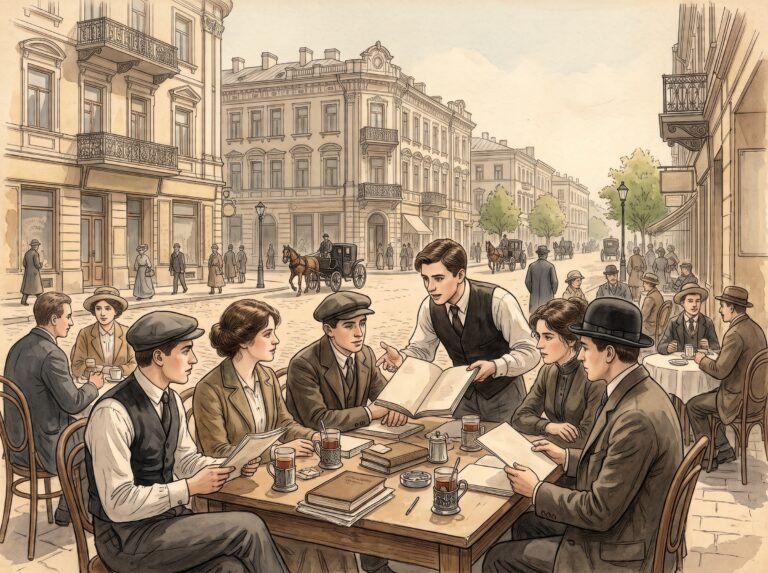
On 11 October 1929, readers of the Yiddish daily Vilner tog opened the paper's special Friday edition to find a page given over to writers most of them had never heard of.…
Reader settings
Colour theme
Colour themes are for light mode. Choosing one switches dark mode off.
Custom colourscolour wheel; text is kept readable
Preview: clear, readable long-form writing.
Saved in this browser only.
Every long read, newest first. Filter by topic, sort, and switch between grid and list.
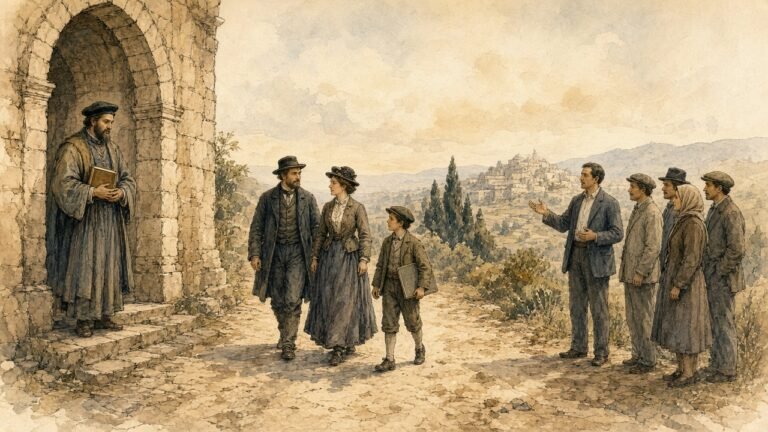
On 11 October 1929, readers of the Yiddish daily Vilner tog opened the paper's special Friday edition to find a page given over to writers most of them had never heard of.…
In May 1916 one of the largest funeral processions New York had seen wound south from a modest apartment house on Kelly Street in the Bronx. Crowds lined the sidewalks for miles;…
In the years between the two world wars, an unusually large share of the great European paintings that crossed the Atlantic passed through the hands of a single firm. Its head was…
On 8 December 1978 a slight, elderly man stood before the Swedish Academy in Stockholm and delivered the first part of his Nobel lecture in Yiddish, a language that few in the…
In the Odessa of the 1890s, writers who met in the cafés and editorial offices of the city spoke with particular respect of an elderly schoolmaster who directed the Talmud Torah, the…
In the spring of 1915, while the armies of the Russian, German and Austro-Hungarian empires fought across the plains of Poland, the Jewish community of Warsaw buried a sixty-two-year-old official of its…
Jules Pascin belonged to a generation of immigrant artists who made Paris an international centre of modern art without surrendering the experiences they had brought there. Born Julius Mordecai Pincas in Vidin,…
Avrom (Abraham) Sutzkever’s life carried him from a childhood in Siberia to the literary circles of Vilna, through the ghetto and the partisan forests, and eventually to Tel Aviv. Born in Smorgon…
El Lissitzky’s career crossed boundaries that later histories have often kept separate. Born Lazar Markovich Lissitzky in Pochinok, near Smolensk, in 1890, he became an architect, abstract artist, book designer, photographer and…
Chaïm Soutine’s paintings give an extraordinary physical force to subjects that remain recognisable: a hillside town, a young pastry cook, a bird laid out on a table. Born in Smilovichi in the…
Marc Chagall was born Moyshe Shagal in Vitebsk, in the north-eastern Pale of Settlement of the Russian Empire, on 7 July 1887 according to the Gregorian calendar then used in western Europe,…
Chișinău, known for much of the modern period as Kishinev, stands on low hills above the Bâc, a modest tributary that joins the Dniester farther east. The city that grew here has…
The Lower East Side of Manhattan occupies a low, crowded stretch of ground between the Bowery and the East River, bounded loosely to the south by the approaches to the Brooklyn and…
Kraków grew from a fortified limestone hill above a bend of the Vistula into the royal capital of Poland, a Magdeburg trading city, a Jagiellonian centre of Renaissance learning, a town of…
Chernivtsi stands on the Prut river in the foothills of the Carpathians, a city that has been known in successive centuries as a Moldavian county seat, as Habsburg Czernowitz, as Romanian Cernăuți,…
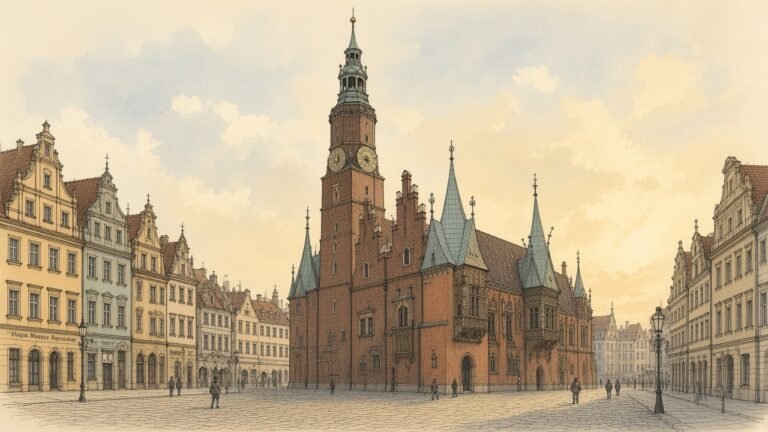
Wrocław stands where the Oder divides into channels and islands, a city whose stone, brick and bridges have carried the names of several states. Known in German as Breslau for much of…
Lviv stands among the hills of western Ukraine with a market square whose parcels were drawn in the Middle Ages and a skyline that still carries the towers of several faiths. The…
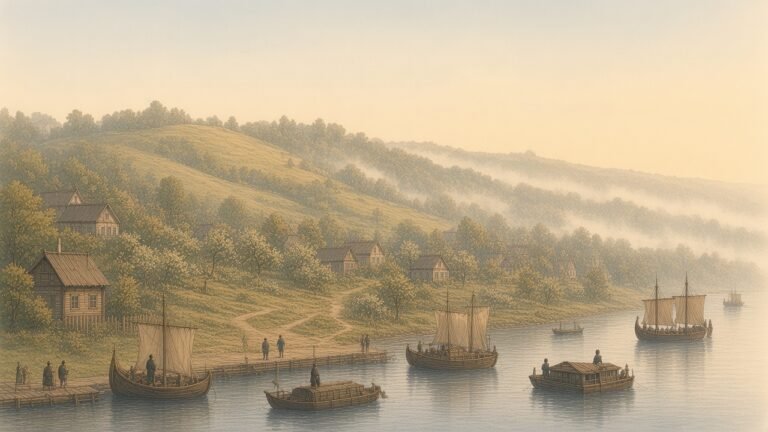
Kyiv stands on the high western banks of the Dnieper, a city whose hills and ravines have shaped settlement for more than a millennium and a half. From its earliest recorded centuries…
For most of the past two thousand years, Jews prayed, studied and wrote in Hebrew while speaking other languages at home and in the marketplace. Hebrew was not forgotten. It was taught…
The duchy of Burgundy was for more than a thousand years a shifting idea as much as a fixed territory. The name passed from an East Germanic people who settled in the…
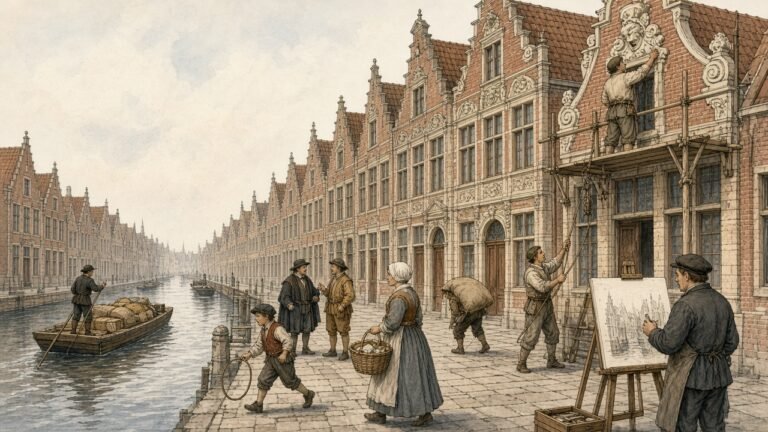
For roughly eight decades in the seventeenth century, a small federation of provinces on the North Sea coast became the most commercially advanced society in Europe. The Dutch Golden Age is the…
The stepped gable, in which the end wall of a pitched roof rises in a series of rectangular steps rather than following the slope of the roof, is one of the most…
For roughly three centuries, from the late twelfth century to the end of the fifteenth, the trade of northern Europe was dominated by an association of German merchants and the towns from…
The Rosetta Stone is a fragment of a granite-like stone slab inscribed in 196 BC with a decree issued by a council of Egyptian priests in honour of the king Ptolemy V.…