A Dealer in Old Masters
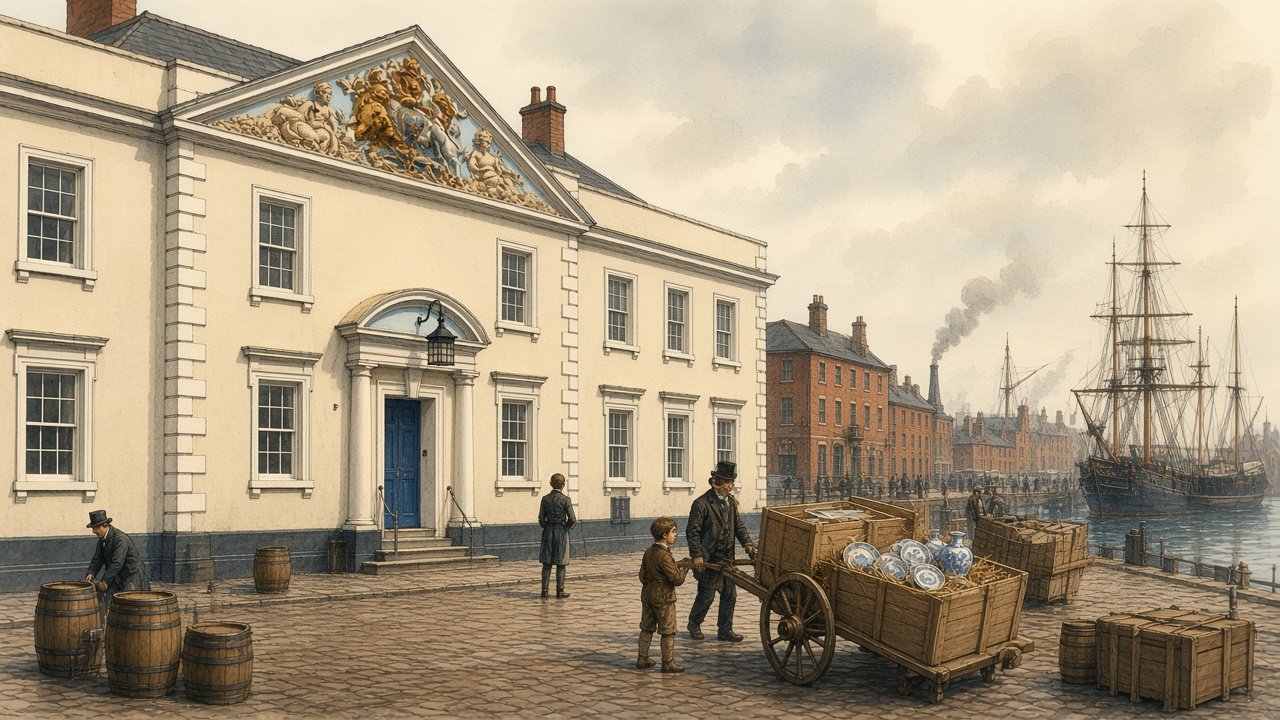
In the years between the two world wars, an unusually large share of the great European paintings that crossed the Atlantic passed through the hands of a single firm. Its head was Joseph Duveen, born in the port of Hull in 1869 to a Dutch Jewish importer of porcelain. Duveen sold Gainsboroughs to railway magnates, Renaissance masters to steel and banking families, and whole collections to men who later gave them to the public. At his death in 1939 he was Lord Duveen of Millbank, a benefactor of the principal museums of London and the best-known art dealer of his age. [1][2]
This special feature follows Duveen from the family business in Hull and its expansion to London and New York, through his apprenticeship under his father and uncle, the great collection purchases of the early twentieth century and the building on Fifth Avenue. It examines his methods as a dealer, his partnership with the connoisseur Bernard Berenson, his relations with Frick, Huntington, Mellon and other collectors, his constant Atlantic crossings and the controversies that surrounded him. It closes with his gifts to British institutions, including the gallery at the British Museum built to house the sculptures of the Parthenon, and with his legacy. An interactive timeline at the end of the essay gathers the principal dates.
1. A porcelain business in Hull
Joseph Duveen was born in Hull on 14 October 1869, the eldest son of Joel Joseph Duveen and his wife Rosetta, née Barnett. His father had been born in the Netherlands, in the town of Meppel, into a Jewish family of traders, and had come to England in the 1860s. Hull was then one of the busiest ports in Britain, with regular sailings to the Netherlands, Germany and the Baltic, and its trade made it a natural base for a young merchant with family connections across the North Sea. [1][3][2]
Joel Duveen at first dealt in a variety of goods, but he soon specialised in the import of Dutch Delftware and Chinese blue-and-white porcelain, for which there was a growing demand in Victorian Britain. The fashion for blue-and-white, encouraged by artists and decorators of the aesthetic movement, made such porcelain a desirable ornament in middle-class and aristocratic houses, and Joel Duveen proved adept at finding it in Dutch farmhouses and shops and selling it to English buyers. [2][4]
The business grew rapidly. Joel was joined by his younger brother Henry, and the firm that became Duveen Brothers extended its trade from porcelain to tapestries, furniture and other decorative arts. In 1876 the family opened premises in London, and soon afterwards Henry Duveen went to the United States, where he established a branch in New York. The firm’s American trade, which supplied the decoration of the great houses being built by the newly rich families of the Gilded Age, became its most profitable activity. [2][5]
Joseph grew up in a large family. His parents had numerous children, and several of his brothers later joined the business. He was educated in England and entered the firm as a young man, learning the trade under his father in London and his uncle in New York. Accounts of his youth emphasise his energy, his self-confidence and his early talent for salesmanship. [2][1]
Hull’s Jewish community had grown during the nineteenth century with the arrival of merchants and later of migrants from eastern Europe, many of whom passed through the port on their way from the Baltic to Liverpool and America. The town had synagogues, a Jewish school and charitable institutions, and its Jewish merchants were active in the timber, grain and shipping trades. The Duveen family belonged to the established, anglicised part of this community. [3][2]
The old town of Hull, with its Georgian merchants’ houses, its quays and its docks, formed the setting of Joseph’s early childhood. The port’s trade with the Netherlands was especially close, and the ships that crossed the North Sea brought the cases of Delftware and Chinese porcelain on which the family’s business was founded. In later life Duveen spoke little of Hull, but his origins in a merchant port shaped his outlook as a man of trade between nations. [3][4]
The firm’s origins in the decorative arts shaped its later character. Duveen Brothers sold not only objects but settings, furnishing rooms with tapestries, panelling, furniture and porcelain in coherent historical styles, and it treated the house of a collector as a single ensemble. When the firm later turned to Old Master paintings, it continued to think of pictures as part of the decoration of grand interiors, a habit that influenced the way its clients bought and displayed art. [4][5]
2. London, New York and the family firm
By the 1890s Duveen Brothers had become one of the leading firms of decorators and dealers in London and New York. Its clients included members of the British aristocracy and the American plutocracy, and it was known for the quality of its tapestries and French eighteenth-century furniture. The firm’s two heads, Joel in London and Henry in New York, complemented each other, the one a skilled buyer and the other a persuasive seller to American clients. [2][5]
Joseph worked in both cities. He developed a close relationship with his uncle Henry, whose understanding of American taste and American money impressed him deeply, and he learned to cultivate wealthy clients through personal attention, flattery and an air of exclusivity. He also learned from his father the importance of buying the best available objects, regardless of price, and of holding them until the right buyer could be found. [2][4]
In 1899 Joseph married Elsie Salamon, the daughter of a New York family. The couple had one child, a daughter, Dorothy, born in 1903. Duveen’s family life was conducted largely in hotels and on ships, as he moved between London, Paris and New York according to the rhythm of the art market and the movements of his clients. [2][1]
The firm’s American trade grew with the rise of the Gilded Age mansion. Families such as the Vanderbilts, Goulds and Whitneys built houses in New York and Newport in the styles of French and Italian palaces, and they needed tapestries, panelling and furniture to fill them. Henry Duveen supplied many of these houses, and his knowledge of their owners gave the firm a foothold among the richest families in the country. [6][2]
Within the firm, Joseph gradually assumed a leading role. He was eager to move the business beyond decorative arts into the market for Old Master paintings, which he regarded as the highest form of art and the most prestigious field of dealing. His father and uncle were at first cautious, but the opportunities created by the sale of European collections and the wealth of American buyers soon persuaded them. [4][2]
3. The great collection purchases
In the first decade of the twentieth century, Duveen Brothers made a series of purchases that established the firm as a major force in the market for Old Masters. In 1906 the firm bought the collection of the Berlin banker Oscar Hainauer, which was rich in Italian Renaissance sculpture, paintings and decorative arts. The following year it acquired the collection of Rodolphe Kann, a Paris banker who had assembled one of the finest private collections of Dutch and Flemish paintings in Europe, including a large group of works attributed to Rembrandt. [2][7]
The Kann purchase was one of the largest single transactions in the history of the art market up to that time. The price was reported to be several million dollars, and the firm borrowed heavily to finance it. Duveen Brothers then sold the paintings individually to American collectors over the following years, recovering the cost many times over. The transaction demonstrated a method that Joseph would use throughout his career, buying entire collections in order to obtain the best works and selling the rest gradually. [2][4]
These purchases reflected the changing circumstances of European collecting. Agricultural depression, inheritance taxes and the expenses of maintaining great houses had placed many aristocratic and banking families under financial pressure, and the dispersal of collections that had been built up over centuries provided dealers with an unprecedented supply of masterpieces. Earlier sales, such as that of Hamilton Palace in Scotland in 1882, had shown the scale of what was available. [8][2]
At the same time, the fortunes created by American industry and finance gave a small number of collectors the means to buy on a scale that European buyers could not match. Men such as J. P. Morgan, Henry Clay Frick, Benjamin Altman and Henry E. Huntington were eager to acquire the finest works of European art, and they were willing to pay prices that astonished contemporaries. [9][10][11]
The Kann collection also included works by Dutch masters such as Frans Hals and Vermeer’s contemporaries, Flemish paintings, French eighteenth-century pictures and decorative arts. Duveen kept some of the finest works for years, offering them only to clients he considered worthy of them, and the gradual release of the collection onto the market gave the firm a reputation for possessing an inexhaustible store of masterpieces. [7][2]
Duveen positioned himself between these two worlds. A remark attributed to him by his biographer S. N. Behrman summarised the situation in the observation that Europe had a great deal of art and America had a great deal of money. Whether or not he phrased it in exactly those words, the idea expressed the basis of his business for more than three decades. [4]
4. The customs case
In 1910 Duveen Brothers became the subject of a major investigation by the United States customs authorities. The firm was accused of systematically undervaluing the works of art it imported into the country in order to reduce the duties payable on them, and federal agents seized documents from its offices in New York. The investigation revealed that the firm had kept two sets of invoices, one recording the true prices and another presented to customs officials. [2][4]
The case ended in 1911 with a settlement in which the firm paid a sum of well over a million dollars in duties and penalties, one of the largest customs settlements of the period. Henry Duveen, who had been in charge of the New York branch, pleaded guilty and paid a personal fine. The episode was widely reported in the press and damaged the firm’s reputation for a time. [2][5]
The customs case coincided with a change in American law. The Payne-Aldrich Tariff Act of 1909 had removed the duties on works of art more than twenty years old, a change for which J. P. Morgan and other collectors had campaigned, and after its passage the incentive for undervaluation disappeared. The free entry of Old Masters into the United States contributed greatly to the growth of the American market in the following decades. [9][2]
The episode taught Joseph Duveen lessons that he applied for the rest of his career. He took greater care with the legal side of his business, cultivated relations with officials and politicians, and became a generous donor to public causes in both America and Britain. His later reputation as a benefactor owed something to the desire to overcome the damage done by the customs case. [2][4]
Joel Duveen had died in 1908, before the case was concluded, and leadership of the firm passed increasingly to Joseph. After the settlement he set out to restore its standing, and he did so with remarkable speed. Within a few years Duveen Brothers had become the most prestigious dealer in Old Masters in America. [1][2]
5. The building on Fifth Avenue
In 1912 Duveen Brothers moved its New York gallery to a new building at 720 Fifth Avenue, at the corner of 56th Street. The building was designed by the French architect René Sergent, who also designed houses for wealthy clients in Paris and Buenos Aires, and its facade was modelled on the eighteenth-century buildings designed by Ange-Jacques Gabriel on the Place de la Concorde in Paris. It was built of pale limestone and stood out among the brownstones and mansions of upper Fifth Avenue. [6][12][13]
The building was conceived as a palace rather than a shop. Its interior contained a series of panelled rooms in which works of art were displayed in settings that suggested a private house, and visitors were received by appointment. Duveen kept many of his finest paintings out of sight, in storerooms or private rooms, showing them only to selected clients at carefully chosen moments. The effect was to create an atmosphere of exclusivity in which the purchase of a painting became a privilege. [4][5]
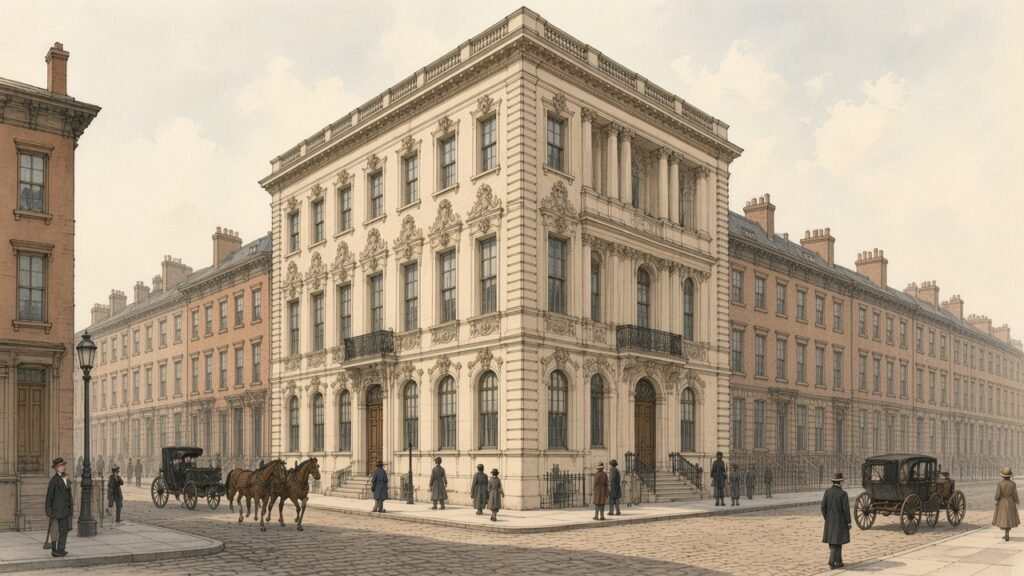
Fifth Avenue in these years was the principal residential street of New York’s wealthiest families. The houses of the Vanderbilts, the Astors and other families lined the avenue, and Henry Clay Frick built his mansion between 70th and 71st Streets in 1913 and 1914. The location of the Duveen building placed the firm at the centre of the world of its clients, within a short distance of their homes and clubs. [6][10][14]
The building at 720 Fifth Avenue became one of the landmarks of the avenue. Its restrained classical facade, its tall windows and its discreet entrance distinguished it from the commercial buildings that were beginning to appear further south, and it remained the American headquarters of the firm until after Duveen’s death. Visitors described the hush of its interior, the deep carpets and the attentive staff who led them from room to room. [6][5]
The firm also maintained galleries in London and Paris. In Paris its premises were in the Place Vendôme, and in London the firm’s principal premises were in the West End, where Joseph established a gallery in Old Bond Street that served as the base of his European operations. The three galleries allowed Duveen to buy in Europe, sell in America and move works of art between the cities according to the demands of the market. [2][15]
6. The art of the sale
Duveen’s methods as a dealer became legendary. He studied his clients closely, learning their tastes, ambitions and anxieties, and he presented works of art to them as opportunities that might never recur. He was known for his theatrical sense of timing, revealing a painting only after a long preparation, and for his insistence that the best was worth any price. [4][2]
He also cultivated the families of his clients, their architects, their secretaries and their servants, and he was reputed to have paid informants for information about the movements and intentions of collectors. When a client was building a house or planning a gallery, Duveen offered to assist with the design and furnishing, and he sometimes arranged the installation of works of art himself. [4][5]
Duveen’s prices were very high, and he made a virtue of the fact. He believed that wealthy collectors valued objects partly according to their cost, and that a high price conferred distinction on both the object and its owner. He also offered to buy back works he had sold, which reassured clients about the value of their purchases and allowed him to resell them later. [4][2]
One of Duveen’s techniques was to encourage collectors to think of their collections as monuments to themselves. He spoke to them of posterity and of the museums that might one day bear their names, and he presented the acquisition of masterpieces as a form of public service as well as private pleasure. Many of his clients did eventually give their collections to the public, and the idea of the collection as a legacy became central to American philanthropy in the arts. [4][16]
His contemporaries were divided in their opinion of him. Some regarded him as a showman who exploited the vanity of rich men, others as a man of genuine taste and judgement who had brought great works of art to America. Both views contained some truth, and Duveen himself seems to have seen no contradiction between his love of art and his skill at selling it. [2][17]
7. Berenson and the attributions
The market for Italian Renaissance paintings depended heavily on questions of attribution. Many works had been altered, repainted or wrongly attributed over the centuries, and buyers who paid large sums wished to be assured that a picture was the work of the master whose name it bore. The leading authority on Italian painting in the early twentieth century was Bernard Berenson, an American scholar of Lithuanian Jewish origin who lived at the Villa I Tatti near Florence and whose lists of authentic works by Italian painters had become standard references. [18][19]
In 1912 Duveen Brothers entered into a secret agreement with Berenson, under which the scholar provided expert opinions on Italian paintings handled by the firm in return for a share of the profits from their sale. The arrangement, which lasted for more than two decades, made Berenson wealthy and gave Duveen access to the most authoritative opinions in the field. Its existence was not publicly known during the lifetime of either man. [20][19]
Historians have debated the extent to which the agreement compromised Berenson’s scholarly independence. Colin Simpson, in a book published in 1986, argued that Berenson’s attributions were influenced by his financial interest, while other scholars have concluded that the evidence is mixed and that Berenson resisted pressure from Duveen on a number of occasions. The arrangement nonetheless illustrates the close relationship between scholarship and commerce in the art market of the period. [20][19][2]
The relationship between the two men was personal as well as commercial. Berenson depended on Duveen’s payments for the upkeep of I Tatti, his library and his household, and Duveen depended on Berenson’s authority for the sale of Italian pictures. Their correspondence, preserved in the firm’s records and in Berenson’s archive, reveals periods of mutual dependence, irritation and occasional affection. [19][20]
The partnership ended in 1937 over a painting of the Nativity from the collection of Lord Allendale. Duveen wished to sell it as a work by Giorgione, whose rare paintings commanded extraordinary prices, while Berenson insisted that it was an early work by Titian. Duveen sold the picture to the collector Samuel H. Kress as a Giorgione, and the disagreement led to the end of their association. The painting, known as the Allendale Nativity, is now in the National Gallery of Art in Washington, where it is catalogued as a work of Giorgione. [18][21][16]
8. Frick, Morgan and the first great clients
Among Duveen’s most important early clients was Henry Clay Frick, the Pittsburgh coke and steel magnate, who moved to New York and began to build a collection of European paintings for his new house on Fifth Avenue. Frick bought from several dealers, but Duveen became one of his principal suppliers in the years before his death in 1919. [10][14]
One of the most celebrated transactions between them involved the series of panels painted by Jean-Honoré Fragonard for Madame du Barry, known as The Progress of Love. The panels had been acquired by J. P. Morgan, and after Morgan’s death in 1913 Duveen bought them from his estate and sold them to Frick in 1915. Frick installed them in a room of his house designed for the purpose, where they remain as part of the Frick Collection. [9][14][2]
J. P. Morgan himself had been one of the greatest collectors of the age, buying paintings, sculpture, manuscripts, porcelain and decorative arts on a vast scale. Duveen Brothers sold him many objects, particularly in the field of decorative arts, and the dispersal of parts of his collection after his death provided further opportunities for the firm. [9][22]
Frick’s purchases through Duveen included works by Gainsborough, Reynolds, Romney and Hogarth as well as French and Italian paintings and decorative arts. After his death in 1919 his house and collection were left to become a public museum, which opened in 1935, and the purchases made through Duveen remain an important part of its displays. [14][10]
Benjamin Altman, the founder of a New York department store, was another important client. He bought Dutch and Italian paintings, Chinese porcelain and other works from Duveen Brothers, and on his death in 1913 he bequeathed his collection to the Metropolitan Museum of Art. Many of the Rembrandts that the firm had acquired with the Kann collection passed through Altman’s hands to the museum. [22][7][2]
9. The Blue Boy
The transaction that made Duveen famous with the general public was the sale of Thomas Gainsborough’s The Blue Boy to Henry E. Huntington in 1921. The painting, a full-length portrait of a youth in a blue satin costume, had been in the collection of the Dukes of Westminster since the nineteenth century, and it was regarded as one of the most celebrated works of English art. [23][24]
Duveen bought the painting from the Duke of Westminster together with other works, and sold it to Huntington and his wife Arabella for a price widely reported at the time as the highest ever paid for a painting. The sale caused a public outcry in Britain, where many regarded the loss of the picture as a national misfortune. Before it left the country, the painting was exhibited at the National Gallery in London, where it was visited by tens of thousands of people in the final weeks before its departure. [23][25][2]
Huntington, who had made his fortune in railways and real estate in California, was assembling a collection of British eighteenth-century portraits for his house at San Marino, near Pasadena. He bought many of them through Duveen, who encouraged his interest in the grand manner portraiture of Gainsborough, Reynolds, Romney and Lawrence. The house and collection later became the Huntington Library, Art Museum and Botanical Gardens. [11][26]
The painting’s departure from Britain became a symbol of the drain of national treasures to America. Newspapers printed cartoons and editorials lamenting its loss, and the episode contributed to the growth of public concern about the export of works of art. Later measures to control the export of important cultural objects from Britain were in part a response to the sales of the 1920s. [23][25]
The sale of The Blue Boy illustrated Duveen’s ability to turn the purchase of a painting into a public event. The press followed the negotiations closely, and the price became a matter of popular fascination. Duveen himself was happy to encourage the publicity, which enhanced the reputation of both the painting and its new owner. [4][23]
10. Pinkie and the British portrait
In 1927 Duveen sold to Huntington another celebrated British portrait, Thomas Lawrence’s Pinkie, a full-length painting of a young girl in a white dress against a stormy sky. The painting, which depicts Sarah Barrett Moulton, had been exhibited at the Royal Academy in 1795, and it was bought at auction in London by Duveen before being sold to Huntington. Pinkie and The Blue Boy now hang facing each other in the Huntington’s main gallery. [27][28][26]
The trade in British eighteenth-century portraits was one of the most profitable fields of Duveen’s business in the 1910s and 1920s. American collectors admired these paintings for their elegance and their association with the British aristocracy, and they paid prices for them that rivalled those for Italian Renaissance masters. Duveen did much to create and sustain this market, buying portraits from British country houses and selling them to American clients. [24][2]
The taste for these portraits has been interpreted as an expression of the aspirations of American wealth in the Gilded Age and after. By acquiring images of English lords and ladies, American collectors placed themselves in a tradition of aristocratic patronage and furnished their houses with the trappings of an established elite. Duveen understood this aspiration and appealed to it skilfully. [4][29]
11. The London house
While New York became the centre of the firm’s sales, London remained the source of much of its stock and the seat of its standing in Britain. The firm’s London gallery stood in the West End, in the district around Bond Street where the leading dealers in paintings, furniture and works of art had their premises. It was close to the auction rooms of Christie’s in King Street and Sotheby’s in New Bond Street, and the dealers of the quarter met constantly in the salerooms and in each other’s galleries. [15][2]
The London trade of the early twentieth century was shaped by the financial position of the British landed families. The agricultural depression of the late nineteenth century had reduced the income of many estates, and the introduction and later increase of death duties placed further pressure on their owners. Many families possessed collections of portraits, Old Master paintings and furniture assembled over generations, and the sale of a single picture could relieve the debts of an estate. [29][23]
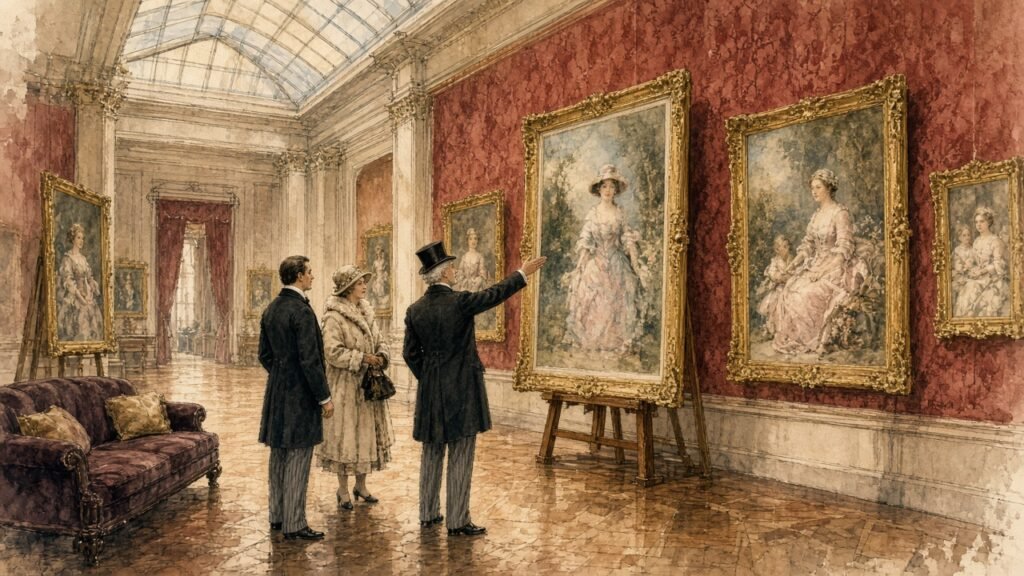
Duveen became a frequent visitor to the country houses of England, where he examined collections and negotiated with owners. He was known for offering prices that exceeded those of his competitors, and for his willingness to buy whole groups of works rather than single pieces. The historian David Cannadine has described the sale of art by the British aristocracy in this period as part of a wider decline in the wealth and power of the landed class, and Duveen was one of the principal agents of that transfer. [29]
The London gallery was also the base from which Duveen cultivated his position in British public life. He entertained politicians, museum officials and members of the aristocracy, and he took an increasing interest in the national collections, whose limited purchase funds he contrasted with the resources of the American museums. His later gifts to the Tate, the National Gallery, the National Portrait Gallery and the British Museum grew out of these connections. [30][2]
The relationship between the London and New York branches was close. Works bought in Britain and on the Continent were shipped to New York for sale, and the partners and staff of the firm crossed the Atlantic regularly. The firm’s Paris gallery, which handled French decorative art and served as a base for purchases on the Continent, completed a network of three cities through which the firm’s stock moved. [5][2]
12. Life on the Atlantic liners
For most of his career Duveen lived between continents. He crossed the Atlantic several times each year, usually travelling on the great express liners of the Cunard and White Star lines, such as the Aquitania, the Mauretania and the Olympic. The ships were floating hotels, with dining saloons, lounges and suites that rivalled the best hotels of London and New York, and they carried a large share of the wealthy travellers who moved between Europe and America. [31][32][33][34]
For Duveen the crossings were an integral part of his business. His clients also travelled on these ships, and the voyage of five or six days provided opportunities for meetings and conversations that might lead to sales. He was said to study the passenger lists in advance in order to book his passage on the same ship as a collector he wished to meet, and to arrange his table and his deck chair accordingly. [4][2]
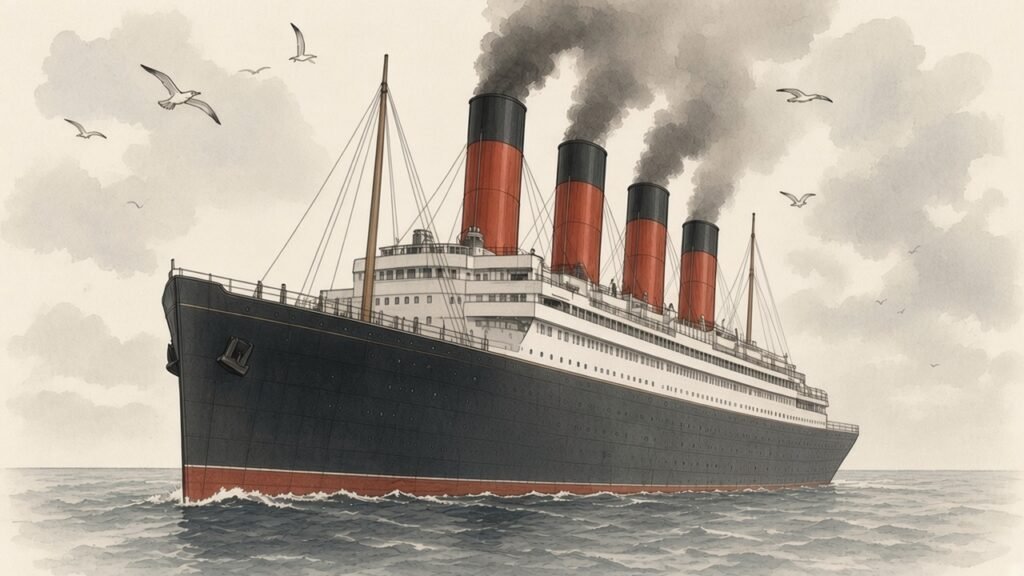
The liners also carried the works of art themselves. Paintings, sculptures and tapestries were packed in crates and shipped in the holds of the passenger liners or on cargo vessels, insured for large sums, and their arrival in New York was sometimes reported in the press. The movement of so many masterpieces across the ocean in these years constituted one of the largest transfers of works of art in history. [2][5]
On board, Duveen maintained the style he kept on land. He travelled with secretaries and assistants, received visitors in his suite and conducted correspondence by wireless telegraph. Fellow passengers recalled seeing him in the lounges and on the promenade decks, deep in conversation with collectors, bankers and their families. [4][31]
The rhythm of Duveen’s life was shaped by the seasons of the market. He usually spent the spring and summer in Europe, buying at auctions and from private owners, and the autumn and winter in New York, selling to American clients. His office in New York and his suite at Claridge’s in London were the fixed points of a life that was otherwise constantly in motion. [35][2]
13. The war and the honours
The First World War interrupted the European art market and made Atlantic crossings dangerous. Duveen continued to do business, but the war reduced the supply of works from Europe and the movement of works across the ocean. In New York, however, the wealth of American collectors continued to grow, and the war years saw several major sales. [2][14]
Henry Duveen, Joseph’s uncle and the head of the New York branch for many years, died in 1919. His death left Joseph as the undisputed head of Duveen Brothers. In the same year Joseph was made a knight in recognition of his gifts to British institutions, and he began to devote an increasing part of his fortune to benefactions in Britain. [1][2]
His father had already established the tradition. Joel Duveen, who was knighted in 1908, had paid for the extension of the Tate Gallery to house the paintings bequeathed to the nation by J. M. W. Turner, and the Turner wing opened in 1910. Joseph continued and expanded this tradition, making gifts to the Tate, the National Gallery, the National Portrait Gallery and the British Museum over the following two decades. [36][1]
The war also brought changes to the firm’s European operations. The Paris gallery was affected by the disruption of the war years, and the movement of works of art between Britain, France and America became subject to wartime restrictions. Duveen spent much of the war in New York, where the market remained active. [2][5]
In 1927 Duveen was created a baronet, and in 1933 he was raised to the peerage as Baron Duveen, of Millbank in the City of Westminster. The title referred to the site of the Tate Gallery on Millbank, overlooking the Thames, and it recalled the family’s long association with that institution. [37][36][1]
14. The Belle Ferronnière case
In 1920 Duveen became involved in one of the most famous legal disputes in the history of the art market. A Kansas City couple, Harry and Andrée Hahn, owned a painting of a woman that they believed to be by Leonardo da Vinci, a version of the portrait in the Louvre known as La Belle Ferronnière. When a newspaper asked Duveen for his opinion, he declared without having seen it that the Hahn picture was a copy and that the Louvre painting was the original. [38][39]
The Hahns sued Duveen for slander of title, claiming that his statement had destroyed the value of their painting and prevented its sale. The case took years to come to trial. In preparation, Duveen arranged for the two paintings to be compared in Paris in 1923 by a panel of experts, including Berenson, most of whom concluded that the Louvre picture was the original. [38][18][2]
The trial took place in New York in 1929. The jury was unable to reach a verdict, and before a second trial could be held, Duveen settled the case by paying the Hahns a substantial sum. The case attracted great public interest and raised questions about the authority of experts, the role of dealers in judging the authenticity of works of art and the reliability of connoisseurship. [38][2]
The trial exposed the methods of connoisseurship to public scrutiny. Experts testified about the style, technique and condition of the paintings, and the lawyers for the Hahns cross-examined them on the basis of their judgements. The spectacle of eminent scholars disagreeing in court did little to reassure the public about the reliability of expert opinion. [38][18]
For Duveen the case was a reminder of the risks of public statements about works of art in the possession of others. In later years he was more cautious in giving opinions on paintings that were not offered to the firm, although he continued to speak with great confidence about those he sold. The Hahn affair remained one of the best-known episodes of his career and was frequently recalled in accounts of his life. [38][2]
The question of the Hahn painting’s attribution was never conclusively resolved during Duveen’s lifetime. Technical analysis carried out in later decades indicated that it was a later copy, and the painting was sold at auction in 2010 as a work of a follower of Leonardo. [38][39]
15. Andrew Mellon and the National Gallery of Art
The most important client of Duveen’s later career was Andrew Mellon, the Pittsburgh banker and industrialist who served as Secretary of the Treasury of the United States from 1921 to 1932. Mellon had collected paintings for many years, buying from several dealers, and in the 1920s he began to plan a national gallery of art in Washington that would rival the great museums of Europe. [40][29]
In 1930 and 1931 Mellon bought, through a group of dealers, twenty-one paintings from the Hermitage Museum in Leningrad, which the Soviet government was selling secretly to raise foreign currency. The purchases included works by Raphael, Titian, Rembrandt and Jan van Eyck, and they formed the core of what became the National Gallery of Art. Duveen was not the principal agent in these purchases, but he became Mellon’s main supplier in the following years. [29][41][16]
In 1936 Duveen sold Mellon a group of forty-two paintings and a large number of sculptures for a total price of about twenty-one million dollars, one of the largest transactions in the history of the art market. Duveen had furnished an apartment in Washington, in the building where Mellon lived, with the works on display, and Mellon was able to study them at leisure before committing himself to the purchase. The story became one of the best known in Behrman’s account of Duveen’s career. [4][29][40]
In 1937 Mellon gave his collection and funds for the construction of a building to the American people, and the National Gallery of Art was established by an act of Congress. The building, designed by John Russell Pope, the architect of the Duveen Gallery at the British Museum, opened in 1941, after the deaths of both Mellon and Duveen. Many of its most important early paintings and sculptures had passed through Duveen’s hands. [16][42][29]
The building of the National Gallery of Art on the Mall in Washington, with its long galleries and its marble rotunda, reflected the classical taste that Duveen shared with Mellon and Pope. The gallery’s early collection included paintings by Raphael, Titian, Rembrandt and Vermeer, and several of its most celebrated works had been acquired by Mellon through Duveen in the last years of his life. [16][42]
Mellon’s relations with Duveen were also the subject of public scrutiny. In 1935 Mellon was tried before the Board of Tax Appeals on charges brought by the administration of President Franklin D. Roosevelt that he had underpaid his income tax, and Duveen gave evidence about the paintings he had sold to Mellon and their intended gift to the nation. Mellon was cleared of fraud after his death. [29][40]
16. Kress and the later collectors
Samuel H. Kress, the founder of a chain of variety stores, was another major client in the 1930s. Kress collected Italian paintings and sculpture on a large scale, and he bought many works from Duveen, including the Allendale Nativity. His collection was later distributed among museums across the United States by the Samuel H. Kress Foundation, and many works went to the National Gallery of Art. [16][2]
Other clients included the banker Jules Bache, whose collection went to the Metropolitan Museum of Art, and members of the Widener, Rockefeller and Mellon families. Duveen also sold to a number of European collectors, although his American business was always the larger. [22][2]
By the 1930s Duveen had become a public figure in America, known for his extravagant style of living, his wit and his lavish entertaining. He gave large sums to American institutions as well as British ones and was a familiar presence in the society pages of the New York press. His gallery on Fifth Avenue was a place where collectors, museum directors and scholars met. [4][6]
17. Depression and the market
The Wall Street crash of October 1929 and the economic depression that followed had a severe effect on the art market. Many collectors lost their fortunes or saw them greatly reduced, and the demand for expensive works of art fell sharply. Several dealers went out of business, and prices for many categories of art declined. [43][44]
Duveen weathered the crisis better than most. His clients included some of the wealthiest men in America, whose fortunes survived the crash, and he continued to make major sales throughout the 1930s, including the sale to Mellon. He also held on to his stock rather than selling it at reduced prices, maintaining the high prices for which his firm was known. [2][29]
The depression nonetheless changed the conditions of collecting. Higher taxes and the decline of great private fortunes encouraged collectors to give their collections to museums, and the institutional collections of the United States grew rapidly in the following decades. Duveen’s late clients were often buying with an eye to eventual gifts to the public, and the destination of many of the works he sold was a museum rather than a private house. [16][44]
18. Gifts to the Tate and the portrait gallery
Duveen’s benefactions to British institutions were extensive. At the Tate Gallery he paid for galleries to house modern foreign art and the works of John Singer Sargent, which opened in 1926, and for a long central sculpture gallery that opened in 1937. The sculpture hall, known as the Duveen Galleries, remains one of the principal spaces of Tate Britain and is used for large installations of contemporary art. [30][36]
At the National Portrait Gallery in London he paid for an extension that opened in 1933, providing new rooms for the display of the collection. He also gave paintings and funds to the National Gallery and to other museums and galleries in Britain, and he supported exhibitions of British art abroad. [45][1]
These gifts reflected Duveen’s attachment to Britain, the country of his birth, and his desire to be recognised as a public benefactor. They also served his business, enhancing his prestige and his relations with the museum world. Critics at the time and later noted that the dealer who had taken so many British paintings to America was now giving back buildings to house what remained. [2][4]
The Sargent gallery at the Tate held a large group of paintings and watercolours by John Singer Sargent, many of them given by his family after his death in 1925. Duveen’s funding allowed the collection to be displayed together, and the galleries for modern foreign art provided space for French Impressionist and Post-Impressionist paintings that the Tate had begun to acquire with the support of the industrialist Samuel Courtauld. [36][30]
Duveen took a close interest in the design of the buildings he funded and in the display of the works within them. He favoured grand, classical architecture with marble floors and top lighting, and he expected his name to be prominently associated with the galleries. His involvement in these projects sometimes led to tensions with the directors and trustees of the institutions. [36][2]
19. Trustee of the National Gallery
In 1929 Duveen was appointed a trustee of the National Gallery in London, and he also became a trustee of the Tate. The appointment was controversial, since it placed an active dealer on the board of a public institution that bought works of art, and it raised questions about possible conflicts of interest. [25][1]
The controversy came to a head in the 1930s. Kenneth Clark, who became director of the National Gallery in 1934 at the age of thirty, found Duveen’s presence on the board increasingly difficult, and there were disputes over the purchase of paintings and the influence of the dealer on the gallery’s decisions. In 1936 Duveen was not reappointed as a trustee. [17][25][2]
Clark later wrote about Duveen in his memoirs, describing him as a man of great charm and energy who nonetheless regarded works of art primarily as commodities. The episode illustrated the uneasy relationship between the art trade and public institutions in a period when dealers played a central role in the formation of museum collections. [17][2]
20. A gallery for the Parthenon sculptures
The most ambitious of Duveen’s gifts was a new gallery at the British Museum to house the sculptures from the Parthenon in Athens, which had been removed from the building in the early nineteenth century by agents of Thomas Bruce, seventh Earl of Elgin, and acquired by the museum in 1816. The sculptures, carved in the fifth century BC under the direction of Phidias, include large parts of the frieze, metopes and pediment figures of the temple of Athena on the Acropolis. [46][47][48][49]
Around 1930 Duveen offered to pay for a new gallery that would display the sculptures to better effect than the existing rooms. The design was entrusted to John Russell Pope, the American architect, who produced a long, top-lit hall in a severe classical style, with the frieze displayed at eye level along the walls and the pediment sculptures at either end. The gallery was completed in 1938. [42][50][51]
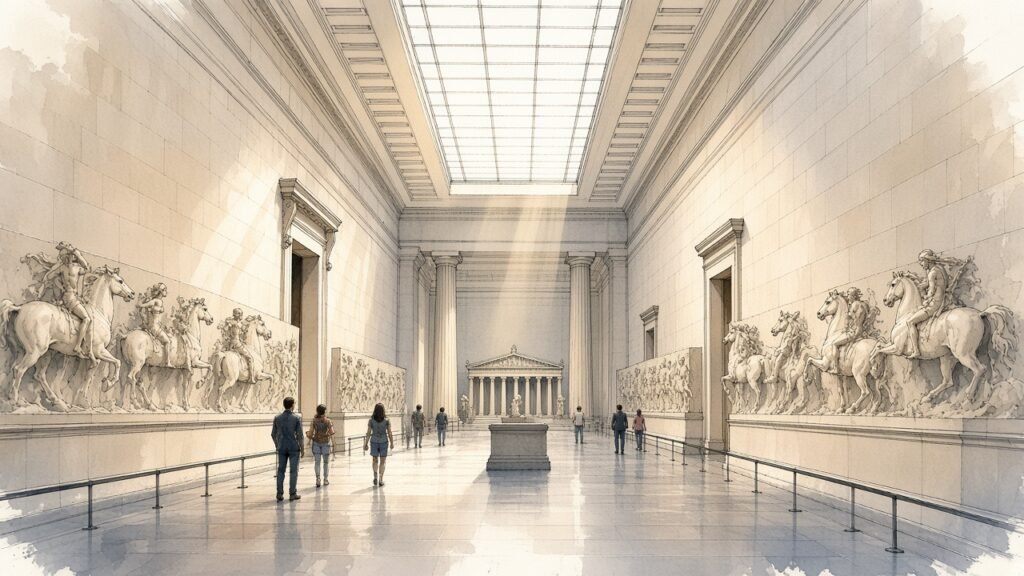
The design was controversial. Some critics admired its grandeur, while others objected that it presented the sculptures in an artificial setting that bore little relation to their original placement high on the exterior of the temple. The gallery’s proportions and its pale stone walls created an effect of monumental calm that has been both praised and criticised in the decades since. [50][52]
Pope’s design reflected his experience of large classical buildings in America, and its scale far exceeded that of the earlier rooms in which the sculptures had been shown. The frieze was mounted on the inner walls so that visitors could walk along it as along the procession it depicts, and the metopes were set high above it. The arrangement was intended to give the visitor a sense of the whole programme of the temple’s decoration. [42][48]
The Second World War delayed the opening. The sculptures were removed for safekeeping in 1939, and the gallery was damaged by bombing in 1940. After repairs it finally opened to the public in 1962, more than twenty years after Duveen’s death. It has remained the principal display of the Parthenon sculptures in London. [50][46]
21. The cleaning of the marbles
In 1937 and 1938, while the new gallery was being prepared, the Parthenon sculptures were cleaned by workmen in a manner that later caused a scandal. Duveen, who believed that ancient marble should appear white, is reported to have encouraged the workmen to remove the discoloured surface of the stone. The men used copper tools and abrasives to scrape the surfaces of several sculptures, removing the patina and in places part of the original carved surface. [51][46]
The damage was discovered in 1938, and the trustees of the British Museum held an internal inquiry. Several members of staff were disciplined, and the matter was kept largely out of public view at the time, although reports appeared in the press. The museum’s own account of the episode was later published by Ian Jenkins, a curator of Greek and Roman antiquities, in a study of the cleaning of the sculptures between 1811 and 1939. [51][50]
In 1999 the British Museum held an international conference on the cleaning, at which scholars from Britain and Greece discussed the extent of the damage and the history of the treatment of the sculptures. The episode has featured in the long-running debate over whether the sculptures should be returned to Athens, where a new Acropolis Museum opened in 2009 with space designed to display the frieze in its original sequence. [46][48]
The extent of the damage has been debated. Studies carried out after the episode found that the cleaning had removed part of the ancient surface in places, including traces of the original tool marks and of the patina that had formed on the stone over centuries. Other parts of the sculptures were less affected. The episode remains one of the most discussed incidents in the history of museum conservation. [51][52]
Historians have noted that the taste for white marble that motivated the cleaning reflected a long tradition of European neoclassicism, which had admired ancient sculpture as pure white stone, unaware or dismissive of the fact that the sculptures had originally been painted. The cleaning of the Parthenon sculptures thus illustrates the influence of aesthetic assumptions on the care of ancient works of art. [52][51]
22. Illness and death
In the last years of his life Duveen suffered from cancer. He underwent treatment and continued to work, travelling and conducting business with his usual energy, but his health declined steadily. His illness was kept from the public and from many of his clients. [2][1]
Joseph Duveen died in London on 25 May 1939, at Claridge’s hotel, where he had lived for many years when in the city. He was sixty-nine years old. His death was reported on the front pages of newspapers in Britain and America, and tributes were paid by museum directors, collectors and public figures. [35][1]
The peerage died with him, since he had no son. His widow, Elsie, and his daughter, Dorothy, survived him. The firm of Duveen Brothers continued under the direction of his former associates, including Edward Fowles, who had worked with Duveen for many years in Paris and New York, and it remained in business for more than two decades after his death. [5][2]
Obituaries in Britain recalled his gifts to the national collections and his service as a trustee, while those in America emphasised his role in the formation of the great American collections. Many noted the scale of the prices he had paid and received, and the remarkable rise of a family business from Hull to the summit of the international art trade. [1][35]
In 1964 the stock and records of Duveen Brothers were acquired by the American industrialist and collector Norton Simon, and the firm ceased to operate as an independent dealer. Its records are now held by the Getty Research Institute in Los Angeles, where they have become an important resource for the history of collecting. [2]
23. Behrman and the making of a legend
Duveen’s reputation after his death was shaped above all by a single book. In 1951 and 1952 the playwright and writer S. N. Behrman published a series of articles about Duveen in The New Yorker, which were collected in book form under the title Duveen in 1952. The book presented Duveen as a brilliant, flamboyant and unscrupulous showman who had manipulated the richest men in America into buying works of art at enormous prices. [4]
Behrman’s portrait was witty and affectionate, and it contained many anecdotes that have since been repeated in countless accounts of the art market. Some of these stories were exaggerated or apocryphal, and later historians have sought to correct the picture. Nevertheless, Behrman’s book established the image of Duveen as the archetypal art dealer, and it remains widely read. [4][2]
Behrman had known some of the people who appeared in his book, and he drew on interviews with former employees, clients and their families. His narrative concentrated on the relationships between Duveen and his clients, and it gave less attention to the commercial organisation of the firm or to the scholarly questions of attribution. Its success with readers derived partly from its literary qualities, which reflected Behrman’s experience as a writer of comedies for the theatre. [4]
Edward Fowles’s Memories of Duveen Brothers, published in 1976, offered an insider’s account of the firm’s operations, and Colin Simpson’s Artful Partners, published in 1986, used the firm’s archives to examine the relationship between Duveen and Berenson. Meryle Secrest’s biography, Duveen: A Life in Art, published in 2004, drew on a wide range of sources to provide a fuller and more balanced account of his life and career. [5][20][2]
24. Private life and character
Joseph Duveen married Elsie Salamon, the daughter of a New York family, in 1899. The couple had one child, a daughter, Dorothy, who was born in the early years of the twentieth century. Duveen’s family life was conducted largely in the background of his business, and his wife and daughter accompanied him on many of his journeys between Europe and America. [2][1]
Contemporaries described Duveen as a man of great energy, charm and self-confidence. He spoke rapidly and with enthusiasm, and he was known for the extravagance of his compliments and the boldness of his claims. Behrman recorded many anecdotes of his manner with clients, in which flattery, persistence and theatrical gestures played a large part. Other accounts emphasise his capacity for hard work and his close attention to the details of his business. [4][5]
He was the eldest of a large family of brothers and sisters, and several of his brothers worked in the firm at various times. Relations within the family were not always easy, and disputes over the direction of the business and the division of its profits arose on several occasions. Joseph’s dominance of the firm after his father’s death was nonetheless complete, and by the 1920s he was its unquestioned head. [2][5]
Duveen took pride in his public honours. The knighthood of 1919, the baronetcy of 1927 and the peerage of 1933 marked his ascent into the British establishment, and he chose for his title the name of Millbank, the district of London where the Tate Gallery stands. The choice reflected the importance he attached to his role as a benefactor of the national collections. [1][30]
In his later years Duveen spent long periods in hotels, both in London and in New York, and his way of life combined the formality of the Edwardian age with constant travel. His correspondence and the records of the firm show him dealing with business matters almost every day, whether at home, on board ship or in the houses of his clients. The boundary between his private life and his work was never clearly drawn. [2][5]
His generosity extended beyond the museums. He gave money to hospitals and charitable causes in Britain and America, and he supported a number of artistic and educational institutions. These gifts were often publicised, and critics observed that they enhanced his reputation at the same time as they served the public. Supporters regarded them as a sincere expression of his attachment to the countries in which he worked. [2][4]
25. Dealers, scholars and attribution
Duveen’s career coincided with the rise of the modern discipline of art history and with the growth of connoisseurship as a profession. In the late nineteenth century scholars such as Giovanni Morelli had developed methods of attribution based on the close study of details such as the shapes of ears and hands, and Bernard Berenson applied and extended these methods in his lists of Italian painters. The attribution of a painting to a particular master could transform its value. [18][19]
The dependence of the market on expert opinion created tensions that ran through Duveen’s career. Dealers needed attributions to sell paintings at high prices, and scholars who provided them could earn substantial fees. Critics argued that this arrangement compromised the independence of scholarship, and the revelation of Berenson’s agreement with Duveen after both men had died contributed to a lasting debate about the ethics of connoisseurship. [20][19]
Duveen himself had no formal training in art history. His knowledge was practical, acquired through long experience of handling works of art, and he relied on Berenson and other experts for questions of attribution. He was nevertheless an acute judge of quality and condition, and he understood what his clients wished to own. Many accounts describe his insistence on presenting works in the best possible condition, an insistence that sometimes led to extensive restoration. [5][4]
The restoration of paintings sold by the firm has been the subject of later study. Some works were heavily cleaned, retouched or repainted to satisfy the taste of collectors for brilliant and unblemished surfaces, and conservators in later decades have in some cases removed these additions. The approach reflected the standards of the period as well as the commercial interests of the firm. [2][16]
The debate over the relationship between dealers and scholars continues to affect the conduct of art history. Museums and universities have adopted codes of practice intended to separate scholarly judgement from commercial interest, and the history of the Berenson and Duveen partnership is often cited as an example of the problems these codes are designed to address. [19][20]
The museums that received works through Duveen’s clients have since conducted extensive research into their history, including their provenance, condition and attribution. Some attributions made in Duveen’s time have been revised, while others have been confirmed. The records of the firm, now held in public archives, have made it possible to trace the routes by which many works travelled from European collections to American museums. [2][22]
26. The art market after Duveen
The art market changed considerably in the decades after Duveen’s death. The Second World War disrupted the trade between Europe and America, and the postwar period brought new collectors, new tastes and new forms of selling. The great private collections of Old Masters that Duveen had helped to form had largely passed into museums, and the supply of major works from European private collections diminished as governments introduced controls on the export of cultural property. [2][25]
In the postwar decades, the auction houses gained a larger share of the market for important works of art. Sales of single paintings at public auction began to achieve record prices that attracted wide publicity, and the auction room increasingly replaced the private gallery as the place where the highest values were established. The private dealer continued to play an important role, but the model of the dealer as the sole intermediary between collector and masterpiece became less common. [2][4]
The taste of collectors also shifted. The British portraits of the eighteenth century, which had commanded the highest prices in Duveen’s time, declined in relative value, while Impressionist and modern paintings rose to prominence. [23][2]
The firm of Duveen Brothers itself continued to trade under Edward Fowles until its sale in 1964, but it no longer occupied the position that it had held during Joseph Duveen’s lifetime. Many of its former clients had died, and the remaining stock included works that had proved difficult to sell. The purchase of the firm by Norton Simon brought much of this stock into a private collection that later became a public museum in Pasadena. [5][2]
Duveen’s example nevertheless continued to influence the practices of dealers. The cultivation of wealthy clients, the presentation of works in luxurious surroundings, the emphasis on the prestige of ownership and the alliance between dealers and scholars all remained features of the trade. Writers on the art market have often referred to Duveen as the founder of the modern business of selling art at the highest level. [4][2]
27. Legacy
Joseph Duveen’s significance lies in the role he played in the transfer of European art to America in the first decades of the twentieth century. Through his sales to Frick, Huntington, Mellon, Kress and others, he helped to form collections that are now among the most important public holdings of European art in the United States, at the Frick Collection, the Huntington, the National Gallery of Art and the Metropolitan Museum of Art. [14][26][16][22]
His methods transformed the business of art dealing. He demonstrated that works of art could command prices comparable to those of the most valuable commodities, and he created a model of the dealer as an intermediary between the old world and the new, at once a connoisseur, a salesman and a friend of the powerful. His influence can be seen in the practices of later dealers and auction houses. [4][2]
In Britain, his gifts to the Tate, the National Portrait Gallery and the British Museum left a lasting mark on the institutions of London. The Duveen Galleries at Tate Britain and the Duveen Gallery at the British Museum remain in use, and they continue to bear his name. [30][50]
Duveen’s career also reflects the history of Jewish participation in the art trade of the late nineteenth and early twentieth centuries. Many of the leading dealers of the period came from Jewish merchant families with connections across Europe, and the Duveens, with their origins in the Netherlands and their base in Hull, were part of this world. Joseph’s rise from a porcelain business in a northern port to a seat in the House of Lords was among its most striking stories. [1][2]
The galleries that bear his name in London are themselves a part of his legacy. The sculpture halls at Tate Britain remain the setting for large commissioned installations by contemporary artists, and the Duveen Gallery at the British Museum continues to house the Parthenon sculptures. Visitors to both buildings encounter his name daily, often without knowing the career that lay behind it. [30][50]
His career has also been the subject of continuing debate. Some historians see him as a benefactor who brought great works of art to new audiences, others as a symbol of the commercialisation of art and the dispersal of European heritage. Both views reflect aspects of a career that was, by any measure, one of the most remarkable in the history of the art trade. [2][17]
28. Timeline
Joseph Duveen is born on 14 October in Hull, the eldest son of Joel Joseph Duveen.
The family firm opens premises in London.
Henry Duveen establishes the firm's American business.
Joseph Duveen marries Elsie Salamon.
Duveen Brothers buys the Berlin collection of Oscar Hainauer.
The firm acquires the Paris collection of Rodolphe Kann.
Joseph's father dies, shortly after being knighted.
The firm settles charges of undervaluing imports.
The firm opens its building at 720 Fifth Avenue and makes its secret agreement with Bernard Berenson.
Duveen sells Fragonard's panels to Henry Clay Frick.
Joseph Duveen is knighted, and his uncle Henry dies.
Gainsborough's portrait is sold to Henry E. Huntington.
Galleries for modern foreign art and the Sargent collection open at the Tate.
He is made a baronet, and Lawrence's Pinkie goes to Huntington.
The Belle Ferronnière case ends with a hung jury, followed by a settlement.
He becomes Baron Duveen of Millbank.
He sells Andrew Mellon forty-two paintings and many sculptures.
The sculpture galleries at the Tate open, and his partnership with Berenson ends.
The gallery at the British Museum is completed, and the cleaning scandal is discovered.
Lord Duveen dies at Claridge's in London on 25 May.
The Duveen Gallery at the British Museum opens to the public.
References
- Grokipedia, “Joseph Duveen, 1st Baron Duveen” ↩
- Meryle Secrest, Duveen: A Life in Art (Alfred A. Knopf, 2004) ↩
- Grokipedia, “Kingston upon Hull” ↩
- S. N. Behrman, Duveen (Random House, 1952) ↩
- Edward Fowles, Memories of Duveen Brothers (Times Books, 1976) ↩
- Grokipedia, “Fifth Avenue” ↩
- Grokipedia, “Rembrandt” ↩
- Grokipedia, “Hamilton Palace” ↩
- Grokipedia, “J. P. Morgan” ↩
- Grokipedia, “Henry Clay Frick” ↩
- Grokipedia, “Henry E. Huntington” ↩
- Grokipedia, “Ange-Jacques Gabriel” ↩
- Grokipedia, “Place de la Concorde” ↩
- Grokipedia, “Frick Collection” ↩
- Grokipedia, “Bond Street” ↩
- Grokipedia, “National Gallery of Art” ↩
- Grokipedia, “Kenneth Clark” ↩
- Grokipedia, “Bernard Berenson” ↩
- Rachel Cohen, Bernard Berenson: A Life in the Picture Trade (Yale University Press, 2013) ↩
- Colin Simpson, Artful Partners: Bernard Berenson and Joseph Duveen (Macmillan, 1986) ↩
- Grokipedia, “Titian” ↩
- Grokipedia, “Metropolitan Museum of Art” ↩
- Grokipedia, “The Blue Boy” ↩
- Grokipedia, “Thomas Gainsborough” ↩
- Grokipedia, “National Gallery” ↩
- Grokipedia, “Huntington Library” ↩
- Grokipedia, “Pinkie (painting)” ↩
- Grokipedia, “Thomas Lawrence” ↩
- David Cannadine, Mellon: An American Life (Alfred A. Knopf, 2006) ↩
- Tate, “Duveen Galleries” ↩
- Grokipedia, “RMS Aquitania” ↩
- Grokipedia, “Cunard Line” ↩
- Grokipedia, “White Star Line” ↩
- Grokipedia, “RMS Olympic” ↩
- Grokipedia, “Claridge’s” ↩
- Grokipedia, “Tate Britain” ↩
- Grokipedia, “Millbank” ↩
- Grokipedia, “La Belle Ferronnière” ↩
- Grokipedia, “Leonardo da Vinci” ↩
- Grokipedia, “Andrew Mellon” ↩
- Grokipedia, “Raphael” ↩
- Grokipedia, “John Russell Pope” ↩
- Grokipedia, “Wall Street Crash of 1929” ↩
- Grokipedia, “Great Depression” ↩
- Grokipedia, “National Portrait Gallery, London” ↩
- Grokipedia, “Elgin Marbles” ↩
- Grokipedia, “Thomas Bruce, 7th Earl of Elgin” ↩
- Grokipedia, “Parthenon” ↩
- Grokipedia, “Phidias” ↩
- Grokipedia, “British Museum” ↩
- Ian Jenkins, Cleaning and Controversy: The Parthenon Sculptures 1811 - 1939 (British Museum Occasional Paper 146, 2001) ↩
- Grokipedia, “Ancient Greek sculpture” ↩