From Krochmalna Street
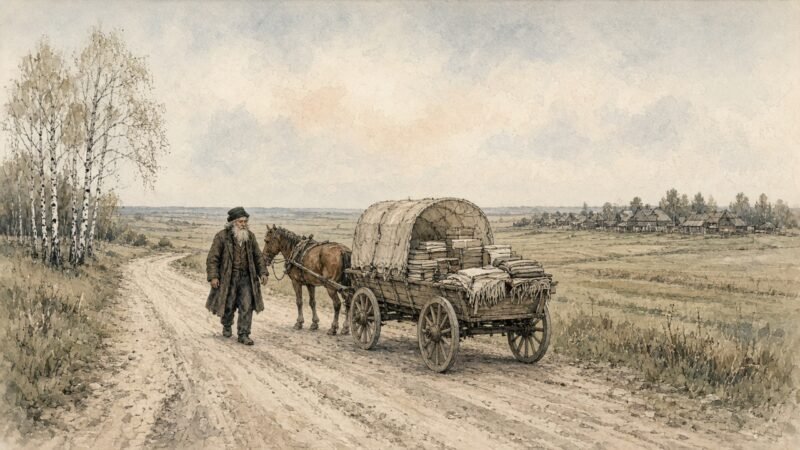
On 8 December 1978 a slight, elderly man stood before the Swedish Academy in Stockholm and delivered the first part of his Nobel lecture in Yiddish, a language that few in the hall could understand. He then continued in English, describing Yiddish as a language of exile, without a land, without frontiers, not supported by any government. The speaker, Isaac Bashevis Singer, had been born in a small Polish village, raised on a crowded Warsaw street and had spent more than forty years in New York writing stories and novels in Yiddish for a readership that the Holocaust had reduced to a remnant. [1][2]
This special feature follows Singer from his childhood in the rabbinical household of Leoncin, Radzymin and Krochmalna Street, through his years in the town of Biłgoraj and his apprenticeship in the literary world of interwar Warsaw, to his emigration to America in 1935. It examines his work for the Yiddish daily Forverts, the novels and stories that made him known in English translation, his writing for children, the honours that culminated in the Nobel Prize, and the films and debates that surrounded his work. It closes with his last years in Florida and his legacy. An interactive timeline at the end of the essay gathers the principal dates.
1. A rabbinical household
Isaac Bashevis Singer was born in Leoncin, a village on the Vistula north-west of Warsaw, in the Russian-ruled Kingdom of Poland. The date of his birth is uncertain. Records and biographers generally give 21 November 1902, while Singer himself often gave the date as 14 July 1904, a discrepancy that has been attributed to the desire to avoid military service or to simple confusion. His Yiddish name was Itshe Zinger. [2][3]
His father, Pinchas Mendel Singer, was a Hasidic rabbi of great piety and limited practical ability, who wrote commentaries and works of religious devotion. His mother, Bathsheba, was the daughter of the rabbi of Biłgoraj, a town in the Lublin region, and she came from a family of mitnagdim, rationalist opponents of Hasidism. The contrast between the mystical, emotional piety of the father and the sceptical, intellectual temperament of the mother left a deep mark on their children. Singer later took the name Bashevis, meaning son of Bathsheba, as his literary pseudonym in honour of his mother. [3][4]
The family had three children who survived to adulthood, all of whom became writers. The eldest, Esther, was born in 1891 and later wrote novels in Yiddish under the name Esther Kreitman. The second, Israel Joshua, born in 1893, became one of the leading Yiddish novelists of the twentieth century, best known for The Brothers Ashkenazi. A younger brother, Moshe, became a rabbi and perished during the Second World War. [5][6]
Leoncin was a small rural settlement, and the household in which Isaac was born was poor. Pinchas Mendel had little talent for the business of the rabbinate, which required negotiating with communal leaders and collecting fees, and he preferred to devote himself to study and writing. Bathsheba managed the family’s meagre resources and took a firm hand in the education of the children. The tensions created by poverty and by the contrasting temperaments of the parents are recorded in the memoirs of all three of the children who became writers. [3][4]
In the year of Isaac’s birth or shortly afterwards, the family moved to Radzymin, a town east of Warsaw that was the seat of a Hasidic dynasty, where Pinchas Mendel served as head of a yeshiva under the patronage of the local rebbe. The position was poorly paid and insecure, and in about 1907 the family moved to Warsaw. [3][7]
2. Krochmalna Street
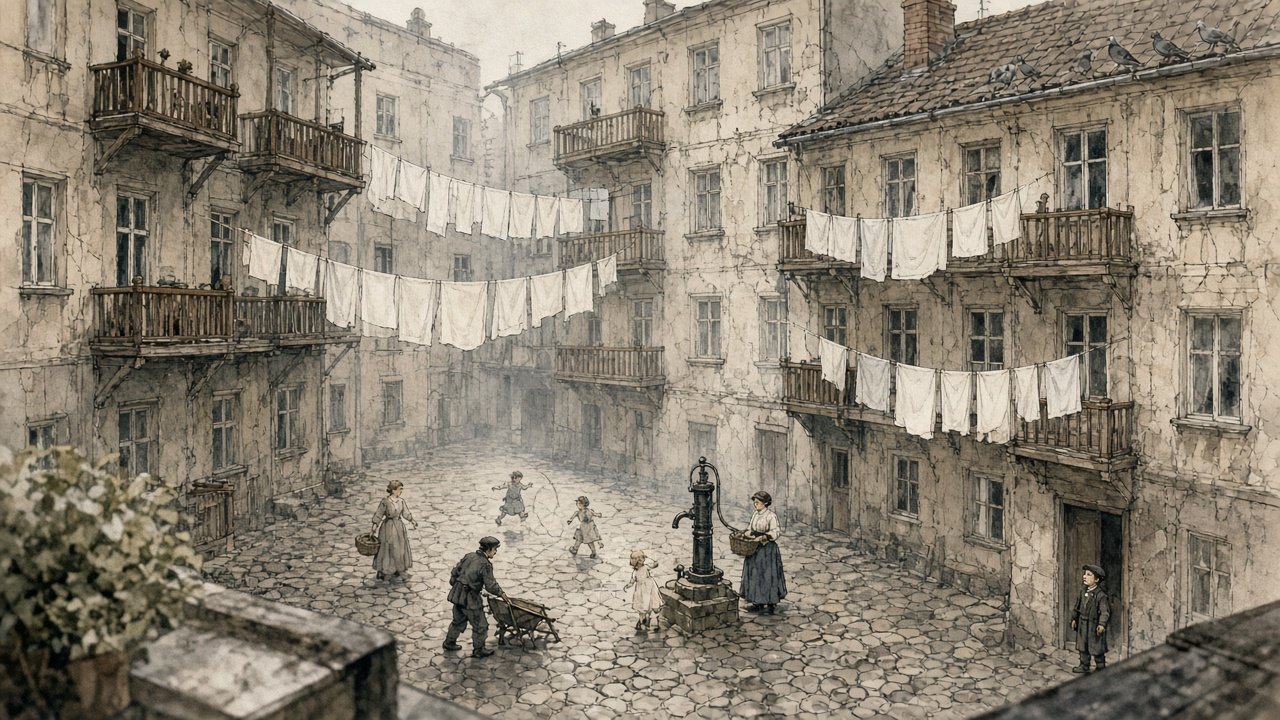
In Warsaw the Singers settled at 10 Krochmalna Street, in the heart of one of the poorest Jewish districts of the city. The street ran through an area of crowded tenements, courtyards and small shops, inhabited by artisans, porters, peddlers, thieves and prostitutes as well as pious families. Pinchas Mendel set up a rabbinical court in the family’s apartment, where he heard cases, adjudicated disputes and answered questions of religious law for the residents of the street. [8][4]
The rabbinical court gave the young Isaac a window onto the lives of his neighbours. Men and women came to his father with questions about dietary laws, marital disputes, business quarrels and matters of conscience, and the boy listened to their stories from the next room or from the corner of the court. Decades later he recalled these scenes in In My Father’s Court, a memoir published in Yiddish in serial form and in English in 1966. [4][2]
The memoir describes a world of extraordinary variety. There were women seeking divorces and men who claimed to be possessed, pious scholars and swindlers, and a constant flow of people from the provinces who had come to the city seeking work. Singer portrayed his father as a gentle and unworldly man, devoted to study and prayer, and his mother as a woman of sharp intelligence who saw through the pretences of the people who came to the court. [4][3]
The street lay near the great markets of Warsaw, including the Mirowski halls and the bazaars where traders sold food, clothing and household goods. Its proximity to these markets brought a constant traffic of buyers, sellers, porters and carters, and the courtyards of its tenements were filled with workshops and small businesses. The boy grew up amid this noise and movement, and the street’s mixture of piety and vice gave him material for a lifetime of fiction. [8][9]
Isaac attended a cheder and studied with his father, and he showed an early aptitude for learning. He was also a solitary and imaginative child, given to daydreams and fears, who spent long hours watching the street from the balcony of the family apartment. His later accounts of his childhood describe a boy preoccupied with questions about God, time and the nature of the universe, questions that his father could not answer to his satisfaction. [4][3]
Krochmalna Street became the central setting of Singer’s imagination. He returned to it in many of his novels and stories, including The Magician of Lublin, The Family Moskat and Shosha, and he described its courtyards, markets and characters with a precision that reflected close childhood observation. The street was destroyed with the rest of the Jewish quarter during the Second World War, and Singer’s writings became one of the principal literary records of its life. [8][10]
3. The elder brother and the modern world
Israel Joshua Singer, eleven years older than Isaac, played a decisive role in his younger brother’s development. As a young man Israel Joshua rebelled against the religious life of his family, abandoned traditional dress and study, and took up painting and writing. His departure from tradition caused conflict at home, and Isaac, still a child, observed the arguments between his brother and his parents with fascination. [5][3]
Through his brother Isaac was introduced to secular books, including works of science, philosophy and literature, and he began to read widely in Yiddish, Hebrew and later Polish and German. He read Spinoza, whose philosophy he studied with intense interest, and works on spiritualism and the occult, which would continue to fascinate him for the rest of his life. [3][11]
Israel Joshua’s circle included painters, writers and political radicals, and through him Isaac glimpsed the bohemian life of Warsaw’s young Jewish intelligentsia. The brothers’ relationship was close but unequal, and Isaac later wrote that he had both admired and feared his brother’s judgement. Israel Joshua’s early stories, which portrayed the Hasidic world from a critical perspective, showed Isaac a way of writing about the society in which they had grown up. [5][6]
Israel Joshua’s example showed Isaac that it was possible to leave the world of his father, but it also presented him with a formidable model. For many years the younger brother lived in the shadow of the elder, who achieved literary success first and whose realist novels set a standard that Isaac felt he must surpass. Singer later acknowledged that his brother had been his master and his most important influence. [5][6]
4. Biłgoraj
During the First World War, conditions in Warsaw became increasingly difficult. The city was occupied by German forces in August 1915, and food shortages and epidemics affected the poor population severely. In 1917 Bathsheba Singer took Isaac and his younger brother Moshe to Biłgoraj, her native town, where her father had been rabbi and where her brother now held the office. [12][8]
Biłgoraj was a small town in the Lublin region, surrounded by forests and marshes, with wooden houses and a Jewish population that made up a large part of its inhabitants. Its Jews were known for the manufacture of sieves, and the town retained many traditional ways of life that had disappeared in Warsaw. To the fourteen-year-old Isaac it seemed a world that had remained unchanged for centuries. [12][9]
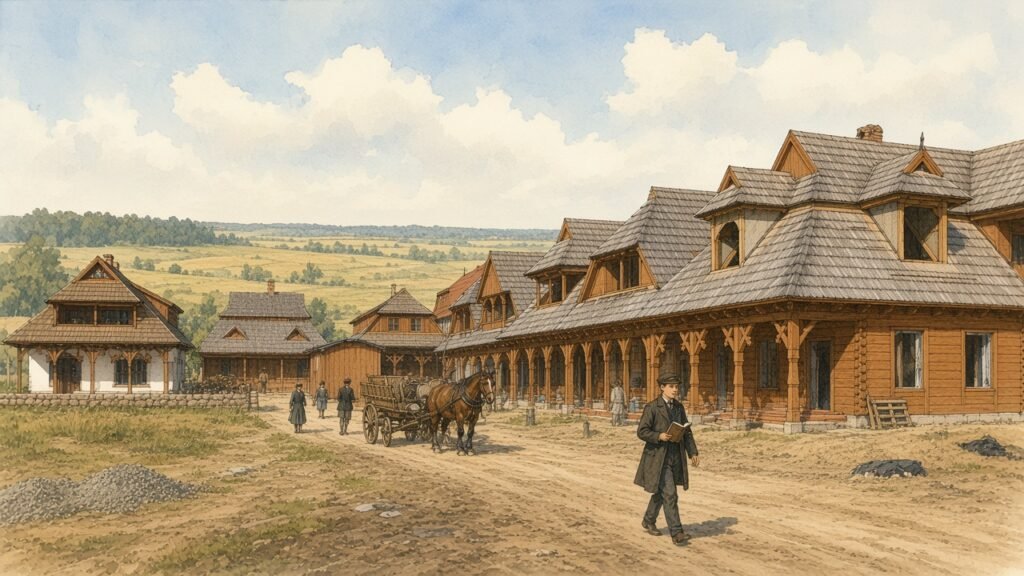
Singer spent about four years in Biłgoraj, and they were among the most formative of his life. He studied the religious texts in the house of his grandfather and uncle, but he also read secular books, taught himself modern Hebrew and began to write. He absorbed the folklore of the town, its stories of demons, dybbuks and miracles, and its memories of the catastrophes of the seventeenth century, when the Khmelnytsky uprising and the Sabbatean movement had shaken the Jewish communities of the region. [13][14][3]
The household of his grandfather in Biłgoraj was more traditional than that of his parents in Warsaw. The rabbinical family observed old customs in dress and daily life, and the town as a whole had been less affected by modern currents than the capital. Singer later wrote that in Biłgoraj he had found the Jewish past still living, and that the experience had given him a sense of the continuity of tradition that he could not have acquired in Warsaw. [12][3]
During these years he also gave Hebrew lessons and began to write poetry and stories in Hebrew, which he later abandoned in favour of Yiddish. The period ended in the early 1920s, when he left Biłgoraj and joined his father, who had become rabbi in the small town of Dzików, before returning to Warsaw. [3][15]
The world of Biłgoraj and the surrounding towns provided the setting for many of his later works, including his first novel, Satan in Goray, set in a town modelled on Goraj, near Biłgoraj, in the aftermath of the massacres of 1648. Singer’s portrayal of the Polish shtetl, with its piety, superstition and passion, drew heavily on what he had seen and heard there. [14][12]
5. Return to Warsaw
In the early 1920s Singer returned to Warsaw. For a brief period he enrolled at the Tachkemoni rabbinical seminary, a modern religious school, but he soon left and turned to writing. Through his brother, who had become an editor and writer of note, he obtained work as a proofreader for the Yiddish literary weekly Literarishe bleter, which was founded in 1924 and became the principal literary journal of Yiddish Poland. [5][3]
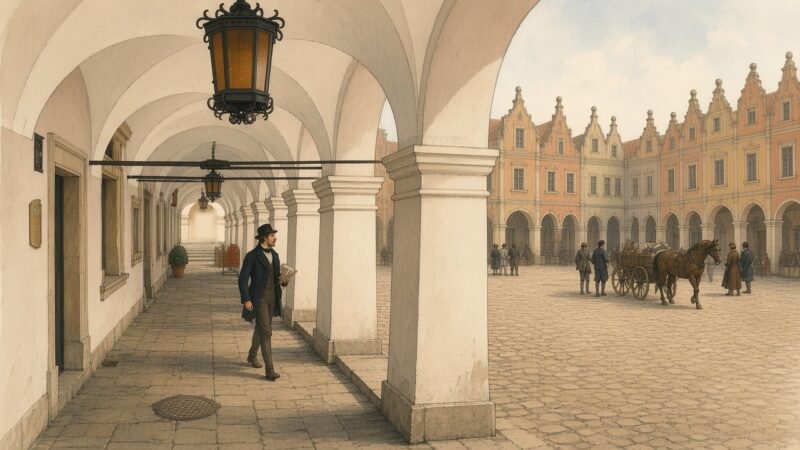
Warsaw in the 1920s was the capital of the newly independent Polish Republic, and its Jewish population of more than three hundred thousand was the largest in Europe. The city had a thriving Yiddish press, with several daily newspapers, a large number of publishing houses, theatres and cultural institutions, and a lively community of writers, journalists and artists. [8][9]
Singer’s work as a proofreader gave him a close view of the literary world and an income, however small. He also translated works from German and other languages into Yiddish, including novels by Knut Hamsun, Thomas Mann and Erich Maria Remarque, and the translations gave him a training in style and a familiarity with modern European fiction. [3][16]
The work at Literarishe bleter brought him into contact with the editors Nachman Mayzel and Peretz Markish and with the writers who contributed to the journal. The weekly published fiction, poetry, criticism and essays, and it was read throughout the Yiddish-speaking world. Singer’s proofreading duties required him to read everything that appeared in it, an apprenticeship that gave him a thorough knowledge of the contemporary literature. [16][3]
His first published story, Oyf der elter, in old age, appeared in Literarishe bleter in 1925 and won a prize in a competition organised by the journal. It was followed by other stories, published under various pseudonyms, including Isaac Bashevis, the name under which he would become known, and Yitskhok Varshavski, which he used for his journalism. [15][2]
6. The writers' club on Tłomackie Street
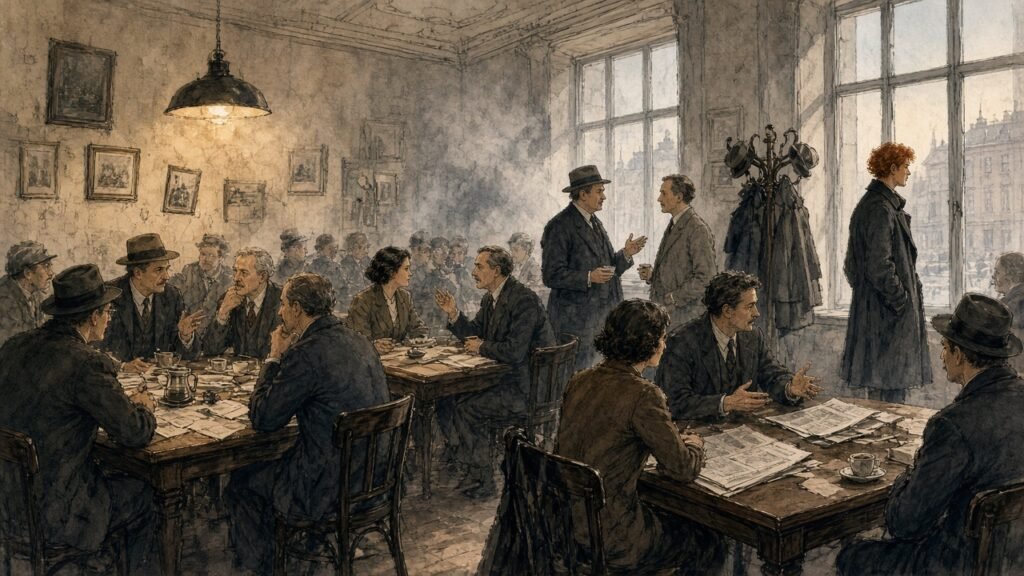
The centre of Yiddish literary life in interwar Warsaw was the Association of Jewish Writers and Journalists, whose headquarters at Tłomackie Street 13 served as a club where writers gathered to talk, argue, read the newspapers and eat. Singer was a regular visitor, and he later described the club in his memoirs and fiction as a place of endless conversation, rivalry and gossip. [8][3]
The writers who gathered at Tłomackie 13 represented a wide range of literary and political positions. There were realists and modernists, communists, Bundists, Zionists and religious traditionalists, and their debates reflected the intense political atmosphere of the time. Singer, who was sceptical of all political ideologies, kept his distance from the factions and was regarded by some of his contemporaries as an outsider. [16][9]
In these years he also formed a relationship with Runia Pontsch, a communist, with whom he had a son, Israel, born in 1929. The relationship was difficult, partly because of Runia’s political commitment, which Singer did not share, and partly because of his own reluctance to settle into family life. Runia and their son later left Poland for the Soviet Union and then for Palestine, where the boy grew up on a kibbutz under the name Israel Zamir. [17][18][3]
Singer’s later fiction and memoirs contain many portraits of the writers he knew at the club, often under invented names. He described their poverty, their quarrels over politics and literature, their love affairs and their ambitions, and he presented the club as a microcosm of Jewish Warsaw on the eve of its destruction. Many of the writers he described were murdered in the Holocaust, and his portraits are among the few records of their lives. [19][8]
Together with the poet Aaron Zeitlin, Singer edited the literary journal Globus, which began publication in 1932. It was in Globus that his first novel, Satan in Goray, was serialised in 1933, before its publication as a book in 1935. [15][2]
7. Satan in Goray
Satan in Goray is set in the town of Goraj in the Lublin region in the years after the massacres of 1648 and 1649, when Cossack and peasant forces under Bohdan Khmelnytsky killed many thousands of Jews in Ukraine and Poland. The survivors of Goraj return to their ruined town and attempt to rebuild their community, but they are swept up in the messianic movement of Sabbatai Zevi, the Ottoman Jew who proclaimed himself the Messiah in 1665. [13][14]
The novel follows the descent of the community into religious frenzy and moral chaos. Its central figure is Rechele, a young woman of fragile mind who becomes a prophetess of the messianic movement and is later possessed by a dybbuk. The town’s rabbi, who opposes the movement, is driven out, and the community abandons the restraints of religious law in anticipation of redemption. When news arrives that Sabbatai Zevi has converted to Islam, the community collapses into despair. [14][20]
The novel’s language attracted particular comment. Singer modelled the narrative style of its final chapters on the Yiddish chronicles and moral tracts of the seventeenth and eighteenth centuries, giving the story the appearance of a historical document. The device created a distance between the narrator and the events, and it allowed the novel to present the madness of the town without explicit commentary. [11][14]
The novel’s style, which imitates the language of seventeenth-century Yiddish and Hebrew chronicles, and its unflinching portrayal of madness and sexuality were unprecedented in Yiddish literature. Critics have read it as an allegory of the dangers of messianic ideologies, including the political movements of the twentieth century that promised redemption and brought catastrophe. Singer himself regarded it as a warning against the abandonment of tradition in the hope of sudden salvation. [11][3]
8. Emigration in 1935
By the mid-1930s the situation of the Jews of Poland was deteriorating. The economic depression had hit the Jewish population hard, antisemitic parties and movements were gaining strength, and the rise of the National Socialists in neighbouring Germany created a sense of looming danger. Many Polish Jews sought to emigrate, but the restrictive immigration laws of the United States and other countries made it difficult to do so. [9][19]
Israel Joshua Singer had visited America in the early 1930s and had settled there in 1934, after the success of his novel Yoshe Kalb, which had been staged by Maurice Schwartz at the Yiddish Art Theatre in New York. He arranged for his younger brother to follow him, and in 1935 Isaac Bashevis Singer left Poland for New York, leaving Runia and their son behind. He would never see Poland again. [5][6]
The decision to leave was difficult. Singer was leaving behind his mother and his younger brother Moshe, as well as the son he had with Runia, and he was going to a country whose language he did not speak and whose culture was alien to him. He later described his first years in America as a period of loneliness and depression, in which he found it almost impossible to write. [3][2]
He sailed from France and arrived in New York in May 1935. His brother met him and helped him to find lodgings and work. Singer later recalled his first impressions of the city, with its noise, its scale and its indifference, and his sense that the Yiddish he spoke and wrote was already in decline among the immigrants and their children. [3][5]
His arrival in New York coincided with the publication of Satan in Goray in book form in Warsaw. The novel attracted attention among Yiddish critics, but Singer was unable to build on its success. For several years he published little fiction, working instead as a journalist and struggling to adapt to his new environment. [15][3]
9. The Forverts
Through his brother’s connections Singer found work at the Forverts, the Jewish Daily Forward, the largest Yiddish newspaper in the world, which had been edited since 1903 by Abraham Cahan. The paper had a circulation in the hundreds of thousands and served as the principal source of news and literature for the Yiddish-speaking immigrants of America. Singer would remain associated with it for the rest of his career. [21][22]
At first Singer wrote articles, reviews and feuilletons under the pseudonyms Yitskhok Varshavski and D. Segal, reserving the name Bashevis for his serious fiction. The journalism provided him with a living but also with an outlet for a wide range of interests. He wrote about science, the occult, psychology and current affairs, and he produced a large number of pieces that have never been collected. [21][3]
The Forverts was also the vehicle through which much of Singer’s fiction first reached readers. His novels and stories were serialised in the paper, often in weekly instalments over many months, and the demands of serial publication shaped their form. Many of his works exist in versions that differ significantly between the Yiddish serial, the Yiddish book edition and the English translation. [21][11]
Abraham Cahan, who had built the Forverts into a powerful institution, was a demanding editor with strong opinions about literature. He preferred realist fiction and was suspicious of Singer’s interest in the supernatural and the sexual. Singer’s position at the paper improved after Cahan’s retirement and death in 1951, when he was given more freedom to publish his fiction. [22][21]
In 1940 Singer married Alma Wassermann, born Haimann, a German Jewish refugee who had left her husband and children to marry him. Alma worked in department stores to support the household during the years when Singer’s earnings were small, and their marriage lasted until his death. [2][3]
10. The war and the destruction
In September 1939 Germany invaded Poland, and within weeks Warsaw was occupied. The Jewish population of the city was confined in a ghetto from 1940, and in 1942 the great majority were deported to the extermination camp at Treblinka and murdered. The Jews of Biłgoraj, Goraj and the other towns that Singer had known suffered the same fate. [10][19][12]
Singer’s mother and his brother Moshe had been deported by the Soviet authorities from the territory they occupied in eastern Poland, and they died in Soviet Central Asia during the war. The news of their deaths reached him only later. Much of the world he had known in Poland had been destroyed, and the readership for which he had written had been reduced to a remnant. [3][19]
In 1944 Israel Joshua Singer died suddenly in New York of a heart attack, at the age of fifty. The death of his brother, who had been his protector and his model, was a severe blow to Isaac. Some biographers have suggested that it also freed him from the shadow in which he had lived, and that his most productive period as a writer began in the years that followed. [5][6][3]
11. The Family Moskat
In 1945 Singer began to serialise in the Forverts a long family chronicle that would become The Family Moskat. The novel follows the fortunes of a wealthy Warsaw Jewish family from the beginning of the twentieth century to the outbreak of the Second World War, tracing the decline of the patriarch Meshulam Moskat and the scattering of his descendants among the competing ideologies and ways of life of modern Polish Jewry. [2][3]
The central figure is Asa Heshel Bannet, a young man from a provincial town who comes to Warsaw in search of knowledge and becomes entangled in the life of the Moskat family. Asa Heshel is an intellectual who has abandoned religious faith but found nothing to replace it, and his restless drifting between women, ideas and places mirrors the condition of a generation that had lost its moorings. [11][3]
The novel is written in the realist manner of the family saga, a form that Israel Joshua Singer had used in The Brothers Ashkenazi, and it has often been compared with that work. It presents a broad panorama of Jewish Warsaw, including Hasidim and assimilationists, Zionists and socialists, merchants and artists, and it ends with the German bombardment of the city in 1939. [5][6]
The original Yiddish version of the novel ends with a character saying that death is the Messiah, a line that expresses the despair of the moment when the Jews of Warsaw faced destruction. The English edition omitted this ending, and the difference between the two versions has been discussed by critics as an example of the way in which Singer adapted his work for American readers. [11][3]
The English translation, by A. H. Gross, was published in 1950 by Alfred A. Knopf. It was Singer’s first book to appear in English and introduced him to American readers, although it attracted only moderate attention at the time. The English version was considerably shortened from the Yiddish, and its ending was altered. [23][2]
12. Gimpel the Fool
The turning point in Singer’s career came in 1953, when the magazine Partisan Review published an English translation of his story Gimpel tam, Gimpel the Fool. The translation was made by Saul Bellow, who was then a rising American novelist, at the suggestion of the critic Irving Howe, who was editing an anthology of Yiddish stories. [24][25][26]
The story is narrated by Gimpel, a baker in the town of Frampol, who is mocked and deceived by everyone around him. His wife Elka is unfaithful to him and bears children by other men, but Gimpel chooses to believe her. On her deathbed she confesses, and Gimpel, tempted by the devil, considers taking revenge on the town by contaminating its bread. He resists and leaves Frampol to become a wanderer, telling stories and waiting for death. [27][11]
Gimpel is a holy fool, whose credulity is a form of faith. He chooses to believe because he regards belief as better than cynicism, and his refusal to be embittered by the deceptions of others represents a moral victory. The story combines comedy and pathos in a way that recalls the tradition of the Yiddish folk tale, but its psychological insight and its ambiguity mark it as a modern work. [26][11]
The publication of Gimpel the Fool in Partisan Review, one of the most prestigious literary journals in America, brought Singer to the attention of a wide audience of English-speaking readers and critics. It was followed by translations of other stories and by the publication of Satan in Goray in English in 1955. [25][2]
13. The magician and the slave
In the late 1950s and early 1960s Singer published a series of novels in English translation that established him as a major figure in American letters. The Magician of Lublin, published in English in 1960, tells the story of Yasha Mazur, an acrobat and magician who performs in the circuses and theatres of Poland in the late nineteenth century. Yasha is a man of many talents and many women, who lives between the Jewish and gentile worlds without belonging fully to either. [28][2]
After a failed attempt at burglary that leaves him injured and disgraced, Yasha returns to his wife in Lublin and has himself walled up in a small cell, where he lives as a penitent. People come to him from far and wide to seek his blessing and advice, but he remains uncertain whether his repentance is genuine. The novel explores the themes of freedom, temptation and the search for faith that recur throughout Singer’s work. [11][3]
The Slave, published in English in 1962, is set in seventeenth-century Poland in the aftermath of the Khmelnytsky massacres. Its hero, Jacob, is a Jewish scholar who has been sold into slavery to a Polish peasant in a remote mountain village. He falls in love with his master’s daughter, Wanda, and after he is ransomed, he returns to bring her back with him. Wanda pretends to be a deaf-mute Jewish woman named Sarah, and the couple live in a Jewish community until her secret is discovered. [13][2]
Both novels exist in versions that differ between the Yiddish and the English. The Magician of Lublin was serialised in the Forverts in 1958 and 1959, and The Slave in 1960 and 1961, under the titles Der kuntsnmakher fun Lublin and Der knekht. Scholars comparing the versions have noted that the Yiddish texts contain more extensive descriptions and digressions, which were cut in translation. [21][11]
The Slave has been regarded as one of Singer’s finest novels. It combines a love story with a meditation on the meaning of Jewish law and tradition, and it portrays both the brutality of the peasant world and the hypocrisy of the Jewish community. Jacob’s faith, which survives his enslavement and his losses, is presented as a personal struggle rather than a matter of conformity. [11][3]
14. The short stories
Singer’s reputation in English rests to a great extent on his short stories, which appeared in a series of collections from the 1950s onward, including Gimpel the Fool and Other Stories in 1957, The Spinoza of Market Street in 1961, Short Friday in 1964, The Séance in 1968, A Friend of Kafka in 1970, A Crown of Feathers in 1973 and Passions in 1975. Many of the stories first appeared in English in The New Yorker, Harper’s and other magazines. [29][27]
The stories range widely in setting and subject. Some are set in the Polish shtetl of the past, among rabbis, scholars and simple folk, and they draw on Jewish folklore, with its demons, imps and dybbuks. Others are set in Warsaw before the war, or in the immigrant world of New York, Miami and Buenos Aires after it. Many are narrated by demons or by Singer’s own alter egos, writers and journalists who encounter strange people and hear strange stories. [27][11]
The demons in Singer’s stories are often narrators who boast of their success in corrupting human beings, and they represent the forces of temptation, doubt and evil that threaten the moral order. Singer insisted that his use of the supernatural was not merely a literary device, and he spoke of his belief in the existence of spirits and other unseen forces. Critics have debated how literally to take these statements. [20][3]
Singer’s stories often end in ambiguity. A character may be redeemed or damned, a vision may be real or imagined, and the narrator frequently declines to resolve the question. This ambiguity reflects Singer’s view that human life is governed by forces beyond human understanding, and that the storyteller’s task is to present the mystery rather than to explain it. [11][27]
The Spinoza of Market Street tells of Dr Nahum Fischelson, an elderly scholar in Warsaw who has devoted his life to the study of Spinoza’s Ethics and lives in isolation in an attic overlooking Market Street. When he falls ill, he is nursed by a neighbour, Black Dobbe, a plain woman who sells bread, and they marry. On their wedding night the philosopher discovers a passion that his philosophy had not accounted for. [27][11]
15. The translators and the second original
Singer wrote all his fiction in Yiddish, but from the 1950s onward the English versions of his work reached a far larger audience than the Yiddish originals. He worked closely with a succession of translators, including his nephew Joseph Singer, the son of Israel Joshua, as well as Cecil Hemley, Elaine Gottlieb, Dorothea Straus, Elizabeth Pollet, Mirra Ginsburg and many others. Often he would prepare a rough English version with a collaborator, which would then be revised and polished in several stages. [3][27]
Singer described the English translations as his second original. He took an active part in the process, and he frequently used it as an occasion to revise the text, cutting passages, changing endings and adjusting the tone for an American audience. Many of the translators did not know Yiddish, and their work consisted in rendering Singer’s own oral or written English drafts into polished prose. [11][3]
This method had important consequences. The English versions of his works often differ substantially from the Yiddish, and some scholars have argued that they present a different Singer, more universal and less specifically Jewish, more concise and less digressive. The Yiddish versions, many of which were serialised in the Forverts and never published as books, contain material that English readers have never seen. [11][21]
The collaboration with translators was often close and personal. Singer would sit with a translator for hours, reading the Yiddish aloud and suggesting English equivalents, and many translators became his friends. Some later wrote accounts of working with him, describing both his generosity and his insistence on having the final word on every sentence. [3][27]
Since Singer’s death scholars have begun to explore the Yiddish texts more systematically, and some previously untranslated novels have been published in English. These publications have revealed aspects of his work, including a fuller engagement with the history and politics of Polish Jewry, that the earlier translations had obscured. [11][27]
16. Memoirs of a father's court
In My Father’s Court, serialised in Yiddish in the Forverts in the 1950s and published in English in 1966, is a sequence of autobiographical sketches describing Singer’s childhood in Warsaw. Each chapter is devoted to a case that came before his father’s rabbinical court or to an episode from the life of the family, and together they form a portrait of the world of Krochmalna Street before the First World War. [4][8]
The memoir is notable for its clarity, humour and compassion. Singer portrays the people who came to the court without judgement, and he presents their dilemmas with sympathy even when they are comic. His father emerges as a figure of integrity who seeks to resolve conflicts through persuasion rather than coercion, and his mother as a woman of sharp insight who often understands the cases better than her husband. [4][3]
Singer returned to his autobiography in several later works, including A Day of Pleasure, a book of childhood memoirs for young readers published in 1969, and the volumes A Little Boy in Search of God, A Young Man in Search of Love and Lost in America, published between 1976 and 1981. These works, which mix fact and invention, trace his life from childhood to his early years in America. [3][2]
The cases described in the memoir include a woman who wishes to know whether a chicken is kosher, a man who claims to have been cheated in business and a couple who quarrel over a marriage contract. Some of the stories are comic, others tragic, and several concern the encounter between the old religious world and the new secular one, as when a young man who has abandoned religion comes to the court seeking his father’s help. [4]
Biographers have noted that Singer’s autobiographical writings are not always reliable as historical sources. He reshaped his memories for literary effect, altered names and dates, and sometimes conflated different events. The memoirs are nonetheless invaluable as an expression of how Singer understood his own life and the world from which he came. [3]
17. Writing for children
In the 1960s Singer began to write books for children, at the suggestion of the editor Elizabeth Shub. His first collection, Zlateh the Goat and Other Stories, published in 1966 with illustrations by Maurice Sendak, was named a Newbery Honor Book, one of the most prestigious distinctions in American children’s literature. It was followed by many other books, including Mazel and Shlimazel, When Shlemiel Went to Warsaw and The Fearsome Inn. [30][2]
Singer’s children’s stories draw on Jewish folklore and on the tales he had heard in his childhood. They feature the fools of Chelm, the wise and foolish inhabitants of a legendary Polish town, as well as demons, goblins and animals, and they combine humour with moral lessons. The title story of Zlateh the Goat tells of a boy and a goat who survive a blizzard by taking shelter in a haystack, the goat providing milk and warmth. [30][27]
The collaboration with Maurice Sendak on Zlateh the Goat brought together two artists whose families had come from the same Polish Jewish world, and Sendak’s illustrations, drawn in a style that recalled old engravings, became closely associated with the book. Other illustrators of Singer’s children’s books included Margot Zemach and Uri Shulevitz, whose drawings gave several of the later books a distinctive visual character. [30][27]
Singer took his writing for children seriously, and he spoke of children as the best readers, who read for the story rather than for the reputation of the author or the approval of critics. His children’s books won several further Newbery Honors, and A Day of Pleasure won the National Book Award for children’s literature in 1970. [31][30]
18. New York and the immigrant world
For most of his life in America Singer lived on the Upper West Side of Manhattan, in apartments on and around Broadway and West End Avenue. The neighbourhood had a large population of Jewish immigrants and refugees, including many survivors of the Holocaust, and its cafeterias, delicatessens and benches provided Singer with a constant supply of characters and stories. He was a familiar figure on its streets, walking, feeding pigeons and eating in its dairy restaurants. [32][3]
Many of Singer’s later stories are set in this world. They describe elderly widowers and widows, refugees haunted by the past, writers who have lost their readers and women who seek out the narrator to tell him their stories. The narrator, often a Yiddish writer who resembles Singer, listens and records, and the stories frequently end on a note of mystery or ambiguity. [27][11]

The cafeteria became one of Singer’s characteristic settings. In the story The Cafeteria, published in A Crown of Feathers, the narrator meets a woman who claims to have seen Hitler and his associates holding a meeting in a cafeteria on Broadway in the middle of the night. The story leaves the reader uncertain whether the vision was real, a hallucination or a symbol of the persistence of the past. [27][19]
Singer’s daily routine was well known to his neighbours. He wrote in the mornings, often by hand in Yiddish in notebooks, and spent the afternoons walking, meeting translators and visitors, and answering correspondence. His telephone number was listed in the directory, and he received calls from readers who wished to talk to him, some of whom became characters in his stories. [32][3]
Singer’s portrayal of New York was often melancholy. The immigrants and survivors in his stories have lost their families, their communities and their languages, and they live among the remnants of a world that has disappeared. Yet the stories are also full of passion and humour, and they present the city as a place where the unexpected can still happen. [11][32]
19. Enemies, a love story
Enemies, A Love Story, serialised in Yiddish in 1966 and published in English in 1972, was Singer’s first novel set in America. Its hero, Herman Broder, is a Holocaust survivor living in Brooklyn in 1949, who has survived the war hidden in a hayloft by a Polish peasant woman, Yadwiga, whom he has married after learning that his wife and children were killed. [33][2]
Herman is also involved with Masha, a fellow survivor who is passionate, unstable and haunted by her experiences in the camps. When his first wife, Tamara, turns out to have survived and arrives in New York, Herman finds himself with three women and unable to choose among them. He works as a ghostwriter for a corrupt rabbi and lives in a state of constant deception and fear. [33][19]
The novel portrays the psychological aftermath of the Holocaust with great subtlety. Its characters are damaged by their experiences and unable to live normal lives, and Herman’s paralysis reflects a deeper uncertainty about faith, identity and moral responsibility. Singer insisted that the novel was not about the Holocaust as such but about people who had survived it, and he avoided depicting the camps directly. [33][11]
In 1989 the novel was adapted for film by Paul Mazursky, with Ron Silver as Herman, Anjelica Huston as Tamara, Lena Olin as Masha and Margaret Sophie Stein as Yadwiga. The film was well received, and Huston and Olin were nominated for Academy Awards. Singer, who had disliked other adaptations of his work, reportedly approved of it. [34][33]
20. Honours and the National Book Award
By the late 1960s Singer had become one of the most celebrated writers in America. His books were published by Farrar, Straus and Giroux, whose co-founder Roger Straus became a close friend, and they were widely reviewed and translated into many languages. He was in great demand as a lecturer and gave readings at universities across the country, where his wit and his accented English made him a popular speaker. [35][2]
In 1970 Singer received the National Book Award in Children’s Literature for A Day of Pleasure, and in 1974 he shared the National Book Award for Fiction for A Crown of Feathers and Other Stories, with Thomas Pynchon’s Gravity’s Rainbow. He was elected to the National Institute of Arts and Letters in 1964. [31][2]
Singer’s success in English was a source of pride for many Yiddish readers but also of controversy. Some Yiddish writers and critics resented his fame, which they felt had been achieved at the expense of other writers equally deserving. Others objected to his portrayal of Jewish life, which they regarded as dwelling too much on sexuality, superstition and depravity, and as presenting a distorted image of the world that had been destroyed. [16][26]
His visibility in American public life grew steadily. He appeared on television, gave interviews to newspapers and magazines and was the subject of documentary films. His public persona, that of a gentle, witty and slightly eccentric old man, contrasted with the dark and passionate world of his fiction, and many interviewers commented on the difference. [2][3]
Cynthia Ozick’s novella Envy, or Yiddish in America, published in 1969, portrayed an embittered Yiddish poet who is consumed by jealousy of a famous Yiddish writer whose works are known in English translation. The famous writer was widely understood to be modelled on Singer, and the story captured the resentments that his success had provoked in the Yiddish literary world. [36][11]
21. The Nobel Prize
On 5 October 1978 the Swedish Academy announced that the Nobel Prize in Literature had been awarded to Isaac Bashevis Singer for his impassioned narrative art which, with roots in a Polish-Jewish cultural tradition, brings universal human conditions to life. He was the first writer in Yiddish to receive the prize, and the award was celebrated by Yiddish readers around the world as a recognition of their language and literature. [37][38]
The award ceremony took place in the Stockholm Concert Hall on 10 December 1978, where the prizes were presented by King Carl XVI Gustaf. Two days earlier Singer had delivered his Nobel lecture, which he began in Yiddish before continuing in English. In it he spoke of the role of the storyteller, of his belief in God and in free will, and of the Yiddish language and the people who had spoken it. [39][1]

In the lecture he described Yiddish as a language of exile, without a land, without frontiers, not supported by any government, a language which possesses no words for weapons, ammunition, military exercises, war tactics. He went on to say that what the great religions preached, the Yiddish-speaking people of the ghettos practised day in and day out. The lecture was widely quoted and became one of the best-known statements about Yiddish in the twentieth century. [1][40]
Singer attended the ceremonies in Stockholm with Alma and was the centre of attention throughout the week of festivities. Journalists noted his humour and his evident pleasure in the occasion, and his remarks at the Nobel banquet, in which he spoke of the Yiddish language and its future, were widely reported. Yiddish newspapers and organisations around the world held celebrations in his honour. [37][39]
The Nobel Prize brought Singer international fame. His books were translated into dozens of additional languages, and he was invited to speak and receive honours around the world. He also used the occasion to speak of his debt to the Yiddish writers who had preceded him and to call for the preservation of the language. [38][2]
22. Yentl
Among Singer’s best-known stories is Yentl the Yeshiva Boy, first published in English in 1962 and collected in Short Friday. It tells of a young woman in a Polish town who, after the death of her father, disguises herself as a man in order to study the Talmud at a yeshiva. There she forms a close friendship with a fellow student, Avigdor, and is drawn into a marriage with his former fiancée, Hadass. The story explores the boundaries of gender, desire and religious law with a frankness that was unusual for its time. [27][2]
In 1975 the story was adapted for the stage by Singer and Leah Napolin, and the play was produced on Broadway. In 1983 Barbra Streisand directed, produced and starred in a film version, Yentl, which turned the story into a musical with songs by Michel Legrand and Alan and Marilyn Bergman. The film was a commercial success and won an Academy Award for its score. [41][42]
The story and its adaptations have attracted renewed interest in later decades from scholars of gender and sexuality, who have read Yentl’s disguise as an exploration of identity that anticipates later debates. Stage versions of the story have continued to be produced, including new adaptations that return to Singer’s text rather than the film. [41][27]
Singer disliked the film intensely. He objected to its songs, to its ending, in which Yentl sails to America, and to the prominence it gave to Streisand. In an interview with himself published in The New York Times, he criticised the adaptation and expressed his view that it had departed from the spirit of his story. The episode became one of the best-known disputes between an author and a film adaptation of his work. [41][3]
23. Shosha and the late novels
Shosha, published in English in 1978, the year of the Nobel Prize, is a novel narrated by Aaron Greidinger, a Yiddish writer in Warsaw in the 1930s who closely resembles Singer himself. Aaron returns to Krochmalna Street, where he grew up, and finds Shosha, a girl he had known in childhood, who has remained childlike in body and mind. He falls in love with her again and marries her, despite the disapproval of his friends and the opportunity to emigrate to America with a wealthy actress. [2][8]
The novel is set against the approaching catastrophe of the Second World War, and its characters debate politics, philosophy and religion in the cafés and apartments of Warsaw while the danger grows. Shosha herself represents innocence and the past, and Aaron’s choice to stay with her can be read as a decision to remain loyal to the world of his childhood. In an epilogue set after the war, Aaron meets a friend in Israel and learns of Shosha’s death. [11][19]
Singer’s other late novels include The Manor and The Estate, published in English in 1967 and 1969, which follow the fortunes of a Jewish family in Poland from the uprising of 1863 to the end of the nineteenth century, and The Penitent, published in 1983, which tells of a man who abandons modern life in America for strict religious observance in Jerusalem. Several novels were published posthumously, including The King of the Fields, Scum, The Certificate and Meshugah. [2][3]
24. Beliefs and contradictions
Singer’s views on religion were complex. He rejected organised religion and did not observe the commandments of Jewish law, yet he spoke often of his belief in God and in providence, and he described himself as a believer who could not accept the dogmas of any faith. He described his position as that of a man who believed in God but protested against God’s ways. [1][3]
He was also deeply interested in the supernatural. He read widely in the literature of spiritualism and psychical research, and he spoke of his belief in telepathy, clairvoyance and the survival of the soul after death. His fiction is full of ghosts, demons and unexplained events, and he insisted that such things should be taken seriously. [20][11]
From 1962 Singer was a strict vegetarian. He explained his decision as a matter of compassion for animals, and he wrote movingly about the suffering of animals in his fiction. In The Letter Writer, a story published in The Séance, the narrator reflects that in relation to animals all people are Nazis, and that for the animals it is an eternal Treblinka. The statement has been widely quoted in discussions of animal rights. [43][27]
His political views were conservative and sceptical. He distrusted all ideologies that promised to transform human nature or to bring about a perfect society, and he regarded the communist and socialist movements that had attracted many Jewish intellectuals of his generation as false messianisms. This scepticism is reflected in his portrayal of political characters in his novels, who are often naive or dangerous. [14][3]
25. A son in Israel
Singer’s son, Israel, grew up far from his father. After leaving Poland with his mother, he lived for a time in the Soviet Union and Turkey before reaching Palestine in 1938, where he was raised on Kibbutz Beit Alfa and took the Hebrew surname Zamir. Father and son had little contact for twenty years. [17][18]
In 1955 Israel Zamir travelled to New York and met his father again. He later described the meeting and the relationship that followed in a memoir, Journey to My Father, Isaac Bashevis Singer, published in Hebrew and later in English. The book portrays Singer as a complicated and often distant father, who nonetheless made efforts to establish a bond with his son. [17][3]
The relationship between father and son remained complicated in the years after their reunion. Zamir visited New York on several occasions, and Singer came to Israel, where he met his grandchildren. Zamir’s memoir describes conversations in which his father spoke of his regret at their long separation, as well as moments of misunderstanding between a secular Israeli raised on a kibbutz and a Yiddish writer whose imagination remained rooted in the Polish past. [17]
Zamir became a journalist and translator, and he translated many of his father’s works into Hebrew. Through his translations Singer’s fiction reached a wide readership in Israel, where his portrayal of the Polish Jewish past was received with both admiration and controversy. Singer visited Israel on several occasions and spoke there of his attachment to the country and of his concern for the future of Yiddish. [17][40]
26. Last years in Florida
In his later years Singer spent increasing amounts of time in Florida, where he and Alma had an apartment in Surfside, near Miami Beach. Florida had become home to a large population of elderly Jewish retirees, many of them immigrants from eastern Europe, and Singer set a number of his late stories among them, in the hotels, cafeterias and apartment buildings of Miami Beach. [44][27]
His health declined in the late 1980s, and he suffered a series of strokes that affected his memory and ability to write. He continued to publish new translations of earlier work, but his creative activity came to an end. Alma cared for him in these years, and he was rarely seen in public. [3][2]
Isaac Bashevis Singer died on 24 July 1991 in Surfside, Florida. He was buried at Beth-El Cemetery in Paramus, New Jersey. His death was reported on the front pages of newspapers in America and around the world, and tributes were paid by writers, critics and political leaders. [44][45][2]
The Florida stories form a distinct group within his late work. They portray widows and widowers who have retired to the sun after lives of labour in New York, survivors who cannot escape their memories and old men who fall in love again. Singer treated these characters with irony and tenderness, and the stories record a chapter of American Jewish life that has received little attention elsewhere in literature. [44][27]
After his death a street on the Upper West Side, the section of West 86th Street near where he had lived, was named Isaac Bashevis Singer Boulevard. In 2004 the Library of America published a three-volume edition of his collected stories, edited by Ilan Stavans, placing him in the canon of American literature. [32][27]
27. Esther Kreitman and the family of writers
Singer’s sister, Esther Kreitman, was also a writer, and her life and work have attracted increasing attention in recent decades. Born in 1891, she was married in 1912 to a diamond cutter, Abraham Kreitman, and moved with him to Antwerp and later to London, where she spent the rest of her life. She wrote novels and stories in Yiddish and translated works from English into Yiddish. [3][16]
Her novel Der sheydim tants, the dance of the demons, published in 1936 and translated into English as Deborah, is a thinly disguised account of her childhood in the Singer household, describing the frustrations of a gifted girl who is denied the education given to her brothers. The novel portrays the father and mother in terms that differ from Isaac’s portrayal of them, and it presents the family from the perspective of a daughter. [3][2]
Esther Kreitman’s work was long neglected, and it was only in the late twentieth century that her novels and stories were reissued and translated anew. Her portrayal of a woman’s experience of the traditional Jewish household has since been recognised as an important contribution to Yiddish literature. [16][3]
The three Singer siblings thus left three different literary accounts of the same family and the same world. Israel Joshua’s realist novels, Esther’s autobiographical fiction and Isaac’s stories and memoirs offer contrasting perspectives on the transformation of Polish Jewish life in the early twentieth century, and their relationship has become a subject of study in its own right. [5][6]
28. Legacy
Isaac Bashevis Singer is the most widely read Yiddish writer in the world, and his work has done more than that of any other writer to bring Yiddish literature to readers outside the Yiddish-speaking community. His stories and novels have been translated into dozens of languages, and they continue to be read, taught and adapted. [2][16]
His achievement lies in the combination of a deep rootedness in the traditions of Polish Jewry with a modern sensibility and a universal appeal. His work draws on the religious texts, folklore and history of the Jews of Poland, and it portrays a world that was destroyed in the Holocaust, yet it addresses questions of faith, desire, freedom and evil that speak to readers of every background. [37][11]
Singer’s relationship with Yiddish literature remains a subject of debate. Some critics see him as the last great representative of a literary tradition that began with Mendele Moykher Sforim, Sholem Aleichem and Peretz. Others regard him as an exceptional figure whose fame in translation distorted the perception of Yiddish literature, overshadowing other writers whose work has been less widely translated. [16][26]
The study of Singer’s work has expanded since his death. Biographies by Janet Hadda and others, critical studies of the relationship between his Yiddish and English texts, and new translations of previously unknown works have deepened the understanding of his achievement. Archives of his papers, including manuscripts and correspondence, are held at the Harry Ransom Center at the University of Texas at Austin, where scholars continue to study them. [3][11]
His influence on American literature has been considerable. Writers such as Saul Bellow, Philip Roth and Cynthia Ozick engaged with his work, and his stories have been widely anthologised and taught. The Library of America edition of his collected stories confirmed his status as a classic of American as well as Yiddish letters. [24][36][27]
29. Passion, evil and the critics
Desire is one of the central forces in Singer’s fiction. His characters are frequently driven by sexual passion, which leads them into transgression, deception and suffering, and he portrayed their desires with a frankness that shocked some Yiddish readers. Yet passion in his work is rarely simply condemned. It is presented as a force of life that can lead to destruction or to a deeper understanding of the self, and his characters’ struggles with it mirror their struggles with faith. [11][3]
The theme of free will is closely connected. Singer often said that he believed in free will because he had no choice, and his characters are repeatedly confronted with decisions between good and evil, faith and doubt, loyalty and betrayal. The demons that populate his stories tempt them, but the choice remains theirs, and the outcome is often uncertain until the end. [3][11]
Evil in Singer’s work is real and pervasive. His fiction depicts cruelty, violence and corruption in many forms, from the massacres of the seventeenth century to the betrayals of daily life, and it does not offer the consolation that evil will be defeated in this world. At the same time it holds open the possibility of goodness, embodied in figures such as Gimpel, whose innocence survives the deceptions practised upon him. [27][13]
Critical responses to these themes have varied widely. Irving Howe, who did much to introduce Singer to American readers, praised his imaginative power but expressed reservations about the darkness of his vision and its distance from the humanist tradition of Yiddish literature. Other critics regarded Singer’s work as a profound exploration of the human condition, and still others as a sensationalist distortion of the Jewish past. [26][16]
Singer himself was dismissive of most literary criticism and resisted attempts to interpret his work in terms of ideas. He maintained that a writer’s first task was to tell a story, and that a story that was interesting would find its readers. This view, which he expressed in many interviews and lectures, was consistent with his scepticism towards all systems of thought. [1][3]
30. The historical imagination
A large part of Singer’s fiction is set in the Polish Jewish past, from the seventeenth century to the twentieth. Satan in Goray and The Slave take place in the aftermath of the massacres of 1648 and 1649, and several stories deal with the Sabbatean movement and its aftermath, including the movement led by Jacob Frank in the eighteenth century, whose followers eventually converted to Catholicism. [13][14][46]
The Manor and The Estate cover the period from the Polish uprising of 1863 to the end of the nineteenth century, when industrialisation, assimilation and new political movements transformed Jewish life. The family saga of Calman Jacoby and his descendants traces these changes through the experience of individuals who move from the traditional world into the modern one, some prospering and others losing their way. [2][9]
Singer’s historical imagination was shaped by his reading of chronicles, responsa and moral literature, as well as by the stories he had heard in Biłgoraj. He did not aim at historical accuracy in the manner of a scholar, and his portrayal of the past is coloured by his own concerns. His work nonetheless conveys a sense of the long history of the Jews in Poland that few other writers have achieved. [12][11]
31. Timeline
Isaac Bashevis Singer is born in Leoncin, probably on 21 November.
The family settles at 10 Krochmalna Street in Warsaw.
His mother takes him and his brother Moshe to her native town.
He returns to Warsaw and later works as a proofreader for the literary weekly.
Oyf der elter wins a prize in a competition run by Literarishe bleter.
His son Israel is born to Runia Pontsch.
His first novel is serialised in Globus.
He leaves Poland for New York and begins work for the Forverts.
He marries Alma Wassermann.
Israel Joshua Singer dies in New York.
His first book in English is published by Knopf.
Saul Bellow's translation appears in Partisan Review.
His son, now Israel Zamir, visits him in New York.
The novel appears in English.
His first children's book is named a Newbery Honor Book.
A Day of Pleasure wins the award for children's literature.
A Crown of Feathers shares the fiction award.
He receives the Nobel Prize in Literature in Stockholm.
Barbra Streisand's film adaptation is released.
He dies on 24 July in Surfside and is buried in Paramus, New Jersey.
His collected stories are published in three volumes.
References
- NobelPrize.org, “Isaac Bashevis Singer, Nobel Lecture” ↩
- Grokipedia, “Isaac Bashevis Singer” ↩
- Janet Hadda, Isaac Bashevis Singer: A Life (Oxford University Press, 1997) ↩
- Isaac Bashevis Singer, In My Father’s Court (Farrar, Straus and Giroux, 1966) ↩
- Grokipedia, “Israel Joshua Singer” ↩
- Anita Norich, The Homeless Imagination in the Fiction of Israel Joshua Singer (Indiana University Press, 1991) ↩
- Grokipedia, “Hasidic Judaism” ↩
- Grokipedia, “Warsaw” ↩
- Grokipedia, “History of the Jews in Poland” ↩
- Grokipedia, “Warsaw Ghetto” ↩
- Seth L. Wolitz, ed., The Hidden Isaac Bashevis Singer (University of Texas Press, 2001) ↩
- Grokipedia, “Biłgoraj” ↩
- Grokipedia, “Khmelnytsky Uprising” ↩
- Grokipedia, “Sabbatai Zevi” ↩
- YIVO Encyclopedia of Jews in Eastern Europe, “Singer, Isaac Bashevis” ↩
- Grokipedia, “Yiddish literature” ↩
- Grokipedia, “Israel Zamir” ↩
- Grokipedia, “Kibbutz” ↩
- Grokipedia, “The Holocaust” ↩
- Grokipedia, “Kabbalah” ↩
- Grokipedia, “The Forward” ↩
- Grokipedia, “Abraham Cahan” ↩
- Grokipedia, “Alfred A. Knopf” ↩
- Grokipedia, “Saul Bellow” ↩
- Grokipedia, “Partisan Review” ↩
- Grokipedia, “Irving Howe” ↩
- Ilan Stavans, ed., Isaac Bashevis Singer: Collected Stories (Library of America, 2004) ↩
- Grokipedia, “Lublin” ↩
- Grokipedia, “The New Yorker” ↩
- Grokipedia, “Newbery Medal” ↩
- Grokipedia, “National Book Award” ↩
- Grokipedia, “Upper West Side” ↩
- Grokipedia, “Enemies, A Love Story (film)” ↩
- Grokipedia, “Paul Mazursky” ↩
- Grokipedia, “Farrar, Straus and Giroux” ↩
- Grokipedia, “Cynthia Ozick” ↩
- NobelPrize.org, “The Nobel Prize in Literature 1978” ↩
- Grokipedia, “Nobel Prize in Literature” ↩
- Grokipedia, “Stockholm Concert Hall” ↩
- Grokipedia, “Yiddish” ↩
- Grokipedia, “Yentl (film)” ↩
- Grokipedia, “Barbra Streisand” ↩
- Grokipedia, “Vegetarianism” ↩
- Grokipedia, “Surfside, Florida” ↩
- Grokipedia, “Paramus, New Jersey” ↩
- Grokipedia, “Jacob Frank” ↩