Wrocław Across Empires
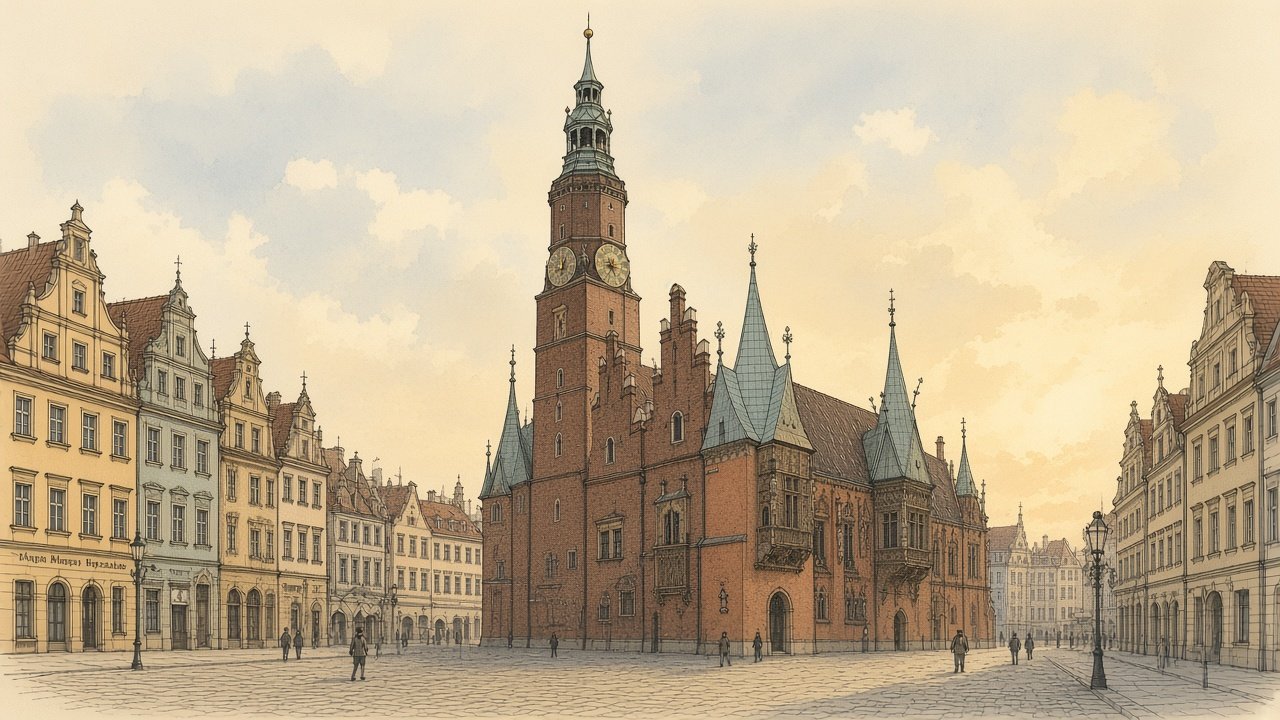
Wrocław stands where the Oder divides into channels and islands, a city whose stone, brick and bridges have carried the names of several states. Known in German as Breslau for much of the modern era, and earlier as Wrotizla and Vratislavia in Latin chronicles, it was for centuries the chief city of Silesia, a borderland contested by Piast dukes, Bohemian kings, Habsburg emperors, Prussian kings and, after 1945, the Polish state. Its market square, cathedral island and university facade still show the successive layers of that history, even as the language spoken in its streets has changed more than once.[1][2]
This special feature follows Wrocław from its early medieval ford and Piast bishopric through Bohemian and Habsburg rule, the Prussian conquest of Silesia, the growth of imperial German Breslau, the destruction of Festung Breslau in 1945, and the postwar remaking of the city by settlers from central Poland and the former eastern borderlands. It turns as well to the Jewish community that flourished and was later destroyed, to the university that produced Nobel laureates, and to the islands, bridges and squares that still organise daily life. An interactive timeline at the end of the essay gathers the principal dates.
The account is chronological. Later chapters treat the siege of 1945, the expulsion of the German population, the arrival of Polish settlers, reconstruction under the People’s Republic, and the city’s place in Poland after 1989, including its year as a European Capital of Culture. The city’s Polish and German names are both used according to period and context: Breslau for the German-speaking municipality before 1945, Wrocław for the Polish city thereafter, and the Polish form for the Piast and episcopal Middle Ages in keeping with much modern scholarship, without denying the multilingual record of the sources.[1][3]
Readers seeking only a short orientation may consult the contents list and the timeline. Readers seeking mechanisms — how Magdeburg law shaped streets, how fortress orders destroyed civilians, how settlers learned a foreign city — will find those mechanisms traced in the chapters themselves. The references favour Grokipedia entries and academic works that can be checked; books are cited without links in the usual way.
1. A ford on the Oder
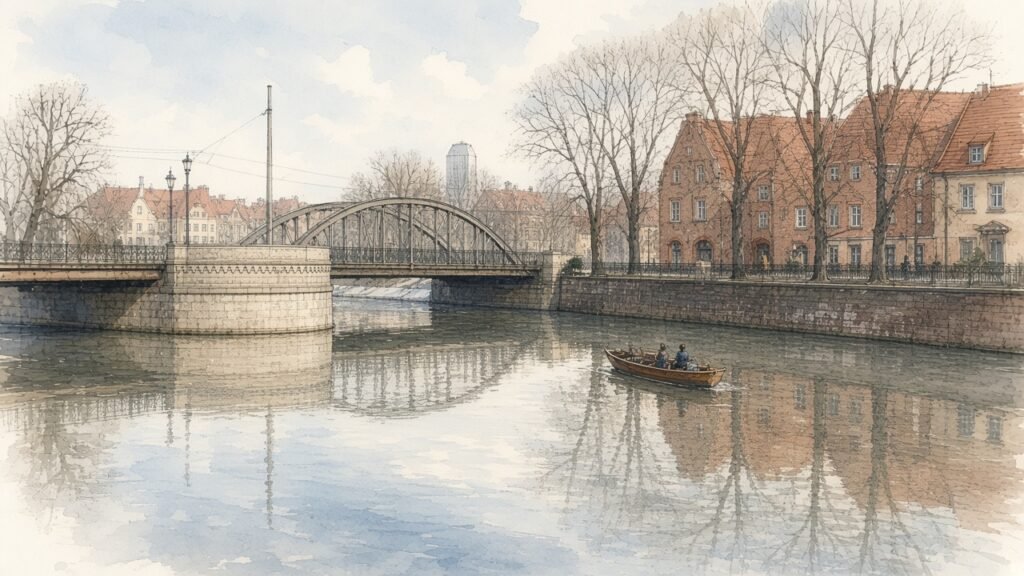
The site of Wrocław was chosen for water. The Oder, flowing north towards the Baltic, breaks here into arms that enclose low islands of sand and clay. In the early Middle Ages those islands offered dry ground above the floodplain, while the fords and ferries that linked them controlled movement between Greater Poland, Bohemia and the marches of the Holy Roman Empire. Slavic settlements of the Ślężanie and related groups occupied the region that later took the name Silesia from their ethnonym; archaeology and early chronicles place a fortified centre on what became Ostrów Tumski, the Cathedral Island, by the tenth century.[1][3][4]
Incorporation into the Piast state followed the expansion of Mieszko I and his son Bolesław I Chrobry. In the year 1000, at the Congress of Gniezno, Bolesław established a bishopric at Wrocław together with sees at Kraków and Kołobrzeg under the new metropolitan archbishopric of Gniezno. The foundation placed a Latin diocese on the Oder at a moment when the Piast rulers were seeking recognition from the Ottonian empire and from Rome. The bishop’s seat on Ostrów Tumski, with its wooden then stone churches, became the first durable institutional presence in the settlement. Chronicles of the eleventh and twelfth centuries already name the place among the political centres of the Polish kingdom, alongside Kraków and Sandomierz.[5][6][2]
The early town was not yet a single urban body. Ostrów Tumski held the cathedral and the bishop’s household. Across the river arms lay craft and market settlements, and on the left bank a ducal residence developed as the Piasts consolidated Silesia. Trade followed the river and the overland routes that crossed it: amber and salt moved north and south; cloth, metalwork and grain moved east and west. The Amber Road and later the Via Regia linked the Oder crossing to markets as far as the Rhineland and the Black Sea littoral. German-speaking merchants and craftsmen appear in the sources from the twelfth century onwards, though Slavic speech remained common in the countryside and among many townsfolk for generations.[7][8]
Political life was unsettled. Bohemian princes contested Silesia; pagan reaction and the Bohemian occupation of the late 1030s disrupted the young diocese; Polish dukes recovered the city mid-century. The fragmentation of the Piast realm after the testament of Bolesław III Wrymouth in 1138 made Wrocław the capital of the Duchy of Silesia under Władysław II the Exile and his successors. From that point the city’s fate was bound more closely to Silesian ducal politics than to the senior duke at Kraków, even as the bishopric remained part of the Polish church province. The ford had become a capital in miniature, with walls, markets and a Latin clergy whose records begin to thicken in the twelfth century.[9][10][3]
Names already varied with the language of the scribe. Latin Vratislavia or Wrotizla, Polish Wrocław, and later German Breslau all derive from forms associated with a personal name, often linked in tradition to Vratislaus of Bohemia, though the etymology remains debated among historians. What mattered for contemporaries was the river crossing and the bishop’s seat. By 1200 the settlement on the left bank was taking on the shape of a chartered town, while Ostrów Tumski remained a distinct ecclesiastical island. That dual structure — civic market and cathedral island, linked by bridges — would organise the city’s geography for the next eight centuries.[1][11]
Archaeology continues to refine the picture of the early stronghold. Excavations on Ostrów Tumski and on left-bank sites have revealed fortification ditches, pottery assemblages and church foundations that align with the written record of a tenth- and eleventh-century centre. The wet environment preserves organic material poorly in some layers and well in others; dendrochronology and careful stratigraphy have nonetheless allowed historians to correlate floods, rebuilds and fires with chronicle notices. Each decade of dig reports adds texture to what older narratives treated as legend.[1][3][11]
The bishopric’s foundation in 1000 must be understood within Ottonian–Piast diplomacy. The Congress of Gniezno was a meeting of rulers and a staging of Christian legitimacy. Placing a bishop on the Oder announced that Silesia belonged inside the new Polish church province rather than under Magdeburg’s direct claim, even as cultural and commercial ties to the Empire remained strong. That jurisdictional decision echoed for centuries whenever German and Polish historians argued over the region’s “natural” affiliation.[5][6][2]
River trade in the high Middle Ages moved salt from Polish sources, herring from the Baltic, cloth from the west and metals from the south. Toll registers, where they survive for Silesian crossings, show the ford’s fiscal value to dukes who might otherwise have seemed poor in comparison with western princes. Control of bridges and ferries was thus as political as control of castles. Feuds over toll rights appear in charters alongside pious donations to monasteries.[4][7][8]
Early ethnic labels in chronicles should be read with care. Words for Slavs, Germans and Bohemians mapped fluid allegiances as much as language. A craftsman might live under German law, worship in a parish with a Latin priest and speak a Slavic dialect at home. Modern national categories flatten that complexity. This essay uses ethnonyms when sources do, while noting that medieval identity was corporate, legal and confessional before it was national in the nineteenth-century sense.[3][15][2]
The dual settlement pattern — ecclesiastical island and civic left bank — created enduring administrative seams. Even after bridges multiplied, the bishop’s jurisdiction and the council’s jurisdiction could clash over markets, morals courts and building rights. Those clashes are documented in episcopal and municipal cartularies. They remind us that “the city” was already a coalition of powers, not a single will, long before modern bureaucracy arrived.[11][10][1]
Latin hagiographies and miracle collections associated with Silesian saints occasionally mention the city as a stage for piety and conflict. Even when historically dubious, such texts show how clerical authors imagined the Oder centre as a moral landscape. They complement charters by revealing rhetorical uses of place. Modern critical editions make these sources more usable than earlier patriotic anthologies did.[3][12][1]
Climate and flood rhythms shaped harvests and fire risks. Wet years softened walls; dry years increased conflagration danger among wooden suburbs. Medieval urban environmental history, still developing for Silesia, will likely show Wrocław as a case where water management was always a political skill. The ford’s blessing was never free of the flood’s threat.[4][1]
Charters of market rights and bridge tolls, reissued by successive rulers, created a parchment continuity that outlasted dynasties. Scribes copied older privileges into newer confirmations so that a Bohemian king might endorse a Piast duke’s grant. Legal memory thus stacked like the city’s stone. Archivists today unfolding these sheets participate in a chain of reading centuries long.[1][21][15]
Military music and civic bands filled parks on Sundays in the imperial age. Repertoires mixed marches with operetta. After 1945 Polish military and scout bands claimed the same bandstands. Continuity of open-air sound with changed anthems is a small emblem of the larger replacement. Sound archives, where they exist, make the emblem audible.[42][58][1]
2. Piast dukes and the bishopric
Under the Silesian Piasts the duchy became one of the most urbanised parts of the fragmented Polish lands. Henry I the Bearded and his wife Hedwig of Andechs, later venerated as a saint, ruled from Wrocław and nearby Legnica in the early thirteenth century and encouraged Cistercian and Franciscan foundations, German settlement under Magdeburg law, and the clearance of forest for agriculture. Their son Henry II the Pious continued that policy until the Mongol invasion of 1241. The Battle of Legnica, fought west of the city, killed Henry II and scattered his army; the Mongols withdrew soon afterwards, but the shock accelerated the rebuilding of towns on new legal foundations and the recruitment of settlers from the Empire.[12][13][14]
Wrocław received Magdeburg rights in stages during the thirteenth century. The privilege organised the market, the council, the craft guilds and the layout of streets around a rectangular square — the Rynek — with a town hall that grew into the Gothic brick structure still standing today. New walls enclosed the left-bank town. Parish churches rose for the German-speaking burghers; the cathedral on Ostrów Tumski was rebuilt in brick Gothic after fires. The bishop remained a territorial power with his own jurisdiction on the island and estates across Silesia, sometimes in tension with the duke and the city council.[15][11][4]
The Silesian Piasts subdivided their inheritance. By the late thirteenth and early fourteenth centuries the Duchy of Silesia had split into numerous smaller duchies — Wrocław, Legnica, Brzeg, Oleśnica, Opole and others — whose rulers sought protection and prestige through marriage and homage. Some dukes leaned towards Poland under Casimir III the Great; others looked to Bohemia, whose kings were rising as a force within the Holy Roman Empire. The city of Wrocław itself, with its rich council and guilds, negotiated privileges from whichever prince held the local ducal title, and increasingly acted as a corporate actor in regional politics.[3][16][17]
Language and law shifted with settlement. German became the dominant language of the town council, the guilds and much of the written urban record, while Polish and Czech persisted in surrounding villages and among parts of the clergy and nobility. Jewish communities appear in Silesian towns in the thirteenth century; in Wrocław they occupied streets near the market and engaged in trade and moneylending under ducal protection that was often revoked in times of crisis. The bishopric’s schools and the mendicant orders supplied Latin learning; vernacular literacy spread among merchants who needed accounts and contracts.[18][19]
By the early fourteenth century the male line of the Wrocław dukes was failing. When the last Piast duke of Wrocław died without heirs, the Bohemian crown stood ready to claim the succession. The city’s wealth — cloth, metal, grain and the transit trade — made it a prize. The transition that followed would detach Silesia from the Polish crown for six centuries, even as family memory, church structures and commercial ties with Poland never wholly disappeared.[2][3]
Hedwig of Andechs, consort of Henry I, became a figure of Silesian sanctity whose cult travelled with Cistercian and court networks. Her foundations and charities mattered for the region’s Christian infrastructure; later German and Polish commemorations both claimed her. Dynastic women in the Piast world often brokered marriages that tied Silesia to the Empire’s princely houses, accelerating cultural transfer in both directions.[12][3]
Magdeburg law’s appeal lay in predictability. Merchants preferred known procedures for debt, inheritance and guild entry. Dukes preferred the tax yields of thriving towns. The bargain produced urban landscapes with regular plots and central squares across East Central Europe. Wrocław’s Rynek is one of the finest surviving results of that bargain, even where later facades hide earlier fabric.[15][14]
The Mongol interlude of 1241 entered chronicles as apocalypse and entered urban history as catalyst. Whether the left-bank town was wholly destroyed or partly evacuated remains discussed; what is clear is that postwar reconstruction privileges for settlers thickened. Invitation charters elsewhere in Silesia show dukes competing for colonists. Wrocław’s recovery was part of a regional race to rebuild taxable prosperity.[14][13][12]
Subdivision of Silesian duchies created a patchwork that outsiders found confusing and locals navigated through homage and marriage. A duke of Legnica might be cousin and rival to a duke of Wrocław. The Bohemian king’s offer of protection and fief status promised higher arbitration and prestige. By the time Casimir III renounced claims at Trentschin, many Silesian Piasts had already oriented their politics southward to Prague rather than northward to Kraków.[16][17][21]
Jewish credit was structurally important to ducal finance and urban trade, which made communities useful and exposed. Blood libels and host-desecration charges, when they appeared in Silesia as elsewhere in Europe, could erase that usefulness overnight. The cycle of protection and persecution is documented in scattered privileges and expulsion orders. Continuity of Jewish presence in Breslau into the modern era was real but never secure.[18][19]
Coinage and seals of Silesian Piasts advertised authority in miniature. Numismatic finds in excavation layers date occupation and trade contacts. Heraldic eagles and other devices later became contested symbols in German and Polish memory cultures. Objects smaller than a palm thus carry centuries of argument about belonging.[12][3][2]
Monastic granges supplied towns with grain and fish. Cistercian and Premonstratensian estates structured the hinterland. Conflicts between abbeys and municipal butchers over market rights fill court records. The city’s food security depended on these rural corporations as much as on long-distance trade — a reminder that urban history is always agrarian history in disguise.[12][1][8]
Dietary cultures shifted with rulers and migrants: Silesian poppy-seed dishes, Prussian culinary fashions, eastern Polish pierogi after 1945, and later global fast food. Food history is not trivial; it marks who settled and what they missed. Cookbooks in municipal libraries register the population exchange as clearly as street-name decrees, if one knows how to read ingredient lists as evidence.[58][2][1]
Schools for the deaf and blind, vocational asylums and municipal hospitals formed a secondary civic landscape of care. Their German-language records become Polish-language records with the same patients sometimes still in beds during the transition. Institutional continuity through demographic rupture is a specialised historical problem that Wrocław’s welfare archives can illuminate for comparative European study.[1][58][36]
3. Mongols, walls and settlers
The Mongol raid of 1241 was brief but formative. After Legnica the invaders moved through Silesia; Wrocław’s left-bank settlement suffered, and rebuilding became an occasion to regularise streets, fortify gates and invite settlers under written privileges. Magdeburg law, already familiar in Silesia, provided a template: a hereditary Schultheiss or Vogt, a council of jurymen, and appeal to Magdeburg in difficult cases. Brick replaced wood for churches and public buildings where means allowed. The Rynek took its classic form as a trading floor ringed by burgher houses with arcades and warehouses behind.[14][15][12]
Settlers came from Saxony, Franconia, Thuringia and Flanders as well as from older German towns in Silesia and Bohemia. They brought craft specialisms — weaving, brewing, metalwork, milling — and the guild statutes that regulated them. The city council gradually bought out the hereditary vogt’s rights and ruled as a closed patriciate, periodically challenged by artisan guilds that demanded representation. Fires in the fourteenth century destroyed large districts; each rebuilding raised denser brick fronts and stricter fire ordinances. Bridges linking the islands were timber at first, then stone in critical spans, and tolls on those bridges funded walls and watch.[1][4]
Outside the walls the countryside remained mixed. Polish-speaking villages paid rents in kind and labour; German-law villages paid cash rents and used different inheritance customs. The bishop’s estates formed a third jurisdiction. This legal pluralism was typical of medieval Central Europe and helps explain why later national historians could read the same landscape as “German” or “Polish” according to the sources they privileged. For the medieval council the relevant distinctions were burgher and outsider, Christian and Jew, guild member and apprentice, not the modern nation.[3][18]
Trade connected Wrocław to Kraków, Prague, Leipzig and the Baltic ports. Cloth from Flanders and England was finished or redistributed; Hungarian copper and Polish grain moved through Silesian merchants; wine came from the south. The city’s merchants joined wider networks that overlapped with the Hanseatic world without making Wrocław a classic Hanse town. Credit instruments, partnerships and fair calendars tied the Rynek to the rhythm of Central European commerce. By 1300 Wrocław was already one of the larger cities east of the Elbe, with a population measured in the low tens of thousands — a major centre by the standards of the age.[8][7][1]
Defensive works thickened as gunpowder arrived in the later Middle Ages. Gates with double towers, wet ditches fed by the Oder arms, and outworks on the approach roads made the city a serious fortress. Those walls would matter when Hussite armies campaigned in Silesia in the fifteenth century and again when later dynasties fought over the province. The medieval inheritance — Magdeburg law, brick Gothic churches, a powerful council, a cathedral island and a dense market square — set the physical and institutional frame within which Bohemian, Habsburg and Prussian rulers would later govern.[20][4]
Brick Gothic in Silesia used locally fired brick for churches, gates and town halls where stone was costly to transport. Workshops shared stylistic vocabularies with Brandenburg, Prussia and Bohemia. Ornament on Wrocław’s town hall places it in that family of civic showpieces. Maintenance of brick fabric across centuries required guilds of specialists whose account books, where preserved, show continuous repair cultures rather than single building campaigns.[15][1]
Guild conflict was not merely economic. Processions, altar patronage and seating in churches mapped honour. When artisans killed councillors in 1418 they attacked a social order, not only a tax policy. Sigismund’s bloody response reasserted princely and patrician authority. Similar urban revolts elsewhere in the Empire provide comparative context: late medieval towns were volatile corporations, not peaceful museums.[20][1]
Hussite campaigns brought ideological war into Silesia. Towns chose sides under pressure of armies that lived off the land. Wrocław’s Catholic-imperial alignment had commercial as well as confessional motives: trade with Prague and the Empire mattered. Rural districts suffered raids that municipal chronicles record with fear. The fifteenth century thus rehearsed, in smaller form, the religious militarisation that the seventeenth century would intensify.[20][27]
Population estimates for 1300–1500 vary because tax lists count hearths differently. What is safe to say is that Wrocław ranked among the significant cities east of Prague and Magdeburg. Its fair calendar and craft specialisations made it a node rather than a backwater. Travellers’ remarks, sparse but useful, notice walls, bridges and the busy market. The city’s self-confidence in dealing with kings rested on that economic weight.[1][8][7]
Defensive modernisation against cannon required earthworks and angled bastions that later centuries would again remodel. Military architecture thus layered upon medieval walls like rings of a tree. When Prussians and then twentieth-century armies assessed Breslau’s defensibility, they read that layered landscape. Festung thinking in 1944 had medieval and early modern precedents in the same ground plan, however different the weapons.[68][1][36]
Comparative urban historians place thirteenth-century Wrocław alongside Kraków, Prague and Wrocław’s Silesian neighbours such as Świdnica. Rankings by tax yield and wall length fluctuate with sources. What matters more than league tables is the shared toolkit of Magdeburg law, brick building and long-distance credit. Wrocław was typical in form and exceptional in later geopolitical fate.[15][14][1]
Fire ordinances required night watches and limited certain crafts to outer zones. Enforcement was uneven; bribery and neighbourly denunciation filled gaps. The history of risk management in medieval towns anticipates modern insurance and zoning. Wrocław’s repeated fires make it a good laboratory for that longer story of urban fear and regulation.[1][15]
Seasonal fairs brought rural sellers into contact with urban buyers under rules older than any living merchant. Dispute resolution at fair courts trained generations in oral pleading. When rail reduced the fair’s centrality, something of that legal theatre faded. Folklorists recorded remnants; economists noted efficiency gains. Both were right about different losses and benefits.[8][1][41]
Gardening advice columns in local newspapers across regimes taught balcony tomato methods and rose pruning. The domestic green of allotments and courtyards softened brick severity. Environmental historians note how such micro-practices maintained soil knowledge through war and shortage. The city’s green is not only parks designed by famous planners; it is also improvised soil in unlikely corners.[1][58]
4. Under the Bohemian crown
The extinction of the local Piast line opened Silesia to the Bohemian crown. In the 1320s and 1330s John of Bohemia secured the homage of most Silesian dukes, and the Treaty of Trentschin in 1335 recorded King Casimir III of Poland’s renunciation of claims to Silesia in return for Bohemian recognition of Polish holdings elsewhere. Wrocław and almost the whole of Silesia were thereby incorporated into the Lands of the Bohemian Crown within the Holy Roman Empire. A Landeshauptmann administered the province for the king. The city’s merchants continued to trade with Poland, but politically the Oder capital now looked to Prague.[21][22][16]
Charles IV, king of Bohemia and later Holy Roman Emperor, visited Wrocław and confirmed privileges. His reign linked Silesia more tightly to the imperial and Bohemian legal order. Fires in the 1340s destroyed large parts of the city; reconstruction under Bohemian overlordship produced denser brick streetscapes and a more assertive town hall. The council guarded its autonomy against royal officials and against the bishop, whose estates remained extensive. Craft guilds pressed for a share of power; tension between patricians and artisans was a recurring feature of urban politics across Central Europe and found violent expression in Wrocław as elsewhere.[23][1][4]
In 1418 craftsmen rose against the council and killed seven councillors. King Sigismund, who held the Bohemian crown, answered with a tribunal that executed twenty-seven ringleaders when he was in the city two years later. He also convened a Reichstag in Wrocław that year. The episode showed both the force of guild discontent and the crown’s determination to keep the city obedient. Hussite wars in the following decades brought raids and religious conflict into Silesia; Wrocław’s council generally sided with Catholic and imperial interests against the Hussite armies that devastated parts of the countryside.[20][1][3]
Bohemian rule did not erase older ties. Polish remained spoken in villages and among migrants; the diocese stayed in the Gniezno province for a time before later rearrangements; trade fairs still drew merchants from Kraków and beyond. Yet the ruling language of the council and courts was German, and the city’s elite identified with the Empire’s urban culture. Silesia’s place inside the Bohemian Crown meant that when the Habsburgs inherited Bohemia in 1526, Wrocław would pass with it — another change of dynasty without a change of daily law or language for most burghers.[2][21][24]
The late medieval city was prosperous enough to sustain monumental building. Parish churches, monasteries and the cathedral fabric on Ostrów Tumski received chapels, altars and stalls. The town hall’s eastern facade acquired the elaborate Gothic decoration that still marks it as one of the finest secular brick buildings east of the Elbe. Markets specialised: cloth, salt, cattle and grain each had their places and tolls. Water mills on the Oder arms powered industry. By 1500 Wrocław was a mature Central European city, Bohemian in allegiance, German in urban speech, and Silesian in the mixed countryside that fed it.[15][11][1]
Dynastic accident completed the medieval transition. Louis II of Hungary and Bohemia died at Mohács in 1526 fighting the Ottomans. His brother-in-law Ferdinand of Habsburg claimed the Bohemian crown; after conflict with rival claimants, Habsburg rule over Bohemia and its crown lands, including Silesia, was secured. Wrocław’s council swore to the new dynasty. The Reformation was already spreading in Silesian towns; the Habsburgs would confront that religious change as Catholic rulers of a largely Protestant province, setting the terms of the next two centuries.[25][24][26]
John of Bohemia’s Silesian policy mixed force, money and ceremony. Homage rituals staged dukes as vassals; unpaid debts and disputed successions gave openings for intervention. Polish historiography long treated Trentschin as a national wound; Bohemian and imperial historiography treated it as orderly integration of a crown land. Both frames capture parts of a negotiation in which Silesian elites themselves sought advantage.[21][22][16]
Charles IV’s confirmation of privileges fit his wider project of a coherent Bohemian crown. Wrocław’s merchants valued access to Prague’s courts and to imperial peace when it held. Fires in the 1340s tested that relationship as rebuilding strained capital. Royal visits were occasions for petition as much as for pageantry. The city’s archives preserve the paper trails of those petitions in Latin and German.[23][1]
Guild revolt and royal punishment in 1418–20 entered urban memory as warning. Patrician chronicles stressed the crime of murdering councillors; artisan traditions, harder to recover, likely stressed hunger and exclusion. Modern historians read the episode through the lens of late medieval corporate conflict. It remains one of the sharpest windows onto social tension inside Bohemian Wrocław.[20][1]
Trade with Poland continued because geography commanded it. Grain, cattle and oxen moved west; cloth and metalwares moved east. Customs posts on the routes generated revenue for whoever held the frontier. Even under Bohemian sovereignty the Oder city remained an economic hinge between Polish lands and the Empire. That hinge function outlasted every dynasty until rail and partition rearranged it.[8][7][3]
The Mohács disaster of 1526 was distant geographically yet decisive dynastically. Ferdinand’s claim brought Habsburg administrators, Habsburg wars and Habsburg confessional priorities. Wrocław’s council calculated survival under the new house as it had under the Luxembourg and Jagiełłon connections of Bohemia. Continuity of local law softened the dynastic break for burghers who paid taxes to whichever chancery issued receipts.[25][24][26]
Art patronage in Bohemian Wrocław included altarpieces, civic plate and illuminated books for churches and council chapels. Surviving objects in museums today are often catalogued under German or Silesian schools that crossed political borders. Cultural history thus resists the neat maps of sovereignty. A workshop could serve a Bohemian king and a Silesian bishop in the same decade.[1][15]
Diplomatic correspondence between Prague and the Silesian Landeshauptmann reveals routine governance: appointments, tax arrears, border incidents with Poland and Hungary. Boredom is historically informative. It shows Bohemian rule as administration, not only as dramatic homage scenes. Wrocław’s council letters in the same archives show a city negotiating constantly for margins of autonomy.[21][23][1]
Musical and liturgical life under Bohemian rule left fragments in choir books and organ contracts. Soundscapes of Latin chant, vernacular hymns and market bells layered the air. Reconstructing them requires specialist skills; mentioning them reminds readers that the city was heard as well as seen. Later Protestant and Catholic sound wars would remix the same streets.[27][1]
Military music and civic bands filled parks on Sundays in the imperial age. Repertoires mixed marches with operetta. After 1945 Polish military and scout bands claimed the same bandstands. Continuity of open-air sound with changed anthems is a small emblem of the larger replacement. Sound archives, where they exist, make the emblem audible.[42][58][1]
Photographers — commercial studio operators, municipal documentarians, amateur family snapshooters — produced millions of images of Breslau and Wrocław. Digitization projects now reunite German family albums with Polish street views of the same corners. Facial resemblance across decades is rare because populations changed; architectural resemblance is common because stones remained. The photographic archive is thus a split inheritance awaiting more joint curation.[2][74][1]
5. Reformation and Habsburg rule
Lutheran preaching reached Silesia early. By the mid-sixteenth century most of Wrocław’s burghers and many nobles had accepted the Augsburg Confession. Churches that had been Catholic became Protestant; the cathedral and a minority of foundations remained Catholic under the bishop. The city council managed ecclesiastical property and schooling in a Protestant key while still acknowledging the Habsburg sovereign. This arrangement resembled other urban Reformations in the Empire: civic control of religion, residual Catholic institutions, and a distant Catholic monarch.[27][26][1]
The Habsburgs, especially after the Council of Trent, sought to restore Catholicism. Jesuits were introduced; Catholic officials were preferred; pressure mounted on Protestant institutions. Wrocław’s Protestant majority resisted through legal privilege and corporate solidarity. The early seventeenth century brought the Bohemian Revolt and the Thirty Years’ War. Silesia became a corridor for armies. Occupation, billeting, plague and contribution payments emptied treasuries and reduced population. The Peace of Westphalia in 1648 confirmed Habsburg sovereignty over Silesia while leaving a complex map of religious rights; in practice Catholic recovery continued through the later seventeenth century with Jesuit schools, new Catholic churches and the conversion or emigration of some Protestant elites.[28][29][26]
Economically the seventeenth century was difficult. War disrupted the transit trade; rural depopulation cut demand; rival routes and the rise of Leipzig and other fair towns pinched Wrocław’s merchants. Recovery in the later 1600s and early 1700s restored some cloth and metal trades and renewed building. Baroque facades appeared on burgher houses; Catholic orders raised convents and colleges. The university that would later make Breslau famous did not yet exist as a full studium under Prussian charter, but Jesuit teaching already offered higher Latin education in the city.[1][4][30]
Habsburg Silesia was administered as part of the Bohemian lands, with a provincial government and estates in which princes, nobles and towns were represented. Wrocław’s council sat among the town voices. Taxation for Vienna’s wars — against Ottomans and against Bourbons — was heavy. Yet the city retained Magdeburg-derived law and German civic culture. Jewish residence was restricted and periodically expelled or readmitted under special patents; small communities persisted under tight regulation typical of Habsburg and imperial towns.[18][19][24]
By 1740, when Emperor Charles VI died and the Pragmatic Sanction was tested, Silesia was a rich Habsburg province with a largely German-speaking urban population, a Catholicised official culture, and Protestant minorities under sufferance. Maria Theresa’s accession invited challenge. Frederick II of Prussia had dynastic claims dating to earlier Hohenzollern–Piast agreements that Vienna rejected. In December 1740 Prussian troops entered Silesia. Wrocław, Protestant in sympathy and unwilling to suffer a siege for a distant Catholic empress, opened its gates in January 1741. The city’s change of master was swift; the consequences would last until 1945.[31][32][33][34]
The Silesian Wars that followed — three conflicts within the War of the Austrian Succession and the Seven Years’ War — confirmed Prussian possession. Treaties of Breslau and Berlin in 1742, and finally Hubertusburg in 1763, left most of Silesia, including Wrocław, to Prussia. Maria Theresa never reconciled herself to the loss; Frederick treated Silesia as the jewel of his conquests. For the city the immediate effect was a new garrison, new taxes, and a Protestant king who favoured the Protestant burghers while retaining Catholic institutions under state oversight. Breslau, as German usage now firmly named it in Prussian administration, entered the orbit of Berlin.[35][32][33]
Lutheran church orders in Silesian towns regulated marriage, schools and poor relief. Hymnody and catechism Germanised religious practice among burghers already German-speaking. Catholic remnants held the cathedral and some villages. The result was a confessionally split province under a Catholic dynasty — a structural tension that Habsburg Counter-Reformation policy sought to resolve in favour of Rome over two centuries.[27][26]
The Thirty Years’ War’s Silesian theatre involved Saxon, imperial and Swedish movements at different times. Contribution systems extracted cash and crops. Plague years emptied houses. Memoirs and parish registers, where studied, show demographic troughs. Wrocław’s walls offered relative safety that drew refugees and disease together. Post-1648 recovery was slow and uneven across the countryside.[28][29]
Jesuit schooling produced Catholic cadres for administration and pulpits. Their colleges taught drama, rhetoric and mathematics alongside doctrine. Protestant gymnasia competed where privileges allowed. The educational arms race shaped Silesian literacy and confessional identity into the eighteenth century. When Prussia took the province, it inherited both school traditions and bent them toward state service.[30][36][27]
Jewish regulation under Habsburgs included Familiants-style limits in some Bohemian lands and local variants in Silesia. Residence without privilege was precarious. Court Jews who financed princes occupied a different niche from poor pedlars. Emancipation was not yet thinkable; utility and theology jointly defined policy. The later Prussian and imperial openings would look revolutionary by comparison.[18][19]
Maria Theresa’s Silesian loss became a personal and dynastic obsession, feeding later Habsburg military reforms. For Wrocław’s Protestants the Prussian takeover felt like deliverance from Catholic pressure; for Catholics it felt like abandonment. Frederick’s propaganda emphasised liberation of co-religionists; his tax officials emphasised yield. The city’s gates opened in 1741 to a king who understood both messages.[31][33][34]
Baroque rebuilding after wartime damage gave the city some of its church and palace silhouettes. Stucco, fresco and organ culture flourished in Catholic spaces. Protestant churches maintained plainer aesthetics in many cases. Walking the city in 1700 would have revealed confessional difference in sound and ornament as much as in doctrine. Those sensory landscapes faded under later Prussian standardisation and still later wartime ruin.[1][26]
Military billeting manuals and contribution lists from the Thirty Years’ War survive in sufficient numbers to allow quantitative studies of extraction. Villages near Wrocław sometimes paid more than they could harvest. Urban magistrates mediated between armies and hinterlands at personal risk. The war’s economic geography, not only its battles, explains postwar stagnation.[28][29][1]
Confessional coexistence after Westphalia was legalistic and fragile. Mixed marriages, baptismal disputes and burial conflicts filled consistory courts. Everyday tolerance existed beside doctrinal hostility. Historians of religion in Silesia stress this lived messiness against older narratives of neat Protestant or Catholic blocs. Wrocław’s parish maps repay close study in that spirit.[29][27][26]
Schools for the deaf and blind, vocational asylums and municipal hospitals formed a secondary civic landscape of care. Their German-language records become Polish-language records with the same patients sometimes still in beds during the transition. Institutional continuity through demographic rupture is a specialised historical problem that Wrocław’s welfare archives can illuminate for comparative European study.[1][58][36]
Tramway labour — drivers, conductors, depot workers — organised early and struck occasionally. Their uniforms changed colours with regimes; their shift patterns obeyed the same clocks. Oral histories with retired tram workers collected in the 1990s capture the People’s Republic everyday with unusual concreteness. Transport proletariats are underused narrators of urban political history.[81][80][1]
6. Frederick takes Silesia
Frederick’s seizure of Silesia transformed the balance of power in Central Europe and remade Breslau’s political horizon. The province’s mines, linen and tax yield financed Prussian militarism; its fortress cities anchored the new southern frontier against Austria. Breslau became the provincial capital of Prussian Silesia, seat of a Kriegs- und Domänenkammer and later of an Oberpräsident. The garrison was large; parade grounds and magazines occupied land near the walls. Civic autonomy shrank as Prussian officials supervised taxation, policing and conscription.[32][33][36]
Religious policy shifted. Protestants regained churches and schools; Catholics kept the cathedral and bishopric but under stricter state control. Frederick’s Enlightenment absolutism prized order and revenue over confessional uniformity. Jews in Silesia remained subject to special regulations — protected for their economic usefulness, taxed heavily, and limited in residence and occupation — in line with wider Prussian practice. Some Jewish families in Breslau rose as army contractors and merchants under these constraints.[18][34][19]
During the Seven Years’ War Austrian forces briefly reoccupied Breslau in 1757 before Frederick recovered it after the Battle of Leuthen. The episode reminded citizens that geography still made them a prize. Fortifications were modernised; the city’s role as a logistics hub for Prussian campaigns into Bohemia and Moravia grew. After Hubertusburg the Prussian hold was not seriously contested until the Napoleonic era. Administrative Germanisation of remaining Slavic place-names and schooling continued gradually; Polish speech retreated further into rural districts and into the eastern fringes of Upper Silesia rather than the Breslau hinterland.[35][32][3]
Urban improvement under Prussian rule included street paving, better fire services, and the gradual removal or piercing of outdated medieval walls to allow expansion. Suburbs grew beyond the old gates. The Oder remained central for timber, grain and coal as mining in Upper Silesia expanded. Breslau’s merchants adjusted to Berlin’s tariff policies and to the competition of Magdeburg and Stettin on Prussian waterways. The city’s population recovered from wartime lows and began a long climb that would accelerate in the nineteenth century.[1][36][4]
Intellectual life reflected the Prussian Enlightenment. Christian Wolff’s philosophy, though associated more with Halle, influenced Silesian schools; local periodicals and reading societies spread. The poet and mystic Angelus Silesius (Johannes Scheffler) belonged to an earlier seventeenth-century Breslau Catholic conversion story still remembered in the city’s literary map. Grammar schools prepared sons of officials and merchants for careers in the Prussian state. Latin and German were the languages of advancement; Czech and Polish had little institutional place in the capital of Lower Silesia.[37][38][36]
When Frederick died in 1786, Breslau was firmly a Prussian city: garrisoned, taxed, administered from Berlin’s templates, Protestant in majority culture, and increasingly distant from the Habsburg world it had left in 1741. The next great shock would come with Napoleon, whose wars swept Silesia into temporary French satellite arrangements before the Congress of Vienna confirmed Prussian Silesia once more. The nineteenth century would then industrialise the city and raise a university that gave Breslau a European scholarly name.[39][40][32]
Prussian administrative vocabulary — Landrat, Kammer, Excise — replaced Habsburg forms. Cadastres measured fields for tax. Conscription lists measured bodies for the army. Breslau’s printers produced the forms. The modern state’s information hunger began here in provincial practice familiar from other Prussian lands. Citizens learned to be subjects of paper as well as of kings.[36][32]
Leuthen’s aftermath in 1757 entered Prussian military legend. The city’s brief Austrian reoccupation showed how quickly fortunes turned. Civilian billeting left bitter memories on all sides. Fortification engineers thereafter improved works with the lesson in mind. Breslau’s identity as a garrison city thickened; officers’ families became a social stratum with their own churches, balls and debts.[35][32][36]
Silesian linen and later coal tied Breslau’s merchants to Atlantic and European markets through Hamburg and overland fairs. Proto-industrial weaving in rural Silesia fed urban finishers. Crises in textile demand produced unemployment that prefigured nineteenth-century cycles. Economic historians trace these commodity chains to explain why Frederick valued the province beyond prestige.[32][41]
The Polish partitions of the late eighteenth century redrew maps east of Silesia and brought new Prussian districts into being. Breslau’s hinterland relationship to Polish-speaking areas shifted as Prussia absorbed Posen and other lands. Official Germanisation policies intensified in the nineteenth century, but their roots lay in Enlightenment-absolutist confidence that language reform served progress. Resistance and bilingual realities complicated that confidence at every turn.[63][3][36]
Napoleonic campaigns brought French troops, satellite rearrangements and then Prussian recovery after 1813. The Wars of Liberation furnished the myth that the 1913 Centennial Hall would later monumentalise in concrete. Breslau’s burghers celebrated emancipation from French pressure as a German national awakening, folding Silesia into a story larger than Frederick’s conquest alone. That story’s exclusions — of Poles, of Jews as full equals — would haunt the imperial age.[39][62][40]
By 1815 Breslau was ready for the demographic and industrial surge that rail would amplify. The Prussian century’s first half laid legal and military foundations; the second half built factories and faculties. The city’s modern German face, the face that 1945 smashed, was largely a nineteenth-century construction upon an eighteenth-century conquest upon a medieval street plan.[40][41][1]
Prussian legal codification eventually produced the Allgemeine Landrecht, which framed property and status in Breslau as in Berlin. Older Magdeburg customs were partly absorbed, partly overridden. Lawyers grew as a profession interpreting the hybrid. The city’s legal culture became a transmission belt for Enlightenment absolutism into daily contracts and inheritance fights.[36][32][15]
Cartographic surveys under Prussian rule mapped Silesia with new precision for tax and war. Breslau’s printers engraved maps that hung in offices across the province. Visual control accompanied fiscal control. Those maps later became historical sources for reconstructing vanished villages and wetlands — an unintended gift of the state’s hunger to know.[36][32][3]
Gardening advice columns in local newspapers across regimes taught balcony tomato methods and rose pruning. The domestic green of allotments and courtyards softened brick severity. Environmental historians note how such micro-practices maintained soil knowledge through war and shortage. The city’s green is not only parks designed by famous planners; it is also improvised soil in unlikely corners.[1][58]
Cemetery plantings of ivy and thuja, chosen in Prussian times, still shade Polish funerals. Tree longevity exceeds human ethnic tenure. Botanists and historians might productively map which species arrived with which planting fashion. The living landscape remembers across the 1945 break more faithfully than many inscriptions do.[1][74][2]
7. Prussian Breslau grows
The decades after the Napoleonic Wars turned Breslau from a fortress-provincial capital into a major Prussian metropolis. The Congress of Vienna confirmed Prussian Silesia; administrative reforms of the Stein–Hardenberg era and later the Vormärz period reorganised districts, abolished many guild monopolies and opened careers to a wider educated class. The city’s population, which had hovered in the tens of thousands in the eighteenth century, climbed steadily as rural migrants arrived from the Silesian countryside and as the Upper Silesian coal and zinc industries created demand for banking, insurance, machinery and transport centred on the provincial capital.[40][36][1]
Railways remade geography. Lines linked Breslau to Berlin, to Dresden and Leipzig, to Kraków and to the Upper Silesian Industrial District. Goods yards and locomotive works appeared on the urban fringe. The Oder was canalised and regulated in stretches to improve navigation, though rail soon carried the bulk of coal and metal. A stock exchange, joint-stock banks and wholesale houses concentrated capital. Textile finishing, brewing, printing and precision trades employed thousands. By mid-century Breslau was among the larger cities of the Prussian state, with a skyline of factory chimneys beyond the old brick towers.[41][1][4]
Municipal government modernised under a reformed Städteordnung. Gas lighting, waterworks, sewerage and horse trams arrived in stages. Parks were laid out on former fortification ground after the walls were slighted. New residential quarters — elegant for officials and merchants, dense Mietskaserne courtyards for workers — extended south and west. The Rynek remained the ceremonial and commercial heart, but daily life spread into suburbs that would later become named districts. Public health crises, including cholera outbreaks typical of nineteenth-century cities, forced further sanitary investment.[1][36]
Culture followed wealth. Theatres, concert halls and museums opened; newspapers in German multiplied. The Schlesische Zeitung and other papers shaped a liberal-national reading public. Festivals commemorated Prussian victories and, after 1871, the new German Empire. At the same time a Polish-speaking minority — students, railway workers, servants and traders — maintained societies and a press of its own, though they were a small fraction of the city’s inhabitants compared with Upper Silesian towns further east.[42][3][2]
The unification of Germany in 1871 made Breslau a city of the Kaiserreich. Representation in the Reichstag, participation in imperial tariffs and the prestige of imperial institutions raised its status as the capital of the Province of Silesia (later divided, with Breslau remaining capital of Lower Silesia). Military presence continued; barracks and parade grounds reminded citizens that the state was a war-ready monarchy. Statues of Prussian kings and generals appeared in squares. The city’s German character seemed, to most of its burghers, permanent and progressive — a conviction that the twentieth century would overturn.[42][36][1]
Architecture of the Gründerzeit filled gaps left by fires and demolition. Neo-Gothic and neo-Renaissance facades lined new avenues; department stores introduced iron and glass. Churches of various confessions rose for growing congregations — Protestant parish churches for the majority, Catholic churches for a substantial minority, and synagogues for the Jewish community treated in a later chapter. Cemeteries expanded on the outskirts. By 1900 Breslau’s population approached or exceeded half a million in the wider urban area, placing it among the great cities of eastern Germany and of Central Europe.[1][4][18]
Labour organisation followed industrialisation. Craft associations gave way to trade unions; the Social Democratic Party found voters among factory hands and railwaymen. Ferdinand Lassalle, born in Breslau in 1825, became a founding figure of German social democracy, though his career unfolded largely elsewhere. Strikes and May Day demonstrations marked the 1890s and 1900s. Catholic workers’ associations competed for the same constituencies. The city’s politics thus mirrored the Empire’s wider conflicts between conservatives, National Liberals, Centrists and Social Democrats, played out in municipal elections and in the press.[43][42]
On the eve of the First World War Breslau was confident in its German identity, proud of its university and industry, and tied by rail and river to the imperial economy. Few imagined that within three decades the city’s language, population and state would be wholly replaced. The Prussian century had built the physical city that later sieges would ruin and that Polish settlers would inherit as a shell to be renamed and rebuilt.[1][2][44]
Cholera epidemics in the mid-nineteenth century killed thousands and spurred sanitary reform. Physicians argued over miasma and water; engineers built intakes and sewers anyway. Cemetery expansions followed mortality spikes. Public health became a municipal specialty with its own budgets and experts. The body’s vulnerability linked rich and poor more tightly than politics admitted.[1][36]
Rail stations were palaces of iron and glass that reoriented urban flows. Hotels clustered nearby; porters and cab drivers formed new trades. Timetables synchronised provincial life with Berlin’s clock. Military mobilisation plans depended on those same tracks. When war came in 1914 and again in 1939, Breslau’s junctions did the work peacetime commerce had rehearsed.[41][44]
Press culture produced readers who debated tariffs, school languages and naval bills. Antisemitic and anti-Polish caricatures circulated alongside liberal editorials. Cabarets and variety theatres lightened evenings. The city’s tone was provincial-metropole: proud, sensitive to Berlin’s condescension, eager to prove cultural worth. That eagerness funded theatres and museums that later Polish Wrocław could reuse as buildings if not as programmes.[42][18][1]
Women’s organisations before 1914 focused on charity, temperance and education; suffrage currents arrived more strongly after the war. Jewish women ran parallel associations. Factory work drew young women into public wage labour under protective legislation that was unevenly enforced. Gender history of Breslau remains a developing field that complicates male-centred municipal narratives.[46][1]
Architecture of historicism clothed modern functions in Gothic and Renaissance dress. Critics later mocked the style; residents enjoyed the grandeur. Demolition for traffic in the twentieth century and war damage removed much of it. Surviving blocks still show the mixture of show facade and cramped rear courtyard typical of Gründerzeit speculation. Housing reformers condemned those courtyards before 1914; they remained inhabited into the siege and after.[1][58]
Lassalle’s birth in the city gave Social Democrats a local hero to commemorate when politics allowed. Conservatives preferred Hohenzollern monuments. The competition of statues and street names rehearsed the memory wars that 1945 would settle by erasure and replacement. Every regime that held Breslau/Wrocław has rewritten bronze and enamel to match its story.[43][2][42]
Technical schools for craftsmen paralleled the classical gymnasium. Evening drawing classes trained workers for machine design. Industrial exhibitions displayed Silesian products under gaslight. Pride in provincial industry was a civic emotion cultivated by chambers of commerce. It fed both liberal progress narratives and, later, nationalist claims to German superiority in the East.[41][42][1]
Migration from rural Upper Silesia and beyond created dialect mixtures in factory districts. Pastors and priests noted pastoral challenges of mobility. Crime statistics worried middle-class readers. Urban sociology as a proto-discipline took Breslau as a case in German statistical journals. The city’s modernity was measured, worried over and celebrated in the same annual reports.[1][63][36]
Photographers — commercial studio operators, municipal documentarians, amateur family snapshooters — produced millions of images of Breslau and Wrocław. Digitization projects now reunite German family albums with Polish street views of the same corners. Facial resemblance across decades is rare because populations changed; architectural resemblance is common because stones remained. The photographic archive is thus a split inheritance awaiting more joint curation.[2][74][1]
University extension lectures for the public, in German before the war and in Polish after, carried science into town halls. Attendance lists show teachers and clerks seeking self-improvement. This didactic civic culture is a thread connecting imperial Breslau to socialist Wrocław without denying the rupture between them. Popular enlightenment was a shared European project under different flags.[45][58][36]
8. University, science and letters
The University of Breslau, refounded and expanded under Prussian auspices in the nineteenth century from earlier Jesuit and Leopoldina roots, became the intellectual centre of eastern Germany. Faculties of theology, law, medicine and philosophy trained officials, pastors, doctors and teachers for Silesia and beyond. German was the language of instruction; Latin lingered in ceremonial use. Libraries and clinics grew with state funding. By the later nineteenth century the university attracted students from across the Empire and from neighbouring lands, including a notable contingent of Jewish students who faced quotas and social barriers yet entered medicine, law and the natural sciences in significant numbers.[45][18][46]
Scientific distinction followed. The medical faculty and associated clinics contributed to pathology, psychiatry and clinical research; Alois Alzheimer worked in related German clinical networks of the era, and Breslau’s hospitals participated in the wider German medical revolution. In chemistry and physics the city’s laboratories belonged to the same world that produced industrial dyes, fertilisers and, later, the controversies of wartime science. Fritz Haber, born in Breslau in 1868 to a Jewish family, studied and began his career in the German chemical community before the ammonia synthesis that won a Nobel Prize and the poison-gas work that stained his reputation. Max Born, also born in Breslau, became a central figure in quantum mechanics and a Nobel laureate, emblematic of the Jewish scientific elite that the city helped form and that National Socialism later drove into exile.[47][48][49][50]
Letters and history had their own Breslau names. Leopold von Ranke’s early career touched Silesian scholarly networks; the university’s historical seminar participated in the professionalisation of German historiography. Gerhart Hauptmann, associated with Silesia, brought naturalist drama and later Nobel recognition into the region’s cultural map. Hoffmann von Fallersleben, author of the song that became the German national anthem’s lyrics, held a Breslau library post before political trouble. The city’s theatres staged Schiller and Goethe alongside contemporary social drama. A reading public sustained bookshops, lending libraries and learned societies.[51][52][53][45]
Theological faculties reflected confessional division. Protestant theology trained pastors for the Prussian church; Catholic theology served the diocese. Debates over biblical criticism, social Christianity and ultramontanism echoed national controversies. Jewish students barred from certain chairs still shaped intellectual life through private scholarship, the rabbinical seminary traditions of German Jewry, and later through Zionist and liberal Jewish thought. Edith Stein, born in Breslau in 1891 to a Jewish family, studied philosophy, converted to Catholicism, entered Carmelite life and was murdered at Auschwitz; she was later canonised, and her Breslau origins remain part of the city’s layered memory.[54][18][45]
Technical education paralleled the classical university. A Technische Hochschule and related institutes trained engineers for railways, mining and electrical industry — the human capital of Upper Silesia’s heavy industry and of Breslau’s own factories. Evening schools and trade schools widened literacy in applied subjects. Women’s admission to university study came late, as elsewhere in Germany, and then unevenly by faculty; once admitted, women entered medicine and teaching in growing numbers before 1914 and especially after 1918.[45][41]
The First World War emptied lecture halls and clinics for military service. Academic nationalism ran high; pacifist and internationalist voices were marginal. Defeat in 1918, the loss of Upper Silesian territory after plebiscites and partition, and economic crisis hit the university’s funding and morale. Yet Weimar-era Breslau still produced research of international standard. The Nazi seizure of power in 1933 brought immediate purges: Jewish professors and politically unreliable staff were dismissed under the civil service law; books were burned; curricula were ideologised. The university’s nineteenth-century achievement was thus inseparable from the German-Jewish symbiosis that National Socialism destroyed.[55][56][45][49]
After 1945 the Polish University of Wrocław inherited buildings, libraries and laboratory shells stripped of most of their German personnel. Academic staff arrived from Lviv (Lwów) and other lost eastern centres, bringing Polish scholarly traditions into German stone. Continuity of place and rupture of people defined the institution’s postwar identity — a theme that runs through the whole city’s modern history and that later chapters will take up in detail.[45][57][58]
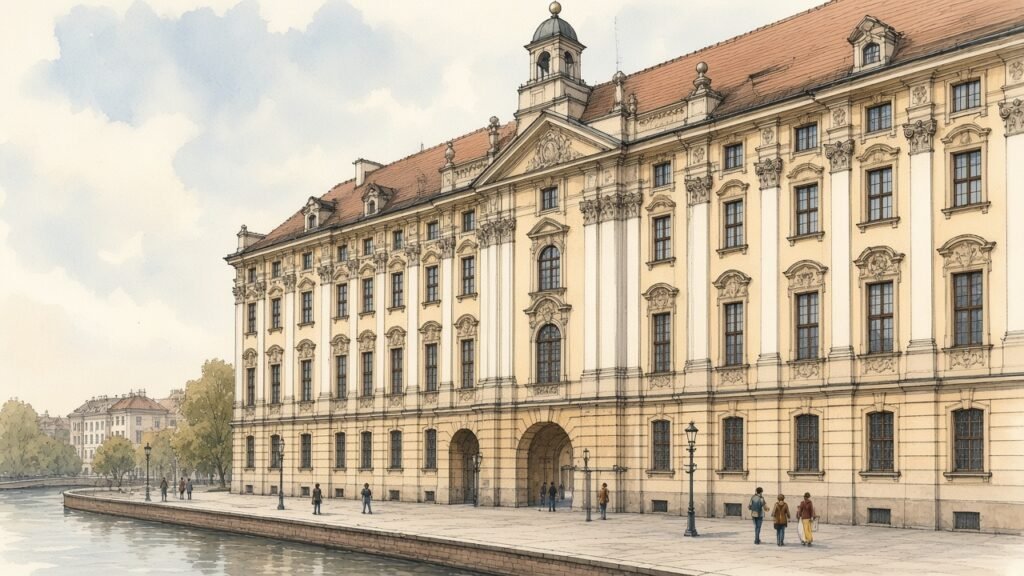
Nobel Prizes associated with Breslau-born or Breslau-trained scientists became, in Polish municipal memory, part of a civic boast that carefully notes birthplace while acknowledging the German and often Jewish context of the achievement. Plaques and exhibitions today present Born, Haber and others within narratives of a European city of science. The university’s baroque facade on the river remains one of the most photographed secular buildings in Wrocław, a stone reminder of the Prussian and imperial investment in learning that outlasted the state that paid for it.[50][49][45][11]
Laboratory science in Breslau participated in the German research university model associated with Humboldtian ideals and with later Kaiser Wilhelm Institutes elsewhere. Equipment budgets, journal exchanges and congress travel tied local professors to Berlin, Heidelberg and Zurich. Students copied lecture notes that circulated as unofficial textbooks. The culture of the seminar — close reading, source criticism, laboratory repetition — trained habits of mind that served industry and bureaucracy as well as scholarship.[45][50]
Jewish student fraternities and associations offered solidarity amid exclusion from some corps. Duelling culture and honour codes placed special pressures on men navigating antisemitism. Women students, once admitted, faced separate hostilities. Oral histories and memoirs recovered since the 1970s have filled gaps left by official university chronicles that preferred celebration to discomfort.[46][18][45]
Medical clinics treated industrial injuries, infectious diseases and psychiatric cases in growing numbers. Pathology collections and autopsy regimes advanced knowledge while raising ethical questions only later generations would centre. Military medicine in 1914–18 drew on the same clinics. Continuities between care and coercion in German medicine are part of Breslau’s scientific story as of other cities’.[47][45]
Haber’s and Born’s trajectories illustrate brilliance under conditions that turned lethal. Haber’s wartime role and Born’s exile map the moral range of twentieth-century physics and chemistry. Breslau as birthplace enters both biographies as formative milieu — schools, families, accents — before larger stages claimed them. Civic plaques today negotiate how to honour achievement without whitewashing context.[49][50][48]
The Polish university after 1945 faced empty shelves and missing instruments. Lviv professors packed what they could. Rebuilding collections took decades. Degrees issued in Polish from German halls carried a symbolism settlers felt acutely. Academic ritual — gowns, Latin mottos, inaugurations — adapted across the language break with surprising ease because European university forms were already shared.[57][45][58]
International rankings and Erasmus exchanges now place the University of Wrocław in ordinary European competition. That normality is hard-won. Behind it lie purged faculties, transplanted faculties and the quiet work of librarians who kept books through ideology. A full institutional history remains a multi-volume task; this chapter has only marked the peaks visible from the river facade.[45][81][84]
Student politics before 1914 included nationalist duelling corps, Catholic associations and emerging socialist cells. Rectoral archives record brawls and bans. The university was never a quiet island; it was a weather station for German political storms. After 1918 those storms intensified until the purge of 1933 ended pluralism by decree.[45][55][56]
Library collections included Silesian regional manuscripts that postwar Polish librarians catalogued anew. Provenance research today traces volumes looted or transferred in 1945. Restitution debates occasionally surface. The quiet work of cataloguers is part of the city’s intellectual legacy as much as any Nobel photograph on a wall.[45][2][57]
Tramway labour — drivers, conductors, depot workers — organised early and struck occasionally. Their uniforms changed colours with regimes; their shift patterns obeyed the same clocks. Oral histories with retired tram workers collected in the 1990s capture the People’s Republic everyday with unusual concreteness. Transport proletariats are underused narrators of urban political history.[81][80][1]
Border-crossing bus routes after Schengen turned weekend shopping in German towns into routine. Price differentials shaped petty trade. Sociologists tracked how quickly “Germany” became a supermarket destination rather than a traumatic symbol for young Poles. Generational change in meaning is as historical as treaty signing; Wrocław’s location makes that change locally measurable.[83][74][1]
9. The Jews of Breslau
Jewish settlement in medieval Breslau followed the pattern of other Silesian and imperial towns: residence under ducal or royal protection, concentration in designated streets, engagement in trade and credit, and vulnerability to expulsion when politics or plague turned against them. Expulsions and readmissions marked the later Middle Ages and early modern period. Under Habsburg rule Jews lived under special patents with heavy taxes and occupational limits. Prussian conquest did not immediately emancipate them; Frederick’s state valued Jewish economic roles while maintaining discriminatory regulations that eased only gradually across the nineteenth century.[18][19][46]
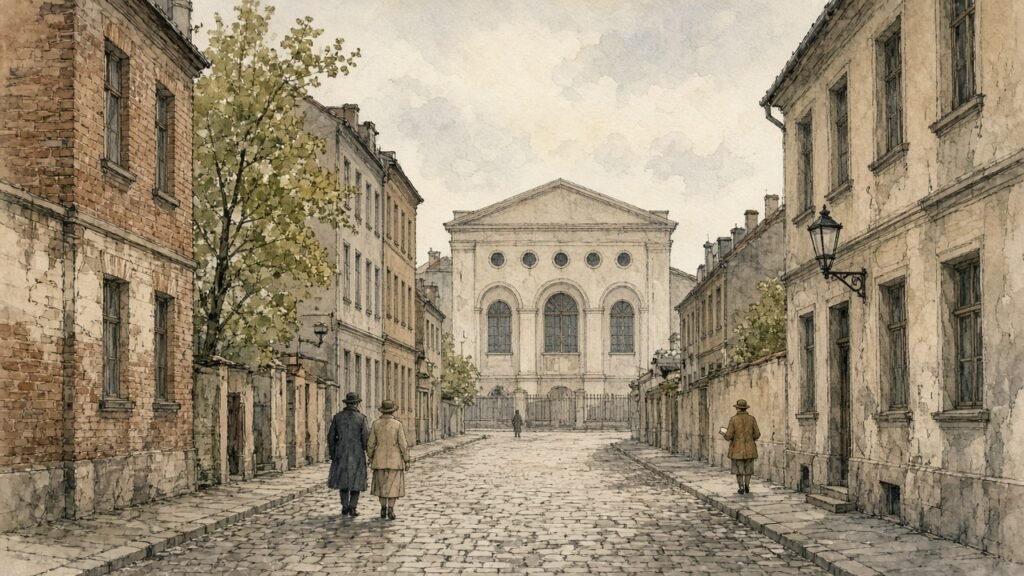
Legal emancipation in Prussia, culminating in the North German Confederation’s and then the Empire’s equal citizenship, opened professions and residence. Breslau’s Jewish population grew into one of the larger communities in eastern Germany — tens of thousands by the early twentieth century — with a spectrum from Orthodox to Reform, from Yiddish-speaking migrants of the East to highly acculturated German-Jewish bourgeoisie. Synagogues of different rites were built; the White Stork Synagogue and the later New Synagogue (destroyed in 1938) marked the community’s visibility in the cityscape. Cemeteries, hospitals, schools and charities formed a dense associational life.[18][46][59]
Acculturation was deep. Many Breslau Jews spoke German as a mother tongue, served in the Prussian and imperial armies, entered the free professions and supported liberal politics. Jewish professors, lawyers and doctors were prominent in the university quarter and in municipal life. At the same time antisemitic parties and press campaigns from the 1870s onward stigmatised Jews as alien, and Eastern Jewish refugees passing through or settling in Silesia became targets of particular hostility. The community’s internal debates — Zionism versus liberalism, Orthodoxy versus Reform — mirrored German Jewry at large.[46][18][43]
YIVO and other scholarly projects of the twentieth century later documented Breslau as a node of German-Jewish culture: rabbis of distinction, teachers’ seminaries, and a publishing and press presence. Socially the community ranged from wealthy merchants and industrialists to impoverished pedlars. Women’s organisations ran welfare and cultural programmes. Intermarriage and conversion occurred at the margins, as with Edith Stein’s family trajectory, but the core remained a self-conscious Jewish minority within a German city.[59][54][46]
The First World War initially reinforced patriotic identification; Jewish soldiers from Breslau died in imperial service. Defeat, inflation and the radicalisation of politics in the Weimar years sharpened antisemitism. Nazi electoral success in Silesia was often above the national average in some contests, and after 1933 the machinery of exclusion descended quickly: boycotts, dismissal from the civil service and professions, Nuremberg Laws, and the destruction of Kristallnacht in November 1938, when synagogues burned and shops were smashed. The New Synagogue was ruined; the White Stork was damaged but survived in shell form.[56][60][55][18]
Deportations during the Second World War emptied Breslau of almost all Jews who had not already emigrated. Those who remained were sent to camps and ghettos under the machinery of the Holocaust; few survived. A small number of Jews returned or arrived after 1945 as part of the Polish Jewish remnant, reconstituting a tiny community around surviving premises including the White Stork Synagogue, which later became a centre of Jewish cultural life in Polish Wrocław. The disproportion between the pre-war community and the postwar handful is one of the sharpest ruptures in the city’s demographic history — parallel to, though distinct from, the expulsion of the German population as a whole.[61][58][18][46]
Memory of Jewish Breslau is now pursued through archives, school curricula, the synagogue’s restoration and scholarship that reconnects Polish Wrocław to the German-Jewish past of the same streets. Street names and missing buildings still mark absences. For a history of the city, the Jewish chapter is not an appendix: it is central to understanding what kind of German metropolis Breslau was before 1933, and what was destroyed before the bombs and artillery of 1945 finished the physical wrecking of the centre.[59][61][1]
The survival of the White Stork Synagogue as a building, and its reuse as a place of prayer and culture, offers a rare stone continuity. Around it, museums and walking tours reconstruct a topography of schools, associations and homes that exist chiefly in photographs and land registers. Visitors who come for the Rynek and the university facade can, if they wish, also trace this quieter map — a necessary counterweight to any account that would treat Breslau’s German centuries as ethnically simple.[18][59][11]
Reform and Orthodox congregations negotiated liturgy, organs and mixed choirs with passion familiar from Berlin and Frankfurt. Rabbis published sermons and scholarly Hebrew and German works. Teachers’ seminaries supplied educators for communities across the East. Breslau’s Jewish press reported local philanthropy and distant pogroms, linking the city’s readers to a wider Jewish world.[46][59]
Economic niches included the clothing trade, grain brokerage, the professions and some industry. Wealth disparities within the community were large. Philanthropic hospitals and orphanages attempted to bridge them. Antisemitic boycotts even before 1933 tested solidarity between Jewish and non-Jewish customers. Credit relationships could turn overnight into denunciations when politics rewarded hostility.[18][46]
Emigration statistics after 1933 show early leavers often younger and better connected abroad. Those who remained faced progressive robbery under cover of law. Deportation trains from Silesia fed the killing centres of the Holocaust. Survivor lists for Breslau are short relative to the 1925 census counts. Each name recovered by researchers restores a fraction of what bureaucracy erased.[61][60][56]
Postwar Jewish life in Polish Wrocław included repatriates from the Soviet Union and survivors rebuilding minyanim. Waves of emigration after 1946, 1956 and 1968 repeatedly reduced numbers. The 1968 campaign’s insults and professional exclusions repeated older patterns under new slogans. Memory of that year remains raw in Polish-Jewish historiography and local family stories.[18][80][61]
Restoration of the White Stork Synagogue and the creation of associated educational spaces in recent decades mark a modest renaissance of visibility. Festivals of Jewish culture draw mixed audiences. Critics ask whether heritage tourism substitutes for living community; organisers answer that visibility itself fights oblivion. Both concerns can be true at once.[18][59][84]
Comparative urban studies place Breslau’s Jewry alongside Poznań, Kraków and Berlin — smaller than the largest centres, yet dense enough to sustain institutions of note. Its German cultural orientation distinguished it from Galician Yiddish centres, even as Eastern migrants brought new accents into its streets. That internal diversity is easily lost in summary statistics and worth stressing in any careful account.[46][59][19]
Charitable women’s leagues organised sewing circles, soup kitchens and educational stipends. Their minute books, where preserved in archives abroad, show organisational sophistication. Gendered Jewish history of Breslau is still being written. It revises older accounts that featured only rabbis and male notables. The community’s resilience depended on this less visible labour.[46][18][59]
Zionist and liberal Jewish youth groups competed for members in the 1920s. Sports clubs offered belonging under colours that were neither imperial nor Marxist. After 1933 such groups faced bans and surveillance. Emigration networks often ran through youth contacts already formed. The road out, for those who found it, was partly paved by earlier associational life.[46][56][61]
Cemetery plantings of ivy and thuja, chosen in Prussian times, still shade Polish funerals. Tree longevity exceeds human ethnic tenure. Botanists and historians might productively map which species arrived with which planting fashion. The living landscape remembers across the 1945 break more faithfully than many inscriptions do.[1][74][2]
Bridge maintenance logs list rivets, ice damage and load tests in languages that switch in 1945 while the spans’ steel inventory continues. Engineers reading both German and Polish sections of the same infrastructure file practice a bilingual technical history. Their practical need for continuity is a model for scholars tempted by narrative rupture alone.[4][1][2]
10. An imperial German city
In the German Empire Breslau styled itself the metropolis of the German East. Official rhetoric contrasted the city’s Kultur with the Slavic countryside and with the mixed populations of Upper Silesia and Posen. In practice Breslau’s own population was overwhelmingly German-speaking by the late nineteenth century, with Polish, Czech and Jewish minorities of varying visibility. Municipal showpieces — the Centennial Hall (Jahrhunderthalle) opened in 1913 to mark the centenary of the Wars of Liberation against Napoleon, designed by Max Berg in pioneering reinforced concrete — advertised technical modernity. The hall’s vast dome and the surrounding exhibition grounds hosted fairs, concerts and sporting events that drew visitors from across the Empire.[62][42][1]
The Centennial Hall was more than architecture. It embodied a civic religion of 1813, Prussian renewal and German nationhood, staged in a province taken from Austria only in the 1740s. Exhibitions of industry and art presented Silesia as a motor of German economic power. Parks, a Japanese garden and later modernist housing estates extended the city’s western districts. Trams electrified; department stores and cinemas remade consumption. A football club culture and workers’ sports associations flourished alongside bourgeois clubs. The city felt, to its German majority, fully integrated into national life.[62][41][42]
Yet imperial Breslau sat near contested frontiers. The Polish national movement in Prussia organised schools, cooperatives and political parties; Upper Silesia’s industrial belt was bilingual and confessionally mixed. Breslau’s newspapers tracked every election and school dispute. After 1890 the Ostmarkenverein and similar associations promoted German colonisation and schooling in the eastern provinces, with Breslau intellectuals often in supporting roles. Polish students at the university faced hostility; Polish societies were surveilled. The city’s self-image as a bastion of Deutschtum hardened even as its factories employed seasonal Polish labour.[63][3][42]
Social geography mapped inequality. Villa quarters housed officials and factory owners; courtyard tenements packed workers’ families into damp rooms. Child labour declined under imperial legislation but overcrowding persisted. Catholic and Protestant charities competed with Social Democratic mutual aid. Public baths, libraries and continuation schools aimed to discipline and uplift. The municipal socialism of utilities — gas, water, trams in public ownership — was pragmatic rather than revolutionary, yet it gave the city a modern administrative spine.[1][36]
When war came in 1914, Breslau mobilised like other German cities: volunteers, war bonds, hospitals for the wounded, and later hunger under blockade. Casualty lists filled newspapers. Women entered factories and offices. By 1918 defeat, the Kaiser’s abdication and the proclamation of a republic arrived as shock. Soldiers’ and workers’ councils briefly appeared; Freikorps and left militants clashed in Silesia as elsewhere. The Treaty of Versailles and the Upper Silesian plebiscite of 1921 redrew borders south and east of the city. Breslau remained German, but Upper Silesia’s partition damaged its economic hinterland and fed revisionist anger that right-wing parties exploited throughout the Weimar years.[55][44][64]
Weimar Breslau struggled with inflation, then depression. Unemployment lines lengthened in the early 1930s. The Nazi Party’s vote in the Breslau region was often strong; SA street violence intimidated opponents. When Hitler became chancellor in 1933, the city’s institutions — university, municipal offices, press, associations — were coordinated (gleichgeschaltet) with remarkable speed. Political opponents went to camps; Jews were excluded step by step; the landscape of parties collapsed into a single dictatorship. The imperial city’s liberal and social-democratic traditions proved fragile under organised terror and popular acquiescence.[56][55][60]
Rearmament and public works reduced unemployment and tied the local economy to the regime. Autobahn projects, barracks and armaments orders filled order books. Propaganda exhibitions occupied the Centennial Hall. Hitler Youth and League of German Girls organised leisure. Church conflict — Protestant Confessing Church currents and Catholic friction — existed but did not define the city’s public face. By 1939 Breslau was a Nazified provincial capital preparing for a war that would, within six years, leave it in ruins and under another state’s flag.[56][62][1]
The imperial and Weimar decades thus closed in dictatorship. What remained of the built environment — Rynek, university, halls, bridges, Mietskaserne — would become the stage for Festung Breslau and then for Polish resettlement. Understanding that German city as it actually was, including its Jewish citizens and its Polish neighbours, is a precondition for understanding the violence of its end and the difficulty of its Polish rebirth.[2][18][44]
Administratively the Province of Lower Silesia, with Breslau as capital, coordinated agriculture, mining liaison, schooling and police. The Oberpräsident and the Regierungsbezirk structure channelled Berlin’s will into local life. Statistics offices counted births, trades and languages with the obsessive precision of the German bureaucracy. Those same card indexes would later serve exclusion and conscription. The modern state’s capacity, built for railways and schools, proved equally efficient for persecution.[36][56][42]
Daily culture mixed provincial solidity with metropolitan ambition. Department stores on the Schweidnitzer Strasse, cafés where officers and students met, allotment gardens on the fringe, summer trips into the Giant Mountains — these filled diaries and photographs that survivors later carried west. When Polish settlers arrived in 1945 they found abandoned flats with German books on shelves, and the intimate material of a vanished everyday life became both booty and ghostly inheritance.[58][2][1]
Max Berg’s Centennial Hall solved structural problems of span with reinforced concrete that contemporaries found almost unbelievable. Engineering journals debated its methods; visitors gasped at the unobstructed interior. The building’s later uses — sports, congresses, concerts — proved its flexibility. UNESCO listing recognised both technical innovation and the cultural programme of 1913 commemorations, however nationally exclusive those commemorations were.[62][84]
Imperial naval and colonial agitation reached Breslau’s lecture halls and newspapers despite the city’s inland site. Collections of ethnographic objects and colonial displays appeared in exhibitions. Ordinary imperialism was part of provincial culture, not only a Hamburg or Berlin affair. Postcolonial scrutiny of those collections is a present-day museum task shared with other European cities.[42][1]
Labour conflicts in the early twentieth century included strikes in transport and metalworking. Police and military interventions left injuries and martyrs for Social Democratic memory. Catholic trade unions offered alternative organising. The three-way split of the left and labour movement — socialist, Catholic, communist after 1918 — shaped Weimar politics in Silesia with special sharpness because industrial Upper Silesia lay nearby.[43][55]
When Upper Silesia was partitioned after the plebiscite, Breslau lost economic partners and gained refugees and resentments. Revisionist maps hung in classrooms. Veterans’ groups cultivated stab-in-the-back legends. The city’s politics tilted in ways that made Nazi breakthroughs easier than in some western strongholds of Catholicism or social democracy. Local studies of voting by district confirm the unevenness of that tilt.[64][55][56]
Everyday pleasures — river bathing, allotment gardening, choral societies — continued beneath high politics. Photograph albums from the 1920s show smiles that later catastrophe would recontextualise. Historians must hold those smiles and the later camps in tension without letting either cancel the other. Ordinary happiness does not refute structural danger; structural danger does not erase ordinary happiness.[1][55]
The Empire’s end and the Republic’s trials left Breslauans with a sense of demotion from imperial security to frontier anxiety. That emotion, manipulated by demagogues, became political fuel. Understanding it without endorsing the crimes it helped enable is part of the historian’s burden in this chapter of the city’s life.[55][56][42]
Municipal statistics offices counted everything from pig slaughter to theatre tickets. Annual yearbooks are mines for social historians. They also reveal the state’s fantasy of total knowledge. What was not counted — private bilingualism, hidden Jewish poverty, women’s unpaid labour — must be recovered otherwise. Critical use of imperial statistics is now standard method.[42][1][18]
War memorials after 1918 filled churches and squares with names of the dead of 1914–18. Those monuments’ later removal or reuse after 1945 added another layer of erasure. Brass letters recycled into new plaques tell material stories of regime change. Epigraphic archaeology of the city remains possible for patient observers.[44][55][2]
University extension lectures for the public, in German before the war and in Polish after, carried science into town halls. Attendance lists show teachers and clerks seeking self-improvement. This didactic civic culture is a thread connecting imperial Breslau to socialist Wrocław without denying the rupture between them. Popular enlightenment was a shared European project under different flags.[45][58][36]
Festival posters layered on kiosks — socialist anniversaries, Solidarity Masses, Capital of Culture logos, Ukrainian benefit concerts — form a stratigraphy of public appeals. Ephemera collections in libraries preserve what walls no longer show. A history of persuasion belongs beside a history of stone in any city so often asked to feel newly loyal.[84][80][58]
11. Weimar years and National Socialism
The Weimar Republic’s fourteen years in Breslau were marked by economic volatility, cultural experiment and escalating political violence. Hyperinflation in 1923 wiped savings; the mid-1920s brought brief stabilisation; the world depression after 1929 produced mass unemployment in Silesian industry and acute distress in the city. Coalition municipal politics struggled to fund welfare. Universities and theatres continued to function, sometimes brilliantly, but the street belonged increasingly to uniforms — Reichsbanner, Rotfrontkämpferbund, Stahlhelm and SA — whose clashes left dead and injured.[55][56][1]
Electoral geography favoured the right more than in some western cities. Protestant middle-class districts moved toward the National Socialists; Catholic voters held longer to the Centre; working-class districts split between Social Democrats and Communists. Jewish citizens, already under antisemitic pressure, saw their public safety erode before 1933. The local Nazi press denounced “Jewish” department stores and “cultural Bolshevism” in the theatre. When the party took national power, Breslau’s police and municipal apparatus cooperated in the new order with few resignations of conscience.[56][18][60]
Gleichschaltung dissolved independent trade unions, parties and many associations. The Gestapo established offices; informants proliferated. Concentration camp threats disciplined dissent. School curricula and youth organisations remade childhood. The university’s purge of Jewish and politically suspect staff was public and humiliating. Emigration accelerated among those who could obtain visas and foreign currency — a trickle of the community’s talent to Britain, Palestine and the United States, leaving behind those who were poorer, older or more optimistic that the storm would pass.[56][61][45]
Kristallnacht in November 1938 brought arson, looting and mass arrests to Breslau as to other German cities. Synagogues burned; men were sent to Buchenwald and other camps for weeks or months. Insurance payments for Jewish property were seized by the state. Forced sales of businesses (Arisierung) transferred shops and firms to non-Jewish owners at coerced prices. By 1939 the community that had numbered in the tens of thousands was already drastically reduced by emigration and stripped of livelihoods. War would complete the destruction through deportation.[60][61][18]
War economy after 1939 brought forced labourers from Poland, the Soviet Union and elsewhere into Silesian factories and into Breslau itself. Camps and prisons operated in and around the city. The regime’s racial hierarchy was visible on trams and worksites. Bombing was limited early in the war compared with western German cities, which encouraged a false sense of security. Only in 1944–45, as the Red Army approached, did Breslau’s leaders and population confront the full meaning of Festung ideology.[65][66][56]
Gauleiter Karl Hanke enforced radical measures as the front neared: refusal of timely evacuation for many civilians, harsh discipline, and preparation of the city for siege. Hitler’s designation of Breslau as a fortress in 1944 meant that military logic would privilege holding the Oder crossing over saving inhabitants or architecture. The stage was set for one of the longest and most destructive urban battles of the war’s final months — a subject that requires its own chapter.[67][68][66]
Looking back, the Weimar and Nazi years in Breslau illustrate how quickly a complex urban society can be remodelled by party dictatorship when state institutions comply and neighbours look away. They also show the special vulnerability of a prosperous Jewish minority that had believed in German culture as its own. The physical city of 1939 still stood largely intact; the moral and human city had already been hollowed out before the first Soviet shells fell.[61][56][2]
Cultural life under Nazism mixed banality with coercion. Approved composers and playwrights filled programmes; jazz and modernist art were denounced. The Centennial Hall hosted mass meetings. Cinema newsreels brought the regime’s version of the war home. Private diaries, where they survive, record fear, rumour, bombing alerts and the disappearance of Jewish neighbours. Historians reconstructing this period rely on such fragments alongside police files and party records, because public speech was so thoroughly controlled.[62][56][60]
Foreign forced labourers left their own traces — graves, camp sites, memories recorded decades later in other countries. Their presence complicates any binary of German perpetrators and German victims in the siege that followed. Breslau in 1944 was already a city of many unfree inhabitants when the fortress order sealed its fate. The siege would kill soldiers, German civilians and forced labourers alike in the rubble of streets that had recently staged imperial celebrations.[65][68][1]
By January 1945 the Red Army’s Vistula–Oder offensive had torn open the eastern front. Refugees from Upper Silesia and East Prussia clogged roads in winter cold. Breslau’s authorities ordered evacuations that were chaotic and incomplete; thousands of civilians died of exposure in the flight. Those who remained — perhaps a hundred thousand or more as the ring closed — faced artillery, aerial bombardment and house-to-house fighting in a city declared invincible by propaganda and already doomed by strategy.[68][66][69]
Hyperinflation stories from Breslau match those from across Germany: wages in baskets, meals priced by the hour, middle-class savings erased. Stabilisation brought relief and lasting distrust of liberal economics among some voters. The depression’s factory closures then seemed to confirm that distrust. Nazi promises of work and order fell on prepared ground even among some who disliked Nazi manners.[55][56]
Cultural experimentation — expressionist theatre, new photography, modernist housing — existed in Breslau as in other cities, though the tone was often more provincial. Conservative taste remained strong. Clashes over public art and school curricula prefigured the broader culture wars the Nazis would settle by force. Exile of artists after 1933 drained the city’s creative capital along with its scientific capital.[55][45]
Police records of SA violence show patterns of targeted intimidation against journalists, politicians and Jewish shopkeepers before and after the seizure of power. Courts sometimes punished street fighters from all sides before 1933; after 1933 the state’s sword pointed one way. Neighbours learned to look away. Fear became a governing technology more efficient than enthusiasm alone.[56][60]
Forced labour camps near Breslau during the war included sites tied to industry and to construction. Postwar investigations and later memorials have mapped some of them; others remain understudied. Polish and Soviet prisoners’ experiences belong to the city’s wartime history as much as German civilian diaries do. Festung narratives that omit them are incomplete.[65][66][61]
Hanke’s rule as the front approached mixed fanaticism with careerism. Evacuation failures in the January cold produced corpses along roads that photographers and diarists recorded. Responsibility debates continue among military historians. What is not debated is the human cost of holding a doomed fortress for prestige and delay.[67][68][69]
The chapter’s close is the ring of Soviet guns. From that ring the next chapter’s rubble follows. Weimar’s fragile openness and Nazism’s organised cruelty prepared the ground; artillery finished the argument about what sort of city Breslau would be. The answer would be given in Polish.[68][56][58]
Communist and Nazi cells recruited in unemployment offices and taverns with different cosmologies and similar promises of total explanation. Street fights over newspaper sales were small wars for public space. Middle-class voters who feared both often chose the Nazis as the more “national” order. That calculation’s consequences need no underlining.[55][56][43]
Radio ownership spread in the 1930s, bringing the Führer’s voice into kitchens. Local stations mixed entertainment with propaganda. Listening habits became political. After Stalingrad, rumour cultures competed with official optimism. Oral historians reconstructing wartime Breslau lean heavily on what people remember hearing as well as seeing.[56][68]
12. Festung Breslau
Hitler’s order that Breslau be held as a fortress turned the city into a battlefield from February to May 1945. German command under officers culminating in General Hermann Niehoff organised defence with Volkssturm, regular units and coerced labour. Soviet forces of the 1st Ukrainian Front under Ivan Konev invested the city. Artillery and air attacks smashed blocks; defenders demolished buildings to clear fields of fire and to construct a makeshift airstrip on the city’s edges, at terrible cost in forced labour lives. Fighting moved street by street through suburbs toward the centre.[68][70][71][67]
Civilian suffering was extreme. Food and medical supplies dwindled; cellars became shelters and tombs; firestorms consumed timber and furnishings. Estimates of civilian dead run into many tens of thousands when flight deaths and siege deaths are combined; precise counts remain debated. The German military dead and Soviet casualties added to the toll. Breslau’s ordeal lasted until 6 May 1945, after Berlin’s fall, making it one of the last major German cities to surrender in Europe. Capitulation documents were signed as the Reich collapsed.[68][69][66]
Physically the result was catastrophic. Large parts of the historic centre and many residential districts lay in ruins. The cathedral on Ostrów Tumski was heavily damaged; churches, the university, the Rynek’s houses and industrial plants were burned or shelled. Bridges over the Oder were destroyed. Photographs from May and June 1945 show vistas of rubble resembling other martyred cities of the eastern front. Yet some structures — fragments of the town hall, walls of the university, the Centennial Hall outside the densest fighting — survived enough to be restored later, providing rare continuities of silhouette.[68][11][62][15]
Soviet occupation brought further violence: looting, rape and arbitrary killing, documented in German and later Polish testimonies, followed the military victory as in other taken cities. German communists were briefly installed in administrative roles before Polish authorities arrived under the broader Allied decision to place the city under Polish administration pending a peace treaty that never restored German sovereignty. The Potsdam Conference of July–August 1945 confirmed the Oder–Neisse line as Poland’s western frontier in provisional form and endorsed the “orderly and humane” transfer of German populations — language that scarcely matched the expulsions that followed.[72][73][74][69]
For German Breslauers who survived the siege, the months after May brought hunger, uncertain legal status and the growing realisation that the city would not remain German. Some fled west before Polish administration consolidated; others stayed through 1945–46 hoping borders might change, until expulsion transports removed them to occupied Germany. Their baggage allowances were small; their houses and graves remained behind. The fortress that was to save the Reich had instead ended a seven-century German urban presence on the middle Oder.[74][58][2]
Military historians debate whether the defence had any operational value for the collapsing Wehrmacht. It tied down Soviet forces for months, but it could not alter the war’s outcome, and it maximised destruction of a city that might otherwise have been taken sooner with less ruin. The Festung policy, here as in other designated cities, expressed the regime’s preference for sacrificial last stands over negotiated surrender. Ordinary inhabitants paid the price in cellars and on frozen evacuation roads.[68][67][66]
Polish soldiers and administrators entering in 1945 encountered a shattered German city and a surviving German civilian population still numbered in the hundreds of thousands across Lower Silesia. The transformation of Breslau into Wrocław — linguistic, legal and demographic — began amid this ruin. The next chapters turn to that transformation: expulsion, the arrival of Polish settlers from central Poland and from the lands taken by the Soviet Union in the east, and the long work of rebuilding under a Communist state that claimed the city as recovered Piast inheritance.[58][74][75]
Memorialisation of the siege later diverged by country. In West Germany expellee organisations commemorated Breslau’s dead and lost Heimat; in Poland the narrative emphasised liberation from fascism and the justice of the western border. Since 1989 more nuanced histories — including Gregor Thum’s study of the city’s reinvention — have circulated in both languages, allowing the siege to be seen as a shared catastrophe rather than only a national epic. Ruins incorporated into new buildings still show burn marks and shrapnel scars to those who look.[2][68][1]
The airstrip built on demolished ground during the siege became a symbol of the defence’s ruthlessness: housing and cultural fabric sacrificed for supply flights that could not in any case save the fortress. Forced labourers died in large numbers during that construction. Their largely unnamed deaths sit beside the named German and Soviet military dead in any honest reckoning of Festung Breslau. The city’s later Polish life grew in soil that held all these layers of violence.[68][65][2]
When surrender finally came on 6 May, columns of German prisoners marched out under Soviet guard. Fires still burned. The smell of ash and unburied dead hung over the islands and the Rynek. Into that landscape Polish railway transports would soon begin to pour new inhabitants who had never seen the city, carrying their own losses from the east. The German name Breslau was about to leave official use; the Polish name Wrocław, always present in Polish speech and memory, would return to maps as the sole legal designation.[68][58][1]
Soviet assault tactics combined artillery preparation with infantry probes into ruined blocks. German defenders used cellars, tram embankments and improvised barricades. Snipers and panzerfaust teams made every street costly. Civilian stretcher-bearers moved under fire. The battle’s intimacy — neighbours’ houses as strongpoints — distinguishes it from open-field campaigns and allies it with other urban fights of 1945.[68][71][70]
Medical services collapsed into triangular triage of the hopeless, the operable and the lightly hurt. Anaesthetics ran short. Amputations increased. Typhus and dysentery threatened shelters. Priests and pastors buried the dead in parks and courtyards when cemeteries were unreachable. These scenes recur in testimonies with a sameness that is itself evidence.[68][69]
The airlift to the fortress, intermittent and costly, brought ammunition and evacuated some wounded. It could not feed a city. Comparisons to Stalingrad were propaganda before they were analysis; the scales differed, yet the logic of encirclement and prestige resembled. Hitler’s refusal of earlier surrender proposals fit a pattern of sacrificial orders issued from distant bunkers.[68][67]
Niehoff’s eventual surrender decision came when further fighting meant only annihilation without purpose. Negotiations with Soviet commanders produced terms that did not protect civilians from subsequent abuses. Captivity for soldiers meant camps; for civilians it meant occupation and then expulsion. The legal end of Festung Breslau was thus only the beginning of the German population’s end in the city.[68][74][72]
Polish memory long preferred the liberation narrative; German memory preferred the victim narrative of bombardment and expulsion. Integration of both with the histories of forced labourers and Jews is the present scholarly task. Monuments in today’s Wrocław still lean toward Polish frameworks, while German cemeteries and visitor groups lean toward theirs. Shared ceremonies remain exceptional and precious when they occur.[2][74][61]
Ruins photographed in 1945 became stock images for expellee publications and for Polish reconstruction propaganda alike. The same broken gable could illustrate German loss or Polish recovery. Image history thus parallels text history in its divided uses. Archivists now digitising those photos serve audiences who may argue about captions while agreeing about the brokenness shown.[2][68][58]
Children’s experiences of the siege — games in cellars, sudden orphanhood, years later nightmares — appear in late-life interviews. Psychological aftermath crossed into West German expellee communities and into the few who remained. Polish children arriving among ruins had different traumas of displacement. Two childhoods of rubble shaped two adult memory cultures that still rarely share therapy metaphors across the border.[68][74][58]
Maps of destruction drawn by Polish engineers in 1945 for reconstruction planning are now historical sources of the first order. They shade blocks by percentage ruined. Darkest shades cluster where fighting was fiercest. Comparing them to pre-war address books allows estimates of cultural loss — which publishers, which synagogues, which clinics vanished from which corners. The map is a tombstone index.[68][2][1]
Administrative orders, railway timetables and ration cards from the mid-1940s, preserved in Polish and German archives, allow micro-histories of particular streets during siege, expulsion and arrival. When read together they show the same address generating incompatible human meanings within months. That documentary triangulation is the method behind this essay’s claim that Wrocław’s modern identity is stacked rather than single-layered.[2][68][74][58]
Future research will continue to exploit digitised address books, geospatial mapping of destruction and linked open data on forced migrants. Citizen historians in both countries already contribute photographs. The professional task is to keep standards of citation and context high as participation widens — a task this site’s reference practice is meant to model in miniature.[2][1][84]
13. Expulsion and resettlement
The demographic revolution that followed the siege was among the largest urban population exchanges in twentieth-century Europe. Under the Potsdam agreements, Germans were to be transferred from the territories placed under Polish administration. In Breslau/Wrocław the process unfolded in stages through 1945–47 and trailed into the early 1950s for some remaining specialists. August 1945 counts still showed a large German majority in the ruined city alongside a small Polish presence. Organised transports, pressure to leave, violence and the absence of legal security reduced the German population year by year until only a remnant remained.[74][73][58][2]
Expulsion was experienced as injustice and catastrophe by those who left — loss of home, graves and language community — and as the precondition of security by Polish settlers who themselves had often been expelled from the Kresy, the eastern borderlands annexed by the Soviet Union. Trains that carried Germans west toward the occupation zones crossed paths with trains carrying Poles west from Lviv, Vilnius region and other lost cities. The “recovered territories” ideology of the Polish Communist and nationalist consensus presented Lower Silesia as eternally Polish land returning after centuries of Germanisation. Scholars since 1989 have described the same process as ethnic cleansing within a wider European pattern of forced migration.[75][74][57][76]
Polish settlers came from several streams. Some were voluntary migrants from overcrowded central Poland seeking flats and farms. Many were forced or strongly encouraged resettlers from the east, including railway workers, professors and whole institutional communities from Lviv who reconstituted themselves in Wrocław — famously the academic transfer that restaffed the university. Others were soldiers demobilised into the new western lands, or Ukrainians and Lemkos later moved under Operation Vistula. The resulting population was Polish-speaking but regionally diverse, with eastern accents, Galicia’s cultural memory and central Polish habits mixed in the same courtyards.[58][57][77][76]
Housing allocation was chaotic and often corrupt. German flats were sealed, looted or assigned; furniture and crockery changed hands. Settlers arrived to streets without names they recognised, churches of unfamiliar rites, and shop signs in German that were soon painted over. Fear of German return persisted into the early 1950s, encouraged by Cold War tension and by propaganda. At the same time, some Germans who were retained as skilled workers in industry lived uneasily beside new neighbours until their own turn for departure came. A small German minority would persist in Lower Silesia, but Wrocław itself became demographically Polish with striking speed.[2][58][74]
The Jewish remnant after the Holocaust formed a small committee in 1945 and attempted communal life among returning survivors and arrivals from elsewhere in Poland. Numbers fluctuated with emigration to Israel and the West, especially after 1946 Kielce shock waves and later antisemitic campaigns. The White Stork Synagogue and associated rooms anchored what continuity existed. Compared with pre-war Breslau’s tens of thousands, postwar Jewish Wrocław was a fragment — yet an important one for the city’s claim to pluralism in later decades.[18][61][58]
State policy combined settlement with Polonisation of the landscape. German monuments fell; street names changed to Polish heroes, Piast dukes and Communist martyrs; German inscriptions were chiselled away. Archives and libraries were sorted, with some collections shipped to Germany or destroyed and others retained. Catholic authorities reclaimed churches that had been Protestant. The bishopric’s Polish character was emphasised as proof of eternal belonging. Schools taught a history in which Wrocław had always been Polish at heart, waiting beneath a German veneer — a usable past for a traumatised settler society that needed to feel at home.[2][75][11]
Economically the first years were about rubble clearance, restoring water and power, restarting rail links and bringing fields back into cultivation with new hands. Industry was nationalised under the emerging Communist system. The city’s German technical manuals and machine labels remained in workshops until translated or replaced. Reconstruction priorities favoured housing and productive plant over historic facades, though the Rynek’s importance as a symbol ensured eventual attention. By the early 1950s Wrocław was functioning as a Polish voivodeship capital, even if ruins still stood in many blocks and the older generation of settlers still spoke of “home” as somewhere east of the Bug.[58][2][1]
Family stories from this period, collected by oral historians, stress improvisation: learning which tram went where, marrying across regional origin groups, mourning eastern graves that could not be visited, and arguing about whether German left-behind objects were spoils or ghosts. Children grew up without German playmates, in a monolingual Polish streetscape their parents had not inherited but invented. That invented continuity — calling the town forever Polish while sleeping in German-built bedrooms — is the central paradox Gregor Thum and others have analysed, and it shaped Wrocław’s culture into the twenty-first century.[2][58][76]
Legal confirmation of the border came slowly. The German Democratic Republic recognised the Oder–Neisse line in 1950; the Federal Republic withheld recognition until the 1970 Warsaw Treaty and final settlement after 1990. Until then some expellee organisations in West Germany cultivated hopes of return that unsettled Polish residents. Passport stamps, radio broadcasts and family letters across the Iron Curtain kept the dual memory of the city alive in two societies that could not easily speak to each other. Only after 1989 did joint commemorations and shared scholarship begin to narrow the gap.[73][74][2]
Thus expulsion and resettlement did not merely change who lived in Wrocław; they created two diasporic memories of one place — German Breslau remembered in the West, Polish Wrocław built in the East — that still structure museums, literature and family reunions. Any history of the city that omits either memory is incomplete. The physical streets hold both, whether or not the guidebooks say so.[2][74][1]
Numbers convey scale. Pre-war Breslau had held on the order of six hundred thousand inhabitants in the wider city; wartime deaths, flight and expulsion removed almost all of the German majority; postwar Polish in-migration rebuilt population over years into a large city again, but with nearly total replacement of persons. Few urban centres of comparable size in Europe underwent so complete a swap of population while retaining so much of the street plan. That fact alone places Wrocław beside other forced-migration capitals of the 1940s in any serious comparative history.[74][58][2]
The administration of expulsion involved Polish militia, Soviet oversight and Allied agreements that provided cover without detailed humanitarian enforcement. Winter transports were deadly; summer transports less so but still harsh. Property declaration forms, assembly points and sealed wagons repeated patterns used elsewhere in the recovered territories. German testimonies speak of theft and humiliation; Polish testimonies speak of revenge for Nazi occupation crimes and of the impossibility of coexistence after such a war. Both sets of experiences belong in the record.[74][75][61]
Assembly points for expulsion transports were often factories or barracks. Guards mixed Polish militia and Soviet personnel depending on date and place. Luggage rules were posted and then violated by thieves on all sides. Nursing mothers, the elderly and the sick suffered most. Church charities in the occupation zones of Germany struggled to receive the arrivals. The word “orderly” in the Potsdam formula remains a historical irony measured in those scenes.[74][73][72]
Settler memoirs describe first encounters with fully furnished German flats — food still in cupboards, photographs on walls — and the uncanny feeling of stepping into interrupted lives. Some settlers packed those photographs away; some threw them out; some kept them for decades in drawers. Anthropologists of the recovered territories have made such objects a special study. They are the micro-archive of macroscopic policy.[2][58]
Ukrainian and Lemko arrivals under Operation Vistula added another forced migration into Lower Silesia’s mix, distinct from the Polish eastern resettlement yet sharing trauma patterns. Their integration, discrimination and later memory politics form a parallel story only sketched here. Wrocław’s voivodeship contained villages where these communities rebuilt wooden churches and musical traditions under watchful state eyes.[77][76]
Administrative Polonisation of surnames and place-names produced comic and tragic errors, bureaucratic stubbornness and occasional quiet resistance by clerks who knew German topography. Maps in schools were updated with stamps and overprints. Children recited new names for old bridges. Language planning on this scale is rare in modern Europe; Wrocław lived it daily.[2][75]
By 1950 the city’s German past was officially a closed chapter of occupation. Unofficially, German ghost stories, tips for finding hidden valuables and songs learned from leftover sheet music circulated in settler culture. The underground of memory never matched the textbook. When the political climate later allowed, that underground surfaced as oral history projects and documentary films.[2][58][74]
Comparative numbers: other recovered cities such as Szczecin underwent similar swaps; few matched Breslau’s pre-war size and Jewish-German cultural density. That density’s destruction — first of Jews, then of Germans — makes Wrocław’s demographic curve uniquely steep among large Central European cities. Graphs in demographic atlases show the cliff. Behind the cliff are names.[74][18][1]
International law debates after the war danced around expulsion without clear enforcement mechanisms for humanity. Scholars of refugee law still cite Potsdam’s phraseology as a caution. Wrocław’s lived experience supplies the empirical content those debates require. Abstract norms look different from a sealed wagon’s interior.[73][74][72]
Remnant German specialists in 1946–48 who kept power plants running occupied a liminal status — needed and unwanted. Their eventual departure completed the skill transfer problem Polish authorities solved by crash training and eastern expertise. Industrial history of the transition still has archival room for monographs.[58][74][81]
Administrative orders, railway timetables and ration cards from the mid-1940s, preserved in Polish and German archives, allow micro-histories of particular streets during siege, expulsion and arrival. When read together they show the same address generating incompatible human meanings within months. That documentary triangulation is the method behind this essay’s claim that Wrocław’s modern identity is stacked rather than single-layered.[2][68][74][58]
Future research will continue to exploit digitised address books, geospatial mapping of destruction and linked open data on forced migrants. Citizen historians in both countries already contribute photographs. The professional task is to keep standards of citation and context high as participation widens — a task this site’s reference practice is meant to model in miniature.[2][1][84]
14. A Polish city remade
Remaking Breslau as Wrocław required more than new inhabitants. It required a usable history, a new sacred geography and everyday routines that made the foreign built environment feel native. Schoolbooks stressed the Piast bishopric of the year 1000, the Polishness of Silesia before Bohemian and Prussian conquest, and the return of the city to the motherland after German defeat. Piast kings and queens appeared on street signs and in monumental sculpture. Archaeological work on Ostrów Tumski was publicised as recovery of Polish origins. The German centuries were framed as occupation rather than as the principal urban culture of the site — a simplification that settlers needed and that later historians would qualify.[2][5][75][3]
Religious life became predominantly Roman Catholic in a landscape that had been confessionally mixed. Protestant churches were reassigned; German Catholic clergy were replaced by Polish priests. Marian processions and parish festivals claimed streets once used for Prussian parades. The cathedral’s reconstruction on Ostrów Tumski became a symbol of Polish permanence. At the same time, the Communist state limited the Church’s public power, creating a tension that would later feed Solidarity-era opposition. Sacral Polonisation and secular Communist power thus competed even as both rejected German claims.[11][58][78]
Language policy was absolute in the public sphere. German inscriptions disappeared from facades; Polish became the sole language of administration, schooling and commerce. Place-names were standardised in Polish forms; some invented commemorative names overwrote older topography. Children corrected parents who still used German street names learned from leftover maps. Libraries weeded German books or relocated them. The soundscape of the Rynek — vendors, church bells, trams — became Polish within a generation.[2][1]
Yet material culture lagged behind ideology. German stoves, door furniture and bathroom tiles remained in flats; engineering drawings in factories stayed in German until redrawn; older settlers sometimes cooked with leftover German utensils. This intimate coexistence with enemy objects produced uneasy jokes and silent accommodations. Some settlers privately admired German craftsmanship while publicly denouncing German politics. The city’s bricks did not change nationality as quickly as its school curricula.[2][58]
Municipal reconstruction followed socialist priorities: housing blocks (blokowiska) on cleared ground, wide avenues for May Day parades, industrial plants on the periphery. Historicising restoration of the Rynek and cathedral island proceeded more slowly, accelerating when tourism and prestige mattered. Architects debated whether to recreate German historicist forms or to invent Polish socialist-national styles. In practice much of the old town’s external silhouette was restored or approximated, while interiors and side streets showed the scars of improvisation. By the 1970s postcard Wrocław could look picturesquely old even where fabric was postwar.[1][2][15]
Institutions transplanted from Lviv gave the city an unexpected eastern Polish cultural density. Professors, actors and civil servants who had lost one beloved city invested emotion in another. Lwów myths — of multicultural Galicia, of university pride, of eastern Borderlands loss — layered onto Wrocław’s streets. Cafés named for eastern towns, societies of resettlers, and literature of displacement kept the Kresy alive in Lower Silesia. Wrocław thus became, paradoxically, both a western frontier city of the new Poland and a capital of eastern nostalgia.[57][58][76]
The Racławice Panorama, a vast cycloramic painting of Kościuszko’s 1794 battle, was eventually brought to Wrocław and housed in a rotunda — another transplant of national myth into the recovered city. Museums organised permanent exhibitions on Piast Silesia and on wartime martyrdom. German urban history occupied little space until decades later. The selective museum city taught newcomers who they were supposed to be.[79][2][75]
Daily life normalised. Trams ran; schools graduated classes who had never heard German in the street; football clubs built local loyalties. Intermarriage among settler origin groups produced children who simply called themselves from Wrocław. By the 1960s a generation existed for whom the city was not a substitute home but the only home. Their identity was Polish and local, less haunted by Lviv or by Breslau, though family stories still surfaced at holidays. That generational shift completed the remaking more effectively than any decree.[58][2][1]
Internationally Wrocław remained behind the Iron Curtain, visited by limited tourism and by official delegations. Twin-city links and trade fairs presented a socialist success story of reconstruction. Western expellee protests sometimes disrupted cultural exchanges. Inside Poland the city ranked as a major academic and industrial centre of the west, less glamorous than Kraków or Warsaw in national myth yet substantial in population and output. Its peculiar origin story was softened into a tale of efficient rebuilding.[58][78][1]
The remade city was real: Polish speech, Polish administration, Polish majority population. It was also haunted: by German ghosts in the masonry, by eastern losses in family memory, and by the violence that had emptied and refilled the streets. Honest history holds both the success of settlement and the cost of expulsion in the same frame. Wrocław’s later openness to German cultural institutes and joint commemorations after 1989 suggests that the remaking need not depend forever on silence about Breslau.[2][74][1]
Municipal archives from the late 1940s show officials inventing Polish genealogies for German buildings — attributing Gothic brickwork to Piast initiative regardless of thirteenth-century German-law context. Such inventions were not merely cynical; they answered a psychological need among people who had lost everything in the east and required the west to feel predestined. Over time, as security grew, some of the more strained legends could be relaxed in favour of more accurate medieval scholarship that still affirmed the city’s early Piast and episcopal roots without denying later German urbanisation.[2][3][15]
By the end of the People’s Republic’s first decades, Wrocław had a stable Polish demographic core, a reconstructed ceremonial centre and an unfinished periphery of blocks and allotments. The stage was set for the political crises of 1968, 1970, 1976 and 1980–81, in which this settler city would play a distinctive role in national opposition — proving that it had become fully Polish not only in language but in the willingness to contest the state that had organised its birth.[78][80][58]
School lessons on the Piasts gave children a genealogy of belonging. Museum dioramas showed medieval Poles on the Oder. The pedagogical intent was therapeutic for displaced families and legitimating for the state. Accuracy varied; effectiveness in creating attachment was high. Many adults who later learned more complex histories still confess the emotional grip of those first lessons.[2][5][75]
Catholic parish structures organised social life where Communist workplace cells did not reach. First Communions, funerals and feast days marked time. Conflicts with the state over building permits and youth education flared periodically. The Church’s moral authority in settler society was amplified by shared anti-German wartime memory even when the Church’s own wartime record elsewhere invited critique.[78][58]
Transplanted Lviv institutions included libraries and theatrical repertoires that made Wrocław a surprising centre of Galician cultural afterlife. Streets could feel, to eastern arrivals, like a second Lwów built of Prussian brick. That metaphor comforted and misled. It comforted by promising continuity; it misled by understating how much was gone and how German the walls remained.[57][58][76]
Socialist realist public art briefly attempted to overwrite historicist facades with worker heroes. Much of it was later removed or decayed. The Rynek’s reconstruction favoured historic colour over socialist mural. Aesthetic choices encoded political ones: which past to make visible. Capitalist advertising after 1989 would overwrite again. Layers of visual culture thus match layers of population.[1][2][58]
Mixed marriages among settlers from different regions produced the first generation without a single “home” elsewhere. Their dialect levelling created a recognisable Wrocław Polish. Linguists have studied that urban koine. It is one of the quieter successes of remaking: a speech community born of displacement that now sounds simply local.[58][2]
The remade city’s confidence allowed, decades later, the risk of remembering Breslau. Without that confidence, acknowledgment might have felt like surrender. Timing matters in memory politics. Wrocław’s sequence — silence, then selective speech, then fuller museums — tracks its demographic and geopolitical security. Other contested cities show different sequences; comparative memory studies thrive on such contrasts.[2][84][74]
Postcard production in the 1950s–70s carefully framed angles that avoided ruins and emphasised flags. Visual propaganda taught residents how to see their city. Collectors now read those postcards against the grain for accidental details. The history of tourism marketing is part of remaking as much as school curricula were.[58][2][1]
Administrative orders, railway timetables and ration cards from the mid-1940s, preserved in Polish and German archives, allow micro-histories of particular streets during siege, expulsion and arrival. When read together they show the same address generating incompatible human meanings within months. That documentary triangulation is the method behind this essay’s claim that Wrocław’s modern identity is stacked rather than single-layered.[2][68][74][58]
Future research will continue to exploit digitised address books, geospatial mapping of destruction and linked open data on forced migrants. Citizen historians in both countries already contribute photographs. The professional task is to keep standards of citation and context high as participation widens — a task this site’s reference practice is meant to model in miniature.[2][1][84]
15. Reconstruction and the People’s Republic
Under the People’s Republic of Poland Wrocław industrialised along socialist lines: electronics, transport equipment, chemicals and food processing joined older sectors. Full employment and planned housing changed social structure. A large student population clustered around the university and the technical university, creating a youth culture that periodically collided with party control. The city’s relative distance from Warsaw and its settler mix may have encouraged a certain independence of tone in student and intellectual circles.[81][45][58]
March 1968’s student protests and the antisemitic campaign of that year hit Wrocław’s remaining Jewish community and liberal academics. Emigration followed for some. The events inscribed the city into the chronology of Polish dissent. In the 1970s economic borrowing financed consumer goods and more housing, then crisis returned with debt and shortages. Strikes in 1980 linked Wrocław workers to the Solidarity movement that began in the Baltic shipyards; local unions, printers and students built one of the stronger regional Solidarity organisations.[80][18][78]
Martial law in December 1981 brought internment, curfews and underground publishing to Wrocław as to other centres. The “Orange Alternative” later used absurdist street happenings — dwarfs painted on walls, playful demonstrations — to mock the martial-law regime and to reclaim public space through humour. That legacy of carnivalesque opposition became part of the city’s self-image and is still celebrated in dwarf statues scattered across the tourist centre. Resistance here was not only tragic but inventive.[80][82][1]
Reconstruction of historic fabric continued unevenly. The Rynek’s colourful tenements, partly rebuilt in simplified forms, became a postcard of Polish Wrocław. Ostrów Tumski’s religious buildings were restored. Socialist-modernist projects elsewhere aged poorly and later required renewal. Pollution from industry and coal heating dirtied facades until environmental policy shifted after 1989. Through it all the Oder floods remained a threat; the great flood of 1997 would later test the post-Communist city’s preparedness and solidarity.[15][11][1][4]
Culture in the People’s Republic mixed censorship with genuine achievement. Theatres, film and jazz found audiences; academic monographs on Silesia appeared within ideological limits. Contact with West German institutions was limited but not zero, especially in the détente 1970s. Expellee and Polish scholars sometimes met awkwardly abroad. Inside the city, German language teaching existed as a foreign language, not as a heritage tongue of the streets. The silence about ordinary German Breslauers’ lives began to lift only among specialists.[2][45][58]
By the late 1980s shortages, debt and the example of Solidarity’s national negotiations brought the Round Table era and semi-free elections. Wrocław’s opposition networks participated in the transition. The People’s Republic ended; the city’s next chapter would be European integration, market transformation and a new willingness to discuss the German past in public. The bricks of the Rynek, cleaned and commercialised, would greet tourists who often did not know the population had changed in 1945 — a forgetting the city itself gradually chose to correct with museums and plaques.[78][2][1]
Industrial plants named for Communist heroes employed tens of thousands; their later privatisation or collapse in the 1990s would shock households that had known only full employment. Prefabricated housing estates such as those in Kozanów and other districts created dense neighbourhoods with their own shops, schools and loyalties. Church building lagged behind housing until the late Communist thaw allowed more parish construction. The geography of daily life — estate, tram, factory gate, parish — structured a socialist urbanism overlaid on the older German plan.[58][1][81]
Higher education expanded. The University of Wrocław, the Wrocław University of Science and Technology and medical and pedagogical academies produced graduates who staffed Lower Silesia’s schools and enterprises. Student hostels became sites of political discussion. Visiting scholars from elsewhere in the Soviet bloc brought comparative perspectives; Western visits were rarer and prized. The city’s academic density helped it punch above its weight in national intellectual life and prepared a constituency for post-1989 civil society.[45][81][80]
Sport and festival culture offered permitted mass emotion. Football derby passions, riverbank recreation and folk events on state holidays filled calendars. The Centennial Hall, renamed and reused, hosted rallies and concerts. When opposition wanted to gather, it often had to invent forms — Masses, pilgrimages, happenings — that the authorities hesitated to club off the streets. Sacred and absurd spaces thus became political resources in a city whose public squares were otherwise policed.[62][82][80]
The People’s Republic decades made Wrocław ordinary in the best sense: a place where Polish children grew up assuming permanence. That ordinary Polishness was the regime’s unintended gift to the settler project. When Communism fell, the city’s inhabitants did not question whether Wrocław was theirs; they questioned how it should be governed and how honestly its past should be told. Both questions remain alive.[58][2][78]
Economic statistics of the 1970s show rising car ownership, television sets and holiday travel within the bloc — the modest consumerism that made later austerity politically explosive. Wrocław shared the Gierek-era boom and bust. When shelves emptied, queues formed on the same market square that tourist guides now praise for architectural harmony. The Rynek’s beauty and the queue’s frustration occupied the same stones.[1][58][80]
Underground publishing (drugi obieg) in Wrocław produced uncensored history, including essays that touched on the recovered territories’ ambiguities. Such texts prepared readers for the fuller debates of the 1990s. Priests’ sermons, too, sometimes carried coded critiques. Between the party’s silence on German civilian suffering and the Church’s silence on its own compromises, a narrow space opened for truths that official textbooks omitted. That space widened suddenly after 1989.[2][80][78]
Industrial accidents and occupational disease in socialist plants produced disability pensions and quiet grievances. Safety campaigns competed with production quotas. Environmental consciousness grew in the 1980s as smog and river pollution became undeniable. Ecological protest sometimes offered a less forbidden channel for broader discontent. Green issues thus linked to democratic ones without always announcing the link.[81][80]
Solidarity’s Wrocław networks printed leaflets in hidden rooms, organised strike committees and maintained contact with Gdańsk. Internment lists under martial law included local intellectuals and workers. Underground radio and cassette culture spread songs. The city’s opposition had a tone both serious and, via Orange Alternative, playfully subversive — a combination that later branding would simplify into dwarf tourism.[80][82]
Academic contacts with West Germany in the détente years included carefully watched exchanges. Some Silesian-born West Germans visited under tourism rules and walked childhood streets in tears. Polish hosts navigated hospitality and suspicion. These encounters planted seeds for later twinning and joint textbooks. They also produced misunderstandings that memoirs still parse.[2][74][78]
Housing waiting lists structured adult life. Young couples lived with parents for years. Allocations rewarded party loyalty and large employers. Black markets in swaps flourished. The politics of the flat — who got one, with what bathroom — may have mattered as much to daily consciousness as the politics of the Central Committee. Oral historians find rich seams here.[58][81]
By 1989 Wrocław’s population was firmly Polish in self-identification, with regional settler memories fading into family lore. The stage was set for the city to face the market, Europe and the German past simultaneously. Few inhabitants predicted how thoroughly those three forces would remake skylines and conversations yet again.[78][83][2]
The People’s Republic’s last decade left unfinished constructions and unfinished debates. Both would be inherited by democratic governments. Continuity of personnel in some offices softened the revolution; rupture in others sharpened it. Wrocław’s transition was thus neither miracle nor mirage but a negotiated muddle typical of 1989 — and, in that typicality, revealing.[78][80][1]
Television after the 1960s brought national news into Wrocław flats with delay and bias, yet also entertainment that standardised Polish popular culture. Local identity negotiated with that national feed. Football results sometimes mattered more than Central Committee communiqués. Media history belongs in any full urban account of the People’s Republic decades.[78][1]
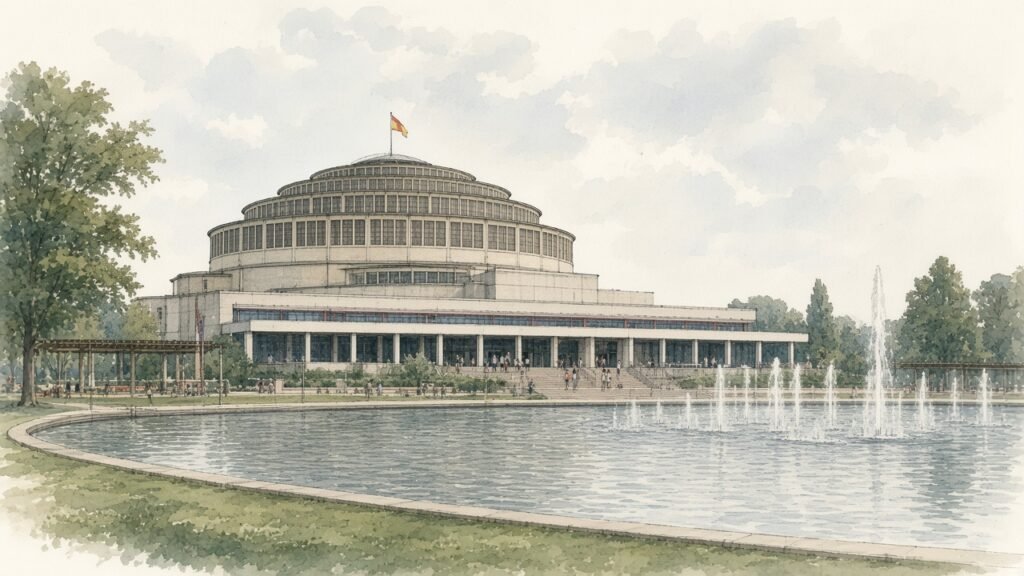
16. After 1989
The end of Communist rule opened Wrocław to market economics, competitive politics and European integration. Privatisation, foreign investment and the collapse of uncompetitive plants produced unemployment alongside new wealth. German firms returned as investors rather than as sovereigns; border traffic and twinning arrangements multiplied after the German–Polish treaties of the early 1990s settled the frontier. EU accession in 2004 and the Schengen open border later made day trips to Dresden or Berlin routine for those with means. The city’s western location, once a Cold War edge, became an asset in Central European logistics and services.[83][73][1]
Memory politics shifted. Institutes, exhibitions and school exchanges began to present German Breslau more fully, including Jewish Breslau and the expulsion, without abandoning Polish narrative centrality. German-language cultural centres and visiting expellees walking old streets became familiar sights. Disputes flared over monuments, cemetery care and property claims, yet the overall trend was toward layered storytelling. Scholarship such as Gregor Thum’s work found Polish and German readers. The city discovered that acknowledging Breslau did not dissolve Wrocław.[2][74][18]
Urban regeneration cleaned facades, renewed tram fleets and commercialised the Rynek into a tourism machine of restaurants and festivals. Gentrification pushed some residents outward. The Centennial Hall gained UNESCO recognition as an early modernist masterpiece. New museums — including projects on the city’s transformation — addressed subjects once avoided. Universities expanded international programmes. Wrocław’s bid successful for European Capital of Culture in 2016 staged a year of events that marketed openness, aquariums of history and contemporary art, and celebrated the dwarf graffiti heritage of the Orange Alternative as civic brand.[62][84][82][1]
The 1997 Oder flood inundated large districts, destroyed homes and tested emergency services. Volunteers filled sandbags in scenes that entered local legend as proof of civic solidarity in the new democracy. Subsequent flood defences and planning reforms aimed to reduce repetition. Climate and river management remain live issues for a city defined by water since its founding. The flood also damaged archives and libraries, reminding historians how fragile the paper record of both Breslau and Wrocław can be.[4][1][2]
Politics in the Third Republic saw Wrocław as generally entrepreneurial and often civically liberal relative to some eastern regions, though national polarisation after 2015 reached its streets as well. Mayors marketed the city to investors; NGOs tended multicultural festivals; debates over refugees and nationalism echoed national media. Ukrainian migration, accelerating after 2014 and especially after 2022, added a new layer of eastern arrivals to a city that had itself been built by eastern resettlers in 1945 — a historical rhyme not lost on local commentators.[1][57][83]
Economically the post-1989 city shifted toward services, IT outsourcing, shared service centres and higher education, while retaining manufacturing niches. Airport growth and motorway links tied Wrocław into European supply chains. Inequality and housing costs rose. Suburban sprawl extended into former villages. The socialist estates of the People’s Republic aged into problems of insulation and social stigma even as some were refurbished. Managing this mixed inheritance — German historic core, socialist housing, capitalist skyline — became the ordinary work of municipal politics.[81][1][58]
Culture flourished in publishing, theatre and electronic music. The city’s literary festivals sometimes hosted German and Polish authors in dialogue about Silesia. Film used Wrocław streets as locations. Football remained a popular passion. Tourism discovered Ostrów Tumski’s evening lighting, the university’s aula, and the Centennial Hall’s dome. Guidebooks gradually improved their historical honesty, mentioning 1945 not only as liberation but as population exchange. Visitors who read carefully leave with a more complicated city than the pastel Rynek first suggests.[11][62][2][84]
Relations with Germany normalised to the point of boredom for younger residents who take open borders for granted. For older expellees and older settlers, visits still carry emotional charge. Joint cemetery clean-ups and shared school textbooks on the region remain works in progress. The European framework that made reconciliation possible is itself now debated in Polish politics, so the city’s German conversations are never only local. Wrocław’s modern identity — Polish, European, post-German, post-Communist — is a stack of adjectives that refuse to collapse into one.[83][74][2]
Demographically the city grew through internal migration and foreign inflows. Students from elsewhere in Poland stayed after graduation; Ukrainians filled service and construction jobs; a small international professional class clustered in new offices. Religious practice followed national trends of decline among the young alongside enduring Catholic festival culture. Minority faiths, including the revived Jewish community around the White Stork Synagogue, occupied a larger symbolic place than their numbers alone would suggest, because they testify to a pluralism the city wishes to claim.[18][1][84]
Looking from 1989 to the present, Wrocław completed a journey from sealed frontier socialist city to open European regional capital without losing the settler imprint of 1945. The honesty with which it now discusses that imprint varies by museum, mayor and school, but the conversation exists. That conversation is itself a historical achievement, hard-won after decades of silence, and it is the necessary preface to any legacy chapter that hopes to be more than boosterism.[2][58][84]
Infrastructure projects — stadiums for Euro 2012 matches, road rings, riverbank promenades — remade leisure geography. Cyclists claimed lanes; cafés spilled onto islands. The aquaria and science centres marketed education as entertainment. Critics worried that festivalisation hollowed civic debate; defenders answered that liveliness beat provincial gloom. Both could point to evidence on the same Saturday afternoon in the Rynek.[1][84][4]
The COVID-19 pandemic and then the war in Ukraine tested municipal services again. Reception of refugees drew on a folk memory of displacement that is unusually strong in Wrocław precisely because so many families have expulsion stories of their own. Whether that memory produces lasting openness or only emergency hospitality remains an open question for the city’s next decades. History here is never only about the past.[57][74][1]
German investment after 1990 included banks, retail and manufacturing that employed Polish workers under German management — a historically loaded arrangement that mostly became ordinary. Protests occasionally revived old language; daily work mostly did not. Economic sociology of these factories shows pragmatism prevailing over inherited grievance among younger cohorts.[83][74]
European Capital of Culture programming in 2016 mixed spectacle with serious historical exhibitions. Debates over budgets and artistic choices were fierce. Lasting effects included infrastructure, international profile and a cohort of cultural managers trained under pressure. Whether deep historical understanding increased among casual visitors is harder to measure than hotel occupancy.[84][2][1]
Ukrainian presence after 2022 transformed schools, churches and labour markets with a speed that recalled, for historians, the 1940s settler wave — with the crucial difference of legal frameworks, open borders within EU rules for Poles, and digital connection to a living homeland at war. Solidarity was real; fatigue and housing strain were also real. The city’s capacity to absorb newcomers remains under test.[57][83][1]
Museum projects on the city’s transition have begun to collect German and Polish testimonies in parallel audio guides. Visitors can hear expulsion and arrival as paired tracks. Such design choices embody the stacked historiography this essay has advocated. They are still fragile, dependent on funding and political weather. Their existence nonetheless marks distance travelled since textbook silence.[2][74][84]
Flood defence upgrades after 1997 and subsequent high-water scares consume large budgets. Climate projections suggest more extremes. A city born of a ford must keep paying for water knowledge. Engineers and historians rarely share conferences; Wrocław would benefit if they did, because earlier flood cultures and street grades still matter to present modelling.[4][1]
The post-1989 chapter is unfinished. Elections, wars nearby, economic cycles and memory laws will continue to rewrite it. What can already be said is that Wrocław seized the opening of borders to become a more self-critical and more visited city than the People’s Republic allowed — and that self-criticism, more than pastel facades, is the achievement worth emphasising.[84][83][2]
Border-crossing bus routes after Schengen turned weekend shopping in German towns into routine. Price differentials shaped petty trade. Sociologists tracked how quickly “Germany” became a supermarket destination rather than a traumatic symbol for young Poles. Generational change in meaning is as historical as treaty signing; Wrocław’s location makes that change locally measurable.[83][74][1]
Charters of market rights and bridge tolls, reissued by successive rulers, created a parchment continuity that outlasted dynasties. Scribes copied older privileges into newer confirmations so that a Bohemian king might endorse a Piast duke’s grant. Legal memory thus stacked like the city’s stone. Archivists today unfolding these sheets participate in a chain of reading centuries long.[1][21][15]
17. Islands, bridges and squares
Wrocław’s geography still explains its history. The Oder’s arms create islands — Ostrów Tumski, Słodowa, Piasek and others — linked by a famously large number of bridges that earned the city comparisons to Venice in tourist prose. Those bridges have been timber, stone, iron and steel across the centuries; many were destroyed in 1945 and rebuilt. Crossing water remains the daily ritual of a city whose earliest reason for being was a ford. Flood marks on walls record the river’s other face.[4][1][11]
Ostrów Tumski, the Cathedral Island, holds the densest sacred and commemorative landscape: cathedral fabric, ecclesiastical buildings, the river walk and the habit of lighting candles on the Tumski Bridge railings. Even visitors uninterested in religious architecture feel the shift in atmosphere when they leave the commercial Rynek for the island’s quieter brick. For medievalists the island is the Piast and episcopal core; for photographers it is evening mist and gas-style lamps; for the city’s self-mythology it is proof of ancient Polish roots. All these readings coexist in the same few hectares.[11][5][3]
The Rynek, with the Gothic town hall at its heart, remains the ceremonial plaza of merchant Wrocław. Colourful tenement facades, partly reconstructed, frame restaurants and festivals. The square’s proportions still follow the medieval market plot. Under the paving lie earlier layers; around it radiate streets that once held cloth halls, Jewish lanes and craft quarters. To stand in the Rynek is to stand in the longest continuous public space of the city’s civic life, even though the citizens have changed.[15][1][18]
North and east of the centre, the university facade along the river presents the Prussian and baroque investment in learning as a postcard. Students cross the same bridges with different textbooks. Further out, the Centennial Hall and its park stage early twentieth-century modernity — concrete, exhibition, sport — now framed by UNESCO status and leisure landscaping. Between these poles of Gothic square, baroque university and modernist hall runs the tram network that stitches German-plan streets to socialist estates and post-1989 office parks.[45][62][84]
Neighbourhoods carry distinct textures. Nadodrze’s warehouses and tenements have seen artistic gentrification; Krzyki’s avenues remember German villa planning; Fabryczna’s industrial zones recycle into lofts or lie fallow; Kozanów’s blocks flood and drain with the river’s moods. Cemeteries — old German graves with Polish caretaking arrangements, Jewish cemeteries under restoration, military cemeteries of several wars — form a quiet cartography of who died here under which flag. Walking them is a more honest tour than the Rynek alone.[1][18][74]
Bridges deserve names in any account: the Tumski Bridge as ritual threshold; the Peace Bridge and others as rebuilt connections; road bridges that carry the burden of cars the medieval city never imagined. When bridges fall in flood or war, the city fragments into islands in the social as well as the fluvial sense. When they stand, Wrocław feels whole. The city’s nickname as a place of a hundred bridges is marketing arithmetic, but the underlying truth is that water and crossing organise experience here as streets organise it elsewhere.[4][1]
Markets and halls continue commercial traditions under new goods. The market hall’s iron architecture speaks the same industrial language as other Central European cities. Christmas markets occupy the Rynek with mulled drinks and lights; summer festivals spill onto islands. Consumption has become a primary way residents and tourists inhabit heritage. Historians may regret the reduction of memory to backdrop, yet vibrant use also keeps stones maintained and watched. Empty authenticity helps no one if roofs collapse.[1][15]
From the air or from a high tower, the city’s plan shows the old oval of walls, the later grid extensions, the park belt and the river’s braid. That view makes clear why armies wanted the place and why settlers could reuse it: the skeleton was durable. Names change; hydrology and plot lines persist. A history of Wrocław written only from chronicles without maps would miss half the argument. The islands, bridges and squares are not illustrations of the story; they are among its principal causes and survivors.[1][4][3]
Small details reward attention: Prussian house numbers still faintly visible under paint; bilingual ghosts on warehouse lintels; a surviving German doorbell mechanism in a Polish family’s flat; flood gauges; dwarf statues that point to martial-law jokes rather than to fairy tales. The city teaches by accumulation of such details. Residents learn them unconsciously; visitors need guides or books. This special feature’s place-based chapter is only an invitation to look longer at what the pastel facades hide and reveal.[2][82][1]
Seasonal light changes the islands. Winter fog softens the cathedral massing; summer beer gardens colonise riverbanks; autumn plane trees drop leaves onto tram tracks. Painters and watercolourists — including the documentary style used in this feature’s illustrations — return often to the Rynek and the Oder because water, brick and haze suit the medium. The city’s visual clichés are grounded in real atmospheric effects. To refuse cliché entirely would be to refuse the place’s actual weather.[1][4][15]
Public transport maps are themselves historical documents: lines follow old German axes; stops bear Polish names commemorating poets, soldiers and abstract virtues; night buses serve estates that did not exist in 1939. Learning the tram map is how newcomers still become locals, as in 1946, only now the newcomers may be from Warsaw or Kharkiv rather than from Lviv. Continuity of practice matters as much as continuity of blood — a lesson Wrocław teaches better than most European cities.[58][57][1]
Finally, the squares host politics. Rallies for and against national governments, pride parades, silence for disaster victims, victory parties after football matches — all claim the same cobbles. The Rynek’s openness is a civic resource inherited from medieval market law and repeatedly rebuilt after fire and war. Guarding that openness, against both commercial enclosure and authoritarian crowd control, is part of the unfinished work of a city that knows how suddenly public space can become a battlefield.[15][68][80]
Hydrological engineering — weirs, channels, floodplains — has altered the Oder’s behaviour since Prussian times. Some islands are more artificial than they look. Navigation requirements and mill races carved edges that parks later softened. Reading the river as infrastructure as well as nature restores the labour of anonymous engineers to the picturesque view.[4][36][1]
Tumski Bridge’s love-lock habit, however commercially copied from elsewhere, creates a contemporary ritual layer on a historic crossing. Municipal debates over the locks’ weight and aesthetics recur. Historians note that bridges have always accumulated votive behaviours. The locks are not “inauthentic” so much as newly specific. Removing them would also be a historical act.[11][4]
Tram bridges and road flyovers of the socialist and post-socialist eras lack postcard beauty yet carry most lives. Aesthetic hierarchies that notice only Gothic brick miss how the city actually works. A full spatial history includes depot yards, transformer stations and the colour of ticket validators. Wrocław’s modernity is not only Max Berg’s dome.[62][81][1]
Park belts on former fortifications follow a pattern common in European cities that slighted walls in the nineteenth century. The green ring eases dense living and preserves sightlines. Allotment colonies within it sustain working-class horticultural culture across regime changes. Seed saving and shed architecture deserve ethnographic attention alongside cathedral spires — especially when house style illustrations must avoid those spires’ crosses.[1][36]
Night lighting schemes now stage Ostrów Tumski and the university as spectacles. Critics call this Disneyfication; defenders call it access. Both alter how stone is perceived. The medieval builders used lamplight and candlelight; electric colour temperatures are a new medium. Sensory history of the islands remains an open research field.[11][45][1]
For walkers following this essay, a suggested circuit runs from the Rynek to the university facade, across to Ostrów Tumski, and out by tram to the Centennial Hall — four nodes matching this feature’s illustrations. The circuit cannot show Festung rubble or expulsion cattle-cars; those require museums and reading. Physical space and historical violence stand at an angle to each other that walking alone cannot resolve.[15][62][68][74]
Bridge maintenance logs list rivets, ice damage and load tests in languages that switch in 1945 while the spans’ steel inventory continues. Engineers reading both German and Polish sections of the same infrastructure file practice a bilingual technical history. Their practical need for continuity is a model for scholars tempted by narrative rupture alone.[4][1][2]
Dietary cultures shifted with rulers and migrants: Silesian poppy-seed dishes, Prussian culinary fashions, eastern Polish pierogi after 1945, and later global fast food. Food history is not trivial; it marks who settled and what they missed. Cookbooks in municipal libraries register the population exchange as clearly as street-name decrees, if one knows how to read ingredient lists as evidence.[58][2][1]
18. Legacy
Wrocław’s legacy is the demonstration that a great European city can change its language, population and state almost totally within a decade and yet continue as an urban organism — bridges over the same river, markets on the same square, universities in the same shells. That demonstration is not a moral comfort; it was purchased with siege deaths, expulsions and silences. It is, however, a historical fact that unsettles simple stories of eternal national landscapes. Cities are tougher and crueller than nations imagine.[2][74][68][1]
For German culture Breslau remains a lost metropolis of science, theatre and Jewish–German achievement, recalled in memoirs, expellee periodicals and family albums. For Polish culture Wrocław is proof of westward rebirth after eastern loss, a capital of the recovered territories that became ordinary home. For Jewish history the city is a chapter of emancipation, creativity and Shoah. For European history it is a case study in border shift, forced migration and reconciliation under EU conditions. These legacies overlap in the same tram ride.[46][61][75][83]
The Piast foundation of the year 1000, the Bohemian and Habsburg centuries, Frederick’s conquest, imperial industrialisation, Festung Breslau and Polish resettlement are not competing alternatives but successive layers. Honest pedagogy stacks them. Mythic pedagogy selects one layer and calls it essence. Wrocław’s public culture since the 1990s has moved, unevenly, from myth toward stack. That movement is itself a legacy worth defending against renewed simplifications from any side.[5][32][2][84]
Material legacies are visible: Max Berg’s hall, the town hall’s Gothic brick, the university’s baroque length, the synagogue that survived, the dwarf statues of opposition humour, the socialist blocks, the flood defences. Intellectual legacies include the Nobel names, the Lviv academic transplant, the Orange Alternative’s method of jest, and the bilingual historiography now available to students. Moral legacies are quieter: the possibility of German and Polish families walking the Rynek together without hatred, and the obligation to remember those for whom that walk came too late.[62][15][82][45][18]
This special feature has traced the city from ford to European Capital of Culture along a chronological arc, with attention to Jews, to universities, to war and to the remaking of population. The interactive timeline that follows gathers dates; the references list sources that readers may pursue. No single essay exhausts Wrocław. The islands will outlast the next renaming, if one comes, as they outlasted the last. What names we use for the city are ours; the river’s braid is not.[1][4][84]
Comparisons help place the case. Other cities changed hands and populations — Lviv, Szczecin, Kaliningrad, Strasbourg in earlier centuries — each with distinct ratios of continuity and rupture. Wrocław’s singularity lies in the combination of extreme demographic replacement with extensive survival of the pre-war street plan and with a successful settler identity that later opened toward the expelled other. That combination makes it a privileged site for thinking about what “home” means in modern Europe after empire and after ethnic cleansing.[57][74][2]
Future challenges — climate flood risk, housing, integration of new migrants, national cultural wars — will rewrite again what the city stands for. Historians cannot predict those rewritings. They can only insist that policies be made with the record in view: that fortresses kill their own civilians; that expulsions create decades of trauma on both sides; that silence about predecessors leaves ghosts in the masonry; and that layered truth-telling is a practical civic technology, not a luxury. Wrocław has begun to practise that technology. Its legacy will depend on whether it continues.[68][74][2][84]
The title of this feature, Wrocław Across Empires, names the pattern without romance. Piast, Bohemian, Habsburg, Prussian, German and Polish sovereignties claimed the ford. Each left law, stone and graves. The present Polish city is the legitimate home of its living citizens; it is also the steward of earlier names. Stewardship requires knowledge. Knowledge requires the kind of long reading this essay has invited. The rest belongs to walkers on the bridges at dusk, when the river holds the last light and the islands go quiet.[1][3][4]
In classrooms from Warsaw to Berlin, Wrocław already serves as an example in modules on forced migration and urban memory. Expanding that use — in Ukrainian, English and other languages as well — would match the city’s own increasingly multilingual streets. The special-feature format adopted here, with contents, chapters, citations, timeline and references, is meant to serve such reading. It follows the model established on this site by earlier long essays and applies it to a city that rewards length because its ruptures invite superficial summary.[2][84][1]
One final image: a tram crossing the Oder at evening, passengers scrolling phones in Polish and Ukrainian, an older couple speaking soft German to each other as tourists, students debating politics, a child asking why the island’s buildings look like churches. The answer takes a thousand years. This essay has been one attempt to give that child, and the adult beside her, a place to begin — and a timeline with which to continue.[1][4][11]
The empires are gone; the city remains. That is the simplest legacy and the hardest. It asks humility of national pride and patience of personal grief. Wrocław’s stones have practised both longer than any of us. We can learn from them if we look carefully, cite honestly and refuse the comfort of a single name.[1][2][3]
Educational exchanges that bring German and Polish pupils to share archival workshops in Wrocław produce measurable attitude shifts in survey studies. The method is slow and expensive compared with nationalist messaging. Its defence is empirical: contact under skilled teaching reduces enmity more durably than slogans. The city’s museums and universities are infrastructure for that method.[84][2][45]
Literary legacies include German memoirs of loss and Polish novels of settlement, now sometimes translated across the border. Reading them in pairings — one German, one Polish, on the same years — is an exercise this essay’s readers might attempt. Fiction carries emotional truths that footnotes cannot. It also carries biases that footnotes must check.[2][74]
Urban planning legacies include the endurance of the medieval market plot and the difficulty of marrying it to automobile scale. Pedestrianisation debates, underground parking and delivery logistics all grind against thirteenth-century dimensions. In that grind the Piast and Magdeburg city still disciplines the electric car. Heritage is not only memory; it is constraint.[15][1]
The Jewish legacy obliges the city to more than festivals. Cemetery maintenance, school curricula on the Holocaust and support for living community institutions are tests of seriousness. German legacy obliges bilingual labelling where appropriate and care for graves without living local kin. Polish legacy obliges attention to eastern resettler memory as more than a footnote to western triumph. Meeting all three obligations at once is the mature form of Wrocław’s stewardship.[18][61][74][57]
If empires return in new forms — economic, informational, military — Wrocław’s position on the Oder will again matter geopolitically. History does not immunise against danger; it only removes the excuse of surprise. The ford that became a city remains a crossing. What crosses next will write the next chapter that this feature cannot yet contain.[4][83][1]
Until then the legacy is the stack: Piast bishopric, Bohemian crown land, Habsburg province, Prussian jewel, German metropolis, fortress of ruin, Polish settler capital, European culture city. To name the stack in order is the first act of respect. To study each layer with equal seriousness is the second. The third belongs to the reader on the bridge.[1][2][3][84]
Festival posters layered on kiosks — socialist anniversaries, Solidarity Masses, Capital of Culture logos, Ukrainian benefit concerts — form a stratigraphy of public appeals. Ephemera collections in libraries preserve what walls no longer show. A history of persuasion belongs beside a history of stone in any city so often asked to feel newly loyal.[84][80][58]
Seasonal fairs brought rural sellers into contact with urban buyers under rules older than any living merchant. Dispute resolution at fair courts trained generations in oral pleading. When rail reduced the fair’s centrality, something of that legal theatre faded. Folklorists recorded remnants; economists noted efficiency gains. Both were right about different losses and benefits.[8][1][41]
Administrative orders, railway timetables and ration cards from the mid-1940s, preserved in Polish and German archives, allow micro-histories of particular streets during siege, expulsion and arrival. When read together they show the same address generating incompatible human meanings within months. That documentary triangulation is the method behind this essay’s claim that Wrocław’s modern identity is stacked rather than single-layered.[2][68][74][58]
Future research will continue to exploit digitised address books, geospatial mapping of destruction and linked open data on forced migrants. Citizen historians in both countries already contribute photographs. The professional task is to keep standards of citation and context high as participation widens — a task this site’s reference practice is meant to model in miniature.[2][1][84]
19. Timeline
Duke Bolesław I establishes the bishopric of Wrocław at the Congress of Gniezno, placing a Latin see on the Oder within the new Polish church province.
After Bolesław III’s testament, Wrocław becomes capital of the Piast Duchy of Silesia as the Polish realm fragments.
Henry II the Pious falls at Legnica; Silesia and Wrocław suffer invasion and subsequent rebuilding under Magdeburg law privileges.
The Treaty of Trentschin records Poland’s renunciation of Silesia; Wrocław passes with the province into the Bohemian Crown.
After Mohács, the Habsburgs inherit the Bohemian Crown; Wrocław comes under Austrian rule while adopting the Reformation among many burghers.
Frederick II enters Silesia; Breslau opens its gates in January, beginning Prussian rule confirmed by later treaties through Hubertusburg in 1763.
The Congress of Vienna confirms Prussian Silesia; Breslau expands as a provincial capital through the nineteenth century.
Breslau becomes a major city of the Kaiserreich and capital of the Province of Silesia, later Lower Silesia.
Max Berg’s reinforced-concrete Jahrhunderthalle marks the centenary of the Wars of Liberation and imperial civic modernity.
National Socialist rule brings Gleichschaltung, the purge of the university and escalating persecution of Jews in Breslau.
Synagogues are burned and Jewish property destroyed in November; forced emigration and robbery accelerate.
Soviet forces besiege the fortress city from February; surrender comes on 6 May amid vast destruction.
German inhabitants are expelled under Potsdam arrangements; Polish settlers arrive from central Poland and the lost eastern lands.
Wrocław becomes a major centre of Solidarity and, under martial law, of underground opposition including the Orange Alternative.
A catastrophic flood inundates large districts, prompting civic mobilisation and later defence reforms.
Wrocław serves as a European Capital of Culture, staging arts programmes and international attention to the city’s layered past.
References
- Grokipedia, “Wrocław” ↩
- Gregor Thum, Uprooted: How Breslau Became Wrocław During the Century of Expulsions (Princeton University Press, 2011) ↩
- Grokipedia, “History of Silesia” ↩
- Grokipedia, “Oder” ↩
- Grokipedia, “Bolesław I the Brave” ↩
- Grokipedia, “History of Poland” ↩
- Grokipedia, “Amber Road” ↩
- Grokipedia, “Via Regia” ↩
- Grokipedia, “Bolesław III Wrymouth” ↩
- Grokipedia, “Duchy of Silesia” ↩
- Grokipedia, “Wrocław Cathedral” ↩
- Grokipedia, “Henry II the Pious” ↩
- Grokipedia, “Battle of Legnica” ↩
- Grokipedia, “Mongol invasion of Europe” ↩
- Grokipedia, “Magdeburg rights” ↩
- Grokipedia, “Casimir III the Great” ↩
- Grokipedia, “Piast dynasty” ↩
- Grokipedia, “History of the Jews in Poland” ↩
- Grokipedia, “History of the Jews in Germany” ↩
- Grokipedia, “Hussite Wars” ↩
- Grokipedia, “John of Bohemia” ↩
- Grokipedia, “Kingdom of Bohemia” ↩
- Grokipedia, “Charles IV, Holy Roman Emperor” ↩
- Grokipedia, “Habsburg monarchy” ↩
- Grokipedia, “Battle of Mohács” ↩
- Grokipedia, “Ferdinand I, Holy Roman Emperor” ↩
- Grokipedia, “Protestant Reformation” ↩
- Grokipedia, “Thirty Years’ War” ↩
- Grokipedia, “Peace of Westphalia” ↩
- Grokipedia, “Jesuits” ↩
- Grokipedia, “Maria Theresa” ↩
- Grokipedia, “Silesian Wars” ↩
- Grokipedia, “War of the Austrian Succession” ↩
- Grokipedia, “Frederick the Great” ↩
- Grokipedia, “Treaty of Hubertusburg” ↩
- Grokipedia, “Kingdom of Prussia” ↩
- Grokipedia, “Christian Wolff” ↩
- Grokipedia, “Angelus Silesius” ↩
- Grokipedia, “Napoleonic Wars” ↩
- Grokipedia, “Congress of Vienna” ↩
- Grokipedia, “Industrial Revolution” ↩
- Grokipedia, “German Empire” ↩
- Grokipedia, “Ferdinand Lassalle” ↩
- Grokipedia, “World War I” ↩
- Grokipedia, “University of Wrocław” ↩
- YIVO Encyclopedia of Jews in Eastern Europe, “Breslau” ↩
- Grokipedia, “Alois Alzheimer” ↩
- Grokipedia, “Fritz Haber” ↩
- Grokipedia, “Max Born” ↩
- Grokipedia, “Nobel Prize” ↩
- Grokipedia, “Leopold von Ranke” ↩
- Grokipedia, “Gerhart Hauptmann” ↩
- Grokipedia, “August Heinrich Hoffmann von Fallersleben” ↩
- Grokipedia, “Edith Stein” ↩
- Grokipedia, “Weimar Republic” ↩
- Grokipedia, “Nazi Germany” ↩
- Grokipedia, “Lviv” ↩
- Norman Davies and Roger Moorhouse, Microcosm: Portrait of a Central European City (Jonathan Cape, 2002) ↩
- Grokipedia, “YIVO” ↩
- Grokipedia, “Kristallnacht” ↩
- Grokipedia, “The Holocaust” ↩
- Grokipedia, “Centennial Hall (Wrocław)” ↩
- Grokipedia, “Germanisation” ↩
- Grokipedia, “Lower Silesia” ↩
- Grokipedia, “Wehrmacht” ↩
- Grokipedia, “World War II” ↩
- Grokipedia, “Karl Hanke” ↩
- Grokipedia, “Siege of Breslau” ↩
- Grokipedia, “Red Army” ↩
- Grokipedia, “Ivan Konev” ↩
- Grokipedia, “1st Ukrainian Front” ↩
- Grokipedia, “Potsdam Conference” ↩
- Grokipedia, “Oder - Neisse line” ↩
- Grokipedia, “Flight and expulsion of Germans (1944 - 1950)” ↩
- Grokipedia, “Potsdam Agreement” ↩
- Grokipedia, “Polish population transfers (1944 - 1946)” ↩
- Grokipedia, “Operation Vistula” ↩
- Grokipedia, “Solidarity” ↩
- Grokipedia, “Racławice Panorama” ↩
- Grokipedia, “Martial law in Poland” ↩
- Grokipedia, “Wrocław University of Science and Technology” ↩
- Padraic Kenney, A Carnival of Revolution: Central Europe 1989 (Princeton University Press, 2002) ↩
- Grokipedia, “European Union” ↩
- Grokipedia, “European Capital of Culture” ↩