Lviv of Four Names
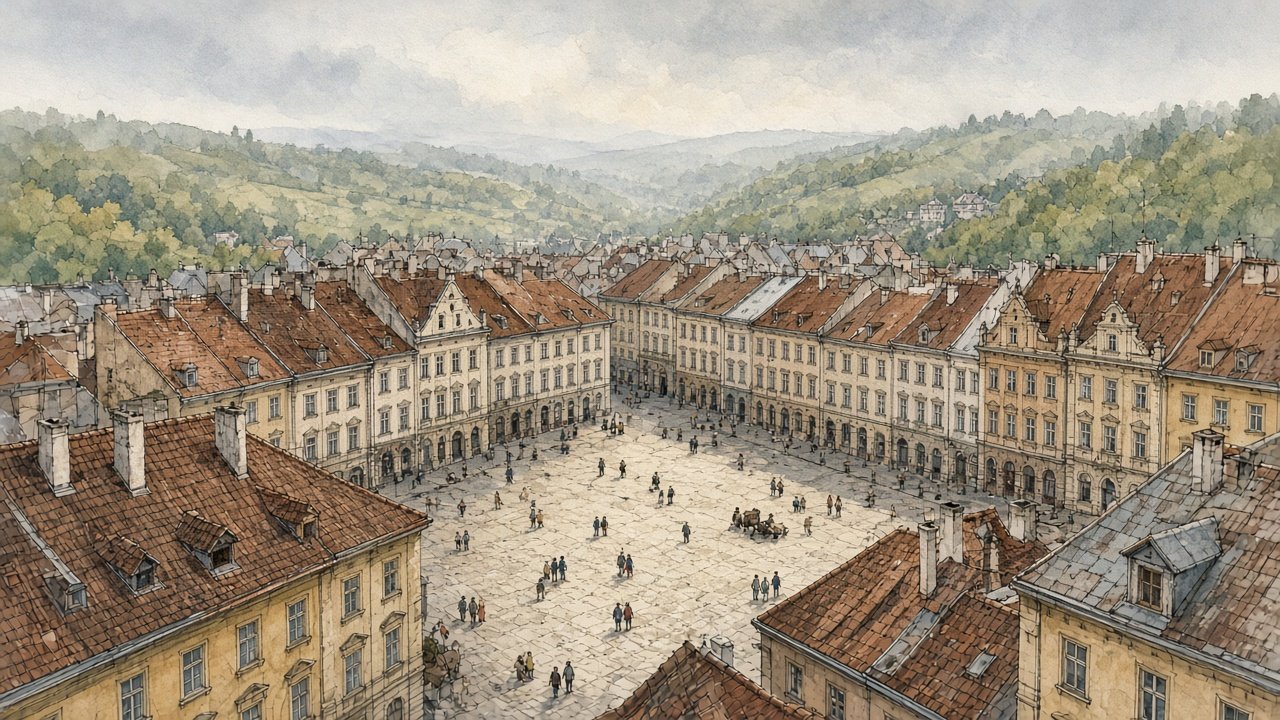
Lviv stands among the hills of western Ukraine with a market square whose parcels were drawn in the Middle Ages and a skyline that still carries the towers of several faiths. The city has been called Lviv, Lwów, Lemberg and Lvov by peoples who ruled it, traded in it or were driven from it. Each name marks a political claim as well as a language. Founded in the thirteenth century as a Ruthenian princely seat, rebuilt as a Polish royal town under Magdeburg law, capitalised by the Habsburgs as the centre of Galicia, fought over in 1918, occupied by the Soviets and the Germans, emptied of its Jews in the Holocaust and of most of its Poles in the population transfers that followed, it entered Ukrainian independence with Soviet-made demography and far older stones. Few cities in Europe have changed masters and inhabitants so often while keeping their street plan so legible.[1][2]
This special feature follows that history from the chronicle notice of 1256 to the independent Ukrainian city of the present. It describes the Ruthenian foundation on Castle Hill, the Polish conquest and the Magdeburg charter, the market square and the nations that shared the walls, the Renaissance rebuilding and the confessional struggles of the Commonwealth. It recounts Habsburg Lemberg, Galician autonomy, the schools and the Jewish metropolis of the long nineteenth century, the November fighting of 1918 and the interwar Polish decades. It then turns to the Soviet occupation of 1939, the German occupation and the destruction of Jewish Lviv, the postwar demographic transformation, late Soviet culture and the years of Ukrainian independence. It closes with an assessment of the city’s legacy. An interactive timeline at the end of the essay gathers the principal dates.
The essay relies on chronicle evidence, municipal and imperial records as synthesised in modern scholarship, and the testimonies of those who lived through the twentieth century’s occupations and expulsions. It aims at explanation rather than verdict, though it does not treat murder as a matter of opinion. British spelling is used throughout. Place names follow the political period under discussion where clarity requires, while the title’s four names remind the reader that nomenclature is part of the history itself.
The chapters that follow can be read in sequence or by period of interest. Cross-references in the notes point to Grokipedia articles and institutional encyclopedias that repay further reading. Book-length studies are cited without links. All online sources were checked for availability at the time of writing.
Population figures cited in later chapters are approximate and vary by census method, especially where language and religion were counted differently. Readers should treat round numbers as orders of magnitude unless a specific census is named.
Citations appear as numbered superscripts. The first occurrence of each source creates the number used thereafter.
1. Founding on Castle Hill
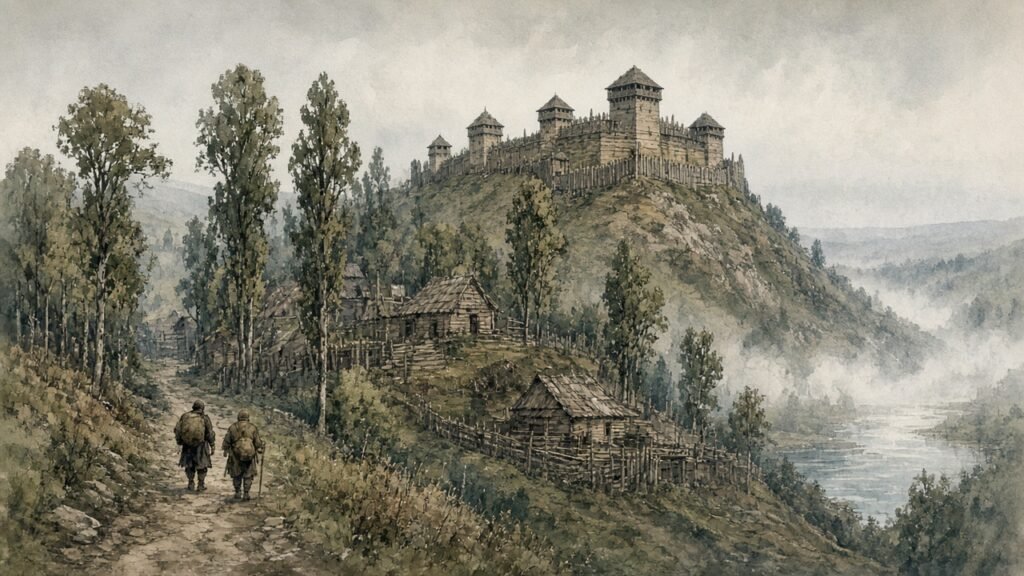
The earliest secure date in the history of Lviv is 1256. In that year the Galician-Volhynian Chronicle, preserved in the Hypatian Codex, records a fire that swept through the settlement named after Lev, the son of Prince Daniel Romanovych of Galicia. The chronicle’s brief notice does not describe a foundation ceremony, yet later tradition and the archaeology of Castle Hill treat 1256 as the city’s birth year. Daniel, already crowned king of Ruthenia with a papal crown in 1253, was rebuilding his principality after the Mongol invasions that had devastated Kyiv and the older Galician centres. He chose a wooded ridge above the Poltva river, on the western fringe of his domains, where a fortified residence could watch the roads that ran from the Carpathian passes toward the Bug and the Dniester.[1]
The choice of site was strategic. Halych, the older capital, lay farther east and closer to the open steppe. Lviv occupied a hinge between the forested uplands of Galicia and the trade corridors that linked the Baltic, the Black Sea and the Danube basin. From the High Castle the princely garrison could command the approaches. Below the ridge, on flatter ground beside the river, suburbs of craftsmen and traders began to gather. Wooden churches of the Eastern rite rose among the houses. The name of the city, Lviv or Lwiw in Old East Slavic, meant “city of Lev”, and when Lev I succeeded his father he confirmed the settlement’s importance by transferring the capital of Galicia-Volhynia there around 1272.[2]
Under Lev and his successors the city remained a Ruthenian princely centre rather than a self-governing commune of the Western European type. Its population was mixed from the start. Ruthenian speakers formed the majority. German settlers, invited by princely privileges, brought craft skills and a knowledge of Magdeburg custom. Armenian merchants, already present on the Black Sea routes, established a colony. Jewish families, moving along the same commercial corridors that linked Kraków, Prague and the Crimean ports, settled in small numbers. The princely court used Church Slavonic for solemn documents and a vernacular East Slavic for daily administration. Latin appeared in correspondence with Hungary and Poland. The city was therefore multilingual before it was ever Polish or Austrian.[3]
The Kingdom of Galicia-Volhynia held together for several more generations, balancing Mongol overlordship with marriages and alliances in Central Europe. Yuri I and his sons maintained Lviv as a royal seat. Stone began to replace timber in the castle and in a few churches. Markets attracted salt from the Carpathian foothills, wax and furs from the north, and oriental goods carried by Armenian and Genoese intermediaries. Yet the dynasty’s male line failed in the 1320s and 1340s. Rival claimants from Poland, Hungary and Lithuania contested the inheritance. In 1340, after the poisoning of the last local prince, Casimir III of Poland intervened. Nine years of war followed. By 1349 Polish forces held Lviv and most of Red Ruthenia. The Ruthenian principality as an independent kingdom was over.[4]
The Polish conquest did not empty the city. Ruthenian boyars and townsmen remained. The Orthodox cathedral continued to serve. What changed was the political framework. Casimir and his successors treated Lviv as a royal city of the Polish Crown, to be organised on the model of Kraków and other Magdeburg towns. German law, Latin charters and a Catholic hierarchy arrived with the new rulers. The High Castle remained a military point, but the civic centre of gravity began to shift downhill toward a planned market square. The transition from Ruthenian capital to Polish royal city took a generation. Its consequences shaped Lviv for the next four centuries.[5]
Archaeology and later chronicles agree that the mid-thirteenth-century foundation was modest. Earthworks and timber walls enclosed a small area. The princely court occupied the summit. Outside the defences lay suburban villages and monastic houses. Fires were frequent, as the 1256 entry itself shows. Winters were severe, and the Poltva flooded. Yet the site prospered because it sat at a crossroads. Caravans moving amber and cloth met caravans moving spices and silk. Local landlords sold grain and cattle. The Mongol peace, however harsh, kept the long-distance routes open enough for a frontier town to grow. By the time Lev made Lviv his capital, it was already more than a castle village. It was a place where several peoples lived under one prince and traded under one set of walls.
The Ruthenian character of the early city left deep marks. Place names, church dedications and family traditions preserved East Slavic forms long after Polish became the language of the town hall. The Uniate and Orthodox communities of later centuries looked back to Daniel and Lev as founders. Modern Ukrainian historiography has treated 1256 as a national as well as a municipal beginning. Polish historiography has sometimes preferred to date the city’s true urban history from Casimir’s charters. Both views capture part of the truth. Lviv began as a Ruthenian princely foundation. It became, under Polish law, a corporate town of many nations. The tension between those two inheritances runs through its entire subsequent history.
Daniel’s wider policy helps to explain why a new city was needed. He had sought recognition from Rome and from Hungary while paying tribute to the Golden Horde. A western capital reduced his exposure to steppe raids and brought him closer to potential Latin allies. The papal crown of 1253 was a diplomatic gesture rather than a lasting ecclesiastical realignment; the population remained overwhelmingly Orthodox. Still, the gesture signalled that Galicia-Volhynia belonged to the European system of kingdoms, not only to the Mongol world. Lviv embodied that claim in timber and earth. When Polish kings later issued Latin privileges for the same hill and the same river crossing, they were building on a foundation already laid by a Ruthenian dynasty that had looked both east and west.
The physical setting rewarded that ambition. Castle Hill rises abruptly above the Poltva valley. From its crest the eye travels across low ridges toward the Carpathian foothills. Approaches from the west climb through woods; approaches from the east open onto wetter ground. A fortress here could not be ignored by any army moving between Kraków and Kyiv. Daniel and Lev understood that geography. So did Casimir III, who kept a garrison on the hill after 1349. So did every later power that ruled the city. The High Castle changed its buildings and its owners, but it never ceased to symbolise dominion over the surrounding land. Even when the civic life of Lviv moved down to the Rynok, the silhouette of the hill remained the city’s oldest landmark.
By the early fourteenth century Lviv was large enough to support specialised crafts, a regular market and several religious houses. It was still far smaller than Kraków, Prague or Vienna. Its importance lay less in size than in position. As the capital of a border kingdom it concentrated political authority, ecclesiastical patronage and long-distance trade in one place. When that kingdom dissolved, the city survived because those functions could be redirected. Polish kings needed a stronghold in Red Ruthenia. Merchants needed a safe market on the east-west roads. Armenians and Jews needed a chartered space in which to live under royal protection. The Ruthenian foundation supplied the site. The Polish conquest supplied a new legal order. Together they created the medieval city whose street plan, in altered form, still underlies the historic centre.
Chroniclers writing centuries later embroidered Daniel’s foundation with omens and noble genealogies. Modern archaeology is more restrained. Excavations on Castle Hill and in the old town have recovered ceramics, weapons and building traces consistent with a thirteenth-century princely centre that grew through the fourteenth. Continuous habitation layers show fire horizons matching documentary disasters. Place-name studies link surrounding villages to service settlements that fed the castle. The documentary silence of many decades is therefore not evidence of emptiness; it is evidence of a frontier society that wrote less than it built. When Casimir’s clerks began to issue Latin charters, they were describing a place already thick with paths and claims.
Seasonal rhythms of the early city followed river and forest. Spring floods cut roads. Summer fairs brought strangers. Autumn slaughter filled cellars. Winter isolated the castle in snow. Mongol tribute collectors arrived on their own calendar. Princely hunts claimed forests that villages also needed. Conflict over woods and pastures surrounded the urban nucleus. Lviv was never only walls; it was a claim on a landscape. That claim, transferred from Ruthenian princes to Polish kings to later states, remains the geographic constant beneath changing flags.
Trade goods of the early period can be inferred from later customs lists and from archaeology: salt, wax, honey, furs, horses, coarse cloth, and occasional silver. Luxury items moved in smaller quantities along Armenian networks. The city taxed what it could see. Smuggling through woods avoided gates. Princely income from Lviv was never only coin; it was service, hospitality and military levies. Understanding the foundation requires seeing the castle as a node in extraction as well as in defence. Daniel and Lev built a place that could feed horsemen. Without that agrarian link the chronicle’s city would have been a camp.
Comparative foundations help. Kraków, Prague and Vienna grew under different conditions; Halych declined as Lviv rose. Daniel’s choice looks wiser in hindsight than it may have seemed amid Mongol pressure. Contingency matters: a different succession, a worse raid, a failed harvest might have left Castle Hill a footnote. The city’s later fame should not be read back as inevitability. It was a successful gamble on geography.
Later Ukrainian state symbolism often returns to Daniel’s crown and Lev’s name. Myth and charter intertwine in schoolrooms. Distinguishing poetical founding stories from the chronicle’s spare fire notice is part of historical literacy. Both matter culturally; only one anchors chronology.
2. Polish conquest and Magdeburg rights
Casimir III the Great completed the military conquest of Red Ruthenia in 1349, and Lviv passed under the Polish Crown. The transfer was contested for years by Hungarian claimants and by local boyars, yet Polish administration gradually took hold. Casimir’s policy was not simple replacement. He confirmed many existing property rights, negotiated with Orthodox nobles, and sought to attract settlers who could thicken the urban population. The decisive legal act came in 1356, when he granted Lviv a charter under Magdeburg law. The charter organised the town as a self-governing community with a council, a bench of jurors, market rights and defined obligations to the king. Additional land grants in 1368 enlarged the municipal territory. German legal forms, already familiar along the Baltic and in Silesia, now shaped civic life on the Poltva.[6]
Magdeburg rights transformed the relationship between ruler and townsmen. The prince’s arbitrary court gave way, in theory, to written custom and elected officers. Burghers held their plots by hereditary tenure. Crafts organised into guilds. Trade was regulated by the council, which also managed walls, gates and markets. In practice the king retained extensive powers of confirmation and intervention, and the Catholic bishopric established in the city after the conquest claimed its own jurisdiction. Still, the charter marked a clear break with the older Ruthenian order. Latin became the language of municipal records. The town seal and the town hall expressed a corporate identity distinct from the castle.[7]
Polish rule also redrew the religious map. A Latin-rite cathedral and Catholic monastic houses appeared alongside the older Orthodox churches. The Armenian community received privileges that recognised its own bishop and courts. Jews lived under royal protection as a separate estate, paying taxes directly to the Crown and maintaining their own communal institutions. Ruthenian townsmen retained property and worship but found themselves a minority within the chartered commune, whose leading offices gravitated toward Catholic, often German-speaking or Polonising, families. Over the fifteenth and sixteenth centuries Polish speech spread in the council chamber even as Ruthenian remained strong in the suburbs and the countryside.[10]
The political geography of the region reinforced Lviv’s new role. Red Ruthenia became a cluster of royal and private lands within the Polish kingdom. Lviv was the principal city of the Ruthenian Voivodeship. Starostas administered royal estates from the castle. Diets and tribunals drew nobles into town for weeks at a time. The union of Poland and Lithuania, sealed dynastically in 1386 and deepened by later agreements, placed Lviv inside a vast commonwealth that stretched from the Baltic nearly to the Black Sea. Merchants using the city could move goods under a single, if loosely coordinated, political roof from Gdańsk to the Moldavian frontier.
Conflict did not disappear. Tatar raids struck the countryside and sometimes reached the suburbs. Hungarian and Moldavian politics unsettled the southern approaches. Inside the walls, disputes over guild privileges, market stalls and church patronage filled the council books. Fires remained a constant danger in a city still largely of wood. Yet the Magdeburg framework proved durable. It outlasted the Piast and Jagiellon dynasties and survived into the era of the elective monarchy. When travellers described Lviv in the late Middle Ages, they described a walled Polish royal city with a mixed population, a busy market and a skyline of towers, not a Ruthenian princely camp.
Casimir’s successors continued his urban policy. Władysław Jagiełło and the Jagiellon kings confirmed and extended privileges. They encouraged immigration from German lands, Silesia and other Polish towns. They supported the Catholic hierarchy while tolerating, within limits, the Orthodox and Armenian churches. The result was a layered society. At the top stood royal officials and the Latin clergy. Beside them stood the council aristocracy of the chartered town. Below and around them lived Ruthenian artisans, Armenian traders, Jewish leaseholders and a shifting population of servants, soldiers and seasonal workers. Each group had its streets, its courts and its calendar of festivals. The city held together because the Crown found the arrangement profitable and because the walls made cooperation a condition of survival.
The conquest also redirected cultural patronage. Latin schools and later a Jesuit college trained clerks for church and state. Orthodox brotherhoods preserved Church Slavonic learning and resisted Polonisation. Armenian manuscripts recorded a diaspora culture linked to the Near East. Jewish scholarship, modest in the fourteenth century, grew as the community expanded. Lviv became a place where several literate traditions coexisted within walking distance of one another. That coexistence was unequal. Catholic institutions enjoyed the fullest legal favour. Yet the persistence of the other traditions meant that the city’s memory could never be reduced to a single language or a single church.
By 1400 Lviv was firmly integrated into the Polish urban network. Its merchants appeared at the fairs of Kraków and Lublin. Its craftsmen adopted styles circulating through Central Europe. Its walls and gates followed patterns known from other Magdeburg towns. At the same time it remained a frontier city, closer to the steppe and the Orthodox world than Poznań or Warsaw. That double character, Central European in law and eastern in neighbourhood, defined Polish Lwów for centuries. The charter of 1356 did not erase the Ruthenian foundation. It overlaid it with a new civic order that proved strong enough to absorb immigrants, survive fires and outlast dynasties.
The military narrative of 1340 to 1349 rewards closer attention because it explains why Polish authority stuck. After the death of Bolesław-Yuri II, local boyars briefly invited Lithuanian and local candidates. Casimir struck quickly, occupying Lviv and other strongholds, then lost and regained ground as Hungarian interests and Tatar pressure fluctuated. Diplomacy mattered as much as arms. Papal support for the Latin mission in Ruthenia gave Casimir a religious justification. Treaties with Hungary partitioned claims for a time. When the dust settled, Poland held the cities and the trade routes; Hungary retained influence farther south. Lviv’s walls, repaired and manned by mixed garrisons, became the guarantor of the settlement.
Administrative practice followed. Royal starostas collected revenues. Land was reassigned to loyal nobles. Catholic benefices were endowed with villages. At the same time Casimir issued assurances to Orthodox clergy and confirmed Armenian and Jewish privileges already germinating under Ruthenian princes. The policy aimed at stability rather than uniformity. A frontier city that expelled its merchants would impoverish the Crown. A frontier city that ignored Latin Christendom would forfeit Western alliances. Magdeburg law offered a third path: a corporate town loyal to the king, rich enough to tax, and open enough to absorb settlers. That formula, repeated across Central Europe, found in Lviv one of its easternmost and most durable applications.
Historians debate how rapidly Polonisation proceeded. Charter language and council lists show German and Latin dominance at first, then a shift toward Polish names and speech. Ruthenian continued in the suburbs and in Orthodox writing. The process was less a sudden conversion than a gradual alignment of elite urban culture with the Crown’s preferred idiom. Peasants in the surrounding villages remained overwhelmingly East Slavic in language. The city thus sat atop a demographic base that never fully matched its official culture. That mismatch, latent in the fourteenth century, became politically explosive in the nineteenth and twentieth.
Currency and tolls reveal how thoroughly Polish rule redirected commerce. Royal mints and authorised coinage displaced older mixed circulations. Toll stations at gates funded walls and officials. Staple rights, when enforced, forced merchants to offer goods for sale locally before transit. Such regulations enriched the council and annoyed long-distance traders, who sought exemptions. Armenians and Jews negotiated special terms. The resulting patchwork of privileges was typical of Commonwealth urbanism. It made Lviv richer than a free market might have in some years and poorer in others when war nullified paper rights. Economic historians reading customs accounts see a city deeply plugged into Kraków-centered circuits yet still facing east for cattle and oriental goods.
Heraldry and seals fixed the new order in wax. The municipal seal showed symbols that advertised loyalty to the Crown and Magdeburg identity. Guild shields hung in churches. Nobles’ arms appeared over gateways. Visual literacy of rank organised crowds during ceremonies. A peasant who could not read Latin could still see who mattered. The semiotic city complemented the legal city. Both survived in museum cases after the regimes that minted them were gone.
Latin parish records begin to thicken in the fifteenth century, offering historians baptisms and marriages that map Catholic settlement. Gaps remain for Orthodox and Jewish populations whose records burned or were never kept the same way. Asymmetry of sources biases modern narratives toward the better-documented Latin city. Correcting for that bias means reading silence as possible evidence of other communities rather than of emptiness. The Polish conquest created a paper trail that favours conquerors. Critical history discounts the trail without discarding it.
Military orders of the Polish kings required Lviv to supply wagons and guides for eastern campaigns. The city’s strategic value was logistical as well as symbolic. Quartermasters’ demands angered councilmen who counted costs. Royal gratitude came as privileges; royal anger as confiscations. The relationship was transactional beneath the rhetoric of loyalty. Magdeburg towns were partners and subjects at once.
Frontier defence under Polish rule meant coordinating with noble levies who arrived late and left early. Council minutes complain of unpaid garrison wages. Mercenaries hired for a season caused their own disorders. The Magdeburg city paid for security it only partly controlled. That fiscal burden explains some of the eagerness for royal privileges that shifted costs elsewhere. Military history and municipal finance are one story in Lviv.
3. The market square and the walls
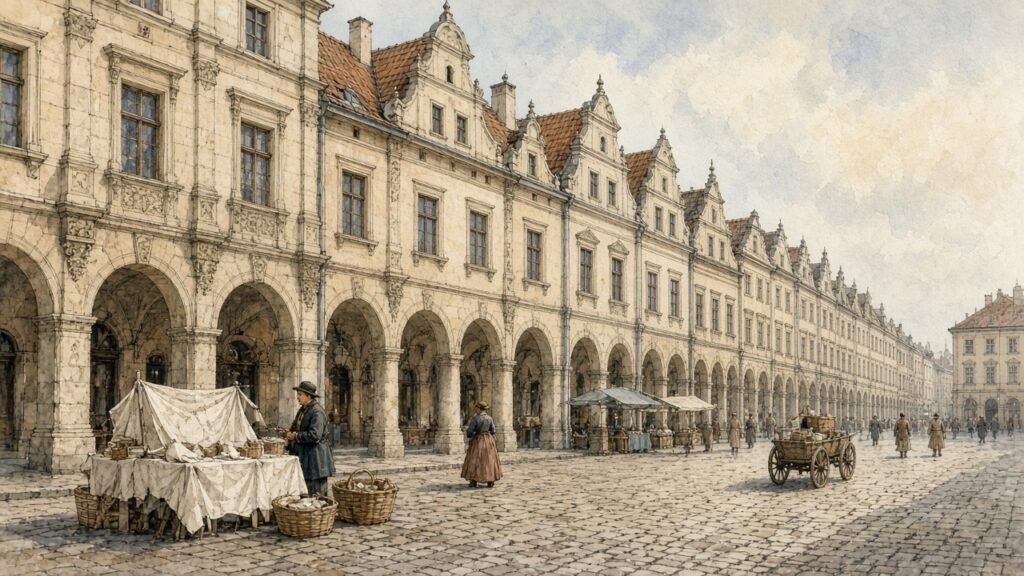
The physical heart of medieval Lviv was the market square, later called the Rynok. Laid out after the Polish conquest on flatter ground below Castle Hill, the square followed the rectangular plan typical of Magdeburg towns. House plots of regulated width faced the open space. In the centre stood the town hall, at first a modest structure and later a tall towered building that dominated the skyline. Arcaded ground floors sheltered traders in wet weather. Cellars stored wine, grain and cloth. From the four sides of the square, streets ran to the principal gates, connecting the civic centre to the suburbs and the roads beyond the walls.[8]
The Rynok was more than a marketplace. It was the stage of municipal life. Proclamations were read there. Criminals were punished there. Processions on feast days crossed it. Foreign merchants rented stalls for the duration of the great fairs. Local guilds defended their pitches against interlopers. The square’s architecture recorded successive rebuildings. Wooden houses gave way, after disastrous fires, to brick and stone. Renaissance attics and Italianate portals appeared in the sixteenth century. Baroque and later neoclassical alterations softened some facades. Yet the parcel division of the medieval plan survived, and with it the social geography of the old town. Wealthy families occupied the corner houses. More modest traders filled the secondary streets. Beyond the walls, poorer suburbs stretched along the roads to Kraków, Halych and the eastern marches.[9]
Fortification shaped daily movement. Medieval Lviv was enclosed by walls, ditches and gates. The High Castle watched from above; lower fortifications protected the chartered town. Towers punctuated the circuit. Drawbridges and portcullises controlled entry after dark. In wartime the suburbs might be burned by defenders to deny cover to an enemy. In peacetime the gates collected tolls and inspected goods. The walls expressed the city’s corporate privilege: within them Magdeburg law ruled; outside, other jurisdictions competed. Expansion therefore meant negotiation. New suburbs sought incorporation or at least regular access to the market. Monasteries and noble residences outside the walls complicated the picture. By the early modern period Lviv had outgrown its medieval belt, yet the old circuit remained the symbolic boundary of the historic centre.
Water and ground posed constant problems. The Poltva, later covered over, ran through the lower town and flooded after heavy rain. Wells and cisterns supplied drinking water. Waste accumulated in alleys. Epidemics struck with the same force as elsewhere in Europe. Municipal ordinances tried to keep streets passable and fires contained. Brick construction, mandated after major blazes, improved safety but raised costs. The great fire of 1527 destroyed much of the wooden city and forced a reconstruction that gave the Rynok much of its lasting Renaissance character. Later fires, including one in 1826, prompted further rebuilding. Continuity of plan combined with discontinuity of fabric: the square’s outline endured while individual houses were renewed.
Trade on the Rynok linked local and long-distance economies. Farmers from the surrounding villages brought foodstuffs. Carpathian salt, a strategic commodity, passed through the city. Cattle driven from the east were sold on designated grounds. Cloth from Flanders and Italy, spices from the Levant, and furs from the north changed hands under the arcades. Armenian merchants specialised in oriental goods. Jewish traders operated across credit networks that reached Kraków, Brody and beyond. German and Polish guilds guarded manufacturing privileges. The council taxed transactions and settled disputes. Prosperity was uneven and vulnerable to war, yet in good decades Lviv ranked among the richer cities of the Polish Crown.
The square also displayed hierarchy. The town hall tower announced municipal authority. Patrician houses carried coats of arms and Latin inscriptions. Church towers of several rites rose nearby, marking the presence of Latin, Orthodox, Armenian and later Uniate communities. Synagogues stood in the Jewish quarter a short walk away. A visitor standing in the Rynok could read the city’s pluralism in stone, even if he could not enter every courtyard. That visibility of difference became a hallmark of Lviv’s self-image and of outsiders’ descriptions. Guides and chronicles lingered on the square because it compressed politics, commerce and confession into a single open space.
Maintenance of the walls and the square consumed much of the municipal budget. Repairs after sieges and storms were expensive. Kings sometimes granted tax relief or timber from royal forests. Nobles with town houses contributed unevenly. Guilds were assessed for labour and materials. The resulting fabric was patchwork: handsome facades beside neglected stretches, new gates beside crumbling towers. Travelers’ praise of Lviv’s beauty usually referred to the best streets and the ceremonial face of the Rynok, not to every alley. Still, by the standards of the region the city was well built. Its survival as a coherent historic centre into the modern age owes much to the durability of that medieval layout and to the habit of rebuilding on the same plots.
In later centuries the Rynok remained the ceremonial and commercial core even as new avenues and Habsburg boulevards drew traffic elsewhere. Cafés occupied former trading rooms. Museums took over patrician interiors. Tourists photographed the fountains and the town hall tower. UNESCO recognition of the historic centre in 1998 rested in large part on the integrity of this square and its surrounding streets. The market that Casimir’s planners laid out in the fourteenth century thus became, unexpectedly, a global heritage site. Understanding Lviv begins with understanding how that rectangle of paving organised power, trade and memory for more than six hundred years.
Guild life around the Rynok deserves separate notice. Butchers, bakers, smiths, tailors, goldsmiths and dozens of other crafts maintained altars, chests and statutes. Apprenticeship bound boys for years. Masterpieces were examined before a candidate could open a shop. Women worked in many trades but rarely held guild office. Disputes between guilds over overlapping products filled the court records. The council mediated, favouring established masters. Innovation was possible but slow. When new goods arrived from Italy or the Ottoman lands, existing guilds tried to claim them. The resulting conservatism frustrated some merchants and protected others. It also gave the city a stable manufacturing base that complemented long-distance trade.
Religious processions mapped sacred geography onto the square. Corpus Christi brought the Latin clergy through the streets. Orthodox and Armenian calendars marked different solemnities. Jewish festivals closed shops in the Jewish streets while Christian markets continued. The coincidence and collision of holy days required informal coordination. Taverns and inns around the gates served travellers who arrived without regard to anyone’s calendar. In this sense the Rynok was both a sacred stage and a secular machine. Its paving stones absorbed wax from candles and blood from butchered animals, sermons and haggling, coronation cheers and funeral bells.
Modern conservation has frozen much of that flux into heritage. Street musicians and café tables now occupy spaces once reserved for carts. Yet the underlying geometry remains. Stand at the town hall and the medieval plan still organises your sightlines. That persistence is rare in eastern European cities scarred by twentieth-century destruction. Lviv’s relative escape from carpet bombing and the postwar decision to retain the old street net left the Rynok legible. The market square is therefore not only a medieval creation but a continuous argument about what the city is for.
Night on the medieval Rynok differed from day. Watchmen circled with lanterns. Taverns near the gates stayed noisy. Bells marked canonical hours for those who listened. Frozen mud in March made carts struggle; summer dust coated arcades. Seasonal fairs temporarily doubled the population with peddlers and pickpockets. Municipal ordinances against dice, blasphemy and unclean stalls survive in copies that show both ambition and failure of enforcement. The square was an ideal of order and a practice of improvisation. That double character remains familiar to anyone who has seen a market regulated on paper and alive in fact.
Animals shared the square with humans more than modern visitors imagine. Horses, dogs and poultry dirtied stones. Butchers’ waste attracted scavengers. Ordinances tried to push slaughter to edges. Smell was a historical fact of the Rynok. Perfume and incense from churches fought it on feast days. Sanitary modernity later buried the Poltva and scrubbed the arcades. Cleanliness made heritage possible and erased part of the market’s truth.
Women traders appear in court records as stall holders, innkeepers and creditors. Guild restrictions limited their formal power yet market reality relied on their labour. Widows inherited workshops under conditions. Servants carried goods and gossip between houses of different nations. A gendered history of the Rynok remains incompletely written; fragments show that the square’s public masculinity rested on female logistics. Any full account of Lviv’s commerce must eventually make that infrastructure visible.
Children in the square apprenticed early—watching scales, chasing theft, learning languages of insult and bargain. Street education competed with church schools. Orphans of the nations begged under arcades. Charity processions temporarily relieved and displayed them. Social history of childhood in Lviv remains sparse; court cases of abuse and abandonment offer grim entry points. The Rynok was not only merchants; it was also unsupervised youth.
Rain changed the square’s commerce. Canvas went up; arguments over dripping eaves entered court. Winter markets shrank to essentials. Summer nights stretched trading hours against ordinances. Climate was a silent councillor. Any history that ignores weather misreads why certain guilds prospered and why certain fires spread.
4. Merchants of many nations
Medieval and early modern Lviv was a city of legally distinct nations. The term is anachronistic if taken in the modern ethnic sense, yet it captures the reality of corporate communities living under different personal laws within one set of walls. Ruthenians, Poles, Germans, Armenians and Jews each possessed recognised institutions. Their coexistence was regulated by royal privileges, municipal statutes and customary practice. Conflict was frequent; so was cooperation in trade and defence. The city’s prosperity depended on that managed plurality.[10]
The Ruthenian population descended from the pre-conquest inhabitants and from rural migrants. Many lived in the suburbs, especially those oriented toward Halych and the eastern roads. They worshipped in Orthodox churches and, after the Union of Brest in 1596, increasingly in Uniate (Greek Catholic) churches that kept the Byzantine rite while accepting papal authority. Ruthenian confraternities maintained schools and presses. The Lviv Dormition Brotherhood became famous for its defence of Orthodoxy and for its printing house, which issued liturgical and polemical works in Church Slavonic and Ruthenian. Socially the Ruthenian townsmen ranged from prosperous traders to poor artisans. Politically they struggled for equal access to municipal office in a commune dominated by Catholics.[17]
Poles and Polonised Germans formed the core of the Magdeburg citizenry. They filled the council, controlled the major guilds and supplied the Latin parish clergy. Polish speech gradually displaced German in official use during the fifteenth and sixteenth centuries, though German surnames and craft traditions persisted. Nobles who kept houses in town added a further Polish-speaking presence, especially during sessions of local assemblies. The Catholic cathedral and the Jesuit college anchored this community culturally. For many later Polish writers, Lwów was above all a Polish city, and the memory of its Catholic and Latin institutions supported that claim.[19]
Armenians arrived as traders linked to the Black Sea and the Near East. Royal privileges granted them a measure of self-government, their own cathedral and the right to adjudicate internal disputes. Their church followed the Armenian rite. Their commercial speciality lay in eastern luxuries, horses and intermediary trade between the Commonwealth and the Ottoman world. Over time many Armenian families Polonised in language while retaining confessional identity. Their cathedral and surrounding streets formed a recognisable quarter. The Armenian presence, though never demographically large, punched above its weight in long-distance commerce and in the city’s exotic reputation among Western visitors.
Jews settled under royal protection and grew into one of the largest urban Jewish communities in the Polish-Lithuanian Commonwealth. They lived primarily in a designated quarter, subject to residence restrictions that shifted over time. The kahal administered taxation, charity and religious life. Synagogues, a cemetery and charitable societies organised communal space. Jews leased inns, managed estates for nobles, traded in cloth and credit, and practised crafts sometimes contested by Christian guilds. Periodic conflicts over market rights and ritual accusations darkened relations, yet economic interdependence bound Jewish and Christian households together. By the eighteenth century Lviv’s Jews were a major demographic and economic force, a pattern that intensified under Austrian rule.
Germans had been important as early colonists and craftsmen. Their legal culture underpinned Magdeburg institutions. As Polish became dominant, many German families assimilated. Lutheran and later other Protestant groups existed in smaller numbers, especially in the early modern period, but the Catholic Counter-Reformation limited their public profile. Other minorities appeared intermittently: Scots, Italians, Greeks and Hungarians left traces in guild records and house names. The city’s role as a trade hub made such sojourners inevitable.
Legal pluralism required constant negotiation. Which court heard a case between an Armenian and a Jew? Who regulated a Ruthenian artisan working in a Polish guild’s craft? How were mixed neighbourhoods policed after dark? Answers varied by period and by the relative strength of the Crown, the council and the confessional hierarchies. Privileges overlapped and contradicted one another. Appeals to the king or to higher tribunals were common. The system worked imperfectly, yet it allowed groups with different languages, calendars and marriage laws to inhabit a dense urban space without continuous civil war.
Cultural exchange accompanied legal separation. Architectural styles crossed communal boundaries. Foodways mixed in markets. Multilingualism was ordinary among traders. Converts moved from one community to another, though conversion carried social costs. Music, costume and funeral customs marked difference while borrowing motifs. Chroniclers who praised Lviv’s diversity and those who lamented its divisions were describing the same social fact from opposite angles. The city was neither a harmonious mosaic nor a simple hierarchy. It was a working arrangement among unequal partners, sustained by commerce and by the walls that made their fortunes interdependent.
This arrangement faced severe tests in the seventeenth century. Cossack uprisings, Swedish invasion and repeated Tatar raids disrupted trade and inflamed confessional tensions. The Khmelnytsky uprising of 1648 and its aftermath brought violence against Jews and Catholics in the wider region, though Lviv’s walls held during crucial sieges. Recovery was slow. The eighteenth century saw economic stagnation in much of the Commonwealth, yet Lviv remained a regional capital with intact communal structures. When Austrian troops entered in 1772 after the first partition of Poland, they inherited a city still organised along these early modern lines. Habsburg reform would simplify some jurisdictions and invent new ones, but the memory of the nations of Lwów continued to shape how inhabitants understood their streets.
Marriage and kinship further complicated communal boundaries. Canon law and rabbinic law restricted intermarriage, yet conversions, concubinage and commercial partnerships created gray zones. Children of mixed unions posed legal puzzles. Servants moved between households of different faiths. In epidemics and fires, neighbours of every community hauled water together. In riots, the same streets divided into hostile camps. Everyday ethics oscillated between solidarity and suspicion. Sermons and rabbinic responsa tried to police the borders; market necessity repeatedly blurred them.
Education reinforced difference while sometimes bridging it. Catholic schools taught Latin. Orthodox brotherhood schools taught Church Slavonic and Ruthenian. Jewish heders and yeshivas taught Hebrew and Aramaic. Armenian priests transmitted their liturgical tongue. A minority of families hired private tutors in foreign languages useful for trade. By the seventeenth century a well-travelled Lviv merchant might understand Polish, Ruthenian, German, Yiddish and scraps of Italian or Turkish. That practical multilingualism did not produce a single civic identity. It did produce a population capable of reading several of the city’s public signs at once.
When Austrian officials arrived after 1772, they encountered this layered society with a mixture of enlightenment ambition and bureaucratic impatience. They would count, classify and reform. They would also discover that corporate privileges, however untidy, had kept the peace more often than not. The nations of Lviv were not a museum exhibit. They were a living legal order, and any history of the city that ignores their courts and their quarrels misses the mechanism that made coexistence possible.
Burial grounds charted the nations in permanence. Catholic cemeteries near churches filled with Latin epitaphs. Orthodox and Uniate graves used Church Slavonic formulae. Armenian stones carried distinct carving. Jewish cemeteries, outside the walls for legal and ritual reasons, accumulated centuries of Hebrew inscriptions until modern destructions. To walk from one cemetery to another was to change alphabet and eschatology within a mile. Twentieth-century regimes that bulldozed or neglected these grounds were attacking memory at its root. Surviving fragments are now documents as precious as any charter.
Festive calendars could coincide dangerously. A Christian procession passing a Jewish street on a Saturday, or a military parade drowning out a Uniate liturgy, produced complaints and sometimes blows. Municipal officers learned the year’s flashpoints. Modern police would call it crowd control; early modern councils called it keeping the peace among the nations. Their partial success is easy to forget when histories dwell on riots. Most feast days ended without blood. Habit and fatigue did as much as law.
Music of the nations overlapped in taverns even when churches separated. Dance tunes crossed languages. Wedding bands played for hire across communal lines. A Jewish fiddler might perform at a Polish feast; a Ruthenian singer might learn a Latin hymn melody. Sound archives cannot recover most of that mixture. Travellers’ diaries catch fragments. The lost soundtrack of early modern Lviv was surely more hybrid than guild statutes imply.
Oaths of office and guild oaths invoked saints foreign to Jewish and Armenian members, who swore differently. Legal anthropology of the city would map these speech acts. Belonging was performed aloud. Refusal to swear could cost a livelihood. Coercion and consent mixed in every ceremony. Modern citizens who treat oaths as formalities forget their historical weight in places like Lviv.
Cookbook manuscripts and later printed receipts show borrowed sauces and shared sweets among the nations. Culinary borders were lower than marriage borders. A feast table could display pluralism that a church pew denied. Anthropologists of food treat this as soft evidence of coexistence. It does not refute conflict; it complicates it.
5. Renaissance rebuilding
The fire of 1527 is the conventional turning point between medieval and Renaissance Lviv. Flames consumed much of the wooden fabric inside the walls. Reconstruction, encouraged by royal decrees that favoured stone and brick, produced the architectural face still associated with the Rynok. Italian and Italian-trained masons worked for local patrons. Attic gables of the type called Polish or Netherlandish Renaissance crowned townhouses. Sculpted portals displayed Latin maxims and family arms. Inside, beamed halls and painted ceilings announced wealth derived from trade. The town hall rose higher. Churches acquired new chapels and furnishings. The city that emerged from the ashes looked more Central European and more consciously splendid than the timber town it replaced.[3]
Economic conditions favoured rebuilding. The sixteenth century was, for the Polish-Lithuanian Commonwealth, a period of relative grain prosperity and territorial grandeur after the Union of Lublin in 1569. Lviv sat on routes that carried oxen, hides and wax westward and oriental goods northward. Armenian merchants flourished. Jewish credit networks expanded. Guilds filled orders for a growing urban and noble clientele. Wars still occurred, and plague still killed, yet between disasters there were decades of accumulation. Patrons spent on houses, altarpieces and books. The visual culture of Renaissance Lwów expressed confidence.[10]
Printing amplified that confidence. Ruthenian brotherhood presses issued liturgical works. Catholic printers produced Latin and Polish texts. Jewish printers, when permitted, served a regional market for Hebrew books. Literacy remained a minority attainment, but the presence of presses made Lviv a node in the Commonwealth’s intellectual geography. Students travelled to Kraków, Padua and later other universities, then returned with new tastes in architecture and argument. Humanist Latin decorated dedications. Orthodox polemicists answered Union proposals in learned treatises. The city talked to itself in several learned languages at once.
The Union of Brest in 1596 altered the confessional balance. Parts of the Orthodox hierarchy entered communion with Rome while retaining the Byzantine rite, creating the Uniate Church. In Lviv the struggle between Orthodox and Uniate parties was intense. Brotherhoods, bishops and noble patrons took sides. Churches changed hands. Riots flared. Rome and Constantinople both claimed authority. The conflict was theological, political and local. Street by street, parishioners decided, or were forced to decide, which altar to attend. Over the seventeenth century the Uniate Church gained ground in Galicia with elite support, while Orthodoxy retained loyalty among others. The eventual dominance of Greek Catholicism in western Ukrainian identity has roots in these bitter urban contests.
Military pressure tested the rebuilt city. In 1648, during the Khmelnytsky uprising, Cossack and Tatar forces approached. Lviv paid a large ransom and avoided sack, a traumatic bargain remembered in municipal lore. Later sieges during the Deluge and subsequent wars again threatened the walls. Each scare prompted repairs and underlined dependence on royal and noble relief. The city’s fortifications, updated in places to early modern trace designs, were never of the first European rank, yet they sufficed, with diplomacy and payment, to preserve the core. Suburbs suffered more. The pattern of a protected centre and exposed outskirts repeated across the Commonwealth’s eastern towns.
Artistic patronage in the late sixteenth and seventeenth centuries left durable monuments. The Boim Chapel, with its densely carved facade, exemplified the taste of a merchant family risen to prominence. Armenian and Ruthenian donors funded their own splendid interiors. Catholic orders, especially Jesuits and Dominicans, built churches that dominated vistas. Sculpture and painting mixed Italian models with local workshops. What later tourists call the “Italian” look of old Lviv was in fact a hybrid produced by immigrant masters, local apprentices and patrons who had seen Kraków, Venice or Vienna. The Renaissance and Baroque layers stacked on medieval parcels without erasing them.
By 1700 the Commonwealth was weakening. Wars with Sweden, Russia and the Ottomans, together with internal political dysfunction, reduced the security that trade required. Lviv declined relative to its sixteenth-century peak, though it remained the chief city of the Ruthenian lands. Architectural ambition slowed. Some houses stood half-finished. Yet the street plan and the major monuments endured. When Austrian surveyors mapped the city after 1772, they recorded a recognisably early modern town: walls, Rynok, multi-confessional churches, Jewish quarter and suburbs. The Renaissance rebuilding had given that town its memorable face. Subsequent styles would add streets and ornaments, but they would work within a silhouette already set by the sixteenth century.
The cultural meaning of that silhouette changed with each regime. Polish patriots of the nineteenth century saw in Renaissance Lwów the proof of Western affiliation. Ukrainian activists saw the brotherhood presses and Uniate churches as evidence of a distinct Ruthenian urban tradition. Austrian officials saw a provincial capital in need of rational improvement. Jewish memoirists remembered the synagogues and markets of a world later destroyed. All were looking at overlapping stones. The Renaissance city was real, and it was also a mirror in which later identities found the ancestors they needed. A careful history keeps both the stones and the mirrors in view.
Italian influence arrived through people as well as pattern books. Architects and masons from the Alpine and Adriatic regions found patrons among Lviv’s merchants who had seen Renaissance cities on their travels. Local workshops absorbed their detailing: rusticated doorways, carved consoles, illusionistic painting. The result was not a copy of Florence but a Galician hybrid suited to colder winters and different plot sizes. Interiors mattered as much as facades. Reception rooms displayed carpets from the East, pewter from local smiths and paintings of saints or ancestors. Inventories surviving in court records list these goods with the care of people who knew their value in cash and in honour.
The reconstruction after 1527 also reorganised crafts. Brickmakers and stonecutters gained importance. Timber specialists adapted to roofs over masonry walls. Guild regulations were rewritten to match new materials. Labour migrants from the countryside supplied muscle. Accidents and disputes over wages entered the judicial record. Building booms created fortunes and bankruptcies. Some families who commissioned grand houses in the 1550s were ruined by war debts by the 1650s. Their houses remained, occupied by successors who carved new arms over old gates. Architectural continuity thus masked social turnover, a pattern familiar in many trading cities.
Religious architecture participated in the same surge. Catholic patrons funded chapels as thanksgiving for survival of plague or fire. Orthodox and Uniate donors answered with their own splendour, refusing to let the Latin rite monopolise beauty. Armenian benefactors imported design motifs reminiscent of their wider diaspora. Synagogue builders, constrained by rules that often forbade overly prominent exteriors, invested in interior craftsmanship: bimahs, arks and wall paintings where permitted. Sacred competition raised the city’s overall artistic level even as it expressed division.
Intellectual life accompanied stone. Graduates returning from Italian universities brought legal and medical knowledge. Physicians competed with barbers and folk healers. Lawyers cited both Roman law and Magdeburg custom. Astronomical and calendrical disputes interested clergy who needed accurate feast dates. Cabinets of curiosities appeared in a few wealthy houses. None of this made Lviv a Padua, yet it placed the city within the Commonwealth’s learned circuit. Books printed or bound in Lviv travelled to Kraków, Vilnius and Kyiv. Ideas travelled with them.
The seventeenth-century crises tested whether Renaissance prosperity had deep roots. Ransoms paid to Cossack and Tatar forces drained treasuries. Fires and epidemics returned. Some suburbs never fully recovered their earlier density. Yet the core streets were rebuilt again and again. The habit of restoration, forced by disaster, became a civic skill. When later centuries praised Lviv’s “old” beauty, they were often praising the cumulative result of these forced renewals. The Renaissance city was less a single project than a long practice of mending and improving within a medieval plan.
Noble townhouses added a further layer. Magnates who drew income from latifundia kept palaces in Lviv for the season of tribunals and marriages. Their architects competed in facade display. Courtyards hosted retinues that strained municipal policing. Conflicts of jurisdiction between noble immunity and city law filled petitions to the king. The Renaissance city was therefore not only bourgeois. It was a stage where estate society performed hierarchy in stone while merchants calculated cloth prices under the same attics.
Water management after the great fire included new wells and rules on thatched roofs. Brick kilns smoked outside the walls. Timber rafts still arrived for scaffolds and floors. The building site was multilingual: Italian masters, German journeymen, Ruthenian labourers, Jewish suppliers of credit and materials. Contracts specified measurements in several metrological traditions. Disputes went to the bench. The Renaissance city was assembled by negotiation as much as by design drawings.
Seventeenth-century inventories after sieges list damaged altars and stolen pewter. Insurance did not exist; recovery depended on kinship and credit. Some families never rebuilt and sold plots to newcomers. Immigrant artisans from Italy and German lands filled gaps. The city’s Renaissance look was therefore refreshed by outsiders even when patriotism claimed it as local glory. Hybridity is the accurate term; purity narratives are later inventions.
Print privileges granted by kings to brotherhood and Catholic presses were economic as well as cultural acts. Monopoly rights angered competitors. Piracy of editions flourished. Booksellers sued. The Renaissance information market in Lviv was small by Venetian standards and vital by Galician ones. Ideas moved at the speed of wagons and at the tempo of lawsuits.
Patronage networks linked Lviv donors to Kraków workshops and Italian quarries. Bills of lading for stone and glass survive in fragments. Conspicuous consumption advertised creditworthiness as well as piety. A carved portal was a financial statement in allegory. Reading Renaissance facades as balance sheets restores merchants to the centre of stylistic history.
6. Confessions of the Commonwealth
Religion organised space, time and law in Commonwealth Lviv more thoroughly than any other single force. The Latin Church, backed by the Crown, held the cathedral and the richest endowments. The Orthodox Church, then the Uniate Church, claimed the older Ruthenian faithful. The Armenian Church served its merchant nation. Judaism structured the life of a growing minority. Protestant communities flickered and faded under Counter-Reformation pressure. To walk the city was to cross invisible jurisdictional lines. A street might belong to the municipality for paving and to a bishop for tithes. A house might pay rent to a monastery and tax to the kahal’s collectors if sublet to Jewish tenants. Sacred geography was a practical map of power.[10]
The Latin cathedral and its chapter embodied Catholic permanence. Bishops sat in the senate of the Commonwealth when they held the requisite dignity. Cathedral schools trained clergy. Processions asserted public claim to the streets. Jesuit colleges, founded in the city as part of the wider Counter-Reformation, educated sons of nobles and burghers in classical Latin and Catholic doctrine. Their theatre and disputations were civic events. Dominican, Franciscan and other orders added monasteries, libraries and confessional styles. Baroque splendour in Catholic churches advertised a Church that had recovered confidence after the Reformation shocks of the sixteenth century.[17]
Orthodox and Uniate institutions told a more embattled story. The Dormition Brotherhood’s church and press became symbols of Ruthenian urban culture. Brotherhood statutes regulated moral life and mutual aid. Controversies over the Union filled pamphlets. Some families split across the Orthodox-Uniate divide. Episcopal appointments became prizes in patronage struggles involving Rome, local nobles and, later, Russian influence. For ordinary faithful the differences might appear in calendar details, liturgical language and the name of the bishop commemorated in the services. For activists they defined the future of the Ruthenian people. Lviv was a principal arena of that fight.
Armenian religious life centred on the cathedral and its clergy. The Armenian rite, with its distinct liturgy and hierarchy, marked the community off from both Latins and Ruthenians. Union with Rome eventually drew many Armenian Christians into closer Catholic alignment while preserving ritual particularity. The community’s small size made its church both intimate and politically exposed. Privileges had to be reconfirmed. Marriages with Poles increased assimilation. By the eighteenth century Armenian identity in Lviv was confessional and familial more than linguistic, yet the cathedral remained a proud landmark.
Jewish religious life was dense and self-administering. Synagogues ranged from modest prayer rooms to substantial buildings. The golden-age synagogue architecture of the Commonwealth left important examples in the city and region. Rabbis of note attracted students. Mystical and legal debates circulating through Polish-Lithuanian Jewry reached Lviv’s study houses. Hasidism, rising in the eighteenth century in nearby districts, found adherents and opponents in town. The kahal’s officers mediated with state authorities, collected taxes and disciplined members. Christian blood libels and riotous attacks occurred in the region’s history; Lviv was not immune to tension. Protective royal privileges and the economic usefulness of Jewish leaseholders usually restored a tense peace after outbreaks.
Calendar pluralism produced a distinctive urban rhythm. Latin Easter and Orthodox Easter often fell on different dates. Jewish High Holidays closed one set of shops while another remained open. Armenian commemorations added further markers. Market days and fair privileges cut across all calendars. The result could be cacophony or, with habit, a workable staggered week. Travellers remarked on the variety of costume leaving churches and synagogues on the same morning. What they were seeing was the public face of corporate religion.
Charity and welfare followed confessional lines. Each community buried its dead in its own cemetery, tended its own poor and ransomed its own captives when Tatar raids took prisoners. Hospitals and confraternities multiplied. Cross-communal charity existed but was exceptional. In crisis, plague or siege, practical cooperation increased; in ordinary time, care remained segmented. This segmentation later struck Enlightenment reformers as irrational. To early modern inhabitants it seemed the natural expression of belonging.
By the late eighteenth century confessional identities were beginning to interact with newer ideas of nation. Ruthenian Uniate clergy would become carriers of a Ukrainian cultural revival. Polish Catholicism would fuse with romantic nationalism. Jewish Enlightenment and, later, Zionism and socialism would reorder Jewish politics. Armenian remnants would largely melt into Polish society. The corporate confessions of the Commonwealth prepared the ground for these transformations by preserving separate institutions long enough for modern movements to inherit them. When the partitions destroyed the Commonwealth’s political frame, the churches and the kahal remained. They became, unevenly, the cradles of modern communal politics in Lviv.
Monastic libraries and scriptoria preserved memory across confessions. Catholic houses held Latin chronicles and theological summae. Uniate and Orthodox monasteries copied Church Slavonic texts and polemics against union or for it. Armenian clergy maintained liturgical books in their script. Jewish printers and copyists supplied tractates and prayer books for a regional market. Destruction by fire or war was common; recopying and repurchase followed. The city’s learning was therefore fragile and stubborn at once. A single generation of neglect could erase a library; a single donor could restore it.
Women’s religious lives left fewer documents but shaped the city. Convents offered dowry alternatives and spiritual careers for Catholic daughters. Orthodox and Uniate sisterhoods, where they existed, provided parallel roles. Jewish women maintained household religion, charity societies and, in some cases, business interests that funded synagogues. Processions and balcony viewings gave women a public religious presence short of ordination. Wills record bequests of jewellery to shrines and of coins to poor brides. Through such gifts women wrote themselves into sacred space.
Confessional soundscapes overlapped. Bells of different churches rang according to different clocks. Jewish prayer times followed the sun. Street cries of peddlers cut through hymn and nigun. On major feasts the city could seem entirely of one faith if one stood in the right quarter; two streets away another faith was celebrating or mourning. This acoustic mosaic impressed and unsettled visitors. It trained residents in selective hearing: to notice their own bells first and to treat others as background. Modern nationalism would later demand that one sound drown the others. Early modern Lviv lived with the dissonance.
Pilgrimage routes tied Lviv to a sacred hinterland. Uniate faithful walked to regional shrines. Catholic processions linked parish to cathedral. Jewish pilgrims visited graves of famed rabbis in nearby towns. Armenian feast days gathered the diaspora kin. Inns specialised in lodging pilgrims of particular rites. The city’s sacred economy thus reached into villages that never saw the Rynok. When later national movements sought rural mobilisation, they often followed paths first worn by religious traffic.
Canon law courts and rabbinic courts produced parallel archives of marriage, inheritance and blasphemy. Historians who read only municipal books miss half the city’s legal life. A quarrel over a dowry might begin in a Jewish court, spill into a Christian neighbour’s testimony and end in a royal appeal. Jurisdictional shopping was a recognised skill. Priests and rabbis complained of lost authority; litigants prized options. Confessional pluralism was therefore not only about belief. It was about forums. When Austrian codes later unified much civil law, they simplified procedures and erased a complexity that had structured daily ethics for centuries.
Conversion narratives circulated as scandal and as propaganda. A Jew baptised for marriage, a Uniate crossing to Orthodoxy for a post, a Protestant returning to Catholicism under pressure—each case fed sermons. Communities counted losses. The state counted taxable souls under new headings. Mobility of conscience was real and costly. Fixed confessional maps in histories understate that movement.
Brotherhood account books list donations of wax, oil and labour. They show artisans funding culture beyond subsistence. Literacy campaigns inside confraternities prepared publics for later newspapers. Confessional organisation was a school of civil society avant la lettre. Destroying or co-opting brotherhoods, as later regimes did, removed a training ground for collective action. Historians of democracy in the region increasingly start from these religious corporations rather than from imported club models alone.
Interconfessional loans and guarantorships appear in notarial acts. Credit crossed faiths when profit outweighed prejudice. Default then reignited prejudice. Economic integration and social separation formed a cycle familiar to other mixed cities. Lviv’s archives are rich in the paperwork of that cycle.
7. Habsburg Lemberg
The first partition of Poland in 1772 transferred Galicia to the Habsburg monarchy. Lviv, renamed Lemberg in German official use, became the capital of the Kingdom of Galicia and Lodomeria. Austrian troops and administrators entered a city whose walls and privileges still breathed the Commonwealth. They set about measuring, taxing and reforming. Joseph II’s enlightened absolutism closed some monasteries, redistributed ecclesiastical property, tinkered with Jewish residence rules and promoted German as the language of bureaucracy and secondary education. The town walls began to lose military meaning and were gradually dismantled or pierced to allow boulevards. A provincial capital of the Austrian Empire was being manufactured out of a Polish-Lithuanian royal city.[11]
German-speaking officials formed a new elite layer. They staffed the governorship, courts and higher schools. Czech and other Habsburg subjects also arrived as clerks and teachers. Yet the older populations remained. Poles continued to dominate much of urban society. Jews, freed from some Commonwealth restrictions and subjected to new Austrian ones, expanded in number and in certain trades. Ruthenians, still largely rural in the province, maintained a presence in the city through the Uniate Church and migration. The official name Lemberg appeared on maps and letterheads; Poles still said Lwów; Ruthenians said Lviv; Yiddish speakers used their own forms. Four names for one city became everyday practice.[12]
Urban reconstruction followed Austrian patterns. The old walls yielded space for parks and avenues. Classicism and later historicism shaped new public buildings. The governor’s palace, courts, barracks and theatres announced imperial presence. Street lighting, numbering and police regulations thickened. Cemeteries were moved outside expanding districts. The covered Poltva became an engineering project of growing urgency as the city densified. Cholera and other epidemics forced sanitary reforms. Lemberg began to look, in its newer quarters, like other mid-sized Habsburg capitals: provincial, orderly and ambitious.[13]
Education was a principal instrument of rule. German-language schools and a reconstituted university trained officials. Polish elites pressed for Polish-medium instruction. Uniate seminaries and Ruthenian schools struggled for resources. Jewish children encountered both traditional heders and, increasingly, state or maskilic schools. The language question in classrooms foreshadowed the nationality conflicts of the later nineteenth century. Every textbook was a political act. Every appointment of a professor signalled which community the state currently favoured.[35]
Economically Galicia was one of the poorer Habsburg lands, and Lemberg reflected that poverty beside pockets of wealth. The city administered a largely agrarian province. Oil discoveries in the region later in the nineteenth century created boom towns elsewhere; Lemberg shared unevenly in the proceeds through finance and administration. Railways linked the city to Kraków, Vienna and the east, transforming markets and making Vienna feel closer. Migrants from the countryside filled new tenements. Factories appeared on the outskirts. Socialists and trade unionists began to organise among workers. The provincial capital acquired a modern social question alongside its older confessional ones.
Polish culture enjoyed a revival even under Germanising pressure. After the early absolutist phase, especially following the revolutions of 1848 and the Austro-Hungarian Compromise of 1867, Galicia gained autonomy within the empire. Polish became the language of the Galician diet and much of administration. Lviv/Lemberg/Lwów turned into the unofficial capital of a Polish political world that could not exist in the Prussian or Russian partitions with the same freedom. Newspapers, clubs and theatres flourished in Polish. At the same time a Ruthenian national movement, centred on the Uniate clergy and secular intellectuals, demanded recognition. The Habsburg framework, by allowing both movements limited public life, made Lviv the stage of a dual national awakening.
Jewish life under Austria changed legal status repeatedly. Josephinian patents, later restrictions, and eventual emancipation in 1867 altered residence, taxation and military service. Maskilim promoted German and then Polish education. Orthodoxy and Hasidism remained strong. Zionism emerged late in the century. Yiddish theatre and press served a mass audience. Jews were over-represented in certain professions and under-represented in others. Antisemitic politics flared in municipal contests. Yet compared with the Russian Pale, Austrian Galicia offered wider civic participation. Lemberg’s Jews became a decisive electoral bloc and a central part of the city’s economic life.
By 1900 Lemberg was a Habsburg provincial capital of roughly 160,000 people, with Poles, Jews and Ruthenians as the main groups and smaller German and other minorities. Electric trams ran. An opera house of Viennese splendour rose on the grand avenue. University students duelled and demonstrated. Cafés argued in three languages. The empire seemed durable to many. Few imagined that within two decades the dual monarchy would collapse and the city would be fought over by Polish and Ukrainian armies. Habsburg Lemberg had modernised the streets and politicised the identities. Both legacies would outlive the empire that created them.
Austrian military geography placed Lemberg in a sensitive zone. Fortresses and barracks multiplied. Officers’ families added a German-speaking consumer public for theatres and shops. Manoeuvres disturbed farmland. Recruits from Polish, Ruthenian and Jewish communities served in imperial regiments that might be posted to Italy or Bohemia. Loyalty to the emperor coexisted with local patriotisms. Veterans returned with pensions and with stories that widened the city’s mental map. The barracks quarter became a distinct social world, complete with taverns and pawnshops.
Cadastral surveys and statistical yearbooks changed how the city knew itself. Officials counted hearths, languages and occupations. Maps at new scales revealed alleys the council had ignored. Taxation grew more regular and, to many, more oppressive. Appeals and petitions flooded offices. A culture of paperwork settled over older customary arrangements. Notaries prospered. So did those who could mediate between German forms and local tongues. The bilingual or trilingual clerk became a characteristic Lviv figure, selling access to the state.
Public health campaigns illustrated both the promise and the arrogance of enlightened rule. Vaccination drives, quarantine regulations and hospital reforms saved lives. They also treated populations as bodies to be managed. Jewish ritual practices sometimes clashed with sanitary rules. Poor suburbs resisted inspections that seemed to criminalise poverty. Over decades, clean water and broader streets did reduce some epidemic risks. The city’s death rates remained high by western European standards, a reminder that Lemberg was still a poor capital of a poor province.
Music and theatre under the Habsburgs gave Lemberg a reputation beyond Galicia. The opera house staged works soon after their Viennese premieres. Polish and later Ukrainian troupes competed for audiences. Military bands played in parks. Jewish musicians staffed many ensembles. A provincial capital could not rival Vienna, yet it participated in the same repertoire circuits. Concert programmes, surviving in archives, show a public eager to be European. That eagerness outlasted the empire and still shapes how Lviv markets itself to visitors.
Suburban growth under the Habsburgs created new social worlds. Railway districts housed workers and clerks. Villa quarters housed officials. Allotment gardens edged the city. Sunday walks to High Castle became a cross-class ritual with different picnic baskets. Photography studios on the main street recorded engagement portraits for every community. The album of a Lemberg family, whichever language it spoke at home, often looks formally similar: stiff poses, shared props, identical painted backdrops. Mass culture began to standardise appearances even as politics insisted on difference.
Floods of the Poltva repeatedly damaged lower streets until covering projects advanced. Engineering reports in German detail gradients and costs. Labourers died in trench accidents. The covered river became a forgotten artery under pavement, remembered when stench rose from manholes. Urban ecology is part of Habsburg inheritance as much as opera. Modern Lviv still manages that buried water.
Conscription drew Galician sons into imperial wars in Italy and Bosnia. Casualty lists arrived by post. Invalids returned to Lviv streets with medals and without legs. Military medicine advanced in city hospitals. Pacifist and socialist critiques grew among workers who paid the blood tax without owning the empire. Habsburg glory and Habsburg grief shared the same railway station.
Hotel registers from the late nineteenth century list guests from Vienna, Warsaw, Odessa and Constantinople. Commercial travellers sold sewing machines and insurance. Spies used false professions. Lovers used false names. The hotel lobby was a Habsburg genre scene. Lemberg participated fully in that genre. Modernisation meant anonymity as well as monuments.
Official bilingualism and then Polish administrative dominance after autonomy left German as a residual elite tongue. Shop signs layered languages. The visual city taught politics before schools did.
8. Autonomy and the dual capital
Galician autonomy after 1867 made Lviv the political capital of a Polish-dominated province inside Austria-Hungary. The Galician diet met in the city. Viceroys and ministers negotiated with Vienna. Polish conservatives, the so-called Stanisławczycy and later other factions, managed provincial affairs with a degree of self-rule unknown in Warsaw under Russian control. For Polish patriots across the partitions, Lwów became a free city of the word: a place to publish, teach and organise without the heaviest tsarist censorship. The Ossolineum library and other institutions gathered manuscripts of the Polish past. Statues and street names celebrated national poets and kings. The city performed Polishness in public while remaining, demographically and politically, more complicated than the performance suggested.[12]
Ruthenian, increasingly called Ukrainian, activism challenged that Polish stewardship. The Supreme Ruthenian Council and later parties demanded schooling, civil service posts and recognition of the Ukrainian language. The Uniate Metropolitanate, under figures who understood both Vienna and the villages, provided leadership and a communications network. Newspapers in Ukrainian appeared. Reading rooms spread through the countryside and into city districts. Controversies over the university, over teacher training and over electoral geometry filled the 1880s and 1890s. Some Ruthenian activists looked to Russia; others insisted on a distinct Ukrainian path within Austria. Lviv was where these arguments were printed and shouted.[15]
Municipal politics mirrored provincial ones. City council seats were contested under restricted franchises that favoured property. Polish parties usually held the mayorality. Jewish votes could tip balances and were courted or denounced accordingly. Ukrainian representation grew slowly. Public budgets for schools, hospitals and street works became nationality contests. Naming a school or funding a theatre signalled affiliation. The Habsburg referee in Vienna sometimes intervened, sometimes let local majorities rule. The result was a politicised everyday life. Buying a newspaper, choosing a school or singing in a choir carried national meaning.[14]
Culture flourished amid the conflict. Polish literature and theatre treated Lwów as a eastern bastion. Ukrainian writers and scholars, among them Ivan Franko, who studied and worked in the city, forged a modern literary language and a progressive politics that criticised both Polish dominance and clerical conservatism. Jewish authors wrote in Yiddish, Hebrew, Polish and German. Music and opera drew mixed audiences even when politics divided them. Cafés on the grand avenue hosted editors, deputies and students who might quarrel in the press by day and share tables by night. The city’s famous café culture was not a escape from nationality politics; it was one of that politics’ stages.
Infrastructure projects expressed civic pride and imperial connection. Railway stations linked Lemberg to the empire’s arteries. Waterworks and gasworks modernised households. Parks occupied former fortification grounds. The Polytechnic and other higher schools expanded technical education. An ambitious opera house, opened at the turn of the century, rivalled stages in richer cities. These projects required taxes and loans that burdened poorer residents. They also created a shared built environment that all communities used even while fighting over its symbolism. A Ukrainian peasant arriving at the railway station entered the same iron nave as a Polish lawyer or a Jewish trader.
The decade before 1914 sharpened tensions. National Democrats and other Polish integral nationalists pushed harder against Ukrainian claims. Ukrainian parties radicalised in response. Zionist and Bundist organisations mobilised Jewish youth. Socialists tried, with mixed success, to organise across ethnic lines among workers. Assassination attempts, street brawls and broken lecture halls punctuated academic years. Vienna’s attention was intermittent. Galicia was important but not the empire’s only crisis. When the First World War began, Lviv sat near the eastern front. Russian armies occupied the city in 1914, Austrian forces retook it in 1915, and the population endured requisitions, refugees and suspicion of collaboration. Autonomy’s fragile achievements buckled under total war.
The war also radicalised futures. Polish activists prepared for independence. Ukrainian activists prepared for a Ukrainian state that would include Galicia. Jewish leaders weighed autonomy, Zionism and various socialist programmes. The Habsburg framework that had contained these projects was dying. When the empire collapsed in November 1918, Lviv was no longer a provincial capital waiting for instructions from Vienna. It was a prize. The dual capital of Polish and Ukrainian aspiration became the scene of open battle. Autonomy had taught both nations to organise. It had not taught them to share the city.
Electoral arithmetic under autonomy rewarded organisation. Polish parties built networks from manor to newspaper. Ukrainian parties built from parish to reading club. Jewish parties and clubs negotiated alliances election by election. Fraud and intimidation occurred; so did genuine mobilisation of new voters as franchises slowly widened. Victory meant jobs in schools and offices. Defeat meant watching one’s language sidelined. The diet in Lviv thus became a school of democratic conflict long before independent statehood. Deputies learned procedure, invective and compromise. Those lessons carried into the successor states, for better and worse.
Students were the shock troops of nationality politics. University lectures in Polish angered Ukrainians who wanted parallel chairs. Ukrainian secret societies and Polish fraternities drilled their members in patriotism. Duels and demonstrations spilled into the streets. Police, caught between Vienna’s desire for order and local officials’ ethnic loyalties, acted inconsistently. A closed lecture hall could empty a café of customers as rumours spread. Intellectual youth treated the city as a battlefield of the future. Many would still be young in 1918, when the battle ceased to be metaphorical.
Village and city were bound by more than politics. Ukrainian peasants sold produce in Lviv markets and bought tools and cloth there. Polish landlords kept townhouses for the season. Jewish traders moved between shtetl and city on weekly circuits. Railway excursion trains brought pilgrims to Uniate shrines and students home for holidays. Epidemics and price shocks travelled the same rails. When autonomy’s newspapers debated tariffs or school laws, they were debating the terms of this interdependence. Separating the city from its hinterland in the imagination was a nationalist habit; economically it was impossible.
Women entered public politics more visibly in the autonomous decades. Polish and Ukrainian women’s associations agitated for education and temperance. Jewish women’s groups organised welfare and Zionist fundraising. Suffrage debates reached Galician papers even when imperial law lagged. Teachers, a growing female profession, became transmitters of national language in elementary schools. Their correspondence and memoirs reveal a city of rented rooms, low pay and high conviction. Autonomy’s public sphere was male-dominated in the diet, yet much of its cultural reproduction happened in classrooms staffed by women.
Statistical yearbooks of autonomous Galicia, printed in Lviv, tabulated population by language and religion with a precision that fed political claims. Every census became a battlefield of classification: Was a Greek Catholic peasant Ruthenian or Polish if he spoke Polish at market? Was a Jew a separate nationality or a religious group? Parties instructed supporters how to answer enumerators. The resulting tables, still cited by historians, are both indispensable and contaminated by the struggles that produced them. Autonomy taught Galicia to count itself nationally, for good and ill.
Peasants entering Lviv for lawsuits or markets encountered a linguistic maze. Signs in German still lingered; Polish dominated offices; Ukrainian helpers waited outside to translate for a fee; Yiddish filled certain streets. A wrong door meant hours lost. Guide touts specialised in steering country clients to sympathetic clerks. The autonomous capital was not equally legible to all subjects of the emperor. Literacy in the ruling tongue was a form of property.
Census maps coloured by language hung in offices and party rooms. They taught viewers to see villages as national property. Cartography became a weapon. Ukrainian ethnographers and Polish statisticians published competing atlases. Lviv printers earned from both. The autonomous capital sold the tools of its own disintegration. When war came, armies marched with maps that had been argued over in Lviv cafés years before.
Theatre riots over language of performance anticipated university riots. A Ukrainian night at the theatre could end with broken chairs. Polish premieres sometimes hired guards. Critics wrote as if reviewing armies. Art was not a refuge from nationality; it was a deployment. Managers who wanted ticket sales from all communities walked tightropes. Some succeeded for seasons; none resolved the structure.
Mayoral elections under restricted franchise produced speeches about sewers as often as about nation. Pavements and streetlights were political. A councillor who fixed drains won votes across languages. Practical governance sometimes blunted identity conflict. Not always. A broken water main could also be blamed on the other nation’s neglect. Infrastructure was never neutral rhetoric.
9. Schools, languages and the university
Higher education made Lviv a factory of elites for a wide hinterland. The Jesuit college of the early modern period had trained clergy and officials in Latin and Catholic doctrine. Under Austria the University of Lviv, refounded and repeatedly reorganised, became a full university with faculties of theology, law, medicine and philosophy. German was at first the dominant language of instruction, matching the empire’s bureaucratic tongue. After Galician autonomy, Polish took over most chairs and the everyday language of the corridors. Ukrainian demands for a separate university, or at least for guaranteed Ukrainian chairs and parallel lectures, produced petitions, boycotts and occasional violence in lecture halls. The Polytechnic trained engineers for railways, municipal works and the Galician oil fields. Latin and Uniate seminaries trained clergy who would staff parishes from the Carpathians to the Bug. Together these schools filled the province with lawyers, doctors, priests, teachers and technicians who carried Lviv’s political quarrels into every county town.[14]
Student life mixed scholarship with conspiracy and display. Reading lists included poets banned in the Russian Empire and pamphlets frowned on in Vienna. Circles discussed Marx, Mickiewicz, Shevchenko and Darwin in the same week. Duelling fraternities cultivated honour codes imported from German-speaking Europe and staged processions that annoyed the police. Women began to enter some faculties late in the nineteenth century, meeting formal and informal resistance and creating their own associations for mutual aid and study. Jewish students, subject to social exclusion in some Polish fraternities and to informal barriers in certain clinics, formed societies of their own and also joined socialist groups that promised equality. Lecture theatres were therefore never only about learning. They were arenas where the city’s future officials, journalists and officers rehearsed allegiance.[15]
Libraries and learned societies extended the schools’ reach beyond enrolled students. The Ossolineum gathered Polish historical manuscripts, maps and pamphlets, becoming a pilgrimage site for scholars from Warsaw, Poznań and exile communities. Ukrainian institutions, poorer at first, built collections of folklore, church history and philology that underwrote a modern national culture. Jewish libraries and reading rooms served Yiddish and Hebrew publics hungry for newspapers and novels. Scientific societies published proceedings in Polish and German, exchanging offprints with Vienna, Kraków and farther centres. Medical clinics attached to the university treated patients from all communities and trained students on the same wards, creating rare spaces of practical cooperation. Knowledge in Lviv was nationalist in its funding and organisation yet often cosmopolitan in its footnotes. A chemist might cite Berlin; a historian might cite Paris; both might go home to write newspaper articles denouncing each other’s nation.
Schools below university level mattered as much as the famous faculties. Polish gymnasia prepared the professional classes with Latin, history and mathematics. Ukrainian gymnasia, hard won from the provincial authorities, did the same for a smaller cohort and became nurseries of activists. Jewish schools ranged from traditional heders and yeshivas to modern institutions teaching in German or Polish. Elementary education in the countryside, often in the hands of Uniate parish teachers or state appointees, determined whether peasants’ children would read the pamphlets arriving from the capital. Textbook commissions fought over spelling, heroes and maps. A child’s first reader taught more than literacy; it taught who “we” were and who had wronged us. Lviv’s printers supplied many of those readers. The city’s intellectual influence thus radiated far beyond its tram lines, into villages where the university’s name was known mainly through a nephew’s letters.
Language itself was an object of study and a weapon of politics. Philologists codified Ukrainian orthography against both Russian imperial standards and Polish pressure. Polish linguists defended their own literary standard and mocked Ukrainian claims as dialect politics. Yiddishists and Hebraists argued over the Jewish future in lectures and feuilletons. German remained a language of science, medicine and older bureaucracy. Multilingual competence conferred advantage in law courts, clinics and railway offices. Monolingual politics conferred advantage in rallies and diet speeches. The university’s language of instruction therefore symbolised larger stakes. When Ukrainian students demanded chairs, they were demanding recognition that their tongue could carry high culture and science. When Polish professors resisted, they were defending a hard-won ascendancy achieved only after decades of struggle against Germanisation. Neither side invented the quarrel; both intensified it and trained their juniors to continue it.
Theatre, the press and the café functioned as informal faculties. Actors taught pronunciation, gesture and emotion to audiences who might never open a scholarly journal. Editors assigned meaning to diet debates within hours of adjournment. Caricaturists sketched professors and deputies as animals, saints or drunkards. Censorship under Austria was lighter than under Russia yet not absent; editors learned to write between lines, and readers learned to decode. The resulting public sphere was vibrant and vicious. Reputation could be made or ruined on a Saturday evening. Lviv’s intellectuals lived on that edge, cultivating both scholarship and polemic as necessary arts.
Professional associations completed the educational system. Lawyers’ chambers, medical societies and engineers’ clubs set standards, defended interests and excluded rivals. Admission battles reproduced nationality conflicts in miniature. A rejected dissertation or a delayed licence could become a newspaper scandal. At the same time, epidemics and fires forced professionals to cooperate across communal lines. The cholera doctor and the bridge engineer were sometimes able to work together when the politician could not. These practical solidarities rarely overturned political structures, yet they complicated any simple map of hatred.
By 1914 the city’s schools had produced several generations of modern nationalists, socialists, liberals and quiet careerists. They had produced competent doctors and engineers whose politics were secondary to their professions, and militants for whom profession was only a base for struggle. Both outcomes mattered. In the wars and regimes to come, Lviv graduates would staff Polish ministries, Ukrainian undergrounds, Habsburg then Soviet institutions, Zionist offices and exile organisations in Paris, Vienna and New York. The university’s buildings would change names, rectors and official languages. The habit of treating knowledge as a national resource, and the counter-habit of treating it as a universal craft, would both survive. Education had not resolved Lviv’s conflicts. It had professionalised them.
Medical faculties deserve special mention. Clinics treated peasants and townsmen whose diseases did not respect nationality. Professors published in German and Polish journals on typhus, trachoma and surgical technique. Jewish students excelled in medicine despite barriers, creating a professional cohort later destroyed in the Holocaust. Nursing and midwifery schools professionalised women’s medical labour. Epidemics in the countryside sent patients into Lviv’s wards, making the city a sanitary capital as well as a political one. The white coat sometimes functioned as a temporary truce flag.
Foreign students and visiting lecturers linked Lviv to wider circuits. Czechs, Romanians and Russians appeared on matriculation lists. Exchange with Kraków and Vienna was routine. A dissertation defended in Lviv might be read in Berlin. Conversely, local students who emigrated after degrees carried Galician debates into Swiss cafés and American seminaries. The university’s alumni map is a map of East European dispersal long before wartime exile. Soft power of credentials outran hard power of states.
Laboratory science in chemistry and physics required funding Vienna sometimes withheld. Professors improvised equipment. Students learned to make do. That culture of improvisation later aided underground printing and, much later, IT entrepreneurship myths. Material constraints shaped intellectual style. Lviv’s academic pride was real; so was its provincial hunger for instruments. Both appear in grant applications preserved in archives.
Dissertations on Galician agriculture, oil geology and urban hygiene produced applied knowledge the province needed. Not all scholarship was nationalist combat. Much was ordinary science and law. Honouring Lviv’s academic past means remembering the quiet theses as well as the street battles. The university’s dual character—hearth of conflict and workshop of competence—explains its enduring prestige across regime changes.
Student poverty was structural. Many lived in overcrowded rooms, tutored schoolboys for rent, and skipped meals. Disease spread in dormitories. Charity funds from each nation aided their own students first. Shared laboratories then required cooperation among the hungry. The sociology of the poor student belongs beside the sociology of the nationalist militant; often they were the same person in different weeks.
10. Jewish Lemberg
Jewish Lviv, called Lemberg in many Jewish sources and Lwów in Polish ones, was one of the great urban communities of East Central Europe. By the early twentieth century Jews formed roughly a quarter to a third of the city’s population, depending on whether censuses counted religion, everyday language or both. They lived in older quarters near the former walls and in newer streets opened by Habsburg expansion. Synagogues, prayer houses, ritual baths, cemeteries and schools mapped a dense sacred geography. Markets, workshops, credit offices and professional practices mapped an equally dense economic one. Yiddish was the everyday language of the majority; Polish and German served upward mobility and contact with the state; Hebrew organised liturgy and, increasingly, nationalist aspiration and modern literature.[17]
The kahal’s early modern authority had been weakened by Austrian reforms that sought to make Jews individual subjects of the emperor rather than members of a corporation. Yet communal boards, synagogues and voluntary societies continued to organise charity, hospitals, burial and representation before the authorities. Orthodoxy remained powerful, especially among migrants from small Galician towns who arrived with their own rabbis and customs. Hasidic courts influenced piety, marriage and local politics. The Haskalah arrived with Germanising maskilim who founded modern schools, published periodicals and fought practices they deemed superstitious. Later generations of enlightened Jews shifted toward Polish culture, producing a Polonised Jewish intelligentsia of doctors, lawyers, writers and musicians who lived in mixed neighbourhoods and sometimes rarely entered a synagogue. Zionism, from the 1880s and especially after Theodor Herzl’s campaigns, offered another path: Hebrew revival, political organisation, gymnastic clubs and eventual emigration to Palestine. The Bund and other socialist movements organised Jewish workers against employers, against communal elites and against antisemitic parties. These currents quarrelled bitterly over schools, theatres and street demonstrations. They also shared courtyards, cousins and a sense that Jewish life in Galicia was changing faster than any single ideology could master.[18]
Economic roles were varied and often misunderstood by neighbours. Jews were prominent in trade, leaseholding, light manufacturing, innkeeping and the free professions. Poverty was widespread in overcrowded courtyards where several families shared a kitchen. Wealth existed in banking houses, export firms and a handful of industrial ventures. Stereotypes flourished on all sides and fed political programmes. Polish and Ukrainian nationalists accused Jews of siding with their enemies or of exploiting the countryside. Jewish politicians sought alliances where they could, sometimes with Polish liberals, sometimes with Ukrainian groups, often with whoever promised security and schooling. In municipal elections Jewish votes were courted and denounced in the same week. In street violence Jewish shops were sometimes the first targets. Legal emancipation after 1867 did not erase social exclusion. Universities, clubs and officer corps set informal barriers. Conversion to Christianity bought entry for a few and stigma among many Jews who remained.[19]
Culture thrived in this tension. Yiddish theatre drew crowds with satires and melodramas. Hebrew poets and journalists addressed a smaller, often Zionist public. Polish-Jewish novelists explored assimilation, mixed marriage and their discontents for readers of all backgrounds. Folklore collectors recorded songs and proverbs from the markets before they vanished. Rabbinic authorities issued responsa on railways, conscription, secular education and business ethics. Women’s charitable associations modernised welfare, orphan care and vocational training. Sports clubs and scouting groups enrolled youth and competed in city leagues. A Jewish public sphere existed in parallel to Polish and Ukrainian ones, overlapping in cafés, tramcars and newsrooms yet distinct in its calendars, its jokes and its anxieties about the next decree or the next riot.[20]
The First World War brought Russian occupation in 1914, accusations of Jewish collaboration with one side or the other, hostages, requisitions and economic ruin. Refugees from the eastern front flooded the city and strained communal charities. After November 1918, during and after the Polish-Ukrainian fighting for the city, Jews suffered violence from both armies and especially during the pogrom that accompanied Polish victory in late November. Contemporary investigations and later scholarship estimate dozens to over a hundred Jewish dead, with widespread looting of Jewish businesses. The interwar Polish Republic recognised Jewish minority rights in treaties and constitutions while practicing discrimination in state employment, army advancement and university admissions. Lviv’s Jews navigated sanacja politics, the rise of radical antisemitism in the 1930s, boycotts and the everyday work of keeping schools, workshops and synagogues open. Zionist training farms and emigration schemes coexisted with a stubborn attachment to streets where grandparents were buried.
Nothing in that long history prepared the community for the German occupation of 1941 to 1944. Einsatzgruppen killings, local pogroms in the first days, the establishment of the Lwów ghetto, deportations to the Bełżec extermination camp and other sites, shootings at the Janowska camp and in nearby forests destroyed Jewish Lviv almost entirely. Synagogues were dynamited or gutted. Cemeteries were desecrated and quarried for stone. A civilisation of language, law, scholarship and neighbourhood vanished into ash, mass graves and silence. Survivors who returned after Soviet reoccupation in 1944 found empty apartments, seized property and authorities indifferent or hostile to Jewish restitution. Most emigrated to Poland’s new western territories, to Israel, to North America or elsewhere when borders permitted. The postwar Soviet city contained only a remnant community under surveillance. Memorialisation was delayed for decades by Soviet policy that resisted specifically Jewish narratives of the war. Today plaques, museum projects, scholarly works and family websites attempt to recover names and addresses. They cannot recover the sound of Yiddish in the markets, the density of prayer houses or the ordinary confidence of a world that had grown for half a millennium and was murdered in three years.
Any history of Lviv that treats Jewish life as a sidebar falsifies the city. For long periods Jews were not guests but co-authors of its economy, its streetscape and its multilingual culture. Their destruction is therefore not only a Jewish catastrophe but a civic amputation. The rebuilt facades of the old town conceal absences that older residents once navigated without thinking: a neighbour’s door, a teacher’s voice, a shop sign in Hebrew or Yiddish letters. Walking those streets with that knowledge is part of understanding what Lviv has been and what was taken from it.
Print culture in Jewish Lviv ranged from folio Talmud editions to penny song sheets. Booksellers on certain streets specialised in sacred texts; others in Zionist brochures or socialist tracts. Reading rooms attached to parties functioned as clubs. Debates over whether to teach children in Hebrew, Yiddish or Polish split parents and school boards. Girls’ education expanded in modern schools, producing a generation of women who worked as teachers, clerks and, later, underground couriers. Gender and language politics intertwined. The community that the Germans destroyed was not timeless; it was modern, fractured and intensely literate.
Philanthropy structured Jewish modernity. Hospitals, orphanages and vocational schools bore donors’ names. Women’s committees accounted for every zloty. Transatlantic relatives sent dollars that built wings and scholarships. Charity was also politics: Orthodoxy, Zionism and socialism competed to own welfare. The poor knew which office gave coal. Communal solidarity coexisted with faction. Destroying this web in 1941-1943 meant destroying not only people but an infrastructure of care that had taken generations to build.
Sport and the body culture of the early twentieth century attracted Jewish youth to clubs that promised strength after stereotypes of weakness. Maccabi and other associations drilled in fields at the city’s edge. Matches against Polish and Ukrainian teams could end in fights or in grudging respect. Physical culture was politics by other means. Photographs of teams in matching shirts show a modernising community decades before its murder. Those faces are part of the historical record that genocide tried to delete.
Burial societies kept membership rolls that now serve genealogists worldwide. Digitized gravestone photos reconnect families to a cemetery devastated and partly rebuilt in memory projects. Genealogy is not a substitute for history, yet it restores individual names to a narrative that genocide reduced to round numbers. Lviv’s Jewish legacy lives also in those private recoveries.
Legal culture among Lviv Jews produced notaries and advocates who mediated with Polish courts. Their bilingual briefs are sources for social history. After 1944 that professional world was gone. Reconstructing it requires reading dry case files with imaginative sympathy. Lawyers’ stamps and Hebrew signatures on the same page once enacted the city’s plurality in miniature.
11. War and November 1918
On 1 November 1918, as the Habsburg monarchy dissolved into successor claims, Ukrainian units in Lviv proclaimed the city the capital of the West Ukrainian People’s Republic. Blue-and-yellow flags rose over public buildings. Ukrainian officers, many trained in Austrian service, attempted to secure the railway station, the barracks and the administrative core. Polish residents, who formed the largest single group inside the municipal boundaries, organised resistance with remarkable speed. Reserve officers, students, railway workers and boy scouts formed detachments. What followed was roughly three weeks of urban warfare: house-to-house fighting, barricades of furniture and tramcars, snipers in attic windows, messengers dodging alleys, and artillery pieces firing along avenues never designed for war. The conflict was intimate as well as ideological. Neighbours who had shared courtyards and water taps now held opposite ends of the same street. Priests of different rites blessed different fighters. Women organised kitchens and dressing stations for their own side and sometimes for the wounded of both.[21]
Jewish self-defence groups tried to protect their districts from both armies and from opportunistic pogromists. Jewish leaders negotiated with whoever held the nearest intersection, seeking guarantees that rarely lasted the night. Accusations flew: that Jews favoured the Ukrainians, that Jews favoured the Poles, that Jews favoured only themselves. In a city where Jews were a large minority without a state project of their own for the streets of Lviv, neutrality was interpreted as betrayal by militants who demanded alignment. Outside the city, Ukrainian forces controlled much of eastern Galicia and sought to link Lviv to a wider Ukrainian polity. Inside, Polish fighters gradually gained the upper hand, especially after reinforcements arrived from Kraków and other centres of the emerging Polish state.[22]
By 22 November 1918 Polish forces held Lviv. Celebrations in Polish districts turned, in Jewish streets, into a pogrom. Soldiers and civilians looted shops, beat residents and murdered Jews in numbers that contemporary investigations and later historians have estimated from several dozen to over a hundred, with many more injured and ruined. The violence stained Poland’s recovery of a city it considered ancestral and became a lasting grievance in Jewish memory and in international reportage. Ukrainian troops withdrew eastward, continuing a war that lasted into 1919 across Galicia. Diplomatic settlements and military outcomes eventually confirmed Polish control of the province, while Ukrainian statehood survived only briefly farther east before Soviet and Polish pressures crushed independent governments. Lviv entered the Second Polish Republic as Lwów, a provincial capital with a victorious Polish myth and several defeated or traumatised minorities.[23]
The November fighting entered legend in incompatible versions. Polish culture celebrated the defence of Lwów and the young “eaglets” buried in the military cemetery, turning the battle into a story of youthful sacrifice and civilisational belonging to the West. Ukrainian culture mourned the lost capital, praised its own soldiers and treated the campaign as proof of national will denied by superior force and Western indifference. Jewish accounts recorded fear, negotiation, burial societies’ work and the discovery that emancipation and patriotism had not guaranteed safety. Monuments, schoolbooks and anniversary marches later hardened these memories into stories that could not share the same intersection without conflict. The Habsburg compromise that had kept the quarrel largely parliamentary was gone. Force had decided, for a time, who would name the streets and staff the police.
The new Polish administration faced a damaged city, a hostile Ukrainian countryside, a Jewish population traumatised by pogrom and war, and infrastructure worn by four years of world war. Reconstruction of water, trams and schools competed with political purification of the civil service. Ukrainian institutions were curtailed, watched or driven into semi-clandestine life. Military cemeteries filled and became pilgrimage sites. Refugees moved in both directions across fluid fronts. The romantic image of Lwów as an eternally Polish city required forgetting how recently Austrian officials had governed it in German, how large the Jewish population was, and how persistently Ukrainian claims had been pressed in diet and newspaper. Forgetting became policy as well as emotion. Street renamings, school curricula and public festivals taught a simplified past. The November battle thus ended one empire’s rule and began a contested nationalisation of urban memory that the twentieth century would only intensify.
Logistics of the November fighting reveal a city improvising war. Tram drivers became transporters of ammunition. Telephone operators passed coded messages until lines were cut. Pharmacies became dressing stations. Schools closed and reopened as billets. Food dwindled in contested blocks while warehouses changed hands. Rumours outran orders: that Warsaw had fallen, that Kyiv had sent armies, that Entente officers would arrive to arbitrate. None of the early rumours proved decisive. What decided the battle was reinforcement, local knowledge of courtyards and the demographic weight of Polish speakers inside the municipal core. Ukrainian command had counted on faster collapse of Polish will and on clearer support from the suburbs. Neither fully materialised.
International context boxed both sides. The Entente preferred a strong Poland as a cordon against Bolshevism and hesitated to endorse a West Ukrainian state that might weaken Warsaw. Bolshevik forces threatened from the east, complicating Ukrainian calculations. Hungarian and Czechoslovak borders were in flux. Lviv’s battle was local streetcraft nested inside a continental settlement. Diplomats who later drew lines on maps rarely walked the alleys where those lines had already been paid for in blood. The cemetery of the eaglets and Ukrainian military graves elsewhere recorded the human cost that paper treaties abstracted.
Aftermath policies hardened identities. Polish authorities investigated the November pogrom imperfectly and punished inadequately in the eyes of Jewish organisations. Ukrainian prisoners and civilians faced suspicion. Property disputes from wartime requisitions clogged courts. Schools reopened with new curricula glorifying the defence. Children who had carried messages became adolescents taught that their city had always been Polish and had been rescued by their generation. Ukrainian children in the same city learned a different lesson at home. The split in civic education began immediately, long before textbooks were formally rewritten.
Civilian experience during the three weeks varied by street. In Polish-held blocks, women sewed armbands and cooked for fighters while listening for Ukrainian machine guns. In Ukrainian-held blocks, families burned Polish newspapers and waited for relief from the east that came too slowly. In Jewish blocks, locked doors and paid guards were imperfect shields. Water mains broke. Corpses lay unburied until truces for removal. Priests and rabbis walked exposed alleys with white flags to retrieve the dead. The urban war was short by twentieth-century standards and endless by the standards of those who lived inside it. Years later, memoirs still organised chronology by the sound of particular guns on particular corners.
Entente missions that eventually visited heard incompatible briefings. Polish officers presented maps of an always-Polish city rescued from separatists. Ukrainian officers presented maps of an ethnographic territory robbed by force. Jewish delegates presented casualty lists from the November pogrom and asked for protection guarantees. Diplomats recorded, deferred and defaulted to larger strategic preferences. The local dead became footnotes to the Versailles system’s eastern improvisations. That diplomatic coldness entered communal memory as abandonment and helped radicalise a generation.
Boy scouts and girl guides entered legend for carrying orders through gunfire. Their later commemorations emphasised innocence and courage. Adult commanders made the strategic choices. The youth story softened the civil-war character of the fighting for Polish audiences. Ukrainian memoirs had their own young heroes. Comparative reading of these texts shows symmetry of sacrifice claims and asymmetry of political outcomes. Pedagogy of the battle shaped citizens who would face 1939 with memories already loaded.
Medical students operated under fire. Improvised hospitals filled churches and schools. Anaesthetics ran short. Amputations marked a generation of veterans on all sides. Disability shaped interwar begging and pension politics. Bodies remembered November when speeches lied. The medical archive of the battle—case notes, prosthesis requests—complements the mythic archive of heroes. Together they describe a city that bled as well as argued.
Truce talks during the fighting collapsed repeatedly over symbols: which flag on the town hall, which language in police commands. Mediators from the clergy sometimes gained hours for burying dead. Hours mattered. Each resumed volley added names to lists. The failure of local compromise foreshadowed the failure of regional compromise in 1919. Urban war was diplomacy’s premature grave.
Postal censorship during and after the battle delayed family news. Returned letters stamped with military seals survive in archives as evidence of interrupted intimacy. War is not only combat; it is also mail that does not arrive. Lviv’s November wrote itself into postal history as well as into cemetery stone.
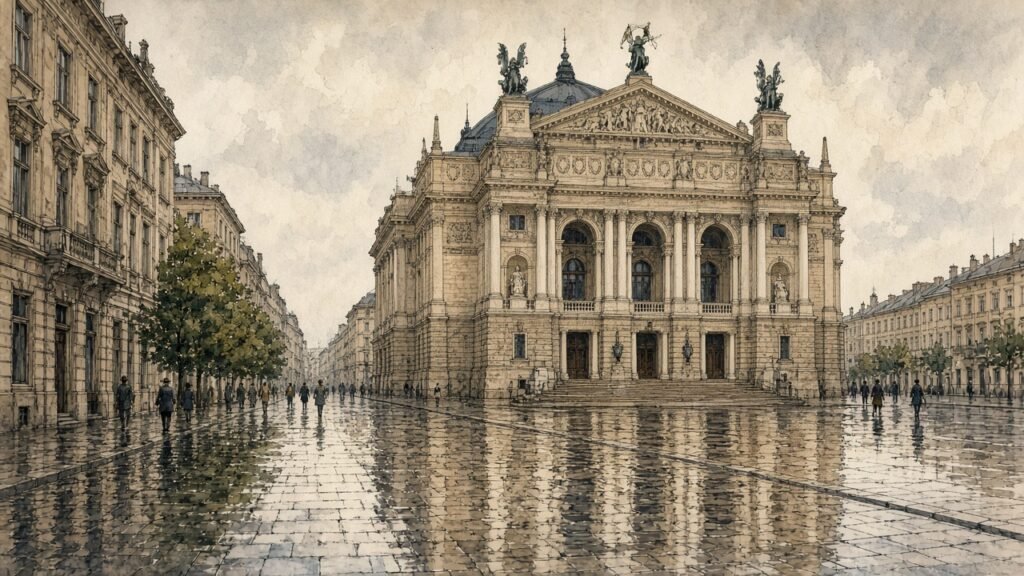
12. Interwar Lwów
Interwar Lwów was the third-largest city of the Second Polish Republic and the chief urban centre of its southeastern provinces. Polish officials, schools and army units dominated public space. The university, now bearing the name of King Jan Kazimierz, taught in Polish. Street signs, postage and courts announced a national state determined to secure a borderland. At the same time the census continued to record large Ukrainian and Jewish minorities, and the countryside beyond the tram termini remained largely Ukrainian-speaking. The city’s politics were therefore the politics of a Polish island in a contested sea, linked to Warsaw by rail and ideology yet shaped by local memories of 1918.[24]
Ukrainian life did not disappear. Legal parties, cooperatives, reading societies and the Uniate Church under Metropolitan Andrey Sheptytsky sustained a public culture under pressure. Underground and radical groups, including the Organisation of Ukrainian Nationalists, chose conspiracy and, at times, assassination. Polish police replied with arrests, pacification campaigns in villages and surveillance in the city. Mutual hatred deepened after each incident. Ordinary Ukrainian townsmen and students meanwhile tried to finish degrees, run shops and avoid both the police and the militants. The Greek Catholic clergy walked a narrow line between pastoral care and national leadership. Sheptytsky’s moral authority made Lviv a symbolic capital even when it was not a political one.[16]
Jewish Lwów recovered demographically from wartime losses yet faced economic squeeze and rising antisemitism. University benches were sometimes segregated by student violence. Boycotts targeted Jewish shops. Zionist, Bundist and religious parties competed for communal leadership. Emigration continued. Polish Jewish writers and musicians contributed to the city’s culture while arguing about whether their future lay in Poland, in Palestine or in socialism. The 1930s darkened prospects as authoritarian tendencies in Warsaw and radical right movements in the streets reduced room for liberal coexistence.
Urban modernism left marks. New housing estates, cinemas, radio and expanded tram lines changed daily life. The Polytechnic and university produced graduates for a state hungry for teachers and engineers. Cafés on the main avenue remained stages of gossip and politics. Football clubs carried nationality into sport. Tourism advertised Lwów’s historic centre to visitors from western Poland who treated the city as an exotic eastern possession. Guidebooks emphasised Polish kings and Catholic churches, mentioning Ukrainians and Jews briefly or not at all. The marketing of heritage was already selective.
Economic conditions were fragile. Galicia remained relatively poor. Oil wealth farther south enriched some Lviv financiers but not the mass of workers. Unemployment fed both socialist and nationalist radicalism. Smuggling across nearby borders became a profession. The Great Depression hit trade and professions. Municipal budgets struggled to maintain Habsburg-era infrastructure while adding Polish monumental gestures. Statues and commemorations of the 1918 defence proliferated. Ukrainian and Jewish commemorations were constrained. Memory itself was a regulated utility.
By 1939 Lwów was a tense, culturally rich, politically brittle city. It possessed theatres, newspapers and faculties of genuine quality. It also possessed underground networks preparing for futures incompatible with one another. When the Molotov-Ribbentrop Pact assigned the region to the Soviet sphere and German invasion from the west destroyed the Polish state, Lwów’s interwar order ended in a fortnight. Soviet tanks entered from the east in September 1939. The Polish island sank into a new empire, and the city’s name began another transformation.
Daily life in interwar Lwów retained Habsburg habits under Polish sovereignty. Cafés still served newspapers on wooden holders. Confectioners kept recipes from imperial days. The opera programme mixed Polish composers with Italian standards. Trams rang the same bells. Yet passports, conscription and school inspectors announced a nation-state. Borderland insecurity meant military presence and occasional alerts. Spies real and imagined haunted conversations. The city’s hotels hosted commercial travellers from Gdańsk and diplomats on their way to Romania. Lwów was provincial relative to Warsaw and cosmopolitan relative to the Galician countryside.
Architecture of the 1920s and 1930s added functionalist blocks beside historicist facades. Sanitary reformers campaigned against overcrowding in Jewish and working-class districts. Electrification reached more flats. Radio brought Warsaw’s voice into kitchens. Cinema filled with American and Polish films. Youth organisations—Polish scouts, Ukrainian Plast, Jewish Hashomer Hatzaír—competed for souls on weekends. Each wore different uniforms and sang different songs in the same parks. The visual pluralism of the city remained striking even as politics demanded monopoly.
Crime and policing reflected nationality. Police cadres were largely Polish. Ukrainian villages accused them of bias; Polish settlers accused them of weakness. Jewish districts complained of inadequate protection during antisemitic outbreaks. Smuggling of livestock, currency and leaflets employed bilingual fixers. Courts heard cases in Polish even when defendants thought in Yiddish or Ukrainian. Translators became crucial and mistrusted. Justice, like schooling, was a nationalising machine that never fully converted its subjects.
The oil of Boryslav and Drohobych tied Lviv’s banks to a volatile industry. Boom and bust cycles enriched brokers and stranded workers. Environmental damage in the oil fields became a provincial scandal. Lviv lawyers drafted company statutes; Lviv newspapers reported strikes. The city’s claim to modernity rested partly on this extractive hinterland. When depression collapsed prices, unemployed youth drifted into radical politics of every colour. Economic history and nationality history were never separate files in Galicia.
Literature of interwar Lwów captured the city’s nerves. Polish poets celebrated stones and mourned eastern danger. Ukrainian prose explored student poverty and police shadow. Yiddish writers sketched market types and Zionist youths. Translations between these literatures were rare; mutual caricature was common. Yet bookshops sometimes shelved all three. A curious reader could, with effort, hear the city in chorus rather than solo. Most readers did not make the effort. Parallel literatures produced parallel truths that collided in politics because they had not met in reading.
Scouting and paramilitary drill filled weekends. Polish riflemen’s associations and Ukrainian youth groups practiced marching that looked ahead to another war. Veterans of 1918 held reunions that excluded the other side’s veterans. Cemeteries became competing shrines. On All Souls’ Day candles burned for incompatible martyrs within sight of one another. The city’s calendar of mourning was dual. Children learned which graves were theirs. Interwar Lwów taught remembrance as boundary maintenance. That lesson proved durable into exile and into undergrounds.
Radio Lwów broadcast programmes that reached villages and shaped accents. News in Polish framed Ukrainian politics as security threat and Jewish politics as demographic problem. Ukrainian clandestine sheets answered in kind. Jewish papers spoke to their own publics about Palestine, Poland and trade. The auditory city was partitioned. Shared entertainment—cabaret melodies, football results—sometimes crossed partitions. Advertising for soap and cigarettes addressed a consumer who might be anyone. Commerce imagined a unified market while politics imagined sealed nations. That contradiction defined the interwar everyday.
University riots over benches for Jewish students made international news and local scars. Professors who defended equal access faced intimidation. Rectorships became political prizes. The classroom was a frontier. Graduates carried the frontier into ministries and clinics. Interwar Lwów’s reputation for learning coexisted with a reputation for nationalist disorder. Both were earned.
Borderland smuggling included people: political agents, conscripts avoiding service, migrants without papers. Safe houses in Lviv connected to routes toward Romania or the free city of Danzig. Police files on these networks mix fact and fantasy. What is clear is that the city’s hotels and stations were nodes in illegal as well as legal mobility. Interwar sovereignty was porous in practice.
Municipal statisticians tracked tuberculosis and overcrowding with maps that embarrassed boosters of the city’s beauty. Social reform societies, some cross-national, pushed clinics and summer camps for children. Successes were partial. Poverty remained visible in courtyards off handsome streets. Interwar Lwów’s postcard face and its sanitary reports describe one place.
13. Soviet occupation
Soviet occupation from September 1939 to June 1941 remade Lviv with revolutionary speed. The city was incorporated into the Ukrainian Soviet Socialist Republic. Official language policy promoted Ukrainian in schools and administration while Russian loomed as the language of power. Polish state institutions were dissolved. Political parties were banned. The NKVD arrested Polish officers, officials, Ukrainian nationalists and Jewish political activists according to shifting categories of class and nation. Deportations eastward removed tens of thousands from the city and region to Kazakhstan, Siberia and other inland areas. Families vanished overnight. Those who remained learned to speak carefully.[25]
Landlords, manufacturers and many professionals lost property through nationalisation. Shops became state outlets. Factories received new directors. The university was reorganised; some Polish professors fled or were dismissed, some Ukrainian scholars advanced, and Marxist curricula replaced older syllabi. Synagogues and churches faced restrictions, though the first Soviet occupation was less systematically murderous toward Jews than the German regime that followed. Refugees from German-occupied western Poland, many of them Jewish, crowded into Lviv seeking safety that proved temporary. Housing shortages forced strangers into shared apartments. Fear of denunciation poisoned stairwells.[36]
Soviet propaganda presented the occupation as liberation of Ukrainians from Polish oppression. Some Ukrainians initially welcomed the fall of the Polish state; many soon experienced conscription, atheist campaigns and the arrest of their own leaders. Poles experienced the occupation as catastrophe. Jews experienced relief from Nazi danger mixed with anxiety about Soviet atheism, property loss and the fate of Zionist and Bundist activists. The city’s café arguments died down; private kitchens became the only safe forums. A new elite of party cadres, many imported, occupied the best apartments.
Culture was conscripted. Theatres staged approved plays. Newspapers printed identical slogans. Archives and libraries were censored. Street names changed again. The military cemetery of the Polish eaglets was neglected or vandalised. Soviet monuments appeared. Yet beneath the surface older networks survived: priests hearing confessions, rabbis advising quietly, Polish teachers tutoring in homes, Ukrainian activists maintaining contacts. The occupation lasted less than two years. It was long enough to destroy the interwar social pyramid and to fill prisons that would become death traps when the Germans arrived.
In June 1941, as German forces advanced under Operation Barbarossa, NKVD personnel massacred political prisoners in Lviv’s jails rather than evacuate them. The discovery of the corpses, exploited immediately by German propaganda, helped ignite anti-Jewish pogroms in early July. Soviet rule thus ended not only with flight but with a final crime that fed the next regime’s crimes. Residents who had survived twenty-two months of Soviet power now faced an occupation of a different and, for Jews, terminal kind.
Refugees from German-occupied Poland altered Lviv’s streets in 1939 and 1940. Jewish families who had fled Łódź or Kraków rented corners of rooms and sought work in Soviet offices or workshops. Some registered for migration to Soviet interiors; others waited, hoping the war would end. Polish officers’ wives sought news of Katyn before Katyn had a name. Ukrainian peasants came to market under new procurement rules. The city’s hotels housed officials from Kyiv and Moscow who inspected and commanded. A revolutionary etiquette replaced bourgeois forms: comradeship on the tongue, hierarchy in the ration.
Schools taught new heroes. Portraits changed on classroom walls. Children recited verses to Stalin and to Soviet Ukrainian poets. Parents whispered corrections at home. Churches lost youth groups. Synagogues lost Zionist meetings. Football teams were reorganised under trade-union names. Jazz was suspect; folk ensembles were promoted if their repertoire fit. The speed of cultural Sovietisation astonished residents used to Austria’s slower bureaucracy and Poland’s more familiar repression. Twenty-two months were enough to create collaborators, resisters and a majority who simply tried to stay invisible.
When war with Germany began, chaos emptied offices. Files burned. Prisoners were shot. Columns of refugees blocked roads eastward then turned back as German advance overtook them. Soviet officials fled in cars; ordinary people watched the sky. The first occupation ended as it had lived: abruptly, violently and with consequences that outlasted its brief calendar.
Photography and identity papers became instruments of rule. New Soviet passports classified nationality in ways that could save or doom. Polish officers who hid their ranks, Jewish refugees who claimed useful trades, Ukrainian teachers who learned Marxist phrases overnight—all performed for clerks who themselves feared quotas. The archive of this occupation is full of petitions in broken Russian and Ukrainian. Reading them is to hear a city learning a new dialect of survival under time pressure no school had taught.
Religious policy in the first Soviet occupation mixed harassment with temporary tactical softness. Some churches lost bells and youth groups. Atheist lectures filled schools. Yet full liquidation of the Uniate Church waited until the second Soviet period after 1944. Jewish religious life continued under constraint. The difference between 1939-1941 and 1941-1944 remains essential: Soviet repression was severe and sometimes murderous; Nazi policy toward Jews was exterminatory. Residents who experienced both occupations insisted on that distinction even when later politics tried to blur it.
Currency exchange and nationalisation produced overnight losers and a few winners. Speculators who read Soviet intentions early bought and sold at frantic rates. Others lost savings when the zloty was withdrawn. Factory committees challenged former owners before NKVD arrests made such theatre moot. The speed of property revolution exceeded anything Galicia had seen in 1848 or under Austrian land reforms. Residents measured the occupation not only in arrests but in the disappearance of familiar shop signs and the appearance of empty shelves where private trade had been.
Children adapted faster in speech and slower in loyalty. Schoolyards taught Soviet songs; grandparents taught old prayers. Family tables became linguistic training grounds and risk zones. A careless phrase at school could endanger parents. A careless phrase at home could mark a child as alienated. Pedagogies of fear settled early. The second Soviet occupation after 1944 would deepen them. Those who lived through both measured time as “before the first Soviets,” “under the Germans,” and “after the return,” a tripartite clock still heard in elderly speech.
Writers’ unions enrolled those willing to praise the new order. Silence or exile awaited others. Libraries stamped “fascist” on Polish patriotic titles and removed them. Ukrainian books that praised the wrong heroes also vanished. The first Soviet cultural revolution in Lviv was a cataloguing war. Shelves taught ideology by absence.
Train stations saw farewells to deportees at night. Those who watched through curtains remembered silence more than shouts. Fear taught stillness. The occupation’s soundscape included that learned quiet. Historians reconstruct it from memoirs written decades later in another country.
14. German rule and the Holocaust
German troops entered Lviv at the end of June 1941. Within days, pogroms erupted. Ukrainian militias, crowds and German instigation combined in violence that killed thousands of Jews in the streets and courtyards. The discovery of NKVD victims was used to blame Jews collectively for Soviet crimes. Photographs and reports document beatings, humiliations and murders around prisons and in Jewish neighbourhoods. German authorities watched, filmed and channelled the violence into their own programme. The Holocaust in Lviv began as public carnival before it became industrial murder.[26]
Administration assigned the city to the General Government as part of Distrikt Galizien. Anti-Jewish decrees followed the pattern established farther west: armbands, confiscation, forced labour, bans on pavements and parks. In late 1941 and 1942 the Germans established the Lwów ghetto, crowding tens of thousands into a sealed district of starvation rations and epidemic disease. Judenrat officials faced impossible orders. Escapes were rare and dangerous. Denunciation and blackmail flourished. A few non-Jews hid neighbours at mortal risk; many more looked away or profited from abandoned property.[27]
Deportations to the Bełżec extermination camp began in 1942. Trains carried Jewish residents to gas chambers a short distance away. Shootings at the Janowska camp on the city’s outskirts killed labourers too weak to work and batches selected for death. Forests and sand pits on the periphery became mass graves. By July 1943 the ghetto was liquidated. Janowska’s remaining prisoners faced final massacres and a short-lived revolt. Synagogues were destroyed. The Golden Rose and other historic houses of prayer were ruined. A community that had numbered well over 100,000 before the war was reduced to scattered survivors in hiding, in forests, or passing as non-Jews on forged papers.[28]
Ukrainian and Polish inhabitants lived under the same German roof on unequal terms. Some Ukrainians served in auxiliary police roles implicated in ghetto guarding and roundups; others joined undergrounds or tried to remain uninvolved. Metropolitan Sheptytsky protested to Hitler and organised the hiding of hundreds of Jews, including children, in Uniate institutions, an act recognised later as rare moral courage. Polish underground organisations operated with their own priorities, sometimes helping Jews, sometimes not, and preparing for a postwar settlement that assumed Polish claims. German repression struck at all resistance. Public executions lined avenues. Hunger affected everyone, Jews most lethally.[29]
Soviet forces took Lviv in July 1944 after heavy fighting. The German occupation had lasted three years. It left the Jewish city erased, the physical fabric partly damaged, and the surviving population sorted by new Soviet classifications. Returning Jewish survivors found empty communal buildings and silence where markets had hummed. Many did not stay. The Holocaust did not merely reduce Lviv’s population; it removed one of the city’s constitutive peoples and thereby changed what the city could mean. Postwar Lviv would be rebuilt demographically as a Ukrainian Soviet city. The Jewish absence would be a structural fact, often unspoken in official histories that preferred a generic narrative of Soviet suffering to the specific genocide of Jews.[30]
Forced labour defined the middle period of German rule for Jews who remained alive. Workshops in the ghetto and at Janowska produced uniforms, brushes and repair work for the Wehrmacht. Selections sorted the useful from the doomed on a weekly rhythm. Bribes delayed death without preventing it. Diaries recovered after the war describe hunger, typhus and the moral lacerations of the Judenrat’s tasks. Children learned to stand still during raids. Rabbis debated whether to bless forged baptismal certificates. Escapees who reached the forests found partisan bands that sometimes accepted Jews and sometimes robbed or killed them. Survival required luck so extreme that statistics make it almost unthinkable, yet thousands of individual decisions accumulated into a few thousand lives saved.
Non-Jewish Lviv under German rule knew curfews, requisitions and the sight of columns marching toward the railway. Some residents traded with the ghetto through cracks in the wall. Some denounced. Some joined German or auxiliary services for pay or ideology. The city’s famous beauty continued to attract German administrative tourism even as genocide proceeded a tram ride away. Photographs of officers posing on the Rynok coexist in archives with photographs of roundups. That coexistence is the historical fact: culture and murder shared a municipal timetable.
After liberation, trials and testimonies began to document what had happened. Many perpetrators escaped. Many witnesses stayed silent under Soviet rules that disliked separate Jewish victimhood. Only decades later did systematic scholarship, German court records and survivor literature make the chronology clear for a wider public. The historiography of the Holocaust in Lviv is therefore itself a layered archive, opened slowly, still incomplete, essential to any honest civic history.
Property transfer accompanied genocide. Jewish flats were reassigned. Workshops were seized. Furniture appeared in new apartments with no questions asked. After the war some occupants dreaded returning survivors; most survivors never returned. Legal restitution under Soviet rule was minimal. The moral economy of everyday theft remains one of the hardest aspects of local history to research and to teach, because it implicates not only German orders but neighbourly choices. Historians work with court files, oral history and the silences where documents were never created.
Janowska’s name stands beside Bełżec in the geography of destruction. The camp on the city’s edge combined labour and killing. Music played by prisoner orchestras, later testified to by survivors, accompanied selections. Escape attempts ended on the electrified fences or in mass reprisals. Local inhabitants saw columns and heard shots. After the war the site’s marking was inadequate for decades. Recent memorial efforts attempt to correct that erasure. A city that markets Habsburg charm must also map Janowska if it wishes to tell the truth about itself. Tourism without that map is advertising, not history.
Resistance inside the ghetto took forms short of open revolt: forging papers, smuggling food, clandestine schooling for children, documenting crimes for a future that might not come. Some joined Polish or Soviet partisan contacts; some fled to Romania or Hungary while routes existed. Most could not. The asymmetry of weapons and the hostility or fear of surrounding populations made mass escape impossible. Honouring resistance requires not inventing a liberatory epic the sources cannot sustain. It requires naming the small acts that preserved dignity and, rarely, life.
Artists and writers who escaped Lviv carried the city into exile literature. Their poems and novels preserved street names the postwar regime renamed. Conversely, some local non-Jewish writers omitted Jewish neighbours from nostalgic portraits of “old Lwów,” reproducing absence as charm. Post-Holocaust culture thus split between testimony and erasure. Museums today negotiate both inheritances. A responsible visitor reads plaques and also notices where plaques are missing.
German administrative correspondence about Distrikt Galizien treats murder as logistics: train slots, guard rotations, tallies. Reading those documents beside survivor memoirs produces moral whiplash necessary for understanding. Bureaucracy and terror were not opposites. In Lviv they shared offices and tram lines. The Holocaust here was not a remote camp alone; it was a municipal sequence. That is why city history must include it at full length rather than as a coda.
Children’s experiences—hiding in cupboards, learning false names, forgetting parents’ real names for safety—appear in late testimonies with terrible clarity. Some child survivors remained in Lviv under new identities; most left. Psychological aftermath shaped families for generations. Historical writing that counts only adult victims undercounts the crime’s temporal reach.
Names recovered from transport lists and pages of testimony return individuals to a narrative that otherwise risks abstraction. Saying “tens of thousands” is necessary and insufficient. Saying a teacher’s name, a child’s age, a street address restores scale. Museums in Lviv and abroad continue that naming work. Readers can support it by seeking those names beyond this survey.
15. Postwar transformation
Postwar Lviv was reinvented by population transfer. The Polish state, shifted westward by Allied agreement, received territories from Germany and lost its eastern provinces to the Soviet Union. Poles from Lviv and its region were repatriated, often under pressure, to Wrocław, Gdańsk and other newly Polish cities. They carried keys, photographs and the name Lwów into exile communities that treated the lost city as a spiritual capital. Ukrainian populations from territories assigned to Poland, including victims of later operations against guerrillas, moved eastward into Galicia. Soviet Ukrainians from the east and elsewhere were settled in emptied apartments. Within a decade the city’s linguistic soundscape had changed from Polish-Jewish-Ukrainian to predominantly Ukrainian and Russian.[31]
The University and Polytechnic were Ukrainianised. Polish professors who remained left or adapted. Archives were redistributed. Street names celebrated Soviet heroes and Ukrainian writers acceptable to the regime. The military cemetery of the Polish defenders was neglected for decades. Churches faced closure or tight control; the Uniate Church was forcibly merged into Orthodoxy in 1946, driving Greek Catholicism underground. Russian became crucial for career advancement. Industrialisation brought factories and a new working class. The historic centre, though worn, survived more intact than many eastern cities because major wartime destruction had been less total than in Warsaw or Kyiv. Soviet planners built housing estates around the old core rather than erasing it.[32]
Memory was policed. Talk of Polish Lwów became politically suspect. Jewish memory was submerged in monuments to “peaceful Soviet citizens” killed by fascists. Ukrainian nationalist memory was criminalised; the UPA and OUN were denounced as collaborators. Families kept private calendars of forbidden commemorations. At the same time, Soviet Ukrainian culture claimed Lviv as a western Ukrainian metropolis, a bridge to Europe within socialist content. Theatres, publishing houses and music ensembles received state funding. The city became a place where one could hear better Ukrainian on stage than in many eastern cities, even as Russian dominated technical fields.
Economically Lviv developed machine-building, bus manufacturing and light industry. Shortages and queues structured daily life as elsewhere in the Union. A certain Habsburg and Polish architectural grandeur, however faded, made the city feel different from standardised Soviet towns. Visitors from the east remarked on the cafés, the churches and the European silhouette. That difference fostered local pride and, quietly, a sense of superiority that later fed political distinctiveness. Lviv’s dissident networks and, in the 1980s, its cultural clubs played visible roles in the late Soviet Ukrainian national revival.
The demographic transformation was the deepest break since the thirteenth century. A city of Poles, Jews and Ukrainians had become a city of Ukrainians and Russians with tiny remnants of the older peoples. Continuity of stones masked discontinuity of inhabitants. Postwar children grew up without Jewish neighbours and with Polishness present mainly as old inscriptions and grandmotherly stories from those few who remained. The invention of Soviet Lviv was therefore both destructive and creative. It destroyed worlds and built another. Independent Ukraine would inherit that Soviet-Ukrainian city, not the Lwów of 1939.
Repatriation trains carried Polish Lvivians westward with bundles and legends. In Wrocław they renamed streets after Lwów’s heroes and reconstituted academic institutes. The diaspora in London and Chicago published memorial books. For them the city was frozen in 1939. Meanwhile actual Lviv filled with strangers learning tram routes. Conflicts over flats were settled by party committees. A Soviet passport and a job mattered more than prewar deeds. Children born in 1948 grew up thinking the city’s Polish inscriptions were merely decorative antiquities.
Industrial recruitment brought workers from central Ukraine and beyond. Barracks and later khrushchevka flats housed them. Factory clubs offered film and dance. The old centre became a place for Sunday walks rather than daily work for many new residents. Restoration workshops repaired stucco for prestige visitors. Earthquake and damp threatened neglected churches. The Uniate underground met in flats. KGB files thickened. By the 1970s Lviv was both a Soviet industrial city and a museum of someone else’s past, uneasily maintained.
Soviet Lviv’s food culture fused Galician habits with eastern supply chains. Coffee houses dwindled then slowly returned in modest form. Vodka and tea structured hospitality. Market stalls sold western Ukrainian produce beside goods from collective farms farther east. Recipes preserved Polish and Jewish traces without naming them. A city can forget peoples and still taste their kitchens. Culinary memory is not justice, yet it is a form of survival that official ideology never fully controlled.
Military service drew Lviv youths into the Soviet army across the Union. Letters home compared other cities to the familiar Rynok. Some soldiers returned with Russian wives and broadened the city’s marriages. Others returned with hardened nationalism from sensing difference. The army was an unwanted school of the Soviet world and, dialectically, of Ukrainian distinctiveness. Veterans’ benefits and disabilities shaped household economies. Victory Day parades in Lviv carried official meaning and, for some families, private mourning for relatives who had fought in other uniforms. The war’s memory was never only the Soviet narrative, even when only that narrative had public loudspeakers.
Cinema of the postwar decades projected Soviet Ukrainian stories onto Lviv screens while the audience walked out past Polish inscriptions. Dubbing and subtitles negotiated language. Film clubs later became discussion spaces. The gap between reel Galicia and street Galicia trained viewers in double vision. When foreign films arrived in limited release, queues formed. Cultural hunger was not erased by ideology. It was redirected and sometimes intensified by scarcity.
Planning offices drew ring roads and factory zones with little sentiment for suburbs’ older fabric. Yet surveyors documenting monuments created inventories later used by preservationists. Soviet modernity was not only demolition; it was also paperwork that inadvertently conserved knowledge. Irony runs through Lviv’s planning history: regimes destroy and record, exile and catalogue. Historians depend on both gestures.
Letters from repatriated Poles in Wrocław to relatives who stayed briefly in Lviv describe unpacking in German-left flats with similar bewilderment to Ukrainians unpacking in Polish-left flats in Lviv. Mirror displacements produced mirror silences. Comparative history of these transfers has grown since the 1990s. It shows Lviv as one node in a continental sorting of peoples that redraws moral maps only if we track where each train went.
Factory sirens replaced church bells as timekeepers for many districts. Shift work reordered sleep. Sunday remained contested between rest, church and voluntary labour. Soviet temporality never fully captured Galician calendars. Dual timekeeping—official and intimate—persisted. That duality helped national feeling survive in kitchens.
Russian-speaking officers’ families occupied some of the finest prewar apartments. Their children grew up among stucco angels and called the city home in Russian. Later Ukrainianisation made some feel alien in their birthplace. Layered belonging and layered estrangement define postwar Lviv biographies. Simple native/outsider binaries fail.
By 1959 Soviet censuses showed a Ukrainian majority in Lviv with a substantial Russian minority and only remnant Polish and Jewish populations. The demographic revolution was complete within one generation.
16. Late Soviet Lviv
From the 1960s to the 1980s Lviv acquired a reputation within the Ukrainian SSR as a city of relatively strong national feeling, musical culture and discreet nonconformity. Shevchenko evenings, choir festivals and private apartment exhibitions circulated Ukrainian culture under the eyes of the KGB. The underground Uniate Church kept sacraments alive. Samizdat and foreign radio supplied news. Arrests of activists punctuated the decades. Yet repression was uneven, and tourist value plus industrial importance gave local elites some bargaining room. The historic centre attracted conservationists who argued for preservation even within Soviet planning norms.[32]
Intellectual life produced historians, writers and composers who tested boundaries. Some emigrated in the détente years. Others stayed and calibrated their sentences. Russian-speaking engineers and officers formed their own social worlds. Mixed marriages complicated simple national maps. Football fandom and popular music created solidarities that were not always political. Everyday Soviet life—dachas, shortages, conscription—shared with the rest of the Union. What differed was the density of western Ukrainian memory and the proximity to a closed border with Poland beyond which relatives sometimes lived.
Gorbachev’s glasnost opened floodgates. Societies for the Ukrainian language, memorial groups for famine and repressed victims, and environmental campaigns filled halls. The Uniate Church emerged from the underground. Monuments were contested. In 1990 and 1991 Lviv’s blue-and-yellow politics placed it in the vanguard of the independence movement. The August 1991 coup in Moscow failed; Ukraine’s referendum in December confirmed independence with overwhelming local majorities in the west. Lviv entered the new state as a symbolic capital of Ukrainian-speaking patriotism, a counterweight to more Russophone eastern cities. The late Soviet decades had prepared that role by keeping national culture breathing when official ideology preferred it silent.
Tourism from other Soviet republics treated Lviv as a pocket of abroad. Visitors photographed courtyards and bought records of local choirs. Hard-currency shops served rare foreigners. Polish consular contacts and family visits across the border, when permitted, refreshed knowledge of a wider Slavic world. Radio Free Europe and Vatican broadcasts reached kitchen radios. The city’s western location made jamming harder and rumour faster. When strikes and protests began to spread in the late 1980s, Lviv’s activists already had networks of trust built in choirs, churches and hiking clubs. Those soft institutions became hard politics almost overnight.
Hiking clubs and student construction brigades look apolitical in photographs. In western Ukraine they often doubled as spaces where Ukrainian was spoken freely and where trust formed for later activism. Songs around campfires included verses omitted from official songbooks. Priests sometimes walked with youth groups. The KGB knew and did not always act, calculating costs. Soft power of landscape—Carpathian trips from a Lviv train station—thus fed hard politics of national revival. Geography was an accomplice.
Academic historiography under late Soviet rules treated Lviv carefully. Medieval Ruthenian beginnings were praised. Polish centuries were narrated as oppression with acknowledgements of architectural achievement. Habsburg rule was criticised as colonial yet credited with urban modernisation. The 1918 conflict was framed to minimise Ukrainian state claims that might inspire contemporaries. The Holocaust was submerged. Soviet liberation of 1944 was climactic. Within those constraints, local historians still salvaged street chronologies, guild records and architectural inventories that later scholars used freely. Censorship shaped emphasis more than it invented facts. Reading late Soviet city histories against the grain remains useful.
Popular culture escaped tighter bonds. Rock groups sang ambiguous lyrics. Theatre directors staged classics with contemporary shadows. Football chants tested what police would tolerate. Church attendance rose around holidays even among party members’ relatives. The gap between official Lviv and lived Lviv widened until glasnost collapsed it. When the gap closed, the city discovered how many of its residents had been waiting to speak.
Economic stagnation of the Brezhnev years meant closed factories and thriving informal trade. Lviv’s nearness to Poland fed a suitcase economy of clothes and electronics. Customs officers became personages. Hard currency from relatives abroad bought favours. The shadow economy taught entrepreneurial skills that surfaced legally after 1991. It also taught cynicism. Late Soviet Lviv was pious in church and inventive in the bazaar, sometimes in the same persons.
The Ukrainian Helsinki monitoring tradition and later human-rights circles had interlocutors in Lviv who documented psychiatric abuse and religious persecution. Typed petitions travelled in double envelopes. Typewriter ribbons were tracked by police; activists learned to share machines. Women typed and hid papers as often as men authored them. When archives opened after 1991, the scale of surveillance astonished even those who had assumed it. Files revealed neighbours’ signatures and lovers’ betrayals. Social trust had to be rebuilt with that knowledge in the room. Late Soviet Lviv’s heroism and its compromises became inseparable subjects for historians and filmmakers.
Popular religion revived before it was legal. Baptisms in secret, pilgrimages advertised as hikes, and icons kept behind cabinet doors prepared the public restoration of the Uniate Church. Metropolitan appointments in the underground maintained apostolic succession claims. Rome watched; Moscow scowled; local believers queued for sacraments at dawn. The emotional energy stored in clandestine religion poured into open politics in 1989-1991. Analysts who saw only nationalism missed the sacramental sources of courage and of exclusion. Church and nation braided tightly in Galicia; Lviv was where the braid was most visible.
Consumer desire focused on jeans, records and coffee. Polish television, when antennas caught it, displayed another Slavic modernity. Comparison fed discontent. Party ideologues denounced “bourgeois” taste while their children sought it. Hypocrisy was widely noted and rarely punished if parents had rank. Lviv’s western position made the hypocrisy more visible. Visibility accelerated disillusion.
Environmental protests over industrial pollution in the 1980s linked green concerns to anti-centralism. Chemists from local institutes spoke publicly. Mothers worried about water. The party struggled to frame ecology as separable from nationalism and failed. Lviv’s contribution to late Soviet protest included this environmental tongue, later partly forgotten in narratives that stress only language and church.
University exchanges with Poland in the thaw years allowed limited contact with non-Soviet Slavic scholarship. Books in Polish crossed legally and illegally. Comparative literature students noticed differences in what could be said about the war. Those differences seeded later revisions. Academic tourism was political education by other means.
Apartment block courtyards hosted informal markets for garden produce and imported soap. Grandmothers negotiated prices in Ukrainian and Russian. Children overheard politics wrapped in shopping talk. The courtyard was a parliament without minutes. Oral historians who collect courtyard memories recover a late Soviet Lviv that official newspapers never printed.
17. Independence and heritage
Independent Ukraine made Lviv a western magnet: for students, for tourists, for politicians seeking authentic Ukrainian imagery. The Uniate Church regained cathedrals. Polish-Ukrainian relations warmed fitfully through presidential visits, cemetery restorations and joint histories that still stumbled over 1918 and wartime massacres in Volhynia. Jewish memory work advanced slowly through scholarship, festivals and the difficult politics of property. Russian language retreated from official use yet remained in some families. Street names changed again, this time toward Ukrainian national figures.[33]
Economic crisis in the 1990s hollowed factories and pushed migrants to Italy and Poland for work. Cafés reopened in reinvented form. IT and tourism later brought new money. UNESCO listing of the historic centre in 1998 encouraged restoration and also tourist kitsch. Inheritance fights over Habsburg and interwar buildings filled courts. Corruption scandals stained municipal politics. Through the Orange Revolution and later Maidan, Lviv’s streets filled with demonstrators who treated the city as a moral capital. War in the Donbas after 2014, and the full-scale Russian invasion of 2022, sent refugees westward into Lviv’s schools and apartments, rewriting demography once more and binding the city to a national emergency.[9]
Heritage debates sharpened. How to present Polish and Jewish layers without diluting Ukrainian narrative? How to restore synagogues that no longer have congregations? How to teach November 1918 in classrooms that serve children of soldiers? Museums experimented. Scholars published. Activists argued. The stones of the Rynok remained. Their captions changed. Lviv’s independence era has been a long negotiation with a past too plural for any single slogan and too painful for nostalgia alone.
Restitution and privatisation scrambled ownership of the historic centre. Some buildings returned to churches; many went to well-connected buyers; some remained in legal limbo. Polish descendants visited with cameras and complicated emotions. Israeli and American Jewish groups sought synagogue sites and mass grave markers. Ukrainian municipal patriots emphasised princely foundations and Habsburg Europeanism while downplaying Soviet modernisation that had housed their parents. History festivals filled the Rynok with costumes. Scholars cautioned against kitsch. The public mostly enjoyed the pageant and the coffee.
The wars of the twenty-first century turned Lviv into a rear capital: hospitals, logistics hubs, cultural fundraisers, blacked-out windows during air raids. Museums packed collections. Stained glass was taped. The UNESCO site faced risks noted on international danger lists. Volunteers cooked for soldiers. Cemeteries acquired new sections. The city’s old talent for multilingual hospitality turned to welcoming the displaced. In this sense contemporary Lviv recapitulates older roles as refuge and fortress, under a Ukrainian flag its interwar rulers would not have flown.
Language laws and school reforms after 1991 completed a Ukrainianisation begun unevenly under the Soviets. Russian-language schools dwindled. Polish-language schooling survived for a minority. Hebrew and Jewish studies reappeared in small programmes. English became the new language of aspiration for IT workers and migrants. The linguistic hierarchy of the city inverted several times in a century. Each inversion left bilingual older people and monolingual younger ones arguing past each other at family tables. Lviv’s soundscape remains a historical instrument.
Municipal governance after 1991 oscillated between reformist mayors and patronage machines. EU-facing projects funded façade restorations and transport studies. Civil society organisations—some heirs to late Soviet clubs, some newly founded—monitored elections and defended parks. Corruption scandals over parking lots and hotels repeatedly mobilised protests. Lviv’s politics were never only national theatre; they were also the ordinary struggle to make a post-Soviet city work. Successes in tourism and IT sat beside failures in industrial conversion. Young people emigrated and remitted money; some returned with skills. The demographic profile skewed as in other Central European cities: ageing cores, student influxes, wartime displacements.
Cultural diplomacy became a tool. Polish institutes, German foundations, American exchanges and Israeli partnerships sponsored translations and exhibitions. Each brought agendas. Lviv’s museums learned to host multiple narratives in adjacent rooms. Whether visitors read all the rooms or only the one that confirmed them is another question. The infrastructure for plural history now exists more than in Soviet decades. Using it honestly remains a civic task under the stress of war.
Universities after 1991 expanded enrolments and struggled with pay. Plagiarism and bribery scandals mirrored national patterns. At the same time Lviv scholars published abroad, hosted conferences and reopened Polish and Jewish topics once closed. Student movements linked the city to Kyiv’s protests. Dormitories became political dormitories in revolutionary weeks. Education remained, as under Austria, a crucible of citizenship—now Ukrainian rather than imperial or Polish.
Book markets after censorship’s collapse sold previously forbidden Polish memoirs, diasporic Ukrainian histories and translated Western scholarship. Readers encountered versions of their city that contradicted schoolbooks. Some reacted with anger; some with relief; many with confusion. Librarians struggled to catalogue and to discard. Pulp nationalism shared tables with careful monographs. The free market in memory was noisy. Over time universities and NGOs raised standards, yet television and social media continually reopened crude debates. Independent Lviv had to learn source criticism as a civic skill under commercial and political pressure.
Infrastructure aged. Water pipes from Habsburg and Soviet eras burst. Tram tracks needed replacement. EU funds and remittances helped selectively. Corruption skimmed projects. Civic activists photographed potholes and unfinished repairs. The historic centre received disproportionate attention relative to panel-block outskirts where most residents lived. Dual cities emerged: postcard Lviv and everyday Lviv. Bridging them is part of the unfinished municipal agenda. War accelerated some repairs and delayed others. Generators and bomb shelters entered planning documents no guidebook had listed.
Memorial competition after 1991 filled squares with statues. Some Soviet monuments fell; some remained with altered plaques. New figures of Franko, Shevchenko and Hrushevsky multiplied. Polish eagles returned in carefully negotiated cemetery spaces. Jewish memorials appeared more slowly. Each unveiling was a speech about who owns public grief. The sculpture garden of the city is a debate in bronze and stone. Tourists photograph it as backdrop. Locals know which statue angers whom.
IT outsourcing in the twenty-first century made English a workplace vernacular in offices overlooking Habsburg courtyards. Programmers joked about living in a museum while coding for clients in California. Economic geography folded Lviv into global networks without erasing local politics. Remittances and startups coexisted with war volunteering. The city’s latest layer is digital yet still framed by older stones outside the window.
Culinary revival claimed Habsburg cafés and Jewish recipes with uneven acknowledgement of sources. Menus became historical arguments. A piece of cake could be marketed as imperial nostalgia or as national comfort. Food historians track these claims with amusement and care. Visitors taste politics whether they intend to or not.
Public history projects after Maidan and during the full-scale war have rushed new exhibitions on occupation and resistance. Speed risks simplification; silence risks indifference. Lviv’s museums navigate that dilemma under air-raid schedules. Curators pack and unpack collections. The continuity of care for objects while people shelter is itself a chapter of civic history still being written.
18. Legacy
Lviv’s legacy is the persistence of a city that has changed its rulers, its official language and much of its population without losing its street plan or its habit of argument. Founded as a Ruthenian princely seat, remade as a Polish Magdeburg town, capitalised under Habsburg rule, fought over in 1918, broken by Soviet and German occupations, emptied of Jews and Poles, and reborn as a Ukrainian metropolis, it carries all these pasts in overlapping inscriptions. Four names—Lviv, Lwów, Lemberg, Lvov—mark the major political layers. None cancels the others in the archive, even when one dominates the signboard.[1]
The legacy is architectural: a market square and parcels that still organise walking; churches of several rites; an opera house that recalls Vienna; Soviet estates on the rim; repaired synagogues without worshippers. It is intellectual: universities that trained enemies and colleagues; presses that printed brotherhood liturgies and nationalist newspapers; cafés that taught the art of lasting quarrel. It is demographic and moral: the absence of Jewish neighbours; the diaspora of Poles who still call the city Lwów; the presence of Ukrainians who made it their own under and after Soviet rule. It is geopolitical: a western Ukrainian stronghold facing east with a European skyline.[2]
To study Lviv is to study how Central Europe’s border cities survive transfers of sovereignty. Continuity of place does not guarantee continuity of people. Law can organise plurality and law can organise expulsion. Beauty in stone can coexist with murder in courtyards. The city’s UNESCO plaques and its mass graves belong to one history. This special feature has traced that history from Castle Hill to independence without pretending that any single community owned the whole. The timeline that follows gathers dates; the references open paths for further reading. The streets themselves remain the primary document, legible to anyone willing to look up and to remember who is missing.[9]
Comparisons clarify the legacy. Unlike Vilnius, Lviv did not become the capital of the state that most loudly claimed it between the wars. Unlike Prague, it did not retain a continuity of national elites across 1945. Unlike many German cities, its old town was not burned to foundations. Its nearest analogues are other Galician and border cities—Chernivtsi, Oradea, Wrocław in reverse—where population exchanges rewrote the meaning of streets. Lviv’s distinction lies in the sharpness of its successive nationalisations and in the richness of the records each left behind.
For readers outside the region, Lviv offers a lesson in mistrusting single-name histories. A guidebook that says only “Ukrainian city” or only “Polish city” misleads. The four names are not exotic synonyms; they are claims. This essay has used “Lviv” as the present name while recognising Lwów, Lemberg and Lvov as historically precise for their periods. Writing about such a place requires that terminological care as a minimal ethics. The maximal ethics is remembering the dead of 1918, of the NKVD prisons, of the ghetto and of later wars without ranking their suffering for present politics. Whether the city can institutionalise that ethics remains an open question for its museums and schools.
For Ukraine at war, Lviv’s legacy includes the practical arts of reception: housing refugees, staging benefits, repairing generators. The city’s western location and its European self-image have made it a logistical and symbolic rear. That role echoes older centuries when Lviv sheltered populations fleeing steppe raids or front lines. Continuity of function amidst discontinuity of empire may be the deepest pattern this history reveals. The special feature opened with four names. It closes with a single ongoing city, still writing itself under pressure.
Finally, Lviv’s legacy includes unfinished business: legal titles, cemetery care, school narratives, tourist scripts, and the wartime present. Historians can clarify; they cannot settle. The city’s inhabitants will continue to argue, as they have since Magdeburg clerks first quarrelled with Ruthenian priests. Argument is not failure. In a place with four names, argument is the form civic life takes. The task is to keep argument from becoming expulsion again.
Scholarship since independence has internationalised Lviv studies. Conferences alternate between Ukrainian, Polish, German, Israeli and American venues. Joint textbooks remain rare; joint articles less so. Disagreement persists over 1918, over Volhynia, over the UPA, over Soviet modernisation’s value. What has changed is the presence of shared footnotes. Researchers cite one another even when they conclude differently. That citational community is a fragile public good. This special feature sits at its edge, offering a synthetic narrative for general readers while pointing, in the references, toward specialised works.
The stones will outlast present arguments if war spares them. People will continue to move. Names on doorbells will change again. The four historical names will remain in libraries. Teaching children to hold more than one of them in mind without hatred may be Lviv’s most valuable possible export. Whether that lesson takes is not for a historian to guarantee. It is enough to show that the city has always been more than one story and that reducing it to one has repeatedly licensed harm.
If there is a practical conclusion, it is methodological: use multiple toponyms, multiple archives and multiple victim lists; distrust monocausal explanations; separate architectural continuity from demographic continuity; and keep the Holocaust and the population transfers inside the main narrative rather than in appendices. Lviv rewards that discipline with clarity. It punishes the lack of it with propaganda. The four names are a test. This feature has tried to pass it.
Readers finishing this feature might walk, if they can, from the High Castle slope to the Rynok, past the opera avenue, toward districts where synagogues stood, and out to memorials at killing sites. The walk is a syllabus. Rain on cobbles, tram sparks, café noise and plaque texts will teach what paragraphs only approximate. History of Lviv is ultimately a practice of attention in place. The four names are audible in guide chatter if one listens for them.
The word count of a city’s history is never finished. New documents appear; new wars add chapters; new generations ask different questions. This feature is a cross-section dated to its writing. It will age. That ageing is normal. What should not age is the refusal to pretend that Lviv was ever the property of only one of its names.
A closing caution: wartime presentism can flatten older centuries into a prologue for today’s struggle. Lviv’s medieval and Habsburg pasts are not only prehistories of Ukrainian statehood or of Polish loss. They were lived presents for people whose hopes differed from ours. Respecting that distance is part of historical ethics. The special feature has tried to grant each period its own weight before the twentieth century’s disasters dominate the page.
Word counts end; cities do not. Lviv will acquire new layers after this text is filed. The responsibility of a historical survey is to leave readers oriented, not finished. Orientation means knowing that Castle Hill, the Rynok, the Habsburg avenue, the vanished Jewish streets and the Soviet estates are one continuous problem of memory. The four names are the key. Use them.
For Daniel White’s readers on nekud.click, Lviv offers a companion to essays on other multilingual cities: a case where law, faith, language and violence braided for centuries in one plan of streets. The special feature ends, as promised, with a timeline and a reference list.
Timeline entries below select hinge dates rather than a complete chronicle. Many other sieges, privileges, elections and cultural premieres could have been included. The selection favours moments that changed who ruled, who lived, or how the city was named in official speech. Readers seeking denser chronologies will find them in the reference works listed after the timeline.
19. Timeline
The Galician-Volhynian Chronicle records a fire in the settlement named after Lev, treated as Lviv’s foundation date.
Lev I transfers the capital of Galicia-Volhynia to Lviv, elevating the castle settlement.
Casimir III secures Red Ruthenia; Lviv passes under the Polish Crown after years of war.
Casimir grants Magdeburg rights, organising a self-governing commune with market privileges.
A catastrophic fire destroys much of the wooden city and prompts Renaissance stone rebuilding around the Rynok.
Parts of the Orthodox hierarchy enter communion with Rome, intensifying confessional conflict in Lviv.
During the uprising the city pays a heavy ransom and avoids sack while the wider region burns.
The first partition of Poland makes Lviv the capital of Austrian Galicia as Lemberg.
After the Austro-Hungarian Compromise, Polish becomes the language of provincial administration centred on Lviv.
Russian then Austrian armies occupy the city as the eastern front rolls through Galicia.
Ukrainian forces proclaim a West Ukrainian capital; Polish fighters take the city by 22 November; a pogrom strikes Jews.
The city becomes a major centre of the Second Polish Republic with contested Ukrainian and Jewish minorities.
Following the Molotov-Ribbentrop Pact, Soviet forces enter; deportations and nationalisation begin.
German troops arrive; pogroms erupt; the path to ghetto and extermination opens.
Deportations to Bełżec and killings at Janowska destroy almost all of Jewish Lviv.
Red Army takes the city; postwar population transfers soon remake its demography.
Poles leave for the new western territories; Ukrainians arrive; Jewish remnant emigrates when possible.
Lviv becomes a leading centre of the independence movement and a western metropolis of the new state.
The historic centre is inscribed as a World Heritage Site for its multicultural urban fabric.
References
- Grokipedia, “History of Lviv” ↩
- Grokipedia, “Lviv” ↩
- Grokipedia, “Lviv during the Middle Ages” ↩
- Grokipedia, “Daniel of Galicia” ↩
- Grokipedia, “Kingdom of Galicia - Volhynia” ↩
- Grokipedia, “Casimir III the Great” ↩
- Grokipedia, “Magdeburg rights” ↩
- Grokipedia, “Rynok” ↩
- Grokipedia, “Stare Misto, Ukraine” ↩
- Grokipedia, “Polish - Lithuanian Commonwealth” ↩
- Grokipedia, “Partitions of Poland” ↩
- Grokipedia, “Kingdom of Galicia and Lodomeria” ↩
- Grokipedia, “Austrian Partition” ↩
- Grokipedia, “University of Lviv” ↩
- Grokipedia, “Ivan Franko” ↩
- Grokipedia, “Andrey Sheptytsky” ↩
- Grokipedia, “Galician Jews” ↩
- Grokipedia, “Haskalah” ↩
- YIVO Encyclopedia of Jews in Eastern Europe, “Lviv” ↩
- YIVO Encyclopedia of Jews in Eastern Europe, “Lwów” ↩
- Grokipedia, “West Ukrainian People’s Republic” ↩
- Grokipedia, “Polish - Ukrainian War” ↩
- Grokipedia, “Lwów pogrom (1918)” ↩
- Grokipedia, “Second Polish Republic” ↩
- Grokipedia, “Soviet invasion of Poland” ↩
- Grokipedia, “Operation Barbarossa” ↩
- Grokipedia, “Lwów Ghetto” ↩
- United States Holocaust Memorial Museum, Holocaust Encyclopedia, “Lviv” ↩
- United States Holocaust Memorial Museum, Holocaust Encyclopedia, “Lviv (Lvov)” ↩
- Grokipedia, “The Holocaust” ↩
- Grokipedia, “Population exchange between Poland and Soviet Ukraine” ↩
- Grokipedia, “Ukrainian Soviet Socialist Republic” ↩
- Grokipedia, “Declaration of Independence of Ukraine” ↩
- Grokipedia, “Lviv Theatre of Opera and Ballet” ↩
- Grokipedia, “Galicia (Eastern Europe)” ↩
- Grokipedia, “NKVD” ↩
- Christoph Mick, Lviv: A City in the Crosscurrents of Empire (forthcoming synthesis; see also Mick, Lemberg, Lwów, L’viv, 1914 - 1947) ↩
- John Czaplicka, ed., Lviv: A City in the Crosscurrents of Culture (Harvard Ukrainian Research Institute, 2005) ↩
- Tarik Cyril Amar, The Paradox of Ukrainian Lviv: A Borderland City between Stalinists, Nazis, and Nationalists (Cornell University Press, 2015) ↩
- Philip Ther, The Dark Side of Nation-States: Ethnic Cleansing in Modern Europe (Berghahn, 2014) ↩