The Hills of Kyiv
Kyiv stands on the high western banks of the Dnieper, a city whose hills and ravines have shaped settlement for more than a millennium and a half. From its earliest recorded centuries it was a river port and a political centre, the capital of the medieval state known as Kyivan Rus and later a provincial capital under Lithuanian, Polish and Russian rule. In the twentieth century it became the capital of Soviet Ukraine and, after 1991, of an independent Ukrainian state. Its history is one of repeated destruction and reconstruction, of trade along the great north–south waterway, of monastic learning, of imperial administration and of modern political upheaval. The city’s population has shifted with conquest, famine, war and migration, yet the site itself — the wooded bluffs above the river, the lower commercial quarter of the Podil, the ridges that once held the princely citadel — has remained the constant frame of its life.[1][2]
This special feature follows that history from the earliest settlements on the Dnieper hills to the wars of the twenty-first century. It describes the rise of Kyivan Rus, the Christianisation of the realm under Volodymyr, the flowering of architecture and learning under Yaroslav, and the Mongol catastrophe of 1240. It then traces the centuries of Lithuanian and Polish dominion, the age of the Cossack Hetmanate, and the long incorporation of the city into the Russian Empire. It recounts the revolutions of 1917 to 1921, the making of the Soviet capital, the Holodomor and the terror of the 1930s, the German occupation and the massacre at Babyn Yar, and the postwar reconstruction that produced the modern metropolis. It closes with the attainment of independence, the Maidan revolutions and the wars that have tested the city since 2014. An interactive timeline at the end of the essay gathers the principal dates.
The spelling of the city’s name in English has itself become a historical marker. For most of the nineteenth and twentieth centuries the form Kiev, based on Russian, predominated in international use. From the 1990s, and with gathering force after 2014 and 2022, the Ukrainian form Kyiv has been adopted by governments, media organisations and academic publishers. This special feature uses Kyiv throughout, except in quotations and in the titles of older works. The change of spelling does not alter the underlying history, but it does signal the perspective from which that history is now most often written in Ukraine itself.
Readers familiar with the Jews of Odessa special feature on this site will recognise the format: an unheaded introduction, a table of contents, numbered chapters, illustrations, citations keyed to a reference list, and an interactive timeline. The present essay applies that format to a much longer span of time and to a city whose history is not that of a single community but of a capital claimed by many. The aim is exposition rather than advocacy. Where interpretations differ sharply — as they do over Pereiaslav, over the Holodomor, over the Maidan and over the wars of the present century — the differences are noted rather than resolved.
Word counts and chapter divisions can only approximate the proportions of a history that spans so many centuries. The medieval chapters are shorter in years covered per page than the twentieth-century ones, because the density of documentation and of living memory increases with proximity to the present. That imbalance is acknowledged rather than hidden. A feature of this length cannot be exhaustive; it can aspire to be continuous, accurate and readable.
1. The site above the Dnieper
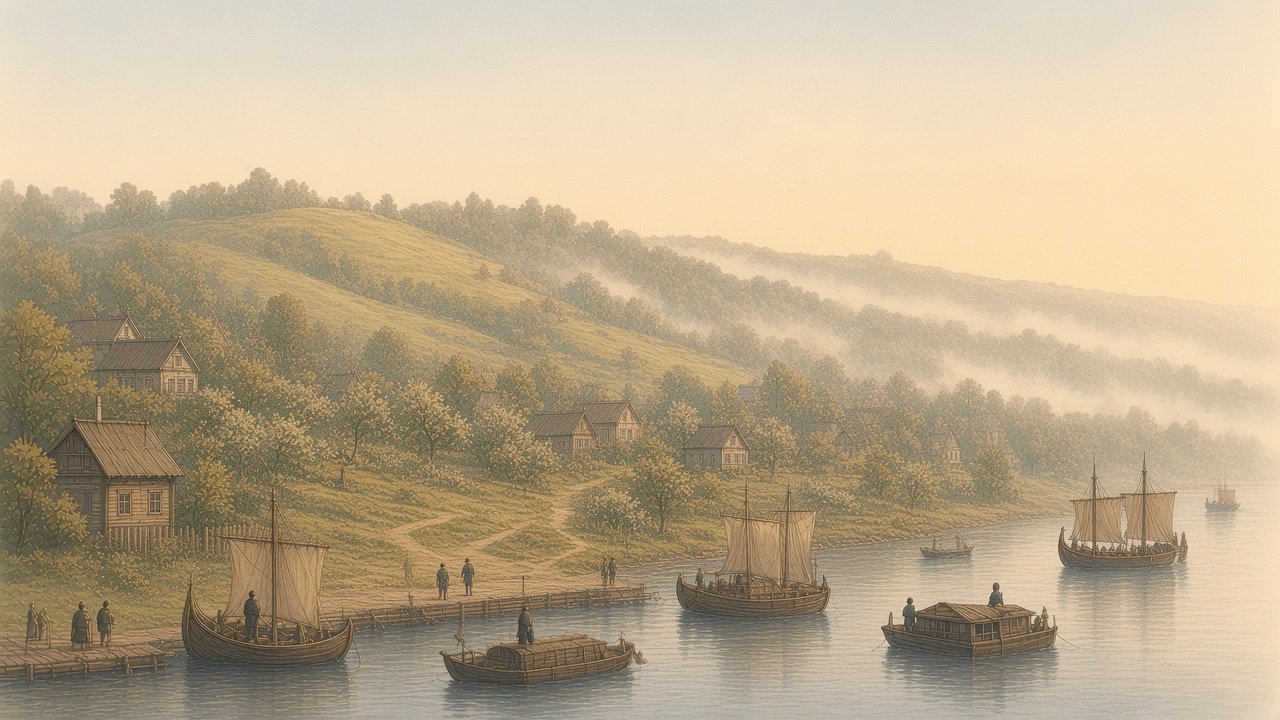
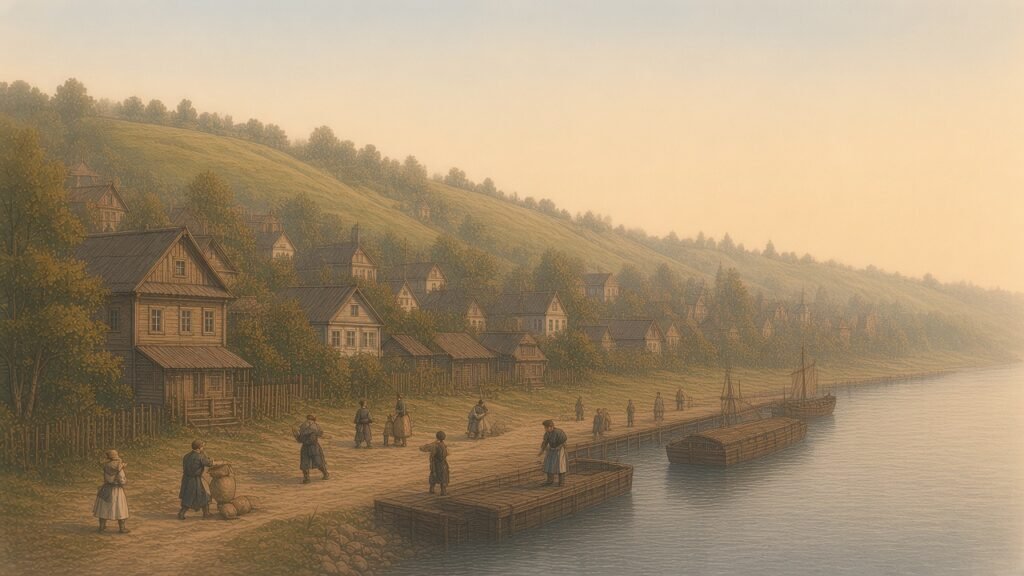
The physical setting of Kyiv explains much of its early importance. The Dnieper, one of the great rivers of Eastern Europe, flows south from the forests of the north toward the Black Sea and forms a natural corridor of trade and migration. At Kyiv the river is bordered on its western side by a chain of steep loess hills and deep ravines, while the eastern bank opens onto a broader floodplain. The hills offered defensive height and dry ground for settlement; the lower terrace along the water, later known as the Podil, provided landings for boats and space for markets and workshops. Small streams cut the western bank into separate ridges, among them the Starokyiv hill, which became the core of the medieval upper town. From these heights lookouts could watch the river for long distances, and from the landings merchants could load and unload cargoes without climbing the slopes.[1][3]
Archaeological work has shown that the region was inhabited long before the city of the chronicles. Palaeolithic and later prehistoric finds mark intermittent occupation, and by the middle of the first millennium CE Slavic farming communities were established along the middle Dnieper. Settlements of the so-called Kyiv culture and related groups of the fifth to seventh centuries have been identified on and near the hills. These were modest villages of timber dwellings, engaged in agriculture, crafts and river trade. They formed part of a wider East Slavic world that stretched from the Pripet marshes to the steppe fringe, and they already used the Dnieper as a link between the forest zone and the grasslands to the south.[1][2]
By the seventh and eighth centuries more substantial fortified sites appear on the Starokyiv hill and neighbouring ridges. Excavations have revealed earthen ramparts, timber houses, pottery and imported goods that point to growing organisation and to contacts with the Khazar Khaganate and with Byzantine markets further south. The population of these early strongholds remained small — estimates for the pre-Rus period often speak of only a few hundred inhabitants — but the combination of height, water and trade made the place a natural focus. The lower terrace of the Podil developed as a riverside quarter where boats could be drawn up and goods exchanged. In later centuries the contrast between the upper town on the hills and the commercial Podil below would become one of the defining features of Kyiv’s urban geography.[1]
The climate of the middle Dnieper is continental, with cold winters, warm summers and enough rainfall to support mixed farming. The surrounding lands yielded grain, timber, honey, wax and furs, all of which could be carried by river. The same corridor that brought northern products south also brought southern luxuries — silks, spices, wine and silver — northward from the Black Sea and the Byzantine Empire. Control of the portage routes and of the landings at Kyiv therefore conferred both wealth and political power. It was this geography, more than any single act of foundation, that prepared the site to become the capital of a large medieval state.[3]
Later generations remembered the hills in legend. The Primary Chronicle, compiled in the early twelfth century, tells of three brothers, Kyi, Shchek and Khoryv, and their sister Lybid, who founded a town on the hills and named it after the eldest. The chronicle places this foundation in a distant past, and later tradition associated it with the fifth century. Modern archaeology does not confirm a city of that date, but the legend preserved an older memory of the ridges as the original home of the settlement and of the river as its lifeline. The names of the hills and of the Lybid stream still recall the story. Whatever the precise chronology, by the ninth century Kyiv was already a place of strategic and commercial consequence on the route from the Baltic to the Black Sea.[4][5]
The Dnieper corridor had been used by traders long before the Rus princes made Kyiv their capital. Amber from the Baltic, furs from the northern forests and slaves taken in warfare moved south; silver, glassware, wine and silk moved north. Archaeological finds of Byzantine coins, Arabic dirhams and Scandinavian ornaments in the Kyiv region attest to this traffic in the eighth and ninth centuries. The river itself was not always easy to navigate. Below the city a series of rapids forced boats to be portaged or guided through dangerous channels, and control of those passages was itself a source of power and conflict. The combination of a defensible hill site and a position above the rapids helps to explain why Kyiv, rather than some other river landing, became the principal town of the middle Dnieper.[3][5]
Environmental conditions shaped daily life. Spring floods inundated the lower terraces; winter ice closed the river for months; summer droughts and locusts could ruin harvests in the hinterland. The early inhabitants adapted by building on the higher ground, by storing grain and by maintaining contacts with multiple trading partners so that a failure in one direction might be offset by success in another. Burial grounds and settlement layers on the Starokyiv hill and in the Podil show continuity of occupation through these seasonal rhythms. By the time the first Rus princes appear in the written record, the site already possessed the essential features of an urban centre: fortification, specialised crafts, a market and a mixed population of locals and newcomers.[1][2]
Later travellers never failed to remark on the beauty of the site. The combination of high green banks, cupolas and the broad river produced a prospect that was compared, with varying degrees of justice, to other hilltop cities of Europe. The comparison mattered less than the practical advantages. From the hills an enemy’s approach could be seen; to the hills a population could retreat when the lower town flooded or was attacked; and between the hills and the water there was room for the markets, wharves and warehouses that sustained urban life. The ravines that cut the western bank complicated movement but also provided sheltered routes and, in time, picturesque streets such as the one later known as Andriivskyi Descent, which links the upper town to the Podil in a steep cascade of steps and houses.[1][3]
The surrounding countryside fed the city. The black earth of the steppes to the south and the mixed forests to the north yielded the grain, livestock, timber and forest products that passed through Kyiv’s markets. Villages within a day’s journey supplied labour, carts and food. In times of peace this hinterland was a source of wealth; in times of war it was a corridor for armies and a refuge for fleeing townspeople. The history of Kyiv is therefore never only the history of its built-up area. It is also the history of a region for which the city served as fortress, market, shrine and capital, and without which the city could not have sustained its population or its ambitions.[2]
Early written notices of the middle Dnieper region come from Byzantine, Arabic and Western Latin sources that mention the Rus and their river trade. These external testimonies corroborate the chronicle’s picture of a commercial and military power centred on the Dnieper, even when they do not name Kyiv specifically. Archaeology fills the gaps: imported beads, amphorae, weapons and coins map the networks that converged on the hills. The picture that emerges is of a site already international in its connections before it became the capital of a named state, a place where the local and the long-distance met as a matter of routine.[5][3]
Seasonal rhythms shaped commerce. Spring freshets filled the river and allowed heavily laden boats to move; autumn low water restricted them. Winter roads of ice and packed snow carried sledges when the river was closed. The city’s warehouses had to store goods through the dead seasons. This seasonal economy persisted in modified form into the railway age, when grain still moved to market according to harvest calendars even though the trains themselves ran year round. The Dnieper did not cease to matter when the railway arrived; it remained a carrier of bulk goods and a defining element of the city’s identity.[3]
Place names within the city encode its history. The Lybid river recalls the sister of the legendary founders; the Khorevytsia hill recalls one of the brothers; the Podil describes a location at the foot of the hills; Pechersk refers to the caves of the monastery; Khreshchatyk derives from a crossed valley or a baptising place, according to competing etymologies. Soviet renaming overlaid this older toponymy with the names of party leaders and revolutionary dates; independent Ukraine has been removing that overlay. To learn the street names of Kyiv is therefore to learn a compressed version of the debates that this essay has traced at greater length.[1]
Modern geology and hydrology confirm what medieval settlers knew by experience: the western bank is dissected by ravines that channel runoff into the Dnieper, and the floodplain on the east is subject to inundation. Soviet and post-Soviet engineering — embankments, the Kyiv hydroelectric dam upstream, drainage works — have modified but not abolished these conditions. Flood risk, slope instability and the preservation of green hillsides remain live issues for city planners. The ancient geography continues to constrain and enable the modern city.[1][3]
Botanical and zoological change has accompanied human settlement. The original forest cover of the hills was reduced by building and by fuel-cutting; species of plant and animal came and went with climate and with human preference. Palace gardens and later public parks introduced ornamental plantings. The remaining wooded slopes, protected in part as parks of landscape significance, are now valued as ecological and recreational resources. The green hills that first attracted settlers remain, in altered form, one of the city’s principal amenities.[1]
2. The founding of Kyivan Rus
The transformation of Kyiv from a regional stronghold into the capital of a large East Slavic state took place in the ninth and early tenth centuries and is inseparable from the activity of Scandinavian warriors and traders known in the East as Varangians. The Primary Chronicle, our principal narrative source, presents a sequence of rulers whose deeds knit together the river route from Novgorod to the Black Sea. Modern historians debate the precise ethnic composition of the early Rus elite and the reliability of particular episodes, but the outlines are clear enough. By the mid-ninth century armed bands based on the Dnieper were already raiding Byzantine territory. In 860 a Rus fleet attacked Constantinople, an expedition that the chronicle associates with the Kyiv rulers Askold and Dir. The attack announced the presence of a new power on the northern approaches to the empire.[4][6]
According to the chronicle, the Varangian prince Oleg, acting for the young Igor of the Rurikid line, seized Kyiv from Askold and Dir around 882 and proclaimed it the mother of Rus cities. He transferred the centre of his authority from the north to the middle Dnieper and imposed tribute on the surrounding Slavic tribes. Whether the details of the coup are exact, the relocation of power to Kyiv made strategic sense. From the hills above the river a ruler could watch the trade that flowed between the forests and the sea, collect tolls and tribute, and project force both northward toward Novgorod and southward toward the steppe and Byzantium. Oleg is also credited with a successful campaign against Constantinople that produced a commercial treaty favourable to Rus merchants. The treaties of the early tenth century, preserved in the chronicle, regulated the rights of Rus traders in the imperial capital and testify to a regular and profitable traffic.[6][7]
Igor, who succeeded Oleg, continued the policy of tribute and trade. His attempt to extract heavier payments from the Drevlianians ended in his death, and his widow Olga took a famous revenge before reforming the collection of tribute into a more orderly system of administrative centres. Olga travelled to Constantinople and was baptised there, an early sign of the attraction that Byzantine Christianity held for the Rus elite, though the mass conversion of the realm still lay ahead. Their son Sviatoslav was a warrior prince who campaigned against the Khazars, the Bulgars and the Byzantines, and who for a time contemplated moving his capital south to the Danube. His death in 972 left the succession contested among his sons, and it was Volodymyr, based at first in Novgorod, who emerged as the sole ruler of a reunited Rus with its centre at Kyiv.[8][9]
Under these early princes Kyiv grew as a fortified capital and a commercial entrepôt. The upper town on the Starokyiv hill held the princely residence and the principal shrines of the pre-Christian cult. The Podil below served as the market and the landing place for the river fleet. Foreign merchants — Scandinavians, Slavs, Khazars, and later Greeks and others — gathered there. The city’s wealth rested on the fur, wax, honey and slave trades of the north and on the return traffic in Byzantine and oriental goods. Its political authority rested on the ability of the prince and his retinue, the druzhina, to enforce tribute and to defend the river corridor against steppe raiders. By the end of the tenth century Kyiv was the recognised capital of a state that stretched from the Baltic approaches to the edge of the southern grasslands, and it was ready for the religious and cultural transformation that would define its golden age.[3][4]
The ethnicity and language of the early Rus elite have been debated for two centuries. The Normanist tradition emphasised the Scandinavian origin of the Rurikid dynasty and of the name Rus itself; anti-Normanist and later Soviet scholarship stressed the Slavic character of the population and the secondary role of Varangian warriors. Contemporary evidence supports a mixed picture. Scandinavian names and artefacts are well attested in the ninth and tenth centuries; the treaties with Byzantium list Rus signatories with Norse names; yet the mass of the population was Slavic, and within a few generations the ruling house had adopted Slavic speech and naming practices. Kyiv was the place where these elements fused into a new political culture.[6][7]
Daily government under the early princes rested on the retinue and on the collection of tribute. In winter the prince and his men toured the subject tribes in the poliudie, gathering furs, honey, wax and other goods; in summer the same goods were shipped south to market. Olga’s reform of this system, creating fixed collection points, was an early step toward a more territorial administration. Military force remained essential. The Pechenegs and other steppe peoples raided the outskirts of Kyiv throughout the tenth century, and the construction of fortified lines to the south of the city became a recurring concern. The Primary Chronicle preserves stories of sieges and of the cunning defence of the town, stories that, whatever their embellishment, reflect a real and persistent threat from the grasslands.[8][4]
The river route from the Varangians to the Greeks, as the chronicle famously called it, made Kyiv rich and exposed. Boats descending from Novgorod and Smolensk paused at the Kyiv landings to pay tolls, to transfer cargoes and to await favourable conditions for the passage of the rapids. Byzantine and other southern merchants came north with their own goods. The resulting exchange created a cosmopolitan waterfront population and a demand for interpreters, guards, shipwrights and innkeepers. It also created a target. Steppe raiders who seized the approaches to Kyiv could choke the trade and threaten the town itself. The early princes’ campaigns against the Pechenegs and later against the Cumans were therefore not only wars of glory but wars for the security of the economic base on which the capital rested.[3][7]
Religious life before the official conversion was diverse. Slavic pagan cults centred on gods such as Perun, whose idol stood on the hill above Kyiv, coexisted with the beliefs of Scandinavian retainers and with the presence of Christians, Jews and Muslims among merchants and visitors. Olga’s personal baptism and the existence of a Christian church in Kyiv before 988 show that Christianity was already known in the elite. Volodymyr’s decision to make it the religion of the state was nonetheless a rupture, because it committed the entire apparatus of princely power to the destruction of the old cults and to the construction of a new sacred geography. The founding age of Kyivan Rus thus ended not with a conquest but with a baptism, and the city that emerged from that baptism was different in skyline, calendar and imagination from the one that had preceded it.[8][10]
Succession crises were built into the Rurikid system. Brothers and cousins competed for senior thrones; defeated claimants fled to Scandinavia or to the steppe and returned with hired warriors; and the population of Kyiv periodically intervened through the veche, the urban assembly, to accept or reject a prince. The veche’s exact powers are debated, but its existence meant that the capital’s inhabitants were not merely subjects of princely will. They could bargain, riot and open the gates. That urban political culture, visible already in the tenth and eleventh centuries, is part of the deep background to the later Maidan tradition of the square as a place of popular verdict on rulers.[4][6]
Archaeology of the Podil has revealed waterlogged wooden structures, jetties and craft debris that flesh out the chronicle’s brief references to the trading quarter. Dendrochronology dates some of these structures to the tenth and eleventh centuries with a precision that written sources cannot match. The picture is of a busy, crowded waterfront, vulnerable to flood and fire, continually rebuilt. That cycle of destruction and reconstruction on the lower terrace is as old as the city itself and continues, in modern form, to the present.[1][5]
Military organisation under the early princes rested on the druzhina, a personal retinue paid by the prince from the proceeds of tribute and war. As the realm expanded, local militias and allied tribal contingents supplemented the retinue. Fortified lines south of Kyiv, with their watchtowers and garrisons, attempted to regulate the movement of steppe peoples. These lines were never impermeable, but they gave the capital a buffer and a warning system. The memory of Pecheneg sieges entered the chronicle as stories of heroism and divine aid, reinforcing the image of Kyiv as a city under providence as well as under arms.[7][8]
Coinage and the use of silver as a medium of exchange spread with the growth of trade. Hacksilver, weighed rather than counted, circulated alongside coined money. The presence of weighing equipment in archaeological finds from the Podil points to a commercial sophistication that matched the political ambitions of the early princes. Kyiv was already a place where value was measured, recorded and disputed before it became a place where mosaics were laid and chronicles were written.[3][5]
3. The baptism of Rus
The conversion of Kyivan Rus to Christianity in the late tenth century was the decisive cultural event of the city’s medieval history. Volodymyr, who had secured sole power by 980, at first maintained and even expanded the pagan cult, setting up idols on the hills above the town. The Primary Chronicle then recounts a celebrated process of religious inquiry. Embassies are said to have examined Islam, Western Christianity, Judaism and Byzantine Orthodoxy, and to have reported that the liturgy of Constantinople surpassed all others in splendour. Whatever the literary embellishment, the political logic was plain. Alliance with Byzantium offered prestige, trade and a model of sacral kingship; baptism offered a means of unifying a diverse realm under a single faith and of elevating the status of the prince.[10][11]
In 988, according to the traditional dating, Volodymyr was baptised, married the Byzantine princess Anna, sister of the emperors Basil II and Constantine VIII, and ordered the destruction of the pagan idols. The chronicle describes the mass baptism of the people of Kyiv in the Dnieper. Churches were built on the sites of the old shrines, and a new ecclesiastical hierarchy was established under a metropolitan appointed from Constantinople. The Church of the Tithes, or Desiatynna, founded soon after the conversion and dedicated around 996, became the first major stone church of the Rus capital and the burial place of Volodymyr and Anna. Greek clergy, architects and craftsmen arrived, bringing with them the liturgy, the written language of Church Slavonic in its early forms, and the artistic vocabulary of Byzantine Christianity.[10][11]
The conversion did not erase older customs overnight, and resistance is recorded in some regions, but in Kyiv itself the change was rapid and visible. The hills that had held the idols now held churches. The metropolitanate of Kyiv became the centre of an ecclesiastical province that eventually covered all of Rus. Monasteries began to appear, and with them schools of writing and painting. The adoption of Christianity tied Kyiv into the cultural orbit of Constantinople and of the Orthodox world more broadly, while the use of a Slavic liturgical language made the new faith accessible to the local population. Diplomacy, marriage alliances and trade with Byzantium intensified. For later generations of East Slavs the baptism of Rus became the founding moment of their Christian civilisation, and Kyiv was remembered as the place where it began.[2][10]
Volodymyr’s reign also saw the consolidation of princely power and the extension of the city’s defences. Fortifications were strengthened, and the population of the capital grew as craftsmen, clergy and retainers gathered around the court. When Volodymyr died in 1015, he left a realm that was Christian in name and increasingly Christian in practice, and a capital whose skyline was beginning to take on the character that would define it for centuries. The succession struggle that followed among his sons delayed further building, but it did not reverse the religious settlement. Within a generation Kyiv would enter the period remembered as its golden age.[11]
The social consequences of conversion were profound. Christian marriage, burial and calendar reshaped family life and the rhythm of the year. Pagan temples were replaced by churches, and the clergy acquired a claim to tithes and to moral authority over prince and people alike. At the same time older practices persisted in the countryside and even in the towns, producing a long period of dual faith that chronicles and sermons alike deplored. In Kyiv the visible victory of Christianity was nonetheless clear. The hills acquired a Christian skyline; the metropolitan and his clergy became permanent figures of the urban scene; and the city’s identity became inseparable from its role as the place where Rus had entered the community of Christian peoples.[10][11]
Volodymyr’s building programme and his distribution of food and alms, as reported by the chronicle, also served to bind the population to the new order. The Church of the Tithes was endowed with a tenth of the prince’s revenue, a mark of the close alliance between throne and altar. Greek and Bulgarian clergy brought books, and the training of local priests and scribes began. Within a generation Kyiv possessed the personnel and the texts needed to sustain an Orthodox Christian culture, and that culture would outlast the political unity of the Rus state itself.[10]
The international dimension of the conversion deserves emphasis. By accepting baptism from Constantinople rather than from Rome, Volodymyr aligned Rus with the eastern half of a Christian world that was already dividing along linguistic and theological lines. The choice had consequences that lasted for centuries. It determined the liturgical language, the artistic models, the canonical law and the political theology of the Rus lands. It also meant that when the Crusades and the sack of Constantinople in 1204 weakened Byzantium, Kyiv’s ecclesiastical orientation remained eastward even as its political ties to the empire loosened. The metropolitan of Kyiv continued to be appointed from Constantinople until the Mongol period disrupted the old patterns, and the memory of Byzantine origin remained part of Orthodox self-understanding in Kyiv long after the empire itself had fallen.[11][10]
Material culture changed with religion. Brick and stone churches required Byzantine and Byzantine-trained artisans; mosaics and frescoes required imported glass and pigments as well as local skill; books required parchment, ink and scriptoria. The Church of the Tithes and later Saint Sophia were not only places of worship but demonstrations of the prince’s ability to mobilise resources on an imperial scale. Cemetery practices changed as inhumation in Christian grounds replaced or modified older rites. Personal names from the Christian calendar appeared alongside older Slavic and Scandinavian names. Within a century of the baptism the elite culture of Kyiv had become recognisably Orthodox, even as popular practice retained older elements that churchmen denounced as pagan survivals.[12]
The baptism also reoriented Kyiv’s external relations. Marriage alliances with Byzantine princesses and with the royal houses of Europe became easier to negotiate within a shared Christian framework. Merchants from Kyiv gained a clearer status in Constantinople under the treaties that regulated their residence and trade. Pilgrimage to Jerusalem and to other holy places became part of elite piety. At home the new faith provided a common language for the diverse peoples of the Rus realm — Slavs, Finns, Balts and steppe newcomers — even when older ethnic identities persisted. Kyiv’s claim to be the mother of Rus cities rested thereafter not only on political seniority but on its role as the first centre of Christianisation.[10][11]
Local cults of saints grew quickly. The murdered princes Boris and Gleb, sons of Volodymyr, were among the first saints of Rus, and their cult linked princely power to sacrificial innocence in a way that served both piety and dynastic propaganda. Shrines and feast days organised the sacred calendar of the city. Processions moved between the cathedral, the monasteries and the river. The Dnieper itself, the scene of the mass baptism, retained a sacred association that later folklore and literature would elaborate. To be baptised in Kyiv was to enter not only a faith but a historical community that traced its origin to Volodymyr’s decision.[10][12]
The Church Slavonic language that came with Christianity became the medium of high culture for centuries. It was not identical with the spoken East Slavic of Kyiv’s streets, yet it was close enough to be intelligible with training, and it provided a written standard that linked Kyiv to Bulgaria, Serbia and the wider Orthodox Slavic world. Literacy in Church Slavonic opened careers in the church and in the princely chancery. The gradual development of vernacular writing, centuries later, would define itself partly against this sacral language, but without the initial Church Slavonic foundation there would have been no written East Slavic culture for the vernacular to build upon.[11]
Missionaries and bishops sent from Kyiv Christianised the provincial centres of Rus in the generations after Volodymyr. The metropolitanate’s authority, though often contested by princes, provided a unifying structure that outlasted political fragmentation. In that sense the baptism of 988 created not only a Christian capital but a Christian network, with Kyiv as its node. When the political node failed after 1240, the ecclesiastical network, though strained, continued to transmit liturgy, law and literacy across the East Slavic lands.[11][10]
4. Yaroslav and the Golden Age
The reign of Yaroslav, later called the Wise, from 1019 to 1054, marks the high point of medieval Kyiv. After a bitter struggle with his brothers, Yaroslav secured the throne and made the city the undisputed capital of a realm that stretched from the Baltic approaches to the steppe. He strengthened the fortifications of the upper town, extended the walls, and undertook a programme of building that transformed the skyline. The most celebrated of his foundations was the cathedral of Saint Sophia, begun in the 1030s and modelled in conception on the great church of the same dedication in Constantinople. Its mosaics and frescoes, many of which survive, proclaimed the splendour of the Rus court and the orthodoxy of its faith. Beside it rose the Golden Gate, a fortified entrance to the city that later generations would remember as a symbol of Kyiv’s medieval greatness.[12][13]
Yaroslav’s Kyiv was a centre of learning as well as of power. The Primary Chronicle was compiled in its monastic scriptoria, and a tradition of writing in Church Slavonic took firm root. The Pechersk Monastery, later known as the Kyiv Cave Monastery or Kyiv Pechersk Lavra, was founded in the mid-eleventh century on the wooded slopes south of the upper town. Its monks lived at first in caves cut into the hillside, and the monastery soon became the principal spiritual and intellectual centre of Rus. Lives of saints, chronicles and theological works were composed there, and its reputation drew pilgrims and recruits from across the East Slavic lands. The combination of the princely cathedral on the hill and the monastic complex on the ravine edge gave Kyiv a double character as a capital of both worldly and religious authority.[14]
The city’s population in this period is difficult to estimate with precision, but it was clearly one of the largest urban centres in Europe east of the Rhine. Craftsmen worked in metal, glass, bone and pottery; merchants traded with Scandinavia, the German lands, Byzantium and the Islamic world; and the princely retinue formed a military and administrative elite. Dynastic marriages linked the Rurikids to the royal houses of Europe. Yaroslav himself married a Swedish princess, and his daughters married into the courts of France, Hungary and Norway. These alliances reflected the prestige of Kyiv and the reach of its diplomacy. Foreign visitors, including the German chronicler Thietmar of Merseburg and later Adam of Bremen, noted the size and wealth of the city, even if their figures must be treated with caution.[2][12]
Yaroslav also issued a legal code, the first version of the Ruska Pravda, which regulated blood feud, property and princely justice. The code, expanded by later princes, became the foundation of East Slavic secular law. In ecclesiastical affairs the metropolitan of Kyiv remained a Byzantine appointee, and the liturgical and artistic life of the city continued to draw on Constantinopolitan models, adapted to local materials and tastes. The result was a distinctive Rus culture, Orthodox in religion, Slavic in language, and open to influences from both north and south.
After Yaroslav’s death the unity of the realm weakened. His sons and grandsons divided the principalities among themselves according to a complex system of seniority, and Kyiv remained the most prestigious throne but was increasingly contested. In 1169 Andrei Bogoliubsky of Vladimir-Suzdal sacked the city, an episode that signalled the rise of the north-eastern principalities and the relative decline of the old capital. Yet Kyiv retained its metropolitan see, its monasteries and its commercial importance. The twelfth and early thirteenth centuries still produced notable building and writing, and the city remained a prize for ambitious princes even as the political centre of gravity began to shift.[15]
The Golden Age left a lasting imprint on the memory of East Slavs. Saint Sophia, the Golden Gate, the Pechersk Lavra and the chronicle tradition became emblems of a lost unity and a classical past. Later rulers in Moscow, Lithuania and elsewhere claimed descent from the Kyiv princes and invoked the baptism of Rus as the source of their Christian legitimacy. For the inhabitants of Kyiv itself the monuments of the eleventh century remained, through fire, war and rebuilding, the visible core of the city’s identity. When travellers of later centuries described Kyiv, they still began with the hills, the river and the ancient churches that Yaroslav and his contemporaries had raised.[12][14]
Artistic production in Yaroslav’s Kyiv reached a high level of sophistication. The mosaics of Saint Sophia, with their solemn figures of Christ, the Virgin and the saints, and the secular frescoes that once decorated the towers and staircases, show both fidelity to Byzantine models and local adaptation. Icons, illuminated manuscripts and liturgical vessels were produced for the cathedral and for the growing number of parish and monastic churches. Craftsmen in the Podil and in the princely workshops worked glass, enamel and fine metals. The city’s workshops supplied not only Kyiv but also the provincial courts of the Rurikid princes, spreading a common visual language across the Rus lands.[12][13]
Education remained closely tied to the church. Boys destined for the clergy learned to read Church Slavonic; a smaller number acquired Greek. The chronicle tradition itself, with its blend of annalistic record, hagiography and dynastic propaganda, was a product of this educated clerical milieu. Lay literacy among the elite is harder to measure, but birch-bark letters from Novgorod and incidental references suggest that reading and writing were not confined to the clergy. Kyiv’s role as the metropolitan centre made it the natural place for the training of bishops and for the copying of books that would stock the libraries of distant monasteries.[14]
The later eleventh and twelfth centuries saw both achievement and strain. New churches and monasteries were founded; the cult of local saints, including the martyred princes Boris and Gleb, flourished; and Kyiv remained the ceremonial capital to which princes aspired. Yet the practice of dividing the realm among sons, and the rivalry between the senior and junior branches of the dynasty, produced chronic civil war. Contenders for the Kyiv throne alternately held and lost the city, and each succession crisis brought looting and fire. The sack of 1169 by Andrei Bogoliubsky was the most dramatic of these episodes, but it was not unique. By the early thirteenth century Kyiv was still a great city by the standards of Eastern Europe, yet it was no longer the unchallenged centre of a unified state, and it was ill prepared for the storm that would break from the east.[15]
Yaroslav’s foreign policy matched his building programme in ambition. He fought the Poles, the Pechenegs and rival kinsmen; he maintained contact with the Holy Roman Empire and with Scandinavia; and he continued the tradition of treaties and trade with Byzantium. The defeat of a Pecheneg attack on Kyiv in 1036 was commemorated by the foundation of Saint Sophia on the site of the victory, according to the chronicle, so that the cathedral was both a thank-offering and a statement of permanence. When Yaroslav died in 1054, the same year as the schism between Rome and Constantinople, he left a realm that was at the height of its prestige and a capital that had been rebuilt in stone and mosaic as a deliberate rival to the great cities of the Christian world.[12][13]
The fragmentation that followed was not immediate collapse. For a century after Yaroslav’s death Kyiv remained the ceremonial and ecclesiastical centre of Rus, and princes fought for it precisely because it still conferred legitimacy. The Homilies of Metropolitan Hilarion, the first native metropolitan, praised the city and its prince in language that compared Kyiv to a new Jerusalem and a new Constantinople. Such rhetoric expressed a real confidence. Yet each princely war damaged the city’s economy and population, and the rise of alternative centres — Vladimir in the north-east, Halych in the west — offered ambitious rulers options that did not depend on holding the Dnieper capital. By the time the Mongols arrived, Kyiv was still magnificent in its monuments but weakened in its capacity to organise a coordinated defence of the Rus lands.[15]
Monastic colonisation radiated from Kyiv into the surrounding forests and ravines. Daughter houses and hermitages spread the Pechersk model of cave-dwelling and communal life. Land grants from princes and boyars endowed these communities with villages and revenues. In return the monasteries prayed for their patrons, copied books and provided bishops for distant sees. The spiritual prestige of Kyiv in the Orthodox world rested as much on this monastic network as on the princely cathedral. When political power faded after 1240, the monastic prestige proved more durable, and it was the Lavra more than any princely court that kept Kyiv on the map of Orthodox imagination.[14]
Law and custom under Yaroslav and his successors balanced princely prerogative with older communal practices. Bloodwite payments limited the cycle of vengeance; church courts claimed jurisdiction over marriage and inheritance; and the prince’s court heard cases involving the elite. The Ruska Pravda’s articles on theft, assault and property give a glimpse of a society that was violent yet rule-governed, and in which Kyiv’s courts set precedents for the provinces. Legal historians still debate the code’s sources — Byzantine, Germanic, Slavic customary — but its existence is evidence of a capital that sought to regularise justice as well as to display splendour.[12]
Pilgrims from across Rus and from further afield began to visit Kyiv’s shrines in the eleventh and twelfth centuries. The Pechersk caves, with their buried monks and their reputation for holiness, were a particular draw. Hospitality for pilgrims became an economic function of the monasteries and of the town. The pilgrimage tradition survived the Mongol conquest, the Lithuanian and Polish centuries and the imperial period, and it survives today, adapted to modern transport and to the jurisdictional complexities of contemporary Orthodoxy. Continuous pilgrimage is one of the longest-running social practices in the city’s history.[14]
Music in the medieval cathedral and monasteries followed Byzantine chant adapted to Church Slavonic texts. Bells, when they began to be cast and hung, added a sonic dimension to the city’s sacred geography. The soundscape of bells, chant and market noise is largely lost to us, recoverable only through analogy and through the occasional literary reference. Yet it mattered to the inhabitants, for whom the city was heard as well as seen.[12]
5. The Mongol catastrophe
The Mongol invasion of the East Slavic lands in the late 1230s and early 1240s brought the medieval order of Kyiv to a violent end. The armies of Batu Khan, grandson of Chinggis Khan, had already destroyed the Volga Bulgar state and the principalities of Riazan, Vladimir and others when they turned south toward Kyiv. In 1240 the city, then ruled by a voivode acting for Prince Danylo of Halych, was besieged. Contemporary and near-contemporary accounts describe the use of siege engines, the breach of the walls and a massacre of the population. The cathedral of Saint Sophia and other churches were plundered; the Church of the Tithes collapsed under the weight of people seeking refuge; and large parts of the upper town were burned. When the Franciscan friar Giovanni da Pian del Carpine passed through a few years later, he reported that the city had been reduced to a fraction of its former size and that the surrounding land was littered with bones.[16][17]
The sack of 1240 did not erase Kyiv from the map, but it ended its role as the capital of a great state. The Mongol Golden Horde established overlordship over the Rus principalities, collecting tribute and confirming princes in office. Kyiv passed under the nominal authority of princes who held their position at the pleasure of the khans, and its population and economy contracted sharply. The metropolitan see continued, and for a time the metropolitans still resided in or near Kyiv, but in the fourteenth century the seat of the metropolitanate was transferred northward, first to Vladimir and then to Moscow, a move that reflected the new distribution of power and that would have lasting consequences for the ecclesiastical geography of the East Slavs.[2][16]
Recovery was slow. The Podil retained some commercial life, for the Dnieper remained a route of trade, and the Pechersk Monastery preserved a thread of monastic continuity. Yet the city that Giovanni da Pian del Carpine saw was a shadow of Yaroslav’s capital. Political initiative passed to other centres: to Halych-Volhynia in the west, to the north-eastern principalities that would form the core of Muscovy, and eventually to the Grand Duchy of Lithuania, which expanded into the lands of old Rus in the fourteenth century. Kyiv’s medieval golden age had lasted, in its fullest sense, little more than two centuries. The memory of that age, however, survived in chronicles, in liturgy and in the ruined and rebuilt monuments of the hills, and it would be invoked by every later power that claimed the inheritance of Rus.[16]
The Mongol period also altered the ethnic and social composition of the region. Steppe peoples moved across the grasslands to the south; captives were taken east; and the old networks of Scandinavian and Byzantine trade gave way to new patterns oriented toward the Horde and, later, toward the rising powers of Lithuania and Poland. For Kyiv the thirteenth century was a watershed. Before it the city had been the mother of Rus cities; after it, for several centuries, it was a provincial town of diminished wealth and contested allegiance, waiting for new overlords to restore a measure of its former importance.[17]
The demographic impact of the Mongol conquest is difficult to quantify but was clearly severe. Entire districts of the upper town were abandoned; suburban villages disappeared; and the crafts that had supplied the princely court contracted. Some inhabitants fled west into Galicia and Volhynia or north into the forest principalities; others were carried off as captives. The survivors lived under a regime of tribute that channelled wealth toward the Horde and limited the resources available for rebuilding. When reconstruction did begin, it was on a smaller scale and often in wood rather than in stone. The great masonry churches of the eleventh century stood as ruins or as partially restored shells, reminders of a past that could not be recovered.[16][17]
Politically the Mongol overlordship froze older rivalries into a new pattern. Princes travelled to the Horde to receive their iarlyks, or patents of office, and competed for the favour of the khans. Kyiv’s throne lost much of its former attraction, for the city no longer commanded the resources that had made it worth fighting for. The rise of Moscow in the fourteenth and fifteenth centuries took place within this Mongol framework, as the Muscovite princes proved especially adept at serving the Horde while accumulating territory and prestige. Kyiv, by contrast, drifted into the Lithuanian sphere, a shift that would determine its allegiance for the next several centuries and that separated its fate from that of the north-eastern Rus lands.[18]
The cultural consequences of the conquest were as significant as the political ones. With the decline of Kyiv as a princely capital, the production of chronicles, icons and monumental architecture shifted to other centres. The Galician-Volhynian chronicle continued the tradition of Rus historiography in the west; the north-eastern principalities developed their own literary and artistic schools. Kyiv’s monasteries kept a diminished flame alive, and pilgrims still came to the Pechersk caves, but the city was no longer the workshop of Rus culture. When the Lithuanian grand dukes took control in the fourteenth century, they inherited a town of great symbolic weight and limited material resources, a combination that shaped their relatively light-handed style of rule.[16][18]
Oral and written memory preserved the catastrophe. Tales of the Mongol sack entered folklore; liturgical commemorations remembered the dead; and later historians, from the Cossack chroniclers to the imperial Russian and Ukrainian scholars of the nineteenth century, returned to 1240 as a turning point. For some it marked the end of a golden age; for others, the beginning of a long ordeal from which the East Slavs would emerge divided into distinct peoples. The physical scars — ruined churches, abandoned districts, a contracted street plan — remained visible for generations and conditioned the more modest urban development of the Lithuanian and Polish centuries.[17]
Administrative continuity of a sort persisted under the Horde. Tribute had to be assessed and collected; local courts continued to function in many matters; and the Orthodox Church, which received privileges from the khans, became a bearer of institutional memory. The metropolitans who still claimed the title of Kyiv, even after residing elsewhere, preserved the idea of a single Rus ecclesiastical province. That idea would later be contested between Moscow and Constantinople, and between Moscow and the Commonwealth, but its root was the pre-Mongol metropolitanate centred on the Dnieper capital. In this limited but important sense Kyiv survived its own destruction as a concept as well as as a place.[16][2]
Comparative perspectives help to measure what was lost. Cities such as Vladimir, Chernihiv and Halych also suffered in the invasion, yet some recovered more quickly or found new roles within the Mongol system. Kyiv’s recovery was slower because its previous function as imperial capital could not be restored under the Horde. The symbolic capital of the Rus past remained; the material base did not. Later powers that ruled Kyiv — Lithuania, Poland, Muscovy, Russia, the Soviet Union, independent Ukraine — all inherited this mismatch between prestige and resources, and all tried in different ways to close the gap by building, by commemorating or by claiming the Kyivan inheritance as their own.[17][16]
The Horde’s demand for tribute in silver, furs and manpower reshaped local economies. Princes who collected tribute efficiently prospered; those who did not were replaced. Kyiv’s diminished tax base made it a less attractive holding, which partly explains the relative neglect it suffered compared with rising centres further north and west. When Lithuanian rulers took the city, they inherited a population accustomed to paying tribute to distant overlords, a habit that eased the transition from one empire to another.[18]
6. Lithuanian and Polish rule
In the fourteenth century the Grand Duchy of Lithuania expanded into the lands of old Rus and absorbed Kyiv. Lithuanian rulers, still pagan in the early part of the century and later Catholic after the conversion of the dynasty, generally allowed the Orthodox population of their eastern territories to retain their faith and customary law. Kyiv became the centre of a Lithuanian voivodeship, and local boyar families continued to play a part in its administration. The city recovered some of its commercial role, particularly in the trade of the Dnieper and of the routes that linked the Baltic to the Black Sea. The Pechersk Monastery remained a focus of Orthodox life, and new churches and fortifications were built, though nothing on the scale of the eleventh-century programme.[18][19]
The Union of Lublin in 1569 transformed the political framework. The Polish-Lithuanian Commonwealth was created, and the Ukrainian lands of the Grand Duchy, including Kyiv, were transferred to the Polish Crown. Kyiv became the capital of a Polish voivodeship. Polish law, the Catholic Church and the culture of the Commonwealth nobility gained ground, especially among the upper strata of society. The Orthodox Church found itself under pressure, and the Union of Brest in 1596, which created a Uniate or Greek Catholic church in communion with Rome while retaining the eastern rite, deepened the religious divide. Many Orthodox hierarchs and laypeople rejected the union, and Kyiv became a centre of Orthodox resistance and revival.[19][20]
The early seventeenth century saw a notable flowering of Orthodox learning in the city. The Kyiv Brotherhood and its school, and then the Mohyla Academy founded under the metropolitan Petro Mohyla in the 1630s, created an institution that combined Orthodox theology with the educational methods of the Latin West. The academy trained clergy and laymen who would influence the religious and intellectual life of Ukraine, Belarus and eventually Muscovy. Printing presses issued liturgical and polemical works. The Pechersk Lavra remained a great monastic centre. At the same time the city’s Magdeburg rights, confirmed and elaborated under Polish rule, gave the burghers of the Podil a measure of municipal self-government, with their own courts, guilds and marketplace. Kyiv in this period was a multi-confessional and multi-ethnic town, with Orthodox, Catholic, Uniate and Jewish communities, Polish officials and Ruthenian townspeople, all living within the frame of Commonwealth law.[20][21]
Social tensions, however, were severe. The expansion of noble estates, the enserfment of the peasantry and the privileged position of the Catholic nobility created grievances that found expression in Cossack revolts. The registered Cossacks of the lower Dnieper, organised in the Zaporozhian Host, occupied an ambiguous place in the Commonwealth’s military system, valued as frontier fighters against the Tatars and Ottomans yet denied the full status they sought. Kyiv, as the principal city of the region and the seat of the Orthodox metropolitan, was drawn into these conflicts. When the great uprising led by Bohdan Khmelnytsky broke out in 1648, the city became both a prize and a symbol for the Cossack cause.[22]
Under Lithuanian and then Polish rule the Jewish community of Kyiv grew in importance. Jews had been present in the city in the Kyivan Rus period, but their numbers and their legal position changed with the Commonwealth. They engaged in trade, tax farming and crafts, and they maintained synagogues and communal institutions. Relations with the Christian population were uneven, and outbreaks of violence occurred, yet Kyiv remained one of the centres of Jewish life in the eastern lands of the Commonwealth. Polish municipal law and the privileges granted to various groups created a patchwork of jurisdictions that later imperial administrators would struggle to simplify.[21][26]
The educational revival associated with Petro Mohyla deserves particular emphasis. Mohyla, of Moldavian princely descent, became metropolitan of Kyiv in 1633 and set out to equip Orthodoxy to compete with Jesuit and Protestant schooling. The academy that bore his name taught theology, philosophy, rhetoric and languages according to a curriculum modelled on Western colleges, while remaining firmly Orthodox in doctrine. Its graduates staffed parishes, monasteries and chanceries across the region, and in the later seventeenth and eighteenth centuries many of them entered the service of the Russian church, bringing Kyiv learning into the heart of the Muscovite and imperial ecclesiastical establishment. The academy thus linked the Commonwealth city of the early seventeenth century to the imperial city of the eighteenth and nineteenth.[20][21]
Municipal life under Magdeburg law gave Kyiv’s burghers a corporate identity distinct from the nobility and the clergy. The town hall, the guilds and the elected officials of the Podil managed markets, trades and local justice. Fires, which repeatedly destroyed wooden housing, were a constant concern, as were the privileges of competing jurisdictions — noble, ecclesiastical and Cossack — that limited the burghers’ authority. Nonetheless the Magdeburg tradition mattered. It linked Kyiv to a wider Central European urban culture and provided a language of rights that later generations would invoke. When the Russian Empire eventually abolished the Magdeburg privileges in the nineteenth century, it removed an institutional link to the Commonwealth past that had survived for more than two centuries of Muscovite and imperial rule.[21]
Religious confraternities and brotherhood schools played a parallel role among the Orthodox population. They organised charity, education and the defence of Orthodoxy against both Catholic pressure and internal decline. The Kyiv Brotherhood’s school was a direct predecessor of Mohyla’s academy. Printing in Church Slavonic and in the vernacular Ruthenian language put polemical and liturgical texts into circulation. The result was an Orthodox urban culture that was neither simply traditional nor simply Westernised, but a distinctive synthesis that prepared Kyiv to serve as an intellectual centre for the Orthodox world of the mid-seventeenth century, including the world of Muscovy, which drew heavily on Kyiv-trained clergy after the annexation.[20]
Trade routes in the Lithuanian and Polish centuries linked Kyiv to the Baltic via Vilnius and to the Black Sea via the Dnieper and the overland paths to Moldavia and the Crimean ports. Wax, honey, furs, cattle and later grain moved along these routes. Armenian, Greek and Jewish merchants specialised in long-distance trade; local Ruthenian burghers dominated retail and crafts. The city’s relative decline compared with its eleventh-century peak should not obscure the fact that it remained one of the more important towns of the Commonwealth’s eastern borderlands, a prize worth governing and a see worth holding.[19][21]
Catholic institutions arrived with Polish rule: churches, monasteries and schools of the Latin rite, and later Uniate foundations. The Jesuit college and other Catholic schools offered an education that competed with the Orthodox brotherhood schools and with Mohyla’s academy. Some Ruthenian nobles converted to Catholicism and entered the Commonwealth elite; others remained Orthodox and formed the constituency for the Cossack revolts. Kyiv was thus a frontier not only of states but of churches, and the city’s skyline came to include both Orthodox cupolas and Latin towers, a visual pluralism that imperial Russian policy would later simplify.[19][20]
Nobility of Ruthenian origin continued to hold estates around Kyiv and to serve in Lithuanian and Polish armies. Their identity was complex: Orthodox or sometimes Converted to Catholicism, speakers of Ruthenian and increasingly of Polish, participants in a Commonwealth political nation that was multi-ethnic yet hierarchical. The gradual Polonisation of this elite removed a layer of local patronage from Orthodox institutions and contributed to the sense of grievance that fuelled the Cossack revolts. Kyiv’s Orthodox revival under Mohyla was, among other things, an attempt to retain the allegiance of those nobles who had not yet converted.[19][20]
7. Cossacks and the Hetmanate
The Khmelnytsky uprising of 1648 to 1657 reshaped the political map of Ukraine and the place of Kyiv within it. Bohdan Khmelnytsky, elected hetman of the Zaporozhian Host, defeated Polish armies and entered Kyiv in triumph. The Orthodox clergy and much of the population welcomed him as a liberator. For a time the city stood at the centre of a Cossack polity that negotiated with Poland, Muscovy and the Ottoman world. The Treaty of Zboriv in 1649 and subsequent agreements attempted to define Cossack autonomy within or beside the Commonwealth, but war continued. In 1654 Khmelnytsky concluded the Pereiaslav Agreement with the envoys of Tsar Aleksei Mikhailovich of Muscovy, placing the Hetmanate under the protection of the tsar while seeking to preserve Cossack rights and the Orthodox faith.[22][23]
The meaning of Pereiaslav has been debated ever since. Muscovite and later Russian historiography often presented it as a reunification of the Rus lands; Ukrainian historiography has more often stressed its character as a military alliance that was subsequently reinterpreted as incorporation. What is clear is that the agreement drew Kyiv and the Left Bank of the Dnieper into the orbit of Moscow. The Russo-Polish war that followed, and the prolonged period of conflict known in Ukrainian tradition as the Ruin, left the city and the surrounding lands devastated. Control of Kyiv passed back and forth, and the population suffered from war, plague and Tatar raids. By the end of the seventeenth century the Truce of Andrusovo and later the Eternal Peace of 1686 confirmed Muscovite possession of Kyiv, even though the city lay on the Right Bank of the Dnieper, which otherwise remained with Poland.[23][24]
Under the Hetmanate Kyiv retained a special status. The Mohyla Academy continued to operate and to send graduates into the service of both the Hetmanate and the Muscovite church and state. The Pechersk Lavra remained a great monastery. Cossack officers and Orthodox hierarchs played leading roles in the city’s life. Yet the autonomy of the Hetmanate was gradually reduced by Moscow. After the revolt of Ivan Mazepa and his alliance with Charles XII of Sweden, defeated at Poltava in 1709, the Russian government tightened its control. In the course of the eighteenth century the institutions of the Hetmanate were dismantled, and Kyiv was integrated into the administrative system of the Russian Empire. The city that had been a Cossack capital became a Russian provincial centre, though one with a distinctive past and a continuing Orthodox and scholarly tradition.[22][24]
The Cossack era left deep marks on Kyiv’s historical memory. The figure of Khmelnytsky, the drama of Pereiaslav, the Mohyla Academy and the Lavra became enduring reference points. Streets, monuments and schoolbooks would later dispute their meaning, but the seventeenth century remained, for later generations, the moment when Kyiv stood again at the centre of a Ukrainian political project, however brief and contested that project proved to be.[23]
The social structure of the Hetmanate rested on the Cossack estate, with its ranks of officers, or starshyna, and rank-and-file Cossacks, alongside burghers, clergy and peasants. Kyiv’s burghers, proud of their Magdeburg rights, sometimes found themselves at odds with Cossack officials. The Orthodox clergy, enriched by the recovery of churches and properties, formed another powerful interest. Land and office were the stakes of factional politics, and those factions increasingly looked to Moscow or to Poland for support. The Ruin of the later seventeenth century, with its competing hetmans and foreign interventions, left Kyiv repeatedly occupied and plundered. Only after the consolidation of Russian control did a measure of stability return, at the price of the gradual absorption of Cossack institutions into the imperial system.[22][24]
Culturally the period was not barren. Chroniclers of the Cossack age composed narratives that mixed biblical typology, classical rhetoric and vivid reportage. Church building and icon painting continued. The academic tradition of Mohyla’s foundation remained alive. Popular song and duma poetry celebrated Cossack heroes and lamented the sufferings of the land. These cultural forms would be rediscovered and reinterpreted by the Ukrainian national movement of the nineteenth century, which found in the Hetmanate a usable past of self-rule and Orthodox defence. Kyiv, as the old capital and the seat of the academy and the Lavra, stood at the centre of that remembered landscape.[23]
The geography of the Hetmanate placed Kyiv on its north-western edge rather than at its military core, which lay further south along the Dnieper and in the Left Bank towns. Yet the city’s symbolic weight was immense. Possession of Kyiv meant possession of the Lavra, of the academy, of the old metropolitan see and of the prestige of the Rus past. Hetmans therefore invested in the city’s churches and fortifications when they could, and the Russian government, once it had secured the city, did the same. The construction and reconstruction of walls, monasteries and administrative buildings in the late seventeenth and eighteenth centuries reflected this ongoing competition for sacred and political capital.[22][24]
Everyday life in Cossack-era Kyiv mixed military, clerical and commercial elements. Cossack officers maintained residences; monks and students filled the Lavra and the academy; merchants of various confessions traded in the Podil; and peasants from the surrounding villages brought produce to market. Epidemics and fires interrupted this routine. The plague of the early eighteenth century, and recurrent outbreaks of other diseases, killed large numbers and temporarily emptied streets. Recovery was always partial. By the time the Hetmanate’s institutions were finally abolished under Catherine II, Kyiv was a quieter place than it had been in Khmelnytsky’s day, but it retained the ecclesiastical and educational establishments that would shape its role in the nineteenth-century empire.[23]
The Pereiaslav Agreement’s aftermath entangled Kyiv in the diplomacy of a wider eastern European crisis. Sweden, Transylvania, the Ottoman Empire and the Crimean Khanate all intervened at various moments in the wars of the mid-seventeenth century. For the inhabitants of Kyiv these interventions meant billeting, taxation and the risk of sack. The city’s walls and the guns of its garrison offered only partial protection. When Russian administration finally solidified, it brought a harsher but more predictable order, together with an influx of Russian officials and clergy who would gradually alter the cultural balance of the town.[23][24]
Mazepa’s revolt and the Battle of Poltava entered both Russian and Ukrainian historical mythology. In Russian tradition Mazepa became the archetypal traitor; in Ukrainian tradition he became, for many, a symbol of failed independence. Pushkin’s poem and Tchaikovsky’s opera fixed one image; later Ukrainian writers fixed another. Kyiv, which Mazepa had endowed with building projects, preserved physical traces of his patronage even when his name was officially condemned. The reinterpretation of Mazepa after 1991, including the restoration of his commemorations, is one example among many of how independent Ukraine has rewritten the imperial and Soviet scripts of the city’s past.[24]
Jewish life in the Cossack wars suffered catastrophically. Khmelnytsky’s uprising was accompanied by massacres of Jews in towns across Ukraine, remembered in Hebrew chronicles as a calamity comparable to the worst disasters of the diaspora. Kyiv’s Jewish community experienced flight, death and dispersal. The recovery of Jewish life in the city under later Russian rule was real but never erased the memory of 1648 and the years that followed. That memory remained part of the multi-communal inheritance of Kyiv, alongside Orthodox, Catholic and secular narratives of the same events.[22][26]
Church architecture of the Cossack era enriched Kyiv’s skyline with Ukrainian baroque forms: multi-tiered belfries, ornate pediments and a distinctive interplay of solid mass and decorative surface. Many of these buildings were endowed by hetmans and officers. Some were destroyed in the Soviet period and rebuilt after independence. The baroque layer of Kyiv’s architecture is thus both a historical deposit of the Hetmanate and a contemporary statement about which pasts the independent state chooses to restore.[22][24]
8. Imperial Kyiv
From the late seventeenth century until 1917 Kyiv was a city of the Russian Empire. Its administrative status changed over time: it was the centre of a governorate, briefly the seat of a governor-generalship that oversaw a wider south-western region, and always a significant military and ecclesiastical centre. The imperial government valued Kyiv for its strategic position on the Dnieper, for its Orthodox shrines that attracted pilgrims from across the empire, and for its claim to the inheritance of ancient Rus, which Russian official ideology presented as the common past of the East Slavs. The city’s physical fabric was gradually transformed. Fortifications were modernised; new streets were laid out; and in the nineteenth century a lower town and an expanding grid of avenues filled the valleys and spread along the hills.[1][25]
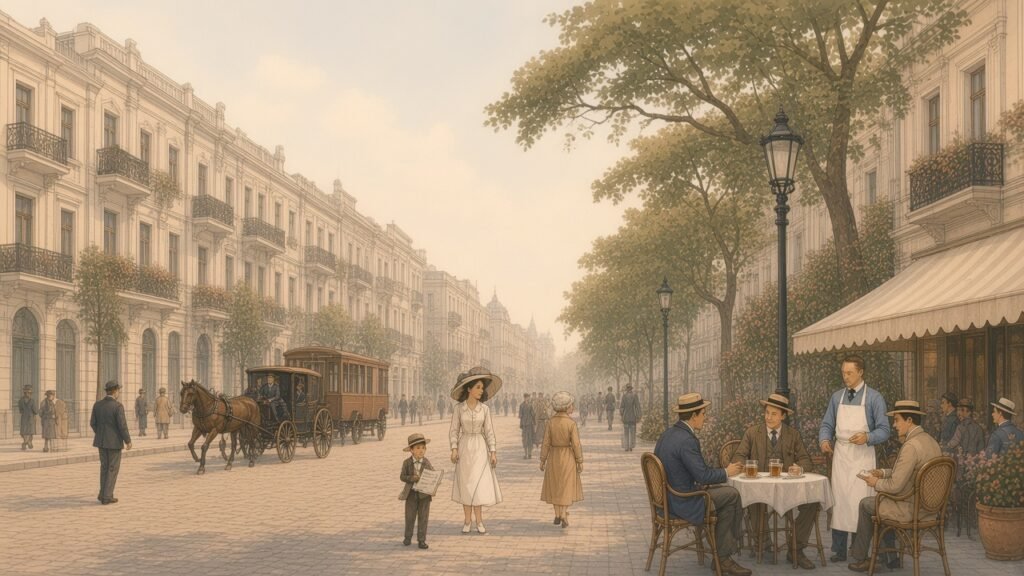
The population grew steadily. At the beginning of the nineteenth century Kyiv was still a modest provincial town of some tens of thousands of inhabitants. By mid-century it had grown substantially, and by the census of 1897 it numbered about a quarter of a million. Russians, Ukrainians, Jews, Poles and others made up a mixed urban society. The Jewish population, restricted by the rules of the Pale of Settlement yet present in significant numbers, played an important part in trade and crafts. Polish nobles and officials retained a presence from the Commonwealth past. Ukrainian speakers were numerous, especially among the lower classes and the peasantry of the surrounding countryside, but Russian was the language of administration, of the higher schools and of much of the public sphere.[1][26]
Imperial policy toward Ukrainian language and culture hardened in the second half of the nineteenth century. The Valuev Circular of 1863 and the Ems Ukase of 1876 restricted Ukrainian publications and public use of the language, on the grounds that a separate Ukrainian literary language was politically undesirable. These measures did not extinguish Ukrainian cultural activity, which continued in private circles, in folklore studies and in the work of writers such as Taras Shevchenko, whose poetry and painting made him the central figure of the modern Ukrainian national movement, but they drove much of that activity underground or abroad and shaped the atmosphere of the city until the end of the empire.[25][27]
At the same time Kyiv acquired the institutions of a modern imperial city. The University of Saint Vladimir, founded in 1834, became a major centre of learning, with faculties of law, medicine, history and philology. The Polytechnic Institute, opened at the end of the century, trained engineers for the industrialising south. Theatres, newspapers and learned societies multiplied. The railway reached Kyiv in the 1860s and linked it to Moscow, Odessa and the west, transforming the grain and sugar trades of the hinterland and accelerating urban growth. Khreshchatyk, the main street in the valley between the old hills, became the commercial spine of the city, lined with shops, hotels and banks. The Podil retained its markets and its older character. On the hills the Lavra and Saint Sophia remained the principal monuments of the deeper past, now framed by imperial pilgrimage and official historiography.[25][28]
By 1914 Kyiv was one of the larger cities of the empire, a place of students, soldiers, pilgrims, merchants and officials, in which Russian imperial culture, Ukrainian national aspiration, Jewish communal life and the remnants of Polish influence coexisted in an uneasy and dynamic balance. The war and the revolutions that followed would shatter that balance and open a new and violent chapter in the city’s history.[1]
Urban planning in the nineteenth century remade large parts of Kyiv. The architect and official planning authorities laid out new avenues, among them the future Khreshchatyk, and regulated building heights and materials. A draught from the hills toward the river created sanitary problems that reformers sought to address with waterworks and paving. Cemeteries were moved; markets were reorganised; and the old wooden housing of the poorer districts gradually gave way, in the centre at least, to brick and stone. The result was a city that looked increasingly like other provincial capitals of the empire, with a grid of streets, a main boulevard, a university quarter and an administrative centre, while still preserving on its hills and in its monastery the monuments of a much older history.[1][25]
Pilgrimage remained a major feature of Kyiv’s economy and identity. Tens of thousands of pilgrims visited the Lavra each year, especially for the great feasts, and the monastery’s hostels, shops and printing press served them. Official Russia cultivated the image of Kyiv as the baptismal font of the Rus people and as a sacred city of the empire. That image coexisted uneasily with the growing Ukrainian national movement, which also claimed Kyiv as its capital but in the name of a distinct people and a distinct history. The tension between these claims would erupt into open conflict in the twentieth century.[14][27]
Military identity was strong in imperial Kyiv. The city housed large garrisons, cadet schools and the headquarters of a military district. Fortresses and magazines occupied strategic ground. The presence of so many soldiers and officers shaped the economy of entertainment, of craft production and of rental housing, and it gave the city a Russian-speaking official class that overlapped only partly with the local Ukrainian and Jewish populations. Parades, manoeuvres and the cult of imperial military glory filled the public calendar. In 1914 that military apparatus would mobilise for a war that destroyed the empire it had served.[25]
The sugar industry of the south-western provinces made fortunes for a handful of refiners and planters, some of whom maintained palaces and cultural patronage in Kyiv. Philanthropy endowed hospitals, schools and museums. The Tereshchenko and Khanenko families, among others, assembled art collections that later formed the cores of public museums. Civic pride expressed itself in the building of theatres, the paving of streets and the installation of modern utilities. By 1914 Kyiv had tramways, telephones, electric lighting in the centre and a sense of itself as a progressive city, even as the political order that sustained that progressiveness was entering its terminal crisis.[28][1]
Demographic change accelerated after the emancipation of the serfs in 1861 and after the railway boom. Peasants moved to Kyiv for seasonal and permanent work. The Jewish population grew despite residence restrictions, drawn by economic opportunity. Russians from the interior came as officials, teachers and officers. The result was a city in which no single group held an absolute majority of the kind that characterised more homogeneous provincial towns. Language use shifted by context: Ukrainian in the market and the suburb, Russian in the office and the secondary school, Yiddish in the Jewish street and workshop, Polish in some noble and professional circles. This multilingualism was a source of creativity and of friction, and it remained a defining feature of Kyiv into the Soviet period and beyond.[26][1]
Public health and education became concerns of the later imperial administration and of civic reformers. Cholera epidemics periodically swept the city, exposing the inadequacy of water supply and sewage. Hospitals and clinics expanded, staffed by graduates of the university’s medical faculty. Primary schooling spread slowly; literacy rose; and a reading public for newspapers and cheap books emerged. The public library and the university library served that public. Kyiv on the eve of the war was thus not only a city of pilgrims and garrison soldiers but also a city of readers, students and professionals who would staff the revolutionary institutions of 1917 and after.[25][28]
The police and the censorship shaped what could be said in public. Ukrainian theatres operated under restrictions; newspapers were warned and suspended; and political suspects were watched. At the same time the sheer size of the city and the multiplicity of its languages and milieus made total control impossible. Illegal pamphlets circulated; private gatherings discussed forbidden topics; and the border with Austrian Galicia, where Ukrainian culture enjoyed greater legal freedom, allowed books and ideas to seep into Kyiv. The imperial city was thus both closely watched and persistently leaky, a combination that frustrated officials and sustained opposition.[27][25]
Synagogues, prayer houses and Jewish schools multiplied in the later nineteenth century as the Jewish population grew. The Brodsky Synagogue and other notable buildings expressed the confidence of a community that had found a place in the city’s commercial life despite legal disabilities. Pogroms and discriminatory laws checked that confidence but did not destroy it. By 1914 Kyiv’s Jews were a substantial and internally diverse population, with Orthodox, Hasidic, Zionist and socialist currents, and with a growing class of professionals who participated in the Russian-language cultural life of the city as well as in Jewish communal affairs.[26]
Fire insurance, credit institutions and professional associations thickened the institutional life of the late imperial city. Merchants and professionals organised to manage risk and to represent their interests to the authorities. These organisations were not democratic in a modern sense, yet they constituted a form of civil society that mediated between the individual and the autocratic state. Their records, where they survive, offer a view of Kyiv from the middle outward rather than from the governor downward.[25][28]
9. Universities, culture and commerce
The cultural life of imperial Kyiv rested on a handful of institutions and on a wider ecology of printing, theatre, music and voluntary association. The University of Saint Vladimir attracted students from across the south-western provinces and from further afield. Its professors conducted research in history, philology, law and the natural sciences, and its libraries and collections served a growing educated public. The historian Mykhailo Maksymovych, the first rector, and later scholars such as Volodymyr Antonovych and Mykhailo Hrushevsky, who taught in Kyiv before the revolutions, made the city a centre of Ukrainian historical studies even under the constraints of imperial censorship. Hrushevsky’s great History of Ukraine-Rus, begun in this milieu, would become the foundational narrative of modern Ukrainian historiography.[27][29]
Literary life was multilingual. Russian-language newspapers and journals dominated the legal press. Ukrainian writing circulated more cautiously, in almanacs, in Galician publications and in manuscript. Taras Shevchenko, born a serf in the Kyiv region, studied at the Academy of Arts in St Petersburg but returned in his work again and again to the landscapes and the historical memory of the Dnieper country; his Kobzar made the vernacular a literary language of the first rank. Later writers and poets, working in Ukrainian and in Russian, used Kyiv as setting and as symbol. The young Mikhail Bulgakov, born in Kyiv in 1891 into a family of theologians and doctors, absorbed the city’s multi-layered life and later transmuted the civil-war years into the novel The White Guard and the play based upon it, works that fixed an image of Kyiv in Russian literature as lasting as Babel’s Odessa.[30][31]
Commerce and industry gave the cultural institutions their material base. Sugar-beet processing, milling, tanning and machine-building developed in and around the city. Banks and trading houses lined the central streets. The Contract Fair, held annually, brought landowners and merchants together for the settlement of agricultural business. Jewish traders and artisans were prominent in many branches of retail and craft production, despite legal disabilities that were only partly eased in the later imperial period. Pogroms in 1881 and especially in October 1905, during the first Russian revolution, revealed the fragility of communal coexistence and left deep scars. The 1905 violence in Kyiv, as in Odessa and other cities, accompanied the broader political upheaval of that year and foreshadowed the greater disasters of the civil-war period.[26][1]
Music and theatre flourished. The city had opera and drama companies that performed in Russian and, when permitted, in Ukrainian. Choirs associated with the Lavra and with secular societies cultivated both sacred and folk repertoires. By the early twentieth century Kyiv possessed the apparatus of a European provincial capital — universities, theatres, a polytechnic, newspapers, tramways and electric light — while remaining a place where the deeper structures of Orthodox pilgrimage, Jewish communal life and Ukrainian rural culture were still strongly felt. That complexity would make the revolutionary years particularly intense, for every political project of 1917 to 1921 sought to claim the city as its capital.[28]
The student population of Kyiv was a political force in its own right. University and polytechnic students took part in the revolutionary circles of the late nineteenth century, in the disturbances of 1905 and in the national and socialist movements that competed for their loyalty. Reading rooms, self-education circles and illegal presses flourished in the shadows of official culture. Women entered higher education in increasing numbers through higher courses and medical training, and a female intelligentsia emerged alongside the male. Jewish students, subject to quotas, formed their own associations and were drawn to Zionism, socialism and liberalism in proportions that mirrored the wider Jewish politics of the empire.[26][28]
By the eve of the First World War Kyiv possessed a dense network of voluntary societies — charitable, learned, sporting and artistic — that constituted a civil society of sorts within the authoritarian frame of the empire. That network would be mobilised, fragmented and reconstituted under the successive regimes of 1917 to 1921, and its survivors would staff the early Soviet institutions of the 1920s. The commercial prosperity of the pre-war years, the cultural ambitions of the intelligentsia and the unresolved national question together made Kyiv one of the most volatile and creative cities of the late empire.[1][29]
Visual art in Kyiv ranged from the academic painting taught in local schools to the avant-garde experiments that linked the city to Moscow, Petersburg and the European modern movements. Alexander Archipenko, born in Kyiv, became a pioneer of Cubist sculpture after leaving for the West. Kazimir Malevich, who spent formative years in the Ukrainian lands, developed Suprematism as a radical abstraction that broke with the figurative traditions of both icon painting and academic realism. The city’s museums and private collections offered models from the Byzantine and baroque past as well as from contemporary Europe. This dense visual culture, interrupted by war and revolution, would be selectively appropriated by the Soviet art establishment of the 1920s and 1930s.[1]
Theatre and music reached wide audiences. Productions in Russian dominated the imperial stage, but Ukrainian troupes performed when censorship allowed, and after 1905 the range of permitted expression widened somewhat. Folk song, church music and the emerging art-song tradition enriched the city’s soundscape. The opera house staged the international repertoire and works by Russian and Ukrainian composers. For a provincial capital of the empire, Kyiv punched above its weight in the performing arts, and that tradition would survive into the Soviet and independent periods, even when political conditions constrained the choice of repertoire and language.[28]
Scholarship on the Kyivan past itself became a field of contention. Imperial Russian historians treated the city as the first capital of a Russian state that had later moved its centre to Vladimir and Moscow. Ukrainian historians, among whom Hrushevsky was the most systematic, treated Kyivan Rus as the first Ukrainian state and traced a continuity through Galicia-Volhynia and the Cossack Hetmanate that bypassed Moscow. Polish historians emphasised the Commonwealth centuries. Jewish historians recovered the record of the kahal and of the pogroms. These competing narratives were already fully formed by 1914, and they would be fought out not only in books but in the street politics of the twentieth century. Kyiv was both the subject and the arena of this historiographical war.[29][27]
The built environment of culture included the opera house, the drama theatres, the university aula and the private salons of merchant and noble families. Concert life featured visiting virtuosi and local ensembles. Art exhibitions introduced the public to the Wanderers, to Impressionism and to local painters who specialised in Dnieper landscapes and historical scenes. Photography studios recorded the faces and the streets of the city for a growing middle-class clientele. This dense cultural infrastructure meant that when political revolution came, it came to a population already practised in association, debate and public performance.[28][1]
Libraries and archives in imperial Kyiv accumulated the manuscripts and books that later historians would need. The university library, the Lavra’s collections and private holdings of families such as the Khanenkos preserved icons, documents and rare editions. Revolutions, wars and Soviet reorganisations dispersed or destroyed parts of these collections, yet enough survived to make Kyiv a major centre of archival research on the Ukrainian past. The continuity of custodianship, through monks, professors, Soviet archivists and independent Ukrainian librarians, is itself a thread in the city’s cultural history.[29][14]
Medical and scientific societies linked Kyiv to the wider imperial and European worlds of research. Congresses met in the city; journals were edited there; and discoveries in medicine and the natural sciences were reported from its laboratories. The medical faculty trained doctors who staffed the hospitals of the south-western provinces. This scientific culture was largely Russian-speaking and imperial in its institutional affiliations, yet it trained many who would later serve Ukrainian and Soviet institutions. Continuity of personnel across the revolutionary divide was greater in the sciences than in the more politicised humanities.[28]
10. Revolution and civil war
The First World War placed Kyiv behind the front for long periods and filled it with soldiers, refugees and the apparatus of military supply. When the February Revolution of 1917 overthrew the monarchy in Petrograd, the news reached Kyiv within days and set off a scramble for authority. A Ukrainian Central Rada, chaired by the historian Mykhailo Hrushevsky, claimed to speak for the Ukrainian people and sought autonomy within a reformed Russian state. Soviets of workers and soldiers, dominated at first by Russian socialist parties, competed for the allegiance of the garrison and the factories. The municipal duma and the provisional government’s local representatives tried to keep order. Through the spring and summer of 1917 Kyiv was a city of meetings, newspapers and rival demonstrations, in which Ukrainian national colours appeared alongside red flags and the slogans of the Petrograd parties.[29][32]
After the Bolshevik seizure of power in Petrograd in November 1917 the Central Rada proclaimed the Ukrainian People’s Republic, at first still within a federal Russia and then, in January 1918, as a fully independent state. Kyiv became its capital. The Bolsheviks, determined to regain control of the Ukrainian provinces and their grain, advanced on the city. In late January and early February 1918 Ukrainian and Bolshevik forces fought for Kyiv; the Arsenal factory uprising of Bolshevik workers was suppressed by Rada troops; and the city changed hands amid street fighting and artillery fire. The Rada, having signed a separate peace with the Central Powers at Brest-Litovsk, returned to Kyiv with German and Austrian backing. A conservative coup then replaced the Rada with the Hetmanate of Pavlo Skoropadsky, a former imperial general who ruled with German support until the Central Powers collapsed in November 1918.[32][33]
The months that followed were among the most chaotic in the city’s history. The Directory of the Ukrainian People’s Republic, led by Volodymyr Vynnychenko and then by Symon Petliura, took Kyiv from Skoropadsky. Bolshevik forces took it again. White armies under Anton Denikin held it briefly in 1919. Polish troops entered in 1920 during the Polish-Soviet war, in alliance with Petliura, and were driven out in turn. Each occupation brought requisitions, arrests and, repeatedly, violence against the Jewish population. Pogroms by various armed bands, including units associated with the Directory and with independent warlords, killed tens of thousands of Jews across Ukraine; Kyiv itself suffered assaults and a climate of fear. Mikhail Bulgakov, who lived through these months in the city, later described them as a time when the inhabitants woke each morning unsure which flag would fly over the public buildings.[30][32]
By 1921 Soviet power was established in Kyiv. The Ukrainian Soviet Socialist Republic, formally sovereign but tightly bound to Moscow, made Kharkiv its capital for more than a decade, relegating Kyiv to the status of a major provincial city. The civil-war years had emptied parts of the centre, destroyed housing and infrastructure, and left a population traumatised by hunger, disease and political terror. Yet they had also confirmed Kyiv’s place as the symbolic capital of Ukraine. Every major Ukrainian political project of the period had claimed it, and the Bolsheviks themselves, once in control, would eventually restore it as the capital of their Ukrainian republic. The memory of 1917 to 1921 — of the Rada, of the Hetmanate, of Petliura, of the Bolsheviks and of the pogroms — remained a live and contested part of the city’s identity for the rest of the century.[32][33]
The human cost of the civil-war years in Kyiv is hard to calculate with precision but was certainly high. Hunger and typhus killed more people than bullets. Housing was requisitioned and re-requisitioned as regimes changed. Intellectuals and professionals emigrated if they could, or adapted if they could not. The Jewish community, traumatised by pogroms, faced a choice between Zionism, socialism, Orthodoxy and emigration that would reshape its character in the 1920s. Ukrainian national activists who had served the Rada or the Directory went into exile or underground, or made their peace with the Soviet regime during the Ukrainisation of the 1920s, a peace that the purges of the 1930s would break. The city that entered the Soviet period was smaller, poorer and more politically homogeneous than the Kyiv of 1914, and it carried wounds that official histories would long refuse to name.[32][33]
International attention flickered over Kyiv during these years. German, Austrian, French and Polish missions passed through. Journalists filed dispatches on the shifting fronts. For most of the outside world, however, the Ukrainian struggle was a sideshow of the Russian civil war, and the specificity of Kyiv’s experience — as a capital claimed by multiple Ukrainian governments and contested by every major force in the region — was poorly understood. That misunderstanding would cast a long shadow over Western perceptions of Ukraine into the late twentieth century.[32]
Women’s experience of the revolutionary years has left a thinner documentary trail but can be partly recovered. Nurses and clerks staffed the hospitals and offices of successive regimes. Market women kept the city fed when supply systems broke down. Intellectuals such as the writers and teachers of the Ukrainian and Russian cultural scenes navigated censorship and danger. Sexual violence accompanied pogroms and military occupations. The promises of emancipation made by socialists and by some nationalists collided with the brutalisation of everyday life. When Soviet power consolidated, women in Kyiv entered factories, schools and party organisations in new numbers, even as traditional burdens of household labour persisted.[32]
The Arsenal factory, whose workers rose for the Bolsheviks in January 1918, became a lieu de mémoire of Soviet Kyiv, commemorated in monuments and street names. Independent Ukraine has reinterpreted or removed some of those commemorations. The physical factory buildings, modernised and partly re-purposed, still stand as a reminder that the civil war was fought not only in the symbolic centre but in the industrial districts where class and nationality intersected in complicated ways.[33]
Foreign occupation left material traces. German and Austrian troops of 1918 requisitioned housing and food; their withdrawal left a power vacuum that the Directory filled only briefly. Denikin’s Whites restored imperial symbols for a few months in 1919 and alienated Ukrainian and Jewish populations by their conduct. The Polish entry in 1920 was accompanied by hopes of a lasting alliance between Warsaw and Petliura’s republic, hopes that the subsequent Polish-Soviet settlement dashed. Each of these episodes deposited memories, grievances and occasional physical relics — graves, buildings, documents — that later regimes would interpret according to their own needs.[32][33]
The intellectual emigration from Kyiv after 1919 and 1920 scattered historians, writers and politicians across Europe and North America. Vienna, Prague, Berlin, Paris and later New York and Canadian cities hosted Ukrainian scholarly institutions that preserved an alternative narrative of Kyiv’s past until that narrative could return to the city itself after 1991. The emigration was thus not only a loss for Kyiv but a mechanism of cultural survival, and its archives remain essential sources for the history of the revolutionary years.[29]
Street fighting in Kyiv during the civil war used the city’s topography. Barricades blocked the steep streets leading from the Podil to the upper town; machine guns commanded the bridges; and the heights offered artillery positions that dominated the lower districts. Control of the railway stations determined the ability to bring in reinforcements. The urban battle of Kyiv was thus a series of contests for nodes — stations, bridges, the Arsenal, the government quarter — rather than a single continuous front. Residents learned to read the sound of gunfire by district and to keep to the side of the hill that seemed safer on any given day.[32]
11. The Soviet capital
The 1920s in Soviet Kyiv were years of reconstruction, experimentation and relative cultural openness within the frame of Bolshevik power. The policy of korenizatsiia, or indigenisation, encouraged the use of Ukrainian in schools, administration and the press, as a means of rooting Soviet power among the local population. Ukrainian-language publishing, theatre and film expanded. Writers associated with the alternative literary organisation VAPLITE and with other groups debated the future of Ukrainian culture under socialism. The city regained population as peasants moved in search of work and as the Soviet administration grew. Factories were restored and new ones planned. Churches and monasteries, however, faced increasing pressure; many were closed, converted or destroyed as the atheist campaign intensified toward the end of the decade.[34][35]
In 1934 the capital of the Ukrainian SSR was transferred from Kharkiv to Kyiv. The move was both practical and symbolic. Kyiv’s historical prestige suited the Soviet claim to stand in the line of Rus and of the Ukrainian past, suitably reinterpreted; and the city’s location was judged more secure and more central for the republic as it then existed. A programme of monumental building began, designed to give the new capital an appropriately Soviet face. Government buildings, squares and avenues were planned on a grand scale. At the same time the political atmosphere darkened. The Ukrainian intelligentsia that had flourished in the 1920s was decimated by the purges of the early 1930s. Writers, scholars, theatre directors and party officials were arrested, exiled or shot. The Ukrainian Autocephalous Orthodox Church was suppressed. What had been a period of Ukrainisation gave way to a renewed emphasis on Russian language and on central control from Moscow.[34][35]
Industrialisation transformed the city’s economy and demography. New plants drew workers from the countryside and from other republics. Housing was scarce, and communal apartments became the norm for much of the population. The Dnieper hydroelectric stations and the industrial development of the Donbas and of Kryvyi Rih tied Kyiv into a wider Soviet economic geography as an administrative and increasingly a scientific centre. Research institutes multiplied. The Academy of Sciences of Ukraine made its home in the city. By the end of the 1930s Kyiv was a Soviet capital in full, with a growing industrial working class, a cowed and reconstructed intelligentsia, and a skyline that mixed the remaining churches of the old city with the new buildings of the Stalinist order.[1][34]
Everyday life combined scarcity with mobilisation. Rationing, queues and the fear of denunciation were part of the urban experience. Public ritual — May Day parades, celebrations of the October Revolution, and the cult of Lenin and later of Stalin — organised time and space. The Pechersk Lavra was closed as a monastery and partly converted to museum use. Saint Sophia became a museum preserve. The Soviet state thus appropriated the monuments of the Kyivan past while emptying them of their former religious function. That appropriation would be tested and nearly destroyed in the war that was about to break upon the city.[14][35]
Architecture and planning in 1930s Kyiv reflected the ambitions and the violence of the decade. Official projects envisaged a socialist capital of wide avenues, monumental squares and dominating public buildings. Some of those projects were realised; others remained on paper. At the same time medieval and baroque churches were demolished to clear space and to signal the triumph of atheism. The loss of the Michael’s Golden-Domed Monastery and of other historic structures was felt even by some within the party, but the demolitions proceeded. The resulting gaps in the historic fabric would be filled, much later, by independent Ukraine’s reconstructions, which sought to reverse the Stalinist erasures and to restore a skyline associated with the pre-Soviet past.[35][14]
Social mobility and social fear coexisted. Peasants who moved to Kyiv for factory work acquired urban skills and identities; children of workers entered higher education through Soviet affirmative-action policies; and a new Ukrainian Soviet elite occupied the offices of party and state. At the same time the NKVD’s lists and the atmosphere of denunciation meant that status could be lost overnight. The Great Terror was not an abstraction in Kyiv. It emptied apartments, filled prisons and made silence a condition of survival. The public culture of optimism — of metro plans, of athletic parades, of Stakhanovite records — ran alongside a private culture of caution that older residents would remember for the rest of their lives.[34][35]
The transfer of the capital in 1934 brought an influx of officials, builders and security personnel. Housing had to be found for them, often at the expense of existing tenants. New government quarters were planned on Pechersk and in other districts. The city’s status as a capital attracted further investment in transport and communications. At the same time the countryside around Kyiv was still recovering from the famine, and the contrast between the privileged capital and the depleted villages was stark. Party propaganda presented Kyiv as a showcase of Soviet Ukrainian achievement; the silenced countryside told a different story to those who knew how to listen.[34][36]
Purges reached the Ukrainian film studios, the theatres and the Academy of Sciences. Scripts were rewritten; productions were shelved; careers ended in the Gulag. The survivors learned to encode their meanings or to keep silent. Official Ukrainian Soviet culture of the later 1930s was thinner and more cautious than that of the 1920s, and the memory of what had been lost persisted as a subterranean counter-history among the intelligentsia.[35]
Consumer life in the 1930s was organised around ration books, factory canteens and the privileged stores available to officials. Shortages of clothing, shoes and household goods were chronic. The black market supplemented official supply. Housing space was allocated by workplace and by political status, producing a finely graded geography of privilege within the city. Communal apartments, in which several families shared a kitchen and bathroom, became the typical dwelling of the urban majority and the setting for a distinctive Soviet domestic culture of negotiation, gossip and surveillance.[34]
Public transport before the metro relied on trams and buses that were overcrowded and unreliable. Walking remained a primary mode of movement for short distances, and the hills of Kyiv made that walking strenuous. The physical effort of daily life in a vertical city is an under-recorded part of the Soviet experience, remembered in memoirs as the climb from the Podil to the upper town or from a tram stop to a fifth-floor walk-up.[1]
Nationality policy oscillated. The Ukrainisation of the 1920s produced a generation of Ukrainian-speaking officials and teachers; the reversals of the 1930s punished many of them as nationalists and restored Russian to primacy in key domains. Kyiv’s schools and offices lived through these oscillations in the form of changing directives on language of instruction and of paperwork. Parents and teachers adapted as best they could. The result by 1941 was a population that was often bilingual and wary of committing too strongly to any official language policy, a wariness that would reappear in later decades.[34][35]
Industrial accidents and environmental pollution accompanied the growth of manufacturing. The Dnieper received untreated effluent; air quality in industrial districts was poor; and workplace safety standards were unevenly enforced. Environmental awareness, when it emerged in the 1980s, drew on the experience of living with these conditions as well as on the shock of Chernobyl. Kyiv’s ecological activists were among the first to organise openly under perestroika, linking local grievances to national and global concerns.[43][34]
12. Famine and the 1930s
The Holodomor of 1932 to 1933, the man-made famine that killed millions in the Ukrainian countryside, left its mark on Kyiv even though the city itself was not the primary theatre of starvation. Grain requisitions, the blockade of villages and the confiscation of foodstuffs drove desperate peasants toward the towns. Many were turned back at checkpoints; others reached Kyiv and died in its streets and hospitals. The city’s own inhabitants faced rationing and shortages. Contemporary witnesses and later oral histories describe swollen bodies, abandoned children and the fear that spoke of the countryside’s catastrophe even when the press was silent. The Holodomor was centred on the rural districts of Ukraine, yet Kyiv as the republican capital was both a place of refuge denied and a place of administration for the policies that produced the famine.[36][37]
The causes of the Holodomor remain a subject of historical and political controversy, but the main elements are well established. Forced collectivisation destroyed the old agrarian order; unrealistic procurement quotas stripped the villages of grain; and measures that prevented peasants from leaving the affected areas turned shortage into mass death. Whether the famine was intended as a deliberate genocide against the Ukrainian peasantry, as many Ukrainian historians and the Ukrainian state maintain, or was the consequence of a more general Soviet assault on the peasantry that fell with especial severity on Ukraine, as some other scholars argue, its demographic and moral impact was enormous. Millions died. The survivors carried the memory into the rest of the century, even when it could not be publicly acknowledged.[36][37]
The mid-1930s brought the Great Terror to Kyiv’s party apparatus, NKVD organs, military command and cultural institutions. Lists of the condemned included Old Bolsheviks, Ukrainian national communists, Polish and German minority leaders, clergy and ordinary citizens caught in the machinery of quotas and denunciations. The cemeteries and the anonymous burial grounds of the period hold thousands of victims. By 1939 the political elite of Soviet Ukraine had been largely replaced by a new cohort judged more reliable by Moscow. The Ukrainian language lost ground in higher education and administration. The public culture of the city was Russianised in key domains, even as Ukrainian continued to be used in many schools and in official bilingual formulas.[35][34]
On the eve of the German invasion Kyiv was a city of some 800,000 people, the third largest in the Soviet Union after Moscow and Leningrad. It possessed a metro plan, a growing industrial base, institutes of the Academy of Sciences and the administrative machinery of a union republic. It also carried the unresolved traumas of famine and terror, and its churches and monasteries stood mostly silent. The war would add a further layer of destruction and of atrocity that would define the city’s twentieth-century memory as much as any earlier event.[1][36]
The silence that surrounded the Holodomor in Soviet public life was itself a historical fact of the first importance. For decades the famine could not be mentioned in print, in schools or in official speeches. Families remembered in private. Diaspora communities, especially in North America, preserved testimony and conducted research that was dismissed as propaganda by Soviet authorities and by some Western scholars. Only in the late 1980s did public discussion become possible in Kyiv itself. Independent Ukraine made the Holodomor a central element of national memory, with monuments, museum exhibitions and a Remembrance Day. Debates continue over numbers, over intentionality and over the relationship between the Ukrainian famine and contemporaneous famines elsewhere in the Soviet Union. What is no longer seriously disputed is the scale of the death toll and the responsibility of Soviet procurement and control policies for turning scarcity into mass starvation.[36][37]
Kyiv’s academic and party elite lived through the famine years in a different register from the peasantry, but they were not untouched. Ration hierarchies privileged the cities and the apparatus; yet even privileged inhabitants knew that the countryside was dying. Some participated in the grain seizures; some wrote letters of protest that went unanswered; most kept their heads down. The moral injury of those years added to the injury of the purges and helped to produce the atmosphere of muted trauma that characterised late Stalinist Kyiv.[36]
Children were among the most visible victims in the city. Orphanages overflowed. Street children begged and stole. Some were evacuated or adopted; many died. Schools tried to maintain routines amid absenteeism and hunger. Teachers who spoke of what they saw risked accusation of spreading panic or of nationalist agitation. The famine thus invaded the classroom and the family as well as the street, and its psychological effects on a generation of Kyivans who were children in 1932 and 1933 are only beginning to be studied through oral history and memoir.[37][36]
Grain continued to be exported from Soviet ports during the famine years, a fact that has weighed heavily in assessments of official responsibility. The decision to maintain exports while villages starved has been read as evidence of genocidal intent by some scholars and as evidence of a ruthless industrialisation priority by others. For the inhabitants of Kyiv who saw emaciated peasants at the railway stations, the moral meaning was simpler: the state had chosen not to feed its people.[36][37]
Official language described the famine, when it described it at all, as a food difficulty caused by drought, sabotage and the backwardness of the peasantry. Internal party documents told a more candid story of procurement quotas and blacklists of villages. The gap between public language and private knowledge created a culture of double-speak that characterised Stalinist Kyiv more broadly. People learned to say one thing in meetings and another at home, a habit that would long outlast the famine itself.[36][35]
Demographic recovery took years. Birth rates fell; mortality remained elevated; and the age structure of the surrounding countryside was permanently altered. Kyiv’s own population growth in the later 1930s came largely from migration rather than from natural increase among famine survivors. The city filled with newcomers who had not witnessed the worst of 1933, and who therefore related to its memory differently from those who had.[37]
Artistic and literary responses to the famine were almost impossible inside the Soviet Union at the time. A few writers encoded references; most were silent. In the diaspora, memoirs and poems appeared. Only much later could Kyiv-based writers address the subject openly. The belatedness of literary witness is itself a measure of the terror that surrounded the topic, and of the importance of the oral tradition that kept memory alive until print was permitted.[37]
Collectivisation itself had remade the villages around Kyiv before the famine struck. Independent farmers were forced into collective farms; so-called kulaks were expropriated and deported; and the old rhythms of agricultural decision-making were replaced by plan targets handed down from above. When those targets proved impossible to meet, coercion intensified. The famine was thus the climax of a longer assault on the rural order, an assault administered in part from offices in Kyiv by officials who may or may not have grasped the full human consequences of their directives.[36][37]
Memorialisation after independence has included the construction of monuments in Kyiv, the establishment of a Holodomor museum and the annual lighting of candles on Remembrance Day. These rituals have made the famine a visible part of the capital’s commemorative landscape, comparable in prominence to the memorials of the Second World War and of the Maidan. Foreign visitors now encounter the Holodomor as a standard element of the Kyiv itinerary, a development that would have been unthinkable in the Soviet period.[37]
Comparisons with other Soviet famines — the Volga famine of the early 1920s, the Kazakh famine of the early 1930s — clarify what was distinctive about the Ukrainian case: the combination of grain-producing abundance with mass starvation, the use of internal passports and blacklists to trap the rural population, and the simultaneous campaign against Ukrainian cultural elites. These features underpin the legal and scholarly case for genocide that Ukraine and a growing number of other states have accepted, even as some historians continue to prefer a framework of totalitarian crime without the genocide designation. The debate is unlikely to end soon; the facts of mass death are not in serious doubt.[36][37]
13. Occupation and liberation
German forces encircled and captured Kyiv in September 1941, in one of the largest battles of encirclement on the Eastern Front. Hundreds of thousands of Soviet troops were taken prisoner. The city that fell to the Wehrmacht was already damaged by bombing and by the sabotage of retreating Soviet units, who had mined major buildings. In the middle of September a series of explosions destroyed the Khreshchatyk and surrounding blocks, killing German soldiers and Ukrainian civilians and giving the occupation authorities a pretext for savage reprisals. The German administration of the Reichskommissariat Ukraine, with its centre at Rivne rather than Kyiv, nevertheless made the city a regional seat of power, and the swastika flag flew over the public buildings.[38][39]
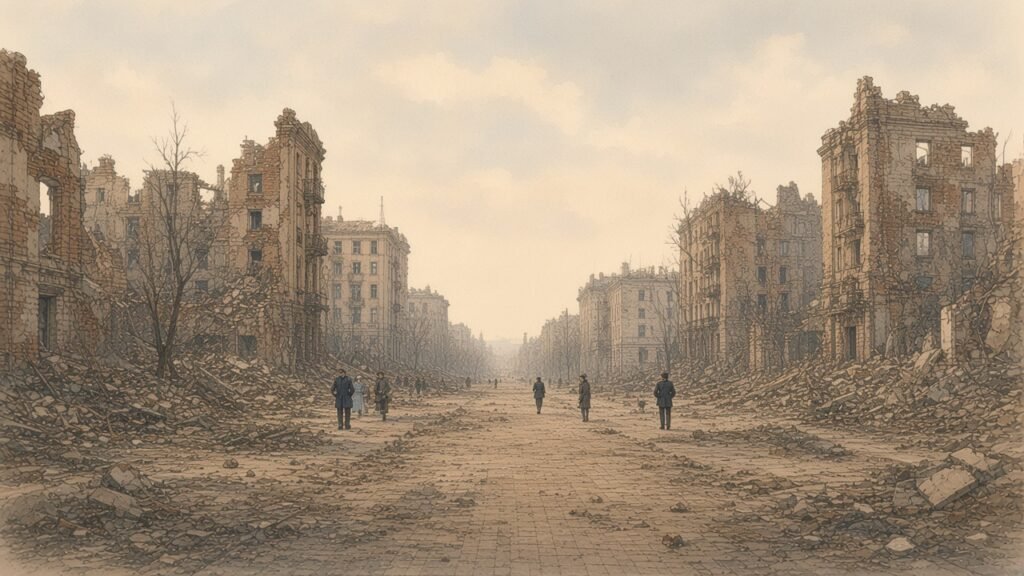
Within days of the occupation the city’s Jewish population was targeted for destruction. Notices ordered Jews to assemble with their belongings for resettlement. On 29 and 30 September 1941 more than 33,000 Jewish men, women and children were marched to the ravine of Babyn Yar, on the north-western edge of the city, and shot by Einsatzgruppe C and auxiliary units. Further shootings followed in the months to come, claiming the lives of Jews who had escaped the first massacre, of Roma, of Soviet prisoners of war, of Ukrainian nationalists, of psychiatric patients and of other categories of victim. Babyn Yar became one of the emblematic sites of the Holocaust in the occupied Soviet Union, and of the wider Nazi killing fields of the east. The exact total of those murdered there during the occupation is uncertain, but it runs into the tens of thousands beyond the September massacre alone.[40][41]
Life under occupation was marked by hunger, forced labour and the constant threat of denunciation and execution. Some inhabitants collaborated with the German authorities; some joined the underground resistance; many simply tried to survive. Ukrainian nationalist organisations sought to use the occupation to advance their own aims and were in turn persecuted when they ceased to be useful to the Germans. The Pechersk Lavra and other religious sites saw a temporary revival of church life under occupation policy, which was more tolerant of Orthodoxy than the Soviet regime had been, though always within the limits of German control. The city’s infrastructure and housing stock deteriorated. By the time of liberation large parts of the centre lay in ruins.[38][39]
Soviet forces liberated Kyiv in November 1943, in a costly offensive across the Dnieper. The returning Soviet authorities reimposed their order, conscripted men for the front and for reconstruction, and began the investigation of occupation crimes. The Jewish community of Kyiv had been almost entirely destroyed. Survivors who emerged from hiding or returned from evacuation found their homes occupied and their relatives dead. For decades the official Soviet memorialisation of Babyn Yar spoke of peaceful Soviet citizens and avoided specific mention of Jewish victims, a silence that itself became a subject of protest and of literary witness, most famously in Yevgeny Yevtushenko’s poem of 1961 and in Anatoly Kuznetsov’s documentary novel. The physical ravine remained a wounded place on the edge of the expanding city.[40][41]
The Soviet reconquest of Kyiv in 1943 was followed by a selective reckoning. German crimes were documented and publicised; collaboration was punished, sometimes justly and sometimes as a means of settling other scores. The specific Jewish character of the Babyn Yar massacre was submerged in the general category of Soviet victimhood, a policy that reflected both ideological universalism and a persistent official unease with Jewish particularity. Jewish survivors who sought to commemorate their dead at the ravine faced obstruction. The long campaign for a proper memorial, waged by activists, writers and eventually by international Jewish organisations, is itself a chapter in the city’s postwar history. Only after independence was a fuller, if still contested, landscape of memory created at Babyn Yar.[40][41]
Physical reconstruction had to begin before mourning could find public forms. Temporary housing, repaired bridges and restored utilities were the priorities of 1944 and 1945. Returning evacuees and demobilised soldiers crowded into a damaged city. The population that rebuilt Kyiv was not the same as the population that had been captured in 1941; too many had died at the front, in the Holocaust, in captivity or in the wartime rear. The new Kyiv of the late 1940s was thus already a city of replacements as well as of survivors, and that demographic fact shaped its Soviet future.[38][39]
The underground resistance in Kyiv included Soviet partisans, nationalist groups and individuals who hid Jews or sabotaged German installations at great personal risk. Numbers are disputed, and postwar Soviet historiography inflated the Communist role while suppressing the nationalist one. What is certain is that resistance existed, that it was harshly punished, and that most of the population was neither actively resistant nor actively collaborative but occupied a broad middle ground of constrained survival. That middle ground is harder to memorialise than heroism or villainy, yet it was the experience of the majority.[39][38]
When Soviet forces re-entered Kyiv in November 1943, they found a city stripped of much of its movable wealth and of most of its Jewish population. The return of Soviet power was welcomed by many as liberation from German terror and dreaded by others as the return of the NKVD. Both responses were justified. The war years had taught Kyivans that successive regimes brought successive dangers, and that lesson would colour the city’s political culture into the postwar decades.[39]
Photographs and films of occupied Kyiv, German and Soviet, create a visual archive that historians still mine. Empty streets, ruined blocks, queues for food, and the faces of inhabitants under occupation appear in these images with a directness that written sources rarely match. The photographs of Babyn Yar taken by the Germans themselves, and those taken by Soviet investigators after liberation, are among the most harrowing. They have been used in trials, in exhibitions and in educational programmes, and they ensure that the massacre remains visible even when words fail.[40][41]
The return of evacuated Soviet institutions after 1943 brought back a party and state apparatus that had spent the war years in the rear. Conflicts arose between returnees and those who had lived under occupation, whom the returnees often suspected of collaboration. Verification commissions examined biographies. Some Kyivans who had simply survived were punished; some who had collaborated escaped. The moral chaos of the immediate postwar period was a further trauma layered upon the occupation itself.[39]
The explosion of the Khreshchatyk mines in September 1941 destroyed not only buildings but also the possibility of a negotiated everyday occupation. German reprisals and the subsequent massacre at Babyn Yar set a tone of extreme violence from the first weeks. Some Ukrainian nationalists who had hoped to use the Germans against Soviet power discovered that they had no independent room for manoeuvre. The Organisation of Ukrainian Nationalists split over tactics, and both factions suffered arrests. Kyiv under occupation was a city without a viable middle path between submission and resistance, and most people chose the forms of submission that allowed their families to eat.[38][39]
Forced labour deportations removed tens of thousands of Kyivans to the Reich. Some returned after 1945; many did not. Their experience of German factories, camps and farms was a distinct strand of wartime suffering, less commemorated than the battlefield or the massacre yet significant for the city’s demographic and psychological reconstruction. Letters and later interviews preserve fragments of that experience.[38]
14. Reconstruction and late Soviet Kyiv
The reconstruction of Kyiv after 1943 was one of the major urban projects of the postwar Soviet Union. Khreshchatyk was rebuilt in the grand Stalinist style, with broad pavements, massive residential and administrative blocks and a uniformity of design that erased much of the pre-war streetscape. The Kreschatyk metro station and later the expanding metro system, which opened its first line in 1960, gave the city a modern underground transport network and a set of elaborately decorated stations that served as showpieces of Soviet public art. New residential districts spread across the hills and onto the left bank of the Dnieper, which had previously been less developed. Prefabricated housing of the Khrushchev and Brezhnev periods created vast microrayons of apartment blocks, schools and clinics, housing a population that passed one million in the late 1950s and two million in the 1970s and 1980s.[1][42]
Kyiv became a major centre of Soviet science and technology. Institutes of physics, chemistry, cybernetics and aerospace research employed tens of thousands. The Antonov design bureau produced transport aircraft that became known throughout the world. The city’s universities and the Academy of Sciences trained a technical intelligentsia that was both Soviet in its institutional loyalties and increasingly aware of Ukrainian cultural questions. The Shevchenko University and the Polytechnic Institute remained the flagship higher schools. Publishing houses issued books in Ukrainian and Russian. A literary establishment of officially recognised writers coexisted with a smaller circle of dissidents who circulated manuscripts in samizdat and who paid for their opposition with arrest and exile.[34][42]
The late Soviet period also saw the slow return of religious and national themes to public discussion. The celebration of the 1500th anniversary of Kyiv in 1982, dated from the legendary foundation of 482, was a Soviet spectacle that nonetheless gave prominence to the city’s ancient past. The Millennium of the Baptism of Rus in 1988, coinciding with Gorbachev’s reforms, brought a more open acknowledgment of the Christian heritage and a partial return of church buildings to religious use. The Chernobyl disaster of April 1986, at a nuclear plant north of the city, sent a radioactive cloud across Kyiv and forced the authorities to stage the May Day parade under conditions of contamination that were concealed from the public. The disaster undermined trust in the regime and became a catalyst for environmental and national activism in the years that followed.[43][1]
By the late 1980s Kyiv was a city of more than two and a half million people, with a metro, a sprawling built-up area on both banks of the Dnieper, a large industrial and scientific workforce, and a political atmosphere increasingly stirred by glasnost and by the Ukrainian national movement. Informal associations, ecological groups and cultural societies proliferated. The first public commemorations of the Holodomor and of Babyn Yar’s Jewish victims were held. When the Soviet Union entered its terminal crisis, Kyiv was ready to become again what it had been in 1917 to 1921: the capital of an independent Ukrainian state.[34][43]
Everyday late Soviet Kyiv had its own rhythms. The metro and the tram carried workers to factories and institutes. Queues formed for sausage, for vodka, for imported goods when they appeared. Summer dachas and allotments supplemented the food supply. Football, especially the fortunes of Dynamo Kyiv, provided a shared passion that crossed linguistic and social lines; the club’s European successes in the 1970s and 1980s were celebrated as victories of the city and of Soviet sport alike. Cafés, beer halls and private kitchens hosted the conversations that official meeting rooms could not. A distinctive Kyiv humour, ironic and multilingual, softened the frustrations of shortage and bureaucracy.[42]
Dissident activity in Kyiv was less famous than that of Moscow or Leningrad but was real. Ukrainian Helsinki Group monitors, poets, historians and religious believers challenged the regime on national rights, on language, on the closed topics of famine and of Babyn Yar. Arrests and psychiatric abuse were the state’s response. The rise of Gorbachev opened space that these activists and their younger successors quickly filled. By 1989 to 1991 Kyiv’s public squares were again political arenas, and the Supreme Soviet of Ukraine became the site of the independence vote that ended the Soviet chapter of the city’s history.[43][34]
The metro’s construction, begun before the war and resumed afterward, employed thousands and became a point of civic pride. Stations such as Khreshchatyk, Arsenalna — among the deepest in the world — and later expansions to the left bank and the residential districts remapped the city’s mental geography. Commuting times fell; new areas became viable for housing; and the metro itself became a symbol of Soviet modernity comparable to the rebuilt Khreshchatyk above ground. In 2022 those same deep stations sheltered thousands during air raids, a reminder that infrastructure built for one purpose can serve another in a crisis.[42][51]
Tourism of a Soviet kind developed around the Lavra, Saint Sophia and the reconstructed centre. Intourist hotels housed foreign visitors on carefully managed itineraries. The image of Kyiv projected abroad was one of ancient monuments and modern achievement, with the Holodomor and Babyn Yar’s Jewish specificity left off the programme. Domestic tourism brought school groups and pilgrims of a secular kind, who laid flowers at war memorials and walked the hills. The city’s vocation as a destination of pilgrimage survived, even when the object of pilgrimage had been redefined.[14][42]
Scientific Kyiv in the Brezhnev years participated in the Soviet space programme, in nuclear research and in cybernetics. Classified institutes employed talented graduates who could not publish freely but who enjoyed material privileges. The Chernobyl plant itself was staffed partly by Kyiv-trained engineers, and the city’s hospitals received many of the first radiation casualties in April 1986. The disaster’s aftermath — the evacuation of Pripyat, the construction of the sarcophagus, the long medical follow-up — became a Kyiv story as well as a Ukrainian and a global one.[43]
Popular music and youth culture in late Soviet Kyiv followed wider Soviet and Western trends, filtered through local conditions. Tape-recorded rock, informal parties and the first cooperatives of the perestroika years created spaces of relative freedom. Football ultras and informal youth groups occasionally clashed with the police. These subcultures were not overtly political, yet they eroded the regime’s claim to organise all social life and prepared the ground for the more openly political mobilisations of 1989 to 1991.[42]
International sport brought Kyiv occasional moments of global attention. Dynamo Kyiv’s victories in the Cup Winners’ Cup and the Super Cup in the mid-1970s were celebrated across the Soviet Union and gave the city a prestige that politics alone could not. The Olympic football tournament of 1980 used Kyiv as a venue. These events required stadium construction and urban beautification that left lasting facilities. Sport was never separate from politics in the Soviet system, yet it also created loyalties and pleasures that exceeded propaganda.[42]
Television arrived in Kyiv households in the 1950s and 1960s and became the principal medium of official culture. The local studio produced news, drama and entertainment in Ukrainian and Russian. Reception of Moscow channels competed with local programming. By the Brezhnev period the evening news was a shared national ritual, watched in communal apartments across the microrayons. The medium’s power to shape perception made control of television a high political stake in the perestroika years and in the independent period that followed.[42]
15. Independence
On 24 August 1991, as the failed coup against Mikhail Gorbachev collapsed in Moscow, the Supreme Soviet of the Ukrainian SSR in Kyiv proclaimed the independence of Ukraine. The act was confirmed by a referendum on 1 December 1991, in which more than ninety per cent of voters across the country, and an equally decisive majority in Kyiv, endorsed independence. Leonid Kravchuk, the former communist ideologist turned national leader, became the first president. The Soviet Union dissolved later that month. Kyiv was once again the capital of an independent state, for the first time since the brief experiments of 1917 to 1921. The red flags came down from the public buildings; the blue and yellow flag of Ukraine took their place; and the city entered a decade of economic crisis, institutional improvisation and national self-definition.[44][45]
The economic transition was severe. The collapse of Soviet supply chains, hyperinflation and the chaotic privatisation of state assets produced a sharp fall in living standards. Factories closed or operated at a fraction of capacity. Scientists and engineers emigrated or drove taxis. A new class of wealthy businessmen, later called oligarchs, acquired control of major enterprises through opaque voucher schemes and political connections. At the same time small trade flourished in the streets and markets. Khreshchatyk and the surrounding centre filled with kiosks, currency exchangers and the first Western shops. The city’s physical fabric, neglected in the late Soviet years, continued to decay in places even as new private construction began to appear on prestigious sites.[45][46]
Politically the 1990s were a period of constitution-making and of struggle between the presidency, the parliament and the regional interests. The Constitution of 1996 defined Ukraine as a republic with a mixed system of government and named Ukrainian as the state language, while guaranteeing the free development of Russian and other languages. In Kyiv itself municipal politics acquired a new importance. The city elected mayors and a council with real, if limited, powers over local services and land. Cultural life revived. Churches were restored and returned to religious use; the Lavra again became a working monastery, though jurisdictional disputes between Moscow-linked and independent Orthodox bodies would later intensify. Ukrainian-language schooling and publishing expanded, though Russian remained widely spoken in the capital’s everyday life.[44][45]
By the end of the decade Kyiv had stabilised demographically and begun to attract investment in retail, services and property. The population of the city proper stood at roughly 2.6 million. A generation that had grown up in the last Soviet years came of age in an independent state whose orientation — toward Russia, toward Europe, or toward some distinctive middle path — remained the central question of public life. That question would be posed with increasing sharpness in the revolutions of the new century, both of which unfolded in the heart of Kyiv.[1][46]
International recognition followed the referendum of December 1991. Kyiv became a capital of embassies, of international organisations and of a foreign policy that sought to balance relations with Russia, with Europe and with the United States. Nuclear weapons inherited from the Soviet arsenal were transferred or dismantled under international agreements, a decision that later generations would debate in light of the wars of 2014 and 2022. The economy slowly stabilised after the introduction of the hryvnia and after the difficult reforms of the late 1990s. A middle class of sorts emerged in the capital, employed in services, in the nascent information-technology sector and in the expanded state apparatus of an independent country.[45][46]
Culture in the 1990s was exuberant and underfunded. Publishers issued works that could not have appeared in Soviet times. Historians rewrote schoolbooks. Churches competed for the allegiance of the faithful. Russian television and pop culture remained influential, while Ukrainian-language media struggled for market share. The result was a hybrid public culture that reflected the bilingual reality of the capital. That hybridity would be challenged by the polarising politics of the following decades, but in the first independent years it seemed to many a workable compromise.[44]
Municipal politics in independent Kyiv produced colourful and sometimes corrupt figures. Land deals, construction permits and the control of markets became sources of wealth and of scandal. Civil society organisations monitored elections, protested illegal development and defended historic buildings. A generation of journalists, many of them based in Kyiv, investigated oligarchic networks and political crime, at times paying with their lives. The murder of the journalist Georgiy Gongadze in 2000 and the subsequent cassette scandal that implicated the presidency were Kyiv stories with national consequences, and they foreshadowed the demand for accountability that would erupt on the Maidan in 2004 and 2013.[46][47]
Education reform sought to raise the status of Ukrainian in schools and universities while preserving access for Russian-speakers. The results varied by district and by institution. In Kyiv the shift was gradual rather than abrupt. University lectures moved toward Ukrainian; secondary schools offered parallel streams; and parents made strategic choices about which language would serve their children’s futures. Language policy remained a sensitive political issue, periodically inflamed by national elections and by events such as the Maidan, yet the capital’s everyday bilingualism proved more durable than some activists on either side expected.[45]
Urban development in the 1990s and 2000s transformed parts of the skyline. High-rise offices and apartments rose on the Pechersk hills and along the river. Shopping malls appeared on the outskirts and in the centre. The resulting landscape mixed Soviet microrayons, imperial and Stalinist avenues and postmodern towers in a composition that planners and heritage activists frequently criticised. Illegal construction and the destruction of historic fabric provoked protests. The struggle over what kind of city Kyiv should become — preserved capital, speculative boomtown, or some combination — remained unresolved when the wars of 2014 and 2022 imposed a different set of priorities.[46][1]
Outside Kyiv’s official boundaries the metropolitan region sprawled into Kyiv oblast, with dachas, satellite towns and industrial zones. Commuter traffic choked the bridges over the Dnieper. The city’s economic magnetism drew migrants from the rest of Ukraine, reinforcing its status as the national primate city. By the eve of the full-scale invasion Kyiv dominated Ukrainian politics, media, finance and higher education to a degree that some regional leaders found unbalanced, yet no alternative capital was seriously proposed.[45]
Banking and finance concentrated in Kyiv as the national currency was introduced and as commercial banks proliferated. The National Bank of Ukraine set monetary policy from the capital. Financial crises, including the shock of 1998 and later turbulence, were felt first and hardest in Kyiv’s banks and exchange offices. The city’s dependence on the service sector made it sensitive to macroeconomic swings, even as its status as capital protected it from the worst industrial collapse that hit the Donbas and other regions.[45][46]
Information technology emerged as a bright spot in Kyiv’s post-Soviet economy. Outsourcing firms, software developers and startups clustered in the capital, serving Western clients and employing a young, educated workforce. By the 2010s Kyiv was recognised as a regional IT hub. The sector’s relative insulation from heavy industry and from oligarchic commodity empires gave it a distinctive culture, more informal and more internationally connected than older branches of the economy. Wartime experience has shown that much of this work can continue remotely, even under air alerts, and IT exports have remained a significant source of foreign exchange.[46][51]
16. The Maidan revolutions
In November and December 2004 Kyiv became the stage of the Orange Revolution. A presidential election between Viktor Yushchenko and Viktor Yanukovych was widely regarded as fraudulent; exit polls and parallel counts contradicted the official result that awarded victory to Yanukovych. Hundreds of thousands of protesters filled the Maidan Nezalezhnosti, Independence Square, and the adjoining streets of the centre. Orange ribbons and flags gave the movement its name. Tents occupied the square for weeks in the winter cold. The Supreme Court ordered a re-run of the second round, which Yushchenko won. The Orange Revolution was peaceful, theatrical and effective. It demonstrated that a mass mobilisation in Kyiv could alter the outcome of a national election, and it raised expectations of democratic reform and of a European orientation that the subsequent Yushchenko presidency only partly fulfilled.[47][48]
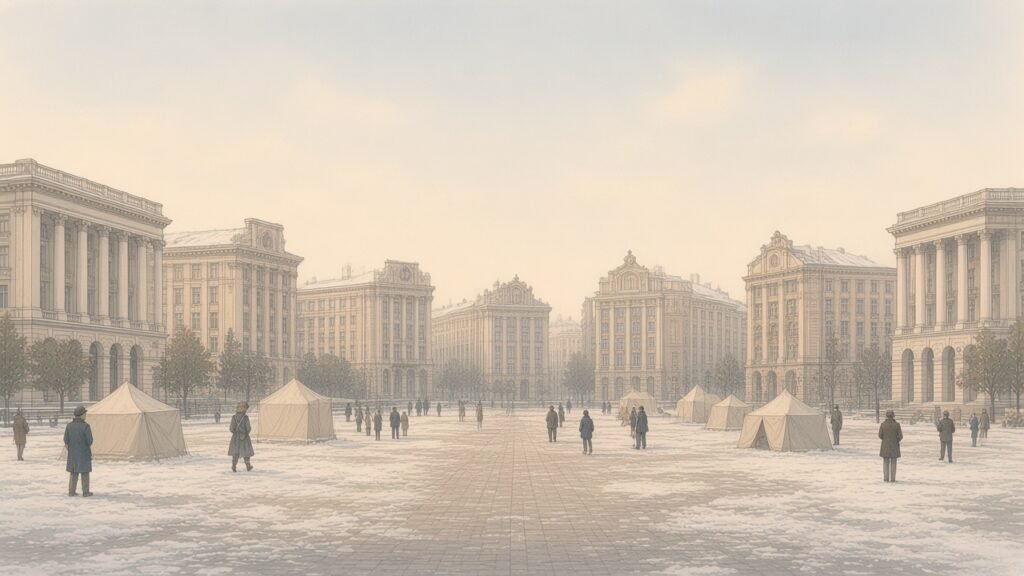
Nine years later the Maidan filled again. In November 2013 President Yanukovych, who had won election in 2010, suspended preparations for an association agreement with the European Union under Russian pressure. Students and young people gathered on the Maidan to protest. When the Berkut special police forcibly dispersed them on the night of 30 November, the demonstration swelled into a mass movement that occupied the square and built a fortified tent city. Through December and January the standoff continued. Negotiations failed. In January 2014 new laws restricting protest radicalised the confrontation. Clashes on Hrushevsky Street and then, in mid-February, on and around the Maidan itself produced dozens of deaths. Snipers killed protesters and policemen. On 21 and 22 February Yanukovych fled, and the parliament voted to remove him. The dead of the Maidan were commemorated as the Heavenly Hundred.[48][49]
The Euromaidan, or Revolution of Dignity, as it came to be called, was more violent and more consequential than the Orange Revolution. It brought to power a pro-European government; it triggered the Russian annexation of Crimea and the war in the Donbas; and it deepened the sense, among a large part of the Kyiv population and of western and central Ukraine, that the country’s future lay with Europe rather than with the Eurasian projects promoted by Moscow. The Maidan itself became a site of memory, with memorials to the dead and an annual calendar of commemoration. The square’s geography — the open space, the surrounding hotels and government buildings, the slope up toward the European Square and down toward Khreshchatyk — was now inscribed with two revolutions within a decade.[47][49]
Critics of the Euromaidan, in Ukraine and abroad, stressed the role of far-right groups in the street fighting, the constitutional irregularities of Yanukovych’s removal and the Western support for the protest movement. Supporters stressed the corrupt and authoritarian character of the Yanukovych presidency, the genuine mass character of the demonstrations and the right of Ukrainians to choose their international alignment. Historians continue to weigh these arguments. What is not in dispute is that Kyiv’s central square had again decided the fate of the country, and that the city would live with the consequences for years to come.[48][49]
The social composition of the Maidan protests has been studied with some care. Surveys of participants in 2013 and 2014 found a mixed crowd of students, professionals, small-business owners and workers, with a strong representation from Kyiv and from western and central Ukraine. Russian-speakers as well as Ukrainian-speakers took part. Far-right organisations were visible and active in the self-defence units, yet they did not constitute a majority of the protesters. The movement’s demands evolved from a narrow call to sign the EU association agreement into a broader call for the removal of Yanukovych, for an end to corruption and for a reconstitution of the political order. The violence of February 2014 radicalised many who had begun as peaceful demonstrators.[48][49]
After the Euromaidan Kyiv’s cityscape absorbed new layers of meaning. Shrines of flowers, candles and photographs marked the places where protesters had fallen. Murals appeared on walls. The annual commemorations on the Maidan became part of the civic calendar. At the same time the war in the east and the annexation of Crimea meant that the victory of the Maidan was inseparable from loss and from a militarisation of public life that the Orange Revolution had not produced. Kyiv in the years between 2014 and 2022 was a capital of a country at war, even when the front was hundreds of kilometres away, and the Maidan was the symbolic centre of that wartime identity.[47][50]
Language and identity shifted measurably after the Euromaidan. Surveys showed rising identification with Ukrainian citizenship across linguistic groups in Kyiv. Ukrainian-language use in public increased. Russian continued to be widely spoken in private and in some professional contexts, but the stigma once attached to Ukrainian in certain elite circles diminished. Street renaming accelerated, replacing Soviet and Russian imperial names with Ukrainian historical and cultural figures. The city’s symbolic landscape was rewritten in real time, even as the war in the east reminded inhabitants that symbolic victories did not by themselves secure the country’s borders.[48][49]
Art and performance flourished on the Maidan itself during both revolutions. Stages hosted musicians, poets and comedians. Improvised galleries displayed placards and paintings. The square became a temporary autonomous zone of cultural production as well as of political demand. Some of that production was ephemeral; some entered museums and anthologies. The aesthetic of the Maidan — tents, tyres, barricades, handmade shields — became an internationally recognised visual language of protest, reproduced in photographs that now stand beside older images of Khreshchatyk and the Lavra in the city’s iconography.[47][48]
Legal and constitutional debates after both revolutions revealed the fragility of Ukraine’s institutional design. The Orange Revolution produced a constitutional reform that weakened the presidency; Yanukovych reversed it; the Euromaidan produced another recalibration. Courts, prosecutors and anti-corruption bodies became arenas of struggle. Kyiv as the seat of these institutions experienced the struggle directly, in the form of demonstrations outside parliament, of press conferences and of the occasional violent incident. Reformers and their opponents shared the same streets and often the same cafés, a proximity that made politics personal as well as programmatic.[47][49]
Memory laws and decommunisation statutes after 2015 changed the city’s nomenclature on a large scale. Lenin monuments fell; streets named for Soviet figures received new designations honouring Ukrainian writers, Cossack leaders or Maidan victims. Supporters saw a necessary break with a totalitarian past; critics saw a selective rewriting that overlooked inconvenient episodes of Ukrainian history. The physical work of replacing signs and statues employed municipal crews for months and gave the city a new semiotic surface that visitors noticed immediately.[48]
Social media shaped the Euromaidan in ways that had not been possible in 2004. Facebook, Twitter and livestreams organised crowds, documented violence and addressed international audiences in real time. The digital archive of the Maidan is vast and still being catalogued. It includes videos of sniper fire, of speeches and of ordinary moments in the tent city. Future historians will have a density of primary source material that no previous Kyiv revolution left behind, together with all the problems of authenticity, selection and overwhelm that such density creates.[49]
Economic grievances intertwined with geopolitical ones on the Maidan. Corruption, selective justice and the ostentation of the Yanukovych family and its associates angered protesters as much as the turn away from the EU. The seized residences and documents of the fleeing elite revealed a scale of private appropriation that confirmed what many had suspected. Anti-corruption demands remained central to post-Maidan politics, even when institutional results lagged behind expectations.[49][48]
17. War and resilience
The Russian annexation of Crimea in March 2014 and the outbreak of war in the Donbas brought conflict to Ukraine on a scale not seen since 1945, though for the first eight years Kyiv itself remained far from the front. The city absorbed internally displaced persons, hosted the political and military command of the Ukrainian state, and became the centre of a volunteer movement that supplied the army with equipment, medical care and moral support. The Minsk agreements of 2014 and 2015 failed to produce a lasting settlement. Casualties mounted in the east. In Kyiv daily life continued, with the war present in news broadcasts, in funerals, in the presence of soldiers on leave and in the renamed streets that erased Soviet and Russian commemorations in favour of Ukrainian ones.[50][51]
On 24 February 2022 the Russian Federation launched a full-scale invasion of Ukraine. Columns advanced on Kyiv from the north, from Belarus, and from the east. The Ukrainian government remained in the capital. President Volodymyr Zelenskyy and his ministers refused offers of evacuation. Territorial defence units, regular forces and volunteers prepared to defend the city. In the first weeks of March Russian troops reached the outskirts, occupied suburbs such as Bucha, Irpin and Hostomel, and subjected the region to shelling and air attack. The battle for Kyiv’s approaches was hard fought. Ukrainian resistance, Western weapons and Russian logistical failures combined to halt the advance. At the end of March Russian forces withdrew from the Kyiv region, leaving behind evidence of killings of civilians that shocked international opinion and hardened Ukrainian resolve.[50][51]
Since the withdrawal Kyiv has lived under the threat of missile and drone attack. Night alerts send residents to metro stations and basements. Strikes have damaged residential buildings, power infrastructure and cultural sites. The city’s population fluctuated as hundreds of thousands fled in the first weeks and as many later returned, joined by displaced persons from the east and south. Municipal services, the metro, schools and hospitals have continued to function under wartime conditions. The economy has adapted to blackouts, conscription and the loss of markets. Cultural life has not ceased; theatres, bookshops and cafés operate between alerts. The war has also accelerated the shift toward Ukrainian language in public life and the removal of remaining Soviet and Russian monuments.[1][51]
As of the mid-2020s Kyiv remains the capital of a country at war, the seat of a government that claims the entire territory of 1991, and a city whose inhabitants have learned to live with air-raid sirens as a fact of daily existence. The hills above the Dnieper, which have seen Mongol horsemen, Polish and Lithuanian governors, Cossack hetmans, imperial officials, revolutionary crowds, German occupiers and Soviet planners, now look out over a capital that has survived another existential test. How the war will end, and what Kyiv will be when it does, lie beyond the scope of a historical survey. What can be said is that the city’s long record of destruction and recovery offers no guarantee of any particular future, only a reminder that Kyiv has been remade many times before.[50][1]
The defence of Kyiv in February and March 2022 will occupy historians for decades. Questions of military preparation, of Western intelligence sharing, of Russian operational failures and of the role of territorial defence volunteers are already the subject of memoirs and preliminary studies. What is clear is that the city’s survival as an unoccupied capital was not inevitable. Had Russian forces seized the Hostomel airport more effectively, or advanced more rapidly down the western approaches, the government might have been forced to flee and the war might have taken a different course. The fact that it did not became a founding episode of a new Ukrainian wartime narrative, with Kyiv as the city that held.[51][50]
Civilian experience of the full-scale war has been varied. Some residents spent weeks in metro stations; some fled abroad and built new lives in Poland, Germany or further west; some stayed and adapted to blackouts, curfews and the sound of generators. Schools shifted to online teaching and then back to classrooms with shelters. The IT sector, already strong before 2022, continued to export services and to contribute tax revenue. Cultural institutions organised concerts in the metro and exhibitions on the war itself. The resilience that foreign observers praised was real, but it coexisted with exhaustion, with grief for the dead and with anxiety about a future that remained radically uncertain.[1][51]
Comparative urban history suggests few parallels for a European capital that has withstood a full-scale assault in the twenty-first century and continued to function as a seat of government. Sarajevo’s siege in the 1990s offers one comparison; the cities of western Europe under aerial bombardment in 1940 to 1945 offer others. Kyiv’s experience combines elements of both with the distinctive features of drone warfare, instant digital communication and a global diaspora that mobilises support from afar. The long-term effects on mental health, on demography and on the built environment will take years to measure. Provisional assessments already note the damage to housing and energy infrastructure, the outflow and partial return of population, and the hardening of civic identity around the experience of shared danger.[51][1]
Energy infrastructure has been a principal target of Russian missile and drone campaigns since late 2022. Kyivans have learned to live with scheduled and unscheduled blackouts, with the hum of generators and with the recalibration of work and sleep around the availability of power. The city’s technical crews repair substations under threat of further strikes. This infrastructural war has no precedent in Kyiv’s earlier sieges, which were fought with different weapons, and it has created a new shared experience that cuts across class and district.[51]
Western military and financial aid has been coordinated in part through embassies and offices in Kyiv. The city’s diplomatic quarter, already important after 1991, became a hub of wartime liaison. Visits by foreign leaders to Kyiv, beginning in the spring of 2022, served as demonstrations of support and as opportunities for negotiation. The logistics of these visits — security, blackouts, air alerts — entered the folklore of the wartime capital. Zelenskyy’s own refusal to leave, summed up in the reported phrase that he needed ammunition rather than a ride, became an element of the city’s wartime mythology, repeated in speeches and on billboards.[50][51]
Reconstruction planning has already begun, even while the war continues. Architects, engineers and international donors discuss the rebuilding of damaged housing, the decentralisation of energy systems and the preservation of historic fabric. Whether these plans will be realised depends on the war’s course and on the governance of the funds involved. Kyiv’s earlier reconstructions — after 1240, after the civil war, after 1943 — offer sobering as well as encouraging precedents. Recovery is possible; it is also slow, contested and never complete.[1]
Municipal leadership under Mayor Vitali Klitschko has shared the wartime stage with the national government, sometimes cooperatively and sometimes in tension over resources and authority. City services — transport, water, heating, emergency repair — have been the municipality’s responsibility under fire. The performance of those services will be one criterion by which Kyivans judge their local government when elections resume. For now, martial law has suspended the normal electoral calendar, and the city’s politics are subordinated to the national war effort.[51][50]
Children growing up in wartime Kyiv have experienced childhoods organised around shelters, online schooling and the absence of parents at the front or abroad. Child psychologists and teachers report elevated anxiety and disrupted development, alongside striking adaptability. The long-term consequences for this generation will form a chapter of Kyiv’s history that is only now beginning. Schools have tried to maintain rituals of normality — concerts, examinations, graduation ceremonies — as acts of defiance as well as of education.[51]
Diaspora Kyivans — those who left in 2022 and those who left earlier — have organised fundraising, lobbying and cultural events in cities across Europe and North America. Their connection to the capital remains strong, sustained by video calls, by visits when possible and by the shared consumption of Ukrainian media. The wartime diaspora is both a loss of population for Kyiv and an extension of the city’s networks into the world, a dual character that earlier emigrations also possessed.[51]
18. Places and legacy
The historical geography of Kyiv is best read on foot, from the upper town to the river. The Starokyiv hill still holds the foundations of the Church of the Tithes and the surviving fabric of Saint Sophia, whose mosaics and frescoes are among the great monuments of medieval European art. The Golden Gate, reconstructed in the twentieth century, marks the line of Yaroslav’s walls. Nearby, the street plan preserves the memory of the princely capital even where the buildings are later. To the south the Pechersk hills carry the Lavra, with its cave churches, its bell tower and its ensemble of baroque cupolas, a complex that has been a monastery, a museum and again a monastery, and that remains a place of pilgrimage and of jurisdictional dispute within Orthodoxy. Between and below these heights the Podil retains the grid of a trading quarter, with contracts square, churches and the river port that first made the site important.[12][14]
Khreshchatyk and the Maidan form the modern ceremonial centre. The postwar Stalinist avenue and the open square at its upper end have been the stage of official parades and of the two Maidan revolutions. Memorials to the Heavenly Hundred stand near the sites of the 2014 shootings. Further out, Babyn Yar remains a place of mourning, now with monuments that acknowledge Jewish, Ukrainian, Roma and other victims, though the forms of remembrance have themselves been contested. The left bank, with its Soviet housing estates and its newer developments, represents the city of the twentieth and twenty-first centuries, less visited by tourists but home to a large part of the population. The metro binds the two banks together and doubles as a shelter in wartime.[40][42]
Kyiv’s legacy is multiple and disputed. For Russian imperial and Soviet tradition it was the mother of Rus cities, the baptismal font of a shared East Slavic civilisation whose centre later moved to Moscow. For modern Ukrainian nationhood it is the ancient and the modern capital, the city of the Rada and of the Maidan, the symbol of a distinct people with a distinct history. For Jews it is a place of deep communal roots and of catastrophic destruction at Babyn Yar. For Poles and Lithuanians it is a former eastern city of the Commonwealth. These claims overlap and conflict in the monuments, the street names and the schoolbooks. The historian cannot adjudicate them all, but can note that the city’s physical and documentary record is rich enough to sustain serious inquiry from many directions.[2][1]
What endures, beyond the arguments of nations, is the site itself: the hills, the river, the layered stones of churches and the broad streets of the modern capital. Kyiv has been built, burned and rebuilt for more than a thousand years. Its archives, its excavated foundations and its living communities continue to yield evidence for the long story that this special feature has sought to outline. The timeline that follows gathers the principal dates; the references point to sources from which a fuller understanding may be drawn.[1]
For the student of urban history Kyiv offers a case of unusual richness. Few cities have been the capital of a medieval empire, a provincial town of several successive states, a revolutionary battleground, a Soviet republic’s showpiece and the capital of a new nation-state, all while remaining on the same hills above the same river. The archival record, though damaged by war and ideology, is substantial. The archaeological record continues to expand with every excavation in the historic core. The living city, for all the destruction of 1941 to 1943 and of the present war, preserves street lines, monuments and place names that allow the past to be traced in the present.[2][1]
This special feature has necessarily simplified a complex story. Whole subjects — the history of women in Kyiv, the full texture of Jewish life before the Holocaust, the architectural history of the baroque and of modernism, the environmental history of the Dnieper — deserve separate treatment. The references below point toward some of the sources from which those treatments can begin. The timeline that precedes them offers a bare chronology as a guide through the centuries. If the essay has a single argument, it is that Kyiv’s history is best understood as a long sequence of reinventions under pressure, each of which has left marks that later reinventions have had to accommodate or erase. The city that stands on the Dnieper hills today is the sum of those marks, and of the silences between them.[1]
The title of this special feature, The Hills of Kyiv, is meant to recall the physical constant that underlies the political changes. Empires have come and gone; the hills and the river remain. From those hills the traveller still sees the Dnieper spreading toward the horizon, as Volodymyr’s subjects and Yaroslav’s builders and the pilgrims of the Lavra and the demonstrators of the Maidan have seen it. The view has been interrupted by smoke and by scaffolding and by the walls of new districts, but it has not been abolished. To write the history of Kyiv is, in the end, to write the history of what successive generations have done on those hills and in their shadow, and of how they have remembered or forgotten those who came before.[1][2]
The references that close this feature include encyclopaedia articles, museum resources and books that can be pursued by any reader who wishes to go further. They are necessarily selective. The historiography of Kyiv is vast and is written in Ukrainian, Russian, Polish, English and other languages. No single essay can command it all. What such an essay can do is to offer a continuous narrative, grounded in established facts and open about its limits, that allows the reader to place the city of the present in the deep context of its past. That has been the purpose of the pages above.[1]
A final word is owed to the ordinary inhabitants whose names do not appear in chronicles or presidential decrees. The boatmen of the Podil, the monks of the Lavra, the Jewish artisans of the pre-1914 workshops, the women who queued in the 1930s, the soldiers who defended the approaches in 1941 and in 2022, the teachers who kept schools open between air raids — these are the people who have made Kyiv a living city rather than a collection of monuments. Their aggregated choices, more than any single decree, explain why the hills above the Dnieper are still inhabited, still contested and still worth describing at length.[2][1]
The Hills of Kyiv, as a title and as a theme, returns the reader to the physical fact with which this essay began. Everything else — dynasties, religions, ideologies, armies — has passed over those hills like weather. The weather has sometimes been catastrophic. Yet after each storm the hills have still been there, and people have still chosen to live on them. That choice, renewed across more than a millennium, is the deepest fact in the history of the city, and the one most likely to hold for the century to come.[1]
Future research will benefit from the digitisation of archives, from oral-history projects conducted during and after the present war, and from the opening of Soviet-era collections that remain only partly explored. The historiography of Kyiv is not closed. It is expanding under the pressure of events, as it has done after every previous catastrophe. Readers of this special feature are invited to treat it as a starting point rather than as a final word.[1][2]
The essay ends, as it began, with the river. The Dnieper has carried longships, grain barges, gunboats and tourist steamers. It has frozen, flooded and been dammed. It has received the baptised, the drowned and the ashes of the dead. It is older than the city and will likely outlast any particular political order that claims the hills above it. To stand on those hills and look at the water is to see the one continuity that requires no footnote and no citation. Everything else in this special feature is an attempt to explain what human beings have done in the presence of that view.[3][1]
19. Timeline
According to later tradition the brothers Kyi, Shchek and Khoryv and their sister Lybid founded a town on the Dnieper hills.
A Rus fleet associated with the Kyiv rulers Askold and Dir attacked Constantinople, announcing a new power on the Dnieper.
The Varangian prince Oleg seized Kyiv and made it the capital of a Rus realm stretching along the river route to the Black Sea.
Volodymyr accepted Byzantine Christianity and ordered the baptism of the people of Kyiv in the Dnieper.
Yaroslav the Wise founded the cathedral of Saint Sophia and strengthened the fortifications of the upper town, including the Golden Gate.
The Kyiv Cave Monastery was founded on the southern hills and became the principal spiritual centre of Rus.
Batu Khan's forces stormed Kyiv, massacred much of the population and ended the city's role as capital of a great state.
After the Battle of the Blue Waters Kyiv passed under the Grand Duchy of Lithuania, beginning centuries of western orientation.
Kyiv and the surrounding lands were transferred to the Polish Crown within the new Polish-Lithuanian Commonwealth.
Bohdan Khmelnytsky entered Kyiv during the Cossack uprising that overturned Commonwealth control of the region.
The Hetmanate placed itself under Muscovite protection, drawing Kyiv into the orbit of the tsars.
The Eternal Peace between Russia and Poland confirmed Russian possession of Kyiv.
The University of Saint Vladimir opened and made Kyiv a major centre of imperial higher education.
The Central Rada, the Hetmanate, the Directory, Bolsheviks, Whites and Poles contested Kyiv in rapid succession.
The man-made famine killed millions in the Ukrainian countryside and drove starving peasants toward Kyiv.
The capital of the Ukrainian SSR was transferred from Kharkiv to Kyiv.
German forces occupied Kyiv; more than 33,000 Jews were shot at Babyn Yar on 29 and 30 September.
Soviet forces retook Kyiv in November after costly fighting across the Dnieper.
Ukraine proclaimed independence in Kyiv; a December referendum confirmed it with an overwhelming majority.
Mass protests on the Maidan forced a re-run of a fraudulent presidential election.
Protests against Yanukovych's rejection of an EU agreement ended in his flight and in Russian aggression in Crimea and the Donbas.
Russian forces advanced on Kyiv in February and were driven back from the region's outskirts by the end of March.
References
- Grokipedia, “Kyiv” ↩
- Encyclopedia of Ukraine, “Kyiv” ↩
- Grokipedia, “Dnieper” ↩
- Grokipedia, “Primary Chronicle” ↩
- Grokipedia, “Askold and Dir” ↩
- Grokipedia, “Oleg” ↩
- Grokipedia, “Kievan Rus’” ↩
- Grokipedia, “Olga of Kiev” ↩
- Grokipedia, “Sviatoslav I” ↩
- Grokipedia, “Vladimir the Great” ↩
- Grokipedia, “Christianization of Kievan Rus’” ↩
- Grokipedia, “Yaroslav the Wise” ↩
- Grokipedia, “Saint Sophia Cathedral, Kyiv” ↩
- Grokipedia, “Kyiv Pechersk Lavra” ↩
- Grokipedia, “Andrey Bogolyubsky” ↩
- Grokipedia, “Mongol invasion of Kievan Rus’” ↩
- Grokipedia, “Batu Khan” ↩
- Grokipedia, “Grand Duchy of Lithuania” ↩
- Grokipedia, “Polish - Lithuanian Commonwealth” ↩
- Encyclopedia of Ukraine, “Kyivan Rus’” ↩
- Grokipedia, “Magdeburg rights” ↩
- Grokipedia, “Bohdan Khmelnytsky” ↩
- Grokipedia, “Pereiaslav Agreement” ↩
- Encyclopedia of Ukraine, “Pereiaslav Treaty of 1654” ↩
- Grokipedia, “Khreshchatyk” ↩
- YIVO Encyclopedia, “Kiev” ↩
- Grokipedia, “Taras Shevchenko” ↩
- Grokipedia, “Podil” ↩
- Grokipedia, “Mykhailo Hrushevsky” ↩
- Grokipedia, “Mikhail Bulgakov” ↩
- Serhii Plokhy, The Gates of Europe: A History of Ukraine (Basic Books, 2015) ↩
- Grokipedia, “Ukrainian People’s Republic” ↩
- Grokipedia, “Cossacks” ↩
- Grokipedia, “Ukrainian Soviet Socialist Republic” ↩
- Grokipedia, “Golden Gate, Kyiv” ↩
- Grokipedia, “Holodomor” ↩
- Encyclopedia of Ukraine, “Holodomor” ↩
- United States Holocaust Memorial Museum, Holocaust Encyclopedia, “Kiev” ↩
- United States Holocaust Memorial Museum, Holocaust Encyclopedia, “Kiev and Babi Yar” ↩
- Grokipedia, “Babi Yar” ↩
- Encyclopedia of Ukraine, “Babyn Yar” ↩
- Grokipedia, “Kyiv Metro” ↩
- Grokipedia, “Chernobyl disaster” ↩
- Grokipedia, “Declaration of Independence of Ukraine” ↩
- Grokipedia, “Leonid Kravchuk” ↩
- Grokipedia, “Revolution on Granite” ↩
- Grokipedia, “Orange Revolution” ↩
- Grokipedia, “Euromaidan” ↩
- Grokipedia, “St Andrew’s Church, Kyiv” ↩
- Grokipedia, “Russo-Ukrainian War” ↩
- Serhii Plokhy, The Russo-Ukrainian War: The Return of History (W. W. Norton, 2023) ↩