Chagall of Vitebsk
Marc Chagall was born Moyshe Shagal in Vitebsk, in the north-eastern Pale of Settlement of the Russian Empire, on 7 July 1887 according to the Gregorian calendar then used in western Europe, and he died at Saint-Paul-de-Vence in the south of France on 28 March 1985. Between those dates he moved from a Yiddish-speaking provincial city through Saint Petersburg, Paris, revolutionary Vitebsk, Moscow, Berlin, New York and the French Riviera, and he became one of the most widely recognised painters of the twentieth century. His images of floating lovers, village roofs and musicians drew on the streets and courtyards of his childhood even when he lived far from them, and they entered the public imagination of modern art more thoroughly than the work of many of his contemporaries. [1][2][3]
This special feature follows that life in chapter order. It begins with Vitebsk and the household of a herring clerk and a small shopkeeper, then traces Chagall’s first lessons with Yehuda Pen, his difficult years in Saint Petersburg, and his arrival in Paris in 1911 among the studios of La Ruche. Later chapters turn to his marriage to Bella Rosenfeld, his appointment as arts commissar in Vitebsk after the Revolution, the conflict with Malevich’s Suprematism, the murals for the Moscow Yiddish theatre, and the return to Paris under the patronage of Ambroise Vollard. The closing chapters describe exile in the United States during the Second World War, Bella’s death, the late stained-glass commissions, and the long afterlife of his reputation. An interactive timeline at the end of the essay gathers the principal dates. [4][5]
Across the references assembled at the end of this feature, the reader will find encyclopaedia articles from YIVO and Grokipedia, museum biographies, and the major narrative lives by Harshav and Wullschläger. Those sources do not always agree on emphasis. Harshav stresses the documentary and linguistic texture of Chagall’s world; Wullschläger offers a continuous story for the general reader; the museum biographies compress the arc into a public chronology. Used together, they permit a checked narrative of the kind attempted here. [5][6][4][2]
The paintings themselves remain the primary documents. Anyone who stands before the early Vitebsk canvases, the theatre designs as reconstructed in photographs, or the late windows in Jerusalem can test the claims of biography against the evidence of the eye. That test is open to every visitor. It is the most democratic legacy an artist can leave. [1][7]
1. A childhood in Vitebsk
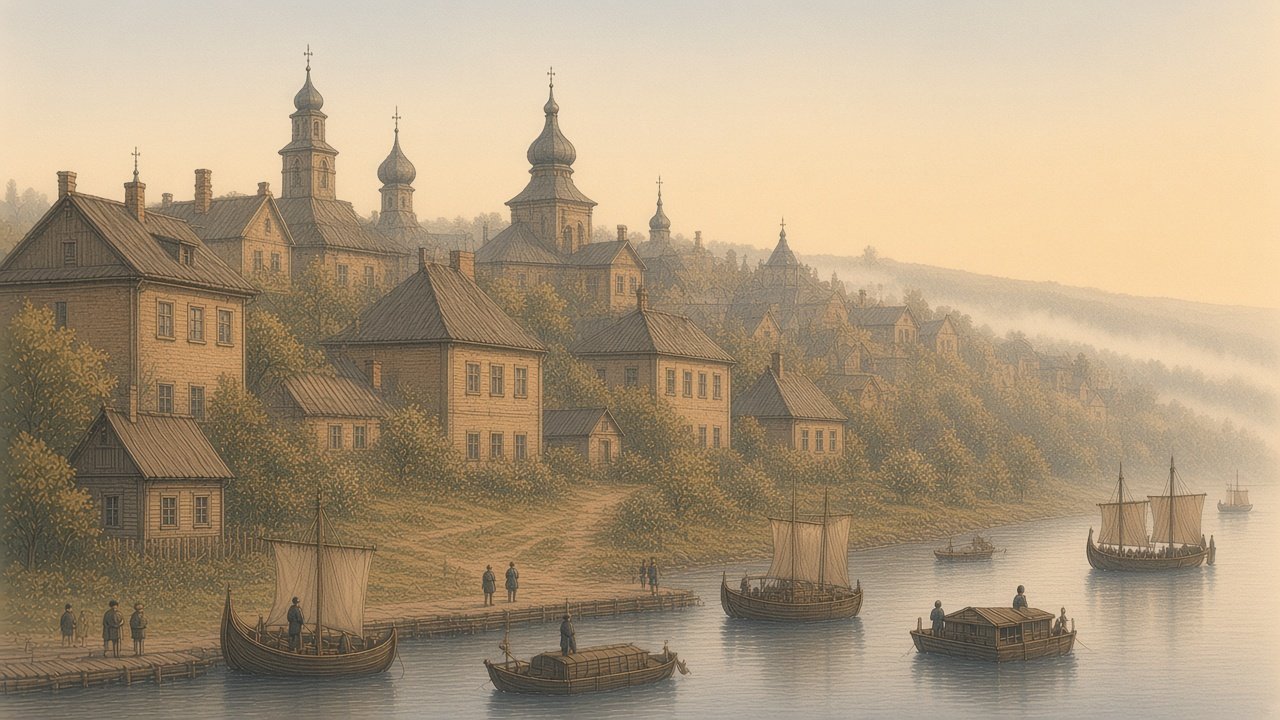
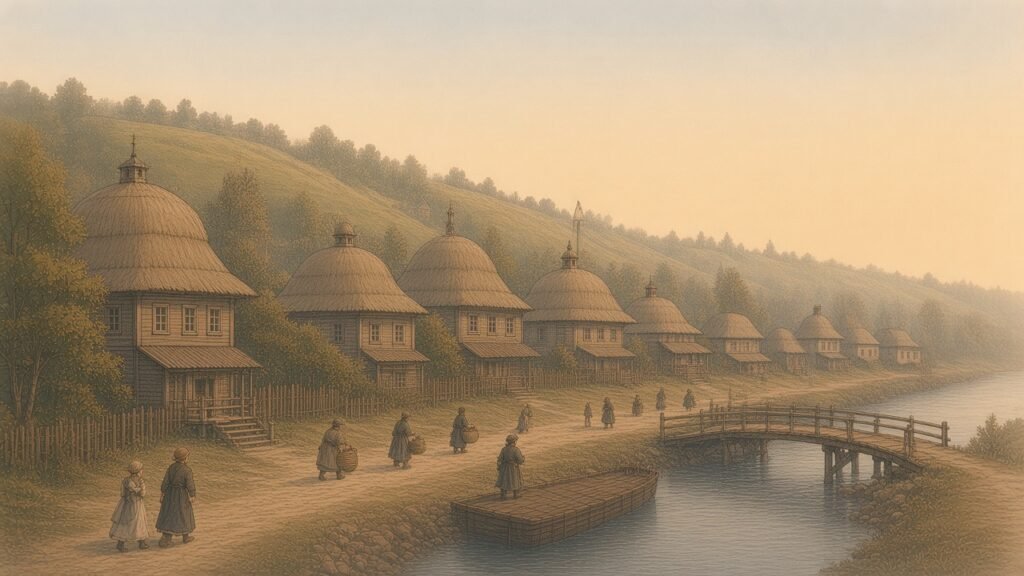
Vitebsk stood on the Western Dvina at the point where the river turned north towards the Baltic, a provincial capital of some tens of thousands of inhabitants by the later nineteenth century and one of the larger Jewish centres of the northern Pale. Jews formed a substantial share of the city’s population, and Yiddish was the language of the streets, the market and the home. The town’s wooden houses, courtyards, onion-domed churches and low warehouses along the river supplied the visual stock from which Chagall would draw for the rest of his life. [3][8][2]
His father, Khatskel (Zakhar) Shagal, worked as a clerk and labourer in a herring warehouse on the river bank, a hard and poorly paid occupation that left him exhausted and silent in the evenings. His mother, Feiga-Ita, kept a small grocery shop on the ground floor of the family’s house on Pokrovskaia Street and managed the household of what would become nine children, of whom Moyshe was the eldest. Both parents came from Liozno, a small town east of Vitebsk associated with the early history of Lubavitch Hasidism, and the family retained ties of kinship and visit to that place. [2][6][5]
The boy attended heder from about the age of four until thirteen, learning Hebrew prayers and the rudiments of biblical text in a language and a pedagogical style that he later remembered as rigid and fearful. At home the speech was Yiddish, and the calendar of the year was that of the Jewish festivals, punctuated by the market days of a provincial trading town. The family’s circumstances were modest rather than destitute, but they were far from the world of academies and salons. Painting as a profession was scarcely imaginable within that milieu, and Chagall’s own later accounts of his childhood stress both the richness of its imagery and the poverty of its opportunities. [1][2]
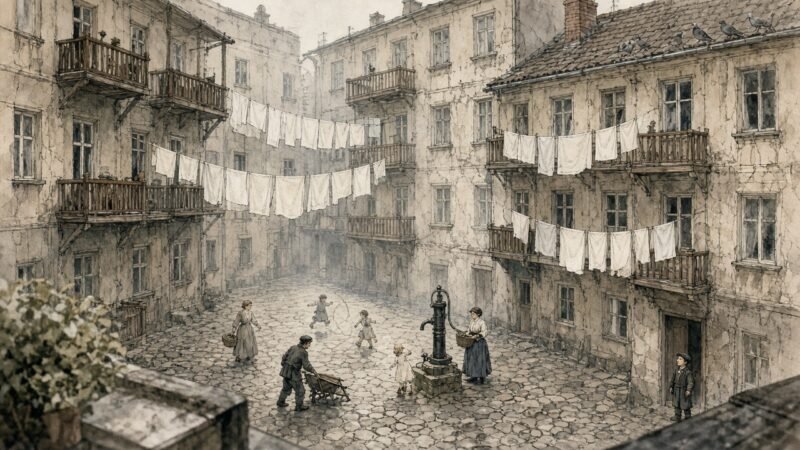
Vitebsk itself was neither a backwater nor a metropolis. It lay close enough to the railway and to the Russian capitals to feel the pull of modern commerce, yet it remained a city of wooden streets, courtyards shared by several families, and a dense Jewish quarter whose synagogues, prayer houses and charitable societies organised much of daily life. Photographers and lithographers of the period recorded its bridges, its market square and the low skyline of roofs that Chagall would later rearrange in paint into a personal geography. Those images, rather than any single documented view, formed the visual memory that he carried to Paris and beyond. [3][7]
The Pale of Settlement, within which Vitebsk lay, confined the great majority of the empire’s Jews to the western provinces and subjected them to residence restrictions, educational quotas and periodic violence. The May Laws of 1882 and the quotas introduced later in the decade limited Jewish access to secondary schools and universities, while the pogroms of 1881 to 1882 and of 1903 to 1906 marked the insecurity of Jewish life under the late empire. Chagall’s childhood coincided with this tightening of legal and social constraints, even as a Yiddish press, theatre and literature were beginning to create a modern secular culture within the same population. [8][2]
Within that setting the boy’s earliest drawings were made on scraps of paper and in the margins of schoolbooks. Relatives and neighbours regarded the impulse as odd. His mother, according to his later recollection, eventually allowed him to pursue it, and it was she who arranged for him to meet the local painter whose studio would open the first door. The decision was practical as well as affectionate. In a household of many children, a trade that might lead to a living was preferable to none, and painting, however irregular, was at least a craft. [6][5]
The streets that Chagall remembered were not museum streets. They smelled of herring, of horse dung and of the damp wood of unpainted fences. Market days brought peasants from the surrounding countryside into the Jewish trading streets, and the contact between languages and costumes furnished the mixed world that his later pictures would rearrange. Winter closed the river with ice; spring floods threatened the lower banks. The calendar of Jewish observance structured the year more tightly than any civic festival. [3][8]
Neighbours included craftsmen, small traders and the poorer clerks of the railway and the warehouses. Hasidic and misnagdic congregations divided the town’s religious life, and the boy’s family belonged to the broad traditional world rather than to any single charismatic court, though the Liozno connection kept Lubavitch in the background of family talk. Literacy in Hebrew for prayer and in Russian for the empire’s requirements coexisted with Yiddish as the language of feeling and joke. [2][5]
The Dvina at Vitebsk carried timber, grain and the flat barges of a river trade that linked the town to Polotsk and, beyond the cataracts and portages, to wider Baltic routes. Children played on the banks in summer; in winter the ice became a road. Chagall’s later paintings of bridges and boats compress that geography into a few emblematic shapes, but the lived experience was muddy, cold and ordinary. The synagogue interiors he remembered were lit by candles and oil lamps, crowded on festivals, and filled with the sound of Hebrew prayer over Yiddish conversation at the door. Nothing in that world predicted a career in the Parisian avant-garde, which is precisely why the career, when it came, returned so obsessively to its source. [3][8][2]
2. Pen and the first lessons
Yehuda (Yuri) Pen kept a private art school in Vitebsk that served as the principal training ground for Jewish youths from the surrounding provinces who wished to draw and paint. Pen had studied at the Imperial Academy in Saint Petersburg and returned to Vitebsk to teach a careful, academic realism grounded in portraiture, still life and the observation of local types. His studio admitted students who could not have entered the state academies under the Jewish quotas, and it became a small but consequential institution in the cultural life of the city. [9][2]
Chagall entered Pen’s school around 1906, after his mother had taken him to the studio and after a brief period of hesitation on both sides. The tuition was modest, and the teaching emphasised draughtsmanship from the model and from plaster casts, the mixing of colour, and the copying of earlier work. Chagall’s own temperament pulled against the discipline of academic finish. He preferred memory and invention to the sustained study of a posed figure, and Pen’s corrections, though kindly meant, often frustrated him. Yet the school gave him the first continuous practice of his hand and the first company of other young people who intended to become artists. [9][6]
Among those who passed through Pen’s studio in these years were several who would later be associated with the Jewish and Russian avant-garde, including El Lissitzky, who as a boy in Vitebsk also took lessons from Pen. The school thus formed a local network that would reconvene, under very different circumstances, when Chagall returned to Vitebsk as arts commissar after the Revolution. For the moment, however, the horizon of ambition pointed towards Saint Petersburg, where further study and the chance of exhibition seemed to lie. [9][10][11]
Leaving Vitebsk required money, papers and a measure of resolve. Chagall’s mother sold household goods and borrowed to raise the fare. The young man arrived in the capital with little more than a portfolio and letters of introduction, and he soon discovered that the city’s academies and schools were closed to him by the Jewish percentage norms that governed admission. He studied for a time at the school of the Imperial Society for the Encouragement of the Arts, and later in the studio of Léon Bakst and Mstislav Dobuzhinsky, where the atmosphere was more open to modern tendencies and to students of Jewish origin who had found a way in. [2][5]
Bakst, himself of Jewish background and already known for his work with Diaghilev’s Ballets Russes, recognised something in Chagall’s drawings and encouraged him, while also warning him that Paris, not Petersburg, was the place for a painter of his gifts. The advice lodged. Chagall’s years in the capital were marked by poverty, police surveillance of Jews living outside the Pale without proper permits, and a growing conviction that his own imagery—drawn from Vitebsk rather than from classical or Impressionist models—required a different city in which to develop. [1][6]
He returned periodically to Vitebsk, and it was there, around 1909, that he met Bella Rosenfeld, the daughter of a prosperous local jeweller. Bella had been educated in Moscow and moved with ease between Yiddish, Russian and the manners of a provincial bourgeoisie more comfortable than Chagall’s own family. Their attachment was immediate and lasting. She became the central human presence in his art for the next three and a half decades, appearing as bride, companion and muse in paintings that treated love as a subject equal to landscape or religion. The engagement was not quickly ratified by her family, who doubted the prospects of a penniless painter, but the bond held. [12][2]
By 1910 Chagall had determined to go to Paris. A stipend arranged through a Vitebsk patron and the sale of a few works provided the means. He left Russia with the intention of returning, and with Bella’s understanding that their future would be settled when he had established himself. The journey west was the decisive break of his early life. [4][5]
Pen’s own paintings of Vitebsk types—rabbis, artisans, market women—offered a local realist precedent that Chagall both absorbed and refused. He learned to construct a head and a hand, then used that knowledge to invent rather than to document. Fellow students remembered his jokes, his thinness and his absolute conviction that he would become a painter of consequence. The studio’s plaster casts and oil-stained floors were the first academy he trusted. [9][6]
When he left for Petersburg, Pen gave him advice and, according to some accounts, a measure of blessing. The relationship survived the later political storms; Pen taught again in the People’s Art School under Chagall’s directorship, a symmetry that pleased them both until Malevich’s arrival altered the balance of power. [9][13]
Across the references assembled at the end of this feature, the reader will find encyclopaedia articles from YIVO and Grokipedia, museum biographies, and the major narrative lives by Harshav and Wullschläger. Those sources do not always agree on emphasis. Harshav stresses the documentary and linguistic texture of Chagall’s world; Wullschläger offers a continuous story for the general reader; the museum biographies compress the arc into a public chronology. Used together, they permit a checked narrative of the kind attempted here. [5][6][4][2]
The paintings themselves remain the primary documents. Anyone who stands before the early Vitebsk canvases, the theatre designs as reconstructed in photographs, or the late windows in Jerusalem can test the claims of biography against the evidence of the eye. That test is open to every visitor. It is the most democratic legacy an artist can leave. [1][7]
3. Petersburg and the academy
Saint Petersburg at the end of the first decade of the twentieth century was a city of sharp contrasts for a young Jew from the Pale. The imperial capital offered museums, theatres and a density of artistic debate unmatched elsewhere in the empire, yet the residence laws that governed Jews outside the Pale made every month precarious. Chagall lived in cheap rooms, took odd jobs, and moved between schools that would accept him for a term and those that would not. The drawings he made in these years already showed the compressed space, the tilted perspective and the reliance on memory that would mark his mature work. [2][5][1]
At the school of the Imperial Society for the Encouragement of the Arts he received a more systematic grounding in drawing than Pen had been able to give, but the atmosphere remained academic. The studio of Léon Bakst and Mstislav Dobuzhinsky, which he entered later, exposed him to the decorative and theatrical modernism associated with the World of Art group and with Diaghilev’s enterprises. Bakst’s advice that he should go to Paris confirmed a direction already latent in Chagall’s own restlessness. The capital’s collections, especially the paintings he saw in private galleries that showed French work, sharpened his sense that colour and form could be treated with a freedom unknown in Vitebsk. [6][7]
Police regulation of Jewish residence meant that Chagall, like many others, lived under the threat of expulsion. He was detained more than once for lacking the proper papers, and the experience of bureaucratic humiliation entered his later recollections of the city. At the same time Petersburg gave him his first sustained contact with Russian literary modernism and with a circle of Jewish intellectuals who were translating the debates of western Europe into the languages of the empire. The combination of constraint and stimulus left him eager to leave. [2][5]
His returns to Vitebsk during these years renewed the attachment to Bella Rosenfeld and to the imagery of the provincial streets. He painted and drew the town from memory even while living in the capital, treating its roofs, fences and figures as a portable world. The double life—provincial memory and metropolitan ambition—became the structural principle of his art. When the opportunity to reach Paris finally arrived in 1910, he took it without intending a permanent exile, yet the journey marked the end of his formation as a Russian provincial student and the beginning of his career as an international painter. [12][4]
The portfolio he carried west contained studies that already announced his difference from Cubism, Fauvism or any single school. Animals, musicians, rabbis and lovers appeared in spaces that obeyed emotional rather than optical logic. Critics in Paris would later struggle to place him within the available categories, and that difficulty began in the Petersburg years, when he refused both the academic finish of the schools and the programmatic modernism of the capital’s avant-garde factions. [1][14]
The World of Art milieu, with its interest in theatre, book design and the decorative arts, offered Chagall a model of the artist as more than an easel painter. Bakst’s costumes and Dobuzhinsky’s cityscapes suggested that modern form could serve public spectacle. Chagall’s later work for Granovsky’s theatre and for the ballet drew on that lesson as much as on Parisian Cubism. [5][15]
Jewish life in the capital was itself stratified. There were wealthy converts and professionals who moved in Russian society; there were impoverished students from the Pale living three to a room; there were political radicals under police watch. Chagall brushed against several of these worlds without fully belonging to any. His true loyalty remained to the imagery forming in his sketchbooks. [2][1]
Across the references assembled at the end of this feature, the reader will find encyclopaedia articles from YIVO and Grokipedia, museum biographies, and the major narrative lives by Harshav and Wullschläger. Those sources do not always agree on emphasis. Harshav stresses the documentary and linguistic texture of Chagall’s world; Wullschläger offers a continuous story for the general reader; the museum biographies compress the arc into a public chronology. Used together, they permit a checked narrative of the kind attempted here. [5][6][4][2]
The paintings themselves remain the primary documents. Anyone who stands before the early Vitebsk canvases, the theatre designs as reconstructed in photographs, or the late windows in Jerusalem can test the claims of biography against the evidence of the eye. That test is open to every visitor. It is the most democratic legacy an artist can leave. [1][7]
4. First years in Paris
Chagall arrived in Paris in 1910 and settled among the artists’ studios of Montparnasse and the nearby complex known as La Ruche, the circular hive of cheap ateliers built from materials salvaged from the 1900 Exposition Universelle. The city overwhelmed him with its museums, its light and its concentration of painters from across Europe. He worked with a ferocity that companions remembered, producing canvases in which the motifs of Vitebsk were restated in a heightened, sometimes acidic colour influenced by his encounters with van Gogh, Gauguin, Matisse and the Cubists. [1][14][2]
He enrolled briefly at academies and spent long hours in the Louvre, copying and absorbing. The Cubist experiments of Picasso and Braque interested him as a liberation of form, yet he never adopted their analytical fragmentation as a programme. Instead he used broken planes and tilted perspectives to serve narrative and memory. Robert Delaunay’s Orphism, with its emphasis on colour and circular rhythm, left a clearer mark on certain canvases of 1911 to 1912. Apollinaire, who visited his studio, wrote appreciatively of the work and helped to introduce him to a wider circle. [6][5]
Poverty remained acute. Chagall lived on little, stretched canvases himself, and sent drawings and paintings back to Russia when he could find a buyer. The dealers and collectors of Paris were not yet ready to sustain him. Nonetheless the years 1911 to 1914 produced some of the works later regarded as central to his oeuvre, including compositions in which a Vitebsk street floats above or beside a Parisian motif, as if the two cities occupied the same imaginative space. [7][4]
He exhibited at the Salon des Indépendants and the Salon d’Automne, where his pictures stood apart from both the Cubist rooms and the more conservative sections. Reviewers noticed the folklore, the animals and the dream logic. For Chagall the Parisian sojourn was never an abandonment of Vitebsk. Letters and later memoirs insist that he painted his hometown more intensely while living in France than he had done while walking its streets. The exile of the provincial Jew in the modern metropolis became, in his hands, a source of imagery rather than a wound to be concealed. [2][1]
By the summer of 1914 he had arranged to return to Vitebsk for what he expected to be a short visit, to see Bella and his family and to exhibit in Berlin on the way. The outbreak of war in August trapped him in Russia. The first Parisian period thus closed abruptly, leaving behind a body of work that would later secure his reputation and a network of contacts that he would renew only after the Revolution and the civil war had run their course. [5][6]
The Parisian light altered his palette. Compared with the browns and muted tones of his Russian studies, the canvases of 1911 to 1914 blaze with greens, reds and yellows that owe something to the Fauves and something to his own temperament. He painted the view from his window, the cattle marketed near La Ruche, and, obsessively, the remembered streets of Vitebsk. Dealers who visited the studio were often puzzled; poets were more quickly convinced. [14][7]
Letters to Bella from these years mix love, ambition and accounts of meals missed or scraped together. He was not yet the celebrated figure of the post-war decades. He was one among dozens of gifted foreigners trying to survive in Montparnasse, distinguished chiefly by the stubborn oddity of his subject matter. [12][6]
Dealers such as Herwarth Walden in Berlin showed his work before the war, giving him a German public that would later be destroyed or scattered by Nazism. The first Parisian period thus already had a triangular geography—Vitebsk, Paris, Berlin—that the rest of his life would elaborate. Apollinaire’s essays and the conversations in cafés mattered as much as any single exhibition for the formation of his self-understanding as a modern painter. He learned to speak of his art in the language of feeling that French criticism rewarded, while continuing to dream in Yiddish. [1][5][14]
Among the canvases of 1912 and 1913 are works in which a self-portrait with seven fingers, a homage to folk counting and to painterly dexterity, announces a playful autobiography. He was constructing a persona as well as a style: the provincial visionary in the metropolis. That persona would outlast Cubism’s moment and Surrealism’s, because it was attached to a biography that history itself would make exemplary. [7][6]
5. La Ruche and the avant-garde
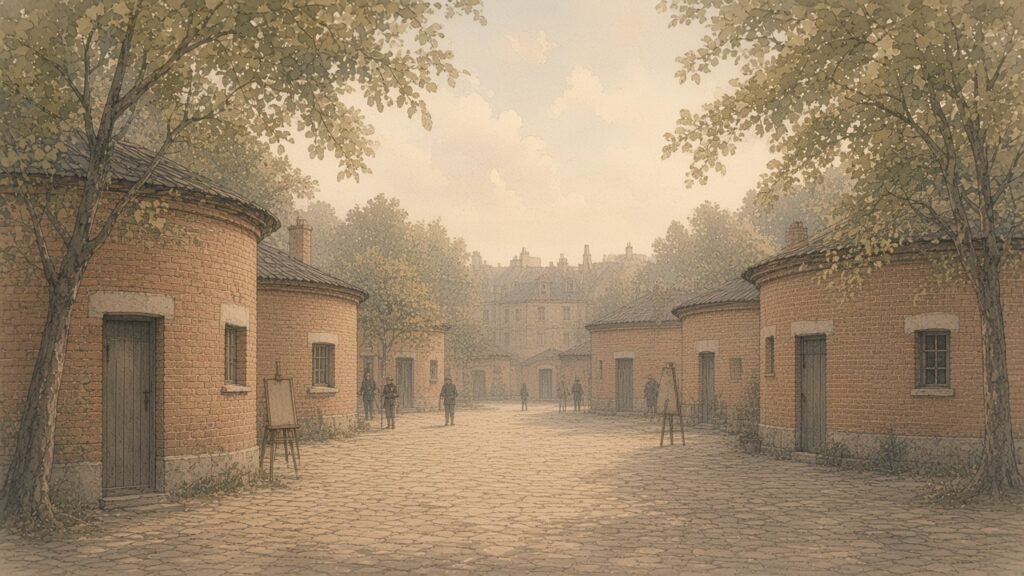
La Ruche, on the passage de Dantzig in the fifteenth arrondissement, housed an extraordinary concentration of immigrant artists in the years before the First World War. Sculptors and painters from eastern Europe, Italy and elsewhere occupied the wedge-shaped studios at rents they could afford, sharing a canteen, a sense of precarious community and the proximity of the slaughterhouses of Vaugirard. Chagall’s neighbours and acquaintances in this milieu included, at various times, figures who would define the so-called School of Paris, among them Amedeo Modigliani, Chaïm Soutine, Jacques Lipchitz and others whose paths crossed in Montparnasse cafés and in the corridors of the hive. [14][16][1]
The name School of Paris, applied retrospectively, designated not a style but a demographic and social fact: the gathering in Montparnasse of foreign-born artists who exhibited in the same salons, sold through overlapping dealers and drank in the same cafés. Many were Jews from the Russian Empire or from central Europe. Yiddish and Russian were heard as often as French in some studios. Chagall’s own French remained imperfect for years, and his social world was partly that of the eastern Jewish immigration. [14][2]
Within this setting he developed the personal iconography that would make him famous. The fiddler on the roof, the cow and the rooster, the floating bride and groom, the rabbi and the village street entered his canvases not as ethnographic illustration but as elements of a private mythology. Critics then and later debated how far these motifs derived from Hasidic folklore, how far from the theatrical modernism of the World of Art, and how far from pure invention. Chagall himself resisted programmatic explanation, insisting on the primacy of feeling and memory. [5][7]
The avant-garde around him was fragmenting into Cubism, Futurism, Orphism and other isms. Chagall borrowed devices—faceting, simultaneous views, non-natural colour—without joining a faction. Apollinaire’s support mattered; so did the interest of poets and critics who saw in his work a bridge between popular Jewish themes and modernist form. Dealers remained cautious. Sales were few, and the painter’s survival depended on small advances, the occasional portrait commission and help from home. [6][1]
When he left for Vitebsk in 1914, La Ruche and Montparnasse had nonetheless given him a peer group, a public and a sense of himself as a modern painter rather than a provincial student. The war would scatter that peer group. Some would die; others would regroup in the 1920s under different conditions of fame and market. Chagall’s own return to Paris would come only in 1923, after the revolutionary years in Russia had altered both his life and his art. [4][5]
La Ruche’s architecture—circular, cellular, slightly absurd—suited a community of newcomers who had left behind the straight streets of provincial towns. The sculptor Alfred Boucher had founded the complex as a philanthropic gesture towards poor artists; by Chagall’s time it was simply cheap and crowded. Arguments over noise, smell and unpaid rent were constant. So were exchanges of food, cigarettes and introductions to dealers. [14][1]
Modigliani’s portrait drawings of fellow artists, Soutine’s early struggles, Lipchitz’s sculpture—all belonged to the same geography of poverty and ambition. Chagall’s difference lay in his refusal to abandon the village for the nude or the still life as primary subject. Even when he painted Paris, Vitebsk showed through. [16][2]
Technical study of the paintings has clarified Chagall’s working methods: the reuse of motifs across decades, the layering of tempera and oil, the transfer of images from sketchbook to canvas to print. Conservators in Nice, Paris and New York have published findings that allow historians to date and sequence works with greater confidence. Such research underwrites any serious biography, including the sources cited in the references below. [7][4]
6. Return and marriage
Chagall reached Vitebsk in the summer of 1914 and married Bella Rosenfeld in July 1915. The wedding, celebrated in the provincial Jewish manner, became a recurrent subject in his painting: the bride and groom lifted above the town, the musicians, the family gathered at table. The couple settled for a time in Vitebsk and then in Petrograd, where Chagall found clerical work that exempted him from front-line service and where Bella’s brother helped to secure his position. Their daughter Ida was born in 1916. [12][2][1]
The war years in Russia were a period of intense production. Cut off from Paris, Chagall painted Vitebsk and its people with a new density, and he painted Bella repeatedly, as if to fix the marriage against the instability of the time. Exhibitions in Moscow and Petrograd brought him a Russian reputation distinct from his still limited Parisian one. The February and October revolutions of 1917 opened political as well as artistic possibilities. Lunacharsky, the Bolshevik commissar of enlightenment, whom Chagall had met earlier in Paris, appointed him plenipotentiary for the arts in the province of Vitebsk in 1918. [17][5][4]
The appointment was extraordinary for a painter still in his early thirties. Chagall threw himself into the organisation of a People’s Art School, the decoration of the town for revolutionary festivals, and the recruitment of teachers. He invited his old master Pen, and he invited younger artists of advanced tendencies, including El Lissitzky and, crucially, Kazimir Malevich. The school was to be both a workshop for proletarian culture and a centre of modernist experiment—an ambition that contained, from the start, a conflict of aims. [9][10][13]
For Bella the return to Vitebsk meant a life divided between the roles of wife, mother and intellectual companion. She wrote, later, memoirs of their early years together; she sat for countless paintings; and she managed the practicalities of a household that the Revolution continually disrupted. The marriage, by all contemporary accounts, remained the emotional centre of Chagall’s existence. When political and artistic pressures later drove him from Vitebsk to Moscow and then abroad, Bella and Ida went with him. [12][6]
The Vitebsk of 1918 to 1920 was a hungry, contested provincial city on the edge of the civil war. Trains were irregular, supplies scarce, and the authority of the new regime uneven. Against that background Chagall’s effort to build an art school and to claim a place for figurative, poetic painting within the Revolution was both idealistic and vulnerable. The arrival of Malevich would test it to destruction. [2][18]
The marriage contract and the wedding photographs, where they survive, show a couple already conscious of being watched by history—or at least by art. Bella’s white dress and Chagall’s awkward solemnity reappear, transformed, in paintings that lift them above the town. The private event became public mythology within a few seasons of work. [12][5]
Petrograd during the war was hungry and tense. Chagall’s clerical post bored him but kept him alive and near Bella. He exhibited when he could, and he listened to the political debates that would soon sweep him into administration. The birth of Ida in 1916 anchored the family for the upheavals to come. [6][4]
Technical study of the paintings has clarified Chagall’s working methods: the reuse of motifs across decades, the layering of tempera and oil, the transfer of images from sketchbook to canvas to print. Conservators in Nice, Paris and New York have published findings that allow historians to date and sequence works with greater confidence. Such research underwrites any serious biography, including the sources cited in the references below. [7][4]
7. Revolution and the Vitebsk school
The People’s Art School in Vitebsk gathered an improbable faculty. Pen taught the older realist methods; Chagall promoted a free, figurative modernism rooted in local and Jewish motifs; Lissitzky, returning from Kiev and the Kultur-Lige, taught printmaking, illustration and architecture; Malevich, arriving in 1919, brought Suprematism, the doctrine of pure non-objective form. Students were drawn from the town and the surrounding provinces, many of them young Jews for whom the school was the first open door to artistic training under the new regime. [9][10][13][2]
Chagall’s conception of revolutionary art insisted that a revolution in form need not abolish the image of the human figure or the memory of the town. He decorated Vitebsk for festivals with banners and panels that mixed modernist design with recognisable scenes. Malevich and his followers in the group that became UNOVIS held, by contrast, that the only art adequate to the Revolution was the non-objective art of the black square and its progeny. The conflict was pedagogical, aesthetic and political. Students drifted towards the more radical creed; Chagall found his authority eroding. [18][19][5]
By 1920 the situation had become untenable. Chagall left Vitebsk for Moscow, wounded by what he experienced as a betrayal of the school he had founded. The episode entered the mythology of the Russian avant-garde as a clash between the poetic figurative painter and the austere Suprematist, and it has been narrated from both sides with lasting bitterness. Lissitzky, who had moved from Jewish book illustration towards Malevich’s orbit, stood in a complicated middle position that later chapters of his own career would clarify. [10][11][13]
The Vitebsk years nonetheless left a durable mark. They confirmed Chagall’s attachment to the town as subject; they gave him administrative experience he would never repeat; and they demonstrated the limits of his willingness to subordinate painting to any collective programme. When he later spoke of the Revolution, he spoke as one who had served it and been displaced by its artistic orthodoxies. The school continued for a time under Malevich before the centre of gravity of Soviet art shifted towards Moscow and, eventually, towards Socialist Realism. [2][6]
For Bella and Ida the departure from Vitebsk was another uprooting. Moscow offered work and a larger stage, but it also meant scarcity, cold and the uncertainty of the civil-war capital. Chagall’s next major undertaking—the murals and designs for the new Yiddish theatre—would occupy him in that city and would constitute his most sustained engagement with the public culture of Soviet Yiddish. [15][12]
Students at the Vitebsk school later recalled Chagall as an inspiring if disorganised director, given to sudden demonstrations of painting and to speeches about the freedom of art. Malevich, by contrast, offered a closed system with exercises, slogans and a collective identity under the UNOVIS seal. For young artists seeking certainty in a collapsing world, the system had attractions that Chagall’s poetic individualism could not match. [13][18][5]
The revolutionary festivals for which Chagall designed decorations briefly turned Vitebsk into a theatre of coloured cloth and painted panels. Photographs show banners across streets and figures at work on large temporary paintings. Those decorations vanished with the weather; their ambition remains part of the school’s legend. [2][1]
Lissitzky’s trajectory through the Vitebsk school—from Jewish book artist to Suprematist collaborator—illuminates the pressures of the moment. Chagall had invited him as a fellow Vitebsk native and a master of graphic art; he found in him, temporarily, an ally of Malevich. The personal sting of that shift stayed with Chagall for decades, surfacing in memoirs and interviews as a story of ingratitude. Art history has learned to read the episode with more neutrality, as a conflict of programmes rather than of characters alone, yet the human cost to Chagall was real. [10][11][13]
UNOVIS organised exhibitions, published broadsheets and treated the school as a collective laboratory. Chagall’s more personal pedagogy had no equivalent machinery. When students voted with their feet, the director’s position collapsed. He left for Moscow with Bella and Ida, carrying unfinished canvases and a sense of historical injury. [18][5]
8. Moscow and the Yiddish theatre
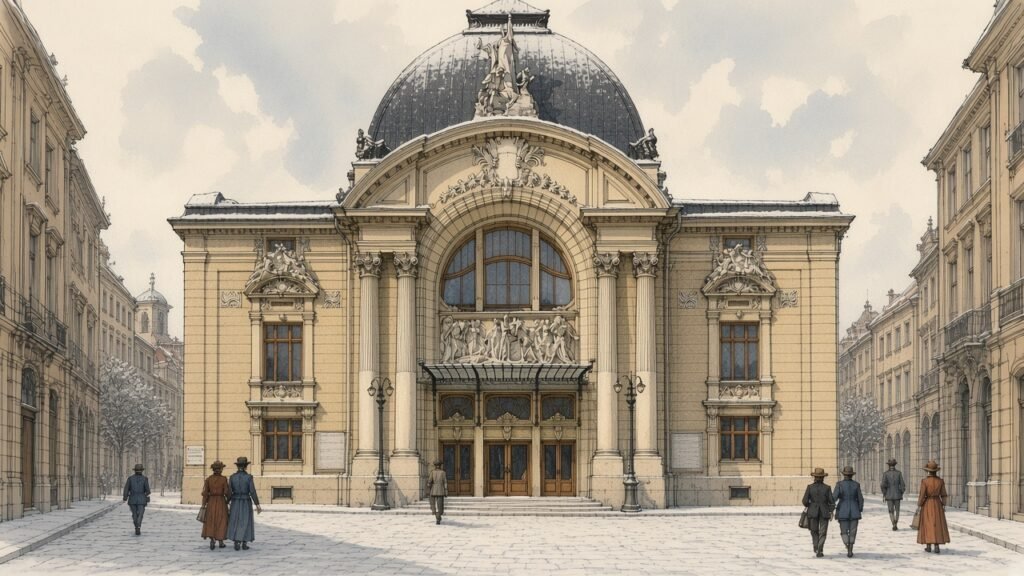
In Moscow Chagall was invited to design stage sets and costumes for the State Yiddish Chamber Theatre, directed by Alexei Granovsky, which sought to create a modern Yiddish performance style distinct from the older popular theatre. Chagall covered the walls of the theatre’s space with murals in which Jewish types, animals and musicians whirled across a flattened, festive ground. The paintings, later dispersed and partly lost, are documented in photographs and in the recollections of actors and visitors, and they stand among the most ambitious attempts to give the new Soviet Yiddish culture a visual form. [15][2][1]
The theatre’s early productions, including works by Sholem Aleichem, used Chagall’s designs to break with naturalistic staging. Actors moved against his tilted roofs and floating figures; costumes carried his colour. For a brief period the collaboration seemed to promise a synthesis of avant-garde form and Yiddish content under state patronage. Political and aesthetic pressures soon complicated that promise. The theatre would continue and evolve; Chagall’s own position in Soviet cultural life remained insecure. [15][5]
Living conditions in Moscow were harsh. Food and fuel were scarce; the family moved between rooms; Chagall took whatever work he could find. He continued to paint easel pictures, including portraits of Bella and studies related to the theatre. The decision to leave Soviet Russia matured slowly. By 1922 he had obtained permission to travel, ostensibly in connection with the publication of his work abroad, and the family made its way to Berlin. The departure proved permanent. [6][4]
Berlin in 1922 and 1923 was a temporary station. Chagall worked on etchings and lithographs, including illustrations that dealers hoped to market, and he renewed contact with the western art world. Hermann Struck and other printmakers helped him to master techniques he would use for decades. In September 1923 the family reached Paris, answering an invitation connected with the dealer Ambroise Vollard, who had in mind a programme of illustrated books. The second Parisian period of Chagall’s life had begun. [20][5]
Looking back, the Moscow years appear as both a culmination and a rupture: the last phase of his immersion in a living Yiddish public culture on Soviet soil, and the prelude to a career that would unfold thereafter in France, the United States and the international market. The murals themselves, removed and damaged over the following decades, became objects of scholarly reconstruction and of memory among those who had seen the theatre in its early seasons. [15][7]
Granovsky’s theatre sought a physical language of acting that broke with both naturalism and the older Yiddish stage stereotypes. Chagall’s murals and costumes abetted that search by surrounding the actors with a world already dancing. Visitors from the Moscow intelligentsia came to stare. For Yiddish writers and actors, the collaboration suggested that their language could occupy the centre of Soviet culture rather than its margin—a hope that the later Stalinist years would destroy. [15][2]
Chagall’s exit papers in 1922 were obtained with difficulty and used without return. He left behind not only a country but a version of himself as public servant of the Revolution. Thereafter he would be an artist of the west who painted the east from memory. [5][6]
Technical study of the paintings has clarified Chagall’s working methods: the reuse of motifs across decades, the layering of tempera and oil, the transfer of images from sketchbook to canvas to print. Conservators in Nice, Paris and New York have published findings that allow historians to date and sequence works with greater confidence. Such research underwrites any serious biography, including the sources cited in the references below. [7][4]
9. Berlin and the road west
Berlin in 1922 offered Chagall a pause between the Soviet experiment and the renewed Parisian career. The city was still a capital of modern art and of a large eastern Jewish immigration, and it possessed dealers, printers and publishers interested in the Russian avant-garde. Chagall worked intensively on prints, learning etching and lithography with a thoroughness that would serve the illustrated books of the following decade. Hermann Struck, the German Jewish artist whom he had met earlier and would meet again in Palestine, was among those who guided his technique. [5][2][1]
The Berlin sojourn also allowed him to take stock of what he had lost and gained by leaving Russia. Vitebsk remained the emotional centre of his imagery, yet the town was now behind a frontier that would harden through the 1920s. Friends and relatives remained in the Soviet Union; correspondence became difficult; the People’s Art School passed into other hands. At the same time Berlin introduced him to a western market that valued his name more highly than Moscow had been able to do in the hungry years of the civil war. Exhibitions and the prospect of contracts pointed west, not east. [6][7]
Publishers discussed projects for illustrated editions of the Hebrew Bible, of contemporary poetry and of classic Yiddish texts. Not all of these plans matured in Berlin, but they prepared the ground for the Vollard commissions that awaited him in Paris. Bella, who wrote and who managed much of the family’s practical life, shared the provisional quality of these months. Ida was still a small child. The decision to move on to Paris in September 1923 was both a professional calculation and a return to the city that had formed Chagall’s first modernist identity. [20][12][4]
Looking back across the arc from 1914 to 1923, the painter had passed through marriage, fatherhood, revolutionary administration, theatrical collaboration and exile. The Berlin interlude was the hinge. When the family alighted in Paris, Chagall was no longer the unknown provincial of 1910. He was a painter with a Russian and a small international reputation, a wife and child, and a dealer ready to put him to work on a scale that the pre-war years had never offered. [1][5]
The prints of these months already show the linear clarity and the narrative density that would characterise his later book illustration. Animals, village streets and biblical figures appear in plates that combine the lessons of Parisian modernism with the memory of the Pale. Collectors and museums would later prize these early impressions; at the time they were also a means of livelihood. The road west was, among other things, a search for a sustainable economy of art. [7][6]
German dealers and collectors in 1922 still bought Russian modernism with enthusiasm. The inflation and political violence of the early Weimar years had not yet destroyed that market. Chagall’s prints sold more readily than large paintings, and he produced them in quantity. The experience taught him the economics of editioned work, knowledge he would apply to the Vollard books. [7][20]
Across the references assembled at the end of this feature, the reader will find encyclopaedia articles from YIVO and Grokipedia, museum biographies, and the major narrative lives by Harshav and Wullschläger. Those sources do not always agree on emphasis. Harshav stresses the documentary and linguistic texture of Chagall’s world; Wullschläger offers a continuous story for the general reader; the museum biographies compress the arc into a public chronology. Used together, they permit a checked narrative of the kind attempted here. [5][6][4][2]
The paintings themselves remain the primary documents. Anyone who stands before the early Vitebsk canvases, the theatre designs as reconstructed in photographs, or the late windows in Jerusalem can test the claims of biography against the evidence of the eye. That test is open to every visitor. It is the most democratic legacy an artist can leave. [1][7]
10. Paris again and Vollard
Ambroise Vollard, the dealer who had handled Cézanne, Picasso and so many others, invited Chagall to illustrate a series of books and provided a measure of financial security that the painter had rarely known. The projects included Gogol’s Dead Souls, La Fontaine’s Fables and, eventually, a Bible that would occupy Chagall for years and would be completed only after Vollard’s death. The etchings and gouaches produced for these commissions form a second major body of work alongside the paintings, and they deepened his engagement with narrative and with the Jewish and European literary tradition. [20][1][5]
Paris in the mid-1920s was again the centre of the School of Paris. Montparnasse cafés filled with painters, dealers and writers; the market for modern art expanded; and Chagall, now a French resident and later a citizen, occupied a more comfortable position than in 1911. He and Bella lived in successive apartments and studios; he painted landscapes of the Île-de-France as well as continuing Vitebsk fantasies; and he exhibited with increasing frequency. Critics still debated his place among the isms, but the public began to recognise his name. [14][4][6]
The Bible project drew him towards a monumental treatment of Hebrew scripture that would culminate, decades later, in the stained-glass windows and the Message Biblique cycle. Vollard’s death in 1939 interrupted the publication, and the plates passed through other hands before appearing in full. Nonetheless the years of work on the biblical subjects confirmed a turn in Chagall’s art towards themes of covenant, exile and prophecy that the rise of Nazism in Germany would make urgently contemporary. [7][5]
Travel punctuated the decade. Chagall visited Palestine in 1931, a journey that left a strong impression and fed later images of Jerusalem and of biblical landscape. He travelled in Europe, and he watched with growing anxiety the political situation in Germany and the fate of Jews under the new regime. In 1937 he obtained French citizenship, a protection that would prove insufficient when France fell. The paintings of the later 1930s darken; crucifixion motifs appear as emblems of Jewish suffering—an iconography that belongs to his painting and that this account does not illustrate. [2][1][4]
By 1939 the second Parisian settlement that had begun so promisingly under Vollard stood under threat. The war that followed would drive the family across the Atlantic and would end Bella’s life before peace returned. The Vollard years nonetheless remain the period in which Chagall’s commercial and critical standing in the west was secured, and in which the great illustrated books were conceived. [20][6]
Vollard’s methods were famously slow and idiosyncratic. Artists complained of delayed payments and of projects begun but not finished. Chagall persisted because the association conferred prestige and because the subjects—Gogol, La Fontaine, the Bible—suited his narrative gifts. The gouaches for the Bible, in particular, show a grandeur of scale that easel paintings of village motifs had not always required. [20][5]
The rise of fascism in Germany and the antisemitic campaigns of the later 1930s darkened the mood of the Parisian Jewish artistic community. Chagall’s French passport was a shield of paper. When the German army entered Paris in 1940, the family fled south and then, with emergency visas, across the Atlantic. [2][1]
The illustrated Dead Souls allowed Chagall to engage Gogol’s grotesque Russia with the eye of an exile who had lived both the provincial town and the capital. His plates emphasise the absurd and the tender rather than the purely satirical. La Fontaine’s animals gave him another menagerie to set beside the Vitebsk cows and roosters. The Bible, largest of the Vollard projects, demanded a confrontation with Hebrew scripture as world literature and as Jewish inheritance—a double demand that suited him uniquely among School of Paris painters. [20][7][2]
French citizenship in 1937 came as the Spanish Civil War raged and as German Jewish refugees crowded into Paris. Chagall signed petitions and worried; he could not foresee how quickly France itself would fall. The paintings of the late 1930s, with their anxious colour and their allegorical suffering, register that climate without becoming propaganda. [1][6]
11. Exile in America
In 1941, with the help of organisations that rescued European artists and intellectuals, Chagall, Bella and Ida reached New York. The United States offered safety and a public already partly familiar with his work through exhibitions and collections. Yet exile was painful. Chagall’s English was limited; the art world of New York differed from that of Paris; and news from Europe brought continual reports of the destruction of the Jewish communities of the Pale, including Vitebsk. He painted, designed for the ballet and the theatre, and took part in the life of the wartime émigré community, but the emotional centre of his existence remained the catastrophe unfolding across the ocean. [1][2][5]
Bella, who had begun to write her memoirs of their early life, fell ill with a viral infection and died in September 1944, on the eve of the news of the liberation of Paris. The death shattered Chagall. For months he produced little; when he returned to work, Bella’s presence haunted the canvases. Ida took on much of the management of his affairs, as she would continue to do for decades. The war’s end found him undecided between remaining in America and returning to France. [12][6][4]
The American years also included collaborations with the ballet, notably designs for productions that brought his colour and imagery to a large theatrical public, and exhibitions that consolidated his reputation in museums and private collections. Dealers and collectors in New York treated him as a major European modernist, a status that the pre-war Parisian market had approached but not fully conferred. The contrast with the hungry Moscow of 1920 could hardly have been sharper. [7][5]
News of the Holocaust and of the fate of Vitebsk’s Jews entered his art as lamentation. He did not become a documentary painter of atrocity; instead he intensified the symbolic language of burning villages, fleeing figures and mourning that had long been latent in his work. Scholars have traced these wartime pictures carefully; they form a distinct chapter within the oeuvre, even as they continue the Vitebsk mythology under the pressure of historical knowledge. [2][1]
In 1948 Chagall returned to France. The American exile had lasted seven years. It had saved his life, cost him Bella, and fixed his international fame. The late career that followed—stained glass, monumental commissions, the chapel and museum at Nice—grew from the security and the sorrow of those years. [4][6]
New York’s wartime galleries showed European modernism as both aesthetic and moral cause. Chagall benefited from that climate even as he felt displaced. He designed for the Ballet Theatre and other companies, bringing his colour to American stages, and he followed the war news with anguish. The liberation of Paris in 1944 arrived in the same season as Bella’s death, mingling public joy with private ruin. [12][6][4]
Émigré New York included writers, painters and musicians who had fled Hitler’s Europe by many routes. Chagall’s apartment and studio became one node in that network. He followed the Yiddish press when he could, and he listened to reports from the Soviet front as the Red Army pushed west. The fate of Vitebsk, occupied and destroyed in large part, reached him as rumour and then as fact. Painting through such news required a discipline of attention that grief continually interrupted. [2][5][3]
After Bella’s death he lived for a time in a numbness that friends found alarming. Ida organised exhibitions and sales to keep the household going. When he began to paint again, the canvases were elegies. The decision to return to France in 1948 was also a decision to inhabit Bella’s absence in the landscapes they had known together. [12][4]
12. Bella and after
Bella Rosenfeld Chagall occupies a place in her husband’s art unmatched by any other single figure. From the engagement portraits of the Vitebsk years through the floating couples of the 1910s and 1920s to the memorial images after 1944, she is bride, reader, companion and absence. Her own writing, published posthumously, offers a counterpoint in prose to the painted mythology, recalling the provincial Jewish world of her youth with a clarity that complements Chagall’s more dreamlike reconstructions. [12][2][5]
After her death Chagall’s personal life passed through a difficult period. He formed a relationship with Virginia Haggard McNeil, with whom he had a son, David; the partnership eventually ended. In 1952 he married Valentina Brodsky, known as Vava, a woman of Russian Jewish origin who organised his later household and career with firm practical intelligence. Vava remained with him until his death. The late paintings continue to summon Bella’s image even as the circumstances of daily life changed. [6][4][1]
Critics have sometimes reduced Bella to the status of muse, a role that the paintings themselves encourage. A fuller account recognises her education, her linguistic range, her writing and her management of the family’s successive displacements. Without her, the Vitebsk of Chagall’s art would lack its central human presence; without her labour, the practicalities of exile and return would have been harder to sustain. The marriage was both a romantic legend and a working partnership. [12][5]
Ida Chagall, their daughter, became an essential intermediary between the painter and the museums, dealers and publishers of the post-war world. She organised exhibitions, negotiated contracts and protected the estate. The family’s collective effort, spanning Bella’s generation and Ida’s, turned a precarious modernist career into an institution. [7][6]
The emotional tone of the work after 1944 is darker and more commemorative than that of the early floating lovers, yet the vocabulary remains continuous. Roofs, candles, animals and embracing figures persist, now charged with the knowledge of mass death. To read the late Bella pictures only as private mourning is to miss their historical dimension; to read them only as Holocaust allegory is to miss the intimacy. Both registers are present. [2][1]
Vava Brodsky’s marriage to Chagall in 1952 stabilised the late household. She controlled access, organised travel and protected his working time. Biographers differ in their portraits of her; all agree on her effectiveness. Ida’s parallel role as dealer and curator meant that father and daughter sometimes negotiated overlapping claims. The estate’s later history reflects both women’s imprint. [5][7]
Technical study of the paintings has clarified Chagall’s working methods: the reuse of motifs across decades, the layering of tempera and oil, the transfer of images from sketchbook to canvas to print. Conservators in Nice, Paris and New York have published findings that allow historians to date and sequence works with greater confidence. Such research underwrites any serious biography, including the sources cited in the references below. [7][4]
13. Stained glass and late commissions
From the 1950s onwards Chagall undertook a series of monumental public commissions that carried his imagery into churches, synagogues, theatres and civic buildings across Europe, Israel and the United States. The stained-glass windows for the cathedral at Metz, for the Hadassah Medical Center synagogue in Jerusalem, for the United Nations and for other sites, together with the ceiling of the Paris Opéra, made his colour a part of modern sacred and civic space. The Nice museum devoted to his biblical message, and the chapel at Vence, gave permanent homes to cycles of painting on scriptural themes. [4][1][21]
These commissions raised questions that easel painting had not. Working with glass craftsmen, architects and ecclesiastical or civic patrons required negotiation over subject, scale and symbolism. Chagall, who had never been a conventional religious painter, brought to Christian buildings a Jewish reading of shared scripture and to Jewish buildings a modernist freedom of form. Controversies accompanied some projects, notably the Opéra ceiling, yet the windows in Jerusalem and elsewhere entered the itinerary of cultural pilgrimage. [5][7]
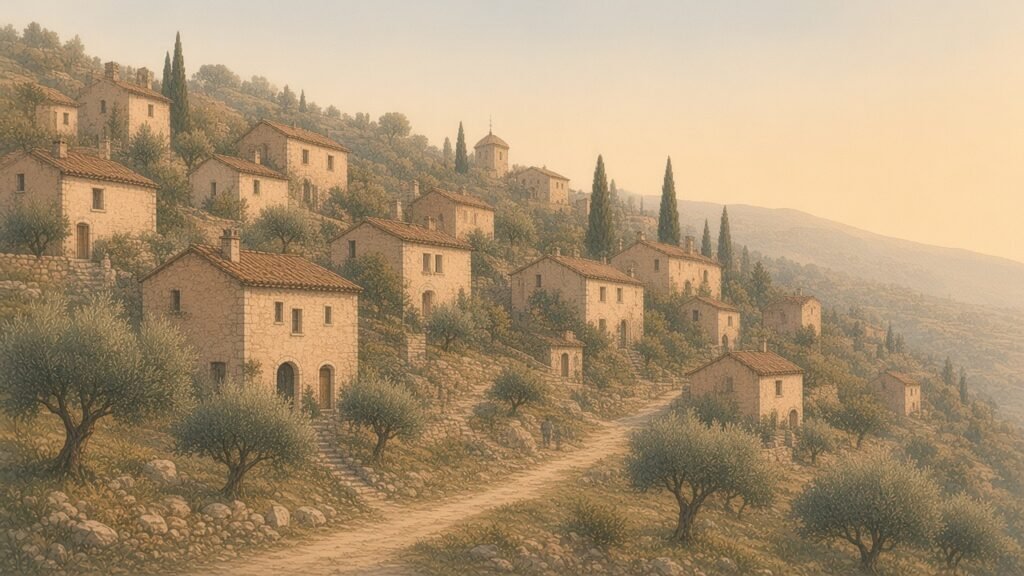
Saint-Paul-de-Vence, where he settled in the south of France, became the geographical centre of the late career. The light, the hill town and the proximity of the Mediterranean suited a painter whose early imagination had been formed by a very different provincial river town. Visitors, dealers and photographers made the studio a place of pilgrimage in its own right. He continued to paint prolifically—flowers, lovers, biblical scenes, memories of Vitebsk—until extreme old age. [21][6][4]
The market for his work expanded beyond anything the School of Paris had known in the 1920s. Museums mounted retrospectives; catalogues raisonnés were planned; forgeries and disputed attributions became a specialised problem. Chagall’s own attitude to fame mixed pleasure with wariness. He remained, in interviews and memoirs, the storyteller of Vitebsk, returning always to the childhood streets as the source of his art. [1][2]
He died on 28 March 1985 at Saint-Paul-de-Vence, aged ninety-seven. The funeral and the subsequent museum and market activity confirmed a status among the most widely known painters of the century. The late commissions, whatever the debates they provoked, had made his imagery a public language. [4][5]
The Jerusalem windows, dedicated in 1962, translate the twelve tribes into saturated colour and floating animal and vegetal emblems. Visitors who know only the early Vitebsk pictures often encounter Chagall first through this glass. The Nice museum, opened in his lifetime, fixed the biblical message as a public institution rather than a private cycle. [4][1]
At Saint-Paul-de-Vence the elderly painter received journalists who asked, again and again, about the flying lovers and the green fiddlers. He answered with anecdotes of Vitebsk, as if the hill town outside the window were only a backdrop for a river city eight decades gone. [21][6]
Across the references assembled at the end of this feature, the reader will find encyclopaedia articles from YIVO and Grokipedia, museum biographies, and the major narrative lives by Harshav and Wullschläger. Those sources do not always agree on emphasis. Harshav stresses the documentary and linguistic texture of Chagall’s world; Wullschläger offers a continuous story for the general reader; the museum biographies compress the arc into a public chronology. Used together, they permit a checked narrative of the kind attempted here. [5][6][4][2]
The paintings themselves remain the primary documents. Anyone who stands before the early Vitebsk canvases, the theatre designs as reconstructed in photographs, or the late windows in Jerusalem can test the claims of biography against the evidence of the eye. That test is open to every visitor. It is the most democratic legacy an artist can leave. [1][7]
14. Legacy
Chagall’s legacy is at once popular and scholarly. Few modern painters are more immediately recognisable to a general public; few have been more thoroughly catalogued, exhibited and biographised. The Vitebsk motifs that he carried through seven decades of displacement became a shared visual vocabulary for the memory of the destroyed Jewish towns of eastern Europe, even as art historians continued to debate his relation to Cubism, Surrealism and the School of Paris. [1][14][2]
In Belarus and in Israel, in France and in the United States, museums and study centres preserve and interpret his work. The house and museum in Nice, the collections in Paris, New York and elsewhere, and the windows in Jerusalem ensure a physical as well as a critical afterlife. Scholarship has recovered the Yiddish and Russian contexts of his early career, the politics of the Vitebsk school, and the theatrical collaborations in Moscow, correcting an older view that treated him solely as a Parisian fantast. [4][5][15]
His influence on later artists is diffuse rather than stylistic. Painters of memory, of Jewish theme and of poetic figuration have claimed him; so have illustrators and designers of public glass. He founded no school and left no dogma. What he left was a body of images in which a provincial Jewish childhood and the history of the twentieth century remain entangled. [7][6]
For the history of Yiddish culture he occupies a special place. Though he wrote and spoke Yiddish, and though he worked for the Moscow Yiddish theatre and illustrated Yiddish texts, his primary medium was painting, and his primary public became international and multilingual. He thus stands both inside and beside the literary Yiddish tradition represented by Sholem Aleichem, Peretz, Singer and Sutzkever. The present essay has followed the painter’s life in order to locate that position with some precision. [2][15][1]
The roofs of Vitebsk, reinvented across a century, remain his most durable invention. They are not documents of a town but the form in which one imagination preserved a world that politics destroyed. In that sense Chagall’s art is historical even when it is fantastic, and fantastic even when it records a street he had walked. [3][5]
Scholarship since the 1990s has reconnected Chagall to Yiddish literature, to the Moscow theatre and to the politics of the Vitebsk school with a precision that earlier French and American criticism often lacked. Harshav’s documentary biography, Wullschläger’s narrative life and the YIVO Encyclopedia’s synthesis are among the resources that make a factual account possible. The popular image of the flying lovers persists alongside that scholarship, and both have their uses. [5][6][2]
What remains, after the catalogues and the auctions, is the stubborn coherence of a vision formed in a provincial Jewish street and carried intact through war, revolution and fame. Few artists of his century held so steadily to a first geography. [3][1]
Public collections from the Centre Pompidou to the Museum of Modern Art hold major groups of his paintings and prints. Temporary exhibitions continue to draw large audiences, a popularity that sometimes obscures the denser historical work of scholars recovering his Yiddish and Soviet contexts. The present account has tried to hold both the popular and the documented Chagall in view, without confusing the flying lovers of the posters with the commissar of Vitebsk or the refugee of 1941. [1][4][5]
In the end the legacy is the work itself: thousands of paintings, prints, theatre designs and windows in which a single provincial childhood became a language adequate to love, revolution, massacre and old age. That language remains available to anyone who looks. [6][2]
The historiography of Chagall has itself a history. Early French and American writing tended to treat him as a poetic exception to the Cubist narrative of modern art. Soviet writing, when it mentioned him at all after his departure, was often hostile or silent. Israeli and Jewish-studies scholarship later reclaimed the Yiddish and biblical dimensions. Since the late twentieth century a more integrated account has become possible, one that places the flying lovers beside the Vitebsk commissar and the New York refugee without forcing a single moral. This special feature has drawn on that integrated scholarship while remaining a narrative for the general reader. [5][2][4]
Collectors and museums continue to negotiate the tension between Chagall’s popularity and the denser claims of context. Blockbuster exhibitions risk reducing him to a brand; specialised catalogues risk losing the reader who came for the colour. Both audiences, however, return to the same pictures, and the pictures continue to reward attention. The child who drew on scraps in a Vitebsk courtyard could not have foreseen that outcome. The old man at Saint-Paul-de-Vence knew it and still preferred to talk about the courtyard. [1][21][6]
15. Timeline
Moyshe Shagal is born to a Jewish family in Vitebsk in the Pale of Settlement.
Chagall studies with Yehuda Pen in Vitebsk.
He settles among the studios of Montparnasse and La Ruche.
War traps him in the Russian Empire after a visit home.
He marries Bella Rosenfeld in Vitebsk.
Lunacharsky appoints him plenipotentiary for art in Vitebsk province.
Kazimir Malevich joins the People’s Art School; conflict follows.
Chagall designs murals and sets for the Yiddish Chamber Theatre.
The family settles in France under Vollard’s patronage.
A visit that feeds later biblical imagery.
He becomes a French citizen.
The family reaches the United States during the war.
Bella Chagall dies in New York.
Chagall resettles in France.
Major stained-glass commissions in Europe, Israel and elsewhere.
He dies at Saint-Paul-de-Vence at the age of ninety-seven.
References
- Grokipedia, “Marc Chagall” ↩
- YIVO Encyclopedia, “Chagall, Marc” ↩
- Grokipedia, “Vitebsk” ↩
- Musée National Marc Chagall, “Biography of Marc Chagall” ↩
- Benjamin Harshav, Marc Chagall and His Times: A Documentary Narrative (Stanford University Press, 2004) ↩
- Jackie Wullschläger, Chagall: A Biography (Alfred A. Knopf, 2008) ↩
- Susan Compton, Chagall (Harry N. Abrams, 1985) ↩
- Grokipedia, “Pale of Settlement” ↩
- YIVO Encyclopedia, “Pen, Yehuda” ↩
- Grokipedia, “El Lissitzky” ↩
- YIVO Encyclopedia, “Lissitzky, El” ↩
- Grokipedia, “Bella Rosenfeld” ↩
- Grokipedia, “Kazimir Malevich” ↩
- Grokipedia, “School of Paris” ↩
- YIVO Encyclopedia, “Theater, Yiddish” ↩
- Grokipedia, “Amedeo Modigliani” ↩
- Grokipedia, “Anatoly Lunacharsky” ↩
- Grokipedia, “Suprematism” ↩
- Grokipedia, “Constructivism (art)” ↩
- Grokipedia, “Ambroise Vollard” ↩
- Grokipedia, “Saint-Paul-de-Vence” ↩