Soutine of Smilovichi
Chaïm Soutine was born in Smilovichi in the Minsk province of the Russian Empire in 1893 and died in Paris in 1943 after surgery undertaken under the constraints of the German occupation. Between those dates he became one of the central painters of the School of Paris, known for convulsed landscapes, pathos-filled portraits of cooks and servants, and still lifes of carcasses that looked back to Rembrandt while speaking the language of twentieth-century paint. His life ran from a poor Jewish tailor’s household through Vilna and La Ruche to Céret, Cagnes and a sudden American fame via Albert Barnes, before ending in wartime flight and illness. [1][2][3]
This special feature follows that life in chapter order. It begins with Smilovichi and the Pale, then traces the Vilna training and the arrival in Paris, the years at La Ruche, the decisive campaign at Céret, the southern landscapes, the Barnes purchases, and the portraits and still lifes of the mature period. Later chapters turn to the occupation, his death, and the afterlife of the work in museums from the Orangerie to Merion. An interactive timeline at the end of the essay gathers the principal dates. [4][5][6]
1. A childhood in Smilovichi
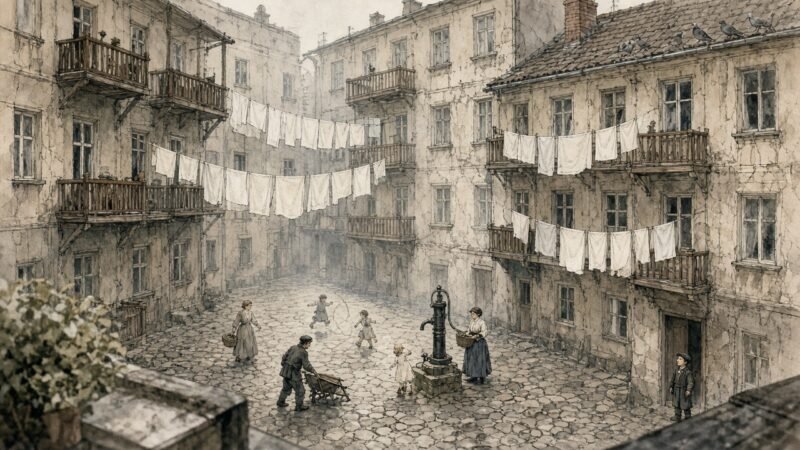
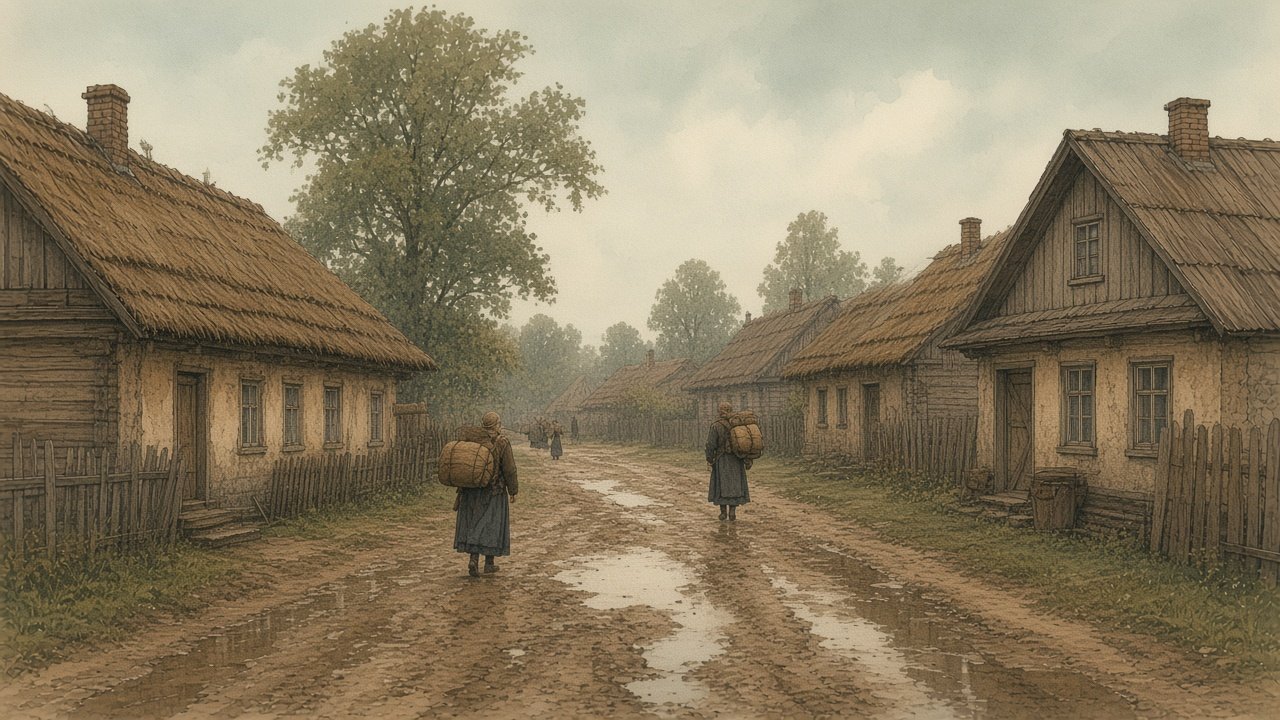
Chaïm Soutine was born in Smilovichi (Smilovitchi), a small Jewish town in the Minsk province of the Russian Empire, on 13 January 1893, the tenth of eleven children of a poor tailor. The town lay within the Pale of Settlement, and Yiddish was the language of the home and the street. Poverty, religious traditionalism and the limited horizons of a shtetl economy formed the background of his earliest years. Later accounts, filtered through Parisian legend, sometimes exaggerated the harshness of that childhood; the documentary record nonetheless confirms a large, struggling family and a boy whose impulse to draw met resistance. [1][7][2]
Drawing in a traditional Jewish household of the 1890s was not an obvious vocation. Stories circulated, after Soutine became famous, of beatings inflicted when he sketched a village notable or neglected religious study. Whether every anecdote is accurate matters less than the pattern they express: a talent that had to fight for space. He left Smilovichi for Minsk as an adolescent to seek training, and from Minsk he moved on to Vilna (Vilnius), where a small art school offered the first sustained instruction he had received. [8][5][6]
Vilna, the historic centre of Lithuanian Jewish learning, was also a city of printers, photographers and a modest artistic life. Soutine studied there from about 1910 to 1913 with friends who would share his Parisian fate, among them Pinchus Krémègne and Michel Kikoïne. The three young men, poor and ambitious, formed a bond that survived the journey west. In Vilna he learned academic drawing, studied plaster casts and began to absorb the idea of the artist as a figure who might live by painting alone. [8][9][1]
The decision to leave for Paris in 1913 was collective as well as personal. Paris was the magnet for eastern Jewish art students who had heard of Montparnasse and La Ruche. The journey by fourth-class train across Europe took days. Soutine arrived speaking little French, carrying Yiddish and Russian, and entered a city that would both feed and torment him for the rest of his life. [3][2]
Smilovichi itself remained a point of origin rather than a subject he painted directly in later years. Unlike Chagall, he did not rebuild his hometown as a personal mythology of roofs and fiddlers. What he carried west was less a set of motifs than a temperament: intensity, mistrust, a hunger for the painted surface, and a memory of scarcity that luxury never entirely erased. [1][6]
The Pale’s restrictions, the poverty of the tailor’s household and the narrowness of shtetl expectation are the first facts of the biography. Everything that followed—Céret, the carcasses, the Barnes purchases, the wartime flight—unfolded from that beginning. To understand the convulsions of his landscapes and the pathos of his pastry cooks, one must keep Smilovichi in view even when the canvases show only French hills and Parisian servants. [7][5]
Vilna’s streets, academies and Jewish quarter gave him his first experience of a city larger than a shtetl yet still Yiddish in much of its daily life. Walking from the art school to cheap lodgings, he passed the same mixture of tradition and secular ambition that defined Jewish Vilna before the First World War. That city would be destroyed a generation later; Soutine never returned to see the destruction. His Vilna remained the Vilna of student poverty and hope. [8][1]
Technical and documentary research since the mid-twentieth century has replaced much anecdote with dated canvases, addresses and dealer records. Monroe Wheeler’s early Museum of Modern Art publication and the later catalogue raisonné edited by Maurice Tuchman and colleagues remain starting points for any serious reader. The Orangerie’s holdings, descended from Paul Guillaume, give European audiences a permanent encounter with the work. [5][6][2][10]
To walk from a Céret landscape to a pastry cook portrait in a museum room is to experience the range of a painter who refused academies and isms alike. The present feature has followed the life in order to keep that range intelligible. [1][11]
2. Vilna and the road to Paris
The art school in Vilna was small, provincial by Parisian standards, yet decisive. There Soutine learned to see a face as a construction of planes and tones, to set up a still life, and to work from the live model when one could be afforded. Krémègne and Kikoïne shared rooms, meals and the dream of Paris. Teachers who recognised their gifts could offer little in the way of patronage; the destination had to be the French capital. [8][9][1]
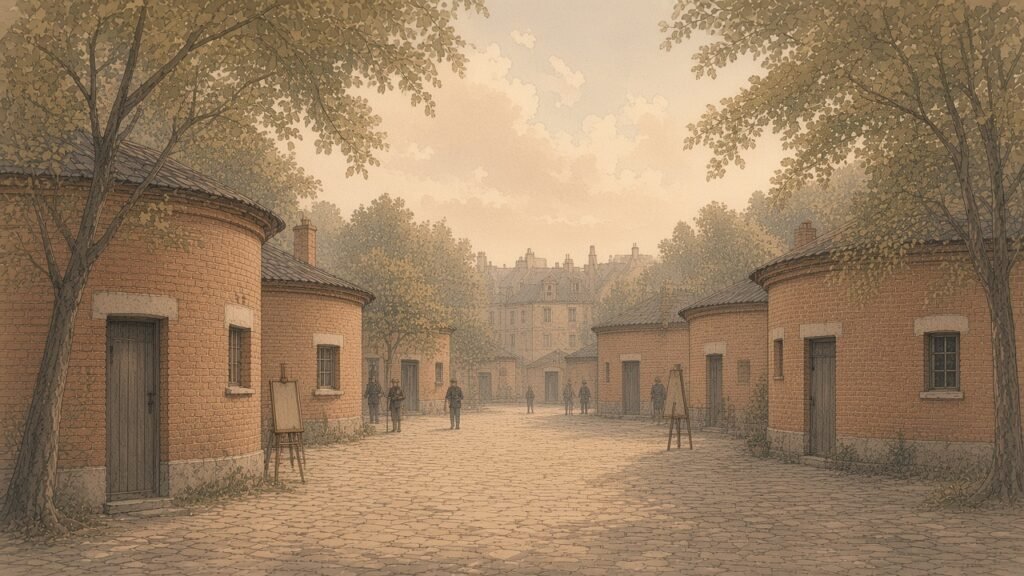
Fundraising for the journey involved family scraps, small sales and the solidarity of the trio. When they reached Paris, they headed for the studios where eastern Jews already clustered. La Ruche, near the slaughterhouses of Vaugirard, offered rooms at rents they could attempt to pay. The smell of the abattoirs, the circular brick ateliers and the community of struggling foreigners became Soutine’s first Parisian world. [3][2][5]
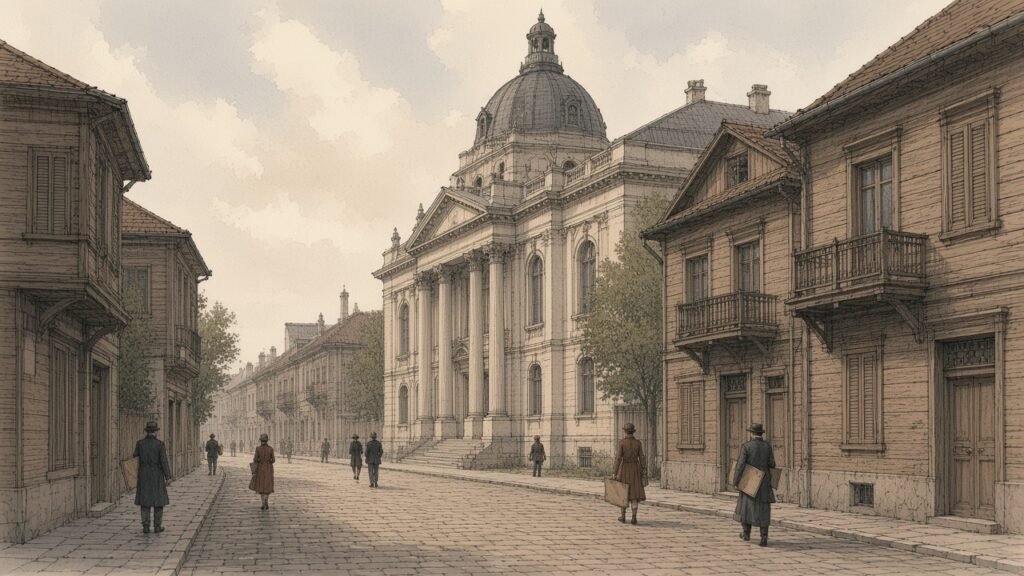
He enrolled for a time at the École des Beaux-Arts under Fernand Cormon, following a path taken by many foreigners who sought credentials and access to models. The Louvre mattered more. There he discovered Rembrandt’s flayed ox, Chardin’s still lifes, Courbet’s material density and the older Spanish and Dutch painters who treated paint as substance rather than description. Those encounters shaped his ambition more than any living teacher. [12][6][1]
French remained a barrier. Yiddish connected him to the Montparnasse immigrant milieu; Russian linked him to other refugees of the empire. He took menial jobs, painted when he could afford canvas and colour, and moved between La Ruche and the Cité Falguière. Jacques Lipchitz introduced him to Modigliani, whose friendship became the most important personal bond of his early Parisian years. [13][3][2]
Modigliani drew Soutine, drank with him and, crucially, introduced him to the dealer Léopold Zborowski. Without that introduction, Soutine’s years of misery might have continued indefinitely. Zborowski’s support, irregular and self-interested as dealers’ support often is, nonetheless made possible the Céret campaign that revealed Soutine’s mature landscape style. [1][5]
The outbreak of war in 1914 found him still obscure. As a foreigner he was subject to residence rules; he moved within Paris and, later, towards the south with Modigliani. The war years were hungry and anxious. Painting continued in bursts. The School of Paris, as a label, did not yet exist; what existed was a community of survivors waiting for the guns to stop. [3][13][6]
By 1919 Zborowski was ready to send Soutine to Céret with a small stipend. The three years that followed would produce some two hundred canvases and would define his reputation. The road from Vilna to that Pyrenean town had taken less than a decade, yet it crossed a civilisation’s collapse into war. [11][2]
3. La Ruche and Montparnasse
La Ruche housed Soutine in conditions of extreme simplicity. The wedge-shaped studios were cold, the sanitation poor, and the neighbouring slaughterhouses filled the air with the smell of blood and hide. For a painter who would later become famous for carcasses of beef, that proximity has tempted biographers into symbolism. What is certain is that he lived among sculptors and painters who shared poverty and ambition, and that Montparnasse cafés—Le Dôme, La Rotonde, later Le Select—were the social extension of the studios. [3][2][1]
Modigliani’s portrait of Soutine, and the anecdotes of their nights together, fixed an image of the young painter as tormented, silent and gifted. Contemporaries remembered his dirty clothes, his reluctance to sell, and his sudden rages. They also remembered the force of the canvases stacked in his room. Dealers who climbed the stairs were often repelled by the man and arrested by the work. [13][5][6]
The immigrant Jewish artists of Montparnasse formed a loose Yiddish- and Russian-speaking society within the French city. Chagall had already left for Russia when Soutine’s Parisian misery was at its height; others, including Krémègne and Kikoïne, remained nearby. Competition for dealers’ attention was fierce. Zborowski’s willingness to back Soutine shifted the balance. [9][3]
Still lifes and early portraits from these years already show the distorted drawing and heavy paint that would characterise the mature work. He painted servants, cooks and anonymous sitters with a pathos that later critics linked to his own social position. The pastry cook in white became a recurring type: a figure of labour and vulnerability rendered in thick, vibrating colour. [1][2]
Montparnasse during and just after the war was also a place of mourning. Friends died at the front or of disease; Modigliani himself would die in 1920. Soutine’s grief and isolation deepened. Painting became both livelihood and compulsion. When Zborowski proposed Céret, the offer was an escape as well as a commission. [13][5]
The legend of Soutine at La Ruche—hungry, furious, genius—has been retold so often that it risks becoming a genre scene. Archival work and the catalogue raisonné have grounded the legend in dates, addresses and surviving canvases. The man who left for Céret in 1919 was already a formidable painter; the town would make him unmistakable. [6][1]
Living near the abattoirs may or may not have inspired the later beef carcasses; Rembrandt’s example in the Louvre is the surer source. What La Ruche certainly gave him was a peer group, a dealer and a mythology that the art market would never tire of repeating. [12][3][2]
Technical and documentary research since the mid-twentieth century has replaced much anecdote with dated canvases, addresses and dealer records. Monroe Wheeler’s early Museum of Modern Art publication and the later catalogue raisonné edited by Maurice Tuchman and colleagues remain starting points for any serious reader. The Orangerie’s holdings, descended from Paul Guillaume, give European audiences a permanent encounter with the work. [5][6][2][10]
To walk from a Céret landscape to a pastry cook portrait in a museum room is to experience the range of a painter who refused academies and isms alike. The present feature has followed the life in order to keep that range intelligible. [1][11]
4. Céret 1919 to 1922
Céret, in the Pyrénées-Orientales, had already attracted Cubists before the war; by 1919 it was a provincial town with cheap rooms, surrounding hills and a Mediterranean light that southern painters prized. Zborowski sent Soutine there with a tiny allowance. He stayed, with interruptions, for about three years, living poorly, walking long distances to motifs, and producing an estimated two hundred canvases of a violence and coherence that stunned those who later saw them together. [11][2][1]
Locals called him “el pintre brut,” the dirty painter, because he wiped brushes on his clothes and neglected his appearance. He rented rooms in the town and sometimes slept in rough outbuildings near the fields. Zborowski described him rising before dawn, hiking with canvases and paints, and collapsing without eating. The legend again tracks a documentary core: the output was enormous, the living conditions sparse, the concentration absolute. [5][6]
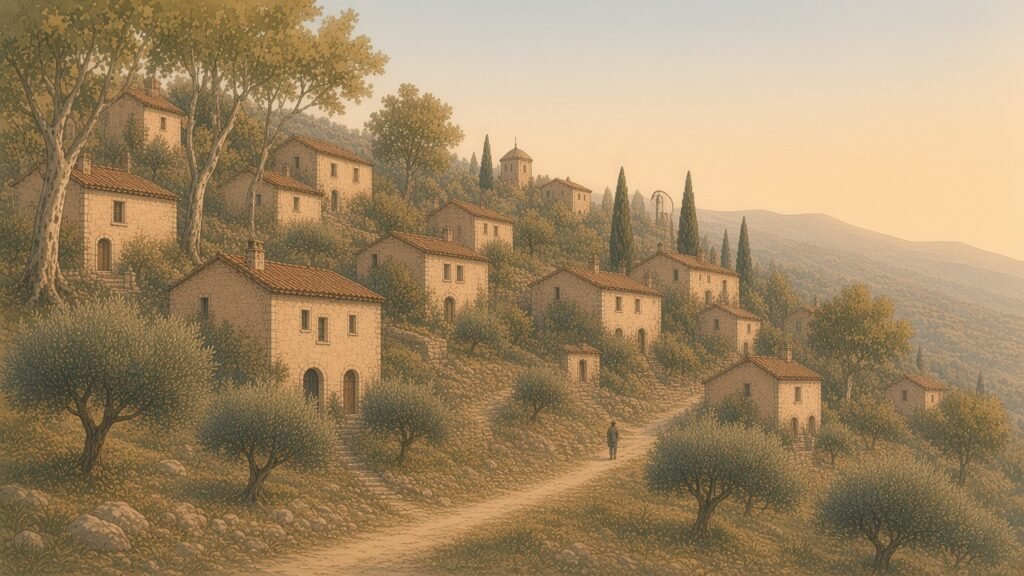
The Céret landscapes abandon stable horizon and calm recession. Houses tilt, trees writhe, roads heave; colour is laid in thick, directional strokes that make the surface surge. Verticals and horizontals are avoided; the whole motif seems caught in a gust. These pictures have been called Expressionist, though Soutine had little contact with German Expressionism as a movement. Their force comes from an encounter between Motif and temperament under conditions of solitude. [11][1][2]
Portraits and still lifes from the same years share the upheaval. Men at prayer, gladioli, and early experiments with animal carcasses appear beside the hills. Soutine worked in series, returning to a motif until it yielded or exhausted him. He destroyed canvases that displeased him—a habit that complicates the catalogue and that dealers later lamented. [6][5]
Trips back to Paris and to Cagnes punctuated the Céret stay. The Mediterranean coast offered a different light and a social world connected to Modigliani’s earlier visits. Yet it was Céret’s inland hills that produced the most radical landscapes. When Soutine finally left, he left behind a body of work that would, within a few years, attract the attention of Paul Guillaume and then of Albert Barnes. [14][10][4]
The Céret period is thus both a biographical chapter and a stylistic landmark. Museums that own these landscapes treat them as peaks of the oeuvre. For Soutine they were also years of loneliness and physical strain. Fame, when it came, came after. [1][2]
Critics comparing Céret to Cubist precedents note that Soutine kept the motif recognisable even as he convulsed it. He never went abstract. The town, the tree and the road remain nameable under the storm of paint—a fidelity to looking that links him to Courbet and Rembrandt as much as to any modernist faction. [12][6][11]
Technical and documentary research since the mid-twentieth century has replaced much anecdote with dated canvases, addresses and dealer records. Monroe Wheeler’s early Museum of Modern Art publication and the later catalogue raisonné edited by Maurice Tuchman and colleagues remain starting points for any serious reader. The Orangerie’s holdings, descended from Paul Guillaume, give European audiences a permanent encounter with the work. [5][6][2][10]
To walk from a Céret landscape to a pastry cook portrait in a museum room is to experience the range of a painter who refused academies and isms alike. The present feature has followed the life in order to keep that range intelligible. [1][11]
5. Cagnes and the south
Cagnes-sur-Mer and the neighbouring coast offered Soutine another southern campaign. He painted there before, during and after the Céret years, sometimes in the company of friends, sometimes alone. The Riviera’s terraces, olive trees and sea haze enter his work with a colour warmer than Céret’s inland greens and browns, yet the same instability of form persists. Houses still lean; space still buckles. [14][1][2]
Dealers preferred the south for its marketable associations with pleasure and light. Soutine’s south is rarely pleasurable. The beauty of the coast is subjected to the same expressive pressure as the Pyrenean hills. Viewers who expect Matisse’s serenity find instead a Mediterranean scratched and heaved by an anxious hand. [5][6]
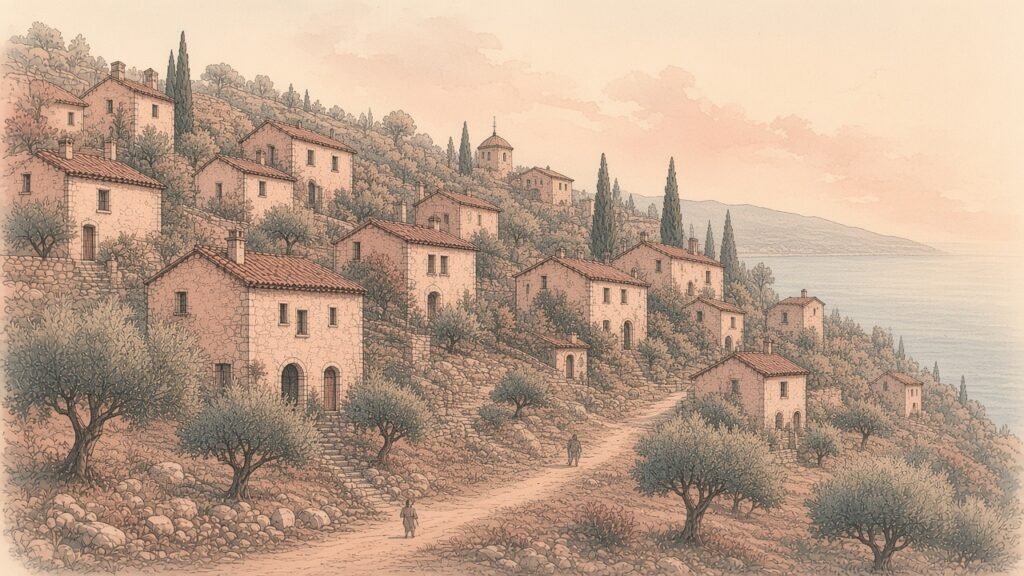
Periods in Cagnes also meant proximity to a social world of collectors and fellow painters that Soutine never comfortably joined. He remained awkward in company, quick to take offence, and protective of his canvases. Stories of his destroying work or refusing sales belong to these years as well as to Paris. The south was not a holiday. [1][2]
Nonetheless the coastal pictures broaden the landscape oeuvre and show his ability to adapt the Céret discoveries to new motifs. Roadside trees, village slopes and distant sea appear in canvases that museums now hang as complements to the Pyrenean group. Together they establish Soutine as one of the century’s great painters of place under emotional stress. [14][6]
Returning to Paris between southern stays, he resumed portraits and still lifes, including the series of hanging turkeys, rays and beef carcasses that linked him openly to Rembrandt. The studio became, at times, a slaughterhouse of motifs, with meat rotting under the brush until the neighbours complained. The anecdotes are famous; the paintings justify the obsession. [12][5][1]
By the mid-1920s the southern landscapes and the Parisian still lifes together constituted a mature oeuvre ready for discovery by a major collector. That discovery, when Albert Barnes arrived, changed Soutine’s material life overnight. [4][10]
Technical and documentary research since the mid-twentieth century has replaced much anecdote with dated canvases, addresses and dealer records. Monroe Wheeler’s early Museum of Modern Art publication and the later catalogue raisonné edited by Maurice Tuchman and colleagues remain starting points for any serious reader. The Orangerie’s holdings, descended from Paul Guillaume, give European audiences a permanent encounter with the work. [5][6][2][10]
To walk from a Céret landscape to a pastry cook portrait in a museum room is to experience the range of a painter who refused academies and isms alike. The present feature has followed the life in order to keep that range intelligible. [1][11]
6. Barnes and sudden fortune
Paul Guillaume, the Parisian dealer and collector, was among the first to take Soutine seriously as more than a Montparnasse curiosity. Through Guillaume, the American collector Albert C. Barnes encountered the work on a visit to Paris and purchased a large group of canvases in the early 1920s. The Barnes purchases, numbered in the dozens, gave Soutine sudden financial relief and an American institutional home for a major share of his production. [10][4][2]
Barnes’s methods were abrupt and his taste personal. He bought what he wanted, hung it in Merion, Pennsylvania, according to his own didactic schemes, and long restricted access. For Soutine the cheques mattered more than the pedagogy. He could at last afford better rooms, better materials and a measure of security. Contemporaries noticed the change in his clothes and his confidence, without finding him easy. [4][5][1]
The Orangerie collection in Paris, built on Guillaume’s holdings, later gave Europe its densest public group of Soutines. Between Merion and Paris, the core of the oeuvre was secured for public viewing even as private collectors competed for what remained. Prices rose; forgeries and disputed works followed, as they did for every suddenly valuable modern. [2][6]
Sudden fortune did not make Soutine gregarious. He continued to paint obsessively, to destroy unsatisfactory canvases, and to move between Paris and the provinces. The Barnes episode stands as a hinge between the years of misery and the relative ease of the later 1920s and 1930s—ease that the coming war would again destroy. [1][5]
Critics debate how far Barnes understood Soutine’s Jewish and immigrant context; the collector’s writings emphasise formal values. What Barnes undeniably did was to remove a large body of work from the uncertainties of the studio and place it, however idiosyncratically, in a collection that survived. [4][6][2]
For the School of Paris narrative, the Barnes purchases confirmed that the immigrant expressionist could command the same market attention as his French-born peers. Soutine’s name rose beside Modigliani’s in the dealers’ conversation. The pastry cooks and the Céret hills became, for American visitors, emblems of Montparnasse intensity. [3][13][1]
Technical and documentary research since the mid-twentieth century has replaced much anecdote with dated canvases, addresses and dealer records. Monroe Wheeler’s early Museum of Modern Art publication and the later catalogue raisonné edited by Maurice Tuchman and colleagues remain starting points for any serious reader. The Orangerie’s holdings, descended from Paul Guillaume, give European audiences a permanent encounter with the work. [5][6][2][10]
To walk from a Céret landscape to a pastry cook portrait in a museum room is to experience the range of a painter who refused academies and isms alike. The present feature has followed the life in order to keep that range intelligible. [1][11]
7. Portraits and still lifes
Alongside the landscapes, Soutine developed a portraiture of ordinary sitters—pastry cooks, page boys, chambermaids, old women—painted with empathy and distortion. Faces elongate; ears and noses swell; hands become eloquent claws. Colour in the costumes, especially whites and reds, vibrates against darker grounds. These pictures refuse flattery without refusing humanity. [1][2][5]
The still lifes of dead animals push further. Turkeys, rays, rabbits and sides of beef hang or sprawl in thick paint that makes decay and splendour inseparable. Rembrandt’s flayed ox in the Louvre is the acknowledged precedent; Soutine’s versions are more agitated, more modern in their refusal of classical composure. Neighbours’ complaints about smell belong to the documentary record of the studio. [12][6][1]
Series structure his production. He would paint a cook repeatedly, a gladiolus repeatedly, a carcass repeatedly, as if circling a problem. Destruction of failed attempts means that surviving series are incomplete. The catalogue raisonné reconstructs what it can from photographs, dealer records and museum holdings. [6][2]
Critics have read the portraits as displaced self-portraits and the carcasses as religious or existential emblems. Soutine left few verbal explanations. The paintings themselves suggest a man who trusted looking and feeling over theory, and who found in humble sitters and butchered meat a grandeur equal to any historical subject. [5][1]
Compared with Modigliani’s elegant elongations, Soutine’s distortions are heavier and more anguished. Compared with German Expressionism, they are less programmatic. His place is with painters for whom the loaded brush is itself the meaning. [13][3][6]
Collectors who bought the portraits often responded first to the pastry cook’s white against a red or green ground—an immediate chromatic drama that survives any amount of critical commentary. Museums hang these works as anchors of their School of Paris rooms. [2][4]
The still lifes, harder to live with, have attracted scholars interested in mortality, Jewish dietary symbolism and the history of the slaughterhouse motif. Soutine’s own relation to kashrut and to religious tradition was distant; the carcasses are painterly before they are theological. Yet the Pale childhood and the Montparnasse abattoirs remain available as contexts without becoming keys that unlock every canvas. [7][12][1]
Technical and documentary research since the mid-twentieth century has replaced much anecdote with dated canvases, addresses and dealer records. Monroe Wheeler’s early Museum of Modern Art publication and the later catalogue raisonné edited by Maurice Tuchman and colleagues remain starting points for any serious reader. The Orangerie’s holdings, descended from Paul Guillaume, give European audiences a permanent encounter with the work. [5][6][2][10]
To walk from a Céret landscape to a pastry cook portrait in a museum room is to experience the range of a painter who refused academies and isms alike. The present feature has followed the life in order to keep that range intelligible. [1][11]
8. The later 1920s and 1930s
With money from Barnes and ongoing sales, Soutine’s material circumstances improved through the later 1920s. He travelled in France, painted at various provincial sites, and maintained Parisian studios. Health problems, including stomach ulcers that would eventually kill him, already troubled him. He sought quieter working conditions and avoided the café celebrity that some peers cultivated. [1][2][5]
The political climate darkened through the 1930s. As a foreign-born Jew he watched the rise of Nazism and the growth of French antisemitism with fear. His papers and his health limited his options. He continued to paint landscapes and portraits of a somewhat calmer surface than the Céret peak, though the underlying intensity remained. [3][6]
Friendships and love affairs punctuated these years; biographers reconstruct them with incomplete evidence. What is clear is that he never built a stable domestic or pedagogical institution. He left no school of followers in the formal sense. His influence operated through the example of the canvases. [1][5]
Exhibitions in Paris and abroad spread his name. American interest, seeded by Barnes, continued. European critics argued over Expressionism, Jewishness and the School of Paris label. Soutine painted through the arguments. [4][2][3]
By 1939 he was a recognised master with a fragile body and a dangerous passport situation. The war would reduce him again to flight and hiding, as if the Smilovichi scarcity had returned in another form. [1][7]
Dealers still sought his work; he still destroyed pieces that failed his standard. The tension between market demand and private judgement remained unresolved. In that tension the late easel pictures were made. [6][5]
Technical and documentary research since the mid-twentieth century has replaced much anecdote with dated canvases, addresses and dealer records. Monroe Wheeler’s early Museum of Modern Art publication and the later catalogue raisonné edited by Maurice Tuchman and colleagues remain starting points for any serious reader. The Orangerie’s holdings, descended from Paul Guillaume, give European audiences a permanent encounter with the work. [5][6][2][10]
To walk from a Céret landscape to a pastry cook portrait in a museum room is to experience the range of a painter who refused academies and isms alike. The present feature has followed the life in order to keep that range intelligible. [1][11]
9. Occupation and death
The German occupation of France placed foreign Jews in immediate peril. Soutine left Paris for the countryside, moving among temporary refuges, including Champigny-sur-Veude in the Touraine, assisted by friends who risked much to shelter him. He continued to paint when materials and safety allowed. The ulcers worsened. [1][2][5]
In August 1943 he was brought back to Paris for emergency surgery. The operation came too late; he died on 9 August 1943. The occupation authorities and the general scarcity of wartime medicine form the grim context of the end. He was fifty years old. [1][6]
News of his death reached the émigré and occupied art worlds as another loss in a season of losses. Post-war retrospectives would secure the reputation that Barnes and Guillaume had already underwritten. The man who had arrived from Vilna hungry in 1913 died a recognised master in a city still under the flag of his murderers’ allies. [2][4][3]
Wartime works that survive show no sudden stylistic rupture—rather a continuation of landscape and portrait under impossible conditions. Scholars treasure them as documents of persistence. They do not redeem the historical catastrophe; they record one painter’s labour inside it. [5][1]
Burial and estate matters were complicated by the occupation and by the absence of direct heirs in a simple sense. The market and the museums took over the afterlife. [6][2]
Friends who had hidden him remembered a man exhausted, grateful and still talking about painting. Those memories, collected later, humanise a biography that legend had already turned into a martyrdom of art. The truth contains both the legend’s intensity and the ordinary facts of illness and fear. [1][5]
Technical and documentary research since the mid-twentieth century has replaced much anecdote with dated canvases, addresses and dealer records. Monroe Wheeler’s early Museum of Modern Art publication and the later catalogue raisonné edited by Maurice Tuchman and colleagues remain starting points for any serious reader. The Orangerie’s holdings, descended from Paul Guillaume, give European audiences a permanent encounter with the work. [5][6][2][10]
To walk from a Céret landscape to a pastry cook portrait in a museum room is to experience the range of a painter who refused academies and isms alike. The present feature has followed the life in order to keep that range intelligible. [1][11]
10. Legacy
Soutine’s legacy rests on the Céret landscapes, the portraits of servants and cooks, and the carcass still lifes, distributed among the Orangerie, the Barnes Foundation and museums worldwide. Catalogue raisonné work has stabilised the corpus; exhibitions continue to reframe him for new audiences. [2][4][6]
He stands as a central figure of the School of Paris’s immigrant generation, beside Modigliani and Chagall yet unlike either—less literary than Chagall, less linear than Modigliani, more purely a painter of charged substance. His Jewishness is biographical fact and contextual resource, not a programme inscribed on every canvas. [3][13][1]
Younger painters have claimed his loaded brush and emotional distortion without forming a school. Critical writing has moved from anecdote towards formal and historical analysis. The Smilovichi childhood and the Montparnasse poverty remain the framing narrative that the public expects and that the work both confirms and exceeds. [7][5][2]
In the history of Yiddish-speaking artists who made modern art in Paris, Soutine occupies the place of the purest painterly extremity. He left no pedagogical writings and few letters of aesthetic theory. The paintings are the argument. They continue to argue whenever a viewer stands before a tilting Céret hillside or a white-clad cook emerging from darkness. [1][11][6]
Museums that hang him beside Cubists and Fauves remind visitors that modernism was always plural. His modernism was the modernism of the brushstroke under pressure. That pressure began in a tailor’s household in the Pale and ended in an occupied capital. Between those poles he painted some of the twentieth century’s most unforgettable images. [7][2][1]
11. Timeline
Chaïm Soutine is born to a Jewish tailor’s family in the Pale of Settlement.
He trains at a small art school with Krémègne and Kikoïne.
He settles at La Ruche and studies briefly at the Beaux-Arts.
The Italian painter becomes his closest companion and later introduces Zborowski.
Zborowski sends him to the Pyrenees; some two hundred canvases follow.
He leaves the town with a mature landscape style established.
Albert Barnes buys a large group of works through Paul Guillaume.
Series of cooks, servants and still lifes of meat consolidate his fame.
Exhibitions spread his name while ulcers and political fear grow.
He hides in the countryside under the occupation.
He dies on 9 August after emergency surgery.
References
- Grokipedia, “Chaim Soutine” ↩
- Musée de l’Orangerie, “Chaïm Soutine” ↩
- Grokipedia, “School of Paris” ↩
- Grokipedia, “Barnes Foundation” ↩
- Monroe Wheeler, Soutine (Museum of Modern Art, 1950) ↩
- Maurice Tuchman et al., Chaim Soutine (1893 - 1943): Catalogue Raisonné (Benedikt Taschen, 1993) ↩
- Grokipedia, “Pale of Settlement” ↩
- Grokipedia, “Vilnius” ↩
- Michel Kikoïne and the School of Paris (various exhibition catalogues) ↩
- Grokipedia, “Paul Guillaume” ↩
- Grokipedia, “Céret” ↩
- Grokipedia, “Rembrandt” ↩
- Grokipedia, “Amedeo Modigliani” ↩
- Grokipedia, “Cagnes-sur-Mer” ↩