The Hanseatic League
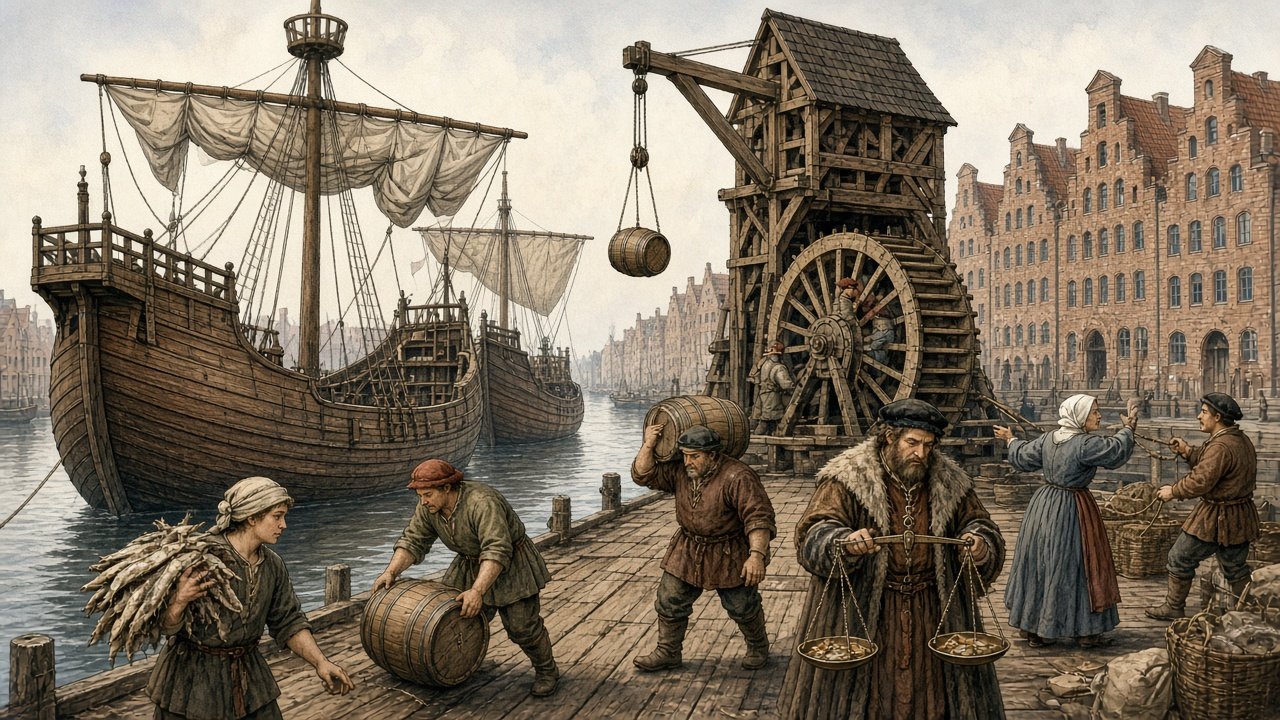
For roughly three centuries, from the late twelfth century to the end of the fifteenth, the trade of northern Europe was dominated by an association of German merchants and the towns from which they came. Contemporaries called it the Hanse, a Middle Low German word for a company or band of travelling traders, and later historians have called it the Hanseatic League. At its height it linked some seventy towns that took an active part in its affairs, and more than a hundred others associated with them, across a zone stretching from the Zuiderzee to the Gulf of Finland and from the Rhineland to the Arctic coast of Norway. Its merchants carried furs and wax out of Russia, grain and timber out of Prussia and Livonia, herring out of Scania, stockfish out of Bergen and cloth out of Flanders and England. It had no constitution, no permanent treasury, no army and no navy of its own, yet it fought and won a war against the King of Denmark, imposed its terms on the King of England and shaped the legal and architectural face of the Baltic world. This essay traces its origins, its institutions and trade, its conflicts, its long decline and the forms in which it survives.
A word and a problem of definition
The word hanse was in use well before any league of towns existed. In the twelfth and thirteenth centuries it denoted a group of merchants from a particular town or region who travelled together to a foreign market, pooled their protection and negotiated as a body with the local ruler. The merchants of Cologne in London formed such a hanse; so did the Flemish towns trading to England, whose association historians know as the Flemish Hanse of London. The term also referred to the dues paid for membership of such a group. Only in the middle of the fourteenth century did the phrase stede van der dudeschen hanse, the towns of the German Hanse, appear in documents as the name of a wider community of towns, and the earliest surviving use of the expression in that sense is usually dated to 1358.
The modern term “Hanseatic League” therefore needs some care. It suggests a formal alliance with a founding charter, a membership list and agreed obligations. The Hanseatic League had none of these in a fixed form. Its members themselves resisted being described as a corporation, partly because a corporation could be held collectively liable for the debts or misdeeds of any one member. When foreign rulers asked for a list of the Hanseatic towns, the Hanse usually declined to provide one. Membership was defined by practice: a town was Hanseatic if its merchants enjoyed the privileges that the Hanse held abroad and if it was summoned to, and contributed to, the common assemblies. Towns could be admitted, could lapse, and could be expelled, a penalty the Hanse called Verhansung.
Historians have described the Hanse in several ways: as a community of merchants that gradually became a community of towns, as a network of interests rather than a state, and as a federation held together by shared privileges rather than by sovereignty. The distinction between the two phases, a merchant Hanse and a town Hanse, is the most useful starting point for understanding how the association came into being.
Lübeck and the opening of the Baltic
German merchants had traded in the North Sea for centuries before the Hanse, but the Baltic was long a sea dominated by Scandinavian, Slavic and Baltic peoples. In the Viking Age the routes eastward across the Baltic and down the Russian rivers had been travelled by the Scandinavian traders whose journeys are described in the nekud essay The Vikings in the East. The island of Gotland, in the middle of the sea, had grown rich on that traffic, and its farmer-merchants continued to sail to Novgorod and the eastern Baltic long after the Viking Age had ended.
The decisive change came with German expansion into the lands of the Slavic peoples between the Elbe and the Oder. In 1143 Count Adolf II of Holstein founded a German settlement on a peninsula between the rivers Trave and Wakenitz, near an older Slavic stronghold called Liubice. The site was well chosen: it lay a short distance from the Baltic, yet was sheltered from it, and it stood at the eastern end of an overland route of only about sixty kilometres to the Elbe and Hamburg, which gave access to the North Sea. The new town suffered from fire and from rivalry with the territorial lord of the region, Henry the Lion, Duke of Saxony and Bavaria, who founded a competing market nearby. After a fire in 1157 the count ceded the site to the duke, and in 1159 Henry refounded Lübeck as his own town.
Henry the Lion granted the townspeople extensive rights and actively encouraged trade. According to the chronicler Helmold of Bosau, the duke sent messengers to the towns and kingdoms of the north, including Denmark, Sweden, Norway and Russia, offering peace and free access to his town. Lübeck quickly became the gateway through which merchants from Westphalia, Saxony and the Rhineland reached the Baltic. Many of its early settlers came from Westphalian towns such as Soest, Dortmund and Münster, and they brought with them both commercial connections and legal customs.
Lübeck’s political position changed after Henry the Lion fell from power in 1180. The town passed for a time under the authority of the Emperor and then, between 1201 and 1225, under the King of Denmark, whose realm then extended along the southern Baltic coast. After the Danes were defeated at the battle of Bornhöved in 1227, with Lübeck’s troops among the victors, the town’s position as a free imperial city, granted by Emperor Frederick II in 1226, was secure. It was subject only to the Emperor, which in practice meant that it governed itself through its own council.
Gotland, Visby and the merchant community
The early German merchants in the Baltic did not trade from Lübeck alone. They needed bases further east, and the obvious one was Gotland. The Gotlanders were experienced long-distance traders with established connections in Novgorod, and Germans began to settle among them in the town of Visby on the island’s western coast. Relations between the two groups were not always peaceful. In 1161, at Artlenburg on the Elbe, Henry the Lion brokered an agreement between German and Gotlandic merchants that ended a period of violence between them and confirmed reciprocal rights: Gotlanders received protection in the duke’s lands, and Germans received rights on Gotland.
From this point a distinctive body took shape: the association of merchants of the Roman Empire who frequented Gotland, known in Latin documents as the universi mercatores imperii Romani Gotlandiam frequentantes. It was a community of travelling merchants rather than of towns. It had its own seal, which showed a lily, and its own common chest, kept in the church of St Mary in Visby, used by the German community there. Merchants from many towns, Lübeck among them, belonged to it. Through it the Germans shared in the Gotlanders’ trade with Novgorod and eventually supplanted them.
Visby itself developed into one of the richest towns of the north. A German town grew beside the Gotlandic settlement, and the two communities shared a town council. Its stone houses and warehouses, many of which survive, and its circuit wall, completed around the end of the thirteenth century, testify to its prosperity. The wall was built partly against the island’s own rural population: in 1288 the townsmen and the Gotlandic farmers fought a short civil war, after which the town was separated more sharply from the countryside. The ruins of numerous churches within the walls, and the wall itself, are today part of a World Heritage site.
During the thirteenth century the Gotland association lost its leading role to the towns. The merchants had been, in effect, a self-governing community abroad, but they were also citizens of towns at home, and the councils of those towns increasingly claimed the right to regulate their affairs. In 1293 the Saxon and Wendish towns agreed that appeals from the German court at Novgorod should go to Lübeck rather than Visby. In 1299 the towns resolved that the Gotland association should no longer use its own seal. These decisions marked the transition from a merchant Hanse to a town Hanse, with Lübeck as its leading member.
From merchant guilds to a community of towns
The towns that came to form the Hanse were of several kinds. There were old cities of the Rhineland and Westphalia, such as Cologne, Dortmund, Soest and Münster, with long traditions of trade towards Flanders and England. There were the towns of the southern Baltic coast founded during the German eastward expansion of the twelfth and thirteenth centuries, among them Lübeck, Wismar, Rostock, Stralsund and Greifswald, which historians group together as the Wendish towns after the Slavic Wends who had inhabited the region. There were the towns of Prussia, founded or chartered under the Teutonic Order, among them Danzig, Elbing, Thorn and Königsberg; the towns of Livonia, among them Riga, Reval and Dorpat; and the inland towns of Saxony and Brunswick, among them Magdeburg, Brunswick, Lüneburg and Goslar. Hamburg and Bremen, on the Elbe and the Weser, linked the system to the North Sea.
Many of these towns had formed regional alliances among themselves before a general Hanse existed. Lübeck and Hamburg concluded an agreement around 1230 and a closer one in 1241 to protect the road between them. The Wendish towns made agreements on the suppression of piracy and on mutual defence in the second half of the thirteenth century. Such regional leagues, which were common in medieval Germany in the absence of strong central authority, provided the habits of cooperation on which the wider Hanse was built.
The development that drew these groups together was the need to protect the privileges their merchants held abroad. In Flanders, England, Norway and Russia, German merchants obtained from local rulers rights that lowered their tolls, exempted them from certain duties, allowed them to govern themselves in disputes among themselves, and protected them from collective reprisals. These privileges were valuable, but they were constantly threatened, and defending them required united action. When the Count of Flanders failed to respect the Germans’ rights, the towns moved their trade elsewhere; when the King of Norway restricted them, they cut off his supply of grain. Coordinating such measures required common decisions, and from the mid-fourteenth century the towns began to take them in general assemblies.
The crisis that is usually taken as marking the formation of the town Hanse arose in Flanders. In the 1350s the German merchants at Bruges came into conflict with the Flemish authorities over their privileges. In 1356 representatives of the towns met at Lübeck in what is often regarded as the first general Hanseatic diet. They reorganised the merchants’ community at Bruges and placed it firmly under the towns’ control. Two years later the towns ordered the German merchants to leave Bruges and transferred the staple to Dordrecht in Holland, and they forbade trade with Flanders. The Flemings, dependent on Baltic supplies, gave way in 1360, confirming and extending the Germans’ privileges. The episode demonstrated both the towns’ capacity for joint action and the principal weapon they would use for the next two centuries: the trade embargo.
The Hansetag and the workings of the association
The general assembly of the Hanseatic towns was called the Hansetag, a term used by historians for what contemporaries usually described as a dagvart, a meeting of the towns. It had no fixed schedule. It met when Lübeck, acting on its own initiative or at the request of other towns, issued invitations, and between 1356 and 1669 it met on several dozen occasions, sometimes several times in a decade and sometimes not for many years. Most meetings took place in Lübeck, which kept the records and acted as the association’s leading town, though assemblies were also held in Stralsund, Hamburg, Bremen, Cologne and elsewhere.
Attendance at the Hansetag was costly and frequently incomplete. Towns sent members of their councils as envoys, usually two or three at a time, and many smaller towns preferred to be represented by a larger neighbour. Decisions were recorded in documents called Rezesse, recesses, which laid down regulations on trade, on the conduct of the Kontore, on relations with foreign powers and on the contributions towns were to make to common enterprises. These decisions were not automatically binding. Envoys often came with limited instructions and had to refer matters back to their councils, and towns that had not attended could and did decline to implement measures that harmed their interests. The Hansetag was therefore less a parliament than a diplomatic conference of sovereign or semi-sovereign towns.
Between general assemblies, much of the business was handled by regional diets. The towns were grouped into regions, which in the fourteenth century followed the organisation of the Kontor at Bruges into three “thirds”: a Wendish and Saxon third under Lübeck, a Westphalian and Prussian third under Cologne or Dortmund, and a Gotland and Livonian third under Visby and later Riga. In the sixteenth century the towns were reorganised into four quarters, led respectively by Lübeck, Cologne, Brunswick and Danzig. Each region held its own meetings and prepared positions for the general diet.
The Hanse had no common treasury in the sense of a state budget. Collective enterprises such as wars or embassies were financed by special levies, most often a toll on goods passing through member ports, called the Pfundzoll, the pound toll, which was imposed for a limited time and assessed on the value of cargoes. Ships and men for war were supplied by individual towns according to agreed quotas. The association likewise had no permanent officials beyond the staffs of the Kontore and the chancery of Lübeck. In 1556 the towns appointed a syndic, Heinrich Sudermann, as a common legal officer and negotiator, an innovation that came late in the Hanse’s history.
The sanctions available to the Hanse were economic. Against foreign rulers it could impose a trade embargo, withdraw its merchants from a market, or move a staple. Against its own members it could impose Verhansung, exclusion from the privileges of the association. Bremen was excluded in 1285 for refusing to join an embargo against Norway and again in 1427; Cologne was excluded during the war with England in the 1470s; and Brunswick was excluded after an internal revolt in 1374. Exclusion meant that a town’s merchants could no longer use the Kontore or claim Hanseatic privileges abroad, a serious penalty for any trading town.
Lübeck law and the legal culture of the Baltic
The towns of the Hanse were bound together not only by trade but also by shared law. When Henry the Lion refounded Lübeck, the town received rights that drew on the customs of Soest in Westphalia. Over the following decades these developed into a distinctive body of urban law, Lübeck law, which regulated the constitution of the town council, the rights of burghers, inheritance, property, commercial obligations and maritime matters. The earliest surviving codifications are in Latin from the early thirteenth century; versions in Middle Low German followed later in the century.
Lübeck law was granted to, or adopted by, a large number of towns founded along the southern and eastern coasts of the Baltic, including Wismar, Rostock, Stralsund, Greifswald, Kiel, Elbing, Memel and Reval. Estimates of the number of towns that used it run to around a hundred. Towns inland generally followed Magdeburg law, a separate tradition widespread in central and eastern Europe, so that the maritime and the continental towns of the Hanse belonged to two different legal families.
A town that adopted Lübeck law also accepted, as a rule, the authority of the Lübeck council as its court of appeal, the Oberhof. Litigants from Lübeck-law towns could carry their cases to Lübeck, whose council issued judgments that clarified and developed the law. This practice continued for centuries; appeals were still being sent to Lübeck in the sixteenth century, and Lübeck law remained in force in some places until the introduction of the German civil code in 1900.
The legal community created a common framework in which merchants from different towns could make contracts, form partnerships and resolve disputes with confidence. Hanseatic merchants commonly traded through partnerships of limited duration and through networks of trusted agents, often relatives, in other towns. They relied heavily on written records: letters, account books and the town registers in which debts and property transfers were entered. The survival of many of these records, including the letters of the Veckinchusen brothers of the early fifteenth century, gives historians a detailed view of Hanseatic commercial practice.
The Kontore
The most distinctive institutions of the Hanse were its four great foreign trading stations, called Kontore, located at Novgorod, Bergen, London and Bruges. Each was a self-governing community of German merchants living abroad under privileges granted by the local ruler. Each had its own statutes, elected aldermen, a common treasury, a seal and, in most cases, a walled compound in which merchants lived and stored their goods. The Kontore embodied the commercial reach of the Hanse at the four points where it met the major economies around it: Russia in the east, Norway in the north, England in the west and the Low Countries in the south-west.
Novgorod and the Peterhof
The Kontor at Novgorod was the oldest. Novgorod was the great trading city of northern Russia, the centre of a republic that controlled a vast hinterland stretching towards the White Sea and the Urals, and the main source of the furs and wax that western Europe demanded. Gotlandic merchants had long maintained a trading court in the city, associated with a church dedicated to St Olaf. German merchants established their own court around a church of St Peter, from which the compound took its name, the Peterhof. It is attested in the late twelfth century, and a treaty concluded around 1190 between Novgorod and the Germans and Gotlanders set out the terms on which the foreign merchants could trade.
The life of the Peterhof was regulated by a statute known as the Schra, which survives in several versions from the thirteenth and fourteenth centuries. It distinguished between the merchants who came for the summer, travelling by sea through the Gulf of Finland and up the Neva and Volkhov rivers, and those who came for the winter, travelling overland. It imposed strict discipline: the gates were locked at night, watchmen guarded the compound, merchants were forbidden to trade on credit with the Russians, and quality controls were imposed on goods. The church served not only for worship but also as a warehouse and strongroom, where the most valuable merchandise and the community’s records and treasury were kept.
The Novgorod Republic valued the trade but kept tight control over it. Russian merchants acted as intermediaries for goods coming from the interior, and the Germans were not allowed to trade beyond Novgorod itself. Disputes were frequent and the Kontor was closed on several occasions. Its fate became tied to the rise of Moscow, which is discussed below.
Bergen and the Bryggen
German merchants were trading at Bergen, then the most important town in Norway, by the late twelfth century. They came primarily to buy stockfish, the dried cod produced in northern Norway, especially in the Lofoten islands, and brought to Bergen for export. In return they supplied grain, flour, malt and beer, which Norway, with its limited arable land, could not produce in sufficient quantity. Their dominance of the grain supply gave them considerable leverage over the Norwegian crown. When King Eric II attempted to restrict their activities in the 1280s, the Wendish towns imposed a blockade, and by the Treaty of Kalmar of 1285 the king was forced to confirm their privileges.
The Kontor at Bergen took formal shape in the middle of the fourteenth century, and by then the Germans occupied the wharf district along the eastern side of the harbour, known as the Bryggen. It consisted of long rows of timber buildings set gable-end to the harbour, divided into separate yards, each housing several trading firms. The community was overwhelmingly male. Merchants and their journeymen and apprentices lived on the premises and were forbidden to marry local women or to become citizens of Bergen. Apprentices were subjected to harsh initiation rituals. In winter the community gathered in communal assembly rooms, the schøtstuer, which were the only heated spaces, as open fires were banned elsewhere because of the danger of fire.
The Bergen Kontor proved one of the most durable Hanseatic institutions. It continued to function into the eighteenth century, long after the decline of the Hanse as a whole, although its membership became increasingly Norwegian. Bryggen has burned several times, most destructively in 1702, and was rebuilt each time along the medieval plan. About sixty of its buildings survive and the site is inscribed on the UNESCO World Heritage list.
London and the Steelyard
The German presence in London was older than the Hanse. Merchants from Cologne had a guildhall in the city by the twelfth century, and King Henry II took them under his protection in 1157. Merchants from Lübeck, Hamburg and other towns formed their own associations, and in the late thirteenth century these groups united into a single community of German merchants in London. Their compound on the north bank of the Thames, just upstream of London Bridge, became known as the Steelyard, a name whose origin is uncertain; it may derive from a word for a sample yard rather than from the steel balance once assumed.
The privileges of the London Germans were set out in a series of royal charters. Edward I’s Carta Mercatoria of 1303, granted to all foreign merchants, offered protection and fixed customs rates, and the Hanseatic merchants succeeded in obtaining terms that were in some respects more favourable than those enjoyed by English merchants themselves. The Steelyard community also had a distinctive obligation: it was responsible for the maintenance of one of the city gates, Bishopsgate, and for contributing to its defence. Within the compound stood warehouses, a hall, living quarters, a garden and a wine tavern that became well known to Londoners.
English resentment of Hanseatic privileges grew in the fourteenth and fifteenth centuries as English merchants sought access to the Baltic and complained that they did not receive reciprocal treatment in Danzig and other Hanseatic towns. These tensions would erupt in open war in the 1470s.
Bruges
Bruges was the most important of the Kontore commercially, but it differed from the others in that it had no enclosed compound. The German merchants there lived in rented accommodation among the townspeople, and their community met in the refectory of a Carmelite friary. Bruges was the principal market of northern Europe in the fourteenth and fifteenth centuries, the place where the goods of the Baltic met those of the Mediterranean, carried by Italian galleys, and the wine, salt and cloth of France and the Low Countries. Here Hanseatic merchants sold furs, wax, grain, timber and metals, and bought Flemish cloth, spices, wine and luxury goods.
The German community at Bruges received its first major privileges from Countess Margaret of Flanders in 1252 and 1253. As described above, its organisation was reformed by the towns in 1356, when it was divided into three thirds. It was at Bruges that the Hanse most clearly demonstrated its capacity to move a market, transferring its staple away from the city in 1280, in 1358 and again in the fifteenth century, each time obtaining improved terms on its return. As the silting of the Zwin estuary cut Bruges off from the sea and as Antwerp rose to replace it as the leading market of the Low Countries, the Kontor eventually followed, moving to Antwerp in the sixteenth century, where it built a large house in the 1560s.
The lesser factories
Beyond the four Kontore, the Hanse maintained a large number of smaller trading posts, often called factories, in towns where its merchants traded regularly. In England there were establishments at Boston, King’s Lynn, Ipswich, Hull, Yarmouth and Bristol, among others. At King’s Lynn a Hanseatic warehouse built in the 1470s still stands. In Norway there were German communities at Oslo and Tønsberg; in Sweden German merchants and craftsmen formed a significant part of the population of Stockholm, Kalmar and other towns. In the east there were trading posts at Pskov, Polotsk and Kaunas, the last of which, on the Neman, linked the Baltic trade with Lithuania. In the Low Countries Hanseatic merchants were also present at Antwerp, Bergen op Zoom and Deventer, and in Scania the towns maintained their own seasonal stations, discussed below in connection with the herring trade.
Ships: the cog and the hulk
The ship most closely associated with the Hanse is the cog. Cogs were in use in the Frisian region of the North Sea well before the Hanse, but they became the standard bulk carrier of the German merchants in the thirteenth and fourteenth centuries. A cog had a flat bottom, which allowed it to settle on tidal flats and be loaded and unloaded on the beach where no harbour existed, and high, straight sides built of overlapping planks in the clinker technique. Its stem and stern posts were straight and set at an angle to the keel, and it was steered by a rudder hung on the sternpost rather than by the side rudder of Viking-age ships. It carried a single mast with a single square sail. In the course of the thirteenth century cogs acquired raised fighting platforms, castles, at bow and stern.
The advantages of the cog lay in its capacity and its relatively low cost. It could carry far more cargo than the Scandinavian ships of the preceding period, and its deep hold suited bulky goods such as grain, timber, salt and barrels of herring. Its high sides also made it hard to board, which offered some protection against pirates. Cogs of the fourteenth century commonly had a capacity of around one hundred lasts, the last being a unit of volume or weight used in the Baltic trade and roughly equivalent to two tonnes.
Much of what is known about the cog’s construction comes from a single find. In 1962 dredging work in the Weser at Bremen uncovered the remains of a cog that had sunk, apparently while still unfinished, during a flood. Dendrochronological analysis has dated the timbers to around 1380. The Bremen cog was raised, conserved over several decades and is now displayed in the German Maritime Museum at Bremerhaven. It is about twenty-four metres long and nearly eight metres wide, and has provided the basis for several working replicas.
From the late fourteenth century the cog was gradually supplanted by a larger type known as the hulk. The hulk is less well understood because no confirmed wreck has been identified; it is known mainly from town seals, illustrations and written references. It appears to have had a rounded, banana-shaped hull without distinct stem and stern posts, and its planking may have been arranged so that the strakes ran up to the ends of the hull. By the fifteenth century hulks were the main large carriers of the Hanseatic trade.
In the second half of the fifteenth century the Hanse also began to adopt carvel construction, with flush-laid planks over a frame, a technique developed in southern Europe. The best-known early example in the Baltic was a large French ship that came into the possession of Danzig in 1462 and was renamed the Peter von Danzig. Carvel-built ships could be made larger and were easier to fit with multiple masts. Within a few decades the three-masted carvel ship had transformed shipping in the north as elsewhere, and the Dutch in particular would use new designs to undercut the Hanseatic carriers.
The goods of the Hanseatic trade
The Hanseatic trade was fundamentally an exchange between the raw materials of the north and east and the manufactured goods of the west. The merchants of the Hanse were, in most cases, intermediaries: they rarely produced the goods they traded, but organised their collection, transport and sale across large distances.
Furs and wax
From Novgorod came the products of the Russian forests, above all furs and wax. The furs included squirrel pelts, traded in enormous quantities, and more valuable sable, marten, ermine and beaver. Squirrel pelts, sorted into numerous grades by colour and quality, were used for linings and trimmings across western Europe, and the fur trade remained one of the most profitable branches of Hanseatic commerce. Wax was indispensable to the church, which used candles in great numbers, and to administrations that sealed documents with it. Hanseatic merchants imposed quality controls on both commodities and frequently disputed with Russian suppliers about grading and adulteration.
Grain, timber and forest products
The lands of Prussia, Livonia and Poland exported grain, especially rye, through Danzig, Riga, Elbing and other ports. Grain shipments became increasingly important from the late fourteenth century onwards, feeding the growing towns of the Low Countries and supplying Norway. From the same regions came timber, including oak planks and boards, masts and spars, as well as forest products such as pitch, tar and potash, all of them essential to shipbuilding and to the cloth industry. Sweden supplied copper and iron, the copper of the Falun mine being of particular importance.
Herring and the Scania market
Herring was the staple food of the Christian fast days, of which there were many in the medieval calendar, and the Baltic herring fisheries off the coast of Scania, then part of Denmark and now the southern tip of Sweden, were among the richest in Europe. Each autumn great shoals of herring appeared in the waters of the Øresund, and fishermen and merchants gathered at Skanör and Falsterbo for a seasonal market that lasted from August to October. The Hanseatic towns held plots of land on the Scanian coast, called Vitten, where their merchants salted and packed the fish into barrels under the supervision of town officials. The quality and size of the barrels were regulated and marked, and Scanian herring was shipped across northern Europe. Control of the Scania market was a central concern of Hanseatic diplomacy and the principal cause of the war with Denmark in the fourteenth century.
Salt
Preserving herring required salt in large quantities, and here the Hanse drew on two sources. The first was Lüneburg, south-east of Hamburg, where brine springs had been exploited since the tenth century. Lüneburg salt was carried overland and by river to Lübeck, and in 1398 the opening of the Stecknitz canal, one of the earliest summit canals in Europe, connected the Elbe tributary at Lauenburg with the Trave, allowing salt barges to reach Lübeck by water. The route became known as the Old Salt Route. The second source was the sea salt produced on the Atlantic coast of France, especially in the Bay of Bourgneuf south of the Loire. From the late fourteenth century Hanseatic fleets, the so-called Bay fleets, sailed each year to collect this cheaper salt and bring it to the Baltic, bypassing Lübeck’s overland trade and benefiting the Prussian and Livonian towns.
Stockfish
Stockfish, cod dried in the open air on wooden racks without salt, came from northern Norway, especially Lofoten, where the fish gathered to spawn in late winter. It could be kept for years without spoiling and was therefore an ideal commodity for long-distance trade and for provisioning ships and armies. Northern Norwegian fishermen brought their catch south to Bergen, where the German merchants of the Kontor bought it, often on credit secured against the next year’s supply of grain, and shipped it to Lübeck, Boston, King’s Lynn and the Low Countries. The dependence of the northern fishermen on credit from the Kontor was one of the foundations of Hanseatic power in Norway.
Cloth
The principal western import into the Baltic was woollen cloth. Flemish cloth, produced in the great textile towns of Ghent, Ypres and Bruges, was the most prestigious and was bought chiefly at Bruges. From the fourteenth century English cloth, at first of coarser quality and later including fine broadcloths, became increasingly important, and it was the expansion of English cloth exports and the desire of English merchants to sell directly in the Baltic that lay at the root of Anglo-Hanseatic conflict. Linen came from Westphalia and other inland regions.
Beer, wine and other goods
Beer was an important Hanseatic export in its own right. Brewing with hops, which preserved the beer and allowed it to be transported, spread through the northern German towns in the thirteenth and fourteenth centuries. Hamburg, Wismar and Bremen produced large quantities for export, and Hamburg in the fourteenth century had several hundred breweries, much of whose output was shipped to the Low Countries. The town of Einbeck in Lower Saxony became renowned for a strong beer that was exported widely; its name survives in the beer style known as bock. Wine came from the Rhineland through Cologne and from France through the Atlantic trade. The Hanse also handled spices, Mediterranean fruits, metalwares, weapons, and a wide range of other goods, but the bulk trade in staples formed the backbone of its commerce.
Denmark and the war with Valdemar IV
The power with which the Hanse had to contend most directly in the Baltic was the kingdom of Denmark. Denmark controlled the Øresund, the main passage between the Baltic and the North Sea, and the Scanian herring fisheries, and its kings had periodically attempted to dominate the southern Baltic coast. In the early fourteenth century the kingdom fell into near-collapse. Its territories were pledged to creditors, chiefly the counts of Holstein, and for several years in the 1330s there was no king at all.
In 1340 Valdemar IV, known as Atterdag, became king and set about rebuilding the realm. Over two decades he redeemed or reconquered pledged lands, sold Danish Estonia to the Teutonic Order in 1346 to raise funds, and restored royal authority. In 1360 he recovered Scania, which had been held by the King of Sweden. In July 1361 he invaded Gotland, defeated the island’s peasant levies outside the walls of Visby and received the submission of the town, which was required to pay a heavy levy. The fall of Visby, an important Hanseatic town, and Valdemar’s control of both sides of the Øresund threatened the entire Hanseatic trading system.
The towns responded with an alliance with the kings of Sweden and Norway and an embargo on trade with Denmark. In 1362 a Hanseatic fleet under the command of Johann Wittenborg, burgomaster of Lübeck, attacked Helsingborg on the Scanian coast. While his men were ashore besieging the castle, Valdemar’s fleet attacked and captured a number of the Hanseatic ships. The expedition was a failure. Wittenborg was arrested on his return, tried by the Lübeck council and beheaded in 1363. The towns concluded a truce and, in 1365, the Peace of Vordingborg, which restored some of their privileges but left Valdemar in a strong position.
Valdemar continued to harass Hanseatic shipping and to raise tolls. In November 1367 representatives of the Wendish, Prussian, Livonian and Dutch towns met at Cologne and formed an alliance against Denmark and Norway known as the Confederation of Cologne. It brought together towns that were not all Hanseatic, including some from Holland and Zeeland, and it was joined by the Duke of Mecklenburg, his son Albert, who was then King of Sweden, the counts of Holstein and Danish nobles opposed to Valdemar. The allies agreed to raise a pound toll to finance the war and to supply ships and men according to quotas.
The campaign of 1368 was a decisive success for the allies. Hanseatic forces attacked and plundered the Danish and Norwegian coasts, took Copenhagen and destroyed its castle, and captured the Scanian fortresses. Valdemar left his kingdom early in 1368, leaving the government to his council. Faced with defeat, the Danish council negotiated a peace.
The Peace of Stralsund
The Peace of Stralsund was concluded on 24 May 1370 between the Hanseatic towns and the Danish council of the realm, and was later confirmed by Valdemar. Its terms were remarkable for a settlement between a kingdom and an association of towns. Denmark confirmed and extended the towns’ commercial privileges throughout the realm, including free trade and reduced tolls. The towns received control of the castles of Skanör, Falsterbo, Malmö and Helsingborg on the Scanian coast for fifteen years, together with two-thirds of the revenues of the region, as compensation for their war costs. The treaty also gave the towns a say in the choice of Valdemar’s successor, a provision that was not ultimately exercised in a decisive way.
The Peace of Stralsund has often been described as the high point of Hanseatic power. It demonstrated that the towns, acting together, could defeat a major monarchy and dictate the terms on which their trade was conducted. Historians have also noted the limits of the achievement. The confederation that won the war was a temporary alliance that included non-Hanseatic towns and territorial princes, and it dissolved within a few years. The Scanian castles were returned to Denmark when the fifteen years expired. The succession clause did not prevent Valdemar’s daughter Margaret from building, within a generation, a union of the three Scandinavian crowns that would eventually confront the Hanse anew.
The Victual Brothers and Klaus Störtebeker
Margaret, who ruled Denmark and Norway after the deaths of her father and her son, became involved in a struggle for the Swedish throne against Albert of Mecklenburg, whom the Swedish nobility had deposed in her favour. In 1389 her forces defeated and captured Albert, but his supporters held Stockholm, which Margaret’s army besieged. Albert’s allies in Mecklenburg, including the towns of Rostock and Wismar, opened their ports to privateers who would harry Danish shipping and run supplies into the besieged city. These privateers became known as the Victual Brothers, from their role in supplying, or victualling, Stockholm.
Once established, the Victual Brothers proved difficult to control. They attacked shipping indiscriminately, including Hanseatic vessels, and in 1394 they seized Visby and made Gotland their base. Their slogan, recorded in later sources as “God’s friends and the whole world’s enemies”, expressed the independence they claimed. Their attacks severely disrupted Baltic trade, and in 1392 and 1393 the Scania market was largely abandoned. The Hanse, Margaret and the Teutonic Order all had reasons to suppress them, but their rivalries delayed concerted action. In 1395 an agreement between Margaret and Albert, mediated by the towns, ended the war over Sweden, and Stockholm was handed over to the Hanse as a pledge.
The decisive blow came in 1398, when the Teutonic Order, under Grand Master Konrad von Jungingen, landed a large force on Gotland, drove out the Victual Brothers and occupied the island, which it held until 1408. Many of the Victual Brothers then moved to the North Sea, where they found protection among Frisian chieftains and continued to attack shipping, now increasingly under the name Likedeelers, “equal sharers”, referring to the division of spoils. Hamburg, whose trade suffered most, led a series of expeditions against them. In 1400 Hanseatic forces defeated them in East Frisia, and in 1401 a Hamburg fleet captured a group of them near Heligoland.
Among those captured in 1401 was Klaus Störtebeker, who with Gödeke Michels became the best-known leader of the Victual Brothers. He was taken to Hamburg and beheaded with many of his men on the Grasbrook, the execution ground by the Elbe, probably in October 1401. Gödeke Michels was captured and executed the following year.
Almost everything that is popularly known about Störtebeker belongs to legend rather than to the historical record. The documentary evidence for his life is thin. A man named Nikolaus Störtebeker appears in Wismar records of 1380, and a person of that name appears in documents connected with the Victual Brothers in the 1390s; whether all references are to the same individual is uncertain. His name, which means roughly “empty the beaker in one draught”, is often explained by a story that he could drain a large tankard at a single pull, but it may simply have been a common nickname. The famous tale that, at his execution, he asked that every man he could walk past after being beheaded should be spared, and that he walked past eleven men before the executioner tripped him, first appears in sources written long after the event. So does the story that the masts of his ship were found to be hollow and filled with gold, which paid for a golden crown on the spire of St Catherine’s church in Hamburg. A skull displayed in Hamburg, found on the Grasbrook in 1878 with a nail driven through it, was long associated with him, but there is no means of confirming the identification.
The image of Störtebeker as a social rebel who robbed the rich and shared with the poor developed mainly in the nineteenth and twentieth centuries, in ballads, novels, plays and later films. It drew on the Likedeeler name and on a romantic reading of the Victual Brothers as an egalitarian brotherhood. Historians see the Victual Brothers more prosaically, as privateers who had been licensed in a dynastic war and who, once the war ended, continued as pirates while serving the interests of whichever local lords would protect them.
England and the Treaty of Utrecht
Relations between England and the Hanse deteriorated through the fifteenth century. English merchants, especially those trading in cloth, sought the right to trade freely in the Baltic and to settle in Danzig and other Prussian towns, which the Prussian towns resisted. The Hanse, in turn, insisted on its privileges in England, including customs rates on cloth that were lower than those paid by the English themselves. Each side seized the other’s ships and goods in retaliation for real or alleged injuries, and agreements reached in 1388, 1409 and 1437 failed to settle the underlying dispute.
The conflict came to a head in 1468, when the King of Denmark seized a number of English ships in the Øresund. Edward IV’s council held the Hanse responsible, on the grounds that Hanseatic seamen had taken part, and ordered the arrest of the merchants of the Steelyard and the confiscation of their goods. Only the merchants of Cologne, who argued that they had nothing to do with the incident and who sought separate terms with the king, were released. The other towns regarded this as a betrayal, and in 1471 Cologne was excluded from the Hanse.
What followed is known as the Anglo-Hanseatic War, which lasted from about 1469 to 1474 and was fought largely at sea by privateers. It coincided with civil war in England, the conflict later called the Wars of the Roses, and the Hanse lent support at a crucial moment to Edward IV, who had been driven from his kingdom in 1470 and returned in 1471 with the help of Hanseatic ships. Hanseatic privateers attacked English shipping and coastal towns. The best known was Paul Beneke of Danzig, who in 1473, commanding the Peter von Danzig, captured a galley sailing under the Burgundian flag and carrying goods belonging to Florentine bankers. Among the cargo was a triptych of the Last Judgement by Hans Memling, commissioned by the Medici agent in Bruges, Angelo Tani. The painting was taken to Danzig and is now in the National Museum in Gdańsk.
Peace negotiations took place at Utrecht and were concluded in February 1474. The Treaty of Utrecht was a considerable success for the Hanse. Edward IV confirmed its privileges in England, including favourable customs rates. The Hanse received the Steelyard in London as freehold property, as well as properties in Boston and King’s Lynn, and the English crown undertook to pay compensation for the losses suffered by the Hanseatic merchants, a sum of ten thousand pounds that was to be offset against customs duties. The English did not obtain the reciprocal rights in the Baltic that their merchants had sought. Cologne was readmitted to the Hanse in 1476.
The treaty secured the Hanseatic position in England for most of the following century, but it did not remove the underlying tension. Under the Tudors English merchants, especially the Merchant Adventurers who controlled the cloth export trade, continued to press for the removal of Hanseatic privileges. Edward VI’s council revoked them in 1552, and although they were partly restored, Elizabeth I ordered the closure of the Steelyard in 1598 after the Emperor, at the Hanse’s urging, expelled the Merchant Adventurers from the Empire. The property remained in Hanseatic ownership until it was sold in 1853; Cannon Street station now stands on the site.
The Teutonic Order and the Prussian towns
The Teutonic Order, a military religious order founded during the Crusades, conquered the lands of the pagan Prussians in the thirteenth century and created a powerful state on the south-eastern Baltic coast. It founded or chartered many towns, including Thorn, Kulm, Elbing and Königsberg, and in 1308 it seized Danzig. The Prussian towns became members of the Hanse, and the Order itself occupied an unusual position: the Grand Master was the only sovereign ruler regarded as a member of the Hanse, and the Order engaged directly in trade, exporting grain and amber through its own officials.
The relationship between the Order and the towns was both cooperative and competitive. The Order provided security and access to its hinterland and, as the campaign against the Victual Brothers showed, could act militarily in ways that the towns could not. But its role as a trader in its own right brought it into conflict with the merchants of its towns, and its heavy taxation in the fifteenth century, especially after its defeat by Poland and Lithuania at the battle of Tannenberg in 1410, provoked resistance. In 1440 the Prussian towns and nobility formed the Prussian Confederation to defend their rights against the Order. In 1454 the confederation renounced its allegiance and placed itself under the protection of the King of Poland. The resulting Thirteen Years’ War ended with the Second Peace of Thorn in 1466, by which western Prussia, including Danzig, Elbing and Thorn, came under the Polish crown. Danzig obtained extensive autonomy under Polish sovereignty and flourished as the principal port for the grain of the Polish kingdom, remaining an active member of the Hanse.
Novgorod and the closure of the Peterhof
The fortunes of the Peterhof depended on the independence of Novgorod, and in the fifteenth century that independence was destroyed by the rise of Moscow. Ivan III, Grand Prince of Moscow from 1462, defeated Novgorod in 1471 and annexed it in 1478, ending the republic, abolishing its assembly and deporting many of its leading families. Moscow had its own priorities. It sought direct trade with the West, it resented the restrictions imposed by the Hanse and the Livonian towns on Russian merchants, and it was in conflict with Livonia.
In 1494, following the execution in Reval of Russian subjects convicted of crimes, Ivan III ordered the closure of the Peterhof. The German merchants present in Novgorod, numbering forty-nine according to Hanseatic records, were arrested and their goods, of considerable value, were confiscated; the church of St Peter was stripped. The merchants were held for several years before being released. The Kontor was reopened in 1514 but never regained its former importance. Trade with Russia increasingly moved to other routes, through the Livonian towns and later through Narva and, from the 1550s, through the White Sea route opened by English merchants to Archangel. The closure of the Peterhof is often treated as a symbol of the end of Hanseatic dominance in the east.
Brick Gothic
The most visible legacy of the Hanse is the architecture of its towns. The coastal plain of northern Germany and the southern Baltic has little building stone, but abundant clay, and from the twelfth century builders developed a style of Gothic architecture in fired brick that historians call Brick Gothic. Bricks were made in standard sizes, often glazed in black or green, and moulded bricks were used to create decorative tracery, friezes and gables. Because brick could not easily be carved like stone, the style favoured large, plain wall surfaces, tall windows and elaborate stepped or blind-arched gables.
The most influential building was the church of St Mary in Lübeck, the church of the town council and merchants, built in its present form between about 1250 and 1350. It adapted the forms of the French cathedrals, with a high nave and flying buttresses, to brick construction, and its nave is among the highest of any brick church. It became the model for a series of major churches across the Baltic, including St Mary’s in Stralsund, St Nicholas in Wismar, St Mary’s in Rostock and the great church of St Mary in Danzig, one of the largest brick churches in the world. The style also shaped secular buildings: town halls such as those of Lübeck, Stralsund, Toruń and Tallinn; warehouses and merchant houses with tall stepped gables; and fortified gates such as the Holstentor in Lübeck, built between 1464 and 1478, which became an emblem of the city.
Brick Gothic was not a uniquely Hanseatic style; it was used by monasteries, princes and the Teutonic Order as well, and its distribution extends beyond the area of Hanseatic membership. But its concentration in the trading towns and its use for buildings that represented civic wealth and self-government have made it closely identified with the Hanse. The old towns of Lübeck, Stralsund, Wismar, Visby and Toruń, among others, are inscribed on the UNESCO World Heritage list in part because of this architecture.
Competition from Holland
The Hanse’s decline was gradual and had several causes, of which competition from the towns of Holland and Zeeland was among the most important. Dutch skippers had been active in the Baltic from the fourteenth century, and some Dutch towns had taken part in the Confederation of Cologne. In the fifteenth century they became rivals. They were not bound by the Hanse’s regulations, they sailed directly through the Øresund rather than using the overland route between Hamburg and Lübeck, and they offered lower freight rates. The Wendish towns, led by Lübeck, sought to exclude them, and in 1438 war broke out between the Wendish towns and Holland. The Peace of Copenhagen in 1441 effectively confirmed the Dutch right to trade in the Baltic. The Prussian and Livonian towns, which benefited from Dutch demand for their grain and from cheaper Dutch shipping, were reluctant to support Lübeck’s policy, and the divergence of interests between the eastern and western members weakened the association.
In the sixteenth century the Dutch came to dominate the Baltic carrying trade. Their ships, culminating in the fluyt, a cheap and capacious cargo vessel developed in the 1590s that could be sailed by a small crew, carried grain, timber and other bulk goods from Danzig and Riga to Amsterdam, which became the great entrepôt of northern Europe. The Danish Sound toll registers, which record ships passing through the Øresund from 1497 onwards, show the Dutch share of this traffic far outweighing that of the Hanseatic towns. The Dutch Republic that emerged from the revolt against Spain built its prosperity in large part on this Baltic trade, which the Dutch themselves called their “mother trade”.
The herring shift
A second factor often cited is a change in the herring fisheries. From the fifteenth century the Scanian fishery declined, while the herring fisheries of the North Sea, worked by Dutch fishermen using large decked vessels called busses on which the fish were gutted, salted and packed at sea, expanded rapidly. Dutch herring came to dominate the European market. Older accounts sometimes attributed the decline of the Scanian fishery to a migration of the shoals from the Baltic into the North Sea; modern historians regard the causes as more complex, involving natural fluctuations in herring stocks, changes in fishing technology and the commercial advantages of the Dutch, and treat the shift as part of a broader reorientation of trade rather than a single decisive event.
Territorial states and princes
The Hanse had flourished in an age when territorial rulers in northern Europe were weak, divided or dependent on the towns for credit and supplies. From the late fifteenth century this changed. Rulers in Scandinavia, Russia, Poland, England and the German territories built stronger states, with standing armies, systematic taxation and economic policies designed to benefit their own subjects. These states increasingly treated foreign merchant privileges as an affront to their sovereignty and a drain on their revenues.
In Scandinavia the Kalmar Union, formed in 1397 under Margaret, united the three crowns for a time, and its kings attempted to reduce Hanseatic influence. When Sweden broke away under Gustav Vasa in the 1520s, Lübeck supported him with ships and loans and was rewarded with privileges, but the new king soon revoked them as Sweden pursued its own commercial interests. Lübeck’s attempt to intervene in Danish politics during the civil war of 1534 to 1536, known as the Count’s Feud, under the leadership of its burgomaster Jürgen Wullenwever, ended in failure and humiliation. In the German lands, princes subdued the towns within their territories: many inland towns lost the autonomy that had allowed them to act as members of the Hanse, and the number of towns participating in its affairs fell steadily.
The Thirty Years’ War and the last Hansetag
The Thirty Years’ War of 1618 to 1648 completed the decline. The war devastated large parts of Germany, disrupted trade and brought Danish, Swedish and imperial armies to the Baltic coast. The Hanseatic towns attempted to remain neutral. Stralsund was besieged by imperial forces under Wallenstein in 1628 and held out with Danish and Swedish help, after which it came under Swedish control. In 1630 Lübeck, Hamburg and Bremen agreed to act jointly to protect their common interests, an arrangement that, in effect, replaced the wider association. By the Peace of Westphalia in 1648, Sweden had acquired Western Pomerania, Wismar and the bishoprics of Bremen and Verden, giving it control of the mouths of several German rivers, and many former Hanseatic towns were under foreign or princely rule.
The last general Hansetag met in Lübeck in 1669. Only nine towns sent representatives: Lübeck, Hamburg, Bremen, Danzig, Rostock, Brunswick, Hildesheim, Osnabrück and Cologne. The assembly failed to agree on the measures proposed and adjourned without reaching a formal recess. No later general assembly was convened, and the Hanse as an association of towns ceased to function, although it was never formally dissolved.
The three Hanseatic cities
Lübeck, Hamburg and Bremen continued to regard themselves as the heirs of the Hanse and to cooperate in its name. They maintained the remaining common properties, the Steelyard in London, the Kontor house in Antwerp and the interests in Bergen, until these were sold in the eighteenth and nineteenth centuries. They kept the title of free Hanseatic cities and preserved their independence as city-states through the upheavals of the following centuries. Annexed by Napoleonic France in 1811, they regained their independence in 1813 and 1814 and became members of the German Confederation in 1815, of the German Empire in 1871 and of the Weimar Republic as federal states.
Hamburg grew into one of the largest ports in the world and the principal commercial city of Germany. Its official name remains the Free and Hanseatic City of Hamburg, and it is a state of the Federal Republic. Bremen, together with its port of Bremerhaven, likewise forms a federal state, the Free Hanseatic City of Bremen. Lübeck lost its independence in 1937, when the Greater Hamburg Act incorporated it into the Prussian province of Schleswig-Holstein; it is today part of the state of Schleswig-Holstein but retains the title of Hanseatic City. A number of other German towns, among them Rostock, Stralsund, Wismar, Greifswald and Lüneburg, have also adopted or revived the title.
The term “Hanseatic” also survived as a description of a social type. In Hamburg and Bremen especially, the word came to denote the patrician merchant families who dominated the cities’ political and social life, and by extension a set of values associated with them: discretion, reliability in business, civic responsibility and a certain reserve. Writers such as Thomas Mann, whose novel Buddenbrooks of 1901 portrays the decline of a Lübeck merchant family, drew on this tradition.
The New Hansa and other legacies
In 1980 the Dutch town of Zwolle, itself a former member of the Hanse, hosted a gathering of former Hanseatic towns that led to the foundation of an association known as the Hanse of Modern Times, or the New Hansa. It promotes cultural exchange, tourism and economic cooperation among its members and organises an annual festival, the International Hanseatic Days, held in a different member town each year. Its membership has grown to around two hundred towns in sixteen countries, from the Netherlands to Russia and from Norway to Poland, including towns in Belgium, Sweden, Estonia, Latvia, Lithuania and Belarus. Its headquarters are in Lübeck. Russian member towns have been excluded from its activities since 2022.
The Hanseatic heritage appears in many everyday forms in modern Germany. The vehicle registration codes of Hamburg and Bremen are HH, for Hansestadt Hamburg, and HB, for Hansestadt Bremen, and several other former Hanseatic towns have codes that begin with H, among them HL for Lübeck, HRO for Rostock, HST for Stralsund, HWI for Wismar and HGW for Greifswald. The German airline Lufthansa, founded in 1926 as Deutsche Luft Hansa, took its name from the Hanse, combining the word for air with the name of the medieval association to suggest a commercial network spanning distances. Banks, insurance companies, shipping lines and sports clubs across northern Germany use the word in their names, and in Rostock the annual Hanse Sail gathers traditional sailing ships in the harbour.
The Hanse has also attracted renewed interest as a historical model. Its admirers have seen in it an early example of transnational economic cooperation among self-governing communities, sometimes described as a forerunner of European integration. Historians have urged caution about such comparisons, pointing out that the Hanse was an association designed to secure privileges for its own members, frequently excluded outsiders and pursued its aims through embargoes and war. In 2015 Lübeck opened the European Hansemuseum, beside the remains of the medieval castle and the old Burgkloster, which presents the history of the association through reconstructions of the Kontore and other trading places.
Assessing the Hanse
The Hanse was a product of particular conditions: the German expansion into the Baltic, the weakness of royal authority in northern Europe, the demand of western Europe’s towns for raw materials and food, and the technology of the cog and the hulk. It developed institutions suited to those conditions, including foreign Kontore with their own self-government, a shared legal culture centred on Lübeck, and a habit of collective action through embargo and, when necessary, war. For three centuries these institutions allowed a loose association of towns, with no common sovereign and no permanent treasury, to dominate one of the major trading zones of Europe.
The same features that gave the Hanse its strength limited its capacity to adapt. It depended on privileges that stronger states were increasingly unwilling to grant. Its members had divergent interests that were difficult to reconcile once Dutch shipping and new routes made the old system less necessary. It had neither the means nor the inclination to transform itself into a state. Its decline was not a collapse but a slow contraction, through which a few cities preserved its name, its traditions and something of its independence. The brick churches and warehouses of the Baltic coast, the wharves of Bergen and the street patterns of dozens of towns from Bruges to Tallinn remain the most tangible evidence of the trading world it created.