The Dukes of Burgundy
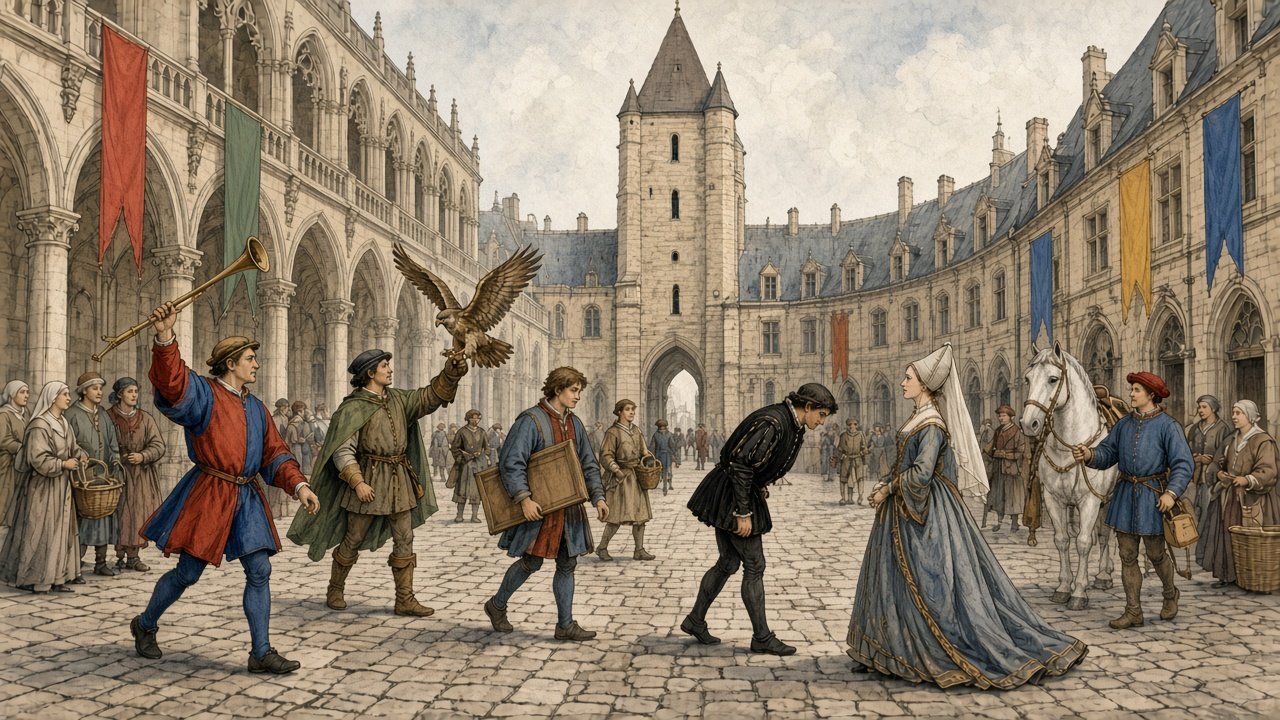
The duchy of Burgundy was for more than a thousand years a shifting idea as much as a fixed territory. The name passed from an East Germanic people who settled in the Rhône valley in the fifth century, to a Merovingian kingdom, to several Carolingian successor states, and finally to a French duchy centred on Dijon. Between 1363 and 1477 four Valois dukes turned that duchy into the nucleus of a composite state stretching from the Jura to the North Sea, rich enough to rival the crown of France and ambitious enough to seek a crown of its own. When the last of them died in the snow outside Nancy, the duchy itself returned to France, while most of the rest passed through his daughter to the house of Habsburg. This long read follows that history from the Burgundian settlement to the Treaties of Nijmegen, and considers what the Burgundian court left behind in art, ceremony and the political shape of the Low Countries.
A people before a place
The Burgundians first appear in Roman and Greek sources as one of the Germanic peoples beyond the Rhine frontier. Pliny the Elder lists the Burgundiones among the Vandal group of peoples, and later traditions, preserved in Scandinavian place names and in a much later Burgundian legend, connected them with the Baltic island of Bornholm, known in Old Norse as Burgundarholmr. Modern historians treat that link with caution. What is reasonably secure is that by the third century groups called Burgundians lived east of the Rhine in the region of the Main, where they came into contact, and frequently into conflict, with the Alamanni and with Rome.
Like many of the peoples who entered the late Roman world, the Burgundians were less a single ethnic bloc than a political community gathered around a royal family and its warriors. Their kings bore the title of hendinos according to the historian Ammianus Marcellinus, who also records a priestly office, the sinistus, held for life. Ammianus noted, with some interest, that a Burgundian king could be deposed if the harvest failed or the army was defeated, a detail that later writers often repeated as evidence of a sacral kingship tied to fortune.
In the opening years of the fifth century, as the Rhine frontier gave way under the pressure of the great crossing of 406, the Burgundians moved west of the river. By about 411 they had established themselves around Worms, apparently with the acquiescence of the usurper Jovinus and later as federates of the western empire under a king named Gundahar, the Gunther of later German legend. This first Burgundian realm on the middle Rhine lasted barely a generation.
The fall at Worms and the Nibelung memory
In 435 and 436 the Burgundians attempted to expand into the Roman province of Belgica. The Roman general Aëtius, who was simultaneously defending Gaul against several groups and managing his own position at court, responded by defeating them and, in 436 or 437, by setting Hunnic auxiliaries upon them. The chronicler Prosper of Aquitaine and the Gallic Chronicle record a great slaughter in which Gundahar was killed along with a large part of his people; one source gives the number of dead as twenty thousand, a figure that should be read as an expression of scale rather than a count.
The destruction of the Rhineland Burgundians left a long literary afterlife. The Middle High German Nibelungenlied, written down around 1200, and the Old Norse poems of the Poetic Edda preserve the memory of a Burgundian king Gunther or Gunnarr, his court at Worms and its annihilation at the hands of Attila, there called Etzel or Atli. The poets compressed and rearranged events, joining Attila, who had nothing directly to do with the massacre of 436, to a catastrophe carried out by Huns in Roman service. Nonetheless the core of the story, a Burgundian court on the Rhine destroyed by Huns, rests on a historical event.
Settlement in Sapaudia
The survivors were not left to wander. In 443 Aëtius settled the remnant of the Burgundians in Sapaudia, a region whose name survives in modern Savoy, though in the fifth century it seems to have meant the lands around Lake Geneva and the upper Rhône. The settlement followed the late Roman pattern of hospitalitas, by which barbarian federates were assigned a share of the land or of its revenues from Roman landowners in return for military service. The arrangement suited both parties. Rome gained a garrison between Italy and the turbulent interior of Gaul, and the Burgundians gained a secure base and a legal standing within the imperial system.
Over the following decades the Burgundians expanded out of Sapaudia along the Saône and the Rhône. They fought alongside Aëtius against Attila on the Catalaunian Plains in 451, and after the murder of Aëtius in 454 and of the emperor Valentinian III in 455 they took advantage of the collapse of central authority to extend their rule. By the 470s their kings controlled Lyon, which became one of their principal residences, together with Geneva, Vienne, and much of the land that later formed the duchy and county of Burgundy, as well as parts of what became Provence and western Switzerland.
Gundobad and the Burgundian kingdom
The most significant ruler of this kingdom was Gundobad, who reigned from around 473 or 474 until his death in 516. Before becoming king he had a remarkable career in Italy. He was the nephew of the Suebian general Ricimer, the power behind several short-lived western emperors, and after Ricimer’s death in 472 Gundobad briefly held the office of magister militum and arranged the elevation of the emperor Glycerius in 473. He then returned to Gaul to take up his inheritance among the Burgundians, leaving Italy to the events that led to the deposition of Romulus Augustulus in 476.
Burgundian kingship in this period was shared among brothers. Gundobad ruled alongside his brothers Godegisel, Chilperic II and Godomar, each with a share of territory and a separate residence. The arrangement was unstable. Chilperic and Godomar disappear from the record in circumstances that later Frankish tradition, particularly Gregory of Tours, presented as fratricide. Gregory’s account is coloured by the fact that Chilperic’s daughter Clotilde married the Frankish king Clovis and became, in Frankish memory, the pious queen who brought her husband to Catholic Christianity. In 500 Godegisel allied with Clovis against Gundobad and won a battle near Dijon, but Gundobad recovered, besieged Godegisel in Vienne and had him killed in 501.
Gundobad’s long reign gave the Burgundian kingdom a degree of coherence. He governed through a Gallo-Roman aristocracy that retained its estates, its Latin culture and its offices, and he corresponded with leading churchmen, especially Avitus, bishop of Vienne, whose letters are one of the main sources for the court. Gundobad was an adherent of the Homoian form of Christianity, often called Arian, which was the faith of most of the Germanic kingdoms; the majority of his Roman subjects were Nicene Catholics. He did not persecute them, and he engaged Avitus in theological debate. His son Sigismund converted to Catholicism during his father’s lifetime.
The Lex Burgundionum and the Roman law of the Burgundians
Gundobad is chiefly remembered as a legislator. The law code known as the Lex Burgundionum, or the Liber Constitutionum, was issued under his authority and revised under Sigismund in 517. It was one of the earliest of the barbarian law codes and among the most closely linked to Roman legal practice. The code regulated relations between Burgundians and Romans, set out the division of land under the settlement, fixed compensation payments for injury and homicide, and dealt with inheritance, marriage, theft and the judicial ordeal. A notable feature was its insistence that Burgundians and Romans should be judged on equal terms in disputes between them, and the code imposed penalties on judges who took bribes.
Alongside it the Burgundian kings issued a separate compilation for their Roman subjects, the Lex Romana Burgundionum, which summarised Roman law drawn from the Theodosian Code and other sources. The existence of the two codes reflects the principle of the personality of law, by which a person was judged according to the law of the community to which he belonged. It also shows that the Burgundian kingdom saw itself as a successor regime within the Roman legal world rather than as a conquest state.
The Lex Burgundionum also gave rise to a word. Its provision allowing a dispute to be settled by judicial combat, defended by Gundobad against the objections of Avitus, was remembered for centuries afterwards, and in the Carolingian period Bishop Agobard of Lyon wrote a treatise attacking the continued use of Gundobad’s law precisely because of its acceptance of the duel as proof.
The Frankish conquest of 534
The Burgundian kingdom was squeezed between two expanding powers, the Franks to the north and the Ostrogoths of Theodoric in Italy, while the Visigoths held much of southern Gaul until Clovis defeated them at Vouillé in 507. Sigismund, who succeeded his father in 516, founded the monastery of Saint-Maurice at Agaunum in the Valais, which became famous for its perpetual liturgy. His reign ended in disaster. In 522 he had his son Sigeric executed on the accusation of his second wife, and Sigeric was a grandson of Theodoric through his mother, which drew Ostrogothic hostility. In 523 the sons of Clovis invaded. Sigismund was captured, handed over to the Frankish king Chlodomer and killed with his family in 524, and he was later venerated as a saint.
His brother Godomar III rallied the Burgundians and defeated the Franks at Vézeronce in 524, where Chlodomer was killed. The respite lasted a decade. In 532 the Frankish kings Childebert I and Chlothar I, joined by their nephew Theudebert, invaded again and defeated Godomar near Autun. By 534 the conquest was complete, and Godomar vanishes from the sources. The Burgundian lands were divided among the Frankish kings. The kingdom of Burgundy as an independent polity had ended after a little less than a century in the Rhône valley.
Yet the name did not disappear. The Franks treated Burgundy as a distinct regnum within their dominions, and for much of the sixth and seventh centuries the Merovingian world was organised into three great kingdoms, Neustria in the west, Austrasia in the east and Burgundy in the south-east, each sometimes ruled by its own king and each with its own aristocracy and mayor of the palace. King Guntram, who ruled Burgundy from 561 to 592 from his residence at Chalon-sur-Saône, is one of the better documented Merovingian kings because of the attention Gregory of Tours paid to him. The Burgundian law code also continued to be applied to people of Burgundian descent well into the Carolingian period.
Carolingian Burgundy and the partition of Verdun
The Carolingian dynasty, which replaced the Merovingians in 751, governed Burgundy as part of a single Frankish empire, especially under Charlemagne. The problem came with succession. Frankish custom treated the kingdom as an inheritance to be divided among a ruler’s legitimate sons, and the sons of Louis the Pious fought a civil war after his death in 840. The Treaty of Verdun in 843 divided the empire into three. Charles the Bald received West Francia, which became the core of France; Louis the German received East Francia, the core of the later German kingdom; and the eldest brother, Lothar I, received the middle kingdom, Lotharingia in the widest sense, a long strip running from Frisia through the Rhineland, Burgundy and Provence to Italy, together with the imperial title.
The line drawn at Verdun cut Burgundy in two. The lands west of the Saône, including Dijon, Autun, Auxerre and Chalon, went to Charles the Bald and therefore to West Francia. The lands east of the Saône, including Besançon, Lyon and Vienne, the old heart of the Burgundian kingdom, went to Lothar. That division, roughly along the Saône, proved to be one of the most durable frontiers in European history. It separated what became the duchy of Burgundy, held from the king of France, from what became the county of Burgundy, later called the Franche-Comté, which lay within the Empire.
The many Burgundies
From the late ninth century onwards the word Burgundy could refer to several different political units at the same time, and much confusion in later accounts comes from failing to separate them.
The first was the kingdom of Lower Burgundy or Provence. In 879, in the vacuum left by the deaths of several Carolingian rulers, Boso, count of Vienne and brother-in-law of Charles the Bald, had himself elected king at Mantaille by the bishops and magnates of the Rhône valley. Boso was the first man of non-Carolingian descent to take the royal title in the Frankish world since 751, and his kingdom of Provence, centred on Vienne and Arles, survived him under his son Louis the Blind.
The second was the kingdom of Upper Burgundy, created in 888 when Rudolf I, of the Welf family, was crowned at Saint-Maurice d’Agaune after the deposition of Charles the Fat. It comprised the lands around Lake Geneva, the Jura and the region that became the Franche-Comté. In the 930s Rudolf II acquired the kingdom of Provence as well, and the united realm became known as the kingdom of Burgundy or, from its southern capital, the kingdom of Arles. When its last king, Rudolf III, died without children in 1032, the kingdom passed under an earlier agreement to the German king and emperor Conrad II. From that point the kingdom of Burgundy was one of the three kingdoms of the Holy Roman Empire, alongside Germany and Italy, although imperial control over it was intermittent and the title of king of Arles became largely honorific.
The third was the county of Burgundy, the region around Besançon and Dole between the Saône and the Jura. It emerged as a distinct county within the kingdom of Burgundy in the late tenth and eleventh centuries under the counts descended from Otto-William, and it therefore owed its ultimate allegiance to the emperor rather than to the king of France. The name Franche-Comté, the free county, became current only in the later Middle Ages.
The fourth, and the subject of most of this account, was the duchy of Burgundy west of the Saône, which lay within the kingdom of West Francia and later France. It is this duchy whose dukes were peers of France, and whose return to the crown in 1361 and again in 1477 forms the spine of the story.
Richard the Justiciar and the first duchy
The duchy of Burgundy as a territorial principality took shape at the end of the ninth century under Richard, count of Autun, known as Richard the Justiciar. He was a brother of Boso of Provence, but unlike Boso he remained loyal to the Carolingian kings of West Francia and fought against his brother’s kingdom, capturing Vienne for the Carolingians in 882. Over the following years Richard gathered a cluster of counties west of the Saône, including Autun, Auxerre, Nevers, Sens, Troyes and Langres, and he became the leading power in the region.
Richard’s reputation rests on his defence of Burgundy against the Vikings. Scandinavian raiders sailed up the Seine and its tributaries in the 880s, besieged Paris in 885 and 886, and penetrated deep into Burgundy. In 898 Richard defeated a Viking army at Argenteuil near Tonnerre, and in 911, together with Robert, marquis of Neustria, and the count of Poitou, he took part in the victory over Rollo’s Vikings at Chartres, the engagement that preceded the settlement which gave rise to Normandy. Contemporaries called him dux, and the title was given formal recognition in the documents of his later years. His sobriquet, the Justiciar, refers to his reputation for maintaining order, including the hanging of brigands.
Richard died in 921 and was buried at the abbey of Sainte-Colombe at Sens. His son Rudolf, known as Raoul, inherited the duchy and in 923 was elected king of West Francia in opposition to the imprisoned Carolingian Charles the Simple. Raoul reigned until 936, and for a few years the duke of Burgundy was also king of the Franks, an early instance of the way the duchy could be drawn into and out of the kingship.
The duchy in the tenth century
After Raoul’s death the duchy passed through a sequence of holders as the great families of West Francia contested control of it. Raoul’s brother Hugh the Black held it until 952, and the Robertian Hugh the Great, father of Hugh Capet, gained overlordship of much of Burgundy. Through Hugh the Great the duchy came to his sons, first Otto and then Henry, known as Henry the Venerable, who ruled from 965 to 1002. Henry was the brother of Hugh Capet, who became king in 987, and so the duchy was tied to the new royal family from the start of the Capetian era.
Henry died without legitimate sons, having adopted his stepson Otto-William, count of Mâcon and of the territories that would become the county of Burgundy. Otto-William claimed the duchy, while King Robert II, the son of Hugh Capet, claimed it as the nearest heir of his uncle. The resulting war lasted more than a decade, and Robert did not secure the duchy fully until around 1016, when he took control of Dijon after negotiations with the bishop of Langres, who held lordship over the town. Robert granted the duchy to his son Henry. When Henry became king as Henry I in 1031, he in turn gave it to his younger brother Robert, who had rebelled against him with the support of their mother, Queen Constance.
The duchy returns to France for the first time
The duchy had therefore been in royal hands, in a practical sense, between about 1016 and 1032. This pattern of reversion, followed by a fresh grant to a younger son, would be repeated twice more in the history of the duchy, in 1361 and 1363, and again, without a regrant, in 1477. The kings of France treated Burgundy as a great fief of the crown, an apanage in the later vocabulary, which could be given to a cadet of the royal house to secure his loyalty and provide him with an income, but which remained a part of the kingdom and could return to the crown when a line died out.
It is important to be precise about what this meant. The duchy was never a sovereign state in the modern sense before the fifteenth century. Its dukes owed homage to the king of France and were counted among the six lay peers of France, alongside the dukes of Normandy and Aquitaine and the counts of Flanders, Champagne and Toulouse. In practice, however, a duke with a strong treasury and a loyal nobility could act with considerable independence, and royal authority in Burgundy for much of the eleventh and twelfth centuries was more a matter of overlordship than of administration.
Robert I and the Capetian dukes
Robert I, duke from 1032 until his death in 1076, founded the line known as the elder Capetian house of Burgundy, which held the duchy for more than three centuries. His reign is not well documented, and chroniclers portrayed him as violent and quarrelsome. He was involved in disputes with the abbeys and bishops of the region, and he is said to have killed his father-in-law, a charge that the sources record without much detail. He was nonetheless a capable consolidator who held together a principality that had been contested for two generations.
Robert’s eldest son Hugh predeceased him, and the duchy passed to his grandson Hugh I, who abdicated after a few years in 1079 to become a monk at Cluny, the great Burgundian abbey whose network of priories extended across Latin Christendom. Hugh I was succeeded by his brother Odo I, known as Borel, who took part in the expeditions to Spain against the Almoravids and died in the Holy Land in 1102 during the crusade of 1101. Odo’s daughter Helie and his son Hugh II continued the line, and Hugh II ruled from 1102 to 1143.
These dukes governed a principality that was in many respects an assemblage of lordships, abbeys and episcopal towns. Dijon was the ducal residence, but the bishops of Langres, Autun and Chalon held large temporal rights, and the great monasteries of Cluny and, from 1098, Cîteaux, the mother house of the Cistercian order, were powers in their own right. Bernard of Clairvaux, the most influential churchman of the twelfth century, was born at Fontaine-lès-Dijon around 1090, the son of a Burgundian knight, and the Cistercian expansion that he led drew on the landed resources of Burgundian families.
Dijon, wine and the ducal domain
The economic foundation of the duchy lay in agriculture, in the trade routes of the Saône valley and, increasingly, in wine. The Côte d’Or, the escarpment running south-west from Dijon towards Beaune and Chalon, was planted with vines from Roman times, and the monastic houses, especially Cîteaux, played a large part in consolidating and recording vineyard holdings. The walled vineyard of the Clos de Vougeot was assembled by the Cistercians from the early twelfth century onwards. Later dukes took a direct interest in the quality and reputation of Burgundian wine, a point that became prominent under the Valois.
Dijon itself suffered a major fire in 1137, after which Hugh II rebuilt the town with a new circuit of walls. In 1183 Duke Hugh III granted the town a communal charter modelled on that of Soissons, giving its citizens a measure of self-government under an elected mayor. Hugh III, who ruled from 1162 to 1192, was the most active of the twelfth-century dukes in wider affairs. He took part in the Third Crusade with Philip II Augustus of France and commanded the French contingent after Philip returned home in 1191. He died at Acre in 1192.
Odo III, Hugh IV and the thirteenth century
The thirteenth-century dukes worked closely with the Capetian kings, whose authority grew markedly under Philip Augustus, Louis VIII and Louis IX. Odo III, duke from 1192 to 1218, fought for Philip Augustus at Bouvines in 1214, the battle that confirmed the ascendancy of the French crown over the Angevins and their imperial allies. Hugh IV, who ruled for a long period from 1218 to 1272, accompanied Louis IX on the Seventh Crusade and was captured with him in Egypt in 1250. Hugh IV also acquired the right to the titular kingdom of Thessalonica, a reminder that Burgundian families had become entangled in the Latin states created after the Fourth Crusade. The house also had a royal offshoot in the Iberian peninsula, since Henry of Burgundy, a grandson of Robert I, had been the father of Afonso Henriques, the first king of Portugal.
Under Hugh IV and his successors the duchy acquired a more developed administration on the French model, with bailiffs governing districts, a ducal council and a chamber of accounts in Dijon. Robert II, duke from 1272 to 1306, served the French crown as grand chamberlain and was a trusted adviser of Philip the Fair. His son Hugh V and then Odo IV followed. Odo IV, duke from 1315 to 1349, married Joan of France, the eldest daughter of King Philip V, and through her inherited the county of Burgundy and the county of Artois in 1330. For the first time in more than two centuries the duchy west of the Saône and the county east of it were held by the same ruler, even though one lay in France and the other in the Empire.
Philip of Rouvres and the end of the line
Odo IV’s only son, Philip, predeceased him in 1346 after a fall from his horse at the siege of Aiguillon during the Hundred Years War. The heir to the duchy was therefore Odo’s grandson, also named Philip, born in 1346 at the castle of Rouvres near Dijon and known as Philip of Rouvres. He succeeded as a child in 1349.
Philip of Rouvres was a pawn in larger politics from the beginning. His mother, Joan of Boulogne, married in 1350 John, duke of Normandy, who became King John II of France the same year. The king was thus the boy’s stepfather and the guardian of his inheritance, which by then included the duchy of Burgundy, the county of Burgundy, Artois, and, through his mother, the counties of Auvergne and Boulogne. In 1357 Philip was married to Margaret of Dampierre, the heiress of Louis of Male, count of Flanders, a match that would have united Burgundy and Flanders under a single prince had the boy lived.
He did not. Philip of Rouvres died of plague at Rouvres on 21 November 1361, aged fifteen, without children. With him the elder Capetian house of Burgundy, which had ruled the duchy since 1032, came to an end.
Reversion to the crown under John II
The death of Philip of Rouvres created a complicated succession. His various lands passed to different heirs according to their separate customs. The county of Burgundy and Artois went to Margaret of France, a daughter of Philip V and therefore Philip of Rouvres’s great-aunt. Auvergne and Boulogne went to a cousin on his mother’s side. The duchy of Burgundy, however, was claimed by John II of France, both as the nearest male relative through his mother, Joan of Burgundy, sister of Odo IV, and as king.
The legal basis of the claim was disputed, since Charles II of Navarre, the grandson of Margaret of Burgundy, the eldest daughter of Robert II, argued that he had the better right by primogeniture. John II rejected this, declared the duchy united to the crown of France in letters of November 1361, and in December travelled to Dijon to receive the homage of the Burgundian estates, swearing to maintain the privileges of the duchy. For a brief period Burgundy was not an apanage but a royal province.
The timing is significant. John II had been captured by the English at the battle of Poitiers in 1356 and held in London until the Treaty of Brétigny in 1360 allowed his release against a huge ransom and the surrender of extensive territories in south-western France. Burgundy itself had been invaded by Edward III of England in 1359 and 1360, and the duchy had bought off the English army with a payment of two hundred thousand gold moutons under the Treaty of Guillon in March 1360. The kingdom was impoverished, and the acquisition of a rich duchy was a valuable gain for the crown.
The grant to Philip the Bold
The union with the crown lasted less than two years. On 6 September 1363 John II secretly granted the duchy of Burgundy to his fourth son, Philip, as an apanage, and appointed him lieutenant of the king in Burgundy. The grant was made public in 1364 by John’s eldest son and successor, Charles V, after John’s death in London, where he had returned voluntarily when one of the hostages for his ransom escaped. Philip was invested as duke and peer of France and became the first of the Valois dukes of Burgundy.
The reason for the grant was partly personal. Philip, born in 1342, had fought beside his father at Poitiers at the age of fourteen. According to the chronicle tradition, he stayed at the king’s side as the French line broke, warning him of the blows that came from left and right, and he shared his captivity in England. The name the Bold, le Hardi, was attached to him for this conduct. John II rewarded his loyalty with the most valuable inheritance at his disposal.
There was also a political calculation. The crown needed a strong figure to hold the eastern frontier against the free companies of discharged soldiers who were ravaging the region after the peace of 1360, and against the claims of Charles of Navarre. An apanaged prince with roots in the duchy was a more effective guardian than a royal lieutenant. The grant carried the condition, standard for apanages, that the duchy would return to the crown if Philip’s male line failed. It was this condition that Louis XI would invoke in 1477.
The Flemish marriage
The decisive event of Philip the Bold’s career was his marriage. Margaret of Dampierre, the young widow of Philip of Rouvres, was the sole heiress of Louis of Male, count of Flanders, Nevers and Rethel, and through her grandmother she was also heiress to the county of Burgundy and Artois. Her hand was the greatest prize in the matrimonial market of western Europe. Edward III of England sought her for his son Edmund of Langley, and a treaty of marriage was agreed in 1364, but the pope, Urban V, refused the necessary dispensation on grounds of consanguinity, under pressure from the French court.
Charles V then negotiated for his brother. The marriage of Philip the Bold and Margaret took place at Ghent on 19 June 1369, after the king had agreed to return to Flanders the castellanies of Lille, Douai and Orchies, which the French crown had annexed earlier in the century. The concession was significant, but the prize was greater. When Margaret of France died in 1382, her granddaughter Margaret of Dampierre inherited Artois and the county of Burgundy, and when Louis of Male died in January 1384, Philip and Margaret inherited Flanders, Artois, the county of Burgundy, Nevers, Rethel and the lordship of Mechelen and Antwerp.
At a stroke the duke of Burgundy became the ruler of the richest and most urbanised region north of the Alps. Flanders, with its cloth towns of Ghent, Bruges and Ypres, was a commercial and industrial centre of the first rank, closely tied to English wool imports and to the trade networks of the North Sea and the Baltic described in the account of the Hanseatic League, whose principal western Kontor was at Bruges. The duchy of Burgundy and the county of Flanders were separated by several hundred kilometres of French and imperial territory, and the problem of joining them physically would preoccupy the Valois dukes for a century.
Flanders in revolt
The inheritance was not peaceful. The great Flemish towns had a long history of rebellion against their counts and against the French crown, rooted in the conflicts between weavers and merchants, between town and count, and between French and English economic interests. In 1379 Ghent rose against Louis of Male, and under the leadership of Philip van Artevelde, son of the earlier Ghent leader Jacob van Artevelde, the rebels defeated the count outside Bruges in 1382 and took control of much of the county.
Philip the Bold persuaded his nephew, the young Charles VI of France, to lead a royal army into Flanders. At Roosebeke on 27 November 1382 the French cavalry crushed the Ghent militia, and Philip van Artevelde was killed. The battle restored comital authority in most of Flanders, though Ghent held out, with English assistance, until the Peace of Tournai in December 1385, in which Philip, now count, granted the town an amnesty and confirmed its privileges. The episode set a pattern for the Valois dukes, who repeatedly faced revolts in Ghent and Bruges and repeatedly crushed them, without ever fully resolving the tension between princely government and urban autonomy.
Regent of France
Philip the Bold’s power did not rest on his own lands alone. When Charles V died in 1380, his son Charles VI was eleven years old, and the government of the kingdom fell to the king’s uncles: Louis, duke of Anjou, John, duke of Berry, Philip of Burgundy, and Louis, duke of Bourbon, the queen mother’s brother. Anjou soon departed to pursue his claim to the kingdom of Naples, where he died in 1384, and Philip became the dominant figure in the royal council.
He used the position to advance Burgundian interests, directing royal money and armies to the defence of Flanders and the pursuit of policies favourable to his territories, including the costly preparation of an invasion of England in 1386 that never sailed. In 1388 Charles VI dismissed his uncles and governed through his father’s former counsellors, the group known as the Marmousets. But in August 1392, while riding through a forest near Le Mans, the king suffered the first of the attacks of mental illness that recurred for the rest of his life. He killed several of his own escort before he was restrained. From then on Charles VI was intermittently incapable, and the government of France became the object of a struggle between his relatives.
The two principal contenders were Philip the Bold and the king’s younger brother, Louis, duke of Orléans. Their rivalry turned on control of the royal treasury, on foreign policy, especially towards England and the papal schism, and on the patronage that flowed from the court. Philip generally prevailed while he lived. He died at Halle, near Brussels, on 27 April 1404, so heavily in debt from his expenditure that his sons are said to have pawned his plate to pay for his funeral, and his widow, following custom, renounced his movable goods by placing her purse and keys on his coffin.
Champmol and the Valois dynastic tomb
Philip the Bold intended Burgundy to be not only a source of revenue but the seat of a dynasty. In 1383 he founded a Carthusian monastery at Champmol, just outside the walls of Dijon, as the burial place of his house. The Chartreuse de Champmol, consecrated in 1388, was one of the most lavish artistic commissions of its time. Philip employed the architect Drouet de Dammartin, the painters Jean de Beaumetz and Jean Malouel, the sculptor Jean de Marville and, after Marville’s death in 1389, the Netherlandish sculptor Claus Sluter of Haarlem.
Sluter, who worked for the duke until his own death in 1405 or 1406, transformed northern sculpture. For the portal of the chapel he carved figures of the duke and duchess kneeling, presented by their patron saints, so animated and so solidly modelled that they seemed to step out of the architectural frame. For the cloister he made a monumental fountain, known as the Well of Moses, a hexagonal base surrounded by six life-size Old Testament prophets, each an individual portrait of age, temper and dress, with heavy drapery and closely observed faces. Some original painting survives on the stone. The figures were completed after Sluter’s death by his nephew Claus de Werve.
For Philip’s tomb Marville and then Sluter designed a monument in which the recumbent effigy of the duke lay on a black marble slab above an arcade of alabaster figures, the pleurants or mourners, cloaked and hooded figures in every attitude of grief who process around the tomb chest. The tomb, completed by de Werve in 1410, was moved after the French Revolution and is now in the Musée des Beaux-Arts in the former ducal palace in Dijon, alongside the tomb of John the Fearless and Margaret of Bavaria, which follows the same design. The Chartreuse itself was largely demolished after 1792, and only the portal, the Well of Moses and fragments survive on the site, which now lies within the grounds of a psychiatric hospital.
John the Fearless
Philip the Bold’s eldest son, John, was born at Dijon in 1371. Before his accession he had already acquired the sobriquet by which he is known. In 1396 he led the Burgundian and French contingent of the crusade against the Ottoman Turks that ended in catastrophe at Nicopolis on the Danube on 25 September 1396. The western knights, ignoring the advice of King Sigismund of Hungary, charged uphill against the Ottoman infantry and were overwhelmed by the sultan Bayezid I. Many prisoners were executed after the battle. John was among the high-ranking captives held for ransom, and he returned home in 1398 after his father paid two hundred thousand ducats, raised with great effort from the Burgundian and Flemish estates. His conduct in the battle earned him the name Jean sans Peur, John the Fearless.
On his father’s death in 1404 John inherited the duchy of Burgundy, and on his mother’s death in 1405 he inherited Flanders and Artois, while the county of Burgundy passed to him as well. Some of the lesser lands went to his brothers: Antoine received Brabant and Limburg, which he acquired through his great-aunt Joan of Brabant, and Philip received Nevers and Rethel. Both brothers would later die at Agincourt.
John’s marriage in 1385 to Margaret of Bavaria, daughter of Albert of Bavaria, count of Hainaut, Holland and Zeeland, was part of a double marriage that also united his sister Margaret with Albert’s son William. It created a Wittelsbach connection that, a generation later, brought the counties of Hainaut, Holland and Zeeland within the Burgundian sphere.
The murder of Louis of Orléans
John lacked his father’s standing as a royal uncle, and in the royal council the duke of Orléans quickly gained the upper hand, allied with Queen Isabeau of Bavaria. The rivalry turned to open hostility. Each prince maintained armed retinues in Paris, and each sought to control the king during his lucid periods and the dauphin during his illnesses. The issue was not merely personal. Orléans favoured an aggressive policy towards England and a heavy royal tax burden, both damaging to Flemish trade; John presented himself as a champion of reform and of lighter taxation, and he cultivated the Parisian population, especially the guild of butchers and the university.
On the evening of 23 November 1407, Louis of Orléans was returning from a visit to the queen at the Hôtel Barbette in the Marais when he was attacked in the Rue Vieille-du-Temple by a band of armed men and killed. Within a few days John the Fearless admitted to his uncle, the duke of Berry, that he had ordered the attack, and he fled to Flanders. Early in 1408 he returned to Paris with an army, and on 8 March a theologian of the University of Paris, Jean Petit, delivered before the court a lengthy justification of the killing as a lawful act of tyrannicide, arguing that Orléans had been plotting against the king. The court, unable to oppose the duke by force, issued letters of pardon.
The Armagnac–Burgundian civil war
The murder divided the French nobility for a generation. The party of the young Charles of Orléans, son of the victim, came to be led by his father-in-law, Bernard VII, count of Armagnac, and its members were called the Armagnacs. The followers of John the Fearless were the Burgundians. The Armagnac–Burgundian civil war was fought intermittently from 1407 to 1435, interrupted by treaties that neither side respected for long.
Paris was the main prize. In 1413 the Burgundian faction in the city, with the support of the butchers led by Simon Caboche, launched a violent movement known as the Cabochien revolt, which forced through an ordinance of administrative reform but alienated the moderate bourgeoisie by its excesses. The Armagnacs regained control of the city in August 1413, the ordinance was revoked, and John withdrew. Both sides negotiated with the English. Henry V, who came to the English throne in 1413, exploited the division by reviving the English claim to the French crown. In 1415 he invaded Normandy, took Harfleur and destroyed a large French army at Agincourt on 25 October. John the Fearless did not take part, although his brothers Antoine of Brabant and Philip of Nevers were killed fighting on the French side.
After Agincourt the English conquered Normandy systematically between 1417 and 1419, while the civil war continued. In May 1418 Burgundian partisans opened the gates of Paris, and in the massacres that followed the count of Armagnac and many of his supporters were killed. The dauphin Charles, the future Charles VII, escaped and established a rival government south of the Loire, at Bourges and Poitiers. John the Fearless entered Paris in July and took control of the king and queen.
The assassination at Montereau
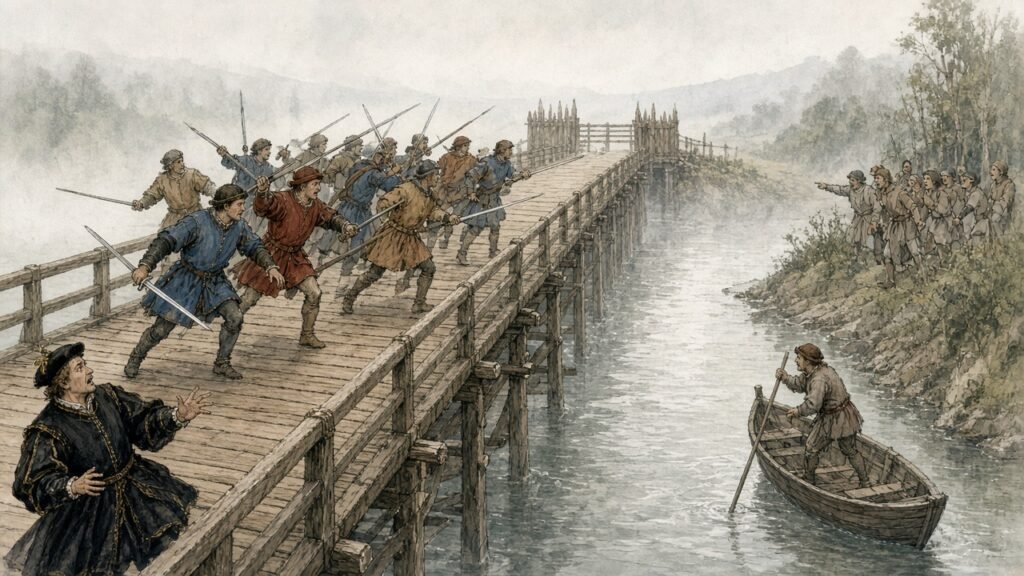
By 1419 the English had taken Rouen and were advancing on Paris. Both John the Fearless and the dauphin recognised the danger of continued division, and they agreed to meet. A first meeting at Pouilly-le-Fort near Melun in July 1419 produced a treaty of reconciliation. A second meeting was arranged on the bridge over the Yonne at Montereau, where the river joins the Seine, on 10 September 1419. A barrier enclosure was built in the middle of the bridge, and each party was to enter with a limited escort.
During the conversation, members of the dauphin’s entourage, among them Tanneguy du Châtel, a former servant of Louis of Orléans, attacked the duke and killed him with axes and swords. Whether the dauphin, then sixteen, ordered the killing, knew of it in advance, or was presented with a fait accompli remains uncertain. The Burgundian side never doubted his responsibility. In the seventeenth century a Carthusian prior at Champmol is said to have shown a visiting king the duke’s skull, with the remark that this was the hole through which the English had entered France. The story is probably apocryphal, but it expresses accurately the consequence of the murder.
Philip the Good and the English alliance
Philip the Good, John’s only son, was twenty-three when his father was killed. He had been raised largely in Flanders and was already governing there on his father’s behalf. His immediate response to Montereau was to seek revenge through an alliance with England.
The Treaty of Troyes, sealed on 21 May 1420 by Charles VI, Queen Isabeau, Henry V and Philip the Good, disinherited the dauphin. It recognised Henry V as heir and regent of France, and arranged his marriage to Catherine of Valois, the daughter of Charles VI, which took place on 2 June. On the death of Charles VI the crowns of England and France were to pass to Henry and his heirs, though the two kingdoms were to remain distinct, each with its own laws and institutions. Philip pledged to support the arrangement and to pursue the dauphin, whose responsibility for the murder of John the Fearless was cited as a reason for his exclusion.
The treaty did not hold for long in practice. Henry V died at Vincennes in August 1422, a few weeks before Charles VI, and his son Henry VI was less than a year old. The English regent in France was the infant king’s uncle, John, duke of Bedford, who married Philip’s sister Anne in 1423, cementing the alliance. The dauphin, recognised as Charles VII in the territories loyal to him, held the south. Philip the Good, while nominally allied with England, increasingly concentrated on his own interests, and his military contribution to the English war effort was intermittent.
Joan of Arc and her capture
In 1428 the English laid siege to Orléans, the key to the Loire. The arrival in 1429 of Joan of Arc, a young woman from Domrémy on the border of Lorraine and Champagne who claimed divine guidance, helped to lift the siege in May and led to the coronation of Charles VII at Reims in July 1429. The coronation strengthened Charles’s claim to legitimacy and weakened the Treaty of Troyes in the eyes of many French subjects.
Philip the Good had been invited to the coronation and did not attend. In the following year a Burgundian army besieged Compiègne, an Oise town that had gone over to Charles VII. On 23 May 1430 Joan led a sortie from the town and was cut off when the gates were closed behind her. She was taken prisoner by men of the Bastard of Wandonne, a follower of John of Luxembourg, count of Ligny, who served in the Burgundian army. Philip the Good visited her in captivity, though no record of their conversation survives beyond the remark of the chronicler Monstrelet, who was present and later claimed not to remember what was said. John of Luxembourg sold her to the English for ten thousand livres in November 1430. She was tried at Rouen by an ecclesiastical court under Bishop Pierre Cauchon of Beauvais, a partisan of the Anglo-Burgundian cause, and burned on 30 May 1431.
Her capture by Burgundian forces has been cited ever since as an illustration of the Anglo-Burgundian alliance at its height. In practice the alliance was already under strain, and Philip had begun to explore terms with Charles VII.
The Congress of Arras, 1435
The decisive break came in 1435. Under the mediation of papal legates and of the Council of Basel, representatives of England, France and Burgundy met at Arras in the summer of 1435. The Congress of Arras was one of the first great international peace conferences of European history. The English delegation, unwilling to give up the claim to the French crown, withdrew in early September. The duke of Bedford died at Rouen on 14 September. On 21 September 1435 Philip the Good and the representatives of Charles VII concluded a separate peace.
The Treaty of Arras was highly favourable to Burgundy. Charles VII expressed his regret for the murder of John the Fearless, promised to punish those responsible and to found a chapel and a perpetual Mass at Montereau. He ceded to Philip the counties of Mâcon and Auxerre and the castellany of Bar-sur-Seine, and pledged the towns of the Somme, including Amiens, Abbeville and Saint-Quentin, which the crown could redeem for four hundred thousand gold écus. Most significantly, Philip was exempted for his lifetime from doing homage to Charles VII. In the language of feudal relations, the duke of Burgundy was no longer the king’s man while he lived.
The treaty ended the Anglo-Burgundian alliance and prepared the ground for the reconquest of France by Charles VII. Paris returned to French royal control in April 1436, and by 1453 the English had been expelled from all of France except Calais. Philip the Good, freed from obligations to either side, turned to the consolidation of his power in the Low Countries.
The acquisition of the Low Countries
The territorial growth of the Burgundian state under Philip the Good was achieved by inheritance, purchase, diplomacy and war, and it transformed a collection of French and imperial fiefs into a coherent bloc of principalities. The process is usually described under the heading of the Burgundian Netherlands.
Namur was bought from its childless count, John III, in 1421, and came to Philip on John’s death in 1429. Brabant and Limburg came to him in 1430 on the death of his cousin Philip of Saint-Pol, the last of the Brabant cadet line descended from his uncle Antoine. Brabant brought the cities of Brussels, Leuven and Antwerp, and the ducal palace on the Coudenberg in Brussels became one of the principal residences of the Burgundian court.
Hainaut, Holland, Zeeland and Friesland were won from Philip’s cousin, Jacqueline of Bavaria, after a long war. Jacqueline was the heiress of William of Bavaria-Straubing and of Philip’s aunt Margaret of Burgundy. Her marriage to John IV of Brabant was unhappy, and her later marriage to Humphrey, duke of Gloucester, brought an English intervention in Hainaut in 1424. Philip fought her and her supporters, the Hook party in Holland, against her uncle John of Bavaria and then on his own account. By the Treaty of Delft in 1428 Jacqueline recognised Philip as her heir and governor, and in 1433, after she married without his consent, she was forced to cede her counties to him outright.
Luxembourg was acquired from Elisabeth of Görlitz, who held it in pledge, by a treaty of 1441 and a military occupation in 1443. Philip also extended his influence over the prince-bishoprics of Utrecht, Liège and Cambrai by securing the election of relatives and allies, including his illegitimate son David, who became bishop of Utrecht in 1456, and his nephew Louis of Bourbon, bishop of Liège from 1456.
By the 1440s Philip ruled the duchy and county of Burgundy, Flanders, Artois, Brabant, Limburg, Hainaut, Holland, Zeeland, Namur and Luxembourg, together with the Mâconnais, Auxerrois, Charolais, the Somme towns and a range of lesser lordships. He was by any measure one of the richest princes in Europe. Contemporaries called him the grand duke of the West, and his lands are sometimes described collectively as the Burgundian state, although no single title, law or administration covered them all.
Ruling a composite state
The Burgundian lands were a personal union of principalities, each with its own customs, assemblies, languages and privileges. The duchy and county of Burgundy were French-speaking and agrarian; Flanders spoke Dutch and was dominated by great towns; Brabant had its own charter of liberties, the Joyous Entry of 1356, which every new duke had to swear before being recognised; Holland was a land of fishing, shipping and polders; Luxembourg was a German and French-speaking territory with a strong nobility. The dukes ruled through local councils, each principality’s estates voted taxes separately, and the duke was duke in one place, count in another and lord in a third.
Philip the Good and his chancellor, Nicolas Rolin, worked to bring a degree of unity to this assemblage. The ducal council was reorganised, chambers of accounts were established at Dijon, Lille and The Hague, and in 1464 the representatives of the estates of the various northern provinces met together at Bruges for the first time. This assembly is usually regarded as the first States General of the Netherlands, and the institution would play a central role in the revolt against Philip II of Spain in the following century, as the account of the Dutch Golden Age describes. The dukes also introduced a common gold coinage, known as the rider or cavalier, for several of their northern territories in 1433.
Rolin himself deserves notice. A lawyer from Autun, he served as chancellor from 1422 until 1457 and was among the most powerful men of his time. In 1443 he and his wife Guigone de Salins founded the Hôtel-Dieu at Beaune, a hospital for the poor, which became famous for its architecture and its endowment of vineyards, and he commissioned from Jan van Eyck the painting known as the Madonna of Chancellor Rolin, now in the Louvre.
The Order of the Golden Fleece
On 10 January 1430, at Bruges, on the occasion of his third marriage, to Isabella of Portugal, Philip the Good founded the Order of the Golden Fleece. It was a chivalric order on the model of the English Order of the Garter, limited at first to twenty-four knights, later thirty, with the duke as sovereign. Its emblem was a golden ram’s fleece hanging from a collar of linked firesteels and flints, a ducal device. The name evoked both the classical story of Jason and the Argonauts and, for those who found Jason an ambiguous model, the biblical story of Gideon, whose fleece was a sign of divine favour.
The Order served several purposes. It bound the leading nobles of the various Burgundian principalities into a single body with the duke at its head, giving the composite state a ceremonial unity it otherwise lacked. Members swore loyalty to the sovereign and could not belong to any other order, which detached them from the French order of the Star and from other allegiances. Chapters were held at intervals in the great towns of the Burgundian lands, and the statutes required knights to accept the correction of their brethren for faults of conduct. The Order also proclaimed the duke’s commitment to the crusade against the Ottomans, a cause that Philip pursued in words throughout his life and in deeds only fitfully.
Isabella of Portugal, the duke’s wife, was herself a political figure of weight. She negotiated with the English on behalf of the duke, directed the household and administration when he was absent, and was the mother of his only surviving legitimate son, Charles, born at Dijon on 10 November 1433.
The court and its painters
The court of Philip the Good was the most splendid in northern Europe. It moved between Dijon, Brussels, Bruges, Lille and Hesdin, accompanied by tapestries, plate, musicians, chapel singers and a household that numbered several hundred people organised in strict departments. Court ordinances specified the duties and precedence of every office, from the first chamberlain to the kitchen boys. Ceremony, display and generosity were instruments of government, demonstrating the duke’s wealth and status to his subjects and to foreign envoys alike.
The most celebrated of the artists associated with the court was Jan van Eyck. He entered Philip’s service in 1425 as painter and valet de chambre, having earlier worked for John of Bavaria at The Hague, and he remained in the duke’s employment until his death at Bruges in 1441. His duties were not confined to painting. He was sent on confidential missions, including a journey to Portugal in 1428 and 1429 to paint portraits of the Infanta Isabella so that the duke could see his future bride. The duke valued him highly, raising his salary and intervening when the accountants of Lille hesitated to pay it, and standing godfather to one of his children.
Van Eyck’s surviving works, including the Ghent Altarpiece, completed in 1432 in collaboration with or after the death of his brother Hubert, the Arnolfini Portrait of 1434 and the Rolin Madonna, mark the high point of what is called Early Netherlandish painting, the art of the Flemish Primitives. The technique of building up thin translucent layers of oil glaze allowed a depth of colour and a precision of detail, in textiles, metals, landscapes and skin, that had no precedent. The ducal court did not commission most of these works directly; many were painted for churchmen, merchants and officials. But the court’s wealth and its taste for display created the market in which this art flourished.
Van Eyck was followed by a generation of painters who worked in the Burgundian cities. Rogier van der Weyden, official painter to the city of Brussels from 1436, painted portraits of Philip the Good, Isabella of Portugal and Charles the Bold, and his workshop produced the frontispiece of the Chroniques de Hainaut showing the duke receiving a manuscript. Dieric Bouts worked at Leuven, Hans Memling at Bruges, and Hugo van der Goes at Ghent. The panels they produced travelled to Italy, Spain and the Baltic, carried by the merchants whose trade is described in the account of the Hanseatic League.
Books, music and the ducal library
The dukes were also the greatest patrons of manuscript production in northern Europe. Philip the Good expanded the ducal library from a few hundred volumes to around nine hundred, employing scribes, translators and illuminators such as Jean Miélot, David Aubert, Loyset Liédet and Willem Vrelant. Many were copies or new compilations of chronicles, romances and histories of ancient heroes, including Alexander, Jason and Hercules, designed to give the court a literary mirror of its own chivalric ideals. The library survives in large part as the core of the Royal Library of Belgium in Brussels.
The ducal chapel was a centre of polyphonic music. Guillaume Du Fay had connections with the court, and Gilles Binchois served in the chapel for some three decades. The composers of the Burgundian school developed the chanson and the cyclic Mass, and the musical culture of the court influenced the chapels of France, England and Italy.
The architectural and urban settings of this culture, the town halls, belfries, guildhalls and stepped gables of Flanders and Brabant, are traced in the account of stepped gables and the Northern Renaissance. The Burgundian period saw the building of the town halls of Brussels, begun in 1401, and Leuven, begun in 1448, and the extension of many of the great churches of the Low Countries.
The Feast of the Pheasant
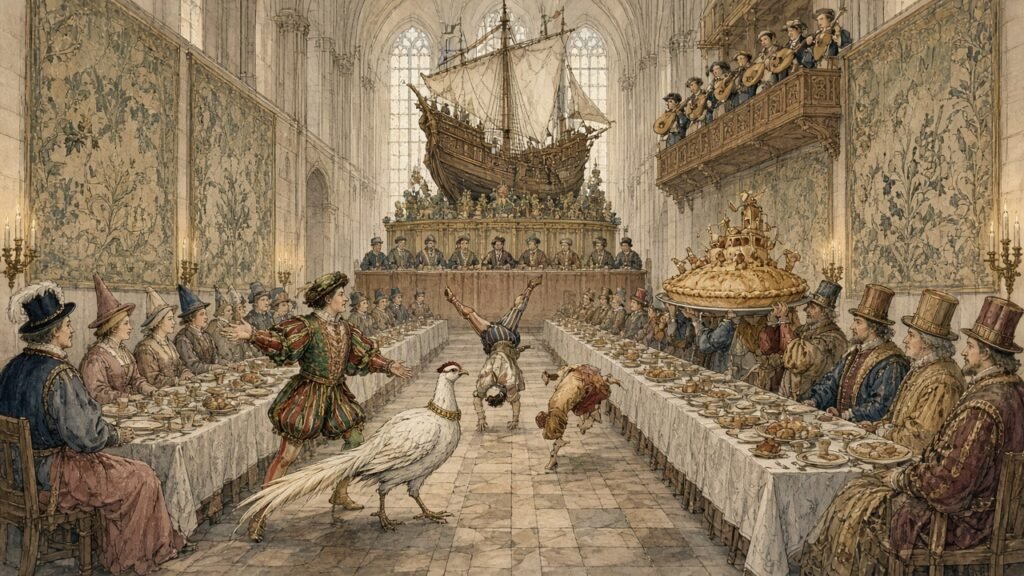
The fall of Constantinople to the Ottoman sultan Mehmed II on 29 May 1453 gave new urgency to the crusading rhetoric of the Burgundian court. On 17 February 1454, at Lille, Philip the Good held a banquet of extraordinary elaboration, known as the Feast of the Pheasant, to proclaim his intention to take the cross.
The chronicler Olivier de La Marche, who helped to organise the occasion, and Mathieu d’Escouchy left detailed descriptions. The hall was hung with tapestries depicting the labours of Hercules. The tables carried enormous set pieces, known as entremets, including a model of a church with singers inside it, a pie that contained an orchestra of twenty-eight musicians, a model ship and a castle. Between the courses there were performances and tableaux, including a mime of the story of Jason. Towards the end a giant led in an elephant on which sat an actor dressed as a nun representing the Church, who lamented her plight under the Turks and appealed to the knights for help.
A live pheasant wearing a gold collar decorated with jewels was then brought in, and Philip and his knights swore vows upon it, in the tradition of the vows of the peacock and the heron in chivalric romance. Philip promised to go on crusade if the king of France joined him or did not oppose him, and if another great prince would take part. Many of the knights’ vows were similarly conditional, and some were fanciful. The crusade never took place. Philip prepared seriously in the early 1460s and a small Burgundian fleet sailed for the eastern Mediterranean, but the duke himself never went.
The Feast of the Pheasant has often been taken as a symbol of the Burgundian court’s taste for spectacle over substance. That judgement is too simple. The feast was a political event that bound the nobility of many principalities to a common undertaking and advertised the duke’s standing to the rest of Europe. Its theatricality was the normal language of princely power in the fifteenth century, and Burgundy spoke that language with exceptional fluency.
The revolt of Ghent and the dauphin’s exile
Splendour depended on revenue, and revenue depended on the towns. In 1447 Philip proposed a permanent tax on salt in Flanders, which the citizens of Ghent refused. The dispute escalated into open war between 1449 and 1453. The Ghent militia was defeated at Gavere on 23 July 1453, and the town was forced to submit. Its leading citizens came out in their shirts to beg the duke’s pardon, the town paid a heavy fine, and its privileges were curtailed. The war demonstrated both the strength of the ducal state and its dependence on the cooperation of the great towns, which supplied the bulk of its tax income.
In 1456 the Burgundian court acquired an unusual guest. Louis, the dauphin of France and the future Louis XI, had quarrelled with his father, Charles VII, and fled from his own apanage of the Dauphiné to the protection of Philip the Good. He lived at the castle of Genappe in Brabant for five years at the duke’s expense. When Charles VII died in July 1461, Philip escorted Louis to Reims for his coronation with an armed retinue that outshone the new king’s own. Louis did not forget the humiliation of dependence. In 1463 he redeemed the Somme towns pledged at Arras, paying the four hundred thousand écus, a transaction that the heir to Burgundy, Charles, count of Charolais, regarded as a betrayal by the courtiers who had advised his father.
Charles and the League of the Public Weal
Charles, count of Charolais, took an increasingly active part in government as Philip aged. He distrusted the Croÿ family, who dominated the ducal council and had favoured the sale of the Somme towns, and he engineered their fall in 1465. In the same year he joined the League of the Public Weal, a coalition of French princes, including Francis II of Brittany and the king’s brother Charles of Berry, who rose against Louis XI in protest at his centralising policies.
The league’s army fought the king at Montlhéry, south of Paris, on 16 July 1465. The battle was inconclusive, but Charles held the field and claimed the victory. The subsequent Treaty of Conflans in October 1465 restored the Somme towns to Burgundy. In 1466 and 1468 Charles also suppressed revolts in the prince-bishopric of Liège, which Louis XI had encouraged. In 1466 he sacked Dinant, a town of the prince-bishopric that had insulted him, and in 1468 he stormed and burned Liège itself.
Charles the Bold
Philip the Good died at Bruges on 15 June 1467, at the age of seventy, after a reign of forty-eight years. Charles, his son, succeeded him. The name by which he is usually known in English, the Bold, translates Charles le Téméraire, which carries the sense of rashness as well as courage. It was not in common use in his own lifetime and gained its currency from later historians reflecting on the outcome of his reign.
Charles was energetic, studious and austere by the standards of his father’s court. He spoke several languages, read the histories of the ancient world, especially those of Alexander and Caesar, and drank sparingly. He worked long hours on administrative business and held audiences at which petitions were heard publicly. He was also uncompromising, convinced of the justice of his cause, and unwilling to accept a reversal.
In 1468 he married, as his third wife, Margaret of York, sister of Edward IV of England. The wedding at Damme and the celebrations at Bruges in July 1468 were among the most magnificent spectacles of the century. The match revived the English alliance against Louis XI. Margaret, who survived her husband by many years, became an important patron and political figure in her own right, sponsoring William Caxton’s first printed books in English and later supporting the Yorkist pretenders against Henry VII.
Péronne
In October 1468 Louis XI came to Péronne in Picardy to negotiate with Charles in person, having obtained a safe conduct. While he was there, news arrived that the people of Liège, encouraged by French agents, had risen again and killed Burgundian officials. Charles, enraged, effectively imprisoned the king in the castle of Péronne for several days. Louis was forced to sign a treaty conceding a range of points, including the exemption of Flanders from the jurisdiction of the Parlement of Paris, and to accompany Charles to Liège to witness the punishment of the town he had incited. The episode was a severe humiliation for the king. The historian and diplomat Philippe de Commynes, who was in Charles’s service at the time and later defected to Louis in 1472, described it in detail in his memoirs.
Centralisation and the Ordinances of Thionville
Charles sought to turn his composite inheritance into a more unified state. By the Ordinance of Thionville of December 1473 he created a single supreme court, the Parlement of Mechelen, for his northern territories, and a central chamber of accounts at Mechelen, replacing the separate chambers of Lille, Brussels and The Hague. He reorganised the army into permanent companies of ordonnance on the French model, regularly paid and governed by detailed military ordinances issued in 1471, 1472 and 1473, which specified the composition of each lance, the drill of archers and pikemen and the use of artillery.
He also raised taxes to unprecedented levels. The estates of the various principalities granted large sums in the early 1470s, but resentment grew, especially in Flanders, and the centralising measures offended the privileges of towns and nobles who had grown accustomed to separate institutions. These grievances would surface immediately after his death.
A crown in prospect
Charles’s ambition was to give his lands the status of a kingdom. The Burgundian territories formed a broken chain between France and the Empire. To the south lay the duchy and county of Burgundy; to the north the Low Countries; between them lay Lorraine, Alsace and the lands of the upper Rhine. If they could be joined, and if the whole could be raised to a kingdom, the house of Burgundy would stand in the position of the old middle kingdom of Lothar.
In 1469 Charles acquired, by the Treaty of Saint-Omer, the Habsburg territories in Alsace and the Breisgau, pledged to him by Sigismund, archduke of Austria, in exchange for a loan of fifty thousand florins. In 1473 he acquired the duchy of Guelders, purchased from its elderly duke Arnold of Egmond, whose son Adolf had imprisoned him, and occupied it by force. In the same year he negotiated with the emperor Frederick III for a royal title.
The meeting at Trier, 1473
Charles and Frederick III met at Trier at the end of September 1473. The discussions turned on two linked questions. Frederick wanted the marriage of his son Maximilian to Charles’s only child, Mary, who was then sixteen and the greatest heiress in Europe. Charles wanted to be made a king, with his lands raised to a kingdom within the Empire, and he hoped also to be designated king of the Romans, the title of the imperial heir, a demand Frederick would not entertain. The preparations for a coronation advanced far. A crown, a sceptre and robes were made ready, and the cathedral at Trier was prepared for the ceremony.
On the night of 24 to 25 November 1473 Frederick III left Trier abruptly by boat down the Moselle without taking leave. The reasons are not wholly clear. The electors and princes of the Empire opposed the creation of a powerful new kingdom on the western frontier; Frederick was uneasy about the scope of the title Charles wanted, which seems to have included the old kingdom of Burgundy and possibly claims over neighbouring imperial territories; and the marriage agreement had not been fixed to his satisfaction. Charles was left without his crown. The episode marked the high point of his diplomatic ambitions and the beginning of their collapse.
The siege of Neuss
In 1474 Charles intervened in the affairs of the archbishopric of Cologne, supporting the archbishop Ruprecht of the Palatinate against the cathedral chapter and the estates, who had elected Hermann of Hesse as administrator. Charles laid siege to Neuss, a fortified town on the Rhine held for the chapter, at the end of July 1474. The town resisted for eleven months. An imperial army under Frederick III, raised from across the Empire, came to its relief in May 1475, and Charles, faced with a war against the Empire as a whole and with the threat of a French attack on his southern territories, agreed in June to lift the siege under papal mediation.
The siege of Neuss consumed a year and immense sums of money. It also wrecked Charles’s plans for a joint campaign with England against France. Edward IV landed at Calais in July 1475 with a large army, expecting Burgundian support, but Charles arrived without his troops, which were still exhausted from the Rhineland. Louis XI offered Edward a large pension and a payment of seventy-five thousand crowns, and by the Treaty of Picquigny of 29 August 1475 the English withdrew. Charles, deprived of his ally, concluded a nine-year truce with Louis at Soleuvre in September.
Lorraine and the Swiss
Freed in the north, Charles turned to Lorraine, the gap between his northern and southern territories. René II, the young duke of Lorraine, had allied with Louis XI and declared war on him in 1475. In the autumn of 1475 Charles conquered the duchy and entered Nancy on 30 November, intending to make it the capital of his united lands.
His southern frontier was meanwhile threatened by a new coalition. In Alsace and the Breisgau, Charles’s governor, Peter von Hagenbach, had provoked hostility by his harsh rule, and in 1474 the towns of the upper Rhine rose against him, captured him and had him executed at Breisach after a trial. Sigismund of Austria redeemed the pledged territories. The Swiss Confederates, who had been drawn into an alliance with Sigismund and the towns, the Lower Union, and who were encouraged and financed by Louis XI, declared war on Burgundy in October 1474 and won a battle at Héricourt in November. They also occupied the Vaud, which belonged to Savoy, an ally of Charles.
Grandson
In February 1476 Charles led his army over the Jura to punish the Swiss. He besieged the castle of Grandson on the shore of Lake Neuchâtel, which surrendered on 28 February. Charles had the garrison of over four hundred men hanged or drowned. On 2 March 1476 the main Swiss army arrived to relieve the castle. At the battle of Grandson the Burgundian army, attempting a manoeuvre to draw the Swiss onto open ground, was thrown into confusion by the sudden appearance of further Swiss contingents on the hills and fled, abandoning its camp.
Casualties were relatively light, but the booty was enormous. The Swiss captured the duke’s artillery, his tents, tapestries, plate, jewels and treasury, much of which was later divided among the cantons. Pieces of the so-called Burgundian booty survive in Swiss museums, including tapestries, banners and the jewels that passed through the hands of later merchants and princes. The defeat damaged the reputation of the Burgundian army, but it did not destroy it.
Morat
Charles reassembled his army at Lausanne and in June 1476 advanced again, laying siege to Morat, Murten in German, a small walled town on the lake of the same name, held by a garrison from Bern under Adrian von Bubenberg. The town held out for nearly two weeks. On 22 June 1476 a Swiss relief army, joined by contingents from Lorraine, Alsace and Austria, attacked the Burgundian siege lines in the rain.
The battle of Morat was a disaster for Burgundy. Charles had expected the Swiss to attack earlier and had stood his army down, and many of his troops were not at their posts when the attack came. The fortified hedge that protected the Burgundian camp was outflanked, and the army was driven back against the lake. Several thousand Burgundian soldiers were killed, many drowned in the lake or cut down in flight. Charles escaped with a small escort. The Swiss later built an ossuary at the site, which stood until it was destroyed by French troops in 1798.
The road to Nancy
The defeat at Morat broke the Burgundian position in the south. Savoy abandoned the Burgundian alliance, and René II of Lorraine reconquered his duchy, retaking Nancy in October 1476. Charles, determined to recover Lorraine, besieged Nancy again in the autumn with an army reduced by casualties, desertion and the failure of the estates to vote new taxes. Commynes describes him in these months as obstinate and withdrawn, refusing the counsel of his captains, and suggests that the defeats had affected his judgement.
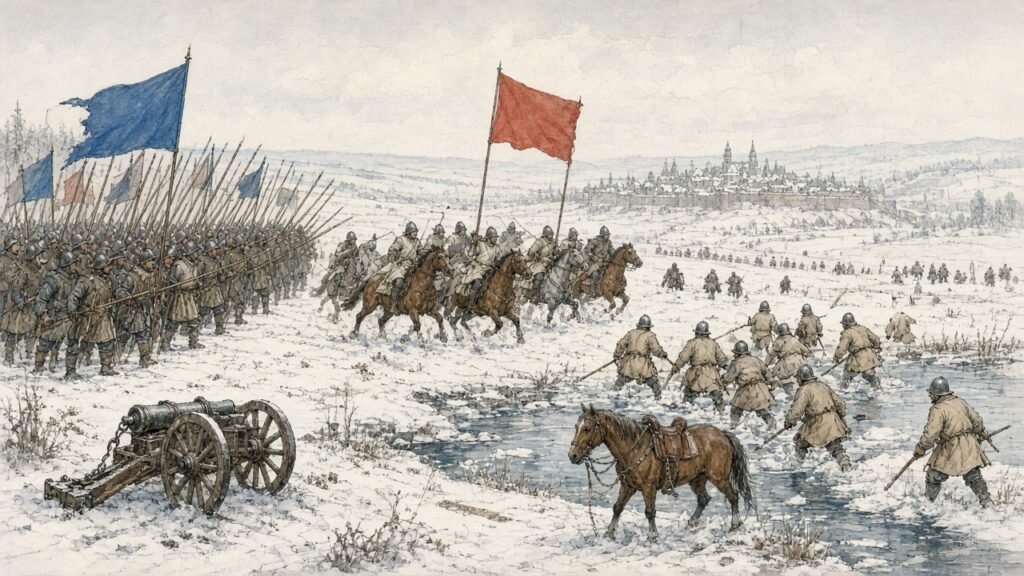
The siege continued into a harsh winter. René raised a relief army with Swiss mercenaries paid in part with French money, and it approached Nancy at the beginning of January 1477. Charles’s army, perhaps only a few thousand men, took position south of the town behind a stream.
Death at Nancy, 5 January 1477
On 5 January 1477 the army of René II and the Swiss attacked. While part of the force engaged the Burgundian front, the main Swiss column made a flanking march through the snow-covered woods and fell on the Burgundian flank. An Italian condottiere in Charles’s service, Nicola di Montforte, count of Campobasso, had already gone over to the enemy with his company. The Burgundian army collapsed.
Charles was killed in the rout. His body was found two days later, frozen into the ice of a pond near the chapel of Saint-Jean, stripped and so disfigured by wounds, including a halberd blow to the head, that he could be identified only by his page and his physician from old scars and missing teeth. René II gave him a solemn funeral in Nancy. In 1550 his great-grandson Charles V had the remains transferred to Bruges, where they were laid near those of his daughter Mary in the church of Our Lady. The battle of Nancy ended the line of the Valois dukes of Burgundy in the male line and with it the project of a Burgundian kingdom.
Louis XI seizes the duchy
Louis XI moved quickly. Charles had died without a son, and the king claimed that the duchy of Burgundy, as an apanage granted by John II to Philip the Bold and his male heirs, had reverted to the crown. The legal position was contested, since the grant of 1363 did not explicitly exclude female succession, and Mary’s councillors argued that she was the rightful heir. Louis did not wait for the argument to be settled. Royal troops under Georges de La Trémoille, lord of Craon, occupied the duchy in late January 1477, and the estates of Burgundy, meeting at Dijon, accepted the king’s authority on condition that their privileges were maintained.
Louis also occupied Picardy, the Somme towns and the county of Boulogne, and sent troops into the county of Burgundy, Artois and Hainaut, claiming wardship of Mary and the right to confiscate fiefs of a rebellious vassal. He proposed that Mary marry his son, the dauphin Charles, then a boy of seven, a match that would have brought all her lands under French control. Arras was taken in May 1477. In the duchy itself resistance continued for some time. Dijon rose against the royal officials in June 1477, and the county of Burgundy fought a hard war, but by 1479 royal forces were in control of both.
The duchy of Burgundy thus returned to France for the third and final time, and this time permanently. It was governed thereafter as a royal province with its own estates and its own parlement at Dijon, which Louis XI established in place of the ducal high court in the years after the conquest.
Mary of Burgundy and the Great Privilege
Mary of Burgundy, born at Brussels on 13 February 1457, was nineteen when her father died. She was in Ghent with her stepmother Margaret of York when the news arrived, and she was immediately confronted by the grievances that Charles’s centralisation and taxation had provoked. The States General of the northern territories met at Ghent in January and February 1477. In return for their support against France, they extracted from her on 11 February 1477 a charter known as the Great Privilege.
The Great Privilege abolished the Parlement of Mechelen and the central chamber of accounts created by Charles, restoring the competence of the provincial courts. It guaranteed that the States General could meet on their own initiative, that no war could be declared and no tax raised without their consent, that offices would be held by natives of the provinces, and that the official languages of each province would be respected in its administration. Individual provinces received their own charters at the same time. The charter was not a constitution in the modern sense, and much of it was later revoked, but it became a reference point for the defence of provincial liberties in the Low Countries, invoked again during the revolt of the sixteenth century.
The Ghent citizens went further. Two of Charles’s leading councillors, the chancellor Guillaume Hugonet and Guy de Brimeu, lord of Humbercourt, were accused of negotiating with Louis XI behind the backs of the estates, tried by the town, and beheaded on 3 April 1477 despite Mary’s personal plea for their lives in the market square.
The Habsburg marriage
The question of Mary’s husband was urgent. The agreement reached at Trier in 1473 and confirmed by later negotiation provided for her marriage to Maximilian, son of the emperor Frederick III, and Mary held to it in the face of French pressure and the proposals of other candidates. A proxy marriage was celebrated at Bruges on 21 April 1477. Maximilian, who was eighteen, travelled from Austria with a small retinue and limited funds and entered Ghent in August. The marriage was celebrated in person at Ghent on 19 August 1477.
The marriage brought the Burgundian inheritance into the house of Habsburg, though not at first securely. Maximilian had little money and few troops, and the provinces were reluctant to pay for a war against France. Contemporary accounts and later portraits nonetheless record a close and affectionate relationship. Mary and Maximilian had three children who survived infancy: Philip, born at Bruges on 22 June 1478; Margaret, born at Brussels on 10 January 1480; and Francis, who died in infancy in 1481.
The War of the Burgundian Succession
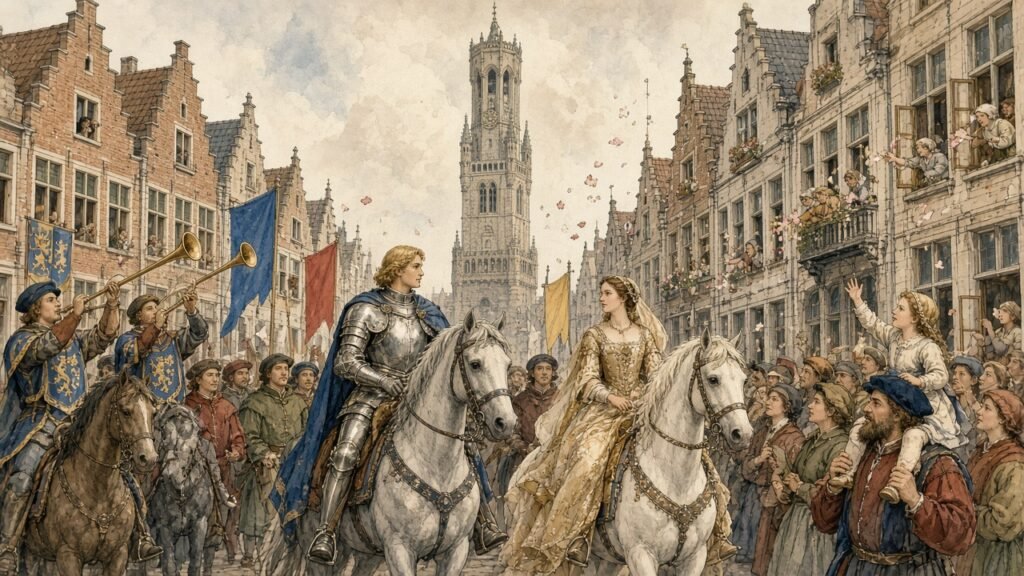
The conflict between Louis XI and the Habsburgs over Charles’s inheritance is known as the War of the Burgundian Succession. It was fought from 1477 to 1482 across Artois, Hainaut, Flanders, the county of Burgundy and the duchy itself.
The principal battle was fought at Guinegate, near Thérouanne in Artois, on 7 August 1479. Maximilian, commanding a Flemish army that combined traditional militia pikemen with nobles fighting on foot, defeated a French army under Philippe de Crèvecœur, lord of Esquerdes, a former Burgundian captain who had gone over to Louis XI. The battle was a tactical victory for Maximilian but did not change the strategic situation, since he lacked the resources to follow it up. In the south the French completed the conquest of the county of Burgundy in 1479, and Dole, its principal town, was sacked after a siege.
The death of Mary, 1482
On 27 March 1482 Mary of Burgundy died at Bruges, aged twenty-five, after a fall from her horse while hawking near the castle of Wijnendale some weeks earlier. She was pregnant at the time, and the injury was complicated by internal damage. Her death transformed Maximilian’s position. He was no longer the husband of the reigning duchess but the father and guardian of the infant heir, Philip, and the States General, led by Ghent, disputed his right to the regency.
Mary was buried in the church of Our Lady at Bruges, where her tomb, with a gilt-bronze effigy by the Brussels founder Renier van Thienen and designs attributed to Jan Borman, was completed in the early sixteenth century. Her father’s remains were later placed in a matching tomb beside hers.
The Treaty of Arras, 1482
The States General, eager for peace and suspicious of Maximilian, negotiated directly with Louis XI. By the Treaty of Arras, concluded on 23 December 1482, it was agreed that Mary’s daughter Margaret, then two years old, should marry the dauphin Charles, bringing as her dowry the county of Burgundy, Artois and the Charolais, among other territories. Margaret was sent to the French court to be brought up as the future queen of France. The duchy of Burgundy and Picardy were left in French hands without further dispute. Maximilian was forced to accept the treaty, though he did not regard it as binding on his rights.
Louis XI died on 30 August 1483 at Plessis-lès-Tours. His son became king as Charles VIII, with his elder sister Anne of Beaujeu governing during his minority. In the Low Countries Maximilian spent the following decade in conflict with the Flemish towns, which refused to recognise his regency. In 1488 the citizens of Bruges imprisoned him for several months, executing several of his officials, and he was released only after his father led an imperial army into the Netherlands. Maximilian was elected king of the Romans in 1486, which strengthened his position, and by 1492 the Flemish revolt was suppressed.
The Treaty of Senlis, 1493
The Arras settlement collapsed when Charles VIII decided to marry Anne, duchess of Brittany, to secure that duchy for France. Anne had been married by proxy to Maximilian in 1490, but French armies overran Brittany, and in December 1491 Charles VIII married her himself. Margaret of Austria, who had been raised as queen-designate at the French court, was repudiated, and the French king faced the problem of returning both the girl and her dowry.
By the Treaty of Senlis, signed on 23 May 1493, Charles VIII, anxious to secure his frontiers before his expedition to Italy, returned to Maximilian and his son Philip the county of Burgundy, Artois and the Charolais. The duchy of Burgundy, together with Picardy, remained with France. Margaret returned to her father. The Senlis treaty fixed the partition of Charles the Bold’s inheritance for more than a century. The duchy belonged to France; the county of Burgundy, Franche-Comté, and the Low Countries belonged to the Habsburgs.
Philip the Handsome
Philip, the son of Mary and Maximilian, known as Philip the Handsome, Philippe le Beau, was declared of age in 1494, at sixteen, and took over the government of the Netherlands from his father. He was a prince of the Low Countries in upbringing and outlook, raised in Mechelen and Brussels among Burgundian nobles and officials, and he generally sought peace with France to protect the trade of the Flemish and Brabantine towns. On his accession he swore to observe the privileges of the provinces, and he restored a central court at Mechelen, the Great Council, in 1504, a more modest institution than his grandfather’s parlement.
The decisive turn in Philip’s life, and in the history of the Burgundian inheritance, came through another double marriage. In 1496 Philip married Joanna, daughter of Ferdinand of Aragon and Isabella of Castile, at Lier near Antwerp, and his sister Margaret married their son, the Infante John, heir to the Spanish kingdoms, in 1497. John died within months of the marriage, in October 1497. His elder sister Isabella, queen of Portugal, died in 1498, and her infant son Miguel in 1500. Joanna thus became heiress of Castile and Aragon, and Philip, as her husband, stood to become king.
When Isabella of Castile died in November 1504, Joanna became queen of Castile, and in 1506 Philip and Joanna travelled to Spain to take possession. Philip was recognised as king of Castile, as Philip I, in July 1506, after a tense settlement with his father-in-law Ferdinand. He died suddenly at Burgos on 25 September 1506, aged twenty-eight, probably of typhoid fever, though rumours of poison circulated. Joanna, whose mental health had been in question for some years, was later confined at Tordesillas, where she lived until 1555.
Charles V, born at Ghent
The eldest son of Philip and Joanna was born at Ghent on 24 February 1500, in the Prinsenhof, and was named Charles after his great-grandfather. He was raised in Mechelen at the court of his aunt Margaret of Austria, who governed the Netherlands on behalf of her father Maximilian from 1507, and his tutors included the Utrecht scholar Adrian Florensz, the future pope Adrian VI. His governor and chief minister in his youth was Guillaume de Croÿ, lord of Chièvres. Charles’s first language was French, the language of the Burgundian court, and he learned Dutch, Spanish and some German later.
On 5 January 1515, at the age of nearly fifteen, Charles was declared of age by the States General in Brussels and took over the government of the Netherlands. The ceremony took place in the great hall of the Coudenberg palace, where the Burgundian dukes had held court, and Charles was presented as the heir of the Burgundian house. In 1516, on the death of Ferdinand of Aragon, he became king of Castile and Aragon, ruling jointly with his mother in name. In 1519, on the death of Maximilian, he was elected Holy Roman Emperor as Charles V, after a contest with Francis I of France that was decided in part by the loans of the Fugger bank.
Charles thus united under a single ruler the Burgundian Netherlands and the Franche-Comté, the Spanish kingdoms with their Italian possessions and American empire, and the Austrian hereditary lands, which he ceded to his brother Ferdinand in 1521 and 1522. Among all these titles he never ceased to style himself duke of Burgundy, and he regarded the duchy, lost in 1477, as his rightful patrimony.
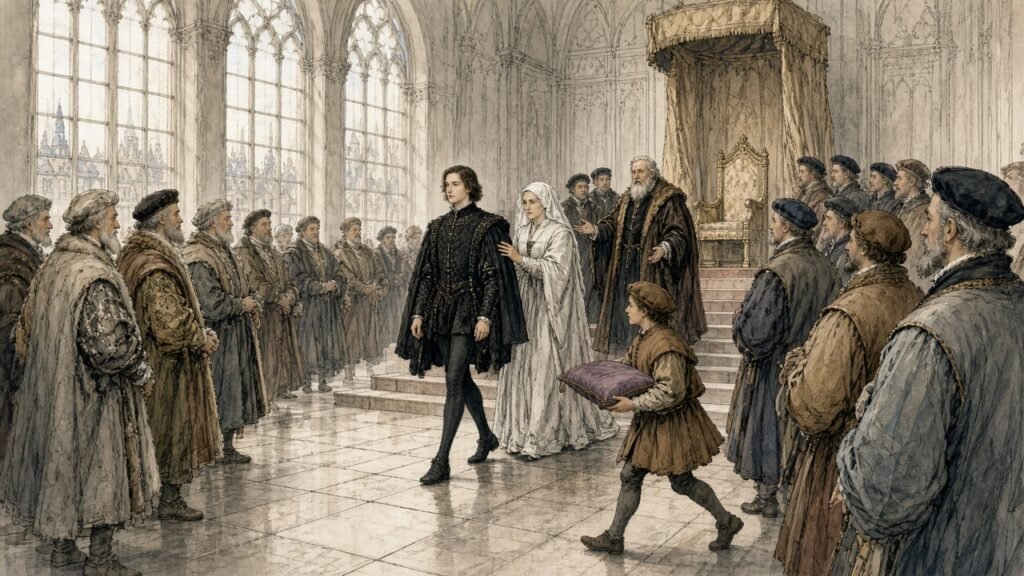
Burgundy at Pavia and Madrid
The rivalry between Charles V and Francis I dominated the first half of his reign. It was fought mainly in Italy, over the duchy of Milan and the kingdom of Naples, but Burgundy was an essential part of it. Charles demanded the restoration of the duchy, which he held had been taken from his grandmother unlawfully, and Francis claimed overlordship of Flanders and Artois as fiefs of the French crown.
On 24 February 1525, Charles’s twenty-fifth birthday, the imperial army defeated the French at the battle of Pavia in Lombardy. Francis I was captured and taken to Madrid. After a year of negotiation, and under heavy pressure, he signed the Treaty of Madrid on 14 January 1526. By its terms Francis renounced his claims in Italy, gave up his overlordship of Flanders and Artois, and agreed to cede the duchy of Burgundy to Charles. He was to marry Charles’s sister Eleanor, and his two eldest sons were to be handed over as hostages for the fulfilment of the treaty.
Francis had made a secret protestation before signing that his consent had been extorted under duress and was therefore void. He was released in March 1526, exchanged for his sons on the Bidassoa river at the Spanish frontier. Once back in France he repudiated the cession of Burgundy. The estates of Burgundy, assembled at Dijon in June 1526, declared that the king had no power to alienate the duchy without the consent of its people and that they wished to remain French. The declaration, whether spontaneous or arranged, gave Francis a legal argument for refusal, since the inalienability of the royal domain was a principle of French public law.
Francis formed the League of Cognac with the pope, Venice, Florence and Milan against Charles, and war resumed. The Peace of Cambrai of August 1529, called the Ladies’ Peace because it was negotiated by Charles’s aunt Margaret of Austria and Francis’s mother Louise of Savoy, settled the matter in France’s favour. Charles abandoned his claim to the duchy of Burgundy, and Francis paid a ransom of two million écus for his sons and renounced his claims to Flanders, Artois and Italy. The renunciation of French sovereignty over Flanders and Artois was confirmed in the Treaty of Crépy in 1544. The duchy of Burgundy would never again be seriously contested.
The Burgundian Circle
Within the Empire the Burgundian inheritance acquired a new constitutional form. In 1500 and 1512 the Imperial Diet, as part of the reform of the Empire under Maximilian, divided its territories into regional circles, or Kreise, which were responsible for maintaining the peace, raising troops and collecting imperial taxes. The Burgundian Circle, created in 1512, comprised the Habsburg Netherlands and the Franche-Comté.
The definitive settlement came with the Burgundian Treaty, the Transaction of Augsburg, agreed by the Diet in June 1548. Under its terms the territories of the Burgundian Circle were placed under the protection of the Empire and contributed to imperial taxation, at the rate of two electors for ordinary taxes and three for a war against the Turks, but they were largely exempt from the jurisdiction of the imperial institutions, including the Imperial Chamber Court. In practice the Burgundian lands became a quasi-independent bloc attached loosely to the Empire.
The Pragmatic Sanction of 1549
In November 1549 Charles V issued the Pragmatic Sanction, which was approved by the estates of each of the seventeen provinces of the Netherlands. It provided that the provinces would henceforth be inherited as a single, indivisible unit, according to the same rules of succession, by the same heir. The aim was to prevent the partition of the Burgundian inheritance, which had been held together hitherto by the accident of single heirs, and to ensure that it passed intact to Charles’s son Philip.
The Seventeen Provinces, as they came to be known, included the duchies of Brabant, Limburg, Luxembourg and Guelders; the counties of Flanders, Artois, Hainaut, Holland, Zeeland, Namur and Zutphen; the margraviate of Antwerp; and the lordships of Friesland, Mechelen, Utrecht, Overijssel and Groningen. The northern and eastern territories of Friesland, Utrecht, Overijssel, Groningen and Guelders had been acquired by Charles himself between 1524 and 1543, completing the work of the Valois dukes. Tournai was taken from France in 1521, and the prince-bishopric of Liège remained outside the union.
The Pragmatic Sanction is often taken as the moment at which the Netherlands became a distinct political entity, though the term must be used with care. The provinces remained separate in law and custom; what bound them was a common ruler, a common set of central councils in Brussels and a common succession.
The abdication and the Spanish line
On 25 October 1555, in the great hall of the Coudenberg palace in Brussels, where he had been declared of age forty years earlier, Charles V abdicated the government of the Netherlands in favour of his son Philip. In a speech to the States General, supported on the shoulder of the young William of Orange, he reviewed his reign and his journeys. He resigned the Spanish kingdoms in January 1556 and the Empire, in effect, to his brother Ferdinand in 1556, although the formal acceptance by the electors did not come until 1558. He retired to the monastery of Yuste in Extremadura, where he died on 21 September 1558.
Philip II inherited the Burgundian lands, the Spanish kingdoms and the Italian and American possessions, while Ferdinand held the Austrian lands and the imperial title. The Netherlands and the Franche-Comté therefore passed to the Spanish line of the house of Habsburg. This division determined the subsequent history of both territories.
Revolt and division in the Low Countries
The revolt of the Netherlands against Philip II, which began in the 1560s and became open war after 1568, turned in large part on the tension between centralised royal government and the privileges of the provinces that the Burgundian dukes had first confronted. The provinces’ defenders appealed to their charters, including the Joyous Entry of Brabant and the Great Privilege of 1477. By the Act of Abjuration of 1581, the States General of the northern provinces deposed Philip II as their sovereign, and the Dutch Republic of the United Provinces emerged from the conflict, its history traced in the account of the Dutch Golden Age. The southern provinces, reconquered by Philip’s armies under Alessandro Farnese in the 1580s, remained under Spanish rule as the Spanish Netherlands.
The independence of the Dutch Republic was recognised by Spain in the Peace of Münster in 1648. The southern Netherlands passed to the Austrian Habsburgs by the Treaty of Utrecht in 1713 and eventually formed the core of the kingdom of Belgium in 1830. Both modern states, the Netherlands and Belgium, trace their territorial and institutional origins in large part to the composite state assembled by the Valois dukes and consolidated by Charles V.
The Franche-Comté under Spain
The county of Burgundy, now usually called the Franche-Comté, remained in Spanish hands after 1556. Its capital was Dole, which had its own parlement and university, while Besançon was an imperial free city until 1654, when it was ceded to Spain and incorporated in the county. The province was governed with considerable autonomy and was known for its loyalty to the Spanish crown, which was distant enough to make few demands.
The family of Nicolas Perrenot de Granvelle, a lawyer from Ornans in the Franche-Comté who rose to be Charles V’s chief minister, and his son Antoine Perrenot, Cardinal Granvelle, who served Philip II in the Netherlands and Italy, exemplified the importance of the Comtois in Habsburg service. The Granvelle palace in Besançon, built in the 1530s and 1540s, survives as a museum.
Louis XIV and the Treaties of Nijmegen
In the seventeenth century the Franche-Comté lay directly in the path of French expansion. During the Thirty Years’ War the province suffered severely in the Ten Years’ War of 1635 to 1644, in which French and Swedish armies devastated it, and its population fell sharply. Dole withstood a French siege in 1636.
Louis XIV invaded the Franche-Comté during the War of Devolution in February 1668 and occupied it in a few weeks, but returned it to Spain at the Treaty of Aix-la-Chapelle in May of that year in exchange for a group of towns in Flanders. During the Franco-Dutch War he invaded again, in 1674, and took Besançon after a siege conducted by Vauban in May of that year. By the Treaties of Nijmegen, the Franco-Spanish treaty of which was signed on 17 September 1678, Spain ceded the Franche-Comté to France. Besançon replaced Dole as the capital, and the parlement and the university were moved there.
With the cession of 1678 the two Burgundies west and east of the Saône, separated since the Treaty of Verdun in 843 except for the period of common rule under the later Capetian and Valois dukes, were both within the kingdom of France. The Low Countries remained divided between the Dutch Republic and the Spanish Netherlands, and the Burgundian Circle continued to exist on paper until the end of the Holy Roman Empire in 1806, although after 1678 it consisted only of the southern Netherlands.
The duchy as a French province
Once the duchy of Burgundy had been absorbed into the kingdom of France, it was governed as one of the great provinces of the old regime, a pays d’états, which retained its own representative assembly. The estates of Burgundy, composed of clergy, nobility and the deputies of the towns, met every three years at Dijon and negotiated with the crown the amount of direct tax, known as the don gratuit, that the province would pay. Between sessions a standing commission, the élus, administered the collection of taxes and public works. The arrangement gave the Burgundian elites a measure of control over their fiscal affairs that provinces governed directly by royal intendants did not enjoy.
The provincial governor was usually a prince of the blood. From 1631 onwards the governorship was held almost continuously by the princes of Condé, the senior cadet branch of the house of Bourbon, who resided periodically at Dijon and patronised its institutions. The Parlement of Burgundy, sitting in Dijon, was one of the regional sovereign courts of the kingdom and its magistrates formed a learned and wealthy elite. The historian and magistrate Charles de Brosses, first president of the Parlement in the eighteenth century, wrote on the Roman world and on the early history of language, and his letters from Italy are a classic of travel writing.
The provinces were abolished in 1790 by the Constituent Assembly, which divided France into departments. The former duchy was divided chiefly among the departments of the Côte-d’Or, the Saône-et-Loire and the Yonne, with parts in neighbouring departments, while the Franche-Comté was divided into the Doubs, the Jura and the Haute-Saône. In 1982 the administrative region of Burgundy was created from the Côte-d’Or, the Nièvre, the Saône-et-Loire and the Yonne, and in 2016 it was merged with the Franche-Comté to form the region of Bourgogne-Franche-Comté, with its prefecture at Dijon. The two Burgundies separated in 843 were thus joined, at least for administrative purposes, in a single region more than eleven centuries later.
The palace of the dukes at Dijon
The physical seat of ducal power in Burgundy was the palace at Dijon, originally a fortified residence of the Capetian dukes. Philip the Bold and his successors rebuilt and enlarged it, and the tower now known as the Tour Philippe le Bon, completed under Philip the Good in the middle of the fifteenth century and rising some forty-six metres, still dominates the city. The great kitchens built for Philip the Good in 1433, with six enormous fireplaces and a vaulted chimney at the centre of the roof, survive almost intact.
After 1477 the palace became the seat of the royal governor and of the estates, and in the seventeenth and eighteenth centuries it was rebuilt in classical style by Jules Hardouin-Mansart and his successors as the Palais des États de Bourgogne, with a semicircular place in front of it, now the Place de la Libération. The building today houses the town hall of Dijon and the Musée des Beaux-Arts, one of the oldest museums in France, opened in 1787. Its Salle des Gardes, the former great hall of the ducal palace, contains the tombs of Philip the Bold and of John the Fearless and Margaret of Bavaria, brought from Champmol, along with altarpieces made for the Chartreuse, including the carved and gilded retables by Jacques de Baerze with painted wings by Melchior Broederlam.
The Hospices de Beaune
The best preserved monument of Burgundian ducal society is not a palace but a hospital. The Hospices de Beaune, the Hôtel-Dieu founded by Nicolas Rolin and Guigone de Salins in 1443, received its first patients in 1452. The building, laid out around a courtyard, is known above all for its steep roofs covered in glazed tiles in geometric patterns of red, brown, yellow and green, a style associated with central Europe and Flanders that became an emblem of Burgundy.
The interior of the great ward, the Salle des Pôvres, has a painted timber barrel vault and rows of curtained beds along the walls, arranged so that patients could see the altar at the end of the hall. For that altar Rolin commissioned from Rogier van der Weyden a polyptych of the Last Judgement, completed around 1450, one of the major works of Early Netherlandish painting, which remains in the building. The hospice was run by a community of nursing sisters and continued to function as a hospital until 1971.
Rolin endowed the foundation with vineyards, and later benefactors added more. Since 1859 the wines from the Hospices’ estates have been sold at an annual charity auction in November, now one of the most widely reported wine sales in the world, with the proceeds supporting the hospital’s successor institutions and the maintenance of the buildings.
Wine and the ducal policy
The connection between the dukes and Burgundian wine was more than ornamental. In an ordinance of 31 July 1395, Philip the Bold prohibited the planting of the Gamay grape in the duchy, describing it as a very bad and disloyal plant, and ordered that existing Gamay vines be uprooted within a set period. The ordinance favoured Pinot Noir, then called Noirien or Pinot, which produced lower yields but finer wines. It also restricted the use of certain fertilisers. The measure was intended to protect the reputation of the wines of Beaune and Dijon, which were sold to the papal court at Avignon and to the royal court at Paris and were an important source of revenue and prestige.
The prohibition was only partly effective, and Gamay continued to be grown in parts of the duchy and became the principal grape of Beaujolais to the south. But the association of the Côte d’Or with Pinot Noir, and later Chardonnay for white wine, dates from this period, and the system of named vineyards, the climats, developed over the following centuries from the parcels first recorded by the monastic houses. The climats of Burgundy were inscribed on the UNESCO World Heritage List in 2015.
The Valois dukes used wine as a diplomatic gift and styled themselves in some documents as lords of the best wines of Christendom. The wine of Beaune was served at the coronations of the French kings and sent to popes and foreign princes, and it was one of the goods that bound the southern duchy to the northern territories, where the Burgundian court consumed large quantities.
The Golden Fleece after Burgundy
The Order of the Golden Fleece survived the end of the Valois dukes and became one of the most prestigious orders of chivalry in Europe. On Mary’s marriage, Maximilian became its sovereign as guardian of the Burgundian inheritance, and he held a chapter at Bruges in 1478. The sovereignty passed to Philip the Handsome, then to Charles V, then to Philip II and the Spanish kings, who held it as heirs of the dukes of Burgundy rather than as kings of Spain.
The extinction of the Spanish Habsburg line with the death of Charles II in 1700 split the Order. Philip V, the Bourbon grandson of Louis XIV who inherited the Spanish throne, continued to confer it in Madrid, while the Austrian Habsburg Charles VI, who claimed the Spanish succession and later the southern Netherlands, took the archives and treasures of the Order to Vienna and established a separate Austrian branch in 1712. Both branches continue to exist. The Spanish order is conferred by the king of Spain as a state honour, while the Austrian branch remains under the head of the house of Habsburg-Lorraine. The treasury of the Order, including its robes, chains and liturgical vessels from the Burgundian period, is displayed in the Imperial Treasury in the Hofburg in Vienna.
Court ceremonial and the Spanish Habsburgs
The Burgundian court left a lasting mark on the etiquette of the Habsburg courts. The household ordinances of Philip the Good and Charles the Bold, codified by Olivier de La Marche in his treatise on the household of Charles the Bold, written in 1474, regulated the hierarchy of offices, the procedures for the duke’s meals, his rising and retiring, the order of precedence and the forms of audience.
When Philip the Handsome travelled to Castile in 1506, and again when Charles V arrived in Spain in 1517, they brought with them Burgundian household officials and Burgundian practices. In 1548, on the advice of the duke of Alba, Charles ordered that the household of his son Philip be organised according to the Burgundian model, the casa de Borgoña, which coexisted for a time with the older Castilian household, the casa de Castilla. The Burgundian etiquette, with its elaborate offices of the sumiller de corps, the mayordomo mayor and the gentlemen of the chamber, and its strict rules governing access to the king and the forms of public dining, became the standard of the Spanish court until the end of the Habsburg dynasty and in modified form beyond it.
This etiquette was frequently described by visitors as solemn and distancing. Its emphasis on the formal separation of the ruler from his court, and on the ritual organisation of the king’s day, influenced other European courts, including that of Vienna, and some historians have traced elements of the ceremonial of Versailles to the same tradition, although the French court had its own lines of development. The Burgundian inheritance in court culture thus outlasted the Burgundian state by more than two centuries.
The Flemish Primitives and their reputation
The art of the Burgundian Netherlands was admired in its own time across Europe. Italian writers, including Bartolomeo Facio in the 1450s, praised van Eyck and van der Weyden, and Italian patrons such as the Medici and the Portinari commissioned works from Flemish painters, the most famous being the Portinari Altarpiece of Hugo van der Goes, which arrived in Florence in 1483 and influenced painters there with its realism. Spanish and Portuguese collectors also acquired Netherlandish paintings in large numbers, and many survive in Iberian collections.
The reputation of the Flemish painters declined in the sixteenth and seventeenth centuries, when Italian art set the standard of taste, and revived in the nineteenth. The term Flemish Primitives, used in the exhibition of Early Netherlandish art held at Bruges in 1902, reflected an older view of these painters as precursors of the Renaissance, although their technical achievement is now generally regarded as fully mature in its own terms. The Ghent Altarpiece, stolen and returned several times, partly looted by Napoleon and later by the Nazi regime, recovered in 1945, and restored in the 2010s and 2020s, is among the most studied works of art in the world.
The connection between the Burgundian court and this painting can be overstated. The dukes commissioned relatively few panel paintings compared with their spending on tapestries, goldsmith’s work and manuscripts. Much of the market for paintings came from the urban elites of Bruges, Ghent, Brussels and Leuven, from foreign merchants and from churchmen. Yet the court set the tone, attracted artists to the region, and created a culture of conspicuous refinement in which skill and display were rewarded, and its leading officials, such as Rolin, were among the most important patrons.
Tapestry and goldsmith’s work
The dukes spent more on tapestries than on any other form of art. Philip the Bold bought large sets from the workshops of Arras, which gave its name to woven hangings in Italian, arazzo, and in English, arras. The tapestries depicted histories, romances, battles and allegories, and they were the principal decoration of the court as it moved from residence to residence, rolled up and transported in carts and hung in temporary settings for feasts and ceremonies. In the course of the fifteenth century the centres of production shifted to Tournai, Brussels and other towns, and Brussels became the leading tapestry city of Europe in the sixteenth century, weaving the sets designed by Raphael for the Sistine Chapel.
Goldsmith’s work, jewels and plate were both display and treasury. The dukes’ collections were pawned and redeemed repeatedly to raise cash, and the jewels lost by Charles the Bold at Grandson passed through the hands of Swiss, German and Italian owners. The Burgundian taste for richly worked metal survives in reliquaries and secular pieces in collections at Vienna, Aachen and elsewhere.
Bruges, Antwerp and the Burgundian economy
The wealth that paid for the court came above all from the towns of the Low Countries. In the first half of the fifteenth century Bruges was the principal market of north-western Europe. Its port at Sluis, on the inlet of the Zwin, received Italian galleys from Venice and Genoa, Hanseatic cogs from the Baltic, wine ships from Gascony and Poitou and wool fleets from England. Foreign merchant communities, the nations, maintained houses and consulates in the town, and the square in front of the house of the van der Beurse family gave its name to the bourse, the exchange, in several European languages. The Hanseatic Kontor at Bruges, the subject of a section in the account of the Hanseatic League, was the League’s most important western office.
The dukes drew on this economy through taxes voted by the estates, through tolls and customs, through the profits of the mint and through loans from Italian bankers. The Medici bank maintained a branch at Bruges, managed in the 1460s and 1470s by Tommaso Portinari, who lent heavily to Charles the Bold and became one of his counsellors. The loans contributed to the branch’s insolvency after the duke’s death and to the wider difficulties of the Medici bank in the 1480s. The episode illustrates how closely ducal policy and international finance were connected.
From the later fifteenth century the commercial centre of the Low Countries shifted from Bruges to Antwerp. The silting of the Zwin made access to Sluis increasingly difficult, Maximilian’s conflict with Bruges in the 1480s led him to order foreign merchants to leave the town for Antwerp, and the Portuguese spice trade and the south German silver and copper trade chose Antwerp as their northern market. By the time Charles V came of age, Antwerp was the leading port and money market of Europe, and much of the credit that sustained his wars was raised there. The shift did not alter the importance of the Low Countries to their rulers. It meant that the Habsburgs inherited, through Mary of Burgundy, the most commercially advanced region of the continent at the moment of its greatest prosperity.
Nobility, bastards and the ducal household
The Burgundian state rested not only on the towns but on a nobility that the dukes drew into their service. Families from the duchy and county of Burgundy, such as the Vergy, the Neufchâtel, the Chalon and the Pot, served alongside families from Picardy and the Low Countries, such as the Croÿ, the Lannoy, the Lalaing, the Luxembourg and the Nassau. The household, the army, the Order of the Golden Fleece and the councils provided offices, pensions and honours that attached these families to the ducal house and gave them a shared identity that cut across the borders of the separate principalities.
Philip the Good had a large number of illegitimate children, at least eighteen according to most counts, by a series of mistresses. They were brought up at court and provided for with offices, church positions and marriages. Anthony, known as the Great Bastard of Burgundy, was a celebrated jouster and commander, and a member of the Order of the Golden Fleece. David became bishop of Utrecht and Philip, another son, succeeded him there in 1517. Cornelius, the eldest, was killed fighting against Ghent in 1452. Such figures were part of the machinery of government rather than embarrassments to it, and their careers show the dynasty’s capacity to place trusted kinsmen in key positions.
The tomb of Philippe Pot, grand seneschal of Burgundy, now in the Louvre, shows the effigy of the knight carried by eight hooded mourners, a development of the pleurants of the ducal tombs at Champmol. Pot served Philip the Good and Charles the Bold and then, after 1477, Louis XI, and in 1484 he made a speech to the Estates General at Tours on the origin of royal power in the people that is often cited in histories of political thought. His career is a reminder that many Burgundian nobles of the duchy transferred their allegiance to the French crown after 1477, while those of the Low Countries generally followed Mary and Maximilian.
Chroniclers and historians
The Burgundian court produced a rich historiography of its own. Enguerrand de Monstrelet, Georges Chastellain, Jean Molinet, Olivier de La Marche and Jean de Wavrin wrote chronicles and memoirs from the perspective of the ducal household, and Philippe de Commynes, who served Charles the Bold before defecting to Louis XI, wrote memoirs that are among the founding texts of political analysis in French. Chastellain, the official historiographer from 1455, and Molinet, his successor, developed an elaborate style that later readers found ornate, but their accounts remain essential sources.
In the modern period, the Dutch historian Johan Huizinga, in his book of 1919 translated into English as The Waning of the Middle Ages and later as The Autumn of the Middle Ages, used the Burgundian court as the principal example of a late medieval culture of intense ceremony, emotion and symbolism. His interpretation, which saw the period as an end rather than a beginning, was influential and contested. The British historian Richard Vaughan wrote a four-volume political history of the Valois dukes between 1962 and 1973, which remains the standard account in English, and later work by historians such as Walter Prevenier, Wim Blockmans, Bertrand Schnerb and others has examined the administration, finances and urban relations of the Burgundian state in detail.
A central question for this historiography has been whether the Burgundian state was a failed kingdom, a dynastic accident or the precursor of modern Belgium and the Netherlands. The answer depends on perspective. The duchy itself returned to France. The southern project of a Lotharingian kingdom died at Nancy. But the northern core of the Valois dominions, consolidated by Philip the Good and given institutional form by the States General, the central councils and the Pragmatic Sanction, did prove durable, and the Low Countries emerged from the Burgundian period with a shared political framework that survived their later division.
The name of Burgundy
The persistence of the name Burgundy is itself one of the more curious features of this history. It passed from a people to a kingdom, from the Merovingian regnum to the Carolingian kingdoms, from the kingdom of Arles to a county in the Empire and a duchy in France, and from the duchy to a set of northern territories that had never been called Burgundy before. In the sixteenth century the Habsburg Netherlands were often referred to in diplomatic language as the Burgundian lands, and the Spanish called the Netherlandish troops in their armies the Burgundians. The red ragged saltire of Burgundy, the cross of Saint Andrew associated with the Valois dukes, became a Spanish military emblem used on flags until the eighteenth century and by the Carlist movement in the nineteenth and twentieth.
Meanwhile the French province of Burgundy, with its capital at Dijon, retained the name in its original sense, and the word came in many European languages to signify above all the wines of the Côte d’Or and the dark red colour associated with them. A single name thus carried at least three different meanings by the early modern period: a French province, a Habsburg inheritance in the Low Countries and a style of wine.
From duchy to inheritance
The sequence of events that this account has traced can be summarised in terms of the status of the duchy itself. It was formed under Richard the Justiciar within West Francia at the end of the ninth century, held by his son Raoul, who was briefly king, contested in the tenth century and secured by the Capetian kings by about 1016. It was granted to Robert I in 1032 and held by his descendants until the death of Philip of Rouvres in 1361, when it reverted to the crown under John II. In 1363 it was granted again, to Philip the Bold, as an apanage. Under the Valois dukes it became the southern anchor of a composite state whose wealth lay mainly in the Low Countries. On the death of Charles the Bold in 1477, it was seized by Louis XI and reabsorbed into France. Charles V regained it on paper in the Treaty of Madrid in 1526, but the cession was repudiated and abandoned at Cambrai in 1529.
The other Burgundian territories followed a different path. The Low Countries and the Franche-Comté passed through Mary of Burgundy to the Habsburgs in 1477, a transfer confirmed in substance at Senlis in 1493. They were brought together in the Burgundian Circle of 1512, given a common succession by the Pragmatic Sanction of 1549, and passed to the Spanish Habsburgs in 1555 and 1556. The Franche-Comté was lost to France at Nijmegen in 1678. The northern provinces became the Dutch Republic; the southern became, in time, Belgium and Luxembourg.
Burgundy and the shape of Europe
The Burgundian story is a reminder that the political map of western Europe was not fixed in advance. For a century the territories between France and the Empire seemed capable of forming a third great power, and the Valois dukes came close to achieving a royal title for it. Their failure left the frontier between France and the Empire, and later between France and the German states, as a zone of recurring conflict from the wars of Louis XIV to the twentieth century. The Low Countries, lying across the old line of Lotharingia, became both a commercial centre of the first importance and a battlefield for their larger neighbours.
The duchy of Burgundy itself, the original nucleus of the Valois state, ended where it had begun, as a province of the French crown. The Habsburgs, who inherited the rest, carried the Burgundian name, its chivalric order, its ceremonial and its claims to Spain, to Austria and across the world. In both its French and its Habsburg forms, the inheritance of the dukes of Burgundy continued to shape the institutions, the art and the political geography of Europe long after the last duke was found in the frozen pond outside Nancy.