Kushta on the Golden Horn

For most of its history the city on the Bosphorus has had more names than it has had rulers. Greeks called it Κωνσταντινούπολις (Konstantinoupolis, the city of Constantine), Arabs قسطنطينية (Qusṭanṭīniyya), Ottoman Turks قسطنطينيه (Kostantiniyye) and, increasingly, استانبول (İstanbul), and its Jews wrote it in Hebrew letters as קושטא (Kushta), the name that appears in the colophons of the books they printed there.[1] For sixteen centuries it was home to a Jewish community that was never the largest in the Mediterranean for long, but was almost always the closest to power. Its members lived beside an imperial palace, first Byzantine and then Ottoman, and the fortunes of the community rose and fell with the policies of emperors, sultans and, after 1923, the governments of the Turkish Republic.
This essay follows that history from the first imperial decree that mentions the city’s Jews in 390 to the community of today, which numbers some fifteen thousand people and gathers at the Neve Shalom synagogue in Galata. Like the other city studies in the Places series, it gives particular attention to the Bible: to the Greek-speaking Romaniote Jews who prayed and glossed Scripture in their own rite, to the Karaites of Pera and Hasköy who read the Bible without the rabbinic tradition, to the first printing press in the Ottoman lands, to the polyglot Pentateuchs of the Soncino family in which the Torah appeared beside Aramaic, Arabic, Persian, Greek and Spanish, and to Me’am Lo’ez, the vast Ladino commentary begun in Istanbul in 1730. A companion post, The Presses and Prophets of Smyrna, on Izmir, the Aegean port the Jews called Smyrna, takes up the story of the community that printed later editions of many of these books and gave birth to the Sabbatean movement.
1. Kushta, a city of many names
The geography of the city shaped the geography of its Jewish life. The old walled peninsula, the Byzantine capital and later Ottoman Stambul, lies between the Sea of Marmara and the Golden Horn, the long curving inlet of the Bosphorus that served as the city’s harbour. Across the Golden Horn lay Galata, a Genoese colony in the late Middle Ages, with the hill of Pera above it, and further up the inlet the village of Hasköy. Across the Bosphorus, on the Asian shore, were Üsküdar (Scutari) and, later, Kuzguncuk and Haydarpaşa. During the Ottoman period Galata, Eyüp at the head of the Golden Horn and Üsküdar all became quarters of the capital.[1]
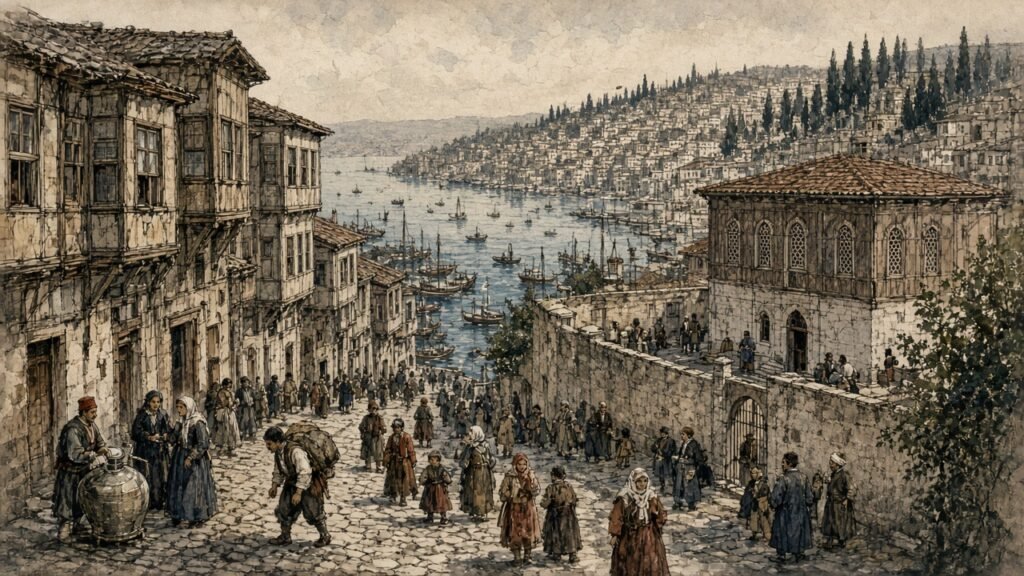
Jews lived in almost every one of these places at one time or another. In the Byzantine period their quarter lay across the water from the imperial city, in the district later called Pera; after 1453 the deported Jews of the Balkans and Anatolia were settled inside the walls around the markets near the harbour, and the Spanish and Portuguese exiles who followed them spread into Balat on the southern shore of the Golden Horn and Hasköy on the northern shore. In the nineteenth century the wealthier families moved to Galata, Pera and Şişli and to the villages along the European shore of the Bosphorus, and in the late twentieth century the community moved again, to the northern suburbs and the Asian side.[1] At the beginning of the twentieth century more than half of the population of Balat was still Jewish, and Ladino could be heard in its streets.[2]
The names of the congregations were maps of origin. The deported Greek-speaking Jews named their synagogues after the towns from which they had been brought, Ohrid, Yambol, Kastoria and the rest; the Iberian exiles named theirs after Castile, Aragon, Catalonia, Portugal and Córdoba; and later there were Ashkenazi, Italian and Karaite congregations as well.[1][2] A Jew of sixteenth-century Istanbul belonged first to his kahal, קהל (congregation), and only then to the community of the city as a whole, and much of the history that follows is the history of how these different congregations, with their different languages, rites and ways of reading the Bible, learnt to live together.
2. Byzantine Jews and the Romaniote rite
The earliest official document concerning the Jews of Constantinople is a decree of 23 February 390, issued in the names of the emperors Valentinian II, Theodosius I and Arcadius, which exempted Jewish and Samaritan shipowners from the burdens of the guild of the navicularii, the shippers who carried the state’s grain.[3] The community therefore already had a commercial presence in the new capital within two generations of its foundation. Its standing soon deteriorated. According to the account in the Jewish Encyclopedia, Theodosius II removed the Jews from the city proper and assigned them a district across the Golden Horn near Galata, and their old synagogue in the quarter of the copper market was converted into a church; Justinian I later interfered with their religious practice, forbidding them, among other things, to celebrate Passover before the Christian Easter.[3] Under the iconoclast emperors and again under Basil I the community suffered forced baptisms and expulsions, but it revived each time the pressure eased, and by the tenth century it was again one of the principal Jewish centres of the eastern Mediterranean.[3]
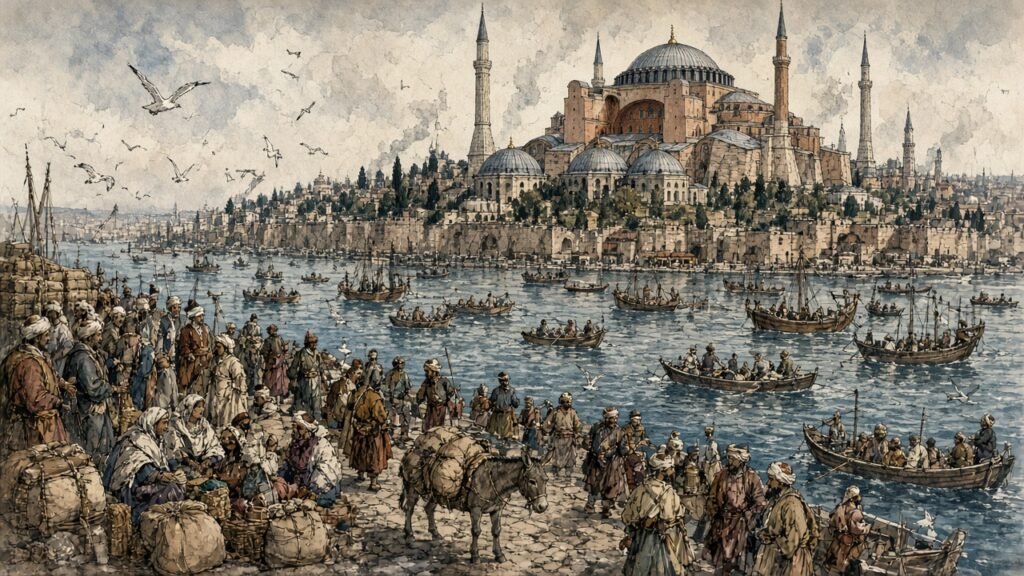
The most vivid picture of the Byzantine community comes from Benjamin of Tudela, the Navarrese traveller who passed through the city in the 1160s and whose Book of Travels is treated at length in Benjamin of Tudela and the Book of Travels. Benjamin found no Jews living inside the city itself. They lived across the water in Pera, two thousand Rabbanites and five hundred Karaites, separated from each other by a wall. Many were silk weavers and merchants, some of them very rich, but no Jew was permitted to ride a horse except the emperor’s physician, Solomon ha-Mitsri, and the tanners of the quarter poured their foul water into the street before Jewish doors, so that the Greeks despised the Jews as unclean and beat them in the streets.[3] The silk industry in which Benjamin saw them working was one of the pillars of the Byzantine economy, and Jewish weavers in Thebes and other Greek towns were renowned for it.[4]
These Greek-speaking Jews of Byzantium are known today as Romaniotes, Ρωμανιώτες (Romaniótes), from Romania, the medieval name for the lands of the eastern Roman Empire. Their history, centred on Ioannina, Chalcis, Corfu, Crete and the Peloponnese as well as Constantinople, is set out in the reference note Romaniote Jews. Their everyday language was Greek, and they developed a Jewish form of it, now called Yevanic, יוונית (Yevanit, from Yavan, Greece), written in Hebrew letters.[4] Their liturgy, the minhag Romania, preserved customs which scholars have linked with the ancient usage of the Land of Israel, including its own sequence of prophetic readings, and it included liturgical poems in Hebrew and in Judaeo-Greek.[4] The prayer book of the rite, the Maḥzor Romania, was first printed in Venice in 1520 and again in Istanbul in 1575 to 1578, in an edition begun by the printer Eliezer ben Isaac of Prague and completed by David ben Elijah Kashti at the press of Joseph Jabez.[4][1]
For the Bible, the importance of the Romaniotes lies less in great commentaries than in a continuous practice of reading. A Greek-speaking Jew heard the Torah chanted in Hebrew and explained in Greek, and over centuries a body of oral Greek renderings of the biblical text grew up in the synagogues and schools. That oral tradition surfaced in print only once, in the Constantinople Pentateuch of 1547, which is described below in section 8. Romaniote Constantinople also suffered with the rest of the city in the catastrophe of 1204, when the knights of the Fourth Crusade sacked the capital and fire swept the commercial quarters along the Golden Horn; that episode is treated in the reference note The Fourth Crusade and the Sack of Constantinople.
3. Karaite learning in Byzantine Constantinople
The five hundred Karaites whom Benjamin counted in Pera belonged to the movement that rejected the authority of the Talmud and the rabbinic oral law and sought to derive Jewish practice from the written Bible alone. The movement had arisen in the Islamic East, and its relations with the Rabbanite majority, including its role in the early history of the Masoretic text, are discussed in the reference note Rabbanites, Karaites, and the Origins of the Masoretic Tradition. From the eleventh century its centre of gravity shifted westward into the Byzantine Empire, and for three centuries Constantinople was the principal seat of Karaite learning.[3][5]
The first great work of Byzantine Karaism was written there. Judah ben Elijah Hadassi, called ha-Avel (the mourner), began his Eshkol ha-Kofer, אשכול הכופר (the cluster of henna, after Song of Songs 1:14), in 1148, according to his own testimony.[6] The book is a vast compendium arranged according to the Ten Commandments, written in rhymed Hebrew prose, in which Hadassi gathered the Karaite tradition of biblical law and exegesis together with grammar, natural science and polemic; recent scholarship has emphasised how it combined the inheritance of Judaeo-Arabic Karaism with the Byzantine environment in which it was composed.[6][7]
Two scholars of the same name brought Byzantine Karaite exegesis to its peak. Aaron ben Joseph, called the Elder, was active in Constantinople at the end of the thirteenth century and wrote the Sefer ha-Mivḥar, ספר המבחר (the book of the choice), a commentary on the Pentateuch, and a grammar, Kelil Yofi.[3] Aaron ben Elijah, called the Younger, was born in Cairo about 1300, lived for many years in Nicomedia, the modern İzmit, and spent his last years in Constantinople, which the Jewish Encyclopedia describes as at that time the centre of Karaite learning; he died there in 1369. He wrote a philosophical work modelled on Maimonides’ Guide of the Perplexed, the Etz Ḥayyim, עץ חיים (the tree of life), finished in 1346; a work on the biblical commandments, Gan Eden (the garden of Eden), composed in Constantinople in 1354; and in 1362 a comprehensive commentary on the Pentateuch, Keter Torah, כתר תורה (the crown of the law).[5] Together these books made Constantinople the place where Karaite biblical scholarship acquired its classical form, and the Karaite communities of the Crimea and Lithuania continued to read them for centuries afterwards. That later history, including the manuscript collecting of Abraham Firkovich, is told in Sima Babovich and the Karaites of Crimea and Abraham Firkovich, Karaite Collector of the Russian Empire.
The Karaites lived in several parts of the city, in Galata and later around the harbour at Eminönü, where the register of 1495 records a Karaite quarter called Edirne near the harbour.[1][8] When the construction of the Yeni Cami, the New Mosque at Eminönü, began at the end of the sixteenth century under the patronage of Safiye Sultan, Karaite property on the site was expropriated, and according to one account the Karaites were given forty houses in Hasköy in exchange; after the great fire of 1660, when the work was resumed on a larger plan, more Jews were moved from the area to Balat and Hasköy.[8] Hasköy, where Karaites are recorded already in the early sixteenth century, became their principal home, and it is there that their synagogue still stands.[1]

4. The conquest of 1453 and the sürgün
Mehmed II took Constantinople on 29 May 1453, after a siege of fifty-three days.[9] What happened to the Jews of the city in the sack that followed is disputed. Some Ottoman sources of the sixteenth and seventeenth centuries claimed that the Jews had helped the besiegers and were spared; other evidence suggests that their fate was no different from that of their Greek neighbours, and that those who did not flee were killed or enslaved and their houses plundered. The old synagogues of Balat were destroyed during the conquest.[1]
The sultan’s first concern after the conquest was to repopulate a city that had shrunk to a fraction of its former size and to make it a prosperous capital. He did so by transferring Muslims, Christians and Jews, most of them merchants and craftsmen, from the provinces of Anatolia and the Balkans.[1][9] The Jews moved in this way were all Romaniotes, and the Ottoman administration called them sürgün (Turkish, deportees or exiles), to distinguish them from the Jews who later came from Spain, Portugal, Germany and elsewhere of their own accord, the kendi gelen (those who came by themselves). According to the Encyclopaedia Judaica, over about twenty years the whole Jewish population of Asia Minor and many communities of Greece, Macedonia and Bulgaria were brought to the capital. The sürgün paid their taxes to the pious foundation of Mehmed II, at a higher rate than the kendi gelen, and they could not leave the city without permission.[1]
The Ottoman registers show where these deported Jews lived. Most were settled in a trapezoid of streets between Eminönü, Sirkeci, Tahtakale, Mahmut Paşa and Zeyrek, around the great commercial district near the harbour, with a smaller group in Balat near Eğrikapı, where the community had its main cemetery, and another at Samatya on the Marmara shore. In Balat the congregations bore the names of Ohrid, Yambol, Kastoria and Karaferiye. By 1540 there were forty-seven Romaniote congregations in the city, each named after its place of origin and each with its own leaders and institutions.[1] The census figures are incomplete and difficult to compare, but they show a community of 1,647 Jewish households in 1477, about eleven per cent of the population of the city, and one that grew rapidly after the arrival of the Iberian exiles; an Ottoman register of 1535 lists 8,070 Jewish households.[1]
The Ottoman state did not govern its non-Muslim subjects as individuals. It dealt with them through their religious communities, which were responsible for the collection of taxes and for the administration of their own law in matters of marriage, divorce and inheritance, a system that historians came to call the millet, from the Ottoman word for a religious community.[10] Recent research has shown that the classical form of this system, with a single recognised head for each community, belongs largely to the nineteenth century, and that in the fifteenth and sixteenth centuries arrangements were far more fluid.[10][11] In Istanbul the first figure to represent the Jews before the government was the Romaniote rabbi Moses Capsali, who had led the community before the conquest. He collected the Jewish taxes and was known as the leading rabbi, but he had difficulty imposing his authority on the congregations of newcomers, especially the Sephardim.[1] Later tradition remembered him as the first ḥakham bashi, the chief rabbi of the empire; the Encyclopaedia Judaica notes, however, that the office with that title, appointed by the sultan, did not yet exist.[11][12]
5. Elijah Mizrahi and the supercommentary on Rashi
Capsali died around 1498, and his place as the foremost rabbi of the city was taken by Elijah Mizrahi, אליהו מזרחי, the outstanding scholar of Romaniote Istanbul and the first scholar of the city whose work on the Bible became part of the common inheritance of the Jewish world.[1][11] Mizrahi was born in Constantinople about 1450 into a Romaniote family and educated there; among his teachers he named Elijah ha-Levi in rabbinic studies and Mordecai Comtino in the sciences. By 1475 he was already heading a keneset, probably a school as well as a synagogue. In one of his responsa he described a working day in which he administered the affairs of the community, gave rulings, headed a yeshivah, taught Talmud and secular subjects, wrote commentaries and answered questions sent to him from distant communities. He was also active, as Capsali had been, in raising money for the refugees from Spain and Portugal, whose learning he respected even as he resisted their attempts to impose their own customs on the older community.[11]
His crowning achievement, in his own estimation as well as that of later generations, was his supercommentary on Rashi’s commentary on the Torah, known simply as Sefer ha-Mizraḥi, ספר המזרחי. It was printed after his death by his son Israel, in Venice in 1527.[11] In it Mizrahi examined almost every word of Rashi, explaining his sources in the Talmud and Midrash and the reasoning behind his choices, defending him against the criticisms of Nahmanides, and at times disagreeing with him outright. The book gave rise to a literature of its own, as later commentators answered Mizrahi’s objections and justified Rashi, and from the sixteenth century onwards Rashi’s commentary and Mizrahi’s supercommentary together became a central subject of study for rabbinic interpreters of the Bible.[11] Mizrahi was also a mathematician, and his Sefer ha-Mispar, the book of number, was printed in Istanbul in 1534.[3][11] He died in Istanbul in 1526.
Mizrahi’s teacher Mordecai Comtino, who lived in Edirne and Constantinople and died in the capital between 1485 and 1490, represents another side of the Romaniote engagement with Scripture. He wrote a commentary on the Pentateuch, still in manuscript, whose preface speaks of his researches in grammar, logic, physics, astronomy, arithmetic, geometry and metaphysics, and in which he criticised Abraham ibn Ezra; he also commented on Ibn Ezra’s grammatical and philosophical treatises.[13] Comtino taught Karaites as well as Rabbanites. Among his pupils were the Karaite scholars Elijah Bashyazi and Caleb Afendopolo, and although he opposed their teachings the Karaites honoured him enough to include two of his liturgical poems in their prayer book.[13]
The question of whether Rabbanites should teach Karaites divided the community. Capsali opposed it; Mizrahi, while rejecting marriage between the two groups on legal grounds, defended the practice of teaching them both secular subjects and even the oral law, and resisted attempts to isolate them.[11] The Romaniote scholars regarded it as their tradition to teach the Karaites, and the issue became part of the wider struggle between Romaniote and Sephardi leaders in the early sixteenth century.[1] The results were visible in Karaite scholarship itself. The Bashyazi family, which moved from Edirne to Constantinople in 1455, led a movement of rapprochement with Rabbanite practice, and Elijah Bashyazi, who died around 1490, became the supreme authority of later Karaism. His code of Karaite law, Adderet Eliyahu, אדרת אליהו (the mantle of Elijah), completed after his death by his son-in-law Caleb Afendopolo, was one of the first Karaite works to be printed.[14] It came from the press of Gershom Soncino in Constantinople in 1531, and its frontispiece is dated to the eleventh year of the reign of Süleyman.[15] A Karaite book of biblical law printed by an Italian Rabbanite printer in the Ottoman capital is as good an emblem as any of the city’s mixed world of learning.
6. Exiles from Sefarad and the Ashkenazim
The Romaniotes were not the only Jews to reach the new capital. Ashkenazi Jews had lived in Constantinople before the conquest, and more came in the fifteenth century, some of them in response to a famous letter sent by Isaac Tzarfati, a rabbi of Edirne, to the Jews of Germany, Austria and Hungary, in which he described the peaceful and prosperous life of the Jews under the Ottomans. Refugees expelled from Bavaria arrived in the late 1460s, and a second wave of Ashkenazim came after Süleyman’s conquest of Hungarian territory in 1526.[1] The Quincentennial Foundation Museum of Turkish Jews displays the Edirne letter among the founding documents of the community’s history.[16]
The decisive change came with the expulsions from Spain in 1492 and from Portugal in 1497. Sultan Bayezid II received the exiles, and among those who settled in Istanbul between 1492 and 1520 were many of the leading scholars of the Iberian diaspora: Abraham Hayyun, David ibn Yahya, Isaac ben Joseph Caro, Judah ibn Bulat, Solomon Taitazak and his son Joseph, Moses ben Shem Tov ibn Habib, Solomon Almoli and Jacob Tam ibn Yahya, among others.[1] The wider story of that migration and its scholarly consequences is told in the reference note Sephardim in the Ottoman Empire and, for Salonica, in From Sefarad to Salonica; here it is enough to note how quickly the newcomers transformed the capital. The Sephardim formed their own congregations, named after the kingdoms and cities they had left, and at first refused to recognise the authority of the Romaniote leader rabbi or to accept Romaniote customs. By the time of Elijah Mizrahi’s death in 1526 the influence of Sephardi practice had grown, and over the following generations the Romaniotes and Ashkenazim of the city were gradually absorbed into a community whose language was Judaeo-Spanish and whose rite was Sephardi.[1]
That language is known to its speakers by several names, among them djudeo-espanyol (Judaeo-Spanish), djudezmo and spanyol; the term Ladino, לאדינו, is often reserved for the literal, word-for-word language of biblical and liturgical translation, which followed Hebrew syntax closely. Both registers are explained in the reference note Ladino (Judezmo), Judeo-Spanish and the Sephardi Bible, and the site’s Ladino course introduces the language itself. In sixteenth-century Istanbul it rapidly became the common tongue of the Jewish quarters, alongside Hebrew for prayer and study, Greek among the Romaniotes and Karaites, and Turkish for dealings with the state and the market.
Some of the newcomers rose high in Ottoman service. The physician Joseph Hamon of Granada and his son Moses served the sultans Bayezid II, Selim I and Süleyman, and later members of the family continued at court.[1] Moses Hamon used his position as a patron of learning, and his name would appear on one of the most important books of the century. In the third quarter of the century the Mendes family, Portuguese conversos who had run a bank in Lisbon with a branch in Antwerp, reached Istanbul by way of Antwerp and Venice. Gracia Mendes and her nephew João Micas returned openly to Judaism there in 1553, and João took the name Joseph Nasi and married Gracia’s daughter Reyna.[1] Joseph Nasi became a favourite of Süleyman and Selim II and was made Duke of Naxos; Gracia Mendes founded a yeshivah, called Yeshivat ha-Gevirah, ישיבת הגבירה (the yeshivah of the lady), after her, under Joseph ibn Lev, and obtained the concession to rebuild Tiberias, whose Jewish history is outlined in the reference note Tiberias.[1][17] By about 1574, according to the German chaplain Stephan Gerlach, there were some ten thousand former conversos in the city and a Jewish population of thirty thousand, divided among forty-four congregations, each keeping its own customs and liturgy.[3]
7. The Nahmias press and the question of 1493
Among the exiles who reached Istanbul after 1492 were two brothers, David and Samuel ibn Nahmias, with David’s son Samuel. They brought with them the craft of printing, and the books they produced were the first printed in any language in the Ottoman Empire. Printing in Ottoman Turkish would not begin until the late 1720s, with the press of İbrahim Müteferrika, and the Encyclopaedia Judaica records that Jonah ben Jacob Ashkenazi, the leading Hebrew printer of the city in that period, was among those who cast the first Turkish type in 1728.[1][18]
The first book of the Nahmias press was the Arba’ah Turim, ארבעה טורים (the four rows), the code of Jewish law compiled by Jacob ben Asher in the fourteenth century. Its colophon, which gives the date in words, records that the printing was completed in Tevet of the year 5254, in the reign of Sultan Bayezid. That corresponds to December 1493, and the Incunabula Short Title Catalogue records the book as printed in Constantinople by David and Samuel ibn Nahmias on 13 December 1493.[19][20] The date has nonetheless been fiercely disputed. Moritz Steinschneider and many later bibliographers assumed an error of ten years and placed the book in 1503 or 1504. Their reasons were practical rather than textual: it seemed scarcely credible that refugees who had left Spain in the summer of 1492 could have settled in a foreign city and produced a large folio code within sixteen months, and the press appeared to have printed nothing more until 1505.[20][18][21] Proponents of the later date also pointed out that the colophon says the work was finished on the sixth day of the week, and that the same date ten years later, in Tevet 5264, fell on a Friday while Bayezid was still on the throne.[18]
The case for 1493 was made above all by Adri K. Offenberg, of the Bibliotheca Rosenthaliana in Amsterdam, which acquired a copy of the book in the 1960s. In a study first published in Studia Rosenthaliana in 1969 and later collected in A Choice of Corals (1992), Offenberg combined technical analysis of the type and paper with the historical record. He argued that the brothers had sailed from Spain with type from the press of Híjar in Aragon, bought more type and a large stock of north Italian paper in Naples, and moved on to Istanbul when plague broke out in Naples; the long gap in production after 1493 he connected with the difficulty of obtaining paper from Venice during the Ottoman-Venetian tensions and the war of 1499 to 1503.[21][18] His conclusions have been widely accepted. The Incunabula Short Title Catalogue, which counts the book among the incunabula, cites his study for its date, and the Encyclopaedia Judaica describes the 1493 date as strongly defended by him.[19][20] Some older and popular accounts, including the Jewish Encyclopedia’s article on Constantinople, still give 1503, and the honest summary is that the colophon says 1493, that the weight of modern bibliographical opinion accepts it, and that a minority continues to prefer 1504.[3][18]
Whatever the date of the Turim, the second book of the press is not in doubt. In 1505 and 1506 the brothers printed the Pentateuch with Rashi’s commentary, together with the haftarot, the prophetic readings, with the commentary of David Kimhi, the Five Scrolls with the commentary of Abraham ibn Ezra, and the Scroll of Antiochus.[20][22] It was the first Bible printed in the Ottoman Empire, and in its choice of commentators it represented exactly the Sephardi canon of biblical interpretation that the exiles had brought with them: Rashi for the plain sense and the rabbinic tradition, Kimhi for grammar, Ibn Ezra for philology. The earliest two books of the press, the Turim and the Pentateuch, carry the same printer’s device, a Star of David surrounded by leaves and flowers.[20] The fifteenth-century debates over the accuracy of such texts in Spain itself are described in The Accurate Books of Toledo and Saragossa.
Over the following years the Nahmias press printed Alfasi’s legal compendium and Maimonides’ code, both in 1509, three works by Isaac Abravanel, the only ones printed in his lifetime, and many others. Samuel the elder died in 1509 or 1510 and David about a year later; David’s son Samuel continued alone or with a partner until 1518, when the press was leased to others.[20] In the first period of Hebrew printing in Istanbul, from 1504 to 1530, more than a hundred books of remarkable range and quality appeared, among them midrashim, the Aggadot ha-Talmud, geonic works and Maimonides’ Sefer ha-Mitzvot, responsa and letters.[1] The book list in the Jewish Encyclopedia shows how much of this output was biblical: Pentateuchs with commentary in 1505, 1514 and 1522, the Torah commentaries of Nahmanides, Ibn Ezra and Bahya ben Asher, an unvocalised Torah in 1516, and Isaac Arama’s commentary on Esther in 1518.[3] The Museum of Turkish Jews displays a copy of the Midrash Tehillim, the midrash on Psalms, printed in Istanbul in 1512.[16]

8. Soncino in Constantinople and the polyglot Pentateuchs
The most celebrated Hebrew printer of the age reached the Ottoman lands at the end of his career. Gershom ben Moses Soncino, whose family history is told in The Soncino Dynasty and whose relatives had printed the first complete Hebrew Bible in 1488, a book described in Soncino and the First Complete Printed Hebrew Bible of 1488, left Italy for Turkey after decades of work in Fano, Pesaro, Ortona and other towns. He printed in Salonica from 1527 and in Istanbul from 1530, assisted by his son Eliezer.[23] Among his first Istanbul books was the Karaite code Adderet Eliyahu of 1531, already mentioned, and among his last was David Kimhi’s Hebrew grammar, the Mikhlol, completed in 1534, the year of his death.[15][23] Gershom and Eliezer together printed more than forty books in Istanbul between 1530 and 1547.[1]
Eliezer’s crowning achievements were two polyglot editions of the Pentateuch, and their contents are often confused, so it is worth setting them out precisely. The first, completed in 1546, set the Hebrew text of the Torah in the centre of the page, with the Aramaic Targum Onkelos on one side and a Persian translation by Jacob ben Joseph Tavus on the other, both in Hebrew characters; Saadia Gaon’s tenth-century Arabic translation, the tafsīr, also in Hebrew characters, ran across the upper margin, and Rashi’s commentary filled the foot of the page.[24][25][26] The second, begun at the start of the month of Tammuz in 5307, that is in the summer of 1547, kept the same layout and the Targum and Rashi but replaced the Arabic and Persian with translations into Judaeo-Spanish and Judaeo-Greek, again in Hebrew letters and with vowel signs.[27][1] There was thus no single Constantinople polyglot containing all five vernacular versions; there were two companion books, an eastern one in Arabic and Persian and a western one in Spanish and Greek, each designed for a different part of the city’s Jewish population.
The 1546 edition was a landmark in several respects. It contained the first printing of Saadia’s translation, which was also the first printed text in Judaeo-Arabic of any kind, and the first printed Persian translation of the Bible.[24][25] Nothing is known of the manuscripts from which it was set, but the orthography of the Arabic suggests a recent copy, and its sporadic vowel signs were added, apparently by a collaborator of North African background, during the editing.[24] The title page names Moses Hamon, the sultan’s physician, as the man who brought the work to the press, a mark of patronage absent from the 1547 edition, and the translator Tavus is described as having been associated with the academy that Hamon maintained in the capital.[27][25] The Persian version had a long afterlife in Christian scholarship. Thomas Hyde transcribed it from Hebrew into Persian characters, and in that form it was published in Brian Walton’s London Polyglot of 1655 to 1657, which is discussed in The Antwerp, Paris and London Polyglots.[25] The tradition of Persian Jewish Bible translation to which Tavus belonged is surveyed in Judeo-Persian Biblical Manuscripts.
The title page of the 1547 edition explains its purpose in a passage that Julia Krivoruchko has translated in full. After praising God for enabling the printers to produce the five books of the Torah in square script with the haftarot and the Five Scrolls, it continues that, in order to help the young of the house of Israel, so that “their tongue shall be ready to speak plainly” (Isaiah 32:4), the printers had decided to include the translation of Scripture into Greek and into the foreign tongue, Spanish, the two languages most widely spoken among the Jews of the city, whom it describes in the words of Obadiah 1:20 as the exiles of Sefarad dwelling in the land of Togarmah. Because every Jew must read the weekly portion twice in Hebrew and once in translation, shenayim miqra ve-eḥad targum, שנים מקרא ואחד תרגום, it adds, they had also printed Targum Onkelos and Rashi. The book was begun, the page concludes, at the beginning of Tammuz 5307 in Constantinople, in the house of Eliezer, son of Gershom Soncino.[27][28][29]
Krivoruchko’s analysis of the edition has changed the way scholars read it. The two translations, she argues, are not learned revisions of an ancient text but examples of la’az, לעז, the popular vernacular renderings used orally in the classroom and synagogue, written down ad hoc for the printing and edited little if at all. There is no reason to suppose that the edition was commissioned by the Ottoman authorities or that it reproduced a revered manuscript; its format and purpose were didactic, and it answered the needs of the city’s own communities, which wanted to teach their children the meaning of the Hebrew text in the languages they spoke at home.[27] For historians of the Greek Bible the Judaeo-Greek column is nonetheless precious, as one of the very few continuous witnesses to the Greek spoken by Jews in Byzantium and its successor states, and a long-running debate has asked how far it echoes the vocabulary of the Septuagint and the later Jewish Greek versions.[27] The Judaeo-Spanish column, for its part, is one of the earliest printed witnesses to the Ladino calque tradition later used in the Ferrara Bible of 1553. Readers who know the great Christian polyglots, such as the Complutensian Polyglot, will notice the difference of purpose: those were monuments of humanist philology, set in the original alphabets of each language, while the Constantinople Pentateuchs were schoolbooks for a multilingual Jewish city, set entirely in Hebrew letters.[25]
Eliezer also printed Jacob Algabe’s Hebrew translation of the Spanish romance Amadís de Gaula, the first secular work in Hebrew printed in Istanbul. He died soon after the 1547 Pentateuch, and his former employee Moses ben Eliezer Parnas continued to print on the Soncino press until at least 1553.[1][23]

9. Jabez, Halicz and the press of Doña Reyna
The Soncino press was followed by others. The Halicz brothers, printers from Kraków who had been baptised in Poland in 1537 and returned openly to Judaism in Istanbul, printed a Hebrew Bible there between 1551 and 1553.[1] More important was the family of Isaac Jabez, exiles from Spain who reached the capital by way of Salonica and Edirne. From 1559 until his death in 1593 Solomon Jabez, joined by his brother Joseph from 1570, printed the responsa of Elijah Mizrahi and of Joseph ibn Lev and the greater part of the Babylonian Talmud.[1] According to Marvin Heller, as many as 320 Hebrew titles were published in Constantinople in the sixteenth century.[22] Patrons paid for many of them. Esther Kiera, who later became a figure of great influence at the court of Murad III, paid for the printing of Abraham Zacuto’s chronicle Sefer ha-Yuḥasin in 1566, and the Mendes and Nasi family helped many scholars to print their books at the Jabez press.[3][22]
With the death of Solomon Jabez the city was left without a Hebrew press, and the gap was filled by a woman. Doña Reyna, the daughter of Gracia Mendes and widow of Joseph Nasi, set up a press in her own residence, the palace of Belvedere on the Bosphorus at Ortaköy, in 1592, and appointed Joseph ben Isaac Ashkeloni to run it. After a pause in the mid-1590s the press moved to Kuruçeşme, and it ceased in 1599, perhaps on her death. Heller counts about seven titles printed at Belvedere and ten at Kuruçeşme. The first of them were biblical: the Yafiq Raẓon, a commentary on the haftarot by Isaac Jabez, son of the printer Solomon, completed on 13 Tammuz 5353, that is 13 July 1593, and the same author’s Torat Ḥesed on the Hagiographa, with sections on the books from Psalms, Proverbs and Job to Daniel, Ezra and Nehemiah. They were followed by the first part of Moses Alshekh’s Torah commentary Torat Moshe, on Genesis, and by the press’s only Ladino title, a guide to the holy places of the Land of Israel.[22][1] Doña Reyna’s aim, Heller observes, was not profit but the support of scholars in Turkey and the Land of Israel, in the tradition of her mother and her husband.[22] The Jewish Encyclopedia dated the founding of her press to 1579, but the surviving books, as catalogued by modern bibliographers, begin in 1593.[3][22]
After 1600 Hebrew printing in Istanbul became intermittent. A former converso, Solomon ben David, revived it by printing Rashi’s commentary on the Pentateuch in 1639, and his son Abraham and son-in-law Jacob ben Solomon Gabbai went on to publish Sephardi responsa, a Midrash Rabbah and a vowelled Mishnah with commentary in the 1640s.[1] The great age of printing in the city was over, but the habit of reading the Bible with the commentators, which the Nahmias and Soncino presses had made possible for every literate household, had become part of the life of Ottoman Jewry. What changed in the next century was the language in which that reading took place.
10. Me’am Lo’ez and the Ladino Bible
The seventeenth century was a hard one for the Jews of the capital. Fires repeatedly destroyed the wooden quarters by the harbour, the great families of the previous century lost their influence, and the messianic movement of Sabbatai Zevi divided the community. Sabbatai, a native of Smyrna, was arrested by the Ottoman authorities when he arrived in the capital in February 1666, held in the fortress of Abydos near Gallipoli, and taken to Edirne, where on 16 September 1666 he chose conversion to Islam over death.[30] His story belongs chiefly to Izmir and is told in the companion post. In the view of the Jewish Encyclopedia, Constantinople ceased after the Sabbatean upheaval to be a focus of Jewish learning, and the Encyclopaedia Judaica describes the eighteenth century as a time of decline in scholarship, when the number of yeshivot fell even though many rabbis continued to write responsa and sermons.[3][1] Yet the city still had distinguished rabbinic families, the Kimhi, Rosanes and Navon among them, and Judah Rosanes, chief rabbi of Constantinople in the early eighteenth century, was regarded in his day as the highest authority of the Jewish East.[1][31]
The deepest problem, as the rabbis themselves saw it, was that the people could no longer read the Bible. The Encyclopaedia Judaica puts it bluntly: by the eighteenth century the cultural level had fallen so far that the majority could not read the Bible in Hebrew, and it was for this reason that books began to be published in Ladino.[1] The response of the Istanbul rabbinate was to bring the Bible and its interpretation to the people in the language they spoke. The printer who made this possible was Jonah ben Jacob Ashkenazi, who with his sons and grandsons dominated Hebrew printing in the city from 1710 to 1778, issuing 188 works and employing at one time as many as fifty workers. Jonah designed and improved his own type, travelled widely in search of manuscripts, and printed the Zohar in 1736 and 1737. His Ladino publications, original works and translations from Hebrew alike, brought about what the Encyclopaedia Judaica calls a revival of Ladino literature and language.[1]
The most important of them was Me’am Lo’ez, מעם לועז, whose title comes from Psalm 114:1, “when Israel went out of Egypt, the house of Jacob from a people of strange language”.[32] Its author, Jacob Culi, יעקב כולי, belonged to a family of Spanish exiles and was the grandson and pupil of the scholar Moses ibn Habib; he left Safed, where he had been living, and came to Istanbul to publish his grandfather’s writings.[31] There he entered into close relations with Judah Rosanes, who appointed him a dayyan, a judge of the rabbinical court, and after Rosanes’ death Culi edited and published his works too.[31] In his introduction to Me’am Lo’ez Culi explained that he had undertaken the work to counter the decline of religious knowledge and the growing distance of the Spanish-speaking public from Hebrew.[33] The first volume, on Genesis, was printed in Istanbul in 1730 at the press of Jonah ben Jacob.[33]
The book was something new in Jewish literature. It followed the weekly portions of the Torah, explaining each chapter and verse through the Talmud and Midrash, the classical commentators and the codes of law, and wove into its exposition stories, ethical teaching, practical guidance for daily life and the laws relevant to each portion, all in an accessible Judaeo-Spanish written in Hebrew characters.[33][31] It was meant to be read aloud, in the home and in the synagogue, by and to people who would never open a Hebrew commentary, and it addressed women as well as men.[33] Culi died in Istanbul on 9 August 1732, having completed Genesis and part of Exodus.[31] The project did not die with him. Isaac Magriso, working from Culi’s notes, completed Exodus, published in 1746, and went on to Leviticus in 1753 and Numbers in 1764; Isaac Behor Argüeti continued the work on Deuteronomy.[33][31] Later authors extended it to other books of the Bible, and the project went on growing until the end of the nineteenth century.[33] The Posen Library calls it the masterpiece of eighteenth-century Ladino literature and a cornerstone of Sephardi culture in the East.[33] Its many reprints in Salonica and Smyrna, which made it a household book across the Ottoman Balkans and Anatolia, are part of the history of those cities.[31]
Alongside Me’am Lo’ez stood the first complete Ladino Bible printed in Hebrew characters. Its translator, Abraham ben Isaac Asa of Constantinople, who lived from about 1710 to 1768, has been called the father of Ladino literature; he translated religious works, the Shulḥan Arukh and works of history, ethics and science, as well as the Bible, and composed rhymed works of his own.[34][1] His introduction to the Bible translation, dated 1739, opens with the conviction that God gave Israel the law so that they might attain the world to come, and that the study and good understanding of it make plain that everything comes from his hand.[35] The Encyclopaedia Judaica records that the Ashkenazi press printed a Bible with Ladino translation in these years in partnership with the Venetian printer Benjamin ben Moses Rushi.[1] The Ladino Bibles of the period belonged to the old calque tradition, in which each Hebrew word had its fixed Spanish equivalent and Hebrew word order was preserved, the tradition described in the site’s Ladino reference note and best known in the West from the Ferrara Bible.[36] For Istanbul’s Sephardim it meant that the whole of Scripture, not only the Pentateuch, was now available in the language of the home.

11. Balat, Hasköy and Galata
The Jewish geography of the Ottoman capital is best seen in three districts along the Golden Horn. Balat, on its southern shore within the old walls, and Hasköy, on its northern shore, are described in modern guides as the two traditional Jewish suburbs of the city, places that survive in memory as quarters where Ladino was spoken and life followed the rhythm of the Sabbath and the festivals.[2] In the sixteenth and seventeenth centuries Hasköy was slightly more populous than Balat and had a greater concentration of wealthy families. The seventeenth-century traveller Evliya Çelebi described more than a thousand houses with gardens in Hasköy and a Jewish population of seventeen thousand, the overwhelming majority of the quarter.[37]
Balat’s oldest surviving synagogue bears the name of a Romaniote congregation. The Ahrida synagogue, קהל קדוש אכרידה (Kahal Kadosh Ahrida, the holy congregation of Ohrid), was founded in the fifteenth century by Jews from the Macedonian town of Ohrid and kept their name even after the congregation was absorbed by the Sephardim. Its main building was rebuilt at the end of the seventeenth century and restored several times, most recently in a restoration completed in 1992. Its tevah, the reading platform from which the Torah is chanted, is carved in the form of a ship’s prow, which local tradition interprets as Noah’s ark and as the ships that carried the exiles from Spain; legend has it that Sabbatai Zevi once preached there.[2] The nearby Yanbol synagogue, named like Ahrida for a Balkan town of origin, also survives.[2][1] Nineteenth-century European visitors wrote harshly of Balat’s poverty, and its crowded wooden houses burned again and again. In 1911 a fire that began at the Or ha-Hayyim hospital destroyed some 520 buildings, including the Gerush synagogue and two Alliance schools, and left a thousand families without shelter.[2]
Hasköy was the home of the Karaites. Their synagogue, known as קהל קדוש קושטא (Kol Kadosh Kushta, the holy congregation of Kushta) and also by the Karaite name בני מקרא (Bene Mikra, the children of Scripture), stands in Hasköy behind a high brick wall. Like other Karaite synagogues it is built below the level of the street, in keeping with the verse “out of the depths have I called thee”, and worshippers sit on carpets rather than benches.[37] According to local tradition a Karaite house of prayer stood on the site in the Byzantine period; the present building was rebuilt after fires, and it was almost destroyed in the fire of 17 March 1918 before being reconstructed.[37][38] The Karaites of Istanbul were joined in the nineteenth century by newcomers from the Crimea, especially after 1856. In 1900 Abdülhamid II recognised them as a separate religious community, and in the late nineteenth and early twentieth centuries their scholars were still sought after, four of the Karaite ḥakhamim of Cairo coming from Istanbul.[1][38] Relations with the Rabbanite majority could still be tense: in 1866 a pamphlet against them by Solomon Kimhi was suppressed by order of the chief rabbi after the Karaites petitioned him.[1] The community declined in the twentieth century. It numbered about 350 in 1955, its members left Hasköy in the 1960s and 1970s, and by 1982 only about 150 remained.[38] When scholars visited in 1977 and 1982 the synagogue was rarely used, though still owned by the congregation; some of its members still spoke their Graeco-Karaite dialect, the last echo of the Greek-speaking Karaism of Byzantium.[38][8]
Hasköy also had the Maalem synagogue of 1754, with a ship-shaped tevah like that of Ahrida, and the great Jewish cemetery on the hill above the quarter, the largest in the city together with that of Kuzguncuk on the Asian shore. The cemetery is now cut through by a road, which passes the neo-Gothic mausoleum of the banker Abraham de Camondo.[37] In the nineteenth century Galata, across the Golden Horn from the old city, became the political and cultural centre of the community, where many businessmen kept their offices, while the wealthy moved north to Pera and Şişli and to the villages of the Bosphorus, and Balat and Hasköy remained poor.[1] In Karaköy, at the foot of Galata, stood the Zülfaris synagogue, whose name is a colloquial form of the Ottoman zülf-ü arus, the curls of a bride, after the many brides who passed down its street on the way to their weddings.[16] Galata and Pera also had the Ashkenazi synagogue and the synagogue of the Italian Jews, who separated from the rest of the community in the 1860s, and Pera later became the home of Neve Shalom.[39][1]
12. Reform, schools and the Ladino press
The nineteenth century brought the community into the age of Ottoman reform. In 1835 the office of ḥakham bashi, chief rabbi, was formally instituted, with Abraham ha-Levi as its first holder, and it soon became both the most prestigious position in the community and the object of fierce struggles.[1][12] The reform edicts of the Tanzimat, the reorganisation of the empire that began in 1839, abolished the poll tax on non-Muslims in the 1850s and declared all subjects equal before the law.[1][40] In 1865 the government approved a constitution for the Jewish community, on the model of those granted to the Greek Orthodox and Armenians, which placed the chief rabbi at the head of a religious council and a lay council, each elected for three years.[1][3] By the Jewish Encyclopedia’s count, there were about 55,000 Jews in the city at the beginning of the twentieth century, of whom 51,000 were Sephardim, 3,000 Ashkenazim and 500 Karaites; they lived above all in Hasköy, Balat, Ortaköy, Kuzguncuk, Galata and Pera.[3] The Ottoman census figures given in the Encyclopaedia Judaica are a little lower, 44,361 in 1885 and 53,606 in 1911 and 1912.[1]
The struggle over education was the defining conflict of the period. In 1854 Albert Cohn, representing Baron Rothschild and the Central Consistory of France, came to Istanbul, and with Abraham de Camondo and other francos, the Jews of European nationality, he opened a modern school that taught secular subjects and, before long, French. Conservative rabbis led a campaign against Camondo, claiming that the school would lead children to conversion, and a ban was pronounced against him; the school continued nonetheless, operating from 1858 to 1889.[1] The Alliance Israélite Universelle, founded in Paris in 1860, opened its first school in Istanbul in 1875, and others followed in Hasköy, Balat, Galata and other quarters; by the beginning of the twentieth century about thirty-five per cent of the Jewish children of school age attended Alliance schools.[1][41] Protestant missions also opened schools for Jewish children, including English schools in Hasköy, but few Jews converted.[1]
The century’s most important new medium for Jewish reading was the newspaper. The first Ladino periodical in Istanbul, Or Yisrael, אור ישראל (the light of Israel), appeared in 1853, edited by Leon Hayyim de Castro. It was followed by the Jurnal Israelit in 1860, whose editor Yehezkel Gabbai was placed under a ban in 1862 for suggesting that not all freemasons were atheists, a quarrel that led to the resignation of the chief rabbi Jacob Avigdor in 1863.[3][1] Later came Sefat Emet, El Tiempo in 1871, El Telegrafo and others, as well as Sharkiye, a paper in Turkish written in Hebrew characters, in 1869; at the beginning of the twentieth century El Telegrafo was a daily and El Tiempo appeared twice a week.[3] From 1860 to 1940, the Encyclopaedia Judaica notes, the Ladino newspaper press and its associated printers published chiefly Ladino literature, while the old Hebrew presses declined. The press of Isaac ben Abraham Castro and his descendants, which printed rabbinic works, Ladino translations and polemics against the Christian missions from 1808, survived until 1925.[1]
Biblical translation changed too. In 1873 a new Ladino Bible was printed in Constantinople at the press of A. H. Boyajian, its first part containing the Torah and the Former Prophets. Its translator is unknown. According to Avner Perez, the scholar of Ladino who supervised its modern transcription into Latin letters, it drew heavily on the Ladino versions that preceded it but freed itself from their complete subjection to the Hebrew text and its syntax, and its rich and flexible language makes it a classic of the Jewish Enlightenment in Judaeo-Spanish. Reissued in a second edition in 1905, it became the most widely read Ladino Bible among the last generations of native speakers.[36] In the same decades the city’s Jews were also reading the Bible in French, the language of the Alliance schools, and their grandchildren would read it in Turkish. The Constantinople Bible of 1873 thus marks the end of an era as much as a beginning, the last great attempt to render Scripture in the language of Ottoman Sephardi Jewry before that language itself began to give way.
13. The Republic, from Lausanne to the Varlık Vergisi
The Ottoman Empire did not survive the First World War. Under the Treaty of Lausanne, signed in July 1923, the new Turkish Republic undertook to protect the rights of its non-Muslim minorities, including their right to maintain their own religious, educational and charitable institutions.[42] Within three years the Jews of Turkey gave those rights up. On 8 August 1926 a meeting of some seventy notables of what the Jewish Telegraphic Agency called the Jewish National Assembly of the Republic of Turkey, presided over by Jacques Nahmias, resolved solemnly to renounce all the national minority rights guaranteed by the treaty, and asked the government to regulate the community’s affairs by ordinary law. The agency noted that they were the first group in Europe and Asia to renounce rights that had been placed under the guarantee of the League of Nations.[43] The decision was presented as an act of loyalty to the new state, and it was also an act of prudence, taken under pressure in a country building a single national identity.
The Republic transformed Jewish life in ways that bore directly on the reading of the Bible. In 1932 the schools of Turkey were secularised and religious instruction was prohibited.[1] Turkish replaced Hebrew in Jewish textbooks, and in the late 1920s and 1930s the Jews were publicly criticised for speaking Ladino rather than Turkish, as the state pressed its minorities to adopt Turkish names, Turkish speech and Turkish-language education.[44][45] The adoption of the Latin alphabet for Turkish in 1928 also distanced younger readers from Ladino texts printed in Hebrew characters.[45] Within two generations the Judaeo-Spanish that had carried Me’am Lo’ez and Asa’s Bible into every home was ceasing to be the first language of Istanbul’s Jewish children.
The 1930s also brought violence closer to home. In June and July 1934 a campaign of boycotts, intimidation and attacks in Eastern Thrace forced thousands of the region’s roughly thirteen thousand Jews to leave their homes in Edirne, Kırklareli, Çanakkale and other towns; estimates of the number displaced run from about three thousand to more than fifteen thousand. Prime Minister İsmet İnönü publicly disavowed the unrest and sent troops to restore order, but only after the communities had been terrorised into flight.[46] Many of the refugees settled in Istanbul.[1] At the same time Turkey offered a refuge of another kind to a small number of German Jewish scholars who had been dismissed by the Nazis and were invited to teach at Turkish universities, a story told today in the museum of the community.[16]
The heaviest blow of the period was economic. On 11 November 1942, with Turkey neutral in the Second World War but its army mobilised and inflation rising, the Grand National Assembly passed Law No. 4305, establishing a one-time capital levy, the Varlık Vergisi. Assessments were fixed by local commissions without fixed statutory rates, and in practice non-Muslims, Greeks, Armenians and Jews alike, were assessed at far higher rates than Muslims, and their assessments often exceeded the whole of their wealth.[47] Those who could not pay had their property confiscated from January 1943 and were sent to labour camps. Some 1,500 Jews from Istanbul were sent to the camp at Aşkale in eastern Anatolia, where about forty of them died.[1] The tax was abolished on 15 March 1944, but the businesses it had destroyed, and the confidence it had broken, were not restored.[47] In the same years, the Encyclopaedia Judaica records, dozens of Georgian, Kurdish and German Jewish families arrived in Istanbul, and the community museum today also honours the Turkish diplomats who saved Jewish lives in the countries where they were serving during the war.[1][16]
14. 1948, 1955 and the long departure
The establishment of the State of Israel in 1948 opened the way to a mass emigration. The Jewish Telegraphic Agency reported in October 1949 that nearly thirty thousand Turkish Jews had emigrated to Israel in the previous twelve months, reducing the Jewish population of the country by some forty per cent, with more than two thousand still leaving each month.[48] The Encyclopaedia Judaica estimates the Jews of Istanbul at 55,000 in 1948, and gives census figures of 32,946 in 1955 and 30,831 in 1965, the decline a direct result of emigration to Israel.[1] Around 1970 some thirty thousand Jews still lived in Balat, Hasköy, Ortaköy and other quarters, with the wealthy in Pera and Şişli; in the decades that followed the old quarters by the Golden Horn emptied, and today recent migrants from Anatolia occupy most of the small houses that the Jews of Balat left behind.[1][2]
The community reorganised itself at the same time. Until 1953, the Encyclopaedia Judaica notes, the Jews of Istanbul had no chief rabbi officially recognised by the authorities; in that year Rabbi Raphael Saban was chosen, while a lay council, whose president Samuel Abrevaya held office until his death in the same year, managed the hospital, schools and charities.[1] The Or ha-Hayyim hospital, built in 1885, still serves the community.[1][49]
On the night of 6 to 7 September 1955, after reports of a bomb attack on the Turkish consulate in Thessaloniki, an explosion later shown to have been staged, mobs attacked the Greek community of Istanbul, destroying or vandalising dozens of churches and schools and thousands of homes and businesses, with the police and militia failing to protect the victims.[50] The pogrom was aimed above all at the Greeks, but it spilled over onto Armenians and Jews. The Jewish Telegraphic Agency reported a fortnight later that a large part of the Jewish-owned shops in various parts of the city had been destroyed in whole or in part, with damage put at some 500 million Turkish lira, and that while Greek and Armenian churches were attacked, synagogues and Jewish communal institutions were untouched, one synagogue having its windows broken during an assault on a neighbouring church.[51] Later accounts record that at least one Jew was killed, Avram Anav, a sixty-five-year-old nightwatchman who died defending the Motola department store in Beyoğlu.[50] The JTA noted the community’s disappointment that the prime minister, Adnan Menderes, spoke to parliament of Greek, Armenian and Turkish victims without mentioning the Jews.[51]
Jews suffered damage again in the anti-minority riots of 1963, and emigration continued.[1] The Encyclopaedia Judaica describes how the Jews of the decades after 1948 kept to a position of political reticence, rarely employed in the civil service and seldom active openly in politics, while Jewish physicians, lawyers, engineers and merchants played a prominent part in the life of the country.[1] By 1988 between 18,900 and 19,200 Jews lived in Istanbul, about 0.3 per cent of the population of a city that had grown to millions.[1] The great dispersal of Istanbul Jewry, to Israel, to France, to the Americas, belongs to the wider modern movement of Jewish peoples described in The Great Jewish Migration.
15. Neve Shalom and the community today
The building that has become the symbol of modern Istanbul Jewry was the response to growth, not decline. By the end of the 1930s the Keneset and Zülfaris synagogues in Galata and Beyoğlu could no longer hold the Jews who had moved into the area, and services for the high holy days were held in rented halls and in the assembly hall of a Jewish primary school. In 1948 the community leaders decided to build a new synagogue on the school’s land, and two young graduates of Istanbul Technical University, Elyo Ventura and Bernar Motola, won the commission; the great dome was designed to carry a massive chandelier, and the stained glass was made from glass imported from England. Neve Shalom, נוה שלום (Neve Shalom, oasis of peace), opened on Sunday 25 March 1951, 17 Adar 5711.[52][53]
It has twice been the target of terror. On Saturday 6 September 1986, at 9.17 in the morning, gunmen armed with grenades and machine guns attacked the congregation during the Sabbath service, killing twenty-two people in a matter of minutes, among them Rabbi David Behar and the cantor Aşer Ergün; the attackers died when their own bombs exploded. The synagogue was restored and reopened on 20 May 1987, and the traces of bullets and bombs on the marble near the Ark were deliberately left unrepaired.[54] On Saturday 15 November 2003, two truck bombs exploded within two minutes of each other, at Neve Shalom and at the Beth Israel synagogue in Şişli. The buildings themselves survived thanks to the security measures taken after 1986, but the blasts devastated the surrounding streets; twenty-three people were killed and more than six hundred injured, most of them Muslim neighbours and passers-by.[54][49]
Neve Shalom is also the home of the community’s memory. The Quincentennial Foundation, created to mark five hundred years since the arrival of the exiles from Spain in 1492, opened the Museum of Turkish Jews in the Zülfaris synagogue on 25 November 2001. Its exhibits begin with the Ottoman reception of the Sephardim and include, in a gallery devoted to printing, the story of the first Hebrew press in the empire, dated in the museum’s account to 1493, and a copy of Midrash Tehillim printed in Istanbul in 1512.[16] Since December 2015 the museum has been housed at Neve Shalom, where a three-storey midrash hall connects it with the synagogue, so that visitors can watch circumcisions, weddings and bar and bat mitzvah ceremonies as they take place.[55] The museum’s celebration of five centuries of amity is the community’s own official narrative, and it sits alongside, rather than in place of, the harder history of 1934, 1942 and 1955.
The community of today is small. The Institute for Jewish Policy Research estimates the core Jewish population of Turkey at 14,800, and the World Jewish Congress and community sources give similar figures, with more than ninety-five per cent living in Istanbul and the next largest community, of perhaps a thousand to fifteen hundred, in Izmir.[56][49] Sephardim form the great majority, with a few hundred Ashkenazim and a very small Karaite congregation. The community runs a school complex in Ulus with about six hundred pupils, the Or ha-Hayyim hospital and youth centres, and publishes the weekly Şalom, which is written in Turkish but keeps a page in Ladino.[49][44] The office of chief rabbi, the hahambaşı, continues. Rabbi İsak Haleva, who held it from 2002 and was the first chief rabbi to preach in Turkish in the synagogues, died on 14 January 2025, aged eighty-four. His successor, Rabbi David Sevi, born in Istanbul in 1955 and long the cantor and ritual slaughterer of Neve Shalom, was elected unanimously in September 2025 and installed at Neve Shalom on 4 December 2025; he is known as an expert in the maftirim tradition, which sets Hebrew liturgical poetry to the modes of Ottoman Turkish music.[49]
16. Legacy, the Bible of Kushta
For the history of the Bible, Istanbul matters in at least four ways. It was, first, a place where the Greek-speaking Jews of Byzantium kept alive their own rite, their liturgical poetry and their reading of Scripture in Greek, and where the Karaites, whose whole religion rested on the text of the Bible, produced in Judah Hadassi’s Eshkol ha-Kofer and in the work of Aaron ben Elijah and the Bashyazi family some of the most important biblical scholarship of their movement. The Graeco-Karaite still spoken by a few elderly members of the Hasköy congregation in the late twentieth century was the last trace of that world. The story of the Karaites who looked to Istanbul from the Crimea is told in Sima Babovich and the Karaites of Crimea, and the long, sometimes fierce relationship between Karaites and Rabbanites in A Contract for Two Calendars.
It was, second, one of the great centres of commentary. Elijah Mizrahi’s supercommentary on Rashi, studied wherever Rashi’s commentary on the Torah was studied, made the city a school for the close reading of the most widely read Jewish commentary on the Bible, and the generations of scholars who followed him in the sixteenth century wrote their own glosses in the margins of his.
It was, third, a city of printers. Whatever the final verdict on the date of the Nahmias brothers’ Arba’ah Turim, Istanbul was the first city in the Ottoman Empire, and among the first anywhere outside Italy and Iberia, to print Hebrew books. Its presses brought out the polyglot Pentateuchs of 1546 and 1547, which set the Hebrew text beside the Aramaic of Onkelos, Saadia’s Judaeo-Arabic, a Judaeo-Persian version and, in the second, Ladino and Judaeo-Greek, so that a single page could show the languages in which the Jews of the empire had heard the Torah. The 1547 Pentateuch preserves a complete Judaeo-Greek translation of the Torah in Hebrew letters, and its Ladino column is one of the earliest printed witnesses to the calque tradition of the Ferrara Bible. These books stand at the head of the series of polyglots described on this site in The Antwerp, Paris and London Polyglots.
It was, fourth, the city where the Bible was given back to the people in their own language. Me’am Lo’ez and Abraham Asa’s Bible of the eighteenth century, and the Constantinople Bible of 1873 in the nineteenth, made the whole of Scripture and its interpretation available in Judaeo-Spanish to readers who could not read Hebrew, and in doing so created a Ladino literature. That literature is studied today in its own right, as the site’s Ladino pages show, and the companion post The Presses and Prophets of Smyrna follows Me’am Lo’ez to the Smyrna presses that made it a household book. The old name of the city, קושטא (Kushta), survives in the Ladino song and proverb of a scattered people, and on the title pages of the books that its printers made. Those books, more than any building, are the monument of the Jews of the Golden Horn.
17. Timeline
A decree of 23 February 390, exempting Jewish and Samaritan shipowners from a guild burden, is the earliest official document concerning the Jews of the city.
Judah Hadassi begins his great Karaite compendium in Constantinople.
The Navarrese traveller counts two thousand Rabbanites and five hundred Karaites in Pera, separated by a wall.
The knights of the Fourth Crusade sack Constantinople and fire sweeps the quarters along the Golden Horn.
Mehmed II takes the city; Jews are brought from the Balkans and Anatolia in the sürgün.
Jews expelled from Spain, and after 1497 from Portugal, settle in the capital.
The Nahmias brothers complete the first book printed in the Ottoman Empire, dated Tevet 5254; some scholars prefer 1504.
Eliezer Soncino prints the Pentateuch with Onkelos, Saadia’s Judaeo-Arabic, a Judaeo-Persian version and Rashi.
The Pentateuch appears with Onkelos, Ladino, Judaeo-Greek and Rashi.
Reyna Nasi’s press at Belvedere issues its first surviving books.
The messianic claimant is arrested in the capital and converts at Edirne.
The first volume of Jacob Culi’s Ladino commentary on Genesis is printed by Jonah ben Jacob Ashkenazi.
Abraham Asa writes the introduction to his Ladino translation of the Bible in Hebrew characters.
Abraham ha-Levi becomes the first chief rabbi formally recognised in the office.
The first Ladino periodical of Istanbul appears.
The government approves a constitution with religious and lay councils.
A new Ladino Bible is printed, reissued in 1905.
The Alliance Israélite Universelle opens its first school in the city.
On 8 August Jewish notables renounce the minority rights guaranteed at Lausanne.
Boycotts and attacks drive thousands of Jews from Eastern Thrace.
The capital levy ruins many non-Muslim businesses; some 1,500 Istanbul Jews are sent to Aşkale.
Nearly 30,000 Turkish Jews leave for Israel within a year.
The new synagogue in Beyoğlu opens on 25 March.
Riots aimed chiefly at Greeks also wreck hundreds of Jewish businesses.
Gunmen kill 22 worshippers on 6 September.
The Quincentennial Foundation museum opens in the Zülfaris synagogue.
Attacks on Neve Shalom and Beth Israel kill 23 on 15 November.
The museum reopens at Neve Shalom in December.
David Sevi is elected and is installed at Neve Shalom on 4 December.
References
- Encyclopaedia Judaica, “Istanbul” (Jewish Virtual Library) *
- Jewish Guide Europe, “The Golden Horn, Balat” *
- Jewish Encyclopedia, “Constantinople” *
- “Romaniote Jews” *
- Jewish Encyclopedia, “Aaron ben Elijah the Younger, of Nicomedia” *
- Encyclopaedia Judaica, “Hadassi, Judah ha-Avel ben Elijah” (Encyclopedia.com) *
- Daniel J. Lasker, Judah Hadassi, Eshkol ha-Kofer, World Union of Jewish Studies *
- Durmuş Arık, “The Karaites in Istanbul”, History of Istanbul *
- “Fall of Constantinople” *
- “Millet (Ottoman Empire)” *
- Encyclopaedia Judaica, “Mizrahi, Elijah” (Encyclopedia.com) *
- “Hakham Bashi” *
- Jewish Encyclopedia, “Comtino, Mordecai ben Eliezer” *
- Encyclopaedia Judaica, “Bashyazi” (Encyclopedia.com) *
- Gershom Soncino catalogue, “Adderet Eliyahu” *
- Naim Güleryüz, “The Zulfaris Synagogue and Museum of Turkish Jews”, TurkishJews.com *
- “Gracia Mendes Nasi” *
- Yasin Meral, “Osmanlı İstanbulu’nda Yahudi Matbaası ve Basılan Bazı Önemli Eserler”, Osmanlı İstanbulu II *
- Incunabula Short Title Catalogue, ij00000300, Jacob ben Asher, Arba’ah Turim (Constantinople) *
- Encyclopaedia Judaica, “Nahmias, ibn” (Encyclopedia.com) *
- Albert van der Heide, interview with Adri K. Offenberg, De Boekenwereld 22 *
- Marvin J. Heller, “Belvedere and Kuru Tsheshme”, Sephardic Horizons 9:1 - 2 *
- Encyclopaedia Judaica, “Soncino” (Encyclopedia.com) *
- Ronny Vollandt, “The Constantinople Polyglot of 1546”, Cambridge University Library Genizah Research Unit *
- Sotheby’s, Important Judaica (2016), lot 168, the Constantinople Pentateuch of 1546 *
- Jewish Theological Seminary Library, “The Torah in Judeo-Arabic” *
- Julia G. Krivoruchko, “The Constantinople Pentateuch within the context of Septuagint studies” *
- Obadiah 1, Sefaria *
- Isaiah 32, Sefaria *
- “Sabbatai Zevi” *
- Jewish Encyclopedia, “Culi, Jacob” *
- Psalm 114, Sefaria *
- Posen Library, “Jacob Huli’s Me‘am lo‘ez” *
- Posen Library, “Abraham Asá” *
- Posen Library, Abraham Asá, “Introduction, Ladino Translation of the Bible” *
- Maale Adumim Institute, “La Biblia de Constantinopla 1873” *
- Jewish Guide Europe, “The Golden Horn, Hasköy” *
- Nathan Schur, “Karaims in Turkey”, from The Karaite Encyclopedia (1995) *
- Jewish Guide Europe, “Beyoğlu and Galata” *
- “Tanzimat” *
- “Alliance Israélite Universelle” *
- “Treaty of Lausanne” *
- Jewish Telegraphic Agency, “Turkish Jews Renounce National Minority Rights”, 9 August 1926 *
- World Jewish Congress, “Türkiye” *
- “History of the Jews in Turkey” *
- “1934 Thrace pogroms” *
- “Varlık Vergisi” *
- Jewish Telegraphic Agency, “30,000 Turkish Jews Left for Israel in Year”, 19 October 1949 *
- TurkishJews.com, “Turkish Jews Today” *
- “Istanbul pogrom” *
- Jewish Telegraphic Agency, “Many Jewish Stores Sacked in Istanbul Riots”, 23 September 1955 *
- Neve Shalom Sephardi Synagogues Foundation, “Neve Shalom Synagogue” *
- “Neve Shalom Synagogue” *
- Neve Shalom Sephardi Synagogues Foundation, “Terrorist Attacks” *
- Quincentennial Foundation Museum of Turkish Jews, “The Museum” *
- Institute for Jewish Policy Research, “How many Jews live in Turkey?” *
Select bibliography
The works below are the first places to turn for a fuller study of the Jews of Istanbul. Every source used in this history is listed in the numbered references above.
- Abraham Galanté, Histoire des Juifs d’Istanbul, 2 vols (Istanbul, 1941–1942)
- Moïse Franco, Essai sur l’histoire des Israélites de l’Empire ottoman (Paris, 1897)
- Steven B. Bowman, The Jews of Byzantium, 1204–1453 (Tuscaloosa: University of Alabama Press, 1985)
- Minna Rozen, A History of the Jewish Community in Istanbul. The Formative Years, 1453–1566 (Leiden: Brill, 2002)
- Avigdor Levy (ed.), The Jews of the Ottoman Empire (Princeton: Darwin Press, 1994)
- Stanford J. Shaw, The Jews of the Ottoman Empire and the Turkish Republic (London: Macmillan, 1991)
- A. K. Offenberg, A Choice of Corals. Facets of Fifteenth-Century Hebrew Printing (Nieuwkoop: De Graaf, 1992)
- Daniel J. Lasker, From Judah Hadassi to Elijah Bashyatchi. Studies in Late Medieval Karaite Philosophy (Leiden: Brill, 2008)
- Marie-Christine Varol, Balat, faubourg juif d’Istanbul (Istanbul: Isis, 1989)


