The Great Jewish Migration
1. Two Million Departures
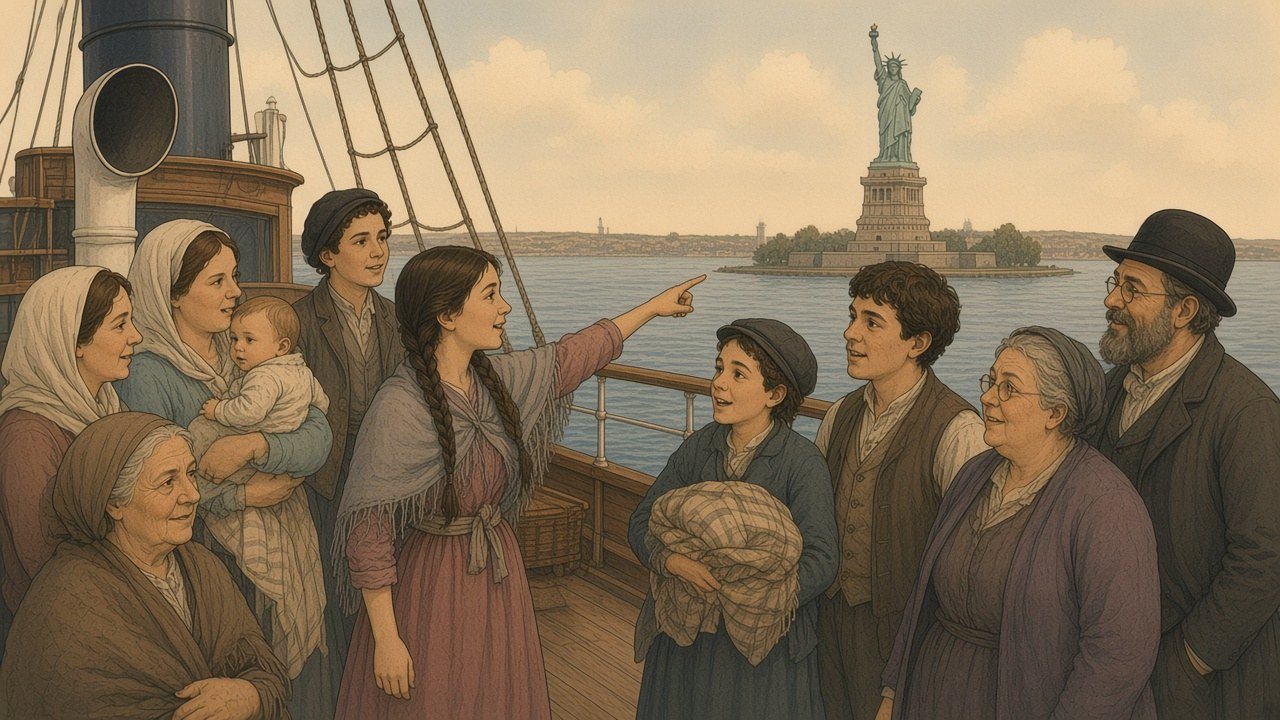
Between the spring of 1881 and the summer of 1914, something over two million Jews left the Russian Empire, the Habsburg province of Galicia and the Kingdom of Romania and made new homes in the United States. The figure that historians most often repeat breaks down roughly as follows: about 1.6 million from the Russian Empire, including its Polish provinces; about 380,000 from Austria-Hungary, most of them from Galicia; and about 80,000 from Romania [1]. Taken together, these people made up perhaps a third of all the Jews of Eastern Europe. No other movement of Jews in modern times, before the catastrophe of the 1940s, reshaped the map of the Jewish world so completely or so fast.
The numbers can be read in two directions. Seen from Eastern Europe, they describe a haemorrhage. Small towns in Lithuania and Belarus lost a son or a daughter from almost every household. Provincial cities such as Kovno, Grodno, Minsk and Vitebsk saw whole streets of artisans thin out year after year. Seen from America, the same numbers describe a foundation. The Jewish population of the United States, perhaps a quarter of a million in 1880, passed three million by the early 1920s, and New York became, for a time, the largest Jewish city in the history of the world. The Yiddish newspapers, unions, theatres, synagogues and benevolent societies the migrants built in Manhattan and Brooklyn, in Chicago and Philadelphia, in Boston and Baltimore, would shape American Jewish life for the rest of the twentieth century.
This essay tries to explain how and why that movement happened. It asks why so many people decided to go in those particular decades, and not earlier or later. It asks what they were leaving and what they hoped to find. It follows them across land frontiers and through North Sea ports, below decks across the Atlantic, through the inspection halls of New York harbour and into the tenements and workshops of the Lower East Side. And it asks what became of the movement when the war of 1914 shut the routes and American politics shut the door.
The usual story and its problems
There is a familiar version of this history, and much of it is true. In March 1881 revolutionaries assassinated Tsar Alexander II. In the weeks that followed, a wave of anti-Jewish riots, soon known to the world by the Russian word pogrom, swept across the southern provinces of the empire. In May 1882 the government issued “temporary rules” restricting where Jews could live and trade. The Jews, terrified and impoverished, fled to America. Twenty years later the massacre at Kishinev and the bloodier pogroms of the revolutionary year 1905 sent a second, still larger, wave across the ocean.
The difficulty is not that any of this is false. It is that, on its own, it does not explain the shape of the migration. The pogroms of 1881 and 1882 struck mainly the south-west of the empire, the Ukrainian provinces, while the heaviest emigration in the following decades came from the north-west, from Lithuania and Belarus, where there had been almost no violence [2]. Jews from Galicia, who lived under a constitutional Habsburg monarchy that had granted them full civil rights in 1867, emigrated at rates comparable to Jews from Russia [3]. The peak years of departure were not the years of massacre: the single largest year of Jewish immigration to the United States before the war was 1906, but the numbers stayed above a hundred thousand a year in 1907 and 1908 as well [4], and rose above that level again in 1913 and 1914. And Jews were far from the only people leaving Eastern Europe. Poles, Lithuanians, Slovaks, Ukrainians, Hungarians and Italians crowded the same ports and the same ships.
What the familiar story omits is the slow pressure underneath the sudden shocks. The Jewish population of Eastern Europe grew at an astonishing pace in the nineteenth century. According to recent estimates the annual net increase between 1850 and 1880 was about 1.7 per cent, enough to double the population in roughly four decades [1]. That growth took place inside a legally confined territory, in an economy that was being turned upside down by railways, factories and the end of serfdom. Millions of Jews found themselves crowded into trades that could not support them. Meanwhile steam had made the Atlantic crossing quicker, cheaper and more predictable than ever before, and a few early migrants had already sent home letters, money and, eventually, tickets.
The violence mattered enormously. It changed how people felt about their prospects and it gave a sense of urgency, even of historic destiny, to decisions that might otherwise have seemed merely economic. But it worked on a population that was already in motion. The historian Simon Kuznets, himself an immigrant from the Russian Empire, argued in a pioneering study in 1975 that the Jewish migration has to be understood as a response to long-term economic and demographic pressures on a minority uniquely constrained by law, and that its timing tracked American business cycles as much as Russian politics. Later historians have argued with the balance he struck, but nobody now thinks that persecution alone explains the movement.
What this essay covers
The chapters that follow move roughly in the order of the migrants’ own journey. They begin in the Pale of Settlement, the band of western provinces to which the Russian state confined most of its Jews, and with the shtetls and cities in which those Jews lived. They look at the hopes raised by the reforms of Alexander II and how those hopes were dashed in 1881. They follow the refugees who crowded into the Austrian border town of Brody, the idealistic young people of the Am Olam movement who set out to farm the American prairie, the poor of Galicia and the young Romanian Jews who in 1900 walked across Europe on foot. They examine the Kishinev pogrom, the revolution and counter-revolution of 1905, conscription, the educational quotas and the expulsions.
The middle of the essay is about the road. It asks how a family in a Lithuanian market town decided who should go first, how tickets were bought and money borrowed, how people crossed a border without a passport, and what they met at the German control stations, in the emigrant city that the Hamburg-America Line built for them, and in the British transit route through Hull and Liverpool. It describes the steerage compartment, which was the experience nearly all of them shared.
The second half is about America. It looks at the old reception depot at Castle Garden and the federal station on Ellis Island that replaced it, at the Jewish aid societies that met the ships, and at the tense relationship between the newcomers and the established German Jewish community uptown. It walks through the Lower East Side, through the garment trade that employed so many of the newcomers, through the strikes and unions they built and the fire of 1911 that killed 146 garment workers. It looks at the hometown societies and the synagogues, the Yiddish press and theatre, women and children and the public schools, and the efforts to send migrants beyond New York, through the Industrial Removal Office and the port of Galveston, Texas. The last chapters cover return migration, the long campaign for restriction that ended with the immigration law of 1924, the war of 1914 and the legacy of the whole movement.
Counting the migrants
It is worth pausing over the numbers, because they are less secure than they look. The United States did not begin to record immigrants by “race or people”, and so to count Jews as Jews rather than as Russians or Austrians, until 1899. For earlier years, historians rely on the records of Jewish aid societies at the ports and on estimates. The most careful early study was a doctoral dissertation published at Columbia University in 1914 by Samuel Joseph. Joseph combined American government figures from 1899 with the reports of the United Hebrew Charities and the Baron de Hirsch Fund for earlier years, and concluded that 1,562,800 Jews had entered the United States between 1881 and 1910. Of these, he reckoned, 1,119,059, or 71.6 per cent, came from the Russian Empire; 281,150, or 17.9 per cent, from Austria-Hungary; and 67,057, or 4.3 per cent, from Romania [4]. The remainder came from Britain, Germany and elsewhere, many of them Eastern Europeans who had paused for some years on the way.
Joseph’s figures show a movement gathering speed decade by decade. Russian Jewish immigration, by his count, ran to 135,003 in the 1880s, 279,811 in the 1890s and 704,245 in the first decade of the twentieth century [4]. The four years between 1911 and 1914, which his study does not cover, added roughly another 400,000 Jews from all sources, which brings the total for the whole period to about two million.
Such numbers are approximations. Some Jews told American officials they were Russians or Poles; some non-Jews were counted as Hebrews; some people came and went more than once and were counted twice. But the broad picture is consistent across every source. The migration was overwhelmingly from the Russian Empire. It accelerated sharply after 1900. And it was, compared with almost every other European migration of the time, a movement of families.
A migration of families
That last feature is the most distinctive. Most of the “new immigrants” who came to America from southern and eastern Europe around 1900 were young men. Many intended to work for a few seasons in a mine or a mill and go home with savings. Jewish migrants were different. In the years 1899 to 1910, Joseph found, women made up 43.4 per cent of Jewish immigrants, compared with 30.5 per cent of all immigrants. Children under fourteen made up a quarter of Jewish immigrants, twice the share among immigrants as a whole [4].
These proportions tell us something about intentions. A man who plans to go home does not usually bring his wife and children. Jews, by and large, did not plan to go home, and relatively few did. For the years 1908 to 1912, when the United States first counted departures as well as arrivals, the number of Jews leaving the country was about eight for every hundred admitted, a far lower ratio than for almost any other group [4]. Recent historians, notably Jonathan Sarna, have shown that return migration was more common in the 1880s and 1890s than the old stories allowed, and that some returnees went back because they had failed and others because they had succeeded. But the contrast with other immigrants is real. For most Jews, the decision to leave was a decision to leave for good.
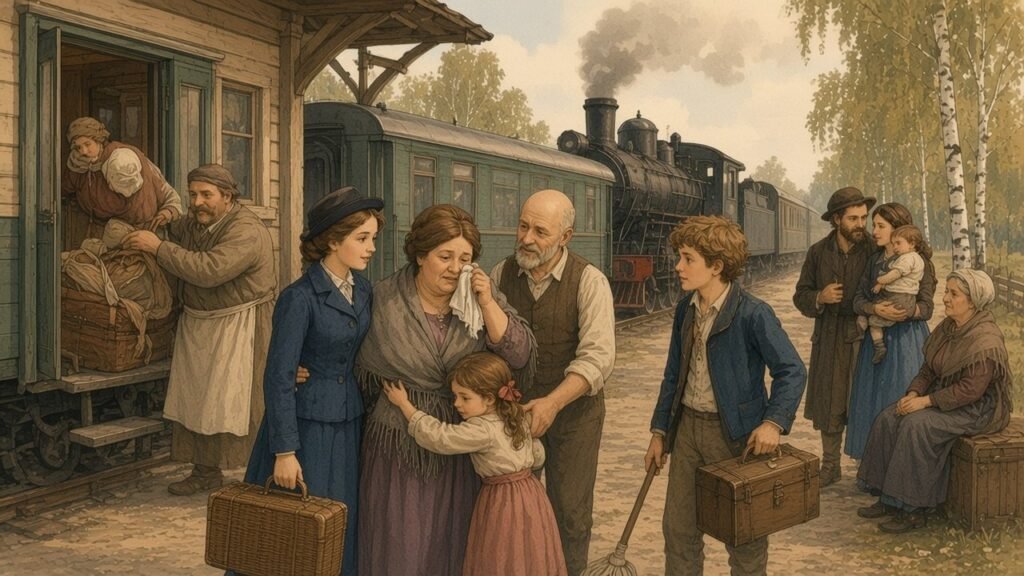
The usual pattern was what historians call chain migration. A husband, a son or an older daughter went first, found work and lodgings, saved money, and sent for the others one or two at a time. The interval could be months or many years. Mary Antin, whose memoir of the journey is one of the classic texts of the migration, was a girl in Polotsk when her father left for Boston in 1891; the rest of the family followed three years later, when he had saved enough for their tickets [5]. Her account of the moment the letter came is still one of the most quoted lines in the literature of the migration: “So at last I was going to America! Really, really going, at last!” [5].
A migration of workers
A second distinctive feature was what the migrants did for a living. American immigration officials recorded the stated occupations of new arrivals. Between 1899 and 1910, of the Jewish immigrants who reported an occupation, 67.1 per cent described themselves as skilled workers, a far higher share than for any other immigrant group. There were more tailors among them than anything else: 145,272 Jewish immigrants in those years gave their trade as tailor. Carpenters, shoemakers, clerks, dressmakers, seamstresses, bakers, butchers, painters and tinsmiths followed [4]. Farm labourers, who formed the largest group among most other immigrants, were rare among Jews.
This occupational profile reflected the economic life of the Pale, where Jews had long been concentrated in crafts and petty trade, and it shaped what happened to them in America. They went to cities, and above all to New York, where the garment industry was booming and Jewish employers who had come a generation earlier from Germany were eager to hire them. Of the Jewish immigrants who arrived between 1899 and 1910, nearly two thirds gave New York State as their destination [4]. Many who landed at other ports soon made their way there too.
Why this story still matters
For many American Jews, and for the descendants of these migrants scattered now across the world, the great migration is family history. The grandmother who arrived alone at sixteen, the great-grandfather who sewed coats in a Ludlow Street tenement, the cousin who stayed behind and vanished in the war, are the stuff of family memory and of a large literature of memoir and fiction. The movement has also become a reference point in arguments about immigration in general. Its history has been told as a triumph of opportunity and a warning about nativism, as proof that a determined minority could rise from poverty in a generation and as a reminder of the brutal conditions in which it did so.
The pages that follow try to set out what can be known, drawing on the work of scholars and on the voices of the migrants themselves. Where the sources disagree, or where a well-known story turns out to rest on weak evidence, the text says so. Where a number is given, it comes from a named source. The illustrations are imaginative reconstructions in ink and watercolour: they are not portraits of real people, and they are meant to suggest the textures of the world described rather than to document it.
A note on names and places
The places in this story had several names. The city the Russian state called Vilna was Vilne to its Yiddish speakers, Wilno to its Poles and is now Vilnius, the capital of Lithuania. Lemberg, Lwów and Lviv are the same city, as are Kishinev and Chişinău, and Elisavetgrad and the modern Kropyvnytskyi. This essay generally uses the forms common in English-language histories of the period, with modern names where they are clearer. Yiddish words are romanised following the standard YIVO system, so landsmanshaft rather than landsmannschaft. Russian dates before 1918 followed the Julian calendar, twelve days behind the Western calendar in the nineteenth century and thirteen in the twentieth. Where it matters, both are given.
The migrants themselves mostly spoke Yiddish, the language of Ashkenazi Jews for many centuries, written in Hebrew letters and drawing on German, Hebrew and Aramaic, and Slavic languages. Many also spoke Russian, Polish, Romanian, Lithuanian or Ukrainian to their neighbours, and an educated minority read Hebrew and German. In America, within a generation, their children would speak English.
How the sources speak
This essay draws on three kinds of evidence, and each has its own voice and its own blind spots. The first is statistical. The most important single source for the numbers is Samuel Joseph’s Jewish Immigration to the United States from 1881 to 1910, a doctoral dissertation published by Columbia University in 1914, which combined American government figures with the records of Jewish charities to produce the first systematic account of the migration [4]. Joseph’s figures have been revised by later scholars, and the categories he used, “Hebrews” as recorded by American immigration officials, did not always coincide with the ways the immigrants defined themselves. But his tables remain the foundation on which most later estimates are built, and they are quoted in this essay wherever possible in his own words and numbers.
The second kind of evidence comes from the immigrants themselves. A small number wrote memoirs, novels and journalism that have become classics: Mary Antin’s From Plotzk to Boston (1899) and The Promised Land (1912), Abraham Cahan‘s Yekl (1896) and The Rise of David Levinsky (1917), and the observations of sympathetic outsiders such as Hutchins Hapgood‘s The Spirit of the Ghetto (1902) and Jacob Riis‘s How the Other Half Lives (1890). These texts are quoted at length in the chapters that follow, because they let us hear how the migration felt to those who lived through it. But they must be read critically. Antin wrote for an American audience and celebrated assimilation; Cahan wrote fiction, however closely observed; Riis shared many of the prejudices of his time. Their authors were exceptional people, and most emigrants left no written record at all.
The third kind of evidence is the work of historians, much of it summarised in the great reference works of Jewish studies, the YIVO Encyclopedia of Jews in Eastern Europe and the Encyclopaedia Judaica, together with the publications of archives, museums and universities. These provide the framework of dates, laws and events. Where they disagree, or where the evidence is uncertain, as with the death tolls of particular pogroms or the motives of governments, the disagreement is noted in the text.
Throughout, quotations are given as they appear in the sources, with their original spellings, and numbers are reported as the sources give them. Where this essay offers its own judgements, it tries to make clear that they are judgements.
The shape of the argument
If there is one argument running through what follows, it is that the great migration was neither simply a flight from persecution nor simply an economic movement, but a combination of both, made possible by new technologies and channelled by networks of family, community and philanthropy. Persecution supplied urgency and gave the movement much of its moral meaning; economics and demography supplied the steady pressure that kept it going year after year; steamships and railways made it possible; and letters, remittances and prepaid tickets turned individual decisions into a mass phenomenon.
It is also an argument about choice. The migrants were not driftwood carried by historical forces. They weighed their options. Some chose Palestine, Argentina, South Africa, Britain or Canada; most chose the United States; many more chose to stay. Those who left were disproportionately young, skilled and poor, but not the poorest of all, who could not afford to go. They borrowed and saved, they sought advice, they bargained with agents and smugglers, and they made their way through a system of borders and inspections that was designed, at almost every step, to sort and filter them. Their courage and ingenuity are the real subject of this essay.
2. The Pale of Settlement
To understand why so many Jews left the Russian Empire, it helps to begin with a peculiar fact: until the late eighteenth century, Russia had almost no Jews at all. Muscovite rulers had long barred Jews from their realm, and the Empress Elizabeth expelled the few who had settled in 1742 [2]. Russia’s Jews came to it all at once, as part of the territory it seized when Poland-Lithuania was partitioned between Russia, Prussia and Austria in 1772, 1793 and 1795. The old Commonwealth had been home to the largest Jewish population in the world: in 1772, according to modern estimates, more than 95 per cent of the Ashkenazi Jews of Eastern Europe lived within its borders [2]. Overnight, the empire of the tsars found itself ruling hundreds of thousands of Jewish subjects whom it neither understood nor wanted.
The making of a boundary
The Pale of Settlement was the Russian state’s answer to this unwelcome inheritance. It grew out of a series of decrees between 1791 and 1835 that defined where Jews might legally live. The first, in 1791, was prompted by complaints from Moscow merchants about Jewish competitors, and it confined Jewish merchants to the newly annexed western lands and to the territories recently conquered from the Ottomans along the Black Sea. Later statutes, especially those of 1804 and 1835, fixed the boundaries more precisely [6]. By the second half of the nineteenth century the Pale consisted of fifteen provinces of the western and south-western empire, stretching from the Baltic to the Black Sea: Kovno, Vilna, Grodno, Minsk, Vitebsk, Mogilev, Volhynia, Podolia, Kiev, Chernigov, Poltava, Kherson, Ekaterinoslav, Taurida and Bessarabia. The ten provinces of the Kingdom of Poland, which had a separate administration, were not formally part of the Pale, but Jews there were subject to similar restrictions on moving further east [7].
The Pale was not a ghetto. It was an enormous territory, larger than France, and inside it Jews could in principle live anywhere permitted by law. But those permissions narrowed over time. Jews were barred from several large cities within the Pale, including Kiev, except for privileged categories; from fifty versts (a little over fifty kilometres) of the western frontier; and, at various times, from rural villages [6]. Beyond the Pale, in the Russian interior, only certain Jews could settle: merchants of the first guild, university graduates, some skilled artisans, discharged soldiers who had served under the old long-term conscription, and a few others. These exceptions were introduced in the 1850s and 1860s and they mattered, but they applied to a small minority.
The state’s motives were mixed. Officials claimed to be protecting Russian peasants from Jewish “exploitation”, by which they usually meant innkeeping, money-lending and the leasing of estates and liquor rights. They also aimed to keep Jewish merchants from competing in the old Russian heartland. And there was a lingering religious antipathy, rooted in the Orthodox Church’s long hostility to Judaism. The result was a population held in place while it multiplied.
A growing population
The growth of the Jewish population of the Pale in the nineteenth century was extraordinary by any standard. By one modern estimate there were about 1,275,000 Jews in all of Eastern Europe in 1800 [2]. By the eve of the First World War, Eastern Europe’s Jewish population had grown to roughly 6,289,000 [2] – this after more than two million had already left. The Russian imperial census of 1897, the only full census the empire ever conducted, counted 5.2 million Jews, about 4 per cent of the empire’s population. Some 94 per cent of them lived within the Pale and the Polish provinces, where they made up about one ninth of the inhabitants.
The causes of this growth were, paradoxically, signs of relative well-being. Jewish communities had comparatively low rates of infant mortality, thanks in part to communal charity, to religious rules on hygiene and diet, and to the fact that Jewish mothers rarely worked in the fields. Illegitimacy was very low: one study of the years 1900 to 1904 found 4 births outside marriage per thousand among Jews, compared with 24 per thousand for the population of European Russia as a whole [2]. Early marriage, which remained the norm in many communities through the mid-nineteenth century, extended the years of childbearing. As marriage ages rose towards the end of the century, Jewish fertility fell, but by then the population was already enormous and very young. The natural increase reached its peak in the 1890s at roughly 20 per thousand a year [2].
What made this growth so dangerous was that it took place in a confined space and in a narrow economy. A people that doubled in forty years, barred from moving east and largely barred from owning land, could only look for a living in the same towns and the same trades that had supported its parents. Each generation divided a cake that was not growing as fast as the number of eaters.
Towns and villages
The great majority of the Pale’s Jews lived in towns. In 1897, according to the census, 86.9 per cent of the Jews of the Pale and the Kingdom of Poland lived in towns and townlets, or shtetlekh [2]. This was not because Jews were urban by nature; in the eighteenth century many had lived in villages as innkeepers, millers and stewards on noble estates. It was the result of deliberate policy. From 1804 onwards successive laws tried to expel Jews from the countryside, partly to stop them selling liquor to peasants. These expulsions were applied fitfully, but over the century they drove a large part of the rural Jewish population into the towns, where it added to the crowding.
In many towns of the Pale, especially in Lithuania, Belarus and the Ukrainian provinces west of the Dnieper, Jews made up a majority of the population. They dominated retail trade and many crafts, and their language, Yiddish, was the language of the marketplace, which non-Jewish peasants also learned to speak. In the larger cities, such as Vilna, Minsk, Berdichev, Białystok and Zhitomir, Jews were often the largest single group. Berdichev, in Kiev province, was said to be four-fifths Jewish in the late nineteenth century. These were the communities that would send their children across the ocean.
The burden of law
Beyond the boundaries of the Pale itself, Russian Jews lived under a dense thicket of special legislation. There were laws on where they could live, which professions they could practise, which schools they could attend, how many could serve on town councils and what taxes they paid. There were special taxes on kosher meat and Sabbath candles, the korobka, collected by Jewish communal agents and resented by the poor who paid them. Until 1874, Jewish communities were obliged to supply recruits for long periods of military service under a quota system that fell hardest on the poor and powerless. Even after the reforms of the 1860s, a Jew in the Russian Empire always lived with the knowledge that the law treated him differently and that its application depended on the goodwill, or the venality, of local officials.
That last point was important. The most burdensome thing about the Jewish laws was not always their content but their unpredictability. A Jewish family living legally in a village one year could be declared illegal the next by a new interpretation of the rules. A craftsman with a residence permit in Moscow could lose it if he changed trades. Police officers routinely demanded bribes to overlook technical violations. The constant insecurity of legal status, more than any single prohibition, created the sense that Jews had no stable future in the empire.
Russifying the Jews
Russian policy towards Jews was not simply repressive. It oscillated between attempts to segregate Jews and attempts to transform them into useful, loyal subjects. Under Nicholas I, who reigned from 1825 to 1855, the state tried to break the authority of the traditional Jewish community. It abolished the kahal, the self-governing communal council, in 1844. It created government-sponsored Jewish schools and two rabbinical seminaries, at Vilna and Zhitomir, in the hope of training a modern, Russian-speaking rabbinate. And it introduced the harsh military conscription of 1827, which will be discussed in a later chapter. Nicholas’s regime was brutal, and Jews remembered it as a time of terror. But it also opened a channel, narrow at first, through which young Jews could acquire Russian education.
Under his son Alexander II, as the next chapters describe, the state relaxed many restrictions for Jews it considered “useful” and encouraged Jews to enter Russian schools and universities. A generation of Russian-speaking Jewish professionals emerged. For a time it seemed as if gradual emancipation was on the way. When that prospect collapsed after 1881, it left behind a generation that had learned to think of itself as part of Russian society and found itself thrown back into the Pale.
Life within the boundary
It would be wrong to think of the Pale only as a prison. For most of its inhabitants it was simply home, a land of familiar towns, synagogues, markets and fairs, rivers and forests. Jewish culture in the Pale in the nineteenth century was extraordinarily rich. It was the heartland of Hasidism, the pietist movement that had spread from Podolia and Volhynia in the eighteenth century, with its dynasties of rebbes and its courts in towns such as Lubavitch, Talne and Ruzhin. It was the home of the great Lithuanian yeshivas at Volozhin, Mir, Slobodka and Telz, where young men studied Talmud with famous intensity. It was also the cradle of the Haskalah, the Jewish Enlightenment, which in Russia produced a modern Hebrew literature and, later in the century, the classic writers of modern Yiddish fiction: Sholem Yankev Abramovitsh, known as Mendele the Bookseller, Sholem Aleichem and Y. L. Peretz.
This culture travelled with the migrants. The Hasidic prayer houses and Lithuanian-style synagogues of the Lower East Side, the Yiddish newspapers and theatres, the radical study circles and the Hebrew schools, were all transplanted from the Pale. So were the divisions: between Hasidim and their opponents, between pious and secular, between Litvaks from the north and Galitsyaner from the Austrian south, between Zionists and socialists.
The geography of departure
Not all parts of the Pale sent emigrants in equal numbers. The heaviest emigration came from the north-western provinces, the region Jews called Lite: Kovno, Vilna, Grodno, Minsk, Vitebsk and Mogilev. This region was poor, its soils thin, its industry limited, and its Jewish population dense. The south-western provinces, Ukraine and New Russia, had richer agriculture and fast-growing cities, above all Odessa, which absorbed many internal Jewish migrants before 1881. Emigration from the south rose sharply after the pogroms of 1881-82 and again after 1903-06, but over the whole period the north-west contributed proportionately more emigrants [2].
The Polish provinces were a special case. Jews in Congress Poland were subject to many of the same legal disabilities as those in the Pale, but the region had its own economy, increasingly industrial, with the great textile city of Łódź at its centre, and its own political tensions. The rise of Polish nationalism in the late nineteenth century, and especially the economic boycott campaign launched by the National Democrats after 1912, pushed growing numbers of Polish Jews towards emigration in the last years before the war.
These regional differences matter because they show that emigration was not a simple reflex of violence. The provinces that suffered the worst pogroms were not always the provinces that sent the most emigrants. What the high-emigration regions shared was dense Jewish settlement, economic stagnation and, increasingly, established links with America. Once a few people from a town had gone and prospered, others followed, and towns that had sent their first emigrants early tended to send more.
A fence around Polotsk
What did the Pale mean to the people who lived within it? Mary Antin, born in Polotsk in 1881, described how a child came to understand it. “There came a time when I knew that Polotzk and Vitebsk and Vilna and some other places were grouped together as the ‘Pale of Settlement,’ and within this area the Czar commanded me to stay, with my father and mother and friends, and all other people like us. We must not be found outside the Pale, because we were Jews” [5]. The knowledge, she wrote, “came so gradually that it could not shock me. It trickled into my consciousness drop by drop. By the time I fully understood that I was a prisoner, the shackles had grown familiar to my flesh” [5].
Antin’s memoir shows how the legal boundary of the Pale was bound up with everyday relations between Jews and their neighbours. When a Christian boy threw mud at her, her mother said resignedly: “How can I help you, my poor child? Vanka is a Gentile. The Gentiles do as they like with us Jews.” By the third time, she “accepted ill-usage from the Gentiles as one accepts the weather” [5]. But not all her neighbours were hostile. The Parphens, a Christian family from whom her grandfather rented his shop, treated them “as if we were not Jews at all”, visiting on Jewish festivals with carefully chosen presents and trying to say the appropriate blessings in Hebrew; the landlady insisted that the Russian people were not to blame, and that it was the priests who taught them to hate the Jews [5].
The fear of violence was a constant undertone. Antin recalled the dread that surrounded Christian holidays and processions, when the police warned Jews to stay indoors and the least disturbance “might start a riot, and a riot lead to a pogrom”. Peering through a crack in the shutters at a procession led by priests carrying crosses and a relic from a nearby monastery, she asked her nurse why there were soldiers in the street, and was told: “In case of a pogrom” [5]. Polotsk itself was spared the great pogroms, but refugees from elsewhere brought “horrible, horrible stories”, and the stories became part of every child’s imagination [5].
The legal maze
For adults, the Pale was experienced above all as a legal maze. Residence outside it depended on belonging to a privileged category: merchants of the first guild, holders of academic degrees, certain veterans, and, from 1865, master craftsmen, a provision that potentially applied to a fifth of the Jewish population of the Pale [6]. Each category required documents, and documents could be lost, revoked or challenged. Many Jews lived outside the Pale illegally, with the connivance of officials who were paid to look the other way, and were exposed to periodic expulsions when policy changed. A ministerial circular of 1880, issued by Lev Makov, allowed Jews who had settled illegally before that date to remain, but the rights of these “Makov circular Jews” always rested on shaky ground, and the circular was withdrawn in 1893 [6].
The expulsion of the “illegal” Jews from Moscow in 1891 was the most notorious of these actions, and it drew international criticism [6]. Its effects rippled through the Pale, as the expelled families crowded into towns that were already overcrowded. Antin described how “the cry of the hunted thrilled the Jewish world with the familiar fear” when the expulsion was announced, a little before Passover, and how the Jews living illegally outside the Pale “turned their possessions into cash and slept in their clothes, ready for immediate flight” [5]. As we shall see in a later chapter, it was this crisis that finally sent her own father to America.
The Pale was formally abolished only on 20 March (2 April new style) 1917, by the Provisional Government that replaced the tsar [6]. By then, more than two million Jews had already left the Russian Empire for the West.
The Pale in memory
In the memory of American Jews, the Pale became a kind of mythical homeland, compounded of poverty, piety and persecution. Sentimental versions of it filled Yiddish songs, the plays of the Second Avenue theatre and, much later, the stage and screen versions of Sholem Aleichem’s stories about Tevye the dairyman. The real Pale was more varied and more modern than these images suggest. By 1900 it contained factories and railways, Jewish trade unions and political parties, Russian-language gymnasia and Hebrew newspapers. Its people were not all pious, nor all poor. But the legal boundary that gave the Pale its name was a constant reality until 1915, when the advancing German army and Russian wartime chaos effectively ended it, and the provisional government formally abolished it after the February Revolution of 1917 [6]. For the two million who left before then, it was the border they were crossing in their minds long before they reached any frontier on the map.
3. Shtetl and City
The Russian imperial census of 1897 counted 5,198,401 Jews in the empire, including the Polish provinces, a little more than 4 per cent of its total population [8]. The best estimates suggest that the Jewish population at the time of the partitions of Poland had been about a million; in a little over a century it had grown roughly fivefold [8]. This chapter looks at how those five million people made a living, and why, in the last decades of the nineteenth century, more and more of them were failing to.
The market town
The emblematic setting of East European Jewish life was the shtetl, the small market town. The word is a Yiddish diminutive of shtot, city, and it meant a place larger than a village but smaller and less important than a provincial city. In the census of 1897, 33.5 per cent of the Jewish population lived in places officially classified as small towns, but the true shtetl population was certainly larger, since many places legally designated as cities were in practice shtetls [9]. In many of them Jews made up 80 per cent or more of the inhabitants [9].
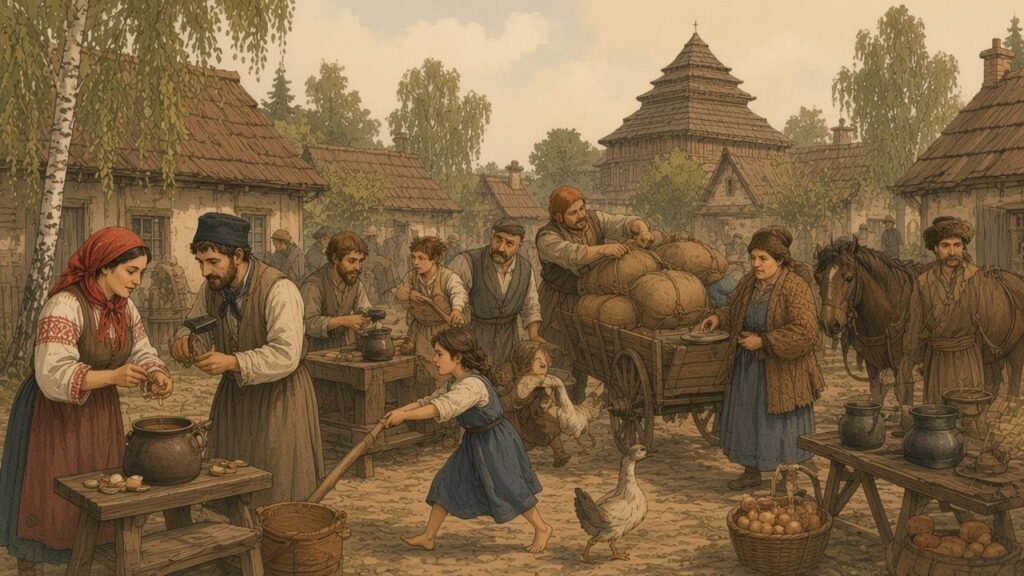
The shtetl’s economy revolved around its market. Once or twice a week, and on a larger scale at the annual fairs, peasants from the surrounding villages came to town to sell grain, flax, eggs, poultry and timber and to buy salt, cloth, tools, kerosene, boots, pots and vodka. The Jews of the town were the middlemen of this exchange. They kept the shops and the stalls, bought the peasants’ produce for resale to merchants in larger towns, made and repaired the goods the peasants needed, drove the wagons that carried goods between town and city, and kept the inns where travellers stayed.
Within the town there was a sharp social hierarchy. At the top were the balebatim, the householders of substance: merchants, contractors, timber dealers, the owners of mills and distilleries, and the families of rabbis and scholars, whose prestige came from learning rather than wealth. Below them came shopkeepers and skilled artisans, such as watchmakers and the best tailors. Near the bottom came ordinary tailors and shoemakers, followed by water carriers and teamsters [9]. At the very bottom were the beggars and the people Yiddish called luftmentshn, “people of air”, who lived from day to day by small trades and errands without any fixed occupation.
This hierarchy shaped emigration. The wealthy rarely left, and the scholars and rabbis had good reason to stay where their learning was valued. The poorest could not afford the journey. The people who left in largest numbers came from the middle and lower ranks: artisans, apprentices, small traders and their children, especially young people who saw no prospect of rising in a town where every trade was overcrowded.
Crafts and their crisis
The single most important fact about the Jewish economy of the Pale was the dominance of crafts. The census of 1897 found that roughly a third of the Jews who earned a living worked in manufacturing and crafts, and roughly a third in commerce of various kinds, with the remainder in transport, domestic service, the professions, religious occupations and agriculture. In some trades Jews were overwhelmingly dominant: the great majority of tailors, shoemakers, hatters, tinsmiths, glaziers and watchmakers in the towns of the Pale were Jewish. A massive survey organised by the Jewish Colonization Association between 1898 and 1899, and published in two volumes in 1904, counted some half a million Jewish artisans in the Pale and Poland, together with their apprentices and journeymen, and documented in detail how poorly most of them lived.
The problem was not simply that there were too many artisans, although there were. It was that the market for their work was changing. Railways, which spread rapidly across the western provinces in the 1860s and 1870s, brought cheap factory goods from Moscow, Łódź and abroad into towns that had once been supplied by local craftsmen. A peasant who could buy machine-made boots or cotton cloth in town no longer needed the local shoemaker or weaver. Railways also bypassed many old market towns, which lost their trade to junctions and provincial centres. The coachmen and innkeepers who had served the old roads found their business vanishing.
The emancipation of the serfs in 1861 had similar double-edged effects. It turned millions of peasants into free agents in the market, which in principle should have expanded demand for the goods Jews sold and made. But it also impoverished many peasants, who were saddled with redemption payments for their land, and it ended the old relationship between Jewish leaseholders and noble landowners, on which many Jews had depended for their livelihood. In the decades after emancipation, peasant cooperatives and Russian merchants increasingly competed with Jews for the rural trade.
At the same time, the Jewish population kept growing. In an overcrowded town, a young man finishing his apprenticeship as a tailor could not expect to find enough customers to set up on his own. He might work for a master for years on starvation wages, or move to a city to find work in a larger workshop. The Jewish artisan economy was characterised by tiny workshops, often a single master with one or two apprentices, working long hours for pitiful returns. Wages were low, seasonal unemployment was common, and the working day in the needle trades could run to sixteen hours.
Poverty
The depth of Jewish poverty in the Pale at the end of the century shocked observers. The JCA survey and other studies found that in many towns a large share of Jewish households, in some places a fifth or more, depended on charity to celebrate Passover, the traditional measure of destitution. Contemporary reports describe families of six or eight living in a single room, children who never saw meat except on the Sabbath, and adults who survived on bread, herring, potatoes and tea. Tuberculosis was widespread. In the larger cities, Jewish workers lived in cellars and garrets crowded far beyond anything permitted by later standards.
Poverty did not by itself drive emigration. Many of the very poorest were too poor to leave, and they had no relatives abroad to send them tickets. Studies of the migrants who reached America show that most had a trade and some savings or credit. But poverty supplied the background against which emigration came to seem rational. A young tailor who knew that a cousin in New York earned in a week what he earned in a month, and who could see no future for himself in his own town, had every reason to consider going.
Industrialisation
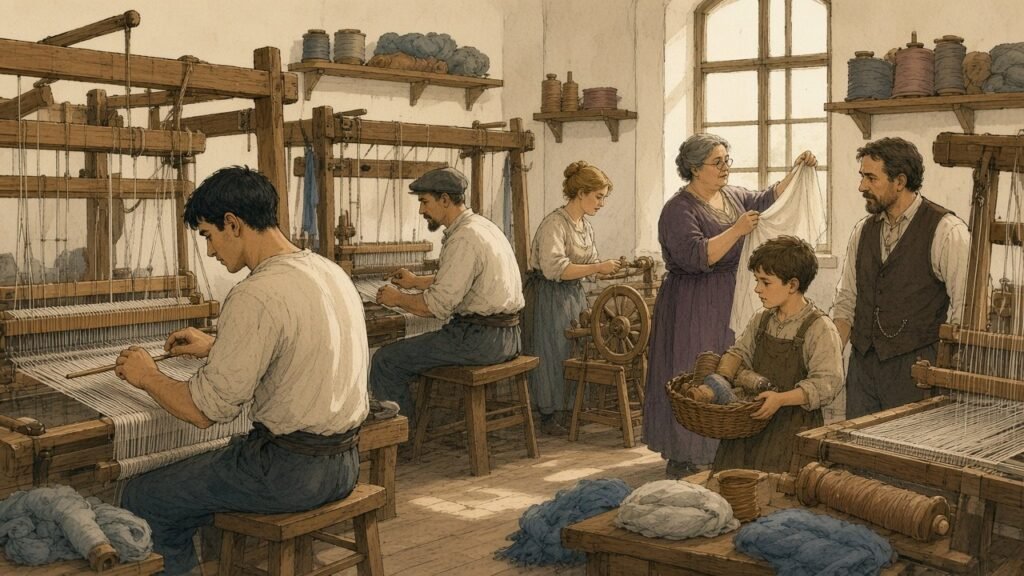
The last decades of the century also brought industry to the western provinces, and with it new kinds of Jewish work. In Białystok, the great textile centre of the Grodno province, Jewish entrepreneurs built woollen mills and Jewish weavers worked the looms, though often in small workshops rather than large factories [10]. In Łódź, the “Polish Manchester”, Jewish merchants and manufacturers played a central part in the cotton industry, although the largest mills tended to employ Polish and German workers. In Vilna, Minsk, Grodno and other cities, Jewish workers made cigarettes, matches, bristles, leather and tobacco. Jewish women worked in large numbers in the tobacco and match factories, and in the sewing trades.
This industrialisation was real, but it was limited. Most Jewish workers remained in small workshops, and Jewish factory workers were often excluded from the mechanised mills, partly because Jewish employers preferred non-Jewish workers who would work on Saturdays and partly because non-Jewish workers resisted Jewish colleagues. The growth of industry in the Pale was not fast enough to absorb the growing Jewish population. And industry brought its own forms of exploitation and conflict, which in the 1890s produced the first Jewish trade unions and, in 1897, the General Jewish Workers’ Bund, which is discussed in a later chapter [11].
Moving to the cities
Long before they crossed oceans, Jews were moving within the empire. The second half of the nineteenth century saw a massive internal migration from the small towns of the Pale to its cities. Warsaw’s Jewish population grew from 15,600 in 1816 to 210,500 in 1897, a third of the city, and to 337,000 by 1914, making it the largest Jewish community in Europe [12]. Vilna, the spiritual capital of Lithuanian Jewry, had about 40,000 Jews in the early 1880s and roughly 63,000 in 1897, and by 1903 Jews were a majority of its inhabitants [13]. Łódź, a small town in 1820, had become a city of hundreds of thousands by 1900, with a Jewish population above 90,000. Odessa, on the Black Sea, attracted Jews from all over the empire with its booming grain trade and its comparatively relaxed atmosphere; in 1897 it counted 139,984 Jews, the second largest Jewish population in the empire after Warsaw [14]. Kiev, despite strict residence rules, also grew rapidly as a Jewish centre: from about 3,000 Jews in 1863 to 32,000 in 1897, many more living there semi-legally [15].
This internal migration was the dress rehearsal for the transatlantic one. It taught people to leave home, to seek work among strangers, to rely on relatives who had gone before. It also concentrated Jews in cities where they encountered modern ideas, political movements and new opportunities, and where they were also more visible to their enemies. Many of the migrants who later reached America had already moved at least once within the empire: from shtetl to provincial city, from Lithuania to Odessa, from Poland to Łódź. For them, America was the next step on a road they were already travelling.
The southern frontier
Odessa and the southern provinces deserve a special word. In the early nineteenth century the Russian government had encouraged Jews to settle in the newly conquered territories of New Russia, around the Black Sea, and even founded Jewish agricultural colonies there. Odessa grew into a cosmopolitan port city where Jews, Greeks, Italians, Russians and Ukrainians traded and mingled. For Jews from the overcrowded north-west, the south was a land of opportunity, Russia’s own frontier. Yiddish had a saying for a carefree life: to live “like God in Odessa”.
But Odessa was also the scene of the empire’s earliest anti-Jewish riots, in 1821, 1859 and 1871 [16]. These outbursts, in which Greek merchants and Russian labourers attacked Jewish shops and homes, were warning signs that the southern frontier was not as welcoming as it seemed. In 1881, when the great wave of pogroms broke, it broke first and most violently in the south.
Women's work
The economy of the shtetl depended heavily on women’s work, though official statistics often missed it. In traditional Jewish society, a pious ideal held that men should devote themselves to Torah study, while their wives earned the family’s living. Only a small elite could live by this ideal, but it gave Jewish women an unusually active role in commerce. Women ran shops and market stalls, traded in poultry and eggs, kept inns and taverns, and dealt with peasant customers. Many also worked as seamstresses, milliners, stocking knitters and dressmakers, and as domestic servants in wealthier households.
Towards the end of the century, growing numbers of young Jewish women went to work in factories and workshops in the cities. Many of them joined the labour movement; women were prominent among the early Bundists. These experiences prepared them for the needle trades of New York, where Jewish women would form a large part of the workforce and play a leading part in the great strikes of 1909 and 1910.
A society on the move
By the 1880s, then, the Jewish society of the Pale was already being transformed. It was growing faster than its economy could support. It was being drawn into a modern market economy that made many of its traditional occupations obsolete. It was moving from villages to towns and from towns to cities. Its young people were learning Russian, reading newspapers, joining study circles, and questioning the authority of rabbis and parents. Some were turning to revolution, others to Jewish nationalism, still others to the hope of assimilation into Russian society.
Emigration was one more response to this transformation, and before 1881 it was a minor one. Between 1820 and 1870, about 10,000 Jews emigrated from the Russian Empire to the United States, and in the 1870s perhaps 15,000 to 20,000 [2]. These were significant numbers, and they laid down the first links between the Pale and America, but they were not a mass movement. What turned a trickle into a flood was the combination of economic pressure with a sudden political shock. That shock came in 1881.
Poverty in fiction and memory
The statistics of poverty in the Pale are given human shape in the memoirs and fiction of the emigrants. Abraham Cahan’s The Rise of David Levinsky (1917) opens in the fictional town of Antomir, in the north-western provinces, where its narrator is born in 1865 [17]. Antomir, he recalls, “then boasted eighty thousand inhabitants” and “was a town in which a few thousand rubles was considered wealth, and we were among the humblest and poorest in it. The bulk of the population lived on less than fifty copecks (twenty-five cents) a day, and that was difficult to earn. A hunk of rye bread and a bit of herring or cheese constituted a meal” [17]. A white starched collar was “an attribute of ‘aristocracy'”, and children nagged their mothers for bread: “Mamma, I want a piece of bread.” “Again bread! You’ll eat my head off” [17].
Levinsky and his widowed mother live “in a deep basement, in a large, dusky room that we shared with three other families, each family occupying one of the corners and as much space as it was able to wrest”. The four housewives cook on a single brick oven, and “fights over pots were as frequent and as truculent as those over the children” [17]. Among their room-mates are a bookbinder and an old soldier who mends sheepskin coats and still wears his uniform years after his service. Cahan was writing fiction, and he was writing for an American readership, but he had grown up in Vilna and he drew on his own memories and those of countless immigrants; the overcrowded basement of Antomir would have been recognised by many of his Yiddish readers.
The scholar's path
Poverty did not extinguish the traditional ideal of learning; in some ways it intensified it. Levinsky’s mother refuses to apprentice her clever son to a craftsman and resolves to send him to a yeshiva. “Nor was she a rare exception in this respect,” Cahan writes, “for there were hundreds of other poor families in our town who would starve themselves to keep their sons studying the Word of God” [17]. Pointing at the great volumes of the Talmud in a bookshop window, she tells him: “This is the trade I am going to have you learn, and let our enemies grow green with envy” [17].
The yeshiva he enters is sustained by donations, and its instruction is free. Students from out of town sleep on the benches and floors of the lecture rooms and receive a pound of rye bread each for breakfast; their other meals are provided by the households of the community in rotation, a system known as “eating days” [17]. One hour a day is given to penmanship and “a sorry smattering of Russian”, paid for by a “modern” philanthropist [17], a small sign of the pressures of modernisation that were reaching even the most traditional institutions.
This was the world in which many of the emigrants had been formed: a world in which material poverty coexisted with intense intellectual and spiritual ambition, and in which a boy’s worth was measured by his learning rather than his earnings. The emigration would turn that scale of values upside down. Levinsky, like many real immigrants, abandons the Talmud in America, rises from pushcart peddler to millionaire cloak manufacturer, and finds his success hollow. “My present station, power, the amount of worldly happiness at my command, and the rest of it, seem to be devoid of significance,” he confesses at the opening of the novel [17]. The tension between the shtetl’s ideal of learning and America’s ideal of success would run through the immigrant experience and the literature it produced.
How representative?
Literary sources must be used with care. Cahan, Antin and other writers were exceptional individuals, and their accounts were shaped by their purposes and their audiences. Most emigrants left no written record at all. Historians who have studied the economic condition of the Pale through official statistics, communal records and the reports of Jewish organisations have painted a picture of widespread and growing poverty, especially in the north-western provinces, but also of considerable variation between regions, towns and families. Not every shtetl was Antomir, and not every family lived in a basement. But the combination of overcrowding, intense competition for a narrow range of occupations, and the legal restrictions that prevented Jews from seeking opportunities elsewhere was real, and it is the essential background to the decision of so many to leave.
The shtetl in American memory
In America the shtetl became the object of an enduring nostalgia. Immigrant writers and their children remembered it as a world of warmth and faith, of Sabbath candles and klezmer music, of poverty borne with dignity. This image owes much to literature, especially the stories of Sholem Aleichem, whose fictional town of Kasrilevke became a byword for the shtetl, and to postwar works such as Mark Zborowski and Elizabeth Herzog’s ethnographic study Life Is with People (1952), which presented the shtetl as a timeless, unchanging culture. Historians have since emphasised how much the shtetl changed in the nineteenth century, how varied it was, and how often its residents wanted nothing more than to escape it.
Both views contain truth. The shtetl was a place of hardship and constraint, and its young people left in droves. It was also a place of strong community, rich religious and cultural life, and deep attachments. Many migrants felt both emotions at once: relief at escaping and grief at what they left behind. The landsmanshaftn they founded in America, which are discussed in a later chapter, were in part an attempt to carry the community of the shtetl with them.
4. Alexander II and the Hopes of Reform
The emigrants of the 1880s were, many of them, children of hope. They had grown up in the reign of Alexander II, the “Tsar-Liberator”, who came to the throne in 1855 in the middle of the disastrous Crimean War and set about remaking the empire. In the quarter-century of his reign, serfdom was abolished, the courts were reformed on Western lines, elected local councils were created, censorship was loosened, the universities were opened up and the army was reorganised. For Russia’s Jews, these years brought the first real hope that the long era of segregation might end, and that they might in time become Russian citizens like any others. The bitterness with which many of them later turned their backs on Russia can only be understood against the measure of that hope.
The end of the cantonists
The first and most deeply felt reform affected conscription. Under Nicholas I, from 1827, Jewish communities had been required to deliver quotas of recruits, including boys as young as twelve, who were sent to special military schools known as cantonist battalions, and then served twenty-five years in the army. Communal leaders, desperate to fill the quotas, hired professional kidnappers, the khapers, who seized children of the poor and powerless. Many cantonists were pressured into baptism; of the roughly 50,000 Jewish boys recruited between 1827 and 1856, about half are thought to have converted [2]. The memory of the cantonists, and of the khapers, lived on in Yiddish song and folklore long after the system ended.
Alexander II abolished the cantonist system and the special Jewish recruitment quotas in his coronation manifesto of 1856. Jews were henceforth to be recruited on the same basis as other subjects [18]. In 1874, the great military reform introduced universal short-term conscription for all classes, with reduced terms for those with education. For Jews, as for others, this was a dramatic improvement, although, as a later chapter shows, it did not end the special burdens and suspicions they faced in military service.
Selective integration
The core of Alexander II’s Jewish policy was what historians call “selective integration”. Rather than emancipating Jews as a whole, the government granted rights to particular categories of Jews it judged useful to the state, in the hope that they would lead the rest towards assimilation. In 1859, Jewish merchants of the first guild, the wealthiest, were permitted to live and trade anywhere in the empire. In 1861, Jews with university degrees received the same right, and in 1865 it was extended to certain categories of artisans. In 1867, Jewish soldiers who had served under the old system, and their descendants, were allowed to settle outside the Pale. Jews with medical training, including pharmacists, dentists and midwives, gained similar rights in 1879 [6] [7].
These measures created a small but significant Jewish population in St Petersburg, Moscow, Kharkov and other cities of the interior. In St Petersburg, a wealthy Jewish elite led by the banker Evzel Gintsburg and his son Horace emerged, and Jews entered the professions, banking, railway construction and the law. In Moscow, the Jewish community grew from almost nothing to tens of thousands by the 1880s, many of them artisans who had taken advantage of the 1865 rule [19]. Their presence in the old capital would later make them targets of the expulsions of 1891.
Selective integration had an obvious drawback. It benefited a small minority and left the great majority of Jews in the Pale untouched. Some historians, most notably Benjamin Nathans, have argued that it nevertheless transformed Russian Jewish society, by creating a new Russian-speaking Jewish elite with a stake in the empire and by establishing the principle that Jews could live beyond the Pale. Others have stressed its limits: the Pale remained, and the laws restricting Jews within it remained, and the government showed no intention of granting general emancipation.

Schools and universities
The most consequential change for the future of Russian Jewry lay in education. The state had long tried to draw Jews into secular schools, and under Alexander II this effort finally succeeded, perhaps too well for the government’s liking. Jewish enrolment in Russian gymnasia and universities rose steeply in the 1860s and 1870s. In many cities of the Pale, Jewish boys made up a large share of gymnasium pupils, and Jews became a visible presence at the universities of St Petersburg, Kiev, Kharkov and Odessa, and in the medical and law faculties above all.
For young Jews, a Russian education offered a way out of the narrow world of the traditional community. It opened careers in the professions, gave access to Russian literature and Western thought, and promised acceptance into Russian society. A generation grew up speaking Russian and reading Pushkin, Turgenev and Chernyshevsky, and many of them came to see the traditional Jewish world of their parents as backward and superstitious. Some converted to Christianity to remove the last barriers to a career. Others, while remaining Jewish, embraced the ideal of russification as the path to emancipation.
The poet Yehudah Leib Gordon, a leading figure of the Russian Haskalah, expressed this ideal in his Hebrew poem “Awake, My People!” of 1863, with its famous counsel to be “a man in the streets and a Jew at home”. Gordon urged Jews to learn the language of the land, to take up useful work and to become loyal citizens, in return for which, he believed, the state would grant them rights. Within twenty years he and many of his readers would feel cruelly betrayed.
The new Jewish press
The reign of Alexander II also saw the birth of a modern Jewish press in the Russian Empire. In 1860, the Russian-language weekly Rassvet (Dawn) and the Hebrew weekly Ha-Melits (The Advocate) both began publication in Odessa. In 1862, the first Yiddish weekly in the empire, Kol mevaser, appeared as a supplement to Ha-Melits. These papers, and the many that followed, created a new public sphere in which Jews debated their future, criticised their leaders and learned about the wider world [20]. They also, from early on, published reports from Jews who had settled in America, giving their readers glimpses of a distant land [1].
In 1863, a group of wealthy St Petersburg Jews led by Evzel Gintsburg founded the Society for the Promotion of Enlightenment among the Jews of Russia, known by its Russian initials as the OPE. It financed Jewish students, published books, and promoted the teaching of Russian. The OPE embodied the strategy of the integrationist elite: to modernise the Jewish masses from above, in partnership with the state.
Counter-currents
Even in the years of reform, hostility to Jews remained strong in Russian society and government. The emancipation of the serfs and the growth of a market economy intensified competition between Jews and non-Jews, and conservative critics increasingly portrayed the Jew as the agent of an exploitative capitalism. In 1869, Jacob Brafman, a convert from Judaism, published The Book of the Kahal, which claimed that the Jewish community secretly continued to govern Jewish life through a hidden network aimed at exploiting Christians. The book, based on a selective and distorted reading of genuine communal records from Minsk, was widely read by officials and helped shape government thinking about Jews for decades.
In 1871, Odessa experienced a pogrom that lasted several days and attracted national attention [16]. It began as a clash between Greek and Jewish residents at Easter but drew in Russian workers and others, and was suppressed only after considerable damage. For the Jewish intelligentsia of Odessa, many of whom had believed in russification, the pogrom was a shock. The writer Peretz Smolenskin and others began to question whether integration was possible. But for most Jews, Odessa in 1871 still seemed an exception rather than a warning.
The Russo-Turkish War of 1877 and 1878 brought another wave of anti-Jewish feeling. Jewish contractors who supplied the army were accused of profiteering, and Russian nationalist newspapers published increasingly hostile articles about the “Jewish question”. The idea that Jews were exploiting Russian peasants, which had long been part of official thinking, now became a staple of the popular press.
Revolutionaries
The 1870s were also the decade of the Russian revolutionary movement. Young radicals, many of them students, “went to the people” in an effort to rouse the peasantry, and when that failed some turned to terrorism. A significant number of these young radicals were Jews, typically students from the gymnasia and universities who had broken with traditional Judaism and saw the revolutionary cause as a universal struggle that would free Jews along with all the oppressed. Aron Zundelevich, Lev Deich and Pavel Axelrod were among the Jewish figures in the movement.
In March 1881, the terrorist organisation People’s Will (Narodnaya Volya) succeeded in assassinating Alexander II with a bomb in St Petersburg. Among those arrested and tried in connection with the plot was a young Jewish woman, Gesia Gelfman, who had sheltered the conspirators; her death sentence was commuted because she was pregnant, and she died in prison after giving birth. Her role was small, but anti-Jewish newspapers made much of it, and the claim that Jews were responsible for the murder of the tsar helped prepare the ground for what followed.
The emigration that came before
Emigration to America had already begun before 1881, though on a small scale. In the 1860s and 1870s, Jews from the north-western provinces, especially the Suwałki and Kovno regions near the Prussian border, began to make their way to America, alongside larger numbers of Jews from Prussian Poland and Hungary. Between 1820 and 1870, perhaps 10,000 Jews from the Russian Empire went to the United States; in the 1870s, a severe famine in Lithuania in 1868 and 1869 and an outbreak of cholera added to the pressure, and perhaps 15,000 to 20,000 more followed [2]. In America they joined the “Polish” congregations that had begun to form in New York and other cities from the mid-nineteenth century: by 1850 there were six such congregations in the United States, and six more were founded in the 1860s [1].
By 1880 there were already small communities of Russian and Lithuanian Jews in New York, Chicago, Boston and other cities. They were few and poor, overshadowed by the much larger and more prosperous German Jewish community. But they were the first links in the chains of migration that would soon draw hundreds of thousands across the ocean. When the crisis of 1881 came, a would-be emigrant in Kovno or Vilna could often name a relative or a neighbour who was already in America.
Writers and the shtetl
The reforming spirit of the era was also expressed in a new Yiddish and Hebrew literature, which took the shtetl as its subject. As the YIVO Encyclopedia notes, the portrayal of the shtetl in this literature “closely followed the Haskalah and its critique of Jewish traditional society” [9]. Writers such as Ayzik Meyer Dik, Yisroel Aksenfeld and Yitskhok Yoyel Linetski became extremely popular with their parodies of shtetl life; in Aksenfeld’s satire Dos shterntikhl (The Headband), a city was distinguished from a shtetl by the fact that “everyone boasts that he greeted someone from the next street because he mistook him for an out-of-towner” [9].
It was Sholem Yankev Abramovitsh, writing as Mendele Moykher-Sforim (“Mendele the Bookseller”), who created the classic literary shtetl, in works such as Dos vintshfingerl (The Magic Ring, 1865), Fishke der krumer (Fishke the Lame, 1869) and Di klyatshe (The Nag, 1872) [9]. His towns, Kaptsansk-Kabtsiel (“Beggartown”), Glupsk-Kesalon (“Foolsville”) and Tuniyadevka-Betalon (“Donothingburg”), as the YIVO Encyclopedia renders them [9], were satirical portraits of poverty, superstition and communal corruption, but they were also drawn with a deep inner knowledge and, at times, tenderness. These books were read by the same generation of young Jews who would later cross the ocean, and they shaped the image of the shtetl that the emigrants carried with them: a place to be loved, mocked and, if possible, escaped.
The meaning of 1881
The reign of Alexander II ended, then, with Russian Jewry divided and uncertain. A small elite had gained rights and wealth and had come to see itself as part of Russian society. A larger group of young people had acquired Russian education and new ambitions. But the great mass of Jews remained in the Pale, subject to restrictive laws, growing poorer and more crowded, and increasingly resented by their neighbours. The promise of emancipation had been held out but never fulfilled.
When Alexander II was killed, his son and successor, Alexander III, turned decisively against the policies of reform. Guided by his former tutor Konstantin Pobedonostsev, the new tsar embraced a programme of autocracy, Orthodoxy and Russian nationalism in which there was little room for Jews. The pogroms of 1881 and 1882, and the government’s response to them, convinced many Jews that the hopes of the previous reign had been an illusion. The historian Simon Dubnow, who lived through these years as a young man, would later describe the new reign as a turning point in the history of Russian Jewry, the moment at which the dream of integration gave way to the search for other solutions: emigration, national revival and revolution [21].
For the generation that had grown up under Alexander II, the shock of 1881 was not only physical but intellectual. They had believed that progress and enlightenment would bring acceptance. Now they saw educated Russians, including some radicals, apparently condoning or even welcoming violence against Jews. The young intellectuals who founded the Am Olam movement and the early Zionist groups were among the first to draw radical conclusions. If Russia would not accept them, they would build a new life elsewhere.
5. The Storm of 1881–1882
On 15 April 1881 by the Russian calendar, 27 April by the Western one, a quarrel in a tavern in the town of Elisavetgrad in the southern province of Kherson turned into a riot. Crowds attacked Jewish shops, houses and taverns, looted them and beat their owners. The disorder lasted for days before troops restored order. It was the week after Easter, and the atmosphere in the empire was tense: six weeks earlier, on 1 March, revolutionaries had assassinated Alexander II in St Petersburg [16]. Within weeks, similar riots had broken out in dozens of towns and villages across the southern provinces. By the time the wave subsided in the summer of 1882, the Russian word pogrom, meaning devastation, had entered the languages of the world.
The course of the violence
The pogroms of 1881 and 1882 came in waves. The first, in the spring of 1881, began in Elisavetgrad and spread rapidly through Kherson province and into the provinces of Kiev, Poltava, Chernigov and Ekaterinoslav. The largest and most destructive riot of this wave struck Kiev itself on 26 and 27 April 1881, when crowds looted and wrecked the Jewish districts of the city over two days while troops stood by [16] [15]. In early May there was a pogrom in Odessa, where Jewish self-defence groups, including students, tried to resist the rioters. A second wave of smaller pogroms followed in the summer of 1881, mostly in villages and small towns.
On Christmas Day 1881, a stampede in a crowded Catholic church in Warsaw, set off by a false cry of fire, led to a pogrom in the Polish capital that lasted for three days [16]. It was the only major pogrom of the period outside the Ukrainian provinces, and it shocked Polish Jews, many of whom had believed that their relations with their Polish neighbours were secure.
The spring of 1882 brought a further wave. The most serious riot took place in the Podolian town of Balta, where a crowd attacked the Jewish population over Easter and caused heavy damage and loss of life [16]. Thereafter the authorities became more willing to use deadly force to suppress the riots, and by the summer of 1882 the wave had largely ended. Serious but isolated pogroms broke out in Ekaterinoslav in 1883 and in Nizhnii Novgorod in 1884, and then, apart from scattered local incidents, the empire saw no further serious pogroms for almost twenty years [16].
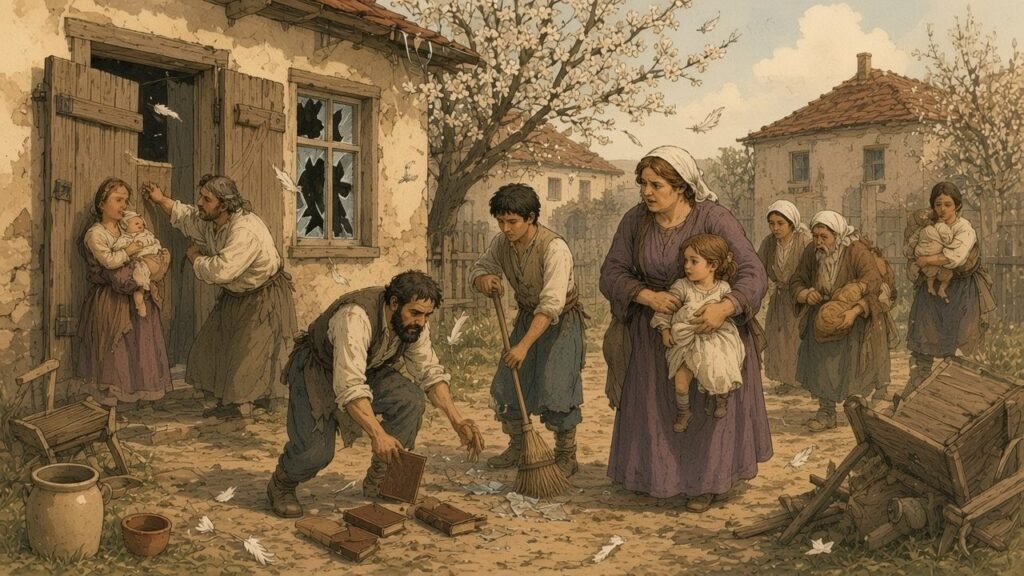
Historians have counted more than two hundred separate outbreaks of violence in 1881 and 1882, most of them in the south-western provinces. The number of Jews killed was smaller than later legend suggested; most estimates for 1881 put the dead in the dozens rather than the hundreds, although Balta and some other places saw serious killing. But the destruction of property was immense, rape was widely reported, and tens of thousands of Jews lost their homes, their shops and their livelihoods. Many more were terrified. The psychological impact far exceeded the physical toll.
Who were the rioters?
The pogroms of 1881 were urban events, or events that began in towns and spread outward along railway lines and roads. Many of the rioters were not local peasants but migrant workers, railway labourers and urban poor, often newcomers from the Russian interior who had come south in search of work. Peasants from surrounding villages joined in, usually to loot. Contemporary accounts describe crowds moving from town to town by rail, and rumours spreading that the tsar had ordered the Jews to be beaten for their part in his father’s murder, or that the authorities would not punish anyone who attacked Jews.
The question of who organised the pogroms has been argued about ever since. At the time, many Jews and foreign observers believed that the government had planned them, or at least encouraged them, as a way of diverting popular anger from the regime. Russian officials, for their part, blamed revolutionaries, who they said had incited the masses to riot. The weight of modern scholarship, especially the work of I. Michael Aronson and John Doyle Klier, finds no evidence that the central government organised the violence. The new regime of Alexander III feared disorder of any kind, and many officials regarded the pogroms as dangerous precisely because they showed how easily crowds could be raised against authority. But local officials were often slow to act, police and troops sometimes stood by while rioters looted, and the government’s subsequent response suggested that it held the victims at least partly responsible.
Some revolutionaries did indeed welcome the pogroms. In the summer of 1881, a leaflet issued in the name of People’s Will in Ukraine praised the rioters for attacking Jewish “exploiters” and called on them to turn next on landlords and officials. It was quickly repudiated by other revolutionaries, but its existence was a bitter lesson for the Jewish radicals who had believed that the revolutionary movement transcended ethnic and religious hatred.
The government's response
The government’s response to the pogroms did as much to drive Jewish emigration as the violence itself. Count Nikolai Ignatiev, who became minister of the interior in May 1881, took the view that the pogroms were a popular reaction to Jewish economic exploitation. In the autumn of 1881 he set up commissions in the provinces of the Pale to investigate the “harmful” economic activities of Jews and to recommend remedies. The commissions, which heard evidence mainly from local officials and non-Jewish notables, largely confirmed what Ignatiev expected to hear: that Jewish exploitation was the root cause of the trouble, and that Jews should be restricted further.
The result was the “temporary rules” of May 1882, discussed in the next chapter. For many Jews, the message of the government’s response was unmistakable: the state blamed the victims and would protect them only grudgingly. An often-repeated story holds that Ignatiev told a Jewish delegation that “the western frontier is open” to Jews who did not like conditions in Russia. The remark appears in several later memoirs and histories, but there is no reliable contemporary record of it, and it should be treated as a characteristic rather than a documented utterance. Whatever the minister actually said, the policy of his government made the point clearly enough.
Jewish reactions
The pogroms shook Russian Jewry to its foundations. For the traditional majority, they were a new chapter in an old story of persecution, to be met with prayer, fasting and endurance. In January 1882, Jewish communities across the empire observed a day of fasting and mourning. But for the young intelligentsia, raised on the hopes of the previous reign, they were a moment of reckoning.
The most famous response came from Leon Pinsker, an Odessa physician who had been an advocate of russification. In 1882 he published, in German, a pamphlet titled Autoemancipation, which argued that hatred of Jews was a psychological disease of the nations among whom they lived, incurable as long as Jews remained a homeless minority. The only solution, he concluded, was for Jews to acquire a territory of their own. Pinsker became a leader of the Hovevei Zion (Lovers of Zion) movement, which sought to settle Jews in Palestine [22]. In the same year, a group of students from Kharkov founded the Bilu society, whose members set out to become farmers in the Land of Israel. Moshe Leib Lilienblum, a former advocate of religious reform, became an ardent proto-Zionist.
Other young intellectuals drew different conclusions. Some joined the Am Olam (“Eternal People”) movement, which aimed to establish agricultural colonies in America, and which is the subject of a later chapter [23]. Others rededicated themselves to the revolutionary cause, convinced that only the overthrow of the autocracy would solve the Jewish question. Still others continued to hope for gradual reform. The pogroms of 1881-82, as one historian has put it, gave birth to modern Jewish politics: the Zionist, socialist and autonomist movements that would shape Jewish life for the next century all trace their origins to this moment [16].
The flight to the frontier
For ordinary Jews in the south-western provinces, the most immediate response was flight. In the spring and summer of 1881 and again in 1882, thousands of Jews from the areas affected by pogroms made their way westward toward the Austrian frontier, often with little more than the clothes they wore. Many headed for the border town of Brody in Galicia, where they hoped to find help from the Jewish organisations of Western Europe. The story of Brody, which became for a time the gateway to the West, is told in a later chapter [24].
The numbers involved in this first flight were not enormous by the standards of what followed. Jewish emigration from the Russian Empire to the United States, which had been running at around a thousand people a year, jumped to more than 15,000 a year after 1881 [1]. Some of the refugees were sent back to Russia by the aid organisations, which feared being overwhelmed. But the flight of 1881-82 established the pattern of the mass migration: refugees crossing the land frontier, assisted by Jewish organisations, moving through Central Europe to the ports, and sailing to America.
The world takes notice
The pogroms attracted wide attention in the West. In January 1882, The Times of London published a long series of articles describing the violence in detail, based on reports gathered by Jewish organisations. The first recorded use of the word “pogrom” in English, according to the Oxford English Dictionary, appeared in The Times on 17 March 1882 [16]. On 1 February 1882, a public meeting at the Mansion House in London, chaired by the Lord Mayor and attended by leading figures in British public life, protested against the persecution of Russian Jews and launched a fund for their relief. Similar meetings were held in New York, Paris and other cities.
In New York, the poet Emma Lazarus, until then known mainly for her literary work, was moved by the pogroms and by the plight of the refugees to become an advocate for Russian Jews. She visited the refugees housed on Ward’s Island, wrote passionately in their defence, and began to argue for Jewish national revival. In 1883 she wrote the sonnet “The New Colossus” for an auction to raise money for the pedestal of the Statue of Liberty [25] [26]. Its most famous lines, about the “huddled masses yearning to breathe free”, were inspired in part by the Russian Jewish refugees she had met.
The Western reaction had a double edge. It brought money and sympathy for the refugees, and it put pressure on the Russian government. But Western Jewish leaders were also deeply anxious about the prospect of a mass influx of poor Russian Jews into their own countries. They feared that it would strain their resources, provoke antisemitism and undermine their own hard-won position in society. These anxieties would shape the policy of Western Jewish organisations towards emigration for decades to come.
A word enters English
The violence of 1881–1882 gave the English language a new word. The standard Russian bureaucratic term for mass unrest was besporiadki, “disorders”, but the occasional use of the word pogrom to describe the attacks on Jews popularised the term in the West [16]. The Oxford English Dictionary records its first use in English in the Times of London on 17 March 1882, in the phrase “That the ‘Pogromen’ [riots against the Jews] must be stopped”, and defines it as “an organized massacre in Russia for the destruction or annihilation of any body or class: orig. and esp. applied to those directed against the Jews” [16].
The word carried an implication that has shaped how the events have been remembered: that the violence was organised from above. As the YIVO Encyclopedia notes, the general usage of the term “usually implies central instigation and control, or at minimum the passivity of local authorities” [16]. Contemporaries widely believed that the pogroms of 1881 were planned, probably by elements within the government, to deflect popular resentment from the regime onto Jewish scapegoats, and this assumption dominated the historical literature for decades. It was challenged by the historians Hans Rogger and I. Michael Aronson, and John Klier’s research in the Russian archives found no evidence of instigation or planning [16]. The issue remains a matter of interpretation: the absence of documentary proof of a plot does not mean that officials were blameless, since the slowness and reluctance of many local authorities to act, and the government’s subsequent insistence that the Jews had provoked the violence by their “exploitation”, shaped the meaning of the events for those who suffered them.
The word also tends to flatten important differences. The common habit of describing every attack on Jews throughout history as a pogrom, the YIVO Encyclopedia observes, “disguises the great variation in the scale, nature, motivation, and intent of such violence at different times” [16]. The riots of 1881–1882 were mainly directed against property; more than 250 separate incidents destroyed millions of rubles’ worth of Jewish property, but the number of deaths is disputed and may have been as low as about fifty, half of them rioters shot by troops [16]. The pogroms of 1903–1906, and above all the massacres of the civil war period after 1918, were far more lethal. The emigrants of the 1880s did not flee mass murder; they fled the shattering of their sense of security, and the realisation that the state would not protect them and might well blame them for their own misfortune.
A turning point
The pogroms of 1881 and 1882 were not the deadliest episode of anti-Jewish violence in the Russian Empire; those of 1903-06 and above all of 1918-21 were far worse. But they were a turning point. They shattered the confidence of the integrationist elite, gave birth to new political movements, and started the mass migration that would carry two million Jews to America. They also created a new image of Russia in the Western mind: a land of persecution from which Jews had to be rescued. This image, which shaped Western Jewish philanthropy and American attitudes, would persist long after the immediate crisis had passed.
It is worth repeating, though, that the pogroms alone did not cause the mass migration. Emigration from the north-western provinces, which had seen no pogroms, rose as quickly as emigration from the south. The deeper causes lay in the economic and demographic pressures described in earlier chapters, and in the restrictive policies that followed the pogroms. What the pogroms did was to transform the meaning of emigration. Before 1881, leaving Russia had been an individual decision, often regarded as a kind of desertion. After 1881, it became a collective response to a national crisis, discussed in newspapers, debated by intellectuals, and organised by philanthropists. The migrants themselves increasingly saw their departure not only as a search for a better life but as an escape from oppression.
6. The May Laws and the Policy of Pressure
On 3 May 1882 by the Russian calendar, Tsar Alexander III approved a set of regulations that came to be known in the West as the May Laws. Officially they were “temporary rules”, intended as an emergency response to the pogroms until a comprehensive revision of the laws on Jews could be completed. They remained in force, with additions and amendments, until the revolution of 1917 [27]. More than any single pogrom, the May Laws and the policy of pressure that followed them convinced Russian Jews that they had no future in the empire, and they did much to sustain the emigration that the riots had begun.
What the rules said
The temporary rules were short. They contained three main provisions. First, Jews were forbidden to settle anew outside towns and townlets, that is, in the rural villages of the Pale. Second, the completion of deeds of sale, mortgages and leases of real estate and land outside the towns in the names of Jews was suspended. Third, Jews were forbidden to trade on Sundays and on the principal Christian holidays [27]. The rules applied to the provinces of the Pale, but not to the Kingdom of Poland.
On paper, these measures might seem modest. They did not expel Jews already living in villages, and they did not affect the towns where most Jews lived. But their effect was far-reaching. They cut Jews off from the countryside at a time when the growing population of the towns desperately needed new outlets. They prevented Jews from acquiring or leasing land, closing off agriculture as a possible occupation. And the ban on trading on Sundays forced observant Jews, who already closed their businesses on the Sabbath, to lose a second day of trade each week.
The rules in practice
The real force of the May Laws lay in how they were applied. Local officials, the police and the Senate, the highest judicial body of the empire, interpreted the rules in ways that steadily expanded their reach. A Jew who had lived legally in a village before 1882 but who left it, even briefly, might be refused permission to return. A Jew who moved from one village to another, even within the same district, was treated as a new settler and expelled. Children of village Jews who married and set up their own households could be refused the right to live where they had grown up. Townlets that had long had a large Jewish population were reclassified as villages, so that their Jewish inhabitants became subject to the rules, and some Jewish families found themselves suddenly residing illegally in places where they had lived for generations.
The rules also opened the way to endless petty extortion. Police officials could threaten Jews with expulsion unless they paid bribes. Jewish families living in villages often did so on sufferance, subject to the whims of local officials. The constant threat of expulsion created an atmosphere of insecurity that made long-term planning impossible. In the words of later historians, the rules were not so much a law as an instrument of harassment.
The overall result was a gradual concentration of the Jewish population in the towns and cities of the Pale, where competition for work was already intense. By the end of the century, the number of Jews living in villages had declined, while the towns grew more crowded and poorer. Economic historians have debated how far the May Laws were responsible for Jewish impoverishment, as distinct from the broader economic changes described earlier, but there is no doubt that they made matters worse.
The Pahlen Commission
Not everyone in the Russian government supported the policy of pressure. In 1883 the government established a High Commission for the Review of Existing Laws Concerning the Jews, chaired by Count Konstantin Pahlen, a former minister of justice. The commission worked for five years. When it finally reported in 1888, the majority of its members concluded that the special laws on Jews had failed, that they had harmed the economy of the Pale and that they should be gradually repealed, with Jews brought step by step to equality with other subjects. A minority dissented.
The commission’s recommendations were ignored. By 1888, the government of Alexander III was firmly committed to a different path. Its leading figures, including Pobedonostsev, the over-procurator of the Holy Synod, and Ivan Delianov, the minister of education, believed that the Jews were an alien and dangerous element that needed to be restrained. The Pahlen Commission’s report became a historical curiosity, evidence that more liberal views existed within the bureaucracy, but without effect on policy.
The quotas
In 1887, the government introduced quotas restricting the admission of Jews to secondary schools and universities. Under the new rules, Jews could make up no more than 10 per cent of students in schools and universities within the Pale, 5 per cent outside it, and 3 per cent in St Petersburg and Moscow [28]. The quotas were justified as a way of preventing Jews from “overcrowding” educational institutions and of protecting Russian students from Jewish influence, and especially from Jewish radicalism.
The quotas struck at the heart of the strategy of integration through education that had flourished under Alexander II. Young Jews who had hoped to escape the Pale through a Russian education now found the doors closing. Families went to extraordinary lengths to get their children into gymnasia: they bribed officials, hired private tutors, moved to cities where the quota had not been filled, and in some cases converted. Many young Jews went abroad to study, to universities in Germany, Switzerland and France, where they formed colonies of Russian Jewish students. Others studied privately and took the gymnasium examinations as external candidates, a route made famous in Yiddish literature as that of the ekstern.
For some families, the quotas were a direct cause of emigration. In America, a child could go to school without limit, and the free public school system, from elementary school to the City College of New York, became one of the great attractions of the New World. Mary Antin, who could not enter a Russian gymnasium, later wrote ecstatically about the public schools of Boston [5]. The image of America as a land where education was open to all, regardless of religion, became a powerful element in the emigrants’ hopes.
Further restrictions
The 1880s and 1890s brought a cascade of other restrictions. Jews were limited in their admission to the bar in 1889. The new statute on rural local government, the zemstvo, adopted in 1890, deprived Jews of the right to vote or to stand in zemstvo elections. The municipal statute of 1892 excluded Jews from voting in town council elections within the Pale and limited the number of Jewish councillors appointed by the authorities to a tenth of the total, even in towns where Jews were a majority. Jews were barred from various state jobs and from serving as officers in the army.
The introduction of the state monopoly on the sale of alcohol, extended across the empire from the mid-1890s and completed in the Pale by the early 1900s, had a particularly serious economic impact. Jews had for centuries been prominent in the liquor trade, as innkeepers, tavern-keepers, leaseholders and distillers. The state monopoly drove tens of thousands of Jewish families out of the trade, adding to the ranks of the unemployed and the impoverished.
The expulsion from Moscow
The most dramatic act of the policy of pressure was the expulsion of Jews from Moscow in 1891 and 1892. Under the laws of the previous reign, a substantial Jewish population, many of them artisans, had settled in the old capital. In 1891, Grand Duke Sergei Aleksandrovich, the tsar’s brother, was appointed governor general of Moscow. Even before his arrival, an imperial order issued in March 1891 announced the expulsion of all Jewish artisans from Moscow and the Moscow province; a further order in October 1892 extended the expulsion to the descendants of discharged Jewish soldiers from the time of Nicholas I [19]. The Grand Duke reportedly declared that his aim was to save Moscow from the Jews [19].
The expulsion was carried out in stages over the following months and years. Families who had lived in Moscow for decades were given short notice to leave; some were escorted to the Pale under police guard, in some cases in chains alongside common criminals. The city’s newly built Choral Synagogue was closed in 1892 and remained closed until 1906 [19]. Estimates of the number of people expelled vary, but most historians put it at around twenty thousand. Many of the expelled went not to the Pale but abroad, and the expulsion from Moscow contributed to the sharp rise in Jewish emigration to America in 1891 and 1892. The next chapter describes the scene at the frontier.
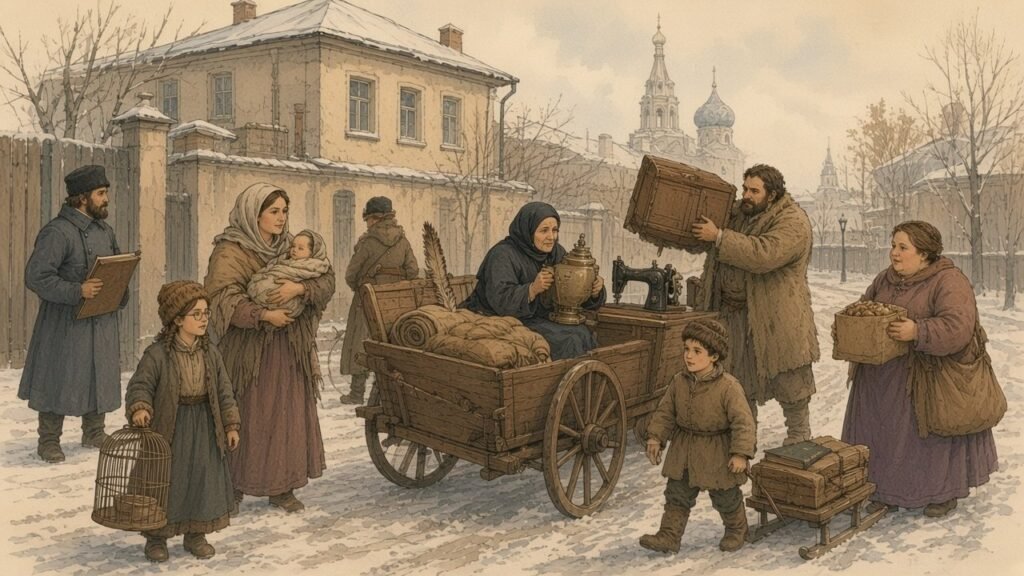
"One third will die"
The policy of pressure is often summed up by a remark attributed to Pobedonostsev, the most influential adviser of Alexander III: that one third of Russia’s Jews would emigrate, one third would convert and one third would perish. The remark has been quoted countless times, in histories, textbooks and popular accounts, as evidence that the Russian government consciously pursued a policy designed to eliminate the Jewish population.
There are good reasons to be cautious about it. It is reported second-hand, in different forms, and historians have been unable to find a contemporary source in which Pobedonostsev said or wrote it. Some versions attribute it to a conversation with a Jewish delegation, others to remarks to a foreign visitor. Pobedonostsev was certainly hostile to the Jews, and his influence on Alexander III was immense [29], but whether he formulated the policy so baldly, or whether the remark is a later distillation of what Jews believed government policy to be, cannot now be determined. The saying is best understood as an expression of how Russian Jews perceived the intentions of their rulers, rather than as a documented statement of policy.
What is clear is that the government of Alexander III and his successor Nicholas II, who came to the throne in 1894, did not seek to keep Jews in Russia. Emigration was formally illegal without a passport, and passports were expensive and difficult to obtain, but the authorities did little to prevent Jews from leaving, and in 1892 the government formally authorised the emigration activities of the Jewish Colonization Association. Jews who left without passports were not permitted to return. For a government that saw the Jews as a problem, their departure was an acceptable solution.
The view from Washington
The persecution of Russian Jews attracted attention in the United States as well. In 1891, as the Moscow expulsions began, the federal government sent two commissioners, John B. Weber and Walter Kempster, to Europe to investigate the causes of emigration. Their report, published in 1892, described the legal disabilities and economic hardships of Russian Jews in detail and concluded that the persecution was driving them out. President Benjamin Harrison, in his annual message to Congress in December 1891, expressed concern about the treatment of Russian Jews and warned that their forced migration on such a scale could not be regarded as a purely internal Russian matter.
American concern was not entirely humanitarian. Officials worried that Russia was effectively dumping its unwanted population on the United States. The tension between humanitarian sympathy for the persecuted and anxiety about mass immigration, visible already in 1891, would run through American policy until the restrictive laws of the 1920s.
Town or village?
Everything under the May Laws depended on the legal status of the place where a Jew lived. In 1875 the Russian Senate had established the category of mestechko, “small town”, which unlike a village had a legal organisation of town dwellers [9]. After 1882, when Jews were forbidden to settle anew in villages, this classification became a matter of life and livelihood. “The Jews’ right to stay in the shtetls where they had lived for generations,” the YIVO Encyclopedia explains, “depended on whether their locale was classified as a town or a village” [9].
The census of 1897 recorded 33.5 per cent of the Jewish population as living in such small towns, but the true shtetl population was probably much higher, since many places classified as cities were in reality shtetls [9]. The distinction, comic as it might seem, was the subject of endless petitions, bribes and lawsuits. A community whose town was reclassified as a village could find itself living on sufferance, liable to expulsion at the whim of an official. Such uncertainty, multiplied across hundreds of communities, was one of the less dramatic but more corrosive pressures that pushed families towards emigration.
The cumulative effect
It is difficult to point to any single law as the cause of Jewish emigration from Russia. The May Laws, the quotas, the Moscow expulsions, the electoral restrictions and the liquor monopoly each affected particular groups. What mattered was their cumulative effect: a steady, relentless narrowing of opportunities, combined with constant insecurity and humiliation. The policy of pressure told Russian Jews, in a thousand small ways, that they were unwanted.
This message was heard not only by those directly affected but by everyone. A young Jew in Vitebsk who had no intention of living in a village, studying at a university or entering the zemstvo could still see that the government regarded him as an alien and that his prospects were narrowing. Combined with the economic pressures of the Pale, the policy of pressure created a pervasive sense that the future lay elsewhere. In 1891 and 1892, Jewish emigration from Russia reached levels not seen before: Samuel Joseph’s figures show 43,457 Russian Jewish immigrants arriving in the United States in 1891 and 64,253 in 1892, the highest number in two decades; nearly a tenth of the entire Russian Jewish immigration of 1881 to 1910 arrived in those two years. In New York, monthly arrivals of Russian Jews, which had averaged about 2,300 in the first months of 1891, jumped to 8,667 in June, two months after the Moscow expulsion order [4]. From then on, despite fluctuations, emigration would remain a permanent feature of Russian Jewish life until the war.
7. Brody, 1881–1882
In the summer of 1881, the small Austrian town of Brody, a few kilometres inside the Habsburg frontier with the Russian Empire, became the scene of the first mass refugee crisis of modern Jewish history. Thousands of Jews fleeing the pogroms in the Ukrainian provinces made their way to the border and crossed into Galicia, many of them without passports or money, in the hope of reaching the West. By May 1882 there were some 12,000 refugees crowded into Brody [24]. Their presence forced the Jewish organisations of Western Europe to confront, for the first time, the question that would dominate Jewish philanthropy for the next three decades: what to do about the mass emigration of Russian Jews.
A Jewish border town
Brody was an obvious destination. It lay on the main road and railway from Kiev and the south-west into Austria, a short distance from the Russian border town of Radziwiłłów. For more than a century it had been one of the great commercial centres of Eastern Europe, a free trade city through which goods flowed between Russia, Austria and Germany. Its status as a free port was abolished only in 1880 [24]. It was also one of the most Jewish cities in Europe. In 1765, at the time of the last Polish census before the partitions, Brody had the largest Jewish community in the Commonwealth, about 8,600 people [2]. In 1880, Jews made up about three quarters of its inhabitants [3].
Brody was famous among Jews for its merchants and for its scholars. It was a centre of the Haskalah in Galicia, the home of maskilim such as Nahman Krochmal and Menahem Mendel Lefin [24], and its merchants had long-standing commercial ties with Odessa, Berdichev and other cities of the Russian south. The Brody Synagogue in Odessa, founded by merchants from Brody, was one of the leading modern congregations in the Russian Empire. For Jews in the Ukrainian provinces, Brody was a familiar name, and the road to it was well known.
The refugees arrive
The refugees began arriving in the spring and summer of 1881, after the first wave of pogroms. Most came from the provinces of Kiev, Volhynia and Podolia. Some had lost their homes and property in the riots. Others had not been directly affected but had been frightened into flight by the violence around them and by rumours of worse to come. Many believed, on the basis of reports in the Jewish press and word of mouth, that the Jews of Western Europe and America would help them to emigrate. Some had heard that free passage to America was being offered.
They crossed the border in various ways. Some had passports. Many did not, and crossed illegally, with the help of smugglers or simply by walking across the fields at night. The Austrian authorities, at first, did not stop them. In Brody, they crowded into the town’s inns, synagogues and private houses, and when these were full, into barns, warehouses, the courtyards of public buildings and the open air. Contemporary accounts describe families sleeping in the streets, children sick with fever, and long lines of people waiting outside the offices of the relief committees.
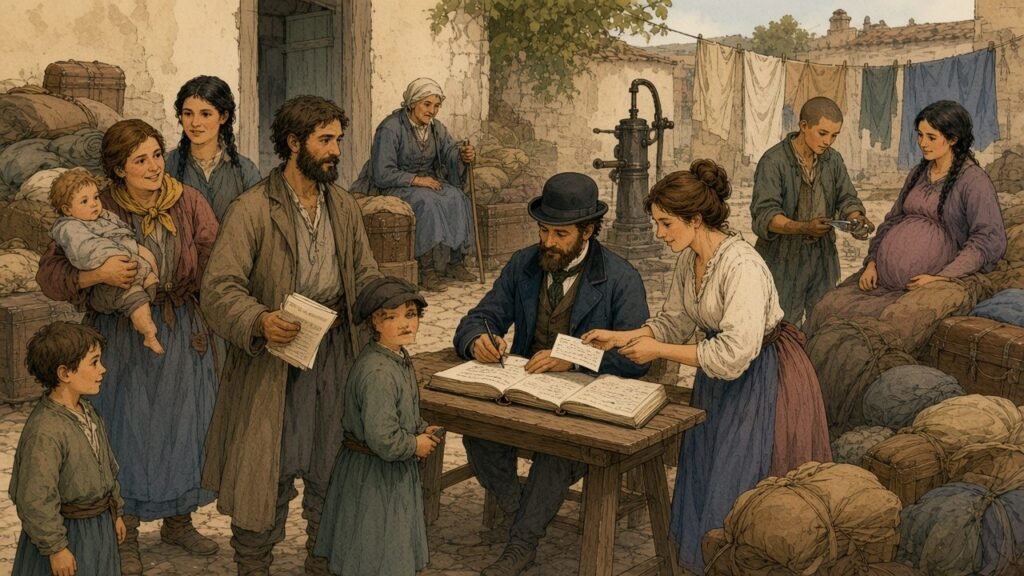
The Alliance takes charge
The main responsibility for the refugees fell on the Alliance Israélite Universelle, the Paris-based organisation founded in 1860 to defend the rights of Jews around the world and to promote their education [30]. The Alliance had long been active in Eastern Europe and the Middle East, sponsoring schools and intervening with governments on behalf of persecuted Jews. In 1881 it sent its most experienced field worker, Charles Netter, to Brody to organise relief. Netter was one of the founders of the Alliance and had been instrumental in establishing the agricultural school of Mikveh Israel near Jaffa in 1870.
Working with local Jewish leaders and with representatives of other organisations, including the Mansion House Fund in London and German Jewish committees, the Alliance set up a system of registration, relief and transport. Refugees were registered, interviewed and classified. Those judged fit to emigrate, typically young, healthy and skilled people, were sent on by rail to Hamburg, Bremen or Antwerp, and thence to America. Others were given small sums of money and encouraged to return to Russia. The Alliance also tried to find places for refugees in Western Europe, but most countries were reluctant to accept them.
Who should go?
From the beginning, the relief effort was shaped by a fundamental tension. The Western Jewish organisations wanted to help the refugees, but they also feared being overwhelmed. They worried that if they provided free passage to America, they would encourage hundreds of thousands more Russian Jews to flee to the border. They worried, too, about the reaction of the American Jewish community, which had to receive the refugees and which was already alarmed by their numbers. And they worried about the reaction of governments, which might close the frontiers if the flow became too great.
The result was a policy of selection. The Alliance and its partners tried to send to America only those refugees who seemed likely to support themselves, and to discourage the rest. In practice this meant favouring young single men and families with skilled breadwinners, and turning away the old, the sick and the destitute. Many of those turned away were sent back to Russia, with travel money and sometimes under pressure. This policy was controversial even at the time, and it left a lasting bitterness among many Russian Jews, who felt that their Western brethren had abandoned them.
Tension with America
The refugees sent from Brody to America in 1881 and 1882 arrived in New York, where they were received by the Hebrew Emigrant Aid Society, established in New York in 1881 to help the newcomers [31]. The New York society, run by members of the established German Jewish community, soon found itself overwhelmed. It complained to the Alliance that it was being sent people who could not support themselves, and demanded that the flow be reduced. The tension between the Western European organisations, which wanted to send refugees on to America, and the American organisations, which wanted to limit the number they received, would recur throughout the period of mass migration.
The New York society did what it could. It housed refugees in temporary shelters, including barracks on Ward’s Island in the East River, and tried to find them work. It also sent some to agricultural colonies and to cities in the interior. But its resources were limited, and its leaders were deeply ambivalent about the newcomers, whom many of them regarded as uncouth, unruly and an embarrassment. Some American Jewish leaders went so far as to propose that the refugees be sent back. The Hebrew Emigrant Aid Society was dissolved in 1883, and its work was taken over by other bodies.
The end of the crisis
The Brody crisis lasted, in its acute form, for about a year. In the summer of 1882, the Austrian government, alarmed by the growing number of refugees, pressed for them to be removed from Brody. The Alliance and its partners stepped up their efforts to send refugees west, and also stepped up repatriation. By the autumn of 1882, most of the refugees had gone. Thousands had been sent to America; thousands more had been returned to Russia; others had found their own way to Western Europe or Palestine.
Precise figures are uncertain. Estimates of the total number of refugees who passed through Brody in 1881 and 1882 range widely, and the numbers sent to America, returned to Russia, or settled elsewhere are disputed. What is clear is that the episode marked the beginning of organised Jewish emigration from Eastern Europe, and that it established patterns that would persist for decades.
Lessons learned
The Brody crisis taught the Western Jewish organisations several lessons. The first was that mass emigration from Russia could not be stopped, only managed. Even when the Alliance and its partners tried to discourage emigration, Russian Jews kept coming. The second was that emigration needed to be organised, with information, transport and reception arranged in advance, if it was not to produce chaos and suffering. The third was that the reception countries, and above all the United States, were the key: without a willing destination, no amount of organisation in Europe would help.
These lessons shaped the development of Jewish emigration policy in the following decades. The Alliance itself withdrew from large-scale involvement in emigration after 1882, although it continued to assist emigrants in various ways. Other organisations took up the task: the German Jewish committees that organised transit through Germany, the Jewish Colonization Association founded by Baron Maurice de Hirsch in 1891, and the American organisations that eventually merged into the Hebrew Immigrant Aid Society. These organisations, and their often difficult relationships, are the subject of a later chapter.
Brody as a waystation
Even after the crisis of 1881-82 had passed, Brody remained an important waystation for Jewish emigrants from Russia. Its position on the frontier, its Jewish population, and its rail connections made it a natural point of transit. In the following decades, thousands of emigrants passed through Brody on their way west, some legally with passports, many illegally with the help of smugglers. The town’s inns and lodging houses did a brisk trade, and a network of agents and middlemen grew up to serve the emigrant traffic.
Brody also became a waystation for emigrants from Galicia itself. Galician Jews emigrated in large numbers from the 1880s: some 36,000 left Galicia in the 1880s and 114,000 in the 1890s, with Brody becoming a key waystation [3]. The next chapter but one describes the conditions that drove them.
Memory and myth
The Brody episode has a special place in the memory of the great migration. For many of the earliest emigrants, it was the first stage of the journey, the moment when they left Russia behind and entered the world of Western Jewish philanthropy. Memoirs of the period describe the crowded inns and synagogues, the long waits at the relief offices, the anxious interviews and the joy or despair of those chosen to go or told to return.
The episode also shaped the self-image of the emigrants. The refugees of Brody saw themselves, and were seen by others, as victims of persecution fleeing for their lives. This image, which drew on the biblical story of the exodus from Egypt, would become central to the way American Jews understood the great migration. In the decades that followed, as the migration grew to include people driven primarily by economic motives, the image of the persecuted refugee remained powerful, shaping both Jewish and non-Jewish perceptions of the newcomers.
The young idealists
Among the refugees and emigrants who passed through Brody in 1881-82 were small groups of young idealists who had a very different vision of their future. These were the members of the Am Olam movement, who planned to establish agricultural colonies in America where Jews could live by their own labour, free from persecution and from the stigma of commerce. Some Am Olam groups formed in Odessa, Kiev, Vilna and other cities, and made their way to America via Brody and other border crossings. Their story, one of the most romantic and tragic episodes of the early migration, is told in the next chapter.
A turning point in philanthropy
The Brody crisis also marked a turning point in the history of Jewish philanthropy. Before 1881, Western Jewish organisations had focused on defending the rights of Jews in their countries of origin and on improving their conditions through education and economic development. After 1881, emigration became a central concern. The question of where Russian Jews should go, how they should get there, and what should be done with them when they arrived would occupy Jewish philanthropists for the next half-century.
This shift was not without controversy. Some Western Jewish leaders argued that emigration was a betrayal of the struggle for Jewish rights in Russia, and that it played into the hands of the Russian government. Others argued that emigration was the only realistic solution to the plight of Russian Jews. Still others, like the founders of the Hovevei Zion, argued that Jews should emigrate not to America but to Palestine, where they could build a national home. These debates, which began in the aftermath of 1881, would continue throughout the period of mass migration and beyond.
The view from the refugees
What did the refugees themselves think? Their voices are harder to recover than those of the philanthropists, but memoirs and letters give some glimpses. Many were bewildered and frightened, uncertain where they were going or what awaited them. Some were angry at the treatment they received from the relief organisations, which seemed to them cold, bureaucratic and condescending. Others were grateful for the help they received and impressed by the efficiency of the Western Jewish organisations.
Above all, the refugees were determined. Many of them had sold everything they owned to make the journey, and they had no intention of going back. When the relief organisations tried to send them back to Russia, many refused, or went back only to leave again. Their determination, more than any policy of the philanthropists, ensured that the migration continued.
A town in decline
The refugees of 1881 arrived in a town that had seen better days. Brody, about eighty kilometres north-east of Lemberg, had owed its prosperity to the free-port status it received in 1779, which allowed goods for export to pass through without duty. Its economy began to decline in 1848, when the new railway line to Odessa bypassed it, and the loss of its free-port status in 1880 came on the very eve of the refugee crisis [24]. In its prime, Brody had also been a centre of the Galician Haskalah: among its maskilim were Nahman Krochmal, Menahem Mendel Lefin and Yitshak Erter, and the Hebrew weekly ‘Ivri anokhi, one of the main vehicles of the Galician Enlightenment, was published there from 1865 to 1890 [24].
The town’s Jewish majority, its position on the border and its tradition of commerce with Russia made it a natural gathering point for the refugees. But it had neither the housing nor the resources to cope with the thousands who poured in, and the burden fell on the international Jewish organisations. The decline of Brody continued after the crisis had passed; its most famous son, the Austrian Jewish novelist Joseph Roth, born there in 1894 [24], would later write of the vanished borderland world of the Habsburg monarchy with a melancholy that owed something to the fading town of his childhood.
Brody's later fate
Brody’s importance as a waystation declined in the later years of the migration, as other routes through Germany became more important. The town itself declined too: its commercial importance had faded with the end of its free-trade status in 1880, and its Jewish population fell as emigration continued. During the First World War it was badly damaged, and in the Second World War its Jewish community was destroyed. Today it is a small town in western Ukraine, its great synagogue a ruin. But in the history of the great migration, Brody has a place out of all proportion to its size: it was, for a moment in 1881 and 1882, the gateway through which East European Jewry began its journey to the New World.
8. Am Olam and the Dream of the Soil
Among the many thousands who left Russia in 1881 and 1882 was a small minority with a vision. They were students, craftsmen and young intellectuals who believed that the Jews’ misfortunes stemmed not only from persecution but from their abnormal economic life, crowded into petty trade and middleman occupations that bred resentment among their neighbours. The cure, they believed, was a return to the soil. In America, where land was plentiful and the government imposed no restrictions on Jews, they would build agricultural communes in which Jews could live by the labour of their hands, free, equal and productive. They called their movement Am Olam, “The Eternal People”, after an essay by the Hebrew writer Perets Smolenskin [23].
Origins
Am Olam was founded in Odessa in 1881 by two young idealists, Mania Bakl and Moses Herder, who called for the settlement of Jews on the land in America in the form of socialist communes [23]. The idea spread quickly. Chapters were formed in Kiev, Vilna, Kremenchug, Elisavetgrad and other cities. Their members were mostly young, many of them students who had been through the Russian gymnasium and university, and who had been involved in, or influenced by, the Russian populist movement of the 1870s. They drew inspiration from Russian populism, with its idealisation of the peasant commune; from Tolstoyan and utopian socialist ideas; and from the Jewish Enlightenment’s long-standing call for the “productivisation” of the Jews.
The movement was also shaped by the American dream as it was imagined in Russia. In the 1870s, Russian radicals and religious dissidents had hatched plans to found collectivist colonies on the open prairies of America, and some of these groups included Jewish participants [1]. To young Russians steeped in the literature of the period, America was the land of the frontier, of homesteads and free communities, where men and women could live according to their ideals. The Am Olam founders combined this romantic vision with a specifically Jewish purpose: to prove to the world, and to themselves, that Jews could be farmers.
Setting out
The first contingent, about seventy craftsmen, artisans and students, left from Elisavetgrad in the spring of 1881. It was followed over the next year by further groups, totalling several hundred people, from Kiev, Kremenchug, Vilna and Odessa [23]. They travelled through Brody and Germany, often with the assistance of the Jewish relief organisations, which saw in them a model of the productive emigrants they wanted to send. Many of the groups crossed the Atlantic singing revolutionary songs and discussing their plans for communal life.
Among the young men who sailed with an Am Olam group in 1882 was Abraham Cahan, a twenty-one-year-old teacher, trained at the Teachers’ Institute in Vilna, who had fled Russia to escape arrest for his revolutionary activities. Cahan never joined a colony, but he later wrote vividly about the Am Olam pioneers in his memoirs, and he would become the most influential Jewish journalist in America [32].
Many of the Am Olam emigrants never got beyond New York. There, confronted with the cost of land and equipment, the lack of agricultural experience, and the attractions of the city, groups broke up and their members drifted into the workshops and factories of the Lower East Side [23]. Those who persisted founded a handful of colonies, scattered across the continent, each of which tells its own story of hope and disappointment.
Sicily Island
The first colony was established in the spring of 1882 at Sicily Island, in the swamps of north-eastern Louisiana. It consisted of thirty-two families led by Herman Rosenthal, a writer and poet from Kiev who had organised the Kiev Am Olam group, and it settled on more than a thousand acres of land purchased with the help of the Alliance Israélite Universelle and American Jewish sponsors [23]. The colonists were mostly city people, with no experience of farming and none at all of the semi-tropical climate of the Mississippi lowlands. They suffered from heat, mosquitoes and malaria.
The decisive blow came within weeks. In the spring of 1882, a disastrous flood of the Mississippi River inundated the colony and destroyed its crops, buildings and livestock [23]. The colony was abandoned. Some of the settlers went to New Orleans or back to New York. Twelve families followed Rosenthal to South Dakota.
Crimea and Bethlehem of Judea
In September 1882, Rosenthal and his followers founded a second colony in the Dakota Territory, near Mitchell, which they called Crimea. A few miles away, another group established a colony called Bethlehem of Judea in the same year [23]. The settlers took up homesteads under the federal Homestead Act, built sod houses, and tried to raise wheat on the open prairie.
The Dakota colonies faced different hardships from those in Louisiana: bitter winters, summer droughts, hail, prairie fires and grasshoppers. They lacked capital and had to borrow at high interest to buy seed, livestock and equipment. Crop failures left them deeper and deeper in debt. Both colonies were liquidated in 1885 [23]. Some of the colonists stayed on as individual farmers; others moved to cities in the Midwest.
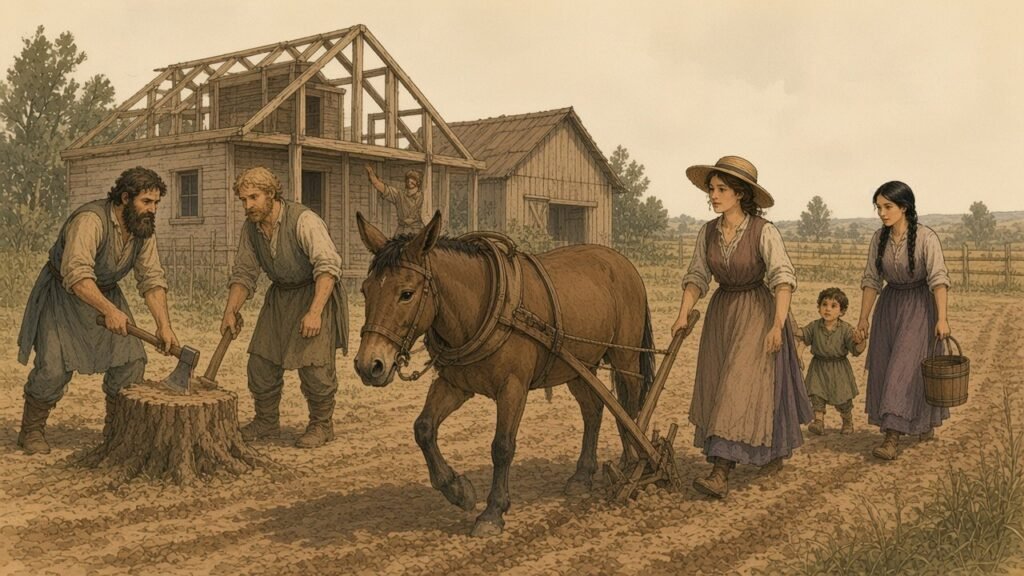
New Odessa
The longest-lived of the Am Olam colonies, and the most intensely communistic, was New Odessa, established in 1882 by some seventy people in Douglas County, southern Oregon [23]. Its leaders were the socialist Pavel Kaplan and an unusual non-Jew, William Frey, a former Russian army officer and mathematician whose real name was Vladimir Geins, and who had become a disciple of Auguste Comte’s “religion of humanity”. Frey had already tried to found a utopian community in Kansas in the 1870s.
New Odessa was organised as a full commune. Its members held all property in common, worked collectively, ate together and met in the evenings for lectures, discussions and sessions of mutual criticism. They cut timber and sold it to the railway, raised vegetables and kept cows. For a time the colony prospered, and visitors were impressed by its idealism and discipline. But the strains of communal life, quarrels over leadership, the austerity Frey imposed, and the tension between his positivist creed and the socialism of other members, gradually wore it down. The colony was dissolved in 1887 [23]. A group led by Kaplan tried to continue as an urban commune, first in San Francisco and then in New York, but by 1890 it too had disbanded [23].
Other colonies
The Am Olam colonies were part of a larger wave of Jewish agricultural experiments in America in the 1880s, sponsored by the Hebrew Emigrant Aid Society, the Alliance, Baron de Hirsch and other philanthropists. Colonies were established in Kansas, Colorado, Arkansas, North Dakota, Michigan and elsewhere. At Cotopaxi, in the Colorado Rockies, a group of Russian Jewish families was settled in 1882 on land that turned out to be almost entirely unsuitable for farming; the colony collapsed within two years. In Kansas, several small colonies, among them one named Beersheba, were founded and failed in the early 1880s.
Most of these colonies failed for similar reasons: poor land, lack of capital, inexperience, isolation and the harshness of frontier life. Many of the colonists were urban artisans and intellectuals who had never farmed and had no idea how to do so. The philanthropists who sponsored them often chose land poorly and provided too little money. And the colonies’ isolation from other Jews made it difficult to maintain a Jewish communal life, to find marriage partners, or to educate children.
South Jersey
The one region where Jewish agricultural colonies took lasting root was southern New Jersey, close enough to Philadelphia and New York to provide markets and supplies. In May 1882, the Hebrew Emigrant Aid Society settled a group of Russian Jewish families on land near Vineland, in Salem and Cumberland counties. The colony was named Alliance, in honour of the Alliance Israélite Universelle, which helped fund it. Other colonies followed nearby: Carmel, Rosenhayn and Norma among them.
The South Jersey colonies survived, though not as purely agricultural communities. The soil was sandy and poor, and farming alone could not support the colonists. They supplemented their income by working in the garment and cigar factories that philanthropists and entrepreneurs established nearby, and by taking in summer boarders from the cities. The colonies became a mixed economy of farming, industry and resort trade, a model that would be repeated in the Catskill Mountains of New York.
In 1891, the newly established Baron de Hirsch Fund founded the town of Woodbine in Cape May County, New Jersey, on more than five thousand acres of land. Woodbine was intended to combine agriculture and industry, and in 1894 it opened the Baron de Hirsch Agricultural School, the first Jewish agricultural school in the United States [33]. The town attracted factories, built a synagogue and schools, and survived as a Jewish community well into the twentieth century.
In 1900, the Baron de Hirsch Fund established the Jewish Agricultural and Industrial Aid Society, later the Jewish Agricultural Society, to provide loans, advice and training to Jewish farmers. With its support, thousands of Jewish families took up farming in New Jersey, Connecticut, New York and elsewhere, often specialising in poultry, dairy and truck farming close to urban markets. By the 1920s, there were reckoned to be several thousand Jewish farm families in the United States, a modest but real achievement.
Why the dream failed
The Am Olam movement, as an organised movement, had ceased to exist by 1890 [23]. Its colonies had failed, and most of its members had become workers, shopkeepers, professionals and political activists in the cities. Historians have offered several explanations for its failure. Some emphasise the practical problems: poor land, lack of capital, inexperience. Others emphasise the ideological tensions within the movement, between socialism and Jewish nationalism, between communalism and individualism, between idealism and the demands of survival. Still others point to the fundamental mismatch between the movement’s romantic vision and the realities of American agriculture, which was becoming increasingly commercial and mechanised.
Perhaps the deepest reason was that the Am Olam vision ran against the grain of the great migration as a whole. The vast majority of Jewish immigrants came from towns and cities, had urban skills, and sought urban opportunities. America in the 1880s was rapidly industrialising and urbanising, and its cities offered far more opportunities for Jewish immigrants than its farms. The movement of Jews to American cities was not a failure of the Am Olam ideal but a reflection of the economic realities of the age.
The other road to the soil
The dream of turning Jews into farmers was not an American invention, and Am Olam was not its only expression. The Russian government itself had promoted Jewish agricultural colonisation from 1806, arranging for the settlement of 80,000 acres in the provinces of Kherson and Ekaterinoslav in New Russia [34]. The early colonies were badly prepared and impoverished by drought; the statute of 1835 institutionalised colonisation and exempted settlers from military service, but state support ended in 1865, when about 33,000 people lived in the colonies. From 1859 until 1891 a series of edicts forbade Jews to rent or buy farmland anywhere in the empire [34].
Yet the Jewish farming population of Russia grew in the last decades of the century. The May Laws and the pressure on the shtetls created a “push”, and Baron de Hirsch’s Jewish Colonization Association began to support colonies and individual farms in the 1890s, which brought rapid improvement in living standards. By 1900, according to the YIVO Encyclopedia, more than 150,000 Jews farmed land in the Russian Empire, and the 22 Jewish colonies in the Kherson area had reached standards of living equal to or better than those of their non-Jewish neighbours. By 1913, some 42,000 Jews lived in 38 colonies in New Russia [34]. In Bessarabia, too, Jewish colonies had become a significant part of agricultural life by 1914 [34].
The pogroms of 1881, the YIVO Encyclopedia observes, “intensified interest in the potential benefits of agrarianization: some continued to seek it in New Russia, while the ‘Am ‘Olam movement looked to America and Ḥibat Tsiyon and BILU directed followers to Palestine” [34]. Seen in this light, the American colonies were one branch of a much wider movement, and their failure was not proof that Jews could not farm. Where land, capital and expert support were available, as in the JCA colonies of southern Russia and Argentina, Jewish farming could succeed. What the American pioneers lacked was not will but resources, experience and good land.
A lasting legacy
Despite its failure, Am Olam left a lasting legacy. Many of its former members played active roles in the Jewish socialist movement in New York [23]. Some became leaders of the Jewish labour movement, the Yiddish press and the Jewish socialist parties. Their idealism, their commitment to social justice and their belief in the dignity of labour helped shape the culture of the Jewish immigrant left.
The Am Olam dream of Jewish agricultural renewal also found other outlets. In Palestine, the Bilu pioneers of 1882 and the later waves of Zionist settlers pursued a similar vision with greater success, eventually building the kibbutzim and moshavim that would form the backbone of the Zionist enterprise. In Argentina, the Jewish Colonization Association founded by Baron de Hirsch established agricultural colonies that, for a time, supported tens of thousands of Jewish farmers [35]. And in the Soviet Union in the 1920s, the government and Jewish philanthropists sponsored Jewish agricultural colonies in Ukraine and Crimea.
In America, the dream of the soil lived on in the Jewish farming communities of New Jersey, the Catskills and elsewhere, and in the summer camps and farm schools that sought to give urban Jewish youth a taste of rural life. But for the great majority of Jewish immigrants, America meant the city, and it was in the cities that their story would unfold.
9. Galicia
If persecution alone explained the great migration, the Jews of Galicia would have had little reason to leave. Galicia, the province that Austria had taken from Poland in the partition of 1772, belonged to the Habsburg monarchy, which in 1867 granted its Jews full civil and political equality. Galician Jews could live where they liked, own land, enter any profession, vote and stand for parliament. There were no pogroms on the Russian scale, no Pale of Settlement, no educational quotas. Yet Galician Jews emigrated to America at rates as high as, and in some periods higher than, those of Russian Jews. Some 36,000 left Galicia in the 1880s and 114,000 in the 1890s, and the flow grew larger still in the first decade of the twentieth century [3]. Overall, about 380,000 Jews from Austria-Hungary, most of them from Galicia, went to America between 1881 and 1914 [1]. The explanation for their departure lies above all in poverty.
A crowded province
Galicia stretched along the northern slopes of the Carpathians, from Kraków in the west to the Russian and Romanian borders in the east. It was one of the largest provinces of the Habsburg monarchy and one of the poorest. Its western half was predominantly Polish, its eastern half predominantly Ukrainian, or Ruthenian as the Austrians called them. Jews were a large minority everywhere: in 1900 they numbered 811,000, about 11 per cent of the population, and in 1910 about 872,000 [3]. In the towns their share was much higher. In 1880, Jews made up three quarters of the residents of eight Galician cities, among them Brody, and between half and three quarters of fifty-five others, including Tarnopol, Rzeszów, Drohobycz, Buczacz, Stanisławów and Kołomyja [3]. The largest community was in the provincial capital, Lemberg, with 31,000 Jews in 1880 and 57,000 in 1910 [3].
Galician Jewry was famously traditional. It was a heartland of Hasidism, home to the courts of the great dynasties of Belz, Sandz, Ruzhin and Chortkiv [3]. It was also, paradoxically, the birthplace of the Haskalah in Eastern Europe, and by the end of the nineteenth century it had a vigorous modern intelligentsia, Polish-speaking assimilationists and Zionists alike. But for most Galician Jews, life revolved around the market town, the prayer house and the struggle to make a living.
Galician misery
“Galician misery” was a proverbial phrase in the late nineteenth century. In 1888 the Polish engineer and economist Stanisław Szczepanowski published a book titled The Misery of Galicia in Figures, which documented the province’s appalling poverty: low agricultural productivity, primitive industry, high mortality and widespread hunger. Galicia was overwhelmingly agricultural, with tiny peasant holdings that were divided further with each generation. Industry was largely limited to the oil fields around Borysław and Drohobycz, which attracted Jewish workers and entrepreneurs, and a few textile centres. Much of the province lacked roads and railways.
Jews were concentrated in commerce, innkeeping, transport and crafts. In 1910, more than half of Galician Jews worked in commerce, innkeeping and transport [3]. They were the shopkeepers and peddlers of the towns, the innkeepers and leaseholders of the villages, the middlemen who bought peasants’ grain and cattle and sold them goods. As in Russia, the population grew faster than the economy, and competition within these trades became desperate. Families crowded into single rooms, lived on bread and potatoes, and depended on charity. Jewish participation in the industrial workforce was lower than that of the general population: in 1910 only some 39 per cent of Jewish households had members in paid employment, compared with 56 per cent of Christian households [3].
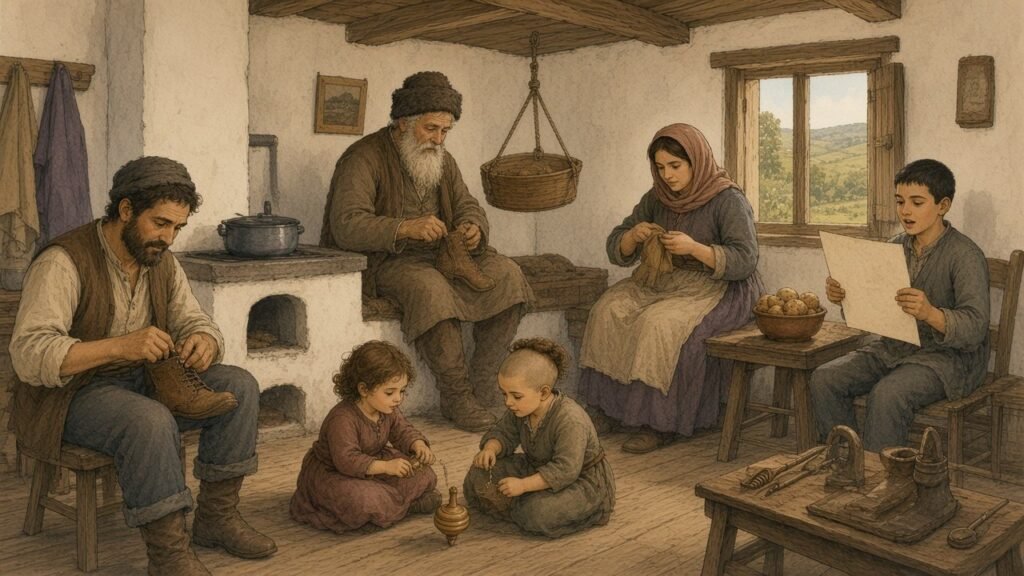
The squeeze on Jewish trade
In the last decades of the century, Galician Jews faced new economic pressures that made their poverty worse. The most important came from the Polish national movement, which increasingly sought to wrest economic power from Jews and transfer it to Poles. In the 1880s, Christian cooperative movements, notably the Agricultural Circles organised among the peasantry, began to set up shops and credit associations that competed directly with Jewish merchants and moneylenders [3]. Their explicit aim, in many cases, was to free the peasant from dependence on the Jew. Combined with campaigns to boycott Jewish businesses, they steadily eroded the Jewish share of rural trade.
The liquor trade, for centuries a mainstay of Jewish livelihood in the countryside, also came under attack. Under the old Polish system, the right to produce and sell alcohol, known as propination, belonged to the noble landowners, who leased it to Jewish innkeepers. A Galician provincial law of 30 December 1875 provided for the abolition of propination, with compensation to the owners, after a transition period that ran to the end of 1910; a second law, of 22 April 1889, reshaped the process, so that from 1890 the right to sell spirits passed from the landowners to the province (except in towns that held the right themselves), and the owners were paid off in bonds. The province leased out the taverns, and propination finally expired at the beginning of 1911 [36]. According to the Encyclopaedia Judaica, Jews were barred from selling alcoholic beverages in 1910, and 15,000 Jewish families lost their livelihood [37].
Antisemitism, too, grew in public life. In 1881 and 1882, a deputy named Teofil Merunowicz made speeches in the Galician diet calling for the abolition of the Jewish communal councils, and in 1882 a blood libel case stirred up public opinion across the province; the accused were tried several times before being acquitted in 1886 by the supreme court in Vienna [3]. In the elections of 1898, the priest Stanisław Stojałowski and his Christian People’s Party used antisemitic slogans in their campaigns, and that year violent riots against Jews broke out in western Galicia, causing massive damage to Jewish property [3]. The riots of 1898 were not on the scale of the Russian pogroms, but they shocked Galician Jews and added to the pressure to leave.
Emancipation without opportunity
The case of Galicia illuminates a central point about the great migration. Legal equality was not enough. Galician Jews enjoyed rights that Russian Jews could only dream of, but those rights did not feed their families. In a province where the economy was stagnant and the population growing, where Jews were concentrated in overcrowded trades and where the national movement sought to drive them out of those trades, emancipation offered no solution to poverty. Emigration did.
Galician Jews also had an important practical advantage over Russian Jews: they could leave legally and with relative ease. Austrian law permitted emigration, passports were fairly easy to obtain, and the railways ran from Galicia directly to the German ports. A Galician Jew did not need to hire a smuggler or cross a hostile frontier at night. The journey was still long and arduous, but it was legal, and that made it cheaper and less frightening.
Relief and reform
Western Jewish organisations were concerned about the plight of Galician Jewry and sought to relieve it. In the late 1880s Baron Maurice de Hirsch, the Bavarian-born financier who had made a fortune building railways in the Ottoman Empire, endowed a foundation in the Habsburg lands to create schools in Galicia and Bukovina. The Baron Hirsch schools offered a modern education combining Jewish and secular subjects, as well as vocational training, in the hope of preparing Galician Jewish children for new occupations. By the early twentieth century there were dozens of such schools [38].
Other organisations, including the Baron de Hirsch Fund and German and Austrian welfare funds, also provided economic help [3]. They set up credit cooperatives, vocational schools and workshops, and tried to encourage Jews to take up agriculture and crafts. These efforts helped some individuals, but they could not change the basic economic situation of the province. Many of the young people trained in Baron Hirsch schools used their skills not in Galicia but in America.
Galitsyaner in America
In America, Galician Jews formed a distinct group, known in Yiddish as Galitsyaner. They spoke a distinctive dialect of Yiddish, had their own customs and religious traditions, and tended to settle together. On the Lower East Side, Galician Jews concentrated in the blocks to the south and west of Houston Street, while Russian and Lithuanian Jews settled further east. Galician Jews founded their own synagogues, landsmanshaftn and mutual aid societies.
Relations between Galitsyaner and Litvaks, the Jews from Lithuania and Belarus, were sometimes tense. Each group had its stereotypes of the other. Litvaks were said to be rational, dry, learned and sceptical; Galitsyaner emotional, pious, warm and superstitious. These stereotypes were the stuff of endless jokes, and they reflected real cultural differences between the Hasidic heartland of Galicia and the Misnagdic, scholarly culture of Lithuania. In America, intermarriage between Galitsyaner and Litvaks was sometimes regarded almost as a mixed marriage.
Hungary and Bukovina
Galicia was not the only part of the Habsburg monarchy that sent Jewish emigrants to America. Jews also emigrated from Hungary, particularly from its north-eastern counties, where the Jewish population was poor, traditional and largely Hasidic, and from Bukovina, the small crown land between Galicia and Romania. Hungarian Jews had begun emigrating to America earlier than Galician Jews, in the middle of the nineteenth century, and they founded their own congregations and societies in New York and other cities. In the official American statistics, all these groups were counted together as immigrants from Austria-Hungary.
According to Samuel Joseph, 281,150 Jews entered the United States from Austria-Hungary between 1881 and 1910: 44,619 in the 1880s, 83,720 in the 1890s and 152,810 in the first decade of the twentieth century [4]. The steady rise reflects both the worsening economic situation in Galicia and the growing networks of relatives and landslayt in America, which made emigration easier with each passing year.
A different kind of migration
Galician Jewish emigration differed from Russian Jewish emigration in some respects. It was less driven by sudden political shocks and more by steady economic pressure. It had a somewhat higher share of single young men, at least in its early years, and somewhat higher rates of return migration. Some Galician emigrants went not to America but to Vienna, Berlin or other cities of Central Europe, where they formed large and visible communities. Others went to Palestine, England or South Africa.
But in its broad outlines, Galician Jewish emigration resembled Russian Jewish emigration. It was a movement of families, it was permanent, and it was directed overwhelmingly to the United States. The Galitsyaner who arrived in New York shared the same streets, the same workshops and the same struggles as their Russian and Lithuanian neighbours, and over time the differences between them faded. Their children grew up as American Jews.
Two Galicias
Galicia’s Jews were not a uniform mass of poor traders. The province contained both extreme poverty and a rising professional class, and the contrast helps explain who left and who stayed. The Jewish population grew from between 150,000 and 200,000 at the annexation of 1772 to 449,000 in 1857, 811,000 in 1900 and about 872,000 in 1910, when Jews made up 10.9 per cent of the province’s inhabitants [3].
At the top, emancipation opened the professions. In 1906–1907 Jews made up 21 per cent of all secondary-school pupils, 25 per cent of the students at the University of Lemberg and 14 per cent at the University of Kraków; Jews formed 30.9 per cent of Galicia’s lawyers in 1887 and 58 per cent in 1910 [3]. In Lemberg, the number of registered Jewish university students rose from 251 in 1881–1886 to 561 in 1901–1906 [39]. In politics, Jews were elected to the Austrian parliament from 1873, and in 1907 the Zionists ran an intensive campaign to elect Jewish nationalist deputies [3].
At the bottom, the picture was very different. A growing Jewish working class appeared in the towns: the prayer-shawl weavers of Kołomyja became famous in 1892 as among the first workers in Galicia to go on strike [3]. Jewish workers who joined the Polish Socialist Party found that it did not understand their needs, and in 1905 some of them formed an independent Jewish Social Democratic Party; a Po’ale Tsiyon party had been founded in Kraków in 1904 [3]. For many families, however, the economic squeeze tightened in the last years before the war. A law of 1911 forced businesses to close on Sundays, a heavy blow to Sabbath-observant shopkeepers who now lost two days’ trade each week, and “the biggest blow”, in the words of the YIVO Encyclopedia, came with the depression of 1912, “when many Jewish families lost their sole source of income” [3]. It was these poorer Jews, artisans, petty traders and their children, who filled the emigrant ships.
What Galicia teaches
The experience of Galician Jewry offers a valuable corrective to the view that the great migration was simply a flight from persecution. It shows that economic pressures alone could drive mass emigration, even in the absence of legal discrimination and large-scale violence. It also shows that legal emancipation, without economic opportunity, could not keep Jews in their homelands. And it shows how emigration, once begun, could become self-sustaining, as each wave of emigrants made it easier for the next to follow.
At the same time, Galicia shows that persecution and economics were not entirely separate. The economic pressures on Galician Jews were intensified by the Polish national movement’s campaign to drive Jews out of trade, by the abolition of propination rights, and by growing antisemitism. Economic discrimination, even without legal disabilities, could be a powerful force for emigration. In Galicia, as in Russia, the great migration was the product of a combination of forces, in which the line between economic and political motives was often blurred.
10. Romania and the Fusgeyers
In the spring and summer of 1900, the roads of northern Romania saw a strange sight. Groups of young Jews, mostly men but some women too, set out from the towns of Moldavia on foot, carrying knapsacks, walking sticks and sometimes banners. They walked westward, through the Carpathian passes into Austria-Hungary, across Hungary and Austria, and on through Germany to the North Sea ports, where they hoped to find ships to carry them to America. They called themselves fusgeyers, “foot-goers”, and their extraordinary journeys became one of the legends of the great migration [40]. To understand why they walked, it is necessary to understand the unique situation of the Jews of Romania.
Foreigners in their own country
Romania emerged in the nineteenth century from the union of the principalities of Wallachia and Moldavia, recognised by the European powers in 1862, and became fully independent of the Ottoman Empire after the Russo-Turkish war of 1877 and 1878 [40]. Its Jewish population was concentrated in Moldavia, the northern principality bordering on Russian Bessarabia and Austrian Bukovina and Galicia, and much of it had arrived from Galicia and Russia in the course of the nineteenth century. In 1878 the census recorded 218,304 Jews, and in 1899, 269,015, about 4.5 per cent of the population [40]. In some Moldavian towns, including the old capital of Iaşi, Jews made up around half of the inhabitants [41].
The defining feature of Jewish life in Romania was the denial of citizenship. Article 7 of the Romanian constitution of 1866 restricted naturalisation to Christians, excluding Jews from civil rights [40]. Jews born in Romania, whose families had lived there for generations, were classified as foreigners, subjects of no state, and they could not vote, hold public office or practise many professions. This situation became a matter of international concern after the Russo-Turkish war. The Treaty of Berlin of 1878, which recognised Romania’s independence, required it to grant equal rights regardless of religion. Romania complied in form: in 1879 it amended its constitution to allow individual Jews to be naturalised by a special act of parliament for each case. In practice, this was a device to avoid emancipation. Apart from 888 Jewish veterans of the 1877 war who were naturalised by a special law, applications were routinely rejected; between 1880 and 1913, only 529 Jews succeeded in acquiring citizenship [40].
A legal noose
As “foreigners”, Romanian Jews were subject to a growing body of restrictive legislation. They were barred from living in rural areas, from holding many kinds of licences, from becoming lawyers, pharmacists or state employees, and from owning rural land. Laws of 1893 limited Jewish children’s access to Romanian public schools, forcing the community to build its own network of schools [40]. Expulsions of Jews from villages had been carried out periodically since the 1860s, often brutally. International interventions on behalf of Romanian Jews, including visits to Bucharest by Adolphe Crémieux in 1866 and Sir Moses Montefiore in 1867, produced hostile reactions in the Romanian press and parliament [40].
Romanian nationalism after 1870 was marked by intense economic xenophobia, in which the Jew was cast as a foreign intruder who had taken over the country’s commerce and industry [40]. Politicians, writers and academics, including some of the most celebrated names in Romanian culture, contributed to this discourse. It gave ideological support to a policy whose evident purpose was to make life so difficult for Jews that they would leave.
Disability upon disability
Samuel Joseph, writing in 1914, traced in detail how Romania used the legal fiction that its Jews were foreigners to exclude them from one occupation after another. A law prohibiting hawking, “or any form of sale from house to house or on the streets”, deprived “several thousands of Jewish families of their livelihood” [4]. The decisive step came in 1886 and 1887, with the laws intended “to create a national industry and commerce”. As foreigners, Jews could neither vote for nor sit in the new Chambers of Commerce and Trade, “although they formed a large majority of the merchants and manufacturers represented in these important bodies”; five years after the founding of a factory, two thirds of its workers had to be Romanians; and Jews were excluded entirely from the financial institutions of the state and the state railways, and in practice from the private railways as well [4].
Education followed the same pattern. A circular of the minister of public instruction in 1887 ordered that Romanian children be given preference where there was not enough room in the elementary schools for all, and in 1893 all “aliens” were required to pay fees for entry to the public schools and were admitted only if room remained [4]. Similar provisions largely closed the secondary schools and universities to Jews, who were completely excluded from the schools of agriculture, forestry and commerce. As aliens they were forbidden to work as physicians or pharmacists in the public health service, or to own or work in private pharmacies [4].
Joseph explained the thoroughness of this policy by the structure of Romanian politics. The electoral law placed power in the hands of the landed aristocracy and the urban middle class; had the Jews been enfranchised, they would have become “the most important part” of the middle-class electoral college, as merchants, manufacturers, professionals and graduates of the elementary schools [4]. Both the liberal and conservative parties therefore agreed on “piling up disability upon disability”. The thirty years since independence, he concluded, had been “one of gradual, steady and systematic deprivation of one civil right after another. To the prohibition of freedom of movement has been added that of work; one occupation after another has been prohibited to Jews under the mask of foreigners” [4].
The crisis of 1899–1900
The immediate cause of the exodus of 1900 was an economic crisis. A poor harvest in 1899 brought hardship to the whole country, and the economic downturn hit Jewish artisans and traders especially hard. At the same time, the government was preparing new measures to exclude Jews from the crafts, and anti-Jewish agitation was mounting. In 1902, the Artisans’ Law required craftsmen to belong to guilds and restricted the rights of foreigners to practise their trades unless their country of origin granted reciprocal rights to Romanians. Since Jews were officially foreigners without any country, the effect was to make it extremely difficult for Jewish artisans to work. Samuel Joseph, writing in 1914, concluded that the feeling that Jews had nothing to hope from the government, as much as the actual distress, was largely responsible for the unprecedented emigration of these years [4].
The walkers
The fusgeyer movement began in Romania in the spring of 1900. Young people in Bârlad, Iaşi, Galaţi, Focşani, Bacău and other Moldavian towns formed walking groups, often with names, constitutions and elected leaders, and resolved to make their way to America on foot. Some groups numbered a few dozen people, others more than a hundred. They saved what money they could, collected donations from their communities, and set off, typically in spring or early summer, walking westward through the Carpathians.
The walkers were mostly young, in their teens and twenties, and mostly male, although some groups included young women and married couples. Many were artisans, the group most threatened by the new restrictions. They carried their belongings on their backs, slept in barns, synagogues and fields, and lived on bread, cheese and whatever their supporters along the way could provide. Some groups sang as they walked, and fusgeyer songs, celebrating their journey and their hopes for America, became part of Yiddish folk culture.
The journeys were long and hard. From northern Romania to Hamburg is well over a thousand kilometres, and the walkers needed weeks or months to cover it, sometimes riding trains for parts of the way when they could afford to. They depended on the help of Jewish communities in the towns they passed through, which provided food, lodging and sometimes money. In Budapest and Vienna, Jewish organisations set up committees to assist the walkers and to arrange their onward transport. Some groups wrote accounts of their journeys, which were published in the Jewish press, and these accounts inspired other young people to follow.
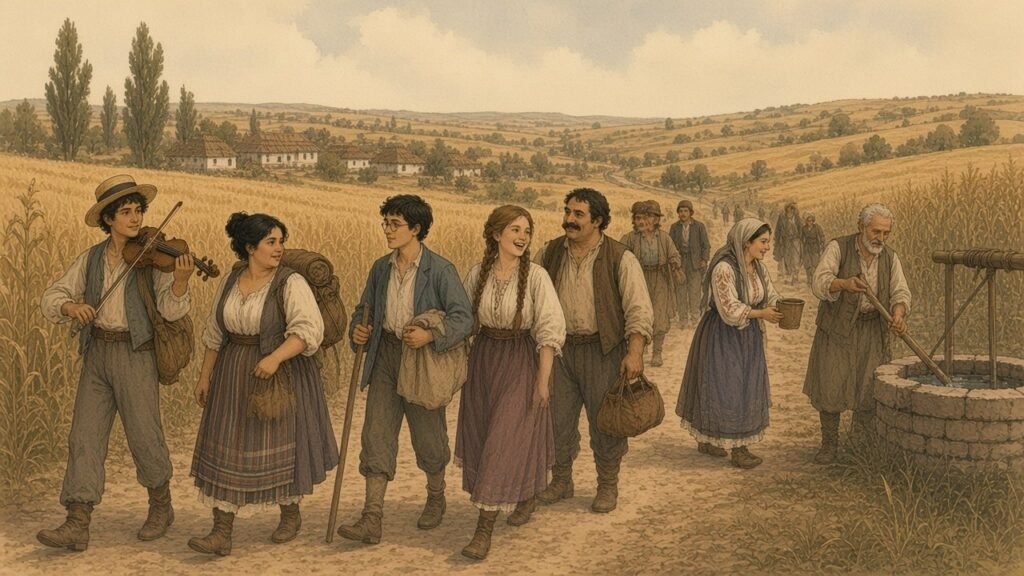
The response in the West
The fusgeyers created a crisis for the Jewish organisations of Western Europe, similar to the crisis in Brody twenty years earlier. Thousands of Romanian Jews were arriving in Vienna, Berlin, Hamburg, Paris and London, many of them penniless, hoping to be sent on to America. The organisations feared that helping them would encourage more to come, and that the Romanian government would take the exodus as a vindication of its policies.
The Jewish Colonization Association, the Alliance Israélite Universelle and the German Jewish organisations met to coordinate their response. They agreed to help those emigrants who had already left, but to discourage further emigration, and they urged Jewish leaders in Romania to restrain the movement. They also tried to channel the emigrants towards destinations other than New York, and some were sent to Canada and other countries. In America, Jewish organisations, already struggling with the influx from Russia, warned that they could not absorb large numbers of penniless Romanian Jews. It was partly in response to the Romanian crisis that American Jewish leaders established the Industrial Removal Office in 1901, to distribute immigrants from New York to the interior; that story is told in a later chapter.
How many?
The size of the Romanian exodus has often been exaggerated. A widely quoted claim, repeated by the American sociologist Edward A. Ross in 1913, held that 50,000 Romanian Jews had emigrated between January and August 1900. Samuel Joseph, examining the figures the following year, showed that this was far too high: American official statistics recorded 6,183 Jewish immigrants from Romania in 1900, around which number immigration held for the next two years before peaking at 8,562 in 1903 [4]. In all, Joseph counted 67,057 Jewish immigrants from Romania between 1881 and 1910, more than half of whom arrived between 1900 and 1904 [4]. The YIVO Encyclopedia puts the total emigration of Romanian Jews to America, from the fusgeyers of 1900 to the eve of the First World War, at almost 70,000 [40].
These numbers were small compared with the flows from Russia and Galicia. But relative to the size of the Romanian Jewish population, they were enormous. In 1903, Joseph calculated, Jewish immigrants from Romania to the United States amounted to 329 for every 10,000 Jews in Romania, a rate considerably higher than that from Russia [4]. In other words, in proportion to their numbers, the Jews of Romania left faster than any other Jewish population in Eastern Europe.
America intervenes
The plight of Romanian Jews also drew the attention of the American government. In 1902, Secretary of State John Hay sent a note to the powers that had signed the Treaty of Berlin, protesting against Romania’s treatment of its Jews and pointing out that it was driving them to emigrate, in large numbers and in poverty, to the United States. Hay argued that the United States had a right to protest, not only on humanitarian grounds but because Romanian policy was effectively forcing a burden on American society. The note, which was published, attracted wide attention, and it is often cited as an early example of American diplomatic intervention on behalf of persecuted Jews. It had little practical effect: none of the European powers was prepared to put pressure on Romania, and Romanian policy did not change.
Hay’s note is revealing of American attitudes. It combined genuine sympathy for the persecuted with a clear concern about the economic and social consequences of mass immigration. The same combination had appeared in President Harrison’s message about the Russian Jews in 1891, and it would continue to shape American responses to Jewish immigration until the restrictive laws of the 1920s.
Romanian Jews in America
In America, Romanian Jews formed a small but distinctive community. They settled mainly in New York, on the Lower East Side, where they concentrated in the blocks around Allen, Rivington and Chrystie Streets, sometimes known as “Little Romania”. They brought with them their own culture: a distinctive Yiddish dialect, a love of grilled meats and wine, and a lively tradition of popular music. Romanian Jewish restaurants and wine cellars became fixtures of the Lower East Side, and Romanian-Jewish music, with its doinas and horas, became an important element of the klezmer tradition in America.
Romanian Jews also played an important part in the early history of the Yiddish theatre, which had been born in Romania. In 1876, the Odessa-born writer Avrom Goldfadn founded a Yiddish theatre troupe in Iaşi, which is generally regarded as the beginning of the modern Yiddish theatre [40] [42]. Many of the actors and writers who brought the Yiddish theatre to New York in the 1880s and 1890s had begun their careers in Romania.
Zionism and Romania
Romanian Jews were also among the pioneers of modern Zionism. Proto-Zionist associations met in congresses at Focşani in 1881 and 1882, and in 1882 some 228 Romanian Jews sailed from Galaţi to Palestine, where they founded the farming settlements of Zikhron Ya’akov and Rosh Pinah [40]. These were among the first colonies of the modern Jewish settlement in Palestine. For some Romanian Jews, Palestine rather than America was the answer to their plight; for the great majority, America offered more immediate hope.
Organising at home
Romanian Jews did not simply wait for rescue or flee. In the last decade of the nineteenth century, groups fighting for emancipation became increasingly active, among them the General Association of Native Israelites, founded in 1890 [40]. The very term “native” was a political statement, insisting that Jews born in Romania were not foreigners. The brothers Elias and Moses Schwarzfeld maintained Jewish journals in Romanian, among them Egalitatea (Equality), published from 1890, and Moses Schwarzfeld researched and wrote the history of Romanian Jewry, an effort to prove its deep roots in the country [40]. In 1910 the Union of Native Jews was set up to fight for emancipation and defend Jews against abuses by the authorities [40].
Others turned to socialism or Zionism. A Jewish socialist circle called Lumina (The Light) was set up in Iași in 1895, and Jewish socialists reached Jewish workers through the Yiddish newspaper Der veker (The Awakener) from 1896 [40]. Proto-Zionist associations had been organised at congresses in Focșani in 1881 and 1882, and in 1882 some 228 Romanian Jews sailed from Galați to found farming settlements in northern Palestine at Zikhron Ya’akov and Rosh Pinah [40].
Their opponents’ arguments shifted over time in a revealing way. Until about 1880, the YIVO Encyclopedia notes, a basic antisemitic argument held that the Jews refused to assimilate; after 1900 it was “replaced by a completely opposite slogan”: that the Jews’ integration into Romanian society endangered the national spirit [40]. Whatever Jews did, it seemed, would be held against them. In 1904 Jews made up 21.1 per cent of Romania’s merchants and formed a majority of them in towns such as Iași, Botoșani and Dorohoi [40], and the antisemitic movement led by the politician A. C. Cuza drew on resentment of this prominence. Violence against Jewish landowners and leaseholders was recorded during the great peasant uprising of 1907 [40].
Even those who left often carried an attachment to the country that had refused to accept them. The YIVO Encyclopedia speaks of “the nostalgia of those whom poverty forced to emigrate around the year 1900” [40]. In New York, Romanian Jews founded their own synagogues, societies and restaurants, and the Romanian corner of the Lower East Side became known for its restaurants and wine cellars.
The lesson of Romania
The Romanian case, like the Galician, offers a corrective to the view that the great migration was simply a flight from violence. Romania had no pogroms on the Russian scale before 1907, when peasant uprisings included attacks on Jewish landowners and leaseholders [40]. What drove Romanian Jews to leave was a combination of legal exclusion, economic discrimination and poverty. The denial of citizenship, the exclusion from professions and trades, and the constant threat of expulsion made it clear that the Romanian state did not want them. In this respect, the Romanian case closely resembled the Russian one: both governments pursued policies whose effect, and possibly intention, was to encourage Jewish emigration.
The fusgeyers also show the role of hope and idealism in the migration. They were not simply refugees fleeing persecution; they were young people setting out to build a new life, with songs, banners and constitutions. Their journeys were acts of self-assertion as well as escape. In this, they resembled the Am Olam pioneers of 1881-82, and they anticipated the young Zionist pioneers who would go to Palestine in the following decades. The great migration was driven by despair, but also by the conviction that a better life was possible.
11. Kishinev, 1903
On the morning of Easter Sunday, 6 April 1903 by the Russian calendar, crowds began to gather in the streets of Kishinev, the capital of the province of Bessarabia, in the far south-west of the Russian Empire. By the afternoon they were attacking Jews. Over the next two days, while the police and the army largely stood aside, rioters killed 49 people, injured 586 and destroyed 1,350 Jewish houses and 588 shops [43]. The death toll was not large by the standards of what came later, but the Kishinev pogrom became, almost overnight, a symbol of Russian barbarism and Jewish suffering around the world. It changed Jewish politics, galvanised Jewish self-defence, provoked an international outcry and sent a new wave of emigrants across the Atlantic.
A Jewish city
Kishinev was a provincial capital of about 110,000 people at the turn of the century. Its Jewish population had grown rapidly in the nineteenth century, from 10,509 in 1847 to 50,237 in 1897, by which time Jews made up 46 per cent of the inhabitants [43]. They had come mainly from Ukraine and Belarus, drawn by the economic opportunities of a growing city on the edge of the empire [43]. Jews dominated the city’s commerce and many of its crafts, and they had built a rich communal life, with synagogues, schools, charities and, from the 1880s, an active Zionist movement: a group of Hovevei Zion members led by Meir Dizengoff, later the first mayor of Tel Aviv, worked in Kishinev from 1886 [43].
Bessarabia had been annexed by Russia from the Ottoman Empire in 1812, and its population was mixed: Moldavians, Ukrainians, Russians, Jews, Bulgarians, Germans and others [44]. Relations between Jews and their neighbours had generally been peaceful, but by the end of the century economic competition and nationalist agitation had created tensions.
The Bessarabets campaign
The pogrom was preceded by a long campaign of incitement in the local press. Kishinev’s only daily newspaper, Bessarabets, edited by Pavel Krushevan, published a stream of vicious antisemitic articles accusing Jews of every kind of crime [43]. Krushevan, a Moldavian nationalist and fervent antisemite, would later be among the first to publish the forgery known as The Protocols of the Elders of Zion, in his St Petersburg newspaper Znamia in 1903. His paper enjoyed the protection of the authorities; requests by local Jews to establish a rival newspaper were refused.
In February 1903, a Christian boy named Mikhail Rybachenko was found murdered in the nearby town of Dubossary. Bessarabets and other papers claimed that he had been killed by Jews to use his blood in making matzah for Passover, an ancient libel that had been revived in Eastern and Central Europe in the late nineteenth century. Although the investigation soon established that the boy had been killed by a relative, the rumour spread. In the weeks before Easter, which that year coincided with Passover, leaflets circulated in Kishinev calling for attacks on Jews, and rumours spread that the tsar had authorised them [43].
Two days of violence
The violence began on Easter Sunday, 6 April 1903, near the central square, where crowds of young men, many of them seminarians, labourers and townspeople, began to attack Jewish shops and passers-by. At first the attacks were limited to looting and beating, but on the second day, Monday 7 April, they became murderous. Groups of rioters, armed with clubs, axes and knives, moved through the Jewish districts, breaking into houses, killing and maiming their inhabitants, raping women, and destroying property. Witnesses later described scenes of almost unimaginable brutality.
Throughout the first day and much of the second, the police and the army did little to stop the violence. The governor of Bessarabia, Rudolf von Raaben, waited for written instructions before ordering troops to act. When the troops finally intervened, on the evening of the second day, the riot ended quickly, which suggested to many observers that it could have been stopped much earlier. In some parts of the city, Jews organised to defend themselves, and their resistance became an important part of the story [43].
Who was responsible?
As with the pogroms of 1881, the question of responsibility was immediately and bitterly debated. Many Jews and foreign observers believed that the interior minister, Vyacheslav von Plehve, had instigated or at least encouraged the pogrom. A letter purportedly from Plehve to the governor of Bessarabia, instructing him not to use force against the rioters, was published in The Times of London in May 1903. Its authenticity has never been established, and many historians regard it as a forgery. More recent scholarship, notably Steven Zipperstein’s study of the pogrom, has emphasised the role of local agitators, including Krushevan and officials of the local secret police, whom the YIVO Encyclopedia names among the authors of the incitement in Bessarabets [43]. Whatever the precise role of the central government, the authorities’ failure to protect Jews, the impunity of the instigators and the light sentences handed down to a few rioters convinced most Jews that the state was indifferent to their fate, if not actively hostile.

"In the City of Slaughter"
The most lasting response to Kishinev came from a poet. The Jewish Historical Commission in Odessa sent the young Hebrew poet Hayim Nahman Bialik to Kishinev to collect testimony from survivors. Bialik spent weeks interviewing victims and recording what they had seen. The experience produced not only a documentary record but a poem, “In the City of Slaughter”, published in 1904, that became one of the most famous works of modern Hebrew literature [43] [45].
The poem was not a conventional lament. In it, God himself takes the poet through the scenes of the massacre, and the poet’s anger is directed not only at the murderers but at the victims, at the men who hid while their wives and daughters were raped, and at the survivors who went to the rabbis to ask whether their violated wives were still permitted to them. It was a cry of rage against Jewish passivity, and it called for a new Jewish courage. Translated into Yiddish and Russian, the poem had an electric effect on a generation of young Jews and became a rallying cry for Jewish self-defence.
Self-defence
In the wake of Kishinev, Jewish self-defence groups sprang up across the Pale. Organised by Zionists, Bundists and other political groups, they collected weapons, trained members and prepared to resist future attacks. Armed Jewish self-defence units first appeared during the pogrom in Gomel, in Mogilev province, in late August 1903 [16] [46]. There, Jewish defenders fought back against the rioters, and the government, in its subsequent prosecution, charged Jews as well as Christians with responsibility for the violence.
Self-defence became a central part of Jewish politics in the years that followed. It drew in thousands of young people, many of whom would later emigrate to America or Palestine, carrying with them a new sense of Jewish dignity and assertiveness. In Palestine, the veterans of the self-defence groups would found Ha-Shomer, the first Jewish defence organisation, in 1909.
The world reacts
The news of Kishinev spread rapidly around the world, carried by telegraph and the new mass-circulation press. In the United States, newspapers ran front-page stories with graphic accounts of the violence. The Irish nationalist journalist Michael Davitt travelled to Kishinev for the Hearst press and wrote a series of reports, later published as a book, Within the Pale, which described the pogrom and its causes in detail. Mass protest meetings were held in New York, Philadelphia, Chicago and other cities, attended by Jews and non-Jews alike and addressed by prominent politicians, clergymen and public figures.
The American Jewish organisation B’nai B’rith drew up a petition to the tsar protesting against the pogrom and appealing for justice for Russian Jews. President Theodore Roosevelt, after some hesitation, agreed to forward it to the Russian government through diplomatic channels. The Russian government refused to receive it. The episode was, in practical terms, a failure, but it established a precedent for American diplomatic intervention on behalf of Jews abroad, and it contributed to the growing conviction among American Jewish leaders that they needed a permanent organisation to defend Jewish interests. In 1906, after the pogroms of 1905, that conviction led to the founding of the American Jewish Committee [47].
Large sums were raised for the relief of the victims, both in America and Europe. The relief effort was coordinated by Jewish organisations in Russia and abroad, and it provided food, shelter and medical care for the survivors, as well as money to rebuild homes and businesses.
Zionism and Uganda
Kishinev also had a profound impact on the Zionist movement. Theodor Herzl, the founder of political Zionism, was deeply shaken by the pogrom and by the apparent urgency of finding a refuge for Russian Jews. In August 1903, he travelled to St Petersburg to meet Plehve and seek Russian support for Zionism. At the Sixth Zionist Congress in Basel in the same month, he presented a British offer of territory in East Africa, the so-called Uganda scheme, for Jewish settlement as a temporary refuge. The proposal split the Zionist movement. Many Russian Zionists, including delegates from Kishinev itself, rejected any alternative to the Land of Israel. Others, who would form the territorialist movement under the leadership of the writer Israel Zangwill, argued that the urgent need for a refuge outweighed historical attachment [48]. Zangwill’s Jewish Territorial Organization would later play a central part in the Galveston scheme described in a later chapter.
A wave of departures
The immediate effect of Kishinev on emigration was dramatic. Samuel Joseph, writing a decade later, observed that the massacre “sent thousands of Jews in veritable flight to the United States”, a fact reflected in an immigration of 77,544 Russian Jews in 1904, the largest number up to that year [4]. In the following years, the numbers rose still higher, as the Russo-Japanese war, the revolution of 1905 and a new wave of pogroms drove hundreds of thousands to leave.
Kishinev’s significance went beyond the numbers. For the generation of Jews who came of age in the early twentieth century, it was a defining event, comparable to the pogroms of 1881-82 for their parents. It confirmed the conviction that Russia offered no future for Jews, and it gave new urgency to the search for alternatives: emigration, Zionism, revolution, self-defence. For many of the emigrants who arrived in America in the following years, Kishinev was a name that summed up everything they had left behind.
The second pogrom
Kishinev’s ordeal was not over. On 19 and 20 October 1905, in the days following the tsar’s manifesto promising a constitution, a second pogrom struck the city, in which 19 Jews were murdered and 56 wounded [43]. Between 1902 and 1905, as emigration gathered pace, the number of Jews in Kishinev fell from about 60,000 to 53,000 [43]. It was part of a much larger wave of violence that swept across the Pale in the autumn of 1905, which is the subject of the next chapter.
Homel
The town where Jewish self-defence first took to the streets was itself a portrait of the changing Pale. Homel (Gomel in Russian), a district town of Mogilev province on the Sozh River, had grown into a major commercial centre at a railway junction. Its Jewish population rose from 2,373 in 1847 to 20,385 in 1897, when Jews made up 56.4 per cent of its inhabitants [49]. Wealthy Jews worked as government contractors and in the timber trade and commerce; by the end of the century poorer Jews also worked in factories and mills producing straw goods, tobacco and timber. The Hebrew writer Yosef Hayim Brenner, who had lived in the town, described the lives of its poor in a story of 1900 [49].
Homel was also a stronghold of the new Jewish politics. It became an important centre of the Bund, which competed for the loyalty of Jewish youth with Zionists who founded Hebrew schools in the town [49]. When anti-Jewish riots broke out there in 1903, Bundists and Zionists together organised self-defence groups. The authorities’ response was revealing: in the trial that followed, 36 Jewish defenders were prosecuted alongside the perpetrators of the pogrom, accused of avenging the victims of Kishinev; only 13 of the Jews were acquitted, and the rest received varying sentences [49]. The Russian government, as the YIVO Encyclopedia notes, sought to characterise such events as “Jewish pogroms”, attacks by Jews against Christians [16].
For many young Jews, the lesson of Homel was double. Self-defence showed that Jews need not be passive victims; but the trial showed that the state would treat Jewish resistance as a crime. Some drew the conclusion that revolution was the only answer; others that Palestine was; and many more that the only safe place was across the ocean.
Memory
In the century since 1903, Kishinev has become a byword for antisemitic violence. The pogrom has been the subject of poems, novels, histories and films, and it has been invoked in countless political debates. Some historians have argued that its notoriety owed as much to the new media of the time, the telegraph, the mass-circulation press and the photographs of victims that circulated widely, as to the scale of the violence itself. Kishinev was, in this sense, the first media pogrom, the first episode of anti-Jewish violence to be experienced in real time by a global audience.
For the emigrants, however, Kishinev was not a media event but a lived reality. Many of those who left Bessarabia and the neighbouring provinces in the following years had witnessed the violence or lost relatives in it. They carried the memory with them to America, where it shaped their politics, their attitudes to Russia and their sense of Jewish identity. In the Yiddish press and theatre of New York, Kishinev remained a living presence for decades.
12. Revolution and Pogrom, 1905–1906
The years from 1904 to 1907 were the most turbulent in the history of the Russian Empire before the First World War, and for its Jews they were a time of extraordinary hope and extraordinary terror. A disastrous war with Japan, a revolutionary upheaval that forced the tsar to grant a constitution, and a wave of counter-revolutionary violence that fell with special ferocity on the Jews, combined to produce the largest Jewish emigration in history up to that time. In 1906, the peak year, 153,748 Jews entered the United States, 125,234 of them from the Russian Empire [4]. In the five years from 1904 to 1908, Samuel Joseph calculated, half a million Russian Jews arrived in America, more than two fifths of the entire Russian Jewish immigration of the thirty years he studied [4].
War and revolution
The crisis began in the Far East. In February 1904, Japan attacked the Russian fleet at Port Arthur, beginning a war that Russia expected to win easily and instead lost humiliatingly. The war brought mobilisation, economic disruption and a series of military disasters that undermined the prestige of the government. For Jews, it also brought conscription into an army in which they were despised, and charges in the right-wing press that Jews sympathised with Japan or were profiting from the war.
On 9 January 1905, soldiers in St Petersburg fired on a peaceful procession of workers led by the priest Georgii Gapon, who had come to petition the tsar; at least 130 marchers were killed and close to 300 wounded [50]. “Bloody Sunday” set off a revolutionary movement that spread across the empire. Workers went on strike, students boycotted classes, peasants attacked landlords’ estates, the national minorities of the borderlands rose against Russian rule, and by mid-1905 there were signs of unrest even in the armed forces [50]. In the autumn of 1905, a general strike paralysed the country and forced Nicholas II to issue the October Manifesto, which promised civil liberties and an elected legislature, the Duma [50].
Jews in the revolution
Jews took part in the revolution to an unprecedented degree. As the upheaval began, they became active in national politics and aligned themselves with one or another of the groups hostile to the old order [50]. Late in 1904, some 6,000 activists signed a Declaration of Jewish Citizens calling for civil equality. In February 1905, Jewish religious communities in 32 cities petitioned the government for the same. In March 1905, sixty-seven activists representing all shades of opinion except the Bundists met illegally in Vilna and founded the Union for the Attainment of Full Rights for the Jewish People of Russia, which established branches in fourteen provinces and fought for both equal rights and cultural autonomy [50].
The Jewish socialist movement played a still more militant role. The Bund, the General Jewish Workers’ Union in Lithuania, Poland and Russia, founded in Vilna in 1897, was by 1905 the largest and best-organised socialist party in the empire [11]. Its leaders urged workers to strike, to arm themselves and to build barricades. Workers in some 60 cities heeded the call, and it has been estimated that the Bund had as many as 1,100 trained men in armed fighting units [50]. These units protected party meetings and defended Jewish communities against attack. In Zhitomir, late in April 1905, Jewish resistance to a pogrom became a battle in which more Christians than Jews were killed. In Łódź in June 1905, about 560 people, among them 341 Jews, died in pitched street battles after soldiers fired on a demonstration [50]. New Jewish parties appeared too: the Zionist Socialist Workers’ Party in 1905, and the Jewish Socialist Labour Party and the Poale Zion in 1906 [50].

The October pogroms
The October Manifesto was greeted with jubilation by the opposition, and Jews joined in the celebrations in towns across the Pale. The jubilation was short-lived. On 18 October, one day after the manifesto was issued, the most sustained wave of pogroms the empire had yet seen swept over the country [50]. Loyalist mobs, later organised in bodies such as the Union of the Russian People and generically known as the Black Hundreds, equated Jews with revolution and attacked them, along with students, intellectuals and others suspected of disloyalty [16].
The violence was worst in the south. In Odessa, four days of rioting left hundreds of Jews dead, and in Kiev the pogrom raged for days [16]. Across the empire, pogroms broke out in hundreds of towns and villages, among them Kishinev for a second time. By the time the violence ended in late November, 876 people had been killed, between 7,000 and 8,000 injured, and property losses amounted to some 62 million roubles [50]. Earlier in the year, between February and mid-October, there had already been some 57 pogroms [50].
Who was responsible? The YIVO Encyclopedia concludes that, despite frequent claims to the contrary, the government in St Petersburg did not instigate the violence, since it was not in its interest to encourage unrest that might turn against the authorities and landlords; but the tsar was known to be deeply hostile to Jews, and local officials failed to prevent the pogroms or to stop them [50]. In many towns police and soldiers joined the rioters. Nicholas II himself, in a letter to his mother, explained the violence as the people’s response to the revolutionaries, nine-tenths of whom, he claimed, were Jews. The tsar’s attitude, widely known, gave encouragement to the Black Hundreds and made it clear to Jews that they could expect no protection from the throne.
Białystok and after
The violence did not end with 1905. Sporadic pogroms continued in 1906, most notoriously in Białystok, the great textile city of the Grodno province, in early June [16]. For three days no policeman or soldier tried to stop the killing, and since Jewish defence units fought back, the city became a battlefield; in all, 82 Jews and six gentiles were killed and about 700 people wounded [50]. The Białystok pogrom was debated at length in the First Duma, where deputies attacked the government for its failure to act. The prime minister, Pyotr Stolypin, conceded that officials had made mistakes, and was greeted with shouts of “Enough” [50]. A further pogrom, in Siedlce in the Polish provinces in September 1906, was carried out largely by soldiers.
Disappointment
The revolution brought Jews some gains. Twelve Jews were elected to the First Duma in 1906, nine of them as members of the liberal Constitutional Democratic (Kadet) party [50]. Censorship was relaxed, and a flourishing Yiddish and Hebrew press emerged. Jewish political parties operated openly for a time. But the core of Jewish legal disabilities remained untouched. No legislation to abolish restrictions on Jews was considered in the First or Second Duma [50]. The prime minister Sergei Witte, who favoured lifting the restrictions, did little more than open about a hundred small towns in southern Russia to Jewish settlement [50]. Late in 1906, Stolypin persuaded the cabinet to support modest measures to ease the burden on Jews, but the tsar refused his approval, saying that “an inner voice” forbade it [50].
In June 1907, the government dissolved the Second Duma and changed the electoral law to produce a more conservative assembly. The revolution was over, and the autocracy had survived. For Jews, the outcome was bitter. They had hoped that the revolution would bring them equality; instead, it had brought them the worst wave of violence in their history in Russia, followed by a reaction in which the old restrictions remained and right-wing antisemitism was more powerful than ever.
The exodus
One of the most important consequences of the revolution, the YIVO Encyclopedia notes, was the acceleration of Jewish emigration, most of it to the United States [50]. Joseph’s figures trace its course. Russian Jewish immigration to the United States rose from 77,544 in 1904, the year after Kishinev, to 92,388 in 1905, and to 125,234 in 1906, the highest figure of the whole period. In 1907 it remained at 114,932, the second largest, before falling to 71,978 in 1908 as the political situation in Russia eased and the financial panic of 1907 depressed the American economy [4]. In these years, Jews made up more than half of all immigrants from the Russian Empire: 53.4 per cent in 1904, 50 per cent in 1905 and 58.1 per cent in 1906 [4].
The emigrants of these years were different in some ways from those who had come before. Many were veterans of the revolutionary movement, Bundists and other socialists who had fought on the barricades or in the self-defence units and who fled to escape arrest, exile or execution. They brought with them a level of political consciousness and organisational experience that would transform the Jewish labour movement in America. Others were young people whose hopes for a better future in Russia had been crushed, and who now saw America as the only alternative. Still others were simply frightened families fleeing the violence.
The territorialist alternative
The crisis of 1905-06 also gave new urgency to the search for alternative destinations. The Jewish Territorial Organization, founded by Israel Zangwill in 1905 after the Zionist movement rejected the Uganda scheme, sought a territory anywhere in the world where Jews could settle in large numbers and govern themselves [48]. It explored possibilities in Africa, Australia, South America and elsewhere, without success. Its most important practical achievement was its partnership with the American banker Jacob Schiff in the Galveston Movement, which from 1907 to 1914 directed some ten thousand Jewish immigrants to the American interior through the port of Galveston, Texas [51]. That story is told in a later chapter.
A generation shaped by 1905
The experience of 1905 marked a whole generation of Russian Jews. For those who stayed, it left a legacy of political mobilisation that would shape Jewish life in Russia through the revolutions of 1917 and beyond. For those who left, it was a formative experience that they carried with them to America. The radical politics of the Lower East Side, the militancy of the garment unions, the socialist culture of the Workmen’s Circle and the Forverts, all owed much to the veterans of 1905. The great strikes of 1909 and 1910 in the New York garment industry, discussed in later chapters, were led in part by young men and women who had learned to organise in the Bund.
The emigrants of 1905 also brought with them a deep and lasting hostility to the tsarist regime. In America, they campaigned against Russian antisemitism, supported efforts to put diplomatic pressure on Russia, and celebrated the fall of the tsar in 1917. Their hostility helped shape American Jewish politics, and it contributed to the campaign that led in 1911 to the abrogation of the Russo-American commercial treaty of 1832, in protest against Russia’s refusal to honour the passports of American Jews.
Counting the violence
How much violence was there? Even the YIVO Encyclopedia’s own articles give different figures, which is a reminder of how uncertain the numbers remain. According to its article on the revolution, there were 33 anti-Jewish riots in the last four months of 1904 alone, many of them staged by soldiers who had read in antisemitic newspapers that Jews were helping Japan, and some 57 pogroms between February and mid-October 1905, many initiated by the Black Hundreds [50]. Then came the great wave that followed the October Manifesto. In Odessa, according to the encyclopedia’s article on the city, the pogroms of 1905 killed 300 Jews, including more than 50 members of Jewish self-defence groups [14].
The death toll at Białystok in June 1906 is a case in point. Most reference works put the number of Jewish dead at between 70 and 82. The Encyclopaedia Judaica gives 70 Jews killed and 90 gravely injured [52]; the YIVO Encyclopedia’s article on pogroms speaks of more than 70 victims [16], and its article on the 1905 revolution, the most detailed count, of 82 Jews and six gentiles killed and about 700 wounded [50]. Its article on Białystok, by contrast, states that the pogrom left “more than 200 Jews dead, 700 wounded, and hundreds of Jewish homes and businesses destroyed” [10]. That higher figure stands apart from the others, and the toll should be treated as contested, though the weight of the evidence points to something under a hundred dead. What is not in doubt is that, as the Białystok article puts it, “the ferocity of anti-Jewish violence in Białystok had a formative impact on both Russian and Russian Jewish society” [10].
The violence was only one side of the revolution. Jews took part in the political struggle in unprecedented numbers. Late in 1904 some 6,000 activists signed a Declaration of Jewish Citizens calling for civil equality, and in February 1905 Jewish communities in 32 cities petitioned the government with the same demand [50]. Self-defence units fought back, sometimes effectively: in Zhitomir in April 1905, Jewish resistance to a pogrom turned into a battle in which more Christians than Jews lost their lives [50]. Vilna, the centre of the Bund, whose Jewish population had grown from about 63,000 in 1897 to perhaps 100,000 in 1905, saw demonstrations and strikes organised by Bundists [13].
When the revolution was defeated, many of those who had fought in it left. The United States, the YIVO Encyclopedia notes, “witnessed an influx of about 100,000 immigrants per year between 1904 and 1907, most from Russia and many steeped in left-wing politics that they fostered in their new homeland” [50]. The radicals of 1905 became the organisers of the great garment strikes of 1909 and 1910.
Persecution and emigration
The revolution of 1905 and its aftermath represent the strongest case for the view that persecution drove the great migration. The connection between the pogroms and the peak of emigration in 1906 is unmistakable. But even here, the picture is more complex. Emigration had been rising steadily before 1905, driven by economic and demographic pressures and by the growth of migration networks. It remained high after 1907, when the violence had subsided, and rose again in 1913 and 1914, years without major pogroms. And the American economy also played its part: the fall in immigration in 1908 reflected the panic of 1907 as well as the calmer situation in Russia [4].
What the revolution did was to intensify a movement already under way, and to give it a new character. The emigrants of 1905-07 left not only because they were poor or because they had relatives in America, but because they had lost hope. The failure of the revolution, and the violence that accompanied it, convinced many Russian Jews that there was no future for them in the empire. America, with its promise of freedom and opportunity, became for them not just a destination but a refuge.
13. Conscription, Quotas and Closing Doors
Pogroms make headlines; regulations do not. Yet for many Russian Jewish families, the decision to emigrate was shaped less by the fear of violence than by the slow accumulation of everyday obstacles: the son who faced years in a hostile army, the daughter who could not get into the gymnasium, the father who lost his right of residence, the craftsman who found his trade closed to him. This chapter looks at three of these pressures, military service, education and residence, and at the way they combined in the last years before the First World War to close one door after another.
The army
The great military reform of 1874 abolished the old system of long-term service and introduced universal conscription for all classes, with a six-year term of active service and a relatively transparent system of exemptions [18]. In principle, Jews were now treated like everyone else. In practice, they quickly found themselves subject to special suspicion and special rules. The Ministry of the Interior opposed Jewish equality in military matters, and especially during the term of the war minister Pyotr Vannovskii, from 1881 to 1897, a series of discriminatory regulations was introduced [18]. Jews were barred from becoming officers, excluded from certain branches of the army, and, by the 1890s, increasingly segregated [18]. Jewish veterans who had served their full term before 1874 had been allowed to settle permanently outside the Pale; this right was now withdrawn for later conscripts [18].
Right-wing critics accused Jews of being “cunning draft dodgers” and useless soldiers. The figures tell a different story. Between 1874 and 1914, Jews served in the Russian army in greater numbers than their share of the population: in 1907, they made up almost 5 per cent of the military but only 4 per cent of the population of the empire [18]. About 90 per cent of Jewish soldiers served in combat positions, most of them in the infantry [18].
The perception of Jewish draft evasion nevertheless had real consequences. A law of 1886 imposed a fine of three hundred roubles on the families of Jewish men who failed to report for service, a crushing sum for a poor household. And the charge was given some plausibility by the fact that emigration did enable many young men to avoid the draft. The prospect of service, in an army where Jews faced contempt and could not rise, was a powerful incentive to leave before the age of call-up. American immigration statistics show large numbers of young Jewish men arriving in their late teens, just before they would have been required to report.
The recruit's farewell
For a Jewish family, the call-up of a son was a time of dread. Even after the abolition of the cantonist system, the army was seen as a place of danger to body and soul: it meant years away from home, the difficulty of keeping kosher and observing the Sabbath, exposure to hostility and violence, and the risk of being sent to fight in distant wars. During the Russo-Japanese war of 1904 and 1905, Jewish reservists were mobilised and sent to Manchuria, and many families decided that it was better for their sons to go to America than to the Far East.
The Yiddish folk song tradition preserved the anguish of the recruits and their families. Songs of the cantonist era lamented children torn from their mothers; later songs spoke of young men called up for service, of mothers weeping at the station, of soldiers longing for home. Some families resorted to desperate measures to avoid service: bribing officials, obtaining false papers, even inflicting injuries on their sons to render them unfit. But for many, the simplest solution was to send the young man abroad before he reached the age of conscription.
Rabbinic authorities, for their part, adapted to the new reality. In 1881, Rabbi Yisrael Meir ha-Kohen, the Hafets Hayim, published a handbook for Jewish soldiers, Mahaneh Yisra’el, which accepted military service as a political reality and instructed soldiers on how to combine military discipline with religious observance [18]. The fact that such a book was needed is a measure of how deeply military service had become part of Jewish life in Russia.
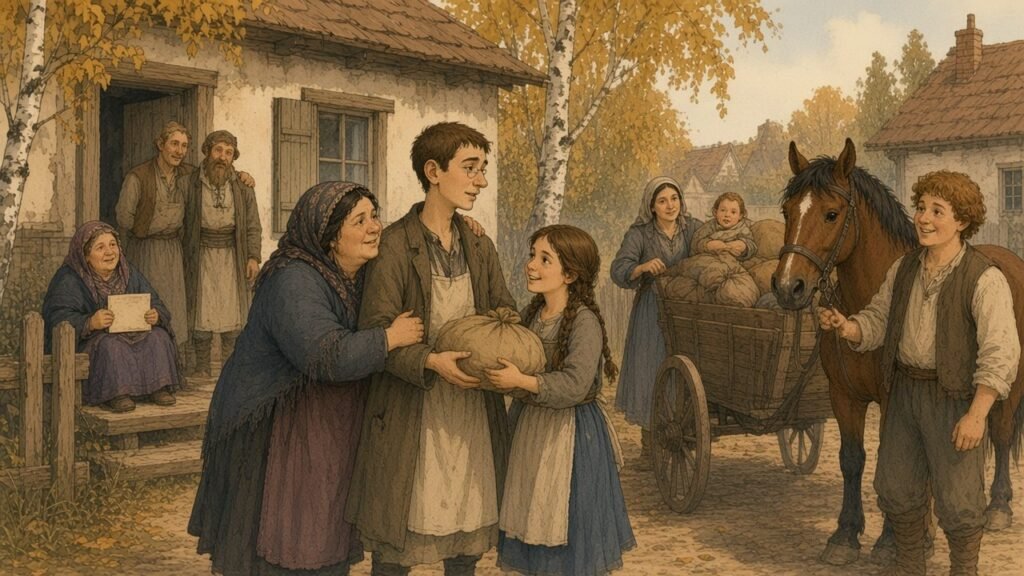
The quotas in practice
The quotas introduced in 1887, which limited Jewish students to 10 per cent of enrolment in secondary schools and universities in the Pale, 5 per cent elsewhere and 3 per cent in the capitals [28], had far-reaching consequences in the following decades. Because the quotas were calculated as a proportion of Christian students, and because many schools in the Pale had few Christian pupils, Jewish children competed for a tiny number of places. Admission came to depend on top marks in entrance examinations, on connections, and often on bribes.
The quotas created a whole class of young Jews who were educated but excluded. Some studied privately and took examinations as external students. Some went abroad, to the universities of Germany, Switzerland and France, where by the early twentieth century Russian Jews made up a large proportion of foreign students. Others turned to revolutionary politics, convinced that only the overthrow of the regime would open the doors. And many emigrated, drawn by the promise of free education in America.
The quotas were tightened in 1908, after a brief relaxation during the revolution, and further restrictions were introduced in the following years. In 1911, the government extended the quota system to external examinations as well. By the eve of the war, the doors of Russian higher education were almost closed to Jews who were not wealthy or well connected.
The residence regime
The rules on residence continued to tighten after the expulsions from Moscow in 1891. The police periodically conducted raids on Jews living illegally outside the Pale, especially in the capitals and in cities like Kiev, where Jewish residence was restricted. Jews with residence permits lived in constant fear of losing them, and those without permits lived in constant fear of discovery. Expulsions of Jews from villages under the May Laws continued, and in some periods intensified.
After the revolution of 1905, the government made some concessions, opening about a hundred small towns in southern Russia to Jewish settlement [50]. Jews who had served in the war against Japan were granted the right to live outside the Pale, though this right was not extended to the capitals and was implemented unevenly elsewhere [18]. But these concessions were limited, and they were offset by new restrictions in the years of reaction that followed.
Economic exclusion
In the last years before the war, Jews also faced growing economic exclusion. The liquor monopoly had already driven many out of the drink trade. Now new restrictions were imposed on Jewish participation in various trades and professions. Jewish lawyers were barred from becoming full members of the bar without ministerial permission. Jewish doctors found it increasingly difficult to obtain posts in state hospitals. Jewish merchants faced new limits on their right to trade outside the Pale.
In the Polish provinces, the situation was worsened by the rise of Polish nationalism. In 1912, after a Jewish vote helped elect a socialist rather than a National Democrat candidate to the Duma from Warsaw, the National Democrats launched an economic boycott of Jewish businesses under the slogan “buy from your own”. The boycott, which spread across Congress Poland, caused real hardship and contributed to the rise in Jewish emigration from the Polish provinces in 1913 and 1914 [53].
The Beilis affair
The most notorious episode of the last years before the war was the trial of Mendel Beilis. In March 1911, the body of a thirteen-year-old Christian boy, Andrei Yushchinsky, was found in a cave on the outskirts of Kiev. Although the evidence pointed to a criminal gang, right-wing groups claimed that the boy had been the victim of a Jewish ritual murder, and the authorities, under pressure from the minister of justice, arrested Beilis, a Jewish clerk at a nearby brick factory [54]. Beilis spent more than two years in prison before his trial, which took place in Kiev from 25 September to 28 October 1913 [55].
The trial was a national and international sensation. The prosecution relied on the testimony of a priest with a criminal record who claimed that the murder bore the marks of ritual murder prescribed by Jewish religion; his arguments were refuted by the rabbi of Moscow, Jacob Mazeh, and by eminent Russian scholars [55]. The witnesses on whom the indictment rested admitted under questioning that they knew nothing [55]. The jury, made up largely of peasants, acquitted Beilis. He left Russia with his family for Palestine and, in 1920, settled in the United States [55]. Bernard Malamud’s novel The Fixer is based on his case.
For Russian Jews, the Beilis affair was a terrifying demonstration of how far the state was prepared to go. That the government of a great European power could, in the twentieth century, put a man on trial on the basis of the blood libel seemed to many Jews to confirm that there was no future for them in Russia. In America, the affair was followed closely in the Jewish and general press, and it reinforced the image of Russia as a land of medieval persecution.
The passport question
One further issue linked the Russian residence regime with American politics. Russia refused to admit American Jews on the same terms as other American citizens, applying to them the same restrictions it applied to its own Jews. American Jews who had emigrated from Russia and become naturalised American citizens could be arrested if they returned to visit their families; American Jewish businessmen were refused visas. American Jewish leaders, led by the American Jewish Committee and its president Louis Marshall, campaigned for years against this discrimination, arguing that it violated the Russo-American commercial treaty of 1832 [47].
In December 1911, after a vigorous campaign, the House of Representatives voted overwhelmingly for a resolution calling for the abrogation of the treaty, and President William Howard Taft gave Russia notice that the United States would terminate it. The episode was a remarkable demonstration of the political influence of American Jewry, much of it built on the votes and voices of the immigrants themselves. It did not change Russian policy, but it showed that the emigrants had found, in their new country, a political voice they had never had in the old.
Conscription remembered
Mary Antin, who grew up in Polotsk in the 1880s, left a vivid account of what conscription meant in a Jewish town under Alexander III. The horrors of the cantonist era were past: “Alexander III was no friend of the Jews; still he did not order little boys to be taken from their mothers, to be made into soldiers and Christians” [5]. But every man had to serve, for four years as she remembered it, and “a Jewish recruit was likely to be treated with severity, no matter if his behavior were perfect” [5].
What mattered most to the pious, Antin explained, was the necessity of breaking Jewish law. “A soldier often had to eat trefah and work on Sabbath. He had to shave his beard and do reverence to Christian things. He could not attend daily services at the synagogue; his private devotions were disturbed by the jeers and insults of his coarse Gentile comrades… For four years he had led the life of a Gentile” [5]. There were economic burdens too. Most men of twenty-one, the age of conscription, were already married with children; in their absence their families suffered and their businesses were often ruined, and “at the end of their term they were beggars” [5]. As beggars, she wrote, they were sent home from their posts, stripped of any good uniform and given a free ticket and a few kopecks a day, “hurried back into the Pale, like escaped prisoners. The Czar was done with them” [5].
The lengths to which families went to avoid service were extreme. Only sons and certain others were exempt, and many young men were rejected at the medical examination. This, Antin wrote, “gave the people the idea of inflicting injuries on themselves, so as to produce temporary deformities on account of which they might be rejected at the examination. Men would submit to operations on their eyes, ears, or limbs, which caused them horrible sufferings, in the hope of escaping the service” [5]. Often the injury intended to be temporary proved permanent, “so that there were many men in Polotzk blind of one eye, or hard of hearing, or lame, as a result of these secret practices; but these things were easier to bear than the memory of four years in the Czar’s service” [5]. The sons of rich fathers could escape without such marks, by bribing the conscription officers, a dangerous but common practice [5].
Avoidance and emigration
Antin’s account is that of a child, written two decades later for an American audience, and it shares the preoccupations of the community in which she grew up. But it is consistent with what other sources tell us about the burden of conscription and the strategies used to avoid it. Families registered sons under false names or ages, arranged adoptions to make them “only sons”, bribed officials, or sent young men abroad before they reached the age of service. The government responded by making Jewish communities collectively responsible for draft arrears [18], and, as we have seen, the accusation of evasion became a staple of antisemitic politics, even though Jews in fact served in numbers greater than their share of the population.
Emigration was the most radical form of avoidance, and for many young men the approach of the call-up was the decisive reason for leaving. Morris Rosenfeld, the future poet of the sweatshop, told Hutchins Hapgood that he had run away from Poland “to avoid being pressed into the army”; he would have liked to serve his country, he said, “if there had been any freedom for the Jew” [56]. Because young men of military age were not allowed to leave Russia legally without completing their obligations, many of them crossed the border illegally, with the help of agents and smugglers, a subject discussed in the next chapters. The age structure of the emigration, with its large numbers of young men in their late teens and early twenties, partly reflects this flight from service.
Conscription thus linked the private decision to emigrate with the public policies of the tsarist state. The same government that refused Jews equal rights demanded equal service from them, and then accused them of disloyalty when they tried to escape it. For many families, the injustice of that bargain was one of the clearest signs that they had no future in Russia.
The cumulative pressure
By 1914, the cumulative pressure of conscription, quotas, residence restrictions, economic exclusion and the threat of violence had convinced hundreds of thousands of Russian Jews that their future lay elsewhere. Emigration, which had dipped after the peak of 1906-07, rose again in 1913 and 1914. The Jews who left in these years were, in many cases, not fleeing a specific event but responding to a general sense that the doors were closing.
The historian Simon Dubnow, who lived through these years in Vilna and St Petersburg and chronicled them in his histories of Russian Jewry, was acutely aware of how heavily they weighed on his people [21]. Dubnow himself rejected emigration as a solution; he believed that Jews should fight for their rights as a national minority in the lands where they lived. But he recognised that, for many, the burden had become too great. The young men who left to avoid conscription, the students who left because they could not study, the families who left because they could not live where they wished, were all responding to the same reality: a state that treated them as aliens and seemed determined to make their lives impossible.
14. Deciding to Go
Every one of the two million departures began with a decision. Somewhere, in a crowded room in a Lithuanian market town or a tenement in Warsaw or a village inn in Galicia, a family sat down and talked about whether to go, who should go first, how to pay for it and what would become of those who stayed. These conversations left few records, but memoirs, letters, songs and the patterns visible in the statistics allow us to reconstruct something of how they went. This chapter looks at the decision to emigrate: the information on which it was based, the calculations it involved, the voices that urged people to go or to stay, and the ways families organised the move.
Pushes and pulls
Historians of migration often speak of “push” and “pull” factors: the conditions that drive people from their homes and the attractions that draw them elsewhere. The earlier chapters have described the pushes in detail: population growth, poverty, legal restrictions, conscription, quotas and violence. But a push alone does not make a migration. People must also know where to go, believe that it will be better there, and have the means to get there.
Contemporaries disagreed about the balance between the two. Samuel Joseph, writing in 1914, recognised that the presence in America of an “immigrant-nucleus” of relatives and friends was “an active and positive force in strengthening the immigration current”. But he concluded that “the key to the Jewish immigration is to be found not in the force of economic attraction exercised in the United States but rather in the exceptional economic, social and legal conditions in Eastern Europe which have been created as a result of governmental persecution” [4]. Later economic historians, notably Simon Kuznets, gave more weight to American conditions, pointing out that Jewish immigration, like other immigration, fell during American depressions, in 1893-94 and 1908, and rose during booms. Both views capture part of the truth. The pressures in Eastern Europe made Jews exceptionally ready to leave; the conditions in America determined when, and how many, actually went.
News from America
The most important source of information about America was the letter. From the 1870s onwards, every emigrant who reached America wrote home, and every letter was read, re-read, passed around and discussed. Letters described wages and prices, housing and work, the strange customs of the new country, the freedom from persecution. They often exaggerated success, since emigrants did not want to admit failure; but they also warned of hardship, homesickness, exploitation and the decline of religious observance.
Letters brought money as well as news. Remittances from America became an important part of the economy of many towns in the Pale and Galicia. A few dollars sent home could support a family for weeks, pay a debt or buy a ticket. The steady flow of money from America was itself a powerful argument for emigration: it showed that people could earn there what they could not earn at home.
The letter from America became a central theme of Yiddish popular culture. “A brivele der mamen” (A Little Letter to Mother), a song written by Solomon Smulewitz in the first decade of the twentieth century, told of a mother begging her son in America to write to her, and of the son who forgets until it is too late. Sung in the Yiddish theatres of New York and recorded on early phonograph records, it became one of the most popular Yiddish songs of the era. Its sentimental power came from the reality it reflected: millions of families divided by the ocean, held together by letters.

The image of America
Long before the mass migration, America had a place in the East European Jewish imagination. In the early nineteenth century, Hebrew and Yiddish books about the discovery of America circulated widely; by mid-century, the Jewish press carried scattered reports about Jews in the Americas [1]. America’s “otherness” was its most enduring quality in East European Jewish eyes. One eighteenth-century book described it as a place on the far side of the globe where people walked about with their feet pointing up and their heads facing down [1].
By the 1880s and 1890s, the image had become more concrete. America was the goldene medine, the golden land, where streets were said, in a phrase that was already a joke, to be paved with gold. It was a land of freedom, where Jews could live where they liked, practise any trade, send their children to school and vote. It was also, in the eyes of the pious, the treyfene medine, the unkosher land, where Jews worked on the Sabbath, abandoned the dietary laws and forgot their religion.
Both images were partly true, and many emigrants held them simultaneously. The tension between them would run through the experience of the immigrants in America, as they struggled to reconcile economic survival with religious tradition.
Voices for and against
The decision to emigrate was debated publicly as well as privately. In the early 1880s, the Jewish elite of St Petersburg did not favour mass emigration, which smacked to them of disloyalty, and refused to organise it [1]. Many rabbis warned against America. In the early 1880s, three prominent Lithuanian and Polish rabbis, Shmuel Mohilever, Eliyahu Meisel and Yosef Soloveichik, issued a public warning against emigration to America [1]. The Hafets Hayim, the most revered rabbinic figure in Lithuania, published a book of religious guidance in 1890 for those who had gone, Nidhe Yisra’el (The Scattered Ones of Israel), urging them to stay within the fold despite the spiritual dangers around them [1].
Zionists, for their part, argued that America was a false solution, and that only a national home in Palestine could end the Jewish problem. Bundists and other socialists argued that Jews should stay and fight for their rights in Russia. And yet members of all these groups emigrated in large numbers: rabbis, Zionists and socialists alike found themselves, in the end, on the ships.
Literature both reflected and shaped the debate. Yiddish and Hebrew writers depicted America in contradictory ways: as a land of opportunity and as a land of materialism and spiritual emptiness [1]. Sholem Aleichem wrote a popular song about the blessings of America, and his last novel, Motl Peyse dem khazns, followed a cantor’s orphaned son from his shtetl to New York [1]. Many of these writers eventually went to America themselves.
Who goes first?
Once a family decided that someone should emigrate, the next question was who. The usual answer was a young man, often the eldest son or the father, who could work and send money home. A father might go first, leaving his wife to support the children until he could send for them, as Mary Antin’s father did in 1891 [5]. A son might go first, followed by siblings and eventually parents. Increasingly, young women went first as well, especially from the 1890s, when the garment industry in America offered them plentiful work.
The interval between the first departure and the reunion of the family varied enormously. In some cases it was a few months; in others, many years. Some families were never reunited: the husband who went first might find a new life and abandon his wife and children, or might fail to save enough to bring them over. Desertion became a serious problem in the immigrant community, and the Yiddish press ran a regular feature, the “Gallery of Missing Husbands”, publishing the names and photographs of men sought by their wives.
Paying for the journey
Emigration was expensive. The cost of a steerage ticket from a North Sea port to New York fluctuated widely with the rate wars between shipping lines, but in the decade before the war it commonly ran to several weeks’ or months’ wages for a worker in the Pale. To this had to be added the cost of the journey to the port, a passport or the fee of a smuggler, food and lodging along the way, and the money that American immigration officials expected arrivals to show. For a poor family, the total was a fortune.
Families raised the money in many ways. They sold furniture, livestock and household goods. They borrowed from relatives, neighbours and moneylenders. They pawned jewellery and Sabbath candlesticks. Communities and charitable societies sometimes helped. Most important, as time went on, were tickets and money sent from America. Relatives who had already emigrated bought prepaid tickets from the agents of the shipping lines in New York and sent them home, or sent money for the journey. In this way, each emigrant who succeeded in America made it possible for others to follow.
Women's decisions
The high proportion of women among Jewish emigrants, 43.4 per cent between 1899 and 1910 compared with 30.5 per cent among all immigrants [4], reflects the family character of the migration. Many of these women were wives and daughters joining husbands and fathers. But many were young single women emigrating on their own, to find work, to escape poverty or family pressure, or to join siblings. Some were fleeing arranged marriages or seeking greater freedom than the traditional community allowed.
For these young women, emigration was a bold decision. They faced not only the hardships of the journey but the dangers of exploitation, including the threat of traffickers who preyed on young women travelling alone. Jewish organisations in Europe and America worked to protect them, meeting them at ports and stations and helping them find safe lodging and work. Their courage and determination are an often overlooked part of the story of the great migration.
The calculation
In the end, the decision to emigrate was a calculation of risks and rewards. On one side were poverty, insecurity, restriction and the threat of violence. On the other were the hardships of the journey, the uncertainty of life in a strange land, the separation from family and community, and the danger to religious observance. Each family weighed these factors differently, depending on its circumstances, its connections and its values.
What is striking is how many chose to go. The proportion of the Jewish population of Eastern Europe that emigrated between 1881 and 1914 was far higher than that of any other group in the region. For Jews, the balance of the calculation tilted decisively towards emigration, because the pressures at home were so great and the prospects in America so promising. And once the movement was under way, it fed on itself: each emigrant who succeeded made it easier for others to follow, and each departure made it harder for those left behind to stay.
One family's decision
Mary Antin’s memoir The Promised Land (1912) offers an unusually detailed account of how one family came to leave. The Antins lived in Polotsk, in the province of Vitebsk. By the early 1890s the family had sunk into poverty after the father lost his position at a mill. Then came the expulsion of the Jews from Moscow in 1891: hundreds of fugitives crowded into the towns of the Pale, every man’s chance of making a living shrank, and the disaster spread, Antin wrote, “ring beyond ring, from the stone thrown by a despotic official into the ever-full river of Jewish persecution” [5]. “Passover was celebrated in tears that year,” she remembered. “In the story of the Exodus we would have read a chapter of current history, only for us there was no deliverer and no promised land.” At the end of the seder, some of the Jews of Polotsk said not “May we be next year in Jerusalem”, but “Next year–in America!” [5]
Her father went first. “We were so far reduced in circumstances that he had to travel with borrowed money to a German port, whence he was forwarded to Boston, with a host of others, at the expense of an emigrant aid society” [5]. Mary was about ten. “America” at first meant no more to her than “Kherson” or “Odessa”, the names of other distant places where her father had gone to seek work. What changed her was a letter he wrote just before boarding the ship. He wrote simply that the emigration committee was taking good care of everybody, that the weather was fine and the ship comfortable; but she heard in it “an elation, a hint of triumph, such as had never been in my father’s letters before… My father was inspired by a vision. He saw something–he promised us something. It was this ‘America.’ And ‘America’ became my dream” [5].
The separation lasted three years. The family left behind had “absolutely no reliable source of income, no settled home, no immediate prospects”; Mary’s mother, whose health had been broken, depended on an allowance from her brothers, who had large families of their own, “with marriageable daughters and sons to be bought out of military service” [5]. When at last her father sent for them, he was far from rich: “he was going to borrow every cent of the money for our third-class passage”. But he argued that “with the children… every year in Russia was a year lost. They should be spending the precious years in school, in learning English, in becoming Americans” [5]. Antin’s reaction was ecstatic: “So at last I was going to America! Really, really going, at last! The boundaries burst. The arch of heaven soared” [5].
The steamer ticket
Antin’s account of the weeks before departure is one of the most vivid pictures we have of what emigration meant to a whole community. On the day the steamer ticket arrived, the news was all over Polotsk before sunset, and a stream of visitors began to pour into the street, “friends and foes, distant relatives and new acquaintances, young and old, wise and foolish, debtors and creditors, and mere neighbors” [5]. They wanted to handle the ticket and to know how much it had cost. “Were we going to have a foreign passport or did we intend to steal across the border? … Was it sure that we could get koscher food on the ship?” [5]
The advice poured in with the questions. Mary’s mother should seek the blessing of a Hasidic rebbe for the journey; she must take her prayer books and “twenty pounds of zwieback at the least”, in case the food on the ship was not kosher; she must take all the featherbeds, because “featherbeds are scarce in America”; and she must not carry her money in a purse but sew it into the lining of her jacket, because “the policemen in Castle Garden take all their money from the passengers as they land” [5]. The rumours were a mixture of shrewd sense and folklore, and they show how much, and how little, the people of Polotsk knew about the world to which so many of their relatives had gone.
Most poignant were the messages entrusted to the departing family for relatives in America. A wig-maker, repeating herself for the eleventh time, begged Mary’s mother to find her son, who had emigrated eighteen months earlier “fresh and well and strong, with twenty-five ruble in his pocket”, had written once to say that he had arrived safely and that a relative had promised him a job, and had then fallen silent: “not a postal card, not a word, just as if he had vanished, as if the earth had swallowed him” [5]. Such silences were common. Some emigrants failed and were ashamed to write; some were too busy or too poor; some simply drifted away from the families they had left. For every family like the Antins that was reunited, there were others left waiting for letters that never came.
The Antin family’s story was in many ways typical: the economic ruin brought on by government restrictions, the father’s departure with help from an aid society, the years of separation, the borrowed money for the family’s tickets, and the conviction that the children’s future lay in America. It is also exceptional, because Mary Antin became a celebrated writer who could tell it. Her account, written for an American audience in the midst of the debate over immigration restriction, is coloured by her purpose, which was to show that immigrants like her could become loyal Americans. But its details ring true, and they bring to life the decisions that the statistics can only count.
Staying behind
It is important to remember, however, that most East European Jews did not emigrate. Despite the departure of two million, the Jewish population of Eastern Europe continued to grow, reaching more than six million by the eve of the First World War [2]. Most Jews stayed, for many reasons: attachment to home and family, religious scruples, political commitments, lack of money, fear of the unknown, or simple inertia. Some who stayed built new lives in the cities of the Pale and Poland; others were swept up in the revolutions, wars and catastrophes of the twentieth century.
For those who stayed, the departure of relatives and neighbours was a source of grief and also of hope. Letters and money from America sustained many families. But the separation was often permanent. Many emigrants never saw their parents again. And after 1914, war, revolution, and finally the Holocaust destroyed the world they had left behind. For many American Jews, the decision of their ancestors to emigrate became, in retrospect, the decision that saved their family’s life.
15. Agents, Smugglers and Border Crossings
Between the decision to leave and the deck of a ship lay the first great obstacle: the frontier. For a Jew from the Russian Empire, getting out of the country legally was difficult and expensive. Russian law required a foreign passport, which cost a significant fee and had to be obtained through a slow and often corrupt bureaucracy, with certificates from the local police and proof that the applicant had no outstanding obligations, including military service. Many emigrants could not get one, or could not afford one, or could not wait for one. So they crossed illegally. Around the frontier there grew up a whole economy of agents, sub-agents, smugglers, innkeepers, guides and corrupt officials, devoted to getting emigrants out of Russia and into Germany or Austria. This chapter looks at that economy and at the experience of the border crossing, one of the most frightening moments of the journey.
The passport problem
The Russian government’s attitude to emigration was ambiguous. Emigration was not formally legal for most subjects without official permission, and those who left without a passport could be punished if they returned. At the same time, the government did little to stop Jews from leaving, and in 1892 it formally authorised the Jewish Colonization Association to organise Jewish emigration [38]. Jews who emigrated with permission were required to renounce their right to return.
In practice, the passport was a valuable document but not an essential one. A family with means and time might obtain passports and cross the frontier legally at one of the official crossing points. Mary Antin’s family, travelling from Polotsk in 1894, did exactly this: their friends advised that a stealthy crossing would be too risky at a time when cholera had made the authorities more vigilant, so they “procured the necessary document” [57]. But Antin also described the other way. When a traveller could not afford a passport, she wrote, “the boundary was crossed by stealth, and many amusing anecdotes are told of persons who crossed in some disguise”, and emigrants were often “aided by men who made it their profession to help them cross” [57].
The agents
The business of emigration was dominated by agents. The great shipping lines, the Hamburg-America Line, the North German Lloyd of Bremen, the Holland America Line of Rotterdam, the Red Star Line of Antwerp and the British lines, competed fiercely for steerage passengers, who were a large part of their income. They maintained networks of agents and sub-agents throughout Eastern Europe, who sold tickets, arranged travel to the ports and provided information. Many of these agents operated illegally in Russia, where the advertising of emigration was forbidden; they worked through local intermediaries, often innkeepers, shopkeepers or teachers, who drummed up business in the towns and villages.
The agents were indispensable but often unscrupulous. They overcharged, sold worthless or forged tickets, sent emigrants by roundabout routes to collect commissions, and abandoned those who could not pay. Contemporary accounts, both Jewish and non-Jewish, are full of complaints about their exploitation. The Jewish aid organisations tried to counter them by providing reliable information and assistance, and by publishing warnings in the Jewish press. In the early twentieth century, the Jewish Colonization Association opened information bureaux in the Russian Empire to advise emigrants about routes, costs and conditions in the countries of destination.
The agents also played a part in stimulating emigration. Critics at the time, including some American restrictionists, alleged that the shipping lines and their agents were “inducing” people to emigrate by painting rosy pictures of America. Samuel Joseph rejected this view for the Jews: in the case of the Romanian exodus of 1900, he wrote, “the cause clearly was not the activity of steamship agents” [4]. Modern historians generally agree that agents channelled emigration rather than created it. They determined routes and ports, but the decision to emigrate was driven by conditions at home and by the pull of relatives in America.
The smugglers
For those without passports, the key figure was the smuggler. Along the long border between the Russian Empire and Prussia and Austria, a network of professional smugglers, many of them Jewish, guided emigrants across the frontier for a fee. They knew the paths through the forests and fields, the times when the border guards changed, and which guards could be bribed. They often worked in cooperation with the agents, who sold emigrants a package including the crossing and the onward journey.
The crossing itself typically took place at night. Emigrants would gather at an inn or a house near the border, sometimes waiting for days until the smuggler judged the moment right. Then they would set out in small groups, carrying their bundles, walking through forests and marshes, wading streams, crawling under fences, hiding from patrols. Children were carried or told to keep silent. If the group was spotted, the guards might fire warning shots, or arrest them; more often, the smuggler had arranged for the guards to look the other way.
The crossing was dangerous and humiliating. Smugglers sometimes extorted extra money midway through, threatening to abandon emigrants in the forest if they did not pay. Some robbed their clients or handed them over to the police. Women travelling alone were especially vulnerable. Memoirs of the crossing describe terror, exhaustion and the overwhelming relief of reaching the other side. For many emigrants, the border crossing remained one of the most vivid memories of the journey.

Border towns
The frontier between Russia and Germany ran for hundreds of kilometres, from the Baltic coast to the junction with Austria near the Silesian town of Myslowitz. Along it lay a series of crossing points where railway lines met: Wirballen and Eydtkuhnen on the main line from St Petersburg and Vilna to Berlin, Grajewo and Prostken, Mława and Illowo, Aleksandrów and Ottlotschin, and others. On the Austrian frontier, Russian Radziwiłłów faced Austrian Brody, and Russian Volochysk faced Austrian Podwołoczyska across the little river Zbruch. In these towns, a whole economy grew up around the emigrant traffic: inns and lodging houses, money changers, ticket agents, porters, and, inevitably, swindlers.
The border towns were also sites of Jewish philanthropy. Local Jewish communities, often small and poor themselves, helped emigrants who were stranded or robbed. In Kibarty, on the Russian side near Wirballen, the Antin family were rescued by a local Jewish benefactor, Herr Schidorsky, after the German authorities refused to let them pass. The young Mary Antin remembered him as “a true ‘Son of Mercy'” [57]. Such benefactors, and the informal networks of mutual aid they represented, made the journey possible for many who would otherwise have been turned back.
Austrian routes
For emigrants from the south-western provinces of the Russian Empire, the Austrian frontier offered an alternative. They could cross into Galicia at Brody or at other points and travel by rail through Kraków and Oświęcim to Germany, or through Vienna. The Austrian authorities were generally less strict than the Prussian, and the Jewish communities of Galicia were experienced in assisting emigrants. Galician Jews themselves, as Habsburg subjects, could leave with Austrian passports, which were comparatively easy to obtain.
The money
At every stage of the journey, emigrants had to pay: the agent, the smuggler, the innkeeper, the porter, the railway, the medical inspection, the disinfection, the lodging house at the port. Mary Antin’s mother, travelling with five children, found that the “little sum we started with” would have lasted to the end of the journey “if there hadn’t been those unexpected bills to pay at Keebart, Eidtkunen, Berlin, and now at the office” in Hamburg [57]. Experienced travellers sewed money into their clothes and hid it in their shoes; the inexperienced were often fleeced.
The cumulative cost of the journey was a major barrier to emigration, and it helps explain why the poorest did not leave. It also explains the importance of prepaid tickets sent from America, which covered at least the ocean crossing, and of the aid organisations, which tried to protect emigrants from exploitation.
Fear and courage
It is easy, reading accounts of the journey, to focus on the hardships and dangers. But the accounts also reveal remarkable courage and resourcefulness. Emigrants who had never been more than a few miles from home found their way across a continent, dealing with officials, agents and smugglers in languages they barely spoke. Mothers travelled alone with small children. Teenagers made the journey on their own. They bargained, argued, pleaded and improvised. When they were turned back, they tried again.
Mary Antin’s account captures this mixture of fear and determination. After the German doctor at Eydtkuhnen told her mother that their tickets were not valid and that they would have to return to Russia, the family felt “homeless, houseless, and friendless in a strange place”. They had, she wrote, “hardly money enough to last us through the voyage for which we had hoped and waited for three long years” [57]. Yet her mother argued, pleaded and found help, and within days they had crossed the “forbidden boundary” and were in Germany [57].
One family at the frontier
The most detailed account of a frontier crossing in this period is the one written by Mary Antin soon after her arrival in Boston in 1894. According to Israel Zangwill’s foreword, she first wrote it in Yiddish when she was eleven and translated it into English at thirteen; it was published in Boston in 1899 as From Plotzk to Boston [57]. Antin’s own preface says she wrote it “when it was all fresh in my memory” [57]. Her account allows us to follow one family step by step.
The family, a mother and four children travelling to join the father in Boston, left Polotsk by train for Vilna, changing at Dvinsk, “being the inexperienced travellers we were”, with “a great deal of bustling and hurrying and questioning of porters and mere idlers” [57]. They stayed in Vilna with an uncle “only long enough for some necessary papers to reach us”. The young Mary found the city “very much like Plotzk, though larger, cleaner and noisier”, and remembered chiefly the horse-cars and a large bookshop: “I had never seen so many books in one place before” [57].
From Vilna an eight-hour journey brought them to Verzhbolovo (Virbalis), the Russian frontier station. The family had been advised not to attempt “a stealthy crossing” and had obtained a passport, but there were rumours that “a special passport was not as powerful an agent as it used to be” [57]. Cholera was raging in Russia, and Antin explained that “measures were taken to make emigration from Russia more difficult than ever” [57].
As the train approached the border, German gendarmes in “blue uniforms, gilt buttons and brass helmets” boarded it, ordered the family to stay in the carriage, and brought in a doctor who questioned them about their health, their destination, their tickets and their money. Then he delivered his verdict: “With these third class tickets you cannot go to America now, because it is forbidden to admit emigrants into Germany who have not at least second class tickets. You will have to return to Russia unless you pay at the office here to have your tickets changed for second class ones.” The exchange, he calculated, would cost two hundred rubles, and “Your passports are of no use at all now because the necessary part has to be torn out, whether you are allowed to pass or not” [57]. Whether this rule was a formal regulation or the local practice of officials anxious to keep out poor emigrants during the cholera scare is unclear from the account; what matters is how it was experienced. The family had saved and waited for three years. “We were homeless, houseless, and friendless in a strange place,” Antin wrote [57].
The family was sent back to Kibarty (Kybartai), the small town on the Russian side, to seek the help of Herr Schidorsky, a local Jewish man “well known for miles around”. After a day and a night in the station and lodgings in a room “for seventy-five copecks, with our tea paid for in that sum”, they were taken in by Schidorsky’s family while he and his elder brother in Eydtkuhnen used their influence with the officials [57]. A fellow passenger from Vilna was so indignant at their treatment that he “declared he would have the matter in all the papers” [57]. Eventually word came from the German side; the torn-out part of the passports was returned, and the family ran to the station “with hardly a hat on all our heads”. At Eydtkuhnen, when the mother said, as instructed, that they were going to Herr Schidorsky, they were allowed to leave the train: it was, Antin realised, “an understanding between him and the officers that those claiming to be on their way to him were not to be troubled” [57].
“At any rate,” she concluded, “we had now really crossed the forbidden boundary – we were in Germany.” Their baggage was immediately taken away “to be steamed and smoked” [57]. The episode shows how much depended on chance, on personal connections and on the goodwill of local intermediaries, and how fragile the plans of even well-prepared emigrants could be.
The frontier as threshold
For the emigrants, the frontier was more than a line on a map. It was the threshold between the old life and the new, between the world of the Pale and the world beyond. Crossing it was an irrevocable step: those who left without passports could not legally return, and many never saw their homes again. The crossing was often accompanied by intense emotion: grief for what was left behind, fear of what lay ahead, and a sense of liberation.
Once across, the emigrants entered a new world of rules and controls. The German and Austrian authorities did not want them to stay; they wanted them to pass through as quickly as possible, and they wanted to make sure that they did not bring disease with them. The next chapter describes the system of control stations that Germany built to manage the emigrant traffic, and the cholera epidemic of 1892 that prompted it.
16. Through Germany and the Cholera of 1892
Most Jewish emigrants from the Russian Empire reached the Atlantic through Germany. The great German ports of Hamburg and Bremen, with their fast and frequent sailings to New York, were the natural gateways for emigrants from the Pale and Poland, and the German railway network carried them there from the eastern frontier. But Germany did not want them. German officials saw the emigrants as a potential burden, a threat to public health and, if they stayed, an undesirable foreign element. The result was a system of control, built up in the 1890s, that was designed to move Russian emigrants through Germany as quickly as possible, without allowing them to settle or to mix with the German population. The decisive event in its creation was the cholera epidemic of 1892.
The emigrant business
For the German shipping lines, the Hamburg-America Line, known by its German initials as HAPAG, and the North German Lloyd of Bremen, East European emigrants were a vital source of income. Steerage passengers filled the lower decks of their ships on the westbound voyage, and the fares they paid helped subsidise the lines’ expansion. In the 1880s, as emigration from Eastern Europe grew, the German lines competed fiercely with each other and with the British, Dutch and Belgian lines for this traffic. The emigrants, who in earlier decades had mostly been Germans, were now increasingly Poles, Jews, Lithuanians and others from the Russian Empire and Austria-Hungary.
The German government had its own interests. It wanted to support the shipping lines, which were a source of national pride and economic strength. But it also wanted to prevent the emigrants from staying in Germany, and it was concerned about the health risks they posed. The Prussian government, in particular, was hostile to the presence of Poles and Jews from Russia. In 1885 and 1886, Prussia expelled some thirty thousand Russian and Austrian subjects, many of them Jews and Poles, from its eastern provinces. The emigrant traffic through Prussia was tolerated only on condition that the emigrants passed through quickly.
The cholera of 1892
In the summer of 1892, cholera spread westward from Russia, where a major epidemic was raging. In August it reached Hamburg, where it found ideal conditions: the city drew its drinking water, unfiltered, from the Elbe, and its poorer districts were crowded and insanitary. Within weeks, the epidemic had killed thousands of people. Hamburg’s cholera of 1892 was one of the last great cholera epidemics in Western Europe, and the deadliest in Germany in the nineteenth century, claiming some 8,600 lives.
The epidemic was quickly blamed on the Russian emigrants. Many of them had passed through Hamburg in the weeks before the outbreak, lodging in crowded barracks near the harbour, and the authorities and the press were quick to identify them as the source. Modern historians, especially Richard Evans in his classic study of the epidemic, have shown that the real cause of Hamburg’s disaster lay in the city’s failure to filter its water supply, a failure rooted in its political system and the reluctance of its merchant elite to spend money on public health. Neighbouring Altona, which filtered its water, largely escaped. But the association between Russian emigrants and cholera was fixed in the public mind, and it had immediate consequences.
Closing and reopening
The response was swift. In late August 1892, Germany closed its eastern frontier to Russian emigrants. In the United States, President Benjamin Harrison ordered a twenty-day quarantine on immigrant ships arriving from cholera-infected ports, which effectively halted immigration from Hamburg for some months. Thousands of emigrants were stranded in Russia and at the frontier. Jewish immigration to the United States, which had reached a peak in 1891 and 1892, fell sharply in 1893, also depressed by the American financial panic of that year [4].
The closure could not last. The shipping lines depended on the emigrant traffic, and the emigrants were determined to go. In the course of 1893 and 1894, the German authorities worked out, in close cooperation with HAPAG and the North German Lloyd, a system that would allow the traffic to resume under strict medical and administrative control.
The control stations
The heart of the system was a chain of control stations along the Russian-Prussian frontier. Emigrants from Russia entering Germany were required to pass through one of these stations, where they were examined by doctors, their luggage was disinfected, and they were questioned about their destination, their tickets and their money. Those who did not have tickets for the onward voyage, or enough money to buy them, or who were judged to be ill, were sent back. Those who passed were put on sealed trains, or in separate carriages, and taken directly to Hamburg or Bremen, with as little contact as possible with the German population.
The stations were financed and run by the shipping lines, under the supervision of the Prussian authorities. This gave the lines enormous power over the emigrant traffic. They could, in effect, decide which emigrants would be allowed to pass and by which line they would travel. Emigrants who arrived at the control stations with tickets for a British or Dutch line might find themselves pressured to exchange them for a German one. Critics accused the German lines of using the control system to create a monopoly, and the issue became the subject of bitter disputes between the lines in the following years.
Mary Antin’s family encountered an early version of this system in 1894. At Eydtkuhnen, a German doctor accompanied by gendarmes boarded their train, questioned them about their health, destination, tickets and money, and told them that with their third-class tickets they could not go on; as described in the previous chapter, only the intervention of a local benefactor got them through [57].
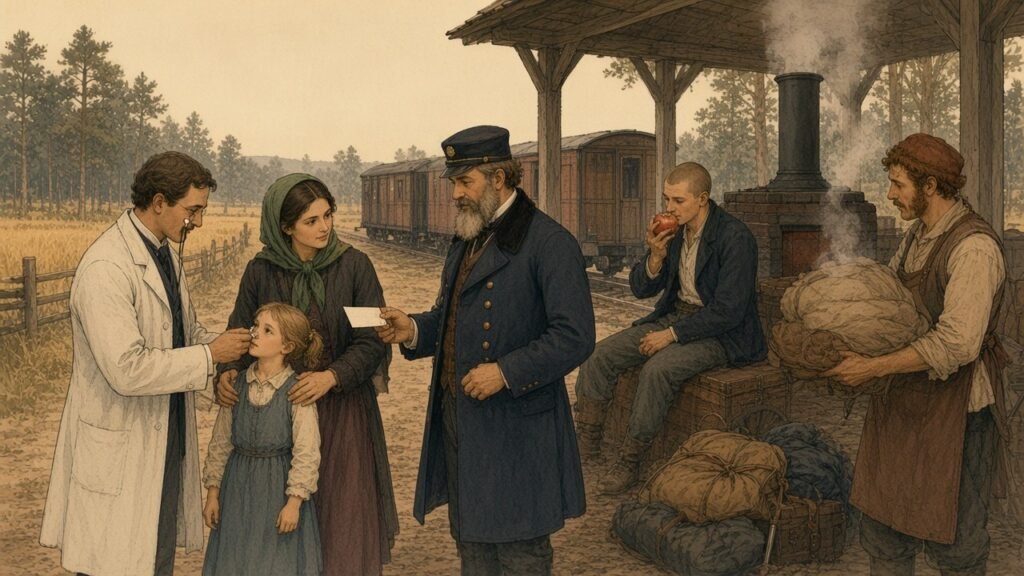
The disinfection
Near Berlin, where the emigrant trains from the eastern frontier converged, the authorities established a central station at Ruhleben, outside the city, where emigrants were bathed and their clothes and luggage disinfected before they continued to the ports. Mary Antin’s account of what appears to have been this station is one of the most vivid descriptions of the experience. The train stopped in “a great lonely field opposite a solitary wooden house within a large yard”. White-clad attendants herded the passengers inside, separated men from women, took their clothes, rubbed them “with a slippery substance that might be any bad thing”, and showered them with warm water “without warning”, while their clothes were steamed in large bags [57].
The experience was terrifying. Antin recalled that “in some minds stories arose of people being captured by robbers, murderers, and the like”, and that the emigrants felt they were being driven “like dumb animals, helpless and unresisting”. Only when they heard the word “train” did they realise that they were “only making us ready for the continuing of our journey, cleaning us of all suspicions of dangerous germs”. Afterwards, locked in a large room, “we were in a prison, and again felt some doubts”. Then each passenger was made to pay two marks “for the pleasant bath we had just been forced to take” [57].
Before Berlin there had been another ordeal: the journey itself. From Eydtkuhnen the family waited for hours in a station waiting room, where the young Mary counted the German books she could not read, while their baggage was put through “all the processes of airing and smoking and steaming and other assaults on supposed germs of the dreaded cholera”, the pillows “even, being ripped open to be steamed”; and then, to their surprise, “a bill for these unasked-for services had to be paid” [57]. The emigrants were then obliged to exchange “the comparative comforts of a third class passenger train for the certain discomforts of a fourth class one”. In their car there were only four narrow benches, and “all other space, to the last inch, was crowded by passengers or their luggage”; at every station more people pushed in. “I cannot see even now how the officers could allow such a thing; it was really dangerous,” Antin wrote [57].
What she remembered most, however, was the good nature of her fellow travellers. “Few showed a sour face even; not a man used any strong language,” she recalled; “they smiled at each other as if they meant to say, ‘I am having a good time; so are you, aren’t you?'” A seventeen-year-old in a family of travellers they had befriended kept everyone’s spirits up with stories through the night [57]. At dawn half the passengers got out, and “there was such a sigh of relief and a stretching of cramped limbs as can only be imagined”. The rest of the day passed in the same train, with girls selling fruit and flowers at the stations and barefoot children waving from the fields, as the emigrants themselves had once waved at passing trains at home: “We used to wonder whether we should ever do so again” [57].
Suspicion and humiliation
What emerges most strongly from Antin’s account is the sense of being treated as a carrier of disease. In Hamburg, the gendarmes “kept a distance from those passengers who came from Russia, all for fear of the cholera” [57]. At the emigrant quarters, a woman with a red cross on her arm searched the family and their baggage when Antin’s mother could not pay the full fee. “Always a call for money,” Antin wrote, “always suspicion of our presence and always rough orders and scowls of disapproval, even at the quickest obedience.” They had to bear it all, she explained, “because we were going to America from a land cursed by the dreadful epidemic” [57].
This experience of suspicion and humiliation was shared by hundreds of thousands of emigrants. The German control system was efficient, and it probably did reduce the risk of disease. But it treated the emigrants as a problem to be managed rather than as people. For many of them, the journey through Germany was a foretaste of the inspections they would face in America, where medical examination and suspicion of disease would again determine their fate.
Through Germany by numbers
The German route carried the largest share of the Jewish emigrant traffic. Exact figures for Jews are difficult to establish, because German statistics counted emigrants by nationality rather than religion, but it is clear that hundreds of thousands of Russian Jews passed through Hamburg and Bremen between 1881 and 1914. Many others travelled through Rotterdam and Antwerp, reached by rail across Germany, or through the British ports, reached by sea from Hamburg, Bremen or the Baltic.
The two German ports competed for the traffic. Hamburg, through HAPAG, had the largest share of the Jewish traffic, partly because of the efforts of its passenger director, Albert Ballin, who is the subject of the next chapter. Bremen, through the North German Lloyd, carried large numbers of emigrants from Austria-Hungary and the Russian Empire, and its outport of Bremerhaven, where the ships actually sailed, became one of the great emigration harbours of Europe. Today the German Emigration Center in Bremerhaven commemorates the millions who sailed from there [58].
The German Jewish response
German Jewish organisations played an important part in assisting the emigrants. In 1901, German Jews founded the Hilfsverein der deutschen Juden (Aid Association of German Jews), which took over and expanded the work of earlier committees. The Hilfsverein maintained offices at the frontier, at the ports and in major cities, providing information, advice, food, shelter and medical care. It helped emigrants deal with the authorities and the shipping lines, protected them from exploitation, and assisted those who were stranded or turned back.
The German Jewish organisations shared some of the ambivalence of their government. They wanted to help the emigrants, but they did not want them to stay in Germany, where they feared that a large population of poor East European Jews would provoke antisemitism. Their aid was designed to speed the emigrants on their way, not to settle them. In this respect, the Hilfsverein and the German control system worked in parallel: both aimed to move the emigrants through Germany as quickly and smoothly as possible.
A system of transit
By the early twentieth century, the German transit system had become a model of its kind: efficient, orderly, medically supervised and highly profitable for the shipping lines. It moved hundreds of thousands of emigrants a year from the Russian frontier to the North Sea ports with minimal contact with the German population. For the emigrants, it was a strange and often frightening experience, but it worked. Most of them reached the ports safely, and most of them sailed.
The system also reflected a broader trend in the history of migration: the growing role of the state in controlling movement across borders. In the early nineteenth century, emigrants had travelled more or less freely, with little official supervision. By the end of the century, they were subject to medical examinations, document checks, disinfection and surveillance at every stage of the journey. The great migration took place at the moment when the modern system of border control was being born, and the emigrants were among its first subjects.
17. Ballin's Emigrant City
On the island of Veddel, in the Elbe a short distance across the water from the old harbour of Hamburg, there stands today a cluster of brick pavilions with steep roofs. They are reconstructions of buildings that once housed hundreds of thousands of emigrants on their way to America, and they now form the BallinStadt emigration museum [59]. The original complex, the Auswandererhallen, or emigrant halls, was opened by the Hamburg-America Line in 1901 under its general director Albert Ballin [60]. It was a self-contained town for people in transit, with dormitories, dining halls, a synagogue and a church, baths, a hospital and a disinfection plant, designed to keep emigrants healthy, orderly and separate from the city until their ships sailed. For many Jews from the Russian Empire, it was the last place in Europe they ever saw.
The shipping man
Albert Ballin was born in Hamburg in 1857, the son of a Danish Jewish immigrant who ran a small emigration agency. He took over the family business after his father’s death, and in the 1880s, as chief passenger agent for the English Carr Line, he adapted its vessels for the transportation of steerage passengers [61]. He understood earlier than most of his competitors that the emigrant traffic from Eastern Europe was not a sideline but the foundation of the transatlantic business. After a period of fierce competition, the Carr Line and the Hamburg-America Line came to an agreement in 1886, and Ballin became head of HAPAG’s passenger department; in 1899 he took charge of the whole company [61].
Under his leadership HAPAG grew into one of the largest shipping companies in the world. Ballin set new standards of speed and comfort and, through his gift for negotiation, organised the first transatlantic shipping conference, a cartel that divided the emigrant traffic between the major lines and limited the ruinous rate wars of earlier years [61]. He became one of the very few Jews admitted to the confidence of Kaiser Wilhelm II, a “Kaiserjude” as his enemies sneered, and an unofficial adviser on economic and diplomatic matters [61] [59]. He remained an unbaptised Jew who married a Protestant and kept his distance from the Hamburg Jewish community [61].
Ballin’s relationship to the Jewish emigrants he carried was complicated. He was not a philanthropist; he was a businessman, and the emigrants were his customers. But he also took a genuine pride in improving the conditions in which they travelled, partly because better conditions made commercial sense and partly because the German authorities and the American immigration service demanded it. The emigrant city was the most visible result.
Before the halls
Before the 1890s, emigrants passing through Hamburg were left largely to their own devices. They lodged in private boarding houses near the harbour, many of them crowded and insanitary, run by keepers who were often in league with agents and runners. Emigrants were overcharged, cheated and robbed, and the conditions in which they waited for their ships were a scandal. The cholera of 1892, blamed on the Russian emigrants, changed this. Under pressure from the authorities, HAPAG built barracks for emigrants at the America Quay in the harbour, where they could be housed, fed and medically supervised in isolation from the city.
It was in such quarters that Mary Antin and her family stayed in the spring of 1894. By Antin’s account their quarantine lasted about nine days. Antin described “a very large room, around whose walls were ranged rows of high iron double bedsteads, with coarse sacks stuffed with something like matting, and not over-clean blankets”, lit by gas lamps, with a stone floor and windows “almost touching the roof”. It looked, she thought, “something like a hospital, only less clean and comfortable; more like the soldiers’ barracks I had seen” [57]. Days passed slowly. “The greatest event was the arrival of some ship to take some of the waiting passengers,” she recalled; “when the gates were opened and the lucky ones said good bye, those left behind felt hopeless of ever seeing the gates open for them” [57].
Antin’s account allows us to reconstruct the regime in detail. The family were driven from the station in a high, narrow wagon through streets that grew quieter and quieter until they could hear the sea; the long ride with no explanation made her think of “criminals being carried on long journeys” [57]. At the office each person, children included, had to pay three marks, “one for the wagon that brought us over and two for food and lodgings, till our various ships should take us away”; when her mother could not pay the whole sum, the family were searched, an episode described in the previous chapter [57].
Inside, the emigrants were sorted. Antin’s family were sent to “Number Five”, which was “only for Jewish women and girls”; the men were housed in a corresponding division [57]. The walls of the yard had wires and nails on top, “so that one couldn’t even climb to get a look at the sea”, and the doors “were never unlocked except when new passengers arrived or others left for their ships”. There was a separate “Jewish Kitchen” with its own overseer. Dinner was half a pound of black bread, a bowl of soup and a small piece of meat; supper and breakfast were “two little rolls and a large cup of partly sweetened tea”. At first the family could not eat the food: “We stopped wondering when our own little store of provisions gave out” [57].
Passover behind the wall
The family’s eighth night in quarantine was the first night of Passover. The Jewish inmates debated anxiously whether the overseer could be trusted to keep the holiday’s dietary laws, declaring that “we would rather starve than touch anything we were not sure of”. The women scrubbed Number Five, though there was not a crumb to be found, “because what bread we received was too precious for any of it to be wasted” [57]. At night a seder was held in an empty room, with candles in a basin of sand and both gas lamps burning as a sign of the holiday. Each person received “exactly one and a half matzos” and some cold meat “burned almost to a coal for the occasion”. The wine tasted “like good vinegar”, and when a little girl screamed “Poison!” the whole company dissolved in laughter [57].
That same evening the family were ordered to bring their baggage to the office, which meant that they would leave the next day. “It was all joy and gladness and happy anticipation for us,” Antin remembered; the cloudy, chilly morning that followed was “the most beautiful day that had ever dawned on Hamburg” [57]. Her account describes the improvised arrangements of 1894, several years before the great emigrant halls on the Veddel were opened; but it shows the elements that would remain constant: segregation, medical control, fees at every stage, separate provision for Jewish emigrants, and the long, anxious wait for a ship.
The city on the Veddel
The barracks at the America Quay were soon inadequate to the growing traffic, and Ballin planned something much larger. The new emigrant halls on the Veddel, opened in 1901, were built as a complex of separate pavilions linked by paths and gardens. Emigrants arrived by train directly from the frontier control stations, without passing through the city. They were registered, examined by doctors, bathed and disinfected, and assigned to dormitories according to sex, family status and, to a degree, nationality and religion. There were separate pavilions for those who had passed the medical checks and those who had not, and a hospital for the sick.
The halls were expanded in the following years as the traffic grew, and at their height they could accommodate several thousand emigrants at a time. The complex had its own kitchens, dining halls, laundries, shops, a bandstand where music was played, and places of worship: a Protestant and a Catholic chapel and a synagogue. For Jewish emigrants, HAPAG maintained a separate kosher kitchen and dining hall under rabbinic supervision, an important consideration for observant travellers who had worried, like the Antins at Passover in 1894, about how they would keep the dietary laws on the road [57].
The emigrant city was, in a sense, a model institution. It was clean, orderly and humane by the standards of its time, and it was a great improvement on the boarding houses of the 1880s. Visitors were impressed, and HAPAG made sure the press knew about it. But it was also a place of control and segregation. Emigrants were not permitted to leave the complex freely and wander into Hamburg; they were, in effect, confined until their ships were ready. The halls were designed to ensure that they passed through Germany without settling, without spreading disease and without being exploited by anyone other than the shipping line.

Life in the halls
For the emigrants, the days in the halls were a strange interlude between the old world and the new. They were fed regular meals, often better than they had eaten at home. They slept in clean beds. They met people from all over Eastern Europe: Poles, Lithuanians, Ukrainians, Hungarians, Russians, Jews from every province of the Pale and from Galicia and Romania. Friendships were formed and information exchanged: about America, about the voyage, about the inspections at Ellis Island, about relatives and acquaintances who had gone before.
There were anxieties too. Emigrants worried about the medical examinations, knowing that those who were judged sick might be refused passage or sent back from America. They worried about money, about the voyage, about what awaited them. Families who had been separated at the frontier or the control stations waited anxiously to be reunited. And there was the constant waiting: for the ship, for the inspections, for the moment when the gates would open.
The shipping lines had good reason to examine their passengers carefully. Under American law from 1891, and more strictly after 1903 and 1907, the lines were required to carry back at their own expense any passenger rejected at an American port, and they could be fined for bringing inadmissible immigrants. The medical examination in Hamburg was therefore a kind of pre-inspection, designed to weed out those likely to be refused in New York. For some emigrants, the dream of America ended not at Ellis Island but in Hamburg.
Bremen and the other ports
Hamburg’s great rival was Bremen, home of the North German Lloyd. Emigrants travelling via Bremen generally lodged in the city before taking the train to Bremerhaven, where the ships sailed. The Lloyd and the Bremen authorities also built facilities for emigrants, though they never matched the scale and showmanship of Ballin’s city. Bremen was especially important for emigrants from Austria-Hungary and for those travelling to Baltimore, where the Lloyd had a regular service. Today the German Emigration Center in Bremerhaven tells the story of the millions who sailed from there [58].
Other ports competed as well. Rotterdam, home of the Holland America Line, and Antwerp, home of the Red Star Line, drew large numbers of emigrants from Eastern Europe by rail across Germany. The Red Star Line, which sailed from Antwerp to New York and Philadelphia from the 1870s until the 1930s, carried very large numbers of emigrants, many of them Jews from the Russian Empire, and its former emigrant buildings in Antwerp now house a museum devoted to their story [62]. The British route, through Hull and Liverpool, is the subject of the next chapter.
The business of steerage
For the shipping lines, the emigrants were a source of enormous profit. Steerage passengers paid much less than first- and second-class passengers, but there were many more of them, and they required much less in the way of space, food and service. A large liner of the early twentieth century might carry a few hundred passengers in first and second class and well over a thousand in steerage. On the westbound voyage, emigrants often provided the bulk of the revenue. On the eastbound voyage, the ships carried returning migrants, freight and travellers.
The competition for this traffic was intense, and it periodically broke out into rate wars in which steerage fares fell dramatically. The shipping conference that Ballin helped organise was designed to prevent such wars by allocating each line a share of the traffic. When the agreements broke down, as they did several times, fares fell and emigration from Eastern Europe tended to rise, as cheaper tickets brought the journey within reach of more people.
Ballin's end
Albert Ballin’s own story ended tragically. During the First World War he organised food supplies for blockaded Germany, and in 1918 he was involved in the preparations for armistice negotiations. On 9 November 1918, as revolution broke out in Germany and the Kaiser fled, Ballin, in despair at the collapse of his company and the monarchy he had served, died of an overdose, probably by suicide [61]. The emigrant halls on the Veddel were used for other purposes after the war, and most of the buildings were demolished in later decades. The reconstructed pavilions of the BallinStadt museum, opened in 2007, commemorate the emigrants who passed through them and the man whose name they bear [59].
The emigrant city in memory
Few of the emigrants who passed through Hamburg wrote at length about the emigrant halls. For most, they were a brief stop on a long journey, overshadowed by the drama of the border crossing before and the voyage and arrival after. Yet for many, the halls were their first experience of a modern institution: a place where everything was organised, regulated and recorded, where people were sorted by category and moved along according to a schedule. In this sense, Ballin’s city was a preparation for America, where the emigrants would encounter the even larger and more formidable machinery of Ellis Island.
The emigrant halls also stand as a reminder of the role that private enterprise played in the great migration. The emigrants were moved not by governments or philanthropists alone but by shipping lines whose motive was profit. Their interests often coincided with those of the emigrants, in safe and efficient transport, and sometimes conflicted, in fares, conditions and the pressure to choose one line over another. The great migration was, among other things, one of the largest commercial operations of its age.
18. The British Route
Not every emigrant sailed directly from the continent. A large stream took an indirect route through Britain: by small steamer from Hamburg, Bremen, Rotterdam or the Baltic ports across the North Sea to Hull or Grimsby, by train across the north of England to Liverpool, and then by one of the great British liners, Cunard, White Star, Dominion, Inman, to New York, Boston or Philadelphia. The route was often cheaper than a direct passage, and for much of the period British lines competed hard for the traffic. It also carried many emigrants who never went further. Between 1881 and 1914 something on the order of 120,000 to 150,000 East European Jews settled in Britain, most of them in the East End of London, Manchester and Leeds, and many of them had originally intended to go to America. This chapter follows the British route and the community it created.
Across the North Sea
The transmigrant traffic through Britain was organised by a network of shipping companies and railway lines. The Wilson Line of Hull ran regular services from Hamburg, Bremen and the Baltic, and its ships carried tens of thousands of emigrants a year at the height of the migration. On arrival at Hull, emigrants were met by agents of the transatlantic lines and taken to waiting rooms near the docks, and then put on special trains to Liverpool, often within hours of landing. The North Eastern Railway built an emigrants’ waiting room at Hull’s Paragon station for the purpose. The journey across England took most of a day. At Liverpool, emigrants lodged in boarding houses licensed by the authorities and run under contract to the shipping lines until their ship sailed.
The route had several attractions. British lines offered competitive fares, especially during rate wars with the German lines. They sailed frequently from Liverpool to several American ports. And for emigrants who had been rejected at the German control stations, or who wished to avoid them, the sea route from the Baltic to Britain could offer a way round. Samuel Joseph noted that the great rise in immigration to the United States “from the United Kingdom” in the peak years after 1904 was due in part to “the number of Russian Jews that came to the United States by way of England” [4].
Liverpool
Liverpool was one of the great emigration ports of the nineteenth century. Millions of Irish, British and continental emigrants had sailed from its docks, and by the 1880s it had a well-developed apparatus for handling them: shipping offices, licensed lodging houses, medical inspectors and emigration officers. East European Jews arriving from Hull joined this stream. They waited in the lodging houses, underwent medical inspection by the shipping lines’ doctors, and boarded the tenders that carried them out to the great liners anchored in the Mersey or moored at the landing stage.
For many emigrants, Liverpool was the first great Western city they had seen at close quarters, with its docks, warehouses, crowds and noise. It was also their last sight of Europe. Memoirs describe the bustle of the landing stage, the anxious crowds of emigrants with their bundles and baskets, the shouts of porters and officials, and the moment when the ship pulled away and the city receded.

The Jews' Temporary Shelter
Many East European Jews who came to Britain, whether intending to stay or to go on, passed through London. In the East End, around Whitechapel and Spitalfields, a large immigrant Jewish community grew up from the 1880s, and with it a network of institutions to receive newcomers. The most important was the Poor Jews’ Temporary Shelter, founded in 1885 in Leman Street, Whitechapel, by a group of immigrant and established Jews. It provided free board and lodging for up to two weeks for Jewish immigrants and transmigrants arriving in London, met them at the docks to protect them from the runners and swindlers who preyed on newcomers, and helped them find work, relatives, or onward passage.
The Shelter’s registers, which survive, show the extraordinary range of people who passed through: young men and women from every province of the Pale, families with small children, artisans and traders, people on their way to America, South Africa, Canada and Argentina, and people who intended to stay in London. Over the decades it housed tens of thousands of people. It became one of the key institutions of the migration, a place where the transatlantic and the British streams met.
Staying in Britain
For some emigrants, Britain was meant to be a temporary stop, a place to earn money for the onward journey. Many stayed longer than they planned, and some never left. The East End’s tailoring workshops, cabinet-making shops, boot factories and bakeries offered work, and the existing Jewish community offered a familiar world. By 1914 the immigrant Jewish population of Britain was large enough to have its own Yiddish press, theatre, trade unions, synagogues and friendly societies, many of them closely linked to those in New York.
The Anglo-Jewish establishment received the newcomers with the same mixture of charity and anxiety as the German Jews of New York. The Jewish Board of Guardians, the community’s main charity, sometimes discouraged immigration and paid for the repatriation of thousands of immigrants to Eastern Europe, or helped them on to America. Established Jews worried that the immigrants’ poverty, foreign ways and radical politics would provoke antisemitism and undermine their own position in British society.
The Aliens Act
Their fears were not unfounded. In the 1890s and early 1900s, the growth of the immigrant population in the East End provoked a campaign for restriction. Agitators claimed that the immigrants were driving down wages, crowding out native workers and spreading disease and crime. In 1902 the government appointed a Royal Commission on Alien Immigration, which heard evidence from both sides. Its report led to the Aliens Act of 1905, the first modern British immigration law, which gave officials the power to refuse entry to “undesirable” immigrants arriving in steerage, such as the destitute and the diseased, while exempting those fleeing religious or political persecution.
The Aliens Act was mild by later standards, and its enforcement was uneven. But it marked a turning point. Britain, which had admitted immigrants freely throughout the nineteenth century, had begun to close its doors. The debate over the Act rehearsed many of the arguments that would be heard in the United States in the following two decades, and it was followed closely by American restrictionists. Transmigrants passing through on their way to America were generally exempt, but the Act made Britain a less attractive destination for those who might have stayed.
The Baltic routes
From the late 1890s, emigrants from the north-western provinces of the Russian Empire could also sail directly from Russian Baltic ports. The port of Libau (Liepāja) in Courland became an important emigrant harbour, served by British, Danish and later Russian lines. From 1906 the Russian American Line, a subsidiary of the Danish East Asiatic Company, operated a direct service from Libau to New York. The direct Baltic routes allowed emigrants to avoid the German control stations altogether, although they required a Russian passport to embark legally. Many emigrants also sailed from Libau to Hull or London and then onward.
Comparing the routes
By the early twentieth century, an emigrant from the Pale had a bewildering choice of routes: via Hamburg or Bremen with the German lines; via Rotterdam or Antwerp with the Dutch and Belgian lines; via Hull and Liverpool with the British lines; via Libau with the Russian, Danish or British lines. The choice depended on cost, convenience, the advice of agents and relatives, the availability of a passport, the emigrant’s destination in America, and sometimes the vagaries of rate wars and shipping conferences. Agents had strong incentives to steer emigrants towards particular lines, and the emigrants themselves often had little real choice.
Each route had its own hardships. The direct German routes involved the control stations and the long rail journey across Germany, but a single sea voyage. The British route involved two sea crossings, the North Sea being notoriously rough, and a rail journey across England, but it might be cheaper and it avoided the German controls. The Baltic route was direct but required a passport. In all cases, the journey from home to America might take weeks, and sometimes months.
The Jewish East End
For those who stayed, London was the great magnet. According to the Encyclopaedia Judaica, the mass emigration from Russia after 1881 caused “a great influx especially to London”, where the Jewish population rose in the course of the next quarter of a century from some 47,000 to approximately 150,000, of whom about 100,000 lived in the East End [63]. The immigrants crowded into Whitechapel, Spitalfields and Stepney, a district that became a miniature Pale on the Thames, with its own small synagogues, Yiddish newspapers and theatres, kosher butchers, friendly societies and workshops.
The established Anglo-Jewish community, like its counterpart in New York, was both sympathetic and alarmed. Its leaders feared that the poverty and foreignness of the newcomers would provoke hostility and damage the standing that British Jews had won since their emancipation. In 1887 Samuel Montagu, later Lord Swaythling, a banker and Liberal politician, created the Federation of Synagogues to coordinate the many small immigrant congregations [63], a step that combined genuine support for the immigrants’ religious life with an effort to bring it under respectable supervision.
Immigrant London produced its own labour movement. The tailoring workshops of the East End were notorious examples of “sweating”, and in 1889 some 10,000 Jewish tailors struck for six weeks, a strike that, in the words of the Encyclopaedia Judaica, “attracted great attention and ended the period of the unmitigated exploitation of the Jewish immigrants” [63]. East End Jewish socialists and anarchists, some of whom later moved to New York, were part of the same transatlantic world of radical politics as their American counterparts.
The provinces
The immigrants also settled in the industrial cities of the north. In Leeds, many Russian and Polish immigrants settled toward the close of the nineteenth century and “were absorbed largely in the tailoring industry to which they gave a great impetus” [64]; the city’s ready-made clothing trade, like New York’s, was built in large part on immigrant Jewish labour. In Manchester, “the most significant influx … resulted from the great Russo-Polish immigration of 1881–1914”, and the immigrants followed “the usual immigrant trades of tailoring and capmaking”; at its peak, around 1910, the city’s Jewish population was estimated at 35,000 [65]. In Hull, the port where many transmigrants landed, so many Jewish immigrants arrived that a second synagogue had to be founded in 1886 and a third in 1902 [66]. In Liverpool, Russian and Polish refugees reached the city on their way to America, and “a number remained to modify the character of Liverpool Jewry” [67].
Britain’s Jewish population was transformed by the migration, as America’s was, though on a much smaller scale. The Aliens Act of 1905, the Encyclopaedia Judaica notes, “stemmed the tide of immigration, though it continued in modified form until the outbreak of World War I in 1914” [63]. For most of the East European Jews who passed through Britain, however, it was never more than a stage on the road to America. The British route reminds us that the great migration was not simply a movement from one country to another, but a movement through a whole network of ports, cities and communities, each of which was changed by those who stopped there and by those who passed through.
A transnational community
The British route created a transnational Jewish community that linked Eastern Europe, Britain and America. Families were often scattered across all three: a brother in London, a sister in New York, parents in Vilna. Letters, money and people moved back and forth. Yiddish writers, actors, journalists and labour organisers travelled between London and New York; the Yiddish press of the East End and the Lower East Side reprinted each other’s articles. Several of the most important figures of the American Jewish labour movement spent time in London first.
This transnational dimension of the great migration is easily overlooked when the story is told from the American side alone. For many emigrants, the journey to America was not a single leap but a series of steps, each of which might last months or years. Britain was one of the most important of these stepping stones, and the experience of the Jewish immigrants who stayed there paralleled, in many ways, that of their cousins across the Atlantic.
19. Steerage
Whatever route they took, nearly all the emigrants shared one experience: the Atlantic crossing below decks, in the part of the ship known as steerage. The name came from the old sailing ships, where the cheapest passengers had been quartered near the steering gear at the stern. By the late nineteenth century it meant the lowest class of accommodation on a steamship, usually in the ship’s lower decks, where hundreds of passengers were packed together in large compartments with little light, little air and little privacy. For a week or two, sometimes longer, this was home. The steerage voyage became one of the defining memories of the great migration, recalled in memoirs, songs and stories for generations.
The ships
The ships that carried the emigrants changed enormously over the period. In the early 1880s, a typical transatlantic steamer was a vessel of a few thousand tons, making the crossing from Hamburg or Liverpool to New York in around ten to fourteen days. Mary Antin’s ship, the Polynesia, which carried her family from Hamburg to Boston in 1894, took sixteen days; it was “the eighth of May, the seventeenth day after we left Hamburg” when they sighted land [57]. By the first decade of the twentieth century, the great liners of the German and British lines displaced twenty or thirty thousand tons and could cross in under a week, carrying well over a thousand steerage passengers at a time.
The improvement in speed was the most important change for the emigrants. A shorter voyage meant less time in the cramped and unhealthy conditions of steerage, less seasickness, less danger of disease, and less food to carry or buy. It also meant cheaper fares, since the lines could carry more passengers in a year. The steamship revolution was one of the essential preconditions of the mass migration.
Boarding
For Mary Antin’s family, the voyage began with a crisis of conscience. As the group of Jewish emigrants was led out of the Hamburg quarantine, an old woman stopped short and cried: “We haven’t any matzo! Where’s the overseer?” It was still Passover, and the overseer had promised to supply them. The official in charge refused to wait: “you can go and get your matzo, but the boat won’t wait for you.” The old woman declared that she “wasn’t going to start on a dangerous journey with such a sin on her soul”; it was the children, crying and begging to follow the party, who decided the matter. At the shore the cook came running up with the matzo [57].
A small steamer took them to a large stone building, where they waited in a crowded room while an official called out the names of ships. “At last we heard, ‘Polynesia!'” Their tickets were stamped, punched or torn “at every step”, until they were taken by a larger steamer out to “the great ship that was to carry us to America” [57]. Boarding was pandemonium: sailors “dragging and hauling bundles and boxes from the small boat into the great ship, shouting and thundering at their work”, officers giving orders “in loud voices, like trumpets”, children crying and fathers questioning the officers about where to go. Antin’s only care, she remembered, was “not to lose hold of my sister’s hand” [57].
Somehow the family found its way to a quiet compartment with a sign reading “For Families” over it. A sailor issued each passenger “a plate, a spoon and a cup”. Then, as the ship prepared to leave, the scene changed: the water was “as motionless and clear as a deep, cool well”, and the passengers spoke in low voices, as if missing “a crowd of friends on the shore, to cheer and salute, and fill the air with white clouds and last farewells” [57]. That evening the captain and steward came to take up their tickets, and a sailor brought supper, “bread and coffee. Only a few ate it.” The seasickness began the next morning [57].
The compartments
Conditions in steerage varied widely between ships and lines, and they improved over time. In the older ships, steerage consisted of large open compartments in which passengers slept in tiers of iron or wooden bunks, two or three high, with straw mattresses and thin blankets. Single men, single women and families were supposed to be separated, but in practice the separation was often imperfect. There was little ventilation, and the air quickly became foul with the smells of bodies, food, seasickness and bilge. Toilets and washing facilities were few and primitive. Passengers kept their belongings on or under their bunks, and there was nowhere to sit except on the bunks themselves or on the deck when the weather allowed.
Mary Antin’s family had upper berths. On the first morning out, she woke to the rocking of the ship and “a very disagreeable smell”; soon “many of the passengers are very sick indeed, they suffer terribly”, and “some children are crying, at intervals. There is nobody to comfort them–all are so miserable” [57]. When she tried to escape to the deck, the sight of “the green water, tossing up the white foam” was even worse, and she crawled back to her berth [57].
From around 1900, the newer liners began to offer what was called “new steerage” or third class: small cabins of two, four or six berths, with proper washing facilities and dining saloons. But the old open steerage persisted on many ships until the First World War, and most emigrants travelled in it.
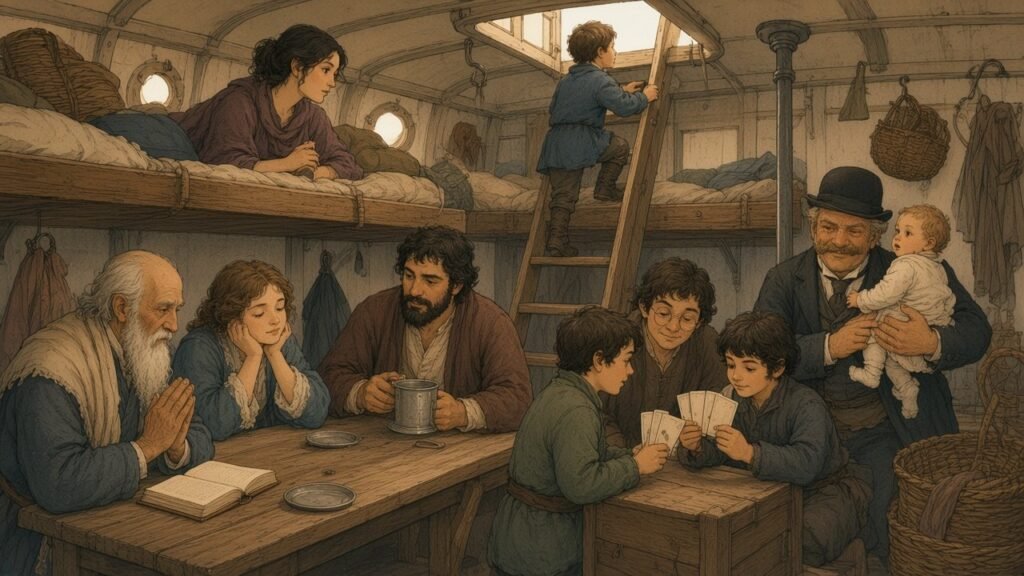
Food
Feeding the steerage passengers was the responsibility of the shipping line, and the quality of the food was a constant source of complaint. On the Polynesia, meals were carried from the galley by a passenger appointed for every twelve or fifteen people: at midday, “large tin pails and basins of soup, meat, cabbage, potatoes, and pudding (the last was allowed only once a week)”; at three, milk for the babies and brown bread with coffee for the rest; supper at six [57]. Most of it, during the first days, was thrown away, since only a few could face food. Fresh water was rationed: “the daily allowance of fresh water was brought, and this soon disappeared and more called for, which was refused, although we lived on water alone for a week” [57].
For observant Jews, the food posed a further problem. The ordinary steerage fare was not kosher, and many Jewish passengers refused to eat it, living instead on bread, herring, hard-boiled eggs, dried fruit, cheese and other provisions they had brought from home, supplemented by tea and the occasional potato. Some lines, recognising the size of the Jewish traffic, introduced kosher food on their emigrant ships, prepared in separate galleys under supervision, and advertised it to attract Jewish passengers. But on many crossings, observant Jews went hungry rather than break the dietary laws.
Seasickness, sickness and death
Seasickness afflicted nearly everyone, especially in the first days and in rough weather. For passengers crowded into a closed compartment, with inadequate toilets and little water, it was a misery that could last the whole voyage. More serious illnesses also spread easily in steerage: measles, typhus, diphtheria and other infections, particularly among children. Each ship carried a doctor, but the medical care available to steerage passengers was limited. Deaths at sea were not common on the fast steamers of the later period, but they did occur, and burials at sea were among the most painful memories of the crossing.
The shipping lines had strong incentives to keep their passengers healthy, since sick passengers might be refused admission in America and would have to be carried back at the line’s expense. Ship’s doctors examined passengers at embarkation and during the voyage, and vaccinated them against smallpox. The Antins were vaccinated on board, and when American officials boarded the ship off Boston, they “examined the passengers to see if they were properly vaccinated” and “pronounced everyone all right” [57].
Regulation
The conditions in steerage were the subject of growing official concern. The United States passed a series of laws regulating the carriage of passengers by sea, notably the Passenger Act of 1882, which set minimum standards for space, ventilation, food and medical care. Britain and Germany had their own regulations. But enforcement was weak, and the lines found many ways to evade the rules. In the early twentieth century, the United States Immigration Commission, appointed by Congress in 1907 and known after its chairman as the Dillingham Commission, sent investigators to travel in steerage disguised as emigrants, and its report described crowded, dirty and degrading conditions on many ships, especially in the old open steerage. Its recommendations contributed to further regulation.
Passing the time
Life in steerage was not only misery. When the weather was good, passengers crowded onto the small area of deck allotted to them, breathing fresh air, watching the sea, talking, singing and making friends. Young people flirted; children played; men argued about politics and religion; women exchanged news and advice. Jewish passengers organised prayer services, with a minyan of ten men gathering in a corner of the compartment or on deck. On the Sabbath, observant passengers tried to rest. Musicians among the passengers played fiddles, accordions and mouth organs, and there was dancing.
The voyage was also a time of reflection and anxiety. Emigrants worried about what awaited them in America: the inspections, the relatives who were supposed to meet them, the search for work and lodging. They exchanged rumours about the questions immigration officers would ask, the medical tests, the dreaded marks chalked on coats. Those with little money worried about whether they would be admitted. Those travelling to join husbands or fathers wondered whether they would recognise them, and whether they would be met at all.
Mary Antin remembered the night thoughts of the voyage: lying awake as the ship grew quieter, thinking “of all we had gone through till we had got on board the ‘Polynesia’; of the parting from all friends and things we loved, forever, as far as we knew” [57].
Landfall
The end of the voyage was a moment of overwhelming emotion. Antin described the first sight of land off Boston: two treetops, then “a green field, a real field with grass on it, and large houses, and the dearest hens and little chickens in all the world”, so dear to the passengers’ eyes “that we dare not speak a word now, lest the magic should vanish away”. “To know how great was our happiness,” she wrote, “you must make a journey of sixteen days on a stormy ocean” [57].
For those arriving in New York, the climax was the Statue of Liberty. Dedicated in October 1886, the statue stood on Bedloe’s Island in the Upper Bay, and every ship entering New York harbour passed close by it. For the emigrants crowding the decks, it became the symbol of their arrival. Emma Lazarus’s sonnet “The New Colossus”, written in 1883 to help raise funds for the statue’s pedestal, gave voice to that meaning: “Give me your tired, your poor, / Your huddled masses yearning to breathe free” [26]. The poem was largely forgotten for some years after it was written; in 1903 a bronze plaque bearing its text was placed inside the pedestal, and in the decades that followed it came to define the statue’s significance [26]. For the Jewish emigrants of 1881 to 1914, many of whom knew nothing of the poem, the statue meant what Lazarus said it meant.
The sea itself
For emigrants from the interior of Eastern Europe, most of whom had never seen the sea before they reached Hamburg or Rotterdam, the ocean was itself a revelation, terrifying and magnificent. Mary Antin, who was twelve when she made the crossing in 1894, recorded her impressions in a long letter in Yiddish to her uncle in Russia, later translated and published as From Plotzk to Boston. Her family’s seasickness, which they had hoped would last a single day, kept them in their berths for six more: “It is a long fast, hardly interrupted, during which we know that the weather is unchanged, the sky dark, the sea stormy” [57].
When she was finally able to go on deck, on the eighth day out, she explored every corner of the ship, questioning the sailors about the names of things, “and some German names hard to learn”. There was music and even dancing: “The little band played regularly on certain days, and the sailors and girls had a good many dances, though often they were swept by a wave across the deck, quite out of time. The children were allowed to play on deck, but carefully watched” [57]. Watching the waves, she was overcome by “the immeasurable distance from horizon to horizon; the huge billows forever changing their shapes”, and “the deep, solemn groans of the sea, sounding as if all the voices of the world had been turned into sighs and then gathered into that one mournful sound” [57]. She found herself thinking of shipwrecks, and of Robinson Crusoe [57].
The passengers watched eagerly for birds, signs that land was near. “The birds were like old friends to us, and brought back many memories,” Antin wrote. “When they did come, how envious we were of their wings! It was a new thought to me that the birds had more power than man” [57].
Fog and storm
The last days of a crossing could be the worst. On the twelfth day after leaving Hamburg, the captain of the Polynesia announced that land would soon be sighted, and the passengers were wild with excitement; but a dense fog set in, and then a storm [57]. Antin described the night that followed: everything in the steerage compartment rolling on the floor, dishes broken, bedding from the upper berths falling on the people below, passengers thrown out of their berths, boards giving way. “The children cried, everybody groaned, and sailors kept coming in to pick up the things on the floor and carry them away” [57]. Above it all sounded the foghorn: “It never stopped the long night through. And oh, how sad it sounded! It pierced every heart, and made us afraid” [57]. When the engines stopped, the passengers imagined the worst.
Such storms were a common experience of the North Atlantic crossing, especially on the slower ships of the 1880s and early 1890s, and they were all the more frightening for passengers crowded below decks, unable to see what was happening and unable to understand the crew. Shipwrecks of emigrant ships were rare by the late nineteenth century, thanks to steam power, iron hulls and better navigation, but they were not unknown, and stories of disasters at sea circulated widely among the emigrants and their families.
The last night
The final night aboard was a time of sleepless anticipation. Antin remembered a rumour that the steward had ordered a great raisin pudding for supper, “as a sure sign that it was the last on board”, though no one believed it [57]. “After all the suffering of our journey, after seeing and hearing nothing but the sky and the sea and its roaring,” she wrote, “it was impossible to sleep when we thought that soon we would see trees, fields, fresh people, animals–a world, and that world America. Then, above everything, was the meeting with friends we had not seen for years; for almost everybody had some friends awaiting them” [57].
That last observation points to one of the most important features of the Jewish crossing. The steerage compartments of the emigrant ships were full of people travelling to join relatives who had gone before: wives going to husbands, children to fathers, brothers and sisters to siblings, fiancées to the men they had promised to marry. The chain of migration that linked the towns of the Pale to the cities of America ran through the steerage of the Atlantic liners, and the hope of reunion sustained the passengers through the misery of the voyage.
The end of the voyage
Antin’s family had one more torment before they could greet the father they had not seen for three years, who stood on the wharf: “To have crossed the ocean only to come within a few yards of him, unable to get nearer till all the fuss was over, was dreadful enough” [57]. The “fuss” was the process of inspection that every immigrant had to pass before setting foot in America. In New York, it took place first at Castle Garden and later at Ellis Island, the subjects of the next two chapters.
20. Castle Garden and the First Wave
The Jewish refugees of 1881 and 1882 who reached New York landed at Castle Garden, a round sandstone fort at the southern tip of Manhattan. Built as a harbour defence before the War of 1812, it had been deeded to the city in 1823 and served for three decades as a place of entertainment, an opera house and theatre where the Swedish soprano Jenny Lind made her American debut in 1850 [68]. On 3 August 1855 it opened as an immigrant landing depot, run by the New York State Commissioners of Emigration, and over the next thirty-four years more than eight million people entered the United States through its doors [68] [69]. Most of them came from northern and western Europe: Irish, Germans, British, Scandinavians. In the 1880s, they were joined by a new stream: Italians, Poles, Slovaks, Hungarians and Jews from the Russian Empire. Castle Garden was the gateway through which the first wave of the great Jewish migration entered America.
The depot
Castle Garden was a state institution. Before 1890, individual states, not the federal government, regulated immigration into the United States [69]. The New York commissioners had established the depot to protect immigrants from the runners, swindlers and boarding-house keepers who had preyed on them at the docks, and to give them information, money changing, railway tickets and help in finding work. Immigrants were brought from their ships by barge to the depot, where they were registered and examined, and then released into the city or put on trains to the interior.
The examination was cursory by later standards. Officials asked a few questions, looked for obvious signs of disease or disability, and recorded names, origins and destinations. Most immigrants passed through in a few hours. Inside the great rotunda, there were benches for waiting, counters for money exchange and railway tickets, a labour bureau that matched immigrants with employers, and an information desk. Relatives waited outside to meet the newcomers.
For Jewish refugees in 1881 and 1882, Castle Garden was often chaotic. The numbers arriving in those years overwhelmed the facilities and the charities. Many refugees arrived with nothing, having been sent by the European committees with only their passage paid. They needed food, lodging, clothing and work, and they needed someone to speak to them in Yiddish.

The Hebrew Emigrant Aid Society
The response of the established Jewish community of New York was the Hebrew Emigrant Aid Society, founded in 1881 to receive the refugees [31]. Its leaders were mostly prosperous Jews of German origin, who had built a respected place in American society and who were both moved by the plight of the refugees and alarmed by their numbers. The society met the ships, provided temporary shelter, distributed food and clothing, and tried to find the newcomers work, often outside New York. It established a refugee camp on Ward’s Island in the East River, where hundreds of refugees were housed in barracks in 1882.
Conditions on Ward’s Island were poor, and relations between the refugees and their benefactors were strained. The refugees complained of bad food, harsh discipline and condescending treatment; on at least one occasion, in 1882, their protests turned into a riot that had to be quelled by police. The benefactors, for their part, complained of the refugees’ ingratitude and lack of discipline. The society’s leaders wrote angrily to the European committees, demanding that they stop sending people who could not support themselves. Emma Lazarus, who visited Ward’s Island, was among the few figures in the established community who identified wholeheartedly with the refugees, and she wrote passionately in their defence [25].
The society also sponsored agricultural colonies, including the colony at Alliance in New Jersey and others further west, discussed in an earlier chapter. It dissolved in 1883, its resources exhausted. Its work was taken up by other organisations, notably the United Hebrew Charities of New York, founded in 1874, which became the main agency for the relief of poor Jewish immigrants, and later by the new Hebrew Immigrant Aid Society, founded by the immigrants themselves.
The first laws
The first wave of the great Jewish migration coincided with the beginnings of federal immigration law. In 1882 Congress passed two laws that marked a turning point. The Chinese Exclusion Act suspended the immigration of Chinese labourers, the first time the United States had barred immigrants on the basis of nationality [70]. And the Immigration Act of 1882 imposed a head tax of fifty cents on each immigrant and barred the entry of “lunatics”, “idiots”, convicts and “any person unable to take care of himself or herself without becoming a public charge”. In 1885 the Foran Act prohibited the importation of contract labourers, immigrants whose passage had been paid by an employer in return for their labour.
These laws were enforced by the states under federal supervision. They did not affect most Jewish immigrants directly, but the “public charge” clause in particular would become a major concern for the Jewish aid organisations, which had to show that the immigrants they sponsored would not become dependent on public relief. The fear that immigrants might be refused because they had no money, no relatives, or no prospects shaped the work of the Jewish organisations at the ports for the next forty years.
The end of Castle Garden
By the late 1880s, Castle Garden was widely criticised as corrupt, inefficient and too small for the growing traffic. Federal investigators found that the state commissioners had failed to enforce the immigration laws properly, and that immigrants were still being exploited by officials and hangers-on. In 1890 the federal government decided to take over the inspection of immigrants at New York, and Castle Garden was closed on 18 April 1890 [68]. For nearly two years, immigrants were processed at the Barge Office nearby while a new federal station was built on Ellis Island. The Immigration Act of 1891 established the federal Office of the Superintendent of Immigration, extended the list of excluded classes to include persons suffering from “a loathsome or a dangerous contagious disease”, and required shipping lines to carry back rejected passengers at their own expense [69].
Castle Garden itself was remodelled and reopened in 1896 as the New York City Aquarium, a role it filled until 1941. Saved from demolition in 1946, it was restored as Castle Clinton and is today a national monument [68].
The first wave in numbers
The decade of Castle Garden’s Jewish traffic, 1881 to 1890, saw some 193,000 Jewish immigrants arrive in the United States by Samuel Joseph’s reckoning, of whom 135,003 came from the Russian Empire, 44,619 from Austria-Hungary and 6,967 from Romania [4]. These were large numbers by the standards of earlier Jewish immigration, but small compared with what came later: the first decade accounted for only about an eighth of the Jewish immigration of the thirty years Joseph studied. Russian Jewish immigration rose to a first peak in 1882, the year after the pogroms, then fell back, rose again in 1886 and 1887 with the stricter enforcement of the May Laws, and climbed to new heights at the end of the decade [4].
The immigrants of the 1880s laid the foundations of the East European Jewish community in America. They founded the first landsmanshaftn and congregations of Russian and Polish Jews on the Lower East Side, the first Yiddish newspapers, the first Jewish trade unions, and the first Yiddish theatres. They established the patterns of settlement and work, in the tenements of the Lower East Side and the workshops of the garment trade, that later arrivals would follow. And they created the networks of relatives and landslayt through which hundreds of thousands more would come.
Pioneers of a new community
Among the immigrants of the 1880s were many who would become leaders of the community in the following decades. Abraham Cahan arrived in 1882 and became the editor of the Forverts [32]. The poet Morris Rosenfeld arrived in 1886 after a period in London, and began to write the poems of sweatshop life that made him famous [71]. The labour leaders, journalists, actors, rabbis and businessmen of the first wave built the institutions that would receive the much larger waves that followed. They were, in a real sense, the pioneers of East European Jewish America.
They were also, at the time, a small and despised minority within American Jewry. The established German Jewish community, which numbered perhaps 250,000 in 1880, regarded them with a mixture of sympathy, embarrassment and alarm. The relationship between “uptown” and “downtown”, between the established German Jews and the East European newcomers, is the subject of a later chapter. For now, it is enough to note that the newcomers of the 1880s faced not only the hardships of immigrant life but the suspicion of their own co-religionists.
David Levinsky at Castle Garden
The most famous literary account of arrival at Castle Garden was written by Abraham Cahan, who had himself landed in 1882. In The Rise of David Levinsky (1917), Cahan’s narrator, a young yeshiva student from a Lithuanian town whose mother had been killed by Gentiles, arrives in New York in the mid-1880s [17]. Levinsky is a fictional character, and his story should not be read as documentary evidence, but Cahan drew heavily on his own experience and that of the thousands of immigrants he had known, and his description of arrival rings true.
“The immigrant’s arrival in his new home is like a second birth to him,” Levinsky declares. “Imagine a new-born babe in possession of a fully developed intellect. Would it ever forget its entry into the world? Neither does the immigrant ever forget his entry into a country which is, to him, a new world in the profoundest sense of the term and in which he expects to pass the rest of his life” [17]. Sailing into the harbour on a clear June morning, he is overwhelmed by “the magnificent verdure of Staten Island, the tender blue of sea and sky”, and by “those floating, squatting, multitudinously windowed palaces which I subsequently learned to call ferries” [17]. Opening his prayer-book, he reads Psalm 104, and prays that God will not hide His face from him in a strange land [17].
The steerage passengers are landed at the Hoboken pier and ferried over to Castle Garden. There Levinsky’s exaltation gives way to disappointment. “The harsh manner of the immigration officers was a grievous surprise to me,” he recalls. He had imagined that the officials of a republic would be “paragons of refinement and cordiality”; instead, he remarks to his companion, “They are not a bit better than Cossacks” [17]. Admission itself is easy: “The stringent immigration laws that were passed some years later had not yet come into existence. We had no difficulty in being admitted to the United States” [17]. But around him other immigrants are met by relatives, with “cries of joy, tears, embraces, kisses”, which only intensify his loneliness, for he knows no one in New York; “the agencies which two Jewish charity organizations now maintain at the Immigrant Station had not yet been established” [17]. Outside, in Battery Park, he and his friend are “pounced down upon by two evil-looking men, representatives of boarding-houses for immigrants”, and have to struggle to free themselves [17].
"A green one"
Ten minutes’ walk brings Levinsky to the Jewish East Side, where “the streets swarmed with Yiddish-speaking immigrants” and “the sign-boards were in English and Yiddish, some of them in Russian” [17]. What strikes him most is the self-confidence of the people: “the poorest-looking man wore a hat (instead of a cap), a stiff collar and a necktie, and the poorest woman wore a hat or a bonnet” [17]. Passers-by point at him: “There goes a green one!” [17]. Levinsky explains that “green one” or “greenhorn” was one of the many English words that Yiddish had absorbed in England and America, and that the many millions of letters exchanged between the Jews of Russia and their relatives in America had by the time of writing made such words familiar in the old country too [17]. The phrase stung him, even when it was spoken with sympathy, for it carried the unspoken message: “Poor fellow! he is a green one. We are not, of course. We are Americanized” [17].
That evening Levinsky asks a street peddler to direct him to a synagogue, where he expects to spend the night, as a poor student would have done at home. He finds “a handful of men in prayer” in a large room, joins the service “with great fervor”, and when some of the worshippers begin to read the Talmud aloud “in the familiar singsong”, “the strange surroundings suddenly began to look like home” [17]. But an elderly reader soon disillusions him. The synagogue was crowded on Saturdays, the man explains, but on weekdays “people in America had no time to say their prayers at home, much less to visit a house of worship”. “It isn’t Russia,” he sighs. “Judaism has not much of a chance here.” And when Levinsky says he means to sleep there: “One does not sleep in an American synagogue. It is not Russia” [17]. The old man is ashamed that he cannot offer a Talmudic scholar a night’s rest, and quotes the Talmud on hospitality; “Alas! America has turned me into a mound of ashes” [17]. Levinsky has a quarter given him by a cloak contractor, and the man tells him there are places “where you can get a night’s lodging for fifteen cents” [17].
Cahan’s account captures a central fact of the first wave. The immigrants of the early 1880s arrived in a community that was still small and poorly organised, with few of the institutions that would later meet newcomers at the dock. Many depended on luck, on chance encounters with landslayt, or on the uncertain help of the charities. Within a decade, the networks of relatives, landsmanshaftn and aid societies would make the experience of arrival less lonely, though never less momentous.
From Castle Garden to Ellis Island
The closing of Castle Garden marked the end of an era in American immigration. The old system of state regulation, with its loose inspections and its focus on protecting immigrants from exploitation, gave way to a federal system focused on screening immigrants and excluding the undesirable. The new station on Ellis Island, opened on 1 January 1892, would become the symbol of this new system [69]. For the great majority of Jewish immigrants who arrived after 1892, it was the gateway to America.
21. Ellis Island
On 1 January 1892, the federal government opened a new immigration station on Ellis Island, a small island in Upper New York Bay, a short distance from the Statue of Liberty [69]. Over the following decades it became the largest and busiest immigration station in the United States. Between 1892 and 1924, when the restrictive immigration laws brought the era of mass migration to an end, more than twelve million immigrants were processed there [72]. For the great majority of the Jewish immigrants of the period, Ellis Island was the gateway to America, and the name became, in Jewish as in American memory, a byword for the immigrant experience itself. In Yiddish it was sometimes called the trern-indzl, the island of tears.
Building the station
The first station on Ellis Island was a large wooden building, constructed of Georgia pine. In the early hours of 15 June 1897 it burned to the ground. No lives were lost, but federal and state immigration records dating back to 1855 were destroyed [69]. While a new station was built, immigrants were again processed at the Barge Office in Manhattan. The new Main Building, a fireproof structure of brick and limestone in the French Renaissance style, opened on 17 December 1900, and 2,251 immigrants were received on its first day [69]. With its great Registry Room on the second floor, under a vaulted ceiling, it became one of the most famous public buildings in America.
The station was expanded several times in the following years, as the traffic grew beyond all expectations. Landfill enlarged the island, and new buildings were added: hospitals, dormitories, a power house, kitchens, a laundry, a baggage and dormitory building. 1907 was the busiest year, with more than a million immigrants processed [69]. On the busiest days, five thousand or more people passed through the station.
Who came through
Ellis Island processed steerage passengers only. First- and second-class passengers were inspected on board their ships by immigration officers and doctors, on the assumption that people who could afford a cabin were unlikely to become public charges; only those whose papers were not in order or who appeared ill were sent to the island. Steerage passengers were taken from their ships by barge or ferry to Ellis Island, sometimes after waiting hours or even days on the barges in the harbour when the station was congested.
The Jews who came through Ellis Island were part of a vast and varied crowd: Italians, Poles, Slovaks, Hungarians, Greeks, Croats, Ukrainians, Lithuanians, Germans, Scandinavians, Irish and many more. In the peak years before the First World War, Jews were among the largest groups, second only to Italians in several years. From 1904 the Hebrew Immigrant Aid Society maintained a bureau on the island, staffed by Yiddish-speaking workers [31], and Jewish immigrants passing through the station were met by its representatives.

The inspection
The inspection process at Ellis Island was designed to identify and exclude immigrants who fell into the categories barred by law: the diseased, the insane, the “feeble-minded”, criminals, contract labourers, polygamists, anarchists after 1903, and above all those “likely to become a public charge”. It took place in stages, and for most immigrants it was over in a few hours.
The first test came on the stairs. Immigrants carrying their bundles climbed the steep staircase from the baggage room to the Registry Room on the second floor, watched by doctors of the Public Health Service who looked for signs of illness, lameness, breathlessness or mental disturbance. At the top, they filed past the doctors in a line. The doctors looked at faces, hair, necks and hands, and turned up eyelids with a buttonhook or their fingers to check for trachoma, a contagious eye disease that was the most common medical cause of exclusion. Immigrants suspected of a condition were marked with chalk on their coats with a letter code, such as “E” for eyes, “L” for lameness, “H” for heart, “X” for suspected mental defect, and were taken aside for a closer examination. Memoirs describe the terror of the eyelid examination and the dread of the chalk mark.
Those who passed the medical inspection then waited on benches in the Registry Room until called before an immigration inspector. The inspector had the ship’s manifest, a list of passengers compiled at the port of embarkation, which recorded for each person name, age, sex, marital status, occupation, nationality, last residence, destination, whether they had paid their own passage, how much money they had, whether they had been in America before, whether they were going to join a relative, and whether they had a job waiting. The inspector asked the questions again, through an interpreter if necessary, and checked the answers against the manifest. Discrepancies could lead to detention.
Most immigrants passed through in a matter of hours. About 2 per cent of arriving immigrants were excluded from entry [69]. But a larger number were detained for further examination, either in the hospital or by a Board of Special Inquiry, and for those detained the experience could be long and agonising.
Detention
Immigrants were detained for many reasons. Some were held in the island’s hospitals for treatment of illnesses that could be cured, such as measles or scarlet fever; children were often admitted to the contagious disease wards, separated from their parents. Some were held because they had no money or no one to meet them, until a relative could be found. Single women were not released unless a male relative or a recognised agency came to collect them, a rule intended to protect them from traffickers but often experienced as humiliating. Others were held because the inspector suspected that they fell into one of the excluded classes.
Detention could last days or weeks. Detainees slept in crowded dormitories, ate in the great dining hall, and waited anxiously for news. For Jewish detainees, the Hebrew Immigrant Aid Society, which opened a bureau on the island in 1904, provided kosher food, arranged religious services (in April 1913 it held a Passover seder on the island), and intervened with the authorities on their behalf. Its representatives translated, guided immigrants through the medical screenings, tracked down relatives, obtained bonds guaranteeing that immigrants would not become public charges, and argued before the Boards of Special Inquiry to prevent deportations [31].
Boards of Special Inquiry
Immigrants whose admissibility was in doubt were referred to a Board of Special Inquiry, a panel of three immigration officials who heard the case. The immigrant was questioned, witnesses such as relatives were heard, and the board decided whether to admit or exclude. There was no right to legal counsel at the hearing itself, but immigrants could appeal against an adverse decision to the commissioner of the island and ultimately to the Secretary of Commerce and Labor in Washington. Jewish aid workers frequently assisted in appeals, and a significant share of appeals succeeded. A later chapter describes these hearings and their consequences in more detail.
The commissioners
The character of Ellis Island depended a great deal on its commissioners. William Williams, a New York lawyer who served as commissioner from 1902 to 1905 and again from 1909 to 1913, was a reformer who cleaned up the corruption that had plagued the station, dismissed dishonest employees and contractors, and insisted on courteous treatment of immigrants. He was also a firm believer in strict enforcement of the exclusion laws, and an advocate of restriction, who regarded many of the “new immigrants” from southern and eastern Europe as undesirable. In 1909 he announced that immigrants would generally be expected to show that they had enough money to support themselves, a figure of twenty-five dollars plus railway fare being widely reported, which caused an outcry among the Jewish organisations and was soon modified. His successor in the intervening years, Robert Watchorn, himself an immigrant, was regarded as more sympathetic.
Through the door
For those who passed, the end of the inspection was abrupt. They collected their baggage, changed money if they needed to, bought railway tickets if they were going on, and descended the stairs to the ground floor. There they found the ferry to Manhattan or the railway ferry to New Jersey, and the waiting area where relatives met new arrivals. The place where families were reunited became known as the “kissing post”. For many immigrants, the first moments on American soil were spent in the arms of husbands, fathers, brothers or sisters they had not seen for years.
Those who had no one to meet them were met instead by the aid societies, which found them lodging and work and helped them begin their new lives. The great majority went to Manhattan, and most of the Jews among them to the Lower East Side.
The island of tears
In Yiddish, Ellis Island acquired a grim nickname: trern-indzl, the island of tears. The name reflected not the experience of the majority, who passed through in a few hours, but the fear that hung over every immigrant until the inspection was over, and the real grief of those who were detained, separated from their families or sent back. For the immigrant who had sold everything to pay for the journey, exclusion was a catastrophe, and stories of rejected relatives circulated widely in the immigrant quarters and in the towns of the Pale. Letters from America warned prospective emigrants to make sure their eyes were healthy, to carry enough money, to have an address in America, and to answer the inspectors’ questions carefully.
The Statue of Liberty–Ellis Island Foundation notes that if an immigrant’s papers were in order and he or she was in reasonably good health, the inspection lasted three to five hours [69]. It also points out, against a widespread belief, that interpreters of all the major languages were employed on the island [69]. Yiddish-speaking interpreters were among them, and the Jewish aid societies supplemented them with their own representatives. Even so, the experience of being examined, questioned and labelled by officials in uniform, in a vast and noisy hall, after a long and exhausting voyage, was intimidating, and memories of it remained vivid for the rest of the immigrants’ lives.
Families at the gate
Because the Jewish migration was a family movement, family situations shaped the inspection in particular ways. The figures collected by the Jewish charities at the port of New York show that between 1886 and 1898, 41.6 per cent of the 251,623 Jewish adults arriving there were women, and that of the 380,278 Jewish immigrants who entered the port in those years, 128,655, or 33.8 per cent, were children under sixteen [4]. Women travelling alone with children, or young women travelling without a male relative, attracted particular scrutiny, since inspectors feared that they would become public charges or fall into prostitution. A woman whose husband had gone ahead might be held until he came to fetch her; an unmarried girl might be released only to a relative or to a representative of an approved society. The Jewish organisations, especially the National Council of Jewish Women, devoted much effort to meeting such women and ensuring that they reached their destinations safely [73].
Children posed other problems. A child found to be suffering from trachoma or another excludable disease could be sent back, and since a young child could not travel alone, a parent had to go too, splitting the family. Some families faced the agonising choice of which parent would return with a rejected child and which would stay with the others in America. Cases of this kind were among the most painful that came before the Boards of Special Inquiry, and they were the ones in which the intervention of HIAS and the other aid societies was most often sought [31].
The new building and the numbers
The fireproof Main Building that replaced the wooden station destroyed by fire in 1897 opened on 17 December 1900, and 2,251 immigrants were received there on its first day [69]. In the years that followed, it handled numbers far beyond anything its designers had imagined. Over the sixty-two years of its operation, more than 12 million immigrants arrived in the United States through Ellis Island [69], and the peak years before the First World War, when well over a million immigrants a year entered the country, were also the peak years of the Jewish migration. For the East European Jews, as for the Italians, Poles and others of the “new immigration”, the Registry Room with its benches, railings and inspectors was the gateway to America.
Memory and myth
Ellis Island closed in November 1954 [69]. After decades of neglect, the Main Building was restored and reopened in 1990 as the Ellis Island Immigration Museum. Today it is visited by millions of people a year, many of them descendants of the immigrants who passed through it, searching for their ancestors in the passenger records.
Ellis Island has acquired a powerful place in American memory, as a symbol of the nation’s identity as a land of immigrants. Some of the myths that have grown up around it are not true. The most persistent is that immigration officers changed the names of immigrants, giving them new, Americanised names on arrival. In fact, inspectors worked from the ship’s manifests, which were compiled in Europe; they did not record new names. Immigrants changed their names themselves, often years later, to sound more American, to fit in at work or school, or for other reasons. But the myth endures because it expresses a truth about the experience: the sense that passing through Ellis Island meant leaving an old identity behind and taking on a new one.
For the Jewish immigrants, Ellis Island was the threshold of a new life. It was a place of fear, humiliation and sometimes heartbreak, where families could be separated and dreams could end. It was also the place where the long journey from the Pale finally ended, and where the promise of America, however uncertain, began.
22. The Aid Network
No other immigrant group of the period arrived in America with so extensive a network of organisations devoted to its welfare. From the moment a Jewish emigrant left home to the moment he or she found work and lodging in an American city, there were Jewish societies, committees and charities ready, at least in principle, to help: in the towns of the Pale, at the frontier, in Berlin and Hamburg, in London, at Ellis Island, on the Lower East Side and in cities across the United States. Some were founded by wealthy Western Jews; others by the immigrants themselves. They did not always agree with each other, and their help was often given with strings attached. But together they formed an extraordinary transnational system of aid that shaped the course of the great migration.
The Alliance
The oldest of the international Jewish organisations was the Alliance Israélite Universelle, founded in Paris in 1860 to defend the rights of Jews throughout the world and to promote their education and emancipation [30]. Its main work lay in the network of schools it built across the Mediterranean and the Middle East, from Morocco to Iraq. But it also intervened with governments on behalf of persecuted Jews, notably in Romania and Russia, and, as an earlier chapter described, it took charge of the refugees at Brody in 1881 and 1882. After that crisis it withdrew from large-scale emigration work, but it continued to assist emigrants in various ways and to cooperate with the organisations that succeeded it.
Baron de Hirsch and the JCA
The largest single source of funds for Jewish emigration in the period was the fortune of Baron Maurice de Hirsch, the Bavarian-born financier who had made his money building railways in the Ottoman Empire. Hirsch was convinced that the solution to the plight of Russian Jews lay in emigration and in their transformation into farmers. He first offered the Russian government fifty million francs to establish a modern system of education for Russian Jews; when the government refused to give him control over how the money was spent, he turned to emigration instead [38]. In 1891 he founded the Jewish Colonization Association, known as the ICA or JCA, with a capital that within a few years stood at about 180 million francs [38]. Its objective was to purchase large tracts of land “for agricultural, commercial and other purposes” in North and South America and elsewhere, and to settle Jewish emigrants on them [38].
“I shall try to make for them a new home in different lands,” Hirsch wrote in an American magazine in 1891, “where as free farmers on their own soil, they can make themselves useful to that country” [38]. The JCA’s largest project was a series of agricultural colonies in Argentina, which for a time supported tens of thousands of Jewish settlers [35]. In 1892, with the agreement of the Russian government, it established a central committee in St Petersburg to organise the emigration of Russian Jews [38]. It opened information bureaux across the Pale, supported vocational schools and credit cooperatives, and assisted emigrants to many countries. When Hirsch’s only son died in 1887, the baron is said to have replied to a message of sympathy: “My son I have lost, but not my heir; humanity is my heir” [38].
The Baron de Hirsch Fund
In the United States, Hirsch’s money worked through the Baron de Hirsch Fund. In 1889, on the advice of Oscar Straus and the scholar Michael Heilprin, Hirsch set aside a fund of 2.4 million dollars for agricultural colonies and trade schools in America, and in 1891 it was incorporated in New York, with Judge Myer S. Isaacs as president, Jacob Schiff as vice-president and Straus and Mayer Sulzberger among the trustees [33]. It supported the agricultural colonies of southern New Jersey and founded the town of Woodbine, with its agricultural school; it financed trade schools in New York, where immigrants and their children learned skilled trades; it paid for English classes, legal aid and other services for adult immigrants; and it supported the Jewish Agricultural Society [33]. That society, created in 1900 as the Jewish Agricultural and Industrial Aid Society, made loans to Jewish farmers and, through its Industrial Removal Office, sent tens of thousands of immigrants from New York to jobs in the interior. Samuel Joseph, whose statistics appear throughout this essay, later wrote the fund’s official history.
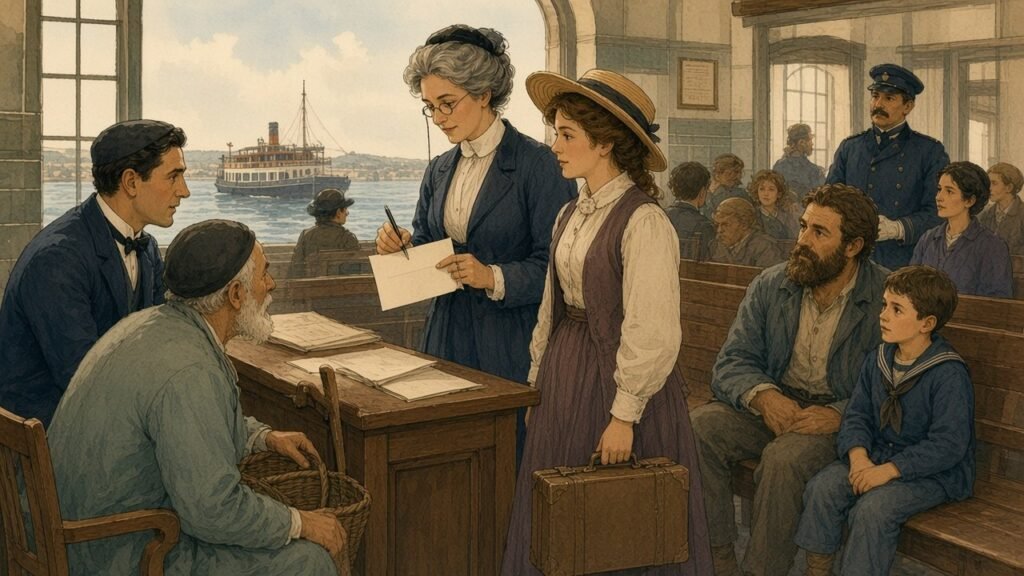
HIAS
The organisation most closely identified with Jewish immigrants in America was the Hebrew Immigrant Aid Society, known as HIAS. Unlike the Baron de Hirsch Fund and the United Hebrew Charities, it was created by the immigrants themselves. Its roots lay in the 1880s, when East European Jews on the Lower East Side began organising to help newcomers. In 1889 they founded the Hebrew Sheltering House Association, under the Hebrew name Hachnosas Orchim, “welcoming guests”, which with its women’s auxiliary provided meals, transport and jobs for new arrivals [31]. In 1902, community members gathered in a shop on the Lower East Side and founded a group that became the Hebrew Immigrant Aid Society, formally incorporated in 1903 [31]. In 1909 it merged with the Hebrew Sheltering House Association.
HIAS set up a bureau on Ellis Island in 1904, where its workers translated for immigrants, guided them through the medical screenings, argued before the Boards of Special Inquiry to prevent deportations, and obtained bonds guaranteeing that immigrants would not become public charges [31]. It found relatives, provided shelter and kosher food, helped immigrants find work, and lobbied in Washington against restrictive legislation. It held Passover seders for detained immigrants on Ellis Island; one, on 21 April 1913, is recorded in a well-known photograph [31]. By the First World War, HIAS had become one of the most important institutions of American Jewish life, and it remains active today, now aiding refugees of every background.
The National Council of Jewish Women
Women and girls arriving alone faced particular dangers, and one organisation took them as its special concern. The National Council of Jewish Women was founded in Chicago in 1893, under the leadership of Hannah Greenebaum Solomon, following the Jewish Women’s Congress at the World’s Columbian Exposition [73] [74]. Within a few years, immigrant aid had become the core of its work. Its members met unaccompanied Jewish girls at the ports of entry, built settlement houses, offered vocational training and Americanisation classes, and fought the “white slave” trade that preyed on young immigrants; in all, the council served more than twenty thousand Jewish girls who arrived in America without guardians [73]. Some of the young women it helped found its “friendly visitors” intrusive and condescending [73]. Sadie American, who led the council’s New York section and was for years its national secretary, did more than anyone to make it an effective agency for assisting Jewish immigrants [75].
The settlement houses
On the Lower East Side itself, the newcomers met a different kind of institution: the settlement house. Inspired by Toynbee Hall in London, settlement houses were founded by middle-class reformers who came to live among the poor, offering classes, clubs, health care and social services. The most famous on the Lower East Side was the Henry Street Settlement, founded in 1893 by the nurse Lillian Wald, herself the daughter of German Jewish parents, with financial support from Jacob Schiff [76] [77]. Wald’s visiting nurses climbed the tenement stairs to care for the sick, and the settlement became a centre of education, culture and reform. The Educational Alliance, established at the end of the 1880s by German Jewish philanthropists on East Broadway, offered English classes, lectures, a library, a gymnasium and, controversially, an explicit programme of Americanisation [77].
The immigrants' own institutions
Alongside these organisations founded from above, the immigrants built their own network of mutual aid: the landsmanshaftn, the hometown societies; the synagogue benevolent societies; the free loan societies, which lent money without interest; the Workmen’s Circle, the socialist fraternal order founded in 1900; and the burial societies, sick-benefit funds and orphan asylums. These institutions, which are the subject of a later chapter, were often more important in the daily lives of the immigrants than the great philanthropic organisations. They offered help on terms of equality rather than charity, and they gave the immigrants a sense of dignity and self-reliance.
From shelter to society
The history of HIAS itself shows how the aid network grew from below as well as from above. According to the Encyclopaedia Judaica, the organisation’s roots lay in the emergency of 1881, when a temporary Russian Emigrant Relief Committee in New York formed the Hebrew Emigrant Aid Society to provide meals, transport and help in finding work for the refugees arriving at Castle Garden [78]. In 1882 the first Jewish shelter for immigrants was opened on the Lower East Side. In 1889 the shelter took the name Hebrew Sheltering House Association and was reorganised by East European immigrants under the traditional Hebrew name Hakhnoses orkhim, “hospitality to strangers” [78]. The Hebrew Immigrant Aid Society proper was founded in 1902, and in 1909 it merged with the Hebrew Sheltering House Association [78].
The difference between this organisation and the philanthropies of the uptown elite lay in its base. HIAS was founded and run largely by East European immigrants themselves, many of whom had once been greenhorns, and it drew its support from thousands of small donors in the immigrant quarters as well as from wealthy patrons. Its traditional name expressed a religious duty, the obligation to welcome the stranger, rather than the language of scientific charity favoured by the uptown agencies. Within a decade of the merger, it had become a national organisation, providing help with legal entry, subsistence, employment, citizenship instruction and the search for relatives to nearly half a million newcomers [78].
Charity and dignity
The question of how to give help without humiliating its recipients ran through the history of the aid network. The established charities of the late nineteenth century were influenced by the doctrines of “scientific charity”, which held that indiscriminate relief encouraged dependency and that applicants should be investigated to separate the “deserving” from the “undeserving” poor. The United Hebrew Charities of New York, founded in 1874 by the merger of several older societies, applied these principles to the immigrants, with investigations, case records and conditions attached to aid. Many immigrants experienced these methods as degrading. They contrasted them with the traditional Jewish ideals of tsedakah, charity as an obligation of justice, and of the free loan, which allowed the recipient to keep his self-respect.
Over time, the professional social work developed by the Jewish charities became more sensitive to these concerns. Social workers from the immigrant community itself entered the field, and the agencies learned to work with the landsmanshaftn and other immigrant organisations rather than over their heads. The founding of the Kehillah in 1908, which brought uptown and downtown leaders together in a single communal body, and of the Federation for the Support of Jewish Philanthropic Societies in New York in 1917, reflected a gradual shift from charity imposed from above to a more cooperative model of communal responsibility.
An international system
The American organisations were only one part of an international network that stretched back across the Atlantic to the frontier towns of the Pale. In Europe, the Alliance Israélite Universelle, the Jewish Colonization Association and the Hilfsverein der Deutschen Juden, founded in Berlin in 1901, advised and assisted emigrants, negotiated with governments and shipping lines, and maintained offices at border stations and ports [30] [35] [79]. In London, the Jews’ Temporary Shelter housed transmigrants on their way to America. In Russia itself, a Society for the Regulation of Jewish Emigration was founded in St Petersburg in 1907, in response to the growing need and to mounting cases of fraud in the emigration business [1].
This network was remarkable for its time. No other emigrant people of the period had anything comparable: a set of organisations, spanning several countries, that sought to guide, protect and support its members at every stage of the journey, from the decision to leave to settlement in the new country. It was the product of a long tradition of Jewish communal self-help, adapted to the conditions of mass migration, and of the solidarity, sometimes grudging, that bound the established Jewish communities of the West to their poorer brethren in the East. It did not prevent suffering, exploitation and failure. But it made the great migration less chaotic, and less cruel, than it would otherwise have been.
Tensions
The aid network was not a harmonious whole. The German Jewish philanthropists who ran the Baron de Hirsch Fund, the United Hebrew Charities and the Educational Alliance often regarded the immigrants as a problem to be managed, and their help came with pressure to Americanise, to abandon Yiddish, to give up “Old World” religious customs and radical politics. The immigrants resented this condescension and built their own institutions in response. The European organisations and the American ones argued constantly about how many emigrants should be sent and who should pay for them. Zionists and territorialists argued with those who wanted to settle Jews in America. And everyone argued about money.
Yet the system worked remarkably well. It helped hundreds of thousands of people make the journey and establish themselves in America. It protected them from the worst forms of exploitation, at the frontier, in the ports and at Ellis Island. It gave them information, shelter, food, work and legal help. And it showed, to a degree unusual among immigrant groups, a sense of collective responsibility for the fate of every member of the community. The traditional Jewish ideals of tsedakah, charity, and hakhnoses orkhim, hospitality to strangers, were adapted to the demands of an age of mass migration.
23. Uptown and Downtown
When the East European Jews began arriving in large numbers in the 1880s, they found an established American Jewish community already in place. It numbered perhaps a quarter of a million people, most of them immigrants from the German-speaking lands of Central Europe or their children, who had come in the middle decades of the nineteenth century. Many had started as peddlers and small shopkeepers and had risen, within a generation, into the commercial and professional middle class; a few had become very rich, as bankers, department store owners and manufacturers. In New York they lived increasingly on the Upper East Side and the Upper West Side, worshipped in grand Reform temples such as Temple Emanu-El on Fifth Avenue, and moved with growing confidence in American society. The newcomers settled downtown, on the Lower East Side. The relationship between “uptown” and “downtown” was one of the central dramas of American Jewish history in this period.
Two communities
The differences between the two communities were deep. The German Jews were, by the 1880s, largely acculturated. They spoke English, or German at home, dressed like other prosperous Americans, and practised a Reform Judaism that had abandoned many traditional rituals, including in many congregations the dietary laws, the covering of the head in prayer and the hope of a return to Zion. In 1885 the leading Reform rabbis, meeting in Pittsburgh, declared that Jews were “no longer a nation, but a religious community”, and that they expected neither a return to Palestine nor the restoration of the ancient sacrificial worship. The German Jews saw themselves as Americans of the Mosaic faith.
The East Europeans were, in their eyes, a different people. They spoke Yiddish, which the Germans regarded as a corrupt jargon. They were mostly poor, and many worked in the garment workshops owned by German Jews. They were either strictly Orthodox, observing rituals the Reform Jews had discarded, or militantly secular and socialist. They wore old-fashioned clothes, beards and sidelocks. They crowded into tenements in conditions that shocked middle-class observers. And there were so many of them. By 1900, East European Jews outnumbered the German Jews several times over, and the proportion grew every year.
Embarrassment and responsibility
The German Jewish response to the newcomers combined genuine charity with acute anxiety. On the one hand, the established community recognised an obligation to help co-religionists who had fled persecution, and it gave generously. The United Hebrew Charities, the Baron de Hirsch Fund, the Educational Alliance, the Hebrew Orphan Asylum, Mount Sinai Hospital and many other institutions supported by German Jews served the immigrants. Jacob Schiff, the senior partner of the banking house Kuhn, Loeb and Company and the most powerful Jewish leader of his generation, gave enormous sums to immigrant causes and devoted himself to their welfare [80].
On the other hand, the German Jews feared that the newcomers would provoke antisemitism and undermine their own position. American society in the 1870s and 1880s was becoming less welcoming to Jews of any origin. In 1877, the banker Joseph Seligman was turned away from the Grand Union Hotel in Saratoga Springs, a famous episode that signalled the spread of social exclusion. Clubs, resorts, schools and neighbourhoods began to close their doors to Jews. The German Jews worried that the visible poverty, foreign ways and radical politics of the East Europeans would confirm the prejudices of their enemies and that all Jews would be judged by the newcomers.
This anxiety expressed itself in condescension. German Jewish newspapers sometimes wrote of the immigrants in terms that echoed those of nativists, describing them as dirty, ignorant, uncouth and superstitious. Some German Jewish leaders, especially in the early 1880s, opposed the immigration altogether and urged the European committees to stop sending refugees. Others favoured dispersing the immigrants across the country, so that they would not form a visible mass in New York.
Americanisation
The central strategy of the uptown leadership was Americanisation. The newcomers were to be helped, but they were also to be transformed: taught English, cleanliness, American manners and American values; weaned from Yiddish, from Old World religious customs and from radical politics; and turned into respectable American citizens as quickly as possible. The institutions the German Jews founded on the Lower East Side, above all the Educational Alliance on East Broadway, were explicitly devoted to this mission. They offered English classes, lectures on American history and civics, libraries, gymnasiums, music and art classes, and clubs for young people. Night schools for adults were filled with workers who came after a long day in the shop.
Many immigrants embraced these opportunities eagerly. The hunger for education among East European Jews was extraordinary, and the classes of the Educational Alliance, the settlement houses and the public night schools were crowded. Mary Antin, who arrived in Boston in 1894, became the most famous advocate of Americanisation; her memoir The Promised Land, published in 1912, celebrated the transformation of an immigrant girl from Polotsk into an American [5] [81].
But many immigrants resented the condescension that came with the help. They did not want to be told that their language was a jargon, their religion superstition, their politics dangerous. They wanted to become Americans on their own terms. The tension between Americanisation from above and self-organisation from below ran through the history of the immigrant community.
Building bridges
Over time, the relationship between uptown and downtown changed. The uptown leaders came to recognise that the immigrants could not simply be remade in their image, and that they would have to work with the immigrants’ own institutions. Some German Jews, like Lillian Wald at the Henry Street Settlement, built relationships of genuine respect with the immigrant community [76]. Others began to see value in the immigrants’ Jewish commitment.
A key moment came with the reorganisation of the Jewish Theological Seminary in New York in 1902, under the leadership of the Romanian-born scholar Solomon Schechter, with funds from Schiff and other uptown philanthropists. The seminary was intended to train American-born rabbis who could reach the children of the immigrants, combining traditional observance with modern scholarship and English-language preaching. It became the centre of what would be called Conservative Judaism, which in the following decades attracted many of the immigrants’ children as they moved out of the Lower East Side.
The American Jewish Committee
The pogroms of 1903 to 1906 brought uptown and downtown closer together in common concern for the Jews of Russia. In 1906 a group of uptown leaders, among them Schiff, Louis Marshall, Cyrus Adler, Oscar Straus and Mayer Sulzberger, founded the American Jewish Committee, to defend the civil and religious rights of Jews in America and abroad [47]. The committee was an elite body, its members chosen rather than elected, and it was criticised by downtown leaders as undemocratic. But it led successful campaigns against restrictive immigration legislation and, as described earlier, for the abrogation of the Russo-American treaty of 1832 in 1911 [47].
The Kehillah
In September 1908, New York’s police commissioner, Theodore Bingham, published an article claiming that Jews, who made up about a quarter of the city’s population, were responsible for half of its crime. The claim provoked outrage on the Lower East Side, and Bingham was forced to retract it. But the episode also prompted a serious effort to organise the community. Under the leadership of Judah Magnes, a young Reform rabbi who bridged uptown and downtown, the Kehillah of New York was founded in 1908 as a democratic communal body representing the city’s Jewish organisations. It conducted surveys of Jewish education, set up a bureau to improve Jewish schools, mediated labour disputes, and established a bureau to combat crime in the Jewish neighbourhoods. The Kehillah was an ambitious experiment in communal self-government; it faded after the First World War, but it left a lasting mark on Jewish education and social work in New York.
"Here a Jew is as good as a Gentile"
The debate over Americanisation was not only a quarrel between uptown and downtown. It ran through the immigrant community itself, and through the lives of individual immigrants. Abraham Cahan’s first novel, Yekl, a Tale of the New York Ghetto (1896), dramatised it with comic and painful precision. Its hero, Yekl, who now calls himself Jake, is a cloakmaker who has been in America for three years and is determined to be taken for a “Yankee”. He has shaved off his beard, follows boxing and baseball, frequents a dancing academy, and peppers his Yiddish with English words. When a scholarly shopmate named Bernstein teases him for his passion for prizefighters, Jake replies: “Once I live in America, I want to know that I live in America. Dot’sh a’ kin’ a man I am! One must not be a greenhorn. Here a Jew is as good as a Gentile. How, then, would you have it? The way it is in Russia, where a Jew is afraid to stand within four ells of a Christian?” [82].
Jake’s outburst captures the exhilaration of freedom that many immigrants felt in America, and the way in which that freedom could be expressed in the most superficial forms of imitation. Cahan treats him with irony but also with sympathy. Jake’s tragedy is that, in his eagerness to become American, he has concealed from his new friends that he has a wife and child in Russia. When his wife Gitl arrives, wearing a wig and speaking only Yiddish, he is ashamed of her, and the marriage collapses. By the end of the novel Gitl, too, has begun to Americanise, while Jake, about to marry a fashionable young woman from the dancing academy, feels not triumph but dread [82]. Hapgood, writing a few years later, called Yekl “the Ghetto masterpiece in the portrayal of these two types of women–the wronged ‘greenhorn’ who has just come from Russia, and she who, with a rakish hat and bad English, is becoming an American girl” [56].
The novel was praised by William Dean Howells, the dean of American letters, and it was one of the first works of fiction to present the Jewish immigrant world to an English-speaking audience from the inside [32]. Its theme, the cost of Americanisation, would recur in immigrant literature for generations.
Ashamed of the Ghetto?
The uptown community’s anxieties about the image of the Jewish immigrants extended to literature and the stage. Hapgood recorded that when Israel Zangwill’s Children of the Ghetto, a dramatisation of his novel about the Jewish East End of London, was produced in New York, “the organs of the swell uptown German-Jew protested that it was a pity to represent faithfully in art the sordidness as well as the beauty of the poor Russian Ghetto Jew”; it seemed to them “particularly baneful that the religious customs of the Jews should be thus detailed upon the stage” [56]. The downtown Jews, by contrast, “received play and stories with delight, as expressing truthfully their life and character, of which they are not ashamed” [56].
The episode illustrates a recurring pattern. The established Jews, conscious of their precarious acceptance in American society, wanted the Jewish image to be respectable, decorous and assimilated. The immigrants, more confident in their identity even when they were poor, wanted to see their own lives portrayed honestly, with their poverty, their piety and their conflicts. As the immigrant generation produced its own writers, artists and spokesmen, it increasingly took control of its own representation, and the uptown leaders’ power to shape the image of American Jewry declined.
Learning from each other
Over time, each side learned from the other. The German Jewish leaders came to appreciate the depth of the immigrants’ religious and cultural traditions, and some of them, notably Jacob Schiff and Louis Marshall, developed a genuine respect for the immigrant community and its institutions. The immigrants, for their part, learned from the established community the techniques of American philanthropy, organisation and political influence, and they built on the foundations it had laid. By the 1920s, the children of the immigrants were taking their places in the institutions their parents had once regarded as alien, and the distinction between uptown and downtown, though it lingered in social life for decades, had lost much of its meaning.
The Yiddish word yahudim, used by the immigrants half-mockingly for the German Jews, and the German Jews’ disdain for the Russen, faded with time. What remained was a single, if diverse, American Jewish community, shaped by both its German and its East European roots, which would face the challenges of the 1930s and 1940s together.
A shifting balance
By the eve of the First World War, the balance of power in American Jewry had begun to shift. The East European immigrants and their children vastly outnumbered the German Jews, and they were beginning to rise economically and to build their own institutions, from synagogues and unions to newspapers and political organisations. The American Jewish Congress movement, launched during the war by Zionists and downtown leaders as a democratic challenge to the American Jewish Committee, was a sign of this shift. Within another generation, the descendants of the East European immigrants would dominate American Jewish life.
The relationship between uptown and downtown was never simple. It combined generosity and condescension, solidarity and suspicion, cooperation and conflict. But it also forged, over time, a single American Jewish community out of two very different groups. The German Jews gave the immigrants institutions, money, political connections and a model of how to be both Jewish and American. The immigrants gave American Jewry numbers, energy, Jewish learning and a passionate commitment to Jewish causes. Both were changed by the encounter.
24. The Lower East Side
For the great majority of the Jewish immigrants who arrived in New York between 1881 and 1914, the first American home was a district of a few dozen blocks on the east side of lower Manhattan, bounded roughly by the Bowery to the west, Fourteenth Street to the north, the East River to the east and the waterfront and Catherine Street to the south. They called it, in Yiddish, simply di ist sayd, the East Side; later generations called it the Lower East Side. By the first decade of the twentieth century it had become one of the most densely populated places on earth, and the largest Jewish community in the world. Its streets, tenements, markets, synagogues, cafés, theatres and sweatshops became the setting of an American Jewish myth that still endures.
A neighbourhood of newcomers
The Lower East Side had been an immigrant district long before the East European Jews arrived. In the middle of the nineteenth century it was Kleindeutschland, Little Germany, home to tens of thousands of German immigrants, and Irish immigrants lived in its southern and eastern parts. From the 1870s, as the Germans moved uptown or to Brooklyn and Yorkville, the East European Jews moved in, first into the blocks around Bayard, Mott and Division Streets, then spreading east along Hester, Grand, Delancey, Rivington and Stanton Streets towards the river. Italians settled to the west, around Mulberry Street, and smaller groups of Greeks, Slovaks, Hungarians, Romanians and others lived among the Jews.
Within the Jewish quarter, immigrants clustered by origin. Hungarian Jews settled north of Houston Street; Galician Jews between Houston and Broome; Romanian Jews around Allen and Chrystie Streets; Russian and Lithuanian Jews in the blocks south of Grand Street, from the Bowery to the river. Landslayt from the same town often lived in the same building or on the same block, and the neighbourhood was a patchwork of overlapping hometown communities. Jacob Riis, who described the district in his famous exposé How the Other Half Lives in 1890, called it “Jewtown” [83].
Density
The most striking feature of the Lower East Side was its crowding. Riis reported that in the Tenth Ward, the heart of the Jewish quarter, the population had risen “to the rate of three hundred and thirty thousand per square mile”, compared with a maximum of a hundred and seventy-five thousand in “the densest crowding of Old London” [83]. “It is said that nowhere in the world are so many people crowded together on a square mile as here,” he wrote [83]. He described a seven-storey tenement in Ludlow Street that housed thirty-six families, in which, at the time of a smallpox case, “there were fifty-eight babies and thirty-eight children that were over five years of age”, and two small rooms in Essex Street that held a “family” of father, mother, twelve children and six boarders [83].
The crowding grew worse as immigration accelerated after 1900. By around 1910, according to most estimates, the Lower East Side housed more than half a million people, the great majority of them Jews. Its density then exceeded even the figures Riis had reported. It was not until the opening of the Williamsburg Bridge in 1903 and the Manhattan Bridge in 1909, and the spread of the subway system after 1904, that significant numbers of Jews began to move out to Brooklyn, Harlem and the Bronx, and the density of the old neighbourhood began to fall.
Tenements
The immigrants lived in tenements, multi-family buildings of five or six storeys built to house as many people as possible on a narrow city lot. The characteristic form was the “dumbbell” tenement, a design that won a competition in 1879 and was widely built under the Tenement House Act of that year. Named for its shape, it had a narrow airshaft on each side, pinched in at the middle of the building, intended to bring light and air to the interior rooms. In practice, the airshafts were dark, airless and used as garbage chutes, and they carried noise, smells and fire from one apartment to the next.
A typical dumbbell tenement had four apartments on each floor, each of three or four rooms: a front room facing the street, a kitchen, and one or two windowless bedrooms. Toilets were in the hall, shared by several families, or in the yard behind; running water came from a tap in the hall. There were no bathtubs; residents used public bathhouses. The rooms were tiny, and families of six, eight or ten people, often with boarders, crowded into them. In summer the heat was unbearable, and people slept on the roofs and fire escapes; in winter the coal stove in the kitchen was the only source of heat.
The Tenement House Act of 1901, a landmark of the Progressive era, banned the construction of new dumbbell tenements and required that new buildings have larger courtyards, a window in every room, and a toilet in every apartment. It also required improvements to existing buildings. The “new-law” tenements built after 1901 were a considerable improvement, but most immigrants continued to live in the older buildings for many years.

The boarder
The boarder was a fixture of tenement life. Many families took in lodgers, young single men or women, often landslayt from the same town, who paid a small sum for a bed, sometimes shared, and meals. Boarders helped families pay the rent, but they added to the crowding and sometimes to domestic tensions. Riis observed that “the boarder plays as important a part in the domestic economy of Jewtown as the lodger in the Mulberry Street Bend” [83]. Abraham Cahan’s novella Yekl, published in 1896, and many stories in the Yiddish press, explored the complications that the boarder could bring into family life [82].
The street
Much of life on the Lower East Side was lived in the street. The tenements were too small and crowded to spend much time in, and the streets were full of people at all hours: women shopping, men talking, children playing, peddlers crying their wares. The great market of the district was on Hester Street, where pushcarts lined the kerbs and sold everything imaginable. Riis described it in 1890 as the “Pig-market”, a name “given to it probably in derision, for pork is the one ware that is not on sale”. There, he wrote, “there is scarcely anything else that can be hawked from a wagon that is not to be found, and at ridiculously low prices”: bandannas and tin cups at two cents, peaches at a cent a quart, hats for a quarter, spectacles “warranted to suit the eye” for thirty-five cents, and “frowsy-looking chickens and half-plucked geese” [83].
Pushcart peddling was the entry point into commerce for many immigrants. A man with a few dollars could rent a cart and buy a stock of goods, and with luck and hard work could save enough to open a small shop. The pushcart markets were a vivid and noisy feature of the Lower East Side until the 1930s, when the city moved them into enclosed markets.
Cafés and culture
The Lower East Side was poor, but it was also a place of extraordinary intellectual and cultural ferment. The journalist Hutchins Hapgood, who explored the district at the turn of the century and published his observations in The Spirit of the Ghetto in 1902, was fascinated by its cafés. In East Canal Street, he wrote, were “many of the little Russian Jewish cafés … where excellent coffee and tea are sold, where everything is clean and good, and where the conversation is often of the best”. There gathered “actors, socialists, musicians, journalists, and poets”, talking “by the hour, over their coffee and cake, about politics and society, poetry and ethics, literature and life” [56]. The combination, he thought, was “Russian, Jewish, and exile” [56].
The district had dozens of synagogues, from grand buildings like the Eldridge Street Synagogue, opened in 1887, to tiny storefront prayer rooms. It had Yiddish theatres on the Bowery and later on Second Avenue, Yiddish newspapers on East Broadway, lecture halls, libraries, night schools and political clubs. It was a place where an immigrant could hear a sermon in the morning, a socialist lecture in the afternoon and a Yiddish melodrama in the evening.
Health and disease
The crowding and poverty of the Lower East Side made it a breeding ground for disease. Tuberculosis, the “tailors’ disease”, was rife among garment workers. Infant mortality was high, though lower among Jews than among some other immigrant groups. Epidemics of typhus, diphtheria and measles swept through the tenements. Public health reformers, settlement workers and visiting nurses, like those of Lillian Wald’s Henry Street Settlement, fought to improve conditions, and the city gradually built public baths, parks, playgrounds and clinics.
Thrift and its costs
Riis, who was no friend of the immigrants he described, wrote that “thrift is the watchword of Jewtown, as of its people the world over” [83]. His account of the Jews, like his accounts of other immigrant groups, was full of stereotypes, and some of what he wrote now reads as ugly prejudice. But it also recorded the extraordinary efforts the immigrants made to save money, often at great cost to their health, in order to bring over relatives, open a business or send their children to school. The determination to escape the tenements drove many of them to work punishing hours and live on almost nothing.
Riis's Jewtown
Jacob Riis’s description of the Jewish quarter in 1890 is a document both of the conditions of the Lower East Side and of the prejudices of the reformers who exposed them. Crossing the Bowery from Chinatown and the Italian district, he wrote, “the tenements grow taller, and the gaps in their ranks close up rapidly” [83]. The Jewish character of the district was so marked that “when the great Jewish holidays come around every year, the public schools in the district have practically to close up. Of their thousands of pupils scarce a handful come to school” [83].
Riis gave examples of the crowding that made the district notorious. One seven-storey tenement in Ludlow Street, a sanitary policeman told him, contained thirty-six families; in it, when a case of smallpox was reported, there were “fifty-eight babies and thirty-eight children that were over five years of age”. In Essex Street, “two small rooms in a six-story tenement were made to hold a ‘family’ of father and mother, twelve children, and six boarders” [83]. He estimated the density of the population at the rate of 330,000 per square mile [83].
What struck Riis most, after the crowding, was the relentless work. “Life here means the hardest kind of work almost from the cradle,” he wrote [83]. Walking along any East Side street, the visitor heard “the whir of a thousand sewing-machines, worked at high pressure from earliest dawn till mind and muscle give out together”; it was “not unusual to find a dozen persons–men, women, and children–at work in a single small room” [83]. Riis contrasted the Jewish quarter with the Italian Mulberry Bend nearby: there, the whole population seemed to pour into the street; here, all its energies “appear to be bent upon keeping in and away from it” [83].
The pawnbroker's explanation
Riis asked a pawnbroker in the district, whom he described as “an unusually intelligent and charitable” man, how there came to be so many desperately poor people in such a colony of workers. The answer is a useful summary of the pressures on the community at the end of the 1880s. “Immigration,” the pawnbroker said, “brings us a lot. In five years it has averaged twenty-five thousand a year, of which more than seventy per cent. have stayed in New York. Half of them require and receive aid from the Hebrew Charities from the very start, lest they starve” [83]. The other class of the poor, he went on, consisted of those who had worked too hard: who had “worked and hoarded and lived, crowded together like pigs, on the scantiest fare and the worst to be got, bound to save whatever their earnings, until, worn out, they could work no longer” [83].
The managers of the Eastern Dispensary, in the heart of the district, told Riis that “the diseases these people suffer from are not due to intemperance or immorality, but to ignorance, want of suitable food, and the foul air in which they live and work” [83]. Many immigrants, he reported, hid their sick from the health officers, out of a firm belief that the authorities would carry them off to hospital to die [83]. The fear was not entirely irrational, given the conditions in some public hospitals and the experience of the cholera quarantines of 1892, and it was one reason why the immigrants founded hospitals of their own.
Reading Riis today
Riis’s book helped to launch the campaign for tenement reform that culminated in the Tenement House Act of 1901, and his photographs remain among the most famous images of immigrant poverty in America. But his descriptions of the Jews are laced with hostility. He wrote that “money is their God”, described the immigrants’ thrift as “an over-mastering passion”, and repeated stereotypes of Jewish greed that would have been familiar to any antisemite of the period [83]. Even his sympathy was often condescending.
The immigrants themselves read the Lower East Side differently. To them, the long hours and the crowded rooms were the price of a foothold in America, a sacrifice made for the sake of children who would not have to make it. The thrift that Riis condemned was the means by which families paid for the passage of relatives, saved enough to open a shop or move to a better neighbourhood, and kept their children in school. And the district that seemed to Riis a hive of joyless toil was, as Hapgood and others discovered, also a place of intense religious, intellectual and political life. Both views contain a part of the truth, and historians of the Lower East Side have had to hold them together.
Dover Street
The Lower East Side was the largest Jewish immigrant district, but it was not unique; every American city that received the immigrants had its own version. Mary Antin’s description of Dover Street, in Boston’s South End, where her family moved after her father’s grocery on Wheeler Street failed, captures the double character of these neighbourhoods as their young inhabitants experienced them. “Dover Street was my fairest garden of girlhood, a gate of paradise, a window facing on a broad avenue of life,” she wrote. “Dover Street was a prison, a school of discipline, a battlefield of sordid strife” [5].
Outwardly, she explained, Dover Street was “a noisy thoroughfare cut through a South End slum”, and “every one of those streets is a rubbish heap of damaged humanity”. Harrison Avenue, which crossed it, was “the heart of the South End ghetto”, its business bursting “through the narrow shop doors” into the basements, the sidewalks and the street itself, “in pushcarts and open-air stands”, while its population “floods the corridors, the doorsteps, the gutters, the side streets, pushing in and out among the pushcarts, all day long and half the night besides” [5]. Even Passover could not clean it: the tenements were scrubbed, but the cleaning “stops at the curbstone”, and the rubbish pitched into the street was trampled to dust that drifted back into the houses [5].
The family came to Dover Street for no particular reason except that “tenements were cheap; by which I mean that rent was low. The ultimate cost of life in those tenements, in terms of human happiness, is high enough” [5]. Their home was “five small rooms up two flights of stairs”, where in the parlour “the dingy paper hung in rags and the plaster fell in chunks”, and one of the bedrooms was “absolutely dark and air-tight”. Six people lived in the five rooms, “bound to be always in each other’s way” [5]. From the window of the tiny bedroom she shared with her sister there was a view of a lumberyard and the “blackened walls of a factory”, and an unceasing noise of electric cars, machinery and heavy trucks [5].
Antin had pointed criticism for the city. “The City Fathers provide soap and water for the slums, in the form of excellent schools, kindergartens, and branch libraries. And there they stop: at the curbstone of the people’s life. They cleanse and discipline the children’s minds, but their bodies they pitch into the gutter.” There were no parks and “almost no playgrounds” in the district; “in my day there were none” [5]. Her complaint echoed those of reformers in New York, who campaigned for parks, playgrounds and better housing on the Lower East Side in the same years, and it expresses the paradox of the immigrant city: generous with education, neglectful of the conditions in which its newest citizens lived.
Leaving the Lower East Side
The Lower East Side was, for most immigrants, a place of passage rather than a permanent home. As soon as they could afford it, families moved to better neighbourhoods: Harlem, Brownsville and Williamsburg in Brooklyn, and later the Bronx. The bridges and subways made these moves possible. By the 1920s, the Jewish population of the Lower East Side had begun to decline, and by the 1930s most of its former residents had moved on.
Yet the Lower East Side remained the symbolic heart of Jewish New York. For the immigrants and their children, it was the place where it had all begun, and it acquired in memory a warmth and vitality that the reality of crowding and poverty had often obscured. Books, plays, films and photographs, and later the Tenement Museum on Orchard Street, have preserved its memory. For many American Jews, a visit to the Lower East Side remains a kind of pilgrimage to the origins of their families in America.
25. The Needle Trades
If one industry defined the economic life of the Jewish immigrants, it was the making of clothes. In the years between 1881 and 1914, the garment industry of New York grew from a modest trade into one of the largest manufacturing industries in the United States, producing most of the ready-made clothing worn by American women and a large share of men’s. Its growth and the great migration were bound together. The immigrants supplied the labour that made the expansion possible; the industry supplied the jobs that allowed the immigrants to survive. By the early twentieth century, a large proportion of the Jewish working population of New York worked in the needle trades, and the shops, lofts and tenement workrooms where they toiled became the setting of some of the most important struggles in American labour history.
Tailors from the Pale
Many of the immigrants came with the skills the industry needed. Tailoring had been one of the most common Jewish occupations in the Pale, and the immigrants included large numbers of tailors, seamstresses, dressmakers and other needleworkers. Of the Jewish immigrants who arrived between 1899 and 1910 and reported an occupation, 145,272 described themselves as tailors, more than any other trade; dressmakers, seamstresses and milliners added many thousands more [4]. Overall, 67.1 per cent of Jewish immigrants who reported an occupation in those years were skilled workers, a far higher share than among any other immigrant group [4].
Many others learned the trade after they arrived. For an immigrant with no particular skill, the garment industry offered work that could be learned quickly. A young man or woman could start as a finisher, sewing buttons and hems by hand, or as a presser, and move on to operating a sewing machine. Abraham Cahan’s novel The Rise of David Levinsky, published in 1917, follows a former yeshiva student who arrives penniless in New York, works as a peddler and is apprenticed to a cloak operator, learning “to bind seams, and later to put in pockets, to stitch on ‘under collars'”, before he rises to become a millionaire manufacturer [17].
The rise of ready-made clothing
Before the Civil War, most Americans had their clothes made at home or by tailors and dressmakers. Ready-made clothing existed, but it was mostly cheap work clothes and garments for sailors and slaves. The Civil War, with its huge demand for uniforms, stimulated the mass production of men’s clothing and the development of standard sizes. In the following decades, the industry expanded rapidly, and from the 1880s the manufacture of ready-made clothing for women, cloaks, suits, skirts and later shirtwaists and dresses, became the fastest-growing branch.
The industry was concentrated in New York, which had the advantages of a great port, a huge market, a fashion centre and, above all, an abundant supply of cheap labour. The manufacturers were, in the early decades, mostly German Jews, who had moved into the clothing business as merchants and wholesalers in the mid-nineteenth century. As the East European immigrants arrived, many of them became contractors and, eventually, manufacturers themselves.
Contractors and sweatshops
The structure of the industry was shaped by the contracting system. Manufacturers designed garments, bought the cloth and cut it in their own establishments, the “inside shops”. They then gave out “bundles” of cut pieces to contractors, who had them sewn up in their own small workshops by hired workers and returned the finished garments. As Cahan’s Levinsky explains, his shop “was not the manufacturer’s. It belonged to one of his contractors, who received from him ‘bundles’ of material which his employees (tailors, machine-operators, pressers, and finisher girls) made up into cloaks or jackets” [17].
The contracting system had advantages for manufacturers: it required little capital, allowed them to expand and contract production quickly with the seasons, and shifted the burden of finding and managing workers onto the contractors. For immigrants, it offered an easy entry into business: a contractor needed only a few sewing machines, a room and the ability to recruit workers, often landslayt or relatives. But competition among contractors was ferocious, and they made their profits by squeezing their workers. The result was the “sweating system”: long hours, low wages, piece rates that fell whenever workers speeded up, and unhealthy, crowded workplaces.
The sweatshops were often in tenement apartments, where the contractor’s family lived and worked alongside the hired hands, or in lofts and basements. The work was seasonal. In the busy season, workers might labour fourteen or sixteen hours a day, seven days a week; in the slack season, they might have no work at all. Hutchins Hapgood wrote of the old scholars from the Pale who, on arriving in New York, became sweatshop tailors: “There are few more pathetic sights than an old man with a long beard … a man who had been perhaps a Hebraic or Talmudic scholar in the old country, carrying or pressing piles of coats in the melancholy sweat-shop” [56].

Homework
Much of the work was done at home. Women and children, especially, did “finishing” work, sewing buttons, felling seams and pulling bastings, in tenement apartments for a few cents a garment. Homework allowed mothers to earn money while caring for children, but it was miserably paid and turned homes into workshops. Reformers campaigned against it, arguing that it exploited women and children and spread disease, since garments made in sick households might carry infection to their wearers. New York State passed laws in the 1890s requiring licences for tenement homework and prohibiting it in certain trades, but enforcement was weak, and homework persisted for decades.
The task system
In the men’s clothing trade, a variant of the contracting system known as the “task system” prevailed in the 1880s and 1890s. Teams of workers, a baster, an operator and a finisher, were paid to complete a “task” of a set number of garments a day. As competition intensified, contractors raised the number of garments in a task without raising the pay, so that workers had to work longer and faster to earn the same wage. The task system was notorious for its exhausting pace and was one of the main targets of the early Jewish unions.
The poet of the sweatshop
The suffering of the sweatshop found its most famous voice in the poetry of Morris Rosenfeld, a presser who had arrived in New York in 1886 after spending time in London [71]. Rosenfeld’s Yiddish poems described the noise of the machines, the exhaustion of the workers, the father who leaves before his child wakes and returns after he is asleep and never sees him awake. When a selection was published in English prose translation by the Harvard scholar Leo Wiener in 1898, under the title Songs from the Ghetto, it made Rosenfeld briefly famous in America and Europe. Hapgood counted him among the four men “of great talent” among the poets of the Canal Street cafés [56].
Wages and hours
Wages in the needle trades varied widely by skill, sex and season. Skilled male cutters and tailors earned the most; female finishers the least. In the busy season, a skilled worker might earn what seemed to newcomers like a fortune; in the slack season, nothing. Working hours were long, and conditions often dangerous: poor lighting, bad ventilation, overcrowding, locked doors and inadequate fire escapes. Employers charged workers for needles, thread, electricity and the use of machines, and fined them for mistakes and lateness.
Yet the needle trades also offered opportunities. A skilled operator could earn a living wage, and an ambitious worker could save enough to become a contractor and then a manufacturer. Many of the great fortunes of the American garment industry were founded by immigrants who started at a sewing machine. The industry was a ladder as well as a trap, and the immigrants who worked in it were acutely aware of both possibilities.
Riis among the sweaters
The most widely read description of the immigrant garment trade in the period was Jacob Riis’s chapter “The Sweaters of Jewtown” in How the Other Half Lives (1890). Riis, a Danish immigrant police reporter and photographer, wrote with a mixture of sympathy and prejudice that is uncomfortable to read today; his account is full of the stereotypes of his time about Jewish greed and cunning. But he also saw clearly that the sweatshop was the product of a system rather than of individual villainy, and his descriptions influenced a generation of reformers.
A cloth manufacturer, Riis recalled, had boasted to him that in cheap clothing New York “beats the world”. Asked why, the manufacturer replied: “To the cutter’s long knife and the Polish Jew” [83]. The long knife was a new mechanical cutter that could cut many layers of cloth at once; the Polish Jew, in Riis’s account, was the cheap and abundant labour that sewed them. “Many harsh things have been said of the ‘sweater,'” Riis wrote, “that really apply to the system in which he is a necessary, logical link. It can at least be said of him that he is no worse than the conditions that created him” [83]. The sweater, he explained, was “simply the middleman, the sub-contractor, a workman like his fellows”, whose capital might consist of nothing more than “two or three sewing-machines, or of credit enough to hire them” [83]. “Of workmen he can always get enough. Every ship-load from German ports brings them to his door in droves, clamoring for work. The sun sets upon the day of the arrival of many a Polish Jew, finding him at work in an East Side tenement, treading the machine and ‘learning the trade'” [83].
Riis described how competition drove the system downward. Often there were two or three layers of sweaters on a single job, each taking a margin that might amount to only a few cents on a dozen pairs of boys’ trousers [83]. The worker who resented the sweater’s profit, Riis observed, would at the first opportunity become a sweater himself, and take his revenge “by driving an even closer bargain than his rival tyrant” [83]. Yet Riis also noted, writing at the end of the 1880s, that the sweaters had already been “forced to partial surrender by the organization of the men to a considerable extent into trades unions, and by experiments in co-operation” [83].
Beyond the reach of the law
The tenement sweatshop, Riis pointed out, was largely beyond the reach of the factory laws. In the factories, the law set a ten-hour day, required a dinner break of at least forty-five minutes and forbade the employment of children under fourteen; but “the tenement has defeated its benevolent purpose. In it the child works unchallenged from the day he is old enough to pull a thread. There is no such thing as a dinner hour; men and women eat while they work, and the ‘day’ is lengthened at both ends far into the night” [83]. Factory workers took work home at the end of the legal day to earn extra money by working overtime [83]. When Riis asked why so many people on the East Side spoke no English, though they were anxious to learn, one of them answered: “When shall we find time to learn?” Riis admitted: “I owe him the answer yet” [83].
He invited his readers to ride the Second Avenue elevated railway through the sweaters’ district, where every open window of the tenements gave a glimpse of a shop: “Men and women bending over their machines, or ironing clothes at the window, half-naked… The road is like a big gangway through an endless work-room where vast multitudes are forever laboring. Morning, noon, or night, it makes no difference; the scene is always the same” [83]. On Sunday, the first day of the Jewish working week, he watched men staggering along the pavements “under heavy burdens of unsewn garments, or enormous black bags stuffed full of finished coats and trousers” [83].
Regulating the sweatshop
Riis’s exposé, and the work of investigators such as Florence Kelley in Illinois, helped to produce the first laws regulating tenement manufacture. New York passed laws in the 1890s requiring licences for tenement workshops and banning the manufacture of certain goods in tenements, and later laws extended inspection and tightened restrictions on homework and child labour. Enforcement was weak, since there were few inspectors and thousands of workshops, and manufacturers and contractors found many ways to evade the rules. But the direction of change was clear. The movement of production from tenements into lofts and factories after 1900, driven partly by regulation and partly by the economics of power-driven machinery, made the industry easier both to inspect and to organise.
The shift from tenement to loft did not end the abuses of the industry, as the Triangle fire would show. But it concentrated workers in larger shops, where they could talk to one another, compare wages and organise. The great strikes of 1909 and 1910, described in the next chapter, took place in these new factories, among workers who had come to see themselves not as isolated greenhorns at the mercy of a sweater but as members of a class with common interests.
From peddler to operator
Cahan’s The Rise of David Levinsky traces a path that thousands of real immigrants followed: from peddling to the shop. Soon after his arrival, Levinsky meets an old acquaintance who complains that “America is a topsy-turvy country”: a shoemaker becomes a man of substance, while a former man of leisure must work in a factory, and his wife, who in Russia had supported him while he studied the Talmud, now sends him out to peddle. “America is not Russia,” she tells him. “A man must make a living here” [17].
Levinsky himself begins with a basket of collar-buttons, garters and pins. His landlady buys a paper of pins “for a lucky start”, wishing that “this little basket become one of the biggest stores in New York”. His plan was to peddle in the streets “until my ‘greenness’ should wear off” and then sell to tenement housewives; he “earned what I then called a living, but made no headway” [17]. He moves on to a rented pushcart, selling remnants of dress goods, linen and oilcloth, but remains “one of the common herd in this branch of the business as well” [17].
It is a skilled tailor named Gitelson who persuades him to change course. “Don’t be a lobster, Mr. Levinsky,” he says, using the English word. “This is not Russia. Here a fellow must be no fool.” He proposes machine-operating in a cloak shop, “which paid even better than tailoring and was far easier to learn”, and pays the fee for an operator to teach him [17]. There are “lots of educated fellows in the shops”, Gitelson assures him, including a young man who reads whenever there is a pause in the work and is “saving up money to go to college” [17].
The shop where Levinsky learns the trade is a contractor’s shop, which receives “bundles” of material from a manufacturer and makes them up into cloaks and jackets with a staff of tailors, machine operators, pressers and “finisher girls”. The cheaper goods were made entirely by operators, while the designing, cutting and sample-making were done “inside”, in the manufacturer’s own establishment [17]. The work is much harder than he had expected: he toils “from six in the morning to nine in the evening”. “Ours is a seasonal trade,” he explains. “All the work of the year is crowded into two short seasons of three and two months, respectively, during which one is to earn enough to last him twelve months” [17]. Cahan’s novel is fiction, but his description of the contracting system, the long hours and the seasonal rhythm of the trade corresponds closely to what investigators and union organisers reported.
The industry transformed
By the eve of the First World War, the New York garment industry had changed considerably. The worst of the tenement sweatshops had given way to larger factories in loft buildings, especially in the area around Washington Square and later in the Garment District around Seventh Avenue. The East European immigrants had moved from the bottom of the industry into all its ranks, from workers to contractors to manufacturers. And, after a series of great strikes between 1909 and 1913, the workers had built powerful unions that won shorter hours, higher wages and better conditions.
The story of those unions, and of the strikes that built them, is told in the next chapter. It was in the needle trades that the Jewish immigrants first made their mark on American public life, and the struggles of the garment workers became a central part of the history of American labour.
26. Unions, Strikes and the Bund in America
The Jewish immigrants who toiled in the sweatshops of New York did not accept their conditions passively. Between the 1880s and the First World War, they built one of the most powerful and distinctive labour movements in American history: a network of trade unions, socialist parties, fraternal orders, newspapers and cultural institutions that historians call the Jewish labour movement. It was born in weakness and failure, in a succession of small strikes that collapsed and unions that vanished, but between 1909 and 1914 it erupted into a series of mass strikes that transformed the garment industry and made the Jewish immigrants a force in American politics. Its leaders were often veterans of the revolutionary movements of the Russian Empire, and its culture was shaped by the experience of the Pale and the ideals of the Bund.
Early struggles
The first Jewish unions in New York appeared in the 1880s, among the cloakmakers, shirtmakers, bakers and other trades in which the immigrants worked. They were small, poor and short-lived. The seasonal nature of the garment industry made organising extremely difficult: unions grew during the busy season, when workers had some bargaining power, and collapsed in the slack season, when work dried up. Many immigrants saw themselves as temporary workers who would soon become contractors or shopkeepers, and were reluctant to commit to a union. Divisions between Jews from different regions, between socialists and anarchists, and between skilled and unskilled workers added to the difficulties.
In 1888, socialist activists founded the United Hebrew Trades, a federation of Jewish unions modelled on the German trade union federation in New York. It sought to organise Jewish workers in every trade and to provide them with support, education and socialist leadership. Its organisers, many of them young intellectuals from the Pale, gave speeches in Yiddish, published newspapers, and led strikes. In its early years, it was more successful in creating unions than in sustaining them, but it laid the foundations of the Jewish labour movement.
Socialists and anarchists
The Jewish labour movement was shaped from the beginning by radical politics. Many of the immigrant intellectuals who led it had been involved in revolutionary movements in Russia, and they brought with them a commitment to socialism or anarchism. In the 1880s and 1890s, Jewish socialists were associated with Daniel De Leon’s Socialist Labor Party, but many broke with it in the late 1890s over De Leon’s dictatorial leadership and his hostility to the existing trade unions. The lawyer Meyer London, who would later become the first socialist congressman from New York, joined the opposition to De Leon in 1897 and became a member of the Socialist Party of America [63].
The most important product of this break was the Forverts (Forward), a Yiddish socialist daily founded in 1897, which under the editorship of Abraham Cahan became the most widely read Yiddish newspaper in the world [84] [32]. The Forverts combined socialist politics with popular journalism, and it played a central role in organising and supporting the unions. Its building on East Broadway, completed in 1912, towered over the Lower East Side as a symbol of the movement’s strength.
Jewish anarchists were also active, publishing their own newspapers, notably the Fraye arbeter shtime (Free Voice of Labour), and engaging in fierce polemics with the socialists. The anarchist Emma Goldman, who arrived from Russia in 1885 and worked in a garment factory in Rochester before becoming a famous agitator, came out of this milieu.
The Bund in America
The founding of the Bund in Vilna in 1897 had a profound impact on the Jewish labour movement in America [11]. The Bund combined Marxist socialism with a commitment to Jewish national and cultural rights, and to Yiddish as the language of the Jewish masses. After the failure of the revolution of 1905, thousands of Bundists emigrated to America, bringing with them experience in underground organisation, strike leadership and armed self-defence. In America they joined the unions and the Socialist Party, founded their own branches, and supported the Bund in Russia with money and publicity.
The arrival of the Bundists transformed the Jewish labour movement. They were more disciplined, more committed and more experienced than many of the earlier activists, and they brought a new emphasis on Jewish culture and the Yiddish language. In 1912 they helped found the Jewish Socialist Federation, a Yiddish-speaking branch of the Socialist Party. Bundist veterans became leaders of the garment unions, the Workmen’s Circle and the Yiddish press, and their influence on the culture of the Jewish left in America lasted for decades.
The Workmen's Circle
The Workmen’s Circle, the Arbeter Ring, began as a small mutual aid society on the Lower East Side in 1892 and was organised as a national order in 1900 [85]. It provided sick benefits, insurance, medical care and burial plots to its members, like the landsmanshaftn, but on a socialist and secular basis. It also sponsored lectures, libraries, Yiddish schools for children and cultural activities. By the eve of the First World War it had tens of thousands of members across the United States, and it became one of the pillars of the Jewish labour movement. Its goal, its members said, was to build a shenere un besere velt, “a more beautiful and better world” [85].
The ILGWU
On 3 June 1900, eleven Jewish tailors founded the International Ladies’ Garment Workers’ Union in New York [86]. The ILGWU brought together the small unions of cloakmakers, shirtwaist makers and other workers in women’s clothing. In its first years it struggled, but it would become, within a decade, one of the largest unions in the country. Although founded by men, it relied for most of its history on a largely female rank and file [86].
The Uprising of the 20,000
The great turning point came in the shirtwaist industry. The shirtwaist, a tailored blouse, had become fashionable in the 1890s, and by 1909 some 600 shops in New York employed 30,000 workers and produced fifty million dollars’ worth of goods a year [87]. Most of the workers were young women, many of them Jewish immigrants, the rest mostly Italian. In the summer and autumn of 1909, spontaneous strikes broke out against the Leiserson Company, the Rosen Brothers and the Triangle Shirtwaist Company, New York’s largest shirtwaist manufacturer [87]. Triangle and Leiserson hired thugs to beat the strikers, and the police arrested strikers on trumped-up charges [87]. The small Local 25 of the ILGWU, which represented shirtwaist makers, asked the Women’s Trade Union League, founded by upper-class reformers in 1904, to monitor the picket lines [87].
On 22 November 1909, thousands of young women packed into the Great Hall of Cooper Union to discuss Local 25’s call for a general strike [87]. After hours of cautious speeches by union leaders and dignitaries, a young striker named Clara Lemlich, who had been beaten on the picket line, rose and made an impassioned speech in Yiddish, calling for an immediate general strike. Her speech ignited what became known as the Uprising of the Twenty Thousand [86]. The next day, 23 November, more than 20,000 Yiddish-speaking immigrants, mostly young women in their teens and early twenties, launched an eleven-week general strike, the largest strike by women in American history to that date [87].

The strike attracted wide public attention and support. Wealthy women from the Women’s Trade Union League, including Anne Morgan, daughter of the financier J. P. Morgan, and the suffragist Alva Belmont, joined the picket lines, raised money and paid bail for arrested strikers. Students from Vassar and other colleges came to help. The strike ended in February 1910 with agreements in most shops that improved wages and hours, but without full union recognition at the largest firms, including Triangle [86]. The partial nature of the victory became tragically evident a year later, as the next chapter describes.
The Uprising made heroes of young women organisers like Clara Lemlich, Pauline Newman and Rose Schneiderman, who would become leaders of the labour and women’s movements in the following decades [88] [89] [90]. It showed that the immigrant women of the garment industry, so often dismissed as unorganisable, could build a mass movement. And it transformed the ILGWU from a small and struggling organisation into a powerful union [86].
The Great Revolt
The shirtwaist strike was followed in the summer of 1910 by an even larger strike of the cloakmakers, most of them Jewish men, known as the Great Revolt. Some 60,000 workers walked out, paralysing the cloak and suit industry for two months. The strike was settled in September 1910 through the mediation of the Boston lawyer Louis Brandeis and other figures, with the “Protocol of Peace”, an agreement that established a system of collective bargaining and arbitration in the industry, set limits on hours, abolished homework and charges for materials, and created a joint board of sanitary control. Meyer London, the union’s counsel, helped formulate it [63]. The Protocol was hailed as a model of industrial relations, and although it broke down in 1916, it set the pattern for labour relations in the garment industry.
Chicago and the Amalgamated
The wave of strikes spread beyond New York. In 1910, a protest by a small group of Jewish women at the huge Hart, Schaffner and Marx men’s clothing factory in Chicago grew into a strike of tens of thousands of workers [90]. Among its leaders was Sidney Hillman, a young immigrant from Lithuania who had been active in the Bund and had twice been arrested for his political activity in Russia [91]. In 1914, dissatisfied with the leadership of the old United Garment Workers, Hillman and others founded the Amalgamated Clothing Workers of America, which under his leadership became one of the most innovative unions in the country; in 1918 it won a 44-hour week [92].
Politics
The labour movement gave the Jewish immigrants a political voice. In 1914, after several unsuccessful attempts, Meyer London was elected to the House of Representatives as a Socialist from the Lower East Side; he was re-elected in 1916 and 1920 [63]. Socialists won seats in the New York State Assembly and the city council. The Jewish vote became an important factor in New York politics, courted by Democrats, Republicans and Socialists alike.
Meyer London, a socialist in Congress
The career of Meyer London shows how the Jewish labour movement moved from the margins into American politics. Born in Góra Kalwaria in Poland, London followed his father to New York in 1891 and was drawn at once into radical politics, partly through his father’s involvement with anarchist and socialist groups [63]. He began as a supporter of the Socialist Labor Party, broke with its leader Daniel De Leon in 1897, and joined what became the Socialist Party of America [63]. Admitted to the bar in 1898, he served as legal counsel to a multitude of unions and their members, and had a significant influence on the needle trades unions in their formative years [63].
London was a pragmatist. Despite his socialist convictions, he helped to formulate the Protocol of 1910, which ended the cloakmakers’ strike and attempted to establish collective bargaining and arbitration in the women’s cloak trade, and he rejected the argument of some socialists that such agreements betrayed the class struggle [63]. In 1914, after several unsuccessful attempts, he was elected to the House of Representatives from a largely immigrant Jewish district on the Lower East Side, and he was re-elected in 1916 and 1920 [63]. In Congress he voted against restrictive immigration and argued for unemployment insurance, the abolition of child labour and other social reforms [63]. His election was a symbol of the political maturity of the immigrant community, and of the strength of the socialist tradition on the Lower East Side.
Sidney Hillman and the new unionism
Sidney Hillman, the leader of the Amalgamated Clothing Workers, represented a different path from the same starting point. Born in 1887 in Zagare in Lithuania, he had left a yeshiva in Kovno for revolutionary politics and the Bund, spent months in tsarist prisons, and emigrated after the failure of the 1905 revolution, first to England and in 1907 to Chicago [92] [91]; he became a leader of the Chicago strikers in 1910 and then, after the men’s clothing workers broke away from the United Garment Workers, the first president of the Amalgamated [92]. In 1915 the union won recognition as the chief bargaining agent of New York’s men’s clothing workers [92]. Under Hillman, the Amalgamated pursued sweeping reforms by negotiation where possible and by strikes where necessary. In 1918 it won a 44-hour week, and in 1920 a contract that provided for a union shop, unemployment insurance and a voice in setting production standards; it also went into banking, using its funds to help garment businesses through hard times [92].
Hillman’s later career, on the Labor Advisory Board of the National Recovery Administration, as one of the founders in 1935 of the Committee for Industrial Organization, which became the independent Congress of Industrial Organizations, and as Franklin Roosevelt’s leading labour adviser in the early years of the Second World War, when he served as associate director general of the Office of Production Management, took the influence of the immigrant labour movement to the centre of American national politics [92] [91]. The idea that unions should not only bargain over wages but provide their members with insurance, housing, banking and education, which the Amalgamated and the ILGWU pioneered, became one of the hallmarks of American social unionism.
A movement that crossed the ocean
The Jewish labour movement in America did not develop in isolation. Its ideas and personnel moved back and forth across the Atlantic. The YIVO Encyclopedia notes that the use of Yiddish speeches and newspapers to spread the socialist message among the masses, and high-profile strike campaigns focused on economic grievances, were tactics “pioneered in the immigrant socialist circles of New York and London” and afterwards imitated by Jewish radicals in the Pale of Settlement [1]. The protest songs written in New York by the immigrant poet David Edelstadt, who died in 1892, quickly became familiar in Russia; the Yiddish writer Avrom Reyzen recalled that Edelstadt was “spoken of with reverence” there and that workers sang his songs “with tears in their eyes” [1].
The traffic ran in both directions. After the failure of the 1905 revolution, thousands of Bundists and other revolutionaries came to America, bringing with them a militancy and organisational experience that energised the American movement [11]. The great strikes of 1909 and 1910 owed much to young workers who had learned the methods of strikes and underground organisation in Vilna, Białystok and Warsaw. In this sense the Jewish labour movement in America was one branch of a transnational movement that spanned the Pale, London and New York, held together by a common language, a common press and the constant movement of people.
Beyond the workplace
The labour movement was also a culture. Jewish workers met in union halls, lecture halls and cafés; read the Forverts and the anarchist press; sent their children to Workmen’s Circle schools; attended concerts, plays and lectures sponsored by the unions. The movement’s community action spilled beyond the workplace: in 1902, Jewish women on the Lower East Side organised a boycott of kosher butchers against high meat prices, and in 1907 and 1908 tenants waged a rent strike, campaigns that, like the union struggles, drew on networks of neighbours and landslayt [87]. The Jewish labour movement was one of the great achievements of the immigrant generation, and its legacy, in American labour law, social welfare and politics, lasted long after its members’ children had left the garment shops.
27. The Triangle Fire
Near closing time on Saturday afternoon, 25 March 1911, a fire broke out on the eighth floor of the Asch Building, at the corner of Washington Place and Greene Street, just east of Washington Square in Manhattan. The top three floors of the ten-storey building were occupied by the Triangle Waist Company, New York’s largest manufacturer of shirtwaists. Within minutes the fire had spread to the ninth and tenth floors. By the time it was over, 146 of the roughly 500 employees at work that day were dead [93]. Most of the victims were young immigrant women, Jewish and Italian, some as young as fourteen [93]; the Jewish victims were mostly recent arrivals aged between sixteen and twenty-three [94]. The Triangle fire was one of the worst industrial disasters in American history, and the deadliest workplace disaster in New York City until the destruction of the World Trade Center in 2001 [94]. For the Jewish immigrant community, it was a catastrophe that seemed to sum up everything that was wrong with the sweatshop system.
The factory
The Triangle Waist Company was owned by Isaac Harris and Max Blanck, two Jewish immigrants who had risen from the shop floor to become the “shirtwaist kings” of New York. In busy seasons they employed almost a thousand workers [94]. Their factory was not a tenement sweatshop but a modern loft factory, in a building that its owners boasted was fireproof. The building itself was fireproof; its contents were not. The floors were crammed with sewing machines, tables, bins of fabric scraps and hanging garments, all highly flammable.
Triangle had been one of the firms at the centre of the shirtwaist strike of 1909. Its owners had fought the strike bitterly, hiring thugs to attack the pickets, and when the strike ended in February 1910 Triangle had refused to recognise the union [87]. The factory remained a non-union shop, although some of its workers had joined the ILGWU [93]. Its safety arrangements were grossly inadequate. The building had only two of the three staircases required by law, and the doors to those stairways had been locked, the owners claimed, to prevent “pilferage” [86]. At quitting time, workers left through an exit on the Greene Street side, where their pocketbooks were inspected [95].
The fire
The fire apparently started in a scrap bin on the eighth floor, perhaps from a discarded match or cigarette, and spread with terrible speed through the fabric and paper. Workers on the eighth floor fled down the stairs and by the elevators, and most escaped. Those on the tenth floor, where the executive offices were, were warned by telephone and fled to the roof, where students from the neighbouring New York University building helped them across to safety.
The ninth floor received no warning. By the time the workers there realised that the building was on fire, the flames had cut off the Greene Street stairway. They rushed to the doors leading to the Washington Place stairs and found them locked [93]. Some crowded into the two passenger elevators, whose operators made several trips before the heat made it impossible to continue; others jumped down the elevator shaft. The single fire escape, which led nowhere in particular, buckled and collapsed under the weight of the workers trying to escape [93]. Firefighters arrived quickly, but their ladders reached only to the sixth or seventh floor, and the water from their hoses could not reach the top floors [93]. Trapped by the flames, dozens of young women and men jumped from the ninth-floor windows to their deaths on the pavement below, watched by horrified crowds. Many chose to jump rather than burn alive [93].
The whole catastrophe lasted less than half an hour.
The dead
Identifying the dead was a harrowing task. The bodies were laid out in a temporary morgue on a pier on the East River, where for days thousands of people filed past in search of missing relatives. Some victims could be identified only by a ring, a shoe or a scrap of clothing. Seven remained unidentified for decades, until the historian Michael Hirsch completed the list in 2011, a century after the fire.
The victims were overwhelmingly young. Many were the main breadwinners of their families, supporting parents and siblings in New York or in the old country. A special relief fund distributed money, collected within the Jewish community and by outside organisations, to dependants living in New York, Russia, Austria and even Palestine [94]. To the Jewish community, the scope and horror of the tragedy recalled the pogroms that had until then been the greatest disaster to befall modern Jewry [94]. The Yiddish press filled its pages with lamentations, and the Yiddish theatre and popular song mourned the dead; a “Mournful Song of the Great Fire” was printed and sold in Yiddish and English [96].

Mourning and protest
The grief quickly turned to anger. The ILGWU proposed an official day of mourning, and the city gathered in churches, synagogues and finally in the streets [96]. Workers flocked to union halls to give testimony and to demand that the Triangle owners be brought to trial [96]. On 2 April 1911, a great meeting organised by Anne Morgan of the Women’s Trade Union League took place at the Metropolitan Opera House, attended by civic leaders, reformers and union representatives [94]. There Rose Schneiderman, the young Jewish organiser of the Women’s Trade Union League and the ILGWU who had been a leader of the 1909 strike, made the most famous speech of her life [89]. “I would be a traitor to these poor burned bodies if I came here to talk good fellowship,” she told the audience of reformers and philanthropists. “We have tried you good people of the public and we have found you wanting” [97]. She compared the factories to the instruments of the Inquisition: “the iron teeth are our necessities, the thumbscrews are the high-powered and swift machinery close to which we must work, and the rack is here in the firetrap structures that will destroy us the minute they catch on fire” [97]. “There are so many of us for one job,” she said, “it matters little if 146 of us are burned to death.” The only way the working people could save themselves, she concluded, was “by a strong working-class movement” [97].
On 5 April, the day set for the funeral of the seven unidentified victims, Local 25 of the ILGWU organised a silent march of mourning through the streets of Manhattan, in pouring rain. Estimates of its size vary. The Forverts reported the next day that 120,000 men and women had marched for six hours through the rain, watched by hundreds of thousands more, and put the total number of participants at more than half a million [98]; a history published by the United States Department of Labor gives over 100,000 marchers and another 400,000 onlookers [99], and the Jewish Women’s Archive speaks of a crowd of 500,000 mourners [94]. The figures are not really in conflict: something over 100,000 people marched, and several hundred thousand more lined the route. It was one of the largest demonstrations the city had ever seen.
Justice?
On 11 April 1911, a grand jury indicted Harris and Blanck for manslaughter, under a section of the labour law that required factory doors to be unlocked during working hours [95]. Their trial began in December. Worker after worker testified that they had been unable to open the doors to the Washington Place stairs. But the jury had to decide whether the owners had known that the doors were locked at the time of the fire, and the defence attorney, Max Steuer, succeeded in planting enough doubt; on 27 December 1911, after a trial of twenty-three days, the jury acquitted them [95]. The owners collected their insurance and soon reopened at a new address, and offered the families of the dead one week’s wages [94]. Twenty-three civil suits were eventually settled in March 1914, when the owners paid seventy-five dollars per life lost [95]. In 1913, Blanck was again charged with locking a door in his factory during working hours, and fined twenty dollars [95].
Reform
If the courts failed the victims, the political system did not entirely do so. In the wake of the fire, a Committee on Safety was formed in New York, among whose members were future New Dealers including Frances Perkins, Henry L. Stimson and Henry Morgenthau Sr. [94]. At its urging, the New York State legislature established a Factory Investigating Commission, chaired by two young Democratic politicians from Tammany Hall, Robert F. Wagner and Alfred E. Smith [94]. Over four years the commission investigated conditions in shops, factories and tenements and drafted a body of new legislation: limits on the number of workers on each floor relative to the size of the staircases, requirements for automatic sprinklers, and laws protecting women and children at work [94]. These were among the most advanced labour laws in the country, and they became a model for other states.
The commission’s work also had a lasting political legacy. Wagner and Smith became leading figures of progressive reform in the Democratic Party; Smith became governor of New York and the Democratic presidential candidate in 1928, and Wagner, as a United States senator, sponsored the National Labor Relations Act of 1935. Frances Perkins, who had witnessed the fire from the street, became Franklin Roosevelt’s Secretary of Labor and the first woman to serve in a presidential cabinet; she is widely quoted as saying that the New Deal began on 25 March 1911, the day of the fire, although the remark is hard to trace to a particular speech or text. Her own account of the fire, in a lecture at Cornell University in 1964, describes how she watched the workers jump from the windows and how the shock of that day led to the commission and to what she called a “magnificent series of legislative acts” protecting working people [100].
A typical sweated factory
The Triangle Waist Company was, in the words of the historians of Cornell University’s Kheel Center, “in many ways a typical sweated factory in the heart of Manhattan” [101]. Although hundreds of workers toiled under one roof, the owners subcontracted much of the work to individuals who hired the hands and kept a share of the profits for themselves. The subcontractors could pay whatever rates they liked, and the owners supposedly never knew the rates paid to the workers, nor exactly how many people were employed in their factory at any given time [101]. The system diffused responsibility and encouraged exploitation. It also meant that the precise number of people at work on the afternoon of the fire, and therefore the number of survivors, has never been known with certainty.
The shirtwaist itself, a tailored blouse worn with a long skirt, was the emblem of the modern working woman of the period, and its manufacture had grown rapidly in the first decade of the century. The industry employed tens of thousands of workers in New York, most of them young immigrant women, Jewish and Italian, working on power-driven sewing machines in loft buildings like the Asch Building. It was in these shops that the strike of 1909 had begun. An incident at Triangle that year had sparked a walkout of its workers, and at the historic meeting at Cooper Union in November 1909, thousands of garment workers from all over the city followed Clara Lemlich’s call for a general strike [101] [87]. The strike won concessions from many employers, but Triangle was among the firms that refused to recognise the union, and many shops remained in the hands of owners who “disregarded basic workers’ rights and imposed unsafe working conditions” [101].
Defiance
The owners’ conduct after the fire did nothing to soften the public’s anger. Immediately afterwards, Harris and Blanck told interviewers that their building was fireproof and had just been approved by the Department of Buildings [95]. Within days, the new premises to which they moved their business were found not to be fireproof, without fire escapes and without adequate exits [95]. When Blanck was fined twenty dollars in 1913 for locking a door during working hours, the judge apologised to him for the imposition; in December of the same year, inspectors found the interior of his factory littered with rubbish piled six feet high and scraps kept in flammable wicker baskets, and he received only a warning [95]. The Triangle Waist Company ceased operations in 1918, its owners insisting to the end that their factory had been “a model of cleanliness and sanitary conditions” [95].
The fire in Yiddish
The fire had a special resonance in the Yiddish-speaking world of the Lower East Side. Many of the dead had been the daughters of families who read the Forward and the other Yiddish papers, and the papers covered the disaster and its aftermath in exhaustive and harrowing detail. Poets wrote laments; the most famous was by Morris Rosenfeld, the poet of the sweatshop, whose elegy, damning “the rich” and “the system” and mourning the dead in specifically Jewish terms, appeared on the front page of the Forward four days after the fire [102]. Popular songs, among them a “Mournful Song of the Great Fire”, were printed and sold on the streets in Yiddish and English [96]. Cartoonists in the Yiddish humour magazines drew the owners as murderers and the factory as a death trap [94].
The comparison with the pogroms, which the Jewish Women’s Archive notes was widely drawn in the Jewish community [94], was especially telling. The immigrants had fled from massacres in Russia, only to see their daughters burned alive in an American factory. For a community that had invested so much hope in America, the fire was a bitter lesson that freedom from persecution was not the same as safety or justice. The lesson strengthened the conviction, already widespread on the Lower East Side, that the immigrants could rely only on their own organisation, in the unions and in politics, to change the conditions of their lives.
Memory
The Triangle fire remains one of the most vivid symbols of the American labour movement, invoked whenever the safety of workers is at stake [94]. Every year, on the anniversary, union members, schoolchildren and descendants of the victims gather at the site, now part of New York University, and read the names of the 146 dead. For the Jewish community, it was a defining tragedy of the immigrant era. It showed, in the most terrible way, the price that the immigrants paid for their place in America, and it strengthened their determination to change the conditions under which they worked. The garment unions, which had been growing since 1909, grew still stronger in the years that followed.
28. Landsmanshaftn, Shuls and Mutual Aid
The Jewish immigrants arrived in America as strangers, but they did not remain alone for long. Within weeks of arrival, most had found their way to people from their own town or region, their landslayt, and through them to a dense network of organisations that offered companionship, help in times of trouble, a place to pray and a decent burial. These organisations, the landsmanshaftn (hometown societies), the immigrant congregations, the free loan societies, sick-benefit funds and burial societies, were the immigrants’ own creations, built with their own money and run by their own members. They were less visible to outsiders than the great philanthropic institutions of the German Jews, but in the daily lives of the immigrants they were often far more important.
The hometown society
A landsmanshaft was a society of immigrants from the same town or region in Eastern Europe. Its name usually announced its origin, joining the name of a town to a description such as “sick and benevolent association”, “brotherly aid society” or khevre anshey (“congregation of the people of”). In North America, the first landsmanshaftn were immigrant synagogues, congregations of people from the same place who prayed together according to their own customs. From the 1880s, secular landsmanshaftn increasingly took the place of the synagogue societies [103]. By 1914, New York City knew of at least 534 such organisations, with memberships ranging from fifty to five hundred [103]; other counts, which included smaller and less formal groups, were much higher.
The landsmanshaft provided a range of benefits. Members paid monthly dues, and in return they received sick benefits when they could not work, interest-free loans, the services of a society doctor, help for their families during the period of mourning, and, above all, burial in the society’s own section of a Jewish cemetery [103]. The burial plot was perhaps the most important benefit of all. For immigrants who feared dying among strangers, the assurance that they would be buried among landslayt, with proper Jewish rites, was a profound comfort. The gates of the society sections in the great Jewish cemeteries of Queens, Brooklyn and Staten Island still bear the names of hundreds of East European towns.
A home away from home
The landsmanshaft was more than an insurance society. It was a social world. At its monthly meetings, members gathered to conduct the society’s business, debate its affairs, elect its officers and catch up on news from home. It sponsored banquets, picnics, dances and outings, celebrated weddings and bar mitzvahs, and visited sick members. For immigrants who worked long hours in the shops and lived in crowded tenements, the society meeting was often the main social event of the month.
The meetings were also a school of democracy. Many immigrants had never belonged to a voluntary organisation with elected officers, written constitutions and parliamentary procedure. In the landsmanshaft, they learned to make motions, vote, run for office and argue in public. The ornate titles of the officers, president, vice-president, recording secretary, financial secretary, treasurer, trustees, and the elaborate rules and rituals of many societies, expressed the members’ pride in their own institutions and their new status as free citizens in a democratic country.

Ties to home
The landsmanshaftn maintained close ties with the towns their members had left. They sent money to relieve poverty and disaster, to support the old community’s synagogues, schools and charities, to rebuild after fires and pogroms. They helped landslayt to emigrate, sending money for tickets and sponsoring new arrivals [103]. News from home was read aloud at meetings, and letters from the old town’s rabbi or communal leaders were received with great emotion.
These ties became especially important during and after the First World War, when the towns of the Pale were devastated by war, revolution and pogroms. The number of landsmanshaftn grew rapidly during the war, and they dispatched millions of dollars in relief supplies and cash to the towns of Eastern Europe [103]. Many sent delegates to their home towns after the war to distribute aid in person.
The immigrant synagogue
Alongside the landsmanshaftn, the immigrants built hundreds of synagogues. Most were small congregations, often meeting in rented rooms, storefronts or tenement apartments, and many were organised by landslayt who wanted to pray according to the customs of their home town. On the Lower East Side alone there were hundreds of such shtiblekh and small congregations by the early twentieth century.
A few congregations built grand synagogues that rivalled the temples of the German Jews uptown. The most famous was the Eldridge Street Synagogue, built in 1887 by Congregation Kahal Adath Jeshurun, the first great synagogue built by East European Jews in America, with its Moorish facade, its rose window and its soaring sanctuary. Its restoration in the early twenty-first century made it a museum of the immigrant era.
The religious life of the immigrants was, however, under severe strain. In America there was no recognised communal authority with the power to regulate religious life, and no state support for religion. Rabbis had to compete for congregants and were often poorly paid. Kosher meat supervision was chaotic and plagued by fraud. Many immigrants, under the pressure of the six-day working week, worked on the Sabbath. The children of the immigrants, educated in public schools and exposed to American culture, often drifted away from traditional observance.
The chief rabbi
In 1888, a group of Orthodox congregations in New York tried to address this crisis by bringing over a chief rabbi from Europe. They chose Jacob Joseph, the celebrated preacher (maggid) of Vilna, who had studied at the yeshiva of Volozhin [104]. He arrived to assume the post of chief rabbi of the Orthodox congregations of Russian Jews in New York. His main task was to bring order to the supervision of kosher meat, which was to be financed by a tax on each slaughtered animal. The tax provoked fierce opposition, from butchers, from rival rabbis and from those who rejected his supervision, and the experiment failed [104]. Rabbi Joseph became an invalid in 1895 and died in poverty in 1902; in 1900 he had founded a yeshiva that was renamed in his honour after his death [104].
His funeral in July 1902 was attended, it is said, by tens of thousands of Jews. As the procession passed the R. Hoe and Company printing press factory on the East Side, workers in the factory pelted the mourners with nuts and bolts; many mourners were injured by the assailants and by the police who came to restore order [104]. The episode shocked the Jewish community, and an inquiry later criticised the police.
Free loan societies and other institutions
Another characteristic institution of the immigrant community was the free loan society, which lent small sums without interest, in accordance with the traditional Jewish commandment to lend to the poor. The Hebrew Free Loan Society of New York, founded in 1892, lent money to immigrants to start businesses, buy tools, pay rent or meet emergencies. Its loans were secured not by collateral but by the signatures of endorsers, usually friends or landslayt. Similar societies were established in many other cities.
The immigrants also built orphanages, old-age homes, hospitals and schools. Beth Israel Hospital was founded on the Lower East Side in 1890 by East European Jews who wanted a hospital where Yiddish was spoken and kosher food served. The Hebrew Sheltering and Immigrant Aid Society, the Workmen’s Circle and many other organisations described in earlier chapters were part of the same network of self-help.
Women's societies
Women played a large role in this world, although it was often less formal and less visible than that of the men. Women’s auxiliaries of landsmanshaftn and synagogues raised money, visited the sick, prepared the dead for burial, and organised charity. Ladies’ benevolent societies supported orphans, widows and the poor. Women were also at the heart of the community protests of the period, such as the kosher meat boycott of 1902 and the rent strikes of 1904 and 1907-08, which drew on networks of neighbours and landslayt to mobilise thousands.
The lodge as a school of the new world
Contemporary observers were struck by the way these societies combined the old and the new. Hutchins Hapgood, writing in 1902, noted that the elderly immigrant soon joined “one of the many hundred lodges which exist on the east side”, and that these societies “curiously express at once the old Jewish customs and the conditions of the new world” [56]. They were “mutual insurance companies formed to support sick members”; when a brother fell ill, the president appointed a committee to visit him, and the committee brought not only sympathy but money. “Mutual insurance societies and committees are American enough,” Hapgood observed, “and visiting the sick is prescribed by the Talmud. This is a striking instance of the adaptation of the ‘old’ to the ‘new'” [56]. When a member died, the lodge’s bereavement committee helped to make up the quorum of ten men needed for prayers in the house of mourning [56].
Hapgood also noticed how the lodges and clubs shaped the cultural life of the quarter. On the first four weeknights, he wrote, the Yiddish theatres were often let to a society, many of them “formed on the basis of a common home in Russia”, which bought the house for two or three hundred dollars and sold tickets to its members at a profit, so that every member was obliged to buy a ticket “whether he wants to see the play or not” [56]. The benefit performance was thus both an evening’s entertainment and a fund-raiser for the society’s sick fund or cemetery.
The societies had their critics. Radicals mocked the pomp of their officers and the parochialism of their loyalties; reformers complained that the proliferation of tiny societies wasted money and energy, and that some were badly run and unable to pay the benefits they had promised. Several attempts were made in the early twentieth century to bring order to this world, by federating the societies of a given region, by persuading them to join national orders such as the Workmen’s Circle or the Independent Order Brith Abraham, or by drawing them into the New York Kehillah [103]. Many societies did affiliate with national fraternal organisations, while others joined federations such as the United Galician Jews of America [103]. But most remained jealously independent, and their very number was a measure of the immigrants’ desire to run their own affairs.
Rabbis without a community
The religious life of the immigrant quarter was shaped by the absence of the institutions that had governed Jewish life in Eastern Europe. Hapgood, who interviewed several of the downtown rabbis, explained the contrast. In the Russian town, he wrote, the rabbi was “a great person”, the only rabbi in the community, respected and “supported comfortably by the congregation, a tax being laid on meat, salt, and other foodstuffs for his special benefit” [56]. In New York there were “hundreds of congregations, one in almost every street, for the Jews come from many different cities and towns in the old country, and the New York representatives of every little place in Russia must have their congregation here” [56]. Most were small and poor. “Few can pay the rabbi more than $3 or $4 a week,” Hapgood reported, and many rabbis depended on fees for weddings, circumcisions and holidays [56].
The result, in Hapgood’s account, was a decline in the standing and learning of the rabbinate. Small congregations sometimes chose as rabbi whichever of their members knew a little more Talmud than the rest, and “fake” rabbis, “rabbis for business only”, became stock comic figures on the Yiddish stage [56]. The genuine scholars among the downtown rabbis felt themselves doubly neglected, by their own impoverished congregants and by the wealthy Reform rabbis uptown, whom they disdained as mere “preachers” [56]. One elderly rabbi described to Hapgood the role he still played in his neighbourhood: he answered questions of Jewish law, such as whether a goose was kosher, and settled quarrels; the sweatshop worker came to him to complain of his boss, the old woman to have her dreams interpreted, the young girl to weigh “questions of amorous etiquette” [56].
This picture was overdrawn in places, and Hapgood had a romantic attachment to the old scholars he admired. But it captures a real problem. In Eastern Europe, the community, the kehile, had supported a rabbi, a ritual slaughterer, a bathhouse and a cemetery, and had enforced religious norms through social pressure. In America, religion was voluntary, congregations competed for members, and no one had the authority to impose standards. The failure of the chief rabbinate of Jacob Joseph, described above, showed how difficult it was to recreate the old structures on American soil. The solutions that eventually emerged, American-trained Orthodox rabbis, a modernised Orthodoxy, the Conservative movement built around the Jewish Theological Seminary, belonged largely to the next generation.
Burial and memory
Of all the services the societies provided, burial was the one the immigrants valued most, and the one that has left the most lasting physical trace. The landsmanshaftn bought plots in the new Jewish cemeteries on the edges of the city, in Queens, Brooklyn and Staten Island, divided them among their members, and fenced them with iron gates bearing the society’s name and that of the town in Eastern Europe from which its members came. In some cemeteries, hundreds of such gates stand side by side, an atlas in iron and stone of the towns of the Pale and Galicia. For many societies, the cemetery plot outlived every other activity; long after the last meetings had been held, the society’s officers continued to administer its graves.
The old man in the new world
For the older immigrants, the synagogue, the lodge and the hometown society were not simply useful institutions; they were the frame within which life continued much as it had before. Hutchins Hapgood, who knew the Lower East Side at the turn of the century, observed that when the Jew comes to America “he remains, if he is old, essentially the same as he was in Russia. His deeply rooted habits and the ‘worry of daily bread’ make him but little sensitive to the conditions of his new home. His imagination lives in the old country and he gets his consolation in the old religion” [56].
Such a man, Hapgood wrote, picked up “only about a hundred English words and phrases”, among them “vinda” (window), “zieling” (ceiling), “never mind”, “alle right” and “politzman”, and was proud of them, because they took him “out of the category of the ‘greenhorn'”, a term of contempt to which newcomers were acutely sensitive: “The man who has been only three weeks in this country hates few things so much as to be called a ‘greenhorn'” [56]. His dress changed more than his language. In the old country a short coat would have marked him as a freethinker; in New York, when his long coat wore out, the best he could find was a “cut-away” or a “Prince Albert”, “which he often calls a ‘Prince Isaac'”. Many old women, “without diminution of piety”, gave up the wigs required of married women in Russia [56].
The old man usually became a sweatshop tailor or a pushcart peddler. “There are few more pathetic sights,” Hapgood wrote, “than an old man with a long beard, a little black cap on his head and a venerable face – a man who had been perhaps a Hebraic or Talmudic scholar in the old country, carrying or pressing piles of coats in the melancholy sweat-shop; or standing for sixteen hours a day by his push-cart” [56]. Yet he kept his religious life intact. He prayed three times a day, observed the fasts and festivals, and judged even his son’s letters by the standards of scripture: “This is a beautiful letter you have written me,” one old man wrote to his son, “it smells of Isaiah” [56]. When there was a death in the family, the ten men needed for the prayers were partly supplied by the Bereavement Committee of his lodge [56], another example of the way old customs were carried on through new institutions.
Hapgood’s portrait is affectionate and somewhat romantic, and it describes only one type among the older immigrants; many older men and women adapted more readily than he suggests. But it captures the generational divide that ran through immigrant families. For the old, America was a place of exile in which they preserved what they could of the world they had left. For their children, as the next chapters show, it was a place of transformation.
Faith in a free country
Not every immigrant clung to tradition. For many, America meant release from a religious discipline they had already begun to question in the old country. Mary Antin’s account of her own family is unusually frank. When the family joined her father in Boston, she saw “that he did not wear the sacred fringes, and did not put on the phylacteries and pray”; when she saw him “go out to work on Sabbath exactly as on a week day”, she concluded that “there was no God, and there was no sin”, and ran out to play, “pleased to find that I was free, like other little girls in the street, instead of being hemmed about with prohibitions and obligations at every step” [5].
Her father, she wrote, “in his ambition to make Americans of us, was rather headlong and strenuous in his methods”. Before the family left, he had written to her mother “that progressive Jews in America did not spend their days in praying”, urging her to leave her wig in Polotsk [5]. He let her keep a kosher kitchen, but “did not want us children to refuse invitations to the table of our Gentile neighbors”. “On the holy days he bought my mother a ticket for the synagogue, but the children he sent to school. On Sabbath eve my mother might light the consecrated candles, but he kept the store open until Sunday morning” [5]. Her mother gave up orthodox observance gradually, “but the process cost her many a pang, because the fabric of that venerable garment was interwoven with the fabric of her soul”. Years later, Antin observed, she kept the same day of rest as her Gentile neighbours, but on the Day of Atonement, when the ram’s horn sounded, “her soul is stirred as of old, and she needs must join in the ancient service” [5].
Antin saw this as the common fate of immigrant families. “The price that all of us paid for this disorganization of our family life has been levied on every immigrant Jewish household where the first generation clings to the traditions of the Old World, while the second generation leads the life of the New. Nothing more pitiful could be written in the annals of the Jews; nothing more inevitable; nothing more hopeful” [5]. She also hinted that the story was not over: her father, she wrote, might one day tell how “in his first violent rejection of everything old and established he cast from him much that he afterwards missed”, and she doubted “if the conversion of the Jew to any alien belief or disbelief is ever thoroughly accomplished” [5].
The synagogues, landsmanshaftn and burial societies described in this chapter must be seen against this background. They were built by immigrants who wished to preserve their faith in a country that put no pressure on them to keep it, and that offered every temptation to let it go. That so many institutions survived, and that so many of the immigrants’ grandchildren returned to them, is evidence of the strength of the ties that Antin’s father had tried to cut.
A world of their own
Taken together, the landsmanshaftn, synagogues and mutual aid societies formed a world of their own, a dense web of institutions through which the immigrants supported each other, maintained their ties with home, and adapted to life in America. They offered help on terms of equality and dignity, rather than charity from above. And they gave the immigrants a sense of belonging, of being part of a community, in a strange and often hostile new world.
These institutions declined as the immigrant generation aged and their children, who felt little connection to the towns of Eastern Europe, did not join. But they enjoyed a final, poignant revival after the Second World War, when survivors of the Holocaust from the destroyed towns joined them, and the societies published memorial books, yizker-bikher, to record the lives and deaths of the communities from which their members had come. Many hundreds of these books were produced, in Yiddish, Hebrew and English. They are among the most moving documents of the great migration, written by the emigrants and their descendants for the people who did not leave.
29. Yiddish Press and Theatre
The immigrants who crowded into the tenements of the Lower East Side brought with them a language, Yiddish, spoken by millions of Jews across Eastern Europe. In America, freed from the censorship and restrictions of the tsarist state, this language became the medium of an extraordinary cultural flowering. Within a generation, New York had become one of the world capitals of Yiddish culture, with daily newspapers selling hundreds of thousands of copies, a thriving theatre, a literature of poetry and fiction, and a vibrant world of lectures, debates and political meetings. Yiddish culture in America served the immigrants as a bridge between the world they had left and the world they had entered. It explained America to them, in their own language, while preserving their attachment to their own traditions and to each other.
The rise of the Yiddish press
In tsarist Russia, the Yiddish press had been severely restricted; for much of the nineteenth century no Yiddish daily was permitted in the empire, and censorship was strict [20]. In America there were no such restrictions, and the Yiddish press grew with astonishing speed. The first successful Yiddish daily in the United States, the Yidishes tageblat, was founded in New York in 1885 by Kasriel Sarasohn and served an Orthodox readership [20]. It was followed by a succession of radical papers of various shades of socialism and anarchism, by the Morgn zhurnal, a conservative morning daily founded in 1901, and by the Varhayt and later the Tog.
The most important of all was the Forverts, the Jewish Daily Forward. Established in New York in 1897 as a more moderate offshoot of the militantly left-wing Abendblatt, it became in its heyday the wealthiest and most widely read Yiddish newspaper in the United States, with eleven local and regional editions reaching as far west as Chicago [84]. Its peak circulation of nearly 200,000 was reached during the First World War [84]; counting all its editions, its circulation in the 1920s surpassed a quarter of a million [32], and each copy was passed from hand to hand and read by many more.
Abraham Cahan
The Forward’s success was largely the work of one man, Abraham Cahan, who edited it, with a few interruptions, for nearly half a century, from 1903 to 1951 [84]. Born in 1860 in Podberezye (Pabradė), a small town near Vilna [32], Cahan had been involved in revolutionary circles in Russia and fled to America in 1882, part of the first great wave of emigration after the pogroms. In New York he became a leading figure in the Jewish socialist movement, lecturing to workers in Yiddish, editing radical papers, and writing in English for the American press [32]. He spent four years as a police reporter for Lincoln Steffens’s Commercial Advertiser, an apprenticeship that taught him the techniques of popular American journalism [32]. He was also a novelist of distinction. His Yekl, a Tale of the New York Ghetto (1896) was praised by William Dean Howells, and his The Rise of David Levinsky (1917) remains a classic of the immigrant experience [32].
Under Cahan, the Forward combined conscientious journalism with a partisan commitment to democratic socialism and the Jewish labour movement [84]. Cahan insisted on writing in a plain, colloquial Yiddish that ordinary readers could understand, rather than the stilted, Germanised style of many earlier papers. He filled the paper with human-interest stories, serialised novels and practical advice, and he published the work of the best Yiddish writers of the day, including Sholem Asch, I. J. Singer and later his brother Isaac Bashevis Singer [84] [32]. In the words of the historian Moses Rischin, Cahan’s Forward became “an educator of the immigrant community, an executive board of the Jewish labor movement, and an introductory course in modern culture” [32].
The Bintel Brief
The most famous feature of the Forward was the Bintel brief (“bundle of letters”), an advice column begun in 1906 in which readers wrote to the editor about their problems and received his reply [84]. The letters dealt with every aspect of immigrant life: husbands who had deserted their families, parents in conflict with Americanised children, workers victimised by their bosses, young people torn between love and duty, the dilemmas of religious observance in a secular country. The Forward also ran a “Gallery of Missing Husbands”, publishing photographs of men who had abandoned their wives and children, in the hope that readers would recognise them.
The Bintel Brief provided a forum in which the immigrants could discuss their problems openly and receive sympathetic and practical advice. The letters, many of which were later collected and translated into English, are one of the best sources for the inner life of the immigrant community.
Explaining America
The Yiddish press played a crucial role in the Americanisation of the immigrants. It reported American news and politics, explained American institutions and customs, and taught its readers how to deal with American life. The Forward gave lessons in English and other subjects for old and new immigrants [84]. At the same time, it kept its readers informed about events in Eastern Europe, the pogroms, the revolutions, the persecutions and the sufferings of the families they had left behind. The Yiddish press thus held the immigrant community together, giving it a sense of shared identity and shared purpose.
The Forward’s building on East Broadway, completed in 1908, was a landmark of the Lower East Side. Ten storeys high, it towered over the surrounding tenements and housed not only the newspaper but also the headquarters of the United Hebrew Trades, the Workmen’s Circle, the Jewish Socialist Federation and other organisations [84]. It was the centre of the Jewish labour movement in the United States.
The Yiddish theatre
The modern Yiddish theatre was born in Romania in 1876, when Abraham Goldfaden staged his first performances in Iasi [105] [106]. Banned in the Russian Empire in 1883, it found a new home in the immigrant communities of London and New York [105]. The first Yiddish performances in New York took place in 1882, and by the 1890s the Bowery had several permanent Yiddish theatres. Writing in 1902, the journalist Hutchins Hapgood described the three Yiddish theatres on the Bowery, the People’s, the Windsor and the Thalia [56]:
> In the three Yiddish theatres on the Bowery is expressed the world of the Ghetto – that New York City of Russian Jews, large, complex, with a full life and civilization.
Into these buildings, Hapgood wrote, crowded “the Jews of all the Ghetto classes – the sweat-shop woman with her baby, the day-laborer, the small Hester Street shopkeeper, the Russian-Jewish anarchist and socialist, the Ghetto rabbi and scholar, the poet, the journalist” [56]. On weeknights the theatres were often let to a society or union, many of them formed “on the basis of a common home in Russia”, which sold tickets to its members as a fund-raiser [56].
Stars and playwrights
The Yiddish stage produced a generation of great actors. Jacob Adler, who arrived in New York in 1890, became the most celebrated tragedian of the Yiddish stage [107]. Boris Thomashefsky, who had come to America as a boy, was the matinee idol of the Bowery, a flamboyant performer of romantic and historical roles [108]. Bertha Kalish, Keni Liptzin, Sara Adler and David Kessler were among the other stars who drew devoted crowds.
The most important playwright of the period was Jacob Gordin. Born in Mirgorod in Ukraine in 1853, Gordin had been a Russian journalist and the founder of a rationalist religious sect before emigrating to America in 1891 [109]. He set out to reform the Yiddish theatre, replacing the crude melodramas and operettas of the day with serious, realistic drama. He borrowed plots freely from European literature, from Hugo, Schiller, Ibsen, Gorky and others, and adapted them to Jewish life [109]. His Yidisher kenig Lir (“The Jewish King Lear”) transposed Shakespeare’s tragedy into a Jewish family, a didactic melodrama about the conflict between generations; its female counterpart, Mirele Efros, became one of the most popular dramas in the Yiddish repertoire and was performed successfully in nine languages [109]. In his eighteen years in America, Gordin wrote more than a hundred plays for the Yiddish stage [109]. When he died in 1909, a quarter of a million Jews are said to have attended his funeral in New York [109].
Papers at war
The Yiddish press was not only large but fiercely divided, and its quarrels mirrored the divisions of the immigrant community. Hutchins Hapgood, who knew many of the editors, described the Tageblatt in 1902 as “the most conservative, as well as the oldest, of the daily newspapers of the Ghetto”, a paper that was “national and orthodox” and “fights tooth and nail for whatever is distinctively Jewish in customs, literature, language, and religion” [56]. Its opponents called it “bourgeois” and “capitalistic”, which Hapgood called “the most horrid of all words in the quarter”, yet it had, he wrote, “admittedly the largest circulation of any daily paper in the Ghetto” at the time [56].
Against it stood the socialist press, which began with the weekly Arbeter tsaytung in 1890. According to Hapgood, the older journals had written in “a Germanized Yiddish, which the people did not understand”, while the new paper “carried on its propaganda in the common jargon of the Jew, the pure Yiddish; and, growing enormously in circulation, forced the language down the throats of the conservative journals” [56]. Among its readers, he observed, socialism “had almost the force and passion of a religious movement” [56]. When the Jewish bakers’ union imposed a label on bread baked in the quarter, the paper backed the union so effectively that “no other bread could possibly be obtained” there; at the paper’s first anniversary celebration, Cooper Union overflowed, and “long lines of the excluded stretched out down the Bowery to Houston Street” [56].
The socialists themselves split in the late 1890s, and the quarrel produced two rival dailies, the Abendblatt, organ of the doctrinaire Socialist Labor Party of Daniel De Leon, and the Forverts, founded by the more moderate faction around Cahan and Louis Miller [56] [84]. Anarchist papers, notably the Fraye arbeter shtime, added a further voice. The polemics between the papers were ferocious, personal and often very funny, and readers followed them with passionate partisanship. Hapgood recorded the view of one rival editor about the readers of the Tageblatt: “It is only the old-fashioned greenhorns, coming from the old country, who will stand for it” [56].
A window on the world
What all these papers shared was a role as teachers. The Yiddish newspaper, Hapgood wrote, had “helped essentially to extend the intellectual horizon of the Jew beyond the boundaries of the Talmud, and has largely displaced the rabbi in the position of teacher of the people” [56]. The papers printed translations of the Russian, French and German classics and popular articles on science, and “for the first time lay the news of the world before the poor Jewish people” [56]. News from Russia sometimes reached the Lower East Side in private letters and appeared in the Yiddish papers before the officially approved version appeared in the Russian press. Hapgood told of an immigrant who received a letter from his father in Russia asking why the reserves had been called up; the son’s reply gave the father his first news of the war in China [56].
Cahan’s contribution to the theatre was also decisive. Hapgood dated a turning point to 1892, when Gordin’s play Siberia was produced and Cahan welcomed it in a long review in the Arbeter tsaytung “as an event breaking the way for realistic art in the colony”; from then on, realistic plays took “a prominent place in the repertory at the Yiddish theatres” [56]. The alliance between the socialist intellectuals and the reformers of the stage helped to raise the Yiddish theatre from the operettas and historical spectacles of its early years to a serious art.
The poet of the shop
Hapgood also left a portrait of Morris Rosenfeld, whom he met when the poet was thirty-eight. Rosenfeld had been born in a village in the province of Suwałki in Russian Poland, had married at sixteen “because my father told me to”, and had fled to avoid military service. “I would like to serve my country,” he told Hapgood, “if there had been any freedom for the Jew” [56]. He learned diamond-cutting in Holland and tailoring in London, and came to New York because he had heard that the tailors there had won a strike, “thinking he would need to work here only ten hours a day”. “But what I heard,” he said, “was a lie. I found the sweat-shops in New York just as bad as they were in London” [56].
“I worked in the sweat-shop in the daytime,” Rosenfeld told Hapgood, “and at night I worked at my poems. I could not help writing them. My heart was full of bitterness. If my poems are sad and plaintive, it is because I expressed my own feelings, and because my surroundings were sad” [56]. Hapgood judged him the most popular Yiddish poet in America, as Eliakum Zunser was in Russia; where Zunser sang to “an older and more buoyant Jewish world”, Rosenfeld “in weary accents sings to the maimed spirit of the Jewish slums” [56]. His verses were set to music, recited at union meetings and memorised by workers who had never read a book of poetry, and through translation they reached an audience far beyond the Yiddish world [71].
The café and the lecture hall
Beyond the press and the theatre lay the informal culture of the quarter: the cafés of East Broadway and Canal Street, where writers, actors and radicals argued late into the night over tea and cake; the lecture halls, where crowds paid a few cents to hear talks on Darwin, Marx, Tolstoy or hygiene; the libraries and reading rooms; the debating clubs and literary societies. Hapgood described the young poet Abraham Wald, who wrote as Lessin, talking excitedly to a group of intellectuals in a Canal Street café, and called him “the Jewish bohemian” [56]. This intense intellectual life, carried on by people who spent their days in the shops, was one of the most remarkable features of the immigrant community, and it nourished a generation of writers, artists and political leaders.
The editor as teacher
Hutchins Hapgood, who knew Cahan in the years before he took charge of the Forverts, left a portrait of him as a man driven by one passion at a time. Cahan, he wrote, had gone as a boy to the heder but “took an early and overpowering interest in the Russian language and ideas”; he graduated from the Teachers’ Institute at Vilna and was appointed a government teacher in the town of Velizh, in Vitebsk province, before “feeling that his liberty and activity were endangered by a longer sojourn in Russia” and leaving for America in 1882, “when a time of severe poverty and struggle ensued” [56].
In New York, Hapgood recorded, Cahan threw himself into the socialist movement “with extraordinary activity”, became “an eloquent and impassioned speaker”, went twice to Europe as the American Jewish delegate to socialist congresses, and became editor of the weekly Arbeter tsaytung in 1893 [56]. Under his editorship that paper and the monthly Tsukunft tried to educate their readers “to an appreciation of the best realistic Russian writers, such as Tolstoi, Turgenieff and Chekhov”, and several of the quarter’s realist sketch-writers discovered their talent in their pages [56].
For Cahan at this stage, Hapgood insisted, literature “was at that time to Cahan only the handmaiden of education. His career as an east side writer was that primarily of the teacher. He wished not merely to educate the ignorant masses of the people in the doctrines of Socialism, but to teach them the rudiments of science and literature” [56]. That is why he wrote in the popular Yiddish of the street, the despised “jargon”, popularised science and wrote humorous sketches “intended, however, always to point a moral or convey some needed information” [56]. After the socialist split, Cahan resigned in 1896 and turned to writing fiction in English, taking up “the cause of realism in English fiction with the same passion and energy with which he had gone in for Socialism” [56].
The combination that Hapgood described, the teacher and the realist, explains much of the later success of the Forverts. Cahan’s insistence on plain Yiddish, his determination to explain America to his readers, and his conviction that literature “should be a transcript from life”, as Hapgood put it [56], made the paper both a school and a mirror for the immigrant generation.
The sweatshop poets
The immigrant world also produced a remarkable body of poetry. The so-called sweatshop poets, Morris Rosenfeld, David Edelstadt, Joseph Bovshover and Morris Winchevsky, wrote about the misery of the shops and the hope of revolution, in verses that were recited at union meetings and set to music [71]. Rosenfeld, himself a presser, became famous beyond the Yiddish world when a volume of his poems was published with English translations in 1898 as Songs from the Ghetto. His poem “My Little Boy”, about a sweatshop worker who sees his child only when the child is asleep, became one of the best-known Yiddish poems in America.
The theatre, the press and the poetry were all part of a single cultural world, in which the immigrants found entertainment and instruction, consolation and hope. This world was at its height in the years before the First World War. It began to decline after the end of mass immigration in the 1920s, as the immigrants aged and their children turned to English. But for a generation it gave the immigrants a voice, and it left a legacy that would shape American Jewish culture, and American popular culture as a whole, for decades to come.
30. Women, Children and the Schools
The Jewish migration from Eastern Europe was a migration of families. Unlike many other immigrant groups of the period, which were dominated by young men who came to work for a few years and then return home, the Jews came to stay, and they brought their wives, their children and often their parents with them. Of the 1,074,442 Jewish immigrants admitted to the United States between 1899 and 1910, 43.4 per cent were female, compared with 30.5 per cent of all immigrants; and between 1899 and 1909, 24.8 per cent were children under fourteen, against only 12.3 per cent of the total immigration [4]. “The Jewish movement is essentially a family movement,” the statistician Samuel Joseph concluded [4]. These figures, more than any others, show that the Jews regarded their emigration as permanent. They also meant that women and children played a central role in the story of the migration, and in the making of the immigrant community in America.
Women on the move
Many Jewish women came to America as wives and daughters, following husbands and fathers who had gone ahead to find work and save money for their tickets. The separation could last months or years, and it was often painful. Some husbands, once in America, failed to send for their families, or abandoned them altogether; the problem of desertion was serious enough for the Yiddish press to publish photographs of missing husbands, and for the Jewish charities to establish a special bureau, the National Desertion Bureau (1911), to trace them. Many women made the journey alone with young children, crossing borders, negotiating with agents and officials, and enduring the hardships of steerage.
A large number of women also came on their own, young and unmarried, to work and to find husbands. They were among the most vulnerable of the immigrants, exposed to exploitation by employers, landlords and procurers. The National Council of Jewish Women, founded in 1893, made the protection of these young women one of its main tasks. Its volunteers met immigrant girls at the ports, helped them find lodgings and work, and followed up on their welfare; over the years it assisted more than 20,000 girls [110] [73].
Women and work
In Eastern Europe, Jewish women had long been active in the economy. In many families the wife ran a shop or stall in the market, or worked as a seamstress, while the husband studied or worked at a trade. In America, married women generally withdrew from paid work outside the home, in keeping with American middle-class ideals, but they continued to contribute to the family economy in many ways. They took in boarders, sewed at home, ran small shops, and managed the family budget with extraordinary skill.
Unmarried daughters, by contrast, went out to work in large numbers, mostly in the garment industry. As we saw in earlier chapters, young Jewish women made up a large part of the workforce in the shirtwaist and dress trades, and they were at the heart of the great strikes of 1909 and 1910 [87]. Their wages often made the difference between poverty and survival for their families, and they frequently paid for their brothers’ education. Mary Antin, who arrived in Boston with her family in 1894, remembered how she was sent to school while her elder sister Frieda went to work in a shop [5]:
> For I was led to the schoolroom, with its sunshine and its singing and the teacher’s cheery smile; while she was led to the workshop, with its foul air, care-lined faces, and the foreman’s stern command.
Women in the community
Immigrant women were also active in the life of the community. They organised and ran charities, mutual aid societies and synagogue auxiliaries. They led the community protests of the period, notably the kosher meat boycott of 1902, when thousands of women on the Lower East Side refused to buy meat until the price came down, and the rent strikes of 1904 and 1907-08. They joined unions and socialist organisations, and some became leaders of national importance, among them Rose Schneiderman, Pauline Newman and Clara Lemlich [89] [88] [87]. Women also campaigned for the vote, which New York State granted to women in 1917, three years before the Nineteenth Amendment extended it nationally.
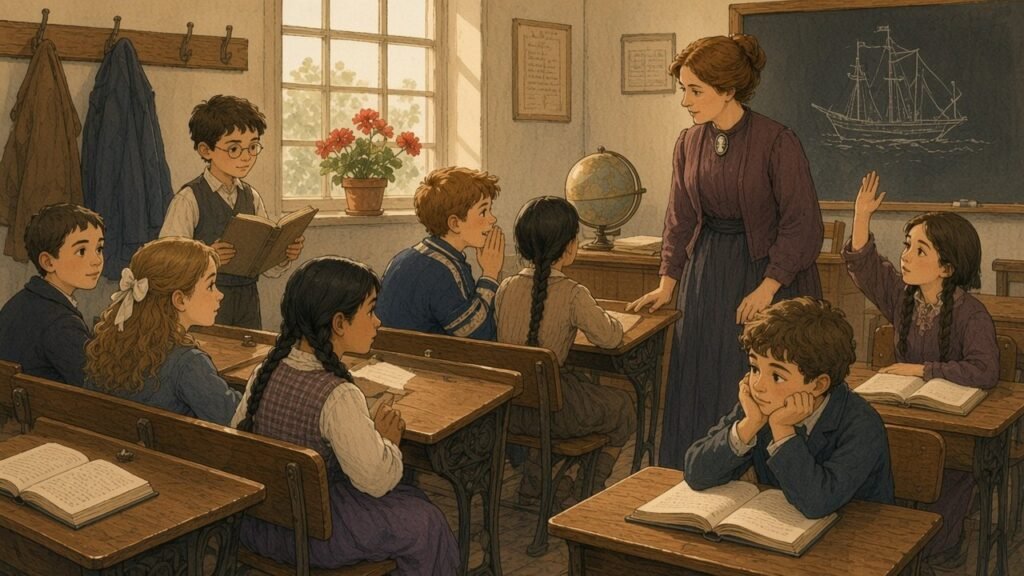
Children
The children of the immigrants grew up between two worlds. At home they spoke Yiddish, ate their mothers’ cooking and observed, to a greater or lesser extent, the Jewish holidays. In the street and the school they spoke English, played American games and absorbed American values. Many became, in effect, the interpreters and guides of their parents in the new country, translating letters, dealing with officials and explaining American ways. This reversal of roles could be a source of pride, but also of tension and conflict.
Child labour was common in the early years. Children worked in the shops, sold newspapers in the streets, and helped their parents with homework in the tenements. Jacob Riis, in How the Other Half Lives (1890), described children sewing and finishing garments in the tenement sweatshops of the Lower East Side [83]. Reformers fought for compulsory education and the abolition of child labour, and New York State gradually tightened its laws in the early twentieth century.
The public school
For the immigrants, the American public school was one of the great promises of the New World. In Russia, Jewish access to state schools had been restricted by quotas, and Jewish children who wanted a secular education faced many obstacles [18]. In America, education was free and open to all. The immigrants embraced it with extraordinary enthusiasm. The schools of the Lower East Side were overcrowded, with classes of fifty or sixty children, and many schools ran double sessions, but Jewish children crowded into them.
For Mary Antin, the first day of school was the apex of her new life. “The apex of my civic pride and personal contentment,” she wrote, “was reached on the bright September morning when I entered the public school” [5]. She insisted that her experience was typical of “the attitude of the intelligent immigrant child toward American institutions”, and that what the child felt reflected “the hopes, desires, and purposes of the parents who brought him overseas” [5]. “The public school has done its best for us foreigners, and for the country,” she wrote, “when it has made us into good Americans” [5].
Not every child’s experience was as happy as Antin’s, and many historians have warned against generalising from her account. Many immigrant children left school early to work, and many struggled with a curriculum that took no account of their background. The schools’ aim of Americanisation could be harsh, teaching children to be ashamed of their parents’ language and customs. But for many families, education was the path to a better future, and by the second generation the children of the immigrants were entering high schools and colleges in remarkable numbers. The City College of New York, which charged no tuition, became known as the “Harvard of the proletariat”, and in the years before the First World War a large share of its students were the children of Jewish immigrants.
Settlement houses and night schools
Alongside the public schools, a network of settlement houses and educational institutions served the immigrants of the Lower East Side. The Educational Alliance on East Broadway, established by uptown German Jews in the early 1890s, offered classes in English, civics and many other subjects, as well as lectures, a library, a gymnasium and art classes [77]. The Henry Street Settlement, which grew out of the nursing service that Lillian Wald, a nurse from a German Jewish family, began on the Lower East Side in 1893, brought nursing care to the tenements and campaigned for public health, playgrounds and the abolition of child labour [76]. Hundreds of thousands of adults attended evening schools to learn English and prepare for citizenship.
Hebrew education
Traditional Jewish education also continued, though under great strain. Many children attended a kheyder after public school, where they learned Hebrew prayers and the Bible from a melamed, often in squalid conditions. Reformers criticised these schools and established modern Talmud Torahs, communal Hebrew schools with trained teachers and modern methods. A few families sent their sons to the new yeshivas, such as the Etz Chaim yeshiva founded on the Lower East Side in 1886. Secular Yiddish schools, run by the Workmen’s Circle and other organisations, were established in the years around the First World War to teach children Yiddish language and culture.
Literacy and the daughters
The enthusiasm of the immigrants for education was shaped by the unequal opportunities they had known in Eastern Europe, and those inequalities fell most heavily on girls. Samuel Joseph’s analysis of the immigration statistics dispelled “the popular impression that practically every Jew is able to read and write”: of the 806,786 Jews aged fourteen and over who entered the United States between 1899 and 1910, 26 per cent could neither read nor write, only slightly below the average of 26.7 per cent for all immigrants [4]. The Jews were more literate than the Lithuanians, Ruthenians and other East European peoples among whom they had lived, but the gap between men and women was wider among them than among any of these peoples. Of the Jewish immigrants aged fourteen and over who arrived between 1908 and 1912, 19.7 per cent of the males were illiterate, against 36.8 per cent of the females; East European Jews, Joseph wrote bluntly, “neglect the education of their daughters as much as they strive to educate their sons” [4]. Joseph attributed the illiteracy of the Jews “chiefly to their exceptional status in Russia and Roumania”, and pointed to the eagerness with which they seized the educational opportunities offered in America as “striking illustration” that the literacy of the Jews was “conditioned by their freedom” [4].
The figures help to explain both the hunger for learning among immigrant women and the obstacles they faced. In the traditional world of the shtetl, boys were sent to the kheyder to learn Hebrew and the sacred texts, while the education of girls was left largely to chance; some learned to read Yiddish, and the daughters of prosperous families might have private tutors or attend a Russian school, but many received little formal schooling at all. In America, compulsory education laws applied to girls as well as boys, and immigrant daughters attended the public schools in large numbers. Their older sisters, who had arrived at working age, often sought education in the evening schools, the settlement houses and the classes of the socialist and labour movement, sometimes after ten or eleven hours in the shop.
Two generations under one roof
The journalist Hutchins Hapgood, who spent much time on the Lower East Side at the turn of the century and published his sketches in 1902 as The Spirit of the Ghetto, gave a vivid account of the gulf that opened between immigrant parents and their American children. In Russia, he wrote, the boy who knew only the kheyder “loves his religion, he loves and honors his parents, his highest ambition is to be a great scholar” [56]. In America, by contrast, “even before he begins to go to our public schools, the little Jewish boy finds himself in contact with a new world which stands in violent contrast with the orthodox environment of his first few years” [56]. In the public school he met an education that was entirely secular; English became his most familiar language, and he came, in Hapgood’s memorable phrase, “to prefer Sherlock Holmes to Abraham as a hero” [56].
Hapgood described how the old religious education survived only in a subordinate place, squeezed into the hours before and after public school, taught by a melamed who often spoke no English and who taught Hebrew through the medium of Yiddish to boys whose real language was now English [56]. Parents, he noted, began to accept that their sons would not become rabbis; “instead of hoping to make a rabbi of him, they reluctantly consent to his becoming an American business man, or, still better, an American doctor or lawyer” [56]. He recorded a scene that must have been repeated in countless tenements:
> “Why don’t you say your evening prayer, my son?” asks his mother in Yiddish. > > “Ah, what yer givin’ us!” replies, in English, the little American-Israelite as he makes a bee-line for the street.
“Amerikane kinder, Amerikane kinder!” wails the old father in Hapgood’s account, shaking his head [56]. Part of the problem, Hapgood observed, was economic. In Russia the father supported his son until marriage and was the head of the house in reality; in America the boy contributed to the family’s support at an early age, selling papers or blacking boots, and because he spoke English and his parents did not, he became the family’s interpreter in business and tended “to take things into his own hands” [56].
Hapgood was a sympathetic outsider, and his sketches, like Mary Antin’s memoir, should not be taken as a statistical portrait. Many immigrant children remained close to their parents and their traditions, and many parents adapted to America as rapidly as their children did. But the conflict he described was real, and it became one of the central themes of immigrant literature, from the Yiddish sketches of the Forward to the novels of the second generation.
The old and the new woman
Hapgood also drew a contrast between two types of women in the Jewish quarter. On the one hand was the traditional Orthodox wife and mother, whose life, he wrote, was “absorbed in observing the religious law and in taking care of her numerous children”, but who was also “beginning to pick up some of the ways of the American woman”; if she came to America young, she soon laid aside her wig and grew lax in the observance of the dietary laws [56]. The literature of the quarter, he noted, often portrayed such a woman arriving in America to join a husband who had gone ahead, only to be “deeply shocked” to find “his beard shaved off, and his manners in regard to religious holidays very slack” [56]. This was precisely the plot of Abraham Cahan’s Yekl [82].
On the other hand were the women touched by socialism and by Russian literature. Even among the less educated, Hapgood found many who had been drawn into the radical movement, who read and thought about labour and capital and took “an active part in speaking, in ‘house to house’ distribution of socialistic literature and in strike agitation” [56]. Seven years later, women of this kind would lead the shirtwaist strike of 1909.
"How long would you say it takes to make an American?"
Mary Antin’s account of her schooling in Chelsea, Massachusetts, where the family moved in 1894, is the classic statement of what the public school meant to immigrant children. “It is not worth while to refer to voluminous school statistics,” she wrote, “to see just how many ‘green’ pupils entered school last September, not knowing the days of the week in English, who next February will be declaiming patriotic verses in honor of George Washington and Abraham Lincoln, with a foreign accent, indeed, but with plenty of enthusiasm.” This “hundred-fold miracle”, she insisted, was “common to the schools in every part of the United States where immigrants are received” [5].
She herself, at thirteen, began in the “baby class”, sitting in a little chair her mind had outgrown “by six or seven years”, and was moved up to the second grade within a week of learning to follow the teacher. Her teachers, she recalled, “advanced me from grade to grade, without reference to the usual schedule of promotions”, and other “green” pupils were not far behind [5]. Her brother, “whose childhood had been one hideous nightmare, what with the stupid rebbe, the cruel whip, and the general repression of life in the Pale”, surprised their father by his progress “under intelligent, sympathetic guidance” [5]. The contrast between the heder and the American classroom was a staple of immigrant memoirs; it was not always fair to the heder, but it expressed a real sense of liberation.
“How long would you say, wise reader, it takes to make an American?” Antin asked. By the middle of her second year she had reached the sixth grade, and when the class began to study the life of George Washington, she found herself overcome with reverence: “Never had I prayed, never had I chanted the songs of David, never had I called upon the Most Holy, in such utter reverence and worship as I repeated the simple sentences of my child’s story of the patriot” [5]. Washington, she discovered, was her “Fellow Citizen”: her father had been naturalised, and she was a citizen through him. “It thrilled me to realize what sudden greatness had fallen on me; and at the same time it sobered me, as with a sense of responsibility” [5].
For the school’s Washington celebration she wrote a long poem, struggling to find rhymes for “tyranny”, “freedom” and “justice” with “less than two years’ acquaintance with English”; “Nothing but ‘Washington’ rhymed with ‘Washington'” [5]. Her father’s hands trembled as he read it, and her teacher, Miss Dwight, asked her to recite it to the class. Standing in front of her schoolmates, “thin, pale, and hollow”, in a red-and-green plaid dress, she “lifted up my voice in praise of George Washington” [5].
Antin’s enthusiasm made her book widely read and a favourite of advocates of Americanisation, and it has made her a target of criticism ever since. Some readers have found her celebration of the public school naïve and her rejection of her Jewish past painful. But her account captures something that many immigrant children felt: that the school offered them not only knowledge and a path to advancement, but a new identity, a sense of belonging to a nation whose founders they could claim as their own.
A generation of change
Women and children were at the heart of the transformation of the immigrant community. Women held families together through the upheaval of migration, and their work and their activism helped to build the community and to change the conditions of their lives. Children, through the schools, became the bridge between the old world and the new. Their success, in the schools, the professions and American life, was the fulfilment of their parents’ hopes, and the most important legacy of the migration.
31. The IRO, Galveston and Beyond New York
By the beginning of the twentieth century, the concentration of Jewish immigrants in New York had become a source of deep anxiety to the established Jewish community. About two-thirds of the Jewish immigrants arriving in the United States gave New York as their destination; according to the immigration statistics compiled by Samuel Joseph, 64.2 per cent of Jewish immigrants between 1899 and 1910 were bound for New York State, 10.1 per cent for Pennsylvania, 6.1 per cent for Massachusetts and 4.7 per cent for Illinois [4]. The Lower East Side was among the most crowded places on earth, and its slums, sweatshops and poverty were the subject of constant public criticism. The German Jewish leaders who ran the community’s philanthropic institutions feared that the congestion would breed disease, crime and radicalism, overwhelm the charities, and provoke an antisemitic reaction that might lead to immigration restriction. Their answer was to try to disperse the immigrants across the country, away from the eastern cities and into the American interior, where, they believed, the newcomers would find work, assimilate faster and attract less attention.
Earlier attempts
The idea was not new. As we saw in earlier chapters, the Am Olam movement of the early 1880s had sought to settle Jewish immigrants on the land, and several agricultural colonies had been established, in Louisiana, South Dakota, Kansas, Oregon and New Jersey, most of them short-lived [23]. The Baron de Hirsch Fund, established in 1889, supported agricultural colonies in southern New Jersey, notably Woodbine, founded in 1891, as well as trade schools and other programmes designed to move immigrants out of the needle trades and the cities [33]. In 1900 the fund established the Jewish Agricultural and Industrial Aid Society, which made loans to Jewish farmers and helped immigrants find work outside New York.
The Industrial Removal Office
The most important effort to disperse the immigrants was the Industrial Removal Office. It grew out of an emergency. In 1900 and 1901, following anti-Jewish measures by the Romanian government, a large wave of Romanian Jews arrived in New York, and a Rumanian Committee was formed to distribute them to other towns where they might find work; B’nai B’rith lodges in those towns assisted the refugees on arrival [111]. The committee soon evolved into the Industrial Removal Office, which took over the work on a much larger scale and opened its services to any unemployed Jewish immigrant, regardless of origin. It was formally created as part of the Jewish Agricultural Society at a meeting of the society’s executive committee on 24 January 1901, and opened in a rented store at 34 Stanton Street on the Lower East Side [111]. It was largely funded by the Baron de Hirsch Fund.
The IRO worked through travelling agents, who toured the country looking for jobs and enlisting the cooperation of local Jewish organisations. Local committees, organised mostly by B’nai B’rith, obtained orders for workers and helped the immigrants when they arrived [111]. The New York office matched the requests with applicants on its lists, paid their railroad fares and sent them off. In its first year, nearly 2,000 people were sent to 250 places across the United States [111].
The philosophy of the IRO was that the immigrants should be treated not as objects of charity but as workers filling a definite place in the community. Its general manager for sixteen years, David Bressler, spoke of allowing the immigrants to find “their own salvation” [111]. Jobs were to be chosen carefully to match the immigrant’s abilities, and the local committee was expected to make the newcomer feel at home. The IRO hoped that each immigrant who settled successfully would serve as a magnet for relatives and friends, so that its work would multiply itself [111].
Results
The occupations into which the IRO placed immigrants were remarkably varied; its records list some 390 trades, among them carpenters, shoemakers, butchers, blacksmiths, farmers, locksmiths, machinists, tanners, printers, watchmakers and wood carvers [111]. They were sent to cities and towns all over the country, from Milwaukee and Cleveland to Memphis, Denver and Seattle. The financial panic of 1907 and the depression that followed reduced the demand for labour sharply, and the IRO responded by sending its agents further afield and opening offices in the West, in Los Angeles, Portland, Seattle and Spokane [111]. By the outbreak of the First World War its operations had shrunk, and only 3,500 immigrants were placed out of 12,000 applicants [111]. The IRO was formally dissolved in 1922. In all, between 1901 and 1922, it distributed approximately 79,000 people [111].
Measured against the total Jewish immigration of the period, this was a modest number, and the IRO never came close to solving the problem of congestion in New York. But its influence was larger than its numbers suggest. Many of the people it sent out became the nucleus of new Jewish communities, or strengthened small existing ones, and brought relatives and friends to join them. In towns across the Midwest, South and West, many Jewish families trace their origins to an immigrant sent out by the IRO.

The Galveston Movement
The most ambitious attempt to redirect the stream of immigration was the Galveston Movement, which operated between 1907 and 1914 [51]. Its aim was to bring Jewish immigrants directly from Europe to a port in the American South, from which they could be dispersed to the interior, without ever passing through New York. It was the brainchild of Jacob Schiff, the banker and philanthropist, who initiated and financed the plan [112] [80]. Schiff hoped that a new route would relieve the congestion of the eastern cities and help forestall an antisemitic reaction that might lead to restrictions on immigration [51].
The organisers considered three ports. Charleston, South Carolina, explicitly wanted Anglo-Saxon immigrants; New Orleans was a thriving city where Jews might settle instead of moving on, and suffered from recurrent yellow fever. Galveston, Texas, was closer to opportunities in the West, it was served by the North German Lloyd line from Bremen, the port through which many East European Jews already left the continent, and its small size would not encourage large numbers to stay [51].
The project was a transatlantic partnership. Schiff presided over a Galveston Committee in New York, which coordinated the recruiting work of the London-based Jewish Territorial Organization, led by Israel Zangwill, and of the Jewish Emigration Society of Kiev, with the reception and relocation work of the Jewish Immigrants’ Information Bureau in Galveston [51] [113]. David Bressler, the general manager of the IRO, who also served as honorary secretary of the Jewish Immigrants’ Information Bureau, administered the programme from his New York office [51] [111], and Morris D. Waldman directed the bureau in Galveston [112]. The Industrial Removal Office, founded in New York in 1901, and Zangwill’s Jewish Territorial Organization, founded in London in 1905, were quite separate bodies; some accounts confuse the two. In Galveston, Rabbi Henry Cohen of Temple B’nai Israel met almost every ship carrying Jewish immigrants and helped send them on to new homes [51] [114].
Arrivals
The first immigrants, fifty-four men and two women, arrived on the steamship Cassel in early July 1907. Two days before the ship docked, the warehouse that had been converted into a reception centre burned down. The mayor of Galveston welcomed the newcomers, and a schoolteacher from southern Russia replied with a speech of thanks on behalf of the group [51]. The members of the first group were sent to cities and towns throughout the western states, as far north as Fargo, North Dakota; none remained in Galveston, in keeping with the movement’s policy [51].
The numbers were never large. About 900 immigrants came through Galveston in 1907, despite the economic depression, but only 106 in 1908. In 1909, 773 landed; in 1910, about 2,500; in 1911, some 1,400, only 2 per cent of the total Jewish immigration to the United States in that year [51]. Recruiters preferred able-bodied labourers and skilled workers under forty, and restricted the numbers of Hebrew teachers and kosher butchers, in the belief that strict religious observance would hinder employment [51].
Difficulties
The movement faced many difficulties. The cooperating organisations on both sides of the Atlantic quarrelled constantly. The American economy was unstable. The immigration authorities at Galveston were often hostile, and in 1910 the federal government deported a number of immigrants who had arrived there, alleging that they were contract labourers or likely to become public charges [112]. In Texas and the surrounding states, local merchants worried about competition, and some communities refused to accept more immigrants. Above all, the immigrants themselves were reluctant. As the Handbook of Texas puts it, European Jews “did not recognize Texas and the Southwest as the America of their dreams” [51]. They wanted to go where their relatives and friends were, and that meant New York, Philadelphia, Boston and Chicago.
Between 1907 and 1914, when it ceased operations, the Jewish Immigrants’ Information Bureau brought about 10,000 immigrants through Galveston [51]. That was a tiny fraction of the Jewish immigration of those years, roughly a third of the number who went to the Land of Israel in the same period [51].
Where the immigrants said they were going
The statistics compiled by the immigration authorities show how strongly the current flowed toward the Northeast. Of the Jewish immigrants who arrived between 1899 and 1910, 923,549, or 86 per cent, gave the North Atlantic states as their destination, and 110,998, or 10.3 per cent, the North Central states; less than one in twenty named any other part of the country [4]. After New York, Pennsylvania and Massachusetts, the most popular destinations were New Jersey, named by 34,279 immigrants, Illinois by 50,931, Ohio by 20,531, Maryland by 18,700 and Connecticut by 16,254 [4]. Samuel Joseph explained the pattern by the occupations of the immigrants: the preponderance of skilled industrial workers and people with commercial experience “makes for residence in the industrial and commercial centers” [4]. A much smaller proportion of Jewish immigrants than of immigrants as a whole headed for the West [4].
The declared destination was not always the final one. Joseph cited the reports of the United Hebrew Charities of New York, which had followed the Jewish immigrants landing at the port between 1886 and 1906. Of 918,388 who landed there in those years, 669,453, or 72.9 per cent, remained in New York, while 248,935, or 27.1 per cent, left for other places [4]. Even before the IRO began its work, then, a substantial minority of the immigrants moved on from the port of arrival, usually to join relatives or landslayt already settled elsewhere. The dispersal schemes worked with this current rather than against it, and their greatest successes came when a placed immigrant sent for his family and friends.
The other cities
The concentration on New York has sometimes obscured the importance of the other centres of Jewish immigrant life. Philadelphia, which received many immigrants through its own port as well as by rail from New York, developed a large immigrant quarter in South Philadelphia, with its own garment shops, synagogues, Yiddish theatres and newspapers. Boston’s immigrant Jews settled first in the North End and the West End, and later in Roxbury, Dorchester and the neighbouring city of Chelsea, where Mary Antin went to school. Baltimore, a port of entry served by the North German Lloyd line from Bremen, had a busy immigrant quarter in East Baltimore and a large clothing industry. Chicago’s West Side, around Maxwell Street with its famous open-air market, became the largest Jewish immigrant district in the interior, and the city’s men’s clothing industry was the scene of the great strike of 1910 that gave birth to the Amalgamated Clothing Workers [92].
In each of these cities, the immigrants recreated the institutions of the Lower East Side on a smaller scale: landsmanshaftn and synagogues, free loan societies and Yiddish newspapers, branches of the Workmen’s Circle and locals of the garment unions. In each, too, an established community of German Jewish origin founded charities and settlement houses for the newcomers, and the relations between the two groups followed the same uneasy pattern as in New York. Smaller industrial cities, from Newark, Paterson and New Haven to Pittsburgh, Cleveland, Detroit and Milwaukee, acquired immigrant Jewish communities of their own, built around small shops, peddling and, increasingly, factory work.
Life in the interior
For the immigrants whom the IRO and the Galveston bureau sent to the interior, the experience could be lonely and disorienting. Many were placed in towns with only a handful of Jewish families, where there was no kosher butcher, no synagogue with a daily quorum, no Yiddish newspaper and no landslayt. Some could not find the jobs they had been promised, or found that the work was unfamiliar or the wages lower than expected; some disliked their employers or their new neighbours. A good number drifted back to New York or on to the larger cities of the Midwest. The IRO’s records, preserved by the American Jewish Historical Society, include tens of thousands of case records and letters from the relocated immigrants, which reveal both success stories and bitter complaints [111].
Others prospered. Many began as workers and became shopkeepers; some peddled goods through the countryside, as German Jewish immigrants had done a generation or two earlier, and opened stores in the towns where they settled. Their children grew up in places far removed from the immigrant quarters of the East, where Jewish life took different forms: a single synagogue serving Jews of every background, a B’nai B’rith lodge, a ladies’ aid society, close and often friendly relations with non-Jewish neighbours. The Jewish communities of the American South and West in the twentieth century owed much to these scattered settlers, and to the relatives and friends they brought after them.
A debate among the leaders
The dispersal schemes also provoked argument within the Jewish community. Their supporters, mostly drawn from the established German Jewish leadership, argued that dispersal was in the interest of the immigrants themselves, who would find better wages, healthier living conditions and a quicker path to Americanisation in the interior, and in the interest of American Jewry as a whole, which would be less exposed to the charge that the immigrants were creating slums and burdening the charities. Some critics, among them Yiddish journalists and labour leaders, suspected that the schemes were motivated less by concern for the immigrants than by the embarrassment of the uptown Jews at the sight of the Lower East Side, and pointed out that the immigrants were being sent to places where they would be isolated from Jewish life. Zionists objected to the Galveston plan’s association with Zangwill’s territorialism, which they saw as a rival to their own programme [113] [48].
There was truth on both sides. The schemes reflected the anxieties and the paternalism of the uptown leaders, but they also offered real opportunities, and many of those who took them up were grateful. In the end, as in so much else, the immigrants voted with their feet.
Boston through a child's eyes
Not every immigrant passed through New York. Mary Antin’s family landed in Boston in May 1894, and her account of their first weeks there is one of the most vivid descriptions we have of how a newly arrived family began to learn America. Her father had spent three years in the city, making “a number of false starts in business”. His history, she wrote, “is the history of thousands who come to America, like him, with pockets empty, hands untrained to the use of tools, minds cramped by centuries of repression in their native land” [5]. She turned on her American readers: “You see them shuffle from door to door with a basket of spools and buttons, or bending over the sizzling irons in a basement tailor shop, or rummaging in your ash can, or moving a pushcart from curb to curb, at the command of the burly policeman. ‘The Jew peddler!’ you say, and dismiss him from your premises and from your thoughts” [5].
The family’s first home was in Union Place, off Wall Street in Boston’s West End, one of “the wrong ends of that city”, the tenement district where “poor immigrants foregather” [5]. A sophisticated visitor, she wrote, would have seen only “a short box of an alley. Two rows of three-story tenements are its sides, a stingy strip of sky is its lid, a littered pavement is the floor, and a narrow mouth its exit.” But the child from Polotsk saw “two imposing rows of brick buildings, loftier than any dwelling I had ever lived in”, with brick even on the ground to tread on, and “the May blue of an American sky” [5]. The three small rooms contained only beds “with lean mattresses”, a few wooden chairs, “a mysterious iron structure, which later turned out to be a stove”, kerosene lamps and a scanty supply of crockery; yet the children were delighted, “chiefly because these wooden chairs and tin pans were American chairs and pans”. Only her mother, Antin suspected, “realized that for her there was as yet no laying down of the burden of poverty” [5].
Instruction began at once. On the cab ride from the pier, her father told the children not to lean out of the windows or point, and “explained the word ‘greenhorn'”. At the first meal he produced food “from little tin cans that had printing all over them”, tried and failed to introduce them to the banana, and had better luck with the rocking-chair. There was no bathtub, so on the first evening he took them to the public baths, and Mary marvelled at the street lamps that burned all night: “In America, then, everything was free, as we had heard in Russia. Light was free; the streets were as bright as a synagogue on a holy day” [5].
Above all, education was free. It was, Antin wrote, the one thing her father “was able to promise us when he sent for us; surer, safer than bread or shelter”. On the second day a little girl from across the alley offered to take the children to school: “No application made, no questions asked, no examinations, rulings, exclusions; no machinations, no fees. The doors stood open for every one of us. The smallest child could show us the way” [5]. Neighbours taught her mother to light the stove, and took the children to a department store “uptown”, where they exchanged their “hateful homemade European costumes, which pointed us out as ‘greenhorns'”, for American machine-made clothes [5].
With the clothes went the names. A committee of friends “several years ahead of us in American experience” chose new names for the family: her mother became Annie, Fetchke became Frieda, Deborah became Dora, and Maryashe, Mashke for short, became Mary [5]. Within two weeks of landing, Antin wrote, the family had achieved so much “toward our Americanization” that her father had little occasion to correct them [5]. Her account is famously optimistic, and later critics have questioned its celebration of assimilation; but it records with precision the small, daily lessons through which hundreds of thousands of immigrant families learned to live in American cities.
An assessment
The dispersal schemes failed in their larger aim. New York remained the overwhelming centre of Jewish immigration, and the concentration of Jews in the great cities of the Northeast continued. The immigrants knew what they wanted: work in the trades they knew, the company of landslayt, synagogues, Yiddish newspapers and theatres, and the support of a large community. These things could be found only in the great cities.
But the schemes left their mark. Together the IRO and the Galveston Movement scattered close to 90,000 Jews across the United States, and with them the seeds of Jewish life in hundreds of smaller communities. They also reflected the anxieties and the generosity of the established Jewish community, which spent large sums to help the newcomers, and they showed how closely the leaders of American Jewry watched the rising tide of restrictionist sentiment. That tide, as the next chapter shows, was gathering strength.
32. Return, Rejection and Restriction
The great migration was a story of arrival, but it was also shadowed by departure, exclusion and, in the end, closure. Some immigrants went home, defeated or homesick. Some were turned back at the gates. And throughout the period, a growing movement in American politics and public opinion sought to restrict immigration, and especially the immigration of the “new” peoples from southern and eastern Europe, Jews among them. The restrictionists won partial victories before the First World War and decisive ones after it. By 1924, the door that had opened so widely in 1881 had been all but shut.
Going home
Of all the immigrant peoples of the period, the Jews were the least likely to go back. The figures compiled by Samuel Joseph are striking. From 1908 to 1912, the first years for which records of departures were kept, 33,315 Jews left the United States, an average of 6,660 a year, while 417,016 Jewish immigrants arrived in the same period. “Thus, for every hundred Jews admitted,” Joseph wrote, “only eight Jews left the country” [4]. Between 1908 and 1910, the corresponding figure for all immigrants was thirty-two departures for every hundred arrivals, and only the Irish had a lower rate of return than the Jews [4]. Jewish emigrants made up only 2.3 per cent of all those leaving the United States in 1908-12, though Jewish immigrants were 9.7 per cent of those arriving [4].
The reason was obvious. Many Italian, Polish, Slovak and Greek immigrants came to America to earn money and return to buy land or pay off debts at home. The Jews came to stay. They had no land to return to, and in Russia they faced persecution, restrictions and the threat of pogroms. Those who did return were mostly people who had failed to find work or adapt to American life, or who had been summoned home by family obligations, and some came back to America again later. Historians have argued that the low official figures for return before 1908 may understate the real number of returnees, especially in the first years of the migration, and the question remains debated; but no one doubts that the Jewish migration was overwhelmingly permanent.
The gatekeepers
For most immigrants, the inspection at Ellis Island was an ordeal but not a barrier. Only about 2 per cent of the immigrants who arrived there were excluded from entry [69]. But in a migration of millions, 2 per cent meant tens of thousands of people, each with a family and a story. Immigrants could be excluded for a variety of reasons under the immigration laws, which grew longer and stricter over the period: as paupers or persons “likely to become a public charge”, as contract labourers, as sufferers from “loathsome or dangerous contagious diseases” such as trachoma, as people of mental or physical disability, as criminals, polygamists or anarchists.
Doubtful cases were sent to a Board of Special Inquiry, a panel of three inspectors who heard the case and decided whether the immigrant should be admitted. Jewish immigrants who appeared before these boards were often helped by representatives of the Hebrew Immigrant Aid Society, which provided interpreters, found relatives who could guarantee support, and pursued appeals to the authorities in Washington [31] [78]. Many detainees were eventually admitted thanks to such interventions.
The rate of exclusion varied with the political climate. Under the commissioner William Williams, who ran Ellis Island in 1902-05 and again from 1909, enforcement of the “public charge” provisions was tightened, and in 1909 Williams caused alarm by announcing that immigrants should have at least twenty-five dollars in addition to their fare to their final destination. Jewish organisations protested vigorously, and the rule was not consistently enforced.
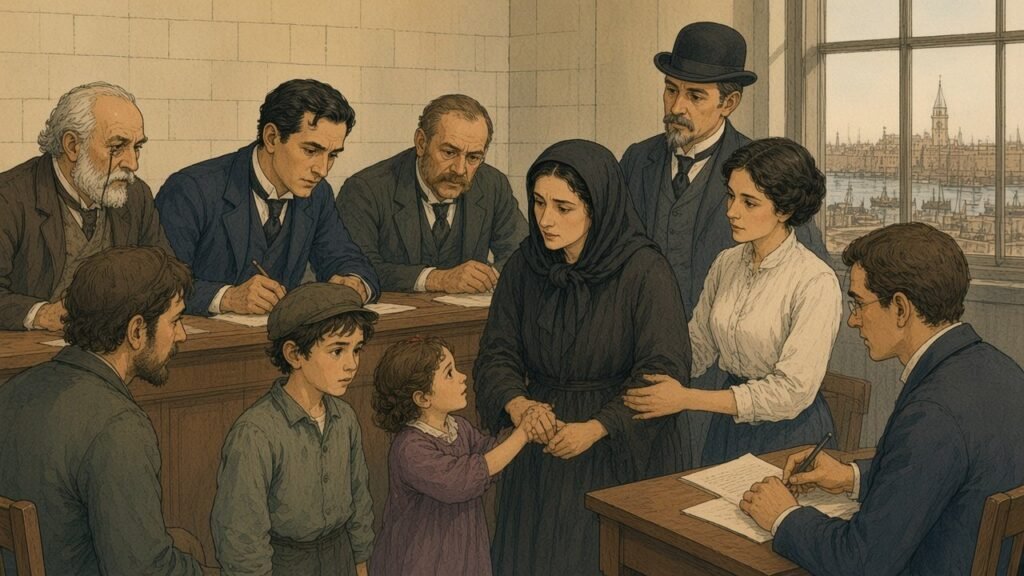
The restrictionist movement
The movement to restrict immigration had deep roots in American nativism. In the 1880s and 1890s, as the “new immigration” from southern and eastern Europe grew, many Americans of older stock came to fear that the newcomers were racially inferior, unassimilable, politically dangerous and a threat to American workers. In 1894 a group of young Harvard graduates founded the Immigration Restriction League in Boston, which campaigned for a literacy test that would exclude many of the new immigrants. The league and its allies drew on the pseudo-science of race that was fashionable at the time, which divided Europeans into a hierarchy of “races”, with the “Nordics” at the top.
Organised labour was divided. Some unions, including the American Federation of Labor, supported restriction, arguing that cheap immigrant labour depressed wages; others, including the Jewish unions whose members were themselves immigrants, opposed it. Business interests, which wanted cheap labour, generally opposed restriction, as did the immigrant communities themselves.
Jews were singled out by some of the restrictionists. The sociologist Edward A. Ross, in The Old World in the New (1914), described Jewish immigrants in harsh and stereotyped terms, and exaggerated the scale of Romanian Jewish immigration; Joseph, writing in the same year, showed that Ross’s figure of 50,000 Romanian Jews a year was far too high [4]. In 1916, Madison Grant’s The Passing of the Great Race offered a racist theory of history in which the “Nordic” race was being swamped by inferior peoples, among them the Jews of Poland.
The literacy test
The literacy test was the restrictionists’ main weapon before the First World War. Congress passed bills requiring a literacy test several times, but they were vetoed by President Grover Cleveland in 1897, by President William Howard Taft in 1913 and by President Woodrow Wilson in 1915. The Jewish community, led by the American Jewish Committee, campaigned hard against the test and against other restrictive measures [47].
In 1907 Congress established the United States Immigration Commission, usually known as the Dillingham Commission after its chairman, Senator William P. Dillingham of Vermont. Its report, published in forty-one volumes in 1911, was an enormous compilation of data about the immigrants, but its conclusions were shaped by the assumption that the new immigrants were less desirable than the old, and it recommended a literacy test. Joseph drew heavily on its figures while rejecting many of its judgements [4].
The test of 1907
The permanence of the Jewish migration was put to a dramatic test by the financial panic of 1907 and the depression that followed. It was generally believed, Samuel Joseph noted, that “the causes which retard emigration from abroad also accelerate the exodus from the United States”, and the great exodus of 1908 seemed to bear this out [4]. Hundreds of thousands of immigrants who had lost their jobs went home. But the Jews were a striking exception. Although 149,182 Jewish immigrants had arrived in 1907, only slightly below the maximum for thirty years, only 7,702 Jews left the country in 1908, about two per cent of all those who departed that year and only five for every hundred Jews admitted the year before [4]. By contrast, for every hundred Poles who entered in 1907, thirty-three left in 1908; for every hundred southern Italians, sixty [4].
The contrast appeared again in the net figures. The Italian inward and outward movements in 1908 produced a net loss to the United States of 79,966 people, followed by a net gain of 94,806 in 1909; the Jewish movement produced a net gain of 95,685 in 1908 and 50,705 in 1909 [4]. “The Jewish immigration responds in its inward movement much more slowly and less completely to the pressure of unfavorable conditions in this country,” Joseph concluded. “In its outward movement it shows practically no response” [4]. A further sign of permanence was the small number of Jewish immigrants who had been in the United States before. Of all immigrants admitted between 1899 and 1910, 12 per cent had been in the country previously; of the 1,074,442 Jews, only 22,914, or 2.1 per cent, by far the lowest proportion of any immigrant people [4].
None of this means that the Jewish immigrants did not suffer in the depression. Unemployment in the garment trades was severe, the charities were overwhelmed, and many families went hungry. Some immigrants who had planned to bring over relatives postponed their plans; Jewish immigration fell sharply in 1908 and 1909. But very few Jews saw a return to Russia as a solution. For most of them, there was nothing to go back to.
Antisemitism in America
The Jewish immigrants had come to a country without a state church, without legal discrimination against Jews and without pogroms, and most of them never ceased to be grateful for it. But America was not free of antisemitism, and it grew more visible in the years of mass immigration. Social discrimination against Jews, which had begun among the wealthy in the 1870s, spread to clubs, resorts, private schools and neighbourhoods. Employers advertised for Christians only. Universities began to worry about the number of Jewish students, and in the 1920s several introduced quotas. The popular press and stage were full of crude caricatures of Jews, and the restrictionist literature described Jewish immigrants as unassimilable, radical, criminal or diseased.
The most shocking episode was the case of Leo Frank. Frank, a Jewish factory superintendent in Atlanta who had been raised in Brooklyn, was arrested in 1913 for the murder of Mary Phagan, a fourteen-year-old employee of the National Pencil Company, whose body had been found in the factory basement [115]. On flimsy evidence, and amid mobs in and out of the courtroom whose hostility was inspired by antisemitic passions, he was convicted and sentenced to death [115]. While his appeals were pending, the politician Tom Watson waged a vicious antisemitic campaign against him in his Jeffersonian Magazine [115]. In June 1915 Governor John Slaton, convinced of Frank’s innocence, commuted the sentence to life imprisonment; on 16 August 1915 Frank was dragged from jail by a mob and lynched [115]. The case led to the founding of the Anti-Defamation League of B’nai B’rith in 1913, and it was a grim reminder to the immigrants that America, too, could produce mob violence against Jews.
The Frank case was exceptional, and most immigrants encountered antisemitism in milder forms: taunts in the street, fights between Jewish and Irish or Italian boys, discrimination in employment, the casual contempt of officials. Organised antisemitism in America grew stronger after the First World War, with the revival of the Ku Klux Klan and the publication in Henry Ford’s Dearborn Independent of a long series of antisemitic articles, but by then the great migration was over.
The defenders
The Jewish community did not accept restriction passively. The American Jewish Committee, founded in 1906 by Jacob Schiff, Louis Marshall, Cyrus Adler and other leaders of the established community, made the defence of free immigration one of its main concerns [47]. Working quietly through lobbying and personal contacts, rather than mass protest, it fought the literacy test in Congress, sought to influence the work of the Dillingham Commission, and pressed the immigration authorities to apply the law humanely. HIAS maintained representatives at Ellis Island and in Washington to intervene in individual cases [31]. The Yiddish press, the unions and the landsmanshaftn mobilised the immigrant masses through petitions and mass meetings.
These efforts delayed restriction for a generation. The literacy test, first passed by Congress in 1897, did not become law until 1917, and the quota system not until 1921. In the meantime, more than a million and a half more Jews entered the United States. The defenders of immigration could not, in the end, prevail against the combination of nativism, racial theory, wartime nationalism and postwar fear that produced the laws of the 1920s. But the years they won made an incalculable difference to the history of the Jewish people.
The door closes
The First World War gave the restrictionists their chance. In 1917, amid wartime fears about national security, Congress passed the first widely restrictive immigration law over Wilson’s veto [116]. The 1917 Act imposed a literacy test that required immigrants over sixteen to show basic reading ability in any language, raised the head tax paid by new immigrants, gave officials more discretion over whom to exclude, and barred immigrants from a geographically defined “Asiatic Barred Zone” [116]. Since the test could be passed in Yiddish or Hebrew, it did little to stop Jewish immigration.
After the war, as immigration revived and fears of Bolshevism swept the country, Congress went further. Senator Dillingham introduced a measure to create quotas based on national origin, set at three per cent of the foreign-born of each nationality in the United States as recorded in the 1910 census, with a total of about 350,000 visas a year [116]. Wilson killed the bill with a pocket veto, but in 1921 the new president, Warren Harding, called Congress into special session to pass it, and in 1922 it was renewed for two years [116].
The Immigration Act of 1924, known as the Johnson-Reed Act, made the restrictions permanent and far more severe. It cut the quota from three to two per cent and moved the base year from 1910 to 1890, before most of the new immigrants had arrived [116]. Later, quotas were to be calculated on the national origins of the whole population of the United States, a formula that favoured immigrants from the British Isles and western Europe [116]. In the words of the State Department’s historians, “the most basic purpose of the 1924 Immigration Act was to preserve the ideal of U.S. homogeneity” [116].
The effect on Jewish immigration was devastating. The quotas for Poland, Russia and Romania, the countries from which most Jewish immigrants came, were reduced to a few thousand places a year. The great migration that had brought more than two million Jews to America was over. The consequences would become tragically clear in the 1930s, when Jews desperate to escape Nazi persecution found the doors of America closed to them.
33. War and the End of the Great Migration
In the spring and early summer of 1914, the great migration was running at full strength. The ships from Hamburg, Bremen, Rotterdam, Antwerp and Liverpool were full of Jewish emigrants, and the year was one of the busiest of the whole period. HIAS records that more than 138,000 Jews arrived in the United States in 1914 [31]; the official count of immigrants registered as “Hebrews” was 138,051 [117]. That figure, like most American immigration statistics of the time, refers to the fiscal year that ended on 30 June 1914, a few weeks before the outbreak of the First World War, so it measures the last year of peace, not a wartime influx. It was one of the highest annual totals of the whole period, surpassed only in 1906 and 1907, the years of flight that followed the revolution and pogroms of 1905, when 153,748 and 149,182 Jewish immigrants arrived [117]. No one could have guessed that it would also be the last great year of the migration. Within weeks, the war that broke out in August 1914 had cut the routes across Europe and the Atlantic, and the stream of emigrants dwindled to a trickle.
The routes close
The outbreak of war closed the emigration routes almost overnight. The German ports of Hamburg and Bremen, through which a large part of the Jewish emigrants had passed, were blockaded by the British navy, and the great German shipping lines suspended their transatlantic services. The frontier between the Russian Empire and Germany and Austria-Hungary, which the emigrants had crossed in their hundreds of thousands, became a front line. Men of military age were forbidden to leave the belligerent countries. A few emigrants continued to find their way to America, through Scandinavia, through neutral ports or across Siberia and the Pacific, but their numbers were small. As the YIVO Encyclopedia puts it, immigration to Western Europe and the Americas “had virtually ceased during the war” [79].
Thousands of families were divided. Husbands and fathers who had gone ahead to America, intending to send for their wives and children, found themselves cut off from them for years. Letters and money could no longer get through, or got through only with long delays. Many families did not hear from each other until after the war, and some never did.
War in the Pale
The war fell with special severity on the Jews of Eastern Europe. The fighting on the Eastern Front took place largely in the heartland of East European Jewry, in areas with a combined Jewish population of more than four million [79]. Armies moved back and forth across the region for four years, and Jewish towns were repeatedly occupied, looted and destroyed.
The Russian government deeply suspected Jewish loyalty. Although nearly 400,000 Jews enlisted in the tsar’s forces, of whom some 80,000 served at the front in 1914-15, Jews were quickly accused of treachery by military leaders and right-wing politicians [79]. Russian commanders often expelled Jews from towns and villages near the front and took Jewish leaders hostage. These practices reached their peak between March and September 1915, when, as the Germans advanced deep into Russian territory, more than half a million Jews were expelled from front-line areas, including all of northern Lithuania and much of Latvia [79]. In one 48-hour period in May 1915, all 40,000 Jews of Kovno were forcibly removed from the city; about 40,000 more were deported from Courland [79] [118]. The property left behind was often looted or destroyed [79].
Ironically, the expulsions led to the de facto abolition of the Pale of Settlement, since the deportees had to be resettled in the Russian interior [79]. In August 1915 the government allowed Jews to live in towns outside the Pale, and in 1916 it was forced to suspend the Pale altogether as a temporary measure to cope with the hundreds of thousands of refugees [8]. The Pale, which had shaped Jewish life in Russia for more than a century, was finally abolished by the Provisional Government after the revolution of February 1917.
In Galicia, too, the war brought disaster. Russian forces invaded the province in 1914 and deported more than 50,000 Jews from occupied Galicia and Bukovina to the Russian interior; at least 200,000 Galician Jews, and by some estimates as many as 450,000, were uprooted by the Russian conquest or its threat [79]. Many fled to Vienna and other cities of the Habsburg monarchy.
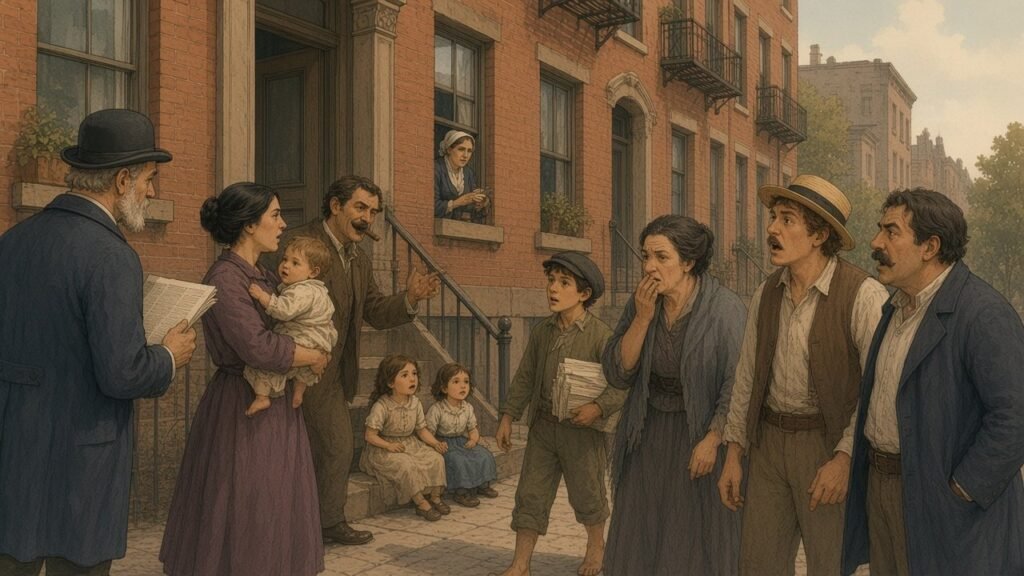
American Jews and the war
For the Jewish immigrants in America, the war in Eastern Europe was a personal catastrophe. Their parents, brothers, sisters and friends were caught up in the fighting, expelled from their homes, or starving in occupied territories. The immigrant community responded with an outpouring of aid.
In 1914, the American Jewish Joint Distribution Committee was founded as an alliance between German and East European Jews in the United States, to aid Jews in the war zones [79]. It brought together three relief committees: the American Jewish Relief Committee, representing the established, largely German Jewish leadership; the Central Relief Committee, representing the Orthodox; and the People’s Relief Committee, representing the Jewish labour movement and the immigrant masses. Together they raised tens of millions of dollars for relief during and after the war. The landsmanshaftn, as we have seen, raised and sent millions more to their home towns [103].
The war also changed the politics of American Jewry. The immigrants, many of whom had fled tsarist persecution, were reluctant to support an alliance with Russia, and the Yiddish press was at first sympathetic to Germany; the Forward came close to being shut down by the government for its pro-German sympathies [84]. The Russian revolution of February 1917 transformed the situation. The fall of the tsar was greeted with jubilation on the Lower East Side, and when the United States entered the war in April 1917, many Jewish immigrants enlisted or were drafted into the American army. Their service helped to establish their claim to full membership in American society.
After the war
The end of the war brought no peace to the Jews of Eastern Europe. The collapse of the Central Powers in November 1918 led to a general breakdown of order in the former Russian Empire, and as rival armies fought over Ukraine and other territories, attacks on Jews reached proportions greater than at any time since the mid-seventeenth century [79]. In the pogroms of 1918-21 in Ukraine, tens of thousands of Jews were killed. Estimates of the total differ sharply, and some are far higher, but the YIVO Encyclopedia puts the minimum credible estimate at 50,000 deaths [16]; its article on the First World War speaks of a pogrom wave that by the end of 1919 alone had claimed several tens of thousands of Jewish lives [79]. Hundreds of thousands more were left homeless and destitute.
When transatlantic travel resumed after the war, Jewish emigration revived, and for a brief period it looked as though the great migration might resume. But the political climate in the United States had changed. The fear of Bolshevism, the “Red Scare” of 1919-20 and the postwar recession strengthened the restrictionists, and in 1921 and 1924 Congress passed the quota laws described in the previous chapter [116]. As HIAS records, because of the Emergency Quota Act of 1921 and the National Origins Act of 1924, few Jewish refugees were admitted to the United States [31]. The flow of Jewish emigrants from Eastern Europe turned instead toward France, Palestine and Latin America [1].
Under occupation
By the end of the summer of 1915, Germany had taken control of all of Congress Poland, Lithuania and Latvia and parts of Volhynia and Belorussia, bringing some 40 per cent of the Russian Empire’s Jews under the rule of the Central Powers [79]. From the spring of 1918 until the end of the war, the Central Powers controlled Ukraine, Belorussia, Volhynia, Congress Poland, Lithuania, Latvia and most of Romania as well as the Habsburg lands, the area in which the large majority of East European Jews lived [79]. For the emigrants’ families, this meant that the towns from which the letters had come, and to which the remittances had been sent, now lay behind enemy lines.
The occupation brought its own hardships. The Germans exacted levies from the local populations to make up for shortages at home caused by the Allied blockade, which aggravated poverty, especially in the occupied zones [79]. Epidemic disease took a heavy toll, especially in the cities that had taken in large numbers of refugees; by 1915 more than 80,000 Russian Jewish war refugees had gathered in Warsaw, and 22,000 more in Vilna [79]. At the same time, the German administration of the occupied north-western provinces, known as Ober-Ost, for a while recognised Yiddish as an official language and permitted a Yiddish daily newspaper, steps that gave some Jews hope of national rights that were soon disappointed [79].
Within Russia, East European Jews organised their own relief. The most important agency was the Jewish Committee for the Relief of War Victims, known by its Russian initials as EKOPO, launched in 1914 by members of the Russian Jewish elite living outside the Pale; its main beneficiaries were the deportees and refugees in the Russian interior [79]. But the greatest number of Jews in need lived under German or Austrian rule for most of the war, beyond EKOPO’s reach [79]. For them, aid from America, channelled through neutral intermediaries until the United States entered the war in April 1917, was often a lifeline [79].
Families divided
For immigrant families in America, the war years were a time of acute anxiety. The Yiddish newspapers carried long casualty lists from the Russian and Austrian armies, reports of expulsions and pogroms, and appeals from relief committees. Lists of names of people seeking relatives abroad filled column after column. Letters took months to arrive, if they arrived at all, and remittances could be sent only through special channels. Many men who had come ahead of their families, intending to send for them within a year or two, were separated from their wives and children for the whole of the war; some learned only afterwards that their families had been deported, scattered or killed.
The YIVO Encyclopedia reproduces a photograph taken in Russia in 1915 of one such family: the mother, wife and three daughters of a man who had emigrated to America, separated from him by the war [1]. Countless families sent and received similar photographs, posed in their best clothes, to reassure distant relatives that they were alive.
When the war ended, the reunion of divided families became one of the first tasks of HIAS and the other aid organisations. HIAS opened offices in Eastern Europe and the Far East after the war [78], to trace missing relatives, to help emigrants obtain documents and tickets, and to guide them through the increasingly complex rules of American immigration law. Thousands of families were reunited in the years immediately after the war, before the quota laws made reunion difficult or impossible.
A new generation of refugees
The physical dislocations of the war proved long-lasting, as refugees and deportees found it difficult or impossible to return to their former homes [79]. The collapse of the old empires and the creation of new states, Poland, Lithuania, Latvia and an enlarged Romania, left many Jews without a clear citizenship. A new category of stateless, unprotected Jews was created, whose numbers diminished only partially before being swelled by refugees from Nazism [79]. At the very moment when the need for a refuge was greatest, the doors of the United States were closing.
The emigrants who did reach America in 1920 and 1921, before the first quota law took effect, brought with them stories of a world destroyed: of towns burned by retreating armies, of expulsions and epidemics, of the pogroms of Ukraine. Many of them were sponsored by relatives who had come before the war. They were the last large group of East European Jews to arrive before restriction, and their stories added a new and darker chapter to the memory of the old country among the immigrants already in America.
Galician refugees and Jewish soldiers
The war also uprooted the Jews of Galicia, the province that had sent so many emigrants to America. The Russian invasion of 1914 set off a mass flight. According to the YIVO Encyclopedia, at least 200,000 Galician Jews, and by some estimates as many as 450,000, more than half of Galician Jewry, were uprooted by the Russian conquest or its threat [79]. Austrian government statistics published in the autumn of 1915 recorded some 77,000 Galician Jews entering Vienna during the Russian advance and another 75,000 finding refuge in the Czech lands, while unofficial surveys counted more than 130,000 in Vienna alone [79]. At the end of the war at least 35,000 Galician Jews, perhaps twice as many, remained in the Austrian capital [79]. Lemberg itself was taken by the Russian army in the summer of 1914 and held until the Austrians returned in May 1915 [39].
Jews fought on both sides. By the end of the war, the YIVO Encyclopedia notes, some 650,000 Jews had served in the Russian forces, of whom about 100,000 lost their lives; 320,000 served in the Austro-Hungarian army, of whom 40,000 were killed; and more than 50,000 served for Bulgaria and Romania [79]. The figures show that Jews were mobilised at the same rate as their non-Jewish neighbours, despite the accusations of disloyalty levelled against them. On 17 August 1914, the German and Austrian high command issued a proclamation in Yiddish urging the Jews of the Russian Empire to rise up and promising them equality in the event of victory; it only fed the suspicions of Russian commanders [79].
For the immigrants in America, the war meant that relatives were suddenly cut off, scattered across refugee camps, deported to the Russian interior or trapped in occupied zones. Many families in New York did not learn for years what had happened to parents, brothers and sisters they had left behind, and some never learned at all.
The end of an era
The great migration of 1881-1914 thus came to an end not with a single decision but with a series of blows: the outbreak of war in 1914, the devastation of Eastern Europe, and the restrictive laws of 1921 and 1924. Between 1881 and 1914, more than two million Jews had migrated to America from Eastern Europe: about 1.6 million from the Russian Empire, including Poland, 380,000 from Austria-Hungary, mainly from Galicia, and 80,000 from Romania [1]. They represented about three-quarters of the total Jewish emigration from Eastern Europe in the period [1].
By the time the door closed, the Jewish population of the United States had grown from perhaps a quarter of a million in 1880 to more than three million, and New York had become the largest Jewish city in the world. The centre of gravity of the Jewish people had begun to shift from Eastern Europe to America. No one knew then how decisive that shift would prove. Within a generation, the communities of Eastern Europe from which the emigrants had come would be destroyed, and the descendants of those who had left would be among the few to survive.
34. Legacy
Between 1881 and 1914, more than two million Jews left Eastern Europe for the United States. Counting the whole period from the early nineteenth century to the restrictive laws of the 1920s, about one-third of the Jews of Europe emigrated to America [1]. It was one of the largest and most consequential migrations in Jewish history, comparable in its effects to the expulsion from Spain in 1492 or the destruction of the Second Temple. It transformed a small and peripheral outpost of Jewish life into the largest Jewish community of the Diaspora [1]. It changed the immigrants, their children and their grandchildren beyond recognition. It changed the communities they left behind. And it changed America.
Why they went
The preceding chapters have told the story of why so many Jews left Eastern Europe, and the answer cannot be reduced to a single cause. The pogroms of 1881-82, 1903 and 1905-06 were the most dramatic spurs to emigration, and the peaks of the migration followed them. The May Laws, the expulsions from Moscow and Kiev, the quotas in schools and universities, the burdens of conscription and the endless petty harassment of the tsarist bureaucracy made life in Russia increasingly hard to bear. In Galicia and Romania, poverty and legal discrimination drove many to leave.
But the historians who have studied the migration most closely have warned against seeing it simply as a flight from persecution. The YIVO Encyclopedia notes that the higher rates of emigration among people of working age and from the poorest areas suggest that more than the pogroms lay behind the mass emigration [1]. The rapid growth of the Jewish population in the nineteenth century, which grew by 1.7 per cent a year between 1850 and 1880, enough to double in forty-one years, intensified the poverty and the competition for a livelihood [1]. The transformation of the Russian economy, the decline of traditional Jewish trades and the rise of industrial America created powerful economic pressures and opportunities. Some historians, looking at the global economic system, have argued that the transfer of labour from underdeveloped regions to fast-growing industrial economies explains the timing, size and composition of the flow better than the decisions of individuals [1] [2].
The debate is not settled, and it may never be. Opinions differ over the relative weight of local factors, networks of relatives and friends, the desire to escape conscription and poverty, and the fear of pogroms [1]. What is clear is that the Jews emigrated at much higher rates than their non-Jewish neighbours: Jews made up an estimated 50 to 70 per cent of all Russian immigrants to the United States between 1881 and 1910, and almost 90 per cent of Romanian emigrants between 1899 and 1911 [1]. And unlike their neighbours, they rarely went back. Economic hardship was shared by Jews and non-Jews alike. The difference lay in the political and legal position of the Jews, which made their future in Eastern Europe uniquely precarious, and in the image of America as a land of freedom where Jews could live as equals. Simon Dubnow, who remained in Russia, confided to his diary in the late 1880s: “I’d rather chop wood in a land of liberty than be a writer in a land of tyranny” [1].
What they built
In America, the immigrants built a world of their own. They created unions that transformed the garment industry and pioneered new forms of collective bargaining and social welfare; the International Ladies’ Garment Workers’ Union and the Amalgamated Clothing Workers of America, led by Sidney Hillman, became among the most innovative unions in the country and played a large part in the labour politics of the New Deal [86] [92]. They built landsmanshaftn, synagogues, mutual aid societies, hospitals, schools and charities. They created a Yiddish press, theatre and literature of extraordinary vitality. They founded political movements that ranged from Orthodox Judaism to anarchism, from Zionism to socialism.
Their children moved out of the Lower East Side to Brownsville, Williamsburg and the Bronx, to Harlem and Washington Heights, and later to the suburbs. They moved out of the garment shops into the professions, business, teaching and the civil service. They entered American politics, culture and intellectual life. The descendants of the immigrants of 1881-1914 have made contributions to American science, literature, music, theatre, film, law and politics out of all proportion to their numbers.
What they left behind
The migration also transformed the communities of Eastern Europe. Because younger adults and children made up the great majority of the emigrants, their departure halted the rapid growth of the Jewish population of Eastern Europe and left behind a Jewry shorn of a large part of its younger generations [1]. Money sent home from America sustained countless families and communities. The emigrants also sent back ideas: the tactics of Yiddish socialist propaganda and mass strikes, pioneered in New York and London, were imitated by Jewish radicals in the Pale; the songs of the immigrant poet David Edelstadt were sung by workers in Russia “with tears in their eyes”; and American Yiddish films and books found eager audiences in interwar Poland [1].
After the First World War, the landsmanshaftn, the Joint Distribution Committee and other American Jewish organisations became a mainstay of Jewish communal life, poverty relief, education and health care in Eastern Europe [1] [103]. American Jews, the children of the migration, became the protectors and benefactors of the communities their parents had left.

The closing of the door
The restrictive laws of 1921 and 1924 ended the great migration. Their consequences became terribly clear in the 1930s and 1940s. When the Jews of Germany, Austria, Poland and the rest of Europe tried to escape Nazi persecution, the quotas kept most of them out of the United States. The communities from which the emigrants of 1881-1914 had come, the shtetls and cities of the Pale, Galicia and Romania, were destroyed in the Holocaust, and most of their Jewish inhabitants were murdered. The YIVO Encyclopedia observes that the catastrophic finality of the Holocaust cast new light on the importance of American Jewry, and on the role of East European Jews in creating it [1].
For the descendants of the emigrants, the knowledge that the decision of a grandparent or great-grandparent to leave had saved their lives gave the story of the migration a new and painful meaning. The yizker books of the landsmanshaftn, the memorial volumes for destroyed communities, became the last record of many of the towns from which the immigrants had come.
Memory
The great migration has become one of the founding stories of American Jewry, and a central chapter in the larger story of American immigration. It has been told and retold in memoirs and novels, in films and musicals, in histories and family stories. Irving Howe’s World of Our Fathers (1976) became a best-seller and a monument to the immigrant generation. The Lower East Side, long since transformed, has become a place of pilgrimage, with its restored Eldridge Street Synagogue and its Tenement Museum. Ellis Island, closed as an immigration station in 1954, was reopened as a museum in 1990, and millions of Americans have searched its records for the names of their ancestors [69].
The memory of the migration has sometimes been sentimental, softening the poverty, the exploitation, the conflicts and the losses of the immigrant years into a warm nostalgia. Historians have worked to restore its complexity: the role of women and of economic forces, the divisions within the immigrant community, the hostility of many Americans, and the costs of Americanisation. But the central fact remains. Two million people, most of them poor, many of them persecuted, crossed a continent and an ocean in search of a better life, and in large measure they found it.
The size of the change
A few figures convey the scale of the transformation. The Jewish population of the Russian Empire had grown from about a million at the time of the partitions of Poland to the 5,198,401 counted in the census of 1897, a little more than four per cent of the empire’s population [8]. To this number, the YIVO Encyclopedia notes, must be added the nearly three million Jews who emigrated from the Russian Empire to the West between the 1870s and 1917 [8]. Most of them went to the United States. Within a single generation, a community that had been a small and marginal part of the Jewish world became its largest centre outside Eastern Europe, and after 1945 its largest centre anywhere.
The migration also reshaped the American Jewish community itself. In 1880, most American Jews were of Central European origin, many of them acculturated, prosperous and attached to Reform Judaism. By 1920, the great majority were East European immigrants and their children, Yiddish-speaking in the first generation, working-class in large part, and divided among Orthodoxy, secularism, socialism and Zionism. The leadership of the community remained for a time in the hands of the older German Jewish elite, but the numbers, the energy and increasingly the political weight lay with the newcomers.
Contested interpretations
Historians have told the story of the migration in very different ways. An older tradition, rooted in the experience of the immigrants themselves and in the work of Jewish historians such as Simon Dubnow, saw it essentially as a flight from persecution, a response to pogroms and discriminatory laws [21]. Later scholars, beginning with economists such as Simon Kuznets, emphasised the economic and demographic forces behind the movement, and pointed out that Jewish emigration had begun before 1881, that it continued in years without pogroms, and that it came disproportionately from the poorest regions [1] [2]. More recent work has stressed the role of networks of relatives and landslayt, the business of the shipping lines and their agents, and the agency of the migrants themselves, including women.
These approaches are not mutually exclusive, and this essay has tried to do justice to all of them. The pogroms were real and terrible, and they shaped the timing of the migration and the way the emigrants understood their own departure. The economic pressures were real too, and they explain why so many people who never saw a pogrom chose to leave. The legal disabilities of the Jews in Russia and Romania turned economic hardship into a permanent trap, and the image of America as a land of freedom made departure seem not just possible but desirable. Each emigrant’s decision was the product of a unique combination of these forces, and of personal circumstances that no statistics can capture.
The second and third generations
The children of the immigrants, born or raised in America in the decades before and after the First World War, carried the legacy of the migration in complex ways. Many left the neighbourhoods, occupations, language and religious practices of their parents as quickly as they could; others remained loyal to the institutions their parents had built. Out of this tension came much of the distinctive culture of American Jews in the twentieth century: its social idealism and political liberalism, rooted in the immigrant labour movement; its commitment to education; its humour, which drew on the irony and wit of Yiddish; its fiction, from Henry Roth and Anzia Yezierska to Bernard Malamud and Philip Roth; and its contribution to American popular culture, on the stage, in song and in film.
The grandchildren of the immigrants, coming of age after the Second World War, often looked back on the immigrant world with a nostalgia that their parents, who had struggled to escape it, did not share. This nostalgia found expression in literature, in musicals such as Fiddler on the Roof (1964), based on the stories of Sholem Aleichem, and in a revival of interest in Yiddish, klezmer music and family history. Historians have sometimes been impatient with this nostalgia, but it testifies to the enduring power of the migration in American Jewish memory.
A family story
For millions of American Jews, the great migration is not an abstraction but a family story: a great-grandmother who walked across Romania with a group of fusgeyers, a great-grandfather who was smuggled across the Russian border at night, a grandmother who worked in a shirtwaist factory and marched in the strike of 1909, a grandfather who learned English at night school and opened a shop in the Bronx. Their stories, multiplied two million times, make up the history this book has tried to tell.
Emma Lazarus, the daughter of an old Sephardi family in New York, was moved by the plight of the Russian Jewish refugees of the early 1880s to write the sonnet that is now inscribed on a plaque at the base of the Statue of Liberty [26] [25]. Its words, “Give me your tired, your poor, / Your huddled masses yearning to breathe free”, have become the most famous expression of America’s promise to the immigrant. The Jews who came from Eastern Europe between 1881 and 1914 were among the first of the huddled masses to whom those words were addressed. Their story is a reminder of how much that promise has meant, and of how much depends on keeping it.
Timeline
Russia annexes eastern Belorussia and Austria takes Galicia, bringing large Jewish populations under the rule of two empires that had previously had few Jewish subjects.
A decree limits the right of Jewish merchants to register in the guilds of Moscow and the interior, the first of a series of measures between 1791 and 1835 that define where Jews may live in the Russian Empire.
Alexander I’s statute confirms the Pale of Settlement, opens state schools to Jews and begins a long campaign to remove Jews from rural liquor trade and village residence.
Nicholas I extends military conscription to Jews. Communities must supply recruits, many of them children who are sent to cantonist schools; the first draft takes about 1,800 Jewish conscripts.
A new statute fixes the boundaries of the Pale of Settlement, which will remain essentially unchanged until 1917 apart from the exclusion of certain cities and border areas.
The Russian state abolishes the kahal, the self-governing council of the Jewish community, while retaining Jewish collective responsibility for taxes and recruits.
The new tsar’s reign raises hopes of reform. In 1856 the conscription of Jewish children is formally ended, although in practice it continues until 1859.
Wealthy Jewish merchants of the first guild are permitted to live outside the Pale, the first of the privileged categories of “selective integration”.
The abolition of serfdom transforms the rural economy on which many Jewish traders, innkeepers and leaseholders depend. University graduates are allowed to live outside the Pale.
Jewish master craftsmen are permitted to live outside the Pale, a provision that potentially applies to a fifth of its Jewish population.
The Habsburg monarchy grants its Jews full civil and political equality, including the Jews of Galicia. Their poverty, however, continues to deepen.
Famine in the north-western provinces of the Pale prompts the first organised efforts by Western Jewish organisations to help Russian Jews emigrate.
Anti-Jewish rioting in Odessa is the first to attract national attention in Russia and leads writers such as Perets Smolenskin to question the prospects of Jewish integration.
A new statute introduces universal military service in Russia, with a six-year term and a system of exemptions; Jews are made collectively responsible for draft arrears.
Avrom Goldfadn stages the first performances of his Yiddish theatre troupe in Iași, Romania, the beginning of the modern Yiddish stage.
The great powers require Romania to grant equal rights regardless of religion as a condition of independence. Romania evades the requirement by declaring its Jews to be foreigners.
Interior Minister Lev Makov permits Jews who had settled illegally outside the Pale before April 1880 to remain. The circular is withdrawn in 1893.
Jewish emigration from the Russian Empire, which had begun slowly in the late 1860s and gathered momentum in the 1870s, reaches substantial proportions in 1880 and early 1881, before the first pogroms.
Revolutionaries kill the tsar on 1 March (13 March new style). His successor, Alexander III, turns away from reform.
On 15 April (27 April) anti-Jewish rioting breaks out in Elisavetgrad in Kherson province and spreads to dozens of towns and villages in the south-west.
A three-day riot in Kiev begins on 26 April (7 May) and spreads to the surrounding villages. Violence continues sporadically through the year.
Thousands of Jewish refugees cross into Galicia and gather in the border town of Brody, where the Alliance Israélite Universelle organises their onward journey.
A riot breaks out in Warsaw on Christmas Day, showing that the violence is not confined to the south-west.
Young Jewish idealists in Odessa and other cities form the Am Olam (“Eternal People”) movement to build agricultural communes in America.
On 17 March the Times of London prints the first recorded English use of the word, in the phrase “That the ‘Pogromen’ must be stopped”.
The most serious pogrom of the second wave strikes Balta in Podolia on 29 April (10 May). Soon afterwards the government’s greater readiness to use force ends the wave of violence.
The “Temporary Rules” of 3 (15) May forbid Jews to settle anew outside towns and townlets, to acquire rural property, or to trade on Sundays and Christian holidays.
The Bilu group of students sets out for Palestine, and the Ḥibat Tsiyon (Love of Zion) movement spreads among the Jews of the Pale.
Am Olam groups found colonies in Louisiana, South Dakota and Oregon. Sicily Island is destroyed by flood within months; New Odessa lasts until 1887.
Russian Jewish families are settled near Vineland in southern New Jersey, the beginning of the most durable Jewish farm colonies in the United States.
The United States imposes a head tax of fifty cents on each immigrant and bars those “unable to take care of himself or herself without becoming a public charge”; the Chinese Exclusion Act suspends Chinese labour immigration.
The Odessa physician Leon Pinsker publishes Autoemancipation, arguing that Jews will never be accepted as equals and must have a land of their own.
A high commission under Count Konstantin Pahlen begins a review of the laws on Jews that lasts until 1887. Its majority favours gradual emancipation, but its advice is ignored.
Emma Lazarus writes her sonnet for the pedestal of the Statue of Liberty, inspired in part by her work with Russian Jewish refugees.
The Russian authorities ban Yiddish theatre, and many actors and playwrights leave for London and New York.
David Levinsky, the fictional hero of Abraham Cahan’s novel, lands at Castle Garden with four cents in his pocket, as thousands of real immigrants did.
Congress prohibits the importation of contract labourers, immigrants whose passage has been paid by an employer in return for their work.
The statue is dedicated in New York harbour on 28 October. Lazarus’s poem is placed on a plaque inside the pedestal only in 1903.
Russia limits Jewish enrolment in secondary schools and universities to 10 per cent within the Pale, 5 per cent outside it and 3 per cent in Moscow and St Petersburg.
About 10,000 Jewish tailors in London’s East End strike for six weeks, a landmark in the history of immigrant labour in Britain.
The federal government takes over immigrant inspection at New York, and Castle Garden closes. Arrivals are processed at the Barge Office while Ellis Island is built.
Jacob Riis publishes his exposé of New York’s tenements, including chapters on the Jewish quarter and its sweatshops.
Jewish socialists in New York launch the Yiddish weekly Arbeter tsaytung, which Abraham Cahan later edits.
Beginning at Passover, thousands of Jews are expelled from Moscow and its district, many at short notice, and crowd into the towns of the Pale.
Baron Maurice de Hirsch founds the Jewish Colonization Association in London and endows the Baron de Hirsch Fund in New York.
The Baron de Hirsch Fund establishes the colony of Woodbine in Cape May County, New Jersey, intended to combine farming and industry.
The United States creates the office of Superintendent of Immigration and adds those suffering from contagious diseases, among others, to the classes excluded from entry.
Mary Antin’s father leaves Polotsk for Boston, travelling with borrowed money; his family follows three years later.
The new federal immigration station opens in New York harbour on 1 January.
A cholera epidemic kills thousands in Hamburg. Russian emigrants are blamed, and Germany sets up a system of control stations on its eastern border.
The nurse Lillian Wald begins a visiting nursing service in the tenements, the origin of the Henry Street Settlement.
Mary Antin, her mother and siblings make the journey from Polotsk through Germany and Hamburg to Boston, arriving in May.
The Baron de Hirsch Agricultural School opens at Woodbine, the first Jewish agricultural school in the United States.
Abraham Cahan publishes Yekl: A Tale of the New York Ghetto, praised by William Dean Howells.
The only full imperial census counts 5,198,401 Jews, a little more than 4 per cent of the population, almost all of them in the Pale and Congress Poland.
The General Jewish Workers’ Bund is founded in Vilna. In New York, Abraham Cahan and his comrades launch the Yiddish daily Forverts.
Theodor Herzl convenes the First Zionist Congress at Basel, offering another answer to the plight of East European Jews.
Fire destroys the wooden buildings of Ellis Island on 15 June. Arrivals are processed at the Barge Office until the new station opens.
Antisemitic election campaigns are followed by violent riots against Jews in western Galicia, causing heavy damage to property.
Economic depression and new restrictions bring Romanian Jews to despair. Groups of young fusgeyers begin to walk across Europe towards the ports.
The fireproof Main Building opens on 17 December; 2,251 immigrants are received there on its first day.
Delegates from local unions found the International Ladies’ Garment Workers’ Union in New York.
The Arbeter Ring (Workmen’s Circle), a mutual aid and educational society of Jewish workers, is organised on a national basis.
HAPAG opens its emigrant halls on the Veddel in Hamburg, a self-contained city for transmigrants.
The Industrial Removal Office is established in New York to send immigrants to jobs in towns and cities across the interior.
US Secretary of State John Hay sends a note to the signatories of the Treaty of Berlin protesting Romania’s treatment of its Jews.
Britain appoints a Royal Commission on Alien Immigration, which reports in 1903.
The Hebrew Immigrant Aid Society is founded on the Lower East Side to help new arrivals; in 1909 it merges with the Hebrew Sheltering House Association to form HIAS.
Thousands of immigrant women on the Lower East Side refuse to buy meat until the price of kosher meat comes down.
Hutchins Hapgood publishes his sympathetic portrait of the intellectual and cultural life of the Lower East Side.
Beginning on Easter Day, 6 April (old style), three days of rioting in Kishinev, capital of Bessarabia, leave almost fifty Jews dead and hundreds injured. The massacre provokes worldwide outrage.
Hayim Nahman Bialik’s poem condemns both the killers and the passivity of the victims. Jewish self-defence units appear in the Gomel pogrom in September.
Britain offers territory in East Africa for Jewish settlement. The proposal divides the Zionist movement and gives rise to the territorialist movement.
War with Japan brings mobilisation in the Pale and growing unrest across the Russian Empire.
Strikes, mutinies and uprisings shake the empire. In October the tsar’s manifesto promises civil liberties and an elected Duma.
In the days after the October Manifesto, loyalist mobs attack Jews in hundreds of places; the pogroms in Odessa and Kiev claim hundreds of Jewish victims.
Britain passes the Aliens Act, which restricts immigration but leaves room for refugees from persecution.
A pogrom in Białystok beginning on 1 (14) June kills scores of Jews; most counts put the Jewish dead at between 70 and 82, though one gives more than 200. Jewish emigration reaches one of its highest levels.
Leading American Jews found the American Jewish Committee to defend Jewish rights at home and abroad.
The Forverts begins its advice column, “A Bundle of Letters”, in which readers’ troubles are answered in print.
Jacob Schiff funds a plan to bring Jewish immigrants through Galveston, Texas, and settle them in the West; the first ship arrives the same year.
Congress tightens the immigration laws and creates the Dillingham Commission to study immigration. A literacy test is defeated.
149,182 Jewish immigrants enter the United States, a figure only slightly below the maximum for thirty years; the financial panic of 1907 follows.
The United States begins recording departures. Joseph finds that from 1908 to 1910 only eight Jews left for every hundred admitted, the lowest rate of any group except the Irish.
In November tens of thousands of shirtwaist makers, most of them young Jewish women, strike in New York after Clara Lemlich’s call in Yiddish at Cooper Union.
New York’s Jews create the Kehillah, an ambitious attempt to organise the city’s Jewish community under a single democratic structure.
The Hebrew Immigrant Aid Society merges with the Hebrew Sheltering House Association, creating the organisation known as HIAS.
Some 60,000 cloakmakers strike in New York. The settlement, the “Protocol of Peace”, introduces arbitration into the garment trade.
A strike at Hart, Schaffner & Marx in Chicago begins a movement that leads, in 1914, to the Amalgamated Clothing Workers of America.
Federal officials deport a number of Jewish immigrants who arrived at Galveston, alleging that they are contract labourers or likely to become public charges.
On 25 March fire sweeps the Triangle Waist Company near Washington Square; 146 workers die, most of them young Jewish and Italian women.
The Dillingham Commission publishes its report, which recommends a literacy test and lends official authority to theories of racial difference.
New York State appoints a commission to investigate factory conditions; its reports lead to a series of labour and safety laws.
After a campaign led by the American Jewish Committee against Russia’s refusal to honour the passports of American Jews, the United States gives notice to end its 1832 commercial treaty with Russia.
Jewish charities create a bureau to trace husbands who have deserted their families, a problem made worse by migration.
Mary Antin’s memoir of her childhood in Polotsk and her new life in Boston is published and widely read.
After a Jewish vote helps defeat a National Democrat in the Duma elections in Warsaw, the National Democrats launch an economic boycott of Jewish businesses.
Former Bundists and other Jewish socialists found the Jewish Socialist Federation, a Yiddish-speaking branch of the Socialist Party of America.
Mendel Beilis, accused of the ritual murder of a Christian boy in Kiev, is acquitted by a jury after a trial that attracts international attention.
Leo Frank, a Jewish factory manager in Atlanta, is convicted of murder after a trial marked by antisemitism. He is lynched in 1915.
In the fiscal year to 30 June 1914, 138,051 Jewish immigrants enter the United States, a total exceeded only in 1906 and 1907.
War in August closes the routes from Eastern Europe. The Pale becomes a war zone, and the great migration effectively comes to an end.
American Jews create the Joint Distribution Committee to coordinate relief for Jews in the war zones.
The Russian army expels hundreds of thousands of Jews from the front areas. In August Jews are allowed to live in towns outside the Pale.
Austrian statistics record some 77,000 Galician Jews entering Vienna during the Russian advance; unofficial surveys count more than 130,000.
Congress passes the literacy test over President Wilson’s veto. In Russia the Provisional Government abolishes the Pale and all anti-Jewish laws on 20 March (2 April).
The collapse of order in Ukraine brings a wave of pogroms far more lethal than any before; the death toll is contested, with a minimum credible estimate of 50,000.
The United States limits annual immigration from each country to 3 per cent of the number of its natives living in the United States in 1910.
The Immigration Act of 1924 cuts quotas to 2 per cent of each nationality as counted in 1890, effectively ending mass Jewish immigration from Eastern Europe.
Glossary of terms
The following 98 terms recur in the chapters above. Yiddish and Hebrew words are romanised in the YIVO system, with the Hebrew-letter spelling where it is standard. Each definition gives the sense in which the word is used in this essay.
- Agunah עגונה
- A “chained” wife: a married woman whose husband has disappeared, and who cannot remarry under Jewish law without proof of his death or a divorce. Desertion by husbands who had emigrated made the agunah a familiar figure of the migration.
- Alliance Israélite Universelle
- A French Jewish organisation founded in Paris in 1860 to defend Jewish rights and promote education. It managed the refugee crisis at Brody in 1881–1882.
- Am Olam עם עולם
- “Eternal People”: a movement of young Russian Jews, founded in 1881, that aimed to establish agricultural communes in the United States.
- Amerike אַמעריקע
- Yiddish for America. In the Pale the word stood for a whole cluster of hopes, fears and rumours, as well as a place.
- Arbeter Ring אַרבעטער רינג
- The Workmen’s Circle, a fraternal order of Jewish workers founded in New York in 1892 and organised nationally in 1900, combining sick benefits and burial with socialist education.
- Arbeter tsaytung אַרבעטער צייטונג
- “Workers’ Newspaper”: the Yiddish socialist weekly founded in New York in 1890, edited for a time by Abraham Cahan.
- Badkhn בדחן
- A wedding jester and improviser, who entertained guests with rhymes and moral verses. Several Yiddish poets and actors began as badkhonim.
- Beys medresh בית־מדרש
- A house of study, usually also used for prayer, where men read the Talmud. Immigrants recreated them in tenement rooms.
- Bintel Brief אַ בינטל בריוו
- “A Bundle of Letters”, the advice column of the Yiddish daily Forverts, begun in 1906, in which readers’ letters about their troubles were answered by the editor.
- Black Hundreds
- The popular name for the monarchist and antisemitic organisations, such as the Union of the Russian People, that attacked Jews and revolutionaries during and after the revolution of 1905.
- Board of Special Inquiry
- A panel of three inspectors at Ellis Island that heard the cases of immigrants detained for further examination and decided whether they could land.
- Boarder
- A lodger who rented a bed or a corner of a family’s tenement flat. Boarders were a crucial source of income and a frequent source of tension; Yiddish speakers called them borders.
- Bund בונד
- The General Jewish Workers’ Union in Lithuania, Poland and Russia, a Jewish socialist party founded in Vilna in 1897. Many of its members later emigrated to America.
- Bundist בונדיסט
- A member or supporter of the Bund. Many Bundists who emigrated after 1905 became leaders of the Jewish labour movement in America.
- Cantonist
- A child conscript in the Russian army under Nicholas I, sent to a military school before beginning adult service. The system was formally abolished in 1856.
- Castle Garden
- The immigrant depot at the southern tip of Manhattan, run by New York State from 1855 to 1890.
- Contractor
- In the garment trade, a small employer who took cut work from a manufacturer and had it sewn in his own shop or in tenement homes, often by recent immigrants.
- Control station
- One of the medical and police checkpoints set up by Germany on its eastern frontier after the cholera of 1892, through which Russian emigrants had to pass.
- Dayen דיין
- A rabbinical judge who settled disputes under Jewish law.
- Desertion
- The abandonment of a wife and children by a husband, a serious social problem in immigrant communities. The National Desertion Bureau was founded in 1911 to trace missing husbands.
- Duma
- The Russian elected parliament created after the revolution of 1905.
- Dumbbell tenement
- The standard New York tenement design after 1879, narrow in the middle like a dumbbell, with air shafts between neighbouring buildings.
- Fareyn פֿאַרייַן
- A society or association. Immigrants formed fareynen of every kind: mutual aid, political, educational and cultural.
- Forverts פֿאָרווערטס
- The Forward, the Yiddish socialist daily founded in New York in 1897 and edited for most of its first half-century by Abraham Cahan.
- Fusgeyer פֿוסגייער
- “Foot-walker”: one of the young Romanian Jews who, in 1899–1900, formed groups to walk across Europe to the ports.
- Gabe גבאי
- The warden or lay official of a synagogue or society, responsible for its affairs.
- Galitsyaner גאַליציאַנער
- A Jew from Galicia. In America the term carried a stereotype, often unflattering, in the rivalry between Jews of different regions.
- Gemore גמרא
- The Gemara, the part of the Talmud that comments on the Mishnah; by extension, Talmud study in general.
- Get גט
- A Jewish bill of divorce, which a husband must give his wife.
- Gmiles khesed גמילות־חסד
- An interest-free loan, and the free loan societies that provided such loans to immigrants starting small businesses.
- Goldene medine גאָלדענע מדינה
- “The golden land”: a Yiddish name for America, used both hopefully and ironically.
- Greener גרינער
- A “green one” or greenhorn: a new immigrant who did not yet know American ways. Newcomers were acutely sensitive to the label.
- Gvir גבֿיר
- A rich man; the leading householder of a shtetl.
- Hakhnoses orkhim הכנסת־אורחים
- “Hospitality to strangers”: the traditional duty of welcoming travellers, and the Hebrew name taken by the Hebrew Sheltering House Association in New York.
- Hasid חסיד
- A follower of Hasidism, the pietist movement that arose in eighteenth-century Podolia. Hasidim were especially numerous in Galicia and the south-western provinces.
- Haskole השׂכּלה
- The Haskalah, or Jewish Enlightenment, which promoted secular learning, the reform of Jewish education and engagement with European culture.
- Heder חדר
- A traditional elementary school where boys learned Hebrew prayers and scripture, usually in the teacher’s home.
- Hester Street
- A street at the heart of the Lower East Side, famous for its pushcart market, and a symbol of the immigrant quarter.
- Hevre kadishe חבֿרה־קדישא
- The burial society, the most important voluntary society of a traditional Jewish community. In America landsmanshaftn provided burial plots for members.
- HIAS
- The Hebrew Sheltering and Immigrant Aid Society, formed in 1909 from the merger of the Hebrew Immigrant Aid Society of 1902 and the Hebrew Sheltering House Association.
- Hoveve Tsiyon חובֿבֿי ציון
- “Lovers of Zion”: the proto-Zionist movement that arose after the pogroms of 1881–1882 and promoted settlement in Palestine.
- Industrial Removal Office
- An agency founded in New York in 1901 to resettle Jewish immigrants in towns and cities of the American interior where work was available.
- Kahal קהל
- The self-governing council of a Jewish community, abolished in the Russian Empire in 1844.
- Kehile קהילה
- A Jewish community. The New York Kehillah of 1909–1922 was an attempt to unite the city’s Jews in a democratic communal organisation.
- Kest קעסט
- Board provided by a bride’s parents to a newly married couple, often so that the husband could continue to study.
- Khaluke חלוקה
- Charitable funds collected abroad for the support of Jews living in the Holy Land.
- Kosher כּשר
- Fit for use under Jewish dietary law. Kosher kitchens in emigrant halls and steerage were essential for observant travellers.
- Kosher butcher
- A butcher selling meat slaughtered and prepared according to Jewish law. The price of kosher meat provoked a famous boycott by immigrant women in New York in 1902.
- Kretshme קרעטשמע
- A village inn, often leased by a Jewish innkeeper from the noble landowner.
- Landsman לאַנדסמאַן
- A fellow countryman: someone from the same town or district in the old country. The plural is landslayt.
- Landsmanshaft לאַנדסמאַנשאַפֿט
- A society of immigrants from the same town or region, providing sick benefits, burial plots and fellowship. Thousands existed in New York.
- Likely to become a public charge
- The clause in American immigration law, first enacted in 1882, under which immigrants judged unable to support themselves could be excluded. It was the most common ground for rejection.
- Lodge
- A fraternal society with a ritual, officers and benefits, modelled on American orders such as the Masons. Many Jewish immigrant societies took this form.
- Luftmentsh לופֿטמענטש
- “Air person”: a man without a regular trade or income who lived by improvisation, a stock figure of shtetl poverty.
- Makov circular
- The Russian ministerial circular of April 1880 that allowed Jews living illegally outside the Pale to remain. It was withdrawn in 1893.
- Maskil משׂכּיל
- An adherent of the Haskalah, the Jewish Enlightenment.
- May Laws
- The “Temporary Rules” of May 1882, which forbade Jews to settle anew outside towns and townlets in the Pale.
- Melamed מלמד
- A heder teacher. Memoirists often remembered the melamed as harsh and poorly educated.
- Mestechko
- The Russian legal category of “small town”, established in 1875. After the May Laws, the classification of a place as a town or village decided whether Jews could live there.
- Mikve מיקווה
- A ritual bath, used especially by married women. Immigrant communities built mikvaot in American cities.
- Minyen מנין
- The quorum of ten adult men required for public prayer.
- Misnaged מתנגד
- An opponent of Hasidism; by extension, a Lithuanian-style traditionalist who emphasised Talmud study.
- Numerus clausus
- A quota limiting admission. In Russia from 1887, Jewish enrolment in secondary schools and universities was restricted to 3–10 per cent.
- Pale Jews
- Jews legally domiciled within the Pale of Settlement, as distinct from the privileged categories permitted to live outside it.
- Pale of Settlement
- The western provinces of the Russian Empire in which Jews were legally permitted to live permanently, from the late eighteenth century until 1917.
- Pinkes פּנקס
- The record book of a community or society. Landsmanshaftn kept pinkeysim of members, dues and benefits.
- Pogrom פּאָגראָם
- A Russian word for an attack on a group, which entered English in 1882 to describe the anti-Jewish riots in the Russian Empire.
- Prepaid ticket
- A steamship ticket bought in America and sent to relatives in Europe. Prepaid tickets financed a large share of the migration.
- Protocol of Peace
- The agreement that ended the New York cloakmakers’ strike of 1910, establishing arbitration machinery in the garment industry.
- Pushcart
- A two-wheeled hand barrow from which peddlers sold food and goods on the streets of the Lower East Side.
- Rebbe רבי
- A Hasidic spiritual leader; also, in everyday speech, a heder teacher.
- Rov רבֿ
- A rabbi, especially a communal rabbi qualified to rule on questions of Jewish law.
- Shabes שבת
- The Sabbath, from sunset on Friday to nightfall on Saturday. Keeping it in America, where most employers required work on Saturday, was a constant struggle.
- Shadkhn שדכן
- A marriage broker.
- Shames שמש
- The beadle or caretaker of a synagogue.
- Shifskarte שיפֿסקאַרטע
- A steamship ticket. Prepaid tickets sent from America by relatives financed a large share of the migration.
- Shiva שבֿעה
- The seven days of mourning after the death of a close relative.
- Shoykhet שוחט
- A ritual slaughterer.
- Shtadlan שתדלן
- An intercessor: a wealthy or well-connected Jew who represented the community before the authorities. The uptown leaders of American Jewry often acted as shtadlonim.
- Shtetl שטעטל
- A small market town in Eastern Europe with a large Jewish population; plural shtetlekh.
- Shul שול
- A synagogue, in everyday Yiddish usage.
- Steerage
- The cheapest class of accommodation on an ocean liner, below decks; later often called third class.
- Sweatshop
- A small workshop where workers were employed for long hours at low wages, often under a contractor, typically in the garment trade.
- Talmud תלמוד
- The great compendium of Jewish law and lore, comprising the Mishnah and the Gemara, the central text of traditional Jewish learning.
- Task system
- A method of payment in the garment trade under which a team was paid for completing a set number of garments, so that hours lengthened as the “task” was increased.
- Tenement
- A multi-storey apartment building housing many families, typical of the Lower East Side; the “dumbbell” tenement was the standard design after 1879.
- Territorialism
- The movement, led by Israel Zangwill after 1905, that sought a territory for Jewish settlement anywhere in the world, not only in Palestine.
- Tkhines תחינות
- Devotional prayers in Yiddish, mostly for women.
- Transmigrant
- An emigrant passing through a country on the way to somewhere else, such as Russian Jews crossing Germany or Britain on their way to America.
- Tsedoke צדקה
- Charity, understood in Jewish tradition as a duty of justice rather than a favour.
- Tsene-rene צאנה־וראינה
- A Yiddish retelling of the Torah with commentary and stories, traditionally read by women on the Sabbath.
- Tsukunft צוקונפֿט
- The Future: the Yiddish monthly of literature and social thought founded in New York in 1892.
- Uptown Jews
- The established, mainly German-origin American Jews, many of whom lived uptown in Manhattan, as distinct from the “downtown” East European immigrants.
- Yeshive ישיבֿה
- A Talmudic academy for advanced study.
- Yeshive bokher ישיבֿה־בחור
- A yeshiva student. Many young emigrants had been yeshiva students before they became workers, peddlers or radicals in America.
- Yiddish ייִדיש
- The vernacular language of Ashkenazi Jews in Eastern Europe, written in Hebrew letters, which became the language of a flourishing press and theatre in America.
- Yidishkayt ייִדישקייט
- Jewishness: the customs, values and way of life of traditional Ashkenazi Jews.
- Yortsayt יאָרצײַט
- The anniversary of a death, marked by lighting a candle and reciting the mourner’s prayer.
References
- “America”, The YIVO Encyclopedia of Jews in Eastern Europe *
- “Population and Migration before World War I”, The YIVO Encyclopedia of Jews in Eastern Europe *
- “Galicia”, The YIVO Encyclopedia of Jews in Eastern Europe *
- Samuel Joseph, Jewish Immigration to the United States from 1881 to 1910 (New York: Columbia University, 1914), Internet Archive *
- Mary Antin, The Promised Land (Boston: Houghton Mifflin, 1912), Project Gutenberg *
- “Pale of Settlement”, The YIVO Encyclopedia of Jews in Eastern Europe *
- “Pale of Settlement”, Encyclopaedia Judaica, 2nd edn, via Encyclopedia.com *
- “Russian Empire”, The YIVO Encyclopedia of Jews in Eastern Europe *
- “Shtetl”, The YIVO Encyclopedia of Jews in Eastern Europe *
- “Białystok”, The YIVO Encyclopedia of Jews in Eastern Europe *
- “Bund”, The YIVO Encyclopedia of Jews in Eastern Europe *
- “Warsaw”, The YIVO Encyclopedia of Jews in Eastern Europe *
- “Vilnius”, The YIVO Encyclopedia of Jews in Eastern Europe *
- “Odessa”, The YIVO Encyclopedia of Jews in Eastern Europe *
- “Kiev”, The YIVO Encyclopedia of Jews in Eastern Europe *
- “Pogroms”, The YIVO Encyclopedia of Jews in Eastern Europe *
- Abraham Cahan, The Rise of David Levinsky (New York: Harper, 1917), Project Gutenberg *
- “Military Service in Russia”, The YIVO Encyclopedia of Jews in Eastern Europe *
- “Moscow”, The YIVO Encyclopedia of Jews in Eastern Europe *
- “Newspapers and Periodicals”, The YIVO Encyclopedia of Jews in Eastern Europe *
- “Dubnow, Simon”, The YIVO Encyclopedia of Jews in Eastern Europe *
- “Ḥibat Tsiyon”, The YIVO Encyclopedia of Jews in Eastern Europe *
- “Am Olam”, Encyclopaedia Judaica, 2nd edn, via Encyclopedia.com *
- “Brody”, The YIVO Encyclopedia of Jews in Eastern Europe *
- “Emma Lazarus”, Shalvi/Hyman Encyclopedia of Jewish Women, Jewish Women’s Archive *
- “The New Colossus”, Statue of Liberty National Monument, US National Park Service *
- “May Laws”, Encyclopaedia Judaica, 2nd edn, via Encyclopedia.com *
- “Numerus Clausus”, Encyclopaedia Judaica, 2nd edn, via Encyclopedia.com *
- “Pobedonostsev, Konstantin Petrovich”, Encyclopaedia Judaica, 2nd edn, via Encyclopedia.com *
- “Alliance Israélite Universelle”, Encyclopaedia Judaica, 2nd edn, via Encyclopedia.com *
- “Our History”, HIAS *
- “Cahan, Abraham”, Encyclopaedia Judaica, 2nd edn, via Encyclopedia.com *
- “Baron de Hirsch Fund”, Encyclopaedia Judaica, 2nd edn, via Encyclopedia.com *
- “Agriculture”, The YIVO Encyclopedia of Jews in Eastern Europe *
- “Jewish Colonization Association (ICA)”, Encyclopaedia Judaica, 2nd edn, via Encyclopedia.com *
- Kamila Staudigl-Ciechowicz, “Das Propinationsrecht und seine Aufhebung in Galizien”, Beiträge zur Rechtsgeschichte Österreichs 2023/2, 242 - 253 *
- “Galicia”, Encyclopaedia Judaica, 2nd edn, via Encyclopedia.com *
- “Hirsch, Baron Maurice de”, Encyclopaedia Judaica, 2nd edn, via Encyclopedia.com *
- “L’viv”, The YIVO Encyclopedia of Jews in Eastern Europe *
- “Romania”, The YIVO Encyclopedia of Jews in Eastern Europe *
- “Iaşi”, The YIVO Encyclopedia of Jews in Eastern Europe *
- “Goldfadn, Avrom”, The YIVO Encyclopedia of Jews in Eastern Europe *
- “Kishinev”, The YIVO Encyclopedia of Jews in Eastern Europe *
- “Bessarabia”, The YIVO Encyclopedia of Jews in Eastern Europe *
- “Bialik, Ḥayim Naḥman”, The YIVO Encyclopedia of Jews in Eastern Europe *
- “Armed Resistance”, The YIVO Encyclopedia of Jews in Eastern Europe *
- “American Jewish Committee (AJC)”, Encyclopaedia Judaica, 2nd edn, via Encyclopedia.com *
- “Territorialism”, The YIVO Encyclopedia of Jews in Eastern Europe *
- “Homel’”, The YIVO Encyclopedia of Jews in Eastern Europe *
- “Russian Revolution of 1905”, The YIVO Encyclopedia of Jews in Eastern Europe *
- “Galveston Movement”, Handbook of Texas, Texas State Historical Association *
- “Bialystok”, Encyclopaedia Judaica, 2nd edn, via Encyclopedia.com *
- “Poland from 1795 to 1939”, The YIVO Encyclopedia of Jews in Eastern Europe *
- “Beilis, Mendel”, The YIVO Encyclopedia of Jews in Eastern Europe *
- “Beilis, Menahem Mendel”, Encyclopaedia Judaica, 2nd edn, via Encyclopedia.com *
- Hutchins Hapgood, The Spirit of the Ghetto: Studies of the Jewish Quarter in New York (New York: Funk and Wagnalls, 1902), Project Gutenberg *
- Mary Antin, From Plotzk to Boston (Boston: W. B. Clarke, 1899), Project Gutenberg *
- Deutsches Auswandererhaus (German Emigration Center), Bremerhaven *
- “Dauerausstellung” (permanent exhibition), BallinStadt Emigration Museum, Hamburg *
- “125 Jahre Auswandererstadt”, BallinStadt Emigration Museum, Hamburg, 22 October 2026 *
- “Ballin, Albert”, Encyclopaedia Judaica, 2nd edn, via Encyclopedia.com *
- Red Star Line Museum, Antwerp *
- “London”, Encyclopaedia Judaica, 2nd edn, via Encyclopedia.com *
- “Leeds”, Encyclopaedia Judaica, 2nd edn, via Encyclopedia.com *
- “Manchester”, Encyclopaedia Judaica, 2nd edn, via Encyclopedia.com *
- “Hull”, Encyclopaedia Judaica, 2nd edn, via Encyclopedia.com *
- “Liverpool”, Encyclopaedia Judaica, 2nd edn, via Encyclopedia.com *
- “History & Culture”, Castle Clinton National Monument, US National Park Service *
- “Overview + History”, Ellis Island, Statue of Liberty - Ellis Island Foundation *
- “Chinese Immigration and the Chinese Exclusion Acts”, Office of the Historian, US Department of State *
- “Rosenfeld, Morris”, Encyclopaedia Judaica, 2nd edn, via Encyclopedia.com *
- “History & Culture”, Ellis Island, Statue of Liberty National Monument, US National Park Service *
- “National Council of Jewish Women”, Shalvi/Hyman Encyclopedia of Jewish Women, Jewish Women’s Archive *
- “Hannah Greenebaum Solomon”, Shalvi/Hyman Encyclopedia of Jewish Women, Jewish Women’s Archive *
- “Sadie American”, Shalvi/Hyman Encyclopedia of Jewish Women, Jewish Women’s Archive *
- “Wald, Lillian”, Encyclopaedia Judaica, 2nd edn, via Encyclopedia.com *
- “Settlement Houses in the United States”, Shalvi/Hyman Encyclopedia of Jewish Women, Jewish Women’s Archive *
- “Hebrew Immigrant Aid Society”, Encyclopaedia Judaica, 2nd edn, via Encyclopedia.com *
- “World War I”, The YIVO Encyclopedia of Jews in Eastern Europe *
- “Schiff, Jacob Henry”, Encyclopaedia Judaica, 2nd edn, via Encyclopedia.com *
- “Mary Antin”, Shalvi/Hyman Encyclopedia of Jewish Women, Jewish Women’s Archive *
- Abraham Cahan, Yekl: A Tale of the New York Ghetto (New York: Appleton, 1896), Project Gutenberg *
- Jacob A. Riis, How the Other Half Lives: Studies among the Tenements of New York (New York: Scribner, 1890), Project Gutenberg *
- “Jewish Daily Forward”, Encyclopaedia Judaica, 2nd edn, via Encyclopedia.com *
- “Workmen’s Circle”, Encyclopaedia Judaica, 2nd edn, via Encyclopedia.com *
- “International Ladies’ Garment Workers’ Union”, Encyclopaedia Judaica, 2nd edn, via Encyclopedia.com *
- “Uprising of 20,000 (1909)”, Shalvi/Hyman Encyclopedia of Jewish Women, Jewish Women’s Archive *
- “Pauline Newman”, Shalvi/Hyman Encyclopedia of Jewish Women, Jewish Women’s Archive *
- “Rose Schneiderman”, Shalvi/Hyman Encyclopedia of Jewish Women, Jewish Women’s Archive *
- “Labor Movement in the United States”, Shalvi/Hyman Encyclopedia of Jewish Women, Jewish Women’s Archive *
- “Sidney Hillman”, Living the Legacy biographies, Jewish Women’s Archive *
- “Hillman, Sidney”, Encyclopaedia Judaica, 2nd edn, via Encyclopedia.com *
- “Fire!”, The 1911 Triangle Factory Fire, Kheel Center, Cornell University ILR School *
- “Triangle Shirtwaist Fire”, Shalvi/Hyman Encyclopedia of Jewish Women, Jewish Women’s Archive *
- “Investigation & Trial”, The 1911 Triangle Factory Fire, Kheel Center, Cornell University ILR School *
- “Mourning & Protest”, The 1911 Triangle Factory Fire, Kheel Center, Cornell University ILR School *
- Rose Schneiderman, “We Have Found You Wanting” (1911), The 1911 Triangle Factory Fire, Kheel Center, Cornell University ILR School *
- “Half a Million People in Mourning”, Forverts, 6 April 1911, in English translation, The Forward *
- “The New York Factory Investigating Commission”, in Safety and Health Regulation, History of the US Department of Labor *
- “Lecture by Frances Perkins”, 30 September 1964, The 1911 Triangle Factory Fire, Kheel Center, Cornell University ILR School *
- “Sweatshops & Strikes before 1911”, The 1911 Triangle Factory Fire, Kheel Center, Cornell University ILR School *
- Paula E. Hyman, “Beyond Place and Ethnicity: The Uses of the Triangle Shirtwaist Fire”, Jewish Women’s Archive *
- “Landsmannschaften”, Encyclopaedia Judaica, 2nd edn, via Encyclopedia.com *
- “Joseph, Jacob”, Encyclopaedia Judaica, 2nd edn, via Encyclopedia.com *
- “Yiddish Theater”, The YIVO Encyclopedia of Jews in Eastern Europe *
- “Goldfaden, Abraham”, Encyclopaedia Judaica, 2nd edn, via Encyclopedia.com *
- “Adler, Jacob”, Encyclopaedia Judaica, 2nd edn, via Encyclopedia.com *
- “Thomashefsky, Boris”, Encyclopaedia Judaica, 2nd edn, via Encyclopedia.com *
- “Gordin, Jacob”, Encyclopaedia Judaica, 2nd edn, via Encyclopedia.com *
- “National Council of Jewish Women (NCJW)”, Encyclopaedia Judaica, 2nd edn, via Encyclopedia.com *
- “Records of the Industrial Removal Office”, collection description, American Jewish Historical Society, Center for Jewish History *
- “Galveston Plan”, Encyclopaedia Judaica, 2nd edn, via Encyclopedia.com *
- “Zangwill, Israel”, Encyclopaedia Judaica, 2nd edn, via Encyclopedia.com *
- “Cohen, Henry”, Encyclopaedia Judaica, 2nd edn, via Encyclopedia.com *
- “Frank, Leo Max”, Encyclopaedia Judaica, 2nd edn, via Encyclopedia.com *
- “The Immigration Act of 1924 (The Johnson-Reed Act)”, Office of the Historian, US Department of State *
- “Migrations”, Encyclopaedia Judaica, 2nd edn, via Encyclopedia.com *
- “Latvia”, The YIVO Encyclopedia of Jews in Eastern Europe *
Select bibliography
- Antin, Mary. From Plotzk to Boston. Boston: W. B. Clarke, 1899. A child’s account of the journey of 1894, written soon after arrival; the most detailed description of the frontier, the German control system and the Hamburg quarantine from an emigrant’s point of view.
- Antin, Mary. The Promised Land. Boston: Houghton Mifflin, 1912. The classic memoir of a childhood in the Pale and an immigrant girlhood in Boston, celebrated and criticised for its faith in Americanisation.
- Aronson, I. Michael. Troubled Waters: The Origins of the 1881 Anti-Jewish Pogroms in Russia. Pittsburgh: University of Pittsburgh Press, 1990. A study of the origins of the 1881 pogroms that challenged the long-held view that they were organised by the government.
- Cahan, Abraham. Yekl: A Tale of the New York Ghetto. New York: D. Appleton, 1896. Cahan’s first novel in English, a sharp portrait of Americanisation on the Lower East Side.
- Cahan, Abraham. The Rise of David Levinsky. New York: Harper & Brothers, 1917. The great novel of the immigrant generation, following its hero from a yeshiva in the Pale to wealth in the cloak trade.
- Diner, Hasia R. The Jews of the United States, 1654 to 2000. Berkeley: University of California Press, 2004. A concise history of American Jewry that places the East European migration in the longer story of Jewish life in the United States.
- Eisenberg, Ellen. Jewish Agricultural Colonies in New Jersey, 1882–1920. Syracuse: Syracuse University Press, 1995. The history of the south Jersey colonies founded in the 1880s, the most durable of the Jewish farm settlements.
- Frankel, Jonathan. Prophecy and Politics: Socialism, Nationalism, and the Russian Jews, 1862–1917. Cambridge: Cambridge University Press, 1981. A classic study of the Jewish socialist and nationalist movements born in the crisis of 1881 and their transatlantic history.
- Glenn, Susan A. Daughters of the Shtetl: Life and Labor in the Immigrant Generation. Ithaca: Cornell University Press, 1990. A study of immigrant Jewish women as workers, strikers and family members.
- Goren, Arthur A. New York Jews and the Quest for Community: The Kehillah Experiment, 1908–1922. New York: Columbia University Press, 1970. The history of the New York Kehillah, the attempt to organise the city’s Jews as a single democratic community.
- Hapgood, Hutchins. The Spirit of the Ghetto: Studies of the Jewish Quarter in New York. New York: Funk & Wagnalls, 1902. A sympathetic outsider’s portrait of the scholars, poets, actors and journalists of the Lower East Side around 1900.
- Higham, John. Strangers in the Land: Patterns of American Nativism, 1860–1925. New Brunswick: Rutgers University Press, 1955. The standard history of American nativism and the movement for immigration restriction.
- Howe, Irving. World of Our Fathers. New York: Harcourt Brace Jovanovich, 1976. A sweeping and much-loved history of the immigrant generation in New York, its labour movement and its Yiddish culture.
- Joseph, Samuel. Jewish Immigration to the United States from 1881 to 1910. New York: Columbia University, 1914. The first systematic statistical study of the migration, and still the basis of most estimates of its size and composition.
- Klier, John Doyle. Russians, Jews, and the Pogroms of 1881–1882. Cambridge: Cambridge University Press, 2011. A detailed archival study of the pogroms of 1881–1882 and the government’s response.
- Klier, John D., and Shlomo Lambroza, eds. Pogroms: Anti-Jewish Violence in Modern Russian History. Cambridge: Cambridge University Press, 1992. Essays on anti-Jewish violence in the Russian Empire from 1881 to the civil war.
- Kuznets, Simon. “Immigration of Russian Jews to the United States: Background and Structure.” Perspectives in American History 9 (1975): 35–124. An economist’s analysis of the background and structure of the migration, emphasising economic and demographic causes.
- Marinbach, Bernard. Galveston: Ellis Island of the West. Albany: State University of New York Press, 1983. The history of the Galveston Movement, the attempt to divert immigrants away from New York.
- Nathans, Benjamin. Beyond the Pale: The Jewish Encounter with Late Imperial Russia. Berkeley: University of California Press, 2002. A study of “selective integration” and the Jews who lived outside the Pale in late imperial Russia.
- Polland, Annie, and Daniel Soyer. Emerging Metropolis: New York Jews in the Age of Immigration, 1840–1920. New York: New York University Press, 2012. A history of New York’s Jews in the age of mass immigration, rich in social detail.
- Riis, Jacob A. How the Other Half Lives: Studies among the Tenements of New York. New York: Charles Scribner’s Sons, 1890. The famous exposé of New York’s tenements, including chapters on the Jewish quarter; vivid, influential and marked by the prejudices of its time.
- Rischin, Moses. The Promised City: New York’s Jews, 1870–1914. Cambridge, MA: Harvard University Press, 1962. A pioneering history of the Jewish Lower East Side and the making of the immigrant community.
- Sandrow, Nahma. Vagabond Stars: A World History of Yiddish Theater. New York: Harper & Row, 1977. A history of the Yiddish theatre from its origins in Romania to its flowering in New York.
- Sarna, Jonathan D. “The Myth of No Return: Jewish Return Migration to Eastern Europe, 1881–1914.” American Jewish History 71 (1981): 256–268. An influential article showing that Jewish return migration, though smaller than that of other groups, was larger than once believed.
- Sorin, Gerald. A Time for Building: The Third Migration, 1880–1920. Baltimore: Johns Hopkins University Press, 1992. A volume of the series The Jewish People in America covering the years of mass migration.
- Soyer, Daniel. Jewish Immigrant Associations and American Identity in New York, 1880–1939. Cambridge, MA: Harvard University Press, 1997. A study of the landsmanshaftn and their role in shaping an American Jewish identity.
- Stein, Leon. The Triangle Fire. Philadelphia: Lippincott, 1962. The classic account of the Triangle fire, based on interviews with survivors.
- Von Drehle, David. Triangle: The Fire That Changed America. New York: Atlantic Monthly Press, 2003. A modern narrative history of the Triangle fire and its political consequences.
- Wischnitzer, Mark. Visas to Freedom: The History of HIAS. Cleveland: World Publishing, 1956. A history of HIAS and of Jewish migration aid more broadly.
- Zipperstein, Steven J. Pogrom: Kishinev and the Tilt of History. New York: Liveright, 2018. A study of the Kishinev pogrom and its long afterlife in Jewish memory and politics.


