Aleppo, Five Thousand Years Beneath the Citadel
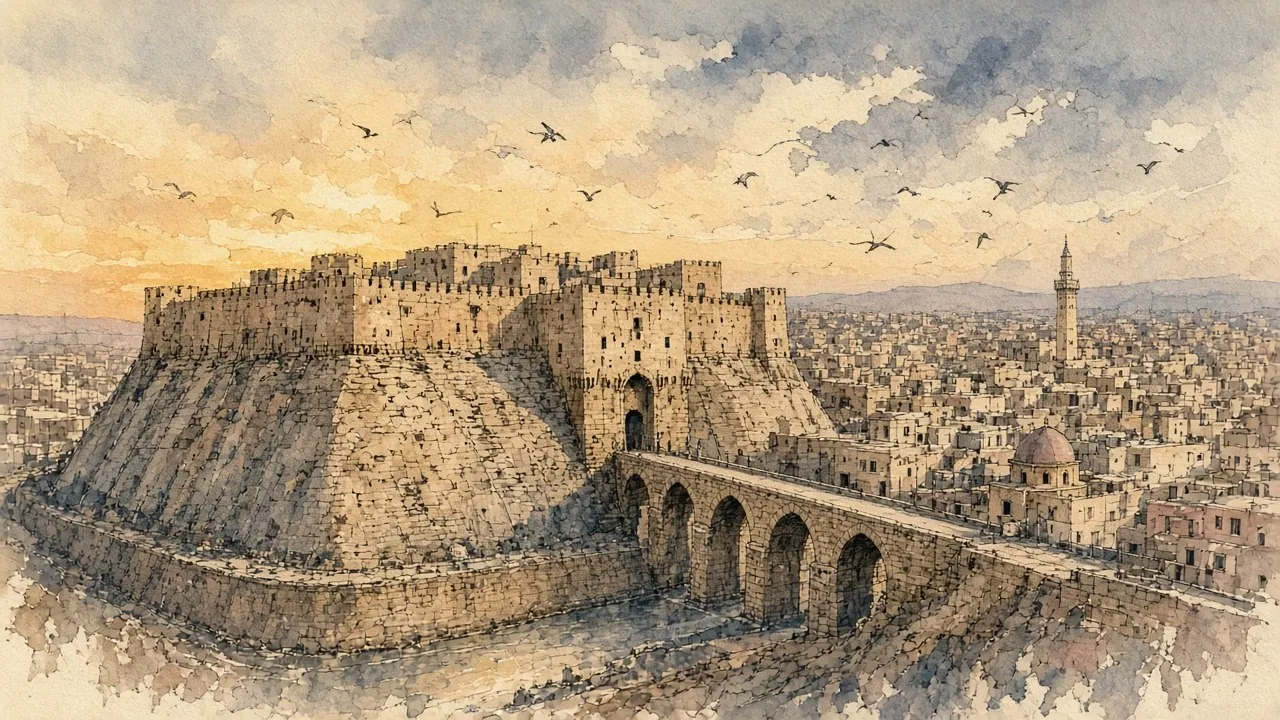
Aleppo is one of the very few cities on earth whose name can be followed, almost without a break, from the clay tablets of the third millennium before Christ to the news reports of this autumn. Scribes at Ebla wrote it as Ḫalab, Hittite kings as Ḫalpa, Seleucid colonists renamed it Beroea, Arab geographers called it Ḥalab al-Shahbāʾ, and its Jews knew it as Aram Ẓova. Through every change of name the same grey limestone hill stood above the same small river, and on that hill, for at least two thousand years, stood the temple of a storm god whose fame reached Ebla, Mari and Ḫattuša. When the god was forgotten, the hill became an acropolis, then a fortress, then one of the great castles of the medieval world, and the town at its foot became a market that drew silk from Iran, spices from India and broadcloth from London.[1][2]
This history follows Aleppo from the mound to the present, chapter by chapter and ruler by ruler, but it is also a history of the people who made the city: priest-kings and caliphs, poets and physicians, Venetian factors and Armenian refugees, the rabbis who guarded the Crown of Aleppo and the masons who are now rebuilding the souqs stone by stone. It draws on excavation reports, chronicles written in Arabic, Greek, Hebrew and Akkadian, the records of the Levant Company, the surveys of UNESCO and the reporting of the last two years. Where the sources disagree, as they often do about dates, numbers of the dead and the meaning of a ruin, the disagreement is set out rather than hidden. The story ends, for now, in the autumn of 2026, with the Great Mosque open again for prayer after thirteen years and the old city still on the list of World Heritage in Danger.[3][4]
1. The mound and the river
A hill between the sea and the Euphrates
Aleppo stands on a limestone plateau in northern Syria, roughly a hundred kilometres inland from the Mediterranean and a little further from the great bend of the Euphrates. The position explains most of its history. To the west lie the Orontes valley, Antioch and the passes to the coast; to the north the roads climb into Anatolia; to the east the steppe opens towards Mesopotamia and the river crossings that led to Baghdad and the Gulf. A traveller moving between any two of those worlds was likely to pass through Aleppo, and for most of the last four thousand years the city made its living from that fact. The Aga Khan Trust for Culture, which spent a decade conserving the citadel, sums up the logic plainly: the city flourished whenever political conditions allowed trade between the Mediterranean and Mesopotamia, and it reasserted itself as a commercial centre time and again after every disaster.[1]
The setting is modest. The Quwayq, the little river that waters the gardens on the western side of the city, has never been navigable and was always more a stream than a river. What it offered in antiquity was a steady supply of water at the edge of rain-fed farmland, close to the steppe where pastoral nomads grazed their flocks. Beside the river rose a natural outcrop of rock, easily defended and visible for miles. That outcrop, smoothed, scarped and clad in stone by later builders, is the citadel hill. Its base is an ellipse roughly 450 by 325 metres, its flat summit about 285 by 160 metres, and its glacis rises some fifty metres above the surrounding streets. Those are the figures of Archnet’s survey of the castle, and the AKTC guide notes that the temple discovered on its summit carries human use of the hill back to the early third millennium BC.[5][1]
A city of many names
The oldest written form of the name is Ḫalab, or Ḫalam, in the cuneiform archives of Ebla, Mari and Alalakh. Hittite scribes wrote Ḫalpa, the Assyrians Ḫalman, and the Greeks of the Seleucid kingdom gave the town a new name, Beroia or Beroea, after a city in Macedonia. The Arabic Ḥalab simply continued the ancient form. Medieval authors added the epithet al-Shahbāʾ, usually rendered as the grey or white one, a reference that later writers explained by the pale stone of the city or by legends about Abraham’s livestock; the epithet is still used today, and it was heard again in the speeches at the reopening of the Great Mosque in October 2026.[6][4]
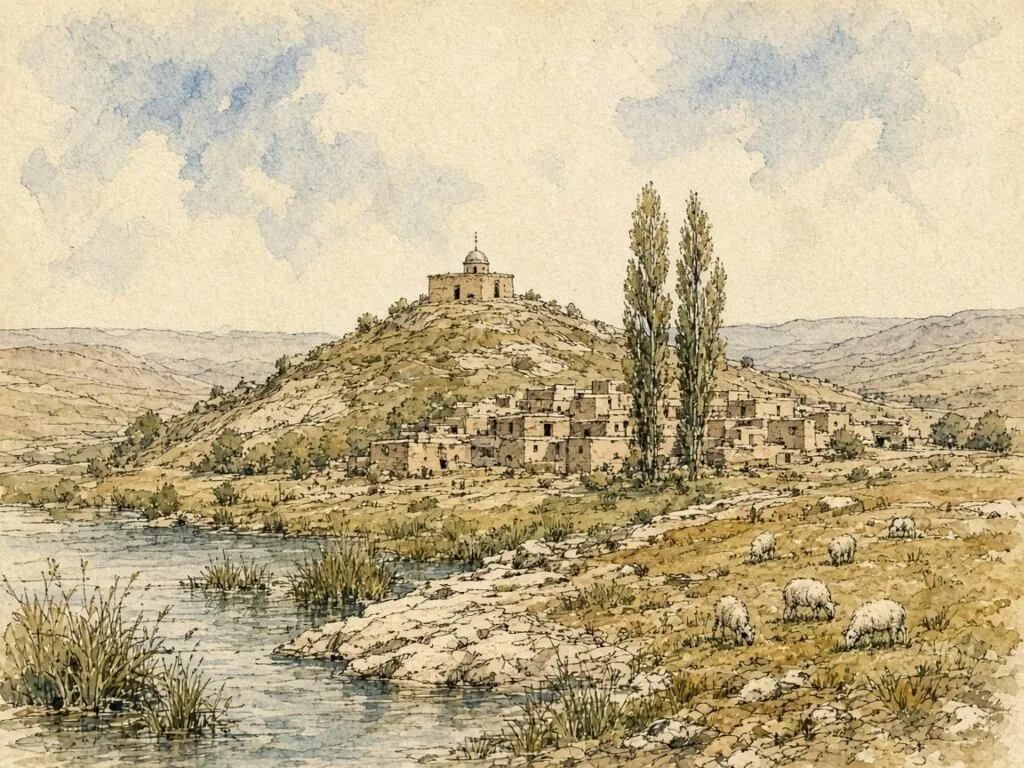
Aleppo’s Jews had a name of their own. They identified the city with Aram Ẓova, the Aramaean kingdom of Zobah that the Second Book of Samuel says King David defeated, and they called their community and its great codex by that name. The Encyclopaedia Judaica records a related tradition, cited by the twelfth-century traveller Pethahiah of Regensburg, that Abraham pastured his flocks on the hill and gave their milk, ḥalav in Hebrew, to the poor on its slopes, so that the city was named after his generosity. The same story, in Muslim form, lies behind the name of the Maqām Ibrāhīm, the shrine of Abraham on the citadel. These are legends, and they say more about the affection that the city’s communities felt for their hill than about the origins of the word, which is older than Hebrew or Arabic and whose meaning is unknown.[6][7]
How the past is known
Writing a history of ancient Aleppo is unusually difficult, because the ancient city has never been excavated in the ordinary sense. The old town has been continuously occupied, rebuilt and re-occupied, and the AKTC guide warns that ancient traces have been obliterated by later development and that archaeological finds remain limited. Almost everything known about the Bronze Age city comes from texts written elsewhere: the palace archives of Ebla in the third millennium, the letters of Mari on the Euphrates in the eighteenth century BC, the tablets of Alalakh in the plain of Antioch, and the treaties and annals of the Hittite kings in central Anatolia. Aleppo appears in those archives as a powerful neighbour, an ally, a rival or a conquest, almost never in its own words.[1]
The single great exception is the citadel itself. Since 1996 a Syrian and German mission under Kay Kohlmeyer has excavated, beneath the Ayyubid and Mamluk levels of the summit, the temple of the storm god of Aleppo, with relief-carved walls that had lain under seven or eight metres of later debris. That excavation, halted when war reached the city, turned a name in other people’s archives into a building that could be walked through and measured. It is the reason this history can begin not with a legend but with stone. The popular claim that Aleppo has been continuously inhabited for eight thousand years, repeated by journalists and officials, is a claim rather than a result: no secure Neolithic level has yet been published from the citadel, and the scholarly evidence begins in the third millennium BC.[8][9][4]
The citadel
The storm god’s hill, Hellenistic acropolis and medieval fortress, with the entrance block of al-Ẓāhir Ghāzī and the temple excavated beneath its surface.
Open in Google MapsThe Great Mosque
Begun under the Umayyads in the early eighth century; its Seljuk minaret fell on 24 April 2013 and the mosque reopened on 8 October 2026.
Open in Google MapsMadrasa al-Ḥalawiyya
The Byzantine cathedral of Beroea, converted into a mosque in 1124 and later into a madrasa, facing the Great Mosque across the street.
Open in Google MapsKhān al-Gumruk
The customs khan of 1574, the largest commercial building of the Ottoman souqs, where European consuls and merchants lodged.
Open in Google MapsBāb Anṭākiya
The western gate on the road to Antioch, at the head of the straight souq street that preserves the line of Seleucid Beroea.
Open in Google MapsCentral Synagogue
The ancient synagogue of the Baḥsīta quarter, where the Crown of Aleppo was kept for six centuries until the riot of December 1947.
Open in Google MapsForty Martyrs Cathedral
The Armenian cathedral of the Jdayda quarter, centre of the Christian suburb north of the walls.
Open in Google MapsBāb al-Faraj
The north-western gate whose surroundings were cleared by the modern planning projects that preceded the 1986 World Heritage inscription.
Open in Google Maps2. Hadda of Ḫalab
The god in the archives of Ebla
The first time Aleppo enters history it does so as the house of a god. In the 1970s Italian archaeologists working at Tell Mardikh, ancient Ebla, some fifty-five kilometres south-west of Aleppo, found the palace archives of a kingdom that flourished in the twenty-fourth century BC. Among the thousands of tablets are accounts of gifts, offerings and journeys, and in them a town called Ḫalab appears again and again as the seat of the weather god Hadda. Alfonso Archi, who has studied the Ebla texts for decades, summarises the picture in a paper published in the journal Iraq in 2010: in the twenty-fourth century, Aleppo, the centre of the cult of Hadda, was administered by an overseer under the control of Ebla, whose own chief god was Kura.[10]
The texts show that the shrine at Aleppo mattered far beyond the town. The king of Ebla and his family took a regular part in the rites of Hadda there, sending or bringing offerings to the god’s house. Twice a year, Archi writes, a renewal rite required the replacement of the god’s mace and of his pair of bull’s horns, the symbols of his power. Besides the mace, a chariot and two bulls with human faces were attributed to the god, an iconography that lasted into later centuries. The AKTC guide draws the same conclusion from the same evidence: that the royal court of Ebla offered sacrifices at a shrine in a place called Khalab is an indication of the storm god’s far-reaching influence.[10][1]
Why a storm god
The prestige of Hadda, later called Addu, Adad or Hadad, is not hard to understand. Northern Syria lies at the margin of rain-fed agriculture. In a good year the plains between the Orontes and the Euphrates produce grain in abundance without irrigation; in a dry year the harvest fails. The god who sent the winter storms and the spring rains therefore held the farmer’s life in his hand, and the AKTC guide explicitly links the long importance of the storm god of Aleppo to the reliance of settled populations on the weather. His bull and his raised weapon, the mace or later the lightning bolt, became the attributes by which he was recognised from the Mediterranean coast to Mesopotamia.[1]
Aleppo’s god did not belong to one people. Over the next two thousand years he was worshipped under different names by the different peoples who ruled north Syria: the Hurrians and the kingdom of Mitanni called him Teššub, the Luwian-speaking successors of the Hittites called him Tarḫunza, and the Aramaeans called him Hadad. The AKTC guide notes that by the end of the second millennium BC, when Aramaeans and Luwians shaped the history of Syria, Aleppo remained famous above all as the spiritual home of the storm god. In that continuity lies the first and deepest layer of the city’s identity: long before it was a capital or a market, it was a sacred place to which kings came.[1]
A temple older than the kingdom
Archaeology has now confirmed that the shrine named at Ebla stood on the citadel hill. Kohlmeyer’s excavation found that the temple had three main building phases, the oldest reaching back into the third millennium, so that the building which later received the famous reliefs was the descendant of a sanctuary already ancient when Yamḫad rose to power. The AKTC guide calls the temple one of the most important recent archaeological discoveries in Syria, precisely because it documents for the first time the whole period between the Early Syrian age of Ebla and the Aramaean centuries.[8][1]
The archaeological detail of the earliest phases is thin, and it is important not to overstate what is known. The third-millennium temple survives in foundations and fragments beneath its successors, and its plan cannot be reconstructed with the confidence possible for the Late Bronze and Iron Age building. What can be said is that the Ebla texts, the excavated sequence and the later Hittite and Assyrian references all point in the same direction: the storm god of Ḫalab had a house on the hill, the house was rebuilt again and again on the same spot, and its fame drew offerings from distant rulers for well over a thousand years. The fortress that crowns the hill today rests, quite literally, on that sanctuary.[8][10]
3. Yamḫad, the great kingdom
The rise of an Amorite capital
In the early second millennium BC the political map of Syria and Mesopotamia was redrawn by Amorite dynasties, ruling houses of West Semitic speech who took power in old cities from the Mediterranean to the Gulf. One of the strongest of them made Aleppo its capital. Its kingdom was called Yamḫad, and in the eighteenth century BC, on the conventional Middle Chronology, it was the greatest power in Syria, its influence reaching from the Euphrates to the sea. The AKTC guide describes this as the first political and economic peak in the city’s history, a time when the storm god, now called Addu, gave legitimacy not only to the kings of Aleppo but to rulers across the region.[1][11]
The dates are approximate and should be read with care. The absolute chronology of the Middle Bronze Age depends on the interpretation of a handful of astronomical observations and king lists, and historians use several competing systems; the Middle Chronology places Yamḫad’s ascendancy roughly between 1810 and 1600 BC, while lower chronologies bring every date down by several decades. What is not in doubt is the sequence. The first king of Yamḫad known in detail, Sumu-epuḫ, contended with Šamši-Adad, the Amorite conqueror who briefly built an empire across upper Mesopotamia. His son Yarim-Lim I outlasted that empire and made Aleppo the arbiter of Syrian politics.[11][12]
The letters of Mari
Most of what is known about Yarim-Lim comes from the palace archive of Mari on the middle Euphrates, excavated by French archaeologists from the 1930s. One letter, sent to King Zimri-Lim of Mari by one of his officials, has become a classic statement of the balance of power in the age of Hammurabi. No king is strong by himself, it explains; ten or fifteen kings follow Hammurabi of Babylon, as many follow Rim-Sin of Larsa and other great rulers, but twenty kings follow Yarim-Lim of Yamḫad. In the ranking of that diplomatic world, the king of Aleppo stood at the head of the largest following of all.[11][12]
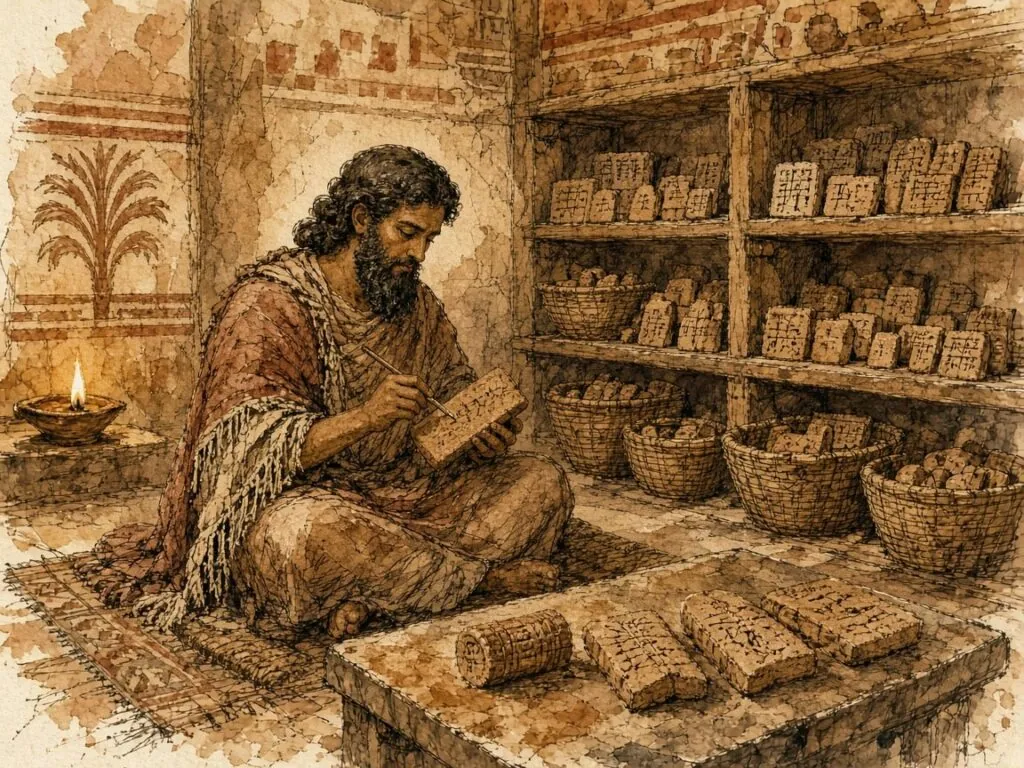
The ties between Aleppo and Mari were personal as well as political. Zimri-Lim had spent his youth in exile before recovering his father’s throne, and the support of Yamḫad was decisive in his restoration; he married Šibtu, a daughter of Yarim-Lim, who became one of the most active queens known from any Mesopotamian archive, writing to her husband about omens, palace business and the affairs of the realm. The Brazilian historian J. B. Ribeiro Santos has described the relationship as an Aleppine-Mariote dynastic project, in which marriage, gifts and shared devotion to Addu of Aleppo bound the smaller kingdom to the greater. Mari’s kings sent offerings to the storm god of Aleppo, and the god’s oracles could be quoted in letters to Mari as a warning or a promise.[12]
Jack M. Sasson has studied one of the most vivid documents from the archive, a tablet first published by Georges Dossin in 1956 in which Yarim-Lim addresses Yašub-Yaḫad, king of Dēr, with a mixture of reproach and menace that amounts to a declaration of war. Yarim-Lim calls on the sun god to judge between them, reminds his correspondent that he had treated him like a father and a brother while he was repaid as by an enemy, and claims that by the weapons of Addu and of Yarim-Lim he had once saved the city of Babylon and given life to Yašub-Yaḫad’s land. Had it not been for Addu and Yarim-Lim, he writes, Dēr would have been blown away like chaff fifteen years before. The letter closes with a threat to come to the gate of the rival’s city and show him the weapons of Addu and Yarim-Lim. Why a copy of such a letter was kept at Mari is itself a puzzle that Sasson discusses, but its voice is unmistakable: the king of Aleppo speaks as the patron of lesser kings and as the partner of his god.[13]
Alalakh and the appanage
Aleppo’s power was exercised in part through family members placed on subordinate thrones. The best documented case is Alalakh, Tell Atchana, in the Amuq plain near modern Antakya, excavated by Sir Leonard Woolley in the 1930s and 1940s. The archive of Alalakh level VII records that the town was granted by Abba-El, king of Aleppo, to his brother Yarim-Lim, who founded a local dynasty there. The tablets of that level, with their land grants, ration lists and legal contracts, are the closest thing to an administrative record of Yamḫad that survives, and they show a kingdom in which Hurrian names were already appearing beside Amorite ones.[11][14]
The greatness of Yamḫad did not last. Its kings were overshadowed after Hammurabi’s conquest of Mari around 1761 BC by the rise of a new power in the north, and the Hittite kings of central Anatolia came to regard Aleppo as the key to Syria. For more than a century and a half, though, Aleppo had been the capital of a great kingdom, the seat of a god whom kings from the coast to the Euphrates honoured, and a centre of diplomacy whose letters can still be read. That memory was not lost: centuries later, Hittite scribes drafting a treaty with a king of Aleppo would recall that the kings of Ḫalpa had once possessed a great kingship.[15][11]
4. The Hittite storm
Ḫattušili and Muršili
The kingdom of Ḫatti, centred at Ḫattuša on the Anatolian plateau, began to reach south across the Taurus in the seventeenth century BC. Its early kings saw Yamḫad as the principal obstacle between themselves and the wealth of Syria. Ḫattušili I campaigned repeatedly in the north Syrian plain and destroyed Alalakh, Aleppo’s western appanage, but the capital itself held. It fell to his grandson and successor, Muršili I, who destroyed Ḫalpa and then marched down the Euphrates to raid Babylon, ending the dynasty of Hammurabi. Later Hittite texts remembered both deeds as the glory of the early kingdom, and the treaty prologues of the fourteenth and thirteenth centuries looked back to them as the moment when the great kingship of Aleppo passed to Ḫatti.[15][11]
The date of the fall of Aleppo is one of the most debated numbers in ancient Near Eastern history. On the Middle Chronology, long the standard in handbooks, Muršili’s raid on Babylon took place in 1595 BC, and the destruction of Aleppo shortly before; on lower chronologies, which many specialists now prefer, the events move later by sixty years or more. This history uses the conventional round figure of about 1600 BC, but readers should treat every Bronze Age date in these pages as provisional. The sequence of events is secure; the absolute numbers are not.[11][16]
Under Mitanni
The Hittite triumph was short-lived. Muršili was murdered on his return, his kingdom fell into decades of internal conflict, and north Syria passed under the influence of a new power to the east. Mitanni, a kingdom whose ruling class spoke Hurrian and whose kings bore Indo-Aryan names, dominated the region from its capital in the upper Ḫabur basin through most of the fifteenth century. Aleppo survived as a subordinate kingdom within the Mitannian system, its storm god now worshipped above all as the Hurrian Teššub, and its royal family continued to claim the old prestige of Yamḫad even when they no longer held its power. The AKTC guide characterises the period simply: the great empire had been short-lived, and Aleppo was soon dominated by Mitanni and later by the Hittites.[1]
The flight of Idrimi
The most famous figure of this age is a prince of Aleppo who did not rule there. Idrimi is known from a statue excavated by Leonard Woolley at Alalakh in 1939 and now in the British Museum, a seated figure in white stone whose body and cheeks are covered with a long autobiographical inscription in Akkadian cuneiform. In the text Idrimi tells how an evil deed occurred in Aleppo, his father’s house, and how the family fled to Emar on the Euphrates, where his mother’s relatives lived. Unwilling to remain a dependant, he left with his horse and chariot and spent seven years among the Ḫapiru, the uprooted fighting men of the Levant, in the land of Canaan, before gathering ships and soldiers, winning recognition from the king of Mitanni and becoming king of Alalakh.[17][14]
The inscription has become one of the most quoted texts of the Late Bronze Age, partly because of its human voice and partly because the British Museum has presented Idrimi as an ancient refugee. But the scholars who published a new edition and study of the statue, The Labors of Idrimi, warn against reading it as a straightforward memoir. The text may have been composed, or at least carved, some time after the events it describes, and it follows literary patterns found in other royal narratives: the youngest son who succeeds where his brothers fail, the years of wandering, the divine sign, the triumphant return. It may preserve real memories of a dynastic catastrophe in Aleppo, but it is first of all a piece of royal self-presentation designed to justify a usurper’s rule in a subordinate city.[14]
What the inscription does show is how the memory of Aleppo’s kingship functioned in the fifteenth century. Idrimi’s claim to rule Alalakh rested on his descent from the royal house of Aleppo, and his story begins there, in the city of his fathers, even though he never ruled it. For the peoples of north Syria the dynasty of Ḫalab still conferred legitimacy generations after its fall, much as the temple on the hill still conferred sanctity. The kings of Mitanni, and after them the Hittites, would both exploit that inheritance rather than try to erase it.[14][1]
5. Priest-kings of Ḫalpa
Šuppiluliuma’s settlement
In the middle of the fourteenth century BC the Hittite king Šuppiluliuma I broke the power of Mitanni and brought the whole of north Syria under his control. His solution to the problem of governing so distant and so prestigious a region was dynastic. He made two of his sons kings in Syria: Piyaššili, who took the Hurrian name Šarri-Kušuḫ, at Carchemish on the Euphrates, which became the military and political centre of Hittite Syria, and Telipinu at Aleppo. Telipinu is described in Hittite sources as the priest, and his office in Aleppo was bound up with the cult of the storm god whose temple stood on the hill. The arrangement neatly divided power from sanctity: Carchemish held the army, while Aleppo kept the god.[16][15]
The monuments that survive from these centuries reflect that settlement. The Hittite Monuments survey of Aleppo describes the storm god of Aleppo as one of the major deities of the Hittites, and notes that during the empire the city was overshadowed politically by Carchemish while keeping its importance as the centre of the storm god’s cult in Syria. The only monumental inscription of the empire period from the city is a dedication of Talmi-Šarruma, Telipinu’s son, known as ALEPPO 1 and first published by Emmanuel Laroche in 1956. For the second time in its history, Aleppo’s importance lay not in armies or tribute but in the authority of its shrine, now recognised by an empire that reached from the Aegean coast to the Euphrates.[16]
The Aleppo Treaty
The most important document of this period is a treaty. A clay tablet in the British Museum, catalogued as BM 140856 and known to Hittitologists as KBo 1.6 or CTH 75, records an agreement between the Hittite king Muwattalli II and Talmi-Šarruma, king of Aleppo, the son of Telipinu. Its historical introduction explains that the treaty is a renewal. An earlier tablet issued by Muwattalli’s father, Muršili II, had been stolen, and the new text was written to replace it. The very fact that a stolen treaty needed to be reissued says much about the importance attached to such documents; they were legal instruments, deposited before the gods, whose loss weakened the bond they recorded.[18][15]
The historical prologue of the treaty is also a short history of Aleppo as the Hittites wished to remember it. In former times, it says, the kings of Aleppo possessed a great kingship, until Ḫattušili and then Muršili of Ḫatti brought it to an end. It goes on to recount how later kings of Aleppo turned to Ḫanigalbat, the Hittite name for Mitanni, and how the lands of Aleppo, Aštata and Nuḫašše offended against Ḫatti before Šuppiluliuma restored order and installed his son. The name lists of the LAMAN project, which index every place mentioned in the tablet, show how densely the text is woven from the geography of north Syria: Ḫalap, Ḫatti, Carchemish, Ḫanigalbat, Aštata, Nuḫašše and the land of Lebanon recur through its lines.[19][15]
Priest, judge and vassal
Talmi-Šarruma’s position was carefully defined. He was a king, and his line was guaranteed the throne of Aleppo, but he ranked below the king of Carchemish in the Hittite hierarchy and was bound to support the great king against all enemies. He also had judicial responsibilities in Syria, and modern studies of the Hittite administration have discussed whether the king of Aleppo acted as a judge in disputes between other vassals, a role that would fit the old prestige of the city and its god. The surviving texts suggest a ruler who combined priestly, judicial and military functions under the supervision of a distant overlord, an arrangement that preserved Aleppo’s dignity while removing its independence.[15][16]
The Hittite empire collapsed around 1180 BC, in the general crisis that brought down palace societies from Greece to Egypt’s Asian provinces. Ḫattuša was abandoned, and the great kingdom dissolved into smaller states. Carchemish survived as the seat of a line of rulers who still called themselves great kings, and in the north Syrian plain new kingdoms emerged whose kings used Luwian hieroglyphs and Hittite titles. For Aleppo the end of the empire did not mean the end of the temple. On the contrary, the decades after the collapse saw one of the most ambitious rebuildings of the storm god’s house, and the reliefs that make it famous today were carved for kings who claimed to be heirs of Ḫatti. That temple, and the man who uncovered it, are the subject of the next chapter.[20][8]
6. Kohlmeyer’s temple
Seven metres down
The first hint of the temple came in the early 1930s, when G. Ploix de Rotrou, the French inspector of antiquities who was restoring the medieval citadel, came upon a re-used relief slab showing two winged genii beneath the sun and moon. He opened a deep sounding nearby, found nothing spectacular and backfilled it. Sixty years later that forgotten trench became the starting point of a new excavation. In 1996 a joint Syrian and German mission, directed on the Syrian side by Wahid Khayyata and later Youssef Kanjou of the National Museum of Aleppo and on the German side by Kay Kohlmeyer, began digging at the centre of the citadel summit, with Julia Gonnella responsible for the Islamic periods. Kohlmeyer, writing in 2020, credits Khayyata with the initiative and the Gerda Henkel Foundation with the courage to fund it.[8]
What they found lay seven to eight metres below the surface. Between 1996 and 2010 the team exposed the cella, the main hall of the storm god’s house, and part of its badly ruined entrance, enough to show a building with a broad cella measuring roughly seventeen by twenty-six metres. The exterior has never been seen. The excavation area is hemmed in by a Zangid mosque on the west, an Ayyubid palace on the south and a modern theatre on the east, and to the north the later deposits rise so steeply that Kohlmeyer expects the outer walls to remain hidden for ever. The Hittite Monuments survey notes the same limitation: only the inner walls have been unearthed.[8][16][21]
Phases of a sanctuary
The sequence of buildings confirmed what the texts had implied. Wherever soundings were possible, the excavators found remains of an Early Bronze Age predecessor beneath the Middle Bronze Age walls, laid directly on the bedrock of the hill and following almost the same outline, with a deposit closely linked to the earliest building. Above it rose the temple of the Middle Bronze Age, the age of Yamḫad, and then the Late Bronze Age building of the Hittite viceroys, whose orthostats, the carved stone slabs lining the base of the walls, were partly re-used by later builders. The latest and best preserved phase belongs to the early Iron Age, after the fall of the Hittite empire, when the temple was refurbished on a grand scale.[8][20]
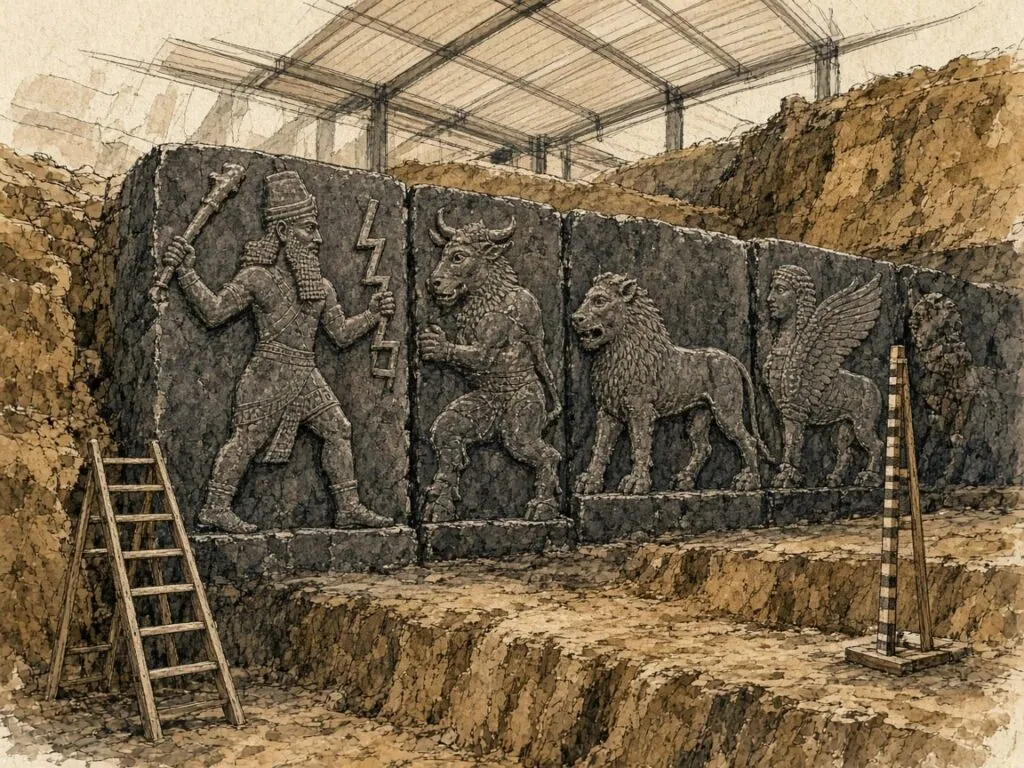
The reliefs of that last phase are the temple’s glory. Along the walls of the cella and the podium stand basalt slabs carved with lions, sphinxes, bull-men, genii and the storm god himself, shown in one celebrated relief stepping into his chariot. Many of the slabs on the eastern wall are re-used pieces of the empire period, so that the Iron Age temple was itself a kind of museum of earlier sanctity. The AKTC guide illustrates reliefs of the podium wall from around 900 BC and a profile of the storm god from the inner elevation of the wall, and observes that the discovery documents for the first time the long stretch of the city’s history between the Early Syrian and the Aramaean eras.[1][16][20]
Taita, king of Palistin
The most surprising find was an inscription. In 2003 the excavators uncovered a relief of a king facing the storm god, accompanied by a text in Luwian hieroglyphs, now known as ALEPPO 6 and edited by J. David Hawkins. It names Taita, hero and king of Palistin, a kingdom of north Syria in the eleventh century BC whose centre, according to the Hittite Monuments survey, lay at Tell Tayinat in the Amuq plain. Inscriptions naming Taita had already been known from the region of Hama, but the Aleppo relief showed that Taita had ruled the city and refurbished its temple. The eDiAna database of the University of Munich gives the full text with Hawkins’s edition.[22][16][20]
Palistin has attracted attention because of its name. Some scholars have linked it with the Philistines, the Peleset of Egyptian texts, and seen in Taita’s kingdom evidence for Aegean or Sea Peoples settlers in north Syria after the collapse of around 1200 BC; others regard the resemblance as superficial or argue that the name should be read Walastin. The date of the relief within the eleventh or tenth century is also debated. These questions remain open, and this history records them as disputed. What is clear is that a king of a new post-Hittite state chose to present himself, in Luwian and in the iconography of Ḫatti, as the servant of Aleppo’s god in his own house.[22][16]
The temple in the war
The political crisis that reached Aleppo in 2011 ended the excavation before its final campaign and before the planned shelter could be built. Kohlmeyer records that in 2010 all the sculptures and relevant structures were protected with sandbags and a roof of zinc sheet. The roof endured for four years, until a grenade exploded in the area, causing the rear wall of a medieval cellar to collapse and leaving the covers and some sculptures exposed to the weather. The UNESCO and UNITAR survey of 2018, using satellite images, recorded that a roof over the excavated area had collapsed by May 2014 and that bursting sandbags had spread their contents across a wider area by 2017; it dates the roof to 2005, a small discrepancy with Kohlmeyer’s account that probably reflects successive stages of protection. At the beginning of 2019, Kohlmeyer writes, it was possible to renew the protective sandbags, and the Gerda Henkel Foundation has since funded further protection of the temple. The storm god of Aleppo, who had outlived Ebla, Yamḫad and Ḫatti, also survived the siege of his hill.[8][23]
7. Aramaeans, Assyrians and Persians
Bit Agusi and the Aramaean kingdoms
In the centuries after the Hittite collapse, the political landscape of north Syria was reshaped once more, this time by Aramaean tribes and dynasties who settled across the region and founded states named after their ancestral houses. Franz Rosenthal, in his survey of Aramaic for the Encyclopaedia Iranica, notes that Aramaic-speaking groups founded a number of city states and federations around Aleppo and Damascus that dominated the history of the region for about three centuries, sometimes in conflict with and sometimes as vassals of the Mesopotamian empires. Aleppo itself lay within the kingdom of Bit Agusi, whose capital was Arpad, modern Tell Rifaʿat, some thirty-five kilometres to the north. It was no longer a royal city, but it remained what it had always been, the home of the storm god, now addressed in Aramaic as Hadad.[24][1]
The Aramaean centuries left Aleppo’s temple standing and honoured. Luwian and Aramaic dynasts alike wanted the god’s favour, and the refurbishment of the cella in the early Iron Age, with the reliefs of the podium wall dated by the AKTC guide to around 900 BC, belongs to this world of competing small kingdoms. The language of the Aramaeans would have a longer life than any of their states: under the Assyrians and the Persians it became the common written language of the Near East, and in its Syriac form it would still be the language of the Christian villages around Aleppo a millennium and a half later.[24][1]
Shalmaneser’s sacrifice
The Assyrian empire of the ninth century BC turned north Syria into its battlefield. In 853 BC King Shalmaneser III crossed the Euphrates on a campaign that would end in the battle of Qarqar on the Orontes against a coalition of Syrian and Levantine kings, among them Hadadezer of Damascus, Irḫuleni of Hamath and Ahab of Israel. His own account of the campaign, carved on the Kurkh monolith now in the British Museum, records his passage through Aleppo. The Posen Library’s translation gives the essential lines: he approached Aleppo, its people were afraid to fight and seized his feet, he received their tribute of silver and gold, and he offered sacrifices before the god Adad of Aleppo.[25][26]
The episode is a vivid illustration of the city’s double identity. Politically, Aleppo was a small place that submitted without a fight; religiously, it was a shrine important enough that the king of Assyria, on his way to the greatest battle of his reign, stopped to sacrifice there. The AKTC guide adds that Assyrian documents counted Aleppo’s god among the seven great storm gods of the Middle East. A conqueror who honoured the god could claim the god’s support, and Shalmaneser’s inscription is careful to place the sacrifice immediately before his march south.[1][25]
Province, trophy and silence
By the middle of the eighth century BC the Assyrians had abandoned the system of tribute-paying vassals in north Syria and annexed the region outright. Tiglath-pileser III took Arpad after a long siege in 740 BC, and Aleppo became part of an Assyrian province. When Assyria itself fell in 612 BC, the Neo-Babylonian kings inherited its western lands, and one remarkable object suggests what that inheritance meant for Aleppo. A large stele of the storm god, catalogued as BABYLON 1, was excavated in 1899 in the palace complex of Nebuchadnezzar II at Babylon, along with inscribed stone bowls; the Hittite Monuments survey notes that they were apparently carried away from Aleppo as trophies. The stele is now in the Istanbul Archaeology Museum.[16][1]
After 539 BC, when Cyrus the Great took Babylon, Aleppo passed under Achaemenid Persian rule for two centuries. Here the sources fall almost silent. The AKTC guide states frankly that there is no documentary evidence about the role of the storm god at that time, and the archaeology of the citadel has so far added little. The silence should not be mistaken for abandonment; north Syria under the Persians was a prosperous satrapy crossed by the royal roads, and Aramaic administrative documents from elsewhere in the empire show how the region was governed. But for Aleppo itself the next clear evidence comes only with the arrival of Alexander’s successors, when the town received a new name and a new plan.[1][24]
8. Seleucid Beroea
A Macedonian name
Alexander the Great passed through Syria in 333 and 332 BC, and after his death in 323 his generals fought for two decades over his empire. North Syria fell to Seleucus I Nicator, who after the battle of Ipsus in 301 BC set about planting Greek and Macedonian cities across his new territory. The most famous of his foundations were the four cities of the north Syrian coast and the Orontes, Antioch, Seleucia in Pieria, Apamea and Laodicea, but he also refounded older towns inland. Between 301 and 281 BC, according to the AKTC guide, Seleucus revived Aleppo under the name of Beroia, after the town of that name in Macedonia, and settled a colony there. For the first time in its history the city of the storm god was given a foreign name and a foreign citizen body.[1]
Beroea was never one of the great cities of the Hellenistic world. It lay on the road from Antioch to the Euphrates crossings, a day’s journey or two from the royal capital, and its role was that of a garrison and market town in Antioch’s hinterland. Yet the refoundation was decisive for the later shape of Aleppo, because it gave the city a planned centre whose pattern can still be traced. The AKTC guide describes the new Hellenistic town as lying between the river and the citadel hill, and the UNESCO and UNITAR survey places the history of the citadel as a fortified acropolis in the Seleucid period, between the late fourth and the first century BC.[1][23]
The grid beneath the souq
Seleucid colonies were laid out on the orthogonal plan associated with the Greek planner Hippodamus, with streets meeting at right angles to form regular blocks. In Aleppo that grid has survived in an unusual way. The covered markets of the old city, the souqs that stretch west from the foot of the citadel towards Bāb Anṭākiya, the Antioch Gate, follow a pattern of long parallel lanes and right-angled crossings that contrasts sharply with the maze of winding lanes and dead ends in the residential quarters around them. The AKTC guide states plainly that the current street system in the souq illustrates the ancient orthogonal road network with its grid layout, in sharp contrast to the maze of the Islamic town.[1]
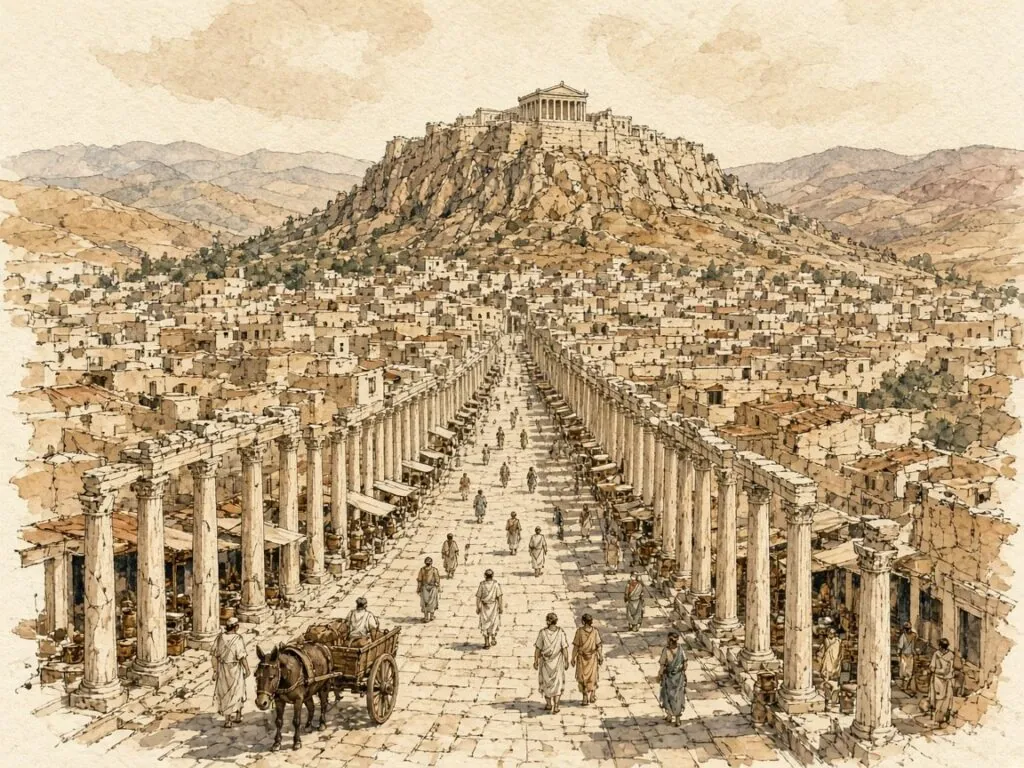
The main axis of the grid ran east towards the citadel. It was a wide street, perhaps colonnaded in the Roman period, which led from the western gate to the foot of the hill. Over the centuries, as the AKTC guide’s diagrams show, the colonnaded street was gradually transformed: shops were built out into the roadway, the open street narrowed into a covered market, and the line of the colonnade became the line of the souq. The process was not a single event but a slow encroachment that took place under Byzantine and Islamic rule alike, and it explains why the main market of modern Aleppo still runs straight as a ruler through a city otherwise famous for its irregular plan.[1]
The acropolis
On the hill itself the Seleucid period left substantial traces. The AKTC guide notes that layers of Hellenistic settlement up to two metres thick survive on the citadel, and its plan of the summit marks a Hellenistic well among the excavated features. The excavators also suspected that a larger building, perhaps a later temple, lay north-east of the temple of the storm god, though it has not been exposed. Medieval Arab historians, the same guide records, dated the history of the citadel as a fortified acropolis to this period, an opinion that the archaeology broadly supports.[1]
What became of the storm god under Greek rule is a question the evidence answers only indirectly. Greek settlers in Syria commonly identified local high gods with Zeus, and when the emperor Julian came to Beroea six centuries later he would sacrifice on the acropolis to Zeus, a choice that the AKTC guide reads as evidence that the worship of the storm god had been transferred to Zeus and survived into late antiquity. The temple of the Bronze and Iron Ages lay by then deep beneath later buildings, but the hill remained sacred. The Seleucids had added a grid, a garrison and a Greek name; they had not displaced the god.[1][27]
9. Roman and Christian Beroea
In Antioch’s shadow
In 64 BC Pompey deposed the last Seleucid king and made Syria a Roman province. For the next seven centuries Beroea belonged to the Roman and then the Byzantine world, and for most of that time it lived in the shadow of Antioch, the provincial capital and one of the three or four greatest cities of the empire. Procopius, writing in the sixth century, placed Beroea between Antioch and Hierapolis, at a distance of two days’ journey from each for an unencumbered traveller, and that description captures its role: a station on the road from the Mediterranean to the Euphrates frontier, prosperous from the farmland and villages around it but rarely the scene of great events. Few traces of the Roman city have been found on the citadel, though the souq preserves the line of its colonnaded street.[28][1]
The surrounding countryside was more remarkable than the town. The limestone massif west of Aleppo was covered in late antiquity with some forty villages, now inscribed by UNESCO as the Ancient Villages of Northern Syria, whose stone houses, churches, bathhouses and oil presses survive in a remarkable state of preservation; UNESCO’s description calls them an exceptional illustration of the development of Christianity in the East in village communities. It was in those hills that Simeon the Stylite spent decades on his pillar in the fifth century, and the great church that grew up around his column, Qalʿat Simʿān, about thirty kilometres north-west of Aleppo, reopened to visitors in early October 2026, a week before the Great Mosque, as part of the same revival of the region’s heritage.[29][4]
Julian on the acropolis
In March 363 the emperor Julian, marching east against Persia, stopped at Beroea, and in a letter to his friend the orator Libanius he described the visit. Zeus, he wrote, had declared all things auspicious by a manifest sign from heaven; he stayed for a day, saw the acropolis and sacrificed a white bull to Zeus in imperial fashion. He also spoke briefly to the town council about the worship of the gods. They all applauded his arguments, he admitted, but very few were converted, and those few already seemed to share his views. The letter is a small masterpiece of disappointment, and a precious snapshot of a city council that was by then overwhelmingly Christian.[27]
The AKTC guide reads the letter also as evidence for continuity on the hill. Julian sacrificed on the acropolis, where the storm god’s temple had stood, and to Zeus, the god with whom Greek-speaking Syrians had long identified their own high gods; the worship of the storm god, in that sense, had been transferred to Zeus and survived into late antiquity. Within a generation of Julian’s death the public cults of the old gods would be closed by imperial law, and the acropolis would acquire churches instead.[1][27]
Bishop Acacius
The most celebrated figure of Christian Beroea was its bishop Acacius. Henry Wace’s Dictionary of Christian Biography describes him as a Syrian who in his youth adopted the ascetic life in the monastery of Gindarus near Antioch, and who was consecrated to the see of Beroea, which the dictionary glosses as the modern Aleppo, by Eusebius of Samosata after the latter’s return from exile in 378. He attended the Council of Constantinople in 381, travelled to Rome on behalf of the churches of Syria, and became one of the most powerful bishops of the East. His reputation was mixed. He was famous for the strictness of his ascetic life, which he kept up as a bishop, but he was also, in Wace’s words, one of the most implacable enemies of John Chrysostom, taking part in the Synod of the Oak in 403 and pressing for Chrysostom’s final exile in 404.[30]
In extreme old age Acacius tried to make peace in the controversy over Nestorius, which divided Antioch from Alexandria. He did not attend the Council of Ephesus in 431, but the New Catholic Encyclopedia credits him with an important part in restoring communion between the two sees through the formula of union of 433. Sources differ on his death: Wace dates his episcopate to about 379 to 436, the New Catholic Encyclopedia places his death shortly after 433 at an age of more than a hundred and ten, and older reference works repeat a figure of one hundred and sixteen. All agree that he lived to an extraordinary age and that, for half a century, the bishop of Beroea was a voice the whole Eastern church had to hear.[30][31]
The cathedral and the Persian fire
The principal church of Beroea stood west of the citadel, close to the line of the colonnaded street. Its remains, with superbly carved capitals, survive inside the Madrasa al-Ḥalawiyya opposite the Great Mosque. The AKTC guide describes it as the sixth-century cathedral built by Justinian and dedicated to Saint Helena, the mother of Constantine; a popular tradition credits Helena herself with its foundation, which is a legend rather than history. The church remained in Christian use until 1124, when, during a Crusader siege, it was converted into a mosque, and it later became a madrasa.[1][23]
In 540 the Persian king Khosrow I invaded Syria. Procopius tells the story in detail. Megas, bishop of Beroea, who happened to be at Antioch, went to Khosrow to plead for the cities of the East; meanwhile the Persian army reached Beroea and demanded twice the two thousand pounds of silver it had extracted from Hierapolis. The Beroeans paid two thousand pounds and said they could pay no more, and that night the whole population fled into the fortress on the acropolis with the soldiers of the garrison. The Persians climbed the empty walls, opened the gates, and Khosrow in his anger set fire to nearly the whole city. On the hill the defenders fought bravely, but they had brought their horses and animals with them, and the single spring in the fortress ran dry. Megas returned to find his city burned and reproached the king, and Khosrow eventually let the besieged go. In the early seventh century, according to records summarised by the AKTC guide, the townspeople again took refuge on the citadel during the wars of Khosrow II, whose army is said to have spared it because the inhabitants convinced the king they had no money left.[28][32][1]
10. The Arab conquest and the Umayyad mosque
Surrender to Abū ʿUbayda
The armies of the new Islamic state entered Syria in the 630s, and after the decisive defeat of the Byzantine field army at the Yarmuk in 636 the cities of the north surrendered one after another. Aleppo was taken by forces under Abū ʿUbayda ibn al-Jarrāḥ, with Khālid ibn al-Walīd among his commanders. The AKTC guide and the Encyclopaedia Judaica both date the conquest to 636, while many histories prefer 637; the difference reflects the uncertain chronology of the campaigns after the Yarmuk, and this history gives both. Like most Syrian towns, Aleppo seems to have surrendered on terms rather than been stormed, and its Christian and Jewish inhabitants remained, paying tribute in return for protection.[1][6][33]
The conquerors found a town in poor condition. According to the written records summarised in the AKTC guide, the Arabs found the walls of the citadel destroyed by an earthquake and repaired and maintained them. For the next three centuries Aleppo was a provincial town, second in its own district to Qinnasrīn, the old Chalcis, which served as the seat of the military province of northern Syria. It lay, in the AKTC guide’s phrase, on the boundary of the territories of the Umayyad and Abbasid rulers, and when the caliphate moved its capital from Damascus to Baghdad in 750 the city’s distance from the centre of power only grew.[1][33]
The Great Mosque
The most lasting work of the early Islamic period was the Great Mosque, al-Jāmiʿ al-Umawī, built on the open ground west of the citadel where, according to tradition, the garden of the Byzantine cathedral had lain. Archnet’s entry, written by Matthew Saba of the Aga Khan Documentation Center at MIT, states that it was first constructed during the reign of the Umayyad caliph al-Walīd I, who reigned from 705 to 715, or of his successor Sulaymān, who reigned from 715 to 717. The coverage of the mosque’s reopening in October 2026 attributed it to Sulaymān in 715. Both attributions appear in the medieval sources, and the founder should be regarded as uncertain.[34][4]
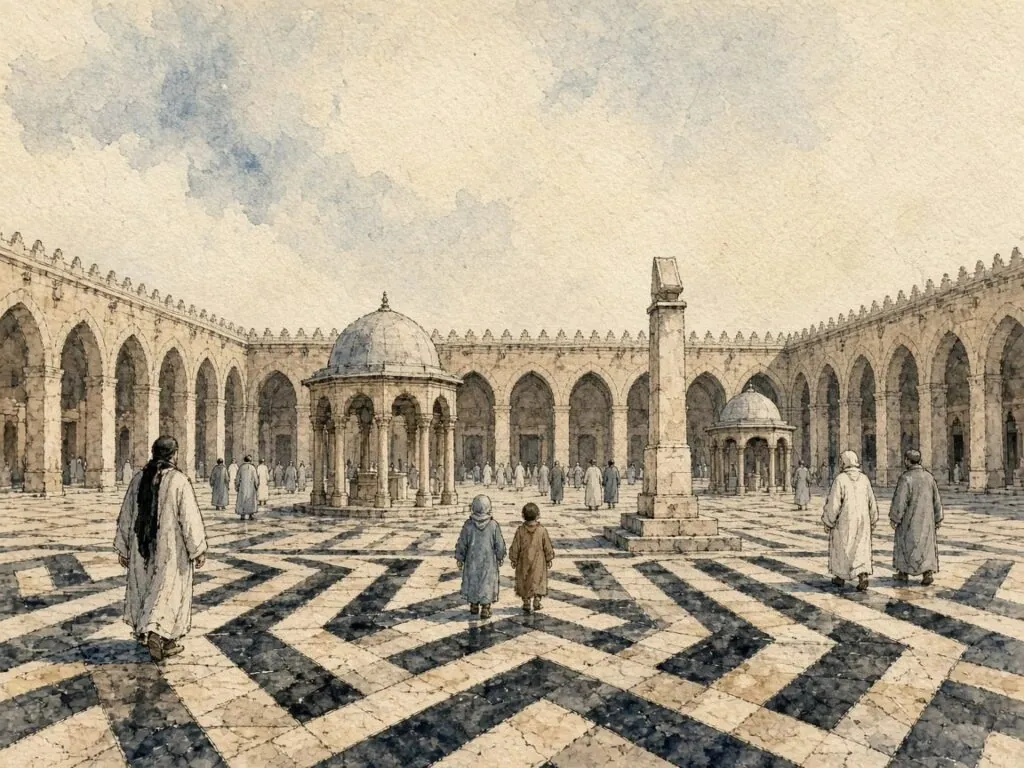
What the first mosque looked like can be inferred only in outline. Archnet describes a courtyard surrounded on at least three sides by arcades, with a long and shallow prayer hall on the qibla side and a wooden roof, probably with a dome over the nave before the mihrab, following the type of the Umayyad Mosque of Damascus built by al-Walīd. Arabic sources suggest lavish decoration with marble revetments, mosaics and re-used architectural elements. The building that stood until 2012 retained that plan but little of the original fabric, for it had been damaged and rebuilt many times: after the Byzantine sack of 962, after the fire of 1169, and twice after Mongol attacks in the thirteenth century.[34]
The prayer hall also holds a shrine associated with Zechariah, the father of John the Baptist, a reminder of how easily sacred memory passed from one faith to another in the city. The mosque’s black and white courtyard pavement, with its intricate geometric patterns, became one of the best-known images of Aleppo, and its two ablution fountains stood at the heart of the city’s daily life. For thirteen centuries, with interruptions, the Great Mosque was the place where Aleppo’s Muslims gathered for Friday prayer, and its closure in 2013 and reopening in 2026 frame the last chapters of this history.[34][4]
Jews and Christians in the early Islamic city
Aleppo’s older communities did not disappear under Islam. The Encyclopaedia Judaica states that Jewish settlement in the city continued uninterruptedly from Roman times, that the Jews lived in a separate quarter before the Muslim conquest and afterwards in the north-east of the city, and that the oldest part of the great synagogue, built as a basilica in the Byzantine period, bears an inscription dated 834. The encyclopaedia also records that Saadia Gaon, the greatest Jewish scholar of the age, was in Aleppo in 921 and is said to have found learned men there. Christians remained the majority of the population for generations after the conquest, and the cathedral continued to serve as a church until the twelfth century.[6][1]
Politically, Aleppo’s ninth and early tenth centuries are obscure. As Abbasid power weakened, northern Syria passed between the caliph’s governors, the Ṭūlūnid rulers of Egypt and their successors the Ikhshīdids, with Byzantine raiders crossing the Taurus whenever the frontier defences faltered. The city was a prize rather than a power. That changed abruptly in 944, when a prince of the Arab house of Ḥamdān took Aleppo and made it, for the first time since Yamḫad, the capital of a state.[33][1]
11. Sayf al-Dawla’s court
A prince of the Ḥamdān
The Ḥamdānids were an Arab family of the tribe of Taghlib who had risen in the service of the Abbasid caliphs in northern Mesopotamia. In October 944 one of them, ʿAlī ibn Abī l-Hayjāʾ ʿAbd Allāh ibn Ḥamdān, better known by the title the caliph had given him, Sayf al-Dawla, the Sword of the Dynasty, took Aleppo and made it the capital of an emirate that stretched across northern Syria and parts of the Jazira. He ruled until his death in 967, and the Gerda Henkel Foundation’s Aleppo Heritage Catalogue states plainly that it was with his successful struggle against Byzantium that Aleppo first gained importance in world history. The AKTC guide speaks of a political and cultural renaissance, a short period in which the provincial town became the seat of one of the most brilliant courts of the tenth century.[35][1]
Sayf al-Dawla’s reputation rested on two things that contemporaries saw as connected: war against the Byzantines and patronage of letters. For more than twenty years he led raids across the Taurus into Byzantine Anatolia, winning victories that his poets celebrated and suffering defeats that they passed over. His military achievement was real but limited, for the Byzantine empire was entering a period of revival under its great soldier-emperors and the balance on the frontier was shifting against him. What made his court unforgettable was the way it turned the frontier war into literature.[33][35]
Poets of the frontier
The greatest of the poets was Abū l-Ṭayyib al-Mutanabbī, widely regarded as the supreme master of classical Arabic verse. He came to Sayf al-Dawla’s court in 948 and stayed for some nine years, composing a series of panegyrics on the emir’s campaigns, the Sayfiyyāt, that are still learned by heart across the Arab world. In them the battles of the frontier become contests of virtue and fate, the emir a hero who embodies the qualities of an idealised Arab nobility. The relationship was stormy. Mutanabbī was proud, quarrelsome and jealous of rivals, and in 957 he left Aleppo for Egypt, where he sought and failed to find a patron of equal stature. His years in Aleppo produced the poems on which his fame chiefly rests.[33][36]
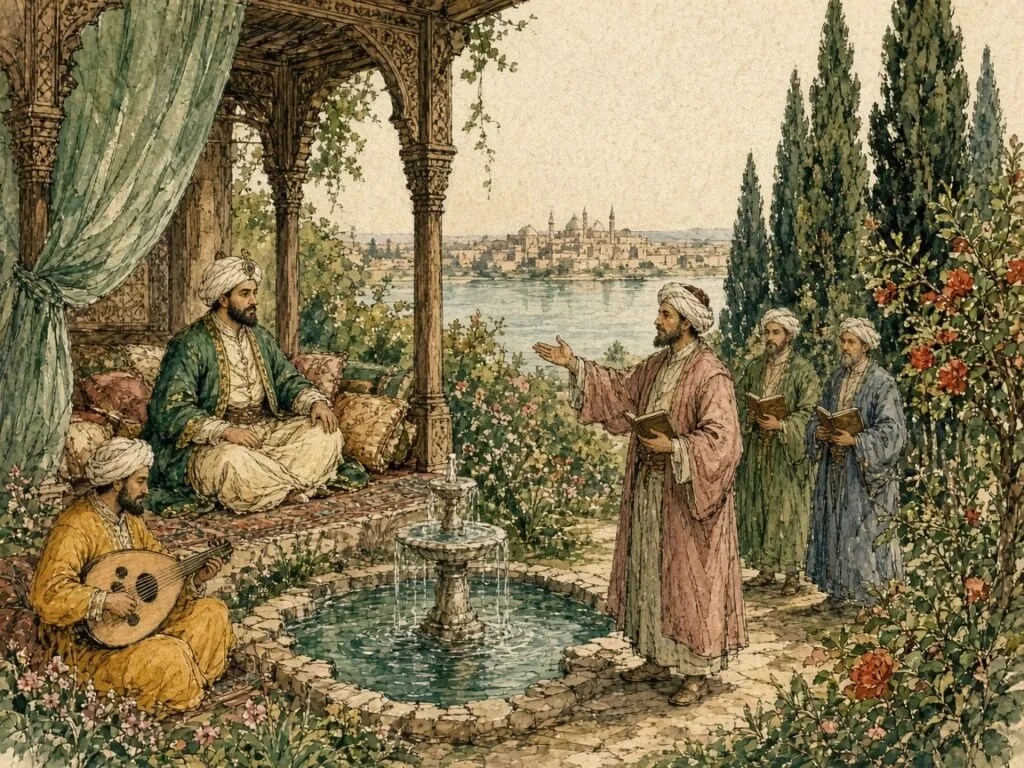
The other great poet of the court was a member of the family. Abū Firās al-Ḥamdānī, Sayf al-Dawla’s cousin, governed frontier districts for him and fought in his wars, and in 962 he was taken prisoner by the Byzantines and held for several years in Constantinople. The poems he wrote in captivity, the Rūmiyyāt, addressed to his mother and to his cousin, pleading for ransom and reproaching delay, have a personal intensity unusual in court poetry. Around these two figures gathered grammarians, philologists, preachers and lesser poets, and the court’s literary prestige outlived the dynasty by centuries. The palace in which they performed stood outside the walls, on the bank of the Quwayq, a residence of gardens and water that the Gerda Henkel catalogue places outside the city on the banks of the river.[35][33]
The philosopher
The court is also associated with Abū Naṣr al-Fārābī, the philosopher whom later tradition called the Second Teacher after Aristotle. His biography is notoriously uncertain, and Dimitri Gutas, writing the entry on Fārābī for the Encyclopaedia Iranica, distinguishes carefully between what the early sources say and the legends added later. What can be established is that Fārābī left Baghdad in 942, finished his best-known work, The Principles of the Opinions of the Inhabitants of the Virtuous City, in Damascus by September 943, lived and taught for some time in Aleppo, visited Egypt in 948 or 949, and died in Damascus between December 950 and January 951.[37][38]
Gutas notes that his stay in Syria was somehow associated with Sayf al-Dawla, and that a manuscript note records his dictating a commentary on Aristotle’s Posterior Analytics to a student in Aleppo, Ibrāhīm ibn ʿAdī. The colourful stories of Fārābī appearing at the emir’s court in Turkish dress, astonishing the company with his music and his knowledge of every language, belong to the later tradition that Gutas regards with suspicion. The Stanford Encyclopedia of Philosophy is equally cautious, remarking that little is known that is really reliable about his life. The honest conclusion is that Fārābī spent part of his last decade in Aleppo under Ḥamdānid patronage, and that the image of the philosopher at Sayf al-Dawla’s side is a legend built on that fact.[37][38]
The court’s brilliance was matched by its fragility. Sayf al-Dawla’s wars drained his treasury, his subjects bore heavy taxes, and the Byzantine revival that his poets dismissed was about to arrive at his own gates. In the winter of 962 the emperor’s armies would show how thin the protection of verse could be.[35][1]
12. December 962
Nikephoros Phokas at the gates
In the 950s and 960s the Byzantine empire went over to the offensive in the east. Its armies were led by members of the great Anatolian military families, above all Nikephoros Phokas, the domestic of the scholai, who had already reconquered Crete from the Arabs in 961. In the winter of 962 he turned against Sayf al-Dawla. The Byzantine army crossed the frontier, defeated the emir’s forces and arrived before Aleppo almost unexpectedly. The Gerda Henkel catalogue describes the outcome in a few words: troops of Nikephoros Phokas unexpectedly destroyed the palace and the city, and the population once again fled to the citadel. The AKTC guide uses the same verb: in 962 the Byzantine troops destroyed Aleppo.[35][1]
The sack was thorough. Sayf al-Dawla’s palace on the Quwayq, the stage of his court, was burned. The city outside the walls and much of the walled town were plundered, and many inhabitants were killed or taken captive. Archnet’s history of the Great Mosque records the first known damage to the building during this Byzantine sack, damage that Sayf al-Dawla and his immediate successors are credited with repairing. Only the citadel held. As in 540, the townspeople crowded onto the hill, and this time the fortress did not fall; the Byzantine army withdrew, laden with booty and captives, without having taken it.[34][35]
The move to the citadel
The disaster of 962 changed the shape of Aleppo for three centuries. Sayf al-Dawla’s son and successor, Saʿd al-Dawla, abandoned the ruined palace on the river and moved the princely residence onto the citadel, which had proved itself the only safe place in the city. The Gerda Henkel catalogue draws the consequence: from that time until the beginning of Mamluk rule the citadel was the royal upper city. The AKTC guide notes, however, that no architectural evidence from the Ḥamdānid period has yet been found there, so that the first princely buildings on the hill are known only from texts.[35][1]
The move had a logic that would be repeated by every later dynasty. As the town grew to the north, the south and especially the east, the citadel stood within it rather than on its edge, an island of power from which the ruler could watch his subjects and retreat in danger. The princes of the next centuries, Mirdasid, Seljuk, Zangid and Ayyubid, would build palaces, baths, mosques, cisterns and arsenals on the summit, and the hill that had once belonged to the storm god became, for good, the home of the state.[35]
Tributary of Byzantium
Sayf al-Dawla never recovered his strength. He died in 967, worn out by illness and war, and within two years Byzantine pressure had reduced his successors to dependence. In 969, after Antioch fell to the Byzantines, Aleppo’s rulers accepted a treaty that made the emirate a tributary of the empire, with obligations to pay tribute, protect Byzantine interests and allow the passage of Byzantine merchants. For the next half-century Aleppo lay between two great powers, Byzantium to the north and the Fāṭimid caliphate of Cairo to the south, each seeking to control it through local clients.[33][1]
Seen from a distance, the Ḥamdānid moment seems brief: a generation of brilliance followed by catastrophe and dependency. But it fixed Aleppo’s identity as a capital and a frontier city, the bastion of Islam against Byzantium and later against the Crusaders, and it gave the city a literary memory it has never lost. The Sayfiyyāt of al-Mutanabbī, composed for a prince whose palace had burned, remain among the most celebrated poems in the Arabic language.[33]
13. Bedouin emirs and the minaret
Between Cairo and Constantinople
For more than a century after the Ḥamdānids, Aleppo was ruled by a succession of short-lived regimes, none strong enough to dominate the region. The Gerda Henkel catalogue sums up the period bleakly: Aleppo saw little prosperity for more than a century, as Byzantine aggression and periodic raids by Bedouin tribes hindered work on the citadel’s defences. The Fāṭimid caliphs of Cairo, who claimed authority over all Syria, sent governors and armies north, while the Byzantine emperors in Antioch expected tribute and obedience. Local factions, the urban militias known as the aḥdāth, and the tribes of the steppe each had their part in the city’s politics.[35][1][33]
Religious tension surfaced too. The Encyclopaedia Judaica records that in 1014 Muslims plundered and destroyed Jewish and Christian houses in the city, a date that falls in the reign of the Fāṭimid caliph al-Ḥākim, notorious for his measures against Christians and Jews. Yet the same encyclopaedia shows a Jewish community that remained organised and learned. Its leader between 1015 and 1029 was Jacob ben Joseph, who came from Fusṭāṭ, served as dayyan, held responsibility for the communities of the region, received the title rosh kalla from the Babylonian academy and taught students from many countries in his own house of study. The great synagogue fell under the authority of the gaon of the Land of Israel and a smaller one under the Babylonian geonim, an arrangement that mirrored the two great centres of Jewish learning of the age.[6]
Mirdasids and Uqaylids
In 1024 a Bedouin chief of the Banū Kilāb, Ṣāliḥ ibn Mirdās, seized Aleppo and founded the Mirdasid dynasty, which ruled with interruptions until 1080. The Mirdasids were tribal leaders whose power rested on the horsemen of the steppe, but they adapted quickly to city life. The oldest of the thirty-one inscriptions on the citadel, according to the Gerda Henkel catalogue, is a Mirdasid text of 1073 in the name of Maḥmūd ibn Naṣr ibn Ṣāliḥ, now in the citadel’s arsenal museum; it cannot be attributed to a particular building, but it confirms the statement, transmitted by the fifteenth-century historian Ibn al-Shiḥna, that the Mirdasids built palaces on the citadel and converted two churches there into mosques. Those two mosques are the ancestors of the two mosques on the summit today.[35][1]
The Mirdasids were followed by another Arab dynasty, the Uqaylids of Mosul, whose emir Muslim ibn Quraysh held Aleppo in the early 1080s. By then, however, a new power had appeared in the Middle East. The Seljuk Turks, who had taken Baghdad in 1055 and destroyed a Byzantine army at Manzikert in 1071, were extending their rule westward. In the winter of 1086 to 1087 the sultan Malik-Shāh led his army into Syria in person and occupied Edessa, Aleppo and Antioch; David Durand-Guédy, writing for the Encyclopaedia Iranica, records that the sultan’s horses drank from the Mediterranean at Latakia, and that he gave Aleppo to his commander Aq Sunqur. After the sultan’s death, his brother Tutush and then Tutush’s son Riḍwān ruled the city until 1113.[39][1]
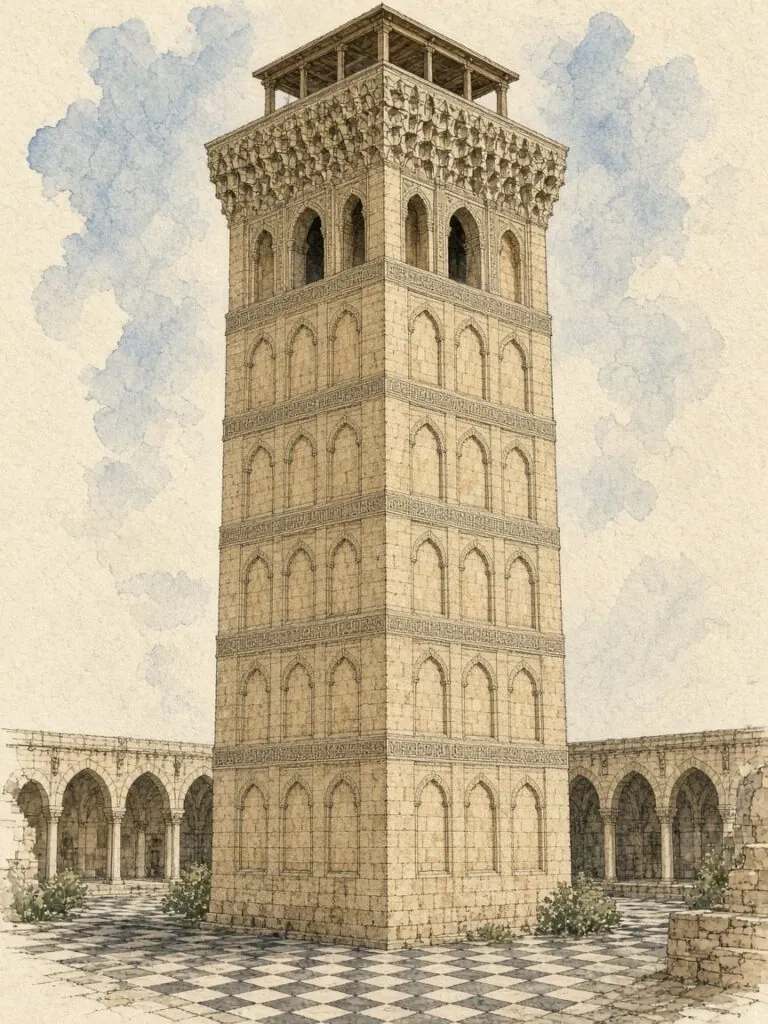
The minaret of the Great Mosque
The most famous monument of the Seljuk decades was the minaret of the Great Mosque. The Syrian Heritage Archive Project, using the inscriptions recorded before the war, states that it was commissioned by the chief judge of Aleppo, Ibn al-Khashshāb, during Seljuk rule, and that the foundation inscription at the base gives the year 483 of the hijra, 1090, while the completion is recorded at the top. The same base bore, inside a cartouche, the signature of its architect, Ḥasan ibn Mufarrij al-Sarmīnī. The inscription named the judge together with the Seljuk governor, a reminder that the city’s government was shared between local notables and the Turkish military.[40][34]
The date of completion is disputed. The Syrian Heritage Archive and the Gerda Henkel catalogue read the upper inscription as 489, or 1096. Archnet, following Ernst Herzfeld’s corpus of Aleppo’s inscriptions, notes that the highest band records the completion of the building in the reign of Tutush, who held power in Aleppo only from the summer of 1094 to January 1095, and therefore dates the completion to 1094. Both readings appear in the scholarly literature, and this history records the minaret as begun in 1090 and completed between 1094 and 1096.[40][41][34]
Whatever its exact date, the minaret was a masterpiece. Its square limestone shaft rose about forty-five metres, divided into tiers of varying height decorated with blind arches and separated by bands of inscription in floriated Kufic and in naskh, with a cornice of niches at the top beneath an open wooden gallery for the muezzin and a small domed pavilion. Terry Allen saw it as a conscious revival of late antique architectural forms in north Syria, and Herzfeld went further, calling it the fundamental document for all studies of the relationship between medieval architecture in Europe and the Orient, a monument of the moment when Romanesque was turning into Gothic. For more than nine centuries it dominated the skyline of the old city. It collapsed on 24 April 2013, during fighting around the mosque.[34][40][42]
14. Crusaders at the gates
After Antioch
In June 1098 the armies of the First Crusade took Antioch after a long siege, and for the first time since the seventh century a Christian power held the great city of the Orontes, two days’ march from Aleppo. The Seljuk ruler of Aleppo, Riḍwān ibn Tutush, was more concerned with his rivals in Damascus and Mosul than with the newcomers, and his city became a buffer between the Frankish principality of Antioch and the Muslim interior. The AKTC guide notes that Aleppo, lying on the route to Jerusalem, was attacked in 1100 and 1103, shortly after the conquest of Antioch. The Gerda Henkel catalogue’s statement that Antioch fell in 1103 is an error; the city fell in 1098.[1][35]
The Franks failed to take Aleppo, and the reason lay on the hill. The Gerda Henkel catalogue explains that several Crusader attempts failed at the citadel, whose elevation placed it beyond the range of their weapons. The height cut both ways: the distance from the towers to the ground was more than a hundred metres, while a Muslim archer, it is said, could shoot three arrows in a second and a half but reach no more than seventy metres, so that the defenders could do little damage to the besiegers below. The citadel could not drive the Franks away, but it could outlast them.[35]
The Field of Blood
The politics of Aleppo in these years were chaotic. Riḍwān died in 1113; his son Alp Arslan was murdered at the instigation of the eunuch Luʾluʾ, who took power and was himself killed in 1117, as the Damascene chronicler Ibn al-Qalānisī records. In the confusion the notables of the city turned for protection to Najm al-Dīn Īlghāzī, the Turkmen prince of the Artuqid family, who became lord of Aleppo. In the summer of 1119 Īlghāzī gathered the Turkmen tribes and marched against Roger, the regent of Antioch, who had camped with a large army of Franks and Armenian foot-soldiers at a place Ibn al-Qalānisī calls Sharmada, about twenty-four miles west of Aleppo.[43]
The battle was fought on Saturday 28 June 1119. Ibn al-Qalānisī, who wrote in Damascus within living memory of the event, describes how the Turkmens charged before the Franks could form and surrounded them with swords and showers of arrows, so that before an hour of the day had passed the whole army lay on the ground, horsemen and footmen alike, and Roger was found among the dead. Eyewitnesses, he says, saw horses lying on the field bristling with arrows like hedgehogs. The Latin chroniclers called the place Ager Sanguinis, the Field of Blood. Antioch was left almost defenceless, but Īlghāzī did not follow up his victory, and the chronicler blames the Turkmens’ haste and their preoccupation with plunder.[43]
The siege of 1124 and 1125
The decisive test came five years later. In 1124, according to Ibn al-Qalānisī, the Franks assembled from their provinces, descended upon Aleppo and began to fight its inhabitants and besiege the city. The siege lasted into the winter. Supplies of food ran short and the people came to the brink of destruction, and in their extremity they wrote to Aq Sunqur al-Bursuqī, the Turkish lord of Mosul, begging him to deliver them from the hands of the infidels. The Franks, the chronicler records, had built houses and huts in their camp to protect themselves from heat and cold, a sign that they meant to stay until the city surrendered.[43]
Ibn al-Qalānisī does not name the Frankish leaders. Other medieval accounts, followed by modern historians including Ross Burns, place King Baldwin II of Jerusalem at the head of the coalition and the Arab amir Dubays ibn Ṣadaqa among its allies, and they record that the besiegers desecrated Muslim tombs outside the walls. Within the city the qadi Ibn al-Khashshāb, who bore the same family name as the patron of the minaret, led the resistance, and in 1124 several churches were converted into mosques, among them the old cathedral, which became the core of the later Madrasa al-Ḥalawiyya. The AKTC guide confirms that the cathedral was used for Christian worship until 1124.[33][1]
Relief came in January 1125. When al-Bursuqī approached with his army, Ibn al-Qalānisī writes, the Franks fled in panic and withdrew in defeat, pursued by the Muslim cavalry until they were safe within Antioch. Al-Bursuqī entered Aleppo, governed it with uprightness, and, in the chronicler’s words, set its affairs in order, restored its districts to prosperity, made its roads safe and brought back the caravans with their merchandise. The siege of 1124 and 1125 was the closest the Crusaders ever came to taking Aleppo, and its failure marked the limit of Frankish expansion in northern Syria.[43][1]
The citadel also served as a prison for Frankish captives. The AKTC guide lists among the famous Crusaders held there Joscelin II, count of Edessa, who died in captivity, Reynald of Châtillon, and King Baldwin II of Jerusalem himself, whom it describes as held for two years. Their presence on the hill, as hostages and bargaining counters, was a reminder that the war between Aleppo and the Franks was also a long negotiation.[1]
15. Nūr al-Dīn’s Sunni city
Zengi and his son
In 1128 ʿImād al-Dīn Zengī, the Turkish atabeg of Mosul, took control of Aleppo, and with him began the period in which the city became the base of a Muslim counter-offensive against the Crusader states. Zengī’s greatest success was the capture of Edessa in 1144, which destroyed the first of the Frankish principalities and provoked the Second Crusade; he was murdered in 1146. His son Nūr al-Dīn Maḥmūd inherited Aleppo and ruled from it until his death in 1174. The AKTC guide describes father and son as feared military commanders and strong-willed politicians, devoted to the ideals of jihad and the unification of all Muslims between the Euphrates and the Nile, and notes that under their leadership the Muslims halted Crusader expansion and Aleppo was never taken.[1]
Nūr al-Dīn’s achievement was political as well as military. In 1154 he took Damascus, and for the first time in centuries, as the AKTC guide stresses, Aleppo and Damascus were united under one ruler. From that combined base he extended his authority to Egypt through his commanders Shīrkūh and Shīrkūh’s nephew Ṣalāḥ al-Dīn, laying the foundations of the state that Saladin would later use to recover Jerusalem. The Encyclopaedia Judaica adds a note from a different perspective: with the inclusion of the town in Nūr al-Dīn’s kingdom in 1146, security improved, and Aleppo’s Jews shared in the new stability.[1][6]
Power and piety
The most original part of Nūr al-Dīn’s programme was religious. Aleppo in the early twelfth century had a large Shiʿi population, and its Shiʿi notables had played a leading part in the city’s politics under the Mirdasids and the Seljuks. Nūr al-Dīn set out to make it a city of Sunni learning and devotion. He founded and endowed madrasas, colleges for the teaching of Sunni law, and other institutions of piety, and he gave the converted cathedral, the Ḥalawiyya, a new life as a madrasa. Yasser Tabbaa’s study of the period, Constructions of Power and Piety in Medieval Aleppo, argues that these buildings were instruments of policy as much as acts of faith, designed to embody in stone the alliance between a Turkish ruler and the Sunni scholars who legitimised him.[44][1]
The new architecture had a distinctive look. Tabbaa traces how the builders of Nūr al-Dīn and his successors developed forms that would shape the architecture of Syria for centuries: madrasas planned around courtyards with iwans, finely cut ashlar masonry, muqarnas vaults and portals, and inscriptions that proclaimed the ruler’s titles as defender of the faith. When a fire in 1169 destroyed the Great Mosque and the surrounding markets, Nūr al-Dīn rebuilt and enlarged it, replacing the columns of the arcades and rebuilding the southern and eastern parts; Archnet notes that an inscription in the eastern riwaq bearing his honorific names, and traces of ornate masonry on the prayer hall façades, confirm his work.[44][34]
The citadel of the jihad
Nūr al-Dīn also rebuilt the defences. The AKTC guide records that he fortified the city walls and the citadel, and that Arab sources describe a high, brick-walled ramp without a roof leading up to the citadel, so that when he rode up the hill his face remained visible to his subjects. Traces of a wall halfway up the southern slope may belong to this work. On the summit he built a palace known as the Golden Palace and a racecourse, the Green Hippodrome, probably covered with grass, and he restored or rebuilt the two mosques founded by the Mirdasids. To the Mosque of Abraham he gave an elaborate wooden mihrab, which, the guide notes with regret, disappeared without trace during the French Mandate.[1]
The twelfth and thirteenth centuries, the AKTC guide continues, were a period of relative stability and cultural revival in Aleppo, when the city became a chief centre of pottery production with brilliant glazes. Trade revived along with security. The Jewish traveller Benjamin of Tudela, who passed through around 1173, reported a substantial Jewish community; the Encyclopaedia Judaica gives his figure as five thousand according to the best-preserved manuscripts, but only fifteen hundred in another, a discrepancy that illustrates how fragile medieval population figures are. The same encyclopaedia records that Aleppo’s scholars corresponded with Maimonides, and that his disciple Joseph ibn ʿAqnīn, whom the encyclopaedia’s authors identify with the merchant, communal leader and later court physician Joseph ben Judah ibn Simeon, lived in the city.[1][6]
Nūr al-Dīn died in Damascus in May 1174. His reputation among Muslim historians was that of the model just ruler, austere, pious and devoted to the war against the Franks, and his buildings gave Aleppo much of its medieval character. His heir was a boy, and within a decade the city would pass to the man who had risen in his service and who would complete his work: Ṣalāḥ al-Dīn, known in the West as Saladin.[1][44]
16. Al-Ẓāhir Ghāzī’s citadel
Saladin’s son
Ṣalāḥ al-Dīn took Aleppo in 1183, after years of conflict with Nūr al-Dīn’s heirs, and soon afterwards entrusted it to his son al-Malik al-Ẓāhir Ghāzī, who ruled from 1186 until his death in 1216. Ghāzī’s reign was the summit of the citadel’s history. The AKTC guide states that the citadel’s importance peaked during Ayyubid rule, and in particular under this sultan, who refortified Aleppo as a stronghold against the Crusaders in the north and against his own uncle, al-Malik al-ʿĀdil, the Ayyubid prince of Damascus. The most spectacular parts of the castle that visitors see today, the bridge, the gate and the clad slope, are largely his work.[1][5]
Ghāzī’s first plan, the guide explains, was to rebuild the city wall along its old line, an irregular rectangle with the citadel at its eastern edge. He then changed his mind and extended the walls to the south and east to enclose the new suburbs, so that the citadel no longer formed part of the circuit but stood at the centre of the fortified city. Among the gates he rebuilt was Bāb Qinnasrīn in the south, and in the north he rebuilt in 1212 the gate that had been called Bāb al-Yahūd, the Jews’ Gate, giving it the name by which it has been known ever since, Bāb al-Naṣr, the Gate of Victory.[1][5][6]
The making of the castle
On the hill itself Ghāzī transformed a fortified summit into a work of military architecture that the AKTC guide calls one of the most spectacular examples in the medieval Islamic world. He smoothed the surface of the outcrop and covered sections of the slope at the entrance with stone cladding, the glacis that still gives the citadel its sheer, pale flanks. He deepened the moat, filled it with water from canals, and spanned it with a tall bridge on arches that still serves as the only way in. At its head he built the great entrance block, its works dated by the AKTC guide to between about 1190 and 1212 and its inscription to the year 608 of the hijra, 1211 to 1212. Behind iron-plated doors the passage bends repeatedly, so that an attacker who forced the gate would find himself turning corner after corner under fire from above, past carved lintels and guardian reliefs.[1][45]
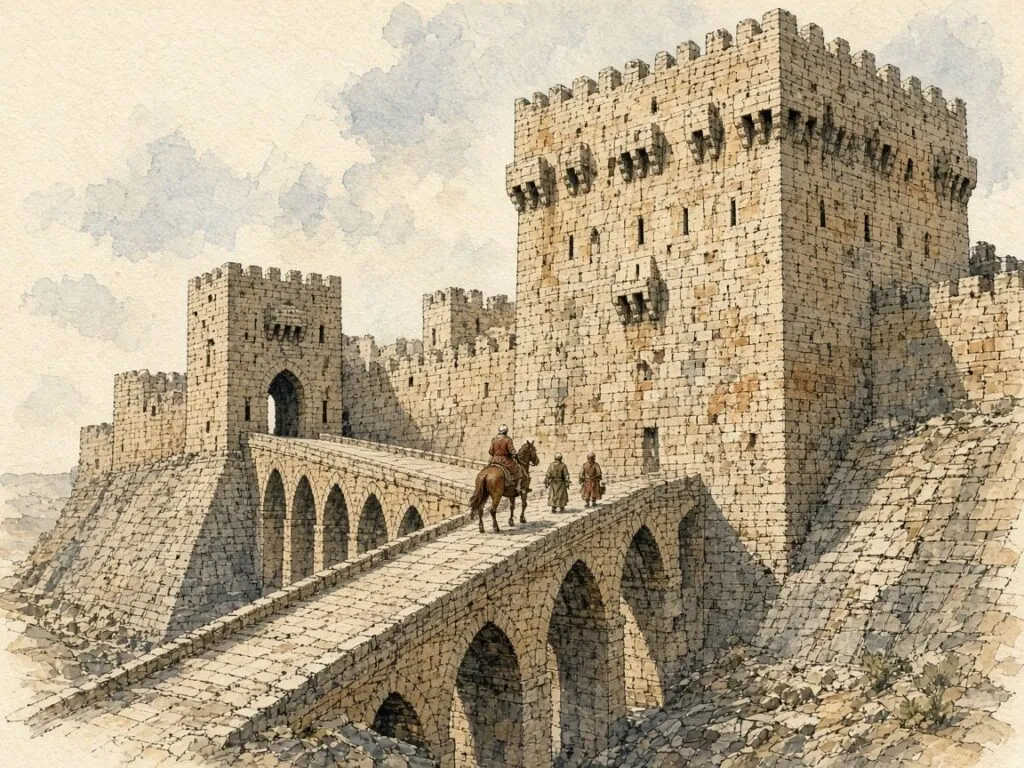
The Arab sources, summarised by the guide, describe the works inside: a large water reservoir, an arsenal, granaries, and a deep well reached by a winding staircase cut in the rock that descends fifty-two metres below the surface of the hill and may also have served as a secret escape route. A covered passage allowed the sultan to reach his court of justice at the foot of the citadel unseen. Under his rule the citadel was not only barracks but also the luxurious residence of a court, with palaces, baths and gardens. The principal palace, generally identified with the Palace of Glory mentioned in the texts, was destroyed by fire on the night of the sultan’s wedding and immediately rebuilt; its portal, with a muqarnas hood of geometric virtuosity, was restored by the Aga Khan Trust for Culture and is one of the finest Ayyubid works in Syria. Ghāzī also restored the two mosques on the summit, and the larger, completed in 1214, received a minaret that rises twenty-one metres above its courtyard and doubled as a watchtower.[1][46]
Ḍayfa Khātūn and the Firdaws
Ghāzī’s widow Ḍayfa Khātūn, a niece of Saladin and daughter of al-ʿĀdil, became one of the most powerful women of the Ayyubid age. After the death of her son al-ʿAzīz in 1236 she governed Aleppo as regent for her young grandson al-Nāṣir Yūsuf II until her death in 1242. She was a great patron, and the UNESCO description of the old city names among its outstanding monuments the Madrasa al-Firdaws, built under her patronage in 1235 and 1236 outside the walls south of the city, a complex of courtyard, prayer hall and iwan whose purity of form has made it one of the most admired buildings of medieval Syria. Tabbaa’s study discusses the Firdaws at length as the masterpiece of a patron whose piety and power were inseparable.[2][44]
Her grandson al-Nāṣir Yūsuf II was the last Ayyubid ruler of the city; two inscriptions in his name found on the citadel show that he too commissioned work there, though its extent is unknown. His father al-ʿAzīz had restored part of the collapsed outer wall, but the work, the AKTC guide remarks, was done so poorly that in 1260 the Mongols would capture the citadel without difficulty. The fortress that Ghāzī had made one of the strongest in Syria thus entered the age of the Mongols weaker than it looked, a reversal that the next chapter describes.[1]
A city of scholars
Ayyubid Aleppo was a centre of learning as well as of power. The Andalusian pilgrim Ibn Jubayr described it in 1184, and the geographer Yāqūt al-Ḥamawī lived and worked in the city in the early thirteenth century and died there in 1229. The greatest historian of Aleppo, Kamāl al-Dīn Ibn al-ʿAdīm, who died in 1262, wrote both a chronicle of the city, the Zubdat al-ḥalab, and an enormous biographical dictionary of its notables, the Bughyat al-ṭalab, works on which much of the history in these chapters ultimately depends.[33]
The Jewish community shared in the prosperity and suffered from its limits. The Encyclopaedia Judaica records that the Hebrew poet Judah al-Ḥarīzī visited Aleppo in 1217 and found Jewish scholars, physicians and officials active in the city, among them a scribe at the court, and that he died in Aleppo in December 1225. Joseph ben Judah ibn Simeon served as court physician to al-Ẓāhir. Yet the same article states that in the Ayyubid period the authorities converted synagogues into mosques, that in al-Ẓāhir’s day the Jewish cemetery and the Jewish gate were destroyed, and that Jewish tombstones were used in the reconstruction of the castle; tombstones of 1148 and of the years 1217 to 1231 survived in the citadel’s walls. The fortress that symbolised the city’s glory was built, in part, from its Jews’ graves.[6]
17. The Mongols and Tīmūr
January 1260
In 1258 the Mongol army of Hülegü, grandson of Chinggis Khan, sacked Baghdad and put the last Abbasid caliph of the city to death. In the following year it crossed the Euphrates into Syria. Aleppo was the first great city in its path. After a short siege in January 1260 the Mongols stormed the town, and a massacre followed; the citadel, whose defences had been weakened by the poor repairs of the 1220s and 1230s, fell soon afterwards, probably in February. The AKTC guide puts the outcome bluntly: the Mongols succeeded where the Crusaders had failed, they stormed the citadel, and the severe damage they inflicted is documented in numerous Arab sources. Little survives of the Ayyubid ring wall today because of that destruction.[1][47]
The Great Mosque was burned during the Mongol occupation, Archnet records, and restored in 1261 and 1262 under the Mamluk sultan Baybars; a second, brief but brutal Mongol incursion caused a second fire, which led to the extensive rebuilding completed under Sultan Qalāwūn in 1285, when stone vaults and piers replaced the wooden ceilings and marble columns of the Ayyubid mosque. The Encyclopaedia Judaica adds a detail from the Jewish community’s memory: the Mongol conquest led to the slaughter of Jews, but the central synagogue, untouched by the invaders, offered asylum to many. The mosque that visitors knew before 2012 was therefore largely a Mamluk building in its structure, whatever the Umayyad origins of its plan.[34][6]
The Mongol advance was halted later that year. In September 1260 a Mamluk army from Egypt defeated a Mongol force at ʿAyn Jālūt in Palestine, and the Mamluk sultanate took possession of Syria. Aleppo became its northern frontier city, and for the rest of the century it lay in the path of Mongol raids from the Ilkhanate of Iran, the state that Hülegü’s descendants ruled; the Encyclopaedia Iranica’s history of the Ilkhanids traces the long conflict along the Euphrates frontier, which brought Mongol armies back into the region repeatedly, including the great invasion of 1299 and 1300.[47][1]
Tīmūr before the walls
A century and a half later a second conqueror from Central Asia came. Tīmūr, known in Europe as Tamerlane, invaded Syria in the autumn of 1400. The fullest account of what happened at Aleppo was written by an eyewitness, the Aleppine scholar and judge known as Ibn al-Shiḥna, and preserved in the biography of Tīmūr by the Damascene writer Ibn ʿArabshāh, translated into English by J. H. Sanders in 1936. According to this account, Tīmūr attacked on Thursday, the ninth of Rabīʿ al-Awwal of the year 803. The governor of Aleppo, Tamurdāsh, had been joined by the armies of the other Syrian cities, Damascus under its governor Sūdūn, Tripoli under Shaykh, Hama under Daqmāq, and the troops of Safad.[48]
The commanders could not agree. Some wanted to enter the city and fight from the walls; others to pitch a camp of tents outside. The governor of Aleppo, seeing their quarrel, proposed letting the people of the city leave and go wherever they wished, which the account calls the best counsel, but the others would not accept it and camped outside the walls facing the enemy. When Tīmūr’s envoy arrived, the governor of Damascus had him killed. On Saturday, the eleventh of Rabīʿ al-Awwal, the end of October 1400 in the Western calendar, Tīmūr led out his armies; the Muslims fell back towards the city, crowded into the gates, and many were killed from behind or taken prisoner. Tīmūr took Aleppo by force, while the governors and nobles climbed to the citadel, where the people had hidden most of their goods.[48]
The judges and the conqueror
On the following Tuesday, after giving a promise of safety on oath, Tīmūr took the citadel, and, in the account’s words, the oath was not kept. The next evening he summoned the learned men and judges of the city. In the most famous scene of the narrative, his own chief scholar put to them a question with which, it was said, he had tested the scholars of Samarkand, Bukhara and Herat and used as a pretext to kill or torture them: of the men slain yesterday, ours and yours, which were the martyrs? Ibn al-Shiḥna answered with a saying of the Prophet, that he who fights so that the word of God shall be highest is the martyr, and Tīmūr, the account says, replied good, good, and promised that none of them would be harmed.[48]
The promise did not extend to the city. As Tīmūr prepared to march on Damascus at the beginning of the following month, the scholars were summoned again and found Muslims being beheaded around them. An officer explained that the conqueror had not ordered the heads of Muslims to be brought, but only wished the heads of the slain to be cut off to raise a tower of them in his honour, according to his custom, and that his purpose had been misunderstood. Ibn ʿArabshāh elsewhere describes Tīmūr as content not only to destroy men but to build towers of their skulls. The Encyclopaedia Judaica records that in 1400 Tamerlane captured Aleppo with much bloodshed and destruction, and that many Jews were killed or enslaved.[48][6]
The AKTC guide notes that Tīmūr’s troops devastated the city for a second time and probably destroyed the mint that the Mamluks had installed in an old bath on the citadel. Archnet’s entry on the citadel misprints the date of the sack as 1410; it took place in October 1400. The scale of the death toll cannot be established from the sources, which speak in the conventional language of catastrophe. What is clear is that, as after 1260, the survivors began to rebuild almost at once, and that within a generation Aleppo had not only recovered but entered one of the most prosperous periods of its history.[1][5]
18. Mamluk Aleppo
The frontier province
After ʿAyn Jālūt the Mamluk sultans of Cairo ruled Syria for two and a half centuries, and Aleppo became the capital of their northernmost province, the seat of a governor, the nāʾib, who commanded the frontier against the Mongols, the Turkmen principalities of Anatolia and later the Ottomans. The AKTC guide observes that the Mamluks at first showed little interest in rebuilding the ruined city. It was Sultan Qalāwūn, who reigned from 1279 to 1290, who began the restoration of the citadel, and his son al-Ashraf Khalīl, who reigned from 1290 to 1293, who completed it; an enormous inscription of 1292 above the great entrance gate records Khalīl’s contribution.[1]
The governors lived in the citadel, though, as the guide admits, the details of their residence are unknown, and they adapted the Ayyubid buildings to their own needs. An inscription of 1367 above the entrance of the Ayyubid palace records a Mamluk governor’s order to build a water pipe to the palace, and one of the old baths, probably the so-called Ḥammām Nūr al-Dīn south of the Mosque of Abraham, was turned into a mint. During the most recent restoration, a large number of coins of the last two Mamluk sultans were found there. Below the hill, the Great Mosque received new furnishings and repairs under al-Nāṣir Muḥammad in 1326 and between 1334 and 1337, a new ceiling in the western riwaq in 1421, and a minbar in the fifteenth century that survived until the recent war.[1][34]
Rebuilding after Tīmūr
The sack of 1400 forced a second Mamluk reconstruction, far more ambitious than the first. Immediately after the conquest, the AKTC guide records, the Mamluks regained and rebuilt Aleppo, restored all its fortifications and extended the city walls to the east. The governor Jakam threw himself into the rebuilding of the citadel and is said to have taken part in the work in person; to the north and south of the citadel two forward towers were raised, and in 1406 and 1407 Jakam had the great Throne Hall built above the Ayyubid entrance block, a vast reception hall completed under Sultan al-Muʾayyad Shaykh.[1][5]
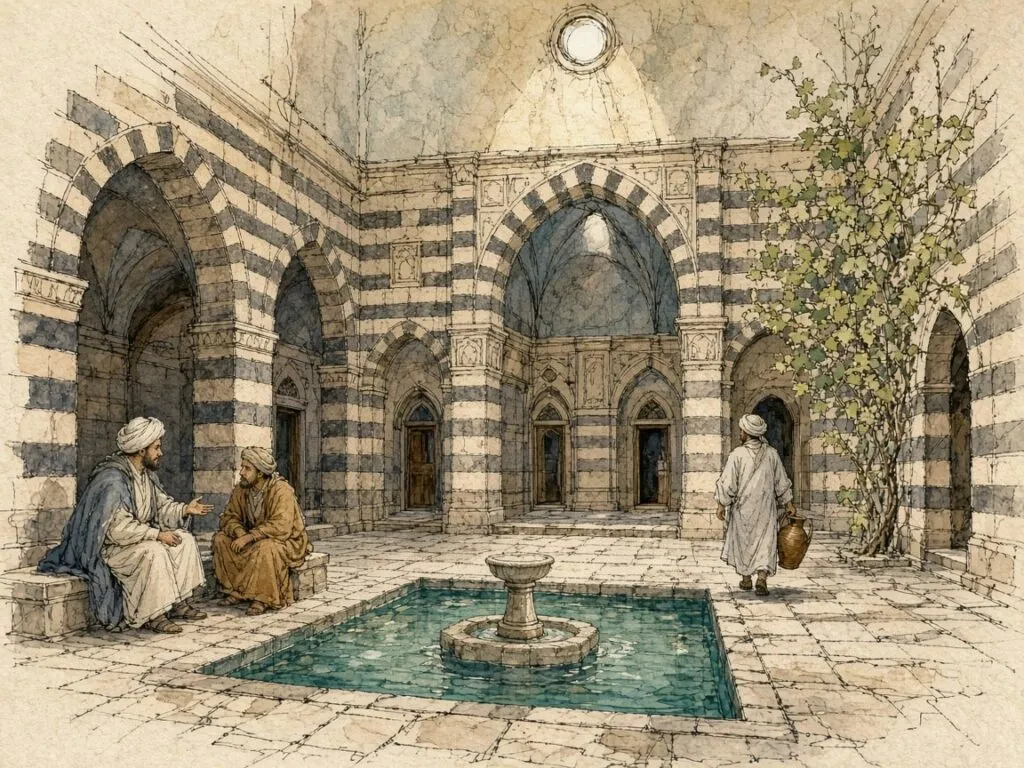
Later sultans continued the work. The octagonal tower east of the entrance gate probably dates from the reign of al-Ashraf Barsbāy, between 1422 and 1438; al-Ẓāhir Jaqmaq, who ruled from 1438 to 1453, ordered part of the western wall to be refortified and the stone cladding near the bridge to be restored; Qāytbāy, between 1468 and 1496, restored the Throne Hall. The most important fortification was undertaken by the last great Mamluk sultan, Qānṣūh al-Ghawrī, between 1501 and 1516, who repaired the moat and the bridge tower, replaced the two forward towers with larger ones, and roofed the Throne Hall, whose wooden ceiling had collapsed, with nine stone domes. The AKTC guide reads these works as an attempt to withstand the growing Ottoman threat from the north, an attempt that would fail in 1516.[1]
Khans, hospitals and the Venetians
The Mamluk city below the citadel was rich. Aleppo stood at the junction of the caravan routes from Iran, Iraq and Anatolia and the roads to the Mediterranean ports, and silk, spices, cotton and dyestuffs passed through its markets. Merchants were housed in khans, the great courtyard buildings with storerooms below and lodgings above that line the souqs, and the Mamluk centuries produced several of the finest, among them the Khān al-Ṣābūn and the Khān Khayr Bak, built at the very end of the period. Charitable foundations multiplied, endowed as waqf, inalienable trusts whose revenues supported mosques, schools, fountains and hospitals; the Bīmāristān Arghūn al-Kāmilī, a hospital founded by the governor Arghūn in 1354, with its courtyards and cells for the care of the mentally ill, became one of the best-known Mamluk buildings of the city.[33][49]
Europe came to Aleppo through trade. Venetian merchants had treaties with the rulers of Aleppo from the thirteenth century, and by the fifteenth they maintained a regular presence in the city’s khans, buying the silk and spices that reached Aleppo overland from the east. Heghnar Zeitlian Watenpaugh’s study of the Venetians in early Ottoman Aleppo shows how the arrangements made in Mamluk times, with consuls, privileges and lodgings in particular khans, continued and expanded after 1516.[50][33]
The Jewish community recovered too. The Encyclopaedia Judaica records that Aleppo, as the Mamluks’ stronghold in northern Syria with a large garrison, brought further prosperity to its Jews, among whom were wealthy merchants, officials, craftsmen and scholars, though the discriminatory laws periodically issued against non-Muslims weighed on them, and in 1327 a synagogue was turned into a mosque with the sultan’s approval and named al-Ḥayyāt. A group of Karaites lived in the city in the thirteenth century and later disappeared. After Tīmūr’s sack, the community gradually overcame the disaster, and by the second half of the fifteenth century Aleppo’s Jews were again trading with India; Obadiah of Bertinoro remarked in 1488 that they had a good income. Between 1375 and 1399 a descendant of Maimonides, David ben Joshua, lived in the city, and with him, as a later chapter will show, may have come the most precious book Aleppo ever possessed.[6]
19. Marj Dābiq and the Ottoman city
The battle on the plain
In the summer of 1516 the Ottoman sultan Selim I, fresh from his victory over the Safavids of Iran two years earlier, turned south against the Mamluks. The old sultan Qānṣūh al-Ghawrī marched north from Cairo to meet him, and on 24 August 1516 the two armies met at Marj Dābiq, a plain north of Aleppo. The Ottomans, with their artillery and their disciplined Janissary infantry, won a crushing victory, and al-Ghawrī died on the field. Aleppo opened its gates to the conqueror, and the citadel, on which al-Ghawrī had spent so much effort, surrendered without a siege. Within a year Selim had taken Damascus and Cairo, and the Mamluk sultanate was at an end.[1][33]
The AKTC guide records that the Aleppines welcomed the Ottoman conquest. The reasons were practical. The city was gradually integrated into the trading network of a vast empire and began to benefit from its position between the Mediterranean and the Euphrates; it was now in the heart of the empire rather than on a frontier, and external threats receded. The citadel lost its military importance and became primarily a garrison. It was restored again under Sultan Süleyman in 1521, and an anonymous Venetian traveller counted some two thousand people living on the hill in 1556; in 1679 the French consul d’Arvieux reported fourteen hundred, three hundred and fifty of them Janissaries, but added that the fortress would not withstand a day’s assault.[1]
Imperial complexes
The Ottomans did not simply occupy Mamluk Aleppo; they rebuilt its centre in their own image. Heghnar Zeitlian Watenpaugh’s The Image of an Ottoman City, the standard study of the subject, shows how governors and grandees appointed from Istanbul built great mosque complexes in the commercial heart of the city that introduced the architectural language of the imperial capital, with its domed prayer halls, pencil minarets and courtyards, into a townscape that had until then been entirely Syrian in style. These complexes were not isolated monuments. Each was endowed as a waqf with markets, khans, baths and coffeehouses whose rents paid for the mosque, so that piety and commerce were built into the same urban fabric.[51]
The first was the Khusrawiyya, the mosque and madrasa of Hüsrev Pasha, completed in 1546 and attributed to the office of the great architect Sinan; it stood immediately south-west of the citadel until it was destroyed in the fighting of 2014. Next came the ʿĀdiliyya mosque of Dukakinzade Mehmed Pasha, with its associated Khān al-Naḥḥāsīn, in 1556, and the Bahramiyya mosque of Bahram Pasha in 1583. Between them the souqs were rebuilt and extended, and the greatest commercial building of the age, the Khān al-Gumruk, the customs khan, was completed in 1574. By the end of the century the covered markets of Aleppo had become one of the largest such complexes in the world; a Xinhua report on the souqs’ revival in 2026 gives their total length as about thirteen kilometres.[51][23][52]
A provincial capital
Ottoman Aleppo was the capital of a large province and, for much of the sixteenth and seventeenth centuries, the principal commercial city of the Levant. Its population is a matter of estimate rather than count; figures in the literature for the period range widely, and Abraham Marcus, whose reconstruction of eighteenth-century Aleppo from the Islamic court records remains the fullest social history of the city, treats every number with caution. What is clear is that Aleppo was among the largest cities of the empire, ranked by many contemporaries after Istanbul and Cairo, and that its markets drew merchants from Iran, India, Anatolia and Europe.[53][51]
The city’s government combined imperial officials with local notables. Governors came and went, often after short terms; judges applied Islamic law in courts whose registers survive in their thousands and record the sales of houses, the disputes of neighbours, the finances of guilds and the estates of the dead. The Janissary garrison and the descendants of the Prophet, the ashrāf, formed rival factions that shaped the city’s politics into the nineteenth century. Non-Muslims had defined roles within this order: the Encyclopaedia Judaica notes that from the 1520s until the mid-seventeenth century Jews as well as Christians served as emin of the customs house, the officer responsible for collecting its receipts, in a city whose prosperity rested on the duties paid on its trade.[53][6]
The citadel, meanwhile, decayed into a picturesque ruin with a garrison. The Portuguese traveller Pedro Teixeira noted in 1605 that silver and gold coins were minted on the hill, and the AKTC excavations in its western part uncovered terraces of Ottoman courtyard houses with clay pipes and coffee cups, evidence of how the soldiers spent their time. When Volney visited in the 1780s he found its walls in ruins and its old towers little better, and the English physician Alexander Russell, resident in Aleppo from 1740 to 1753, described the shops, cells and pleasant houses of the barracks inside the gates. The storm god’s hill had become a village above the city.[1]
20. Consuls, silk and the Levant Company
The consuls arrive
In the sixteenth century Aleppo replaced Damascus as the principal Syrian market for European merchants, and the European trading nations followed their merchants there. Venice, long the leading Western power in the Levant trade, moved its Syrian consulate from Damascus to Aleppo in 1548; France established a consulate in 1562; England’s first consul was appointed in 1583; and the Dutch followed in 1613. The exact years vary slightly in the literature, depending on whether one counts the first appointment, the first resident or the formal transfer of an existing post, but the sequence is not in doubt. For roughly two centuries the consuls of the European nations, living with their merchants in the great khans of the souq, formed one of the most distinctive communities in the city.[54][50][55]
The Venetians led the way. Watenpaugh’s study of the Venetians in early Ottoman Aleppo shows them occupying particular khans, with the consul’s residence, the warehouses and the lodgings of the merchants grouped around a single courtyard, and living under rules that limited their contact with the city around them. Trade was organised around the arrival of the caravans from Baghdad and Basra and the departure of the galleys and round ships from the ports of Tripoli and later Iskenderun, Alexandretta, on the coast. The merchants bought silk from Iran, spices, indigo and drugs from India and the Gulf, and gall-nuts, cotton and mohair from Syria and Anatolia, paying with silver, woollen cloth and other European goods.[50][54]
Mr Forster’s commission
The English arrived late but quickly became important. In 1581 Queen Elizabeth granted a charter to a group of London merchants, the Turkey Company, to trade in the Ottoman empire, and in 1592 a new charter merged it with the Venice Company to form the Company of Merchants of the Levant, the Levant Company. Alfred C. Wood’s history of the company, published in 1935, describes how William Harborne sailed from England in January 1583 as the first English ambassador to the sultan, arriving in Constantinople on 26 March, and how, in his commission appointing Richard Forster consul in Syria that same year, he styled himself Her Majesty’s ambassador. The commission, printed by Richard Hakluyt in his Principal Navigations, authorised Forster as consul of the English nation in the parts of Aleppo, Damascus and the adjacent regions.[55][56]
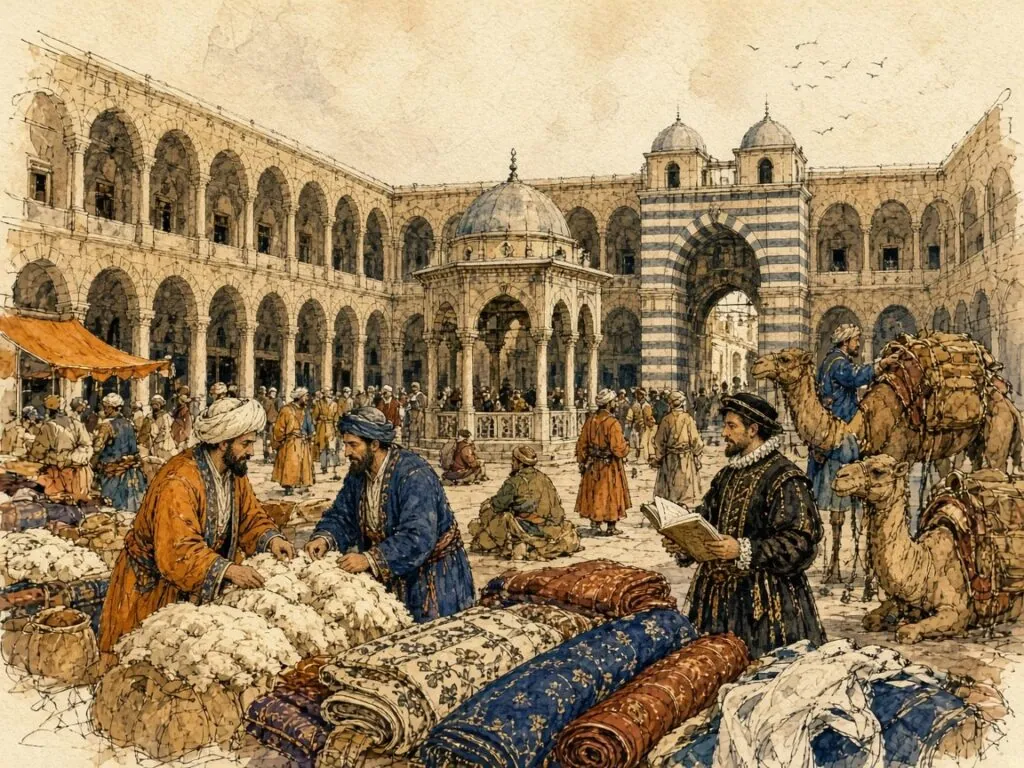
Aleppo became the company’s chief factory in Syria, and the records of its English merchants, the factors, now in the National Archives in London, form one of the richest European archives for any Middle Eastern city. An Oxford doctoral thesis on English trade with Aleppo examines how the factors bought Persian silk and sold English broadcloth, and how they dealt with Ottoman officials, local brokers and rival Europeans. The factory was a small community of men, many of them young, who spent years in the city learning the trade before returning home to London.[55][57]
The Tiger and the turbaned Turk
Aleppo entered English literature through this trade. In the third scene of Macbeth, the First Witch describes a sailor’s wife who refused to share her chestnuts: her husband’s to Aleppo gone, master of the Tiger, and the witch promises to sail after him in a sieve and do him harm. The Folger Shakespeare Library notes that the Tiger was a real ship, which in 1583 carried the first English merchant delegation to Asia by way of the Levant, led by John Newbery and including Ralph Fitch, who went on overland to the court of the emperor Akbar in India and travelled as far as the Malay Peninsula. Aleppo was the gateway through which they passed.[58][59]
Othello, in his last speech, reaches for the same city. Asking to be remembered as one who loved not wisely but too well, he tells the Venetians to say besides that in Aleppo once, where a malignant and a turbaned Turk beat a Venetian and traduced the state, he took the circumcised dog by the throat and smote him, and with that he stabs himself. For Shakespeare’s audience the name of Aleppo evoked a real place where Venetians and Englishmen did business under Ottoman rule, distant but familiar from the talk of merchants and sailors.[60]
Masters and the turn of the tide
The prosperity of the European trade did not last for ever, and its decline has been the subject of an influential argument. Bruce Masters, in The Origins of Western Economic Dominance in the Middle East, studied the commerce of Aleppo between 1600 and 1750 through Ottoman and European records. He argued that the balance between the Islamic economy of the Ottoman city and the mercantilist economies of the West shifted decisively in this period, as European states protected and organised their trade while Ottoman policy, concerned with supply and revenue rather than with national advantage, did not. By the mid-eighteenth century, the trade of Aleppo was increasingly shaped by Western demand and Western shipping, and the overland silk trade from Iran was in decline.[54]
The Levant Company’s own records tell a parallel story of competition and contraction. The French, who came to dominate Levantine trade in the eighteenth century, were joined by merchants from many nations, and the arrival of sea routes to India around the Cape had long since diverted much of the spice trade away from the caravan routes. Yet Aleppo remained a great market, and its foreign community left one of its most valuable legacies in a book. Alexander Russell, physician to the English factory, published The Natural History of Aleppo in 1756, and his half-brother Patrick, who succeeded him, issued an enlarged edition in 1794. Its descriptions of the city’s plants and animals, its houses and customs, its diseases and above all its plagues, observed by doctors who treated patients of every faith, make it one of the most detailed accounts of any Ottoman city written before the nineteenth century.[61][55]
21. A city of many faiths
Jdayda
Ottoman Aleppo was a city of many religious communities, each with its own clergy, courts, schools, charities and quarters, and each recognised by the state as a distinct body responsible for its members. The largest Christian groups were the Armenians, the Greek Orthodox, later divided into Orthodox and Catholic branches, the Syriac Orthodox and Syriac Catholics, and the Maronites; smaller numbers of Chaldeans, Latin Catholics and, from the nineteenth century, Protestants completed the picture. Most of them lived and worshipped in the north-western suburbs outside the medieval walls, and above all in the quarter of al-Jdayda, the New Quarter.[23][53]
The UNESCO and UNITAR survey describes al-Jdayda as the centre where Christians settled and built churches from the fifteenth century. One of the earliest is the Armenian Orthodox church of the Forty Martyrs, built in 1491 to replace a small chapel in the old Christian cemetery, enlarged in 1500 and renovated in 1616 after the cemetery was moved, a three-aisled basilica without a dome to which a bell tower was added in 1912. The survey calls it the oldest active church in the Armenian diaspora and notes its collection of more than thirty icons. Around it the quarter grew through the seventeenth century into a centre of production with many qaysariyyas, enclosed workshops and markets, and in the eighteenth and nineteenth centuries wealthy merchants built some of the finest houses in Aleppo there, among them the Bayt Ajiqbash and the Bayt Ghazaleh, whose courtyards, iwans and carved stone show the influence of European baroque ornament on local craftsmen.[23]
Within a few hundred metres of the Forty Martyrs stood the Maronite cathedral of Mar Ilyās, the Syriac churches, the Greek Orthodox and Greek Catholic cathedrals and the Armenian Catholic church. Their proximity reflected both the density of Christian settlement and the fact that the communities, divided by liturgy, language and hierarchy, shared streets, trades and often families. The Christians of Aleppo were prominent in commerce, in crafts such as textile weaving and in the service of the European consulates as interpreters and agents, roles that gave them prosperity and exposed them to suspicion.[23][62]
The Catholic turn
From the early seventeenth century Catholic missionaries, Capuchins, Jesuits and Carmelites, established themselves in Aleppo under the protection of the French consuls, and their schools and preaching won many adherents among the Eastern Christians. The result was not mass conversion to the Latin rite but a gradual movement within each Eastern church towards union with Rome while keeping its own liturgy. In community after community, a Catholic party formed alongside the traditional hierarchy, and Aleppo, with its wealthy and educated Christian merchants, was one of the places where this movement was strongest.[62][63]
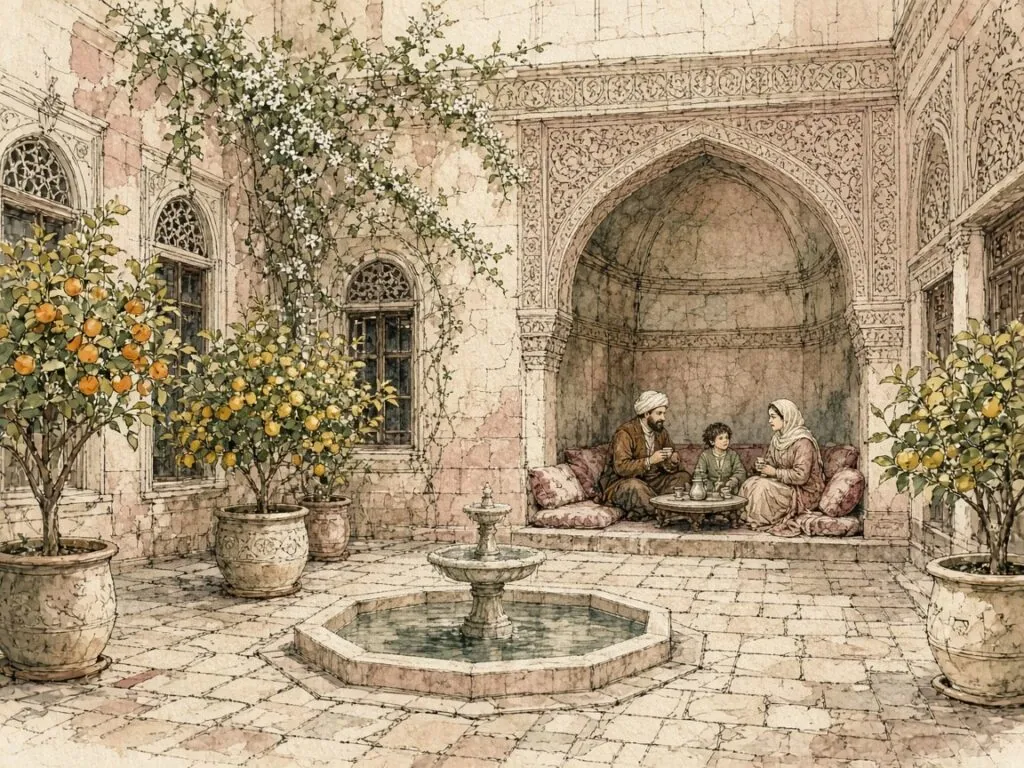
The decisive break came in the Greek Orthodox community. In 1724, after the death of the patriarch of Antioch, the pro-Catholic party in Damascus elected Seraphim Tanas, who took the name Kyrillos, while the patriarch of Constantinople consecrated a rival, Silvestros, a Cypriot monk. The schism that followed divided the Orthodox of Syria permanently, and the Catholic branch became the Melkite Greek Catholic Church. Aleppo’s Orthodox community had particularly strong Catholic sympathies, and the struggle there between the partisans of the two patriarchs, each seeking recognition and berats of investiture from the Ottoman authorities, lasted for decades. Hasan Çolak’s study of the Ottoman documents shows that in 1745 the Porte briefly invested Kyrillos himself as Orthodox patriarch, a remarkable episode in which a Catholic held the Orthodox see with Ottoman approval.[64]
The Syriac community went through a similar division. In 1783 Michael Jarweh, an Aleppine who had become a Catholic, was elected patriarch and founded the line of the Syriac Catholic patriarchs, while the Syriac Orthodox retained their own hierarchy. The Armenians, too, were divided between the Apostolic church and an Armenian Catholic church. For the Ottoman state these quarrels were problems of order and revenue, for the communities they were matters of salvation and identity, and for the city they produced a dense network of rival churches, schools and confraternities that would shape Christian life in Aleppo into the twentieth century.[23][62]
Living together and apart
Abraham Marcus’s reconstruction of eighteenth-century Aleppo from the Islamic court registers shows how this plural society worked in practice. Muslims, Christians and Jews lived in mixed as well as separate quarters, bought and sold houses from each other, appeared before the same Muslim judges, belonged to the same guilds and suffered the same plagues and famines. Legal distinctions, the poll tax paid by non-Muslims, and restrictions on dress and building, marked the boundaries between communities, and they were enforced more strictly at some times than at others. Marcus resists both the image of harmonious coexistence and that of permanent oppression, describing instead a society in which religious difference was one of many social facts, managed through custom, law and negotiation.[53]
That balance was fragile. In the nineteenth century, as European influence grew and the fortunes of the communities diverged, tensions that had been contained for centuries would break into violence. Before that story is told, however, one community deserves its own chapters, for Aleppo’s Jews were among the oldest inhabitants of the city and the keepers of its most famous book.[62][6]
22. Aram Ẓova
The oldest community
Aleppo’s Jews traced their community to the age of King David. The Encyclopaedia Judaica records a tradition, cited by Rabbi Abraham Dayyan, that the community began in the time of Joab ben Zeruiah, David’s general, who conquered Aram Ẓova and built the great synagogue. The encyclopaedia’s authors are more cautious: other, non-Jewish traditions confirm the existence of the community in the Greek period, which is probably when it was founded, and Jewish settlement has continued without interruption since Roman times. The most ancient synagogue, Kanīsat Mutakal, was built in the fourth century in the north-eastern part of the city, and the oldest section of the great synagogue, built as a basilica with three aisles in the Byzantine period, carried an inscription dated 834.[6]
The great synagogue, known in Arabic as al-Ṣafrāʾ, the Yellow, stood in the quarter of Baḥsīta, north-west of the citadel, the heart of Jewish Aleppo for centuries. Its courtyard, its arcades and its many arks and chambers grew over the generations, and it housed, in a small room known as the Cave of Elijah, the iron chest in which the community kept its most precious manuscript. The Sephardic Heritage Museum’s timeline of the community recalls how the codex was kept in the great synagogue for centuries, and how its guardianship was a source of pride and anxiety for the leaders of every generation.[6][65]
Mustaʿraba and Sephardim
At the beginning of the sixteenth century exiles from Spain began to arrive in Aleppo, among them outstanding rabbis. The Encyclopaedia Judaica describes how they established a separate congregation while sharing the general institutions of the community with the Mustaʿraba, the Arabic-speaking Jews of old Syrian stock. The newcomers prayed in an eastern wing of the great synagogue that had been added when the old building could no longer hold the congregation. For several centuries the Mustaʿraba congregation was led by members of the Dayyan family, among them Moses and Saadiah Dayyan in the sixteenth century and several Mordecais and Nathans after them, while the spiritual and intellectual leadership of the whole community passed gradually to the Sephardim, to rabbis such as Samuel Laniado, his son Abraham and his grandson Solomon.[6]
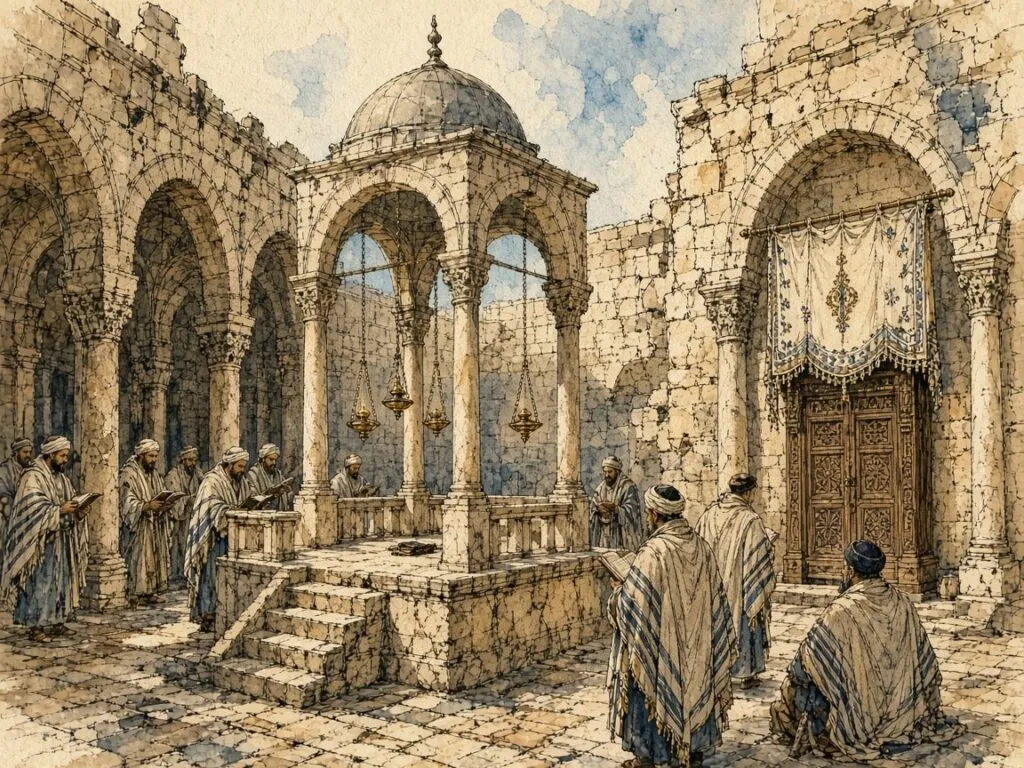
The two congregations quarrelled in the sixteenth century, the encyclopaedia notes, but later lived together peacefully, and by the end of the seventeenth century an academy, a yeshivah, was operating in the city. The local rite, the Aram Ẓova rite, had its own prayer book, printed in Venice between 1523 and 1527. Aleppo’s Jews kept close ties with the communities of Istanbul and Anatolia, traded with Iran and India, and looked to Safed, whose kabbalists strongly influenced their piety. When the messianic movement of Shabbetai Ẓevi swept the Jewish world in 1665 and 1666 it found many adherents in Aleppo, among them leading rabbis, and after Shabbetai’s apostasy his prophet Nathan of Gaza came to the city and continued his activity there.[6][65]
The size of the community can be estimated only roughly. The traveller Teixeira put it at about a thousand families around 1600, many of them wealthy; an Ottoman census of 1672 recorded three hundred and eighty Jews paying the poll tax, most of them Mustaʿraba and seventy-three of Spanish origin; in 1695 there were eight hundred and seventy-five families. The encyclopaedia’s authors estimate that Jews formed about five per cent of the city’s population in the Ottoman period. In 1803 the traveller Taylor thought there were only three thousand.[6]
The Francos and the Picciottos
From about 1700 a new element arrived: Jewish merchants from Livorno and France, known as Francos, who came to take part in the trade between Iran and southern Europe and lived under the protection of the European consuls. The Encyclopaedia Judaica describes them as wealthy, learned and attached to the customs they brought from Europe. They supported communal institutions generously, but they refused to pay the regular communal taxes and did not recognise the community’s authority, and in the eighteenth century the chief rabbis Samuel Laniado and later Raphael Solomon Laniado tried in vain to bind them to its rules. The Sephardic Heritage Museum dates the arrival of the first of the Picciotto family, Hillel Ḥayyim Picciotto, from Livorno to 1732.[6][65]
The Picciottos became the most remarkable of these families. From 1798, the encyclopaedia records, Raphael Picciotto served as consul of Austria and Tuscany, and over the following century members of the family represented Russia, Prussia, the Netherlands, Belgium, Persia, Denmark, Sweden and Norway and the United States, so that a single Jewish family held a remarkable share of the consular posts in the city. Their position gave them influence with the Ottoman authorities and the ability to protect others; during the Christian–Jewish tensions of the 1850s, the encyclopaedia notes, the Picciotto family helped the Christians.[6]
Songs of the night
Aleppo’s Jews were also famous for their music. Amnon Shiloah, writing in the Encyclopaedia Judaica, notes that the community’s question to Maimonides in the twelfth century, whether it was permitted to sing Arabic muwashshaḥāt with instrumental accompaniment, shows how popular such music already was. Almost all the hymns sung outside the formal service were the work of Aleppo rabbis who were poets and composers, among them Moses Laniado, Raphael Antebi, Jacob and Mordecai Abbadi and Mordecai Levaton, and Mordecai Abbadi’s introduction to the book of bakkashot, Mikra Kodesh, published in 1873, defended the art of song. Every Sabbath and festival prayer had its appropriate maqām, the melodic mode of Arabic music, and the custom of singing bakkashot through the night before dawn on winter Sabbaths spread from Aleppo to Jerusalem and from there to many Eastern communities. The Jewish Music Research Centre of the Hebrew University preserves recordings of the tradition, which its scholars regard as one of the formative sources of the modern Sephardi-Jerusalemite style.[6][66]
23. The Crown of Aleppo
A book from Tiberias
The most famous object ever kept in Aleppo is a book. The Aleppo Codex, known in Hebrew as the Keter, the Crown, and to its guardians as Keter Aram Ẓova, is a manuscript of the complete Hebrew Bible written on parchment in Tiberias in about 930. The Yad Izhak Ben-Zvi institute, which holds responsibility for it, describes it as considered by many scholars the most accurate copy of the Hebrew Bible extant, a source for the vocalisation and cantillation of the biblical text. UNESCO, which inscribed it on the Memory of the World Register in 2015 on Israel’s nomination, calls it the oldest extant nearly complete Hebrew Bible and the most exact and authoritative.[67][68][69]
Its making is recorded in a dedicatory inscription added soon after it was written. The consonantal text was copied by the scribe Shlomo ben Buyaʿa, and the vowel points, accents and the Masorah, the marginal notes that guard the text against error, are associated with Aaron ben Asher, the last and most famous of a dynasty of Masoretes in Tiberias. How much of the pointing was done by Ben Asher’s own hand is disputed: the Encyclopaedia Judaica’s article on the Masorah notes that the codex was apparently not vocalised by him, although a later colophon attributes the vocalisation to him, while the Ben-Zvi institute and the UNESCO nomination present it as the work of his school and the model of his system. This history records the point as uncertain.[70][69]
Jerusalem, Cairo and Aleppo
The codex did not stay long in Tiberias. According to its dedication it passed to the Karaite community of Jerusalem, and when the Crusaders took Jerusalem in 1099 it was among the books seized as booty and ransomed by the Jewish community of Egypt. The Ben-Zvi institute summarises the journey: from Tiberias the codex reached the Karaites of Jerusalem, was captured during the Crusades and ransomed by the community in Cairo, where it was seen by Maimonides, who attested to its accuracy, and ended up in Aleppo. Maimonides, in his code of Jewish law, the Mishneh Torah, names a book then in Egypt, which had been in Jerusalem and which all relied upon because Ben Asher had corrected it, as the model he followed in laying out the sections of the Torah, and that book is generally identified with the Aleppo Codex.[67][71][69]
How and when it came to Aleppo is less certain. The UNESCO nomination, prepared by the Ben-Zvi institute, states that it was apparently brought in 1375 by a descendant of Maimonides, David ben Joshua, and the Encyclopaedia Judaica confirms that David ben Joshua, son of the nagid of Egypt, settled in Aleppo between 1375 and 1399. The word apparently matters, and the transfer should be described as probable rather than proven. What is certain is that for nearly six hundred years the codex was kept in Aleppo’s great synagogue, in an iron chest in the chamber called the Cave of Elijah. Access to it was restricted, and oaths were sworn on it; it was less a book to be read than a relic to be guarded, and the community believed that its presence protected them.[69][6][65]
The night of the fire
On 1 December 1947, in the riots that followed the United Nations vote on the partition of Palestine, the great synagogue was attacked and burned. The Ben-Zvi institute records that it was at first thought that the whole codex had been lost, but that it had in fact been rescued and hidden. On the same day, according to the Israel Museum, a member of the community named Shmuel Sabag collected a scrap of parchment from the pages of the codex; placed in his wallet, it served him as an amulet until the end of his life, and in 2003 his family gave it to the Ben-Zvi Institute. For ten years the community’s leaders kept the surviving leaves in hiding.[67][72]
In 1957, according to the oral histories collected by the Sephardic Heritage Museum, the rabbis Moshe Tawil and Selim Zafrani entrusted the codex to Murad Faham, a member of the community who held Iranian citizenship and had been expelled from Syria after being caught helping Jews to escape, when he returned to Aleppo to collect his belongings. His wife Sarina hid it among the family’s baggage, and the family carried it via Turkey to Israel. There, in 1958, it was handed to the president of Israel, Izhak Ben-Zvi, who set up a committee to preserve it; it was deposited at the Ben-Zvi Institute in January 1958 and is now displayed in the Shrine of the Book at the Israel Museum. The Encyclopaedia Judaica, written before the transfer, still places it at the Ben-Zvi Institute, a statement now out of date.[65][67][73]
The missing leaves
When the codex reached Israel it consisted of 294 leaves written on both sides, out of a probable original of about 487, so that a third of the book was gone. The Ben-Zvi institute notes that most of the losses fell at the beginning: of the Torah only a few leaves of Genesis and the last chapters of Deuteronomy survive, and parts of the Song of Songs, Ecclesiastes, Lamentations, Esther, Daniel, Ezra and Nehemiah are also missing. Two pieces have since been recovered: a complete leaf of Chronicles kept by an Aleppine family in New York, now reunited with the codex, and a fragment of Exodus kept by a man of Aleppine descent, also in New York, as a talisman in his wallet.[67]
What happened to the rest remains unknown and controversial. The traditional account holds that the leaves were destroyed in the fire of 1947; later investigators have noted that the surviving leaves show stains of fungus rather than burn marks, and the journalist Matti Friedman argued in his book The Aleppo Codex, published in 2012, that the manuscript was largely intact after the riot and that many leaves went missing afterwards. These questions are disputed, and the Ben-Zvi institute itself asks whether the missing parts were lost, ruined or hidden without offering an answer. The Crown that Aleppo’s Jews guarded for six centuries survives, damaged and incomplete, in Jerusalem; the community that guarded it is gone from the city.[67][74]
24. Earthquake, riot and reform
The night of 13 August 1822
At about twenty to nine on the evening of 13 August 1822, an earthquake struck northern Syria. The Global Historical Earthquake Archive, which compiles the seismological literature, places its source in the region of ʿAfrīn, some forty-five kilometres north-west of Aleppo, and gives magnitudes between about 7.0 and 7.5 in the studies of Nicholas Ambraseys and of Syrian seismologists. For Aleppo the result was catastrophic. The UNESCO and UNITAR survey states that about sixty per cent of the urban fabric was destroyed, and that the citadel was badly damaged and subsequently deserted. Archnet’s citadel entry misprints the year as 1828. The number of dead is unknown; figures in the older literature range so widely that none can be given with confidence.[75][23][5]
The disaster had long consequences for the city’s institutions. Much of Aleppo’s property, houses, shops and khans, belonged to waqf endowments, whose revenues supported mosques, schools and charities and whose assets could not legally be sold. With so many endowed buildings in ruins and no money to rebuild them, the courts and administrators adapted the law, allowing long leases and other arrangements by which private investors could rebuild endowed property in return for lasting rights over it. A study of the impact of the earthquake on the administration of waqf, published by Brill, traces how these changes transformed the ownership of the old city.[76][23]
Ibrāhīm Pasha and the Tanzimat
Within a decade Aleppo had changed hands again. In 1832 the army of Muḥammad ʿAlī, the governor of Egypt who had made himself all but independent of the sultan, invaded Syria under his son Ibrāhīm Pasha and defeated the Ottomans near Aleppo. For eight years the city was ruled from Cairo. Ibrāhīm’s government was centralising and modernising, introducing conscription, new taxes and greater equality for non-Muslims, and it provoked resistance. On the citadel his engineers built barracks, using stones taken from the ruined buildings of the hill, the AKTC guide records; the Ibrāhīm Pasha barracks still stand on the summit, restored under Sultan Abdülmecid in 1850 and 1851. European pressure forced the Egyptians to withdraw in 1840, and the Ottomans returned.[1][33]
The restored Ottoman government embarked on the reforms known as the Tanzimat, proclaimed in 1839, which promised security of life and property, regular taxation and equality before the law for all subjects regardless of religion. Their application in Aleppo was gradual and contested. The UNESCO and UNITAR survey dates the first municipal body in the city to 1866, the period in which Aleppo also became the centre of a reorganised province, a vilayet; the Encyclopaedia Judaica records that from 1858 Jews sat in the mercantile court and that in 1868 the first Jew was appointed to the city council, the meclis. New schools, printing presses and newspapers followed.[23][6]
October 1850
The reforms also sharpened communal tensions. On 17 October 1850 crowds from the Muslim quarters of the old city attacked the Christian suburbs, above all al-Jdayda and al-Ṣalība, sacking houses and burning churches; the Greek Catholics, the wealthiest and most visible of the Christian communities, suffered most. The Ottoman authorities regained control only after weeks of tension, and in November their troops bombarded the rebellious quarters. The casualty figures in popular accounts are unreliable, and this history does not repeat them.[62][63]
Historians have read the events in different ways. Bruce Masters, in an article in the International Journal of Middle East Studies, argued that they should be understood as an aftershock of Syria’s incorporation into the capitalist world economy: Christians who had prospered from trade with Europe and from foreign protection had become the targets of resentment among Muslims whose livelihoods were threatened, at a moment when the Tanzimat seemed to overturn the old hierarchy of communities. Yaron Harel, writing in the same journal, examined the relationship between Jews and Christians in Aleppo as the background to the Jewish response to the riot, showing how the Jews, spared in 1850, were themselves targets of Christian blood libels in the same decades.[62][63]
Those accusations were real and repeated. The Encyclopaedia Judaica records three blood libels in Aleppo between 1841 and 1860, including an accusation by the Greek Catholic patriarch in June 1853 that Jews had kidnapped a Christian boy for ritual purposes, and another in 1875, when the missing Armenian boy whose absence had provoked the charge was found in a nearby village. It also records that in 1854 the rabbis declared a ban on contact with Protestant missionaries.[6]
The canal and the emigrants
The greatest blow to Aleppo’s economy came from far away. The opening of the Suez Canal in 1869, the Encyclopaedia Judaica notes, greatly affected the international trade of Aleppo’s merchants, for goods from India and the Gulf could now reach Europe by sea without passing through the caravan cities of Syria. Aleppo remained a regional market and an industrial town, with weaving, soap and other trades, but its place in world commerce shrank. Emigration followed. From the 1850s Aleppine Jews settled in Manchester and opened firms there; later many went to Egypt, to Beirut and, in the 1880s and 1890s, in great numbers to North and South America. The Jewish population, three thousand five hundred in 1847, was ten thousand two hundred in 1881, but the young and enterprising were increasingly leaving. The same pressures drove Christian and Muslim Aleppines abroad, and the Aleppo diaspora, in the Americas above all, dates from these years.[6]
25. Railway, war and refuge
The iron road
At the beginning of the twentieth century the old caravan city was joined to the railway age. A French-owned company that had built a line from Beirut to Damascus extended its network northward through Homs and Hama, and by the eve of the First World War Aleppo was also a station on the German-financed Baghdad Railway, whose construction across northern Syria and Mesopotamia preoccupied the British government; the files of the India Office now in the Qatar Digital Library record that concern in detail. The station that served the line, a stone building on the edge of the modern quarters north-west of the old city, still carries the name Gare de Bagdad. The railway made Aleppo a junction once more, though now between Istanbul, Baghdad and the ports, rather than between the caravan routes of the desert.[77][33]
The city had also been growing beyond its medieval walls for decades. New quarters with broad streets and European-style houses spread to the north and west, notably al-ʿAzīziyya and al-Jamīliyya, where wealthier Christian and Jewish families moved from the crowded lanes of the old city. The Encyclopaedia Judaica records that a large part of the Jewish community had moved to al-Jamīliyya by the inter-war years, leaving the old Jewish quarter of Baḥsīta to the poor.[6][23]
The deportations of 1915 and 1916
In the spring and summer of 1915 the Ottoman government, at war with Britain, France and Russia, ordered the deportation of the Armenian population of Anatolia, and hundreds of thousands of men, women and children were driven south toward the Syrian desert. Aleppo lay on the route. It became a way station, the place from which convoys were sent on toward Deir ez-Zor on the Euphrates, where the deportees faced starvation and massacre, and for many tens of thousands of survivors it eventually became a destination. The Near East Relief Historical Society describes the city as a way station and a refuge, and records that many survivors of the death marches fled on foot to Aleppo.[78][79]
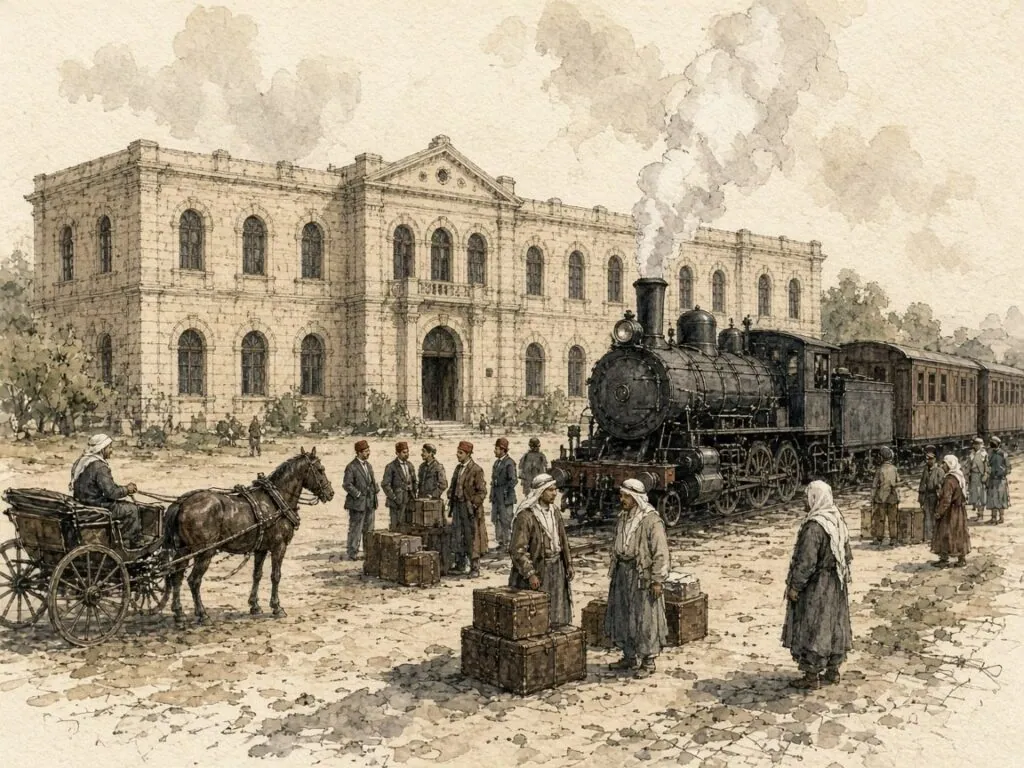
What the deportations were, and how they should be named, remains a matter of fierce political dispute between states, but not among most historians of the period, who regard the destruction of the Ottoman Armenians as genocide. This history follows that consensus. In Aleppo itself, local Armenians, foreign missionaries and relief workers tried to feed and shelter deportees, and an exhibition on the rescue of Armenians by the Armenian Genocide Museum-Institute in Yerevan gathers photographs of orphans collected from the deserts around the city and of survivors living in caves on its outskirts.[79]
The capture of October 1918
The war came to Aleppo itself in its last weeks. After the defeat of the Ottoman armies in Palestine in September 1918, British, Indian, Australian and Arab forces pushed north through Damascus and Homs. General Allenby’s despatch, printed in the London Gazette, records that on the evening of 25 October a detachment of the Arab Army of the Emir Fayṣal reached the eastern outskirts of Aleppo and during the night forced its way into the town, inflicting heavy casualties on the defenders. Early the next morning British armoured cars and the 15th Imperial Service Cavalry Brigade moved round the west side of the town and caught the Turkish rearguard, some two and a half thousand infantry with cavalry and guns, south-east of Haritan, where the Mysore and Jodhpur Lancers charged. That night the rearguard withdrew to a position some twenty miles north-west of Aleppo, and the 5th Cavalry Division, too weak to press further, occupied Muslimiyya junction and watched the roads to Kilis and Katma. Five days later, on 30 October, the armistice of Mudros ended the war with the Ottoman Empire.[80]
The capture severed Aleppo from Anatolia, to which it had been bound for four centuries by trade, family ties and government. The postwar treaties left the city as the northernmost large town of an Arab Syria, separated by a new frontier from Aintab, Urfa and Marash, cities that had been its natural hinterland. In the following years refugees continued to arrive. The Near East Relief Historical Society describes three waves of Armenian refugees between 1915 and 1925, the first of survivors of the deportations, the second from Cilicia after France ceded the region to Turkey in October 1921, and the third after the destruction of Smyrna in 1922, when the organisation brought thousands of its orphans south from the Anatolian interior.[78]
A city of refugees
By 1923, according to the same account, Aleppo had received nearly a hundred thousand refugees, seventy-nine thousand of them Armenians, together with some eight thousand Anatolian Greeks and several thousand orphans. Near East Relief took over an overcrowded orphanage housing some sixteen hundred children, opened a second in tents, and ran a hospital and vocational workshops whose shops, staffed by orphans learning their trades, gave a new street the name of the Street of Near East Relief. In 1922 a hundred blind children from the American School for the Blind at Harput walked, rode and floated on barges down the Euphrates for a month to reach the city, where the school was re-established.[78]
The refugees transformed Aleppo. Camps on the edge of the city gave way, over two decades, to permanent Armenian neighbourhoods, schools, churches and clubs, and the Armenian community of Aleppo became one of the largest and most important in the diaspora, with its own press and political parties. The city that had absorbed Bedouin, Turks, Kurds and Europeans for a thousand years absorbed these newcomers too.[78][33]
The State of Aleppo
The Arab government of Fayṣal in Damascus lasted less than two years. In July 1920 French troops defeated its army at Maysalūn and occupied Syria under a League of Nations mandate. On 1 September 1920 General Henri Gouraud divided the territory, creating among other units a separate State of Aleppo, and the city became for a time the capital of its own small polity under French tutelage. The arrangement did not last. A federation of the Syrian states was proclaimed in 1922, and by a decree of 5 December 1924 Aleppo and Damascus were united as the State of Syria from 1 January 1925. The historian Adam Mestyan, in the Journal of Global History, has shown how these administrative orders became the framework within which a Syrian constitution and political order were negotiated in the following years.[81]
French rule was resisted. In the countryside west of Aleppo, Ibrāhīm Hanānū led a revolt between 1919 and 1921 that drew support from Turkish nationalists across the new border, and the city’s notables later played a large part in the National Bloc that negotiated with France for independence. The greatest loss to Aleppo in the mandate years came in 1939, when France ceded the Sanjak of Alexandretta, with its port and the city of Antioch, to Turkey. Aleppo, which had depended on Alexandretta for its sea trade since the sixteenth century, was cut off from its natural outlet to the Mediterranean, and its merchants turned increasingly to Beirut and to the new Syrian port of Latakia.[33][81]
The French on the citadel
The mandate authorities also took a scholarly interest in the citadel. French archaeologists and architects cleared and restored parts of the hill in the 1920s and 1930s, and it was during this work that the officer Ploix de Rotrou found the first of the reliefs of the storm-god’s temple, the discovery that would, seventy years later, lead Kay Kohlmeyer to the temple itself. After independence the work continued under the Syrian antiquities service, which in 1980 built a semicircular modern theatre in the middle of the hill for performances; the AKTC guide notes that the antiquities authorities came to regard it as problematic, because it buried the remains of older buildings, while acknowledging that it also protects still older layers from decay.[1][8]
26. Independence and the night of December 1947
Evacuation Day
The last French troops left Syria in April 1946, and 17 April, Evacuation Day, became the national holiday of the independent republic. Aleppo entered independence as the country’s largest city and its industrial and commercial capital, with textile mills, a cotton trade fed by the newly irrigated plains of the Jazīra and a merchant class that had grown rich under the mandate. Its politicians, organised in the People’s Party, were rivals of the Damascus notables of the National Party, and much of Syrian politics in the first decade of independence turned on that rivalry, on the question of union with Iraq, which many in Aleppo favoured, and on the ambitions of army officers.[33][36]
The new state was fragile. A series of military coups began in 1949; the officer Adīb al-Shishaklī ruled from 1949 to 1954; Syria joined Egypt in the United Arab Republic between 1958 and 1961; and in March 1963 officers of the Baʿth Party seized power. Aleppo’s economic elite suffered under the land reforms and nationalisations of the union and the Baʿth, which broke up great estates and took over factories, banks and trading houses. Many of the city’s leading families, Muslim and Christian, left for Beirut and beyond. In 1970 Ḥāfiẓ al-Asad took power in Damascus, and his rule, and his son’s after him, would shape the city for more than half a century.[33][36]
The riots of December 1947
For the Jews of Aleppo the decisive moment came even before independence had been consolidated. On 29 November 1947 the General Assembly of the United Nations voted to partition Palestine. The next days saw demonstrations across the Arab world, and in Aleppo a mob broke into the Jewish quarter. The Encyclopaedia Judaica gives the date as 1 December 1947 and records that about one hundred and fifty buildings, fifty shops and offices, ten synagogues and five schools were damaged, and that one hundred and sixty old Torah scrolls of the Baḥsīta synagogue were burned. A dispatch of the Associated Press printed in the New York Times on 3 December, datelined Damascus on 2 December, reported that a mob in Aleppo had broken into the Jewish quarter “today”, attacking restaurants, clubs and shops and burning goods; the discrepancy of a day, which runs through later accounts, may reflect the riot’s duration over more than one day or simply the delay of reporting.[6][82]
The number of people killed is disputed. The Encyclopaedia Judaica gives no death toll, and the contemporary Associated Press report mentions none; some later accounts give figures of up to seventy-five dead, but they cannot be traced to a reliable contemporary source, and this history does not adopt them. What is not in doubt is the scale of the material destruction and its consequences. The Central Synagogue, the ancient building in which the Crown of Aleppo had been kept for six centuries, was set on fire, and the community’s spiritual centre was devastated. The rescue of the Codex from its ruins has been told in the previous chapter.[6][82][83]
A clandestine exodus
The Jewish community of Aleppo in 1947 numbered about ten thousand. The Encyclopaedia Judaica states that some six thousand of them fled the city after the riots, many crossing the frontiers secretly into Turkey or Lebanon, where some settled, while others continued to Israel, Europe or the Americas. The Jewish Telegraphic Agency, writing in 1994, describes a clandestine emigration that continued until the government cracked down in 1951. Flight was dangerous, and those caught at the border were imprisoned; the Encyclopaedia Judaica cites a report of the agency from November 1947 that twenty-two Aleppo Jews had been arrested trying to cross the frontier between Lebanon and Palestine.[6][83]
Those who remained lived under increasing restriction. The Encyclopaedia Judaica records that the four schools of the Alliance Israélite Universelle were closed by the government in 1950, that about two thousand Jews remained in 1959, and that by 1968 about a thousand lived in two quarters, the old Baḥsīta and the newer al-Jamīliyya, where Muslims who had moved into abandoned Jewish homes occasionally assaulted their Jewish neighbours. After the war of June 1967 Jewish teachers were dismissed and degrading regulations imposed. The Jewish Telegraphic Agency describes the surveillance of the secret police, restrictions on travel and trade and arbitrary arrests, but notes that religious life was allowed to continue.[6][83]
From 1947, a channel of secret aid linked the community with its emigrants. The JTA reports that Isaac Shalom, a Syrian Jew in Brooklyn, approached the American Jewish Joint Distribution Committee for emergency relief after the Aleppo riots, and that for decades money passed through the Near East Jewish Aid Society to trusted members of the communities of Damascus, Aleppo and Qāmishlī. In 1977 the first legal departures began, of young women allowed to leave to marry abroad, and in 1992 Ḥāfiẓ al-Asad permitted free emigration. By October 1994, the agency reported, some three thousand eight hundred Jews had left Syria since 1992, and only about two hundred and thirty remained in the whole country. The community of Aleppo, which had existed for more than two thousand years, had come to an end. Its descendants live today in Brooklyn, in Buenos Aires and elsewhere in Latin America, and in Israel, where its liturgy, its music and its name survive.[83][6][66]
The Artillery School and the year of the tanks
In the late 1970s Aleppo became the main battleground of an armed Islamist challenge to the Baʿthist state. On 16 June 1979 militants of the Fighting Vanguard, a radical offshoot of the Muslim Brotherhood movement, attacked the military Artillery School in the al-Rāmūsa district with the complicity of an officer on duty, who gathered the cadets, most of them young ʿAlawīs, in the dining hall and let the gunmen in. Official figures gave thirty-two dead; other sources give up to eighty-three. The government blamed the Muslim Brotherhood, whose leadership publicly distanced itself from the attack, and launched mass arrests.[84][85]
The following year the confrontation in Aleppo turned into something close to urban war. After strikes and demonstrations that closed the shops of the city centre for two weeks in March 1980, the army’s Third Division and the special forces surrounded the city, and from early April troops entered quarter after quarter, firing on buildings and arresting hundreds; the citadel served as a temporary prison. The journalist Michael Nuding, summarising the research of Raphael Lefèvre and Patrick Seale, describes the killing of at least eighty-three men and boys at the Hanānū cemetery after special forces sealed off the al-Mashāriqa quarter on 11 August 1980, the first day of the Eid. The troops did not withdraw until February 1981. The overall death toll of these years in Aleppo is not known, and figures given by the government and by opposition groups differ widely.[84][85][86]
The suppression of the Islamist uprising, which culminated in the destruction of much of Hama in February 1982, left a deep and largely silent trauma in Aleppo. The city’s conservative Sunni merchant class had been divided by the uprising, and the security services watched closely over its mosques and associations for the rest of Ḥāfiẓ al-Asad’s rule. When the economy was cautiously opened in the 1990s and 2000s, Aleppo’s industrialists and traders prospered once more, but the memory of 1980 was never publicly acknowledged.[84][36]
27. World Heritage and the war
Saving the old city
In the decades after independence the old city of Aleppo came close to being cut apart. The UNESCO and UNITAR survey describes the early years of the republic as a time of hectic modernisation. In 1954 the French planner André Gutton developed urban projects begun under the mandate, and wide expropriations and highly destructive demolitions in several historic neighbourhoods, among them Bāb al-Faraj, al-Jdayda and the areas west of Bāb al-Jinān, destroyed tens of hectares of the historic fabric. The Antiquities Law No. 222 of 1963 protected monuments and acknowledged historic areas; between 1968 and 1974 the antiquities service designated more than a hundred and sixty buildings as monuments, and the Japanese planner Gyoji Banshoya, mandated by UNESCO, drew up guidelines and a protection plan for the old city. In 1976 the intramural city was declared a national historic area under a conservation committee; in 1978 the protected zone was extended to some of the extramural quarters; in 1979 the committee asked UNESCO for help; and an international symposium was held in 1983.[23]
In 1986 the Ancient City of Aleppo was inscribed on the World Heritage List. The inscription recognised the cohesion and authenticity of an urban fabric shaped by successive rulers, with its citadel, its mosques and madrasas, its khans, its hammams and its courtyard houses. Restoration work by the antiquities service and the municipality followed, and in 1992, at the initiative of the Friends of the Old City of Aleppo, the city asked the German Technical Cooperation Agency, GTZ, to support urban conservation. The Directorate of the Old City was created the same year; a rehabilitation project was drafted in early 1993; new road-building and demolition plans were scrapped; water and sewers were renewed, four-fifths of the street paving was relaid, and residents were offered interest-free loans to restore their houses.[2][23]
The citadel received particular attention. In 1999 the Aga Khan Trust for Culture, in partnership with the Syrian antiquities service, began a programme for the conservation of Syrian citadels that included Aleppo, financing conservation and excavation inside the citadel with the World Monuments Fund, and between 2004 and 2010 its Historic Cities Programme carried out the Aleppo Citadel Perimeter project, which nearly halved the traffic around the hill and recast the area as a pedestrian space. The UNESCO and UNITAR survey judges that by early 2011 the results were impressive: the city was prosperous, modernising, and attracting rapidly growing investment in tourism.[23][1][87]
Madrasa al-Sulṭāniyya
The Ayyubid madrasa facing the citadel entrance, completed in 1223 and holding the mausoleum of al-Ẓāhir Ghāzī, severely damaged in 2014 and 2015.
Open in Google MapsKhān al-Wazīr
One of the great khans of the souqs, on the street that runs from the Great Mosque towards the citadel and gives it its name.
Open in Google MapsBāb al-Naṣr
The northern gate of the walled city, leading towards the Jewish quarter of Baḥsīta and the Christian suburbs.
Open in Google MapsBayt Ajiqbash
An eighteenth- and nineteenth-century house of the Jdayda quarter with richly carved courtyard façades, home of the Museum of Popular Arts and Traditions.
Open in Google MapsBaghdad station
The station of the Baghdad Railway, opened in the years before the First World War, which made Aleppo a railway junction.
Open in Google MapsBāb Qinnasrīn
The south-western gate of the medieval walls, on the road to the ancient city of Chalcis.
Open in Google MapsThe battle for Aleppo
The uprising that began in Syria in March 2011 reached Aleppo comparatively late, and for more than a year the city was spared the fighting that engulfed Homs, Hama and the countryside around it. In July 2012 armed opposition groups entered the city from the countryside, and the UNITAR timeline dates the start of hostilities in Aleppo to 19 July 2012. Within weeks the city was divided between government-held western districts and opposition-held eastern ones, with the front line running through the old city itself, around the citadel and the souqs.[23]
The historic centre suffered from the first months. At the end of September 2012 a huge fire swept the covered souqs, and the UNITAR report records that it damaged much of the eastern side of the Great Mosque, the outer wall abutting the souqs and the eastern portico, and destroyed the mosque’s library. On 24 April 2013 the mosque’s minaret, the tower that had stood for more than nine hundred years, was destroyed. The Director-General of UNESCO, Irina Bokova, deplored the destruction the same day. Responsibility was disputed. The BBC reported that the state news agency SANA accused fighters of Jabhat al-Nuṣra of placing explosives in the minaret and the southern door of the mosque, while an activist quoted by the Associated Press said the minaret had been brought down by army tank fire. No independent investigation has settled the question.[23][42][88]
In 2013 the Ancient City of Aleppo was placed on the List of World Heritage in Danger, together with Syria’s five other World Heritage properties. The worst damage was yet to come. Fighters on both sides dug tunnels beneath the front lines and packed them with explosives, and between 2014 and 2015 most of the historic buildings south of the citadel were destroyed or severely damaged by such underground bombs, among them the New Serail, the Madrasa al-Sulṭāniyya, the Ḥammām Yalbughā al-Nāṣirī and the Khusrawiyya complex. The National Ḥamīdī Hospital, the first modern hospital of the city, later the Carlton Hotel, was blown up on 4 May 2014. The citadel itself, held by government troops, was shelled and its perimeter wall breached; the UNITAR analysis records impact damage in the moat and possible tunnel entrances beside the fortified wall.[23][89][5]
East Aleppo
For four years the eastern districts lived under bombardment and, in the final months, siege. Air strikes and barrel bombs destroyed hospitals, markets and whole neighbourhoods in the east, while opposition shelling struck the western districts; the Guardian, reporting the end of the battle, described residents living without functioning hospitals and with little electricity or water in freezing winter conditions. In the second half of 2016 government forces, with Russian air power and Iranian-backed militias, encircled the east and advanced through it. The final evacuation, under an agreement brokered by Turkey and Russia, was completed on 22 December 2016. The International Committee of the Red Cross reported that the Syrian Arab Red Crescent and the ICRC had evacuated some thirty-five thousand people from the devastated neighbourhoods to the surrounding countryside; the Guardian put the total who left the east in the last week at a little over forty thousand. Many went to Idlib province, still held by the opposition.[90][91]
Counting the damage
The first full survey of the damage to the World Heritage property was published by UNESCO and UNITAR in December 2018, based on satellite imagery from 2013 to 2017 and on experts’ review. It assessed five hundred and eighteen historic sites, among them the citadel and the Great Mosque, and found that more than ten per cent of the historic buildings had been destroyed and more than half of those assessed showed severe or moderate damage. Measured by land plots of the old cadastral survey, it counted seven hundred and twenty-three plots destroyed, two thousand one hundred and sixty-eight severely damaged and two thousand two hundred and eighty-seven moderately damaged. Introducing the study, the Director-General of UNESCO, Audrey Azoulay, recalled that until 2012 Aleppo had been regarded as one of the best examples of urban conservation in the world.[23][89]
The war’s toll in human life in Aleppo is not known with precision, and no single figure commands general agreement. What can be said is that the city that emerged from 2016 had lost a large part of its population to death, flight and emigration. Its eastern half lay largely in ruins. The old city at its heart, which had survived the Mongols and Tīmūr, the earthquake of 1822 and the riots and reforms of the nineteenth century, had suffered the greatest destruction in its long history.[23][90]
28. After the ruins
The earthquake of February 2023
The first years after 2016 brought a fragile peace to Aleppo and the beginnings of repair. Restoration of parts of the souqs began in 2017, and the Xinhua news agency, surveying the work in October 2026, records that rehabilitation was completed in several markets, among them Sūq al-Ḥibāl, while work continued elsewhere in the old city. The government also began works on the Great Mosque in 2017, although the building remained closed. Then, in the early hours of 6 February 2023, two great earthquakes struck southern Türkiye and northern Syria. UNESCO reported the next day that significant damage had been noted in the citadel of Aleppo, that the western tower of the old city wall had collapsed and that several buildings in the souqs had been weakened; a satellite assessment by UNOSAT documented damage on the citadel, including to the Ottoman mill and the barracks of Ibrāhīm Pasha.[52][4][92][93]
The human cost in the city cannot be given precisely. A flash update of the humanitarian country team in Syria, published on 12 February 2023, reported that the Syrian Ministry of Health had recorded one thousand four hundred and fourteen deaths, mainly in Aleppo, Latakia, Hama, the Idlib countryside and Tartus, without a separate figure for the city, and warned that the number was expected to rise; thousands more died in the opposition-held north-west. More than eighteen thousand five hundred families were sheltering in collective centres, and in Aleppo many of them were people who had returned to homes already weakened by the war. For the old city, already on the List in Danger, the earthquake added a second layer of destruction to the first.[94][92]
The fall of the old regime
The political order that had ruled Aleppo since 1963 collapsed with astonishing speed at the end of 2024. On 27 November an alliance of opposition factions led by Hayʾat Taḥrīr al-Shām launched an offensive from Idlib. The Guardian reported on 29 November that rebels had entered Aleppo three days into the attack, and on 30 November CNN reported that they controlled most of the city, the first time since 2016 that the government had lost it; Kurdish forces at the same time extended their control beyond the two Kurdish-majority neighbourhoods they already held. Within days the offensive swept south through Hama and Homs, and on 8 December 2024 Damascus fell. Bashar al-Asad fled to Moscow, ending more than half a century of rule by his family.[95][96][97][98]
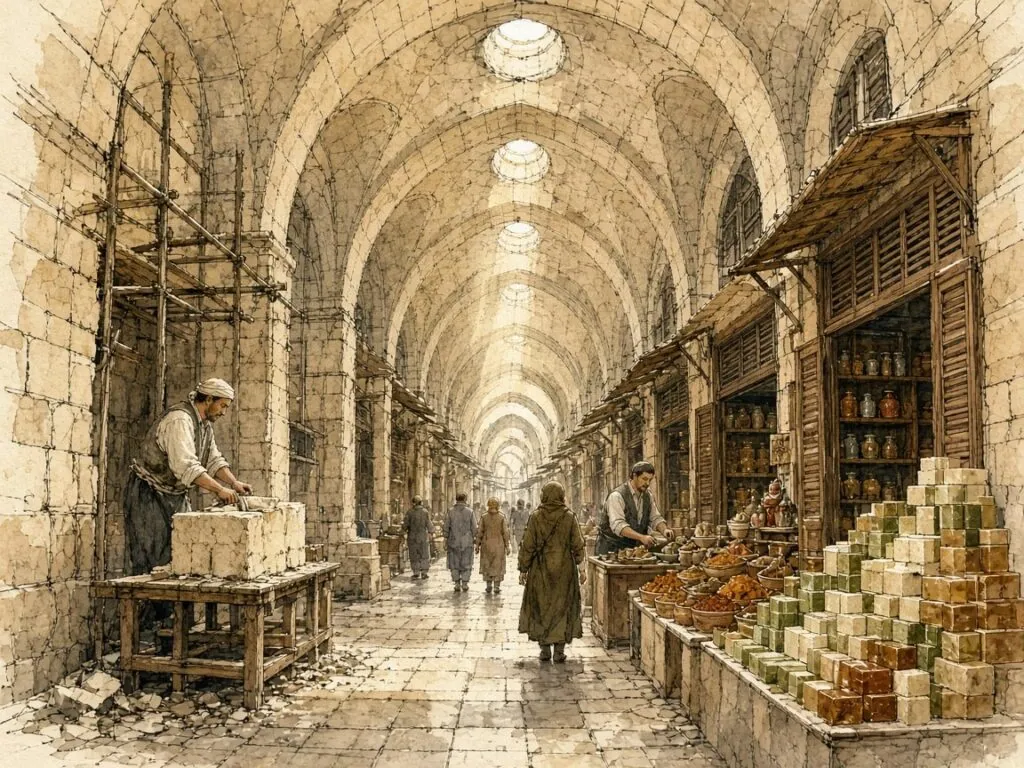
Aleppo began to reconnect with the world. In March 2025 the Great Mosque was partially reopened for the month of Ramadan, and on 18 March 2025 Aleppo International Airport reopened, with international flights following shortly afterwards. The future of the Kurdish-held districts of Shaykh Maqṣūd and al-Ashrafiyya, home to a large Kurdish population, became the city’s most sensitive political question. On 10 March 2025 the new authorities in Damascus and the Kurdish-led Syrian Democratic Forces signed an agreement on the integration of the SDF into the institutions of the state, and in April 2025 a separate Aleppo agreement provided for a gradual withdrawal of SDF fighters from the two neighbourhoods. The arrangement was fragile; clashes broke out in October 2025 and were followed by a ceasefire on 7 October.[4][99][100][101][102][103]
January 2026
The crisis came to a head in January 2026, after talks on integrating the SDF into the national army collapsed. From 6 January heavy fighting between government forces and the SDF engulfed Shaykh Maqṣūd, al-Ashrafiyya and the neighbouring district of Banī Zayd. Al Jazeera reported that at least thirty people were killed and more than a hundred and fifty thousand displaced; an assessment by ACAPS on 15 January gave displacement figures of the same order. The fighting ended with a ceasefire reached through international mediation, in which the United States played a central part, and on 11 January the Aleppo governor, ʿAzzām al-Gharīb, announced that the last SDF fighters had left the city by bus for Raqqa.[104][105][106]
Casualty figures for those days differ widely. The Syrian Observatory for Human Rights, a monitoring group based in Britain, later gave a much higher toll, of one hundred and forty-two dead by its own count, while other tallies were far lower; this history records the figures as reported and does not attempt to reconcile them. By mid-February 2026, the Associated Press reported, most residents had returned to the Kurdish-majority neighbourhood and recovery had been swift, although the political questions behind the fighting remained unresolved.[107][108]
The Committee in Busan
In July 2026 the World Heritage Committee, meeting for its forty-eighth session in Busan, examined the state of the old city. Its decision noted that a joint mission of the World Heritage Centre and ICOMOS had visited Aleppo in October 2025 and welcomed the mission’s finding that conservation and restoration work generally showed high-quality physical conservation, including at key monuments. It also warned that the transition from fragmented, ad hoc interventions to a coherent reconstruction process remained a critical challenge; asked the Syrian authorities to set a clear policy on whether the full reconstruction of damaged elements was compatible with the authenticity of the property; urged emergency stabilisation of monuments at risk of collapse, the systematic documentation of original elements recovered from debris, a Recovery Master Plan and an adequate buffer zone; and requested a report by 1 February 2027. It decided to keep Aleppo on the List of World Heritage in Danger.[3]
The mosque reopened
On the ground the work continued. In late July 2026 the Syrian state news agency, in a report republished by the Aga Khan Development Network, described the restoration of Sūq al-Saqaṭiyya and other markets; the director of the Old City Directorate credited the Aga Khan Trust for Culture, which had worked in Syria since 1999 and on the citadel’s surroundings and parts of the souqs since 2006, with a central role, and officials of the governorate discussed with the network its project for conservation work on the citadel. The report presented the restoration as part of a wider effort to preserve the historic character of the old city, revive its markets and encourage residents to return, in support of the economic recovery of the city.[109]
On the evening of Thursday 8 October 2026 the Great Mosque of Aleppo was formally reopened, after more than thirteen years of closure. Al-Monitor, reporting the ceremony from the state news agency, records that it was attended by the governor ʿAzzām al-Gharīb, the minister of endowments Muḥammad Abū al-Khayr Shukrī and the presidential media adviser Aḥmad Muwaffaq Zaydān, and that the governor spoke of restoring the mosque of al-Shahbāʾ after years of destruction. The restoration had been resumed by the Aleppo Endowments Directorate in November 2025. The report does not say how far the minaret destroyed in 2013 has been rebuilt, and the extent of its reconstruction could not be confirmed for this history. A week earlier, the fifth-century complex of Saint Simeon, some thirty kilometres north-west of the city, had reopened to visitors.[4]
A city rebuilding
Recovery reaches beyond monuments. On 19 October 2026 the United Nations in Syria announced the completion of a project by Alwaleed Philanthropies, the Aleppo governorate and UN-Habitat that restored a safe water supply to some six hundred thousand residents of the eastern districts of Tall Shughayb, Karm al-Muyassar, al-Nayrab and Qāḍī ʿAskar. On 30 October Xinhua described shopkeepers returning to the restored lanes of the souqs, one of them, a coffee roaster, recalling how commerce had stopped when the fighting began, and a craftsman in Sūq al-Ḥibāl explaining that the markets are not only historic buildings but crafts, skills and commercial habits handed down through generations. Those involved in the work insisted that physical restoration means little without the return of economic life.[110][52]
That has always been Aleppo’s way. The city on the Quwayq has been sacked by Hittites and Persians, Byzantines and Mongols, shaken by earthquakes and emptied by plague and war, and each time it has been rebuilt by people who returned to the same streets, the same souqs and the same hill. Whether the old city can recover its authenticity as well as its life, as the World Heritage Committee asks, is a question for the coming years. What is already clear is that the people of Aleppo, in the souqs and the mosques, in the courtyards of Jdayda and the restored lanes below the citadel, have begun once more to make their city live.[3][52]
Timeline
The dates below follow the chapters above. Select an entry to open it; dates for the Bronze Age follow the Middle Chronology and are approximate.
Texts from the royal archives of Ebla name Ḫalab and record offerings sent by the Eblaite court to the temple of its storm god Hadda, already a shrine of more than local prestige. [10]
Šuppiluliuma I conquers north Syria and installs his son Telipinu as priest-king of Aleppo. [15]
The emperor Julian sacrifices a white bull to Zeus on the acropolis of Beroea and addresses a mostly Christian council. [27]
The Persian king burns Beroea while the inhabitants defend themselves on the acropolis. [28]
Nikephoros Phokas storms the city while the citadel holds out. [35]
Īlghāzī destroys the army of Roger of Antioch west of Aleppo. [43]
Al-Bursuqī relieves Aleppo from a Crusader siege. [43]
Hüsrev Pasha’s mosque complex brings imperial Ottoman architecture to Aleppo. [51]
A new charter unites the English Turkey and Venice traders in the Levant Company, whose chief Syrian factory is at Aleppo. [55]
The Antiochene Orthodox church divides, and Aleppo’s Catholic party forms the Melkite Greek Catholic church. [64]
Alexander Russell publishes his account of the city, later enlarged by Patrick Russell. [61]
Egyptian forces occupy Syria and build barracks on the citadel. [1]
The canal opens, eroding Aleppo’s caravan trade. [6]
Arab and British forces take Aleppo; the armistice of Mudros follows on 30 October. [80]
General Gouraud creates a separate State of Aleppo under the French mandate. [81]
Aleppo and Damascus are united by a decree of 5 December 1924. [81]
France cedes the Sanjak of Alexandretta to Turkey, cutting Aleppo from its port. [33]
The last French troops leave and Syria becomes fully independent. [33]
The surviving leaves are handed to the Ben-Zvi Institute after being smuggled out of Syria. [67]
Militants kill cadets at the military Artillery School, beginning two years of violence and repression. [84]
Special forces kill at least eighty-three men and boys after sealing off the quarter. [84]
The Ancient City of Aleppo is inscribed on the World Heritage List. [2]
Free emigration ends the Jewish community of Aleppo. [83]
Hostilities begin in the city, which is soon divided by a front line through the old city. [23]
Bashar al-Asad flees to Moscow. [97]
Fighting between government forces and the SDF ends with the departure of the last SDF fighters. [104]
The World Heritage Committee keeps Aleppo on the List of World Heritage in Danger. [3]
The mosque is formally reopened after more than thirteen years. [4]
Glossary of terms
These terms recur in the chapters above. Each definition gives the sense in which the word is used in this history.
- Acropolis
- The fortified high town of a Greek or Hellenistic city; at Beroea, the citadel mound.
- Aleppo Codex
- The Keter Aram Ẓova, a tenth-century manuscript of the Hebrew Bible written in Tiberias and kept in Aleppo for about six centuries.
- Aram Ẓova
- The Hebrew name used by the Jews of Aleppo for their city, identifying it with the biblical Aram-Zobah.
- Atabeg
- A Turkish guardian or regent of a young prince, and by extension a military ruler, as were Zangī and his successors.
- Bāb
- Arabic for gate; Bāb Anṭākiya, Bāb al-Naṣr and Bāb Qinnasrīn are gates of the old city walls.
- Bīmāristān
- A hospital in the medieval Islamic world, such as the Bīmāristān Arghūn al-Kāmilī.
- Consul
- A representative of a foreign nation who protected its merchants; Venice, France, England and the Netherlands kept consuls at Aleppo.
- Dhimmī
- A non-Muslim subject protected under Islamic law in return for the jizya tax and certain restrictions.
- Factory
- In the early modern sense, a trading post of resident merchants, or factors, such as the Levant Company’s house at Aleppo.
- Glacis
- The sloping, stone-faced bank of a fortification; the citadel of Aleppo is wrapped in one of the largest in the world.
- Ḥammām
- A public bathhouse.
- Ḥamdānids
- An Arab dynasty that ruled Aleppo in the tenth century, most famously under Sayf al-Dawla.
- Khān
- A courtyard building for merchants, their goods and animals, the commercial centre of the souq.
- Madrasa
- A college for the teaching of Islamic law and religious sciences, often endowed by a ruler.
- Mamluk
- A slave soldier; from 1250 to 1517 a sultanate of such soldiers ruled Egypt and Syria.
- Maqām
- A shrine marking a holy person’s station; also, in music, a melodic mode.
- Masorah
- The notes and vowel and accent signs added to the Hebrew Bible to fix its text and pronunciation.
- Miḥrāb
- The niche in a mosque’s wall indicating the direction of prayer.
- Millet
- A recognised religious community in the Ottoman Empire, with its own leaders and courts in personal matters.
- Mustaʿraba
- The Arabic-speaking Jews long established in Syria, as distinct from the Sephardi exiles who arrived after 1492.
- Qāḍī
- A judge of Islamic law.
- Sūq
- A market street or quarter; in Aleppo, the covered markets of the old city.
- Storm god
- The chief god of Aleppo, called Hadda or Addu at Ebla and Mari, Hadad in Aramaic, Tarḫunza in Luwian and Teššub in Hurrian.
- Tanzimat
- The Ottoman reforms of 1839 to 1876, which promised equality before the law and reorganised the provinces.
- Vilayet
- A province of the reorganised Ottoman Empire after 1864.
- Waqf
- A perpetual charitable endowment in Islamic law, whose property could not be sold.
- Yamḫad
- The Amorite kingdom of the Middle Bronze Age with its capital at Aleppo.
References
- Julia Gonnella, with contributions by Kay Kohlmeyer and others, The Citadel of Aleppo, 2nd ed. (Geneva: Aga Khan Trust for Culture and Syrian Directorate-General of Antiquities and Museums, 2008) *
- UNESCO World Heritage Centre, “Ancient City of Aleppo,” World Heritage List, property no. 21 (inscribed 1986) *
- World Heritage Committee, Decision 48 COM 7A.13, “Ancient City of Aleppo (Syrian Arab Republic),” 48th session, Busan, July 2026 *
- Beatrice Farhat, “Syria reopens Aleppo’s 1,300-year-old Great Umayyad Mosque after 13 years,” Al-Monitor, 9 October 2026 *
- Archnet, “Qalʿa Ḥalab” (Citadel of Aleppo), site record *
- Eliyahu Ashtor, Leah Bornstein-Makovetsky, Hayyim J. Cohen and Amnon Shiloah, “Aleppo,” Encyclopaedia Judaica, 2nd ed., vol. 1, pp. 613 - 617, reprinted at Encyclopedia.com *
- Elkan N. Adler and others, “Aleppo,” The Jewish Encyclopedia (1901 - 1906) *
- Kay Kohlmeyer, The Temple of the Weather God of Aleppo, Qalʿat Ḥalab Occasional Papers 1 (Münster: Rhema, 2020), publisher’s excerpt *
- Archaeology magazine, “Temple of the Storm God,” November - December 2009 *
- Alfonso Archi, “Hadda of Ḫalab and his temple in the Ebla period,” Iraq 72 (2010), pp. 3 - 17 *
- J.-R. Kupper, “Northern Mesopotamia and Syria,” in The Cambridge Ancient History, 3rd ed., vol. II, part 1 (Cambridge University Press, 1973), print *
- J. B. Ribeiro Santos, “Alepo, Mari e o projeto dinástico alepino-mariyanum,” Varia Historia *
- Jack M. Sasson, “Yarim-Lim’s War Declaration,” in Miscellanea Babylonica. Mélanges offerts à Maurice Birot (Paris, 1985) *
- Jacob Lauinger and others, The Labors of Idrimi (Atlanta: SBL Press, open access) *
- Gary Beckman, Hittite Diplomatic Texts, 2nd ed. (Atlanta: Scholars Press, 1999) *
- Hittite Monuments, “Aleppo,” illustrated catalogue of the temple reliefs *
- British Museum, “The Statue of Idrimi,” museum no. 1939,0613.101 *
- British Museum, clay tablet with the treaty between Muwattalli II and Talmi-Šarruma of Aleppo, BM 140856 *
- LAMAN, Hittite texts online, CTH 75.A, treaty of Muwattalli II with Talmi-Šarruma of Aleppo *
- Kay Kohlmeyer, “The Temple of the Storm God in Aleppo during the Late Bronze and Early Iron Ages,” Near Eastern Archaeology 72, no. 4 (2009), pp. 190 - 202 *
- Archnet, “Temple of the Storm God Hadad (Aleppo Citadel),” site record *
- eDiAna, Luwian hieroglyphic corpus, “ALEPPO 6,” after the edition of J. D. Hawkins (2011) *
- UNESCO and UNITAR-UNOSAT, Five Years of Conflict. The State of Cultural Heritage in the Ancient City of Aleppo (Paris and Geneva, 2018) *
- Encyclopaedia Iranica, “Aramaic” *
- The Posen Library of Jewish Culture and Civilization, “The Campaign of Shalmaneser III in the Levant” (Kurkh Monolith) *
- British Museum, “The Kurkh Stela,” museum no. 118884 *
- Julian, Letter 58 to Libanius, 10 March 363, trans. W. C. Wright (Loeb Classical Library, 1923), Tertullian Project *
- Procopius, History of the Wars II.7, trans. H. B. Dewing (Loeb Classical Library), LacusCurtius *
- UNESCO World Heritage Centre, “Ancient Villages of Northern Syria,” World Heritage List, property no. 1348 *
- Henry Wace, ed., A Dictionary of Christian Biography and Literature (1911), “Acacius, bishop of Beroea,” Christian Classics Ethereal Library *
- “Acacius of Beroea,” New Catholic Encyclopedia, reprinted at Encyclopedia.com *
- Encyclopaedia Iranica, “Antioch” *
- Ross Burns, Aleppo. A History (London and New York: Routledge, 2016) *
- Matthew Saba, “Great Mosque of Aleppo,” Archnet site record (2017) *
- Gerda Henkel Stiftung, Aleppo Heritage Catalogue, “The citadel under the rule of the Hamdanids and the nomad dynasties of the Mirdasids and Uqaylids” *
- Philip Mansel, Aleppo. The Rise and Fall of Syria’s Great Merchant City (London: I.B. Tauris, 2016) *
- Dimitri Gutas, “Fārābī i. Biography,” Encyclopaedia Iranica *
- Therese-Anne Druart, “al-Farabi,” Stanford Encyclopedia of Philosophy *
- David Durand-Guédy, “Malekšāh,” Encyclopaedia Iranica *
- Syrian Heritage Archive Project (Museum für Islamische Kunst and Deutsches Archäologisches Institut), “Aleppo, Great Mosque, minaret, foundation inscriptions on the base” *
- Gerda Henkel Stiftung, Aleppo Heritage Catalogue, “Significance of the Great Mosque’s minaret” *
- UNESCO World Heritage Centre, “UNESCO Director-General deplores continuing destruction of ancient Aleppo, a World Heritage site,” 24 April 2013 *
- Ibn al-Qalānisī, The Damascus Chronicle of the Crusades, extracted and translated by H. A. R. Gibb (London: Luzac, 1932) *
- Yasser Tabbaa, Constructions of Power and Piety in Medieval Aleppo (University Park: Pennsylvania State University Press, 1997) *
- Archnet, “Qalʿa Ḥalab, entrance block,” site record *
- Archnet, “Qalʿa Ḥalab, palace of al-Malik al-Ẓāhir Ghāzī,” site record *
- Charles Melville, “Il-Khanids i. Dynastic history,” Encyclopaedia Iranica *
- Ahmed ibn Arabshah, Tamerlane or Timur the Great Amir, trans. J. H. Sanders (London: Luzac, 1936), with notes from Ibn al-Shiḥna *
- Jean Sauvaget, Alep. Essai sur le développement d’une grande ville syrienne, des origines au milieu du XIXe siècle (Paris: Geuthner, 1941), with the review by René Dussaud, Syria 24 (1944) *
- Heghnar Watenpaugh, “Life in the Khans. The Venetians in Early Ottoman Aleppo” *
- Heghnar Zeitlian Watenpaugh, The Image of an Ottoman City. Imperial Architecture and Urban Experience in Aleppo in the 16th and 17th Centuries (Leiden: Brill, 2004) *
- Xinhua, “Feature. Stones, craft and commerce, reviving Aleppo’s ancient souks,” Aleppo, 30 October 2026 (published 31 October 2026) *
- Abraham Marcus, The Middle East on the Eve of Modernity. Aleppo in the Eighteenth Century (New York: Columbia University Press, 1989) *
- Bruce Masters, The Origins of Western Economic Dominance in the Middle East. Mercantilism and the Islamic Economy in Aleppo, 1600 - 1750 (New York University Press, 1988), with its review in the International Journal of Middle East Studies *
- Alfred C. Wood, A History of the Levant Company (Oxford University Press, 1935) *
- Richard Hakluyt, “A commission given by M. William Hareborne … to M. Richard Forster, authorizing him Consul of the English nation, in the partes of Alepo …” (1583), in The Principal Navigations, Cambridge Library Collection *
- University of Oxford doctoral thesis on English trade at Aleppo, Oxford University Research Archive *
- William Shakespeare, Macbeth, act 1, scene 3, Folger Shakespeare Library *
- Folger Shakespeare Library, Shakespeare and Beyond, “Shakespeare’s Asia. Ships, spices and porcelain” *
- William Shakespeare, Othello, act 5, scene 2, Folger Shakespeare Library *
- Alexander Russell, The Natural History of Aleppo, 2nd ed., revised and enlarged by Patrick Russell (London, 1794) *
- Bruce Masters, “The 1850 Events in Aleppo. An Aftershock of Syria’s Incorporation into the Capitalist World System,” International Journal of Middle East Studies 22 (1990) *
- Yaron Harel, “Jewish - Christian Relations in Aleppo as Background for the Jewish Response to the Events of October 1850,” International Journal of Middle East Studies 30 (1998) *
- Hasan Çolak, “When a Catholic is invested as the Orthodox patriarch of Antioch,” Collectanea Christiana Orientalia 20 (2023) *
- Sephardic Heritage Museum, “The Aleppo Codex and the Fahams” *
- Jewish Music Research Centre, Hebrew University of Jerusalem, “Aleppo. Musical tradition” *
- Yad Izhak Ben-Zvi, “The Aleppo Codex” *
- UNESCO Memory of the World, “Aleppo Codex,” registered 2015 *
- Yad Izhak Ben-Zvi, nomination of “The Aleppo Codex” to the UNESCO Memory of the World Register (2014) *
- Aron Dotan, “Masorah,” Encyclopaedia Judaica, 2nd ed., vol. 13, print *
- Magnes Press, description of the facsimile and studies of the Aleppo Codex *
- Israel Museum, Jerusalem, “Rescued from Fire. A Rare Remnant of the Aleppo Codex” *
- Jewish Telegraphic Agency, “UNESCO recognizes Israel’s Aleppo Codex in registry of world treasures,” 9 February 2016 *
- Matti Friedman, The Aleppo Codex. A True Story of Obsession, Faith, and the Pursuit of an Ancient Bible (Chapel Hill: Algonquin Books, 2012), print *
- Global Historical Earthquake Archive, “13 August 1822, 20.40, Aafrine,” compiling Ambraseys (1989, 2006, 2009) and Sbeinati and others (2005) *
- “The Impact of the 1822 Earthquake on the Administration of Waqf in Aleppo,” chapter in a Brill volume on Ottoman Syria *
- Qatar Digital Library, “XXII/8 Baghdad Railway,” India Office Records, British Library *
- Near East Relief Historical Society, “Near East Relief in Aleppo” *
- Armenian Genocide Museum-Institute, Yerevan, exhibition “Rescue of Armenians” *
- General Sir Edmund Allenby, despatch of 31 October 1918, supplement to the London Gazette, issue 31087 *
- Adam Mestyan, “From administrative to political order? Global legal history, the Organic Law, and the constitution of mandate Syria, 1925 - 1930,” Journal of Global History (2021) *
- Associated Press, “Anti-Jewish Riots in Syria,” New York Times, 3 December 1947, transcribed by the Center for Online Judaic Studies *
- Jewish Telegraphic Agency, “The Untold Story of Syria’s Jews. Decades of Secret U.S. Jewish Aid Preceded the Exodus of Syrian Jewry,” 19 October 1994 *
- Michael Nuding, “Die Stunde des Rifaat al-Assad. 40 Jahre Niederschlagung der syrischen Opposition in Aleppo,” zenith, 29 June 2020 (in German) *
- Raphaël Lefèvre, Ashes of Hama. The Muslim Brotherhood in Syria (London: Hurst, 2013), print *
- Middle East Watch, Syria Unmasked. The Suppression of Human Rights by the Asad Regime (New Haven: Yale University Press, 1991) *
- Aga Khan Development Network, “Cultural development, Syria” *
- BBC News, “Syria clashes destroy ancient Aleppo minaret,” 24 April 2013 *
- UN News, “First full satellite survey of devastated ancient Aleppo raises recovery hopes,” 17 December 2018 *
- International Committee of the Red Cross, “SARC and ICRC finalise evacuation of some 35,000 people from devastated Aleppo neighbourhoods,” 22 December 2016 *
- Kareem Shaheen and Patrick Wintour, “Final evacuees leave eastern Aleppo as Assad regime takes control,” The Guardian, 22 December 2016 *
- UNESCO World Heritage Centre, “Earthquake in Syria and Türkiye. UNESCO offers support,” February 2023 *
- UNITAR-UNOSAT, earthquake damage assessment of the Citadel of Aleppo, imagery of 8 February 2023 *
- UN OCHA, “Syrian Arab Republic. Humanitarian Country Team coordinated response, Flash Update 7, Earthquake,” 12 February 2023, ReliefWeb *
- The Guardian, “Syrian rebels enter Aleppo three days into surprise offensive,” 29 November 2024 *
- Eyad Kourdi, Gul Tuysuz, Sophie Tanno, Tim Lister and Mohammed Tawfeeq, “Syrian rebels take control of most of Aleppo city,” CNN, 30 November 2024 *
- Associated Press, “How it happened. Two seismic weeks that toppled Syria’s government,” December 2024 *
- Associated Press, “Fall of Syria’s President puts an end to the Assad family’s 54 years of rule,” December 2024 *
- Arab News, “Syria’s Aleppo International Airport reopens for domestic, international flights,” 18 March 2025 *
- Enab Baladi, “SDF to withdraw from Aleppo neighborhoods following agreement with Damascus,” April 2025 *
- Associated Press, “Kurdish fighters leave northern city in Syria as part of deal,” April 2025 *
- Reuters, report on clashes and the ceasefire between the Syrian army and the SDF in Aleppo, 6 - 7 October 2025 *
- Syria Direct, “In Aleppo’s Kurdish neighborhoods, another setback for SDF-Damascus integration,” October 2025 *
- Al Jazeera, “Last SDF fighters leave Syria’s Aleppo after days of deadly clashes,” 11 January 2026 *
- ACAPS, “Syria. Escalation of conflict,” briefing note, 15 January 2026 *
- Reuters, reports on the fighting and ceasefire in Aleppo’s Kurdish-majority districts, 8 - 9 January 2026 *
- Syrian Observatory for Human Rights, death-toll update, 19 August 2026 (a monitoring group whose figures are given here with attribution) *
- Associated Press, “Clashes rocked a Kurdish-majority neighborhood in Syria but recovery has been swift,” 14 February 2026 *
- Aga Khan Development Network, “Aleppo advances restoration of Old City to preserve Syria’s heritage, revive economy,” from SANA, 28 July 2026 *
- United Nations in Syria, “Alwaleed Philanthropies (Global), Aleppo Governorate and UN-Habitat restore water supply for 600,000 residents in eastern Aleppo,” 19 October 2026 *
Select bibliography
The works below are the first places to turn for a fuller study of Aleppo. Every source used in this history, including news reports and official documents, is listed in the numbered references above.
- Ross Burns, Aleppo. A History (London and New York: Routledge, 2016)
- Philip Mansel, Aleppo. The Rise and Fall of Syria’s Great Merchant City (London: I.B. Tauris, 2016)
- Julia Gonnella, with contributions by Kay Kohlmeyer and others, The Citadel of Aleppo, 2nd ed. (Geneva: Aga Khan Trust for Culture and Syrian Directorate-General of Antiquities and Museums, 2008)
- UNESCO and UNITAR-UNOSAT, Five Years of Conflict. The State of Cultural Heritage in the Ancient City of Aleppo (Paris and Geneva, 2018)
- Kay Kohlmeyer, The Temple of the Weather God of Aleppo, Qalʿat Ḥalab Occasional Papers 1 (Münster: Rhema, 2020), publisher’s excerpt
- Jean Sauvaget, Alep. Essai sur le développement d’une grande ville syrienne, des origines au milieu du XIXe siècle (Paris: Geuthner, 1941), with the review by René Dussaud, Syria 24 (1944)
- Yasser Tabbaa, Constructions of Power and Piety in Medieval Aleppo (University Park: Pennsylvania State University Press, 1997)
- Heghnar Zeitlian Watenpaugh, The Image of an Ottoman City. Imperial Architecture and Urban Experience in Aleppo in the 16th and 17th Centuries (Leiden: Brill, 2004)
- Abraham Marcus, The Middle East on the Eve of Modernity. Aleppo in the Eighteenth Century (New York: Columbia University Press, 1989)
- Bruce Masters, The Origins of Western Economic Dominance in the Middle East. Mercantilism and the Islamic Economy in Aleppo, 1600–1750 (New York University Press, 1988), with its review in the International Journal of Middle East Studies
- Alfred C. Wood, A History of the Levant Company (Oxford University Press, 1935)
- Alexander Russell, The Natural History of Aleppo, 2nd ed., revised and enlarged by Patrick Russell (London, 1794)
- Eliyahu Ashtor, Leah Bornstein-Makovetsky, Hayyim J. Cohen and Amnon Shiloah, “Aleppo,” Encyclopaedia Judaica, 2nd ed., vol. 1, pp. 613–617, reprinted at Encyclopedia.com
- Matti Friedman, The Aleppo Codex. A True Story of Obsession, Faith, and the Pursuit of an Ancient Bible (Chapel Hill: Algonquin Books, 2012), print
- Adam Mestyan, “From administrative to political order? Global legal history, the Organic Law, and the constitution of mandate Syria, 1925–1930,” Journal of Global History (2021)
- Raphaël Lefèvre, Ashes of Hama. The Muslim Brotherhood in Syria (London: Hurst, 2013), print
- World Heritage Committee, Decision 48 COM 7A.13, “Ancient City of Aleppo (Syrian Arab Republic),” 48th session, Busan, July 2026