Emanuel Ringelblum and the Buried Archive
Emanuel Ringelblum, who also used the Hebrew name Menahem, was born in Buczacz on 21 November 1900 and was murdered in the ruins of the Warsaw Ghetto, almost certainly on 10 March 1944. A historian of Polish Jewry, a teacher, a social worker for the American Jewish Joint Distribution Committee, and a lifelong member of Po’alei Zion Left, he is remembered above all as the organiser of Oyneg Shabes, the clandestine archive of the Warsaw Ghetto. Under his direction, several dozen men and women collected testimonies, official papers, underground newspapers, diaries, poems, photographs, tram tickets and even candy wrappers, in the conviction that the Jews of occupied Poland must not be known to posterity only from German records. Two of the three caches they buried were recovered after the war. They now form, under the name of the Ringelblum Archive, one of the essential sources for the history of the Holocaust, and in 1999 they were inscribed on UNESCO’s Memory of the World Register.[1][2][3]
This essay follows his life in order, from a Galician childhood and the upheaval of the First World War to his training at the University of Warsaw, the Young Historians Circle and the YIVO years, the Joint and the refugee camp at Zbąszyń, the decision to return from the Zionist Congress in Geneva on the eve of the German invasion, and the building of Jewish self-help in a city under siege. It then describes the making of Oyneg Shabes, the great collaborative project known as Two and a Half Years, the transmission of news of the Chełmno killings to the outside world, the burials of the archive during the deportations and the uprising, Ringelblum’s capture and his rescue from the Trawniki labour camp, the months spent writing in the Krysia bunker on Grójecka Street, and the discovery of that hideout in March 1944. A timeline gathers the principal dates. Where the sources disagree, as they do on his mother’s official name, on a possible stay in Kołomyja, on the year he joined the Joint, and on the identity of the person who betrayed the bunker, the disagreement is reported rather than resolved.[4]
1. Buczacz and a Galician childhood
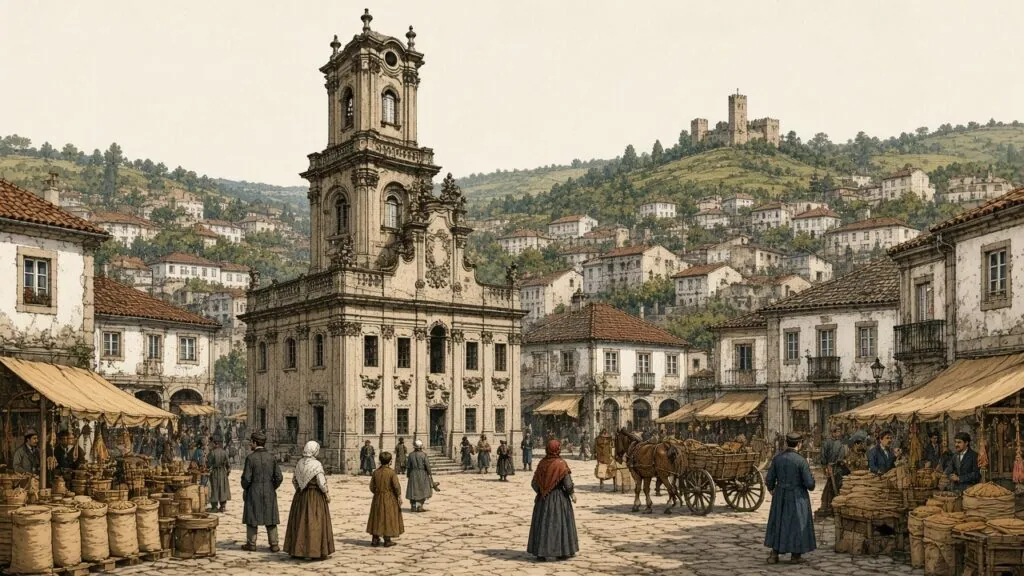
Buczacz, which Jews called Bichuch, stood in a bend of the river Strypa in eastern Galicia, a province that had passed under Habsburg rule in 1772 and still belonged to Austria-Hungary in the year of Ringelblum’s birth. The town was also spoken of as part of Podolia. Wooded hills rose around it, and on one of them lay an empty castle, der puster shlos, which local tradition associated with King Jan Sobieski and a Tatar raid. The splendid baroque town hall, the ratusz, built for the Potocki family in the eighteenth century, dominated the market square. Buczacz had long been a predominantly Jewish town. In 1870 Jews made up 68 percent of the inhabitants; in 1900, the year Ringelblum was born, there were 6,730 Jews in a population of 11,755, or a little more than 57 percent. The surrounding countryside was heavily Ukrainian. Like most Galician towns it was poor. Jews dominated the trade in grain and other agricultural products, but the low purchasing power of the peasantry limited what that trade could yield, and in time Polish and Ukrainian cooperative movements would narrow it further. Many families left. Among those who had already gone were Jacob Freud, the father of Sigmund Freud, and the young Shmuel Yosef Agnon, who would win the Nobel Prize in Literature and who, in Samuel Kassow‘s account, was Ringelblum’s cousin.[4]
Ringelblum’s father, Fayvish or Fajwisz, was a grain merchant, respected in the community though not particularly prominent, and a follower of the Jewish Enlightenment, a maskil. Someone who met him during the First World War later recalled that he looked like an ordinary folksmensh, “a Jewish Jew,” dressed half in the Jewish manner and half in the European, without earlocks but with a short red beard. The mother’s name is recorded in more than one form. Kassow, followed by the Jewish Historical Institute‘s English biographical sketch, calls her Munie or Munia, née Heler, and notes that she died when her son was twelve; Kassow adds that in later years Ringelblum used her name as a nom de plume. A biographical introduction published by the same institute in 2020, written by Joanna Nalewajko-Kulikov, gives her official name as Rachela Neche, née Heller. The two accounts are not necessarily in conflict. Munie or Munia is a familiar diminutive, and Heler is a spelling of Heller. What is not supported by these sources is the form Halpern, which has sometimes circulated in secondary summaries and should be set aside.[4][6][41]
There were four children, two sons and two daughters. One of the daughters, Gizela or Giza, later married the historian Artur Eisenbach, who would survive the war and, in the 1960s, serve as director of the Jewish Historical Institute in Warsaw. Giza and their daughter Emilia were murdered during the war. A telegram from Giza, sent from Buczacz on 19 September 1942 and preserved in the Ringelblum Archive, asks after “her family’s health,” in words that already seem to know more than they say about the “resettlement” of Warsaw’s Jews. The names of Ringelblum’s brother and of the second sister have not been established in the sources used for this essay.[6]
Fayvish wanted his children to have both a Jewish and a secular education. Emanuel was sent to the local heder, though his father was not strictly observant, and he completed the primary school in Buczacz before beginning at a state gymnasium. He joined a small Zionist youth group run by Cwi Heller. His own memoirs of the town were not preserved, but he liked, in later life, to recall his childhood there. The world in which he grew up was the product of a particular Habsburg setting. Galicia offered Jews a Polish education of some quality, and a milder official climate than that of the Russian Pale, together with a strong current of Jewish nationalism. It was not an accident, Kassow has observed, that so many of the modern historians of East European Jewry came from this province: Majer Bałaban, Filip Friedman and Natan Gelber from Lwów, Ignacy Schiper and Salo Baron from Tarnów, Raphael Mahler and Artur Eisenbach from Nowy Sącz. Ringelblum belonged to that generation, even if his own first years were spent in a smaller town on the Strypa.[4][6]
2. Flight, Nowy Sącz and a political education
In 1912 or 1913, when Emanuel was twelve, his mother died. His father married again. Then the war came. In the summer of 1914 the Russian army advanced into Galicia, and Jewish families had reason to fear pogroms by Cossack units. The standard account, given by Kassow and repeated in most institutional biographies, is that the Ringelblums fled Buczacz for Nowy Sącz, a town in southern Galicia near Kraków, at the outbreak of the war. Nalewajko-Kulikov, in the 2020 introduction already mentioned, writes that Emanuel attended schools in Buczacz and in Kołomyja, “to which, when he was fourteen, the family had to flee from the town before the arrival of the Russian army.” The two versions can be reconciled by supposing an intermediate stay in Kołomyja, but that stop does not appear in Kassow’s narrative, and it is better to leave the question open than to tidy it away.[4][7][41]
Nowy Sącz became the scene of Ringelblum’s adolescence. The household was hard pressed. Mendel Najgroszl later remembered “quiet sadness in a home where poverty and the loneliness of uprooted people prevailed.” Emanuel attended the Jan Długosz Gymnasium No. 1, a Polish-language philological school, where classmates called him Edek or Edzia. He passed the matura, the school-leaving examination, in 1920, with honours according to the Jewish Historical Institute’s short biography of the Oyneg Shabes staff. The years in the town also gave him the friendships that shaped his life. Raphael Mahler and Artur Eisenbach, both of whom would become major historians, were already there. Under their influence he joined Po’alei Zion, and after the party split in 1920 he remained with its left wing, a Marxist Zionist movement devoted to Yiddish, to the Jewish masses, and to a socialism that did not require the abandonment of Jewish national culture. In 1919 he attended a congress of the party’s youth organisation, Jugnt, in Warsaw. Memories of him in this period do not all agree. Some recall a withdrawn young man who rarely smiled. Mahler remembered a handsome, fair-haired student in a school cape, whose “light, sincere laugh” and whose Jewish folk and socialist songs could be heard in the city park on summer evenings. Both memories may be true of different moments.[6]
The Left Po’alei Zion would remain his political home for the rest of his life. It taught him to treat Yiddish not as a jargon to be shed but as the language in which a modern Jewish culture could be built, and to treat history as a public duty rather than a private accomplishment. He took a large part in the party’s cultural work. Through the same circles, a few years later, he would meet Judyta Herman, born in 1904, who was herself a member of the Left Po’alei Zion. They married, and in 1930 their only child, Uriel, called Uri, was born. Ringelblum was a devoted father. One of his pupils later recalled that when the class wished to distract him from a coming test, they had only to ask how little Uri was getting on. He would “beam with a smile” and tell them how clever the boy was and how quickly he was learning.[1][6]
3. Warsaw University and the making of a historian
In 1920 Ringelblum moved to Warsaw and applied to study medicine at the university. He was rejected under the informal numerus clausus that limited the number of Jewish students in the professional faculties. The fact is worth dwelling on, because it explains a good deal about the path he then took. In interwar Poland a Jew of his gifts could earn a doctorate and still have almost no hope of a university chair. History, for him, would be a vocation practised from the side, in schools, party rooms, editorial offices and, later, in the premises of a welfare organisation.[6][8]
The chronology of his studies is recorded with slightly different compressions. Kassow’s article in the YIVO Encyclopedia says that in 1920 he entered the history faculty of Warsaw University. The Joint Distribution Committee‘s memorial, together with Polish biographical sketches, dates the beginning of his studies in the Faculty of Philosophy to 1922. A careful reconstruction by Nalewajko-Kulikov, cited by the Jewish Historical Institute, is more detailed. In 1921 Ringelblum began studies in the Faculty of Philosophy. In 1922 he asked the rector for permission to transfer to the Faculty of Medicine and was again refused, probably because of the same unspoken quota. In 1922 he began to study history in the Faculty of Philosophy. That last date, 1922, is the one that should be used for the start of his historical training, with 1920 reserved for his arrival in the capital and for the failed medical application. He supported himself by private lessons and translations, and by teaching in the evening schools of the Left Po’alei Zion, including, for a time, in Vilnius.[1][9][7]
He worked under Marceli Handelsman, the leading Polish historian at the university, who was his formal supervisor, and under the decisive intellectual influence of Ignacy Schiper, who was not a university professor in the same sense but who had already shown that the history of Polish Jewry could be written as a social and economic history of ordinary people, not only as a chronicle of rabbis and patrons. Behind both men stood the longer tradition of Simon Dubnow, who in the 1890s had called on the Jews of Eastern Europe to collect their own sources and to make historical consciousness the pillar of a secular national identity, and of Majer Bałaban, the great historian of Polish Jewish communities. Ringelblum absorbed from this school a double conviction: that Jewish history in Poland was an integral part of the history of the country, and that it had to include beggars, tavern keepers, book pedlars and physicians as well as the learned and the rich.[10][5]
On 20 May 1927 he defended his doctoral dissertation, Żydzi w Warszawie od czasów najdawniejszych do 1527 r., “The Jews of Warsaw from the earliest times until 1527,” or, in the title used by the POLIN Museum, “until the last exile of 1527.” The work was published as a book in 1932. Jewish historians, including Bałaban and Schiper, received it warmly. Some Polish historians criticised his Latin and his reading of Old Polish texts. The disagreement is itself a document of the world in which he had to make his way: a Jewish scholar writing the history of Jews in the Polish capital, examined by a Polish faculty, praised by his own scholarly community and found wanting, in some quarters, on the technical ground of language. About a year later, in 1928, he received the diploma of a high-school teacher.[6][10]
The dissertation was only a beginning. Throughout the 1930s he published in Polish and in Yiddish on the history of the Jewish book trade, on Polish perceptions of Jews in the eighteenth century, on projects to alter the legal status of the Jews in the reign of Stanisław August, on Jewish physicians, and on the Jews in the Kościuszko uprising of 1794, a monograph that appeared in 1937. He wrote the first historical study of Szmul Zbytkower, the eighteenth-century Warsaw entrepreneur. He worked on a continuation of the Warsaw history into the end of the eighteenth century, which he never published as a finished book, though fragments appeared as articles. With Mahler he issued, in 1930, a volume of sources for the history of the Jews in Poland and Eastern Europe. From the same year he contributed some thirty monographic entries on Polish Jewish communities to the German Encyclopaedia Judaica. By 1939 a bibliography compiled in the spirit of Eisenbach counted about 126 scholarly items. It was a formidable output for a man who had no university post and who earned his living, for most of these years, as a schoolteacher and a welfare official.[6][5][34]
He never pretended that this scholarship was a retreat from politics. In an essay of the period he argued, as Paweł Fijałkowski has underlined, that historical research should support the struggle for the social and national liberation of the Jews, prove their contribution to the economic development and the independence movement of Poland, and so furnish arguments for equality among the country’s citizens. The point was not to write propaganda. It was to write history that could stand inspection, in the belief that a people whose past had been told only by others would always be spoken of as guests. The same belief, carried into the ghetto, would make the archive a form of resistance even before anyone in Oyneg Shabes spoke of arms.[11]
4. Young Historians, YIVO and a usable past
In 1923 Ringelblum and Raphael Mahler founded the Young Historians Circle, Koło Młodych Historyków, or, in Yiddish, the yunger historiker-krayz. The Encyclopaedia Judaica, in its second edition, dates the founding to 1928, which is almost certainly too late and should not be followed. The circle eventually included some forty Jewish history students who had little prospect of academic careers and who saw history as a national task. They wished to show that Jews lived in Poland by right and not on sufferance, to build a secular culture in Yiddish, and to involve ordinary Jews, the zamlers or collectors, in the study of their own past. The group published Yunger historiker, or Der Yunger Historiker, from 1926, with a further issue in 1929, and, from 1934, Bleter far geshikhte, of which a 1938 issue is also recorded. Kassow’s short YIVO Encyclopedia article dates Bleter far geshikhte to 1929, which appears to compress an earlier moment with the later title; his longer overview in the same encyclopedia, and the work of Paweł Fijałkowski, support the 1934 dating. After the war Eisenbach would revive Bleter far geshikhte, and a Polish counterpart, at the Jewish Historical Institute.[1][12][5]
From 1925 Ringelblum was a mainstay of the Historical Section of YIVO, the Yidisher Visnshaftlekher Institut, founded that year in Vilna. The Warsaw circle became, in effect, YIVO’s historical commission in the capital, sometimes called the Warsaw Commission for Jewish History from 1929. He believed, in a phrase he made his own, in a “history of the people and by the people.” He was active in the Landkentenish movement of “engaged tourism,” which sought to root Jews in the landscape of Eastern Europe by teaching them to know its towns, its “Jewish places,” and its natural history; at one point he edited the movement’s journal in its second iteration. A letter of 25 September 1932, written from Warsaw to Elye Tsherikover, the Paris-based head of YIVO’s Historical Section, shows him already arguing that Jewish historians should not censor “difficult” subjects, such as the presence of Jewish spies in the period of the Kościuszko uprising, out of fear of antisemitism, and that they should not, either, isolate such subjects in a way that would give a false picture of the Jewish role. The letter is a small portrait of his method: candour without sensationalism, and a refusal to let the enemy dictate the syllabus.[1][13]
The circle was not a party cell, though many of its members, like Ringelblum and Mahler, belonged to the Left Po’alei Zion. Among those who survived the war and became major historians were Mahler and Joseph Kermish in Israel, Isaiah Trunk and Filip Friedman in the United States, and Artur Eisenbach in Warsaw. A photograph of 1933, taken at an international historical congress in the Polish capital, shows Ringelblum standing in a group that includes Schiper, Abraham Duker, Mahler, Salo W. Baron, Me’ir Halevi and Majer Bałaban. Another, from the 1930s, places him with the poet Itsik Manger, the writer Rokhl Oyerbakh, the historian Yankev Shatzky, Ber Horovits, Mahler and M. Weinberg. These images record a scholarly world that was already, in its way, an archive, and that would be almost entirely destroyed.[12]
5. Jehudia, the Joint and the free-loan funds
From about 1928 Ringelblum taught history at Jehudia, or Yehudiya, a private secondary school for Jewish girls in Warsaw. There he met Abraham Lewin, a fellow teacher and a Zionist, who would later keep one of the essential diaries of the ghetto and would work closely with Oyneg Shabes. Ringelblum gave up classroom teaching in 1938 in order to devote himself to social work. He was also active in TSYSHO, the Central Yiddish School Organisation, in the Union of Jewish School Teachers, in the Jewish Writers Society, and on the programme committee for history teaching. The schoolroom and the editorial table were, for him, two sides of the same work. He wanted Jewish children to learn a history in which their own people were not a footnote, and he wanted that history to be written to a professional standard.[6][1]
From 1929 he cooperated with the Centrala Kas Bezprocentowych, CEKABE, the central organisation of the interest-free or free-loan funds, which was supported by the American Jewish Joint Distribution Committee, known as the Joint or JDC. He became editor of CEKABE’s periodical Folkshilf, a post he held until 1938. The free-loan kasses, or gemiles-khesed funds, numbered some 870 by 1939. The Joint typically provided half the capital if the local community provided the rest. In a country where Jews were often unable to obtain credit from state or Christian institutions, these small funds were a form of economic self-defence, and they brought Ringelblum into contact with Jewish life far beyond Warsaw. They also brought him under the influence of Yitzhak Giterman, the Joint’s director in Poland, a man he would later describe as changing the course of his life. Giterman taught him to distinguish self-help from traditional philanthropy: not the gift that humiliates, but the organisation that allows people to stand.[9][5]
On the year he joined the Joint itself, the sources differ slightly. The JDC Archives memorial, and a tribute by Paweł Śpiewak of the Jewish Historical Institute, say that he joined the Warsaw office in 1930, at first as a part-time employee, and that he was a full-time member of staff by the late 1930s. Kassow’s YIVO Encyclopedia article gives 1932. The editorship of Folkshilf from 1929 is not in dispute. The fairest statement is that he was working with the Joint’s Polish free-loan network from 1929, that the Joint itself records him as staff from 1930, and that Kassow’s slightly later date should be noted rather than silently preferred.[9][1][31]
CENTOS, the Central Organisation for the Care of Jewish Orphans, was another of the great Jewish welfare bodies of the interwar period and of the ghetto years. Ringelblum’s own institutional home before the war was CEKABE, the Joint and TSYSHO, not the leadership of CENTOS. In the ghetto the work of the two networks overlapped, and Henryka Łazowertówna, a poet who wrote for Oyneg Shabes, prepared publicity for CENTOS and for Jewish Social Self-Help. It would be a mistake, on the present evidence, to list Ringelblum as a CENTOS official.[14]
What these years gave him, besides a livelihood, was a practical education in how a Jewish society under pressure could organise itself. He learned the names of towns, the habits of committees, the difference between a gesture and a structure. When, in the autumn of 1938, the Joint needed someone to go at once to a border town and improvise a whole system of care, it was this education, as much as his historian’s training, that made him the right person to send.[9]
6. Zbąszyń and the return from Geneva
In late October 1938 the German government suddenly expelled Jews of Polish citizenship living in the Reich. The Aktion, later called the Polenaktion, drove out some 17,000 people. A large group, usually given as about 6,000, was stranded at the border town of Zbąszyń, hungry, poorly sheltered, and for a time refused easy entry into Poland. The Encyclopaedia Judaica, in a compressed sentence, places all 17,000 “in Zbaszyn,” which is imprecise. The larger figure is the number expelled; the smaller is the number who accumulated at that particular crossing.[2][5]
On 30 October 1938 Giterman appointed Ringelblum to head the Joint’s relief team. He spent about five weeks in Zbąszyń and organised, as he later described it, an entire town: a supply department, a hospital, workshops for carpenters, tailors, shoemakers and barbers, a legal section, an emigration office, a post office with fifty-three clerks, a welfare department, a court of arbitration, a committee for law and order, an overt and a covert control service, a sanitary commission and a network of health services, together with cultural activities. The Joint quotes this description from a letter it dates 6 December 1939. The year is very likely a typographical error for 1938, which fits the five-week mission; the 1939 date would fall after the outbreak of the war, when Ringelblum was already in occupied Warsaw. He also collected testimonies from the deportees and information about conditions in Nazi Germany. The method of the future archive, the insistence on listening to ordinary people and writing down what they said, was already in use on the frontier. The shock of what he saw at Zbąszyń is described, by every serious biographer, as formative. Among the expellees were the family of Herschel Grynszpan, whose assassination of a German diplomat in Paris was then used as the pretext for the November pogrom. That fact belongs to the history of the Aktion, not to any action of Ringelblum’s, but it measures the world into which the deportees had been thrown.[9]

In August 1939 he went to Geneva as a Left Po’alei Zion delegate to the Twenty-First Zionist Congress, which sat from 16 to 25 August. The United States Holocaust Memorial Museum records that when Germany invaded Poland on 1 September he had just returned to Warsaw from Switzerland. The Joint memorial adds that he travelled home by way of Italy, Yugoslavia and Hungary, because passage through Germany was no longer possible. He was offered the chance to remain in the West and refused it. In the Chronicle of the Warsaw Ghetto he wrote that “Our decision to return to the country was dictated by civic duty.” Eisenbach, already in or near Warsaw, encouraged him to leave the capital. He would not go. He stayed to organise social help on behalf of the Joint. During the September siege he took part in civil-defence watches under fire and aided the wounded, and he joined the coordinating committee of Jewish aid organisations. The choice, so briefly recorded, is one of the hinges of his life. A historian who had already seen what Nazi policy meant at Zbąszyń, and who had a wife and a nine-year-old son, walked back into a city that was about to be enclosed, because he thought that was his duty.[2][9][6]
7. Siege, self-help and the closed district
Out of the coordinating committee of September 1939 grew the Jewish Social Self-Help, known under several overlapping names as the organisation changed its legal skin. In Polish it was the Żydowskie Towarzystwo Opieki Społecznej, ŻTOS; in German, often Jüdische Soziale Selbsthilfe, JSS; in Yiddish, the Aleynhilf, self-help. Officially tolerated by the Germans as a welfare body, it also became a cover for underground work. Ringelblum, continuing his service for the Joint, became one of its principal organisers. After the ghetto was sealed he headed the “Public Sector,” the department that oversaw hundreds of house committees, the komitety domowe, which were asked not only to collect dues and distribute aid but to become cells of mutual assistance, education and cultural life. He supervised soup kitchens that, at their height, fed tens of thousands of people. The kitchens were also meeting places, and sometimes a cover for political work that could not be done in the open. He tried to find employment for teachers, writers and intellectuals who had been stripped of their livings, because he believed that a society which allowed its intelligentsia to starve would lose more than so many mouths.[9][2][5]
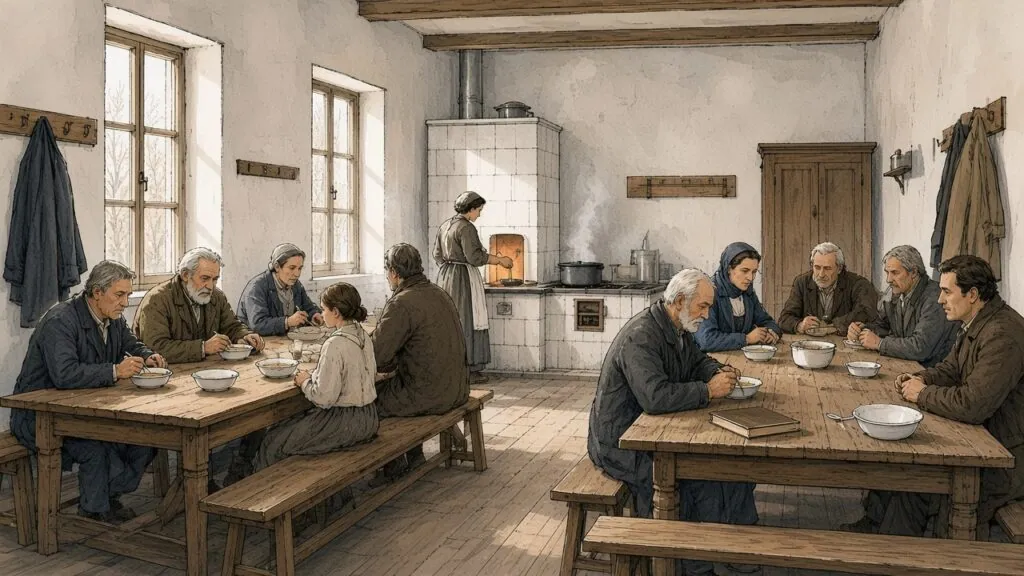
The house committees were, in his design, more than a fiscal device. A single tenement might contain dozens of tenants, many of them refugees who knew no one in the building, and the doorbell codes that later found their way into the archive are a small emblem of that crowding. A committee that worked could collect money for a soup kitchen, arrange a clandestine class for children, hear a complaint against a neighbour who had taken more than his share of a loft, and pass on news that had come in with a smuggler or a newly arrived family from a provincial town. Ringelblum tried to make these committees the social base of the Aleynhilf, a way of reaching people whom a central office would never see. The attempt was only partly successful. Some committees became instruments of the better-off tenants; some collapsed under hunger and typhus; some, as he later recorded with anger, lost heart. He wrote the failures down as carefully as the successes, because a history that recorded only heroism would have been another kind of falsehood.[2][4]
The Aleynhilf office used the building of the Main Judaic Library, next to the Great Synagogue, at Tłomackie 3/5. Meetings of the documentation group would later be held there. The building survived the war and has been, since 1947, the headquarters of the Jewish Historical Institute, so that the archive now lives in a house Ringelblum knew. The family’s own flat, at 18 Leszno Street, was included in the ghetto when the walls went up. The gates were closed on 16 November 1940. Figures for the enclosed population vary with the date and the method of counting. The Institute of National Remembrance, in a 2021 essay, gives almost 395,000 people in about 400 hectares at the moment of closure. Other standard accounts speak of some 400,000 to 450,000, and at times nearly half a million, in a space that was only a few percent of the city’s area. The precision of any one figure matters less than the fact that a great city of Jews had been forced into a few streets.[8][15][38]
68 Nowolipki Street
The first and second caches of the archive were buried here; a square and a memorial now stand between today’s 28 and 30 Nowolipki Street.
Open in Google Maps34 Świętojerska Street
The third cache was buried here on 18 April 1943 and has never been found; the wartime lot now lies in the grounds of the Chinese embassy, beside Krasiński Garden and the Supreme Court.
Open in Google MapsTłomackie 5
The Aleynhilf offices stood here, officially Tłomackie 3/5, now the Jewish Historical Institute, where the recovered archive is held.
Open in Google Maps81 Grójecka Street
The Krysia bunker was dug under a greenhouse here, outside the ghetto walls; a memorial plaque is on the apartment block at 77 Grójecka Street.
Open in Google MapsWith Menachem Linder, a YIVO-trained economist, Ringelblum also helped to found the Yidishe Kultur Organizatsye, YIKOR or IKOR, to advance Yiddish culture inside the walls. Schools, lectures, concerts and an underground press continued, often illegally, because the alternative was to accept that Jewish life had already been reduced to a queue for soup. Ringelblum moved through this world as an official of self-help and as a man who was already writing things down. From September or October 1939 he had kept a systematic chronicle, notes of what he saw and of what refugees told him as they arrived from the provinces. The United States Holocaust Memorial Museum dates the personal chronicle to October 1939; a later Polish account begins it in September. Either way, the habit of the archive preceded the institution.[2][1]
8. The archive they called Oyneg Shabes
In the summer of 1940, according to the Institute of National Remembrance, Ringelblum and a small group of colleagues tried to turn that habit into an informal organisation. In November 1940, at or just after the sealing of the ghetto, the group took a more durable form under a cryptonym: Oyneg Shabes, also written Oneg Shabbat or Oneg Szabat, “Joy of the Sabbath,” because the executive met clandestinely on Saturday afternoons. Kassow dates the founding of the secret ghetto archive to November 1940. Record gathering continued at least until late February 1943, and Hersh Wasser later said that work went on into April. It is therefore a mistake to speak of a single founding meeting in late 1939, as if the whole enterprise had sprung into being in the first weeks of the occupation. The accurate statement is simpler and more impressive. A personal chronicle began in the autumn of 1939. An organised clandestine archive, using the Aleynhilf as cover and as a recruitment network, was in being by November 1940.[8][1][2]
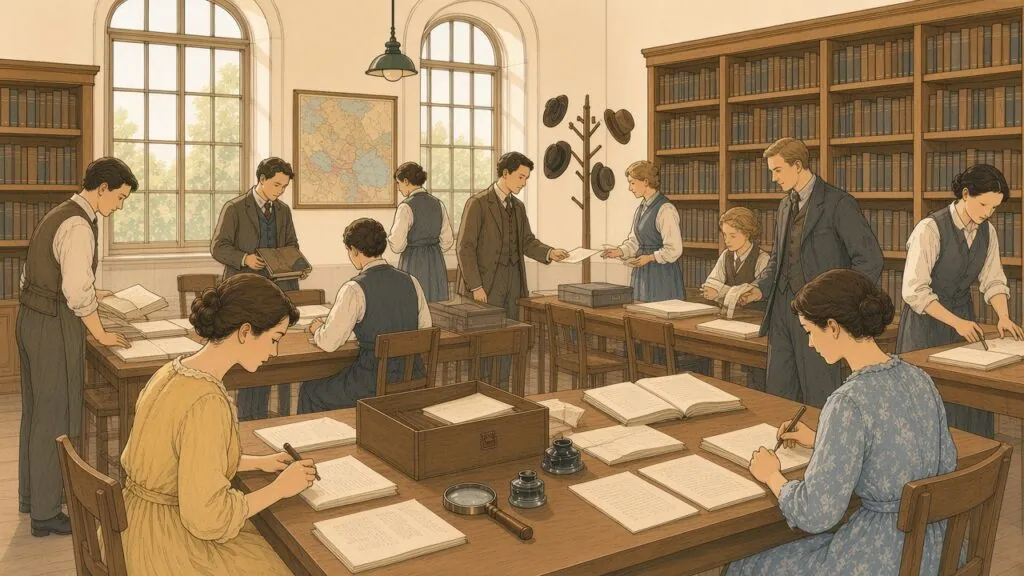
The staff was deliberately mixed. Ringelblum recruited from prewar YIVO, from the Joint, and from his own party, but he also brought in people from other worlds. In a passage often quoted, he described the collaborators as “a uniform corporation, animated by one spirit, imbued with one idea,” in which “the pious rabbi Szymon Huberband, next to the leftist Poale Zionist Hersz Wasser, and the general Zionist Abraham Lewin” sat at one table and worked in harmony. The two secretaries were Wasser, an economist of the Left Po’alei Zion, who kept the register of documents and authors, and Eliyahu Gutkowski, of the Right Po’alei Zion, a teacher and journalist who was the archive’s link to the youth movement Dror. Menachem Mendel Kon, a merchant, gave money and kept a journal during the great deportation. Linder prepared the economic section of the later monographic project and helped to found YIKOR. Israel Lichtensztajn, teacher and principal of the Ber Borochov school at 68 Nowolipki Street, would be entrusted with the physical hiding of the papers; his wife, the painter Gela Seksztajn, taught drawing in the same school, and her works were buried with the archive. Two of Lichtensztajn’s former students, Dawid Graber and Nachum Grzywacz, helped to bury the first cache. Rachel Auerbach, a journalist and writer, joined from mid-1941 and ran a soup kitchen that was also a listening post. Rabbi Huberband watched over religious life. Perec Opoczyński, a journalist who found work as a ghetto postman, wrote observational reportage from his rounds. Gustawa Jarecka, who wrote in Polish and worked in the Judenrat, copied official documents and wrote a text that has become a motto of the whole enterprise, “The last stage of resettlement is death.”[8][16][14]
There were others, and the Jewish Historical Institute’s biographical pages now give many of them a name and a task: Cecylia Słapakowa, who in 1942 conducted seventeen interviews with Jewish women of different backgrounds; Natan Koniński, a refugee from Kalisz, who wrote “The Face of the Jewish Child”; Nechemiasz Tytelman, who collected jokes, street songs and folklore; Szmuel Winter, who helped to fund both the archive and the purchase of arms for the Jewish Combat Organisation; Yitzhak Giterman, who had returned to Warsaw in April 1940 after an early wartime detention and who continued to support the work; Józef Kapłan and Szmuel Bresław of Ha-Shomer ha-Tsa’ir, who sat on the executive and linked the archive to the youth movements that would form the core of the fighting organisation. Ringelblum himself was close to the leadership of Ha-Shomer, including Mordecai Anielewicz. The Institute of National Remembrance estimates that some fifty to sixty people were involved between 1940 and 1943. At least thirty further collaborators remain unnamed. Only three members of the inner circle survived the war: Hersh Wasser, his wife Bluma, who had copied documents and conducted interviews, and Rachel Auerbach.[14][1]
The ghetto at large did not know that the archive existed. The United States Holocaust Memorial Museum has called it one of Ringelblum’s greatest achievements that the Germans never stumbled on the secret. Reports prepared for the Polish underground sometimes carried the signature ARG, Archiwum Getta, the Ghetto Archive. Ringelblum used the names interchangeably. Every item, the secretary of the archive later said, passed through his hands.[16]
9. Questionnaires, testimonies and Two and a Half Years
Ringelblum stated two principles for the work: versatility, meaning a comprehensive coverage of Jewish life and not only of elites or of atrocities, and objectivity, the old historian’s claim to write sine ira et studio, without hatred and without zeal. Until 1942 he still hoped that the archive would serve a living postwar Jewish Poland and even improve Polish-Jewish relations. After the beginning of mass murder that hope receded, and the aim became to document destruction, to send material abroad, and to preserve evidence for a justice that might come later.[1][16]
The method was professional. The group used questionnaires and prepared outlines, conducted interviews that were written up as reports, and collected original documents together with annotated copies. It took in official records, the underground press, posters, tickets, invitations, food stamps, incoming mail, personal papers, diaries, literary work, photographs, and the humble debris of daily life, including candy wrappers and restaurant menus that advertised roast goose and fine wines in a starving city. For selected towns the archivists tried to assemble more than one kind of evidence, so that a future historian would not have to depend on a single witness. The first cache would also contain many photographs, of which seventy-six more or less survived.[16][15]
The most ambitious of the planned works was a collective monograph known as Two and a Half Years, Dwa i pół roku, or, in Yiddish, Tsvey un a halbe yor. It was sometimes projected at about 1,600 pages, structured chronologically, and based on questionnaires, interviews and defined topics, on the order of eighty or eighty-one subjects. The headings included intellectuals, economic life, women, children and youth, artisans, corruption, the ghetto street, religious life, soup kitchens, bookshops and libraries, the fate of small towns, Jews under Soviet occupation, German-Jewish relations, Polish-Jewish relations, the Judenrat and the Jewish police, forced labour, smuggling, cultural work and the underground press. Eliezer Lipe Bloch was essential to the organisation of the project; Linder took the economic section. Katarzyna Person has pointed out that the outline of what later became Ringelblum’s bunker essay on Polish-Jewish relations already belonged to this programme. The monograph was never finished as a book, because the world it was meant to describe was being destroyed as the chapters were assigned. But the questionnaires and the studies that were completed remain, and they are one of the reasons the archive is more than a pile of rescued papers. It is a research institute that did its work in a condemned city.[14][17]
Most of the archive’s own writings were in Yiddish, which Ringelblum regarded as the proper language of a history written by and for the Jewish masses, though Polish was used when the writer or the subject required it, and Hebrew appears as well. The choice was political as well as practical. A documentation project that had spoken only in the language of the universities would have betrayed the circle’s old programme, the belief that ordinary Jews could be partners in the writing of their own past. In that sense Oyneg Shabes was the wartime form of the zamling that YIVO had asked of its friends in peacetime, carried out under conditions that no prewar questionnaire had imagined. Refugees were invited to describe the towns they had left, so that the archive would not be only a Warsaw chronicle, and so that Polish Jewry would be remembered in its variety, town by town, and not solely as a single statistic of destruction.[10][18]
Among the special studies often singled out are Słapakowa’s interviews with women, which record a shift in the social role of wives and mothers under the pressure of hunger and smuggling; a medical investigation, requested by Ringelblum, into the physical and psychological effects of starvation; Koniński’s study of children; Tytelman’s folklore; Opoczyński’s postal reportage; Jarecka’s writing on deportation; and Huberband’s essays on religious life, later gathered in English as Kiddush Hashem. Ringelblum himself kept his chronicle, and he was careful, as a later YIVO article on Holocaust diaries notes, not to write down underground activities in a way that would endanger others. The silence in the diary about his own role in the resistance is not a lack of involvement. It is a historian’s ethic under conditions in which a sentence could kill.[14][16][39][42]
10. Chełmno, the alarm and the Great Deportation
In January 1942 a man named Szlama Ber Winer, born in 1911 in Izbica Kujawska, escaped from the killing site at Chełmno nad Nerem, which the Germans called Kulmhof. He had been assigned to the forest commando that buried those murdered in gas vans. On 19 January, during a transport, he got out through a small window of a truck. He reached the Warsaw Ghetto, and in February Hersh and Bluma Wasser wrote down his detailed account. In the documents he appears under a false name, Jakub Grojnowski, or Jacob Grojanowski. The testimony became the basis of an Oyneg Shabes report, “Wypadki chełmińskie,” “Events in Chełmno,” dated 25 March 1942, which was passed to the Home Army in March. Fearing the police, the group sent Winer on to a relative in Zamość. In early April he wrote to Wasser, in guarded language, that the same killing was now underway at Bełżec. After the liquidation of the Zamość ghetto on 11 or 12 April he was deported there and murdered. On 24 April his nephew, Abram Bajler, informed the Wassers of the deaths.[19]
The report did not remain in Warsaw. Information about Chełmno and about other massacres reached London in early June 1942, in particular through a letter from the Bund dated 11 May and carried by the Swedish businessman Sven Norrman. Some of that information, as Maria Ferenc Piotrowska and Franciszek Zakrzewski have shown in their introduction to a volume of the complete edition of the archive, derived from the Oyneg Shabes report. In that limited but important sense, Ringelblum’s group was a source for what the world was told. On 26 June 1942 the BBC broadcast a programme on the extermination of Polish Jews. A figure of 700,000 murdered, then the group’s own estimate, was given, and Chełmno, Ponary, Bełżec and other sites were named. Szmul Zygielbojm, the Bund representative on the National Council of the Polish government-in-exile, spoke. Ringelblum recorded the broadcast with a mixture of vindication and bitterness. For months, he wrote, they had felt that the world was deaf, and they had “a grudge” against those in contact with the Polish government who, they believed, had not wanted Jewish suffering to overshadow Polish suffering. Gutkowski, in his diary the next day, asked whether anything would now change, and answered himself that it was “not very likely.” They were, he wrote, “a toy in the hands of murderers.”[20][19]
The Grossaktion in Warsaw began on 22 July 1942. In the following weeks some 300,000 Jews from the ghetto were deported to Treblinka and murdered. Several members of Oyneg Shabes were among them. Ringelblum, after the summer deportations, became a believer in armed resistance, a change that the Encyclopaedia Judaica records with due weight. He was not a military commander of the uprising that would come in April 1943. Phrasing that makes him a co-creator of the Jewish Combat Organisation, as one museum sketch does, should be handled with care. What the better-documented accounts show is close contact with the youth movements, a place on the informational and moral approaches to resistance, and, in some testimonies, a part in the planning. The archive, because of Gutkowski, Kaplan, Bresław and Ringelblum’s friendship with Anielewicz, was in a position to follow the birth of a fighting organisation from the inside. In November 1942 Oyneg Shabes delivered to the Polish Underground State a major report, “The Liquidation of Jewish Warsaw.”[5][10][16][32][40]
Uri, then thirteen, was taken out of the ghetto in the summer or early autumn of 1942 and hid for about half a year. The Institute of National Remembrance writes that he most probably stayed in Teresa Nowakowska’s apartment in the Praga district of Warsaw. An English biographical sketch on the Jewish Historical Institute’s site says “Teresa Nowakowa’s flat in Treblinka,” which is almost certainly a slip, whether of translation or of place, and should not be repeated as fact. Praga is the identification to prefer, with a note that the other wording exists and looks wrong.[8][6]
11. Three burials and the last months of the ghetto
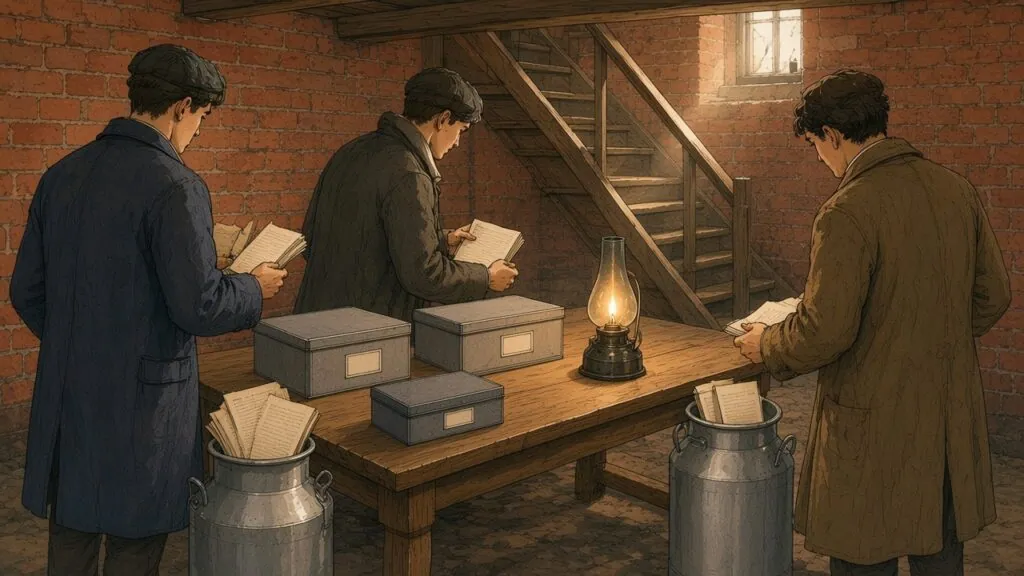
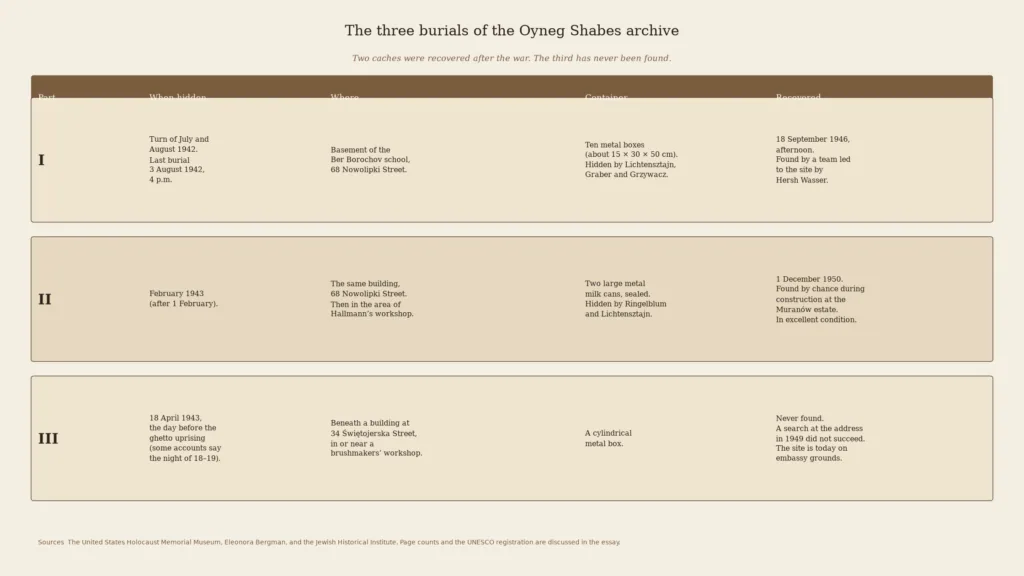
At the turn of July and August 1942, in the midst of the deportation, the first part of the archive was hidden. Israel Lichtensztajn, with Dawid Graber and Nachum Grzywacz, placed it in ten metal boxes, about fifteen by thirty by fifty centimetres, and buried them in the basement of the Ber Borochov school at 68 Nowolipki Street, a building that had housed a school affiliated with the Left Po’alei Zion. The hiding probably took several days. The last documents, according to Graber’s testament, went into the ground on 3 August 1942 at four in the afternoon. Graber, who was nineteen, left a last will that has been often quoted, a boy’s decision that the work should be found even if he was not. Ringelblum wanted the address passed to YIVO and to Raphael Mahler in New York, in case no one in Warsaw remained to dig.[16][21][36]
A second cache was buried in February 1943 under the same building, this time in two large milk cans. The latest document in that part is an issue of the underground paper Biuletyn Informacyjny Żagiew dated 1 February 1943. The United States Holocaust Memorial Museum attributes the burial to Ringelblum and Lichtensztajn. Eleonora Bergman notes that they were then, officially, employees of Hallmann’s szop, a workshop producing for the Wehrmacht, which since September 1942 had taken in the area of the former school. The choice of milk cans was practical. Sealed, they would keep out the water that, as the first recovery would show, could ruin boxes that had not been properly welded.[22][16]
The third cache was placed, according to the Museum, on 18 April 1943, the day before the ghetto uprising began, in a cylindrical metal box beneath a building at 34 Świętojerska Street, in or near a brushmakers’ workshop. The Jewish Historical Institute sometimes says that it was to be hidden on 19 April, “the night before the uprising.” The two datings differ by a few hours at most. That third part has never been found. Searches at the address in 1949 did not succeed. The site is today, according to the Institute, on the grounds of the Chinese embassy. A clause on one POLIN Museum page wonders whether the third cache was ever buried. The dominant scholarly position is that it was buried and lost.[16][15][43]
The Ringelblums avoided deportation to Treblinka during the Grossaktion. In February or March 1943, with the help of Barbara Temkin-Bermanowa and her husband Adolf Berman, they left the ghetto and went into hiding on the so-called Aryan side, in a bunker that will be described in the next chapter. The dates in the sources are not identical. Majchrowska and the Institute of National Remembrance say February, after the armed clash of January 1943, when it had become clear that the Germans meant to liquidate what remained. The United States Holocaust Memorial Museum and Kassow’s YIVO article say March. Either way, it was before the April uprising. Ringelblum, however, did not remain outside. On the eve of Passover, two days before the festival according to the Joint memorial, he re-entered the ghetto alone, in order to be a witness. He was captured, in Kassow’s dating in April 1943, and sent to the labour camp at Trawniki, near Lublin. For some months his friends in Warsaw did not know whether he was alive. In July they learned that he was a prisoner at Trawniki.[6][2][1]
12. Trawniki, rescue and life under the greenhouse
In August 1943 Ringelblum was extracted from Trawniki, disguised as a Polish railway worker, by a two-person mission. The rescuers were Teodor Pajewski, born in 1915 in Warsaw’s Praga district, a Home Army soldier whose nom de guerre was Szalony, “Crazy,” a railway man known for the daring of his journeys into the camps of the Lublin district, and Emilia Kossower, born Szoszana Kossower in Radzymin on 10 May 1922, who used the names Emilka and, as a courier, Marylka, as well as Jadwiga Ledźwińska and Wanda Borkowska. They acted as an inseparable pair of emissaries for the Home Army and for the Council to Aid Jews, Żegota. Kossower later recalled receiving “a beautiful letter from his son thanking him for saving his father.” Pajewski was recognised as Righteous Among the Nations in 1977, on the initiative of Arnold Szyfman, and died in Birmingham in 1986. In 2022 the President of the Republic of Poland awarded both Pajewski and Kossower, the latter posthumously (she died in Tel Aviv on 17 June 2008), the Commander’s Cross of the Order of Polonia Restituta. This identification is the one established by the Jewish Historical Institute, by Artur Podgórski’s research, and by the narratives used at the United States Holocaust Memorial Museum, the Joint, POLIN and the Warsaw Ghetto Museum.[23]
A confusion that has sometimes appeared in secondary memory should be cleared away here. The rescue is not attributed, in these sources, to “Shmuel Kazik Krakowski.” Two different people are easily mixed together in that phrase. Simcha Rotem, whose nom de guerre was Kazik, was a well-known courier of the Jewish Combat Organisation. Shmuel Krakowski was a historian at Yad Vashem and, with Joseph Kermish, co-editor of the English edition of Ringelblum’s Polish-Jewish Relations during the Second World War. Neither is documented as the man who brought Ringelblum out of Trawniki. The names to keep are Pajewski and Kossower.[23][24]
After the escape, Ringelblum hid for about three months in Praga, at 2 Radzymińska Street, in the home of Pajewski’s sister-in-law, Stanisława Jaszczyk. He then returned to his wife and son in the bunker called Krysia, from the Polish kryjówka, a hideout, under Mieczysław Wolski’s greenhouse at 81 Grójecka Street, in the Ochota district, well outside the former ghetto, near the point where regular buildings gave way to suburban gardens and farms. The Wolski family had been hiding Jews since 1942; the bunker itself was in use from March 1943. A memorial plaque, installed in April 1990, stands on an apartment block at 77 Grójecka, which replaced the site. One later essay refers to a garden centre at 84 Grójecka “in this area.” The standard address in the Institute’s accounts, and in the plaque’s narrative, is 81.[23][25]
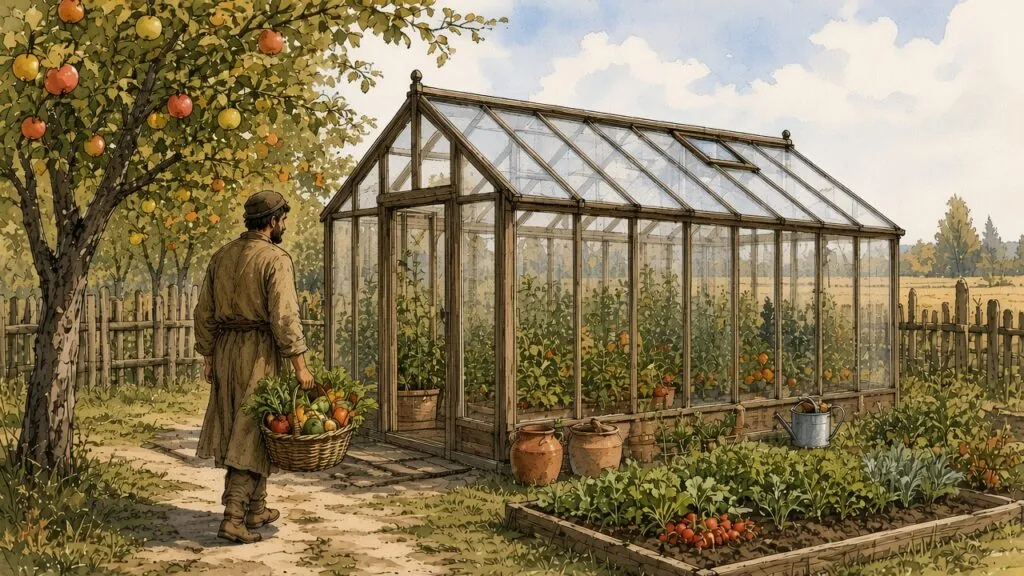
Descriptions of the bunker vary in detail but agree on its character. It covered about twenty-eight square metres, or, in other accounts, almost thirty or even thirty-five, and was some 1.83 to two metres high. There were two rows of narrow metal bunks, a long table, a small kitchen used at night, and a screened toilet. Some commemorative texts mention running water and electricity. Orna Jagur, who lived there for eight months under her later name and who left shortly before the raid, remembered filth, mustiness, vermin and a heavy psychological strain. The number of people hidden is given as thirty-four others besides the Ringelblums, or as thirty-eight Jews, or as about forty. Uri slept head to toe with his parents. During the day they had to be silent and still. At night, when it was safe, they could go out briefly to talk and to eat. Mieczysław Wolski and his teenage nephew, Janusz Wysocki, brought food, removed waste and mediated with the world above. Wolski’s mother and sisters gave what support they could.[6][26][27][37]
Ringelblum wrote almost constantly, by the light of a carbide lamp. Jagur saw him at the same place at the table, “only physically present,” his thoughts elsewhere, staying out of the daily quarrels. On 6 January 1944 he wrote to Adolf and Basia Berman that the food was decent and the tightness “unbearable,” but that the chance of being outdoors all day, in the greenhouse area, was a great advantage, and that only the first days were awful. Judyta, who also signed herself Józia, wrote more bleakly of arguments, of fights over space and dirt, and of “terrible depression, an indefinite prison, terrible hopelessness.” The difference in tone has been read as a difference of temperament and of obligation. He had work that could fill the hours. She had the same walls, without that shelter.[6][28][33]
The work he did there survived because he passed the manuscripts, in Polish and in other languages, to Adolf Berman, then head of the Jewish National Committee and a secretary of Żegota. The principal text is Stosunki polsko-żydowskie w czasie drugiej wojny światowej, Polish-Jewish Relations during the Second World War, written in the autumn of 1943 and subtitled Notes and Insights. Ringelblum declared a wish to write objectively, even as he admitted that the materials were fresh, that official sources were lacking, and that the war was not over. He has been criticised, and has also been defended, for the severity of some of his judgements on Polish society. Person and Tadeusz Epsztein, in presenting a critical edition, stress that the essay is a continuation of the Two and a Half Years programme and a personal testimony, not a complete modern history of the subject, and that Ringelblum himself said as much in his preface. He also wrote an extensive essay on the Trawniki camp, which Majchrowska reports as lost during the war, though other accounts say he continued to describe what he had seen there; until the complete edition is checked item by item, the survival of a finished Trawniki study should not be assumed. He worked on studies of the tragic fate of the Jewish intelligentsia and of the Jewish resistance, the latter probably unfinished, including biographical essays on leading figures of the ghetto. Later literature, following Kassow, identifies among these the portraits of Janusz Korczak, Yitzhak Katzenelson and Mordecai Anielewicz. With Berman he also prepared a text on culture in the ghettos and the tragedy of Jewish artists, which was sent to the PEN Club and to YIVO in New York. The letters of Emanuel and Judyta to the Bermans, written between 25 November 1943 and 3 March 1944, have been edited by Israel Gutman and annotated by Eleonora Bergman. A letter of 1 March 1944, a few days before the bunker was found, is often described as Ringelblum’s last will. In a message routed toward YIVO in New York he wrote that 95 percent of Poland’s Jews had already been murdered, that those who remained did not expect to survive, and that “We alarmed the world with detailed information about the greatest crime in history.”[17][24][4]
13. Betrayal, Pawiak and the afterlife of the archive
On 7 March 1944 Gestapo officers, with Polish “blue” police from the twenty-third post and elements of the Polish criminal police, the Kripo, in its wartime “Jewish department,” surrounded the property at 81 Grójecka Street. They knew where to look. They beat Mieczysław Wolski. According to his mother, as reported by Orna Jagur, they shouted that he was a “Jewish servant.” The people in the bunker were forced out, mothers and children first, then the men. The lawyer Tadeusz Klinger, Jagur’s father, took cyanide and died on the spot. The rest, including Wolski and Wysocki, were loaded onto trucks and taken to Pawiak prison. The greenhouse and the bunker were blown up with grenades.[29]
Who denounced them has not been established. Two hypotheses are reported, side by side, by Jan Grabowski, Andrzej Żbikowski and Agnieszka Haska. One is that a former girlfriend of Wolski, sometimes called Krysia, informed on him in revenge for a broken relationship; the name of the bunker, however, comes from kryjówka, and should not be treated as proof of that story. The other points to Jan Łakiński, a szmalcownik, a blackmailer of Jews, from Ochota, who collaborated with the “Jewish department.” On 30 March 1944 the Warsaw Special Court of the Polish Underground announced in Biuletyn Informacyjny a death sentence on Łakiński “for collaboration with the occupier and tracking down Polish citizens of Jewish descent,” and he was executed. The sentence is suggestive. It is not a courtroom identification of the person who betrayed this particular bunker. The honest statement is that the informer is unknown.[29][25]
At Pawiak, Ringelblum was held with Uri; Judyta was placed in the women’s section. According to the writer Jechiel Hirschaut, also known as Julian Hirszhaut, a plan was formed to move Ringelblum into a group of prisoners who were to be sent to Germany as tailors and shoemakers. Hirschaut managed to enter the cell and tell him of it. Ringelblum asked what would happen to the boy, and to his wife in the women’s section. Hirschaut’s silence, as he later wrote, told the truth. Ringelblum said that he preferred to go “the way of Kiddush Ha-Shem,” the sanctification of the Name, together with them. Hirschaut also recorded him looking at Uri and saying, “This little one, what is he guilty of? Because of him my heart is breaking,” and then asking, “Is dying difficult?” The conversation comes from a single witness. Kassow and Haska treat it as valuable and plausible, and it should be presented as Hirschaut’s account, not as a stenographic record.[9][29]
The date of the killing can now be given with more confidence than in older obituaries. Reports of the Prison Section of the Delegatura, the Government Delegation for Poland, dated 10 and 16 March 1944, and preserved in the Archiwum Akt Nowych under the reference 202/II-17, were published and discussed by Haska. The first notes the “catch”: twenty-four Jewish women and sixteen Jewish men brought in, “fully clothed and money hidden in buttons, jewellery, big sums of money.” The second states, with official brevity, that on 10 March “all Jews captured in a bunker in Grójecka street were shot dead.” This is the best documentary basis for 10 March 1944 as the date of the execution in the ruins of the ghetto. Wolski and Wysocki were almost certainly killed with them. The burial place is unknown. The Gestapo rewarded fifteen people who had taken part in the raid. Five members of the Wolski family, including Mieczysław, were later recognised as Righteous Among the Nations. An older tribute by Śpiewak said that the exact date of death was unknown; that statement should yield to the Delegatura reports. A short caption in the Joint’s memorial, which says that the family were “murdered in Pawiak Prison,” is less accurate than the same memorial’s extended profile, which correctly places the shooting in the ghetto ruins.[29][44]
The archive outlived its founder, but only because people who had worked with him refused to let the rubble have the last word. On 4 June 1945 the Board of the Central Committee of Jews in Poland already discussed the need to find it. Permission for excavation came in mid-August 1945, yet funding and the sheer mass of ruins delayed the work for a year. Rachel Auerbach demanded action in public, including at the commemoration of the third anniversary of the ghetto uprising. “Even if the ruins reach five storeys high,” she said, “we must find the Archive.” Only Hersh Wasser knew the precise spot, and even he was disoriented by the ruined street plan. In mid-September 1946, with money from the American Jewish Labor Committee, digging began. On the afternoon of 18 September, after the shovels hit “something hard,” the ten boxes of the first cache were raised. Present from the Jewish Historical Commission were Michał Borwicz, Józef Wulf, Nachman Blumental and Wasser. Natan Gross filmed the moment, and the footage later entered the 1948 film Mir lebngebliebene, “We, the Survivors.” The boxes had not been properly welded. Water had got in. Borwicz described swollen bundles, mould, and photographs whose emulsions had stuck together. Transcription began on 23 September at the Commission’s office on Sienna Street, in the former Berson and Bauman hospital. Wasser attached identification cards naming authors, knowledge that would otherwise have been lost.[21]

The second part was found by chance on 1 December 1950, during construction work at the new Muranów estate, in the two milk cans, and in far better condition. Bergman counts almost 21,000 pages or cards in the first part and nearly 8,000 in the second. UNESCO, when it inscribed the “Warsaw Ghetto Archives (Emanuel Ringelblum Archives)” on the Memory of the World Register in 1999, after a submission in 1998, gave the collection as 1,680 archival units, approximately 25,000 pages. A POLIN page on the anniversary of the discovery once said 1996; the official UNESCO year is 1999, and the inscription is on the Memory of the World Register, not the World Heritage List. The milk cans and the metal boxes remain in the care of the Jewish Historical Institute. A complete scholarly edition, Archiwum Ringelbluma. Konspiracyjne Archiwum Getta Warszawy, began at the end of the 1990s, was interrupted, and was resumed, and the Institute now makes it available through the Central Judaic Library. The permanent exhibition in the Tłomackie building is called, in English, “What We Were Unable to Shout Out to the World.”[22][3][10]
Ringelblum’s own notes, summaries and essays, written during the occupation, were published after the war in two Yiddish volumes as Ksovim fun Geto, and in English, in a widely read but necessarily selective edition, as Notes from the Warsaw Ghetto, edited and translated by Jacob Sloan in 1958. A fuller Polish edition, Kronika getta warszawskiego, appeared under Artur Eisenbach’s care in 1983. Hebrew volumes of the diary and of the last writings on Polish-Jewish relations followed from Jerusalem in the 1990s. Joseph Kermish’s anthology, To Live with Honor and Die with Honor, opened a substantial selection of the archive itself to English-language readers in 1986. None of these publications replaces the complete edition now in progress in Warsaw, and none of them should be quoted as if it were the last word on a damaged or fragmentary text. They are, however, the means by which Ringelblum has been read, argued with and taught, and they belong to the afterlife of the work as much as the milk cans in the Institute’s exhibition cases. The Institute’s own complete edition, volume by volume, is the proper place to verify a difficult reading, and it should be preferred whenever a popular translation and a critical text diverge. That caution is a form of respect for the dead as well as for the reader.[5][30][35][34]
Ringelblum had asked, in a world that was being erased, who would write the history of the Jews of Poland. The answer turned out to be, first of all, he himself, and the men and women he gathered, and then the historians who, after 1946, sat down with the damp and the miraculously dry papers and began, slowly, to read. The work is not finished. Large parts of the archive are still little known. But the question is no longer whether the story can be told. It is how faithfully it will be told, and whether the versatility and the objectivity he demanded can still be practised, without hatred and without zeal, in the face of what the papers contain.[4]
14. Timeline
This timeline gathers the principal dates of Ringelblum’s life and of the archive he organised. Select an entry to read a short note. Disputed points, including the possible stay in Kołomyja and the year he joined the Joint, are stated rather than resolved.
Born in Buczacz, eastern Galicia, to Fayvish Ringelblum and Munie (likely registered as Rachela Neche), née Heller.
His mother dies when he is twelve. His father later remarries.
The family flees the Russian invasion of Galicia. Kassow places the refuge at Nowy Sącz; other Polish research also mentions Kołomyja.
Takes the matura with honours at the Jan Długosz Gymnasium in Nowy Sącz. An attempt to study medicine at Warsaw University fails under the numerus clausus.
Begins formal historical studies at Warsaw University, having already attended lectures and seminars.
Helps to found the Young Historians Circle. The Encyclopaedia Judaica later dates the Circle to 1928, which is too late.
Defends his doctoral dissertation on the Jews of Warsaw to 1527, under Marceli Handelsman.
Teaches history at the Jehudia gymnasium for girls, where he meets Abraham Lewin.
Works with the CEKABE free-loan funds and, from 1930 or 1932 (the sources disagree), on the staff of the American Jewish Joint Distribution Committee in Poland.
Goes to Zbąszyń to organise relief for Polish Jews expelled from the German Reich. He remains about five weeks.
Attends the Twenty-First Zionist Congress in Geneva and returns to Warsaw, through Italy, Yugoslavia and Hungary, as the war begins.
Begins a personal chronicle of the occupation and helps to organise the Aleynhilf, the Jewish self-help.
The Warsaw Ghetto is sealed. The Ringelblums’ flat at 18 Leszno Street lies inside the closed district.
Organises the clandestine Oyneg Shabes archive, after informal collecting that had begun earlier in 1940.
Szlama Ber Winer’s Chełmno report, later called the Grojanowski report, is taken down for the archive.
The BBC broadcasts news of the extermination of Polish Jews, based in part on material sent from Warsaw.
The German Grossaktion, the great deportation from Warsaw to Treblinka, begins.
Last burial of the first cache: ten metal boxes in the basement of the Borochov school at 68 Nowolipki Street.
A second cache, two sealed milk cans, is buried in the same building.
The Ringelblums leave the ghetto with Adolf and Basia Berman and go into hiding on the Aryan side.
Ringelblum re-enters the ghetto at the outbreak of the uprising, is captured, and is deported to the Trawniki labour camp. A third cache is buried at 34 Świętojerska Street on 18 April and is never recovered.
Teodor Pajewski and Emilia Kossower-Rozencwajg, working with Żegota and the Home Army, rescue him from Trawniki.
The family hides first at 2 Radzymińska Street, then in the Krysia bunker under a greenhouse at 81 Grójecka Street.
The Krysia bunker is discovered. The Ringelblums and the other Jews in hiding are arrested and taken to Pawiak.
Delegatura prison reports record that the Ringelblums were shot in the ruins of the ghetto, together with the other Jews taken from the bunker.
The first cache of ten boxes is recovered at 68 Nowolipki Street, on a site identified by Hersh Wasser.
The two milk cans of the second cache are found during construction on the Muranów estate.
UNESCO inscribes the Warsaw Ghetto Archives (Emanuel Ringelblum Archives) on the Memory of the World Register.
Glossary of terms
The following terms recur in the chapters above. Each definition gives the sense in which the word is used in this essay.
- Aleynhilf
- Yiddish for “self-help.” The Jewish Social Self-Help in occupied Warsaw, later known in official Polish as the ŻSS or ŻTOS, and sometimes as the JSS. Its offices stood at Tłomackie 5, later remembered as Tłomackie 3/5.
- CEKABE
- The Centralna Kasa Bezprocentowa, or Central Interest-Free Loan Fund, also called Folkshilf. A network of free-loan kassas supported by the Joint, which Ringelblum served from 1929.
- Delegatura
- The Delegation of the Government of the Republic of Poland in the Country, the civilian underground authority of the Polish government-in-exile. Its Prison Section recorded the Ringelblums’ deaths in March 1944.
- Grossaktion
- The German code-name for the great deportation from the Warsaw Ghetto to Treblinka, which began on 22 July 1942.
- House committee
- A courtyard or building committee organised, with Ringelblum’s encouragement, to collect food, money and information and to support neighbours in the ghetto.
- Joint (JDC)
- The American Jewish Joint Distribution Committee, the principal overseas Jewish relief body working in inter-war and occupied Poland.
- Judenrat
- The Jewish Council imposed by the German occupation authorities. In Warsaw it was headed first by Adam Czerniaków.
- Krysia
- The underground bunker beneath a commercial greenhouse at 81 Grójecka Street in Ochota, on the Aryan side of Warsaw, where the Ringelblums hid from late 1943 until 7 March 1944.
- Landkentenish
- A Yiddish movement of local study and touring, devoted to knowledge of the land and of Jewish places in Poland, with which Ringelblum was associated in the 1930s.
- Memory of the World
- UNESCO’s programme for documentary heritage. The Ringelblum Archive was inscribed on the Register in 1999 (some later museum pages wrongly give 1996). It is not a World Heritage site.
- Oyneg Shabes (Oneg Shabbat, ARG)
- Yiddish for “Joy of the Sabbath.” The clandestine archive organised by Ringelblum in the Warsaw Ghetto. In internal papers it was also called the ARG, for Archiwum Getta, the Ghetto Archive.
- Pawiak
- The principal Gestapo prison in Warsaw, on Pawia Street, to which the Jews discovered in the Krysia bunker were taken on 7 March 1944.
- Po‘alei Zion Left
- The Left Poale Zion, a Marxist-Zionist workers’ party to which Ringelblum belonged from his youth in Nowy Sącz.
- Szmalcownik
- A blackmailer who extorted money from Jews in hiding on the Aryan side, or who threatened to denounce them to the Germans.
- Szop
- From the German Schupo or, in ghetto usage, a workshop or shop under German administration in which Jews were employed, often as a fragile claim to exemption from deportation.
- Trawniki
- A labour camp in the Lublin district to which Ringelblum was deported after the Warsaw Ghetto Uprising, and from which he was rescued in August 1943.
- Two and a Half Years
- A comprehensive underground research project of the Oyneg Shabes archive, designed to describe Jewish life in occupied Poland from September 1939 through the first years of the war.
- YIVO
- The Yidisher Visnshaftlekher Institut, or Yiddish Scientific Institute, founded in Vilna in 1925, with which the Young Historians Circle was affiliated.
- Zamling
- Yiddish for “collecting.” The YIVO practice of gathering folklore, documents and everyday papers, which Ringelblum adapted to the work of the archive.
- Żegota
- The Konrada Żegoty Council for Aid to Jews, a clandestine Polish organisation, supported by the Delegatura, which took part in the Trawniki rescue.
- ŻOB
- The Żydowska Organizacja Bojowa, or Jewish Fighting Organisation, which led the Warsaw Ghetto Uprising in April 1943.
References
- Samuel Kassow, “Ringelblum, Emanuel,” YIVO Encyclopedia of Jews in Eastern Europe *
- United States Holocaust Memorial Museum, “Emanuel Ringelblum and the Creation of the Oneg Shabbat Archive,” Holocaust Encyclopedia *
- UNESCO Memory of the World, “Warsaw Ghetto Archives (Emanuel Ringelblum Archives).” Registration year 1999 *
- Samuel D. Kassow, Who Will Write Our History? Emanuel Ringelblum, the Warsaw Ghetto, and the Oyneg Shabes Archive (Bloomington: Indiana University Press, 2007) *
- Nathan Eck and Michael Berenbaum, “Ringelblum, Emanuel (Menahem),” Encyclopaedia Judaica, 2nd ed., vol. 17 (2007), pp. 335 - 336 *
- Anna Majchrowska, “Emanuel Ringelblum - optimist who believed in the human being,” Żydowski Instytut Historyczny *
- Przemysław Batorski, “«Za nim się podążało». Rocznica urodzin Emanuela Ringelbluma,” Żydowski Instytut Historyczny, citing Joanna Nalewajko-Kulikov (2020) *
- Institute of National Remembrance, “Animated by one spirit, imbued with one idea.” Emanuel Ringelblum and the underground archive of the Warsaw Ghetto, 12 March 2021 *
- JDC Archives, “In Memoriam: Emanuel Ringelblum” *
- Krzysztof Persak, “Birthday of Emanuel Ringelblum,” POLIN Museum of the History of Polish Jews *
- Paweł Fijałkowski, “Emanuel Ringelblum as a Student of History of Warsaw’s Jews,” Jewish History Quarterly / Kwartalnik Historii Żydów, no. 256 (December 2015) *
- Samuel Kassow, “Historiography: An Overview,” YIVO Encyclopedia of Jews in Eastern Europe *
- Letter of Emanuel Ringelblum in Warsaw to Elye Tsherikover, 25 September 1932, YIVO RG 107 *
- Żydowski Instytut Historyczny, “Oneg Shabbat biographies” *
- Tadeusz Epsztein, “About the Ringelblum Archive,” Żydowski Instytut Historyczny *
- United States Holocaust Memorial Museum, “The Oneg Shabbat Archive,” Holocaust Encyclopedia *
- Przemysław Batorski, “New edition of ‘Polish-Jewish Relations during the Second World War’ by Emanuel Ringelblum,” Żydowski Instytut Historyczny, quoting Katarzyna Person and Tadeusz Epsztein *
- “Memory,” YIVO Encyclopedia of Jews in Eastern Europe *
- Anna Majchrowska, “This is probably the last letter I’m writing to you…,” Żydowski Instytut Historyczny *
- Żydowski Instytut Historyczny, “June 26, 1942. BBC informs about the extermination of Polish Jews” *
- Anna Majchrowska, “We must find the Archive!,” Żydowski Instytut Historyczny *
- Eleonora Bergman, “Discovering second part of Archive,” Żydowski Instytut Historyczny *
- Przemysław Batorski, “Teodor Pajewski and Emilia Kossower-Rozencwajg awarded for saving Jews,” Żydowski Instytut Historyczny *
- Emanuel Ringelblum, Polish-Jewish Relations during the Second World War, ed. Joseph Kermish and Shmuel Krakowski (Jerusalem: Yad Vashem, 1974/1976; Evanston: Northwestern University Press, 1992) *
- Żydowski Instytut Historyczny, “74th anniversary of Emanuel Ringelblum’s arrest” *
- Paweł Wieczorek, “Bunker ‘Krysia’,” Warsaw Ghetto Museum *
- Orna Jagur (Irena Grodzińska), „Krysia” bunker (Łódź: Oficyna Bibliofilów, 1997) *
- Eleonora Bergman, “Sidenotes Regarding Emanuel and Judyta Ringelblums Letters to Adolf and Basia Berman (25 November 1943 - 3 March 1944),” Jewish History Quarterly, no. 256 (December 2015) *
- Agnieszka Haska, “Last days of Emanuel Ringelblum,” Żydowski Instytut Historyczny *
- Joseph Kermish, ed., To Live with Honor and Die with Honor! Selected Documents from the Warsaw Ghetto Underground Archives “O.S.” (Jerusalem: Yad Vashem, 1986) *
- Paweł Śpiewak, “He created the memory of the nation. Emanuel Ringelblum,” Żydowski Instytut Historyczny *
- Israel Gutman, The Jews of Warsaw, 1939 - 1943: Ghetto, Underground, Revolt (Bloomington: Indiana University Press, 1982/1989) *
- Israel Gutman, “Emanuel Ringelblum’s Letters,” Zagłada Żydów. Studia i materiały 1 (2005) *
- Artur Eisenbach, introduction to Emanuel Ringelblum, Kronika getta warszawskiego (Warsaw, 1983) *
- Emanuel Ringelblum, Notes from the Warsaw Ghetto: The Journal of Emmanuel Ringelblum, ed. and trans. Jacob Sloan (New York, 1958) *
- Aleksandra Bańkowska and Agnieszka Haska, “…w podziemiach wymienionych domów zakopane są… Poszukiwania Archiwum Ringelbluma,” Zagłada Żydów. Studia i materiały 12 (2006) *
- Gunnar S. Paulsson, Secret City: The Hidden Jews of Warsaw, 1940 - 1945 (New Haven: Yale University Press, 2002) *
- Barbara Engelking and Dariusz Libionka, The Warsaw Ghetto: A Guide to the Perished City (New Haven: Yale University Press, 2009) *
- Shimon Huberband, Kiddush Hashem: Jewish Religious and Cultural Life during the Holocaust, ed. Jeffrey Gurock and Robert Hirt (New York, 1979) *
- Ruta Sakowska, “Two Forms of Jewish Resistance: Two Functions of Ringelblum’s Oyneg Shabes Archive,” in Robert Moses Shapiro, ed., Holocaust Chronicles (Hoboken, N.J., 1999) *
- Joanna Nalewajko-Kulikov, “Emanuel Ringelblum (1900 - 1944),” in Emanuel Ringelblum, Stosunki polsko-żydowskie w czasie drugiej wojny światowej, ed. Tadeusz Epsztein (Warsaw: ŻIH, 2020), pp. 10 - 23 *
- “Holocaust Diaries,” YIVO Encyclopedia of Jews in Eastern Europe *
- POLIN Museum, “The Anniversary of Discovering the Ringelblum Archive” *
- Archival reports of the Prison Section of the Delegatura, 10 and 16 March 1944, Archiwum Akt Nowych, 202/II - 17, as published and discussed by Agnieszka Haska *
Select bibliography
- Eleonora Bergman, “The Three Lives of the Ringelblum Archive,” and related essays issued by the Jewish Historical Institute, Warsaw.
- Tadeusz Epsztein, ed., The Warsaw Ghetto Oyneg Shabes–Ringelblum Archive: Catalog and Guide (Bloomington: Indiana University Press, in association with the United States Holocaust Memorial Museum and the Jewish Historical Institute, 2009).
- Israel Gutman, The Jews of Warsaw, 1939–1943: Ghetto, Underground, Revolt (Bloomington: Indiana University Press, 1982).
- Samuel D. Kassow, Who Will Write Our History? Emanuel Ringelblum, the Warsaw Ghetto, and the Oyneg Shabes Archive (Bloomington: Indiana University Press, 2007).
- Joseph Kermish, ed., To Live with Honor and Die with Honor! Selected Documents from the Warsaw Ghetto Underground Archives “O.S.” (Jerusalem: Yad Vashem, 1986).
- Joanna Nalewajko-Kulikov, “Emanuel Ringelblum (1900–1944),” in Emanuel Ringelblum, Stosunki polsko-żydowskie w czasie drugiej wojny światowej, ed. Tadeusz Epsztein (Warsaw: ŻIH, 2020).
- Emanuel Ringelblum, Kronika getta warszawskiego, wrzesień 1939 – styczeń 1943, ed. Artur Eisenbach (Warsaw, 1983).
- Emanuel Ringelblum, Notes from the Warsaw Ghetto: The Journal of Emmanuel Ringelblum, ed. and trans. Jacob Sloan (New York, 1958).
- Emanuel Ringelblum, Polish-Jewish Relations during the Second World War, ed. Joseph Kermish and Shmuel Krakowski (Jerusalem: Yad Vashem, 1974; Evanston: Northwestern University Press, 1992).
- Ruta Sakowska and the staff of the Jewish Historical Institute, editions in the series Archiwum Ringelbluma (Warsaw: ŻIH).