About this essay
Called by Name is a long read in twenty chapters on the names that Jews have given and received, from the personal names of the Hebrew Bible and the seals of Iron Age Judah to the Yiddish, Ladino, Judeo-Arabic and Hebrew naming traditions, the surnames imposed by European states between 1787 and the nineteenth century, Hebraization in Israel and the stories told about Ellis Island.
Each chapter opens from its card below and can be read on its own. Numbers in square brackets lead to the references at the end of the page, and the asterisk beside each reference leads back to the text. A timeline of 53 dates, a glossary of 42 terms and a select bibliography follow the chapters, and every image is an ink-and-watercolour illustration made for this essay.
The Essay in Twenty Chapters
What a Jewish Name Carries
A Jewish child is usually given a name before it can know anything about it, and in most families the choice has already been half made long before the birth. The parents may settle on a grandmother who died the previous winter, on a grandfather who is still very much alive and expects the honour, on a figure from the weekly Torah portion, or on a fashionable Hebrew word that sounds pleasant in Tel Aviv, Manchester or Buenos Aires. Whichever road they take, the name they pronounce at a circumcision, at a synagogue reading of the Torah or at a home celebration for a daughter is rarely theirs alone. It belongs to a family memory, to a community’s sense of what is proper, to a language or several languages, and, for the last two centuries in particular, to the paperwork of states. This essay is an attempt to follow those claims across roughly three thousand years, from the seals and ostraca of the kingdoms of Israel and Judah to the birth registers of present-day Israel and the immigration files of the twentieth century.
The subject is vast because the Jewish people have lived in so many places and spoken so many languages. A woman in medieval Cairo might sign a contract with an Arabic name that her Hebrew-speaking ancestors would not have recognised; a man in eighteenth-century Vilna might be called Hirsh in the market and Tsvi in the synagogue, and receive the surname Hirschowitz only when a Russian official insisted on one; his great-grandson might change that surname to something shorter in Chicago, or to a Hebrew word in Haifa. None of these moves broke a tradition. Each was a way of carrying it, sometimes willingly, sometimes under compulsion, and the record of those moves is one of the most intimate archives that Jewish history possesses. The classic survey in the Jewish Encyclopedia of 1906 already devoted separate sections to biblical, Talmudic, Arabic, Spanish, French and English names, to surnames, to nicknames and to superstitions surrounding a change of name, and the subject has grown enormously since then[1].
A Name Received, Not Chosen
Jewish tradition has always treated the name as something more than a label. The book of Ecclesiastes opens one of its most quoted chapters with the line that a good name is better than precious oil, and the rabbis who commented on the verse in Kohelet Rabbah spun it into a long comparison, observing among other things that fine oil is for the living while a good name is for the living and for the dead[2][3]. In the prophecy of Isaiah, God addresses Israel with words that have been inscribed on countless naming certificates and synagogue plaques, I have called thee by thy name, thou art Mine, and the sentence gives this essay its title[4]. The phrase works in two directions. It tells the bearer that a name is a form of being claimed, and it tells the namer that the act of calling someone by name is not neutral.
The rabbis of late antiquity drew out this idea in ways that later generations took literally. A passage in the Babylonian Talmud asks how we know that a name affects a person’s life, and answers with a pun on a psalm verse, reading the word for desolations, shammot, as if it were the word for names, shemot[5][6]. The same page explains the name Ruth as an allusion to the songs with which her descendant David would saturate the Holy One. Elsewhere the Talmud tells of three sages travelling together, one of whom, Rabbi Meir, was in the habit of examining names. When an innkeeper introduced himself as Kidor, Rabbi Meir heard in the name an echo of a verse in Deuteronomy about a perverse generation, ki dor, and refused to leave his purse in the man’s keeping, a precaution that the rest of the story vindicated[7][8]. Stories of this kind did not create a coherent doctrine, but they established a habit of attention. A name could be read as a sign, and the people who chose it were responsible for what it might signify.
Another strand of rabbinic teaching insisted that the name given at birth is only the beginning. A homily in the Midrash Tanchuma, attached to the verse in which Moses announces that God has called Bezalel by name, says that a person is known by three names, the one his father and mother call him, the one other people call him, and the one he earns for himself, and that the last is the most important[9][10]. The thought cuts across the whole of this essay. Parents could give a child the name of a revered ancestor, a community could add a nickname, a government could impose a surname, but the reputation attached to all of these remained the bearer’s own work.
Three Layers in One Person
For most of Jewish history a single person carried several names at once, each suited to a different sphere of life. The first was a Hebrew or Aramaic name used in religious settings, when a man was called up to read from the Torah, when a marriage contract or bill of divorce was drawn up, when a prayer was said for the sick and when a gravestone was carved. In Ashkenazi usage this came to be called the shem hakodesh, the holy name, and it was normally followed by a patronymic, so that a man was Avraham ben Yitzhak and a woman Rivka bat Moshe. The second was the name used in daily life, among neighbours and in the market, which might be a vernacular form of the Hebrew name, a translation of it, a loosely associated name in the local language, or something unrelated. The third, which for most Jews appeared only in the late eighteenth or nineteenth century, was a hereditary surname, frequently imposed or regulated by the state. Alexander Beider, whose dictionaries have transformed the study of Ashkenazi names, puts the contrast sharply in the YIVO Encyclopedia. Personal names, he writes, developed organically inside Jewish communities over centuries and were closely bound up with the history of Yiddish, while family names in Eastern Europe were mostly invented in a short period around the turn of the nineteenth century under pressure from state authorities[11].
The coexistence of several names is very old. The Talmud records, in a discussion of the signatures on bills of divorce sent from abroad, a tannaitic teaching that the names of most Jews outside the Land of Israel are like the names of gentiles, which meant that a court could not assume that a document signed with Greek or Persian names was the work of non-Jews[12]. An earlier enactment attributed to Rabban Gamliel the Elder, preserved in the Mishnah, dealt with a related difficulty. A husband who had lived in more than one town might be known by different names in each, and a bill of divorce that gave only one of them could later be challenged. Rabban Gamliel therefore ruled that the scribe should write the man so-and-so and every name that he has, and the same for the woman[13][14]. The rule shows that by the first century CE Jewish law already took multiple names for granted, and it explains why lists of names and their variant spellings became a specialised genre of medieval and early modern rabbinic literature. The same practical worry, that a person must be identified beyond doubt in a document that could decide whether a woman was free to remarry, lies behind the later codes discussed in the chapters on medieval naming[15].
Sometimes the layers were closely tied. Yiddish speakers paired a Hebrew name with a Germanic or Slavic name that echoed it, often through Jacob’s blessings of his sons in Genesis, so that Naftali, compared there to a hind, became Hirsh, and Yehuda, compared to a lion, became Leyb. At other times the link was only phonetic, as when a man named Mordechai was known in German as Markus, or simply conventional, as when Sephardi women bore Spanish names such as Vida, Sol or Esterina. In the modern period the layers often came apart altogether. A child born in Brooklyn in the 1950s might have a Hebrew name chosen to honour a great-grandfather, an English first name beginning with the same letter, and a surname that an immigrant grandparent had shortened. Each layer tells a different story, and much of what follows is an attempt to separate the threads without pretending that they were ever entirely separate in the lives of those who carried them.
How the Evidence Survives
The sources for this history are scattered and uneven. For the biblical period there is the Hebrew Bible itself, with something like 2,800 personal names borne by perhaps 15,000 individuals according to the count used in the Jewish Encyclopedia, together with an expanding corpus of inscribed seals, seal impressions and ostraca recovered by archaeology[1]. The study of these names was put on a scientific footing in 1928 by Martin Noth, whose monograph on Israelite personal names placed them within the wider Semitic onomasticon, and their religious content was examined in the 1980s by Jeffrey Tigay, who used inscriptions to test what the Bible says about Israelite worship[16][17]. For the Persian period there are the Aramaic papyri of the Jewish garrison at Elephantine in Upper Egypt, which preserve the names of soldiers, their wives and their slaves[18]. For the Hellenistic and Roman periods, inscriptions on ossuaries, tombstones and synagogue mosaics, together with papyri and the writings of Josephus and the New Testament, have been gathered in Tal Ilan’s multi-volume Lexicon of Jewish Names in Late Antiquity, which made it possible for the first time to count how often a given name occurs in a given region[19][20].
For the Middle Ages the most important single source is the Cairo Genizah, the storeroom of the Ben Ezra synagogue in Fustat, where hundreds of thousands of fragments of letters, contracts, court records and lists survived because Jews were reluctant to destroy writing that might contain the name of God. Its documents allow historians to see how Jews in the Islamic world combined Hebrew, Arabic and occasionally Greek or Persian names, and how they used Arabic naming conventions such as the kunya and the nisba[21][22]. For Ashkenaz there are memorial books, the records of Jewish communities and Christian authorities, tax lists and, later, the vast registers produced when states made Jews adopt surnames. Beider’s dictionaries, published by Avotaynu, rest on this documentary base, and so do the databases of given names maintained by JewishGen[23][24].
The twentieth century added sources of a darker kind. The Pages of Testimony collected by Yad Vashem since the 1950s record the names of millions of murdered Jews as remembered by relatives and neighbours, often in several spellings and languages at once, and they have become, almost incidentally, one of the largest collections of Jewish naming data ever assembled[25]. Alongside them stand the immigration files of the United States, Britain, Argentina and other countries of refuge, the decrees of Israeli ministries encouraging the Hebraization of names, and the statistics of the Israel Central Bureau of Statistics on the names parents give their newborns. Together with the older literature, from Leopold Zunz’s pioneering study of 1837 to the dictionaries of Benzion Kaganoff and Beider, they make it possible to write a history of Jewish names that is neither a list of etymologies nor a collection of anecdotes, but an account of how a scattered people kept, changed and argued over the words by which its members were known[26][27].
The Shape of This Essay
The chapters follow a roughly chronological route, with long detours by region and by theme. The next chapter examines names in the Hebrew Bible, from the theophoric names that announce what God has done to the names that the biblical narrators explain through puns, and the renamings of Abraham, Sarah, Jacob and Joshua that set a pattern for every later change of name. Two chapters on the Second Temple and rabbinic periods follow the arrival of Greek, Aramaic and Latin names, the statistics that can be drawn from ossuaries, and the rabbinic teachings that shaped later practice. A chapter on the geonic and medieval worlds moves from Baghdad and Fustat to the Rhineland and al-Andalus.
The central part of the essay is organised by community. It looks at the Ashkenazi custom of naming children after the dead and never after the living, at the Yiddish pairs and diminutives known as kinnuim, at the Sephardi custom of naming children after living grandparents and the Judeo-Spanish names of the Ottoman Balkans, and then at the many traditions of Jews who spoke Judeo-Arabic, Judeo-Persian, Bukharan, Judeo-Georgian, Kurdish Neo-Aramaic, Judeo-Italian, Judeo-Greek and the languages of Ethiopia. Separate chapters consider patronymics and matronymics, which survive in every Jewish religious document, and the names of women, who are often harder to find in the sources but whose names were among the most inventive in the Jewish world.
The later chapters deal with surnames, beginning with the edict of Joseph II in 1787 and the laws that followed in France, the German states, the Netherlands and the Russian Empire, and continuing with a typology of the resulting names, priestly and Levite, toponymic, occupational, ornamental and acronymic, as well as the house signs of Frankfurt that produced Rothschild. They then turn to the kabbalistic understanding of names and the custom of changing the name of a gravely ill person, to the ceremonies in which names are given, to the Hebraization of names in the Yishuv and the State of Israel, to anglicisation and the persistent legend of names changed at Ellis Island, and to the Nazi decree of 1938 that forced Jews in Germany to add Israel or Sara to their names. The final chapter gathers together the names of converts, the taboos that govern which names may and may not be given, the fashions of the present, and the history of Jewish onomastic scholarship itself. A timeline, a glossary, the numbered references and a select bibliography close the essay.
Names in the Hebrew Bible
Every later chapter of Jewish naming looks back to the Bible. The great majority of names that Jews have borne over the centuries, from Avraham and Sarah to Yitzhak, Rivka, Yaakov, Rahel, Leah, Moshe, Aharon, David and Shlomo, come from its pages, and even names that seem far removed from it, such as the Yiddish Hirsh or the Judeo-Spanish Vida, are frequently linked to biblical originals through translation or association. Yet the biblical world itself named children in ways quite unlike those of its heirs. Its names were mostly coined fresh rather than inherited, they often formed short sentences about God, and they were rarely repeated within a family. Joseph Jacobs, writing for the Jewish Encyclopedia, observed that none of the twenty-one kings of Judah bore the name of a predecessor, not even that of David, the founder of the dynasty, and that families preferred to vary one element of a name rather than repeat it whole, so that the priest Ahitub had sons named Ahijah and Ahimelech[1]. The custom of naming a child after a grandfather, which later became so central to Jewish life, appears only after the Babylonian exile.
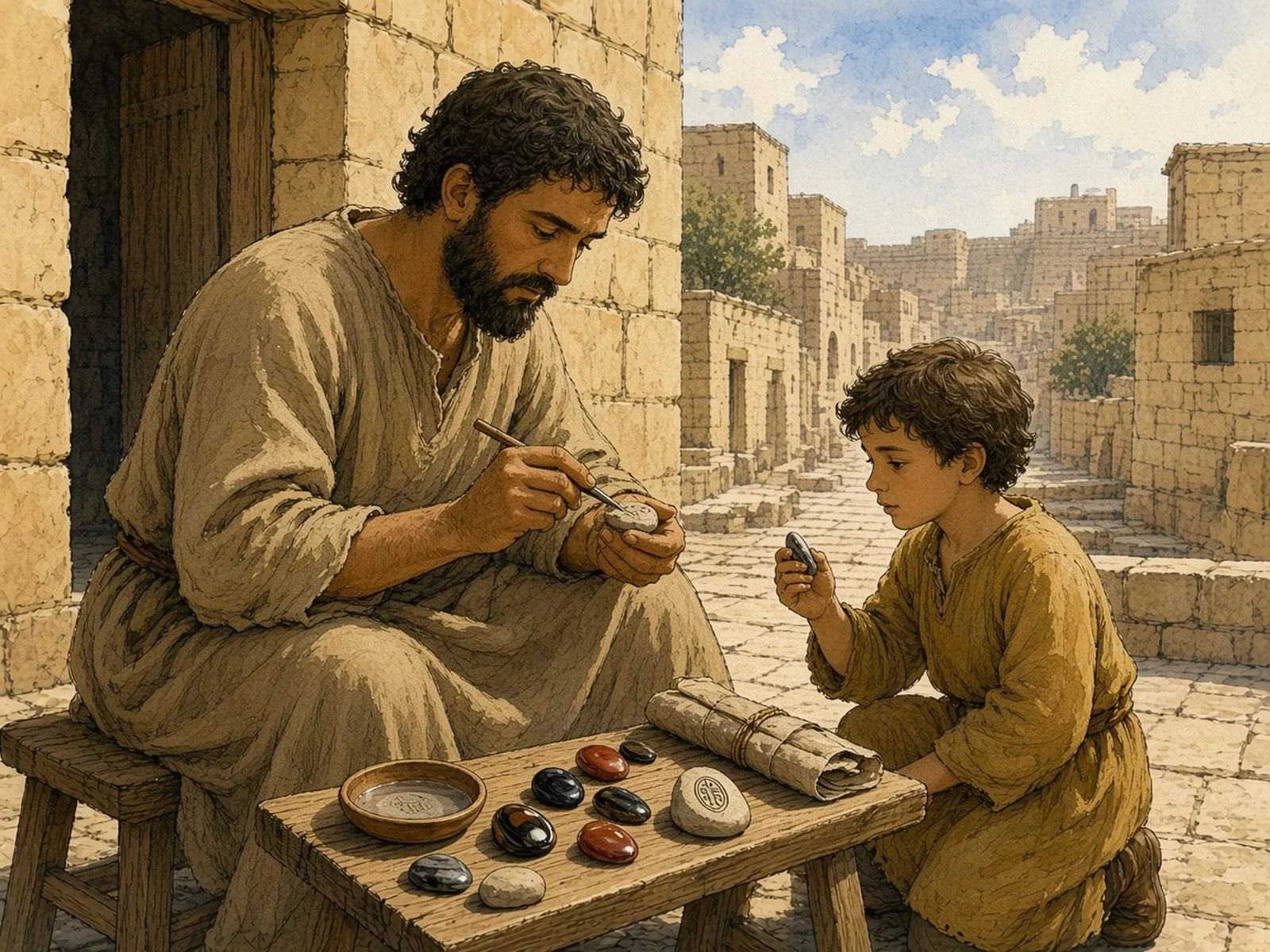
This chapter considers the main types of biblical name and the ways in which the biblical writers explained them. It looks at the theophoric names that contain an element meaning God, at the names whose meaning the narrative supplies through a pun, at the dramatic renamings that mark turning points in the lives of the patriarchs and of Joshua, at the many names drawn from animals and plants, and at the evidence of seals, seal impressions and ostraca that allows the biblical record to be compared with the names that people in Israel and Judah actually used. It ends with the question of who gave a child its name, and when.
Theophoric Names with El and Yah
The most characteristic biblical names are sentences in miniature. Nethanel and Elnathan both mean God has given, Jonathan and Nethaniah mean the Lord has given, and Elishama and Shemaiah mean God has heard and the Lord has heard. The divine element appears at the beginning or the end of the name, as El or as a short form of the Tetragrammaton, Yeho or Yo at the beginning and Yahu or Yah at the end. The article on names in the Encyclopaedia Judaica, drawing on the work of the Swiss scholar Johann Jakob Stamm, classifies these names by grammar as well as meaning. Some are verbal sentences in the perfect tense, which give thanks for something God has already done, as in Nethanel. Others use the imperfect, as in Jehoiachin or Jechoniah, and may express either a statement or a wish, a distinction that scholars have debated since Noth. Still others are so-called names of reliance, nominal sentences such as Elijah, the Lord is my God, or Uzziel and Uzziah, God is my strength, in which the possessive my may refer either to the parent who first pronounced the name or to the child who would later make it his own[27].
The theology implied by these names is surprisingly full. Jacobs compiled a list of the actions and attributes that biblical names ascribe to God. God gives, increases the family, is gracious, has mercy, blesses, loves, helps, delivers, comforts, heals, establishes, knows, remembers, sees, hears, answers, lives, judges, is just, is king, is great and is incomparable, the last in the name Michael, which asks who is like God[1]. Such names were not abstract confessions. The Encyclopaedia Judaica points out that in Hebrew, unlike Akkadian, the names that speak of help, salvation or mercy generally refer not to the child but to the parents, whose prayer had been answered or whose fortunes had been restored, so that the name commemorates an experience of the family into which the child was born[27]. A name such as Shemaiah thus recorded a moment of relief, much as a later Jewish name given in memory of a grandparent records a moment of loss.
Some of the oldest names have a theophoric structure without an explicit divine element. Isaac, Jacob, Israel and Joseph are abbreviated forms of sentences whose subject was originally El, and Noth and Stamm regarded the type as especially common in the stories of Moses and the Judges, rarer under David and more frequent again around the time of the exile[27]. The question of when names began to contain the Tetragrammaton has occupied scholars for more than a century. The Encyclopaedia Judaica regards Joshua as the first name that certainly does, and notes that the name of Moses’ mother, Jochebed, is older but only doubtfully contains the divine name[27][28]. By the period of the monarchy, names ending in yahu had become so common that they dominate the names of kings, prophets and officials, from Hezekiah, Josiah and Zedekiah to Isaiah and Jeremiah.
Not every divine name in the Bible refers to the God of Israel. The book of Judges explains that Gideon was called Jerubbaal because his father declared that Baal should contend with the man who had pulled down Baal’s altar, and the genealogies in Chronicles preserve the names of Saul’s son Eshbaal and Jonathan’s son Meribbaal[29][30]. In the books of Samuel, however, the same two men appear as Ishbosheth and Mephibosheth, with the element baal replaced by bosheth, shame[31]. Most scholars take this as a deliberate scribal correction by later editors who found the word baal intolerable in Israelite names, although baal could also be a title meaning lord and was probably applied to the God of Israel in early times. The episode is one of the earliest examples of a theme that recurs throughout this essay, the urge to purify names of foreign or idolatrous associations.
Names Explained by the Narrative
The narrators of Genesis rarely introduce a name without explaining it. Adam calls his wife Havah, Eve, because she is the mother of all living, hai[32]. Eve names her first son Kayin because, she says, she has gained, kaniti, a man with the help of the Lord, and her third Shet because God has appointed, shat, another child in place of Abel[33][34]. Lamech names Noah in the hope that he will bring comfort, yenahamenu, from the toil of the ground[35]. Hagar is told to call her son Ishmael because the Lord has heard her affliction, and Sarah, having laughed at the promise of a son in old age, names him Isaac, Yitzhak, with the words God has made laughter for me; whoever hears will laugh with me[36][37]. At the birth of Rebekah’s twins the first emerges red and hairy and is called Esau, while the second comes out holding his brother’s heel, akev, and is called Yaakov[38].
The densest concentration of such explanations comes in the account of the births of Jacob’s children. Leah, the unloved wife, names her first son Reuben because the Lord has seen her affliction, her second Simeon because the Lord has heard that she is hated, her third Levi because now her husband will be joined to her, and her fourth Judah because this time she will praise the Lord[39]. The names of the sons of the handmaids Bilhah and Zilpah, given by Rachel and Leah, continue the contest between the sisters. Dan is so called because God has judged Rachel, Naphtali because she has wrestled with her sister and prevailed, Gad because good fortune has come, and Asher because women will call Leah happy. When Rachel at last bears a son, she calls him Joseph, saying may the Lord add to me another son[40]. The Talmud noticed the emotional content of these passages and observed that from the day the world was created no one had thanked God until Leah did so at the birth of Judah[5].
Many of these explanations are not etymologies in the modern sense. Reuben, read literally, means see, a son, and the explanation linked to the verb to see and the word affliction is a play on sound rather than a derivation. The narrators were less interested in philology than in the meaning that a name could carry within the story, and the result is a form of storytelling in which the name becomes a summary of a parent’s situation. Rachel, dying in childbirth on the road to Ephrath, names her second son Ben-oni, son of my sorrow, but Jacob renames him Binyamin, son of the right hand or son of the south, and so prevents the child from carrying his mother’s grief for the rest of his life[41]. Tamar’s twin Perez is named for the breach he made in being born first, and in Egypt Joseph calls his sons Manasseh, because God has made him forget his hardship, and Ephraim, because God has made him fruitful in the land of his affliction[42][43].
The pattern continues beyond Genesis. Pharaoh’s daughter names the Hebrew foundling Moshe because, she says, she drew him out of the water, an explanation that later commentators found puzzling because an Egyptian princess would hardly have spoken Hebrew. The Jewish Encyclopedia reviewed the attempts to derive the name from an Egyptian word for child that appears in royal names such as Thutmose, and concluded that the question remained open[44][45]. Moses himself names his first son Gershom, saying I have been a stranger, ger, in a foreign land[46]. Hannah calls her long-awaited son Samuel because she asked him of the Lord, although the name as written seems closer to the word for name, shem, combined with El[47]. The wife of Phinehas, dying after the capture of the Ark of the Covenant by the Philistines, names her son Ichabod, there is no glory, because the glory has departed from Israel[48]. The Chronicler reports that a mother called her son Jabez because she bore him in pain, otzev, and adds that Jabez later prayed to be kept from the harm his name implied[49].
The biblical writers also assumed that a name revealed character. Abigail, apologising to David for her husband’s insult, says that Nabal is like his name, for Nabal is his name and folly, nevalah, is with him[50]. Naomi, returning destitute to Bethlehem, tells the women of the town not to call her Naomi, pleasant, but Mara, bitter, for the Almighty has dealt very bitterly with her[51]. The prophets went further and gave their children names that served as public messages. Isaiah announced the birth of a child to be called Immanuel, God is with us, and named one of his own sons Maher-shalal-hash-baz, the spoil speeds and the prey hastens, as a prophecy of Assyria’s conquest of Damascus and Samaria[52][53]. Hosea named his children Jezreel, Lo-ruhamah, not pitied, and Lo-ammi, not my people, as signs of judgement on the northern kingdom[54]. Names of this kind were never imitated in later Jewish practice, but they confirmed the conviction that a name could speak.
Renaming Abram, Sarai and Jacob
The most consequential names in the Bible are those that God changes. In the covenant of circumcision in Genesis 17, Abram is told that his name will be Abraham, for I have made you the father of a multitude of nations, and in the same chapter Sarai becomes Sarah[55][56]. Philologically the two pairs are probably dialectal variants of the same names, but the narrative treats the change as a sign of a new status, and it ties the moment of renaming to the covenant ritual that would later become the occasion for naming every Jewish boy. When the eighth-day circumcision acquired a fixed liturgy in the rabbinic and medieval periods, the announcement of the child’s name became part of it, so that each new Abraham, Isaac or Jacob receives his name at the same point in the story at which Abraham received his[57].
Jacob’s renaming is more dramatic. After wrestling through the night with a mysterious figure at the ford of the Jabbok, he refuses to release his adversary without a blessing, and is told that his name will no longer be Jacob but Israel, for you have striven with God and with men and have prevailed[58]. When Jacob in turn asks the stranger’s name, he is refused. The pattern of a divine or angelic being who will not disclose a name recurs in the story of Samson’s parents, where the angel asks Manoah why he asks his name, since it is wonderful, and it echoes the scene at the burning bush in which Moses asks what he should tell the Israelites when they ask God’s name and receives the enigmatic answer Ehyeh asher ehyeh, I will be what I will be[59][60]. Names, in this world, conferred power over the one named, and God’s reluctance to be named belongs to the same set of ideas as God’s readiness to rename human beings.
Other changes of name are less exalted. Moses changes the name of his assistant Hoshea son of Nun to Yehoshua, adding the divine element to a name meaning salvation, before sending him to spy out Canaan[61]. Nathan the prophet gives the infant Solomon the second name Jedidiah, beloved of the Lord, a name that is never used again in the narrative[62]. Conquerors and overlords renamed their subjects to mark their authority. Pharaoh gives Joseph an Egyptian name, Zaphenath-paneah, and an Egyptian wife[63]. Pharaoh Necho makes Eliakim king of Judah and changes his name to Jehoiakim, and Nebuchadnezzar does the same to Mattaniah, renaming him Zedekiah[64][65]. In both cases the new name still contains the name of the God of Israel, but the act of renaming marks the vassal’s dependence. In Babylon, the court official in charge of the young Judean captives renames Daniel, Hananiah, Mishael and Azariah with Babylonian names, Belteshazzar, Shadrach, Meshach and Abed-nego, while in the book of Esther the Jewish heroine has both a Hebrew name, Hadassah, myrtle, and the name by which she is known at the Persian court[66][67].
These stories laid the foundations for later Jewish attitudes to names in two quite different ways. On the one hand, the renaming of Abraham and Jacob established the principle that a change of name could change a destiny, a principle that the rabbis made explicit when they listed a change of name among the four things that can annul a harsh decree, alongside charity, prayer and a change of conduct[68]. On the other hand, the Babylonian names of Daniel and his companions, and the double name of Esther, offered a model for the coexistence of Jewish and gentile names that diaspora Jews would follow for two and a half millennia. A later midrash praised the Israelites in Egypt for not changing their names, but the Bible itself already shows Jews carrying two names, one for the court and one for their own people[69].
Animal, Plant and Nature Names
A large group of biblical names has nothing to do with God. Jacobs counted eighty-four names, borne by about 120 different people, that derive from animals and plants, and his list includes some of the best-known names in the Bible[1]. Rachel means ewe, and Leah may be related to a word for a wild cow. Deborah means bee, Jonah dove, Zipporah bird and Caleb dog. Huldah, the prophetess consulted by King Josiah, bears a name meaning mole or weasel, and Shaphan, the royal scribe who brought her the newly discovered book of the law, is named after the rock hyrax[70]. Achbor means mouse, Tamar date palm, and Hadassah myrtle. The daughters of Job, born after his restoration, are called Jemimah, dove, Keziah, cassia, and Keren-happuch, horn of eye paint, names that the text singles out by stating that no women in the land were as beautiful[71].
Older scholarship, influenced by the anthropology of the late nineteenth century, sometimes saw these names as traces of totemism, the belief that a clan descended from an animal ancestor. Few scholars now accept that view. Names of this kind are common across the ancient Near East and are better explained as expressions of affection or as descriptions of a child’s appearance or character, much as modern parents may call a daughter by a pet name. Jacobs himself noted that personal characteristics gave rise to names such as Laban, white, and Harim, with a pierced nose, and that the absence of trade names like the English Smith reflected the relatively undifferentiated economy of early Israel[1]. Names from nature, such as Barak, lightning, or Tamar and Hadassah, also lend themselves to translation, which is one reason why they later reappeared in vernacular forms in Yiddish, Ladino and other Jewish languages, and why modern Hebrew name givers in the twentieth century turned to the same field when they wanted names that were biblical without being ancestral.
Names in Ostraca, Seals and Bullae
The names in the Bible are a literary selection. To know what names ordinary Israelites and Judeans actually bore, scholars turn to inscriptions. The most important are the personal seals and the clay seal impressions, or bullae, that sealed papyrus documents, together with ostraca, potsherds used for letters, receipts and lists. Thousands of such objects are now known, although many on the antiquities market are of uncertain origin and some are forgeries. Among the excavated finds, one of the most striking is a bulla found in the Ophel excavations in Jerusalem directed by Eilat Mazar and published in 2015, which bears the inscription belonging to Hezekiah son of Ahaz, king of Judah, together with a winged sun disc[72][73]. Other bullae and seals carry the names of officials who also appear in the Bible, such as the scribe Shaphan and his son Gemariah, in whose chamber in the Temple Baruch read Jeremiah’s scroll to the people[74].
Inscriptions of this kind allow a statistical approach that the Bible alone cannot support. In the 1980s Jeffrey Tigay examined the personal names in Hebrew inscriptions to test the biblical claim that Israelites widely worshipped other gods. He found that names containing the name of the God of Israel vastly outnumbered names containing the names of other deities, and he argued that, whatever the prophets said, the onomastic evidence did not suggest widespread polytheism among the people who left these seals and letters[17]. More recent statistical work by Mitka Golub, using a much larger corpus of Iron Age names from the Land of Israel and Transjordan, has mapped how name types were distributed between Judah, the northern kingdom and the neighbouring peoples, and has confirmed that Yahwistic names were especially characteristic of Judah[75]. The Samaria ostraca from the northern capital, which record deliveries of wine and oil, include both Yahwistic names and names formed with Baal, a mixture that fits the biblical picture of the northern kingdom as religiously more varied[17].
Inscriptions also reveal forms that the biblical text has smoothed over. The long forms of Yahwistic names ending in yahu are standard on seals from Judah, while the shorter yo or yau forms are more typical of the north, and the biblical books preserve both, sometimes for the same person. Short names such as Nathan, Shaphan or Azzur, which the Jewish Encyclopedia regarded as abbreviations of longer theophoric names, appear often in inscriptions, as do patronymics formed with ben, son of, which became the standard way to identify an individual as the number of people bearing the same name grew[1]. The scholarly tradition behind this work goes back to George Buchanan Gray’s Studies in Hebrew Proper Names of 1896 and Noth’s monograph of 1928, but the archaeological evidence that they could only partly use has since multiplied many times over[76][16].
Who Named the Child
The Bible does not prescribe who should name a child, and the narratives show a variety of practice. The Jewish Encyclopedia noted that in early biblical times it was generally the mother who chose the name, as in the cases of Eve, Leah, Rachel and Hannah, although sometimes the father did so, as Abraham named Ishmael and Isaac, and occasionally someone outside the family, as when Pharaoh’s daughter named Moses and the prophet Nathan gave Solomon his second name[1]. Nothing in the biblical text links the naming of a boy to his circumcision. Names seem to have been given at birth, and only in the late Second Temple period, as the Gospel of Luke indicates in its account of John the Baptist, do we find evidence that a boy was named on the eighth day at the circumcision[1][77]. The detail about John is also revealing in another way. His relatives expected him to be called Zechariah after his father, and were surprised when his parents chose a name that no one in the family had borne, a sign that the post-biblical custom of naming after relatives had by then become established.
The Bible thus left later generations with an inheritance that was both rich and ambiguous. It supplied the stock of names that Jews would use for the next two and a half thousand years, from Adam to Zerubbabel, and with them a set of stories that made each name meaningful. It gave the model of renaming as a turning point and of the name as a sign of character and destiny. It also showed, in Daniel and Esther, that a Jew might live under two names without ceasing to be a Jew. What it did not provide was the pattern of naming children after their forebears, which would become the defining feature of Jewish naming in the centuries that followed, nor the surnames that most Jews would acquire only in the modern age. Those developments begin in the period of the Second Temple, when Jews living under Persian, Greek and Roman rule began to repeat a small number of family and national names and to mix them with names drawn from the languages of the empires around them.
Greek, Aramaic and Latin Names in the Second Temple Era
When the Judean exiles returned from Babylon under Persian rule, they brought back a stock of names that was still recognisably biblical, but the world around them was changing quickly. Aramaic had become the common language of the Near East, and after Alexander the Great conquered the Persian empire in the 330s BCE, Greek followed it as the language of government, trade and prestige. For the next five centuries Jews in Judea, Egypt, Syria, Asia Minor and Rome lived among speakers of Greek and later of Latin, and their names show it. The rabbis who looked back on this period were uneasy about the result. A homily in Vayikra Rabbah praises the Israelites in Egypt for having kept their names, observing that Reuben and Simeon went down to Egypt and Reuben and Simeon came up, and adding that they did not call Judah Rufa, Reuben Luliani, Joseph Leistes or Benjamin Alexandri[69]. The forms the preacher chose to condemn were the Greek and Latin names that many Jews of his own day actually bore, and the Encyclopaedia Judaica reads the passage as a homily against a prevailing fashion rather than a description of ancient Egypt[27].
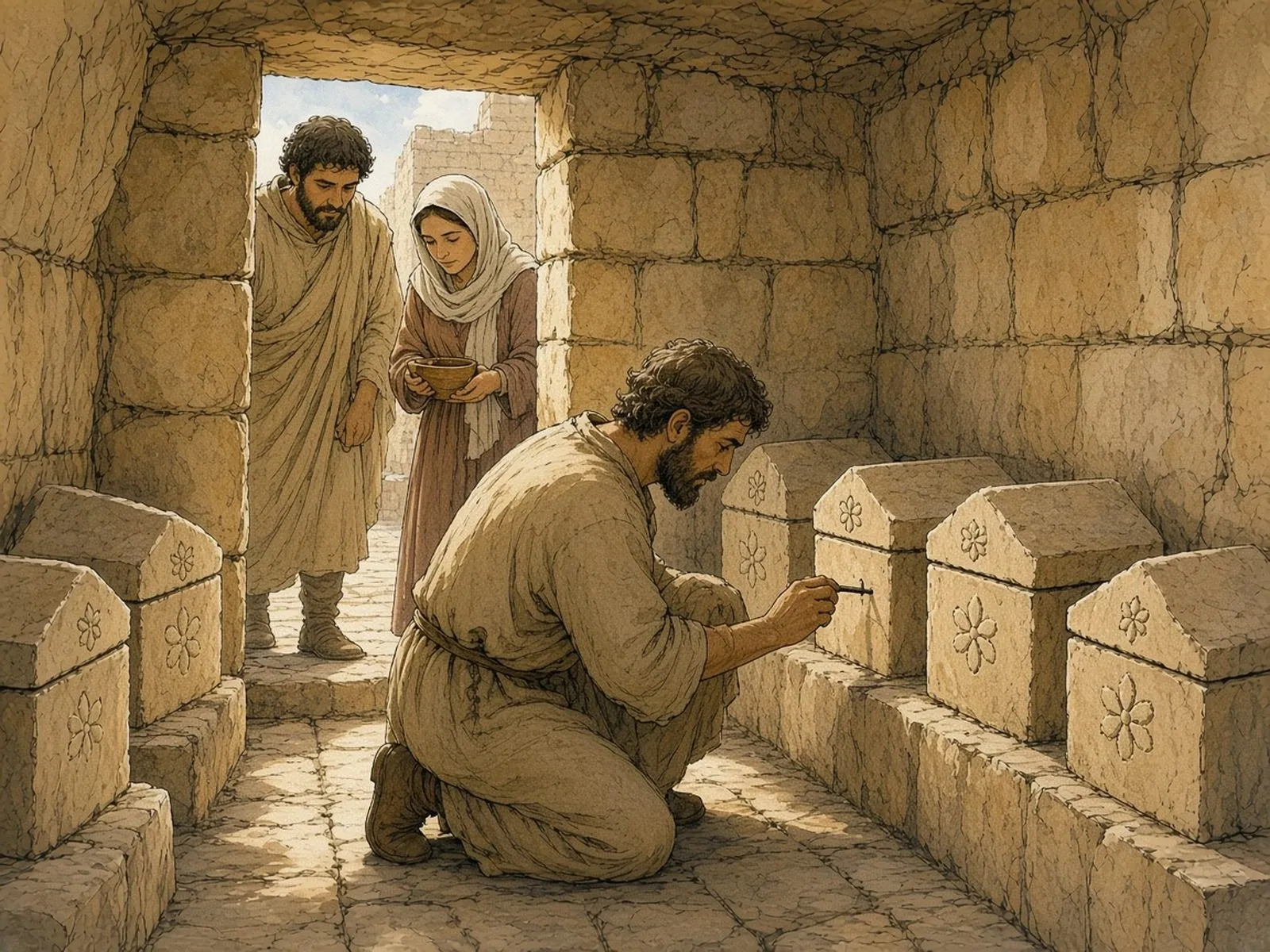
This chapter looks at that fashion and at the evidence that allows it to be measured. It begins with the extraordinary concentration of names in Hasmonean Judea, which can now be counted thanks to Tal Ilan’s lexicon, moves on to the double names that allowed Jews to live in Greek and Semitic worlds at once, and then turns to the ossuaries of Jerusalem, the papyri of Egypt, from the Persian-period garrison at Elephantine onwards, and the epitaphs of the Jewish catacombs of Rome.
The Hasmonean Name Pool
The single most important tool for studying Jewish names in this period is Tal Ilan’s Lexicon of Jewish Names in Late Antiquity, the first volume of which covers Palestine between 330 BCE and 200 CE. Ilan gathered every name she could find in the books of the Maccabees, Josephus, the New Testament, early rabbinic literature, the Judean Desert documents and thousands of inscriptions, ossuaries and coins. Her corpus has 3,595 entries, of which 2,826 met her strict criteria for statistical use. Because family names were not normally in use, the lexicon is arranged by personal name, with every known bearer listed under each, and Ilan describes it as more than a linguistic tool, a historical record in its own right[78][19].
Her central finding was that the principles of Jewish name giving had changed profoundly since the biblical period. The pool of names in use was very small, so that a large share of the population used only a handful of names. Of the 2,509 named men in her corpus, 1,842 bore one of 150 biblical names, so that about a fifth of the male name pool served almost three quarters of the male population. The meaning of a name seems to have mattered little, new Hebrew names were hardly being invented, and the names chosen were not those of the great heroes of the Bible[78]. Abraham, Moses, Aaron, David, Solomon and Elijah are virtually absent. Ilan found four people called Abraham in her sources, all apparently fictional, one possible Moses on a fragmentary papyrus, and none at all named Aaron, Solomon or Elijah. Names of more doubtful biblical characters, by contrast, were well represented, among them Simon and Levi, whom Jacob rebuked, Saul, Absalom, Manasseh and Menahem, and the name Ishmael occurs no fewer than thirty-one times[78]. She suggests that people may have feared dishonouring a great figure, or that a name thought too powerful might be dangerous to its bearer, and she notes that the same reluctance later appears in Christian avoidance of the name Jesus[78].
What did determine the choice was the memory of the Hasmoneans. The revolt against the Seleucid king Antiochus IV was led by the priest Mattathias of Modiin and his five sons, Yohanan, Simon, Judah, Eleazar and Jonathan, whose descendants ruled an independent Judea for nearly a century, until the Roman conquest of 63 BCE[79][80]. Their names dominate Ilan’s tables. Simon appears 257 times, Judah 179, Eleazar 177, Yohanan 128, Jonathan 75 and Mattathias 63. After removing doubtful entries, people from the period before the revolt and members of the Hasmonean family itself, Ilan counted 792 men, 31.5 per cent of all named men, who bore one of the six Hasmonean names. The second most common male name, Joseph, with 231 bearers, is not among them, but the second book of Maccabees mentions a brother called Joseph, and if he is counted as a sixth son the share of men bearing family names of the dynasty rises to almost 40 per cent[78]. Ilan reads the numbers as a glaring indication of the popularity of the revolt and of the dynasty that came out of it.
The consequences of this concentration can be felt in every source of the period. When so many men were called Simon or Judah, a personal name alone could not identify anyone, and the Gospels, Josephus and the ossuaries are full of patronymics, epithets, places of origin and nicknames that distinguish one Simon from another, Simon Peter from Simon the Zealot and Simon the leper. The same pressure explains why Ilan’s data have been used, rather to her own surprise, in debates over whether a tomb in Jerusalem might contain the bones of figures from the New Testament. A writer for Jerusalem Perspective, applying her tables to that claim, calculated that a given Jewish man of the time had a better than one in ten chance of being called Simon and about a one in eleven chance of being called Joseph, and that about a quarter of named women were called Mary in one of its forms[81].
Priestly families add a further layer. Although there were no surnames, the twenty-four priestly courses listed in the first book of Chronicles functioned as something close to hereditary designations. The first book of Maccabees takes care to place the Hasmoneans in the course of Joarib, the first in the Chronicler’s list, and Ilan records several people identified in Second Temple sources by the course to which they belonged[78][79]. The priestly courses were later commemorated in synagogue inscriptions and in Byzantine liturgical poetry, and the habit of marking priestly or Levitical descent survived in the Hebrew titles ha-Kohen and ha-Levi, which became the basis of some of the commonest Jewish surnames many centuries later.
Double Names Like Jason and Joshua
The Hasmoneans who made Hebrew names fashionable were themselves at home with Greek names. The first book of Maccabees introduces the sons of Mattathias with an epithet for each, John called Gaddi, Simon called Thassi, Judas called Maccabeus, Eleazar called Avaran and Jonathan called Apphus[79]. Their successors on the throne went further and carried Greek names as rulers. John Hyrcanus, Aristobulus I, Alexander Yannai and his widow Salome Alexandra, known in Hebrew sources as Shelamzion, all ruled under Greek names or under names that combined a Greek element with a Hebrew one[80]. The Encyclopaedia Judaica raises the possibility that it was then normal for a Jew to have two names, one Semitic and one Greek, and that this explains the epithets of Mattathias’s sons as well as the dual names of the later kings[27].
The practice was older than the dynasty, and in its earliest form it was a matter of controversy. The second book of Maccabees describes how, in the reign of Antiochus IV, a brother of the high priest Onias bought the high priesthood and set about transforming Jerusalem into a Greek city, with a gymnasium built under the citadel and a body of citizens enrolled as Antiochenes[82]. He was called Jason, a Greek name chosen for its resemblance to his Hebrew name Joshua, and his successor in the office, Menelaus, likewise bore a name from Greek legend[83][84]. For the authors of the books of Maccabees these names were badges of apostasy. For the many Jews who came after, the device of choosing a Greek name that echoed the sound of a Hebrew one became routine. Jesus was simply the Greek form of Joshua, and Jason a Greek name chosen because it sounded like it. In the Encyclopaedia Judaica’s survey, the Greek name Dositheus, gift of God, appears among the rabbis as Dostai and was understood as an equivalent of Nethanel or Jonathan, both of which mean God has given[27].
The New Testament preserves several examples of the same habit. Saul of Tarsus is described as Saul who is also called Paul, a Latin name that sounded close to his Hebrew one, and one of the candidates proposed to replace Judas among the apostles is introduced with three names at once, Joseph called Barsabas, who was surnamed Justus[85][86]. A Hebrew name, an Aramaic patronymic and a Latin cognomen thus sat together on one man in first-century Jerusalem. The first chapter of the Mishnah tractate Avot, which lists the chain of teachers who received and handed on the Torah, shows the same range in a more exalted setting. Antigonus of Sokho, a sage of the generation after Alexander, bore a Macedonian royal name, while Avtalyon, one of the pairs of scholars who led the Pharisees in the first century BCE, had a name that is probably Greek, and his colleague Shemaiah a thoroughly biblical one[87][88].
Ilan’s statistics allow the spread of Greek names to be measured. Her corpus contains 244 Greek names, which make up 29.6 per cent of the name pool and show that Jews in Palestine knew a broad range of Greek names, not just a few fashionable ones. Yet those names were borne by only 410 people, 14.5 per cent of the named population. Greek names were noticeably more common among women than among men, borne by about one woman in five against about one man in seven[78]. Some of them were theophoric names honouring Greek gods, such as Apollonius, Dionysius or Artemon, which scholars have long found surprising in a monotheistic society. Ilan compares them with biblical precedents such as Mordecai, whose name contains that of the Babylonian god Marduk, and suggests that names containing the Greek word for god, theos, such as Dositheus, Theodorus or Theophilus, may have been understood as Greek renderings of the God of Israel. They were so common among Jews in Egypt that the historian Victor Tcherikover treated them as a likely sign that their bearers were Jewish[78].
Ossuaries and the Statistics of Tal Ilan
Much of Ilan’s data comes from the ossuaries of Jerusalem and its surroundings. Between about 40 BCE and 135 CE, according to the Encyclopaedia Judaica, Jews in and around Jerusalem practised secondary burial on a large scale. The body was laid in a rock-cut tomb, and about a year later the bones were gathered into a stone chest. Many of these chests carry inscriptions scratched or written in charcoal in Hebrew, Aramaic or Greek, or in two languages. According to the Encyclopaedia Judaica, most give only the name of the deceased or a family relationship, such as mother, while a few record longer details[20]. Their brevity is what makes them useful. An ossuary inscription was written for relatives, not for posterity, and it records the name by which a person was known in the family, sometimes with a nickname, a patronymic or a place of origin.
The ossuaries confirm that the same small set of names circulated at every level of society, and they show how families managed the resulting confusion. Brothers and cousins with the same Hasmonean name could be distinguished by adding a patronymic, by specifying the town or region from which a family came, or by a nickname describing an occupation or a physical trait. These devices would later develop, in other places and periods, into the surnames of the medieval and modern worlds, but here they remained personal and unstable. A man might appear on one ossuary with his father’s name and on another with a nickname, and his son would not necessarily inherit either.
The names of women are especially revealing. Ilan’s corpus contains only 317 named women against 2,509 named men, so that women make up just 11.2 per cent of the persons recorded, and she argues that their names must be studied as a separate pool because, when a daughter was born, a completely different set of names was consulted[78]. Only about half of the women bore biblical names, compared with almost three quarters of the men, which Ilan interprets as a sign that, as in later periods, foreign names were adopted more readily for women. The concentration of names was even more extreme than among men. Mariam, in its various forms, and Salome, together with its Hebrew original Shelamzion, account for 152 women, roughly 48 per cent of the female population. Ilan notes that the only two Hasmonean women whose Hebrew names are known were Queen Shelamzion and Herod’s wife Mariamme, and leaves open whether the names were popular because the royal women bore them or the reverse[78].
Nicknames and second names also appear in the great texts of the age, sometimes with a political charge. The leader of the second revolt against Rome, between 132 and 135 CE, appears in contemporary letters as Simeon bar Kosevah or Ben Koseva. The popular name Bar Kokhba, son of the star, alluded to the verse in Numbers about a star stepping forth out of Jacob, which was read messianically, while later rabbinic tradition, disappointed by his defeat, turned his name into Bar Koziva, son of the lie[89]. In a single generation a patronymic or place name had become a messianic title and then a curse. The episode shows how readily Jews of the period heard meaning in names, even when, as Ilan argues, they paid little attention to meaning when choosing them.
Egypt, Elephantine and the Papyri
Long before Alexander, Jews had settled in Egypt, and the papyri that they left behind give the earliest documentary picture of a Jewish diaspora’s names. The best known come from Elephantine, an island in the Nile at the first cataract, where a Jewish military colony served the Persian kings in the fifth century BCE. The garrison had its own temple to the God of Israel, whom the papyri call Yahu, and its archives record contracts, letters, lists of contributions to the temple and family papers[90][18]. The personal names in these documents are overwhelmingly Hebrew and frequently theophoric, built on the same Yahu element that dominates the seals of Judah, so that the community appears as a continuation of pre-exilic Judean naming in a distant setting.
The papyri also show the limits of that continuity. The community’s worship admitted other divine names alongside Yahu, among them Anathbethel, and the Encyclopaedia Judaica notes that the military units of the garrison, the degalim, bore Persian or Babylonian names, as did the higher command[90]. Intermarriage with Egyptians is documented. One of the best-known archives concerns a woman called Mivtahyah, daughter of Mahseiah son of Yedonyah, whose marriage contract with an Egyptian named As-hor sets out the gifts she received and the terms on which either partner could end the marriage. Several scholars have inferred that As-hor became part of the Jewish community, because his sons bore the Jewish names Yedonyah and Mahseiah, the names of their mother’s father and grandfather[90]. If that reading is right, the papyri preserve one of the earliest examples of a family naming children after their forebears, the custom that was to become universal among Jews.
After Alexander, Egypt received a much larger Jewish population, concentrated above all in Alexandria. The papyri and inscriptions of Ptolemaic and Roman Egypt show these Jews using Greek names on a large scale, alongside biblical names in Greek form. It was here that names with the element theos became so common that Tcherikover could treat them as a likely indication of Jewish identity[78]. Greek-speaking Jews also translated Hebrew names into Greek rather than simply transliterating them, so that a name meaning God has given might reappear as Theodotus or Dositheus. In this way a Hebrew name and a Greek one could carry the same meaning, an approach that Jews in later centuries would apply to Latin, Arabic, German and Spanish.
Roman Diaspora Epitaphs
At the western end of the Mediterranean, the Jewish community of ancient Rome left the richest epigraphic record of any diaspora community of antiquity. Six Jewish catacombs have been found in the city, mostly along the Appian Way, among them Monteverde near the ancient Via Portuensis and Vigna Randanini, discovered in 1859[91]. Their inscriptions date from the first to the fourth century CE. The Encyclopaedia Judaica, drawing on the work of Harry Leon, records that Greek is the predominant language of the epitaphs, with Latin in Latin script becoming usual from the third century and Hebrew confined to a few formulaic words. The names are more striking still. According to the same survey, 46 per cent are Latin, 31 per cent Greek and only 13 per cent Semitic, the last group including Benjamin, Jacob, Jonathan, Judas, Rebekah and Sarah[91].
The Encyclopaedia Judaica’s article on Rome adds detail on the kinds of names involved. Many were characteristic Greek names used by Jews, such as Alexander, Theodorus, Theodotus and Zosimus. Some Latin names were translations of Jewish ones, for instance Benedicta, blessed, and Vitalis, which probably renders the Hebrew Hayyim, life, while others were ordinary Roman names such as Aurelius and Julius[92]. Double names were common, and the article on the catacombs explains them by the fact that many Roman Jews were freedmen who, on emancipation, adopted the family name of their former master[91]. Some synagogues of the city were themselves named after Roman patrons, among them those of the Augustenses, the Agrippenses and the Volumnenses, which suggests that the communities had grown out of the households of prominent Romans[92].
The Talmud remembers a sage from Rome whom the Encyclopaedia Judaica calls Josa Todros, probably Theodosius, whose name alone marks him as a man of the Greek-speaking diaspora[92]. Like the ossuaries of Jerusalem, the catacomb epitaphs show that a Jewish identity could be expressed through symbols, the menorah, the Torah ark, the etrog and the lulav, carved beside names that gave no hint of it. The pattern that emerges from Rome, Alexandria and Jerusalem is consistent. By the early centuries of the Common Era, Jews in the Greek and Roman worlds commonly bore names drawn from the languages around them, often in addition to Hebrew ones, and the rabbinic statement that the names of most Jews outside the Land of Israel resembled those of gentiles was simply an accurate description. The rabbis’ task, taken up in the next chapter, was to decide what that meant for religious law and for the meaning that a name might carry.
Rabbis, Inscriptions and the Talmudic Name
The rabbinic literature of late antiquity, the Mishnah, the two Talmuds and the midrashic collections, spans roughly seven centuries, from the generation of Simeon the Just around 200 BCE to about 500 CE, and it is full of names. The Encyclopaedia Judaica, surveying this material, warns that a distinction must be made between fact and homiletical propaganda[27]. The rabbis said a great deal about what names ought to be and what they could do, and some of their statements became the foundation of later Jewish custom. At the same time, the names of the rabbis themselves, together with the inscriptions on synagogue floors and tombs in Galilee, Babylonia and Syria, show how Jews in this period actually named their children. The two kinds of evidence do not always agree, and the gap between them is one of the most interesting features of the period.
Rabbinic Teaching on Names
The most important single statement for later Jewish practice is a short exchange in Bereshit Rabbah, commenting on the verse in which Ever names his son Peleg because in his days the earth was divided. Rabbi Yosei observes that the ancients, who knew their genealogies, gave names on the basis of events, while we, who do not know our genealogies, give names after our forebears. Rabban Shimon ben Gamliel offers a different explanation for the same contrast. The ancients, he says, had the holy spirit and could name children after events still to come, but we, who lack it, name them after our ancestors[93]. Whatever the reason, both sages describe naming after ancestors as the ordinary practice of their own time. The biblical habit of coining a fresh name for each child had given way to the inherited name, and the rabbis looked for a way to explain the change rather than to resist it.
Other passages set limits on that practice. The Babylonian Talmud, discussing the verse in Proverbs that the memory of the righteous is a blessing while the name of the wicked shall rot, has Rabbi Elazar explain that the name of the wicked rots because no one names others after them, so that it sinks into oblivion[94][95]. The passage then tells the grim story of Doeg ben Yosef, whose mother each day gave the Temple his added weight in gold, and who was eaten by her during a siege, as if to show what follows when a child receives the name of a biblical villain. Bereshit Rabbah makes the same point more simply, asking whether anyone has ever heard of a man calling his son Pharaoh, Sisera or Sennacherib, rather than Abraham, Isaac, Jacob, Reuben or Simeon[96]. Elsewhere in the same collection Rabbi Yosei bar Hanina divides names into four kinds, fair names with fair deeds, foul names with foul deeds, foul names with fair deeds and fair names with foul deeds, and gives Esau and Ishmael as examples of the last, men whose names promised more than their actions delivered[97].
The awkwardness of this teaching is that Ishmael was a common name among Jews of the period, borne by famous sages such as Rabbi Ishmael and Rabbi Ishmael ben Elisha. The Encyclopaedia Judaica notes that later commentators, the Tosafists, explained the anomaly by the tradition that Abraham’s son Ishmael had repented before his death. Where a name was felt to be truly tainted, it was altered. A judge in Jerusalem mentioned in the Mishnah is called Hanan ben Avishalom rather than ben Absalom, and the Encyclopaedia Judaica sees in the variant form a deliberate softening of the name of David’s rebellious son, of whom the Talmud says that he has no share in the world to come[98][27]. Here, as with the bosheth names of the books of Samuel, scribes and teachers were willing to adjust a name rather than let it carry an unwelcome association.
A positive counterpart to this avoidance was the naming of children in honour of living teachers and benefactors. The Talmud tells of a woman in the coastal towns whose first two sons had died after circumcision. Rabbi Natan advised her to wait until the third child’s colour had settled before circumcising him, the child survived, and he was called Natan the Babylonian after the sage[99]. In another story, the many children born after Rabbi Elazar son of Rabbi Shimon declared doubtful blood samples pure were all called Elazar in his name[100]. Naming a child after a living person, a practice that later Ashkenazi custom came to avoid, is here a straightforward expression of gratitude. Avot de-Rabbi Natan makes a related observation in a homily on peace in heaven. God, it says, did not call ten angels Gabriel or ten Michael, as human beings call ten men Reuben, ten Simeon, ten Levi and ten Judah, so that the angels would not be jealous of one another[101]. The image assumes, as a fact of everyday life, that Jewish communities were full of people with the same few names.
The most consequential rabbinic statement about names concerns their power. In a saying of Rabbi Yitzhak listing four things that can tear up a harsh decree against a person, the Talmud places a change of name beside charity, prayer and a change of conduct, and supports the point with the renaming of Sarai as Sarah[68]. A homily in the Midrash Tanchuma urges that a person should examine names in order to give a son a name worthy of a righteous man, because the name sometimes contributes to good or ill, and the Encyclopaedia Judaica cites the passage as an example of the rabbinic belief that a name helps to shape a life[27][102]. These ideas would be developed much later by kabbalists and by the authors of medieval ethical works, and they underlie the custom, discussed in a later chapter, of giving a dangerously ill person a new name.
Galilean Synagogue Dedications
The synagogues built in Galilee and elsewhere in the Land of Israel between the fourth and seventh centuries were often paved with mosaics that included inscriptions naming the donors and craftsmen. These texts are among the best evidence for the names of ordinary Jews in late antiquity, because they record people who were neither rabbis nor kings. At Bet Alfa in the Jezreel Valley, two inscriptions were found at the entrance to the prayer hall. One, in Aramaic, dates the mosaic to the reign of an Emperor Justin, almost certainly Justin I in the early sixth century, and the other, in Greek, names the mosaicists as Marianos and his son Hanina[103]. A father with a Greek name and a son with a Hebrew one, working together on a floor depicting the binding of Isaac and the signs of the zodiac, sum up the bilingual world of Byzantine Galilee.
At Hammath near Tiberias, an earlier synagogue floor with a celebrated zodiac and a figure of the sun god Helios carries inscriptions in Greek and one in Aramaic commemorating several donors, among them a certain Severus described as the pupil of the most illustrious patriarchs[104]. The name is Roman, the title of his patrons is the Greek honorific given to the rabbinic patriarchs of the house of Hillel, and the inscription is set in a building whose decoration owed much to Greco-Roman art. Far to the east, at Dura-Europos on the Euphrates, the synagogue whose painted walls are among the great discoveries of twentieth-century archaeology has a Greek inscription commemorating its construction by Samuel son of Idi, elder of the Jews, with the help of other members of the congregation, while tiles from the ceiling bear dated donors’ inscriptions in Greek and Aramaic[105]. The Encyclopaedia Judaica concludes from them that the congregation was presumably bilingual.
Burial inscriptions tell the same story. The necropolis of Bet She’arim in Lower Galilee, where Rabbi Judah the Patriarch was buried, served Jews from across the Land of Israel and the diaspora. According to the Encyclopaedia Judaica, its epitaphs generally give only the name of the deceased and a patronymic or other family descent, with a word of affection or praise. The Hebrew inscriptions read, for instance, Shalom to Judah, or This tomb is of Rabbi Isaac bar Makim, shalom, but there are 218 Greek inscriptions, and Greek was apparently the common language of the Jews buried there. Pure Greek names stand beside Hebrew names transliterated into Greek, and a Greek verse epitaph speaks in the voice of a learned young man, Justus son of Leontius, who lies there with many of his people and laments his home town of Besara[106]. The catacomb in which members of the patriarchal family and other sages were buried, by contrast, has inscriptions almost entirely in Hebrew, a sign that the rabbinic elite marked its identity in death through language as well as through names.
Babylonian Aramaic Names
In Babylonia, where the larger Talmud was composed, Jews lived under Parthian and then Sasanian Persian rule and spoke Jewish Babylonian Aramaic. The names of the Babylonian sages, the amoraim, reflect this setting. Some are biblical in Aramaic dress, such as Yosef, Yitzhak or Nahman, others are characteristically Aramaic short forms or nicknames such as Huna, Hisda, Papa, Zeira and Abbaye, and still others, such as Rav, Rabbah and Rava, look like forms of the rabbinic title itself. The Encyclopaedia Judaica warns that it is not easy to identify all the amoraim in the Talmud and Midrash, because the same sage often appears under different names while two sages from different generations may bear the same one, and many names were transmitted incorrectly[107]. Family names of a kind already appear in such patronymics, as when the Encyclopedia of Religion describes Abbaye as the pupil of his uncle Rabbah bar Nahmani, whose name records a father rather than a place or a trade[108].
The Talmud also shows that Babylonian Jews could bear names that sounded thoroughly Persian or Aramaic. In discussing whether bills of divorce signed by witnesses with gentile names are valid, the Babylonian Talmud gives Rav Pappa’s examples of unambiguously gentile names, Hurmiz, Abbudina, bar Shibbetai, bar Kidri, Bati and Nakim Una[109]. The point of the passage is that such names were not normally borne by Jews, which implies that other non-Hebrew names were. The parallel discussion on the following page explains that documents from abroad signed with names like those of gentiles are nevertheless valid, because the names of most Jews outside the Land of Israel are like those of gentiles, while in the Land of Israel the same ambiguity was a reason for caution[12]. Rabbinic law thus accommodated, and in a sense codified, the coexistence of Jewish and gentile names in the diaspora.
The rabbis of Babylonia also took a special interest in names in documents that could affect personal status. The tractate Gittin reports a woman in Babylonia known in one place as Miriam and in another as Sarah, and a question sent from the diaspora to Rabban Gamliel about a man known as Joseph in the Land of Israel but by a different name in Babylonia[14][27]. Cases like these explain why later codes of Jewish law devote so much attention to the exact forms of names in a bill of divorce, a subject that occupies whole sections of the medieval and early modern literature and that, as later chapters show, became one of the most reliable sources for the history of Jewish names.
Gentile Names Among the Sages
The names of the rabbis themselves confirm what the inscriptions suggest. The Encyclopaedia Judaica observes that almost every type of later Jewish nomenclature can already be found in the short list of the pairs of scholars and their fathers in the first chapter of Avot. It contains biblical names such as Simeon, Joshua and Judah, Hebrew names that occur in the Bible without belonging to its heroes, such as Hillel, Gamliel, Yohanan and Yoezer, the purely Greek names Antigonus and Avtalyon, Aramaized forms such as Yose for Joseph and probably Tabbai for Tobiah, and what appears to be a purely Aramaic name, Nittai[27][87]. Fathers with Greek names had sons with Hebrew ones, as with Eliezer son of Hyrcanus, and the reverse also occurs, as with Dostai son of Judah[27]. The same article reads the rabbinic praise of the Israelites in Egypt for keeping their names, discussed in the previous chapter, as a homily rather than a description, an appeal to retain or give Hebrew names at a time when the tendency to adopt foreign ones was strong. It reports, too, the suggestion of the nineteenth-century scholar Leopold Zunz, which it calls somewhat casuistical, that the rabbis objected only to exchanging a Hebrew name already given for a gentile one, a sign of deliberate assimilation, and not to giving a child a non-Jewish name in the first place[27]. Either way, the sages’ own families show that Greek and Aramaic names were no bar to learning or piety.
The family of Rabbi Yose ben Halafta, one of the leading sages of the second century, illustrates the range within a single household. The Babylonian Talmud records that he spoke of having planted five cedars in the Land of Israel, his sons Ishmael, Elazar, Halafta, Avtilas and Menahem, and then explains that a sixth name sometimes attached to the family, Vardimas, belonged to Menahem and was given to him because his face was as beautiful as a rose, vered[110]. The Jerusalem Talmud gives a slightly different list[111]. Three of the sons had biblical names, one bore the Aramaic name of his grandfather, Halafta, and one had a Greek name, while the play on Vardimas turns a probably Greek name into a Hebrew compliment. Rabbi Yose, who in Bereshit Rabbah describes his own generation as naming children after their forebears, did exactly that with his son Halafta[93].
The Encyclopaedia Judaica counts eight further talmudic examples of the same custom of giving a child the name of an ancestor. The best known is the dynasty of Hillel, in which the same few names, above all Gamliel and Simeon, recur over many generations of patriarchs. Another is the son of Rabbi Eliezer ben Hyrcanus, who bore his grandfather’s name Hyrcanus and appears in a story about the straps of his phylacteries[112]. The encyclopedia also records the older view of the nineteenth-century scholar Leopold Loew that the custom had been learned from the Greeks[27]. Whatever its origin, it was well established by the rabbinic period, and it laid the foundation for the Ashkenazi and Sephardi customs described later in this essay.
Equally striking is what the rabbinic onomasticon lacks. The Encyclopaedia Judaica points out that not a single rabbi is known by the name of Moses, Abraham, Israel, David or Solomon. The name Moses occurs only once in the whole of talmudic literature, borne by a certain Moshe bar Atzari whose son Rav Huna appears in a discussion of marriage contracts, and Aaron is borne by only two amoraim[27][113]. Among the sons of Jacob, Simeon and Judah were preferred, with Levi and Joseph popular among the amoraim, while Dan, Gad and Asher do not occur at all. Of the fifteen prophets whose books are in the Bible, only a few gave their names to rabbis. Zechariah is the only one that occurs with any frequency, borne by three tannaim and two amoraim, and Haggai appears together with the short form Hagga, while Isaiah, Hosea, Joel, Amos, Obadiah, Micah, Habakkuk, Zephaniah and Malachi do not appear[27]. Where a prophetic name does become popular, the Encyclopaedia Judaica suspects that something other than the prophet was being honoured. Nahum is frequent, but so are Nahman, Tanhum and Tanhuma, which share its root, and the encyclopedia concludes that it was the meaning, comfort, that recommended the name. Jonah, which is found only among the amoraim, may owe its appeal to the many homilies of that period that identified the dove, yonah in Hebrew, with Israel[27]. The rabbinic pattern thus confirms Ilan’s finding for the earlier period. The great names of the Bible were not yet the common property of every Jewish family. Ilan suggests that the mechanism behind this restraint was a belief that the use, or misuse, of a name could dishonour its original bearer, and she contrasts it with Islam, where a completely different mechanism made Muhammad the most popular name of all[78]. The great biblical names became common Jewish property only later, in the Middle Ages, a change traced in the next chapter.
From the Geonim to Medieval Ashkenaz and Sefarad
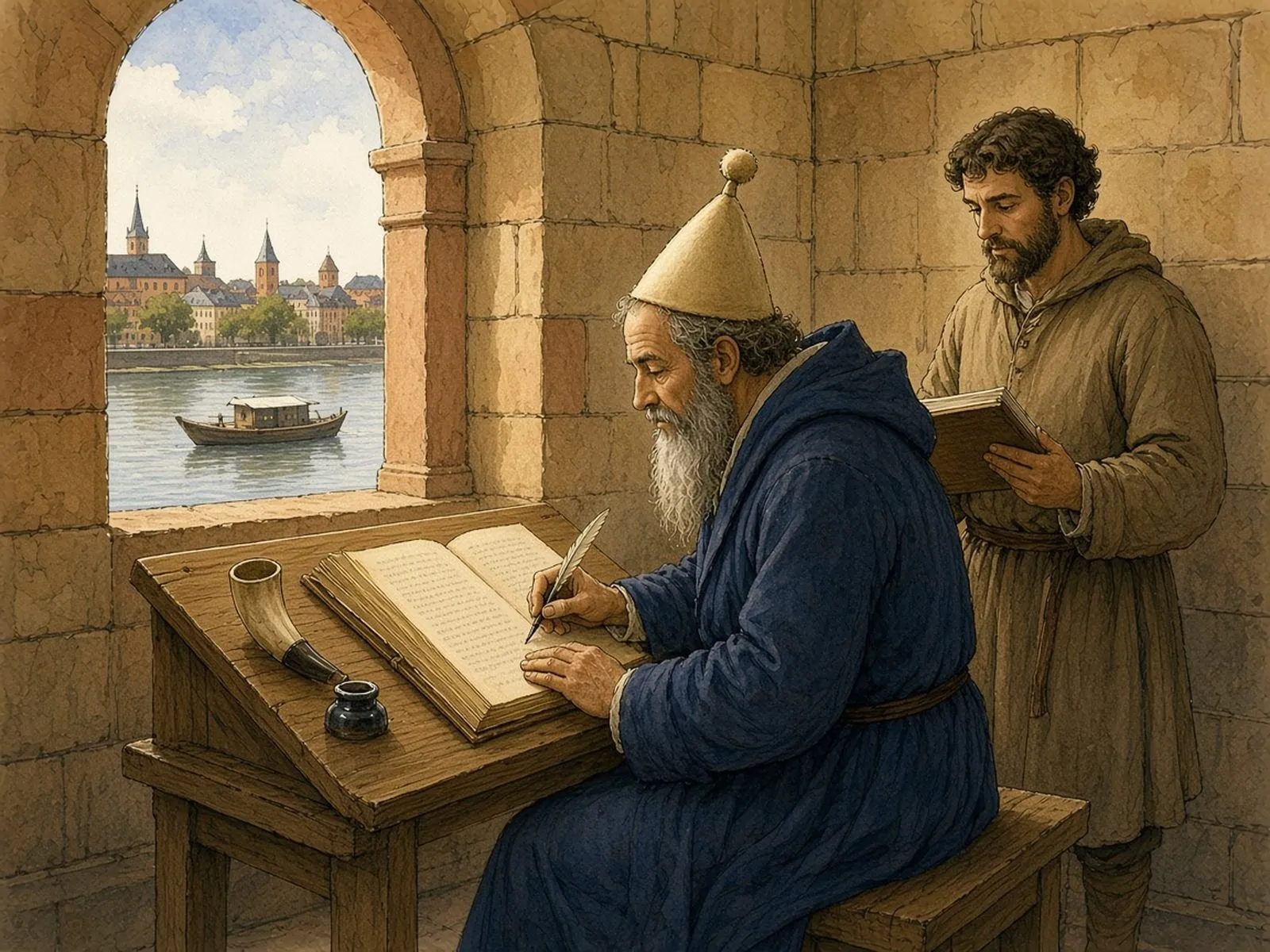
Between the end of the talmudic period and the expulsions of the late Middle Ages, the Jewish world divided into regions that would shape Jewish naming for the next five centuries. Most Jews lived under Islam, in a broad band of cities from Iraq through Egypt and North Africa to Spain, and spoke and wrote Arabic. Smaller communities grew up in the Christian lands of Italy, France, the Rhineland and England, and spoke the Romance and Germanic vernaculars of their neighbours. The Encyclopaedia Judaica summarises the result in a sentence. Jews retained a preference for Hebrew forenames throughout the Middle Ages, but those names were readily adapted to the language of the surrounding society, so that in the Arab world Abraham became Ibrahim and David became Dawud, in Greek lands Joseph became Iosiph, and in the Latin West Moses became Moyses and Hayyim became Hagin[27]. Out of these adaptations, and out of the bynames that grew up beside them, came most of the Jewish surnames still in use.
Genizah Letters and Arabic Kunyas
The richest evidence for names in the Islamic world comes from the Cairo Genizah, the synagogue storeroom in which Egyptian Jews deposited their worn-out writings over many centuries. The Encyclopaedia Judaica explains that such a store was needed because books and objects bearing the name of God could not be destroyed, and that the discarded pages, since they contained the Divine Name, were themselves known as shemot, names[114]. The Taylor-Schechter collection at Cambridge University Library alone holds some 193,000 manuscript fragments, mainly in Hebrew, Judeo-Arabic, Aramaic and Arabic, and the library stresses that alongside literary and sacred texts they preserve a huge number of personal letters, legal deeds and other documents[115]. These papers record the names of merchants, physicians, scribes, widows, slaves and children in a way no literary source can.
The pattern they reveal is a double one. A man might bear a Hebrew name for religious purposes and an Arabic one in the market, and the Encyclopaedia Judaica gives as typical pairs Eleazar with Mansur and Yefet with Hasan, alongside Greek and French equivalents from other regions[27]. The Jewish Encyclopedia of 1906 observes that Arabic-speaking Jews adopted local names such as Hassan, Abdallah and Sahl, or translated Hebrew names into Arabic, so that Eleazar, God has helped, became Mansur, the one given victory, and Matsliah, the one who prospers, became Maimun. Masud, fortunate, served as an equivalent of Baruch, and Abbas, lion, corresponded to Judah, the tribe whose emblem was the lion[1]. Unlike the Jews of Christian Europe, who never used their non-Hebrew names for religious purposes, the Jews of the Islamic world, according to the Encyclopaedia Judaica’s survey of Judeo-Arabic culture, used their Arabic names in the synagogue and in marriage contracts as well[116].
The most distinctive feature of Arabic naming was the kunya, a byname that identified a man as the father of his first son. The Encyclopaedia Judaica describes it as a special Arabic usage, the identification of the father by his firstborn, while the Jewish Encyclopedia adds that some kunyas became conventionally attached to particular Hebrew names, so that Abu al-Walid served as a byname for Jonah[27][1]. A kunya of this conventional kind did not depend on the birth of a son at all, so that a single individual could carry a personal name, a patronymic and a kunya at the same time, each chosen by a different logic. Jewish women in the same world bore Arabic names more often than their husbands did. The Encyclopaedia Judaica lists Masuda and Sultana among popular female forenames and observes, for the Middle Ages generally, that the range of non-Hebrew names was broader and the proportion of their bearers higher among women than among men[27]. Women had no ritual role that required a Hebrew name, and families were freer to choose for daughters names that expressed hopes for happiness, beauty or good fortune in the language of everyday life.
Place of origin supplied another layer. In the Arab world, the Encyclopaedia Judaica notes, names derived from locality were especially favoured, and its examples are the legal authority Isaac Alfasi, the man from Fez, and Saadiah al-Fayyumi, the man from the Fayyum in Egypt[27]. Saadiah, who lived from 882 to 942, left his native Egypt and was appointed gaon of the academy of Sura in Babylonia[116], yet he is still known by a name that records his Egyptian birthplace, a reminder of how far scholars and merchants travelled across the Islamic world and how their names travelled with them.
Ibn and Nisba in al-Andalus
In Muslim Spain the patronymic with ibn, son of, gave rise to what the Jewish Encyclopedia calls the first true Jewish family names. Ibn Aknin, Ibn Danan, Ibn Latif, Ibn Migash and Ibn Verga are among the best known of them, and the same source points out that abu could also form family names, as in Abudarham and Aboab, and that the Arabic article al appears in names such as al-Harizi[1]. Some of these names show how a byname became fixed. Ibn Danan, son of Danan, passed into Spanish as Abendana, and the same encyclopedia records other hispanicised forms such as Abeldano for Ibn el-Danan, Abencabre for Ibn Zabara and Avinbruch for Ibn Baruch[1]. The Encyclopaedia Judaica notes that the patronymic was readily adapted from the Hebrew ben to the Arabic ibn and the French fils, but only in the Arabic-speaking world did it harden so early into a hereditary family name[27].
The other main source of bynames in al-Andalus was the nisba, the adjective of origin or affiliation formed with the suffix -i. Al-Harizi, al-Fasi and al-Fayyumi belong to this class, and the Jewish Encyclopedia gives al-Haruni, the Aaronide, as an Arabic equivalent of Cohen, borne by families of priestly descent[1]. The same list, drawn from Moritz Steinschneider’s catalogue of eight hundred Arabic names published in the Jewish Quarterly Review, includes Ghayyat, Ibn Zabara, Ibn Zimra and Ibn Waqar, names that became famous in the history of Hebrew poetry and scholarship. Steinschneider also noted names derived from trades, such as Najar and Najara for carpentry, and the Jewish Encyclopedia mentions with appropriate caution the suggestion that the name of the Kimhi family of grammarians might be read as Arabic qamhi, made of wheat, rather than as Hebrew[1].
When the Christian kingdoms of the north absorbed the former Muslim territories, these names entered Castilian and Catalan records, sometimes in strange spellings. The Jewish Encyclopedia notes that Isaac appears as Acaz, Cohen as Coffen or Coffe, and that Hebrew names could be rendered by translation as well as transliteration. Yom Tov, good day, became Bondia, and Tsemah, growth, became Crescas, a name that remained in use among Spanish and Provencal Jews. The Hen family of Barcelona appears to have translated into Hebrew the name of its home village, Gracia, since hen means grace, and the tendency to take family names from places produced names such as Gerondi, from Girona, and Cavalleria[1]. The Encyclopaedia Judaica adds that local surnames became particularly widespread after the expulsions, when Jews, both for ease of identification and out of nostalgia, took names recalling their former homes, so that in the Ottoman Empire after 1492 names such as De Leon, D’Alvo, Zamora and Toledano abounded[27]. These Sephardi names are the subject of a later chapter, but their roots lie in the onomastic habits formed in Muslim and Christian Spain.
Spain also produced its share of literary names. The Encyclopaedia Judaica points out that acronyms built from a title and a name, such as Rambam for Rabbi Moses ben Maimon, and names taken from a famous book, such as the Tur for Rabbi Jacob ben Asher or the Rokeah for Rabbi Eleazar ben Judah, could almost entirely obscure an author’s given name and surname[27]. A scholar might thus be known to posterity by four or five different designations, Hebrew, Arabic, Spanish, acronymic and bibliographic, each used by a different audience.
Rhineland Names and the Romance Vernacular
The Jewish communities of northern France and the Rhineland, whose descendants became the Ashkenazim, used a smaller stock of names, but they too adapted them to their surroundings. The Jewish Encyclopedia observes that biblical names appear to have been used more widely in France than elsewhere, judging from the lists at the end of Henri Gross’s Gallia Judaica, and that in the south of France true surnames such as Abigdor, Farissol and Bonet occurred, while local designations such as Samson of Sens were the rule in the north. In England, whose Jews spoke French throughout their stay, Isaac was the most popular name in the twelfth century and Joseph the next[1]. On both sides of the Channel, the same article notes, Jews translated biblical names into French, producing Deulesalt for Isaiah, Serfdeu for Obadiah and Deudone for Elhanan, and adopted ordinary French names such as Beleasez, Fleurdelis and Muriel for women and Amiot, Bonevie, Bonenfaund and Bonfil for men[1].
The Encyclopaedia Judaica gives similar pairs from the Latin West, Mattathias with Dieudonne, God-given, Jehiel with Vivant, living, and Hayyim with Vital, all of them translations or near-translations of the Hebrew. Its prime example of a double designation is the thirteenth-century leader of French Jewry who was known in Hebrew as Rabbi Jehiel of Paris, after the city of his adult activities, and in French as Vivant of Meaux, after his birthplace[27]. Among French and German Jewish women the encyclopedia lists Angelique, Fleurette and Precieuse as popular names, French counterparts of the Arabic Masuda and Sultana[27]. In each case a name chosen for its pleasant meaning in the vernacular stood alongside, or in place of, a Hebrew name used for religious purposes.
The Rhineland communities of Mainz, Worms and Speyer, which the medieval rabbis called Ashkenaz, a biblical name that they applied to Germany[117], were dominated by a few learned families whose names recur across the generations. The most famous was the Kalonymus family. The Encyclopaedia Judaica records the family tradition that its ancestors came from Lucca in Lombardy and were settled in Mainz by a king called Charles, and it warns that because the same names recur in different cities and generations, members of the family are very easily confused[118]. The name Kalonymus itself appears in talmudic literature as that of the father of Onkelos the translator, and it was borne in Provence by scholars, such as Kalonymus ben Kalonymus of Arles, who were not necessarily related to the Rhineland family[118]. Recurring names within a single lineage, a habit familiar from the house of Hillel, became one of the hallmarks of the scholarly families of medieval Ashkenaz.
The German-speaking Jews also took up German names. The Jewish Encyclopedia lists Bernhard, Bero, Eberhard, Falk, Gumprecht, Liebreich, Susskind, Weiss and Wolf among those found in the early Middle Ages, and it notes the popularity of compounds in -mann, such as Lipman and Seligman[1]. Some of these, like Wolf, would later be paired with Hebrew names to form the double names described in a later chapter. The violence of the First Crusade in 1096, which struck the Rhineland communities, also produced a new kind of name list. The Encyclopaedia Judaica explains that the custom of reading out the names of the dead in the synagogue developed after those massacres, and that the Memorbuch of Mainz, begun by Isaac ben Samuel of Meiningen in 1296, became the model for the memorial books of other communities[119]. Its lists of martyrs, later extended to victims of the Rindfleisch massacres and the Black Death, are among the most important sources for the names of medieval German Jews.
Crossing the boundary between communities was itself marked by a change of name. The Encyclopaedia Judaica notes that conversion into or out of Judaism was almost always accompanied by a symbolic renaming. Those who entered the Jewish faith most often took the names Abraham and Sarah, after the first patriarch and matriarch, while Jews who left it in Christian Europe took names such as Paul, Christian and Mary or adopted the names of the prominent churchmen or nobles who sponsored their baptism[27]. The same survey traces how bynames based on occupation, such as those of physicians, printers, masons, tailors, dyers and minters, and on physical or moral traits such as size, age, complexion, honesty and piety, gradually crystallised over the later Middle Ages into family names passed from one generation to the next[27]. That process was slow and uneven, and among Ashkenazi Jews, as later chapters show, it was completed only under state compulsion.
Sefer Hasidim and the Rules of Naming
The circle of German pietists known as the Hasidei Ashkenaz produced the first systematic body of rules about Jewish names. Its central figure, Judah ben Samuel he-Hasid, belonged to the Kalonymus family. The Jewish Encyclopedia records that his grandfather Kalonymus was a scholar and communal leader in Speyer who died in 1126, that Judah left Speyer for Regensburg around 1195, and that he died in February 1217. His principal work is Sefer Hasidim, the Book of the Pious, a sprawling collection of moral and practical guidance[120]. Among its many instructions are several that concern names, and they became, through the centuries of Ashkenazi life that followed, the source of some of its most persistent customs.
One passage in the Sefer Hasidim contrasts Jewish and gentile naming directly. Gentiles who name their children after their fathers, it says, do nothing objectionable, but Jews take care not to do so, and there are places where they do not name their children after the living but give them the names of those who have already died[121]. This is an early statement of what became the Ashkenazi rule against naming a child after a living parent or grandparent, which the next chapter explores. The Jewish Encyclopedia lists further rules attributed to the same work. People of the same name should not live in the same town or allow their children to marry into each other’s families, a man should not marry a woman with the same name as his mother, or should require her to change it, and a dangerously ill person may change his name in the hope of baffling the Angel of Death, who summons people by name[1].
Many of these prescriptions reappear in an ethical will attributed to Judah he-Hasid, though the Jewish Encyclopedia regards his authorship of it as doubtful. The testament, printed in 1583 and later translated into Judeo-German, contained regulations about the dead, the building of houses and matrimony, prohibitions on certain marriages between step-siblings and cousins, and a range of further customs and superstitious prescriptions[120]. Later Ashkenazi rabbis argued over how far its rules were binding, but in matters of naming they shaped popular practice for centuries. The emphasis on names as carriers of fate, which goes back to the rabbinic sayings of late antiquity, was in this way turned into a set of everyday precautions.
Get Lists and the Laws of Divorce
The most technical medieval writing about names concerned the get, the bill of divorce. Because an error in the name of either party could invalidate a get, and with it any subsequent marriage, rabbis took great care to record names exactly. The Jewish Encyclopedia observes that particular care is required in writing names in legal documents, the slightest error invalidating them, and that this concern produced a whole literature of monographs on names, both personal and geographical, beginning with one by Simhah Cohen, the best known being the Tuv Gittin, which the encyclopedia associates with Samuel ben Phoebus and Ephraim Zalman Margulies[1]. These works list the standard spellings of personal names and of the rivers and towns by which the place of writing was identified, and they are among the best sources for the forms that names actually took in different regions.
The rules they apply were summed up in the sixteenth-century code, the Shulchan Arukh. It requires that the names of the man and the woman be written in the get, and that if either has two names, the scribe write the name by which the person is usually called and most widely known, adding the phrase “and all names that he has” or “and all names that she has”[15]. If the scribe writes a name other than the familiar one, relying on such a general phrase, the get is invalid, and if he changes the person’s name altogether, no general phrase can rescue it. A man known by one name in one place and by another elsewhere should, according to the same chapter, preferably write all of his names, or the name used where he and his wife live together with a phrase covering the rest[15].
The code also deals with apostates and with nicknames. An apostate should be divorced under his Jewish name rather than his gentile one, and the glosses of the Ashkenazi authority known as the Rema add that a nickname acquired while the man was still Jewish should be written after his Jewish name with the phrase “who is called”[15]. A man known as Reuven who is also called Shimon should be written in exactly those words, and the order of names and nicknames could decide whether a get was valid[15]. All of this presupposed a world in which most Jews had at least two names, one Hebrew and one vernacular, and in which those names varied from town to town. The laws of the get, which began with the talmudic cases of Joseph and Johanan or Miriam and Sarah, thus became over the centuries a running register of the double names of the Jewish diaspora.
Ashkenazi Naming After the Departed
Of all the customs surrounding Jewish names, none is better known or more deeply felt than the Ashkenazi practice of naming a child after a relative who has died. Most Jews of Central and Eastern European descent can trace their own names to a grandparent or great-grandparent, and many can recite the chain of namesakes that stretches back through their family for several generations. The custom has no basis in a biblical commandment, and the codes of Jewish law treat it as a matter of custom rather than obligation, yet it has proved more durable than many binding rules. It survived the move from Yiddish to German, Russian, English and Hebrew, the abandonment of religious practice by millions of Jews, and the destruction of the communities in which it took shape. This chapter traces its roots, the reasons that have been given for it, the strict avoidance of the names of the living that accompanied it, the inventive ways in which immigrant families kept it alive, and the limits that tradition set on whose names could be passed on.
Memory Embodied in a Child
The idea that a child might carry the memory of a dead relative is very old. The Encyclopaedia Judaica’s account of biblical names describes a whole class of what scholars call substitute names, in which the bearer was felt to replace a deceased relative or to bring him back to life. Jashub, he has returned, and Eliakim, God has raised up, belong to this group, and the encyclopedia observes that in such names the praise of the dead simultaneously keeps their memory alive. It also stresses that this ancient idea, rooted in the structure of tribe and clan, did not depend on any belief in the transmigration of souls[27]. The rabbinic sages, as an earlier chapter showed, already took it for granted that children were named after their forebears, and the Talmud preserves several examples of a grandson bearing his grandfather’s name.
What distinguished the Ashkenazi custom was its insistence that the namesake be dead. Alexander Beider, writing in the YIVO Encyclopedia of Jews in Eastern Europe, states that the custom of calling children after deceased relatives existed in German lands by the Middle Ages and was reinforced over the centuries, and he places it within a general and older Ashkenazi tradition from which East European practice grew[11]. The YIVO article on the Jewish life cycle confirms that it was common in Eastern Europe to name a child after a deceased grandparent or ancestor. It adds that boys were named publicly at their circumcision, while girls received their names when their fathers were called up to the Torah in the synagogue soon after the birth, and that a circumciser might keep a record of the names and dates of the boys he had circumcised[122]. Such registers, where they survive, are among the most valuable sources for the history of Ashkenazi names before the age of civil registration.
Many explanations have been offered for the custom. The custom has no codified rules, as one widely read essay points out[123], and the explanations given for it vary. The most common modern one appears in that same essay, first published in an anthology on Jewish rites of passage edited by Rela M. Geffen and now reprinted by My Jewish Learning. It suggests that parents hope that a child who receives the name of an admired family member will emulate the virtues of the deceased, and that, to a certain extent, the soul of the loved one is believed to live on in the child who bears the name[123]. A more mystical formulation appears in a guide to naming published by Aish, which speaks of a metaphysical bond between the soul of the baby and that of the relative and describes the naming as an honour to the dead, whose soul can be elevated by the good deeds of the namesake[124]. A rabbinic answer on the Din Online site adds the commandment to honour one’s parents, since naming a child after a grandparent is also a way of honouring the child’s own father or mother, and notes that, according to kabbalistic sources, there may be a connection between the soul of the named and the soul of the person named after[125].
Whatever its theological gloss, the custom gave each Ashkenazi family a store of names that belonged to it. A newborn’s name announced whose memory the parents chose to keep, and the choice could be the occasion of delicate negotiations between the two sides of a family. Beider points out that the double names that became extremely common in nineteenth-century Poland, where in some communities more than 40 per cent of children received two names, allowed parents to commemorate two deceased relatives at once[11]. A child named Khaye Feyge or Avrum Leyb might thus carry the memory of both a maternal and a paternal grandparent, and the arrangement settled disputes that a single name would have left open.
The custom also shaped the way names were written down. Because a child usually carried both a Hebrew name taken from a dead relative and one or more everyday names, a single person might appear under quite different names in different records. The JewishGen Given Names Data Bases, compiled by the late G. L. Esterson of Ra’anana, were designed to help genealogists discover all the alternative Jewish and vernacular names an ancestor may have used in Europe and in the country to which he emigrated[24]. Esterson illustrated the problem with his own family tree, in which a grandfather appears as Aleksander, commonly called Ziskind, with the nickname Zisl, and his father as Jacob, whose Hebrew names were Yaakov Dov and who was known as Jake[24]. A name in an Ashkenazi family was in this sense a bundle of names, held together by the memory of the person it first belonged to.
Never After the Living
The reverse side of the Ashkenazi custom was a strong aversion to naming a child after anyone still alive. The Sefer Hasidim, as noted in the previous chapter, already contrasts gentiles who name their children after their fathers with Jews who take care not to do so[121]. By the early modern period the rule had become one of the most widely observed in Ashkenazi life. Fathers did not give their sons their own names, grandparents were not honoured with namesakes while they lived, and families went to considerable lengths to avoid any repetition that might seem to anticipate a death.
Several reasons were given. The Jewish Virtual Library summarises the popular belief that the Angel of Death might mistake an infant for an adult with the same name and take the wrong one, and a further belief that using the name of a living relative might rob that person of his soul, since the name was so closely tied to it[126]. The same fear of confusion underlies the rule, recorded by the Jewish Encyclopedia, that it was considered unlucky in Russia for a father-in-law to share his name with the bridegroom, and the guidance in the pietist literature that a man should not marry a woman whose name was the same as his mother’s[1][11]. Beider observes that such pietist rules were not universally observed, but the underlying anxiety about two living people sharing a name in the same family remained a powerful force[11].
The prohibition could create genuine dilemmas. A guide on Aish addresses the case of parents who wish to use the name of a deceased relative when a living relative bears the same name. If the living relative is closely related to the baby, a parent, grandparent or sibling, the guide advises against the name, and otherwise it permits it[124]. Families in which the same few names recurred, such as Moyshe or Sore, often found themselves balancing the wish to honour a beloved grandparent against the fear of seeming to wish an uncle or aunt dead. In such circumstances the solution was frequently to add a second name or to choose a variant form, and the double names of Eastern Europe owe something to these compromises.
The contrast with Sephardi practice could hardly be sharper. My Jewish Learning notes that Sephardim usually name their children after a grandparent, living or dead, and that many Sephardi grandparents look forward to being honoured by grandchildren who bear their names while they are still alive to see it[123]. What one community regarded as a dangerous provocation, the other treated as one of the highest honours a family could bestow. The Sephardi custom and the names it produced are the subject of a later chapter. Here it is enough to note that both traditions claimed to be honouring the older generation, and that both used the same Hebrew names, and the difference between them lay entirely in the question of timing.
Initial-Letter Naming in the Diaspora
When Ashkenazi Jews moved into the languages of Western Europe and America, they faced a new problem. The name of a deceased grandparent, such as Leyb, Sheyne or Zisl, often had no obvious counterpart in German or English, and parents who wanted their children to blend into the surrounding society did not want to give them a Yiddish name for daily use. The solution most widely adopted was to give the child a Hebrew or Yiddish name for religious purposes and a vernacular name linked to it by sound, by meaning or by nothing more than an initial letter.
The pattern began in Central Europe. Beider notes that from the 1830s typical German Christian names became increasingly common among Jews in the Habsburg lands, but that in many cases the new names sounded like, or translated, the Jewish names used in the same families. Arnold replaced Aron, Bernhard stood in for Ber and Barukh, and Ignatz, Isidor, Julius, Leon and Moritz corresponded to Itskhok, Isroel, Yoyel, Leyb and Moyshe[11]. The Jewish Encyclopedia, drawing on a study of given names in Berlin published in 1902, made the same observation for Prussia. Isidore stood for Isaac, Jacques and James for Jacob, Ludwig for Levi and Moritz for Moses, and Benno was used for Benjamin[1]. In the Soviet Union, Beider adds, the same principle operated in a Russian setting, so that in the generation born in the 1960s Grigorii, whose diminutive Grisha sounds close to Hirsh, Boris for Ber and Barukh, Leonid and Lev for Leyb, and Arkadii for Aron were far more common among Jewish boys than among others, and in many cases honoured deceased relatives who had borne traditional Yiddish names[11].
In the English-speaking world the link usually became phonetic and was reduced, in many families, to the first letter. The essay on My Jewish Learning describes the American pattern precisely. If parents name a child Sarah after a grandmother of that name, they are usually interested only in an English name beginning with S, so that a grandmother whose English name was something like Sadie may have a granddaughter called Samantha. The same essay notes that German-speaking Jews, by contrast, often made no attempt to connect the Hebrew and German names, so that a boy might be named Avraham in Hebrew and Franz in German[123]. Another My Jewish Learning article confirms that most American Jews follow the East European custom of linking the Jewish and English names either by sound or by meaning[127].
A vivid illustration comes from a paper by Rabbi Ben Zion Bergman published among the responsa of the Rabbinical Assembly, the association of Conservative rabbis. Discussing whether a stillborn child should be given a name, he recalled that his brother was named Leibel and that he had a whole pack of cousins named Leonard, Louis, Libby and Lillian, all of them named after their paternal grandfather, Leib Yitzchak[128]. The initial L was all that united them, yet to the family the link was obvious. Esterson’s family tree shows the same habit one generation on, for his own Hebrew names, Gershom Liber, were rendered in English as Gerald Lee, and he was known as Jerry[24]. Bergman’s concern in the same passage was that giving a stillborn child a grandparent’s name would have used up the name, since it would have seemed inappropriate to give a living child the name of one who had never lived[128].
The initial-letter convention also loosened the link between a name and the sex of its first bearer. Bergman’s cousins Libby and Lillian were named after a grandfather, a choice that would have been impossible had the family insisted on giving them his Hebrew name, and the essay on My Jewish Learning observes that Sephardim are much more punctilious than most Ashkenazim about naming a boy after a man and a girl after a woman[128][123]. In many Ashkenazi families, a granddaughter could therefore carry the memory of a grandfather, and a grandson that of a grandmother, through a shared letter or a feminine or masculine form of the Hebrew name. The flexibility helped the custom survive in small families, where waiting for a child of the right sex might mean that a beloved name was never passed on.
The same essay on My Jewish Learning notes a further twist. A child might be given the Hebrew name Yaakov after his grandfather and be called Jacob in English, even though the grandfather himself, also Yaakov in Hebrew, had been called something like Jerome[123]. The revival of interest in biblical and Israeli names among American Jews, which the essay also notes, has sometimes reversed the process of the earlier generations, restoring a direct correspondence between the Hebrew name and the everyday one. In every case, however, the underlying principle of the old Ashkenazi custom remained intact. The child carried something of a departed relative, even if it was only a letter.
Avoiding the Names of the Wicked and the Ill-Fated
The custom of naming after the dead raised an obvious question. Was every dead person’s name suitable? The rabbinic tradition had already answered in part, warning, as an earlier chapter showed, that the name of the wicked shall rot because no one names a child after them[94]. The Encyclopaedia Judaica notes that when a new name was chosen for a sick person by opening a Bible at random, names of ill repute such as Esau or Korah were skipped[129]. In the family setting, the same principle meant that a relative remembered for bad conduct would rarely be commemorated, whatever his place in the genealogy.
A more difficult question concerned relatives who had died young or by violence. Many Ashkenazi families hesitated to give a child the exact name of such a person, for fear that the misfortune might in some way pass to the new bearer. Rabbi Pinchas Waldman, answering a question on Aish, explains that some have the custom not to give a baby the precise name of a person who died young, especially one who was killed rather than dying naturally, and that some define a premature death as one before the age of sixty, on the basis of a passage in the Talmud[130]. That passage, in the tractate Moed Katan, lists the significance of death at various ages and says that dying at sixty is death at the hand of Heaven, while death at fifty-two is the death of the prophet Samuel[131]. Others, Waldman notes, reject the stricter definition precisely because Samuel and King Solomon both died at fifty-two and their names have always been popular[130].
The rabbinic literature on the question is extensive. The Din Online answer cites, among other authorities, the commentator known as the Maharshal on the fourth chapter of Gittin, the responsa of Rabbi Moshe Feinstein, the Mishneh Halakhot and the Yabia Omer, and it observes that the very number of responsa written on the subject demonstrates how widespread and entrenched the custom of naming after the dead had become[125]. Feinstein’s guidance, as summarised by Aish, is that a person who died a natural death and left children should not be regarded as having had bad fortune, but that where a person died an unnatural death the name should be altered[124]. The same guide suggests that this may be why many Jews named after the prophet Isaiah, who according to tradition was murdered, use the shorter form Yeshaya rather than Yeshayahu[124].
The most common remedy was to add a second name. Waldman advises that in such a case a family may give the child an additional name, before or after the name of the deceased, or may state at the circumcision that they are naming the child for the good qualities and values of the relative rather than for his tragically short life[130]. He adds that many authorities are lenient about naming children after victims of the Holocaust, even though they died young, since perishing in the Holocaust is no indication that a name is unsuited to a long life[130]. For families who had lost parents, siblings and grandparents in the Shoah, that leniency allowed the old Ashkenazi custom to become one of the most intimate ways of remembering them.
Yiddish Kinnuim and Double Names
For roughly a thousand years, most Ashkenazi Jews lived their lives in Yiddish. The Encyclopaedia Judaica traces the language to the tenth century, when Jews from northern France and northern Italy, speaking a Romance language they called Laaz, settled in the German-speaking territory of Lotharingia, and it states that from then until the end of the eighteenth century Yiddish was the virtually uncontested medium of oral communication among Jews from Holland to Ukraine[132]. On the eve of the Second World War, according to the Jewish Language Project, there were perhaps ten or eleven million speakers, making it the most widely spoken Jewish language[133]. Its personal names form one of the richest name systems in Jewish history, combining Hebrew, Aramaic, German, Romance and Slavic elements into a single, intricately structured corpus. This chapter looks at the two-tier system of sacred and everyday names, the paired names drawn from the blessings of Jacob and Moses, the profusion of diminutives and pet forms, and the work of Alexander Beider, whose dictionary has made it possible to trace the history of these names in detail.
Shem Hakodesh and the Calling Name
Beider, in his article for the YIVO Encyclopedia, explains that from a religious point of view all male names fell into two categories. The first were the shemot ha-kodesh, sacred names, which Yiddish called oyfruf-nemen, the names by which a man was called up to the Torah. They were given to boys at their circumcision, used when they were called to read in the synagogue, and inscribed on their tombstones, and the category included all biblical names, all postbiblical names of Semitic origin and a few names of Greek origin that Jews had borne for many centuries. The second and larger category was the kinnuim, secular names, called in Yiddish ruf-nemen, calling names. These came from languages other than Hebrew and Aramaic and included numerous vernacular, hypocoristic and pet forms[11]. Beider stresses that both kinds of name had to appear on a Jewish bill of divorce, and the laws of the get, discussed in an earlier chapter, are the reason that so much is known about them.
Women’s names were treated differently. Beider observes that all female names were equal from a religious point of view, since women were not called to the Torah and there was therefore no category of sacred female names. Communities in Eastern Europe had no strict rules about when girls should be named, and in some places the name was given right after birth while in others the family waited until the next Sabbath, or less often a Monday or Thursday, when the father was called up to the Torah in the synagogue[11]. The result was that Yiddish women’s names drew far more freely on the vernacular than men’s. Freyde, Frumet, Golde, Gute, Mine, Raytse, Toybe and Zelde all belong to the Germanic stratum that Beider traces to the Jewish communities of the Rhineland, Franconia, Bavaria and Austria[11].
The great Hebrew-language guides to writing a get recognised the two-tier system explicitly. G. L. Esterson, the compiler of the JewishGen Given Names Data Bases, built his collection on these works rather than on ordinary onomastic studies, because they recorded the structure of names as the rabbis understood it. He explains that the rabbis recognised a primary Hebrew name and a subsidiary name linked to it, such as Yehuda with Yudl or Leyb, and that these combinations formed the legal names written in a get or a marriage contract and used to call a man to the Torah. Beyond these legal names, most people also had endearments and diminutives, such as Yidele, Yudye or Itke, which were never written in a get, and some Jews, Esterson notes, collected as many as thirty-five given names across the various categories[24]. In the nineteenth century the rabbinic manuals distinguished between old names, which were Yiddish, and some five hundred new names, German, Polish, Hungarian and other secular names such as Albert, Berta, Bernat, Pola, Andras and Szidonia, which the rabbis accepted for writing in a get in Hebrew characters[24].
The system made a single individual a cluster of overlapping identities. A man called up to the Torah as Yehuda ben Avraham might be known at home as Leybl, in the market as Leyb, and in later life in America by an English name chosen for its first letter. None of these was a false name. Each belonged to a particular setting, and the rabbis who wrote divorce documents took pains to record them all, precisely because the validity of the get depended on identifying the man beyond doubt.
Paired Names Like Zev Wolf and Aryeh Leib
The best-known feature of the Yiddish system is the double name in which a Hebrew name is followed by its Yiddish equivalent. Many of these pairs go back to the animal imagery of Jacob’s blessing of his sons in Genesis and Moses’ blessing of the tribes in Deuteronomy. Judah is a lion’s whelp, Naphtali a hind let loose, Benjamin a ravenous wolf, and Issachar a strong-boned donkey, while in Deuteronomy Joseph is likened to a firstling bull[134][135]. The Encyclopaedia Judaica notes that the custom widely prevalent in later ages of giving double or alternative names on the basis of these chapters produced such combinations as Judah Aryeh, Naphtali Zevi, Benjamin Ze’ev and Joseph Bekhor Shor, and it identifies a single talmudic precedent in a passage of Pesachim in which a sage called Issi is described as the son of Gur Aryeh, lion’s whelp, also known as the son of Judah[27].
From such pairs grew the familiar Yiddish names. Aryeh, lion, was matched with Yiddish Leyb, and the combination Aryeh Leyb, or Yehuda Leyb, became one of the most common in Eastern Europe. Zev, wolf, paired with Volf, gave Zev Volf, and Tsvi, deer, paired with Hirsh, gave Tsvi Hirsh, while Dov, bear, paired with Ber, gave Dov Ber. Beider describes the arrangement in which the first part represented a shem ha-kodesh and the second its traditional kinnui, and gives Yude Leyb, Dov Ber and Uri Fayvish as examples[11]. In each case the Yiddish name was originally a calling name, the one used in daily life, while the Hebrew name was used in the synagogue. Over time, the pair became a single unit, and men were known by both names together in ordinary conversation.
The essay on Jewish naming customs published by My Jewish Learning explains how this worked in practice. A man named Dov, a name found almost exclusively among Ashkenazim, would be followed by the Yiddish Ber and known as Dov-Ber both formally and in conversation, and if a diminutive was used it was usually formed from the Yiddish name alone, so that Dov-Ber became Berl and Zev-Wolf became Velvel[123]. The Jewish Encyclopedia’s tables of the surnames that later grew from these names show how far the animal equivalents spread. Under Judah it lists Leo, Leon, Lion, Löb, Löwe and Lyon, under Benjamin it lists Wolf, Wolff, Wulf and Seef, under Naphtali Hirsch, Hirschel, Herz and Hart, and under Issachar Baer and Beer[1].
Not every Yiddish pair was based on the blessings. Beider notes that other combinations were linked by biblical text in different ways, as with Avrom Itskhok, father and son, Sore Rivke, after the matriarchs Sarah and Rebecca, or Rokhl Leye, two sisters, and that Ester Malke joined the queen of the book of Esther with the Hebrew word for queen[11]. In many cases, however, he observes that no relation existed between the two parts at all, and names such as Avrum Moyshe, Itsek Mayer or Khane Rukhle, common in nineteenth-century Poland, simply put together two names that a family wished to use. Since official surnames were still largely ignored in Jewish communal life, a double name helped to distinguish one person from another as well as to honour more than one relative[11].
Diminutives and Hypocoristics
The most striking feature of Yiddish names in everyday life was the sheer number of their diminutive forms. Beider divides Yiddish personal names into three stylistic classes. There were neutral full forms, such as Moyshe or Leyb. There were hypocoristic forms, familiar and colloquial, made mainly by adding diminutive suffixes. With -l came Yankl, Berl, Velvl, Brayndl, Gitl and Mindl, with -ke Froymke, Moshke, Leyke and Sorke, with -ek and -ik Moshek, Levek and Hershlik, with -e Fole, Leybe, Dobe and Tsipe, with -ush and -ish Leybush and Berish, and with -sye and -she Dvosye, Khisye, Khashe and Maryashe. Finally there were pet forms, distinctly expressive or emotive, which always included diminutive suffixes, such as Berele, Leybele, Hindele and Rivele, Shlomtse, Nyumtshe, Khantse and Khavtshe, and Khayemshi and Beyleshi[11].
These suffixes came from different layers of Ashkenazi history, and Beider’s dictionary devotes a long chapter to tracing when and where each was adopted. Its table of contents shows separate sections on the suffix -(e)l in German-speaking countries before and after the Black Death, in Central Europe and in Eastern Europe before the seventeenth century and in modern times, and further sections on suffixes in -ke, -tse and -tshe, -khne and -khe, and on names with two hypocoristic suffixes at once[136]. The publisher’s description notes that the book dates and localises the use of the various diminutive suffixes, so that their spread becomes evidence in its own right for the history of Yiddish and its dialects[23].
Diminutives did not stay diminutive. Many began as terms of endearment for children and then became independent names, given at birth and carried for life. Yentl is a case in point. Beider’s dictionary entry, published as a sample by Avotaynu, traces it to a Romance name, Gentil or Gentile, meaning noble, which was common among Jews in Italy, France and Spain in the Middle Ages. He argues that it came to Germany from France before the eleventh century, when the initial G was still pronounced as a hard sound, and that German-speaking Christians’ pronunciation turned it into Yentil[137]. The earliest occurrences he lists include eleven women named in Hebrew sources from the Rhineland in 1096, and later examples from Mainz, Erfurt and Cologne in the thirteenth century[137]. He rejects the suggestion of the linguist Max Weinreich that the related form Yente was a back-formation from Yentl, on the grounds that Jews were not yet using the suffix -l at the time, and treats Yente instead as a parallel form derived from the Old French adjective gente, noble or beautiful[137].
The fate of Yentl illustrates a wider truth. The names that Ashkenazi Jews thought of as quintessentially Yiddish often had long histories elsewhere. Beider lists among the Yiddish names of Romance origin Bendit, Bunem, Fayvush and Shneyer for men and Beyle, Bune, Toltse and Yentl for women, and observes that they came to Eastern Europe from German lands[11]. Their Romance roots link them to the speech of the first Jewish settlers in the Rhineland, whose language, according to the Encyclopaedia Judaica, survives in Yiddish in only a few words, such as leyenen, to read, and bentshn, to bless[132]. The names proved more durable than most of the vocabulary.
Many calling names later hardened into surnames, and the Jewish Encyclopedia’s tables of the forms that biblical names took as family names read like a catalogue of Yiddish kinnuim. Under Asher it lists Anschel and Ansell, under Baruch Bendit and Benedict, under Ephraim Fischl, under Jacob Koppel, under Menahem Mendel and Mendelssohn, under Samuel Sanvel and Zangwill, and under Isaac Itzig, Seckel and Sichel[1]. Each of these surnames preserves the everyday name by which an ancestor was called, rather than the sacred name by which he was called to the Torah. Beider’s list of Yiddish names with Germanic roots that came from the Jewish communities of the Rhineland, Franconia, Bavaria and Austria, including Anshl, Berman, Herts, Hirsh, Leyb, Lipman, Mendl and Volf, reappears in the encyclopedia’s tables in surnames such as Hirsch, Lipman, Mendel and Wolf[11][1]. The calling name, in other words, often outlived the system that created it, surviving as the family name of descendants who no longer spoke Yiddish at all.
Women’s calling names travelled less often into surnames, but they too reveal the layers of Ashkenazi history. Beside the Germanic Freyde and Golde and the Romance Beyle and Yentl stood names of Slavic origin, which Beider shows mostly disappeared in the great homogenisation of the late sixteenth century, with a few survivors such as Dobre, Tsherne and Zlate taken into the Yiddish corpus[11]. A Jewish woman in a Polish town around 1800 might thus bear a name whose roots lay in medieval France, in the German Rhineland or in Bohemia, and her daughters might be called by diminutives of it formed with suffixes such as -ke or -tshe, which Beider treats in separate sections of his dictionary[136]. The names of Jewish women are the subject of a later chapter, but the Yiddish material already shows how much freer women’s naming was from the constraints of the sacred language.
Beider’s Dictionary of Given Names
Much of what is now known about these names is due to Alexander Beider, whose A Dictionary of Ashkenazic Given Names, published by Avotaynu, is the standard reference. According to the publisher’s description, the 728-page book identifies more than 15,000 given names derived from just 735 root names. Each entry describes the etymology of the root, sets out a scheme showing how the variants evolved and lists dated references to them, some going back to the eleventh century, while the dictionary itself occupies only about 60 per cent of the volume. The remainder is a thesis of some three hundred pages on the origins, structure, pronunciation and migrations of Ashkenazi given names, including an analysis of Jewish migrations in Europe from the Middle Ages to the seventeenth century and a dating of the phonetic phenomena of Yiddish and its dialects[23].
Beider’s method treats names as linguistic fossils. A name like Yentl preserves a sound shift that took place in medieval French, and the form in which it appears in a given place shows where its bearers’ ancestors had lived. The former head librarian of the YIVO Institute, Zachary Baker, quoted by the publisher, described the method as a kind of linguistic archaeology that makes it possible to trace migratory patterns not otherwise discernible from archival documents[23]. In the YIVO Encyclopedia, Beider summarises some of the results. Sources from the thirteenth to the sixteenth centuries show that Jews in various parts of Eastern Europe bore mainly biblical and postbiblical Hebrew names together with names that originated in western German lands and Austria, while names of Slavic origin were not unusual in Bohemia and Moravia and in the region of Lwów and the Grand Duchy of Lithuania[11].
Only at the end of the sixteenth century, according to Beider, did a large homogenisation, or Yiddishising, of Jewish names take place across Eastern Europe. Ashkenazi forms of biblical names, such as Moyshe for Moses, Itskhok for Isaac, Yankev for Jacob, Sore for Sarah and Rokhl for Rachel, became standard, while Yiddish male names derived from German forms of biblical names, such as Ayzik, Kopl, Zalmen, Zanvl and Ziml, spread with them[11]. At the same time many Slavic names disappeared. The rare survivors were Yiddishised, producing Beynesh, Dobre, Prive, Slave, Tsherne and Zlate, all of Czech origin, and in the east Badane, Drobne, Vikhne and Yakhne[11]. The shift shows that the Yiddish name system was not an ancient inheritance carried unchanged from the Rhineland but a product of the early modern consolidation of Ashkenazi culture in Poland and Lithuania.
Beider also traces the decline of the system. In the Habsburg lands a law of 1787 required Jews to choose names from a list of 123 male and 37 female names, while in the Soviet Union, between the 1920s and the 1940s, Yiddish forms of biblical names gave way to Russian ones such as Moisei, Semen, Anna and Mariia[11]. These changes, and the state-imposed surnames that accompanied them, are discussed in later chapters. Yet the Yiddish names have not disappeared. In Hasidic communities Yiddish is still spoken robustly by all generations, according to the Jewish Language Project[133], and with it the old system of sacred names, calling names and pet forms remains a living part of everyday speech.
Sephardi Grandparents and Judeo-Spanish Names
The Jews expelled from Spain in 1492 and from Portugal a few years later carried their names with them across the Mediterranean, to North Africa, Italy, the Netherlands and above all the Ottoman Empire. In their new homes they continued to speak the Spanish they had brought from Iberia, a language variously called Judezmo, Spaniolish or Ladino, which the Encyclopaedia Judaica describes as composed of ancient Spanish dialects[138]. Their naming customs differed in important ways from those of the Ashkenazim. They named children after living grandparents, they kept a strong attachment to family names that often went back to medieval Spain, and they developed a distinctive repertoire of Judeo-Spanish names for women that combined Hebrew, Spanish, Turkish and later French elements. The history of the conversos, who were forced to give up their Jewish names and sometimes later recovered them, adds a further layer to the story.
Honour Through the Living
The most consequential difference between Sephardi and Ashkenazi naming lies in the treatment of the living. The genealogist Jeff Malka, whose SephardicGen website is one of the main resources for Sephardi family history, puts it plainly. Sephardim name children after persons who may be living or dead, whereas Ashkenazim name their children only after relatives who have died[139]. He sets out the common convention as an order of precedence. The firstborn son is named after the paternal grandfather, the second son after the maternal grandfather, the first daughter after the paternal grandmother, the second daughter after the maternal grandmother, and later children after paternal and then maternal uncles and aunts. If a grandparent or a sibling of the parents had died, Malka adds, that person’s name would often take precedence over a living relative, and some Spanish exiles named children after their own parents[139].
The custom produced a characteristic pattern in Sephardi families, in which the same names alternate generation after generation, a grandson bearing his grandfather’s name while the grandfather is still alive to hold him. Malka observes that this has consequences for genealogists. Whereas in Ashkenazi research the birth of a child named after a relative can be used to estimate the year of the namesake’s death, in Sephardi research the name of the eldest son gives a strong clue to the name of his paternal grandfather[139]. The essay on Jewish naming customs published by My Jewish Learning notes that many Sephardi grandparents look forward to being honoured by grandchildren bearing their names while they are still alive to see it, and that the practice strengthens the ties between grandfathers and grandsons and between grandmothers and granddaughters[123].
A guide published by the National Jewish Outreach Program describes the same order in slightly different terms. In most Sephardi communities, it says, the first child is named after a paternal grandparent and the second after a maternal grandparent, and a living grandparent may forgo the honour if he or she wishes[140]. It traces the custom to the story of Judah’s sons in Genesis, where Judah names the first son, Er, and his wife names the second, Onan, and it notes that the same verses are cited as the source of the Ashkenazi custom by which the father names the first child and the mother the second[140][141]. Whatever the exegetical basis, the Sephardi practice turned naming into an act of respect directed at the living, while the Ashkenazi practice made it an act of memory directed at the dead.
The Sephardi custom also affected the choice of everyday names. My Jewish Learning notes that Sephardim often gave a child a non-Jewish name whose meaning approximated that of the Hebrew one, and gives as an example the name Rahamim, compassion, which is almost exclusively Sephardi, matched with Clement[123]. The Encyclopaedia Judaica’s article on the change of name records that among Sephardim the name chosen for a dangerously ill person was often Hai, life, the Sephardi counterpart of the Ashkenazi Hayyim[129]. Meaning, rather than sound or initial letter, was usually the link between a Sephardi child’s Hebrew name and the name by which he or she was known outside the synagogue.
Sephardi tradition also attached great religious weight to the exact form of a name. Malka notes that among Sephardim great care is taken in writing names in marriage contracts and other religious records so that the spelling follows accepted rabbinic sources, in the belief that the name follows a person into the afterlife, and that care is therefore also needed in the hashkabah, the Sephardi memorial prayer for the dead. He adds that kabbalistic teaching discouraged certain combinations of letters, and that names were not changed casually but only for serious reasons such as sickness or death[139]. His example of the importance of spelling is the name Malka. Spelled with a final he, it is a Hebrew word meaning queen and a common Ashkenazi first name, but the Sephardi family name Malka, spelled with a final aleph, is Aramaic and means king, and until recently Malka was rarely used as a first name among Sephardim[139].
Ladino Forms Like Vida, Djamila and Bulisa
The women’s names of the Judeo-Spanish world are among the most colourful in Jewish history. An article in the Jewish Women’s Archive encyclopedia on the Jews of Ottoman and post-Ottoman Turkey explains that until the late nineteenth century women were as a rule given either ancient Hebrew names such as Sarah, Esther and Rachel or names from the Iberian Peninsula, including Oro, gold, Estreya, star, Alegre, happiness, Amada, beloved, Bolisa, housewife, Joya, jewel, Vida, life, Luna, moon, Sol, sun, and Regina, queen[142]. The article observes that girls were given names expressing beauty and sweetness, in keeping with the expectations of beauty and modesty placed on women, and that all of these names reflected the longing for, and the promise of, a good life[142].
Some of these names were translations of Hebrew ones. A study of Jewish women’s names on Istanbul tombstones from the late sixteenth and early seventeenth centuries, based mainly on the database A World Beyond, Jewish Cemeteries in Turkey 1583 to 1990, identifies Vida as a Sephardi rendering of Hayyim, life, and Reina, queen, as a Sephardi translation of Malka[143]. The same study records Dona, lady, Gracia, grace, and compound names such as Oro Vida and Oro Sol, and it notes that the Arabic name Jamila, beauty, though usually a Muslim name in Turkey, had been used by the Jews of Navarre, who brought it with them to Istanbul[143]. Djamila, as the name was often written in Judeo-Spanish, thus carried a memory of the Muslim period of Iberian history into the Ottoman capital.
Men’s names on the same tombstones look very different. A companion list of Jewish men’s names in sixteenth-century Istanbul, drawn largely from the names of the deceased and dated by the year of death, is overwhelmingly Hebrew. Avraham, Yaakov, Yitzhak and Mosheh each appear many times, alongside Hayim, Shabetai, Shelomoh, Shem Tov, Yom Tov and Nisim[144]. Only a handful of vernacular names occur, among them Vidal, from the Latin for lively and possibly a translation of Hayim, the Greek Polichrono and Kalonymos, the latter perhaps a translation of Shem Tov, good name[144]. The contrast with the women’s names, so many of them Spanish, Arabic or Turkish, confirms the general rule observed throughout the medieval Jewish world, that women’s names were far freer than men’s. It also shows how completely the great biblical names, which the rabbis of late antiquity had so rarely used, had become the ordinary stock of Jewish men by the early modern period.
Other names served special purposes. The Jewish Women’s Archive article explains that Merkada, acquired, was not given at birth but to a man or woman in danger of death, who was symbolically sold to a family member to confound the Angel of Death, while Haya, life, and Bohora, firstborn, also carried particular significance. The name Dudun was given when a baby’s mother and paternal grandmother bore the same name, so that the child could be named after her grandmother without repeating her mother’s name, and Hanum, from the Turkish word for lady, was also popular[142]. Sultana, the same article notes, corresponded to the Hebrew Malka and the Spanish Reina and Regina, yet despite its Turkish origin it was not used by Muslim women[142].
The names changed with the times. With the spread of French language and culture in the late nineteenth and early twentieth centuries, the Jewish Women’s Archive article continues, new names were added, so that Mazaltov became Fortune, Gracia became Germaine and Regina became Regine. In the 1950s the wish to become part of Turkish society led families to give girls Turkish names[142]. Men’s names showed the same layering. The Jewish Encyclopedia lists among the surnames of Ottoman Jews names derived from Spanish places, such as Behar from Béjar, Italian ones such as Galante and Veneziani, a few Arabic ones such as Alfandari and Haggis, Greek ones such as Galipapa and Pappo, and a few Turkish ones such as Jamila, Bilbil and Sabad[1].
Conversos and Hidden Names
For the Jews who stayed in Iberia and accepted baptism, a change of name was part of the price. The Encyclopaedia Judaica notes that the term New Christian carried no intrinsic pejorative connotation, but that with the growing power of the Inquisition and the concept of purity of blood it came to signal the disabilities heaped on those who bore it[145]. Malka observes that the names chosen by converts were often deliberately and conspicuously Catholic, such as de la Cruz, de Santa Maria or de Santa Fe, that in Portugal the names of plants such as Pereira were common, and that converts often took the names, and sometimes the coats of arms, of their Catholic godfathers[139]. The Jewish Encyclopedia made the same point a century earlier, noting that the Marranos on adopting Christianity in most cases accepted the family names of their godfathers[1].
Some conversos kept a hidden Jewish identity for generations, and when the chance came they reclaimed Jewish names. The career of Gracia Nasi is the most celebrated example. The Encyclopaedia Judaica records that she was born in Portugal into the first generation of Marranos and was known as a Christian as Beatrice de Luna. After her husband’s death she left Portugal with her family, travelling through England, the Low Countries and Venice to Ferrara, where she threw off the disguise of Christianity and became known by her Jewish name, Gracia Nasi. Her nephew, known in Portugal as João Micas, became Joseph Nasi, and in Constantinople a synagogue named after her, La Señora, survived for a long time[146].
The pattern repeated itself among the conversos who reached Amsterdam in the seventeenth century. The physician and philosopher Isaac Orobio de Castro was born Balthazar in Braganza in 1620 to a Marrano family. He was imprisoned and tortured by the Inquisition in Spain, fled to France, and in 1662 moved to Amsterdam, where he joined the Jewish community, changed his name to Isaac and practised medicine[147]. Uriel da Costa, whose challenge to rabbinic authority made him one of the most controversial figures of the Amsterdam community, was born Gabriel da Costa in Oporto into a New Christian family and fled with his relatives to Amsterdam in 1614[148]. For men like these, the change from Balthazar to Isaac or from Gabriel to Uriel marked an entry into a Judaism they had known only in secret or had reconstructed from the Bible, while their Portuguese surnames continued to proclaim their Iberian origins.
Converso surnames remain one of the most visible legacies of this history. Malka points out that, unlike most Ashkenazi family names, which were adopted relatively recently, Sephardi surnames typically go back to the eleventh or twelfth century and usually identify their bearers as descendants of a specific recognised family[139]. Malka adds that Sephardi families often travelled and moved extensively while faithfully and scrupulously retaining their family names and often their genealogies as well, so that in Sephardi research the surname matters more than the locality, the reverse of the Ashkenazi situation[139]. Some surnames proclaimed an illustrious past. Malka cites the Ibn Daud family, which claimed descent from King David, as one whose very name advertised its lineage[139]. Names such as Toledano, from Toledo, and Alfasi, from Fez, record a place of origin, and in the case of families that passed through Christian Iberia the surname might preserve a godparent’s name or a baptismal patron in place of the Hebrew name that had been abandoned.
Sephardi surnames have been collected systematically by genealogists. JewishGen’s Jeff Malka Sephardic Collection, for example, includes a list of one hundred Sephardi surnames from the Ottoman Empire extracted by Lea Haber Gedalia from the Israel Museum’s book The Spaniard Jews in the Ottoman Empire, Chapters in their Material Culture, with an index made available by the genealogist Mathilde Tagger[149]. Lists like this, compiled from tombstones, community registers and the material culture of the exile, are the raw material from which the history of Sephardi names is now being written.
Ottoman Salonica and Smyrna
The greatest centres of Sephardi life in the Ottoman Empire were Istanbul, Salonica and Izmir, the city Europeans called Smyrna. The Encyclopaedia Judaica’s article on Salonika describes how, during the fifteenth and sixteenth centuries, expellees from Spain, Portugal, Italy, Sicily and France, together with refugees from North Africa, settled in the city, the largest numbers arriving in 1492 and 1493 and in 1536[150]. They founded separate congregations, each called kahal kadosh, holy congregation, and named after their native countries or towns, such as Sicily, Calabria, Majorca and Lisbon. There were about thirty independent congregations, and by the middle of the seventeenth century, the article says, some 30,000 Jews made up about half the town’s population[150].
Before the arrival of the Iberian exiles, Salonica already had a Jewish community. The Encyclopaedia Judaica notes that the Jews of the city in the Roman and Byzantine periods had Greek names and spoke Greek, and that they followed the Romaniote rite until 1492[150]. The newcomers absorbed this older community, and its Greek names gradually gave way to Spanish and Hebrew ones. The congregational names themselves functioned as a kind of collective surname, identifying families by their Iberian or Italian origins long after the original immigrants had died. In the same way, the Encyclopaedia Judaica notes that the settlers in Izmir established their own congregations with names such as Gerush, expulsion, and Portugal[151].
Izmir had a much older Jewish history. The Encyclopaedia Judaica notes that a few Greek inscriptions of the second and third centuries CE have survived there, and that one of them shows that a woman named Rufina was then mother of the synagogue there, a title of honour in the Greek-speaking diaspora[151]. In the seventeenth century the city became famous as the birthplace of Shabbetai Zevi, who began his messianic activity there[151]. By the nineteenth century, according to the Jewish Women’s Archive article, the Jews of Turkey formed the largest Jewish community in the Ottoman Empire, centred on Istanbul and Izmir[142], and their names, from the Hebrew Rahamim and the Spanish Vida to the Turkish Sultana and the French Fortune, recorded every stage of their journey.
In Salonica the Judeo-Spanish press and theatre flourished in the late nineteenth century. The Encyclopaedia Judaica notes that Juda Nehama printed El Lunar, the first Judeo-Spanish newspaper in the city, in 1864, and that the leading paper, La Epoca, was founded in 1875 by Saadi Halevi Ashkenazi[150]. The surname of the founder is itself a reminder that the Sephardi world absorbed people from elsewhere, for Ashkenazi, as Malka notes in his list of Sephardi surnames, means simply the man from Germany[139]. Even in the Ottoman period, the pressures of a modern state could lead to a change of name. The Encyclopaedia Judaica mentions among the Salonica Jews active in Young Turk politics Moise Cohen, born in Serres, who later changed his name to Tekinalp to assert his patriotism to Turkey[150]. His choice anticipated the wider movement, described by the Jewish Women’s Archive, by which Turkish Jews in the 1950s began to give their daughters Turkish names[142].
The end of Sephardi Salonica came in the Second World War. The Encyclopaedia Judaica records that the community, which had dominated the city as a plurality or majority for most of the 450 years since the expulsion from Spain, numbered 56,000 before the war, and that about 54,000, some 98 per cent, died in Auschwitz-Birkenau or on the death march of 1945[150]. Before the deportations the German authorities ordered the destruction of the city’s Sephardi cemetery, five hundred years old and holding, according to the same article, half a million graves[150]. With it went the largest single archive of Judeo-Spanish names, the record in stone of the Vidas, Sultanas, Bohoras and Shem Tovs who had lived and died in the city since the arrival of the exiles. What survives of that onomastic world survives in documents, in the memories of descendants and in the names that those descendants continue to give, in the Sephardi manner, in honour of the living.
Names Across the Jewish Languages of Islam and the East
Beyond the Sephardi diaspora lay the oldest Jewish communities of all, those of Iraq, Iran, Yemen, Kurdistan, Central Asia and the Caucasus, together with the Jews of North Africa, whose ancestors had lived there long before the exiles from Spain arrived. These communities spoke Judeo-Arabic, Judeo-Persian, Judeo-Tajik, Judeo-Tat, Neo-Aramaic and Judeo-Georgian, and their names drew on each of those languages as well as on Hebrew. In Israel they are often grouped together as Mizrahim, easterners, a term that obscures enormous variety. This chapter surveys the naming traditions of five regions, using the evidence that is currently available in reliable published form and leaving aside claims that cannot yet be checked.
Judeo-Arabic Names from Morocco to Iraq
Judeo-Arabic, according to the Jewish Language Project, is an ethnolect with its own history, used by a distinct language community, and Jewish varieties of Arabic came to exist all around the Arabic-speaking world, from Iraq and Yemen in the east to Spain and Morocco in the west. The project estimates that some 415,000 people spoke it in 1900 and that perhaps 82,000 do so today[152]. The medieval pattern described in an earlier chapter, in which Jews of the Islamic world bore Arabic names alongside Hebrew ones and used them even in the synagogue and in marriage contracts, persisted in many of these communities into modern times[116].
In Morocco, the Jewish population combined descendants of the indigenous communities with Spanish exiles, and its surnames reflect both. The genealogist Jeff Malka reports a statistical study by the Moroccan Jewish historian Toledano of 83,000 Moroccan Jews who immigrated to Israel, out of a total Moroccan immigration at the time of 160,000. It found that a mere 38 family names accounted for 58.3 per cent of the immigrants, while the remaining 41 per cent were spread over 484 surnames[139]. Malka also notes the variety of forms meaning son of in North African Jewish names, from Hebrew ben, Arabic ibn and Aramaic bar to the Berber u or wa, and he gives Uhayun, now usually written Ohayon, as an example of the Berber form[139]. Prefixes meaning father of also occur, as abi in Hebrew and abu in Arabic, producing names such as Abihsera and Abudarham[139]. The same writer stresses how names shifted as families moved. Just as Shlomo becomes Solomon in New York, Salomon in France, Suleiman in Istanbul and Shleimi in Poland, he observes, Sephardi surnames sometimes changed to suit the custom of the land, so that known variants of the surname Malka, meaning queen, include Ben Malka, Ibn Malka, Aben Rey and possibly even Shahin and Ben Shahin in Persia[139]. A single family could therefore appear under Hebrew, Arabic, Spanish and Persian forms of what was in origin the same name, a fact that makes the genealogy of these communities both rewarding and treacherous.
A popular glossary of Moroccan Jewish surnames published on the Dafina website, a site devoted to the heritage of Moroccan Jews, suggests origins for hundreds of these names, though many of its etymologies are offered as possibilities rather than certainties. It derives Abitbol from Arabic, as one who has a drum, presumably a maker or player of the instrument, and Assayag and Sayag from the Arabic for jeweller. It explains Sarfati as the Frenchman in Hebrew, and records that Bentolila means son of Toledano, since Tolitola and Toledano were synonyms in the Middle Ages[153]. For Ohana it offers either Bou Henna, a locality of the Aït Ou Afella in Morocco, or a Berber phrase meaning son of grace, for Ohayon a Berber expression meaning son of the living, and for Elbaz either an origin in Elvas in Portugal or the Arabic for falcon[153]. Such uncertainties are typical of North African onomastics, where Arabic, Berber, Spanish and Hebrew roots often lie behind similar-sounding names.
At the eastern end of the Arabic-speaking world, the Jews of Iraq traced their community to the Babylonian exile. The Encyclopaedia Judaica describes the diaspora of Iraq as one of the most ancient, and records that the Jews of Babylonia, who had suffered persecution under the late Sasanian kings, welcomed the Arab conquest[154]. The same article dates the beginning of the community to the destruction of the First Temple in 586 BCE, or perhaps a decade earlier with the exile of King Jehoiachin, and it closes its account of the twentieth century by noting that only a handful of Jews remained at the start of the twenty-first, so that the most ancient diaspora of the Jewish people came to an end[154]. Iraqi Jewish family names often grew from the given name of a prominent ancestor. The Sassoon family, the merchant princes of Bombay and London, is the best-known example. The Encyclopaedia Judaica names its founder as Sheikh Sassoon ben Salah, who lived from 1750 to 1830 and for almost forty years presided over the Jewish community of Baghdad, and records that his son David Sassoon fled the pasha’s oppression in 1828 and in 1832 moved with his large family to Bombay, where he founded a business of international scope[155]. The founder had also been chief treasurer of the Ottoman pashas of Baghdad, and his descendants rose to great influence first in India and then in England and China[155]. The patronymic Sassoon thus became a family name within two generations, and travelled with the family to India, China and England.
Iraqi Jewish life ended in a mass exodus. The Encyclopaedia Judaica notes that the number of schools supervised by the Baghdad community reached twenty by the time of the mass emigration of 1950 and 1951[154]. In Israel the names of Baghdad, Basra and Mosul joined those of Fez, Marrakesh and Tunis in a new national onomasticon, and many families later Hebraised their surnames, a process discussed in a later chapter.
Judeo-Persian and Bukharan Practice
The Jews of Iran wrote Persian in Hebrew characters, a literary language that the Encyclopaedia Judaica’s article on Bukhara describes as common to the Jews of Iran, Afghanistan and Central Asia in the medieval period[156]. The Jewish Language Project explains that the term Judeo-Persian is often extended to cover Judeo-Tajik, the language of the Bukharan Jews, and sometimes Judeo-Tat, the language of the Mountain Jews of Dagestan and northern Azerbaijan[157]. Persian literary culture shaped Jewish names in a distinctive way. Several Judeo-Persian poets are known by poetic names in the Persian manner. The Encyclopaedia Judaica’s survey of Judeo-Persian literature notes that it is unclear whether Shahin, the name of the fourteenth-century poet Mawlana Shahin, is his name or merely an attribute, and records that Elisha ben Shemuel of Samarkand wrote under the poetic name Raghib in the seventeenth century, that Binyamin ben Mishael, born in Kashan probably in 1672, was known as Amina, and that the mystical poet Siman Tov Melammed of Yazd wrote as Tuvia[158].
Iranian Jewish history also includes one of the most dramatic episodes of forced renaming anywhere in the Jewish world. In 1839 the entire Jewish community of Meshed, in north-eastern Iran, was forced to convert to Islam[159]. The Encyclopaedia Judaica records that the converts were known as Jadid al-Islam, New Muslims, and that they were ordered to close their synagogues and schools, abandon all Jewish practices and change their Jewish names to Muslim ones. Almost all of them nevertheless lived a double life, keeping the dietary laws, prayers, Sabbath and festivals in secret, and some families left to live openly as Jews in Herat and elsewhere, eventually reaching India, the Land of Israel, South Africa, London and New York[160]. In Jerusalem, the same article adds, those who arrived from Meshed settled in the Bukharan Quarter, contributed to its construction and built two synagogues there[160], so that the descendants of men who had been forced to bear Muslim names in Iran helped to build one of the city’s best-known Jewish neighbourhoods. For these families, as for the conversos of Iberia, a public Muslim name and a private Hebrew one coexisted for generations.
In Central Asia the Jews of Bukhara, who spoke a distinct dialect of Tajik, faced a similar trial. The Encyclopaedia Judaica records that the first attempt to convert them by force was made in the middle of the eighteenth century, creating a community of anusim called in the local languages Chala[156]. The term, which the encyclopedia glosses literally as not this and not that, is itself a name that describes ambiguity, applied to Jews who were outwardly faithful to Islam while secretly keeping the commandments. Forced Islamisation resumed at the beginning of the nineteenth century, but when Russia conquered the kingdoms of Central Asia in the last third of that century, the new rulers did not recognise the Chala as Muslims and treated them as a special group of Bukharan Jews, and some of those living under direct Russian administration returned to Judaism[156]. The naming practices of Bukharan Jews in more recent times have been studied by Svetlana Amosova, whose article on traditions of name-giving among them in the late twentieth and early twenty-first centuries, published in the Russian-language journal Diaspory in 2011, is based on interviews with several generations of Jews in Bukhara and Samarkand. According to its abstract, she identifies two main principles of naming, in honour of a deceased relative and according to the Torah[161]. The first of these principles, naming only after the dead, aligns Bukharan practice with the Ashkenazi custom described in an earlier chapter rather than with the Sephardi practice of honouring living grandparents, and it shows that the boundary between the two great customs was never simply a line between Ashkenazim and everyone else.
Yemenite Names
The Jews of Yemen formed one of the most isolated communities of the diaspora. The Encyclopaedia Judaica’s article on Yemen records several episodes that bear on their names. In the late seventeenth century the community was expelled to Mawza, a small town in the west of the country where living conditions were almost unbearable, and in the eighteenth century its recovery was led by Shalom Iraqi, who served three imams as collector of taxes and was responsible for the mint[162]. His prosperity did not last. In 1762, when he was more than eighty years old, Iraqi was thrown into prison and his property confiscated, and all the synagogues of San’a were closed for thirty years[162]. The surname of this leader, Iraqi, records a family origin far to the north, a reminder that even in Yemen Jewish names preserved memories of migration. The greatest Yemenite Jewish poet, Shalom Shabazi, who lived from 1619 until some time after 1680, belonged according to the same article to the Sharabi Mahsta family of southern Yemen[162]. He was a younger relative of the poet Joseph ben Israel, and about 850 of his poems survive[162].
Names were also at stake in the most notorious of the restrictions imposed on Yemenite Jews. Under Imam Yahya, the Encyclopaedia Judaica notes, the Zaydi authorities enforced an orphans’ edict under which every Jewish orphan was to be taken from his family by the government and raised as a Muslim[162]. Children taken in this way lost their Jewish names along with their community. The great majority of Yemenite Jews left the country between 1949 and 1951, when more than 50,000 emigrated to Israel through Aden[162], and their names, both given names and family names, entered Israeli society in a single generation.
The definitive study of the subject is Aharon Gaimani’s The Names of Yemenite Jewry, published as the second volume of a series of Studies in Jewish Onomastics, which the Pennsylvania State University Press describes as an analysis of personal names in Jewish communities in Yemen throughout history[163]. Its 426 pages are a measure of how much there is to say about a community whose names have received far less attention than those of the Ashkenazim. Because the detailed findings of that work are not available in open sources, this essay does not attempt to summarise them, beyond noting that it treats Yemenite names as a social and cultural history in their own right.
Georgian and Mountain Jewish Names
In the Caucasus two Jewish communities developed distinct naming traditions. The Jewish Language Project’s article on Judeo-Georgian explains that personal names and surnames form a special stratum in the vocabulary of Georgian Jews. Jews in Georgia were frequently given first names that were widely known in Georgia, while also bearing Hebrew names for ritual participation that were known only to family members[164]. Before that, and in some families even in the last decade of the twentieth century, they received biblical names such as Moshe, Itskhak, Shamuel, Rebecca, Abraham, Aaron, Sarah and Fani. Where both Jews and their Christian neighbours used biblical names, the article notes, Jews used names common in the Torah while Georgian Christians used names from both Testaments, and the Christians preferred Greek forms such as Isaac, Moses and Samoel while Jews used Hebrew versions such as Itskhak, Shemuel or Shamuel and Iakob, together with distinctive forms such as Bachibaki, as a way of marking their identity[164].
The Mountain Jews of Dagestan and Azerbaijan, who spoke Judeo-Tat, a Persian language, offer a more speculative case. An article on them in the Encyclopedia of World Cultures, by M. Ikhilov, describes them as one of the oldest ethnic groups of the Caucasus and Dagestan[165]. The self-designations it records are G’ivri, Isroil’ and Zhch’uch’ur, and the name Dagchifut, Mountain Jews, reflects the multinational environment in which they lived among Persian-speaking Tats, Armenians, Turks of the eastern Caucasus and especially the mountain peoples of Dagestan[165]. The article also describes a twentieth-century episode in which a group of Mountain Jews, seeking to conceal their ethnic identity at a time of renewed antisemitism, rejected the term Jewish for a number of years and presented themselves under the label Tat, as Tats, Iranians or Judaists. Ikhilov calls the result an artificial Tatization, and insists that the Mountain Jews are all members of one ethnic group[165]. Here it was the name of the whole community, rather than the names of individuals, that was changed under pressure. It also reports that the rulers of the Khazar dynasty after the conversion of the khan Bulan were known by the names Avnil, Izro, Manashir, Obadiya and Iosif, and that these names have been preserved unaltered among those Mountain Jews who consider themselves to be Jewish Khazars[165]. Whatever the historical value of that tradition, it shows how names could serve as evidence, or at least as claims, of descent from a remote and prestigious past.
The same article notes that after the unification of Azerbaijan and Dagestan with Russia in 1813 the Mountain Jews accepted Russian citizenship and began to be called up for military service[165]. Even the name of their language has travelled. The Jewish Language Project gives its own names as Cuhuri, Juhuri or Dzhuhuri, and notes that in Israel it is known under such misleading names as Kavkazit, Qawqazit and even Dagestanit, names that point to the Caucasus or to Dagestan rather than to the language itself. The same source reports that some literary activity is still carried on in Israel in Judeo-Tat, though to a much lesser extent than in Judeo-Bukharan[157].
Kurdish Jewish Names
The Jews of Kurdistan, in the mountains where modern Iraq, Iran and Turkey meet, spoke a form of Aramaic, the language of the Talmud and of the targumim. The Encyclopaedia Judaica describes their speech as an Aramaic with insertions of Turkish, Persian, Kurdish, Arabic and Hebrew words, and records that around 1930 some 9,837 people spoke it in Iraqi Kurdistan alone, from Zakho and Amadiya to Sulaimaniya and Halabja[166]. They called this language the language of the Targum, Lishna Yehudiyya, the language of the Jews, and Lashon ha-Galut, the language of exile, a set of names that captures in miniature how a community could describe itself through its scriptures, its people and its history of dispersion[166]. Before their great exodus to Israel in 1950 and 1951, the Jews of Kurdistan lived mainly in the Iraqi region, in 146 communities, with nineteen in the Iranian region and eleven in Turkey[166].
The names of Kurdish Jewish scholars and poets illustrate the importance of place in their identity. The Encyclopaedia Judaica lists among the most important poets of the community Rabbi Samuel ben Nethanel ha-Levi Barazani, a head of a yeshivah in Mosul in the seventeenth century, together with his daughter Asenath, Rabbi Phineas ben Isaac Hariri and his son Hayyim, Rabbi Simeon ben Jonah Mizrahi, Rabbi Gershon ben Rahamim, Rabbi Simeon ben Benjamin Abidani, Rabbi Moses ben Isaac Bajulnaya, Rabbi Samuel ben Simeon Ajamiya and Rabbi Baruch ben Samuel Mizrahi[166]. The same article names Barazan and Harir among the places where Jewish poets lived, and the surnames Barazani and Hariri evidently record those homes[166]. Asenath, the name of Joseph’s Egyptian wife, is a rare choice for a Jewish woman, and its bearer, who is remembered as a scholar in her own right, gave it a lasting place in Kurdish Jewish memory.
Kurdish Jews also told stories about their own origins that turned on names and descent. The Encyclopaedia Judaica records a popular tradition that many descendants of the Ten Tribes exiled to the region by the kings of Assyria had converted to Christianity, and reports that in 38 villages of Iraqi Kurdistan there were hundreds of Jews who claimed descent from the tribe of Benjamin and possessed a holy book in Kurdish, living in the provinces of Mosul, Kirkuk and Khanaqin[166]. The pattern of names drawn from Hebrew, Aramaic, Arabic and local place names, recorded in the patronymics of scholars and poets, is typical of the Jewish communities of the East, where hereditary surnames came late and where a man was usually known by his own name, his father’s name and the town from which he came.
Italy, Byzantium, Ethiopia and the Edges of the Diaspora
The great blocs of Ashkenazi, Sephardi and Mizrahi Jewry do not exhaust the Jewish world. Some of the oldest communities of all, in Italy and in the Greek-speaking lands of the Byzantine Empire, belonged to none of them, and at the far edges of the diaspora, in Ethiopia, China and India, Jewish communities developed in near or complete isolation from rabbinic centres. Each of these communities shaped its own names from the languages around it, and each shows in a different way how the impulse to carry a Hebrew identity could survive, adapt or fade. This chapter visits them in turn, beginning in Rome and ending on the Malabar coast and the Konkan shore.
Judeo-Italian Translation Names
Jews have lived in Italy, according to the Jewish Language Project, perhaps since the second century BCE, in the time of the Roman Republic. The earliest settlers were probably Greek-speaking, while most later communities adopted Latin and then the regional varieties of Italian, so that there was never a single Judeo-Italian but rather a family of dialects such as Judeo-Roman, Judeo-Venetian, Judeo-Florentine and the Judeo-Livornese known as Bagitto[167]. The Encyclopaedia Judaica adds that the Jews themselves called their speech Latino or Volgare, and that the Roman form of the dialect became frozen after the Jews were isolated in the ghetto from 1555[168].
The habit that most clearly distinguishes Italian Jewish naming is translation. The Jewish Encyclopedia explains that in the post-Talmudic period Jews generally chose a local name for their civil life and a sacred name for the synagogue and Hebrew documents, and that the sacred name was as far as possible associated with the civil one, often as its translation. Its examples come from Italy, with Asael paired with Diofatto, Manoah with Tranquillo and Hayyim with Vita[1]. In each case the Italian name renders the meaning of the Hebrew one, so that a man could be called by the same idea in two languages. The pattern of translation pairs reached back to antiquity, for the Encyclopaedia Judaica’s article on Rome records that the Latin names of the city’s ancient Jews included translations of Jewish names alongside genuine Roman names such as Aurelius and Julius[92]. A celebrated example from the early modern ghetto is the Roman scholar and communal leader Tranquillo Vita Corcos, who lived from 1660 to 1730[92]. Both of his given names belong to the family of translation names listed by the Jewish Encyclopedia.
Italian Jews also coined names of their own. The Jewish Encyclopedia notes that names ending in -el, on the model of biblical names, became exceptionally popular in Italy, and traces to this source the new name Hushiel[1]. It records that certain names became characteristic of particular districts, among them Kalonymus in southern Italy and Sheshet and Joab in Rome, and it mentions the Italian title Messer combined with a name, as in Messer Leon[1]. The oldest Roman Jewish families had distinctive surnames too. The Encyclopaedia Judaica describes the learning of medieval Rome as centred in the ancient Anau, or Anav, family, whose members included the thirteenth-century author Zedekiah ben Abraham Anav and his brother Benjamin, a physician and Talmudist[92].
Later Italian Jewish surnames often recorded movement. The Jewish Encyclopedia counts many Italian Jewish names among those derived from places, citing Alatino, Genese from Genoa, Meldola, Montefiore, Mortara, Pisa and Romanelli with its variants Romanin, Romain, Romayne and Romanel[1]. A papal decree turned such names into a map of loss. The Encyclopaedia Judaica records that Pope Pius V’s bull Hebraeorum gens of 1569 excluded the Jews from the cities of the Papal States except Rome and Ancona, and that a large part of the expelled population took refuge in Rome, where names such as Di Capua, Di Segni, Tivoli, Terracina, Tagliacozzo and Recanati, commemorating their former places of residence, became characteristic surnames[92]. The Judeo-Italian dialect itself produced nicknames from Hebrew. The Encyclopaedia Judaica cites bangavanodde, from the Hebrew for for our sins, as a nickname for an unfortunate and luckless person[168], an example of how the language of the liturgy could turn into a playful personal label.
Romaniote Greek Names
The Romaniots, as the Encyclopaedia Judaica defines them, were the original Jewish population of the Byzantine Empire, Constantinople, the Balkans and Asia Minor. Their family names were Greek, their synagogues were known by Greek names, and Greek had even been adopted in their synagogue services. From the sixteenth century they were on the defensive against the waves of Sephardi immigrants, who gradually imposed their way of life on the older population, and their Greek dialect eventually survived only in Kastoria, Ioannina and Chalcis and among the Karaites of the Haskoy district of Constantinople[169]. Even the community’s name for itself in the capital survived as a label for a congregation, for the synagogue of the Gregos community, the Greeks, continued in Constantinople until 1660, while the Romaniote synagogue of Sofia lasted until 1898 and that of Adrianople until it burned down in 1905[169]. The language of the liturgy shows the same blend of Hebrew and Greek that marks the names. A translation of the Torah in Greek and Ladino was printed in Constantinople in 1547, and for many years the Romaniots read the Book of Jonah on the Day of Atonement in both Hebrew and Greek[169].
Medieval evidence shows how Hebrew names were adapted in this Greek milieu. The Encyclopaedia Judaica notes that among Greek-speaking Jews Joseph became Iosiph and Shemariah became Samargia, and it cites Eliakim-Anastasios among the paired Hebrew and non-Hebrew names that Jews of the Middle Ages bore. It also lists Anastassu, Cali and Zoe among the Greek names popular with Jewish women[27]. The Jewish Encyclopedia adds that Japheth and Caleb were characteristic names of Jews in Greece, and hence among the Karaites[1].
A detailed modern compilation of Romaniote names from sixteenth-century Istanbul, assembled from Ottoman records and gravestones on the Issendai website, gives a closer view. It reports that not all Romaniote Jews had family names, but that the practice was well established by the fifteenth century. Family names included patronymics such as Gibor and Yefet, names of origin such as Istamati, from Samatia, and Komitiano, from Komotini, and occupational names given in Turkish, such as Başçı, teacher or scribe, and Rabitçı, bookbinder. Ottoman scribes, the compiler notes, tried to force every name into the Turkish pattern of a personal name followed by bin or bint and the father’s name, while gravestones expanded names to record as much of the deceased’s family as possible[170]. One inscription names a woman as Afedra, daughter of Avraham ibn Shemaryah ibn Hayim, reaching back three generations, while women’s gravestones often listed a husband’s name after the father’s, and some named a husband but no father at all, as in Parthi, widow of Shelomoh Istamati[170]. Such records make it hard, the compiler admits, to know what names people actually used in daily life, since official scribes and stonecutters each imposed their own conventions.
The given names in the same compilation are revealing. Among men, Eliyah was by far the most popular name, about three and a half times as common as the next, and Kalev was also very popular, which matches the Jewish Encyclopedia’s observation about Caleb in Greece[171]. Greek wish names expressed hopes for a long life. Polikhrono is glossed as a wish that the child would live to grow old, and Papula, grandpa, as a wish that he would live to become a grandfather, while Eliyapoulo combined the Hebrew Eliyah with the Greek suffix poulos, son of[171]. Among women the compiler estimates that roughly 14 per cent bore Greek names, and lists Irini, peace, Khrisula, golden, Kokona, sweetheart, Panorea, consummate beauty, and Arkhondopoula, daughter of a nobleman[172]. These names give the Romaniote world a character entirely its own, distinct from both the Sephardi newcomers and the Ashkenazim of the north.
Beta Israel Names in Amharic and Tigrinya
The Jews of Ethiopia were, for most of their history, known to outsiders under names that were not their own. The Encyclopaedia Judaica explains that Beta Israel is the name the group uses for itself, and that it was known until recently by others as the Falashas, a term the group regards as contemptuous[173]. The Jewish Encyclopedia of 1906, which used the older name, recorded several other designations. It glossed Falashas as emigrants, reported that they were also called Kaila, that in the Walkait and Tchelga regions they were known as Foggara and that the Galla called them Fenjas, and observed that in their own families they spoke of the house of Israel, or simply Israel, while the word for Jew was almost unknown among them[174]. The same article noted that they read the Bible in Ge’ez and translated it into an Agau dialect called Falashina or Kailina, and that they preserved some memory of the Hebrew names of the months in forms such as Nisan, Ab, Lul and Teshran[174].
Ethiopian personal names were built on different principles from those of other Jewish communities. In an account published in the Forward in 2015, the Ethiopian-Israeli activist Fentahun Assefa-Dawit explained that in the Ethiopian tradition an individual takes on the first name of a parent as a last name upon marriage. In his own case Assefa is his father’s first name, Dawit his grandfather’s and Fentahun his own, and he explained that Fentahun means may you be the one who remains with us in Amharic, a reference to his mother’s two miscarriages before his birth[175]. He had also received a Hebrew name, Natan, at his synagogue in Gondar, but declined to have it put on his identity forms in Israel[175].
Many others did take Hebrew names, sometimes without real choice. The Forward reported that when Ethiopian immigration intensified in the 1990s new immigrants were given Hebrew names in addition to their Amharic ones, and that for years teachers and officials privileged the Hebrew names[175]. An Ethiopian-Israeli writer for Ynetnews recalled in 2018 envying the Ethiopian children who had Amharic or Tigrinya names, and once signing an exam as Mebrahti, which the writer glosses as light in Tigrinya. The piece describes how many Ethiopian Israelis have a birth name as well as a new name given by the Interior Ministry, school administrators or kindergarten teachers, and how the former footballer and Netanya councillor Imaye Taga abandoned the name Amir and returned to his birth name[176]. The anthropologist Lisa Anteby-Yemini likewise identifies the decision of many young adults to change back to the Ethiopian and Amharic names given them at birth as one of the most visible statements of renewed identification with their country of origin[177]. The wider history of Hebraised names in Israel belongs to a later chapter, but the Ethiopian case shows how recently a community’s own naming system could be overwritten and then reclaimed.
Kaifeng, Cochin and Bene Israel
At the eastern end of the Silk Road, the Jews of Kaifeng in central China offer the clearest example of a community absorbed into the naming system of its neighbours. The Encyclopaedia Judaica records that Jews probably arrived in Kaifeng before 1127 from India or Persia, that they numbered about a thousand, and that their daily language was probably New Persian. Their first synagogue was built in 1163, and Europe first heard of them when the Kaifeng Jew Ai T’ien visited the Jesuit Matteo Ricci in 1605. Gradually, the encyclopedia states, the community adopted Chinese customs and Chinese surnames, Ai, Chang, Chao, Chin, Chou, Huang, Li, Mu, Nieh, Pai, Tso and Yen[178]. Among the community’s notable members it names Chao Ying-ch’en, a mandarin of Jewish descent who rebuilt the synagogue after a flood in 1653. At the end of the Second World War some two hundred to two hundred and fifty traceable descendants survived, all intermarried with their Chinese neighbours[178].
On the Malabar coast of India the Jews of Cochin kept clearer records of family descent. The Jewish Encyclopedia reported in 1906 that the White Jews of Cochin then numbered about fifty families, divided into six stocks, the Zakkai, said to have come from Cranganore in 1219, the Castillia, exiles from Spain who reached Cochin in 1511, the Ashkenazi and Rothenburg, who came from Germany in the sixteenth century, and the Rahabi and Haligua families, who came from Aleppo about 1680[179]. The surnames thus preserved a memory of each wave of settlement. The same article describes a copper-plate charter granted around 750 by a king of Malabar to a man named in it as Isuppu Irabban, that is Joseph Rabban, probably a Yemenite Jew who led Jewish settlers to Cranganore[179]. The Encyclopaedia Judaica’s article on the Hallegua family adds that its members, originally from Aleppo, provided leaders of the community from the seventeenth century onward, that the earliest recorded member, Moses Hallegua, has a tombstone dated 1666, and that the family came to hold the hereditary office of mudaliar, the head of the autonomous Jewish community[180]. The Jewish Encyclopedia also records that the only ceremony for a girl was her naming, in the synagogue or at home, eight days after birth[179].
The Bene Israel of the Konkan coast, south of Bombay, developed yet another pattern. Their own tradition, as related to Christian missionaries early in the nineteenth century and recorded by the Encyclopaedia Judaica, holds that they descend from seven men and seven women who survived a shipwreck off the Konkan coast at Navgaon, some 26 miles south of Bombay, and that a Jew named David Rahabi later discovered them in their villages, recognised their vestigial Jewish customs and trained religious preceptors called Kajis, whose position became hereditary[181]. According to the Encyclopaedia Judaica, they forgot much of their Hebrew and adopted Marathi as their mother tongue, while keeping circumcision, the dietary laws and the Sabbath, and their neighbours called them Shanwar Telis, the Sabbath-observing oilmen, after their occupation of oil-pressing and their observance of the Sabbath[181]. The Jewish Encyclopedia noted a custom among them of changing biblical names into names resembling Hindu ones with the addition of -jee, so that Benjamin became Benmajee, Abraham Abrajee, David Dawoodjee and Jacob Akkoobjee[1]. Their surnames, as they appear in the Encyclopaedia Judaica, typically end in -kar, among them Kehimkar, the community’s historian, Divekar, who founded the first Bene Israel synagogue in Bombay in 1796, which was named Sha’ar ha-Rachamim, the Gate of Mercy, Rajpurkar, translator of Hebrew liturgy into Marathi, and the Padma Shri recipients Cheulkar and Dandekar[181]. The same article records that from the establishment of the State of Israel until 1969 more than 12,000 Bene Israel emigrated there[181], carrying with them names that combine the Bible with the forms of western India.
Son of, Daughter of
For most of Jewish history a person was identified not by a family name but by a parent. The Hebrew Bible names Joshua as Yehoshua ben Nun, Joshua the son of Nun, and the Encyclopedia of Religion lists kinship of this kind first among the sources of biblical names[182]. The formula has never fallen out of use. Every Jew who is called to the Torah, married under a canopy or divorced before a rabbinical court is still named as the son or daughter of someone, and for centuries before surnames were imposed by European states this was the only stable way of telling one Avraham from another. This chapter follows the formula from its ritual home into the surnames that grew out of it, including two families of names that are often overlooked, those formed from the names of mothers and those formed from the names of fathers in the languages of the countries where Jews lived.
Ben and Bat in Ritual Use
The religious name of an Ashkenazi man, as Alexander Beider explains in the YIVO Encyclopedia, was the name given to him on the day of his circumcision and used when, as an adult, he was called up to read from the Torah in the synagogue, and the same name appears in tombstone inscriptions[11]. In each of these settings the personal name was joined to the father’s, so that the man who stood at the reading desk or lay under the stone was recorded in the form that his community had always used, a given name followed by ben and the name of his father. The female equivalent, bat, often pronounced bas in Ashkenazi Hebrew and Yiddish, served the same function for women. The seventeenth-century memoirist known to modern readers as Glückel of Hameln never used that name. According to the Encyclopaedia Judaica it was her nineteenth-century editor, David Kaufmann, who first called her Glueckel von Hameln, while she signed herself Glikl bas Judah Leib[183]. The Jewish Museum Berlin explains that because her father was the diamond merchant Judah Leib, her name in the Jewish naming tradition was Glikl bas Judah Leib[184].
The divorce document shows how seriously the formula was taken in law. The Shulchan Arukh’s rules for writing names in a get direct that a scribe should not add titles such as rabbi or sage, even if the man or his father is entitled to them, but should write simply that so-and-so is the son of so-and-so, adding only whether he is a Kohen or a Levite[15]. The same section rules that a get remains valid even if the father’s name of the man or the woman was omitted, but it recommends that, from the outset, the nicknames of the father should be written as well[15]. The father’s name thus mattered enough to be recorded with care, though not so much that its absence would invalidate a divorce. The emphasis tells us something about the way identity was imagined, as a link in a chain of generations rather than as membership of a lineage with a fixed label.
The gaps in the chain were handled with equal care. The Shulchan Arukh directs that for a convert, a child of unknown fatherhood, or a foundling taken in from the street with no known parents, only the person’s own name is written, since there is no father to name[15]. For a man who converts to Judaism, the same code prescribes the formula son of our father Abraham, making the patriarch the father of record[15]. A gloss deals with the son of a man who had left Judaism. Such a son, it notes, might be called up to the Torah and sign documents with his grandfather’s name, avoiding mention of his father, yet a divorce document written for him should still use his father’s name, and he should not be described in it as the son of an apostate[15]. Each of these rulings treats the father’s name as a legal fact that cannot be freely rewritten, even when the community preferred, in everyday religious life, to pass over an embarrassing link.
One context has long reached for the mother’s name instead. In a passage of the Babylonian Talmud, Abaye reports advice he received from the woman who raised him, whom he calls Mother, that all incantations which are repeated should be pronounced using the name of the mother of the person who needs them[185]. The text concerns folk healing rather than synagogue prayer, and it does not explain the rule, but it shows that by late antiquity the mother’s name already had a recognised place in appeals for a person’s welfare. Rabbinic culture thus knew two kinds of filiation, a public one through the father that located a man or woman in law and genealogy, and a more intimate one through the mother that was used when health and protection were at stake.
The patronymic formula also travelled beyond Hebrew. The Encyclopaedia Judaica notes a special Arabic usage, the abu designation, which identified a father by his firstborn son and so reversed the direction of the patronymic[27]. In Ashkenaz, the Encyclopaedia Judaica’s article on genealogy warns that a son-in-law might take the name of a scholarly father-in-law, or even of a beloved mother-in-law, in place of his own patronymic, which makes family trees of rabbinic dynasties notoriously difficult to reconstruct[186]. The formula was flexible enough to bend around the realities of family life, and when states finally demanded surnames, it was one of the main quarries from which new names were cut.
Matronymic Surnames in Eastern Europe
Among the surnames adopted by Jews in the Russian Empire, a striking number are formed from women’s names. Beider gives Belkin, Dvorkin, Malkin and Rivkin as examples, derived from Belka or Beyle, Dvorka or Deborah, Malka and Rivka, and calls their frequency a real idiosyncrasy of Ashkenazi onomastics[187]. In a survey of the Russian Empire as a whole he counts metronymic surnames, as he calls them, at about 7 per cent of all Jewish family names whose type can be determined, compared with 13 per cent for those formed from men’s names[188]. The distribution was very uneven. Beider reports that in eastern Belorussia, in the Mogilev province, matronymics covered 30 to 40 per cent of the Jewish population, almost all of them formed with the East Slavic possessive suffix -in, while in Podolia and Volhynia similar names were formed instead with the Yiddish possessive -s, as in Malkis, Buntsis, Freidichkis and Pesirivkis[187][188].
Some names of this kind are much older than the nineteenth century. Beider notes that the rabbinic surname pronounced Margolis by Lithuanian Jews and Margulis by those of Poland and Ukraine derives from the given name of the mother of its first known bearer, Rabbi Jacob of Nuremberg at the end of the fifteenth century, and that the frequency of the surname is not due to the popularity of the given name itself[187]. In Prague, where hereditary names were in regular use long before 1787, the YIVO Encyclopedia lists Bassewi and Porges among family names derived from women’s personal names[11]. Famous Polish rabbis of the sixteenth and seventeenth centuries were known by similar names. Beider cites Samuel Eidels, who lived from 1555 to 1631, and Joel Sirkes, from 1561 to 1640, both names ending in the Yiddish possessive -s, and explains that Eidels took his name from his mother-in-law Eidel Lifschitz, who for twenty years met all the expenses of the yeshiva he led[187].
Why were such names so common in Russia and so rare elsewhere? Beider dismisses as naive the idea that they reflect matrilineal descent, since that principle holds for all Jews while the surnames are limited to the Russian Empire[187]. He points instead to an older Ashkenazi tradition of nicknames formed from the names of mothers, wives or mothers-in-law, to the commercial role of Jewish women, who often traded in little shops or in the market place while many men worked as craftsmen at home or devoted themselves to study, and above all to the fact that in Russia the names were assigned by the officers of the Jewish community, the kahal, rather than by Christian state clerks[187][188]. A further factor was proposed by Michael Falk in 2001. In a survey published in Onomastica Canadiana he found that areas under Russian administration between 1815 and 1914 averaged 5.3 per cent matronymic surnames, against 1.0 per cent in neighbouring areas under other administrations, and he suggested that the Russian three-part name, consisting of given name, patronymic and surname, made a surname formed from the mother’s name attractive because it avoided repeating the father’s[189]. Beider illustrates the point with an imaginary Ber, son of Abram and Rivka, who would otherwise have been called Ber Abramovich Abramov or Abramovich but could instead become Ber Abramovich Rivkin[188].
Beider accepts Falk’s explanation as an important factor but not the whole story. It does not account, he notes, for the many surnames ending in the Yiddish -s in southern Ukraine and Bessarabia, and even in Mogilev the kahal officials had other patterns available to them, so that the choice of matronymics there was to a great extent fortuitous[188]. He concludes that the decisive difference was institutional. Only in Russia did the mass adoption of surnames take place inside the Jewish community, while elsewhere Christian clerks were directly involved, and the formation of surnames from women’s given names was almost unknown in European Christian cultures[188]. The matronymic surnames carried by millions of descendants of Russian Jews are therefore, in large part, a record of administrative choices made by Jewish officials in particular districts around 1804, rather than a direct expression of any single cultural attitude toward women.
Patronymic Surnames Like Mendelssohn
The most famous patronymic surname in Jewish history belongs to a man who was born with none. The Encyclopaedia Judaica gives the names of the philosopher Moses Mendelssohn, who lived from 1729 to 1786, as Moses ben Menahem, known by the acronym RaMbeMaN, or Moses of Dessau, after the town where he was born[190]. His father’s name, Menahem, had the Yiddish calling name Mendel, and the Jewish Encyclopedia lists Mendel, Mendelson and Mendelssohn among the surnames derived from Menahem[1]. Mendelssohn, son of Mendel, was thus the German rendering of the Hebrew formula Moses ben Menahem, and it became one of the best-known family names in Europe through his descendants. The Jewish Encyclopedia’s long list of surnames derived from biblical names shows how productive the pattern was, with Jacob giving Jacobs, Jacobson and Jacoby, Joseph giving Josephs and Josephson, and Samuel giving Samuels, Samuelson and Zangwill[1].
Patronymic surnames took different forms in different states. The YIVO Encyclopedia notes that in the Polish-Lithuanian Commonwealth Christian sources referred to Jews by their given names, often followed by a patronymic formed with the suffix -owicz added to the father’s name, and that patronymic surnames such as Abramowicz, Jakubowicz, Herszlikowicz and Lewkowicz became common in the western and central parts of Congress Poland after its law of 1821[11]. In Prague before 1787, family names derived from men’s names included Karpeles and Schmelkes[11]. In the provinces that Prussia had taken from Poland, where Jews acquired surnames in 1812 in West Prussia and in 1833 in Posen, many names were drawn from male given names, such as Abraham, Elkanus, Hirsch, Isaac, Jacob, Joseph, Marcuse, Mendelssohn and Simon[11].
Some patronymics were disguised. The YIVO Encyclopedia gives examples from the Prussian provinces in which the underlying personal name was hidden, with Arndt and Arnheim standing for Aron, Bürger for Barukh, Löwenberg and Löwenstein for Lewin, Maas and Moritz for Moses, and Salinger for Salomon[11]. In the Russian Empire, Beider reports, patronymic surnames were particularly common in Courland, Lithuania and Belorussia and usually ended in -ovich or -evich, as in Leibovich, Mordkovich and Palterovich, in -ov or -ev, as in Kopelev and Rubinov, or in -son or -zon, as in Natanzon and Mendelson, while names without any suffix, such as Abram, Liber and Zalkind, were rare[188].
The Hebrew formula itself survived inside some surnames in the form of acronyms. Beider records that in Volhynia numerous Hebrew surnames were formed from abbreviations of phrases meaning son of Reb so-and-so, producing names such as Barag, Barak, Barakh, Baral, Baram, Baran, Barash and Barmak, while others were formed from phrases meaning son-in-law of Reb so-and-so, producing Kharab, Kharal, Kharash, Kharlats and Kharpak[188]. A family called Baram or Kharash thus carries, compressed into a few letters, a statement of who its founder’s father or father-in-law was. When Zionist Hebraizers in the twentieth century looked for ways to replace European surnames, the Encyclopaedia Judaica notes, patronyms were among the most common methods they used[27], so that the old formula of ben and bat returned in a new national form, a story taken up in a later chapter.
The Names of Jewish Women
The history of Jewish women’s names has to be written from fewer sources than the history of men’s names, and from sources that were mostly kept by men. Women were rarely called to the Torah, rarely signed communal documents and rarely appear in the rabbinic literature by name. Yet the names they bore are, in some ways, more revealing than those of their fathers and husbands. Because they were not tied to a sacred register, they moved more freely with the languages and fashions of the countries where Jews lived, and they record, in a compressed form, what each community thought a girl’s name should say about her. This chapter follows those names from the small stock of the Hebrew Bible through the vernacular names of medieval and early modern Europe and the formulas of Jewish law to the birth registers of present-day Israel.
Biblical Scarcity and Later Abundance
The Hebrew Bible supplied Jewish women with very few names. Alexander Beider, writing in the Forward in 2018, puts the imbalance starkly, with more than 2,700 male names in the Bible against only about 50 female ones, and observes that Sarah, Rivka, Rachel, Leah, Esther and Miriam could never have been enough to name all Jewish women[191]. Other counts arrive at somewhat different totals but the same proportion. An article published in the Society for Humanistic Judaism’s magazine in 2022 cites an analysis of the Hebrew Bible together with Hebrew inscriptions that found 1,426 names, of which 1,315 belonged to men and 111 to women, so that women’s names made up between 5.5 and 8 per cent of the total[192]. The precise figures depend on how one counts repeated names and different persons with the same name, but no method makes women anything other than a small minority of the named.
Many biblical women were not named at all. The Jofa Journal noted in 2008 that, although anonymous men outnumber anonymous women in absolute terms, a larger proportion of female characters is unnamed, and that many biblical women are identified only as wives and mothers[193]. The same note points readers to the reference work Women in Scripture, edited by Carol Meyers and others in 2000, which lists named and unnamed women in the Hebrew Bible, the Apocrypha and the New Testament, and to Adele Reinhartz’s 1998 study of anonymity in biblical narrative, which challenges the assumption that anonymity is associated primarily with women and argues that personal identity can emerge in spite of a missing name[193]. Pharaoh’s daughter, who rescued Moses from the Nile, is one of the best-known examples of a woman who acts decisively in the story but is never named in it[192].
The names that are recorded have their own character. A study by Mitka Golub and Anat Mendel-Geberovich of the Hebrew University, published in Orientalia Suecana in 2024, compared the names of women found on excavated Iron Age epigraphic artefacts with those of women mentioned in biblical narratives of the First Temple period[194]. They found only five women’s names on the artefacts, all on seals or seal impressions from Jerusalem, which they read as a sign of the limited participation of women in the official public sphere, and forty women’s names in the biblical narratives[194]. Most of these women’s names did not differ in form from men’s names, but as a group they were different, because names without a divine element dominated among women while names invoking the God of Israel dominated among men, and the gap widened over the course of the First Temple period[194]. The authors suggest that the pattern may reflect the religious lives of women, in which, they argue, ritual activity was related mainly to gods other than the national god of Israel[194].
The Jewish Encyclopedia had noticed a related difference a century earlier. Writing in 1906, its contributors observed that biblical names taken from objects were found especially among women, citing Rebekah, which seemed to derive from a word for a tethering rope, Peninnah from coral, and Keren-happuch from a box of face-paint, and that abstract names seemed to be applied especially to women[1]. These were names of description and ornament rather than of theology, and they foreshadow the long history of women’s names that praise beauty, sweetness or precious things.
After the biblical period, the scarcity was filled in two ways. Beider explains that some new women’s names were coined in Hebrew during the Middle Ages, among them Chaya, life, Menucha, calm, and Nechama, comfort, all of which took root among the Jewish women of Central Europe, and Simcha, joy, which was common in Spain, France and Germany[191]. But the bulk of the new names, he writes, came from the vernacular languages that Jews spoke, and wherever one looks these names have positive meanings[191]. The story of Jewish women’s names after antiquity is therefore largely the story of borrowing, selection and adaptation from the languages of the surrounding peoples.
Vernacular Names Like Sheyne, Freyde and Reyzl
Beider’s survey of these vernacular names reads like a map of the Jewish diaspora. In northern France and England, whose Jewish communities came from northern France, thirteenth- and fourteenth-century sources record names such as Bellassez, very beautiful, Douce, sweet, and Fleur, flower[191]. In the Czech lands between the fourteenth and sixteenth centuries Jewish women were called Dobra, good, Radochna, glad, and Vesela, joyful[191]. In medieval western Germany, the earliest Yiddish female names appeared, among them Eydl, noble, Freyde, joy, Hinde, doe, Reyzl, rose, Sheyne, beautiful, and Zelde, happiness[191]. Documents from sixteenth-century Rome refer to Allegrezza, joyfulness, Bonadonna, good woman, and Graziosa, gracious, while the Jews of medieval Spain and their descendants in the Ottoman Empire bore names such as Alegria, Buena, Clara, Delicia and Esperanza, and those who settled in Morocco, Algeria, Tunisia and Libya adopted Arabic names such as Aziza, beloved, Djamila, beautiful, Djohar, gem, and Zohra, flower[191].
Across all these languages, Beider notes, the meanings fall into a few groups, beauty, luck, joy, light and majesty, with others drawn from gems, flowers and birds[191]. Most of these names arose independently in each country, and many were not invented by Jews at all but borrowed from their gentile neighbours. In medieval Europe, he points out, Slavic and German Christian women also received names with pleasant meanings, but at the end of the Middle Ages Christians in those regions largely abandoned such names in favour of names of Latin, Greek, Romance and Hebrew origin associated with saints and biblical figures[191]. Jewish women kept the older style. The result was a curious reversal. At the turn of the eighteenth and nineteenth centuries, Beider writes, German Christian authors inspired by Romanticism proposed reviving native names with pleasant meanings, suggesting Bluma, Goldine, Edela and Freudine, or new noble names built from words such as Freude, Glück, Schöne and Gold, apparently without realising that Jewish women had been carrying names of exactly this kind, originally borrowed from Christians, for centuries[191].
It is tempting to explain the secular character of Jewish women’s names by the idea that women dealt more with the outside world than men did. Beider rejects that explanation. In traditional Jewish society, he argues, the assignment of names to boys and girls alike was an internal Jewish process, partly influenced by the naming customs of the gentile majority but made without taking non-Jews into consideration[191]. The real difference lay in the names available and in their religious function. Women had no need of a sacred name because they were not called up to read from the Torah, while every man needed a Hebrew or Aramaic name for that purpose, and since the Bible offered so few women’s names, a name of any language served women equally well[191]. A Yiddish name such as Sheyne or Freyde was therefore not a concession to the gentile world but a normal Jewish name, as fully at home in the community as Sarah or Rivka.
The same freedom allowed women’s names to be adapted when Jews moved or acculturated. Under the Habsburg list of 1787, already discussed in an earlier chapter, women’s choices were narrowed for a time, and in the Soviet Union the Yiddish forms of biblical women’s names gave way to Russian equivalents. But for most of the period covered by Beider’s surveys, the stock of Jewish women’s names grew rather than shrank, absorbing new words of praise and affection from each language that Jews encountered and keeping them long after the neighbours who had lent them had moved on to other fashions.
Women in Legal Documents
Jewish law required women’s names to be recorded precisely in the documents that governed marriage and divorce. The Shulchan Arukh’s rules for the get instruct the scribe to write the name by which each party is usually called and best known, and then to add a formula covering any other names, so that the document names the man and all the names he has, and the divorced woman and all the names she has[15]. If the scribe also wrote a woman’s surname, the document remained valid, and a gloss adds that it was valid even if only her main name was written, so that the scribe need not be exact about every nickname[15]. These rules assume that women, like men, might be known by more than one name, and that the law had to reach all of them.
The marriage contract, the ketubbah, could record a bride’s name in more than words. The Encyclopaedia Judaica’s survey of decorated ketubbot notes that the biblical figures depicted in their borders sometimes symbolised the name of the bride or groom, so that a scene from the life of Joseph might indicate that the groom was called Joseph and a scene from the Book of Ruth that the bride was called Ruth[195]. The richly illuminated ketubbot of the seventeenth and eighteenth centuries that the same survey describes came from Italy, Corfu, the Balkans and Gibraltar, and in them the frames might also carry portraits of the couple, family coats of arms, or the hands of the priestly blessing to show that the groom came from a family of Kohanim[195]. In such a contract the bride’s name could be read twice, once in the text and once in the picture, turning a legal record into a family portrait of names.
Outside the formal documents, women’s names show how much depended on context. The best-documented Jewish woman of early modern Germany, the merchant and memoirist known as Glückel of Hameln, illustrates the gap between the name a woman used and the name posterity gave her. The Encyclopaedia Judaica records that she was born in Hamburg in 1646 or 1647 to the merchant Judah Leib and the businesswoman Beila Melrich[183]. The Jewish Museum Berlin adds that at fourteen she married the gold and jewel merchant Chaim of Hameln, who was also known as Hein Goldschmidt, a reminder that men too carried a Jewish name and a name for dealings with the wider world[184].
Chava Turniansky’s article in the Shalvi/Hyman Encyclopedia of Jewish Women notes that Glikl was an active partner in her husband’s business, managed it after his death in 1689 and began writing her memoirs in 1691[196]. The article also reproduces a portrait in which Bertha Pappenheim, a descendant, posed as Glückel for the painter Leopold Pilichowski[196]. Between the woman who called herself Glikl bas Judah Leib and the figure of Glückel von Hameln portrayed by her descendant lie two centuries in which a name from a Yiddish manuscript became a German literary name, a change that tells us as much about the readers who shaped her reputation as about the woman herself.
Girls’ Names in Israel Today
In present-day Israel the names of Jewish girls are recorded with statistical precision. According to the Central Bureau of Statistics, the most common name given to Jewish girls born in 2024 was Avigail, given to 1,437 babies, followed by Ayala with 1,182 and Sarah with 1,151[197]. The rest of the top ten, in order, were Tamar, Maya, Esther, Yael, Noa, Libi and Hana, and every name in the 2023 top ten remained in the 2024 list, with only small changes of rank[197]. The list mixes biblical names such as Avigail, Sarah, Tamar, Esther, Yael and Hana with the Hebrew names Ayala and Libi and with Maya, which the bureau found most common in the cities of central Israel, while Esther and Sarah were especially common in cities with large Haredi populations[197].
The same report shows that the boundary between boys’ and girls’ names has become fluid. The bureau classifies a name as feminine if more than 80 per cent of the children who receive it are girls and as masculine if fewer than 20 per cent are, and treats everything in between as gender-neutral[197]. By this measure the most common gender-neutral name among Jewish children born in 2024 was Ariel, given to 1,479 boys and 620 girls, followed by Uri or Ori, given to 1,320 boys and 613 girls[197]. Further down the list, Hillel was given to 515 girls and 308 boys, Uriya or Oriya to 611 girls and 170 boys, Gefen to 565 girls and 175 boys, and Neta to almost equal numbers of each, 288 girls and 276 boys[197]. The bureau cautions that Hebrew names in the population register are written without vowel points, so that Uri and Ori, or Uriya and Oriya, cannot be told apart[197].
These figures would have been unimaginable to the women whose names were recorded in early modern marriage contracts and divorce documents. A biblical woman’s name, Avigail, now heads the list, while Hillel, known from rabbinic literature as the name of a man, is now given more often to girls than to boys. The scarcity of the biblical stock is being answered in modern Hebrew in a new way, through a growing set of names shared by girls and boys, just as Jewish women in medieval France, Bohemia and the Rhineland once answered it by drawing on the vocabulary of their own vernaculars. In both cases the solution came from outside the narrow canon of biblical women, and in both cases it gave Jewish girls names that their great-grandmothers would not have recognised.
When States Imposed Surnames
Most Jewish surnames in use today are not ancient. They were created over a few decades between the late eighteenth and the mid-nineteenth century, when the states of Central and Eastern Europe decided that their Jewish subjects must carry fixed, hereditary family names that officials could record, tax and conscript. The Encyclopaedia Judaica summarises the process in a few lines. In the earlier stages of emancipation, it notes, government edicts were often needed to establish the regular use of surnames among Jews, beginning with the Austrian legislation of 1787, followed by Napoleon’s decree of 1808 in France and the Prussian edict of 1812, which made emancipation conditional on the adoption of acceptable surnames within six months[27]. Each of these laws reflected the politics of the state that issued it, and each left its own mark on the names that millions of Jews would carry across the world. This chapter takes them in turn.
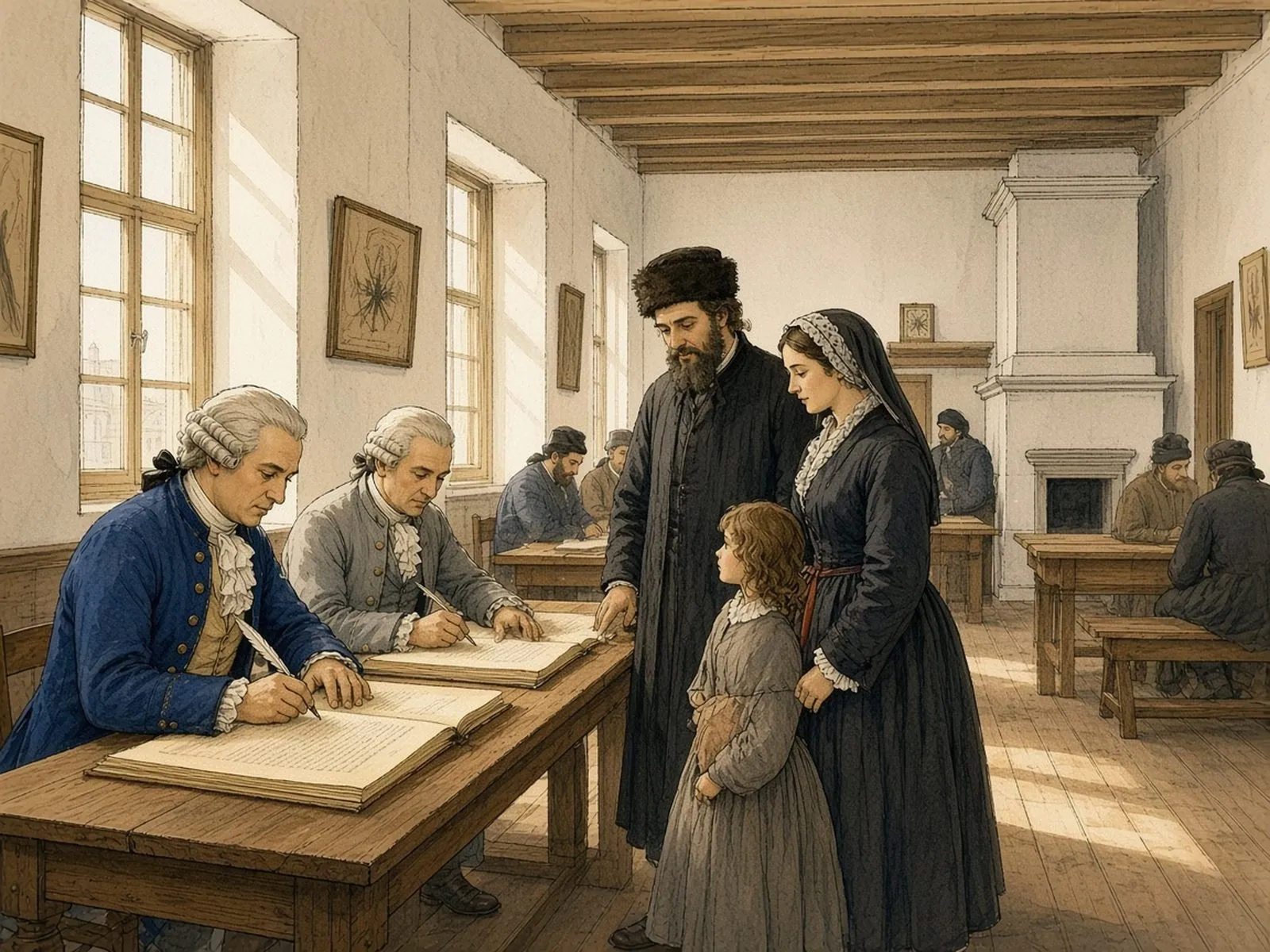
The Josephine Edict of 1787
The first and most consequential of these laws was issued by the Habsburg emperor Joseph II. Alexander Beider writes in the Forward that among the Jews of Eastern Europe, the families of Galicia were the first to receive surnames en masse, after the emperor signed a law in 1787 forcing all Jews of the Habsburg Empire to adopt fixed hereditary surnames, and that before that date, with very few exceptions, they had none[198]. Jewish Currents, marking the anniversary of the decree on 12 November, places it five years after Joseph’s Edict of Tolerance of 1782, which had permitted Jewish children to attend schools and universities, removed vocational restrictions, abolished stigmatising rules of dress and conduct and restricted Yiddish and Hebrew to the private sphere[199]. The surname law was one part of a larger programme that aimed to turn the Jews of the empire into useful, German-speaking subjects.
The Encyclopaedia Judaica’s article on Galicia shows how wide that programme was. It records that Joseph II included Galicia in a series of statutes between 1785 and 1789 directed at improving the condition of the Jews and at their eventual assimilation, that the autonomy of the community, its rabbinical court and its craftsmen’s guilds were abolished, and that in 1789 Jews were made subject to military service and required to adopt German family names[200]. The YIVO Encyclopedia’s article on Galicia adds that the Jews of the province were required to adopt surnames and forbidden to use Yiddish or Hebrew in official documents, and that their children had to attend German Jewish schools[201]. Names were thus bound up from the start with schooling, language and the army.
The procedure itself was administrative. According to the Encyclopaedia Judaica, Jewish surnames were to be registered by a government commission, and where a Jew refused to choose a name, the same commission was empowered to choose one for him[27]. Beider, in the YIVO Encyclopedia, describes the same process from the other side. Jews were free to choose their own names, subject to approval by Austrian officials, but if a Jew had not chosen one, a name was assigned, and the choice then depended only on the official’s imagination[11]. Almost all the names that resulted were based on German words, some referring to occupations and others to personal qualities, but the largest category consisted of artificial names drawn from the German vocabulary of plants and animals, metals and stones, natural phenomena, food and household utensils, which had nothing to do with the characteristics of their first bearers[11].
The same law also restricted given names. Under the regulations that accompanied it, the YIVO Encyclopedia notes, the Jews of the Habsburg Empire had to choose personal names from official lists, and resistance to this restriction was led by middle-class Jews in Prague who wanted to give their children German names[11]. A further law of 1836 allowed Jews to choose any German given name while still prohibiting changes of name, and only with the general civic rights law of 21 December 1867 did all restrictions on Jewish names come to an end[11]. For eighty years, in other words, the names of Habsburg Jews were a matter of state regulation, first imposed and then slowly relaxed as the empire moved toward legal equality.
Galicia and the Clerks
The story most often told about the Galician surnames is that they were sold. Beider sets out the legend in detail. Austrian officials, it is said, took bribes for desirable names and assigned ridiculous ones to those who could not pay, keeping price lists on which names built from flowers and precious stones, such as Goldstein, Rosenthal or Silberberg, were the most expensive, names built from ordinary metals, such as Eisenberg or Kupferstein, were cheaper, and animal names such as Adler and Schwalbe were free, while antisemitic officials gave insulting names such as Niemand, nobody, Affengesicht, monkey face, Mausfall, mousetrap, and Wanzreich, realm of bedbugs, out of spite[198]. Beider attributes the theory of expensive, cheap and free names to the historian Majer Bałaban, whose account has been widely repeated[188].
Beider argues that the evidence points the other way. If good names had to be bought, he reasons, then in a population as poor as the Jews of Galicia they would be the rarest, and insulting names the most common. Yet in his etymological dictionary of Galician Jewish surnames, about 37,000 names in all, only a few dozen are derogatory or ridiculous, among them Deligtisch, criminal, Geschwür, ulcer, Katzenflügel, cat’s wing, Krebsfuss, crab’s paw, Falschberg, false mountain, and Sommerfeind, enemy of summer, while the names with especially pleasant meanings, supposedly the most expensive, are the most common in various parts of the province[198]. Beider also points to a curious group of names built with Freund, friend, such as Bauerenfreund, Weisenfreund, Kinderfreund, Judenfreund and Rosenfreund, which, though positive on their face, may themselves have been coined in mockery[198].
The decisive point, in Beider’s view, is the compound name. Names built from two German roots, such as Gold, Silber, Eisen, Rose, Blum, Wein, Weiss, Grün or Roth joined to stein, berg, feld, thal or baum, appeared for the first time after the law of 1787, and dozens of communities of unrelated families adopted exactly the same ones[198]. That pattern, he argues, could not have been produced by many clerks independently inventing names and setting prices; it suggests instead that the method was devised centrally, most probably in Vienna, by officials who saw that a few roots could be combined into a large number of surnames, which was exactly what was needed when hundreds of thousands of Jews had to be named for administrative purposes in a short time[198]. He credits the historian Edgar Samuel with the conjecture that the whole process was directed from Vienna, where lists of recommended surnames could have been compiled, and judges it plausible even though no archival document confirms it[188].
The YIVO Encyclopedia gives a fuller list of the building blocks. First elements came from metals such as Gold, Silber, Eisen and Kupfer, from adjectives of beauty such as Fein and Schön, from colours, from fruits and flowers such as Apfel, Birn, Mandel and Rose, and from words for the heavens such as Himmel, Licht and Stern, while second elements included Berg, Feld and Stein, Dorf, Haus and Heim, and Baum, Blatt, Holz, Wald and Zweig[11]. Beider suggests that the choices were influenced by the romantic tendencies of German culture at the time, and that they served the state’s aim of acculturation, since the new names sounded typically German and many were already in use among Christians, sometimes coinciding with place-names and with the names of noble families who owned those places, such as Grünberg, Rosenberg and Rosenthal[11].
Perhaps the strongest argument against the bribery legend is that most Jews cared little about their new surnames. Beider notes that outside official documents Jews went on using their traditional names, that well into the nineteenth century surnames appeared on tombstones only among bourgeois families in large cities, and that provincial and Orthodox families did not inscribe them on tombstones until the beginning of the twentieth century, using only a given name and a patronymic such as Abraham ben Moses[198]. In Yiddish and Hebrew literature of the later nineteenth century, too, characters are mainly called by given names or nicknames[198]. A name that people ignored was hardly a name they would have paid for.
The Napoleonic Decree of 1808
In France the obligation to adopt surnames formed part of Napoleon’s reorganisation of Jewish life. The Encyclopaedia Judaica’s article on France places it among the measures of 1808 that put Jewish worship under a consistorial system subject to strict government control and imposed restrictive economic and residential regulations on the Jews, noting that one decree made it obligatory for Jews to adopt surnames before an official of the civil registry, though in doing so it largely confirmed an existing situation, and that the Central Consistory was established on 17 July 1808[202]. The text of the decree, issued at Bayonne on 20 July 1808 and published in the Bulletin des lois, is reproduced by the Fondation Napoléon[203].
Its first article required those subjects of the empire who followed the Hebrew religion and had until then lacked fixed family and given names to adopt them within three months and declare them before the civil registrar of their commune[203]. Foreign Jews who settled in the empire had to do the same within three months of arrival[203]. The third article set the limits of choice. No name taken from the Old Testament and no name of a town could be adopted as a family name, while given names were to be chosen from those permitted by the law of 11 Germinal of the year XI, the French statute that governed first names[203]. The consistories, the new representative bodies of French Jewry, were charged with checking that each member of their communities had complied and with reporting anyone who had changed name irregularly[203].
The decree made an important exception. Jews who already had known names that they had consistently borne could keep them, even if those names came from the Old Testament or from towns where they had lived, provided that they declared them within the same three months[203]. The penalties were severe. Jews who failed to comply within the time allowed were to be expelled from the territory of the empire, and those who changed their names arbitrarily in a public act or private contract were to be punished under the law, if necessary as forgers[203]. The Encyclopaedia Judaica’s observation that the decree largely confirmed an existing situation is borne out by this exception, which allowed the many French Jews who already bore stable names to keep them while drawing those who did not into the civil registers[202][203].
Westphalia, Baden and the Netherlands, 1808 to 1811
Napoleon’s influence reached beyond France into the states he reshaped in Germany and into the Netherlands. The Encyclopaedia Judaica records that the Kingdom of Westphalia, established by Napoleon in 1807 from portions of Hanover, Hesse and other states, granted its Jews civic rights on 27 January 1808, making them the first Jews in Germany free to settle anywhere in the kingdom and to follow any profession, and that a consistory on the French model was set up in Kassel under Israel Jacobson, financial adviser to King Jerome Bonaparte[204]. The same article notes that the consistory was charged with supervising all Jewish activities, that the kingdom was divided into seven rabbinical districts and that Jews were compelled to choose family names[204]. Attracted by the kingdom’s liberal policies, the Jewish population rose to 19,039 by 1810, but the kingdom was abolished in 1813, and with it the consistory[204]. The surnames, however, remained, and the Jews of the region carried them into the Prussian province of Westphalia created in 1816[204].
In the Grand Duchy of Baden the change came through a series of constitutional edicts. The Encyclopaedia Judaica notes that the first constitutional edict of 14 May 1807 recognised Judaism as a tolerated religion, that the sixth edict a year later gave Jews irrevocable civil rights, and that the ninth edict, the so-called Judenedikt of 13 January 1809, granted them an officially recognised state organisation, required them to adopt permanent family names and set out their still very restricted civil status[205]. In Baden as in Westphalia, surnames were part of a bargain in which Jews gained a defined legal position in exchange for becoming legible to the state.
The Netherlands offers an unusually well-documented case. The compilers of the Dutch Jewry database, Dave Verdooner and Harmen Snel, explain that the Sephardim who settled in the Netherlands from the end of the sixteenth century continued to use the surnames they had brought from the Iberian Peninsula, while the Ashkenazim, who arrived in large numbers from Germany and Poland especially after 1634, generally used only a personal name and a patronymic, sometimes with a name derived from their place of origin[206]. Their names adapted to Dutch, so that Hirsch and Mordechai became Hartog and Marcus, and Preger became van Praag, and in the eighteenth century surnames spread among the better-off Ashkenazim who dealt more with the authorities[206]. Most Ashkenazim in the western and southern parts of the country still had no surnames when, by decrees of 20 July 1808 and of August 1811, Napoleon required all inhabitants of the empire to register a given name and a surname[206].
The Hague’s municipal archive gives a vivid local picture. It describes the imperial decree of August 1811 as obliging everyone in the Netherlands to adopt an unchangeable surname, which in The Hague in practice meant the members of Ashkenazi Jewish families, and records that 399 heads of family confirmed or adopted surnames for themselves and their descendants[207]. Given names were sometimes made more Dutch as well, though the new forms were not always used. The archive notes that Betje Keijzer, registered as Berenice from 1811, nevertheless married as Betje in 1818[207]. In Amsterdam, according to Verdooner and Snel, 2,880 certificates of name adoption were drawn up covering 10,995 people, of which 2,134 involved the adoption of a new name[206].
The Amsterdam registers show the full range of the new names. Verdooner and Snel group them into names based on places of origin, such as van Embden, van Heeks and Speijer, on occupations, such as Kornalijnslijper and Melkman, on functions in the Jewish community, such as Koster, Psalmzegger and Voorzanger, on patronymics such as Arons, Davids and Zadoks, on French names such as le Loup and de la Meuse, and on animals such as Kater, Koe and Konijn, while some registrants, not taking the measure seriously, chose joke names such as Hazelip and Leegloper[206]. Not everyone registered, for fear of conscription or because their right to remain was uncertain, and in November 1825 King Willem I offered another opportunity, backed this time by severe penalties, though little use was made of it[206].
Prussia and the Emancipation Edict of 1812
In Prussia the surname requirement was written into the edict that made Jews citizens. The Encyclopaedia Judaica describes the edict concerning the civil status of the Jews, promulgated on 11 March 1812 under the reforming ministers who followed Prussia’s defeat at Jena, as the decisive step, since its first article declared all legally resident Jews to be full citizens and opened all occupations and academic positions to them[208]. The text of the edict, reproduced on the German constitutional history site verfassungen.de, shows how closely citizenship and names were tied. Its second paragraph made the continuation of citizenship conditional on two obligations, that Jews bear fixed family names and that they keep their business books, draw up contracts and legal declarations in German or another living language, and sign their names only in German or Latin script[209].
The third paragraph set the timetable. Within six months of the edict’s publication, every protected or licensed Jew had to declare before the authorities of his place of residence which family name he would bear permanently, and by that name he was to be called both in public documents and in everyday life, like any other citizen[209]. Once he had done so, the provincial government would issue him a certificate stating that he was a native and a citizen, which would serve for him and his descendants in place of the old letter of protection[209]. Those who failed to comply with the obligations concerning names and language were to be regarded and treated as foreign Jews[209]. A surname, in other words, was the price of admission to Prussian citizenship.
The promise of the edict was soon narrowed. The Encyclopaedia Judaica records that after the Congress of Vienna King Frederick William III had no intention of carrying out the edict in full, that Jews were excluded from academic positions in 1818, and that Jewish officials in Westphalia and the Rhineland were dismissed the following year, including Heinrich Marx, the father of Karl Marx[208]. The edict’s benefits were not extended to the province of Posen, where older laws remained in force[208], and there, as the YIVO Encyclopedia notes, Jews acquired surnames only in 1833[11]. Many of the surnames registered under the edict outlasted the hopes that had accompanied them, and they passed on to descendants who, a century later, would find those same names scrutinised again under very different laws.
The Russian Empire After 1804
In the Russian Empire the surname law came in 1804, and it applied to the Jews of the Pale of Settlement[11]. Beider explains in the YIVO Encyclopedia that the authorities of the Jewish communities, the kahals, were responsible for implementing it, that no regulations restricted the choice of names, and that in many places the community officials used set patterns to create names quickly[11]. Beider stresses that only in Russia did the mass adoption of surnames take place inside the Jewish community, whereas in other states Christian clerks were directly involved in assigning names[188], a difference that helps to explain some of the distinctive patterns described below.
The patterns differed sharply from region to region. Beider notes that in several districts of eastern Belorussia about a third of surnames were created from women’s names with the suffix -in, that in northern Ukraine nearly half of all Jews had surnames ending in -man, and that many names were formed from Yiddish and Hebrew words, others from Ukrainian and Belorussian, and were often immediately Russified because Russian was the official language[11]. German was used mainly to build artificial compound names such as Blumenthal, Goldberg, Rosenbaum and Rosenblatt, which were particularly common in Volhynia and Podolia, and in Courland, where German was the official language until 1893, patronymic and occupational names were also German in form[11]. Most often, however, surnames were taken from place-names in the Pale of Settlement, ending in -ski in the Kiev and Grodno areas, as with Belotserkovski, Kanevski and Umanski, and in the Yiddish suffix -er in the Mogilev area, Volhynia and Podolia[11].
Beider’s statistics show the overall result. Of about 61,400 Jewish surnames from the Russian Empire whose source language could be determined, he counts 51.2 per cent as Slavic, 43.0 per cent as Yiddish or German, 5.5 per cent as Hebrew and 0.3 per cent as Romanian, excluding several thousand names brought into the empire by migrants from Congress Poland and Galicia[188]. He warns against assuming that Hebrew names must be older than German ones and German older than Slavic. The surnames Levi, Rosenbaum and Portnoy, he points out, all emerged in the Russian Empire at the same time, immediately after the law of 1804, and only the rabbinical surnames are older[188]. Kahal officials, he adds, were most likely aware of the Galician results and reused its compound patterns because they offered a quick way to create many names[188].
The territories that Russia acquired later followed their own course. In Congress Poland, according to the YIVO Encyclopedia, a law of 1821 obliged Jews to take family names, restoring in many cases the names assigned earlier by Austrian and Prussian officials and in others creating new Polish names from words for birds, fish, animals and plants, such as Drozd, thrush, Kanarek, canary, Skowronek, skylark, and Wierzba, willow, or from occupations such as Farbiarz, dyer, and Młynarz, miller[11]. Once these names were registered, they were difficult to change. Beider notes that mass changes of surname were forbidden by tsarist legislation throughout the Russian Empire, including Congress Poland, and that even Jews who converted to Christianity were required to keep their family names[11].
Hungary and the Magyarized Surname
Hungary, which was part of the Habsburg monarchy, received its Jewish surnames under the law of 1787 like the other Habsburg provinces, and, as the YIVO Encyclopedia notes, those names were mainly based on German words[11]. But Hungary later became the only province of Eastern and Central Europe where Jews changed their surnames in large numbers. From the middle of the nineteenth century, influenced by the Hungarian national movement, some Jews began to choose names that sounded typically Hungarian, and the practice lasted about a century[11]. Often the new names translated the old German ones, so that Schwarz became Fekete, Gross became Nagy, Metzger became Mészáros and Wolf became Farkas[11].
Other new names had no such link. Beider explains that Jews also added the Hungarian suffix -i to place-names or adopted Hungarian words for occupations and characteristics, patterns that were common among Christian Hungarians too, and that in many cases they simply borrowed common Christian surnames, so that a Jewish Szabó or Varga was not necessarily a tailor or a shoemaker and a Somogyi or Hevesi did not necessarily come from the counties of Somogy or Heves[11]. In some cases only a phonetic resemblance linked the new name to the old, as with Ferenczi from Fraenkel and Polányi from Polacsek[11]. Elsewhere in the Austro-Hungarian Empire, in Galicia, Bohemia, Moravia and Bukovina, such changes were extremely rare[11]. The Hungarian case anticipated, within Europe, the larger wave of name changes that would follow when East European Jews emigrated to Britain, the Americas and the Land of Israel, a story taken up in later chapters.
Priests, Places, Trades and Ornaments
Once Jewish surnames existed, they could be sorted. Scholars of names have proposed various schemes, but most agree on a small number of basic types. Sarah Bunin Benor, in a table prepared for the Posen Library of Jewish Culture and Civilization, groups the hereditary surnames of Jews around the world into nine categories, names reflecting priestly or Levite descent, names reflecting a rabbinic line, names drawn from a Jewish communal function, occupational names, geographic names, names describing a characteristic, patronymics, matronymics and ornamental names[210]. Alexander Beider’s statistics for the Russian Empire give a sense of their relative weight. Of about 71,100 surnames whose origin he could establish, 33 per cent were toponymic, 18 per cent artificial, 15 per cent occupational, 13 per cent patronymic, 12 per cent drawn from personal characteristics, 7 per cent metronymic, and only 1 per cent each derived from priestly or Levite descent or from rabbinical families[188]. This chapter looks at the types that have not already been discussed, beginning with the oldest and smallest group and ending with the house signs of Frankfurt.
Kohen and Levi Families
Of all surnames borne by Jews, Cohen and Levi are the ones most widely recognised as Jewish, and Beider argues that they are different in kind from all the others. The traditional Jewish name, he writes in the Journal of Jewish Languages, consisted of only two mandatory elements, a given name and a patronymic introduced by ben or bat, but for men of priestly descent, traced to Aaron the brother of Moses, or of Levite descent, a third element followed, ha-Cohen or ha-Levi[211]. These two groups, which Beider describes as internal Jewish castes, gave rise to the surnames Cohen and Levi or Levy, which, unlike all other Jewish surnames, are natural outgrowths of the Jewish naming tradition itself[211].
That does not mean, Beider cautions, that Cohen and Levi are thousand-year-old surnames. Unlike ordinary hereditary names, they applied not to individual families but to large groups of Jews, and in Europe, North Africa and the Middle East the designations ha-Cohen and ha-Levi were in use at a time when neither Jews nor their neighbours used fixed family names at all[211]. Not a single Jewish surname, he concludes, has been inherited from antiquity. When surnames did begin to appear in certain Jewish families in the late Middle Ages and early modern period, the priestly or Levite designation usually came first, so that Hebrew sources from the Maghreb in the fifteenth and sixteenth centuries refer to men called ha-Cohen Bacri and ha-Cohen Solal[211].
The surname and the religious status can also diverge. Beider points out that members of the priestly or Levite groups do not necessarily bear the surnames Cohen or Levi, and that the surname, once acquired, follows different rules from the status[211]. A priest who violated the rules binding on his caste could pass the surname Cohen to his sons, though they would no longer count as ha-Cohen in religious contexts, and a daughter would inherit the surname from her father but not the designation, since priestly and Levite status passes only from father to son[211]. A surname, in other words, records a claim made at the moment it was fixed, while the religious status has to be maintained generation by generation.
The two names took many forms. Benor’s table lists Cohen, used in many communities; Kagan, the Russian form, in which the Hebrew h became g; Kahane, from the Aramaic; Sacerdote, the Italian word for priest; and Caplan, from a Slavic word for chaplain[210]. Beider explains that Kaplan, which may be Belorussian or Polish, is derived from the word for priest and is a calque of Cohen, and he notes that the most common variants of Cohen and Levi in the Russian Empire were Kogan and Levin[188][211]. The Jewish Encyclopedia’s list of surnames derived from Levi, published in 1906, runs from Halevy and Levene to Levinsohn, Lewis, Löwy and Lowy, many of them assimilated to German or English forms[1].
Even these two names are not universal. Beider notes that Cohen and Levi were common among the Jews of the Maghreb, Italy, Amsterdam and the Ottoman Empire, and existed in the Russian Empire, but are absent among Jews from several former Soviet republics of the Caucasus and Central Asia[211]. Their prominence elsewhere can be measured. In a list of the most common surnames among the Jews of Alsace in 1784, reproduced in the Jewish Encyclopedia, Levy, with 618 bearers, was far ahead of every other name, followed at a great distance by Bloch with 189 and Weyl with 187, while the various forms of Kahn numbered 90[1].
Acronyms Such as Katz and Segal
The priestly and Levite designations also produced some of the oldest acronymic surnames. The YIVO Encyclopedia explains that among the expressions marking descent from priests the most common were ha-Kohen and the acronym KTs, pronounced Katz, meaning priest of righteousness, while Levite origin was expressed by ha-Levi and the acronym SGL, Segal, associate of the Levitic order[11]. Beider adds that these acronyms were synonymous with ha-Cohen and ha-Levi in Jewish texts and that the corresponding Ashkenazi surnames are similarly old, citing an Italianised form Segale or Segali in Christian documents from Lombardy in the mid-sixteenth century and a Prague merchant called Katz in a German document from Leipzig in 1668[211]. The Encyclopaedia Judaica’s article on the Kohen family of Prague printers shows the same acronym in use as a business name, since the firm continued under the name the Grandsons of Moses Katz, explained as kohen tzedek, the righteous priest[212].
Acronyms were a natural resource for a culture that already referred to its greatest scholars by abbreviations. Beider notes that the most renowned scholars were traditionally known by acronyms such as Rashi, for Rabbi Shlomo Itzhaki, Rambam, for Rabbi Moshe ben Maimon, and Maharshal, for Morenu ha-Rav Shlomo Luria, and that tombstones in Prague from the sixteenth and seventeenth centuries already show a few dozen acronymic surnames, including Back, from a Hebrew phrase meaning the sons of holy martyrs[211]. It was during the mass surnaming at the turn of the eighteenth and nineteenth centuries, however, that many more acronymic surnames appeared, among them, in some communities, surnames that simply reproduced the acronyms of scholars who had lived centuries earlier, such as Maharshak, Rashal, Rambam and Rashba[211].
Benor’s table gives a wider sample of these names and their meanings. Zak stands for zera kodesh, holy seed; Braff for ben rabbi Pinchas or Peretz; Babad for ben av bet din, son of the head of the rabbinical court; Barshal for ben rabbi Shlomo Levi; Charmatz for chatan rabbi Meir Tzvi, son-in-law of Rabbi Meir Tzvi; and Magarshak for morenu ha-rav rabbi Shmuel Kaidanover, in which the h of the Hebrew has again become g in Russian[210]. Other acronyms recall communal offices rather than lineage. Shatz stands for shaliach tzibur, the prayer leader, and Matz for moreh tzedek, a rabbinic teacher[210]. The Jewish Encyclopedia had noted the same pattern in 1906, explaining Schatz as an abbreviation of sheliach tzibbur and Goetz, Yates in English, as one of ger tzedek, a righteous proselyte, and reporting that Sack was used for a member of the zera kodesh[1].
Many of these acronyms happened to coincide with ordinary German words, a coincidence that Benor’s table records. Katz is also the German for cat, Segal resembles the German word for a seal, Zak means sack, and Shatz means treasure[210]. A name that sounded entirely German to an outsider could thus carry, for those who knew the code, a statement of priestly descent, scholarly lineage or communal service.
Toponymic Surnames
The largest single category of Jewish surnames is formed from place-names. The Jewish Encyclopedia observed in 1906 that, after biblical surnames, local ones enjoyed the greatest popularity among Jews and perhaps formed the largest number of surnames among modern Jews, though no single local name was as frequent as the least common biblical one[1]. Germany contributed most. The same article lists Posner from Posen, Berliner and Berlinsky from Berlin, Fould from Fulda, and Oppenheim, along with smaller towns such as Flatau, Hildesheim, Bischoffsheim and Auerbach, and notes that names such as Birnbaum, Rosenberg, Sommerfeld, Grünberg and Goldberg, which might seem artificial, could also be names of towns[1]. It adds that the English Crawcour came from Cracow and that the Dutch and English Van Praagh is the name of a Prague family that settled in Holland before moving to England[1].
Some place-names became distinctively Jewish surnames even though the places themselves were not Jewish. Beider gives the examples of Fubini, Modigliani and Soncino in Italy, all predominantly or exclusively Jewish surnames derived from towns whose populations were always mainly Christian, and of the rabbinical family Katzenellenbogen, named after the German town of Katzenelnbogen[211]. Phonetic changes could disguise the origin further. Luzzatto and Morpurgo, he notes, are Italianised forms of the German place-names Lausitz and Marburg, the latter the present-day Maribor in Slovenia, and the Belorussian surname Klebanov reflects the reduction of unstressed vowels in the place-name Kolybanovo[211].
Other toponymic names refer not to a town but to a whole region or people. Benor’s table lists Mizrahi, from the east, Deutsch, German, Hamburger, from Hamburg, Yerushalmi, from Jerusalem, Yazdi, from the Iranian city of Yazd, and Toledano, from Toledo[210]. Beider singles out Ashkenazi as one of the few Hebrew surnames found in many widely separated communities. In Eastern Europe it means one from German-speaking lands, and its variants such as Eskenazi and Askenazi were common in the Maghreb and the Ottoman Empire, where it began as a nickname for any Jew from an Ashkenazi community, while in Italy the same people appear in Christian records as Tedesco, Todesco or Teutonicus[211].
In the Russian Empire, as discussed in the previous chapter, place-names provided the most common source of surnames of all, often with Slavic suffixes such as -ski or the Yiddish suffix -er. Beider points out that many of these surnames are hybrids, with a Slavic place-name and a Yiddish suffix denoting its inhabitants, as in Mikhaylover, Ovsishcher and Prigoniker[211]. The Jewish Encyclopedia mentions another kind of place-name surname, Altschul or Altschuler, derived from the Altschul, the old synagogue, of Prague, a name that commemorates a building rather than a town[1].
Occupational Surnames
Surnames from trades and offices form the next large group. The Jewish Encyclopedia lists Kaufmann and Marchant, merchant, Spielmann, player, Steinschneider, engraver, Schuster, shoemaker, Schneider and Snyders, tailor, and Wechsler, money-changer, as names Jews shared with their neighbours, but it also identifies a group that is more distinctively Jewish[1]. These include Parnass and Gabbay, from synagogue officials, Singer, Cantor, Voorsanger and Chazan, from the singers of the synagogue, Shochet, Schaechter and Schechter, from the ritual slaughterer, Shadkun, a marriage broker, Rabinowitz and Rabbinovitz, from rabbis, and Benmohel, which the encyclopedia connects with one who performed circumcision[1].
Benor’s table separates these two groups explicitly. Names reflecting a non-hereditary Jewish communal function include Gabbai, synagogue administrator, Melamed, teacher, Chazan, cantor, Shochet, ritual slaughterer, Katzav, butcher, and Dayan, rabbinic judge, while names reflecting a profession beyond the Jewish community, which may be shared by non-Jews, include Shumacher, Metzger, Kirschner and Fingerhut in Ashkenaz, Maddar, potter, and Tabib, physician, in Yemen, Fornaro, baker, in Italy, and Haddad, smith, in the Arabic-speaking world[210]. Beider notes that in Lithuania many surnames formed from the Hebrew component of Yiddish were occupational, such as Soifer, scribe, Dayen, judge, Melamed, teacher, and Khait, tailor, and that although such names occur throughout the Pale of Settlement, they were most concentrated in Lithuania[188].
Slavic occupational names were common too. Beider observes that Kravets and Koval, from words for tailor and smith, may derive from Ukrainian, Belorussian or Polish, since the three languages share the roots[188]. Occupational names, more than most, risk being read too literally. A surname registered in 1804 or 1812 might record the trade of the man who registered it, but it might equally have been chosen or assigned for other reasons, and Beider makes exactly this point about the Hungarian surnames adopted by Jews in the nineteenth century, observing that a Jew called Szabó or Varga was not necessarily a tailor or a shoemaker[11].
Ornamental and Purchased Names
The ornamental or artificial surname, built from words with pleasant associations and often from two German roots, is the type most strongly associated with Ashkenazi Jews. Benor’s table defines it as a name that fits no other category but was selected because it sounded attractive or fashionable, often combining two words, and gives Rosenberg, rose hill, Eisenfeld, iron field, Rothblum, red flower, Rubinstein, ruby stone, and single-word names such as Weiss, Stern, Wald and Zilber[210]. As shown in the previous chapter, these names were coined in large numbers by officials in Galicia after 1787 and later reused by Jewish community officials in the Russian Empire, and Benor’s table, like Beider’s research, finds no evidence that Jews purchased more desirable names[210][198].
A second popular belief holds that ornamental names conceal Jewish meanings. Beider lists examples of the claim. Surnames beginning with Korn, grain, are said to disguise Cohen; Eckstein, cornerstone, and Meersand, sea sand, are said to refer to verses in Psalms 118 and Genesis 32; surnames beginning with Gold, Blum, Rosen and Perl are said to refer to the corresponding Jewish women’s names; and Teitelbaum, date palm, is said to hint at the biblical name Tamar[198]. He does not dismiss such interpretations entirely, but notes that these names are polygenetic, borne by many unrelated families, and that even if a hidden meaning was intended in one branch, it is implausible that it was intended in all the others, particularly when surnames were so marginal in the consciousness of the Jews who received them[198].
There were genuine exceptions. Beider documents a set of surnames from Vitebsk province taken directly from the Hebrew text of the Bible, such as Efros, from Ephrath or Bethlehem, Katalkherman, from the phrase as the dew of Hermon in Psalms 133:3, and Amkhir, Gaitsgori, Gamus and Zarkhi, all quotations from the Book of Numbers[188]. These are ornamental in the sense that they say nothing about their bearers’ trades or origins, but they are learned rather than decorative, drawn from the Hebrew scriptures by someone who knew them well.
House Signs and Rothschild
In a few old communities, Jews had surnames long before the state required them, and some of these came from the signs that marked houses. Beider explains that in Prague many Jews already had surnames in the seventeenth century, so that when the law of 1787 came, most simply retained them, and that the same was true of Frankfurt am Main, where the law of 1807 had only small consequences[211]. He suggests that early use of surnames in these two cities may be related to the fact that they were the largest Jewish communities, where many members needed to be distinguished by name[211].
In Frankfurt the houses of the Judengasse, the Jewish street, were known by their signs. The Jewish Encyclopedia lists the surnames that came from those signs as including some of the best-known Jewish families, Rothschild, red shield, Schwarzschild, black shield, Adler, eagle, Gans, goose, Schiff, ship, Strauss, ostrich, and Ochs, ox, and refers readers to a list of the signs compiled by Schudt in his Jüdische Merckwürdigkeiten[1]. Such a name began as an address, a way of saying which house in a crowded street a family lived in, but it did not have to stay attached to the building, as the most famous example shows.
The Rothschilds are the most famous case. The Encyclopaedia Judaica records that the family name derives from a red shield which once hung in front of the Frankfurt house of Isaac Elhanan, who died in 1585 and was a grandson of Uri, the first recorded member of the family, who died around 1500, and that although Isaac Elhanan’s grandson left the house, his descendants kept the name[213]. Until the birth of Mayer Amschel Rothschild in 1744, the same article notes, the family were undistinguished merchants and communal servants. Mayer Amschel began by trading in antiques, old coins and money changing, and in 1764 began doing business with the future Landgrave William IX of Hesse-Kassel, an avid coin collector and heir to the largest fortune in Europe[213].
A name taken from a sign on a house in a crowded ghetto street thus became, within a few generations, a byword. The Encyclopaedia Judaica observes that Rothschild came to serve both as a positive symbol of Jewish wealth, influence and philanthropy among the Jewish masses, particularly in Eastern Europe, as in the stories of Sholem Aleichem, and as a sinister symbol in antisemitic propaganda[213]. Few surnames show more clearly how the accidents of naming can be overtaken by history, as a red shield above a doorway in the Frankfurt Judengasse came to be read by admirers and enemies alike as a symbol of Jewish wealth and power.
Kabbalah, Illness and the Changed Name
Alongside the public history of Jewish names, with its decrees, registers and census returns, runs a private history in which names were treated as powers in their own right. A name could be counted, decoded and linked to the soul. It could be changed to cheat death, hidden to avoid envy, or replaced with a word so unattractive that no spirit would want to claim its bearer. These beliefs were never uniform, and rabbinic authorities sometimes questioned them, but they shaped the names of millions of Jews and survive today in customs that many families still observe. This chapter looks at three strands of that history, the mystical idea that a name corresponds to a soul, the practice of changing or adding a name in time of illness, and the protective names given to children whose lives seemed especially fragile.
Numerology and the Soul’s Name
The habit of reading names as numbers is older than Judaism’s mystical schools. The Encyclopaedia Judaica traces the first known use of gematria, the calculation of words by the numerical value of their letters, to an inscription of the Assyrian king Sargon II, whom it dates to 727 to 707 BCE, stating that he built the wall of Khorsabad 16,283 cubits long to correspond to the numerical value of his name[214]. Gnostic writers, the same article notes, equated the divine names Abraxas and Mithras because the letters of each added up to 365, the number of days in the solar year[214]. In Jewish sources the method appears in rabbinic literature, where it was applied above all to names.
The classic example concerns a servant of Abraham. The Encyclopaedia Judaica explains that the Baraita of the 32 Rules cites as an example of gematria the interpretation that the 318 men whom Abraham led into battle in Genesis 14 were in fact only his servant Eliezer, since the numerical value of that name is 318, and suggests that the interpretation may have been a reply to the Epistle of Barnabas, which read the same number in Greek letters as a reference to the cross and to the name of Jesus[214]. The Jewish Encyclopedia regarded this as one of three biblical gematriot that are very probably intended, along with the opening verses of Moses’ song in Deuteronomy 32, whose initial letters give the number 345, the value of the name Moses[215]. In each case a name is treated as a sum, and the sum as a key to the meaning of a text.
Kabbalah went further, treating the name as a key to the soul. The Safed kabbalist Hayyim Vital, active in the sixteenth and early seventeenth centuries, recorded the teachings of his master Isaac Luria, and his son Samuel Vital arranged those writings into eight gates, the eighth of which, Sha’ar ha-Gilgulim, the Gate of Reincarnations, deals with the transmigration of souls[216]. In one passage of that work, Vital explains that each holy soul has a known name corresponding to the limb of the supernal Adam from which it was hewn, and that when parents name a newborn child with whatever name comes into their minds, the choice is not accidental, for God places in their mouths the name that the soul requires, and that name is inscribed above on the Throne of Glory[216].
Vital supports this with the same play on a psalm verse, reading desolations as names, that the Talmud had used to argue that a name affects a person’s life, and with the tradition, discussed in an earlier chapter, that Rabbi Meir and Rabbi Joshua ben Korha examined people’s names[216]. He then adds a darker counterpart. Just as the holy soul has a fixed name, which is the name the father and mother give at the circumcision, so the evil inclination that enters a person at birth has a fixed name of its own, so that every person has two names, one from the side of holiness and one from the side of the husks, the kabbalistic term for the forces of impurity[216]. A person who could discover the second name in life, Vital writes, could identify and repair the damage it represents, and the righteous, having struggled against it in life, are spared the painful separation from it after death that awaits the wicked[216].
The idea that a person’s name would matter after death took popular forms as well. The Jewish Encyclopedia records that later kabbalists recommended that each person learn a psalm verse whose first and last letters matched the first and last letters of his or her name, so as to prevent any misunderstanding at the resurrection[1]. Such customs explain why, in many communities, the choice of a child’s name came to be seen as a moment of spiritual consequence rather than simply a matter of family memory, and why parents who followed the kabbalistic tradition believed that the name they chose, however casually it seemed to arrive, was the name the child had always been meant to bear.
Shinui Hashem for the Sick
If a name was bound to a person’s destiny, changing it might change that destiny. The Jewish Encyclopedia’s article on shinnuy ha-shem, the change of name, begins with the biblical precedents, among them Pharaoh’s renaming of Joseph as Zaphnath-paaneah, which the encyclopedia translates as the revealer of secrets, and the renaming of Daniel and his companions with Chaldean names, and it notes that names of the wicked were treated as a curse[217]. For this reason, it records, Rabbenu Tam corrected the text of the Talmud from Absalom to Abishalom and from Shebna to Shakna, because the biblical Absalom and Shebna were wicked[217].
The medical use of the custom rests on the Talmudic teaching, discussed in earlier chapters, that a change of name is one of the things that can annul an evil decree. The Jewish Encyclopedia records that Judah he-Hasid in the thirteenth century wrote in the Sefer Hasidim that the name of a person who was dangerously ill should be changed, since this might reverse the decree, and that a later authority, Rabbi Perez, held that the practice conformed to an enactment of the Geonim[217]. The underlying principle, the encyclopedia explains, was that the former name, under which the divine decree had been issued, ceased to exist, and that the person who received a new name became, in effect, another person against whom the decree had no force[217].
The choice of the new name could be left to chance. According to the Jewish Encyclopedia, the new name was originally selected by opening a Bible and adopting the first name that appeared on the page, until Rabbi Israel Bruna protested in a responsum against taking the name of a wicked person when such a name came first, ruling that it should be passed over in favour of the first righteous name and citing the verse that the memory of the just is blessed but the name of the wicked shall perish[217]. The Encyclopaedia Judaica similarly records that names of ill repute such as Esau or Korah were excluded[129].
Over time the custom softened from replacement to addition. The Jewish Encyclopedia notes that in a later period the original name was retained and another added to it, usually one signifying recovery, the most popular being Hayyim, life, Shalom, peace, Raphael, God heals, and Azriel, God helps, and that the additional name was usually given in the synagogue when the Torah scroll was taken out of the ark[217]. The Encyclopaedia Judaica adds Hezekiah, may God give strength, to the list of names for men and Hayyah for women, and explains that in the Ashkenazi rite the change is made through a special Mi she-Berakh prayer asking that, just as the name has been changed, so the evil decree may be changed from justice to mercy, from death to life and from illness to complete recovery, while the Sephardi rite uses a different formula[129].
The Jewish Encyclopedia prints a longer form of the declaration. It states that, since the rabbis taught that a change of name is among the things that annul a decree, the patient’s former name has been changed to a new one, that he is now another person against whom the decree has no force, and it asks, in the name of all the holy names in the Torah scroll and of the angels of healing, for a swift and complete cure for the person under the new name[217]. Once given, the Encyclopaedia Judaica notes, the new name was used together with the old one for all religious purposes, including being called to the Torah, the writing of a divorce document and the inscription on a tombstone, in combinations such as Hayyim Abraham[129]. A Jew who bears Hayyim or Chaim as part of a double name may therefore carry, without knowing it, the trace of an illness survived by an ancestor.
Names Given Against the Evil Eye Such as Alter and Chaim
Changing a name after illness struck was one strategy. Another was to choose a name in advance that would deflect danger. The Encyclopaedia Judaica’s article on the evil eye explains that prominent men, beautiful women and newborn babies, all likely to attract attention, were thought especially vulnerable, and that if beauty was veiled, riches were hidden and a child was covered with a dirty bag or given an ugly name, the happy event might pass unnoticed and the evil eye remain passive[218]. The same article mentions other protective customs, such as tying a red band around the wrist or neck of a newborn child and adding to any praise the Yiddish phrase keyn ayen hore, may there be no evil eye, and notes that one scholar listed more than eighty anti-evil-eye practices among the Jews of Eastern Europe[218].
In Eastern Europe, a recognised set of protective names developed. Beider writes in the YIVO Encyclopedia that a number of substitute names were assigned to seriously ill or tenderly guarded children to protect them from evil spirits, among them Khayem and Khaye, life, Kayem, solid, Kadish, after the prayer for deceased relatives, Zeyde and Bobe, grandfather and grandmother, and Alter and Alte, old man and old woman[11]. The last two, he notes, were sometimes used instead of the child’s real name as a way to cheat the angel of death, and for the same reason some Lithuanian Jews did not address their children by their given names at all[11].
The name Alter carried a particular history. The Encyclopaedia Judaica records that it was frequently given to a boy if several children in the family had died in infancy, as a good omen that he would reach old age[129]. The Jewish Encyclopedia gives a variant of the same custom. When several children in a family had died, the next child was given no name at all but was called Alter or Alterke, in the belief that the Angel of Death, not knowing the child’s name, would be unable to take it, and when the child reached marriageable age a new name, generally that of one of the patriarchs, was given[1]. The same article notes that it was considered unlucky in Lithuania to call an only child by its real name[1].
These customs drew on a widespread folk motif. The Encyclopaedia Judaica’s article on the Angel of Death describes a family of tales, found in the folk literature of all Jewish communities, in which the angel is tricked into missing the right moment to take a soul, among other ways by a change of the doomed person’s name, so that he fails to recognise the man he has come to fetch[219]. A child called Alter, Zeyde or Bobe was, in effect, a living version of such a story, given a name that announced old age in the hope of reaching it.
Some of these customs belong to a world that has largely disappeared, but others have proved durable. The Encyclopaedia Judaica describes the choice of auspicious names such as Hayyim for the dangerously ill as the most widespread form of the custom and one that persists to the present day[129], so that the oldest Jewish belief about names, that they are bound to the lives of those who bear them, continues to find expression wherever a family gathers to pray for one of its members.
Covenants, Blessings and the Moment of Naming
A Jewish name is not simply registered. It is announced, in a fixed form of words, before witnesses, at a moment that tradition has surrounded with prayer and celebration. For boys that moment has for many centuries been the circumcision on the eighth day. For girls it has varied enormously, from a blessing at the Torah reading to a gathering around a cradle in the German countryside or a song from the Song of Songs in a Sephardi home. This chapter looks at those ceremonies and at what they reveal about the meaning of names, beginning with the formula used at the circumcision and ending with the new ceremonies for daughters devised in the second half of the twentieth century.
The Brit Milah Formula
The link between circumcision and naming is not found in the Hebrew Bible, where children are generally named at birth. David Golinkin, in an English summary of a Hebrew study published by the Schechter Institutes, points out that in Genesis the mothers of Jacob’s children name them as they are born, that the midwife at Tamar’s delivery names the twins Peretz and Zerah, and that Isaac was clearly named by Abraham before his circumcision, the reverse of present custom[220]. Remarkably, he adds, neither the Mishnah nor either Talmud says explicitly when boys or girls were named, and the sources he cites for a boy’s naming at his circumcision are the Gospel of Luke, which describes both Zechariah’s son and Jesus as named at their circumcisions, the Church Father Clement of Alexandria, and the eighth-century midrash Pirkei de-Rabbi Eliezer, which says that Moses was called Yekutiel at his circumcision[220].
Golinkin cites Theodor Gaster’s suggestion that the naming of boys was moved from birth to the circumcision because Jews of the period feared that demons might attack a baby before the covenant had been sealed, in the same way that Christians gave names only at baptism and other peoples kept a child’s name hidden for a time after birth[220]. The Jewish Encyclopedia, writing in 1906, reached a related conclusion from the liturgy. It noted that the use of the pronoun him in the father’s blessing and in the congregation’s response, recorded in an ancient baraita in the Talmud, suggests that the child was originally named immediately after the circumcision, so that the congregation was blessing a child who had just received his name[221].
The ceremony itself gathered layers over time. According to the Jewish Encyclopedia, by the geonic period it had moved from the parents’ house to the synagogue, where it took place after the service before the whole congregation, and by the tenth century a godfather, the sandek, appears beside the mohel and the father, holding the child on his knees during the operation, while a second chair, the chair of Elijah, is set beside him[221]. After the operation, the father blesses God who has commanded him to bring his son into the covenant of Abraham, and the congregation responds that, as the child has entered the covenant, so may he enter into the study of Torah, the marriage canopy and good deeds[221].
The name itself is pronounced in a prayer that follows the blessings over wine. The Jewish Encyclopedia gives its text, preserved from geonic times by medieval liturgical writers, in an English rendering that asks God to preserve the child to his father and mother, “and let his name be called in Israel N the son of N,” and ends with the wish that the child so named may grow great[221]. The formula combines the two elements that recur throughout this essay, the given name and the father’s name, and places them explicitly within the people of Israel. It is, in a sense, the first entry in a register that will reappear when the man is called to the Torah, married and, at the end of his life, commemorated on his tombstone.
Zeved Habat and the Sephardi Daughter
The naming of daughters took many forms. Golinkin reports that from the sixteenth century onward sources mention some twenty different customs for the proper time to name a baby girl, and that, broadly, Ashkenazi Jews preferred ceremonies in the synagogue while Sephardi and Middle Eastern Jews preferred ceremonies at home[220]. His sample includes the first time the mother came to the synagogue after the birth, the day of birth itself, the first Torah reading or the first or second Sabbath after the birth, a full week or two weeks after it, the eighth day, the new moon, and simply any time within the first year[220].
Among the Jews of Iraq, Golinkin notes, a festival called the Shisha is held on the sixth night after birth for both boys and girls, and at it girls receive their names, while boys are named at their circumcision[220]. He connects this with an older puzzle. Rabbinic literature mentions a celebration called shavua haben, the week of the son, which Rashi and others took to mean the circumcision, but a source quoted by Nahmanides refers to both a shavua haben and a shavua habat, the week of the daughter, and since girls have no circumcision, Golinkin argues that these may have been seventh-day celebrations for both sexes, at which girls were named, though he presents this as a hypothesis awaiting further evidence[220].
The best-known Sephardi ceremony for daughters is the zeved habat, the gift of a daughter. The Steinsaltz Center’s guide to Jewish law explains that the term comes from the words of the matriarch Leah after the birth of her son Zebulun, God has granted me a fine gift, in Genesis 30:20, and that some families give the girl her name at a zeved habat celebration, at which verses such as the Song of Songs’ address to a dove in the clefts of the rock are recited[222]. The Stroum Center for Jewish Studies at the University of Washington describes the same ceremony under its Ladino names, las fadas or la fijola. It notes that Sephardi prayer books record the zeved habat from as early as the seventeenth century and that the custom reaches back to medieval Spain, where Jews borrowed the term las fadas, the fairies, from Christian neighbours who believed that fairies attended a birth and blessed the newborn[223].
At a fijola, the Stroum Center explains, the family gathered at home to sing, bless the baby and announce her name. Many wished her novya ke la veamos, may we see you as a bride, and verses from the Song of Songs were sung, sometimes in Ladino, beginning with the image of the dove in the crevices of the cliff, an allusion to the baby emerging for the first time as a member of the community[223]. If the baby was her parents’ first child, an additional verse was sung describing the dove as the only one of her mother, and just before the name was announced a Mi she-Berakh prayer was recited which, unlike most such prayers, invoked the matriarchs and other Jewish heroines rather than the patriarchs[223]. The Steinsaltz Center’s guide likewise mentions a Mi she-Berakh for the newborn that names the matriarchs together with Miriam, Abigail and Esther[222].
Torah Reading and Ashkenazi Girls
In Ashkenazi communities the commonest way to name a girl has been in the synagogue, during the reading of the Torah. The Steinsaltz Center’s guide explains the practice. The father is called up to the Torah at the first opportunity after the birth, on a Sabbath, a Monday or a Thursday, or a festival, and at the end of his portion the gabbai, the synagogue official, recites a blessing for mother and child and announces the baby’s name[222]. The guide offers a theological reason for the absence of a separate rite. A boy’s naming is delayed until his circumcision, but for a girl the birth itself is considered equivalent to circumcision, so that she is named without delay and receives at birth the level of soul that a boy receives on the eighth day[222].
My Jewish Learning describes this as a long-standing Ashkenazi practice, still followed in most Orthodox communities and in many others, in which the father’s aliyah on the Sabbath after the birth is followed by a prayer that announces the daughter’s name and asks for the healing of the mother[224]. In non-Orthodox communities, it notes, the mother often takes part as well, and the synagogue blessing may precede a larger ceremony at home or in the synagogue rather than replacing it[224]. The YIVO Encyclopedia confirms that in Eastern Europe there were no strict rules for naming newborn girls, some communities naming them immediately after birth and others waiting until the next Sabbath, or more rarely a Monday or Thursday, when the father was called to the Torah[11].
German Jews long had a more colourful custom. The Jewish Encyclopedia describes the Holle Kreish, a cradle naming adopted from their neighbours, in which, on the Sabbath when the mother first returned to the synagogue, children aged eight to ten were invited to the house, formed a circle around the cradle of the infant, usually about a month old, lifted it three times and cried, Holle, Holle, what shall the child’s name be, whereupon the child’s everyday, non-Hebrew name was called out[225]. The father recited the first verse of Leviticus, and in some places a copy of Leviticus was placed under the baby’s head[225]. The encyclopedia dates the established custom to the fifteenth century and reports the view of the scholar Perles that Holle was a German demon who, like Lilith, sought to carry off infants, so that the ceremony was intended to protect the child, and that because circumcision was considered sufficient protection for boys, the rite was generally reserved for girls[225].
Golinkin’s study places the custom earlier and describes it in more detail. He writes that it existed in Germany for some nine hundred years, that it took place after the Sabbath midday meal, on the first Sabbath that the mother went to the synagogue after the birth, that boys performed it for boy babies and girls for girl babies, with a tallit and a copy of Leviticus placed in a boy’s crib, and that the children cried out the name three times before being rewarded with nuts, sweets and fruit[220]. In time, he notes, the ceremony was dropped for boys, who were named at their circumcision in any case, and kept only for girls, who received at it either a Hebrew or a secular name[220]. My Jewish Learning adds that by the 1650s urban Jews had abandoned the cradle ceremony, which survived in small towns and rural areas and spread to Alsace, the Rhineland, southern Holland and Switzerland, where it continued into modern times for the naming of girls[224].
Simchat Bat in the Twentieth Century
In the second half of the twentieth century, American Jewish feminists set out to create a ceremony for daughters that would match the public celebration given to sons. The Jewish Women’s Archive records that on 14 March 1977 the New York Times reported that naming ceremonies for girls were becoming common in all branches of Judaism, noting that the new Reform prayer book, published the previous month, included a naming ceremony for baby girls for the first time, and that the feminist collective Ezrat Nashim was about to publish a booklet titled Blessing the Birth of a Daughter, Jewish Naming Ceremonies for Girls[226].
The same account explains why the new ceremonies spread so quickly. Naming ceremonies for girls, often called simchat bat, rejoicing in a daughter, violated no rule of traditional Jewish law, so that women could combine Judaism and feminism without coming into conflict with rabbinic authority[226]. The historian Paula Hyman told the Times that, as feminists, she and others believed that egalitarianism must begin at birth, and many of the new ceremonies gave prominent roles to mothers and grandmothers, whereas the father traditionally led at a circumcision[226]. Rabbi Irving Greenberg saw in them evidence of a change in the relationship between Jewish feminists and tradition, from turning away from religion to demanding that feminism be expressed within it[226].
The Stroum Center notes a historical irony in this development. When American Ashkenazi communities began in the 1970s to create ceremonies called simhat bat or berit bat as counterparts of the circumcision, scholars and lay people described them as innovative and novel, although Sephardi communities had been celebrating the birth of daughters for centuries with the zeved habat[223]. Golinkin draws a similar lesson from a longer view. The most ancient custom, he concludes, was to name girls at birth, as in the Bible, and the multiplication of customs for girls after the naming of boys moved to the circumcision may reflect the weakening of an originally uniform practice rather than any inherent lesser importance of daughters[220].
Today, the Jewish Women’s Archive observes, naming ceremonies for girls had become common enough to attract no notice from the media, whether held at home or in a synagogue and whether based on a printed text or a newly written one[226]. The ceremonies vary from family to family, but they share with the circumcision formula and the older customs the conviction that a name should be given in public, with blessings, so that the community that hears it takes responsibility for the person who will bear it.
Hebraizing a Nation
The revival of Hebrew as a spoken language brought with it a revolution in Jewish names. Families that had carried German, Polish or Russian surnames for a century exchanged them for Hebrew ones, and given names that had been Yiddish or European were replaced by biblical or newly coined Hebrew names. The Encyclopaedia Judaica notes that the political leaders of Israel’s first decades illustrate the phenomenon, listing Ben-Zvi, formerly Shimshelevitz, Shazar, formerly Rubashov, Ben-Gurion, formerly Gruen, Sharett, formerly Shertok, Eshkol, formerly Shkolnik, and Meir, formerly Myerson[27]. Their new names were not only personal choices. They were statements about the kind of nation that the Zionist movement hoped to build, and the state they founded actively encouraged others to follow their example. This chapter traces Hebraization from its beginnings among the early pioneers to the pressures it placed on later immigrants and the reaction that followed.
Ben-Yehuda and the First Hebraizers
The man most closely associated with the revival of spoken Hebrew was himself a Hebraizer of names. The Encyclopaedia Judaica records that Eliezer Ben-Yehuda, who lived from 1858 to 1922 and is generally regarded as the father of modern Hebrew, was born Eliezer Yitzhak Perelman in Luzhky in Lithuania and officially adopted the pseudonym Ben-Yehuda, which he had already used in his writing, when he moved to Palestine[227]. In October 1881, it continues, he and his wife Deborah arrived in Jaffa, where he told her that from then on they would speak only Hebrew, making theirs the first Hebrew-speaking home in Palestine, and their first son, Ben-Zion, later known as Ithamar Ben-Avi, the first child raised with modern Hebrew as his language[227].
Both names in that family are revealing. Ben-Yehuda, son of Judah, turned the old formula of ben and a name into a modern surname, and his son’s later name Ben-Avi, son of my father, played on the same formula in a more personal way. Gabi Birnbaum, a senior researcher at the Academy of the Hebrew Language, told the Forward in 2015 that there were only a few Hebraizers among the tens of thousands of Jews who came to Ottoman Palestine in the First Aliyah of 1882, but that the practice became widespread during the Second Aliyah, between 1904 and 1914, together with the revival of the language[175]. The main motive, he explained, was that people who came to the Land of Israel at the end of the nineteenth century wanted to sever their ties with the Diaspora and with the whole of East European culture[175].
The Forward’s account lists some of the best-known examples among the founders of the state. David Gruen, also spelled Green, became David Ben-Gurion decades before he declared Israel’s independence; Moshe Shertok became Moshe Sharett, the second prime minister; Golda Meyerson, raised in the United States, became Golda Meir, the fourth prime minister; and Aubrey Solomon, from South Africa, became the diplomat Abba Eban[175]. The Encyclopaedia Judaica describes the methods most often used to create such names as the patronym, the translation of a non-Hebrew name into a Hebrew equivalent, and the adoption of a Hebrew word that sounded like the original[27]. Meir and Eshkol belong to the third type, echoing the sound of Meyerson and Shkolnik.
The movement also produced institutions. The Encyclopaedia Judaica notes that the revival of Hebrew brought new interest in Hebrew forenames, expressed in the establishment of a Commission for Hebrew Nomenclature, the Va’ad Shemon Ivri, and in the compilation of a multivolume Shemon Ivri containing rules for the Hebraization of non-Hebrew names and much information on Hebrew names[27]. Successive generations of native-born Israelis, it adds, rejected older patterns and created their own, sometimes using obscure biblical names, sometimes reviving pre-biblical Canaanite names and sometimes inventing wholly new ones[27]. Names, like the language itself, became a field for experiment.
Ben-Gurion and the State’s Officers
With the creation of the state and its army, Hebraization became a matter of policy. The Posen Library reproduces an excerpt from a 1948 order of the Prime Minister and Minister of Defence, published by Mordecai Nimtsa-bi under the title Choose Yourself a Hebrew Name, which recommends that all commanders, from platoon leader to chief of staff, change their family names, whether German, Anglo-Saxon, Slavic, French or any other foreign name, to Hebrew family names in order to set an example for their troops[228]. The Israel Defense Forces Archive explains that a Committee for Hebrew Names was established in the army during the War of Independence under Nimtsa-bi, and that it printed thousands of copies of a booklet with the same title to encourage soldiers to Hebraize their foreign names[229].
The archive’s account, written for its series on the stories behind its documents, describes Ben-Gurion’s commitment as uncompromising. Recommendations to choose Hebrew names were given to ambassadors, senior officers, judges and the state’s representatives in international bodies, and Ben-Gurion wrote countless letters on the subject, some advising and some rebuking, as well as a booklet explaining how to Hebraize a name[229]. The archive gives as examples David Ben-Gurion himself, formerly Gruen, Yigal Allon, formerly Paicovitch, Amnon Shahak, formerly Lipkin, and Ehud Barak, formerly Brog, and notes that the trend continued until the 1980s[229].
A 2014 report by Amir Bohbot for Walla News, based on documents released by the same archive, adds details. As early as 1948, it reports, Ben-Gurion instructed military personnel, especially officers and non-commissioned officers, to replace their foreign surnames with Hebrew ones, circulated instructions to every unit and told the commanders of the various corps to publish the instruction in orders of the day[230]. In a letter to all soldiers he wrote that the Israel Defense Forces must be Hebrew in its spirit, its vision and all its internal and external expressions[230]. In June 1955, the report continues, he addressed soldiers again, acknowledging that citizens had what he called the dubious right to keep foreign surnames and that the minister of defence had no authority to impose a change, but declaring that he would not send any officer abroad in a representative role without a Hebrew name[230].
Individual cases show how personal the campaign became. Walla quotes a letter from Ben-Gurion to the chief of staff about a major named Goldenzweig, suggesting that unless there was a special reason for the major to keep his cumbersome German name, which native Israelis found hard to pronounce, he should change it, since he might have to appear in the name of the army and it was undesirable that someone representing the Israel Defense Forces should be taken for a German[230]. The same report describes Ben-Gurion’s reply to a citizen called David Dana, assuring him that he need not change his name because Dana was already Hebrew, appearing in the Book of Joshua as the name of a town in Judah, and a teasing letter from a citizen named Yosef Cohen-Tzedek who suggested that the prime minister begin by changing the name of his own wife, Paula[230].
Committees and Lists of Suggested Names
The campaign offered practical help as well as exhortation. Walla quotes a letter sent from headquarters staff to army units, which ends by telling its reader that the Hebrew character of the Israeli air force depends on him, proposing that each person change his foreign name to a Hebrew one by translation, by sound, by description, after his father’s or son’s name, or in any other suitable way, so long as the name had a pleasant Hebrew content and a Hebrew sound[230]. The letter offered to suggest several options to anyone who found the choice difficult, urged recipients to fill in a request for a change of name and return it to the manpower department for publication in the official gazette, and noted that soldiers had been exempted from the usual fee at the request of the minister of defence[230]. Ben-Gurion, the report adds, supplied a remarkably long list of possible Hebrew names for the purpose[230].
The methods proposed in that letter are the same ones the Encyclopaedia Judaica identifies, the patronym, translation and phonetic similarity, with description added as a further option[230][27]. The Academy of the Hebrew Language still offers such help. Keren Dubnov, a researcher at the Academy, told the Forward that there are two main ways to Hebraize a name, by keeping its meaning or its sound, and that only rarely can both be preserved[175]. Her example was the American name Stephanie, which means crown in Greek and could be rendered by meaning as Atara or Ateret, or by sound as Stav, Sivan or Osnat[175]. The service, the Forward reported, is free but rarely used[175].
Israeli law imposes some limits on the choice. The same Forward report notes that an immigrant who wishes to take the name Cohen must provide a letter from a rabbi confirming descent from the priestly kohanim, that the same applies to several other names of biblical origin, and that Israelis are allowed to change their names once every seven years[175]. Hebraization has never been without critics. The Forward reports that the Hebrew linguist Yitzhak Avineri, who had himself changed his surname from the Slavic Rebeleski, advised immigrants with classically European Jewish names not to rush to change them, and said that Holocaust survivors should not Hebraize their names if they were the last of their families[175].
The tide eventually turned. The Israel Defense Forces Archive observes that there is now a trend to return to original names or to keep the original name alongside the Hebraized one[229]. By the time some 165,000 Russian-speaking immigrants arrived in the 1990s, according to the Forward, Hebraization was already waning as a national movement, and the writer and translator Hillel Halkin remarked that a newcomer could be called Arkadi or Yevgeny without provoking resentment[175]. Yet a minority still choose Hebrew names. The Forward reported that about 15 per cent of British and American immigrants who arrive on flights organised by the Nefesh B’Nefesh organisation change their names on arrival, at the airport named after the most famous Hebraizer of all, David Ben-Gurion[175].
Mizrahi Experiences of Hebraization
For Jews from the Middle East and North Africa, Hebraization often felt very different. The Forward’s 2015 report notes that when these Jews arrived in the 1950s and 1960s, the Ashkenazi establishment applied to them the idea of leaving the ghetto and the shtetl that had inspired its own name changes, and that Hebraization became part of the process of absorbing new immigrants[175]. The children of these immigrants were often given Hebrew names at school, typically without their families’ permission. The report quotes the folklorist Abraham Stahl, who wrote in a 1994 study in the journal Names that some children actively opposed the new names and insisted on keeping their own, but that more often they submitted to the pressure of their new environment and learned to live with the new names[175].
Sami Shalom Chetrit, a scholar of Moroccan-Israeli origin who grew up in Ashdod in the late 1960s, gave the Forward a vivid account of how this happened. His teacher read out a list of new names for a class made up largely of French-speaking North African Jews, telling one child that her name would now be Aliza, another that Jackie would be Jacob and Michele would be Michal, and then telling him that Sami would become Shmuel Shalom[175]. He went home in tears, feeling that something precious had been stolen from him, and the next day his father explained to the teacher that Sami was an Arabic name and forbade any teacher to change the names of his children[175].
Surnames followed a similar path, though here the change was more often voluntary. The Forward reports that a smaller number of Mizrahi Jews altered their surnames in the hope of rising on the Israeli social ladder, and some to distance themselves from Arab origins[175]. In the 2015 election campaign, the Shas party leader Aryeh Deri, who added his Moroccan middle name Makhlouf to his campaign material, spoke of the Mizrahim whom society had embarrassed into changing their family names, changing Shukrun to Sharon, Dahan to Dan, Sabag to Segev, Abutbul to Avital and Siboni to Regev[175]. Most pairs in his list show the phonetic method at work, a Hebrew name chosen to echo some of the sound of the old one, so that the original could still be glimpsed behind the new name while no longer being spoken.
Chetrit told the Forward that artists and writers were now returning to their original names as a declaration of cultural independence and as a way to make peace with their parents, adding that for many years it had been like hiding something, when in the end there had been no reason to hide[175]. The same report describes a parallel movement among Ethiopian Israelis, discussed in an earlier chapter, many of whom have reclaimed their Amharic names after years in which teachers and officials preferred the Hebrew names given to them on arrival[175]. The history of Hebraization thus ends where it began, with names as declarations of identity, though the identity now being declared is often the one that the first Hebraizers had hoped to leave behind.
Crossing Oceans and Changing Names
The great migrations of the late nineteenth and twentieth centuries carried millions of Jews from the Russian Empire, Austria-Hungary and Romania to the United States, Britain, Argentina, South Africa and other countries, and with them went their names. In the new countries those names were respelled, shortened, translated or replaced. The Encyclopaedia Judaica notes that the tendency to alter names to suit Western tastes has been obvious in the American Jewish community, where family names brought from Eastern Europe generally branded their bearers as immigrants and cumbersome Slavic endings were dropped to form short, American-sounding names[27]. YIVO’s encyclopedia observes that in North America and Great Britain numerous surnames were anglicised, and that for many families the new names shared certain sounds or a similar meaning with the old, while for many others the new names were entirely unrelated[11]. This chapter asks who changed those names, when and why, and what the evidence of archives and court records reveals about a subject long dominated by family legend.
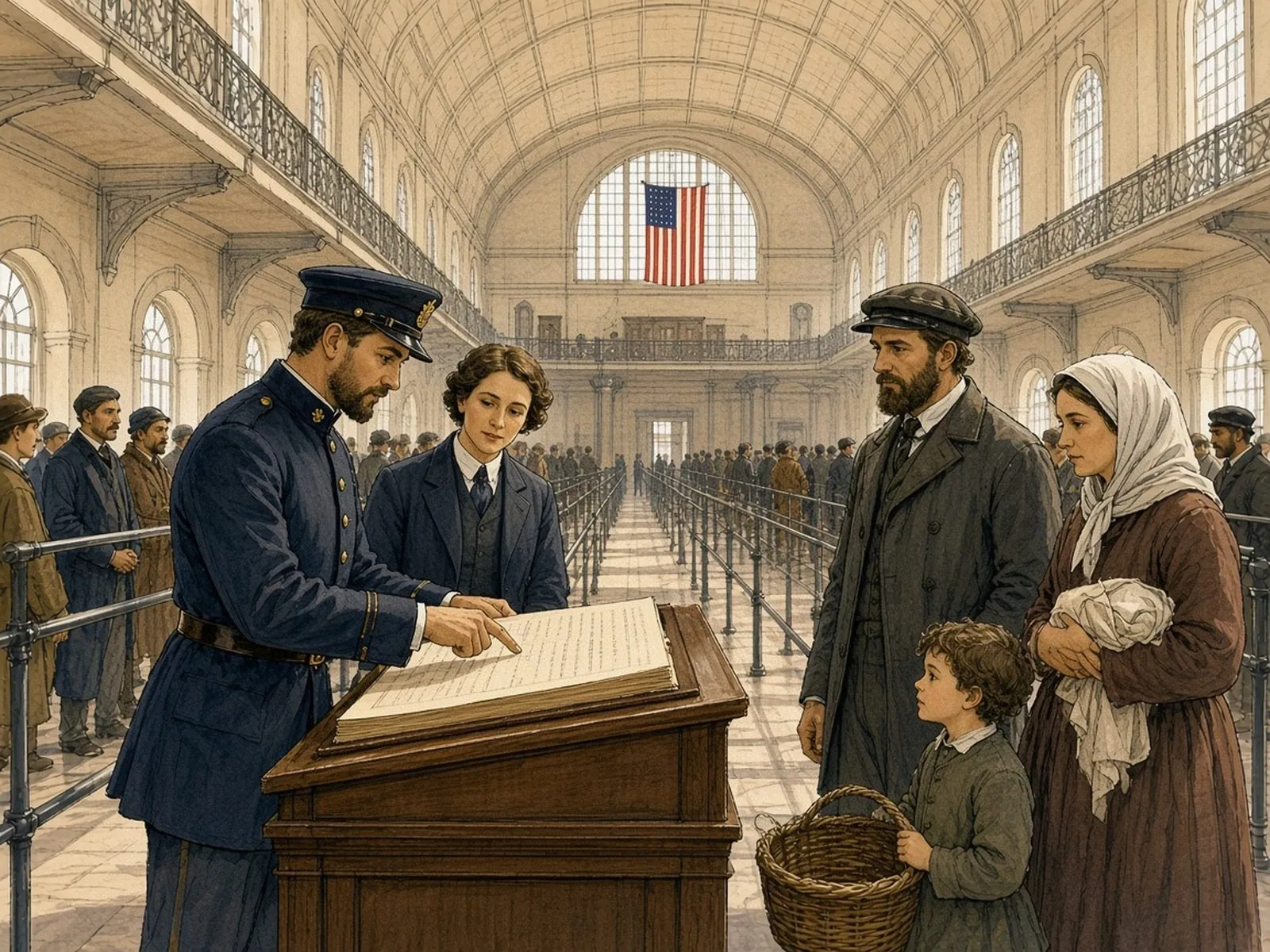
The Ellis Island Myth
Almost every American Jewish family seems to have a story in which an immigration officer at Ellis Island, unable to understand a foreign name, wrote down a new one. Philip Sutton, a librarian in the New York Public Library’s Milstein Division of United States History, Local History and Genealogy, addressed the story directly in a 2013 blog post. Between 1892 and 1954, he wrote, over twelve million people entered the United States through the inspection station at Ellis Island, and there is a persistent myth in family lore that their names were changed there, when in fact they were not[231]. He quoted the historian Vincent Cannato’s history of the island, which states that inspectors never wrote down the names of incoming immigrants, that the only lists of names were the steamship manifests filled out in Europe, and that the clerk in the Great Hall, usually working through interpreters, asked questions to check that the answers matched those manifests[231].
The United States Citizenship and Immigration Services makes the same case in its genealogy pages. Passenger lists were not created at Ellis Island, it explains, but abroad, beginning near the immigrant’s home when the ticket was bought, and an inspector was not to change the name or other details of any immigrant unless the immigrant asked or inspection showed the original information to be wrong[232]. Language was rarely a barrier, since between about 1892 and 1924 a third of all immigrant inspectors were themselves foreign-born, inspectors spoke an average of three languages and were assigned to groups by language, and the station employed full-time interpreters and called in others under contract for rarer tongues[232]. Smithsonian magazine added that Fiorello LaGuardia, a congressman and three-term mayor of New York, worked at the station as an interpreter during the day while studying law at night, and that, as the son of an Italian father and a Jewish mother from Austria-Hungary, he spoke Italian, German, Yiddish and Croatian[233].
Names were, of course, mangled along the way. The USCIS essay acknowledges that the first ticket clerk might misspell a name, assuming a correct spelling even existed, and that every further transcription on a journey with several connections offered new chances for error[232]. Its more important point is that the decisive changes happened later, in American life. Once in the country, immigrants were usually asked their names and recorded by people who were already English-speaking, such as teachers, landlords, employers and judges, which explains many small changes in spelling over time, and many immigrants welcomed the change because a name long on consonants and short on vowels could get in the way of a job interview or invite ridicule at school[232]. The agency’s own files bear this out, with letters from immigrants in the naturalization records explaining, among other cases, how Diamond became Cohen and how Kohnovalsky became Cohn[232].
Why did the legend persist? Sutton cited the suggestion of Marian L. Smith, in her essay American Names, Declaring Independence, that when immigrants spoke of Ellis Island they meant the whole experience of their first years in America, from learning English and finding work to adjusting a name to a new spelling or pronunciation[231]. He also told the story of the rare exception that proved the rule. The passenger list of the S.S. New York, which arrived from Southampton on 4 October 1908, shows a name crossed out and replaced, because a passenger who had travelled as Frank Woodhull, in male attire, was detained for special inquiry and recorded as Mary Johnson, before being allowed to continue to New Orleans[231]. Sutton offered the case, with some humour, as proof that even if a name had been changed at Ellis Island it would not have mattered, and the New York Times printed interviews in which Woodhull told the story of a life spent working in men’s clothes[231].
New research has begun to measure how often names did change. A study by Joshua Goldstein of the University of California, Berkeley, and Guy Stecklov of the University of British Columbia, reported by the university in November 2026, used Social Security records for men who first applied for numbers between 1936 and 1970, comparing sons’ surnames with those of their fathers[234]. It found that more than 80 per cent of immigrants kept their surnames intact, that about 15 per cent made slight changes that preserved their ethnic roots, and that only about 5 per cent adopted English-sounding names that could mask their origins[234]. Jewish immigrants had the highest rate of change, but even among men whose fathers had names like Shapiro or Cohen, nearly 90 per cent kept them and only about 6.5 per cent changed to English-sounding names[234].
Name-Change Petitions in New York
If clerks did not change Jewish names, Jews often changed them themselves, and the historian Kirsten Fermaglich has reconstructed how. Her book A Rosenberg by Any Other Name, which she describes as the first book to explore the phenomenon, draws on thousands of previously unexplored petitions submitted to the New York City Civil Court during the twentieth century[235]. She argues that name changing was a distinctive American Jewish practice in the middle of the century, that Jews changed their names at rates far out of proportion to their numbers in the city, and that they often did so together with other family members[235]. In an interview with the Jewish Herald-Voice in 2018 she noted that in New York during the 1930s Jews made up about 26 per cent of the city’s population but roughly 65 per cent of the petitioners had Jewish-sounding names, and that most petitioners were white-collar workers, students seeking entry to professional schools and businessmen and secretaries applying through employment agencies[236].
The reason, Fermaglich argues, was a private system of anti-Jewish discrimination in education and employment. She told the Jewish Herald-Voice that Columbia University established the modern college application form in 1917, after roughly 40 per cent of its undergraduates had become Jewish immigrants or their children by 1915, and that the form asked about religious affiliation, the father’s name, birthplace and occupation, with later versions adding the mother’s maiden name and any changes made to the family name since the applicant’s birth[236]. By 1921, she said, Jewish enrolment at Columbia had fallen to 21 per cent, and Harvard and other Ivy League schools then designed detailed application forms that specifically asked about name changing, as did employers in professions such as law and medicine[236].
The growth of the state during the Second World War added further pressure. Fermaglich writes that as government reached more deeply into daily life, more Jews found it necessary to change their names officially in order to avoid discrimination and take part in the war effort[235]. After the war the Jewish community became sharply divided over the practice. The Jewish Herald-Voice describes an anonymous 1948 article in the Atlantic titled I Changed My Name, whose author defended his decision and described his friends’ anger, and which provoked passionate debate, with many Jews regarding name changing as shameful, a sign of trying to pass, of leaving the community or of self-hatred[236]. Fermaglich concludes, however, that the majority of name changers remained members of the Jewish community and used their new names mainly to make work in the wider world easier[235].
The story ended through civil rights law rather than through any change of heart about names. Fermaglich argues that name changing became a central issue in the campaign for early civil rights legislation in New York, as Jewish organisations sought to ban discriminatory questions on job and college application forms, and that once questions about religion, nationality and names were made illegal the strategy became less necessary[236]. Jews stopped changing their names in large numbers by the 1970s, she writes, just as negative portrayals of name changers and stories of Ellis Island officials changing names spread through popular culture[235]. Since 2001, she adds, other ethnic groups have been changing their names in the same court for very different reasons[235].
Given names followed a related path. The Encyclopaedia Judaica observes that in the United States each generation after the immigrants adopted new styles of given name, and that names very popular with an earlier generation were later rejected because they seemed too closely identified with immigrant status and with Jewishness[27]. The pattern had a precedent in nineteenth-century German-speaking Europe, described in an earlier chapter, where acculturating families chose German names that echoed the sound or meaning of the Yiddish names they replaced. The American version differed mainly in scale and speed, since a single generation could move from Yiddish names at home to English names at school, with the old name often surviving only as the Hebrew name used in synagogue.
Anglicisation in Britain
Britain saw the same processes on a smaller scale. The National Archives’ research guide to Jewish records warns that although Jewish individuals and families can often be identified by typically Jewish names, this is not an exact science, since many surnames thought of as Jewish are really German or Eastern European, and many Jewish immigrants to the United Kingdom anglicised their surnames or simply changed them[237]. The guide adds that Jewish forenames are typically drawn from the Old Testament but were not unique to Jews, since many such names were also favoured by English and Welsh nonconformists[237].
Wartime brought special pressures. A pamphlet of the First World War period, collected by E. F. Cory Kernick and published by the British Empire Union, listed some 3,000 changes of name by deed poll and enrolment announced in the London Gazette during the war, which its compilers estimated as perhaps a quarter of the total advertised there[238]. They wrote that most were German names changed to British ones, that changes advertised in the Gazette ran at over 400 a year in the first three years of the war, and that in 1918 the rate rose to 1,200 a year[238]. The pamphlet was openly hostile, presenting the changes as a possible danger to the Empire and calling for stricter legislation, and it shows how a foreign-sounding name could become a political liability almost overnight[238].
A family history published by the University of Portsmouth’s history blog shows the same pressures a generation later. Jeremy Schultz describes how his grandfather, born in 1907 to Lithuanian and Belorussian Jewish immigrants and raised in his father’s tailoring workshop in Whitechapel, changed his name from Israel Shneor Zalman Schultz to Ivor Shaw, a change recorded in a statutory notice in the London Gazette of April 1940[239]. On the same page of the Gazette, he notes, Abraham Israeloski became Abraham Ingram, Nathan Levy became Norman Harrow, Harry Fink became Harry Ferguson and Myer Strumanger became Myer Stone[239]. Schultz attributes the rush to the outbreak of war and the burden of a German-sounding name, to the antisemitic campaigns of Oswald Mosley’s British Union of Fascists in the 1930s, and to the classification in 1939 of some 55,000 Jewish refugees in Britain as category C enemy aliens[239].
His account also shows how such changes can be reversed. Growing up in London in the 1970s and 1980s as Jeremy Shaw, he felt both envy of friends whose German-sounding Ashkenazi names hinted at a deeper heritage and relief at the protection a British-sounding name seemed to offer[239]. Concluding that Shaw had served its purpose, a borrowed name that obscured rather than celebrated his family’s story of migration, and moved by a resurgence of antisemitism in the United Kingdom, he changed his name back to Schultz by deed poll in 2021[239]. His grandfather’s freedom to choose a new name, he observes, contrasted sharply with Germany in the same years, where a 1938 order forced Jews with non-Jewish first names to add Israel or Sara to their official documents, a subject taken up in the next chapter[239].
Hollywood and Professional Renaming
The film industry offers the most visible examples of professional renaming. Writing in the British Film Institute’s Sight and Sound in May 2021, Christina Newland notes that in Golden Age Hollywood smooth-syllabled, homogeneous names of white Anglo-Saxon Protestant character dominated, even though the talent pool included many people born with Italian, Jewish and Spanish surnames thanks to the great wave of immigration at the start of the twentieth century[240]. The best-known case is Kirk Douglas. The Encyclopaedia Judaica records that he was born Issur Danielovich Demsky in Amsterdam, New York, in 1916, while the Sight and Sound article reports that he later said his real name was too unwieldy and too Semitic for Hollywood[241][240].
The same article points out that many of the studio heads who imposed such changes were themselves from Jewish immigrant families, and that Sam Goldwyn had originally been called Goldfish[240]. Jack Warner, it notes, had no qualms about renaming the stage actor Julius Garfinkle as John Garfield[240]. By the 1970s, however, Jewish stars such as Barbra Streisand and Elliott Gould were keeping their own names, even as other forms of typecasting persisted in Hollywood[240]. The shift matches the wider pattern described by Fermaglich, in which large-scale name changing among American Jews ended by the 1970s[235].
The history of immigrant name changing is therefore less a story of careless clerks than of choices made under pressure. Families altered their names to find work, to enter universities, to escape suspicion in wartime or to succeed on the stage, and most did so without leaving the Jewish community. Some of their descendants, like Jeremy Schultz, have chosen to recover the old names, while the statistical evidence suggests that most immigrant families never changed their surnames at all. In both cases the name remained what it had been in earlier centuries, a record of the pressures and hopes of the moment at which it was chosen.
Israel and Sara in the Nazi Name Decree
Earlier chapters described how European states compelled Jews to take fixed surnames as part of the long and uneven process of emancipation. The Nazi state reversed that process, and it used names as one of its instruments. The Leo Baeck Institute, introducing a document from its collections, observes that Jews in Germany were twice forced to change their names, first through the introduction of often stigmatising family names during the emancipation, and then through the compulsory first names Sara for women and Israel for men imposed on 17 August 1938[242]. The Encyclopaedia Judaica describes the measure as a clear expression in the sphere of names of the Nazis’ total repudiation of emancipation[27]. This chapter examines the decree, the way it entered documents and daily life, and the place that names came to hold in the records of deportation and in the memorials built after the war.
The Approved List of 1938
The measure was formally the Second Ordinance for the Implementation of the Law on the Alteration of Family and Personal Names, dated 17 August 1938. The Encyclopaedia Judaica summarises it as specifying 185 forenames for men and 91 for women, many of them with derogatory connotations, which German Jews were henceforth to use, while Jews who already bore other names had to add Israel or Sarah by 1 January 1939, register the new names and use them in all business and legal transactions[27]. The German Federal Agency for Civic Education gives the citation as Reichsgesetzblatt I, page 1044, and explains that the forced name applied to anyone whose existing first name did not conform to the guidelines of the Reich Minister of the Interior, which in practice meant names that did not match antisemitic stereotypes of Jewishness[243].
An American diplomat’s report shows how the measure looked to outside observers at the time. In a political report from Berlin printed in the State Department’s Foreign Relations of the United States, the American ambassador in Germany, Wilson, noted that a law promulgated on 18 August 1938, in Part I, number 130 of the Reichsgesetzblatt, compelled Jews to bear Jewish given names, that it did not apply in Austria and did not affect foreign Jews living in Germany, and that Jews without names designated as Jewish by the Minister of the Interior had to adopt Israel or Sara by 1 January 1939[244]. Those affected, the report continued, had to inform the registry and police authorities by the end of January 1939 and use the added names in all legal and business correspondence, with six months in prison for wilful failure to comply and one month for negligence or for failing to notify the authorities[244].
The list of permitted names itself was published separately. The Stralsund memorial book project explains that it appeared as an annex to a circular of the Reich Minister of the Interior in the ministry’s official gazette, number 35 of 24 August 1938, which obliged all Jewish parents to give their children a name from the list[245]. The list it reproduces mixes biblical names borne by kings, rivals and rebels condemned in the biblical narrative, such as Ahab, Esau, Korach, Laban and Jezabel, with Yiddish and East European names like Feibisch, Itzig, Schmul, Fradel, Scheindel and Kreindel, and a handful of ordinary Hebrew names such as Baruch, Menachem and Rachel[245]. The American report adds that the same circular told registry offices that, in order to further the idea of the clan, only German names should in principle be given to German children, though certain foreign names long sanctioned by usage, such as Hans, Joachim, Peter, Julius, Elisabeth, Maria, Sofie and Charlotte, would be accepted[244].
The choice of Israel and Sara was itself a calculated insult, turning names of honour into labels of exclusion. The Leo Baeck Institute quotes the New York German-Jewish newspaper Aufbau, which commented in its September 1938 issue that if the motives behind the regulation were not so abysmally cruel there would be nothing in its content to complain about, since Israel means fighter for God and Sarah or Sara means princess[246]. The same institute notes that the regime also made sure that Jews who had changed their family names in order to blend in and avoid discrimination had to return to their former names[242]. In that respect the decree undid both the private choices of assimilating families and the public promise of emancipation.
Stigma in Documents and Daily Life
The decree worked through the ordinary machinery of registration. The Leo Baeck Institute preserves a letter of 21 December 1938 in which the Friedmann family of Schwandorf in Bavaria informed the local police that four members of the family, Amalie, Bruno, Lillian and Georg Friedmann, would bear the additional names Sara or Israel from 1 January 1939 in accordance with the law, and that the relevant registry offices had been notified[247]. The Federal Agency for Civic Education, discussing the same family, adds that the notices were sent by registered post to the registry offices in Munich and Berlin as well as to the Schwandorf police, and that no one can know with certainty what the family thought when they learned of the decree[243].
The new names were only one element in a system of identification. The United States Holocaust Memorial Museum notes that the government required Jews to identify themselves in ways that would permanently separate them from the rest of the population, that all Jews had to carry identity cards indicating their Jewish heritage, and that in the autumn of 1938 all Jewish passports were stamped with the letter J[248]. Its encyclopedia illustrates the point with passports issued to a German Jewish couple in Karlsruhe on 29 December 1938, stamped with J for Jude[248]. These measures followed the Nuremberg Race Laws, which the museum explains were announced on 15 September 1935 at a Nazi Party rally and comprised the Reich Citizenship Law and the Law for the Protection of German Blood and German Honour[249].
The Federal Agency for Civic Education describes the decree as a direct intrusion of antisemitic legislation into private life that took from its victims the most personal thing of all, their own name, and observes that the public marking of Jews through names began three years before the introduction of the yellow star in September 1941[243]. In working life and in legal matters, it notes, Jews were now forced to use at least one stereotyped first name that clearly identified them as Jews[243]. A signature on a letter, an entry in a register or a name called out in an office now announced the bearer’s status to every official and employer who read or heard it.
For some the humiliation was unbearable. The Federal Agency for Civic Education records that Hedwig Jastrow, a former teacher and feminist who had taught German children for 43 years, took her own life in Berlin at the age of 76 to avoid the renaming[243]. In her handwritten farewell letter, as quoted by the agency from the documentary edition of the persecution of European Jews, she wrote, in translation, that she did not want to live without a fatherland, home, dwelling or civic rights, outlawed and reviled, and that she wanted to be buried with the name her parents had given and partly bequeathed to her, a name on which no stain rested, rather than wait until a mark of shame was attached to it[243]. The agency also notes that the journalist and author Inge Deutschkron referred to the forced change of name in her memoir I Wore the Yellow Star, which became the basis of a play titled From Today Your Name Is Sara, first performed at the Grips Theatre in Berlin on 9 February 1989[243].
Names in Deportation Records and Memorials
The bureaucratic habits that produced the decree also produced the records through which victims are traced today. Because the added names had to be used in all legal and business dealings, they became part of the paper trail that persecution left behind[244]. The United States Holocaust Memorial Museum serves as the American repository of the digital archive of the International Tracing Service from the Arolsen Archives, whose collection contains digital images of documentation on millions of victims of Nazism, and it maintains a database through which millions of names of people persecuted by the Nazi regime can be searched[250].
After the war, the recovery of names became a central form of remembrance. Yad Vashem in Jerusalem created Pages of Testimony, special one-page forms submitted by survivors, relatives or friends to record the names, biographical details and, where possible, photographs of individual Jews murdered in the Holocaust, which it describes as symbolic tombstones[25]. It reports that the first 800,000 names on such pages were collected in the 1950s, that some 2,800,000 names are now recorded on them in more than twenty languages and kept in the circular repository of its Hall of Names, and that in 2013 the repository was included in UNESCO’s Memory of the World Register, the first Israeli collection to be so recognised[25].
The language of these projects echoes the long Jewish concern with names traced throughout this essay. Avner Shalev, as chairman of Yad Vashem, was quoted as saying that for many survivors and their families Pages of Testimony are the only tangible evidence that their murdered relatives once lived, and that the pages, together with information gathered worldwide, restore their names and so their identities[25]. Alexander Avram, director of the Hall of Names, described the repository as a collective memorial intended to preserve the names as symbols of the victims’ humanity[25]. Where the decree of 1938 tried to reduce each Jew to a uniform label, the work of remembrance seeks the individual name that each person was given and answered to, and the Hebrew name, the calling name and the family name each have their place on the page.
The decree thus belongs with the edicts of 1787, 1808 and 1812 described earlier, as a moment when a state reached into the most personal of Jewish possessions. The difference is one of purpose. Those earlier laws, however coercive, aimed at incorporating Jews into the civil order of the state, whereas the decree of 1938 aimed at marking them for exclusion, and it formed one step in a sequence that led, within a few years, from registration to deportation and murder.
Converts, Taboos and the Names of Today
The final chapter gathers several threads. It begins with the names given to those who join the Jewish people, a practice that shows with unusual clarity how a Jewish name defines its bearer’s place in a family and a community. It then turns to the inherited cautions that still shape naming, to the fashions visible in present-day Israel and in the American Jewish community, and finally to the scholars who, over nearly two centuries, have turned Jewish names into a field of study. In each case the old patterns described in earlier chapters reappear in new forms, sometimes strengthened and sometimes quietly transformed.
Ben Avraham Avinu and Ruth
A convert to Judaism needs a name that can stand in the formula of ben or bat with a parent’s name, and the tradition supplies one. The Encyclopaedia Judaica’s article on proselytes explains that a convert severs former family ties and is considered like a newly born child, so that the convert’s Jewish name is not linked with that of the biological father and the convert is instead called the son of Abraham our father, and it adds that the custom later developed of naming the convert himself Abraham, after the first Jew who knew his Creator, so that he became Abraham son of Abraham[251]. The Encyclopaedia Judaica’s article on names likewise notes that the most common names for those entering the Jewish faith were Abraham and Sarah[27].
The Jewish Virtual Library describes the practice as it stands today. There is no legal requirement that a male convert adopt the Hebrew name Abraham or that a female convert take the name Ruth or Sarah, it explains, but there is a long-standing tradition to that effect, and in most cases a man is named Avraham ben Avraham Avinu and a woman Sara bat Avraham Avinu or Rut bat Avraham Avinu[252]. It offers two reasons for the choice of Abraham. The first is that the Bible calls him the father of a multitude of nations, which suits converts drawn from many peoples, and the second, taken from the Midrash, is that both Israel and converts are called friends of God, which gives Abraham, called God’s friend in Isaiah, a special relationship with converts[252].
The choice of Sarah and Ruth is explained in a similar way. The Jewish Virtual Library notes that female converts take the name of Sarah because she was the wife of Abraham, the first Hebrew, and because tradition holds that she and Abraham won souls to the worship of God, Abraham among the men and Sarah among the women[252]. Ruth, it adds, is regarded as the model of loyalty to Judaism for her vow of allegiance to her mother-in-law Naomi, even though she did not undergo a formal conversion in the later sense[252]. The Jewish Encyclopedia of 1906, in its article on proselytes, already pointed to Ruth as the type of the stranger who seeks refuge under the wings of the God of Israel[253].
The legal consequences of the new name are real. The same Jewish Virtual Library entry observes that because the Talmud likens converts to newborn children their legal connection with their former families is largely severed and the family of Abraham becomes their family, yet converts must still honour their parents and observe the laws of mourning when their non-Jewish parents die[252]. The name ben Avraham Avinu thus marks both a new genealogy and a continuing human bond, and the Shulchan Arukh’s rules for writing a bill of divorce, discussed in the chapter on patronymics, require it in that most formal of documents[15]. It also shows, perhaps more clearly than any other case, that a Jewish name has always been a statement of descent as much as a personal label.
Names to Avoid
Converts receive names of honour, but much of Jewish naming has been shaped by the opposite concern, the names that should not be given. Earlier chapters traced the main strands of this tradition: the rabbinic warnings against naming children after the wicked, the medieval rules of the Sefer Hasidim about sharing names within a town or a marriage, the Ashkenazi reluctance to name a child after a living person, and the protective names, such as Alter and Chaim, given to children in families that had lost earlier babies. These cautions arose in different periods and places, and they were never a single code, but together they show how seriously Jews took the power of a name to shape and to endanger its bearer.
The twentieth century added new taboos. The Nazi name decree of 1938 attached a lasting shadow to certain names, while the reaction against Hebraization made some Israelis wary of erasing family names altogether. The Forward’s account of Hebraization recalls the linguist Yitzhak Avineri’s advice that Holocaust survivors who were the last of their families should keep their family names, a modern caution grounded in memory rather than superstition[175]. Many of the older customs survive. A survey of American Jews published in 2022 by the Jewish Language Project at Hebrew Union College found that the Ashkenazi tradition of naming babies after deceased relatives remains strong among American Jews of diverse backgrounds, and its author Sarah Bunin Benor said she was surprised by how many respondents of Sephardi heritage, or with non-Jewish spouses, named their babies in this way[254].
Present-Day Fashions in Israel and the Diaspora
Israel’s Central Bureau of Statistics publishes an annual analysis of the names given to newborn children, and its report on children born in 2024 shows how the old and the new combine. The most common name for Jewish boys was David, given to 1,842 babies or 2.7 per cent of Jewish boys born that year, followed by Lavi with 1,518, and Ariel with 1,479[197]. The remainder of the top ten were Rafael, Uri or Ori, Yosef, Ari, Moshe, Yehuda and Avraham, and nine of the ten names that led the list in 2023 remained there in 2024, with Avraham replacing Noam[197]. A list dominated by names of patriarchs, kings and prophets, alongside newer Hebrew names such as Lavi and Ari, suggests that the biblical stock remains central a century after the first Hebraizers tried to replace the names of the Diaspora.
The bureau’s figures also reveal sharp differences between communities. The Jerusalem Post, reporting on the 2024 data, noted that traditional names such as Esther and Sarah were especially common in cities with large Orthodox populations, including Jerusalem, Bnei Brak and Beit Shemesh, that Maya was more common in central Israel, and that traditional boys’ names such as Abraham, David, Joseph and Moses dominated in mainly Orthodox areas, while Adam was notably popular in Tel Aviv-Jaffa[255]. It added that no single name appeared in the top ten for every socioeconomic group, either for Jewish girls or for Jewish boys[255]. Names in Israel thus serve as markers of religious and social identity, much as they once marked regional origin in the Diaspora.
Events, too, leave their mark. The Jerusalem Post reported that the name Be’eri, which surged after the Hamas attack on Kibbutz Be’eri, fell by 343 babies between 2023 and 2024, the largest decrease recorded for any name[255]. A generation earlier, the onomastician Edwin Lawson, analysing names drawn from English-language editions of Israeli telephone directories, found that over 90 per cent of both men’s and women’s names were Hebrew in origin, with the Bible accounting for over 70 per cent of the male names and about 40 per cent of the female names[256]. Comparing his figures with the newest lists suggests remarkable continuity in the dominance of biblical names for boys, though the methods of the two studies differ too much for exact comparison.
In the United States the story has moved in the opposite direction to the one told in the chapter on immigration. The survey by Benor and Alicia Chandler, based on more than 11,000 responses collected in 2019, found that American Jews became steadily more likely to give their children names of Jewish origin, with a major increase after the 1960s, so that 14 per cent of Jews in the oldest age group had names of Jewish origin compared with 63 per cent in the youngest[254]. The leading names of each decade show the change, from Ellen and Robert in the 1950s to Rebecca and Joshua in the 1970s and Noa and Ari in the 2010s[254]. The report adds that the strongest factors in giving a child a distinctively Jewish name were time spent in Israel, a birth after 1969 and a parent’s own distinctively Jewish name, followed by a desire for a unique name, synagogue attendance and Sabbath observance[257].
The same survey found that while some Jews had changed their first names for various reasons, hardly any had done so to make their names less Jewish, in contrast to the common practice of changing family names in the middle of the twentieth century[254]. It found that most respondents had a Hebrew or other Jewish ritual name, usually different from their everyday name, and that since the 1960s parents had become more likely to give identical ritual and everyday names[257]. Jews with distinctively Jewish names were also much more likely to use a so-called Starbucks name, an alternative first name for service encounters, while some with common American names did the reverse, adopting a more Jewish name for the purpose, and some kept an Aroma name for cafés in Israel[254]. The two-name system of the Ashkenazi kinnui and shem ha-kodesh, described in an earlier chapter, has found an unexpected modern successor.
A Century of Jewish Onomastic Scholarship
The study of Jewish names as a scholarly discipline began in the nineteenth century. The Encyclopaedia Judaica names two works as the major studies of Jewish onomastics, Leopold Zunz’s Namen der Juden of 1837 and Heinrich Loewe’s Geschichte der jüdischen Namen of 1929[27]. For the medieval period and the establishment of surnames, the same article’s bibliography directs readers to the onomastic excursuses and detailed indexes found in histories of particular communities, and to tax records, in which much valuable information on names is preserved[27]. The article itself is the work of several scholars, among them Johann Jakob Stamm, Harold Louis Ginsberg, Louis Isaac Rabinowitz and Robert Chazan, and it divides the subject by period, from the Bible and the Talmud to the medieval establishment of surnames and modern times[27].
The second half of the twentieth century brought dictionaries and statistical studies. Benzion Kaganoff’s Dictionary of Jewish Names and Their History appeared in New York in 1977, and Lawson’s study of Israeli names in the journal Names in 1991 drew on it among other works[256]. Alexander Beider’s series of dictionaries transformed the study of Ashkenazi names, beginning with A Dictionary of Jewish Surnames from the Russian Empire in 1993 and continuing with volumes on Prague in 1995, the Kingdom of Poland in 1996, Ashkenazic given names in 2001 and Galicia in 2004[11]. For antiquity, the first part of Tal Ilan’s Lexicon of Jewish Names in Late Antiquity, published in 2002, covers Palestine from 330 BCE to 200 CE[19], and its introduction already called for companion volumes on Palestine from 200 to 650 CE and on the Greco-Roman and Byzantine Diaspora[78].
Recent scholarship has shifted its attention from the origins of names to the people who chose them. Kirsten Fermaglich’s study of name-change petitions in New York, Abraham Stahl’s work on Hebraization among Mizrahi children and the national survey of Benor and Chandler all treat names as evidence of social pressure, identity and choice[235][175][254]. Among the scholars invited to respond to the survey at its launch was Aaron Demsky of Bar-Ilan University, author of a collection of studies in Jewish onomastics titled These Are the Names[254]. Historical and social approaches now work side by side, and the sources that support them, from ancient ossuaries to modern registers, continue to grow.
This essay has followed Jewish names from the theophoric names of the Bible through the Greek and Aramaic names of the Second Temple period, the Arabic and Romance names of the Middle Ages, the Yiddish and Ladino names of early modern communities, the surnames imposed by European states, the Hebrew names of Zionism and the anglicised names of the great migrations, to the statistical tables of the present. Across all those centuries a Jewish name has done three things at once. It has tied its bearer to a family, living or departed; it has placed that person within a people and its sacred history; and it has reflected the languages and pressures of the surrounding world. The names given in Jerusalem, New York or London today still do all three, and they will one day be read by historians as the present essay has read the names of the past.
Timeline
OpenClose
The Encyclopaedia Judaica’s dates for the Assyrian king whose wall at Khorsabad was measured to match the numerical value of his name, the earliest known example of gematria[214].
The destruction of the First Temple, from which the Encyclopaedia Judaica dates the beginning of the Jewish community of Iraq[154].
Roman conquest closes the period in which the family of Mattathias ruled Judea and shaped the Jewish name pool[80].
One of the pairs of Pharisaic leaders, a biblical name beside one that is probably Greek[88].
An Aramaic inscription dates the synagogue floor to an emperor Justin, while a Greek one names the craftsmen Marianos and Hanina[103].
Beider lists eleven women named in Hebrew sources from this year among the earliest bearers of the name[137].
The Jewish Encyclopedia’s date for the arrival from Cranganore of one of the six stocks of the White Jews of Cochin[179].
Isaac ben Samuel of Meiningen begins the memorial book that became the model for recording the names of the dead in other communities[119].
Exiles in the Ottoman Empire take surnames such as De Leon, Zamora and Toledano, recalling their former homes[27].
A translation printed in Constantinople serves the Romaniote and Sephardi communities of the city[169].
The isolation of Rome’s Jews in the ghetto freezes the Roman form of Judeo-Italian[168].
Pope Pius V’s bull excludes Jews from the cities of the Papal States except Rome and Ancona[92].
Its rules on the dead, on building and on marriage, with many further customs, appear in print[120].
The Frankfurt house of the red shield gives the Rothschild family its name[213].
Born Gabriel da Costa in Oporto, he flees with his New Christian family[148].
After imprisonment by the Inquisition, Orobio settles in Amsterdam and takes the name Isaac[147].
Joseph II opens schools and trades to Jews five years before the surname law[199].
Levy, with 618 bearers, heads the list of the most common Jewish surnames in the province[1].
Habsburg Jews must adopt fixed hereditary surnames, and Galician families are the first in Eastern Europe to receive them en masse[198].
Founded by a member of the Divekar family, whose surname shows the typical ending in -kar[181].
Jews of the Pale of Settlement are required to adopt family names[11].
The Kingdom of Westphalia grants its Jews civic rights[204].
Jews of the French Empire must register fixed given names and surnames[203].
The ninth constitutional edict gives the Jews of Baden an officially recognised religious organisation[205].
Under an imperial decree, 399 heads of family in The Hague confirm or adopt surnames[207].
A new law obliges Jews to take family names[11].
Jews of the province acquire surnames, two decades after the Prussian edict[11].
Jews may choose any German given name but may not change their names[11].
The first major scholarly study of Jewish names is published[27].
Juda Nehama prints Salonika’s first Judeo-Spanish newspaper[150].
The general civic rights law removes the last legal limits on Jewish names in the Habsburg lands[11].
Eliezer Ben-Yehuda, born Perelman, arrives in Jaffa and makes Hebrew the language of his home[227].
The station operates until 12 November 1954[233].
Joseph Jacobs’s article on personal names surveys the field from the Bible to modern superstitions[1].
A rare documented change of name at Ellis Island is recorded on the manifest of the S.S. New York[231].
Questions on religion, birthplace and the father’s name begin to screen out Jewish applicants[236].
Martin Noth places biblical names in their wider Semitic setting[16].
The Reich Citizenship Law and the Law for the Protection of German Blood and German Honour are announced[249].
Jews in Germany are restricted to listed names or must add Israel or Sara[27].
The Reich Interior Ministry’s gazette publishes the list of names permitted to Jews[245].
Jews with non-listed names must bear the added names from this date[248].
The London Gazette records the change beside others of the same kind[239].
Ben-Gurion’s order urges all Israeli commanders to Hebraize their surnames[228].
An anonymous article in the Atlantic opens a public debate among American Jews[236].
Ben-Gurion declares that no officer without a Hebrew name will represent Israel abroad[230].
The New York Times reports their spread in all branches of Judaism[226].
A Dictionary of Jewish Surnames from the Russian Empire begins his series of reference works[11].
The first part of the Lexicon of Jewish Names in Late Antiquity covers Palestine from 330 BCE to 200 CE[19].
Yad Vashem’s repository enters UNESCO’s Memory of the World Register[25].
More than 11,000 people respond to the national survey later published by Benor and Chandler[254].
Jeremy Shaw changes his name back to Schultz by deed poll[239].
David is the most common name among Jewish boys born in Israel this year[197].
Glossary of Terms
OpenClose
- Aliyah
- Literally ascent; immigration of Jews to the Land of Israel. The First Aliyah began in 1882 and the Second ran from 1904 to 1914.
- Alter
- Literally old one. A Yiddish name given to a child in a family that had lost earlier children, in the hope of protecting it.
- Ashkenazi
- Belonging to the Jews of medieval Germany and their descendants in Central and Eastern Europe and beyond.
- Bat
- Daughter of. Used with a parent’s name in the Hebrew naming formula, as in Rut bat Avraham Avinu.
- Ben
- Son of. Used with the father’s name in Hebrew names and documents, and the root of many modern Hebrew surnames.
- Ben Avraham Avinu
- Son of Abraham our father. The patronymic traditionally given to a male convert to Judaism.
- Beta Israel
- The Jewish community of Ethiopia, whose naming customs draw on Amharic and Tigrinya.
- Brit milah
- The covenant of circumcision on the eighth day, at which a Jewish boy traditionally receives his name.
- Bulla
- A small lump of clay impressed with a seal, often bearing its owner’s name, used to secure documents in antiquity.
- Converso
- A Jew of Spain or Portugal who converted to Christianity, often under pressure, or a descendant of such converts; also called a New Christian.
- Deed poll
- In English law, a legal document by which a person changes their name, often announced in the London Gazette.
- Double name
- A combination of two given names, such as Zev Wolf or Aryeh Leib, often pairing a Hebrew name with its Yiddish equivalent.
- Gematria
- The calculation of the numerical value of a word from its letters, used in interpreting names.
- Get
- A Jewish bill of divorce, which must record the names of both parties with great precision.
- Hebraization
- The replacement of a non-Hebrew name with a Hebrew one, widespread in the Yishuv and early State of Israel.
- Hollekreisch
- A cradle ceremony of western Ashkenazi Jews, at which children were lifted and their secular name announced.
- Hypocoristic
- A diminutive or pet form of a name, such as Yiddish names ending in -l, -ke or -tshe.
- Ibn
- Arabic for son of, used in Jewish names in the Islamic world and al-Andalus, and the source of surnames such as Ibn Ezra.
- Ketubbah
- The Jewish marriage contract, which records the names of bride and groom.
- Kinnui
- The everyday or secular name, often Yiddish or vernacular, borne alongside a Hebrew sacred name.
- Kohen
- A member of the priestly family descended from Aaron; the source of surnames such as Cohen, Kahn and Katz.
- Kunya
- An Arabic name formed with abu, father of, identifying a man by his firstborn son.
- Ladino
- Judeo-Spanish, the language of the Sephardi diaspora in the Ottoman Empire and beyond.
- Levi
- A member of the tribe of Levi, who assisted the priests; the source of surnames such as Levy, Levin and Segal.
- Matronymic
- A name derived from a mother’s name, as in many East European Jewish surnames.
- Memorbuch
- A community memorial book recording the names of the dead, especially martyrs, read aloud in the synagogue.
- Mizrahi
- Belonging to the Jews of the Middle East and North Africa.
- Nisba
- An Arabic adjective of origin or affiliation, such as al-Fasi, of Fez, used in names.
- Ornamental surname
- A surname composed of pleasant-sounding words, such as Rosenthal or Goldberg, typical of names adopted after 1787.
- Ossuary
- A stone box for the bones of the dead, often inscribed with names, common in Jerusalem in the late Second Temple period.
- Pages of Testimony
- One-page forms kept by Yad Vashem that record the names and details of Jews murdered in the Holocaust.
- Patronymic
- A name derived from the father’s name, such as ben David or Mendelssohn.
- Rashei teivot
- Acronyms formed from initial letters, the source of surnames such as Katz and Segal.
- Romaniote
- Belonging to the Greek-speaking Jews of the Byzantine Empire and their descendants.
- Sefer Hasidim
- The Book of the Pious, a medieval German Jewish work containing many rules about names.
- Sephardi
- Belonging to the Jews of medieval Spain and Portugal and their descendants.
- Shem ha-kodesh
- The sacred name, Hebrew or Aramaic, by which a man is called to the Torah and recorded on his tombstone.
- Shinui hashem
- The changing of a seriously ill person’s name, or the addition of a new name, as a protective measure.
- Simchat bat
- Celebration of a daughter. A modern ceremony for naming and welcoming a baby girl.
- Theophoric
- Containing a divine name, as do biblical names with El or Yah.
- Toponymic surname
- A surname taken from a place, such as Berliner, Toledano or Posner.
- Zeved habat
- Gift of the daughter. The Sephardi ceremony for naming a baby girl.
References
OpenClose
- Joseph Jacobs, “Names (Personal)”, Jewish Encyclopedia (1906) *
- Ecclesiastes 7:1, Sefaria *
- Kohelet Rabbah 7:1, Sefaria *
- Isaiah 43:1, Sefaria *
- Berakhot 7b, Babylonian Talmud, Sefaria *
- Psalms 46:9, Sefaria *
- Yoma 83b, Babylonian Talmud, Sefaria *
- Deuteronomy 32:20, Sefaria *
- Midrash Tanchuma, Vayakhel 1, Sefaria *
- Exodus 35:30, Sefaria *
- Alexander Beider, “Names and Naming”, YIVO Encyclopedia of Jews in Eastern Europe *
- Gittin 11b, Babylonian Talmud (William Davidson edition), Sefaria *
- Mishnah Gittin 4:2, Sefaria *
- Gittin 34b, Babylonian Talmud, Sefaria *
- Shulchan Arukh, Even HaEzer 129 (names in a get), Sefaria *
- Martin Noth, Die israelitischen Personennamen (1928), Internet Archive *
- Jeffrey H. Tigay, You Shall Have No Other Gods. Israelite Religion in the Light of Hebrew Inscriptions (Scholars Press, 1986), Internet Archive *
- Bezalel Porten, Archives from Elephantine (University of California Press, 1968) *
- Tal Ilan, Lexicon of Jewish Names in Late Antiquity, Part I, Palestine 330 BCE–200 CE (Mohr Siebeck, 2002; e-book 2020) *
- “Ossuaries and Sarcophagi”, Encyclopaedia Judaica, via Encyclopedia.com *
- Taylor-Schechter Genizah Research Unit, Cambridge University Library *
- Princeton Geniza Project *
- Alexander Beider, A Dictionary of Ashkenazic Given Names (Avotaynu) *
- JewishGen Given Names Data Bases *
- “Pages of Testimony”, Yad Vashem *
- Benzion C. Kaganoff, A Dictionary of Jewish Names and Their History (Schocken, 1977), Internet Archive *
- “Names”, Encyclopaedia Judaica, 2nd edn, via Encyclopedia.com *
- Exodus 6:20, Sefaria *
- Judges 6:32, Sefaria *
- I Chronicles 8:33–34, Sefaria *
- II Samuel 4:4, Sefaria *
- Genesis 3:20, Sefaria *
- Genesis 4:1, Sefaria *
- Genesis 4:25, Sefaria *
- Genesis 5:29, Sefaria *
- Genesis 16:11, Sefaria *
- Genesis 21:3–6, Sefaria *
- Genesis 25:25–26, Sefaria *
- Genesis 29:31–30:24, Sefaria *
- Genesis 30:24, Sefaria *
- Genesis 35:18, Sefaria *
- Genesis 38:29–30, Sefaria *
- Genesis 41:51–52, Sefaria *
- Exodus 2:10, Sefaria *
- “Moses”, Jewish Encyclopedia (1906), on the name *
- Exodus 2:22, Sefaria *
- I Samuel 1:20, Sefaria *
- I Samuel 4:21, Sefaria *
- I Chronicles 4:9, Sefaria *
- I Samuel 25:25, Sefaria *
- Ruth 1:20, Sefaria *
- Isaiah 7:14, Sefaria *
- Isaiah 8:3, Sefaria *
- Hosea 1:4–9, Sefaria *
- Genesis 17:5, Sefaria *
- Genesis 17:15, Sefaria *
- Genesis 17, Sefaria *
- Genesis 32:29, Sefaria *
- Judges 13:17–18, Sefaria *
- Exodus 3:13–15, Sefaria *
- Numbers 13:16, Sefaria *
- II Samuel 12:24–25, Sefaria *
- Genesis 41:45, Sefaria *
- II Kings 23:34, Sefaria *
- II Kings 24:17, Sefaria *
- Daniel 1:6–7, Sefaria *
- Esther 2:7, Sefaria *
- Rosh Hashanah 16b, Babylonian Talmud, Sefaria *
- Vayikra Rabbah 32:5, Sefaria *
- II Kings 22:3, Sefaria *
- Job 42:14, Sefaria *
- “Hezekiah’s Seal Impression”, Biblical Archaeology Society *
- II Kings 18:1, Sefaria *
- Jeremiah 36:10, Sefaria *
- Mitka R. Golub, “The Distribution of Personal Names in the Land of Israel and Transjordan during the Iron II Period”, Journal of the American Oriental Society 134 (2014) *
- George Buchanan Gray, Studies in Hebrew Proper Names (London, 1896), Internet Archive *
- Luke 1:59–63 (King James Version), Bible Gateway *
- Tal Ilan, Lexicon of Jewish Names in Late Antiquity, Part I, introduction and statistical chapter (Mohr Siebeck sample PDF) *
- 1 Maccabees 2:1–5 (NRSV Updated Edition), Bible Gateway *
- “Hasmoneans”, Encyclopaedia Judaica, 2nd edn, via Encyclopedia.com *
- Jerusalem Perspective, “The Statistics behind ‘The Tomb’” *
- 2 Maccabees 4:7–13 (NRSV Updated Edition), Bible Gateway *
- “Jason”, Encyclopaedia Judaica, 2nd edn, via Encyclopedia.com *
- “Menelaus”, Encyclopaedia Judaica, 2nd edn, via Encyclopedia.com *
- Acts 13:9 (Saul who is also called Paul), Bible Gateway *
- Acts 1:23 (King James Version), Bible Gateway *
- Pirkei Avot 1, Sefaria *
- “Zugot”, Encyclopaedia Judaica, 2nd edn, via Encyclopedia.com *
- “Bar Kokhba”, Encyclopaedia Judaica, 2nd edn, via Encyclopedia.com *
- “Elephantine”, Encyclopaedia Judaica, via Encyclopedia.com *
- “Catacombs”, Encyclopaedia Judaica, 2nd edn, via Encyclopedia.com *
- “Rome”, Encyclopaedia Judaica, 2nd edn, via Encyclopedia.com *
- Bereshit Rabbah 37:7, Sefaria *
- Yoma 38b, Babylonian Talmud, Sefaria *
- Proverbs 10:7, Sefaria *
- Bereshit Rabbah 49:1, Sefaria *
- Bereshit Rabbah 71:3, Sefaria *
- Mishnah Ketubot 13:1, Sefaria *
- Shabbat 134a, Babylonian Talmud, Sefaria *
- Bava Metzia 84b, Babylonian Talmud, Sefaria *
- Avot de-Rabbi Natan 12, Sefaria *
- Midrash Tanchuma, Haazinu 7, Sefaria *
- “Bet Alfa”, Encyclopaedia Judaica, 2nd edn, via Encyclopedia.com *
- “Hammath”, Encyclopaedia Judaica, 2nd edn, via Encyclopedia.com *
- “Dura-Europos”, Encyclopaedia Judaica, 2nd edn, via Encyclopedia.com *
- “Bet She’arim”, Encyclopaedia Judaica, 2nd edn, via Encyclopedia.com *
- “Amoraim”, Encyclopaedia Judaica, 2nd edn, via Encyclopedia.com *
- “Abbaye”, Encyclopedia of Religion, via Encyclopedia.com *
- Gittin 11a, Babylonian Talmud, Sefaria *
- Shabbat 118b, Babylonian Talmud, Sefaria *
- Jerusalem Talmud Yevamot 1:1, Sefaria *
- Menachot 35a, Babylonian Talmud, Sefaria *
- Bava Batra 174b, Babylonian Talmud, Sefaria *
- “Genizah, Cairo”, Encyclopaedia Judaica, 2nd edn, via Encyclopedia.com *
- Taylor-Schechter Genizah Research Unit, Cambridge University Library *
- “Judeo-Arabic Literature”, Encyclopaedia Judaica, via Encyclopedia.com *
- “Ashkenaz”, Encyclopaedia Judaica, 2nd edn, via Encyclopedia.com *
- “Kalonymus”, Encyclopaedia Judaica, 2nd edn, via Encyclopedia.com *
- “Memorbuch”, Encyclopaedia Judaica, 2nd edn, via Encyclopedia.com *
- “Judah ben Samuel he-Ḥasid of Regensburg”, Jewish Encyclopedia (1906) *
- Sefer Hasidim 460, Sefaria *
- “Life Cycle”, YIVO Encyclopedia *
- “What’s in a Jewish Name?”, My Jewish Learning *
- “Naming a Jewish Baby. Ceremony, Rules and Customs”, Aish *
- “Naming After the Deceased”, Din Online *
- “Jewish Names”, Jewish Virtual Library *
- “Jewish Names”, My Jewish Learning *
- Rabbinical Assembly, teshuvah on naming a stillborn (Bergman response) *
- “Name, Change of”, Encyclopaedia Judaica, 2nd edn, via Encyclopedia.com *
- “Naming Baby After Relative Who Died Young”, Aish *
- Moed Katan 28a, Babylonian Talmud, Sefaria *
- “Yiddish Language”, Encyclopaedia Judaica, via Encyclopedia.com *
- “Yiddish”, Jewish Languages Project *
- Genesis 49, Sefaria *
- Deuteronomy 33, Sefaria *
- Alexander Beider, A Dictionary of Ashkenazic Given Names, table of contents (Avotaynu) *
- Alexander Beider, entry “Yentl”, A Dictionary of Ashkenazic Given Names (sample, Avotaynu) *
- “Ladino”, Encyclopaedia Judaica, via Encyclopedia.com *
- Jeff Malka, “Sephardic and Ashkenazi Jewish genealogy differences”, Sephardicgen *
- “Choosing a Hebrew Name”, NJOP *
- Genesis 38:3–5, Sefaria *
- “Turkey. Ottoman and Post-Ottoman”, Jewish Women’s Archive Encyclopedia *
- “Jewish Women’s Names in 16th-/17th-Century Istanbul”, 16th-Century Istanbul (Issendai) *
- “Jewish Men’s Names in 16th-Century Turkey”, 16th-Century Istanbul (Issendai) *
- “New Christians”, Encyclopaedia Judaica, via Encyclopedia.com *
- “Nasi, Gracia”, Encyclopaedia Judaica, via Encyclopedia.com *
- “Orobio de Castro, Isaac”, Encyclopaedia Judaica, via Encyclopedia.com *
- “Costa, Uriel da”, Encyclopaedia Judaica, via Encyclopedia.com *
- “Sephardic Surnames in the Ottoman Empire”, JewishGen *
- “Salonika”, Encyclopaedia Judaica, via Encyclopedia.com *
- “Izmir”, Encyclopaedia Judaica, via Encyclopedia.com *
- “Judeo-Arabic”, Jewish Languages Project *
- “Les noms des Juifs du Maroc”, Dafina *
- “Iraq”, Encyclopaedia Judaica, via Encyclopedia.com *
- “Sassoon”, Encyclopaedia Judaica, via Encyclopedia.com *
- “Bukhara”, Encyclopaedia Judaica, via Encyclopedia.com *
- “Judeo-Persian”, Jewish Languages Project *
- “Judeo-Persian”, Encyclopaedia Judaica, via Encyclopedia.com *
- “Anusim”, Encyclopaedia Judaica, via Encyclopedia.com *
- “Meshed”, Encyclopaedia Judaica, via Encyclopedia.com *
- Svetlana Amosova, “The Traditions of Name-giving Among Bukhara Jews (Late 20th – Early 21st Century)”, Diaspory 2011, JPR archive *
- “Yemen”, Encyclopaedia Judaica, via Encyclopedia.com *
- Aharon Gaimani, The Names of Yemenite Jewry. A Social and Cultural History (Penn State University Press) *
- “Judeo-Georgian”, Jewish Languages Project *
- M. Ikhilov, “Mountain Jews”, Encyclopedia of World Cultures, via Encyclopedia.com *
- “Kurdistan”, Encyclopaedia Judaica, via Encyclopedia.com *
- “Judeo-Italian”, Jewish Languages Project *
- “Judeo-Italian”, Encyclopaedia Judaica, via Encyclopedia.com *
- “Romaniots”, Encyclopaedia Judaica, via Encyclopedia.com *
- “Romaniote Jewish Names”, 16th-Century Istanbul (Issendai) *
- “Romaniote Jewish Male Names”, 16th-Century Istanbul (Issendai) *
- “Romaniote Jewish Female Names”, 16th-Century Istanbul (Issendai) *
- “Beta Israel”, Encyclopaedia Judaica, via Encyclopedia.com *
- J. D. Perruchon and Richard Gottheil, “Falashas”, Jewish Encyclopedia (1906) *
- Naomi Zeveloff, “For New Israelis, Hebrew Names Are About Autonomy, Not Assimilation”, Forward, 31 May 2015 *
- “The great awakening of Israeli Ethiopian youth”, Ynetnews, 25 December 2018 *
- Lisa Anteby-Yemini, “From a Returning Jewish Diaspora to Returns to Diaspora Spaces”, Quest 16 (2019) *
- “Kaifeng”, Encyclopaedia Judaica, via Encyclopedia.com *
- Joseph Jacobs and Joseph Ezekiel, “Cochin”, Jewish Encyclopedia (1906) *
- Walter Joseph Fischel, “Hallegua”, Encyclopaedia Judaica, via Encyclopedia.com *
- “Bene Israel”, Encyclopaedia Judaica, via Encyclopedia.com *
- “Names, Personal”, Encyclopedia of Religion, via Encyclopedia.com *
- “Glueckel of Hameln”, Encyclopaedia Judaica, via Encyclopedia.com *
- “Glikl bas Judah Leib/Glikl of Hameln”, Jewish Museum Berlin *
- Shabbat 66b, Babylonian Talmud (William Davidson edition), Sefaria *
- “Genealogy”, Encyclopaedia Judaica, 2nd edn, via Encyclopedia.com *
- Alexander Beider, “Why Do So Many Jewish Last Names Come From Women?”, Forward, 25 February 2018 *
- Alexander Beider, “Jewish Surnames Adopted in Various Regions of the Russian Empire”, Avotaynu Online *
- Michael Falk, “Why so many Matronymics among Jewish Surnames?”, Onomastica Canadiana 83.2 (2001) *
- “Mendelssohn, Moses”, Encyclopaedia Judaica, via Encyclopedia.com *
- Alexander Beider, “Why Did Jewish Women Traditionally Have Secular Names, But Not Men?”, Forward, 4 June 2018 *
- Jodi Kornfeld, “Women in the Bible. Remembering Their Names and Stories”, Society for Humanistic Judaism (Humanistic Judaism Magazine, Summer 2022) *
- “Named and Unnamed Women in the Bible”, Jofa Journal, Spring 2008 *
- Mitka Golub and Anat Mendel-Geberovich, “Cherchez la femme. Ancient Israelite Women’s Religion in Light of their Personal Names”, Orientalia Suecana 73 (2024) *
- “Ketubbah”, Encyclopaedia Judaica, via Encyclopedia.com *
- Chava Turniansky, “Glueckel of Hameln”, Jewish Women’s Archive Encyclopedia *
- Israel Central Bureau of Statistics, “First Names Given to Children Born in 2024” (Hebrew), media release 391/2025 *
- Alexander Beider, “Did Jews Buy Their Last Names?”, Forward, 3 January 2018 *
- “November 12. Jews Acquire Family Names”, Jewish Currents *
- “Galicia”, Encyclopaedia Judaica, via Encyclopedia.com *
- “Galicia”, YIVO Encyclopedia *
- “France”, Encyclopaedia Judaica, via Encyclopedia.com *
- Décret impérial n° 3589 du 20 juillet 1808 concernant les Juifs qui n’ont pas de nom de famille et de prénom fixes, Fondation Napoléon (from the Bulletin des lois) *
- “Westphalia”, Encyclopaedia Judaica, via Encyclopedia.com *
- “Baden”, Encyclopaedia Judaica, via Encyclopedia.com *
- Dave Verdooner and Harmen Snel, “Family Names Adoptions, from 1812 till 1835”, Dutch Jewry Database (Akevoth) *
- “Naamsaanneming door Joden 1811”, Haags Gemeentearchief *
- “Prussia”, Encyclopaedia Judaica, via Encyclopedia.com *
- Edikt betreffend die bürgerlichen Verhältnisse der Juden in dem Preußischen Staate, 11 March 1812, verfassungen.de *
- Sarah Bunin Benor, “Jewish Surnames around the World. Occupation, Characteristic, Geographic, and More”, Posen Library of Jewish Culture and Civilization *
- Alexander Beider, “The Notion of ‘Jewish Surnames’”, Journal of Jewish Languages 6 (2018), 182–220 *
- “Kohen”, Encyclopaedia Judaica, via Encyclopedia.com *
- “Rothschild”, Encyclopaedia Judaica, via Encyclopedia.com *
- “Gematria”, Encyclopaedia Judaica, via Encyclopedia.com *
- “Gematria”, Jewish Encyclopedia (1906) *
- Hayyim Vital, Sha’ar ha-Gilgulim, Introduction 23 (Hebrew), Sefaria *
- “Shinnuy ha-Shem”, Jewish Encyclopedia (1906) *
- “Evil Eye”, Encyclopaedia Judaica, via Encyclopedia.com *
- “Angel of Death”, Encyclopaedia Judaica, via Encyclopedia.com *
- “When Should Baby Girls Be Named?”, Schechter Institutes *
- “Circumcision”, Jewish Encyclopedia (1906) *
- “Birth of a Daughter. The Giving of a Name”, Steinsaltz Center, Concise Guide to Halakha *
- “La Fijola. Naming Baby Girls at Home”, Stroum Center for Jewish Studies, University of Washington *
- “Historic Rituals for Welcoming Jewish Daughters”, My Jewish Learning *
- “Holle Kreish”, Jewish Encyclopedia (1906) *
- “The New York Times reports on naming ceremonies for Jewish girls”, This Week in History, Jewish Women’s Archive *
- “Ben-Yehuda, Eliezer”, Encyclopaedia Judaica, via Encyclopedia.com *
- “Choose Yourself a Hebrew Name!” (1948), Posen Library of Jewish Culture and Civilization *
- “Thus Said Ben-Gurion. Choose Yourself a Hebrew Name” (Hebrew), IDF and Defense Establishment Archives *
- “Ben-Gurion pressed the soldiers to change to Hebrew names” (Hebrew), Walla News *
- Philip Sutton, “Why Your Family Name Was Not Changed at Ellis Island (and One That Was)”, New York Public Library blog, 2 July 2013 *
- “Immigrant Name Changes”, USCIS Genealogy Notebook *
- “Did Ellis Island Officials Really Change the Names of Immigrants?”, Smithsonian Magazine *
- “How Often Did Immigrants to America Change Their Name? Less than You Might Think”, UC Berkeley Research *
- “Kirsten Fermaglich on A Rosenberg by Any Other Name”, Rorotoko, 12 June 2019 *
- “A Rosenberg By Any Other Name traces divisional history of name changing”, Jewish Herald-Voice *
- “Jewish people and communities in Britain and its former colonies”, The National Archives research guide *
- Register of Changes of Names During the War by Deed Poll and Enrolment as Announced in the London Gazette, Internet Archive *
- “Name and shame. How I reclaimed a lost identity”, History@Portsmouth, University of Portsmouth *
- “Thandiwe Newton and the whitewashing of actors’ names”, Sight and Sound, BFI *
- “Douglas, Kirk”, Encyclopaedia Judaica, via Encyclopedia.com *
- “Sara for women, Israel for men”, 1938Projekt, Leo Baeck Institute *
- “Ab heute heißt du anders”, Schicksalsjahr 1938, Bundeszentrale für politische Bildung, 24 April 2018 *
- Foreign Relations of the United States, 1938, vol. II, document 311, Office of the Historian *
- “Liste der vorgeschriebenen jüdischen Vornamen”, Gedenkbuch Stralsund *
- “Israel and Sara”, 1938Projekt, Leo Baeck Institute *
- “Stigmatizing bureaucracy”, 1938Projekt, Leo Baeck Institute *
- “Anti-Jewish Legislation in Prewar Germany”, USHMM Holocaust Encyclopedia *
- “Nuremberg Race Laws”, USHMM Holocaust Encyclopedia *
- USHMM Holocaust Survivors and Victims Database *
- “Proselytes”, Encyclopaedia Judaica, 2nd edn, via Encyclopedia.com *
- “Conversion to Judaism”, Jewish Virtual Library *
- “Proselyte”, Jewish Encyclopedia (1906) *
- “HUC-JIR’s Jewish Language Project Releases Major Study of American Jewish Names”, Hebrew Union College *
- “Israeli parents using traditional names, study reveals”, Jerusalem Post *
- Edwin D. Lawson, “Most Common Jewish First Names in Israel”, Names 39 (1991) *
- Sarah Bunin Benor and Alicia B. Chandler, American Jewish Personal Names, Results from a National Survey (HUC-JIR Jewish Language Project, 2022) *
Select Bibliography
OpenClose
- Beider, Alexander. A Dictionary of Jewish Surnames from the Russian Empire. Teaneck, NJ, 1993.
- Beider, Alexander. Jewish Surnames in Prague, 15th–18th Centuries. Teaneck, NJ, 1995.
- Beider, Alexander. A Dictionary of Jewish Surnames from the Kingdom of Poland. Teaneck, NJ, 1996.
- Beider, Alexander. A Dictionary of Ashkenazic Given Names. Their Origins, Structure, Pronunciation and Migrations. Bergenfield, NJ, 2001.
- Beider, Alexander. A Dictionary of Jewish Surnames from Galicia. Bergenfield, NJ, 2004.
- Beider, Alexander. “The Notion of ‘Jewish Surnames’.” Journal of Jewish Languages 6 (2018), 182–220.
- Benor, Sarah Bunin, and Alicia B. Chandler. American Jewish Personal Names. Results from a National Survey. Los Angeles, HUC-JIR Jewish Language Project, 2022.
- Cannato, Vincent J. American Passage. The History of Ellis Island.
- Colletta, John P. They Came in Ships.
- Demsky, Aaron. These Are the Names. Studies in Jewish Onomastics.
- Fermaglich, Kirsten. A Rosenberg by Any Other Name. A History of Jewish Name Changing in America. New York, NYU Press, 2018.
- Gray, George Buchanan. Studies in Hebrew Proper Names. London, 1896.
- Heim, Susanne (ed.). Die Verfolgung und Ermordung der europäischen Juden durch das nationalsozialistische Deutschland 1933–1945, vol. 2, Deutsches Reich 1938–August 1939. Munich, Oldenbourg, 2009.
- Ilan, Tal. Lexicon of Jewish Names in Late Antiquity, Part I, Palestine 330 BCE–200 CE. Mohr Siebeck, 2002.
- Jacobs, Joseph. “Names (Personal).” Jewish Encyclopedia, 1906.
- Kaganoff, Benzion C. A Dictionary of Jewish Names and Their History. New York, Schocken, 1977.
- Kernick, E. F. Cory (comp.). Changes of Names During the War by Deed Poll and Enrolment as Announced in the London Gazette. London, British Empire Union.
- Kolatch, Alfred J. The Second Jewish Book of Why. Middle Village, NY, Jonathan David, 1985.
- Lawson, Edwin D. “Most Common Jewish First Names in Israel.” Names 39 (1991).
- Loewe, Heinrich. Geschichte der jüdischen Namen. 1929.
- Meyers, Carol, et al. (eds.). Women in Scripture. A Dictionary of Named and Unnamed Women in the Hebrew Bible, the Apocryphal/Deuterocanonical Books, and the New Testament. 2000.
- Noth, Martin. Die israelitischen Personennamen. 1928.
- Reinhartz, Adele. “Why Ask My Name?” Anonymity and Identity in Biblical Narrative. 1998.
- Tigay, Jeffrey H. You Shall Have No Other Gods. Israelite Religion in the Light of Hebrew Inscriptions. Scholars Press, 1986.
- Zunz, Leopold. Namen der Juden. Leipzig, 1837.