Shanghai, the Last Open Port

In July 1938, at the French spa town of Évian-les-Bains, the delegates of thirty-two nations met to discuss the Jewish refugees of Germany and Austria. Almost every one of them, expressing the deepest sympathy, explained why his own country could take no more. The doors of the world were closing with bureaucratic precision: quotas, affidavits, transit visas, landing money, each requirement another way of saying no. Yet within little more than a year, some seventeen thousand Jews from Germany and Austria, and later about a thousand more from Poland, had found safety in the unlikeliest refuge of the war: Shanghai, a Chinese city already half wrecked by fighting, whose own people were fleeing by the hundred thousand. [1]
The reason was an accident of sovereignty. After the battle of 1937 nobody exercised effective passport control over the Shanghai waterfront. The Chinese government had been driven out, the foreign municipal councils had never had the power to keep people out, and the Japanese forces who now held the districts north of Suzhou Creek did not at first trouble with entry formalities. Until August 1939 a refugee needed no visa of any kind to land. It was, as the refugees and later their historians called it, the port of last resort: the one place on earth where a stateless Jew with a ship’s ticket could simply walk down the gangway.
This long read follows that story from beginning to end. It starts with the two Jewish communities, Baghdadi and Russian, that were already in the city, and with the war that broke Shanghai in 1937. It follows the refugees out of the Reich, through the consulates and down the Suez route, into the hostels and lane houses of Hongkew, and through the economic, cultural and religious life they made there. It explains Japanese policy, the Polish refugees who came by way of Lithuania and Kobe, the proclamation of February 1943 that confined the newcomers to a “designated area”, the American air raid of July 1945, the liberation and the long dispersal that followed, and finally the way the city now remembers them. The great merchant families appear only where the refugee story needs them; their own histories are told in our Merchants section.
1. The open door
Évian and the arithmetic of refusal
The Évian conference was called by President Franklin Roosevelt in the spring of 1938, after the German annexation of Austria in March had put another 185,000 Jews under Nazi rule almost overnight. It opened on 6 July and lasted nine days. The delegates heard reports from Jewish organisations, from the League of Nations and from the representatives of refugees already scattered across Europe, and then they made speeches. Britain would not discuss Palestine and pleaded the unemployment of its own workers. Australia declared that, having no racial problem, it did not wish to import one. The United States would not enlarge its quota; it merely promised to fill the German and Austrian quota, which it had often left unfilled. The Latin American republics, one after another, spoke of their preference for farmers and their limited capacity. Only the Dominican Republic offered to take large numbers, and its offer, of up to a hundred thousand settlers, produced in practice a small agricultural colony at Sosúa of a few hundred people. The conference set up an Intergovernmental Committee on Refugees and went home.
The figures for the whole period are worth setting out, because they show where Shanghai sits. By September 1939, according to the United States Holocaust Memorial Museum, about 282,000 Jews had left Germany and 117,000 had left annexed Austria. Some 95,000 reached the United States, 60,000 Palestine, 40,000 Great Britain and about 75,000 Central and South America. More than 18,000 found refuge in Shanghai. [2] In other words a single Chinese port, at war and under military occupation, took in more Jewish refugees from the Reich than Canada, Australia, New Zealand, South Africa and India together.
The contrast that later writers reach for most often is the voyage of the MS St. Louis. In May 1939 she sailed from Hamburg for Havana with 937 passengers, almost all of them Jews holding Cuban landing permits that the Cuban government had cancelled while they were at sea. Cuba refused to let most of them land; the United States and Canada did not take them either; and the ship sailed back to Europe in June. Britain, France, Belgium and the Netherlands divided the passengers between them, and many of those who went to the continent were later caught by the German conquest of 1940. In the same spring, ships of the Lloyd Triestino and Norddeutscher Lloyd lines were landing hundreds of refugees at a time on the Shanghai waterfront without any document check at all.
An accident, not a policy
It would be easy to turn this into a story of Chinese generosity, and the refugees’ Chinese neighbours do deserve a large place in it. But it should be said plainly at the start that nobody in authority in Shanghai decided to open the door. The open port was the side effect of a collapsed order. Shanghai had been divided since the 1840s between a Chinese city, an International Settlement run by a municipal council dominated by British and other foreign ratepayers, and a French Concession under the French consul general. None of these authorities had ever needed passport control in the modern sense; foreigners had come and gone more or less as they pleased under the treaties, and the Chinese customs service, itself run largely by foreigners, inspected goods rather than people. When the Japanese army drove the Chinese government out of the Shanghai region in November 1937, what remained was a legal vacuum. The Chinese state could not control the harbour; the Settlement and the French Concession did not claim the right to bar foreigners from landing; and the Japanese, who controlled the wharves of Hongkew and Yangtzepoo north of Suzhou Creek, had other priorities.
So the door stood open, not because it had been opened, but because nobody was in a position to shut it. In August 1939, as the numbers grew, the authorities did begin to close it; we come to that below. By then, however, most of the refugees who would ever reach Shanghai were either already there or holding tickets.
Infrastructure before sentiment
The other condition of the refuge was that Shanghai already had Jews. Two communities, very different from each other and from the newcomers, had institutions that could be turned to the work of relief: synagogues, burial societies, schools, a club, charitable funds, a newspaper, and leaders who knew how to deal with the Municipal Council, with the consulates and, after 1937, with the Japanese. The Baghdadi Jews supplied money and connections; the Russian Jews supplied numbers, Yiddish and a working knowledge of what it meant to be a stateless refugee in China. Neither community had asked for the task, and neither was large: perhaps seven hundred Baghdadis and four or five thousand Russians in the late 1930s. But when the great wave came in the winter of 1938, it was their kitchens that fed it.
That is one of the quiet lessons of the whole story. Refuge is infrastructure before it is sentiment. The sanctuary worked because someone had already built the kitchens, and because a few dozen men and women were willing to run them on borrowed money for seven years.
What this article covers
The sections that follow are arranged roughly in order of time. The first part describes the city the refugees came to: the Baghdadi and Russian communities, Hongkew, and the war of 1937. The second follows the escape: the closing of the Reich, the consulates, the voyage and the arrival. The third describes the refuge as a society, with its relief committees, trades, press, theatre, music, schools and synagogues. The fourth turns to politics: Japanese policy, the Polish refugees, Pearl Harbor and the proclamation of 1943. The fifth describes life in the designated area, the bombing of July 1945 and the end of the war. The last part follows the refugees away from Shanghai and into memory.
Readers who want the wider setting may also find these earlier essays useful: Old Shanghai and the International Settlement on the government of the foreign settlements, The Long History of Shanghai’s Bund on the waterfront, and our review of Bernard Wasserstein’s Secret War in Shanghai on the espionage and collaboration that went on around the refugees.
2. The Baghdadi Jews
From Baghdad to the treaty ports
The oldest Jewish community in modern Shanghai came from Baghdad by way of Bombay. Its founder, in the sense that he created the network along which it travelled, was David Sassoon, a merchant who left Baghdad in the late 1820s and settled in Bombay in the early 1830s. Under British protection his firm became one of the great trading houses of Asia. When the Treaty of Nanking opened five Chinese ports to British trade in 1842, the Sassoons followed. David’s son Elias David Sassoon was in Canton in 1844 and in Shanghai by 1845, when the foreign settlement there was only two years old. After David’s death in 1864, Elias broke away and founded E. D. Sassoon & Co. in 1867, so that Shanghai came to know an old and a new Sassoon firm.
The trade on which these fortunes were first built included Indian opium, a fact that our Sassoon chapters set out in full. Later the firms moved into cotton, textiles, shipping, banking and above all Shanghai property. By the 1920s and 1930s, the family and their associates owned a remarkable share of the city’s most valuable land.
The Sassoon houses recruited their clerks among the Jews of Baghdad, and many of those young men stayed in the East and founded firms of their own. Elly Kadoorie arrived in China in 1880 as a Sassoon employee and went on, with his brother Ellis, to build the Kadoorie fortune; their story is told in the Kadoorie pages. Silas Aaron Hardoon, who had grown up poor in Bombay, worked for both Sassoon firms before becoming the largest private landowner in Shanghai through his own speculation along Nanking Road. Families named Ezra, Abraham, Gubbay, Raymond, Toeg, Elias and others made up the rest of a small, tightly knit and largely Arabic-speaking community, which in time became English-speaking and British in its politics.
A community of seven hundred
The Baghdadis were never numerous. The Holocaust Memorial Museum puts the Sephardic community of Shanghai at about seven hundred people before the war. [1] Most were British subjects or British-protected persons, a status that brought the advantages of extraterritoriality and later, after December 1941, the disadvantages of being enemy aliens in a Japanese-occupied city. Some held Iraqi or other papers.
Their religious life followed the Baghdadi rite. The community’s first permanent synagogue, Beth El, was established in the nineteenth century; the more famous Ohel Rachel synagogue on Seymour Road (now North Shaanxi Road) was built in 1920 by Sir Jacob Elias Sassoon’s family in memory of his wife Rachel, and it remained the grandest synagogue in the Far East. In 1927 Silas Hardoon built a second, Beth Aharon, on Museum Road near the Bund, in memory of his father. It was a large building for a small congregation, and for years it was half empty. That emptiness would matter in 1941, when an entire Lithuanian yeshiva needed somewhere to study.
The community had its own school, the Shanghai Jewish School, supported over decades by the Kadoories and others, and its own cemetery, the old Israel’s Cemetery on Mohawk Road, later supplemented by others. It also had a newspaper. In 1904 N. E. B. Ezra founded Israel’s Messenger, a monthly in English that became the voice of Zionism in the Far East. In 1920 Ezra received a letter from Sun Yat-sen, then out of power in Shanghai, expressing his sympathy for the Zionist movement as a movement for the restoration of “your wonderful and historic nation”. The letter is still quoted in Chinese and Israeli speeches about the friendship between the two peoples, and it belongs to the same Shanghai world that the refugees would enter.
What the Baghdadis could and could not do
When the refugees came, the Baghdadi community could offer money, buildings and access. Its leading figures sat on the boards of companies, knew the members of the Municipal Council and could speak to consuls. Sir Victor Sassoon turned floors of the Embankment Building, his large block on the north bank of Suzhou Creek, into a reception centre for new arrivals, and his firm and his associates contributed to the refugee funds. The Kadoorie brothers, especially Horace, threw themselves into education: the Shanghai Jewish Youth Association that Horace founded in 1937 opened a school for refugee children in Hongkew in November 1939, which everyone called the Kadoorie School. These contributions are covered in detail in our chapter on the Kadoories and the refugees in Shanghai, and are only summarised here.
There were also limits. The Baghdadis were few, and their fortunes, though very large, were bound up in property and businesses that were themselves suffering from the war of 1937 and the collapse of Shanghai’s trade. They were also culturally remote from most of the newcomers. A refugee from Vienna or Breslau had little in common with a British-educated Baghdadi merchant except religion, and many of the refugees were not observant. Relations were sometimes strained by the gap between benefactor and beneficiary, as they were between relief committees and refugees everywhere. Historians such as Maisie Meyer, who wrote the standard history of the Sephardi community, have stressed how far the Baghdadis went beyond what could have been expected of so small a group, while noting that they also feared, with reason, that a flood of penniless Europeans might destabilise the delicate position of all Jews in the foreign settlements. [3]
After December 1941 most of the Baghdadis with British nationality became enemy aliens. Their companies were taken over by the Japanese, and in early 1943 many of them were interned in civilian camps. Sir Victor Sassoon had left for India in 1941 and spent the war there. Sir Elly Kadoorie was interned with his family and died in February 1944. Their part in the refugee story therefore belongs mainly to the years 1938 to 1941. Our chapter on war and internment follows the family through the camps.
3. The Russian Jews
By way of Harbin
The second Jewish community of Shanghai was larger, poorer and much more recent. Its roots lay in Manchuria. From 1898 the Russian empire built the Chinese Eastern Railway across northern Manchuria, and the railway town of Harbin grew into a Russian city on Chinese soil. Jews, who faced residence restrictions inside the Russian empire, were welcome in Harbin as merchants, contractors and professionals, and by the 1920s the city had a Jewish community of several thousand with synagogues, schools, a hospital and a lively press. Our essay on Harbin describes the city they built.
Revolution, civil war and then the Japanese occupation of Manchuria in 1931 pushed many of these Jews south. The Russian Revolution of 1917 and the civil war that followed sent tens of thousands of Russians of every kind into China, and Jews among them made their way to Shanghai. After 1931, when the Japanese army seized Manchuria and set up the client state of Manchukuo in 1932, conditions in Harbin worsened sharply. The kidnapping and murder in 1933 of Simon Kaspé, the son of a Jewish hotel owner, by Russian fascists working with the Japanese military police became a symbol of the new insecurity, and many more families moved to Tianjin or Shanghai.
By the late 1930s the Russian Jewish community of Shanghai numbered some four thousand people. [4] Many were stateless, holding the Nansen passports issued by the League of Nations to Russian émigrés, or no papers at all; some held Soviet passports. Most lived modestly as shopkeepers, clerks, small traders, furriers, musicians, dentists and doctors, many of them in the French Concession and in Hongkew.
Ohel Moshe and Rabbi Ashkenazi
The congregation that the Russian Jews founded in 1907 took the name Ohel Moshe, the tent of Moses, by most accounts in memory of an early member named Moses Greenberg. In 1927 it moved into a three-storey building on Ward Road in Hongkew, now 62 Changyang Road. It was not a grand synagogue; it occupied the upper floors of a plain brick building in a working district. But it was the spiritual centre of Ashkenazi Shanghai, and its rabbi from 1926 was Meir Ashkenazi, a Lubavitch hasid from Russia who served as chief rabbi of the Ashkenazi community until he left for the United States in 1949. During the war his synagogue stood in the middle of the refugee district, and it is that building which now houses the Shanghai Jewish Refugees Museum. In 1941 the Russian community opened a larger New Synagogue on Rue Tenant de la Tour in the French Concession.
The Russian Jews also built the Shanghai Jewish Club, a hospital, a chevra kadisha and a mutual aid society, and they had their own Zionist organisations, including a branch of the revisionist youth movement Betar. A Jewish company of the Shanghai Volunteer Corps, the Settlement’s citizen militia, was formed in the early 1930s, and many of its members were Russian Jews. Their newspapers appeared in Russian, and some in English; in 1941 the Russian weekly Nasha Zhizn (Our Life) added English and Yiddish sections, the Yiddish one titled אונדזער לעבן, which became an important outlet for the Polish refugees.
A community that knew what exile meant
The Russian Jews were the closest thing in Shanghai to the newcomers from Poland, with whom they shared Yiddish, Orthodox practice and memories of the Pale of Settlement. With the Germans and Austrians they had less in common: different languages, different politics, different ideas of what a Jew was. But they knew what it meant to arrive in a strange city without money and with doubtful papers. Many of them had done it twice, once in Harbin and again in Shanghai.
Their legal position would also matter later. When the Japanese ordered stateless refugees into a designated area in 1943, the order applied only to those who had arrived since 1937. The Russian Jews, most of whom had come earlier, were exempt, and some of their leaders were drawn into administering the move. Japan’s neutrality pact with the Soviet Union, signed in April 1941, also gave Soviet passport holders a certain protection. That difference in status, between Jews who could move freely about the city and Jews who could not, became one of the fault lines of wartime Jewish Shanghai.
4. A Jewish map of Shanghai
Three districts
Before the refugees came, the Jews of Shanghai were spread across the foreign city in a pattern that followed wealth and origin. The rich Baghdadi families lived mostly in the western districts of the International Settlement, along Bubbling Well Road and the streets around it, in large houses with gardens; the Kadoories’ Marble Hall stood there. The Shanghai Jewish School and Ohel Rachel synagogue stood side by side on Seymour Road, in the same district. The Baghdadi firms had their offices on and near the Bund, and Sir Victor Sassoon’s Cathay Hotel, Cathay Mansions, Embankment Building and other properties were landmarks of the city.
The Russian Jews lived mainly in the French Concession, especially around the Avenue Joffre, the long commercial street that was the centre of Russian émigré life in Shanghai, and in Hongkew, where rents were lower and where Ohel Moshe stood. Their shops, clubs and offices were scattered through both districts.
Hongkew
The refugees, by contrast, were concentrated from the start in Hongkew, for the simple reason that it was cheap. A minority who arrived with money or found good jobs moved into the Settlement or the French Concession, and a few lived well there. But the great majority lived north of Suzhou Creek, in the district that had been wrecked in 1937 and that would become the designated area in 1943. Within a few years Hongkew contained not only the Heime and the kitchens but the refugees’ cafés, shops, schools, theatres, clinics, prayer halls and newspaper offices.
Distance
The distances were not great, a few kilometres from Ward Road to Bubbling Well Road, but the social distance was enormous. A refugee who walked from Hongkew across the Garden Bridge and along the Bund to the western Settlement passed from one of the poorest districts of the foreign city to one of the richest. That walk, which was possible without permission until 1943 and required a pass afterwards, measured both the generosity of Jewish Shanghai and its divisions.
5. Hongkew and the war of 1937
North of Suzhou Creek
Hongkew, written Hongkou in modern Chinese romanisation, was the part of the International Settlement that lay north and east of Suzhou Creek, the narrow, crowded river that flows into the Huangpu just north of the Bund. The Garden Bridge, a steel truss bridge of 1907, carried traffic across the mouth of the creek from the Bund to Broadway, and beside it rose Broadway Mansions, an apartment block completed in 1934. Beyond them stretched a mixed district of wharves, warehouses, cotton mills, small factories, lane houses, schools, markets and the great grey bulk of the Ward Road Gaol, the largest prison in the Settlement, which stood at Tilanqiao.
Hongkew had once been the American settlement, merged with the British settlement in 1863 to form the International Settlement. By the 1930s it had become the Japanese quarter. Japanese residents, numbering some tens of thousands, were the largest foreign community in Shanghai, and they lived mostly in Hongkew, with their own shops, schools, shrines, newspapers and a Japanese naval landing party headquartered on North Szechuen Road. The district was also home to many hundreds of thousands of Chinese people, most of them poor.
1932 and 1937
Hongkew had already been fought over once. In January 1932, after anti-Japanese boycotts and clashes, Japanese marines attacked the Chinese district of Zhabei next door, and the Chinese Nineteenth Route Army resisted for more than a month. Parts of Hongkew and much of Zhabei were damaged before a truce was signed in May.
The second battle was far worse. In August 1937, a month after the clash at the Marco Polo Bridge near Beijing had begun full-scale war between China and Japan, Chiang Kai-shek chose to fight at Shanghai. The battle lasted from 13 August into November and drew in hundreds of thousands of troops on each side. On 14 August, a day the city remembered as Bloody Saturday, Chinese aircraft trying to hit the Japanese cruiser Izumo in the Huangpu dropped bombs that fell on Nanking Road and on the Great World amusement centre, killing many hundreds of civilians. Hongkew and Yangtzepoo became front-line districts, and much of their housing was wrecked or burnt. By the time the Chinese army withdrew in November, the Chinese city around the foreign settlements was in Japanese hands, and Hongkew was a district of ruined streets, empty lots and cheap rents. Our essays on the war that remade China and on Rana Mitter’s account of China’s war describe the wider conflict.
The solitary island
For the next four years Shanghai was a city of several governments. The Japanese army and navy controlled the Chinese districts and, in practice, Hongkew and Yangtzepoo, where the Settlement police continued to operate only with Japanese consent. South of Suzhou Creek, the central and western districts of the Settlement and the French Concession remained under their old foreign administrations, surrounded by occupied territory. The Chinese called this period gudao, the solitary island. The surrounding Chinese city came under a series of Japanese-sponsored administrations, and from 1940 under the collaborationist national government of Wang Jingwei in Nanjing.
The solitary island was crowded, frightened and in some ways prosperous. Hundreds of thousands of Chinese refugees had poured into the foreign areas during the fighting, and many stayed. Capital fled into the settlements, and speculation, smuggling, terrorism and political murder flourished, as Wasserstein’s book on the city’s secret war describes. It was into this city that the Jewish refugees arrived in late 1938. Because rents in the ruined parts of Hongkew were the lowest in the foreign areas, that is where most of them went.
A city that asked no questions
The refugees discovered Shanghai’s peculiar openness by word of mouth. Shipping agents in Vienna, Berlin and Hamburg knew that the Italian and German lines could carry passengers to Shanghai and that nobody would ask for a visa on arrival. Jewish organisations in Europe, which at first discouraged emigration to a war-torn Chinese city, could not stop it. After November 1938, as the next section shows, almost any destination was better than staying.
6. Shanghai’s other refugees
A city of refugees
The Jewish refugees were not the only refugees in Shanghai, nor the most numerous. The city had been absorbing people fleeing war, famine and revolution for decades, and in the late 1930s it held several refugee populations at once. Understanding them helps to explain both the indifference and the tolerance with which the Jewish newcomers were met.
Chinese refugees of 1937
The battle of 1937 drove hundreds of thousands of Chinese people from their homes in Zhabei, Hongkew, Yangtzepoo, Pudong and the surrounding countryside into the foreign settlements. At the height of the crisis, the Settlement and the French Concession were sheltering vast numbers of Chinese refugees in camps, temples, schools, warehouses and on the streets. The French Jesuit Robert Jacquinot de Besange negotiated with the Japanese and Chinese commanders in November 1937 to create a safety zone in Nantao, the old Chinese city south of the French Concession, which sheltered a very large number of Chinese civilians during and after the fighting. His zone later served as a model for the Nanjing Safety Zone. When the Jewish refugees arrived a year later, many of these Chinese refugees were still in the city, still homeless and still dependent on charity.
That context matters. The Shanghai authorities and the city’s charities were already overwhelmed by a refugee crisis vastly larger than the one the Jews represented. The Jewish refugees, numbering in the thousands, were a small addition to a city that held millions of displaced and impoverished people. That was one reason they were let in without fuss, and one reason they received so little official help.
The Russian émigrés
The other large foreign refugee community was Russian. Tens of thousands of Russians, most of them not Jewish, had come to Shanghai after the revolution and civil war, many by way of Harbin. By the 1930s they formed one of the largest foreign communities in the city, mostly poor and mostly stateless, working as guards, policemen, musicians, dancers, shopkeepers and clerks. The Russian Jewish community was part of this wider émigré world, and Ristaino’s Port of Last Resort studies the Russian émigrés and the Jewish refugees side by side, showing how both groups navigated statelessness in a city of extraterritorial privilege. [5]
The Russian precedent was important. Shanghai had already shown that it could absorb tens of thousands of stateless Europeans without collapse. The Russian émigrés had built their own churches, schools, newspapers and charities, and their experience offered a model, and sometimes a warning, to the Jewish refugees who came after them.
A city that did not ask
What all these refugee groups had in common was that Shanghai did not ask them why they had come. It did not ask the Chinese peasants fleeing the battle, the Russians fleeing the Bolsheviks or the Jews fleeing the Nazis for papers or reasons. It offered no welcome and little help, but it did not turn them away. In a decade when the rest of the world was building walls, that indifference was a form of mercy.
7. The Reich closes in
Five years of pressure
Between 1933 and 1938 the German Jews were pushed out of public life step by step. They were dismissed from the civil service in 1933, excluded from the professions one by one, stripped of citizenship rights by the Nuremberg Laws of 1935, and gradually squeezed out of business. Emigration was encouraged, but it was also made ruinous. A Jew leaving Germany paid the Reich flight tax, a levy originally introduced in 1931 to stop the flight of capital, which now took a quarter of a person’s assets; what remained could be transferred abroad only at punitive rates of exchange, and by the late 1930s the amount of currency an emigrant could take was cut to ten Reichsmarks. Most of the Jews who reached Shanghai arrived with almost nothing because the law had taken almost everything.
Even so, many German Jews hoped until 1938 that the regime would moderate or pass. In 1933 a few thousand had left for nearby countries; some, including a number of doctors who could no longer practise in Germany, went as far as Shanghai, and they formed the nucleus of the small German Jewish presence in the city before the main migration. The Holocaust Memorial Museum counts about 1,500 refugees in Shanghai at the end of 1938. [1]
1938
Three blows came in 1938. In March the annexation of Austria put the Jews of Vienna, about 185,000 people, under Nazi rule overnight. The violence in Vienna in the days after the Anschluss shocked even observers who had grown used to Berlin: Jews were made to scrub pavements, shops were looted and thousands were arrested and sent to Dachau. Adolf Eichmann’s Central Office for Jewish Emigration, set up in Vienna in August, organised the forced emigration of Austrian Jews with a ruthless efficiency, stripping them of property in exchange for exit papers.
In October the regime expelled some seventeen thousand Polish Jews living in Germany across the Polish border. And on the night of 9 to 10 November came the pogrom that the Nazis called Kristallnacht. Synagogues were burnt throughout Germany and Austria, thousands of shops were wrecked, about ninety Jews were murdered, and some thirty thousand Jewish men were taken to the concentration camps at Dachau, Buchenwald and Sachsenhausen.
Kristallnacht changed emigration into escape. The men in the camps could often be released if their families could show that they would leave the country quickly, with a ticket or a visa to somewhere. That rule is the key to the Shanghai migration. A ticket to Shanghai, which needed no visa, could get a man out of Dachau. Families sold whatever they could to buy berths on the next ship east, and the shipping lines, which had to be paid in foreign currency or under special arrangements, soon had waiting lists.
Every door but one
By the end of 1938 the alternatives were few. The United States quota for people born in Germany and Austria, about 27,000 a year, was oversubscribed many times over, and an immigrant needed an affidavit of support from a relative or sponsor in America. Britain admitted about ten thousand unaccompanied children through the Kindertransport, and adults with guarantors or domestic service posts, but restricted entry to Palestine, and in May 1939 its White Paper set a limit of 75,000 Jewish immigrants to Palestine over five years. The Latin American republics tightened their rules in 1938 and 1939, and consuls in Europe sold visas that their governments later refused to honour, as the passengers of the St. Louis found.
In this world Shanghai was a door that nobody had thought to close. It had terrible drawbacks: it was on the other side of the world, it was at war, its climate was punishing, and nobody knew how a European could make a living there. Jewish organisations in Europe and America warned against it. But for a family whose father was in Buchenwald, or whose apartment had already been seized, these objections did not count for much.
8. The Shanghai of legend
What the refugees imagined
Most of the people who bought tickets to Shanghai in 1938 and 1939 knew almost nothing about it. Few had any connection with China. What they knew came from atlases, newspapers, popular novels and films, and the Shanghai of European imagination in the 1930s was a lurid place. The city was famous as the “Paris of the East” and also as a byword for vice, crime, opium and adventure. The verb “to shanghai”, meaning to kidnap a man for service on a ship, had been in English since the nineteenth century.
Films reinforced the image. Josef von Sternberg’s Shanghai Express (1932), with Marlene Dietrich as a woman of doubtful reputation on a train through civil-war China, was one of the best-known films of the decade in Germany as well as America, though it was largely set outside the city. Newspapers reported the battles of 1932 and 1937, the bombing of Nanking Road, the kidnappings and the gang wars. Vicki Baum, the Austrian-born novelist of Grand Hotel, published in 1939 a novel about the lives of a group of strangers in the city on the eve of the 1937 battle, which appeared in English as Shanghai ’37. Nothing in this picture suggested a refuge.
Advice from Europe
The Jewish organisations of Europe gave refugees little encouragement. The Hilfsverein der deutschen Juden in Germany and the Israelitische Kultusgemeinde in Vienna, which were overwhelmed by the demand for emigration, at first warned against Shanghai on the grounds that there was no work, the climate was unhealthy and the city was at war. The JDC and the Shanghai committees later asked them to discourage it. But the European organisations were also under heavy pressure from the Nazi authorities to speed up emigration, and after Kristallnacht they could not hold anyone back. For families with a man in a concentration camp, the warnings were irrelevant.
What they found
The reality, when refugees arrived, was both better and worse than the legend. Shanghai was not the den of iniquity of the films; it was a working city of several million people, with banks, hospitals, schools, trams, newspapers in many languages, orchestras and cinemas. It was also poorer, dirtier and more dangerous than anything most Europeans had seen. Many memoirs describe a double shock: first the beauty of the Bund, seen from the river, and then the misery of Hongkew, seen from the back of a lorry. Within a few weeks most refugees had stopped thinking of Shanghai as a legend and started thinking of it as a problem to be solved: where to sleep, what to eat, how to earn money, how to get out.
9. Consuls and papers
Why a visa that was not needed mattered
Shanghai did not require a visa, but the German authorities required proof that an emigrant was going somewhere. A ticket might do; a visa was better. The papers that let a family walk to the ship as legitimate emigrants, rather than be stopped at the border as stateless persons with nowhere to go, were often a consular stamp of some kind. The transit countries, especially Italy, also wanted to see that a traveller would not stay. And so, paradoxically, a Chinese visa for a city that did not require one became one of the most valuable documents a Jew in Vienna could hold.
Ho Feng-Shan in Vienna
The diplomat whose name is most closely tied to those papers is Ho Feng-Shan, the Chinese consul general in Vienna from 1938 to 1940. Born in Hunan in 1901, educated at Yale-in-China and with a doctorate from the University of Munich, Ho had been posted to Vienna as first secretary of the Chinese legation in 1937, and after the Anschluss, when the legation became a consulate general, he stayed on as consul general. Our essay The Consul Who Kept Stamping tells his life in full; here only the outline is needed.
According to Yad Vashem, Ho issued visas for Shanghai to all who asked for them, including people who intended to go elsewhere but needed a visa to leave the Reich. He did so against the instructions of his superior, the Chinese ambassador in Berlin, Chen Jie, who wanted to protect China’s relations with Germany and had forbidden visas on such a scale. The number he issued was never recorded; Yad Vashem’s estimate is “hundreds, perhaps even thousands”. Survivors told Yad Vashem that a Chinese visa was enough to get relatives released from Dachau, and that some holders used their visas to reach Palestine, the Philippines, Cuba or other places rather than Shanghai. A demerit entered in Ho’s file at the Chinese foreign ministry in 1939 is believed to have been connected with his insubordination. In May 1940 he was transferred, and he went on to a long career in the diplomatic service of the Republic of China, retiring in 1973 to San Francisco, where he died in 1997. It was only after his death, largely through the research of his daughter Manli Ho, that his role became widely known, and in 2000 Yad Vashem recognised him as Righteous Among the Nations. [6]
Ho’s visas were not the only route out of Vienna, and many refugees reached Shanghai with no Chinese papers at all. But his story captures the strange situation exactly: in a world of closed doors, a Chinese official’s stamp for a port that asked for no stamp was what made departure possible.
The second consul
A second consul, in another country and two years later, plays a parallel part in the story. In the summer of 1940, Chiune Sugihara, the Japanese consul in Kaunas, Lithuania, issued transit visas through Japan to Polish Jewish refugees trapped by the Soviet annexation of Lithuania. Those visas, and the refugees who used them, are the subject of a later section and of our essays Visas for Life and Where the Visas Led. Two consuls, one Chinese and one Japanese, each disobeying his own government, each saving thousands, at a time when their two countries were at war with each other. It is one of the century’s more striking ironies.
10. The first arrivals
Before the flood
The refugee migration to Shanghai did not begin with Kristallnacht. From 1933 a small number of German Jews, many of them doctors, dentists and other professionals who had lost the right to work in Germany, chose Shanghai deliberately. They came with some money, often with professional contacts, and they settled in the Settlement or the French Concession rather than Hongkew. By 1937 there were a few hundred of them, and some had established practices with foreign and Chinese patients.
These early arrivals were not refugees in the sense of the later migration. They travelled on valid German passports, and they came because they believed that a city with a large foreign population and little regulation would let them practise their professions. Some were right. When the main wave of refugees arrived after November 1938, these earlier German Jews were among the first to help them, and some became leaders of the refugee community and its organisations.
Austrians after the Anschluss
The first larger group came from Vienna in the summer and autumn of 1938, after the Anschluss. Austrian Jews, subjected to violence and forced emigration under Eichmann’s office, sought any destination that would take them, and the first shiploads of Austrian refugees reached Shanghai in the second half of 1938. The photograph of Austrian refugees landing from the Conte Verde on 14 December 1938 records one of these arrivals. [1] Viennese refugees would remain the largest single group among the arrivals, which is why the refugee quarter came to be called Little Vienna rather than Little Berlin.
The established communities react
The arrival of hundreds of destitute refugees in the summer and autumn of 1938 took the established Jewish communities by surprise. The first relief efforts were improvised by individuals and small committees. Only when it became clear, after Kristallnacht, that thousands more were coming did the communities set up the larger organisations, the IC and the CFA, described above. By the end of 1938, about 1,500 refugees were in Shanghai; a year later there were nearly 17,000. [1]
11. The voyage east
Trieste, Genoa and the Suez route
Until June 1940 most refugees reached Shanghai by sea from Italy or Germany. The Italian line Lloyd Triestino ran a regular service from Trieste and Venice, calling at Brindisi, Port Said, Massawa or Aden, Bombay, Colombo, Singapore, Manila and Hong Kong before Shanghai. Its large liners Conte Biancamano, Conte Verde and Conte Rosso carried thousands of refugees, and the photograph of Austrian Jews disembarking from the Conte Verde on 14 December 1938, now in the US National Archives, is one of the best known images of the migration. [1] German ships of Norddeutscher Lloyd and the Hamburg America Line, among them Potsdam, Gneisenau and Scharnhorst, sailed from Bremen and Hamburg; Japanese lines carried others. The journey took three to four weeks.
For many refugees the voyage was a strange interval of comfort between persecution and destitution. A family that had been robbed of its business could still, if relatives abroad paid in foreign currency, travel in a cabin and be served at table by stewards. Memoirs describe the uneasy pleasure of deck games and dances, the first sight of palm trees at Port Said or Colombo, and also the swastika flags on the German ships and the sense of being watched. At several ports, Jewish communities came aboard with food, clothes and advice. At Port Said and in the Red Sea the heat was a warning of what lay ahead.
The Holocaust Memorial Museum notes the shock of arrival for people who had just stepped off a European liner, where they had been served breakfast by uniformed stewards, and now found themselves lining up for lunch in a soup kitchen. [1] The voyage, in other words, was the last moment at which most of them lived as the middle-class Europeans they had been.
The scale of the migration
The arrivals came in waves. A trickle in 1938 became a flood in the six months after Kristallnacht. In the first months of 1939 ships arrived carrying hundreds of refugees each, sometimes several ships a week. The Holocaust Memorial Museum gives the change in round numbers: from about 1,500 refugees at the end of 1938 to nearly 17,000 a year later. [1] Historians have argued over the precise totals, because there was no systematic registration at landing, because some people moved on, and because some later counts included non-Jewish refugees or the Polish group that came in 1941. The figure most often given for all Central and Eastern European Jewish refugees who reached Shanghai is between eighteen and twenty thousand. The wall of names at the Shanghai Jewish Refugees Museum, which has been extended as research has continued, now carries more than nineteen thousand names. [7]
Ports of call
The ports along the way became stations in a slow education. At Port Said many refugees saw the East for the first time, and some tried to go ashore and stay, without success, since Egypt and the British authorities in the canal zone admitted no one without papers. At Aden and Colombo the heat grew; at Bombay and Singapore the ships passed through the British empire that would not take them in; at Manila, a few refugees with Philippine visas went ashore for good; at Hong Kong, the last stop before Shanghai, they glimpsed another British colony that was almost entirely closed to them. Each port was a reminder that the world was full of places, and that almost none of them would let a stateless Jew land. Refugees who kept diaries of the voyage often recorded the names of these ports with a mixture of wonder and bitterness, and a few kept the menus and passenger lists of the liners for the rest of their lives, as souvenirs of the last weeks in which they had been treated as ordinary travellers.
By land, after 1940
When Italy entered the war on 10 June 1940, the Mediterranean route closed. Refugees still reached Shanghai by land: by train across Germany and Poland, or later from Lithuania, on the Trans-Siberian Railway, and then either through Manchuria by way of Harbin and the port of Dairen, or by ship from Vladivostok to Japan and then onwards. This route required Soviet and Japanese transit papers and money that few had, and the numbers who used it before June 1941, when Germany invaded the Soviet Union and the land route also closed, were small compared with the sea migration of 1939. The Polish refugees of 1940 and 1941 came this way, as described below.
The first sight of Shanghai
Ships approaching Shanghai came up the brown waters of the Yangtze estuary and into the Huangpu, past Woosung and the wrecked districts of Yangtzepoo, and docked at the wharves of Hongkew or tied up in the stream opposite the Bund. Refugees remembered the heat if they arrived in summer and the damp cold if they arrived in winter, the smells of the river and the city, the crowds of coolies on the jetties, the sampans and junks, and then the stone fronts of the banks and hotels on the Bund, which looked like a European city that had been moved to Asia. Then they were loaded onto lorries and driven across the Garden Bridge into Hongkew, past streets that were still half rubble from 1937.

12. Landing and the first restrictions
Met at the quay
From the winter of 1938 the relief committees met every refugee ship. Volunteers, many of them Russian Jews and some of them earlier refugees, took the new arrivals’ names, loaded their luggage and drove them in lorries to the reception centres. In the early months the main reception centre was in the Embankment Building, Sir Victor Sassoon’s block on the north bank of Suzhou Creek, where whole floors were set aside for newcomers. Later, the arrivals went directly to the hostels in Hongkew that the committees had opened.
The first night in Shanghai was remembered by almost everyone. Doctors, lawyers, shopkeepers, actors, professors and their children slept in rows of bunks in a converted warehouse or school, ate from tin bowls, and heard the noise of a Chinese city that did not sleep. Some fell ill at once; some wept; many, according to later testimony, felt simple relief at being out of reach of the Gestapo.

August 1939
The authorities in Shanghai watched the numbers with alarm. The Municipal Council, which had to keep order and public health in a city already crowded with Chinese refugees, worried about destitution and disease. The Baghdadi and Russian leaders of the relief effort, who were spending money faster than they could raise it, warned the Joint Distribution Committee and the European organisations that they could not support an unlimited stream of penniless arrivals and asked them to discourage emigration to Shanghai. The Japanese, whose own plans for the city were evolving, had begun to fear that Hongkew would be swamped.
In August 1939 the Japanese authorities announced that they would not permit further refugees to settle in the areas north of Suzhou Creek, and the Municipal Council and the French authorities followed with restrictions of their own. From the autumn of 1939 a would-be immigrant needed a permit issued by the Council. Permits were granted to those who could show a deposit of 400 American dollars for an adult (with a smaller sum for a child), or a contract of employment in Shanghai, or a close family member already living there, or an intention to marry a Shanghai resident. These rules, which the historians Kranzler and Ristaino describe in detail, reduced the flow sharply but did not stop it, and refugees continued to arrive in smaller numbers through 1940 and 1941. [8] [5]
The restrictions came at almost the same moment as the outbreak of war in Europe on 1 September 1939, which closed many other routes and sent the remaining Jews of the Reich into deeper despair. Some refugee organisations later concluded that the restrictions had saved the relief system from collapse; others thought they had cost lives. Both judgements can be true at once.
Who came
The refugees of 1938 and 1939 were overwhelmingly Jews from Germany and Austria, with smaller numbers from Czechoslovakia, Hungary and elsewhere. Some were Christians of Jewish descent who fell under the Nuremberg definitions. They were a cross-section of Central European Jewish society, which meant that a great many were professionals and businesspeople. Doctors, lawyers, teachers, engineers, merchants, craftsmen, musicians and actors were all well represented. Many were middle-aged or elderly, because younger people had found it easier to reach other destinations, and because parents often followed children or children sent parents ahead. There were also hundreds of young people and many children.
That composition explains a great deal of what followed. A population of lawyers and shopkeepers was badly fitted to survive in a Chinese labour market where a coolie earned a few cents a day. But a population of doctors, teachers, musicians and journalists could build institutions quickly, and within two years the refugees had built a society of their own in Hongkew.
13. A refugee’s papers
The red J
The documents a refugee carried tell the story of the period in miniature. From October 1938, after the Swiss government asked Germany to mark the passports of Jews so that its border officials could identify them, the German authorities stamped a large red letter J in Jewish passports. From 1 January 1939 Jews in Germany who did not have first names on an approved list of Jewish names had to add Israel or Sara to their names in all official documents. Many refugees arrived in Shanghai with passports bearing both the J and the added name.
Exit papers and tickets
To leave, a refugee needed the documents that the German authorities required: proof of payment of the Reich flight tax and other levies, clearance from the tax office, permission to take whatever personal goods were allowed, and evidence of a destination, which might be a ticket, a visa or both. Austrians leaving Vienna dealt with Eichmann’s Central Office. Those released from concentration camps after Kristallnacht often had a deadline of weeks to leave. The ship’s ticket, bought in foreign currency or through special arrangements, was the most precious paper of all.
Shanghai papers
On arrival, refugees registered with the relief committees and with the International Committee, whose identity documents became, for many stateless refugees, the only papers they had. After August 1939 newcomers needed the landing permits of the Municipal Council. After December 1941 refugees had to register with the Japanese authorities, and from 1943 those in the designated area needed the passes of the Stateless Refugees Affairs Bureau to leave it. After November 1941 German passports were in any case worthless, since their holders had been deprived of citizenship.
After the war
When the war ended, the refugees needed new papers again: identity documents from UNRRA or the International Refugee Organization, affidavits and visas from the countries they hoped to reach, and exit permits from the Chinese authorities. Many survivors kept these documents all their lives, and the collections of the Holocaust Memorial Museum, Yad Vashem and the Shanghai museum include many of them. A refugee’s file, from the red J to the American immigrant visa, can be read as a map of the twentieth century.
14. The Council and the refugees
Who governed
The International Settlement was governed by the Shanghai Municipal Council, elected by the foreign ratepayers of the Settlement, with British members in the majority for most of its history and American, Japanese and, from 1928, Chinese members alongside them. The Council ran the police, public works, health services, schools and finances of the Settlement. It was, in effect, a small city government controlled by foreign property owners, and its first concerns were order, public health and the rates.
Order and health
For the Council, the refugee influx was primarily a problem of order and public health. Its Public Health Department worried about epidemics in the crowded districts of Hongkew; its police worried about crime and destitution; and its members worried about the cost of relief and the effect of thousands of poor Europeans on the prestige of the foreign community. The Council did not organise relief itself, which it left to the Jewish committees, but it inspected the Heime, licensed refugee doctors and businesses, and from 1939 administered the landing permits.
Japanese pressure
After 1937 the Council came under increasing pressure from Japan, whose nationals formed the largest foreign community in the Settlement and whose army controlled the districts north of Suzhou Creek. The Japanese demanded more seats on the Council and more control over the police in Hongkew. At the ratepayers’ meeting of January 1941, the Japanese community leader Yukichi Hayashi drew a pistol and shot and wounded the Council’s chairman, W. J. Keswick of Jardine, Matheson, an incident that showed how fragile the old order had become. After December 1941 the Council continued under Japanese control until the Settlement was handed over to the Wang Jingwei regime in 1943.
A government that did not govern the refugees
The refugees thus lived under a government that had not invited them, did little for them, and had limited power over the district in which most of them lived. That ambiguity was part of what made Shanghai’s open door possible, and part of what made life inside it so precarious.
15. Committees, money and the Joint
The committees
Relief in Shanghai was organised by a tangle of committees, as relief usually is. The first was the International Committee for Granting Relief to European Refugees, usually called the IC or the Komor Committee after its founder, Paul Komor, a Hungarian-born businessman long settled in Shanghai, who set it up in August 1938. The IC dealt with registration, documents, employment and the many non-Jewish refugees who also needed help, and it issued identity papers that the Shanghai authorities came to accept.
The main Jewish body was the Committee for the Assistance of European Jewish Refugees in Shanghai, known as the CFA or Speelman Committee after its chairman, Michel Speelman, a Dutch Jewish businessman. The Holocaust Memorial Museum describes it as formed in 1938 by prominent local Jews. [1] Baghdadi leaders, including representatives of the Sassoon and Kadoorie interests, sat on it, as did figures from the Russian community. The CFA ran the hostels, kitchens and medical services and negotiated with the Joint Distribution Committee in New York.
A Kitchen Fund, started by refugees and local supporters, collected money for meals. The Jüdische Gemeinde, the Communal Association of Central European Jews, was formed by the refugees themselves in 1939 to look after their religious, educational and legal affairs, including an arbitration court that settled disputes among refugees. Other bodies looked after students, artisans, the old, children and the sick. The proliferation of committees, with their rivalries and overlapping authority, is one of the recurring complaints in refugee memoirs, and it was not unique to Shanghai.
The Joint
The money came largely from America. The American Jewish Joint Distribution Committee, the JDC or the Joint, had been sending relief to Jews abroad since 1914. Its appropriation for Shanghai, the Holocaust Memorial Museum notes, rose from 5,000 dollars in 1938 to 100,000 dollars in 1939, and even that barely kept pace with the need. By late 1939 more than half the refugees needed help with food or housing. [1] The JDC’s archives, now open online, hold the reports, budgets and cables that tell this story in great detail. [9]
In May 1941 the JDC sent Laura Margolis, an experienced social worker who had worked in Cuba with refugees, to Shanghai to report on the situation and reorganise relief. She found the local committees overstretched and quarrelsome, the food programme near collapse, and the community leaders reluctant to accept direction from a young American woman. Manuel Siegel joined her later in the year. Margolis’s reports are among the most vivid sources on the refuge: she wrote frankly about hunger, about the failings of the committees and about the dignity of many of the refugees.
When the Pacific war broke out in December 1941, the JDC in New York could no longer send money to enemy territory. Margolis, working with Siegel and with the agreement of the Japanese authorities, raised loans in Shanghai against the JDC’s promise to repay after the war, and with them kept the kitchens open through 1942. In early 1943 she and Siegel, as American citizens, were interned. Margolis was repatriated on an exchange ship later that year and continued to work for the JDC in Europe and Israel. Her loans kept thousands of people fed through the first year of the Pacific war.
Local money
The Baghdadis gave generously. Victor Sassoon’s contributions included the reception centre in the Embankment Building and, by contemporary accounts, a fund to help refugees set up in business and find work. The Kadoories funded the school and youth work. Russian Jewish businessmen and ordinary families gave in cash and in kind, took refugees into their homes, offered jobs and lent tools and premises. The refugee community also raised money from itself, through levies, benefit concerts, sports matches and lotteries.
But the local resources were never enough to support thousands of destitute people for years. The relief system in Shanghai was always close to breaking, and the refugees who depended on it knew that their meals depended on decisions made in New York, on exchange rates and on the willingness of a few rich men in Shanghai to keep paying.
16. Waiting to move on
Shanghai as a waiting room
Almost every refugee who reached Shanghai thought of it as a temporary stop. The goal was America, Palestine, Australia or almost anywhere with a future, and from the first months the refugees began the slow business of applying for onward visas. Many had relatives abroad who were trying to obtain affidavits for them; many had numbers on the American quota lists that would not come up for years.
HICEM and the information bureau
The main Jewish emigration organisation for the Far East was HICEM, formed in 1927 by the merger of the Hebrew Immigrant Aid Society of New York with the Jewish Colonisation Association and Emigdirect. Its Far Eastern office, known by its telegraphic name DALJEWCIB (the Far Eastern Jewish Central Information Bureau), had been based in Harbin and later moved to Shanghai, under Meir Birman, who had long experience of Russian Jewish emigration through Manchuria. The bureau helped refugees trace relatives, obtain documents, correspond with consulates and find passage, and it kept in touch with the Jewish communities of Kobe, Harbin and elsewhere. [10]
Leaving before Pearl Harbor
Between 1939 and 1941 some refugees did leave Shanghai for the United States, Latin America, Australia and Palestine, as their quota numbers came up or relatives found them visas. The numbers were small compared with the arrivals, perhaps a few thousand at most, because visas were scarce, passages expensive and the consulates in Shanghai slow. Each departure was an event in the refugee community, and each was watched with envy.
When the Pacific war began in December 1941, the remaining refugees were trapped. There would be no more departures for nearly four years. Many who had been close to obtaining visas in 1941 had to wait until 1946 or 1947, and some of them died in the meantime.
Letters
Until December 1941, refugees could still write to and receive letters from Europe, and many maintained a painful correspondence with relatives left behind, who wrote of deportations, hunger and fear. Some refugees tried to bring relatives out to Shanghai, sending money for tickets or applying for landing permits after August 1939; a number succeeded in 1940 and 1941, travelling overland through the Soviet Union. After Pearl Harbor even letters through the Red Cross, limited to twenty-five words, arrived rarely and late.
17. The Heime
Five hostels
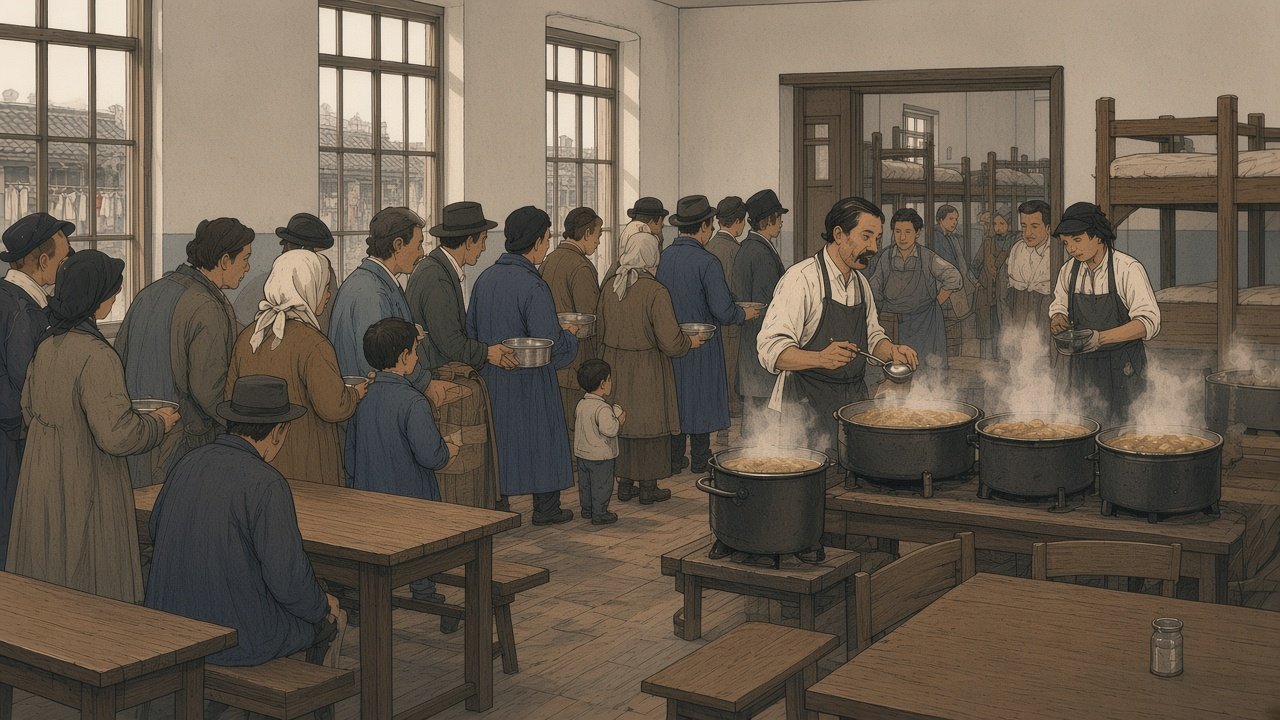
The poorest refugees lived in the hostels that the CFA opened in Hongkew from January 1939. The refugees called them by the German word Heime, homes; the singular was Heim. The Holocaust Memorial Museum counts five main group shelters. The Ward Road Heim, opened in January 1939 in a former barracks, was the first; others were set up in former schools, warehouses and institutional buildings on Kinchow Road, Chaoufoong Road, Alcock Road and East Seward Road. [1]
The buildings were adapted quickly and cheaply. Large rooms were filled with rows of narrow wooden bunks, two or three tiers high, under which people kept their few possessions in suitcases. By the end of 1939, the Holocaust Memorial Museum records, about 2,500 people lived in the Heime, sleeping anywhere from six to 150 to a room, and another 4,500 who lived in rented rooms elsewhere ate in the Heime kitchens. [1] Blankets were hung between bunks to make a little privacy for couples. Washing facilities were few, and in the summer the dormitories were stiflingly hot. In the rainy season water came through roofs and doors.
Life in the dormitories
The Heime were the bottom of the refugee world, and everyone who could leave them did. People who could find work or help from relatives moved out into rented rooms in the lane houses of Hongkew or, if they could afford it, in the Settlement south of the creek or the French Concession. Those who remained were the old, the sick, the unemployed, single men, and families who had lost everything. Some of them stayed in the Heime for the whole of the war.
Memoirs describe the queues for food, the monotony of the diet, the quarrels over space and the loss of privacy. They also describe acts of kindness, lessons and lectures held in the dormitories, choirs, chess, card games and the stubborn effort of many residents to keep up appearances: shaving every day, keeping a tie and a clean shirt for the Sabbath or for an interview, sending children to school with mended clothes. The Heime had their own committees, and residents took part in running them.
The kitchens
The kitchens were the heart of the relief system. They fed thousands of people every day on a budget that the committees fought over constantly. The meals were simple: soups, bread, rice, beans, sometimes a little meat or fish. At the worst points in 1942 and 1944, when money ran short, rations were cut to a single hot meal a day, and many refugees lived on that and on bread. The Kitchen Fund, supported by gifts from Shanghai Jews and by the refugees themselves, kept the kitchens going at moments when the larger committees could not.
The Heime and kitchens kept people alive, but they did not keep everyone healthy. Malnutrition was common among those who depended on them, and diseases spread quickly in crowded rooms. For many of the old and frail, the Heime were where they died.
18. Making a living
The problem of work
A refugee with no capital in a city of cheap Chinese labour had few ways to earn money. Manual work at Chinese wages could not support a European family; most of the professions in which the refugees had trained were closed to them by language, licensing or the simple absence of clients; and the war had shrunk Shanghai’s foreign economy. Many refugees sold whatever they had brought, a camera, a fur coat, a set of silver cutlery, and lived on the proceeds and on relief while they looked for something more permanent.
Even so, a striking number found work. The Holocaust Memorial Museum notes that some refugees adapted well, taking advantage of opportunities that the city offered, establishing small factories and cottage industries, setting themselves up as doctors or teachers, or working as architects and builders to rebuild parts of bombed-out Hongkew. [1]
Rebuilding Hongkew
The refugees’ most visible achievement was physical. They rented ruined houses and shops in Hongkew, repaired them, and turned whole streets into a working European quarter. Builders and architects among them organised the work, and money from relatives abroad, small loans from the committees and the savings of those who had managed to bring a little capital paid for it. Rents in Hongkew rose as a result, which in turn affected the Chinese residents of the district, a fact that local histories have noted.
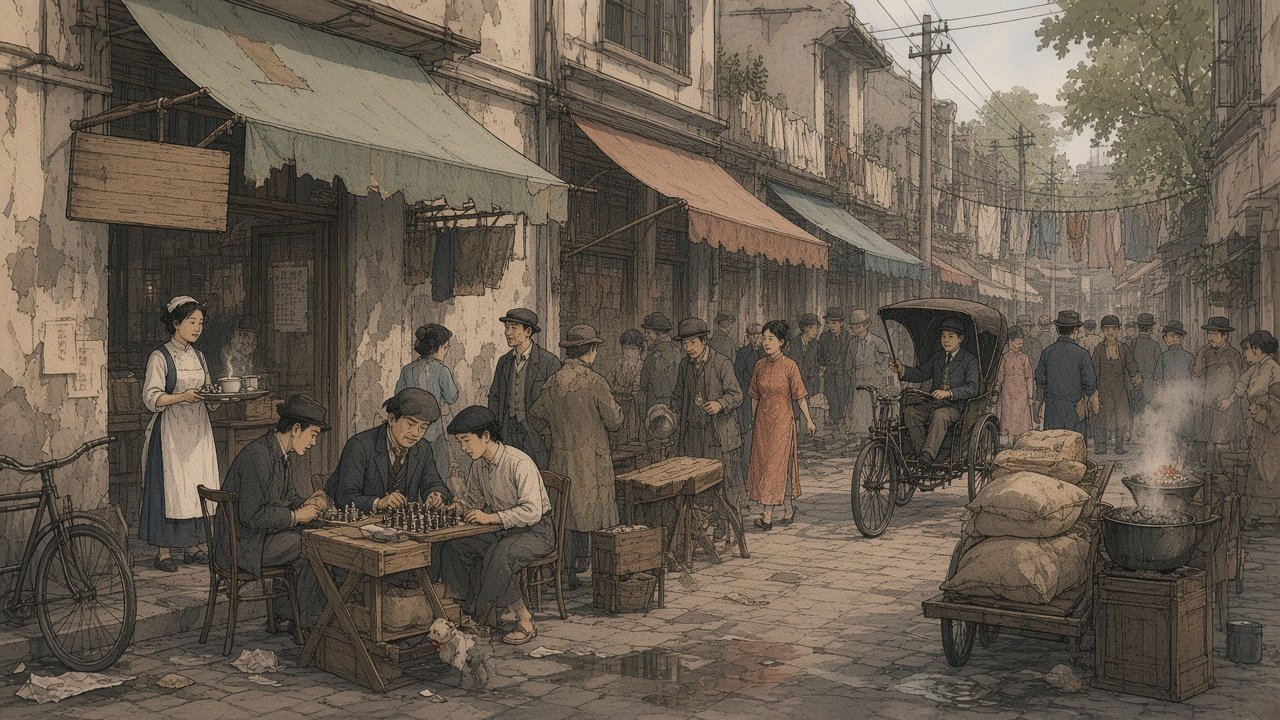
By 1940, the area around Chusan Road (now Zhoushan Road) was known as Little Vienna, from its cafés, delicatessens, nightclubs, shops and bakeries. [1] Shop signs and menus were in German and English. Refugees opened tailors’ and shoemakers’ shops, hairdressers, watch repairers, pharmacies, bookshops and lending libraries, small factories making soap, sausages, sweets, leather goods and furniture, and restaurants serving Viennese and Berlin dishes. Café Louis on Ward Road, opened by the Eisfelder family who arrived at the end of 1938 and named after the father of the family, became a popular gathering place throughout the war years. [1]
The professions
Doctors were the largest professional group among the refugees, and they had an immediate field of work. The refugee population needed medical care, and so did the Chinese and other poor residents of Hongkew. Refugee doctors staffed the clinics and hospitals of the relief committees and opened private practices. They had to pass examinations to be licensed by the Municipal Council, and their numbers were large compared with the paying patients available, but many found a livelihood. Some served Chinese patients; some taught; at least two joined Chinese forces. Dr Jakob Rosenfeld, an Austrian urologist who had been held in Dachau and Buchenwald, reached Shanghai in 1939 and in 1941 joined the Communist New Fourth Army, later serving with Communist forces in north China as a senior medical officer. He is still honoured in China, where he is known by the name Luo Shengte. He left China in 1949 and died in Tel Aviv in 1952.
Lawyers and civil servants had a harder time, because their qualifications were useless in Shanghai. Many became clerks, salesmen, teachers of languages, or workers in refugee businesses. Teachers found work in the Kadoorie School and the other refugee schools. Engineers and chemists sometimes found posts in Shanghai firms. Journalists founded newspapers. Musicians played in cafés, nightclubs and hotel bands, and the best of them joined the Shanghai Municipal Orchestra or taught. Actors staged plays.
Women’s work
Refugee women often found work faster than men. They could take jobs as nurses, governesses, secretaries, shop assistants, seamstresses, hairdressers, cooks and waitresses, and many families depended on a wife’s earnings while a husband looked for work in his old profession. Women ran many of the small cafés and pensions of Hongkew. Some women, in desperate circumstances, were forced into prostitution, a fact that the relief committees and the community recorded with distress.
Poverty
For all the success stories, poverty was the norm. Wages were low; inflation, which began after 1937 and grew worse in the 1940s, ate savings; and the relief system was always strained. By late 1939, as noted above, more than half the refugee population needed help with food or housing. After 1941, with business disrupted by the Pacific war and the cut-off of American funds, the proportion of refugees who depended at least partly on relief grew again, and the years in the designated area after 1943 were the hardest of all.
19. Women of the refuge
Carrying the household
The history of the refuge has often been told through men: diplomats, committee chairmen, rabbis, editors and the boys who later wrote memoirs. But in many refugee families it was women who kept the household going. As noted above, women frequently found paid work sooner than men, because the work available in Shanghai, in service, sewing, cooking, nursing, hairdressing, teaching and shops, was work that women had often done or could quickly learn. A wife’s wages from a café or a dressmaker’s shop might feed a family while her husband, a former lawyer or merchant, looked in vain for work in his old profession.
That reversal had consequences. Memoirs and oral histories describe marriages strained by poverty, by the loss of a husband’s status and by the crowding of whole families into one room. Some marriages broke down; others were strengthened. Women also carried much of the daily labour of survival: queuing for food, bargaining in the markets, boiling water, washing clothes in basins, nursing the sick and keeping children in school.
Women in public life
Women took a large part in the refugee community’s institutions. They served as nurses and doctors in the hospitals, as teachers in the Kadoorie School and other schools, as volunteers in the kitchens and Heime, as actresses and singers on the refugee stage, and as organisers of women’s committees and welfare groups. Laura Margolis, the JDC’s representative, was a woman working in a world of male committee leaders, and her reports note the difficulty she had in being taken seriously by them at first. Shoshana Kahan’s diary is one of the most important sources for the life of the Polish refugees.
Girls growing up
Many of the memoirs of the refuge were written by women who had been girls in Shanghai. They recall school, friendships, youth groups and the first stirrings of independence in a city where parents were too busy and too worried to supervise closely, as well as the hunger and fear of the last years of the war. Together with the testimony of men, these accounts have given a much fuller picture of the refuge than the official records alone could provide.
20. Bread, coal and the market
Feeding a city
Food was the everyday preoccupation of the refuge. The refugees had come from a central European diet of bread, potatoes, meat, dairy and vegetables to a city where rice was the staple, dairy products were rare and expensive, and meat was a luxury. Refugee bakers soon produced rye bread, rolls and cakes; delicatessens sold sausages made by refugee butchers; cafés served coffee, strudel and Sachertorte, or as close an approximation as local ingredients allowed. For those with money, Shanghai offered almost anything. For the majority, the diet was bread, rice, soup, vegetables and, when possible, eggs and a little meat.
Kosher food
Observant refugees faced additional difficulties. Kosher meat was supplied by the shochetim of the Russian and Baghdadi communities and by refugee butchers under rabbinic supervision, and the kitchens of the relief committees tried to maintain kashrut. At Passover the communities organised the baking of matzah, which in some wartime years was difficult because of shortages of flour.
Fuel and the cold
Winter brought its own problem: fuel. Lane houses had no central heating, and coal and wood were expensive. Many refugees remembered the cold of the Shanghai winter, damp and penetrating, more vividly than the heat of the summer. Families cooked on small charcoal or coal-ball stoves, sometimes indoors, with the risk of fumes. The Chinese practice of buying hot water from shops, known in English as “hot water shops”, for washing and tea was adopted by many refugees.
Markets and money
Refugees bought food in the Chinese markets of Hongkew, bargaining in pidgin and a few words of Shanghainese. Many traded goods as well as bought them: European clothes, watches and household goods were sold or bartered for food, especially in the last years of the war when money lost its value. Some refugees made a living as middlemen in this trade. Inflation, especially in 1944 and 1945, made prices change from day to day, and anyone who held cash lost its value quickly. Those who held goods, or foreign currency, did better.
Black markets
The black market was a fact of life in occupied Shanghai. Food, medicines, cigarettes, currency and goods of every kind circulated outside the official rationing system. Some refugees were involved in it; most were its victims, paying prices they could not afford for food and medicine. The relief committees, which bought food in bulk, had to navigate the same markets.
21. Life in the lanes
Lane houses
Most refugees who left the Heime moved into the lane houses of Hongkew. Shanghai’s characteristic housing was the lilong or lane neighbourhood: rows of two- or three-storey brick houses, many of them in the shikumen (stone gate) style, arranged along narrow alleys that opened through a gateway onto the main street. A house built for one Chinese family might be divided among several households, with rooms sublet and resublet. A refugee family might have one room, sometimes a cubicle in a partitioned room, with a shared kitchen and no bathroom.
Sanitation was a constant hardship. Few lane houses had flush toilets. Like their Chinese neighbours, refugees used wooden buckets, emptied every morning by night-soil collectors who carted the waste away. [4] Water came from shared taps; bathing meant a bowl, or a visit to a public bathhouse. In summer the heat and humidity were overwhelming and the lanes swarmed with flies and mosquitoes; in winter the houses were damp and cold, and fuel was costly.
Neighbours
The lanes were shared. Hongkew’s Chinese population was many times larger than the refugee population, and in the designated area of 1943 the proportion was roughly ten Chinese to one refugee. Refugees and Chinese families lived in the same lanes and houses, bought from the same hawkers, used the same water taps and endured the same occupation.
The relationship is one of the most often discussed aspects of the refuge, and it is easy to romanticise it. The testimony of refugees and of Chinese residents, gathered by oral historians in later decades, is broadly consistent: relations were peaceful and often friendly, though separated by language and by a social gap that the refugees did not always see. Many refugees remembered kindness from Chinese neighbours who were themselves very poor. Children played together and learnt a few words of each other’s languages; adults traded, worked side by side and occasionally married. Some refugees employed Chinese servants or workers, even in poverty, because labour was cheap; some refugees later admitted that they had shared the colonial attitudes of the foreigners around them.
Chinese historians, notably the scholars of the Center of Jewish Studies Shanghai founded in 1988 under Pan Guang, have emphasised the solidarity of the two peoples under Japanese occupation, a theme that became central to official Chinese memory of the refuge. [11] Western historians such as Irene Eber, while acknowledging the real decency of many encounters, have also pointed out how separate the two communities largely remained, and how little most refugees knew of Chinese life. [10] Both perspectives are part of the truth.
A Chinese city at war
It is worth remembering what the Chinese residents of Hongkew were living through. They had seen their district destroyed in 1932 and again in 1937. Many had lost homes, relatives and work. They lived under a Japanese occupation that was brutal to Chinese people in ways it rarely was to Europeans: public beatings, arrests, rationing that favoured the Japanese, and the constant threat of the Kempeitai, the Japanese military police. Many refugees remembered seeing Chinese people beaten or humiliated at checkpoints, and seeing the bodies of the destitute collected from the streets in winter.
For the Chinese neighbours, the refugees were one more group of strangers in a crowded city, poorer than most foreigners but richer than most Chinese. That the two communities lived together without serious conflict through eight years of war, occupation, hunger and inflation is a fact worth recording, and it is why, in the Chinese and Israeli speeches of the twenty-first century, Hongkew has become a symbol of friendship.
Sun Fo’s plan
Chinese leaders did make one notable proposal for Jewish refugees. In 1939 Sun Fo, the son of Sun Yat-sen and president of the Legislative Yuan in the Nationalist government, proposed setting aside land in south-western China, in Yunnan province, for Jewish refugee settlement. The plan was discussed but never implemented; the Nationalist government, retreating before the Japanese, had neither the means nor, in the end, the will. [12] Gao Bei’s study of Chinese and Japanese policy towards the refugees shows that both governments saw the Jewish question partly through the lens of their relations with the United States and with Jewish opinion abroad.
Language on the street
Few refugees learnt more than a few words of Chinese. The language of the street, between refugees and Chinese shopkeepers, rickshaw pullers and servants, was the pidgin English that had grown up in the treaty ports over the previous century, mixed with German, Yiddish and fragments of Shanghainese. Refugees learnt the pidgin words that every foreigner in Shanghai used, such as maskee for “never mind” and chit for the signed slip of paper with which foreigners paid for goods and services on credit, and children picked up Shanghainese far faster than their parents. In the other direction, Chinese hawkers and neighbours in Hongkew learnt German words for the goods and dishes the refugees wanted. That mixed street language, half joke and half necessity, was one of the small daily bridges between the communities, and many former refugees could still remember a few phrases of it seventy years later.
For most adults, however, the language barrier was real and lasting. It limited the refugees’ understanding of Chinese politics and society, made them dependent on intermediaries, and helped keep the two communities apart even when they lived in the same lanes. Irene Eber’s work emphasises how little most refugees knew of the Chinese world around them, and how much their Shanghai remained a European island in a Chinese city. [10]
22. Sickness and death
A hostile climate
Shanghai’s climate was hard on people who had grown up in Central Europe. Summers were long, hot and humid; winters raw and damp. The water had to be boiled; raw vegetables and fruit could carry disease; and the crowding of Hongkew, with its open drains and night-soil buckets, made epidemics a constant threat. Refugees suffered from dysentery, typhoid, typhus, cholera, scarlet fever, skin infections, tuberculosis and the diseases of malnutrition, including beriberi. Many arrived already weakened by camps, prisons or months of anxiety.
Hospitals and doctors
Because so many of the refugees were doctors, the community was better served medically than its poverty would suggest. The relief committees ran hospitals and clinics, among them hospitals attached to the Heime on Ward Road and Chaoufoong Road, an isolation ward for infectious diseases and a maternity service. Refugee doctors and nurses worked for little or nothing. Medicines were always scarce and became scarcer after 1941. The Russian Jewish community’s hospital and the Settlement’s own hospitals also treated refugees. Refugee doctors organised vaccination campaigns against cholera and typhoid, ran clinics for mothers and infants, and lectured the refugee population on hygiene in a tropical city: boiling water, avoiding raw food, keeping out mosquitoes. Their work, in a district where many Chinese residents had no access to Western medicine, also reached their neighbours, and some refugee doctors built practices with Chinese patients that lasted until they left Shanghai.
Dentists, pharmacists and nurses were also well represented among the refugees, and they too set up practices and dispensaries. Pharmacies run by refugees supplied medicines that were increasingly hard to obtain after 1941, sometimes at high prices, and the shortage of drugs such as insulin, sulphonamides and vaccines was one of the most serious problems of the last years of the war.
Deaths
Deaths among the refugees ran highest among the old and among infants. The figures are uncertain, and different sources give different totals for the war years; estimates of the number of refugees who died in Shanghai between 1939 and 1945 commonly run to somewhere around a thousand or more, most of them from disease and the effects of poverty and hunger. It was a high toll for a community of under twenty thousand, but it was a death rate of a different order from that of the ghettos and camps of Nazi Europe, where most of the refugees’ relatives perished.
The refugees were buried in the Jewish cemeteries of Shanghai. Before the war the city had the old Mohawk Road cemetery and a cemetery on Baikal Road; new burial grounds on Columbia Road and Point Road were opened to cope with refugee deaths. After 1949 the cemeteries stood in the way of urban development. In the late 1950s the graves were moved to a site in the western suburbs, and during the Cultural Revolution that site was destroyed. In recent decades gravestones from the old Jewish cemeteries have turned up in villages and building sites around Shanghai, and private efforts to recover and document them continue.
23. A press in exile
German-language newspapers
The refugees were a literate, opinionated population, and within months of the first large arrivals they had founded newspapers. Irene Eber and other historians have counted dozens of German-language periodicals produced in Shanghai between 1939 and 1947, from daily newspapers to monthly magazines and one-off pamphlets. [10] Many were short-lived; some lasted the whole war.
The most important daily was the Shanghai Jewish Chronicle, edited by Ossi Lewin, which appeared from 1939 and, after 1941, was for a time the only German-language Jewish newspaper allowed to continue. The 8 Uhr Abendblatt, an evening paper, and the weekly Shanghai Woche were also widely read. The most intellectually ambitious publication was the Gelbe Post, founded in 1939 by Adolf Josef Storfer, a Viennese psychoanalyst and former director of the International Psychoanalytic Publishing House, who had come to Shanghai after the Anschluss. The Gelbe Post began as a magazine of essays on Chinese culture, Jewish questions and exile life, and later became a daily before Storfer’s money ran out in 1940. He left Shanghai for Australia, where he died in 1944.
The newspapers carried news of the war, local announcements, advertisements for refugee businesses, theatre reviews, serialised fiction, advice on how to cope with the Chinese climate, and fierce debates about Zionism, the relief committees and community politics. After Pearl Harbor they were subject to Japanese censorship, and news of Europe came mostly through Japanese, German and Allied radio broadcasts listened to secretly or reported indirectly.
Yiddish, Polish and Russian
The Polish refugees who arrived in 1941 brought another language and another press. They published Yiddish and Polish newspapers and bulletins, often duplicated rather than printed, and held readings of Yiddish poetry. The Yiddish section of Nasha Zhizn, אונדזער לעבן, carried writing by the newcomers. The Holocaust Memorial Museum notes that such publications, though sporadic because of logistical problems and Japanese censorship, helped to sustain the refugees transplanted from Poland. [4] Polish Jewish writers coined a bitter Yiddish pun on the city’s name, שאַנד־חי, shand-khay, “a shame of a life”. [4]
Among the Polish refugees was the Yiddish critic and translator Yehoshua Rapoport, and the actress Shoshana Kahan, whose Yiddish diary of the Shanghai years, published after the war as אין פֿײַער און פֿלאַמען (In fayer un flamen, In Fire and Flames), is one of the main sources for the life of the Polish group. Irene Eber’s anthology Voices from Shanghai translated a selection of Yiddish and Polish writing from the refuge into English. [13]
Radio and books
There was a German-language refugee radio programme for a time, and refugee lending libraries circulated the books that people had brought with them. Printing shops set up by refugees produced books and pamphlets in German, and the yeshiva students, as described below, reprinted religious texts. Shanghai thus became, for a few years, one of the larger centres of German-language Jewish publishing in the world, and the only one in Asia.
24. Stage, music and art
Theatre and cabaret
The refugees performed. Within a year of the main arrival there were refugee theatre companies staging plays in German, cabaret evenings in the cafés and roof gardens of Hongkew, operettas and revues. Actors and directors from the theatres of Vienna and Berlin performed for audiences who paid in small change, and amateur groups performed in the Heime. The repertoire mixed classics, light comedy and plays written in Shanghai about exile life, some of them sharp satires on the relief committees or on the refugees’ own illusions. After Pearl Harbor the Japanese censors had to approve scripts, and overtly political material disappeared, but performances continued throughout the war.
The Polish refugees added Yiddish theatre: readings, concerts and plays performed by actors such as Shoshana Kahan and her colleagues, for audiences of Polish and Russian Jews. The Holocaust Memorial Museum notes that the creation of artwork and plays helped sustain the refugees from Poland. [4]
Musicians
Music was the art in which the refugees made the deepest mark on Shanghai itself. Among the arrivals were orchestral players, soloists, singers, conductors, composers and music teachers. Some joined the Shanghai Municipal Orchestra, the city’s long-established symphony orchestra, conducted from 1919 by the Italian pianist Mario Paci, who built it into the leading Western orchestra in Asia and engaged a number of refugee players, and others played in hotel bands, cafés, nightclubs and dance halls across the city. Others taught at the National Conservatory of Music, China’s first modern conservatory, which had been founded in Shanghai in 1927.
The composer Wolfgang Fraenkel, a former Berlin judge who had been dismissed under the Nazi laws and imprisoned in Sachsenhausen, taught composition and theory at the conservatory, where his students included Chinese composers who later became prominent. The violinist Alfred Wittenberg, the pianist and composer Julius Schloss and others also taught Chinese students. Refugee musicians also gave recitals and chamber concerts for refugee audiences in Hongkew, often in borrowed halls with hired pianos, and organised concerts for the benefit of the relief funds. Choirs sang in the synagogues and at community events, and cantors from Germany and Austria led the services of the High Holy Days. Through the conservatory teachers, the musical culture of Central Europe was transmitted directly into the first generations of China’s conservatory-trained musicians, a legacy that Chinese music historians have acknowledged.
Artists
Painters, graphic artists and photographers also came. The best known is David Ludwig Bloch, a Bavarian painter and woodcut artist, deaf from infancy, who had been held in Dachau after Kristallnacht and reached Shanghai in 1940. His woodcuts of rickshaw pullers, beggars and street life, made in Shanghai between 1940 and 1949, are among the most powerful visual records of the city in those years. Bloch married a Chinese woman, Lilly Cheng, and after the war emigrated with her to the United States. Other refugee artists painted portraits, designed posters and theatre sets, and drew cartoons for the refugee press.
Lectures and learning
Refugee intellectuals gave lectures on philosophy, history, medicine and literature; there were evening classes in English, which nearly everyone needed for emigration, and in Chinese, which fewer people took up. A refugee “university” of sorts, organised by former professors, offered courses. The intellectual life of Hongkew, crammed into cafés and borrowed halls, was one of the ways the refugees insisted that they were still the people they had been in Europe.
25. Families in exile
Marriage and birth
The refugee population was not static. People married, had children, divorced and died. Many refugees had arrived as single men or women, or as fragments of families, and Shanghai became a place where new families were formed. Marriages between refugees were common; marriages between refugees and Russian Jews became more frequent as the war went on; a few refugees married Chinese partners. Refugee children were born in the hospitals of the relief committees and in the lane houses of Hongkew, and hundreds of people now living in many countries give Shanghai as their place of birth.
Old age
At the other end of life were the old. Many elderly refugees had followed their children or come with them, and they suffered most from the climate, the poverty and the loss of everything familiar. They filled the Heime, the hospitals and the cemeteries. Some younger refugees later wrote with particular sadness of parents and grandparents who had survived Nazi Germany only to die in a lane house in Hongkew, far from everything they had known.
Families divided
Most refugee families were incomplete. Parents, brothers, sisters, children and grandparents had been left in Europe, either because they could not get papers or tickets, or because they had refused to leave. For many refugees, life in Shanghai was dominated by efforts to bring relatives out, and then, after 1941, by the silence. The Holocaust Memorial Museum records that Ernest Heppner, who came with his mother, lost his father and sister in the Holocaust; a brother escaped to England. [1] That pattern of partial survival was typical.
Children’s Shanghai
For children, as noted earlier, Shanghai could be a world of adventure. Many former refugee children remember games in the lanes with Chinese children, the excitement of street vendors and festivals, the school, the football matches and the youth groups, as well as hunger, illness and their parents’ anxiety. Their memoirs and oral histories are an important source for the history of the refuge, and they have shaped the way it is remembered.
26. Children, schools and sport
The Kadoorie School
The refugees brought hundreds of children, and more were born in Shanghai. Their education was one of the first concerns of the relief effort. The established Shanghai Jewish School, supported by the Baghdadi community, took some refugee children, but it could not take them all. In 1937 Horace Kadoorie had founded the Shanghai Jewish Youth Association, and in November 1939 it opened a school for refugee children on Kinchow Road in Hongkew. It became known simply as the Kadoorie School. [14]
The school taught around seven hundred children, in English, with the explicit aim of preparing them to emigrate to English-speaking countries. Its teachers were mostly refugees; its curriculum included English, arithmetic, history, geography, science, Hebrew and religious studies, and it offered sport, clubs, music and vocational training in trades such as carpentry and dressmaking for older pupils. For many refugee children, the school was the most stable thing in their lives. When the designated area was proclaimed in 1943, the school lay inside it and carried on, though in harder conditions. Our chapter on the Kadoories and the refugees in Shanghai gives a fuller account of the school and the family’s work.
Other schools
There were also religious schools, among them a Talmud Torah, and later schools organised by the Polish group, as well as kindergartens and vocational courses run by the ORT organisation, which trained young people and adults in trades that might help them earn a living in Shanghai or after emigration. Many children also learnt from the street: they picked up Shanghainese and pidgin English, ran errands, sold goods for their parents and grew up quickly.
Youth movements
The full spectrum of Jewish youth movements came to Shanghai. Zionist groups of every shade, from the socialist Zionists to the Revisionist Betar, which was already active among the Russian Jews, recruited among the refugees. Betar organised the Jewish youth into uniformed groups, and a Jewish unit of the Shanghai Volunteer Corps had existed before the war. The Polish refugees included members of Bundist, Zionist and religious movements. After Pearl Harbor the Japanese forbade overt political activity, but the Holocaust Memorial Museum notes that Zionists and Bundists remained clandestinely active throughout the war. [4]
Sport
Football was the refugees’ favourite sport. Refugee teams played in Shanghai leagues against British, Portuguese, Russian and Chinese sides, and matches drew large crowds of refugees. There were also boxing, table tennis, athletics, swimming and gymnastics clubs. Sport gave young men something to do, gave the community something to talk about, and gave refugees a place in the wider life of the city that had nothing to do with charity.
Growing up in Shanghai
Many of the best-known memoirs of the refuge were written by people who were children at the time, and they give a distinctive picture. For a child, Shanghai could be an adventure as well as a hardship: a city of rickshaws, street food, kites, festivals, fights and friendships, in which parents’ anxieties were only half understood. Sigmund Tobias, who arrived from Berlin as a boy and later became an educational psychologist in the United States, wrote of his Shanghai childhood in Strange Haven. [15] Ernest Heppner, who came as a young man from Breslau with his mother in 1939, described the refuge in Shanghai Refuge. [16] The artist Peter Max, born in Berlin in 1937, spent most of his childhood in Shanghai and later traced the bright colours of his pop art to what he saw there.
27. Preparing to leave
English
From the first months of the refuge, almost everyone studied English. It was the language of business and administration in Shanghai, the language of the relief committees and the language of the countries most refugees hoped to reach. The Kadoorie School taught in English; evening classes for adults were held in the Heime and in rented rooms; and refugee teachers made a living giving private lessons. Many refugees who arrived speaking only German left Shanghai with fluent English.
Trades
Many refugees also learned new trades, because the professions they had practised in Europe were unlikely to be open to them in their next country either. The ORT organisation, which specialised in vocational training for Jews, ran courses in Shanghai in trades such as carpentry, metalwork, electrical work, tailoring, dressmaking and leatherwork. Lawyers became mechanics; merchants became bakers; schoolgirls became seamstresses. These skills helped people earn a living in Shanghai and, later, in America, Australia and Israel.
Hope as discipline
Preparing to leave was also a way of keeping hope alive. Refugees studied English, learned trades, kept their documents in order, wrote to relatives abroad and followed the news of quota numbers and shipping lines. Even in the designated area, when departure seemed impossible, many continued to prepare. When the war ended and the doors began to open, those who had prepared were often the first to go.
28. Religious life
Three traditions
Religious life in wartime Shanghai reflected the three communities that made up Jewish Shanghai. The Baghdadis worshipped in their own rite at Ohel Rachel and Beth Aharon. The Russian Jews worshipped at Ohel Moshe in Hongkew and from 1941 at the New Synagogue in the French Concession, under Rabbi Meir Ashkenazi. The German and Austrian refugees, many of whom had belonged to Liberal congregations in Germany or had not been observant at all, formed their own congregations.
The Jüdische Gemeinde, founded by the refugees in 1939, organised religious services, the chevra kadisha that buried the dead, religious education and kosher supervision. Services were held in rented halls, in the Heime, in cinemas on the High Holy Days and in the synagogues of the established communities. Refugee rabbis, cantors and teachers from Germany and Austria served these congregations. The refugees’ religious life was as varied as their origins: some found in Shanghai a renewed attachment to Judaism, others drifted away from it, and many simply kept the festivals as a link to home.
The yeshivas
The most remarkable religious story of the refuge belongs to the Polish group. Among the refugees who came from Lithuania by way of Japan in 1941 were some four to five hundred rabbinical students and teachers from several yeshivas, the academies of advanced Talmudic study that had been the pride of Eastern European Jewry. The largest group by far was the Mir Yeshiva, founded in 1815 in the town of Mir in what is now Belarus, which arrived almost complete: some 250 to 300 students and teachers. There were also smaller groups from other academies, among them students of the Lubavitch movement and of the Chachmei Lublin yeshiva.
The Mir had fled from Poland to Lithuania in 1939, when the Soviet Union occupied eastern Poland, and from Lithuania through the Soviet Union to Japan in 1940 and 1941, with Sugihara’s transit visas and with the help of Jewish organisations abroad. Its senior head, Rabbi Eliezer Yehuda Finkel, had gone to Palestine in 1940; in Shanghai the yeshiva was led by Rabbi Chaim Shmuelevitz, with Rabbi Yechezkel Levenstein as its spiritual supervisor, or mashgiach.
Beth Aharon
In Shanghai the Mir students were given the use of Beth Aharon, the large synagogue that Silas Hardoon had built in 1927 and that had stood almost empty for years. The Holocaust Memorial Museum notes that the yeshiva gathered there, in a synagogue built by one of the wealthiest members of Shanghai’s Sephardic community. [4] For the whole of the war, under occupation and later in the designated area, the students studied Talmud there in the traditional way, in pairs, aloud, from morning till late at night. Visitors who saw the hall described a sound unchanged from that of the study halls of Lithuania.

Printing the books
The students had brought few books, and Shanghai had almost none of the volumes they needed. The yeshivas solved the problem by printing. With the help of funds sent before Pearl Harbor and later by loans, and with the support of rabbis abroad, notably Rabbi Avraham Kalmanowitz of the Vaad Hatzalah rescue committee in New York, they reprinted volumes of the Talmud, codes of law and other works from the few copies they had, using Shanghai’s printing shops and photographic reproduction. The Holocaust Memorial Museum notes that the students used books reprinted from those few they had carried with them from Poland or had received from supporters abroad. [4] Dozens of titles were produced, and these Shanghai editions are now collectors’ items.
Survival intact
The Mir Yeshiva emerged from the war, in the Holocaust Memorial Museum’s words, as the only Eastern European yeshiva to survive the Holocaust intact. [4] Its students and teachers left Shanghai in 1946 and 1947, most for the United States, where the yeshiva was re-established in Brooklyn, and others for Palestine, where Rabbi Finkel had re-established the Mir in Jerusalem. Rabbi Shmuelevitz later became head of the Mir in Jerusalem. Both institutions still exist. The fact that a whole academy, with its teachers, students and traditions, crossed Siberia, Japan and the war in China and came out on the other side is one of the extraordinary episodes of the Holocaust years, and it happened in Shanghai.
The holy days in Hongkew
Refugee memoirs often recall the High Holy Days, when every hall that could be hired was turned into a synagogue and thousands of people who did not normally attend services crowded in. Passover was harder: matzah had to be baked locally, and in some years the relief committees struggled to supply it. Weddings, circumcisions and bar mitzvahs went on through the war, and a generation of children was born in Hongkew and given Jewish names, a sign that the refugees, however uncertain their future, expected to have one.
29. Three Jewish worlds
Benefactors and beneficiaries
Jewish Shanghai in the war years was not one community but three, and their relations were not simple. The Baghdadis were rich, British in outlook and few; the Russians were of modest means, Russian-speaking and Zionist in sympathy; the refugees were poor, German-speaking or Polish-speaking, and bitter at what Europe had done to them. Each group had its own synagogues, clubs, newspapers and leaders.
The relationship between the established communities and the refugees was that of benefactor and beneficiary, with all the strain that implies. The relief committees were run largely by the established communities and by a few American representatives, and the refugees often felt that decisions were made about them without them. Complaints about the Heime, the food, the allocation of money and the manners of committee members fill the refugee press and memoirs. Committee members, for their part, complained of ingratitude and of refugees who would not take the work available.
Language and culture
Language divided the communities as much as money. The Baghdadis spoke English and, among the older generation, Judeo-Arabic; the Russians spoke Russian and Yiddish; the Germans and Austrians spoke German; the Poles spoke Polish and Yiddish. English became the common language of business and relief, and many refugees learnt it as quickly as they could, both for use in Shanghai and in preparation for emigration. The refugees’ attachment to German culture, even after what Germany had done to them, puzzled and sometimes offended the other communities, while the refugees often looked down on what they saw as the provincialism of the Russians and the colonial manners of the Baghdadis.
Religion and politics
Religious differences ran deep. The Baghdadis were traditional; the Russian Jews and the Polish yeshiva students were Orthodox; many German and Austrian refugees were Liberal or secular. Politics divided them further: Revisionist and Labour Zionists, Bundists, communists and those who wanted nothing to do with politics all argued in the cafés of Hongkew. Some refugees, as noted above, joined the Chinese Communists.
Cooperation
Yet the communities cooperated more than they quarrelled. Russian Jews took Polish refugees into their homes; Baghdadi money built the reception centre and the school; refugee doctors treated Russian and Baghdadi patients; and in the worst years of 1943 to 1945 the Russian community, which remained relatively free, was a lifeline for the refugees in the designated area. Marriages between the communities became more common as the war went on. In retrospect, many of those who lived through it remembered not the quarrels but the fact that a Jewish society of twenty thousand people, made from three very different groups, held together through eight years of war.
The Polish refugees in the designated area
The Polish refugees of 1941, the last to arrive, were also among the most distinctive. They were more religious than the German refugees, more political, more used to organising, and better connected to American Jewish organisations, which sent them help through Orthodox and Polish Jewish channels. They protested against their inclusion in the designated area on the grounds that they were Polish citizens, and their protest, as noted above, was suppressed. Inside the area, the yeshiva students continued their studies; the Bundists and Zionists maintained their underground groups; and the Yiddish writers and actors kept up a cultural life that the Holocaust Memorial Museum describes as sustaining them through isolation. [4] Their Yiddish word for Shanghai, שאַנד־חי, a shame of a life, captures the bitterness of people who had expected to reach America and found themselves instead in a Chinese ghetto. But they too survived.
30. From Kaunas to Kobe
Trapped in Lithuania
When Germany and the Soviet Union divided Poland in September 1939, thousands of Polish Jews fled north-east into Lithuania, which was still independent and which received the city of Vilnius from the Soviets in October. Among them were rabbis, yeshiva students, political activists of every party, writers, and ordinary families. In June 1940 the Soviet Union occupied Lithuania and in August annexed it. The refugees now faced Soviet rule, with the threat of arrest and deportation that it carried for “class enemies”, religious leaders and members of non-communist parties, and they looked for a way out.
The way that opened was improbable. Jan Zwartendijk, the acting Dutch consul in Kaunas, wrote on refugees’ papers that no visa was required to enter the Dutch Caribbean colony of Curaçao, which was true in the sense that the governor could admit people at his discretion. Chiune Sugihara, the Japanese consul in Kaunas, then issued Japanese transit visas to people holding the Curaçao endorsement, in defiance of instructions from Tokyo to issue them only to applicants with proper destination visas and sufficient funds. The list he later sent to Tokyo contains 2,139 names, many of them heads of families; the number of people who travelled on his visas is uncertain and has been put at anything from about two thousand to six thousand, though recent research tends towards the lower end. The Holocaust Memorial Museum describes a group of about 2,100 Polish Jews who found a safe haven by this route in late 1940 and early 1941. [4] [17]
Sugihara was recalled from Kaunas at the end of August 1940 when the consulate closed, and, according to the many accounts, went on writing visas until his train left. He was dismissed from the Japanese foreign service in 1947 and lived in obscurity until Israeli diplomats and survivors traced him; Yad Vashem recognised him as Righteous Among the Nations in 1984. Zwartendijk was recognised in 1997. Our essay Visas for Life tells their stories.
Across Siberia
With Japanese transit visas and Soviet exit permits, which the Soviet authorities issued for payment in foreign currency, the refugees crossed the Soviet Union on the Trans-Siberian Railway to Vladivostok, a journey of more than a week, and sailed from there across the Sea of Japan to the port of Tsuruga. The Jewish community of Kobe, a small group of Russian, Baghdadi and other Jews with a committee known as Jewcom, received them and found them lodgings. Our essay Where the Visas Led follows that journey in detail.
Kobe
For most of a year, from the autumn of 1940 to the autumn of 1941, Kobe was the temporary home of several thousand Jewish refugees. The Japanese authorities allowed them to stay beyond the few days their transit visas permitted, partly through the intercession of sympathetic Japanese, among them the Hebraist Setsuzo Kotsuji, who used his contacts to obtain extensions. Many refugees remembered the Japanese population of Kobe as kind and curious. Those with visas for America, Palestine, Canada, Australia or elsewhere left as soon as they could. But many had no onward destination.
Removal to Shanghai
In the late summer and autumn of 1941, as relations between Japan and the United States worsened, the Japanese government decided to move the remaining refugees out of Japan. About a thousand of them, including the Mir Yeshiva and other yeshiva students, were shipped to Shanghai between August and November 1941. [4] They arrived in a city where the refugees from Germany and Austria had been living for two or three years, and where the newcomers were, in many ways, strangers again: Polish-speaking and Yiddish-speaking among German-speakers, Orthodox among secular Jews, political among people who had learnt to keep their heads down.
The Polish refugees were helped by the Russian Jewish community, with whom they shared language and traditions, and by funds from American organisations. They were generally better organised than the German refugees and were notably successful in obtaining help from abroad, which produced some resentment. The Holocaust Memorial Museum describes their shock at the sights and smells of Shanghai, which they had heard about in Japan as a crowded, unsanitary and crime-ridden city. [4]
31. Japan and the Jews
An uncertain policy
The refugees lived in a city controlled, in increasing measure, by Japan. Japan was Germany’s partner under the Anti-Comintern Pact of 1936 and from September 1940 its ally under the Tripartite Pact. Yet the Japanese authorities in Shanghai never adopted the Nazi policy towards Jews, and the refugees survived under Japanese rule. Why this was so is one of the central questions of the history of the refuge, and historians have given a range of answers.
Japan had little direct experience of Jews. The image that Japanese officials had of them was formed largely by two sources. One was the memory of the American banker Jacob Schiff, who had arranged large loans to Japan during the Russo-Japanese War of 1904 to 1905, partly in protest at the Tsarist government’s treatment of Jews, and who was decorated by the Emperor. The other was the antisemitic literature, including the forged Protocols of the Elders of Zion, brought to Japan by Japanese officers who had served with the White Russian forces in Siberia during the Russian Civil War. Both images exaggerated Jewish power. Some Japanese officials concluded that the Jews were a dangerous conspiracy; others concluded that, being powerful, they should be cultivated.
The Jewish experts
Within the Japanese army and navy a small group of officers became the government’s experts on Jewish affairs. The best known were Colonel Norihiro Yasue of the army, who served in Manchuria and Dalian, and Captain Koreshige Inuzuka of the navy, who headed the navy’s office dealing with Jewish affairs in Shanghai. Both had earlier written or translated antisemitic works, and both came to argue that Japan could use the Jews of the Far East, and through them American Jewish opinion and capital, for its own ends in Manchuria and China. Yasue was associated with the Far Eastern Jewish Conferences held in Harbin between 1937 and 1939 under Japanese sponsorship, at which leaders of the Manchurian Jewish community, led by Dr Abraham Kaufman, expressed loyalty to Japan.
This line of thinking produced proposals in the late 1930s for settling large numbers of Jewish refugees in Manchukuo or elsewhere in Japanese-controlled territory, in return for American Jewish investment and goodwill. Marvin Tokayer and Mary Swartz popularised these proposals in their 1979 book The Fugu Plan, named after the poisonous pufferfish that is delicious when prepared correctly and fatal when it is not. [18] The book drew on interviews and documents but also on reconstruction; historians generally treat its narrative with caution, and the larger settlement schemes it describes never progressed beyond discussion.
The Five Ministers’ Conference
The formal policy of the Japanese government was set at a conference of five senior ministers, the prime minister and the ministers of foreign affairs, war, navy and finance, on 6 December 1938, a month after Kristallnacht. The conference decided that Jews in Japan, Manchukuo and occupied China should be treated fairly, like other foreigners; that they should not be expelled; and that Japan should not actively invite Jews to come, except for capitalists and technicians who might be useful. The policy rejected Nazi racial doctrine as the basis of Japanese action, while giving no particular welcome to the refugees. [12] [8]
That decision governed Japanese conduct until 1942 and influenced it afterwards. It explains why the Japanese in Shanghai did not at first interfere with the arrival of refugees in Hongkew, why they later restricted it on grounds of space and order rather than race, and why, when they finally confined the refugees in 1943, they framed the order in terms of statelessness rather than Jewishness.
Pragmatism and fear
Historians differ on how to weigh the motives. Kranzler emphasised the role of the Japanese “Jewish experts” and the restraining effect of Japan’s interest in American opinion. [8] Gao Bei, using Chinese and Japanese sources, has shown how Japanese and Chinese policies towards the refugees were both shaped by efforts to influence the United States before Pearl Harbor. [12] Others point to simple bureaucratic inertia, to Japan’s indifference to a problem that mattered little to its war, and to the reluctance of Japanese officials to take orders from German diplomats. The result, whatever the mix of causes, was that the refugees, though they suffered under Japanese rule, were not murdered.
32. Japanese neighbours
A Japanese district
It is easy to forget that the refugees lived not only among Chinese neighbours but in the Japanese quarter of the city. Hongkew had been the centre of Japanese life in Shanghai since the early twentieth century. Before the war the Japanese community there ran to tens of thousands of people: merchants, mill managers, shopkeepers, teachers, clerks, their families and, after 1937, a growing number of officials and soldiers. North Szechuen Road and the streets around it were lined with Japanese shops, restaurants, bathhouses and schools. The Japanese naval landing party had its headquarters there, and the Japanese consulate general stood beside the Garden Bridge.
The refugees therefore encountered Japanese people not only as occupiers at checkpoints but as shopkeepers, landlords, employers and customers. Refugee memoirs include accounts of Japanese civilians who were friendly or indifferent, as well as of soldiers and officials who were brutal. Refugee doctors had Japanese patients; refugee musicians played for Japanese audiences; refugee craftsmen worked for Japanese firms. In the designated area the Japanese presence was everywhere, but it was not only the presence of the Bureau and the gendarmerie.
The occupier’s face
At the same time the refugees saw what the occupation meant for the Chinese population. Japanese sentries on the Garden Bridge required Chinese passers-by to bow, and beat those who did not. The Kempeitai arrested, tortured and executed people suspected of resistance. Refugees learned to keep away from soldiers and to avoid attracting attention, and the arbitrary behaviour of officials such as Ghoya was a small-scale version of a larger system. That the refugees were not killed did not mean they were not afraid.
After the war
When the war ended, the Japanese civilians of Hongkew were themselves concentrated, registered and repatriated to Japan by the Chinese authorities in 1945 and 1946. The district that had been the Japanese quarter for half a century emptied of Japanese residents within a few months. For a short time the refugees and the departing Japanese lived side by side in a reversal of fortunes that several memoirs note with mixed feelings.
33. Pearl Harbor and the occupation
8 December 1941
On the morning of 8 December 1941, Shanghai time, a few hours after the attack on Pearl Harbor, Japanese forces moved into the International Settlement south of Suzhou Creek. In the Huangpu, the British gunboat HMS Peterel refused to surrender and was sunk; the American gunboat USS Wake was captured. By the end of the day Japanese troops held the whole Settlement. The French Concession, governed by Vichy France, was left nominally alone. The solitary island had ended.
The cut-off
For the refugees the most immediate consequence was financial. The money from the JDC in New York, which had paid for most of the relief, stopped because the United States was now at war with Japan. Laura Margolis’s local borrowing, described above, kept the kitchens open, but in 1942 the number of people needing help grew as businesses failed. Communications with Europe and America were cut; letters from relatives stopped; and the refugees were left almost entirely in the dark about the fate of their families. The Holocaust Memorial Museum notes that most refugees from Poland had heard nothing from relatives in occupied Poland since the spring of 1941. [4]
Enemy nationals
British, American and Dutch citizens became enemy nationals. They were registered, made to wear red armbands, and had their property and businesses taken over. In early 1943 most of them were sent to civilian assembly centres in and around Shanghai, among them the camps at Lunghwa, Pootung and Chapei. Many Baghdadi Jews with British papers were interned, including the Kadoorie family, and the Sassoon and Kadoorie businesses passed into Japanese control. Sir Elly Kadoorie died in February 1944 after a period of detention. The relief committees lost some of their leading figures and their richest supporters.
Stateless
The German and Austrian refugees had become stateless in the strict legal sense on 25 November 1941, when the Eleventh Decree to the Reich Citizenship Law stripped German Jews living abroad of their citizenship and of their property in Germany. The Japanese authorities accepted the German definition. As the Holocaust Memorial Museum puts it, the Japanese accepted that their Nazi ally had left German and Austrian Jews stateless, and in early 1943 ordered these stateless refugees, including Jews from Poland, to live within a designated area. [4] The Polish Jews were also treated as stateless after Japan, which did not recognise the Polish government in exile, closed the Polish embassy in Tokyo in the autumn of 1941.
The German presence
There was a large German community in Shanghai, with its own consulate, schools, clubs, newspaper, the Ostasiatischer Lloyd, and Nazi party organisation. German officials and propagandists watched the refugees, attempted to influence the Japanese, and in some cases pressed for harsher treatment. Astrid Freyeisen’s study of the policy of the Third Reich in Shanghai documents the activities of the German consulate and party organisations there. [19]
The Meisinger story
One episode has become central to the popular history of the refuge and is also its most uncertain. Josef Meisinger, a Gestapo officer notorious for his part in the occupation of Poland, was posted in 1941 to the German embassy in Tokyo as police attaché. According to a story first told after the war, Meisinger visited Shanghai in 1942 and proposed to the Japanese a plan to exterminate the Jews of Shanghai, by setting them adrift on old ships, starving them in camps or using them as forced labour. The story rests mainly on postwar testimony from people who said they had heard of the plan from Japanese officials, and it was popularised by The Fugu Plan in 1979. Historians who have searched Japanese and German records have not found documentary evidence that such a plan was formally proposed, and some Japanese scholars have argued that the designated area was a Japanese initiative rather than a response to German pressure. The plan should be regarded as unproven. [8] [20]
What is certain is that Meisinger was later extradited to Poland, tried for his crimes in Warsaw, and executed in 1947; that the Japanese did confine the refugees in 1943; and that they did not deport or kill them.
34. Crime, terror and the secret war
A dangerous city
Shanghai in the late 1930s was one of the most dangerous cities in the world. The underworld was dominated by the Green Gang, whose leader Du Yuesheng had close ties to the Nationalist government and to the French Concession police. Kidnapping for ransom was common, armed robbery frequent, and the opium and gambling trades flourished. The war added political violence: from 1938 to 1941, agents of the Nationalist government, of the Wang Jingwei regime’s secret police headquartered at 76 Jessfield Road, and of the Japanese fought a campaign of assassination and terror in the streets of the solitary island. Bankers, journalists, officials and policemen were shot in broad daylight.
Refugees in the secret war
The refugees lived on the edge of this world. Most simply tried to keep out of its way. A few were drawn into it: some worked as informers or agents for the various intelligence services, some for the Allies and some for the Japanese or the Germans; some were involved in smuggling or the black market. Wasserstein’s Secret War in Shanghai traces several such careers and shows how the Japanese and German security services watched the refugee community for spies and communists. [20] Their suspicions were one of the reasons for the creation of the designated area.
Victims and witnesses
More often the refugees were victims or witnesses of the violence around them. They saw executions, beatings and bodies in the streets; they were robbed and cheated; and in the last years of the war they lived under constant surveillance. Memoirs record the fear of the Kempeitai and the relief, at the end of the war, of being able to speak freely again. Our review of Wasserstein’s book gives a fuller account of this world.
35. The proclamation of 1943
18 February 1943
On 18 February 1943 the commanders of the Imperial Japanese Army and Navy in the Shanghai area issued a proclamation that changed the refugees’ lives again. It announced that, for reasons of military necessity, “stateless refugees” would be restricted to a designated area. The proclamation defined stateless refugees as those who had arrived in Shanghai since 1937 from Germany, Austria, Czechoslovakia, Hungary and the former Poland, Latvia, Lithuania and Estonia, and who held no nationality. It did not use the word Jew. [8]
The designated area was a district of a little under one square mile in Hongkew and Yangtzepoo, around the streets where many refugees already lived and the Heime stood. Refugees living elsewhere in the city had until 18 May 1943 to move into it, to sell or exchange their homes and businesses outside, and to obtain permission to do so. Chinese and other residents of the area were not required to leave, and the population of the district in 1943 has been put at around 100,000 Chinese residents and some 8,000 refugees before the move. [8]
Kranzler estimated that about half of the roughly 16,000 refugees then in Shanghai had to leave homes and businesses they had built outside the area and move into it. For many families it was the second time in five years that they had lost almost everything. [8] Shops and flats in the Settlement or the French Concession, built up through years of work, had to be given up for whatever price could be got, and rooms inside the designated area, suddenly in great demand, rose sharply in price.
Who was exempt
The Russian Jews, most of whom had arrived before 1937, were exempt, as were the Baghdadi Jews who were not already interned, and other Jews who held a recognised nationality. The order thus fell on the refugees of 1938 to 1941, German, Austrian, Czech, Hungarian and Polish, and not on Jewish Shanghai as a whole. That distinction mattered greatly to the people concerned. It also left the Russian Jewish community in a delicate position, since it was relatively free while the refugees were confined, and some of its leaders were drawn into the administration of the move.
SACRA
To carry out the relocation, the Japanese authorities worked through a body formed by figures from the Russian Jewish community, the Shanghai Ashkenazi Collaborating Relief Association, known as SACRA. SACRA was responsible for finding housing in the designated area and for organising the move. It was unpopular: the refugees saw it as an instrument of the Japanese, and its members were caught between the occupiers’ demands and the needs of the people they were supposed to help. Its history illustrates the dilemmas of community leadership under occupation, which in Shanghai, as elsewhere, could not be avoided.
Resistance and protest
Most refugees complied, because there was no alternative. Some tried to delay or obtain exemptions. A group of Polish refugees, who argued that they were not stateless but Polish citizens, refused at first to move, and some of them were arrested and held for a time in harsh conditions before the protest collapsed. The Mir Yeshiva had to leave Beth Aharon, which lay outside the area, and continued its studies inside it.
Why the order was given
The reasons for the order remain debated. Some historians have linked it to German pressure, including the Meisinger story; others see it as a Japanese decision driven by security concerns, the internment of enemy nationals, a desire to control a population that might contain spies or communists, and perhaps a wish to placate Germany cheaply. The proclamation’s careful avoidance of the word Jew, and its definition by date of arrival and statelessness rather than by religion or race, fits the Japanese policy of 1938. It also had the effect of confining almost every refugee from the Reich, and of no one else. The Holocaust Memorial Museum notes that the refugees called the area the Shanghai ghetto, though it differed fundamentally from the ghettos of Nazi-occupied Europe. [4]
36. Passes and the King of the Jews
Signs and boundaries
The designated area had no wall. Its boundaries were marked by streets and by signs, one of which is now in the collection of the United States Holocaust Memorial Museum. It reads, in English: “Stateless Refugees are Prohibited to Pass Here without Permission”. [4] The Chinese residents moved freely across the boundaries; the refugees could not, without a pass.
The Bureau
The area was administered by the Shanghai Stateless Refugees Affairs Bureau, a Japanese office headed by Tsutomu Kubota, a former naval officer. The Holocaust Memorial Museum notes that Kubota had little direct contact with the refugees, who hated and feared his subordinates, Okura and Ghoya. [4]
Refugees who worked, studied or had business outside the area had to apply for a pass. There were passes of different durations, some valid for months, others for days, and they were issued at the Bureau’s office after long waits in queues that sometimes stretched around the building. The most notorious of the officials who issued them was Kanoh Ghoya, a small man who called himself the “King of the Jews”. Memoirs remember him as unpredictable: he might grant a pass with a joke, or slap, insult and humiliate an applicant who displeased him, or refuse without reason. He insisted on being treated with deference, and refugees learned to approach him carefully. After the war he was confronted and beaten by refugees in the street, according to several memoirs, before he left for Japan.
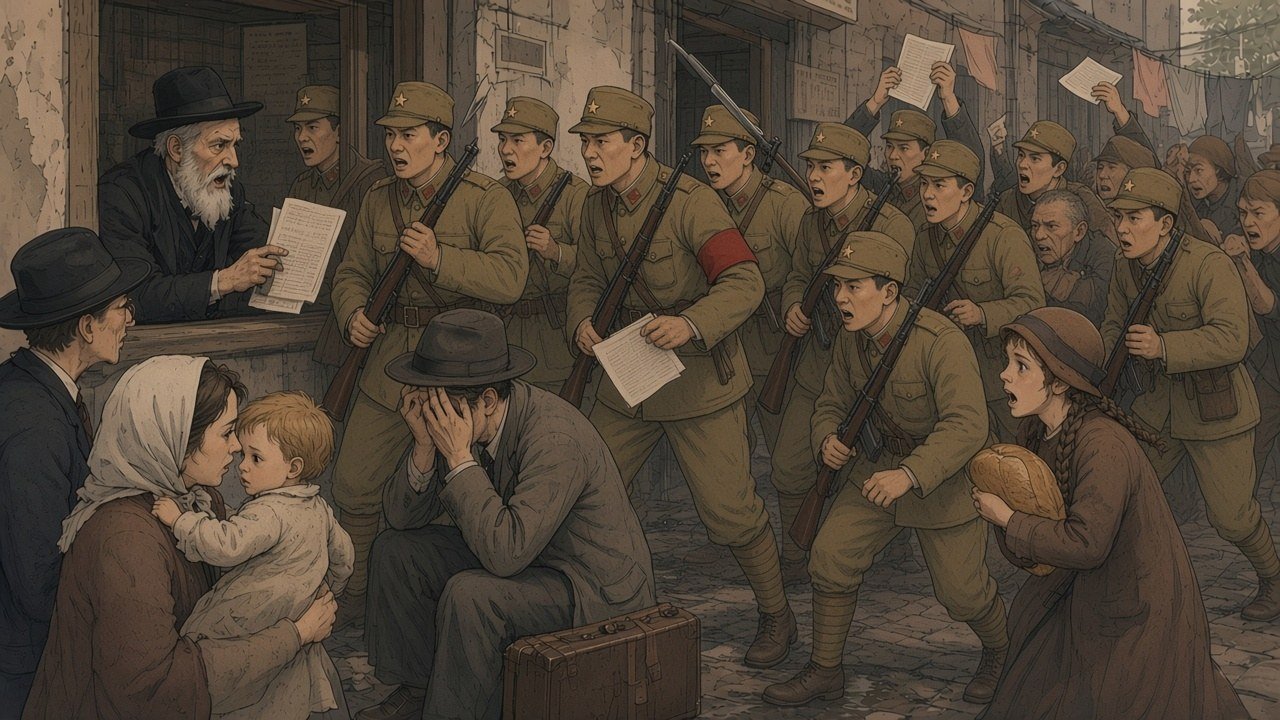
The Pao Chia
Inside the area, order was kept partly by the refugees themselves. The Japanese adapted the traditional Chinese system of collective responsibility, baojia (spelled pao chia at the time), under which households were grouped and made responsible for each other’s conduct. Refugee men, generally between their twenties and their forties, were enrolled in the Foreign Pao Chia and stood guard at the boundaries in shifts, checking the passes of other refugees. The duty was resented, and the guards’ authority over their own neighbours made them unpopular, but it also kept Japanese soldiers away from the daily running of the area.
A ghetto without walls
The designated area was a place of restriction, not of extermination. There were no deportations from it, no organised killings, no forced labour on the scale of Europe. People could leave with a pass; Chinese residents came and went; refugees continued to run businesses, schools, theatres, clinics and synagogues inside it. The Holocaust Memorial Museum stresses that life there, though hard, did not involve the daily terrors endured by ghettoised Jews in Europe, and that the Japanese treatment of Jews in Shanghai was comparatively benign. [4] Some survivors resisted the word ghetto for that reason; others used it because it described the experience of confinement, humiliation and dependency that they lived through. Both uses are understandable.
37. The squeeze, 1943 to 1945
Crowding
The relocation of 1943 crammed thousands more refugees into the district. Families who had lived in flats in the French Concession now shared single rooms in lane houses, often with another family. The Heime filled again. In the summers of 1943, 1944 and 1945 the heat in the crowded rooms was intense, and disease spread.
Hunger and inflation
The war economy of occupied Shanghai deteriorated steadily. The Japanese and the Wang Jingwei government introduced a new currency, the notes of the Central Reserve Bank, which lost value rapidly, especially in 1944 and 1945. Rice and other staples were rationed, and the rations given to foreigners in the designated area were small. Prices on the open market rose many times over. Families sold the last of their possessions; the committees cut the kitchen rations; and hunger became general among the poorer refugees. Many depended on the single hot meal a day that the kitchens could provide.
The JDC’s funds could not legally reach Shanghai during the war, but some money arrived through neutral channels, notably through Switzerland and through the efforts of the JDC’s representatives in neutral countries, and through the International Red Cross. These remittances, small as they were, helped keep the kitchens open in 1944 and 1945.
Life went on
Within the designated area, the institutions the refugees had built continued. The Kadoorie School taught; the yeshivas studied; the newspapers that survived kept appearing under censorship; the cafés on Chusan Road and Ward Road stayed open for those who could pay; theatre and concerts went on; football matches were played. Refugees married, had children, studied for emigration that might never come, and argued about politics in whispers. People who had passes went out to work in the city each day and came back at night.
Underground
There were also refugees who resisted. A small number took part in underground networks that gathered and passed on information, listened to Allied radio, and in some cases helped Allied airmen or assisted Chinese and Allied intelligence. Some young men joined Chinese forces. The scale of this activity was modest, and much of it is known only from later testimony, but it existed.
News from Europe
Through 1943 and 1944, fragments of news about the fate of the Jews in Europe reached Shanghai through radio broadcasts, neutral contacts and rumour. Few refugees could grasp it fully. The Holocaust Memorial Museum notes that the entry of American troops into Shanghai in 1945 was met with jubilation that was quickly tempered by news of the Holocaust, and that it took many months for refugees to learn the fate of individual relatives. [4] For most of them, the end of the war brought the knowledge that the families they had left behind had been murdered.
38. The hardest year
1944
By common consent the worst period of the refuge was the last year and a half of the war. The designated area was overcrowded; the economy was collapsing; inflation was destroying the value of money; the relief committees were short of funds; and the Japanese authorities, increasingly anxious as the war turned against them, were harsher in granting passes. Many refugees who had worked outside the area lost their jobs when their passes were withdrawn or shortened.
The kitchens under strain
At several points in 1944 the kitchens were close to collapse. The number of people dependent on them rose, while the money and food available fell. Rations were cut, and the meals became thinner. Medical care was limited by the lack of medicines, and the death rate among the elderly and the sick rose. Some help arrived through the International Red Cross and through funds transmitted from neutral countries, which helped prevent outright starvation.
Endurance
Yet even in 1944 the institutions of the refuge continued. Schools taught; synagogues held services; the yeshivas studied; concerts and plays were performed; football matches went on. Refugees continued to marry and to have children. Memoirs of this period emphasise both the misery and the determination to keep up a normal life, and many survivors later said that it was the community’s institutions, more than anything else, that kept them going.
Waiting for the end
By early 1945 the refugees knew from radio broadcasts and rumours that Germany was losing the war, and they hoped that Japan’s defeat would follow. American air raids on Shanghai, which became more frequent in 1945, were a sign that the end was coming, and also a new danger, as the bombing of July 1945 showed. The last months of the war were a time of hunger, fear and hope.
39. 17 July 1945
Air raids
From late 1944 American aircraft began to attack Japanese targets in and around Shanghai: airfields, docks, shipping, fuel stores and factories. Air raid alarms became frequent in the summer of 1945. Shanghai had few shelters, because the ground water lay close beneath the streets, and when the sirens sounded people often went out into the lanes rather than stay indoors. [10]
The raid
On the afternoon of Tuesday 17 July 1945, a hot and humid day, American bombers attacking Japanese installations in Hongkew dropped bombs into the crowded lanes of the designated area. It was generally believed afterwards that the target was a Japanese radio transmitter near Dongshan Road; there may also have been military stores or workshops nearby. Houses collapsed and burned. Irene Eber, drawing on refugee reports, gives the toll among the refugees as 31 dead and some 190 wounded, with about 700 left homeless and dozens of houses destroyed or damaged. [10] The Holocaust Memorial Museum gives a figure of 40 Jewish dead, including seven Polish Jews. [4] The Chinese residents of the district suffered far more: their dead numbered in the hundreds.
Ernest Heppner, who worked in a bakery in a crowded lane, had decided to go home at noon that day; the bakery was destroyed when the bombs fell in the early afternoon. [10] [16] Eyewitnesses described scenes of horror in the streets, the heat, the dead and the injured.
Refugees and Chinese together
The raid became one of the defining memories of the refuge, and one of the moments most often cited as evidence of solidarity between refugees and Chinese. Refugee doctors and nurses treated the injured of both communities in improvised dressing stations; Chinese and refugees dug together in the ruins; and the passes were ignored as people rushed to help. Shoshana Kahan, who was in the French Concession that day, wrote in her diary that when she rushed back to Hongkew by rickshaw, the passes were not checked at the entrance to the area. [10]
After the raid
There were funerals in the heat, described by Kahan in painful detail, and there was anger. Some refugees blamed the Jewish organisations for not having helped them emigrate before the war closed the routes; others blamed the Japanese for placing military installations in a residential district. The raid came less than a month before Japan’s surrender. Those killed had survived Nazi Germany and six years of exile only to die in the last weeks of the war, by the bombs of the side they had been praying for.
40. Liberation
August and September 1945
The news of Japan’s surrender reached Shanghai on 15 August 1945. For a few weeks the city was in an odd interregnum: the Japanese garrison remained, awaiting the arrival of Chinese Nationalist and American forces, and the authority of the Wang Jingwei regime collapsed. The designated area dissolved almost at once in practice, as refugees simply walked out of it. The formal surrender in Shanghai and the arrival of the first American forces came in late August and September.
The refugees greeted the Americans with joy. Soldiers and sailors, among them Jewish servicemen who sought out the refugees, brought food, cigarettes, news and contacts with relatives in America. American and other Allied organisations began to operate in the city. Some refugees found work with the American forces, which needed interpreters, clerks, mechanics and drivers. Ernest Heppner worked for the United States Air Force in China for several years after the war. [1]

The dead
With liberation came the lists. Over the following months refugees learned through the Red Cross, the JDC and other organisations which of their relatives had survived and which had been murdered. For most, the news was of loss on a scale that made their own survival seem accidental. The Holocaust Memorial Museum notes that the jubilation at the arrival of American troops was quickly tempered by the news of the Holocaust. [4] Memorial services were held in the synagogues and halls of Hongkew, and the survivors of Shanghai began to understand that they had been spared what had happened to almost everyone they had left behind.
The end of the foreign settlements
The Shanghai that the refugees had entered no longer existed. In January 1943 Britain and the United States had signed treaties with the Nationalist government giving up their extraterritorial rights in China, and in August 1943 the Japanese-sponsored Wang Jingwei regime had taken over the International Settlement and, nominally, the French Concession. After the war the Nationalist government took control of the whole city, and the old foreign municipal councils were never restored. The refugees were now foreigners without privileges in a Chinese city.
The JDC returns
The JDC resumed its work in Shanghai at once, repaid the wartime loans raised by Laura Margolis, and opened an office directed by Charles Jordan, who became the most important figure in the postwar relief and emigration of the Shanghai Jews. The United Nations Relief and Rehabilitation Administration (UNRRA) and later the International Refugee Organization also took responsibility for the refugees. The question now was not survival but departure.
A city in turmoil
Postwar Shanghai was not a calm place to wait. The returning Nationalist government was widely resented for the corruption of its officials, who seized enemy property and businesses for themselves. Inflation, which had been severe under the occupation, became catastrophic in 1947 and 1948, when prices rose so fast that wages were paid in sacks of banknotes and shops changed their prices several times a day. The civil war between the Nationalists and the Communists resumed in 1946 and turned decisively against the government in 1948. Strikes, demonstrations and black-market trading filled the streets. American forces remained in the city for several years, and their presence brought jobs, goods and money to many refugees, but also a sense that the city’s future lay with forces beyond anyone’s control. For the refugees, the lesson of 1937 to 1945 was clear: it was time to leave while the doors were open.
41. The dispersal
Nobody wanted to stay
Almost no refugee intended to stay in Shanghai after the war. China was poor, the civil war between the Nationalists and the Communists was resuming, inflation was spiralling, and the refugees had no future as stateless foreigners in a Chinese city. They wanted to go to America, to Palestine, to Australia, to anywhere that would take them. But the doors that had been closed in 1938 were only slowly opening.
The United States
The American quotas for Germany and Austria, which had been full before the war, now had room, but every applicant still needed papers, affidavits and a place on a ship. Thousands of Shanghai refugees emigrated to the United States between 1946 and 1949, many settling in San Francisco, Los Angeles and New York. Ernest Heppner went to the United States in 1947 with his wife, whom he had met and married in Shanghai. [1] The Displaced Persons Act of 1948 later eased the way for some who remained.
Palestine and Israel
Several thousand refugees went to Palestine and, after May 1948, to Israel. Before independence, emigration to Palestine was limited by British certificates; after it, the new state welcomed all Jewish immigrants, and organised groups left Shanghai by ship for Israel in 1948 and 1949. Many of the Polish refugees and of the Russian Jewish community also went to Israel.
Australia and elsewhere
Australia admitted a number of refugees from Shanghai after the war, though its government restricted Jewish immigration from Shanghai at times in the late 1940s. Others went to Canada, to Latin America, to Britain and to other countries. Some returned to Germany and Austria: a few hundred went back to Berlin and Vienna, often for political reasons or because they had family or property there, or because they were old and could not face another new country. Sonja Mühlberger, born in Shanghai in 1939, returned with her family to East Germany and later helped the Shanghai Jewish Refugees Museum compile its wall of names. [7]
The Mir and the yeshivas
The yeshiva students left in 1946 and 1947, most for the United States, where the Mir was re-established in Brooklyn, and others for Palestine. They carried with them the books they had printed in Shanghai and a tradition that had survived intact.
Departure
The departure took years. In 1946 and 1947 thousands left; by 1948 the numbers in Shanghai were falling fast. Some people waited years for visas, living in the same rooms in Hongkew, working for the American forces or in refugee businesses, while the civil war drew closer. For many families the last memory of Shanghai was of a ship pulling away from the wharf in Hongkew, the same wharf at which they had arrived ten years before.
42. Restitution and recognition
Compensation
After the war, refugees who had been driven out of Germany and Austria were able, under the restitution and compensation laws of the Federal Republic of Germany, to claim compensation for lost property, lost careers and persecution. For the Shanghai refugees, one question was whether their confinement in the designated area counted as persecution for which Germany was responsible, since it had been imposed by Japan. The question was argued in German courts and administrative proceedings, and many former Shanghai refugees eventually received compensation for their losses, including in some cases for the period of confinement.
Recognition of rescuers
Recognition also came, slowly, for those who had helped. Chiune Sugihara was recognised by Yad Vashem in 1984, Jan Zwartendijk in 1997 and Ho Feng-Shan in 2000. [6] In 2015 Taiwan’s president posthumously honoured Ho. Laura Margolis’s work for the JDC was recognised within the organisation and by historians of the refuge. The Chinese neighbours of Hongkew, whose decency was real but undramatic, have been honoured collectively, in the museum and in the speeches of Israeli and Chinese leaders, rather than as individuals.
The survivors’ own memorials
The refugees also built their own memorials: newsletters, reunions, archives of letters and photographs, collections of oral history, and the list of names that became the museum’s wall. These efforts, made mostly by people in their seventies, eighties and nineties, preserved much of what is now known about the refuge, and they are why the history of Jewish Shanghai can now be written in such detail.
43. The last Jews of Shanghai
The Communist victory
The People’s Liberation Army entered Shanghai in May 1949, and the People’s Republic of China was proclaimed in October. By then most of the refugees had gone, but several thousand Jews, refugees and members of the older communities, remained, either because they were still waiting for papers or because they had decided to try their luck under the new regime.
The new government did not persecute Jews as Jews. But it was hostile to foreign capital, to private trade and to the whole world of the treaty port, and the remaining foreign community shrank quickly. Foreign firms were squeezed out through taxes, labour demands and restrictions on remittances; foreigners found it hard to work; and exit permits could be slow to obtain. The establishment of diplomatic relations was also complicated: Israel recognised the People’s Republic in January 1950, one of the first non-communist states to do so, but full diplomatic relations between the two countries were not established until 1992.
The Council and the JDC
The Council of the Jewish Community of Shanghai, with the help of the JDC and HIAS, organised the departure of the remaining Jews in the early 1950s. Elderly and sick people, who had nowhere to go, were the hardest to place, and the JDC continued to support a dwindling number of Jews in Shanghai for years. By the mid-1950s only a few hundred remained, and by the 1960s only a handful. The synagogues closed and were turned to other uses; the cemeteries, as described earlier, were moved and later destroyed.
The Baghdadi fortunes
The great Baghdadi firms also left. Sir Victor Sassoon had already shifted his business to the Bahamas; his Shanghai property passed into the hands of the new state, and the Cathay Hotel reopened in 1956 as the Peace Hotel. The Kadoories had moved the centre of their business to Hong Kong, where they remained among the territory’s leading families; Marble Hall, their Shanghai house, became the Children’s Palace. Our Sassoon and Kadoorie chapters, including Victor Sassoon and the Shanghai skyline, follow these stories after 1949.
Silence
For three decades after 1949 the history of the refuge was largely forgotten in China. The city was closed to most foreigners; the subject did not fit the political narratives of the time; and the buildings of Hongkew were turned over to housing, factories and offices. Ohel Moshe was put to other uses for decades. Outside China the refugees themselves kept the memory alive in family stories, in survivors’ associations in America, Israel and Australia, and in a handful of memoirs, but the subject attracted little scholarly attention until the 1970s.
44. Lives after Shanghai
A generation scattered
The refugees of Shanghai went on to ordinary and extraordinary lives in dozens of countries. Their children grew up in Tel Aviv, New York, Melbourne, Toronto and Berlin, and many of them spoke of Shanghai as the place where the family had survived. A few became famous, and their stories have done much to make the refuge known.
W. Michael Blumenthal
Werner Michael Blumenthal was born in 1926 near Berlin. After Kristallnacht his father was held in Buchenwald and released on condition that the family leave Germany, and in 1939 the family reached Shanghai, where Michael grew up in Hongkew and lived through the designated area as a teenager. He went to the United States in 1947, studied at Berkeley and Princeton, and became a business executive and public servant. He served as United States Secretary of the Treasury under President Jimmy Carter from 1977 to 1979, and later as the founding director of the Jewish Museum Berlin, which opened its permanent exhibition in 2001. His life ran from the designated area to the cabinet of the United States and back to Berlin.
Peter Max
The pop artist Peter Max was born in Berlin in 1937 and was taken to Shanghai as an infant. He grew up surrounded by Chinese street life and the colours of the city, which he later said influenced his art. The family left in 1948 for Israel and later moved to the United States.
Jakob Rosenfeld
Jakob Rosenfeld, the Austrian doctor who joined the Communist New Fourth Army in 1941 and later served with Communist forces in north China, became one of the few foreigners to rise to senior rank in the Chinese Communist military medical service. He left China in 1949 and died in Israel in 1952. In China he is remembered under his Chinese name, Luo Shengte, and he is commemorated in Shandong province, where he served.
Writers and witnesses
Many refugees became witnesses. Ernest Heppner’s Shanghai Refuge (1993) is a sober, detailed account of a young man’s life in Hongkew and the designated area. [16] Sigmund Tobias’s Strange Haven (1999) describes a Berlin boy’s childhood in the refuge. [15] Rena Krasno’s Strangers Always (1992) gives the view of a Russian Jewish family that had lived in Shanghai before the refugees came. [21] Shoshana Kahan’s Yiddish diary records the life of the Polish refugees. Hundreds of others gave oral histories to museums, archives and researchers; Steve Hochstadt’s Exodus to Shanghai (2012) is built from many of these interviews. [22]
Scholars and doctors, merchants and musicians
Most refugees became neither famous nor writers. They worked as doctors, engineers, tailors, teachers, shopkeepers and musicians in their new countries, raised families and in many cases rarely spoke of Shanghai. Survivors’ groups, especially in California and Israel, held reunions, published newsletters, and in later decades organised visits to Shanghai, where many of them saw again the lanes in which they had lived. The descendants of the refugees, a number that now runs into tens of thousands, are the living result of the open port.
Those who stayed in China
A small number of refugees stayed in China after 1949 out of conviction. Some, like the Austrian doctor Richard Frey, who had joined the Communists during the war, took Chinese citizenship and spent the rest of their lives in China. Their stories are a reminder that for a few refugees Shanghai was not only a waiting room but a turning point that led them into Chinese history.
45. Counting the refugees
Why the totals differ
Readers of different books and websites will meet different figures for the number of Jewish refugees who reached Shanghai: 14,000, 16,000, 17,000, 18,000, 20,000 and even 25,000 or 30,000. The variation is not carelessness. It reflects real uncertainties in the sources.
There was no registration of people landing in Shanghai before August 1939, because no authority claimed the right to register them. The relief committees registered those who asked for help, and the International Committee registered many others, but not everyone. Some people who arrived moved on quickly to other destinations in Asia or the Americas. Some were not Jewish by religion but were refugees from Nazi racial persecution. Some counts include the roughly one thousand Polish refugees of 1941; some do not. Some include the Russian Jews, who were not refugees in the same sense; most do not. And some later figures were inflated by the natural tendency to round up a remarkable story.
The best estimates
The figures that historians most often accept are these. About 17,000 Jews from Germany and Austria (including annexed Czechoslovakia) reached Shanghai, most of them between November 1938 and the autumn of 1939, with smaller numbers before and after. [1] About a thousand Polish and Lithuanian Jews came from Japan in 1941. [4] That makes a total of about 18,000, which is the figure given by the Holocaust Memorial Museum for refugees from the German Reich and the figure most often used in scholarly work; estimates including all categories of refugee from Central and Eastern Europe go up to about 20,000. [2] [5]
The wall of names at the Shanghai Jewish Refugees Museum began in 2014 with 13,732 names, drawn largely from a list of more than 14,000 names published in the German volume Exil Shanghai and checked by the former refugee Sonja Mühlberger. Further research has added names: the wall carried 18,578 after the museum’s expansion in 2020 and 19,672 after an addition in October 2025. [7] [23] The list is a work of memory and research, not an official register, but it now approaches the higher scholarly estimates.
Survival
Whatever the precise total, almost all of the refugees survived the war. Deaths from disease, hunger and age, perhaps a thousand or more over the whole period, and the victims of the bombing of July 1945 were the losses; there were no deportations and no killings. In the context of the Holocaust, in which about six million Jews were murdered, a community of eighteen thousand that lived to see the end of the war was among the largest groups of Jews from the Reich to survive anywhere outside the territory of the Allies.
Numbers as argument
Numbers have also been used as arguments. Chinese official accounts sometimes speak of “tens of thousands” of Jews saved by Shanghai, which slightly overstates the total and blurs the distinction between the open port and active rescue. Some Western accounts understate the role of Chinese neighbours or the significance of the refuge. A careful reader will treat round numbers with caution and remember that behind every figure are families whose survival depended on decisions taken by shipping clerks, consuls and committee members as much as on the policies of governments.
46. How the story has been told
Early silence
For about thirty years after the war, the Shanghai refuge received little attention from historians. The refugees were busy rebuilding their lives; Holocaust history was concentrated on Europe; China was closed; and the story did not fit easily into the categories of either Holocaust or Chinese history. Some survivors published memoirs in German, English and Yiddish, and German-speaking exile studies began to take notice in the 1960s and 1970s, but there was no comprehensive history.
Kranzler
The first major scholarly history was David Kranzler’s Japanese, Nazis and Jews: The Jewish Refugee Community of Shanghai, 1938–1945, published in 1976. [8] Kranzler, an American historian and librarian with a particular interest in Orthodox rescue efforts, used Japanese, German, Yiddish and English sources and interviews with survivors, and he set out the framework that later historians would build on: the open port, the role of the relief committees, Japanese policy and the “Jewish experts”, the designated area, and the survival of the community. His emphasis on Japanese motives, including the influence of the Fugu proposals, has been debated, but his book remains essential.
The 1990s
The opening of China after 1978, the end of the Cold War, the establishment of diplomatic relations between China and Israel in 1992, and the ageing of the survivors brought a wave of interest in the 1990s. James Ross’s Escape to Shanghai (1994) gave a popular narrative. [24] In China, the Center of Jewish Studies Shanghai under Pan Guang published studies and an illustrated volume, The Jews in Shanghai, in 1995. [11] Documentary films brought the story to wide audiences: Port of Last Resort (1998), by Joan Grossman and Paul Rosdy, and Shanghai Ghetto (2002), by Dana Janklowicz-Mann and Amir Mann, both built around the testimony of survivors.
In 1998 Bernard Wasserstein’s Secret War in Shanghai placed the refugees within the world of espionage, collaboration and crime that surrounded them, and showed how the designated area fitted into Japanese security policy. [20] Our review of Wasserstein’s book discusses it in detail.
Ristaino, Eber and after
Marcia Reynders Ristaino’s Port of Last Resort: The Diaspora Communities of Shanghai (2001) set the Jewish refugees beside the Russian émigrés and other stateless communities of the city, and showed how much their experience had in common. [5] Irene Eber, a historian of China at the Hebrew University of Jerusalem who had herself survived the Holocaust in Poland as a child, published Voices from Shanghai (2008), an anthology of Yiddish, Polish and German writing from the refuge, and Wartime Shanghai and the Jewish Refugees from Central Europe (2012), which emphasised the refugees’ coexistence with the Chinese and other communities and their efforts to preserve their identity. [13] [10] Her work with Avraham Altman on the background of the flight to Shanghai examined how and why the migration of 1938 to 1940 happened. [25]
Gao Bei’s Shanghai Sanctuary (2013) used Chinese and Japanese sources to examine the policies of both governments. [12] Steve Hochstadt’s Exodus to Shanghai (2012) drew on the oral histories he recorded with former refugees. [22] German scholars, including Astrid Freyeisen on the policy of the Third Reich in Shanghai and the editors of Exil Shanghai 1938–1947, have documented the German side of the story and the refugees’ lives in detail. [19] [23] Jonathan Kaufman’s The Last Kings of Shanghai (2020) retold the story of the Sassoons and Kadoories, including their role in the refugee relief. [14]
The debates
Several questions recur in this literature. How far was the refuge the result of Chinese hospitality, Japanese policy, or simply the absence of any authority able to say no? How much did the Japanese “Jewish experts” matter, and how seriously should the Fugu proposals and the Meisinger story be taken? Should the designated area be called a ghetto? How did the refugees relate to their Chinese neighbours, and how much did they know of Chinese life? How did the different Jewish communities of Shanghai relate to one another? The answers given in the most careful recent work are usually mixed: the refuge was made by a combination of contingency, policy, philanthropy and the refugees’ own efforts, and its history cannot be reduced to a single cause.
47. Other refuges in Asia
Shanghai in context
Shanghai was the largest refuge for Jews from the Reich in Asia, but it was not the only one, and comparing it with the others shows what was distinctive about it.
Manila
In the Philippines, then an American commonwealth moving towards independence, President Manuel Quezon, the American high commissioner Paul McNutt and members of the small Jewish community of Manila, among them the Frieder brothers, businessmen from Cincinnati, organised the admission of about 1,300 Jewish refugees from Germany and Austria between 1937 and 1941. Larger schemes, including a plan to settle refugees on the island of Mindanao, were discussed but not carried out. Unlike Shanghai, Manila admitted refugees through a deliberate, selective programme with visas, which kept the numbers small. When Japan occupied the Philippines in 1942, the refugees there, as German nationals or stateless persons, were mostly not interned, but they suffered heavily in the battle for Manila in 1945.
Japan
Japan itself was a transit country rather than a refuge. The few thousand Polish and Lithuanian Jews who came through Kobe in 1940 and 1941, described above, were moved on to Shanghai or to other destinations before the Pacific war. A small number of German Jewish refugees had settled in Japan before the war, as teachers, musicians and businessmen, and some remained throughout the war.
Manchuria and north China
Harbin, Tianjin and Dalian had Russian Jewish communities older than the refugee migration. Some refugees from Germany and Austria passed through Manchuria on the overland route; a few stayed. The Japanese authorities in Manchukuo, who sponsored the Far Eastern Jewish Conferences in Harbin, admitted small numbers of refugees. Tianjin, with its foreign concessions, had a community of a few thousand Jews, mostly Russian, who also helped refugees.
India and South-East Asia
British India admitted some hundreds of Jewish refugees from Central Europe, mostly professionals such as doctors and engineers with guaranteed employment, and some refugees reached the Dutch East Indies, Singapore and other colonies. In each case entry depended on visas, guarantees and the approval of colonial governments, and the numbers were small.
What was different about Shanghai
Shanghai stands apart because it did not select. Every other refuge in Asia admitted refugees on conditions, through visas, guarantees, quotas or schemes. Shanghai, until August 1939, admitted everyone who could buy a ticket. That is why it received more refugees than all the other Asian destinations together, and why it received the old, the sick, the poor and the unqualified as well as the useful. It is also why the refugees found there no reception, no plan and no state help: the openness that let them in was the same absence of authority that left them to fend for themselves.
48. Hongkou today
Old names and new
A visitor to Hongkou today can still walk through much of the refugee quarter, although the streets have new names and many buildings have gone. Ward Road, where Ohel Moshe, the first Heim and Café Louis stood, is now Changyang Road. Chusan Road, the heart of Little Vienna, is now Zhoushan Road. Wayside Road is now Huoshan Road. The great prison at Tilanqiao still stands, and it has given its name to the surrounding district, which the city has designated the Tilanqiao Historic Area.
The museum
The former Ohel Moshe synagogue at 62 Changyang Road was restored and opened as the Shanghai Jewish Refugees Museum in 2007. In December 2020 the museum reopened after an expansion that increased its area from about 900 square metres to more than 4,000, and its exhibits from about 150 to nearly a thousand. [26] [27] The permanent exhibition is arranged in six parts covering the flight to Shanghai, life in the refuge, the refugees’ relations with the Chinese, the postwar departure, the bonds between the two peoples, and the shared future. [27]
In the museum’s courtyard stands the Wall of Names of Jewish Refugees in Shanghai, unveiled on 3 September 2014. It began with 13,732 names, drawn mainly from a list of more than 14,000 names in the appendix to the German volume Exil Shanghai 1938–1947, checked name by name by Sonja Mühlberger, a former refugee born in Shanghai. The museum has added names as research continued: the wall carried 18,578 names after the 2020 expansion, and a further addition in October 2025 brought the total to 19,672. [7] Beside it stands a sculpture with six figures, representing the six million Jews murdered in the Holocaust.
The lanes
Around the museum, along Changyang, Zhoushan and Huoshan roads, some of the lane houses and shopfronts of the refugee period survive, and parts of the area have been restored. The streetscape has been preserved as a historic district, with old façades along Zhoushan Road and plaques marking buildings associated with the refugees. In Huoshan Park, a small park on Huoshan Road, a memorial stone records the designated area for stateless refugees in Chinese, English and Hebrew.
Elsewhere in the city
Ohel Rachel synagogue still stands on North Shaanxi Road, in grounds long used by the city’s education authorities; it has been opened occasionally for services and visits. Beth Aharon, where the Mir Yeshiva studied, was demolished in 1985. The Embankment Building on the north bank of Suzhou Creek, where so many refugees spent their first nights, is still an apartment block. On the Bund, the former Cathay Hotel is again the Peace Hotel. The Garden Bridge and Broadway Mansions, which refugees crossed and passed on their way from the wharves into Hongkew, still stand at the mouth of Suzhou Creek.
Visits and diplomacy
Since China and Israel established diplomatic relations in 1992, the refuge has become a regular theme of diplomacy between them. Israeli prime ministers, presidents and other leaders have visited the Ohel Moshe building, beginning with Yitzhak Rabin in 1993, and the museum receives many visitors from Israel, Germany, Austria and the United States, as well as Chinese school groups. In Chinese official narratives, the refuge illustrates the friendship of the Chinese and Jewish peoples and the shared experience of suffering in the Second World War. For the descendants of the refugees, it is above all a place of family memory.
49. What the open door meant
Not a simple tale
It is worth being precise about the lesson, because the story is often sentimentalised into a simple tale of Chinese compassion, and the truth is more interesting. The people of Hongkew were, by most testimony, decent neighbours to the refugees, sharing poverty without resentment, and that decency was real and is remembered. But the sanctuary itself was made by a stack of contingencies: a legal anomaly created by the collapse of the treaty-port order; the philanthropy of the established Jewish communities and the money of American Jews; the disobedience of a few diplomats; the stubbornness and enterprise of the refugees themselves; and the decision of an occupying power, for its own reasons, not to import a genocide. No one planned it.
The opposite of Évian
In that sense Shanghai was the opposite of Évian. The doors that closed in 1938 had been closed deliberately, by committees and governments, with expressions of regret. The door that stayed open had simply never been shut. The contrast carries the moral of the story. In July 1938 the representatives of the democracies, meeting in comfort on the shore of Lake Geneva, found thirty-two reasons why rescue was impractical. Shanghai, a city at war, occupied, hungry and half in ruins, did not find a reason. It let people off the ships.
Room, not hospitality
There is a quieter point about what kind of refuge this was. The refugees were not guests: nobody had invited them, and nobody waited on them. What they received in Hongkew was not hospitality but room: room to rent a corner, open a surgery or a café, argue about Zionism, publish a newspaper, marry, mourn, study Talmud, and wait for the world to come to its senses. They brought Europe with them, and for a few years a working fragment of it, its medicine, music, scholarship and coffeehouse culture, went on functioning on Chinese soil among Chinese neighbours, at a time when Europe itself had stopped functioning altogether.
When the survivors sailed away they took that fragment with them, which is why the story has the strange afterglow it does. It is one of the few Holocaust rescues in which the rescued were numerous enough, and settled enough, to carry a whole culture through the war intact: a yeshiva with its students and teachers, a theatre with its actors, a press with its editors, a medical community with its doctors. Survivors themselves sometimes describe Shanghai as an ark. The metaphor is exact. An ark is not a paradise. It is the thing that floats.
Who saved whom
Who saved the Jews of Shanghai? The honest answer is that many people did, in small ways, and that the largest share of the credit belongs to circumstances that nobody controlled. The consuls who issued visas, the shipping clerks who sold tickets, the committees who ran the kitchens, the American Jews who paid for them, the Japanese officials who chose restriction rather than murder, the Chinese neighbours who shared their lanes, and the refugees who rebuilt a district out of rubble all played their parts. A story with so many authors does not lend itself to a single hero, and the best histories of the refuge do not try to supply one.
The present
Shanghai’s refuge also says something to the present. Refugee crises recur, and the arguments made at Évian, about capacity, unemployment, security and the danger of encouraging more arrivals, are made again in every generation. Shanghai is not a model of policy, because it had no policy. But it shows what happens when people fleeing for their lives are simply allowed to land: most of them survive, many of them flourish, and their descendants remember the place that let them in. The ledger of the treaty ports, which this site has often recorded as a story of what the open door cost China, has in Hongkew a counter-entry: proof that the same openness could, when the world needed it, run the other way.
50. Shanghai and the Holocaust
Refuge, not rescue
Where does Shanghai belong in the history of the Holocaust? It does not fit easily into the usual categories. It was not a rescue operation in the sense of the Kindertransport, the Danish boats of October 1943 or the protective passes of Budapest in 1944: no government or organisation set out to bring Jews to Shanghai, and most of those who helped did so after the refugees had already arrived. Nor was it a place of persecution in the European sense, though it had its ghetto and its hunger. It is best described as a refuge: a place where people who had escaped by their own efforts were able to survive.
The bystander nations
Shanghai also casts light on the conduct of the countries that could have taken more refugees and did not. The figures from Évian onwards show that the world’s democracies, with all their resources, admitted Jews from the Reich in numbers that were small relative to their populations and their capacity, and hedged every admission with conditions. A single occupied Chinese port, with no resources to speak of, took in more than many of them together. Historians of the refugee crisis of the 1930s have often used the comparison to make the point that capacity was never the real obstacle.
Japan’s role
Shanghai also complicates the history of the Axis. Japan was Germany’s ally, and it shared some of the antisemitic ideas circulating in Europe. Yet it did not adopt the Nazi programme, and the Jews under its control in Shanghai survived. That outcome was not the result of a humanitarian policy, but neither was it an accident; it followed from decisions taken in Tokyo in 1938 and maintained, with modifications, through the war. Historians of Japan and of the Holocaust continue to debate how much credit, if any, Japanese officials deserve.
A community that survived
Finally, Shanghai is one of the very few places where a Jewish community from Central Europe survived the war as a community, with its institutions, its culture and its memory intact. That is why its records, newspapers, memoirs and photographs are so rich, and why its history matters not only to the descendants of the refugees but to anyone who wants to understand what was lost in Europe and what, in a few unexpected places, was saved.
51. Sources and archives
Where the evidence is
The history of the refuge rests on a wide range of sources. The archives of the American Jewish Joint Distribution Committee in New York and Jerusalem hold the reports, budgets, correspondence and cables of the relief effort, including Laura Margolis’s reports, and much of this material is now searchable online. [9] The United States Holocaust Memorial Museum holds oral histories, photographs, documents and objects, including the boundary sign of the designated area. [4] Yad Vashem holds testimonies and the files of the Righteous Among the Nations, including Ho Feng-Shan’s. [6]
The Shanghai Municipal Archives hold the records of the Shanghai Municipal Council and the Shanghai Municipal Police, including files on refugees, and Japanese archives hold the records of the army, navy and foreign ministry that historians such as Gao Bei and Japanese scholars have used to reconstruct policy. [12] German archives hold the records of the German consulate and party organisations in Shanghai. [19] The refugee press of 1939 to 1947 survives in libraries in Germany, Israel and the United States, and memoirs and oral histories number in the hundreds.
Reading the sources
These sources have their limits. The records of relief organisations tend to describe the refugees as problems to be managed. Japanese and German official records reflect the concerns of their authors. Memoirs, written decades after the events, sometimes repeat stories that circulated in the community rather than first-hand experience, and they are shaped by later knowledge of the Holocaust. Oral histories are vivid but subject to the workings of memory. The best histories of the refuge combine all of these sources and treat each critically, which is why the more dramatic stories, such as the Meisinger plan, are now handled with caution.
52. A note on words
Refugee, emigrant, Shanghailander
The people at the centre of this story did not always call themselves refugees. In German they often used Emigranten, emigrants, a word that implied a choice and preserved a little dignity. The older foreign residents of Shanghai called themselves Shanghailanders, and some of the refugees, as the years passed, began to use the word of themselves. In Chinese they were Youtai nanmin, Jewish refugees, the term now used by the museum and by Chinese historians.
Ghetto
Whether the designated area should be called a ghetto has been debated since the war. The Japanese proclamation spoke of a “designated area for stateless refugees”; refugees called it the ghetto, or the Ghetto in German; the Holocaust Memorial Museum refers to it as the Shanghai ghetto in inverted commas while stressing how different it was from the ghettos of Nazi Europe. [4] This article uses “designated area” for the place and the period, and “ghetto” where the refugees’ own usage is being described. The distinction matters: the ghettos of Warsaw, Łódź and Vilnius were stages on the way to murder, and the designated area of Hongkew was not.
Place names
Shanghai’s street names have changed several times. This article uses the names in use at the time, such as Ward Road and Chusan Road, with modern names where they help a visitor: Ward Road is now Changyang Road, Chusan Road is Zhoushan Road and Wayside Road is Huoshan Road. Hongkew, the old postal spelling, is used for the wartime district; Hongkou is the modern name of the district. Chinese names of people are given in the forms most familiar from English-language sources.
Yiddish and Hebrew
Yiddish and Hebrew words appear on this site in Hebrew script. The refugees’ own German terms, such as Heim, are given in italic transliteration. A short glossary follows the timeline.
53. Timeline
The son of David Sassoon reaches Shanghai, two years after the port opened to foreign trade, and begins the Baghdadi Jewish presence in the city.
N. E. B. Ezra founds Israel’s Messenger, the English-language Zionist monthly of Shanghai.
Russian Jews in Shanghai found the Ohel Moshe congregation, which moves into its building on Ward Road in Hongkew in 1927.
Ohel Rachel synagogue is built on Seymour Road in memory of Rachel, wife of Sir Jacob Elias Sassoon. Sun Yat-sen writes to N. E. B. Ezra in support of Zionism.
Silas Hardoon builds Beth Aharon synagogue on Museum Road; in 1941 it will house the Mir Yeshiva.
Nazi rule begins in Germany; a few hundred German Jews, many of them doctors, settle in Shanghai over the next five years.
Fighting from August to November wrecks Hongkew and Zhabei; the Japanese take the Chinese city and control the districts north of Suzhou Creek.
Germany annexes Austria in March; the Évian conference in July fails to open doors; Kristallnacht follows on 9 and 10 November. In August the IC is formed; refugee arrivals become a flood after November. On 6 December the Five Ministers’ Conference in Tokyo sets Japan’s policy on Jews.
The Ward Road Heim opens in January. In August the Japanese and then the Settlement authorities restrict further arrivals; landing permits and deposits are required from the autumn. In November the Kadoorie School opens. By the end of the year nearly 17,000 refugees are in Shanghai.
Italy enters the war in June, closing the sea route. In July and August Chiune Sugihara issues transit visas in Kaunas. Ho Feng-Shan is transferred from Vienna in May.
Laura Margolis arrives for the JDC in May. About a thousand Polish refugees, including the Mir Yeshiva, are moved from Japan to Shanghai between August and November. On 25 November German Jews abroad are stripped of citizenship. On 8 December Japanese forces occupy the International Settlement.
On 18 February the Japanese proclaim a designated area for stateless refugees; refugees must move into it by 18 May. Enemy nationals, including many Baghdadi Jews, are interned.
Inflation, hunger and disease reach their worst; Sir Elly Kadoorie dies in February.
On 17 July an American air raid on Hongkew kills dozens of refugees and hundreds of Chinese residents. Japan surrenders on 15 August; American forces arrive in September.
Refugees begin to leave for the United States, Palestine, Australia and elsewhere; the Mir Yeshiva leaves in 1946 and 1947.
The People’s Liberation Army enters Shanghai in May; most remaining Jews leave over the next few years.
David Kranzler publishes Japanese, Nazis and Jews, the first major scholarly history of the refuge.
China and Israel establish diplomatic relations; the refuge becomes a theme of their friendship.
Yad Vashem recognises Ho Feng-Shan as Righteous Among the Nations.
The Shanghai Jewish Refugees Museum opens in the former Ohel Moshe synagogue.
The Wall of Names is unveiled on 3 September with 13,732 names.
The museum reopens in December after expansion; the wall now carries 18,578 names, rising to 19,672 in October 2025.
54. Glossary
- Baghdadi Jews
- Jews of Iraqi origin who settled in India and the treaty ports of China from the nineteenth century; in Shanghai they included the Sassoon, Kadoorie and Hardoon families.
- Designated area
- The district of Hongkew and Yangtzepoo into which stateless refugees who had arrived since 1937 were ordered in 1943.
- Heim
- German for home; the refugees’ name for the group hostels of the relief committees. Plural Heime.
- Hongkew
- The district of the International Settlement north of Suzhou Creek, now Hongkou.
- JDC
- The American Jewish Joint Distribution Committee, the main funder of refugee relief in Shanghai.
- Pao Chia
- The Japanese adaptation of the Chinese baojia system of collective responsibility, used to police the designated area.
- Yeshiva ישיבה
- An academy of advanced Talmudic study.
- Mashgiach משגיח
- The spiritual supervisor of a yeshiva.
- Chevra kadisha חבֿרה קדישא
- The burial society of a Jewish community.
- Shand-khay שאַנד־חי
- “A shame of a life”, the Yiddish pun on the name of Shanghai coined by Polish refugees.
- Shikumen
- Stone gate; the characteristic Shanghai lane house of the late nineteenth and early twentieth centuries.
- Stateless
- Without nationality; from November 1941 the legal condition of German Jews living abroad, and from 1943 the category on which Japanese restrictions were based.
References
- United States Holocaust Memorial Museum, “German and Austrian Jewish Refugees in Shanghai”, Holocaust Encyclopedia *
- United States Holocaust Memorial Museum, “German Jewish Refugees, 1933 - 1939”, Holocaust Encyclopedia *
- Maisie J. Meyer, From the Rivers of Babylon to the Whangpoo: A Century of Sephardi Jewish Life in Shanghai (Lanham: University Press of America, 2003) *
- United States Holocaust Memorial Museum, “Polish Jewish Refugees in the Shanghai Ghetto, 1941 - 1945”, Holocaust Encyclopedia *
- Marcia Reynders Ristaino, Port of Last Resort: The Diaspora Communities of Shanghai (Stanford: Stanford University Press, 2001) *
- Yad Vashem, “Ho Feng Shan”, The Righteous Among the Nations Database *
- Shanghai Jewish Refugees Museum, “The Wall of Names” *
- David Kranzler, Japanese, Nazis and Jews: The Jewish Refugee Community of Shanghai, 1938 - 1945 (New York: Yeshiva University Press, 1976) *
- American Jewish Joint Distribution Committee Archives, New York and Jerusalem (records of the JDC’s work in Shanghai) *
- Irene Eber, Wartime Shanghai and the Jewish Refugees from Central Europe: Survival, Co-Existence, and Identity in a Multi-Ethnic City (Berlin and Boston: De Gruyter, 2012) *
- Pan Guang (ed.), The Jews in Shanghai (Shanghai: Shanghai Pictorial Publishing House, 1995) *
- Gao Bei, Shanghai Sanctuary: Chinese and Japanese Policy toward European Jewish Refugees during World War II (New York: Oxford University Press, 2013) *
- Irene Eber (ed.), Voices from Shanghai: Jewish Exiles in Wartime China (Chicago: University of Chicago Press, 2008) *
- Jonathan Kaufman, The Last Kings of Shanghai: The Rival Jewish Dynasties That Helped Create Modern China (New York: Viking, 2020) *
- Sigmund Tobias, Strange Haven: A Jewish Childhood in Wartime Shanghai (Urbana: University of Illinois Press, 1999) *
- Ernest G. Heppner, Shanghai Refuge: A Memoir of the World War II Jewish Ghetto (Lincoln: University of Nebraska Press, 1993) *
- Hillel Levine, In Search of Sugihara (New York: Free Press, 1996) *
- Marvin Tokayer and Mary Swartz, The Fugu Plan: The Untold Story of the Japanese and the Jews during World War II (New York: Paddington Press, 1979) *
- Astrid Freyeisen, Shanghai und die Politik des Dritten Reiches (Würzburg: Königshausen & Neumann, 2000) *
- Bernard Wasserstein, Secret War in Shanghai (London: Profile Books, 1998) *
- Rena Krasno, Strangers Always: A Jewish Family in Wartime Shanghai (Berkeley: Pacific View Press, 1992) *
- Steve Hochstadt, Exodus to Shanghai: Stories of Escape from the Third Reich (New York: Palgrave Macmillan, 2012) *
- Georg Armbrüster, Michael Kohlstruck and Sonja Mühlberger (eds), Exil Shanghai 1938 - 1947: Jüdisches Leben in der Emigration (Teetz: Hentrich & Hentrich, 2000) *
- James R. Ross, Escape to Shanghai: A Jewish Community in China (New York: Free Press, 1994) *
- Avraham Altman and Irene Eber, “Flight to Shanghai, 1938 - 1940: The Larger Setting”, Yad Vashem Studies 28 (2000) *
- Cao Chen, “Shanghai Jewish Refugees Museum reopens”, China Daily, 9 December 2020 *
- Shanghai Jewish Refugees Museum, “About the Museum” *


