Where the Visas Led
The last image of Chiune Sugihara is the one history has chosen to keep: a Japanese consul leaning out of the window of a moving train at Kaunas station in the late summer of 1940, still signing, still stamping, handing papers down into a forest of outstretched arms until the platform ran out from under him. It is a magnificent ending. But for the people who caught those papers, it was not an ending at all. It was the beginning of one of the strangest journeys in the history of flight — a journey that would carry them across the whole of the Soviet Union, over the Sea of Japan, into the warmth of a small Japanese port and the hospitality of Kobe, and finally, for most of them, across the East China Sea to Shanghai. A visa is only a promise. This is the story of the road the promise opened.
The Fiction of Curaçao
To understand the journey, it helps to understand the papers that made it, because the Sugihara visa was only the second half of an elegant, improvised fiction. The first half was written by another consul in Kaunas, a Dutchman named Jan Zwartendijk, a Philips engineer who had been pressed into service as honorary consul only weeks earlier. When desperate Jewish refugees asked him for entry to Dutch territory, Zwartendijk could not give it — no one could get to the Caribbean in 1940. But he discovered that no visa was required for the Dutch colony of Curaçao; only the landing permission of the island’s governor, a formality rarely requested and even more rarely granted. Zwartendijk began stamping passports with a careful declaration that no visa was needed for Curaçao. It was technically true. It was also a door to nowhere — unless someone else could be persuaded to treat it as a door to somewhere.
That someone was Sugihara. Japan would not admit refugees as immigrants, but it could grant transit visas to travelers who could show a final destination elsewhere. Curaçao was elsewhere. And so the two consuls, working within walking distance of each other and with no instruction from either government, assembled a paper bridge out of two half-permissions: a Dutch annotation that promised nothing and a Japanese visa that believed it. Between them, over the last weeks of July and August 1940, they created the documents for perhaps six thousand people. The bridge was made of ink. What it had to carry was flesh and blood, across eleven time zones.
Six Thousand Miles of Soviet Union
The Soviet Union was the unavoidable middle of the journey, and it was the most dangerous part, because the refugees were passing through a state that was then allied to Nazi Germany and that regarded them, at best, as a source of hard currency. Stalin’s government had agreed to sell transit visas and railway tickets — at prices calculated to strip the travelers of nearly everything they had. A transit visa cost dollars. The train from Moscow to Vladivostok cost dollars, payable through Intourist, the state travel agency, at rates that consumed a family’s remaining savings in a single transaction. The refugees arrived at the border with suitcases and left it, often, with little else. Many were helped by the American Jewish Joint Distribution Committee, the JDC, which wired money and paid fares it could barely afford, gambling that the paper bridge would hold.
What followed was the Trans-Siberian in wartime: five, six, seven days in hard wooden carriages, east across the Urals, past the new industrial cities of Siberia, along the shore of Lake Baikal, through forests that went on for a day and a night and another day. The passengers were a cross-section of Polish Jewry in flight — yeshiva students in black hats who had studied in Vilna and Mir and Kletzk, merchants, doctors, schoolteachers, entire families with children who treated the journey as an adventure and grandmothers who knew it was a verdict. They carried samovar tea in shared pots, rationed bread, and a single emotion that everyone remembered afterward: terror of being pulled off the train. Every stop brought Soviet guards. Every guard could mean an invalid document, a stamp out of order, a reason. The documents, after all, were a fiction, and everyone on the train knew it. The trains kept moving. Almost everyone made it through.
At the end of the line lay Vladivostok, a closed military port that the refugees glimpsed mostly through the procedures of departure. From Vladivostok a small Soviet steamer made the short crossing of the Sea of Japan to a harbor almost none of them had ever heard of. Its name was Tsuruga.
A Boy on the Train
Somewhere in one of those eastbound carriages rode a seven-year-old boy from Bialystok named Lejb Melamid. His father was a Yiddish teacher who had read the danger early, and the family had made the dash to Kaunas, the queue at the consulate, the papers. The boy’s memories of the crossing were a child’s: the endless forest, the samovar at the end of the car, the strange flat light over Lake Baikal, the excitement of a ship at the end of the world. In Kobe, his mother managed to arrange a small birthday party for him — the first birthday, he later said, that felt like a birthday since the war began. The family was among the fortunate few who obtained American visas in time, and in 1941 they sailed for the United States. Lejb Melamid grew up in Chicago as Leo Melamed, became a lawyer and a trader, and eventually chairman of the Chicago Mercantile Exchange, where in 1972 he founded the International Monetary Market — the first financial futures exchange in the world. When historians tally what a single Kaunas transit visa could carry across Siberia, they can point to, among other things, an entire category of modern global finance. The boy on the train lived to see his own name, in his eighties, on the honors lists of two countries, and he never stopped telling the story of the consul.
He was one child among thousands. The visas carried whole families on a single stamp, and the children of the trains — the ones old enough to remember — carried a double memory for the rest of their lives: the terror their parents felt at every Soviet checkpoint, and the wonder of arriving, at last, somewhere the guards smiled.
The Port of Tsuruga
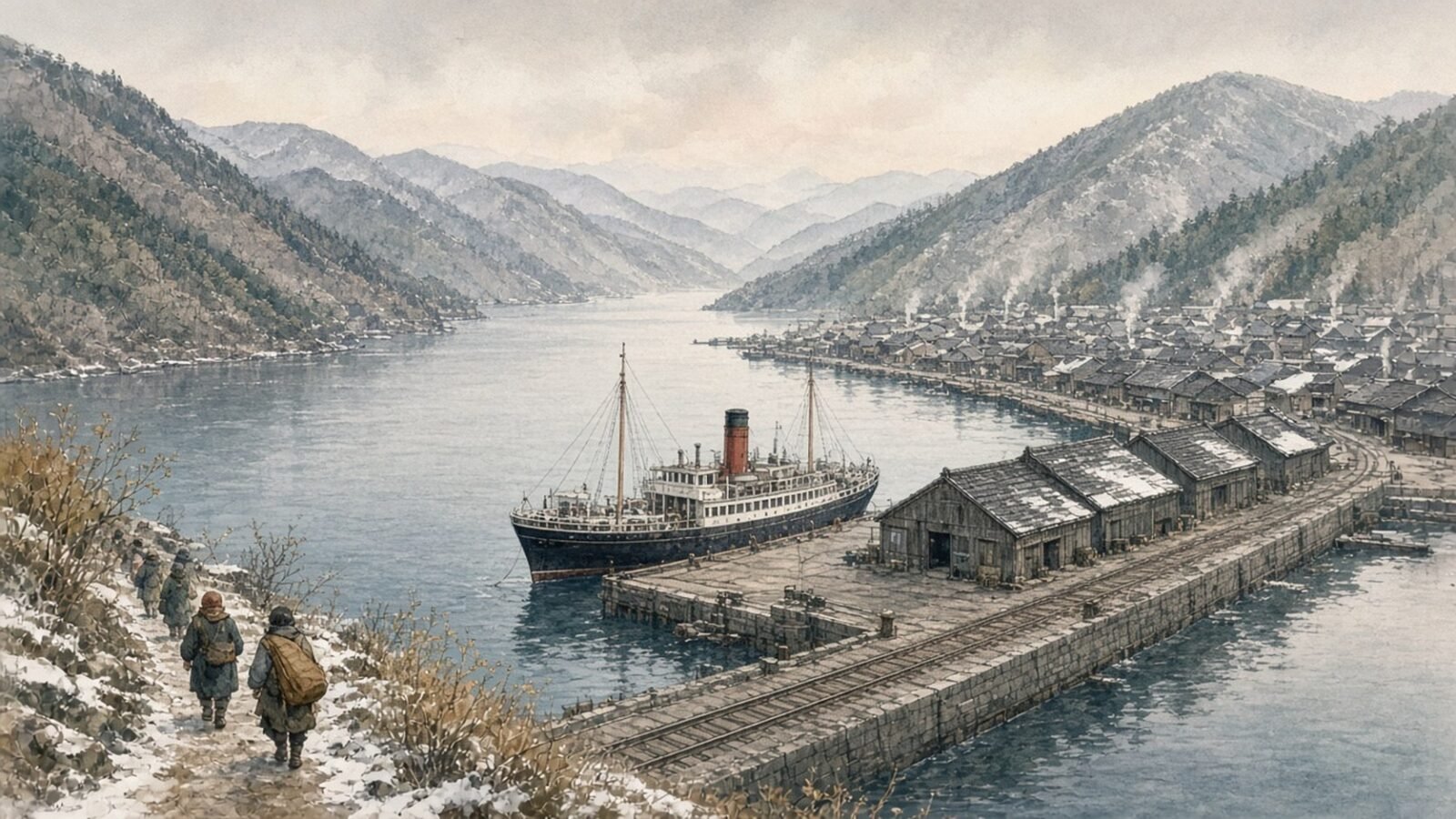
Tsuruga, on the coast of Fukui prefecture, was for most of the refugees the first place in months — for some, the first place in their lives — where strangers were simply kind to them. They arrived exhausted, often ill, dressed in winter clothes out of season, and the people of a small Japanese fishing and trading port met them on the docks. The town’s bathhouses opened to them. Shopkeepers refused payment. Local doctors treated them without charge. Decades later, survivors who had crossed the whole world still remembered Tsuruga with a particular disbelief: the baths, the rice balls handed up to them, the children who stared at them and then smiled. Tsuruga had been, for generations, Japan’s quiet window on the continent — the port where travelers boarded for Vladivostok — and in 1940 and 1941 it became, almost by accident, the first place where the hunted were welcomed. Today a small museum in the town keeps the suitcases and the stories, and Tsuruga remembers itself, accurately, as a port of humanity.
Kobe Opens Its Doors
From Tsuruga the refugees traveled by train, mostly to Kobe, and it was Kobe that became the great unexpected refuge of the story. The transit visas were good for fifteen days. Almost no one could leave in fifteen days — the destinations they were seeking, America, Palestine, Australia, had quotas, waiting lists, and consulates that moved slowly or not at all. And so the fifteen days became months, and the months became a community. Between the autumn of 1940 and the late summer of 1941, roughly four to five thousand Jewish refugees passed through Japan, and at any given moment nearly a thousand of them were living in Kobe.
What held them there was a tiny institution with an unforgettable name: Jewcom — the Jewish Community of Kobe. Kobe had had a small, mostly Russian and Middle Eastern Jewish population since the nineteenth century, a few dozen families of merchants. Its leaders — men like Anatole Ponevejsky, a Russian-born trader who became the refugees’ tireless advocate, and Moise Moiseeff — looked at the flood of the destitute arriving at the port and made a decision wildly out of proportion to their means. They rented buildings. They found houses and converted them into dormitories. They opened a communal kitchen that fed hundreds every day, set up a clinic, arranged schooling for children, negotiated endlessly with the prefectural police for extensions of stay, and raised money from the JDC in New York and from Jewish communities abroad. The refugees slept on tatami mats in crowded rooms and ate in shifts, and they were alive, and free, and — a thing many of them had not felt in a year — safe. The city of Kobe itself, its police, its shopkeepers, its ordinary citizens, behaved throughout with a decency that the refugees never forgot. No one in Kobe spat at them. No one broke their windows. Japan was allied to Germany; the Kobe newspapers carried the war news of the Axis; and in the streets of the city, black-hatted yeshiva students studied Talmud in the open air while the Rising Sun flew over the harbor.
Life Between Arrival and Departure
Daily life in Kobe settled, improbably, into something like a neighborhood. The refugees had arrived with nothing and were housed, at first, in dormitories of thirty and forty people to a room; but they were not prisoners, and Kobe was a port city with a century of practice at absorbing foreigners. The town’s small synagogue, Ohel Shelomo, the oldest Jewish house of worship in Japan, became the shared center of longtime residents and newcomers alike. In the spring of 1941 the community managed a Passover seder for hundreds, with matzo and supplies sent through by the JDC — refugees who had fled Poland eighteen months earlier reading the story of the exodus from Egypt in a rented hall in Hyogo prefecture. Children who had missed a year of school were taught in improvised classrooms; some refugee youngsters even attended Japanese schools and came home singing Japanese songs to bewildered parents. Yiddish, Polish, Russian, German, and Japanese mixed in the streets around the dormitories. The refugees sold what little they had left — a fur coat, a watch — to the pawnshops of Kobe, and the shopkeepers, survivors recalled, paid fairly. It was a thin life, rationed and anxious, stretched over an indefinite wait for visas that mostly never came. But it was lived in safety, in a city at peace, and the people who endured it spoke afterward of Kobe the way the earlier travelers spoke of Tsuruga: with a kind of wonder that such a place had existed at exactly the moment they needed it.
The Yeshiva That Crossed the World
Among the crowds in Kobe was one group whose survival is counted by historians as close to a miracle in the literal sense: the Mir Yeshiva. The yeshiva of Mir was one of the greatest academies of Jewish learning in Eastern Europe, and when the war came, its students and rabbis — some two hundred and fifty of them, with a handful from other yeshivas joining along the way — made a collective decision that no European institution of its kind survived making. They would not scatter. They would not stay. They would move the entire academy, its books where they could carry them, its discipline, its daily rhythm of study, to wherever in the world would have them, together.
They fled Vilna for Kaunas, queued with everyone else at the consulates, and obtained Sugihara and Zwartendijk papers like everyone else. Then they did something astonishing: they crossed the Soviet Union, the Sea of Japan, and later the East China Sea as an intact school, holding classes on trains and in dormitories, keeping the unbroken chain of a tradition of learning that reached back centuries. In Kobe they studied in borrowed rooms above the refugee kitchen, their chanting of the Talmud drifting out over a Japanese port city. Of all the great yeshivas of Lithuania and Poland — the intellectual heart of a civilization that was being systematically annihilated behind them — the Mir was the only one to survive the Holocaust whole. It survived because a Dutch consul bent a regulation, a Japanese consul defied his ministry, a Soviet railway sold them passage, and a Japanese city fed them. The Talmud itself, in a later edition printed for the students in Asia, would carry the name of the place that had sheltered it. It is still known among scholars as the Shanghai Talmud, and its survival meant that after the war the academy could be replanted — in Jerusalem and in Brooklyn, where it thrives today as one of the largest yeshivas in the world.
Japan’s Strange Refuge
None of this was supposed to happen, and it is worth pausing on why it did. Japan in 1940 was bound to Nazi Germany in the Tripartite Pact, and German officials repeatedly pressed Tokyo to act against the Jews in its territory. Japan did not. The reasons were a tangle of contradiction: a small group of Japanese officials who had absorbed a garbled admiration for Jewish financial power and hoped to enlist it; a more general bureaucratic indifference; genuine moments of humanity, of which Sugihara’s was only the most famous; and the simple fact that Japan had no native tradition of antisemitism and no intention of importing one. The result was a paradox that the refugees lived inside of: a militarized empire at war with half the world, allied to the regime that sought their extermination, which nonetheless let them live in its cities, study in its streets, and be treated by its doctors. The arrangement was always fragile, and everyone knew it. It ended in the late summer of 1941.
One More Sea to Cross
By then some of the refugees — a few hundred — had obtained real visas and departed for the United States, Canada, Australia, Palestine, and Latin America. But for the rest, there was nowhere left to go. In August 1941, with American-Japanese relations sliding toward war, the Japanese authorities ordered the remaining refugees out of Japan proper. The destination, for those without papers for anywhere else, was Shanghai — the one city on earth that still required no visa at all.
So in the autumn of 1941 the Kobe community emptied, ferry by ferry, across the East China Sea. Perhaps a thousand Sugihara refugees, the Mir Yeshiva among them, arrived in a city already holding close to twenty thousand Jewish refugees from Germany, Austria, and Poland. They were moved into Hongkew, the crowded district across the creek from the great Bund, into a world of heim shelters, communal kitchens, and cramped rooms that the earlier arrivals had already built. The Yiddish-speaking Lithuanians joined German-speaking Viennese doctors and Berlin musicians in one of the most improbable communities ever assembled: a sliver of European Jewry, transplanted entire to the banks of the Huangpu. They would endure there through the war — through the stateless-refugee ghetto the Japanese proclaimed in 1943, through hunger, disease, and the bombing raids of 1945 — and they would survive it almost to the last family. Behind them, the world they had fled was destroyed. In Shanghai, they studied, traded, married, had children, and waited. When the war ended, they scattered to the four corners — to New York and Melbourne, to Toronto and Tel Aviv — carrying the rest of their lives out of a visa office in Kaunas, a dormitory in Kobe, and a lane house in Hongkew.
What the Paper Carried
There is a temptation, in telling stories of rescue, to stop at the rescuer, because the rescuer is legible: one man, one decision, one act of conscience. Sugihara himself, who was dismissed from the foreign service on his return to Japan and spent decades in obscurity selling light bulbs, always resisted that framing. He said he had only done what a human being should do, and that the ones who deserved the attention were the people who had taken his pieces of paper and bet their lives on them. The record bears him out. The visas saved no one by themselves. What saved six thousand people was the whole improbable bridge: a Dutch engineer’s careful wording, a consul’s defiance, a committee’s remittances, a Soviet railway’s expensive indifference, the bathhouses of Tsuruga, the rented dormitories and crowded kitchen of Kobe, and the open harbor of Shanghai — each link held by a different stranger, most of whom never met, in four countries, on two continents, in the middle of a world at war.
The Sugihara survivors and their descendants are now estimated to number more than forty thousand people. Somewhere among them are the great-grandchildren of students who chanted Talmud over the Kobe harbor and of children who thought the Trans-Siberian was a grand adventure. Their existence is the epilogue the consul on the train never got to see. He handed papers down into the crowd until the platform ran out. The crowd carried them the rest of the way — across Siberia, across two seas, across the war — and turned them into lives.