Visas for Life
In the last days of August 1940, at the railway station of Kaunas, Lithuania, a crowd of Jewish refugees stood on the platform beside the departing train, and the Japanese consul, leaning from the window of his compartment, went on writing visas. He had been stamping for a month, sometimes eighteen hours a day, and now, with his consulate closed and his posting over and his family aboard, he kept at it, signing transit visas and handing them down to outstretched hands as the train prepared to leave, and when the train pulled out, by the testimony of those who were there, he threw the remaining signed blanks onto the platform behind him. The consul’s name was Chiune Sugihara. The visas he wrote in those weeks, more than two thousand of them, each carrying a family, carried some six thousand Jews out of the reach of the Holocaust, across Siberia, through Japan, and on, most of them, to Shanghai, where this site’s earlier essays have already told of the open port and the other disobedient consul waiting at the far end. The rescue of 1940 had two bookends, one Chinese and one Japanese. This is the story of the second.
The Russian specialist
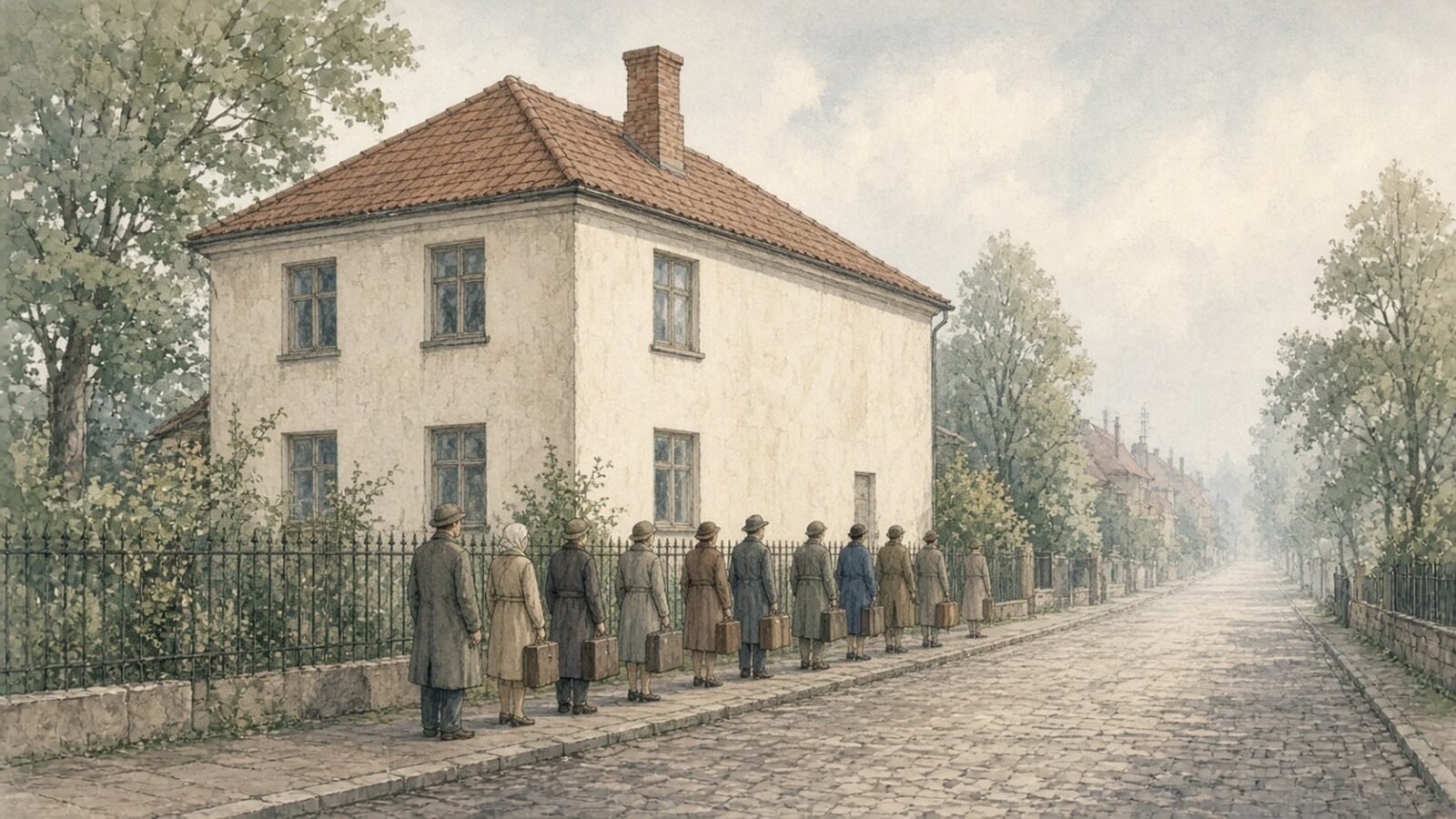
Chiune Sugihara was not cut from diplomatic cloth. He was born in 1900 in Yaotsu, a town in the hills of Gifu prefecture, the second son of a middle-class family, a gifted and wayward student whose father intended him for medicine and who instead talked his way into a foreign-ministry scholarship for language study. The ministry sent him to Harbin, in Manchuria, the Russian-built railway city that was then the most cosmopolitan place in East Asia, and Harbin made him: he mastered Russian, converted to Russian Orthodox Christianity, married a White Russian woman, Klaudia, and became the Japanese foreign service’s leading young specialist on the Soviet Union. He also saw, at close quarters, what the Japanese army was doing in Manchuria, the colony his government had seized in 1931, and by his own later account he resigned his post in 1934 in disgust at its treatment of the Chinese. The resignation was softened into a transfer; the ministry could not afford to lose its Russian experts, and Sugihara spent the late 1930s moving between posts, remarrying, to Yukiko, the partner of the years that mattered, and waiting for the assignment that used his talents. It came in October 1939, one month after the world went to war: a one-man consulate in Kaunas, the temporary capital of independent Lithuania, a small republic holding its breath between two dictators. His official duty was routine consular work. His real duty, as both sides understood, was to watch the German and Soviet armies massing on either side of a small country that was about to disappear. He set up the consulate in a rented house, hung out the plaque, hired local staff, and settled his family, Yukiko and the children, into an upstairs apartment, from whose windows, the following summer, they would watch the queue form and never quite disperse. The children of the consulate remembered the summer of the visas all their lives: the faces at the fence, their father writing at his desk until his hand gave out, their mother answering the gate. It was, in the household’s memory, the only posting in which the whole family was enlisted, and it lasted five weeks.
Lithuania in 1939-40 was a corridor of the doomed. The Soviet Union absorbed it in June 1940; foreign missions were ordered to close; and in the streets of Kaunas, all through that summer, gathered the people with the most to fear: Polish Jews, some fifteen thousand of them, who had fled the German invasion of Poland the previous autumn and now stood between Stalin and Hitler with nowhere to go. They needed transit visas, permission to cross the Soviet Union to some port, and onward visas to somewhere beyond. And that summer, in Kaunas, the paperwork of salvation was improvised by two consuls working in tandem, neither of them authorized to do it.
The refugees’ own organization made the rescue possible, and it had a leader whose presence at the fence is part of the record. Among the Polish Jews in Kaunas were the students and faculty of the Mir Yeshiva, and their representatives, the rabbinical student Zerah Warhaftig prominent among them, had spent the winter studying the world’s visa regulations the way their tradition studied texts, looking for the loophole. It was Warhaftig who approached the Dutch consulate about Curaçao, and it was the yeshiva’s delegation that pressed the question at Sugihara’s gate. The point matters for the telling: the rescue was not a gift descending on passive victims but a collaboration between the desperate and the disobedient, the refugees supplying the legal ingenuity and the persistence, the consuls supplying the stamps. Warhaftig survived, reached Jerusalem, and eventually became Israel’s minister of religious affairs; in his old age he would stand at ceremonies honouring the two consuls and explain, to anyone who would listen, that the righteous had been necessary but not sufficient, that the saved had also saved themselves.
The two consulates of Kaunas
The first half of the mechanism was Dutch. Jan Zwartendijk, a Philips engineer serving as the Netherlands’ acting consul, had found the loophole: the Dutch Caribbean colony of Curaçao required no entry visa, only the permission of the governor, a detail Zwartendijk simply omitted, writing into passports a destination annotation that read, in effect, no visa required for Curaçao. Nobody intended to go to Curaçao, and Zwartendijk knew it; the annotation existed to satisfy the onward-destination requirement of a transit visa. The second half was Japanese. In the last week of July 1940, a delegation of refugees came to Sugihara’s consulate to ask whether Japan would grant transit visas across its territory, from Vladivostok to a Japanese port, for holders of the Curaçao annotation. Sugihara cabled Tokyo for instructions. Tokyo refused. He cabled again, twice more, and was refused again, the cables surviving in the archives with the ministry’s reasoning laid out in plain officialese: the empire had no provision for such an influx, and the war made exceptions impossible. The foreign ministry had no wish to absorb thousands of Jewish refugees, least of all while bound to Germany by friendship, and its replies were unambiguous.
What happened next, Sugihara described only late in life, and with characteristic plainness. The people at his gate, he recalled, had nowhere else to go; they would be killed if they stayed; and as for the orders, he concluded that he might have to disobey his government, but if he did not act he would be disobeying God. He consulted his wife Yukiko, who had a small child in her arms and refugees at the fence, and she told him to do it. From the end of July to the end of August 1940 the consulate became a visa factory: Sugihara wrote the transit visas by hand, each one laboriously, the family details, the seal, the signature, hundreds a week, with Yukiko helping to register and manage the crowds, and the applicants queuing in the street from dawn. He negotiated with the Soviet authorities for an extension of his stay and used every day of it. When the consulate finally closed at the end of August he carried the work to the railway station, and then to the train, and then, in the image that has defined him ever since, to the window of the moving train, scattering the last signed blanks onto the platform. The total, as best the records can be reconstructed, is 2,139 visas, covering, with wives and children, roughly six thousand people.
Across the top of the world
The route the visas unlocked was one of the strangest journeys of the war: eleven days on the Trans-Siberian Railway from Moscow to Vladivostok, six thousand miles across the Soviet Union, the refugees travelling on Japanese paper through the country that had just swallowed their refuge, then by ferry across the Sea of Japan to the port of Tsuruga, and on to Kobe, where, through the winter of 1940-41, a small, astonished Jewish community, augmented by Jewish merchants of the port and funds from American Jewish relief organizations, housed and fed the influx. The crossing of the Soviet Union was itself an exercise in suspended disbelief. Stalin’s government, then bound to Hitler by the pact of 1939, sold the refugees transit with one hand while deporting their relatives to Siberia with the other; the refugees, for their part, crossed the endless birch forests in heated wagons, counting their remaining money and their remaining luck, reading the station names in an alphabet some of them knew from the old country, and arriving at Vladivostok half-incredulous that the longest single journey of their lives had been the one that a hostile empire had sold them a ticket for. Japan’s tolerance of the refugees on its own soil was provisional and puzzled, but it had a pedigree. Japanese policy toward Jews had contained, since the early twentieth century, a peculiar admiring strain: the Meiji leadership had been impressed by the help of the American Jewish banker Jacob Schiff in financing the war against Russia, and a school of thought in the Japanese establishment, the so-called Fugu Plan, named for the pufferfish, a delicacy that is deadly if mishandled, argued that Jewish capital and talent, settled in Manchuria, could serve Japanese power. It was a fantasy, and an ugly one in its assumptions, but its existence meant that Japan’s alliance with Germany was never extended into a program of murder. The refugees in Kobe were watched, restricted, and finally, as war with America approached in 1941, removed from Japan proper. They were sent, nearly all of them, to Shanghai.
The Kobe interlude deserves its own paragraph, because it was the gentlest chapter of the refugees’ war. Through the winter of 1940-41 the small port city became a sanctuary: the arrivals were housed in synagogue premises and hired lodgings, fed by a relief committee funded from America, and left, on the whole, unmolested by a police that watched them with bewilderment rather than hatred. The refugees, for their part, walked the streets of a country they had been taught to regard as an enemy of the West and found it clean, orderly and courteous; the culture shock ran both ways, and the memoirs are full of small astonishments, the bowing shopkeepers, the children staring at beards, the first taste of rice. The yeshiva students reconstituted their study hall within weeks, as they would again in Shanghai, rocking over the Talmud in a borrowed building while the world outside decided whether to let them exist. Japan never quite decided. It tolerated, frowned, shuffled the refugees from Kobe to Shanghai, and refused, throughout the war, to go further, a national shrug that saved thousands of lives and that historians are still explaining.
There the story joins the one this site has already told. The Sugihara refugees, among them the entire Mir Yeshiva, the great Lithuanian Talmudic academy, whose survival intact is unique in the history of the Holocaust, arrived in the open port through 1941, settled in Hongkew, endured the designated area, and survived the war almost to a man. The chain that saved them had four links, each improbable: a Dutch engineer’s fiction about Curaçao, a Japanese consul’s disobedience, the Soviet Union’s willingness to sell transit across itself, and a Chinese city with no visa office. Break any link and the six thousand are gone. The Mir Yeshiva alone, transplanted to Shanghai and later to Jerusalem and New York, became one of the great seedbeds of postwar Jewish scholarship; its students’ students today number in the tens of thousands, and every one of them descends from a queue at a consulate fence in Kaunas in the summer of 1940.
The obscurity of the righteous
Sugihara’s own afterlife was long, quiet and hard. He was serving in Romania when the war ended; the Soviet advance swept him up, and he spent eighteen months in Soviet internment before being repatriated to Japan in 1947, where the foreign ministry, drastically downsized in the defeat, let him go. He never blamed the visas publicly, and the ministry never admitted the connection, but his career was over at forty-seven. He sold light bulbs, worked in trade, spent years back in Moscow as a commercial representative, the Russian of Harbin come full circle, and raised his family in modest circumstances, without ever presenting himself as anything but a man who had done his duty. Israel found him in 1968, when a survivor who had become an Israeli diplomat tracked him down, and the slow machinery of recognition began: in 1985, Yad Vashem named him Righteous Among the Nations. He was too ill to travel; Yukiko went in his place. He died the following July, in 1986, at eighty-six, in his home town, and the story is told that his funeral, expected to be a small family affair, was met by delegations from Israel and from the survivors, arriving as if from the platform at Kaunas to answer for the lives he had signed into being. His home town of Yaotsu now keeps his memorial museum on a hill above the river; the Chiune Sugihara Memorial Hall receives the visitors who make the pilgrimage to the town where the consul was a boy. His widow’s memoir, Visas for Life, gave the story its title and its testament.
The recognition, once it began, never quite stopped. Japan, which had dismissed him without ceremony in 1947, spent the 1990s and 2000s reclaiming him with a thoroughness that suggests a country making a point to itself: the memorial museum in Yaotsu, the honours bestowed by the foreign ministry that had once refused his cables, the visits of Japanese prime ministers to his grave and his hill. Lithuania, remembering its lost Jewish world, raised its own memorials to the consulate on its old street. And in Israel and across the Jewish world the Sugihara survivors and their descendants, organized, correspondents, stubborn keepers of the ledger, built the legend by the simple method of testimony, each one repeating the same few facts: the fence, the queue, the hand writing day and night, the train, the bow. The numbers grew as the generations multiplied, until the six thousand of 1940 became, by the usual and defensible arithmetic, a community of descendants in the tens of thousands, a people-sized answer to a single summer’s disobedience.
The arithmetic of a stamp
There is a temptation, in telling the stories of Ho Feng-Shan and Chiune Sugihara together, to leave them as parallel tales of individual goodness, and they are that. But the pairing teaches something more exact about how rescue actually worked in the worst years of the century. Neither man commanded armies or diverted trains; neither could have saved anyone alone. Each stood at a narrow point in the machinery of exclusion, a window where a stamp turned a category, undesirable alien, into another category, documented traveller, and each chose to work the window at full capacity for as long as he could hold it. The visas were fictions, everyone understood this, the Curaçao annotation invented a destination, the Shanghai visa invented an entry requirement that did not exist, and that is the sharpest lesson of all: the bureaucracies of the 1930s had made paper the difference between life and death, and the rescuers were simply the officials who agreed to issue the paper. It is worth adding what both men paid, because the price was real if modest by the standards of the camps: Ho carried his black mark through a diminished career and died with the story untold; Sugihara lost his profession at forty-seven and sold light bulbs. Neither was imprisoned, neither was shot, and neither, to the end, suggested that the price was worth mentioning. The asymmetry is the instruction. What they risked was a career; what they saved was thousands of lives; and they regarded the exchange, both of them, as the natural thing to do. Between the two consulates, Vienna and Kaunas, and the open port at the end of both routes, something like twenty-five thousand people passed through the eye of the century’s needle. Their descendants are uncountable and everywhere. It is not too much to say that a village of survivors has become a city of the living.
On the platform at Kaunas the train pulled away, and the consul was seen, by those who stayed behind, to bow to them from the window, an apology, he later explained, for not having been able to do more. He had done, of course, the maximum the window allowed, which is the only definition of enough that history can honestly use. The queue, the stamp, the bow from the train: the rescue of 1940 was made of gestures that fit inside a passport. Its architects asked for nothing, and one of them, for nearly thirty years, got exactly that. The rest of us got the instruction, and it is worth stating plainly, because it is the whole point of the pairing of these essays: when the system says the door is closed, check whether the person at the window agrees.