The House of Wisdom in Baghdad and the Sages of the Middle East

In the summer of 762 the second Abbasid ruler, Abu Jafar al-Mansur, chose a site on the west bank of the Tigris, close to the point where that river runs nearest to the Euphrates, for a new capital. The place lay among villages and market gardens in the old agricultural heartland of Mesopotamia, a short distance north of the ruined Sasanian royal city of Ctesiphon. Within four years a round city had risen there, and within a generation Baghdad had become one of the largest cities in the world. In the course of the following two centuries it was also the setting for one of the most sustained efforts of intellectual recovery and invention in recorded history. Greek, Persian, Indian and Syriac learning was gathered, translated into Arabic, compared, corrected and extended. Physicians, astronomers, mathematicians, engineers and philosophers, many of them working with the support of the court and of wealthy patrons, produced a body of work that would shape science across Western Asia, North Africa and Europe for the next six hundred years.
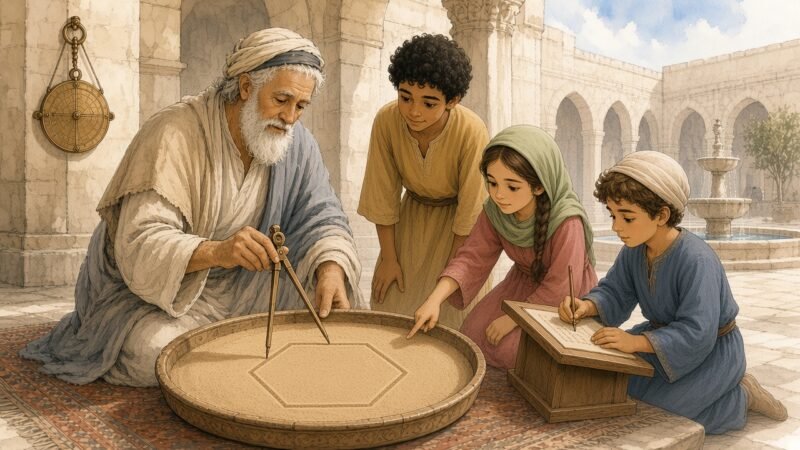
At the centre of the story stands an institution known as the Bayt al-Hikma, the House of Wisdom. Its exact form remains a matter of scholarly discussion. Some historians have pictured it as a great academy with lecture halls, an observatory and a staff of salaried translators; others, reading the surviving sources more cautiously, see it as a palace library and archive that grew out of Sasanian royal practice and served as a meeting point for scholars. What is not in doubt is that Baghdad in the late eighth and ninth centuries hosted an extraordinary concentration of learning, and that the House of Wisdom was one of its focal points. This article traces the founding of the city, the rulers who encouraged scholarship, the older traditions on which the translators drew, the movement that turned Arabic into a language of science, the principal figures of medicine, astronomy, mathematics, optics and philosophy across the Middle East, the observatories and hospitals in which their work was carried out, the destruction of Baghdad by the Mongols in 1258, and the routes by which this learning passed to Europe.
The Round City on the Tigris
The Abbasid family came to power in 750 after a revolution that began in Khurasan, the great eastern province of the former Persian empire, and overthrew the Umayyad dynasty of Damascus. The new rulers drew much of their military and administrative strength from the east, and they had little reason to remain in Syria, where Umayyad loyalties ran deep. For a decade they governed from a succession of temporary seats in Iraq, notably at al-Hashimiyya near Kufa. Al-Mansur, who succeeded his brother Abu al-Abbas in 754, wanted a capital that would be secure, well supplied and close to the canals and roads that connected the Gulf, the Iranian plateau, Syria and Egypt.
The site he chose had obvious advantages. Boats coming up the Tigris from Basra and the Gulf could unload there, and the Sarat canal and other channels joined the Tigris to the Euphrates, giving access to grain from the north and to the caravan routes that led towards Syria. The surrounding countryside, irrigated since antiquity, could feed a large population. According to later accounts the ruler consulted local landowners about the climate and the absence of mosquitoes before settling on the spot, and work began in 762 under the supervision of engineers, surveyors and astrologers. Two of the astrologers named in the sources, the Persian Nawbakht and the Jewish scholar known in Latin as Messahala, are said to have calculated a favourable moment for laying the foundations. Whatever the precise truth of the story, the presence of such men at the founding is a reminder that the court valued technical expertise from the beginning.
The official name of the new capital was Madinat al-Salam, the City of Peace. Its plan was circular, about two and a half kilometres across according to most estimates, enclosed by a moat and by double walls of sun-dried brick pierced by four gates named after the regions towards which they faced: the Khurasan gate to the north-east, the Basra and Kufa gates to the south, and the Syrian gate to the north-west. Inside the walls a ring of residential quarters for officials and soldiers surrounded a vast open central area containing the palace of the ruler, crowned by a green dome, and the main administrative buildings. The geometry of the plan has fascinated historians, and some have connected it with earlier round cities of the region, such as the Parthian and Sasanian foundations at Hatra, Darabgerd and Firuzabad. The design expressed an idea of a centre from which authority radiated evenly in every direction.
The round city itself soon proved too small. Markets were moved outside the walls to the suburb of al-Karkh in the south, and the heir to the throne, al-Mahdi, built a separate palace and garrison quarter at al-Rusafa on the eastern bank of the Tigris. Bridges of boats connected the two sides. Over the following decades new palaces, gardens, canals and markets spread along both banks, until the original round city was little more than one district in a great metropolis. By the early ninth century Baghdad may have held several hundred thousand inhabitants, drawn from Arabia, Iraq, Iran, Central Asia, Syria, Egypt and beyond, and speaking Arabic, Persian, Aramaic in its Syriac and other forms, Greek, Turkic languages and many others.
The wealth of the city rested on the revenues of an empire that stretched from North Africa to the borders of India and China, and on trade. Ships sailing from Basra reached the ports of India, Ceylon and southern China, while caravans connected Baghdad with Khurasan, Transoxiana and the routes beyond. Paper, silk, spices, porcelain, metalwork and books moved along these routes, and so did people and ideas. The Abbasid court, which adopted much of the ceremonial and administrative practice of the Sasanian kings, needed scribes, accountants, surveyors, physicians and astrologers, and it was willing to pay them well. In this setting, the demand for practical and theoretical knowledge grew rapidly.
Sasanian and Syriac Antecedents
The scholars of Baghdad did not begin from nothing. For centuries before the Abbasid revolution, the lands between the Mediterranean and the Iranian plateau had been home to communities that read, copied and taught Greek science and philosophy, and to a Persian royal culture that valued astronomy, medicine and statecraft.
The Sasanian kings, who ruled Iran and Mesopotamia from the third century until the Arab conquests of the 630s and 640s, had shown a strong interest in foreign learning. Sasanian tradition, as preserved in later Persian and Arabic writings, held that Shapur I in the third century had ordered Greek and Indian works on astronomy, medicine and philosophy to be collected and translated into Middle Persian. Under Khusraw I Anushirvan, who reigned from 531 to 579, this interest became a deliberate policy. Khusraw welcomed Greek philosophers who had left Athens after the closing of the Neoplatonic school there in 529, among them Damascius and Simplicius, and although they did not remain long, the episode was remembered as a sign of royal patronage. His physician Burzoy is said to have travelled to India and brought back the collection of fables later known in Arabic as Kalila wa-Dimna, together with other Indian books. Middle Persian versions of Ptolemy’s astronomy and of Indian astronomical tables circulated in the Sasanian realm, and the royal astronomical tables known as the Zij-i Shahriyar were compiled and revised under the later kings.
The most famous centre associated with this period is Gondishapur, properly Gundeshapur or Beth Lapat, a city in Khuzistan in south-western Iran founded or refounded by Shapur I and settled with captives taken from the Roman cities of Syria. Later Arabic writers described Gondishapur as the home of a great medical school and hospital where Greek, Syriac, Persian and Indian medicine were taught side by side, and they made it the direct ancestor of medicine in Baghdad. Modern historians have questioned some of these claims. There is little contemporary evidence for a formal academy on the scale later imagined, and the stories may in part reflect the pride of the physicians who later came from Gondishapur to Baghdad. Yet it is clear that the city had a significant community of Syriac-speaking physicians, and that it supplied the Abbasid court with its first great medical dynasty.
The Syriac-speaking communities were the second main channel. From the fourth century onwards, scholars writing in Syriac, a literary form of Aramaic, had translated Greek philosophical and scientific works for use in their schools. The school of Edessa, and after its closure in 489 the school of Nisibis on the Persian side of the frontier, taught Aristotle’s logic. Sergius of Reshaina, a physician who died in 536, translated a large part of the works of Galen and some philosophical texts into Syriac. In the seventh century the community of Qenneshre on the Euphrates became a centre of Greek studies, where Severus Sebokht wrote on the astrolabe and mentioned with admiration the Indian numerals and their nine signs. These communities, living under Sasanian and later Arab rule, preserved a working tradition of Greek learning in a Semitic language, and they produced the bilingual and trilingual scholars who would carry out much of the later translation into Arabic.
A third strand came from Harran in upper Mesopotamia, a city where an ancient tradition of star lore survived among people later known as the Sabians. The scholars of Harran cultivated astronomy, astrology and mathematics in the Greek tradition, and they too would send notable figures to Baghdad. To these must be added the learned traditions of India, transmitted through Persian intermediaries and through direct contact by sea and land, and the scholarship of Alexandria, which continued in reduced form after the Arab conquest of Egypt in 641.
Paper from Samarkand
A material change made the scale of the Baghdad enterprise possible. Before the eighth century the main writing materials of the region were papyrus, made in Egypt, and parchment, made from animal skin. Papyrus was relatively cheap but fragile and dependent on Egyptian supply; parchment was durable but expensive. Paper, invented in China and in use there for centuries, offered a writing surface that was light, cheap and could be made from rags and plant fibres almost anywhere water was available.
According to a widely repeated account, knowledge of papermaking reached the Middle East after the battle of the Talas River in 751, when Abbasid forces defeated a Tang Chinese army in Central Asia and took prisoners, some of whom were skilled papermakers who were brought to Samarkand. Modern scholars treat this story with caution, since paper was probably already known in Central Asia before that date, but Samarkand certainly became famous for its paper. By the end of the eighth century paper was being made in Baghdad itself, and tradition credits the Barmakid family of ministers with encouraging its use in government offices. The first paper mill in Baghdad is often dated to around 794 or 795.
The effects were profound. The chancery adopted paper for its records, and booksellers and copyists followed. A street of stationers and booksellers grew up in Baghdad, where scribes copied books to order and scholars met to buy, sell and discuss them. A professional copyist could produce a substantial treatise in a matter of days, and wealthy collectors assembled libraries of thousands of volumes. Without cheap paper the translation movement and the scientific literature that followed it would have been far smaller and far more vulnerable to loss.
## Harun al-Rashid and the Barmakids
The early Abbasid rulers took a close personal interest in learning. Al-Mansur himself is reported to have commissioned translations of works on astronomy and logic, and in about 771 or 773 an embassy from India brought to Baghdad a scholar who was learned in the astronomy of the Sindhind, an Arabic name derived from the Sanskrit siddhanta. Under the ruler’s instructions the astronomer Muhammad ibn Ibrahim al-Fazari and his colleagues prepared an Arabic version of an Indian astronomical work, probably based on the Brahmasphutasiddhanta of Brahmagupta. The resulting tables, known as the Zij al-Sindhind, became the starting point of Arabic mathematical astronomy. Al-Mansur also suffered from a stomach complaint that the court physicians could not cure, and in 765 he summoned from Gondishapur the head of its hospital, Jurjis ibn Jibril ibn Bakhtishu, beginning a connection between that family and the court that would last for more than two hundred years.
The reign of Harun al-Rashid, from 786 to 809, has long been remembered as a golden age, partly because of its later portrayal in the stories of the Thousand and One Nights. Its actual achievements were real enough. The empire was at the height of its wealth, and the court in Baghdad attracted poets, musicians, jurists, physicians and scholars from every province. Much of the administration was in the hands of the Barmakids, a family originally from Balkh in present-day Afghanistan, whose ancestors had been hereditary administrators of the great Nawbahar foundation there. Khalid ibn Barmak had served al-Mansur, and his son Yahya and grandsons al-Fadl and Jafar effectively ran the state for much of Harun’s reign until their sudden fall in 803.
The Barmakids were among the most important patrons of foreign learning. They are credited with encouraging the translation of Indian medical and astronomical works, sending scholars to India to collect books and drugs, and bringing Indian physicians to Baghdad. One such physician, known in Arabic as Manka, is said to have cured Harun of a serious illness and then translated works on medicine and poisons from Sanskrit. Yahya ibn Khalid is reported to have commissioned a new translation of Ptolemy’s great astronomical treatise, the Almagest, after earlier versions proved unsatisfactory. The family’s support for papermaking and for the chancery further strengthened the material base of scholarship.
It is in connection with Harun that the sources first speak of a khizanat al-hikma, a treasury or storehouse of wisdom, a royal library whose keepers were responsible for copying and preserving books. This library probably continued the Sasanian royal practice of keeping archives and literary works in the palace, and it may have been here that the Persian histories and books of statecraft translated by scholars such as Ibn al-Muqaffa, who died around 757, were kept. Harun is also reported to have brought back Greek manuscripts from campaigns in Byzantine Anatolia, particularly after the capture of Amorium and Ankara, though the most famous accounts of book-gathering in Byzantine lands belong to the reign of his son.
Al-Ma’mun and the House of Wisdom
Harun divided the succession between his sons al-Amin and al-Ma’mun, and the arrangement collapsed into civil war after his death. Al-Amin held Baghdad; al-Ma’mun governed from Merv in Khurasan, with strong support from Persian officials and soldiers. In 813 al-Ma’mun’s forces took Baghdad after a long siege that caused great destruction, and al-Amin was killed. Al-Ma’mun remained in Merv for several more years and returned to Baghdad only in 819.
Al-Ma’mun, who ruled until his death in 833, is the figure most closely associated with the House of Wisdom. He was himself well educated in jurisprudence, literature and rational debate, and his interest in philosophy and science was unusually intense. He enjoyed disputations between learned men of different traditions and took part in them himself. A later story, preserved by the bibliographer Ibn al-Nadim, relates that Aristotle appeared to al-Ma’mun in a dream, and that this experience prompted him to send to the Byzantine emperor asking for permission to collect Greek books. Whatever the truth of the tale, the sources agree that al-Ma’mun sent missions to Constantinople and other Byzantine centres to acquire manuscripts, and that the scholars he employed included men who travelled widely in search of good copies.
Under al-Ma’mun the palace library developed into the institution that later writers called the Bayt al-Hikma. Its directors in this period included Sahl ibn Harun, a Persian man of letters known for his writings in praise of Persian culture, and Salm, whose name appears in connection with the translation of Persian works. The mathematician al-Khwarizmi is described as working in the library, as are the Banu Musa brothers and a number of astronomers. Translators were paid for their work, and the ruler is said in one later account to have rewarded Hunayn ibn Ishaq with the weight in gold of the books he translated, a story that, although probably exaggerated, reflects the prestige the work had acquired.
The precise function of the House of Wisdom has been the subject of careful scholarship in recent decades. The traditional picture of a large research institute, with a staff of translators organised in departments, a teaching programme and an attached observatory, owes much to modern imagination. The surviving Arabic sources are brief and scattered, and they use the term chiefly for a library and archive attached to the palace. Many of the most important translations were commissioned not by the ruler but by private patrons, among them the Banu Musa, court physicians, officials and members of the wealthy families of Baghdad. The translation movement was thus a broad social phenomenon, extending well beyond a single building. Yet the House of Wisdom served as a symbol and a meeting place, and the patronage of al-Ma’mun gave the whole enterprise a prominence it would not otherwise have had.
Al-Ma’mun’s interest in astronomy led to two of the best-known scientific projects of his reign. He ordered the construction of observatories at al-Shammasiyya near Baghdad and on Mount Qasiyun near Damascus, where teams of astronomers carried out systematic observations of the Sun, the Moon and the planets in order to test and correct the values given in Ptolemy’s Almagest. The resulting tables, known as al-Zij al-Mumtahan, the verified tables, were among the first in which ancient parameters were systematically revised by new observation. He also commissioned a measurement of the circumference of the Earth. Two teams of surveyors were sent into the plain of Sinjar in northern Mesopotamia; starting from a fixed point, one group walked north and the other south, measuring their progress with ropes and pegs until the altitude of the celestial pole had changed by one degree. The length of a degree of latitude was found to be about fifty-six and two-thirds Arabic miles, a value which, depending on the exact length of the mile used, gives a circumference of the Earth remarkably close to the modern figure.
The Translation Movement
Between the middle of the eighth century and the end of the tenth, almost all the secular Greek scientific and philosophical works then available in the eastern Mediterranean, other than literature, history and drama, were translated into Arabic. The scale of the achievement is difficult to overstate. It included the logical, physical, biological and metaphysical works of Aristotle, with many of the ancient commentaries upon them; much of Plato in summary form; the medical corpus of Hippocrates and the vast output of Galen; the mathematics of Euclid, Archimedes, Apollonius, Nicomachus, Menelaus and Diophantus; the astronomy and geography of Ptolemy; the pharmacology of Dioscorides; and works on mechanics, music, optics and agriculture. Alongside the Greek material came Persian works of history, ethics and statecraft, and Indian works of astronomy, arithmetic and medicine.
The motives behind the movement were varied. The Abbasid state needed astronomy for the calendar, for timekeeping and for astrology, which was taken very seriously by rulers who wished to choose favourable moments for their actions. It needed mathematics for surveying, taxation, inheritance calculations, accounting and engineering, and it needed medicine for the health of the court and the population. Philosophy and logic were valued as tools of argument in the vigorous intellectual debates of the period. Historians such as Dimitri Gutas have also stressed the political dimension. By presenting themselves as heirs to the Persian kings, who had in turn been portrayed as the guardians of a universal learning scattered by Alexander’s conquests, the early Abbasids could claim a cultural legitimacy that appealed strongly to their Persian supporters. The recovery of ancient science became part of the ideology of the dynasty.
The methods of translation changed over time. Early versions, made in the eighth century, were often literal, following the Greek word by word, and they sometimes left technical terms untranslated. Later translators worked to establish a consistent Arabic scientific vocabulary, building new terms from Arabic roots or adapting Greek and Persian words, and they paid increasing attention to the meaning of the whole sentence rather than to individual words. In many cases a Greek work was first translated into Syriac and then from Syriac into Arabic, and the same text might be translated several times as better manuscripts and better understanding became available. By the tenth century Arabic had become a language capable of expressing the most refined distinctions of logic, medicine and mathematics.
## Hunayn ibn Ishaq and His Circle
The greatest of the translators was Hunayn ibn Ishaq, known in Latin as Johannitius. He was born in 808 or 809 in al-Hira, an old Arab city near Kufa, to a Syriac-speaking family; his father was a pharmacist. As a young man he went to Baghdad to study medicine under the court physician Yuhanna ibn Masawayh, but according to a well-known story he asked so many questions that his teacher lost patience and dismissed him, saying that the people of al-Hira had no business studying medicine and should stick to money-changing. Hunayn left Baghdad and spent several years, probably in the Byzantine lands or in Alexandria, perfecting his Greek. When he returned he was able to recite Homer, and his mastery of the language so impressed the physician Jibril ibn Bakhtishu that he took the young man into his patronage. Hunayn was later reconciled with Ibn Masawayh and worked with him.
Hunayn’s working method set new standards. He collected several manuscripts of each work before translating it, compared them to establish the best text, and then rendered the meaning rather than the mere words. In a remarkable letter, known as the Risala, he listed about 129 works of Galen that he and his associates had translated into Syriac or Arabic, giving for each the patron for whom the translation was made and the manuscripts on which it was based. He describes searching for a copy of Galen’s On Demonstration through Mesopotamia, Syria, Palestine and Egypt, and finding only about half of it in Damascus. The letter is one of the most valuable documents in the history of scholarship, and it shows how much of the work was done for private patrons, including members of the Bakhtishu family, the Banu Musa brothers and court officials.
Hunayn worked with a team that included his son Ishaq ibn Hunayn, who specialised in philosophical and mathematical works and produced the standard Arabic versions of several treatises of Aristotle and of Euclid and Ptolemy, and his nephew Hubaysh ibn al-Hasan, who translated many medical works. Typically Hunayn would prepare a Syriac version and Hubaysh or another assistant would then make an Arabic version from it, which Hunayn would check. Ishaq tended to work directly into Arabic. Hunayn also wrote original works, including a celebrated treatise on the eye, the Ten Treatises on the Eye, which became the foundation of Arabic ophthalmology, and an introduction to medicine that circulated widely in Latin as the Isagoge Johannitii. He served as physician to several rulers, and despite a period of disgrace and imprisonment in the reign of al-Mutawakkil, he died in 873 a respected and wealthy man.
The Bakhtishu Physicians
The Bakhtishu family formed the most enduring medical dynasty of the Abbasid court. Jurjis ibn Jibril, summoned from Gondishapur in 765 to treat al-Mansur, was succeeded by his son Bakhtishu ibn Jurjis, who served Harun al-Rashid, and by his grandson Jibril ibn Bakhtishu, who became Harun’s personal physician after curing a favourite slave girl of a paralysis. Jibril amassed an immense fortune, and he was a generous patron of translators, including the young Hunayn. Members of the family served the court for some eight generations, until the eleventh century.
The physicians of the family represented the medical tradition of Gondishapur, with its roots in Greek medicine studied in Syriac. Their prominence at court helped to establish Galenic medicine as the dominant system in the Abbasid state and to set standards for the training and conduct of physicians. They were also involved in the founding of hospitals. Jibril ibn Bakhtishu is associated with the early bimaristan, or hospital, established in Baghdad during Harun’s reign, modelled on the hospital at Gondishapur. The family’s position was not always secure; members were imprisoned or dismissed at various times, and their wealth was sometimes confiscated. But their long service gave continuity to medical practice at the centre of the state.
Another physician of the same background, Yuhanna ibn Masawayh, known in Latin as Mesue, served several rulers from Harun to al-Mutawakkil and wrote on fevers, diet, ophthalmology and the preparation of drugs. He is said to have dissected apes supplied by the ruler in order to study anatomy. His teaching sessions in Baghdad were famous for their wit and attracted students and listeners of every kind.
Thabit ibn Qurra and the Scholars of Harran
The city of Harran produced one of the most versatile scholars of the ninth century, Thabit ibn Qurra. Born around 826 or 836, he was a money-changer in his native city when the mathematician Muhammad ibn Musa, one of the Banu Musa brothers, met him on a journey and was so impressed by his knowledge of languages that he brought him to Baghdad. There Thabit studied mathematics and astronomy under the brothers’ supervision and became one of the leading translators and original scientists of the age.
Thabit translated or revised translations of Euclid’s Elements, Archimedes, Apollonius’s Conics, Ptolemy’s Almagest and the arithmetic of Nicomachus. His original work was even more significant. He discovered a rule for generating pairs of amicable numbers, numbers each equal to the sum of the proper divisors of the other, such as 220 and 284. He wrote on the theory of parallel lines, attempting to prove Euclid’s fifth postulate; on the quadrature of the parabola and the measurement of solids of revolution, extending the methods of Archimedes; on the balance and the theory of the lever, in a treatise later known in Latin as the Liber karastonis; and on sundials. In astronomy he wrote on the motion of the Sun and on the apparent variation in the rate of precession, a subject on which his views, transmitted to Europe as the theory of trepidation, were long influential. He served as an astronomer at the court of al-Mu’tadid and died in Baghdad in 901.
Thabit founded a scholarly family. His son Sinan ibn Thabit was a physician who directed hospitals in Baghdad and is remembered for organising an examination of physicians in 931, and his grandson Ibrahim ibn Sinan made notable contributions to the geometry of conic sections and of sundials before dying young in 946. Another scholar from Harran, al-Battani, would become one of the greatest astronomers of the period.
Jewish Scholars and Other Communities
Jewish scholars took part in the scientific culture of Baghdad from its foundation. Messahala, as he is known in Latin, a Jewish astrologer from Basra, was among those who calculated the foundation horoscope of the city in 762, and his works on astrology and the astrolabe were later translated into Latin and widely read in Europe. Sahl ibn Bishr, another Jewish astrologer and mathematician from Khurasan, served as an adviser to officials in the early ninth century. The physician Masarjawayh of Basra, a Jewish physician of the Umayyad or early Abbasid period, is credited with translating a medical compendium from Syriac into Arabic, one of the earliest scientific translations in the language.
Later, Jewish scholars in Baghdad, Kairouan, Cordoba and Cairo wrote in Arabic on medicine, astronomy, mathematics and philosophy, and they played a central part in the later transmission of this learning to Europe. The Baghdad tradition also included Persian-speaking scholars, the scholars of Harran, and Arabic-speaking scholars from every part of the empire. The scientific literature of the period was thus the product of a multilingual society, united by the use of Arabic as the common language of learning.
Al-Khwarizmi and the Science of Algebra
Muhammad ibn Musa al-Khwarizmi, whose name indicates a family origin in Khwarazm, the region of the lower Amu Darya south of the Aral Sea, worked in Baghdad during the reign of al-Ma’mun and is often described as a member of the House of Wisdom. Little is known of his life; he was probably born around 780 and died around 850. His writings, however, made him one of the most influential mathematicians in history.
His treatise on calculation by completion and balancing, al-Kitab al-mukhtasar fi hisab al-jabr wa-l-muqabala, written around 820 and dedicated to al-Ma’mun, gave the subject of algebra its name. In it al-Khwarizmi set out systematic methods for solving linear and quadratic equations, classified into six standard types, and justified the rules by geometric demonstrations using squares and rectangles. Al-jabr, restoration, referred to the operation of moving a subtracted quantity to the other side of an equation, and al-muqabala, balancing, to the cancellation of like terms on both sides. The work was intended to be practical, and much of it deals with problems of commerce, surveying, inheritance and legacies. Its significance lay in treating the solution of equations as a discipline in its own right, with general methods applicable to whole classes of problems.
A second treatise, on calculation with the Indian numerals, survives only in Latin translation, where it begins with the words Dixit Algorizmi, thus spoke al-Khwarizmi. It explained the decimal place-value system, with nine figures and a sign for zero, and the methods of addition, subtraction, multiplication, division and the extraction of roots. Through this work and its successors the numerals now used throughout the world reached Europe, and the latinised form of his name gave rise to the word algorithm. Al-Khwarizmi also compiled a set of astronomical tables based on the Sindhind, which were later revised in al-Andalus and translated into Latin by Adelard of Bath, and a geographical work, Kitab surat al-ard, the Image of the Earth, which revised the coordinates of Ptolemy’s Geography and listed the latitudes and longitudes of more than two thousand places.
The Banu Musa Brothers
The three sons of Musa ibn Shakir, a former highwayman who became an astronomer and companion of al-Ma’mun, were brought up at the court after their father’s death and educated in the House of Wisdom. Muhammad, Ahmad and al-Hasan, known collectively as the Banu Musa, became wealthy and powerful men, active in court politics as well as in science, and among the most important patrons of translation. They sent agents to Byzantine lands to buy manuscripts and paid translators, including Hunayn and Thabit, generous salaries.
Their own contributions covered mathematics, astronomy and mechanics. Their treatise on the measurement of plane and spherical figures dealt with the area of the circle, the volume of the sphere and the trisection of the angle, building on Archimedes. Muhammad wrote on astronomy and on the motion of the celestial spheres, and al-Hasan was a gifted geometer who worked on the ellipse. Ahmad is credited with the best known of their works, the Kitab al-hiyal, the Book of Ingenious Devices, which describes about a hundred mechanisms, many of them trick vessels that pour liquids in sequence, fountains that change shape, automatic lamps and self-regulating devices using floats, valves and siphons. Several of the devices employ conical valves and feedback mechanisms of a sophistication not found in the Greek sources on which the brothers partly drew. They also built a large astronomical instrument in Baghdad and carried out observations, and they took part in engineering projects, including the planning of canals.
## Al-Kindi, the Philosopher of the Arabs
Abu Yusuf Yaqub ibn Ishaq al-Kindi, born around 801 in Kufa or Basra to a noble Arab family of the tribe of Kinda, was the first major philosopher to write in Arabic, and later generations called him the philosopher of the Arabs. His father had been governor of Kufa. Al-Kindi was educated in Basra and Baghdad and worked at the courts of al-Ma’mun, al-Mu’tasim and al-Wathiq, serving as tutor to the son of al-Mu’tasim. He did not translate from Greek himself but supervised a circle of translators who produced Arabic versions of key philosophical texts, including parts of Aristotle’s Metaphysics and an Arabic paraphrase of the writings of Plotinus that circulated under Aristotle’s name.
Al-Kindi’s output was enormous. The bibliographer Ibn al-Nadim lists more than 260 titles, covering philosophy, logic, arithmetic, geometry, astronomy, music, medicine, optics, meteorology, psychology and the manufacture of swords, perfumes and glass. In his treatise On First Philosophy he argued that the pursuit of truth from whatever source was a worthy enterprise, and that the learning of the ancients should be welcomed and completed. In optics he criticised the Euclidean theory of visual rays and developed a geometrical account of how rays travel in straight lines in all directions, an approach that influenced later work in the field. He wrote on the use of the Indian numerals, on the theory of music and its mathematical ratios, and on the pharmacology of compound drugs, where he tried to quantify the strength of mixtures mathematically.
One of his most remarkable works dealt with the decipherment of encrypted messages. In it al-Kindi described the method of frequency analysis, counting how often each letter appears in a long text and comparing these frequencies with those of a ciphertext in order to identify the substitutions. This is the earliest known description of the technique, which remained the foundation of cryptanalysis for many centuries. Al-Kindi fell from favour under al-Mutawakkil, when rivals at court, reportedly including the Banu Musa, arranged for his library to be confiscated, though it was later returned. He died in Baghdad around 873.
Al-Razi, Physician of Rayy
Abu Bakr Muhammad ibn Zakariya al-Razi, known in Latin as Rhazes, was born around 854 in Rayy, near present-day Tehran. He is said to have been a musician and perhaps a money-changer or alchemist before turning to medicine relatively late in life. He studied in Baghdad and later directed hospitals both in Rayy and in Baghdad. A well-known anecdote relates that when he was asked to choose a site for a new hospital in Baghdad, he hung pieces of fresh meat in different quarters of the city and selected the place where the meat decayed most slowly.
Al-Razi was the greatest clinical physician of his age. His approach was grounded in careful observation of patients, and he recorded case histories in detail, noting the course of a disease, the treatment given and the result. His treatise on smallpox and measles was the first work to distinguish clearly between the two diseases, describing their symptoms, course and treatment with great precision. It was translated into Latin and later into many European languages, and it was still being printed in the nineteenth century. His vast medical notebook, al-Hawi, the Comprehensive Book, assembled by his students after his death from his notes and reading, collected the opinions of Greek, Indian, Persian and Arabic authorities on every disease together with his own observations. Translated into Latin as the Continens in 1279 at the court of Charles of Anjou, it was one of the largest medical works printed in the early years of the press.
Al-Razi also wrote a shorter medical handbook dedicated to the governor of Rayy, al-Mansur ibn Ishaq, known in Latin as the Liber ad Almansorem, which was widely used in European universities. He was a pioneer in the use of controlled comparison, describing in one case how he treated one group of patients with bloodletting and left another untreated in order to judge the effect. In chemistry he classified substances into minerals, plants and animal products and described laboratory apparatus and procedures such as distillation, calcination and crystallisation, turning alchemy towards practical chemistry. He was also an independent philosopher who wrote a treatise entitled Doubts about Galen, in which he respectfully but firmly criticised the great Greek physician where his own observations disagreed. He died in Rayy around 925 or 935, by some accounts blind in his last years.
Al-Farabi, the Second Teacher
Abu Nasr al-Farabi, born around 870 near Farab on the Syr Darya in Central Asia, probably of Turkic or Persian origin, came to Baghdad as a young man and studied logic with Abu Bishr Matta ibn Yunus, a Syriac-speaking scholar who translated Aristotle into Arabic, and with Yuhanna ibn Haylan. He lived most of his life in Baghdad, moving in his last years to Aleppo and the court of the Hamdanid ruler Sayf al-Dawla, and he died in Damascus in 950 or 951.
Al-Farabi was known in later tradition as the second teacher, after Aristotle, the first. His commentaries on Aristotle’s logic established the subject as the foundation of all scientific reasoning in the Arabic tradition, and his Enumeration of the Sciences provided a systematic classification of knowledge into linguistics, logic, mathematics, physics, metaphysics, politics and law, which was translated into Latin and influenced the organisation of learning in medieval Europe. In political philosophy his treatise on the opinions of the inhabitants of the virtuous city drew on Plato’s Republic to describe an ideal state governed by a philosopher-ruler and to analyse the forms of imperfect states. He was also a distinguished theorist of music. His Great Book of Music presented a detailed account of the mathematical basis of intervals, scales and rhythms, combined with practical knowledge of the instruments of his day, and remains one of the most important sources for the history of music in the Middle East.
Ibn Sina and the Canon of Medicine
Abu Ali al-Husayn ibn Sina, known in Latin as Avicenna, was born in 980 at Afshana near Bukhara, the capital of the Samanid state in Central Asia. His father was an official in the Samanid administration. Ibn Sina was a prodigy; by his own account he had mastered logic, mathematics and natural science by the age of sixteen and turned to medicine, which he found an easy subject, treating patients and learning from experience. He read Aristotle’s Metaphysics forty times without understanding it, until a chance purchase of al-Farabi’s commentary in the book market of Bukhara made its meaning clear. When he cured the Samanid ruler Nuh ibn Mansur of a serious illness he was given access to the royal library, which he described as containing rooms of books on every subject, many of which he had never seen before.
The collapse of the Samanid state at the end of the tenth century forced Ibn Sina into a wandering life. He served a succession of rulers in Khwarazm, Gurgan, Rayy, Hamadan and Isfahan as physician, administrator and at times minister, sometimes in prison or in hiding, and he wrote much of his work on horseback during campaigns or by night after a day’s official business. He died in Hamadan in 1037.
His Canon of Medicine, al-Qanun fi al-tibb, is one of the most famous books in the history of medicine. Organised in five books, it covered general principles of physiology and pathology, simple drugs, diseases of each part of the body from head to foot, conditions affecting the whole body such as fevers and wounds, and compound drugs. The Canon combined the medicine of Galen and the natural philosophy of Aristotle into a single, clearly ordered system, enriched by Ibn Sina’s own observations and by the clinical experience of earlier physicians such as al-Razi. It described the contagious nature of some diseases, the spread of disease through water and soil, the use of quarantine, and rules for testing new drugs, among them the requirement that a drug be tested on a simple uncomplicated disease, that its effects be observed over time, and that the results be reproducible. Translated into Latin by Gerard of Cremona in the twelfth century, the Canon was used as a textbook in European universities until the seventeenth century.
Ibn Sina’s philosophical encyclopaedia, al-Shifa, the Healing, covered logic, natural philosophy, mathematics and metaphysics, and its sections on the soul, on minerals and on motion were widely read in Latin. His argument that a man suspended in the air, deprived of all sensation, would still be aware of his own existence, known as the floating man, anticipated later discussions of self-awareness. In physics he developed a theory of impetus to explain the motion of projectiles, and in geology he described the formation of mountains by erosion and the uplift of land.
Al-Battani and the Refinement of Astronomy
Muhammad ibn Jabir al-Battani, born before 858 in or near Harran, carried out astronomical observations at al-Raqqa on the Euphrates over a period of some forty years, from 877 to about 918. His principal work, the Kitab al-Zij, a set of astronomical tables with explanatory chapters, was based on his own observations and corrected many of Ptolemy’s values. He determined the length of the solar year as 365 days, 5 hours, 46 minutes and 24 seconds, close to the modern value, and he found that the solar apogee, the point at which the Sun is farthest from the Earth, had moved since Ptolemy’s time, a discovery that implied a slow motion of the solar orbit.
Al-Battani also made important contributions to trigonometry. He replaced the Greek use of chords with sines, introduced the use of cotangents in the calculation of the lengths of shadows, and established a number of relationships between trigonometric functions. Translated into Latin by Plato of Tivoli in the twelfth century under the title De motu stellarum, his work was cited by Copernicus, Tycho Brahe, Kepler and Galileo. A crater on the Moon bears his Latin name, Albategnius.
Al-Biruni and the Measurement of the World
Abu al-Rayhan Muhammad ibn Ahmad al-Biruni was born in 973 in Kath, the capital of Khwarazm, and spent his early life there, studying with the mathematician Abu Nasr Mansur. Political upheaval drove him to Rayy and Gurgan, and in 1017 he was taken by the conqueror Mahmud of Ghazna to Ghazna in present-day Afghanistan, where he spent the rest of his long life. He accompanied Mahmud’s campaigns into north-western India and used the opportunity to learn Sanskrit and to study Indian science and society in great depth. He died in Ghazna around 1050.
Al-Biruni wrote about 146 works, of which around a fifth survive. His Chronology of Ancient Nations compared the calendars of Persians, Greeks, Jews, Syriac-speaking communities, Sogdians, Khwarazmians and others. His book on India, completed in 1030, is a remarkable study of Indian philosophy, astronomy, geography, customs and literature, written with careful attention to sources and an effort to present Indian ideas in their own terms. His great astronomical work, the Mas’udi Canon, dedicated to Mahmud’s son Mas’ud, discussed the possibility that the Earth rotates on its axis, treating it as a question that could not be decided by the observations then available.
He devised an ingenious method for measuring the radius of the Earth. Standing on a mountain of known height near Nandana in the Punjab, he measured the angle of depression of the horizon and, using trigonometry, calculated the Earth’s radius at about 6,339 kilometres, within a few per cent of the modern value. He also determined the specific gravities of eighteen precious stones and metals with a precision that remained unsurpassed for centuries, and he wrote on mineralogy, pharmacology, geodesy and the construction of instruments. His treatise on the determination of the coordinates of cities, the Tahdid, laid the foundation for mathematical geography.
## Ibn al-Haytham and the Science of Optics
Abu Ali al-Hasan ibn al-Haytham, known in Latin as Alhazen, was born in Basra around 965. According to his biographers he served as an official in Basra before moving to Cairo, where the Fatimid ruler al-Hakim had invited him to propose a scheme for regulating the floods of the Nile. Having travelled up the river to Aswan and recognised that the project was beyond the means of the time, he is said to have feigned madness to escape the ruler’s displeasure, and to have been confined to his house until al-Hakim’s death in 1021. During these years and afterwards he devoted himself to science, supporting himself by copying mathematical works, and he died in Cairo around 1040.
His Book of Optics, Kitab al-Manazir, in seven books, transformed the subject. Earlier theories had held either that the eye emits rays that touch objects, as Euclid and Ptolemy had proposed, or that objects send out complete images of themselves, as some ancient philosophers argued. Ibn al-Haytham showed that vision occurs when light rays, travelling in straight lines from every point of an illuminated object, enter the eye, and he combined this physical account with a detailed anatomy of the eye derived from Galen and with a psychology of perception that explained how the mind interprets what the eye receives. He studied reflection from plane, spherical, cylindrical and conical mirrors, refraction through transparent media, the camera obscura, the apparent enlargement of the Moon near the horizon, and the rainbow and halo.
What gave the work its lasting importance was its method. Ibn al-Haytham insisted that claims about light and vision be tested by controlled experiment, and he designed apparatus for the purpose, including tubes for sighting rays, graduated instruments for measuring angles of refraction, and dark chambers with small apertures. In his Doubts about Ptolemy he subjected the astronomy of the Almagest to the same critical scrutiny, pointing out inconsistencies between the mathematical models and the physical principles they were supposed to represent. He also solved a difficult geometrical problem, now known by his name, concerning the point on a spherical mirror at which light from a given source is reflected to a given observer. Translated into Latin around 1200 as De aspectibus or Perspectiva, the Book of Optics shaped European optics through Roger Bacon, Witelo and John Pecham, and remained influential up to Kepler. A generation earlier, the Baghdad mathematician Ibn Sahl had written a treatise on burning mirrors and lenses in which he stated the law of refraction in a form equivalent to the rule later associated with Snell.
Al-Zahrawi and the Art of Surgery
The scientific culture that grew in Baghdad spread to every part of the Arabic-speaking world, and one of its greatest physicians worked at the opposite end of the Mediterranean. Abu al-Qasim Khalaf ibn al-Abbas al-Zahrawi, known in Latin as Abulcasis, was born around 936 at Madinat al-Zahra, the palace city near Cordoba in al-Andalus, and practised there and in Cordoba as court physician to the Umayyad rulers of Spain. He died around 1013.
His medical encyclopaedia, al-Tasrif, in thirty books, covered the whole of medicine, but its final book, on surgery, was the most influential. It was the first illustrated treatise on surgery, containing drawings of some two hundred instruments, many of them designed by al-Zahrawi himself, among them scalpels, retractors, curettes, hooks, specula, forceps for extracting a dead foetus and a device for examining the urethra. He described the use of catgut for internal stitches, the cauterisation of wounds, the removal of bladder stones, the treatment of fractures and dislocations, dental procedures, the ligature of arteries and operations on the eye. He insisted that the surgeon must know anatomy thoroughly and must act with caution and humanity. Translated into Latin by Gerard of Cremona, the surgical book was used in European medical teaching for five centuries.
Ibn al-Nafis and the Pulmonary Circulation
Ala al-Din Ali ibn Abi al-Hazm ibn al-Nafis was born in 1213 near Damascus, where he studied medicine at the great Nuri hospital. He moved to Cairo, where he became chief physician at the Nasiri and later the Mansuri hospital, and he died there in 1288, leaving his house and library to the Mansuri hospital.
In his Commentary on the Anatomy of Ibn Sina’s Canon, written around 1242, Ibn al-Nafis rejected the view, held since Galen, that blood passes from the right to the left side of the heart through invisible pores in the dividing wall. The wall, he wrote, is thick and has no passages. The blood must instead pass from the right ventricle through the pulmonary artery to the lungs, where it mixes with air, and return through the pulmonary vein to the left ventricle. This was the first known description of the pulmonary circulation, more than three centuries before similar accounts by Michael Servetus and Realdo Colombo in Europe. He also suggested that the heart’s own muscle was nourished by vessels within it, anticipating the description of the coronary circulation. His work was largely forgotten until a copy of the commentary was studied in Berlin in 1924.
Other Sages of the Period
Many other figures contributed to this body of learning. Abu Kamil of Egypt, writing around 900, extended al-Khwarizmi’s algebra to equations with irrational coefficients and influenced Fibonacci. Abu al-Wafa al-Buzjani, working in Baghdad in the late tenth century, developed spherical trigonometry and computed tables of sines and tangents of great accuracy. Al-Karaji of Baghdad, in the early eleventh century, developed the algebra of polynomials and used an early form of mathematical induction. Umar al-Khayyam of Nishapur, now better known in Europe for the quatrains attributed to him, solved cubic equations geometrically by the intersection of conic sections and took part in a reform of the Persian calendar of remarkable accuracy. Abd al-Rahman al-Sufi of Rayy produced the Book of Fixed Stars in 964, revising Ptolemy’s star catalogue with new magnitudes and positions and giving the first recorded description of the Andromeda galaxy, which he called a little cloud. The geographers Ibn Khurradadhbih, al-Muqaddasi and al-Masudi described the roads, cities and peoples of the known world, and the pharmacologist Ibn al-Baytar of Malaga compiled a great dictionary of simple drugs in the thirteenth century.
In philosophy the line from al-Kindi and al-Farabi through Ibn Sina reached its western culmination in Ibn Rushd of Cordoba, known in Latin as Averroes, who died in 1198 and whose commentaries on Aristotle were so highly regarded in Latin Europe that he was known simply as the Commentator. In the east, Nasir al-Din al-Tusi of Tus in Khurasan, born in 1201, wrote on logic, ethics, mathematics and astronomy, treated trigonometry as an independent discipline, and devised the geometrical device now known as the Tusi couple, which produces straight-line motion from a combination of two circular motions and was later used by Copernicus.
Observatories and Instruments
Astronomical observation in the Abbasid period began with the programmes of al-Ma’mun at Baghdad and Damascus, but over the following centuries it developed into large, permanently staffed institutions. Rulers and wealthy patrons funded observatories equipped with large instruments, since a larger instrument could be divided more finely and read more accurately. Al-Battani observed at al-Raqqa, the Buyid ruler Sharaf al-Dawla founded an observatory in the garden of his palace in Baghdad in 988, and the astronomers of Cairo under the Fatimids compiled the Hakimi tables in the early eleventh century.
The most important of these institutions was the observatory at Maragha in north-western Iran, founded in 1259 by the Mongol ruler Hulegu at the request of Nasir al-Din al-Tusi. It had a large library, a staff of astronomers drawn from Iran, Syria, Iraq and even China, and instruments including a great mural quadrant with a radius of about four and a half metres, an armillary sphere and devices for measuring the solstices. Over twelve years its astronomers compiled the Ilkhani tables, and the theoretical work done there, by al-Tusi, Muayyad al-Din al-Urdi, Qutb al-Din al-Shirazi and others, produced new planetary models that resolved many of the difficulties identified by Ibn al-Haytham in Ptolemy’s system. Similar models were later developed by Ibn al-Shatir in Damascus in the fourteenth century, and their close resemblance to some of the devices used by Copernicus has led historians to consider whether knowledge of them reached him. The tradition reached its height at the observatory of Ulugh Beg in Samarkand, built in the 1420s, whose great meridian arc, with a radius of about forty metres, allowed the most accurate star catalogue since antiquity.
The astrolabe, inherited from the Greeks and described in Syriac by Severus Sebokht, became the characteristic instrument of the age. Makers in Baghdad, Harran, Isfahan and later Cordoba and Toledo produced brass astrolabes of great beauty and precision, which allowed the user to tell the time by day or night, find the positions of the Sun and stars, determine latitude and survey heights and distances. Treatises on its construction and use were among the most widely copied scientific texts, and the instrument itself was carried into Europe along with them.
Hospitals and Medical Learning
The bimaristan, a word of Persian origin meaning a place for the sick, was one of the most significant institutions of the period. The first hospital in Baghdad was founded during the reign of Harun al-Rashid, apparently with the help of the Bakhtishu physicians, and others followed in the ninth and tenth centuries. The minister Ali ibn Isa founded a hospital in 914, and the Buyid ruler Adud al-Dawla established the Adudi hospital in western Baghdad in 982, with a staff of twenty-four physicians, among them specialists in surgery, ophthalmology and bone-setting.
These hospitals were endowed institutions, supported by the revenues of lands and shops, which treated patients free of charge regardless of origin or means. They had separate wards for men and women and for different kinds of illness, including fevers, eye diseases, surgical cases and mental disorders. They kept pharmacies and libraries, and they served as places of instruction, where senior physicians taught students at the bedside. After the scandal of a patient’s death through malpractice in 931, the Abbasid ruler al-Muqtadir ordered Sinan ibn Thabit to examine all the physicians of Baghdad, and only those who passed were licensed to practise. The great hospitals of later centuries, such as the Nuri hospital in Damascus, founded in 1154, and the Mansuri hospital in Cairo, founded in 1284, which could accommodate thousands of patients and had a staff of physicians, nurses and servants, continued this model.
## Decline and the Mongol Sack of 1258
The political power of the Abbasid rulers declined from the middle of the ninth century. Turkic military commanders came to dominate the court, which moved for half a century to Samarra, and provincial governors in Egypt, Khurasan and elsewhere established hereditary dynasties of their own. From 945 the Buyids, a family from Daylam in northern Iran, held effective control of Baghdad, and from 1055 the Seljuk Turks. Yet the decline of central authority did not end scientific activity. On the contrary, the multiplication of courts in Cairo, Rayy, Bukhara, Ghazna, Isfahan, Cordoba and many other cities created new centres of patronage, and learning that had been concentrated in Baghdad spread across a wider area. Baghdad itself remained an important centre of scholarship, with famous libraries, colleges and hospitals.
In the thirteenth century the Mongol conquests brought this long history to a violent turning point in the city. In 1256 Hulegu, a grandson of Chinggis Khan, led a great army west from Mongolia to establish Mongol rule over Iran and the lands beyond. After reducing the mountain fortresses of Alamut and its neighbours in the Alborz, he demanded the submission of the last Abbasid ruler of Baghdad, al-Mustasim. The ruler’s replies were defiant but his preparations were inadequate. In January 1258 the Mongol army, with Chinese siege engineers and auxiliaries from Georgia, Armenia and the Persian lands, surrounded the city. After a bombardment lasting several days, the eastern walls were breached and on 10 February the city surrendered.
The sack of Baghdad that followed lasted about a week. Contemporary and later sources speak of tens or hundreds of thousands of dead, numbers that cannot be verified but which convey the scale of the catastrophe. Al-Mustasim was executed, reportedly rolled in a carpet and trampled by horses, and members of his family were killed with him. Palaces, colleges and hospitals were burned, and the irrigation works on which the surrounding countryside depended were damaged. Later chroniclers reported that so many books were thrown into the Tigris that its waters ran black with ink. The image has become symbolic of the destruction of the city’s libraries, though historians note that a significant number of books had already been dispersed or taken away, and that Nasir al-Din al-Tusi, who accompanied Hulegu, is said to have rescued many thousands of volumes and carried them to the new observatory at Maragha.
Baghdad never regained its former position. It became a provincial city of the Mongol Ilkhanate and later of other empires, and the centres of learning moved elsewhere, to Maragha and Tabriz, to Cairo and Damascus, to Samarkand and Herat, and later to Istanbul and Isfahan. The scientific tradition itself continued for several centuries, producing major work in astronomy, mathematics and medicine. But the House of Wisdom and the culture of the early Abbasid capital had passed into history.
Transmission to Europe
Long before the fall of Baghdad, the learning it had gathered had begun to pass into Latin Europe. The most important routes ran through Spain, Sicily and southern Italy, regions where Arabic- and Latin-speaking populations lived side by side, and through the contacts of merchants, physicians and scholars across the Mediterranean.
In al-Andalus the scientific culture of the east had been cultivated since the tenth century. The Umayyad rulers of Cordoba built up great libraries, and scholars such as the astronomer Maslama al-Majriti, who revised al-Khwarizmi’s tables, and the astronomer al-Zarqali of Toledo, who designed a new universal astrolabe and compiled the Toledan Tables, carried on the work of Baghdad. The Jewish courtier and physician Hasdai ibn Shaprut, in the service of the Cordoban rulers, supervised a new Arabic translation of Dioscorides made with the help of a Byzantine scholar. When the kings of Castile captured Toledo in 1085, the city’s libraries, its scholars and its tradition of Arabic learning came under the rule of a Latin kingdom.
During the twelfth century Toledo became the main centre of translation from Arabic into Latin. Scholars from all over Europe came to the city to work with local Arabic-speaking scholars, many of them Jewish, who often provided an intermediate version in the Castilian vernacular that the Latin translator then rendered into Latin. Gerard of Cremona, an Italian who arrived in Toledo around 1144 in search of the Almagest and remained there until his death in 1187, translated more than seventy works, including the Almagest, Euclid’s Elements, al-Khwarizmi’s algebra, Ibn Sina’s Canon, al-Razi’s handbook, al-Zahrawi’s surgery and works of al-Kindi, al-Farabi and Thabit ibn Qurra. Other translators included Dominicus Gundissalinus and the Jewish scholar Abraham ibn Daud, who together translated Ibn Sina’s philosophical works; John of Seville; Plato of Tivoli; Robert of Chester, who translated al-Khwarizmi’s algebra in 1145; and Michael Scot, who translated Ibn Rushd’s commentaries on Aristotle. In the thirteenth century King Alfonso X of Castile sponsored a further programme of translation into Castilian, and the Alfonsine Tables, compiled in Toledo, became the standard astronomical tables of Europe for three centuries. The activity in the city has come to be known as the Toledo School of Translators.
Sicily, ruled by Arab emirs from the ninth century until the Norman conquest of the late eleventh, offered a second route. The Norman kings of Sicily maintained a court where Latin, Greek and Arabic were all in use, and Roger II commissioned the geographer al-Idrisi to produce a great description of the world, completed in 1154 and accompanied by a silver planisphere. The emperor Frederick II, who ruled Sicily in the first half of the thirteenth century, corresponded with Arabic-speaking scholars on questions of mathematics and philosophy and employed Michael Scot at his court. In southern Italy the medical school of Salerno received Arabic medicine through the translations of Constantine the African, a native of North Africa who settled at Monte Cassino in the late eleventh century and translated works of Hunayn ibn Ishaq, Ishaq ibn Imran and Ali ibn al-Abbas al-Majusi into Latin.
Other travellers contributed. Adelard of Bath, an Englishman who travelled in Sicily, southern Italy and the Levant in the early twelfth century, translated al-Khwarizmi’s astronomical tables and Euclid’s Elements from Arabic, and wrote dialogues contrasting the reasoned methods he had learned from Arabic teachers with the reliance on authority common among his own countrymen. Leonardo of Pisa, known as Fibonacci, who learned arithmetic as a boy in the North African port of Bejaia where his father was a customs official, introduced the Hindu-Arabic numerals to European merchants in his Liber abaci of 1202.
The arrival of these translations transformed European learning. The universities founded in the twelfth and thirteenth centuries at Bologna, Paris, Oxford, Montpellier and Padua built their curricula around the works now available in Latin, among them Aristotle with the commentaries of Ibn Rushd, the Canon of Ibn Sina, the optics of Ibn al-Haytham and the astronomy of al-Battani and al-Farghani. Arabic names for stars such as Aldebaran, Altair, Betelgeuse, Rigel and Vega, and technical terms such as algebra, algorithm, alkali, almanac, azimuth, cipher, nadir, zenith and zero, passed into European languages and remain in use today. When Copernicus, Kepler and Galileo began to reshape astronomy in the sixteenth and seventeenth centuries, they drew on a body of observation, mathematics and criticism of Ptolemy that had been built up over many centuries by scholars writing in Arabic and Persian.
The Legacy of the House of Wisdom
The House of Wisdom has acquired a symbolic weight that its modest documentary record can barely support. Whether it was a great academy or a palace library, it stands for a period in which a powerful state, a wealthy capital and a diverse population of scholars combined to recover the learning of the ancient world and to extend it in new directions. The translators of Baghdad, many of them Syriac-speaking physicians and scholars from Gondishapur, Harran and al-Hira, preserved Greek works that might otherwise have been lost, and they did so with a critical care for texts that anticipated later philology. The mathematicians, astronomers and physicians who followed them did not merely repeat what they had received. They corrected Ptolemy’s parameters, created algebra as an independent discipline, transformed optics into an experimental science, distinguished diseases by careful observation, described the circulation of the blood through the lungs and measured the Earth with remarkable precision.
The work begun in Baghdad was carried on in Rayy, Bukhara, Ghazna, Cairo, Cordoba, Maragha and Samarkand, and passed through Toledo and Sicily into the universities of Europe. It formed a bridge between the science of antiquity and the science of the early modern period, and it shaped the vocabulary, the instruments and the questions of later scholars. The names of al-Khwarizmi, Ibn Sina, Ibn al-Haytham and their colleagues, in their Latin forms as well as their Arabic ones, remain part of the history of every science they touched.