Re-Engineering Geometry – Perfectoid Spaces
In 2011, a twenty-three-year-old doctoral student at the University of Bonn named Peter Scholze uploaded a paper to the arXiv that would permanently alter the landscape of modern mathematics. In a single stroke, Scholze solved a major case of Pierre Deligne’s celebrated weight-monodromy conjecture, a problem that had resisted the finest minds in arithmetic geometry for nearly four decades. He achieved this not through incremental technical labor, but by inventing an entirely new geometric universe: the theory of perfectoid spaces. Seven years later, at the 2018 International Congress of Mathematicians in Rio de Janeiro, Scholze was awarded the Fields Medal. Yet rather than resting upon his laurels, he joined forces with Dustin Clausen to launch an even more radical enterprise: condensed mathematics, an audacious program to dismantle and rebuild the foundational relationship between topology and algebra. Scholze’s journey represents a generational re-engineering of the mathematical architecture, bridging the discrete fractures of prime numbers with the smooth geometries of the continuum.
1. The Strange Topography of the P-Adic World
To appreciate Peter Scholze’s conceptual revolution, one must step outside the familiar geometric intuition of Euclidean space and enter the strange, ultrametric topography of p-adic numbers. For centuries, mathematical analysis—from Isaac Newton and Gottfried Wilhelm Leibniz to Augustin-Louis Cauchy and Karl Weierstrass—was built upon the real numbers real space. In the real line, distance is measured by the standard archimedean absolute value: two numbers are close if their numerical difference is small.
In 1897, German mathematician Kurt Hensel proposed a radically different metric on the rational numbers (), rooted in the prime numbers. For any chosen prime number p (such as 2, 3, 5, or 17), every non-zero rational number x can be written uniquely as.
where v is an integer (the p-adic valuation), and a and b are integers not divisible by p. Hensel defined the p-adic absolute value |x|_p by.
Under this definition, the more times a number is divisible by p, the smaller its p-adic absolute value becomes. For example, in the 2-adic metric, the number 64 is exceptionally small (|64|_2 = 2⁻⁶ = 1/64), while the number 1,024 is even smaller (|1024|_2 = 2⁻¹⁰ = 1/1024). The sequence of numbers $2, 4, 8, 16, 32, 64,… does not diverge toward infinity; in the 2-adic world, it converges rapidly to zero!
When the rational numbers () are completed with respect to the standard archimedean metric, one obtains the continuous, smooth continuum of the real numbers real space. But when () is completed with respect to the p-adic metric, one obtains an entirely different mathematical continuum: the field of p-adic numbers, _p. By Ostrowski’s theorem, these are the only possible non-trivial completions of the rational numbers.
The field _p possesses an utterly alien geometric topology governed by the strong triangle inequality (the ultrametric inequality).
This ultrametric condition forces geometry to behave in counter-intuitive ways. In a p-adic metric space, every triangle is isosceles, and every point inside an open ball is its center! Furthermore, the topological space _p is totally disconnected: between any two distinct points, there exists a clopen set (a set that is simultaneously open and closed). It resembles a fractal Cantor dust rather than a continuous rubber sheet.
For arithmetic geometers, the ring of p-adic integers—the numbers whose p-adic distance from zero is at most one—is the natural habitat for studying polynomial equations modulo powers of prime numbers. However, because the p-adic continuum is totally disconnected like a cloud of dust, doing calculus, differential geometry, or algebraic topology on p-adic varieties was notoriously difficult. One could not draw continuous paths or deform geometric shapes as in classical complex geometry.
2. The Characteristic Divide – The Power of the Frobenius Map
Deep within modern algebra lies a fundamental dichotomy known as the characteristic divide. Every algebraic field possesses a characteristic: either characteristic zero (such as the rational numbers, real numbers, and p-adic numbers), where adding one to itself repeatedly never yields zero, or characteristic p (the world of modular arithmetic over prime fields), where adding one to itself p times circles back to zero.
For arithmetic geometers, working in characteristic p is extraordinarily advantageous because of a miraculous mathematical symmetry: the Frobenius map. In any commutative system of prime characteristic, the binomial expansion simplifies dramatically because all intermediate cross-terms are multiples of the prime and vanish into dust.
This identity, affectionately known in mathematics as the Freshman’s Dream, ensures that raising expressions to the p-th power preserves addition cleanly. The Frobenius map acts as a magical linearizing operator that smooths out algebraic complexities, controls geometric singularities, and provides a powerful dynamical symmetry across prime characteristic. It was Pierre Deligne’s mastery of this Frobenius action that allowed him to prove the third Weil conjecture—the Riemann Hypothesis for varieties over finite fields—in 1974.
In stark contrast, characteristic zero fields—especially the p-adic numbers—lack this clean Frobenius symmetry: the p-th power of a sum blossoms into complicated cross-terms. Without the Frobenius map, many of the deepest questions in number theory appeared trapped on the difficult characteristic-zero side of the divide. Mathematicians dreamed of an alchemy that could transform intractable arithmetic problems in characteristic zero into tractable geometric problems in characteristic p.
3. The Tilting Equivalence – From Characteristic Zero to Characteristic P
The earliest glimmer of this alchemy appeared in 1979 in a remarkable discovery by French mathematicians Jean-Marc Fontaine and Jean-Pierre Wintenberger. They proved a startling equivalence: if one adjoins an infinite hierarchy of p-power roots to the p-adic numbers, the resulting infinitely branched field shares the exact same absolute Galois symmetry group as a corresponding Laurent series field in characteristic p.
This result was astonishing: on the left was a field of characteristic zero; on the right was a field of characteristic p. Yet their absolute Galois groups—the ultimate invariants of arithmetic symmetry—were identical. However, the Fontaine-Wintenberger theorem applied only to individual fields. It was an isolated arithmetic island. Algebraic geometry, however, is not about isolated fields; it is about geometric spaces, polynomial rings, algebraic varieties, and continuous manifolds.
In 2011, Peter Scholze achieved the breakthrough that transformed arithmetic geometry. He asked: what if one extends this field equivalence to entire geometric spaces? To do this, Scholze introduced the concept of a perfectoid algebra and a perfectoid space.
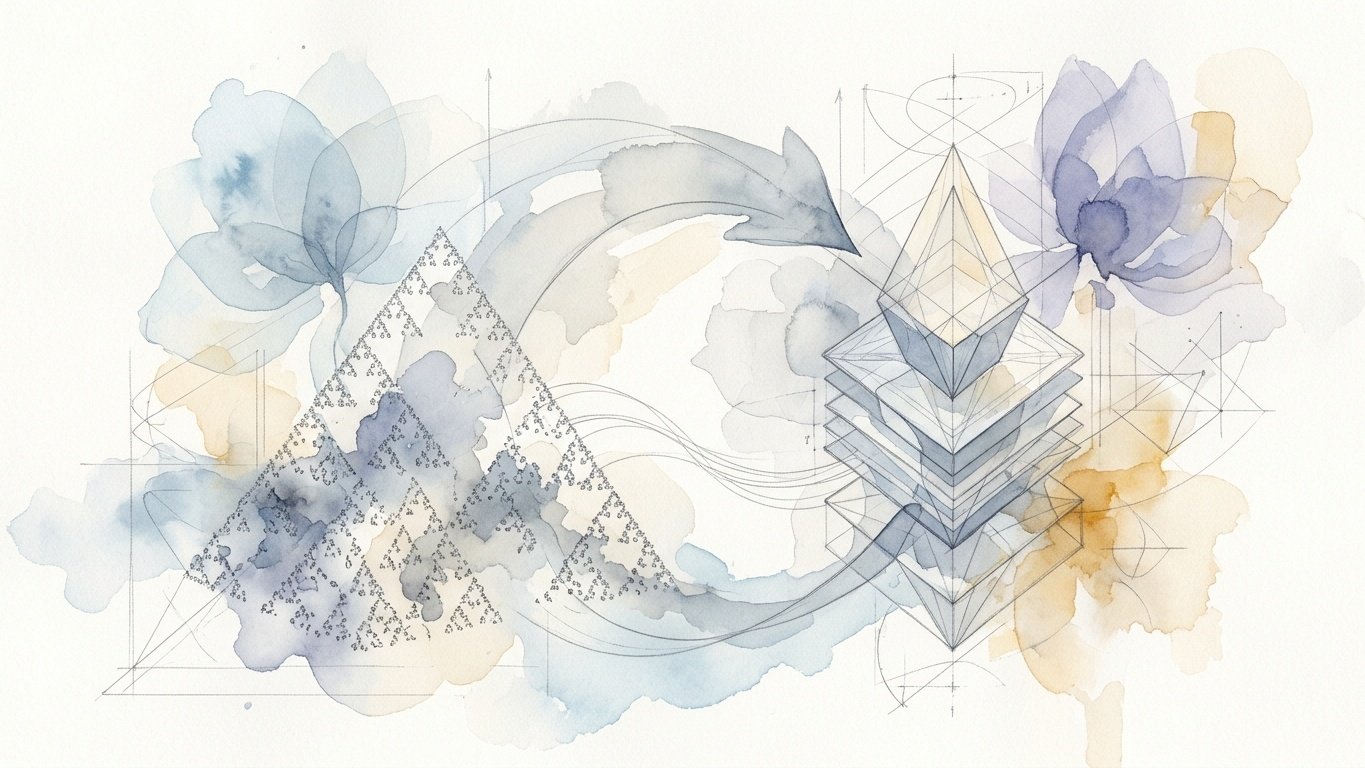
Scholze realized that this root-adjoining construction could be generalized into a comprehensive theory of ‘perfectoid rings.’ By requiring a ring to be infinitely fertile in p-power roots, the Frobenius map becomes surjective modulo p. Scholze then defined a mathematical operation called the ’tilt’: an explicit functor that translates any perfectoid structure in characteristic zero into an associated twin structure in characteristic p.
Scholze proved the magnificent Tilting Equivalence Theorem: the geometric category of perfectoid algebras over a characteristic-zero field is strictly equivalent to the category of perfectoid algebras over its tilted counterpart in prime characteristic.
Using Roland Huber’s theory of adic spaces, Scholze globalized this algebraic equivalence into geometry. An adic space captures both classical geometric points and generic infinitesimal valuations. Scholze proved that to every perfectoid space defined over characteristic zero, there corresponds a tilted perfectoid space in prime characteristic with an identical topological structure and an identical étale topology. Arithmetic geometers could now transport geometric problems freely across the characteristic divide.
This was the bridge mathematicians had sought for half a century. Any algebraic variety in characteristic zero, once adjoined with infinite p-power roots to become perfectoid, could be “tilted” across the divide into characteristic p. In characteristic p, the Frobenius endomorphism was fully active, allowing geometers to compute étale cohomology, resolve singularities, and apply Deligne’s Riemann Hypothesis techniques. Once the problem was solved in characteristic p, the solution could be “untilted” back into characteristic zero!
4. Conquering the Weight-Monodromy Conjecture
To demonstrate the awesome power of his newly invented machinery, the twenty-three-year-old Scholze turned immediately to one of the most formidable open problems in arithmetic geometry: Pierre Deligne’s weight-monodromy conjecture.
Formulated by Deligne in 1970, the conjecture concerns the arithmetic cohomology of algebraic varieties over local fields. When an algebraic variety degenerates (for instance, when a family of smooth varieties degenerates into a singular fiber), the action of the local Galois group on the ell-adic étale cohomology groups decomposes into two components: the unramified Frobenius action and a unipotent “monodromy operator” N measuring the topological monodromy around the degenerate fiber.
The weight-monodromy conjecture asserts that the filtration induced by the monodromy operator N aligns precisely with the weight filtration induced by the Frobenius eigenvalues—generalizing the classical Lefschetz decomposition in Kähler geometry to arithmetic varieties. Deligne had proved the conjecture for varieties defined over function fields of characteristic p in his 1980 paper Weil II, using the Frobenius automorphism. But for varieties defined over p-adic fields in characteristic zero, the conjecture remained stubbornly open for forty years.
Scholze deployed his perfectoid tilting engine. By taking a smooth projective variety X over a p-adic field _p that is a complete intersection in projective space, Scholze showed that the infinite tower of coverings formed by adjoining p-power roots of coordinates can be completed into a perfectoid space widetilde{X}. He then tilted widetilde{X} into a characteristic-p perfectoid space widetilde{X}^flat.
In characteristic p, Scholze was able to apply Deligne’s established characteristic-p theorems directly! Using an almost-mathematics version of the Poincaré lemma and the étale comparison theorems he developed, Scholze proved that the ell-adic cohomology of the original characteristic-zero variety could be recovered from the tilted space. In doing so, he proved the weight-monodromy conjecture for all complete intersection varieties in projective space, creating an immediate sensation across the global mathematical community.
5. Shimura Varieties and Torsion in the Cohomology of Manifolds
Having conquered weight-monodromy, Scholze directed his attention to the beating heart of the Langlands Program: Shimura varieties. Shimura varieties are higher-dimensional generalizations of modular curves. They are algebraic varieties that parameterize abelian varieties equipped with polarization, endomorphisms, and level structures (PEL type). They serve as the primary laboratory where automorphic forms and Galois representations interact.
A longstanding ambition of the Langlands Program was to realize Galois representations within the cohomology of Shimura varieties. For classical “compact” Shimura varieties, this was largely understood. However, for non-compact or non-PEL Shimura varieties—and especially for the torsion in their cohomology—mathematicians were completely blocked.
In a legendary 2013 preprint titled “On torsion in the cohomology of locally symmetric varieties,” Scholze resolved this challenge. He proved that the infinite-level limits of Shimura varieties are themselves perfectoid spaces! At infinite level (where one adjoins all level structures at p), the geometry of the Shimura variety simplifies dramatically, exhibiting a perfectoid structure that admits a Hodge-Tate period map mapping directly to an ordinary flag variety.
Using this perfectoid Hodge-Tate period map, Scholze constructed Galois representations associated with torsion classes in the cohomology of locally symmetric spaces for (GL(n)) over imaginary quadratic fields. These torsion classes do not correspond to classical holomorphic modular forms or algebraic differential forms; they exist purely as torsion in discrete group cohomology. Scholze’s work proved that even these elusive torsion phenomena are deeply governed by Galois symmetries, establishing a new frontier in the Langlands Program.
6. The Foundations Crack – Why Topological Spaces Fail Algebra
By 2018, having revolutionized arithmetic geometry and received the Fields Medal, Peter Scholze began contemplating a much deeper, structural defect in the foundational bedrock of mathematics: the incompatibility between topology and abstract algebra.
Since the early twentieth century, mathematics has treated a “topological space”—a set endowed with a collection of open subsets closed under arbitrary unions and finite intersections, formalized by Felix Hausdorff and Kazimierz Kuratowski—as the gold standard for studying continuity, limits, and geometry. However, when one attempts to blend topology with modern categorical algebra (such as abelian categories, derived categories, and homological algebra), topological spaces fail catastrophically.
Consider the category of topological abelian groups (abelian groups equipped with a compatible topology, such as real space, complex numbers, or _p). In homological algebra, the indispensable concept is an abelian category: a category where every morphism has a well-behaved kernel and cokernel, where short exact sequences make sense, and where one can compute derived functors (such as Ext and Tor).
The category of topological abelian groups is notoriously not abelian! If f: A → B is a continuous, bijective homomorphism between two topological groups, it is not necessarily an isomorphism of topological groups: the inverse map f⁻¹ might not be continuous (for example, taking the real numbers with the discrete topology and mapping them via the identity to the real numbers with the standard Euclidean topology). The quotient topology behaves pathologically: the quotient of a topological group by a non-closed subgroup is not Hausdorff. Consequently, taking cokernels destroys the topological separation properties.
Because the category is not abelian, one cannot do homological algebra with topological groups. One cannot take projective resolutions, form derived categories, or define Ext-groups in a satisfying way. For nearly a century, functional analysts and topologists patched over this defect using ad-hoc fixes: Fréchet spaces, Banach spaces, locally convex topological vector spaces, bornological spaces, and nuclear spaces. Each patch had its own idiosyncratic failure modes, creating endless friction in global geometry.
7. Condensed Mathematics – Clausen and Scholze Rebuild the Continuum
In 2019, Peter Scholze and American mathematician Dustin Clausen announced a revolutionary solution to this century-old crisis: Condensed Mathematics. Their central thesis was astonishing: the concept of a “topological space” was a historical mistake. The fundamental building blocks of continuity are not unconstrained sets with open topologies, but profinite sets—compact, totally disconnected Hausdorff spaces, such as the Cantor set or the p-adic integers integers_p.
A profinite set is a topological space that can be represented as an inverse limit of finite discrete sets.
Profinite sets possess extraordinary algebraic and topological properties: by Stone’s representation theorem, they are dual to Boolean algebras. Clausen and Scholze defined a condensed set not as a set with a topology, but as a sheaf on the site of compact Hausdorff spaces (or equivalently, profinite sets).
A condensed set is a functor that assigns to every profinite probe space S the set of continuous maps from S into X, satisfying the sheaf condition for finite disjoint unions and surjective quotient maps. A condensed abelian group is simply a sheaf from profinite sets into the category of abelian groups.
The consequences of this definition are staggering. Clausen and Scholze proved that the category of condensed abelian groups, denoted (Cond(Ab)), is an abelian category! Unlike topological abelian groups, in (Cond(Ab)):
- Every morphism has an unambiguous kernel and cokernel.
- Short exact sequences behave with total algebraic perfection.
- It possesses enough projectives and injectives, allowing the full machinery of derived categories and homological algebra to be deployed without restriction.
- Every classical topological space embeds naturally into condensed sets via the functor T mapsto T, where (T(S) = C(S, T)). For compactly generated spaces (which include all metric spaces and CW-complexes), this functor is fully faithful!
Condensed mathematics reconciles topology with algebra by embedding topological spaces into a larger, perfectly abelian category of sheaves. Real numbers, complex numbers, and p-adic numbers can now be treated using the exact same homological tools previously reserved for discrete rings.
8. The Liquid Tensor Experiment – Machine-Verifying the Foundational Lemma
In the development of condensed mathematics, Clausen and Scholze realized that to do real analysis and differential geometry, they needed an analytic variant of condensed groups capable of handling complete topological vector spaces like real space. They termed this framework “liquid mathematics” (or analytic rings).
At the center of liquid mathematics lay a formidable technical statement: Theorem 9.4 in Scholze’s Bonn lecture notes, also known as the Liquid Tensor Experiment lemma. The theorem asserted that for a certain real parameter p in (0, 1], a specific complex of condensed vector spaces involving the p-liquid completion of Laurent polynomials (integers((T))_{p}) has vanishing higher Ext groups.
This lemma was the linchpin of the entire theory: if true, it meant that real analysis, functional analysis, and complex geometry could be seamlessly unified with algebraic geometry. If false, the entire edifice of liquid mathematics collapsed.
However, the proof was so dense, subtle, and conceptually intricate that Scholze himself admitted he could not be 100% certain of its correctness. In December 2020, Scholze made an unprecedented public appeal to the formal verification and computer proof community. In a blog post titled “Liquid Tensor Experiment,” he challenged interactive theorem-prover experts to formalize the proof of Theorem 9.4 in Lean, an interactive theorem prover developed at Microsoft Research.
A collaborative team of mathematicians and computer scientists, led by Johan Commelin in the Netherlands, took up the challenge. Over eighteen months, the team translated Scholze’s human mathematical prose into machine-verifiable dependent type theory in Lean. In June 2021, Commelin announced that Lean had successfully verified the foundational core of Theorem 9.4. By July 2022, the entire proof had been formalized and verified by the computer down to the core axioms of Zermelo-Fraenkel set theory.
The success of the Liquid Tensor Experiment was a historic milestone. It demonstrated that modern formal proof assistants could not only verify century-old classical theorems, but could actively collaborate with the world’s leading mathematicians at the bleeding edge of twenty-first-century research, certifying the integrity of foundational concepts that strain the limits of human cognition.
9. Diamonds, V-Stacks, and the Geometrization of Arithmetic
Not content with perfectoid spaces and condensed sets, Scholze continued to push the boundaries of arithmetic geometry with the invention of diamonds and v-stacks. In classical algebraic geometry, Alexander Grothendieck had introduced algebraic spaces and Artin stacks to study quotient spaces where groups act with non-trivial stabilizers.
However, when studying quotients of perfectoid spaces by infinite profinite groups (such as absolute Galois groups), traditional algebraic stacks failed. Scholze introduced the “v-topology” (or pro-étale topology) on the category of perfectoid spaces. A diamond is a pro-étale sheaf on the category of perfectoid spaces that can be written as a quotient of a perfectoid space by an equivalence relation that is pro-étale.
Diamonds possess an astonishing capability: they can “remember” characteristic-zero information while living in a characteristic-p world. Through diamonds, Scholze was able to construct the geometric moduli space of all local Galois representations and classify p-adic vector bundles on the Fargues-Fontaine curve. In his 2021 Berkeley lectures with Laurent Fargues, this diamond machinery culminated in the geometrization of the local Langlands correspondence, transforming arithmetic representation theory into the geometry of sheaves on diamonds.
11. Adic Spaces and Roland Huber’s Topographical Framework
To fully comprehend the structural engine underpinning perfectoid spaces, one must delve into the theory of adic spaces, introduced in the early 1990s by German mathematician Roland Huber. For decades, the study of non-archimedean geometry—geometry over fields like _p or complex numbers_p—was conducted through the rigid analytic geometry of John Tate, developed in 1961, and subsequently through Vladimir Berkovich’s theory of Berkovich spaces.
Tate’s rigid analytic spaces replaced classical open sets with “admissible” open sets and Grothendieck topologies, creating a quasi-topological space that allowed power series convergence to be rigorously managed. However, Tate’s spaces lacked a underlying topological space of genuine points in the classical Zariski or Hausdorff sense. Berkovich resolved this by defining a compact, Hausdorff space whose points correspond to multiplicative semi-norms. Yet Berkovich spaces were insufficiently sensitive to capture higher-rank valuations and infinitesimal boundary behaviors essential for arithmetic compactifications.
Huber conceived a vastly richer geometric framework: the adic space. Built upon pairs of topological rings and their subrings of bounded elements, the adic spectrum parameterizes all continuous valuations, capturing the subtle micro-structure of non-Archimedean spaces with unprecedented fidelity.
Crucially, Huber’s valuations are not restricted to real-valued valuations: they can take values in arbitrary totally ordered abelian groups of arbitrary rank. This allows (Spa(A, A^+)) to contain not only classical points, but also “microbial” and “infinitesimal” valuations that hover like ghost points around classical boundaries, recording how functions vanish to different orders of infinity. Huber endowed (Spa(A, A^+)) with a natural topology generated by rational subsets and constructed a structure presheaf O_X.
However, for general Huber rings, Huber’s structure presheaf failed to be a sheaf: the sheaf axiom could fail on pathological open coverings, an affliction known as the non-sheafiness problem. For nearly twenty years, Huber’s adic spaces remained an esoteric, relatively obscure corner of mathematics.
Scholze recognized that Huber’s adic spaces were the exact geometric canvas required for the p-adic continuum. He proved a miraculous structural result: if a Huber ring is perfectoid, Huber’s presheaf O_X is always, unconditionally a true sheaf! Perfectoidness completely cures the non-sheafiness pathology. On the category of perfectoid affinoid pairs, (Spa(A, A^+)) behaves with total geometric integrity. By building perfectoid geometry upon Huber’s adic foundations, Scholze gave non-archimedean geometry an unshakeable, fully spatial foundation.
12. Almost Mathematics and the Ghost of Gerd Faltings
The second foundational pillar of the perfectoid revolution is “almost mathematics”—an audacious mathematical philosophy originally conceived by Fields Medalist Gerd Faltings in his legendary 1988 proof of the p-adic Hodge comparison theorem, and later formalized systematically by Ofer Gabber and Fabrice Ramero.
In classical algebra, a module is either zero or non-zero. In arithmetic geometry, however, one often encounters structures that are not strictly zero, but are annihilated by all elements of infinitesimal valuation. Faltings realized that in the presence of an infinitely ramified hierarchy of roots, elements extinguished by fractional powers of the prime are effectively negligible.
Faltings made an astonishing philosophical leap: what if one simply ignores any mathematical object that is annihilated by the maximal ideal mathfrak{m} of topologically nilpotent elements? In O_complex numbers_p, the maximal ideal satisfies the idempotent condition mathfrak{m}² = mathfrak{m}. Because mathfrak{m} is idempotent, the category of modules modulo mathfrak{m}-torsion forms an abelian category—the category of “almost modules.”
In this ‘almost mathematics,’ two modules are considered isomorphic if their difference is annihilated by arbitrarily small fractional powers of the prime. By filtering out these infinitesimal discrepancies as background noise, intractable algebraic obstructions dissolve: spaces that fail classical smoothness become ‘almost smooth,’ and higher cohomology obstructions that plague classical calculations vanish completely.
Scholze synthesized almost mathematics with adic spaces to formulate the “almost purity theorem.” In classical algebraic geometry, the purity theorem of Grothendieck and Zariski describes the behavior of étale coverings across boundaries. In the p-adic setting, Faltings had proved a partial almost purity result, but his proof was widely regarded as extraordinarily difficult and notoriously opaque. Scholze proved the Almost Purity Theorem in full generality for all perfectoid spaces: if X is a perfectoid space and Y → X is a finite étale covering, then Y is itself canonically a perfectoid space, and the tilting equivalence preserves finite étale coverings identically!
The Almost Purity Theorem acts as the supreme technical sledgehammer in perfectoid geometry. It guarantees that the étale fundamental group is invariant under tilting, allowing deep topological and Galois-theoretic invariants in characteristic zero to be computed seamlessly in characteristic p.
13. Prismatic Cohomology – The Unified P-Adic Architecture
Following the triumph of perfectoid spaces, Peter Scholze and Indian-American mathematician Bhargav Bhatt embarked on an even more ambitious campaign: unifying all p-adic cohomology theories into a single, master crystalline cohomology known as Prismatic Cohomology.
Throughout the latter half of the twentieth century, arithmetic geometers had to contend with a bewildering zoo of disparate cohomology theories for algebraic varieties over p-adic rings:
- de Rham Cohomology: Constructed from algebraic differential forms, capturing algebraic de Rham periods.
- Crystalline Cohomology: Pioneered by Alexander Grothendieck and Pierre Berthelot, utilizing divided power structures to lift varieties over finite fields to characteristic zero.
- Étale Cohomology: Utilizing ell-adic and p-adic constructible sheaves to extract Galois representations.
- Hodge-Tate Cohomology: Capturing graded pieces of p-adic Hodge filtrations.
Each of these theories captured a different fragment of the arithmetic truth, but their relationships were governed by highly delicate, technically fragile comparison theorems (the C_cris, C_st, and C_dR conjectures proved by Faltings, Niziol, Tsuji, and Fontaine). There was no single universal cohomology theory from which all others could be derived as simple base changes.
In 2019, Bhatt and Scholze introduced Prismatic Cohomology, built upon the geometric concept of a ‘prism’—a specialized ring structure equipped with a lifted Frobenius symmetry and an ideal that captures p-adic quantum deformations.
To any geometric scheme, Bhatt and Scholze associate a prismatic cohomology that acts as a universal master cohomology, unifying crystalline, de Rham, and étale invariants into a single coherent framework.
The prismatic framework achieves the ultimate synthesis of p-adic Hodge theory. Bhatt and Scholze proved that all classical cohomology theories are simple specialization functors (base changes) of the universal prismatic cohomology:
- Specializing the prism along the Cartier divisor I = 0 recovers algebraic de Rham cohomology, complete with its Hodge filtration.
- Specializing the prism to the crystalline point (I = (p)) recovers Berthelot’s crystalline cohomology.
- Inverting the ideal I and taking étale localization recovers p-adic étale cohomology.
- Evaluating the Nygaard filtration recovers Hodge-Tate cohomology.
Prismatic cohomology transformed p-adic Hodge theory from a labyrinth of delicate comparison conjectures into a single, unified geometric theory of sheaves on the prismatic site. Furthermore, through its connection to topological Hochschild homology (THH) and topological cyclic homology (TC) in algebraic K-theory, prismatic cohomology provides a bridge linking arithmetic geometry directly to modern stable homotopy theory.
14. Condensed Functional Analysis and Analytic Rings
While condensed mathematics began as an abstract resolution to the pathologies of topological abelian groups, Dustin Clausen and Peter Scholze quickly realized that its greatest power lay in functional analysis and complex analytic geometry.
For more than half a century, Jean-Pierre Serre’s celebrated GAGA theorems (Géométrie Algébrique et Géométrie Analytique) established that on compact complex manifolds, algebraic geometry and complex analytic geometry are equivalent: algebraic coherent sheaves are identical to analytic coherent sheaves. However, when geometers attempted to extend GAGA to non-compact varieties or non-archimedean analytic spaces, functional analysis broke down because the infinite-dimensional spaces of global holomorphic sections are nuclear Fréchet spaces, which do not form an abelian category.
Clausen and Scholze re-founded functional analysis inside condensed mathematics by developing the theory of “analytic rings.” An analytic ring is a condensed ring A equipped with a chosen collection of complete condensed modules satisfying precise nuclearity and compact-measure conditions.
In condensed functional analysis, a Banach space or Fréchet space is viewed not as a metric space of individual vectors, but as a condensed vector space that assigns to every compact Hausdorff space S the set of continuous families of vectors parameterized by S. In this setting, the completed projective tensor product tensor product—which in classical functional analysis is notoriously non-exact and fraught with Grothendieck’s nuclearity dilemmas—becomes an exact, fully derived tensor functor in the derived category (D(Cond(k)))!
Using condensed analytic rings, Clausen and Scholze formulated and proved a universal GAGA theorem that holds simultaneously across all fields—over complex numbers, over real space, and over non-archimedean fields like _p. By treating real and complex manifolds as condensed schemes over the analytic ring of integers with solid decay conditions, functional analysis has been absorbed into pure homological algebra, eliminating the analytical pathologies that burdened mathematical physics and differential geometry for generations.
15. The Formalization Horizon – Lean and the Future of Proofs
The verification of Scholze’s Liquid Tensor Experiment in Lean marked a profound cultural shift in twentieth-first-century pure mathematics. Historically, professional research mathematicians viewed computer proof assistants with deep skepticism, regarding them as clunky, pedantic software systems suited only for verifying trivial software code or brute-force combinatorial problems (such as the Four Color Theorem).
Scholze’s public embrace of Lean shattered this prejudice. In his post-verification retrospective, Scholze noted that translating human mathematics into formal dependent type theory forced an unprecedented degree of conceptual precision. Human mathematicians frequently rely on hand-waving phrases like “it is easy to see,” “by standard arguments,” or “the result follows by symmetry”—phrases that occasionally conceal subtle, fatal gaps in logic.
During the formalization of the Liquid Tensor Experiment, the Lean team led by Johan Commelin discovered that Scholze’s original handwritten proof of a secondary lemma contained a genuine gap. However, because Lean required every single deduction step to be explicitly articulated down to first principles, the process of formalization guided the team to discover an alternative, cleaner, and vastly more robust proof of the entire theorem.
This success has ignited a global movement toward the formalization of modern mathematics, spearheaded by figures such as Kevin Buzzard at Imperial College London. Massive collaborative repositories, such as Lean’s mathematical library Mathlib, are systematically formalizing algebraic geometry, scheme theory, and perfectoid spaces. The vision of twenty-first-century mathematics is moving toward an era where human intuition and machine-verified formal logic operate in continuous, symbiotic harmony, ensuring that the crystalline cathedrals of modern geometry stand on foundations of absolute certainty.
16. The Pro-Étale Site and Continuous Cohomology
Before launching condensed mathematics, Scholze laid the groundwork for unifying topological and algebraic cohomology through the invention of the pro-étale site of schemes. In classical algebraic geometry, Alexander Grothendieck’s étale topology allowed mathematicians to define algebraic covering spaces and construct ell-adic cohomology groups. However, the étale site suffered from an annoying technical limitation: it could only handle finite étale coverings. Continuous topological groups, such as the p-adic integers integers_p or profinite Galois groups, had to be treated indirectly through awkward projective systems of finite quotient sheaves.
In his 2013 paper “The p-adic Hodge Theory for Rigid-Analytic Varieties,” Scholze introduced the pro-étale topology. A morphism of schemes or adic spaces is pro-étale if it can be represented as a cofiltered limit of étale morphisms that is locally on the target affinoid or affine. The pro-étale site X_proet allows infinite Galois coverings—such as the universal covering space of a variety with its full profinite fundamental group—to be treated as single, genuine geometric objects within the site!
The pro-étale site resolves one of the most frustrating discrepancies in modern geometry: the Riemann-Hilbert correspondence for constructible sheaves. On a complex algebraic variety, the classical Riemann-Hilbert correspondence establishes an equivalence between local systems and flat vector bundles. On the pro-étale site, this correspondence becomes an almost trivial consequence of the acyclicity of affine spaces, allowing ell-adic and p-adic sheaves to be manipulated using the exact same continuous homological algebra as complex differential forms.
Furthermore, the pro-étale site provides the natural geometric home for the Hodge-Tate period map on Shimura varieties. By passing to the infinite-level pro-étale limit, the intricate, singular boundary components of toroidal and minimal compactifications dissolve into smooth, perfectoid spaces where periods can be integrated without encountering boundary poles, providing arithmetic geometry with a continuous differential calculus.
17. Solid Abelian Groups and the Analytic Foundation
At the technical core of condensed mathematics lies the theory of “solid” abelian groups, developed by Dustin Clausen and Peter Scholze in their foundational lectures on condensed mathematics. While general condensed abelian groups provide an abelian category for topological groups, they are still too general to support a robust theory of derived completions: some condensed groups exhibit wild, uncontrolled behavior when tensored together.
To isolate the well-behaved, complete objects, Clausen and Scholze introduced the “solidification” functor, denoted by a filled black square (blacksquare). A condensed abelian group M is called “solid” if for every profinite set S, the canonical map from continuous functions on S with values in M satisfies a precise completeness condition: specifically, that the evaluation map from formal integers-linear combinations of elements in S to M factors through the space of solid measures.
Within condensed mathematics, Clausen and Scholze identified the realm of ‘solid’ abelian groups. Here, algebraic operations and topological completions harmonize completely, eliminating the classical pathologies of infinite limits.
In classical homological algebra, projective limits and tensor products are notoriously incompatible, leading to higher obstruction terms that plague functional analysis. The solid framework eliminates these obstructions entirely, allowing topology and algebra to be manipulated with algebraic exactness.
By establishing that the derived category (D(Solid)) possesses the complete formal structure of a derived algebraic geometry, Clausen and Scholze succeeded in constructing a universal foundation where number theory, functional analysis, differential geometry, and algebraic topology can all be computed using a single, unified derived categorical language.
18. Arithmetic Topology – Knots, Primes, and Condensed Invariants
One of the most poetic and intellectually fertile implications of Scholze’s geometric revolution is its resonance with “arithmetic topology”—a visionary analogy conceived by Barry Mazur, David Mumford, and Yuri Manin in the 1960s, and later elaborated by Japanese mathematician Masanori Morishita. Arithmetic topology posits a rigorous dictionary between three-dimensional topology (specifically the study of knots and links inside 3-manifolds) and algebraic number theory (the study of prime ideals inside rings of integers of number fields).
In this profound analogy, the ring of whole numbers behaves topologically like a three-dimensional sphere. Each prime number corresponds to an embedded knot winding through this space. The Frobenius symmetry at a prime acts as a loop encircling the knot, and classical quadratic reciprocity—the mutual harmony governing whether two primes are squares modulo one another—is revealed to be the three-dimensional linking number between two tangled knots.
For decades, arithmetic topology was treated as an inspiring heuristic metaphor rather than a rigorous mathematical theory because the foundational topology of (Spec(integers)) was algebraic and discrete, lacking the smooth geometric continuities of differential 3-manifolds. One could not deform knots, compute Chern-Simons path integrals, or apply quantum invariants like the Jones polynomial to prime numbers directly.
Condensed mathematics and the theory of diamonds provide the exact categorical infrastructure required to turn this metaphor into rigorous mathematics. By treating (Spec(integers)) as a condensed ring and embedding p-adic fields into the analytic category, topologists and number theorists can now define continuous paths, evaluate derived mapping stacks, and construct arithmetic Chern-Simons invariants. Scholze’s students and collaborators are actively investigating whether the categorical tools of condensed mathematics can realize a true four-dimensional arithmetic quantum field theory, where the classical Langlands correspondence emerges as an S-duality between arithmetic knots and prime representations.
19. Conclusion – The Architect of Twenty-First-Century Mathematics
At an age when most mathematicians are just finding their scientific voice, Peter Scholze has fundamentally rewritten the rules of the discipline. From the ultrametric landscapes of p-adic numbers to the crystalline bridges of perfectoid spaces, and from the re-foundation of topology in condensed sets to the formal verification of liquid mathematics, his work embodies an aesthetic of sublime clarity.
Scholze does not view mathematics as a collection of difficult obstacles to be conquered by brute technical force. Rather, he views it as a hidden, harmonious landscape waiting to be unveiled. By finding the right definitions—definitions so natural that deep conjectures dissolve into simple, inevitable truths—Peter Scholze has re-engineered geometry for the twenty-first century, proving that when the foundations are built with structural integrity, the highest towers of human intellect can touch the stars.