Grand Mathematical Tapestry – Geometric Langlands
In February 2024, a quiet seismic shock rippled through the global mathematics community. Across five monumental papers totaling nearly one thousand pages of dense, categorical algebraic geometry, a collaborative team led by Dennis Gaitsgory and Nick Rozenblyum announced the definitive, unconditional proof of the unramified Geometric Langlands Conjecture. Spanning more than three decades of collective struggle and drawing upon concepts that did not exist when Robert Langlands first penned his legendary 1967 letter to André Weil, the proof unites two seemingly irreconcilable continents of modern mathematics: the spectral world of algebraic geometry and the automorphic universe of harmonic analysis and quantum field theory. It stands as one of the supreme intellectual achievements of twenty-first-century thought—a crystalline bridge connecting the fundamental symmetries of number, shape, and physics.
1. The Vision of Robert Langlands – A Rosetta Stone for Mathematics
To grasp the significance of the Geometric Langlands Conjecture, one must journey back to January 1967, when a thirty-year-old associate professor at Princeton University named Robert Langlands typed a seventeen-page handwritten letter to the legendary French mathematician André Weil. Modestly introducing his thoughts with the words, “If you are willing to read it as pure speculation I would appreciate that; if not—as you have a wastebasket handy—no harm will be done,” Langlands outlined a breathtaking web of conjectures that would come to be known as the Langlands Program.
At its core, the classical Langlands Program seeks to establish a profound non-abelian generalization of class field theory. Throughout the nineteenth and twentieth centuries, algebraic number theorists—from Carl Friedrich Gauss and Ernst Kummer to David Hilbert, Emil Artin, and Teiji Takagi—sought to understand the deep symmetries governing prime numbers and polynomial equations. The crown jewel of this effort was abelian class field theory, which demonstrated that the abelian extensions of a number field (extensions whose Galois groups are commutative) are intimately governed by the arithmetic of the field itself, encoded in its group of idèles.
However, the vast majority of polynomial equations and physical symmetries are non-abelian: the order of operations matters, just as rotating a three-dimensional object around one axis and then another yields a different result than reversing the sequence. For non-abelian symmetries, classical class field theory broke down completely. Langlands proposed an audacious conceptual bridge. He conjectured that the structural invariants of non-abelian Galois representations—objects belonging to the realm of arithmetic and algebra—are in one-to-one correspondence with the spectral data of automorphic forms—objects belonging to the realm of harmonic analysis, differential equations, and continuous Lie groups.
More precisely, Langlands postulated that to every continuous symmetry group, there exists a reciprocal dual group—the Langlands dual group. Langlands conjectured that the structural representations of absolute Galois symmetries correspond bijectively to the harmonic representations of automorphic forms. This was a mathematical Rosetta Stone: a dictionary allowing intractable arithmetic problems to be translated into solvable analytic questions, and vice versa. It was this classical framework that enabled Andrew Wiles and Richard Taylor to prove the Taniyama-Shimura-Weil conjecture for semistable elliptic curves in 1994, thereby conquering Fermat’s Last Theorem.
2. From Arithmetic to Geometry – The Function Field Metaphor
While the arithmetic Langlands Program operates over number fields (finite extensions of the rational numbers ()), mathematicians recognized an ancient, beautiful analogy first articulated by Richard Dedekind and Heinrich Weber, and later elevated to an art form by André Weil: the analogy between number fields and function fields.
In this dictionary, a number field like () corresponds to the function field (k(X)) of an algebraic curve X defined over a finite field k = _q. The prime numbers p in integers correspond to the closed geometric points x in X. In both settings, one can define rings of integers, valuations, local fields, and adelic groups. However, algebraic curves possess a profound conceptual advantage over number fields: they have geometry. One can vary curves in continuous families, compute their topological genus, deform their structures, and apply the formidable machinery of algebraic and differential geometry.
In the 1980s, algebraic geometers—led by Alexander Beilinson, Vladimir Drinfeld, and Gérard Laumon—dared to take this metaphor to its ultimate conclusion. What happens if one replaces the finite field _q with the field of complex numbers complex numbers, and replaces the algebraic curve over a finite field with a smooth, compact Riemann surface X?
In moving from number fields to complex curves, the arithmetic nature of Galois groups transforms into the topological nature of the fundamental group. A representation of the fundamental group translates, via the Riemann-Hilbert correspondence, into a flat connection on a geometric bundle over the curve—what mathematicians designate as a local system.
Simultaneously, the automorphic side undergoes a radical metamorphosis. In the classical setting, automorphic forms are complex-valued functions on the adelic quotient (G(K) G(_K) / K_infty). In the geometric setting, this adelic quotient is replaced by the moduli stack of principal G-bundles over the curve X, denoted by Bun_G. But in modern geometry, one does not merely study functions on a space. Guided by Alexander Grothendieck’s philosophy of sheaves and motives, functions are viewed as mere shadows. The true structural entities are sheaves—specifically, perverse sheaves and D-modules living on the geometric space Bun_G.
3. Categorification – The Leap to Derived Infinity-Categories
The transition from functions to sheaves represents a monumental intellectual shift known as categorification. In classical mathematics, statements are formulated as equalities between numbers or functions: (f(x) = g(x)). In categorified mathematics, equalities are replaced by isomorphisms between objects in a category, and equations between isomorphisms are replaced by higher categorical equivalences.
In the original naive formulation of the Geometric Langlands Conjecture, mathematicians sought a correspondence that would associate to every flat G^dual-bundle (local system) σ on a curve X a specific “Hecke eigensheaf” F_σ on the moduli stack Bun_G. This Hecke eigensheaf was required to be an eigen-object for the action of geometric Hecke operators, with eigenvalues given by the local system σ.
However, during the late 1990s and early 2000s, Alexander Beilinson and Vladimir Drinfeld realized that establishing a bijection on the level of individual objects was mathematically insufficient and structurally unnatural. Geometric objects do not live in isolation; they exist within vast, interconnected categories containing rich morphisms, extensions, tensor products, and higher homotopical structures. The true conjecture had to be formulated not as a correspondence between objects, but as an equivalence of categories.
This insight led to the modern, categorical formulation of the Geometric Langlands Conjecture: there exists an equivalence between two vast derived infty-categories.
To decode this magnificent equation is to understand the language of twentieth-first-century geometry:
- The Automorphic Side: (D-Mod(Bun_G)) is the derived category of D-modules on the moduli stack of G-bundles over the curve X. A D-module is an algebraic sheaf endowed with an action of polynomial differential operators. It is the modern algebraic formulation of a system of linear partial differential equations. The stack Bun_G is a non-quasiprojective, infinite-dimensional algebraic stack possessing severe singularities and infinite stabilizers, making the rigorous analysis of D-modules upon it extraordinarily treacherous.
- The Spectral Side: (IndCoh_{Nilp}(LocSys_{G^dual})) is the category of ind-coherent sheaves on the moduli stack of flat G^dual-bundles (LocSys_G^dual}) whose singular support is constrained to lie within the “global nilpotent cone” (Nilp). Coherent sheaves represent algebraic vector bundles and their generalized sub-quotients. The nilpotent singular support condition, formulated by Dennis Gaitsgory and David Arinkin, was the crucial missing piece: it prevents the category from becoming pathologically large while capturing the subtle non-abelian monodromy invariants.
- The Equivalence _G: The functor _G is not an ordinary linear map, but an equivalence of symmetric monoidal derived infty-categories that intertwines the action of geometric Hecke modifications on the automorphic side with the action of spectral tensor products on the geometric side.
4. The Physics Connection – Kapustin, Witten, and Electric-Magnetic Duality
While algebraic geometers were laboring through the thickets of derived categories, an astonishing intellectual intervention arrived from theoretical physics. In 2006, Anton Kapustin and Edward Witten published a seminal 220-page paper titled “Electric-Magnetic Duality And The Geometric Langlands Program”, showing that the Geometric Langlands Conjecture is not merely an abstract mathematical fantasy, but the exact mathematical expression of Montonen-Olive S-duality in four-dimensional supersymmetric quantum gauge theories.
In four-dimensional N=4 supersymmetric Yang-Mills (SYM) theory—the most symmetric and mathematically tractable quantum field theory known—the theory possesses a continuous gauge symmetry group G and a complexified coupling constant the theoretical relationship. Montonen-Olive duality asserts that the theory with gauge group G and coupling τ is physically indistinguishable from a dual theory with the Langlands dual gauge group G^dual and inverted coupling -1/τ. This duality exchanges electric charges with magnetic monopoles, swapping strongly coupled physics with weakly coupled physics.
Kapustin and Witten considered compactifying this 4D supersymmetric theory on a product manifold Sigma × X, where X is a compact two-dimensional Riemann surface (the algebraic curve) and Sigma is a two-dimensional spacetime surface. By performing a topological twist (specifically, the geometric Langlands twist), the four-dimensional field theory descends to an effective two-dimensional topological sigma model on Sigma.
Remarkably, the target space of this 2D sigma model is none other than the Hitchin moduli space (M_H(G))—the hyperkähler manifold parameterizing pairs ((E, φ)) of a holomorphic vector bundle E and an operator-valued 1-form φ called a Higgs field, first discovered by Nigel Hitchin in 1987. Because the Hitchin space is hyperkähler, it possesses three mutually orthogonal complex structures: I, J, K. In complex structure I, the Hitchin space parameterizes stable Higgs bundles; in complex structures J and K, it parameterizes flat connections on the curve X (local systems).
Under the topological twist, the physical states and boundary conditions of the two-dimensional sigma model are classified mathematically as “branes” living in derived categories:
- On the automorphic side, the theory manifests as an A-model topological sigma model, whose boundary conditions form the Fukaya category of A-branes (Lagrangian submanifolds equipped with flat bundles). Under the Beilinson-Drinfeld localization functor, these physical A-branes correspond precisely to D-modules on Bun_G.
- On the spectral side, the S-dual theory manifests as a B-model topological sigma model, whose boundary conditions form the derived category of B-branes (coherent sheaves on complex submanifolds). These B-branes correspond precisely to coherent sheaves on LocSys_G^dual}.
Montonen-Olive S-duality acts as a mirror symmetry linking the geometric spaces of the original gauge group and its Langlands dual. In physics, this duality maps electric Wilson line operators to magnetic ‘t Hooft loop operators; in mathematics, this physical equivalence is precisely the Geometric Langlands correspondence linking geometric Hecke operators to spectral tensor operations. Physicists had not only re-derived the conjecture from quantum gauge theory, but provided the physical intuition that guided mathematicians toward the correct categorical formulations.
5. The Architecture of the Proof – Dennis Gaitsgory and the Collaborative Ascent
Despite the luminous conceptual illumination provided by physics, proving the conjecture rigorously within the demanding standards of pure algebraic geometry remained a Herculean task. The moduli stack Bun_G is not a smooth, finite-dimensional manifold: it is an infinite-dimensional algebraic stack containing dense strata of wildly varying dimensions, infinite automorphism groups, and severe non-isolated singularities. Standard tools of homological algebra collapsed under these pathologies.
The thirty-year campaign to prove the conjecture was spearheaded by Dennis Gaitsgory, a professor at Harvard University and later the Max Planck Institute for Mathematics in Bonn. Gaitsgory realized that before one could even construct the functor _G, the foundational architecture of algebraic geometry had to be rebuilt from scratch using the modern machinery of derived algebraic geometry and Jacob Lurie’s theory of higher infty-categories.
Over two decades, Gaitsgory, together with Nick Rozenblyum and a brilliant cohort of collaborators—including David Arinkin, Dario Beraldo, Justin Campbell, Tsao-Hsien Chen, Lin Chen, and Sam Raskin—developed an entire library of foundational treatises. They developed the theory of DG-categories (differential graded categories), ind-coherent sheaves, singular support of coherent sheaves, and the crystalline nature of stacks. They systematically established the foundational properties of D-modules on infinite-dimensional prestacks, creating an analytical toolkit capable of manipulating derived categories on singular stacks with total mathematical rigor.
The definitive proof, released in five sequential preprints in February 2024, operates through a masterfully orchestrated strategy of categorical localization, degeneration, and harmonic analysis:
- The Unipotent and Kac-Moody Reduction: Rather than attacking the global stack Bun_G directly, the team utilized the Beilinson-Bernstein-Drinfeld localization theory, representing D-modules on Bun_G in terms of representations of the affine Kac-Moody Lie algebra mathfrak{g} at the critical level at the critical level. At this precise critical level, the center of the universal enveloping algebra becomes colossal: by the legendary Feigin-Frenkel theorem, it is isomorphic to the algebra of functions on the space of opers on the formal disc.
- The Theory of Opers and Local Langlands: An oper is a specific geometric gauge-theoretic structure: a flat connection with a Borel reduction satisfying a strict transversality condition. By establishing the categorical local Langlands correspondence at the critical level, the team built a bridge between local representations of loop groups and local spectral Galois data.
- The Global Nilpotent Singular Support: The fatal obstacle in earlier attempts was that the category of coherent sheaves on LocSys_G^dual} was far too large, containing unphysical objects that had no counterpart on the D-module side. Arinkin and Gaitsgory introduced the concept of singular support for coherent sheaves, isolating the subcategory IndCoh_Nilp. By showing that the singular support of automorphic D-modules is constrained to the global nilpotent cone, they achieved the exact categorical size match required for a bi-directional equivalence.
- The Gluing and Compact Generation Argument: The final proof utilizes a profound “spectral gluing” methodology. By decomposing the moduli stacks into manageable open and closed strata, constructing the equivalence locally over the base of Hitchin fibrations, and proving that both categories are compactly generated by dualizable objects, the team proved that the functor _G is fully faithful and essentially surjective—thereby completing the equivalence of categories.
6. The Ramified Horizon and Beyond – What the Proof Unlocks
The February 2024 proof establishes the unramified Geometric Langlands Conjecture: the setting where the algebraic curve X has no marked points and the bundles are smooth everywhere. While this constitutes the structural core of the program, it immediately unlocks the next great frontiers in modern mathematics:
The first natural extension is the ramified Geometric Langlands Conjecture. In the ramified setting, the curve X is punctured by a finite set of marked points {x_1,…, x_n, where the flat connections and D-modules are permitted to exhibit prescribed singularities (poles). These singularities can be regular (tame ramification, corresponding to logarithmic poles) or irregular (wild ramification, corresponding to higher-order poles with Stokes phenomena). The study of wild ramification connects geometric Langlands directly to the theory of Painlevé differential equations, Stokes matrices, and the wall-crossing formulas of Donaldson-Thomas theory.
A second frontier is the arithmetic synthesis. A long-standing dream of the Langlands school is to use the geometric proof over complex numbers to deduce new theorems about number fields and Galois representations over (). Through the machinery of the ell-adic trace formula and Grothendieck’s Sheaf-Functions dictionary, every categorical statement about perverse sheaves on Bun_G over a finite field _q can be converted into an exact numerical identity between classical automorphic forms and Galois representations. Peter Scholze and Laurent Fargues have already leveraged these geometric concepts in their revolutionary geometric formulation of the local Langlands correspondence for p-adic fields, proving that the geometric perspective is destined to reshape arithmetic number theory at its deepest foundations.
Finally, the proof provides theoretical physicists with a rigorous mathematical foundation for four-dimensional topological quantum field theories (TQFTs). The categorical equivalence _G can be interpreted as proving that the 4D N=4 SYM theory defines a fully extended four-dimensional TQFT in the sense of the Cobordism Hypothesis of Baez, Dolan, and Lurie, assigning categories to 2-manifolds, 2-categories to 1-manifolds, and higher categorical invariants to 0-manifolds.
8. The Hitchin Fibration and Classical Integrable Systems
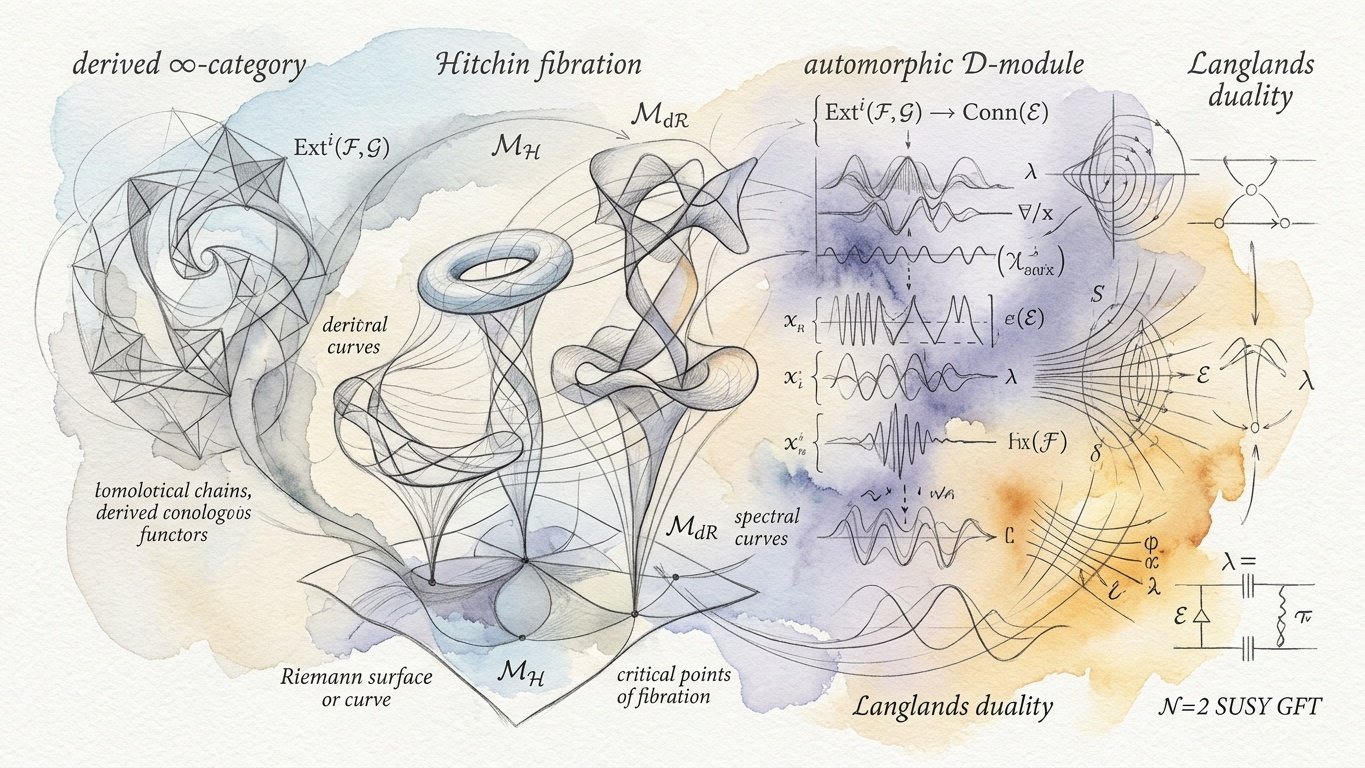
To understand why the Geometric Langlands Conjecture possesses such profound geometric coherence, one must examine the geometric geometry of the Hitchin fibration. Discovered in 1987 by British geometer Nigel Hitchin, the moduli space of Higgs bundles, (M_H(G)), is endowed with the structure of an algebraically completely integrable Hamiltonian system (ACIHS) of extraordinary beauty.
A Higgs bundle on a smooth algebraic curve pairs a holomorphic vector bundle with a differential form known as the Higgs field. Hitchin defined a canonical fibration mapping these bundles to the characteristic invariants of the Higgs field.
where the Hitchin base B is an affine vector space parameterizing the characteristic polynomial invariants of the Higgs field.
where d_i are the degrees of the fundamental invariant polynomials of the Lie algebra mathfrak{g}. For the group (G = SL(n, complex numbers)), the map evaluates the coefficients of the characteristic polynomial (determinant(· Id – φ) = ^n + s_2 ^{n-2} +… + s_n), sending a Higgs pair to the collection of differential forms ((s_2,…, s_n) in B).
Hitchin proved that the base of this fibration has exactly half the dimension of the total moduli space. Furthermore, the coordinate functions Poisson-commute with one another, establishing the Hitchin system as a completely integrable Hamiltonian system—generalizing classical physical models like the spinning top and the Toda lattice to infinite-dimensional geometry.
The fibers of the Hitchin map over generic points b in B are Lagrangian submanifolds. Even more remarkably, Hitchin demonstrated that these generic fibers are compact complex tori: specifically, they are isomorphic to the Prym varieties of the “spectral curve” X_b subset of T^*X defined by the vanishing of the characteristic polynomial. A Higgs bundle on the original curve X unrolls into a simple line bundle (rank 1 sheaf) living on the spectral curve X_b. This abelianization theorem allows non-abelian gauge-theoretic structures to be decomposed into classical abelian Picard and Prym varieties.
In the context of Geometric Langlands, Donagi, Pantev, and Hausel established that the Hitchin fibrations for dual groups are dual abelian torus fibrations over the exact same base space. Over generic points, the torus fibers of the dual groups are reciprocal abelian varieties. Under the classical Fourier-Mukai transform, sheaves on an abelian variety map into sheaves on its dual. Thus, the Hitchin fibration acts as a geometric scaffolding for the entire Langlands correspondence, proving that at the level of generic fibers, the duality is simply the Fourier-Mukai transform applied across an integrable system.
9. D-Modules, Perverse Sheaves, and the Riemann-Hilbert Correspondence
On the automorphic side of the correspondence, the fundamental mathematical entities are not functions, but D-modules. To appreciate why D-modules are the natural geometric language for automorphic forms, one must examine their origins in algebraic analysis and partial differential equations.
On a smooth algebraic variety Y, the sheaf of differential operators D_Y is the non-commutative ring generated by the structure sheaf O_Y and the tangent sheaf T_Y, subject to the canonical commutation relations ([v, f] = v(f)) for vector fields v and functions f. A D_Y-module is a sheaf of modules over this non-commutative algebra. It represents, geometrically and coordinate-independently, an overdetermined system of linear partial differential equations.
The order filtration on D_Y induces a filtration on any coherent D-module M. The associated graded module (gr(M)) is a coherent sheaf on the cotangent bundle T^*Y. The support of this graded sheaf within the cotangent bundle is called the characteristic variety of the D-module, denoted (Ch(M) subset of T^*Y). By the celebrated Bernstein-Kashiwara-Sato theorem, the characteristic variety is always an involutive (co-isotropic) subvariety of T^*Y with respect to the canonical symplectic structure. Consequently, the dimension of (Ch(M)) is at least the dimension of Y.
A D-module is called holonomic if its characteristic variety has the minimal possible dimension: (dimension Ch(M) = dimension Y), meaning its characteristic variety is a Lagrangian subvariety of T^*Y. Holonomic D-modules represent differential systems with finite-dimensional spaces of solutions. In modern geometry, holonomic D-modules are the algebraic analogues of constructible sheaves and perverse sheaves.
The bridge between the continuous differential world of D-modules and the topological world of algebraic topology is provided by the Riemann-Hilbert correspondence, established independently by Masaki Kashiwara and Zoghman Mebkhout. The Riemann-Hilbert functor establishes an equivalence between the derived category of regular holonomic D-modules on Y and the derived category of constructible complexes of sheaves with respect to the analytic topology.
Under this equivalence, the abelian category of regular holonomic D-modules corresponds not to ordinary constructible sheaves, but to perverse sheaves—complexes of sheaves satisfying strict vanishing conditions on the dimensions of the supports of their cohomology sheaves, introduced by Beilinson, Bernstein, and Deligne in 1982. Perverse sheaves provide the rigorous foundation for the intersection cohomology of Goresky and MacPherson, allowing topologists to define Poincaré duality on singular algebraic varieties.
When applied to the infinite-dimensional moduli stack Bun_G, the theory of D-modules becomes profoundly subtle. Because Bun_G has infinite stabilizers and is not of finite type, one cannot work with ordinary holonomic D-modules. Gaitsgory and his school had to develop the category (D-Mod(Bun_G)) as a compactly generated DG-category using ind-completion and crystalline prestacks, proving that even on an infinite stack, D-modules retain the homological finiteness properties required to support a categorical equivalence.
10. The Geometric Satake Equivalence – The Quantum Group Interface
At the beating heart of both the arithmetic and geometric Langlands programs lies the Satake isomorphism. In classical number theory, the Satake isomorphism maps the spherical Hecke algebra of a reductive group G over a p-adic field to the representation ring of the dual group G^dual. In the geometric setting, this numerical isomorphism undergoes a magnificent categorification known as the Geometric Satake Equivalence.
Pioneered by Victor Ginzburg and brought to definitive fruition by Ivan Mirković and Kari Vilonen in 2000, the Geometric Satake Equivalence operates on the affine Grassmannian Gr_G. The affine Grassmannian is an infinite-dimensional ind-scheme defined as the quotient of the loop group (G((t))) by the positive loop group G[[t]].
The affine Grassmannian parameterizes modifications of a trivial G-bundle over a formal disc punctured at the origin. The group G[[t]] acts on Gr_G with orbits indexed by the dominant coweights (in X_*(T)^+) of the group G. The closures of these orbits, Gr_lambda, are finite-dimensional singular Schubert varieties.
Mirković and Vilonen considered the category of G[[t]]-equivariant perverse sheaves on the affine Grassmannian, denoted (Perv_{G[[t]]}(Gr_G)). Equipped with the convolution product star, this category forms a symmetric monoidal tensor category. The Geometric Satake Equivalence states that there is an equivalence of symmetric monoidal tensor categories.
This result is extraordinary. The left-hand side belongs entirely to the geometry and topology of infinite-dimensional loop spaces associated with the group G. The right-hand side belongs to the algebraic representation theory of the Langlands dual group G^dual. The dual group G^dual is not introduced by fiat: it emerges spontaneously as the Tannakian group of the geometric category (Perv_{G[[t]]}(Gr_G)) via the global hypercohomology fiber functor!
Under Geometric Satake, the intersection cohomology complexes on Schubert varieties of the affine Grassmannian map directly to irreducible representations of the Langlands dual group. In the Geometric Langlands correspondence, this equivalence provides the exact mechanism by which geometric Hecke operators act on automorphic sheaves, mirroring the tensor action of dual group representations on the spectral side.
11. The Quantum Geometric Langlands Conjecture and Chiral Algebras
While the classical Geometric Langlands Conjecture concerns flat connections and standard D-modules, the deepest structural insights have emerged from its quantum deformation: the Quantum Geometric Langlands Conjecture (QGLC).
In the quantum setting, the correspondence depends upon a continuous complex parameter c in complex numbers, known as the level or the coupling constant. On the automorphic side, ordinary D-modules are replaced by “twisted” D-modules, which are modules over twisted differential operators D^c_Bun_G associated with powers of the determinant line bundle L^c. The level c shifts the critical level of the affine Kac-Moody algebra to level parameter.
Conjectured by Alexander Stoyanovsky and developed extensively by Dennis Gaitsgory, the Quantum Geometric Langlands Conjecture asserts an equivalence between twisted D-modules on Bun_G at level c and twisted D-modules on Bun_G^dual} at the dual level c^dual, where the levels are related by the celebrated S-duality fractional transformation.
where r is the lacing number of the Lie algebra mathfrak{g} (equal to 1 for simply-laced groups like A, D, E, 2 for B, C, F_4, and 3 for G_2). Notice the profound symmetry: when c → 0, the dual level c^dual → infty. In this extreme limit, the non-commutative ring of twisted differential operators degenerates into a commutative algebra of functions—the twisted D-modules at infinity become coherent sheaves on the moduli space of flat connections, reproducing the unramified classical Geometric Langlands Conjecture as a degenerate boundary case of the quantum theory!
The mathematical engine driving the quantum conjecture is the theory of chiral algebras, developed by Beilinson and Drinfeld. A chiral algebra is an algebraic, coordinate-independent formulation of a Vertex Operator Algebra (VOA)—the mathematical foundation of two-dimensional conformal field theory in string theory. The chiral algebra of observables at the critical level at the critical level is isomorphic to the Feigin-Frenkel center. By quantizing this center away from the critical level, one obtains the W-algebras of conformal field theory, linking the representation theory of affine Lie algebras directly to quantum integrable systems and the Alday-Gaiotto-Tachikawa (AGT) correspondence of modern theoretical physics.
12. The Five Papers of 2024 – A Dissection of the Monumental Proof
The announcement of the proof of the unramified Geometric Langlands Conjecture in February 2024 was marked by the simultaneous publication of five interlocking treatises on the arXiv, authored by Dennis Gaitsgory, Nick Rozenblyum, and their collaborators. Each paper resolves a foundational pillar of the thirty-year architecture:
- Paper I – Affine Grassmannians and Categorical Spectral Actions: Establishes the precise categorical framework for the action of the geometric Hecke category on (D-Mod(Bun_G)). Utilizing the factorization machinery of Beilinson and Drinfeld, this work proves that the categorical spectral action commutes with global convolution and is compatible with parabolic restriction.
- Paper II – The Kac-Moody Localization at the Critical Level: Resolves the local-to-global passage using representations of the affine Lie algebra mathfrak{g} at at the critical level. Demonstrates that the global sections functor from Bun_G to the category of critical Kac-Moody modules is fully faithful on the relevant nilpotent subcategories, translating global geometry into local chiral representation theory.
- Paper III – The Global Nilpotent Singular Support: Co-authored with David Arinkin, this paper provides the definitive definition and classification of the singular support for coherent sheaves on algebraic stacks. It proves that the category (IndCoh_{Nilp}(LocSys_{G^dual})) is compactly generated, dualizable, and possesses the exact homological properties required to match the automorphic D-module category.
- Paper IV – Eisenstein Series and Parabolic Induction: Formulates and proves the categorical analogues of Arthur’s truncation and Selberg’s Eisenstein series. By analyzing how D-modules behave under parabolic induction from Levi subgroups M subset of G, the authors prove that the automorphic category can be reconstructed from cuspidal D-modules and boundary strata via categorical gluing.
- Paper V – The Global Equivalence: The grand synthesis. Integrates the local spectral action, the singular support bounds, and the Eisenstein induction into a unified functor _G. Proves that _G preserves compact objects, commutes with colimits, intertwines Hecke operators with spectral tensor products, and is both fully faithful and essentially surjective.
The collective volume of these works represents not merely a proof of a single conjecture, but the establishment of an entire continent of mathematics. The techniques invented to navigate the singularities of Bun_G and LocSys_G^dual} will govern algebraic geometry, categorical representation theory, and mathematical physics for the next half-century.
13. The Fargues-Fontaine Curve and the Arithmetic Synthesis
Perhaps the most breathtaking intellectual offspring of the Geometric Langlands Program is its unexpected, profound colonization of arithmetic number theory through the work of Laurent Fargues and Fields Medalist Peter Scholze. For decades, mathematicians considered the geometric Langlands correspondence over the complex numbers complex numbers to be a beautiful but distant metaphor for the true arithmetic Langlands program over p-adic local fields (finite extensions of _p). This isolation was shattered by the discovery of the Fargues-Fontaine curve.
Introduced in 2011 by Laurent Fargues and Jean-Marc Fontaine, the Fargues-Fontaine curve, denoted X_FF, is a geometric object that defies classical intuition. It is an algebraic curve of absolute dimension one defined over a p-adic field, yet it possesses no points over any classical field! Instead, it is constructed using the modern machinery of perfectoid spaces, tilting equivalence, and Fontaine’s rings of p-adic periods (B_dR, B_cris, and B_st).
Despite its exotic construction, the Fargues-Fontaine curve behaves geometrically like the complex projective line ¹ or a compact Riemann surface of genus zero. Fargues discovered a magnificent classification theorem: every algebraic vector bundle on X_FF decomposes uniquely into a direct sum of stable vector bundles (O()) indexed by rational slopes lambda in, exactly mirroring Alexander Grothendieck’s classic 1957 classification of vector bundles on ¹.
In 2014, Fargues had a stroke of prophetic genius: he realized that the moduli stack of vector bundles on the Fargues-Fontaine curve, (Bun_G(X_{FF})), is the exact arithmetic analogue of the moduli stack Bun_G on a complex Riemann surface! Fargues conjectured that the entire local Langlands correspondence for a p-adic reductive group G could be formulated as a geometric Langlands correspondence on the Fargues-Fontaine curve.
Between 2018 and 2021, Peter Scholze and Laurent Fargues proved this conjecture in their monumental treatise “Geometrization of the Local Langlands Correspondence.” By developing the theory of diamonds, v-stacks, and spatial étale cohomology, they constructed the moduli stack Bun_G as a geometric diamond over the category of perfectoid spaces. They proved that irreducible smooth representations of the p-adic group (G(E)) correspond to Hecke eigensheaves on Bun_G, while the eigenvalues are given by L-parameters (representations of the Weil-Deligne group into G^dual).
This achievement represents the complete unification of geometry and arithmetic. The methods developed by Gaitsgory, Beilinson, and Drinfeld to understand D-modules on complex algebraic curves are now applied directly to classify Galois representations of p-adic number fields. The boundary separating continuous differential geometry from discrete arithmetic has dissolved into a unified theory of geometric representation theory.
14. Tannakian Duality and Modern Higher Categorical Structures
To fully appreciate the mathematical revolution embodied by the proof of the Geometric Langlands Conjecture, one must examine the philosophical shift in how modern mathematics conceptualizes “space” and “symmetry.” Throughout antiquity and the classical era, geometry was the study of spaces composed of points, and algebra was the study of groups composed of symmetry elements.
In the mid-twentieth century, Alexander Grothendieck transformed this paradigm through Tannakian duality. Grothendieck demonstrated that one does not need the points of a geometric group G to study it: the group G can be completely, losslessly reconstructed from its category of representations, (Rep(G)), endowed with its tensor product operation tensor product and a forgetful “fiber functor” (ω: Rep(G) → Vect). In Tannakian philosophy, the category of representations is the fundamental reality; the group itself is a derived shadow.
The Geometric Langlands Conjecture elevates Tannakian duality to the level of derived infty-categories. In the work of Gaitsgory and Rozenblyum, categories are no longer abelian collections of objects: they are differential graded (DG) infty-categories equipped with higher homotopical coherences, where associativity and commutativity hold not on the nose, but up to a continuous, infinitely coherent hierarchy of higher homotopies (A_infty and E_infty structures).
Under this lens, the equivalence _G is understood as an equivalence of symmetric monoidal infty-categories that intertwines two distinct Tannakian actions. On the spectral side, the category (IndCoh_{Nilp}(LocSys_{G^dual})) is naturally a module category over the symmetric monoidal category of coherent sheaves (QCoh(LocSys_{G^dual})), where objects act by tensor products. On the automorphic side, the derived category (D-Mod(Bun_G)) is acted upon by the geometric Hecke category, whose monoidal structure is governed by convolution on the affine Grassmannian Gr_G.
By invoking the Geometric Satake Equivalence, the Hecke action is shown to be Tannakian-dual to the tensor action of the Langlands dual group G^dual. The proof of the conjecture demonstrates that the automorphic category (D-Mod(Bun_G)) is a spectral module over LocSys_G^dual}, proving that the very fabric of automorphic forms is woven from the representation theory of the dual group. In the ultimate categorical abstraction, geometry and harmonic analysis are revealed to be two presentations of the same underlying higher tensor category.
15. Homological Mirror Symmetry and Quantum Cohomology
The convergence of the Geometric Langlands Program with theoretical physics is not limited to four-dimensional gauge theory; it intersects profoundly with another grand pillar of modern geometry: Maxim Kontsevich’s Homological Mirror Symmetry (HMS) conjecture.
Formulated at the 1994 International Congress of Mathematicians in Zürich, Homological Mirror Symmetry conjectures that to every Calabi-Yau manifold M (or symplectic manifold), there exists a mirror Calabi-Yau manifold W, such that the derived Fukaya category of M, denoted (Fuk(M))—whose objects are Lagrangian submanifolds equipped with flat connections, capturing symplectic topology and pseudo-holomorphic curve counts (Gromov-Witten invariants)—is equivalent to the bounded derived category of coherent sheaves on the mirror manifold W, denoted (D^bCoh(W))—which captures complex algebraic geometry.
In the context of the Geometric Langlands Program, the Hitchin moduli spaces (M_H(G)) and (M_H(G^dual)) provide the most sophisticated non-compact example of Homological Mirror Symmetry ever explored. Because the Hitchin space is hyperkähler, it possesses a family of complex structures parameterized by the 2-sphere mathbb{CP}¹. In complex structure I, the Hitchin fibration is a Lagrangian torus fibration whose dual is the Hitchin fibration of the dual group G^dual in complex structure I.
Under the Strominger-Yau-Zaslow (SYZ) fibration conjecture, mirror symmetry is fiberwise T-duality applied to special Lagrangian torus fibrations. In the Hitchin system, this fiberwise T-duality is none other than the classical Fourier-Mukai transform along the dual abelian varieties forming the fibers of the Hitchin map! This proves that at the semi-classical level, Geometric Langlands is a manifestation of Homological Mirror Symmetry applied to the Hitchin moduli spaces.
Furthermore, this mirror-symmetric perspective illuminates the role of quantum cohomology and quantum differential equations. The flat connections arising on the spectral side of the Langlands correspondence can be interpreted as the Dubrovin connections on the quantum cohomology of algebraic varieties. By studying how the quantum differential equations of Gromov-Witten theory transform under S-duality, algebraic topologists have uncovered deep connections between the Frobenius manifolds of Dubrovin, the wall-crossing formulas of Donaldson-Thomas theory, and the geometric Langlands Hecke eigensheaves.
Through this homological mirror perspective, the proof of the Geometric Langlands Conjecture not only settles a sixty-year problem in representation theory, but provides an unshakeable mathematical bridge linking the symplectic geometry of Hamiltonian systems with the algebraic geometry of moduli stacks and string theory.
16. Conclusion – The Symphony of Mathematical Unity
In an era where scientific disciplines often fracture into hyper-specialized subfields unable to communicate with one another, the proof of the Geometric Langlands Conjecture stands as a majestic testament to the underlying unity of human knowledge. It demonstrates that the discrete, rigid world of prime numbers, the continuous, flexible domain of algebraic curves and differential equations, and the quantum symmetries of gauge theories are not isolated islands, but different projections of a single, luminous mathematical reality.
Fifty-seven years after Robert Langlands typed his speculative letter to André Weil, the vision has been vindicated. Through the tireless labor of generations of mathematicians—Beilinson, Drinfeld, Laumon, Hitchin, Witten, Arinkin, Rozenblyum, and Gaitsgory—the great categorical bridge has been anchored in bedrock. Mathematics possesses a unified language, and the grand tapestry is whole.
The reception of the Gaitsgory-Rozenblyum proof across the international mathematical landscape has been marked by intensive study seminars from Princeton to Bonn, Paris, and Kyoto. Doctoral dissertations and postdoc workshops are already dissecting the foundational tools developed in the five-paper corpus. Mathematicians recognize that, much like Grothendieck’s Éléments de géométrie algébrique (EGA) and Séminaire de géométrie algébrique (SGA) in the 1960s, the categorical infrastructure erected to prove Geometric Langlands will serve as the indispensable vocabulary for twenty-first-century geometry. The boundary between representation theory, algebraic geometry, and mathematical physics has been permanently erased, replaced by an integrated, higher-categorical discipline capable of navigating the deepest symmetries of the mathematical cosmos.