The Twenty-Tesla Magnet – High-Field Fusion
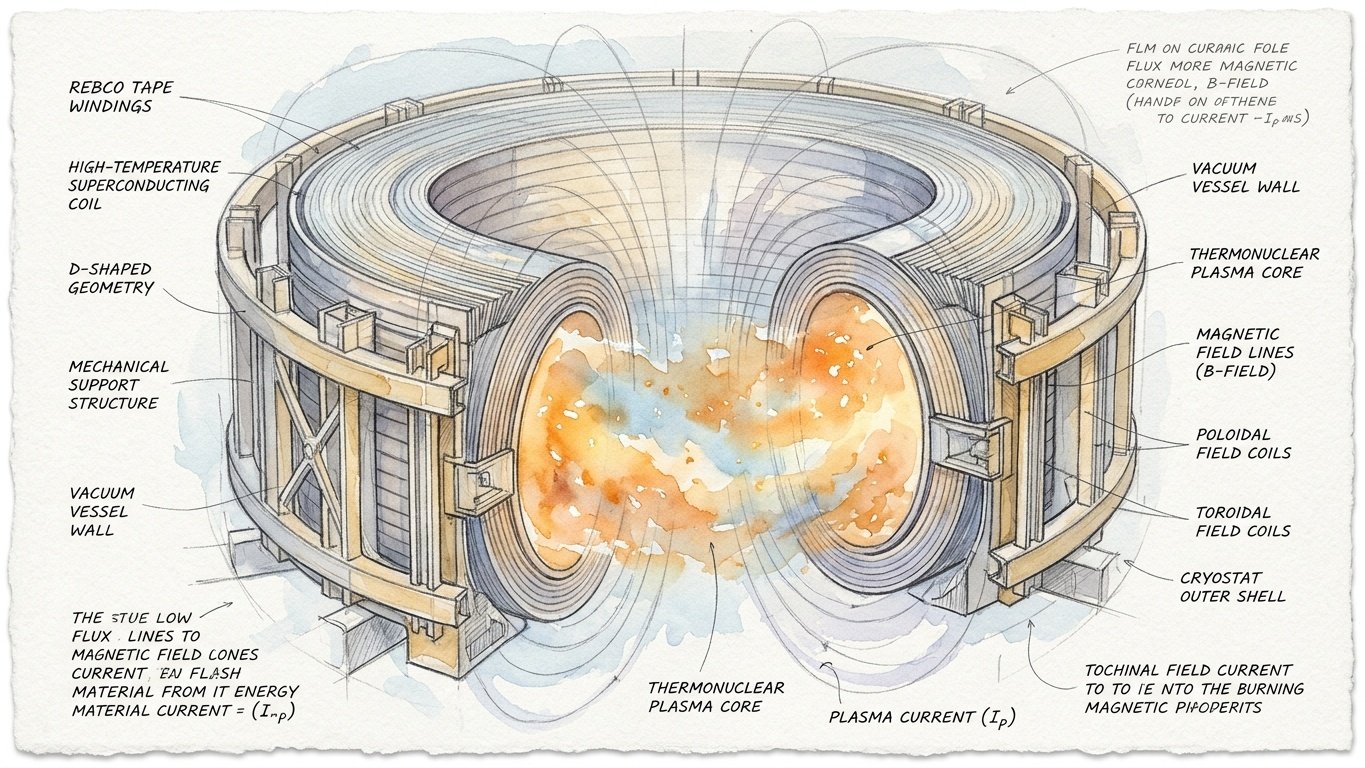
On September 5, 2021, inside a fortified testing bunker at the Massachusetts Institute of Technology’s Plasma Science and Fusion Center in Cambridge, an engineering team held its breath as electric current steadily ramped into a massive D-shaped coil. Layered with thousands of meters of razor-thin ceramic tape, the magnet was chilled to twenty Kelvin. As the power supplies surged past forty thousand amperes, the magnetic field at the coil’s apex breached twelve, fifteen, eighteen, and finally crossed twenty Tesla. Storing more than one hundred megajoules of magnetic energy, the magnet sustained a field strength more than four hundred thousand times greater than the magnetic field of Earth. That twenty-Tesla milestone dismantled a sixty-year orthodoxy in nuclear fusion physics: it proved that the quest for net fusion energy did not require cathedral-sized, multi-billion-dollar behemoths, but could be captured inside compact, high-field tokamaks engineered from high-temperature superconductors.
1. The Tyranny of Scale – The Fusion Scaling Law and B to the Fourth
For more than half a century, the road toward magnetic confinement fusion was defined by an escalating race toward sheer physical size. To achieve net fusion energy—where the thermonuclear power produced by a plasma exceeds the external heating power injected to sustain it (Q > 1)—a burning plasma must satisfy the Lawson criterion. The triple product of plasma temperature T, plasma ion density n, and energy confinement time tau_E must exceed the critical Lawson triple product for deuterium-tritium ignition.
In a magnetic bottle such as a tokamak, high-energy plasma particles are trapped along helical magnetic field lines created by the combination of external toroidal field coils, poloidal field coils, and an intense toroidal plasma current. However, heat continuously escapes across these magnetic field lines through turbulent transport, drift-wave instabilities, and collisional diffusion. Historically, the only reliable mechanism to increase energy confinement time tau_E was to make the plasma physically larger. The further turbulent heat eddies had to travel from the superheated core to the cold vacuum vessel walls, the longer the heat remained trapped.
This empirical scaling relationship reached its zenith in the design of the International Thermonuclear Experimental Reactor (ITER), currently under construction in Cadarache, France. To reach a scientific power gain of Q = 10 (producing 500 megawatts of thermal fusion power from 50 megawatts of input heating), ITER was engineered with an astronomical physical footprint: a major radius R of 6.2 meters, a minor radius a of 2.0 meters, a plasma volume of 840 cubic meters, and a total machine weight exceeding 23,000 metric tons. ITER stands as one of the most complex, expensive, and protracted engineering endeavors in human history.
Yet hidden deep within the foundational magnetohydrodynamic (MHD) equations governing tokamak physics lies an alternative, dramatically steeper lever: the magnetic field strength B. The maximum pressure P of a stably confined plasma is strictly constrained by the Troyon beta limit.
where β represents the ratio of plasma kinetic pressure to magnetic pressure, mu_0 is the permeability of free space, beta_N is the normalized beta limit (an empirical stability parameter), I_p is plasma current, and a is the minor radius. This relation demonstrates that the maximum permissible plasma pressure scales quadratically with the magnetic field.
Because the rate of deuterium-tritium thermonuclear fusion reactions per unit volume is proportional to the square of the plasma density (and hence the square of the plasma pressure at optimal temperatures around 15 keV), the volumetric fusion power density p_fusion scales with the fourth power of the magnetic field strength.
This fourth-power scaling law represents an astonishing mathematical lever in applied physics. If the on-axis magnetic field strength of a tokamak can be doubled—say, from 5.3 Tesla (the baseline toroidal field of ITER) to 10.6 Tesla—the volumetric fusion power density increases not by two, but by sixteen-fold. Alternatively, for a target total fusion power output, doubling the magnetic field allows the physical volume of the tokamak to be slashed by a factor of roughly forty to sixty.
Furthermore, theoretical and empirical confinement scaling laws (such as ITER98y2) indicate that the fusion triple product scales strongly with magnetic field strength.
A high-field compact tokamak with a modest major radius of 1.85 meters—such as the SPARC tokamak designed by CFS and MIT—operating with a toroidal field of 12.2 Tesla on-axis (derived from a 20-Tesla peak field at the magnet coil surface) can achieve the exact same energy confinement performance and thermonuclear gain (Q > 10) as ITER, while occupying less than 2% of ITER’s physical volume.
2. The Low-Temperature Ceiling – Why Classical Superconductors Stalled
If the physics of high magnetic fields was understood for decades, why was ITER designed as a gargantuan low-field machine? The answer lies in the intrinsic material limitations of twentieth-century low-temperature superconductors (LTS).
To produce the massive, steady-state magnetic fields required for fusion without consuming hundreds of megawatts of electrical power in resistive heating, tokamak coils must be superconducting: exhibiting zero electrical resistance. For sixty years, the undisputed workhorses of applied superconductivity were ductile niobium-titanium (NbTi) and brittle intermetallic tri-niobium tin (Nb_3Sn).
Superconductivity in any material is strictly bounded by a three-dimensional thermodynamic phase boundary defined by three interdependent parameters: the critical temperature T_c, the critical current density J_c, and the upper critical magnetic field B_c2. If a material breaches any of these three operational limits, the superconducting state is destroyed, and the material instantly “quenches,” reverting to a normal resistive conductor.
For niobium-titanium, the critical temperature is a modest 9.2 Kelvin, and its upper critical field at absolute zero is roughly 14 Tesla. In practice, when cooled by liquid helium to 4.2 Kelvin, NbTi cannot operate safely in magnetic fields exceeding 8 Tesla. Tri-niobium tin (Nb_3Sn) pushed the thermodynamic boundary further: with a critical temperature of 18.3 Kelvin, Nb_3Sn possesses an upper critical field B_c2 of roughly 28 Tesla at absolute zero. However, under realistic engineering conditions at 4.2 Kelvin, its critical current density plummets precipitously as magnetic fields approach 12 to 13 Tesla.
Moreover, Nb_3Sn is an exceptionally brittle, strain-sensitive A15 intermetallic compound. It cannot be wound into coils after heat treatment without fracturing its delicate crystalline grain structure. Superconducting magnets for ITER had to be manufactured via an agonizing “wind-and-react” process: pristine strands of copper, niobium, and tin were braided into massive “cable-in-conduit conductors” (CICC), wound into gigantic D-shaped geometries, and subsequently baked inside enormous vacuum furnaces at 650°C for hundreds of hours to synthesize the Nb_3Sn phase in situ. Once reacted, even a microscopic mechanical strain of 0.5% would permanently degrade the superconductor’s critical current.
Constrained by the physical ceiling of Nb_3Sn, the engineering team designing ITER faced an insurmountable physical boundary: the peak magnetic field at the superconductor surface could not exceed 11.8 Tesla. When geometric divergence and 1/R field decay between the inner coil leg and the plasma center are factored in, an 11.8-Tesla peak field at the coil yielded a maximum on-axis toroidal field of just 5.3 Tesla at the plasma core. Under the tyranny of B⁴, ITER had no mathematical choice: to reach net energy, it had to be colossal.
3. The REBCO Revolution – Crystallography of Rare-Earth Cuprates
The material breakthrough that emancipated fusion from the low-temperature ceiling originated in the late 1980s with the discovery of high-temperature cuprate superconductors by Georg Bednorz and K. Alex Müller, followed rapidly by the synthesis of yttrium barium copper oxide (YBa_2Cu_3O_7-delta}, or YBCO) by Ching-Wu Chu and Maw-Kuen Wu.
Known collectively as REBCO (Rare-Earth Barium Copper Oxide, where the rare-earth element can be yttrium, gadolinium, samarium, or europium), these materials belong to a class of perovskite-derived ceramic copper oxides. In these layered crystals, superconductivity originates within two-dimensional copper-oxygen (CuO_2) planes, separated by charge-reservoir layers containing barium, rare-earth cations, and variable oxygen vacancies (delta).
The fundamental properties of REBCO shocked the solid-state physics world. First, its critical temperature T_c exceeded 92 Kelvin—shattering the historic liquid-nitrogen barrier (77 K). But for high-field fusion engineering, an even more astounding discovery lay in its upper critical magnetic field: whereas Nb_3Sn collapsed at 28 Tesla, REBCO’s upper critical field B_c2 at low temperatures was estimated to exceed an astonishing 100 Tesla—well beyond the mechanical destruction threshold of any engineering structural alloy on Earth.
Furthermore, when cooled to intermediate cryogenic temperatures between 10 K and 20 K (easily achieved using closed-cycle gaseous helium or liquid hydrogen refrigeration), REBCO maintains immense critical current densities (J_c > 1,000 A/mm²) even when immersed in background magnetic fields exceeding 20, 30, and even 40 Tesla. Unlike Nb_3Sn, whose current carrying capacity dies a steep death beyond 12 Tesla, REBCO exhibits an almost flat current-field response in the 15-to-25 Tesla domain.
However, turning a brittle, anisotropic ceramic into thousands of kilometers of flexible, high-current commercial wire required thirty years of intense materials engineering. The central obstacle was the “weak-link” problem. In ceramic cuprates, the superconducting coherence length—the physical distance over which Cooper pairs remain correlated—is exceptionally short, typically less than 1.5 nanometers. Consequently, high-angle grain boundaries (where crystalline grains are misaligned by more than 3 to 5 degrees) act as catastrophic Josephson junctions that scatter electrons and choke off macroscopic supercurrent flow.
To solve the weak-link dilemma, the advanced manufacturing industry invented the “coated conductor”—a multi-layered composite tape engineered with nanometer precision. Rather than a monolithic wire, modern REBCO coated conductors are manufactured as thin, flexible metal ribbons typically 4 or 12 millimeters wide and only 50 to 100 micrometers thick:
- Structural Substrate: A high-strength, non-magnetic nickel-chromium superalloy tape, such as Hastelloy C-276, roughly 30 to 50 micrometers thick, provides the tensile mechanical backbone of the tape.
- Buffer Architecture: Because Hastelloy is polycrystalline and chemically reactive with cuprates, a series of nanoscale oxide buffer layers (such as Y_2O₃, aluminum_2O₃, and CeO_2) are deposited via Ion Beam Assisted Deposition (IBAD) or Magnetron Sputtering. The IBAD process aligns the buffer crystal grains with atomic precision, creating an artificial single-crystal template across miles of tape.
- Epitaxial REBCO Layer: A single-crystal-like thin film of REBCO (such as GdBa_2Cu_3O_7-delta}), typically 1.0 to 2.0 micrometers thick, is deposited epitaxially via Metal-Organic Chemical Vapor Deposition (MOCVD) or Pulsed Laser Deposition (PLD). With crystalline grains aligned to within 2 degrees across kilometer lengths, supercurrents flow uninhibited across grain boundaries.
- Artificial Pinning Centers (APCs): To prevent magnetic flux vortices from moving under the intense Lorentz forces generated in high-field magnets (which causes resistive dissipation), nanometer-sized columns of non-superconducting barium zirconate (BaZrO_3) or barium hafnate (BaHfO_3) are engineered into the REBCO matrix. These artificial pinning centers anchor magnetic flux lines, dramatically boosting in-field critical currents.
- Stabilizer and Encapsulation: A thin protective silver capping layer (1 to 2 µm) is sputtered over the REBCO film, followed by electroplating a continuous copper jacket (typically 20 to 50 µm) to provide an electrical bypass shunt and thermal heat sink in the event of localized quenching.
4. The MIT-CFS Twenty-Tesla Milestone – The SPARC Toroidal Field Model Coil
By 2018, commercial coated-conductor manufacturers (such as SuperPower, Shanghai Superconductor, SuNAM, and THEVA) were producing high-performance REBCO tape in industrial quantities. Recognizing that REBCO had crossed the threshold of industrial maturity, researchers at the MIT Plasma Science and Fusion Center, led by Dennis Whyte, Martin Greenwald, and Zach Hartwig, spun out Commonwealth Fusion Systems (CFS) with a singular mission: prove that REBCO could be wound into a full-scale, high-field fusion magnet.
The resulting demonstrator was the Toroidal Field Model Coil (TFMC)—a D-shaped magnet measuring roughly 3 meters tall and 2 meters wide, scaled to be a direct 1:1 prototype of the toroidal field coils required for the SPARC tokamak. The TFMC was wound from nearly 300 kilometers of 4-millimeter REBCO tape, arranged into 16 nested, pancake-wound coil modules.
The monumental engineering hurdle faced by the MIT-CFS team was not merely the superconductor itself, but the colossal Lorentz forces generated by high magnetic fields. The magnetic pressure P_m exerted outward by a magnetic field is given by.
At an on-coil peak field of 20 Tesla, the magnetic pressure reaches an astounding 160 megapascals—equivalent to roughly 1,600 atmospheres of pressure. In the TFMC, this magnetic pressure generated a net bursting “hoop force” exceeding 40 meganewtons (approximately 9 million pounds of force), attempting to rip the D-shaped coil apart from the inside out, while the centering forces driving the coil toward the central machine axis exceeded 30 meganewtons.
To resist these immense forces without crushing the delicate REBCO ceramic films, the MIT-CFS team discarded traditional resin-impregnated epoxy insulation. Instead, they invented a novel, high-strength structural architecture. The REBCO tapes were stacked inside high-precision helical copper-alloy channels, backed by thick structural plates of cryogenic-grade 316LN stainless steel and high-manganese austenitic steels. The magnet utilized a “no-insulation” or “partial-insulation” winding methodology: by eliminating turn-to-turn electrical insulation, current was allowed to bypass localized hot-spots through adjacent turns during transient disturbances, dramatically enhancing thermal and electrical stability.
On September 5, 2021, the TFMC was submerged in a cryogenic vacuum test chamber, cooled to 20 Kelvin via a closed-loop forced-flow supercritical helium refrigeration loop, and energized. Over several hours, the electric current was ramped in precise increments: 10,000 amperes, 25,000 amperes, and finally 40,500 amperes. At 40.5 kA, hall probe sensor arrays recorded a steady-state magnetic field of 20.1 Tesla at the coil winding pack.
The magnet held the 20-Tesla field stably for hours, successfully withstanding the titanic 40-meganewton mechanical load with microscopic structural deflections perfectly matching predictive finite-element mechanical simulations. When the team deliberately discharged the coil to test its energy extraction system, the 100 megajoules of stored magnetic energy were dumped safely into external resistive dump banks within seconds without damage. The 20-Tesla demo proved definitively that REBCO magnets could survive the brutal electrodynamic and mechanical environment of a burning-plasma fusion reactor.
5. SPARC versus ITER – The Radical Downsizing of the Fusion Core
The direct consequence of the 20-Tesla magnet breakthrough is a radical, paradigm-shifting reduction in the size, mass, cost, and complexity of fusion reactors. To understand the magnitude of this transformation, one need only contrast the engineering specifications of ITER with SPARC:
| Engineering Parameter | ITER (Cadarchae, France) | SPARC (Devens, Massachusetts) | Factor / Reduction Ratio |
|---|---|---|---|
| Superconductor Technology | Low-Temp (Nb_3Sn, NbTi) | High-Temp (REBCO Coated Tape) | Generational Leap |
| Operating Magnet Temp | 4.2 Kelvin (Liquid Helium) | ~20 Kelvin (Supercritical He) | 5x Higher Cryo Temperature |
| Peak Field at Coil | 11.8 Tesla | 20.1 Tesla | 1.7x Higher Field |
| On-Axis Field in Plasma | 5.3 Tesla | 12.2 Tesla | 2.3x Higher Toroidal Field |
| Major Radius (R) | 6.2 meters | 1.85 meters | 3.3x Shorter Radius |
| Minor Radius (a) | 2.0 meters | 0.57 meters | 3.5x Narrower Plasma |
| Plasma Volume | 840 cubic meters | ~14 cubic meters | 60x Volume Reduction |
| Total Machine Weight | ~23,000 metric tons | ~600 metric tons | ~40x Weight Reduction |
| Target Scientific Gain (Q) | Q approximately 10 (500 MW / 50 MW) | Q > 10 (140 MW / 14 MW) | Equivalent Net Energy Gain |
| Project Construction Cost | $30+ Billion (estimated) | ~1.5 – $2.0 Billion | ~15x Capital Reduction |
This comparison reveals the breathtaking power of B⁴. SPARC achieves the exact same scientific performance threshold—producing over 140 megawatts of thermal fusion power while consuming roughly 14 megawatts of external auxiliary heating, achieving Q > 10—inside a vacuum chamber that is sixty times smaller by volume than ITER. While ITER requires a tokamak pit deep enough to swallow the Arc de Triomphe, SPARC fits comfortably inside a modest two-story industrial high-bay building on a corporate campus in Devens, Massachusetts.
This dimensional reduction alters the entire development velocity of nuclear fusion. In physics, size dictates capital requirements, supply chain bottlenecks, and assembly schedules. A machine that weighs 23,000 tons requires decades to fund, approve, manufacture, and assemble: a single damaged component can derail an international coalition for years. Conversely, a 600-ton machine can be fabricated in standard precision manufacturing facilities, transported on commercial flatbed railcars, assembled in months, and iterated rapidly. If an operational failure occurs, components can be pulled, analyzed, re-engineered, and replaced on corporate timelines rather than diplomatic cycles.
6. Cryogenic Thermodynamics at Twenty Kelvin – The Carnot Advantage
While the astronomical magnetic field capability of REBCO captures headlines, its elevated operating temperature confers an equally profound thermodynamic advantage on balance-of-plant engineering: the relief of the cryogenic refrigeration penalty.
Low-temperature superconducting magnets wound from Nb_3Sn or NbTi must operate at approximately 4.2 Kelvin, submerged in liquid helium. The theoretical minimum electrical power W_refrig required to extract heat Q_c from a low-temperature cold reservoir and reject it into an ambient room-temperature reservoir (roughly 300 Kelvin) is governed by the Carnot refrigeration coefficient of performance.
For a traditional low-temperature magnet operating near absolute zero at 4.2 Kelvin, extracting heat requires immense cryogenic power: the thermodynamic Carnot penalty means that every single watt of heat leaking into the magnet requires hundreds of watts of electrical power at room temperature to pump out.
Inverting this coefficient reveals that the theoretical minimum electrical work required to remove one single watt of heat at 4.2 Kelvin is approximately 70 watts of room-temperature electricity. When accounting for real-world mechanical compressor losses, turbine expander friction, and cryostat thermal leaks, modern industrial liquid helium cryogenic plants operate at a “wall-plug” efficiency of roughly 25% to 30% of the Carnot limit. Consequently, removing one single watt of heat at 4.2 Kelvin consumes roughly 250 to 300 watts of electrical power from the grid.
In a burning-plasma fusion reactor, heat deposition into the superconducting coils is an unavoidable, constant reality. Energetic 14.1-MeV fusion neutrons stream outward through the vacuum vessel and neutron shielding. Even with thick tungsten and borated water shields, gigawatts of fusion neutrons deposit tens of kilowatts of parasitic nuclear heating directly into the magnet windings. Furthermore, nuclear radiation generates high levels of resistive heating in joints and stabilizes eddy currents during rapid plasma shaping maneuvers. If 20 kilowatts of heat are deposited into a 4.2 K magnet pack, the external cryogenic refrigeration plant must consume between 5 and 6 megawatts of continuous electrical power purely to keep the magnets from quenching.
By contrast, high-temperature REBCO magnets can operate comfortably at 20 Kelvin, chilled by forced-flow supercritical helium gas or liquid hydrogen.
The theoretical refrigeration efficiency improves by a factor of five. In practice, cryo-refrigeration plants operating at 20 Kelvin achieve wall-plug efficiencies where only 35 to 45 watts of electrical power are required per watt of heat extracted at 20 K—an eight-fold reduction in parasitic electrical consumption compared to 4.2 Kelvin systems.
This thermodynamic relief fundamentally transforms the balance of plant. The gigantic, capital-intensive liquid helium liquefaction buildings, helium recovery systems, and vacuum super-insulated transfer lines that dominate the ITER site can be replaced by compact, closed-loop gaseous helium chillers. In a commercial fusion power plant, this Carnot advantage directly boosts the net electrical efficiency (Q_electric) delivered to the transmission grid.
7. Quench Dynamics and Protection – The Low Propagation Velocity Hazard
Despite their extraordinary virtues, REBCO coated conductors present a unique, terrifying engineering hazard that has destroyed dozens of high-field research coils: the quench detection paradox.
In traditional low-temperature superconductors like NbTi, the normal zone propagation velocity (NZPV)—the physical speed at which a localized resistive “hot spot” spreads along the wire—is very fast, typically between 10 and 100 meters per second. This rapid propagation is caused by the minuscule heat capacity of metals at 4.2 Kelvin: the moment a tiny region of NbTi quenches, Joule heating (I² R) instantly raises the local temperature, which triggers thermal diffusion that sweeps rapidly down the wire. Because the quench spreads across meters of wire within milliseconds, it generates a substantial, easily detectable voltage rise (typically hundreds of millivolts) across the coil. Fast digital instrumentation detects this voltage spike, triggers high-speed circuit breakers, and dumps the coil’s magnetic energy into external resistive resistors before the hot spot can melt the conductor.
In high-temperature superconductors operating at 20 Kelvin, the physics is completely inverted. The volumetric heat capacity of solid materials (governed by the Debye T³ law) is roughly one to two orders of magnitude higher at 20 K than at 4.2 K. Consequently, when a microscopic defect in a REBCO tape reverts to the normal resistive state, the localized Joule heat is absorbed by the high specific heat of the surrounding metal matrix without rapidly propagating outward.
As a result, the normal zone propagation velocity in REBCO is agonizingly slow—typically measured in millimeters or centimeters per second, roughly three orders of magnitude slower than in LTS conductors. A tiny, localized hot spot can remain pinned to a 2-millimeter section of tape, absorbing immense Joule heating while the rest of the coil remains perfectly superconducting. Because the normal zone is only millimeters wide, the total resistive voltage drop across the entire coil may be only a few microvolts—well below the noise floor of digital voltage meters.
Undetected, this microscopic hot spot can heat from 20 K to over 1,000°C within fractions of a second, melting the copper stabilizer, vaporizing the REBCO film, and initiating an explosive arc-fault that tears the magnet apart under high-voltage discharge. This low NZPV characteristic makes classical voltage-tap quench detection nearly useless in high-temperature superconducting coils.
To solve the quench detection crisis, fusion magnet designers have developed radical sensing and structural technologies:
- Distributed Fiber-Optic Sensing: Optical fibers inscribed with Fiber Bragg Gratings (FBG) or Rayleigh backscattering sensors are co-wound continuously alongside the REBCO tapes. By analyzing the wavelength shift of laser pulses reflected through the fiber, the system detects microscopic temperature spikes (delta T < 1 K) or localized strain concentrations along the entire length of the conductor in real time, pinpointing hot spots before voltage drops emerge.
- Non-Insulated and Metal-Insulated Windings: By deliberately omitting organic turn-to-turn electrical insulation (such as Kapton or polyimide) and winding bare metal tapes with thin metallic inter-layers (such as stainless steel or brass), the coil gains intrinsic self-protecting capability. When a localized section of REBCO experiences a hot-spot transition, the local electrical resistance rises sharply. Because there is no insulating barrier between turns, the electrical current simply bifurcates, flowing radially across the metallic tape turns around the hot spot, preventing excessive localized Joule heating and rendering the coil immune to catastrophic thermal burnout.
- Acoustic and RF Emission Monitoring: Microscopic mechanical slip events and early-stage micro-arcing emit high-frequency acoustic emissions and radio-frequency noise that propagate through the structural steel casing, providing millisecond-level precursors to thermal transitions.
8. Demountable Coils and Reactor Maintenance
One of the darkest structural problems in classical tokamak engineering is the “donut-hole” topology. Because the toroidal field coils of a tokamak wrap completely around the toroidal vacuum vessel, the vacuum vessel and internal blanket components are permanently trapped inside a cage of solid superconducting magnets.
In a commercial fusion power plant generating hundreds of megawatts of electricity, the internal “first wall” and tritium-breeding blankets will be exposed to a relentless bombardment of 14.1-MeV fusion neutrons. Over time, neutron radiation induces atom displacements (measured in displacements per atom, or dpa), embrittling structural steels, swelling materials, and transmuting elements. Engineering estimates indicate that the internal first wall and divertor cassettes must be physically removed, discarded, and replaced every three to five years to sustain commercial power plant operations.
In a low-temperature Nb_3Sn tokamak like ITER, the magnets cannot be disassembled. Replacing an internal vacuum vessel component requires microscopic robotic snake-arms operating through narrow access ports over months of tedious remote-handling operations. If a superconducting magnet coil fails, the entire reactor must be dismantled from the ground up—a multi-year outage that would bankrupt any commercial utility.
REBCO high-temperature superconductors introduce a transformative solution: demountable magnet coils. Because REBCO tapes are thin, flat, and robust under mechanical compression, engineers can design toroidal field coils with bolted, demountable mechanical joints. The top leg of each D-shaped magnet can be physically unbolted and lifted away using an overhead crane, opening the entire top of the tokamak like a lid.
With the magnets demounted, the internal vacuum vessel, vacuum divertor, and breeding blankets can be extracted vertically in massive modular sections in a matter of days. A fresh, pre-tested blanket assembly can be lowered into place, the demountable magnet legs bolted back together with robotic torque wrenches, the joints chilled, and the reactor returned to commercial electrical generation within weeks. This demountability transforms fusion from an unmaintainable laboratory apparatus into a practical, serviceable utility asset.
9. Alternative High-Field Geometries – Spherical Tokamaks and Advanced Stellarators
While Commonwealth Fusion Systems and SPARC pursue the classical D-shaped aspect-ratio tokamak, the commercialization of REBCO magnets has unleashed an explosion of innovative alternative magnetic confinement architectures across the global fusion startup landscape.
Foremost among these alternatives is the Spherical Tokamak, championed by British firm Tokamak Energy. A spherical tokamak reduces the aspect ratio of the torus from roughly 3.0 down to 1.5, transforming the traditional donut into a cored apple geometry. Spherical tokamaks possess inherently superior plasma stability: they can operate at significantly higher plasma beta (β), meaning they can confine higher-pressure plasmas for a given magnetic field.
Historically, the fatal flaw of spherical tokamaks was the central column. Because the “hole in the donut” is exceedingly narrow in a spherical geometry, there was simply no physical room to install thick nuclear shielding, a central solenoid, and bulky low-temperature superconducting magnets. The central column had to be wound from unshielded copper, which melted under continuous high-power operation.
REBCO tapes completely alter this geometric equation. Because REBCO carries immense current densities in microscopic cross-sections, Tokamak Energy can wind ultra-compact, high-field central columns that fit through the narrow throat of a spherical tokamak while delivering toroidal fields exceeding 10 Tesla at the plasma edge. Their flagship prototype, the ST40, demonstrated plasma ion temperatures of 100 million Kelvin (8.6 keV) in a device no larger than a family minivan, paving the way for compact, high-beta commercial power plants.
In parallel, the stellarator community is experiencing a renaissance driven by REBCO. Unlike tokamaks, which generate their poloidal magnetic fields by driving an internal electric current through the plasma itself (rendering them vulnerable to violent, unpredictable disruptions when the plasma current collapses), stellarators produce their entire confining 3D magnetic cage using complex, twisted external magnet coils. A stellarator is intrinsically steady-state and immune to current disruptions.
However, stellarator coils feature intricate, non-planar, saddle-shaped three-dimensional geometries that were virtually impossible to wind from brittle Nb_3Sn conductors without causing micro-fractures. Startups such as Proxima Fusion (a spin-out from the Max Planck Institute for Plasma Physics) and Type One Energy are combining automated robotic tape winding, 3D additive metal printing, and REBCO conductors to manufacture high-field quasi-isodynamic stellarators. By pairing the steady-state, disruption-free physics of stellarators with the intense magnetic fields of REBCO, these teams aim to bypass the plasma control challenges of tokamaks entirely.
10. The Economic Pathway to the Grid – The ARC Power Plant
SPARC is designed as a scientific demonstrator: its purpose is to cross the Rubicon of Q > 10 and retire all physics risks associated with high-field burning plasmas. But the ultimate objective of Commonwealth Fusion Systems and the fusion community is electricity on the grid.
The commercial successor to SPARC is the ARC power plant (Affordable, Robust, Compact). Engineered to produce roughly 400 to 500 megawatts of thermal energy and deliver approximately 200 megawatts of net commercial electricity to the transmission grid, ARC integrates the 20-Tesla REBCO magnet architecture with advanced balance-of-plant systems:
- Liquid Immersion Blanket: Rather than utilizing complex solid ceramic pebble beds for neutron moderation and tritium breeding, ARC submerges the entire vacuum vessel inside a tank of molten FLiBe (a liquid fluoride salt mixture of lithium fluoride and beryllium fluoride, LiF-BeF_2). The molten FLiBe serves simultaneously as a radiation shield, a high-temperature heat transfer fluid (operating at 600°C to 700°C), and an ultra-efficient tritium breeding medium with a tritium breeding ratio (TBR) comfortably exceeding 1.1.
- Advanced Supercritical CO2 Turbines: The high operating temperature of the molten FLiBe salt allows ARC to couple directly to a high-efficiency closed-loop supercritical carbon dioxide (sCO_2) Brayton cycle power conversion system, achieving thermal-to-electric conversion efficiencies exceeding 45%, vastly outstripping traditional steam turbines.
- Modular Capital Economics: By capping total reactor thermal output at 500 MWth, the capital expenditure required to build an ARC power plant is estimated between 3 billion and $5 billion—a financial scale that can be underwritten by commercial infrastructure funds, public-private utility partnerships, and sovereign wealth entities without bankrupting national budgets.
12. Divertor Heat Exhaust and the Power Density Challenge
While shrinking a tokamak core sixty-fold delivers unprecedented gains in capital efficiency and construction velocity, it introduces an excruciating thermal engineering challenge at the plasma boundary. Thermonuclear fusion power scales with B⁴, but the surface area of the vacuum vessel confining that power scales only with R². Consequently, in a compact, high-field tokamak like SPARC or ARC, the heat exhaust power density per unit area of the divertor target plates reaches values that rival the surface of the Sun.
In any magnetic confinement device, the outermost closed magnetic flux surface is defined by the “separatrix.” Outside this boundary, magnetic field lines are open, guiding escaping heat, helium ash, and unburnt deuterium-tritium fuel into an exhaust channel known as the scrape-off layer (SOL). The scrape-off layer channels this blistering heat flux toward the divertor—a dedicated exhaust target assembly positioned at the bottom (and sometimes top) of the vacuum chamber.
The width of the scrape-off layer heat-flux channel at the outboard midplane, denoted by lambda_q, is notoriously narrow. Empirical scaling laws derived across international tokamaks (notably the Goldston heuristic drift model) demonstrate that lambda_q scales inversely with the poloidal magnetic field.
In a high-field compact tokamak with high plasma current and intense poloidal fields, lambda_q shrinks to less than one single millimeter. Funneling dozens or hundreds of megawatts of continuous thermal exhaust through a millimeter-wide ribbon of plasma would result in an unmitigated parallel heat flux exceeding several gigawatts per square meter. If this raw heat flux struck a solid metallic target plate directly, any known material on Earth—including tungsten, diamond, or carbon composites—would instantly vaporize, melting the divertor and destroying the vacuum integrity of the reactor within seconds.
To survive this thermal assault, fusion physicists and engineers employ advanced magnetic and atomic physics solutions:
- Magnetic Flux Expansion: By shaping the external divertor magnetic coils, the magnetic field lines are intentionally spread apart as they approach the divertor strike plates. This geometric expanding reduces the local field line incidence angle to less than one degree relative to the plate surface, distributing the parallel heat flux across a vastly broader surface area.
- Advanced Divertor Topologies: Rather than a simple single-null divertor, advanced geometries such as the “Super-X Divertor” (pioneered on the MAST-Upgrade spherical tokamak) and the “Snowflake Divertor” utilize extra poloidal coils to dramatically lengthen the magnetic connection length between the plasma midplane and the target plates. This extra transit length gives escaping particles more time to dissipate energy via non-destructive radiation before striking the wall.
- Radiative Impurity Seeding and the Detached Plasma Regime: The ultimate defense is plasma detachment. By puffing precise quantities of noble gas impurities—specifically neon, argon, or nitrogen—into the divertor region, the local plasma is cooled through atomic line radiation. The injected impurity atoms absorb kinetic energy from plasma electrons and re-radiate it isotropically as harmless ultraviolet light across the entire chamber volume.
When impurity radiation lowers the divertor plasma electron temperature below 5 electron-volts, volume recombination occurs: ions and electrons recombine into neutral atoms, creating a dense, protective cushion of cold gas in front of the target plates. In this “fully detached” regime, the peak steady-state heat flux striking the solid tungsten divertor plates is suppressed below the strict engineering limit of 10 megawatts per square meter, enabling steady-state operation without material erosion.
13. Neutron Irradiation and Superconductor Lifetimes
In a deuterium-tritium fusion reaction, 80% of the liberated thermonuclear energy is carried by highly energetic neutrons, each possessing a kinetic energy of 14.1 MeV. Unlike charged alpha particles (helium nuclei), which are trapped by the magnetic field and heat the core plasma, these neutral neutrons pass unimpeded through the magnetic cage, traversing the first wall and vacuum vessel to deposit their energy into the surrounding blankets and magnet structures.
For low-temperature superconductors like Nb_3Sn, neutron irradiation causes severe crystal lattice damage, displacing tin and niobium atoms from their crystallographic lattice sites. Beyond a cumulative neutron fluence of roughly thirty sextillion neutrons per square meter, the critical current density of Nb_3Sn degrades rapidly, setting a hard limit on the operational lifespan of unshielded coils.
The radiation resilience of REBCO coated conductors under high-energy neutron bombardment has been a subject of intense scientific investigation. Because REBCO thin films are deposited with pre-existing nanostructured defect arrays (artificial pinning centers) to trap magnetic flux vortices, early stages of low-dose neutron irradiation actually produce an unexpected, beneficial effect: fast neutrons knock atoms out of place, creating localized cascade damage and point defects that act as additional vortex pinning sites. In initial exposure phases, the in-field critical current of REBCO can actually increase by 10% to 20%.
However, under prolonged, intense neutron fluence exceeding forty sextillion neutrons per square meter, structural degradation dominates. Oxygen atoms are knocked out of the delicate two-dimensional CuO_2 superconducting planes, disrupting the electronic orbital hybridization essential for Cooper pair formation. Furthermore, the copper stabilizer layer undergoes transmutation and radiation-induced defect accumulation, increasing its electrical resistivity (known as residual resistivity ratio degradation, RRR fade) and compromising its ability to shunt electrical current during quench events.
To protect REBCO coils over a multi-decade power plant lifecycle, compact high-field tokamaks implement advanced composite radiation shielding. By utilizing layered combinations of tungsten carbide (WC) to attenuate fast neutrons through inelastic scattering, titanium diboride (TiB_2) to capture thermal neutrons, and hydrogen-rich metal hydrides (such as yttrium hydride, YH_x) for rapid neutron moderation, the required shield thickness can be reduced from meters to mere tens of centimeters. This dense, high-efficiency shielding ensures that the superconducting magnets can endure twenty years of full-power operation before requiring replacement or thermal annealing cycles.
14. High-Current Cable Architectures – VIPER, CORC, and Twisted Stacks
While an individual commercial REBCO coated conductor tape can carry between 100 and 300 amperes at 77 Kelvin in self-field, a commercial fusion tokamak magnet requires operating currents ranging from 20,000 to over 50,000 amperes at 20 Kelvin. Operating at such massive currents is essential to limit the total inductance of the magnet winding pack, keeping terminal operating voltages within manageable limits (below 5 to 10 kilovolts) during emergency energy dump cycles.
Consequently, hundreds of individual REBCO tapes must be bundled together into composite, high-current superconducting cables. However, bundling thin ceramic tapes into a flexible, mechanically compliant cable capable of operating in high transverse magnetic fields without experiencing catastrophic current imbalance or mechanical degradation is one of the most sophisticated challenges in modern magnetics. To solve this, superconducting engineers created three distinct high-current cable paradigms:
- VIPER (Vacuum-Pressure Impregnated, Insulated, Enabled by REBCO): Developed by Zach Hartwig and the MIT-CFS engineering team specifically for the SPARC TFMC magnet, the VIPER cable architecture stacks dozens of individual REBCO tapes inside an internal copper jacket with a central cooling channel. The stack is twisted along its longitudinal axis to achieve transposition—ensuring that every tape experiences the same average magnetic flux across its path. The entire assembly is swaged inside a high-strength structural jacket of copper and stainless steel, then vacuum-pressure impregnated with solder to create an exceptionally rigid, monolithic cable capable of resisting massive transverse crushing forces exceeding 600 megapascals.
- CORC (Conductor on Round Core): Invented by Danko van der Laan at Advanced Conductor Technologies, the CORC design winds multiple layers of narrow (typically 2-mm to 4-mm wide) REBCO tapes helically around a slender, highly flexible central metallic copper core at alternating winding angles. Because the tapes are wound helically, CORC cables can bend with astonishingly small radii (under 30 millimeters) without straining the delicate ceramic films beyond their 0.5% mechanical yield limit. CORC cables exhibit near-isotropic magnetic field response and can carry currents in excess of 10,000 amperes per cable, making them ideal for complex, tight-radii poloidal field coils and stellarator winding packs.
- TSTC (Twisted Stacked-Tape Conductor): Championed by Makoto Takayasu at MIT, the TSTC architecture stacks 20 to 60 REBCO tapes flat inside a slotted round copper profile. The entire copper profile is then twisted with a predetermined twist pitch (typically 100 to 200 mm) and drawn through a die. This twisted stack geometry minimizes inter-tape eddy-current coupling loops, drastically reducing alternating-current (AC) hysteresis losses when the magnet experiences rapid magnetic field variations during plasma startup, current ramp-up, and vertical displacement control maneuvers.
These advanced high-current cabling architectures allow raw commercial REBCO tape to be integrated into robust, industrial-scale conductors that behave electrodynamically like solid copper busbars with zero electrical resistance, providing the structural foundation upon which commercial compact fusion reactors will be built.
15. Conclusion – Igniting the Star in the Crucible of Silicon and Superconductor
For three generations, nuclear fusion was mocked as a perpetual mirage—a scientific dream forever thirty years away. That tragic delay was not a failure of theoretical plasma physics, but a consequence of material constraints. Plasma physicists were attempting to bottle the ferocious core of a star using twentieth-century low-temperature superconductors whose physics capped magnetic fields at the exact threshold where tokamaks were forced to become gargantuan.
The twenty-Tesla high-temperature superconducting magnet has broken that sixty-year stalemate. By harnessing the crystallographic perfection of rare-earth cuprate thin films and mastering the physics of extreme electromagnetic hoop stress, materials scientists and fusion engineers have unlocked the exponential lever of B⁴. The dawn of compact, high-field fusion proves that the solution to humanity’s greatest energy challenge does not demand machines the size of cathedrals, but the triumph of atomic-scale materials science over the brutal forces of the cosmos.