The Coffeehouse Diaspora: Cafés and the Making of Modern Jewish Culture
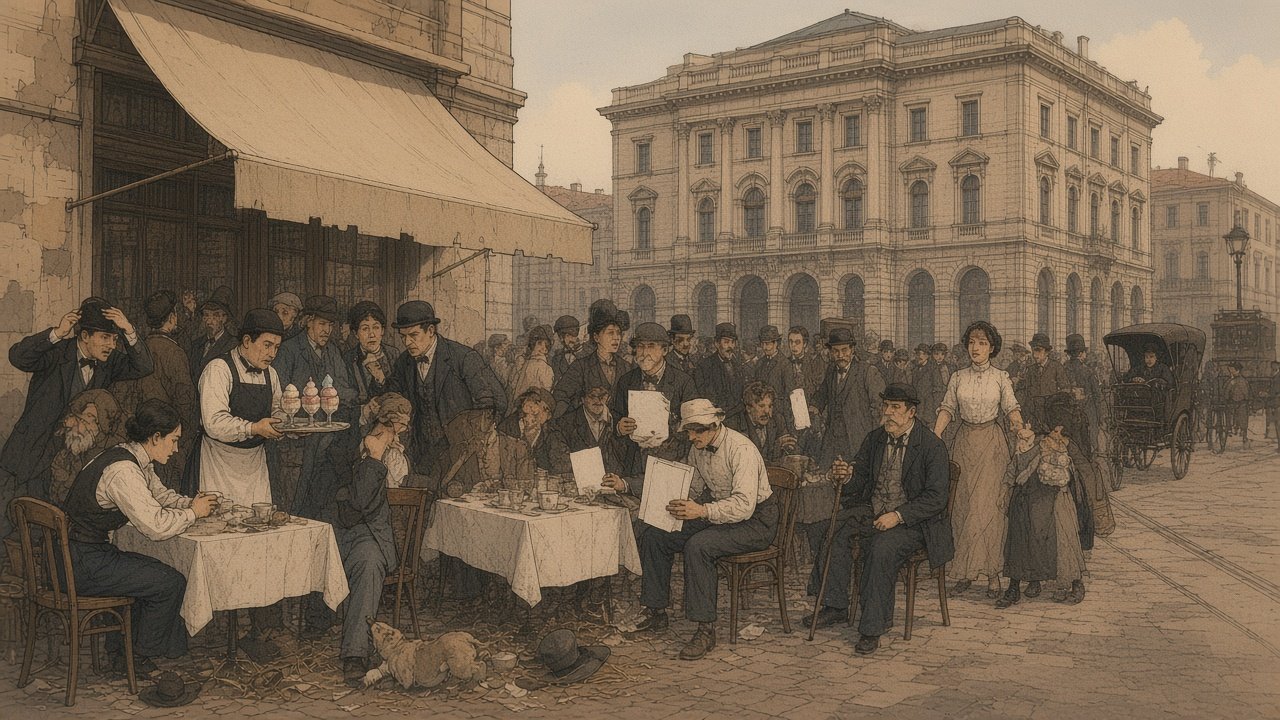
For roughly a century, between the revolutions of 1848 and the decades after the Second World War, a remarkable share of modern Jewish culture was talked into being across small marble tables. Poets drafted manifestos over a single glass of tea, editors recruited contributors between games of chess, playwrights cast their actors from the people at the next table, and refugees learned where to find work, lodgings and news from home. The places in which this happened were not synagogues, schools or party offices but cafés: Fanconi in Odessa, Kotik’s in Warsaw, the Arkaden and the Herrenhof in Vienna, the Romanisches Café in Berlin, the Café Royal on Second Avenue, Kassit on Dizengoff Street. Shachar M. Pinsker’s A Rich Brew: How Cafés Created Modern Jewish Culture, published by New York University Press in 2018, is the first book to treat these places together, as links in a single moving network rather than as local curiosities [1].
This essay follows Pinsker’s route through six cities, Odessa, Warsaw, Vienna, Berlin, New York and Tel Aviv–Jaffa, and sets his findings beside the wider scholarship on coffee, the coffeehouse and the Jewish metropolis. It begins with the early history of coffee among Jews and with the theoretical question of what kind of space a café is. It then visits each city in turn, paying attention to the owners and waiters as well as to the writers, to the quarrels as well as to the friendships, and to the few women who claimed a seat at tables built for men. It closes with Pinsker’s own question, which he says readers put to him again and again: where did all these cafés go, and why does nothing quite like them exist now? Earlier nekud.click essays on the Jews of Odessa, Warsaw, Tel Aviv and the great Jewish migration touch on some of these cafés in passing; here they are the subject.
1. A table in Lemberg
Pinsker opens with a young man stepping off a train. In 1907 Shmuel Yosef Czaczkes, a twenty-year-old from the Galician town of Buczacz, went to Lemberg (the Polish Lwów, today’s Lviv) to work on a short-lived Hebrew daily. The paper soon failed, but in the months he spent there he discovered the city’s cafés and the writers, politicians and students who sat in them. When he left home for good in the spring of 1908, bound for Ottoman Palestine, he went straight from the Lemberg station to a café to say goodbye to his friends, then on to Kraków and Vienna, where there were more coffeehouses and more acquaintances, and finally to the port of Jaffa. There he frequented Arab, German and Jewish cafés, published his first Hebrew stories and took the pen name Agnon. In 1912 he moved to Berlin, where he spent the First World War among Jewish intellectuals who also met over coffee, and in 1924 he returned to Palestine and settled in Jerusalem, a city whose cafés would soon fill with refugees from Germany and Austria [1].
Pinsker’s point is that Agnon’s itinerary was not exceptional. Almost every figure in his book moves between cities, sometimes for a season, sometimes for good, and in each new city looks for a café before looking for much else. Agnon himself explained why in his great novel תמול שלשום (Tmol shilshom, “Only Yesterday”), written in Jerusalem in the 1940s. When his naïve hero Yitzhak Kumer reaches Lemberg, he hurries to the coffeehouse, and the narrator offers a simple sociology: in a small town you step outside and meet your friend at once, but in a big city weeks can pass without an encounter, so people fix a place in a café where they can be found at set hours [2]. Kumer, who had imagined this café as “the most exquisite place”, finds gilded chandeliers, gleaming marble, plush chairs, newspapers and waiters who carry themselves like dignitaries.
The passage captures in miniature two things that recur throughout Pinsker’s book. The first is the café as a solution to the anonymity of the modern city: a fixed point at which a migrant can be found, introduced, employed or consoled. The second is the café as a kind of secular temple, glamorous and slightly unreal, offering a substitute for something the migrant has left behind and at the same time an entry into something he has never known. Both are present in Kumer’s wide-eyed reaction, and both are treated by Agnon with a gentle irony that the older novelist, writing after the destruction of the world he describes, could hardly avoid.
From this opening Pinsker draws his governing image. Cafés, he argues, were way stations on a “silk road” of modern Jewish creativity. He is careful to note that the Silk Road itself is a modern coinage: the German geographer Ferdinand von Richthofen gave the name in 1877 to an ancient network of trade routes, and the idea gained wide currency only in the twentieth century, at a moment when railways, telegraphs and steamships were binding the world together. The metaphor is therefore less about antiquity than about a modern system of nodes and routes along which goods, people and ideas travelled. Applied to Jewish history, it shifts attention away from arrival and settlement, the usual frame of immigration history, and towards movement itself: the itineraries of people, and the links they forged between places [1].
That shift is the book’s most important methodological claim. Historians, as Pinsker notes with reference to Rebecca Kobrin, have long studied Jewish immigrants in particular cities but have said less about the transnational character of their movements or about the connections that bound one city to another. Following people into cafés, he suggests, inevitably means following them out again: asking how they got there and where they went next. Each chapter of the book is anchored in one city, but the same names keep reappearing in different chapters. Sholem Aleichem turns up in Odessa, Warsaw and Berlin; Sholem Asch in Warsaw, Berlin, New York and Tel Aviv; Leah Goldberg in Kovno, Berlin and Tel Aviv; Ya’akov Shteinberg in Warsaw, Berlin and Tel Aviv; and Peretz Smolenskin in Odessa and Vienna. Read together, the chapters sketch a map of Jewish modernity drawn not by borders but by the routes of its writers.
The book is equally clear about its limits. Its six cities are not the only places with a Jewish café culture: Lemberg, Budapest, Prague, Paris, Buenos Aires and Jerusalem could all have been included, and Pinsker acknowledges that the book deals almost entirely with Ashkenazi Jews, although there was a lively café life among Sephardi and Mizrahi Jews in Baghdad, Cairo and Tangier. His six cities were chosen because they formed the main crossroads of Ashkenazi migration in eastern and central Europe, North America and the Middle East, and because each was, at some point, a centre of Jewish culture in several languages at once: Yiddish, Hebrew, German, Russian and Polish. The chronology moves with the geography. In the European cities the story runs from about 1848 to the 1930s; in New York from the 1880s to the years after the Second World War; in Tel Aviv from the first decade of the twentieth century to the 1960s and beyond [1].
2. From the Ottoman coffeehouse to the Kaffeehaus: Jews and early coffee
The café is usually thought of as a European institution, but neither the drink nor the place began in Europe. Coffee drinking spread through the Arabian peninsula and Egypt in the fifteenth and early sixteenth centuries, in part through Sufi circles that used it to stay awake during night devotions, and the public coffeehouse appeared in Mecca, Cairo and then Istanbul in the course of the sixteenth century. Ralph Hattox’s classic study shows how quickly these establishments became contested: jurists debated whether coffee was an intoxicant, governors worried about the gossip and sedition that seemed to gather wherever men sat together over it, and the coffeehouse was repeatedly closed and reopened [3]. The Arabic name of the drink, قهوة (qahwa), travelled with it into Turkish, Italian, Dutch, English, German and Hebrew. Coffeehouses opened in Venice, Oxford and London in the mid-seventeenth century and spread across European cities over the following hundred years.
Jews were present in this story from the start. One of the first coffeehouses in England, the Angel in Oxford, was opened in the early 1650s by a man remembered only as Jacob, a Jew of Sephardi background who is sometimes said to have come from Lebanon [1]. The cultural historians Markman Ellis and Brian Cowan have each placed this Oxford beginning within a wider account of how coffee moved from the curiosity cabinets of scholars and virtuosi to the commercial streets of London, where coffeehouses became places to read newsletters, conduct business and argue politics [4] [5]. The coffeehouse was, in this sense, a migrant institution from the outset, carried westward along routes of trade and learning and re-rooted in each new city.
The historian Elliott Horowitz showed more than thirty years ago that coffee also entered Jewish religious life. In a widely cited article in the AJS Review, he traced how the drink, available in Egypt and the Land of Israel before it reached Europe, was taken up by kabbalists and pietists who prized it as an aid to wakefulness during nocturnal rituals such as the midnight lament תיקון חצות (Tikkun Ḥatsot). In eighteenth-century Italy, where Venice alone had some two hundred coffeehouses, several of them in the ghetto, the spread of coffee coincided with a revival of all-night vigils at Shavuot and Hoshana Rabbah and with a surge in printed liturgies designed for those who stayed awake [6]. Coffee, in other words, did not simply secularise Jewish nights; it first made certain kinds of piety easier.
Robert Liberles carried the story into early modern Germany. His Jews Welcome Coffee examines rabbinic rulings on the new beverage, patterns of Jewish consumption, the place of coffee in petty trade and in ceremonies such as weddings, and the efforts of German authorities to restrict Jewish dealing in coffee. Liberles also looked at coffeehouses as places where Jews from different social strata could, cautiously, mix with Christian society [7]. Pinsker builds on both scholars to argue that the association of Jews with coffee and its places of consumption long predated the nineteenth century. What changed after 1800 was the scale and the significance of the association.
The pivotal early figure is Moses Mendelssohn. In the 1750s the young Mendelssohn, recently arrived in Berlin from Dessau and working as a tutor and bookkeeper in a silk manufactory, joined a society of about forty men, mostly scholars but also artists, who met in a coffeehouse organised by the educator and translator Johann Georg Müchler. This was the Gelehrtes Kaffeehaus, the “learned coffeehouse”. The members read papers, played billiards and tarot, and drank coffee. Pinsker recounts an anecdote preserved by Friedrich Nicolai in which three mathematicians quarrelled over a game of cards and Mendelssohn remarked how marvellous it was that three mathematicians could not count to twenty-one. The atmosphere suited him. There was a rival dining club in Berlin, the Monday Club, but its meals were not kosher, and a society that served only coffee posed no such problem [8].
More than sociability was at stake. Mendelssohn presented one of his first philosophical essays, on probability, to the society, and Müchler, who also launched a moral weekly, drew him into German letters. Pinsker argues that the format of the eighteenth-century moral weekly, with its fictional editors and correspondents, shaped Mendelssohn’s own short-lived Hebrew journal קהלת מוסר (Kohelet musar, “The Moral Preacher”), which appeared in the second half of the 1750s and is usually counted among the first stirrings of the Haskalah, the Jewish Enlightenment. The journal’s discussion of the “art of living”, of enjoying physical and social pleasures in moderation and in learned company, reads in Pinsker’s account as a quiet reflection of the coffeehouse experience: something different both from the discipline of traditional Jewish law and from the dissipation of the tavern [8]. The father of the Haskalah, on this view, entered German intellectual life through the door of a café.
It was not an isolated case. In the same decade Nicolai’s guidebook to Berlin listed among the city’s dozen or so coffeehouses one run by a Jew, Philipp Falk, on Spandauer Strasse, which doubled as a kosher eating house. Little more is known about it, but its existence is a reminder that Jewish owners as well as Jewish customers were part of the coffeehouse world from an early date [8]. When the café became the characteristic institution of the nineteenth-century city, Jews were therefore not newcomers to it. They were, in many places, among its proprietors, its most faithful regulars and its chroniclers.
3. Thirdspace, the public sphere and the “Jewish café”
Why should the café have mattered so much to Jews in particular? Pinsker offers several practical answers before he turns to theory. Jews were often unwelcome in the more exclusive meeting places of European cities, the clubs and societies whose membership was controlled by birth, religion or money. Many Jews were uncomfortable in taverns, even though Jews frequently owned them. The café, sometimes described as a “tavern without wine”, offered an alternative: it was usually cheap, it felt select without being closed, and it allowed a measure of freedom from the attention of the authorities. It also carried an air of foreignness that never entirely wore off. Neither coffee nor the coffeehouse had grown from local soil, and an institution that was itself a migrant may have been unusually hospitable to migrants [1].
The obvious theoretical point of reference is Jürgen Habermas. In The Structural Transformation of the Public Sphere, first published in German in 1962, Habermas presented the coffeehouses of late seventeenth- and early eighteenth-century London as one of the cradles of a bourgeois public sphere: places where private individuals came together as a public, distinct from the state, to discuss literature, news and politics on terms that bracketed rank [9]. Pinsker takes Habermas seriously but finds the model both idealised and too early. Not everyone had equal access to the London coffeehouse, and Habermas saw the institution declining in the nineteenth century as it was “invaded” by private interests. For Pinsker’s subject the chronology is reversed. The period from 1848 to 1939 was the golden age of café culture across Europe and beyond, and it is precisely in this period that Jews became so prominent in it.
Walter Benjamin offers a more useful guide. In his Berlin Chronicle of 1932, Benjamin used the cafés of his youth as signposts in a map of his own life and tried to sort them into “professional” and “recreational” establishments, only to concede that the distinction kept collapsing [10]. Pinsker treats that failure as instructive. The café, he argues, was always several things at once: a business built on consumption and spectacle and a refuge for bohemians who despised both; a private retreat in a public room; a place of leisure where a great deal of work was done. To hold these contradictions together he borrows the term “thirdspace” from the cultural geographer Edward Soja, who used it for space that is at once physical, social and imagined, and continually produced by the people who use it [11]. The term should not be confused with the sociologist Ray Oldenburg’s “third place”, a phrase for the informal gathering spots between home and work that nourish community life [12]. Oldenburg’s concept is essentially affirmative; Soja’s, as Pinsker uses it, is meant to capture tension, ambiguity and the interplay of reality and representation.
That interplay matters because Pinsker’s sources are so heavily literary. The cafés themselves have almost all vanished, and the few that survive tend to resemble museums. What remains are memoirs, newspaper reports, police and municipal records, caricatures, photographs, paintings and, above all, fiction and poetry. Pinsker reads these not as transparent documents but as refracting lenses, and he pays special attention to the feuilleton, the hybrid of essay, sketch and reportage that originated in Parisian newspapers around 1800 and became a staple of the European press. The feuilleton was written in cafés, about cafés and for readers who often read it in cafés; Karl Kraus’s barbed remark that there would be no feuilleton without Heine shows how early the genre was associated with Jewish writers [1].
The café’s “Jewishness” is the most delicate of Pinsker’s themes, and he handles it with care. He rejects the older vocabulary of emancipation and assimilation as too blunt, since “assimilation” presupposes a fixed majority to assimilate into, and he is equally wary of Jacob Katz’s notion of a “neutral” or “semi-neutral” society in which religious identity could be left at the door [13]. Cafés were rarely neutral. They were places where Jews met non-Jews and Jews of other classes, languages and political persuasions, and where those encounters were negotiated, sometimes amicably, sometimes not. A café could be marked as Jewish by its owner, by its regulars, by its enemies or by its later memorialists, and these markings did not always agree. Pinsker’s question is therefore not whether a given café was “really” Jewish, but how, when and by whom it came to be seen as a Jewish space.
Two further threads run through the whole book. The first is gender. Jewish café culture, Pinsker shows, was intensely male, and many writers explicitly compared the café to the בית־מדרש (beys medresh), the traditional house of study where men gathered to learn and argue. The comparison was affectionate and ironic at once: the café was a secular study house, with newspapers in place of folios. Very few women took part in literary café culture as writers, and those who did, among them Else Lasker-Schüler, Anna Margolin, Leah Goldberg and Veza Canetti, both exposed and disrupted its masculinity. The second thread is literary form. Dan Miron has argued that modern Jewish literature, written in many languages and places, is better described by “contiguity” than by “continuity”, by adjacency and overlap rather than a single line of descent [14]. Pinsker’s cafés give that abstract idea a physical location. In the café, Hebrew, Yiddish, German, Russian and Polish writers literally sat side by side.
4. Odessa: Fanconi and the small bourse
Odessa was a new city with an old name. Catherine the Great founded it in 1794 on the site of the Ottoman fortress of Khadjibey, on land recently taken from the Ottoman Empire, and named it the following year after an ancient Greek settlement. Her government advertised across Europe for settlers, offering land, tax relief and freedom of worship, and within a few decades a handsome port city had grown up, laid out by Italian and French administrators and populated by Russians, Ukrainians, Poles, Greeks, Italians, Germans, Armenians and Jews. Jews were the fastest-growing group. As Steven Zipperstein showed in his cultural history of the community before 1881, they did not have to adapt to a single dominant culture so much as to an urban way of life that they themselves were helping to make [15]. By the census of 1897 the city’s 138,935 Jews made up more than a third of its population [16].
The city acquired a double reputation in Jewish folklore. A Yiddish saying promised that one could “live like God in Odessa”, while another warned that the fires of hell burned for seven miles around it. Jarrod Tanny has traced how this mixture of freedom, prosperity, vice and humour hardened into the “myth of old Odessa”, a cultural creation that survived the city’s own transformation and lived on in Soviet popular culture [17]. Pinsker’s contribution is to show that the city’s cafés stood at the centre of both the history and the myth. Even in the 1860s, a Hebrew moralist in Peretz Smolenskin’s novella שמחת חנף (Simḥat ḥanef, “The Hypocrite’s Joy”, 1872) could scold a friend for wasting his days in cafés, “in places of eating and drinking”, among frivolous companions. The novelist A. A. Kabak, writing decades later, imagined Smolenskin himself holding court in a Greek café on Bazarnaya Street among penniless maskilim, Hebrew teachers, clerks and young men who had run away from their wives [16].
By the end of the nineteenth century Odessa had dozens of cafés and teahouses; one local paper counted fifty-five in 1894, alongside more than four hundred restaurants. Guidebooks singled out a handful: the Italian Café Zambrini, the Swiss-owned Fanconi, opened in 1872, the French-owned Robina and the Jewish-owned Libman, both of the 1880s. There were also café-chantants, cabarets where singers and musicians entertained the customers, in the centre and in the poorer districts. Fanconi was the most famous. It stood in the business quarter near the exchange, and the historians Oleg Gubar and Alexander Rozenboim describe how it changed from a haunt of card sharps and shady dealers into something like a club for writers, artists, actors and athletes [16]. Charles King’s portrait of the city likewise places Fanconi among the institutions through which Odessa advertised its cosmopolitan self-image [18].
The cafés did not appeal equally to everyone. The circle known as the “Sages of Odessa”, which included Mendele Mokher Sforim (Sholem Yankev Abramovitsh), Ahad Ha’am, Simon Dubnow, Moshe Leib Lilienblum and the young Hayim Nahman Bialik, tended to meet in private: in the homes of Abramovitsh, Ahad Ha’am and Dubnow, on Friday evenings or Saturdays, behind closed doors. Pinsker contrasts these salons with the café. The salon admitted people who already knew each other and shared a language and an agenda; the café was open to anyone who could pay for a drink. One of the sages, Elhanan Leib Lewinsky, wrote a Hebrew feuilleton in 1896 lamenting that a building on Langeron Street which had once housed a library was now a busy café. The landlord told him that Odessa Jews liked noise, rich food and strong coffee rather than books, and Lewinsky concluded that his fellow Jews would happily pay for the pleasure of having dirty water thrown in their faces [16].
The café mattered far more to the younger writers and, above all, to the theatre. Modern Yiddish theatre was born in Romania in the 1870s, but it was consolidated in Odessa. Avrom Goldfaden arrived in 1878 and formed a troupe that met, rehearsed and sometimes performed in cafés and taverns. The actor Jacob Adler, who grew up in a migrant family in the city, recalled the excitement in Fanconi when news of Goldfaden’s arrival spread, and remembered rehearsals in a Jewish-owned café on Rivnoya Street. Jacob Gordin, later the great reformer of the Yiddish stage in New York, frequented Odessa cafés in the 1880s as a Russian-language journalist. Because tsarist bans repeatedly closed Yiddish theatre in the empire, most of these figures ended up in New York, but they carried Odessa with them: Gordin’s play Sappho, staged in New York in 1900, is set entirely in Odessa and uses Café Fanconi as a place where marriages are discussed and reputations made [16].
Pinsker’s most vivid evidence of the café as contested ground is the “Fanconi affair” of 1887. According to reports in the Hebrew newspaper המליץ (Ha-melits), a penniless young maskil who habitually sat in Fanconi without paying had water thrown over him by the waiters. The Jewish regulars protested; the owner wrote to a Judeophobic local paper defending his staff and complaining that the Jews had turned his café into a tavern; and the Jewish merchants responded by boycotting it. The café emptied. Within weeks the owner published a conciliatory notice in a liberal paper insisting that he had never meant to offend the Jewish people, and the regulars drifted back. The Hebrew writer Yehoshua Ravnitsky, reporting the affair for distant readers, explained that Fanconi was the meeting place of the city’s merchants, that almost all its habitués were Jews, and that the sums Odessa Jews spent there could have kept a poor family in comfort. The affair, he suggested, had at least raised his brethren’s self-esteem as Jews [16]. For Pinsker the episode shows how a café owned by a Swiss proprietor could come to be perceived, by its friends and its enemies alike, as a Jewish space, and how much the owner depended on that perception even when he resented it.
The writer who fixed Fanconi permanently on the map of Jewish literature was Sholem Aleichem. Sholem Rabinovich came to Odessa from Kiev in 1891 after losing his father-in-law’s fortune on the exchange, and in his epistolary novel about the luckless speculator Menakhem-Mendl and his wife Sheyne-Sheyndl he turned the café into the stage for a comedy of modern capitalism. Menakhem-Mendl, newly arrived from the shtetl of Kasrilevke, writes home that business in Odessa is done on a man’s word alone: one drops into a café, sits at a table, orders tea or coffee and waits for the brokers. He boasts that he now sits in Fanconi among the dealers at a marble table, where a waiter in a frock coat expects him to order ice cream, and another serving after that, on pain of being turned out into the street where a policeman is watching for loiterers [19].
Sheyne-Sheyndl, who never leaves Kasrilevke, sees through all of it. She tells her husband that the café politician he calls Gambetta is raving mad and asks what business his wars are of hers, and in one of the novel’s best jokes she demands to know who this “Franconi” is with whom Mendl spends all his time, and whether it is a he or a she. By the end Menakhem-Mendl has lost everything and declares himself sick of Odessa, its market, its Fanconi and its petty thieves. Pinsker reads the novel as a precise satire of the café as a place where a new and intangible economy, built on news, rumour and speculation, met men who could not understand it. The café gave the לופֿטמענטש (luftmensh, literally “man of the air”), the Jew without a trade who lives on schemes, both his stage and his downfall [16].
5. Odessa after 1905: bombs, pogroms and the old city
The relaxed cosmopolitanism of Fanconi did not survive the turn of the century intact. A recession, the war with Japan and the revolutionary unrest of 1905 struck Odessa hard. The mutiny on the battleship Potemkin took place off its coast in June 1905, and in October, after the tsar’s manifesto promising reforms, the city suffered one of the worst pogroms in the empire, in which at least four hundred Jews were killed [16]. Cafés were not spared. In December 1905 a group of anarchists bombed the Jewish-owned Café Libman in the Passage building, apparently after its owner refused to pay them protection money. Many of the bombers were themselves Jews, and among the injured were Jewish families with children.
The generation that came of age around 1905 wrote in Russian as often as in Hebrew or Yiddish. Vladimir Jabotinsky, born in Odessa in 1880 and later the leader of Revisionist Zionism, worked as a feuilletonist for the daily Одесские новости (Odesskie novosti, “Odessa News”) and liked to sit both in the grand central cafés and in the simple Greek cafés of the port. In his late novel Пятеро (Pyatero, “The Five”, 1936) he recalled the trading terraces of Fanconi and Robina before 1905, noisy as the sea and crowded with customers waiting for a table, and described a literary club in which the “eight or ten tribes” of old Odessa mingled without anyone noticing who was who. After 1905, his narrator suggests, the terraces emptied and the city was never the same. A friend remembered Jabotinsky praising the Greek Café Ambarzaki as a modern Olympus where the nectar was Turkish coffee and the ambrosia was Turkish delight and halva [16].
Literature registered the violence directly. Alexander Kuprin, who was not Jewish, set his story Гамбринус (“Gambrinus”, 1907) in a real Odessa beer cellar where the Jewish fiddler Sashka played every request from Russian folk songs to Viennese waltzes for an audience of sailors and dockers. When the pogrom comes, some of the same listeners turn on the Jews; Sashka returns with a broken arm and cannot play the violin, but the story ends with him picking up a harmonica. The Hebrew novelist Ya’akov Rabinovitz’s נווה קיץ (Neve kayits, “A Summer Retreat”, 1934) follows a group of young Russified Jews through the summer of 1905; one of them sees a revolutionary friend eating watermelon in a café with a policeman and decides not to greet him, for fear of revealing his own Jewishness. By the end of the novel the characters have retreated to a humble Jewish café in the Moldavanka, the poor district on the city’s edge, where they can talk freely [16].
Odessa’s underworld also passed through its cafés. Sholem Aleichem’s Yiddish story “Three Calendars” (1913) is the monologue of a man who once sold Jewish calendars to the speculators around Fanconi and has been reduced, under the repressive governor Ivan Tolmachev, to dealing in “interesting postcards from Paris”. Isaac Babel, born in the Moldavanka in 1894, made the city’s Jewish gangster Benya Krik, modelled on the real Mishka Yaponchik, a regular at Fanconi, which one of his characters describes as packed like a synagogue on Yom Kippur [20]. Pinsker adds a delicious anecdote about the jazz musician Leonid Utesov, who is said to have met Yaponchik at Fanconi during the civil war to ask that his men leave the audience of a benefit concert alone; the posters reportedly promised free movement through the city until six in the morning, and the theatre was full [16].
After the Bolshevik victory the old café world dissolved. Hebrew was declared a reactionary Zionist language, and most Hebrew and many Yiddish writers left the city in 1921 for Berlin, New York and Tel Aviv. Cafés closed or were converted into clubs for sailors and soldiers; by the time Babel’s screenplay Benya Krik reached the screen in 1927, Fanconi itself had long been turned into a club for the Soviet navy. A journalist advised visitors in 1924 that if they wanted to feel the soul of dying old Odessa they should visit its old cafés and its ancient cemeteries. In Ilf and Petrov’s satirical novel Золотой телёнок (The Golden Calf, 1931), Fanconi reappears as the Café Florida in the city of “Chernomorsk”, now renamed City Diner No. 68, outside which a crowd of old men in piqué waistcoats and darkened panamas still gather from habit to talk about deals that no longer exist [16] [17].
Pinsker’s Odessa chapter ends with a migrant’s memory. The poet Leon Feinberg, who left Odessa in 1921 and eventually settled in New York, published in 1954 a novel in verse whose Odessa section follows a character from the Moldavanka between Fanconi and Robina, where historical figures mingle with the creations of Sholem Aleichem, Mendele and Babel. The painter Yefim Ladyzhensky, who emigrated to Israel, painted Fanconi as late as the 1970s in a series on the Odessa of his youth. Odessa’s cafés, Pinsker concludes, became a portable memory, carried by people who tried to recreate their atmosphere in the cities to which they moved. That is the first instance of a pattern that recurs throughout the book.
6. Warsaw: Kotik’s café and the Nalewki courtyards
Warsaw’s Jewish history was much older than Odessa’s, but its emergence as a Jewish metropolis was comparatively late. Jews lived in the city under severe restrictions for centuries, and the community grew large only after the Congress of Vienna made Warsaw the capital of a Polish kingdom under the Russian tsar. Between 1816 and 1864 the city’s population nearly tripled and its Jewish population rose almost fivefold; by 1914 there were some 337,000 Jews in the city, and by 1939 about 375,000, a third of all Varsovians and the largest Jewish community in Europe [21] [22]. Coffee arrived with the court. The first coffeehouse, or kawiarnia, opened in 1724 within the grounds of King Augustus II’s Saxon Palace, and a second, more public one in the Market Square in 1763. As in Odessa, the early cafés were mostly run by Italians, Swiss, French and Germans, and in the nineteenth century places such as Kawiarnia Honoratka, opened in 1826, drew Romantic writers, artists and musicians, among them Chopin. Some of the planning for the risings of 1830 and 1863 was done in cafés [21].

By the late nineteenth century Warsaw was also the leading centre of Jewish publishing in three languages. The Hebrew paper הצפירה (Ha-tsfirah), founded in 1862, became a daily; the Polish-Jewish weekly Izraelita appeared from 1866; Yiddish dailies followed once the censors allowed them. Y. L. Peretz, Nahum Sokolow and David Frishman settled in the city, and publishing houses multiplied. Acculturated Jewish writers who wrote in Polish, such as the poet and Esperantist Leo Belmont, frequented central establishments like the Kawiarnia Udziałowa on the corner of Nowy Świat and Aleje Jerozolimskie, a haunt of the Young Poland movement. Writers in Hebrew and Yiddish tended to gather elsewhere, in the dense Jewish district around Nalewki Street, the commercial spine of Jewish Warsaw [21].
These Nalewki cafés looked nothing like Fanconi. The climate was harsh, space was scarce and the political atmosphere tense, so the cafés were small, plain and built for winter, sometimes tucked away in courtyards. Some were mleczarnie, kosher dairy restaurants. They filled up with a new generation of migrants: young men born in the 1880s in the small towns of the Pale of Settlement, Congress Poland and Galicia, raised on Yiddish and traditional Hebrew learning, who came to Warsaw hoping to earn a living from journalism and literature rather than from private tutoring. Sholem Asch, Avrom Reyzen, Hersh Dovid Nomberg, Yosef Hayim Brenner, Gershon Shofman, Uri Nissan Gnessin, Hillel Zeitlin, Zalman Shneour, Ya’akov Fichman and Ya’akov Shteinberg all arrived in the first years of the century. Many of them were ליטוואַקעס (litvakes, Lithuanian Jews), and Pinsker notes that around 150,000 Litvaks moved to Warsaw before 1914, where they had to adjust to the very different Jewish culture of Poland [21].
The great men of the older generation kept salons. The most famous was Peretz’s apartment at Ceglana Street 1, where young writers came to read their work to the master (the subject of an earlier nekud.click essay, The Sage of Ceglana Street). But, as Fichman recalled, Peretz, Frishman and Sokolow were simultaneously dear and remote, and the bohemian life of the city drew the young newcomers to cafés instead. Within days of arriving from Odessa in 1903, Fichman had become a regular in “the tiny and smoky café of Kotik”, where he sat over coffee with Asch and Reyzen [21]. A Hebrew editor complained in 1904 that the number of cafés in the city was growing at an alarming rate, and blamed the growing number of young people living alone, far from their families.
Pinsker reconstructs several of these establishments. There was a “Zionist café” on Dzielna Street, run by a man known only as “the quiet Jew”, whose position deep in a courtyard was a blessing because the shouting inside would otherwise have attracted the police; despite its name, it was full of socialists. There was Glotser’s café on Dzika Street, where Hebrew teachers and old-fashioned maskilim gathered and where, according to Reyzen, the owner could not bear to hear young modernists tearing the crowns off the heads of the older writers. And there was Sholem’s café on Gęsia Street, where the activist Abraham Teitelbaum remembered his secret socialist cell meeting in the last of a series of ever-smaller back rooms that smelled of coffee and cheesecake. Asch later placed the headquarters of a clandestine Jewish socialist committee in the kitchen of just such a café in his Yiddish novel וואַרשע (Varshe, “Warsaw”, 1929) [21]. Scott Ury’s study of Warsaw Jewry in the revolution of 1905 likewise identifies cafés among the new urban spaces in which political identities were formed and argued over [23].
The most celebrated of them all was Kotik’s, in a courtyard at Nalewki 31. Its founder, Yehezkel (Khatskl) Kotik, who opened it in the 1890s, was an activist as well as a café keeper, and his memoirs, מײַנע זכרונות (Mayne zikhroynes, “My Memoirs”), are a valued source for Jewish life in nineteenth-century Lithuania. The folklorist A. Litvin called it “the most remarkable Jewish café in the entire world”. Its customers included young writers who read new stories and poems aloud before publication, but also salesmen, clerks, brokers, Hebrew teachers, Zionists, Bundists and members of the Polish Socialist Party. Newspapers in several languages were free, coffee was cheap and strangers soon talked like old friends. Kotik used the café as a base for mutual-aid societies that helped bewildered newcomers, published pamphlets at his own expense and handed them out to customers he judged would read them, and installed a telephone, a rarity in Warsaw at the time. Mrs Kotik, who ran the business with her husband, disliked the arguments and hurried to hush them, fearing that the noise would bring the police; her husband, meanwhile, sometimes neglected the café to publish his brochures [21].
Sholem Aleichem, who visited Warsaw often and became Kotik’s friend, paid the café the highest compliment available to a Yiddish humorist: he sent Menakhem-Mendl there. In the last series of letters, serialised in the Warsaw daily הײַנט (Haynt, “Today”) in 1913, Menakhem-Mendl has become a journalist and needs a café in which to drink coffee with a friend. He chooses Kotik’s, he explains, to spite the “Polacks”, the Polish Jews, at a time when some Poles were boycotting Jewish businesses and some acculturated Jews avoided places like Kotik’s. There he and Kotik sit, as he puts it, discussing their Jewish brethren, while he hatches one fantastic scheme after another [21]. One of those schemes, a café for all Jewish writers that would also support them financially, would turn out to be oddly prophetic.
Pinsker is careful not to romanticise Kotik’s world. The literature written by its regulars is often bleak. In Zalman Shneour’s Hebrew feuilleton of 1903 about a writers’ café, the room resembles a שוויץ (shvits, steam bath), and the narrator is besieged by hungry young writers who probe every newcomer’s “talent”, which is to say his ability to lend them a few kopeks. In Reyzen’s Yiddish story “To Pawn Yourself” (1905), a penniless young teacher who dreams of being a poet goes into “the famous café” to find someone to borrow from, finds no one, and feels himself imprisoned by the need to order something under the waitress’s gaze. Lamed Shapiro’s story “Bertha” (1906) shows a regular in a “Litvak café” obsessed with a young waitress whom he cannot decide is a modest Jewish girl or a courtesan [21]. The café was a home for the homeless, but it also displayed their poverty and loneliness with merciless clarity.
7. Warsaw between the wars: Tłomackie 13, the Ziemiańska and the ghetto
Independence in 1918 made Warsaw the capital of a new Polish republic and, as Soviet policy closed down much of Jewish cultural life in the east, an even more important centre of Jewish creativity. Isaac Bashevis Singer, who settled in the city in 1923, remembered organisations, clubs and libraries springing up like mushrooms after rain. Pinsker calls the interwar years the golden age of café culture in Warsaw, and Jews were at its heart. But the city’s cafés also mapped its divisions. Increasing numbers of educated Jews wrote in Polish and some became leading figures in Polish literature, while Polish nationalism and antisemitism grew louder; Jewish politics split among Zionists, Bundists, communists, Folkists and the Orthodox; and the choice of literary language, Yiddish, Hebrew or Polish, became a political statement. Particular cafés became strongholds of particular camps, and almost forbidden ground to others [21].
For Yiddish writers the centre was not strictly a café at all. The פֿאַראיין פֿון ייִדישע ליטעראַטן און זשורנאַליסטן (Farayn fun yidishe literatn un zhurnalistn, Association of Jewish Writers and Journalists) was founded in March 1916, shortly after Peretz’s death, and from 1918 to 1938 occupied rooms at Tłomackie 13, beside the Great Synagogue and between the Nalewki and Grzybów districts. It had a buffet with coffee and simple food, tables, newspapers, chess sets, works of art and a gramophone, and it held readings and parties for members and the public. Its visitors included actors, artists, teachers and guests from abroad. Pinsker suggests that Tłomackie 13 came to fill the role of a literary café partly because the most prominent Polish cafés were associated with acculturated or converted Jews, places where Yiddish writers felt they did not belong. It was in effect a realisation of Menakhem-Mendl’s scheme. One writer called it “a real literary café” in the European manner and the nerve centre of Jewish literary life, and the Yiddish press photographed it as a קיביצערניע (kibitsernye), a word for a gossiping café that had travelled to Warsaw from New York [21].
Singer, who made his first steps in Yiddish literature there, later serialised an autobiographical novel under the title דער שרײַבער־קלוב (Der shrayber klub, “The Writers’ Club”, 1956). He describes standing at the door in 1923, trembling, telling himself that the writers inside were only flesh and blood, and then entering a hall with a buffet at the far end where writers ate, played chess and chatted, none of them taking the slightest notice of him [21]. It is one of the finest descriptions in the book of what it felt like to be a young provincial at the threshold of a literary world, and it echoes Kumer’s arrival in Lemberg. After the destruction, the poet Melech Ravitch summed up Tłomackie 13 in a phrase Pinsker quotes with evident respect: not a place where history was made, but a place of refuge to which people escaped from history.
A few streets away, and in a different cultural universe, stood the Café Ziemiańska at Mazowiecka 12, opened in 1918. The Polish modernist group Skamander was born that November in a short-lived poetry café called Pod Picadorem on Nowy Świat. When Pod Picadorem closed for lack of money in 1919, the Skamandrites moved to the Ziemiańska, where by the mid-1920s they had their own table on the mezzanine. The group’s most gifted members, Julian Tuwim and Antoni Słonimski, were of Jewish origin; Słonimski was the grandson of Hayim Zelig Słonimski, the founder of Ha-tsfirah. The editor Mieczysław Grydzewski, from an acculturated Jewish family, said that his literary weekly Wiadomości Literackie was born between two tables at the Ziemiańska [21]. Witold Gombrowicz, who went there almost every evening at around nine, described the café as an addiction, and its entrance as a plunge into darkness, smoke and stale air.
The Ziemiańska was regarded by many as a Jewish space, and Pinsker shows how differently Jews themselves experienced that fact. The Hebrew and Yiddish poet Yitzhak Katzenelson published in 1936 a Hebrew poem, “Varsha” (Warsaw), in which the speaker sits in a Warsaw café, recognisably the Ziemiańska, among a withered crowd that includes the משומד (meshumad, apostate) Słonimski, and then flees in disgust to Dzika and Gęsia streets, where he finds “real Jews”, poor and broken but with the divine presence resting on their faces. The Yiddish critic Y. Y. Trunk, a wealthy man who could afford the prices, described visiting the Ziemiańska with his poodle Nik, who lay beneath the tables of “the greatest gods of the words” and once stole a lick of the black nectar, which he found bitter. Trunk was mocking the Ziemiańska’s pretensions, but he was also mocking himself, and every Jew who was drawn to the Polish literary world while remaining on its margins [21]. By the late 1930s Tłomackie 13 had declined, its association had left the building, and several of its leading members, Bashevis Singer among them, had emigrated.
The last section of the chapter is the hardest to read. After the German invasion in 1939 the Jews of Warsaw were confined to a ghetto that was sealed in November 1940 and at its height held more than 400,000 people. The Writers’ Association opened a soup kitchen for writers at Leszno 40, and, astonishingly, cafés and cabarets also multiplied. The actor Jonas Turkow remembered that in 1940 almost every second house seemed to become a café or restaurant with some kind of performance. Many charged prices that only a thin layer of smugglers, officials and the newly rich could pay. The most popular was Café Sztuka at Leszno 2, where the singer Vera Gran performed, the pianist Władysław Szpilman played, and Władysław Szlengel’s satirical revue Żywy dziennik (“The Living Newspaper”) mocked the ghetto police, the rickshaws and, obliquely, the Gestapo. The diarist Mary Berg called it laughter through tears. Turkow was enraged that Yiddish was practically unwelcome there, and the memoirist Ya’akov Tselemensky remembered being warned not to step on a corpse on his way in to tables laden with poultry and wine [21].
Szpilman’s memoir, written immediately after the war, gives the most famous verdict: playing in ghetto cafés, he says, cost him two illusions, his belief in general solidarity and his belief in the musicality of the Jews [24]. Shirli Gilbert’s study of music in the Nazi ghettos and camps places such cabarets within a much wider and more varied musical life, from street singers to concerts organised by the ghetto’s own institutions, and warns against reading any of it simply as defiance [25]. Yet the memoirist Michel Mazor asked whether the cafés’ continued existence in a city the Germans regarded as a cemetery was not, in a certain sense, the ghetto’s protest and its affirmation of the right to live [21]. Pinsker does not resolve the moral ambiguity, and rightly so. The ghetto cafés were sites of corruption and collaboration, but they also kept writers, musicians and actors alive, at least for a time, and they were among the few places in which satire of ghetto life could be performed. They lasted until the deportations of 1942 and the final destruction of the ghetto in 1943.
8. Vienna: functioning myths and the matzo island
No city is more closely identified with the coffeehouse than Vienna, and none has done more to turn it into a monument. In 2011 the Austrian commission for UNESCO added “Viennese coffee house culture” to the national inventory of intangible cultural heritage, describing the coffeehouse as a place “in which time and space are consumed, but only the coffee is listed on the bill” [26]. Pinsker begins his Vienna chapter by setting that official image beside an older and more ironic text: Friedrich Torberg’s “Traktat über das Wiener Kaffeehaus” (“Treatise on the Viennese Coffeehouse”), written in 1959 after the author, born Friedrich Kantor-Berg, had returned from exile in America. Torberg called Vienna “the city of functioning myths”, a place where legends continue to work as long as reality is guided by them, and he named the café as the most complicated of all those legends [27].
The founding legend is a good example. Every Viennese schoolchild used to learn that the first coffeehouse in the city was opened by Georg Franz Kolschitzky, a Polish-born interpreter and spy who slipped through Ottoman lines during the siege of 1683 and was rewarded with the sacks of coffee beans left behind by the retreating Turks. The story is charming, and the city named a street after him and put up his statue. The documented first coffee-sellers in Vienna, however, were two Armenians, Johannes Diodato, who opened his establishment in 1686, and Isaak de Luca, who followed in 1693 [27]. As in Oxford, Venice and Amsterdam, the coffeehouse arrived through the hands of people who had come from the Ottoman world.
Jews entered the history of the Viennese café comparatively late, for the simple reason that very few Jews were legally allowed to live in the city. After the expulsion of 1670 only a handful of privileged “tolerated” Jewish families were admitted, and Joseph II’s Edict of Toleration of 1782 eased restrictions without removing them. The wealthy few, such as the banking families whose daughters, like Fanny von Arnstein, held glittering salons during the Congress of Vienna, appear in accounts of the period’s social life; the coffeehouse at this stage was largely a gentile institution. Mass Jewish settlement came only after the emancipation of 1867. The city’s Jewish population, which had been a few thousand at mid-century, reached about 99,000 by 1890 and about 175,000 by 1910, close to 9 per cent of the population [27] [28]. Many of the newcomers came from Bohemia, Moravia and Hungary, and later from Galicia, and they settled first in the Leopoldstadt, the district across the Danube Canal that had held the ghetto in the seventeenth century and was nicknamed the Mazzesinsel (“matzo island”).
The extraordinary Jewish presence in the culture of fin-de-siècle Vienna has been one of the most intensively studied topics in modern European history. Carl Schorske’s classic Fin-de-Siècle Vienna (1980) treated the city’s modernism as a response to the collapse of liberal politics, while Steven Beller argued that the predominance of Jews among the educated bourgeoisie made the city’s culture, to a remarkable extent, a Jewish phenomenon; he notes that the two institutions that provided the main milieu of liberal cultural life, the salon and the coffeehouse, both had a very high Jewish presence [29] [28]. Harold Segel, introducing his anthology of the “coffeehouse wits”, observed that what distinguished the Viennese literary café from its European counterparts was its “heavily Jewish character” [30]. Pinsker accepts the observation but asks a harder question: what exactly did that Jewishness consist of, and who was describing it? The answer, he argues, depends very much on whether one reads accounts written at the time or reminiscences written after 1938, and on whether the writer was an insider or an outsider, Jew or gentile, German-speaking or Yiddish- and Hebrew-speaking.
The two great literary cafés of the 1890s stood in the old city: the Griensteidl on the Michaelerplatz, the home of the Jung Wien circle around Hermann Bahr, Arthur Schnitzler, Richard Beer-Hofmann and the young Hugo von Hofmannsthal, and the Central on the Herrengasse, which opened in 1876 and became the leading literary café after the Griensteidl closed in 1897. Peter Altenberg famously gave his address as the Café Central, and its regulars included Alfred Polgar, Egon Friedell and later Anton Kuh and Franz Werfel, almost all of them Jews or of Jewish origin; Leon Trotsky was a habitué during his Viennese years after 1907 [27] [30]. Schnitzler recalled in his autobiography that as a medical student in the early 1880s he preferred to meet his friends not at the university but on “neutral ground”, in a coffeehouse such as the Central, where he read newspapers, played billiards and dominoes, and played chess with a grey-bearded Polish Jew. The phrase echoes Jacob Katz’s “neutral society”: the café was one of the few places in which Jews and gentiles of different backgrounds could meet on something like equal terms.
Pinsker is especially interesting on the Hebrew and Yiddish side of this story, which most accounts of Viennese modernism ignore. Peretz Smolenskin, whom we met in Odessa, edited his Hebrew monthly השחר (Ha-shaḥar, “The Dawn”) in Vienna from 1868 until his death in 1884 and became a regular at the Café National on the Taborstrasse, where, as Reuven Brainin put it, he “became Viennese”. In December 1882 he attended the founding meeting of the Jewish student association Kadimah, headed by Nathan Birnbaum, in the Café Gross by the canal, and gave the society its Hebrew name, קדימה (“Forward”) [27]. In 1878 he even tried to launch a Hebrew weekly modelled on the eighteenth-century London Spectator, the archetypal coffeehouse paper. At the same time the Galician bard Velvel Zbarazher (Benjamin Wolf Ehrenkranz) sang his own Yiddish songs to Galician merchants and maskilim in the Café Hackel, also on the Taborstrasse.
The coffeehouse was not only a refuge from antisemitism; it was also one of the places in which Jewishness was most anxiously discussed, including by Jews. Karl Kraus, born in 1874 in Jičín in Bohemia, made his name with Die demolirte Literatur (“Demolished Literature”), a satire on the closure of the Griensteidl in 1897 that mocked the pretensions of the Jung Wien circle, and followed it in 1898 with Eine Krone für Zion (“A Crown for Zion”), an attack on political Zionism that portrayed Herzl and his followers as café dandies playing at medieval knighthood [27]. The founders of Zionism, for their part, used the café as a symbol of everything they wanted to leave behind. At the Second Zionist Congress in 1898 Max Nordau called for a Muskeljudentum (“muscular Judaism”) and contrasted the “coffeehouse Jews” of the diaspora with the new Jews who would rise early, have clear heads and hard muscles. Herzl, who had written an affectionate feuilleton about the Griensteidl in 1887, opened his utopian novel Altneuland (1902) with Dr Friedrich Löwenberg sitting in deep melancholy at a round marble table in his café in the Alsergrund, served by a sickly, pale waiter, an emblem of a degenerating Europe and a dead end for assimilated Jews [31]. Pinsker’s point is that Herzl and Nordau were themselves inveterate café-goers. The coffeehouse Jew was a figure of self-criticism, produced in coffeehouses.
9. Vienna: Arkaden, Herrenhof and the writers from the east
From the 1890s onwards a new wave of Jewish migrants, many of them poor, Yiddish-speaking and religiously observant, arrived in Vienna from Galicia and Bukovina. Most settled in the Leopoldstadt near the Nordbahnhof where their trains had pulled in. The district was never majority Jewish, but its synagogues, markets, shops and crowded tenements made it feel, to many observers, like a shtetl inside the metropolis, and its many cafés made it unmistakably part of Vienna. Joseph Roth, who came from Brody by way of Lemberg and lived in the city from 1913 to 1923, wrote that the two principal streets of the Leopoldstadt were the Taborstrasse and the Praterstrasse, both full of cafés, and that these were Jewish cafés, where Jews went to read the paper, play tarock and chess, and do deals [27] [32].

Alongside the traders came a small but remarkable group of Hebrew and Yiddish writers: Gershon Shofman, David Vogel, Avraham Ben-Yitzḥak, Melech Ravitch, Melech Chmelnitzki, Meir Wiener and Avrom Moyshe Fuchs among them. Ravitch, who moved from Lemberg in 1912, later described the “dream of Vienna” he had carried with him for years, a dream woven from Schnitzler, Altenberg, Beer-Hofmann, Zweig and Hofmannsthal, and admitted that he could no longer remember how he had combined it with an unshakeable determination to remain a Yiddish writer. For these writers the coffeehouse was at once a substitute community, a connection to other cities and a place where they experienced the shocks of metropolitan life. Before the First World War their favourite haunt was the Café Arkaden on the Reichsratsstrasse near the university, which was also frequented by Ludwig Wittgenstein, Kurt Gödel and members of the Vienna Circle. Daniel Charney remembered meeting there the socialist Zionist Ber Borochov, who lived in Vienna from 1912 to 1914, and Nathan Birnbaum, who had moved from Zionism to Yiddishism; the Arkaden also kept Hebrew and Yiddish newspapers, a rarity among the great cafés [27].
The war transformed both the city and the cafés. Tens of thousands of Galician Jews fled into Vienna ahead of the Russian armies, and their visible presence provoked a wave of antisemitism directed first at the refugees and then at Viennese Jews in general. Some café regulars, such as Roth and Ravitch, served in the Habsburg army; Shofman and Vogel, as subjects of the tsar, found themselves enemy aliens. Roth’s novella Zipper und sein Vater (“Zipper and his Father”, 1928) follows a father and son who are never explicitly identified as Jews, though the identification is unmistakable. Before the war the father visits his café every day; after it, the son, stuck in a civil-service post he loathes, develops a passion for his evening coffeehouse, the one place where nothing reminds him of work and where he can escape both the horror of solitude and the demands of community. Shofman’s Hebrew story “In Siege and Distress” (1922) presents a darker version: a group of east European émigrés in wartime Vienna seek belonging in a café, but the smoke that envelops them both joins and isolates them, and the café cannot protect them from military police searching for deserters [27].
After 1918 the centre of literary gravity moved from the Central to the Café Herrenhof, a few doors along the Herrengasse, opened in that year by the Jewish proprietors Bela Waldmann and Markus Klug. Anton Kuh, the master of the interwar feuilleton, wrote that the Central had “died” as writers withdrew from it one by one, and described the spacious, light, bourgeois Herrenhof as an emancipation from the stale smell of bohemia, contrasting the Central as an asylum for masculine resignation with the Herrenhof as a place where ladies came to wait. Its regulars included Roth, Robert Musil, Werfel, Elias Canetti, Hermann Broch, Egon Erwin Kisch and Torberg, and, for the first time, women writers such as Veza Canetti, Hilde Spiel, Gina Kaus and Vicki Baum. The journalist Milan Dubrovic, who was not Jewish, claimed that eighty per cent of the regulars were Jews [27]. Hebrew and Yiddish writers frequented it too, and it was there that encounters across languages took place. Shofman met Peter Altenberg in the Café Central during the war, an encounter that left a mark on his own miniature prose; Elias Canetti met the Hebrew poet Avraham Ben-Yitzḥak, “Dr Sonne”, in the Herrenhof and the Museum, and later wrote that Sonne consisted entirely of what he said, so completely that one noticed nothing else [27].
Two novels, one Yiddish and one Hebrew, show the range of this café world. Avrom Moyshe Fuchs’s Yiddish novella אונטער דער בריק (Unter der brik, “Under the Bridge”, 1924) is set among the destitute of the Leopoldstadt. Its hero is a Jewish pimp who imagines himself a Viennese Benya Krik, and much of the action takes place in the small, smoky Café Glazer, where impoverished prostitutes and crippled veterans sit without socks on their feet, and where the hero’s gentile rival, back from the front, shows the café a finger he cut from a dead soldier. David Vogel’s Hebrew novel חיי נישואים (Ḥaye nisu’im, “Married Life”, 1929), set largely in the Herrenhof, follows Rudolf Gurdweill, an impoverished Hebrew writer from Podolia, through a catastrophic marriage to an Austrian baroness. When a woman asks Gurdweill’s circle how long they can go on sitting in cafés, one of his friends replies that sitting in cafés is a barrier against the enforced activity that makes their lives miserable, and that people like them always feel they are missing something irretrievable [27] [33]. Pinsker reads it as the European modernist Hebrew urban novel par excellence. In a second Viennese novel, unpublished in Vogel’s lifetime and issued only recently as רומן וינאי (Roman vina’i, “Viennese Romance”), Vogel rewrote the opening of Altneuland in reverse: his young migrant, Michael Rost, meets a rich patron in a luxurious café, but instead of setting out for Palestine he settles in Vienna and becomes a flâneur, moving between the elegant cafés of the centre and a cheap kosher café in the Leopoldstadt full of migrants arguing about where Jews should go next [27].
The war also changed relations between men and women in the café, though less than Kuh’s quip suggested. Vicki Baum, a successful journalist and novelist and a member of the Herrenhof circle, remarked drily in her memoirs that she did not remember a ladies’ room in the coffeehouse. Veza Canetti’s stories Die gelbe Straße (“The Yellow Street”), set on a Leopoldstadt street modelled on her own, include “The Tiger”, in which a pianist hired to play in the Café Planet discovers that her employer, the café’s owner, regards her as available along with the coffee [27]. We return to these women in section 13.
The end came abruptly. On the day of the Anschluss in March 1938 Waldmann and Klug were arrested and the Herrenhof was declared Nazi property. Most of its Jewish regulars had already left or soon fled; a few, Torberg and Spiel among them, returned after the war. Torberg’s best café story concerns a refugee in Nairobi who writes to a friend exiled in Shanghai that, although there are of course no coffeehouses there, the emigrants meet every afternoon on the main square, on the street corner where a coffeehouse ought to be, and exchange the news [27]. The anecdote is funny and terrible at once. It also points to something real: in Shanghai, the last port open to Jewish refugees without a visa, Viennese and Berlin refugees did open cafés in Hongkew, such as the Café Louis on Ward Road, and argued in them as they had argued at home, a story told in the nekud.click essay Shanghai, the Last Open Port. Torberg was right that the Viennese café was a functioning myth. It functioned even where there were no cafés at all.
10. Berlin: from the Konditorei to the Romanisches Café
In 1937 the Hebrew poet Leah Goldberg published a short epistolary novel, מכתבים מנסיעה מדומה (Mikhtavim mi-nesi’a meduma, “Letters from an Imaginary Journey”), whose narrator, Ruth, writes from Berlin in the dark years after 1933. She explains that she is not sitting in any of the famous cafés of the past, because the great men who once sat in them are dead or gone, but in a small place called “Kwik” which “our Jewish brothers” still frequent, and she admits that she arrived too late to see the lions of art and literature in the Romanisches Café, though anyone interested in Jewish literature could still glimpse a few of their wild manes there [8]. Pinsker opens his Berlin chapter with this backward glance because it captures something about the city’s place in his story. Berlin was never a Jewish city in the way Odessa or Warsaw were; its Jews never formed more than a small percentage of the population. But from Mendelssohn’s Gelehrtes Kaffeehaus in the 1750s to the Romanisches Café in the 1920s it was one of the great junctions of the café network.

Nineteenth-century Berlin’s characteristic café was the Konditorei, the pastry shop with a reading room. The most famous, Josty, Stehely, Kranzler and Spargnapani among them, were largely founded by immigrants, many of them confectioners from the Swiss canton of Graubünden, and they offered not only coffee and cake but a wide range of newspapers and journals. The humorist Adolf Glassbrenner described how, at sunset, the free Swiss gentlemen’s establishments filled with officers, students, writers and gossips. It was in this world that Heinrich Heine, a law student in Berlin, wrote his Briefe aus Berlin (“Letters from Berlin”, 1822), a series of urban sketches that Pinsker, following Karl Kraus’s sardonic judgement, treats as a founding text of the German feuilleton [8].
At the turn of the twentieth century the Café des Westens on the Kurfürstendamm, nicknamed, like the Griensteidl, “Café Größenwahn” (“Café Megalomania”), became the headquarters of Berlin expressionism. Its regulars included the theatre director Max Reinhardt, the editor Herwarth Walden, whose journal Der Sturm was planned there, the poet Else Lasker-Schüler, the anarchist poet Erich Mühsam, Alfred Döblin and the art dealer Paul Cassirer. Many of them were Jews, and their prominence attracted hostile attention: in 1911 a conservative paper called the café a swamp and asked whether such a place should be tolerated [8]. Lasker-Schüler, who spent nearly a decade writing her Hebräische Balladen (“Hebrew Ballads”, 1913), gave the café one of its best lines: secretly, she wrote in 1912, we all think of the café as the devil, but what would life be without the devil? Walter Benjamin, who frequented it as a young man, used it in his Berlin Chronicle as one of the cafés around which he arranged his memories of the city, and observed that before the war the women in such cafés were mostly “coquettes” [10].
The east European Jews of Berlin had their own café. From the early 1900s the Café Monopol on Friedrichstrasse, opposite the station and close to the immigrant Scheunenviertel, was a meeting place for Zionists from Russia and Poland and a “Hebrew corner” where, as one participant recalled, Hebraists conversed in the language of the prophets while German Zionists came to listen and even the gentile head waiter greeted them with “Shalom”. In June 1902 Reuven Brainin wrote a Yiddish feuilleton in the manner of Heine, telling readers that if they wanted to see where Berlin’s Jews gathered they should leave the restaurants and go to the Monopol [8]. Sholem Asch, the director Max Reinhardt and the actor Rudolph Schildkraut are said to have discussed the staging of Asch’s play גאָט פֿון נקמה (Got fun nekome, “God of Vengeance”) there, and the Hebrew writer Micha Yosef Berdichevsky, who lived in Germany from 1890 until 1921, held a “literary table” for younger writers.
The great age of Jewish café life in Berlin, however, came after the First World War. Revolution, civil war and pogroms in the former Russian empire, together with the collapse of the Habsburg monarchy, sent hundreds of thousands of refugees westward, and for a few years at the beginning of the 1920s, when galloping inflation made the city cheap for anyone with foreign currency, Berlin became the capital of Russian and Jewish émigré culture. In 1925 the city had about 173,000 Jews, some 44,000 of them east Europeans [8] [34]. Steven Aschheim’s study of German attitudes to the Ostjuden (eastern Jews) shows how ambivalent the reception was, among assimilated German Jews as much as among gentiles: the newcomers were at once objects of romantic fascination and of embarrassment [35]. The main gathering place of the émigré intelligentsia was the Romanisches Café, opened in 1916 by Karl Fiering on the ground floor of a neo-Romanesque building opposite the Kaiser-Wilhelm-Gedächtniskirche. Its doorman, Herr Nietz, controlled the flow of visitors; its regulars divided the building into a large “pool for swimmers”, reserved for the famous, and a smaller “pool for non-swimmers” for everyone else.
Accounts of the Jewish Romanisches are unusually rich. Ilya Ehrenburg, writing his Письма из кафе (“Letters from a Café”) in the early 1920s, described it as the headquarters of fanatical vagabonds and educated crooks entirely cured of narrow-minded nationalism. Nahum Goldmann recalled that every Jewish faction, Yiddishists, Zionists and Bundists, had its own table and argued from table to table, and the Yiddish poet A. N. Stencel called the café the parliament of a Jewish colony formed in the west of the city by refugees from pogroms and revolution [8]. Daniel Charney, a Yiddish writer who spent years in Berlin, wrote that almost the whole of Yiddish literature and almost all of Jewish society passed through it between 1920 and 1935, and called it the transit hub of the whole of ייִדישלאַנד (Yidishland, the imagined country of Yiddish). He claimed that the idea of founding YIVO, the Yiddish Scientific Institute later based in Vilna, was born there (on which see the nekud.click post on the Yiddish Scientific Institute), and called the café both his sanatorium and his college: he had cured his lungs with nicotine and caffeine. When Abraham Cahan of the New York פֿאָרווערטס (Forverts, “Forward”) came to Berlin, he went to the Romanisches to recruit writers [8] [36].
Not everyone was charmed. The educator Israel Rubin complained that the writers gathered every evening to recite a “Romanisches evening service” in which every subject had been exhausted and every colleague slandered. Melech Ravitch, writing from Warsaw, called the Yiddish writers lounging in the Romanisches deserters, while their comrades pulled the cart of Yiddish culture; Peretz Markish mocked the café as a new exile becoming a new Jerusalem, a “third temple”, and a few months later rushed there himself to meet Uri Zvi Greenberg and Vladimir Mayakovsky [8]. Marc Chagall, who arrived in 1922, remarked that he had never met so many miraculous Hasidic rabbis as in inflationary Berlin, nor such crowds of constructivist artists as at the Romanisches Café.
The end was announced well before it came. On 12 September 1931, the Jewish New Year, Nazi thugs attacked Jews on the Kurfürstendamm, stationing themselves both outside a synagogue and near the Romanisches Café, which they evidently regarded as a Jewish space comparable to a house of prayer. After 1933 most of the café’s Jewish regulars left. The building was destroyed by bombing in 1943. Lasker-Schüler reached Jerusalem, where few customers in her new café recognised her; Wolf Ze’ev Joffe, in Tel Aviv, wrote an unpublished memoir of a year in the Romanisches; and Egon Erwin Kisch, expelled from Germany in 1933, had already explained that Europeans could easily answer the question why one goes to cafés, because they had the beloved Kaffeehaus, without which, he thought, one could not live [8].
11. New York: kibitzing on the East Side and Second Avenue
Alfred Polgar, the Viennese feuilletonist who reached America as a refugee in 1940, wrote a story a decade later in which an exiled Austrian editor declares that in America there are no coffeehouses where one could sit for hours, that if there were they would not be congenial, and that if they were they would long ago have gone out of business [37]. Pinsker’s New York chapter, the longest in the book, sets out to show how wrong that truism was. The city had coffeehouses from the colonial period, among them the Tontine Coffee-House at Wall and Water Streets, where merchants traded and the New York Stock Exchange’s early dealers met, and its German-Jewish immigrants of the 1840s already knew their value: B’nai B’rith was founded in 1843 by a group of men who met on Sunday mornings in Aaron Sinsheimer’s café on Essex Street.
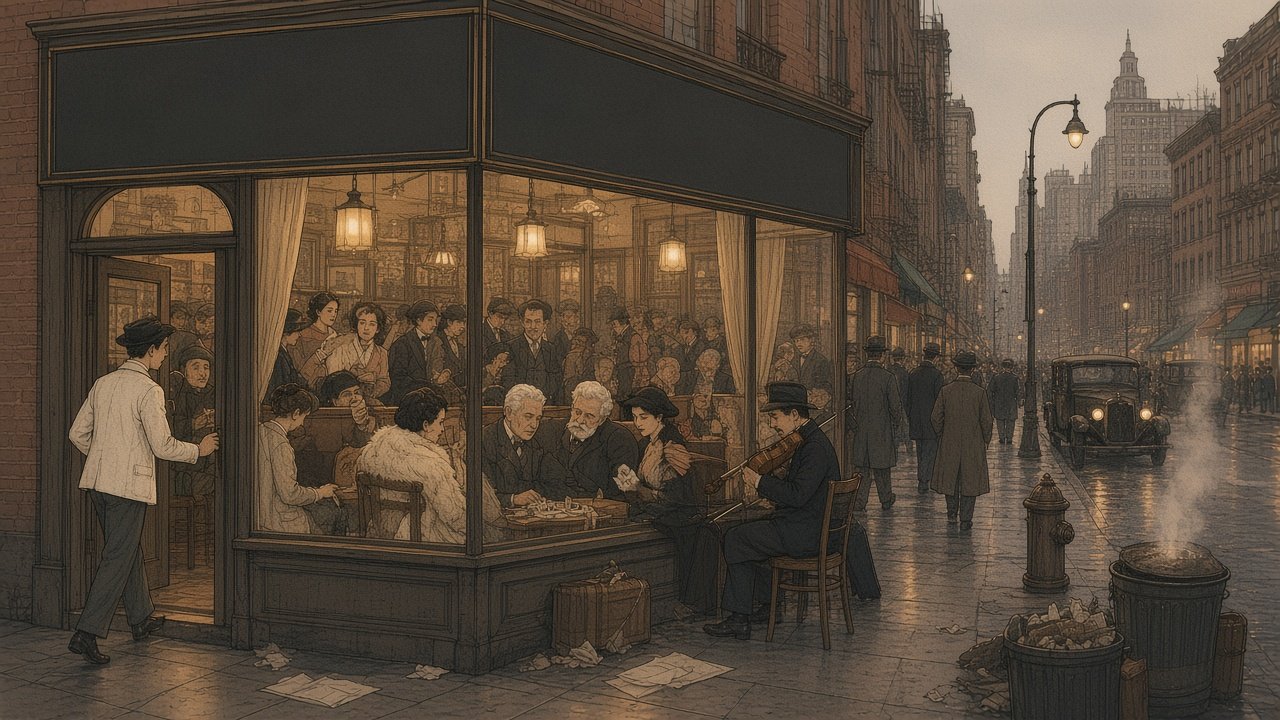
The real growth of Jewish café culture came with the mass migration from eastern Europe after 1881, the subject of the recent nekud.click essay The Great Jewish Migration. Between 1881 and 1914 some two million Jews crossed the Atlantic, most of them to New York, and the Lower East Side became one of the most densely populated districts on earth [38]. Its cafés multiplied on Canal Street, East Broadway, Division Street and Grand Street, among the tenements described in Streets of the Lower East Side. In the late 1880s the radicals of the district gathered at the saloon of the Frankfurt-born anarchist Justus Schwab and at Sachs’ Café on Norfolk Street, where, as one memoir put it, Mrs Sachs served fine coffee and cheesecake to the cream of the radicals. Emma Goldman recorded in her autobiography that on her very first day in New York, 15 August 1889, the anarchist Hillel Solotaroff took her to Sachs’, the headquarters of East Side radicals, socialists, anarchists and young Yiddish poets; she remembered two packed rooms in which everyone talked, gesticulated and argued in Yiddish and Russian [39].
By the turn of the century the cafés of the East Side were famous enough to attract journalists from uptown. Hutchins Hapgood, whose Spirit of the Ghetto (1902) introduced the immigrant intelligentsia to American readers, praised the little Russian-Jewish cafés of Canal Street, where the coffee was excellent and the conversation, among actors, socialists, musicians, journalists and poets, often of the best [40]. Each café had its constituency. Zeitlin’s at 126 Canal Street was the domain of Jacob Gordin, who had brought his Odessa café habits with him and sat surrounded by admiring actors and younger playwrights; when the building was demolished in 1908 to make room for the approaches to the Williamsburg Bridge, the theatre people moved to Schreiber’s at 33 Canal Street. Herrick’s on Division Street, which advertised itself as “a café, saloon and restaurant”, was a haunt of journalists, and Abraham Cahan, editor of the Forverts (subject of the nekud.click post The Forverts and the Jewish Daily Forward), was a regular visitor at various East Side cafés [37].
The New York chapter also gives the book its key word. The Yiddish קיביצן (kibitsn, to banter, to look over someone’s shoulder at a card game and offer unwanted advice) became the name for café talk itself, and in 1909 a humorous weekly called דער גרויסער קיביצער (Der groyser kibitser, “The Great Kibitzer”) carried advertisements for the cafés in which its readers did it. Café culture on the East Side was famously argumentative, and Pinsker shows how the choice of café became a literary manifesto. Around 1907 a group of young poets who called themselves די יונגע (Di Yunge, “The Young Ones”), among them Mani Leib, Zishe Landau, Moyshe-Leyb Halpern, Reuben Iceland, Joseph Opatoshu, David Ignatov and Isaac Raboy, rebelled against the political poetry of the older generation of “sweatshop poets” and declared that Yiddish verse should serve beauty rather than the cause. Their elders gathered at Sholem’s café on Division Street, which was open twenty-four hours a day; Di Yunge refused to sit under the same roof and adopted Goodman and Levine’s, where, Iceland remembered, the food was very bad but there was always someone reading a poem and one could hear, with a beating heart, how one was currently rated as a writer [37] [41].
After the First World War the centre of Yiddish New York moved uptown, to the theatres of Second Avenue, and with it the centre of café life. The Café Royal, on the corner of Second Avenue and Twelfth Street, was opened in 1908 under the name of its owner, Breslau, and renamed when he sold it in 1910. Legend has it that the Prague-born businessman Oscar Szathmary won it in a game of pinochle and in a second game won its Hungarian busboy, Herman, who presided over the door for decades and was reputed to have become a millionaire from tips. By the mid-1920s the Royal was the meeting place of the Yiddish theatre, which had several thousand-seat houses along the avenue, and the writers followed the actors. The poet Judd Teller described its continental décor, high ceilings and long windows, and its division into a writers’ side and an actors’ side, with card players and racing tipsters hidden behind a curtain at the back [37]. Leo Rosten told readers of the New Yorker that everyone who was anybody in the creative Jewish world turned up at the Royal at least once a week; the actor Herman Yablokoff was taken there from Ellis Island on the day he arrived in 1924; and E. E. Cummings, Sergei Yesenin, Isadora Duncan and Charlie Chaplin all dropped in.
The Royal also drew the modernists. E. E. Cummings came down from Greenwich Village to talk with the Yiddish introspectivist poets of the אין זיך (In zikh, “In Oneself”) group around Jacob Glatstein, Aaron Glanz-Leyeles and N. B. Minkoff. The small community of American Hebrew writers envied them. In 1926 the poet Shimon Halkin published in the Hebrew weekly הדואר (Ha-do’ar), under a pseudonym, a lyrical feuilleton describing the café as a temple of shadows in which the poet, veiled in a cloud of incense, could be freed from the yoke of prophecy. In the next issue Daniel Persky replied drily that the Yiddish writers spent their days in the Café Europa and their nights in the Café Royal, that there was no Hebrew café of that kind in New York, and that without such a קיביצערניע (kibitsernye) there was no prospect of a Hebrew literary movement in America [37].
By the 1930s the Royal was turning into a museum of itself. Isaac Bashevis Singer, taken there by his brother Israel Joshua soon after he arrived in 1935, found the regulars vain and rude, could not eat a bite and felt a rage against America; tourists pointed at the tables. The folklorist Nathan Ausubel, writing for the Federal Writers’ Project, called it unreal, a pantomime of quaintly amusing ghosts and Yiddish bohemia’s lyrical protest against the Machine Age. In 1942 Hy Kraft’s comedy Café Crown, directed on Broadway by Elia Kazan, put a thinly disguised Royal and its busboy on stage, and the publicity probably kept the café going for another decade. Weegee photographed it in 1945, full of refugees and survivors among the ageing actors, and it closed in the early 1950s [37].
Its successor was not a café but a cafeteria. The Garden Cafeteria at 165 East Broadway, opposite the Forverts building, was opened in 1941 by Charles Metzger, an Austrian Jew who had arrived in 1911. Customers took a ticket at the door, pushed trays along a chrome counter and paid on the way out; the system was designed for speed, but people sat for hours. The journalist Dan Wakefield called it an ordinary American beanery and also a refuge of the spirit of the old East Side, where the community sense that had peaked at the Café Royal survived in the shrunken Yiddish literary world [37]. Isaac Bashevis Singer, who wrote for the Forverts for decades, called it his second home and set one of his most powerful stories in a place very like it. In “The Cafeteria” (1968), the narrator, a lonely writer, meets landslayt, would-be writers, retired teachers and a rabbi without a congregation, who talk about Yiddish literature, the Holocaust and Israel, and about acquaintances who were eating rice pudding the last time he came and are already in their graves. A young survivor, Esther, tells him that on the night before the cafeteria burned down she saw through the window men in white robes with swastikas on their sleeves sitting round pushed-together tables, with Hitler at their head [42]. The narrator first thinks her mad, then wonders. The story is the darkest coda to the history Pinsker tells: the café as a place in which the living sit among the dead.
12. Jaffa and Tel Aviv: the first Hebrew city and its many cafés
“Blessed be you, O Tel Aviv, city of gazoz and cinema,” wrote the poet Avraham Shlonsky in 1934; “everywhere you turn, coffeehouses call you.” Visitors agreed. When Sholem Asch toured Palestine in 1936, having been warned by good people not to form his impressions of the country in Tel Aviv, he reported admiringly that the city had the best theatre in the southern hemisphere, the only European museum in the Middle East and a deluge of clubs, parties and cafés [43]. The number of cafés grew from a handful in the early 1920s to 178 in 1934 and 422 in 1946, a remarkable density for a town of its size. Anat Helman’s study of interwar Tel Aviv treats the cafés, together with the beach, the shops and the festivals, as the ground on which a new urban Hebrew identity was formed, and Barbara Mann and Maoz Azaryahu have shown how much of the city’s self-image was built from such everyday places, a theme of the nekud.click essay Tel Aviv, the Hill of Spring [44] [45][46].

Pinsker’s subtitle for the chapter, “The ‘First Hebrew City’ or a City of Many Cafés?”, points to the tension at its heart. Zionist ideology celebrated the farmer and the pioneer and was suspicious of urban idleness; Nordau’s attack on the coffeehouse Jew had become part of the movement’s rhetoric. Yet the Jews who built Tel Aviv were overwhelmingly migrants from European cities, and they reproduced the institutions they knew. They did so, moreover, in a land where the coffeehouse was not a European import at all. Jaffa, the Arab port known as عروس البحر (‘Arus al-bahr, “Bride of the Sea”), had dozens of coffeehouses long before the first Zionist immigrants arrived; according to Ze’ev Smilansky’s census of 1905, there were some eighty of them, none owned by Jews [43].
Some of the first Hebrew theatre productions in the country took place in those Arab cafés. The actor Menahem Gnessin recalled how his amateur circle, the Lovers of Dramatic Art, staged Karl Gutzkow’s Uriel Acosta in 1904, the first play performed in Hebrew in Palestine, in an Arab café in Jaffa that happened to have a stage, which was “cleaned and purified” for the occasion, so that Jews who had never set foot in it came majestically dressed, and the actress Yehudit Harari remembered a later production in the Café Fadul on Bustros Street, full of smoke, cards, dice and nargilas, but with the largest stage in Jaffa [43]. Smilansky dated the first “Hebrew café” to the end of the summer of 1905: it was opened by the Lifshitz family, arranged in a deliberately European style so that “our fastidious brothers” would feel comfortable, and later renamed Café Levanon. To many people’s surprise, three-quarters of its income came from non-Jews.
Agnon fictionalised it in Only Yesterday as Café Hermon, which stood at the edge of the Neve Shalom quarter near Bustros Street, presided over by an owner with a face red as honey cake. Agnon’s narrator insists that Café Hermon is not like the Arab cafés with their nargilas, gramophones and parrots, nor like the café in Lemberg with silver dishes and lordly waiters; it is humble, but in it one finds writers, teachers, clerks and activists. Then comes the irony. When Isaac Kumer and his friend Sonya order coffee there, they are served a weak brew with milk, and Sonya remarks that if he wants to taste real coffee he should go to the Arabs [2]. Pinsker points out that Agnon writes “café” in the old form בית הקהווה (beit ha-kahava), preserving the Arabic قهوة (qahwa), rather than the newer בית קפה (beit kafe). The novel thus quietly reminds its readers that the institution the Zionist migrants were importing from Europe had reached Europe from the Arab world in the first place.
Jaffa also had a German café, the Café Lorenz, opened in 1903 by Franz Lorenz in the German Templer quarter, and expanded in 1909 with a hall upstairs for music, theatre and films. It was a place of mixed languages, Arabic, German, Yiddish and Hebrew, and of the conflicts that mixture could provoke. Eitan Belkind, one of the Hebrew gymnasium students who formed a “battalion” for the defence of Hebrew, recalled that in 1914 they threw stones into the hall to stop a Yiddish performance of Goldfaden’s plays, shouting “only in Hebrew”, and succeeded in dispersing the audience [43]. The episode is a reminder that the “language war” described in the nekud.click essay The Emergence of Modern Hebrew was fought, among other places, in cafés.
The most famous early café of Tel Aviv proper was the Casino, built half in the sea on the town’s beach and opened in May 1922 by Salomon Karzanovsky, an immigrant from Odessa, to designs by the city engineer Yehuda Magidovitch, who had also studied in Odessa. Its model was the beach café of their home city. It drew not only Tel Aviv Jews but Arabs from Jaffa; in July 1922 the Jaffa newspaper فلسطين (Falastin) complained that Arabs were spending large sums there and reported plans for a rival casino on Jaffa’s beach, which were never realised. Bialik, who settled in Tel Aviv in 1924, liked to sit there and said it made him feel as if he were sitting in a ship at the heart of the sea. In 1928, when a new owner staged a performance in German, the Battalion for the Defence of the Hebrew Language protested, and the municipality forbade the Casino to stage performances in any language but Hebrew. Damaged by salt water, it closed and was demolished in 1939 [43].
Later cafés had different publics. The Hungarian Café on Nahalat Binyamin Street, where the Hebrew writer Avigdor Hameiri and the young Arthur Koestler planned a political-literary cabaret in 1926, gave rise to the cabarets Ha-kumkum and Ha-matate. Café Sheleg Levanon on Allenby Street became the bohemian café of the late 1920s; when the municipality tried in 1931 to impose a midnight closing time on all cafés, 411 writers, actors and artists signed a petition explaining that they met to talk, not to drink, and that the night was their only time for their artistic affairs, and the authorities relented. In 1933, three newly arrived architects, Arieh Sharon, a Bauhaus graduate, Yosef Neufeld and Ze’ev Rechter, met in a café and decided to bring the International Style to Tel Aviv, the beginning of what became the White City [43].
The café that came to define Hebrew literary life, however, was Kassit. It was founded in April 1935 at 59 Ben-Yehuda Street by two women, Lyuba Goldberg and Ilana Mordekhovitz, and quickly attracted Shlonsky and the modernist group around him. In 1942, after an interval, it reopened at 117 Dizengoff Street, then a new street at the northern edge of town, and in 1944 it was bought by Yehezkel (Khatskl) Weinstein, a Galician immigrant who had worked his way up from dishwasher in other Tel Aviv cafés. He became so identified with the place that he took the name Ish-Kassit, “the man of Kassit”. Shlonsky, Nathan Alterman, Leah Goldberg, Alexander Penn, the actors Hannah Rovina and Aharon Meskin, the painters Reuven Rubin and Yosef Zaritsky, and then the native-born generation of Haim Gouri and Moshe Shamir all became regulars [43]. Shamir’s story “Lost Keys” (1946) takes a young kibbutz poet into a thinly disguised Kassit, where he tries and fails to interest the reigning poet, a recognisable Shlonsky bent over a chess board, in his new poems, which are nothing like the older generation’s verse about urban cafés, cigarette smoke, loneliness and the cruelty of the clock. In Yoram Kaniuk’s novel היהודי האחרון (Ha-yehudi ha-aḥaron, “The Last Jew”, 1981), a shell-shocked veteran of 1948 sits in Kassit for three days under a sign reading “I know dead people”, offering testimony that almost nobody wants to hear. Khatskl died at the end of 1979. Kassit, the café of the “first Hebrew city”, was also one of the last of the great Jewish literary cafés.
13. Women at the marble table
One thread runs through every chapter of A Rich Brew, and Pinsker is candid about it: the Jewish literary café was overwhelmingly a male space. Women were everywhere in it as waitresses, cashiers, singers, pianists and owners, and as objects of the regulars’ gaze, but very rarely as habitués who joined the argument. Avery Robinson, reviewing the book, singled out this theme of “homosocial, masculine spaces” as one of its most important [47]. The pattern is consistent across the six cities. In Odessa, Sheyne-Sheyndl must ask from Kasrilevke whether “Franconi” is a he or a she. In Warsaw, Sholem Asch’s early Hebrew story about a young woman who works in a café on Twarda Street shows her watched by the young men at the tables and by her anxious father, while Lamed Shapiro’s narrator cannot decide whether the waitress Bertha is a modest girl or a courtesan [21]. In Vienna, the Yiddish poet Melech Chmelnitzki fantasises about a beautiful stranger across a noisy café, and the stranger never speaks.
The women who did claim a seat at the table paid a price for it. Kadya Molodowsky, one of the very few women to make her name as a Yiddish poet in interwar Warsaw, visited Tłomackie 13 but remembered it as a place where it was “always dark”, and could not understand how writers could sit frowning over chess boards when there was so much poverty in Jewish Warsaw [21]. Else Lasker-Schüler, the one woman at the centre of Berlin expressionism, made the Café des Westens her stage by dressing as her own literary creation, Prince Jussuf of Thebes; her friend Gustav Landauer wrote that she did not fit anywhere, least of all in the milieu in which one saw her. In New York, the poems Anna Margolin began publishing in 1920 were the talk of the cafés, and Reuben Iceland reported to her that the general opinion was that the author must be a man, since no woman could write like that; Margolin’s three-part poem “In the Café” (1922) begins with a woman sitting alone as the voices around her fade, ordering a black coffee [37]. In Tel Aviv, Leah Goldberg, interviewed at “the twilight hour in Café Kassit” for a 1937 magazine issue on “the modern woman”, mocked the kind of modern woman whose modernity consisted of her clothes and her presence in fashionable cafés, while herself defending the café as a place of work [43].
What changed after the First World War was less the masculinity of the café than its visibility. Anton Kuh’s quip that the Herrenhof had become a coach house for waiting ladies, Vicki Baum’s remark that she could not remember a ladies’ room in the Kaffeehaus, and Veza Canetti’s story of a pianist harassed by her café-owner employer all describe the same thing from different sides: women had entered the room, but on terms set by men. Pinsker also notes a quieter fact that recurs across his chapters. The people who ran the cafés were often women: Mrs Sachs on Norfolk Street, Mrs Kotik on Nalewki, Lyuba Goldberg and Ilana Mordekhovitz at Kassit and Ararat, and, as a later generation of refugees discovered, many of the small cafés of wartime Shanghai. They made the space in which men talked, and only occasionally entered the talk.
14. Closing time: nostalgia and the end of the café network
Pinsker ends his book with a question his students and colleagues kept asking him: where did all these cafés go? There are, of course, more cafés in the world today than ever, thanks partly to the global coffee chains. But the confluence of Jewish culture and the urban café that existed in Europe until the Second World War, and in New York and Tel Aviv until the 1960s and 1970s, has disappeared. Pinsker can think of only a few exceptions, such as the Mizrahi poets of the group ערס פואטיקה (‘Ars Poetica, a pun on the Hebrew slang ערס, ‘ars, a swaggering lout) at Café Albi in south Tel Aviv, and the readings at the bookshop-café Tmol Shilshom in Jerusalem, named after Agnon’s novel [48]. The first of these exceptions is worth noting, because it suggests a story the book does not tell: the place of Jews from Arab and Muslim lands in a café culture that, as Agnon’s Sonya knew, was in origin theirs.
Three recent works guide Pinsker’s reflections. The first is Aharon Appelfeld’s memoir עוד היום גדול (‘Od ha-yom gadol, 2001), translated as A Table for One. Appelfeld, born near Czernowitz in 1932 and a survivor of the war and the camps, came to Jerusalem as a young man and recalled entering Café Peter in the German Colony and knowing at once that its regulars were his lost uncles and cousins. He wrote most of his books in cafés, traced his attraction to the beautiful cafés of Czernowitz, and lamented that the cafés of his youth had given way to large, crowded rooms in which one wants only to leave quickly. But he refused to sentimentalise them. A café, he wrote, is not a sentimental place; those who sit in cafés are generally people whose own homes are cramped, for whom loneliness is a frequent companion, or who come from foreign parts and gather to speak their native tongue [49] [48].
The second is Michael Idov’s comic novel Ground Up (2009), based on its author’s own failed attempt, as a young immigrant from Riga, to open a Viennese-style café on Orchard Street on the Lower East Side in 2005. Its fictional café is named after Kolschitzky, the hero of Vienna’s founding myth, and it collapses under the pressure of rent, a gentrifying neighbourhood and a marriage that cannot bear the strain. The third is the documentary Café Nagler (2015), in which the Israeli director Mor Kaplansky goes to Berlin to find the legendary Kreuzberg café once owned by her great-grandparents, discovers that nobody remembers it and that it was probably of no cultural importance, and finally recreates it with young Berliners who throw 1920s parties [48]. In each case the café survives as a story told by migrants or their descendants.
To make sense of this, Pinsker borrows from Svetlana Boym, herself an émigré from the Soviet Union, the distinction between restorative nostalgia, which seeks to rebuild the lost home, and reflective nostalgia, which dwells in longing and delays the homecoming, wistfully, ironically, desperately [50]. The UNESCO listing of the Viennese coffeehouse and the ersatz Kolschitzky of the Lower East Side are restorative. But Pinsker suggests that much of what was written in and about Jewish cafés during their heyday was already reflective: a longing for a provisional home rather than a lost one. Agnon’s Kumer, staring at the silver dishes in Lemberg, is not mourning a vanished past. He is longing for a future he cannot quite enter. That is perhaps the best definition the book offers of the Jewish café: a בית הקהווה that was never meant to be a permanent home, and was valued precisely because it was not.
15. Assessing A Rich Brew
A Rich Brew was widely and warmly reviewed in the scholarly press, in journals of American Jewish history and Jewish studies as well as in literary venues [51] [52][47][53]. Its achievement is easy to state. Pinsker read his sources in Hebrew, Yiddish, German, Russian, Polish and English, and he put side by side texts that are almost always studied separately: Sholem Aleichem’s Fanconi beside Jabotinsky’s Russian Odessa, Vogel’s Hebrew Herrenhof beside Roth’s German Leopoldstadt, Charney’s Yiddish Romanisches beside Ehrenburg’s Russian one. The result is a genuinely transnational literary history in which the café is not a backdrop but a mechanism, the place where newspapers were read and written, manuscripts circulated, quarrels conducted and reputations made. The metaphor of a “silk road” linking the cafés of six cities is more than decoration: again and again the same people, Smolenskin, Asch, Charney, Ravitch, Leah Goldberg, reappear in different cities, carrying with them the habits of the last café.
The book’s limits are mostly the limits of its design. It is a study of Ashkenazi Jews in six cities, and it says so. Readers will miss Prague, where Kafka encountered Yiddish theatre in the Café Savoy; Paris, where Jewish painters of the School of Paris lived in the cafés of Montparnasse (see The School of Paris and Pascin of Montparnasse); Lemberg and Czernowitz, which appear only in passing although both were famous café cities (see Lviv of Four Names and Little Vienna on the Prut); Buenos Aires; London’s East End; and the Jewish communities of Cairo, Baghdad, Istanbul and Salonica, where Jews had sat in coffeehouses since the sixteenth century. The Middle Eastern origins of the coffeehouse frame the book at the beginning and resurface in the Jaffa chapter, but the Jews of the Middle East themselves remain at its edges.
There are smaller weaknesses. The theoretical framework of “thirdspace” sometimes seems to describe everything and therefore nothing in particular; a reader may feel that the café’s ambivalence, at once home and exile, refuge and trap, emerges more vividly from the literary texts than from the theory. The book’s range also leaves some slips: it dates Karl Kraus’s Die demolirte Literatur to 1879 in one passage and 1897 in another, and an early Viennese text appears with a date a century too late. None of this detracts from the central achievement. Pinsker has given a whole field a new map, and he has done it with sympathy for the people at the tables: the brokers, the poets, the waiters, the refugees and the few women who insisted on sitting down.
References
- Shachar M. Pinsker, A Rich Brew: How Cafés Created Modern Jewish Culture (New York: New York University Press, 2018), Introduction, “The Silk Road of Modern Jewish Creativity”, pp. 1 - 16. *
- S. Y. Agnon, Only Yesterday, trans. Barbara Harshav (Princeton: Princeton University Press, 2000); Hebrew original Tmol shilshom (1945). *
- Ralph S. Hattox, Coffee and Coffeehouses: The Origins of a Social Beverage in the Medieval Near East (Seattle: University of Washington Press, 1985). *
- Markman Ellis, The Coffee-House: A Cultural History (London: Weidenfeld & Nicolson, 2004). *
- Brian Cowan, The Social Life of Coffee: The Emergence of the British Coffeehouse (New Haven: Yale University Press, 2005). *
- Elliott Horowitz, “Coffee, Coffeehouses, and the Nocturnal Rituals of Early Modern Jewry”, AJS Review 14, no. 1 (1989): 17 - 46, doi:10.1017/S0364009400002427. *
- Robert Liberles, Jews Welcome Coffee: Tradition and Innovation in Early Modern Germany (Waltham, MA: Brandeis University Press, 2012). *
- Shachar M. Pinsker, A Rich Brew: How Cafés Created Modern Jewish Culture (New York: New York University Press, 2018), ch. 4, “Berlin: From the Gelehrtes Kaffeehaus to the Romanisches Café”, pp. 142 - 185. *
- Jürgen Habermas, The Structural Transformation of the Public Sphere: An Inquiry into a Category of Bourgeois Society, trans. Thomas Burger with Frederick Lawrence (Cambridge, MA: MIT Press, 1989). *
- Walter Benjamin, “A Berlin Chronicle”, in Reflections: Essays, Aphorisms, Autobiographical Writings, ed. Peter Demetz, trans. Edmund Jephcott (New York: Harcourt Brace Jovanovich, 1978). *
- Edward W. Soja, Thirdspace: Journeys to Los Angeles and Other Real-and-Imagined Places (Oxford: Blackwell, 1996). *
- Ray Oldenburg, The Great Good Place (New York: Paragon House, 1989). *
- Jacob Katz, Out of the Ghetto: The Social Background of Jewish Emancipation, 1770 - 1870 (Cambridge, MA: Harvard University Press, 1973). *
- Dan Miron, From Continuity to Contiguity: Toward a New Jewish Literary Thinking (Stanford: Stanford University Press, 2010). *
- Steven J. Zipperstein, The Jews of Odessa: A Cultural History, 1794 - 1881 (Stanford: Stanford University Press, 1985). *
- Shachar M. Pinsker, A Rich Brew: How Cafés Created Modern Jewish Culture (New York: New York University Press, 2018), ch. 1, “Odessa: Jewish Sages, Luftmenshen, Gangsters, and the Odessit in the Café”, pp. 17 - 54. *
- Jarrod Tanny, City of Rogues and Schnorrers: Russia’s Jews and the Myth of Old Odessa (Bloomington: Indiana University Press, 2011). *
- Charles King, Odessa: Genius and Death in a City of Dreams (New York: W. W. Norton, 2011). *
- Sholem Aleichem, The Letters of Menakhem-Mendl and Sheyne-Sheyndl and Motl, the Cantor’s Son, trans. Hillel Halkin (New Haven: Yale University Press, 2002). *
- Isaac Babel, The Complete Works of Isaac Babel, ed. Nathalie Babel, trans. Peter Constantine (New York: W. W. Norton, 2002). *
- Shachar M. Pinsker, A Rich Brew: How Cafés Created Modern Jewish Culture (New York: New York University Press, 2018), ch. 2, “Warsaw: Between Kotik’s Café and the Ziemiańska”, pp. 55 - 97. *
- Glenn Dynner and François Guesnet (eds), Warsaw. The Jewish Metropolis: Essays in Honor of the 75th Birthday of Professor Antony Polonsky (Leiden: Brill, 2015). *
- Scott Ury, Barricades and Banners: The Revolution of 1905 and the Transformation of Warsaw Jewry (Stanford: Stanford University Press, 2012). *
- Władysław Szpilman, The Pianist: The Extraordinary Story of One Man’s Survival in Warsaw, 1939 - 45, trans. Anthea Bell (London: Victor Gollancz, 1999). *
- Shirli Gilbert, Music in the Holocaust: Confronting Life in the Nazi Ghettos and Camps (Oxford: Clarendon Press, 2005). *
- Austrian Commission for UNESCO, “Viennese Coffee House Culture”, National Inventory of Intangible Cultural Heritage in Austria (inscribed 2011), unesco.at. *
- Shachar M. Pinsker, A Rich Brew: How Cafés Created Modern Jewish Culture (New York: New York University Press, 2018), ch. 3, “Vienna: The ‘Matzo Island’ and the Functioning Myths of the Viennese Café”, pp. 98 - 141. *
- Steven Beller, Vienna and the Jews, 1867 - 1938: A Cultural History (Cambridge: Cambridge University Press, 1989). *
- Carl E. Schorske, Fin-de-Siècle Vienna: Politics and Culture (New York: Alfred A. Knopf, 1980). *
- Harold B. Segel (ed. and trans.), The Vienna Coffeehouse Wits, 1890 - 1938 (West Lafayette: Purdue University Press, 1993). *
- Theodor Herzl, Altneuland (Leipzig: Hermann Seemann Nachfolger, 1902). *
- Joseph Roth, The Wandering Jews, trans. Michael Hofmann (New York: W. W. Norton, 2001); German original Juden auf Wanderschaft (1927). *
- David Vogel, Married Life, trans. Dalya Bilu (London: Peter Halban, 1988); Hebrew original Ḥaye nisu’im (1929). *
- Michael Brenner, The Renaissance of Jewish Culture in Weimar Germany (New Haven: Yale University Press, 1996). *
- Steven E. Aschheim, Brothers and Strangers: The East European Jew in German and German Jewish Consciousness, 1800 - 1923 (Madison: University of Wisconsin Press, 1982). *
- Gennady Estraikh and Mikhail Krutikov (eds), Yiddish in Weimar Berlin: At the Crossroads of Diaspora Politics and Culture (Oxford: Legenda, 2010), including Shachar Pinsker, “Deciphering the Hieroglyphics of the Metropolis”, pp. 28 - 53. *
- Shachar M. Pinsker, A Rich Brew: How Cafés Created Modern Jewish Culture (New York: New York University Press, 2018), ch. 5, “New York City: Kibitzing in the Cafés of the New World”, pp. 186 - 245. *
- Irving Howe, World of Our Fathers (New York: Harcourt Brace Jovanovich, 1976). *
- Emma Goldman, Living My Life (New York: Alfred A. Knopf, 1931). *
- Hutchins Hapgood, The Spirit of the Ghetto: Studies of the Jewish Quarter in New York (New York: Funk & Wagnalls, 1902). *
- Ruth R. Wisse, A Little Love in Big Manhattan: Two Yiddish Poets (Cambridge, MA: Harvard University Press, 1988). *
- Isaac Bashevis Singer, “The Cafeteria”, in The Collected Stories of Isaac Bashevis Singer (New York: Farrar, Straus and Giroux, 1982). *
- Shachar M. Pinsker, A Rich Brew: How Cafés Created Modern Jewish Culture (New York: New York University Press, 2018), ch. 6, “Tel Aviv - Jaffa: The ‘First Hebrew City’ or a City of Many Cafés?”, pp. 246 - 302. *
- Anat Helman, Young Tel Aviv: A Tale of Two Cities (Waltham, MA: Brandeis University Press, 2010). *
- Barbara E. Mann, A Place in History: Modernism, Tel Aviv, and the Creation of Jewish Urban Space (Stanford: Stanford University Press, 2006). *
- Maoz Azaryahu, Tel Aviv: Mythography of a City (Syracuse: Syracuse University Press, 2007). *
- Avery Robinson, “Cafe Culture, Judaism, and World Making”, Marginalia Review of Books, 29 March 2019, themarginaliareview.com. *
- Shachar M. Pinsker, A Rich Brew: How Cafés Created Modern Jewish Culture (New York: New York University Press, 2018), Conclusion, “Closing Time”, pp. 303 - 309. *
- Aharon Appelfeld, A Table for One: Under the Light of Jerusalem, trans. Aloma Halter (London: Toby Press, 2005); Hebrew original ‘Od ha-yom gadol (2001). *
- Svetlana Boym, The Future of Nostalgia (New York: Basic Books, 2001). *
- Rebecca Kobrin, review of A Rich Brew, American Jewish History (2020), doi:10.1353/ajh.2020.0040. *
- Sarah E. Wobick-Segev, review of A Rich Brew, AJS Review (2019), doi:10.1353/ajs.2019.0080. *
- Judith Müller, review of A Rich Brew, PaRDeS: Zeitschrift der Vereinigung für Jüdische Studien 25 (2019): 176 - 179, doi:10.25932/publishup-43262. *


