The Forverts and the Jewish Daily Forward
1. A Yiddish daily on East Broadway
On 22 April 1897 a new Yiddish daily appeared on the streets of New York’s Lower East Side. Its name, Forverts, was borrowed from Vorwärts, the newspaper of the German Social Democrats in Berlin, and its English title, the Jewish Daily Forward, announced both its schedule and its politics. Over the following half-century it became the most widely read Yiddish newspaper in the world and, by the early 1930s, a metropolitan daily with a national circulation above 275,000. It was owned not by a proprietor but by the Forward Association, a body of socialists and trade unionists, and for most of that period it was directed by a single editor, Abraham Cahan.[1][2][3]
The Forverts did far more than report the news. It raised strike funds and campaigned for socialist candidates, published serialised novels by the leading Yiddish writers of its time, gave lessons in American manners and in English, and through its advice column, the Bintel Brief, offered a public forum for the private troubles of its readers. At its peak it was the largest non-English newspaper in the United States, and from 1932 its radio station carried its voice into homes that did not buy it. Tony Michels, the historian of Yiddish socialism in New York, has described it as a force to be reckoned with rather than merely a newspaper, one that instilled a new social ethic among immigrant Jews.[3][4][5]
The paper’s later history follows the history of its readers. Restricted immigration, the Americanisation of the second generation and the destruction of Yiddish-speaking Europe reduced its readership after the Second World War; it became a weekly in 1983, added an independent English-language weekly in 1990 and ended its print editions in 2019. It continues today as a digital publication in English, with a Yiddish section that still appears under the old name. This essay traces that history from the founding meeting on Orchard Street to the present, with particular attention to Cahan’s editorship, the Bintel Brief, the paper’s place in the labour movement, its literary pages and the building that became its emblem.[6][1][7]
2. Orchard Street, 1897
The men and women who founded the Forverts were socialist intellectuals and labour activists rather than businessmen. On 30 January 1897 they met in a rented hall on Orchard Street to plan a new paper. Unlike the leading Yiddish daily of the time, the politically conservative Yidishes Tageblat, the Forverts was to belong to the Forward Association, a nonprofit and cooperatively run body. The Knee Pants Makers, the Vest Makers, the Brotherhood of Tailors and the United Hebrew Trades of Philadelphia joined the association, as did socialist clubs such as Voice of Labor, the Women Workers’ Society and the Lassalle Continuing Education Society. Their stated purpose was “to hold high the banner of international class struggle” in Yiddish.[3]
The new paper grew out of a quarrel on the left. Cahan and his associates had worked on Di Arbeter Tsaytung, founded in 1890 by Social Democrats with the sponsorship of the United Hebrew Trades, a powerful alliance of Jewish unions, and its editors had become entangled in bureaucratic and political disputes with their publisher. The founders of the Forverts were Yiddish-speaking members of the Socialist Labor Party, and the Encyclopaedia Judaica describes the paper as a more moderate offshoot of the militantly left-wing Abendblatt. The meeting of January 1897 was called to establish a paper free of the influence of the United Hebrew Trades; it took its name from the Social Democratic newspaper in Berlin, and Cahan was appointed editor.[1][6][8]
The first issue appeared on 22 April 1897 with the slogan “Workers of the World Unite!” across the top of the front page. The market it entered was crowded with dailies, weeklies and monthlies, many of which lasted only a few months, and the Forverts itself passed through difficult early years. Cahan did not stay to see them. He wanted a paper that would remain socialist but address the ordinary reader, who had little interest in the factional disputes that filled the radical press; in Irving Howe’s later phrase, it was to encompass “the widest range of Yiddish sensibility”, from cheap sensationalism to high culture. His colleagues disagreed, and in August 1897 he resigned.[9][3][1]
In its first years the paper depended on the movement that had created it. When it could not pay its gas bill, the Workmen’s Circle paid it; when printing costs grew too heavy, Voice of Labor organised a masquerade ball, and more than 10,000 people attended the first, in 1898. Some guests came dressed as wounded strikers or evicted tenants; one woman wore a dress decorated with socialist newspapers, and another came as “the angel of social democracy”. The Forward Association was incorporated in New York in 1901 and has remained the owner and publisher of the paper, its members electing a board of directors and serving on financial, editorial and membership committees.[3][4]
3. Abraham Cahan before the Forverts
Cahan was born in 1860 in Podberez’ye, a village fourteen miles from Vilna. His grandfather was a rabbi and his father a religious teacher who also sold brandy at his tavern; the family moved to Vilna when Abraham was six. He studied Talmud at the Ramayle yeshiva before turning to Tolstoy and Turgenev, and he joined a clandestine socialist circle. After the assassination of Alexander II in 1881 he was arrested and questioned; when members of his group were taken and the police came to search his room, he left the Russian Empire, and in 1882 he arrived in Philadelphia, travelling steerage aboard the British Queen.[9][1]
In New York he stripped tobacco at a cigar factory on Fifth Avenue, learned English from Appleton’s grammar and in a public-school class alongside twelve-year-old boys, and by the autumn of 1883 was teaching English to other immigrants in evening classes, work that supported him for more than a decade. He read Dickens in an attic room on Clinton Street, saw Edwin Booth play Hamlet and heard Adelina Patti sing. He also began speaking at meetings, and Edward Kosner, reviewing Seth Lipsky’s biography, credits him with the first political speech in Yiddish. In the spring of 1886 he and his friend Chaim Rayevsky launched a weekly, Di Naye Tsayt, with ten dollars of capital; it folded after four issues.[1][9]
Cahan also wrote in English. His first article, contesting the glowing reports of the coronation of Alexander III, appeared on the front page of Joseph Pulitzer’s New York World, and by 1883 he was writing for the New York Sun and for the Workman’s Advocate, the English-language weekly of the Socialist Labor Party. Short stories in Cosmopolitan and The Atlantic Monthly drew the attention of William Dean Howells, who helped him publish Yekl: A Tale of the New York Ghetto in July 1896 and called its author “a new star of realism”. After leaving the Forverts in 1897 he spent five years at the Commercial Advertiser, working with the muckraker Lincoln Steffens and covering the police beat and political speeches.[1][9]
Those years taught him the methods of the popular American press. Kosner notes that by the time Cahan returned to the Forverts he had learned the techniques of sensational journalism that were driving the circulations of Pulitzer’s World and William Randolph Hearst’s Journal. His fiction continued alongside his journalism: a didactic socialist novel, The White Terror and the Red, appeared in 1905, and The Rise of David Levinsky, the story of a former Talmud student who becomes one of the most important garment manufacturers in the country, followed in 1917. Howells hailed Levinsky as “an artistic triumph”, and Howe later called it “a minor masterpiece of genre realism”.[9][1]
4. Cahan’s American fiction
Cahan’s career as an English-language novelist began with a meeting of literary sympathies. In 1892 William Dean Howells, curious about the Jewish quarter of the Lower East Side, sought out Cahan, then editor of the socialist Arbeter Tsaytung, and was surprised to find that his visitor knew not only the immigrant streets but also the literature of realism. Howells encouraged him to write about immigrant life for American readers, and Yekl was the result. Its hero, a sweatshop worker who calls himself Jake, charts a proud path towards Americanisation through popular amusements, rudimentary English and flirtations with assimilating young women. When his wife, Gitl, and their son arrive from Europe, he is ashamed of her speech and dress and divorces her, only to regret the loss of the person he used to be.[10]
Howells reviewed the novella under the heading “New York Low Life in Fiction”, comparing it with Stephen Crane’s Maggie: A Girl of the Streets. Cahan returned to the ghetto in The Imported Bridegroom and Other Stories of the New York Ghetto (1898), whose title story concerns a prosperous immigrant who brings a pious young Talmudic scholar from Europe as a husband for his American-educated daughter, Flora, and sets the father’s Old World expectations against her secular ambitions. In The Rise of David Levinsky the cost of success is stated outright. “The very clothes I wore and the very food I ate had a fatal effect on my religious habits,” Levinsky confesses, and Leon Wieseltier, reviewing Irving Howe, called the book a searching novel about the high personal costs of immigrant success in America.[10][11][12]
Cahan also explained the ghetto to American readers in essays. In “The Russian Jew in America”, published in the Atlantic Monthly in July 1898, he put the Jewish population of Manhattan at 250,000, the largest such centre in the world, and described grey-haired tailors who came to evening classes after a day in the sweatshop to spell out simple English words. He noted that at least 500 of the 1,677 students at the free City College were Jewish boys from the East Side. The six Yiddish dailies then published in America, five of them in New York, were in his view “so many preparatory schools from which the reader is sooner or later promoted to the English newspaper”, just as the Yiddish theatres prepared the way to Broadway. The sentence anticipated the policy of his own paper.[13]
Yekl found a new audience in 1975, when Joan Micklin Silver adapted it as the film Hester Street, shifting the emphasis of the story from the husband to the wife. Hollywood producers judged the project too “ethnic”, and it was financed by her husband; it was shot in black and white, with scenes in Yiddish and English subtitles, on a budget of about $370,000. The film brought Carol Kane a nomination for the Academy Award for Best Actress, earned some $5 million by the end of its run and was added to the National Film Registry in 2011.[14]
5. Cahan’s newspaper
With immigration falling and the circulation of Yiddish papers declining, the Forward Association persuaded Cahan to return and accepted his demand for absolute editorial control. Ezra Glinter dates his return to March 1902; Michels, the YIVO Archives and the Encyclopaedia Judaica date the beginning of his long editorship to 1903. Apart from one further short-lived resignation, he directed the paper for more than forty years. In the first issue after his return he published an article on intermarriage and an editorial on the estrangement of immigrant parents from their educated American children; a few weeks later an editorial titled “Freethinkers, Don’t be Fanatics” argued that socialists should at least tolerate the religious leanings of their fellow workers.[1][3][4][6]
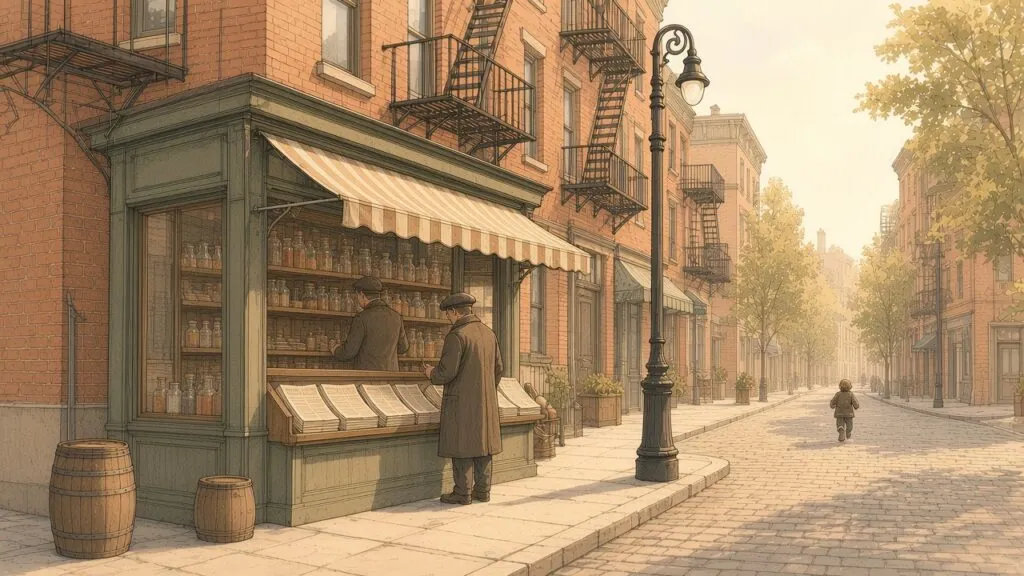
Socialist purists were outraged, but readers responded. According to Glinter, circulation rose from 6,000 to 8,000 within two months and to 19,000 by the middle of the summer; it reached 50,000 in 1907 and 100,000 in 1910. Kosner, following Lipsky, gives a figure of more than 83,000 copies a day by 1909, which made the Forverts the largest Jewish newspaper in the world. Sensational headlines ran beside sober political commentary, and Kosner records a new slogan: “Jewish in WORD, American in THOUGHT”. Crime stories, domestic disputes, personal tragedies and literature both high and low filled the paper alongside its union reports.[1][9][3]
Michels has argued that it is pointless to try to decide whether socialism or sensationalism caused the paper’s success: readers loved it because it entertained them and voiced their economic grievances. Cahan claimed that the Forverts had “democratized reading”, reaching the least-educated readers and bringing them into a new world of ideas about social justice. He held that a paper must “interest itself in the things that the masses are interested in when they aren’t preoccupied with the daily struggle for bread”, and he told his readers that under their tenement roofs was “real life — the very stuff of which the greatest books are written”.[3][15]
The paper also set out to teach. It printed notes on American table manners alongside poetry and political coverage, and Cahan believed that it was as important to “teach the reader to carry a handkerchief in his pocket as it is to carry a union card”. One of its main subscription bonuses was Alexander Harkavy’s Yiddish-English dictionary, a key tool for immigrants learning English. Glinter observes that Yiddishists attacked Cahan for his indifference to the fate of the language. For Cahan a Yiddish newspaper was a means of helping immigrants adapt to their new country rather than an end in itself, and by encouraging them to learn English the paper helped to hasten the decline of the language in which it was written. By its twentieth anniversary its circulation stood at about 200,000.[15][1][3]
6. A bundle of letters
The feature for which the Forverts is best remembered began almost by chance. In his memoirs Cahan recalled that he had long wanted the paper to receive stories from daily life, written not at a desk but in the tenements, factories and cafés. One day in January 1906 his secretary, Leon Gottlieb, showed him three letters that did not suit any department. All three were personal rather than communal, and Cahan decided to print them together under the title “A Bintel Brief”, a bundle of letters, judging that the name itself would attract readers and that an interesting feature might develop from it.[16]
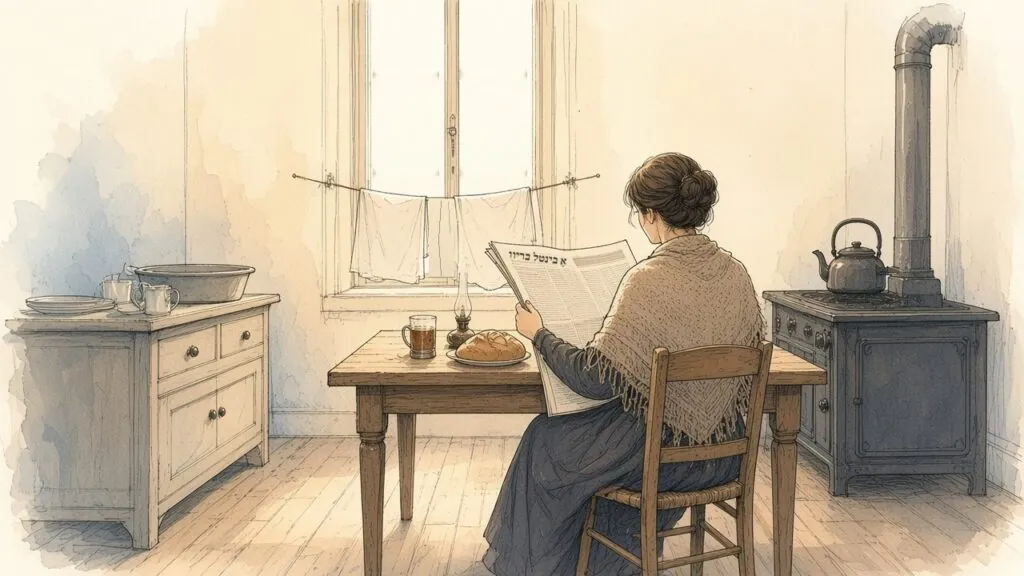
Two of the first letters showed what he wanted. A woman from Eldridge Street appealed to a neighbour, whose husband was out of work, to return the pawn ticket for a watch that had disappeared while the neighbour minded her home; she promised to pretend that nothing had happened and assured her that she would always be a welcome guest. Another reader reported that a man had sold him his grace after meals for two cents. The letters were published on 20 January 1906 with a short introduction, and the second bundle followed on 29 January. Letters began to arrive in quantity, and the Bintel Brief became a regular daily feature.[16]
The column printed whole letters, some of them long and detailed, followed by replies that could run to a full column. Most concerned love, custody, marriage and relations between parents and children. Many were poorly written and had to be rewritten for print, and many were written for the sufferers by others, so that a trade in such letters grew up; Cahan recalled signs announcing “‘Bintel Brief’ letters written here”. He answered the letters himself in the early years while Gottlieb read and sorted them, and within three years B. Feigenbaum had taken over the replies. Cahan wrote that many illiterate women learned to read through the column, and that mothers found children they had not seen for twenty years or more, sometimes in the newspaper’s offices before a waiting crowd.[16]
The replies combined practical counsel with the paper’s politics. Cahan told a father that his sons could play baseball, and even become outstanding players, as long as it did not interfere with their studies or lead them into bad company. To an immigrant who felt guilty for leaving Russia while others fought at the barricades he replied: “We can give no better advice than to fight right here in America for a social order in which a man wouldn’t have to work like a mule for five dollars a week.” Gabrielle Birkner, writing in the Forward, called the column “poor man’s therapy” and quoted Cahan’s memoir on the “lonely souls who thirsted for expression”.[1][9][17]
Over the decades the letters followed their writers into the middle class. Through the 1940s they often turned on the tension between old customs and modern lives; by the 1970s the predicaments increasingly resembled those of other Americans. The paper discontinued the column in the early 1980s, and the editor, Simon Weber, was quoted in The New York Times as saying, “The readers… ran out of problems.” Seth Lipsky later suggested that their problems had become the same as everyone else’s, so that they no longer needed the Forward for answers. In 2007 the web editor Daniel Treiman revived the Bintel Brief as a weekly online feature with guest columnists.[17]
7. Women readers and the women’s page
The Forverts addressed women as workers, voters and householders, and not always with one voice. In 1909 a reader who signed himself “With Socialist regards, LV” told the Bintel Brief that members of his discussion group feared that women given the vote would abandon their families and their housework; the editor replied that many intelligent women already took part in public activities and remained excellent homemakers. When the women of New York State won the vote in November 1917, the paper offered a prize of $25 for the best essay on the victory and published the responses over several weeks in its section “Froyen interesen” (Women’s Interests). One essayist, Eyde Val of 45 Norfolk Street, answered the claim that voting would ruin the home: “If she won’t be a better baleboste, she certainly won’t be a worse one for voting.”[18]
The women’s page itself, Rukhl Schaechter has written, reveals an ambivalence about the paper’s Americanising purpose. In the issue of 15 March 1925 a column of notes from the women’s world reported the struggle for the vote in Belgium and Britain. The historian Maxine Seller identified its author as Esther Luria, a Bundist from Warsaw who had been exiled to Siberia in 1906, escaped to New York six years later and wrote for Tsukunft, Glaykhhayt and the Forverts, including articles on the low wages of women workers. The same issue carried an article signed Judith Kopf that blamed a working wife for the troubles of her marriage. Schaechter notes that men sometimes wrote for the page under women’s names: an article of 7 June 1953 on bargains in the department stores, signed Golde Miller, was the work of the humorist Yoysef-Shimen Goldshteyn.[19]
From 1917 to 1959 the most popular writer on the women’s pages was Regina Frishwasser. She urged readers to adopt more American manners, to speak more quietly than they had been used to in the markets of the old towns of Eastern Europe, and to cultivate the art of smiling and making friends. For years she also ran a cookery column, “Est gezunterheyt”, which answered such questions as why warm milk should be used for potatoes. The cookery pages taught younger women the traditional Jewish dishes while showing them how to use the new tinned and packaged foods, and the paper held cooking competitions; the issue of 15 January 1938 listed winners who had received a dollar each, one of them for a kugel of yellow squash. The page also printed photographs of the latest fashions and for years supplied sewing patterns.[19]
Fanny Jacobson, who worked at the paper from 1948 until her retirement in 1999, remembered the fashion page as very popular. By 1974, when Tsirl Steingart took sole charge of the women’s page, “Di froy un di heym”, often writing under pseudonyms, it had shrunk to a quarter of a page, consisting mainly of recipes. Schaechter reads the contraction partly as a sign of the state of Yiddish in America, since younger women preferred English newspapers, and partly as a sign that women educated in the 1970s read about the White House, Israel and the wider world as fluently as their husbands. The paper’s concern with the family also had a darker side. Its regular “Gallery of Missing Husbands” printed portraits of men who had deserted their wives, with an appeal to readers to let the wives know through the Forverts if they recognised them; one such gallery appeared on 10 December 1913.[19][10]
8. The paper and the labour movement
Once it became profitable the Forverts repaid its debts to the movement. Between 1911 and 1915 alone it gave more than $20,000 to unions, socialist groups and other left-wing newspapers, and during strikes it coordinated public fund-raising on a large scale: $25,000 for the furriers, $50,000 for the ladies’ waist makers and $60,000 for the cloak makers. Its staff spoke at union rallies and covered labour events in close detail, and Michels notes that the paper sometimes took the lead in planning strikes months in advance. Employers read it too, and reprinted its articles in their trade publications to learn what their opponents were planning.[3]
Its influence within the unions was considerable. It was said that no union officer could win an election without its endorsement, and a union stalwart wrote in 1917 that the workers felt “a certain gratitude to this newspaper”, which was “the only source from which the workers get their information.” Opponents took notice. The satirical weekly Der Groyser Kundes regularly drew the Forverts as an overstuffed fat cat wearing a top hat in the shape of its ten-storey headquarters, and for decades the communists called the paper a traitor to the working class.[3]
The paper worked alongside the United Hebrew Trades, the Jewish Socialist Federation and the Workmen’s Circle, the Jewish labour fraternal order. In 1914 it campaigned for the socialist lawyer Meyer London in his race for Congress, printing an electioneering supplement that listed the names and addresses of all 12,000 registered voters in his Lower East Side district. When London won, the crowd waiting for the results outside the Forward Building was ecstatic. Ross Perlin, writing in The Nation, places the paper, together with the socialist-led garment unions and the socialist officials who followed London into office, at the centre of a “Red New York” without parallel in American history.[20][21]
Yet the Forverts was never a party organ. It charted its own course through the arguments over the Soviet Union and the early Zionists in Palestine, and it spoke on familiar terms with the poshete yidn, the ordinary Jews who bought it at the candy store. During the Depression Cahan helped to establish the American Labor Party for anti-communist socialists and supported Franklin Roosevelt, whom he endorsed for president in 1936. The YIVO Archives’ guide to the Forward Association’s records includes a series of papers on the Liberal Party of New York State from 1944 to 1951.[20][9][4]
9. The shirtwaist strike and the Triangle fire
The garment strikes of 1909 and 1910 placed the paper at the centre of the movement it served. On 22 November 1909 thousands of shirtwaist makers, most of them Jewish women in their teens and early twenties, filled the Great Hall of Cooper Union to discuss the conditions in their shops. Union leaders, socialist politicians and Cahan himself spoke for hours without calling a strike, until the twenty-three-year-old Clara Lemlich demanded the floor and, speaking in Yiddish, moved a general strike. Benjamin Feigenbaum of the Forverts then asked the crowd to take a Yiddish oath modelled on a traditional pledge: “If I turn traitor to the cause I now pledge, may my hand wither from the arm I now raise.”[22][23]
Within days some 20,000 workers had walked out, and the New York Jewish Week, writing in 2019 about an exhibition at the Museum of the City of New York, called the walkout the largest women’s strike in American history, with upwards of 40,000 women on the picket lines. Jo-Ann Mort records in the Forward that it lasted until February 1910 and ended in what she calls a “protocol of peace” with the shirtwaist manufacturers, who agreed to better conditions, higher wages and shorter hours, and that it marked the emergence of the International Ladies’ Garment Workers’ Union as a national force. Among the employers who resisted were Max Blanck and Isaac Harris of the Triangle Waist Company, who hired thugs to harass and beat strikers and set up a company union with their relatives as officers.[23][24][22]
On 25 March 1911 fire broke out in the Triangle factory, which occupied the top three floors of the Asch Building in Greenwich Village, and 146 workers, most of them young Jewish and Italian women, were killed. The building had no sprinklers, the company held no fire drills, and the door to the Washington Place exit was in all probability locked. The next day the Forverts published “Our Ghastly Devastation” and “The Morgue Is Full of Our Victims!”, and on 27 March it printed short portraits of the dead. One of them was Yetta Rosenboym, aged twenty-two, who had come from Rovno three years earlier and had started at the factory the previous Friday; her brother could identify her at the morgue only by a scar on her foot left by an operation in childhood.[25][22][26][27]
Cahan’s editorial of the same day, “The Blood of the Victims Calls to Us”, opened: “The entire neighborhood is sitting shiva.” He refused to accept that the fire was a natural disaster, asking whether it was “natural” that hundreds of young people should be imprisoned in a ten-storey firetrap with locked doors. He recalled that the paper and the union had campaigned against such buildings for years, and that the long strike had begun at this same shop, and he placed the guilt on “the entire capitalist system and its government”. The fire chief, he wrote, had warned that a catastrophe would sooner or later occur in the building, and the city government had done “Nothing! Nothing! Nothing!”[28]
The paper kept the fire before its readers. Morris Rosenfeld contributed a poem in the voice of Eastern European parents who wished their daughters in American factories would come home, and an account of the mourners’ march in which, he wrote, the lamentation was greater than at the marches against the pogroms; another report counted half a million people in mourning. The Forverts followed the indictment of Blanck and Harris for manslaughter in April 1911 and their trial, at which they were acquitted. On the twenty-third anniversary, in 1934, its front page declared that firetraps were still to be found, forty-eight people having burned to death in the first twelve weeks of that year, and in 1936 it announced a memorial broadcast on WEVD with the Secretary of Labor, Frances Perkins.[26][22][29]
The anniversary reports also recorded how the labour movement had come to understand the fire. In 1956 the Forverts writer Y. Fogel reported a speech by David Dubinsky, president of the International Ladies’ Garment Workers’ Union, to the Italian dressmakers of Local 89, at which Eleanor Roosevelt also spoke. Dubinsky argued that the history of the needle-trade unions had to be written alongside that of the fire, which had shaken the country’s conscience, prompted new laws for workers and changed the treatment of the garment trades, and he praised the cooperation of Jewish and Italian workers within the union. Lemlich herself later served on the state commission set up to investigate the fire, whose vice-chairman, Alfred E. Smith, went on to become governor of New York.[29][22]
10. 175 East Broadway
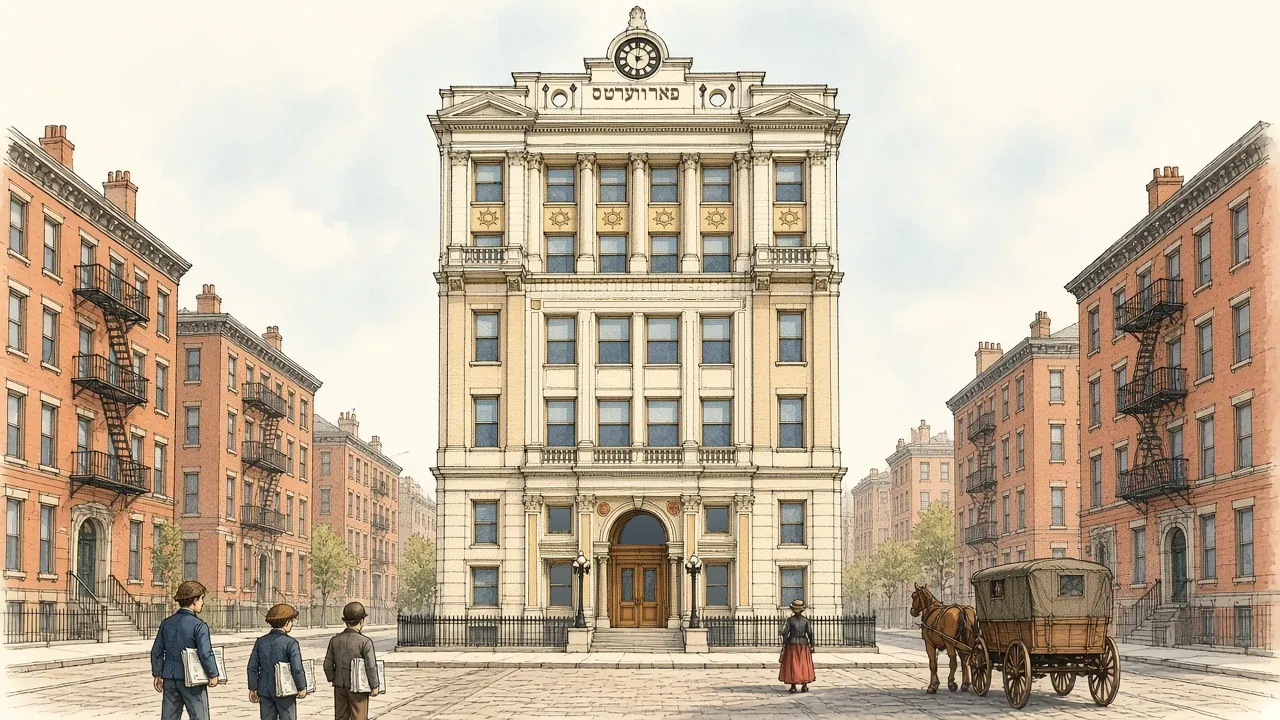
The Forward Association bought the tenement at 175 East Broadway in 1904 and the adjoining one at No. 173 in 1910. Two years later, in what a city landmarks report called a deliberate response to S. Jarmulowsky’s new bank building round the corner, it commissioned the architect George A. Boehm to build something taller, intending to let floors to sympathetic organisations to help meet the cost. The ten-storey Beaux-Arts building, completed in 1912 at the corner of East Broadway and Canal Street, was the first skyscraper of the Lower East Side. Its façade carried pillars, engraved torches, a clock and the paper’s name in Yiddish and English.[30][15][1][21]
Cahan treated the building as a statement of faith. “Our old religious Jews here have their synagogues,” he wrote in a 1912 editorial. “Where is the synagogue of our Jewish workers? Where is the temple of freedom, of equality, of brotherhood?” His answer was that the Forward Building would be the home of the Jewish socialist movement and “the temple of the workers’ religion”. When construction workers broke ground, water spurted up, and the next day’s front page described what the crowds collected in mugs and buckets as “holy water”. Above the entrance were busts of Marx, Engels, Ferdinand Lassalle and a fourth socialist whose identity is disputed, variously given as Wilhelm Liebknecht, Karl Liebknecht, August Bebel or Friedrich Adler.[15][30]
Not everyone approved. The critic Henry Margoshes complained that “the socialist movement in New York will be buried under this 10-story capitalist building”, and that the paper had become “a circus” as well as a cultural force. For others the building was a beacon. Alfred Kazin remembered crossing the Brooklyn Bridge as a young man and seeing “the electric sign of the Jewish Daily Forward, burning high over the tenements of the Lower East Side”. The Workmen’s Circle, the Butchers’ Union Local 509, the Jewish Socialist Verband and the Naturalization Aid League kept offices there, and on election days the results were projected onto a screen on the side of the building for the crowds in Seward Park.[15]
In 1947, for the paper’s fiftieth anniversary, the Yiddish writer Y. Fogel described the building floor by floor: the printing presses in the basement, the bookkeepers and switchboard operators off the lobby, a second-floor hall for Workmen’s Circle conferences and concerts, the general manager’s office on the third floor, the “kingdom of the Yiddish writer” on the sixth, where the I. L. Peretz Writers’ Union met, and on the ninth the newsroom, “the nerve center”, where a ticker relayed news from around the world. Open twenty-four hours a day, the building was in his words “the epicenter of the hubbub of Jewish life”, where meetings could sound violent until everyone went down to the cafeteria and settled their feuds over coffee.[30]
In 1974 the Forward Association sold the building to a Chinese-American family, the Laus, and the paper moved to midtown. The new owners let the ground floor to the evangelical Ling Liang Church, and the busts were covered by a sign in Chinese. A plan to convert the building into lofts in the late 1990s came to nothing, and it fell into disrepair until the developers Ronald Castellano and Christopher Hayes took it on in 2004, restored the façade and gutted the interior to create thirty luxury condominiums, which sold within three months of being advertised around 2005. The façade, with its Yiddish nameplate and its busts, had been designated a landmark in 1986.[15][30]
11. Writers in the Forverts
The Forward’s own history claims that its editorial staff included, at one time or another, nearly every major figure of Yiddish literature, from Morris Rosenfeld, “the poet of the sweatshops”, to the future Nobel laureates Isaac Bashevis Singer and Elie Wiesel. The YIVO Archives name Zalman Shneour, I. J. Singer, I. B. Singer, Sholem Asch, David Bergelson, Avrom Reyzen and Rosenfeld among them, and the Encyclopaedia Judaica adds Jonah Rosenfeld to the authors whose stories and serialised novels it printed. Cahan, in Dan Miron’s account in the YIVO Encyclopedia, insisted on publishing artistic fiction of quality in weekly instalments and could pay handsome salaries to writers whose work appealed to him and was accessible to a wide readership.[2][4][6][31]
Morris Rosenfeld, born in 1862 in Boksha in the province of Suwałki, worked as a tailor in New York’s sweatshops after arriving from London in 1886, and his poems of factory life made him something close to a popular star among Yiddish speakers. Cahan recruited him to the Forverts, but their relationship was uneasy; Eli Rosenblatt, reviewing Marc Miller’s study of the poet, calls it “rutted”. Rosenfeld was also attacked by the poets of Di Yunge, whose ideal of art for art’s sake set them against his reputation as an activist voice. His case shows the tension between the poet of the masses and the literary artist that ran through the paper’s cultural pages.[32][33]
Sholem Asch became a salaried regular contributor in the autumn of 1914, shortly after settling in New York, beginning an association that lasted nearly twenty-five years. His first major work completed in America, the novel Motke ganef (Motke the Thief, 1916), was serialised both in the Forverts and in the Warsaw daily Haynt. Avrom Reyzen, who moved to New York in 1911, at first contributed regularly to the Forverts and to Tsukunft, the monthly that the Forward Association published from 1912 to 1940; he later wrote for Der tog and the communist Frayhayt, and returned to the Forverts in 1929, disappointed by the other papers’ response to the Arab attacks on Jews in Hebron.[34][35][4]
Cahan also drew on writers who remained in Europe. David Bergelson, who settled in Berlin in 1921, published mostly stories in the Forverts, together with journalism and a biting attack on the Evsektsiia, before resigning to join the communist Frayhayt when he came to believe that only the Soviet Union offered a future for Yiddish culture. Zalman Shneour met Cahan in Paris in the summer of 1927 and offered him a sequence of tales about a middle-class Jewish family in Shklov in the 1890s. Published in weekly instalments for almost a year in the Forverts and in the Warsaw Moment, they were a spectacular success, and readers read them aloud to their families on the Sabbath. When Shneour escaped occupied France and reached New York in 1941, his ties with the paper allowed him to settle in relative comfort.[36][31]
12. Theatre criticism and the Gordin quarrel
The paper’s cultural authority extended to the stage. Michael Steinlauf and Jeffrey Veidlinger, writing in the YIVO Encyclopedia, note that regular Yiddish theatre criticism had already developed in the pages of the Forverts by the first years of the twentieth century, whereas in Eastern Europe its birth was linked to the rise of a Yiddish mass culture during the revolution of 1905. Cahan had found an ally in Jacob Gordin, whose melodramas were the first to reflect contemporary social reality. In Warsaw, Peretz urged Jewish intellectuals to shape an art that would not only educate the masses, “as Cahan preached in New York”, but also serve national aspirations.[37]
Gordin had arrived in America in 1891 with no intention of writing for the Yiddish stage, whose melodramas and vaudeville had little in common with the plays of Chekhov and Ibsen that had inspired him in Russia. Won over by stars such as Boris Thomashefsky and Jacob Adler, he wrote plays, among them The Kreutzer Sonata and The Jewish King Lear, that portrayed the conflicts of new immigrants and earned him the name “the Shakespeare of the Jews”. The alliance with Cahan did not last. Eric Molinsky, writing in Tablet, says that the editor made it his mission to destroy Gordin’s career, and Glinter records that Cahan kept up a running feud with the playwright as a drama critic; when Gordin died of cancer in 1909, many accused Cahan of having hounded him to his grave.[38][39]
Gordin’s reputation has since found defenders. His great-granddaughter, Beth Kaplan, has written a biography of him, and Ruth Gay and Sophie Glazer have published an annotated translation of The Jewish King Lear. The quarrel also says something about the editor. Adolph Held, a long-serving colleague, once called Cahan a “Bolshevik of the spirit”, and the temperament he described reappeared decades later in the campaign against Sholem Asch.[38][39]
13. The Singer brothers
Israel Joshua Singer came to Cahan’s attention in 1921 with the story “Perl” (Pearls), published in Ringen. He became a correspondent for the paper, reporting from Galicia in 1924 and from Poland and the Soviet Union in 1926; his travelogue Nay Rusland (New Russia, 1928) and his later work appeared first in the Forverts. He wrote fiction under his own name and journalism mainly as G. Kuper, his wife’s maiden name. In 1931 he met Cahan in Berlin, and after a visit to the United States in 1932 he settled there in 1934. He died of a heart attack in New York in 1944.[40][41]
His younger brother Isaac Bashevis Singer emigrated in 1935 and, with his brother’s help, found work at the Forverts, first as a proofreader and then as a columnist. He remained a regular contributor for the rest of his life, using different names for different kinds of writing: Yitskhok Bashevis for fiction, Y. Warshavsky for memoirs and literary pieces, and D. Segal for agony-aunt columns and other ephemera. In his first years in New York, Mikhail Krutikov writes, he remained in the shadow of his elder brother and was bitter about the prospects of Yiddish in America; his articles argued that American Yiddish literature had to draw its inspiration from older Eastern European sources.[42][41]
The destruction of Polish Jewry gave Singer a new purpose. During the war years the Forverts began to serialise his novel The Family Moskat, and Krutikov, summarising David Stromberg’s edition of the journalism, sees in this period the beginning of Singer’s self-image as the guardian of a murdered world. For most of his creative life he published virtually all his work first in Yiddish, and in 1978 he received the Nobel Prize in Literature. The Yiddish Book Center’s White Goat Press has since begun to publish his newspaper articles in English in three volumes.[41][42]
Singer’s path to a wider public ran through translation. Joseph Sherman writes in the YIVO Encyclopedia that in America Singer soon realised that he had a limited future if his work appeared only in Yiddish, and that, following the example of Sholem Asch, he encouraged English translations, through which he achieved worldwide celebrity. “Gimpel the Fool”, first published in Yiddish in 1945, appeared in Partisan Review in 1953 in a translation by Saul Bellow, and helped to establish his reputation in America. The Yiddish Book Center notes that the translation renders as “fool” two words that Gimpel distinguishes, tam (simple) and nar (fool), and that, according to Janet Hadda’s biography, Eliezer Greenberg, who helped Bellow with the translation, omitted a line hostile to Christianity. The Family Moskat, which the Forverts had serialised, appeared in English in 1950.[42][43][44]
14. War, revolution and Palestine
Cahan travelled widely and wrote about what he saw. In 1912 he toured Europe, interviewing Alfred Dreyfus and meeting Lenin in Kraków, who gave him an early edition of Pravda. His first judgements were not always sound. Committed to international socialism, he regarded Zionism as a distraction, writing after Theodor Herzl’s death in 1904 that “the entire notion of Zionism is child’s play”; he at first backed Germany against Russia in the First World War, and he initially excused the terror of the Bolshevik revolution. The Encyclopaedia Judaica records that during the war the intervention of Louis Marshall barely saved the paper from being shut down by the federal government for its pro-German sympathies.[15][9][6]
Many of these views changed. Cahan made two reporting trips to the Soviet Union in the 1920s and concluded after the first that “the world has never seen such a despotism”; Kosner credits the Forverts with being among the first newspapers to report on the Siberian prison camps, and in the 1930s its correspondents documented the starvation and exile caused by collectivisation. His ten-week tour of Palestine in 1925 was heavily promoted, and on one Sunday near the end of the trip the paper printed 220,000 copies of an edition carrying his latest dispatch. His disdain for Zionism gradually softened, although Lipsky, as Glinter notes, still faults his scepticism.[9][1]
The paper read the threat of Nazism clearly. It called the Munich agreement a “shameful document” signed by “a Fascist devil”, and when Germany invaded Poland after the Nazi-Soviet pact Cahan wrote that Hitler’s most important ally was Stalin. Late in life Cahan also turned against one of the paper’s most celebrated writers. When Sholem Asch began serialising a novel that depicted Jesus as a Jew, the Forverts refused to continue publishing it and attacked Asch for encouraging conversion, a condemnation repeated by most of the world’s Jewish press. The novel appeared in English as The Nazarene in 1939, and Cahan, then in his eighties, pursued a bitter campaign against its author.[9][34]
15. Revolution and the communist split
The First World War divided the paper’s own writers. Gennady Estraikh’s study of the Forverts, as summarised by Brian Dolber in In geveb, shows that Ben Feigenbaum, whom Estraikh calls a “Marxist purist”, and M. Baranoff advocated an unconditional internationalism in line with the pacifism of the Forward Association and of the Second International, while Cahan regarded that position as blind to what workers actually felt. When the United States entered the war in 1917, Cahan was accused of being a German agent and the paper faced the loss of its mailing privileges. To avoid the fate of other left-wing journals, it translated all its war-related articles into English and complied with the federal restrictions.[45]
The revolutions in Russia were at first greeted with joy. Nathaniel Popper, surveying the paper’s coverage for its 110th anniversary, quotes the headline with which it met the Bolshevik seizure of power: “Jewish Troubles Are at an End.” Dolber notes that in 1917 and 1918 the Forverts reported events in Russia in far greater detail than the major English-language papers. Cahan and Moyshe Olgin, its correspondent for Eastern Europe, had at first supported the Mensheviks; in May 1918 Cahan declared support for the Bolshevik government, tacitly accepting the revolution as an accomplished fact, while the paper’s writers continued to resist Leninism within the American socialist organisations.[46][45]
The break with the communists came within a few years. In 1921 the Jewish Socialist Federation left the Socialist Party and was expelled from the Forward Building, where many of its leading intellectuals worked as members of the paper’s staff; Cahan purged five writers. Together with the newly formed Workers Party, the federation founded the Frayhayt in April 1922 as an afternoon daily, named after the paper of Germany’s Independent Socialists and edited by Olgin. Its staff included H. Leivick, Moyshe-Leyb Halpern, David Ignatoff and Moyshe Nadir, and in June 1927 it became the morning Morgn-Frayhayt. Irving Howe wrote that it attracted young writers seeking acceptance for fiction and verse “more experimental than Abraham Cahan tolerated in the Forward”.[47][45][48]
Popper dates Cahan’s public turn against the Soviet Union to 1923, after desperate appeals from democratic socialists inside Russia, and notes the satisfaction with which the paper reported, that year, Leon Trotsky’s admission that Soviet industry would move closer to capitalism under the New Economic Policy. Thereafter the two dailies were preoccupied with each other. YIVO’s exhibition on the radical Yiddish press describes progressive writers and artists regarding the Forverts with contempt, as both a lowbrow paper and a traitor to the left, while the Frayhayt, never its rival in circulation, followed the directives of the Comintern. The decisive test came with the riots of August 1929 in Palestine, when the Frayhayt abandoned its support for the Jewish community there and took the Arab side; many readers deserted it, and its circulation fell sharply from a peak of 14,000.[46][48][47]
Within the paper the case against Bolshevism was argued from the left. Estraikh follows the career of Raphael Abramovitch, a left Menshevik contributor who saw the revolution as a peasant rather than a proletarian rising and wanted workers’ councils, not the party, to rule; he had settled in Berlin in 1920 and moved to New York in 1925. By the end of the 1920s Estraikh could describe the Forverts as an “anti-Soviet tribune”. Cahan had decided in 1921 that Berlin was “in a sense, the most significant city in the world” for Jews and set up a large bureau there under the demographer Jacob Lestschinsky, whose reports on antisemitic violence were discounted by such figures as Alfred Döblin and Asch with the retort “Germany is not Ukraine!” By 1933 exile and deportation had dissolved the bureau.[45][49]
16. Reporting catastrophe
The paper’s European reporting had been shaped from the start by violence against Jews. In April 1903 it headlined the pogrom in Kishinev as “Rivers of Jewish Blood in Kishinev — The Bloodiest and Most Terrible of All Pogroms”. Popper contrasts its reporters’ accounts of Jews who fought back with the image of passive victims later fixed by the poet Hayyim Nahman Bialik, who visited after the pogrom was over. The Forverts told its readers that young and middle-aged men had come from all over the town and fought “like lions”, bare-handed against attackers armed with knives and axes, and it warned that the same assault in Volhynia or Lithuania would have killed thousands within an hour.[46]
Popper also writes that from Hitler’s accession the paper published reports from inside Europe warning of what was coming, one of them observing that there was talk of pogroms, “not if they will occur, but when”, and that when Jews could no longer travel within occupied Europe it printed a steady stream of smuggled reports and photographs. Alex Grobman, surveying the first six months of 1942, lists the Forward with Der Tog, the Jewish Telegraphic Agency and other papers that published eyewitness accounts of mass executions on the Russian front, deportations to “unknown destinations” and deaths from cold and hunger in the ghettos. In 1943 a report from London in the Forverts stated that thousands of Jews in Poland were being gassed and that the chambers at Treblinka could kill up to 5,000 Jews a day.[46][50]
Jordan Kutzik, of the Yiddish Forverts, has examined how the paper reported the rising in the Warsaw ghetto. Its first reports, on 22 April 1943, three days after the fighting began, announced that the Nazis had begun to slaughter the last Jews of Warsaw on the second night of Passover, with a single line stating that unarmed Jews were fighting their armed murderers. Only on 24 April, beneath a main headline on the British advance in Tunisia, did it report that armed Jews were fighting the Nazis in the ghetto. Kutzik concludes that, despite discrepancies that were unavoidable when occupied territory was almost cut off from the Allied world, the Forverts conveyed the overall picture accurately at a time when many American newspapers largely ignored the extermination.[51]
The war years tested the paper’s politics as well as its reporting. Estraikh notes that after the German invasion of 1941 the Forverts supported the Soviet Union against Germany but remained vehemently opposed to Stalinism, a position confirmed for its readers by the deaths at Soviet hands of the Polish Bundists Henryk Erlich and Victor Alter, correspondents of the paper, made public in 1943. Its view of Zionism completed a long change in the same years. Popper writes that by the time of the Holocaust Cahan had left no question that the paper believed in the need for a Jewish homeland in Palestine, and on 15 May 1948 its banner headline announced that the United States had recognised the new Jewish state of Israel.[45][46]
17. Vladeck and the Forward Association
For twenty years the paper’s business was directed by Baruch Charney Vladeck. Born Baruch Charney in 1886 in Dukora, near Minsk, he rebelled against yeshiva education, was jailed for six months in 1904 for the reading he had recommended to workers, and then spent four years as a fugitive organiser for the Bund under the name Vladeck before fleeing to the United States in 1908. After three years of lecturing across the country he settled in Philadelphia, where in 1912 he became manager of the paper’s Philadelphia edition while studying economics and English at the University of Pennsylvania. He moved to New York in 1916 as city editor, became general manager in 1918 and held the post until his death in 1938, at the age of fifty-two.[52]
Vladeck combined management with public office. In 1917 he was one of a group of socialists elected to the city’s Board of Aldermen; re-elected in 1919, he lost his seat two years later when his district was gerrymandered, and in the party split of 1919 he fought the communist wing. Mayor Fiorello La Guardia appointed him to the New York City Housing Authority in 1934, and in 1937 he was elected to the City Council on the American Labor Party ticket, leading its anti-Tammany majority and initiating one of the first municipal slum-clearance projects in the country; the city later named the Vladeck Houses after him. In 1934 he also founded the Jewish Labor Committee, which organised anti-Nazi activity and relief for the victims of fascism, and persuaded the American Federation of Labor to endorse the boycott of German goods.[52]
The paper’s politics moved with the New Deal. In 1932 the Forverts endorsed the socialist Norman Thomas for president, but in 1933 Cahan began publicly to praise Franklin Roosevelt for moving in a socialist direction. In 1936, Estraikh notes, the paper and the organisations in its orbit left the Socialist Party to form the Social Democratic Federation, and Vladeck, together with David Dubinsky, was among the founders of the American Labor Party. Four years later the Forverts campaigned strenuously for Roosevelt’s third term, telling its readers that a vote for him was a vote “Against the Black Crows of Reactionism and Fascism”, and a large crowd celebrated his victory outside the Forward Building.[46][45][52]
18. Regional editions and the radio
At its height the Forverts was a national enterprise. Increased advertising revenue in the 1920s and 1930s supported as many as eleven local and regional editions, reaching as far west as Chicago, and the paper printed regional editions in Los Angeles, Chicago, Philadelphia and Boston as well as New York. The YIVO Archives hold the association’s records of its offices in Chicago, Detroit and Boston, including correspondence from 1941 on a proposal to close the Chicago printing plant. Glinter gives a peak of more than 270,000 daily readers in the mid-1920s, while the Forward and the YIVO Archives give a circulation topping 275,000 in the early 1930s.[6][33][4][1][2]
The business manager Baruch Charney Vladeck had dreamed since 1922 of a transmitting tower on the Forward Building. WEVD, named after the Socialist Party leader Eugene Victor Debs, was founded in 1927 by a fund that bought a Long Island station; facing financial and legal problems in 1930 and 1931, it turned to the Forverts, and under Vladeck the paper assumed dominant financial and managerial control. Henry Sapoznik dates the rescue to 1932 and puts the sum at $250,000; Gus Tyler, who joined the paper that year, recalled that the station began to run commercials and light entertainment and bought a powerful transmitter. In 1938 the Forward paid about $85,000 for station WFAB and funded new studios on West 46th Street.[5][53][54]
The centrepiece of the new WEVD was the Forverts Sho, the “Forward Hour”, a “living newspaper” broadcast at eleven on Sunday mornings to a theme of revolutionary hymns including the Marseillaise and the Internationale. It featured an orchestra, a chorus, soloists and well-known actors, who staged letters from the Bintel Brief and plays by writers such as Kadya Molodowsky, Isaac Bashevis Singer and Nahum Stutchkoff. The station called itself “the station that speaks your language”. After the war the programme lost first its studio audience, then its orchestra and then its actors; the rhymed commentaries of Zvee Scooler, known as Der Grammeister, sustained it until his death in 1985.[5][2]
The station later became an asset to be sold. Tyler recalled that the Forward, no longer a profitable media giant, sold buildings in New York, Chicago and Philadelphia, parcels of real estate and finally the radio station: WEVD-FM was sold in 1989 for $30 million, and the proceeds were used to launch the English-language Forward. WEVD’s 1050 AM frequency was sold in 2002, after which the Forward Hour moved to WMCA on Saturday nights and placed its hopes in the internet.[54][5]
19. Contraction
The contraction began long before the end of the daily. Congress cut off mass immigration in 1924, the children of immigrants read English, and with the end of the Second World War the Yiddish-speaking world of Eastern European Jewry no longer existed. Cahan suffered a stroke in 1946 that ended his active involvement, and he died on 31 August 1951; ten thousand people filled the street in front of the building. By then the paper’s circulation had fallen to 80,000. His successors as editor were Hillel Rogoff, from 1951 to 1962, Lazar Fogelman, Morris Crystal, Simon Weber, from 1970 to 1987, and Mordechai Strigler, from 1988 to 1998.[1][2][9][6]
The postwar Forverts also reported a changing city. Popper observes that as its readers turned to other newspapers, it became less a paper for Jews about the world than a worldly paper about the Jewish community. In 1968, when a local school board in the largely black Brownsville district of Brooklyn began dismissing its mainly white and Jewish teachers, a strike led by Albert Shanker kept more than a million children out of school for nearly three months. The Forverts wrote that the dispute had been exploited by antisemites and racists, urged its readers to restore friendly relations with their black neighbours and promised to help make the decentralisation of the schools a success.[46]
In 1970 circulation was officially put at 44,000. According to the Forward Association, the paper managed until about 1972, when it began to be hurt by the rising costs that were forcing major English-language newspapers across the United States and Canada to close. It dropped its Saturday issue in 1973 and its Monday edition around 1979. Loyal readers, friends and the trade union movement raised $1.3 million in four campaigns, in 1975, 1977, 1978 and 1981–82, and the association sold the East Broadway building and liquidated reserves built up in what it called the “good old days”.[6][55]
On 4 January 1983 the association announced that it was giving up its “struggle” to publish the paper four days a week. The last daily issue appeared on 28 January, and from 4 February the Forverts became a weekly, with a circulation of about 20,000; a recently started English-language weekly supplement was to continue. The association said that it had remained faithful to its guiding principle, “to serve the large mass of Jewish immigrants and to be their teacher in adapting themselves to a new home”, and that ceasing publication altogether had been “unthinkable”.[55]
Its old rival did not outlast it. The Morgn-Frayhayt, which had remained loyal to the Communist Party through the Hitler–Stalin pact, began a process of self-examination after Khrushchev’s denunciation of Stalin in 1956, supported Israel’s right to defend itself in 1967 against the line of the American party, and appeared five times a week in 1970 with an estimated circulation of 8,000. It became a weekly in 1977 and closed in September 1988.[47]
The Yiddish weekly survived on the loyalty of its remaining readers. Many of them, Perlin writes, were Holocaust survivors, and a staff member told him that the unspoken hope was to keep printing in Yiddish every week until the last survivor was gone. In 1998 Boris Sandler, a Yiddish prose writer born in 1950 in Soviet Moldova, was appointed editor of the Yiddish Forverts, and under him the paper made, in Perlin’s words, a brave attempt to attract a Hasidic audience.[20][6]
20. The English Forward
In 1990 the Forward Association decided to remake the English-language Forward as an independent weekly that would cover the Jewish world in the crusading spirit of Cahan’s paper. Its first editor, for a decade, was Seth Lipsky, a long-serving member of the editorial board of The Wall Street Journal and later Cahan’s biographer. Its cultural pages carried work by Cynthia Ozick, Phillip Lopate, Anne Roiphe and Ilan Stavans, and from 1991 to 2015 Hillel Halkin wrote its weekly language column under the pseudonym Philologos. J. J. Goldberg replaced Lipsky in July 2000 and led the paper to its largest English-language circulation.[2][6][8][1]
In 2008 Jane Eisner became the paper’s first female editor-in-chief, and she led it for more than ten years. From 1995 to 2005 the association also published a Russian Forverts. The Yiddish paper revived under Sandler, benefiting from renewed interest in Yiddish on college campuses, and later under Rukhl Schaechter, its first female and first American-born editor. The Forward also lived on its accumulated assets: Perlin notes the sale of its 33rd Street headquarters in 2010 and credits such sales with allowing “a generous twilight” long after the decline of Yiddish and of socialism.[2][6][20]
The paper also opened its past to readers. In 2015 the Forward Association agreed with the National Library of Israel and Tel Aviv University to add the entire run of the Forverts to the Historical Jewish Press project, JPress, in searchable digital form. The announcement described the Forverts as the largest Jewish newspaper in the world from the first to the seventh decade of the twentieth century and noted that it was then still published every two weeks in print and daily online. Samuel Norich, the association’s publisher, said that the archive would be completely searchable, displaying every occurrence of any word.[33]
21. The digital Forward and the Yiddish Forverts
On 17 January 2019 the publisher, Rachel Fishman Feddersen, announced that the Forward would print its last paper issues in English and in Yiddish that spring and become a digitally focused publisher. She wrote that it reached more than two million readers a month online and that printing in both languages was no longer financially sustainable. Ten jobs, nearly 30 per cent of the staff, were cut, including that of the editor-in-chief, Jane Eisner; the NewsGuild of New York, which represented some of the staff, called the digital explanation an excuse for the layoffs. The final print editions appeared in April and May 2019, and Moment magazine took over the paper’s 16,000 print subscribers.[7][56][57]
Jodi Rudoren, formerly of The New York Times, was editor-in-chief from 2019 to 2025. In 2023 the Forward removed its paywall, making all its content free for the first time in its history and relying on a reader-funded membership programme. After Rudoren left in April 2025, Julie Moos served as interim editor-in-chief, and Alyssa Katz, formerly executive editor of The City, then led the paper. In September 2026 Moos returned in a newly created role, editor-in-chief and chief content officer, combining editorial and audience leadership for the first time.[2][8]
The Yiddish Forverts now addresses a different public. In 2017 Schaechter wrote that most people who read Yiddish were, or had been, members of the Hasidic community, but that the paper aimed to draw in Yiddish enthusiasts of every affiliation and background. Covering politics, she said, was no longer part of the Forverts mission; the paper sought instead to share news that brought Jews of different opinions together. Her examples of its work ranged from a report on a conference in Sweden devoted to the poet Avrom Sutzkever to subtitled cooking programmes and a video series of treasures from its archive.[58]
For learners of Yiddish the paper has become a teacher again. In April 2020 it launched Yiddish Word of the Day, short videos written and narrated by Schaechter that introduce familiar words and phrases, and in January 2026 a limited podcast series of twelve episodes, Yiddish With Rukhl, in which she reads Forverts articles aloud on a weekly theme. Within three days of its launch the podcast had been downloaded more than a thousand times. Perlin, who filed video reports in Yiddish from China and elsewhere for the paper, described it as the last Yiddish newspaper in the world in which photographs of women could be printed.[59][60][20]
22. Readers and records
The Forverts outlived most of the conditions that produced it. Perlin argues that it undermined its own success by encouraging its readers to switch to English, and that the Bintel Brief helped greenhorns find their feet so effectively that many walked off into the non-Jewish world. Glinter reaches a similar conclusion: Cahan’s priority was the integration of immigrants rather than the preservation of Yiddish, and the paper helped to condemn the language to a rapid decline even as it held on as a daily until 1983.[20][1]
The paper’s own records are scattered. The general manager Paul Rubinstein gave the records of the Forward Association to the YIVO Archives in May 1974, with addenda in the late 1980s, but Michels complained in 2007 that the paper had discarded most of its records when it sold the building, that it had never published a comprehensive history of itself, and that Cahan’s five-volume memoir, Bleter fun mayn lebn, still awaited complete translation. The digitised run of the newspaper in JPress and the memoir passages translated by the Forward’s archivist, Chana Pollack, now make much of that history accessible.[4][21][33][16]
The building still stands on East Broadway with its Yiddish and English signage, though its interior now holds private apartments. When the floors were opened during the conversion, Castellano’s team found Yiddish type and tobacco packets left by the original workers. Michels called the building a monument of immigrant Jewish life, and the newspaper that built it continues in English and Yiddish more than 125 years after its first issue.[15][21][2]
The paper’s place in historical memory owes much to Irving Howe’s World of Our Fathers (1976), written with the assistance of Kenneth Libo and drawing on memoirs, newspapers and interviews with elderly survivors of the immigrant world. Robert Alter, reviewing it in Commentary, called Howe an elegiac but not sentimental poet of the immigrant milieu; Leon Wieseltier recalled Cahan’s role as Der Proletarisher Magid, the proletarian preacher who heaped “elaborate Vilna curses” on the wealthy. Glinter cites Howe’s observation that “there was a fear that the historical experiment in America might end in catastrophe”, and argues that if the experiment did not collapse in shame, it was in no small part because of the Forverts and Cahan.[61][12][39]
Estraikh’s study ends with the paper’s transformation. Initially a forum for socialism, internationalism, secularism and anti-Zionism, the Forverts had by the middle of the century changed its agenda in virtually every domain, and its Saturday and holiday issues increasingly took the traditional reader into account. Cahan saw Yiddish as a tool for bringing workers to socialism rather than a culture to be preserved, whereas the Workmen’s Circle built schools intended to bind second-generation American Jews to “the millions of Jews who live, struggle, enjoy and create culture in their own language”. Estraikh quotes a Workmen’s Circle activist in 1990: “My father was a Socialist and freethinker, I am a liberal and belong to a Reform congregation, and my son is an Orthodox.”[45]
Timeline
Abraham Cahan is born in Podberez’ye, near Vilna.
Cahan arrives in Philadelphia and settles in New York.
Founding meeting on Orchard Street on 30 January; first issue on 22 April; Cahan resigns in August.
The Forward Association is incorporated in New York.
Cahan returns as editor with full editorial control.
The paper reports the pogrom in Kishinev and the Jews who fought back.
The first bundle of readers’ letters appears on 20 January.
Clara Lemlich moves a general strike at Cooper Union on 22 November.
146 workers die on 25 March; Cahan’s editorial appears on 27 March.
The ten-storey building at 175 East Broadway is completed.
The paper campaigns for the socialist Meyer London, who wins a seat in Congress.
The paper invites essays after the women of New York State win the vote.
Baruch Charney Vladeck becomes general manager.
A communist Yiddish daily is founded in April as the paper’s rival.
Cahan’s ten-week tour of Palestine; one edition prints 220,000 copies.
The Forward takes control of the radio station WEVD.
Vladeck founds the committee to organise anti-Nazi activity.
Isaac Bashevis Singer joins the paper as a proofreader and columnist.
The paper reports the rising on 22 and 24 April.
A banner headline on 15 May reports American recognition of the new state.
Cahan dies on 31 August; circulation has fallen to 80,000.
Saul Bellow’s translation of Singer’s story appears in Partisan Review.
The association sells the East Broadway building and moves to midtown.
Joan Micklin Silver’s film of Yekl is released.
The last daily issue appears on 28 January; weekly publication begins on 4 February.
An independent English-language weekly is launched under Seth Lipsky.
Sandler becomes editor of the Yiddish Forverts.
Agreement to add the full run of the Forverts to the JPress archive.
The last print editions in English and Yiddish appear in the spring.
All Forward content becomes free to read.
The Forverts launches a Yiddish podcast; Julie Moos becomes editor-in-chief and chief content officer.
References
- Ezra Glinter, “Looking Back at The Forward: ‘The Rise of Abraham Cahan’”, Los Angeles Review of Books, 14 October 2013 *
- The Forward, “Our Story” (history of the paper) *
- Tony Michels, “A Newspaper That Was No Mere Newspaper”, The Forward, 7 April 2007 *
- YIVO Archives, “Guide to the Records of the Forward Association, 1913 - 1972, 1986 - 1987, RG 685” *
- Henry H. Sapoznik, “On the Radio”, The Forward, 6 April 2007 *
- Encyclopaedia Judaica, “Jewish Daily Forward” (Jewish Virtual Library text) *
- Rachel Fishman Feddersen, “The Forward, America’s Leading Jewish News Organization, Goes All Digital”, The Forward, 17 January 2019 *
- “The Forward” *
- Edward Kosner, “Honest Abe”, Commentary, November 2013 *
- Jessica Kirzane, “Abraham Cahan’s ‘Yekl: A Tale of the New York Ghetto’”, resource kit, Yiddish Book Center *
- “Abraham Cahan” *
- Leon Wieseltier, “Only in America”, review of Irving Howe, World of Our Fathers, The New York Review of Books, 15 July 1976 *
- Abraham Cahan, “The Russian Jew in America”, Atlantic Monthly 82 (July 1898), in The Posen Library of Jewish Culture and Civilization, vol. 7 *
- American Film Institute, “Hester Street (1975) - AFI Catalog Spotlight” *
- Sam Kestenbaum, “The Forward Building: From Labor Citadel to Luxury Condos”, The Forward, 16 April 2016 *
- Abraham Cahan, “‘A Bintel Brief’ Is Born”, translated by Chana Pollack, The Forward, 19 May 2010 *
- Gabrielle Birkner, “The Column That Spawned a Century of Agony Aunts and Uncles”, The Forward, 19 May 2010 *
- Sarah Quiat, “‘Froyen Interesen’: How Yiddish Newspapers Addressed Suffrage Before and After Women Won the Right to Vote”, Jewish Women’s Archive, 15 July 2020 *
- Rukhl Schaechter, “From the archives: How the Forverts historically related to its women readers” (in Yiddish), The Forward, 6 May 2021 *
- Ross Perlin, “Why We Mourn the Loss of a Printed ‘Forward’”, The Nation, 30 January 2019 *
- Tony Michels, “Time To Bring the Forward Back Home”, The Forward, 10 July 2007 *
- Jo-Ann Mort, “Heroes and Villains, Key Players Who Made a Difference”, The Forward, 16 March 2011 *
- “Toward A More Perfect Union”, New York Jewish Week (Jewish Telegraphic Agency), 14 May 2019 *
- Jo-Ann Mort, “Bringing Our Labor Legacy to Life”, The Forward, 26 August 2009 *
- Alyssa Fisher, “The Triangle Shirtwaist Fire: What Happened?”, The Forward, 22 March 2019 *
- Forward Staff, “A guide to the Forverts archival coverage of the Triangle Fire”, translations by Chana Pollack, Ezra Glinter and Myra Mniewski, The Forward, 25 March 2021 *
- “Remembering the Victims”, Forverts, 27 March 1911, translated in The Forward *
- Abraham Cahan, “The Blood of the Victims Calls to Us”, Forverts, 27 March 1911, translated in The Forward, 15 March 2011 *
- Forward Staff, “The Triangle Shirtwaist Factory Fire: How It Was Covered Through The Years”, The Forward, 22 March 2019 *
- Jodi Rudoren, “‘The people’s temple,’ where condos now sell for $2 million”, The Forward, 29 July 2022 *
- Dan Miron, “Shneour, Zalman”, The YIVO Encyclopedia of Jews in Eastern Europe *
- Eli Rosenblatt, “Rage Against the (Sewing) Machine”, review of Marc Miller, Representing the Immigrant Experience, The Forward, 13 February 2008 *
- Forward Staff, “Forward Archives Are Now Digitized And Searchable”, The Forward, 23 October 2015 *
- Joseph Sherman, “Asch, Sholem”, The YIVO Encyclopedia of Jews in Eastern Europe *
- Nathan Cohen, “Reyzen, Avrom”, The YIVO Encyclopedia of Jews in Eastern Europe *
- Avraham Novershtern, “Bergelson, Dovid”, The YIVO Encyclopedia of Jews in Eastern Europe *
- Michael C. Steinlauf and Jeffrey Veidlinger, “Theater: Criticism and Scholarship”, The YIVO Encyclopedia of Jews in Eastern Europe *
- Eric Molinsky, “Staged Rebellion: Yiddish playwright Jacob Gordin inspired fury and adulation”, Tablet, 10 July 2007 *
- Ezra Glinter, “A Very American Abraham”, The Forward, 19 May 2010 *
- Anita Norich, “Singer, Israel Joshua”, The YIVO Encyclopedia of Jews in Eastern Europe *
- Mikhail Krutikov, “I.B. Singer’s many newspaper articles are now available in English”, The Forward, 11 November 2023 *
- Joseph Sherman, “Singer, Isaac Bashevis”, The YIVO Encyclopedia of Jews in Eastern Europe *
- Josh Lambert, “Isaac Bashevis Singer’s ‘Gimpel the Fool’”, resource kit, Yiddish Book Center *
- “Isaac Bashevis Singer” *
- Brian Dolber, “Review of Transatlantic Russian Jewishness by Gennady Estraikh”, In geveb, October 2021 *
- Nathaniel Popper, “110 Years of News in the Forward”, The Forward, 7 April 2007 *
- Encyclopaedia Judaica, “Morning Freiheit” (Encyclopedia.com text) *
- YIVO Institute for Jewish Research, “Shades of Red”, online exhibition *
- Benjamin Ivry, “Café Culture in Weimar Berlin”, review of Gennady Estraikh and Mikhail Krutikov (eds), Yiddish in Weimar Berlin, The Forward, 3 August 2010 *
- Alex Grobman, “Part XIX: No Respite in Reports of Mass Slaughter”, The Jewish Press, 27 February 2022 *
- Jordan Kutzik, “120 Years of the Forverts: How We Covered the Warsaw Ghetto Uprising”, The Forward, 19 April 2017 *
- NYU Special Collections, Tamiment Library, “Guide to the Baruch Charney Vladeck Papers and Photographs, TAM 037” *
- Nathan Godfried, “Struggling over Politics and Culture: Organized Labor and Radio Station WEVD during the 1930s”, Labor History 42, no. 4 (2001) *
- Gus Tyler, “My 75 Years at the Forward, From East Broadway to the Blogosphere”, The Forward, 5 January 2007 *
- “Jewish Daily Forward to Go Weekly Beginning Feb. 4”, Jewish Telegraphic Agency, 4 January 1983 *
- Colin Dwyer, “‘The Forward,’ Storied Jewish Paper, Shutters Print Edition After 121 Years”, NPR, 18 January 2019 *
- Fern Siegel, “‘Forward’ Goes Digital Only, ‘Moment’ Takes Over Its Print Subscription List”, MediaPost, 17 June 2019 *
- Rukhl Schaechter, “Forverts Editorial: What’s Our Agenda?”, The Forward, 9 November 2017 *
- Forward Staff, “Learn Yiddish with the Forverts’ Word of the Day videos”, The Forward, 28 April 2020 *
- Rukhl Schaechter, “Why the Forward launched a Yiddish podcast”, The Forward, 5 February 2026 *
- Robert Alter, “World of Our Fathers, by Irving Howe”, Commentary, April 1976 *
Select bibliography
- Abraham Cahan, Yekl: A Tale of the New York Ghetto (New York: D. Appleton, 1896).
- Abraham Cahan, The Rise of David Levinsky (New York: Harper & Brothers, 1917).
- Abraham Cahan, Bleter fun mayn lebn, 5 vols (New York, 1926–1931).
- Gennady Estraikh, Transatlantic Russian Jewishness: Ideological Voyages of the Yiddish Daily Forverts in the First Half of the Twentieth Century (Boston: Academic Studies Press, 2020).
- Nathan Godfried, “Struggling over Politics and Culture: Organized Labor and Radio Station WEVD during the 1930s”, Labor History 42, no. 4 (2001).
- Irving Howe, World of Our Fathers (New York: Harcourt Brace Jovanovich, 1976).
- Beth Kaplan, Finding the Jewish Shakespeare: The Life and Legacy of Jacob Gordin (Syracuse: Syracuse University Press, 2007).
- Seth Lipsky, The Rise of Abraham Cahan (New York: Schocken, 2013).
- Isaac Metzker (ed.), A Bintel Brief: Sixty Years of Letters from the Lower East Side to the Jewish Daily Forward (Garden City, NY: Doubleday, 1971).
- Tony Michels, A Fire in Their Hearts: Yiddish Socialists in New York (Cambridge, MA: Harvard University Press, 2005).
- Marc Miller, Representing the Immigrant Experience: Morris Rosenfeld and the Emergence of Yiddish Literature in America (Syracuse: Syracuse University Press, 2007).
- J. C. Rich, The Jewish Daily Forward (New York, 1967).
- Hillel Rogoff, Der gayst fun Forverts (New York, 1954).
- David Stromberg (ed. and trans.), Isaac Bashevis Singer’s Writings on Yiddish and Yiddishkayt: The War Years, 1939–1945 (Amherst: White Goat Press).