Warsaw Across the Centuries
1. The ground before the city
The middle Vistula plain
Mazovia is the country of the middle Vistula. The river crosses a shallow, often waterlogged basin of sand and loess; the soils along it are poor — marshy and stony, morainic deposits, weak drainage — so much of the ground was left as heath and scrub rather than ploughed. [1] That country shaped the city’s early character: a settlement that owed more to what the river carried than to what the fields yielded. The Vistula was the region’s road — Mazovia is flat country on both banks, and its villages stood where the water could be crossed, fished and taxed. [2] Nothing about the site announced a capital. It was a good piece of riverbank.
The villages before the town
The ground was not empty. Settlements older than any town run along the river: Bródno, in the north-east of the future city, a small fortified place raised in the ninth or tenth century; Kamion, founded about 1065 by what is now the Warszawa Wschodnia station, today’s Kamionek estate; Solec, on the same bank downstream, recorded in the eleventh century; and Jazdów, before 1250 on the ground the Sejm occupies now. [3] Mazovian princes raised such strongholds through the eleventh century as they drove Prussians and Germans from the river; a gród on the site of Stare Bródno belongs to that generation. [1] Bródno burned about 1040, in the revolt of Miecław, a local Mazovian prince. [4] The names survive as districts and streets of the city that swallowed them.
Jazdów was the village that mattered, the one the crown moved. It was raided twice: in 1262 by Lithuanians, and again in 1281 by Bolesław II, Prince of Płock. [4] After the second raid the settlement was moved north, and the town that replaced it rose three and a half to four kilometres further north, on the site of a fishing village called Warszowa. [4] The prince who burned Jazdów was the same Bolesław II who, ruling all Mazovia from 1294, laid out a walled town a generation later; the old village was superseded, not abandoned to its raiders.
Warsz, Rawicz, and the other etymology
The name is uncertain. Polish reference works derive “Warszawa” from a knight named Warsz of the Rawicz family — Warsz a short form of Warcisław — the settlement having grown on his land. [3] The Latin forms the town used in its own documents support that reading: Varsovia, not Varsavia. [5] The other etymology is the one everybody knows, “Wars and Sawa”: folk etymology, and the version the tourist service tells — a name split into two figures so that the river could have a guardian. [6] Closest to the documents is the name of the village the town was built over, Warszowa, also written Warszewa, which the new settlement inherited. [3]
The mermaid and the trumpet
The Warsaw mermaid is legend, and the city now prefers it. In the version given by the city’s own tourist service, a golden-haired mermaid swims up the Vistula from the Baltic and rests on the sandy bank below the Old Town; there a merchant seizes her and a fisherman’s son frees her, and in gratitude she pledges herself to watch over the fishermen and their village. [7] On the city’s coat of arms she appears with a sword and a shield. [8] It is a fairy tale with a blade in it, and belongs to the city’s imagination rather than to its foundation: the armed guardian of a fishing village became the emblem of a town planted a generation earlier.
The hejnal carries the city’s other, less cheerful memory. The trumpet call sounded from the tower of St John’s cathedral has its own Tatar chapter: an oral legend attached to the call itself rather than to any documented event. [9] The Museum of Warsaw does record one episode that belongs to history, not folklore: in 1620, after Michał Piekarski’s attempt on the life of Sigismund III, a rumour of a Tatar attack spread through the crowd in St John’s. [9] It was a rumour that moved through a church, not a raid that came over the river. The Tatars of Warsaw’s founding stories belong to the tradition, and there they should stay.
2. A town laid out on the Chełmno law
Planting a town
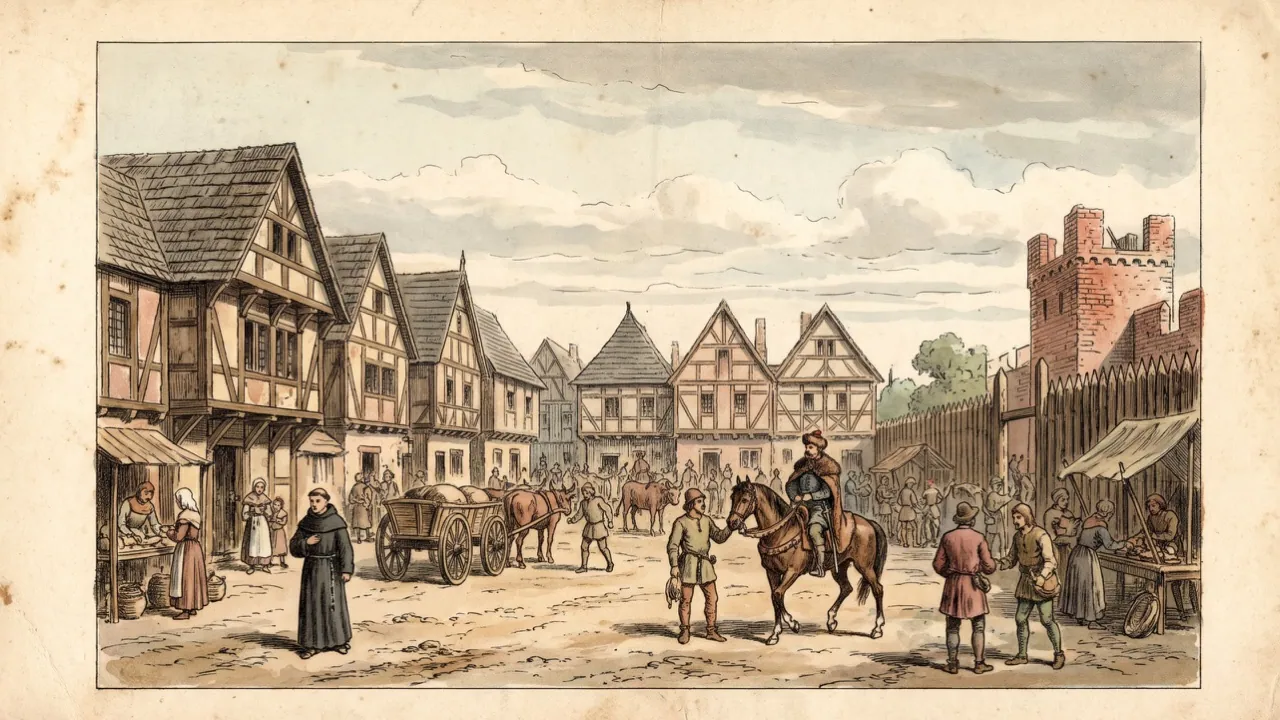
The founding was a locatio: the deliberate planting of a town by a lord, on a plan, under a law. [10] Warsaw’s locatio was carried out on the Chełmno law — the municipal code that reached Poland from the towns of Royal Prussia — around the year 1300, by Bolesław II of Masovia, Prince of Płock, who had ruled all Mazovia since 1294. [4] The site was the small fishing village of Warszowa, a few kilometres north of Jazdów; the town was raised on it as a fortified settlement with a market at its centre, and given a legal form that would shape the next three centuries. [4]
The market square
A rectangular market square with its hall at the centre, and lanes running off it at right angles.
Open in Google MapsThe Vistula
The timber bridge that carried the road over the Vistula.
Open in Google MapsThe charter has not survived, and that single fact governs everything that follows. The precise date cannot be fixed: Polish reference works put the founding “at the turn of the 13th and 14th centuries” and “around 1300”, and those are the forms a careful history must use. [10] A locatio was a legal instrument as much as a building programme: it set out the market and streets, allotted the plots, defined the jurisdiction, and bound the town to a law and a lord. Warsaw’s own instrument is gone, so the town begins as a set of obligations that cannot be seen written down.
Merchants, and the court at Toruń
Who were the founders? Not a saint, and not a king: a group of prosperous merchants, probably brought from Toruń, a town that already knew how to run a town on this law. [3] Until the fifteenth century the Toruń council served as the higher court under Chełmno law for Warsaw: the new town had its own magistracy, and its appeals went to a council of merchants on the same river, upstream. [10] How much of the city’s first legal life depends on a town that is not Warsaw, as though the law had to be fetched from somewhere with more experience of law.
The founder was Bolesław II of Masovia, Prince of Płock — the prince who united Mazovia in 1294 and lost it again to his brothers on his death in 1313, the year the town is first heard of. [1] The foundation of Warsaw is not the work of Władysław II Jagiełło, whose name later retellings attach to it: every source consulted for this history credits Bolesław II and a Mazovian locatio of about 1300. [10] The duchy he had briefly reunited was divided among his brothers within months of his death. [1]
The first attestation
The earliest surviving mention of the town is 23 April 1313, in the titulature of Duke Siemowit II: Warsaw appears among the lands and lordships by which the prince styles himself. [10] The first document attesting a Warsaw castellany is of the same year. [11] Siemowit II had by then received the middle share of the divided duchy, with its capital at Rawa Mazowiecka, while his brother Trojden took the Czersk lands; the town appears in a prince’s style of address, which is how a chancery asserted what was his. [1] A characteristic medieval beginning: no founding document, no founding story — only a clause in a prince’s letter and a mention in the record of an office.
The town took shape over the following half-century. The first line of city walls was raised from about 1350 and a second from about 1380: an earthen bank at first, stone from the late fourteenth century. [10] The first known privilege for Old Warsaw was issued by Duke Janusz I the Old at Zakroczym in 1376. [10] The population table that survives begins cautiously, with several hundred inhabitants in 1300; an English estimate puts the fourteenth-century figure at about 4,500, in a town of crafts and trade whose households showed an extreme disparity of wealth between patricians and plebeians. [4]
3. Two charters, two towns
The first lines of wall
Warsaw’s walls were raised in stages, and the charters that made it a pair of towns belong to the same process. The first line came up about 1350, a second from about 1380: an earth bank of timber and soil rather than masonry, with stone only in the late fourteenth century. [10] The sequence matters, because New Warsaw — the town that would stand beside the Old Town — grew up largely outside them. The first known privilege for Old Warsaw was issued by Duke Janusz I the Old at Zakroczym in 1376. [10] It is the earliest legal act for the Old Town in the surviving record, because the charter of the founding itself — the locatio of about 1300 under the Chełmno law — did not survive. A town founded on paper that is lost is a town known through its consequences; a privilege is a grant, made to be produced and relied upon.
The charter of 1408
In 1408 Janusz I the Elder bought Warsaw back from the Teutonic Order, and in the same year issued a privilege for New Warsaw which excluded it from the jurisdiction of the voivode of Old Warsaw — an exclusion and thereby conferred town status, a lokacja, under the Chełmno law. [12] The mechanism is unusual: town status here was constituted not by a grant of land but by the removal of a jurisdiction. A year later, in 1409, the duke and his wife Danuta Anna endowed the Visitation of the Blessed Virgin Mary as New Warsaw’s parish church. [12] The endowment completed what the 1408 privilege had begun: the grant added a parish and a priest. A parish church was not a pious afterthought: it made the settlement a parish, the unit in which the town’s people were counted, taxed and buried.
A town without walls
In 1414 New Warsaw obtained its own self-government. [13] By then it had a market, a town hall and a parish church of its own — and no walls. [12] It was a town in law and a suburb in stone: it kept its own council and its own coat of arms, in which a woman with a unicorn rampant stood for the settlement, but never enclosed itself. The contrast with the Old Town is exact: two chartered towns, each with a council, a coat of arms and a parish church, and one ring of walls, serving only one of them. In 1546 the New Town contained 204 estates. [13] Two centuries after the charter of 1408, New Warsaw was a substantial quarter of the city — and still the town without walls, outside the ramparts the Old Town had raised and rebuilt twice.
The capital moves
The third date belongs to the same decade and to the same duke. In 1413 Janusz I moved the capital of the Duchy of Masovia from Czersk to Warsaw. [10] The transfer made Warsaw the seat of a duchy five years before the town received a charter of its own, and four years before its parish church was endowed. The order of those three dates is the order in which the town’s legal personality, its institutions and its political weight were assembled.
4. The Old Town square and the town hall
The Old Town’s plan
The Old Town — Stare Miasto, what Warsawers call the Starówka, and what Latin documents call Vetus Varsovia — occupied about 16 hectares. [14] Inside that enclosure lay two market squares, the Rynek and the Szeroki Dunaj, and twelve streets, and along those streets stood roughly 150 houses. [14] The arrangement is characteristic of a locatio: ground surveyed and divided before anyone lived on it, not a settlement that grew along a road. The rectangle of the great square was the town’s first act of drawing, and the streets that ran off it the second; the narrow gables for which the Old Town was later famous follow from the width of the plots, not from fashion. Plots along the Rynek went to the forty wealthiest founders, and their measurements were workmanlike numbers: nine metres of frontage, thirty-five to forty metres of depth, on a rectangular square. [14] A house of that depth stands well back from the street; a frontage of nine metres is the width of two ordinary houses. The square was thus to be lined with narrow parcels fronting a common open space — and the Old Town Market Square is still, in its plan, that arrangement.
Fire, and then brick
The houses were narrow, one or two storeys high, with steep staircases and gabled roofs; wooden at first, with brick becoming the rule increasingly from the fifteenth century. [14] The change was forced by fire and then by law. The town burned in 1374, in 1384 and again in 1478, and in 1431 wooden houses were banned inside the walls. [14] What the Old Town kept from the fifteenth century onward was a masonry town of narrow gables and steep roofs, the ancient plots still legible in the grain of the street. The largest of these losses came on 30–31 May 1515, when a great fire destroyed part of Old Warsaw, including the collegiate church of St John, the church of St Martin, and the suburb across the water with the Bernardine monastery and its church. [10] The castle court book records the men responsible as a band of plunderers sent by the Muscovite prince. [4] That is an act of accusation as much as a record of damage: the fire was not an accident of a dry season but arson, ordered from a distance, and the entry was written to be read in court.
The town hall and the market hall
The Old Town’s town hall is first mentioned in 1429, and it remained Gothic in form until 1580, when Antonim — Antoneo — de Ralia rebuilt it in the Netherlandish manner, with four cylindrical buttresses at the corners and a tower rising above them. [15] That building served the town for the next century and a half. Around it, in 1701, was raised the single-storey brick market hall to the design of Tylman van Gameren: 55 by 34 metres, with 36 stalls on the town-hall side and 39 outside, four portals, and a balustraded attic above.
The market hall was built around the town hall but did not adjoin it. The distinction between the two civic buildings was functional as well as formal: the town hall was where the council sat and the court heard causes, the market hall the covered place of trade. The result was the oddest feature of the Warsaw Old Town: two civic buildings side by side with narrow lanes between them, and a market square whose usable width was cut to eighteen or nineteen metres. [15] The square was effectively a street with a market on it, walled on all four sides by houses on the forty original plots; the passage between the two halls became one of the tightest squeezes in the city.
Rebuild and demolition
In 1749 a fire destroyed the upper storey of the town hall and its tower, and the building was rebuilt in the Baroque manner; in 1781 it was rebuilt again, probably to the design of Dominik Merlini, in a classical style. [15] The last change was administrative rather than architectural. In 1817 or 1818 — the sources differ by a year — the Old Town town hall was pulled down, and the city authorities moved to the Jabłonowski Palace beside the Great Theatre. [16] The square kept its name and its market; the town that governed it had gone elsewhere.
5. The barbican and the Kraków Gate
A bastion before the gate
The barbican stands on the old line of the town’s southern defences, where the road from the south came in along what is now Nowomiejska Street. It is a semicircular fortified outpost built to protect that approach, replacing an older gate, designed by the Italian Renaissance architect Jan Baptist the Venetian, and instrumental in redesigning the fourteenth-century city walls. [17] The dates do not agree: the English-language online encyclopedia puts its construction in 1540, the Polish article on the Old Town in 1548. [14] Both fall in the 1540s, and it is safer to place it in that decade than choose between the two years. The shape is the argument: a rounded front set in front of a wall is a work built to shoot along a road rather than to be shot at from one.
Its dimensions were those of a serious piece of artillery architecture: a three-level bastion manned by fusilieriers, 14 metres wide, 15 metres high from the bottom of the moat, projecting 30 metres from the outer wall. [17] A gun on its roof could sweep the road and the face of the wall it defended; a detached work of that shape was the first thing a besieger met. The name barbican, long since naturalised in European fortification, described precisely this — a small fort set in front of a gate.
One day in 1656
The work saw action once in its life. On 30 June 1656 it had to be recaptured from the Swedes by the army of King John II Casimir. [17] In the eighteenth century it was partially dismantled, as artillery grew heavier and longer in range; the building was then put back together between 1952 and 1954, its form taken from seventeenth-century etchings and its brick salvaged from Nysa and Wrocław. [17] The brick is therefore not original, and what stands on the site is a careful reconstruction of a work that had stood dismantled for two hundred years.
The Kraków Gate and Castle Square
The gate that the barbican guarded was the Nowomiejska gate; the royal entrance lay further north, at the Kraków Gate, where the road to Kraków entered the town at Castle Square. The Kraków Gate had been developing through the fourteenth century, and stood as the ceremonial threshold of a city on its way to being a capital. In 1817 it was demolished, together with the Nowomiejska gate, to clear space for Castle Square. [16] Both gates went in the same year and for the same reason: a square was being made, and the medieval walls it displaced stood in the way.
What stands on Castle Square in place of the gate is Sigismund’s Column. It was erected in 1644 by Władysław IV to glorify his father, Sigismund III, and was the first secular statue in the form of a column in modern history. [18] It was raised while the Kraków Gate still stood on the square; the column outlived the gate by more than a century. It remained in place until the first night of September 1944, when a German tank gun struck it and it collapsed. [18] The statue was brought back and re-erected on Castle Square in 1949. [18] The column’s two lives bracket the twentieth century: the Vasa monarchy raised it, and the state that emerged from the ruins restored it.
St John’s and the trial of 1339
The other building that anchors the medieval town is St John’s Archcathedral, the cathedral church completed in 1390. [11] It is the cathedral of the walled town, and in the fourteenth century it was a court as much as a church. On 15 September 1339 the Warsaw Trial was judged in the church of St John: the dispute between the Polish Crown and the Teutonic Knights over the seizure of Pomerania, Chełmno Land and Kuyavia, with 175 witnesses examined. [10] Around it stood the offices of the castellanate of Warsaw, the first document attesting which dates from 1313.
6. The bridge of timber
A right bought before the bridge existed
In 1557, eleven years before the first pile was driven into the Vistula at Warsaw, Sigismund Augustus bought the exclusive right to ferry across the river at the town. The right was hereditary: it had descended for generations in the Jeżewski family, whose ancestors had received it from the dukes of Mazovia, and it was worth more to the crown than the timber it would one day carry. What the king bought that year was a toll and a market, not a bridge. The purchase committed him to the Sigismund Augustus Bridge eleven years before the first of its spans was laid.
The work itself was long and difficult. The first piles went in in 1568, and the building took years, held up by fires in the spans, by the river’s rising and by repairs to what the ice had already done. Its builder was a burgher of Zakroczym, Erazm Giotto; English reference works give the name as Erazm Cziotko, and both forms are still found.[9] Sigismund Augustus, the last Polish king of the Jagiellonian dynasty, died in 1572, a year before the work was finished; his sister Anna Jagiellonka, wife of King Stephen Báthory, patronised its completion. The crossing opened on 5 April 1573, in the week of the first free election in the Commonwealth.
Oak, pine and iron
The finished bridge was more than half a kilometre long and about six metres wide, of twenty-two or twenty-three spans, five of them carried on floating supports, with the roadway four metres above the water. Built of oak and pine beams roughly fifty centimetres thick joined with iron, it used a truss bearing system that was the technical novelty of the work — and a problem of its own, since the river shifted under it and the ice worked at the piers from the first winter. A merchant’s clerk from Danzig, Martin Gruneweg, left a description of walking over it: it “runs straight as a cord, and is so wide that two carts can pass each other on it, and it is also the pleasantest walking road of Warsaw’s inhabitants”.[9] The passage was tolled.
Georgius Braun, whose panorama of the cities of the world was printed in the Civitates orbis terrarum in 1617, wrote that by its length and the magnificence of the view the bridge had “almost no equal in all Europe” and drew universal admiration. The river was less impressed: a flood, by the reckoning of the sources in 1576, damaged the structure, and King Stephen Báthory noticed the defects himself and secured the money for the repair.[9]
The bastion at the bridge head
The permanent answer to fire was masonry. In 1582 Anna Jagiellonka ordered a brick bastion built at the head of the bridge, on the Warsaw bank, to shield the wooden structure from flames; it stands still as the Bridge Bastion, the Baszta Mostowa, otherwise the Stara Prochownia. Its bronze tablet, set into the western wall in 1582 and now in the Museum of Warsaw, gives the reason in Latin: the bridge, begun at great cost by Sigismund Augustus and completed after his death by his sister, might at any time be seized by “a sudden fire from poorly guarded suburban houses nearby” — and so the queen ordered the rampart enclosed with the safest brickwork, founded in the year of Christ 1582.[9]
The ice takes it
The bridge served for thirty years. In the spring of 1603, despite a militia raised for the purpose, the drifting ice of the Vistula broke it: the floes tore the spans away from their piers, and the timber structure, left unrepaired for some years, collapsed altogether.[9] There was then no permanent crossing between Warsaw and Praga, and the two banks of the river went their separate ways again for the best part of two centuries.[4]
Three more permanent wooden bridges were built at Warsaw over the following hundred years; the river allowed each of them to exist for only a few months. A further crossing was built in 1775, the first permanent link between the two banks since the ice had taken the first, and it was to stand until 1794.[4]
7. From duchy town to capital
Mazovia into the Crown
With the extinction of the Mazovian ducal line, Mazovia and Warsaw were incorporated into the Crown of the Kingdom of Poland in 1526; on 10 September of that year the Mazovian sejm swore allegiance to the Polish king, and in 1529, after the sejm at Piotrków had confirmed the incorporation, Warsaw became the capital of the Mazovian Voivodeship.[10] The last duke, Janusz III, had died in that year. The burghers of Warsaw gained privileges and tax exemptions; Queen Bona, widow of Sigismund I, took up residence in the Jazdów court in 1546 and stayed there until her departure for Italy in 1556.[10]
The seat of the General Sejm
In 1568 Sigismund II August moved his court and the central offices to Warsaw for good. The next year, at the sejm sitting in Lublin, the union of the two nations was agreed, and it was decided that Warsaw would be the permanent seat of the General Sejm of the Crown and of the Grand Duchy of Lithuania.[10] The city was well placed for the role: it lay in Mazovia, newly incorporated into the Crown and therefore seen as neutral in Polish–Lithuanian quarrels, and closer to Gdańsk, from where Sweden was always threatening, than Kraków.[4] Before 1795, 145 General Sejms were held at Warsaw — more than Piotrków’s 38, Kraków’s 29 or Grodno’s 11.[3]
The field of elections
From 1573 the kings of Poland were chosen in the fields around Warsaw. The first free election was held in 1573 at the village of Kamionek on the Warsaw road, and it produced Henry of Valois; a year later the assembly moved to the field at Wielka Wola, in what is now the Wola district, and from then on that field was the standing ground of the elections, including that of 1587 which set Sigismund III Vasa on the throne.[3] In the same year as the election at Kamionek, the city gave its name to the Warsaw Confederation, which confirmed religious freedom in the Commonwealth.[19]
A residence, not a capital
Warsaw was never legally declared the capital. The decision to move the royal court was taken in March 1596, after the fire at Wawel, and the king and court most probably arrived on 16 March 1596.[10] The chancelleries and the offices of the marshal and treasury were brought from Kraków into the enlarged Royal Castle, whose western wing was built for them after 1614; Sigismund III Vasa moved into it for good in 1611, returning from the Muscovite War.[20] Officially the city bore only the title of “the residential city of His Royal Majesty” until the collapse of the Commonwealth in 1795; Kraków remained the capital de jure, and it was still the city of coronation.[21]
The court brought the machinery of state, and the machinery brought masonry. Between 1598 and 1619 the castle was enlarged by Giovanni Trevano, whose plans were probably amended by the Venetian Vincenzo Scamozzi; Giacomo Rodondo finished the new northern wing between 1601 and 1603, and after 1614 Matteo Castelli built the western wing for the chancelleries and the marshal’s office. Sigismund’s Tower was finished in 1619: sixty metres high, set in the middle of a new western wing ninety metres long.[20]
The city that received all this was no capital in size, but it was no village either. In 1596, at the moment of its transformation into a capital, Warsaw already counted some 14,000 inhabitants: the old walled town held 169 houses, the new Warsaw outside the walls 204, and the suburbs as many as 320.[4]
Growth of that kind pushed the city out of its walls. In the years that followed, the suburbs filled with private jurisdictions — jurydyka, as they were called, the property of aristocrats and gentry, governed by their own laws and courts, and settled by craftsmen and tradesmen. Praga was one of them, and received a city charter of its own in 1648.[4]
8. The fire of 1607
Before 1607
Warsaw burned more often than most towns of its size, and its fire chronology has to be read carefully, because the years get confused in the telling. The first of the great fires came in the night of 30 to 31 May 1515, during the Muscovy–Lithuania war, when part of Old Warsaw went up, including the collegiate church of St John, the church of St Martin and the suburb with the Bernardine monastery and church; the castle court book records that a band of plunderers sent by the Muscovite prince was responsible.[10] The English account of the city’s history has the same fire in the same year and describes it as probably lit by Russian agents.[4] Smaller fires followed: a great blaze in the Old Town on 10 January, the year not given by the chronicle that reports it, and another on 15 October 1580 that threatened the Vistula bridge itself.[9]
Twenty-two tenements
The fire that decided the look of the Old Town was in 1607, and it is probable that it was started by participants in the Sejm; twenty-two tenements on the Old Town Market Square burned.[22] Until that year the houses round the square had been Gothic in style; afterwards they were rebuilt in late-Renaissance and, later, late-Baroque style, the square itself rebuilt in 1701 by Tylman Gamerski — Tylman van Gameren, the Dutch-born architect who came to Poland in 1664, trained in Utrecht, Italy and probably France, and a pupil of Jacob van Campen.[23] The rebuilding of the square survived, almost unchanged, until 1944.[22]
What the square had been before the fire, it had been for long: the heart of all Warsaw until the end of the eighteenth century, where the guilds and merchants met, where fairs were held and where, now and then, an execution took place.[24] The town hall at its centre had stood since before 1429 and was rebuilt in 1580 in the Polish mannerist manner by Antoneo de Ralia, and again between 1620 and 1621, with attics, four corner towers and a clock tower under a bulbous spire; it was pulled down in 1817, and the square took its four modern street names — Dekert, Kołłątaj, Zakrzewski and Barss — from Poles who lived on its sides.[16] The square was the market of the city and of Mazovia: luxury goods were sold there, and foreign merchants stood beside the city’s own burghers.[14]
The Jesuits and the burnt ground
The same year, the Jesuits were brought to Warsaw, and the ground they were given was the ground the fire had cleared. The plot beside St John’s Cathedral was not an accident of town planning: the houses in its immediate neighbourhood had just been destroyed, and the Jesuits, riding the wave of the Counter-Reformation, were in no mood to stand on the edge of things.[9] Their church was built between 1608 and 1626 in the mannerist manner, with a dome over the presbytery, and was rebuilt after the Second World War.[14]
The order was not shy about what it wanted next. In 1628 the Jesuits tried to take the neighbouring house of St Martin, the Augustinian monastery and church at Piwna 9/11: a widow ordered a Mass for her dead husband from the Augustinians, drew the monks to a thanksgiving feast at her house, and the Jesuits offered to guard the abandoned monastery — and then claimed it. The king and Pope Urban VIII were both drawn in, the courts gave the Augustinians their property back, and the episode is remembered as one of the monachomachies that Ignacy Krasicki, much later, turned into a poem.[9]
9. The Deluge
Three occupations
Warsaw was besieged, taken and pillaged three times between 1655 and 1658, by Swedish, Brandenburgian and Transylvanian forces in turn, and the Swedish troops carried off books, paintings, sculptures and other works of art.[4] The Swedish occupation, called the Deluge in Polish history, lasted until 1660; in 1656 the battle was fought under the walls of the town, and afterwards the Swedes and the Brandenburg-Prussians took the site of the Polish camp and seized Praga, which was burned to the ground.[10]
The castle stripped
The systematic plundering of the royal castle began with the Swedish administration in 1656. Paintings, sculptures, furniture, tapestries, the royal library, the crown archive and the royal flags were carried off, and whole floors went with them; the Swedes set up a military Lazareth field hospital in the castle, and what the armies did not take they destroyed, stripping the copper and tearing up the flooring.[20] Three occupations, the last of them by the Transylvanians, ended the splendour of the Vasa residence, and the rich residences of the magnates went down with the town: when the Swedes left, they lay in ruins, and their furniture, works of art, archives and libraries had been carried off to Sweden.[10]
The great hall went with the rest. The castle’s double-storied opera room, more than fifty metres long, where in 1628 Poland’s first opera, Galatea, had been staged, was demolished by the Swedes and the Germans and rebuilt only in the 1660s, by John II Casimir. Reconstruction of the castle itself began in 1657 under the Italian architect Izydor Affaiti; the next king, Michał Korybut Wiśniowiecki, had neither the money nor the will for anything more radical than raising the ruined buildings again, and in 1669 the court moved out to Ujazdów Castle. Until Sobieski’s death in 1696 no serious work was done on the castle at all.[20]
Rebuilding in Baroque
The Old and New Towns of the mid-seventeenth century survived the sack and were not destroyed again until 1939; their style was late Renaissance, with Gothic ground floors preserved from the fire of 1607.[4] The rebuilding was carried out over roughly two decades: the Swedish and Transylvanian armies finally left the city on 23 June 1657, and Old and New Warsaw was largely rebuilt by 1670.[21] The Copper-Roof Palace on Castle Square shows the sequence: built in 1651–1656 as a patrician house for Wawrzyniec Reffus, destroyed by Rákóczi’s army in 1657, and completely remodelled in 1698–1701 for Jerzy Dominik Lubomirski, who added a southern wing at right angles to the structure and extended the western elevation.[20]
Under John III Sobieski the centre of gravity moved to the west, beyond the old walls, and magnificent Baroque residences rose all around the city in the 17th and early 18th centuries.[4] In 1677 Sobieski bought the Wilanów estate and began a suburban residence that he named Villa Nova; the Wilanów Palace stands about ten kilometres south of the Old Town.[4] The church of the Reformati, the Capuchins’, was begun in 1683 as the king’s votive offering for the victory at Vienna.[10]
The Visitationist Church was a royal foundation: Queen Marie Louise Gonzaga brought the Sisters of the Visitation to Warsaw in the early 1650s — 1651 is the year the reference literature gives — and she and the dethroned John II Casimir later endowed their house with the furnishings that had survived the castle’s sack.[20] Its first church was of wood, and the Swedes burnt it in the Deluge; the masonry church that replaced it belongs to the eighteenth century.[5]
Not everything was lost, but it was scattered. Much of what survived the sack passed into the keeping of the Visitationists, where John II Casimir and Marie Louise Gonzaga, stripped of their kingdom, placed it; and the Copper-Roof Palace, a burgher’s house before the war, ended the century as a seat of the magnate and, since 1989, as a branch of the Royal Castle Museum.[20]
10. Augustus II and the Saxon Axis
A king dethroned on the election field
Frederick Augustus of Saxony was elected king of Poland in 1697 and took the name Augustus II. In 1700 he joined the Great Northern War on Peter I’s side, and the Polish Crown had not the force to make that war its own. Warsaw was besieged several times, the first by Swedish troops in 1702, and suffered severely from the occupation. [4]
In June 1704 the gentry dethroned Augustus and elected at Wielka Wola the pro-Swedish Stanisław Leszczyński. Within three months, on 1 September 1704, Warsaw was retaken by Augustus’s Saxon army after five days of bombardment. Augustus lost the city again after the battle of 31 July 1705, where two thousand Swedish troops defeated ten thousand men of the Polish-Lithuanian-Saxon army; Leszczyński was crowned that October and reigned until 1709, when Russia’s victory at Poltava drove the Swedes out and Augustus II became king again. [4]
Russian troops entered Warsaw in 1707 under the peace terms and withdrew after two months; from 1713 Russian and Saxon troops were permanently stationed there, an oppressive occupation. Beside the war came plague in 1708, flood in 1713 and poor harvests. Augustus II died in February 1733; that September the gentry elected Leszczyński again, and within a month the Sejm chose Augustus II’s son, Augustus III. The War of the Polish Succession brought further occupations, and Leszczyński fled to France. [4]
The axis out of Dresden
The Oś Saska, the Saxon Axis, was conceived and executed by architects from Dresden: Matthäus Daniel Pöppelmann, J. Naumann, Z. Longuelune, Joachim Daniel Jauch and Jan Zygmunt Deybel. It runs for about 1,650 metres from Krakowskie Przedmieście to Plac Żelaznej Bramy, through the Saxon Garden, and follows the line joining the church of St Lawrence in Wola, the old election field, with the village of Kamion, where the first free election was held in 1573. Its centre was the Saxon Palace and its garden; the great iron gate on the western side gave the square in front of it a new name. [25]
The work took nearly forty years: from 1713 to the early 1720s, a second stage from 1717 to Augustus II’s death, and completion under Augustus III in the 1730s and 1740s. The ground was cleared first — a pentagon of some seventeen hectares, covered before 1713 with buildings of little value — and a park was laid out on it, with five main arteries converging on its centre, where the Great Salon pavilion was put up in 1724. The court carried the work into the castle as well: the Senate Chamber was raised by a storey in 1709, the stables and a carriage house went up to Johann Christoph Naumann’s design between 1716 and 1720, and the Chamber of Deputies was rebuilt in 1717 as a coronation hall for the Saxon kings. [25] [20] Not far away stood the Copper-Roof Palace, which the king took over in 1777, when Domenico Merlini joined it to the library wing of the Royal Castle. [20]
The first public park
The garden was given to the public on 27 May 1727, the city’s first public park. It covers 15.5 hectares, on ground that had been Sigismund III’s ramparts and then, from 1666, a palace built for Jan Andrzej Morsztyn; its parterres were laid out from 1713 by Joachim Heinrich Schultze and from 1735 by Gothard Paul Thörl. The Iron Gate, built after 1735 to Jauch’s design and carved with the arms of Poland and Lithuania, was pulled down in 1821. [26] A plan of 1745 shows seventy pedestals; by 1797 thirty-seven sculptures remained, twenty of them left today. The sandstone figures were carried off to Saint Petersburg after Suvorov’s recapture of the city in 1794 and set up in the Summer Garden. [26]
11. The city Stanisław August made
The Załuski Library
The library was founded by two bishops, the brothers Józef Andrzej and Andrzej Stanisław Załuski. Józef announced the plan for a public library in his Programma literarium of 1732, and the collections were housed in the Daniłowicz Palace, bought in 1736. The Załuski Library was opened to the public there on 8 August 1747 — the first Polish public library, and one of the largest collections in the world. [27] Its shelves drew on the private libraries of Andrzej Olszowski and Andrzej Chryzostom Załuski, including the Sobieski library and the Żółkiewski collections with the legacies of Sigismund II Augustus and Stephen Báthory. Beside the books were more than forty thousand engravings, a numismatic cabinet, natural-history specimens, cartographic and mathematical collections and an astronomical observatory, in twenty-nine rooms; before the confiscation the books numbered more than 400,000 printed items and about 12,000 manuscripts. [27]
In January 1774 the library passed to the Commission of National Education, whose member Ignacy Potocki became its first custodian. Then came the ruin. After the fall of the Kościuszko rising the collections were plundered by the Russians and carried off between December 1794 and January 1795 on Catherine II’s orders, to become in 1814 the foundation of the Imperial Public Library in Saint Petersburg. The haul was inventoried at 400,000 volumes, 20,000 manuscripts and 40,000 engravings, of which only 260,000 volumes, 11,000 manuscripts and 24,500 engravings survived the transport. [27]
Collegium Nobilium
Stanisław Konarski, a Piarist priest, founded the Collegium Nobilium in 1740 as a school for the sons of the nobility and a forerunner of the University of Warsaw. It began as the “Collegium Novum” in Długa Street, was renamed in the autumn of 1741, and was later extended to Miodowa Street, where the Aleksander Zelwerowicz Theatre Academy stands today. In 1774 the rector Augustyn Orłowski bought land between the Vistula and the Bełcząca ravine, in the Szymanowska jurydyka, and put up a two-storey building in 1775. The school had five classes and an eight-year course, emphasised the natural sciences, cut Latin and Greek back in favour of Polish, French and German, and ran a school theatre. It closed in 1832, when its premises lay inside the Warsaw Citadel. [28]
A ministry of education
The Commission of National Education was established by a resolution of the Sejm of 14 October 1773 and took over the estates of the suppressed Jesuit order: the first secular ministry of education in the world. Its first president was Ignacy Jakub Massalski, Bishop of Vilna, removed in 1776 for financial abuses in the Lithuanian schools. Its most deserving members were Adam Kazimierz Czartoryski, Joachim Litawor Chreptowicz, Ignacy Potocki and Andrzej Zamoyski, though in practice the work was done by a circle around Hugo Kołłątaj. [29] The Commission set up the Towarzystwo do Ksiąg Elementarnych, which produced thirty textbooks; Polish became a subject of instruction in its own right only from 1780. Two institutions date from 1765: the Royal Cadet Corps, the first secular school in Warsaw, [5] and the National Theatre, the city’s first public theatre, whose Operalnia was a five-hundred-seat house built to Pöppelmann’s design on the model of the small theatre in Dresden, where on 19 November 1765 the actors staged Józef Bielawski’s Natręci, after Molière. [26]
Ramparts of earth
The Sigismund Rampart was raised in 1621–1624 on Sigismund III’s order after the defeat at Cecora: an earthwork reinforced with stone, it swept round Old Warsaw, New Warsaw and the dense suburbs in a semicircle resting on the Vistula, its centre at the Royal Castle, leaving three entrances open — Krakowskie Przedmieście, Senatorska and Długa — and enclosing about 125 hectares. [30] In 1770 the Grand Crown Marshal Stanisław Lubomirski raised a new rampart around Warsaw and on Praga, partly replacing Sigismund’s, by a proclamation of 5 October. Its purpose was sanitary rather than military: the plague was spreading, and the earthworks were to control who came into the city, travellers and goods inspected. [31] The left-bank rampart ran 12.8 kilometres and enclosed 1,469 hectares; three kilometres of earthwork encircled 165 hectares of Praga. The plague never came; a severe winter ended it in 1771.
12. The Bar Confederation and the Four-Year Sejm
Confederation at Bar
On 29 February 1768, at Bar in Podolia, the Polish nobility swore the act of a Bar Confederation: an armed league formed in defence of the Catholic faith and the Commonwealth’s independence, and aimed against the Russian protectorate, Catherine II and the king who had accepted it. Its watchword was wiara i wolność — faith and freedom. Sixty-six local leagues soon made up the general confederation; on 19 June 1768 the Confederates, with royal troops under Franciszek Ksawery Branicki, took Bar. The preceding Radom Confederation sejm — the “Repnin” sejm of 1767–1768 — sat in the capital, revising the reforms of the 1764 Convocation sejm. On 14 October 1767 Repnin had the leaders of the Radom Confederation seized, among them the bishop of Kraków, Kajetan Sołtyk, and Field Hetman Wacław Rzewuski with his son Seweryn. On 24 February 1768 the Commonwealth signed a treaty of perpetual friendship with Russia and became a protectorate; two days later the “cardinal rights” made the equality of the dissidents an inviolable law. [32]
The king on Miodowa Street
In October 1771 the confederation’s leaders authorised Kazimierz Pułaski to seize the king. On 3 November, on Miodowa Street in Warsaw, a party of Confederates attacked the royal carriage as it returned; Stanisław August was wounded in the head and taken beyond the town defences, where one of his captors, moved to pity, led him off to a mill at Marymont. Its defeat cost the First Partition of 1772, decided in Saint Petersburg in the middle of 1771. [32]
The Great Sejm
The four-year sejm opened in Warsaw on 6 October 1788, with Catherine II’s consent: she needed Polish help against the Turks in the war begun in 1787. It was called the Great Sejm, and from December 1790 it sat in double form. Its principal work was the Constitution of 3 May 1791, which divided power between the legislature, the executive and the courts, enlarged the rights of the townsmen, abolished the confederations and the liberum veto in the Sejm, and curtailed the political rights of the poorest nobility. The British historian Norman Davies called it “the first constitution of its kind in Europe”. [4]
Russia had guaranteed the constitution since 1775, and the Russo-Turkish War of 1787–1792 gave Catherine II the freedom of hand to move against it. [33] The Constitution survived fourteen months and three weeks. The Targowica Confederation was concluded on 14 May 1792 in the small town of Targowica, the conspiracy having been made on 27 April in Saint Petersburg under Catherine II’s patronage, the act drafted by the Russian general Wassili Popow. Among the signatories were Stanisław Szczęsny Potocki, marshal of the Crown confederation, the hetmans Franciszek Ksawery Branicki and Seweryn Rzewuski, and Szymon Marcin Kossakowski; the secretary was the publicist Dyzma Bończa-Tomaszewski. On 18 May 1792 an army of a hundred thousand Russians struck the Commonwealth. [34]
The Cities Act
The Prawo o miastach, the Cities Act, abolished the jurydyki and merged them with Warsaw into a single urban organism under one magistracy; it was incorporated into the Constitution of 3 May in full, as its Article III. Townsmen might send twenty-four plenipotentiaries to the Sejm, with a vote on city matters alone, and gained personal immunity, the right to buy land, hold offices, officer ranks and clergy benefices, and be ennobled. [35]
On 27 November Jan Dekert, president of Old Warsaw, convened in the city the representatives of 141 royal towns, who addressed a memorial to the king; on 2 December a “black procession” marched from the Old Town town hall to the Royal Castle. The Sejm appointed a deputation for the royal towns on 18 December 1789; its bill failed in the chamber on 1 March 1791. What finally passed was not the deputation’s draft but a bill introduced by the deputy Jan Suchorzewski, which the king supported and the Sejm adopted on 18 April 1791. The English History of Warsaw dates the Act to 21 April, still kept in the city as Warsaw’s day; the statute itself bears the date of 18 April. [35] [4]
13. The third partition and the massacre of Praga
Fortifications unfinished
The Kościuszko Uprising began on 17 April 1794, and Warsaw was its capital. But the internal struggle for power in the city and the demoralisation of its population meant that General Józef Zajączek never finished the fortifications that were to encircle the capital from the east and the west, and the Russians were moving in meanwhile. [4] They reached the eastern outskirts on 3 November 1794 and began firing the next day; the suburb of Praga, on the far bank of the Vistula, was the point they had chosen to strike. [36]
Four hours on Praga
The Russian army under Alexander Suvorov numbered about 23,000 men. The guns are counted differently: Schlosser gives the Russians 86, the Polish military encyclopaedia the defenders 104, others 90. His troops formed into seven columns and assaulted the sandy entrenchments of Praga at five in the morning of 4 November, the main blow falling on the northern works, which were held by General Jakub Jasiński. [36] Behind those earthworks stood Zajączek with about 13,600 men — Lithuanian troops, poorly trained and supplied, broken in spirit by a long retreat from Lithuania — in fortifications thrown up in sand, badly laid out and stretched too far. [36]
The fighting lasted about four hours. Zajączek, lightly wounded in the arm, withdrew early to the left bank and destroyed the pontoon bridge behind him. [36] General Paweł Grabowski, Tadeusz Korsak — a deputy to the Great Sejm — and General Jasiński were killed, and some six thousand soldiers died; only a small part of the garrison got across the river. [4]
The burning of the suburb
Then the suburb burned. The troops looted and set fire to Praga, and many of its inhabitants were murdered — the event Polish history calls the “massacre of Praga”. The numbers are disputed: the standard accounts run from five or six thousand dead up to twenty thousand, and one Russian estimate, cited by Adam Zamoyski, puts the dead at 20,000 within a few hours. [36] [4] A Warsaw observer, the Carmelite friar Klemens Hofbauer, wrote to his superior that after the suburb was taken “more than 16,000 people — men, women and children — were murdered”, and that only the Vistula separated the suburb from the house opposite. [36]
The city’s Jewish community paid its own price. Berek Joselewicz, a merchant and army purveyor who had witnessed the Paris revolution of 1789 and formed a Jewish light-horse regiment of five hundred Warsaw men, saw it almost annihilated at Praga; [37] the survivors dispersed, and Joselewicz went into exile, to Galicia and then Italy. Samuel Zbitkover, in whose honour a quarter of the suburb was called Schmulevizna, put up two barrels on the day of the massacre, one of gold and one of silver, paying a ducat in gold to anyone who brought him an inhabitant of Praga, Jew or Christian, and a silver ruble to anyone who brought him a dead citizen for burial. Both barrels emptied in a day. [38]
On the evening of 4 November three magistrates of Warsaw — Dominik Borakowski, Franciszek Ksawery Makarowicz and Stanisław Strzałkowski — reached Praga with a letter from the king and authority to treat for surrender. [36] The whole city capitulated on 5 November; the Russian troops entered on 9 November, after the bridge had been repaired, and the guns left in the arsenal were spiked. [36] After the fall of the Kościuszko Uprising the Commonwealth was divided for the third time in 1795; Warsaw fell within the Prussian share and became the capital of the province of South Prussia. [4]
14. The first Jews of Warsaw, 1414
A lawsuit, and a street called Żydowska
The earliest trace of a Jewish settlement in Warsaw is a quarrel over money. In 1414 a Jewish merchant and banker of the city — Lazar in the Polish sources, Lazarus in the older Latin — appears in the pages of the Book of Czersk, disputing a debt with a burgher of the ducal town, and the entry calls him a Jew of Warsaw. Warsaw’s own court books from those years have not survived, so the record is accidental: a single name lifted out of a lawsuit, and with it the first evidence that a community was here. The YIVO Encyclopedia dates its first documentary evidence to the same year and places that community on Żydowska Street in the Old Town, where the Jews built a synagogue and a cemetery on Wąski Dunaj Street.[38]
The quarter stood on ground the town could not claim. Polish reference works date the first documented mentions of Jews in the Old Town to 1427 and locate it between Wąski Dunaj, Piwna and Piekarska streets and the city wall — land held by the dukes of Mazovia, and therefore exempt from municipal law. The vanished Żydowska Street ran through the quarter and divided it in two; the cemetery lay near St John’s, outside the wall.[14]
It was a small world, and the paperwork of it is thin. The tax record of 1423 shows ten Jewish families paying tax in Warsaw and about as many more exempted from it, and the Jewish Virtual Library will go no further back than the end of the fourteenth century, when Jews were apparently already in the city.[39] Modern estimates put the fifteenth-century community at something like a hundred and fifty souls, merchants and bankers with a few craftsmen among them — a reconstruction rather than a count. For comparison, the oldest surviving municipal books of Kraków already speak of a settled Jewish colony along Żydowska street — today’s św. Anny — in 1304; Warsaw’s own books begin a century later, and only by accident.[40]
A thirteenth century hypothesis
The thirteenth century is a different order of evidence, and must be given with care. The Jewish Encyclopedia reports that, according to Polish writers, the earliest settlement of Jews in Warsaw dates from the thirteenth century, and points to documents in Hebrew script preserved in the local archives as the sign of their early importance there.[37] The older court books are lost, so the community’s existence before 1414 is inferred rather than documented — a reasonable inference, given how thoroughly the fifteenth-century papers show the quarter at work, but a hypothesis and not a date.
Expelled, and returned
Hostility was constant. The burghers of Warsaw resented the competition of Jewish merchants and appealed to the Mazovian princes against them; the preaching of the anti-Hussite John of Capistrano fanned the fear, and the town expelled its Jews in 1455, in 1483 and in 1498, though some were living in the city again within three years of the second expulsion. A charter for the community was drafted in 1469 and never promulgated.[38] Between 1498 and 1524 there is no information at all about Jews in the city: they were probably driven out entirely, or they held on in the outskirts on magnates’ land, from which they could still come in to trade.[39] By 1527 they were back.
A community without a commune
From 1527 until the Prussian conquest there was no authorised kehilah in Warsaw. The Jews living in the city and its environs nevertheless met for prayer, formed prayer houses and charitable associations, and appointed a syndic-parnas to direct the tax administration, exercise judicial power and organise the census, assisted by dayyanim and by a sworn meturgeman, an interpreter for the courts and the offices; rabbis officiated without authorisation.[39] A community with its own court, its own register and its own officers, and no standing before any authority: the magistracy could recognise its men or decline to — and that was still the position when the Prussians arrived.
15. De non tolerandis Judaeis
The privilege of 1527
Mazovia was folded into the Crown in 1526, and in 1527 King Sigismund I the Old confirmed to the burghers of Warsaw the old ducal privilege de non tolerandis Judaeis — the refusal to tolerate Jews — which forbade them to live in Old or New Warsaw, and, in the crown’s version, in the suburbs as well.[14] The ducal original was two years old: in 1525 Prince Janusz III of Mazovia had forbidden Jews to reside in Warsaw or to pursue mercantile or industrial occupations there, and the measure was soon ineffective, for the simplest reason in the world: the Jews driven out of the city settled just beyond the walls, on private land, where the town’s jurisdiction did not reach and the city’s trade still did.[37]
The decree of 1570
In 1570 Sigismund II Augustus made the rule more drastic, in four clauses no magistrate could politely ignore. No Jew, Jewess, Jewish child or servant — Jewish or Christian — might dwell with property or wares on any municipal, royal or clerical land within the limits of Old or New Warsaw, nor remain there even during royal sojourns, excepting only the time of the Diets. A Jew with business connections might sojourn with the written consent of the magistrate, but might not trade or practise a handicraft that interfered with the daily pursuits of the citizens, nor reside or trade within two miles of Warsaw on either bank of the Vistula, on pain of confiscation. And it was the duty of the magistrates to enforce the removal of the Jews from the city and its environs “without regard to any extenuating circumstances or even to letters of exemption from the king or his successors”.[37]
The decree had to bend around the calendar of the parliament. The Sejm had been sitting in Warsaw since the 1550s, and the city’s importance as a political and commercial centre made the Diet’s season the one time when the ban relaxed: Jews were permitted in while it sat, first during its conventions, then, from 1570, for a fortnight before and a fortnight after the sessions.[39] Representatives of the Council of Four Lands were likewise permitted to visit the capital to negotiate with the king and the szlachta.[38] In 1580 King Stephen Báthory added an edict forbidding the Jews to reside in Warsaw or to lease city taxes or property; those who had to come on business secured a special permit from the magistrates.[37]
Three ways of keeping the city shut
Three mechanisms kept the system in being. The first was the ticket: outside the sessions of the Sejm a Jew could obtain permission to enter Warsaw through a “ticket” carrying the right to remain for a fortnight — the arrangement the Jewish Virtual Library calls the “daily ticket”.[39] The second was the guilds: Christian merchants rid themselves of their Jewish competitors by insisting on the strict application of the Magdeburg Law, and went on agitating for it with varying success for years.[37] The third was the law itself. After 1539, when Sigismund I ceded to the nobles full legal jurisdiction over the Jews living on their lands, a lord could judge his own Jews, hear appeals from them and keep the profit of their labour.[41]
In practice the exclusion was never total, and the gap between the decree and the practice is where the money changed hands. Decrees of 1663, 1676, 1737, 1740, 1761, 1763 and 1770 confirmed the earlier edicts; deprived of permanent residence, Jews secured immunity by purchasing the goodwill of the city magistrates, while Christian merchants paid bribes to the same magistrates for the exclusion of their Jewish competitors. In 1691, preparing for the wedding of the crown prince Jacob Sobieski, Warsaw’s merchants paid ten silver thalers to the Grand Crown Marshal and gave lemons and oranges worth 54 Polish gulden, so that intercession might be made with the king to withhold protection from the Jews.[37]
The licence was then formalised, and priced. Under the Grand Crown Marshal Stanisław Lubomirski every Jew who wished to stay in Warsaw had to buy a certificate for one silver groschen, good for five days only, on pain of imprisonment; the revenue from those tickets reached 200,000 Polish gulden a year.[37]
16. Tickets, bribes and the magistracy
Licensed, not admitted
The point of the system is easily missed. Jews in Warsaw were never legally admitted to the city and never legally excluded from it; they were licensed to be there. The ticket was bought, dated and returned, and the magistrates sold it. The daily round was already fixed, as POLIN’s survey of the Jewish towns describes it — Jews traded in the main market by day and, before nightfall, went back through the gates to their own enclave, as the law of non-tolerance required.[40]
The Jewish community of Warsaw had no legally constituted communal body between 1527 and the Prussian conquest. Prayer houses, charitable associations and a syndic-parnas who organised the tax assessment, the court and the census existed in the absence of any legal recognition.[39] That is why the Prussian grant of a kehilah, given legal status in 1796, mattered more than the text of any decree: for two centuries the community’s standing had been a question of what the magistracy was prepared to recognise on any given day. The Jewish Encyclopedia, recording the Prussian change, notes that the government allowed the Jews to live in Warsaw, permitted them to organise a ḳahal for the regulation of local Jewish affairs, abolished the rabbinical tribunals, and prohibited rabbinical anathemas under penalty of fifty thalers’ fine and banishment.[37]
The marshal’s guard in New Jerusalem
The system had teeth, and it used them. Under Crown Marshal Franciszek Bieliński the restrictive measures were enforced to the point of admitting Jews only during the Diet’s sessions; the great crown marshal Lubomirski issued the certificates, and his guard saw to the rest. On 22 January 1775 that guard invaded New Jerusalem, the Jewish settlement beyond the Jerusalem gate, confiscated the merchandise found there and demolished all the Jewish houses.[37] The settlement lay inside Prince August Sułkowski’s Bożydar-Kałęczyn jurydyka, founded in 1702, and the Old Warsaw magistrate sued the prince in the marshal’s courts for its liquidation.[42]
The enclaves and their lords
The magnates who owned the enclaves were resented in their turn, because their courts sheltered the town’s rivals. In the jurydyki around Old and New Warsaw the groups the burghers liked least found shelter: Jews, Protestants, craftsmen and merchants who did not belong to a guild.[38] A man outside the guild system could trade in a town where the guild system was a licence to trade; a Jew outside the walls could sell in a town where the walls forbade it.
Counts and their caveats
How many Jews there were is a series of censuses rather than a headcount, and the differences between them are as interesting as the numbers. The poll-tax census of 1765 recorded 2,519 Jews in Warsaw.[39] On POLIN’s Virtual Shtetl the population grew from about 2,500 in 1765 to about 3,500 in 1778. The census of 1792 counted 6,750 Jews in a total population of 81,300 — 8.3 per cent — a figure the YIVO article suspects may be an underestimate.[38] The Prussian census ordered in 1793 returned only 6,997, “evidently much below the actual figures”, because it was widely evaded.[37] The count of 1797 gave 7,700; the Jewish Virtual Library gives 7,688, or 12 per cent of the population.[39] More than doubled in a quarter of a century, and in the counting and the evading the city kept its own counsel about what the account meant.
17. New Jerusalem and the riot of 1790
The enclaves outside the walls
Warsaw’s suburbs were not simply suburbs. Around the two chartered towns grew a belt of private enclaves — the jurydyki — founded by magnates, clergy and monasteries, each with its own law and court. A Sejm law of 1559 allowing the gentry to buy urban property sent them multiplying: by 1788 the YIVO Encyclopedia counted about fifteen, a Polish reference work lists twenty-eight.[43] The magnates who owned them sat in the Sejm, and the enclaves sheltered the city’s most unwelcome residents — Jews, Protestants, craftsmen and merchants outside the guilds.[38] The rule that excluded the Jews from Warsaw was thus circumvented by the aristocracy that had voted it.
Nowa Jerozolima
One of those enclaves belonged to Prince August Sułkowski. The jurydyka of Bożydar-Kałęczyn passed to the prince in 1774; in that year a Jewish settlement, Nowa Jerozolima, rose between today’s Plac Artura Zawiszy and ul. Kaliska, on ground the de non tolerandis privilege had closed to Jews since 1527. It survives in the street that took its name, Aleje Jerozolimskie.[42]
The sources disagree on the dates, and they disagree by more than a year. The Jewish Encyclopedia gives 22 January 1775 for the guard’s raid and the demolition of the houses, and records the confiscated merchandise, worth hundreds of thousands of gulden, stored in the arsenal and later sold at auction.[44] The Polish article on Bożydar-Kałęczyn has the houses demolished on 23 January 1776.[42] YIVO’s encyclopedia places the liquidation after 1788 and makes it the work of the municipality, which persuaded the king that the settlement was illegal and liquidated it despite the Permanent Council and the Russian ambassador Otto Magnus Stackelberg.[38] Founded in the 1770s and destroyed in the mid-1770s, the settlement leaves one day least settled.
One more date belongs to this stretch. On 25 May 1784 Marshal Mniszek issued an ordinance expelling the Jews from Warsaw and its environs, and the Jewish Encyclopedia records that the better classes of Polish society condemned the ill treatment of the Warsaw Jews by the merchant and artisan guilds.[44]
The riot of 16 May 1790
The Four-Year Sejm, sitting from 1788 to 1792, was the scene of a bitter argument over the status of the Jews, petitions going to it from both sides, Jews and Christian burghers. In March 1790 furriers and tailors assembled at the city hall and demanded the expulsion of the Jews who had settled in Warsaw; their petition was carried to the Sejm by the mayor of Warsaw, Jan Dekert, and produced a new decree expelling all Jews to the suburbs, except merchants holding specific rights of residence. The decree was followed by repeated outbreaks of anti-Jewish violence.[38]
The worst of them came on 16 May 1790, when a tailor named Fux began attacking Jewish workshops on Senatorska Street, working in the courtyard of the Gołubskie Palace; when the main exit was barred to him he escaped by a side door. His brief disappearance set off the rumour that “the Jews killed a tailor”. An official of the Jewish community found Fux and paraded him through the streets, but the crowd would not disperse: the riot wrecked the Gołubskie Palace and, next door, the Pociejowski Palace. The violence was not directed only at Jews but at the szlachta too, whose use of the jurydyki to escape the rules on Jewish settlement was bitterly resented by the burghers who had just won the petition.[38]
The constitution adopted on 3 May 1791 improved the legal status of the towns and did nothing for the Jews. Their position in fact worsened: the City Act of 18 April 1791 abolished the jurydyki and merged them with Warsaw under a single magistracy, removing the aristocratic protection on which so many had depended. In May 1792 the new and more powerful Warsaw magistracy renewed the call for the expulsion of the Jews.[38] [35]
18. Equality suspended, the Duchy of Warsaw
A state made in July 1807
Napoleon carved the Duchy of Warsaw out of the Prussian partition after the Treaties of Tilsit of 7 and 9 July 1807. Its duke was Frederick Augustus I of Saxony, and its constitution was granted on 22 July 1807: serfdom was partially abolished, all classes were to be equal before the law, and religious tolerance was constitutionally guaranteed. The 1810 census counted 4,334,000 inhabitants — 79 per cent ethnic Poles, 7 per cent Jews, perhaps an underestimate. The constitution’s fourth article, that “all citizens are equal before the law”, would have given Jews the right to vote and to sit in the Sejm.[45] [38]
Between the partitions the city belonged to Prussia, and the Prussians restricted the occupations Jews might follow and expelled the poor and the unemployed to the Russian and Austrian partitions. In February 1802 they abolished the feudal privileges of the towns in their newly annexed Polish lands, which gave Jews unrestricted access to every town, Warsaw included — and the burghers promptly treated the Jews as instruments of the Prussian authorities. On 17 July 1806 the Prussian-controlled Warsaw magistracy ordered the removal of Jews from some principal streets for two years; the order was never carried out, because Napoleon beat Prussia.[38]
No single regulation
There was no single regulation on Jewish residence in the Duchy of Warsaw. The act usually described in that way does not exist, and the authoritative account of what does exist is Aleksandra Oniszczuk, “The Old Privileges and the New Spirit of Law”, Studia Judaica 23 (2020). The interim Governing Commission resolved four times in 1807 — on 26 January (§40: “The national towns shall have their privileges retained”), 6 June, 18 June and 22 July, the last at Dresden. Every one of these acts implicitly restored the Old-Polish town privileges, the privilegia de non tolerandis Judaeis among them.[46]
When the Duchy was formally established and adopted its constitution, the highest authorities did not treat those old privileges as binding — but they refrained from announcing that, and agreed to settle individual cases “as if the old privileges were still binding”. What replaced them was the rewir, the German Revier, a district concept borrowed from the Prussian Generaljudenreglement of 1797, which silently accepted de non tolerandis clauses while formally making no mention of them. Oniszczuk’s summary: “no legal act was ever issued in the Duchy that would have uniformly regulated the Jewish residence issue across the state.”[46]
The decree of 16 March 1809
The instrument that actually governed was the decree of 16 March 1809, which reduced the Jewish presence in more than thirty of the finest central Warsaw streets, “deemed the best addresses in town”. It did not renew the city’s de non tolerandis privilege: the interior minister argued that the old privileges had lost their validity “as proved by the decree of 16 March 1809 regarding Warsaw”. Across the Duchy the new restrictions took one of three forms — a cap on the number of Jewish houses permitted in an urban centre; the streets or parts of town where Jews might dwell, explicitly “not, however, representing ghetto areas”; or a complete ban on settlement.[46]
Around it lie smaller measures: the decree of 19 November 1808 depriving Jews temporarily of the right to buy land, and the decree of 25 March 1809 on the kosher tax. The constitutional equality was suspended rather than never granted: royal decrees of 7 September and 17 October 1808 postponed the granting of civil rights to Jews for ten years, “hoping that they will destroy in themselves characteristics which distinguish them so much from other inhabitants”.[46] [38]
The town president and the banker’s street
In Warsaw the argument played out in the town hall. The town president, Paweł Bieliński, refused to recognise the kehilah, appointed a Jewish syndic instead, and tried to restore the town’s right to exclude Jews — unsuccessfully. Within a year he had recognised Jewish residence rights and accepted the kehilah as the governing body. The Jews remained concentrated in the northern part of the city, an area that kept its Jewish character until 1943.[38]
Napoleonic rule in Poland ended with the Congress of Vienna in 1815; in the Kingdom of Poland that followed, the ticket levy abolished in 1811 would be collected again from 1825.
19. The kehilah and the two synagogues
A community recognised in 1799
What the Prussians made possible was an authorised community. Their government, which did not recognise the old city charters, allowed the Jews to remain in Warsaw and permitted them to organise a ḳahal for the regulation of local Jewish affairs.[39] It also appointed a representation for Warsaw Jewry with the right to exercise the herem, so that taxes were paid, and the revived community could appoint authorised rabbis.[37]
The authorised community dates from 1799, when the Prussians granted the Jews the right to establish their own kehilla; the Virtual Shtetl, the historical portal of the POLIN museum, counts as many as 9,200 Jews in the city then, about a tenth of the population. The YIVO Encyclopedia, which gives the kehilah legal status in 1796, disagrees; the discrepancy is best handled by giving both dates and preferring 1799.[38] The kehilla sat at first in private apartments, its management mainly Misnagdim; its first chief rabbi, elected in 1821, was Salomon Zalman Lipszyc, who had served the community of Praga since 1819 and held office until his death in 1839.
Two congregations, not two denominations
Two congregations, not two denominations, divided Warsaw’s Jewish religious life. The “German” synagogue on Daniłowiczowska Street was founded in 1802 at the expense of Isaac Flatau of Berlin for the maskilim. It was not a reform synagogue, but it had modern features, including a sermon, given first in German and from the late 1850s in Polish; the Orthodox called it contemptuously di daytshe shul, and it was replaced by a new building in 1843.[38] [39] The “Polish” synagogue on Nalewki Street followed in 1852, linked with the school of the maskilim; it “remained basically Orthodox, although a number of changes were introduced in the way worship was conducted.”
That is the fault line in Warsaw’s Jewish religious life, and older accounts have muddled it. They speak of a “Kahal al-Jadid” and a “Kahal ha-Sifrutim,” joined by a decree of 1805 or 1806 into a single “Kahal Polsky.” No such pair of names and no such decree appears in the documentary record. What the sources do document is a merger of the two real communities, Warsaw and Praga: the Jewish kehilla in Praga was incorporated into the Warsaw one in 1832, and in 1871 the two finally merged into one. In that year, by an ordinance on the electoral order, the Warsaw religious supervisory board took the name Zarząd Warszawskiej Gminy Starozakonnych.
Izaak Kramsztyk was the first to preach in Polish at the “Polish” synagogue on Nalewki Street, from 1852; after the Russians exiled him he returned under an official ban on preaching and teaching. He lies in the Jewish cemetery on Okopowa Street in quarter 26, row 11. Markus Mordechaj Jastrow (1829–1903), preacher at the progressive synagogue on Daniłowiczowska Street from 1858, who preached in Polish, was expelled from Warsaw with Chief Rabbi Dov Berush Meisels in 1861 and emigrated to the United States.[37]
A council that could not agree
The kehilah was granted, and then it was contested from within. In the elections of 1912 a coalition of assimilationists and Misnagdim narrowly defeated the allied Zionists and Hasidim led by Nahum Sokolow. In 1923 Moses Schorr was appointed extra-district rabbi for the supporters of Reform Judaism and Sebastian Bregman became president of the board. The Aguda won the election of 1926, with Eliasz Kirszenbaum as Council president and Joshua Farbstein of the Mizrachi as board president. In 1929 the Bundists resigned from kehilla work in protest at the refusal of aid to TSYSHO, the Jewish Central School Organization, which they regarded as a neglect of non-believers’ needs; the Folkists objected in turn to high rabbinical salaries and to expenditure on Palestinian funds.[47]
Underlying all of this was the bargain struck between the acculturated and the Orthodox. Since 1822 the boards governing Jewish communities had been restricted to religious matters. After a financial criterion was introduced, the assimilationists assumed the leadership of the community by agreement with the Hasidim and controlled its affairs for over fifty years, from 1871 to 1926.[39] When the November Uprising broke out in 1830, some 300 to 400 Jews joined the National Guard, having first shaved their beards; those who refused were allowed to found a “Civil Guard” of about a thousand by late summer 1831.[38]
Meisels took part in the revolution of 1848 in Kraków, and in 1861 he was one of the twelve leading citizens of Warsaw who petitioned the tsar for the restoration of the “rights of the Polish nation.” Going to Count Andrzej Zamoyski, he was told that the Jews were “our countrymen and brothers, the children of one land,” and answered: “And we too feel that we are Poles and we love the Polish land as you do.” The state’s answer was expulsion: Meisels, permitted back the following year, died in 1870 and was buried at Okopowa.[38]
20. The maskilim and the school of the hundred
A school that trained no rabbis
There is no School of the Hundred. No institution of that name, and no school called the “Wage,” figures in the record for 1878 or 1879; the names belong to a later confusion. The institution that filled the role was the Szkoła Rabinów, the Warsaw Rabbinical School, founded in 1826 on the strength of a ukase of Emperor Nicholas of 1 July 1825 and directed by Antoni Eisenbaum (1791–1852), a convinced maskil and a follower of the Haskalah. It was a modern secondary school for Jewish male youth which, despite its name, trained no rabbis.[37] [48]
Eisenbaum wanted “enlightened” rabbis and laymen who would understand the modern world and be well placed to serve as leaders of the Jews in Warsaw. Its teachers included Aaron Moses Cylkow, father of the preacher Jacob Cylkow who translated the Psalms into Polish, A. Buchner, author of a study of the Talmud, and Isaac Kramsztyk; when it opened in 1826 it had fourteen pupils, and by 1843 it had 221.[37]
When it closed is likewise a matter of dates rather than of doubt: the closure is given as 1860, at the end of the 1860/61 school year, as 1862, and as 1863 — the last tied to the suppression of the January Uprising and to a general reform of Polish education. The YIVO Encyclopedia’s account of the eastern European seminaries gives 1863 and adds that the school was founded chiefly on the initiative of the maskilim Abraham Stern, Jakob Tugendhold and Eisenbaum.[48]
What the maskilim built instead
What genuinely belongs to 1878 and 1879 is a burst of civic institution: a Jewish hospital established in 1878 by M. Bersohn, A. Kraushar and others, a Hebrew technical school founded in 1879, and a library organised in 1881 in connection with the Great Synagogue under Ignacy Bernstein.[37]
The most ambitious of the foundations came after the war. On 19 February 1928 the Institute for Judaic Studies, the Instytut Nauk Judaistycznych, opened in Warsaw, and the Jewish Historical Institute described it as “the first Jewish school in Europe with a scientific curriculum including not only theological subjects but also secular Judaic studies.”[49] It was a body quite distinct from the Jewish Historical Institute, which was founded only in 1947 and took over its building and the Main Jewish Library on Tłomackie Street.[50]
Poles of the Mosaic faith
These institutions stood inside a political settlement. In 1862 the governor-general Aleksander Wielopolski emancipated the Jews: they could settle freely in Warsaw, hold office and practise trades from which they had been barred, and the discriminatory taxes — the levy for living in Warsaw, the tax on kosher meat — were abolished. Among the Polish Positivists the dominant aim was to draw peasants, women and Jews into the nation by a policy of Polonisation that would make Jews “Poles of the Mosaic faith” through education.[38]
For a time the programme worked. The assimilationists persuaded the overwhelming majority of Warsaw’s Jews to declare themselves Poles in the census of 1881. In 1886 the financiers Jan Bogumił Bloch and Henryk Natanson were able to prevent the extension to the Congress Kingdom of the anti-Jewish laws introduced in the tsarist empire in May 1881.[38] What followed was a narrowing of ground. Zionism and socialism entered the community’s politics, and the maskilim’s institutions — the Great Synagogue on Tłomackie Street, the Szkoła Rabinów, the communal board — lost the allegiance of the grandchildren of the men who had built them.
21. The heder and the Talmud Torah
The melamed’s room
The heder was the basic unit of traditional education. Its teacher was the melamed; heders were privately owned by teachers, located in their homes, and served mainly the middle class, while community-supported Talmud Torah schools provided elementary education to orphans and to the children of the poor. Writing was not taught in most heders until the end of the nineteenth century, and there were no common standards: some communities laid down rules about the maximum number of pupils, but such rules were often not enforced.[48]
The order of study was fixed. The beginners’ heder taught the alphabet and reading from the prayer book, the Pentateuch and its Aramaic translation, Targum Onkelos; the heder humash went back over the Pentateuch with Rashi’s commentary and the weekly portions in Yiddish, met the early Prophets and came for the first time to the Babylonian Talmud; the heder gemara took selected Talmudic chapters with Rashi and the glosses of the Tosafists. On Fridays the pupils were tested by the teacher; on the Sabbath they presented what they had learned in the week. Most boys who reached the third level finished at twelve or thirteen, and relatively few went on to a yeshiva.[48] [51]
The melamed’s standing explains much of this. He is portrayed consistently as a man of little knowledge and severely limited teaching skill. A man of real ability preferred instead to be a rabbi, a judge in a rabbinical court, a maggid or a teacher in a yeshiva; since teaching in a heder required no qualification, the position became a last resort. A photograph of a heder in Warsaw is dated c. 1917.[48] [51]
Learning a trade
Alongside the heder, and increasingly beside it, stood the trade school. ORT’s work in the newly independent Polish state started in 1921; by 1939 it ran 66 institutions and had trained over 4,500 students, with a curriculum of day schools, adult and artisan workshops, certification courses and training farms. The first congress of ORT committees in Poland was held in Warsaw in February 1923.[49] A glossary printed with a volume of the Ringelblum archive dates the opening of the ORT bureau in Warsaw to 1924, placing it in 1921–24.
The scale of that world is best seen in the census: Warsaw’s was the largest Jewish community in Europe, and by 1931 nearly half of its Jews worked in industry.[38]
The Hasidic quarter
The ordinary practice of a Hasidic district was visible everywhere in the count of buildings. In 1880 more than two-thirds of the 300 synagogues in the city were Hasidic, as were most of the shtiblekh, the prayer rooms.[38] [39] The influx of the Litvaks weakened Hasidic dominance, because immigrants often came from areas where Jewish religious life was dominated by the Misnagdim. The Litvaks were resented by the Hasidim as impious intruders and criticised by some Poles as purveyors of Russian values — a charge with little truth in it, for as late as 1897 Russian speakers were only 2.2 per cent of Warsaw’s Jews.[38]
22. The workshop, the bank and the factory
A city outgrowing its province
In 1816 Warsaw counted 81,250 inhabitants, of whom 15,600 were Jews — 19.2 per cent of the city. By 1864 the total had reached 223,000 and the Jewish share 72,800, or 32.7 per cent; in 1897 the city had 625,000 people, and 210,500 of them were Jews, 33.7 per cent. The Jewish Encyclopedia’s table for 1882 gives 127,917 Jews in a city of 382,464, and its figures for 1897 are higher again — 231,678 out of 638,208 — the difference turning on registered and actual population and on the suburbs counted. For two generations the Jewish population of Warsaw grew faster than the city around it.[38] [37]
The growth came not only from natural increase and from migration out of the Congress Kingdom’s towns and villages, but from the movement of Jews out of the Russian Pale of Settlement into Warsaw — legal after 1868, and intensified after the tsarist anti-Jewish laws of 1881, which did not apply to the Congress Kingdom. Those migrants were called Litvaks by Poles and by Polish Jews alike. By the outbreak of the war perhaps 150,000 of them had settled in Warsaw; the scale is disputed, and YIVO’s survey of Polish Jewry puts the number of Litvaks in Congress Poland by the First World War anywhere between 100,000 and 250,000.[38] [47]
The stall and the workshop
The occupational profile was set early and changed slowly. At the beginning of the nineteenth century the largest group among Warsaw’s Jews consisted of merchants and traders, ranging from financiers to impoverished peddlers; the bulk of the remainder were artisans, above all tailors, hatters and furriers. By the 1887 census, 13.7 per cent of the city’s Jews — nearly 30,000 people — declared Polish their mother tongue. Yet the mass of the community remained Yiddish-speaking — 83.7 per cent in 1897 — and Orthodox.[38]
What the census of 1931 shows is a community of small enterprise. Forty-seven per cent of Warsaw Jews worked in industry, mostly in small factories or artisan workshops; 33 per cent in commerce and insurance; 4 per cent in education and culture; 4 per cent in medicine and health; 1 per cent in public and social services. Jews were dominant in the textile, clothing and tobacco trades. The economy that carried them was not the economy of large works: it was the economy of the bench, the back room and the market.[38]
Credit, the exchange and the river
The trade had deep roots. An eighteenth-century Jewish merchant of Praga, Reb Shmuel Zbitkewer, “traded with notions, cut goods, then became a grain merchant, carried rye on the Vistula to Danzig,” went on to “buy forests, build sawmills, transport wood on rafts, buy estates, employ a mass of people — a sort of Meir Anshel Rothschild — in Praga.”[52]
Credit, however, was organised in families. The great Jewish banking houses went beyond the degree of acculturation favoured by the maskilim: they constituted a closely knit circle of about a dozen families, often related by marriage. Some of them, such as Zelig Natanson or Mathias Rosen, remained Orthodox all their lives and were enthusiastic supporters of Jewish causes; conversion, meanwhile, made steady inroads into the circle. The great houses of the Napoleonic and post-Napoleonic years — the Fränkls, the Epsteins, the Laskis, the Kronenbergs — formed the basis of Warsaw’s banking community.[38]
The railway and the crash
What made the city central was the railway. The abolition of the tariff barrier between the Congress Kingdom and the tsarist empire created the conditions for rapid economic development, and Warsaw was the place where the European narrow-gauge lines met the Russian broad-gauge; in those years the capital emerged as a major industrial centre. When the Russian market was lost after 1918, the industries built to serve it suffered, and the Great Depression of the 1930s intensified the difficulties. By the 1930s the majority of Warsaw Jews dealt in small-scale trade and craft.[38]
23. The Yiddish press
Before the dailies
The first Jewish newspaper in Warsaw appeared in the latter part of 1823, a weekly in two languages: Der Beobakhter an der Vayksel, the Observer on the Vistula, which the Jewish Encyclopedia spells Der Beobachter an der Weichsel, with a Polish edition, Dostrzegacz Nadwiślański, printed in parallel columns. Its editor and publisher was Antoni Eisenbaum, the maskil who had run the rabbinical school. YIVO notes that the Yiddish text was a transliteration of German into Hebrew characters, apparently a condition of the government subsidy. The other Warsaw Jewish weekly of the period was Polish-language: Jutrzenka, the Dawn, founded by Daniel Neufeld in 1861.[37] [38]
Real newspaper culture arrived after 1905. In 1906 five Yiddish newspapers were published in Warsaw — Der veg, Di telegraf, Idishes tageblat, Morgenblat and Di naye tsaytung — with a combined daily circulation of 96,000. The Hebrew dailies of the same year, Ha-Yom, Ha-Tsefirah and Ha-Tsofeh, together sold only 12,000, while the single Polish-Jewish paper, Gazeta Nowa: Ludzkość, circulated to about 10,000.[38]
Der veg, Idishes tageblat, Haynt
Two of those five papers matter for what followed. Der veg was founded in 1905 by Zwi Pryłucki, who had obtained a government concession for a Yiddish daily with a general Jewish-nationalist orientation; it was the first Yiddish daily in Poland, and it closed in 1907, largely because of the competition of Idishes tageblat. That paper had been founded in 1906 by Shmuel Yankev Yatskan (Jackan), a Zionist and a former contributor to the Hebrew paper Ha-Tsefirah; in 1908 it changed its name to Haynt, and quickly established itself as the premier Yiddish newspaper of the Kingdom of Poland. From its inception Haynt followed the Odessa practice of Aleksander Zederbaum in reprinting Yiddish fiction in serialised form, and it passed 150,000 copies by 1913.[53] [38]
The interwar peak
After the coup of May 1926 the Yiddish press flourished, reaching a combined daily circulation of 170,000 in 1932–33. The most important papers published in Warsaw were Haynt and Moment, unaffiliated Zionists; Folks-tsaytung, the Bundist organ; and Yudishe togblat, the Orthodox daily. The same encyclopedia also lists the peak averages of the leading titles — about 25,000 each for Haynt and Moment, about 15,000 for Folks-tsaytung, about 13,000 for Der Yud — and puts the whole of Warsaw’s Yiddish, Polish and Hebrew dailies, roughly a dozen papers, at almost 100,000 copies a day at their height; the two figures measure different things.[38]

The Polish-language daily Nasz Przegląd ran alongside them, and by 1937–38 it was selling nearly 23,000 copies under the editorial direction of Jakub Appenszlak; it claimed independence from any party and printed the label “Independent Organ” in its byline. Estimates of its circulation have ranged as high as 50,000. The Hebrew press, by contrast, declined: many of its writers left for Palestine, and Ha-Tsefirah, which had been daily in Warsaw since 1886, ceased publication in 1931.[38] [54]
Writers, and the older weekly
Polish-language journalism had its own line of descent. The weekly Izraelita, published from 1866 to 1915, stoutly defended the assimilationist position; under its first editor, Szmul Hirsz Peltyn, it identified with the Warsaw Positivists and the European Enlightenment, opening its pages to leading Polish writers and assailing Jewish religious conservatism.[38]
It was in the 1890s that Y. L. Peretz settled in Warsaw and gathered a circle of Yiddish writers around him. Jewish creativity flourished in both Yiddish and Polish, with writers such as Sholem Asch, Israel Joshua Singer, Antoni Słonimski, Julian Tuwim and Adolf Rudnicki; it was in this environment that Isaac Bashevis Singer obtained his literary apprenticeship. A particularly important role in the cultural life of Yiddish Warsaw was played by the Association of Yiddish Writers and Journalists, at 13 Tłomackie Street.[38]
24. Zionism, the Bund and Agudat Israel
A threefold division
By the interwar decade Jewish political life had come to be characterised by a threefold division — Zionism, Orthodoxy and socialism. The Folkist party, which sought Jewish cultural autonomy, was also vigorous in the first years of Polish independence. All these groupings were strong in Warsaw, which became one of the main arenas of the struggle for control of the “Jewish street”. YIVO’s survey of Polish Jewry puts it more bluntly: the three main streams had each their own constituency and advanced different political strategies, and no one party or tactic dominated.[38] [47]
The orthodox current was organised at Katowice, not in Warsaw. Agudat Israel was established by Jewish religious leaders at a conference held at Kattowitz — Katowice — in 1912, with 27–29 May given as the dates of the founding meeting; those who gathered there had broken with the Zionists after the Tenth Zionist Congress of 1911, when the Mizrahi demand for funding religious schools was defeated. In Poland its leading figures were Abraham Mordechai Alter, Meir Szapira and Abraham Perlmutter. Agudas Isroel was, in the Polish party system, openly a supporter of the Piłsudski camp.[55] [56]
The Bund and the arithmetic of the Jewish vote
The Bund entered the new Polish state from the Russian empire, and in Warsaw it grew to be the strongest of the three currents. In the country elections the Bund’s vote was 81,884 in 1922 — 0.9 per cent of the whole — about 100,000 in 1928, and 66,699 at what the source itself calls the “largely rigged” election of 1930. It never took a seat in the Sejm: Agudat Israel, the Folkspartei and the Zionist parties were represented there, the Bund was not; the reason usually given is that the Polish Socialist Party, the Bund’s only plausible partner, was reluctant to appear as a pro-Jewish party. In eighty-nine towns the Bund nonetheless won one-third of the Jewish vote outright, and in Łódź it took 57.4 per cent.[57]
The arithmetic of the Jewish vote is better read party by party than as a bloc. In the elections to the first Sejm in January 1919 the General Zionists took about half of the Jewish vote; the Bund, which stood outside those elections, took nothing, and the division of the Jewish electorate among lists that would not combine cost the community seats it might have won — the disparity is generally put down to the divergent character of the groupings and to their lack of unity going into the poll. The lists that did combine, the bloc through which the Zionists, Agudas Yisroel and the minorities entered parliament, took 16 per cent of the vote in 1922, and 12.6 per cent with 55 seats in 1928; in 1930 the same alliance returned 33 deputies to the Sejm and 7 senators.[58] [57]
The schools and the street
The battleground was the school. Tens of thousands of Jewish youngsters studied through the private and communal networks established by Polish Jews in the interwar period, among them Tarbut, Ḥorev, Yavneh and the Jewish Central School Organisation, TSYSHO, while more than three-quarters of Jewish children sat in Polish public schools.[47]
After May 1935
After Piłsudski’s death in May 1935 the ground changed under all three currents. Calls for Polish Jewry to emigrate, the ghetto benches in the universities, a revived boycott of Jewish shops and increased anti-Jewish violence undermined the community. Zionists lost ground as emigration to Palestine became harder; Agudas Yisroel’s accommodation with the authorities appeared bankrupt; and the Revisionist Zionists, the Communists and above all the Bund gained. In the local government elections in Warsaw in December 1938 the Bund took 61.7 per cent of the Jewish vote — fourteen seats, according to the YIVO Encyclopedia, or seventeen according to the Bund’s own account; against five seats for the Jewish National Bloc, which included the Zionists and Agudas Yisroel, and one for the Democratic Zionists.[38] [57]
25. The Great Synagogue and the two cemeteries
The synagogue on Tłomackie
The committee of the Daniłowiczowska synagogue conceived a new synagogue in 1859 or earlier and became the Synagogue Construction Committee in 1870; Ludwik Natanson proposed building a new synagogue on 5 September 1859 and presided over it from 1871 to 1896. The site was acquired on 5 May 1872: two seventeenth-century tenements from Józef Simmler, on the square where the Great Synagogue on Tłomackie Street was to stand for sixty-five years.[39] The building was purpose-made in brick; Marconi’s classicalist design was accepted by the governor-general on 3 January 1874, after competitions in 1872–73 and June 1873.[59]
The cornerstone was laid on 14 May 1876, at a cost of about 200,000 rubles. It was opened on 26 September 1878, on Rosh Hashanah, with the governor-general Count Paweł Kotzebue and the mayor Socrates Staryniewicz in attendance; the preacher Isaac Cylkow addressed the gathering in Polish, which the governor did not challenge. The hall seated exactly 2,200, 1,150 in the main hall and 1,050 in the women’s gallery. It was the institutional stronghold of the assimilationists, though not a Reform synagogue of the German kind: its founders avoided liturgical reforms that departed from Jewish law.[59]
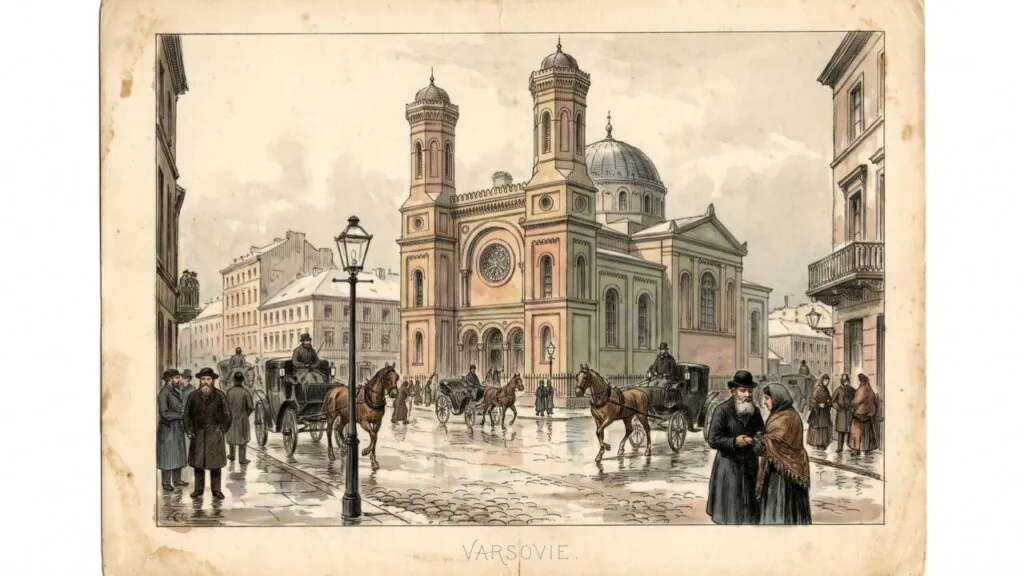
What survived of the synagogues
Of roughly four hundred synagogues and houses of prayer working in Warsaw until 1941 — the Virtual Shtetl puts the total above four hundred and forty — one survives: the Nożyk Synagogue at Twarda 6, built between 1898 and 1902. The Great Synagogue closed for good on 30 March 1942, on the order of Heinz Auerswald; on 16 May 1943 Jürgen Stroop blew it up, in the last and most emblematic act of the ghetto’s destruction. It was not rebuilt; the site carries the Błękitny Wieżowiec today. On Tłomackie Street the former Main Jewish Library survives, now the seat of the Jewish Historical Institute.[60] [59] [49]
The cemetery on Okopowa Street
The Jewish cemetery on Okopowa Street was created in 1806 on the initiative of the Warsaw Jewish community, the third Jewish necropolis in the city. The Chewra Kadisha, the burial fraternity, administers it. The first person officially buried was Nachum son of Nachum of Siemiatycze, who died on 6 December 1806; the first woman was Elka Junghoff, wife of Kacper Jezierzyel Junghoff, whose headstone bears a death date of 26 November 1804 — almost certainly an error. The date of 1864 sometimes given for the opening of the cemetery is wrong; the Polish description of the site and the JewishGen record both give 1806.[61] [52]
The ground covers about 33.5 hectares, the largest Jewish necropolis in the Mazowieckie voivodeship and the second in Poland after Łódź. The number of graves is a range: the JewishGen record gives “about 150,000 tombstones” in its data fields and “approximately 250,000” in its narrative. Between roughly 150,000 and 250,000 gravestones is the safe figure.[61] [52]
At its centre stands the Synagoga Cmentarna, a late-classicist building of 1877 designed by Adolf Schimmelpfennig; a well was sunk in front of it in 1882. The cemetery was enlarged repeatedly between 1824 and 1869, and from 1885 free burials went to Bródno to save space and money. When the Lubomirski Rampart was levelled in 1875 and Tłomackie and Okopowa Streets laid out in its place in 1887, the necropolis was drawn inside Warsaw’s administrative boundaries. In the interwar years, when it had filled, the community used the system of nasypy: headstones removed and a metre of fresh earth piled over old graves, fourteen times, the last in 1936. On 15 May 1943 the Germans blew up every building in it; only the well survived.[61]
Among the tombs the JewishGen record lists are those of the writers I. L. Peretz, An-sky and D. Nomberg, the publisher S. Orgelbrand and the rabbis B. Meisels and Ch. Sołowiejczyk; there are ohelot of tzaddikim from Warka, the tombs of the insurgents of 1863, the mass graves of soldiers who fell in 1939, and a memorial to Janusz Korczak.[52]
The second cemetery, on Praga
The other great Jewish cemetery of Warsaw stands on the Praga side of the river, at ul. św. Wincentego 15. It served the Jewish community of Praga, founded in the eighteenth century — the sources give 1743, 1780 and 1811 — and occupies 5 hectares, with some 300,000 people presumed buried there and 3,000 gravestones surviving.[62] The Okopowa cemetery fell inside the ghetto when it was sealed in November 1940 and was excluded from it in October 1941; the gap that followed made it a smuggling route into the district.[61]
26. The politics of the interwar decade
The Fourth Duma election of 1912
The decade began badly. In the Fourth Russian Duma elections, held in Warsaw in October 1912, Polish attitudes had changed, and a single vote showed it: when the Polish liberal candidate failed to condemn antisemitism, the Jewish members of the restricted electoral curia elected a socialist instead. What followed was a boycott of Jewish shops organised by the National Democratic Party of Roman Dmowski, frequently accompanied by violence — a far cry from the high hopes of Polish–Jewish brotherhood in 1861–1863.[38]
War, and German rule
The First World War made matters worse. The tsarist authorities and the National Democrats both saw Jews as supporters of the German war effort. Jews welcomed the Russian defeats of the spring of 1915 with enthusiasm, and people of Jewish origin made up a significant proportion of the Polish legions that Marshal Jósef Piłsudski set up alongside the Austrians.[38]
German rule, from 6 August 1915 until November 1918, brought a revival of Jewish political life: banned newspapers reappeared and many new ones were established, and it made possible the Jewish private school system that would form the basis of the Zionist, Bundist and Orthodox school networks of interwar Poland, though most children still attended ordinary Polish schools.[38] [47]
Relations with the Polish majority improved under the occupiers: the Polish groups that had supported the Central Powers, the aktywiści, had been at odds with the National Democrats and were less likely to indulge in anti-Jewish demagogy. When city council elections were held, the more moderate Jewish groups, anxious to avoid a repetition of 1912, divided the seats with the principal Polish political organisations, and got a smaller share than their share of the city’s population.[38]
The capital of an independent Poland
Warsaw became the capital of an independent Polish state again in November 1918, with the defeat of the Central Powers. A large civil service now made its home in the city, and it became the focus of the country’s political life. Economically the loss of the Russian market, on which the city’s prosperity had depended, meant that its industries suffered, and the Depression made it worse.[38]
The community’s own numbers grew more slowly than the city’s. There were 310,000 Jews in Warsaw in 1921, 352,000 in 1931 and 375,000 on the eve of the war, and the Jewish share of the population fell from 33.1 to 29.1 per cent. The heart of Jewish Warsaw stayed in the north of the city, around Nalewki, where the main Jewish restaurants were; the acculturated and the assimilated were concentrated further south and east.[38]
Theatre, cabaret and scholarship
The years following the coup of May 1926, which Warsaw’s Jews supported, were fruitful. The Jewish theatre had houses of its own: the Warsaw Yiddish Art Theater (WIKT), founded by Zygmunt Turkow and Ida Kaminska. Cabaret played an important part: Julian Tuwim and Antoni Słonimski among the Jewish writers who fed it wrote for cabarets such as Qui Pro Quo and Morskie Oko, and the first Yiddish cabaret patterned on the Polish model, Azazel, followed in 1925. There were important Jewish choirs, among them the choir of the Tłomackie Street synagogue and the Grosser Choir of the Bund.[38]
Jewish scholarship flourished as well: Majer Bałaban held a chair in Jewish history at Warsaw University, and the independent Institute for Jewish Studies opened in 1928.[38]
The political weather changed after Piłsudski’s death in May 1935. Calls for Polish Jewry to emigrate, “ghetto” benches in the universities, a revived boycott and increased anti-Jewish violence undermined the community.[63] Zionists lost ground as emigration to Palestine grew harder, Agudas Yisroel’s accommodation with the authorities looked bankrupt, and the Revisionists, the Communists and above all the Bund gained. In the December 1938 elections the Bund took 14 seats in Warsaw — 61.7 per cent of the Jewish vote, against 5 for the Jewish National Bloc and one for the Democratic Zionists — though an English account puts the Bundist share of the twenty council seats won by Jewish parties at 17; the seat count is disputed.[38] [57]
The German army entered the city in September 1939, and within a year the Germans were building a wall across the Jewish districts.[38]
27. The wall
From Lublin to Madagascar
The Germans had no single plan for Warsaw’s ghetto, but a series of them, each abandoned as the war’s plans changed. The first was to gather the Jews of the entire General Government into the Lublin district — considered in March 1940, dropped the following month. The boundaries of a Warsaw ghetto were surveyed in the spring, and the work stopped when the scheme to resettle Europe’s Jews in Madagascar came back into favour; with the German army’s situation in the east it resumed in August 1940.[64] The ghetto district itself was created by order of Ludwig Fischer, the governor of the Warsaw District, on 2 October 1940.[64]
The German governor-general, Hans Frank, announced the ghetto’s creation to the city on 16 October.[65] Residents had been told to be inside by 31 October; the deadline was extended to 15 November. The district was closed and isolated on 15/16 November 1940; Polish scholarship dates the sealing to 16 November, though the United States Holocaust Memorial Museum’s timeline gives 15 November and Yad Vashem 16 November.[66] [64] The sealing was an operation as much as a proclamation: on the day the district closed, a sweep of the ‘Aryan’ side began, 11,130 people were caught and marched in, and 3,770 Jewish shops were taken over and emptied.[64] The Germans handed the internal government of the district to the Judenrat and its policing to a Jewish constabulary the council had created, numbering about 1,700 officers at the moment of closure.
The wall itself
On 27 March 1940, in the middle of the anti-Jewish disturbances, the Jewish Council was handed a map marking the limits of a closed zone and told to begin building walls on it. The German explanation, supplied at once and repeated for two and a half years, was that the walls were there to protect Jews from excesses. The bill went not to the city but to the Council, and Adam Czerniaków took out a 160,000 złoty loan from Bank Dyskontowy to meet it.[64] The boundary had been marked before a brick was laid: in March 1940 the administration began sealing off the northern part of the city on the ground of a so-called epidemic, and white boards went up on the boundary streets — Seuchensperrgebiet, only passage permitted.[64] The alarm was a fiction; the isolation it announced was not, and the northern district was closed first because that was where Warsaw’s Jews lived.
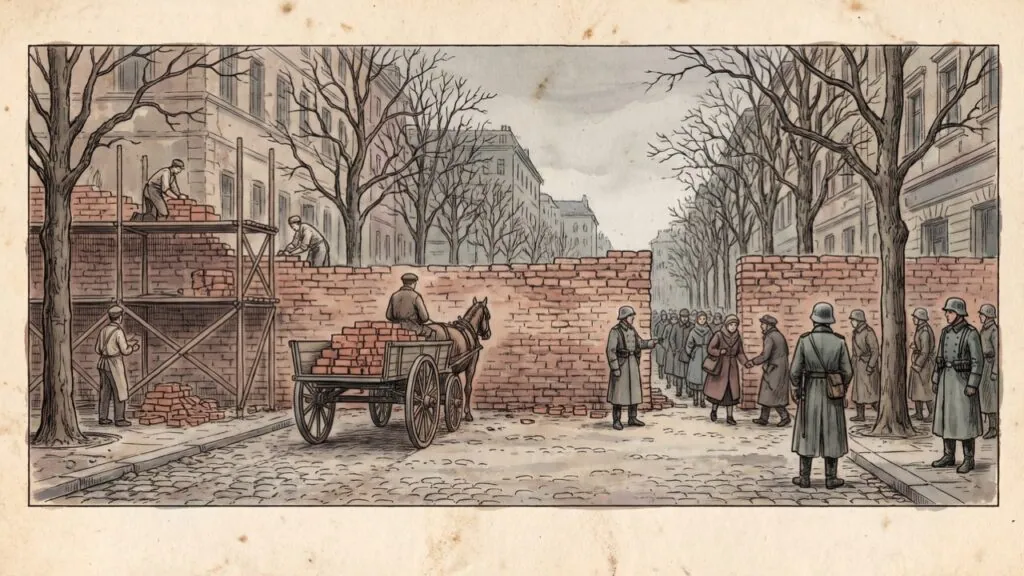
What rose around the district was brick, not fence. The wall stood about three metres high, with a further metre of barbed wire on top; the United States Holocaust Memorial Museum describes it as almost ten feet high and gives the perimeter as around eleven miles.[67] [65] To cross it was to be shot. Escapees were killed on the spot, and German policemen from Order Police Battalion 61 were reported to hold victory parties on days when large numbers were shot at the ghetto fence.[65]
Three square kilometres
The district covered about 3 square kilometres — roughly 307 hectares — and the wall around it ran for some 18 kilometres.[64] The museum gives the area as 1.3 square miles, or 3.4 square kilometres.[67] Both agree on what matters: the ghetto was 2.4 per cent of the city’s area.[66] Building the ghetto meant moving a quarter of a million people inside a few weeks: about 138,000 Warsaw Jews and 113,000 ethnic Poles changed address, and some 700 Volksdeutsche were shifted out.[64] By scale, Warsaw’s ghetto had no equal: the largest in the General Government and in all occupied Europe, both in area and in population.[65] The Łódź ghetto, with 204,000 people, was second.
Two ghettos and a footbridge
Chłodna Street, one of the city’s east–west thoroughfares, was excluded from the district, and the ghetto fell into two parts: the Small Ghetto to the south-east, the Large Ghetto to the north.[65] The two were joined at the junction of Chłodna and Żelazna Street by a gate. In January 1942 the gate was taken away and a wooden footbridge put in its place — two storeys high, reached by fifty steps from each side, the largest of four pedestrian crossings over ghetto streets.[64] The council that had paid for the wall sat at Grzybowska 26/28.
28. The Judenrat and Adam Czerniaków
An engineer from the city
Adam Czerniaków was born in Warsaw in 1880 and trained as an engineer, at the polytechnic institutes of Warsaw and Dresden. In interwar Poland he led the movement for better vocational training for Jewish artisans and defended their interests against a rising antisemitism. He was elected to the Polish senate in 1931, and a technicality kept him out of it. When the government dissolved the elected board of the Warsaw Jewish Community in 1936 — a board the Bund had dominated — it appointed Czerniaków vice-chairman.[68] In September 1939, after the German invasion, the board’s president, Maurycy Meisel, fled Warsaw; the mayor, Stefan Starzyński, named Czerniaków to succeed him, and the Germans then appointed him head of the Warsaw Judenrat.
The lightning rod
The council itself was a committee of twenty-four men, and it was made responsible for carrying out German orders.[65] The first Jewish councils had been ordered into existence by Reinhard Heydrich on 21 September 1939, and Hans Frank’s rules of 18 November set their size at twelve for small communities and up to twenty-four for the larger. They were to report headcounts, clear residences, hand over valuables, present workers for forced labour and collect money; refusal risked collective punishment.[69] Lucy Dawidowicz’s judgement on Czerniaków’s first draft of October 1939 was that it was ‘just a rehash of conventional kehilla departments’, and that the pre-war board had itself been an instrument of state policy.[65]
The Judenrat’s position was structurally impossible, and the YIVO Encyclopedia’s phrase for it is the most economical: it served as ‘a lightning rod that deflected Jewish anger away from the Germans’.[68] Czerniaków dealt only with the lower rungs of the German bureaucracy, suffered repeated humiliations and rarely extracted a concession; in the diary he compared himself to the captain of a sinking ship. He exercised far less active control over the ghetto’s administration and police than Khayim Rumkowski in Łódź or Jakub Gens in Vilna. The historian Michael Berenbaum put the limit on such leadership: in the end the Judenräte had no influence on the outcome, because the extermination machine in Berlin was alone responsible for it.[69]
He kept the diary from September 1939 to July 1942 — nine volumes, published in English as The Warsaw Diary of Adam Czerniakow: Prelude to Doom.[65] [68] It is the closest thing the ghetto has to a chronicle from inside, and it is not an apologia. It records a man who understood that no act of leadership could save the community he was administering, and served anyway; the entry of 23 July 1942 ends it. Some activists condemned his suicide as an act of weakness, but over time most survivors came to read it as a sign of integrity and moral courage.
The critics
The council’s own methods were a standing source of resentment. The YIVO Encyclopedia lists them: a tax policy that hurt the poor, exemption of the wealthy from forced labour, the appointment of converts to key positions, and rampant corruption.[68] Czerniaków’s own view was that in wartime it was necessary to employ tough, often unsavory characters who could get results; in 1942 he tried to remedy some of these abuses, and his critics remained dissatisfied.[68] The wider account is harsher still. Baruch Milch, a survivor quoted by the sociologist Tadeusz Piotrowski, said that he did not know of a single instance when a Judenrat helped some Jew in a disinterested manner, and called the councils an instrument in the hands of the Gestapo — though Piotrowski cautions that the behaviour of council members was not uniform.[69]
The other institution
Outside the council’s organisation, but loosely linked to it, stood the Jewish Self-Help, the Jüdische Soziale Selbsthilfe, which gathered the pre-war health, childcare, training and loan societies of the General Government into one structure. The resources the occupation authorities allowed it were extremely modest beside the need; what it managed was soup kitchens, warehouses and medical aid.[70] In Warsaw its work reached those the council’s welfare department did not: the displaced pouring in, children, and the fight against hunger. Some thirty orphanages and children’s homes operated in the ghetto, and a dense network of house committees — komitety domowe — coordinated by the social work section, headed by Emanuel Ringelblum, organised feeding floor by floor.[64] The Joint Distribution Committee opened over 250 soup kitchens in the ghetto, serving at one point as many as 100,000 meals a day.[65]
29. How many were sealed in
A range, not a number
No single figure can be given for the population sealed into the Warsaw ghetto; the honest answer is a range with named sources. Some 350,000 to 380,000 people were confined when the district was closed in November 1940: the United States Holocaust Memorial Museum’s timeline puts it at ‘more than 350,000 Jews (about 30 percent of the city’s population)’, and Yad Vashem gives 380,000 sealed inside. The English-language online encyclopedia, drawing on the museum and on Israel Gutman, gives ‘between 375,000 and 400,000’ before the Holocaust began. Polish scholarship, citing Ruta Sakowska, puts the population at about 396,000 in January 1941.[66] [65]
The number did not stay still. Refugees from across occupied Poland continued to arrive — some 50,000 Jews were moved into the district from the western counties of the Warsaw area between January and March 1941 alone — and the closed district held about 450,000 people in April 1941, the peak before the deportations. Yad Vashem’s lecture notes give the same shape: 375,000 Jews in the city before the war, brought up to 450,000 by refugees. The English-language online encyclopedia’s figure for the height of the ghetto is higher, ‘as many as 460,000 Jews were imprisoned’. Before the deportations of July 1942 the number sometimes approached half a million, and a World Jewish Congress report of 1942, quoting German official statistics, gives 433,000 for March 1942. Over 43,000 people died in 1941.[64] Until July 1942 the arrivals outpaced the deaths; after that the arithmetic was reversed, and the trains began to run.
The city before the wall
The comparison figures are themselves unstable. The census of 1931 counted 332,938 Jews in Warsaw — 32.7 per cent of the population of the left bank and 14.9 per cent of the right — and many Jews left the city during the Depression; by 1938 the city’s Jewish population was estimated at 270,000.[65] A count carried out on 28 October 1939 on the orders of the German occupation authorities recorded 359,827 Jews in the city, and between November 1939 and October 1940 some 90,000 more were moved into the capital from the territories annexed to the Reich, chiefly from Łódź and the Ciechanów regency.[64] The discrepancy runs in one direction: the Polish estimates fall, while the German count rises, and the figures used in the ghetto literature are higher still.[67]
What the number excluded
Any figure for the sealed population is a figure for the living. It does not count those killed in the first weeks and months of the occupation, before the wall existed, nor those who fled. Nor does it count those who came afterwards: refugees from across occupied Poland who by 1941 made up a third of the ghetto’s inhabitants, some 150,000 people.[65] The ghetto was not a sealed quantity of Warsaw Jews transferred once into a district and left there. It was a city of the displaced, growing while it was starving — and shrinking in the summer of 1942, for a different reason, when the trains began to run.
30. Hunger, crowding and disease
By the end of its first winter the Warsaw Ghetto had become the densest inhabited district in Europe. The figures the sources give for the crowding diverge, and the divergence is itself informative: 9.2 persons per room, citing Bains and Gutman; 7.2 per room, in the United States Holocaust Memorial Museum’s account; and 6 to 7 per room, in the Yad Vashem’s exhibition text. [67] [71] Whatever the exact figure, the shape of the thing is not in doubt. A pre-war tenement in the northern districts had housed a family in two rooms; sealed inside the ghetto, with its courtyard and its street and its ventilation shaft, it housed eight or nine families. [70]
The rations were worse than the crowding. Here the sources differ so violently that the disagreement has to be shown rather than smoothed over. On the figures of Roland, the average daily ration for Jews in Warsaw in 1941 was 184 calories, against 699 for non-Jewish Poles and 2,613 for Germans — falling to 177 calories in August. [65] The United States Holocaust Memorial Museum states that in 1941 the average Jew in the ghetto subsisted on 1,125 calories a day. [67] Yad Vashem’s formulation is the one that resists a number: the rations were “the equivalent of one-tenth of the required minimum daily calorie intake.” [71] A reader is entitled to see that spread. It may be that the lower figure counts what was actually issued and distributed and the higher one what was nominally allocated; it may be that the calculations differ in what they include. The German administration, which wrote the ration cards, was not a neutral accountant, and a population that was being starved deliberately did not have its hunger measured by the party that was doing it.
A hundred thousand deaths in fifteen months
The arithmetic of that diet is written in the casualty figures. In the first fifteen months of the ghetto’s existence, malnutrition, overcrowding, cold and the diseases that follow them killed nearly 100,000 people. [38] Polish scholarship, following Ruta Sakowska, records more than 43,000 deaths in 1941 alone. [64] These were not killed by a bullet. They were killed by a calorie deficit administered through a ration card, in a district where the Polish police guarded the wall from the outside and the Judenrat was required to keep the population on the register.
And here the cruelty acquires its bureaucratic shape. The Social Welfare Department of the Judenrat was operating under German order, which required it to favour “active” and “productive” members of the population. Aid was to be directed accordingly: to the employed, the able-bodied, the useful. The old, the very young and the chronically ill were at the wrong end of the arithmetic. [38] Against this the Jewish Self-Help Organization — loosely attached to the Judenrat but never absorbed by it, and the only Jewish body whose activities covered the whole of the Generalgouvernement — attempted above all to reach exactly those the official welfare system was instructed to neglect. Until the entry of the United States into the war it continued to receive funds from the American Joint Distribution Committee. [38]
The two ghettos were divided from one another not by the wall but by a street. Chłodna was excluded from the sealed district, and the two halves of it — the Small Ghetto to the south-east, the Large Ghetto to the north — were joined at Żelazna by a gate. In January 1942 that gate was removed and a wooden footbridge put in its place, so that the crossing became a supervised one, and the image of the little bridge with its queue of people crossing it became one of the most reproduced pictures of the Holocaust in occupied Poland. [65]

31. The workshops and the forced labour
Before the ghetto was sealed, roughly 130 fixed labour sites — placówki — operated in Warsaw: police premises, army depots, the railways, the post office, and the clearance of rubble after the bombing. Forced labour was two days a week, up to twelve hours a day, and frequently accompanied by beatings; by August 1940 some 105,000 Jews were liable for it. [64] Once the ghetto existed, the same labour was administered from within. The Judenrat‘s Labour Battalion, the Batalion Pracy, ran the assignment system, and its office correspondence survives, along with the “Labour Battalion General Report for 1940” and the circulars sent to every Jew subject to compulsory labour. [70] [72] One Judenrat agency was transformed in January 1942 into the Cooperative Bank of the Jewish Quarter — an institution that took a man’s savings and made them available to the administration that was killing him. [72]
Többens and the factories
The German firms who ran the workshops were a small number of men with very large interests. Walter C. Többens of Hamburg was the dominant figure: by early 1943 some 15,000 Jews were working for him, at factories on Prosta and Leszno Streets among others. In early 1943 he obtained the appointment of Jewish deportation commissar for Warsaw — an arrangement that kept his own workforce in place while the rest of the ghetto was deported. In May 1943 he moved his businesses, with about 10,000 Jewish forced labourers, to the Poniatowa barracks. Fritz Schultz took his enterprise, with about 6,000 Jewish workers, to the Trawniki camp. By the spring of 1942 a “Stickerei Abteilung” at Nowolipie 44 already employed 3,000 people making shoes, leather goods, sweaters and socks for the Wehrmacht. [65]
After the Great Deportation the conditions in the workshops were formalised and made lethal by arithmetic. Hours ran from six in the morning to five in the afternoon. Absence from work was punished by loss of the daily food ration. Order was maintained by the Werkschutz, factory guards drawn from German, Ukrainian and Jewish units. About 4,000 people were employed by the Werterfassung, the SS office that sorted and stored the property left behind by the murdered, commanded by SS officer Franz Konrad. [73] [70]
Which is to say that work was the price of food, and food was the condition of survival, and the same labour that kept the workshops running also kept the SS supplied with boots and blankets. It is also why the workshops were the principal objective of the Jewish Combat Organization in April 1943: a fighter who could not reach the factories could not protect the people in them, and a population without rations would not be a population that could hold a street. [74]
32. What the ghetto wrote down
The ghetto produced a literature of its own, and the scale of it is the first surprise. It had its own newspaper, its own underground press, its own court system, its own schools — official and clandestine — its own charitable bodies, its own religious life under the constant supervision of the Judenrat, and a dense, self-sustaining economy of rumour in which the price of a fact was set by its usefulness. [70] Almost all of it has been lost. What survives is a fragment, and the fragment is remarkable for being a record made under conditions in which making it was itself a capital offence.
The underground press
The official paper of the Generalgouvernment’s Jews was Gazeta Żydowska, and it is important not to confuse it with what it was not. It was founded at the initiative of the occupation authorities, its editorial offices were at ul. Dietla 49 in Kraków, and its first issue appeared on 23 July 1940; from July 1941 it came out three times a week, on Mondays, Wednesdays and Fridays, printed in a 42 by 29 centimetre format with a run of about 6,500 copies, at 20 to 30 groszy the copy. The editor-in-chief was Fritz Seifter, and among the contributors were Edmund Stein and Hillel Seidman; Marcel Reich made his debut there. [75] Emanuel Ringelblum denounced it as a hitlerowski szmatlawiec, and the ghetto’s own underground press called it something worse. [70]
The underground press was a separate and much larger enterprise: the Warsaw ghetto alone boasted around fifty underground titles, published in Yiddish, Polish and Hebrew, usually typewritten or mimeographed on bulk paper and passed hand to hand. [70] One concrete example survives in the archive’s catalogue: Wiadomości, the underground periodical of the Coordinating Commission of the Jewish National Committee and the Bund, edited by members of the Oneg Shabbat group, of which six typewritten Polish issues survive, published between 14 November 1942 and 15 January 1943 and each marked with the initials ARG. The German counter-paper was the Nowy Kurier Warszawski, the “reptilian press,” issued in Warsaw until August 1944. [72]
A poet, and a quantity of paper
The best-sourced candidate for the ghetto’s poet is Itzhak Katzenelson — a teacher, a poet, a dramatist and a resistance fighter, who was executed at Auschwitz-Birkenau in 1944. [65] “The ghetto poet” is not itself a sourced label; the name is. The fullest surviving anthology of ghetto poetry is Poetry in Hell, the complete collection of poems from the Ringelblum Archives in the original Yiddish with English translations. [76]
What the underground writers produced was not literature for its own sake. Reports, sermons, letters, depositions, notices, recipes and poems were all instruments of a single purpose: the determination to record, in case nobody believed what had happened. That purpose becomes explicit in the archive itself, and it governs the next section, and the next, and the one after that.
33. “Resettlement”, the deportations of 1942
For most of the first two years of the ghetto the German purpose was legible: the walls were meant to make a population cheap to feed, easy to police and useful to the war economy. What changed was not the policy but its destination. After the invasion of the Soviet Union in June 1941, the decision was taken to settle the “Jewish question” by mass murder, and the machinery built to extract labour was turned, with remarkable speed, into a machine for removing its population.[38] [67]
The word the SS used was Umsiedlung — resettlement, appearing in the documents of the operation with the same blandness it would carry in a housing office. The operation was code-named Grossaktion Warschau, directed by SS-Oberführer Ferdinand von Sammern-Frankenegg, the SS and Police Leader for Warsaw, and operated day to day by SS-Sturmbannführer Hermann Höfle, whose title was “Resettlement Commissioner”.[65]
Seven weeks of trains
The deportations ran from 22 July to about 21 September 1942; the Jewish Historical Institute gives 23 September as the end.[77] [73] For seven weeks the Germans removed between two thousand and ten thousand people a day. The sources do not agree on the scale: about 265,000 Jews deported to Treblinka in the United States Holocaust Memorial Museum’s account and in the English-language online encyclopedia’s; about 254,000 in the figure attributed to Yisrael Gutman; about 300,000 in the Jewish Historical Institute’s.[78] [79] [73] Polish scholarship describes the campaign as having removed about three-quarters of the ghetto’s inhabitants.[80]
About 35,000 Jews were killed inside the ghetto during the operation itself.[78] The rounding-up was done block by block: households were taken in turn to the holding area, put through a second selection, and loaded onto trains for the north. The selection was the moment at which the German apparatus decided, case by case, who would be worked and who would be gassed — in front of the person it concerned, in a queue, in daylight, by men with lists.[81]
The mechanism had a mundane side. Adults paid a full “resettlement” fare; children under ten or twelve paid half; those under four paid nothing. The SS passed part of the money to the Reichsbahn, which received a third-class fare for each prisoner.[81] The railway was a partner in it, invoiced at the standard rate: the Reichsbahn’s clerks published timetables, collected fares and allocated locomotives, and, in Ronald Berger’s judgement, did not deviate much from the routines used for ordinary traffic. In the first days of the operation the marshalling on the square was done by Jewish policemen alone, under the command of Jakub Lejkin.[82]
The deportation trains left for Treblinka, a killing centre on the railway line north-east towards Białystok, roughly eighty kilometres from the city. On 20 September 1942, near the end of the first wave, the socialist underground newspaper Oyf der vakh — “On guard” — published in the ghetto a detailed account of what was happening at Treblinka.[78] It is one of the strangest documents of the period: a report of a murder programme, typed and distributed by people who knew they would be killed for it.
January 1943, and what came of it
The second wave came in January 1943, when the Germans returned to liquidate the remnants. Himmler had inspected the ghetto in person on 9 January; the action ran from 18 to 22 January. Polish scholarship reports about 6,000 Jews sent to Treblinka; the United States Holocaust Memorial Museum gives roughly 5,000 deported and about 6,500 captured and murdered.[80] The January action produced the first armed resistance in the ghetto: a detachment under Mordechai Anielewicz ambushed a German convoy at the corner of Niska and Zamenhof Streets, killing about a dozen Germans and wounding several dozen more. About 1,200 Jews died in the reprisal, and roughly 5,000 were deported instead of the 8,000 the Germans had planned. The action was called off within days.[83]
After the Great Deportation the ghetto shrank to 295 houses holding some 35,000 people, living and working almost entirely in the German production workshops. Roughly 25,000 of the unemployed hid in what the surviving documents call the “wild” strip — open ground between the central ghetto and the main workshop area, where people lived in dug-outs beyond the reach of any register.[73]
34. The Umschlagplatz
The place from which the trains left has become a single word, often told backwards. The site was not originally a deportation point at all: it was the goods-transfer yard on Stawki Street beside the Warsaw ring railway, in use since the 1870s, where freight was shifted between narrow-gauge and main lines. In December 1940 the German authorities named part of it plac przeładunkowy — “Umschlagplatz”, transhipment place — and put it under the Transferstelle, the German office at ul. Królewska 23, which controlled the trade between the ghetto and the so-called Aryan side. Goods ordered by ghetto inhabitants arrived at the ramp and were cleared at a ghetto customs boundary; official food deliveries came through the same gateway.[82] Residents simply called it the Umschlag, and Gutman records the word as ordinary usage.
So the term was contemporaneous and administrative — a railway word, meaning a place where goods change trains. What is anachronistic is the ghettological sense that the word now carries. The square became the assembly point only from 22 July 1942, when the railway buildings and the former public-school buildings were converted into selection, holding and loading areas for the transports. The SS deportation headquarters were in the public schools at Stawki 21 — the address is today 5/7.[82] An article that speaks of “the Umschlagplatz” without qualification is wrong about 1940–41 and right about 1942–43. Łódź’s ghetto had its own Umschlagplatz along the tracks, which makes the word standard rather than a Warsaw peculiarity.[65]
The square and the ramp
The square was divided in two, simply and mercilessly. The southern part was walled, and in it Jews sat on the ground or sheltered in the buildings, waiting for a train that might not come for a day or two; Władysław Szpilman, who was there and wrote it down, puts the capacity at up to 8,000 people, and on some days about 10,000. The northern part held the siding, where the wagons were loaded.[82] Between the two was a strip of nothing much — a few metres of ground on which the entire population of the largest Jewish community in Europe had to pass, in single file, in daylight.
What the survivors describe is not so much terror as its administration: the queue, the call, the counting, the ticket, the crush at the ramp, the heat of an enclosed square in the second week of August. Then the wagons, and the northbound train. The wagons themselves were standard German freight stock — covered goods wagons and cattle wagons — and the SS regulations proposed fifty prisoners to a car, though they were routinely loaded to twice that. No food or water was supplied; a covered wagon carried a bucket for use as a latrine, and a small barred window gave irregular ventilation, so that people suffocated and froze. An average transport took about four days.[81]
At the far end of the line there was Treblinka, a camp built in 1942 for the purpose. Its gas chambers were disguised as communal shower rooms. The camp was laid out so that the arrival platform led without interruption to the undressing barracks, and beside the path stood a fake infirmary, the “Lazarett”, marked with the Red Cross, behind which those who resisted were shot; the SS called the path die Himmelstraße — the road to heaven.[84] The first transport from the Warsaw ghetto left on 22 July 1942 with 6,000 people, and the gas chambers at Treblinka began operating the following morning.
On the square where the station stood there is now a monument. The Monument to the Ghetto Heroes, completed by Nathan Rapoport in 1948, marks the place where the trains left. Its history — its competition, its artists and the choice of site — belongs to the last act of this story.
35. The ghetto fighters
Armed resistance was discussed in the ghetto’s political circles from the first week of the deportations, with a clarity that surprises people who expect only panic. The arithmetic was understood: any revolt, given the disparity of forces, would be suicidal — which did not end the discussion but defined its terms.[85] On 28 July 1942 — the sixth day of the Great Deportation — the Jewish Combat Organization was formed by the youth Zionist groups Akiba, Dror, Gordonia, Hashomer Hatzair and Hanoar Hacijjoni.[73] Its statute, adopted on 2 December 1942, set three objectives: armed resistance during the deportations; action against Jewish collaborators — the ghetto police, council officials, the Werkschutz; and the defence of Jews employed in the workshops.
The first act of the new organisation was not a battle but an execution: on 29 October 1942 the ŻOB carried out the killing of Eliahu Różański, a Jewish police officer who had served the Judenrat and collected lists.[73] The command was a committee rather than a general — Mordechai Anielewicz as commander, Icchak Cukierman as deputy responsible for arms, Berek Sznajdmil replaced by Marek Edelman in intelligence, Hersz Berliński in planning, Johanan Morgenstern in finance, and Michał Rozenfeld.[80]
The other organisation
Beside the ŻOB stood the Jewish Military Union, formed in 1939 and drawn from the right-wing Zionist Revisionists and from Betar. It was commanded by Dawid Wdowiński, Michał Strykowski and Leon Rodal, with Paweł Frenkel as its military commander.[80] The two organisations cooperated without merging, and the political authority above both was the Jewish National Committee, composed of all the ŻOB’s political factions except the Bund, with a Coordination Commission as the formal platform of cooperation.[73]
There is a popular account of the ghetto’s leadership that the sources do not support and that has circulated for decades: a “court of five” of civilian leaders who directed the resistance from a council. What Edelman’s memoir describes is different. The ŻOB was organised in “fives” — groups of five instructors under a commander — and the first of them comprised Liebeskind, Zygmunt Frydrych, Lejb Szpichler, Abram Fajner and Marek Edelman.[85] The confusion is understandable, but the structure was military and disciplinary, not a cabinet.
How many were there?
On the number of fighters the estimates span a factor of three, and it is better to show the spread than to pick the roundest figure. The United States Holocaust Memorial Museum twice puts the number of young Jewish fighters at “about 700”.[77] The Polish-language online encyclopedia gives the ŻOB about 600 soldiers by the end of 1942 and the ŻZW about 250.[80] The Jewish Historical Institute counts 250 armed ŻOB members, plus around 300 armed civilians.[73] The order of magnitude, then, is several hundred armed men and several hundred more armed civilians, in a city of a million, against an occupying force with artillery.
That was the moral problem, and it was confronted openly. When the Germans resumed the deportations on 18 January 1943, the ŻOB offered resistance; the Germans replied with a display of force so large that the offer was withdrawn, and after several days — and the removal of about 6,500 people from the ghetto — the deportations were halted.[77] [78] They returned on 19 April, and this time the intention was not to clear the ghetto but to destroy it.
36. The uprising, 19 April – 16 May 1943
The operation began at about two or three in the morning of 19 April 1943, the eve of Passover, with columns entering the ghetto under a loudspeaker car that summoned the Jews to the collection points.[85] The ŻOB’s fighters answered from alleyways, sewers and windows, with pistols, grenades and bottles of fuel thrown as incendiaries. The Germans brought in the Waffen-SS, battalions of the Order Police, and auxiliary units; the defenders had a few dozen guns, a handful of machine pistols, grenades made in secret workshops, and the streets.
On 23 April Himmler ordered the operation continued “with greater harshness and relentless severity”. Jürgen Stroop, whom Himmler had sent on 17 April, advanced by burning the ghetto block by block with flamethrowers and fire bottles, and by blowing up cellars, bunkers and sewers to find those in hiding. Marek Edelman’s sentence is the shortest description ever written: “We were beaten by the flames, not the Germans.”[85]
The last message
On 25 April the insurgents suffered their heaviest single loss, when scouts trying to leave through the sewers were wiped out. On 26 April came the last message from the ŻOB high command: “For eight days now we have been engaged in a deadly battle… Our last days are approaching. But we will continue to fight and to resist as long as we hold weapons in our hands.”[85] On 27 April, twenty of the ghetto’s twenty-six streets were burning. On 29 April the ŻZW lost all its commanders, and the remaining fighters escaped through the tunnel beneath Muranów into the Michalin forest.
On 8 May the Germans stormed the Anielewicz bunker at Miła 18. Most of the remaining leadership and dozens of others died by cyanide there, including Anielewicz.[85] Polish sources put the death toll in the bunker at about 120 people, and name those who got out: Tosia Altman, Pnina Zalcman, Jehuda Węgrower, Menachem Bigelman and Cywia Lubetkin.[80] Edelman escaped through the sewers two days later and lived to write it down.
The report of 24 May
On 15 May the last buildings of the ghetto were destroyed, the Great Synagogue excepted; on 16 May Stroop personally detonated it, “the last act of destruction in the suppression of the uprising”. His report of 24 May claimed 56,065 Jews killed on the spot or deported — his own figures showed 57,065 — and 631 dug-outs destroyed. It listed the booty: 59 pistols, hundreds of grenades and incendiary bottles, 1,240 used military tunics, 108 horses, and 4.4 million złoty in counted money with five to six million more uncounted. And it closed, in the flat administrative register of a quartermaster: “the former Ghetto is completely destroyed.”[85]
Around the walls stood 367 officers of the Polish General Government Police, forming the cordon; a company of the Warsaw fire brigade gave technical support for the demolition.[80] On 23 April Stroop had posted a notice banning Poles from entering the “former Jewish residential district” on pain of death. And the civilians were fighting too: refusing to assemble at the collection points and hiding in bunkers were themselves acts of resistance, and after the uprising was over individual Jews continued to hide in the ruins and attack German patrols, the last skirmish on 5 June 1943.[77]
About 42,000 captured survivors were deported to the forced-labour camps at Poniatowa and Trawniki and to Majdanek, about 7,000 more to Treblinka, and at least 7,000 died fighting or in hiding.[77] On 10 May 1943, in London, Szmul Zygielbojm, a Bundist member of the Polish government in exile, killed himself in protest against the Allies’ inaction.[85]
The uprising did not save the ghetto: by April 1943 the great majority of Warsaw’s Jews had already been deported and murdered, and the ghetto that rose up was the residue, and it was not the only response to the deportations — hundreds of thousands had walked to the station without a weapon. What it was is the largest act of armed Jewish resistance against the Germans in occupied Europe, carried out with almost no outside help, in a sealed district, by people who knew what awaited them at the station and chose to fight instead.[77]
37. Oneg Shabbat
The most remarkable thing the Warsaw ghetto produced was not a book but a record. The United States Holocaust Memorial Museum puts it plainly: the project of documentation within the ghettos was carried out in secret, and “countless other individuals, charged with the same fevered sense of purpose, also worked to document the events.” [86]
This was the Oyneg Shabes archive — Oneg Shabbat, the “Sabbath eve” — founded by Emanuel Ringelblum, a social worker and historian whose careers, relief and history, met under the wall. He had directed relief for six thousand Jewish refugees stranded at the border in Zbąszyń in October 1938, and had been in the Historical Section of the Yiddish Scientific Institute since 1925. [87] The archive began as his own chronicle in October 1939 and became an organised operation with dozens of contributors once the ghetto was sealed in November 1940. [86]
Leszno 18, and the Tłomackie rooms
The formal founding meeting was held on 22 November 1940 in Ringelblum’s flat at ul. Leszno 18; the codename was chosen because the group met mostly on Saturdays, when the streets were fullest and the round-ups least likely. [88] Its practical base was the Aleynhilf — the Żydowska Samopomoc Społeczna, the Jewish Self-Help Society — whose offices were in the Main Judaic Library on Tłomackie Street, today the seat of the Jewish Historical Institute. Some fifty to sixty people collaborated with the archive between 1940 and 1943.
The records were the work of Hersz Wasser, its secretary, who by Ruta Sakowska’s account made Oneg Shabbat “organisationally and technically” what it was; with him worked Eliahu Gutkowski, Menachem Mendel Kon, Szmuel Winter, who linked the archive to the Judenrat, and Abraham Lewin. [88] The writers were Rachel Auerbach, Lejb Goldin, Henryka Łazowertówna and Cecylia Słapakowa; rabbi Szymon Huberband was among the most capable collaborators, and Daniel Fligelman went about the city interviewing refugee witnesses. [88]
What they collected was everything: essays, diaries, drawings, wall posters, tram tickets, refugee accounts — about 6,000 documents on 35,000 pages. [76] The distinguishing feature of the enterprise was its conspiracy and its independence from the Judenrat; its members cooperated across the political spectrum, from Agudath Israel through the Bund and Poale Zion to the Polish Workers’ Party. [88]

Three caches, two recoveries
The material was buried in three caches: three milk cans and ten metal boxes. The boxes lay beneath a Jewish school at 68 Nowolipki Street, buried from August 1942, holding clandestine documents, photographs, memoirs and letters. [76] Two canisters were unearthed on 18 September 1946; a further ten boxes on 1 December 1950. [72] The third cache was never found; it is thought to lie beneath what is now the Chinese Embassy in Warsaw, where a search in 2005 failed to locate it. [76] Rachel Auerbach set the postwar search in motion.
The archive’s first great coup was the report of Szlama Ber Winer, an escapee from Chełmno who reached the ghetto on 19 January 1942 with detailed information about the camp; his account was smuggled out through the Polish underground, reached London, and was published by June. [76] Ringelblum’s own end was less fortunate: caught by the Germans in April 1943 and sent to the Trawniki labour camp, he escaped in August 1943 and hid in an underground bunker in Warsaw with his wife Yehudis, his son Uri and thirty-four others. The Germans found the bunker on 7 March 1944 and a few days later murdered all its inhabitants. [87] Only three members survived the war: Hersz and Bluma Wasser, and Rokhl Oyerbakh, known as Rachel Auerbach.
The archive is now kept in Warsaw, and in 1999 was entered on the Memory of the World Register.
The Nożyk Synagogue at Twarda 6, built in 1898–1902, is the only synagogue in Warsaw that survives in its pre-war form; the Germans used it as a Wehrmacht horse stable, and it has since been restored. [65] Of roughly four hundred synagogues and prayer houses in Warsaw before 1941, that is the one that is still a synagogue. [60]
38. The Polish side
The conduct of Polish society and the Polish underground towards the ghetto is the most contested subject in this history, and what can be written is a set of cases.
“Protest!” and the Karski report
The most famous intervention by the Polish underground in 1942 was not a rescue but a denunciation. On 11 August 1942, a few weeks into the Great Deportation, Zofia Kossak-Szczucka, chair of the Front Odrodzenia Polski, printed a leaflet-poster clandestinely in Warsaw, 5,000 copies run off. Its first half described the conditions in the ghetto and the deportations; its second indicted the silence of Poles, the Allies and world Jewry alike in the image of Pontius Pilate washing his hands: “Whoever stays silent in the face of murder becomes an accomplice to the murderer. Whoever does not condemn allows it.” She also denounced Polish antisemitism as a cause of the disaster. [89]
The most consequential Polish act of the year had been Jan Karski‘s. Convinced by the Jewish underground leaders, he entered the ghetto twice and, disguised as a Ukrainian auxiliary SS guard, entered the camp from which Jews were transported to their deaths — first identifying it as Bełżec, later recognising it as the transit camp at Izbica. He carried his reports to the Polish government, which forwarded “Raport Karskiego” to the British and American governments; the report was prepared by Foreign Minister Edward Raczyński on 10 December 1942. [90] An allegation has circulated for decades — that the Polish government offered to trade the lives of Polish Jews for greater Allied commitment — but Karski and most historians reject it: the documentation supports the report, not the allegation. [91]
Żegota
The organisation that did the saving had the codename “Konrad Żegota”, coined by Kossak-Szczucka from two conspirators in Part III of Dziady. The Temporary Committee for Aid to Jews was created on 27 September 1942 by Kossak-Szczucka and Wanda Krahelska; on 4 December 1942 it was replaced by the Council for Aid to Jews under the Government Delegation for the Home Country. [91] Its chairman was Julian Grobelny of the Polish Socialist Party, the deputies Tadeusz Rek of the Peasant Party and Leon Feiner of the Bund, and the presidium Władysław Bartoszewski, Adolf Berman and Emilia Hiżowa. Kossak-Szczucka did not join the December council, arguing that the organisation should be run by Poles alone and that spontaneous aid was better than bureaucratic aid. [91]
Bartoszewski, from February 1943 information officer and deputy head of the Jewish Referate of the Delegatura’s Interior Department, helped organise aid for participants in the ghetto uprising. [91]
The other side of the ledger
Adam Puławski’s study of the underground state’s attitude to the Holocaust concludes that aid to Jews in 1941–42 “was spontaneous, not organised by the underground state”, though the Home Army‘s Information and Propaganda Bureau had had a Jewish Referate since 1941. [91] In April 1943 the Home Army and the People’s Guard fought the Germans outside the ghetto walls at six locations between 19 and 23 April, and three units under Józef Pszenny made a failed attempt to breach the walls with explosives. Marian Fuks, writing in the Biuletyn of the Jewish Historical Institute, put it more strongly: without Polish assistance and participation, and without arms from the underground movement, the uprising would not have been possible. [85]
Three hundred and sixty-seven officers of the Polish General Government Police cordoned the ghetto walls during the uprising; a company of the Warsaw Polish fire brigade provided technical support for the demolition; Polish Sonderdienst and eastern auxiliary units guarded the walls. [80] In May 1943 a further appeal went out under the signature of the “Polish Independent Organisations”, carrying an appeal by Prime Minister Władysław Sikorski for aid to Jews — six months too late. [91]
A detachment of the Jewish Military Union that had escaped through the Muranów tunnel, expecting the underground organisation “Miecz i Pług” to take them to the forests, was handed over to the Germans and killed near Otwock; the whole unit perished. [80] Separately, the National Armed Forces fought the Jewish partisan unit named for Anielewicz in the Wyszków forest, and wiped it out almost entirely. [80]
39. The ruins and the mass graves
What the Germans left was not a battlefield but a demolition site. After the uprising the ghetto site was cleared: in the summer of 1943 Jewish prisoners brought from Auschwitz-Birkenau were set to dismantling the ruins for reuse as building material, and in September 1943 armed German guards led Polish workers to the ruins to blow up the frames of the buildings still standing, so that, as one account puts it, “many of the last survivors of the Jews of Warsaw finally met their end”. [92] Small groups of Jews continued to live among the ruins until November 1943. [65]

The bodies were not all taken to Treblinka. The verifiable places of mass burial are the mass graves at the Warsaw Jewish Cemetery on Wola and the mass-burial areas around the ghetto’s northern approaches. [64]
Two monuments in three years
The decision to build a monument to the ghetto fighters was taken as early as 1944, by the Central Committee of Polish Jews in Lublin. A small tablet was unveiled on 16 April 1946 in the square bounded by Anielewicza, Karmelicka, Lewartowskiego and Zamenhof Streets — the site of the first armed clash and, from August 1942, the last location of the Judenrat. The larger Nathan Rapoport monument, designed by Leon Suzin, was unveiled on 19 April 1948; it is eleven metres tall, and its “wall” evokes both the ghetto wall and the Western Wall of Jerusalem. Both were built partly from German materials brought to Warsaw in 1942 by Albert Speer. [93]
Very little of the ghetto survived physically. The best-preserved wall fragments are at 55 Sienna Street, 62 Złota Street and 11 Waliców Street; St. Augustine’s Church survived, and so did the buildings at 7, 9, 12 and 14 Próżna Street. [65]
The count
The number is not known and cannot be, because the German records that would allow it to be computed are unreliable. The best-sourced formulation is a range: of roughly 450,000 people who had passed through the Warsaw ghetto, about 300,000 were murdered at Treblinka and in the deportations of 1942 and 1943, and about 92,000 died of hunger, disease, fighting and the final destruction inside Warsaw — close to 400,000 in all. [65] The United States Holocaust Memorial Museum’s arithmetic is the most granular: 265,000 deported to Treblinka between July and September 1942, some 35,000 killed inside the ghetto in that operation, 83,000 dead of starvation and disease between 1940 and mid-1942, roughly 5,000 more sent to Treblinka in January 1943, and after the uprising 42,000 deported to labour camps and Majdanek, 7,000 to Treblinka, and at least 7,000 dead fighting or hiding. [77]
The work of establishing these figures began in Lublin in 1944: a Historical Commission was organised there in August by five Polish Jews — among them Filip Friedman, Nachman Blumental and Abba Kovner — and in December became an agency of the Central Committee of Polish Jews, renamed the Central Jewish Historical Commission. It devised survivor questionnaires; by December 1945 about 3,000 testimonies had been collected, by late 1947 about 7,300, with 38 books published. [50] In 1947 the commission reconstituted itself as the Jewish Historical Institute, under immediate pressure from the communist state: 24 books in 1946, eight in 1947, and by 1948 a single brochure with the journal Bleter far geshikhte, founded that year and largely given to the Holocaust, a subject the authorities discouraged. [50] The recovery of the second part of the Ringelblum Archive in 1950 gave the institute a second wind; that year it began publishing the Biuletyn Żydowskiego Instytutu Historycznego.
40. The ruined city and the rebuilding
The destruction of Warsaw in 1944 did not stop when the fighting did. After the Home Army surrendered on 2 October, the Germans drove out the remaining population and demolished the deserted left-bank city with engineer units and arson squads for roughly three and a half months. Taken together with September 1939, the liquidation of the ghetto and the air raids, the war reduced the left bank’s built-up area to rubble by 84 per cent, or about 65 per cent of the whole city including Praga. [94]
The damage can be counted by category: bridges, 100 per cent; industrial building volume, 90 per cent; historic buildings including churches, 90 per cent; cultural institutions, 95 per cent; the health service, 90 per cent; schools, 70 per cent; dwellings, 72.1 per cent. Of 957 registered architectural monuments, 782 were destroyed and 141 damaged. [94]
A city of a hundred and sixty-two thousand
The Red Army and the 1st Polish Army took right-bank Praga on 15 September 1944; in October the Germans began building the “Festung Warschau” on the rubble; on 17 January 1945 Soviet and Polish troops took the left bank. [3] The “liberation” found almost no city. The Warsaw Uprising Museum describes it as “almost totally deserted”, with a few thousand “Warsaw Robinsons” hiding in the ruins, no electricity and no tap water, and 20 million cubic metres of rubble on the ground.
The widely repeated “roughly 100,000” cannot be verified, and the best-sourced estimates are considerably higher — about 22,000 people in left-bank Warsaw and about 140,000 in Praga in January 1945, roughly 162,000 in the city as a whole, against a pre-war population of more than 1.3 million. [94]
The decision to rebuild was made in Moscow. The Lublin government resolved on 3 January 1945, before the Red Army had taken the city, to rebuild Warsaw and make it the capital again; among the alternatives considered were Cracow as the capital, with Warsaw’s ruins turned into “a national monument” and a new city founded to the south. [95] [3]
The Capital Reconstruction Office
On 22 January 1945 Mayor Marian Spychalski created an Office for the Organisation of the Reconstruction of Warsaw; after the National Council resolution of 3 February it became the Biuro Odbudowy Stolicy, the Capital Reconstruction Office, from 14 February 1945, headed by Roman Piotrowski. The decree of 24 May 1945 sanctioned the undertaking and created the Supreme Council for the Reconstruction of the Capital under Bolesław Bierut; the office was liquidated in 1951, and its documentation was inscribed on UNESCO’s Memory of the World register in 2011. [96] [4]
The slogan that nationalised the project was “Cały naród buduje swoją stolicę” — the whole nation builds its capital. The office worked with the conservator-restorer Jan Zachwatowicz, Józef Sigalin and Witold Plapis, and mobilised ordinary Varsovians, who returned to their ruined plots and courtyards before the authorities had decided anything. [96]
The argument about what to build
The dispute ran between two camps. The conservators — the zabytkowicze — led by Jan Zachwatowicz argued for rebuilding the majority of what the war had destroyed. Against them, the “modernisers” in the reconstruction office, drawing on the Modernist movement and Maciej Nowicki’s designs for Nowy Świat, wanted the destruction used to build a functionally new city — wide arteries, greenery, ventilation corridors. [9] The Modern Museum of Warsaw’s exhibition “Spór o odbudowę” argues that the decision to rebuild was neither a whim of the communist authorities but a method rooted in pre-1944 urbanist debate. [9]
What came out of the compromise was a corrected Old Town: historic in silhouette, but stripped of its late-nineteenth-century accretions. [9] The Old Town Market Square was completed on 22 July 1953. [24] The ruined Archcathedral of St John the Baptist became the emblem of the destroyed city; it was rebuilt under Zachwatowicz in a reconstructed “most original” medieval Gothic form rather than its 1939 neo-Gothic appearance, and Cardinal Stefan Wyszyński consecrated it on 9 June 1960. [97]
Both the Poniatowski Bridge and the railway bridges reopened in 1946; the Sigismund’s Column was erected on 22 July 1949. In May 1951 the Council of Ministers enlarged the city’s boundaries from 144 square kilometres to 362. [4] The Royal Castle was rebuilt between 1971 and 1984, over the wishes of the first secretary Władysław Gomułka. The Old Town was inscribed on the UNESCO World Heritage List in 1980. [16]
The reconstruction became the central myth of the postwar Polish state. The municipalisation decree of October 1945 transferred ownership of the land needed for reconstruction to the city, which made rebuilding possible at scale but froze the property question. The central accusation in a sentence: “Warsaw was rebuilt, but not restored to its pre-destruction shape.” [9]
41. Survivors, and the pogrom at Kielce
The remnant of Polish Jewry after the Holocaust numbered around 350,000, not the few thousand the wartime dispatches might suggest. Some 40,000 Polish Jews returned from Germany and Austria between May and December 1945, and about 180,000 of the roughly 230,000 who had spent the war in the Soviet Union chose to come home under the repatriation agreements of 1944 and 1945, bringing the number registered with the Central Committee of Polish Jews to 81,500 as of 1 January 1946. [98]
And they began to leave again almost at once. During the first wave, from July through October 1945, some 40,000 to 50,000 Jews left the country; during the second, from May through September 1946, more than 100,000 additional Jews departed. Most of those who left did so with the help of a semiclandestine organisation called Beriḥah, operated by Zionist parties and youth movements; it brought some 120,000 Jews out of the country, mainly to the displaced-persons camps in the American occupation zones. By mid-1947 only about 90,000 remained. [98] For a period the state gave the movement official cover: between August 1946 and February 1947 the administration conducted a “green border” policy permitting Beriḥah units to operate openly.
What was rebuilt first
The Central Committee of Polish Jews was the most prominent official Jewish institution in Poland after the Holocaust, and it attended to the needs of Jews from the autumn of 1944 until 1950 — food, shelter, education and medical assistance — while supervising the repatriation of Jews from the Soviet Union. It was a government-funded body, supported financially by the American Jewish Joint Distribution Committee. [99] Its leading historical arm was the Historical Commission, which in December 1944 became an agency of the Committee and in October 1947 was transformed into the Jewish Historical Institute, housed in the rebuilt Institute of Judaic Studies at ul. Tłomackie 5; since 1 January 2009 it has carried Emanuel Ringelblum’s name. [49]
The violence of the first postwar years
As many as 600 Jews — by some estimates many more — were killed in attacks between autumn 1944 and summer 1946. Julian Kwiek’s register of 2021, the first scientific one, records 1,074 to 1,121 Jewish victims of violence between 1944 and 1947, killed in at least 365 localities. Older estimates gave “about 1,500” (Dobroszycki) or 1,000 (Gutman); David Engel judged both to “seem high”, and his own review of the archives found 130 incidents in 102 localities in which 327 Jews died. Jan T. Gross argued that only a fraction of Jewish deaths in this period could be attributed to antisemitism. Łukasz Krzyzanowski’s caution holds the ground: the symmetrical errors — attributing every attack to ethnicity, or dismissing all of it as ordinary criminality — are reductionist, and “the Jewishness of the victims was unquestionably the chief, if not the sole, motive for the crime” in many cases. [100]
The pogrom at Kielce on 4 July 1946 made the question impossible to put off. It began with a rumour that Jews had seized an eight-year-old Polish boy, Henryk Błaszczyk, in the cellar of the building at ul. Planty 7 to perform a ritual murder on him. [101] The Polish account names the perpetrators as the city’s residents together with soldiers of the Polish People’s Army, the Internal Security Corps and the Militia; YIVO, describing the same morning, says that police and army units stood by as a mob gathered in front of the building. [102] The death toll is reported differently: the Polish-language online encyclopedia’s infobox gives 37 killed and 80 injured, YIVO and the English-language article 42 killed. [101]
What happened at Kielce was then used for political purposes: the ruling Polish Workers Party and the Polish Socialist Party employed the pogrom against the Jews to compromise the opposition Polish People’s Party and the armed anticommunist underground. [102] The story that the pogrom was a provocation staged by Polish or Soviet security forces is the most popular thesis in Poland, and is unsupported. [102] Michael Marrus called Kielce a turning point for postwar Polish-Jewish history, because the Zionist underground drew from it the conclusion that there was no future for Jews in Europe. [100] The first formal contact between Kielce’s Christian residents and Jews came on 23 August 1987, when about two hundred Jews visited the city.
42. The campaign of March 1968
After 1956 the authorities permitted Jewish emigration again: Polish figures put the number who left at about 42,000, YIVO says almost 50,000, most of them to Israel. [103] Before the Six-Day War in 1967 roughly 25,000 Jews remained in a Poland of 32 million. The severing of diplomatic relations with Israel after the Six-Day War, and mounting internal disputes in the regime, supplied the occasion for what followed. [98]
What followed in March 1968 was not, at first, an antisemitic campaign at all. On 8 March two dissident students, Adam Michnik and Henryk Szlajfer, were expelled from the University of Warsaw, and a rally of more than five thousand students was broken up by a state-mobilised “worker squad”. Protests spread for three weeks, with street clashes in Warsaw, Gdańsk, Kraków, Łódź, Poznań and Wrocław. On 15 March Gdańsk saw the country’s largest demonstration, twenty thousand people. [103] [104]
19 March
The turn came on 19 March 1968, when Władysław Gomułka delivered his anti-Zionist speech to a three-thousand-strong party activist meeting in the Congress Hall of the Palace of Culture and Science. It is the trigger for the official campaign, and the passage that made it one divides Poles of Jewish origin into “patriotic Jews”, Zionists and “cosmopolitans” who were “neither Jews nor Poles”. [103] The campaign peaked in March and April and declined in June and July, when Gomułka ordered the media and the party apparatus to stop targeting “Zionists”. [104]
What followed was an apparatus rather than a speech. Jews were removed from jobs in the public service; pressure was placed upon them to leave the country by bureaucratic actions and sometimes by physical brutality. [98] Emigrants had to sign an application to the State Council renouncing Polish citizenship. On 6 June 1968 the General Prosecutor’s office reported that over 2,700 people had been detained, of whom 359 were students; nearly 700 had been expelled, of whom 143 were students; and investigations had been opened against 540, of whom 207 were students. [104]
The wave
The best single formulation is this: more than 15,000 Jews and people of Jewish origin left Poland in the climate of 1968 to 1972, the wave peaking in 1969, and by the early 1970s Poland’s Jewish community numbered between roughly 5,000 and 10,000. [104] [103] One detail from the Polish record: between June and the end of August 1969, after the campaign had officially wound down, the Passport Office of the Interior Ministry received more applications for travel to Israel than in the whole of 1968.
What was lost was not only a population. Among roughly 15,000 emigrants in 1968 and 1969 were about 500 scientists, about a thousand students, some 520 former central administration employees, 200 journalists and nearly a hundred musicians, actors and visual artists. The named departures include Bronisław Baczko, Zygmunt Bauman, Włodzimierz Brus, Aleksander Ford, Jan Kott, Leszek Kołakowski, Krzysztof Pomian, Arnold Słucki, Witold Wirpsza and Stanisław Wygodzki. [103]
The Jewish Historical Institute was pushed into crisis, and several of its leading scholars — Tatiana Berenstein, Adam Rutkowski, Shmuel Krakowski — left Poland, leaving behind only a small group of Holocaust historians. [50] The subject itself was becoming dangerous to write about: the communist state’s publishing guidelines discouraged discussion of the specific fate of the Jews under the Nazis, and the institute’s journals had been carrying the work almost alone.
43. The museums, POLIN and the ghetto memorial
The institutional answer to the destruction of the ghetto was a building, and it was built opposite the monument. The international architectural competition for a museum of the history of Polish Jews was announced in February 2005; 245 architects from 36 countries registered, and of 119 entries a jury chaired by Bohdan Paczowski shortlisted eleven teams, among them David Chipperfield, Daniel Libeskind and Kengo Kuma. The winner was the Finnish team Lahdelma & Mahlamäki, with Kuryłowicz & Associates as the Polish construction partner. Construction was inaugurated on 30 June 2009 and completed in 33 months, at a cost of roughly PLN 320 million. [105]
The result is a square-plan, minimalist volume clad in glass fins and copper mesh, with the word “Polin” silk-screened on the glass in Hebrew and Latin letters. The main entrance on ul. Zamenhofa takes the shape of the Hebrew letter taw. The entrance hall is cut by high, undulating walls that recall a wadi or gorge, and are read by the architects as evoking the parting of the Red Sea on the way to the Promised Land. Inside are about 13,000 square metres of space, including a 4,000-square-metre permanent exhibition. The architects were explicit that the new building must not dominate the Ghetto Heroes Monument opposite, which was to remain the reference point for the whole surrounding area. [105]
The exhibition and its argument
The permanent exhibition was made by more than 120 scholars and curators, developed by an international team from Poland, the United States and Israel with the museum’s curatorial team under Barbara Kirshenblatt-Gimblett. Its chronology runs from the first encounters of the tenth century to 1507, the Jewish town of 1648–1772, the age of modernity, the Jewish street of 1914–1939, the Holocaust, and the postwar years. The Holocaust gallery presents the deaths of approximately 90 per cent of Poland’s 3.3 million Jews, introduces Ringelblum and Oneg Shabbat, and portrays both the horrors inflicted on Poles and their responses. The final gallery treats the emigration after 1945, the communist takeover, and the “state-sponsored anti-Semitic campaign conducted by the communist authorities in 1968,” ending in 1989 with “the revival of a small but dynamic Jewish community in Poland.” A centrepiece is the reconstructed roof and vault of the seventeenth-century Gwoździec synagogue. [105]
Its name is a pun: in Hebrew, Polin means both “Poland” and “rest here”. The gallery title “Paradisus Iudaeorum” was criticised because the proverb it invokes has antisemitic roots. [105] The anthropologist Erica Lehrer objected to the museum’s opening treatment of “post-Jewish” objects retained by non-Jewish Poles, arguing that a catalogue vocabulary of objects “found,” “rescued,” “salvaged,” “kept safely” and “cared for” fails to address the “extortion, theft, and murder” by which many such objects were obtained. [105]
What the monument does not show
The Monument to the Ghetto Heroes stands eleven metres tall. Its western side carries the bronze group of insurgents — men, women and children with guns and Molotov cocktails — with Mordechai Anielewicz at the centre of the frieze; its eastern side shows the persecution of the Jews, and carries a trilingual inscription: “Jewish nation to its fighters and martyrs.” It was built partly of Nazi German materials brought to Warsaw in 1942 by Albert Speer. Willy Brandt’s Warsaw kniefall took place here in December 1970. [93]
What it deliberately does not show is the deported. There is no train, no platform, no Treblinka: the monument memorialises those who fought and those who fell, and the dead who never fought are not given a face. The other memorials take a different line and are more literal. At the Umschlagplatz — the largest such collection point in occupied Poland, through which between 254,000 and 265,000 Jews passed on their way to Treblinka in 1942 alone — a monument erected in 1988 resembles a freight car with its doors open; the square carries plaques engraved with Jewish first names, a syenite gravestone and the original ghetto tram. [106]
The ghetto boundary marked by wall and building frontage from 16 November 1940 was about 18 kilometres long; after the two uprisings most of the freestanding walls were demolished, and only a few fragments survive. The three best known are in the former small ghetto, in the courtyards of the tenements at Sienna 55, Złota 62 and Waliców 11; the Sienna 55 wall is about three metres high and carries a memorial plaque, and two bricks were removed from it in 1989 and taken to the United States Holocaust Memorial Museum in Washington, where a cast copy can also be seen. [65] [107]
44. The scholarship and the stranger thesis
What the ghetto wrote down became the foundation of a field. The Ringelblum Archive gave historians the daily texture that no other source could supply; the Central Jewish Historical Commission, founded in Lublin in August 1944 by five Polish Jews, devised survivor questionnaires. On that foundation stand the standard works of Yisrael Gutman, Marek Edelman, Ruta Sakowska, Lucjan Dobroszycki and Nathan Davies. [50] [79]
The book that was censored
Władysław Szpilman’s Śmierć Miasta — “Death of a City” — was published in 1946 by the publishing house Wiedza, edited by the music critic Jerzy Waldorff, and censored by the Stalinist authorities; a 1950 Polish film based on it was heavily censored by the communist government. It describes his life in the ghetto and his survival in the ruined city with the help of strangers, including the German army captain Wilm Hosenfeld. A German translation appeared in 1998 and an English translation by Anthea Bell in 1999 as The Pianist. [108] [109]
Jan Karski‘s silence was of another kind. He couriered for the Polish government in exile and the Western Allies between 1940 and 1943, smuggling out microfilm from the underground; his reports were transcribed and translated by Walentyna Stocker, and on the basis of his microfilm the Foreign Minister Edward Raczyński circulated the Raczyński Note to the Allied governments on 10 December 1942, one of the earliest and most accurate Allied accounts of the Holocaust. Karski emigrated to the United States after the war, taught at Georgetown, and did not speak publicly about his wartime missions until 1981. [110]
The stranger
The phrase teza o obcym — the thesis of the stranger — is in current use in Polish argument for the position that the Jews of Poland were strangers in their own country. The label is used for a position more readily than for a school of history, and the attribution of the thesis to particular scholars is itself contested; it is best taken as the name of a claim that has to be argued rather than as a settled account. [111]
What is not contested is the shape of the argument on both sides. The historian Dariusz Stola, director of POLIN, has put the counter-claim at the centre: “You cannot understand the history of these cities and regions without excluding the Jews from it,” he has written, “and a history of Poland that marginalises them is simply false.” [112] The opposing pole is held by scholars who argue that the entanglement was itself the story, and that the record of Polish complicity in the destruction of the Jews has been systematically minimised — a position associated most visibly with Jan Grabowski, whose Polacy, nic się nie stało! collected a decade of polemics on Polish memory of the Holocaust, and with his and Barbara Engelking’s Dalej jest noc. [113]
On 9 February 2021 a Warsaw court found Grabowski and Engelking guilty of defamation over Dalej jest noc, declining to fine them but demanding an apology — a verdict widely read as part of a campaign to discipline Holocaust scholarship in Poland. [113] The museum’s own controversies are part of the same argument: the gallery title “Paradisus Iudaeorum”, the treatment of objects taken from Jewish homes, and the question of where the Jews belong in the national story. [105]
45. Jewish life in Warsaw today
The revival began before the regime that had crushed it fell. In 1979 a small group of young dissidents founded the Żydowski Uniwersytet Latający, the Jewish Flying University, a self-education course; in the early 1980s the Citizens Committee for the Protection of Jewish Cemeteries and Cultural Monuments was established as a focus for Jewish activism. Public interest was sharply stimulated by the appearance in 1987 of Jan Błoński’s essay “The Poor Poles Look at the Ghetto”, which argued that the history of Polish Jewry is an essential component of the history of Poland. All of these trends intensified after 1989. [98]
What there is to walk into
Assisted by philanthropies from abroad, most notably the Ronald Lauder Foundation, the Polish Jewish community employed two rabbis, operated a small network of Jewish schools and summer camps, and sustained several periodicals; academic Jewish studies programmes were established at Warsaw University and the Jagiellonian University in Kraków, and in 2000 Poland’s Jewish population was estimated at as many as 10,000 or 12,000. [98] The same visibility produced a backlash, most visible in the two-year debate of 2000–2002 over revelations concerning the massacre of Jews at Jedwabne in July 1941 — the Jan Błoński controversy, as it is conventionally called. [98]
Some of the institutions that survived the war survived the post-war decades as well: the Polish State Yiddish Theater, founded in 1950 and directed by Ida Kamińska, the Jewish Historical Institute, and the Yiddish newspaper Folks-shtime all remained in operation through the Stalinist and Gomułka years. In Warsaw itself the anchor today is the Jewish Historical Institute, whose public lecture series, the “Open University”, has run since 2002, together with the communal life of the Jewish religion and POLIN. [98] [49]
The ritual of the nineteenth of April
That ritual is the Żonkile, the paper daffodils, launched in April 2013 during the seventieth anniversary of the ghetto uprising with five hundred volunteers. Every 19 April they distribute paper daffodils to passers-by, and the ghetto-uprising veteran Marek Edelman lays them at places of memory associated with the extermination of the Jews. From 2015 the museum has run “Ambassadors and Ambassadresses” for the action under the motto “Łączy nas pamięć” — “Memory connects us”. [105]
The physical city carries the memory in a small number of fixed points: the Ghetto Heroes Monument and its 1946 precursor plaque; the Umschlagplatz memorial with its freight-car form, plaques of first names, syenite stele and original ghetto tram; the kotwica memorials at Brzeska 24 and Zielna 37; the Little Insurgent Monument of 1983; the “Nike” on Plac Krasińskich; the Dom Spotkań z Historią at Karowa 20; and the Żydowski Instytut Historyczny at Tłomackie 5. [93] [106] [107]
And the two catastrophes stand face to face. The Warsaw Uprising Museum opened on 31 July 2004; in 2004 the sixtieth anniversary was attended by the German Chancellor Gerhard Schröder, the British deputy prime minister John Prescott and the United States Secretary of State Colin Powell, while Russia again sent no representative; and on 1 August 2009 the first day of the uprising was made a national commemorative day. POLIN was deliberately sited so that the two narratives should look at each other across a single square. [108] [105]
The capital of a country whose capital contains the archive of the destruction of the largest Jewish community in Europe is an odd place to end a history. YIVO’s synthesis of the postwar years is blunt about the arithmetic: the active Jewish community consisted almost entirely of an older generation, and most observers at the time predicted that the thousand-year Jewish presence in Poland was on the verge of extinction. [98] It was not extinct. It was, for a time, nearly so.
46. Timeline
Bolesław II of Masovia founds a town on the left bank of the Vistula, laid out on the Chełmno law: a market square, a street grid, a town hall. [4]
Duke Janusz I the Old founds a second, larger town on the other bank, which the chroniclers called Nowa Warszawa to distinguish it from the older settlement. [4]
The earliest documentary evidence of Jews in Warsaw appears in 1414. Within a century the community numbered in the hundreds and held a quarter of the city’s trade. [44]
King Sigismund I issues the privilege de non tolerandis Judaeis, excluding Jewish settlement from the town walls; the order of 1515 and this decree shaped four centuries of Jewish history. [114]
On 5 April a timber bridge across the Vistula is opened, joining Old Warsaw to the new town; the same year the Warsaw Confederation forms in defence of the Lutheran communities. [19]
Sigismund III Vasa transfers his court and the seat of government from Kraków to Warsaw, and the city begins its transformation into a capital that will last, with two interruptions, until 1795. [20]
A great fire destroys the Old Town around the market square and the town hall; the rebuilding gives Warsaw the shape — square, burgher houses, lanes — reconstructed after 1944. [24]
Swedish forces storm and sack Warsaw; the city burns for weeks in the winter of 1656, and the Jews of the suburb beyond the walls bear the full weight of the massacre and plague. [115]
Tylman van Gameren, the Dutch-born architect who drew up the city’s first plan, completes the great market hall on the Old Town square — the first planned civic building of the capital. [23]
A Jewish quarter outside the walls is given the name New Jerusalem; destroyed within two years, the sources differ on whether the blow fell in 1775 or 1776. [4]
The four-year Sejm convenes in Warsaw, the greatest assembly of the Commonwealth’s nobles, and the city’s political and intellectual life reaches a peak the partitions will shortly destroy. [116]
Poland’s constitution is proclaimed in Warsaw on 3 May, and its Cities Act gives the rights the Jewish community will use in the following decade to buy its way into citizenship. [117]
Russian troops storm Praga and kill thousands in a day. The massacre ends the Kościuszko Uprising and empties the suburb of most of its inhabitants, Jewish and Polish alike. [118]
Napoleon creates a Polish state out of the Prussian partitions, with its capital at Warsaw and a constitution that promises equality of the religions — a promise suspended almost at once. [45]
The Great Synagogue on Tłomackie Street is consecrated, the largest house of worship in Warsaw and the visible monument of a community that had become the largest in Europe. [119]
The Orthodox Zionist organisation Agudat Israel founds its periodical Der Veg, giving the Jewish street a new pole of opinion alongside the Bundist and secular Zionist press. [55]
Warsaw’s Jews boycott the elections to the Fourth Duma, and the same year Agudat Israel is founded as a worldwide religious organisation at Katowice, which becomes its headquarters. [55]
An official estimate puts Warsaw’s Jewish population at 337,000, roughly a third of the city’s inhabitants and the largest Jewish community in Europe of that time. [44]
Piłsudski’s coup in May changes the political weather; that autumn, in elections to the Jewish community’s council, the Bund wins a majority, giving Warsaw’s Yiddish politics an edge for a decade. [57]
In the municipal elections the Bund takes 61.7 per cent of the Jewish vote, a figure that shows how completely the city’s politics had become a politics of the Jewish street. [57]
Germany invades; Warsaw is taken after a siege of three weeks; within a fortnight the Polish state is gone, and with it the legal framework the city’s Jews had lived under for a century. [4]
Governor-General Hans Frank announces that a Jewish quarter is to be created in Warsaw. An order signed by the district governor, Ludwig Fischer, had already designated the district on 2 October. [65]
The walls go up and the district is closed — 15 November in United States Holocaust Memorial Museum’s dating, 16 November in Polish scholarship; the sealed population is between 350,000 and 500,000. [66]
The first train of the Grossaktion Warsaw leaves the Umschlagplatz for Treblinka with six thousand people; over the next seven weeks two to ten thousand were taken daily, until a quarter of a million had gone. [78]
The Jewish Fighting Organization rises against the Germans, holding the streets for four weeks against an armoured column and artillery. On 16 May SS-Brigadeführer Jürgen Stroop detonates the Great Synagogue. [85]
At Kielce, after a rumour that a Polish boy has been ritually murdered by Jews, Jews are killed in the streets — forty-two by YIVO’s count, thirty-seven in Polish sources — and every survivor leaves. [102]
The Central Jewish Historical Commission reconstitutes itself as the Jewish Historical Institute, in the rebuilt Institute of Judaic Studies on Tłomackie Street, and begins collecting what the war had destroyed. [50]
The Museum of the History of Polish Jews opens opposite the Monument to the Ghetto Heroes, in a building whose glass frontage carries the word Polin, in Hebrew both “Poland” and “rest here”. [105]
- Mazowsze *
- Masovia *
- Warszawa *
- History of Warsaw *
- Warsaw *
- Warsaw Tourism: The Legend of Warsaw’s Mermaid *
- Warsaw Mermaid *
- Herb Warszawy *
- The Warsaw Museum: Dział Obraz Miasta — spacer *
- Historia Warszawy *
- St. John’s Archcathedral Warsaw *
- Nowe Miasto w Warszawie *
- New Town Warsaw *
- Stare Miasto w Warszawie *
- Ratusz Starej Warszawy *
- Old Town Warsaw *
- Warsaw Barbican *
- Sigismund’s Column *
- Warsaw Confederation *
- Royal Castle Warsaw *
- Encyclopedia.com: Warsaw (history) *
- Rynek Starego Miasta w Warszawie *
- Tylman z Gameren *
- Old Town Market Square *
- Danuta Kłosek-Kozłowska, “On the Spatial Values of the Saxon Axis in Warsaw” (Kwartalnik Architektury i Urbanistyki, 2017) *
- Ogród Saski (Zarząd Zieleni m.st. Warszawy) *
- Biblioteka Załuskich *
- Collegium Nobilium pijarów w Warszawie *
- Komisja Edukacji Narodowej *
- Wał Zygmuntowski *
- Okopy Lubomirskiego w Warszawie *
- Konfederacja barska *
- Sejm Czteroletni *
- Konfederacja targowicka *
- Prawo o miastach *
- Obrona Pragi *
- The Jewish Encyclopedia: Warsaw *
- YIVO Encyclopedia: Warsaw *
- The Jewish Virtual Library *
- POLIN: Żydzi w miastach Polski (2024) *
- YIVO Encyclopedia: Poland before 1795 *
- Bożydar-Kałęczyn *
- Jurydyki Warszawy *
- The Jewish Encyclopedia: Warsaw *
- Duchy of Warsaw *
- Aleksandra Oniszczuk The Old Privileges and the New Spirit of Law: Jewish Residential Areas in the Duchy of Warsaw Studia Judaica 23 (2020) *
- YIVO Encyclopedia: Poland from 1795 to 1939 *
- YIVO Encyclopedia *
- Żydowski Instytut Historyczny (Jewish Historical Institute) *
- YIVO Encyclopedia: Jewish Historical Institute *
- Heder *
- JewishGen *
- Haynt *
- Nasz Przegląd *
- Agudath Israel *
- Historia Żydów w Polsce *
- Bund *
- History of the Jews in Poland *
- Great Synagogue (Warsaw) *
- Nożyk Synagogue *
- Cmentarz żydowski w Warszawie (Wola) *
- Brodno Cemetery *
- Ghetto benches *
- Getto warszawskie *
- Warsaw Ghetto *
- USHMM Holocaust Encyclopedia: The Warsaw ghetto is sealed *
- USHMM Holocaust Encyclopedia: Warsaw *
- YIVO Encyclopedia: Czerniaków Adam *
- Judenrat *
- YIVO Encyclopedia: Life in Ghettos *
- Yad Vashem: Warsaw Ghetto *
- Jewish Historical Institute: About the Ringelblum Archive *
- Jewish Historical Institute: April 19 – May 16 1943. The Warsaw Ghetto Uprising *
- Jewish Combat Organization *
- Gazeta Żydowska *
- Ringelblum Archive *
- USHMM Holocaust Encyclopedia: The Warsaw Ghetto Uprising *
- USHMM Holocaust Encyclopedia: Deportations to and from the Warsaw Ghetto *
- Yisrael Gutman *
- Powstanie w getcie warszawskim *
- Holocaust trains *
- Umschlagplatz *
- Jewish Historical Institute: The January deportation from the Warsaw ghetto *
- Treblinka extermination camp *
- Warsaw Ghetto Uprising *
- USHMM Holocaust Encyclopedia: Emanuel Ringelblum and the Creation of the Oneg Shabbat Archive *
- YIVO Encyclopedia: Ringelblum Emanuel *
- Oneg Szabat *
- Protest! *
- Jan Karski *
- Rada Pomocy Żydom *
- Yad Vashem: Among the Ruins of the Warsaw Ghetto *
- Monument to the Ghetto Heroes *
- Zburzenie Warszawy *
- 1944.pl: Phoenix from the Ashes — A Short Story of Warsaw *
- Odbudowa Warszawy *
- Bazylika Archikatedralna św. Jana Chrzciciela w Warszawie *
- YIVO Encyclopedia: Poland since 1939 *
- YIVO Encyclopedia: Central Committee of Jews in Poland *
- Anti-Jewish violence in Poland 1944–1946 *
- Kielce *
- YIVO Encyclopedia: Kielce *
- Marzec 1968 *
- 1968 Polish political crisis *
- POLIN Museum of the History of Polish Jews *
- Umschlagplatz *
- Dom Spotkań z Historią *
- Warsaw Uprising *
- Powstanie warszawskie *
- Jan Karski *
- Dariusz Stola Pomimo różnic (Academia PAN 2014) *
- Rzeczpospolita: Prof. Stola: Bez Żydów nie ma polskiej historii *
- YIVO: Holocaust Scholarship on Trial (Jan Grabowski) *
- Privilegium de non tolerandis Judaeis *
- The Deluge (history) *
- Great Sejm *
- Constitution of May 3 1791 *
- Praga (Warszawa) *
- Jewish Historical Institute: The opening of the Great Synagogue in Warsaw *