The Yiddish Book Center
1. A thousand years of a book culture
A language of print
Yiddish had been in written use for about a thousand years, and it was the everyday speech of the Ashkenazi Jews of Eastern Europe — “a hybrid Germanic vernacular, written in Hebrew script,” a language that proclaimed its foreignness. “Beginning around 1860, Yiddish became the vehicle for many writers and playwrights, and the commonality of the Yiddish language enabled intellectual life to move across national borders and spread even to the new world.” By 1987 a librarian surveying the field could still write that “a language in use for about 1,000 years would be extinct.” [1] [2]
The publishing machine
“In the second half of the 19th century, as enlightenment made its way into Eastern Europe, Yiddish gave rise to the single most concentrated outpouring of literary and artistic creativity in Jewish history. Twenty-five thousand titles appeared.” A 1994 notice in the Voice and Herald gives 45,000 Yiddish titles up to the Nazi era. In 1921, 1922 and 1923 “approximately 300 Yiddish books appeared in Poland in each year, about 70 per cent of the world total.” Lwów’s printers Madfes, Kugel-Levin and Shtand produced 112 Hebrew or Yiddish books in 1863 alone; by 1874, 12 of Vilna’s 13 publishing houses were owned and staffed by Jews; independent Poland “in 1923 produced 258 Yiddish titles (some 70% of world production) and supported in 1931 some 6,000 Jews in printing.” [3] [4] [5] [6]
The publishing houses
Joseph Werbelowsky, emigrated from Lithuania in 1884, founded New York’s Hebrew Publishing Company in 1900; it had “the greatest staying power of any Yiddish book publisher,” and its fiftieth-anniversary catalogue — “the largest in the world, the oldest in America” — ran to nearly 200 pages. Jacob Lidski, in Warsaw from 1899, founded Progres around 1900: “Progres was the first to publish books by Sholem Asch and Avrom Reyzen.” He co-founded the Tsentral conglomerate in 1911. Boris Kletskin opened the Vilner farlag around 1910 and is considered “the first genuine publisher of modern Yiddish literature”; his imprints “were distinguished by beautifully designed covers with metal bas-reliefs of their authors,” and his authors included Dovid Bergelson, Alter Kacyzne, H.Leivick and Joseph Opatoshu. [7]
The paperback revolution
The Kultur-lige released seventy titles in its first year; Dik “produced hundreds of chapbooks during the third quarter of the nineteenth century, many of which sold thousands of copies,” and Dan Miron estimated they “may have sold as many as half a million copies from the 1850s to the 1870s.” Distribution ran through the newspaper: Abraham Cahan, born in Podberezhie in 1860, edited the Forverts for more than half a century until his death in 1951 at 91; the paper had the highest circulation of any Yiddish daily, close to a quarter million copies a day, and also sold books to its readers at discounts or offered them as premiums. The golden age of Yiddish ran “roughly from the 1860s to the immediate aftermath of World War II.” [5] [7] [8]
2. Two catastrophes, and a third one at the end
The burning
The first catastrophe was a policy of paper: “The khurbn began with the Nazi book burnings in 1933, a prelude to the burning of people less than a decade later.” The record divides on the numbers: the Jewish Virtual Library is cited for 11 million Yiddish speakers, the YIVO Encyclopedia of Jews in Eastern Europe about 13 million on the eve of the war. Lansky used the lower figure: “There were 11 million Yiddish speakers in the world when the Nazis invaded Poland in 1939; by 1945 one in two had been murdered, and the great Jewish cultural centers of Eastern Europe lay in ruins.” [9] [10] [3]
The collapse of the readership
The second catastrophe was quieter and slower: the collapse of the readership. “The 2.5 million East European Jews who arrived in the United States between 1881 and 1924 strove at first to re-create the dense, all-encompassing Jewish life they had known in Europe.” They had been literate: “Since East European Jews were ostracized and isolated from the communities around them, their culture developed intensively; almost everyone was literate, and voracious readers were commonplace.” Their children were not. Their grandchildren were not. [3] [1]
Moscow and Tel Aviv
The publishing did not follow the readers. “During the 1920s and early 1930s, the Soviet Union was the locus of Yiddish book publishing, at least in terms of output: Jewish Publications in the Soviet Union, 1917–1960 lists approximately 3,500 Yiddish books produced during that period (excluding translations into Yiddish).” Der Emes, in Moscow, predominated; the paper Eynikayt “served as the quasi-official voice of Soviet Jews until it was shuttered in 1948,” after which “Yiddish book publishing ceased completely from that year until 1959.” [7]
Tel Aviv became the last major center of secular Yiddish publishing: Di goldene keyt appeared in the winter of 1949, with Sholem Sutzkever as its editor, subsidised by the Histadrut. Its demise is another point of disagreement: “by 1995, even the flagship Di goldene keyt could no longer continue. Its demise, with issue number 141, was unheralded,” while a companion account in the same series records that “the journal came out regularly, with two to four issues per year until 1996.” [7] [9]
The books that were never reprinted
Then the third catastrophe: the books were not destroyed all at once, they simply stopped being reprinted. “Consequently, Yiddish books were not reprinted for lack of a readership. For example, the complete works of Sholem Aleichem were last published in the United States in 1928, and I.L.Peretz’s in 1948. Most of the literature written in Yiddish perished during World War II.” By the 1990s, “Yiddish publishing worldwide had dramatically declined. Outside of the Hasidic milieu the handwriting was on the wall in Moscow, New York, Tel Aviv, and Buenos Aires.” Jacob Lidski died in Vilna in 1921; according to Zalmen Reyzen, “in his will, he refused to return to the Yiddish writers the type molds of his Farlag Yudish.” [10] [7]
3. How a million Yiddish books were made
Wood pulp and cheap print
The economics of the Yiddish book were settled by a material: paper. “The birth of modern Yiddish literature in 1864 coincided with the popularization of wood-pulp paper, which deteriorates easily.” Cheap stock and cheap printing made possible a literature of enormous circulation and very low unit cost — books issued in runs of thousands, in editions that multiplied, and printed for a public of millions rather than thousands. [11]
Shund
That market had a name, and the writers and editors who wanted a higher tone gave it: shund, trash. Late-nineteenth-century readers “devoured the popular literature of the time, and at that time it was shund,” and shund “underpinned commercial publishing enterprises such as Joseph Werbelowsky’s Hebrew Publishing Company in New York City or Jacob Lidski’s publishing business in Warsaw”; the same publishers also marketed prayer books, the Torah, and haftoyres. After Russian censorship relaxed in the wake of the 1905 revolution, “demand for Yiddish books grew exponentially.” [7]
Print runs
The runs were enormous for the trade. Dik’s chapbooks — hundreds of them in the third quarter of the nineteenth century — sold thousands of copies each. The same logic governed the series that carried the literature across the khurbn. In Buenos Aires, between 1946 and 1966 the Tsentral Farband far poylishe yidn in Argentine published Dos poylishe yidntum: 175 hardcover books under the editorship of Mark Turkow, at an average of two books a month in the early years, in runs of three to five thousand copies, with an estimated quarter million sold by 1954. Only thirteen of the 175 volumes were translated into other languages, and only one reached an international readership: Wiesel’s Un di velt hot geshvign. Beside them stood the more than 1,000 Yizkor books published by landsmanshaften, the mutual-aid groups. [5] [9]
The market in distress
Two houses carried the tradition on after the war. In Warsaw, the Communist Yidish-bukh (Yiddish Book) publishing house issued more than 300 volumes of new and classic Yiddish works in the 1950s and 1960s, until the 1968 anti-Semitic purges ended Jewish culture in Poland. In 1957 Shmuel Rozhanski, the head of Argentine YIVO, launched the Musterverk series, which ran until 1984, published by the Instituto Cientifico Judio (IWO), founded in 1928, with support from the South African businessman Joseph Lifshitz. [9] The market was already in visible distress: in the lead article of its January 1939 bulletin the Bundist organization Kult-bukh bemoaned the wretched financial state of the Yiddish book market in Poland and appealed to five organizations — among them the Yiddish PEN Club and the YIVO Institute — to proclaim a Yiddish book month. [5]
4. The cheap book and the cheap generation
A distribution system built on a dying public
The distribution system was as remarkable as the output. The Forverts “enjoyed the highest circulation of any Yiddish daily (at its peak it sold close to a quarter million copies each day)” and was also “an occasional publisher and distributor of Yiddish books, often selling them to Forverts readers at enticing discounts or offering them as premiums,” and was “especially prolific during the 1910s,” releasing the collected works of Morris Rosenfeld, early Sholem Asch fiction and Maupassant’s collected works. “Over the years, hundreds of copies of this edition, in its familiar red binding, have been gathered by the Yiddish Book Center.” The books went out with the newspaper, into a readership that was itself about to end. [7]
No new edition
What the discounts could not fix was the absence of a buyer for a new edition. “Consequently, Yiddish books were not reprinted for lack of a readership. For example, the complete works of Sholem Aleichem were last published in the United States in 1928, and I.L.Peretz’s in 1948.” The market’s own diagnosis was already available in January 1939, when the Bundist organization Kult-bukh bemoaned the wretched financial state of the Yiddish book market in Poland and appealed to several organizations — the Yidishe Literatn un Zhurnalistn Fareyn, the Yiddish PEN Club, the Tsentraler Yidisher Shul-Organizatsye, YIVO Institute, and the Bibliotekn-tsenter of the Bundist Kultur-lige — to proclaim a Yiddish book month. [10] [5]
The generation that could not read
The explanation the owners themselves gave was the simplest one, and it covered the books and the language at once. “For most Jews, the obvious explanation is that they couldn’t read them. As Philip Roth’s Alexander Portnoy observed in 1969, ‘Talk Yiddish? How? I’ve got twenty-five words to my name — half of them dirty, and the rest mispronounced.’” [3]
A demographic catastrophe
The timing matters. This was not a single catastrophe but a demographic one, working through a generation. The forces were visible before the war: “economic depression, anti-Jewish government policies, the omnipresence of entertainment fiction in the Yiddish daily press, and the rapid linguistic assimilation of Polish Jewish youth.” The institutional repair came late, and in the other language: Max Weinreich taught the first Yiddish college course at City College in New York in 1947; another college-level Yiddish program was launched in the 1950s at Columbia by Frank Atran, later succeeded by Uriel Weinreich, author of the first modern textbook in English, College Yiddish (1949); and in 1991 UNESCO passed a resolution declaring Yiddish an endangered language. [12] [10]
5. Seventy thousand, the estimate
The number that framed the enterprise
In 1980, when Aaron Lansky decided to save the world’s Yiddish books, he had a number in his head. “At that time, experts estimated that 70,000 Yiddish books were still extant and recoverable,” and the Center’s own account adds that “the Center’s young staff and zamlers surpassed that number in six months.” McGill’s report of the mood in the graduate school is blunter: “Scholars at the time were concerned. Some estimated that only 70,000 or so volumes could be recovered. Yiddish books were thought to be in serious peril.” [13] [2]
Who estimated, and how Lansky learned it
No source names the estimator, and the accounts differ in wording: “experts estimated” in the Center’s own pages, “Some estimated” at McGill, and in the Center’s finding aid “Scholars’ original estimate of there being 70,000 Yiddish books remaining in the world.” Lansky’s own paraphrase of the estimate reads: “The people who knew the most about Yiddish literature thought that it was all but extinct, with a total number of surviving volumes maybe seven or eight times my own family’s personal library.” How Lansky came by the figure is worth stating precisely, because the retellings usually imply more than the record allows: “According to the book, at age 23 Lansky read that thousands of the few remaining Yiddish books in North America were being discarded by the children of the books’ original Yiddish-speaking owners.” He read it. [13] [14] [15]
Four tellings of one number
The figure survives in at least four forms, and they do not agree exactly. Writing in Pakn Treger in 2011, Lansky put it this way: “Thirty-one years ago, when we set out to save the world’s Yiddish books, scholars estimated that 70,000 were still extant and recoverable.” The foreword to his memoir says: “In 1980, at the age of twenty-three, I decided to save the world’s Yiddish books. At the time scholars believed 70,000 volumes remained; today, my colleagues and I have collected more than one and one-half million — many of them at the last minute from attics and basements, demolition sites and Dumpsters.” The publisher’s copy puts it the other way round: “When Lansky started out, experts believed that fewer than 70,000 Yiddish-language books still existed.” [3] [16] [17]
Wrong by a factor of twenty
Give the number its weight. On this figure the whole enterprise turned: a young man decided that roughly seventy thousand books were all that remained of a literature, and organised a rescue around that number. The Center’s claim — its own claim, and not a datable fact — is that its “young staff and zamlers surpassed that number in six months”; by 2002 it had “recovered more than 1.5 million books, and hundreds more arrive each week.” The number was wrong by a factor of more than twenty. [11]
6. What was being thrown away
Attics and dumpsters
The books were being thrown away at home and at the far end of the chain. The volunteers found them “from basement storerooms, attics, garages, and book cabinets, and with the assistance of many helpers … the volunteers located and collected the forgotten volumes,” and the Center’s own account of the rescue distinguishes two fates: “some lovingly handed over by their original owners, others rescued at the last minute from basements and dumpsters.” The finding aid’s list of sources is wider still — “people’s homes, synagogues and occasionally from organizations that were closing, sometimes being rescued from dumpsters or buildings that had already been demolished.” [10] [13] [18]
The reach of the zamlers
The reach was continental and domestic at once: the collectors worked “from abandoned buildings in the South Bronx to garages in Beverly Hills.” What they brought back was not only books. The zamlers gathered plays, books of poetry, Yiddish periodicals and sheet music as well, and sent the materials on to the Center. Lansky’s own description of the method, given to the Jewish Telegraphic Agency in 1984, notes the verb — “We went to Jewish neighborhoods, ringing doorbells, asking to borrow books.” Not to buy. To borrow. [19] [18]
Crumbling paper
What came in was in poor condition. “Because old books were printed on cheap, wood-pulp, brittle paper, they turned yellow in time and crumbled.” By the time the collection had reached the scale it did, the Center’s vice-president, Nancy Sherman, said plainly that “the collection was physically deteriorating.” Lansky put it more starkly: “Nearly all the books in the center were printed on the inexpensive paper, and the collection is literally crumbling before our eyes.” [10] [11]
The moral difficulty
The obvious explanation for abandonment was that the owners could not read them: “For most Jews, the obvious explanation is that they couldn’t read them.” The collection itself complicates that account. The collecting had a ritual form, as Lansky recalled it: the volunteers had to listen to people’s stories, then help themselves to ample amounts of homemade food, and only then could they mention what they really came for. And those who gave their libraries away gave them as bestowers of a treasure: “Time and time again elderly Jews handed us their libraries with the words ‘Ot iz mayn yerushe — Here is my inheritance.’ In their eyes, they possessed no greater treasure.” The sentence recurs in every account of the rescue, and the donors who used it meant it. “Ot iz mayn yerushe — Here is my inheritance.” [10] [3]
7. Aaron Lansky
New Bedford, and a snowball
Aaron Lansky was born in 1955 in New Bedford, Massachusetts. The archive of the Yiddish Book Center records him as “Lansky, Aaron, 1955-”, creator of the Yiddish Book Center Collection, I-457. He was a lawyer’s son, and he was thrown out of Hebrew school as a teenager for hitting a teacher with a snowball. [18] [2] His grandfather set the pattern the Center would later spend its life arguing over. “I still remember how my Galician-born grandfather, a religious Jew who made his living as a junkman, used to come home from work each day, put on a yarmulke, and sit down to read the Forverts a socialist Yiddish paper.“ [3] Historically, Lansky would argue, the religious and the secular had both been integral components of Jewish identity — a distinction Jewish tradition affirms at the close of every Sabbath, in the Havdalah prayer, between kodesh and khol, the holy and the everyday. Two sides of the same evening, in the same house.
The summer of the bicentennial
The summer of 1976 was the summer of the American bicentennial, and the crowds were thronging Paul Revere’s house in Boston. Lansky, then an undergraduate at Hampshire College, had a plan: fresh-squeezed orange juice, sold from a bicycle and then from a pushcart in a Boston square, as a profile in McGill News has it. Business was poor. “Business was bad that summer,” he wrote in his memoir, “but reading was good.” What rescued the summer was a book a friend handed him: The Schlemiel As Modern Hero, by a McGill professor, Ruth Wisse. Schlemiels were familiar territory — Yiddish stories, not to mention Borscht Belt routines, classic sitcoms and Woody Allen movies, are replete with the archetypal born loser, who was nobody’s idea of a hero until Wisse recast the role. “I sat down, started reading it, and that was it for fruit juice. By the end of the day, I knew this was the person I wanted to study with.” [2]
He took the first courses on the Holocaust offered to him as a Hampshire undergraduate and began looking into the culture lost to the Nazi regime; to read the sources he needed a teacher. Lansky found one at the University of Massachusetts: the late Jules Piccus, who agreed to teach him Yiddish after hours. [20] [21] He took a B.A. in modern Jewish history from Hampshire College in 1977, and in 1989 the MacArthur Foundation made him a fellow; he was thirty-four. [22]
The man who stayed
Early in his career Esquire included him in its first annual register of “The Best of the New Generation: Men and Women Under Forty Who Are Changing America”. He lives in Amherst with his wife, Gail; they have two daughters, Sasha and Chava. [23] The Center he founded in 1980 outlasted most of what he expected of it, and the story of it became a book: Outwitting History: The Amazing Adventures of a Man Who Rescued a Million Yiddish Books, published by Algonquin Books of Chapel Hill in 2004, its catalogue subjects given as “National Yiddish Book Center (U.S.) — History, Book collecting, Yiddish imprints, Language revival”. [24] Its length is recorded inconsistently — 316 pages in the Internet Archive catalogue record, 328 in the online encyclopedia’s infobox — and the book won the Massachusetts Book Award in Nonfiction in 2005. [15]
8. Learning the language
Singer on the shelves
He was sixteen when he found Isaac Bashevis Singer in a New Bedford bookshop. “I was sixteen when I discovered Isaac Bashevis Singer on the shelves of our local bookstore,” Lansky wrote in his essay on Singer for the Center’s magazine, in a town where such “apparitions” were unknown. What he loved were Singer’s descriptions of Jewish life in Eastern Europe, a world his immigrant grandparents were rarely willing to discuss, and he shrugged off the dybbuks, demons and imps who populated those pages. [25]
Two years later he saw Singer in person, when Singer spoke at Smith College in Northampton, around 1973–74. Lansky remembers the moment from the men’s room: an elderly man in a fedora and a long wool coat, his pockets crammed with books, who looked like a figure walked straight out of a Singer novel. It was only later, when the man took the stage, that Lansky realised who he was. Onstage Singer was a doting grandfather with a charming Yiddish accent. Asked whether the title character of The Magician of Lublin, who walls himself off from the world, was meant to symbolise a return to the womb, he gave a quizzical look: “I’m sorry, but I don’t really know from psychology; all I know is to tell a story.” It was, Lansky’s account concedes, only half true. [25]
Piccus, and two years of Singer
A year later he began learning Yiddish. His teacher was Piccus, who “allotted a single semester to Weinreich’s College Yiddish and then handed out copies of Der sotn in goray (Satan in Goray), Singer’s first novel. We spent the next two years hacking our way through Singer’s prose, looking up words at home and translating aloud, line by line, in class. It was slow going, but it worked: by the time I graduated college I had a reasonable mastery of Yiddish and a whole new appreciation of Singer.“ [25]
A modern language
What he had found was not a relic but a modern language, and one that proclaimed its modernity rather than apologising for it: a “hybrid Germanic vernacular, written in Hebrew script”, and the language in which “for a thousand years roughly three-quarters of all Jews spoke Yiddish as their first or only language”. [2] [3] It was the language of the household and of the newspaper alike. Rare, Lansky wrote, was the Ashkenazic Jewish home without the works of I.L.Peretz, Sholem Aleichem and Sholem Asch on its shelves.
It was also, by then, a language under sentence. In 1987 Fay Zipkowitz described what the libraries of North America seemed to be facing: “Newspaper publishing in general, theater, indeed, the entire cultural setting for Yiddish seemed to be vanishing as the surviving Yiddish-speaking communities of immigrants in the U.S., Israel, and post-World War II Europe, were dying out or growing old. A language in use for about 1,000 years would be extinct.” [1]
9. A room of books at McGill
A new programme
He came to McGill in 1977 for a master’s degree in the newly established programme of East European Jewish studies. The department was young; it had been co-founded by Ruth Wisse, who had earned an M.A. at Columbia and a PhD at McGill, writing her dissertation on the “Shlemiel as Hero in Yiddish and American Fiction”, and who began teaching at McGill in 1968. [26] [27] The McGill Reporter later called her “a co-founder of the department”, and noted, in a line that reads like an obituary written early, that Lansky, a graduate of that department, had founded the National Yiddish Book Center in the United States. [28]
Finding the assigned texts was the problem. “There were only four or five students in the course,” Lansky remembered, “but one would race to the McGill Library and one went to the Jewish Public Library and that was it. Everyone else had to go to Jewish neighbourhoods and knock on doors.” [2]
Snowden, and the library
He lived in Snowden, two blocks from the Jewish Public Library of Montréal, and became a regular there; he was also recruited to teach children Yiddish. Montreal, he later said, was “like a North American Vilna, a provincial city that had emerged as a true Yiddish intellectual center”. [29] It was “probably one of the last cities in the world where Yiddish was widely spoken within the Jewish community, not just by old people but by the Canadian-born generation, to whom it was passed primarily through the Jewish day schools.” Every Saturday night he went to the library’s Yiddish lectures, which packed the building, and the older Jews came to kibbitz with him at his table. “To sit alone and study quietly? I don’t think that was culturally possible.” [2]
Knocking on doors
Knocking on doors, he found something worse than a shortage. Fay Zipkowitz recorded the discovery in a 1987 report on the Center’s library programme: “Lansky was a young graduate student at McGill University in 1979 pursuing studies in Jewish history and literature. Finding needed materials in Yiddish was next to impossible, so he resorted to going door-to-door in Montreal’s Jewish neighborhoods asking for books. He found them; and he also found that many were being discarded since the owners did not realize that anyone else valued them.” [1] What the door opened on was not a book alone. “People wouldn’t just give you a book. They’d sit you down, give you hot tea in a glass, and ask you what you thought of it. It was an experience only Montreal could offer.” [2]
The Nobel headline
In November 1978, working deep in the stacks, Lansky looked up at a commotion among the older men who gathered each afternoon to read the Yiddish newspapers from New York. The day’s Forverts carried the news that Singer had won the Nobel Prize in Literature. He expected jubilation. “S’iz a shande far di goyim!” — it is a disgrace in the eyes of the non-Jews — said one octogenarian. “S’past nisht!” said another, it is unseemly. They proposed Chaim Grade, then Sutzkever, then Sholem Aleichem, and settled on the dead I.L.Peretz, father of modern Yiddish literature. The head librarian explained that the Swedish Academy could only award the prize to writers still alive. Lansky was twenty-three, and baffled: Singer had been raised in a Yiddish-speaking home, the son of a rabbi, and had spent his career writing in Yiddish about Yiddish-speaking Jews. The library staged a debate on the question “Is Isaac Bashevis Singer a Yiddish Writer?”, and it was not a debate, because both sides agreed he was not. [25]
10. The decision to stop
A leave that became permanent
He took what he expected would be a two-year leave of absence from graduate school, and the leave became the rest of his life. Hampshire College’s own account puts it in one line: “So he took what he expected would be a two-year leave of absence from graduate school, founded the Yiddish Book Center, and, in the summer of 1980, issued a public appeal for unwanted and discarded Yiddish books.” [23] Ruth Wisse’s judgement, reported in the Los Angeles Times, was blunter: “He dropped out of graduate school—and just in the nick of time,” said Wisse, by then a professor of Yiddish literature at Harvard. [21] The MacArthur Foundation’s record of him nonetheless lists an M.A. from McGill, awarded in 1980. [22]
The number he read
What turned the leave into a decision was a figure that reached him through reading rather than from any named authority: “At age 23 Lansky read that thousands of the few remaining Yiddish books in North America were being discarded by the children of the books‘ original Yiddish-speaking owners.” [15] How many books remained was itself reported in shifting terms — “scholars estimated” — and no source names whoever produced the figure. “Thirty-one years ago, when we set out to save the world’s Yiddish books, scholars estimated that 70,000 were still extant and recoverable.” [3] Lansky’s age at the founding is given two ways: twenty-three in the publisher’s copy of the memoir and in several later accounts, twenty-four in the Center’s own history and in his own recollection of walking into the New York offices.
Every major organisation
At twenty-four, in what he later called “a naïve graduate student in a borrowed suit”, he went to “every major Jewish organization in New York to ask for help in saving Yiddish books. They all turned me away empty-handed.‘Yiddish is dead,’ they asserted.‘Even if you can save Yiddish books, who will ever read them?’” [3] At the time, Lansky recalled, “the best I could manage was to point to the intrinsic value of Yiddish literature. The Jewish leaders remained unconvinced.” TIME recorded the same verdict in fewer words: “They all said the same thing: ‘Yiddish is dead. Forget it.’” [30] Brygida Gasztold, writing in 2015, put the question the other way round: “‘Who needs Yiddish in America now?’ they asked.” [10]
Not every door in the establishment was shut. Ruth Whitman, then at YIVO, remembered him arriving to ask her to sign a letter requesting money from a Jewish foundation — “For what? To collect Yiddish language books that might be headed for oblivion and house them in Amherst” — in an account she gave to Jewish Currents. [31] YIVO’s head librarian, Dina Abramowicz, recorded that the Center “was founded with the endorsement of VIVO and funded by government grants and private donations.” [32] The rest he did himself: he “returned to Massachusetts, scrounged money from friends, bluffed my way into a deferred-payment lease on an empty factory loft”. [3]
11. The appeal, summer 1980
Send books
First he had to be able to pay for paper. He went to Maine to work as a migrant blueberry picker for the summer, and made enough “to have stationery printed”. Then he sat down at a picnic table with a Government-surplus typewriter and began: “I sat down and started putting out press releases saying, ‘If you have old books lying around, send them in…’” “Within a month the books started arriving — by the thousands.” [30]
The letter that went out to the Jewish papers of North America has been printed in full. The JTA dispatch of 18 May 1984, by Aviva Cantor, records that Lansky “mailed out an announcement to all the Jewish papers in North America.” The letter itself, as it was sent, read: “Send books.” The answer came as a flood: “Within weeks, he said, ‘thousands of Yiddish books came in. It was a deluge.’” [19] Volunteers organised campaigns in their own communities and sent books “from as far away as Nome, Alaska and Beverly Hills, California”, said Sharon Kleinbaum, the Center’s twenty-five-year-old assistant director. [33]
The night train
The first formal collection trip set out in mid-July 1980. [15] The night everyone still tells is the one in Manhattan: “he’d taken a dead-of-night train from the Valley to Manhattan in 1980 and, with the help of a number of friends, rescued some 5,000 Yiddish books from a mammoth dumpster, working through a steady rain and pooling just enough money to rent a U-Haul truck to bring the books back to Massachusetts.” [34] The Center’s own older promotional text puts a larger figure on what appears to be the same night: “Once they received a midnight phone call, took a 2 A.M. train to New York City and worked all day in the freezing rain to rescue 8,000 books from a garbage dumpster.” [35]
The two counts have never been reconciled — the newspaper’s five thousand and the Center’s eight thousand describe one night in the rain. Beside it in the same promotional text stands a second rescue of a different kind: “Another time they organized a group of local teenagers into a ‘bucket brigade’ to recover a 15,000-volume Jewish library from the basement of a demolished building in the Bronx.” [35] The books travelled in both directions: New Bedford’s parents found their second floor in danger of collapse under the weight of them, and Lansky’s own shoulders gave out after years of carrying thirty-kilo boxes down tenement stairs. [2]
June, 1980
The date of the founding is itself slightly unsettled. The Voice and Herald of 26 April 1985 states it flatly: “The National Yiddish Book Center was founded in June, 1980 by a handful of young graduate students and scholars.” [33] The Center is generally given as founded in 1980; its own tax record gives the month in bureaucratic terms: tax exemption issued June 1980, with a ruling date of 1 June 1980, and a 501(c)(3) designation. [36] The charter itself was sponsored by six people. Richard Tice Alpert, an early board member, remembered how “Aaron’s passion, charisma, and enthusiasm convinced him and five others to sponsor the founding charter of what was then called the National Yiddish Book Exchange.” [37] In the same report, the twenty-nine-year-old executive director is quoted calling the Massachusetts organization “the only comprehensive source of Yiddish books anywhere in the world”.
12. The old schoolhouse in Amherst
Old East Street
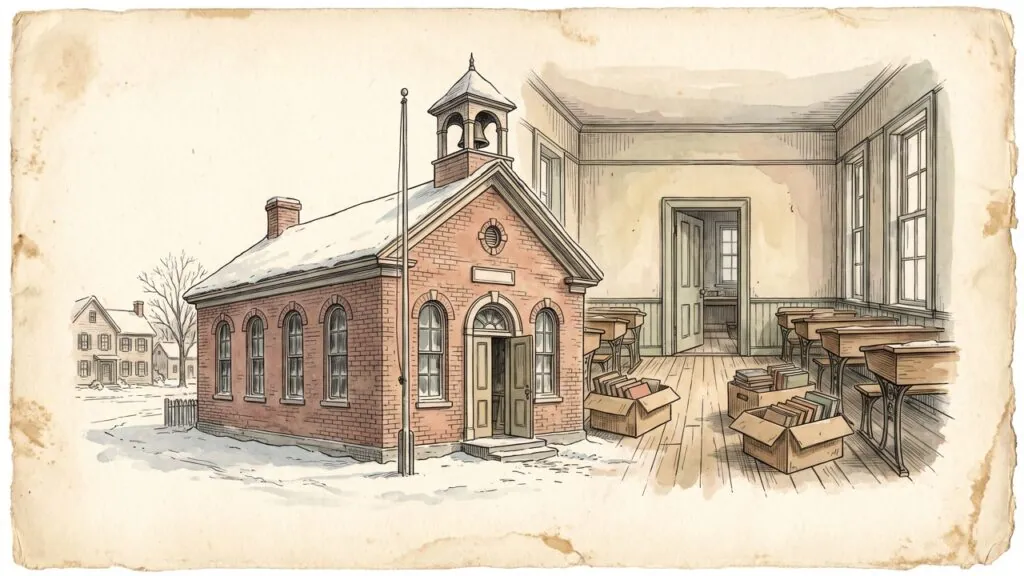
The Center’s address through the 1980s was the Old East Street School, P.O.Box 969, Amherst, Massachusetts 01004. [19] Fay Zipkowitz, writing for the College & Research Libraries News in 1987, gave the whole arrangement: “The YLDP and the NYBC are located at Old East Street School in Amherst, Massachusetts, with warehouse facilities in Holyoke, Massachusetts.” [38] A TIME feature on the Center described the office inside it as occupying “a century-old brick schoolhouse in Amherst only four blocks from Emily Dickinson’s home and 15 miles from the Holyoke annex”; a Korean academic living in Tokyo ordered his books from it, and so did readers — tenured or not — in such places as Guam, Thailand and Brooklyn, N.Y. [30]
The first Amherst home
One correction is needed, because the schoolhouse is often made to sound like the beginning. It was not. The operation began in a factory loft in Northampton in 1979–80, and the schoolhouse was the first home the Center had in Amherst. [19] Lansky’s own account, written for the Book Peddler and reprinted by Hampshire College in 1994, dates the tenure: the town of Amherst had announced plans to reclaim “the cozy, red-brick building that had served as our headquarters since 1981”. [39] What came through its door was more than books. The archive’s finding aid records that the collectors brought “books, plays, books of poetry, Yiddish periodicals, and sheet music” and sent them “to an old schoolhouse in Amherst, MA”. Most of the volumes that originally came in, the finding aid adds, were nineteenth- and twentieth-century novels and non-fiction published in the United States, Eastern Europe and South America. [18]
A thin first winter
The arithmetic of those first years is startling and small. In fall 1982 the Center’s own newsletter, then called The Book Peddler, “proudly announced that 50,000 books had been collected”. [40] Minutes from the board meeting of October 1982, preserved in the Center’s own account of its archive, reported that a total of $40,000 had been raised and that “the three staff members often went without salary”; a direct mail campaign was expected to “resolve all our financial worries”. It did: by May 1984 the minutes record membership growing from 1,400 to 6,000 in a single year. The archive holds posters from programs, artworks from past exhibits, negatives and photographs of travels, events, programs and people, and Aaron’s personal notes and files from his days as a graduate student through the Center’s early years. [40]
Not everything about the first winter was austere. In 1983 the Center offered its first week-long Summer Program in Yiddish Culture for adults; it was not sure it could fill the 45 available places, and was instead “overwhelmed by more than 2,000 applications”. [39] By the time the newsletter became a magazine, with Yiddish Book News appearing from Volume 1, no. 1 in 1986, the Center had a staff of twelve full-time people, with Lansky as executive director, and “over 8,000 members and donors” behind it. [38]
The work of Lansky and his colleagues over the following three decades would be described, by the archivists of New England, as “one of the greatest cultural rescue efforts in Jewish history”. [41]
13. The zamlers
What a zamler is
The word is Yiddish: a zamler, plural zamlers — a gatherer, a collector. Lansky did not invent it. YIVO had run such a network since the 1920s, and Dina Abramowicz, the institute’s head librarian, described it in an article on YIVO’s acquisitions as “a network of zamlers or collectors living in various localities, ranging from the smallest shtetlekh (villages) to the large cities, who reported on and acquired materials.” [32] The Center organised its own: “Lansky put out a nationwide call for unwanted Yiddish books and then helped to organize a book rescue network of volunteer ‘zamlers’ (gatherers or collectors), which started in Western Massachusetts and soon became a worldwide effort in areas that had once had thriving Yiddish-speaking communities.” [18]
Two hundred volunteers
The JTA counted them in May 1984: “a system of 200 ‘zamlers’ — volunteers who travel around their areas of North America collecting books — from abandoned buildings in the South Bronx to garages in Beverly Hills”. [19] Zipkowitz, three years later, described “a network of over 200 collectors (or ‘zanders’ in Yiddish) around the U.S. and Canada, forage for, salvage, and send in materials to the Center”. [38] TIME, in the same decade, put the figure lower, at “a network of nearly 100 volunteers around the U.S. and Canada”. [30]
The scale soon outgrew any of these counts: the Center’s young staff and zamlers “surpassed that number in six months”, the number being the 70,000 books scholars believed were all that remained. [13] That is the Center’s own claim, and its own account of its history still measures itself against the figure.
The collector at the door
Behind every numbered volume is a doorway, and the doorway is where the method actually began. What the volunteers were taught, Brygida Gasztold wrote in 2015, was a kind of ritual: “first, the volunteers had to listen to people’s stories, then help themselves to ample amounts of homemade food, and only then could they mention what they really came for—the Yiddish books.” [10] The books were the last thing mentioned. Time and time again old Jews handed over their libraries with the words “Ot iz mayn yerushe — Here is my inheritance.” [3]

By the middle of the decade the network was international. Books came to Amherst “from Israel, Costa Rica, Uruguay, Chile, Brazil, Mexico, Canada, Cuba, and South Africa”. [10] Lansky’s own list ran wider: “in every state, in every Canadian province, in Mexico, Cuba, Venezuela, Argentina, Uruguay, Chile, Zimbabwe, South Africa, Australia, England, France, and, of course, Russia and Eastern Europe.” [3]
The people around him
The Center was founded, the Voice and Herald reported in 1986, “by Aaron Lansky, then a recent graduate of Hampshire College, and a group mainly from the Five Colleges, which beside UMass and Hampshire include Amherst, Mount Holyoke and Smith Colleges.” [42] Around him in the first years stood a small group whom the Center has since interviewed for its own oral-history project: Rabbi Sharon Kleinbaum, the spiritual leader of Congregation Beit Simchat Torah in New York and a former assistant director of the Center in its earliest years; Penina Migdal Glazer, a historian and former dean at Hampshire College, on the board for years; Gail Levy Perlman, a social worker and former board chair; and Marvin Swartz, professor emeritus of history at the University of Massachusetts, who stressed the preservation of “not simply the language, but the whole world of [Yiddish]”. [37]
14. Knocking
Knocking in Montreal
The method that produced the collection was not a purchase and not a grant. It was a knock on a door. Aaron Lansky came to McGill University in 1977 for a master’s degree in East European Jewish studies, under Ruth Wisse, having read modern Jewish history at Hampshire College, and found the reading list missing. Fay Zipkowitz set it down in College & Research Libraries News in 1987: he was “a young graduate student at McGill University in 1979 pursuing studies in Jewish history and literature” for whom “finding needed materials in Yiddish was next to impossible,” so “he resorted to going door-to-door in Montreal’s Jewish neighborhoods asking for books. He found them; and he also found that many were being discarded since the owners did not realize that anyone else valued them.”[38] Lansky’s own summary to the Jewish Telegraphic Agency two years earlier is blunter: “We had no books to use—most were out of print. We went to Jewish neighborhoods, ringing doorbells, asking to borrow books.”[19] The verb is the method. The collectors were not buyers and not fundraisers. They were asking a stranger to lend them books, and were prepared to leave them where they lay.
A borrowed apartment
The scale of it is best measured by TIME, which found Lansky “spending most of his time — most of the next five years, in fact — behind the wheel of borrowed or rented vans, collecting books from elderly donors who were too frail to pack and mail their books.”[30] The vans were not enough. His apartment became a warehouse and he slept in a hammock to gain floor space; in New Bedford, where he had set up a parallel rescue scheme, his parents‘ second floor was in danger of collapse; and his shoulders gave way after years of toting 30-kilogram boxes down tenement stairs.[2] None of this is metaphor. A young man was moving boxes down stairs and paying for it in his back.
What was collected
What came in was not only novels. The finding aid for the Center’s own archive records that the books “were collected from people’s homes, synagogues and occasionally from organizations that were closing, sometimes being rescued from dumpsters or buildings that had already been demolished,” and that the collectors gathered “plays, books of poetry, Yiddish periodicals, and sheet music” besides novels.[18] The JTA dispatch of 18 May 1984 described the resulting network of 200 volunteers reaching “from abandoned buildings in the South Bronx to garages in Beverly Hills,” and called them zamlers — gatherers.[19] The word was not invented in Amherst: YIVO had run a network of zamlers in the same towns and villages from the 1920s, “ranging from the smallest shtetlekh (villages) to the large cities.”[32]
The designated eater
The work was done in threes. As the Jewish Telegraphic Agency reported in June 2025, Lansky’s collecting teams “went in teams of three — two to load the trucks, and one, the ‘designated eater,’ whose job it was to sit with the donors and hear their stories.”[8] The division of labour is worth a moment’s attention. Two people handled the boxes; one handled the conversation, and the conversation was the part that could not be delegated to the van.
15. Kugel and tea
Rattletrap trucks
Lansky’s summary of the method is the sentence the Center has kept at the centre of its own story: “For years we bounced along in rattletrap trucks, pulled priceless books from demolition sites and Dumpsters, and listened as older Jews plied us with kugl, kikhlekh, and glezelekh tey (noodle pudding, pastries, and glasses of hot tea) and regaled us with stories of their eventful lives.”[3] The publisher’s copy for his memoir, Outwitting History, sets out the menu of a collecting day: the volunteers “shlepping books from attics and basements, demolition sites and Dumpsters, while shmoozing with their owners, who insisted on feeding them a little nosh — gefilte fish, kasha, blintzes, latkes, kugel — before handing over, one book at a time, their beloved literary heritage.”[43]
The order of things
Brygida Gasztold, writing in Text Matters in 2015, took the description from Lansky and turned it into a sequence. “The process of collection, as Lansky recalls it, became a kind of ritual: first, the volunteers had to listen to people’s stories, then help themselves to ample amounts of homemade food, and only then could they mention what they really came for—the Yiddish books.”[10] The order is the argument. The books come last, after the story and the meal, and only because the first two have been given.
In Montreal the order had been set years earlier, in a graduate seminar. “People wouldn’t just give you a book. They’d sit you down, give you hot tea in a glass, and ask you what you thought of it. It was an experience only Montreal could offer, and it made the program quite special,” Lansky said.[2] It is tempting to treat the tea and the kugel as a preliminary, the social lubricant that makes a transaction possible. The sources suggest something else: the food was the transaction. A young man had come to a stranger’s door to ask for a library that the stranger had inherited and no longer wanted. The only form that request could take was a visit. The tea was not a preliminary to the request; it was the form the request had to take.
Here is my inheritance
What came back, again and again, was a formula. “Time and time again elderly Jews handed us their libraries with the words ‘Ot iz mayn yerushe—Here is my inheritance.’ In their eyes, they possessed no greater treasure.”[3] The same phrase appears in Gasztold’s 2015 study of the Center’s method, where it stands as the words elderly Jews used as they handed over their libraries.[10] The Center’s own account of what it saved divides the material into two kinds, and the division is, in effect, the moral history of the whole operation: “some lovingly handed over by their original owners, others rescued at the last minute from basements and dumpsters.”[13] Handed over, or rescued: the two verbs sit at opposite ends of the question of whether the books belonged to the people who owned them.
16. Dumpsters and the ethics of taking
The night of the dumpster
The best-known night of the rescue was a dumpster in New York in July 1980, and the accounts of the haul do not agree: five thousand volumes in one telling, eight thousand in another. That night has already been told, and the figures attached to it will not settle. What matters here is what the night was. It was a trespass. A young man had no claim on the books in that container, no right of entry to the yard, and no way of asking the owner, because there was no owner to ask; whatever had been thrown in had been thrown in by people who no longer thought of it as theirs. The scale of the loss was not a single night’s work. “Dusty books depicting village characters disappeared into dumpsters.”[2]
Paper that crumbles
What was being destroyed was a literature, and the paper it was printed on was not built to survive the decade. McGill News put the disposal in a single image: “Dusty books depicting village characters disappeared into dumpsters.”[2] The birth of modern Yiddish literature in 1864, the JTA noted in 2002, “coincided with the popularization of wood-pulp paper, which deteriorates easily,” and by the time the Center had gathered the material Lansky said, “Nearly all the books in the center were printed on the inexpensive paper, and the collection is ‘literally crumbling before our eyes.’” Nancy Sherman, the Center’s vice-president, put the same fact more soberly: “the collection was physically deteriorating.”[11] Pulling a book out of a dumpster only postponed the moment at which it disintegrated on a shelf.
The right to take
No source records a donor who refused; that is what makes the act hard to describe. The books in the dumpster had already been thrown out; the books in the Bronx belonged to a household whose building was being demolished, and the rescuers there were local teenagers organised into a “bucket brigade” to carry a 15,000-volume Jewish library up out of the basement of a demolished building.[35] But a dumpster on a Manhattan street is also the last place to which a family carries the books of a life, and the people who came for them knew it. The Center’s own account of what it saved divides the material into two kinds: “some lovingly handed over by their original owners, others rescued at the last minute from basements and dumpsters.”[13]
Lansky reached for the precedent that makes the act legible. In Isaac Bashevis Singer‘s Enemies: A Love Story an elderly Yiddish bookseller explains to a neighbour, “not because he’s afraid of thieves stealing his inventory,” that “My only fear is that some Yiddish author might break in at night and put in some more books.”[3] The joke is that the bookseller wants more books rather than fewer; the joke is also the confession. The Center’s own archive keeps a photograph of Aaron in a big fur hat standing in Red Square, from the journey he made to the Soviet Union to deliver Yiddish books to groups that “had previously been forbidden under Communism.”[40] [18] The moral question reached much further than the Bronx. What strikes a reader now is not the taking but the alternative: nobody else was coming.
17. The second copy
A great many duplicates
The rescue produced something no donor expected: a surplus. “As more and more books began to arrive at the schoolhouse in Amherst and were catalogued, a great many of them were determined to be duplicates.”[18] The finding aid’s plain sentence marks the moment the operation stopped being a salvage and became a library. Duplicates were not waste; they were stock, and the Center began publishing catalogues of them: “The Book Center staff started publishing catalogs of books and sheet music that were available for purchase, including rare and out-of-print books, sheet music, books in translation, and Holocaust literature.”[18]
The right of first selection
Two arrangements governed the surplus. The first was absolute: “The YIVO Institute for Jewish Research and the Library of Congress each get a copy of every book not already in their library.”[19] The second was a promise made at the founding, and it was made to institutions rather than to collectors. Dina Abramowicz, head librarian of the YIVO Institute for Jewish Research, recorded it in the YIVO journal Judaica Librarianship in 1984: “The founders promised that the right of initial selection would be given to large central depositories such as VIVO in order to make it possible for them to fill their gaps.”[32] The spelling is the article’s own; VIVO means YIVO. The point of the promise was that the libraries with the deepest existing holdings should say first which duplicate they wanted.
The pilot at Great Neck
The scale of the trade is best seen from inside a rival institution. Abramowicz reported that the Center “advertises itself as ‘the world’s only comprehensive source of new, used and out-of-print Yiddish books’ and informs us that its collections grow at the rate of 1,000 books per week,” quoting the Center’s own newsletter The Book Peddler of 1984.[32] That is the Center describing itself in its own advertisement, reported by a rival librarian, and it should be read as a claim. The same article noted a second front: “Besides filling orders, the Center has launched a ‘Yiddish Library Development Program’ whose aim is to establish comprehensive or augmentative Yiddish collections in major universities and research libraries.”
The pilot had already run. The Center’s own account of the programme describes it as “launched with a pilot program at the Great Neck, NY Public Library,” after which “the Center quickly started supplying major research libraries with collections of Yiddish books.”[14] The trade in duplicates became a programme of its own: in 1985 the Center founded the Yiddish Library Development Program, “which offered a large collection of Yiddish literature and non-fiction to university libraries at a lower cost, which had also already been catalogued and Book Center staff offered support with any future cataloguing questions.” And the sheet music, which arrived as a gift from a company that had closed rather than as a donation from a household: “A cache of thousands of sheet music folios from Metro Music, a music publishing company in New York that closed in the early 1970s, was given to the Book Center in 1986 and a sales catalog for the music was published in 1987.”[18]
18. The sorting tables
Sorted by hand
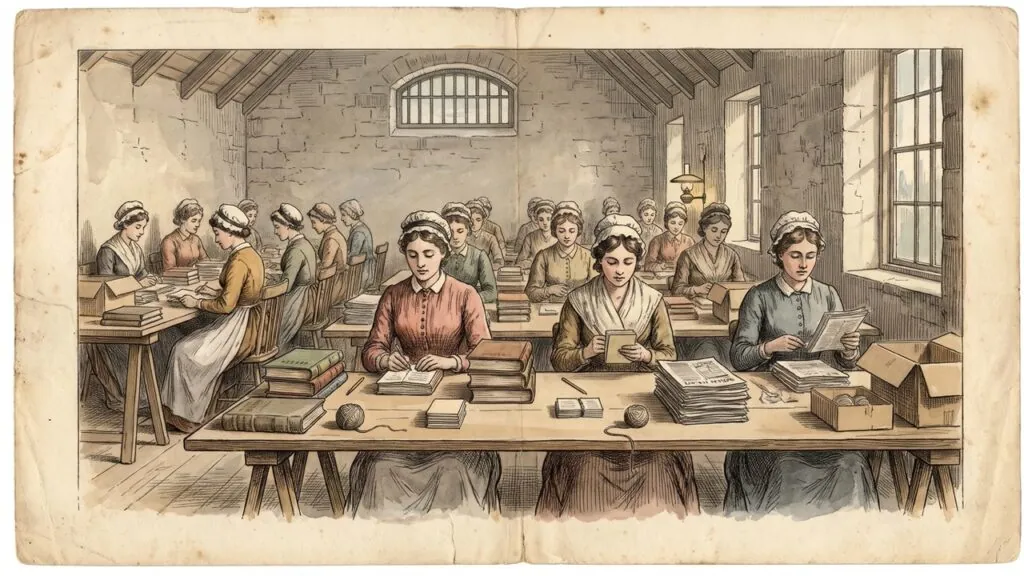
Everything that came into the Center had to be made findable, and the finding was done by hand. The Encyclopaedia Judaica entry puts it in a single sentence: “All books coming into the Center are sorted by hand and new titles are catalogued according to library standards.”[44] The volumes arrived in cardboard boxes from basements and the back seats of cars, and somebody had to open every box and decide what was in it. Hand-sorting was the bottleneck of the entire enterprise; no amount of goodwill about rescue made a box legible.
A librarian and a pipeline
The first stage was rough. As Fay Zipkowitz reported in College & Research Libraries News in 1987, “as the Center began collecting the materials, brief annotations were created and recorded on a microcomputer database for later use,” and she added the sentence any working cataloguer recognises: “Full cataloging cannot keep up with all the new acquisitions but the Center now publishes listings of available materials in its Yiddish Book News, starting with Volume 1, no. 1, 1986.”[1] The professional work arrived in February 1986, when Devorah Sperling joined the staff as librarian and director of the newly launched Yiddish Library Development Program. She held “a master’s degree in library and information science from Drexel, a bachelor’s in anthropology and Near Eastern studies from Indiana University, and a master’s in folklore and folklife from the University of Pennsylvania,” and came to the Center “after two years as a Hebraica cataloger at Dropsie College.”[38]
The finding aid
The pipeline she built ran through the shared database of the whole American library system. “New records are entered on the OCLC union catalog at the libraries at the University of Massachusetts and the University of Hartford, which have received the first two collections of materials from the YLDP. All the cataloging records are carefully transliterated, conform to AACR2 cataloging rules, and are in MARC format.”[38] Errors went to a single pair of hands: “The corrections are forwarded to Shimeon Brisman, Judaica bibliographer at UCLA; he proofreads them and forwards them to OCLC for enhancement of the database.”[1]
Around the professionals the labour force was students and volunteers. A Yiddish-language learning summer internship programme started in 1989 and later became the Steiner Summer Internship Program, “where students learned Yiddish and helped sort and catalog book donations.”[18] The volunteer collectors of the early years were the same zamlers who went door to door. Everything that reached the sorting tables passed through two kinds of hands: the hands that had carried it, and the hands that wrote it down.
The record of all this is the Center’s own finding aid, I-457, the archival record of the Yiddish Book Center Collection: “This collection contains newspaper articles and press releases, catalogs for used, new, and out-of-print Yiddish book and sheet music for sale, event fliers, invitations, programs, pamphlets, and miscellaneous fundraising materials related to the first 15 years of the Yiddish Book Center, 1980-1995.” The finding aid also preserves the institution’s oldest paperwork: “There are the earliest issues of our magazine, when the Center was called The National Yiddish Book Exchange, and the magazine, then a newsletter, was titled The Book Peddler.”[40]
19. The catalogue
A newsletter, and then a magazine
The Center’s public record of itself began as a newsletter and became a magazine. The finding aid for the Yiddish Book Center Collection lists among its holdings “catalogs for used, new, and out-of-print Yiddish book and sheet music for sale” — the trade lists that turned duplicates into revenue.[18] The newsletter was The Book Peddler; the magazine that grew out of it is Pakn Treger, the Yiddish for a peddler of books, carrying on the old trade of the pakn tregers who “traveled from shtetl to shtetl in Eastern Europe bringing books and news of the world.”[45]
What was published
Three streams of paper came out of Amherst, each answering to a different reader. The trade catalogues went to buyers. Yiddish Book News, beginning with Volume 1, no. 1 in 1986, listed the materials that full cataloguing had not yet reached.[1] And The Book Peddler itself “describes the activities of the Center and highlights particular parts of the collection” for its members. A fourth stream was the finding aid: the archivists‘ record of the whole operation, catalogued by the Jewish Heritage Center in Boston as I-457.
The archive of the rescue
The Center’s own account of its archive is also its own account of its scale. “In fall 1982, the newsletter proudly announced that 50,000 books had been collected.”[40] The finding aid’s description of what those books were is worth reading closely, because it describes a rescued national literature rather than a collection assembled by taste: “Most of the books which originally came into the Center, which was originally known as the National Yiddish Book Exchange, were 19th and 20th-century novels and non-fiction that were published in the United States, Eastern Europe, and South America.”[18]
The earliest surviving advertisement is the place where the two names and the two claims sit side by side. In the September 1982 issue of the American Jewish Times Outlook, preserved among the scans held by the Internet Archive, the Exchange describes itself: “The National Yiddish Book Exchange is a non-profit agency with the unique goal of rescuing unwanted Yiddish books and recycling them to new readers. In the course of just two years the Exchange has saved more than 100,000 Yiddish volumes, many of which would otherwise have been destroyed.” It is the Center’s own text, set in type by someone else, and worth reading as what it is. In December 1982 the Boston Phoenix took up the same operation, reporting how the Center gave multiple copies of a rare book to the Library of Congress and to YIVO, and sold others — a complete 28-volume set of Sholom Aleichem for $85 — to individuals and to libraries “that are starting or expanding their Yiddish collections.” Sharon Kleinbaum, an early assistant director of the Center, was quoted on the practice: “When the Center receives multiple copies of a real treasure; it gives them to the Library of Congress and/or YIVO.”[46]
20. The count that was wrong
Four different counts
No single number describes what the Center held, and the reason is not carelessness but arithmetic: the sources count different things. A book collected, a book held on a shelf, a book saved from a dumpster and a volume that duplicates another volume are four different objects. Two of the earliest figures come from the Center itself. In the autumn of 1982 its newsletter “proudly announced that 50,000 books had been collected.”[40] Two months earlier, in the September 1982 issue of the American Jewish Times Outlook, the Center’s own advertisement had claimed that in two years the Exchange had “saved more than 100,000 Yiddish volumes, many of which would otherwise have been destroyed.”[47] Both are the Center’s own figures; they differ; and neither counts what was on the shelf in Amherst.
Collected, held and saved
From 1984 the numbers climb and the verbs change with them. The Voice and Herald of 18 May 1984 reported that the Center “will be moving the 250,000 Yiddish books it has rescued from all over North America in the past four years,” with “Every week 2,000 additional books, many of them rare,” still arriving.[19] On 26 April 1985 the same paper described “a non-profit organization which has rescued 350,000 discarded Yiddish books.”[33] On 29 November 1985 the verb had changed again: “While the Yiddish Book Center has saved some 500,000 books from destruction, its purpose all along has been to return the books to university libraries where they can be of greatest use.”[48]
In March 1986 a third quantity appeared: the Center “now has a professional staff, libraries at Amherst and Holyoke, and a total of 400,000 Yiddish volumes which include many duplicates.”[42] Four hundred thousand held, duplicates included, is a smaller number than five hundred thousand saved from destruction — and a later date. TIME, whose article carries no printed date where it was retrieved, found Lansky in the Center’s annex in Holyoke, “on the vast, hangarlike floor of a renovated paper factory,” where “are stored about 700,000 of the 900,000 Yiddish books that the center has collected.”[30] The figure that later became the Center’s headline is larger again, and less comparable to any of the others: “1.5 million Yiddish books rescued from individuals and institutions worldwide.”[44]
The membership numbers
The membership counts move as oddly as the holdings. The Center’s own archive records 1,400 members in 1983, rising to 6,000 by May 1984.[40] By May 2002 the Center was described as “supported by 30,000 members”;[49] in 2015 a scholarly account put the figure at “around 20,000 registered members”;[10] and the Center’s own retrospective has its own version of the number: “When we founded the Yiddish Book Center in 1980, most Jewish leaders insisted that Yiddish was dead. Fortunately, 30,000 people disagreed: they signed up as members.”[13] Thirty thousand in 2002, twenty thousand in 2015, thirty thousand in the Center’s own telling: counted by different hands for different purposes, and they do not climb.
From collecting to circulating
Lansky’s own summary of the change, given in 1985, is the truest one available: “This is the end of the funky phase of being out there rounding up books. Now the emphasis will be on getting them back into use.”[1] The volume of material collected went on climbing, and still climbs. The number that mattered was the one that left the building. And a volume and a title are not the same unit: the Center’s own appeal puts its holdings at “roughly 17,000 unique titles” against a total Yiddish literature of “about 45,000” titles.[50]
21. Going abroad, South America and South Africa
The shift in origin
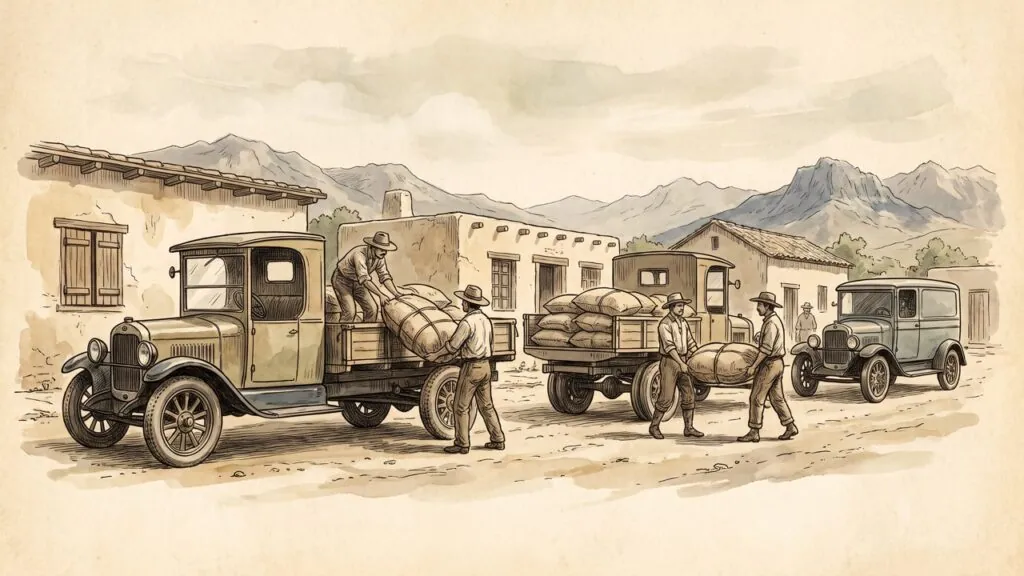
In the early years most of the books — the personal property of Eastern European Jewish immigrants — came from within the United States. “The mid-1990s saw a shift in origin, with volumes shipped from South Africa, Argentina, Mexico, and Brazil—sites of once-large Yiddish-speaking immigrant communities,” as the Encyclopaedia Judaica entry puts it.[44] A longer list comes from Gasztold: “Yiddish books have come from Israel, Costa Rica, Uruguay, Chile, Brazil, Mexico, Canada, Cuba, and South Africa.”[10]
The larger map
Lansky’s own list runs further still: “We’ve found Yiddish books in every state, in every Canadian province, in Mexico, Cuba, Venezuela, Argentina, Uruguay, Chile, Zimbabwe, South Africa, Australia, England, France, and, of course, Russia and Eastern Europe.”[3] The Buenos Aires presses were among the richest sources of all: the series Dos poylishe yidntum (Polish Jewry) ran to 175 volumes published in Buenos Aires between 1946 and 1966, and “many copies” of it are at the Center.[10]
Mexico City
In Mexico the Center did what it had been doing in Massachusetts, at greater distance. “Last fall, the Yiddish Book Center sent staff members to Mexico City to collect oral histories and to sort and examine the Yiddish library of the Colegio Israelita de México and prepare many of the books for the trip to Amherst.” One book in that library caught Eitan Kensky‘s eye: Der hotel vos ekzistirt nit (The Hotel that Doesn’t Exist), “published in two volumes in Montevideo in 1944,” and its manuscript had “been shipped out of Nazi-occupied Paris, wandered to the south of France, and across Spain and Portugal, to the English censor in Trinidad. After a journey of several years, it arrived here [in Montevideo].”[51] [52] The earlier of the two Montevideo books, Tate un zun (Father and Son), “was first published in Montevideo in 1943 and republished in Buenos Aires in 1945.”
The Soviet delivery
The other journey abroad was not a collection trip but a delivery, and it was the more urgent of the two. “In 1989-1990, Lansky, a journalist, and a photographer traveled to the Soviet Union to deliver thousands of Yiddish books to Jewish groups in Latvia, Lithuania, and Estonia, which had previously been forbidden under Communism.”[18] A German-language report of the journey names the party — Lansky, the journalist Kenneth Tliran, and the photographer Janice Rubin — and gives the route: “Von Stockholm mit einem gemieteten Lastwagen nach Helsinki, von wo aus die Bücher aufgeladen und nach Tilsit, Estland, verschifft wurden.” In all, “Es konnte nun insgesamt 6000 Bücher in die Sowjetunion schicken. Die Kosten hierfür wurden von seinen 9000 Mitgliedern getragen.”[53]
TIME described the same journey from the American side: “Late last year he visited half a dozen cities in the Soviet Union where Jews, taking advantage of the cultural freedom afforded by glasnost, have expressed an interest in establishing Yiddish libraries.”[30] The Forward’s summary of the decade catches the whole arc in one line: Lansky recounted collecting books “on trips to Cuba and Russia, and from countless elderly Jews who fed him kugel and tea before tearfully sending him on their way with their beloved books.”[54] The memoir’s own geography runs from “a tiny community in Cuba” to “the bombed-out synagogue in Argentina” and “the towns in Latvia, Estonia, and Belorus, where Jews had no Yiddish books and yearned for them.”[55]
22. The town reclaims the schoolhouse
The schoolhouse and its landlord
The National Yiddish Book Center’s headquarters in Amherst was a village schoolhouse, and its landlord was the Town of Amherst. The building was the Old East Street School — “the cozy, red-brick building that had served as our headquarters since 1981”, as Aaron Lansky put it in the summer of 1994. [39] Its address was P.O.Box 969, Old East Street School, Amherst 01004, a form still printed on the Center’s own imprints in 1987. The office worked in the schoolhouse; the books were stored fifteen miles away in Holyoke, and the schoolhouse stood only four blocks from Emily Dickinson’s house. [56] [57]
The announcement, and the vacate
The news arrived as a plan rather than as a notice of eviction. “Five years ago, when our landlord, the Town of Amherst, Massachusetts, announced plans to reclaim the Old East Street School… we greeted the news less as a calamity than an opportunity.” Lansky was writing in the summer of 1994, so the announcement, by his own reckoning, belonged to 1989. The departure came later than the announcement implied: “it wasn’t until three years later, in the spring of 1992, that we actually had to vacate the schoolhouse.” [39] The Center’s own account compresses the memory into a single year: in 1991 the organization received word that it would have to vacate the borrowed schoolhouse. [58] Lansky’s gloss on the news itself: “At first we saw it as a calamity…Five minutes later we realized it was an opportunity: a chance to build a home of our own.” [58]
1991, or 1992
On the year itself the record is not uniform. The finding aid for the Center’s own archive states that “In 1991, the town of Amherst reclaimed the old brick schoolhouse where the Book Center was housed and they needed to find a new location.” [18] The online encyclopedia’s article on Lansky’s memoir agrees that in 1991 the town reclaimed the building, leaving the organization homeless. [59] Bromberg’s 2020 study describes a tenancy of “11 years until it was suddenly reclaimed by the town in 1991” — from 1981 to 1991 inclusive. [60] A 1991 dealer list for Jewish material still gave the Old East Street School as the Center’s address. [61] Against these readings stands Lansky’s own 1994 article, whose chronology puts the announcement in about 1989 and the vacate in the spring of 1992. Whether the two accounts describe the town’s decision and the Center’s eventual departure, or simply disagree, the sources do not say.
What the town intended
What the town intended to do with the building was set out in its own planning papers: “The 31 South East Street development will be the redevelopment of the old East Street school building to six rental units and the new construction of a three-story building with 25 rental units which connect to the school.” [62] The schoolhouse, a headquarters for a decade, was to become six flats attached to a new three-storey block of twenty-five. The development that replaced the Center’s home was housing.
The Center had been living in other people’s buildings since it began. The succession runs: “a factory loft, a red-brick schoolhouse, a spice warehouse, a roller rink, a nineteenth-century silk mill, and a defunct shopping mall.” [63] The books were in none of them. In a dispatch of 18 May 1984 the Jewish Telegraphic Agency reported that the Center’s new headquarters was a renovated old paper mill in Holyoke, with 17,000 square feet of fire-protected space; the books, “all but 25,000 of which are still in the boxes they were mailed or carried in originally”, had until then sat in a temporary warehouse near Amherst whose lease expired that June, and the Center was seeking $75,000 to enable volunteers to move the books and install lighting and humidity controls and steel library shelving. [19] The Holyoke library annex had its own address at 100 Lyman Street, where the Center announced a gala celebration of Yiddish culture for Sunday 9 June, from 1 to 5 p.m. [33]
23. South Hadley
Rent-free, for a time
The search for a new home was short. Bromberg’s account records that the Center “sought a location nearby and in partnership with some of the local colleges”. [60] Mount Holyoke College offered the way: “Our reprieve was then extended for another four years when Mount Holyoke College offered us rent-free use of a 20-room mansion until we could secure a building of our own.” The college is in South Hadley, Massachusetts, and the arrangement cost the Center nothing in rent. For an organisation that had never owned a building, the arrangement bought four years of time at no rent.
What the Center had become
By 1992 the thing being housed was large. A feature in TIME found Lansky standing on “the vast, hangarlike floor of a renovated paper factory” in Holyoke, where about 700,000 of the 900,000 Yiddish books the Center had collected were stored; in its first decade the collection had grown to include 25,000 titles. By 1987 the Center had a staff of twelve full-time people, more than 8,000 members and donors, and a network of over 200 collectors, whom the same report calls “zanders” in Yiddish. [1] Fourteen years in, Lansky wrote that the staff and board had come to see “that the mission of the National Yiddish Book Center… had, over the course of fourteen years, evolved to include a good deal more than Yiddish books.” [39]
The work itself had spread well past the town. Collections were going out to other institutions, “sometimes in packages of 500 or more volumes”, to libraries as diverse as the Jagiellonian University in Cracow, the University of Melbourne in Australia and the public library in Cincinnati. [57] The Center had founded the Yiddish Library Development Program in 1985, offering large collections of Yiddish literature and non-fiction to university libraries at a lower cost, and in 1988 it began a books-on-tape programme in which Yiddish actors read short stories, plays, poems, memoirs, Yiddish novels and world literature in Yiddish translation. [18]
Three questions, and a mission
The South Hadley rooms gave the staff and board the chance to ask, for the first time, what they actually needed. Three questions, in Lansky’s formulation: “What is the Center’s overall mission, both now and in the future? Exactly how much and what type of space do we need to realize that mission? And, lastly, should we rent or buy an existing structure or build from scratch?” [39] The first was a question about identity, and it had an answer in the Center’s own language, which had widened well beyond the rescue of damaged volumes: to “recover, celebrate, and regenerate Yiddish and modern Jewish literature and culture”. [64] The other two were questions of measurement and law, and they had to be answered before anything could be drawn.
The colleges that might help
The two institutions to be approached were chosen together, and the approach was made with help from Myra Fein, “an intrepid community activist (soon to be elected the Chair of our Board)”. Lansky’s account: “we made appointments to meet in person with the presidents of our two ‘first choice’ schools: Hampshire and Mount Holyoke Colleges.” [39] The meeting with Mount Holyoke’s president, Elizabeth Kennan, “began on an auspicious note when the Dean of Faculty announced that his mother had been a long-time member of the Center.” For a centre that needed a college to believe in it, that was a good start.
The third of the three questions — rent, buy an existing structure, or build — was the one that took years to answer, and it was answered in Amherst, on land belonging to Hampshire College. By the summer of 1994 the Center had “just signed final papers for the purchase of 10 acres of land at the southeast corner of the campus of Hampshire College in Amherst, Massachusetts” — a round figure that the same article gives more precisely elsewhere, as 10.32 acres. [39]
24. The orchard on the campus
A cultural village
The college president who could say yes was a newcomer from Dartmouth. Gregory Prince wanted to develop what Bromberg calls “a ‘cultural village’ made up of non-profit organizations around the campus”. [60] But his intention, Lansky wrote, “was not to sell land – which colleges almost never do, under any circumstances – but to lease it over an extended period of time, with each organization retaining title to its own ‘improvements’ (i.e. its building).” The College was willing to extend the Center’s land lease for a full 99 years, and the rent first discussed was one dollar a year. [39]
The Center’s board would not take it. “Our Board would accept nothing less than outright ownership,” Lansky wrote, and Bromberg supplies the reasoning: the Center was reluctant to accept the offer unless it could own the land, firmly believing that “Yiddish, having suffered through enough impermanence, needed security and stability.” [60] Prince’s answer was institutional rather than personal: “colleges, as a matter of course, do not sell land, and that his Board would be unalterably opposed.” [39] What followed was years of argument — three and a half, by Lansky’s count.
The January vote
“It took several years, but in the end it was historical argument and not fiscal convention that prevailed: on January 20th of this year, Hampshire’s Board voted to sell.” [39] The article was written in the summer of 1994, so the vote was 20 January 1994. One member asked “What’s the rush?” at the beginning; when the issue finally came to a vote, the same member asked, no less pointedly, “What took you so long?”
Ten point three two acres
The papers were signed at Prince’s home on 11 March 1994. “At a ceremony at Greg’s home on March 11, 1994, we signed final papers for the purchase of 10.32 acres of land. The price, negotiated on the Center’s side by Board members Win Gerson and Ruth Stark, was $200,000 — slightly less than $20,000 per acre — payable without interest over the next two years.” [39] Bromberg’s summary compresses the same sequence: three more years before the president could bring his board around, and the orchard finally sold for $200,000. [60]
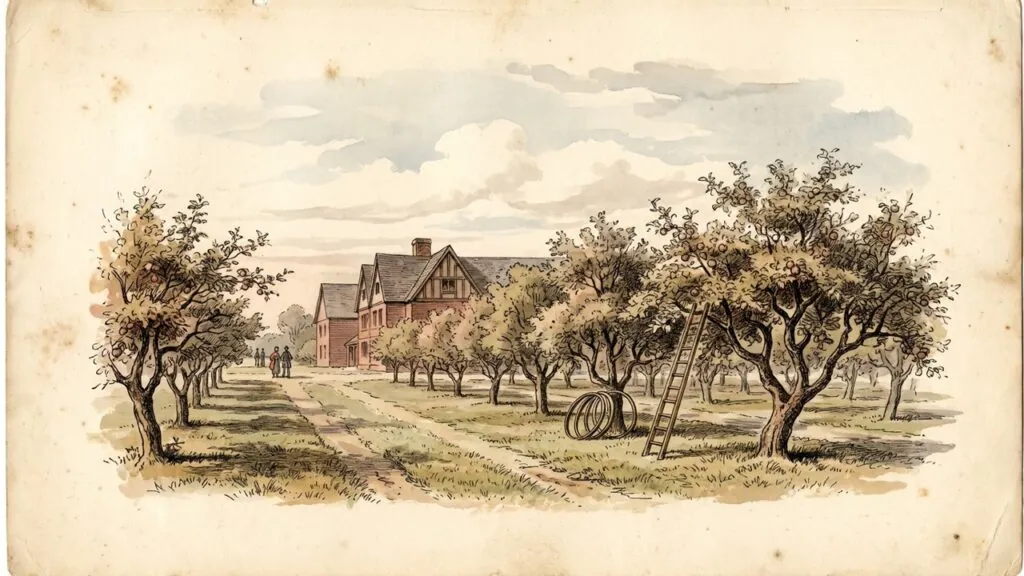
The parcel was not the three acres the Center had first had in mind. “Originally intended as a three-acre site, the parcel eventually grew, through the persuasive logic of our architect, to six, seven, and finally 10.32 acres, including a buffer zone of towering red and white pines and a small pond at the eastern edge of the orchard.” [39] Lansky had described the ground earlier as “an old apple orchard sloping down to a stand of red and white pines surrounding a small pond.” The siting itself had been proposed by Berkshire Design Group, the environmental planning firm hired by the College, whose campus Master Plan suggested that the Book Center be located “in an apple orchard at the southeast corner of the campus, with independent access (if needed) to the state highway, and a long, open view of the Holyoke Range.”
Why a college campus
A campus was also an offer of borrowed infrastructure. At no cost, the Center could use “the infrastructure and facilities of a host institution, including theaters and auditoriums, radio and television studios, security, frequent free bus service between the schools, excellent libraries, computer links and fiber-optic communications.” [39] The campus would also let the Center “establish ourselves as a visible and readily accessible resource for the 30,000 undergraduate and graduate students within a six-mile radius.”
The people who did the work were named in Lansky’s account: his “indefatigable Board chair Myra Fein”, the lawyer Steve Shatz, “and the many almost-unimaginably dedicated and hard-working members of our staff and Board”. [39] Before Lansky ever met Prince, the Center had been briefed on him by Penina Glazer, the former chair of the Center’s board and by then Hampshire’s vice-president and dean of faculty. And Lansky owned the slowness of the process: “That the process took not months but years – three and half, to be exact – is a measure of how much we still had to learn about the ways of real estate, not to mention Board members, lawyers, architects, engineers, environmental planners, wetland conservationists, historic preservationists, and more town and state officials.”
25. Allen Moore and the wooden synagogue
Twenty architects, or a dozen
With a site secured, Lansky and board chair Myra Fein went looking for an architect, and the search took more than a year. [58] How many they spoke to is disputed. The Center’s own account says that “Lansky and Fein interviewed twenty architects, but none seemed to understand quite what was needed”; Bromberg’s 2020 study says they interviewed a dozen firms, to no avail. [60] Both accounts end the same way: a board member, Hillel Levine, introduced them to Allen Moore.
The rooflines of wooden synagogues
Moore seemed an unlikely choice, as the Center’s own account has it: “he wasn’t Jewish and he knew next to nothing about Yiddish.” [58] The certainty came after a visit to a house Moore had recently completed on Martha’s Vineyard. “Lansky and Fein knew they had found their architect, and Moore headed straight to the Harvard Library to research Jewish architecture of Eastern Europe.” [58] What he found there set the roofline of the building. Moore “was particularly intrigued by the vernacular roof lines of the venerable wooden synagogues of Russia and Poland, almost all of which were destroyed in the Holocaust.” [58] A note published later, on Sol LeWitt’s projected synagogue for Congregation Beth Shalom Rodfe Zedek, records the same discovery from the other side: Moore “conducted research on Jewish buildings in eastern Europe and was inspired, particularly by the rooflines of the wooden synagogues (Wołpa in particular), to design a structure for the Yiddish Book Center that clearly evokes a shtetl.” [65]
Three days and nights in Newburyport
The brief Moore was given was short: “It needed to recall the shtetl… but not in a Disneyland-like way.” [58] His own gloss on the method was later recorded with some pride: “The Yiddish Book Center is very much what they would have built if they’d had the technology and materials” — meaning the shtetl builders of the eighteenth and nineteenth centuries, who had limited materials and a small workforce. The plan itself came quickly once the consultation had happened. After a weekend-long consultation with staff and board members and outside advisers, Moore “returned home to Newburyport, Massachusetts, sequestered himself for three days and nights in his studio, and emerged with a schematic plan that remained essentially unchanged over the ensuing four years of architectural drawing, fundraising, and construction.” [58]
Heymish modern
What was planned inside was already specific: “With classrooms, exhibit space, a small theater, a reading library, a bookstore, offices, and a central book repository, the building is bright, airy, and forward-looking — a singular style that Lansky describes as ‘heymish modern.’” [58] PRINT magazine would later call the result the “postmodern shtetl” on the Hampshire College campus. [66] The building was designed to be read by the body before it was read by the eye: an approach across what Moore called “a noisy Billy Goats Gruff bridge”, a dimly lit entryway, and then the light-filled Great Hall, its peaked ceiling topped by a cupola, with an unimpeded view of the central book repository. Overhead beams form a Star of David, and the skylight carries Moore’s motive in plain words: “These were books that had years of cherished use and then were stored away in attics and basements. They had been in the dark, and I wanted to put them in the sunlight again.” [58]
Twenty-seven thousand, or forty-nine
The size of the building is reported inconsistently. Bromberg describes Moore’s plan as a 27,000-square-foot wooden building, integrating a reading library, extensive book storage, an exhibition space, a hundred-seat theatre, a bookstore, offices and a kosher kitchen, and Lansky’s 1994 article gave the same figure for the projected building. [60] [39] The online encyclopedia’s infobox, by contrast, gives a 49,000-square-foot complex for the finished site, a number that includes the addition built in 2009. [67] The two figures appear to count different things at different dates: the wooden building projected in 1994, and the complex after the addition built in 2009.
26. The capital campaign
The appeal of 1991
In 1991 the Center launched an urgent capital campaign to raise funds for a new and permanent location. The finding aid for the Center’s own archive describes the machinery: “The Book Center hired an architect and began a capital campaign to fund the construction. Lansky sent out an appeal for donations, and also traveled the country, visiting individuals and organizations to ask for funding.” [18] The building the money was for had a name before it had walls. Lansky called it “a true lebedike velt–a living center where books, interactive exhibits, educational programs, and the daily work of students and staff will combine to make the past thousand years of Jewish history come alive for young and old alike.” [39]
The size of the ask was $7 million. “The entire project, including the land, design and construction was estimated to cost $7 million.” The size of the institution asking for it was considerably smaller: “Before the launch of the campaign, the largest monetary gift the YBC had ever received was $10,000, with most individual contributions averaging between $18 to $36 a year.” Funding experts predicted that it could not be done—that “they would need to raise 40% of the expected cost before the campaign could be officially announced to the public.” [60]
Two months and four thousand members
The experts were wrong on schedule. “Within just two months, over 4,000 members had contributed $2,625,260 via mail.” The mail appeal was followed by the travels, and the travels by the large gifts: “some of the largest donations included $250,000 from Steven Spielberg’s Righteous Persons Foundation, $600,000 from the Kresge Foundation and $1 million from the Harry and Jeanette Weinberg Foundation.” [60]
The online encyclopedia’s article on Lansky’s memoir, Outwitting History records the outcome in a single paragraph: “The construction of this new building wound up costing $7 million and experts had informed Lansky and his associates that raising these funds would not be possible. However, through donations from over 10,000 individuals as well as large individual donations from Steven Spielberg’s Righteous Persons Foundation and the Harry and Jeanette Weinberg Foundation, the funds were eventually raised.” [59]
Ten thousand donors
Bromberg’s account of the campaign’s last months turns to the walls. “In the end, the next month, the YBC team began the long process of installing plaques in honour of each of their 10,000 donors.” [60] The figure is her summary of the donor roll; the parallel statement in the online encyclopedia’s account is “donations from over 10,000 individuals.” [59] How many names the finished wall carries is not stated in any of the sources.
The building was being fitted out as the money came in: “in March of 1997, over three miles of steel library shelving were donated and installed.” Six years from the appeal to the public opening, Bromberg’s verdict is brief: “the YBC managed to raise over $7 million dollars, acquire land, build and open a state-of-the-art facility to the public within just six years.” The finding aid for the Center’s archive reaches the same conclusion in the institution’s own voice: “The fundraising efforts were a great success.” [60] [18]
27. June 1997
A housewarming for three thousand
“On a sunny day in June 1997, the building was officially opened to the public with over 3,000 guests in attendance.” [60] The Center’s own history of the building gives the day a Yiddish name: “Three thousand people attended the Khanukes habayis, the housewarming party for the structure dedicated as the Harry and Jeanette Weinberg Building in June of 1997.“ [58] The finding aid dates the same event from the administrative side: the new building, ”designed to evoke European wooden synagogues and includes library stacks, a theater, exhibit space, and a bookshop,“ opened to the public in June 1997. [18]
What was inside
Encyclopaedia Judaica described the public institution that filled the building: “It is open to the public six days per week and houses library-style stacks of Yiddish books as well as exhibits, a theater, bookstore, and offices. Approximately 10,000 visitors come to the Center each year.” [44] The Center’s own summary adds the setting: “In 1997 we opened the Harry and Jeanette Weinberg Building, set on a ten-acre apple orchard at the edge of the Hampshire College campus in Amherst, Massachusetts.” [13]
A visitor in 2024 took an inventory of the rooms: besides the exhibition space, the building holds “an excellent shop, a room with a helpful introductory video, galleries for changing exhibitions, and two performance spaces.” [68] The Jewish Telegraphic Agency, writing a quarter of a century on, called the result “A Jewish village resurrected on a college campus in sylvan Amherst, Massachusetts,” and added that the building conveys the Center’s mission. [69]
The address and the open door
The address has never changed. The online encyclopedia’s infobox gives it as 1021 West Street, Amherst, MA 01002; the Jewish Federation of Greater Boston’s directory gives “Harry and Jeanette Weinberg Building 1021 West Street Amherst MA 01002 (413) 256-4900”; the UMass Amherst regional visitor guide lists “National Yiddish Book Center / Harry & Jeanette Weinberg Building / 1021 West St, Amherst / 413-256-4900.” [67] [70] [71] One detail from a visitor’s note in the UMass alumni journal is worth keeping: “Everything around the center and inside is marked in Yiddish and English, except the books.” [72]
The mood of the opening is better caught in Lansky’s own account of why the money had arrived at all. Much of the campaign’s success, he reflected, came down to “a miracle of timing” and luck, arising “at this perfect moment in time, coming at the cusp of two epochs in Jewish history.” [60]
28. The building as an argument
A claim built in wood
The Center states the claim itself. In its own visitor’s guide: “Our building, designed to recall a shtetl, a traditional Jewish town or village in Eastern Europe.“ [73] Its institutional history puts the claim in the architect’s terms: ”Architect Allen Moore’s design for both buildings echoes the rooflines of an Eastern European shtetl (Jewish town). Unlike their architectural forebears, however, our buildings are bright, airy, and green, heated and cooled by geothermal power.“ [13] The qualification is the argument. A wooden shtetl is a memory of what was burned; this one is lit, warmed from the ground beneath it and standing in open country beside a college campus. Allen Moore was asked for a form without a Disneyland of nostalgia, and what he drew was a village that had to be walked through before it could be entered.
The argument was made twice. A decade after the first building opened, Lansky found it, in the Center’s phrase, “bursting at the seams,” and called the same architect back. The result was the Kaplen Family Building, 22,000 square feet of new work including the 350-seat Kligerman-Greenspun Performance Hall, the Klarman Student Center and the Brechner Gallery, and above all the Lief D.Rosenblatt Library, a fireproof, climate-controlled home for the Center’s core book collection. Larry Kaplen arranged a leadership gift of $2 million from the Kaplen Foundation, and the addition was tucked behind the original building, so that it is “barely visible from the street” but “appear bigger inside than out.” [58] Under the original building, the Center reports, the basement and vault make up “more than a third of the Center’s 49,000-square-foot building.” [40]
The path into the light
The approach is staged, and the staging is described in the Center’s account of its architect. “He designed the building’s approach to convey a sense of drama and anticipation: to reach the front doors, visitors cross what he describes as ‘a noisy Billy Goats Gruff bridge.’” The image is Norwegian and the resonance is Jewish: goats were a common presence outside shtetl homes and figure prominently in Yiddish literature, “so much so that the Center adopted a kleyn vays tsigele—a little white goat—for its logo.“ The light then runs backwards. ”After crossing the bridge, visitors pass through a dimly lit entryway and emerge into the light-filled Great Hall, its peaked ceiling topped by a cupola.“ [58]
The center of gravity
What the Great Hall is for, Moore said, is not grandeur but involvement: “The Great Hall provides a center of gravity,” Moore explains. “I thought you had to see and smell the books and feel a sense of involvement immediately.” From the hall, “one has an unimpeded view of the central book repository: row upon row of shelves filled with tens of thousands of volumes.” [58] The skylight above those shelves carries the argument in Moore’s plainest words: “These were books that had years of cherished use and then were stored away in attics and basements. They had been in the dark, and I wanted to put them in the sunlight again.” A visitor in 2024 saw the same thing from the floor: “inside, tall ceilings and skylights make it bright and cheerful.” [68]
The building’s geometry follows the same logic. “The ten-acre parcel had a west-to-east grade that allowed Moore to hide the massive volume of the Center’s high-ceilinged book repository by placing it in the back of the building.” [58] The village is the front; the repository of rescued books is the back.
The bima and the small synagogue
Inside, the motifs are Jewish and the purposes are secular, and the building admits it. Visitors are asked by the docents to look up, “where overhead beams form a Star of David.” The glass and wood display cases, designed by Moore’s wife, the master cabinetmaker Suzi Moore, “have slightly angled tops that recall the slanted table on the synagogue bima, where the Torah is traditionally unfurled and read.” The eighty-seat Applebaum-Driker Theater is, in the Center’s account, “a secular space designed with a religious subtext.‘It looks like a small synagogue,’ Moore says.” Either side of the entrance stand two hexagonal spaces with clerestory windows; the first is the Esther Ohsie Klein Welcome Gallery, where visitors usually stop, and the other houses the Center’s bookstore. [58]
29. The Steiner interns
1986, or 1989
The programme began as a bargain between unpaid work and language lessons. The finding aid for the Center’s archive dates it: “A Yiddish-language learning summer internship program started in 1989, which later became the Steiner Summer Internship Program, where students learned Yiddish and helped sort and catalog book donations.” [18] Encyclopaedia Judaica gives the same year and the same terms: “In 1989 the Center invited college students to take part in an internship program that provided Yiddish language instruction in combination with hands-on work sorting and shelves incoming Yiddish volumes.” [44]
The Center’s own donors‘ page, however, puts the summer programmes three years earlier: “While the Center has offered summer programs for college students since 1986—in the earliest years, student interns unpacked Yiddish books in a warehouse in the morning in exchange for language lessons in the afternoon—the Steiner program is more academically intensive than those earlier iterations.” [74] The arrangement is the same in both accounts; only the date differs. Even the order of the day is disputed: the Jewish Ledger reported in 2014 that participants “received Yiddish instruction every morning in exchange for afternoons spent unpacking and sorting books in a warehouse.” [75]
The Steiners‘ leadership gift
The programme carries the name of David and Sylvia Steiner of West Orange, New Jersey, and the gift that endowed it was made in 2004: “In 2004, the Steiners provided a leadership gift to endow the summer Yiddish program that now bears their name.” Since then, the Center says, “hundreds of talented students have learned Yiddish through the program, with many going on to further study and professional pursuits in Yiddish and Jewish culture.” David Steiner put the point more plainly: “They would have the energy to go forth with these tools and push Yiddish…They’re the future. They’re the ones who have to carry the ball.” [74]
Seven weeks and eighteen students
The curriculum is built on compression. “Students spend seven weeks at the Center taking a full year’s worth of language classes at either the beginner or intermediate level.” Students also “study Yiddish literature and culture with gifted visiting faculty members, and the more advanced students have a chance to participate in Center projects.” The programme’s own description adds what a student leaves with: to “earn up to six college credits upon successful completion”; the chance to “attend the Yiddish Book Center’s Yidstock: The Festival of New Yiddish Music”; and, for intermediate-level students only, to “participate in paid internships.” [74] [76]
How long the programme runs is itself reported two ways. The Center’s pages say seven weeks; Encyclopaedia Judaica, describing the same programme, says students now “take part in the ongoing work of the Center for eight weeks each year.” [44] Size is the other method of selection. “A distinctive aspect of our program is the sense of community that develops due to its small size (around eighteen students) and residential setting,” and “Admission to the program is quite competitive.” The programme is open to students and recent graduates between the ages of 18 and 25 and “requires a full-time commitment for seven weeks.” [77]
What the students are given
None of it costs the student anything. “All students accepted to the program receive full-tuition scholarships. Intermediate students also receive free housing and a $1,000 stipend, in exchange for working on ongoing projects at the Center.” The credits are earned through the University of Massachusetts Amherst, though the pages differ here too: the Jewish Ledger said all participants were eligible to receive college credits through the university, while the Center’s logistics page says students are eligible to earn four for completion of the language course. [75] [78]
The programme also promises an institution the students can join. “Many have gone on to careers in fields related to Yiddish and Jewish culture in academia, the arts, and at cultural organizations—including the Yiddish Book Center.” [77] The Jewish Ledger’s alumni list included Jeremy Dauber, then the Atran Professor of Yiddish at Columbia; the writer Caraid O’Brien; and Peter Manseau, whose novel Songs for the Butcher’s Daughter, based in part on his time in the Steiner programme, won a National Jewish Book Award. [75] The Center’s independence is part of the pitch, too: “The Yiddish Book Center is an independent organization located on land adjacent to Hampshire College. We own our land and our building.” [77]
30. The witnesses
Six continents and eight languages
Since 2010, the Yiddish Book Center’s Wexler Oral History Project has recorded more than 1,500 in-depth video interviews that “provide a deeper understanding of the Jewish experience and the legacy and changing nature of Yiddish language and culture.” The Center’s fuller accounting of where the work was done: “We’ve recorded more than 1,500 interviews in our Karmazin Recording Studio, and in the field.” [79] The project’s scholarly description gives the reach: “a collection of video interviews about Yiddish language and culture recorded on six continents in eight languages.” [80]

How many interviews?
No two sources give the same number, and the spread is wide. The Center’s own Oral Histories page says more than 1,500; so does Susan Bronson, the Center’s president, in the Jewish Berkshires interview — “The Oral History Project started tiny in the first year I got here, and we’ve now recorded more than 1,500 oral histories from all over the world.” [81] — and so does Bronson again in an April 2026 webinar for the American Alliance of Museums, where she described “our Wexler oral history project, which currently consists of more than fifteen hundred one-to-two-hour interviews from around the world.” [82] The online encyclopedia says more than 1,400; [83] the Holocaust Museum in Los Angeles said more than 1,300 in 2025; [84] and the National Endowment for the Humanities‘ Virtual Bookshelf and the Center’s own GuideStar profile both give more than 700. [85] [86]
The spread has a shape. The Jewish Ledger reported in 2017 that the project had “interviewed more than 700 people – writers and musicians, scholars and students, native Yiddish speakers and cultural activists.” [87] The Center’s own 2019 year review counted 1,018 interviews completed, 758 full interviews accessible online and 4,075 excerpts posted to its website, and noted that “we were able to conduct our 1,000th interview this year!” [88] No source offers a reconciliation, and the counts have not been brought to a common date.
The director
The project has been directed since it began by Christa P.Whitney, born in 1987. She “discovered Yiddish while studying comparative literature, Jewish studies, and dance at Smith College,” interned at the Center in 2009 and has been the project’s director since February 2010; she has studied at the Yiddish Book Center, the Vilnius Yiddish Institute and the Workers Circle, and took Yiddish poetry with Justin Cammy at Smith College. [89] [90] Her own tallies differ from the project’s: the Center’s course page says she “has conducted over 600 oral histories,” [91] while the online encyclopedia says Christa Whitney has “conducted over 1,000 interviews, many of which are Holocaust survivors.”
She has also made films. With Liz Walber she co-directed BEYLE: The Artist and Her Legacy (2019), about the Yiddishist artist Beyle Schaechter-Gottesman; with Hadas Kalderon and Emily Felder she made the feature-length Ver Vet Blaybn? (Who Will Remain?) (2021), about the Yiddish poet Abraham Sutzkever. In 2020 she was named on the Forward 50 list of “people we needed in a year we definitely didn’t.” [89] [90] The project’s record is not only the famous: Leonard Nimoy was interviewed in 2013, [83] and the fieldwork continues — a photograph on the Center’s own course page is credited “Nejama Barad interviewed by Christa Whitney in Buenos Aires, Argentina, 2026.” [91]
Three collections, not one
Two older recording programmes sit alongside the Wexler project and should not be confused with it. The Sami Rohr Library of Recorded Yiddish Books is “a collection of Yiddish works read aloud by volunteers—some of them professional actors, many of them laypeople, all of them native Yiddish speakers—and recorded in the 1980s and ‘90s at the Jewish Public Library in Montreal,” comprising “some 150 titles, including novels, short stories, nonfiction works, memoirs, essays, and poetry.” [92] Encyclopaedia Judaica counts the same library differently: “more than two dozen full-length works of modern Yiddish literature read by native Yiddish speakers, in partnership with the Jewish Library of Montreal.” [44] A third and older thing again is the Frances Brandt Online Yiddish Audio Library, which “contains lectures by and interviews with Yiddish writers, recorded at the Jewish Public Library of Montreal between 1953 and 2005.” [93]
31. Steven Spielberg’s library
The foundation that paid twice
The money came out of a film. The Righteous Persons Foundation was founded with the profits of Spielberg’s Schindler’s List (1993), and it paid the Center twice: once for the construction of the brick building that opened in 1997, and again in 1998, when it gave half a million dollars toward the digitisation of the collection, “a gift that Lansky described as ‘visionary’.” [94]
The Foundation’s own account of the second gift reads: “So, in 1998, RPF became the lead funder of the Yiddish Book Center’s ambitious effort to preserve all of Yiddish Literature. The result was the Steven Spielberg Digital Yiddish Library, which includes digitized copies of all the books in the center’s collection (over one million books, with over 11,000 distinct titles)—all of which are accessible online.” [95]
What set the project in motion was not preservation but scarcity. Once the new building’s doors opened, Lansky told the Forverts, “an unexpected problem arose”: when visitors found certain books they wanted to buy, “they were often disappointed to hear that they were not for sale because there simply were not enough copies of them available. The only solution… was to digitize the entire collection.” [94]
The library carries a Yiddish name as well: “Di yidishe digitalishe biblyotek afn nomen shmuel shpilberg” — “the Shmuel Shpilberg Yiddish Digital Library”. [94] The English name used in the launch release was the Steven Spielberg Digital Yiddish Library.
Which year the library began
The year, though, is contested, and the institutions that document the project do not agree. The Center’s own retrospective says the library was established in 1997 — “In 1997 we took a giant step forward with the establishment of the Steven Spielberg Digital Yiddish Library” — and, in the same page, that “In 1998, thousands of titles were digitized, leading to the establishment of the Steven Spielberg Digital Yiddish Library.” [13] The Righteous Persons Foundation dates its own lead funding to 1998, [95] and Encyclopaedia Judaica says that “The Center created the Steven Spielberg Digital Yiddish Library in 1998.” [44]
Yiddish Book Center gives 1997 as well: “In 1997, with a grant from the Righteous Persons Foundation, the center launched its Steven Spielberg Digital Yiddish Library, which has digitized and cataloged more than 12,000 Yiddish titles and made them available for free download from the Internet Archive.” [67] The Center’s archive finding aid splits the difference: “The Steven Spielberg Digital Yiddish Library was started in 1997-1998.” [18]
One date is not in dispute. The press release issued by VTLS on 6 May 2002 announced that “the National Yiddish Book Center today launched the Steven Spielberg Digital Yiddish Library on the World Wide Web.” [49] Later accounts give a different year again: Susan Bronson said in April 2026 that “We launched the Stephen Spielberg digital Yiddish library in 2009,” [82] and the Forward has dated the digital library’s launch to 2009 as well. [94] Whatever the beginning of the project, the launch the public could see was on 6 May 2002.
Three million pages, and a catalogue
The Jewish Telegraphic Agency made two aims of the decision: the Center digitized the collection “both to preserve it and to make copies of the books more widely available.” The physical case was that the books were “literally crumbling before our eyes,” Lansky said, nearly all of them printed on the inexpensive wood-pulp paper that had arrived with the birth of modern Yiddish literature in 1864. [11]
The scale was announced in the release of 6 May 2002. With lead gifts from Spielberg, the Intel pioneer Max Palevsky and others, “the $3.5 million project offers computer users on-demand reprints of more than 12,000 Yiddish titles, most of which have been out of print for fifty years or more.” [49]
The pages came first. Pitney Bowes Management Services were hired to “capture” — the word the release used — or scan more than 3.2 million separate pages. “The Center’s staff then cataloged every title, in both the original Hebrew alphabet and ‘English’ transliteration, according to Library of Congress standards, using software specially developed by VTLS.” [49]
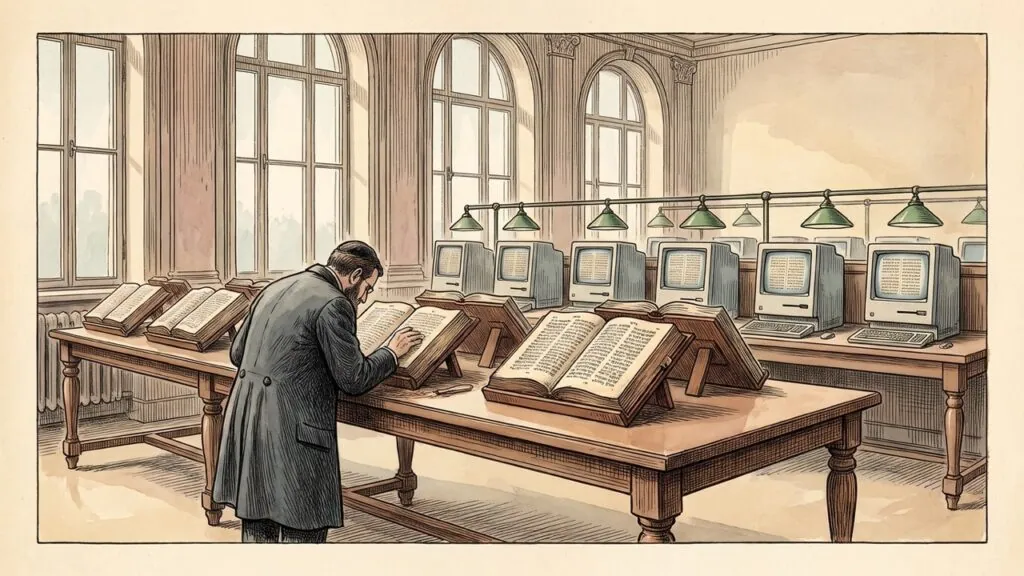
The catalogue could be searched by author, title or keyword through the VTLS Chameleon Web Gateway at yiddishbooks.org, and a reprint, once ordered, came off a digital printer “in Mechanicsburg, Pennsylvania”, usually “in three minutes or less.” [49] The Jewish Telegraphic Agency reported that Fay Zipkowitz, a retired professor of library science, spent several years cataloguing the collection to Library of Congress standards and put the catalogue on the web where anyone could reach it. [11]
The database itself was treated as something worth hiding. “For security reasons, duplicate copies of the Center’s database have been stored in secure locations across the country, including a former Strategic Air Command control center buried deep inside Bare Mountain, less than a mile from the Yiddish Book Center’s headquarters. The facility is now owned by Amherst College.” [49]
Why a filmmaker funds a library
Spielberg gave his own reason when he asked Lansky to fly out to Los Angeles: “You have to understand,” he said, “that what I do for my living is I tell stories. The idea that you have miles of Jewish stories that have yet to be told, that’s just irresistible to someone like me.” [8] The Foundation’s voice was more solemn about the same gift: “Yiddish literature is a gateway into a world that was lost during the Holocaust,” said Rachel Levin of the Righteous Persons Foundation. [49]
32. Free to read, free of charge
Twenty-nine dollars a book
At first, the library was a shop. The Jewish Telegraphic Agency reported on 10 May 2002 that the National Yiddish Book Center had launched “an online bookstore that makes more than 12,000 out-of-print Yiddish titles available for purchase directly over the Internet.” The dispatch opened on a familiar complaint: “Until recently, it seemed you could find Yiddish books only in obscure libraries or the attic of someone’s grandparents.” [11] “Readers can search the catalog of titles and order books for $29 each; members of the center pay less.” The order was routed to a production facility in Pennsylvania, where a digital printer reached the previously scanned pages of the requested book and generated a new paperback copy within minutes. [11]
Lansky sized the field as he announced it: “Offering 12,000 of the 18,000-20,000 titles that compose modern Yiddish literature, the digital library has turned Yiddish into the most in-print literature available.” “Most of the titles available through the digital library have been out of print since the 1950s. Popular writers include I.L.Peretz, Sholem Aleichem and Sholem Asch.” And the claim about the publishing trade: “the digital library is the only major publisher of Yiddish books today.‘A small press in Israel puts out a few titles, but besides us, that’s it.’” His case for the rescue, in the same report, was that “They used to say the only way to find a Yiddish book was to go to a rare book dealer in Amsterdam or a garbage can in Brooklyn.” [11]
The step to free access
What changed the arrangement was the decision to give the scans away. The Center’s own retrospective puts it in 1997: “In 1997 we took a giant step forward with the establishment of the Steven Spielberg Digital Yiddish Library, where complete digitized works can be accessed online, free of charge. The digital library today contains 12,000 titles, which so far have been downloaded an astounding 1.6 million times.” [13]
Lansky told the same story differently, in Pakn Treger 63 in the summer of 2011: “Twelve years ago, with help from Steven Spielberg and others, we digitized most of the books in our collection, prompting the New York Times to declare Yiddish ‘proportionately the most in-print literature on the planet.’ Two years ago we went a giant step further: posting the full text of 11,000 Yiddish titles online, available completely free of charge. According to the Internet Archive… in the first 24 months full-length Yiddish books have been downloaded 217,000 times!” [3] Counted literally from 2011, those phrases put the digitisation in 1999 and the free posting in 2009 — two more dates to set beside the Foundation’s 1998 and the Center’s 1997.
The second New York Times verdict followed the Center’s partnership, in 2012, with the National Library of Israel, which was “launching its own project to digitize its entire Hebrew-alphabet collection, including thousands of Yiddish titles”; the effect, in the online encyclopedia’s summary, was that “The effort prompted The New York Times to declare Yiddish ‘proportionately the most accessible literature on the planet’.” [67]
Counting the downloads
The download counts are a spread rather than a number, and the spread is wide because no source supplies a dated series. The Internet Archive’s figure for the first twenty-four months of free posting was 217,000. [3] The Institute of Museum and Library Services‘ 2014 National Medal brochure counted “more than 500,000 times”; [96] The online encyclopedia, for the end of the same year, put the figure at 1.3 million. [67]
The later figures are larger still. The Center’s application to the National Endowment for the Humanities claims that the titles in the library “have been downloaded more than three million times”; [97] its Tsukunft page says “nearly five million times”; [98] and The New York Times, in February 2024, reported that “11,000 titles from the center’s collection have been digitized and have triggered five million downloads.” [99]
The title count is disputed in the same fashion. The University of Kansas Libraries describe the resource as “nearly 11,000 out-of-print Yiddish titles”, scanned under the auspices of the Spielberg library and made available through the Internet Archive; the Jewish Telegraphic Agency counted “12,000 of the 18,000-20,000 titles that compose modern Yiddish literature”. [11] The Center’s own retrospective counts 12,000. [13]
One thing did grow: use. “Partly thanks to a new optical character recognition technology called Jochre that computational Yiddish linguist Assaf Urieli developed and which the Center launched in 2019, use of the digital library has doubled.” [94]
What the scans protect
What the scans protect is the paper. The Center’s own catalogue of the new core collection explains that with digital reproduction “both of these obstacles have been overcome… it is now possible for the Yiddish Book Center to offer a new and reconfigured core collection, in full confidence that supplies will not run out and that the volumes themselves – which are printed on acid-free paper – will have a shelf life of hundreds of years.” [100] The roughly 1,000 titles in that core library “were drawn from the National Yiddish Book Center’s continually expanding corpus of digitized texts.” [14]
Online, the same collection appears as “close to 12,000 books and over 1,000 audio recordings”, accessible through the Internet Archive. [101] It has been listed under more than one name: the University of Wisconsin’s database record gives its former title as “Yiddish Books Online”. [102]
33. The universal Yiddish library
Four libraries, one portal
In May 2025, the Center’s efforts to make Yiddish books accessible culminated with the launch of the Universal Yiddish Library. More than a decade in the making, this project, a consortium with the National Library of Israel, YIVO Institute for Jewish Research, and the New York Public Library, makes the Yiddish book collections of all four institutions accessible through a single web portal. [13]
The portal describes itself as “a digital crossroads uniting four institutions: the Yiddish Book Center, the National Library of Israel, YIVO, and the New York Public Library”. It “offers unparalleled access to a wealth of Yiddish books, harnessing advanced Optical Character Recognition (OCR) technology to make thousands of texts fully searchable”, and “we provide direct links to the original materials hosted on our partner institutions‘ websites.” [103]
The consortium was older than the portal. In its spring 2019 newsletter, YIVO described itself as “a founding partner of the Universal Yiddish Library, a consortium of major libraries with the largest collections of Yiddish books”, aiming at “an all-inclusive catalog of Yiddish publications and online access to digitized Yiddish books via links to the websites of all participating partners”, with the first stage — “the creation of the catalog” — already underway. The catalogue came first; the portal with full-text search over it came afterwards, and a beta was expected “early in 2025”. [68]
Lansky’s letter
Lansky raised the money for it in a letter to supporters. The appeal letter puts the arithmetic plainly: “Three libraries with extensive Yiddish holdings — the National Library of Israel, the YIVO Institute for Jewish Research, and the New York Public Library — have already joined us. Together we possess the preponderance of Yiddish titles.”
His political reading of the change, in Yiddish: “For years most Yiddish organizations hobn gemakht shabes far zikh — they celebrated Shabbos alone, refusing to speak to, let alone work with, their perceived ideological opponents. But times have changed.” [50]
The money was the harder part. “As the founding institution, the Yiddish Book Center’s share of the total cost will be $750,000. An anonymous foundation has offered a remarkable 1:2 challenge: they will contribute $250,000 if we can raise the additional $500,000 on our own. Two longtime friends of the Center pledged $300,000 toward that match. That leaves $200,000 to go.” [50] When Lansky wrote, the library itself “expected to take two to three years to complete.”
The harvester in Brighton
The technical build was farmed out in part: “We’re working with a tech firm in Brighton, England, to develop a ‘harvester’… The beating heart of the Universal Yiddish Library is the shared portal that will allow participating institutions to combine their respective digitized Yiddish holdings and provide ‘one-stop shopping.’” [50]
Susan Bronson described the state of it in April 2026: “The Universal Yiddish Library went beta this past year. And, after a decade of work in 2025, and this is the web interface for the Universal Yiddish Library, which includes the collections of all four institutions.” [82] “So to date, we have over 67,000 book records from all four institutions. Nearly 20,000 are scanned and processed with OCR.” And the searching: “in the Universal Yiddish library, you can search for phrases and snippets of full text… You can search Yiddish characters and transliterated… and all the books link back to the owning institution.” [82]
And the recruitment: “we’re actively recruiting other institutions to share collections… the next partners will probably be Stanford University. On the other hand, the National Library of Finland, which has a small Yiddish book collection, is interested in joining with us as well.” [82]
The principle behind the model, in her words: “we’re not absorbing the institutions. We’re making their work accessible and available.” [82] And the modesty: “with the Universal Yiddish library, we weren’t the largest of the institutions, in fact. The National Library of Israel is way bigger than the Yiddish Book Center.” [82]
Sixty thousand, or sixty-seven
The size of the catalogue is itself disputed, and the framing differs as much as the number. The Center’s banners announce the library as live and invite readers to “Search more than 60,000 books” from “four institutions — now in one place”. [104] The American Alliance of Museums‘ Museum magazine, in September 2026, put the figure at “approximately 67,000 book records” and named the New York Public Library, YIVO and the National Library of Israel as the contributors, with the Center itself implied as the fourth. [105] Books against book records; four institutions against three named. The magazine’s point was that the work was not only technical: “It depended on building partnerships, securing funding, and creating agreements that preserved individual institutional ownership while enhancing public access.”
The funders the portal lists are the Arcadia Foundation, the David Berg Foundation, the Abby J. and David Cohen Family Foundation, the David and Barbara B.Hirschhorn Foundation, the National Endowment for the Humanities, Michael (z“l) and Linda J.Schmelzer, Robert and Nina Schor, and Josh Weston. [103]
One use is worth noting at the end: “An initiative by researchers at the University of Pennsylvania… is using our online books to create a linguistic model that shows how Yiddish has changed over time.” [50]
34. The duplicates go out
The first two recipients
The first two institutions to take delivery were announced four months apart, and both purchases ran to the same specification. In the Voice and Herald of 29 November 1985 the University of Hartford was reported as acquiring 1,000 Yiddish books, and thereby becoming “the first recipient of a comprehensive collection of volumes in the language, acquired from the National Yiddish Book Center of Amherst, Massachusetts”. [48] The money did not come from the Center: “Funding for the acquisition has been made possible by a grant of $20,000 from the Endowment Fund of the Greater Hartford Jewish Federation.” The collection was to open the programme rather than merely join it: “The collection will initiate the Yiddish Book Center’s Library Development Program, a long-term plan to establish collections of Yiddish literature in major university and research libraries throughout the world.” The university had prepared the ground it received the books on, with a new Maurice Greenberg Center for Jewish Studies endowed by Arnold Greenberg, chairman of Coleco, Inc. [48]
The second recipient was closer to home. On 14 March 1986 the Voice and Herald reported that “The University of Massachusetts at Amherst has announced the acquisition by purchase of a 500 volume collection from the National Yiddish Book Center in Amherst as a library resource for undergraduates in Jewish and Yiddish studies.” The 500 volumes were to serve as a core collection, and the money was secured so that the books would outlast the people who bought them: “A permanent fund for the Marcus collection has been established for this purpose.” The selection was left to a scholar rather than to a list: “The volumes were selected by Hannah Kliger of the UMass Judaic Studies faculty.” The Center had prepared a guide for libraries choosing their own: “a special bibliography—‘Yiddish Literature: Suggestions for a University Collection.’—as a guide to libraries.” [42]
Two shelves, and a bibliography
The programme had a fixed architecture, and it was deliberately narrow. Fay Zipkowitz, writing for College & Research Libraries News in 1987, described two sets: “The Basic Collection, which is designed to support undergraduate programs in Jewish studies, consisting of about 500 volumes, and the Comprehensive Collection, comprising 1,000 volumes including the Basic Collection and additional selections in the coverage areas.” [1] Libraries chose from two bibliographies the Center prepared — Yiddish Literature: A Basic University Collection and Yiddish Literature: A Comprehensive University Collection — though the name used in the Center’s own 1986 notice to libraries was a third: Yiddish Literature: Suggestions for a University Collection. [42] The bibliographies were built for teaching: they carried “reference works, texts in history, biography, ethnography, social theory and other nonfiction areas, as well as literature and criticism”, and the Comprehensive Collection was “also strengthened by primary sources on the Holocaust, including memoirs.”
The record-keeping was what made the sets usable anywhere else. Sperling’s estimate was that “by the end of 1987 complete cataloging for all the titles in the standard Basic and Comprehensive Collections will be available on the OCLC system.” [1] Her remit was wider than a list: as director of the programme “Sperling works with collection development librarians at a variety of institutions to define institution-specific needs, acquisitions, the feasibility of microfilming projects, and the creation of specialized bibliographies.” By the same survey the whole operation stood at “Over 600,000 volumes have been collected; over 15,000 have already been distributed to libraries and individuals” — one volume in forty finding a new shelf.
The Yale gift
The largest single order came four years after the first two. In the summer of 1989 the Pakn Treger announced “a history-making gift” of funds for Yale to purchase and process 10,000 volumes from the Yiddish Book Center, which it called “the largest single retrospective Yiddish library acquisition in history.” [14] The volumes came in the two sizes the programme had been running on since the mid-1980s: “The Yiddish Book Center’s original core collections, comprising 500 and 1,000 titles each, responded to this need.” The money was the gift; the books were bought, which is how a routine acquisition order came to be called history-making.
The Center’s own account of the trade is that it never intended to be a warehouse. “We never envisioned the Yiddish Book Center as a genizah, a static storehouse for old books. Rather, our goal from the outset was to place old volumes into the hands of new readers.” [13] A profile in TIME gave the trade its own description of the Center: “the center, which is the world’s largest supplier of out-of-print Yiddish books.” [57]
Students, public libraries, and a disputed count
Students were the cheapest audience to reach and the hardest to charge. In January 1987 the Center announced the Gildin Yiddish Student Book Fund, which “hopes to make thousands of” Yiddish books available at a rate no commercial publisher would match: “Students receive a discount which amounts to more than 80% off the purchase price of thousands of Yiddish titles.” The terms were as broad as the benefaction: “Book Fund is available to all undergraduate and graduate students enrolled in degree programs anywhere in the world.” [106]
Public libraries came in through a programme with a name rather than a shelf list. The Center’s “Coming to America” Reading Groups for Public Libraries program, in which librarians organise reading groups around books of Yiddish literature in translation and around books related to the immigrant communities their libraries serve, “selected twenty-two libraries from diverse communities across the country, brought librarians to the Center for a training workshop, and distributed copies of Yiddish books in translation to each library.” [97] The reach was not only American: in 2013 alone, “nearly 3,000 volumes were shipped to universities and cultural institutions in Poland.” [10]
How many libraries the Center strengthened is a number nobody has reconciled. In April 2014 Rep. Jim McGovern’s office put it at “600 university and research libraries around the world”. [107] The Center’s own application to the National Endowment for the Humanities says it has “established and strengthened Yiddish holdings at 700 libraries around the world”. [97] The online encyclopedia’s article gives “more than 700 research libraries, schools, and museums around the world”; a profile published in 2024 gives “more than 720 libraries in 26 countries”. [67] [68] A Jewish Affairs article of 2010 reported a different quantity altogether: “a customer list which includes 4000 individuals and more than 5000 national and university libraries in 26 countries.” [108] These may be successive snapshots of a growing programme rather than four contradictory claims, and the five-thousand figure counts a customer list rather than libraries strengthened. No source reconciles them.
35. The New Yiddish Library
A top-down series
The Center did not begin its translation work by choosing books; it joined a series that already had. “Our first step was to join forces with an existing project called the Library of Yiddish Classics (later the New Yiddish Library).” [109] The series had a list and a method, and the Center’s own judgement of the method was unkind: “The series had already published a short but impressive list of titles. Its selection process, however, was decidedly top-down.” Top-down selection meant that scholars decided which Yiddish books mattered and a translator was handed one; the programme the Center built a decade later would reverse exactly that arrangement. It also meant the pace of a committee: “We managed to publish one new translation a year for each of the next ten years — an achievement we were rather proud of until a student pointed out that at that rate we still had 39,000 years to go.” [109]
The series and its editor
The formal arrangement was announced in 2002, and the front matter of the first volume is unusually explicit about who pays and who decides. As The Letters of Menakhem-Mendl and Sheyne-Sheyndl and Motl, the Cantor’s Son went to press on 11 July 2002, the series described itself: “The New Yiddish Library is a joint project of the Fund for the Translation of Jewish Literature and the National Yiddish Book Center. Additional support comes from the Kaplen Foundation and the Felix Posen Fund for the Translation of Modern Jewish Literature. David G.Roskies, series editor.” [110] The copyright on the same series ran to the Fund rather than to the publisher: “Copyright 2002 by the Fund for the Translation of Jewish Literature.” [111]
Three sources give the Fund three names — the Fund for the Translation of Modern Jewish Literature, of Jewish Literature, and of Yiddish Literature — and none of them explains the variation. [44] [112] The editor named on the page was a working Yiddish scholar. David G.Roskies was “series editor of the New Yiddish Library and professor of Yiddish at the Jewish Theological Seminary”, and he edited The Dybbuk and Other Writings by S.Ansky, published by Yale University Press in 2002. [113] Contemporaneously the Center announced the partnership as a turn in its own work: “The next step, said Lansky, is to translate the best Yiddish books into English, through a partnership with the Fund for the Translation of Jewish Literature called the New Yiddish Library. The first titles will be published later this year by Yale University Press.” [49]
What the series published
The list is short, and the names on it are the argument for the series. A survey of Yiddish literature in English translation recorded that the New Yiddish Library “has also issued editions of the Peretz and Ansky titles, as well as a new translation of Sholem Aleichem’s Letters of Menakhem Mendel and Motl the Cantor’s Son (2002, Hillel Halkin) and The World According to Itsik — Selected Poetry and Prose of Itsik Manger (2002, Leonard Wolf).” [112] Halkin translated the whole; Wolf chose. Five years later the series added “a novel, Everyday Jews, by Yehoshue Perle (Maier Deshell and Margaret Birstein), and stories by Lamed Shapiro.” [112]
The money came from one British donor. “Both the New Yiddish Library and the Library of Jewish Classics series are joint projects of the National Yiddish Book Center and the Fund for the Translation of Yiddish Literature, which has received financial support from Felix Posen, a British Jewish philanthropist.” [112] What the series was for was stated plainly in the scholarly literature of the period: the best Yiddish books “are translated into English under the program ‘The New Yiddish Library.’” [10]
One a year, and the field
Ten translations was the sum the series reached before the question of speed became unavoidable. A profile in the Forward set the work against its rivals: “the Yiddish Book Center partnered with Yale University Press to issue 10 translations in the New Yiddish Library series, and Syracuse University Press had its own Yiddish translation series.” [114] Encyclopaedia Judaica, describing the same arrangement, named the writers the series existed to bring into English — “Shalom Aleichem, Itzik Manger, and Lamed Shapiro” — and called the whole thing “an initiative producing new translations of modern Yiddish literature”. [44] The series still stood on the publisher’s list of imprints as the New Yiddish Library Series. [115] Ten books, one a year, set against tens of thousands of titles: the arithmetic that produced the next chapter.
36. The 98 per cent problem
Ninety-eight per cent
The Center’s own statement of the problem is a single number, and it is an uncomfortable one. “The tens of thousands of modern Yiddish titles represent one of the most concentrated outpourings of literary creativity in all of Jewish history, yet 98 percent of them remain inaccessible to those who can’t read Yiddish in the original.” [109] The figure counts titles rather than volumes, and it describes a limit of English rather than a shortage of books. The rescue had put the literature within reach of readers who could not read it.
The response was a meeting. “We convened a summit. To our surprise, over a hundred people showed up”, and after three days two priorities had emerged: “a publishing venture through which we could print new translations at an affordable cost, and a plan to train a new generation of translators.” [109] The two halves have run since as an imprint and a fellowship. The online encyclopedia summarised the programme as a whole: in 2013 the Center launched a translation effort comprising a fellowship, a publishing venture, Taytsh.org — “a website and interactive resource for working Yiddish-to-English translators” — and an annual digital Pakn Treger translation anthology. [67]
White Goat Press
The imprint was run by a professional rather than by an idea. “Four years ago we launched White Goat Press (named for the klor vays tsigele, the little white goat who adorns our logo). Under the leadership of Lisa Newman, a senior staff member with extensive publishing experience, we’ve released 19 titles so far, with 10 more under contract.” [109] The first titles were specific: “Journey through the Spanish Civil War by S.L.Shneiderman; Meant to Be and Other Stories by Shira Gorshman; and the first of a three-volume collection of Writings on Yiddish and Yiddishkayt by Isaac Bashevis Singer.” [109]
How many books that amounts to is unsettled. The online encyclopedia dates the imprint to 2019 and counts its output like this: “As of 2024, White Goat Press has releases over twenty titles including In eynem: The New Yiddish Textbook.” [67] The Center’s institutional account gives a third figure: “the press has published more than two dozen books, including a new Yiddish language textbook, In eynem, used at colleges and universities around the world.” [13] Nineteen titles with ten more under contract; more than twenty as of 2024; more than two dozen in the Center’s own account. The textbook is the one item all three agree on, and it is the one with the widest use.
The translation fellowship
The fellowship was designed against the habit of the old series. “We were thrilled, therefore, when 21 applied for six positions in the program’s first year.” [109] The applicants chose their own books: “As part of the admissions process, each applicant chooses a book they would like to translate. That’s the exact opposite of a top-down approach: rather than relying on experts, the applicants themselves peruse the thousands of books in our Steven Spielberg Digital Yiddish Library and select the ones that intrigue them most.” [109]
The training had two parts. “The training program consists of both workshops and mentorships. The workshops take place over three long weekends… Mentors meet one-on-one with their fellows three to five times a year.” [109] After the first year the Center changed the way the workshops were run, and the change is the clearest statement of its method: it “shift[ed] our approach… to choose workshop leaders who were brilliant literary translators, period, like Bill Johnston of Indiana University, whose field is Polish literature. Sometimes it’s better if our workshop leaders don’t know Yiddish, because that way they can evaluate each translation on its own merit: How well does it read in English?” [109]
The programme was run by a matchmaker. “According to Dr. Mindl Cohen, the director of our translation initiative, they don’t come looking for help with vocabulary but with the overall craft of literary translation.” Cohen is described as “the shadkhn, the matchmaker.” [109] The first cohort is named in the Center’s letter: Anita Norich, Kathryn Hellerstein and Faith Jones, with Ellen Cassedy and Daniel Kennedy as fellows who became well-known translators. Jessica Kirzane, who teaches Yiddish at the University of Chicago, “rediscovered and translated Miriam Karpilove’s Diary of a Lonely Girl, or the Battle Against Free Love — a novel of intimate feelings and scandalous behavior that appeared serially from 1916 to 1918.” Caraid O’Brien came to the work from Galway, Ireland, by way of the Steiner Summer Yiddish Program, and her project, “recently published by White Goat Press, was Sholem Asch’s Underworld Trilogy, a collection of three dramas, ready for the stage.” Cassedy’s summary of the stakes is the sentence the programme was built to answer: Yiddish is “a major literature in a minor language.”
The money, and the competition
The funding was not secure, and the Center said so plainly. “We have been fortunate to have two foundations supporting our translation efforts these past 11 years. Our books and fellowships have won universal acclaim — including the Prize for Translation Initiatives at the London Book Fair.” [109] Then the arithmetic: “One of our major funders ended its support last year, and the other will be doing the same in 2024. The annual cost of our translation initiative is $150,000.” [109] The number of translators trained is likewise unsettled: the same letter speaks of “all ninety of the translation fellows we’ve trained so far”; Our Story says “the Center has trained more than 100 translators and launched a publishing imprint, White Goat Press”; a profile published in 2024 gives “more than 90”. [68] Ninety, ninety-plus and a hundred-plus, from one institution, in documents written within a few years of each other.
The last question is where the books are, and here the claims collide. The YIVO Library “contains nearly 400,000 volumes of books and periodical editions”, of which “approximately 40,000 volumes are in Yiddish, making the YIVO Library the largest collection of Yiddish-language works in the world.” [116] Some of those volumes come from a history the Center’s own collection does not share: books and periodicals from YIVO’s prewar collections in Vilna, “confiscated by the Nazis during the Holocaust, later found in Germany after the war, and eventually sent to the New York YIVO in 1947”, together with “treasures rescued by the so-called ‘Paper Brigade’” and the private collections of “Chaim Zhitlowsky, Elias Tcherikover, Max Weinreich, Kalman Marmor, Shmuel Niger, Sholem Perlmutter, and Chaim Grade.”
Against this, Brygida Gasztold wrote in 2015 that the Center in Amherst “houses the world’s largest collection of Yiddish books.” [10] The two claims are not measuring the same object — one counts Yiddish titles in a research library, the other counts volumes held by an institution that keeps duplicates — and the Center’s own president has conceded as much. Speaking to the American Alliance of Museums, Susan Bronson said that “with the Universal Yiddish library, we weren’t the largest of the institutions, in fact. The National Library of Israel is way bigger than the Yiddish Book Center.” [82]
37. The Great Hall
A hall built around the stacks
The room at the centre of the Yiddish Book Center is a hall, and the way into it is staged. Visitors cross what Allen Moore called “a noisy Billy Goats Gruff bridge”, then “pass through a dimly lit entryway and emerge into the light-filled Great Hall, its peaked ceiling topped by a cupola”. [58] From there “one has an unimpeded view of the central book repository: row upon row of shelves filled with tens of thousands of volumes.” The repository is not a back room kept out of sight. It is the thing the building is arranged around, and it is the first thing a visitor sees.
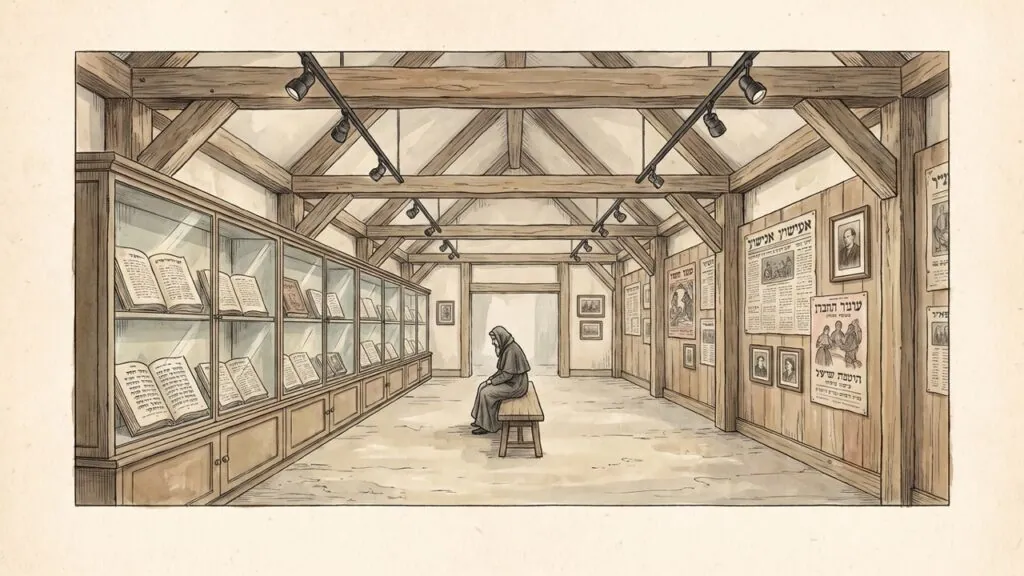
Moore’s reason for the arrangement was not grandeur but involvement. “The Great Hall provides a center of gravity,” he explained. “I thought you had to see and smell the books and feel a sense of involvement immediately.” [58] The hall is flanked by hexagonal spaces with clerestory windows; the first is the Esther Ohsie Klein Welcome Gallery, where visitors usually stop, and the other houses the Center’s bookstore. The Jewish motifs are pointed out rather than imposed: docents ask visitors to look up at the ceiling, “where overhead beams form a Star of David”, and the glass and wood display cases, designed by Moore’s wife, the master cabinetmaker Suzi Moore, “have slightly angled tops that recall the slanted table on the synagogue bima, where the Torah is traditionally unfurled and read.”
Two languages on every sign
Everything about the wayfinding is bilingual. A visitor noted it flatly: “Everything around the center and inside is marked in Yiddish and English, except the books.” [72] The exception is the point of the building. A shelf in the repository holds the evidence of the rescue in its bindings and its foxing, and nothing on a spine explains to a reader who cannot read the script what the volume is. The Center’s collections page is where that gap is addressed: it lists the Digital Yiddish Library, the recorded programs, the archival recordings and the Yiddish audiobooks — the catalogue through which the untranslated contents become legible.
The building describes itself in two languages as well. On the Center’s homepage the institutional tagline is rendered in Yiddish as well as English: “The Yiddish Book Center is a lebedike velt, a lively world where concerts, performances, films, and public programs draw visitors from near and far to experience Yiddish culture.“ [117] Underneath it, a rotating line in Yiddish serves as the invitation to give.
What the building holds now
What the building contains today is set out on the Center’s visitor pages: “permanent and visiting exhibits; two performance halls with a year-round schedule of educational programs, concerts, films, and events; an English-language bookstore; and a million Yiddish books.” [118] The two halls are the eighty-seat Applebaum-Driker Theater and the 350-seat Kligerman-Greenspun Performance Hall; alongside them sit the Klarman Student Center, the Brechner Gallery and the Lief D.Rosenblatt Library, which keeps the core collection in climate-controlled storage. [58]
The building was filled in two stages. The 1997 structure opened with “classrooms, exhibit space, a small theater, a reading library, a bookstore, offices, and a central book repository”; the 2009 addition brought 22,000 square feet more, among them the 350-seat performance hall and a “state-of-the-art, fireproof facility” for the core collection. [58] There is no separate museum wing. The permanent exhibition is not sealed off from the shelves: its displays “surround and weave in and out of the Center’s book stacks, another striking architectural feature of the building.” [69]
A visitor in 2024 walked the ground floor and took inventory: “Besides the main exhibition space, the building includes an excellent shop, a room with a helpful introductory video, galleries for changing exhibitions, and two performance spaces.” [68] The same account noticed what the roof does: the low wooden structures with distinctive gabled roofs “recall the appearance of an Eastern European shtetl”, but “inside, tall ceilings and skylights make it bright and cheerful.” The gables are a quotation; the daylight is the building’s own argument.
Orchard, terrace, and the Holyoke Range
Outside, the land does some of the talking. “The Center is surrounded by peaceful gardens, a ten-acre apple orchard, and a spectacular view of the rolling Holyoke Range.” [119] The orchard is the ground the building was raised on: in 1997 the Center opened the Harry and Jeanette Weinberg Building “set on a ten-acre apple orchard at the edge of the Hampshire College campus”. [13] The visitor’s guide tells guests to “Stroll through our Yiddish Writers Garden and picnic in the apple orchard”, and to browse the bookstore for one-of-a-kind gifts, books in Yiddish and English, and toys.
The Outdoor Terrace is the largest room on the site: 7,900 square feet, “with room for a tent of up to 3,200 square feet (40 x 80 feet)”, overlooking the orchard and the gardens and used for tented ceremonies and events. [119] It is also the only named space in the building without a shelf in it.
38. “Yiddish – A Global Culture”
A core exhibition, rebuilt
The Center’s own press release carried the date in its headline — the announcement is titled “Yiddish Book Center to Launch Major New Core Exhibition on October 15, 2023” — and stated that Yiddish: A Global Culture “debuts on October 15, 2023, expanding the Center’s scope to include the world’s first comprehensive museum of modern Yiddish culture”. [120] The show it announced explores “modern Yiddish literature, theater, music, press and politics”, running through “approximately 350 objects, including rare books, artwork, photographs, sheet music, Yiddish typewriters and other artifacts” and covering “the 1860s to the present”. [121] [122] JTA’s report of the exhibition described what it argues: the show “depicts the ‘secular’ Yiddish culture that arose in the mid-19th century as a distinctly transglobal, modern movement that includes theater, the press, mass market publishing and intellectual ferment in big cities from Warsaw to New York to Shanghai.” [69]
That date is not agreed. The English-language online encyclopedia article states instead that “In October 2024, the Yiddish Book Center opened a new permanent exhibition”. [83] Against it stand the Center’s own pages and the contemporaneous coverage: the press release, JNS, the Berkshire Eagle and a Tablet visit that refers to “the Oct. 15 unveiling of this new core exhibition” all place the opening in October 2023. [123] [121] [122] [124] The online encyclopedia’s version is contradicted by the Center’s own record; no source says so in as many words, and the year is left where the sources leave it.
The show’s measurements are disputed too. The press coverage counts 350 objects; the Berkshire Eagle counts “16 themed sections, including press and politics, women’s voices and celebrities”, while a review published the following November counts seventeen and lists among the topics “Modernism—The Yiddish Avant-Garde 1914–39; Women’s Voices—Gender, Stereotypes, and the Struggle for Equality; Press & Politics—Mass Newspapers and Mass Politics; and Khurbn/Holocaust”. [122] [68] No source says whether a section was added or a category renamed between the two visits. Asked how many things the exhibition holds, the curator answered: “There are almost a thousand individual items — books, objects, photographs — if you total everything up.” [122] The two figures count different things: 350 display objects, or everything counted in.
An NEH exhibition implementation grant paid part of the cost — the endowment records that the Center “used an NEH exhibition implementation grant to open their new permanent exhibition” — and the balance came from the Kaplen Brothers Fund, the Estate of Dr. Thomas Zand, the Simha and Sara Lainer Family Foundation, the David Berg Foundation and others. [85] [120]
Yiddishland, and the Peretz salon
The entrance is a map. Visitors “see Yiddish-language copies of 49 books, from ‘Harry Potter and the Philosopher’s Stone’ to ‘Moby Dick,’ beneath a commissioned 60-foot mural, Martin Haake’s ‘Yiddishland’.” [122] The mural “maps 35 places and events in modern Yiddish culture around the world from the mid-19th century to the present”, among them “the world’s longest-running Yiddish bookstore, which was in Cape Town, South Africa”, “an ongoing Yiddish music festival in Québec, a Yiddish school in Mexico City established in 1935, and Vitebsk (in present-day Belarus), the birthplace of artist Marc Chagall and his wife, Bella”. [68] The books ranged along the ramp beneath it are the Center’s own — translations and originals, “as varied as immigration narratives, children’s books, scientific writing, and poetry”.
One room is a jewel box. “Nearby, you can step across the threshold, as Mazower said, into a recreation of writer I.L.Peretz’s Warsaw apartment, where he hosted salons that were an early 20th-century centerpiece of Yiddish modernism. Next door, there’s a theater, replete with puppets and autograph books.” [122] The salon carries 24 portraits of writers in the literary circle of I.L.Peretz (1851–1915) — Joseph Opatoshu, Ansky, Dovid Bergelson, Tea Arciszewska, Hava Shapiro among them — and one line on the wall: “Leave the ghetto, see the world—but with Jewish eyes.” [68] [124]
Press & Politics, and the last linotype
The Press & Politics section stands on a machine. “One object that the museum had stored for 30 years is the world’s last Yiddish linotype machine.” [122] It is now shown with “a video of someone working on a linotype, a graphic with the machine’s core functions and a photograph with many linotypes”, and the man at the centre of that photograph “wears a costume made of Yiddish newspapers”. [68]
Elsewhere the exhibition sets out the rest of its material: a 1920s leather steamer trunk used by the Yiddish literary couple Peretz Hirshbein and Esther Shumiatcher on their world tours; a video of the Yiddish opera singer Anthony Russell singing about Jewish slavery in Egypt; pull-out drawers of DIY “zines in and about Yiddish”. [122] [124] It honours “the monumental ‘Language and Cultural Atlas of Ashkenazic Jewry’ undertaken between 1959 and 1972 by the linguist Uriel Weinreich”, and describes YIVO, in the Center’s own exhibit, as “The Mothership”. [69] The displays “surround and weave in and out of the Center’s book stacks”, and since the pandemic shutdown the Center “has been drawing 10,000 visitors a year”.
39. Mazower and the objects
A Londoner with a Yiddish grandmother
David Mazower came to the Center in 2017, and the post he was hired for was not the one he kept. He took the job of bibliographer when “the Center’s longtime bibliographer stepped down”; he is now Bibliographer and Editorial Director, and the co-editor with Aaron Lansky of the Center’s English-language magazine Pakn Treger. [122] [125] Before Amherst he had spent twenty-five years as a journalist at BBC News, and he left “my job as a BBC news editor” to join the Center as “editorial director and bibliographer”, having served on its board and written for its magazine while still in London. [126]
The family story he tells explains the pull. His grandmother was “the celebrated Yiddish writer Sholem Asch”‘s daughter, and the writer’s presence in the house was domestic rather than monumental: “His portrait hung above the sofa, his pewter inkwells stood on his old writing table, and his books filled the shelves.” [126] Mazower is a great-grandson of Sholem Asch; the Center’s own account of the exhibition names him as its author and chief curator and makes the same descent part of his credentials. [81]
A small exhibit that grew
The project began as a footnote. Lansky and Executive Director Susan Bronson asked him to work on “a small exhibit… to be called ‘Yiddish Encounters in America’”. [122] He said yes — “Sure”, the account runs, “not knowing that his next six years would be defined by that project.” The Berkshire Eagle counts the culmination as six years of work; the Center puts the curating itself at five. [81] What came out of it now fills the permanent galleries, and the Center’s exhibition page says the show “will be on display for many years to come”. [127]
The widening of the scope had a reason. “Because in beginning to work on it, he found that limiting a Yiddish story to America was difficult.‘Migration is so at the heart of the modern Jewish experience. You’re going to have to keep referring to where people come from.’ So what if the exhibit could be global in scope, painting a picture of Yiddish culture that encompasses Shanghai and Capetown and Buenos Aires?” [124] The Center’s own programme had moved the same way: the translation imprint White Goat Press, named for the little white goat on the logo, had begun four years before his letter, under Lisa Newman, a senior staff member with extensive publishing experience. [109]
The Big Bang moment
The premise was deliberately narrow. “We decided to focus on the moment when Yiddish writers and musicians and theater people and journalists and folklorists and anthropologists have the ambition to put Yiddish on par with every other world culture. It’s a self-conscious, ‘Big Bang moment’ when everything shifts and becomes a mass phenomenon.” [122] And the claim that came out of it: “We realized at a certain point: we were creating the world’s first Yiddish museum” — set against Warsaw’s POLIN, “which has lots of information about Polish Yiddish culture but is more broadly about Jews in Poland, and a relatively small gallery at the YIVO Institute.”
He put the ambition to JTA this way: “My hope is that through the exhibition as a whole you see Jewish history through a Yiddish lens and in a different way from the Holocaust-defined story that so many of us have been educated with and that popular culture feeds us.” [69] Lansky, who had wanted the exhibition for years, “admits his own vision is more literary than the core exhibit’s, and thanked Mazower for creating a broader view of Yiddish as a global culture.” The catalogue makes the same case in the language of print: “In essence, it’s the emergence of Yiddish as a modern mass culture and its flowering as a worldwide network with centers in Europe, North America and Latin America. We tell that story thematically through Yiddish literature, theater, music, politics, the press and more.” [128]
The catalogue, and the desk
The catalogue to the exhibition, Yiddish: A Global Culture: Bold Lives, Boundless Creativity, runs to 344 full-colour pages and includes “an eight-page gatefold of ‘Yiddishland,’ the exhibition’s 60-foot mural, along with hundreds of reproductions of artworks, rare artifacts, and other key elements of the exhibition.” [129] Its publisher’s note describes its author as “research bibliographer and editorial director at the Yiddish Book Center and chief curator and writer of the Center’s permanent exhibition”, who “oversees the Center’s core collections and co-edits its magazine, Pakn Treger”. [130]
His letter to supporters is an argument in miniature. The Center’s appeal lists what money buys — a Fellow to sift through unsorted boxes and journals, an international shipment so that books can be recovered from Australia, Europe and South America, translations, and the repair and conservation of fragile rare books — and then describes what came out of the sorting. One discovery was a 1921 imprint from Lodz, Himlen in opgrunt (Heavens in the Abyss), by an expressionist poet named Chaim Krol, whose pictures “flickered and danced”. [126]
40. Yidstock
A festival with three birthdates
Yidstock, the Yiddish Book Center’s festival of new Yiddish music, began as an attempt to fill a building with people rather than with pages. Susan Bronson, then a new hire as the Center’s executive director, was brainstorming ways to attract visitors. “I really wanted to think about what we could do where we’d be bringing in people from all over the country, and where we could also be fostering creativity in Yiddish music…And I just thought that a music festival would be a wonderful thing.” She recruited Seth Rogovoy, a musician and critic then based in the Berkshires, to put together a set list. [131] The New York Times noted in February 2024 that “Thanks to Bronson’s initiative, the center has sponsored a summer music festival called Yidstock.” [132]
How long the festival has been running is less settled. Bronson’s account dates it to 2011, when she was a new employee. [131] The artistic director’s own biography says that “Since its debut in summer 2012,” he has run the annual festival. [133] A 2013 report from WAMC spoke of that year’s “inaugural year,” and an ArtsFuse notice from the same July called the event “In only its second year.” [134] [135] Later announcements count differently: the 2024 edition was “the 12th edition,” and the 2025 festival was “Now in its thirteenth year.” [136] [137] A 2022 release marked the festival’s tenth anniversary. [138] The arithmetic does not reconcile across these versions, and no source explains the discrepancy: 2011, 2012 and 2013 each have a document behind them.
From one day to a long weekend
At the beginning, “In its first iteration, Yidstock consisted of a few concerts over the course of a day. Now, in its 10th, the festival boasts 400 and a long weekend’s-worth of activities, including film screenings, dance workshops and artist talks.” [131] The figure is given without an itemisation. The 2025 festival ran four days, from 10 to 13 July, with seven concerts, four hands-on workshops and nine in-depth talks. [139] The 2026 festival ran from 9 to 12 July, again four days and again seven concerts, with a livestream option for those who could not travel to the Pioneer Valley. [140] The dates announced for 2027 are 8 to 11 July. [141] The pandemic interrupted the sequence: the 2021 festival was a virtual programme, “a 75-minute program featuring Yiddish songs of social justice,” [142] and the 2022 edition was “the first in-person festival since the pandemic disrupted Yidstock’s live, in-person performances.” [143]
The scale is one thing; the names are another. The Klezmatics have “performed at almost every Yidstock,” and the group, Rogovoy said, “served as the initial inspiration for the festival due to a unique approach of blending outside genre influences with traditional klezmer and Yiddish music”; by 2026 they were celebrating a 40th anniversary at the festival. [144] The 2026 lineup listed Levyosn, Midwood, Eleanor Reissa, Ethel Raim, Socalled, and the rising artists Riki Rose and Jordan Wax, with Reissa performing with Frank London’s Klezmer Brass Allstars and Ethel Raim with The Socalled Band. [145] The 2024 edition brought Berlin’s Daniel Kahn, “perhaps most famous for his Yiddish version of Leonard Cohen’s ‘Hallelujah’,” and a show based on “the irreverent Khumesh Lider (Bible stories) of great Yiddish poet Itsik Manger (1901-1969)” by Basya Schechter and Avi Fox-Rosen. The 2025 bill closed with The Great Yiddish-American Songbook, with Frank London’s Yinglish Orchestra and Singers, featuring Eleanor Reissa, Judy Bressler, Lorin Sklamberg, Joanne Borts and Sarah Gordon, and also included a re-creation of the landmark 1956 klezmer album TANZ! by Dave Tarras and Sam Musiker, with Michael Winograd and an all-star band; Hankus Netsky as musician-in-residence; and dance workshops led by Judy Bressler and Asya Vaisman Schulman. [137]

New music, not a museum piece
The name carries a programme in its subtitle: Yidstock, the festival of new Yiddish music. “It’s important that the subtitle is Yidstock, the festival of new Yiddish music,” Rogovoy said. “We are devoted to Jewish music as it’s been heard for the last 50 or 100 years…But what we look for are artists who are bringing something new, different, and contemporary. The only way to keep the music alive is to view it as a living thing and support artists who approach it that way, rather than as a museum piece.” [136] The rationale he offers is institutional as much as musical: “providing Yiddish-speaking musicians, especially contemporary ones, a platform to share their work is crucial to keeping the language alive and ‘perfectly melds with the mission of the Yiddish Book Center itself.’” [144] Lisa Newman, the Center’s director of public programs and publishing, describes the festival as “an annual celebration of…‘the breadth of Yiddish music’ – music that reflects elements of jazz, blues, klezmer, even techno.” [143]
A festival that refuses to grow
Scale has never been the point. “We’re not looking to expand,” Rogovoy said. “All we’re looking for each year is to put on a combination of fun, entertaining, interesting, challenging, provocative, intellectual … and cutting-edge Yiddish music.” [144] The director himself is a critic and historian who has written about the music for decades, among other things The Essential Klezmer: A Music Lover’s Guide to Jewish Roots and Soul Music (Algonquin, 2000) and Bob Dylan: Prophet Mystic Poet (Scribner, 2009). [133] Bronson, describing the 2025 festival, called Yidstock “a vibrant celebration of Yiddish music and culture,” and said the Center was “excited to once again welcome an extraordinary lineup of performers and an enthusiastic audience for a dynamic weekend of concerts, conversations, and creative exchange.” [137] A festival that treats its own tradition as a living thing, under a director whose published work argues for exactly that, applies to music the method the Center applies to books: a repertoire kept in circulation rather than a collection closed for display.
41. The critics
Authenticity and the shtetl trope
The serious criticism of the Center comes from inside the field, and it is not about money or management. The central academic statement of it is an article by Brygida Gasztold in the journal Text Matters in 2015. Her argument begins with the uses of Yiddish as evidence: “as a medium through which one may examine the Jewish past, Yiddish cultural representations evoke a question of authenticity. Since Yiddish has become a proxy for all those speakers whose voices have been muted by the Holocaust, the politicization of Yiddish studies has been unavoidable.” [10]
Gasztold places the Center’s work inside a scholarly argument about the shtetl image. Dan Miron’s The Image of the Shtetl, published in Tel Aviv in 1981, “examined the shtetl from a fuller perspective that challenges nostalgic re-creations of history.” [10] On the limits of revival she quotes Anita Norich and Janet Hadda: “As long as those contemporary trends illustrate the accommodative qualities of Yiddish, none of them, as Janet Hadda argues, ‘can claim to be direct continuations of the rich, conflict-ridden, and sometimes contradictory realm that existed in Eastern Europe before World War II.’” [146] The charge she is making is that the shtetl has hardened into a cliché: “the image of the shtetl (traditional Jewish village) life of pre-Holocaust Europe is invoked with an almost religious reverence with such a frequency as to make it a trope.” Avineri’s term for the process, as the same study reports it, is “the nostalgia socialization of diaspora Jews to Yiddish, a socialization into a set of affective ideologies that project reverence onto the Jewish Eastern Europe of their grandparents, connecting them to a Yiddish-speaking quotidian Jewish reality that no longer exists.” [146]
Numbers and thin description
The same study reports an ethnographic observation by Joshua L.Friedman: “Friedman (2016) has observed a similar situation in his ethnography of the Yiddish Book Center in Amherst, Massachusetts, describing how visitors came to observe the sheer volume of Yiddish texts even though they rarely had any relevant Yiddish competence.” The chapter is cited there as “Friedman, Joshua L. 2016.‘Let’s Start with the Big Ones: Numbers, Thin Description, and the Magic of Yiddish at the Yiddish Book Center.’ In Taking Stock: Cultures of Enumeration in Contemporary Jewish Life, edited by Michal Kravel-Tovi & Deborah Moore,” Bloomington: Indiana University Press. [146] The chapter itself was not obtained for this article. The observation is therefore reported at second hand, no sentence of Friedman’s own text is quoted here, and no page number is given. The citation signals that the Center’s statistics are themselves a scholarly object, read for what they do as well as for what they count.
An adjacent project, and a museum that is not a village
The sharpest language about shtetl-style reconstruction does not, in fact, concern the Center. It comes from UCL Discovery’s “Architecture of Memory,” a critique of Sol LeWitt’s synagogue project: “Despite such oddities, my ethical and aesthetic opinion about this project is ambivalent, as the estate – although undoubtedly a financially profitable and extravagant example of cultural appropriation – is nonetheless a site of remembrance in a place of forgetting.” [65] The remark is adjacent to the Center’s own buildings and should not be read as an attack on them. A more direct verdict comes from Rokhl Kafrissen in Tablet, who contrasts the Center with the POLIN museum in Warsaw: “No attempt is made at recreating some kind of ersatz ‘shtetl’ feel. (One shudders to think.)” [124]
Kafrissen’s other reservation is about scale, and with the October 2023 unveiling of the new core exhibition the Center “has established itself as a cutting-edge educational space, even with a tiny fraction of the space of a traditional museum.” [124] The Center’s own answer is to define the museum by what it holds rather than by the village it declines to rebuild. The exhibition, “Yiddish: A Global Culture,” “expands the Center’s scope to include the world’s first comprehensive museum of modern Yiddish culture” [120] [121] – a modern, global story rather than a nostalgic village.
The competition, and two institutional answers
Balance is easy to supply. The Berkshire Eagle sets out the field: “There are other substantial Yiddish libraries and bookstores in the world, such as the ones at New York’s YIVO Institute for Jewish Research and the by-appointment-only CYCO Books, respectively, but there was and remains no other spot with the Center’s mix of collection, archive and repository.” [122] Two further answers to the criticism are institutional rather than argumentative. The first is the National Medal for Museum and Library Service, “presented in a White House ceremony by Mrs. Michelle Obama on May 8, 2014,” in the medal’s twentieth-anniversary year. [147] The medal’s brochure reports that “The nationwide effort has since recovered more than one million volumes.” [96]
The second answer is the open-access policy, which Bronson has defended in detail, and which governs the Center’s digital library: “We offer free downloads of the books…We have always leaned to open access, and, you know, we continue to do so. Recognizing that there are risks inherent in that,” she said in April 2026. On the repository question she was blunter: “we store the images of the books… one of which is the Internet archive, which was the original repository…And we have a lot of concerns about the Internet Archive because they’ve had a lot of issues themselves. So we are… looking at other options to make sure that… we’re not compromised.” [82] The tension between the two answers is real and unresolved: a collection meant to be read anywhere, free of charge, also depends on infrastructure whose durability its own director doubts.
42. Why Amherst
The city that refused
Before the argument for Amherst there is the rejection. Lansky, then twenty-four by his own recollection, though the publisher’s copy of his memoir gives twenty-three, “went to every major Jewish organisation in New York to ask for help in saving Yiddish books. They all turned me away empty-handed.‘Yiddish is dead,’ they asserted.” [3] The documentary transcript of A Bridge of Books is blunter: “when I first came up with this idea to go rescue the world’s Yiddish books the response everywhere was essentially the same ‘don’t you know Yiddish is dead, don’t you know no one cares about this culture any longer, why don’t we give you a nice scholarship and you can go off and study on Israel, why do you have to waste your time with these old books that nobody wants.’” [148] Bronson’s summary is drier: “many of the existing Jewish organizations in major urban areas were dismissive, saying: ‘Yiddish is dead, why are you bothering with this?’” [149]
Why not New York
The obvious alternative has a name. Ilan Stavans: “The obvious choice [for its location] would have been New York, where Yiddish and Jewish culture has its epicenter in the United States.” And the verdict of 1980, from the same commentator: “At that time, it was deemed adventurous, or maybe foolish, quixotic, when [Lansky] placed it in Amherst, Massachusetts, far from any Jewish cultural centre.” Bronson’s explanation of the site is practical: “Because Lansky is a Hampshire College graduate, he started storing the Yiddish books in the Amherst area. At the time, Hampshire College was interested in building a ‘cultural village’ and offered land to the Yiddish Book Center. It was significantly cheaper than it would have been in other places.” [149]
What grew on that land is described in the New York Times of February 2024: “Part museum, part library, part bookstore, part storehouse, the center is now based in a 10-acre complex on the campus of Lansky’s alma mater, Hampshire College, where two buildings are designed to appear like an East European shtetl, or a small town.” [132] [99] The shtetl styling of those buildings was a deliberate decision, and has an architectural account of its own. [150]
New York had its own Yiddish institutions, among them the YIVO Institute for Jewish Research and the by-appointment-only CYCO Books; by the Berkshire Eagle’s count, no other spot combines the Center’s collection, archive and repository. [122] What New York lacked was the campus: the college that stored the books, the five-college consortium around them, and land the Center could afford. [149]
The Five Colleges
The strongest argument for a small New England town is academic: “Its location within the Five College Consortium has also proved valuable for both students and the center.” “Staff members at the center teach guest Yiddish classes at the Five Colleges, and the interlibrary loan system means that students can check out books easily from the center, ‘making our reservoir of material really inexhaustible,’” Stavans said. The reach is wider than the consortium. “While we’re based in Amherst, as a wonderful cultural asset in the Pioneer Valley, we have a footprint that is international,” Bronson said. “Although the center took a long time to build, it has become a magnet, bringing people from all over the world to Amherst.” [149]
Students at the colleges themselves are less sure. Ilya Nemirovsky ‘24 argues the opposite case: “In a way, the [Yiddish Book Center] is much more needed here than in some place like New York or Boston because most colleges there have Jewish studies programs.” Shayna Klainberg ’25 makes the obvious complaint: “The fact that we couldn’t find a course on Yiddish being taught at any of the five colleges strikes me as something surprising.” [149]
Six hundred, or seven hundred, or five thousand
The Center’s institutional answer to the warehouse charge is that it was never intended as one: “We never envisioned the Yiddish Book Center as a genizah, a static storehouse for old books. Rather, our goal from the outset was to place old volumes into the hands of new readers.” [13] The evidence offered is the duplication programme, and the numbers attached to it disagree. In April 2014 Rep. Jim McGovern’s office put it at “600 university and research libraries around the world.” [107] The Center’s grant application to the National Endowment for the Humanities says it has “established and strengthened Yiddish holdings at 700 libraries around the world,” [97] a figure a profile published in 2024 puts at “more than 720 libraries in 26 countries.” [68] A 2010 issue of Rosh Hashanah in South Africa reported that the Center’s “customer list … includes 4000 individuals and more than 5000 national and university libraries in 26 countries” [108] – a figure that describes orders rather than collections strengthened, and that is more than a decade older than the others.
No source reconciles the three counts, and the differences may be a matter of what is being counted: institutions whose holdings were strengthened, institutions that received books, institutions on a mailing list. What all three agree on is that the books were meant to leave Amherst, and that leaving is the point. A genizah keeps what it has; the Center’s stated purpose was the opposite.
43. Lansky retires
Lansky steps down
The news came out in the last week of February 2024, on the front page of the New York Times, under a headline that read like a joke turned true: “He Rescued 1.5 Million Yiddish Books. Now He Will Have Time to Read Some.” The story, by Joseph Berger, was about Aaron Lansky announcing that he would step down as president of the Center he had founded in 1980. His own letter put the span in his words: “It’s hard to believe almost 45 years have passed since I took what I thought would be a two-year leave of absence from graduate school to save Yiddish books. At the time, scholars estimated just 70,000 volumes could still be found; we collected that number in six months and went on to recover 1.5 million.” [132] [151]
How the departure would work was described three ways, and they do not quite agree. The Forward, reporting on 27 February 2024, was the most definite: “Lansky will step down from his role as president of the center in June 2025 but will remain for two years as senior adviser to the institution he created. Susan Bronson, the center’s executive director, will succeed him as president.” The Center’s own news entry was blunter: “Aaron Lansky, president and founder of the Yiddish Book Center, will retire in June 2025. Susan Bronson, who has been the Center’s executive director for 14 years, will take over the position.” [142]
Lansky himself, talking to WAMC in May 2024, was less precise about what he was stepping down to: “A year from this coming June, I’ll be 70 years old, which seemed like a fairly good point of demarcation…But I’m only stepping down from my current role as president and then I’ll stay on for an indeterminate amount of time, as our – I think the title is ‘founder and senior advisor.’” Two years as senior adviser, an indeterminate amount of time as founder and senior advisor, a part-time advisory role: each source described the arrangement differently, and the spelling of the title varies with the reporting. JTA, writing on the handover in June 2025, called the step-down “both voluntary (his successor is Susan Bronson, the center’s executive director for the past 14 years) and gradual.” [152] [8]
The MacArthur grant
The financial turning point of the early years came in 1989, and the MacArthur Foundation records it in the terse form of a fellow’s profile: Aaron Lansky, “Cultural Preservationist”, Class of 1989, aged 34 at the time of the award, area of focus “Culture and Society”, location Holyoke, Massachusetts. The grant was for $250,000, and Lansky was, as Mass Moments recorded it, “shocked but thrilled” by the news. “Oh, what a difference that grant made!” he recalled. “It bestowed a new measure of credibility on the nascent Yiddish Book Center — and on Yiddish itself. It opened doors. It paid off a mountain of debt accumulated during the nine years I had worked for next to nothing.” [22] [153]
What the money actually paid for is not settled, and three incompatible accounts survive. Mass Moments has it opening the building: “With his MacArthur money, he opened the National Yiddish Book Center in Amherst.” The Los Angeles Times, in September 1989, reported that the Center’s associate director, Nanci Glick, said: “He expects to use it to send Yiddish books to the Soviet Union.” Lansky’s own recollection is the third: the money paid off “a mountain of debt”. [153] [154] A MacArthur grant is unrestricted, so all three may have been true at once; no source consulted allocates the $250,000.
The scale of what it eventually paid for is clearer. The Weinberg building cost $7,000,000; individual supporters gave nearly $3,000,000 of that, and foundations provided the rest, and the building opened to the public in June 1997. The same 1989 Los Angeles Times report put the operation’s size alongside the award: the Center “has saved about 900,000 Yiddish books and sent out tens of thousands to individuals and libraries around the world. About 100,000 of those volumes came from Southern California.” [153] [154]
Twenty-three or twenty-four
The age at which Lansky started is disputed by Lansky. The foreword to his memoir, Outwitting History, opens: “In 1980, at the age of twenty-three, I decided to save the world’s Yiddish books.” The Forward agreed with him: “Lansky’s quest began in 1980 when he was a 23-year-old graduate student at McGill University in Montreal.” The online encyclopedia’s entry for the memoir repeats the figure. [16] [54] [59]
Two years later the same man gave a different number. The New York Times described “Lansky, then 24 years old” at the moment of decision; the Center’s own retrospective traced its story to “an idea conceived by a 24-year-old graduate student”; and Lansky told it in the first person in Pakn Treger: “When I was 24 years old—a naïve graduate student in a borrowed suit—I went to every major Jewish organization in New York to ask for help in saving Yiddish books. They all turned me away empty-handed.” [132] [37] [3]
Both accounts describe 1980, and neither is corrected by the other. What he intended to do with the rest of his life, written in the same month, was short: “You know, I’ll retire, but I promise you, the organization will go on for a very, very long time and the reason is – it’s too important not too.” [152]
44. Susan Bronson and the next chapter
Bronson in the chair
The successor is Susan Bronson, and her route to the job was local: she had “lived here while working in development and management of local cultural institutions before going to work at the Center fifteen years ago.” She came to run the Center’s educational work and stayed to run the institution; the Center’s staff page lists her with a PhD in Russian history and Jewish history from the University of Michigan, and records her earlier work in nonprofit cultural management. [81] [89]
Two small disagreements sit inside that record. The first concerns the length of her tenure as executive director: the Center’s own news entry and JTA both say fourteen years, while the Berkshire interview says she went to work at the Center fifteen years ago. The second concerns her title, which the staff page still gives as executive director while newer sources call her president — the title of the video in which she is interviewed is “The Jewish Lens presents: the president of the Yiddish Book Center, Susan Bronson!”, and the American Alliance of Museums introduced her in April 2026 as “Susan Bronson, president of the Yiddish Book Center in Amherst, MA.” [142] [8] [81] [155] [82]
Asked when the change had actually happened, Bronson was casual. Interviewed by Jonathan Rosen for The Jewish Lens on 6 August 2025, she said: “You you became president, okay…Well, it happened just like two weeks ago officially, right? It’s been in the works for a couple of years.” The succession was not announced so much as administered. [155]
The programmes she built
Bronson’s own account of what changed under her is a list of things that grew. “Our educational programs have grown dramatically. We have a translation initiative now, which has trained more than 100 translators. We launched a publishing imprint to publish Yiddish books in translation. The Oral History Project started tiny in the first year I got here, and we’ve now recorded more than 1,500 oral histories from all over the world.” The oral history project was directed for most of that time by Christa Whitney. [81] [90]
The count of that collection varies by source and by date: the Center’s own pages say more than 1,400, and Bronson, speaking to the American Alliance of Museums in April 2026, put it at “more than fifteen hundred one-to-two-hour interviews from around the world.” [13] [82]
The museum, which opened in 2023, is the other thing she points to, and its afterlife is the point: “A virtual version of the exhibit and a new book by curator David Mazower will provide further entry points to the story of Yiddish, as will the Center’s continuing outreach and extensive educational programming.” [81]
Libraries and translators
The largest single expansion under Bronson is not in Amherst. “They’re funding a program that we’re doing for public libraries all over the country. We’re going to be working in the next three years with 120 public libraries from all over the country.” The programme rides on the translation initiative and on the Center’s print-on-demand reprints, and the American Library Association has been running reading groups on religion, assimilation, identity and immigration. [155] [156]
The digitisation was, she argues, started early and hardened by the pandemic: “We were very early pioneers in digitizing. We’ve always had a robust website with a lot of online collections, but particularly since the pandemic, with the sort of explosion of virtual programming around the world, it certainly made it easier for us to reach audiences around the world.” On the library itself she was exact: “We launched the Stephen Spielberg digital Yiddish library in 2009. That library currently consists of more than 12,000 titles, which are available and can be downloaded for free.” The size of that library is one of the standing disagreements, the Center’s own pages giving “more than 11,000 Yiddish titles available to read online” in one place. [149] [82] [93]
The Universal Yiddish Library is the consortium version of the same idea, and Bronson describes it without swagger: “With the vision of trying to scan all Yiddish books around the world, process them with OCR, and make them all accessible with a single full-text search, regardless of the owning institution.” She was even more careful about the relative sizes of the partners: “With the Universal Yiddish library, we weren’t the largest of the institutions, in fact. The National Library of Israel is way bigger than the Yiddish Book Center.” What she claimed for the arrangement was a method rather than a prize: “Other organizations see the value of this resource and are now coming to us. I believe that our work with books and libraries can be a model in creating broad access to related materials for research and other uses.” [82] [105]
A new generation of learners
Under Bronson the teaching side of the job has grown fastest, and she describes it in the most concrete terms: “We’re training Yiddish teachers. We’re creating new textbooks and new learning materials.” The audience she is reaching for is also new. “Another track that I think is important and interesting is for a younger generation that is not part of the Haredi community that is engaging with Yiddish language and culture and doing all kinds of new things with it. We see it in art, in music, in theater.” [81] The collecting was done, or nearly done; what remained was making the surviving books usable by readers who cannot read them, and the teaching that has to come first.
45. What is left to save
What remains to be saved
The language itself is on the endangered list. In 1991 UNESCO passed a resolution declaring Yiddish an endangered language, and teaching it has stayed thin. It may be heard “not only in ultra-Orthodox communities in America and Israel, but at about twenty colleges and universities throughout North America”, and “Baruch College at the City University of New York is the only place in the United States which has a resident Yiddish theatre company — The Folksbiene Theater.” A reader at the local student paper put the local shortage plainly: “The fact that we couldn’t find a course on Yiddish being taught at any of the five colleges strikes me as something surprising.” [10] [149]
The arithmetic of translation is the sharpest statement of the task that remains, and the Center states it without flinching. “We managed to publish one new translation a year for each of the next ten years — an achievement we were rather proud of until a student pointed out that at that rate we still had 39,000 years to go.” The untranslated remainder is the same statement in another form: “The tens of thousands of modern Yiddish titles represent one of the most concentrated outpourings of literary creativity in all of Jewish history, yet 98 percent of them remain inaccessible to those who can’t read Yiddish in the original.” The money is the other half of the unfinished business, and the Center says so plainly: “One of our major funders ended its support last year, and the other will be doing the same in 2024. The annual cost of our translation initiative is $150,000.” [109]
The endowment gap
Lansky’s own list of what he intended to do before handing over read as a campaign prospectus: “I want to expand our educational programs, to translate more Yiddish books into English, and to roll out the Universal Yiddish Library: our plan to pool our digitized holdings with those of other major libraries and make Yiddish, once in danger of extinction, the most accessible literature on Earth.” The sentence that followed named the figure the campaign has to raise: Lansky was “looking forward to traveling with Susan to visit with members and tell you more about our exciting plans for the years ahead, and to lay the groundwork for a campaign to increase our endowment to $100 million before our 50th anniversary in 2030.” [151]
The consortium project had its own price tag: “As the founding institution, the Yiddish Book Center’s share of the total cost will be $750,000. An anonymous foundation has offered a remarkable 1:2 challenge: they will contribute $250,000 if we can raise the additional $500,000 on our own. Two longtime friends of the Center pledged $300,000 toward that match. That leaves $200,000 to go.” [50]
The print problem
One problem was solved and one was not. The originals were printed on poor paper: “Because old books were printed on cheap, wood-pulp, brittle paper, they turned yellow in time and crumbled. Reprinting was too expensive, so the books were scanned and digitalized.” The Centre’s own catalogue of the new core collection sets out the two obstacles digital reproduction removed — limited holdings of key titles, and brittle pages with damaged bindings — and concludes that “with the arrival of digital reproduction technology both of these obstacles have been overcome”. [10] [14] [100]
The paper of the originals has not improved, and the reprints the physical collection depends on are not always available: the Center’s order page carried a notice that from May 2024 it was “unable to take any reprint orders”. And the policy that makes the digitised library free to download carries its own risk, as Bronson put it to the American Alliance of Museums: “We offer free downloads of the books…We have always leaned to open access, and, you know, we continue to do so. Recognizing that there are risks inherent in that.” [157] [82]
The ninety-nine per cent problem
Lansky’s own estimate, reported in February 2024, inverts the usual picture. The Center’s collection, together with the Yiddish libraries of YIVO, the New York Public Library and the National Library of Israel, is being digitised, and “Lansky estimates that the four organizations together possess 99 percent of all the Yiddish book titles ever published.” [99] The residue is therefore not so much a matter of attics and basements as of unread titles: the Center’s own appeal puts its holdings at roughly 17,000 unique titles against a total thought to be about 45,000, so “even after recovering more than a million volumes, two out of every three titles are still missing from our collection.” [50]
The institutional answer has not changed since the beginning: “We never envisioned the Yiddish Book Center as a genizah, a static storehouse for old books. Rather, our goal from the outset was to place old volumes into the hands of new readers.” The scale of the joint catalogue is one of the standing disagreements — the Center’s banners advertise “more than 60,000 books” from four institutions, while the American Alliance of Museums counts “approximately 67,000 book records” from the New York Public Library, YIVO and the National Library of Israel. [13] [117] [105]
What remains is a task of access rather than of acquisition, and Lansky stated it in the same breath as his retirement: “You know, I’ll retire, but I promise you, the organization will go on for a very, very long time and the reason is – it’s too important not too.” [152]
46. Timeline
The forty-five years since the appeal reduce to a sequence of dates, from a decision taken in 1980 to a change of president in June 2025. The timeline that follows sets them out in order.
Three of Lwów’s printing houses — Madfes, Kugel-Levin and Shtand — brought out 112 Hebrew or Yiddish books in a single year, among them halakhic, Hasidic and kabbalistic texts, Jewish historiography, and Haskalah poetry. The sheer number is the point: this was a trade, not a curiosity. [6]
The year modern Yiddish literature was born, and the year wood-pulp paper was popularised — the paper that would make the books cheap, and make them crumble. The coincidence is not an accident of chronology but of chemistry. [11]
In Vilna, twelve of the thirteen publishing houses were owned and staffed by Jews. The city was becoming the capital of Yiddish publishing, and would remain so for the better part of half a century, before Warsaw took the trade away from it. [6]
Joseph Werbelowsky, who had immigrated from Lithuania in 1884, founded the Hebrew Publishing Company in New York. The company “was to have the greatest staying power of any Yiddish book publisher”; on its fiftieth anniversary it issued a catalogue of nearly 200 pages, “the largest in the world, the oldest in America.” [7]
Jacob Lidski, who had begun in book publishing in Chicago in the 1890s and founded the Progres house around 1900, co-founded the Tsentral (Central) Yiddish and Hebrew publishing conglomerate in Warsaw. Dozens of Lidski titles survive in the Center’s collections. [7]
Independent Poland produced 258 Yiddish titles in 1923 — some 70 per cent of the world total — and by 1931 supported about 6,000 Jewish printers. Warsaw strengthened its dominance at the expense of Vilna, drawing such Vilna stalwarts as Kletskin to the capital. [6]
“Der khurbn began with the Nazi book burnings in 1933, a prelude to the burning of people less than a decade later.” The destruction of the libraries came first; the destruction of the readers followed. [9]
In the winter of 1949, just after the Israeli war of independence, the first issue of the Yiddish literary journal Di goldene keyt appeared in Tel Aviv under its editor Sholem Sutzkever, subsidised by the Histadrut. It transformed Tel Aviv into the last major centre of secular Yiddish publishing. [7]
In the summer of the American bicentennial, Aaron Lansky, a Hampshire College graduate trying to decide what his degree could take him, ran a fruit juice stand in Boston’s Copley Square, selling fresh-squeezed orange juice to tourists. The books, not the juice, would decide the question. [21]
Lansky came to McGill to pursue a master’s degree in the newly established programme of East European Jewish studies. Finding the assigned texts was problematic: reading lists could not be filled from the shelves. He began a career of collecting what was missing. [2]
Finding needed materials in Yiddish was next to impossible, so Lansky went door-to-door in Montreal’s Jewish neighbourhoods asking for books. He was a young graduate student at McGill University in 1979, pursuing studies in Jewish history and literature. The answers were not what he expected. [38]
The Center took up residence in the Old East Street School in Amherst, a century-old red-brick schoolhouse four blocks from Emily Dickinson’s home. It was the first of the Amherst premises, though not the first home of the project, which began in a Northampton factory loft. [39]
In the fall of 1982 the Center’s newsletter proudly announced that 50,000 books had been collected. Minutes from the board meeting that October recorded that $40,000 had been raised and that the three staff members often went without salary. A direct mail campaign was anticipated to resolve all the financial worries. [40]
The Center began selling sorted, catalogued collections to university libraries — first to the University of Hartford, which became the first recipient of a comprehensive Yiddish collection in the United States, and then to the University of Massachusetts at Amherst. The program was to build Yiddish holdings worldwide. [18]
Student interns began unpacking Yiddish books in a warehouse in the morning in exchange for language lessons in the afternoon. The same year the Center received a cache of thousands of sheet-music folios from the Metro Music Company of New York, a firm that had closed in the early 1970s. [74]
The Gildin Yiddish Student Book Fund offered students anywhere in the world a discount of more than 80 per cent on thousands of Yiddish titles. It was open to all undergraduate and graduate students enrolled in degree programmes anywhere in the world. [106]
The Yiddish-language summer internship began, combining language instruction with hands-on work sorting and shelving incoming donations; it later became the Steiner Summer Yiddish Program. That same summer the Center announced a “history-making gift” funding Yale’s purchase of 10,000 volumes. [18] [14]
With the relaxation of censorship, books were carried by lorry from Stockholm to Helsinki and shipped to Tilsit and other cities in the Baltic republics, six thousand volumes at a time, paid for by the Center’s nine thousand members. Lansky, a journalist and a photographer travelled to deliver them in person. [53]
In the spring the Center vacated the schoolhouse, and Mount Holyoke College offered it rent-free use of a twenty-room mansion for four years. The reprieve was extended once more when the college renewed the offer, buying the Center time to raise the money for a building of its own. [39]
At a ceremony at the Hampshire president’s home on March 11, final papers were signed for the purchase of 10.32 acres of land — an old apple orchard sloping down to a stand of red and white pines. The price, negotiated for the Center by board members Win Gerson and Ruth Stark, was $200,000, payable without interest over two years. [39]
The Harry and Jeanette Weinberg Building was dedicated with a khanukes habayis, a housewarming attended by three thousand guests. Six years of fundraising had produced a permanent home on the campus of a college that had given the Center its land. [58]
The Steven Spielberg Digital Yiddish Library launched, offering on-demand reprints of more than 12,000 Yiddish titles — more than 3.2 million separate pages had been scanned to make it. In the same year the Center began the New Yiddish Library with Yale University Press, turning translation into a second front of the work. [49] [44]
A 22,000-square-foot extension was tucked behind the original building: the 350-seat Kligerman-Greenspun Performance Hall, the Klarman Student Center, the Brechner Gallery, and the Lief D.Rosenblatt Library, a fireproof, climate-controlled home for the core collection. [58]
The Universal Yiddish Library went live — a single portal joining the collections of the Center, the National Library of Israel, YIVO and the New York Public Library, more than a decade in the making. In June, Aaron Lansky retired and Susan Bronson became president of the institution he had founded. [13] [54]
- Fay Zipkowitz, “The Yiddish Library Development Program” (College & Research Libraries News, 1987) *
- McGill News – An accomplishment worth kvelling about *
- Flip Side: The Yiddish Book Center’s Next Great Adventure *
- 1994 03 10 *
- Ellen Kellman, “Dos yidishe bukh alarmirt!” (in Polin 16, Liverpool University Press, 2003) *
- YIVO Encyclopedia: “Printing and Publishing after 1800 *
- Storied history yiddish publishing *
- Aaron Lansky built a home for 1.5 million Yiddish books. Now he’s handing over the keys. – Jewish Telegraphic… *
- Portable library polish jews *
- Brygida Gasztold, “Yiddish Books as a National Treasure” (Text Matters, 2015) *
- Arts & Culture with Digital Library, Yiddish Books Suddenly Become Accessible to All – Jewish Telegraphic Agency *
- Dos yidishe bukh alarmirt! Towards the History of Yiddish Reading in Inter-War Poland – Focusing on Jewish… *
- Yiddish Book Center: Our Story *
- 1000 Essential Yiddish Books *
- Outwitting History *
- Yiddish Has Not Yet Said Its Last Word *
- Outwitting History: The Amazing Adventures of a Man who Rescued a Million … – Aaron Lansky – Google Books *
- Collection: Yiddish Book Center (Amherst, Massachusetts) Collection *
- Jewish Telegraphic Agency, 18 May 1984 (via Voice and Herald) *
- Jews save culture, kibitzing *
- A Real Mensch – Los Angeles Times *
- Aaron Lansky – MacArthur Foundation *
- Aaron Lansky 73F *
- Outwitting history : the amazing adventures of a man who rescued a million Yiddish books : Lansky, Aaron, 1955-… *
- Is Isaac Bashevis Singer a Yiddish Writer? *
- Ruth R. Wisse *
- Ruth R. Wisse *
- Reporter: Jewish Studies gift *
- Voices from the Vault: Yiddish Writers Speak Again *
- Amherst, Massachusetts *
- People of the Book 101: Ruth Whitman, Translations & Transformations *
- Dina Abramowicz, “Yiddish Acquisitions: The YIVO Experience” (Judaica Librarianship 1:2, 1984) *
- Voice and Herald, 26 April 1985 *
- A dream fulfilled: Aaron Lansky, whose Yiddish Book Center helped reclaim a culture, stepping aside – Daily… *
- National Yiddish Book Center in Amherst, MA *
- National Yiddish Book Center Inc – Nonprofit Explorer – ProPublica *
- Stories of Aaron Lansky’s legacy *
- Fay Zipkowitz, “The Yiddish Library Development Program” (College & Research Libraries News, 1987) *
- Chapter 3: Some Presidential Initiatives *
- Help Us Preserve the Yiddish Book Center’s History *
- New England Archivists – Fall 2016 *
- Voice and Herald, 14 March 1986 *
- Outwitting History *
- National Yiddish Book Center *
- Yiddish – Judaic Studies – Research Guides at University of Michigan Library *
- Full text of “The Boston Phoenix 1982-12-07: Vol 11 Iss 49 *
- Full text of “The American Jewish times outlook [serial] *
- Voice and Herald, 29 November 1985 *
- National Yiddish Book Center launches Steven Spielberg Digital Yiddish Library *
- Make universal yiddish library reality *
- The Hotel That Doesn’t Exist *
- The Four Corners of the Earth: Yiddish Around the World *
- Full text of “Carola S. Trier Collection 1900-2000 *
- Aaron Lansky, who rescued 1.5 million Yiddish books and founded the Yiddish Book Center, is retiring *
- Audible | Listen to Audiobooks, Podcasts & Originals *
- Shtetl, Yiddish Language and Culture – Theater, Bibliography *
- TIME: “Amherst, Massachusetts *
- Allen Moore: Architect *
- Outwitting History *
- Leora Bromberg, “Yiddish Has Magic” (The iJournal 5:2, 2020) *
- ZichronNote, 1991 *
- Exhibit F Unit Tabulation and Market Study *
- CultureNow: “Yiddish Book Center *
- Library of Congress: “Yiddish Book Center and Museum *
- Sol LeWitt, “The Synagogue Project *
- How Alex Isley Art Directs Illustrations that Bring Yiddish Culture to Life – PRINT Magazine *
- Yiddish Book Center *
- From Rescue to Renewal: The Yiddish Book Center in Amherst, MA – Side of Culture *
- 25 years after opening, Yiddish Book Center overhauls its core exhibit for a wider audience – Jewish… *
- National Yiddish Book Center – JUF – Together for good *
- AmherstVisitorGuide08V3 *
- University of Massachusetts Amherst: journal page *
- Plan Your Visit *
- David & Sylvia Steiner *
- Summer Yiddish program for college kids seeks applicants – Jewish Ledger *
- About steiner summer yiddish program *
- Frequently asked questions ssyp *
- Program logistics *
- Oral histories *
- Preserving Yiddish Language & Culture through Bilingual Oral History Access *
- The BJV Interview: Susan Bronson of the Yiddish Book Center *
- Digital Innovations in Collections Stewardship and Access at Jewish Museums – American Alliance of Museums *
- Yiddish Book Center *
- Teicholz Film Series: Who Will Remain? *
- Virtual Bookshelf: Jewish-American Heritage Month *
- NATIONAL YIDDISH BOOK CENTER INC – GuideStar Profile *
- Yiddish Book Center receives major NEH grant for oral history project – Jewish Ledger *
- 2019: The Year in Review *
- Staff *
- Christa Whitney *
- How preserve family and community stories through oral *
- Yiddish audiobooks *
- Collections *
- Steven shmuel spielbergs epic contribution to yiddish culture *
- Home – RPF *
- Medals2014brochure 0 *
- FOIA%2020 99%20Yiddish%20Book%20Center *
- Tsukunft future *
- Aaron Lansky 73F, Founder of Yiddish Book Center on Hampshire Campus, Celebrated in the “New York Times *
- Essential yiddish books *
- Resources in yiddish studies digital collections *
- Digital Yiddish Library – Databases – UW-Madison Libraries *
- About the Universal Yiddish Library *
- Special projects *
- Innovating for Impact: How Digital Tools Can Transform Engagement – American Alliance of Museums *
- Voice and Herald, 30 January 1987 *
- U.S. Rep. Jim McGovern Announces Yiddish Book Center as a Recipient of 2014 National Medal for Museum and… *
- Rosh Hashanah 2010 *
- Support yiddish book centers translation *
- Oxford Academic: “Dos yidishe bukh alarmirt! *
- ansky *
- Yiddish Literature in English Translation *
- The Dybbuk and Other Writings – S. Ansky – Google Books *
- More than shtetl and pogrom: Inside the movement to translate Yiddish *
- Series – Yale University Press *
- Overview of Library | YIVO Institute for Jewish Research *
- Yiddish Book Center *
- Yiddish Book Center (Amherst, MA) *
- Hold your event yiddish book center *
- Yiddish book center launch major new core exhibition october 15 2023 *
- ‘Yiddish: A Global Culture’ debuts major new exhibition on Oct. 15 – Israel & Jewish News – JNS *
- Is the world’s first Yiddish museum in Amherst? | Arts and Culture *
- About us *
- Trip to yiddishland book center *
- David Mazower *
- Help us discover gems *
- Permanent exhibition yiddish global culture *
- The Daily Heller: Yiddish as Modern Language – PRINT Magazine *
- Yiddish A Global Culture by David Mazower *
- Yiddish: A Global Culture – by David Mazower (Hardcover) : Target *
- At a Yiddish music festival in bucolic Massachusetts, tradition is everything — and nothing *
- The New York Times: Aaron Lansky Yiddish Book Center *
- Long Bio — Seth Rogovoy *
- Yidstock 2013 *
- Fuse News: Arts and Culture Tips — What Will Light Your Fire This Week – The Arts Fuse *
- Music Preview: Yidstock 2024 – Roots and Branches – The Arts Fuse *
- Klezmatics, Eleanor Reissa, Joanne Borts, and Michael Winograd Headline Yidstock 2025 *
- The July Drop: Much ado about something, from fireworks to free Shakespeare on the Common *
- The Yiddish Book Center presents Yidstock July 10-13 *
- Yidstock: The Festival of New Yiddish Music *
- SAVE THE DATE Yidstock: The Festival of New Yiddish Music *
- Yiddish Book Center: news *
- Bringing it all back home: Chester Theatre Company, Yidstock return for live performances – Amherst Bulletin *
- Preserving a language through song: Yidstock brings vibrant Yiddish culture and klezmer to the Valley *
- Yidstock: The Festival of New Yiddish Music | Amherst, MA *
- 8b876f27efef1ac4c1d940bcd002d68d88d4 *
- A Day of White House Accolades for 2014 National Medal Recipients *
- Bridge of Books – Citizen Film *
- Amherst Student: “Yiddish Book Center President To Step Down After 45 Years *
- Conversation with architect Steve Lloyd – Jewish Ledger *
- Aaron lansky founder and president yiddish book center announces retirement *
- Aaron Lansky, Yiddish Book Center founder, talks past and future of book rescue mission as he preps for retirement *
- Yiddish Book Rescuer Wins Genius Grant *
- A Mother Tongue Clings to Life : For Jews Seeking Roots, Yiddish Is Stuff of History – Los Angeles Times *
- The Jewish Lens presents: the president of the Yiddish Book Center, Susan Bronson! – YouTube *
- Apply to host reading groups on religion, assimilation, identity and immigration with the Yiddish Book Center *
- Buy yiddish book *