Benjamin Harshav and the Lost World
1. A scholar who read paintings through language
Benjamin Harshav, born Benjamin Hrushovski in Vilna in 1928, spent most of his working life on the forms of poetry: metre, rhythm, sound and the ways in which a literary text builds a world. In the last two decades of his career that same attention turned to a painter. Between the early 1990s and 2008 he produced a sequence of books, essays and translated documents on Marc Chagall, and in 2009 the art critic Jed Perl could write that the preceding years had been a golden age for Chagall studies, led by Harshav’s investigations of the artist’s art, life and world.[1][2][4][21]
What drew a literary theorist to Chagall was not the familiar image of a painter of fiddlers and floating lovers. It was the conviction that Chagall’s art could not be understood without the language in which he grew up. Perl summarised the argument directly: Harshav believed that the key to Chagall’s art was his intimate relationship with Yiddish, the language he spoke from childhood and with which he was arguably most at ease throughout his life. The paintings, on this reading, were built in the manner of that language, from elements of many origins combined in a single, unstable but coherent whole.[2]
This essay follows that fascination with the lost Jewish world behind Chagall’s images, and places it within Harshav’s own life as a poet, translator and theorist. The two stories are connected. Harshav came from Vilna, the city that Chagall visited in 1935 for the YIVO conference after which he began writing poetry in Yiddish. He knew the culture of the Pale of Settlement from inside its language, and he brought to Chagall the tools he had developed for reading Hebrew and Yiddish verse. The result was a body of work that treated the paintings as texts without reducing them to illustrations of a story.[3][4][1]
2. Vilna, the Urals and the road to Israel
Harshav’s native language was Yiddish, and he was exposed to Hebrew well before he left Europe. When German forces invaded Lithuania in 1941 his family fled into the Soviet interior, and the Forward records that he went with his parents to the Ural Mountains. His schooling continued in Russian, and during the war he studied mathematics and physics at Orenburg University. Robert Alter, who knew him for many years, recalled that he later added German, English, French and some Italian, and that he once remarked that, knowing so many languages, he felt none was entirely his own; in fact, Alter added, he was a master of both Hebrew and Yiddish.[1][4]
The war ended with the young man still in the Soviet Union and already writing. At the age of nineteen he published his first volume of poetry in Yiddish. In 1948 he reached Palestine on the last illegal immigrant ship and joined the newly formed Israeli army. His route thus passed through several of the great dislocations of twentieth-century Jewish life: the Vilna of the interwar Yiddish renaissance, Soviet evacuation, the post-war remnant in Europe and the founding of the Israeli state.[1]
That biography matters for his later scholarship. When he wrote about the culture of the Pale, about Yiddish as a language of fusion or about the revival of Hebrew, he was describing worlds that he had either inhabited or watched disappear. Yet his writing rarely turns to autobiography. The personal experience appears instead as precision: in the attention he paid to dialect, to the spelling of names and to the exact wording of idioms, and in his complaint that most writing on Chagall came from authors who no longer knew the languages and situations of that lost world, so that mistakes in reading its Yiddish and Hebrew texts and subtexts abounded.[5]
3. H. Binyomin and Gabi Daniel
Before he was a scholar, Harshav was a poet, and he remained one under two names. In Yiddish he wrote as H. Binyomin, beginning in his mid-teens; in Hebrew he wrote as Gabi Daniel, publishing poetry that Alter described as being of a high order of formal complexity, often with challenging thematic content. Alter reported that readers competent to judge the Yiddish poems considered them extraordinary, and that a 900-page edition of the poems in both languages, with facing Hebrew translations of the Yiddish, was due to appear in Israel; the Forward named the publisher as Carmel.[4][1]
In Israel he joined the literary group Likrat, whose members included Yehuda Amichai, Natan Zach and Dahlia Ravikovitch.[1] At the same time he continued to publish his own Yiddish poetry and began translating Yiddish poetry into Hebrew. The Likrat poets belonged to the generation that reshaped Hebrew verse after 1948; Amichai, who had served as a soldier in the 1948 war, went on to receive the Israel Prize for poetry in 1982 for transforming the genre’s relationship to spoken language.[6]
Alter saw the poet’s presence in the scholar’s writing. In his account, the artistic presence of Daniel and Binyomin made itself intermittently felt in the scholarly taxonomies of Harshav, so that dry analysis would at moments flow into an illumination of a poem’s power. That double perspective, of maker and analyst, would shape the way Harshav looked at Chagall, whose paintings he treated as deliberate constructions rather than spontaneous outpourings, and whose own Yiddish poems he translated and printed beside the documents of his career.[4][7]
4. Tel Aviv, poetics and the fictional world
Harshav’s formal training linked two traditions. He studied with René Wellek, the leading comparative literature scholar at Yale, and with the Yiddish linguists Max and Uriel Weinreich, and from that combination he developed theories of versification founded on the history of Yiddish and Hebrew literature. Alter recorded that he did not complete the Yale dissertation he began under Wellek, and that he at first had a certain reputation for not finishing things; his later productivity overturned it.[1][4]
In 1967 he created the Department of Poetics and Comparative Literature at Tel Aviv University. Alter described the disciples he brought with him from Jerusalem as formalists, while insisting that Harshav’s own approach was always more nuanced. In the late 1960s he founded the Hebrew journal Ha-Sifrut, which, in Alter’s judgement, raised the critical discussion of literature in Israel to a whole new level, and in 1979 he founded the English-language journal Poetics Today, which is still published.[1][4]
His theoretical papers of these years appeared under the name Hrushovski. They included “The Meaning of Sound Patterns in Poetry: An Interaction Theory” (1980), “Poetic Metaphor and Frames of Reference” (1984) and “Fictionality and Fields of Reference: Remarks on a Theoretical Framework”, all published in Poetics Today. Alter noted that a planned large book of theory never appeared, but that he issued three advance statements of it: two books in Hebrew, both in 2000, and Explorations in Poetics in 2007.[7][4]
The concept of fictional worlds connects this theory directly with the Chagall work. When Harshav described all of Chagall’s paintings as referring to a single fictional universe, his note sent readers to Thomas Pavel’s Fictional Worlds and to his own essay on fictionality and fields of reference. The literary theorist did not leave his theory behind when he turned to painting; he carried its central term into the gallery and tested it on canvas.[5]
5. Metre, rhythm and a flexible formalism
The prosodic work that occupied Harshav for six decades began early. Alter dated his precocious first essay on Yiddish free verse to 1953 and recorded that it was reprinted in his last book, Three Thousand Years of Hebrew Versification: Essays in Comparative Prosody, published by Yale University Press. His long 1972 article “Prosody, Hebrew” for the Encyclopaedia Judaica was, in Alter’s account, hailed as a classic. A short monograph on the expansive rhythms of Uri Zvi Greenberg’s Hebrew poetry appeared in 1978.[4]
Alter emphasised that Harshav treated Hebrew and Yiddish as literatures especially suited to comparison, quoting his description of them as “comparative literatures par excellence”. Hebrew poetry, in this view, had adopted the parallelistic verse of the biblical period, Arabic quantitative metre and monorhyme in medieval Andalusia, syllabic verse in early modern Italy, accentual-syllabic verse in Eastern Europe and free verse in the era of modernism; Yiddish, though only some seven centuries old, showed a similar evolving interaction with the poetry of surrounding languages.[4]
The distinctive feature of the theory was its refusal to treat metre as a fixed grid. Alter quoted Harshav’s formulation: “The regular meter is the symmetrical warp, and the free local configurations make up the colorful woof.” Elsewhere he wrote that a text is said to have a metre when the metrical matrix can be read in that metre, but that for expressive purposes it may not be read metrically. Alter called this a flexible formalism, nicely attuned to the unpredictable character of poetry. In biblical verse Harshav proposed three elements that may be parallel between the halves of a line: meaning, syntax and the number of accents.[4]
The same habit of mind would govern his reading of Chagall. In both cases a basic structure is recognised but not allowed to dictate every detail: the metrical matrix underlies a living rhythm, and the formal devices of modernist painting underlie a picture whose units come from a remembered world. Harshav’s account of how Chagall balanced heterogeneous elements in each painting, with emphasis shifting from one stratum to another, is in effect a prosody of the canvas.[4][5]
6. The meaning of Yiddish and the modern Jewish revolution
Alter identified a turning point in Harshav’s publishing at the end of the 1980s. He and his wife, the translator Barbara Harshav, were completing a large bilingual anthology of American Yiddish poetry during a year at the Institute for Advanced Study in Berlin, and were obliged to stay a second year because health problems prevented her from travelling. The introduction he began to write for the anthology grew into an independent book, The Meaning of Yiddish, published by the University of California Press in 1990.[4][7]
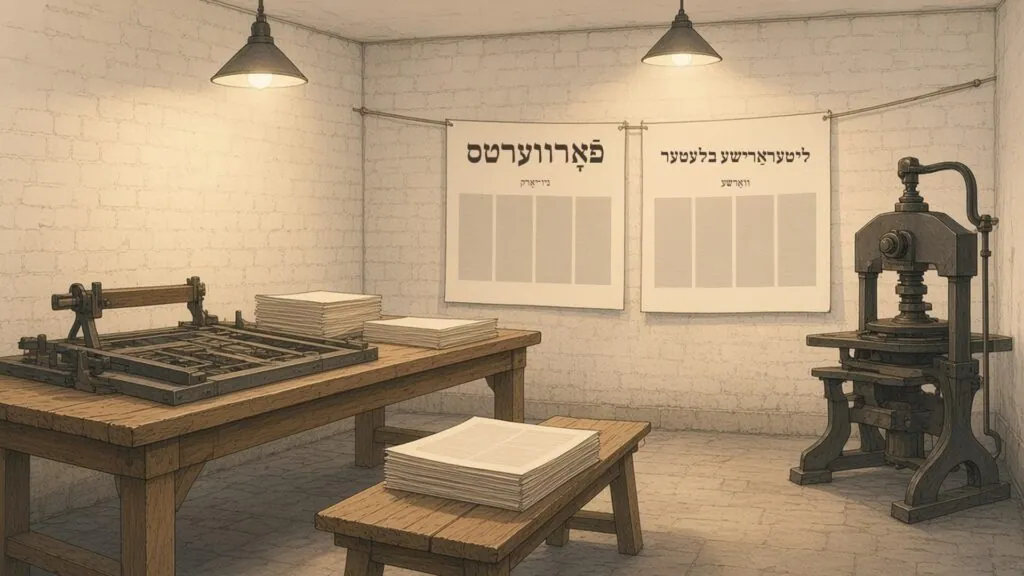
Alter described the book as a remarkable general description of the distinctive nature of Yiddish as a language and of how it reflected its cultural setting. In 1993 the University of California Press published a companion volume on Hebrew, Language in Time of Revolution, which was reviewed in Language in Society and the AJS Review. Alter called it chiefly a beautifully lucid account of the revival of Hebrew, opening with a 75-page essay on what Harshav named “the modern Jewish revolution”.[4][8][9]
That essay supplied a framework that reappears in the Chagall work. Alter singled out its identification of 1897 as a point of departure: the year in which Herzl founded the World Zionist Organization in Basel, the Bund appeared in Vilna, the Yiddish daily Forverts began publication in New York, the Hebrew journal Ha-Shiloah was inaugurated in Odessa and Simon Dubnov published the first of his Letters on Old and New Judaism. In Harshav’s summary, a whole generation passed between the shock of the pogroms of 1881 and 1882 and the formation of these political and institutional instruments.[4]
In the Chagall catalogue of 1992 the same idea is applied to a painter. Chagall’s move from a provincial Yiddish milieu to the centres of Russian and French modernist art is described there as “part of the Modern Jewish Revolution, the total secularization of masses of Jews and their entrance into general European culture”. Chagall and his contemporaries entered the history of European culture from outside, just as a radical upheaval was transforming it, and for such newcomers history appeared as what Harshav, borrowing André Malraux’s term, called a synchronic imaginary museum, in which items could be chosen regardless of their historical context.[5]
7. A partnership among books
Translation was the second pillar of Harshav’s career, and most of it was shared with Barbara Harshav. The Forward described him, together with his wife, as a prolific translator of Yiddish and Hebrew poetry, whose volumes made those literatures available to an international audience; he also translated Yiddish and German literature into Hebrew. Alter listed numerous anthologies in Hebrew and English and “one translation after another”, from German and Yiddish poetry into Hebrew and, with Barbara Harshav, from Yiddish and Hebrew into English.[1][4]
Two of their books are central to the Yiddish side of this work. American Yiddish Poetry: A Bilingual Anthology, edited and translated by Benjamin and Barbara Harshav, was published by the University of California Press in 1986; its introduction was the seed of The Meaning of Yiddish. In 1991 the same press published A. Sutzkever: Selected Poetry and Prose, translated from the Yiddish by Barbara and Benjamin Harshav, covering the poet’s work from Blond Dawn (1934–1937) to new poems written between 1987 and 1990.[4][10][11]
The Sutzkever volume shows how closely the translation work and the Chagall work were interwoven. Its section Siberia, written in 1936, is accompanied by Marc Chagall’s illustrations to Siberia, dated 1953, and the section Blind Milton carries a portrait of the poet by Chagall. Within the same volume, the “Ode to the Dove” asks, “Who is the garden tremor where bloom Chagallian blues?” Sutzkever, born near Vilna in 1913, spent his early childhood in Siberia. Harshav’s YIVO entry on Chagall records that the painter illustrated Sutzkever’s long poems Siberia and Fiddle Rose and corresponded in Yiddish with him in Tel Aviv.[10][3]
One poem in that volume, “Inside Me”, carries the dedication “For Barbara and Benjamin Harshav”. Its opening lines, in the Harshavs’ translation, read: “Inside me, a twig of sounds sways toward me, as before. / Inside me, rivers of blood are not a metaphor.” The dedication marks a relationship between a poet, his translators and a shared world of Vilna Yiddish culture, and it is within that relationship that Harshav encountered Chagall as a correspondent and illustrator of Yiddish writers, not only as a celebrated modernist.[10]
8. Moscow, 1992, the theatre murals and the archives
The decisive commission came from the Guggenheim Museum. Its exhibition Marc Chagall and the Jewish Theater ran in New York from 23 September 1992 to 17 January 1993 and then at the Art Institute of Chicago until 7 May 1993. At its centre were the murals Chagall painted in 1920 for the Yiddish Chamber Theatre in Moscow, lent by the State Tret’iakov Gallery. Alter recalled that, knowing of Harshav’s love of modern art and his command of Russian and Yiddish, the museum sent him to Moscow to examine the newly accessible Chagall archives.[5][4]
Harshav’s acknowledgements describe the essay as written in a very short time, including a trip to Moscow with Barbara Harshav to study little-known archival sources in the Russian archives where many extant documents of the theatre, liquidated by Stalin, were kept. Writing of the theatre’s papers, he noted that he and Barbara Harshav had been allowed access to all the documents in the Central State Archive of Literature and Art, but that the large files of the theatre’s “Liquidation Commission” had disappeared.[5]
The catalogue gave Harshav two roles. He wrote its principal essay, “Chagall: Postmodernism and Fictional Worlds in Painting”, and with Barbara Harshav he translated and edited what the museum’s foreword called an extensive collection of primary documents by and about Chagall and the Jewish Theater, many never before available in English. Alter judged the essay a brilliant consideration of Chagall’s relation to vernacular Jewish culture and to European modernism, and a broad exposition of what Harshav called “Jewish discourse”, from Sholem Aleichem to Bellow and Roth.[5][7][4]
The theatre itself is part of the story Harshav told. Founded in Petrograd in 1919, the Yiddish Chamber Theatre moved to Moscow at the end of 1920. There the art critic Abram Efros, co-author of the first book on Chagall, became artistic director and persuaded the director Aleksei Granovskii to commission Chagall to design the first Moscow production, an evening of Sholem Aleichem’s one-act plays that opened on New Year’s Day 1921. Chagall had just lost his own People’s Art School in Vitebsk to the radical abstractionists Malevich and Lissitzky, and the commission was welcome.[5][3]
The actor Solomon Mikhoels became the theatre’s central figure. Harshav quoted Granovskii’s programmatic brochure of 1919, which called Yiddish theatre “a temple of shining art and joyous creation — a temple where the prayer is chanted in the Yiddish language”. Mikhoels, who played King Lear in Yiddish in 1935, was killed in Minsk in January 1948, and the theatre was closed in 1949. The murals survived because the State Tret’iakov Gallery acquired them, keeping them rolled on drums because of their size and fragility; in 1924 they had already been removed from the small hall when the company moved to a larger former concert hall on Malaia Bronnaia Street. Harshav’s attention to the theatre was therefore also an act of recovery of a culture that the Soviet state had ended.[5][12]
9. A postmodernist in the age of Modernism
The essay’s opening claim was deliberately provocative: “Marc Chagall was the first conscious, even deliberate postmodernist.” Harshav did not mean that Chagall stood outside modernism. He listed what Chagall took from it: quasi-geometric articulations of form derived from Analytic Cubism, Orphism’s predilection for circles, a Fauve-inspired exuberance for colours that overflow the boundaries of objects, the precise chromatic shapes of Suprematism, the strong diagonal gestures of Futurism, and dreamlike arrangements that anticipated Surrealism. These elements were combined in each painting rather than adopted as a single pure style.[5]
Harshav described postmodernism as an attitude rather than a period: critical of, but acutely aware of, the achievements of many modernist trends, relativising their theories, evoking earlier styles and masters, and allowing the poetic licence of eclecticism. Above all, he wrote, it implies a personal voice dominating the functional integration of art. Chagall, he argued, held this attitude while modernism was still unfolding. Where other avant-garde artists worked in one artistic language at a time, Chagall placed several side by side in the same canvas.[5]
The comparison he chose was linguistic. For many modernists, he wrote, the poetics of their art was like a spoken language: one speaks French or English or Russian, but not all in the same sentence. “In Yiddish, however, one can speak several languages in the same sentence.” Chagall appropriated the languages of art in the same way, integrating them into “a complex, kaleidoscopic, and contrapuntal whole”. Harshav named the result “demonstrative eclecticism”. Perl, while accepting the centrality of Yiddish, recorded his disagreement with the larger claim: in his view Harshav went too far in calling Chagall the first postmodernist, because storytelling and woven-together pictorial and symbolic elements belonged to the heartland of modern art.[5][2]
Alongside eclecticism, Harshav identified a second principle, which he called introspectivism. He compared Chagall with the Yiddish Introspectivist poets who published their manifesto in New York in 1919 and who held that all topics of modern life, from wars, revolutions and pogroms to a lover or one’s own unrest, were legitimate subjects for poetry if presented in an introspective and fully individual manner. Chagall was not connected with that group, he stressed, but his cultural background and perceptions were similar to theirs, and Yiddish was their common native tongue.[5]
10. One fictional universe
The most important theoretical move in the essay concerns the status of Chagall’s subject matter. A novelist creates a separate fictional world for each novel, whereas, on Harshav’s account, Chagall’s paintings draw on one fictional universe that exists outside any single picture. That universe was built from recognisable domains: old Jews of the recent religious past, seen from the distance of a secular generation; Christian officials and peasants of the village; an invented Vitebsk as the symbolic small town of a distant Jewish world; and, in later years, Paris, lovers and the Bible.[5]
These items, he argued, function as modular units in a large mosaic. Their boundaries often melt in what he called “portmanteau figures”: man and animal; Christ and a praying Jew and Chagall himself; geometric forms, patches of colour and the human body; the Eiffel Tower with human legs. Repetition turned them into a recognisable vocabulary. Harshav cited Blaise Cendrars’s poem on the painter, in which Chagall “takes a church and paints with a church” and “takes a cow and paints with a cow”, as an early recognition that a strange fictional world had itself become a language of art.[5]
He also quoted Chagall’s statement in a speech at Mount Holyoke College in 1943 that before the war of 1914 he had been accused of falling into “literature” and was now called a painter of fairy tales and fantasies, whereas his first aim was to construct his paintings architecturally, filling his canvases with “objects and figures treated as forms”. Harshav’s comment was that Chagall here defined his goals not in terms of ideology, autobiography or national nostalgia but of composition. The subject matter was real, but it operated as material, as patches of light had for the Impressionists and cubes for the Cubists.[5]
From this followed a methodological conclusion that Harshav stated plainly. A scholar of Chagall’s art, he wrote, is compelled to study his biography and cultural context as primary sources of his language, iconography and meaning, and Jewish elements are part of that language. This does not make Chagall an exclusively “Jewish” artist, any more than William Faulkner is an exclusively “Southern” writer: in both, local specificity is the way they see the world, and it becomes the language of an art of universal validity.[5]
11. Yiddish as a key, idioms made literal
The concrete evidence for Harshav’s approach lies in his readings of idioms. His YIVO Encyclopedia entry on Chagall states that many of the painter’s basic images were influenced by Yiddish language and literature. The Wandering Jew floating above Vitebsk is derived from a literal realisation of the idiom “Er geyt iber di hayzer”, “he walks over the houses”, meaning a beggar or wandering peddler, combined with the literary image of the eternal Wandering Jew.[3]
The Guggenheim essay places this device in a wider frame. Harshav compared Chagall with Franz Kafka, calling the painter “a lyrical joker, an optimist of an absurdist world perception, a comedian Kafka”. Both used the “realization of metaphors”, a technique that takes every metaphor literally and depicts it as a fact in the fictional world: Gregor Samsa really becomes an insect, and in Over Vitebsk a Jew with a sack really goes over the houses. Such sudden breaks in a realistic flow he linked with the device that the Russian Formalists called making strange, which draws attention to the work as an artificial object.[5]
His reading of the 1914 ink drawing known as Thinking About Picasso shows the method at its most detailed. He read its Russian inscription as “I am sick of Chagall thinking [about] Picasso”, and noted that a shortened version below uses the first syllable of Picasso’s name, “pik”, which in Russian means “peak”. The placement of that inscription, he suggested, carries a vulgar Yiddish idiom as a subtext, while a tail and snout attached to a house transform it into a fox: returning to his own home ground, Chagall seems to say, he had outfoxed Picasso.[5]
Harshav also offered a Yiddish riddle as a model of Chagall’s choice of motifs. A herring is green, hangs on the wall and whistles because “I hung it there”, “It’s my herring, I can paint it as I want” and “So you have something to ask.” Chagall, he remarked, knew a lot about herrings, since his father carried barrels of them every day. The anecdote describes the apparent arbitrariness of the selection; the deeper justification, he argued, is that each element belongs to a unified personal universe in which it makes sense.[5]
12. The semiotics of Jewish discourse
Beyond particular idioms, Harshav proposed that Chagall’s art embodied what he called “the semiotics of Jewish discourse”. He traced it to the Bible, an encyclopaedic book encompassing all genres, and to the interpretive culture built upon it. In Diaspora texts, he argued, the directional discipline of plot or argument is set aside, and every detailed observation is treated as an autonomous value; because it belongs to one total universe, any detail could be parallel to any other, and any text could evoke any other in the library.[5]
He described such discourse as talkative, argumentative, contrary and associative, given to answering with examples, anecdotes, parables or questions rather than direct logical replies, and to seeing the smallest detail as symbolic of universal issues. It had been transmitted through a dense educational network and through Yiddish, and was carried into other languages by assimilated Jews such as Kafka, Freud, Saul Bellow and Chagall. When the religious universe that once guaranteed coherence fell away, substitute totalities were sought; in Freud’s and Chagall’s perception, that totality became one person’s consciousness.[5]
Chagall’s paintings, on this account, are themselves talkative: they have a lot to say and try to say it all. Their details are given intensive symbolic attention, freed from continuity of space, time and causality, and arranged by private association. Harshav named Chagall’s associative, metaphorical and whimsical autobiography as the verbal equivalent of this style, and the Introduction to the Yiddish Theater as its tour de force.[5]
Perl, reviewing the later books, reported a related observation that reaches beyond the theatre. Harshav traced Chagall’s use of the crucified Christ to modern Yiddish thought, observing that “the historical or legendary Jesus was part of the modern gallery of Jewish literature”, and pointed to Uri Zvi Greenberg, the expressionist poet who wrote in Yiddish and Hebrew and used the figure of Jesus prominently in his work. On this reading, even the most apparently Christian of Chagall’s motifs arrived through a Jewish literary channel.[2][13]
13. Reading the Introduction to the Yiddish Theater
The centre of the Guggenheim essay is a reading of the murals. Within forty days, working single-handedly, Chagall painted a canvas twenty-six feet long, Introduction to the Yiddish Theater; four tall images of the arts, Music, Dance, Drama and Literature; a long frieze, The Wedding Table; and a square panel known as Love on the Stage. The theatre occupied the second floor of a requisitioned mansion on Bol’shoi Chernyshevskii Lane and held ninety seats. Because the murals covered the walls of the auditorium, the audience experienced a performance within a four-wall Chagallian space, soon nicknamed “Chagall’s box”.[5]
Harshav recorded the poverty of the materials as part of the work’s character. The main canvas was painted on thin Dutch bedsheets sewn together, with gouache, kaolin mixed with paint and water, sawdust and pencil; Chagall dipped lace in paint, pressed it to the canvas and removed it, leaving its impression on the dress of a female dancer. He also read the large canvas from left to right as a procession. In the first group, Efros brings Chagall to the theatre and Chagall offers his palette to Granovskii, whose formal tie and jacket contrast with legs that perform a quadrille, a sign that he accepts the notion of merriment.[5]
The names themselves are written into the composition. On a study for the canvas, Harshav observed, Efros’s name appears in the new Soviet Yiddish spelling, with all its vowels, while the names of Granovskii and Chagall look like gibberish until they are read letter by letter in the opposite direction, as if in Russian; on the finished mural Granovskii’s name is further distorted. A band of klezmer musicians follows, and here the musicians are actors: in Yiddish, “zey shpiln” means both “they play music” and “they perform in a play”. A goat, Chagall’s representative, opens the performance.[5]
Further on, a Jew wearing phylacteries, at the most solemn moment of prayer, stands on his hands like an acrobat. On his belt Harshav read a childish Yiddish inscription, “ikh balavezekh ikh”, meaning that he plays pranks; his neighbour’s belt declares “ikh bin akrob[at]”. There were no acrobats in the Yiddish theatre, he noted: Chagall inserted them to indicate the upheaval of the old Jewish world. Between the legs of the middle acrobat he found a list of Yiddish writers beginning with Mendele, Peretz and Sholem Aleichem, the classic trio of modern Yiddish literature, whose names also stood on the stamp of the Kiev Kultur-Lige.[5][14]
The smallest discovery was also the most personal. On the flautist’s only leg, above black stripes, Harshav found a list written in childish, unconnected longhand letters naming Chagall’s immediate family: his mother Feyge-Ite, his father, himself as Moyshe, his sisters and brother, his wife under her Yiddish name Berte, his daughter Ida, his grandfather Mendl, a grandmother and his uncles. Most were Hebrew names spelled in a half-Yiddishised way, as they were pronounced, some in Russified forms. Such inscriptions could be read only by someone who knew the script, the dialect and the family history together.[5]
Other details tie the canvas to the theatre’s programme. Near the top, Harshav pointed to the silhouette of a temple bearing the stone tablets, which he connected with Granovskii’s image of the theatre as a temple, and he noted elements of Chagall’s shtetl drawn on the white belt of the figure he identified as Mikhoels. The playfulness is constant, but it is attached to the institution the mural was made to introduce, so that the painting reads as a manifesto for a new Jewish stage as well as a personal fantasy.[5]
14. Four Jewish muses and a theatre of comedy
For the four panels on the auditorium’s right-hand wall, Harshav set the Russian exhibition titles of Music, Dance, Drama and Literature against Chagall’s own description in his Yiddish memoir of 1928 on his work in the theatre, which named them as “klezmers, a wedding jester, women dancers, a Torah scribe”. These, he argued, were traditional Jewish professions that could be grasped as the folk origins of the new Jewish arts, and they belonged to Yiddish rather than Hebrew culture. The same memoir, translated in the catalogue, recalls Efros showing Chagall the walls and Chagall shouting, “Down with the old theater that smells of garlic and sweat!”[5][7]
In Literature the transformation is explicit. The Torah scribe writes on his scroll not a sacred text but “amol iz geven”, “once upon a time”, the conventional opening of a Yiddish folktale. Above him a cow moos “Chagall”, and a small figure carries a chair inscribed with the beginning of the word for theatre. In Music, as the YIVO entry describes it, the soaring violinist with a green face wears “cubicized” trousers and a prayer shawl with similar patterns, suggesting that cubist forms already existed within the Jewish tradition. Perl quoted Harshav’s summary of the cycle: the old Jewish world is stood “on its head, topsy-turvy, as in Sholem Aleichem’s fiction”.[5][3][2]
Above the four arts hung The Wedding Table, a frieze in two mirrored halves, one of them inverted. Harshav read its Hebrew inscriptions as “kosher le-pesakh”, kosher for Passover, and “carmel”, the name of wine from the Land of Israel, a Zionist element that he thought Chagall naively unafraid to use in the Soviet Union. The food, he observed, is not a Passover meal at all, since it includes challah, which is forbidden during the festival; the inscriptions signal festivity rather than ritual. In Dance, the woman in a flowery peasant dress moves to the Hebrew wedding words “kol khosn, kol kale”, “the voice of the groom, the voice of the bride”, written on the hem of her dress.[5]
Harshav connected this inversion with genre. Jewish folk tradition, he argued, had no language of tragedy; its entertainment and folk literature were fragmentary, anecdotal and joking, so the traditional world fictionalised in Yiddish literature could be resurrected on the Soviet stage only as comedy. In 1919 and 1920 the players still called themselves actors and attempted serious drama; after Chagall and Sholem Aleichem they called themselves comedians, and for fifteen years they did not approach serious tragedy. Mikhoels’s success as King Lear in 1935 was, in Harshav’s phrase, the victory of a comedian turned tragic actor.[5][12]
He also measured the murals against Picasso’s Guernica. Both were public commissions from cultural bodies in a kind of diaspora, and in each case the commission became a quintessential encyclopaedia of the artist’s previous work. In Picasso’s painting contradictory trends are fused within each figure; in Chagall’s they are held in a pluralistic balance. Picasso observed the unities of tragedy and Chagall the plurality of comedy: “the heroic gesture of a Spaniard and a Communist versus Jewish Utopian hope and self-irony”.[5]
The comparison ends on a historical judgement. Secular Jewish culture, to which Chagall, Efros and the theatre contributed, was a utopian effort to create a culture of “three times”, encompassing past and future in the present. But, Harshav wrote, it had no true past and borrowed one from the religious tradition; it had no future of its own and borrowed one from the Russian Revolution; and in Russia it was wiped out by that revolution itself. What remains, he concluded, is a heroic art that captured the moment of transformation.[5]
15. An empire within an empire
The fourth chapter of the essay reconstructed the world from which Chagall came. Harshav began by acknowledging how little is known: not his mother’s maiden name, nor when his parents died, while My Life, his elliptical, colourful and self-centred autobiography, is notoriously unreliable. An artist’s origins, he wrote, must not be confused with his art, but background provides an essential key to its understanding. He quoted Chagall’s statement that if he were not a Jew, with the content he put into that word, he would not have been an artist, or would have been a different artist altogether.[5]
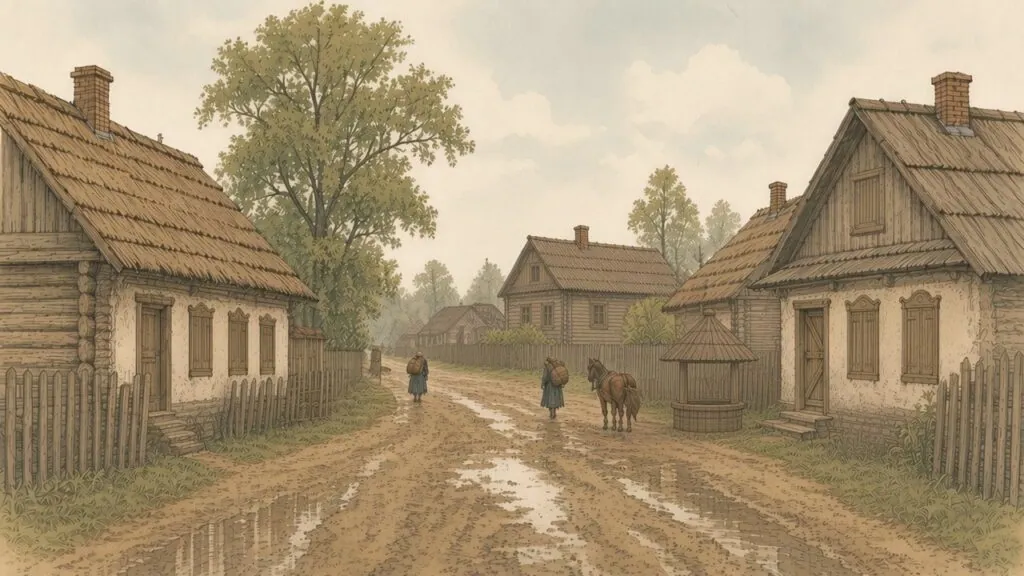
His central image was of a Jewish “empire” within the Russian Empire. Using the census of 1897, he noted that Jews made up only 11.8 per cent of the population of Vitebsk Province but 66.3 per cent of the population of its small towns. They had their own schools, synagogues, hospitals, presses and community institutions, and were not a minority in the Western sense but a totality in their own culture. Yiddish served daily life and education, Hebrew the Bible and written documents, and Aramaic the Talmud; in 1897 almost 98 per cent of the 5.2 million Jews of the Russian Empire declared Yiddish as their language.[5][15]
Within this world he located Chagall’s particular region. Chabad Hasidism, whose founder Shneur Zalman of Lyady was born in Lyozno, the town of Chagall’s family,[3] had introduced joy and optimism into a gloomy orthodoxy, and in 1909 Vitebsk had two synagogues and sixty prayer houses, most of them Lubavitch. Harshav suggested that Chagall’s cheerful disposition may have stemmed from that movement’s spiritual elation, so that his fictional Jewish world differs sharply from the dour picture of the impoverished shtetl in much Jewish literature of the period. In 1897 the city itself had 34,420 Jews, just over half its population.[5]
He was equally precise about language. Chagall must have studied the Hebrew Pentateuch in heder from the customary age of four until thirteen, yet throughout his life he showed little knowledge of Hebrew: he copied biblical texts into paintings, sometimes with mistakes, but never produced a sentence or even a combination of two Hebrew words of his own. His Yiddish spelling was atrocious, Harshav added, following his spoken Byelorussian dialect and confusing “s” with “sh”, and he kept apologising for it in letters to the novelist Yosef Opatoshu and other Yiddish writers.[5]
16. The name and the family
That dialect feature became the key to the painter’s name. In an appendix titled “Why Marc Chagall?”, Harshav explained that the family name Segal is spelled SGL in Hebrew, an acronym, and that speakers of eastern Byelorussian Yiddish confused “s” and “sh”; Chagall himself rhymed the two sounds in his Yiddish poems. SGL was therefore pronounced ShGL and, with the accent shifted to the last syllable, became Shagal. The change probably came from the painter’s paternal grandfather, since an uncle in Lyozno was also a Shagal, as the Russian shop sign in Uncle’s Shop in Lyozno shows.[5]
The name carried claims of descent. Chagall maintained that Hayim Segal, the eighteenth-century painter of the Mohilev synagogue, was his great-grandfather, and he inserted the Hebrew letters of “Segal Moyshe” into the book read by a pious Jew in The Pinch of Snuff and into the biblical quotations of other paintings. The YIVO entry adds that during the First World War he signed several paintings “Moyshe Segal”, alluding to that presumed ancestor, and that his emerging Jewish consciousness was influenced by the flood of refugees who reached Vitebsk from the front in 1914 and 1915.[5][3]
The memoir of 1928 shows how strongly Chagall felt that connection. Lying on the ground among the materials for the murals, he recalled his great-grandfather who painted the synagogue in Mohilev and asked why he had not taken him, a hundred years earlier, as an apprentice. The French form of the name came later: according to the YIVO entry, when the family arrived in Paris in September 1923, Berta became Bella, Moyshe became Marc and the surname Shagal was spelled Chagall. For Harshav, the layers of the name were a compressed history of the painter’s passage between cultures.[7][3]
17. Letters, speeches and the documentary narrative
The documentary side of Harshav’s work began in the catalogue. Its texts included a new translation of the first book on Chagall, by Abram Efros and Iakov Tugendkhol’d, published in Moscow in 1918; Granovskii’s statements of the theatre’s aims; Chagall’s memoir of the murals; his speech at the YIVO world conference in Vilna, where he told the assembled scholars that he shared their weakness and their passion, the Jews; letters on a Jewish art museum at YIVO published in 1936; a letter to Zalman Shazar published in 1969; and a group of his Yiddish poems.[7]
The headnote to “My Old Home”, Chagall’s autobiographical poem, records that it appeared simultaneously in the New York Tsukunft in December 1937 and in the Warsaw Literarishe bleter in February 1938, and that the translation follows the Warsaw text. Other documents describe Chagall’s Yiddish autobiography, which appeared in instalments in Tsukunft in 1925, seven years before the French edition, and whose manuscript, with corrections, is held by YIVO in New York. In New York during the war, Harshav noted, Chagall read Yiddish newspapers, did not know English and spoke Yiddish with friends such as Opatoshu.[7][5]
These materials grew into two books from Stanford University Press. Marc Chagall on Art and Culture, edited by Harshav and published in 2003, presented and translated Chagall’s public statements, including essays, speeches and two interviews, together with the first book on his art. Samantha Baskind, reviewing it in the Jewish Quarterly Review, noted its introductory essay, “The Texts of a Multicultural Artist”, which presents Chagall’s identity as a blend of Jewish, French and Russian identities.[16][3]
Marc Chagall and His Times: A Documentary Narrative, a volume of more than a thousand pages, reconstructed Chagall’s world through about a third of his correspondence, including letters from his correspondents and from figures such as Virginia Haggard, Valentina Brodsky, his daughter Ida and Monroe Wheeler of the Museum of Modern Art. Baskind quoted the author’s description of the work as international detective work. Although written in English, it rested on translation: Benjamin and Barbara Harshav translated hundreds of letters written in Russian, Yiddish, French, German and Hebrew by Chagall and his contemporaries.[16][17]
The book won the 2003–2004 Koret Jewish Book Award for biography, autobiography and literary studies. Perl called it the best biography of Chagall then available, though not a biography at all, with “some of the layered richness of a Talmudic text” and the crazy-quilt quality of a collage by Kurt Schwitters. One letter he singled out, from Daniel Catton Rich of the Art Institute of Chicago to Monroe Wheeler, worried about “stressing the ‘Russian-Jewish culture and mysticism’” as an exhibition of Chagall’s work was being planned.[17][2]
18. The lost Jewish world and the YIVO portrait
Marc Chagall and the Lost Jewish World, published by Rizzoli in 2006, presented the argument in a large illustrated format. Foreword Reviews described it as measuring nine by thirteen inches, with some two hundred colour and black-and-white illustrations, and singled out its chapter on the iconography of the theatre paintings, in which Harshav examined Introduction to the Yiddish Theater at length. The reviewer quoted his remark on a cow of unusual colour: “Chagall often used bright green as a challenge to realism.”[18]
Perl regarded the book as essential for its analyses of key paintings and drew attention to its treatment of the windows of the Twelve Tribes, which Chagall designed for the synagogue of the Hadassah medical centre in Jerusalem and completed between 1959 and 1961. According to Perl, Harshav emphasised the break with Chagall’s narrative inclinations that the static iconography of the tribes required, observed that the subject was “rarely represented in the Christian tradition of Biblical iconography”, and saw in the arrangement of the coloured windows rhythms that echo patterns in biblical poetry. Here the prosodist and the art historian meet in a single argument.[2][19]
Harshav’s entry “Chagall, Marc” in the YIVO Encyclopedia of Jews in Eastern Europe condenses this scholarship into a single portrait. It describes Chagall’s art as polyphonic, combining the formal concerns of several modernist trends with cultural representations and an interest in the fantastic and the grotesque, based on “his reinvented biography”. It records that his language at home and in heder was Yiddish, that he began writing Yiddish poetry after attending YIVO’s conference in Vilna in 1935, that during the war in New York his contacts were mainly with Yiddish writers, and that he read the Bible in Yiddish and quoted it in Hebrew.[3]
The entry also lists the Yiddish books Chagall illustrated, including the journal Khalyastre in 1924, edited by Perets Markish, the Yiddish translator of his autobiography, and thirty-four drawings for the collected poetry of Avrom Liessin. Its bibliography names Harshav’s other contributions: a long Hebrew essay on Chagall’s painting, theatre and world in the journal Alpayim in 1993, and “The Role of Language in Modern Art: On Texts and Subtexts in Chagall’s Paintings”, published in Modernism/Modernity in 1994. The theatre research was gathered once more in The Moscow Yiddish Theater: Art on Stage in the Time of Revolution, published by Yale University Press in 2008.[20][21]
19. Arguments, corrections and the late Chagall
Harshav’s fascination did not make him an uncritical admirer. In the catalogue he argued that with time Chagall’s strength became a weakness: through over-repetition the images of his retrospectively constructed childhood lost much of their impact, and after the Holocaust his view of the Jewish world became more sentimental, nostalgic and stereotypical, less deformed and less whimsical. “The physical Vitebsk was destroyed”, he wrote, “and he couldn’t imagine it anymore.” One solution to that impasse, he suggested, was a shift to colour, which flooded large parts of the later paintings.[5]
He was also sharp with other interpreters. In a critical note on the art historian Ziva Amishai-Maisels he rejected readings of the murals that depended, in his view, on invented Yiddish: there was no Yiddish word “shpaltung” for an acrobatic split, and her reading of the inscription IKTIKT as suggesting the name “Mikita” lacked evidence. Against her identification of the fiddler on the right with Lissitzky, he preferred the identification with Mikhoels, supporting it with the double meaning of “shpiln” as playing music and acting.[5]
His own interpretations, in turn, met disagreement. Perl accepted the centrality of Yiddish but rejected the label of the first postmodernist. John Milner’s review of the documentary volume in the Slavonic and East European Review drew from it the observation that there are signs Chagall was relatively ignorant of Jewish religious matters, a view consistent with Harshav’s own account of the painter’s limited Hebrew. David Kaufmann’s review in Haaretz summarised Harshav’s books as revealing a cosmopolitan Chagall, anchored in Yiddish culture and relying on women to take care of his daily needs.[2][22][23][5]
20. The poet-scholar and the painter
Harshav moved from Tel Aviv to Yale in the mid-1980s, in 1986 by Alter’s account and 1987 by the Forward’s, becoming Jacob and Hilda Blaustein Professor of Hebrew Language and Literature and, from 1992, also professor of Slavic languages and literature. Alter recorded that with the move he changed his family name from Hrushovski to Harshav. He was a fellow of the American Academy of Arts and Sciences, received the Emet Prize for his literary scholarship in 2005, and died in New Haven on 23 April 2015 at the age of eighty-six.[4][1]
At Yale he stood apart from the so-called School of Yale, which had dominated American literary theory for more than a decade when he arrived. Alter wrote that, with his commitment to conceptual rigour and clarity, he had no patience for Lacan, Derrida, Foucault or Althusser, and that the only colleague with a comparable profile was the poet and scholar John Hollander. Having absorbed the work of Roman Jakobson, to whose memory his last book is dedicated, and of the Russian Formalists, he marked out his own conception of form.[4]
Alter also recalled Irving Howe’s remark that of all the people he knew, the one he would be most inclined to call a genius was Benjamin. More telling for the Chagall work is Alter’s description of what united the poet, the translator and the theorist: underlying the passion for analysis was a passion for art, manifested in his own poetry, his translations, his anthologies and his work on Chagall.[4]
Harshav’s Chagall is neither the folk mystic of popular reproduction nor a modernist detached from his origins. He is a painter who built a portable fictional universe from a vanished Yiddish-speaking world and assembled it with the techniques of every modernist school he encountered. Harshav’s contribution was to show that the inscriptions, idioms, names and jokes inside the paintings are part of their structure, and to make the documents of that world available in English.[5][16][2]
The fascination was therefore not nostalgic in any simple sense. The world Harshav reconstructed around Chagall was one he had known from inside its language, and he read it with the same discipline he applied to a line of verse. Sutzkever’s dedication, the translated letters and the family names on a flautist’s leg belong together: they record a culture that survived in its texts, and a scholar who insisted on reading those texts exactly.[10][5]
Timeline
Born Benjamin Hrushovski into a Yiddish-speaking family.
The family flees the German invasion to the Ural Mountains; he later studies mathematics and physics at Orenburg University.
Arrives on the last illegal immigrant ship and joins the newly formed Israeli army; joins the Likrat poets.
Publishes an essay on Yiddish free verse.
Creates the Department of Poetics and Comparative Literature at Tel Aviv University.
Writes the Encyclopaedia Judaica article on Hebrew prosody.
Founds the English-language journal Poetics Today.
Publishes the bilingual anthology with Barbara Harshav; moves to Yale in the mid-1980s.
University of California Press.
A. Sutzkever: Selected Poetry and Prose, translated with Barbara Harshav.
Principal essay and translated documents for the Guggenheim exhibition.
Companion study of the revival of Hebrew.
Marc Chagall on Art and Culture and Marc Chagall and His Times; the latter wins a Koret Jewish Book Award.
Awarded for literary scholarship.
Illustrated study published by Rizzoli.
Published by Yale University Press.
Dies in New Haven on 23 April.
References
- Forward Staff, “Benjamin Harshav, Literary Scholar and Translator, Dies at 86”, The Forward, 24 April 2015 *
- Jed Perl, “The Spiritual In Art”, The New Republic, 18 February 2009 *
- Benjamin Harshav, “Chagall, Marc”, The YIVO Encyclopedia of Jews in Eastern Europe *
- Robert Alter, “Give Ear O Ye Heavens”, Jewish Review of Books, Summer 2015 *
- Benjamin Harshav, “Chagall: Postmodernism and Fictional Worlds in Painting”, in Marc Chagall and the Jewish Theater (New York: Solomon R. Guggenheim Museum, 1992), pp. 15 - 64 *
- “Yehuda Amichai” *
- Benjamin Harshav (ed.), Benjamin and Barbara Harshav (trans.), “Texts and Documents” and bibliography, in Marc Chagall and the Jewish Theater (New York: Solomon R. Guggenheim Museum, 1992), pp. 133 - 200 *
- Moshe Nahir, review of Benjamin Harshav, Language in Time of Revolution, Language in Society 25, no. 2 (1996), pp. 307 - 311 *
- George Jochnowitz, review of Benjamin Harshav, Language in Time of Revolution, AJS Review 21, no. 1 (1996), pp. 190 - 193 *
- A. Sutzkever, Selected Poetry and Prose, trans. Barbara and Benjamin Harshav (Berkeley: University of California Press, 1991) *
- “Abraham Sutzkever” *
- “Solomon Mikhoels” *
- “Uri Zvi Greenberg” *
- “Sholem Aleichem” *
- “Pale of Settlement” *
- Samantha Baskind, review of Marc Chagall on Art and Culture and Marc Chagall and His Times: A Documentary Narrative, Jewish Quarterly Review 98, no. 1 (2008), pp. 135 - 138 *
- “Berkeley Kabbalah Scholar Wins Koret Book Award”, J. The Jewish News of Northern California, 5 March 2004 *
- Review of Benjamin Harshav, Marc Chagall: The Lost Jewish World, Foreword Reviews, 2006 *
- “Marc Chagall” *
- Benjamin Harshav, “The Role of Language in Modern Art: On Texts and Subtexts in Chagall’s Paintings”, Modernism/Modernity 1, no. 2 (1994), pp. 51 - 87 *
- Andrew Willimott, review of Benjamin Harshav, The Moscow Yiddish Theater: Art on Stage in the Time of Revolution, European History Quarterly (April 2010) *
- John Milner, review of Marc Chagall and His Times: A Documentary Narrative, Slavonic and East European Review 86, no. 1 (January 2008), pp. 150 - 152 *
- David Kaufmann, “This Bumpkin Was a Man of the World”, Haaretz, 11 April 2004 *
Select bibliography
- Benjamin Harshav and Barbara Harshav (eds and trans.), American Yiddish Poetry: A Bilingual Anthology (Berkeley: University of California Press, 1986).
- Benjamin Harshav, The Meaning of Yiddish (Berkeley: University of California Press, 1990).
- A. Sutzkever, Selected Poetry and Prose, trans. Barbara and Benjamin Harshav (Berkeley: University of California Press, 1991).
- Benjamin Harshav, “Chagall: Postmodernism and Fictional Worlds in Painting”, in Marc Chagall and the Jewish Theater (New York: Solomon R. Guggenheim Museum, 1992).
- Benjamin Harshav, Language in Time of Revolution (Berkeley: University of California Press, 1993).
- Benjamin Harshav, “The Role of Language in Modern Art: On Texts and Subtexts in Chagall’s Paintings”, Modernism/Modernity 1, no. 2 (1994).
- Benjamin Harshav (ed.), Marc Chagall on Art and Culture (Stanford: Stanford University Press, 2003).
- Benjamin Harshav, Marc Chagall and His Times: A Documentary Narrative (Stanford: Stanford University Press).
- Benjamin Harshav, Marc Chagall and the Lost Jewish World (New York: Rizzoli, 2006).
- Benjamin Harshav, Explorations in Poetics (2007).
- Benjamin Harshav, The Moscow Yiddish Theater: Art on Stage in the Time of Revolution (New Haven: Yale University Press, 2008).
- Benjamin Harshav, Three Thousand Years of Hebrew Versification: Essays in Comparative Prosody (New Haven: Yale University Press).