The Czernowitz Conference
In the last days of August 1908 several dozen writers, students, teachers, party activists and merchants gathered in Czernowitz, the capital of the Austrian crown land of Bukovina, to discuss a language that most of their governments did not recognise and that many of their own leaders regarded as a temporary convenience. The language was Yiddish, then spoken by millions of people from the Pale of Settlement to the Lower East Side of New York. The meeting called itself the first conference for the Yiddish language. It sat for five days and quarrelled for most of them. Before it closed in the small hours of a September morning, it adopted a resolution that has been quoted, misquoted and argued over ever since: that Yiddish was a national language of the Jewish people.[1][2]
This special feature follows the conference from its setting in a Habsburg borderland and the long argument over the status of Yiddish, through Nathan Birnbaum’s call from New York, the arrival of the delegates and each of the sessions, the banquet that split along class lines and the vote that split along almost every other line. It then traces what became of the resolution and the people who made it, and widens the frame to the actors, writers, musicians, scholars and painters who built the modern Yiddish culture that the conference claimed to speak for, distinguishing carefully between those who were in the hall and those who were not. It closes with Czernowitz itself after 1918, the destruction of its Jewish community and the uses of the conference in memory. An interactive timeline at the end of the essay gathers the principal dates.
The surviving record is uneven. The minute book kept by Birnbaum’s son Solomon was lost during the First World War, and what is known comes chiefly from newspaper reports, memoirs and the documentary volume that the Yiddish Scientific Institute published in Vilna in 1931.[1][3] Where those sources disagree, on dates, on numbers or on who said what, the disagreement is stated rather than smoothed away.
1. A city on the Prut
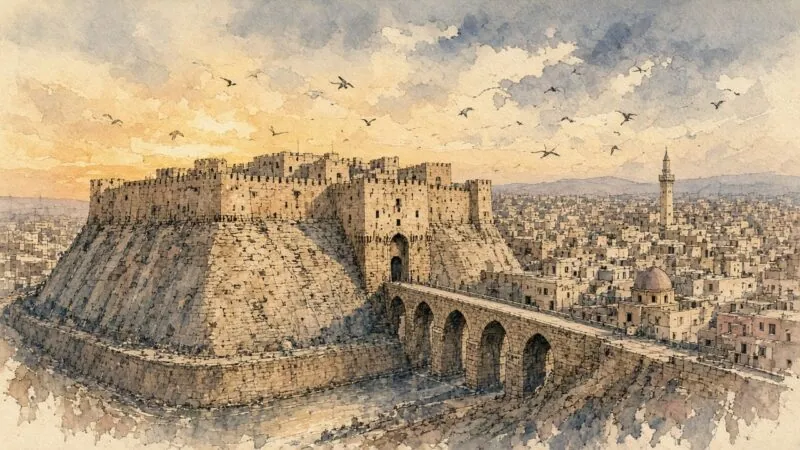
Czernowitz stood on a ridge above the river Prut, close to the point where the Habsburg monarchy met the Russian Empire and the young kingdom of Romania. Austrian troops had occupied the surrounding territory in 1774, during the manoeuvres that accompanied the first partition of Poland, and the Ottoman Porte, which held suzerainty over Moldavia, ceded it the following year. The new district took its name, Bukovina, from the beech forests that covered much of it. For most of the next seven decades it was administered as an appendage of Galicia. Only after the revolution of 1848 did the constitution of March 1849 separate it as a crown land in its own right, with Czernowitz as its capital.[4][5]
The town that became a capital had been modest. The presence of Jews there was first recorded in 1408, and by the time the Austrians arrived they formed the largest Jewish concentration in the district, a community of traders who mainly spoke Yiddish and governed their own affairs through an elected kahal. Austrian officials regarded the steady arrival of Jews from Galicia, Podolia and Moldavia with suspicion and tried for decades to restrict it with fees, marriage restrictions and expulsions. None of these measures held. In 1850 Czernowitz counted 4,678 Jews among 20,467 inhabitants. By 1880 the figures were 14,440 of 45,600, and the census of 1910 recorded 28,610 Jews in a city of 87,235, almost exactly one resident in three.[5]
Growth followed the railway and the administration. The line from Lemberg reached Czernowitz in the 1860s and tied the town to Vienna, while the provincial government, the courts, the diet and the garrison brought officials and their families from every corner of the monarchy. In 1875 the emperor’s government founded a German-language university, the easternmost in the Austrian half of the empire, and it quickly became a magnet for Jewish students. According to the YIVO Encyclopedia, Jews made up 42 per cent of its students by 1903 or 1904, and about 60 per cent of the pupils at the city’s German gymnasium by 1905.[5][4]
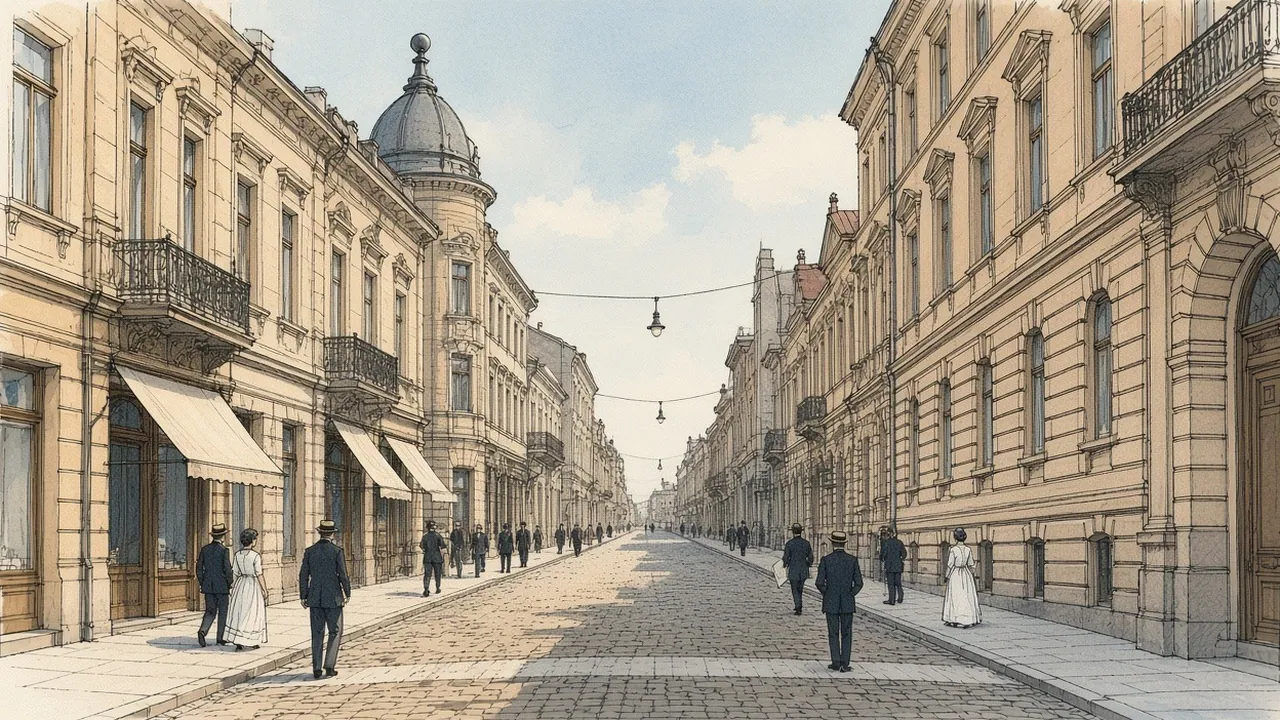
The centre of the city was built to look like a provincial copy of Vienna. The Ringplatz, with its town hall and tower, opened on to streets of stuccoed façades, coffee houses, bookshops and the offices of German-language newspapers. Electric trams climbed the hill from the railway station. A Jewish observer arriving in 1908 would also have seen the great Reform temple, consecrated in 1877, whose domed silhouette signalled the confidence of a community that had won full civic equality with the rest of the monarchy’s citizens in 1867. The temple stood for the dominant line of the local Jewish elite. From 1853 to 1892 the community’s chief rabbi, Eliezer Igel, preached in German, and the liberal middle class that elected him regarded German language and culture as the natural route to respectability and advancement.[5]
Beneath that surface lay several other cities. The Orthodox population, much of it loyal to the Hasidic courts of Sadagora, Vizhnits and Boyan in the surrounding countryside, resisted the reformers so strongly that in 1872 it elected its own rabbi and split the community for five years, until the authorities imposed an arbitration in 1877.[4][5] Poorer Jewish districts in the lower town spoke Yiddish at home and in the market. Ukrainian peasants, called Ruthenians in official usage, came in from the northern villages, Romanian landowners and clergy from the south, and the city also had Polish, German, Armenian, Hungarian and Lipovan residents.
Politics in such a city could not avoid the question of nationality. After 1890 the first organised antisemitic currents appeared among Romanian, Ukrainian and German nationalists. Jewish responses took two broad forms. One was Zionism, which arrived early; Bukovina sent three delegates to the First Zionist Congress at Basel in 1897, and the first Zionist organisation in the province was founded in 1901. The other was the Jewish National Party led by the lawyer Benno Straucher, who became president of the Jewish community in 1903 and sat for Czernowitz in the Vienna parliament. Straucher’s party argued that Jews should be recognised as a nationality like the Romanians, Ukrainians and Germans, with corresponding rights in schools and public life.[5][4] Between 1905 and 1908, by the reckoning of the YIVO Encyclopedia, the city even had a Jewish mayor, Eduard Reiss; other sources give his term as ending in 1907.[5]
It was therefore no accident that a conference on the status of Yiddish should be held here rather than in Warsaw, Vilna or Odessa. In the Russian Empire, any such gathering would have needed permission from authorities who were deeply suspicious of Jewish political organisation after the revolution of 1905. Austria guaranteed freedom of assembly and, at least on paper, the equality of its peoples and languages. Czernowitz offered the additional attraction of standing between the great Jewish population centres of Galicia, Russia and Romania, a short train ride from the Russian border and within reach of Lemberg, Kraków and Vienna.[1][2]
That public was not, for the most part, Yiddish-speaking in its own self-image. The Jewish elite of Czernowitz spoke and wrote German, read the Viennese press and sent its sons to the German university. Many of its members regarded Yiddish as the language of their grandparents or of recent arrivals from Galicia. It met in a city whose Jews were among the most culturally German in Eastern Europe, and its organisers hoped to persuade the world that Yiddish was the authentic voice of the Jewish nation.
2. Bukovina under the Habsburgs
Bukovina was the smallest and most mixed of the Austrian crown lands. When the Habsburg army occupied it in 1774 it covered just over ten thousand square kilometres of forest, river valley and upland pasture, with about 250 towns and villages. The first Austrian census, taken in 1775, recorded 526 Jewish families, concentrated mainly in the market towns of Czernowitz, Suczawa and Sereth.[4] Over the following century the province absorbed waves of settlers. Romanian peasants and boyars formed the older population in the south; Ukrainian villagers predominated in the north; German colonists, Polish officials, Hungarian Szeklers, Lipovan Old Believers and Armenian merchants added to the mixture. Jews came above all from Galicia, encouraged after 1790 by tax exemptions and, until 1830, by the absence of military conscription.[4]
The numbers tell the story of a Jewish population that grew faster than any other group. The YIVO Encyclopedia records 3,286 Jews in the province in 1802 and 11,581 in 1846, out of a total population of 371,131. By 1850 there were 14,581, by 1880 there were 67,418, and the census of 1910 counted 102,919 Jews, or 12.9 per cent of the inhabitants of the crown land.[4] Most of them lived in towns, where they worked as merchants, artisans, innkeepers, builders and moneylenders. In 1826, 44 of the 62 registered firm owners in the province were Jews, and by 1906 almost half the tax revenue of Bukovina came from Jewish taxpayers.[4]
Emancipation in the Habsburg monarchy came in stages. The revolution of 1848 swept away many of the old restrictions on residence and occupation, the neo-absolutist decade that followed restored some of them, and the constitutional settlement of 1867 completed legal equality. Bukovina’s autonomy as a crown land, with its own diet in Czernowitz, gave local notables considerable room for manoeuvre. Because the administration classified Jews as German speakers, Jewish politicians could act within the German camp while also positioning themselves as brokers between Romanians and Ukrainians, whose national movements competed fiercely for control of schools, churches and land.
This privileged position had no parallel in the Russian Empire, where Jews were confined to the Pale of Settlement, barred from most state service and subject to periodic violence, nor in Romania, where the great majority of Jews were denied citizenship until after the First World War. Bukovina’s Jews were nonetheless a minority among minorities, and their security depended on the goodwill of Vienna and on the balance among the larger nationalities. When Ukrainian and Romanian nationalists began to demand separate national representation, the Jewish question became part of the general competition. If Jews counted as Germans, they swelled the German total; if they counted as a nation of their own, the German share would shrink to a small fraction and the Jews would become the third largest group in the province.[4]
Religious life in Bukovina had its own distinctive character. The Hasidic dynasties founded by descendants of Israel of Ruzhin, who settled at Sadagora near Czernowitz in the 1840s, made the province a pilgrimage centre for followers from Galicia, Romania and Russia. Branches at Vizhnits and Boyan attracted thousands more. The courts were conservative in religion but often lavish in style, and they gave the Yiddish-speaking population of the villages and small towns a strong sense of identity independent of the German-speaking urban elite.[4]
Political Zionism found early support in this environment. The Viennese student society Kadimah, which Nathan Birnbaum co-founded in 1883, drew its first members mostly from Galician students in the capital, and Birnbaum’s paper Selbstemanzipation became the voice of the new nationalism in the eastern provinces.[6] By the first decade of the new century the province had Zionist associations, a Jewish National Party, socialist circles and a growing body of Jewish university graduates who argued about nationality in the cafés of the capital. In 1908, the year of the conference, a separate Jewish socialist organisation calling itself the Bund was founded in Bukovina; three years later it joined the Jewish Social Democratic Party of Galicia.[4] The Bukovinian group was distinct from the much larger General Jewish Labour Bund in the Russian Empire, but it shared that movement’s commitment to Yiddish as the language of the Jewish working class.
Proximity would matter in August 1908. Czernowitz lay a few hours by train from the Galician towns of Kolomea, Stanislau and Buczacz, which supplied the bulk of the conference’s audience, and within a day’s journey of the Russian frontier at Novoselitsa.[1]
The years after the conference brought war, occupation and annexation. Russian armies occupied Czernowitz three times during the First World War, and in November 1918 Romanian troops took control of the province after a short-lived attempt by Ukrainians from Galicia to claim it. Bukovina was then united with Romania, a change confirmed by the treaty of Saint-Germain.[4][5] The province that had hosted the conference as an Austrian crown land became a set of Romanian counties, and the question of Jewish language rights passed into the hands of a government with very different priorities. In 1908 the Habsburg order still looked permanent to most of the people who travelled to Czernowitz, and the conference was conceived within its assumptions.
3. Language and the law
The Austrian half of the Habsburg monarchy, known to administrators as Cisleithania, was governed after 1867 by a set of fundamental laws that included one of the most generous guarantees of linguistic rights in Europe. Article 19 of the Basic Law on the General Rights of Citizens declared that all the peoples of the state enjoyed equal rights and that each had an inviolable right to preserve and cultivate its nationality and language. The state recognised the equality of all languages customary in a given province in schools, administration and public life.[7][8]
The guarantee had a catch. It applied to recognised peoples and to the languages customary in each province, and the courts and ministries decided which those were. Jews were treated as a religious community, not a people, and Yiddish was not counted among the customary languages of any crown land. Official usage described it as a jargon or as a dialect of German. The YIVO Encyclopedia notes that in Bukovina the administration acknowledged Yiddish only as a local dialect and therefore classified its speakers as Germans.[4] In Galicia, where Polish had become the dominant language of administration and education after the autonomy settlement of the late 1860s, most Jews were counted as Poles. The same person could thus appear as a German in Czernowitz and a Pole in Lemberg without changing the language he spoke at home.
The census turned this legal fiction into numbers. From 1880 the Austrian census asked each citizen to name a language of daily use, the Umgangssprache, chosen from a fixed list of recognised languages. Yiddish was not on the list. The results mattered because they were used to allocate schools, to draw electoral districts and to settle disputes between nationalities over the language of local government. When the competing nationalities of the monarchy argued over percentages, Jews were the swing population whose declarations could tip a town or a district from one side to the other.[4][1]
Jewish nationalists in Austria had begun to challenge this arrangement in the 1890s. They argued that the Jews formed a nationality with its own history, culture and language, and that they should be recognised as such under Article 19. The argument was awkward on two counts. Most Jewish nationalists in Vienna and Bukovina spoke German themselves, and the language they would name as the national one was not obvious. Zionists looked to Hebrew, which almost no one in the monarchy spoke as a daily language. Diaspora nationalists, socialists and a growing number of writers looked to Yiddish, which millions spoke but which the educated classes, Jewish and non-Jewish alike, had long disparaged.[9][10]
The introduction of universal male suffrage for elections to the Vienna parliament in 1907 gave the question new urgency. Zionist and Jewish nationalist candidates stood in many Galician and Bukovinian districts, and four were returned on a platform that combined Zionism with demands for national autonomy: Adolf Stand, Heinrich Gabel and Arthur Mahler from Galicia, and Benno Straucher from Bukovina.[11][10] Nathan Birnbaum also stood, in Buczacz, his father’s native town in eastern Galicia. He persuaded the Jewish National Party to replace its original candidate with himself and campaigned on a platform of Jewish national rights and cooperation with the Ukrainians against the Polish establishment. He lost, as the YIVO Encyclopedia puts it, as a result of severe electoral abuses by the local Polish authorities.[6]
The census was the other front. Austria’s next decennial count was due at the end of 1910. Galician and Bukovinian nationalists expected, rightly as it turned out, that the government would refuse to accept Yiddish as a language of daily use, and they hoped that a strong public declaration in its favour might change official practice or at least provide a basis for protest. Joshua Fishman, the leading historian of the conference, observed that many Galician delegates came to Czernowitz with the census in mind and were disappointed that the conference would not resolve that all Jews in the monarchy should name Yiddish as their Umgangssprache, not least because many of them, and Birnbaum himself, were German speakers at home who had only recently acquired fluency in Yiddish.[1] In 1910 Birnbaum led a campaign urging Jews to write Yiddish on their census forms. It did not succeed in winning legal recognition.[6]
Arrangements elsewhere in the monarchy offered models and warnings. Several provinces had begun to divide electorates and school systems along national lines, most famously Moravia under the compromise of 1905, which enrolled citizens in national registers. In Bukovina the electoral reform of 1909 and 1910 guaranteed Jews nine of the sixty-three seats in the diet without recognising them as a nationality in their own right.[4] The lesson for Jewish nationalists was that recognition could bring concrete political benefits, and that the absence of a recognised language was the main obstacle to obtaining it.
Across the border, the situation was different again. In the Russian Empire there was no constitutional guarantee of linguistic equality, and the Duma established after 1905 gave the Jewish parties very limited room. Yet it was in Russia that Yiddish had its largest readership, its most vigorous press and its most organised political movement, the General Jewish Labour Bund, which had adopted Yiddish as the language of its agitation and had begun, after 1905, to demand national cultural autonomy for the Jews.[12][13] Russian Jewish delegates who travelled to Czernowitz in 1908 therefore came from a state where Yiddish was politically far more developed but legally invisible, into a state where it was legally invisible but where the law itself appeared to promise equality to anyone who could prove that his language was a language.
For the Russian delegates the conference was a chance to speak freely about culture, schools and literature. For many of the Austrian delegates it was a political occasion with immediate stakes. The organisers tried to keep the agenda on practical questions of spelling, grammar, translation and the economic position of writers and actors. They could not prevent the question of status from taking over, because in Austria the status of a language was a legal category with legal consequences, and the people in the hall knew it.[1]
4. The jargon question
Yiddish was almost a thousand years old in 1908. It had formed among the Jews of the Rhineland and the Danube in the Middle Ages, fusing medieval German dialects with a substantial Hebrew and Aramaic component and, as its speakers moved east into Poland, Lithuania and Ukraine, a growing Slavic layer. It was written in the Hebrew alphabet. For most of its history it had shared the cultural life of Ashkenazi Jewry with the sacred tongue, loshn-koydesh, the combination of Hebrew and Aramaic in which prayer, law and learned commentary were conducted. Men studied in Hebrew and Aramaic and explained what they studied in Yiddish. Women read devotional literature, translations and story books in Yiddish. The arrangement was stable for centuries precisely because no one claimed that the vernacular and the sacred language were equals.[14][15]
The Jewish Enlightenment broke that stability from the top. The maskilim of Berlin, and later of Galicia and Russia, saw in the vernacular a symbol of everything they wished to reform: isolation, superstition and a corrupted German that kept Jews apart from European culture. They called it Jargon, a word that stuck. Educated Jews in Austria and Germany were urged to abandon it for German, and in Russia for Russian. Yet the reformers who despised the language often had to use it to reach the people they wanted to change, and the first modern Yiddish fiction and journalism in Russia were written by maskilim who regarded the medium as a temporary necessity.[16][14]
That necessity produced a literature. In 1862 the Odessa weekly Kol mevaser began to appear as a Yiddish supplement to a Hebrew paper, and in 1864 it published the first Yiddish story by Sholem Yankev Abramovitsh, who wrote under the name Mendele Moykher-Sforim, Mendele the Bookseller. Over the following decades Abramovitsh created a narrative prose in Yiddish of a richness that later critics regarded as the foundation of the modern literary language.[17][18] In 1876 the poet and dramatist Avrom Goldfadn staged the first professional Yiddish theatre performances in Iași in Romania.[19][20] In 1888 and 1889 Sholem Rabinovitsh, already famous as Sholem Aleichem, edited Di yidishe folks-bibliotek, an anthology that aimed to give Yiddish literature a serious public, and in 1891 Y. L. Peretz followed with Di yidishe bibliotek in Warsaw.[21][22]
By the turn of the century the vernacular had acquired a mass press. The Forverts was founded in New York in 1897, the year in which the General Jewish Labour Bund was founded in Vilna. The Bund conducted its agitation in Yiddish and, after some years of hesitation, began to argue that Yiddish was the national language of the Jewish masses.[12][13] In 1903 Der fraynd began publication in Saint Petersburg as the first Yiddish daily in the Russian Empire. In the relative freedom that followed the revolution of 1905, Yiddish newspapers, publishing houses and theatre companies multiplied in Warsaw, Vilna, Odessa and Kiev.[23][16]
Growth did not settle the question of status. Many educated Jews who read Yiddish newspapers still called the language a jargon. Zionists who had committed themselves to the revival of Hebrew as a spoken national language, a cause associated above all with Eliezer Ben-Yehuda in Jerusalem, saw Yiddish as an exile tongue to be left behind.[24][25] The essayist Ahad Ha-Am, the most influential thinker of cultural Zionism, maintained what the YIVO Encyclopedia describes as a distant, often condescending stance towards Yiddish.[26][27] At the same time some of the finest Hebrew writers wrote in both languages. Hayim Nahman Bialik, the foremost Hebrew poet of his generation, had begun to publish Yiddish poems in 1899, and in 1906 he produced a Yiddish version of his poem on the Kishinev pogrom.[28][29][30]
The bilingual practice of the writers did not dissolve the ideological rivalry. In the years after 1905 the argument between Hebraists and Yiddishists hardened into what contemporaries began to call a war of languages. It would reach a peak in Palestine in 1913, when teachers and pupils protested against the decision of a German Jewish foundation to make German the language of instruction at the new technical college in Haifa, but in 1908 it was still primarily an East European quarrel conducted in newspapers, school committees and party congresses.[9][31] For Hebraists the issue was national continuity and the return to the land of Israel. For Yiddishists it was the culture of the living Jewish masses where they actually lived. For socialists it was also class. Yiddish was the language of the Jewish worker, Hebrew the language of the synagogue and of the middle-class intelligentsia.
Beyond the Jewish world, the decade before the First World War was an age of language congresses. Joshua Fishman noted that more than a dozen other languages on three continents were organising their own first conferences at about the same time, usually without government support and often in opposition to official policy.[1] The Yiddish conference belonged to that movement as much as to the internal Jewish debate. Its organisers wanted to give their language what the others were seeking: a standard orthography, a grammar, a dictionary, an accepted vocabulary for modern subjects and a recognised position in public life.
This was the programme that the call to Czernowitz set out in the spring of 1908. It was also the programme that, in the event, the conference barely touched. The question that the maskilim had opened a century earlier, whether the vernacular of the Ashkenazi Jews was a language in its own right or a corruption to be overcome, could not be postponed in a hall full of people who had come precisely because they wanted it answered.[1][32]
5. Nathan Birnbaum
The man who conceived the conference was a Viennese intellectual who had spent most of his life writing in German. Nathan Birnbaum was born in Vienna in 1864 to moderately Orthodox parents; his father came from Buczacz in eastern Galicia. In secondary school he drifted away from religious observance, but unlike most of his assimilated classmates he concluded that the Jews were not a religious denomination of the German people but a nation in their own right. In 1883, while still a student, he joined Reuven Bierer and Moritz Schnirer in founding Kadimah, the first Jewish nationalist student society in Vienna. Two years later he launched a periodical called Selbstemanzipation, self-emancipation, in whose pages he later coined the word Zionism.[6][33]
For the next decade Birnbaum was one of the most energetic organisers of the early Zionist movement in Austria. He wrote under his own name and under the pseudonym Mathias Acher. In 1892 he founded a union of Austrian associations for the colonisation of Palestine and toured Galicia to set up local branches, of which more than a dozen were established. Theodor Herzl’s appearance on the scene in 1896 transformed the movement and marginalised its earlier leaders. Birnbaum took part in the First Zionist Congress at Basel in 1897, but by then his own thinking had moved towards a cultural conception of Jewish nationhood, and the following year he broke with Herzl’s organisation altogether.[6][33]
The break was the beginning of a long intellectual journey that his biographer Joshua Fishman described as an odyssey. Birnbaum came to regard the Jews of Eastern Europe, rather than the emancipated Jews of Vienna or Berlin, as the true bearers of Jewish nationality. He argued that the Jewish nation already existed wherever Jews lived in large numbers with their own customs and their own speech, and that its future depended not on a territory in Palestine but on national rights in the Diaspora. That conviction led him to Yiddish. The YIVO Encyclopedia observes that he began to advocate Yiddish as the Jews’ national language before he could speak it well himself, and that he mastered it only many years later.[6]
Birnbaum’s Yiddishism was therefore not the native loyalty of a writer raised in the language but the deliberate choice of a German-Jewish intellectual who had reasoned his way to it. Peretz, Asch, Reyzen and Nomberg had grown up in Yiddish-speaking homes in Russian Poland and wrote it as their mother tongue. Birnbaum came to it as an ideologist.[3]
In the years before the conference he threw himself into Austrian politics. Between 1906 and 1907 he published a short-lived paper, the Neue Zeitung, in which he urged an alliance between Jews and Ukrainians in Galicia against the dominant Polish establishment.[6] He had also founded a Yiddish cultural society among students at the University of Vienna, called Yidishe Kultur, whose members would form the administrative committee of the conference.[1]
Birnbaum’s decision to call an international meeting about Yiddish grew out of this combination of ideas and experience. He believed that if Yiddish was to serve as the national language of a Diaspora nation, it needed the attributes of a national language: an agreed spelling, a grammar, dictionaries, translations of the classics of Jewish and world literature, schools and a press. These were technical tasks, and he hoped that a conference of writers, teachers and scholars could begin them without becoming entangled in party politics. He also believed that a public declaration in favour of Yiddish, made by a representative gathering, would strengthen the claim of Austrian Jews to be recognised as a nationality with a language of their own.[1][6]
His position at the conference reflected these hopes. He was elected its president and later the secretary general of the cultural organisation that it decided to found. In both roles he tried to steer the delegates back to practical work whenever the debate drifted towards ideology, with limited success.
Birnbaum’s later life took a direction that few of his colleagues in 1908 could have predicted. In the years before the First World War he gradually returned to religious observance. He moved to Berlin in 1911 and came to see secular Yiddishism, as he had once seen political Zionism, as an inadequate answer to the Jewish condition. In a series of publications between 1917 and 1919 he called for the renewal of the Jews as a people of God, and when the Orthodox movement Agudas Yisroel was re-established after the war he became its first general secretary.[6][34] He later looked back on Czernowitz, in Fishman’s summary, as a time of anguish and of error.[1]
He fled Berlin in 1933 and settled in Scheveningen, near The Hague, where he died on 2 April 1937.[6] His son Solomon Birnbaum, who had kept the minute book of the conference as a young man, became a distinguished scholar of Yiddish and of Hebrew palaeography.[1] The father’s itinerary, from assimilation to Zionism to Yiddishism to Orthodoxy, summed up in a single life many of the options open to Central European Jews of his generation.
6. The call from New York
The conference was proposed not in Vienna or Czernowitz but in New York. In the winter of 1907 and 1908 Birnbaum made his first journey to the United States, a lecture tour that brought him into contact with the Yiddish intelligentsia of the Lower East Side. Its most prominent theorist of Jewish nationality was Chaim Zhitlowsky, a philosopher and socialist born in Vitebsk province who had spent years in Swiss and German exile, helped to found Jewish socialist parties in Russia and settled in America. Zhitlowsky had argued for more than a decade that the Jews were a nation whose future in the Diaspora depended on a fully developed Yiddish culture.[1][10]
A Russian Jewish correspondent named M. Lazarson described a public meeting in New York, held apparently at the end of February 1908, in a report for the Saint Petersburg weekly Rasvet. The meeting, he wrote, had been called to create a movement for winning for the jargon the right to be called a national Jewish language, and it was a prelude to a conference that its supporters were planning for the following summer in Austria. The lexicographer Alexander Harkavy spoke first, Birnbaum second, and Zhitlowsky, whom Lazarson described as the theorist of the movement and the initiator of the meeting, last. Lazarson summarised Zhitlowsky’s argument that the low cultural level of the Jewish people was the result of the lack of a language of its own. Philosophy was the brain of a culture and poetry its heart, Zhitlowsky said in this report, and language could be compared to the blood; a body without enough blood suffered from anaemia.[3][35]
The practical decision was taken in a private house. Twenty years later the playwright David Pinski recalled that the idea of the conference and the first appeal had come from his home. One Sunday in the spring of 1908, he wrote in a letter of 1928, Birnbaum, Zhitlowsky, the publisher Alexander Evalenko and Pinski himself met there, discussed the plan and drafted the appeal, to which they added the signature of the dramatist Jacob Gordin. Pinski regretted that he had been unable to attend the conference itself.[3][36][37] The YIVO Encyclopedia names Zhitlowsky and Pinski as the preeminent signatories of the call and notes how unusual it was that so significant a gathering had no party or institutional sponsor.[1]
The printed invitation was dated in the Hebrew month of Nisan 5668, which corresponds to April 1908. It was sent by post to individuals, newspapers and organisations interested in Yiddish, and it proposed ten subjects for discussion. They were Yiddish orthography; Yiddish grammar; foreign words and new words; a Yiddish dictionary; Jewish youth and the Yiddish language; the Yiddish press; the Yiddish theatre and actors; the economic position of Yiddish writers; the economic position of Yiddish actors; and the recognition of the Yiddish language.[3][1] The order was deliberate. Practical questions came first, the question of status last, and the word national did not appear among the headings.
The distribution of the invitation shaped the composition of the conference. Fishman observed that it went to all Jewish organisations interested in Yiddish for educational, cultural or political reasons, but that it reached them unevenly. The Bund in Russia was underrepresented, while local Zionist clubs, especially in Galicia, were overrepresented.[1] The organisers had no network of their own beyond Birnbaum’s Viennese students and the correspondents of the American signatories, and they depended on the Yiddish press to publicise the meeting.
The first reactions in that press were cautiously favourable. In March 1908 the Saint Petersburg daily Der fraynd printed the circular with some abridgements, accompanied by a signed commentary. The writer noted that the idea of such a conference was not new and that a Dr Y. Wortsman had proposed one some years earlier. What pleased him most, he wrote, was what the circular did not say. It contained no point of struggle against Hebrew, which in recent years had become a fashion; Yiddish, he argued, did not need to be built on the ruins of Hebrew and could be built only by positive work for itself. The Vilna Literarishe monatsshriftn published a notice in the same month, listing Birnbaum, Pinski, Gordin, Evalenko and Zhitlowsky as the initiators.[3]
Not everyone was so pleased. Among the writers asked to add their names were Y. L. Peretz and Yankev Dinezon in Warsaw. Peretz’s papers contained a draft reply, in his own hand and in the name of both men, which was later printed in a collection of his letters and speeches; whether it was ever sent is unknown. In it Peretz declined to sign. He objected to what he called the American preamble and its florid phrases, which he thought childish and lacking in style, and he expressed scepticism about claims of great progress when the Yiddish press in Russia, as he put it, consisted of two yellow sheets. He proposed a simpler, European call that would merely announce a conference to promote the development of the Yiddish language and list its subjects. Among those subjects he included Bible translation, literature, drama and the stage, international literary copyright, and the significance of the language as a national or folk language and its relation to Hebrew.[3][38]
Peretz’s draft is revealing. He was willing to attend and would become the conference’s most famous participant, but he disliked the rhetoric of the call and its authors’ optimism. He also put the relation to Hebrew on the agenda explicitly, as the American circular had not. Fishman noted that Pinski had foreseen in New York that the status of Yiddish would dominate any such gathering.[1]
The summer of 1908 was spent on preparations in Vienna and Czernowitz. Members of Yidishe Kultur handled correspondence and arrangements, local supporters in Czernowitz sought a venue and lodging, and the Yiddish newspapers of Warsaw, Vilna and Kraków carried announcements and argument.[1][3] Birnbaum returned from America to supervise. When the delegates assembled at the end of August, the conference had a programme, a president in waiting and a large measure of public curiosity, but no budget, no institutional patron and no agreed idea of what it was meant to decide.

7. Who came to Czernowitz
No complete list of the participants survives. When the Yiddish Scientific Institute assembled its documentary volume in 1931, its editors printed a roll of forty-eight names, marked as incomplete and compiled for the most part from a group photograph taken during the conference, with identifications supplied by people who had been there.[3][39] The list is the nearest thing to a register that exists.
Contemporary reports gave widely varying figures. One account in the documentary volume reckoned about seventy registered participants: fourteen from the Russian Empire, one from Romania and fifty-five from Galicia and Bukovina. Of the fifty-five Austrian participants, the same report counted eight writers and forty-seven merchants, students and others, among them a professional wedding entertainer, a badkhn, and at least one man who could not speak Yiddish at all. Other newspapers counted seventy-five to eighty, or about one hundred delegates and one hundred and fifty guests, and one Russian Jewish paper spoke of up to three hundred guests at some sessions.[3][1] Fishman’s summary in the YIVO Encyclopedia notes simply that many participants had literally never attended a conference before.[1]
The Russian contingent was small but contained most of the famous names. From Warsaw came Y. L. Peretz, accompanied by his wife, and the younger writers Hersh Dovid Nomberg and Noah Prilutski. Sholem Asch, then twenty-seven and already celebrated for his novella The Shtetl and his play The God of Vengeance, is listed with his home town of Kuzmir. Avrom Reyzen, poet, short-story writer and editor, came from Kraków, where he was then living. Lazar Kahan represented Łódź, Yosef Bregman Kiev and Avrom Vevyorke Częstochowa, while Moyshe Taytsh is listed simply as coming from Russia. Ester Frumkin, the Bundist educator and theorist, came from Vilna.[3][40][41][42][22][43]
Chaim Zhitlowsky came from New York and was the only one of the American signatories to make the journey. Pinski and Gordin stayed in America, and Evalenko does not appear on the list.[3] From Bern came Shmuel Eisenstadt, and from Brăila in Romania a physician named Sotek, whose name is sometimes printed as Slotek. The remainder were Austrians. Lemberg sent the journalist Gershom Bader, Meir Geyer, Anzelm Kleinman and the Poale Zion activist Khazanovitsh. Kraków sent Yona Krepel as well as Reyzen. From Przemyśl came the linguist Matisyohu Mieses; from Buczacz, Birnbaum’s former constituency, came Weinreb and Wender; from Kolomea, Złoczów and Kosov came further Galician delegates. Czernowitz itself was represented by Leybl Toybish, Y. Kisman, Efraim Depler and others, and by Birnbaum, who is listed under the city where the conference was held.[3]
Two names on the list deserve particular care. The first is that of a Mikhl Vaykhert from Galicia, who is almost certainly Michał Weichert, then a young man of eighteen, who later became one of the most important Yiddish theatre directors of interwar Poland.[3][44] The second is a Moyshe-Leyb Halpern from Złoczów. The modernist poet of that name was born in Złoczów in 1886 and left Europe for New York in 1908, so the identification is plausible, but the documentary volume does not confirm it, and it should be treated as uncertain.[3]
A separate section of the list names the members of the Viennese student society Yidishe Kultur who acted as the conference’s staff and organisers, among them its chairman Avrom Zinger, Yosef Vaysman, Yosef Gotlib, Leo Haber and Mikhl Helman.[3] These students had handled correspondence, registration and arrangements, and two of them, Zinger and Vaysman, served as secretaries during the sessions.
Equally important were the people who did not come. The great classic writers of modern Yiddish literature were represented only by Peretz. Mendele Moykher-Sforim, then in his seventies and living in Odessa, sent a greeting. Sholem Aleichem, recovering from serious illness, sent a telegram from Baranovichi. Jacob Gordin, Pinski, Dinezon, Mordkhe Spektor, Harkavy and the young dramatist Perets Hirshbeyn also sent greetings rather than attending.[3][1] Some later accounts placed Spektor or the actress Ester Rokhl Kaminska in Czernowitz during the conference; the documentary record gives no support for either claim.[3]
The geographical imbalance had consequences. Galician and Bukovinian delegates, many of them Zionists, outnumbered the Russians several times over in any vote, and their concerns, including the Austrian census and the dignity of Hebrew, carried more weight than the Russian writers expected. The Bund, the largest Yiddish-speaking political movement in the world, was represented chiefly by Ester Frumkin, who was not, as far as the record shows, an official delegate of her party but was widely regarded as its voice.
The social mix was equally striking. Most of the professional writers were men in their twenties and thirties, with Peretz, at fifty-six, the senior figure. Many of the Galicians were small merchants and students who knew Yiddish as a home language but had little experience of literary or linguistic debate. The organisers had hoped for a working conference of specialists. What arrived was a cross-section of the Jewish public of Galicia and Bukovina, together with a handful of the most prominent writers of Warsaw and a single representative of each of several political tendencies.[1][32]
8. The eve of the conference
A week before the opening, the Warsaw daily Unzer lebn printed the programme that the organisers had sent out. It announced that the conference would open on Sunday 30 August 1908, the third of the month of Elul, at ten in the morning in the great hall of the Jewish House in Czernowitz. After the business of procedure and the election of officers, the delegates would hear papers under seven headings. Avrom Reyzen, Shloyme Eisenstadt of Bern, Dr Sotek of Brăila and a teacher named Paluba from Siedlce were to speak on the language itself, meaning spelling, grammar, foreign and new words and the dictionary. Peretz, Noah Prilutski and Reyzen would speak on literature and writers, Sholem Asch on translating the Bible, Peretz, Prilutski and Meir Geyer on the stage and actors, Mordkhe Spektor on the press, Birnbaum on the younger generation, and Leybl Toybish of Czernowitz and Matisyohu Mieses of Przemyśl on the recognition of Yiddish.[3]
The same notice set out a social programme. On Sunday afternoon there would be a public meeting in the Orpheum, a theatre garden run by a man named Gruder at number 20 Siebenbürgerstrasse. On Monday evening the delegates would attend the theatre. On Tuesday evening the Viennese student society Yidishe Kultur would hold a banquet in honour of the conference. On Wednesday there would be a grand literary evening at which Peretz, Morris Rosenfeld, Asch and Reyzen were to read, and on Thursday another evening at the theatre. Full membership of the conference was open to anyone who agreed with its purpose, was a friend of the Yiddish language and was at least twenty-one years old; anyone could attend as a guest, and members and guests alike were asked to pay five crowns towards expenses.[3] Several of these plans would change. Spektor did not come, Rosenfeld appeared in Czernowitz only after the conference had ended, and the opening session would not take place in the Jewish House at all.
The delegates who had already arrived met informally on the afternoon of Saturday 29 August in the building of the Israelite primary school. The chairman of the organising committee, Yosef Vaysman of Yidishe Kultur, opened the meeting, reported on the preparations and handed over the further conduct of business to the assembled participants. Because several speakers had not been able to travel in time, the pre-conference revised the order of business. Birnbaum would open the conference formally on Sunday morning, followed by procedural decisions, the election of a presiding bureau and the reading of greetings. Zhitlowsky, Peretz and others would address the public meeting on Sunday afternoon. Asch’s paper on bringing the cultural treasures of Judaism into Yiddish and the papers on grammar, orthography and the dictionary were scheduled for Monday. On Tuesday Peretz, Zhitlowsky and Reyzen were to describe literature, the stage and the press in Russia, America and Galicia. Birnbaum was to speak, and to Asch on art and its creators.
The pre-conference also agreed that papers would be read only in the mornings and that afternoons would be given to organisational and practical questions. Prilutski proposed an additional subject, folk creativity and its normalisation, on which he offered to report; the chairman noted the proposal for the presiding bureau to consider.[3] The orderly beginning lasted until Nomberg raised the question that the circular from New York had left out.
Nomberg proposed that the conference should on no account pass over in silence its relation to Hebrew. According to the report printed in the documentary volume, he argued that the delegates had gathered in order to bring about a transformation in Jewish life and literature and to raise Yiddish to the highest level of social development, and that the people expected from them a clear view of all the new national and cultural values. They could not avoid answering the question of how they stood towards the Hebrew language, with which Jewish history and the whole of Jewish culture were bound up. The conference should adopt a clear resolution, which in his deepest conviction should express genuine sympathy for Hebrew.[3]
Peretz disagreed. He did not believe, the report continued, that the conference would expose itself to any accusation if it adopted no resolution on its relation to Hebrew. Not to adopt a resolution was not the same as keeping silent or avoiding an answer. They had gathered for practical work for the Yiddish language and were interested only in positive activity; the Hebrew question was a theoretical one, and debating it would bear no fruit, since everyone would keep his own opinion. No one would accuse them of hatred towards Hebrew. His own attitude to Hebrew was well known, and if a conference were ever called on questions of Hebrew literature, he would gladly take part.[3] Asch took the same view, calling the question of Hebrew a stone on which all their plans might be broken. Birnbaum, Toybish, Prilutski and others agreed with them.
Eisenstadt pointed out a difficulty. The question might be partly theoretical, he observed, but every writer who wrote equally in both languages had refused to take part in the conference out of suspicion that it was hostile to Hebrew, and of such writers only Peretz was present.[3] It was at this point that Peretz made the remark that would be quoted against him for the rest of the week. Insisting that he was not betraying the Hebrew language, he declared, in the report’s wording, that he said sincerely that their national language was Hebrew and their folk language Yiddish. Reyzen reproached him for departing from the purposes of the conference, and the participants were drawn into a further argument over the dualism Peretz had admitted.[3]
Peretz then explained what he meant. A national language, he said, was one born together with a nation, which could disappear only with that nation’s degeneration; such a language was Hebrew. A folk language was the language spoken in a given historical period by a part of the people, one that had not been born together with Judaism and whose fate was not so organically bound up with the fate of the people.[3] The distinction was coherent and characteristic of a writer who had begun his career in Hebrew and who still regarded the whole Jewish textual tradition as his inheritance. The pre-conference ended without a resolution, but the line of battle for the next five days had already been drawn, and it had been drawn by the most eminent person present.
9. The opening session
The conference did not open where it had been announced. The Jewish community of Czernowitz and its president, Benno Straucher, had promised the organisers the hall of the new Jewish National House, which was due to be finished by 30 August. On the morning of the opening it was not available. The reports collected in 1931 agree on that fact and disagree on the reason. Der fraynd wrote that the building was not ready, adding that people said this was because Straucher did not want it to be. The Warsaw paper Haynt reported that the hall was supposedly not finished because Straucher felt slighted that the Yiddish writers had not paid him due respect. Gershom Bader, writing for a New York daily, claimed that Straucher withdrew his permission an hour before the start, so that the conference had to wander first to the Musikverein and then to the Ruthenian National House, and he compared its fate to that of the Jewish people in exile.[3] Most accounts agree that the sessions opened in the hall of the Musikverein, the city’s music society.
The correspondent of the New York Forverts described a heightened mood in the streets from early morning. People walking and standing in every corner were talking about the conference, and by ten o’clock the hall was packed. Delegates sat in the front part of the room, separated from the guests by an empty space. To the right of the tribune stood the table of the presidium and to the left a table for correspondents and stenographers. The Rasvet correspondent noted that the public consisted mostly of local intelligentsia, students and workers, with many representatives of the provinces, and that members of Yidishe Kultur kept order wearing ribbons in their lapels. Among the guests the reports named the chief rabbi, Dr Rosenfeld, and a Rabbi Binyomin Vays.[3]
The press table was crowded. Bader noted with irritation that the Polish papers in Galicia had made fun of the jargonist fantasts and that the Lemberg Tagblatt had joked about literary paupers, while the German papers of Bukovina had behaved better, each printing translations of Peretz, Asch and Nomberg in the days before the opening. The insult about paupers, Bader added, had stung several writers into taking rooms in the finest hotel in the city.[3]
Shortly after ten Birnbaum appeared on the tribune, accompanied by Peretz, Asch and Zhitlowsky. He read his opening address from a prepared text. One observer found the vocabulary purely Yiddish, if somewhat pedantic and polished, and noted that Birnbaum read it in a Galician dialect. Bader was harsher, writing that because Birnbaum could not speak Yiddish he had read from paper with a Germanised accent and made a poor impression, though the audience applauded warmly all the same.[3] The speech itself, as printed in Birnbaum’s weekly, was a defence of the dignity of the language. The world liked to laugh at people who took new paths, he began, but ridicule did not kill them; in time it became clear who had been foolish. Why, he asked, when other peoples mixed different languages and produced from the mixture a creation with its own soul, was the result called a language and honoured, while the Jews, who had done the same with German, Hebrew and Slavic, were told that they spoke a jargon and were mocked for it?[3]
Birnbaum traced the movement for the language back several decades and named the lexicographer Alexander Harkavy, still living in New York, as one of its first pioneers. He described how even the nationalist intelligentsia had long regarded Yiddish as an affliction to be endured rather than embraced, and argued that an intellectual who spoke a language other than that in which his people thought, felt, lamented and rejoiced had in effect abandoned it. The language, he said, had gone its own quiet way regardless, and a new intelligentsia had arisen that saw in it the soul of the people.[3] It was a speech about respect rather than about policy, and it avoided the word that would dominate the coming days.
The session then turned to business. The conference elected a presidium with Birnbaum as president and three vice-presidents: Peretz, Zhitlowsky and the Czernowitz Zionist Leybl Toybish. Its secretariat was made up of Sotek, Nomberg, Anzelm Kleinman, Lazar Kahan, the students Avrom Zinger and Yosef Vaysman, and Ester Frumkin.[3] Toybish represented the local Zionists and religious traditionalists, Peretz the literary establishment of Warsaw, Zhitlowsky the American and socialist wing, and Frumkin, as a secretary, the Bund.
The reading of greetings followed. The most anticipated came from the two living classics who had not made the journey. Mendele Moykher-Sforim sent a message from Odessa. Sholem Aleichem, convalescing in Baranovichi after a collapse earlier that summer, sent words that the reports rendered as saying that his soul was with the conference though his sick body held him where he was.[3][21] Peretz proposed that the conference send a telegram of greeting to Mendele, a motion that the hall received with prolonged applause.[3]
The most memorable moment of the morning came when Peretz rose to speak. Observers of every persuasion agreed that he was a far better orator than Birnbaum. Bader, who had little good to say about the president, wrote that Peretz’s speech made an enormous impression and that the applause would not die down.[3] What Peretz said that morning has been quoted more often than anything else from Czernowitz, and it requires a chapter of its own.
10. Peretz at the tribune
Yitskhok Leybush Peretz was fifty-six years old in 1908 and the most respected figure in Yiddish letters in Poland. He had been born in Zamość in 1852 into a prominent family, received a traditional education in Talmud and commentaries, taught himself European languages and literature, and published his first book, a collection of Hebrew verse, in 1877. For a decade he practised as a lawyer in Zamość until, in 1887, he was stripped of his licence on allegations of promoting Polish nationalism and socialism. He moved to Warsaw, where from 1891 he worked as an official of the Jewish community in its department of burials, and divided the rest of his life between that post and writing.[22][45]
His apartment in Warsaw was the nearest thing Yiddish literature then had to an academy. In the absence of Jewish cultural institutions, as the YIVO Encyclopedia puts it, he turned each of his homes into a literary hub and kept regular visiting hours for writers. Among the careers he helped to launch were those of Sholem Asch, S. An-ski, Dovid Bergelson, Der Nister, Alter Kacyzne, Hersh Dovid Nomberg, Joseph Opatoshu, David Pinski, Avrom Reyzen, Lamed Shapiro and Yehoash.[22] Three of those writers, Asch, Nomberg and Reyzen, sat with him in Czernowitz.
Peretz’s address on the first morning was short. It has survived in the text printed in Birnbaum’s weekly and has been translated into English by Marvin Zuckerman.[32][3] He began by disclaiming any wish to play the prophet, and then identified what he called three liberating moments in Jewish history that had given rise to the movement for Yiddish. The first was Hasidism, when the poor and unlearned masses lost faith in both the scholar and the rich man and sought a Torah for everyone. Yiddish literature, he argued, did not begin with the popular nineteenth-century storyteller Isaac Meir Dik but with the Hasidic tale, and the first folk poet was Rabbi Nahman of Bratslav. The second was the awakening of the Jewish woman, for whom devotional books were written and out of whose needs Judeo-German became a mother tongue. The third was the Jewish worker, who needed a language for his struggle and his own culture and could not be satisfied with women’s prayers or wonder tales.[32]
A fourth impulse, Peretz said, explained why delegates from so many countries had gathered to proclaim the equality of Yiddish among languages. It was a socio-political and international development: the decline of the nation-state. In Zuckerman’s translation he described the nation-state as an altar to which small and weak peoples had been sacrificed as children once were to Moloch, a state that in the interest of its ruling classes sought to make everything uniform, with one army, one language, one school, one police and one law. That state, he declared, was losing its lustre. The people, not the fatherland, was the modern idea, and separate cultures, not patrolled borders, would guard the separate folk cultures. The weak and oppressed peoples were waking and fighting for their languages, and the Jews, the weakest of all, had joined them.[32]
He then turned to the city in which he was speaking. Bukovina, and Czernowitz above all, was the best place for such a meeting, he said, because people of many nationalities and languages lived there side by side. Walking in the streets in the evening, one heard from different windows the sounds of different languages and different folk music. Then came the sentence that has been quoted ever since: we want our own windows, our own motif in the symphony of peoples. The Jews, he continued, no longer wanted to be fragmented and to pay tribute to every nation-state; there was one people, the Jews, and its language was Yiddish.[32] In that language they would gather their cultural treasures and unite culturally across all countries and all times.
The second half of the speech was practical. Peretz proposed two tasks that he considered the most important. If Yiddish was to become a real language, he argued, all the cultural treasures of the Jewish past had to be brought into it, and above all the Bible had to be translated into Yiddish. If Yiddish was to become a full member of the family of languages, it had to be accessible to the world, and he therefore also proposed transliterating the best works of Yiddish literature into Roman letters. He warned against introducing Jewish culture to other peoples through mechanical translations that deadened the living word, and he urged the delegates to talk less and work more.[32]
He closed by thanking Birnbaum and the students of Yidishe Kultur and then turned to the absent classic. They were without Mendele Moykher-Sforim, he said, the first to create works of modern Yiddish literature and the author of its first classic. The hall broke into applause that lasted several minutes, and Peretz proposed that the conference send Mendele a greeting in its name.[32][3] The philologist Matisyohu Mieses, who was present, later wrote that the speech had been received with spiritual hunger.[32]
The speech was in some respects in tension with what Peretz had said the evening before. At the pre-conference he had called Hebrew the national language and Yiddish the folk language. On the tribune he declared that the Jews were one people whose language was Yiddish. That ambiguity would follow Peretz through the week and help explain why, on the last day, he refused to accept the very resolution that his speech had done so much to inspire.[3][1]
The address had one other lasting effect. Its image of the windows gave the conference a phrase that later writers would treat as its motto, and its call for a Yiddish Bible would bring Sholem Asch to the tribune the following day with a paper on exactly that subject.[32][46]
11. The meeting in the garden
On the afternoon of the first day the conference left the Musikverein and went out to meet the city. The public meeting had been advertised for four o’clock in the large garden of the Yiddish theatre, known locally as Gruder’s garden after its proprietor. The day was oppressively hot. The report in the documentary volume nonetheless counted more than a thousand people in the garden, and other estimates went as high as two thousand. The theme announced for the speeches was the significance of the conference for the Yiddish language and its purpose.[3]

The first speaker was Leybl Toybish, the Czernowitz vice-president of the conference, who according to the report spoke in the spirit of Orthodox Judaism. He argued that Yiddish was essential for developing the spiritual strength of the people and for reducing the social and class divisions within it. If the position of Yiddish were strengthened, he said, some intellectuals would stop looking down on ordinary Jews. Yiddish was a social fact, not a subject for speculation, and the further a Jew moved from Yiddish, the further he moved from Judaism. There were not even a million Jews who knew Hebrew, Toybish observed; there was therefore no real question of Hebrew or Yiddish, and such a question would arise only if all or most Jews spoke Hebrew.[3]
Zhitlowsky followed with the most quoted speech of the afternoon. He declared that Yiddish was beyond the reach of any competition and that no other language, however beautiful and exalted, could harm it. The conference, and the organisation it would found, should work to develop Yiddish into the Jewish national language, because this was the best means of securing the national existence of the Jews. He described the gulf that had until recently separated the concepts of Jew and human being. Jewish students in Russian universities, he said, had faced a choice between becoming socialists, which meant free human beings, and remaining Jews, which meant enduring the torments of exile. That gulf had disappeared with the development of the Yiddish language, which had brought the Jews into organic connection with European civilisation. Yiddish was still somewhat anaemic, he conceded, returning to the image he had used in New York, but it could and would develop.[3]
On Hebrew, Zhitlowsky offered a parable. The holy tongue, he said, was an old grandmother who had lived her time and kept house, well or badly, but whose time as mistress of the household had passed. A wise grandmother would hand over the keys of the storerooms and cupboards to the younger women of the house, her daughters or daughters-in-law, and tell them that it was now their turn. The young would then owe her respect, look after her honourably to the end and give her a fine funeral. Hebrew, however, would not behave like that. She refused to give up the keys and scolded the young ones, insisting that she was the mistress and that they ate from her hand. That, said Zhitlowsky, was why relations between young and old were tense and why the struggle over the keys burned on.[3]
Peretz spoke next and announced that, since his predecessors had spoken theoretically, he would speak practically. He talked about the condition of contemporary Jewry, lamented that many of its best talents had gone to serve other peoples, and called for work to spread cultural goods in the folk language so as to achieve a unified Jewish culture.[3] The Poale Zion activist Khazanovitsh from Lemberg argued that the tragedy of Jewish culture would not end until everyone spoke Yiddish, but said he was glad to see the intelligentsia speaking it more and more. To lose the language, he said, would be to let one’s tongue be cut out. He was not pessimistic, because two important forces had taken up the work: the masses and the intelligentsia.[3]
Ester Frumkin, Leon Veksler, Noah Prilutski, Sotek and others also spoke. Frumkin made the point that would define her role throughout the week: it was the proletariat, she said, that had first recognised the Yiddish language and had influenced both the broad masses and the intelligentsia in that direction.[3] The Rasvet correspondent noticed that the Galician speakers were especially passionate, because for them the recognition of Yiddish as a language with equal rights was a current political question, organically linked to national self-determination.[3] The meeting lasted about three hours.
That evening, at half past eight, the city theatre was filled for a literary evening. Zhitlowsky opened it with a short talk on the literatures of oppressed peoples in general and Yiddish literature in particular. Peretz read the second act of his drama Di goldene keyt, The Golden Chain, and a piece entitled Four Generations, Four Testaments. Reyzen read some of his poems and a sketch called Left Alone. After a short interval Asch read a story that had not yet been published, A Carnival Night in Rome, together with a sketch and extracts from his Yiddish translation of the Book of Ruth. Nomberg recited three folk songs. According to the report, the audience received the writers with extraordinary enthusiasm.[3]
12. The Bible in Yiddish
The second session opened at ten o’clock on Monday 31 August. Zhitlowsky explained on behalf of the presidium that it had not been possible to fix the agenda for every session in advance, and that the conference would therefore begin with subjects on which no disputes had arisen. Then Sholem Asch rose to read the paper that Peretz’s opening speech had anticipated, on bringing the cultural treasures of Judaism into the Yiddish language.[3]
Asch began by rejecting a claim made by opponents of Yiddish, that Yiddish literature began only with Mendele. Yiddish literature, like Jewish culture as a whole, was much older, he argued; it derived from the Bible. The Bible was not a specifically Jewish possession but a good belonging to the whole world, and yet it remained the heart and source of Jewish culture. It was necessary to bring it into Yiddish. People said that the Bible had value for Jews only in Hebrew, but this was wrong. The real enemies of the Bible, in his view, were those who held it to be petrified and eternally bound to the language in which it had been written, because they closed it off from the broad layers of the people.[3]
Then came the distinction that gave the paper its originality. The Bible, Asch said, should not be translated but re-poeticised: it had to be given to the people poetically, in poetic Yiddish forms. All other peoples had translated the Hebrew Bible and known how to use it, and the classics of other nations, such as Homer’s Odyssey, had become part of world culture through translation; only the Jews had failed to do the same. This was all the stranger, he argued, because the Jews had never had a cult of language. Not the outward form and not the words had been holy, but the content.[3]
Asch supported the argument with a sweeping history. The Jewish God, he claimed, became the great and almighty God of the whole people only in the period of the Second Temple, when Jews no longer spoke Hebrew but Aramaic. The so-called jargon had already been born then, created by the universal character of Jewish culture. The Talmud was written largely in Aramaic and most Jewish philosophical works in Arabic, so that the people could understand them; Hasidism had spoken to the people in Yiddish. Even the prayers were not all purely Hebrew, and women’s prayers were entirely in Yiddish. In Hebrew one recited the liturgy, Asch said, but in Yiddish one prayed. Women had created their own devotional literature, including the Tsene-rene, the Yiddish paraphrase of the Pentateuch that generations of Jewish women had read on the Sabbath, and these heartfelt prayers had preserved the spirit of the people. Had the Jews possessed a state and a land, he concluded, they would have fought for them. As it was, they could and must fight for their cultural treasures, and first of all for the Bible.[3]
The hall responded with loud applause, and the discussion that followed was one of the most substantial of the week. Peretz opened it. Asch, he said, had mixed several things together because he was no orator, but his central idea, that Jewish cultural treasures must be translated into Yiddish, was correct. The writers who had come out of the traditional house of study were dying out, and a generation of writers was arising who lacked traditional learning and had to find their roots in the past. Gentile nations had built an entire branch of scholarship on the Bible; Jews had Torah readers who chanted it while the people still did not understand it. Every culture needed its traditions. The Bible had become closed to the people, and so had the Talmud. All the doors had to be opened, Peretz said; the Bible had to become Yiddish, and it had to be made not only holy but alive.[3]
Others were less convinced. Mieses considered it superfluous to translate the Bible into Yiddish. Prilutski, by contrast, argued that Yiddish literature was becoming shallow because Yiddish writers knew less and less Hebrew, and that contemporary Jewish life was too narrow to supply them with subjects; a Yiddish Bible would connect them with the past and would also enrich the language itself. Eisenstadt reminded the delegates that the Bible had already been translated into Yiddish several times, that future translators would have to reckon with the older versions, and that much of it had only historical interest; he wanted translation to extend to all Jewish literature from the Bible to Mendele. Nomberg pointed to contradictions in Asch’s paper. The Tsene-rene was already a folk translation, he said, and the best one, so a new translation could only have a demonstrative character. He agreed that it should be made but stressed that this did not mean any wish to uproot Hebrew; he would consider it a national misfortune if Jews forgot Hebrew.[3]
Ester Frumkin doubted that a Yiddish Bible would have for Jews the value it had had for other peoples. When Luther translated the Bible, she observed, the work had a religious and national character, whereas for modern Jews it would be a private matter. She added that if old Jewish works were to be translated into Yiddish, so too should the treasures of all the other literatures of the world.[3] Zhitlowsky concluded that translating the Bible and other Jewish cultural treasures would open to the Jewish masses a great sea that they had never seen, noted that no one had actually spoken against the proposal, and moved a resolution declaring it necessary to bring into Yiddish the old Jewish works written in Hebrew, first of all the Bible. In his closing reply Asch accepted that the Talmud should also be translated but insisted that the Bible was most necessary of all, because the issue was not only the formation of the Yiddish language but the formation of the Jewish soul.
Two draft resolutions were tabled, one presenting translation as a means of enriching the language, the other as a means of enriching Jewish culture. After further debate they were merged, adopted and passed to a drafting committee of seven, which included Bader, Depler, Nomberg and Krepel.
The resolution had a direct sequel. At the end of the conference the bureau was instructed to publish Asch’s Yiddish version of the Book of Ruth, extracts of which he had read at the literary evening, with the proceeds going to the new organisation.[3] A complete modern Yiddish Bible would take much longer. The poet Yehoash, Solomon Bloomgarden, who had come to literature through Peretz’s circle, spent the last decades of his life on a translation that was published in New York in the 1920s and 1930s and became the standard Yiddish version.[22] It was the clearest instance of a Czernowitz proposal that was eventually fulfilled, though by an individual writer rather than by any institution the conference created.
13. A plan for an organisation
On Monday afternoon the conference turned from translation to institutions. The third session met at two o’clock with Zhitlowsky in the chair, and the presidium confirmed the division of labour agreed on Saturday: papers in the mornings, organisational questions in the afternoons. Peretz then presented the plan that he regarded as the conference’s most important possible achievement. Its merit would be great and its purpose fulfilled, he said, if it took the first step towards organising a general Jewish literary and cultural society. The need for such a body was urgent. Although the members of the conference were not elected delegates, the large number of guests and the many greetings showed that it expressed the mood of the Jewish masses. If the delegates wanted to do anything for the Yiddish language and Yiddish culture, they had to create an organisation that would carry out their decisions and convene further conferences from time to time.[3]

The draft statutes that the provisional bureau had prepared were ambitious. The conference for the Yiddish language would pursue two aims: the recognition and equal rights of the Yiddish language, and the promotion and spread of culture and art in Yiddish. To achieve them it would create an organisation and a bureau with its provisional seat in Czernowitz. Members would be Jews who supported these aims and paid a modest annual subscription, set at one rouble or its equivalent in crowns. The central bureau would collect the dues and carry out the decisions of the conference. It would also recruit members, found societies, committees and groups within the limits of the laws of different countries, publish and support the publication of cultural and artistic works, found libraries, organise lectures and help to bring the cultural and artistic treasures of the Jewish past into Yiddish, above all the Bible.[3]
The list continued. The bureau would support the publication of model textbooks, found and support model Yiddish schools and a travelling model theatre, create professional associations for writers and artists, mediate between writers and artists on one side and publishers, booksellers and the public on the other, establish an institution that would serve as an authority on questions of Yiddish orthography, grammar and other linguistic matters, and conduct propaganda for the recognition and equal rights of Yiddish, convening periodic conferences.[3] The Rasvet correspondent reported that the idea of the project was Peretz’s and that members of the bureau had edited it; another participant recalled that Peretz added a further formula describing the goal as the union of the Jewish people in its culture and its language.[3]
The debate exposed every fault line in the hall. Noah Prilutski complained that the draft said too much about the central bureau and almost nothing about the organisation itself. He proposed a narrower action committee seated in Czernowitz, a larger committee with representatives from every country, and a literary court of honour.[3] Lazar Kahan agreed with much of Prilutski’s criticism and suggested that the body be called the Organisation for Yiddish Language and Culture and publish its own journal.[3]
Then came the first open clash with the Hebraist camp. A Galician delegate named Avrom Hayzler, from Kosov, declared himself against any such organisation. He recognised Yiddish only as the necessary language of the Jewish exile, he said, and the programme gave no proper place to Hebrew, which had been, was and would remain the only bond of Jewish national existence. The whole plan, he charged, was nothing but a means of damaging the Zionist organisation, and if the conference meant to decide that the Jewish people should no longer regard Hebrew as its national language, it would not be a language conference but a conference of apostasy.[3]
The hall erupted. Bader wrote that many participants, although the speaker was an elderly man with a grey beard, simply wanted to throw themselves at him, while Hebraists among the guests added to the noise, so that a brawl seemed imminent. The Forverts correspondent described a man in a skullcap and long coat who had registered as a member specially for the purpose and who cried out that they had gathered to bury Hebrew, supported by people in the gallery who had come to make a disturbance. Both reports credited Zhitlowsky’s chairmanship with restoring order, and Bader added that rumours were circulating that the Hebraists of Czernowitz planned demonstrations against the conference with help from some of its own members.[3]
Ester Frumkin attacked the plan from the opposite direction. A single organisation uniting Jews of all classes, she argued, would be another exercise in the politics of a supposedly united Jewish people, which obscured the class consciousness of the proletariat; it could not exist. Kahan replied that all classes could unite around certain cultural interests and that the proletariat was perhaps more interested in the development of Yiddish than the bourgeoisie. Even the Bund, he suggested, ought to support such an organisation, since it would be the beginning of the cultural autonomy for which the Bund itself was striving. Khazanovitsh insisted on the importance of uniting Jews from every country; to exclude that possibility from the start, he said, was to stand on the ground of assimilation and to promote the fragmentation of the Jewish people. Zinger, the student leader, argued that such an organisation was both possible and necessary. The session closed late in the evening.[3][43]
Frumkin’s fuller argument was later summarised in the Vilna anthology Di naye tsayt. Every social group, it ran, spread culture according to its own world view and interests. For a Zionist, translating the entire Bible was a great piece of agitation; for proletarians its poetic parts were a source of aesthetic feeling and the rest material for historical study and criticism. The proposed organisation set itself political aims, the struggle for equal rights for the language, which could be understood in different ways and could be pursued only under the concrete political, social and economic conditions of each country. No worldwide organisation could do that. The organisation should therefore be purely informational, limited to statistics, bibliography and similar tasks, with grammatical, pedagogical and literary commissions to come later if interested bodies wanted them.[3]
That evening many delegates went to see the local Yiddish theatre, where the organisers had promised to arrange some good performances. Bader reported that everyone went home disappointed, because what they saw was simply a caricature of Yiddish theatre.[3] Within a decade, as later chapters show, an artistic Yiddish theatre of a very different calibre would emerge, inspired in part by the demands Peretz and his circle had been making for years.[47][48]
14. Grammarians and philologists
Tuesday 1 September was meant to be the day of linguistics. The fourth session opened in the morning under Zhitlowsky’s chairmanship with three papers on language, orthography and grammar, by Sotek, Eisenstadt and Mieses. Before they could begin, fourteen members tabled a motion asking the conference to draft a manifesto to the Jewish people explaining what the conference was and what it wanted.[3]
Peretz opposed the motion, arguing that real work could not begin with a manifesto and that such an appeal could be published at the end of the conference once its position on the language question had been settled; he suggested that the future executive bureau should draft it. Nomberg defended the proposal and Asch supported Peretz, while Moyshe Taytsh, Ester Frumkin and M. Birnbaum, the Warsaw teacher, backed the manifesto as the cornerstone of the whole undertaking. A vote postponed the question and the conference returned to its agenda.[3]
The first paper came from Dr Sotek of Brăila in Romania, the only participant from that country. He surveyed the history of Yiddish and its organic bond with Jewish life, setting out which languages had influenced it and to what extent. The Jews, he observed, were a wandering people, and wherever they had lived they had absorbed influences, yet Yiddish had acquired original features as an expression of Jewish popular life. A language, Sotek insisted, was not born like Volapük or Esperanto; it developed naturally, unfolding like a tree with roots in the soil. In his account, the Jews expelled from Bavaria in the fifteenth century had spoken German, and Yiddish had arisen in the Slavic provinces as a product of life rather than art, taking in many Russian and Polish words on one side and many Hebrew words on the other.[3] Modern scholarship places the origins of Yiddish several centuries earlier and further west, but Sotek’s broader point, that Yiddish was a natural language with its own history, was the one his audience cared about.[14]
Sotek then compared the treatment of Yiddish with that of other languages. Every language had its scholars, he said; even the dialects of the Roma had attracted professors who sought to describe them scientifically. Yiddish alone had been dismissed as a jargon, though Luther had created the finest German literary language by drawing together the best words of every German dialect. Turning to orthography, he warned that great care was needed but insisted that a unified system had to be worked out, so that writers no longer spelled according to their own whims. His practical proposal recalled Peretz’s: to spread Yiddish literature in Latin transcription among half-assimilated readers who could not read the Hebrew alphabet. By his own account, the method had won two thousand new readers for Yiddish literature in Romania.[3]
Shmuel Eisenstadt of Bern followed with a technical study of orthography, tracing the historical development of each sound in relation to Hebrew and German and illustrating every point with examples from historical documents. He presented his results in an orthographic table distributed to all the participants. The audience proved less patient than the speaker. Because, as two reports put it, the specialised scientific paper did not greatly interest the public, the conference decided not to hear the second half and to pass it to a language commission that was to be established.[3] The one paper devoted to the problem that had headed the original invitation, the regularisation of Yiddish spelling, was cut short.
The third paper produced the opposite reaction. Matisyohu Mieses, then twenty-three, was a philologist from Przemyśl who had studied ten languages by the age of eighteen and had already crossed swords in print with Nahum Sokolow over the place of Yiddish. Personally he preferred Hebrew, but he believed that Yiddish faced its greatest danger not from Hebrew but from the languages of the countries in which Jews lived, and that even convinced Hebraists should therefore support it.[49] His paper opened with a question and its answer: was Yiddish a language? There was no doubt of it. A language spoken by eight or nine million people was a language. It had not yet been recognised as the national language of the Jews, and that recognition had to be fought for, as other peoples had fought to persuade their own intelligentsia to accept their mother tongues.[3]
Mieses dismantled the argument that Yiddish was a mixture. Science had shown, he said, that there were no pure languages at all. English was a Germanic and French pudding; German contained Celtic and Romance words; Greek had Phoenician borrowings; Hebrew itself was mixed with Aramaic, Phoenician and other elements. If Yiddish was a jargon because of its borrowings, then German, English and French were jargons too. Yiddish was called ugly, but so was English, and the Germans had once said the same of their own language. The material of Yiddish was partly taken from other languages, as with every language, but its spirit was purely Jewish. Nor was it a misfortune that Yiddish was not an oriental language, since most peoples did not speak the language of the race to which they were thought to belong.[3] The majority of Jews, he concluded, spoke Yiddish, and the minority who spoke other languages spoke dozens of them, so that no other language could claim to be national.
On Hebrew, Mieses was blunt. The question of Hebrew, he said, was no question at all. Hebrew had lost its heart and soul and had become, like ancient Greek and Latin, a language of books. It still connected the Jews with their past and would remain a language through which they could know their history. He closed by pointing to the close links between Yiddish and Hebrew in vocabulary and grammar, and with a prediction: the nineteenth century had given humanity the equality of nations, and the twentieth would give it the equality of languages.[3]
The paper caused an uproar among part of the conference. A proposal to print it as a separate brochure, as the first scientific work on the Yiddish language, was greeted with applause from one side and noisy protests from the other. Fishman’s later summary records that some delegates wept uncontrollably when Hebrew was described as a putrefying cadaver.[3][1] Peretz, by contrast, admired the speech, and the YIVO Encyclopedia’s biography of Mieses notes that it won his esteem.[49] At the end of the week the bureau was instructed to publish the paper. Its author went on to write two of the first scholarly books on Yiddish in German, published in 1915 and 1924, and was killed in the Holocaust.[3][49]
15. Ester Frumkin and the Bund
The most determined voice on the left of the conference belonged to a twenty-eight-year-old woman from Minsk. Khaye Malke Lifshits, known in the movement as Ester and to most of the press as Ester Frumkin, was the most prominent woman in the leadership of the General Jewish Labour Bund in Russia. Unlike most of the Jewish revolutionary intelligentsia, she had received a strong Jewish education at home and was fluent in both Yiddish and Hebrew. After secondary school in Minsk she studied philology and Russian literature at the Pedagogical University in Saint Petersburg, where she was drawn into Marxist circles, and during the revolution of 1905 she became an important Bundist leader in her home city. She was arrested in September 1907, released after a short time, and in 1908 went into exile in Austria and Switzerland.[43]
Within the Bund Frumkin belonged to the wing that wanted the party to commit itself fully to Yiddish culture. Its leading theorist, Vladimir Medem, had argued for a position called neutralism, under which the Bund would neither promote nor resist the assimilation of Jewish workers but leave the question of national survival to history. Frumkin opposed him. Between 1905 and 1914 she wrote and lectured extensively on Jewish education, insisting that the children of Jewish workers should receive elementary schooling in Yiddish in secular schools. Only the existence of a Jewish national culture, she argued, could justify the Bund’s demand for national cultural autonomy.[43][12] In 1910 she published a full-length study of the Yiddish folk school, which the YIVO Encyclopedia describes as the systematic exploration of the pedagogical theories and socialist basis behind the demand for Yiddish schools.[50]
Those convictions explain both her alliance with the Yiddishists in Czernowitz and her repeated clashes with them. She agreed with Zhitlowsky and the young Warsaw writers that Yiddish deserved recognition, and she went further than any of them, demanding that it be declared the sole national language of the Jews, which was already the position of the Bund. But she rejected the idea, central to Peretz’s plan, that Jews of all classes and countries could be united in a single cultural organisation. The Bund denied that the Jews of the world constituted one nation in a political sense, and Frumkin held that the cultural interests of the Jewish working class differed from those of the Jewish bourgeoisie.[43]
On Tuesday afternoon, when the conference resumed its debate on the organisation, Peretz gave his concluding reply. He identified three tendencies: one opposed to any organisation, one wanting an organisation with limited competence, and one supporting the plan. To those who said such an institution could only be founded by a state, he replied that the best Jewish institutions were founded and maintained by Jews themselves. He wanted an end to merely local cultures and the creation of a common literature and a common culture. The Jews were torn and splintered by their statelessness, he said, and should create a cultural union on the basis of the Yiddish language and literature. He expressed his greatest sympathy for the Bund but argued that the parties had been too subjective in their cultural work and had flooded the market with pamphlets.[3]
Frumkin answered with a formal resolution. It proposed rejecting Peretz’s project, electing a bureau with purely informational functions, and making future conferences meetings of the various organisations and institutions working in Yiddish culture in different countries. Because Peretz’s plan opened with a general statement on the role of Yiddish in national life, she prefaced her own with a theoretical declaration: we recognise the Yiddish language as the only national language of the Jews. Leon Veksler of Lemberg immediately objected that she was trying to smuggle in a decision of principle that the conference had not yet taken, and warned that many members would have to leave if it were adopted.[3]
After a long argument about procedure, the conference voted by eighteen to sixteen against opening a full debate on her resolution. Peretz’s organisational plan was then adopted as a platform by twenty-seven votes to seven with two abstentions, and Frumkin’s resolution and the proposal to debate a manifesto were rejected by the same majority. Some of those who had voted against her explained that they objected only to the practical side of her proposal, others that they objected precisely to its theoretical declaration. Khazanovitsh explained that if he, as a Labour Zionist, opposed her theoretical formula, it was not because he sided with the bourgeois Zionists but because the Poale Zion represented a third tendency of its own. Peretz proposed that the first point of the plan, which contained the statement of principle, be taken the next day.[3]
The Forverts correspondent summed up the mood that evening. A whole mountain still weighed on the conference’s head, he wrote: whether it regarded Yiddish only as a folk language, as a national language, as the only national language or as one of two national languages. Time was running out, and the conference decided to set aside the papers scheduled for the following day and open a debate on Hebrew and Yiddish instead.[3] Frumkin’s resolution had failed, but it had forced the question that every faction had been trying to postpone.
Her later career showed how far the paths of the Czernowitz delegates diverged. After the conference she stayed in Czernowitz for a time and helped to organise a group called Orgnroyt, a forerunner of the Jewish Social Democratic Party of Galicia and Bukovina. She returned illegally to Russia in 1909, was arrested again in 1912 and banished to Siberia, escaped and spent most of the war in hiding. After 1917 she joined the Bund’s central committee, led its Communist wing during the split of 1920, and after its dissolution in 1921 became a leading figure in the Jewish section of the Soviet Communist Party and vice-rector of the Communist University for Western National Minorities in Moscow.[43] She helped to establish Soviet Yiddish schools and the official recognition of Yiddish in the Soviet Union, and she also played a central part in the campaign against Jewish religious institutions. Arrested in the purges of the late 1930s, she was sentenced in 1940 to eight years in a labour camp in Kazakhstan, where she died on 8 June 1943.[43] The delegate who had demanded in Czernowitz that Yiddish be declared the sole Jewish national language thus lived to see it recognised by a state, and then died in that state’s camps.
16. The banquet
On the evening of Tuesday 1 September the Viennese student society Yidishe Kultur, which had convened and organised the conference and had come to Czernowitz in full strength, held a banquet in honour of the delegates. In the custom of German-speaking student associations it was billed as a Kommers. The great hall of the Musikverein was decorated and filled. All the delegates had been invited, together with the leaders of the Jewish community headed by the parliamentary deputy Benno Straucher, representatives of political parties and cultural institutions, and other guests. Greetings and apologies for absence were received from the Land President of Bukovina and from the mayor of Czernowitz.[3]
The presence of Straucher was itself contentious. The community president was widely blamed for the loss of the Jewish National House on the opening morning, and many delegates regarded him as an opponent. The student chairman, Avrom Zinger, opened the evening with an account of the society’s history and then greeted the guests in order of rank, beginning with Straucher and ending with Ester Frumkin. As soon as he mentioned her name, according to the report in the documentary volume, she went up to the tribune and protested that the organisers had invited only the bourgeoisie, while workers who had come were not even being admitted to the hall.[3]
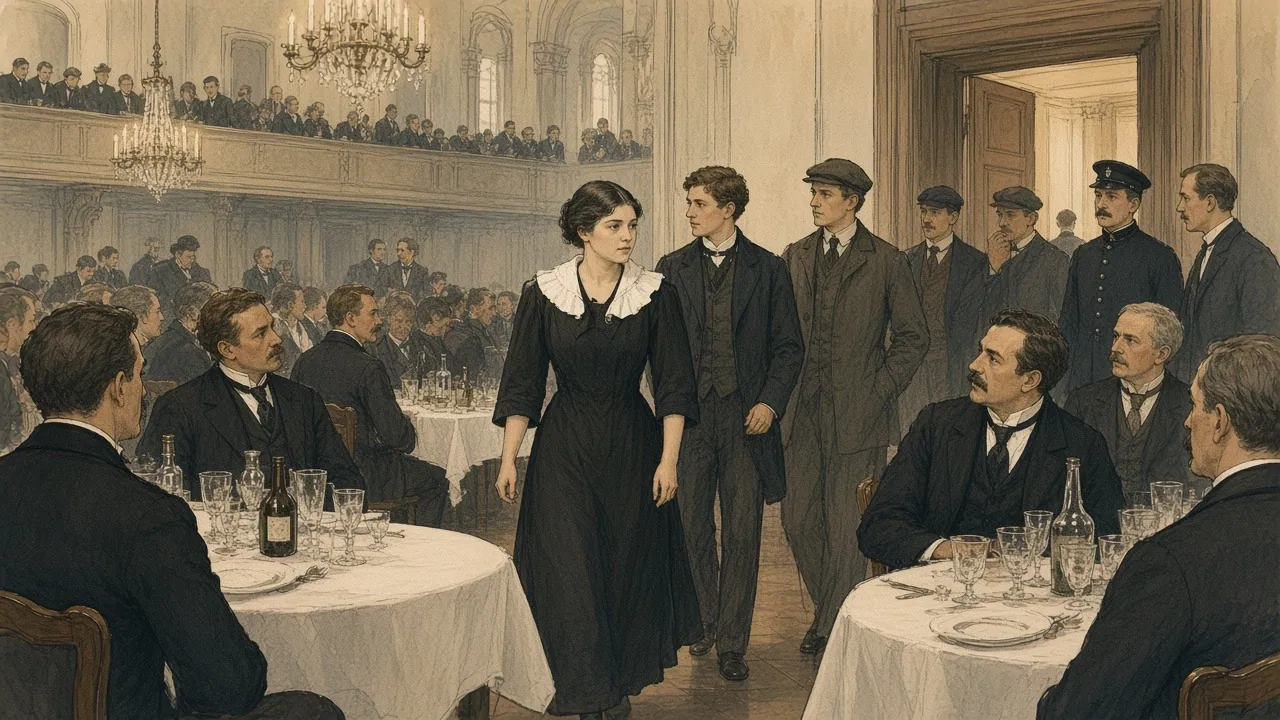
There was an uproar. The chairman tried to calm the room, explaining that only representatives of the workers had been invited because space was short and not everyone could be let in. The explanation satisfied no one on the left, and Frumkin and several others walked out.[3] Fishman’s account in the YIVO Encyclopedia states that worker delegates who wore no jackets were refused seats because of their inappropriate dress, and the Forverts correspondent gave a sharper version. The society, he wrote, had also invited the Labour Zionist workers of Czernowitz, but when workers arrived at the Musikverein they were told they must wear black frock coats, and when some went in regardless the police were called and they were led out of the hall. At the same time, he added, the society had invited many members of the bourgeoisie who had never had anything to do with Yiddish culture while leaving out the representatives of the local cultural organisation that worked among the city’s workers.[1][3]
Bader, writing for the New York Tageblatt, described the Kommers as looking more like a mass meeting than a student celebration. The hall and the galleries were overfilled, and agitational speeches were made as if at a popular rally. Representatives of the Czernowitz workers had wanted to come, he confirmed, but were not admitted; several community leaders had come, and the organisers had been ashamed to let in workers who did not possess a black dress coat.[3]
The banquet went on without her. After the incident the speeches began. Birnbaum spoke in German, a choice that did not go unnoticed at a conference for Yiddish. Zhitlowsky, Peretz, Asch, Prilutski and representatives of the student society also spoke. An orchestra played Jewish melodies, a Miss Gotesman and a twelve-year-old boy named Vaynshtok sang Yiddish songs to great applause, and the evening lasted almost until dawn.[3] A writer who signed himself A–r in the Vilna anthology Di naye tsayt observed that Yidishe Kultur was not a Zionist society but that a good many of its roughly thirty members were Zionists.[3]
The consequences reached the next morning’s session. When the sixth session opened on Wednesday, Frumkin tabled a protest resolution signed by herself and fifteen other members against Yidishe Kultur, because representatives of the workers, whom it described as the foundation of Yiddish culture, had not been admitted the previous evening, and in particular because the local Jewish social democratic education committee had been excluded. Khazanovitsh protested in the name of the Poale Zion against the society’s conduct. Zhitlowsky, speaking for the presidium, added a protest of a different kind: against the society’s chairman for opening the banquet with a greeting to Straucher, who had behaved so badly towards the conference as a whole.[3]
The episode was small in itself, but it showed the conference’s social character more clearly than any debate. Its organisers were university students from Vienna who modelled their customs on the German academic world. Its hosts were the German-speaking Jewish notables of Czernowitz, whose leaders were at odds with the conference and with each other. Its most passionate supporters, in the garden on Sunday, had been artisans, shop assistants and workers who spoke Yiddish every day. The banquet put the first two groups inside the hall and left the third at the door. For Frumkin and the Bund, it confirmed that a language movement led by the middle classes would serve middle-class interests, and the Bund’s later insistence that the conference was a minor event owed something to the memory of that night.[1][12]
17. The national language debate
Wednesday 2 September was the day the conference had been avoiding since Saturday. The sixth session opened at ten o’clock under Zhitlowsky’s chairmanship with the protests over the banquet. The chairman of Yidishe Kultur replied that the society had been forced to refuse entry to the provincial Labour Zionists because the hall was too crowded, that it had known nothing of the workers’ educational association, and that the banquet had been the society’s own affair and had nothing to do with the conference. There was uproar and a pause of several minutes, after which the conference resolved to attach all the protests to the minutes and move on.[3]
The agenda for the morning listed papers on the Yiddish press, literature and theatre. Lazar Kahan proposed setting them aside and going straight to the organisational question, because many Russian delegates could not stay beyond Friday and would otherwise leave with nothing achieved. Prilutski suggested an evening session instead. After a short debate Kahan’s proposal was adopted, and the conference turned to the first point of Peretz’s organisational plan, the recognition of the Yiddish language. Was Yiddish a national language, the only national language, or neither, and what was the conference’s attitude to Hebrew?[3]
The debate took as its starting point Peretz’s draft, which according to Bader read: the conference recognises the Yiddish language as a language of the Jewish people and demands the unification of the Jews in Yiddish culture and in the Yiddish language. Weinreb of Buczacz, a Zionist, opened by declaring that the national language of the Jewish people was Hebrew alone. He saw the development of Yiddish only as a means of preserving Jewishness and drawing closer to the ideal of reviving the people in its national language, Hebrew. That need not prevent cooperation with those who saw Yiddish as the whole and eternal content of Jewish culture, he said, provided they took care not to offend the feelings of the Hebraists. He proposed adopting no resolution on the principle at all: let us speak only of culture, he urged; I ask for tolerance.[3]
Khazanovitsh set out the position of the Poale Zion. They did not want to pronounce a final verdict on the language question, he explained, because they believed in the ingathering of the exiles and no one could know whether Hebrew might regain its former national role, as was already happening in the Land of Israel. He therefore proposed a resolution that would declare, without passing judgement for all time and for all Jews, that in countries where Jews lived in masses and spoke Yiddish, Yiddish should be recognised as a national language.[3] Yona Krepel of Kraków held that Yiddish was not the only national language but that one should nonetheless work for it. Lazar Kahan argued that more than three quarters of all Jews spoke Yiddish and no one spoke Hebrew; for the time being Yiddish was not yet a true national language, but the goal was to make it one and to win its recognition, which would become possible only when all the cultural treasures of Judaism were available in it. Prilutski urged the delegates not to stray into metaphysics but to build the institutions that Yiddish deserved by right; life itself would make it the national language.[3]
Then Asch spoke, and the reports agree that his speech was the emotional climax of the conference. The question whether Yiddish was a national language, he said, was the same as the question whether the Jews were a nation. Yiddish was no foreign growth but the fruit of their own blood and heart, and whoever felt Yiddish knew that it was their national language. He would regard the day the Hebrew language was lost to the Jews as a second Ninth of Av, the fast that mourns the destruction of the Temple. But there were two Hebrews. One was the Hebrew of the patriarchs, the prophets and the midrashim, a living and natural Hebrew that he and his friends loved and respected more than the Hebraists did. The other was the new Hebrew spoken in the Jewish colonies in Palestine, which he called artificial and unnatural, not Hebrew at all but a worse jargon than any existing jargon and wholly foreign to the Jewish spirit. When he had been in the Land of Israel, he said, he had heard only one song from the children, and it had cut him to the heart to see young minds constrained in that way.[3] Bader wrote that the speech was a complete success and aroused great enthusiasm, and that under its influence the whole audience shed tears and no eye remained dry.[3]
Avrom Vevyorke warned that any decision on Yiddish and Hebrew would be unrepresentative, because the Jewish workers of Russia were absent from the conference. A student delegate named Vays then spoke. Yiddish was a national language, he said, and the broad masses did not even understand Hebrew. When Jewish students went to the university and demanded recognition as a distinct nationality, they were asked what language they spoke, because in Austria languages were recognised rather than nations; and when they said Yiddish, they were told it was merely corrupt German. If the Jews themselves doubted whether Yiddish was a national language, what would their neighbours say? It was enough to be a people without a land, he concluded; they were not obliged to be a people without a language.[3]
The afternoon session opened at three. Nomberg affirmed his respect for Hebrew but pointed out that the Jewish masses recognised Yiddish as their national language; the importance of a resolution, he argued, lay in persuading the Jewish middle classes to do the same. Zhitlowsky observed that the views heard at the conference existed throughout Jewish society, and went on to the need for a national language. When Jews fought for national rights and demanded Jewish schools, he said, they had to show that they had a national language, and that language could not be Hebrew but only Yiddish. He proposed a commission to draft a resolution recognising Yiddish as the Jewish national language.[3]
Peretz had the closing word. He explained what he meant by nation and people, national language and folk language, and then argued against any resolution on a national language at all. These were theories, he said. If someone had once come forward and declared that the earth revolved, it would have been absurd to put the proposition to a vote. Everyone was entitled to an opinion, and a majority was no guarantee of truth. Majority and minority mattered only in practical work; if the delegates truly wanted to work, they should work, and theoretical questions were unimportant.[3] It was a consistent position, and it was overruled within the hour.
Five resolutions were now read. Peretz’s recognised Yiddish as a language of the Jewish people and demanded the union of the Jews in Yiddish culture and language, without addressing whether it was national. Krepel added a clause stating that the conference had no intention of diminishing the significance and value of Hebrew for the Jewish people. Frumkin’s recognised Yiddish as the only national language of the Jewish people and described Hebrew as a historical monument whose revival was a utopia. Khazanovitsh’s declared Yiddish a national language and demanded full political and social equality for it in countries with compact Jewish masses. The joint resolution of Zhitlowsky, Asch and Nomberg declared Yiddish the national language of the Jewish people while leaving every member free to think about Hebrew according to his own convictions.[3]
On Peretz’s motion the conference first decided the principle and left the wording to a commission. The general question, whether Yiddish was or was not a national language, was put first. With some thirty-odd members voting, the conference resolved almost unanimously that Yiddish was a national language of the Jewish people. According to the report, Asch and Reyzen fell on each other’s necks and kissed for joy.[3]

The detailed votes followed. Krepel’s clause protecting the value of Hebrew was rejected. The joint proposal of Asch, Zhitlowsky and Nomberg, with its definite article, was defeated by twenty votes to fifteen. Weinreb then declared that, as a Zionist, he had come to do common work for the Jewish people without prying into anyone’s reasons; for him Yiddish was not a national language but the language actually spoken by a large part of the people, which was why he loved it and wished to develop it. The adopted resolution made it impossible for him to work with the conference, and he withdrew, promising to continue working for Yiddish in accordance with his Zionist convictions. Finally, an addendum stating that every member remained free to relate to Hebrew according to personal conviction was carried by twenty-six votes to twelve, and a commission was chosen to draft the final text.[3] The two words that would make the conference famous, a and the, had been decided by fewer than forty people in a hall in Czernowitz on a Wednesday afternoon.
18. The resolution
The eighth session opened at half past nine on Thursday 3 September with Birnbaum in the chair. Zhitlowsky read the text that the commission had drafted overnight. In the translation used here it ran: The first conference for the Yiddish language recognises Yiddish as a national language of the Jewish people and demands for it political, social and cultural equality of rights. At the same time the conference considers it necessary to declare that every participant in the conference, as well as every member of the future organisation, retains the freedom to relate to the Hebrew language according to his personal convictions.[3][1]
Peretz immediately declared that he personally did not agree with it. The speeches he had heard, he said, had not convinced him. The argument that the political situation in Austria, and above all in Galicia and Bukovina, required Yiddish to be declared a national language had not moved him; such a declaration did not belong in the statutes of an association founded by the conference, and a practical political purpose could not and should not affect a conviction. All that was needed was recognition of Yiddish as a language. Asch, he recalled, had told them about the living Hebrew of the Bukharan Jews, against which he himself had nothing. By declaring Yiddish the national language, Peretz argued, they assigned Hebrew a place only in the past, in history, and treated it as foreign. To whom, then, had they surrendered their past? To whom were they selling their prophets?[3]
He ended his statement with four points, as reconstructed in the documentary volume from the Forverts and Rasvet reports. Hebrew was not a folk language; it no longer lived. Reviving a language mechanically meant creating a new jargon. As long as Jewish cultural treasures remained in Hebrew, Yiddish was only a folk language. The conference therefore had the right only to undertake work to help the folk language rise to the level of a national language. Without submitting to the majority, he said, he would remain a member of the conference, but he withdrew from the presidium, the bureau and practical work until the next conference, which, he predicted, would surely be content with the sentence: our language is Yiddish. With that he left the presidium table and took his place among the ordinary members.[3]
Krepel then announced that he disagreed with the theoretical side of the resolution and would oppose it in print. Toybish argued that Jews everywhere spoke other people’s languages, and that adopting a foreign language was like adopting a foreign nationality; Yiddish was not foreign but organically bound to Jewish life. Yet it could not be called national, he said, because by that reasoning the Judeo-Spanish of the Bulgarian Jews, which had also developed in Jewish mouths, could be called national too. He proposed recognising Yiddish as the language of the Jewish people but not as national.[3]
Ester Frumkin attacked from the other side. The instability of the conference’s opinions, she said, came from leaving the question of Hebrew open. The formula on Yiddish was not enough. The discussion about national and folk languages might mean nothing, but some words were symbols, and after three days of debate in which there had been many fervent speakers for Hebrew, leaving the clause as it stood would create the impression that the conference supported the Zionist utopia, which she could not help to do. She would not leave the conference, but it represented the mood neither of the people nor of the intelligentsia; it was a gathering of chance participants, and it should found nothing more than an information bureau, take no decisions of principle and resolve only to convene a second conference. There was uproar, and it took some time to restore order. Khazanovitsh insisted that the recognition of Yiddish as a national language had created a platform for common work by everyone present, and that he could not agree with the extremists who demanded a negative attitude to Hebrew, since people from the Zionist camp had agreed to work with them.[3]
The Forverts correspondent caught the mood. The assembly seemed tired, he wrote, and did not know what to do next. Birnbaum made a last attempt at compromise. He urged the delegates not to fall into pessimism. Someone had hinted that they were an accidental assembly that no one had elected or authorised and that did not express the opinion of the whole Jewish people. The first part was partly true, he said, but the second was baseless, since every tendency in Jewish public life had found expression in their debates. They all wanted the same thing and differed only in theory. He therefore proposed dropping the resolution in its final wording, though he personally agreed with it entirely, and adopting instead a statement that the conference considered the recognition of the Yiddish language in cultural, national and social respects absolutely necessary. They should repel no one, neither the Zionists nor the Bund; today they should be modest.[3]
Prilutski answered that it was too late, because the question had been settled the previous day. The debate was closed. The resolution was voted on clause by clause and adopted as a whole in the commission’s wording, according to the documentary volume with all votes against four; the Forverts gave a majority of twenty against five.[3] The hall was agitated, and the chairman called a ten-minute break.
Before the conference moved on, every member was given the right to enter in the minutes a personal statement explaining his disagreement. Peretz asked for his to be recorded. A group led by Leybl Toybish submitted a joint declaration stating that the signatories regarded Hebrew as the older national language of the Jewish people, that the resolution did not diminish the value and significance of Hebrew, and that they joined in practical work without anticipating the course of history. It was signed by Aryeh-Leyb Toybish, Leon Veksler, David Toybish, Meir Geyer, Yona Krepel and Kalman Shpiro.[3]
Fishman later wrote that the formula of a national language was adopted as the best possible compromise, even though it left many dissatisfied, and he credited its initial formulation to Nomberg.[1] The detailed record complicates that attribution, since Nomberg appears as a co-sponsor of the rival formula with the definite article. What the record does show is that the compromise was reached by elimination rather than design. The definite article was defeated by a coalition of Zionists, traditionalists and Peretz; the refusal to use the word national was defeated by the Galicians, the Labour Zionists and the young Yiddishists; and the clause leaving everyone free on Hebrew was the price of keeping the Zionists in the room. The indefinite article was what remained.
19. The last night
With the resolution adopted, the conference had one day left to decide what, if anything, it would leave behind. The remaining business of Thursday morning was Peretz’s organisational plan, and the arguments of Monday afternoon began again. Ester Frumkin presented a detailed scheme for a second conference, to be composed of representatives of all the cultural organisations working in Yiddish, including arts and education societies, teachers’ associations, schools, trade unions with systematic cultural activity, theatre companies, newspapers, publishers and libraries, each of which would have to contribute towards expenses three months in advance. Zhitlowsky, who had backed a broad organisation earlier in the week, now argued that the debates had shown the ground was not yet ready for it and supported Frumkin’s limited plan. Birnbaum replied that the difference between the two schemes was small, that the essential thing was the awareness that they needed a leading institution and were able to create one, and that they could not wait for a second conference before beginning work.[3]
By twenty-seven votes to sixteen the conference decided to proceed with Peretz’s plan, but its opening phrase about the union of the Jewish people in its culture and language was defeated. The resolution on Yiddish as a national language, with its clause on freedom of conscience regarding Hebrew, was inserted as the first two principles of the statutes. Reyzen proposed adding the word exclusively to the aim of promoting culture in Yiddish, because the statutes did not state clearly enough how the conference regarded Hebrew; his proposal failed, and the aim was amended to read the promotion and spread of culture, art, literature and science in the Yiddish language.[3]
When the ninth session resumed in the afternoon, the Forverts correspondent observed that the last day was almost over and the work hardly begun. Zhitlowsky proposed adopting the remaining clauses without discussion and leaving a commission to tidy them. Frumkin insisted that nothing more was possible than setting the rules for a second conference. Khazanovitsh warned that many people would leave if the statutes gave the bureau too much power, and proposed agreeing on a minimum that everyone could accept, an information bureau, leaving the statutes to the second conference. Nomberg supported Frumkin. A ten-minute pause was called, during which Frumkin, Khazanovitsh, Zhitlowsky and others drafted a minimum programme.[3]
The compromise provided for a bureau with four functions: to prepare the second conference, to publish the minutes and stenographic report of the first, to provide information, and to draft programmes for the second conference. The second conference would consist of representatives of cultural societies and organisations that worked in Yiddish and recognised it as a national language of the Jewish people, with political parties admitted in an advisory capacity. After some speakers complained that the left wanted to turn the conference into a socialist circle, the new plan was put on the agenda by twenty-five votes to one with several abstentions. With that vote, the documentary volume notes, Peretz’s project was in effect rejected.[3]
The tenth and final session opened late that evening in the hall of a local Jewish student corporation called Sapira. Because the room was small, only delegates were admitted. Zhitlowsky took the chair at first and then handed it to Peretz, who had returned to the presidium. A proposal by Asch entitling groups of a hundred members who paid an annual fee to send one delegate, was adopted against the votes of Frumkin and her supporters. Representatives of the parties, Frumkin for the Bund, Khazanovitsh for the Poale Zion, Zhitlowsky for the Sejmists and Veksler for the Zionists, all defended giving parties only an advisory vote, and Nomberg’s amendment that such representatives must come from the parties’ central bodies was carried unanimously.[3]
The final dispute concerned the powers of the bureau. A majority of twenty-two voted to give it the right not only to inform and execute but also to take initiatives that did not contradict the tendencies and decisions of the conference. By then it was about two in the morning. Frumkin rose to make a personal statement. She regarded the conference as a chance gathering that represented neither the masses, nor the intelligentsia, nor the cultural work actually being done in Yiddish. Its participants should have seen themselves only as initiators of a more representative conference. Now a decision had been taken under which the bureau would immediately begin broad creative cultural work, and she would take no part in what she called the falsification, at which word a storm of protest broke out and Birnbaum shouted, Chutzpah. She would not take part in the votes, she continued, and disclaimed responsibility for all the resolutions of the conference. Bregman of Kiev associated himself with her statement.[3]
The bureau’s tasks were then fixed. It was to prepare the second conference, publish a printed stenographic record of the first, publish Asch’s Yiddish translation of the Book of Ruth, the whole income from which Asch had donated to the future organisation, publish Mieses’s paper as a separate pamphlet, and draft a programme for the next conference.[3] The central bureau would sit provisionally in Czernowitz with three members resident there and two salaried secretaries, working with a central committee drawn from every country.
Before the elections the question of Peretz arose. A proposal to allow exceptions for certain individuals who did not accept the resolution was opposed by Asch, Nomberg, Reyzen, Prilutski and others and was defeated. Peretz then declared that he agreed with the conference’s aim of making Yiddish a national language and with all the functions it assigned to Yiddish, and differed only in his definition of a national language. Nomberg moved that, in recognition of Peretz’s services to Yiddish language and culture, and because his declaration showed that he agreed in substance, an exception be made for him alone. The motion was carried unanimously.[3] Birnbaum was elected president of the central bureau unanimously, with David Toybish, a student, and Khazanovitsh as its other Czernowitz members. The executive committee comprised Peretz and Dinezon in Warsaw, Zhitlowsky in New York, Sotek in Brăila, the writer A. Vayter in Vilna, the student leader Zinger in Vienna and Veksler in Lemberg.[3]
The conference voted again to telegraph Mendele. A proposal to telegraph Sholem Aleichem too was rejected, on the ground that the conference would then have to send telegrams to every Yiddish writer, whereas Mendele was the grandfather, the Nestor and, in a word, the symbol of Yiddish literature.[3] Birnbaum closed with a review of the week. They had done much more than demonstrate, he said, though demonstrations were important; the debates had been too long, but they expressed every tendency in Jewish life, and the open polemic about Hebrew would help many to clarify their views. To prolonged applause, the first conference for the Yiddish language was declared closed at three o’clock in the morning.[3] Since the final session began on the Thursday evening, the closing fell in the early hours of Friday 4 September. This probably explains why the Bukowina-Institut gives the dates as 30 August to 3 September while Fishman’s YIVO article gives 30 August to 4 September.[2][1]
20. Echoes and the writers’ tour
The conference had been discussed in print before it opened, and not always kindly. Hillel Zeitlin, writing his weekly notes in a Yiddish daily at the end of August, explained that he sympathised with the idea of the conference in the way he sympathised with the congresses of Esperanto: it would do no harm if it did no good. Anyone who thought even a little, he wrote, knew that languages were not created by conferences. Either Yiddish was a language, in which case it needed no guardians, or it was not, in which case guardians would not help. A conference might make sense if linguists, specialists and philologists met, but not when chance writers and guests with five crowns in their pockets came together. He found the programme laughable, mocked the idea of Prilutski lecturing on literature, and asked whether Asch, who was to speak on translating the Bible, actually knew the Bible.[3]
Morris Rosenfeld, the New York poet of the sweatshop, was in Galicia that summer. Before the conference opened he wrote an article for the Forverts, under a title that named Kraków, Yiddish and Czernowitz, in which he reported that he had just sent five crowns to Czernowitz to entitle him to attend as a delegate and looked forward to forgetting the assimilated atmosphere of Kraków. When Birnbaum’s weekly reprinted the article in October, it added a pointed note. Rosenfeld had arrived in Czernowitz only after the conference, had spent a week there, and had spoken against it both there and elsewhere in Galicia without understanding what it was for. The editors declined to judge him but suggested that he had been offended because his lecture in Czernowitz had been postponed by a few days, and that, as a nervous man of moods, he had turned against the whole undertaking.[3] Whatever the reason, the most famous Yiddish poet in America is to be counted among the non-attendees, despite his paid fee.
The bureau’s first public act was an appeal, published over the names of Birnbaum as president and David Toybish as acting secretary in the fifth issue of Dr. Birnboyms vokhnblat in September 1908. The conference had ended, it said, and now the work must begin. It asked every Jew to help, and above all called on cultural societies, schools, theatre groups, libraries, writers’ groups and student associations that registered Yiddish as their mother tongue to join, sending at least five crowns, which the appeal equated with five marks, two roubles or one dollar, to secure the right to send delegates to the second conference. The documentary volume notes that, apart from this appeal, only one act of the bureau is known: a letter to the Zionist central committee in Galicia.[3] Birnbaum’s weekly, the conference’s nearest thing to an official organ, did not survive long.[1]
The most visible consequence in the weeks after the conference was a literary tour. During the conference Peretz, Asch, Reyzen and Nomberg had decided to travel through Galicia and Bukovina giving readings, with the net proceeds going to the expenses of the bureau.[3] Peretz was thus raising money for an organisation whose founding resolution he had refused to accept.
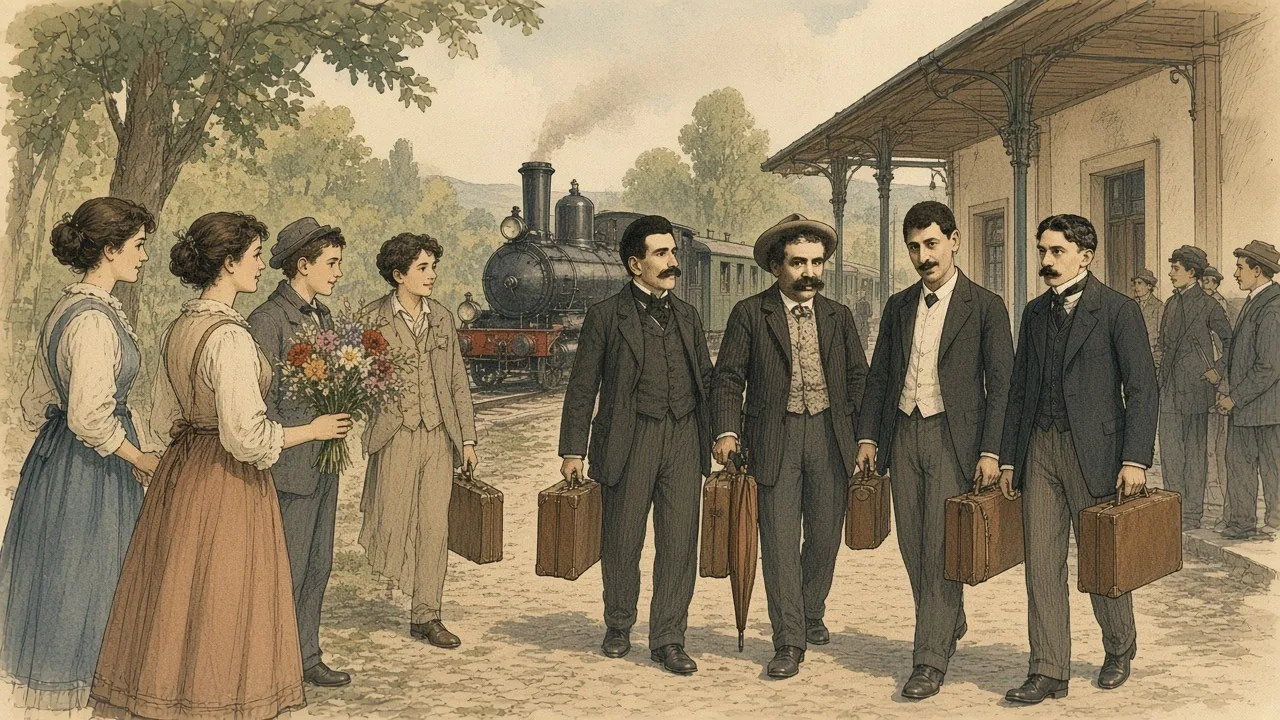
The reports in Birnbaum’s weekly and in the Lemberg Tagblat allow the tour to be followed town by town. In Kolomyya the evening took place on a Saturday night in the hall of the savings bank before a large audience drawn from every stratum of Jewish society. Dr Rozenhek opened it on behalf of the committee, the four writers read from their work, and a convivial gathering followed. On the Sunday afternoon Peretz read one of his social sketches to a local association, at which a Dr Schorr made a speech in German that Peretz answered sharply.[3] The Tagblat’s correspondent painted a less flattering picture. He had searched the hall for the local intelligentsia with a lantern, he wrote, and found none; the rest of the audience said they had expected acting or singing and had heard readings they did not understand. At the drinking session afterwards the local Zionists began to sing their anthem, and Asch, angered, told his hosts that they were shameless. When a young woman brought Peretz a picture postcard signed by the four Jewish deputies in the Austrian parliament and asked him to add his name, he refused, saying he had nothing in common with those people and would not appear on the same card.[3]
In Buczacz the main literary evening was held in the theatre hall at about half past eight. Peretz appeared first, to great enthusiasm, and Asch read the first act of his drama Shabbetai Zvi and a sketch from manuscript. Peretz then lectured on the development of Yiddish literature, and Asch spoke on the language conference itself; afterwards there was an agitated scene provoked by a few over-zealous supporters of Hebrew.[3]
In Drohobych Peretz opened the evening with an address on its purpose that ended, according to the report, with a statement of his position more concise than anything he had said in Czernowitz. We have our old Hebrew language of culture, which perhaps has a future, he said, but it cannot become a folk language from one day to the next, and the people needs its own language today so as not to be swept away by the stream of assimilation; we must take care of today if we want to live to see tomorrow. Reyzen and Nomberg recited poems, Peretz read his sketches, and at the gathering afterwards Zionists, Labour Zionists and socialists all spoke.[3] Further evenings were reported in the Bukovinian towns of Suceava, Câmpulung and Gura Humorului, the last given by Reyzen and Nomberg, and in Stanislau and Stryj in Galicia, with more planned in western Galicia.[3]
Mieses later recorded an incident from Stanislau. Peretz and two other writers had spoken there at a large meeting on Yiddish, to the irritation of the local Hebraists. At six o’clock the next morning a hot-headed young Hebraist was waiting at the railway station and shouted at Peretz in contempt. Peretz answered, with his usual composure, that for that the young man need not have got up so early.[3]
The tour shows what the conference meant in the small towns. Audiences turned out in large numbers to see famous writers, the arguments of the conference followed the writers from hall to hall, and the divisions between Zionists, socialists, Hebraists and assimilated notables surfaced at every reception. The real legacy of the week would be carried not by the bureau but by the people who had been in the hall and by those who read about them.
21. The delegates afterwards
The bureau faded, but the people who had argued in the Musikverein did not. Several of them spent the next three decades building precisely the institutions that the conference had failed to create. This chapter follows the principal participants, as distinct from the absentees and successors discussed in the chapters that follow.
Peretz returned to Warsaw and to the role he had played before the conference, as the patron and arbiter of the young writers who came to his apartment. His biographer in the YIVO Encyclopedia, Ruth Wisse, judged that he dominated the conference and helped to stave off the radical resolution declaring Yiddish the Jewish national language, while hailing the creativity of the Jewish masses whose language it was. She also recorded his warning that a deracinated Yiddish could itself become a means of assimilation unless it drew on traditional sources.[22] In the years after 1908 he translated the biblical scrolls into Yiddish, organised the Hazomir society in Warsaw for the performance and study of Jewish music, and lectured to adults on Jewish history at a People’s University that he had helped to found. He had already set up a theatre studio and tried to establish a national organisation for Yiddish theatre, and his phantasmagoric verse drama A Night in the Old Marketplace, written in 1907 with more than a hundred characters, was never staged in his lifetime.[22]
When the First World War broke out, Peretz threw himself into relief work, helped to establish a Jewish orphanage and wrote poems for children. He died of a heart attack on 3 April 1915, during the intermediate days of Passover, with one of those poems unfinished. About a hundred thousand people attended his funeral. Schools and organisations were named after him wherever Polish Jews settled, and his tomb in the Warsaw Jewish cemetery, the Ohel Peretz, survived the German occupation.[22]
Hersh Dovid Nomberg emerged from Czernowitz as the most energetic propagandist of the cause. Kalman Weiser’s YIVO article credits him with coining the word Yidishizm, Yiddishism, and with proposing the compromise formula of a, not the, national language; as the previous chapters have shown, the documentary record is more complicated on the second point.[42] From 1909 he published a Friday column of weekly chats on literature and culture in Der fraynd, and after a visit to the United States in 1911 he became Peretz’s closest associate in Hazomir. With the critic Alexander Mukdoyni he campaigned against the commercial melodrama known as shund and for a Yiddish art theatre in Warsaw.[42] During the German occupation of Poland he worked in the Yiddish secular school movement, coined the term Folkism and was one of the chief organisers of the Folkspartey in 1916. He sat in the Polish Sejm for the party in 1919 and 1920, travelled to Argentina in 1922 and 1923 to raise money for the TSYSHO schools, visited Palestine in 1924, and served as president of the Association of Jewish Writers and Journalists in Warsaw from 1925 until his death in 1927.[42]
Noah Prilutski, who had urged the conference to build institutions rather than debate metaphysics, built more than almost anyone. Born in Berdichev in 1882 and raised in Kremenets, he had been the first regular Yiddish drama critic in the Russian Empire, and by 1908 he had exchanged Zionism for Diaspora nationalism. His YIVO biographer notes that he championed at Czernowitz the recognition of Yiddish as the national language of the Jewish people, and that he came accompanied by his wife, the poet Paula Rozental.[51] Returning to Warsaw in 1909 to practise law, he became a patron of younger writers, among them Yoshue Perle and I. M. Vaysenberg, and headed a folklore circle whose members produced the first scholarly folklore collections printed entirely in Yiddish, including two volumes of Yiddish folk songs in 1911 and 1913 and two anthologies of folklore, philology and cultural history in 1912 and 1917.[51]
In May 1910 Prilutski founded the Warsaw daily Der moment, which his father, the veteran journalist Tsevi Prilutski, edited in practice for most of its existence. Its early columnists included Hillel Zeitlin, who had mocked the conference in 1908, and Mordkhe Spektor, who had been billed to speak there on the press and did not come. In 1916 it became the official organ of the Folkist Party and fought for the recognition of Yiddish as the Jewish national language and for the Yiddish school network, while remaining, unlike most Yiddishist papers, sympathetic to Hebrew and to Jewish settlement in Palestine. By the late 1920s it sold twenty to twenty-five thousand copies a day.[52]
The party itself drew heavily on the Czernowitz generation. Kalman Weiser’s article on the Folkists lists among its organisers Prilutski as leader, Nomberg, Lazar Kahan, who had spoken in the national language debate, and Hillel Zeitlin, all of them writers for Der moment.[53] In the elections of June 1916 to the Warsaw city council, then widely regarded as the embryo of a future Polish parliament, the party’s People’s Committee won four of ninety seats on a platform of national cultural autonomy based on Yiddish and its secular institutions. In the first Sejm of 1919 it won two seats, held by Prilutski and Samuel Hirschhorn. The Polish right engineered Prilutski’s removal from the Sejm in 1921 on a technicality, and he was replaced first by Nomberg; he was re-elected in 1922.[53][51]
Prilutski’s later career was increasingly scholarly. He laid the basis for the modern classification of Yiddish dialects, co-edited the journal Yidishe filologye from 1924, joined YIVO’s philological section and edited its journal for language standardisation, Yidish far ale, in 1938 and 1939. When Germany invaded Poland he fled to Lithuania, and under Soviet rule he was appointed in October 1940 to the first chair of Yiddish language and culture at the University of Vilna. In January 1941 he replaced Max Weinreich, who had escaped to the United States, as administrator of YIVO. After the German invasion of the Soviet Union he was arrested by the Gestapo, forced to catalogue the incunabula of the Strashun library, and murdered on 18 August 1941.[51]
22. The absent classics
The first half of this feature has kept a strict line between those who were in Czernowitz and those who were not. The documentary record places Peretz, Asch, Reyzen and Nomberg in the hall. It places none of the following there. Each sent greetings, was invoked, or was involved before or after, and each belongs to the story as an absentee.
Mendele Moykher-Sforim, the pen name of Sholem Yankev Abramovitsh, was born in Kapulye, now Kapyl in Belarus, in 1835, and had lived in Odessa since the 1880s. His novella The Little Man of 1864, his novel Fishke the Lame of 1869, The Mare of 1873 and The Travels of Benjamin the Third of 1878 had turned Yiddish into a vehicle for sophisticated prose, and he was already known as the grandfather of Yiddish literature.[18][17] In the decade before Czernowitz he was rewriting his own work in Hebrew; Fishke appeared in its Hebrew counterpart under Bialik’s editorship in 1902, and further revisions and translations of The Wishing Ring and The Mare continued until 1909.[18][3] He died in Odessa on 8 December 1917, in the first weeks of Bolshevik rule.[18]
Sholem Aleichem, born Sholem Rabinovitsh in Pereyaslav in 1859, had left the Russian Empire after the pogroms of 1905 and spent the following years between Lemberg, Geneva, London and New York, where the press dubbed him the Jewish Mark Twain. In 1908, driven by financial hardship and nostalgia for his East European readers, he toured the towns of Ukraine and Belorussia for three months as a one-man act. The tour wrecked his health; he was diagnosed with open tuberculosis and became bedridden, which is why his greeting reached Czernowitz from Baranovichi.[21] The war drove him from Berlin to Copenhagen and in 1914 back to New York, where he wrote for Der tog. He died on 13 May 1916. His funeral, attended by hundreds of thousands, became a demonstration of the size and cohesion of Yiddish-speaking New York.[21] Through Tevye the dairyman, the Kasrilevke stories and the letters of Menakhem-Mendl, he would give Yiddish its most widely translated characters, but he played no part in the conference beyond a message of goodwill.
Jacob Gordin had co-signed the call. Born in Myrhorod in the Poltava region in 1853, he had emigrated to New York in 1891 and in eighteen years wrote or adapted some seventy to eighty plays, among them The Jewish King Lear, Mirele Efros, God, Man and Devil, The Kreutzer Sonata and Khasye the Orphan, drawing on Shakespeare, Tolstoy and Ibsen to give the Yiddish stage a literary repertoire.[54] By the summer of 1908 he was seriously ill with cancer, and he spent part of the following winter in hospital. He died in New York in June 1909.[54]
Dovid Pinski, in whose home the call had been drafted, had been one of the circle around Peretz in Warsaw in the 1890s before emigrating to America in 1899. His plays The Treasure and Yankl the Blacksmith became the most popular of his many dramas, and The Eternal Jew was among the first productions of the Hebrew-language Habimah theatre in Moscow. A Zionist by conviction, he settled in Israel in 1949 and died there in 1959.[36]
Yankev Dinezon, Peretz’s closest friend and collaborator in Warsaw, was elected to the executive committee in his absence. A novelist whose sentimental children’s story Yosele of 1899 had been immensely popular, he joined Peretz during the war in founding the first homes for Jewish children orphaned or abandoned by the fighting. After Peretz’s death he devoted himself to children’s homes and schools and became one of the leading advocates of the Polish Yiddishist schools. When he died in Warsaw in 1919, tens of thousands attended his funeral, and he was buried beside Peretz.[38]
Mordkhe Spektor, who had been billed to speak on the press, was a veteran editor and novelist from Uman who had shared a cell with Peretz in the Warsaw Citadel after their arrest at a clandestine literary evening in 1899. His paper Di naye velt merged with Der moment in 1910. During the war he returned to Odessa, helped to found the Kultur-lige there, and at the end of 1920 left the Soviet Union for New York.[55] Perets Hirshbeyn, then twenty-eight, had moved to Odessa in 1908 and that autumn, encouraged by Bialik, founded the Hirshbeyn Troupe, the first Yiddish company devoted exclusively to serious drama. His finest plays, A Forsaken Corner, The Empty Inn, The Blacksmith’s Daughters and Green Fields, written between 1912 and 1918, became staples of artistically ambitious Yiddish theatres.[56][35]
The absentees from America are a separate category. Of the New York signatories only Zhitlowsky came. Morris Rosenfeld paid the fee, arrived after the closing session, and turned against the enterprise. The poet and Bible translator known as Yehoash does not appear in the participant lists either.[3] Avrom Goldfaden, the founder of the professional Yiddish theatre, had died in New York earlier in 1908, and more than a hundred thousand people had attended his funeral.[19]
23. The stage
The Czernowitz programme had promised papers on the stage and the actor by Peretz, Prilutski and Meir Geyer, and the decision of Wednesday morning to skip them meant that the conference never discussed the theatre at all.[3] None of the actors and directors in this chapter, with the single exception of Michał Weichert, is known to have attended.
The professional Yiddish theatre was barely thirty years old. Avrom Goldfaden had founded the first professional company in Iași in 1876, recruiting cantors’ choristers, wedding jesters, shop assistants and apprentices who became what Sholem Aleichem called the wandering stars.[48][20] From 1883 the Russian government banned Yiddish performances, and companies survived by pretending to perform in German. Ester-Rokhl Kaminska and her husband Avrom-Yitskhok Kaminski, who married in 1893, toured the empire for more than a decade with such a company, called the Jewish-German Theatre, playing in barns and fire stations and bribing police officials.[57] When restrictions eased in 1905 they returned to Warsaw and turned to the literary repertoire championed by Peretz and his disciples: plays by Sholem Aleichem, Peretz, Gordin, Pinski and Mark Arnshteyn, and early Yiddish translations of Gorky, Przybyszewski and Ibsen.[57]
In 1907 Kaminski founded, with Arnshteyn, the Literary Troupe, the first company dedicated to the new repertoire, and in the year of the conference it was touring the Russian Empire, to acclaim in the liberal Russian press of Saint Petersburg. Kaminska’s performances in Gordin’s Khashe the Orphan Girl and Mirele Efros, the so-called Jewish Queen Lear, made her a legend; audiences called her Di Mame Ester-Rokhl, the mother of the Yiddish theatre. Her husband took her to New York for several successful tours beginning in 1909.[57][58] Her daughter Ida Kaminska, born in 1899, led the Yiddish theatre company of postwar Poland, became an international celebrity through the Czech film The Shop on Main Street, released in 1965, and was driven from Poland with most of her company by the government’s anti-Zionist campaign of 1968.[57][59]
The company that most fully answered Peretz’s call for an artistic theatre emerged during the First World War. When the German occupiers of Vilna lifted the tsarist restrictions in 1915, a group of young actors, mostly amateurs, formed a purely literary Yiddish company. It premiered in February 1916 on a wooden circus stage with Asch’s play The Countryman, moved to Warsaw in September 1917, and became known as the Vilner Trupe, the Vilna Troupe.[47] Its most famous production came after the death of S. An-ski, the writer and ethnographer, in November 1920. At his graveside in Warsaw the company’s manager, Mordechai Mazo, vowed to stage An-ski’s play The Dybbuk at the end of the thirty days of mourning.[60]

The Dybbuk opened in Warsaw on 9 December 1920, directed by Dovid Herman, with Miriam Orleska as Leah, Alyosha Shtayn as Khonen and Avrom Morevski as the Tsadik of Miropolye. It was a stunning success and travelled from Warsaw to every city and town of interwar Poland and then into the repertoires of Yiddish companies across the world.[60][61] An-ski had based the play on material collected during the ethnographic expedition he led through the Jewish towns of western Russia between 1912 and 1914, had written it first in Russian and then in Yiddish, and had reconstructed his lost Yiddish manuscript from Bialik’s Hebrew translation.[60]
The Hebrew production made The Dybbuk world famous. The Habimah company, founded in Moscow in 1918 out of an amateur Hebrew troupe that Nahum Tsemakh had led in Białystok, Vilna and Warsaw from 1909, staged it in 1922 in Bialik’s translation, directed by Evgenii Vakhtangov, with Hanna Rovina as Leah.[62][60] Its incidental music was by Yo’el Engel.[63] Habimah’s members dreamed of a Jewish cultural renaissance through the revival of Hebrew, and the Jewish section of the Communist Party attacked the company as reactionary and clericalist; it was eventually re-established permanently in Tel Aviv.[62]
In Moscow the Soviet state created its own Yiddish showcase. The Moscow State Yiddish Theatre, known as GOSET, grew out of Aleksandr Granovskii’s Jewish Chamber Theatre in Petrograd and was moved to Moscow in 1920. It made its debut in 1921 with an evening of Sholem Aleichem one-act plays, in sets by Marc Chagall that included his mural Introduction to the Jewish Theatre.[64] Its leading actor, Solomon Mikhoels, played Menakhem-Mendl in that first programme, Benjamin in an adaptation of Mendele’s Travels of Benjamin the Third in 1927, and the First Jester in Peretz’s A Night in the Old Marketplace in 1925, the play that had never been staged in Peretz’s lifetime.[65] During the war Mikhoels chaired the Jewish Anti-Fascist Committee. On 13 January 1948 he was murdered in Minsk by agents of the Ministry of State Security, in a killing first presented as a road accident, and the theatre was closed in 1949.[65][64][66]
The one attendee in this chapter came to the stage from the student benches of Czernowitz. Michał Weichert, born in Podhajce in 1890 and raised in Stanislau, studied law in Lemberg, Vienna and Berlin, where he learned avant-garde stagecraft from Max Reinhardt, and settled in Warsaw in 1918. He directed plays for leading companies including the Vilner Trupe, edited several theatre journals, headed the Yiddish Actors’ Union in Poland from 1925 to 1927, and in 1932 formed the Yung-teater from the graduates of his studio.[44] Supported by the Warsaw Kultur-lige, the Yung-teater staged left-wing documentary theatre about the Sacco and Vanzetti case in a cramped union hall, abolishing curtain and stage and lighting forty-four short scenes around the audience. Under government pressure it moved to Vilna in 1937 and performed as the Nay-teater until 1939.[67][44] During the war Weichert led the Jewish Social Self-Help organisation in occupied Poland; he was tried for collaboration after the war and exonerated in Kraków in 1946, but remained a controversial figure, and he left for Israel in 1958.[44]
Across the Atlantic, the American Yiddish stage reached its height in the same decades through actors and managers such as Boris Thomashefsky and Maurice Schwartz, whose Yiddish Art Theatre in New York championed the plays of Hirshbeyn, and performers such as Molly Picon.[68][69][70][56] None of them had any connection with Czernowitz.
24. Writers of the Yiddish century
The decades after Czernowitz were the richest in the history of Yiddish literature. It would be wrong to attribute that flowering to the conference, which neither commissioned nor published a single literary work, but the writers who produced it inherited the arguments of 1908 and often referred to them.
Sholem Asch, the attendee who had made the hall weep, went on to become the most internationally famous Yiddish novelist of his generation. His YIVO biographer, Joseph Sherman, notes that 1908 was also the year of his first visit to Palestine, which helps to explain the personal tone of his remarks on the Hebrew of the colonies, and that after the conference he toured with Peretz, Reyzen and Nomberg in support of a programme to develop Yiddish into a literary, scientific and national language.[40] He first visited the United States in 1909 and 1910, and when war broke out in 1914 he settled in New York, became an American citizen and a salaried contributor to the Forverts. His trilogy Before the Flood, published between 1921 and 1931 and translated into English as Three Cities in 1933, consolidated his international reputation.[40][71] His novel about Jesus as an observant Jew, published in English in 1939 as The Nazarene, was refused by the Forverts and condemned by much of the Jewish press for supposedly encouraging conversion, and the controversy estranged him from many of his Yiddish readers. He spent his last years in Bat Yam, near Tel Aviv, where his house became a museum, and died in 1957.[40]
Avrom Reyzen, the other prominent writer among the participants, had been a contributor to the Bund’s legal and illegal press and a master of the simple, memorable poem, many of which were set to music. In 1908 he published two Yiddish school textbooks in Warsaw, one of them with his brother Zalmen, and edited the weekly European Literature, which brought translations of world literature to Yiddish readers. In early 1911 he moved to New York, where he wrote for the Forverts, the monthly Tsukunft and later Der tog and the Communist Frayhayt, returning to the Forverts in 1929 after his disappointment with the other papers’ reaction to the Arab attacks on Jews in Hebron. He died in 1953.[41] His younger brother Zalmen Reyzen, who did not attend, became the bibliographer of the literature; the first edition of his Lexicon of Yiddish Literature and Press appeared in 1914, he edited the Vilna daily Vilner tog from 1919 to 1939 and was one of the central figures of YIVO. Arrested when Soviet forces entered Vilna in September 1939, he was shot by the Soviets in 1941.[72]
Among the non-attendees, the most important new voice of the immediate post-conference years came from Kiev. Dovid Bergelson, who had switched from Hebrew to Yiddish around 1907, published his first novella, At the Depot, in Warsaw in 1909. Avraham Novershtern describes it as the first significant manifestation of impressionism in Yiddish prose, and Bergelson’s novel When All Is Said and Done of 1913 as his most important contribution to the modern Yiddish novel.[73] His Kiev associate Der Nister, the pen name of Pinkhes Kahanovitsh, had debuted in 1907 with prose poems of a mystical, symbolist cast, and in the 1930s began his historical novel The Family Mashber, among the most important prose works of Soviet Yiddish literature.[74] Perets Markish, born in 1895, made his debut in 1917 and in the next few years became the leading expressionist voice of the Kiev anthologies called Eygns, before spending the early 1920s between Warsaw, Berlin, Paris and London and returning to the Soviet Union in 1926.[75]
Their fates belong to the darkest chapter of the language’s twentieth century. Bergelson, who had left for Berlin in 1921, was the last of his cohort to return to the Soviet Union, in 1934, and became a major figure in Soviet Yiddish life and an active member of the Jewish Anti-Fascist Committee during the Second World War.[73] Der Nister was arrested during the liquidation of Yiddish culture after the war and died in a prison hospital in 1950.[74] Markish and Bergelson were tried with other members of the committee and shot in secret in Moscow on 12 August 1952.[75][73]
In Poland the generation after Peretz produced the two Singer brothers. Israel Joshua Singer, born in Biłgoraj in 1893, achieved his greatest success with Yoshe Kalb in 1932 and, after settling in the United States in 1934, published The Brothers Ashkenazi in 1936 and The Family Carnovsky in 1943; he died in 1944.[76][77] His younger brother Isaac Bashevis Singer serialised his first novel, Satan in Goray, in the Warsaw journal Globus in 1933, emigrated to New York and became the only Yiddish writer to receive the Nobel Prize for Literature, in 1978.[78][79] Kadya Molodowsky, who taught by day in the Warsaw schools of the TSYSHO network and published four books of poetry between 1927 and 1935, moved to New York, edited the journal Svive and died in Philadelphia in 1975.[80] Alter Kacyzne, regarded by himself and others as Peretz’s foremost student, wrote the screenplay for the 1937 film of The Dybbuk and was killed in Tarnopol on 7 July 1941.[81]
Vilna, which had sent Frumkin to Czernowitz, produced the last great Yiddish literary group of Eastern Europe, Yung-Vilne, in the 1930s. Its poets included Avrom Sutzkever, born in 1913, who survived the Vilna ghetto, escaped with a partisan unit in September 1943, testified at the Nuremberg trials and settled in Tel Aviv in 1947, where he edited the quarterly The Golden Chain until 1995.[82][83] The journal shared its title with Peretz’s verse drama The Golden Chain.[22] Chaim Grade, also of Yung-Vilne, emigrated to the United States in 1948 and wrote some of the finest Yiddish prose about the world of the yeshivas, including the two-volume novel known in English as The Yeshiva.[84][85]
None of these writers attended the conference; the youngest were born after it. What connects them to Czernowitz is not participation but a condition the conference had tried to describe: a literature produced in a language that its writers regarded as national, in a world that refused to recognise it as such.
25. Music and song
Music had no place on the Czernowitz agenda, but 1908 was also the founding year of the most important Jewish musical organisation of the period, far away in Saint Petersburg. The coincidence was not a connection; no musician associated with the new society is known to have attended the conference, and the conference did not mention it.
The systematic collection of Yiddish folk songs had begun around 1896 with the work of Peretz and Yehudah Leib Cahan in Warsaw. In 1898 the historians and folklorists Shaul Ginsburg and Peysekh Marek published appeals for songs in the Hebrew and Russian press, and in 1901 they published the first major collection of Yiddish folk songs. In the same year that their appeals appeared, the composer and critic Yo’el Engel first transcribed folk melodies, and he went on to present them in lecture-concerts.[86] Chana Mlotek, in her YIVO survey of the genre, describes the range of what these collectors found: Sabbath table hymns, wedding and love songs, cradle songs, children’s rhymes, historical songs about the conscription of Jewish boys and about pogroms, and workers’ songs about the lot of apprentices and seamstresses.[86]
Engel, born in Berdyansk in 1868, had been urged by Tchaikovsky to enter the Moscow Conservatory, and until 1918 he was music critic of the liberal Moscow daily Russkie vedomosti. His lecture-concerts of 1900 and 1901 with Ginsburg and Marek established him as the leading expert on Jewish music in the Russian Empire, and his polemic with Sholem Aleichem and the songwriter Mark Varshavski over the authenticity of the latter’s songs showed how contested the very idea of folk music could be.[63] Encouraged by Rimsky-Korsakov, a group of young Jewish musicians at the Saint Petersburg Conservatory founded the Society for Jewish Folk Music in 1908. Its early members included Lazare Saminsky, Efrayim Shkliar, Solomon Rosowsky, Aleksandr Krein, Mikhail Gnesin and Joseph Achron.[87]
The society’s work had four parts: research, composition, performance and publishing. Its members transcribed folk songs, klezmer tunes and Hasidic melodies and used them as the basis for concert works, first as short arrangements for voice and piano, later as chamber and orchestral pieces that mixed late Russian Romanticism with European modernism. It began publishing in 1910 with a series of fifteen compositions and eventually issued several hundred works, opened branches in Moscow and Kiev in 1913 and in Odessa in 1916, and received requests for music from as far away as Zurich, Edinburgh, Baltimore and Tel Aviv. Politically it cooperated with Zionist, Folkist and liberal groups alike, which places it, like Peretz, outside the party quarrels that dominated Czernowitz.[87]

The most ambitious field project of these years was S. An-ski’s Jewish Historical-Ethnographic Expedition of 1912 to 1914, for which Engel organised the musical work, making transcriptions and early field recordings in the towns of the Pale.[63][87] The same material later fed An-ski’s Dybbuk, for whose Habimah production Engel wrote the incidental music that became his best-known concert suite.[63] Revolution and civil war split the society three ways. A Moscow successor, the Society for Jewish Music, worked with state support until 1929, and composers such as Krein and Gnesin wrote operas, ballets and symphonies on Jewish themes; Engel and Rosowsky emigrated to Palestine in the 1920s, where the society’s idea of a Jewish national music influenced Zionist composers; and Saminsky, Leo Zeitlin and Achron carried it to New York.[87] Engel himself lived in Berlin from 1922 to 1924, where he founded the Yuval publishing house, then moved to Tel Aviv in 1924 and died there in 1927.[63]
Collecting continued. Cahan, by then in the United States, published a two-volume collection of folk songs with melodies in 1912. In Warsaw and Vilna collections were published by Prilutski, Menakhem Kipnis, Shmuel Lehman and others, and folk songs appeared in Der pinkes, the Vilna yearbook of 1912 and 1913. When YIVO was founded in Vilna in 1925, its Ethnographic Commission, directed by Cahan, created a worldwide network of amateur collectors and trained folklorists such as Shmuel Zaynvl Pipe.[86][88] In the Soviet Union the folklorist Moisei Beregovskii argued in 1935 that Jewish singers did not borrow Ukrainian melodies mechanically but reshaped them to their own expressive needs.[86]
Mlotek also traced the boundary between folk and authored songs. Many songs that Jews sang as anonymous folk songs had known authors: nineteenth-century folk poets such as Berl Broder, Elyokem Tsunzer and Goldfaden, and later writers such as Varshavski and Mordkhe Gebirtig. Sholem Aleichem’s lullaby Sleep My Child, first printed in Odessa in 1892, had become a folk song by 1901, when five people in different places sent versions of it to the collectors. The songs of David Edelstadt and Morris Rosenfeld travelled back from America in the same way.[86] Avrom Reyzen’s short lyrics were among the most frequently set of all, and many of his poems became popular songs.[41]
After the Holocaust, folk songs continued to be anthologised and recorded by singers such as Ruth Rubin, Theodore Bikel and Chava Alberstein, and composers including Ravel, Prokofiev and Shostakovich adapted Yiddish folk material in their own works.[86]
26. Schools and scholarship
Of all the tasks listed in the invitation to Czernowitz, the two that the conference had least time for were schools and the scientific study of the language. The fourth session heard papers on the language by Sotek, Eisenstadt and Mieses, but the conference never discussed them as practical proposals, and its last-day programme of work said nothing about a dictionary or a grammar. Over the following three decades both tasks were taken up by institutions that the conference did not found. Fishman’s warning applies with particular force here: there is little if any direct link between these institutions and the resolutions or participants at Czernowitz, however often their founders invoked its memory.[1]
The programme of Yiddish scholarship was set out most forcefully by Ber Borokhov, the theorist of Labour Zionism, who founded in a short life two distinct fields, Labour Zionism and Yiddish studies. In 1913 he published in the Vilna yearbook Der pinkes two seminal essays, The Aims of Yiddish Philology and The Library of the Yiddish Philologist. The first opened with the sentence: of all the sciences, philology plays the greatest role in the national revival of the oppressed peoples. By philology Borokhov meant the whole range of language- and literature-based disciplines, including linguistics, folklore and literary history.[89] He returned to Russia after the revolution of 1917, contracted pneumonia on a speaking tour and died on 4 December of that year, aged thirty-six.[89]
The man who turned that declaration into an institution was Nokhem Shtif. Born in Rovno in 1879, he had co-founded the Jewish Socialist Labour Party, whose members, the Sejmists, sought Jewish national autonomy in Russia and became committed Yiddishists; Zhitlowsky had represented the same tendency at Czernowitz. From 1908 his interest in Yiddish philology showed in a steady stream of publications.[90] After documenting the Ukrainian pogroms of 1918 to 1921 with the historian Elye Tsherikover, Shtif wrote in Berlin in October 1924 a long memorandum, On a Yiddish Academic Institute, surveying the state of Yiddish scholarship and proposing a research centre.[88][90] Teachers and scholars in Vilna endorsed the memorandum in a set of theses that were later regarded as YIVO’s founding act, and from 7 to 12 August 1925 nine delegates from Western and Eastern Europe met in Berlin to create an organising committee.[88] The Yiddish Scientific Institute, YIVO, began work in Vilna in a room in Max Weinreich’s apartment.[91]
Weinreich, born in 1894, quickly became the driving force of the new institute. He served as research secretary of its linguistic section from 1925, and his interests ranged from the history of linguistics and orthography to dialectology, stylistics and the influence of traditional Jewish culture on the development of Yiddish.[91] Under his direction YIVO broadened into the social sciences; he translated Freud’s Introduction to Psychoanalysis into Yiddish between 1936 and 1938, founded a division of youth research in 1934, and in the same year created a graduate training programme named after Tsemakh Shabad.[88] When war broke out on 1 September 1939, Weinreich and his elder son Uriel were in Denmark on the way to a linguistics conference, and they made their way to New York, where the American branch of YIVO became its de facto headquarters. He was its research director from 1940 to 1950 and spent his last years completing the four-volume History of the Yiddish Language, published posthumously in 1973.[91][92] Shtif, by contrast, was drawn to the Soviet Union by the unprecedented scale of state-sponsored Jewish culture there, and died in 1933.[90]
YIVO depended on volunteers. Its small staff could survey and gather sources only with the help of an extensive network of zamlers, collectors who gathered documents, folklore, data and funds in their own communities. A survey of 1929 found that a quarter of the collectors had ties to Yiddish schools and nearly a third were poor manual labourers, some of whom wrote to ask for small sums to cover paper and postage.[88] In 1931 YIVO published the documentary volume on the conference on which much of this feature rests, a collection of reports, documents and reactions assembled from newspapers and memoirs, in which Solomon Birnbaum helped to identify the student participants.[3][1] At the institute’s world convention in 1935 Marc Chagall opened its art section with an exhibition of his drawings.[88]
The schools followed a parallel path. The Central Yiddish School Organisation, TSYSHO, was founded in Warsaw in June 1921, led mainly by the Bund and the Left Labour Zionists, with the Bundist Beynish Mikhalevitsh as its first chairman. Its curriculum taught Yiddish language and literature, Jewish history, the sciences, music and crafts in Yiddish, with Polish subjects in Polish and, in some schools, Hebrew. At its peak in the late 1920s it maintained 219 institutions with 24,000 pupils in a hundred places, including forty-six kindergartens, 114 elementary schools, six high schools, fifty-two evening schools and a teachers’ seminary in Vilna. Without government subsidies, and with aid from abroad dwindling during the Depression, it declined to some 15,500 pupils by 1934 and 1935.[50]
The question of spelling, which the conference had not reached, took longest. Fishman, in his YIVO survey of language planning, notes that the rallying cry of Yiddish planners since the early nineteenth century had been away from German, an admonition strongly reaffirmed at Czernowitz, and that it applied chiefly to the writing system, spelling, vocabulary and grammar.[46] Soviet usage went furthest, spelling words of Hebrew and Aramaic origin phonetically, a policy associated with anti-religious and anti-Zionist sympathies. A YIVO-sponsored conference approved phonetic spelling in 1931, but the institute never adopted it, and YIVO promulgated its own rules in 1936.[88] The YIVO unified spelling of 1937, republished many times since, became the standard followed by the overwhelming majority of non-Orthodox Yiddish publications.[46][93]
27. Painters and printmakers
No visual artist is recorded among the participants at Czernowitz, and the conference said nothing about painting. Yet the question it debated, whether a stateless people could have a national culture and in what language, was being asked at the same moment by Jewish artists, who had no language of their own to argue over and had to invent a visual one.
The pioneer was a Galician. Maurycy Gottlieb was born in Drohobych in 1856, the town where Peretz would speak during the writers’ tour fifty-two years later. German was his chief language; he studied in Vienna, Kraków and Munich and became one of the most gifted pupils of the Polish national painter Jan Matejko. Ezra Mendelsohn describes him as perhaps the first artist to aspire to be both Polish and Jewish. His most famous work, Jews Praying in the Synagogue on the Day of Atonement, was painted in 1878, a year before his death at twenty-three.[94][95]
Izidor Kaufmann, born in Arad in 1853, studied in Budapest and at the Vienna Academy and from 1894 travelled through Hungary, Moravia, Slovakia, Galicia, Ukraine and Russian Poland in search of what he considered more authentic Jewish life. His portraits of Hasidim, scholars and rabbis in festive clothes, painted nostalgically as if untouched by modernisation, were especially popular with the urban Jewish bourgeoisie of Vienna.[96] Samuel Hirszenberg of Łódź, trained in Kraków, Munich and Paris, painted the Jewish world in a darker key: Jewish Cemetery of 1892, mourning the victims of the pogroms of 1881 and 1882; The Wandering Jew of 1899, which won a bronze medal at the Paris Exhibition of 1900; Exile of 1904, a response to the Kishinev pogrom; and The Black Banner of 1907, a Hasidic funeral rendered as collective trauma. In 1907 he settled in Jerusalem to teach at the Bezalel school, and he died there in 1908, the year of the conference.[97]
The graphic counterpart of these painters was Ephraim Moses Lilien, also born in Drohobych, in 1874. Trained in Kraków, he fused Art Nouveau with Jewish and Zionist themes, drew portraits of Theodor Herzl, served as a cultural delegate at early Zionist congresses, co-founded the Jüdischer Verlag in Berlin and designed the emblem of the Bezalel school.[98] His illustrations for Lieder des Ghetto of 1903, a German translation of Morris Rosenfeld’s Yiddish poems, brought the poet who would later quarrel with Czernowitz to a Central European audience in the most fashionable visual idiom of the day.[98]
In the Russian Empire, the decisive figure was a teacher. Yehudah Pen, born in 1854 in a shtetl in Kovno province, had decorated Purim noisemakers and eastern-wall plaques as a boy before entering the Saint Petersburg Academy of Arts in 1880. In November 1897 he opened a private School of Drawing and Painting in Vitebsk, which lasted more than twenty years and trained several hundred pupils, most of them Jews. Among them were Marc Chagall, Osip Zadkine and El Lissitzky, all of whom remained in touch with him for the rest of his life. Pen was murdered in his home in Vitebsk on 28 February 1937, in circumstances never explained.[99]
Chagall, born in Vitebsk in 1887, went to Paris around 1910 with a stipend from the lawyer Maksim Vinaver and lived in the artists’ colony of La Ruche among Soutine, Modigliani and other members of what would be called the School of Paris. Caught in Russia by the outbreak of war in 1914, he was appointed by Lunacharsky in 1918 as plenipotentiary for art in Vitebsk province and founded a People’s Art College there. He then moved to Moscow, where he painted the murals for the Yiddish Chamber Theatre, before leaving Soviet Russia in 1922.[100][101] El Lissitzky, born in 1890, joined Yisakhar Ber Rybak on expeditions of the Jewish Historical and Ethnographic Society in 1915 and 1916, drawing the painted wooden synagogues along the Dnieper. His Jewish illustrations appeared in thirty publications between 1918 and 1923, culminating in his coloured lithographs for the Passover song Had Gadya in 1919, before Malevich’s suprematism drew him to the abstract Prouns.[102][103]
The organisation that gave this generation its institutional home was the Kultur-lige, founded in Kiev early in 1918 to promote every sphere of modern Yiddish culture: education, literature, theatre, art and music. It was supported by the Ukrainian Ministry of Jewish Affairs and by a coalition of Jewish socialists, left-wing Zionists and Folkists, and its leaders included Bergelson, Nakhmen Mayzel and Yekhezkl Dobrushin, with Moyshe Zilberfarb at the head of its executive bureau. By the summer of 1918 it had branches in almost a hundred Ukrainian towns.[104] In its range of sections, which embraced teachers, theatre artists, health workers, publishers and libraries, it came close to the comprehensive organisation that Peretz had proposed in Czernowitz and that the conference had rejected.

Rybak, Lissitzky and Iosif Chaikov established a formal art department within the Kultur-lige, and Rybak and Boris Aronson wrote the manifesto Paths of Jewish Painting, published in the journal Oyfgang in 1919, on the difficulty of defining a Jewish national style.[105] The league’s art exhibitions, in Białystok in 1918, Kiev in 1920 and 1922, Moscow in 1922 and Riga in 1923, brought Jewish artists together around the question of a Jewish artistic tradition.[104] Rybak’s lithographic album Shtetl, My Destroyed Home, a Remembrance of 1923, fusing cubism and expressionism, remains his masterpiece.[105] Aronson emigrated to the United States in the early 1920s, worked first in the Yiddish theatres of New York and became one of Broadway’s most celebrated designers, with sets for Fiddler on the Roof, Cabaret, Company and Follies.[106] Natan Altman, who copied reliefs from old Jewish tombstones in 1913 and painted his famous portrait of Anna Akhmatova in 1914, designed Habimah’s Dybbuk in 1922 with silver Hebrew lettering suspended above the stage and, for GOSET, a constructivist Uriel Acosta.[107]
In Poland the Łódź group Yung-yidish, formed in 1918 by the poet Moyshe Broderzon with the artists Yitskhok Broyner, Yankl Adler and Marek Szwarc, became the first Yiddish artistic avant-garde in the country. Szwarc had lived at La Ruche in Paris from 1912 alongside Chagall and Soutine.[108] The School of Paris, a term coined by the critic André Warnod in 1925, described the mostly foreign-born artists, many of them Jews from Eastern Europe, who made Paris the centre of modern art between the wars, among them Chagall, Chaim Soutine, Moïse Kisling, Jacques Lipchitz and Amedeo Modigliani.[109] Soutine, born in Smilavichy in 1893, studied in Vilna before reaching Paris in 1913 and living in hardship at La Ruche.[110] Their history is the subject of this feature’s companion presentation, The School of Paris.
28. Cernăuți between the wars
The city that had hosted the conference as the capital of an Austrian crown land changed its name, its state and much of its population within a decade. Russian armies occupied it three times during the First World War, and many Jews fled; some never returned after Romanian forces took control in November 1918 and the union of Bukovina with Romania was proclaimed.[5] As Cernăuți it became a provincial city of Greater Romania, and its Jewish population was replenished by newcomers from Ukraine, Poland and Bessarabia. The Romanian census of 1930 counted 42,592 Jews in the city, 37 per cent of the total.[5][111]
The new state’s attitude to its minorities was very different from that of Vienna. Jews were officially recognised as a national minority, and in spite of the hostility of Romanian nationalists they continued to play important roles in the municipal council, where some served as deputy mayors, in the professional associations and in the chamber of commerce; between 1919 and 1933 several Jews sat for Cernăuți in the Romanian parliament. But Andrei Corbea-Hoisie, in his YIVO article on the city, describes strong pressure of Romanianisation through state institutions and above all through the schools.[5] Jewish families responded in two ways: they clung to German language and culture, and they showed a growing interest in Yiddish, promoted above all by the strong left-wing organisation Morgnroyt. In 1930 the majority of the city’s Jews declared Yiddish as their mother tongue.[5] Across Bukovina as a whole, 8.7 per cent of the population did so.[4]
In 1910 the Austrian census had refused to accept Yiddish as a language of daily use; twenty years later a Romanian census allowed the city’s Jews to name it, and most of them did. It did not bring the political recognition that the Galician delegates had hoped for. Disputes between Yiddishists and Hebraists, and among Zionists, social democrats and supporters of the Union of Romanian Jews, weakened the community’s ability to respond to increasingly violent antisemitism, which sometimes enjoyed the passive or active support of the authorities.[5] A decree of January 1938 reconsidering the citizenship of Bukovinian Jews signalled what was to come.[4]
The leading Yiddish writer of interwar Cernăuți was Eliezer Shteynbarg, born in Lipkany in Bessarabia in 1880, who settled in the city in 1919 and ran, among other things, a Yiddish children’s theatre. He was the most distinguished figure in the Czernowitz Jewish School Association and in the Jewish Cultural Association of Romania, founded in 1921, and in that year he published in Czernowitz two primers, one for Yiddish and one for Hebrew, in which old heder methods were combined with modern teaching.[112] His fame rested on his fables, which circulated in periodicals and by word of mouth through his own readings and those of performers such as Herts Grosbard; only one collection of twelve, Through the Eyeglasses, appeared in his lifetime, in a limited edition of 1928. Bialik had called them masterpieces as early as 1911.[112] Their heroes are animals, objects and even the letters and vowels of the Yiddish alphabet, and their language is saturated with verses from the Bible and sayings from the Talmud, Rashi and the midrash. After two years in Brazil, from 1928 to 1930, he returned to Cernăuți; he died in 1932.[112]
His fables can be read as a practical illustration of Peretz’s argument that Yiddish would become a national language only by drawing on the treasures still held in Hebrew. It was Shteynbarg, too, who formally launched the career of the city’s greatest Yiddish poet, by publishing his work in the July 1921 issue of the journal Kultur.[113]
That poet was Itzik Manger, born Isidor Helfer in Czernowitz in 1901, seven years before the conference. He attended heder and a state gymnasium until he was expelled, absorbed German Romantic poetry, and grew up in a family of tailors where Yiddish song and literature were constant companions; his father coined the word literatoyre, combining literature and Torah. During the war the family moved to Iași, the city of Goldfaden’s first company and of the folk troubadour Velvl Zbarzher, and it was there that Manger began writing Yiddish verse.[113][114] After military service in the Romanian army in Czernowitz he moved to Bucharest, became a spokesman for the Yiddish secular movement in Greater Romania, and in 1928 arrived in Warsaw, where the decade until 1938 became, in his own words, his most beautiful.[113]
In Warsaw Manger published Stars on the Roof in 1929, invented the genre of Bible Songs in 1935, rewrote the Purim scroll as the Megile-lider in 1936, and wrote a personal history of Yiddish literature, Close Images, in 1938. He also adapted Goldfaden for the stage in The Witch and Three Hotsmakhs, wrote lyrics for cabaret and film, and in January 1930 was one of the four youngest writers elected to the Yiddish PEN club, alongside Isaac Bashevis Singer.[113] As a Romanian national he was forced to leave Poland in 1938; he spent the war years in Paris, Marseilles and London, went on to New York in 1951 and settled in Israel, where he died in 1969.[113] David Roskies identifies Manger’s first period as that of a self-consciously regional poet, who regarded Romania as the source of the modern Yiddish fable, grotesque and ballad, the fable meaning Shteynbarg and the grotesque meaning Goldfaden.[113]
The city’s German-language poets came from the same Jewish milieu. Corbea-Hoisie names Alfred Margul-Sperber, Rose Ausländer and the young Paul Celan among the writers who chose German, while Shteynbarg and Manger chose Yiddish.[4] Celan, born Paul Antschel in Czernowitz in 1920, two years after the city passed to Romania, learned Romanian at school, but German remained his primary cultural language and Vienna his cultural lodestar.[115][116] The language question that the conference had debated in 1908 was thus lived out within a single generation of Czernowitz Jews, in Yiddish, German, Romanian and Hebrew, until the war put an end to it.
29. Destruction and memory
The Jewish community of Czernowitz was destroyed in four years. In June 1940 the Soviet army occupied the city. For the city’s Jews, Corbea-Hoisie writes, the occupation replaced racial persecution with the experience of Communist social levelling and Stalinist terror; the bourgeois elite of the community, some three thousand people, was deported to Siberia.[5] On 5 July 1941 Romanian and German forces reoccupied the city with orders from the government of Ion Antonescu to punish the Jews for their supposed attachment to the Soviet Union. A wave of killings culminated in the murder of the chief rabbi, Abraham Mark, and the burning of the great temple, and Jews were stripped of their civil and economic rights.[5][111]
On 11 October 1941 a ghetto was established in the old Jewish quarter, concentrating about five thousand people as a transit point for deportation across the Dniester. Between October 1941 and the early summer of 1942 more than 32,000 Jews were deported from the city to camps and ghettos in Transnistria. To prevent the paralysis of local life, a group of Romanian notables led by the mayor, Traian Popovici, obtained permission for 17,000 Jews to remain in the city as forced labourers. When the Soviet army returned in 1944, an estimated 30 per cent of the Jewish population had survived.[5] Most of the survivors crossed into Romania in 1945 and 1946 and went on to Palestine.[5]
Paul Celan’s parents were among the deported, and both died. Celan himself spent a year and a half, from 1942 to 1944, in forced labour. In May 1945, after hearing reports of the death camps, he wrote Todesfuge, Deathfugue, which James Lyon describes as considered by many the most powerful representation of the Holocaust in any language.[115] The poem was written in German, the language of the city’s schools before 1918, by a son of the Czernowitz Jewish middle class. Celan later settled in Paris, where he died in 1970.[115][116]
Elsewhere, of the conference’s participants, Matisyohu Mieses died on a death march in January 1945; Noah Prilutski was murdered in Vilna in August 1941; Michał Weichert survived the Warsaw and Kraków ghettos. Zalmen Reyzen, the bibliographer of the literature, was shot by the Soviets in 1941, and Alter Kacyzne was killed in Tarnopol in the same year. In the Soviet Union the murder of Mikhoels in 1948 and the execution of Markish, Bergelson and their colleagues in 1952 completed what the war had begun.[49][51][44][72][81][65][75] The population whose language the delegates had debated was reduced, within forty years of the conference, to a remnant scattered across the world.
After the war, Czernowitz, now Chernivtsi in Soviet Ukraine, acquired a new Jewish population from other parts of the Soviet Union. There were about 37,000 Jews in the city in 1959, 16,469 in 1989 and only 1,443 at the census of 2001, after emigration to Israel intensified with Ukrainian independence in 1991. One synagogue remained in use. Communal life was reorganised around a Yiddish cultural society named after Eliezer Shteynbarg, led by the writer Josef Burg.[5]
The conference itself had a long afterlife in memory. Fishman observed that after the Holocaust it came to be reinterpreted as a reminder of the high tide that Yiddish and Yiddish activism reached in the first decades of the twentieth century: the recognition of Yiddish in several post-war East European settlements, the founding of TSYSHO in 1921 and YIVO in 1925, the Yiddish Culture Association, YKUF, in 1937, and the World Congress for Yiddish Culture after the Second World War. He was sceptical of the connection. There is little if any direct link, he wrote, between any of these and either the nebulous spirit of Czernowitz or the resolutions and participants of the conference itself; perhaps, he suggested, Yiddishism needed a festive event to balance its sombre calendar, and Czernowitz was regularly called upon for that purpose.[1]
The centenary in 2008 offered occasions for both kinds of memory. The Yiddish Book Center marked it in the summer 2008 issue of its magazine Pakn Treger by publishing Marvin Zuckerman’s translation of Peretz’s opening address under the title Unruly Language: Czernowitz at 100. In her introduction Catherine Madsen observed that a hundred years later the speech was read with complex reactions: much had happened since 1908, and terms such as the folk could no longer be read without a wince after their abuse by the Nazis. Yet, she argued, a nationalism of language taken seriously, as Peretz and his circle had taken it, ultimately offered an escape from the tyranny of one’s own group, because language is unruly and permeable and cultures that truly coexist constantly trade words.[32] The Bukowina-Institut in Augsburg, which documents the history of the region, includes the conference among the events of its online Bukovina encyclopaedia, dating it from 30 August to 3 September 1908 and counting over seventy participants.[2]
30. Legacy
The conference set itself three kinds of task: to declare the status of Yiddish, to create an organisation to serve it, and to begin the practical work of standardising the language and widening its uses.
The declaration was its most famous achievement and its most fragile. The resolution of 3 September recognised Yiddish as a national language of the Jewish people and demanded political, social and cultural equality for it. For two decades after 1918 that demand was partly met. The Soviet state recognised Yiddish as one of its national languages and funded schools, theatres and research institutes, while in Poland the Folkists carried the demand into the Sejm and TSYSHO built a school system without state support.[43][53][50] In each case the recognition depended on political circumstances that the language’s speakers did not control, and in each case it was withdrawn or destroyed. In the end, legal recognition came in a form no delegate had imagined: Sweden recognised Yiddish as an official minority language in 1999, and the Netherlands, Poland, Romania, Slovakia and Finland also recognise it, at a time when the communities of native speakers in those countries were small or had disappeared.[15]
The rival language followed an opposite path. The Hebrew that Asch had called artificial in 1908 and that Frumkin’s resolution had dismissed as a utopia became the spoken language of a new society in Palestine and then the national language of the State of Israel.[25][24] Peretz’s position, that Hebrew no longer lived and that its mechanical revival would produce a new jargon, was refuted by events. The compromise clause that left every member free to relate to Hebrew according to personal conviction, carried by twenty-six votes to twelve as the price of keeping the Zionists in the hall, proved to be the most prescient sentence the conference adopted.
The organisation was its clearest failure. The bureau in Czernowitz issued an appeal, wrote one letter and faded, and no second conference was held. Yet the institutions that Peretz’s plan had imagined, a network of societies for schools, publishing, theatre, music and scholarship, did come into being, through the Kultur-lige in Kiev, TSYSHO in Warsaw, the Society for Jewish Folk Music in Saint Petersburg, the Vilner Trupe and YIVO in Vilna. Fishman’s caution applies: none of them was founded by the conference, and their founders’ appeals to its memory were often retrospective.[1] What the conference supplied was a precedent: the first public occasion on which writers, scholars, party leaders and students from several countries had argued about Yiddish as a national cause.
The practical work had the most durable results, though they came slowly and from other hands. The campaign to move Yiddish away from German, which Fishman found strongly reaffirmed at Czernowitz, shaped the YIVO standard of 1937, still followed by most non-Orthodox Yiddish publications.[46] The scholarly study of the language, for which Mieses’s paper had been an early and controversial attempt, became a discipline through Borokhov, Prilutski, Weinreich and their successors.[89][91]
The fate of the speakers themselves is the hardest part of the legacy to state plainly. Yiddish had perhaps eleven to thirteen million speakers before the Second World War, most of them in Eastern Europe, and the Holocaust destroyed the great majority of that population. Current estimates of fluent speakers range from half a million to a million, most of them Hasidic Jews in the United States, Israel, Canada and Europe who use it as their everyday language.[15] The language now survives above all in the communities that the secular Yiddishists of 1908 least expected to carry it.[6]
The final legacy is a methodological one. The history of the Czernowitz conference has suffered from the very generosity of its memory, as names were added to its roll that the record does not support and resolutions were credited with consequences they did not have. Read in its documents, it was a small meeting with large ambitions, conducted in a provincial capital by people who disagreed about nearly everything except the dignity of the language they spoke. That is the conference this feature has tried to describe.
31. Timeline
Habsburg troops occupied the territory that became the crown land of Bukovina, with Czernowitz as its capital.[4]
Sholem Yankev Abramovitsh published his first Yiddish story in the Odessa weekly Kol mevaser, beginning the career of Mendele Moykher-Sforim.[17]
The German-language Franz Joseph University opened in Czernowitz and soon drew large numbers of Jewish students.[5]
Avrom Goldfaden founded the first professional Yiddish company in Iași.[48]
On 2 and 3 September the conference recognised Yiddish as a national language of the Jewish people; Peretz refused to accept the resolution.[3]
The conference elected a bureau in Czernowitz and closed in the early hours of 4 September; Peretz, Asch, Reyzen and Nomberg then toured Galicia and Bukovina.[3]
Young composers in Saint Petersburg founded the Society for Jewish Folk Music.[87]
Peretz died in Warsaw on 3 April; about a hundred thousand people attended his funeral.[22]
The Vilner Trupe staged An-ski’s Dybbuk in Warsaw on 9 December; GOSET moved to Moscow.[60][64]
The Central Yiddish School Organisation was founded in Warsaw in June.[50]
YIVO published the reports, documents and reactions of the Czernowitz conference in Vilna.[3]
YIVO’s unified spelling rules were promulgated.[46]
The Soviet army occupied Cernăuți and deported about three thousand members of the Jewish elite to Siberia.[5]
Romanian and German forces reoccupied the city in July, a ghetto was established in October, and deportations to Transnistria began.[5]
Paul Celan, a survivor of forced labour, wrote Todesfuge in May.[115]
Sweden recognised Yiddish as an official minority language.[15]
The Yiddish Book Center marked the centenary by publishing Peretz’s opening address in English translation.[32]
References
- YIVO Encyclopedia, “Czernowitz Conference” *
- Bukowina-Institut, BukoWiki, “Yiddish Language Conference 1908” *
- Di ershte yidishe shprakh-konferents: barikhtn, dokumentn un opklangen (Vilna: YIVO, 1931), Internet Archive *
- YIVO Encyclopedia, “Bucovina” *
- YIVO Encyclopedia, “Chernivtsi” *
- YIVO Encyclopedia, “Birnbaum, Nathan” *
- Cisleithania *
- Habsburg monarchy *
- War of the Languages *
- YIVO Encyclopedia, “Parties and Ideologies” *
- YIVO Encyclopedia, “Galicia” *
- YIVO Encyclopedia, “Bund” *
- General Jewish Labour Bund *
- YIVO Encyclopedia, “Yiddish” *
- Yiddish *
- YIVO Encyclopedia, “Yiddish Literature after 1800” *
- YIVO Encyclopedia, “Mendele Moykher-Sforim” *
- Mendele Mocher Sforim *
- YIVO Encyclopedia, “Goldfadn, Avrom” *
- Abraham Goldfaden *
- YIVO Encyclopedia, “Sholem Aleichem” *
- YIVO Encyclopedia, “Peretz, Yitskhok Leybush” *
- YIVO Encyclopedia, “Newspapers and Periodicals” *
- Eliezer Ben-Yehuda *
- Revival of the Hebrew language *
- YIVO Encyclopedia, “Ahad Ha-Am” *
- Ahad Ha’am *
- YIVO Encyclopedia, “Bialik, Ḥayim Naḥman” *
- Hayim Nahman Bialik *
- YIVO Encyclopedia, “Frishman, David” *
- YIVO Encyclopedia, “Hebrew” *
- Yiddish Book Center, Pakn Treger, “Unruly Language: Czernowitz at 100”, I. L. Peretz, trans. Marvin Zuckerman (2008) *
- Nathan Birnbaum *
- YIVO Encyclopedia, “Agudas Yisroel” *
- YIVO Encyclopedia, “Harkavy, Avraham” *
- YIVO Encyclopedia, “Pinski, Dovid” *
- David Pinski *
- YIVO Encyclopedia, “Dinezon, Yankev” *
- Yiddish Book Center, Di ershte yidishe shprakh-konferents (1931), digital edition *
- YIVO Encyclopedia, “Asch, Sholem” *
- YIVO Encyclopedia, “Reyzen, Avrom” *
- YIVO Encyclopedia, “Nomberg, Hersh Dovid” *
- YIVO Encyclopedia, “Lifshits, Khaye Malke” *
- YIVO Encyclopedia, “Weichert, Michał” *
- I. L. Peretz *
- YIVO Encyclopedia, “Planning and Standardization of Yiddish” *
- YIVO Encyclopedia, “Vilner Trupe” *
- YIVO Encyclopedia, “Yiddish Theater” *
- YIVO Encyclopedia, “Mieses, Matthias” *
- YIVO Encyclopedia, “TSYSHO” *
- YIVO Encyclopedia, “Pryłucki, Noah” *
- YIVO Encyclopedia, “Moment, Der” *
- YIVO Encyclopedia, “Folkists” *
- Jacob Gordin *
- YIVO Encyclopedia, “Spektor, Mordkhe” *
- YIVO Encyclopedia, “Hirshbeyn, Perets” *
- YIVO Encyclopedia, “Kaminski Family” *
- Ester Rachel Kaminska *
- Ida Kamińska *
- YIVO Encyclopedia, “Dybbuk, The” *
- The Dybbuk *
- YIVO Encyclopedia, “Habimah” *
- YIVO Encyclopedia, “Engel, Yo’el” *
- YIVO Encyclopedia, “Moscow State Yiddish Theater” *
- YIVO Encyclopedia, “Mikhoels, Solomon Mikhailovich” *
- Solomon Mikhoels *
- YIVO Encyclopedia, “Yung-teater” *
- Boris Thomashefsky *
- Maurice Schwartz *
- Molly Picon *
- Sholem Asch *
- YIVO Encyclopedia, “Reyzen, Zalmen” *
- YIVO Encyclopedia, “Bergelson, Dovid” *
- YIVO Encyclopedia, “Der Nister” *
- YIVO Encyclopedia, “Markish, Perets” *
- YIVO Encyclopedia, “Singer, Israel Joshua” *
- Israel Joshua Singer *
- YIVO Encyclopedia, “Singer, Isaac Bashevis” *
- Isaac Bashevis Singer *
- YIVO Encyclopedia, “Molodowsky, Kadia” *
- YIVO Encyclopedia, “Kacyzne, Alter-Sholem” *
- YIVO Encyclopedia, “Sutzkever, Avrom” *
- Abraham Sutzkever *
- YIVO Encyclopedia, “Grade, Chaim” *
- Chaim Grade *
- YIVO Encyclopedia, “Folk Songs” *
- YIVO Encyclopedia, “Society for Jewish Folk Music” *
- YIVO Encyclopedia, “YIVO” *
- YIVO Encyclopedia, “Borokhov, Ber” *
- YIVO Encyclopedia, “Shtif, Nokhem” *
- YIVO Encyclopedia, “Weinreich, Max” *
- Max Weinreich *
- Yiddish orthography *
- YIVO Encyclopedia, “Gottlieb, Maurycy” *
- Maurycy Gottlieb *
- YIVO Encyclopedia, “Kaufmann, Izidor” *
- YIVO Encyclopedia, “Hirszenberg, Szmul” *
- Ephraim Moses Lilien *
- YIVO Encyclopedia, “Pen, Yehudah” *
- YIVO Encyclopedia, “Chagall, Marc” *
- Marc Chagall *
- YIVO Encyclopedia, “Lissitzky, El” *
- El Lissitzky *
- YIVO Encyclopedia, “Kultur-lige” *
- YIVO Encyclopedia, “Rybak, Yisakhar Ber” *
- Boris Aronson *
- YIVO Encyclopedia, “Al’tman, Natan Isaevich” *
- YIVO Encyclopedia, “Yung-yidish” *
- School of Paris *
- Chaim Soutine *
- Chernivtsi *
- YIVO Encyclopedia, “Shteynbarg, Eliezer” *
- YIVO Encyclopedia, “Manger, Itsik” *
- Itzik Manger *
- YIVO Encyclopedia, “Celan, Paul” *
- Paul Celan *