From the Areopagus to Melidoni Street
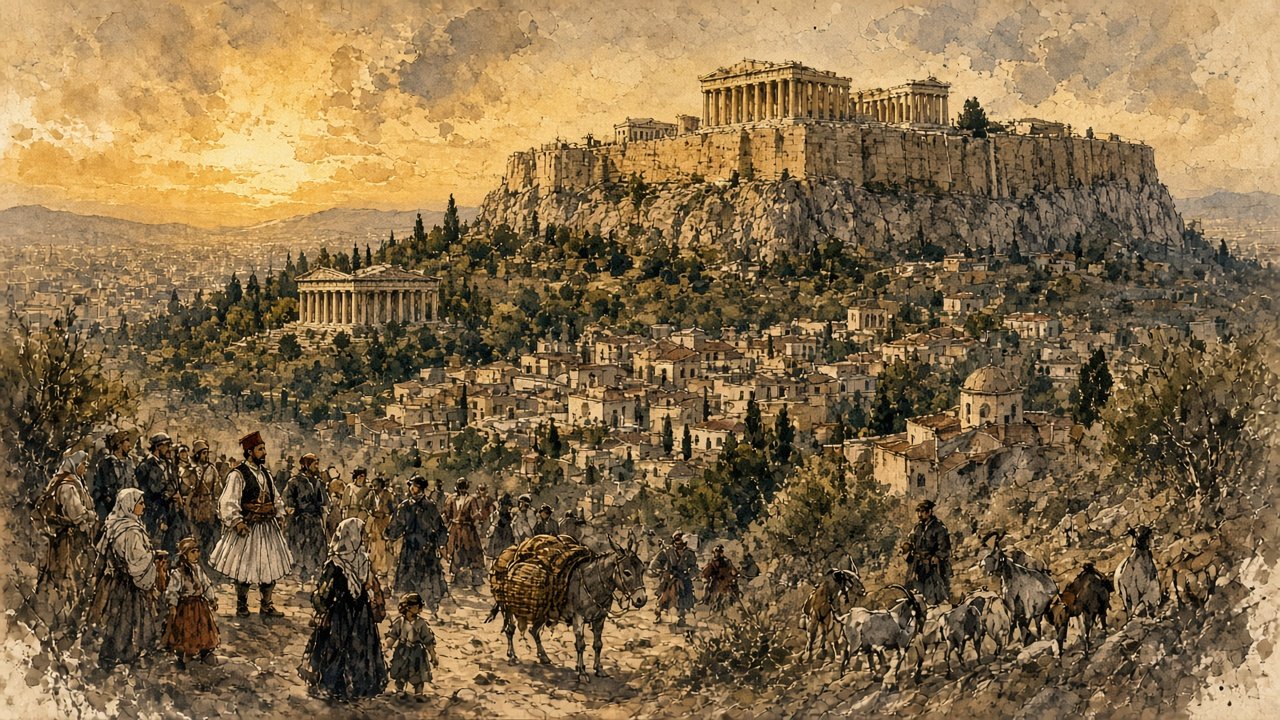
Athens, Ἀθῆναι (Athēnai, Athens) to its ancient citizens and Αθήνα (Athína) today, is known in Hebrew as אתונה (Atuna). For most of the last two and a half thousand years its Jewish population has been small. Alexandria, Antioch, Rome, Salonica and Constantinople all had far larger and more influential communities, and the standard reference works are frank that in ancient Jewish history Athens occupied “a position of secondary importance”.[1] Under the Ottomans there were long stretches when only a handful of Jewish families lived in the town, and the modern community, refounded after Athens became the capital of independent Greece in the 1830s, numbered only a few thousand on the eve of the Second World War.[2][3]
And yet the city sits at the centre of the story this site tells about the Bible and its transmission. An Athenian statesman is the hero of the legend of the Greek Torah; an Athenian synagogue was the setting of one of the most famous scenes in the Acts of the Apostles; the Greek in which Romaniote Jews explained their Hebrew scriptures is the ancestor of the language spoken in Athens today; and the struggle over whether the Old Testament of modern Greeks should come from the Hebrew or from the Septuagint was fought out in the capital’s university, its Holy Synod and its streets. This essay follows the Jewish community of Athens across those centuries, with the Bible kept in view throughout. It draws on the histories published by the Jewish Community of Athens and the Central Board of Jewish Communities in Greece, on the epigraphic and archaeological evidence, and on recent scholarship on the Greek Bible in Jewish hands. A timeline at the end gathers the principal dates.
1. Athens and Jerusalem
The relationship between Athens and Judaea is older than any Jewish community in Athens. Attic pottery, both black-figure and red-figure, has been found in many places in the land of Israel, evidence of the commercial reach of Athens from the sixth century BCE onwards. Coins struck in Judaea under the Persian governors bore the name יהד (Yehud, Judah) on one side and an owl on the other, a deliberate imitation of the Athenian drachma, which was the most widely trusted silver currency of the eastern Mediterranean.[1][2] The owl of Athena thus circulated in the markets of Jerusalem long before any Athenian Jew is recorded.
After Alexander’s conquests the contacts multiplied. A papyrus of 259 BCE recording the sale of a slave girl in Transjordan names among its witnesses a “Heraclitus son of Philip, the Athenian”, an official in the service of Apollonius, the finance minister of Ptolemy II.[1] Second Maccabees, describing the persecution of Antiochus IV Epiphanes, says that the king sent “an Athenian senator” (or, as some translators read the Greek, a man named Geron the Athenian) to compel the Jews to abandon the laws of their ancestors and to rededicate the Temple in Jerusalem to Olympian Zeus.[4] In the memory of the Hasmonean revolt and of Ḥanukkah, then, Athens appears first as the agent of a hostile Hellenism.
The rabbis kept that ambivalence alive in their own way. The introduction to the Midrash on Lamentations contains a cycle of stories that begin with the formula “an Athenian came to Jerusalem”, in which visiting Athenians are outwitted by the children and tradesmen of Jerusalem. The Babylonian Talmud tells how Rabbi Joshua ben Hananiah, at the emperor’s prompting, travelled to Athens and bested its elders in a contest of riddles (Bekhorot 8b).[1] These are not historical reports. They are a culture’s way of measuring itself against the city that stood, in the ancient imagination, for wisdom itself, and of insisting that the wisdom of Torah was not inferior.
The same tension runs through Jewish writing in Greek. Philo of Alexandria speaks of Athens with the respect customary among Greek authors, cites Solon and alludes to the wars between the Athenians and the Spartans, while Josephus refers to Athenian laws and customs repeatedly in his treatise Against Apion.[1] For Greek-speaking Jews Athens was a symbol of the culture they had made their own, and the medium in which they read their scriptures was the Greek of the Athenian tradition, simplified into the common language, the κοινή (koinē, “common” Greek), of the Hellenistic world.
2. Moschos and the first Jews of Attica
The earliest Jew known by name on the soil of Greece was not an Athenian citizen but a slave. In 1952 Greek archaeologists excavating the Amphiareion at Oropos, the healing sanctuary of the hero Amphiaraos on the border between Attica and Boeotia, found a marble stele recording the manumission of a slave called Moschos. The text, published by Markellos Mitsos and discussed by D. M. Lewis in an article memorably titled “The First Greek Jew”, is dated on the basis of its lettering to the first half of the third century BCE.[5][6] Its owner, Phrynidas, promises to free Moschos after a fixed term, and a list of witnesses follows, among them two Athenians. The closing lines record that the stone was set up by Μόσχος Μοσχίωνος Ἰουδαῖος (Moschos Moschiōnos Ioudaios, “Moschos son of Moschion, the Jew”) “having seen a dream” in which the god Amphiaraos and the goddess Hygieia commanded him to write the record on a stele and set it beside the altar.[5][7]
The inscription is precious precisely because it is awkward. Moschos and his father both bear ordinary Greek names, and Moschos evidently slept in a pagan sanctuary in the hope of a healing dream, yet he described himself, in public and on stone, as a Ioudaios. Margaret Williams, who surveyed the use of the word in Greek and Roman inscriptions, treats it as one of the earliest self-identifications of its kind and notes how far Moschos’s conduct lay from what later Jewish piety would require.[8] Brent Nongbri has used the stone to ask what the word meant in the third century BCE at all, whether ethnic origin, religious allegiance or something between the two.[6] For the history of Jews in Attica the point is simpler. Within a generation or two of Alexander, Judaeans were present in the Athenian borderlands, held as slaves, freed, and living among Greeks.
Later inscriptions from Athens itself confirm a settled presence. The corpus of Attic inscriptions includes epitaphs of Samaritans (IG II² 10219 to 10222), of a Jew (IG II² 12609) and of a man described as a Jerusalemite (IG II² 8934).[1] The Samaritan stones are a reminder that the Israelite communities of the Greek world were not all of one kind and that the community of Mount Gerizim had its own diaspora in the Greek cities. None of these Athenian epitaphs is long or eloquent. Together, though, they show families who lived and died in Attica and who wished their origin to be remembered on their graves.
By the first century CE Jews in Attica were numerous enough to be mentioned in a diplomatic letter. Philo reports that Agrippa I, writing to the emperor Gaius Caligula, listed Attica among the lands of the Jewish diaspora (Legatio ad Gaium 281), alongside Thessaly, Boeotia, Macedonia, Aetolia, Argos, Corinth and “most of the best parts of the Peloponnese”.[1][2] That catalogue is the background against which the narrative of Acts places a synagogue in Athens, and against which the archaeological traces discussed below must be read.
3. Hyrcanus, Herod and the Athenian assembly
Athens also entered into formal relations with the Jewish state that emerged from the Maccabean revolt. Josephus preserves the text of a decree of the Athenian people in honour of “Hyrcanus son of Alexander, high priest and ethnarch of the Jews”, who had shown goodwill to the city and received Athenian visitors with kindness. The assembly resolved to crown him with a golden crown, to set up his statue in bronze in the precinct of the Demos and the Graces, and to proclaim the honour at the festivals of the city (Antiquities 14.149 to 155).[9][1]
Josephus attaches the decree to Hyrcanus II, the son of Alexander Jannaeus, but the name of the Athenian archon in the preamble, Agathocles, has led most modern scholars to date it to 106/5 BCE and to attribute it to Hyrcanus I, the son of Simon the Maccabee.[1][2] Either way it is a revealing document. The descendants of the rebels who had fought the Seleucid Hellenisers were, within two or three generations, being honoured in the most Hellenic of all cities in the most conventional of Hellenistic forms, and the ruler of Judaea was content to be one of the many eastern princes whose goodwill Athens cultivated.
Herod the Great continued the connection. In his survey of Herod’s benefactions to cities outside his kingdom, Josephus lists Athens and Sparta among the beneficiaries (Jewish War 1.422 to 425), and documents survive that attest friendly relations between Athens and later members of the Herodian house.[1] For a Jewish client king, gifts to Athens were a way of buying prestige in the Greek world and of presenting himself as a patron of its culture. None of this tells us much about ordinary Jews in the city. It does show that by the turn of the era the leaders of Judaea and the people of Athens knew one another, and that Athens was a place where a Jewish name could be honoured in public.
4. Demetrius of Phalerum and the Greek Torah
The most important Athenian in the history of the Jewish Bible probably never had anything to do with it. The Letter of Aristeas, the Greek narrative that gives the classic account of how the Torah came to be translated into Greek, tells how King Ptolemy II Philadelphus of Egypt was advised by his librarian, Demetrius of Phalerum, that his great library lacked the laws of the Jews. The king sent to the high priest Eleazar in Jerusalem, who dispatched seventy-two learned elders, six from each tribe, with a magnificent copy of the Law; they completed their translation on the island of Pharos in seventy-two days, and the Jewish community of Alexandria received it with acclamation.[10][11]
Demetrius was a real and eminent Athenian. A pupil of Theophrastus in Aristotle’s Lyceum, he governed Athens on behalf of the Macedonian ruler Cassander from 317 to 307 BCE, was driven out by a democratic restoration, and found refuge at the court of Ptolemy I in Egypt, where he is credited with encouraging the collection of books that grew into the Library of Alexandria.[12] The Letter of Aristeas makes him the bridge between the learning of Athens and the Torah of Jerusalem. Modern scholars regard the Letter as a later composition, probably of the second century BCE, written to give the translation a dignified origin, and they note that the role it gives Demetrius under Ptolemy II is very hard to square with what is known of his career; the story is the subject of a separate study on this site, The Septuagint and the Letter of Aristeas, and of the wider history told in The Library of Alexandria.[10][11]
Whatever its historicity, the legend expresses something true about the Septuagint, Οἱ Ἑβδομήκοντα (Hoi Hebdomēkonta, “the Seventy”), as the Greek translation came to be called. It was the Bible of Greek-speaking Jews from Alexandria to the Aegean, and so it was the Bible of whatever Jews lived in Athens in the Hellenistic and Roman periods. Its Pentateuch was made in Egypt in the third century BCE and the other books followed over the next two centuries, by different hands and in different styles.[10] When the Jews of Attica heard the scriptures read in their synagogue, they heard them in this Greek, and when Paul quoted scripture in his letters he usually quoted it in a form close to the Septuagint. The technical history of the text, its recensions and its manuscripts is treated in the reference notes on The Greek Septuagint, The Göttingen Septuagint and The Lucianic Recension of the Greek Bible.
The Athenian frame of the legend mattered to later readers too. For the Greek Church Fathers, and for the modern Orthodox Church of Greece, the Septuagint is not merely an ancient translation but the authoritative Old Testament, read in the liturgy to this day.[13] The story of an Athenian librarian commissioning the Greek Torah therefore became part of a long argument about whether the Greek Old Testament or the Hebrew original should have the last word, an argument that, as section 12 shows, broke out again in nineteenth-century Athens.
5. Paul in the synagogue and on the Areopagus
The only scene set in a synagogue of ancient Athens that survives in any literature is in the seventeenth chapter of the Acts of the Apostles. Paul, escorted south from Beroea, waited in Athens for his companions Silas and Timothy. Acts says that he “was deeply distressed to see that the city was full of idols”, κατείδωλος (kateidōlos, “thick with idols”), and that he “argued in the synagogue with the Jews and the devout persons and also in the marketplace every day with those who happened to be there” (Acts 17:16 to 17).[14] The phrase translated “devout persons”, τοῖς σεβομένοις (tois sebomenois, “those who revere [God]”), is the term Acts uses for Gentiles who attached themselves to the synagogue without becoming Jews, the people often called God-fearers. Athens, in other words, had a synagogue with a fringe of sympathetic Greeks, just as the Jewish communities of Thessalonica, Beroea and Corinth did in the same chapters.[1][2]
The narrative then moves out of the Jewish world. In the Agora Paul met Epicurean and Stoic philosophers, some of whom dismissed him as a σπερμολόγος (spermologos, literally “seed-picker”, a scavenger of other men’s ideas), while others thought he was proclaiming foreign divinities because he spoke of Jesus and the resurrection. They brought him to the Ἄρειος Πάγος (Areios Pagos, “the hill of Ares”), whether to the rocky outcrop below the Acropolis or to the council that bore its name, to explain himself, “for all the Athenians and the foreigners living there would spend their time in nothing but telling or hearing something new” (Acts 17:18 to 21).[14][15]
The speech that follows (Acts 17:22 to 31) is the most Greek passage in the New Testament. Paul begins from an altar he has seen inscribed Ἀγνώστῳ θεῷ (Agnōstō theō, “to an unknown god”) and proclaims that what the Athenians worship as unknown he will make known.[16] He declares that the God who made the world “does not live in shrines made by human hands”, that he made all nations from one ancestor and allotted them their times and boundaries, and that “in him we live and move and have our being”. He then quotes a Greek poet, “for we too are his offspring”, a half-line from the Phaenomena of Aratus, the third-century BCE poet from Cilicia; the first phrase has often been traced to Epimenides of Crete.[15][17] Only at the end does he turn to repentance, judgement and a man raised from the dead, at which some of his hearers scoffed. A few believed, among them “Dionysius the Areopagite and a woman named Damaris” (Acts 17:32 to 34).[14]
For a history of the Jews of Athens the significance of the scene lies partly in what it assumes. The author of Acts takes it for granted that a Jewish visitor to Athens would go first to the synagogue, and the speech itself is built from Jewish materials translated into philosophical idiom. The claim that God does not live in shrines made by human hands repeats, in gentler form, the argument of Stephen’s speech earlier in Acts, which declares that “the Most High does not dwell in houses made with human hands” and quotes Isaiah 66:1 to 2 in its Greek form (Acts 7:48 to 50); the polemic against images of gold, silver and stone belongs to the long tradition of Jewish critique of idolatry that runs from the prophets to the Wisdom of Solomon.[18] Scripture is never quoted by chapter and verse to the Areopagites, but its arguments are everywhere.
Paul’s own letters confirm the visit. Writing to the Thessalonians, he recalls that “we decided to be left alone in Athens” while Timothy was sent back north (1 Thessalonians 3:1 to 2).[19] Acts moves him on to Corinth almost at once, and the church tradition that made Dionysius the first bishop of Athens belongs to later centuries; so does the influential body of mystical theology composed around the year 500 by an anonymous Syrian author under Dionysius’s name.[20] The rock itself, a bare outcrop just north-west of the Acropolis, remains one of the places where the Jewish and Christian pasts of Athens meet most visibly.

6. A menorah in the Agora and the Metroon question
Where was the synagogue in which Paul argued? Acts does not say, and no remains of a first-century synagogue have been identified in Athens. In 1941 the archaeologist William McDonald suggested that it probably lay outside the Agora, since Acts distinguishes Paul’s activity “in the synagogue” from his discussions “in the marketplace”.[21] The physical evidence for Jews in Roman and late antique Athens is in fact modest: a handful of epitaphs with Jewish names or symbols, and a small number of terracotta lamps decorated with menorahs, the earliest of them dated to the fourth century CE.[21]
The most famous object was found in 1933 by the American excavators of the Athenian Agora, a few metres north-east of the Hellenistic Metroon on the west side of the square. It is a fragment of Pentelic marble incised with a seven-branched menorah and a לולב (lulav, “palm branch”), the symbols of the Temple and of the festival of Sukkot.[22][23] In the 1970s Homer A. Thompson, who had directed the Agora excavations, proposed that the fragment had decorated the Metroon itself, whose northernmost room had been rebuilt after the Herulian sack of 267 CE as a hall with an apse, and that this hall had served as a synagogue in late antiquity. He compared its plan with the synagogue built into the bath and gymnasium complex at Sardis.[21] A copy of the plaque is displayed in the Jewish Museum of Greece, which dates the original to about the fifth century CE.[23]
The theory has been widely repeated, including in community histories, which speak of “the ancient synagogue of the Agora” destroyed in the fifth century.[24] It has also been treated cautiously by specialists, and in 2026 Jocelyn Burney reexamined it in Hesperia, the journal of the American School of Classical Studies at Athens. Her conclusion is that the marble fragment may have come from a funerary marker, that the final reconstruction of the Metroon belongs to the early fifth century, that the fragment cannot be connected to the building on stratigraphic grounds, and that “there is no positive evidence that the building was a synagogue”.[22]
The honest position, then, is that late antique Athens had Jews who used the menorah and the lulav as markers of identity, but that their synagogue has not been found. The fragment remains important. It is one of very few objects that connect the Jewish community of Athens directly to the iconography of the Temple and of the festival year, and it belongs to the same visual world as the synagogue mosaics of Aegina and the Jewish inscriptions of Corinth, which are discussed in surveys of ancient Greek Judaism.[21]
7. Aquila, Justinian and the Greek synagogue Bible
By the second century CE the Septuagint had become the Old Testament of the Christian churches, and Jewish readers increasingly preferred new Greek versions that kept closer to the Hebrew text that rabbinic Judaism was standardising. The most important was the translation made around the 130s or 140s CE by Aquila, a proselyte from Sinope in Pontus whom tradition links to the circle of Rabbi Akiva and, more fancifully, to the family of the emperor Hadrian. Aquila’s version is notoriously literal, reproducing Hebrew word order and even the Hebrew particle that marks a definite object.[25] Its revisions of the older Greek are related to the earlier Jewish revisions known from the Greek Minor Prophets scroll of Naḥal Ḥever, described on this site in The Nahal Hever Scroll and the Kaige Recension, and Origen placed it in the third column of his Hexapla, discussed in The Hexapla of Origen.[26]
For centuries Christian writers claimed that Jews had abandoned Greek scripture altogether. The evidence says otherwise. On 8 February 553 the emperor Justinian addressed to his praetorian prefect Areobindas the law known as Novella 146, settling a dispute within Jewish communities over the language of the synagogue reading. Justinian permitted “the Hebrews” to read the sacred books in Greek, Latin or any other language their hearers understood, recommended the Septuagint, but explicitly allowed the use of Aquila’s version as well; at the same time he banned the δευτέρωσις (deuterōsis, “repetition”, probably a name for rabbinic oral tradition).[27] The law shows that Greek-speaking Jews of the empire, which then included Athens, still read scripture in Greek in the sixth century, and that some of them wanted Hebrew alone.
The Cairo Genizah has provided manuscript proof. Among the fragments brought to Cambridge by Solomon Schechter in 1896 to 1897 are palimpsests[28] in which leaves of Aquila’s translation, written in a Greek hand of about the sixth century, were later scraped and reused for Hebrew liturgical poetry by Yannai; one preserves Aquila’s version of 1 Kings 21:7 to 17, and F. C. Burkitt published the Kings fragments in 1897.[29][30] Later Genizah finds include biblical glossaries and translations in Greek written in Hebrew letters, which allowed scholars to trace a continuous Jewish tradition of Greek Bible translation into the Middle Ages.[31]
Between 2006 and 2009 a project at the University of Cambridge directed by Nicholas de Lange, Greek Bible in Byzantine Judaism, gathered this evidence into a corpus, aiming to document “the use of Greek Bible translations by Jews in the Middle Ages”.[32] One of its witnesses is a Romaniote prayer book now in the Bodleian Library in Oxford (MS. Opp. Add. 8° 19), a small parchment volume in Byzantine Hebrew script dated tentatively to the fourteenth century, which contains on folios 220 to 227 the Book of Jonah in Greek; it was edited by D. C. Hesseling in 1901 and discussed by de Lange in 1995.[33] Jonah is the prophetic reading for the afternoon of the Day of Atonement, which helps to explain why a Greek Jonah should sit inside a book of prayers. No such manuscript can be tied to Athens. But it was in this Greek-speaking Jewish world, stretching from Constantinople to Crete and Corfu, that any medieval Athenian Jews would have lived and read.
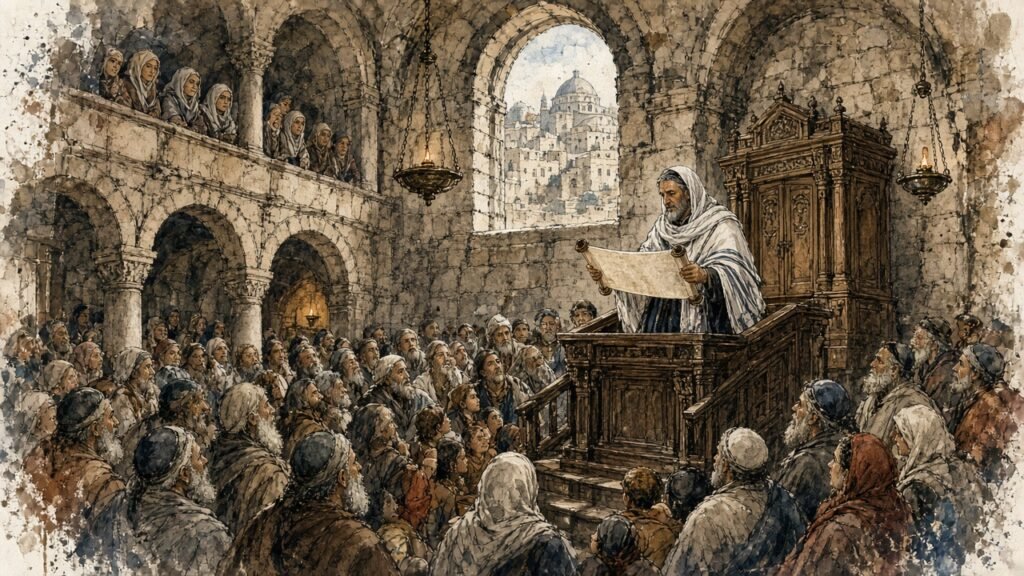
8. Byzantine silence and the Romaniote rite
For the Byzantine centuries the Jewish history of Athens is largely a blank. The community’s own history states plainly that “historical sources seem to be silent”.[3] When Benjamin of Tudela travelled through Greece in the 1160s he went from Corfu to Arta, Patras, Lepanto and Crissa, then to Corinth, where he found about three hundred Jews, and on to “the great city of Thebes, where there are about 2,000 Jews”, whom he called “the most skilled artificers in silk and purple cloth throughout Greece”, before continuing to Egripo, the Chalkis of Euboea.[34] He did not visit Athens or mention a community there. The contrast with Thebes, a few days’ journey away, is a fair measure of how marginal the old city had become; Benjamin’s journey is the subject of Benjamin of Tudela and the Book of Travels.
The Jews of the Byzantine Greek world were the people now called Romaniotes, Ρωμανιώτες (Romaniótes), from Ῥωμανία (Rhōmania), the empire’s own name for itself. Elisabeth Hollender and Jannis Niehoff-Panagiotis define them as the Greek-speaking communities of the former Byzantine lands, characterised by “their active use of Greek, which they speak and also write, usually in Hebrew characters, and their adherence to a specific liturgical rite”, the מנהג רומניא (minhag Romanya, “the custom of Romania”).[35] Their prayer book, the Maḥzor Romania, contained Hebrew piyyutim of Byzantine composition alongside a small number of hymns and dirges in Judaeo-Greek, and the Greek renderings of scripture discussed above belong to the same culture of reading Hebrew and understanding it in Greek.[35] The site’s reference note Romaniote Jews describes the community as a whole.
After the Fourth Crusade of 1204, when Athens became the seat of a Frankish duchy, the Byzantine world broke into Latin, Greek and later Ottoman states, and Hollender and Niehoff-Panagiotis trace how Italian and then Sephardi immigration gradually displaced the Romaniote rite in most major centres. By the Ottoman period the Romaniote heartland had shrunk to western Greece and Euboea, with Ioannina as its principal centre and smaller communities at Arta, Patras, Larissa, Volos, Chalkis and Corfu.[35] That geography matters for Athens, because when a Jewish community was finally rebuilt there in the late nineteenth century, it was Romaniote Jews from Ioannina who built its first synagogue. The wider story of the Latin conquest is told in The Fourth Crusade and the Sack of Constantinople.
9. The Constantinople Pentateuch of 1547
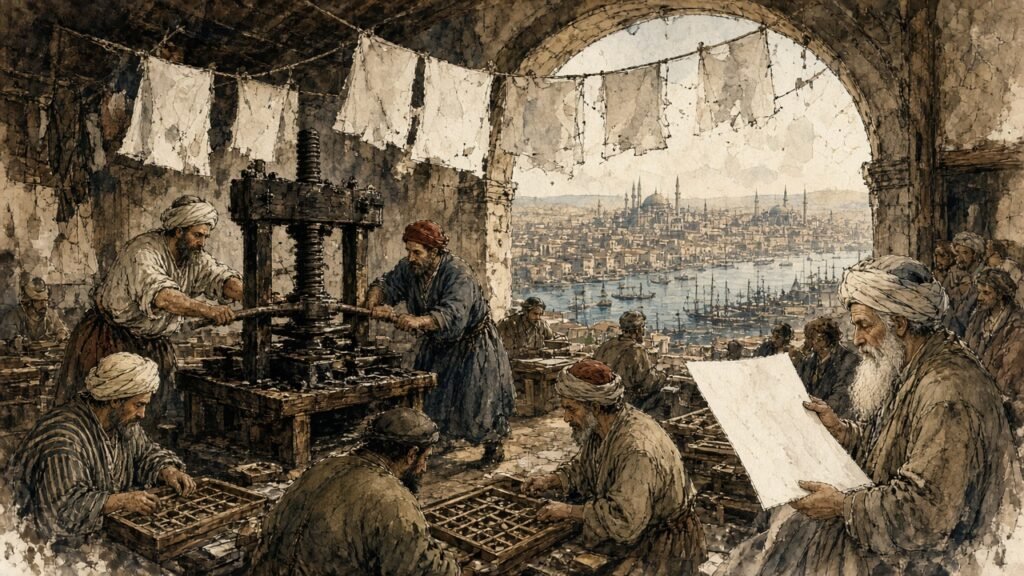
The most remarkable monument of Romaniote Bible culture was printed not in Greece but in the Ottoman capital. In 1547 Eliezer (Albert) Soncino, a member of the famous family of Jewish printers whose history is told in The Soncino Dynasty, published in Constantinople a polyglot Pentateuch with the Hebrew text in the centre, Targum Onkelos and Rashi’s commentary, and two vernacular translations, one in Judaeo-Spanish and one in Greek, both printed in Hebrew characters.[31] A year earlier he had issued a companion polyglot with the Arabic translation of Saadia Gaon and a Judaeo-Persian version by Jacob ben Joseph Tavus.[36] The two books together amount to a portrait of the Jewish languages of the Ottoman capital in the generation after the Iberian expulsions.
The Greek column is the first printed Greek translation of the Pentateuch made by and for Jews, and it is written in the vernacular Greek of its day rather than in the language of the Septuagint. When the Dutch Hellenist D. C. Hesseling transcribed it into Greek letters and published it in Leiden in 1897, he described it as a translation entirely independent of the Septuagint.[31][37] Later scholars have qualified that judgement. In 1924 D. S. Blondheim argued that the Greek of the 1547 Pentateuch was a late link in a chain of Jewish Bible translation reaching back to antiquity; Natalio Fernández Marcos found its agreements with the Septuagint in vocabulary and construction “striking”; and John Wevers cited it in the second apparatus of the Göttingen edition of Exodus because a marginal hand in the Codex Ambrosianus, a Greek manuscript of the Pentateuch, often offers similar renderings.[31]
Julia Krivoruchko, reviewing the state of research in 2007, describes the Greek as a לעז (laʿaz, “vernacular rendering”), a popular word-for-word translation that circulated mainly orally in the schoolroom and the synagogue, which explains both its literalism and the didactic layout of the page. She estimates that of a print run of several hundred copies fewer than a dozen complete or nearly complete exemplars survive, and suggests that the great fire of 1569 in the Jewish quarter of Constantinople may account for their rarity.[31] The Judaeo-Spanish column belongs to the same tradition as The Ferrara Bible of 1553 and is discussed in the note on Ladino (Judezmo), Judeo-Spanish and the Sephardi Bible; the companion post on the Jews of Istanbul (Kushta on the Golden Horn) treats the city in which the book was made.
For Athens the 1547 Pentateuch is significant as the clearest surviving evidence of how a Greek-speaking Jew of the sixteenth century would have heard the Torah explained. The Hebrew was chanted from the scroll; the Greek, in the language of the street, was the bridge to understanding. That pattern, Hebrew text and Greek meaning, is the thread that links Moschos, the synagogue of Acts, Aquila, the Romaniote prayer book and the Ioannina Jews who would build the first modern synagogue of Athens.
| Version | Date and place | Character | Evidence and later use |
|---|---|---|---|
| Septuagint | Third to first centuries BCE, Alexandria and elsewhere | Koine Greek translation, Pentateuch first | Bible of Hellenistic Jews and of Paul; Old Testament of the Orthodox Church |
| Kaige and related revisions | First century BCE to first century CE | Jewish revisions towards the Hebrew | Naḥal Ḥever Minor Prophets scroll |
| Aquila | About 130 to 140 CE | Extremely literal, close to the rabbinic Hebrew text | Permitted by Justinian in 553; Genizah palimpsests of the sixth century |
| Medieval Judaeo-Greek versions | Byzantine world, tenth to fifteenth centuries | Greek in Hebrew letters, glossaries and running translations | Genizah fragments; Romaniote Jonah in Oxford |
| Constantinople Pentateuch | 1547, Constantinople | Vernacular Greek laʿaz in Hebrew letters beside Ladino, Onkelos and Rashi | Transcribed by Hesseling in 1897; cited in the Göttingen Exodus |
10. An Ottoman town without a Jewish quarter
Athens surrendered to the Ottoman army in 1456, three years after the fall of Constantinople, and for nearly four centuries it was a provincial town of the empire. Its Jewish history in this period is thin, and it begins, according to the histories of both the Jewish Community of Athens and the Central Board of Jewish Communities in Greece, with an exclusion. After the conquest Sultan Mehmed II is said to have granted the inhabitants of Athens the right to forbid Jews from settling in the city.[2][3] The privilege is reported rather than documented in these accounts, and it should be read as a community tradition about why Athens, unlike Salonica, Constantinople or Smyrna, never became an Ottoman Jewish centre.
The exclusion was not absolute. The same histories record that some refugees from Spain and their descendants found asylum in Athens after 1492, and that a French traveller in 1705 met fifteen to twenty Jewish families there.[2][3] These were tiny numbers in a Jewish world that was being transformed. The Iberian exiles who reached the Ottoman Empire made Salonica a city with a Jewish majority, a story told in detail in From Sefarad to Salonica, and they transformed the communities of Constantinople and Smyrna, which are the subjects of the companion posts on the Jews of Istanbul (Kushta on the Golden Horn) and the Jews of Izmir (The Presses and Prophets of Smyrna). Others found refuge further west, in Morocco, where the old Jewish quarter of Fez received exiles from Castile and Andalusia; the companion post on the Jews of Fez (Grammarians of the Fez Mellah) follows that branch of the dispersion. The site’s note on Sephardim in the Ottoman Empire gives the general framework.
Ottoman Athens, by contrast, was a modest garrison and market town clustered below the Acropolis. In the Sephardi age of Ottoman Jewry the Romaniote and Sephardi communities of Greece lay to the north and west, at Salonica, Ioannina, Arta, Larissa, Volos and Chalkis, and on the islands. Whatever Jewish families lived in Athens in the eighteenth century did not survive the Greek War of Independence. The Central Board’s history lists the community of Athens among those destroyed during the revolution of 1821 to 1829.[2][3]
There is a further irony here for the history of the Bible. In the very decades when Athens had almost no Jews, the Greek Pentateuch printed by Eliezer Soncino in Constantinople was being read in the Romaniote communities that survived elsewhere, and the Sephardi presses of Salonica and Constantinople were supplying Hebrew Bibles to the whole Ottoman Jewish world. Athens took no part in that culture of print. When it re-entered Jewish history, it would be as a modern European capital.
11. Bavarians, bankers and the Don Pacifico affair
Athens became the capital of the new Kingdom of Greece in 1834, under the young Bavarian prince Otto who had been placed on the throne by the Great Powers. With the court came a small number of Jewish families from the German lands. The Central Board’s history names among them a member of the Rothschild banking family who is described as part of King Otto’s entourage, and it records that the Duchess of Placentia, who had settled in Athens in 1831 and who is said to have developed through Bible study a deep sympathy for Judaism, acquired a large plot of land in 1843 for the building of a synagogue.[2] The donation was never realised; in 1852, the same source says, the municipal authority renounced it.[2]
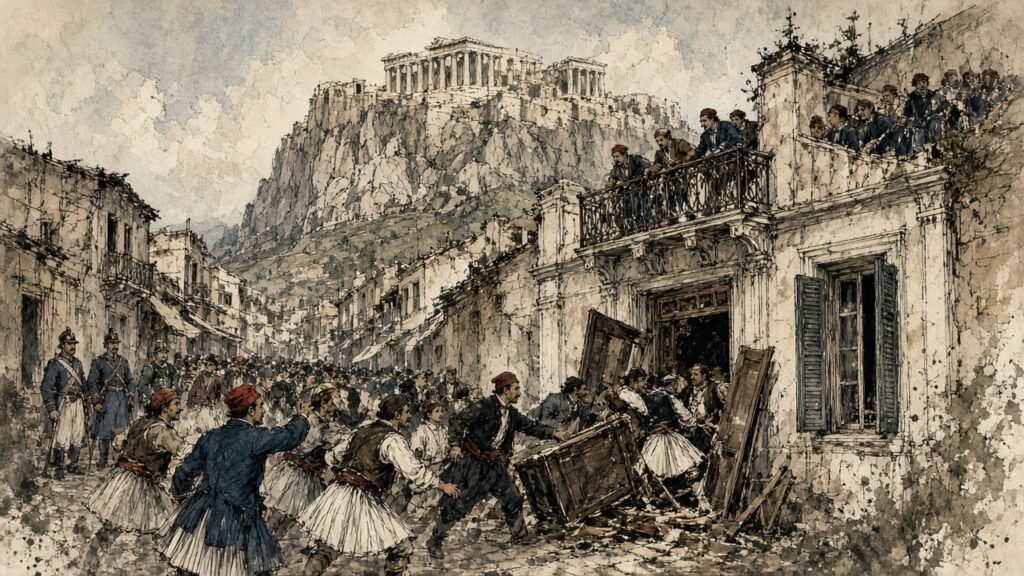
The best-known episode of these years shows how fragile the position of Jews in the new capital was. It had long been an Easter custom in Athens to burn an effigy of Judas Iscariot. In 1847, during a visit to Athens by a member of the Rothschild family, the authorities banned the burning so as not to offend him. At Easter a mob attacked instead the house of David Pacifico, a Jewish merchant born in Gibraltar in 1784 and therefore a British subject, who had served as Portuguese consul in Athens; his house was sacked and his possessions destroyed while, as Pacifico claimed, the police looked on.[38][39][2] Pacifico demanded compensation from the Greek government, putting his losses at a sum which the Jewish Encyclopedia gives as £26,618.[38]
When Athens refused to pay, the British foreign secretary, Lord Palmerston, took up the claim together with others against Greece, and in January 1850 a Royal Navy squadron blockaded the Piraeus.[39][40] The affair became a crisis of British politics. In June 1850 the House of Lords censured the government, and in the Commons Palmerston defended himself in a long speech which ended with the claim that, as the Roman of old could say Civis Romanus sum (“I am a Roman citizen”), “so also a British subject, in whatever land he may be, shall feel confident that the watchful eye and the strong arm of England, will protect him against injustice and wrong”. The government survived by forty-six votes.[40] Pacifico eventually received a fraction of what he had claimed and moved to London.[39]
The Don Pacifico affair is remembered in British history as the high-water mark of gunboat diplomacy, and in Greek history as a humiliation. For the Jews of Athens its lesson was different. The few Jewish families in the city depended on the goodwill of the authorities and on the protection of foreign consuls, and a popular religious custom that cast the Jews as the betrayers of Christ could turn, in a moment, into violence against a neighbour’s house. Within a generation, however, a permanent community would take root.
12. Neophytos Vamvas and the Hebrew Bible in modern Greek
At the same time as the Pacifico affair, Athens was the scene of a quieter controversy that bears directly on the history of the Bible. The British and Foreign Bible Society had set out to provide scripture in the spoken languages of every nation. In the 1810s and 1820s it reprinted an old modern Greek New Testament and commissioned a new Greek translation from Hilarion, archimandrite of Sinai, but rejected his work, in part because his Old Testament followed the Septuagint rather than the Hebrew original. Mikhail Seleznev, who has studied the episode, judges that this rejection “made almost all Greek Orthodox clergy opponents of the Bible Society”.[13]
The Society’s next translator was Neophytos Vamvas (1770 to 1856), Νεόφυτος Βάμβας (Neóphytos Vámvas), an Orthodox archimandrite and professor of philosophy, later dean, at the new University of Athens. Unusually among Greek clerics, he accepted the Society’s view that the Masoretic Hebrew text, not the Septuagint, was the proper basis for an Old Testament. Between 1831 and 1851 he published a Psalter translated from the Masoretic text (1831), the Gospels and Acts (1838), the Old Testament books of the Hebrew canon (1840), the New Testament (1844) and finally the whole Bible, in the learned register known as καθαρεύουσα (katharévousa, “purifying” Greek).[13] The Old Testament of Vamvas was, in effect, a Greek version of the Hebrew Bible that the Jews of Athens read in their synagogues, made by a Christian scholar in their city.
It was condemned at once. The Holy Synod of the Church of Greece disapproved of the work in letters and declarations between 1834 and 1836; the Ecumenical Patriarchate issued an encyclical in 1836 condemning vernacular translations of the Bible; and the theologian Constantinos Oikonomos wrote a four-volume defence of the Septuagint against its critics.[13] The dispute was not about Judaism, but it turned on the question that had divided Jews and Christians since Aquila’s day: whether the Greek Old Testament of the Church or the Hebrew text preserved by the synagogue had the better claim to be scripture. Vamvas’s Bible survived, republished by the Bible Societies and used above all by the small Greek Protestant community.[13]
The language question returned with violence at the end of the century. In 1901 Queen Olga, the Russian-born queen of Greece, published a modern Greek version of the Gospels that she had commissioned; in the same year the newspaper Ακρόπολις (Akrópolis) serialised a translation of Matthew into the spoken language, δημοτική (dimotikí, “popular” Greek), by Alexandros Pallis, a translator of Homer. The Patriarchate and the theological faculty of the University of Athens protested, students attacked newspaper offices, and in November 1901 crowds clashed with troops in central Athens. Eight people died, the metropolitan of Athens resigned, the prime minister fell, and the Holy Synod banned the sale and reading of translations of the Gospels on pain of excommunication. The episode is remembered as the Ευαγγελικά (Evangeliká, “the Gospel affair”).[41][42]
A century later the picture has changed. In 1997 the Hellenic Bible Society published a complete Bible in modern spoken Greek, generally called Today’s Greek Version, whose Old Testament follows the Masoretic text for the books of the Hebrew canon and the Septuagint for the deuterocanonical books; it was prepared by a team of Greek biblical scholars that included Miltiadis Konstantinou and Ioannis Karavidopoulos.[13][43] The Orthodox edition carries a letter of approval stating that it may be used for study but “cannot replace in the liturgical and general use in our Holy Orthodox Church the translation of the Seventy”.[13] The Church’s own publishing house, Apostoliki Diakonia, publishes the Septuagint itself, but not a modern Greek translation of it.[44]
Greek scholarship on the Septuagint has meanwhile moved towards translating the Church’s Old Testament into the modern language. The Hellenic Bible Society, based in Athens, describes its translation of the Septuagint into modern Greek as the first such project undertaken by any member of the United Bible Societies, and it organised an international symposium in Athens in November 2001 on “the translation of the Septuagint in Biblical Studies and in the church”, under the aegis of the Holy Synod.[45] Myrto Theocharous, a Cambridge-trained Septuagint scholar who teaches at the Greek Bible College, has written about the project under the title “The Septuagint and Its Long Awaited Descendant”.[46] Konstantinou has written on the long entanglement between Bible translation and Greek national identity.[47] In Athens today, then, the Septuagint is studied as a living liturgical text, the Hebrew Bible is translated as the original, and the arguments that once divided the Hellenistic synagogue from the church are conducted in seminars rather than in the streets.
13. Ioannina comes to Melidoni Street
The modern Jewish community of Athens grew slowly. The two community histories differ slightly in their figures, but both record a community of a few dozen people in the late 1870s, growing to about 250 within a decade, and official recognition by the Greek state in 1889.[2][3] The Central Board’s history names Charles Rothschild as president in 1890, when three small synagogues were in use.[2] Many of the early members were Ashkenazi merchants; others were Romaniotes from Ioannina and Sephardim from the Ottoman ports.
The most important newcomers were the Jews of Ioannina, who brought the Romaniote rite to the capital. In 1904 they built the first purpose-built synagogue of modern Athens at 8 Melidoni Street in Thiseio, a short walk from the ancient Agora. Known as עץ חיים (ʿEts Ḥayyim, “Tree of Life”), a name commonly given to Romaniote synagogues, and also as the Γιαννιώτικη (Gianniótiki, “the Ioannina synagogue”), it occupied the upper floor of a neoclassical building whose ground floor housed the Talmud Torah school and part of the rabbi’s residence; the first מקוה (mikve, ritual bath) in Athens was in its courtyard.[48] Inside, the arrangement is traditionally Romaniote: the reading platform stands against the western wall and the ark against the eastern wall, and the Torah scrolls are kept in wooden cases, תיק (tik, “case”), in the Eastern manner.[48]
The Jews of Athens lived mainly in Thiseio and Petralona, neighbourhoods that, the community’s history stresses, “never had the character of a ghetto”, and most were merchants with shops in Monastiraki. One family from Smyrna, the Yusurums, opened the first antiques shop in the area, and their name became the general word for antiques markets in Greece.[3] After the Balkan Wars of 1912 to 1913, and especially after the great fire of Salonica in 1917, Sephardi Jews from Salonica and from Asia Minor moved to the capital, and the upheavals that followed the Greek defeat in Asia Minor in 1922 brought Jewish refugees from Smyrna and elsewhere.[3][2][24] In the census of 1928 the Jews of Athens numbered 1,578, according to the community, the majority of them Romaniotes.[49]
The Sephardi newcomers built a second synagogue across the street. Beth Shalom, בית שלום (Beit Shalom, “House of Peace”), at 5 Melidoni Street, was built in 1935 by the Sephardi community on the site where refugees from Asia Minor had held services, though its interior was not finished before the war.[24] On the eve of the Second World War the Jewish population of Athens was about 3,000 by the community’s estimate, or 3,500 by the figure the United States Holocaust Memorial Museum gives for 1940; the most prosperous were Ashkenazim, while many Sephardim from northern Greece and Turkey worked as pedlars, second-hand dealers and small shopkeepers.[2][50] Interviewed in 2019, a community official recalled that even in later decades most of the cantors were Romaniotes and the prayers were chanted with the Romaniote accent, although the rabbis were Sephardim.[49]
14. Occupation and rescue, 1941 to 1943
German troops entered Athens on 27 April 1941. Greece was divided between German, Italian and Bulgarian zones of occupation, and Athens fell within the Italian zone, although the Germans kept a strong presence in the capital and at once claimed control of Jewish affairs.[51] In May 1941 they confiscated the community’s archives and its rabbinical library and arrested leading members of the community council.[2][3] On 1 September 1941 the Italian authorities appointed the chief rabbi, Elias Barzilai, as president of the community, ignoring the Germans’ earlier appointment, and Barzilai, in the words of the Central Board’s history, exploited the rivalry between the two allies to protect his people.[2]
Pressure grew through 1942. On 14 July 1942 members of the Greek National Socialist organisation ESPO broke into and wrecked the community’s offices; when the resistance bombed the ESPO headquarters in September, the Germans blamed the Jews and forced the Italians to arrest the community’s leaders, who were released after twenty days.[2] Meanwhile Jews from Salonica, under German rule, began to slip south into the Italian zone, and after the deportations from Salonica began in March 1943 their numbers grew. The community later estimated that between four and five thousand Jewish refugees reached Athens, bringing its Jewish population to around eight thousand.[49] Solidarity committees and communal kitchens were organised for them.[2]
The deportations from Salonica provoked a public protest from the head of the Greek Church, an act that the United States Holocaust Memorial Museum contrasts with the silence of many church leaders elsewhere in Europe.[50] On 23 March 1943 Archbishop Damaskinos of Athens and All Greece sent a memorandum to the collaborationist prime minister, Konstantinos Logothetopoulos, asking him to intervene with the German authorities to stop the persecution of Greek Jews, and on 24 March a second memorandum to the German plenipotentiary for Greece, Altenburg. Both were co-signed by leading figures of Greek public life.[2] The United States Holocaust Memorial Museum notes that the text was drafted by the poet Angelos Sikelianos and that it invoked the words of Paul to the Galatians, that in Christ “there is neither Jew nor Greek” (Galatians 3:28).[50][52] It is a striking reversal of the Areopagus scene: the Greek Church of Athens quoting the apostle, himself a Jew, in defence of the Jews of Greece.
Words were followed by documents. The Athens police chief, Angelos Evert, ordered the issue of false identity cards with Christian names to Jews who asked for them, and because the cards came from the police themselves they passed German inspection.[2][53] Damaskinos instructed clergy to help the persecuted and arranged, with Panos Chaldezos of the Athens municipality, for baptismal and civil records that allowed Jews to pass as Orthodox Christians; the Central Board’s history records that 560 Athenian Jews, as well as refugees from other cities, survived the war in this way.[2][53] In 1969 Yad Vashem recognised both Damaskinos and Evert as חסידי אומות העולם (Ḥasidei Umot ha-ʿOlam, “Righteous Among the Nations”).[54]
The decisive moment came after Italy’s armistice in September 1943, when German forces took over the Italian zone. On 21 September, according to the Central Board, Barzilai was summoned by the SS officer Dieter Wisliceny, newly arrived from Salonica, and ordered to deliver within twenty-four hours a list of all the Jews of Athens, including the refugees. Barzilai told him that the community’s records had been destroyed in the ESPO raid; that night community officials burned what records remained, the leaders went into hiding, and Barzilai himself was taken with the help of the resistance to the mountains.[2][51] By 25 September, the Central Board writes, most of the Jews of Athens had disappeared from view. When the SS police commander for Greece, Jürgen Stroop, ordered all Jews to register at the synagogue, about 1,200 complied at first and about 2,000 within a month; they came disproportionately from the poor, who lacked the means to stay hidden.[2][51]

15. Passover 1944
The registered Jews remained within reach of the authorities. On 24 March 1944, the date given by Yad Vashem, two weeks before Passover, a rumour that the authorities would distribute מצה (matsa, unleavened bread) drew a large number of them there; the Germans sealed the building and arrested some 350 people, mostly men, and then brought their wives and children from their homes, so that about 800 were held.[55][2][56] The United States Holocaust Memorial Museum gives a higher figure of 1,690 Jews rounded up in Athens at this time, many of them refugees from Salonica.[50]
The prisoners were kept in the synagogue without food or water until Saturday evening, the Central Board records, and were then taken in closed trucks to the camp at Χαϊδάρι (Chaïdári), west of the city, where they were beaten and abused. The Spanish ambassador protested in vain on behalf of Spanish nationals.[2] On Sunday 2 April the prisoners were taken to the Rouf railway station and put on a train of thirty cars, which collected Jews arrested in Ioannina, Arta, Preveza, Patras, Volos, Trikala and other towns along the way. By the time it passed through Salonica, according to the Central Board, it held about 5,200 people in 84 cars.[2] It reached Auschwitz-Birkenau on 10 or 11 April; Yad Vashem gives 11 April for the arrival of the nine-year-old Eric Angel and his mother, who had been arrested in Athens in March and were separated on arrival.[55] A small number of Jews with Spanish citizenship were sent instead to Bergen-Belsen and eventually released to Spain.[2]
The proportion of Athenian Jews who survived was nevertheless far higher than in Salonica, where almost the entire community was deported in 1943. The United States Holocaust Memorial Museum attributes the rescue of about two thirds of the Jews of Athens to the Italian occupation, the warning given by Barzilai, the connections of the community with the resistance, and the stand of Damaskinos and Evert.[50] Others have stressed that the Jews of Athens spoke Greek as their mother tongue and could disappear into a large city more easily than the Ladino-speaking Jews of Salonica.[49] For Greece as a whole the toll was terrible: at least eighty-one per cent of Greek Jews, between sixty and seventy thousand people, were murdered.[50] The fate of the Salonica community is told in From Sefarad to Salonica.
16. Beth Shalom, Etz Hayyim and the community since 1945
After liberation Athens became the centre of Greek Jewish life. Survivors returning from the camps and Jews from destroyed provincial communities gathered in the capital, and its Jewish population rose to about 5,000, or 4,940 by the figure the United States Holocaust Memorial Museum gives, before emigration reduced it to about 3,000.[2][50] The American Jewish Joint Distribution Committee provided aid; a clinic, ORT vocational centres and hostels for orphaned girls were established; and in 1945 the Central Board of Jewish Communities in Greece was set up by law to rebuild Jewish institutions throughout the country.[2]
The two synagogues of Melidoni Street served the survivors in different ways. The Romaniote Etz Hayyim sheltered homeless survivors of the camps after the war, while its ground floor housed the community’s polyclinic, and in 1953 it gave refuge to Jews from Zakynthos made homeless by the Ionian earthquake; a full renovation was completed in 2007, and it is now used on the High Holidays and special occasions.[48] Beth Shalom, its interior finally completed in 1951 and fully renovated in 1975 to designs by the architect Iosif Koen, became the community’s main active synagogue.[24] The arrangement of a Sephardi synagogue in daily use facing a Romaniote one opened for festivals sums up the composition of the community, in which the old Greek-speaking rite and the Sephardi tradition of Salonica and Smyrna have come together.
In May 2010 Athens, which had been, as The Guardian noted, the last capital of the European Union without a Holocaust memorial, unveiled one in a small park in Thiseio near the synagogues, overlooking the ancient cemetery of the Kerameikos. Designed by the Greek American artist DeAnna Maganias, it takes the form of a Star of David broken into pieces: six triangular blocks of marble are scattered around a central hexagon, each pointing towards the places where Greek Jewish communities once lived, and the whole is set in a garden of aromatic herbs, with a text by Elie Wiesel.[56][57] In 2016 a monument to the Greek Righteous Among the Nations, in the form of a book whose pages carry their names, was placed on the railings of the forecourt of Beth Shalom.[2]
Today the Jewish Community of Athens is the largest in Greece. Its own website speaks of about 1,200 families, while the Central Board’s history gives a figure of 2,500 people.[3][2] The community maintains the two synagogues, a Jewish primary school in Psychiko, a community centre near the university, the Restion care home in Vari and a cemetery in Nikaia, and Athens is also the seat of the Central Board and of the Jewish Museum of Greece.[3]

17. The Jewish Museum of Greece
The Jewish Museum of Greece began in 1977 in a small room in the Beth Shalom synagogue, with objects and documents salvaged from the war. To this first collection were added religious objects, documents and personal belongings confiscated from the Jews of eastern Macedonia and Thrace during the Bulgarian occupation, and between 1977 and 1982 its first director, the artist and historian Nikos Stavroulakis, who led the museum until 1993, gathered material from Jewish communities throughout Greece.[58] The collection moved to rented premises at 36 Amalia Street in 1985, and in 1989 the museum became a legal entity. It then bought and restored a late nineteenth-century neoclassical building at 39 Nikis Street, which was inaugurated on 10 March 1998.[58]
The museum holds more than 10,000 objects, the oldest of them manuscripts, textiles and tombstones of the sixteenth and seventeenth centuries, arranged to cover the cycle of life, the festivals and the history of both Romaniote and Sephardi Greek Jewry. Its basement contains the interior of the synagogue of Patras, with its wooden ark of about 1920, and its Judaica include Torah cases from Corfu and silver ornaments from Rhodes and Ioannina.[59] A copy of the menorah plaque from the Agora is among its exhibits, a reminder of the ancient community discussed earlier in this essay.[23]
Stavroulakis’s later work explains a name that sometimes causes confusion. The Etz Hayyim of Melidoni Street in Athens shares its Romaniote name with a much older synagogue at Chania in Crete, a Venetian church acquired by the Jewish community after the Ottoman conquest of the island in 1669. After the deportation of the Jews of Crete in 1944 that building fell into ruin, and Stavroulakis led its restoration with the World Monuments Fund; it was rededicated on 10 October 1999.[60] It suffered two arson attacks in January 2010, the same winter in which Athens was preparing to unveil its Holocaust memorial.[61][57]
18. Athens on the map of Greek Bible scholarship
Many of the city notes on this site end by placing a community on the map of Masoretic scholarship, measuring it by its scribes, its codices and its presses. By that measure Athens hardly appears. It produced no great codex, no Hebrew press of note and no school of grammarians. Its contribution to the history of the Bible is of another kind, and it is best seen through the Greek Bible rather than the Hebrew one.
Athens supplied the setting of the founding legend of the Septuagint, in which an Athenian librarian brings the Torah into the Greek library. It supplied the setting of the most famous encounter between the Jewish scriptures and Greek philosophy, in the synagogue and on the Areopagus of Acts 17. It belonged, if only faintly, to the Greek-speaking Jewish world that read Aquila in the age of Justinian and explained the Torah in Greek in the Romaniote synagogue, the world documented by the Cairo Genizah and by the Greek Pentateuch of 1547. In the nineteenth and twentieth centuries it was the place where Greek Orthodox Christians argued, sometimes violently, over whether their Old Testament should be the Septuagint or a Greek version of the Hebrew Bible of the synagogue, and where, today, scholars and Bible societies work on modern Greek translations of both.[13][45]
That makes Athens a natural companion to the cities where Greek and Hebrew met in the book trade and the schoolroom. Constantinople printed the Greek Pentateuch, and its Jewish history is told in the companion post on the Jews of Istanbul (Kushta on the Golden Horn); Smyrna was home to the Yusurums and to one of the great Sephardi communities of the Aegean, the subject of the companion post on the Jews of Izmir (The Presses and Prophets of Smyrna); and Fez, at the other end of the Sephardi Mediterranean, shows how the same exiles who reached Salonica rebuilt Bible scholarship in Morocco (Grammarians of the Fez Mellah). Cambridge, where the Genizah fragments of Aquila and the Greek Bible in Byzantine Judaism project are kept and studied, has its own entry on the scholarship map. For the textual background see the reference notes Hebrew & Greek Bibles and How the Greek Bible Was Copied and Kept.
The Jews of Athens were always few, and for long periods almost absent. Yet the city’s Jewish history begins with a freed slave who called himself a Ioudaios in Greek, passes through a synagogue where a Jewish apostle quoted a Greek poet, and arrives at two synagogues on Melidoni Street where the Torah is read in Hebrew and explained in the Greek of modern Athens. Hebrew text and Greek meaning, held together across twenty-three centuries, is as good a summary as any of what Athens has meant for the Bible.
19. Timeline
A manumission stele at the Amphiareion of Oropos, on the border of Attica, names Moschos son of Moschion, “the Jew”, the earliest Jew known by name in Greece.
The Pentateuch is translated into Greek in Alexandria. The Letter of Aristeas later credits the Athenian statesman Demetrius of Phalerum with the idea.
According to 2 Maccabees, Antiochus IV sends an Athenian to compel the Jews to abandon their laws and to rededicate the Temple to Olympian Zeus.
The Athenian assembly votes a golden crown and a bronze statue to the Hasmonean high priest Hyrcanus, in a decree preserved by Josephus.
Agrippa I lists Attica among the lands of the Jewish diaspora in a letter to Caligula quoted by Philo.
Paul argues in the synagogue and the Agora and speaks on the Areopagus (Acts 17).
Justinian permits synagogue readings in Greek and allows the use of Aquila’s translation alongside the Septuagint.
The traveller visits Corinth, Thebes and Chalkis but records no community at Athens.
Athens surrenders to the Ottomans. Community tradition holds that Mehmed II allowed its inhabitants to exclude Jews.
Eliezer Soncino prints the Torah with Onkelos, Rashi and translations in Judaeo-Spanish and vernacular Greek in Hebrew letters.
A French traveller finds fifteen to twenty Jewish families in Athens.
Athens becomes the capital of the Kingdom of Greece under King Otto, and a small Jewish community forms.
Neophytos Vamvas publishes the books of the Hebrew canon in Greek, translated from the Masoretic text; the full Bible follows in 1850 to 1851.
A mob sacks David Pacifico’s house at Easter 1847; Britain blockades the Piraeus in 1850.
The Greek state recognises the Jewish Community of Athens.
Riots in Athens over translations of the Gospels into modern Greek leave eight dead.
Jews from Ioannina build the Romaniote synagogue at 8 Melidoni Street.
American excavators find a marble fragment incised with a menorah and lulav near the Metroon.
The Sephardi community builds Beth Shalom across Melidoni Street.
Archbishop Damaskinos and leading Greeks protest against the deportation of the Jews of Greece.
Chief Rabbi Elias Barzilai refuses to hand over a list of the Jews of Athens and escapes with the help of the resistance.
About 800 Jews are seized at the synagogue on Melidoni Street and taken to Haidari.
A train leaves Athens for Auschwitz-Birkenau, gathering Jews from other Greek towns on its way north.
Yad Vashem recognises Archbishop Damaskinos and police chief Angelos Evert.
The museum opens in a room of Beth Shalom; it moves to 39 Nikis Street in 1998.
The Hellenic Bible Society publishes a complete Bible in modern Greek, its Old Testament translated from the Masoretic text.
Athens unveils its Holocaust memorial in Thiseio, near the synagogues.
A study in Hesperia concludes that there is no positive evidence that the Agora Metroon was a synagogue.
References
- Jewish Virtual Library (from the Encyclopaedia Judaica), “Athens” *
- Central Board of Jewish Communities in Greece, “Historical review of the Jewish presence in Athens” *
- Jewish Community of Athens, “The Jews of Athens” *
- 2 Maccabees 6:1 - 2, New Revised Standard Version Updated Edition *
- Attalus.org, “Manumission of slaves in Boeotia” (the Oropos inscription, SEG 15.293, translated after D. M. Lewis, “The First Greek Jew”, Journal of Semitic Studies 2, 1957) *
- Brent Nongbri, “The Moschos Ioudaios Inscription”, Variant Readings (2018) *
- Jewish Museum of Greece heritage guide, “Μόσχος Μοσχίωνος” (Moschos son of Moschion) *
- Margaret H. Williams, “The Meaning and Function of Ioudaios in Graeco-Roman Inscriptions”, Zeitschrift für Papyrologie und Epigraphik 116 (1997), 249 - 262 *
- Flavius Josephus, Antiquities of the Jews, book 14, chapter 8 (trans. William Whiston) *
- “Septuagint” *
- “Letter of Aristeas” *
- “Demetrius of Phalerum” *
- Mikhail G. Seleznev, “Debates over the Place of the Septuagint in the Orthodox Tradition and the Bible Translation into Modern Russian”, HSE Working Papers, Humanities 203 (2021) *
- Acts 17, New Revised Standard Version Updated Edition *
- “Areopagus sermon” *
- “Unknown God” *
- “Aratus” *
- Acts 7:44 - 50, New Revised Standard Version Updated Edition *
- 1 Thessalonians 3:1 - 2, New Revised Standard Version Updated Edition *
- “Dionysius the Areopagite” *
- “Synagogue in the Agora of Athens” *
- Jocelyn Burney, “The Agora Metroon in Late Roman Athens: A Reexamination of Its Use as a Synagogue”, Hesperia 95.3 (2026), 465 - 494 *
- Jewish Museum of Greece, collections, “Tombstone” (copy of the menorah plaque from the Athenian Agora) *
- Jewish Community of Athens, “Beth Shalom Synagogue” *
- “Aquila of Sinope” *
- “Hexapla” *
- Internet Medieval Sourcebook, Justinian, Novella 146 (8 February 553) *
- Greek Bible in Byzantine Judaism, “Cambridge, UL, T-S 12.184 + T-S 20.50” *
- Cambridge Digital Library, T-S 12.184, “Palimpsest; Bible; piyyuṭ” *
- F. Crawford Burkitt, Fragments of the Books of Kings According to the Translation of Aquila (Cambridge, 1897; reissued 2012) *
- Julia G. Krivoruchko, “The Constantinople Pentateuch within the Context of Septuagint Studies”, XIII Congress of the IOSCS, Ljubljana 2007, 255 - 276 *
- Greek Bible in Byzantine Judaism, “The AHRC Project” *
- Greek Bible in Byzantine Judaism, “Oxford, Bodleian Library, MS. Opp. Add. 8° 19 (Neubauer 1144)” *
- Internet Medieval Sourcebook, The Itinerary of Benjamin of Tudela (trans. Marcus Nathan Adler) *
- Elisabeth Hollender and Jannis Niehoff-Panagiotis, “Mahzor Romania and the Judeo-Greek Hymn ἕνας ὁ κύριος”, Revue des études juives 170 (2011), 117 - 171 *
- Cambridge University Library, Genizah Fragments, “Throwback Thursday: The Constantinople Polyglot of 1546” *
- Revue des études juives 35 (1897), review of D. C. Hesseling, Les cinq livres de la loi (le Pentateuque), traduction en néo-grec publiée en caractères hébraïques à Constantinople en 1547 *
- Jewish Encyclopedia, “Pacifico Case” *
- “Don Pacifico affair” *
- History of Government blog, “Lord Palmerston and the ‘civis Romanus sum’ principle” (2015) *
- Orthodox History, “The Athens Gospel Riots of 1901” (2022) *
- Philip Carabott, “Politics, Orthodoxy and the Language Question in Greece: The Gospel Riots of November 1901” *
- Biblionet, “Η Αγία Γραφή, Παλαιά και Καινή Διαθήκη” (Hellenic Bible Society, translators) *
- Alexandru Mihăilă, “The Septuagint and the Masoretic Text in the Orthodox Church(es)”, Review of Ecumenical Studies (2018) *
- Hellenic Bible Society, “Activities” *
- Myrto Theocharous, “The Septuagint and Its Long Awaited Descendant: The Modern Greek Translation of the Old Greek Bible”, in Translating the Bible, Past and Present, ed. F. Biver-Pettinger and E. Shuali (Strasbourg, 2024), 233 - 252 *
- Miltiadis Konstantinou, “Bible Translation and National Identity, the Greek Case”, Synthesis 1 (2012) *
- Jewish Community of Athens, “Synagogue Etz Hayim (Tree of Life), Synagogues of Athens” *
- Georgia N. Gleoudi, “Our Jewish Athens”, Kathimerini (21 May 2019) *
- United States Holocaust Memorial Museum, “The Holocaust in Greece” *
- “The Holocaust in Greece” *
- Galatians 3:28, New Revised Standard Version Updated Edition *
- Yad Vashem, Righteous Among the Nations database, “Damaskinos Theophilos” *
- Yad Vashem, “Righteous Among the Nations Honored by Yad Vashem by 1 January 2024, Greece” *
- Yad Vashem, “9-year-old Eric Angel was deported from Athens to Auschwitz in April 1944” *
- Jewish Community of Athens, “Holocaust Memorial” *
- Helena Smith, “Athens unveils its first Holocaust memorial”, The Guardian (9 May 2010) *
- Jewish Museum of Greece, “History” *
- Jewish Museum of Greece, “The Permanent Exhibition of the Jewish Museum of Greece” *
- Etz Hayyim Synagogue, Chania, “The History of Etz Hayyim” *
- Tamar Runyan, “Greek Island’s Only Synagogue Set on Fire Twice This Month”, Chabad.org (25 January 2010) *


