The Library of Alexandria
The Library of Alexandria was the largest and most celebrated collection of books in the ancient Mediterranean world. Founded in the early third century BC under the first Ptolemaic kings of Egypt, it formed part of a royal research institution, the Mouseion, which supported poets, scholars and scientists at the expense of the crown. Over the following three centuries its members edited the texts of Homer and the Greek dramatists, catalogued the literature of the Greek world, measured the circumference of the earth, dissected the human body and translated foreign works into Greek. The library’s later history is much less well documented than its reputation suggests. It was damaged, reduced and eventually lost through a long sequence of events rather than a single catastrophe, and several of the best-known stories about its destruction arose centuries after the events they describe. This essay examines what the ancient sources say about the library, how modern historians have interpreted them, and how the institution came to occupy its place in later memory.
Alexandria and the Ptolemies
Alexander the Great founded Alexandria in 331 BC on a strip of land between Lake Mareotis and the Mediterranean, at the western edge of the Nile Delta. The site offered two harbours sheltered by the island of Pharos, which was joined to the mainland by a causeway known as the Heptastadion, seven stadia long. Alexander left Egypt soon after the foundation and never saw the city built. After his death in Babylon in 323 BC his empire was divided among his generals, and Egypt was assigned to Ptolemy, son of Lagus, a Macedonian noble who had served as one of Alexander’s bodyguards and companions.
Ptolemy I governed Egypt first as satrap and from 305 BC as king. He secured Alexander’s body, which had been on its way to Macedonia, and brought it to Egypt, where it was eventually interred in Alexandria. He moved the seat of government from Memphis to the new city on the coast. Under his rule and that of his successors Alexandria grew into the largest city of the Greek-speaking world, with a mixed population of Macedonians, Greeks, Egyptians, Jews and others. The palace quarter, known in later sources as the Brucheion, occupied a large area near the eastern harbour and included royal residences, gardens, temples and public buildings.
The Ptolemies were Macedonian rulers of a land with an ancient and distinct civilisation. Their authority among the Greek population of Egypt and in the wider Hellenistic world depended in part on their ability to present themselves as patrons of Greek culture. The rival dynasties that succeeded Alexander, the Seleucids in Syria and Mesopotamia and the Antigonids in Macedonia, competed with the Ptolemies not only on the battlefield but also in prestige. Patronage of poets, philosophers and scientists was one means of displaying wealth and legitimacy, and the Mouseion and its library became the most ambitious expression of this policy.
Demetrius of Phalerum and the founding
The ancient sources do not agree about who founded the library or exactly when. Some attribute it to Ptolemy I, others to his son and successor Ptolemy II Philadelphus, who ruled jointly with his father from about 285 BC and alone from 283 BC until 246 BC. Modern scholars generally conclude that the project was begun under Ptolemy I and brought to completion or greatly expanded under Ptolemy II.
A central figure in the ancient tradition is Demetrius of Phalerum, an Athenian statesman and philosopher of the Peripatetic school founded by Aristotle. Demetrius had studied under Theophrastus, Aristotle’s successor, and from 317 to 307 BC he governed Athens on behalf of the Macedonian ruler Cassander. When he was expelled from Athens he spent some years at Thebes and then, around 297 BC, came to the court of Ptolemy I in Alexandria. According to later tradition he advised the king on law and on the formation of a collection of books.
The most detailed account of Demetrius’s role appears in the Letter of Aristeas, a Jewish Greek text discussed further below. It describes Demetrius as the official in charge of the king’s library and reports a conversation in which he tells Ptolemy II that the collection already contains more than two hundred thousand rolls and that he hopes to reach five hundred thousand. The Letter is not a reliable historical document in its details, and its chronology is confused, since other sources indicate that Demetrius fell out of favour when Ptolemy II came to power. Diogenes Laertius records that Demetrius had advised Ptolemy I to choose as heir a son by another wife, and that Ptolemy II, on his accession, banished him to the countryside, where he died from the bite of a snake. If this is correct, Demetrius cannot have held the position the Letter assigns him under Ptolemy II.
Despite these difficulties, the association of Demetrius with the library’s beginnings is widely accepted in outline. His Peripatetic background is significant. Aristotle had assembled a large private library at Athens and organised research collectively among his students, gathering information on constitutions, natural history and the history of science. Strabo states that Aristotle was the first person known to have collected books and that he taught the kings of Egypt how to arrange a library. Strabo does not mean that Aristotle personally advised the Ptolemies, since he died in 322 BC, but that the Alexandrian institution followed the model of research and collection developed in his school, a model that Demetrius and others carried to Egypt.
The Mouseion
The library did not exist as an independent institution. It was attached to the Mouseion, a shrine of the Muses that served as a residential community of scholars. The word museum derives from it. In the Greek world a mouseion was a place dedicated to the Muses, the goddesses of the arts and learning, and philosophical schools such as Plato’s Academy and Aristotle’s Lyceum included such shrines. The Alexandrian Mouseion was on a far larger scale and was supported directly by the crown.
The fullest description comes from the geographer Strabo, who lived in Alexandria for several years around 25 to 20 BC. In the seventeenth book of his Geography he writes that the Mouseion was part of the royal palaces and contained a covered walk, an arcade with seats and a large building in which the scholars took their meals in common. The community, he says, held property in common and had a priest in charge of the Mouseion, appointed formerly by the kings and in his own time by the Roman emperor. Strabo does not mention the library explicitly in this passage, which has led to some uncertainty about its exact location and form. It is usually assumed that the book collections were housed in or near the buildings of the Mouseion within the palace quarter.
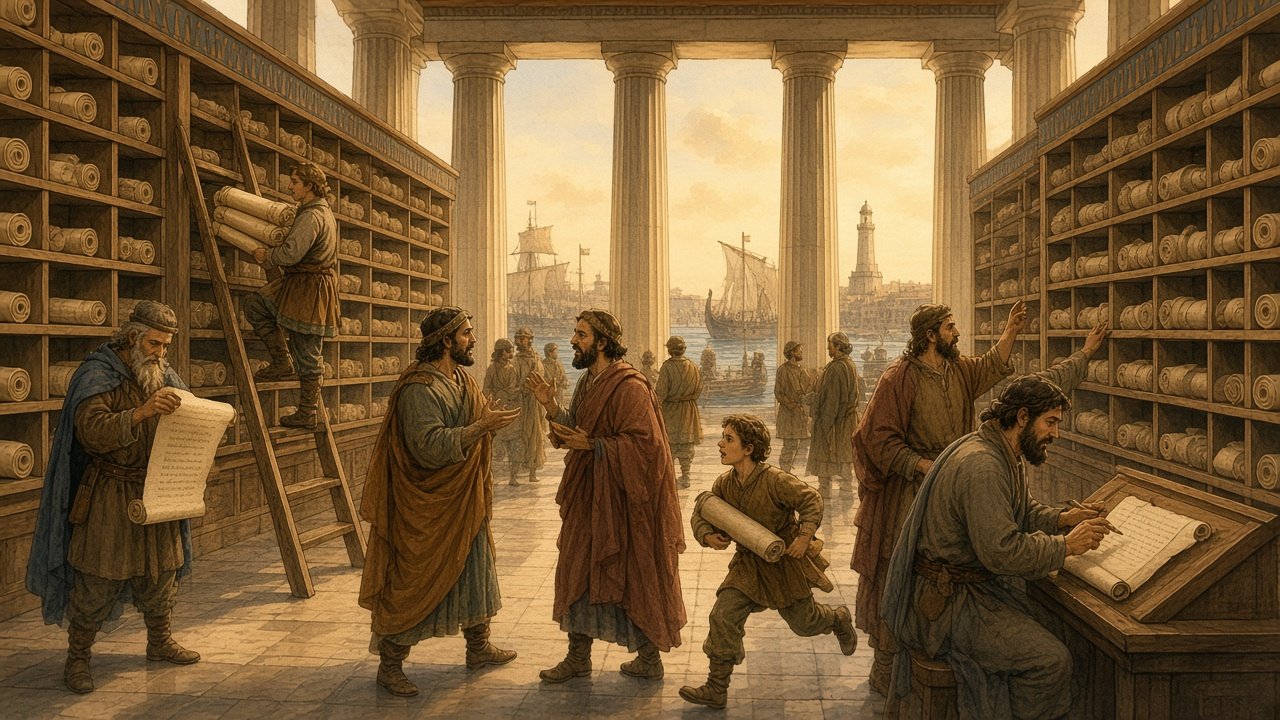
No archaeological remains of the Mouseion or the main library have been securely identified. The ancient palace quarter lies beneath the modern city and, in part, under the waters of the eastern harbour, where the coastline has subsided since antiquity. Underwater surveys since the 1990s have recovered statues, columns and architectural fragments from the area of the royal harbour, but none can be linked with certainty to the library. Ancient descriptions do not give its dimensions, the number of rooms or the arrangement of shelves. Modern reconstructions, including many illustrations of vast halls lined with scrolls, are imaginative rather than based on direct evidence.
Members of the Mouseion received a salary, free meals and lodging, and were exempt from taxation. The satirist Timon of Phlius, writing in the third century BC, described them as well-fed bookish scribblers who quarrelled endlessly in the birdcage of the Muses. The remark reflects both the privileged position of the scholars and the impression that their work was remote from ordinary life. The number of members at any one time is unknown, but estimates of thirty to fifty have been suggested on the basis of comparisons with later institutions.
How the collection was built
Ancient authors preserve several stories about the methods the Ptolemies used to acquire books. They were reported centuries after the events and may have been embellished, but they convey the reputation the kings had for determination in collecting.
The physician Galen, writing in the second century AD in his commentary on the Hippocratic Epidemics, states that Ptolemy III Euergetes, who reigned from 246 to 222 BC, ordered that all books found on ships arriving in Alexandria should be taken to the library and copied. The originals were kept and the owners received the copies. The confiscated books were labelled as coming from the ships. Galen mentions this in the course of a discussion about a disputed passage in Hippocrates, because one of the versions available to him was said to derive from a copy brought in this way.
Galen also tells a story about the official copies of the works of the three great Athenian tragedians, Aeschylus, Sophocles and Euripides. In the fourth century BC the Athenian statesman Lycurgus had arranged for authoritative texts of their plays to be kept in the public archive, so that actors would not alter them. According to Galen, Ptolemy III asked the Athenians to lend him these copies so that they could be transcribed, and he deposited fifteen talents of silver as a guarantee of their return. When the copies arrived, he had new copies made on the finest papyrus, sent these back to Athens and kept the originals, forfeiting the deposit. A sum of fifteen talents was very large, and the story, whether or not it is accurate in its details, illustrates the value the Ptolemies placed on authoritative texts.
Other sources report that agents were sent to the book markets of Athens and Rhodes to purchase copies, and that the kings competed with other rulers for valuable collections. Athenaeus, writing around AD 200, records that Ptolemy II bought the library of Aristotle, which had passed to Theophrastus and then to Neleus of Scepsis. Strabo gives a different account of the fate of Aristotle’s books, stating that they were hidden in a cellar at Scepsis and later sold to Apellicon of Teos and taken to Rome. The two stories may be reconciled if Neleus sold most of the collection to Alexandria but kept some of Aristotle’s own manuscripts, but the question remains open.
Collecting was not limited to Greek literature. Later sources claim that the Ptolemies sought out books from other peoples and had them translated. The most famous case is the Greek translation of the Jewish scriptures. There are also references to works on Egyptian history, such as the account written in Greek by the priest Manetho under Ptolemy I or II, and to Babylonian learning transmitted through the work of Berossus. The extent of translation activity beyond the Septuagint is uncertain, and claims that the library systematically collected texts in all the languages of the known world rest on late and sometimes legendary testimony.
The enthusiasm for collecting also created a market for forgeries. Galen remarks that the kings’ eagerness to obtain works of famous authors led some sellers to attach well-known names to inferior or spurious texts, or to pad out short works to make them appear substantial. Part of the work of Alexandrian scholars consisted in distinguishing genuine works from false attributions, a task that required careful comparison of style and content.
How large was the library?
Ancient figures for the size of the collection vary widely, and none can be accepted at face value. The Letter of Aristeas gives the figure of more than two hundred thousand rolls under Ptolemy II, with an aim of five hundred thousand. The Byzantine scholar John Tzetzes, writing in the twelfth century AD and apparently drawing on an earlier source, states that the library in the palace held 400,000 mixed rolls and 90,000 single or unmixed rolls, and that the library outside the palace, presumably at the Serapeum, held 42,800. Aulus Gellius in the second century AD and Ammianus Marcellinus in the fourth both give a figure of 700,000 volumes destroyed in the Alexandrian War of 48 BC. Seneca, writing in the first century AD and apparently citing Livy, refers to forty thousand books burned at Alexandria, although some editors have emended the figure to four hundred thousand, and the historian Orosius in the fifth century gives the figure of four hundred thousand.
These numbers are difficult to interpret for several reasons. First, the ancient book was a roll of papyrus, and a single literary work of any length usually occupied several rolls. Homer’s Iliad, for example, was divided into twenty-four books, each of which could fill a roll. A figure of hundreds of thousands of rolls would therefore represent a much smaller number of distinct works. Second, the collection contained multiple copies of many texts, since scholars sought out different versions for comparison. Tzetzes’ distinction between mixed and unmixed rolls has been interpreted as referring either to rolls containing several works and those containing one, or to rolls of uncertain classification and those already catalogued, but its meaning is not certain. Third, ancient authors often used large round numbers to convey scale rather than precise measurement.
Some modern historians, notably Roger Bagnall, have argued that the higher figures are implausible. Bagnall has pointed out that the total body of Greek literature known to have existed by the third century BC, even including works now lost, cannot easily account for hundreds of thousands of rolls, and that the physical space and labour required to house and copy such a collection would have been considerable. On this view the library may have held tens of thousands of rolls rather than hundreds of thousands, which would still have made it the largest collection of its time. Other scholars accept that the numbers may have been inflated but consider the higher range possible if duplicates and documentary material are included. No archaeological or documentary evidence exists that would settle the question.
Callimachus and the Pinakes
A collection of this size required a system of organisation. The most important figure in this respect was Callimachus of Cyrene, a poet and scholar active in Alexandria under Ptolemy II and Ptolemy III. Callimachus was one of the most influential poets of the Hellenistic age, known for his hymns, epigrams and the Aetia, a long poem on the origins of customs and rituals. He favoured short, highly polished poems over long epics, and a remark attributed to him, that a big book is a big evil, became famous.
Callimachus compiled the Pinakes, or Tables of persons eminent in every branch of learning together with a list of their writings. The work filled 120 books and survives only in fragments quoted by later authors. It appears to have been organised by genre, such as epic poetry, tragedy, comedy, lyric poetry, history, oratory, philosophy, medicine and law, with a residual category for miscellaneous works. Within each category authors were listed in alphabetical order, with brief biographical information, a list of their works, the opening words of each work and its length measured in lines. The quotation of opening words was necessary because many ancient works lacked fixed titles.
The Pinakes was more than an inventory. It was a bibliographical survey of Greek literature and formed the basis for later lists and literary histories. It also involved critical judgement, since Callimachus had to decide questions of authorship and classification. Later scholars, including Aristophanes of Byzantium, wrote supplements and corrections to it. Although the term library catalogue is often applied to the Pinakes, it is not certain that it corresponded exactly to the holdings of the library or recorded their physical location.
Callimachus is sometimes described as head of the library, but the evidence suggests otherwise. A papyrus from Oxyrhynchus, published in 1914 as P.Oxy. 1241 and dating from the second century AD, contains a list of heads of the library. It names Zenodotus, Apollonius of Rhodes, Eratosthenes, Aristophanes of Byzantium, Apollonius the Classifier and Aristarchus, but not Callimachus. The papyrus contains some errors and its reliability is debated, yet most scholars accept that Callimachus, although closely associated with the library and its work, did not hold the formal position of librarian.
The librarians
The office of head of the library carried considerable prestige. In addition to supervising the collection, the librarian often served as tutor to the royal children. The sequence of holders, as reconstructed from the Oxyrhynchus papyrus and the Byzantine lexicon known as the Suda, runs from the early third century to the middle of the second century BC.
The first librarian was Zenodotus of Ephesus, who held the post under Ptolemy II. He is remembered principally as the first critical editor of Homer. He compared manuscripts of the Iliad and Odyssey, marked lines he considered spurious and in some cases removed them from the text. He also compiled a glossary of rare words. His methods were later criticised by his successors for being too subjective, but he established the practice of producing an edited text on the basis of comparison between copies. Zenodotus is also said to have arranged the works of the epic and lyric poets, while Alexander of Aetolia and Lycophron of Chalcis dealt with tragedy and comedy respectively.
The second librarian was Apollonius of Rhodes, author of the Argonautica, an epic poem on the voyage of Jason and the Argonauts. Ancient biographies describe a quarrel between him and Callimachus over the merits of long epic poetry and claim that Apollonius withdrew to Rhodes after an unsuccessful first reading of his poem. These stories are probably later inventions based on the poets’ differing styles, and the nature of their relationship is uncertain.
The third librarian was Eratosthenes of Cyrene, who was invited to Alexandria by Ptolemy III around 245 BC and held the post for several decades until his death around 194 BC. Eratosthenes worked in many fields, including geography, mathematics, astronomy, chronology and literary criticism. His contemporaries nicknamed him Beta, meaning second, either because he was considered second best in every field or because he was thought of as a second Plato. He also called himself a philologos, a lover of learning, and he is often credited as the first to use that term to describe his work.
The fourth librarian was Aristophanes of Byzantium, who took office around 194 BC when he was already about sixty years old. He was a grammarian and lexicographer who produced editions of Homer, Hesiod, the lyric poets and the dramatists. He is credited with introducing or systematising a range of critical signs used in the margins of texts to indicate doubtful or spurious lines, and with developing a system of accent marks and punctuation to help readers pronounce and divide Greek words correctly, since ancient texts were written in continuous script without spaces. He also divided lyric poetry into metrical units called cola, which made its structure visible on the page. A story recounted by the Roman writer Vitruvius has Aristophanes serving as a judge in a poetry competition and exposing the plagiarism of the competitors by recalling the original works from the library shelves.
According to one tradition Aristophanes was imprisoned when he was suspected of planning to leave Alexandria for the rival court of Pergamon, where the Attalid kings were building their own library. The rivalry between the two libraries gave rise to a story recorded by Pliny the Elder, who attributes it to Varro, that a Ptolemy banned the export of papyrus to deprive Pergamon of writing material and that the Pergamenes responded by developing parchment, prepared animal skin. The name parchment derives from the Latin pergamena, but animal skins had been used for writing long before, and the story is generally regarded as an explanation devised after the fact.
The fifth head of the library was Apollonius, known as the Eidographer or Classifier, perhaps because he classified lyric poems by musical mode. Little is known of him. The sixth was Aristarchus of Samothrace, a pupil of Aristophanes, who held the post from around 153 BC. He was regarded in antiquity as the greatest of the Homeric critics. He wrote commentaries and treatises on many authors and produced editions of Homer that were based on careful analysis of manuscripts and of the poet’s own language and usage. His principle that Homer should be explained from Homer, that is, that difficulties in the text should be resolved by reference to the poet’s own practice elsewhere, became a standard of philological method. He left Alexandria in 145 BC, during the political upheaval discussed below, and died in Cyprus.
Homeric scholarship
The study of Homer was the central activity of the Alexandrian scholars. The Iliad and Odyssey were the foundation of Greek education and culture, and by the third century BC copies varied considerably in the number and form of their lines. Some texts circulating in the Greek world, known from papyri of the early Ptolemaic period, contained additional lines not found in later standard texts. Alexandrian editors set out to establish a reliable text.
Their work involved comparing copies from different cities, which the sources refer to as the city editions, from places such as Massalia, Chios and Argos, and individual copies associated with particular persons. They identified lines that they considered spurious and marked them with a horizontal stroke called the obelos, from which the modern term obelus derives. Aristarchus used a number of further signs, such as the diple, an arrow-shaped mark that drew attention to a point of interest in language or content, and the asteriskos, which indicated lines repeated elsewhere. These marginal signs referred to discussions in separate commentaries, called hypomnemata, in which the scholar explained his reasoning.
The editions of Aristarchus did not become a single authorised text that replaced all others, but they influenced the text of Homer that circulated from the second century BC onward. Papyri from Roman Egypt show that the number of lines in copies of Homer became more stable after this period, which many scholars attribute to Alexandrian influence. Much of what is known of Alexandrian Homeric criticism survives in the scholia, notes written in the margins of medieval manuscripts, especially the tenth-century manuscript of the Iliad known as the Venetus A, now in the Marciana Library in Venice. These notes preserve extracts from the work of Aristarchus and his successors as summarised by later scholars.
Alexandrian scholars applied similar methods to other authors. They produced editions of Hesiod, Pindar and the lyric poets, the tragedians and Aristophanes the comic playwright. They compiled lexicons of difficult words, studies of dialects and treatises on grammar. Dionysius Thrax, a pupil of Aristarchus, is traditionally credited with a short handbook of grammar that became the model for later grammars of Greek and Latin, although its authorship and date have been questioned. The term philology, in the sense of the systematic study of texts and language, owes much to the practices developed in Alexandria.
Mathematics and astronomy
Alexandria was also a major centre of mathematical and scientific research. Euclid is said to have worked in the city around 300 BC under Ptolemy I. Almost nothing is known of his life, and the stories told about him come from much later writers such as Proclus in the fifth century AD. One such story has Ptolemy asking whether there was an easier path to geometry than the Elements, to which Euclid replied that there was no royal road. Whether Euclid was connected with the Mouseion is not recorded, but his presence in Alexandria at the time of its foundation is generally accepted.
The Elements, in thirteen books, set out the foundations of plane and solid geometry and the theory of numbers on the basis of definitions, postulates and common notions, from which propositions were deduced by strict proof. The work drew on earlier Greek mathematics and organised it into a single system. It remained the standard textbook of geometry in Europe and the Islamic world into the nineteenth century. Euclid also wrote works on optics, on the division of figures and on the phenomena of the heavens, some of which survive.
Other mathematicians active in or associated with Alexandria included Apollonius of Perga, author of a treatise on conic sections, who studied there in the late third century BC. Archimedes of Syracuse corresponded with Alexandrian mathematicians, including Eratosthenes, to whom he addressed his work known as the Method. Later figures associated with the city include Hero, who wrote on mechanics and pneumatics in the first century AD, and Claudius Ptolemy, the astronomer and geographer of the second century AD, whose astronomical work, known by its Arabic title Almagest, dominated the subject for more than a millennium. Pappus in the fourth century and Theon and Hypatia at its end continued the mathematical tradition.
Aristarchus of Samos, not to be confused with the Homeric critic Aristarchus of Samothrace, proposed in the third century BC that the earth revolved around the sun. His surviving treatise on the sizes and distances of the sun and moon uses geometrical methods to estimate these quantities. Although he is sometimes linked to Alexandria, the evidence for his presence there is indirect.
Eratosthenes measures the earth
The best-known scientific achievement associated with the library is the measurement of the earth’s circumference by Eratosthenes. His own treatise on the subject is lost, and the method is described in a later work by the astronomer Cleomedes, probably written in the first or second century AD. According to Cleomedes, Eratosthenes assumed that Syene, the modern Aswan, lay directly south of Alexandria on the same meridian, and that at noon on the summer solstice the sun stood directly overhead at Syene, so that it cast no shadow. At the same moment in Alexandria a vertical rod cast a shadow, and the angle between the rod and the sun’s rays was one fiftieth of a full circle, about seven degrees and twelve minutes.
Eratosthenes reasoned that this angle was equal to the angle at the centre of the earth between Syene and Alexandria. If the distance between the two cities was 5,000 stadia, the circumference of the earth must be fifty times that figure, or 250,000 stadia. Other sources give the figure as 252,000 stadia, a number that may represent a refinement to make it divisible by sixty. The accuracy of the result in modern units depends on the length of the stadion used, which is uncertain, since different standards existed in the ancient world. Depending on the value adopted, the result lies within a few per cent of the modern figure of about 40,000 kilometres, or somewhat further from it. The method itself was sound in principle, and several of its assumptions, such as the exact meridian alignment of Syene and Alexandria, were approximations.
Eratosthenes also produced a map of the inhabited world with lines of latitude and longitude, wrote a work on geography in three books, and compiled a chronology of Greek history from the fall of Troy, which he dated to the equivalent of 1184 to 1183 BC. He devised a method for finding prime numbers that is still known as the sieve of Eratosthenes and wrote on the problem of doubling the cube, for which he constructed a mechanical device.
Medicine and anatomy
In the early third century BC Alexandria became the site of systematic study of human anatomy. Herophilus of Chalcedon and Erasistratus of Ceos are the two names most closely associated with this work. Their writings are lost, but later authors, especially Galen and the Roman medical writer Celsus, preserve information about their findings.
Herophilus is reported to have performed dissections of human bodies, a practice that was otherwise rare or absent in the ancient world because of religious and cultural objections to the opening of corpses. He described the brain and identified its ventricles, distinguished the cerebrum from the cerebellum, and recognised the nerves as distinct from tendons and ligaments, dividing them into sensory and motor nerves. He described the duodenum, giving it a name based on its length of twelve finger-breadths, examined the eye, the liver and the reproductive organs, and studied the pulse, measuring it with a water clock. Erasistratus investigated the heart and its valves and the vascular system and proposed theories of physiology based on the movement of air and blood.
Celsus, writing in the first century AD, states that Herophilus and Erasistratus performed vivisections on criminals provided by the kings from the prisons. The Christian writer Tertullian later accused Herophilus of having cut up six hundred living people. These claims have been much discussed. Some scholars accept them, pointing to the exceptional conditions of royal patronage in early Ptolemaic Alexandria, while others regard them as exaggerations or as polemical statements by later critics. The evidence for human dissection on dead bodies is stronger than that for vivisection. Systematic human dissection appears to have ceased in Alexandria after the third century BC and did not revive in Europe until the late Middle Ages.
The connection of Herophilus and Erasistratus with the Mouseion is not explicitly attested, and Erasistratus may have worked partly elsewhere, but their activity is usually discussed in the context of the research culture that the Ptolemies fostered. Alexandria remained an important centre of medical teaching under Roman rule, and in the second century AD Galen studied there, partly because, as he notes, it was possible to see a human skeleton in the city.
The Septuagint and the Letter of Aristeas
Alexandria had a large Jewish community from its early years, concentrated in particular districts of the city. By the third century BC many of its members spoke Greek as their first language. The Greek translation of the Hebrew scriptures, known as the Septuagint, was produced in Alexandria in stages beginning in the third century BC. The first part to be translated was the Torah, the five books of Moses, and the remaining books were rendered over the following two centuries.
The traditional account of the translation is given in the Letter of Aristeas, a work written in Greek and presented as a letter from Aristeas, a courtier of Ptolemy II, to his brother Philocrates. According to the Letter, Demetrius of Phalerum advised the king that the library should contain a copy of the Jewish laws in Greek. The king sent an embassy to the high priest Eleazar in Jerusalem, who chose seventy-two elders, six from each of the twelve tribes of Israel, and sent them to Alexandria with a copy of the law. After a series of banquets at which the king questioned them on philosophy and government, the elders worked on the island of Pharos and completed the translation in seventy-two days. The translation was then read to the Jewish community of Alexandria, who approved it and declared that it should not be altered. The name Septuagint, from the Latin for seventy, derives from this tradition.
The Letter of Aristeas is generally dated by modern scholars to the second century BC, well after the events it describes, and it is regarded as a work of apologetic literature rather than a historical record. Its purpose appears to have been to present the Greek translation as authoritative and to portray Judaism favourably to Greek readers. Its chronological error regarding Demetrius, noted above, is one of several indications of its later date. Later writers embellished the story further. Philo of Alexandria, in the first century AD, described the translators as working independently and producing identical texts through divine inspiration, and some Christian writers repeated and expanded this version.
Despite its legendary features, many scholars consider it plausible that the translation of the Torah took place in Alexandria under Ptolemy II, around the middle of the third century BC. Whether the initiative came from the royal court, as the Letter claims, or from the needs of the Jewish community itself for a version of the scriptures in its own language, remains debated. The Septuagint became the Bible of Greek-speaking Jews and later of the early Christian churches, and it is the source of many of the quotations from the Hebrew scriptures in the New Testament.
The Serapeum and the daughter library
Alongside the main library in the palace quarter there existed a second collection, housed in the temple of Serapis in the south-western part of the city, in the district called Rhakotis, which had a largely Egyptian population. The cult of Serapis, a god combining features of the Egyptian deities Osiris and Apis with those of Greek gods such as Zeus and Hades, was promoted by the early Ptolemies as a focus of worship for both Greeks and Egyptians. The Serapeum of Alexandria was rebuilt on a grand scale under Ptolemy III, as shown by foundation plaques in Greek and Egyptian bearing his name, which were discovered in the twentieth century. It was later rebuilt again in the Roman period, probably in the second century AD.
The sources describe the Serapeum’s collection as a daughter library of the main one. Tzetzes, as noted, gives it 42,800 rolls, and the fourth-century bishop Epiphanius of Salamis also refers to it. Some modern historians have suggested that it held copies of works already in the main library and was more accessible to readers who were not members of the Mouseion. The Christian writer Tertullian, at the end of the second century AD, mentions that the Greek translation of the Jewish scriptures could be seen in the Serapeum in his day. Excavations at the site have revealed a series of small rooms or niches along one side of the temple enclosure, which some archaeologists have interpreted as book storage rooms, though this identification is not certain.
The Serapeum stood on high ground and was one of the most impressive buildings of ancient Alexandria. The fourth-century historian Ammianus Marcellinus described it as second only to the Capitol in Rome in magnificence. Its later history is closely connected with the religious conflicts of the late fourth century, discussed below.
Decline under the later Ptolemies
The golden age of the Mouseion is generally placed in the third and early second centuries BC. From the late second century BC the Ptolemaic kingdom was weakened by dynastic conflict, revolts in the Egyptian countryside, economic difficulties and the growing influence of Rome. Royal patronage of scholarship became less consistent, and the institution’s fortunes depended on the inclinations of individual rulers.
A decisive episode occurred under Ptolemy VIII, nicknamed Physcon, meaning pot-belly, and officially called Euergetes II. He had ruled jointly with his brother Ptolemy VI and his sister Cleopatra II and was involved in long struggles with them. When Ptolemy VI died in 145 BC, Ptolemy VIII returned to Alexandria and seized power. According to accounts preserved by Athenaeus, who cites the historians Menecles of Barca and Andron of Alexandria, he expelled many intellectuals from the city, among them grammarians, philosophers, geometers, musicians, painters, teachers of physical training and physicians. The scholars of Alexandria had been associated with the supporters of his brother and of the young Ptolemy VII, and the expulsion appears to have been politically motivated. Athenaeus observes that as a result the islands and cities of the Greek world became full of teachers who had left Alexandria.
Aristarchus, the head of the library, left at this time and went to Cyprus, where he died. The Oxyrhynchus papyrus names as his successor a certain Cydas, described as one of the spearmen, a soldier rather than a scholar. The appointment suggests that the post had become a political office. After this the list of known librarians becomes obscure. Alexandrian scholarship did not end, but it lost its central position, and several of the leading scholars of the following generations worked elsewhere, at Rhodes, Pergamon, Athens and eventually Rome.
Scholarly activity in Alexandria nonetheless continued. Didymus, a prolific commentator of the first century BC, was nicknamed Chalkenteros, brass-guts, for his tireless output, which ancient sources estimate at more than three thousand books. He compiled the work of earlier Alexandrian critics and is a major source for the scholia that preserve their opinions. His activity shows that the library’s resources remained available to scholars in the late Ptolemaic period.
Caesar and the fire of 48 BC
In 48 BC Julius Caesar arrived in Alexandria in pursuit of his rival Pompey, who had been murdered on the Egyptian coast on the orders of the advisers of the young king Ptolemy XIII. Caesar became involved in the dynastic conflict between Ptolemy XIII and his sister Cleopatra VII, and he was besieged in the palace quarter by the Egyptian army and the Alexandrian population. The fighting that followed is known as the Alexandrian War and lasted into the spring of 47 BC. The Grokipedia entry on the siege of Alexandria summarises the campaign.
During the siege Caesar set fire to ships in the harbour to prevent the Egyptian forces from seizing them. Caesar’s own account, the Civil War, mentions the burning of ships but says nothing about books. The continuation of his work, the Alexandrian War, written by one of his officers, notes that the buildings of Alexandria were largely of stone and did not burn easily, also without reference to a library. Later writers, however, connect the fire with the destruction of books.
Seneca the Younger, in his essay On Tranquillity of Mind, written in the first century AD, states that forty thousand books were burned at Alexandria. He cites Livy, whose relevant books are lost, as having called the library a most noble monument of the wealth and care of kings. Seneca himself is critical, describing the library as a display of luxury rather than learning. As noted above, the manuscript figure of forty thousand is sometimes emended. Plutarch, writing in the early second century AD, states in his life of Caesar that when the enemy tried to cut off his fleet Caesar was forced to repel the danger with fire, which spread from the dockyards and destroyed the great library. Cassius Dio, writing in the early third century AD, gives a more specific account. He says that many places were set on fire, including the dockyards and the storehouses of grain and of books, which he describes as very numerous and excellent.
Aulus Gellius and Ammianus Marcellinus both refer to the burning of seven hundred thousand volumes during the Alexandrian War, and Ammianus, writing in the late fourth century, places the event in the time of Caesar’s dictatorship. Ammianus’s account is confused in other respects, since he appears to locate the destroyed libraries at the Serapeum.
The interpretation of these sources is disputed. The key difficulty is that Dio refers to storehouses of books near the docks rather than to the library itself, and some historians have argued that what burned were books stored in warehouses near the harbour, perhaps awaiting export or recently confiscated from ships, rather than the main collection in the palace. On this view, Plutarch’s reference to the great library is a later conflation. Other historians accept that the fire caused serious damage to the library, pointing to the testimony of Seneca and Livy and to the large figures given by Gellius and Ammianus.
Evidence from the decades after 48 BC is relevant to this question. Strabo, who lived in Alexandria about twenty years after the fire, describes the Mouseion as a functioning institution, although he does not mention the library. He was able to conduct research in the city, which suggests that substantial collections remained available. Plutarch also records, in his life of Mark Antony, a claim made by Antony’s opponent Calvisius that Antony had given Cleopatra the two hundred thousand volumes of the library of Pergamon. Plutarch himself says that most people did not believe the charges brought by Calvisius, and the story is regarded with caution, but it has sometimes been interpreted as an attempt to compensate for losses in the fire. The balance of the evidence suggests that the fire of 48 BC destroyed a significant number of books, perhaps including part of the library’s holdings, but that the institution survived.
The Roman period
After the defeat of Antony and Cleopatra at Actium in 31 BC and their deaths in Alexandria the following year, Egypt became a Roman province under the direct control of the emperor. The Mouseion continued to function, and its head was appointed by the emperor, as Strabo records. Membership became an honour that emperors could confer on favoured individuals, including people who were not scholars and did not live in Alexandria. Inscriptions and papyri from the Roman period mention members of the Mouseion, among them athletes, officials and orators.
Some Roman emperors took an interest in the institution. Suetonius reports that the emperor Claudius, who wrote histories of the Etruscans and Carthaginians in Greek, founded an additional building at Alexandria named after himself, the Claudium, where his works were to be read aloud each year. Suetonius also records that Domitian, at the end of the first century AD, had the libraries of Rome that had been destroyed by fire restored by obtaining copies from many places and by sending scribes to Alexandria to copy and correct texts. This implies that Alexandria remained a source of reliable texts at that time. The emperor Hadrian visited the Mouseion in AD 130 and debated with its members.
Scholars continued to work in the city. Claudius Ptolemy carried out his astronomical observations there in the second century AD. Galen studied medicine there and drew on Alexandrian copies of Hippocrates. The grammarian Apollonius Dyscolus and his son Herodian, who wrote on Greek syntax and accentuation, worked in Alexandria in the second century AD. The city was also an important centre of Christian learning, through the catechetical school associated with Clement and Origen in the late second and early third centuries. There is no clear evidence that these Christian scholars used the royal library, but they had access to extensive collections of books.
By the third century AD the evidence for the library becomes scarce. References to members of the Mouseion continue, but it is unclear how far the institution still maintained a large collection of books. Papyrus rolls deteriorate over time, especially in the humid climate of the coast, and require periodic recopying. Without sustained funding and staff, a collection of rolls would decline gradually through decay, loss and neglect. Some historians emphasise that this kind of slow decline is likely to have been more damaging over the long term than any single fire.
Aurelian and the fighting of the 270s
In the third century the Roman Empire passed through a period of military and political crisis. Between 270 and 272 Egypt came under the control of Zenobia, queen of Palmyra, whose forces occupied Alexandria. The emperor Aurelian recovered the province in 272, and further fighting took place in the city, apparently in connection with the revolt of Firmus, a local leader, in the same period. Ammianus Marcellinus states that during these conflicts the Alexandrians lost the greater part of the district called the Brucheion, which had long been the residence of distinguished men. A fragment of the Christian historian Eusebius describes a siege in which the inhabitants of the Brucheion were starved.
If the library and the Mouseion were still located in the palace quarter at this time, they would have suffered from this destruction. No source explicitly mentions the library in connection with Aurelian’s campaign, but many modern historians regard the devastation of the Brucheion in the 270s as the most likely end of the main library as a physical institution, if it had not already ceased to exist. Further fighting took place in Alexandria in 297 and 298, when the emperor Diocletian suppressed a revolt and besieged the city for eight months.
The Mouseion as an institution may have survived in some form. A mathematician named Theon, who lived in the late fourth century, is described in the Suda as a member of the Mouseion, and he is the last person known to have been associated with it. Where it was located at that time, and whether it still possessed books, is not known.
The destruction of the Serapeum in 391
In the late fourth century the Roman Empire under Theodosius I issued a series of laws restricting traditional pagan cults. In 391, in Alexandria, conflict broke out between the Christian population, led by the bishop Theophilus, and the adherents of the old religion. According to the church historians Rufinus of Aquileia, Socrates Scholasticus and Sozomen, the dispute began when Theophilus obtained permission to convert a disused temple into a church, and objects found in the process were displayed in public to mock pagan worship. Pagans responded with violence and took refuge in the Serapeum, which they held for some time. When the emperor’s response arrived, it pardoned the pagans but ordered the destruction of the temples. The Serapeum was then destroyed by a crowd of Christians and soldiers, and the great statue of Serapis was broken up.
The sources for these events, both Christian and pagan, are concerned with the destruction of the temple and its cult. None of them states explicitly that books were destroyed. The pagan writer Eunapius, who was hostile to the Christians, describes the destruction of the Serapeum in bitter terms but speaks of statues and offerings rather than a library. It is therefore uncertain whether the Serapeum still contained a library in 391. Ammianus Marcellinus, writing shortly before these events, refers to the libraries of the Serapeum in a passage that appears to use the past tense, and some scholars have read this as evidence that the collection was no longer there. The Christian historian Orosius, writing in the early fifth century, said he had seen empty book chests in temples in Alexandria, which he attributed to plunder in his own time. His statement is consistent with the view that collections once kept in temples had been dispersed.
The destruction of the Serapeum has often been presented in modern literature as the destruction of the last remnant of the Library of Alexandria by Christians. The evidence supports the destruction of the temple, but it does not demonstrate the presence of a large library within it at the time. Historians differ in their assessment of how much of a collection may have remained, and the question cannot be settled from the surviving sources.
Hypatia
Hypatia was the daughter of the mathematician Theon, the last known member of the Mouseion. She was a philosopher in the Neoplatonic tradition and a teacher of mathematics and astronomy, and she collaborated with her father in editing mathematical texts, possibly including Ptolemy’s Almagest and the Arithmetica of Diophantus. She taught students of different religious backgrounds, among them Synesius of Cyrene, who later became a Christian bishop and whose letters to her survive.
In March 415 Hypatia was murdered by a Christian crowd in Alexandria. The fullest account is given by Socrates Scholasticus, a church historian writing a few decades later. He states that she was respected for her learning and had influence with the Roman prefect Orestes, who was in conflict with the bishop Cyril. A rumour spread that she was preventing a reconciliation between the two, and a group led by a reader named Peter seized her, dragged her into a church called the Caesareum, killed her and burned her remains. Socrates describes the act as a disgrace to Cyril and to the church of Alexandria. Other sources, including the seventh-century chronicle of John of Nikiu, present her in a hostile light.
Hypatia’s death has frequently been linked in modern writing with the end of the Library of Alexandria and of ancient science. No ancient source connects her with the library, and the institution, as far as can be determined, had already ceased to exist in its original form. Her murder was a consequence of political and religious conflict in the city, and it is significant as an episode in the history of late antique Alexandria rather than as an event in the history of the library itself.
The Arab conquest story
The Arab armies under Amr ibn al-As conquered Egypt between 639 and 642, and Alexandria surrendered by treaty in 641, with Arab forces taking possession of the city in 642. A well-known story holds that Amr, at the command of the caliph Umar, destroyed the library after the conquest. In its developed form the story relates that a scholar named John the Grammarian asked Amr to grant him the books of the royal library. Amr wrote to Umar for instructions, and the caliph replied that if the books agreed with the Book of God they were unnecessary, and if they disagreed they were undesirable, so that in either case they should be destroyed. The books were then distributed to the public baths of Alexandria, where they were used as fuel for six months.
This story does not appear in any source written close to the time of the conquest. Neither the Christian chronicles of the seventh century, such as that of John of Nikiu, which describes the Arab conquest of Egypt in detail, nor the early Arabic historians of the conquest mention it. The earliest known references date from around the beginning of the thirteenth century, nearly six hundred years after the event. Abd al-Latif al-Baghdadi, a physician and scholar who visited Egypt in the 1190s and 1200s, refers briefly to the library in his description of Egypt, stating that it was burned by Amr on the orders of Umar. A fuller version appears in the biographical dictionary of scholars by Ibn al-Qifti, written in the first half of the thirteenth century. The thirteenth-century Christian writer Bar Hebraeus, also known as Abu al-Faraj, repeated the story in an Arabic historical work, and it was through his account, published in Latin translation in the seventeenth century by the English orientalist Edward Pococke, that it became widely known in Europe.
Modern scholars have generally rejected the story as unhistorical. The figure of John the Grammarian has been identified with John Philoponus, a Christian philosopher of Alexandria, who died around the 570s, several decades before the Arab conquest. The idea of the caliph’s dilemma is a literary motif, and similar stories are told about other conquests, including a version in which Umar gives the same instruction concerning books found in Persia. The claim that the books fuelled the baths of Alexandria for six months implies a collection of a size that is difficult to reconcile with the other evidence for the library’s decline over the preceding centuries. Edward Gibbon, in the eighteenth century, already expressed doubt about the story, and the historian Alfred Butler, in his study of the Arab conquest of Egypt published in 1902, set out detailed arguments against it.
Historians have suggested various reasons why the story emerged when it did. The historian Bernard Lewis argued that it may have been put into circulation in the late twelfth century in connection with the policies of the sultan Saladin, who sold and dispersed the great library of the Fatimid caliphs in Cairo after overthrowing their dynasty in 1171. On this interpretation, an account of an earlier caliph’s destruction of books would have provided a precedent and a justification. This explanation remains a hypothesis, but most scholars agree that the Arab conquest story is a later legend and that whatever remained of the ancient library had disappeared long before 642.
What the sources say and what the legend says
The popular image of the Library of Alexandria often combines several elements: a single great building holding the whole of ancient knowledge, destroyed in a single catastrophe, whose loss set back human progress by centuries. Different versions assign the destruction to Caesar, to the Christians of 391 or to the Arab conquerors of 642. Each of these versions emphasises one episode and, in many cases, the supposed responsibility of a particular group.
The surviving ancient evidence presents a more complex picture. There is no description of the library building, and the size of its collection is known only from figures that are late, inconsistent and difficult to interpret. The sources attest to a long period of intensive scholarship in the third and second centuries BC, a political disruption in 145 BC, a fire in 48 BC whose effects on the library itself are disputed, continued but diminished activity under Roman rule, devastation of the palace quarter in the 270s, the destruction of the Serapeum temple in 391 without explicit mention of books, and a story about the Arab conquest that first appears six centuries later.
Most modern historians therefore describe the end of the library as a gradual process. Royal patronage declined, scholars left or ceased to be appointed, rolls decayed and were not recopied, parts of the collection were lost to fire and warfare, and the palace quarter in which the institution was located was destroyed. By the time of the events most often associated with the library’s destruction in popular accounts, it may already have ceased to exist as a functioning collection.
The question of what was lost is also more complicated than the legend suggests. Many ancient works survived because copies existed elsewhere, in other libraries, in private collections and in the hands of teachers and scholars across the Mediterranean world. The transition from the papyrus roll to the parchment codex between the second and fifth centuries AD played a major role in determining which texts survived, since works that were not copied into the new format were less likely to be preserved. The survival of classical Greek literature into the Middle Ages owed much to Byzantine scholars and to translators in the Islamic world who rendered Greek philosophical, medical and scientific texts into Syriac and Arabic, especially in Baghdad from the eighth to the tenth century. Many works were lost, but their loss cannot be attributed to the destruction of a single library.
The legend nonetheless has its own history. In the European Renaissance and Enlightenment the library came to symbolise the learning of classical antiquity, and its destruction was used to illustrate arguments about the decline of civilisation, the dangers of fanaticism or the fragility of knowledge. Edward Gibbon, Voltaire and later writers used it in this way, and in the twentieth century the astronomer Carl Sagan presented it, in his television series Cosmos in 1980, as a lost centre of scientific inquiry whose destruction coincided with the murder of Hypatia. Such accounts have done much to shape public perception, but historians have pointed out that they simplify or alter the evidence.
The Bibliotheca Alexandrina
In the late twentieth century the government of Egypt, with the support of UNESCO, undertook to build a new library in Alexandria as a successor to the ancient institution. An international architectural competition held in 1988 and 1989 was won by the Norwegian firm Snøhetta. Construction began in the 1990s near the presumed site of the ancient palace quarter, on the eastern harbour. The Bibliotheca Alexandrina was officially inaugurated in October 2002.
The main building takes the form of a large tilted disc, partly sunk below ground level and rising towards the sea, symbolising the sun rising over the Mediterranean. Its main reading room, arranged on a series of terraces under a roof of glazed panels, is one of the largest in the world. The outer wall of grey granite from Aswan is carved with characters from many of the world’s writing systems. The complex includes a library with space for several million volumes, museums of antiquities and manuscripts, a planetarium, research institutes and conference facilities. The library has also hosted a mirror of the Internet Archive, an online archive of web pages, reflecting the aim of preserving knowledge in modern forms.
The Bibliotheca Alexandrina does not reconstruct the ancient library and does not hold its books. It is a modern research library and cultural centre that draws on the name and reputation of its predecessor. Its establishment reflects the continuing significance of the ancient library as a symbol of learning, both in Egypt and internationally.
Legacy
The Library of Alexandria and the Mouseion established practices that shaped later scholarship. The idea that a library should aim to collect the whole of a literature, that texts should be compared, corrected and edited on the basis of manuscript evidence, and that a body of literature should be catalogued and classified, were developed or systematised in Alexandria. The Pinakes of Callimachus is an ancestor of later bibliographies and catalogues. The critical signs and commentaries of Zenodotus, Aristophanes and Aristarchus are early forms of the scholarly apparatus used in modern editions of ancient texts.
The institution also offered an early model of state-supported research. Its members were paid by the crown to pursue inquiry in literature, mathematics, astronomy, geography and medicine, and they worked in proximity to one another and to a large collection of books. Historians have compared it with later institutions such as the House of Wisdom in Abbasid Baghdad, the medieval universities and modern research academies, although each of these had its own character and origins.
The texts edited and studied in Alexandria form the basis of much of the classical literature that survives. The standard texts of Homer, the division of the Homeric poems into twenty-four books each, the arrangement of the works of the lyric poets and dramatists, and the selection of authors considered canonical in many genres owe much to Alexandrian scholars. Many of the commentaries now preserved in medieval manuscripts derive ultimately from their work. In science, Euclid’s Elements, Eratosthenes’ geography and Ptolemy’s astronomy shaped learning for many centuries in both the Islamic world and Europe.
The library’s memory has been as influential as its achievements. It has served as a model for the ambitions of later collectors, from the Renaissance princes and popes who built great libraries to the founders of national libraries in the modern period. It has been used to illustrate both the value of preserving knowledge and the vulnerability of collections to war, neglect and political change. The historical institution, as reconstructed from the surviving sources, was smaller in documented detail and longer in its decline than the legend suggests, but its contribution to the history of scholarship remains substantial.
Further reading
The ancient evidence for the library is discussed in detail in Roy MacLeod, ed., The Library of Alexandria: Centre of Learning in the Ancient World (2000), and in Roger Bagnall, “Alexandria: Library of Dreams”, Proceedings of the American Philosophical Society 146 (2002). Rudolf Pfeiffer, History of Classical Scholarship from the Beginnings to the End of the Hellenistic Age (1968), remains the standard account of Alexandrian philology. P. M. Fraser, Ptolemaic Alexandria (1972), provides a comprehensive survey of the city and its institutions. Further general information is available in the Grokipedia entry on the Library of Alexandria.