Bernard Lewis and the Prescience of 1976
In January 1976 the American monthly Commentary carried a long essay by a British historian who had only recently moved to Princeton. Its title was three words long, and it said something that most Western observers of the Middle East did not then believe: that Islam, far from fading before the advance of nationalism, socialism and secular modernity, remained the deepest political loyalty of most Muslims, and was about to make itself felt again. The author was Bernard Lewis. The essay was “The Return of Islam”.[1]
Three years later the Shah of Iran fled his country and an elderly cleric returned from exile to found an Islamic republic. Two years after that, Anwar Sadat was shot dead at a military parade by men who believed they were killing an apostate. In the decades that followed came the war against the Soviet Union in Afghanistan, the rise of Hezbollah and Hamas, the Algerian civil war, the attacks of 11 September 2001 and the self-proclaimed “caliphate” of the Islamic State.[2] Each event sent readers back to Lewis’s essay, and each time it seemed to some of them to have been written by a prophet and to others by a polemicist who had dressed a political argument in scholarly clothes.[3][4]
This long read sets out what Lewis actually argued, section by section and in his own words where they matter, with the page numbers of the original magazine. It then places the essay in its moment, the years between the October War of 1973 and the Iranian revolution, and follows its reception: Edward Said’s attack on it in Orientalism in 1978, the bitter exchange between the two men in The New York Review of Books in 1982, its rediscovery after 1979 and again after 2001, and the work of the scholars who came after, among them John Esposito, Gilles Kepel and Olivier Roy. Because this is a site about Jewish history, it also asks what the essay says, openly and between the lines, about Jews and Israel, and how it connects with Lewis’s own later history of the Jews under Islamic rule.
The aim is not to vindicate Lewis or to convict him. Both have been done many times, often by people who had read only the title. The aim is to read the essay closely, to show where its evidence is strong and where it is thin, and to let the main arguments for and against it be heard in their own terms. Readers who know the Middle East of the 1970s only from what came after may find the essay stranger, and more interesting, than its reputation suggests.
1. A magazine, a historian and a title
Commentary was founded in 1945 by the American Jewish Committee, and in the 1970s it was still published under the Committee’s auspices; the copyright line on Lewis’s essay reads “American Jewish Committee”.[5] Founded as a journal of Jewish affairs and contemporary issues, it had quickly found a readership far wider than the Jewish audience for which it was intended. Under Norman Podhoretz, editor from 1960 to 1995, it moved from the liberal left of the post-war years to become, in the 1970s and 1980s, one of the principal voices of the political agenda that came to be called neoconservatism.[6] Its pages mixed political essays with fiction, criticism and long reviews. The January 1976 issue also carried a review of Arabs and Israelis: A Dialogue, by Saul Friedländer and Mahmoud Hussein, a piece on Western guilt and Third World poverty, and a review of a study of writers and revolution.[7]
The author’s note on the first page described Lewis as “Cleveland Dodge Professor of Near Eastern Studies at Princeton University and a long-term member of the School of Historical Studies at the Institute for Advanced Study”, and listed four of his books: The Arabs in History, The Emergence of Modern Turkey, The Middle East and the West and, most recently, History: Remembered, Recovered, Invented.[1] Lewis was then fifty-nine. Born in Stoke Newington in north London in 1916 to a Jewish family of east European origin, he had come to Middle Eastern languages through the Hebrew he learned for his bar mitzvah, studied at what is now SOAS, taken his doctorate in the history of Islam in 1939, served in British intelligence and the Foreign Office during the war, and in 1949 become professor at SOAS, where he spent a quarter of a century. He was the first Western historian admitted to the Ottoman archives in Istanbul. In 1974 he moved to Princeton, where he and the economic historian Charles Issawi transformed the department of Near Eastern Studies.[8][4]
He was not a journalist, and the essay is not a piece of reportage. It is a historian’s argument, written in the dry, ironic and assured prose that made Lewis’s general books widely read, and it ranges across fourteen centuries in a little over nine thousand words. But it is also a piece of political writing for a political magazine, and it was read as such from the start.
An old argument in new clothes
The essay was not entirely new. In 1964 Lewis had published The Middle East and the West, a set of lectures that included a chapter called “The Revolt of Islam”. There he had already argued that religious movements were the only ones in the region that were authentically local in inspiration. His student and later defender Martin Kramer quotes the earlier text: Islamic movements “alone are authentically Middle Eastern in inspiration” and express “the passions of the submerged masses of the population. Though they have all, so far, been defeated, they have not yet spoken their last word.”[3]
Edward Said noticed the continuity and made much of it. In Orientalism he complained that Lewis had published “a chapter called ‘The Revolt of Islam’ in a book in 1964, then republish[ed] much of the same material twelve years later, slightly altered to suit the new place of publication (in this case Commentary) and retitled ‘The Return of Islam.'”[5] Said read the change of title as a change of message. We shall come back to that charge. For now it is enough to note that the 1976 essay was the mature form of an argument Lewis had been making for more than a decade, now aimed at a new, American audience at a moment when that audience had suddenly become interested in the Middle East.
Afterlives in print
The essay was later reprinted, notably in Michael Curtis’s anthology The Middle East: A Reader, where it appears as a chapter of fourteen pages.[9] The full text is also available on Commentary‘s own website, and the magazine’s writers have returned to it repeatedly. In October 2023, in the days after the Hamas attack on southern Israel, a Commentary editor recommended it to readers again.[10] Few magazine essays of the 1970s have been so often reread, and fewer still have been read in such different ways.
The text used here is a scanned copy of the original eleven magazine pages, numbered 39 to 49. The scan has been checked against the clean text on Commentary‘s website; where quotations below follow the original page layout, the page numbers are those of the January 1976 issue.
2. The Middle East in the winter of 1975
To read the essay as its first readers did, it helps to remember what the Middle East looked like as 1975 turned into 1976. Two years earlier, on 6 October 1973, Egypt and Syria had attacked Israel’s forces in Sinai and on the Golan Heights. The war began with Egyptian successes along the Suez Canal and ended, after an American airlift to Israel and an Israeli crossing of the canal on 16 October, in an Israeli military victory obtained at heavy cost. For a few days in late October the United States and the Soviet Union came closer to confrontation than at any time since the Cuban missile crisis, and American nuclear forces were put on worldwide alert.[11]
The war had an economic sequel that touched every household in the West. In response to the American resupply of Israel, the Arab members of OPEC imposed an embargo on the United States, extended it to the Netherlands, Portugal and South Africa, and cut production. The price of a barrel of oil first doubled and then quadrupled. Cars queued at petrol stations, the United States introduced a national speed limit and created a strategic petroleum reserve, and the embargo was lifted only in March 1974, after Henry Kissinger’s shuttle diplomacy had produced the first disengagement agreements.[12] Edward Said would later observe that “before the sudden OPEC price rises in early 1974, ‘Islam’ as such scarcely figured either in the culture or the media. One saw and heard of Arabs and Iranians, of Pakistanis and Turks, rarely of Muslims.”[13] Lewis and Said agreed on very little, but they agreed that something had changed in how the West looked at the region, and that the change dated from these years.
A region still read in secular terms
The governments of the region still looked, from outside, like variations on secular themes. Egypt under Anwar Sadat, who had expelled Soviet military advisers in 1972, was turning towards the United States and opening its economy.[14] Syria and Iraq were ruled by rival branches of the Ba’th party, whose ideology was Arab socialism. The Shah of Iran seemed secure on his throne and was modernising his country by decree. The Palestine Liberation Organisation, led by Yasir Arafat, presented itself to the world as a national liberation movement whose stated goal was a “democratic, secular state” in Palestine. Turkey had been an avowedly secular republic for half a century. Martin Kramer, recalling the period forty years later, summed up the conventional wisdom with deliberate bluntness: “The role of Islam in politics? There wasn’t any to speak of.”[15]
That is an exaggeration, and Kramer meant it as one; the Muslim Brotherhood existed, as Lewis himself pointed out, and specialists knew about the clerical opposition in Iran. But it captures something real about the frameworks in which the region was usually discussed. Robert Irwin, another of Lewis’s former students, cites the British scholar Fred Halliday, who in 1974 was looking forward to the eventual triumph of secular left-wing revolutionary movements in Arabia, and who in a book on Iran published in 1979 listed four possible futures for the Shah’s regime, none of them an Islamic republic.[16] Halliday was a serious and well-informed scholar. His expectations were widely shared, and it is against them that Lewis was writing.
Lebanon
The most immediate occasion for the essay was Lebanon. The Lebanese civil war had begun on 13 April 1975, when Phalangist gunmen attacked a bus carrying Palestinians, and by the end of the year the country was divided into militias and the capital into a Christian east and a Muslim west. The participants included the Lebanese Front, representing mainly Maronite Christians, and the Lebanese National Movement, a coalition of secular leftists and Sunni Muslims sympathetic to Arab nationalism, along with the PLO, Shi’i populists and, later, Syria and Israel.[17] Western newspapers commonly described the conflict as a struggle between “rightists” and “leftists”. Lewis opens his essay by mocking exactly that habit, and he closes it with the fate of the Christians of Lebanon. Between the first page and the last, Lebanon is never far away.
The war would last fifteen years, kill more than a hundred thousand people and displace nearly a million.[17] None of that was known in January 1976. What was known was that a country often held up as a model of coexistence between religious communities was tearing itself apart along religious lines, while the language used to describe it in the West was the language of European party politics.
3. Saracens, trinities and a baseball correspondent
Lewis begins not with the Middle East but with medieval France. In the Chanson de Roland, the great epic of the wars between Christians and Saracens in Spain, the poet tries to tell his listeners what the Saracens believed. He imagines that they worshipped a trinity: Muhammad, and two devils called Apollin and Tervagant. “To us this seems comic,” Lewis writes, “and we are amused by medieval man unable to conceive of religion or indeed of anything else except in his own image.” Since Christendom worshipped its founder in association with two other persons, the Saracens had to do the same.[1]
Then comes the turn that sets the tone of the whole essay. “In the same spirit,” Lewis continues, “one finds special correspondents of the New York Times and of other lesser newspapers describing the current conflicts in Lebanon in terms of right-wing and left-wing factions.” Medieval Christians could only imagine religion as a trinity; their modern descendants can only imagine politics as “a theology or, as we now say, ideology, of left-wing and right-wing forces and factions” (p. 39). The comparison is meant to sting. It casts the up-to-date Western observer as the heir of the medieval polemicist, sure of his categories and blind to the thing in front of him.
A history of wrong names
Lewis then offers a short history of how Europe named the Muslims, as evidence of a “recurring unwillingness to recognize the nature of Islam or even the fact of Islam as an independent, different, and autonomous religious phenomenon” (p. 39). For centuries Christians called them Saracens, a word “of uncertain etymology but clearly of ethnic not religious connotation”. In Spain and Portugal they were Moors, and Iberians went on calling Muslims Moors even in Ceylon and the Philippines. In most of Europe they were Turks, so that a convert to Islam “turned Turk” even in Marrakesh or Delhi. Further east they were Tatars (p. 39).
When Europeans did finally recognise Islam as a religion, Lewis argues, they described it through “a sequence of false analogies”: they called it Muhammedanism, although Muslims have never called themselves Muhammedans, “since Muhammad does not occupy the same place in Islam as Christ does in Christianity”; they equated the Muslim Friday with the Christian Sunday, the Qur’an with the Bible, the mosque with the church and the ulema, the learned men of religion (علماء, ‘ulamā’, “scholars”), with priests (p. 39). And, “coming more directly to our present concern”, they imposed on Muslim history “purely Western notions of country and nation”. Gibbon, in his account of the Prophet’s career, has Muhammad and his companions inspired by “patriotism and love of liberty”, concepts that Lewis drily finds “inappropriate to the circumstances of 7th-century Arabia” (p. 39). Europeans called the Ottoman lands Turkey centuries before their inhabitants did.
The modern blind spot
The core of this opening section is a claim about the modern Western mind. “Modern Western man,” Lewis writes, “being unable for the most part to assign a dominant and central place to religion in his own affairs, found himself unable to conceive that any other peoples in any other place could have done so, and was therefore impelled to devise other explanations of what seemed to him only superficially religious phenomena” (p. 40). He cites the old scholarly debates over whether Muhammad was “sincere” or a “deceiver”, and the long search by historians for the “real” economic or social meaning of religious conflicts within Islam.
“To the modern Western mind,” he goes on, “it is not conceivable that men would fight and die in such numbers over mere differences of religion; there have to be some other ‘genuine’ reasons underneath the religious veil.” Westerners allow religious conflict “to accredited eccentrics like the Northern Irish, but to admit that an entire civilization can have religion as its primary loyalty is too much” (p. 40). The next sentence is one of the most quoted in the essay, and one of the most resented: “Even to suggest such a thing is regarded as offensive by liberal opinion, always ready to take protective umbrage on behalf of those whom it regards as its wards” (p. 40).
The section ends with the image that gives this part of our account its title. The use of “left-wing and right-wing, progressive and conservative, and the rest of the Western terminology” to explain Muslim politics is, Lewis says, “about as accurate and as enlightening as an account of a cricket match by a baseball correspondent” (p. 40). It is a characteristically English joke for an American readership, and it was pointed: the baseball correspondent is not stupid, only equipped with the wrong rules.
What kind of argument this is
It is worth pausing on the structure of the argument, because it shaped every later quarrel about the essay. Lewis’s first claim is not about Muslims at all. It is about Western observers, and about a failure of imagination that he attributes to secularisation in the West. Muslims, in this account, are not the problem; the problem is a set of borrowed categories that make them invisible. Read this way, the opening is a plea for taking Muslims seriously on their own terms, and his defenders have often read it so.
But the same passage also makes a large claim about “an entire civilization” and its “primary loyalty”, and it frames those who disagree as squeamish liberals protecting their “wards”. Critics would seize on both features: the generalisation about a whole civilisation, and the move that turns disagreement into a symptom of political sentiment. Said quoted precisely these sentences in Orientalism, as evidence of what he took to be Lewis’s method.[5] The opening pages of the essay therefore contain, in small, both the insight its admirers praise and the habits its critics condemn.
4. Neither Caesar’s nor God’s – religion as a total jurisdiction
Having cleared the ground, Lewis states his thesis. “If, then, we are to understand anything at all about what is happening in the Muslim world at the present time and what has happened in the past, there are two essential points which need to be grasped. One is the universality of religion as a factor in the lives of the Muslim peoples, and the other is its centrality” (p. 40).
He begins with a verse from the Gospels: “Render unto Caesar the things which are Caesar’s; and unto God the things which are God’s.” That, he says, is Christian doctrine and practice, and “totally alien to Islam” (p. 40). The three Middle Eastern religions differ in their relation to power. Judaism “was associated with the state and was then disentangled from it; its new encounter with the state at the present time raises problems which are still unresolved”, a brief and suggestive aside in an essay for a Jewish magazine at a time when the relation between Jewish religion and the Israeli state was itself much debated. Christianity was for its first centuries separate from, and often persecuted by, the state, and only later, with Constantine, entered into partnership with it. “Islam from the lifetime of its founder was the state” (p. 40).
The founder as ruler
The contrast turns on the life of the founder. “Muhammad did not die on the cross. As well as a Prophet, he was a soldier and a statesman, the head of a state and the founder of an empire, and his followers were sustained by a belief in the manifestation of divine approval through success and victory” (p. 40). The association of religion and power, “community and polity”, is visible, Lewis says, in the Qur’an and the earliest texts. The consequence is that religion in Islam is not one sector of life among others, “regulating some matters while others are excluded; it is concerned with the whole of life—not a limited but a total jurisdiction” (p. 40). In such a society the separation of church and state is not so much rejected as meaningless, “since there are no two entities to be separated” (p. 40).
Lewis supports this with a point about language that he would make many times in later work. Classical Arabic and the other classical languages of Islam have, he says, no pairs of terms corresponding to lay and ecclesiastical, spiritual and temporal, secular and religious. These words express “a Christian dichotomy which has no equivalent in the world of Islam” (p. 40). In a footnote he adds that the modern Arabic word for secular, which he transliterates alamani (علماني, ‘almānī, “worldly”, “of this world”), was probably of Christian Arab origin and passed into general use only in the nineteenth century (p. 40). The concepts were imported under Christian influence; their “meaning is still very imperfectly understood and their relevance to Muslim institutions dubious” (p. 40).
Identity and loyalty
From universality Lewis moves to centrality: religion, he says, “constituted the essential basis and focus of identity and loyalty” (p. 40). It marked who belonged and who did not. His example is pointed and has been much quoted: “A Muslim Iraqi would feel far closer bonds with a non-Iraqi Muslim than with a non-Muslim Iraqi” (p. 40). Muslims of different countries and languages share “the same memories of a common and sacred past, the same awareness of corporate identity, the same sense of a common predicament and destiny”. The historic basis of identity is not nation or country, as in the West, “but the religio-political community”, and the imported idea of “ethnic and territorial nationhood remains, like secularism, alien and incompletely assimilated” (p. 41).
The Arabic term for that religio-political community is the umma (أمة, “community”, “nation”), though Lewis does not use it here. He offers instead a single striking quotation. When advocates of the new patriotism pressed their case on a Grand Vizier of the Ottoman Empire, he replied: “The Fatherland of a Muslim is the place where the Holy Law of Islam prevails.” Lewis adds: “And that was in 1917” (p. 41). He does not name the vizier or give a source, and the quotation cannot easily be checked; it is offered as an illustration rather than as proof.
Strengths and objections
This part of the essay rests on claims that most historians of Islam would accept in some form: that the Prophet was a ruler as well as a preacher, that classical Islamic law claimed to regulate the whole of life, and that pre-modern Muslim societies, like pre-modern Christian and Jewish ones, defined belonging largely in religious terms. Lewis’s later critics did not, for the most part, dispute the history. They disputed what he did with it.
Three objections recur. The first is that the contrast with Christianity is overdrawn: medieval Christendom also had theocratic ideals, and the classical Islamic world developed in practice a real distinction between the caliph or sultan and the ulema, between dynastic law and religious law. Lewis himself conceded something like this a few pages later, when he described Islamic history as “political pluralism combined with socio-cultural unity” (p. 46). The second objection is that “Islam” in the singular hides enormous variety across regions, schools, classes and centuries. The third, and the most serious, is that an argument from founding texts and early history can be read as an argument that Muslims do not and cannot change. That was the reading Said would give it. Lewis’s defenders replied that he was describing a historical inheritance and its persistence in memory, not an unchanging essence, and that he went on in the same essay to warn against “discounting the degree of effective secularization” (p. 48).[3] Both readings can find support in the text.
5. Two centuries of resistance in religious dress
The next part of the essay is a rapid historical survey, and its purpose is to show that whenever Muslims have faced a real crisis, the responses that mattered were religious. It moves quickly, naming movements most American readers would never have heard of, and it is worth slowing it down.
From the Wahhabis to Shamil
In the eighteenth century, Lewis writes, Austrian and Russian victories over the Ottomans and British successes in India made Muslims aware “that they were no longer the dominant group in the world but were, on the contrary, threatened in their heartlands by a Europe that was expanding at both ends”. The “only really vital responses” were religious reform movements: the Wahhabis in Arabia and the reformed Naqshbandi Sufi order that spread from India to other Muslim countries (p. 41). In the early nineteenth century, as Britain, France and Russia advanced in India, North Africa and Central Asia, the most significant resistance was again religious: the Indian followers of Sayyid Ahmad Brelwi from 1826 to 1831, the struggle of Abd al-Qadir in Algeria from 1832 to 1847, and the long resistance of Shamil to the Russians in Daghestan and the northern Caucasus from 1830 to 1859. “All of them were crushed, but made a considerable impact at the time” (p. 41).
There followed, Lewis says, a period in which Muslims “were sufficiently overawed by the power, wealth, and success of Europe to desire to emulate European ways”. But a new wave of imperial expansion from the mid-nineteenth century (the suppression of the Indian Mutiny and the end of the Mughal monarchy, the Russian advance in Central Asia, the French in Tunisia and the British in Egypt, the mounting threat to the Ottoman Empire itself) “brought a response in the form of a series of pan-Islamic movements” (p. 41).
Pan-Islam before pan-Arabism
Here Lewis makes an argument about chronology that is central to his case. The unification of Germany and Italy inspired many Ottoman leaders, who imagined their state as the Prussia or Savoy of a larger union. But a union of what? “Not a pan-Turkish entity. Such ideas were still far away in the future.” The basic political identity was Islamic, “and pan-Islamism was the first and natural response to pan-Germanism and pan-Slavism. It was not until much later that pan-Turkism and pan-Arabism appeared on the political horizon and, even then, there is some doubt as to what they really signified” (p. 41). Nationalism, on this reading, was the latecomer and the import; religious solidarity was the older and more natural form of political feeling.
The same pattern, Lewis argues, reappeared after the First World War. Enver Pasha formed the “Army of Islam” to liberate the Muslims of the collapsing Russian Empire. Several movements were linked with or taken over by the Communists “at a time when the fundamentally anti-Islamic nature of Communism was not yet understood” (p. 41). Most striking of all, the Kemalist revolt in Anatolia, later celebrated as the founding act of secular Turkish nationalism, was “in its first inspiration as much Islamic as Turkish”. Men of religion were prominent among its early leaders, its rhetoric spoke “of Ottoman Muslims rather than of Turks”, and only after victory and the founding of the republic did it lay stress on “nationalist and secular aims” (p. 41). In the twentieth century, Lewis concludes, resistance was usually expressed in “the fashionable form of political parties and in the fashionable language of political, more or less secular, nationalism”. But neither party nor ideology “really corresponded to the deeper instincts of the Muslim masses”, which found their outlet in organisations “led by religious leaders and formulated in religious language and aspiration” (p. 41).
The Muslim Brothers
The most important of these, Lewis says, was the Society of the Muslim Brothers, al-Ikhwān al-Muslimūn (الإخوان المسلمون, “the Muslim Brothers”), founded in Egypt by the schoolteacher Hasan al-Banna. Lewis is cautious about its origins (“the early history of the movement is not clearly known”, p. 41); later reference works date the foundation precisely to 1928, at Ismailia.[18] His account of what followed is compact and largely matches later scholarship. The Brothers began with preaching, education and charity; entered politics after the Anglo-Egyptian Treaty of 1936; took up the Palestinian cause, which spread the movement to other Arab countries; sent volunteers to fight in 1948; were dissolved by the prime minister, Nuqrashi Pasha, who was then assassinated by one of their members; and saw their founder killed “in circumstances which have never been established” (p. 42). Later accounts confirm the assassination of Nuqrashi in December 1948 and note that many believe al-Banna’s murder was carried out at the government’s behest.[18]
Lewis traces the Brothers’ close early links with the Free Officers who seized power in 1952, their exemption when other parties were dissolved, the deterioration of relations, the failed attempt on Nasser’s life on 26 October 1954, the trials and executions that followed, and the further executions of August 1966, “among them Sayyid Qutb, a leading ideologist of the Brothers” (p. 42). That is the only mention of Qutb in the essay. It is a reminder of how little the Western public then knew of the man whose prison writings, above all Milestones (also translated as Signposts in the Road), would become, in the words of a standard reference work, “a template for modern Sunni militancy”.[19] Lewis ends the paragraph with a forecast that was soon fulfilled: the Brotherhood “remains a powerful if concealed force at the present day and there are recent signs of a return in Egypt” (p. 42).
Fatah and its names
Lewis then makes a claim that was bound to provoke. Fatah, the largest Palestinian guerrilla organisation and the core of the PLO, had, he says, past links with the Muslim Brothers that “seem to be clear”, and its “imagery and symbolism” were “strikingly Islamic” (p. 42). Arafat’s nom de guerre, Abu ‘Ammar, alluded to ‘Ammar ibn Yasir, a companion of the Prophet. The word fatḥ (فتح, “opening”, “conquest”) is, Lewis says, “a technical term meaning a conquest for Islam gained in the Holy War”, the sense in which Mehmed II, conqueror of Constantinople, is called Fatih. In a footnote he records the other explanation, that the name is a reversed acronym of Ḥarakat Taḥrīr Filasṭīn, “movement for the liberation of Palestine” (p. 42). The brigades of the Palestine Liberation Army were named after Qadisiyya (القادسية), Hattin (حطين) and Ayn Jalut (عين جالوت), victories over the Zoroastrian Persians, the Crusaders and the Mongols. “In the second and third of these, the victorious armies were not even Arab; but they were Muslim, and that is obviously what counts” (p. 42). Fatah’s communiqués, he adds, began with the invocation “In the name of God, the Merciful and the Compassionate.”
In 1976 this was a direct challenge to the PLO’s self-presentation as a secular national movement, and to the way much of the Western left saw it. Whether names and invocations show the “real” character of a movement is, of course, exactly the kind of question Lewis had accused others of asking the wrong way round: they looked for secular realities under religious language, he looked for religious realities under secular programmes. A decade later the founding of Hamas in 1987, by members of the Muslim Brotherhood and religious factions within the Palestinian movement, gave the religious current in Palestinian politics an organisation of its own.[20]
Iran and Central Asia
The Brothers and their offshoots, Lewis notes, were largely confined to Arabic-speaking countries, but there were parallels elsewhere. In Iran the Fida’iyan-i Islam (فدائیان اسلام, “Devotees of Islam”) were active in Tehran between 1943 and 1955, killed the prime minister, General Ali Razmara, in March 1951, and were suppressed after a failed attempt on another prime minister, Hossein Ala, in 1955; they “even seem to have enjoyed some limited support from the semi-official religious leadership” (p. 43). This brief paragraph is the essay’s only discussion of Iran. Even his most loyal student concedes that Lewis did not predict the Iranian revolution; the next great Islamic upheaval would be Iranian and Shi’i, and the essay barely anticipates that.[3]
He lists other movements: the Association of Algerian Ulema, the Tijaniyya brotherhood, the National Salvation Party in Turkey, and the Basmachi revolts in Soviet Central Asia from 1919 into the 1920s, whose last leader, Ibrahim Beg, was captured and executed in 1931 (p. 43). “It is characteristic of Western attitudes,” he remarks, “that a search of half-a-dozen major encyclopedias failed to disclose any article on the Basmachis”, while the Soviet encyclopaedia, he notes in a footnote, “devotes a long article to discrediting them” (p. 43). The point of the list is breadth: from the Atlantic to Central Asia, the movements that mobilised people against foreign rule or secularising regimes spoke the language of religion.
6. Who was a Greek, and who was a Turk?
One of the most original passages in the essay concerns not militant movements but governments, and not Arabs but Greeks and Turks. Lewis’s claim is that “avowedly secular and radical governments” have also responded, in moments of crisis, to religious definitions of belonging (p. 43). His example is the exchange of populations between Greece and Turkey in the 1920s.
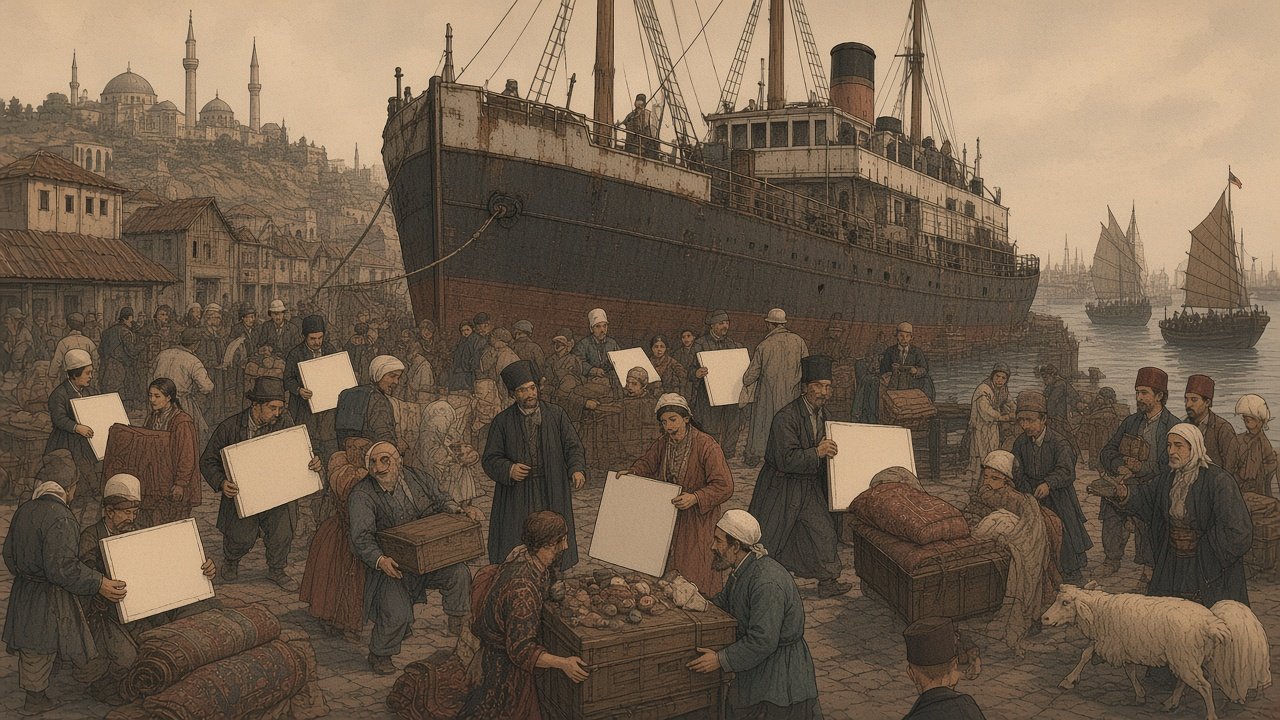
The terms of the exchange were set in a convention signed at Lausanne on 30 January 1923. Its first article provided for “a compulsory exchange of Turkish nationals of the Greek Orthodox religion established in Turkish territory, and of Greek nationals of the Moslem religion established in Greek territory”, with exceptions for the Greeks of Constantinople and the Muslims of Western Thrace.[21] Lewis gives the scale: between 1923 and 1930, “a million and a quarter ‘Greeks’ were sent from Turkey to Greece and a somewhat smaller number of ‘Turks’ from Greece to Turkey” (p. 43). The quotation marks around the national names are his, and they carry the argument.
At first sight, he writes, this looks like the triumph of the European principle of nationality, “Greeks and Turks unwilling or unable to live as national minorities among aliens”, returning to their own homelands. On closer examination, it looks different. In the abandoned churches of the Greeks of Karaman in southern Turkey, the inscriptions on the tombstones “are written in Turkish, though in Greek characters”; many families of the so-called repatriates “had little or no knowledge of Greek but spoke Turkish among themselves, writing it in Greek characters” (p. 43). Equally, many of the “Turks” sent from Crete and other parts of Greece spoke Greek at home and wrote it in Arabic script. “Script all over the Middle East,” Lewis observes, “is closely associated with religion”, and he draws a comparison that will interest readers of this site: Jews and Christians in Arabic-speaking countries long wrote Arabic “in Hebrew or in Syriac instead of in Arabic characters” (p. 43). Judaeo-Arabic, the Arabic written in Hebrew letters by Maimonides and preserved in the Cairo Genizah, is the best known example.
His conclusion is deliberately provocative. “By any normal Western definition of nationality, the Greeks of Turkey were not Greeks, but Turks of the Christian faith, while the so-called Turks of Greece were for the most part Muslim Greeks.” Taken in their Western sense, the words mean that “the famous exchange of population between Greece and Turkey was not a repatriation of Greeks to Greece and of Turks to Turkey but a deportation of Christian Turks from Turkey to Greece and a deportation of Muslim Greeks from Greece to Turkey. It was only after their arrival in their putative homelands that most of them began to learn their presumptive mother tongues” (p. 43).
The evidence of the treaty
On this point the documentary record strongly supports Lewis. The convention itself defines the populations to be exchanged by religion, “Greek Orthodox” and “Moslem”, not by language or descent.[21] The Turkish-speaking Orthodox of central Anatolia, known as Karamanlides, and their literature in Turkish written in Greek letters, called Karamanlidika, have since become a substantial field of study, including the poetry in which exchanged villagers recorded their displacement in Turkish written in the Greek alphabet.[22] One small correction is in order: Lewis says the exchange was agreed “after the Treaty of Lausanne”, but the convention was signed in January 1923, before the main peace treaty had been concluded, though its final article gave it the same force as if it formed part of that treaty.[21]
Lewis presses the point into the present. “Even today, in the secular republic of Turkey, the word Turk is by common convention restricted to Muslims.” Non-Muslim citizens enjoy citizenship but “do not call themselves Turks nor are they so called by their neighbors”, while a non-Turkish Muslim immigrant “very rapidly acquires a Turkish identity”. “The identification of Turk and Muslim remains virtually total” (p. 43). This is an observation about everyday usage in the 1970s, offered without data, and it would be contested by Turkish secularists; but it is the kind of observation that Lewis, a long-standing student of modern Turkey, was well placed to make, and it supports his larger case that religion survives as a marker of belonging inside the most secular of Muslim states.
Why this example matters
The exchange is perhaps the strongest example in the essay because it does not depend on sermons, slogans or the behaviour of crowds. It rests on the decisions of two governments, one of them led by Mustafa Kemal, the founder of the most determinedly secular state in the Muslim world, and on the legal text in which they recorded those decisions. It also shows something Lewis’s critics sometimes miss: his argument is about the persistence of religious community as a category of identity, which is a different thing from piety or from political Islam. Christians as well as Muslims were sorted by it, and the Christian state of Greece applied the category as readily as the Muslim one.
7. Arabism and its Christians
“With Arabs,” Lewis writes, “the situation is somewhat more complex” (p. 43). Arabic-speaking countries had long had substantial Christian and Jewish minorities who spoke the same language, though in the past they had written it in different scripts and often spoken it in a slightly different dialect. When the idea of Arabism as a common nationality was launched in the late nineteenth and early twentieth centuries, Arabic-speaking Christians played a prominent part in it, and Lewis thinks it natural that they should have, “since in the one they could claim the equal citizenship to which they could never aspire in the other” (p. 44). In a nation defined by language and culture, Christians, and “even at times Jews”, might share in a common Arabism with the Muslim majority.
His description of the old order is precise and has often been quoted. As members of non-Muslim communities in a Muslim state, Christians “occupied a position of stable, privileged, but nevertheless unmistakable inferiority, and in an age of change even the rights which that status gave them were endangered” (p. 44). That sentence compresses the whole classical system of the dhimma (ذمة, “protection”, “covenant”), under which Jews and Christians were tolerated and protected as subordinate communities, a subject Lewis would develop at length eight years later in The Jews of Islam. Secular nationalism promised to replace this with equality. Christians were also, Lewis says, more open to Western ideas and had better access to education, so that they played a disproportionate part in the Arabic press, especially in Egypt, in modern Arabic literature, in commerce and in the nationalist movements themselves (p. 44).
“This prominence has ceased to be tolerable”
Then the argument turns. “In recent decades, this prominence has ceased to be tolerable” (p. 44). Through nationalisation by socialist governments and by “other more direct means”, the economic power of Christian communities had been reduced “in one country after another” and was now being challenged “in its last stronghold, the Lebanon”. A new generation of Arab writers was overwhelmingly Muslim. Within the PLO, Fatah was “overwhelmingly though not exclusively Muslim”, while many of the more extreme organisations tended to be Christian, “for in the radical extremism which they profess Christians still hope to find the acceptance and equality which eluded them in nationalism” (p. 44). Lewis names no organisations or individuals here.
The general principle follows in one of the essay’s key sentences: “As the nationalist movement has become genuinely popular, so it has become less national and more religious—in other words, less Arab and more Islamic. In moments of crisis—and these have been many in recent decades—it is the instinctive communal loyalty which outweighs all others” (p. 44).
Two riots
Lewis’s evidence is two episodes from Egypt. On 2 November 1945, the anniversary of the Balfour Declaration, demonstrations were held. “Though this was certainly not the intention of the political leaders who sponsored it, the demonstration soon developed into an anti-Jewish riot and the anti-Jewish riot into a more general outbreak in the course of which several churches, Catholic, Armenian, and Greek Orthodox, were attacked and damaged” (p. 44). On 4 and 5 January 1952, at Suez, demonstrators protesting against the British presence in the Canal Zone “looted and fired a Coptic church and killed a number of Copts” (p. 44). Neither the Balfour Declaration nor British policy had anything to do with Armenians, Greeks or Copts. “The Copts are not English; indeed, there is none more Egyptian than they.” Yet “in the moment of truth, the angry mob reacted instinctively to a feeling that the Copts—native Egyptian, Arabic-speaking, yet Christian—were on the other side, and treated them accordingly” (p. 44).
The anti-Jewish character of the 1945 riots is not in doubt. A contemporary report by the Jewish Telegraphic Agency, dated 4 November 1945, describes crowds in Cairo shouting “Death to the Jews”, the looting of Jewish department stores, the burning of the synagogue in the Jewish quarter near al-Azhar with its holy books thrown on a bonfire, police standing by, and six deaths reported from Alexandria.[23] Said, as we shall see, objected that Lewis had not shown how the riot was anti-Jewish; the contemporary record supplies what the essay leaves out. What remains open is the larger inference Lewis draws, from crowds to civilisation.
Lewis acknowledged local causes. In a footnote he notes that official inquiries blamed “foreign agents” and adds: “If so, the agents knew which themes to evoke, and how to direct the response” (p. 44). The deeper attitude, he argues, is summed up in a saying ascribed to the Prophet, “probably falsely, but this makes no difference”: al-kufru millatun wāḥida (الكفر ملة واحدة), “unbelief is one nation (or one religio-political community)”. “The world is divided basically into two. One is the community of the Muslims, the other that of the unbelievers, and the subdivisions among the latter are of secondary importance” (p. 44).
Mosul, 1959, and the Christians who left
Lewis adds the Lebanese civil war of 1958 and the struggle between nationalists and Communists in Iraq in 1959, both of which, he says, “assumed a strongly religious character”. He quotes at length a prayer recited in Egyptian mosques and printed on the front pages of Egyptian newspapers on 17 March 1959 for those killed in Mosul, full of the vocabulary of martyrdom and holy war and ending with a verse from the Qur’an (pp. 44–45). Its “religious passion and fervor are unmistakable”, he comments, and it alarmed the Christian minorities of Lebanon and elsewhere (p. 45).
Since then, he argues, the regimes “have become more, not less, self-consciously Islamic”, especially the “so-called radical and revolutionary states which are intellectually and socially far more conservative than the politically conservative states” (p. 45). The treatment of Christians, “though still falling well short of persecution, has changed for the worse”, and emigration was growing. He quotes a Christian Arab writer, from a volume edited by A. J. Arberry, on emigrants who felt that Christians had “no future in a country which is becoming all the time more socialist and totalitarian”, whose children were taught a syllabus “devoted more and more to Islam” (p. 45).
Arab Americans
The last paragraph of this section turns to the United States, and it is the one most plainly addressed to Lewis’s American readers. Most Arab Americans, he notes, were Christians of Syrian and Lebanese origin who had emigrated before Arab nationalism took hold, and who “thought in unequivocally communal terms”. Their feelings towards their old homelands resembled “not those of American Jews toward Israel but rather those of American Jews toward the countries in Central and Eastern Europe from which they had come seeking a better and freer life in America” (p. 45). Their recent involvement in the Palestine question was, he suggests, “a reflection not of their Arabism but of their Americanism”, an adoption of the American pattern of ethnic lobbying, and the pressures on Christians in Syria and Lebanon were already “leading to a reassessment” (p. 45).
The comparison with American Jews is telling. It shows Lewis thinking about diaspora identity in terms his readers would recognise from their own experience, and it reflects the essay’s underlying argument that Middle Eastern Christians and Jews shared a common predicament as non-Muslim minorities. It also shows how directly the essay entered the American politics of the Arab-Israeli conflict.
8. Pan-Islam and the limits of rulers
“The growth of Islam’s political effect,” Lewis writes, “can be observed in two respects—in the field of international politics, and in internal affairs” (p. 45). He takes them in turn, and reaches opposite conclusions about each.
Two kinds of pan-Islam
The attempt to use Islamic brotherhood for international purposes dates, he says, from the 1870s, when the Ottoman government under Sultan Abdülaziz and then, more actively, under Abdülhamid II tried to rally Muslim opinion everywhere behind a weakened empire. From the beginning, pan-Islamism was “of two kinds”: an official variety promoted by governments for their own purposes, and a radical one, “often with revolutionary social doctrines, and led by a more or less charismatic religious figure” (p. 45). The radical counterpart of Abdülhamid was Jamal al-Din, known as al-Afghani. Neither produced much in the way of political results, “though both undoubtedly heightened the common Muslim sense of identity”, helped by the press, the telegraph and later radio and television (pp. 45–46).
Between the wars, radical pan-Islamism came first from left-wing and often Communist sources and later from “right-wing, nationalist, and sometimes fascist sources”. Lewis’s example of the latter will be familiar to readers of Jewish history: “the pan-Islamic activities of the Mufti of Jerusalem, Haj Amin al-Husayni, who enjoyed Nazi sponsorship and eventually spent the war years in Hitler’s Germany” (p. 46). It is a single sentence, and Lewis does not develop it here; but its presence in an essay for Commentary in 1976 linked the theme of religious politics to the most painful chapter of modern Jewish history.
Nasser at the Kaaba
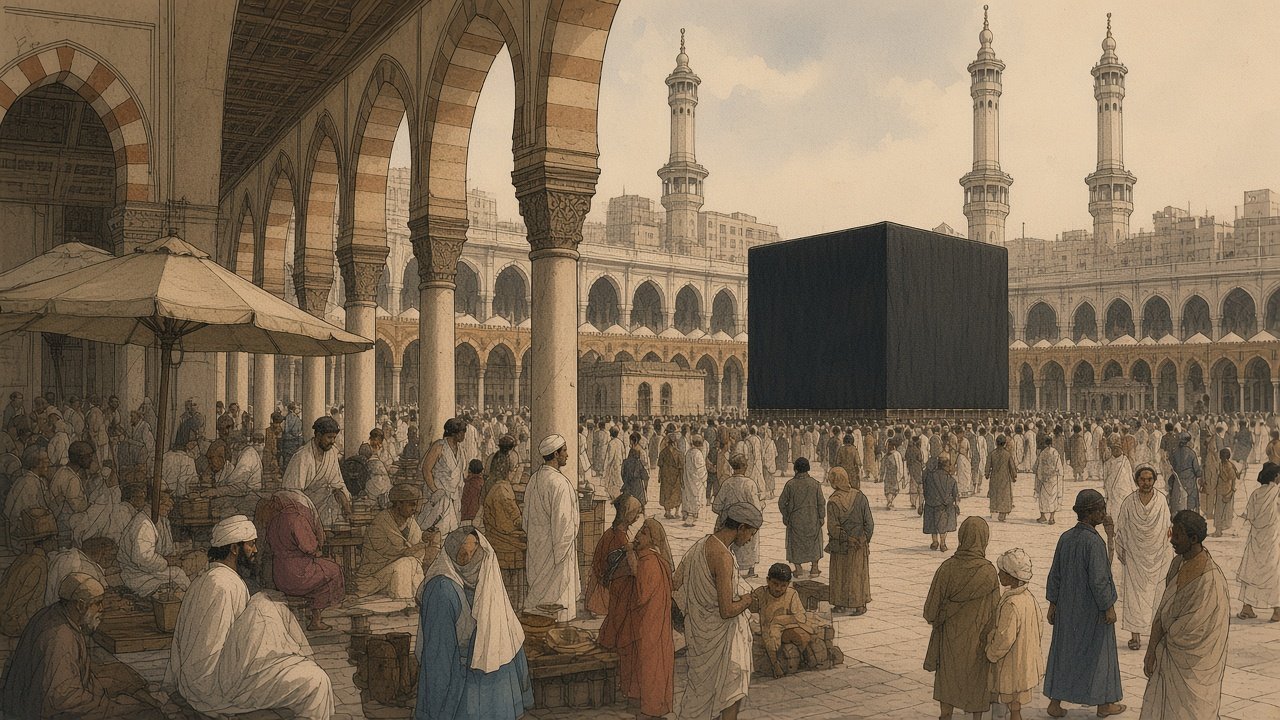
After the war, Lewis says, nothing came of pan-Islamic initiatives until the Islamic Congress of Mecca in 1954, in which the Egyptians took the lead. To show their intentions he quotes at length from Gamal Abdel Nasser’s booklet The Philosophy of the Revolution, in which Nasser describes three circles of Egyptian interest: the Arab, the African and the Islamic (p. 46). Standing before the Kaaba, Nasser writes, he realised “the need for a radical change of our conception of the Pilgrimage”. The Hajj should no longer be “an admission card to Paradise” but “a periodical political conference” of heads of state, scientists, industrialists and businessmen, a “world Islamic Parliament”. He reports telling King Saud as much, and the king’s reply: “Truly this is the real purpose of the Pilgrimage.” Contemplating the hundreds of millions of Muslims from Indonesia to the Soviet Union, Nasser foresees from their cooperation “unlimited power” for them and their “Brethren-in-Islam” (p. 46).
The passage is valuable because it comes from the most celebrated secular Arab nationalist of the age, and Lewis lets it speak for itself. He notes that the Congress was directed by Anwar Sadat as Secretary-General and served Egyptian policy alongside the Afro-Asian Solidarity Conference and the Arab League, and that this was precisely why it failed: “this new Egyptian-sponsored pan-Islamism was too obviously related to state purposes and failed to arouse the necessary response from elsewhere” (p. 46).
A tradition of pluralism
Here Lewis offers a historical explanation that qualifies much of what went before. “In the first century and a half of the Caliphate, Islam was indeed one single world state. But at that early date, it ceased to be so, and was never reunited again.” Muslim memory therefore conditions Muslims “to a sense of common social and cultural identity”, but gives them no tradition of a single Islamic state, “but rather one of political pluralism combined with socio-cultural unity” (p. 46). This is an important concession. It means that the “return of Islam” Lewis describes is a return of identity and loyalty, not necessarily of a unified Islamic polity, and it helps explain why he was sceptical, in 1976, about pan-Islam as a force in international politics.
He grants that pan-Islamic feeling had produced some diplomatic results, more than anything comparable in the Christian world: the Arab states voted as a bloc for Pakistan against India’s candidacy for the Security Council, “despite India’s devoted and selfless service to the Arab cause”, and Muslim states supported Muslims in conflict with non-Muslim majorities in the Philippines, Eritrea and parts of Africa, though they were cautious about Muslims in the Soviet Union, Eastern Europe and China (pp. 46–47). In a footnote he notes a different kind of exception: some Arab and Muslim states refused to support Turkey over Cyprus, out of residual resentment of former rulers and disapproval of Turkish secularism (p. 47).
Bourguiba and Ramadan
Islam had shown its strength “much more clearly”, Lewis argues, in the internal politics of Muslim countries, and especially as a limit on what autocrats could do. His first example is Tunisia. In February 1960 President Habib Bourguiba proposed that the month-long fast of Ramadan, with its loss of work and production, was a luxury a poor country could not afford. A Muslim ruler could not simply abolish a major prescription of the holy law, so Bourguiba argued from within it: the law allows a Muslim to break the fast on campaign in a jihād (جهاد, “struggle”, “holy war”), and a developing country was engaged in a jihad for economic independence. He sought a fatwā (فتوى, “legal opinion”) from the Mufti of Tunis. The religious authorities refused, the great mass of people kept the fast, and Bourguiba “was finally compelled to beat a more or less graceful retreat” (p. 47). “Even an autocratic socialist head of state, in pursuit of so worthy an end as economic development, could not set aside a clear ruling of the holy law” (p. 47).
Later accounts broadly confirm this episode and add detail. A Tunisian journalist and researcher writing in 2024 dates Bourguiba’s first call to break the fast to 1960, records that he addressed state leaders and senior clerics including the grand mufti in February of that year, and describes how in March 1962 Bourguiba went further, drinking a glass of orange juice on live television during Ramadan. The controversy, he argues, opened the door to a new kind of religious opposition in Tunisia and has echoed in Tunisian politics ever since.[24] Lewis’s reading of the episode as a demonstration of religion’s power to set limits on an autocrat is consistent with that account, though the later history suggests a longer and more contested struggle than the phrase “graceful retreat” implies.
Syria, 1967
The second example is “a more striking illustration of the religious limits of autocracy”. On 25 April 1967 the Syrian army magazine Jaysh al-Sha’b (جيش الشعب, “The People’s Army”) published an article by a young officer, Ibrahim Khalas, calling for “a new Arab socialist man” who believed that “God, religion, feudalism, capitalism, and all the values which prevailed in the pre-existing society were no more than mummies in the museums of history” (p. 47). The response, Lewis writes, was “immediate and violent”. A population that had acquiesced in the suppression of free speech and the confiscation of property would not accept “a denial of God and religion in an officially sponsored journal”, which “revealed the limits of acquiescence, the point at which a Muslim people was willing to stand up and be counted” (p. 47).
The Ba’thist government arrested religious leaders but also the author and editors, who were sentenced by a military court to life imprisonment; the official press proclaimed the regime’s respect for God and religion; and Radio Damascus blamed “an American-Israeli reactionary conspiracy” and the CIA (pp. 47–48). Lewis records the detail without comment, but its irony is plain: a secular, socialist regime, faced with religious anger, reached for the language of foreign and Zionist conspiracy. In his concluding section he adds a statistic: under the Ba’th, “more mosques were built in the three years after the Jaysh al-Sha’b incident than in the previous thirty” (p. 48). No source is given for that figure, and it could not be independently checked for this article.
9. Badr, 1973 – holy war in a secular army
The last body of evidence in the essay concerns war. “Even in Nasserist Egypt,” Lewis writes, “Islam continued to provide a main focus of loyalty and morale” (p. 47). He cites the orientation manual issued by the Supreme Command of the Egyptian forces in 1965, which presented the wars in Yemen and against Israel as a jihad. Officers were instructed to tell troops who asked whether the classical duty of jihad was still in force that it was, interpreted in modern terms as a striving for social justice and human betterment, against “imperialism, Zionism, and the Arab reactionaries”. The manual quotes the Qur’an (2:191): “Kill them wherever you come upon them and drive them from the places from which they drove you” (p. 48). The war, Lewis comments, “is a holy war, and the rewards of martyrdom as specified in scripture await those who are killed in it” (p. 48).
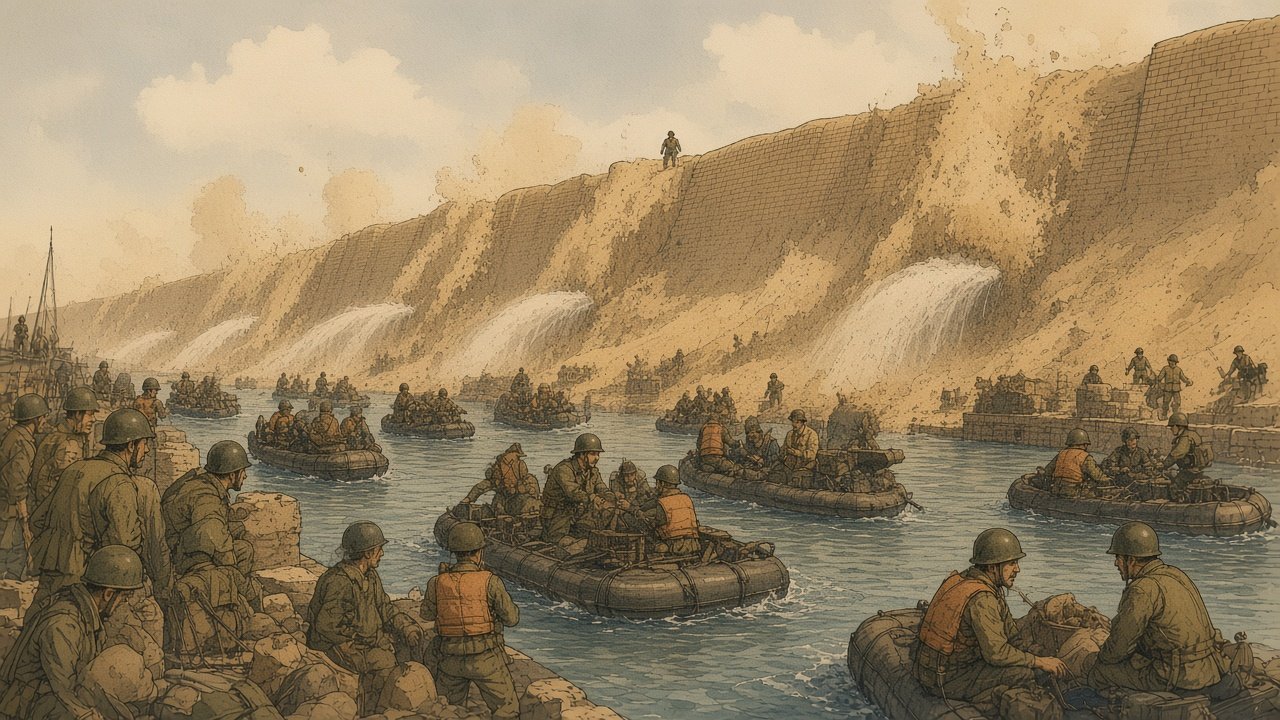
Similar ideas, he says, appeared in the manual issued to Egyptian troops in June 1973, and “the operational code name for the crossing of the Canal was Badr”, after the Prophet’s first great victory over his Meccan opponents (بدر). “Incidentally, the enemy named in the manual is not Zionism or even Israel but simply ‘the Jews'” (p. 48). He contrasts the Egyptian stress on religion with the “more ideological approach” of Syrian orientation literature.
Lewis then turns to the two most recent wars between Muslims and non-Muslims: the Turkish landing in Cyprus in 1974 and the Egyptian and Syrian war against Israel in October 1973. In both, he writes, “the language, the rhetoric accompanying the offensives, were strikingly religious”, and popular wartime legend told of the Prophet and the angels fighting on the Egyptian side; a writer who complained that this devalued the army’s achievement “was bitterly denounced” (p. 48). Coptic Christians fought in the Egyptian army, some as senior officers, and the guidance manual invoked Christian as well as Muslim belief. Yet when news came of the Israeli crossing to the west bank of the canal, a rumour blamed the treachery of a Coptic officer. The government denied it at once, and Lewis notes that it was “probably not entirely coincidental that a Coptic general was promoted to an army command at that moment” (p. 48). Even the secular Turks in Cyprus, he adds, used “numerous Islamic terms” for themselves, their enemies and the struggle.
A warning against overstatement
Immediately after this, Lewis enters a qualification that is often omitted when the essay is summarised. “In recognizing the extent to which communal loyalty remains a significant force in the life of Muslim countries, one should not fall into the opposite error of discounting the degree of effective secularization” (p. 48). In the more developed countries, “changes which are probably irreversible have already taken place”, above all in social and economic life and in law and the courts. In Turkey, Iran and Egypt, geography and history had given their peoples “a special sense of separate identity and destiny” and advanced them “on the path toward secular nationhood” (p. 48).
But the qualification is itself qualified. Even in these countries Islam “remains a significant, elsewhere a major, force”, and “in general, the extent of secularization is less than would at first appear”. Ostensibly secular schools and universities were increasingly subject to religious influence, and in radical states like Syria “the net effect of secularization seems to be directed against minority religions much more than against Islam”. His example is a Syrian government report of October 1967 requiring private schools, mostly Christian, to use ministry textbooks in which the teaching of Christianity and Islam was “unified” so as not to leave room for “confessionalism” (p. 48).
These pages are among the most concrete in the essay, because they rest on documents (the manuals, the code name, the Syrian report) rather than on general impressions. They are also the pages that bear most directly on Israel. The name Badr would be remembered: eight years later Sadat was assassinated during the military parade held to commemorate the crossing of October 1973, by members of a group that called itself Islamic Jihad.[14]
10. Saturday people, Sunday people – the conclusions
“From the foregoing,” Lewis writes, “certain general conclusions emerge” (p. 48). They are worth setting out in full, since they are what later readers have tested against events.
The first is the central thesis: “Islam is still the most effective form of consensus in Muslim countries, the basic group identity among the masses.” This “will be increasingly effective as the regimes become more genuinely popular”. The small, Western-educated elites that governed until a few decades earlier were giving way to regimes closer to the populace, and “as regimes come closer to the populace, even if their verbiage is left-wing and ideological, they become more Islamic” (p. 48). In other words, Lewis predicted that democratisation, or at any rate popularisation, would strengthen Islam in politics rather than weaken it.
The second conclusion concerns international politics, and it is more cautious than the essay’s reputation suggests. “Islam is a very powerful but still an undirected force in politics. As a possible factor in international politics, the present prognosis is not very favorable.” Pan-Islamic policies had failed, partly because “those who have made the attempt have been so unconvincing”. But: “This still leaves the possibility of a more convincing leadership, and there is ample evidence in virtually all Muslim countries of the deep yearning for such a leadership and a readiness to respond to it” (pp. 48–49). The lack of “an educated modern leadership” had so far kept religious movements from being serious contenders for power. Islam was “already very effective as a limiting factor and may yet become a powerful domestic political force if the right kind of leadership emerges” (p. 49). This is the passage most often cited as prophetic, and it is worth noticing its form: it is conditional, it speaks of a possibility, and it is about leadership.
Israel and Lebanon
The final paragraph returns to the two places that had framed the essay. “In the period immediately preceding the outbreak of the Six-Day War in 1967, an ominous phrase was sometimes heard, ‘First the Saturday people, then the Sunday people.'” The phrase means that the Christians, whose holy day is Sunday, will follow the Jews, whose holy day is Saturday. “The Saturday people have proved unexpectedly recalcitrant,” Lewis continues, “and recent events in Lebanon indicate that the priorities may have been reversed” (p. 49).
“Fundamentally,” he argues, “the same issue arises in both Palestine and Lebanon.” The basic question is: “Is a resurgent Islam prepared to tolerate a non-Islamic enclave, whether Jewish in Israel or Christian in Lebanon, in the heart of the Islamic world?” He points to the “current fascination among Muslims with the history of the Crusades” and the lessons drawn from the extinction of the Crusader states (p. 49).
The last sentences state the essay’s most sweeping claim. “Islam from its inception is a religion of power, and in the Muslim world view it is right and proper that power should be wielded by Muslims and Muslims alone. Others may receive the tolerance, even the benevolence, of the Muslim state, provided that they clearly recognize Muslim supremacy.” That Muslims should rule non-Muslims is “right and normal”; that non-Muslims should rule Muslims is “an offense against the laws of God and nature”, whether in Kashmir, Palestine, Lebanon or Cyprus (p. 49). A footnote adds the example of Islamic marriage law, which allows a Muslim man to marry a non-Muslim woman but forbids the reverse, because “in a marriage the man is the dominant, the woman the subordinate, partner—and Islam must prevail” (p. 49). Lewis ends by repeating that Islam is “not conceived as a religion in the limited Western sense but as a community, a loyalty, and a way of life”, still recovering from the trauma of conquest and alien rule. “Both the Saturday people and the Sunday people are now suffering the consequences” (p. 49).
Description or verdict?
The conclusion is where readers divide most sharply. Read as description, it summarises a classical juristic view of the relation between Muslims and non-Muslims that Lewis, as a historian of Islamic law and society, knew well, and it identifies a real political question about the place of non-Muslim states and communities in the region. Read as verdict, it attributes a single “Muslim world view” to hundreds of millions of people and makes the Arab-Israeli conflict, and the Lebanese war, in essence religious. The essay itself does not choose between these readings; it moves from the first to the second without marking the step. That ambiguity is the source of much of the controversy that followed.
11. Said’s Orientalism – “Muslims are Muslims”
The first and most consequential critic of “The Return of Islam” was Edward Said, the Palestinian American literary scholar at Columbia, whose Orientalism appeared in 1978. The book’s central argument was that Western scholarship on the “Orient”, from the eighteenth century onwards, had been bound up with imperial power, and that it constructed an essential, unchanging East as the opposite of a rational, dynamic West. In the last part of the book, on contemporary American Middle East studies, Lewis becomes Said’s principal living example, and “The Return of Islam” is the text he examines most closely. Said’s publisher even acknowledged permission from the American Jewish Committee to reprint excerpts from it.[5]
Said’s case against Lewis has several strands. The first concerns standing. Lewis’s position in “the Anglo-American Middle Eastern Establishment”, he wrote, is “that of the learned Orientalist, and everything he writes is steeped in the ‘authority’ of the field. Yet for at least a decade and a half his work in the main has been aggressively ideological.” Lewis’s recent writing was “a perfect exemplification of the academic whose work purports to be liberal objective scholarship but is in reality very close to being propaganda against his subject material”.[5]
The second strand is the relation between the 1964 and 1976 texts. Said argued that the change of title, “From ‘Revolt’ to ‘Return'”, was “a change intended by Lewis to explain to his latest public why it is that the Muslims (or Arabs) still will not settle down and accept Israeli hegemony over the Near East.”[5] This is a claim about intention and audience; it reads the essay as an intervention in American Jewish opinion about Israel.
The riot of 1945
The third strand is the most specific, and it is a close reading of the Egyptian riot of November 1945. Said set the two versions side by side. In 1964 Lewis had written that “political leaders in Egypt called for demonstrations on the anniversary of the Balfour Declaration”, which “rapidly developed into anti-Jewish riots in the course of which a Catholic, an Armenian, and a Greek Orthodox church were attacked and damaged”. In 1976, as quoted above, “demonstrations were held”, the political leaders did not intend what followed, and “several churches” of the three denominations were attacked. Said annotated the later text with his own comments in square brackets: the passive “demonstrations were held” was “an attempt to show instinctive loyalties”, whereas in the earlier version “political leaders” had been responsible; and “several churches, of three kinds” gave the impression of many churches, whereas “the earlier version is specific about three churches”. He also complained that “in neither instance does he tell us how it was anti-Jewish”, the only evidence given being the attacks on churches.[5]
Here a reader in 2026 can test the claim. The contemporary report of the Jewish Telegraphic Agency, quoted earlier, records synagogues burned and Jewish shops looted, which plainly made the riot anti-Jewish.[23] The essay does not spell this out; the contemporary record shows it. Said’s textual point, that the revision shifted responsibility from leaders to crowds and so served the thesis of “instinctive communal loyalty”, is a fair observation about how the passage was rewritten, though readers will differ about how much weight it can bear.
“Islam does not develop”
The fourth strand is the general charge that gave the critique its force. “Lewis’s polemical, not scholarly, purpose”, Said wrote, “is to show, here and elsewhere, that Islam is an anti-Semitic ideology, not merely a religion.” Lewis presented Islam as “an irrational herd or mass phenomenon, ruling Muslims by passions, instincts, and unreflecting hatreds”, and the point of his exposition was “to frighten his audience, to make it never yield an inch to Islam”. “According to Lewis, Islam does not develop, and neither do Muslims; they merely are.” Lewis, Said granted, always took care to say that Muslims were not anti-Semitic in the way the Nazis were, but implied that their religion could too easily accommodate anti-Semitism. “The core of Lewis’s ideology about Islam is that it never changes, and his whole mission is now to inform conservative segments of the Jewish reading public, and anyone else who cares to listen, that any political, historical, and scholarly account of Muslims must begin and end with the fact that Muslims are Muslims.”[5] Said then quoted, as a final exhibit, the passage about liberal opinion taking “protective umbrage” and the cricket match reported by a baseball correspondent.
Weighing the charge
Said’s reading had real purchase on the text. The essay does speak of “instinctive” loyalties, of the “angry mob” and of “the Muslim world view”, and its last paragraph does generalise about what Muslims hold “right and proper”. It was published in a Jewish magazine and closes on Israel. But some of Said’s paraphrases go beyond what the essay says. It nowhere claims that Islam is “an anti-Semitic ideology”; its treatment of anti-Jewish violence is set within an argument about attacks on Christians, which it presents as the stronger evidence. It explicitly warns against “discounting the degree of effective secularization” and describes “changes which are probably irreversible” (p. 48), which is hard to square with the claim that, for Lewis, Islam “never changes”. Said also noticed a “logical difficulty” in Lewis presenting Islam both as a mass phenomenon and as “not genuinely popular”; the phrase does not appear in that form in the essay, which in fact says that the nationalist movement became more Islamic as it became “genuinely popular” (p. 44).[5]
What Said identified, and what later critics developed, is less a set of misstatements than a way of framing: the habit of making “Islam” the subject of sentences about politics, and of explaining events by identity rather than by interests, institutions or circumstances. Whether that framing illuminated the Middle East of the 1970s, or distorted it, is the question on which the subsequent debate turned.
12. The quarrel of 1982 and Covering Islam
Lewis did not answer Orientalism at once. His reply came four years later, in June 1982, in The New York Review of Books, under the title “The Question of Orientalism”. He did not defend “The Return of Islam” line by line; indeed he barely mentioned his own work. He defended instead the scholarly tradition that Said had attacked.
The article opens with an extended parody. Imagine, Lewis wrote, that Greek patriots decided that classical studies were an insult to Hellas, the product of “a deep and evil conspiracy” to denigrate the Greek achievement, and demanded that only Greeks, or non-Greeks with suitable political credentials, be allowed to teach Greek history. “Stated in terms of classics and Greek, the picture is absurd. But if for classicist we substitute ‘Orientalist,’ with the appropriate accompanying changes, this amusing fantasy becomes an alarming reality.” The term Orientalism, he complained, had been “emptied of its previous content and given an entirely new one—that of unsympathetic or hostile treatment of Oriental peoples.”[25]
His substantive objections were historical. Said, he argued, had reduced the Orient to the Middle East and the Middle East to part of the Arab world, excluded Turkish and Persian studies, and dated the rise of Orientalism to the late eighteenth century in Britain and France, ignoring its seventeenth-century beginnings and its main centres in Germany: “a history of Arabic studies in Europe without the Germans makes as much sense as would a history of European music or philosophy with the same omission.” He accused Said of reading “an elaborate, hostile, and wholly absurd interpretation” into a dictionary definition of an Arabic root that Lewis had quoted. He noted that six of his own books had been translated in the Arab world, “one of them indeed under the auspices of the Muslim Brethren”. And he insisted that criticism of individual scholars was a normal part of scholarship, but that “a criticism of Orientalism” as such “would be meaningless”.[25]
The exchange
In August the Review printed replies from Said and from the art historian Oleg Grabar, with a rejoinder by Lewis. Said’s letter was furious. He accused Lewis of “suppressing or distorting the truth and by innuendo”, adding “that veneer of omniscient tranquil authority which he supposes is the way scholars talk”. European interest in Islam, Said insisted, “derived from fear of a monotheistic, culturally and militarily formidable competitor to Christianity”, and that combination of fear and hostility had persisted into modern scholarship.[26] He complained that Lewis was appealing to readers likely to assume that “since Clifford Geertz has told them I am an intemperate left-wing non-Orientalist Christian Palestinian, I cannot be trusted” (the anthropologist Geertz had reviewed him in the same paper a few weeks before); this, Said wrote, was “not an epistemological issue but a political one”.
Lewis’s rejoinder insisted that political views, his own and Said’s, were “basically irrelevant”, since the assertions on both sides “must stand or fall on their scholarly merits”. It ended on a note that both his admirers and his critics would later quote: “The tragedy of Mr. Said’s Orientalism is that it takes a genuine problem of real importance, and reduces it to the level of political polemic and personal abuse.”[26]
The exchange did not settle anything; it fixed positions. Ian Buruma, writing in 2004, judged that in arguments with ideological opponents, “not least a famous 1982 exchange with the late Edward Said”, Lewis “has regularly displayed his superior mastery of Islamic history”, but added that Said’s charge had never been ignorance: it was that Orientalists “were arrogant and contemptuous of Muslims, and disguised political agendas with scholarship”.[27] Lewis’s retort, recorded in his Guardian obituary, that if Westerners could not legitimately study the history of Africa or the Middle East “then only fish can study marine biology”, condensed his side of the quarrel.[4]
Covering Islam
Between Orientalism and the 1982 exchange, Said published Covering Islam (1981), which applied his argument to the American news media and their coverage of the Iranian revolution and the hostage crisis of 1979 to 1981. Said argued, in the summary of one contemporary reviewer, that the abuse of “Islam” as “a catch-all category” was hardly new, but that its almost daily use as political cliché in the media had intensified. In a passage the reviewer quoted, Said observed that before the OPEC price rises of early 1974, “‘Islam’ as such scarcely figured either in the culture or the media. One saw and heard of Arabs and Iranians, of Pakistanis and Turks, rarely of Muslims.” That reviewer, Sarah Graham-Brown, writing in MERIP Reports, praised Said’s account of how news is made by correspondents who change posts at regular intervals and “do not know the language, history or culture of the societies they cover”, while finding the critique “occasionally weakened by the use of abstruse language that verges on the baroque”.[13] Malise Ruthven, in the London Review of Books, summarised Said’s charge that today’s orientalists presented Islam “as something monolithic and predominantly hostile”, a “‘reductive and monochromatic’ account of an enormously varied and complex reality”. He thought that “Said’s fire is sometimes rather wild”, inclined to overlook “such nuggets of truth as lie buried” within the clichés, such as the central role of martyrdom in Iranian religious and popular culture, but judged that “Said’s targets are well-chosen and the questions he raises important”.[28]
Covering Islam is in one sense the mirror image of “The Return of Islam”. Lewis complained that the West could not see religion in Muslim politics; Said complained, five years later, that the West could now see nothing else. Martin Kramer would later argue that the book was “an attempt to cover his own failure to anticipate the new salience of Islam”, and that Said, unlike Lewis, “didn’t see the Iranian revolution coming”.[29] Said’s defenders would reply that the distortions he documented in the coverage of Iran were real whether or not anyone had foreseen the revolution. Both claims can be true at once.
13. After 1979 – the essay as prophecy
Within three years of publication, events gave “The Return of Islam” a reputation it has never lost. The Iranian monarchy fell in February 1979 and Ayatollah Khomeini returned from exile to establish an Islamic republic.[30] In the same year came the seizure of the Grand Mosque in Mecca and the Soviet invasion of Afghanistan, which drew volunteers from across the Muslim world into a war fought explicitly as jihad. In October 1981 Anwar Sadat was assassinated during the parade commemorating the October crossing, the operation whose code name had been Badr.[14] In Lebanon, the war that Lewis had treated as a test of Muslim tolerance for a Christian enclave continued until 1990; in its course, after the Israeli invasion of 1982, the Shi’i movement Hezbollah emerged.[17] In 1987 the first Palestinian intifada gave rise to Hamas, an offshoot of the Muslim Brotherhood that defined the conflict with Israel in religious terms.[20]
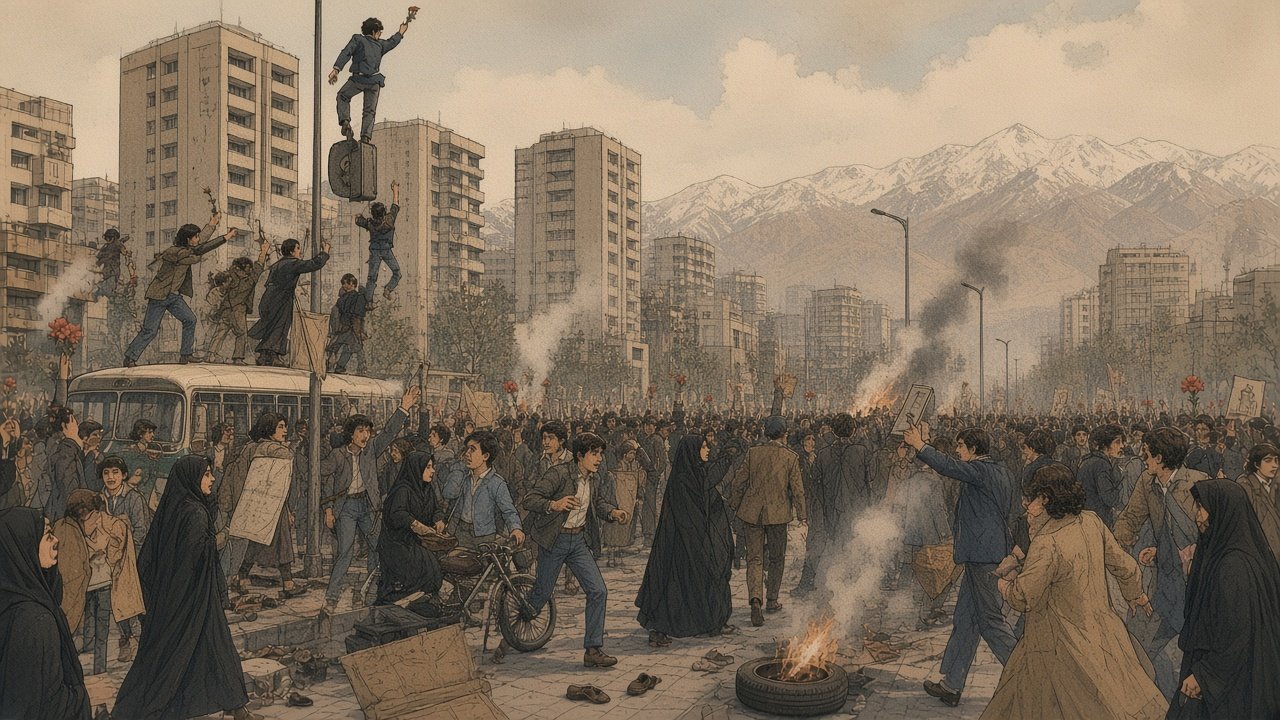
Kramer’s verdict is characteristically precise: Lewis “didn’t predict the Iranian Revolution three years later, but it enhanced his reputation for prescience.”[3] The essay does not mention Shi’ism as a political force, does not discuss the Iranian clergy, and treats Iran mainly as one of three countries (with Turkey and Egypt) furthest along “the path toward secular nationhood” (p. 48). What it did do, against much contemporary opinion, was insist that religious loyalty was the deepest political identity of the Muslim majority and that it would grow stronger, not weaker, as politics became more popular. Its conditional forecast, that Islam “may yet become a powerful domestic political force if the right kind of leadership emerges” (p. 49), was answered in Iran by exactly such a leadership. The Guardian‘s obituarist called the article “especially prophetic”, published “well before the Iranian revolution”.[4]
Lewis on the revolution
Lewis returned to the theme in 1988 in an essay in The New York Review of Books titled “Islamic Revolution”. Its argument extends the 1976 essay. Earlier Middle Eastern reformers and revolutionaries had borrowed European symbols, first French and later those of Eastern and Central Europe. “The Islamic revolution which won power in Iran in 1979 and continues to offer a major challenge to existing regimes in other Islamic lands uses none of these symbols. For the Ayatollahs and those who respond to them, neither the Bible nor the Latin and Greek classics, neither Jacobins nor Bolsheviks, neither Paris nor Petrograd provide usable models or evocative symbols.” Islam, he went on, “has its own scriptures and classics”, and Islamic history “provides its own models of revolution”. He also repeated the 1976 argument about the founder: unlike Moses and unlike Jesus, Muhammad had established a state, and “as the Ayatollah Khomeini has reminded us, Muhammad exercised the normal functions of a head of state”.[31] In this sense Khomeini became, for Lewis, a witness to the thesis he had already advanced about religion as a total jurisdiction.
Other explanations
Not everyone accepted that 1979 vindicated the essay’s framework. Other readers stressed the specific features of the revolution: a Shi’i clergy with its own revenues and institutions, the alliance of clerics with bazaar merchants and the secular left, the economic dislocations of the oil boom and the character of the Shah’s regime. The Ruthven review of 1982 noted that one author under review overlooked “the specific role of the clergy as carriers of the nationalist banner” in Iran.[28] Seen this way, the Islamic revolution was also a nationalist revolution, and its religious language had a history of its own rather than a timeless source.
Gilles Kepel, the French political scientist whose Jihad: The Trail of Political Islam became a standard account, dated the beginning of the Islamist movements to the early 1970s, when “militants revolted against the regimes in power throughout the Muslim world”, and argued that their political radicalisation had peaked before September 2001.[2] Olivier Roy, in The Failure of Political Islam, went further, arguing that Islamism was in its social content the “Third Worldism of the 1960s” in new dress, so that “those marching today beneath Islam’s green banners are the same as the ‘reds’ of yesterday, with similarly dim prospects of success”.[32] Both accounts agree with Lewis that something real and religious had happened; they differ in treating it as a modern political movement with a social base, a programme and a life cycle, rather than as the reassertion of an ancient identity.
In 1998, Lewis analysed in Foreign Affairs the “Declaration of the World Islamic Front for Jihad against the Jews and the Crusaders”, issued under the signature of Usama bin Ladin. He took the document seriously as an expression of a widespread grievance, but added that “for many—perhaps most—Muslims, the declaration is an equally grotesque travesty of the nature of Islam and even of its doctrine of jihad. The Quran speaks of peace as well as of war.”[33] That distinction, between the force of religious identity and the claims of those who would speak for it, runs back to the 1976 essay’s observation that Islam was “a very powerful but still an undirected force”.
14. After 2001 – clash, rage and the war on terror
The second afterlife of “The Return of Islam” began in September 1990 with another magazine essay, “The Roots of Muslim Rage”, in The Atlantic Monthly. There Lewis wrote a sentence that would be quoted more than anything else he published: “This is no less than a clash of civilizations—the perhaps irrational but surely historic reaction of an ancient rival against our Judeo-Christian heritage, our secular present, and the worldwide expansion of both.”[34] Three years later Samuel Huntington quoted the passage in Foreign Affairs, in the article “The Clash of Civilizations?”, which turned the phrase into a theory of world politics after the Cold War.[35] Kramer has insisted that Lewis “meant it as a very partial description of the past and the present, and not as a prediction of the future”.[3]
After the attacks of 11 September 2001, Lewis became, as Kramer put it, famous in a way he had not been before: “Osama bin Laden made me famous”, he admitted, and the two short books he published after the attacks became bestsellers. He was “a valued interlocutor” of statesmen in Turkey, Jordan and Israel, of the last Shah, and of President George W. Bush and his team.[3] Ian Buruma, writing in The New Yorker in 2004, described him as “a thoroughly political don”: Karl Rove had invited him to speak at the White House, Richard Perle and Dick Cheney were among his admirers, he had championed Ahmad Chalabi for a leading role in Iraq, and “if anyone can be said to have provided the intellectual muscle for recent United States policy toward the Middle East it would have to be him”.[27] The Guardian obituary noted that he had been consulted by the Bush administration, though he “recommended the encouragement of revolution in the north of Iraq rather than invasion”.[4]
Said’s reply
Said answered the new mood in The Nation in October 2001 with “The Clash of Ignorance”. Huntington, he wrote, relied heavily on Lewis’s 1990 article, “whose ideological colors are manifest in its title”. In both texts “the personification of enormous entities called ‘the West’ and ‘Islam’ is recklessly affirmed, as if hugely complicated matters like identity and culture existed in a cartoonlike world where Popeye and Bluto bash each other mercilessly”. The attacks, he argued, were “the capture of big ideas (I use the word loosely) by a tiny band of crazed fanatics for criminal purposes”, and labels like Islam and the West “mislead and confuse the mind, which is trying to make sense of a disorderly reality that won’t be pigeonholed or strapped down as easily as all that”.[36] This was the 1978 critique of “The Return of Islam” restated for a new war: the objection was not to the facts Lewis reported but to the entity, “Islam”, that was made to act in his sentences.
Assessments
The arguments of the 2000s attached to Lewis’s later work rather than to the 1976 essay, but they coloured how it was read. Charles Tripp, quoted in the Guardian obituary, judged Lewis’s earlier work “substantial and influential but through his later misguided political involvement in US policymaking, he reinforced Said’s argument about how forms of knowledge are produced to service power”.[4] Buruma, who granted Lewis’s superior mastery of Islamic history, doubted that he was contemptuous of Muslims, quoting his statement that “Islam is one of the world’s great religions” which “has brought comfort and peace of mind to countless millions of men and women”, but argued that his writings “give the impression that British and French imperialism, United States interventions, and Israeli oppression of Palestinians are simply alibis for the region’s political failings”, the real causes being, in Lewis’s account, “deeper, older, grander”.[27] Kramer, defending his teacher after his death in 2018, rejected the idea that Lewis held “the Arabs” in contempt, pointed to his long friendships with Charles Issawi and Fouad Ajami, recalled that in 1971 he had carried a peace overture from Sadat to Golda Meir, and argued that it was his Arab friends who persuaded him, “however improbably”, that the Arab peoples were ready for democracy, “beginning in Iraq”.[3]
By the 2010s the 1976 essay had become a standard text for both sides of the argument: cited by admirers as the proof of foresight, and by critics as the origin of a habit of explaining politics by religion. Its reissue in readers and its anniversary commentary in Commentary itself kept it in circulation.[9][10]
15. The Jews of Islam – the essay and the Judaeo-Islamic tradition
For readers of this site, the essay has a further dimension. “The Return of Islam” was written for a Jewish magazine by a Jewish historian, and it ends with the Jews: the “Saturday people”, Israel as a “non-Islamic enclave”, and an army manual that names the enemy as “simply ‘the Jews'” (p. 48). Said read this as the essay’s hidden purpose. But it can also be read beside the book in which Lewis, eight years later, set out his views on the Jewish experience under Islam at length.
The Jews of Islam (Princeton, 1984) was reviewed in The New York Review of Books by Norman Stillman, himself a leading historian of the Jews of the Arab world. Stillman described how the subject had been pulled between two partisan pictures: the “golden age” of Jewish life under Islam, an idea with roots in nineteenth-century romanticism and in German Jewish scholarship, which had been taken up by anti-Zionist writers; and the “persecution and pogroms” school, which “has been enjoying vogue in Israel and among many of its passionate supporters elsewhere”. Lewis, Stillman wrote, “refuses such simplistic approaches and tries to explain the complex and often contradictory history of Jewish–Muslim relations over fourteen hundred years”.[37]
The book’s central concept is what Lewis called “the Judaeo-Islamic tradition”, in Stillman’s words “a historical concept parallel to and no less real—perhaps even more real—than that of the Judaeo-Christian tradition”. Lewis stressed that for much of the Middle Ages, “Islamic practice on the whole turned out to be gentler than Islamic precept—the reverse of the situation in Christendom”, and he ridiculed the modern debate about the tolerance or intolerance of Islam, since for most of history tolerance was not a virtue, nor intolerance a vice. Under the system of the ذمة (dhimma), Stillman summarises, non-Muslims “were second-class citizens, but they did have ‘a kind of citizenship'” and real rights. He also praised Lewis for setting attitudes against political and social change, “so as not to create the false impression of timeless, static patterns”.[37]
That last phrase is worth setting beside Said’s charge that, for Lewis, “Islam does not develop”. On Jewish history at least, Lewis’s most sympathetic expert reviewer found the opposite. Read in this light, the final paragraph of “The Return of Islam” applies to the twentieth century the same model as The Jews of Islam: a tradition in which non-Muslims could receive “the tolerance, even the benevolence, of the Muslim state, provided that they clearly recognize Muslim supremacy” (p. 49). The question the essay put was what happened to that tradition when the subordinate communities, Jews in Israel and Christians in Lebanon, ceased to accept subordination.
Myth and counter-myth
Lewis was also one of the first to analyse the politics of the “golden age” itself. Mark R. Cohen, the Princeton historian of Jews in the medieval Islamic world, credits him with the insight that the myth of an interfaith utopia in Muslim Spain “was invented by Jews in 19th century Europe as a reproach to Christians—and taken up by Muslims in our time as a reproach to Jews”, a sentence from Lewis’s 1968 essay “The Pro-Islamic Jews”.[38] Cohen also describes the reaction against that myth, a “counter-myth of Islamic persecution” which, adapting Salo W. Baron’s critique of the “lachrymose conception of Jewish history”, he calls a “neo-lachrymose conception of Jewish-Arab history”, whose chief proponent, Bat Ye’or, popularised the term “dhimmitude”.[38] This site’s essay on the Golden Age of Sefarad discusses that debate in detail.
Where does “The Return of Islam” sit between myth and counter-myth? Its account of 1945 and 1952, of the Saturday and Sunday people, and of a “religion of power” comes close to the second; its insistence elsewhere on the gentler practice, on the real secularisation of law, and on the variety of Muslim political experience keeps it short of it. The essay was published at the moment when the great majority of the Jews of the Arab world had already left; the communities whose history Stillman and Lewis were writing were, as Stillman put it, reduced to “a few remnants”.[37] This site’s reference note on the Jews of the Arab lands lists Lewis’s surveys among the foundational syntheses of that history.
A different mirror
Another essay on this site, The Cosmopolis Before the Catastrophe, offers a reading of the same movements that Lewis traces, from al-Afghani to the Muslim Brotherhood, which differs from his in a way that matches the later scholarly debate. There Islamism appears as a modern ideology, a “reactionary nationalism” born, like Zionism, of the encounter with European imperialism, which took the classical أمة (umma) and reshaped it into a political nation. Lewis, by contrast, saw the religious community as the older and deeper loyalty, which nationalism had only temporarily disguised. The two readings agree on the chronology and the actors; they disagree on which came first, the faith or the nation, and therefore on whether what “returned” in the 1970s was old or new.
16. How the essay reads now
Fifty years on, “The Return of Islam” can be read in at least three ways, and each has its evidence.
It can be read as a forecast. In January 1976 the leading opinion in Western universities and governments treated religion as a declining force in Middle Eastern politics. Lewis argued that it was the most durable political identity in the region, that it would gain as politics became more popular, and that what it lacked was leadership. Iran in 1979, Egypt in 1981, Lebanon in the 1980s, Hamas in 1987, the movements Kepel chronicled and the jihadism of the 1990s all fit that frame. His admirers, from Kramer to the editors of Commentary, have rested his reputation on it.[15][10]
It can be read as a framing. Said and those who followed him did not, for the most part, deny that Islamic movements were growing. They objected to the habit of writing “Islam” as the subject of political sentences, to the use of words like “instinctive” and “mob”, and to the move from the history of an idea to the motives of hundreds of millions of people. Roy and Kepel, in different ways, explained the same events as the product of particular social groups, regimes and economic crises, and expected them to change and even to fail.[5][32][2]
And it can be read as a historian’s essay in a specific place and time: a learned, sardonic, frequently brilliant tour of two centuries of evidence, from the Wahhabis to the Basmachi and from Lausanne to Badr, written for American Jewish readers in the first winter of the Lebanese war, by a scholar who was also a participant in the arguments he described. Much of what is most durable in it is the evidence: the exchange of populations defined by religion rather than language, the Christians drawn to secular Arabism, the churches attacked in Cairo and Suez, the Egyptian manuals, the Syrian schoolbooks. Much of what is most contested is the generalisation that frames that evidence.
What it did not say
It is worth recording what the essay did not claim. It did not predict a revolution in Iran, which it described as one of the countries furthest along the road to secular nationhood. It explicitly warned against “discounting the degree of effective secularization” (p. 48). It found pan-Islamic politics a failure and its prospects “not very favorable” (p. 48). It treated Islam as “undirected”, its political future dependent on the emergence of a leadership that did not yet exist. These qualifications are often lost when the essay is cited as prophecy, and they are lost equally when it is cited as caricature.
The questions it left
The essay’s last question, whether “a resurgent Islam” would tolerate “a non-Islamic enclave, whether Jewish in Israel or Christian in Lebanon, in the heart of the Islamic world” (p. 49), has received more than one answer since 1976. Egypt made peace with Israel in 1979 and Jordan in 1994, and both treaties have endured despite the movements that reject them; Lebanon’s war ended in 1990. At the same time, the movements that defined the conflict in the most religious terms, in Gaza, in south Lebanon and elsewhere, became more powerful rather than less. The essay’s question has therefore not been answered so much as divided: states, with their interests and treaties, have answered it one way, and movements claiming to speak for the faith have answered it another.
That division is itself close to Lewis’s own distinction, at the end of his essay, between the regimes and the populace, and between Islam as a source of identity and Islam as a force that might yet be “directed”. It is also close to Said’s insistence that “Islam” names many different things. The essay’s afterlife, in other words, has been the argument between those two readings, and it is still going on.
References
- Bernard Lewis, “The Return of Islam”, Commentary 61:1 (January 1976), pp. 39 - 49 *
- Gilles Kepel, Jihad: The Trail of Political Islam, trans. Anthony F. Roberts (Cambridge, MA: Harvard University Press, 2002; paperback 2003), publisher’s page *
- Martin Kramer, “The Conflicted Legacy of Bernard Lewis”, Foreign Affairs, 7 June 2018 *
- Lawrence Joffe, “Bernard Lewis obituary”, The Guardian, 6 June 2018 *
- Edward W. Said, Orientalism (New York: Pantheon, 1978; Vintage, 1979), pp. 316 - 318 *
- Harry Ransom Center, University of Texas at Austin, “Commentary Magazine: An Inventory of Its Records” *
- Commentary, January 1976 issue, contents *
- Princeton University, “Bernard Lewis, eminent Middle East historian at Princeton, dies at 101”, 22 May 2018 *
- Bernard Lewis, “The Return of Islam”, in Michael Curtis (ed.), The Middle East: A Reader (Routledge), chapter 9 *
- Abe Greenwald, “Bernard Lewis on the Return of Islam”, Commentary, 16 October 2023 *
- Office of the Historian, US Department of State, “The 1973 Arab-Israeli War” *
- Office of the Historian, US Department of State, “Oil Embargo, 1973 - 1974” *
- Sarah J. Graham-Brown, “Islam in the News” (review of Edward W. Said, Covering Islam), MERIP Reports, July 1982 *
- Encyclopaedia Britannica, “Anwar Sadat” *
- Martin Kramer, “The Return of Bernard Lewis”, Mosaic, June 2016 *
- Robert Irwin, “Middle East Pundits and Their Mainly Worthless Prophecies”, Mosaic, 8 June 2016 *
- Encyclopaedia Britannica, “Lebanese Civil War” *
- Encyclopaedia Britannica, “Muslim Brotherhood” *
- Encyclopaedia Britannica, “Sayyid Qutb” *
- Encyclopaedia Britannica, “Hamas” *
- Convention Concerning the Exchange of Greek and Turkish Populations, signed at Lausanne, 30 January 1923 (text published by the Ministry of Foreign Affairs of Türkiye) *
- Koray Saçkan, MA thesis on the Karamanlides, Bilkent University, 2023 *
- Jewish Telegraphic Agency, “Anti-Jewish Riots in Egypt; Synagogues Burned in Cairo; Six Killed in Alexandria”, November 1945 *
- Ahmed Nadhif, “How a Scandalous Glass of Orange Juice Helped to Reshape Tunisian Politics”, New Lines Magazine, 5 April 2024 *
- Bernard Lewis, “The Question of Orientalism”, The New York Review of Books, 24 June 1982 *
- Edward W. Said and Oleg Grabar, reply by Bernard Lewis, “Orientalism: An Exchange”, The New York Review of Books, 12 August 1982 *
- Ian Buruma, “Lost in Translation”, The New Yorker, 14 June 2004 *
- Malise Ruthven, “Arabs”, London Review of Books 4:3 (1982) *
- Martin Kramer, “Edward Said and Middle Eastern studies in America” (interview), Sandbox, 11 May 2017 *
- Encyclopaedia Britannica, “Iranian Revolution of 1978 - 79” *
- Bernard Lewis, “Islamic Revolution”, The New York Review of Books, 21 January 1988 *
- Olivier Roy, The Failure of Political Islam, trans. Carol Volk (Cambridge, MA: Harvard University Press, 1994; paperback 1998), publisher’s page *
- Bernard Lewis, “License to Kill: Usama bin Ladin’s Declaration of Jihad”, Foreign Affairs, November/December 1998 *
- Bernard Lewis, “The Roots of Muslim Rage”, The Atlantic Monthly, September 1990 *
- Samuel P. Huntington, “The Clash of Civilizations?”, Foreign Affairs, Summer 1993 *
- Edward W. Said, “The Clash of Ignorance”, The Nation, 22 October 2001 *
- Norman A. Stillman, “Peaceful Coexistence” (review of Bernard Lewis, The Jews of Islam), The New York Review of Books, 25 October 1984 *
- Mark R. Cohen, “The ‘Golden Age’ of Jewish-Muslim Relations: Myth and Reality”, in Abdelwahab Meddeb and Benjamin Stora (eds), A History of Jewish-Muslim Relations (Princeton: Princeton University Press, 2013), sample chapter *