Skip to content

Archive

Every long read, newest first. Filter by topic, sort, and switch between grid and list.

979 long reads

Transmission

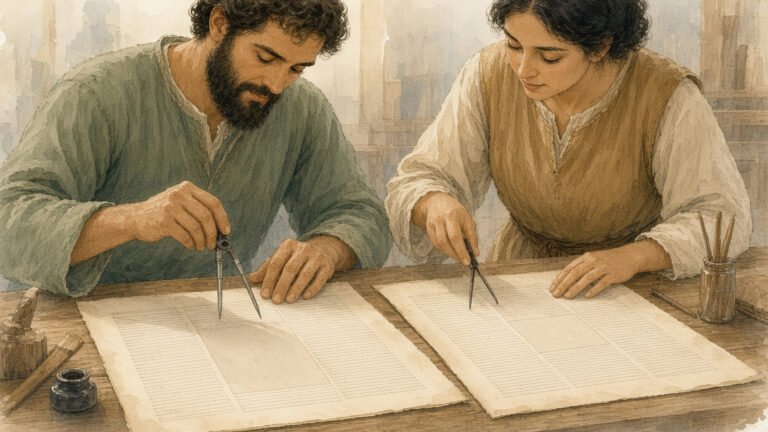
Women Copyists of Medieval Hebrew Manuscripts

Paula bat Avraham of Rome and Miriam bat Benayah of Sanaa are the best-attested women who copied Hebrew manuscripts in the Middle Ages, known almost entirely from the colophons in which they named themselves.


35 min read

Transmission

Judeo-Persian Biblical Manuscripts

From eighth-century inscriptions in Afghanistan to the Pentateuch copied by Joseph ben Moses in 1319 and the verse epics of Šāhin, Persian written in Hebrew letters carried a thousand-year tradition of Bible translation among the Jews of Iran and Central Asia.

37 min read

Transmission

The Bologna Torah Scroll

Catalogued for a century as a clumsy seventeenth-century copy, Rotolo 2 of the Biblioteca Universitaria di Bologna was recognised in 2013 as the oldest complete Torah scroll known and as the “Bible of Ezra” once treasured by the Dominicans of San Domenico.

43 min read

Transmission

Seligmann Baer and the Masoretic Text

Seligmann Baer of Biebrich spent his life on the Masorah and the liturgy, producing with Franz Delitzsch the Leipzig editions of the Hebrew Bible, the standard Seder Avodat Yisrael and the Masorah of the Vilna rabbinic Bible, and his methods were sharply criticised by Ginsburg.

31 min read

Transmission

The Craft of Hebrew Codicology

Malachi Beit-Arié’s study of the dated Hebrew manuscripts copied before 1540 shows how parchment, paper, quiring, ruling and the colophons of individual scribes reveal where and how medieval Hebrew books were made.

34 min read

Transmission

Hilleli, Muggah and Zambuki: The Lost Model Codices

The Hilleli, the Muggah, the Zambuki and the Jerusalem codex were cited for centuries as authorities in the margins of Hebrew Bibles, yet none of them survives, and what is known of them comes from the readings later scribes and scholars recorded.

29 min read

Transmission

The Amsterdam Hebrew Bibles of Joseph Athias

Printed in Amsterdam in 1661 and 1667 with the help of the Utrecht Hebraist Johannes Leusden, the Bibles of Joseph Athias introduced a new system of verse numbers, earned their printer a gold medal from the States General, and through the edition of Van der Hooght became the received text of the Hebrew Bible for scholars until the nineteenth century.

25 min read

Transmission

The Jerusalem Crown Edition of the Hebrew Bible

Published under the aegis of the Hebrew University at the turn of the twenty-first century, the Jerusalem Crown set the text of the Aleppo Codex, as established by Rabbi Mordechai Breuer, in three columns to the page in a new typeface, and documented the evidence for every decision in its accompanying volumes.

21 min read

Transmission

Ben Asher against Ben Naphtali: The Book of Differences

Written in Arabic by a Karaite scholar in Jerusalem around the turn of the tenth and eleventh centuries, the Book of Differences is the only reliable record of how the Masoretes Ben Asher and Ben Naftali disagreed, and the standard by which the great Tiberian codices are still classified.

22 min read

Transmission

The Unusual Letters of the Hebrew Bible

Dotted words, inverted nuns, suspended letters and letters written large or small are among the oldest features of the written Hebrew Bible, transmitted with the consonantal text and interpreted in the rabbinic literature long before the Masoretes recorded them in their notes.

24 min read

Transmission

Open and Closed Sections in the Hebrew Bible

The spaces that divide the text of a Torah scroll into open and closed sections are among the oldest features of the written Hebrew Bible, attested at Qumran, fixed for the Torah by Maimonides and recovered for the Prophets and Writings from a copy found in a Jerusalem attic in 1987.

20 min read

Transmission

The Masoretic Lists of Okhlah ve-Okhlah

The largest independent compilation of Masoretic lists, known by the first two words of its opening list, shows how the Masoretes and their successors classified the unique, the irregular and the easily confused in the text of the Hebrew Bible.

23 min read

Culture

Discovering Ashkenaz with YIVO

YIVO’s free online courses, led by Samuel Kassow’s survey of East European Jewish history, bring the Institute’s archives to learners everywhere.

1 hr 15 min read

Culture

How Poland Became Polin

How a small migration of traders and refugees from the German and Bohemian lands became, by the eighteenth century, the largest Jewish community in the world: the Piast state, the privileges of Kalisz and Casimir the Great, leases and private towns, the Jewish councils, the catastrophe of 1648, natural increase, and the end of the Commonwealth, with the legends and the demographic debates weighed against the evidence.

1 hr 2 min read

Architecture

Tel Aviv, the Hill of Spring

From a lottery on the dunes north of Jaffa in 1909 to a modern metropolis: the founding of Tel Aviv, its growth under Ottoman and British rule, the White City, the war of 1948 and the long, contested union with Jaffa.

50 min read

Culture

Aaron Kosminski and the Jews of the Pale

A Polish Jewish immigrant in Whitechapel, a police suspect in an unsolved murder series, and the antisemitism that greeted Jews leaving the Pale for London and other destinations.

47 min read

Culture

The Origins of Chutzpah

How a rabbinic word for impudence passed through Yiddish into American English, and how an attitude once condemned as brazenness came to be admired as boldness.

28 min read

Culture

The Forverts and the Jewish Daily Forward

How a socialist Yiddish daily founded on the Lower East Side in 1897 became the voice of Jewish immigrant America under Abraham Cahan, and how it survives today as the digital Forward and the Yiddish Forverts.

51 min read

Culture

Benjamin Harshav and the Lost World

The life and work of Benjamin Harshav, from Vilna and the Urals to Tel Aviv and Yale, and the books, essays and translated documents in which he read Marc Chagall’s paintings through the lost Yiddish-speaking world that made them.

36 min read

Culture

The Czernowitz Conference

In the last days of August 1908 several dozen writers, students, teachers, party activists and merchants gathered in Czernowitz, the capital of the Austrian crown land of Bukovina, to discuss a language…

2 hr 14 min read

Arts

The School of Paris

In the first decades of the twentieth century Paris drew painters and sculptors from across Europe and beyond on a scale that had no earlier parallel. They came to study in the…

2 hr 13 min read

Culture

The Yiddish Book Center

A graduate student took a two-year leave from his master's degree in 1980 because Yiddish books were being thrown away. The rescue that followed has become a museum, a school and a festival around 1.5 million volumes — and a long argument about who holds the world's largest Yiddish collection.

2 hr 19 min read

Culture

Warsaw Across the Centuries

Founded on the Vistula by a Mazovian prince around 1300, Warsaw became the capital of a capital-seeking kingdom, the largest Jewish community in Europe, and the city in which the Holocaust's ghetto was built, fought and destroyed. A history in five acts.

2 hr 9 min read

Culture

The Yiddish Scientific Institute

The YIVO Institute for Jewish Research was founded in Berlin in August 1925, headquartered in Vilna for fourteen years, and survives today in New York with the largest archive of East European Jewish life in the world. Its hundred-year story.

2 hr 8 min read
  1. Transmission · 10 November 2026

    Women Copyists of Medieval Hebrew Manuscripts

    Paula bat Avraham of Rome and Miriam bat Benayah of Sanaa are the best-attested women who copied Hebrew manuscripts in the Middle Ages, known almost entirely from the colophons in which they named themselves.

    35 min readby Nekud
  2. Transmission · 10 November 2026

    Judeo-Persian Biblical Manuscripts

    From eighth-century inscriptions in Afghanistan to the Pentateuch copied by Joseph ben Moses in 1319 and the verse epics of Šāhin, Persian written in Hebrew letters carried a thousand-year tradition of Bible translation among the Jews of Iran and Central Asia.

    37 min readby Nekud
  3. Transmission · 10 November 2026

    The Bologna Torah Scroll

    Catalogued for a century as a clumsy seventeenth-century copy, Rotolo 2 of the Biblioteca Universitaria di Bologna was recognised in 2013 as the oldest complete Torah scroll known and as the “Bible of Ezra” once treasured by the Dominicans of San Domenico.

    43 min readby Nekud
  4. Transmission · 10 November 2026

    Seligmann Baer and the Masoretic Text

    Seligmann Baer of Biebrich spent his life on the Masorah and the liturgy, producing with Franz Delitzsch the Leipzig editions of the Hebrew Bible, the standard Seder Avodat Yisrael and the Masorah of the Vilna rabbinic Bible, and his methods were sharply criticised by Ginsburg.

    31 min readby Nekud
  5. Transmission · 10 November 2026

    The Craft of Hebrew Codicology

    Malachi Beit-Arié’s study of the dated Hebrew manuscripts copied before 1540 shows how parchment, paper, quiring, ruling and the colophons of individual scribes reveal where and how medieval Hebrew books were made.

    34 min readby Nekud
  6. Transmission · 10 November 2026

    Hilleli, Muggah and Zambuki: The Lost Model Codices

    The Hilleli, the Muggah, the Zambuki and the Jerusalem codex were cited for centuries as authorities in the margins of Hebrew Bibles, yet none of them survives, and what is known of them comes from the readings later scribes and scholars recorded.

    29 min readby Nekud
  7. Transmission · 10 November 2026

    The Amsterdam Hebrew Bibles of Joseph Athias

    Printed in Amsterdam in 1661 and 1667 with the help of the Utrecht Hebraist Johannes Leusden, the Bibles of Joseph Athias introduced a new system of verse numbers, earned their printer a gold medal from the States General, and through the edition of Van der Hooght became the received text of the Hebrew Bible for scholars until the nineteenth century.

    25 min readby Nekud
  8. Transmission · 10 November 2026

    The Jerusalem Crown Edition of the Hebrew Bible

    Published under the aegis of the Hebrew University at the turn of the twenty-first century, the Jerusalem Crown set the text of the Aleppo Codex, as established by Rabbi Mordechai Breuer, in three columns to the page in a new typeface, and documented the evidence for every decision in its accompanying volumes.

    21 min readby Nekud
  9. Transmission · 10 November 2026

    Ben Asher against Ben Naphtali: The Book of Differences

    Written in Arabic by a Karaite scholar in Jerusalem around the turn of the tenth and eleventh centuries, the Book of Differences is the only reliable record of how the Masoretes Ben Asher and Ben Naftali disagreed, and the standard by which the great Tiberian codices are still classified.

    22 min readby Nekud
  10. Transmission · 10 November 2026

    The Unusual Letters of the Hebrew Bible

    Dotted words, inverted nuns, suspended letters and letters written large or small are among the oldest features of the written Hebrew Bible, transmitted with the consonantal text and interpreted in the rabbinic literature long before the Masoretes recorded them in their notes.

    24 min readby Nekud
  11. Transmission · 10 November 2026

    Open and Closed Sections in the Hebrew Bible

    The spaces that divide the text of a Torah scroll into open and closed sections are among the oldest features of the written Hebrew Bible, attested at Qumran, fixed for the Torah by Maimonides and recovered for the Prophets and Writings from a copy found in a Jerusalem attic in 1987.

    20 min readby Nekud
  12. Transmission · 10 November 2026

    The Masoretic Lists of Okhlah ve-Okhlah

    The largest independent compilation of Masoretic lists, known by the first two words of its opening list, shows how the Masoretes and their successors classified the unique, the irregular and the easily confused in the text of the Hebrew Bible.

    23 min readby Nekud
  13. Culture · 10 November 2026

    Discovering Ashkenaz with YIVO

    YIVO’s free online courses, led by Samuel Kassow’s survey of East European Jewish history, bring the Institute’s archives to learners everywhere.

    1 hr 15 min readby Nekud
  14. Culture · 10 November 2026

    How Poland Became Polin

    How a small migration of traders and refugees from the German and Bohemian lands became, by the eighteenth century, the largest Jewish community in the world: the Piast state, the privileges of Kalisz and Casimir the Great, leases and private towns, the Jewish councils, the catastrophe of 1648, natural increase, and the end of the Commonwealth, with the legends and the demographic debates weighed against the evidence.

    1 hr 2 min readby Nekud
  15. Architecture · 10 November 2026

    Tel Aviv, the Hill of Spring

    From a lottery on the dunes north of Jaffa in 1909 to a modern metropolis: the founding of Tel Aviv, its growth under Ottoman and British rule, the White City, the war of 1948 and the long, contested union with Jaffa.

    50 min readby Nekud
  16. Culture · 9 November 2026

    Aaron Kosminski and the Jews of the Pale

    A Polish Jewish immigrant in Whitechapel, a police suspect in an unsolved murder series, and the antisemitism that greeted Jews leaving the Pale for London and other destinations.

    47 min readby Nekud
  17. Culture · 9 November 2026

    The Origins of Chutzpah

    How a rabbinic word for impudence passed through Yiddish into American English, and how an attitude once condemned as brazenness came to be admired as boldness.

    28 min readby Nekud
  18. Culture · 9 November 2026

    The Forverts and the Jewish Daily Forward

    How a socialist Yiddish daily founded on the Lower East Side in 1897 became the voice of Jewish immigrant America under Abraham Cahan, and how it survives today as the digital Forward and the Yiddish Forverts.

    51 min readby Nekud
  19. Culture · 9 November 2026

    Benjamin Harshav and the Lost World

    The life and work of Benjamin Harshav, from Vilna and the Urals to Tel Aviv and Yale, and the books, essays and translated documents in which he read Marc Chagall’s paintings through the lost Yiddish-speaking world that made them.

    36 min readby Nekud
  20. Culture · 9 November 2026

    The Czernowitz Conference

    In the last days of August 1908 several dozen writers, students, teachers, party activists and merchants gathered in Czernowitz, the capital of the Austrian crown land of Bukovina, to discuss a language…

    2 hr 14 min readby Nekud
  21. Arts · 9 November 2026

    The School of Paris

    In the first decades of the twentieth century Paris drew painters and sculptors from across Europe and beyond on a scale that had no earlier parallel. They came to study in the…

    2 hr 13 min readby Nekud
  22. Culture · 8 November 2026

    The Yiddish Book Center

    A graduate student took a two-year leave from his master's degree in 1980 because Yiddish books were being thrown away. The rescue that followed has become a museum, a school and a festival around 1.5 million volumes — and a long argument about who holds the world's largest Yiddish collection.

    2 hr 19 min readby Nekud
  23. Culture · 8 November 2026

    Warsaw Across the Centuries

    Founded on the Vistula by a Mazovian prince around 1300, Warsaw became the capital of a capital-seeking kingdom, the largest Jewish community in Europe, and the city in which the Holocaust's ghetto was built, fought and destroyed. A history in five acts.

    2 hr 9 min readby Nekud
  24. Culture · 8 November 2026

    The Yiddish Scientific Institute

    The YIVO Institute for Jewish Research was founded in Berlin in August 1925, headquartered in Vilna for fourteen years, and survives today in New York with the largest archive of East European Jewish life in the world. Its hundred-year story.

    2 hr 8 min readby Nekud