Skip to content

Archive

Every long read, newest first. Filter by topic, sort, and switch between grid and list.

979 long reads

Transmission

The Accurate Books of Toledo and Saragossa

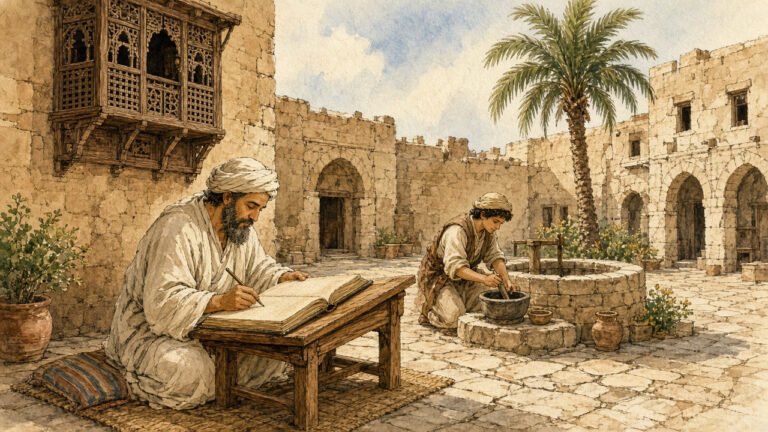
In his seventies David Kimhi set out from Narbonne to defend Maimonides and fell ill at Avila. Earlier journeys had taken him to the model codices of Toledo and Saragossa. His grammar, his manual for scribes and his theory of the qere and ketiv shaped how the pointed Bible was read for centuries.
20 min read

Transmission

The Counters of the Torah and the Three Scrolls of the Temple Court

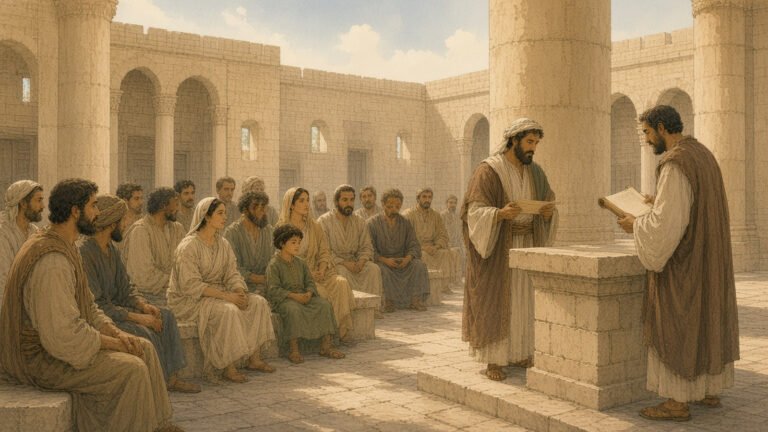
The Talmud says the first sages were called soferim because they counted every letter of the Torah, and remembers a Babylonian teacher who refused to check their count. From Ezra at the Water Gate to three scrolls compared in the Temple court, the scribes left the habits the Masoretes inherited.

23 min read

Transmission

Elijah ha-Naqdan and the Nakdanim of Medieval Europe

In 1239 Elijah ben Berechiah, son of the author of the Fox Fables, shaped the Masorah of a northern French Bible into letters and pictures and signed himself scribe, pointer and masran. Long dismissed as ornament, his notes turn out to follow the eastern Tiberian codices closely.

21 min read

Transmission

A Contract for Two Calendars

Early in 1082, probably in Cairo, a Rabbanite leader promised his Karaite bride she need not sit by a Sabbath candle. The two communities split over the calendar, the table and the oral law, yet read, copied and pointed the same Bible, down to a codex dedicated to a Karaite synagogue and trusted by Maimonides.

20 min read

Transmission

The Book Ben Hayyim Never Saw

Jacob ben Hayyim fixed the rabbinic Bible in Venice without the Aleppo Codex, and every later printing inherited his manuscripts. At Bar-Ilan, Menachem Cohen and his team spent decades rebuilding Miqraot Gedolot on the Crown, its Masorah and commentaries restored from their own manuscripts.

21 min read

Architecture

Mudéjar and the Mathematics of Ornament

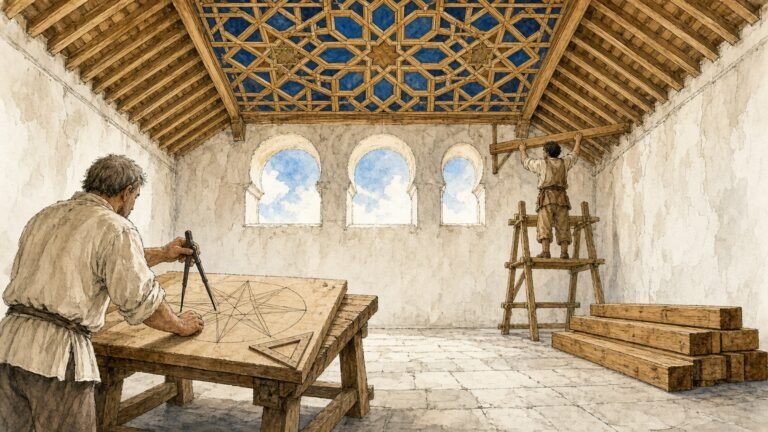
How the brick, tile, plaster and timber of Mudéjar Spain drew on a geometry that ran from Euclid through Baghdad, Córdoba and Toledo to the set-squares of Sevillian carpenters, with the mathematicians, monuments and methods that connect them.

7 hr 39 min read

Transmission

How Scribes Set Out the Songs of the Torah

Maimonides found the songs written in confusion and trusted a book corrected by ben Asher. The Talmud’s brickwork, the line-lists in Soferim, the disagreements of the great codices, and the Ashkar-Gilson scroll show a scribal tradition that lived beside the Masorah, not inside it.

19 min read

Physics

Terafab and the Orbital Foundry

In March 2026 Tesla and SpaceX unveiled Terafab, an ambition to build logic, memory, and advanced packaging in Texas at a scale of one terawatt of compute hardware a year. Behind the Kardashev-scale rhetoric lies a far more revealing story of Intel 14A physics, stacked Texas tax filings, radiator thermodynamics in vacuum, and the hard arithmetic of moving artificial intelligence off the grid.

50 min read

Transmission

The Sedarim and the Palestinian Reading of the Torah

In twelfth-century Cairo a traveler found two synagogues reading the Law at different speeds. The shorter Palestinian lessons, the sedarim, survived in the Masorah, in disagreed counts, and in the margins of the manuscripts Ginsburg later collated in London.

20 min read

Transmission

A Pastor in Cairo: Kahle and Hebrew Pointing

A German pastor in Cairo, later a professor in Bonn and an exile in Oxford, taught modern scholarship to treat the vowels of the Hebrew Bible as a history with more than one centre, and he put the Leningrad Codex under the eyes of a printed critical edition.

19 min read

Transmission

The Scholar Who Described the Pointed Bible

Later work on the vowels, accents and Masoretic notes of the early Hebrew Bible manuscripts still begins from the books Israel Yeivin wrote in Jerusalem. Those handbooks can be watched at work in the scholarship that cites them, page by page.

24 min read

Transmission

The Scribe Who Signed the Leningrad Codex

The scribe of the Leningrad Codex left his name in the book itself, and his work can now be followed in other manuscripts as well. Those copies show habits that are unusual among Tiberian Bible codices, including a Masorah magna that was, on at least one occasion, reproduced identically.

21 min read

Transmission

The Making of the Biblia Hebraica Stuttgartensia

Biblia Hebraica Stuttgartensia was planned as a new setting of one manuscript, not as a reconstruction of an original Hebrew Bible. Its Masorah, edited by Gérard Weil, is the part of the page that most needs a separate explanation.

21 min read

Transmission

Abū al-Faraj Hārūn’s Long and Short Guides

The Hidāyat al-Qāriʾ does not survive as a single book. Its author wrote a long version and then a short one, later readers made Hebrew and Arabic abridgements, and the names under which the work travelled are almost as various as the copies.

17 min read

Transmission

A Book at the End of a Codex

The short Tiberian treatise known as Diqduqe ha-Teʿamim does not survive in a single fixed form. Its copies differ in length and arrangement, and the printed editions have made those differences more visible rather than less.

15 min read

Biology

Against the Grain

The lives and work of thirteen Jewish women scientists, from Gerty Cori and Lise Meitner to Ada Yonath and Shafi Goldwasser. Each of them did foundational work in physics, chemistry, biology, medicine, mathematics, astronomy or computing while facing barriers of sex and antisemitism.

3 hr 29 min read

Culture

Archive of European Jewry

A history of POLIN, the museum built on the site of the Warsaw ghetto opposite the Monument to the Ghetto Heroes, from the place and the idea to the building, the Core Exhibition and the debates that have surrounded it.

50 min read

Culture

The Jews of Łódź

A history of Łódź from bishops’ town to textile city, and of the Jewish community that grew to a third of its population, lived through the ghetto of 1940–1944 and left a lasting mark on the city.

48 min read

Culture

The Jews of Fatimid Egypt

A history of the Jewish communities of Egypt and Palestine under the Fatimid caliphs from 969 to 1171, drawing on chronicles and the documents of the Cairo Geniza.

49 min read

Culture

Isaac Abarbanel

Isaac Abarbanel was born in Lisbon in 1437 and died in Venice in 1508. The surname appears in contemporary and later sources as Abarbanel, Abravanel and Abrabanel; the first of these forms…

53 min read

Culture

Moses Maimonides, from Córdoba to Fustat

The life and works of the jurist, philosopher and physician whose Commentary on the Mishnah, Mishneh Torah and Guide of the Perplexed shaped Jewish law and thought for eight centuries.

49 min read

Culture

Benjamin of Tudela and the Book of Travels

A Jewish traveller from Navarre recorded the communities, scholars, trades and rulers he found between the Ebro, Baghdad and Egypt in the 1160s and early 1170s.

49 min read

Culture

Baghdad

Two and a half thousand years of Jewish life in Mesopotamia, from the Judean exiles settled by Nebuchadnezzar and the academies of the Talmud, through the geonim of Abbasid Baghdad and the Ottoman and British centuries, to the Farhud of 1941 and the airlift of 1950 and 1951 that brought almost the whole community to Israel.

1 hr 2 min read
  1. Transmission · 13 November 2026

    The Accurate Books of Toledo and Saragossa

    In his seventies David Kimhi set out from Narbonne to defend Maimonides and fell ill at Avila. Earlier journeys had taken him to the model codices of Toledo and Saragossa. His grammar, his manual for scribes and his theory of the qere and ketiv shaped how the pointed Bible was read for centuries.
    20 min readby Nekud
  2. Transmission · 13 November 2026

    The Counters of the Torah and the Three Scrolls of the Temple Court

    The Talmud says the first sages were called soferim because they counted every letter of the Torah, and remembers a Babylonian teacher who refused to check their count. From Ezra at the Water Gate to three scrolls compared in the Temple court, the scribes left the habits the Masoretes inherited.

    23 min readby Nekud
  3. Transmission · 13 November 2026

    Elijah ha-Naqdan and the Nakdanim of Medieval Europe

    In 1239 Elijah ben Berechiah, son of the author of the Fox Fables, shaped the Masorah of a northern French Bible into letters and pictures and signed himself scribe, pointer and masran. Long dismissed as ornament, his notes turn out to follow the eastern Tiberian codices closely.

    21 min readby Nekud
  4. Transmission · 13 November 2026

    A Contract for Two Calendars

    Early in 1082, probably in Cairo, a Rabbanite leader promised his Karaite bride she need not sit by a Sabbath candle. The two communities split over the calendar, the table and the oral law, yet read, copied and pointed the same Bible, down to a codex dedicated to a Karaite synagogue and trusted by Maimonides.

    20 min readby Nekud
  5. Transmission · 13 November 2026

    The Book Ben Hayyim Never Saw

    Jacob ben Hayyim fixed the rabbinic Bible in Venice without the Aleppo Codex, and every later printing inherited his manuscripts. At Bar-Ilan, Menachem Cohen and his team spent decades rebuilding Miqraot Gedolot on the Crown, its Masorah and commentaries restored from their own manuscripts.

    21 min readby Nekud
  6. Architecture · 13 November 2026

    Mudéjar and the Mathematics of Ornament

    How the brick, tile, plaster and timber of Mudéjar Spain drew on a geometry that ran from Euclid through Baghdad, Córdoba and Toledo to the set-squares of Sevillian carpenters, with the mathematicians, monuments and methods that connect them.

    7 hr 39 min readby Nekud
  7. Transmission · 13 November 2026

    How Scribes Set Out the Songs of the Torah

    Maimonides found the songs written in confusion and trusted a book corrected by ben Asher. The Talmud’s brickwork, the line-lists in Soferim, the disagreements of the great codices, and the Ashkar-Gilson scroll show a scribal tradition that lived beside the Masorah, not inside it.

    19 min readby Nekud
  8. Physics · 13 November 2026

    Terafab and the Orbital Foundry

    In March 2026 Tesla and SpaceX unveiled Terafab, an ambition to build logic, memory, and advanced packaging in Texas at a scale of one terawatt of compute hardware a year. Behind the Kardashev-scale rhetoric lies a far more revealing story of Intel 14A physics, stacked Texas tax filings, radiator thermodynamics in vacuum, and the hard arithmetic of moving artificial intelligence off the grid.

    50 min readby Nekud
  9. Transmission · 13 November 2026

    The Sedarim and the Palestinian Reading of the Torah

    In twelfth-century Cairo a traveler found two synagogues reading the Law at different speeds. The shorter Palestinian lessons, the sedarim, survived in the Masorah, in disagreed counts, and in the margins of the manuscripts Ginsburg later collated in London.

    20 min readby Nekud
  10. Transmission · 13 November 2026

    A Pastor in Cairo: Kahle and Hebrew Pointing

    A German pastor in Cairo, later a professor in Bonn and an exile in Oxford, taught modern scholarship to treat the vowels of the Hebrew Bible as a history with more than one centre, and he put the Leningrad Codex under the eyes of a printed critical edition.

    19 min readby Nekud
  11. Transmission · 13 November 2026

    The Scholar Who Described the Pointed Bible

    Later work on the vowels, accents and Masoretic notes of the early Hebrew Bible manuscripts still begins from the books Israel Yeivin wrote in Jerusalem. Those handbooks can be watched at work in the scholarship that cites them, page by page.

    24 min readby Nekud
  12. Transmission · 12 November 2026

    The Scribe Who Signed the Leningrad Codex

    The scribe of the Leningrad Codex left his name in the book itself, and his work can now be followed in other manuscripts as well. Those copies show habits that are unusual among Tiberian Bible codices, including a Masorah magna that was, on at least one occasion, reproduced identically.

    21 min readby Nekud
  13. Transmission · 12 November 2026

    The Making of the Biblia Hebraica Stuttgartensia

    Biblia Hebraica Stuttgartensia was planned as a new setting of one manuscript, not as a reconstruction of an original Hebrew Bible. Its Masorah, edited by Gérard Weil, is the part of the page that most needs a separate explanation.

    21 min readby Nekud
  14. Transmission · 12 November 2026

    Abū al-Faraj Hārūn’s Long and Short Guides

    The Hidāyat al-Qāriʾ does not survive as a single book. Its author wrote a long version and then a short one, later readers made Hebrew and Arabic abridgements, and the names under which the work travelled are almost as various as the copies.

    17 min readby Nekud
  15. Transmission · 12 November 2026

    A Book at the End of a Codex

    The short Tiberian treatise known as Diqduqe ha-Teʿamim does not survive in a single fixed form. Its copies differ in length and arrangement, and the printed editions have made those differences more visible rather than less.

    15 min readby Nekud
  16. Biology · 12 November 2026

    Against the Grain

    The lives and work of thirteen Jewish women scientists, from Gerty Cori and Lise Meitner to Ada Yonath and Shafi Goldwasser. Each of them did foundational work in physics, chemistry, biology, medicine, mathematics, astronomy or computing while facing barriers of sex and antisemitism.

    3 hr 29 min readby Nekud
  17. Culture · 12 November 2026

    Every Town Has Three Names

    The changing place names of Central Europe, from Pressburg to Królewiec

    3 hr 19 min readby Nekud
  18. Culture · 11 November 2026

    Archive of European Jewry

    A history of POLIN, the museum built on the site of the Warsaw ghetto opposite the Monument to the Ghetto Heroes, from the place and the idea to the building, the Core Exhibition and the debates that have surrounded it.

    50 min readby Nekud
  19. Culture · 11 November 2026

    The Jews of Łódź

    A history of Łódź from bishops’ town to textile city, and of the Jewish community that grew to a third of its population, lived through the ghetto of 1940–1944 and left a lasting mark on the city.

    48 min readby Nekud
  20. Culture · 11 November 2026

    The Jews of Fatimid Egypt

    A history of the Jewish communities of Egypt and Palestine under the Fatimid caliphs from 969 to 1171, drawing on chronicles and the documents of the Cairo Geniza.

    49 min readby Nekud
  21. Culture · 11 November 2026

    Isaac Abarbanel

    Isaac Abarbanel was born in Lisbon in 1437 and died in Venice in 1508. The surname appears in contemporary and later sources as Abarbanel, Abravanel and Abrabanel; the first of these forms…

    53 min readby Nekud
  22. Culture · 11 November 2026

    Moses Maimonides, from Córdoba to Fustat

    The life and works of the jurist, philosopher and physician whose Commentary on the Mishnah, Mishneh Torah and Guide of the Perplexed shaped Jewish law and thought for eight centuries.

    49 min readby Nekud
  23. Culture · 11 November 2026

    Benjamin of Tudela and the Book of Travels

    A Jewish traveller from Navarre recorded the communities, scholars, trades and rulers he found between the Ebro, Baghdad and Egypt in the 1160s and early 1170s.

    49 min readby Nekud
  24. Culture · 10 November 2026

    Baghdad

    Two and a half thousand years of Jewish life in Mesopotamia, from the Judean exiles settled by Nebuchadnezzar and the academies of the Talmud, through the geonim of Abbasid Baghdad and the Ottoman and British centuries, to the Farhud of 1941 and the airlift of 1950 and 1951 that brought almost the whole community to Israel.

    1 hr 2 min readby Nekud