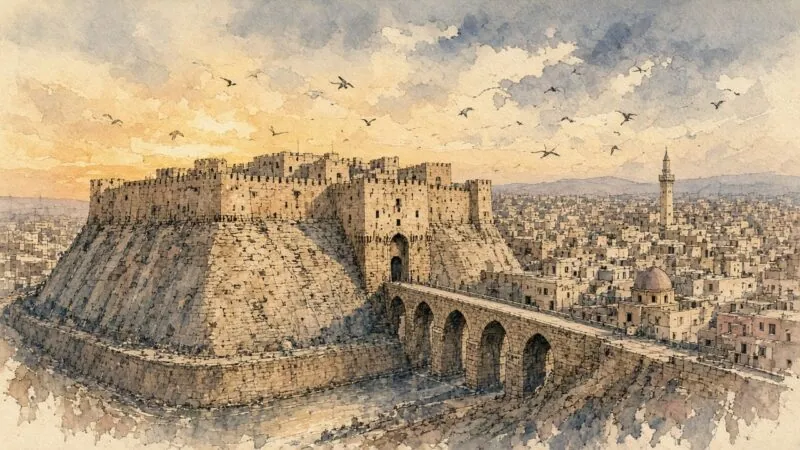
The Jews of Fatimid Egypt
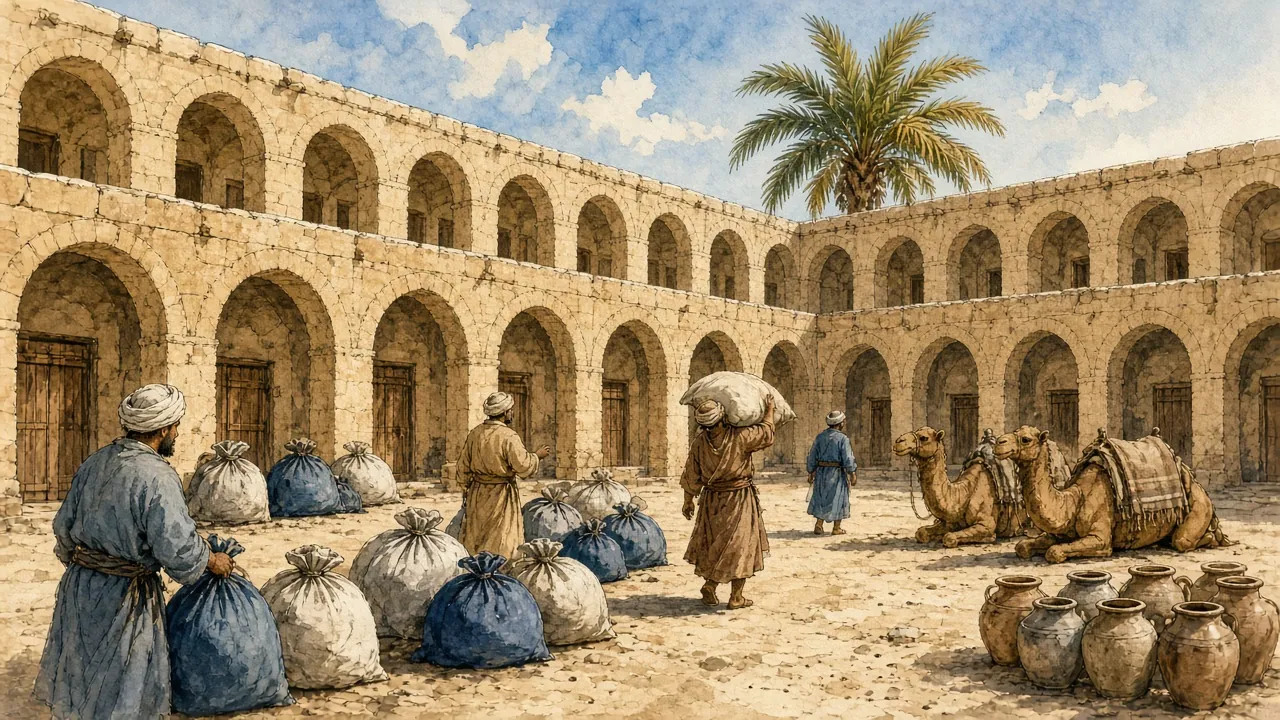
For two centuries, from the conquest of 969 to the death of the last caliph in 1171, Egypt was ruled by the Fatimids, an Isma’ili Shi’i dynasty that had risen in North Africa and claimed descent from Fatima, the daughter of the Prophet Muhammad.[1][2] Under their rule the old garrison city of Fustat and the new palace city of Cairo became the centre of a Mediterranean and Indian Ocean economy, and the Jews of Egypt, together with the Jews of Palestine and Syria who were for long periods subject to the same government, entered one of the best documented periods in their history.[3] The documentation is unusual in kind as well as quantity. Alongside the chronicles of Muslim historians and a modest number of Hebrew literary sources, it consists of hundreds of thousands of fragments of paper and parchment that were deposited over several centuries in the storeroom, or genizah, of a synagogue in Fustat and were recovered at the end of the nineteenth century.[4][5]
The fragments include letters between merchants and their partners, contracts, marriage deeds, court records, lists of the poor, petitions to officials, accounts, medical prescriptions, poems and the correspondence of the heads of academies. Read together, they allow historians to follow individual families across several generations, to reconstruct the routes along which flax, silk, indigo and pepper travelled, and to observe how a religious minority organised its courts, schools and charities under a Muslim state.[6][7] The scholar most closely associated with this work, Shelomo Dov Goitein, gave his five-volume synthesis the title A Mediterranean Society, a choice that expressed his view that the documents described not a closed community but a population fully engaged in the economic and social life of the region.[6][8]
1. The Fatimid conquest of Egypt
The Fatimid movement began as a clandestine Isma’ili mission that taught the imminent return of a rightful imam descended from Ali and Fatima. In 909 its leader proclaimed himself caliph in Ifriqiya, the region of modern Tunisia and eastern Algeria, in open rivalry with the Abbasid caliphs of Baghdad, whose authority had already fragmented into a series of regional dynasties.[9] Egypt was the first great objective of the new state. Several expeditions in the early tenth century failed, and the country remained under governors nominally loyal to Baghdad, the last of whom belonged to the Ikhshidid family. Effective power in the 950s and 960s lay with Kafur, a former slave who governed in the name of the young Ikhshidid princes until his death in 968.[10]
Kafur’s death, a low Nile flood and a period of famine weakened the Egyptian government at the moment when the fourth Fatimid caliph, al-Mu’izz li-Din Allah, had assembled the resources for a new campaign.[11] His general Jawhar, a commander of slave origin who is usually described as coming from Sicily or from the Slavic lands of the northern Mediterranean, led an army across Libya in the spring of 969 and entered Fustat in July of that year after limited resistance. Jawhar issued a guarantee of safety to the inhabitants that promised the restoration of order, the protection of property and the continued practice of religion, and the population, exhausted by scarcity, largely accepted the change of regime.[1][12]
Al-Mu’izz himself moved from Ifriqiya to Egypt in 973, bringing his court, his treasury and the coffins of his ancestors. From then on Egypt was the centre of the Fatimid state, while Ifriqiya was left to a family of governors who eventually broke with Cairo in the middle of the eleventh century.[11][13] The new rulers soon extended their authority into Palestine and southern Syria, though control of these provinces was contested for decades by Byzantine armies, Bedouin confederations and local strongmen. Ramla, the administrative capital of Palestine, and Jerusalem, Tiberias and Tyre were thus drawn into the same political orbit as Fustat, a fact of great importance for Jewish communal life, since the principal academy of Palestinian Jewry was now located in a Fatimid province.[2][14]
For the Jews of Egypt the conquest did not at first bring a change of legal condition. The Fatimids inherited the body of Islamic law and administrative practice that governed the status of Jews and Christians, and they continued to collect the poll tax and to require a formal acknowledgement of Muslim supremacy.[15] What changed was the character of the ruling elite and the scale of the economy it promoted. The Fatimid caliphs were the heads of a minority movement within Islam, ruling a population that remained largely Sunni and, in the countryside, still in part Christian. Historians have often argued that this situation inclined them to employ capable officials without strict regard to religious affiliation, and the presence of Christians and Jews in high administrative office during the dynasty’s first century is well attested.[2]
2. Fustat and the new city of Cairo
Within days of entering Egypt, Jawhar laid out a new walled enclosure a few kilometres to the north-east of Fustat, on the plain between the Nile and the Muqattam hills. It was named al-Qahira, “the Victorious“, and it was intended as a royal and military city containing the caliph’s palaces, the barracks of the army, government offices and the great mosque of al-Azhar, founded in 970 and completed in 972.[12][16] In its first century al-Qahira was not open to the general population in the way that Fustat was. Its gates were guarded, its streets were reserved largely for the court, the soldiery and their dependants, and it was the backdrop for the ceremonial processions through which the caliphs displayed themselves to their subjects.[12]
Fustat, founded by the Arab conquerors in the seventh century beside the Roman fortress of Babylon, remained the commercial heart of the country. It lay along the east bank of the Nile, facing the island of Roda, and its markets, warehouses, workshops and residential quarters extended for several kilometres along the river and inland towards the desert.[17] Travellers of the eleventh century were impressed by the height of its buildings, some of which rose to several storeys, by the density of its population and by the quantity of goods in its bazaars. The Persian Isma’ili poet and traveller Nasir Khusraw, who spent several years in Egypt in the 1040s, left a detailed account of both cities in his travel book, describing the wealth of the merchants, the abundance of the markets and the order maintained by the government.[18]
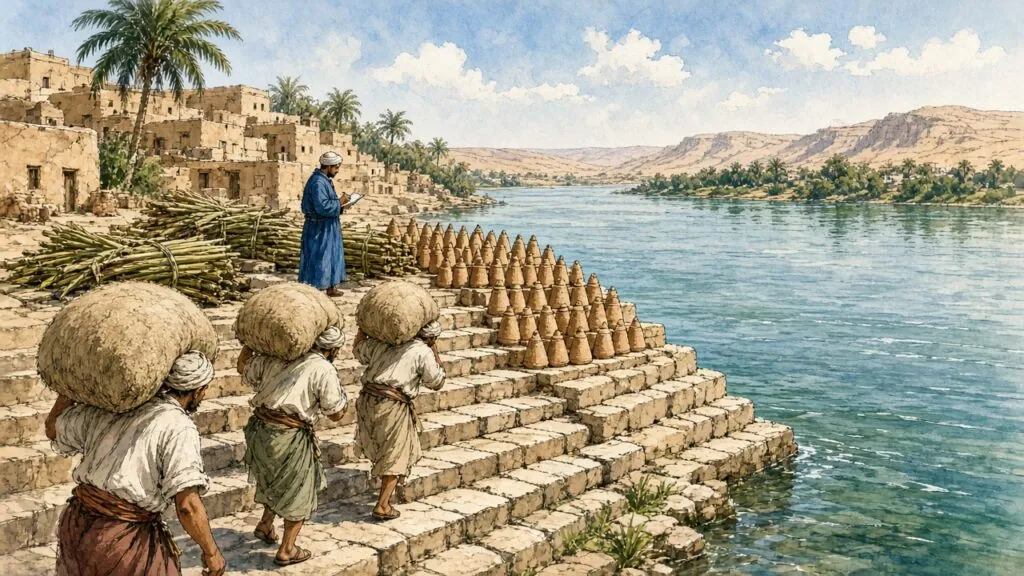
The Jewish population of the capital lived mainly in Fustat, which Jewish documents called Misrayim or Fustat Misrayim, and the great majority of Geniza documents were written there or addressed there. Jews lived in mixed neighbourhoods as well as in streets where they formed a majority, and Goitein’s analysis of property deeds showed that Jewish, Christian and Muslim owners frequently held shares in the same houses or lived as immediate neighbours.[19][17] A smaller Jewish community formed in al-Qahira during the eleventh century, particularly in the quarter near the Zuwayla gate, and by the twelfth century the two cities were already growing towards each other, though they remained distinct until the burning of Fustat in 1168 and the later expansion of Cairo.[20][12]
3. The Jewish communities of Egypt and Palestine
Jewish settlement in Egypt was ancient, but the communities of the Fatimid period were largely the product of the preceding Islamic centuries, when Jews had moved from the countryside into the towns and when immigrants from Iraq, Syria, Palestine and the Maghrib had settled in the Egyptian cities. The Geniza documents mention Jewish residents in a large number of Egyptian localities, from the Mediterranean coast to Aswan, although most of these were small groups of a few families.[3][20] The great centres were Fustat and Cairo, Alexandria, the Delta ports of Damietta and Tinnis, and a number of provincial towns, among them Bilbeis on the road to Palestine, al-Mahalla in the Delta, and Qus in Upper Egypt.[21][22]
Estimates of the size of these communities are uncertain. Historians generally agree that the Jews of Egypt in the eleventh and twelfth centuries numbered no more than a few tens of thousands, a small fraction of a total population that probably amounted to several million, and some estimates are considerably lower. Benjamin of Tudela, who travelled in the region around 1170, gave figures for the Jewish households of several Egyptian cities, but the numbers in the surviving manuscripts of his book vary, and historians use them with caution.[6][21] What is clear from the documents is that the community was urban, literate to an unusual degree, and engaged in a wide range of occupations, from medicine and international trade to glassmaking, dyeing, weaving, metalwork and retail selling.
Alexandria was the principal Mediterranean port of the country and the point of entry for most travellers and merchants arriving by sea. Its Jewish community maintained its own courts and synagogues and corresponded constantly with Fustat about the arrival of ships, the prices of goods and the reception of visitors.[23] Damietta and Tinnis, on the eastern branches of the Nile near Lake Manzala, were centres of the textile industry and of maritime trade with Syria and the Byzantine world, and both had Jewish communities that supported the Palestinian academy and appear frequently in business correspondence.[21][24]
Palestine formed a second sphere of Jewish life under Fatimid rule. Ramla, the provincial capital, had a large Jewish population divided into Rabbanite congregations of the Palestinian and Babylonian rites and a Karaite community, and it was for a time the seat of the Palestinian academy. The city suffered severely from a Bedouin raid in 1025 and from earthquakes in 1033 and 1068, and its decline in the second half of the eleventh century reflected the wider insecurity of the province.[25][14] Jerusalem, which Jewish communities had been permitted to resettle after the Muslim conquest of the seventh century, was the seat of the academy for much of the period and the focus of pilgrimage at the autumn festivals. Tiberias, the older centre of Palestinian scholarship, retained an important place in Jewish memory and in the titles of communal leaders.[26]
4. Rabbanites, Karaites and Samaritans
The Jews of Fatimid Egypt were divided into three religious communities. The largest consisted of the Rabbanites, who accepted the authority of the Talmud and of the rabbinic tradition transmitted through the academies of Iraq and Palestine. The Rabbanites were themselves divided by rite and allegiance into two congregations, each with its own synagogue in Fustat. The Palestinians, or Shamiyyin, followed the customs of the Land of Israel and owed allegiance to the Palestinian academy, while the Iraqis, or Babylonians, followed the customs of the academies of Sura and Pumbedita in Iraq and corresponded with their geonim.[27]
The two Rabbanite congregations differed in liturgy, in the reading cycle of the Torah, in details of marriage law and in other matters of custom, but they shared a common legal tradition and their members intermarried, did business together and appeared in each other’s courts. The synagogue of the Palestinians in Fustat, later known as the Ben Ezra synagogue, was the building whose genizah preserved the bulk of the documents on which modern knowledge of the period rests.[28][5] Its rebuilding after the destruction of synagogues under al-Hakim is usually dated to the decades around 1025 to 1040, and it stood, with later restorations, until a reconstruction in the 1890s.[28]
The second community consisted of the Karaites, who rejected the authority of the rabbinic oral law and sought to derive religious practice directly from the Hebrew Bible. Karaite tradition traced the movement to Anan ben David in eighth-century Iraq, although modern scholars regard Karaism as having taken shape gradually, through the convergence of several dissenting groups in the ninth and tenth centuries.[29] By the Fatimid period the Karaites had important communities in Jerusalem, Ramla and Fustat, and in Egypt they included some of the wealthiest families of the capital. Their calendar, which depended on the observation of the new moon and the ripening of barley in the Land of Israel, set their festivals on different days from those of the Rabbanites, and their marriage laws and dietary practices differed in a number of respects.[30]
Relations between Rabbanites and Karaites combined rivalry with practical cooperation. Polemics between the two communities had been sharp since the time of Saadia Gaon in the tenth century, and in Jerusalem the Rabbanite leadership at times pronounced a ban on the Karaites during the gathering on the Mount of Olives at the festival of Tabernacles.[31][32] Yet in Fustat the communities lived side by side, and the Geniza preserves marriage contracts between Rabbanite and Karaite partners in which each party undertook to respect the religious practice of the other, for example by not compelling a Karaite wife to sit by a lit lamp on the Sabbath eve or to violate her own festival days.[30][33] Karaite notables such as the Tustari brothers interceded with the government on behalf of all Jews, and the Rabbanite and Karaite communities of Fustat contributed together to the ransoming of captives after the crusader conquest of Jerusalem in 1099.[34][35]
The third community consisted of the Samaritans, who traced their descent to the ancient Israelites of the northern kingdom, accepted only the Pentateuch as scripture and venerated Mount Gerizim near Nablus as the chosen place of worship. Samaritan communities lived in Palestine, Damascus and Egypt, and in Fustat and Cairo they maintained their own synagogues. They appear in Muslim administrative sources as a distinct group of non-Muslim subjects and occasionally in Jewish documents as neighbours, partners or officials.[36] Their numbers were small, and the Geniza, which reflects primarily Rabbanite life, says comparatively little about them, but their presence completes a picture in which the population described in Arabic sources simply as “the Jews” was in practice divided into several communities with their own institutions and leaders.[20]
5. Karaite learning in Jerusalem and Fustat
The tenth and eleventh centuries were the classical period of Karaite literature, and much of it was written by scholars living in Jerusalem under Fatimid rule. A group known as the Mourners of Zion had settled in the city in the tenth century, devoting themselves to prayer for the restoration of Zion and to the study of scripture, and from their circle came commentators, grammarians and jurists who wrote mainly in Arabic, often in Hebrew script.[29][30] Japheth ben Ali, active in the second half of the tenth century, produced a translation of the Hebrew Bible into Arabic accompanied by an extensive commentary, and his son Levi ben Japheth composed a book of commandments that later Karaite authors used widely.[37]
In the first half of the eleventh century the leading Karaite theologian was Joseph ben Abraham ha-Kohen, known in Arabic as Yusuf al-Basir. He came from Iraq or Persia, was blind, and was called by the euphemism ha-Ro’eh, “the Seer“. He settled in Jerusalem early in the century and died there around 1040.[38] Al-Basir adopted the method of the Basran school of the Mu’tazila, the rationalist current of Islamic theology, and applied it to Karaite doctrine. His principal work, known in Arabic as al-Muhtawi and in its Hebrew translation as Sefer ha-Ne’imot, discusses the unity and justice of God, the createdness of the world, free will and the nature of the commandments, and argues that reason takes priority in establishing the foundations of belief.[38][39]
His pupil Jeshua ben Judah, known in Arabic as Abu al-Faraj Furqan ibn Asad, was active in Jerusalem in the second half of the eleventh century. He wrote commentaries on the Pentateuch and philosophical works, but his most lasting contribution concerned the Karaite law of forbidden marriages. Earlier Karaite jurists had extended the biblical prohibitions by repeated analogy until the range of permitted partners had become very narrow. Jeshua argued that analogy could be applied only once, and his position, which reduced the number of forbidden unions, was accepted by later Karaite authorities.[40]
The Karaite scholars of Jerusalem maintained close ties with the community in Fustat, which supplied much of their financial support, and copies of their works travelled between the two cities. The Seljuk conquest of Jerusalem in the 1070s and the crusader conquest of 1099 brought this period to an end. The Karaite quarter of Jerusalem was destroyed, many of its inhabitants were killed or taken captive, and the letter written by the Karaite elders of Ashkelon in the summer of 1100 describes the efforts to ransom both people and books taken from the synagogues of the city.[35][41] After that date the centre of Karaite life in the Islamic world shifted to Egypt, where the Karaite community of Cairo remained one of the most important in the world until the twentieth century.[30]
6. The terms of protection
Jews, like Christians, lived in the Fatimid state as dhimmis, members of a protected community whose security of life, property and worship was guaranteed in return for the payment of a poll tax and acceptance of certain restrictions. The principles of this arrangement were set out in Islamic law and in a document known as the Pact of Umar, a text of uncertain date attributed to the second caliph, which listed obligations such as refraining from building new places of worship, from displaying religious symbols in public, from riding horses and from bearing arms.[15]
The poll tax, the jizya, was collected annually from adult males according to a graduated scale. For the wealthy it was a modest charge, but for the poor it could be a severe burden, and the Geniza contains many letters in which men without means ask for help in paying it or describe the fear of being arrested by the tax collectors. Communal charity often took the form of payments towards the poll tax of the poor, and travellers needed receipts to prove that they had paid it in their place of residence.[42][6]
The restrictions of the Pact of Umar were not applied uniformly. Under most Fatimid caliphs the laws on distinctive dress and on the building of places of worship were enforced only intermittently, and the chronicles record Christian processions in which the caliphs themselves took part. Jewish and Christian officials served in the financial administration, and Jewish physicians attended the court.[2] The Encyclopaedia Judaica entry on the dynasty summarises the prevailing view that the Jews enjoyed under the Fatimids “a reasonable degree of tolerance, security, and prosperity“, while noting that the reign of al-Hakim was a major exception.[2]
Within this framework the Jewish community enjoyed broad autonomy in its internal affairs. Its courts decided cases of marriage, divorce, inheritance and commercial dispute according to Jewish law, and Jews could also bring their cases before Muslim courts, a possibility that communal leaders sometimes tried to restrict.[43] The community appointed its own judges, cantors, scribes and supervisors of charity, collected its own revenues and maintained its own synagogues, schools and cemeteries. The relationship between this autonomy and the authority of the state was mediated by Jewish courtiers and, from the late eleventh century, by a recognised Head of the Jews, an office described in a later chapter.[44]
7. Courtiers and administrators under al-Mu’izz and al-Aziz
The most famous official of Jewish origin in the early Fatimid state was Ya’qub ibn Killis. Born in Baghdad in 930 to a Jewish family, he moved as a young man with his father to Palestine, where the family lived in Ramla and he worked as an agent for merchants. Around the middle of the century he left for Egypt, according to one hostile tradition after failing to repay funds entrusted to him, and entered the service of Kafur, who made him one of his principal financial administrators.[45][46] In 967, apparently after Kafur remarked that he would be fit to be vizier if he were a Muslim, Ibn Killis converted to Islam. After Kafur’s death he was imprisoned by a rival, bought his release and made his way to the Fatimid court in Ifriqiya, where he gave al-Mu’izz information about the condition of Egypt.[47][45]
Ibn Killis returned with al-Mu’izz in 973 and was placed in charge of the collection of taxes. Under al-Aziz, who succeeded his father in 975, he became vizier, the first holder of that office under the Fatimids; the sources give 977 or 979 as the date of his appointment and the title “most illustrious vizier” was conferred on him in 979.[48][45] Apart from a brief disgrace in 983, he held office until his death in 991. He reorganised the financial administration, reformed the coinage, and presided over a learned salon in his palace where jurists, theologians, poets and physicians met, and he composed a work of Isma’ili jurisprudence that entered the curriculum of the dynasty’s scholars.[46][47]
Ibn Killis was a Muslim throughout his public career, and his relationship with Jews after his conversion was ambivalent. He employed Jewish administrators, including Manasseh ibn Ibrahim ibn al-Qazzaz, who managed his property in Syria; but a report preserved by a later Muslim biographer describes him disparaging Judaism in one of his assemblies, and only one Geniza fragment, a literary text rather than a document, mentions him.[45] Earlier scholars attempted to identify him, or the general Jawhar, with Paltiel, a Jewish courtier praised in a Hebrew family chronicle, but these identifications are no longer accepted.[45][49]
Paltiel himself is known from the Chronicle of Ahimaaz, a rhymed Hebrew family history composed in southern Italy in 1054. According to that work, Paltiel was born in Oria in Apulia, was taken into the service of al-Mu’izz after the Fatimid capture of the town, and rose to a position of great influence, provisioning the army during the conquest of Egypt and acting as a patron of his co-religionists until his death, which the chronicle places in 975.[49] The chronicle calls him nagid, and some earlier historians regarded him as the first holder of that office in Egypt. Later research has argued that his position, whatever it was, concerned the service of the state rather than the leadership of the Jewish community, and that the narrative has been shaped by literary and legendary elaboration.[49][44]
Other Jews are better attested. Manasseh ibn al-Qazzaz served as head of the financial administration in Syria in the 990s, when the Christian Isa ibn Nestorius was vizier in Cairo, and he appears in Hebrew poems from the Geniza as a benefactor of the Jewish communities of the province.[2][20] A Jewish physician named Moses ben Eleazar and members of his family are reported to have served the early caliphs, and the court physician of al-Mu’izz has been variously identified in modern scholarship.[20][2] The careers of these men illustrate both the opportunities that the Fatimid administration offered to capable non-Muslims and the vulnerability of those who depended on the favour of the ruler.
The reign of al-Aziz (975 to 996) was remembered by Jews and Christians as a period of tolerance. The caliph’s wife was a Melkite Christian, and two of her brothers became patriarchs of Jerusalem and Alexandria. The appointment of a Christian vizier and of Jewish officials provoked complaints among Muslims, and a well-known anecdote, of doubtful authenticity, describes a petition reproaching the caliph for honouring Christians and Jews at the expense of his Muslim subjects.[48][2] These tensions anticipated the very different policy of his son.
8. The decrees of al-Hakim
Al-Hakim bi-Amr Allah became caliph in 996 at the age of eleven and ruled until his disappearance in 1021. His reign is among the most debated in Islamic history. Muslim, Christian and Jewish sources describe a ruler of unpredictable temperament who issued a long series of decrees on matters ranging from public morality and diet to the dress of non-Muslims, and who in his last years was regarded by a group of followers as a manifestation of the divine, a belief from which the Druze religion developed.[50][51]
For the first decade of his reign the position of Jews and Christians seems to have changed little. A Hebrew scroll composed in 1012, which survives in the Geniza in two versions, describes the caliph as the protector of the Jews who saved them from a riot in Fustat, and letters from the heads of the Palestinian academy and of the academy in Fustat mention subsidies paid by the caliph to their institutions.[52][20] From around 1004, however, and with increasing severity after 1009, the caliph imposed restrictions on non-Muslims. In 1009 he ordered the destruction of the Church of the Holy Sepulchre in Jerusalem, and in the following years many churches in Egypt and Syria were destroyed or confiscated.[53][50]
The Jews were affected by these measures from about 1012. Jews and Christians were required to wear distinctive garments and badges, and reports in the chronicles describe Jews being compelled to wear a wooden block or the image of a calf, and Christians a wooden cross, as a sign of their status. They were forbidden to ride horses, to employ Muslim servants or to buy Muslim slaves.[54][20] Synagogues were destroyed, among them the synagogues of Fustat, and some Jews converted to Islam under pressure while others left the country.[52][2] The academy in Fustat, headed at the time by Elhanan ben Shemariah, lost the subsidy it had received from the state and appealed to Jewish communities abroad for support.[55]
Historians have emphasised that the evidence for the scale of these events is uneven. The Encyclopaedia Judaica notes that Christian and Muslim reports of the persecution of Jews “should be treated with caution“, and recent studies have examined how the caliph’s measures fitted into his wider policies towards Sunni Muslims, Christians and his own Isma’ili followers.[52][56] What is clear is that the restrictions were lifted in the last years of the reign. From about 1017 Jews and Christians were permitted to rebuild their places of worship, and those who had been forced to convert were allowed to return to their former religion.[52]
Al-Hakim disappeared in February 1021 while riding alone at night in the Muqattam hills, and he is generally believed to have been murdered, perhaps at the instigation of his sister. His followers among the Druze held that he had withdrawn from the world and would return.[50][51] Later Jewish tradition preserved stories about his reign. A seventeenth-century chronicler, Joseph Sambari, recounted that the persecution had been provoked by an Arabic translation of the Passover Haggadah, which the caliph took as an insult to himself because it described the drowning of the Egyptian king.[52]
9. Restoration under al-Zahir and al-Mustansir
The reign of al-Hakim’s son al-Zahir (1021 to 1036) saw the restoration of the earlier policy of tolerance, though it was also a period of famine, Bedouin uprisings in Palestine and political instability at court.[57] The rebuilding of synagogues in Fustat and elsewhere belongs to these years and the decades that followed. The Geniza documents become abundant from about this time, a fact that historians associate partly with the rebuilding of the Ben Ezra synagogue and the creation of the storeroom into which the community deposited its discarded writings.[4][45]
Al-Zahir’s son al-Mustansir succeeded him in 1036 at the age of seven and reigned for almost sixty years, the longest reign of any caliph. In his early years real power lay with his mother, a Sudanese woman who had been sold to al-Zahir by a Jewish merchant of the Tustari family, and with the officials who enjoyed her confidence.[58][59] Among them was Abu Sa’d Ibrahim ibn Sahl al-Tustari, known in Hebrew sources as Abraham ben Yashar, whose family had come to Egypt from Tustar in south-western Persia and had built one of the great commercial houses of the capital. Abu Sa’d specialised in jewels and precious objects, while his brother Abu Nasr, in Hebrew Hesed, was a banker.[34][60]
The Tustaris used their influence on behalf of Jewish communities in Egypt and Palestine, and both Rabbanites and Karaites appealed to them for help; their own affiliation has been debated, although they are generally regarded as Karaites.[34] Abu Sa’d never held the title of vizier, but he was regarded as the effective director of government at the height of his power, and he secured the appointment of Sadaqa ibn Yusuf al-Fallahi, a Jewish convert to Islam, as vizier. The alliance did not last. In 1047 Abu Sa’d was murdered by soldiers acting, according to the chronicles, at the instigation of al-Fallahi, and his brother was killed soon afterwards.[59][34] Nasir Khusraw, who was in Cairo at the time, recorded the episode and described the wealth of the family.[18][59]

The middle decades of al-Mustansir’s reign were the high point of Fatimid prosperity. Cairo was the scene of elaborate public ceremonies, including the procession that marked the opening of the canal when the Nile reached its full height, and the festivals of the Muslim calendar were celebrated with illuminations and distributions of food and clothing.[12][18] Jewish documents of the same years record a dense commercial life, regular communication with the Maghrib, Sicily, Palestine and India, and the building and furnishing of synagogues.[6]
From the 1060s the state entered a severe crisis. Rivalry between Turkish and Sudanese regiments led to civil war, and a succession of low Nile floods between about 1065 and 1072 produced famine, epidemic and the plundering of the caliph’s treasures by unpaid troops. The period was remembered in Arabic sources as “the great calamity“.[58][61] Order was restored only after al-Mustansir summoned Badr al-Jamali, the Armenian governor of Acre, who arrived with his army in 1073 and governed Egypt as military vizier until his death in 1094. Badr rebuilt the walls of Cairo in stone and constructed the great gates that still stand on the north and south sides of the old city.[62]
10. The yeshiva of the Land of Israel
The highest institution of Palestinian Jewry was the yeshiva, or academy, of the Land of Israel, whose head bore the title gaon. The yeshiva functioned as a court of appeal, a source of legal rulings and a body that ordained judges, issued honorary titles and confirmed the appointment of local officials in the communities that recognised its authority. Its members were ranked in a fixed hierarchy below the gaon, with the av bet din, the president of the court, in second place and the “third“, “fourth” and further ranks below.[27] The yeshiva depended for its income on donations from the communities of the diaspora, and the greater part of its surviving correspondence consists of letters to Egypt requesting funds, intervening in disputes or recommending travellers.[31]
For most of the Fatimid period the yeshiva was located in Jerusalem, although it moved to Ramla for a time in the tenth century and its leaders often resided there. Its gaonate was held largely by a few priestly families, and successions were frequently contested.[25][27] Solomon ben Judah, who came from a family of scholars from Fez, was gaon from about 1025 until his death in 1051. More of his letters survive than of any other Palestinian gaon, and they show him as a conciliatory leader who tried to prevent the annual ban against the Karaites and who endured opposition from Nathan ben Abraham, a rival claimant supported by scholars from the diaspora.[31][63]
On Solomon’s death the office passed not to the expected candidates of the priestly family but to Daniel ben Azariah, a descendant of the Babylonian exilarchs who claimed Davidic lineage. Daniel was gaon from 1051 to 1062 and was honoured in Egypt as nasi, or prince; the synagogue of the Palestinians in Fustat was named in his honour during his tenure.[64] After his death the gaonate returned to the priestly family in the person of Elijah ben Solomon ha-Kohen, who held office from 1062 to 1083.[65]
In the early 1070s Jerusalem was occupied by Turkish forces under the Seljuk commander Atsiz, and the yeshiva moved to Tyre, which remained under Fatimid control.[65][66] Elijah’s son Abiathar, who succeeded him, became involved in a long conflict with David ben Daniel, the son of the former gaon, who had come to Egypt and sought, with the support of some Egyptian communities, to extend his authority over the yeshiva and the Jews of the region. Abiathar described the dispute in a Hebrew account known as the Scroll of Abiathar, in which he defended the special rights of the Land of Israel against claims made from the diaspora.[67][20] David ben Daniel’s authority in Egypt collapsed in 1094, and the episode contributed to the consolidation of a separate Egyptian leadership.[68]
The crusader conquest of Jerusalem in 1099 ended any prospect of a return to the city. The yeshiva remained for a time in Tyre, and Abiathar’s brother Solomon later re-established it at Hadrak near Damascus. In 1127 Solomon’s son Masliah ha-Kohen arrived in Fustat and founded a yeshiva within the synagogue of the Palestinians that claimed the same title as the academy in Syria, and he and his successors used the style “head of the yeshiva of the Glory of Jacob“.[69][27] Masliah, who died in 1139, is regarded as the first of the Egyptian geonim, and his successors are attested until the end of the century, the last being Sar Shalom ben Moses ha-Levi, who held office in Fustat from 1171 until at least 1195.[70]
11. Scholars and academies in Fustat
Alongside the Palestinian yeshiva, Fustat had its own centre of rabbinic learning from the late tenth century. A medieval legend, preserved by the twelfth-century Andalusian historian Abraham ibn Daud, told of four scholars from Iraq who were captured at sea around 970 while collecting funds for the Babylonian academies, and who were ransomed in different ports where each founded a school; one of them, Shemariah ben Elhanan, was said to have been redeemed in Alexandria and to have settled in Fustat.[71][72] Modern historians regard the story as a legend, but the existence of Shemariah is well attested in Geniza documents.
Shemariah ben Elhanan, who died in 1011, had studied in Iraq under the gaon Sherira and corresponded with both Sherira and his son Hai. In Fustat he headed a school and the local court, was renowned as a preacher, and bore the title “av bet din of all Israel“, which may have reflected his position as the highest religious authority in Egypt.[72][73] His son Elhanan, who died in 1026, succeeded him and received an honorary rank from the Palestinian yeshiva as well as maintaining ties with the Iraqi academies. Elhanan’s school received a grant from the treasury until al-Hakim withdrew it, after which he travelled to raise funds from communities abroad. Fragments of his writings, including a poem against the Karaites and Arabic sermons, survive in the Geniza.[55]
The scholarly world of Fustat was closely linked to Qayrawan in Ifriqiya, where the schools of Hushiel and of his son Hananel, and of Nissim ben Jacob, flourished in the first half of the eleventh century. Students, books and legal queries travelled between the two cities, and many of the Maghribi merchants who settled in Egypt had studied in Qayrawan before entering commerce.[74][75] Nahray ben Nissim, who arrived in Egypt around 1040 and became one of the leading merchants of Fustat, had studied at the Qayrawan academy and acted for decades as a jurisconsult, answering legal questions and leading congregations alongside his business.[76]
The responsa literature of the period, the written answers of authorities to questions sent to them, shows the extent of this network. Questions from Egypt were addressed to the geonim of Iraq, to the Palestinian yeshiva, to the scholars of Qayrawan and later to Spanish authorities, and the answers circulated in copies that were themselves preserved in the Geniza.[73] The legal culture that resulted combined elements of the Palestinian and Babylonian traditions, and it formed the background against which Maimonides, who settled in Fustat around 1166, composed his commentary on the Mishnah and his code of law.[77]
12. The Head of the Jews
The office that dominated Jewish communal life in Egypt from the late eleventh century was that of the Head of the Jews, in Arabic ra’is al-yahud, whose holder was also known by the Hebrew title nagid. Its origins have been studied in detail by Mark R. Cohen, whose research on Geniza documents showed that the office emerged in Egypt during the second half of the eleventh century, at the time when the authority of the Palestinian yeshiva over Egyptian Jewry was weakening.[44][78] Later legends attributed the creation of the office to a descendant of the Babylonian exilarchs who had been invited to Egypt by a Fatimid caliph’s Abbasid wife, but this tradition has no historical basis.[44]
The first Heads of the Jews in Egypt came from a family of physicians who served at court. Judah ben Saadia held the position from around the 1060s, and his brother Mevorakh ben Saadia succeeded him around 1078.[68][44] Mevorakh’s tenure was interrupted when David ben Daniel, the son of the former Palestinian gaon, came to Egypt and was recognised by some communities as their leader. Mevorakh was accused before the authorities and banished for a time to the Fayyum and Alexandria. In 1094, after the death of Badr al-Jamali and the accession of Badr’s son al-Afdal as vizier, Mevorakh was restored, and from that year he bore the title nagid, which he held until his death in 1111.[78][79]
The Head of the Jews was appointed by the state and represented the community before the government. He confirmed the appointment of judges and other officials, supervised the courts, enforced the obligations imposed on the community and intervened with the authorities when individuals or congregations were threatened. Like the heads of the Christian communities, he was usually chosen from among those who already held positions at court, and in Egypt most holders of the office were physicians.[44][68] The office did not depend on descent, as the exilarchate in Iraq did, but on personal standing and the favour of the ruler.
Mevorakh was succeeded by his son Moses, and in the twelfth century the office passed through several families. Samuel ben Hananiah, a physician known in Arabic as Abu Mansur, was Head of the Jews in documents dated between about 1140 and 1159. It is reported that in 1134 he refused the caliph al-Hafiz’s request to prepare a poison for the caliph’s son, after which he became chief court physician. Samuel received the poet Judah Halevi when he arrived in Egypt in 1140 and was praised by him in several poems.[80][81]
The later history of the office was turbulent. A certain Zuta, also known as Yahya and Abu Zikri, displaced Samuel for a short period, apparently through bribery, and later regained the position after Samuel’s death. The surviving Hebrew account of his career, the Scroll of Zuta, was written by an opponent in 1196 and is polemical, and its chronology has been reconstructed in different ways by modern historians.[82][20] Maimonides was involved in efforts to remove Zuta from office, and his son Abraham later held the position of Head of the Jews in the Ayyubid period, but these events belong to the history that followed the end of the Fatimid dynasty.[82][77]
13. The Maghribi traders
The largest body of commercial correspondence in the Geniza was produced by a group of Jewish merchants whose families came from Ifriqiya and the western Mediterranean and who settled in Fustat and Alexandria in the late tenth and eleventh centuries. Goitein called them the Maghribi traders, and their letters, written in Judeo-Arabic, that is in Arabic written in Hebrew characters, describe a network that extended from Spain and Sicily to Egypt, Palestine and Syria.[8][6] The economist Avner Greif later used these letters to argue that the Maghribi merchants formed a coalition that enforced honest conduct among its members through shared information and collective sanction, an interpretation that the historian Jessica Goldberg and others have since challenged by emphasising the role of personal relationships, formal partnership and courts.
One of the earliest great merchants of the group was Joseph ibn Awkal, who was active in Fustat from about 1001 until 1038. His archive of letters shows him coordinating shipments of flax, textiles, spices, dyes and metals through a network of agents and partners across the Mediterranean, rather than travelling himself. Ibn Awkal also acted as a representative of the Iraqi academies in Egypt and transmitted funds and correspondence on their behalf.[83][8]

Nahray ben Nissim, born around 1025 into a family descended from a leader of the Jewish community of Qayrawan, came to Egypt around 1040 under the patronage of a relative, Barhun ben Isaac al-Tahirti. The archive that he or his heirs deposited in the Geniza contains perhaps more than five hundred letters, notes, legal documents and accounts, one of the largest corpora concerning a single individual. Nahray traded between Egypt, Ifriqiya and Sicily, lived for a time in Alexandria and then settled permanently in Fustat, where he combined commerce with the work of a jurisconsult and community leader until his death around 1098.[76][84] His correspondence includes requests from partners to buy and sell goods on their behalf, reports on prices and on the movement of ships, complaints about delays, and greetings to families and associates in many cities.
The commercial methods documented in these letters were sophisticated. Merchants worked through formal partnerships, in which capital and labour were combined and profits divided according to agreed shares, and through informal relationships of mutual service, in which each merchant acted as agent for the other without payment. They sent goods with travelling associates, used bills of exchange, called suftajas, to transfer funds over long distances, and kept accounts that recorded the sale of each consignment.[6][85] Letters frequently travelled by several routes at once, so that at least one copy would reach its destination, and merchants complained when a correspondent failed to write by every available ship.[84]
14. Flax, linen and the Mediterranean exchange
The most important export commodity mentioned in the Geniza letters of the eleventh century is flax. Egypt produced large quantities of flax in the Delta and the Fayyum, and the fibre was shipped in bales to Ifriqiya and Sicily, where it supplied local weavers. In return, Maghribi merchants sent to Egypt silk, olive oil, soap, metals, coral and other products of the western Mediterranean.[8] The flax trade required large investments, and merchants often bought crops from the growers before the harvest, supervised the processing of the fibre, and organised its transport to Alexandria for shipment.[6]
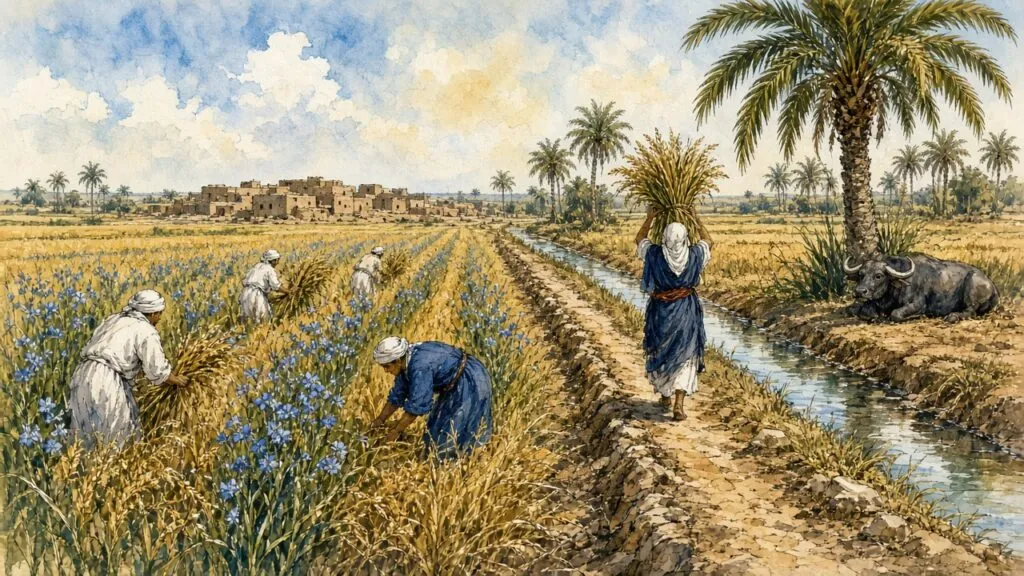
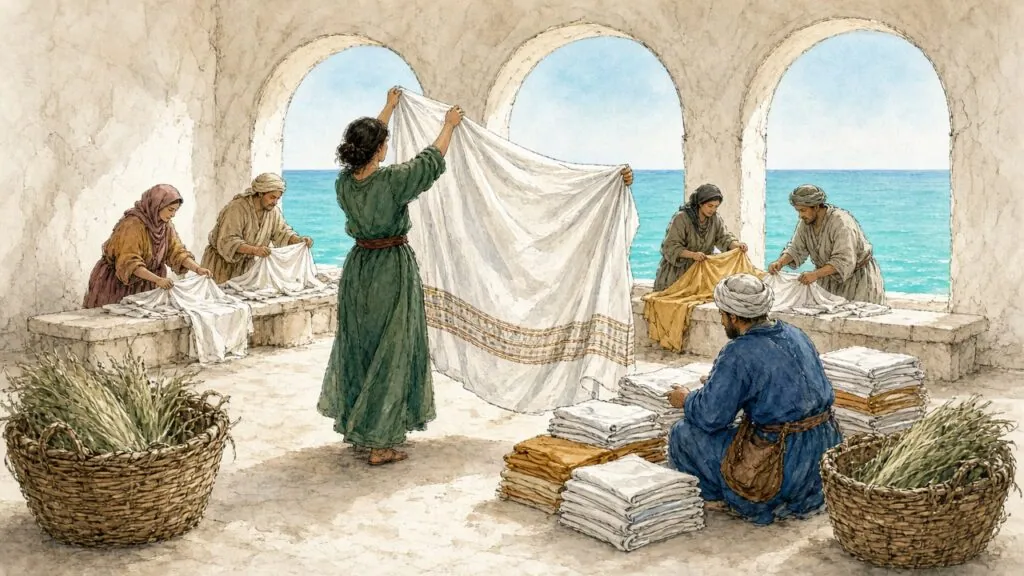
The processing of flax into linen was one of the major industries of Fatimid Egypt. The towns of the eastern Delta, especially Tinnis and Damietta near Lake Manzala, were famous for fine linen and for the luxurious textiles woven for the caliphs, including the inscribed fabrics known as tiraz that the court distributed as robes of honour.[24][86] Jews took part in the textile industry as weavers, dyers and merchants. Dyeing was a characteristically Jewish occupation in many parts of the Mediterranean, and the Geniza documents mention Jewish dyers who worked with indigo, lac and other dyes, as well as merchants who specialised in the trade in dyestuffs.[87][6]
Indigo, which reached Egypt both from India and from cultivation in Egypt and Palestine, was among the goods most frequently mentioned in the merchants’ letters, and it was traded in grades distinguished by origin and quality. Brazilwood, lac and saffron were also imported for dyeing, while alum, used as a mordant, was exported from Egypt to Italy and elsewhere.[87] The variety of textiles named in trousseau lists, from linen and cotton to silk, brocade and mixed fabrics, reflects the importance of cloth not only as a commodity but also as a form of stored wealth that families could sell or pledge in time of need.[33][6]
15. The India trade
In the late eleventh and twelfth centuries a growing part of the commerce documented in the Geniza concerned the trade between Egypt and India. Goods from South Asia and South-East Asia, among them pepper, cinnamon, ginger, other spices, aromatics, dyes, iron, brass and copperware, Chinese porcelain and textiles, reached Aden at the southern end of the Red Sea, where they were transferred to ships bound for the Egyptian ports of Aydhab and Qusayr. From there caravans carried them across the Eastern Desert to Qus on the Nile and then downstream to Fustat and Alexandria.[88] In the opposite direction went textiles, metals, glass, paper, books, coral, foodstuffs and other Mediterranean goods.[89]
Goitein devoted decades to collecting the Geniza documents of this trade, which he called the India Book, and the edition of the material has been continued since his death by Mordechai Akiva Friedman. The documents show Jewish merchants living in India for years at a time, forming partnerships with Indian, Arab and Persian traders, and employing local agents and shipowners.[90][89] In Aden the representative of the merchants, Madmun ben Hasan-Japheth, acted as a banker, shipowner and communal leader, and corresponded with merchants in India and Egypt.[90]
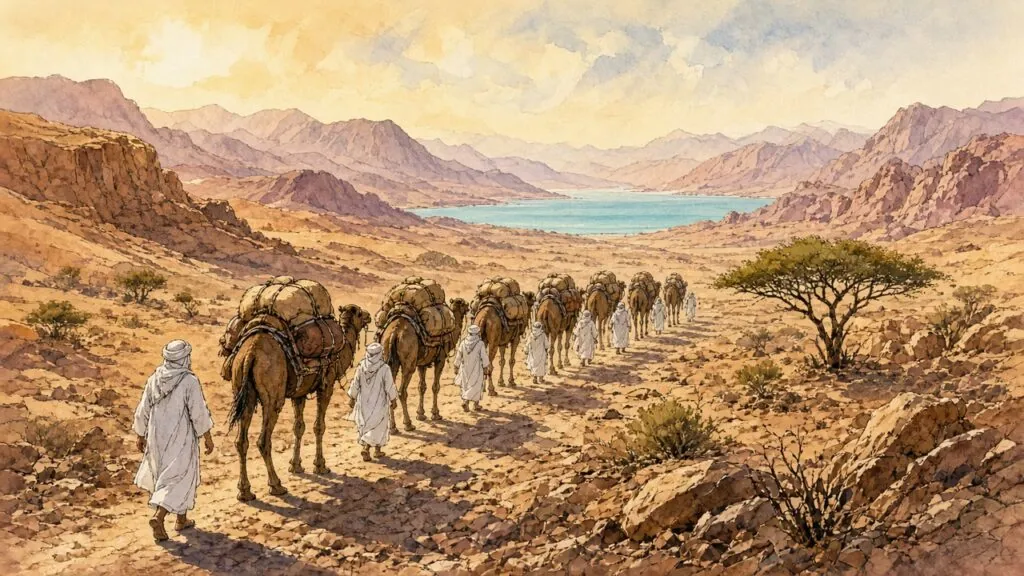
The best known of these merchants is Abraham ben Yiju, who was born in al-Mahdiyya in Ifriqiya, spent some years in Aden, and lived on the Malabar coast of India, mainly in Mangalore, from before 1132 until 1149. In India he ran a bronze workshop and traded in pepper, iron, betel nuts and other goods. He freed and married an Indian woman named Ashu, with whom he had children, and after returning to Yemen he wrote in 1149 to his brothers in Ifriqiya, inviting them to join him and proposing to marry his daughter to one of their sons.[90][91] He later moved to Egypt, where his daughter married her cousin. The novelist and anthropologist Amitav Ghosh reconstructed the story of Ben Yiju and of an Indian slave who worked for him in his book In an Antique Land, published in 1992.[92]
The India trade was dangerous and its profits were uncertain. Letters report shipwrecks, the plundering of ships by pirates, and the deaths of merchants far from home; the wife of a merchant lost at sea might wait years before a court could establish his death and permit her to remarry.[89][90]
16. Crafts, money and the market
Most Jews of Fatimid Egypt were neither great merchants nor court officials. The Geniza documents name hundreds of occupations, and Goitein’s survey found that Jews worked in a much wider range of crafts and trades than in later centuries. They were weavers, dyers, tailors, silk workers, glassmakers, metalworkers, goldsmiths and silversmiths, perfumers, druggists, sugar makers, cheese makers, bakers, oil pressers, bookbinders, scribes and teachers, as well as brokers, money changers, shopkeepers and peddlers.[6][8]
Fustat was a major centre of ceramic production, and the excavations of the city have produced vast quantities of pottery, including the lustre-painted wares that were among the finest products of Fatimid craftsmanship. Lustreware, in which a metallic sheen was produced by firing a glaze with metal oxides, had been developed in Iraq and was brought to new heights in Egypt in the tenth to twelfth centuries.[17] The documents rarely identify potters by religion, but they show that craftsmen of all communities worked in the same markets, rented workshops from owners of other faiths and formed partnerships across religious lines.[6]
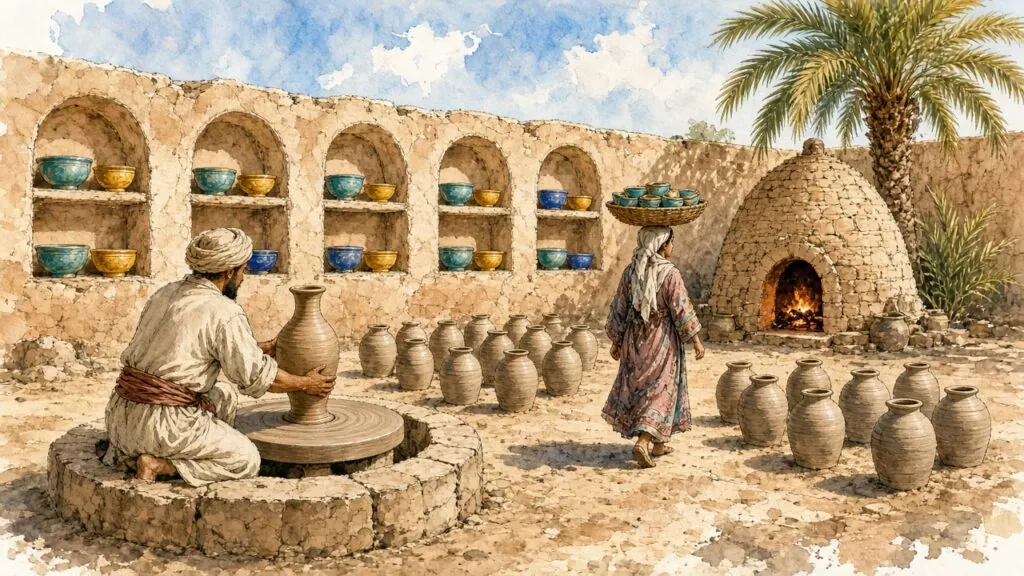
Workshops were often small family enterprises in which a master worked with one or two partners or apprentices. Partnership contracts in the Geniza record the investment of tools, materials and labour, the division of profits and the length of the agreement. Glassmaking, in which Jews were particularly active, required furnaces and specialised skills, while the production of silk and fine textiles depended on networks of spinners and embroiderers, many of whom were women working at home.[6][93]
The monetary economy of Fatimid Egypt was based on the gold dinar, which the dynasty minted to a high standard, and on silver dirhams of varying quality. Money changers and bankers, many of them Jewish, exchanged coins, assayed their weight and fineness, held deposits and extended credit. The Tustari brothers and other wealthy families acted as bankers to the court as well as to merchants.[85][59] Prices and exchange rates were a constant subject of the merchants’ letters, which reported the state of the markets in each city and the arrival or absence of goods.[84]
17. Marriage, household and the lives of women
The Geniza documents preserve a large body of material on family life, including marriage contracts, betrothal agreements, dowry lists, bills of divorce, wills and letters between relatives. Goitein devoted the third volume of A Mediterranean Society to the family, and later scholars have studied the documents of marriage, divorce and women’s work in detail.[6][33] The Jewish marriage contract, the ketubbah, recorded the obligations of the husband, the sum he promised to pay his wife if the marriage ended through divorce or his death, and the goods that the bride brought into the marriage.[33]
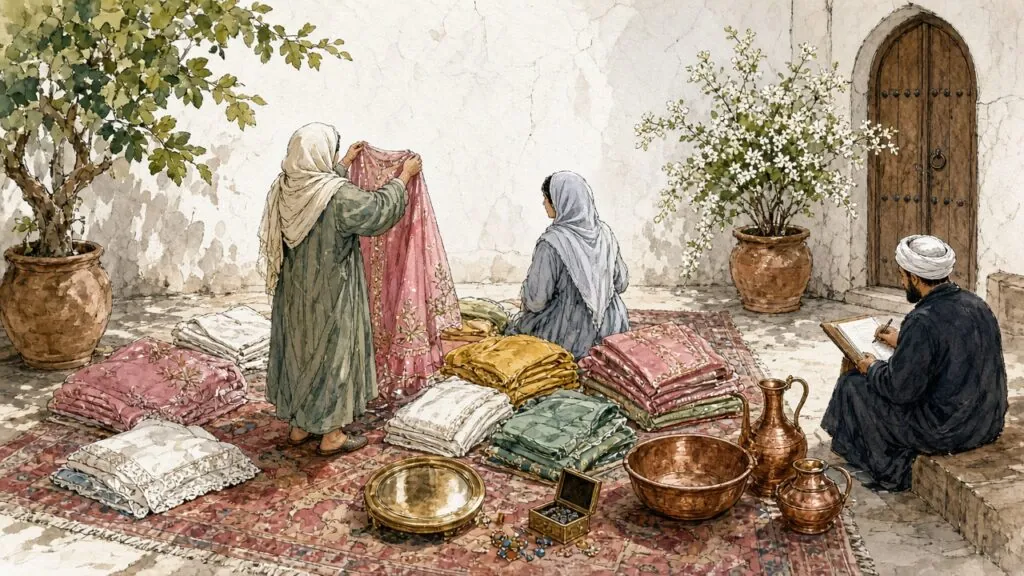
The dowry lists attached to marriage contracts are among the most detailed records of material culture to survive from the medieval Mediterranean. They list clothing, bedding, cushions, carpets, curtains, copper and brass vessels, jewellery and other household goods, each with an estimated value, and they allow historians to compare the wealth of families and to follow changes in fashion and taste.[33][6] The goods listed remained in principle the property of the wife, and in the event of divorce or widowhood she or her heirs could claim them. For many women the dowry was the principal form of economic security.
Marriage contracts of the Palestinian rite sometimes included conditions that protected the wife, such as an undertaking by the husband not to take a second wife or a concubine without her consent, not to travel for long periods without providing for her, and not to move her to another city against her will. Polygamy was legally permitted but uncommon in the documents, and monogamy clauses became frequent in the eleventh and twelfth centuries.[33][6] Divorce was available and not rare, and the documents record negotiations over the return of dowries and the custody and support of children.
Women’s economic activity is visible throughout the documents. Many women spun, wove and embroidered at home and sold their work through brokers, often other women. Some lent money, invested in partnerships or managed property.[93][6] The best documented of these women is Karima, daughter of Amram, a banker of Alexandria, who was known as al-Wuhsha the broker and lived in Fustat at the end of the eleventh century and the beginning of the twelfth. Court records show her investing in merchandise, including goods from India, and lending money against pledges.[94][93]
Al-Wuhsha’s private life is also unusually well documented. She was married and divorced, and she later had a son from a relationship with a man from Ashkelon to whom she was not married. She went to court to establish that the child was not the offspring of an adulterous or incestuous union, which would have barred him from marrying within the Jewish community, and her will, which survives, made provision for him.[93][94] Her case illustrates both the independence that some women achieved and the importance of courts and witnesses in regulating family relationships.
18. Courts, deeds and communal charity
Each major Jewish community in Egypt had a court, the bet din, composed of a presiding judge and two or more associates. Courts met regularly, often in the synagogue, and handled cases of marriage and divorce, inheritance, commercial disputes, debts, property transactions and the appointment of guardians for orphans.[43][6] Their records, drafted by court clerks, form a large part of the documentary Geniza. They include depositions of witnesses, settlements, powers of attorney, deeds of sale and gift, receipts and releases, and they show the procedures by which disputes were investigated and resolved.

The judges were appointed by, or with the approval of, the heads of the academies and, later, the Head of the Jews. They applied Jewish law as interpreted in the responsa of the geonim and in the legal literature of the period, but they also took account of local custom and of the practices of Muslim courts, where Jews sometimes registered property transactions to secure their enforcement by the state.[43][44] Court clerks often combined their work with other functions, such as leading prayers, teaching or copying books, and the hands of a few prolific clerks appear on hundreds of documents.[93][95]
Communal charity was organised through the synagogue. The community maintained a fund, supported by donations, bequests and the income of endowed properties, from which it distributed bread, clothing and cash to the poor, paid the poll tax for those who could not afford it, supported widows and orphans, and ransomed captives.[6][42] Lists of recipients of bread and of donors to appeals survive in large numbers, and they show that the poor included not only local residents but also refugees, foreigners and travellers.[96] Endowments for the benefit of the synagogue or the poor, often consisting of houses or shares in houses in Fustat, were administered by trustees and supervised by the courts.
The ransoming of captives was a recurring obligation. Jews captured at sea by Byzantine or other forces, or taken in war, were ransomed through appeals to communities in Egypt and elsewhere, and letters of recommendation accompanied former captives seeking help. After the crusader conquest of Jerusalem in 1099 the communities of Fustat contributed substantial sums to ransom Jewish captives and the books taken from the synagogues of Palestine, a campaign documented in the letters sent from Ashkelon.[35][41]
19. Medicine, poetry and Judeo-Arabic letters
Medicine was the profession through which Jews most often reached the court. The Fatimid caliphs and their viziers employed Jewish physicians alongside Muslim and Christian colleagues, and several Heads of the Jews, among them Judah and Mevorakh ben Saadia and Samuel ben Hananiah, were court physicians.[68][80] The Geniza contains medical prescriptions, notebooks and fragments of medical books in Arabic and Judeo-Arabic, as well as letters in which physicians discuss their patients and their positions. Medical training was usually acquired through apprenticeship and the study of the classical Greek and Arabic authorities, and physicians often combined practice with the trade in drugs.[95][6]
The language of everyday life and of most writing among the Jews of Fatimid Egypt was Arabic, written in Hebrew script. This Judeo-Arabic was used for letters, contracts, accounts and much of the religious, philosophical and scientific literature of the period, while Hebrew was reserved mainly for liturgy, poetry, formal legal formulae and some correspondence between scholars.[97][32] The model for much of this literature was Saadia ben Joseph, born in the Fayyum in 882, who left Egypt as a young man and became gaon of the academy of Sura in Iraq. His translation of the Bible into Arabic, his commentaries, his prayer book and his philosophical work, the Book of Beliefs and Opinions, were read throughout the Jewish communities of the Islamic world.[98][32]
Hebrew poetry flourished in the same period, above all in al-Andalus, where poets such as Samuel ibn Naghrillah, Solomon ibn Gabirol and Moses ibn Ezra adapted the metres and themes of Arabic poetry to Hebrew verse.[99] Their poems reached Egypt in manuscript and were copied, collected and imitated there. Egyptian and Palestinian Jews also produced liturgical poetry, piyyut, for use in the synagogue, and occasional verse in honour of patrons and leaders, much of which survives only in Geniza fragments.[100]
The most celebrated literary visitor to Fatimid Egypt was Judah Halevi, the Andalusian poet and author of the philosophical dialogue known as the Kuzari. Halevi left Spain to travel to the Land of Israel and arrived in Alexandria in September 1140. He spent several months in Egypt, as the guest of Aaron ibn al-Ammani in Alexandria and of Samuel ben Hananiah in Cairo, and wrote poems in their honour.[81][101] Letters in the Geniza written by his friends describe his stay and his departure by sea in the spring of 1141. He died soon afterwards, and it is not known whether he reached the Land of Israel.[101][80]
20. Crisis, crusade and the end of the dynasty
The last decades of the eleventh century brought the Fatimid state a series of territorial losses. The Seljuk Turks took most of Syria and Palestine in the 1070s, and although the Fatimids recovered Jerusalem in 1098, they lost it the following year to the armies of the First Crusade.[66] The crusaders took Jerusalem in July 1099 and killed or captured much of its population, including its Jewish and Karaite inhabitants. The new Kingdom of Jerusalem gradually took the coastal cities of Palestine and Lebanon, among them Tyre in 1124, and Ashkelon, the last Fatimid stronghold on the coast, fell in 1153.[102][103]
These events had direct consequences for the Jews of Egypt. Refugees from Palestine arrived in Egypt, captives were ransomed with Egyptian funds, and the institutions of Palestinian Jewry were transferred to Fustat. Trade continued, and Christian merchants from Italy became more prominent in Egyptian ports, but the political position of the dynasty weakened steadily.[104][35] After the death of al-Mustansir in 1094 the caliphs were dominated by their viziers. Al-Afdal, the son of Badr al-Jamali, governed until his assassination in 1121, and the caliph al-Amir was himself murdered in 1130.[79]
In the middle of the twelfth century Egypt became the object of competition between the Kingdom of Jerusalem and the Muslim ruler of Syria, Nur al-Din. Rival claimants to the Fatimid vizierate sought the support of one side or the other. In 1163 the deposed vizier Shawar fled to Damascus, and in 1164 he returned with a Syrian army under the Kurdish commander Shirkuh, and over the following years King Amalric of Jerusalem invaded Egypt several times, sometimes as Shawar’s ally and sometimes as his enemy.[105][106]
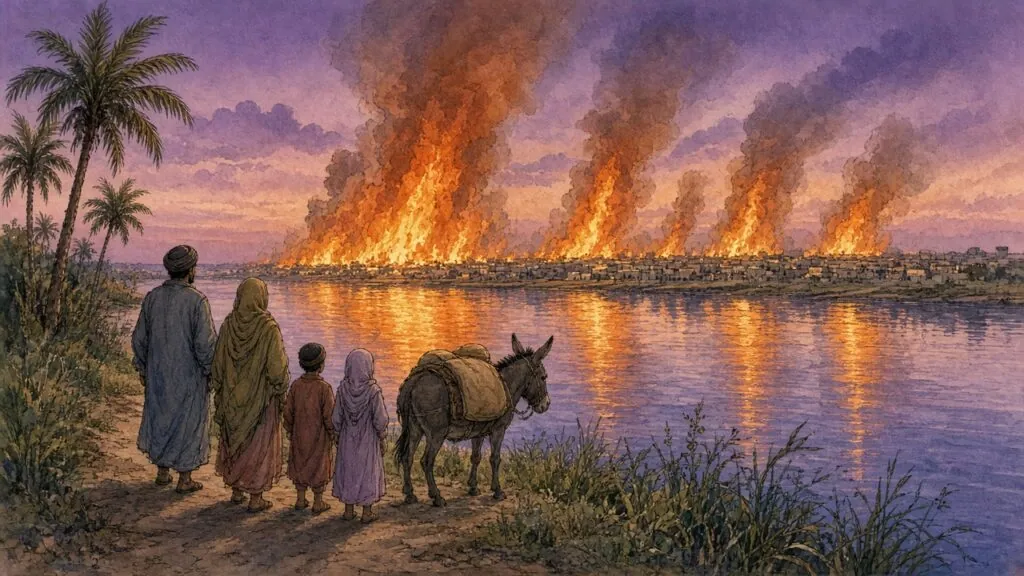
In November 1168 Amalric’s army stormed Bilbeis, on the road from Palestine to Cairo, and sacked the town, killing or capturing many of its inhabitants, among them members of its Jewish community. As the crusaders approached the capital, Shawar ordered Fustat to be set on fire so that it could not serve as a base for the enemy, and the city is reported to have burned for many days.[22][17][61] The scale of the destruction has been debated by archaeologists and historians, but the burning marked the end of Fustat’s predominance, and in the following decades Cairo grew to absorb the functions of the old city. Several documents in the Geniza refer to efforts in which Moses Maimonides took part to raise funds for ransoming Jewish prisoners taken by the Franks at Bilbeis, though the attribution and dating of some of them are debated.[5][77]
Shirkuh returned to Egypt with a Syrian army in January 1169, the crusaders withdrew, and Shawar was killed. Shirkuh became vizier but died in March of the same year, and his nephew Salah al-Din Yusuf ibn Ayyub, known in Europe as Saladin, succeeded him as vizier to the last Fatimid caliph, al-Adid.[106][107] Over the next two years Saladin consolidated his power, defeated the Sudanese regiments of the old army and replaced Isma’ili officials with Sunni ones. In September 1171 the Friday sermon was pronounced in the name of the Abbasid caliph in Baghdad, and al-Adid died a few days later. The Fatimid caliphate came to an end, and Egypt returned to Sunni allegiance under the Ayyubid dynasty.[108][109]
For the Jews of Egypt the change of regime brought continuity as well as change. The Ayyubids enforced the laws of the dhimma more consistently than most Fatimid rulers had done, but Jewish physicians continued to serve at court, Jewish merchants continued to trade with India and the Mediterranean, and the communal institutions of the Fatimid period, the courts, the yeshiva in Fustat and the office of the Head of the Jews, survived into the new era.[109][110]
21. The Geniza and its rediscovery
Jewish custom forbids the destruction of writings that contain the name of God, and worn-out books and documents were therefore deposited in a storeroom, a genizah, until they could be buried. The genizah of the Ben Ezra synagogue in Fustat, a chamber reached by a ladder through an opening high in the wall, was never emptied for burial, and over the centuries it accumulated an enormous mass of writing in Hebrew, Aramaic, Judeo-Arabic, Arabic and other languages.[4] Although the community deposited mainly religious texts, it also discarded letters, contracts, accounts and other documents, and these form what scholars call the documentary Geniza, a corpus of some tens of thousands of items within a total that has been estimated at around four hundred thousand fragments.[5][95]
Scholars and collectors became aware of the Geniza in the course of the nineteenth century, and fragments began to reach libraries in Europe and America. The decisive moment came in 1896, when two Scottish sisters, Agnes Lewis and Margaret Gibson, showed Solomon Schechter, then reader in rabbinics at the University of Cambridge, a fragment they had bought in Cairo. Schechter identified it as part of the lost Hebrew original of the Book of Ben Sira.[111][112] With the support of Charles Taylor, the master of St John’s College, he travelled to Cairo at the end of 1896 and obtained permission to remove the greater part of the remaining contents of the storeroom, which he brought to Cambridge.[112]
The Taylor-Schechter collection at Cambridge University Library contains about 193,000 fragments, the largest single collection of Geniza material. Other major collections are held by the Jewish Theological Seminary in New York, the Bodleian Library in Oxford, the British Library, the John Rylands Library in Manchester, the University of Pennsylvania, the National Library of Russia in St Petersburg and many other institutions.[95][113] Among the literary discoveries were fragments of the Damascus Document, a sectarian text later recognised in the Dead Sea Scrolls, as well as lost works of liturgical poetry, early rabbinic texts and autographs of medieval authors.[5]
The study of the documentary Geniza as a source for social and economic history was transformed by Shelomo Dov Goitein, who began working on the documents in the late 1940s and published the five volumes of A Mediterranean Society between 1967 and 1988, with an index volume following in 1993.[6][8] His work was continued by his students and by later generations of scholars, among them Mark R. Cohen, who founded the Princeton Geniza Project in 1986, and Mordechai Akiva Friedman, who has edited the India Book and the documents of marriage. The Princeton Geniza Project now provides searchable descriptions, transcriptions and translations of many thousands of documents, and the digitisation of the collections by Cambridge University Library and the Friedberg Genizah Project has made images of most fragments available online.[7][114][113]
Through these documents the Jews of Fatimid Egypt have become among the most closely studied communities of the medieval world. The letters of merchants, the records of courts and charities, the marriage contracts and the correspondence of communal leaders allow historians to describe not only the political history of the community but also the concerns of individuals whose names appear in no chronicle.[6][96] Among the fragments are also autograph drafts and letters of Moses ben Maimon, who settled in Fustat with his family around 1166, in the last years of Fatimid rule. His work as jurist, physician and communal leader under the Ayyubids, the subject of a separate essay, drew on the institutions and the learned culture that the Jews of Egypt had built over the preceding two centuries.[77][5]
22. Timeline
The Fatimid imam proclaims himself caliph in Ifriqiya, in opposition to the Abbasids of Baghdad.[9]
The Egyptian-born scholar, later gaon of Sura, sets the pattern for Judeo-Arabic religious literature.[98]
Ya‘qub ibn Killis, of a Baghdad Jewish family and an official of Kafur, converts to Islam.[45]
Jawhar enters Fustat for al-Mu‘izz and lays out the new royal city of al-Qahira.[12]
The date assigned by later legend to the capture of four scholars, among them Shemariah ben Elhanan, later head of a school in Fustat.[72]
The congregational mosque of al-Azhar is founded and completed in the new city.[16]
Al-Mu‘izz arrives in Egypt with his court; the Fatimid state is henceforth centred on Cairo.[11]
The Jewish courtier of al-Mu‘izz described in the Chronicle of Ahimaaz dies, according to that source.[49]
Al-Aziz appoints Ibn Killis vizier, an office he holds, with one interruption, until 991.[46]
Al-Hakim orders the destruction of the Church of the Holy Sepulchre; restrictions on non-Muslims intensify.[53]
Synagogues are destroyed and Jews are required to wear distinctive dress and emblems.[52]
Jews and Christians are allowed to rebuild places of worship, and forced converts to return to their faith.[52]
The caliph vanishes in the Muqattam hills and al-Zahir succeeds him.[50]
Solomon ben Judah becomes gaon of the yeshiva of the Land of Israel, holding office until 1051.[31]
The seven-year-old al-Mustansir begins a reign of almost sixty years.[58]
The last dated activity of Joseph ibn Awkal, merchant of Fustat and agent of the Iraqi academies.[83]
The Karaite theologian Yusuf al-Basir dies in Jerusalem.[38]
The young merchant from Qayrawan settles in Egypt, where he trades and teaches until about 1098.[76]
The influential Jewish merchant and adviser at court is assassinated; his brother is killed soon afterwards.[59]
A descendant of the Babylonian exilarchs holds the Palestinian gaonate.[64]
Low Nile floods, famine and civil war devastate Egypt.[58]
Turkish forces occupy Jerusalem and the yeshiva moves to Tyre.[65]
The governor of Acre arrives in Egypt and restores order as military vizier.[62]
The court physician succeeds his brother Judah as Head of the Jews of Egypt.[68]
Mevorakh is restored after the challenge of David ben Daniel and bears the title nagid until 1111.[78]
The crusaders capture the city; Jewish and Karaite inhabitants are killed or taken captive.[102]
The Karaites of Ashkelon report to Fustat on the ransoming of captives and books.[35]
Tyre, the seat of the Palestinian yeshiva after the 1070s, falls to the crusaders.[115]
Masliah ha-Kohen arrives from Syria and founds a yeshiva in the synagogue of the Palestinians.[69]
The merchant Abraham ben Yiju lives and trades on the Malabar coast.[90]
The Andalusian poet stays in Alexandria and Cairo before sailing east.[101]
The court physician appears in documents as Head of the Jews of Egypt.[80]
The last Fatimid stronghold on the Palestinian coast is taken by the Kingdom of Jerusalem.[103]
Syrian and crusader armies intervene repeatedly in the contest for the vizierate.[105]
Amalric sacks Bilbeis and Shawar orders Fustat to be burned.[22]
The Friday sermon is read for the Abbasid caliph and al-Adid dies; Ayyubid rule begins.[108]
Solomon Schechter identifies a fragment of Ben Sira and brings the contents of the Ben Ezra genizah to Cambridge.[112]
Goitein publishes his synthesis of the documentary Geniza in six volumes.[6]
References
- Fatimid Caliphate *
- Fatimids *
- History of the Jews in Egypt *
- Cairo Geniza *
- Genizah, Cairo *
- A Mediterranean Society, Volume I: Economic Foundations *
- The Princeton Geniza Project *
- Letters of Medieval Jewish Traders, introduction *
- Isma‘ilism *
- Ikhshidid dynasty *
- Al-Mu‘izz li-Din Allah *
- Cairo *
- Ifriqiya *
- Ramla *
- Dhimmi *
- Al-Azhar Mosque *
- Fustat *
- Nasir Khusraw *
- Cairo *
- Egypt *
- Damietta *
- Bilbeis *
- Alexandria *
- Lake Manzala *
- Ramleh *
- Tiberias *
- Yeshivot *
- Ben Ezra Synagogue *
- Karaite Judaism *
- Karaites *
- Solomon ben Judah *
- Saadia Gaon *
- Ketubbah *
- Abu Sa‘d al-Tustari *
- Letter from the Karaites of Ashkelon to Fustat, T-S 10J5.6 + T-S 20.113 *
- Samaritans *
- Levi ben Japheth *
- Basir, Joseph ben Abraham ha-Kohen ha-Ro’eh al- *
- Kalam *
- Jeshua ben Judah *
- Letter on the Capture of Jerusalem *
- Jizya *
- Beth din *
- Nagid *
- Ya‘qūb ibn Killis *
- Ibn Killis, Abu al-Faraj Ya‘qub ibn Yusuf *
- Ibn Killis, Ya‘ḳub ben Yusuf (Abu al-Faraj) *
- Al-Aziz Billah *
- Paltiel *
- Al-Hakim bi-Amr Allah *
- Druze *
- Hakim bi-Amr Allah, al- *
- Church of the Holy Sepulchre *
- Badge, Jewish *
- Elhanan ben Shemariah *
- Al-Ḥākim and the Dhimmīs *
- Al-Zahir li-I‘zaz Din Allah *
- Al-Mustansir Billah *
- Abū Sa‘d Tostarī *
- (Abū Sa‘d) Ibrāhīm b. Sahl al-Tustarī *
- Al-Maqrizi *
- Badr al-Jamali *
- Nathan ben Abraham I *
- Daniel ben Azariah *
- Elijah ben Solomon ha-Kohen *
- Seljuk Empire *
- Abiathar ben Elijah ha-Kohen *
- Mevorakh ben Saadiah *
- Mazli’ah ben Solomon ha-Kohen *
- Sar Shalom ben Moses ha-Levi *
- Abraham ibn Daud *
- Shemariah ben Elhanan *
- Hai ben Sherira *
- Kairouan *
- Kairouan *
- (Abū Yaḥyā) Nahray b. Nissim *
- Maimonides *
- (Abū l-Faḍl) Mevorakh b. Sa‘adya (Nagid) *
- Al-Afdal Shahanshah *
- Samuel ben Hananiah *
- Judah Halevi *
- Zuta *
- Yosef b. Ya‘aqov Ibn ‘Awkal *
- Letter of Nahray b. Nissim from Fustat, T-S 13J14.2 *
- Banking and Bankers *
- Linen *
- Indigo dye *
- Qus *
- India *
- Avraham Ben Yijū *
- Letter of Avraham Ben Yijū from Aden, T-S 10J10.15 *
- Amitav Ghosh *
- Wuhsha the Broker *
- Karīma bt. ‘Amram (Wuḥsha al-Dallāla) *
- Taylor-Schechter Genizah Research Unit *
- Genizah fragment of the month *
- Judeo-Arabic Literature *
- Saadya [Saadiah] *
- Moses ibn Ezra *
- Solomon Ibn Gabirol [Avicebron] *
- Judah Halevi *
- Siege of Jerusalem (1099) *
- Ashkelon *
- Crusades *
- Shawar *
- Shirkuh *
- Saladin *
- Al-Adid *
- Ayyubids *
- Saladin *
- Solomon Schechter *
- Schechter, Solomon *
- Cairo Genizah collection *
- Friedberg Jewish Manuscript Society *
- Tyre *