Aaron Kosminski and the Jews of the Pale
1. A suspect and a climate
Aaron Kosminski, born Aron Mordke Kozmiński in Kłodawa in Congress Poland on 11 September 1865, was a Polish Jewish hairdresser who lived in Whitechapel during the autumn of 1888, when five women were murdered in the district in a sequence of crimes that the press soon named after “Jack the Ripper”. He was never charged. His name entered the police paperwork years later, in Sir Melville Macnaghten’s confidential memorandum of February 1894 and in the private marginalia that Chief Inspector Donald Swanson later wrote in a copy of Sir Robert Anderson’s memoirs. Those documents make him one of the most discussed suspects in an unsolved case. They do not make him the murderer.[1][2][3]
This essay places Kosminski inside a larger history. He belonged to the wave of Jews who left the Russian Empire’s Pale of Settlement after the pogroms of 1881 and the May Laws of 1882, and who remade the East End of London, the Lower East Side of New York, and smaller communities in Argentina, South Africa and elsewhere. In Whitechapel that history collided with poverty, the sweating trades, blood-libel residues and a press ready to blame “foreign Jews” for crimes it could not solve. The Leather Apron scare, the chalk writing found in Goulston Street beside a bloodstained scrap of apron, and the later police habit of naming a “low-class Polish Jew” as the killer all belong to that collision. So do the Aliens Act of 1905 and the nativist politics that greeted Pale emigrants in other destinations. Kosminski’s asylum notes and the disputed DNA claims attached to a shawl are part of the story; they are not the whole of it.[4]
The aim is neither to clear nor to convict a man who cannot answer for himself. It is to show how rumour, police opinion and proof were confused in 1888 and after, and how antisemitism shaped the reception of Jews who had fled the Pale for cities that promised work and offered, instead, crowded rooms, low wages and the charge of being the cause of their own hardship.
The title of this essay therefore names two subjects that official Ripper literature has often kept apart. One is a man in the asylum registers. The other is a climate: the prevailing antisemitism that greeted Jews leaving the Pale for London and for sister destinations overseas. Treating only the first subject produces a closed room of memoranda and DNA disputes. Treating only the second produces a general migration history in which Kosminski is a footnote. Holding both in view shows how an unsolved crime became a vehicle for ethnic suspicion, and how an obscure patient became famous because suspicion needed a name.
Readers coming to the subject through television reconstructions will find the pace here slower and the conclusions less absolute. That is deliberate. The surviving police prose is short; the migration history is long; the ethical stakes of naming a Jew as a legendary killer are high. Slowing down is a method, not a lack of nerve.
2. The Pale and the reasons for leaving
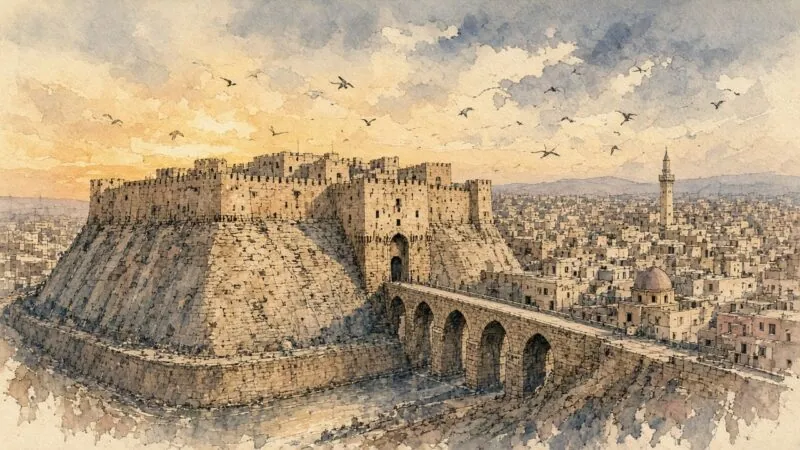
The Pale of Settlement was the zone of the Russian Empire in which Jews were generally permitted to reside. Established under Catherine II and reshaped by the partitions of Poland, it stretched across much of what is now Ukraine, Belarus, Lithuania and parts of Poland, and by the late nineteenth century held more than five million Jews—almost the entire Jewish population of the empire. Within those provinces Jews faced residency controls, occupational barriers and, after the assassination of Tsar Alexander II in March 1881, a wave of pogroms that the authorities were slow to suppress and that some contemporaries accused them of tolerating. The Temporary Regulations of May 1882, known as the May Laws, further restricted Jewish rural settlement and trade, deepening the economic squeeze on communities already crowded into towns and shtetls.[2][4][5]
Historians of the period treat the pogroms and the May Laws together as the shock that turned long-standing hardship into mass emigration. Between 1881 and 1914 some two million Jews left the Pale and the wider East European Jewish world, most of them for the United States, with smaller streams to Britain, Canada, Argentina, South Africa and Ottoman Palestine. Nearly one in three Jews in the Pale depended on communal charity by 1900. Emigration was not only flight from violence; it was also an economic regulator in a population that had grown faster than the opportunities available under tsarist law. Families sold what they could, borrowed for steamship tickets, and followed letters from relatives already working in London’s East End or New York’s garment lofts.
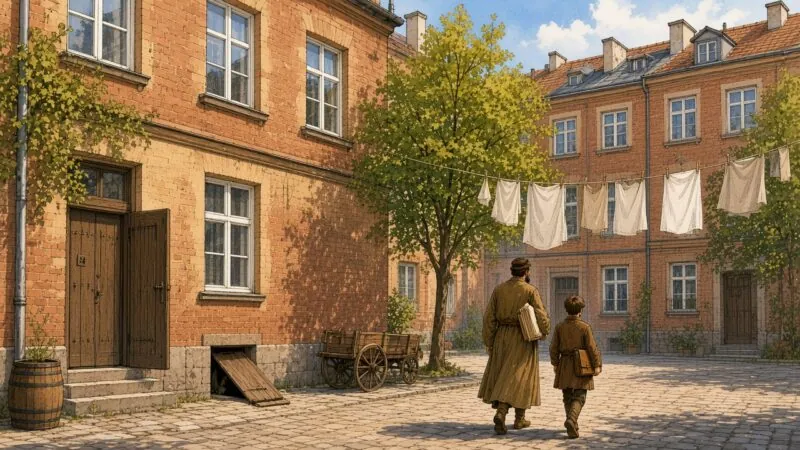
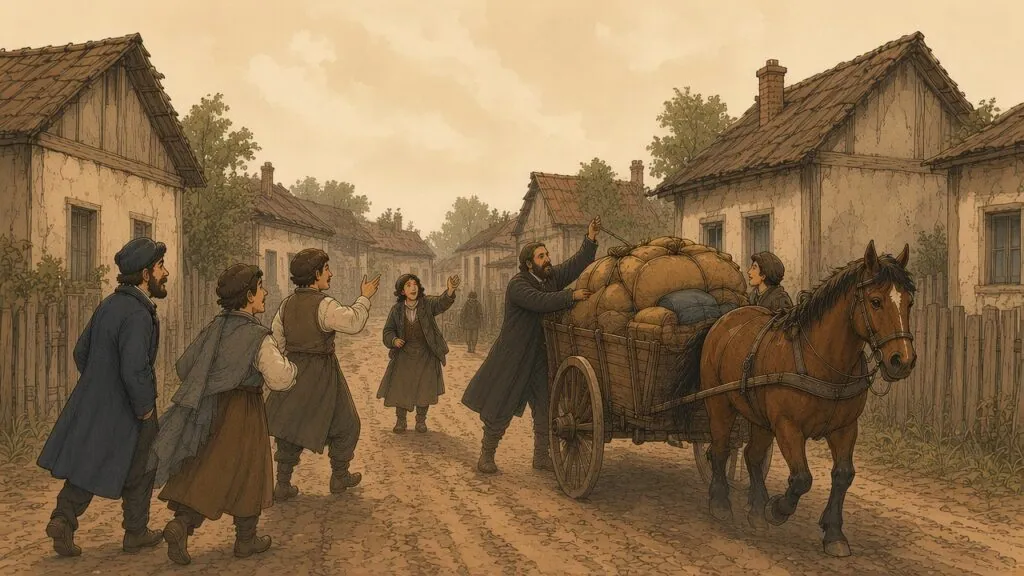
Aaron Kosminski’s family belonged to that movement. His father, Abram, a tailor from the Kalisz region, died when Aaron was a child. Around 1881 his widowed mother, Golda, brought her children from Kłodawa to London’s East End, part of the first surge of arrivals after the pogroms. The boy who would later appear in police memoranda as “Kosminski” was then about sixteen. He entered a city that had a long-settled Anglo-Jewish elite and a much poorer Yiddish-speaking quarter expanding street by street around Whitechapel, Spitalfields and Mile End.
The legal architecture of the Pale had always been designed to keep Jews out of the Russian interior while exploiting their commercial roles in the western borderlands. Merchants of the first guild, certain students, soldiers and a few other categories could live beyond the Pale under licence; the mass of artisans, small traders and air-men—people without capital—could not. Periodic expulsions from Kiev, Moscow and rural districts refreshed the lesson. When the pogroms of 1881–82 burned shops and terrorised families across scores of towns, the May Laws then forbade new Jewish leases outside towns and limited rural trade, so that flight became rational even for households that had not been directly attacked. Jewish Encyclopedia entries of the early twentieth century, written while the Pale still existed, already treated the May Laws as a turning point that “provided the impetus for mass emigration.”
Kłodawa, where Aaron Kosminski was born, lay in the Kalisz Governorate of Congress Poland, inside that restricted world. Tailoring, his father’s trade, was one of the classic Jewish crafts of the region: portable, teachable and always vulnerable to fashion, credit and local hostility. A widow leading children to London was following a path already marked by letters, ticket agents and the rumour of wages. The family’s 1881 timing places them among the earliest post-pogrom arrivals, before the later peaks of the mid-1890s and of 1905–06, when revolutionary violence and fresh pogroms pushed annual Jewish departures to extraordinary heights.
3. Where the emigrants went
The geography of Pale emigration matters because London was never the only destination, and antisemitism was never only an East End problem. Roughly eighty-five per cent of the intercontinental Jewish migrants of 1881–1914 went to the United States. There they remade New York’s Lower East Side, entered the garment trades, founded unions and newspapers, and met a nativism that culminated in the immigration quotas of the 1920s. Argentina received a smaller but organised flow under the Jewish Colonization Association founded by Baron Maurice de Hirsch in 1891; by 1920 some 150,000 Jews lived in the country, many still tied to the agricultural colonies that Hirsch’s philanthropy had intended as an alternative to urban poverty. South Africa drew Jews especially from Lithuania; the Union’s first census in 1911 recorded nearly 47,000 Jews, a community already concentrated in the Cape and the Transvaal and already facing the politics of alien restriction. Canada, Western Europe and the First Aliyah settlements in Ottoman Palestine absorbed further thousands.[4][6][7]
In each place the pattern was recognisable: chain migration, Yiddish as the street language of the first generation, work in portable trades, and a host society that could treat Jewish arrival as both a labour resource and a cultural threat. Restrictionist campaigns spoke the language of overcrowding, disease, wage undercutting and dual loyalty. Blood-libel fantasies, already centuries old in Christian Europe, did not need to be believed literally in order to colour the suspicion that Jews were secretive, clannish and capable of ritual or sexual crime. When a sensational murder series erupted in Whitechapel in 1888, that reservoir of suspicion was ready to hand.[8]
Statistics compiled by migration scholars in the early twentieth century, and synthesised later in encyclopedic surveys, give a sense of scale even when individual country series are imperfect. Of some 2.4 million Jewish intercontinental migrants between 1881 and 1914, about two million went to the United States; Canada took on the order of a hundred thousand; Argentina more than a hundred thousand across a slightly longer window; South Africa several tens of thousands; and Ottoman Palestine tens of thousands in the First Aliyah and after. Britain’s 150,000 Eastern European Jewish arrivals between 1881 and 1914 were thus a minority of the whole movement and a majority of the Jewish transformation of one city. Whitechapel felt like an invasion to some English observers because the arrivals clustered. The global picture was of a people redistributing itself under pressure, with London as one harbour among several.
Steamship lines, ticket agents in Hamburg and Bremen, and the economics of steerage made the Atlantic crossing a business as well as a flight. Some migrants intended London only as a stop on the way to New York and remained when money ran out or kin found them work. Others chose England because English Jews had organised shelters and because the language of Shakespeare’s country seemed, from a distance, a language of liberty. The liberty they found was real compared with May Law Russia, and heavily qualified compared with the promises in emigration circulars.
4. Whitechapel and the East End
London’s East End had long been a landing place for newcomers. It lay near the docks and near Liverpool Street Station, through which migrants arrived after crossing from Harwich and other east-coast ports. Between 1880 and 1914 about 150,000 Eastern European and Russian Jewish refugees entered Britain; up to seventy per cent settled in the East End, swelling the older Jewish neighbourhood between Spitalfields and Whitechapel. Yiddish was heard in the streets. Cheap rents, kin networks and workshop jobs pulled families into a few square miles already known for poverty.[9][1]
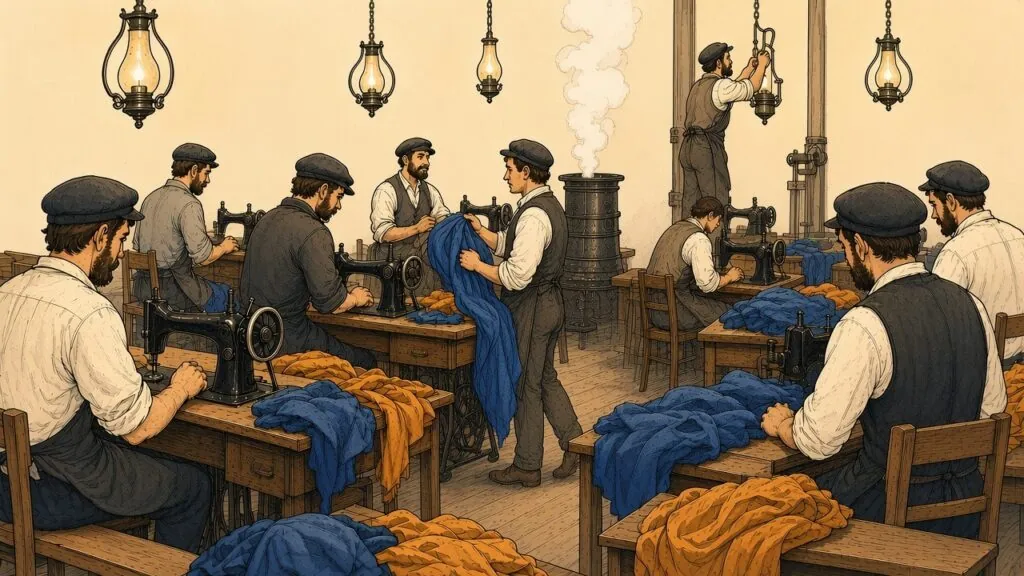
The clothing trade dominated immigrant employment. Charles Booth’s researchers counted 571 workshops making men’s coats in less than one square mile around Whitechapel by the late 1880s. Most employed fewer than ten people in cramped, steamy rooms—the “sweating” system that contemporaries blamed for long hours, low pay and tuberculosis. Up to seventy per cent of the East End’s immigrant workforce found work in clothing. The Jewish Board of Guardians lent money for sewing machines; the Poor Jews’ Temporary Shelter on Leman Street offered a fortnight’s lodging to new arrivals. Established Anglo-Jewry urged anglicisation and feared that visible poverty would feed antisemitism. Restrictionists replied that the newcomers themselves were the cause of sweating and overcrowding, as if those evils had awaited Jewish ships before taking root in English cities.
Kosminski worked as a hairdresser’s assistant or barber, a portable trade common among Jewish immigrants. Addresses associated with him and his kin—Duke’s Yard off Petticoat Lane, Greenfield Street, New Road—placed him inside the immigrant quarter and within walking distance of the streets where the 1888 murders occurred. Proximity is not proof. Thousands of other poor Jews lived in the same streets. What proximity did provide, in a climate of panic, was the raw material of suspicion.
Contemporary observers left thick descriptions of the quarter. George R. Sims and other social journalists wrote of “sweated London” as a spectacle of steam, cloth and bent backs. Ellen Gertrude Cohen’s images of the Poor Jews’ Temporary Shelter on Leman Street show dormitories of new arrivals still dressed for the road. Middlesex Street—Petticoat Lane—concentrated Sunday trading that drew customers from across London and complaints from those who wanted the Sabbath streets quiet. Synagogues ranged from formal foundations of the United Synagogue to small hevrot upstairs in houses. Chederim taught boys to read Hebrew; evenings filled with Yiddish theatre and political meetings. The density that later police writers would treat as a cover for a killer was, for residents, simply the condition of affordable life near work.
It is in this density that one must situate any claim about Kosminski’s “proximity” to murder sites. Greenfield Street and the lanes off Commercial Road lay near Berner Street and Mitre Square on a map; so did the homes of thousands of other men. Police theory that privileges geography without a reliable eyewitness, a forensic link or a contemporaneous charge is geography converted into prejudice. The East End’s Jewish geography explains how a Polish hairdresser could live near the crimes. It does not explain why he, rather than his neighbours, entered Macnaghten’s shortlist.
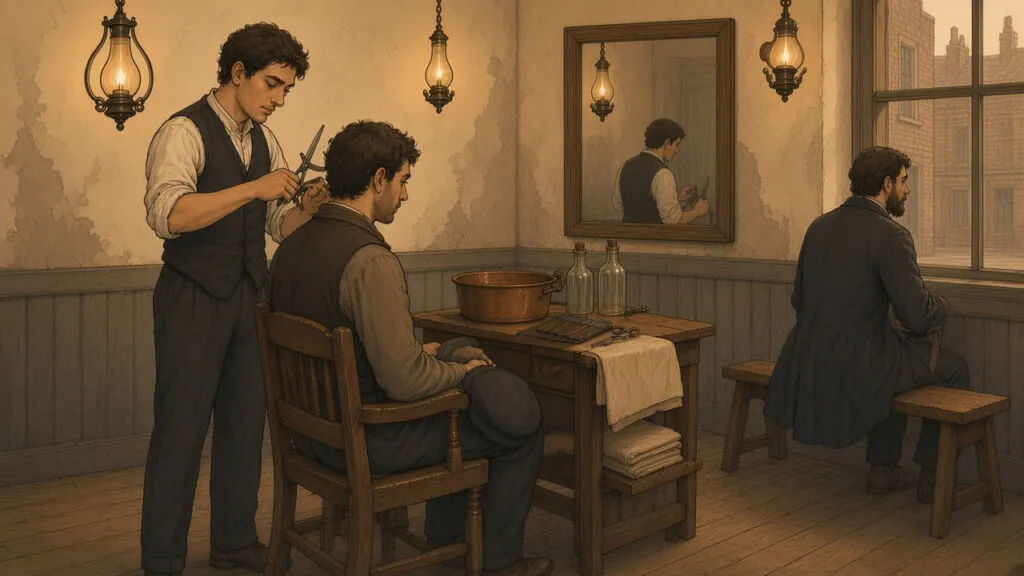
Hairdressing shops and barber chairs were part of the street furniture of immigrant Whitechapel, serving Jewish and Gentile customers who wanted a cheap cut. A young assistant in such a shop saw faces all day and was himself seen. Visibility of that ordinary kind is sometimes confused, in suspect literature, with the special visibility of a man hunted by detectives. Kosminski’s trade made him observable. It did not make him observed as a murderer.
5. Aaron Kosminski in London
The documentary trail of Aaron Kosminski’s ordinary life is thin and institutional. Asylum and workhouse records, reconstructed by later researchers including Martin Fido, show a young man whose mental health deteriorated in the years after the murders. He was said to refuse food handled by others, to hear voices, and to threaten his sister with a knife. In February 1891, after a brief stay associated with Mile End Old Town workhouse and infirmary care, he was committed to Colney Hatch Lunatic Asylum at the age of twenty-five. Case notes pointed toward what modern clinicians would recognise as a severe psychotic illness, often discussed as paranoid schizophrenia. He was later transferred to Leavesden Asylum, where he remained until his death from gangrene on 24 March 1919.[1][10][11]
Nothing in those notes records a confession to murder, a police interrogation about Whitechapel, or a criminal conviction. The gap between the sick immigrant recorded by asylum clerks and the “homicidal” Polish Jew of later police prose is one of the central difficulties of the Kosminski case. Macnaghten would write that “Kosminski” had a great hatred of women, especially prostitutes, and strong homicidal tendencies. Anderson would write of a low-class Polish Jew identified by a witness who would not testify. Swanson would add that the man died soon after entering Colney Hatch. Aaron Kosminski did not die soon after; he lived nearly three more decades. That discrepancy alone forces any careful reader to distinguish between a named historical person and the figure constructed in retrospective police narrative.
Genealogical work tied to later DNA claims has clarified sibling relationships—sisters Matilda and Betsy among them—and the family’s movement through East End addresses. Hairdressing placed Aaron among the service trades that required little capital and much standing on one’s feet. Intermittent employment and reliance on kin were normal for young immigrant men. What was not normal was the intensity of the illness that followed: the refusal of handled food, the paranoia, the reported threat against his sister. Those symptoms explain the asylum. They do not, by themselves, explain a theory of serial murder. Many asylum patients hated or feared other people; very few were Jack the Ripper. The leap from clinical danger to canonical guilt is exactly where Macnaghten’s adjectives—“strong homicidal tendencies”—do rhetorical work that evidence has not yet done.
6. The Whitechapel murders of 1888
The Whitechapel murders of 1888 remain, in the canonical accounting preferred by Macnaghten and by most later police historians, a sequence of five killings: Mary Ann Nichols in Buck’s Row on 31 August; Annie Chapman in Hanbury Street on 8 September; Elizabeth Stride in Berner Street and Catherine Eddowes in Mitre Square on the night of 29–30 September; and Mary Jane Kelly in Miller’s Court on 9 November. Other deaths in the district before and after those dates have been attached to the same unknown hand by some writers and rejected by others. The present essay follows the five-victim frame without pretending that the boundary is beyond dispute, and without rehearsing mutilations for their own sake. What matters here is the public and official response, and the speed with which that response turned toward the Jewish immigrant quarter.[3][12]
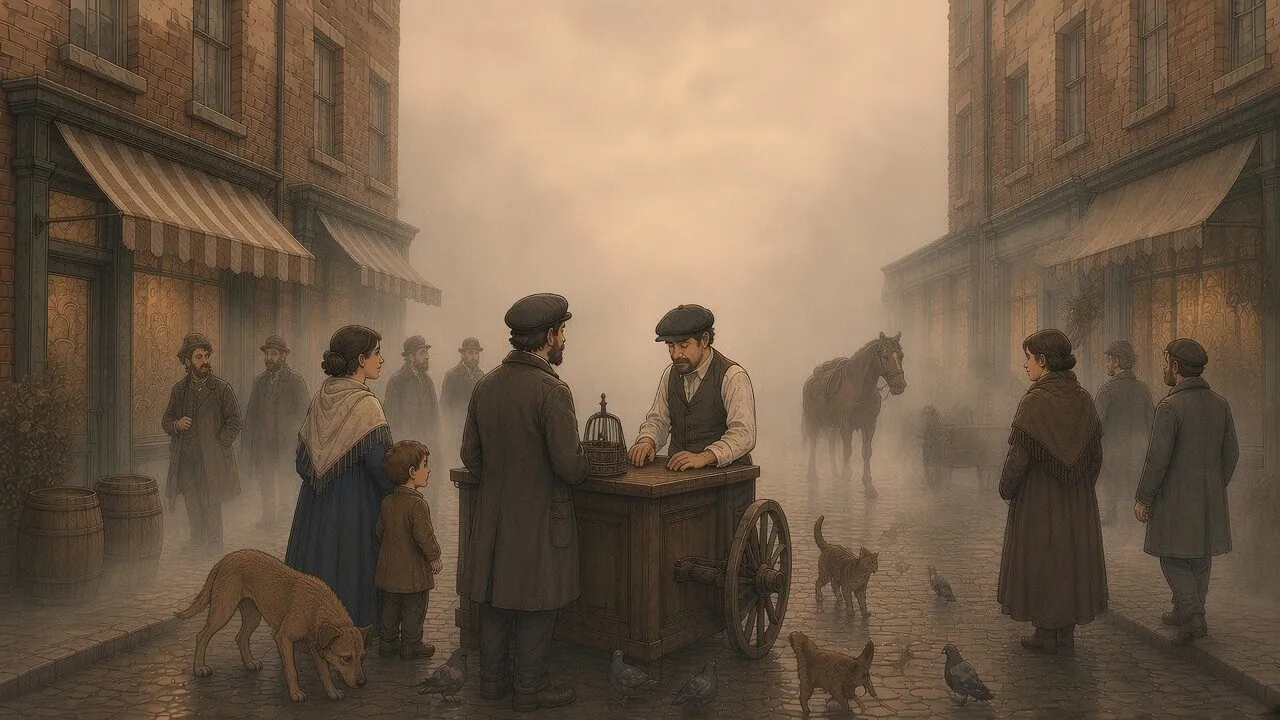
The East End in 1888 was already a subject of parliamentary inquiry into sweating, a stage for Salvation Army missions, and a favourite scene for journalists who specialised in the abyss. Unemployment and casual labour made nights dangerous for women who sold sex to survive. When the murders began, the police faced a maze of courts, common lodging-houses and poorly lit streets, and a press that invented the killer’s nickname from a letter that many officers already doubted. Failure to catch anyone fed a hunger for a type: a butcher, a midwife, a mad doctor, a foreigner. Among those types, the Jew was the most charged, because it fused local friction over housing and wages with older European fantasies about Jewish secrecy and blood.
Macnaghten’s own list of the five murders, reproduced in the memorandum preserved by Casebook and other documentary projects, is terse to the point of grimness: throat cutting; increasing mutilation; a double event when, he believed, the killer was disturbed near a Jewish club in Berner Street and went on to Mitre Square; a final indoor crime in Miller’s Court that occupied hours. He used that progression to argue against Cutbush, whose later stabbings seemed to him a feeble sequel. The same progression has tempted every theorist who needs the killer removed from the streets after November 1888—by suicide, by flight, or by the asylum. Kosminski’s advocates lean on the asylum. Druitt’s lean on the Thames. The documents authorise the temptation without satisfying it.
Elizabeth Stride’s body lay near the International Working Men’s Educational Club on Berner Street, a largely Jewish socialist club whose members became witnesses to disturbance if not to murder. Macnaghten’s remark that Jews driving up to the club disturbed the killer is one of the few places where Jewish presence enters the memorandum as something other than the suspect’s ethnicity. It is a reminder that Jews were also neighbours, clubmen and accidental witnesses—roles erased when the story shrinks to a single Polish madman.
7. Leather Apron and Goulston Street
Before Kosminski’s name entered any surviving police memorandum, Whitechapel had already lived through the Leather Apron scare. A Jewish boot-finisher named John Pizer, known in the neighbourhood by the nickname Leather Apron, was widely rumoured to be the killer after Nichols and Chapman. The nickname came from his trade. Gossip endowed him with a habit of threatening prostitutes with a knife. Crowds formed; Jewish passers-by were abused; the press amplified the story. Pizer was arrested and then released when alibis covered the relevant nights. The scare did not invent East End antisemitism, but it organised it around a single face and a single apron, and it showed how quickly a Jewish tradesman’s tool could become an emblem of ritualised violence in the popular imagination.[13][14][15]
Sir Charles Warren, the Metropolitan Police Commissioner, and his subordinates understood the danger. When, after the “double event” of 30 September, a piece of Catherine Eddowes’s bloodstained apron was found in a doorway in Goulston Street, chalk writing on the wall above it appeared to point at Jews. Officers recorded variants of a sentence usually rendered as “The Juwes are the men that will not be blamed for nothing.” Warren ordered the writing erased before the neighbourhood woke, fearing a riot in streets thronged on Sunday mornings by Jewish vendors and Christian customers. In his report to the Home Secretary of 6 November 1888 he described the text as written “with the intention of inflaming the public mind against the Jews,” and he noted that the Acting Chief Rabbi had already written to him about press claims that “Jewes” was a Yiddish spelling—claims the rabbi called dangerous to poor Jews in the East End.
Whether the chalk was left by the murderer, by an antisemitic passer-by, or by someone seeking to deflect suspicion remains unsettled. Walter Dew later recalled that antisemitic scrawls were common in the district. What is not unsettled is the official judgment that the message was inflammatory enough to risk disorder, and that Jewish safety in Whitechapel in the autumn of 1888 depended in part on preventing a rumour from hardening into a mob.
Warren’s erasure of the Goulston Street writing has been debated ever since as either prudent riot-prevention or the destruction of a clue. The apron fragment was real physical evidence; the chalk may or may not have been connected to it. Officers differed in their transcriptions of the spelling—Juwes, Juews, Jewes—feeding later fantasies about Masonic or cryptic meanings that Warren’s own report does not support. His concern, stated to the Home Office, was immediate public order in a mixed market street at dawn. The Acting Chief Rabbi’s letter, which Warren quoted, shows communal leaders intervening not to suppress evidence of Jewish guilt but to stop a false linguistic claim from becoming a pretext for violence. In that sense Goulston Street is less a Ripper riddle than a case study in how antisemitic interpretation races ahead of fact.
The Leather Apron episode also taught the police how identification could fail. Pizer was known; he was produced; alibis held. The crowd’s appetite was not satisfied by his release. Mythic suspects are productive precisely because they can shed one body and inhabit another. When, years later, “Kosminski” appeared in confidential prose, the mythic slot—Polish, Jewish, local, sexually disordered, insane—was already carved.
Historians still disagree about whether the chalk writing and the apron piece were left together by design. The disagreement is proper. What Warren’s report fixes beyond dispute is the official belief that an antisemitic reading of the wall was the clear and present danger at dawn on 30 September 1888, in a street about to fill with Jewish traders.
8. The Macnaghten memorandum
Sir Melville Macnaghten joined the Metropolitan Police as Assistant Chief Constable of the Criminal Investigation Department in 1889, after the canonical murders had stopped. His memorandum of 23 February 1894 was written to rebut press claims that one Thomas Cutbush, detained for stabbing women, was Jack the Ripper. Macnaghten insisted that the Whitechapel murderer had five victims only, that “no one ever saw” him, and that three men were more likely than Cutbush: Montague John Druitt, whose body was found in the Thames; “Kosminski—a Polish Jew—& resident in Whitechapel”; and Michael Ostrog, a Russian criminal later held as a homicidal lunatic.[12][10]
Of Kosminski, Macnaghten wrote that the man “became insane owing to many years indulgence in solitary vices,” that he “had a great hatred of women, specially of the prostitute class, & had strong homicidal tendencies,” and that he “was removed to a lunatic asylum about March 1889.” “There were many circumstances connected with this man which made him a strong ‘suspect’.” The date is wrong for Aaron Kosminski’s Colney Hatch admission, which came in 1891. The memorandum names no forename, cites no witness confrontation, and sits beside Macnaghten’s own claim that nobody ever saw the killer—a claim that collides with Anderson’s later story of an identification. The document is invaluable as evidence of what a senior officer believed, or wished the Home Office to believe, in 1894. It is not a dossier of proof.
Two textual traditions of the memorandum are discussed by researchers: the version from Lady Aberconway’s papers, brought to light in the mid-twentieth century, and the Scotland Yard version later seen by officers and writers including Donald Rumbelow. Both name Druitt, Kosminski and Ostrog. Both repay slow reading. Macnaghten’s purpose was bureaucratic self-defence against a newspaper scare, not a full disclosure of CID’s inner knowledge. He may have exaggerated the strength of suspicion against his three names in order to diminish Cutbush. He may have repeated gossip about “solitary vices” that mirrored asylum language without independent investigation. He was not present as a senior detective in Whitechapel in autumn 1888. Those limits do not make the memorandum useless. They make it a source that must be weighed, not recited.
Ostrog, the third name, has fared poorly under later scrutiny; researchers have shown him imprisoned at times when he would have needed to be in Whitechapel. Druitt, the barrister found in the Thames, attracts a different class of speculation, often laced with anxieties about gentlemanly homosexuality and “family belief.” Kosminski attracts the ethnic plot. That the same memorandum shelters all three theories is evidence of Macnaghten’s uncertainty as much as of his knowledge.
9. Anderson, Swanson and the seaside story
Sir Robert Anderson, who headed CID during the murders, published The Lighter Side of My Official Life in 1910. There he stated that the killer was a low-class Polish Jew, and that “the only person who ever had a good view of the murderer” unhesitatingly identified him but refused to give evidence. Anderson’s explanation for that refusal—that Jews would not testify against a fellow Jew—is itself a stereotype, and it was challenged at the time in the Jewish press. In clarifying remarks after criticism in the Jewish Chronicle, Anderson hardened rather than softened his claim: when he said the murderer was a Jew, he said, he was stating a matter of fact.[16][17][18]
Chief Inspector Donald Swanson, who had led much of the investigation, annotated his copy of Anderson’s memoirs. The Swanson marginalia identify the suspect as “Kosminski,” place an identification at a “Seaside Home,” and state that the man was watched at his brother’s house in Whitechapel by City Police, sent to the workhouse and then to Colney Hatch, and that he died shortly afterwards. The seaside identification—often linked by later writers to the police convalescent home at Hove—has never been corroborated by a contemporary official report in the surviving Metropolitan files. The early-death claim does not fit Aaron Kosminski. Swanson’s notes are the strongest reason the surname Kosminski is yoked to Anderson’s Polish Jew; they are also a reminder that even senior memory, written years later in a book margin, can compress, misdate and invent coherence.[11]
Martin Fido’s search of asylum records in the 1980s found Aaron Kosminski as the only inmate of that surname whose dates roughly answered the police story. The identification of the memorandum’s “Kosminski” with Aaron is now the working consensus among researchers who accept the police documents as referring to a real patient. Consensus about a name is not consensus about guilt.
Anderson wrote as a man convinced that the detective branch had done its essential work. His memoirs belong to a genre of official self-justification common among late-Victorian civil servants. The Jewish Chronicle’s dissent matters because it refused to let a stereotype pass as tradecraft. If a witness existed who had seen the murderer clearly, the refusal to prosecute for want of Jewish testimony would have been a scandal requiring names, dates and an explanation to the Home Office. No such public file has been produced. Swanson’s seaside confrontation, placed after 1890 by the logic of the convalescent-home identification, would have occurred when Aaron Kosminski was still at large in Whitechapel or already sliding toward the workhouse. The absence of a charge sheet from that period is not a minor gap. It is the difference between a solved case and a remembered opinion.
Later Ripper writers have proposed Lawende, who saw a man with Eddowes, or Schwartz, who reported a Berner Street assault, as Anderson’s witness. Each proposal adds a further layer of inference. Macnaghten’s flat statement that no one ever saw the murderer stands as an internal police contradiction that any single-theory account must somehow dissolve. The honest alternative is to leave the contradiction standing: senior officers did not agree, even in retrospect, on whether an identification had occurred.
Swanson’s presentation copy of Anderson’s memoirs, later donated to New Scotland Yard’s Crime Museum, gave researchers a tangible object around which to build the Kosminski case. Objects can authorise stories that the wider file does not sustain. The book with its handwritten notes is real. The seaside identification it asserts still lacks a matching contemporary report in the public domain.
10. Rumour, police opinion and proof
It is worth stating plainly what the sources do and do not show. They show that some senior officers came to believe that a Polish Jewish resident of Whitechapel, later named Kosminski, was the murderer. They show that Aaron Kosminski was a real immigrant who became severely ill and spent the rest of his life in asylums. They show that East End Jews were harassed and scapegoated during the murder panic. They do not show a trial, a charge, a recovered murder weapon tied to Kosminski, or a contemporaneous arrest report naming him in 1888. Macnaghten’s “strong suspect” is an opinion. Anderson’s “definitely ascertained fact” that the killer was a Jew is an assertion offered without the public production of the witness or the confrontation. Swanson’s marginalia are private glosses on a memoir.[12][16][10]
Historians of crime are accustomed to working with partial archives. The Whitechapel case is extreme because the archival silence has been filled by a century of speculation, television reconstructions and commercial claims of final proof. The responsible distinction is among three categories: street rumour (Leather Apron; the Goulston Street chalk); police opinion recorded after the fact (Macnaghten, Anderson, Swanson); and proof that would meet even the modest standard of a Victorian committal hearing. Kosminski has been abundant in the first two categories. He has been absent from the third. That absence is not a romantic mystery. It is the ordinary condition of an unsolved crime onto which ethnic suspicion was loaded from the start.
Casebook: Jack the Ripper, the long-running documentary archive, has made the Macnaghten text, Warren’s Goulston Street report, and numerous dissertations on Anderson and Swanson freely available to readers who wish to test secondary claims. That availability is a gift and a responsibility. It allows any writer to see that Macnaghten denied that anyone saw the murderer while Anderson insisted on an identification; that Swanson’s death date fails; that Warren feared a riot against Jews. Popular programmes that skip those frictions in favour of a single named villain are not simplifying for a general audience. They are choosing myth over the grain of the sources.
Proof, for a Victorian prosecutor, would have meant a case that could survive cross-examination before a magistrate and a jury. Anderson’s witness who would not swear is, even on Anderson’s telling, the opposite of that case. A modern reader who treats Anderson’s certainty as dispositive is asking memoir to do the work of indictment. This essay declines that request.
11. The shawl and the DNA claims
In the twenty-first century the Kosminski hypothesis acquired a forensic costume. Russell Edwards bought at auction a silk shawl said to have been taken from the Eddowes crime scene by a police officer and kept in a family for generations. Working with the molecular biologist Jari Louhelainen, Edwards announced in his 2014 book Naming Jack the Ripper that mitochondrial DNA from stains on the shawl matched descendants of Eddowes and of Kosminski. A 2019 paper by Louhelainen and David Miller in the Journal of Forensic Sciences presented parts of that analysis as peer-reviewed science. The claim was widely reported as a solution.[19][20][21]
Specialists in mitochondrial genetics were not persuaded. Mitochondrial DNA is inherited maternally and is shared across maternal lines; as Hansi Weissensteiner and others noted in responses collected by Science magazine, such markers can exclude a person but cannot uniquely identify a male suspect among the many Londoners who might have shared a haplotype. Critics also objected that the paper withheld the actual sequences, offering coloured graphics instead, and that the shawl’s provenance was never established in contemporary police inventories. Contamination over a century of private handling is not a footnote; it is a central risk. Ars Technica’s summary of the controversy was blunt: the analysis did not hold up under scrutiny, and history had seen many previous “final” identifications. An expression of concern later attached to related forensic publication underscored how fragile the claim remained. This essay records the DNA episode because it belongs to Kosminski’s afterlife in public culture. It does not treat the shawl as proof.
Edwards’s book and the subsequent journal paper also illustrate how commercial true crime and scientific publication can become entangled. The shawl was a private purchase with a family story attached; the laboratory work was presented as decisive; the public received a headline. Geneticists asking for sequences, haplotype frequencies and contamination controls were not spoiling a good tale. They were applying the ordinary rules of forensic inference. Until those rules are met—and until the shawl’s presence at Mitre Square is shown by something better than later tradition—Kosminski’s guilt remains where Macnaghten left it: a suspicion without a case.
The 2014 media cycle and the 2019 paper also had the unintended effect of re-ethnicising the case for a new audience: headlines that “a Polish Jew” had been identified replayed, in scientific costume, the structure of 1888’s suspicion. Responsible coverage noted the critics. Irresponsible coverage treated peer review as a synonym for truth. Historians writing after both must keep the distinction between a published claim and a demonstrated one.
12. Sweating trades and immigrant labour
Long before any memorandum named a Polish Jew, the East End debate about Jewish immigration had fastened on the sweating system. By the late 1880s the alien Jew was widely held responsible for creating and perpetuating overcrowded workshops, wage undercutting and the employment of women and children at the lowest rates. A House of Lords committee on sweating, sitting in 1888–89, investigated the East End clothing trade and related industries; its findings disappointed restrictionists by judging that the evils of sweating had been exaggerated and that immediate alien exclusion was not warranted. The political pressure did not disappear. Newspapers, Tory backbenchers and organisations such as the British Brothers’ League, founded in 1901, kept the image of the pauper immigrant before the public.[9][22][23]
Sweating was real. So was the tendency to ethnicise it. English and Irish workers already laboured in miserable conditions; Jewish arrivals entered an existing system and became its most visible newcomers. Trade-union voices were divided: some, like Ben Tillett in hostile moments recorded by later historians, spoke of continental “scum”; others, including Eleanor Marx and members of the Socialist League, defended Jewish workers and encouraged their organisation. The Jewish Board of Guardians and related bodies practised their own screening, assisting those with skills while discouraging the settlement of those thought likely to become a communal burden—an internal restrictionism born of fear that Anglo-Jewish respectability would be damaged. David Feldman’s work on Englishmen and Jews, reviewed and extended in later scholarship, has shown how complicated those communal politics were. They do not reduce to a simple story of Gentile prejudice alone, but neither do they erase that prejudice.
Booth’s survey, Sims’s sketches and the Lords committee minutes together show an economy of tiny workshops whose Englishness or Jewishness was secondary to their cheapness. Employers, often immigrants themselves who had climbed one rung above their cutters and pressers, drove hours because margins were thin and seasons sharp. Tuberculosis spread in closed rooms. Children fetched bundles. The political error was to treat this system as a Jewish invention rather than as industrial capitalism at its most minute. The moral error was to conclude that the cure was to keep Jews out. Factory inspection, wages boards and union contracts were slower tools. They were also tools that did not require an Aliens Act.
Women’s labour was central to the sweating debate and almost invisible in Ripper suspect theories. Immigrant women sewed, finished, pressed and carried; English observers fixated on male aliens as wage-cutters while depending on female piecework in the same trades. Any full social history of Whitechapel’s Jewish economy must restore those women to the centre. They are also a silent chorus around the murdered women, who moved through the same streets in poorer and more exposed ways.
13. Restrictionism and the Aliens Act 1905
The Aliens Act 1905 was the first peacetime statute to impose modern immigration controls on the United Kingdom. Receiving royal assent on 11 August 1905 and coming into force on 1 January 1906, it empowered officers at ports to refuse steerage passengers deemed likely to become a public charge, suffering from disease or insanity, or bearing certain criminal records, while preserving a refugee exemption for those fleeing religious or political persecution. Cabin passengers were largely outside its net. Everyone understood which “undesirable aliens” the Act had in mind. From 1881 some 150,000 Jewish refugees had entered Britain; the United States had taken the overwhelming majority of the wider exodus, but the East End concentration made Jewish immigration a metropolitan political fact.[22][23][24]
Parliamentary debate mixed fiscal anxiety with racialised language. Restrictionists cited overcrowding statistics and Poor Law figures; opponents argued that sweating and bad housing were national institutions that immigrants found rather than invented, and that the Act would distract from remedies. William Evans-Gordon became, in Chaim Weizmann’s later phrase, a father of the measure. Implementation was milder than the rhetoric: thousands of provisional refusals, many upheld on appeal, but no sealing of the ports. The precedent mattered more than the early numbers. Britain had announced that alien entry was a privilege subject to administrative discretion. Later aliens restriction in wartime and after would build on that foundation. For the Jewish immigrant of Kosminski’s generation who had arrived before 1905, the Act was a door closing behind them; for those still on the road from the Pale, it was a new hazard at the gangway.
The Royal Commission on Alien Immigration of 1902–03 had already gathered volumes of testimony about East End conditions before the Act was drafted. Theodor Herzl appeared before it, arguing that a Jewish homeland would relieve European antisemitism—an argument that restrictionists could twist into support for keeping Jews out of Britain. Anglo-Jewish leaders walked a narrow line: opposing statutory exclusion while continuing private efforts to disperse or re-embark those thought unfit. Antony Lerman, reviewing David Glover’s cultural history of the Act, notes how thoroughly the figure of the “undesirable alien” was understood to mean the poor Jew from the Russian Empire, even though the statute’s text remained facially general. Alfred Eckhard Zimmern’s contemporary remark that the Act’s non-naming of Jews was “only a pretence” captured the open secret.
Numbers after 1906 show both enforcement and its limits. Provisional refusals ran into the thousands by 1913; appeal boards overturned some and upheld others. Jewish organisations monitored the ports. Migration continued, especially for those who could present themselves as refugees or as possessing means. The Act’s deeper effect was normative: it ended the nineteenth-century assumption that Britain’s ports were open in peacetime. Kosminski, already locked inside Leavesden by then, was not a passenger subject to the new law. The younger cousins still leaving the Pale after the 1905–06 pogroms were.
Liberal governments inherited the Act and did not scrap it. Enforcement culture matters as much as statutory text. Port officials learned to sort faces and papers; appeal boards learned to hear stories of persecution. Jewish refugees after 1905 still entered, but under a gaze that assumed their undesirability until proved otherwise. That gaze is part of Kosminski’s wider world even though he never stood before an immigration officer under the new rules.
14. The Lower East Side and American nativism
Across the Atlantic the same generation built a denser world. Between the early 1880s and the First World War about two million Yiddish-speaking Ashkenazim entered the United States, the largest single chapter of Pale emigration. New York’s Lower East Side became their capital: tenements, pushcarts, landsmanshaftn, Hebrew schools, the Yiddish theatre and a press whose most famous daily, the Forverts, spoke to workers in their own language about socialism, strikes and American manners. The garment industry absorbed huge numbers of men and women; unions grew out of the shops; English came in the second generation.[6][4]
Nativism met them early. Charitable “Americanisers” and restrictionist politicians alike worried about Yiddish, Orthodoxy and radicalism. The Immigration Act of 1924, with its national-origins quotas, finally choked the flow from the countries that had sent most Jewish migrants. Blood libel had an American afterlife too—most notoriously in the 1928 Massena case in upstate New York—but the more routine hostility was economic and cultural: the charge that Jews took jobs, congested neighbourhoods and resisted assimilation. Compared with Whitechapel in 1888, the Lower East Side was larger, more institutionally complete and less defined by a single murder panic. The structural rhyme remains. Pale Jews arrived poor, worked in needle trades, spoke Yiddish, and were told that their poverty was a menace to the nation that had admitted them.
Nekud readers who know the streets of the Lower East Side through earlier essays will recognise the furniture of this migration: the tenement flat, the piecework done at the kitchen table, the landsmanshaft dues, the Forverts on the oilcloth. What Whitechapel shared with Hester Street was not only poverty but a public debate that treated Jewish arrival as a test of the nation’s character. American restrictionists had their own leagues and literacy tests; British restrictionists had the Brothers’ League and the 1905 Act. In both countries Jewish socialists and trade unionists answered by organising shops and publishing in Yiddish—an insistence that the immigrant was a worker among workers, not a racial problem to be administered away.
The comparison also clarifies what the Ripper panic uniquely did to London’s Jews. New York had crime and sensational murder cases; it did not have a multi-month series that the press framed as proof of alien monstrosity in the heart of the Jewish quarter. That framing is why Goulston Street and Leather Apron belong in any Kosminski essay that hopes to be more than a police-file digest. The murders killed five women. The panic around them threatened a whole migrant population with collective punishment.
Chain letters from New York to the Pale advertised wages in dollars and warned about sharpers on the docks. Similar letters went to London. The Atlantic world of Jewish migration was one information system with many ports. Kosminski’s branch of that system ended in Middlesex asylums; other branches ended in Union locals, in Argentine cooperatives, in Johannesburg shops, and in the Yiddish literary culture that Nekud’s other essays explore.
15. Argentina, South Africa and other destinations
Argentina and South Africa show the same rhyme in different keys. Baron de Hirsch’s Jewish Colonization Association tried to plant Eastern European Jews on the land in Argentina, hoping that farming would prove more “productive” in Gentile eyes than urban peddling and tailoring. Early agricultural settlement was limited and difficult; the larger Argentine Jewish population of the early twentieth century was increasingly urban, commercial and industrial, like its cousins in New York and London. By 1920 the community numbered about 150,000. It faced Catholic-majority suspicions, periodic nationalist agitation, and the familiar claim that Jews were unassimilable—claims that would darken further in the interwar years.[4][6][7]
In South Africa, Lithuanian and other Eastern European Jews arrived from the late nineteenth century into an economy shaped by mining and into a racial order already obsessed with ranking populations. The 1911 census counted 46,919 Jews; by 1921 the figure was over 62,000, many in the Transvaal. Immigrant Jews occupied an uneasy middle position: white under the developing colour bar, yet alien in the eyes of restrictionists who watched Eastern European entry as closely as London had done. When United States quotas tightened after 1924, South Africa registered a noticeable share of Jewish aliens among new arrivals, and political pressure for further control followed. Paris and Vienna, older centres of Jewish life, received their own Pale refugees and generated their own antisemitic literatures—from Karl Lueger’s Vienna to the Dreyfusard storms that had already shown France how an individual Jewish body could stand for a national anxiety. The point is not that every city repeated Whitechapel. It is that Kosminski’s London was one node in a migratory and ideological network that stretched from the Pale to the Rio de la Plata and the Witwatersrand.[8]
Hirsch’s philanthropy itself reveals how Gentile and Jewish elites shared a preference for “productive” Jewish bodies. Farming colonies in Entre Ríos and elsewhere were meant to prove that Jews could leave the classic middleman trades. Many colonists struggled with soil, isolation and inexperience; their children drifted to Buenos Aires. The urban Argentine community built theatres, papers and mutual aid on a New World pattern, while Catholic nationalism and economic crisis periodically revived older slanders. South African Jewry’s Lithuanian core produced a community famous for solidarity and for anxiety about Eastern European “greeners” who might provoke the authorities. In both places, as in London, the immigrant’s safety depended partly on the respectability politics of those who had arrived earlier.
Paris and Vienna, though not primary mass destinations on the scale of New York, mattered as capitals of ideology. Viennese municipal antisemitism under Lueger showed how electoral politics could run on anti-Jewish feeling in a modern city. The Dreyfus Affair in France showed how a single Jewish officer’s body could become the screen for a national argument about loyalty. Pale refugees who passed through or settled in those cities entered cultures already fluent in antisemitic speech. London’s version of that fluency, in 1888, happened to be written in chalk on a Whitechapel wall and in ink in police memoirs.
16. Blood-libel residues
Blood libel—the medieval accusation that Jews murdered Christian children for ritual purposes—had no literal currency in the Metropolitan Police files of 1888. It did not need to. What survived into late-Victorian England was a looser grammar of suspicion: that Jews were clandestine, that they protected their own, that their religion licensed cruelty, that their men were sexually dangerous. The Leather Apron nickname, the Goulston Street chalk, Anderson’s claim that Jewish witnesses would not swear against a Jew, and the press habit of emphasising a suspect’s “Polish Jewish” origin all drew on that grammar. Even when officers acted to prevent a riot, as Warren did, they were managing a prejudice they knew to be explosive rather than dismantling it.[13][15]
Scholars of antisemitism have long distinguished theological Jew-hatred from modern racial and economic antisemitism. In the East End those strands tangled. A dock labourer who feared wage competition and a reader of penny dreadfuls who feared Jewish ritual could share a vocabulary. The immigrant’s Yiddish, beard and Sabbath could mark him as both a labour competitor and a figure from older nightmare. Kosminski, insane and obscure, became available to later storytelling precisely because he fitted the type that 1888 had already rehearsed: the foreign Jew in the narrow street, close to the bodies, hard to interview, easy to imagine.
English culture had its own archive of such images, from medieval ritual-murder shrines to Dickensian Fagins and stage Shylocks. By 1888 the literate public could disavow medieval fantasy while still responding to a cartoon of a hook-nosed knife-man in a Whitechapel court. The immigrant’s difference made the cartoon feel local. Police memoir later gave it the dignity of “ascertained fact.” Between the cartoon and the memoir, men like Pizer and, later, the remembered Kosminski, became usable bodies for a fear that was about more than one killer’s identity.
To say that blood-libel residues shaped 1888 is not to say that English policemen were medieval fanatics. It is to say that modern societies carry old stories in their nerves, and that a knife murder in a Jewish district can awaken them without anyone citing a thirteenth-century trial. Warren’s sponge on the Goulston Street wall was, in that light, a modern instrument applied to an ancient fire.
17. Anglo-Jewry under pressure
Anglo-Jewry’s response to the Pale influx and to the Ripper panic was double-edged. The Board of Deputies, the Chief Rabbinate, the Jewish Chronicle and philanthropic boards worked to protect physical safety, to correct press falsehoods about Yiddish spelling and Jewish customs, and to accelerate anglicisation. Schools, clubs and settlements taught English manners. At the same time communal leaders feared that visible Orthodox poverty would undo decades of emancipation politics. Distinctions between “desirable” and “undesirable” immigrants, documented in evidence to the Royal Commission on Alien Immigration and in the practices of the Jewish Board of Guardians, meant that some Jews arriving from the Pale met not only Gentile hostility but communal triage.[23][9]
That triage is part of the historical record and should not be sentimentalised away. It is also not the same as the street violence or the legislative exclusion that restrictionists sought. When Anderson published his memoirs, Jewish newspapers challenged the implication that Jewish ethics forbade testimony against a murderer. The challenge mattered. It insisted that a senior British police official’s stereotype was not a “definitely ascertained fact.” The gap between Warren’s pragmatic defence of Jewish bodies in Goulston Street and Anderson’s later literary certainty that the killer was a Jew is the gap between riot control and narrative closure. Pale immigrants lived in that gap.
Communal defence work in 1888 included monitoring the press, writing to commissioners, and urging immigrants not to gather in agitated crowds that could be photographed as menace. It also included a longer campaign of anglicisation that many Yiddish speakers experienced as pressure. Benjamin Harshav’s later reflections on Yiddish modernism, and the wider history of Jewish letters, remind us that the languages of the Pale were not merely obstacles to integration; they were cultures under relocation. The East End’s Yiddish was the same portable civilisation that produced poets in Vilna and editors on East Broadway. Police theory that flattened that civilisation into “low-class Polish Jew” was ethnography at bayonet point.
18. Press, panic and memory
The Victorian press made the Whitechapel murders a national entertainment and a local terror. Letters signed “Jack the Ripper,” of disputed authenticity, gave the killer a voice. Artists’ impressions filled pages. Correspondents toured the courts by gaslight. In that market, a Jewish suspect was good copy because he confirmed a story readers already half knew: that the East End had been transformed by aliens, and that transformation was dangerous. Pizer’s ordeal showed how an individual could be pressed into that story and then discarded when alibis intervened. The story itself remained available for the next name.[3][11]
Police leakage and memoir culture continued the work after 1888. Macnaghten’s memorandum was confidential; Anderson’s book was not. By the time Swanson’s marginalia became known to researchers in the late twentieth century, the Polish Jew suspect had already had a long career in true-crime literature. Fido’s asylum identification of Aaron Kosminski gave the career a civil-registration anchor. Documentaries and books followed. Each retelling tended to harden opinion into legend. The corrective is slow reading of what the documents actually say, and equal attention to the immigrant world that produced Kosminski as a person rather than as a silhouette in a police theory.
Illustrated papers sold the East End as a jungle a cab ride from the West End. That exoticism prepared readers to believe that anything could happen there, and that the agents of horror would look foreign. When the murders stopped, the papers moved on; the stereotype stayed available for the next crisis—Boer War jingoism, 1905 agitation, Cable Street in the 1930s. Kosminski’s posthumous fame is one tributary of that longer river.
19. Colney Hatch and Leavesden
Colney Hatch and Leavesden were not footnotes. They were the institutions that held Aaron Kosminski for most of his adult life. Late-Victorian asylums mixed custody, moral management and overcrowding; Jewish patients could find Yiddish-speaking staff scarce and religious needs poorly met. Case notes that mention “self-abuse,” dietary refusals and threats are written in the clinical slang of their day, which moralised symptoms we would now place in a psychiatric frame. To read those notes as a Ripper profile is to ignore their purpose. They were compiled to justify detention and to track a patient’s course, not to solve murders that had already baffled the Criminal Investigation Department.[1][16]
The chronology bears repetition. The canonical murders ended in November 1888. Kosminski’s major asylum admission came in early 1891. Macnaghten’s memorandum placed “removal to a lunatic asylum” about March 1889—closer to the crimes, tidier for a theory of sudden cessation, and wrong for Aaron. Swanson’s claim of early death after Colney Hatch would have sealed the tidy theory; Aaron’s survival until 1919 unseals it. If a writer wishes to argue that the murders stopped because Kosminski was somehow restrained earlier by family watchfulness, that argument needs evidence of such restraint. The police memoranda gesture at City Police surveillance of a brother’s house; they do not supply duty logs. Between gesture and log falls the shadow in which suspect literature thrives.
Leavesden, to which he was moved in the twentieth century, specialised in long-stay chronic patients. Death from gangrene in 1919 is a poor man’s ending, recorded without poetry. The contrast between that ending and the lurid immortality conferred by Ripper books is almost unbearable. Historical writing cannot restore his privacy, but it can refuse to make his illness a costume for someone else’s certainty.
Family visits, if they occurred, have left little public trace. The brother’s house where Swanson said City Police watched the suspect belongs to the memoir layer rather than to a surviving surveillance log open to historians. Aaron’s long residence at Leavesden means that any “death shortly after” story was false for decades while he still ate asylum meals. Falsehoods that are not corrected in an officer’s lifetime have a habit of becoming folklore after it.
20. The ordinary order of the quarter
Whitechapel’s Jewish quarter was not a ghetto by law. It was a dense migrant district produced by rents, docks, workshops and kinship. Synagogues, chevrot, Hebrew classes and benefit societies filled the side streets. Pedlars cried goods in Yiddish and broken English. On Sundays the markets drew the whole city. The same streets held Irish labourers, English casuals and a shifting population of the very poor. Crime of the ordinary sort—theft, fights, prostitution—was common, as it was in other slums. What the Ripper panic did was to overlay that ordinary city with a myth of extraordinary Jewish menace.[9][22]
Housing statistics compiled for philanthropic and parliamentary inquiries showed extreme overcrowding. Multiple families shared rooms; workshops doubled as sleeping space; sanitation lagged. Restrictionists treated those figures as proof that aliens lowered the English standard of life. Reformers answered that the standard had been low before the ships came, and that factory legislation, union wages and municipal housing were better remedies than closing the ports. The Aliens Act sided, with qualifications, with the restrictionists. Kosminski’s Whitechapel was thus both a refuge from the Pale and a stage on which English politics rehearsed the modern argument about immigration—an argument still audible whenever a poor newcomer’s neighbourhood becomes news for the wrong reasons.
Municipal maps of the period show board schools, wash houses and mission halls planted among the courts. Reform was not absent; it was insufficient. Jewish self-help filled gaps that the rates did not. The order that Warren feared would collapse into riot was, on ordinary days, an order of markets, synagogues and workshops. Understanding that ordinary order is the beginning of understanding why collective blame was both plausible to outsiders and false.
21. One node in a wider network
Set London beside New York, Buenos Aires and Johannesburg, and the differences sharpen the similarities. New York’s Jewish Lower East Side was larger and, through the Forverts and the unions, more politically articulate in Yiddish. Argentina’s colonies staged an experiment in Jewish agrarianism that London never attempted. South Africa folded Jewish immigrants into a white settler order while still marking them as aliens. Only London, among these destinations, hosted the Ripper murders. Yet only a historiography obsessed with the murders would treat that uniqueness as the main fact about Pale Jews in Britain. The main facts are demographic and social: tens of thousands of arrivals, a needle trade, a Yiddish street culture, communal self-help, and a host politics that moved from laissez-faire entry to statutory control in a single generation.[6][4]
Kosminski stands at the unhappy intersection of those facts with an unsolved crime. He is historically important because police chiefs wrote his surname into the margins of the case, and because later culture made him a favourite answer to a question that may have no answer. He is humanly important because he was one sick immigrant among many who left Kłodawa’s world for Greenfield Street’s, and who found in England not only wage work but confinement. To remember only the suspect is to forget the migrant. To remember only the migrant without the antisemitic storm of 1888 is to miss why his name, rather than another patient’s, became famous.
For Nekud’s purposes the comparison also reconnects this essay to neighbouring subjects: the Forverts as the voice of American immigrant labour; the Lower East Side as built environment; Yiddish as the language in which migrants argued about socialism, religion and manners; even the later American career of words such as chutzpah, which travelled in the same trunks as sewing machines and prayer books. Kosminski did not write in that culture. He was confined before it fully flowered in London and New York. But the culture is the proper frame for his passage from Kłodawa to Whitechapel, and for the hostility that passage aroused.
South African and Argentine archives, like English ones, show immigrant Jews founding Hebrew schools, burial societies and Yiddish circles while negotiating the politics of the host nation. The comparison forbids any claim that London’s antisemitism was unique. It also forbids any claim that it was trivial. Five women dead and a district on the edge of riot are not trivial. They are the local form of a transnational pressure.
22. What can be said with care
What, finally, can be said with care? First, that Aaron Kosminski was a Polish Jewish immigrant in Whitechapel, a hairdresser by trade, who developed a severe mental illness and died in an asylum in 1919 after nearly three decades of institutional life. Second, that senior police officers retrospectively named “Kosminski” as a leading suspect in the Whitechapel murders, citing insanity, alleged hatred of women and, in Anderson’s and Swanson’s accounts, an identification that never produced a prosecution. Third, that those accounts contain internal contradictions and factual errors, including the date of asylum removal and the claim of early death. Fourth, that East End Jews in 1888 faced a real threat of collective blame, visible in the Leather Apron scare and in the Goulston Street chalk that Warren erased to prevent disorder. Fifth, that the wider emigration from the Pale met parallel suspicions in the United States, Argentina, South Africa and elsewhere, and that Britain’s Aliens Act 1905 wrote restriction into law without needing to name Jews in the statute book. Sixth, that modern DNA claims about a shawl have not met the standards that would allow a responsible historian to close the case.[1][12][20]
The Whitechapel murderer remains unknown. Antisemitism in the age of Pale emigration does not. It can be traced in riots threatened and averted, in newspaper copy, in police memoir, in sweating polemics and in immigration statutes. Kosminski’s name travels through that trace as both a person and a projection. Separating the two is the least that historical writing owes him, and the least it owes the thousands of other Jews who walked the same cobbles without ever entering a memorandum.
A further caution concerns tone. True-crime writing thrives on revelation. Historical writing about unsolved murder and about antisemitism thrives on proportion. The women killed in Whitechapel deserve to be remembered as persons, not as props in a suspect debate; this essay has named them and declined to catalogue their injuries. The Jews of the East End deserve to be remembered as a migrant society under pressure, not as a backdrop for a single patient’s notoriety. Kosminski deserves the minimal dignity of accurate dates and the refusal to invent his face or his confession. Police officers deserve to be read closely rather than quoted as oracles. Modern laboratory claims deserve the same scepticism we apply to Victorian rumour.
If there is a lesson for the present, it is not a slogan. It is that a society under strain will reach for the newest poor and the oldest slanders at once, and that officialdom can share the reflex even while individual officials work to prevent a riot. The Pale’s emigrants tested Britain, America, Argentina and South Africa with the fact of Jewish poverty in motion. Whitechapel in 1888 was one place where that test met a murder panic. Aaron Kosminski’s name is how later readers often enter the story. The story itself is larger than his name, and it is unfinished wherever immigrant districts are asked to answer for crimes and for fantasies they did not commit.
Drafted for Nekud as a long read rather than as a dossier, this essay will have succeeded if it leaves the reader with fewer certainties about the murderer’s name and more clarity about the migrant world that was asked to bear the blame. Publication, if it comes, should await the same scrutiny of sources and images that earlier Nekud features have received. Until then it remains a finished draft: complete in argument, open to correction, and unwilling to mistake a police opinion for a verdict.
Further documentary discussion of the Polish Jewish suspect tradition, the seaside-home identification hypothesis and related police commentary is collected in the Casebook dissertations listed among the references.[25]
Timeline
Catherine II’s decree begins the long history of the Pale as a zone of Jewish residence in the Russian Empire.
The tsar’s death is followed by pogroms across scores of towns; Jews are widely scapegoated.
Temporary Regulations further restrict Jewish rural settlement and trade.
Golda Kosminski brings her children, including Aaron (b. 1865, Kłodawa), to the East End.
Some two million Jews leave the Pale and Eastern Europe, mostly for the United States; about 150,000 enter Britain.
The five canonical murders attributed to “Jack the Ripper” take place in the East End.
John Pizer is arrested and released; antisemitic crowd hostility flares.
A bloodstained apron piece and chalk writing about “Juwes” are found; Warren orders the writing erased.
The Commissioner explains the erasure to the Home Secretary as riot prevention.
Aaron Kosminski is committed to Colney Hatch Lunatic Asylum.
Sir Melville Macnaghten names “Kosminski” among three suspects more likely than Cutbush.
Baron de Hirsch’s organisation channels settlers toward Argentine colonies.
Restrictionist agitation intensifies in the East End.
Britain’s first peacetime immigration-control statute receives royal assent.
Sir Robert Anderson publishes The Lighter Side of My Official Life, calling the killer a low-class Polish Jew.
Chief Inspector Donald Swanson names “Kosminski” in notes on Anderson’s book.
Nearly 47,000 Jews recorded in the Union of South Africa.
Aaron Kosminski dies at Leavesden Asylum from gangrene.
About 150,000 Jews live in Argentina.
National-origins quotas sharply restrict further mass entry from Eastern Europe.
Martin Fido links the memorandum’s Kosminski to Aaron via asylum records.
Russell Edwards publishes DNA claims about a shawl said to link Kosminski to Eddowes.
Louhelainen and Miller publish forensic claims; geneticists in Science and Ars Technica remain unconvinced.
References
- “Aaron Kosminski” *
- “Pale of Settlement” *
- “Jack the Ripper” *
- “Mass emigration from the Pale”, The Jewish Diaspora *
- “Escape from the Pogroms”, Jewish Virtual Library / Library of Congress Judaic Treasures *
- “Migrations”, Encyclopaedia Judaica via Encyclopedia.com *
- “South Africa”, YIVO Encyclopedia of Jews in Eastern Europe *
- “Argentina”, YIVO Encyclopedia of Jews in Eastern Europe *
- “The Jewish East End”, London Museum *
- “Aaron Kosminski”, Casebook: Jack the Ripper *
- “Martin Fido” *
- “The Macnaghten Memoranda”, Casebook: Jack the Ripper *
- “Goulston Street Graffito”, Casebook: Jack the Ripper *
- “Warren’s Report to the Home Secretary - 6 November 1888”, Casebook: Jack the Ripper *
- “Goulston Street graffito: Jack The Ripper’s missing clue?”, Sky HISTORY *
- “Anderson and the Swanson Marginalia”, Casebook: Jack the Ripper *
- “Kosminski and the Seaside Home”, Casebook: Jack the Ripper *
- “The Men Who Suspected Kosminski”, Casebook: Jack the Ripper *
- “Naming Jack the Ripper (book)” *
- David Adam, “Does a new genetic analysis finally reveal the identity of Jack the Ripper?”, Science / AAAS, 15 March 2019 *
- “Don’t believe the hype: We may never know the identity of Jack the Ripper”, Ars Technica, March 2019 *
- “1905 Aliens Act”, Spartacus Educational *
- Antony Lerman, “Pollutants: The Aliens Act”, London Review of Books, 7 November 2013 *
- “History of UK immigration control” *
- “The Polish Jew Suspect - Jewish Witness Connection”, Casebook: Jack the Ripper *
Select bibliography
- Sir Robert Anderson, The Lighter Side of My Official Life (London: Hodder and Stoughton, 1910).
- Paul Begg, Jack the Ripper: The Definitive History (London: Pearson Longman, 2003).
- David Cesarani, The Jewish Chronicle and Anglo-Jewry, 1841–1991 (Cambridge: Cambridge University Press, 1994).
- Hasia R. Diner, The Jews of the United States, 1654 to 2000 (Berkeley: University of California Press, 2004).
- Russell Edwards, Naming Jack the Ripper (London: Sidgwick & Jackson, 2014).
- David Feldman, Englishmen and Jews: Social Relations and Political Culture, 1840–1914 (New Haven: Yale University Press, 1994).
- Martin Fido, The Crimes, Detection and Death of Jack the Ripper (London: Weidenfeld and Nicolson, 1987).
- David Glover, Literature, Immigration and Diaspora in Fin-de-Siècle England: A Cultural History of the 1905 Aliens Act (Cambridge: Cambridge University Press, 2012).
- John D. Klier, Russians, Jews, and the Pogroms of 1881–1882 (Cambridge: Cambridge University Press, 2011).
- Lloyd P. Gartner, The Jewish Immigrant in England, 1870–1914 (London: Allen & Unwin, 1960).
- Donald Rumbelow, The Complete Jack the Ripper (London: W. H. Allen, 1975; later eds).
- William J. Fishman, East End Jewish Radicals, 1875–1914 (London: Duckworth, 1975).