How Poland Became Polin
1. Polin, a legend and a question
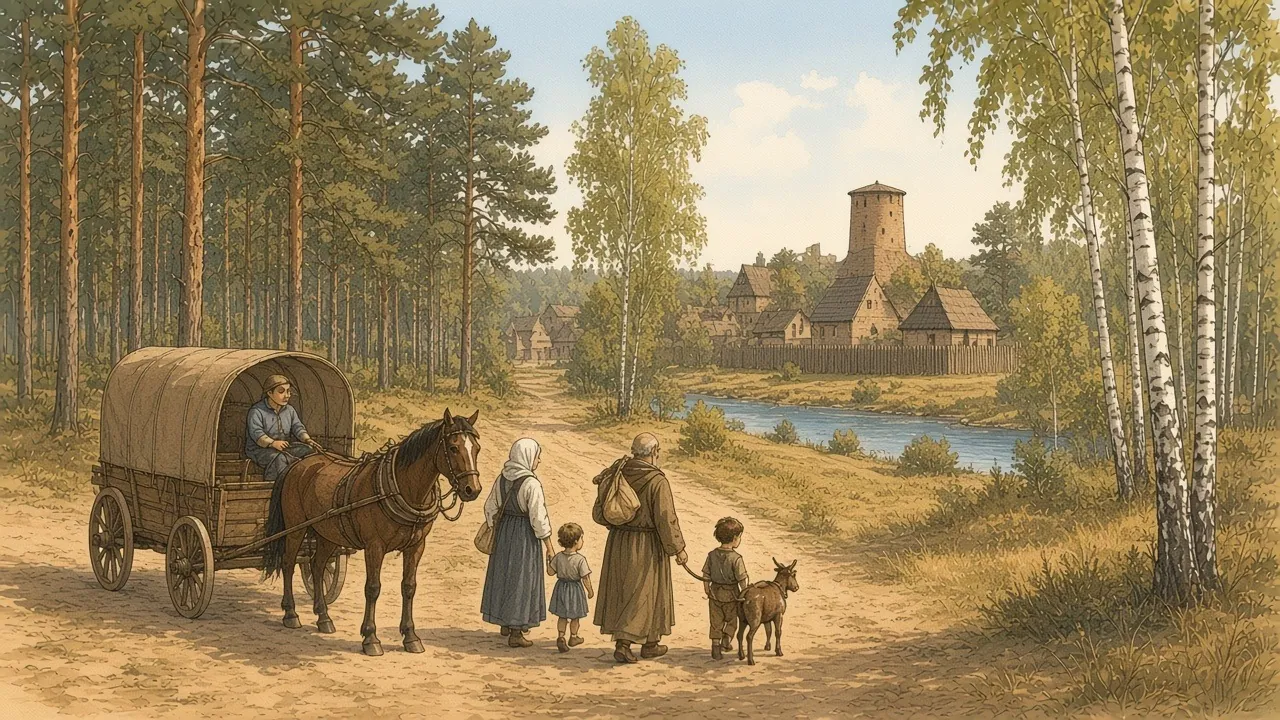
Visitors to the POLIN Museum of the History of Polish Jews in Warsaw begin their tour in a gallery called the Forest. There they meet a story first told, in its best-known printed form, by Gershom Bader in a Yiddish book published in New York in 1927. Jews fleeing persecution in the German lands fasted and prayed for deliverance until a paper fell from the sky bearing the words “Go to Poland. You will find peace there.” As they travelled eastward they heard birds in the forests calling “Po-lin! Po-lin!”, which they understood as the Hebrew for “rest here”, and on the branches of the trees they seemed to see pages of the Gemara. The museum takes its name from the legend, and its glass facade is printed with the word Polin in Hebrew and Latin letters.[1]
The legend compresses into a single journey what was in reality a slow migration over several centuries, and it answers in the language of providence a question that historians answer with charters, tax registers and coin hoards. By the middle of the eighteenth century the Polish-Lithuanian Commonwealth held the largest Jewish community in the world. A government census of 1764 and 1765, once corrected for those who evaded it and for infants it did not count, points to about 750,000 Jews in a state of some eleven million people, perhaps a third of all the Jews then alive.[2] Around 1500 the Jews of Poland and Lithuania had numbered a few tens of thousands at most, and in the early fourteenth century perhaps no more than a thousand.[3]
This essay asks how that change came about. It follows the political history of Poland from the Piast dukes of the tenth century, through the union with Lithuania under the Jagiellonians and the noble Commonwealth that followed, to the partitions of the late eighteenth century and the long aftermath. Within that frame it asks why Jews came to Poland in such numbers in the early centuries, what they found there, and how a community of immigrants became, by natural increase as much as by migration, the demographic heart of the Jewish world.
Much of the answer is economic and legal rather than sentimental. Polish rulers needed credit, coin, tolls and towns; German-speaking Jews, squeezed by crusading violence, expulsions and the accusations that accompanied the Black Death, had the skills to supply them. The privilege issued at Kalisz in 1264 and confirmed by Casimir the Great in the fourteenth century gave that exchange a legal form. Later, the leasing of noble estates and the founding of private towns carried Jewish settlement eastward into Ukraine and Belarus, while councils of Jewish delegates gave Polish Jewry an unusual degree of self-government.
The evidence is uneven, and on several important points scholars disagree. Population figures before 1764 are estimates resting on fragmentary tax records; the death toll of 1648 has been put at anything from under twenty thousand to several hundred thousand; the role, if any, of Khazar converts in the ancestry of Polish Jews remains a subject of public argument long after most historians and geneticists have set it aside. Where the sources diverge, the essay sets out the competing positions rather than choosing silently between them, and it treats the legends of Polin and of Esterke as evidence of how Polish Jews remembered their past rather than as accounts of what happened.
2. The Piast state and the conversion of 966
The Polish state emerged in the second half of the tenth century among the West Slavic tribes of the basin of the Warta and the Vistula. Its first documented ruler, Mieszko I of the Piast dynasty, governed the Polans of the region around Gniezno and Poznań from about 960 until his death in 992. Through war and alliance he extended his authority over Silesia, Pomerania and part of Lesser Poland, and in a document known from its opening words as Dagome iudex he placed his lands under the protection of the papacy.[4]
The decisive act of his reign was his baptism in 966 in the Latin rite, which followed his marriage to the Bohemian princess Dobrawa. Baptism brought the Polans into Western Christendom and gave Mieszko a standing in relation to the German emperor Otto I that a pagan ruler could not have had. A missionary bishopric was established at Poznań in 968, and in the year 1000 Gniezno became the seat of an archbishopric, giving the Polish church an organisation independent of the German sees.[5]
Mieszko’s son Bolesław I, called the Brave, ruled as duke from 992 and was crowned king on 18 April 1025, shortly before his death. His reign consolidated the Piast state and brought it recognition as one of the powers of central Europe, but the royal title did not pass smoothly to his successors, and the eleventh century saw pagan reaction, Bohemian invasion and the slow reconstruction of ducal authority.[6]
For the history of the Jews, the significance of this early state lay less in its religion than in its place on the trade routes of the continent. The Piast lands lay between the German empire to the west, Bohemia to the south, the Baltic to the north and Kievan Rus’ to the east. Furs, wax, honey, salt and, above all in the early period, slaves moved through them. Coins struck in Polish mints imitated Bavarian, Saxon and Cologne types, a sign of how closely the young state’s economy was tied to that of the empire.[6]
Christianisation also brought the institutions of the Latin church, including, in time, its canon law on the Jews. The church taught that Jews were to be tolerated, but in a subordinate position: they were not to hold public office over Christians, employ Christian servants or mix freely with Christians in social life. These rules were not fully applied in Poland until much later, and were never consistently observed, but they set the outer limits within which Polish rulers would later frame their own Jewish policy.[7]
When Jews first appear in sources about Poland, therefore, they appear in a Christian kingdom that was still young, still thinly populated and still dependent on long-distance commerce. Their earliest role was that of travellers passing through, and it is with one such traveller, a Jewish envoy from Muslim Spain, that the written history of Poland effectively begins.
3. Ibrahim ibn Yaqub and the earliest report
Ibrahim ibn Yaqub, a Jew from Tortosa in al-Andalus, travelled through the German and Slavic lands in the 960s, probably on behalf of the Umayyad caliph of Córdoba, al-Hakam II, and probably in connection with an embassy to the court of Otto I. His own report has not survived. It is known through extracts preserved by later Arabic geographers, among them al-Bakri and al-Himyari, and it has been described as the earliest known comprehensive description of the Polish kingdom.[8][9]
Ibrahim described Prague as a great centre of trade, visited by Russians and Slavs who came from Kraków with goods, and by Muslims, Jews and Turks who brought goods and money from the lands of the Turks. Flour, tin and furs were exported from the city, and the slave trade was evidently important there. He wrote of a salt mine on the Saale where Jews were at work. Of the country of the ruler he called Mashqa, that is Mieszko, he wrote that it was the largest of the Slavic lands, abundant in food, meat and honey, and that its ruler kept three thousand armoured warriors, paid, clothed and armed at his own expense.[9]
It is tempting to read this as an account of Jewish settlement in Poland in the tenth century, and popular histories sometimes do. The evidence does not support that reading. Dmitrij Mishin, who translated and analysed the surviving fragments, discusses the dating most often proposed, 965, a year in which Otto I was at Magdeburg, and points out that Kraków itself was then under Bohemian rule and passed to the Polish dukes only at the end of the century. The detailed attention to fortresses, armies and the strength of the Slavs as potential enemies led him to suggest that the text reads more like a scout’s report to the caliph than a merchant’s diary, and there is no clear evidence that Ibrahim ever entered Mieszko’s territory. Mishin regards much of the information about Poland as general in character and probably taken from other informants, who may have been met in Prague or in the German lands.[9]
Other modern accounts are more confident that he visited Polish territory, and the encyclopaedic literature on him varies on this point.[10] What is not in dispute is the commercial world his report reveals. Jewish merchants were among those who connected the Slavic lands to the markets of the Islamic Mediterranean and of Byzantium, moving slaves, furs and metals westward and southward and bringing spices, silver and gold coin in return.[8]
These traders were travellers rather than settlers. Rosman, surveying the evidence, judges it unlikely that Jews lived permanently in Poland much before the twelfth century.[2] The importance of the tenth-century traders lies elsewhere: they show that from the very beginning of Polish statehood the Jewish presence in the region was bound up with commerce on routes that ran far beyond it, and that the country was known to Jewish travellers before it was home to Jewish communities.
4. From the east? The Khazar hypothesis
A second answer to the question of origins looks not west but east. Between about 650 and the 960s the Khazar qaghanate dominated the steppe from the Volga to the Crimea, and important segments of its population, beginning with its ruling circle, converted to Judaism in the second half of the eighth century. Coins struck in the Khazar lands in 838 replaced the Islamic profession of faith with the words “Moses is the Messenger of God”. After the destruction of its urban centres by the Rus’ in the 960s, the qaghanate faded from the record.[11]
From these facts a theory was built that the Jews of eastern Europe descended largely from Khazar converts who moved westward after the fall of their state. Arthur Koestler gave it wide currency in The Thirteenth Tribe in 1976, and Shlomo Sand revived it in 2009 in The Invention of the Jewish People.[12] In 2013 the geneticist Eran Elhaik published an analysis that, using modern Armenians and Georgians as proxies for the Khazars, concluded that Khazar ancestry was a major component of the Ashkenazi gene pool. Elhaik presented his findings partly as a solution to a demographic puzzle: how a population of perhaps fifty thousand in the fifteenth century could have grown to some eight million by the twentieth.[13] Reviewing the paper, Stampfer pointed out that no Khazar DNA had been analysed at all, and that the treatment of Georgians and Armenians as proto-Khazars rested on outdated or amateur literature and had no support in contemporary scholarship.[13]
The historians who know the sources best have found little to support the theory. Peter Golden, the leading specialist on the Khazars, allows that Judaised Khazars may have been one component of what became the largest Jewish community of the modern era, but considers it very unlikely that they were a determining element.[11] Rosman notes that the early Jewish settlements of Kievan Rus’, some connected with Khazaria and some not, do not appear to have survived the Mongol invasion of 1240, and that no one has shown that refugees from the east formed more than a token presence among Polish Jews.[2] Shaul Stampfer went further, arguing in a long study published in 2013 that the evidence for a mass conversion of the Khazars is itself too weak to bear the weight placed on it.[14][12]
Genetic studies published since Elhaik’s paper have, on the whole, pointed the same way. A genome-wide study by Doron Behar and colleagues in 2013, using samples from 106 Jewish and non-Jewish populations including fifteen from the Caucasus and the region to its north, found no particular similarity between Ashkenazi Jews and the populations closest to the former Khazar lands, and no indication of a significant genetic contribution from within or north of the Caucasus.[15] A later study by Elhaik and colleagues that placed an ancestral homeland in eastern Turkey was criticised by Pavel Flegontov and others both for its genetic method and for its claim that Yiddish was originally a Slavic language; all the methods of historical linguistics, they observed, agree that Yiddish is Germanic.[16] In 2022 a team sequencing the remains of thirty-three Jews buried in fourteenth-century Erfurt found that the founder event which shaped the modern Ashkenazi population had already occurred, and that there had been almost no incorporation of genes from non-Jewish European populations over the following six hundred years.[17]
The eastern Jewish presence was nevertheless real, and it should not be dismissed together with the theory. Jewish communities existed in the Crimea and on the Taman peninsula, in Kiev, Chernigov and Volodymyr in Volhynia from the eleventh century, and Rabbanite and Karaite Jews from the Black Sea coast and Kievan Rus’ helped to found communities in Halych and possibly Lwów. Turkic-speaking groups professing simplified forms of Judaism still lived on the steppe at the end of the twelfth century.[18] These small communities were later absorbed into a much larger population whose language, law and liturgy came from the German lands. The disagreement, then, is not over whether Jews lived to the east of Poland in the early Middle Ages, but over whether they explain the size of later Polish Jewry. Most specialists conclude that they do not.
5. The first settlers and the bracteates
The first Jews known to have had dealings in the Polish lands appear in scattered sources of the eleventh and twelfth centuries. A rabbinic responsum cites a decision of a rabbinical court in Kraków in the first half of the eleventh century. A chronicle entry for 1085 notes how a Polish princess redeemed slaves from Jewish traders, and in 1098 a Bohemian prince decided to confiscate the property of Jews who were fleeing to Poland to escape persecution. In about 1150 a nobleman named Petrus acquired the village of Tyniec from Jews, and in 1203 a document refers to part of the village of the falcon breeders at Wrocław held by a Jew named Joseph. Routine legal documents of this kind, Rosman observes, already take Jews for granted.[2]
These references describe merchants, slave traders, refugees and landholders, but not yet organised communities. Rosman concludes that permanent Jewish residence in Poland much before the twelfth century is unlikely.[2] Kupovetsky reaches a similar view: individual Ashkenazic families settled in western Poland after fleeing from Prague during the First Crusade, a Jewish presence is recorded at Przemyśl at the end of the eleventh century, and through the twelfth and early thirteenth centuries the Jewish population remained small even though it was steadily supplemented by migrants from central Europe. By the middle of the thirteenth century there were communities in Kraków and possibly in Kalisz, Płock and Gniezno.[18]
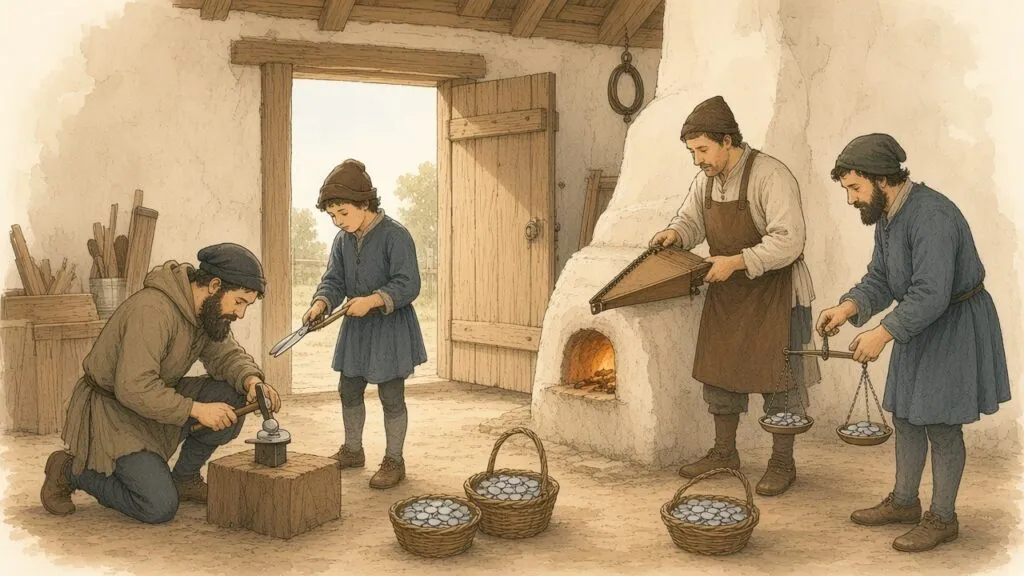
The most vivid evidence of these early settlers is numismatic. Between 1177 and 1296 Jewish moneyers working for Polish rulers struck coins inscribed in Hebrew letters.[2] Many of these were bracteates, thin coins stamped on one side only, issued in the reign of Mieszko III of Greater Poland and his successors.[19][20] They show that Jews were already entrusted with one of the most sensitive functions of a medieval government, the leasing of the mint. Kalisz, the oldest town in Poland, was one place where Jews minted coins for the prince in the twelfth century.[21]
The coins also show where the minters came from. Rosman lists four indicators that point consistently to the German lands: the Germanic origin of the legal privileges later granted to Polish Jews, the acceptance of Ashkenazic rabbinic authority, the Yiddish language, and these Hebrew-lettered coins struck by immigrant minters.[2] Some time before 1217, Rabbi Eli’ezer of Bohemia tried to persuade Rabbi Yehudah he-Hasid in Regensburg that the small and poor communities of “Poland, Russia and Hungary” needed different rules of finance and organisation from their mother communities in Ashkenaz, so that they could pay their religious functionaries from contributions rather than from a regular communal budget.[2]
A later Polish Jewish legend remembered the coins in its own way. In the version retold by S. Y. Agnon in his story Polin, the first Jews who came to Poland struck coins in the holy script and the language of the country, with the name of the king Mieszko on them, after a paper fell from heaven telling them to go to Polaniya. The same text tells how, on reaching the forest of the land, they found a tractate of the Talmud carved on every tree.[22] Folk memory had preserved, in transfigured form, a genuine fact of the twelfth century: the Jewish minters of the Piast dukes.
By about 1200, Rosman suggests, the immigrant Jewish population had reached a critical mass sufficient to sustain permanent communities.[2] Their arrival was part of a far larger movement that was transforming the Polish lands in the same period, and it cannot be understood apart from it.
6. Fragmentation, the Mongols and the German colonisation
The twelfth and thirteenth centuries, the period in which Jewish settlement in Poland became permanent, were also the period of the country’s political fragmentation. On the death of Bolesław III Wrymouth in 1138 his lands were divided among his sons under a system of seniority that was meant to preserve the unity of the realm under the senior duke in Kraków. In practice it produced a patchwork of duchies ruled by rival branches of the Piast dynasty, each competing for revenue, settlers and allies.[23] Kraków became the capital of one of the major principalities in 1138, but the Polish crown was not restored for more than a century and a half.[24]
Fragmentation weakened Poland militarily, and the Mongol invasion of 1241 left Kraków largely destroyed.[24] It also created conditions in which settlers of every kind were in demand. Provincial dukes, bishops and lay lords sought to raise the value of their lands by bringing in colonists, founding villages and towns under German law and granting them charters of self-government. Kraków itself was rebuilt after the Mongol attack and received Magdeburg law, the German model of municipal self-government, in 1257.[24] Over the twelfth to fourteenth centuries German-speaking peasants, craftsmen and merchants moved eastward in large numbers, and the Jews who came to Poland in the same period were, in Rosman’s phrase, one stream in this large-scale migration.[2]
This context matters for understanding why Jews came. Their motives were not identical to those of their Christian neighbours, for the push of persecution weighed on them in a way it did not on German peasants, but they were moving along the same roads, towards the same towns and in response to the same demand for skills. The Jews who settled in Kraków in the early fourteenth century, like most of the city’s Christian population, came from German lands.[24] They brought with them the German language that would become Yiddish, the customs and legal traditions of the Rhineland and Bohemian communities, and a body of experience in trade and credit that the new towns needed.
The colonisation also created the tension that would shape Jewish life in Poland for centuries. Because Jews were barred almost everywhere in Europe from owning land, they concentrated in towns, where they formed a second urban class parallel to the Christian burghers. Magdeburg law, which governed most of the new towns, excluded them from the merchant and craft guilds, and the resulting competition between Jews and burghers found expression in legislation and, at times, in violence.[20] Rulers, by contrast, valued Jews precisely because they stood outside the municipal corporations and depended directly on the ruler for protection.
Jewish settlement was not, therefore, an isolated phenomenon that requires a special explanation. It was part of the general repopulation and urbanisation of the Polish lands in the high Middle Ages. What distinguished the Jewish settlers was their legal position. A German burgher arrived as a member of a chartered town; a Jew arrived as the subject of a duke, and his security depended on the terms that duke was willing to grant. It was in that setting, in one of the duchies of the fragmented kingdom, that the first general privilege for Polish Jews was issued.
7. Ashkenaz under pressure
The Jews who moved east into Poland came from a world that had itself been formed by migration. The first communities along the Rhine, at Mainz, Worms and Speyer, were founded by Jews from northern France and Italy. In 1084 Rüdiger, bishop of Speyer, issued a Latin charter welcoming Jews who wished to settle in his town, offering them a walled quarter and protection; it was a model of the community charters that would later be granted further east.[25]
Twelve years later the same communities suffered the worst violence they had known. Between May and July 1096 bands gathering for the First Crusade attacked the Jews of Speyer, Worms, Mainz, Trier, Metz and Cologne. Estimates of the dead range from two thousand to twelve thousand; in Mainz alone the Hebrew chronicles record more than a thousand deaths, many of them by suicide or killing within families in preference to forced baptism.[26] The memory of 1096 was preserved in lists of martyrs read aloud in synagogues and shaped Ashkenazic piety for centuries.[25] It was in the aftermath of these events that, according to Kupovetsky, individual families fleeing from Prague settled in western Poland.[18]
It would be wrong, however, to imagine two centuries of constant persecution driving a steady stream of refugees eastward. Ivan Marcus, the historian of medieval Ashkenaz, stresses that for about two hundred years after 1096 most Jews in the German lands lived relatively peacefully alongside their Christian neighbours, and that there was no “age of the Crusades” of continuous persecution. Major episodes of violence became common only in the late thirteenth century.[25] The kings of England and France expelled their Jews in 1290 and 1306 respectively, the French expulsion affecting perhaps eighty thousand people.[25] In the German lands and Bohemia, a mob following the knight Rindfleisch attacked the Jewish community of Prague in 1298 after an alleged desecration of the Host, and charges of ritual murder were brought against Prague Jews in 1305.[7]
Western Christendom was also tightening the legal framework within which Jews lived. The church insisted on distinguishing dress, on the exclusion of Jews from public office and on the separation of Jews and Christians, and in Hungary the Golden Bull of 1222 and the Council of Buda in 1279 sought to enforce such rules.[7] The same measures were proclaimed for Poland by the Synod of Breslau in 1267, which forbade Christians all social contact with Jews, ordered separate Jewish quarters and limited towns to a single synagogue.[7]
The pressure on the Jews of the west and centre of Europe thus rose in stages, and the timing of the movement into Poland reflects that. A small migration in the twelfth century became a larger one in the thirteenth and fourteenth, as violence and expulsion became more frequent in the old centres and as the eastern duchies offered both economic opportunity and the promise of legal protection. The privileges issued in central Europe in the mid-thirteenth century were the legal hinge of that movement, and the Polish privilege was one of a family of such documents.
8. The privilege of Kalisz, 1264
On 8 September 1264 Bolesław the Pious, duke of Greater Poland, issued at Kalisz a general privilege for the Jews of his duchy. It is the first document of its kind in the Polish lands, and it became the basis for many later royal privileges.[21] Rosman describes it as based on a German model adjusted to the Polish situation and as the earliest known attempt to regularise the conditions of Jewish residence in Poland.[2]
The model is not in doubt. In the two decades before Kalisz, Frederick II, duke of Austria, had issued a privilege for his Jews in 1244, Béla IV of Hungary in 1251 and Ottokar II of Bohemia in 1254, and the Polish text follows their structure closely.[23] Teller notes that rulers such as Ottokar II and Bolesław of Kalisz granted Jews settlement privileges in return for services in the field of credit.[20] The privilege was thus part of a regional competition among the rulers of east-central Europe for the settlers and skills that would make their realms richer.
The statute, in the form in which it survives, contains thirty-six articles. It placed the Jews under the duke’s protection and the jurisdiction of his own officials rather than that of the town courts, regulated their lending against pledges and their freedom to trade and travel, imposed penalties for attacks on Jews and for the desecration of synagogues and cemeteries, and provided procedural safeguards against the accusation of ritual murder.[23] Its guiding principle was that Jews were valuable subjects of the ruler and that harm to them was harm to his revenue.
The original charter has not survived, and the text is known from later copies, the oldest from the fifteenth century. In 1880 the legal historian Romuald Hube argued that the long version in circulation was a later fabrication. Most scholars have since rejected that view, pointing to the close agreement between the Polish text and the earlier Austrian, Bohemian and Hungarian privileges.[23] The core of the 1264 privilege, and its confirmation in the following century, are not seriously disputed.
The statute should not be read as evidence that Poland was uniquely tolerant. The Synod of Breslau, meeting three years later, demanded the very separation and subordination that the duke’s privilege ignored.[7] The two documents expressed two different interests: that of the ruler, who wanted Jews to settle, lend and trade under his protection, and that of the church, which sought to keep them separate and subordinate. For the next five centuries Jewish life in Poland was conducted in the space between those interests, and its security depended on the ruler’s continuing willingness to enforce his own privilege.
At the time it was issued, the Kalisz privilege applied to a single province with a small Jewish population. Its long-term importance came from its adoption by the restored Polish monarchy, and above all by the king whom Polish and Jewish memory alike would credit with having opened the country to the Jews.
9. Casimir the Great
The fragmentation of Poland was ended by Władysław I Łokietek, who reunited much of the Piast inheritance and was crowned king in 1320. He was succeeded in 1333 by his son Casimir III, the last of the native Piast kings, whose reign of thirty-seven years is remembered as one of consolidation and building. A Polish saying credits him with having found Poland wooden and left it stone. He fortified the country with more than fifty castles, stabilised the coinage, brought his provinces under common laws, founded the Academy of Kraków in 1364 and granted privileges to immigrants, among them Jews fleeing persecution in the German lands.[27]
Casimir’s Jewish legislation took the Kalisz privilege and extended it to the kingdom as a whole. In 1334, the year after his accession, he granted a royal privilege to the Jews of Kraków and Lesser Poland, guaranteeing freedom of religion, judicial autonomy and the right to lend money and trade, and making Jews subject only to the jurisdiction of the king or his governor.[24] The encyclopaedic literature dates this confirmation to 9 October 1334 and records a further confirmation in 1367 for the Jews of Kraków, Lwów and Sandomierz, after the annexation of Red Ruthenia had brought Lwów into the kingdom.[23] Later Jewish accounts attributed to his confirmation specific protections for Jewish cemeteries and a prohibition on accusing Jews of using human blood.[28]
Casimir also founded, on 27 March 1335, the town of Kazimierz across the Vistula from Kraków, named after himself and given walls, a market square and a town hall.[29] A century and a half later it would become the home of the Kraków Jewish community. In the meantime the Jews of Kraków lived within the city, where a Jewish street is mentioned in 1304, a cemetery in 1311 and a synagogue in 1356.[24]
The king’s reliance on Jewish finance can be seen in the career of Lewko of Kraków, the most important financier of the Polish crown in the second half of the fourteenth century. Lewko sat on a council convened by Casimir in 1368 to organise the royal salt mines, became co-lessee of the mines at Bochnia and Wieliczka and helped to administer the royal mint. He lent to Casimir, to Louis of Anjou, to Queen Jadwiga and to Władysław Jagiełło, as well as to nobles, burghers and the Kraków city council, and in 1370 the council, at the king’s request, granted him and his family a letter of protection and equal rights with the citizens.[30]
Casimir’s policy gave rise to a legend that outlived him by centuries. The fifteenth-century chronicler Jan Długosz wrote that the king’s Jewish mistress, Esterke, had persuaded him to invite Jews to Poland and to grant them extensive privileges. David Gans repeated the story in his sixteenth-century chronicle Tsemah David, and oral versions attached it to particular places: at Radom it explained the name of the town, at Lublin Esterke was said to be buried in the old cemetery, and at Kazimierz Dolny the Great Synagogue was described as the king’s gift to her.[31]
The legend has no documentary support, but it was not wholly baseless, for Casimir did extend in 1334 the privileges first granted at Kalisz.[31] Jewish versions modelled Esterke on the biblical Esther, the Jewish woman at a gentile court who saves her people; Długosz’s version, by contrast, used her to explain why a Christian king had favoured the Jews. In both forms the story translated a legal and fiscal policy into a personal romance, much as the Polin legend translated a migration into a divine summons.
10. The Black Death and the great migration
In 1348 the plague that contemporaries called the great mortality reached central Europe, and with it came the accusation that the Jews had caused it by poisoning wells. In the autumn of that year Jews on the shores of Lake Geneva were arrested by order of the count of Savoy and tortured until they confessed. Records of their confessions, among them that of a Jew named Agimet extracted at Châtel in October 1348, were sent from town to town along the Rhine. Thousands of Jews were killed in at least two hundred towns and villages.[32]
At Strasbourg the city authorities tried at first to protect the Jews and were overthrown. On the feast of St Valentine, 14 February 1349, about two thousand Jews were burned on a wooden platform in their cemetery; those who accepted baptism were spared, and children were taken from the fire and baptised against their parents’ will. Debts owed to Jews were cancelled and their cash was divided among the craftsmen. The chronicler Jacob von Königshofen, writing later from earlier Strasbourg records, observed that the money “was indeed the thing that killed the Jews”.[32] Albert Winkler, surveying the persecutions in the German lands, counts attacks in more than three hundred communities, notes that civic authorities often mandated the killings, and observes that some survivors sought refuge in Poland.[33] In Erfurt a massacre in 1349 interrupted the life of one of the largest Jewish communities in Germany.[17]
The contrast with Poland has often been drawn. Antony Polonsky, in his overview of Jewish-Christian relations in the region, writes that the Black Death had relatively little impact in Poland and suggests that this may have been one reason why Jews expelled from elsewhere in central Europe were able to settle there.[7] Not every source agrees that Poland escaped the violence. The Jewish Virtual Library’s survey cites the Chronica Olivska for massacres of Jews blamed for the plague in Poland, and lists anti-Jewish riots in 1348 and 1349, again in 1407 and in 1494.[28] The difference is partly one of scale and evidence: the German massacres are documented in civic records and chronicles in great detail, while the Polish references are fewer and less precise. What can be said is that the Polish kingdom did not experience a wave of destruction comparable to that in the Rhineland, and that its king continued to issue and confirm Jewish privileges in the decades that followed.
The broader pattern of the period is described by Kupovetsky. From the thirteenth to the fifteenth century Jews were being pushed out of much of central and western Europe by expulsions and by sharper competition with the non-Jewish urban population; at the same time Poland and Lithuania pursued policies aimed at developing urban settlement and granted privileges to attract migrants, Jews among them, from central and western Europe.[18] The Black Death accelerated a movement that had begun earlier, and its significance for Poland was less as a single cause than as an event that confirmed the contrast between the declining old centres and the expanding east.
Lithuania followed a similar policy. In 1388 and 1389 the grand duke Vytautas issued charters granting the Jews of his lands, perhaps six thousand people, protection of person and property and freedom of movement.[34] By the end of the fourteenth century there were Jewish communities in Kraków, Kalisz, Poznań, Płock, Gniezno, Sandomierz and possibly Warsaw, and Jews from west and south may have founded the communities of Grodno and Brest in the same period.[18]
11. The Jagiellonian union
Casimir died in 1370 without a legitimate son, and the crown passed to his nephew Louis of Anjou, king of Hungary, and then to Louis’s youngest daughter Jadwiga, crowned in October 1384.[35] In August 1385, at Krewo, the Lithuanian grand duke Jogaila agreed to marry the young queen, to accept Catholic baptism together with his pagan subjects and to join his realm to the Polish crown. The union took effect in 1386, when he was crowned king of Poland as Władysław II Jagiełło.[36] On 15 July 1410 the combined Polish and Lithuanian armies defeated the Teutonic Order at Grunwald, a victory that secured the union and began the long decline of the Order’s power on the Baltic.[37]
The union with Lithuania transformed the geography of Jewish settlement. It joined the Polish crown to a grand duchy that stretched across what are now Belarus and much of Ukraine, and it opened a frontier of towns, trade routes and thinly populated estates to the east. In the fourteenth and fifteenth centuries, both Poland and Lithuania granted privileges to attract urban settlers from the west, Jews among them.[18]
The Jewish economy of the fifteenth century was still dominated by credit. Until the middle of the century moneylending was by far the most important Jewish occupation in Poland, with the nobility relying on Jewish lenders for both income and loans. A law of 1423 forbade Jews to lend against mortgages on landed property, which made large-scale lending more difficult, and in the long run pushed Jewish capital towards trade and the leasing of estates.[38] The great Jewish financiers of Kraków in this period were the Fiszel family, who appear in the sources from the 1460s and served as creditors to Casimir IV and his sons. Rahel Fiszel, who had come to Kraków from Prague, lent to three kings in her own right, and in 1504 King Alexander allowed her to strike coins from his metal to recover a royal debt of a thousand florins.[39]
Relations between Jews and the Christian burghers of the towns grew more strained. In Kraków the burghers regarded Jews as economic rivals, and in 1485 they forced through an agreement that virtually excluded Jews from commerce and confined them to pawnbroking, though it had little practical effect. After a fire in 1494 destroyed part of the city, including the Jewish quarter, the king ordered the Jews to leave Kraków and resettle in Kazimierz, across the Vistula. They continued to call themselves the Kraków community, and some Jewish merchants kept warehouses and shops on the market square.[24] In the Grand Duchy of Lithuania all Jews, at least two thousand people, were expelled in 1495 and allowed to return in 1503.[18]
The nobility, meanwhile, was consolidating the privileges that would make it the dominant force in the state. The Nieszawa statutes of 1454, issued by Casimir IV, required the king to consult the regional assemblies of nobles before raising taxes or levying troops.[40] This shift of power from the crown to the nobility would eventually alter the position of the Jews profoundly, since it was increasingly the nobles rather than the king who determined where Jews could settle and on what terms.
The fifteenth century also saw continued immigration from the German lands and Bohemia. Jewish families from those regions, and later from Italy, kept arriving in Kraków throughout the fifteenth and sixteenth centuries.[24] Among them was Jacob Polak, who came from Prague and founded what was probably Poland’s first yeshiva in Kraków in the last years of the fifteenth century.[24] In 1503 the crown appointed him rabbi of Poland, an office that marked the beginning of a recognised chief rabbinate.[28] Polish Jewry was becoming a centre of learning in its own right.
12. How many Jews?
How many Jews were there in Poland in these early centuries? The question is central to the subject of this essay, and the sources answer it badly. Before the eighteenth century the only documents that bear on it are tax rolls, which list properties, households or individual taxpayers in ways that are ambiguous and often inaccurate. Rosman concludes that for the twelfth to the fifteenth century no figures can be substantiated at all.[2]
For the early fourteenth century, the Polish historians Hanna Węgrzynek and Gabriela Zalewska suggest a figure of only about a thousand Jews. A tax register probably drawn up in 1507 lists fifty-four Jewish communities but omits about thirty localities, so that some ninety communities may have existed at the start of the sixteenth century, most of them with a few dozen to a hundred members. They put the Jewish population of the Polish and Lithuanian lands in the early sixteenth century at about ten thousand to twenty-four thousand.[3] Rosman gives a range for about 1500 of ten thousand to thirty thousand in a total population of five to seven and a half million.[2]
These figures do not agree with a claim that is still widely repeated. The Jewish Virtual Library’s survey of Polish Jewish history states that by the middle of the sixteenth century eighty per cent of the world’s Jews lived in Poland.[28] The demographic estimates cited above make that figure impossible for the sixteenth century. Kupovetsky, drawing on recent research, estimates that the share of world Jewry living in eastern Europe as a whole rose from 1.4 per cent at the end of the fifteenth century to between ten and fourteen per cent at the end of the sixteenth, to twenty-eight per cent at the end of the seventeenth and to about half at the end of the eighteenth.[18] The concentration of world Jewry in Poland was an outcome of the seventeenth and eighteenth centuries, not a fact of the sixteenth.
Growth thereafter was rapid. By the late sixteenth century the number of communities had risen to about two hundred; estimates for the early seventeenth century range from eighty thousand to a hundred thousand Jews, and by the end of that century the number may have reached two hundred thousand.[3] For 1648, on the eve of the Cossack rising, Rosman gives a range of two hundred thousand to five hundred thousand and considers the lower figure the more realistic.[2] The proportion of Jews in the population, on the highest figures proposed, rose from 1.2 per cent in the mid-sixteenth century to 3.3 per cent a century later.[18]
Two conclusions follow. The first is that the early migrations, however important in founding the community, were small. The Jews who came from the German lands in the thirteenth, fourteenth and fifteenth centuries numbered in the thousands or low tens of thousands, not in the hundreds of thousands. The second is that most of the later growth must be explained by something other than migration. Kupovetsky argues that until the middle of the seventeenth century immigration was the main cause of Jewish population growth, and that after that time growth was probably a consequence of natural increase.[18] The question of why Jews came to Poland in such numbers is therefore partly a question of why, once there, they multiplied.
The low early figures also explain why so much modern argument has gathered around this subject. If one assumes, as Elhaik did, that a population of tens of thousands could not have grown to millions without a large influx from outside, the Khazars appear to offer a solution.[13] If, on the other hand, the Jews of the Commonwealth enjoyed for two centuries a rate of natural increase well above that of their neighbours, no such influx is required. The evidence for that second view is examined later in this essay.
13. Learning, printing and community in the sixteenth century
The sixteenth century is often called the golden age of Polish Jewry, and in matters of learning and communal life the description has some justification. Kraków was its first centre. The yeshiva founded by Jacob Polak was continued by a line of distinguished heads, among them Moses Isserles, who studied under Shalom Shakhnah at Lublin and who died in 1572.[24][41] Isserles’ Mapah, a set of glosses on Joseph Karo’s Shulhan arukh, supplied the Ashkenazic customs and rulings that the Sephardic code had omitted. Its first part was printed in Kraków in 1570, and every later generation of Ashkenazic legal scholars has treated it as a practical authority.[41]
Printing gave the new centre a reach far beyond Poland. The Helicz brothers established the first Hebrew press in Kazimierz in 1534; it closed in 1539 after they converted to Christianity, and Aharon Prostitz opened another in 1568.[24] The first known printed Yiddish book, Mirkeves hamishne, a biblical concordance intended for readers without advanced schooling, appeared in Kraków in 1534, and a literature of translations, moral works, stories and prayers for women followed.[2] In 1595 the Kraków community compiled its statutes in Yiddish, a communal constitution regulating trade, crafts, health care, schools, worship and the courts, which remained in force until the end of the eighteenth century.[24]
The community itself had grown substantially. The tax rolls of 1578, the first reasonably reliable figures for Kraków, show about two thousand Jewish residents of Kazimierz. Immigration continued from the German lands, Bohemia and Moravia, and now also from Italy, which was linked to Kraków by trade and by the marriage of King Sigismund I to Bona Sforza of Milan.[24] Lublin offers a comparable picture. The city obtained a privilege de non tolerandis Judaeis in 1535 that barred Jews from living and trading within its walls, but a Jewish town grew up at the foot of the castle, received permission to build a brick synagogue and a yeshiva in 1567, and in the following year apparently obtained a privilege of its own excluding Christians. In 1602 about two thousand Jews lived in Lublin, some twenty per cent of its population.[42]
The authorities of the crown continued to regulate the community’s internal government. By 1551, according to the Jewish Virtual Library’s account, Jews had been permitted to choose their own chief rabbi.[28] At the same time the crown was surrendering ground to the nobles. In 1539 Sigismund I ceded to the nobility full legal jurisdiction over the Jews living on their lands, and from then on the owners of great estates heard the appeals of their own Jewish subjects.[2]
These developments explain the reputation of the period. A seventeenth-century Hebrew chronicler, Gavri’el Schossburg, described Polish Jewry as “a delight to all the lands of the Exile for its Torah, honour and greatness”.[2] The flowering was real, but it rested on a particular political structure, in which kings and nobles had a common interest in protecting Jews whose economic activity was useful to them. Rosman observes that a strong and secure Jewish community offered the maximum economic benefit at the minimum cost: Jews paid relatively high taxes, borrowed the lords’ idle capital at interest and promoted trade, and for the king they were a valuable counterweight to the self-governing towns.[2] The second half of the century gave that structure its constitutional form.
14. The Commonwealth of the nobility
On 1 July 1569, at Lublin, the kingdom of Poland and the grand duchy of Lithuania were joined in a single federated state with a common monarch, a common parliament and a common foreign policy, while each retained its own administration, laws and army. In the months before the union the Polish crown annexed from Lithuania the provinces of Podlasie, Volhynia, Kiev and Bracław, lands inhabited largely by Orthodox Ruthenians that today form much of Ukraine.[43] The Commonwealth that resulted was one of the largest states in Europe, and its south-eastern provinces became the main field of Jewish expansion in the following century.
The death of the last Jagiellonian king, Sigismund II Augustus, in 1572 completed the transformation of the monarchy. From 1573 kings were chosen by the free election of the whole nobility, assembled in a field near Warsaw, and each elected king swore to observe the Henrician Articles, which codified the liberties of the nobility and restricted royal power.[40] The Warsaw Confederation of the same year guaranteed religious peace among the nobility at a time when much of Europe was at war over religion.[40] The power of the nobility culminated in the liberum veto, by which a single deputy could break up the Sejm; from 1652 to 1764 some forty-eight of fifty-five Sejms are said to have been disrupted in this way.[40]
For the Jews the consequences of noble supremacy were mixed. The weakness of the crown meant that royal protection counted for less, and the privileges that mattered most were increasingly those granted by individual nobles. But the nobility as a class had every reason to welcome Jews. A noble-dominated society that lived by exporting grain needed intermediaries to market its produce, collect its revenues and supply its towns, and the Jews, excluded from landholding and from the guilds of the royal cities, were well placed to serve. Rosman describes the Commonwealth as a multiethnic and multireligious state that maintained a high degree of de facto toleration of groups that were neither Catholic nor ethnically Polish, though this began to change in the seventeenth century.[2]
The structure of the economy pointed eastward. The export of grain and other agricultural produce to the west, mostly by large landowners, was the main source of the country’s wealth.[2] In Ukraine the annexations of 1569 opened vast and lightly settled estates to the great magnate families, who needed managers, leaseholders and townspeople to develop them. The Ukrainian lands experienced rapid population growth and economic expansion in the sixteenth and early seventeenth centuries, and Polish nobles sought to maximise the return on their new possessions.[44]
The Jewish population moved with these opportunities. From the second half of the sixteenth century to the first half of the seventeenth, Jews began to leave the royal cities, particularly those that had obtained privileges excluding them, and to settle in privately owned towns and in the south-eastern provinces.[18] By the eighteenth century about two-thirds of the Jews of Poland-Lithuania lived east of the Vistula, in regions where Poles were a minority.[2] The two instruments of this eastward movement were the lease and the private town.
15. Arenda, Jews and the noble estate
The lease was the mechanism through which Jewish economic life moved from the city to the countryside. Judith Kalik distinguishes two main kinds: the dzierżawa, a lease of land, and the arenda, a lease of monopoly rights, though contemporaries did not always separate the terms. Jews entered the business through moneylending. Cash was always scarce in an agrarian society, the great nobles found it difficult to turn the produce of their estates into money, and the machinery for collecting taxes and customs was undeveloped, so that borrowing against mortgages or leasing out monopoly rights was the easiest way to raise funds.[19]
The path from lending to leasing was shaped by law. As rising land values encouraged the nobility to monopolise landholding, Jews were formally barred from owning land in the sixteenth century, and they could no longer safely lend against estates that they could not take over in case of default. Raising money from Jews on the security of land could therefore be done only by leasing the land to them, since then ownership did not change hands. The leasing of whole estates, land and monopolies together, spread rapidly until the middle of the seventeenth century.[19] The legal sources begin to record arenda contracts between great landowners and Jews in the 1580s.[2]
Rosman cites a lease of 1594 in which Prince Piotr Zabrzeski, for nine thousand zlotys, leased to Efrayim of Międzyboż and his Christian partner, Mikołaj Wransowicz, all his possessions in the district of Krzemieniec, including the villages and settlements, the nobles, burghers and serfs who lived in them, their debts and obligations, the taverns, tolls, ponds and mills, the manors and the tithes paid by the inhabitants. Leases of this kind could cover a single village or several townships extending over hundreds of square miles, and they transferred to the lessee authority over the whole economic life of the property.[2]
This arrangement gave the Jewish lessee, in Kalik’s words, the de facto status of a noble landowner, and placed him between the lord and the Orthodox peasantry of Ukraine as the visible collector of dues and enforcer of obligations. Kalik suggests that the resulting tension may have been one of the causes of the rising of 1648.[19] The Cossack and peasant violence of that year was directed in large part against Polish nobles and their Jewish leaseholders.[45]
After the middle of the seventeenth century the pattern changed. As the magnates grew more powerful, they preferred to lease their large estates to noble clients whose political loyalty they wished to secure, and Jews were largely excluded from such leases, although they continued to lease the smaller estates of the lesser nobility, particularly in a belt stretching from northern Podlasie to the Carpathians.[19] The lease of monopoly rights became correspondingly more important: milling, fishing, forest produce, salt and tobacco, and above all propinacja, the lord’s monopoly on the production and sale of alcohol. The sale of drink on the local market was the simplest way for an estate to dispose of its grain surplus, and the village inn became a characteristic Jewish occupation. Before the sixteenth century most innkeepers had been hereditary peasant leaseholders; Jews displaced them and competing burghers in the course of the following two centuries.[19]
The scale of this transformation appears in the census of 1764 and 1765, which shows that more than a third of employed Jews in the Commonwealth were leaseholders of one kind or another. By the end of the eighteenth century, village Jews made up almost forty per cent of the Jewish population in some regions, many of them living far from the schools and institutions of the market towns.[19] The arenda explains a great deal about why Jews could be absorbed into the Polish economy in such numbers: it created a vast number of small economic niches across the countryside, each of which could support a Jewish family.
16. The private towns
The second instrument of eastward expansion was the private town. The great magnates of the Commonwealth founded towns on their estates and populated them with Jewish and Christian settlers, granting privileges that guaranteed the Jews rights of residence, worship and trade that were often more generous than those available in the royal cities. Teller notes that the nobility, hostile to urban monopolies, worked to weaken them by supporting their Jewish competitors, which led to the granting of special community privileges, especially in private towns owned by powerful aristocrats.[20] Rosman adds that by founding private commercial towns with significant Jewish populations, nobles could avoid having to trade in the large royal cities with their restrictions and fees.[2]
The movement was given further impetus by the royal cities themselves. From the second half of the sixteenth century, Jews began to leave crown cities, particularly those that had obtained the privilege de non tolerandis Judaeis prohibiting Jewish residence, and to move to privately owned towns and to the south-east.[18] Warsaw officially barred Jews from 1527, although by the late eighteenth century it had a considerable Jewish population. Among the important communities in towns owned by nobles were Brody, Dubno, Krotoszyn, Leszno, Międzyboż, Opatów, Ostróg, Pińczów and Zasław.[2] In 1765 the largest Jewish community in the Commonwealth was not in a royal city at all but in the magnate town of Brody, with about 8,600 Jews, followed by Lwów with about 7,400 and Leszno with about 6,000.[18]
Zamość shows how deliberate this policy could be. Jan Zamoyski founded the town in 1580 as the principal seat of his family estates, and in 1588 granted a privilege of settlement to Sephardic Jews only, in the expectation that they would bring trading connections. The first settlers were chiefly merchants from Turkey and Italy who reached Zamość by way of Lwów; families from Holland and Flanders followed after 1620. The Jewish quarter received a brick synagogue in the Renaissance style, built between about 1610 and 1618, and with its Jewish and Armenian residents the town served as an important link in trade with the Islamic world. Over the seventeenth century Ashkenazic Jews came to outnumber the Sephardim, and by 1770 the Jews of Zamość numbered more than a thousand, about a quarter of the town.[46]
Opatów, in Lesser Poland, illustrates a more common pattern. Sold by the bishops of Lubusz to noble owners in 1502, it admitted Jews from 1538. Eighty Jews paid the poll tax there in 1578; by 1618 Jews owned sixty of the town’s 185 houses, and by the 1640s Jewish merchants outnumbered Christian ones, travelling to Gdańsk, Prague and the Leipzig fairs. Swedish troops massacred dozens of Jews in 1656 and 1657, but in 1662 the town still had 266 Jewish poll-tax payers, about twenty-seven per cent of the population.[47]
The owners of such towns were not philanthropists. They protected Jews because Jewish trade, crafts and leaseholding increased the value of their estates, and they could restrict or burden them when it suited them. From 1539 they also held legal jurisdiction over the Jews on their lands.[2] But the private town offered Jews what the royal cities increasingly did not: room to settle, freedom from the guilds and municipal councils, and a lord whose interest coincided with their own. The town that later generations would call the shtetl, where Jews formed half or more of the inhabitants, had its origins in these seigneurial foundations. Rosman notes that while Jews were less than seven per cent of the population of the Commonwealth, they made up as much as half of its urban population, less in the large western cities and more in the small towns of the east.[2]
17. The kahal and the councils
The Jews of the Commonwealth governed much of their own lives through institutions that had no exact parallel elsewhere in Europe. At the local level each community was administered by a kahal, dominated by affluent merchants and leaseholders and chosen through electors by the relatively small group of householders who paid most of the taxes. The kahal set and collected taxes, ran the synagogue, school, cemetery and charitable societies, supervised the rabbinate and courts, and regulated the economic and social conduct of its members.[2] Above the communities stood regional and national councils whose development Adam Teller has traced in detail.
The first known record of a regional council dates from 1519, when eleven communities in Great Poland combined to collect their own taxes from Jews in Poznań, the leading community of the region. By the end of the sixteenth century four regional councils were active in the kingdom: Great Poland, centred on Poznań; Little Poland, on Kraków; Subcarpathian Rus’, on Lwów; and Volhynia, on Ostróg. A Lithuanian council existed before 1569, although its record book begins only in 1623.[48] The councils were not rabbinic synods but bodies of elected lay leaders, which employed judges, trustees, scribes and an intercessor, the shtadlan, who represented them before officials, the church and the noble assemblies.[48][49]
The national body, known to Jews as the Council of Four Lands, apparently came into being in 1580, when the Sejm reimposed a Jewish poll tax to help finance the war against Muscovy. Jewish leaders from the provinces agreed to farm the tax, valued at fifteen thousand zlotys, and used their new role to create a body representing the whole of Polish Jewry. It met regularly at Lublin during the Candlemas fair in the early spring and at Jarosław during the late summer fair, imitating in its own way the Sejm and the noble tribunal established at Lublin in 1578.[48]
The council never received a founding privilege and had only de facto recognition, chiefly from the crown treasurer, so that its rulings had force only when individual communities adopted them. Yet its range of business was wide. It negotiated the size and distribution of the poll tax, represented Polish Jewry before the king, the Sejm and the senate, organised responses to blood libels and other attacks, heard appeals, and legislated on matters from the limits of economic competition with the nobility to the treatment of bankrupts, the sale of rabbinical posts and the licensing of books. In 1607 it asked leading rabbis to devise rules for credit between Jews, which produced the arrangement known as the heter iska, and in 1672 it banned Sabbatian activity.[48]
By the eighteenth century sixteen bodies were permanently represented on the council, but fewer than one per cent of adult Polish Jews were entitled to vote for its members, a proportion not unusual for early modern parliamentary bodies. From 1717 to 1764 the poll tax paid by Polish Jewry remained fixed at 220,000 zlotys.[48] The council’s last decades were marked by procedural disputes, accusations of corruption and a growing burden of debt, much of it in long-term loans from church institutions and magnates. In 1764 the Sejm abolished the councils and replaced the collective levy with a poll tax on every individual Jew over the age of one.[3] The councils were left owing 2,305,111 zlotys, and the loss of confidence in Jewish communal finance produced a crisis that lasted for three decades.[48][20]
The councils matter for the question of why Jews came to Poland because they show what the Commonwealth offered beyond economic opportunity. The state allowed, and for fiscal reasons encouraged, a Jewish self-government that reached from the village tavern to a national assembly. Jewish communities could regulate their own law, education and religious life with a freedom that few rulers elsewhere permitted, and that autonomy helped make Poland the leading centre of Ashkenazic learning for two centuries.
18. Paradisus Iudaeorum? Security and its limits
In 1606 an anonymous Latin satire described the kingdom of Poland as heaven for the nobles, purgatory for the townsmen, hell for the peasants and paradise for the Jews.[50] The phrase paradisus Iudaeorum was intended, in Piotr Konieczny’s words, as a satirical exaggeration of the Jewish position, and it originated in a xenophobic and antisemitic poem, probably by a townsman or a cleric. Over the centuries the poem was forgotten and the phrase was turned into a neutral or even favourable description of the golden age of Jewish culture in early modern Poland-Lithuania, a process Konieczny describes as linguistic reclamation.[51]
The reclaimed phrase now stands, with the Polin legend, as one of the shorthand explanations of why Jews came to Poland. Both carry a measure of truth. Rabbi David ben Samuel ha-Levi, known as the Taz, wrote in 1689 that in Poland “most of the time the gentiles do no harm; on the contrary they do right by Israel”.[2] Compared with the expulsions from England, France, Spain and much of the German lands, the Commonwealth offered Jews a secure place of residence for centuries. There were no formal ghettos of the western European type: most towns had a defined Jewish quarter, but as the population grew Jews and Christians often lived side by side.[2]
The limits were also real. The Synod of Breslau’s prohibitions were repeated in 1279 and again by Archbishop Mikołaj Trąba in 1440, although they were never fully enforced: the distinctive dress they required was unknown in Poland, and Jews were often entrusted with the very tollhouses the church wanted to forbid them.[7] The blood libel took root in Poland in the sixteenth century. Polonsky counts eighty-one ritual murder cases between 1547 and 1787, sixteen in the sixteenth century, thirty-three in the seventeenth and thirty-two in the eighteenth; they declined only after the Sejm abolished torture in criminal cases in 1776 and after Popes Benedict XIV and Clement XIII condemned the accusation.[7]
Towns and guilds pressed constantly against the Jewish presence. Many royal cities obtained privileges excluding Jews altogether, and those that admitted them sought to restrict them by agreements, or pacts, limiting the trades and streets open to Jews. Rosman notes that while royal and noble privileges sought to guarantee Jews the freedom and security they needed to serve their protectors’ interests, the pacts showed that such intentions met resistance from significant elements in society.[2] In Kraków in 1495, and in many smaller towns, the outcome was removal to a separate settlement or a neighbouring private town.[24]
The satire’s other clauses also deserve attention. If Poland was a paradise for the Jews, it was because it was a heaven for the nobles, and the hell of the peasants was in part administered by Jewish leaseholders acting for noble masters.[19] Hundert’s dictum, quoted by Polonsky, that the norms of both church and synagogue were strongly segregationist and that each faith taught the inferiority of the other, describes a society of mutual distance rather than harmony. Effectively all power lay with the Christians, who could at any moment expel or persecute their Jewish subjects.[7]
The best summary of the position is perhaps the one implied by the councils and the leases together. Poland offered Jews a combination that was unusual in early modern Europe: legal security underwritten by kings and nobles, room for economic expansion across a large and underdeveloped country, and a wide measure of communal autonomy. It did not offer equality, safety from popular hostility or freedom from dependence on noble patrons. When the structure that guaranteed Jewish security broke down, the consequences were catastrophic.
19. 1648
The Ukrainian provinces annexed in 1569 were owned largely by Catholic Polish magnates and nobles, worked by Orthodox Ukrainian peasants and guarded on their southern frontier by the Cossacks, Orthodox warriors who lived by hunting, fishing and war and whom the crown employed in the defence of the region against the Crimean Tatars. The rapid growth of the region in the late sixteenth and early seventeenth centuries brought the nobility great profits, but also heavy pressure on the peasantry, and resentment of Polish lordship focused in large part on the Jews who managed estates, leased taverns and mills and collected dues.[44][19]
In the spring of 1648 the Cossack officer Bohdan Khmelnytsky led a revolt that, joined by the peasantry and supported by the Crimean khan, swept through the Ukrainian lands. The Jewish communities of the region were among its chief victims. At Nemyriv on 10 June 1648 Cossack forces overran the town and killed almost all its Jews; at Tulczyn local Polish nobles were accused of handing Jews over to the rebels.[45][44] The minute book of the Kraków community recorded that tens of thousands of villains had committed many murders in the holy communities of Niemirów, Tulczyn, Machnówka and others, and that no such cruel murder for the sanctification of the Name had been committed since the destruction of the Temple. A fast on the twentieth of Sivan was instituted in memory of the victims.[44] The Treaty of Zboriv in 1649 recognised Cossack autonomy and provided for the expulsion of Jews from certain regions.[45]
How many died is one of the most disputed questions in the history of Polish Jewry. Later Jewish memory was shaped above all by Yeven metsulah, the chronicle of Nathan Note Hannover, who wrote vividly of the massacre at Nemyriv and the betrayal at Tulczyn; he reported some six thousand dead at Nemyriv alone. Recent scholarship has shown that his descriptions are often inaccurate, that he drew creatively on the works of others and that his casualty figures were greatly exaggerated.[44][45] Popular and older scholarly estimates were correspondingly high. The Jewish Virtual Library’s survey gives a figure of one hundred thousand to two hundred thousand Jewish dead for 1648 and 1649.[28]
The most careful modern reconstruction reaches a far lower figure. Shaul Stampfer, working from settlement and tax data region by region, estimated that about forty thousand Jews lived in the Ukrainian lands, excluding Red Ruthenia, before 1648. He then counted the survivors, about eight thousand in Volhynia, two thousand in Podolia, eight thousand refugees, a thousand converts and three thousand captives later ransomed from the Ottoman slave markets, and concluded that no more than eighteen to twenty thousand had died.[52] In his encyclopaedia article he puts the point more cautiously still: most Jews fled, fewer than twenty thousand died, and very possibly much less than half.[44]
Other specialists fall between these positions. Rosman writes that as many as twenty thousand Jews were killed and a similar number became refugees.[2] Kupovetsky cites an estimate of twenty to twenty-five thousand killed in the eastern regions of the Commonwealth and three to five thousand taken captive.[18] Węgrzynek and Zalewska suggest that the uprising reduced the Jewish population by as much as a fifth to a quarter, through killing and through flight.[3] The difference between these figures and the older ones lies chiefly in their starting points: once it is accepted that the Jewish population of Ukraine was in the tens rather than the hundreds of thousands, a death toll of a hundred thousand or more becomes impossible.
The lower figures do not diminish the catastrophe. For the communities affected, the destruction was near total, and the memory of 1648 entered Jewish liturgy, chronicles and folklore as the archetype of persecution in eastern Europe. But they matter for the larger argument of this essay. Stampfer stresses that reconstruction was relatively rapid: many refugees returned when order was restored, and within half a century the Jewish communities of Ukraine had regained their importance within Polish Jewry.[44] The rising of 1648 interrupted the growth of Polish Jewry; it did not reverse it.
20. Deluge, recovery and growth
The Cossack rising was only the first of a series of wars that the Polish historians call the Deluge. Muscovite armies invaded the eastern provinces in 1654, and on 25 July 1655 Swedish forces under Charles X Gustav began an occupation of central Poland that, together with incursions from Brandenburg, Transylvania and the Crimea, left most of the Commonwealth under foreign control for a time.[53] The Jewish quarter of Lublin was destroyed by the Muscovite army in 1655, and at Opatów Swedish troops massacred dozens of Jews in 1656 and 1657.[42][47] Rosman notes that these invasions brought death and misery to large numbers of Jews in the path of both the invading and the Polish armies.[2]
The Commonwealth survived and, under John III Sobieski, could still play a leading part in European affairs: on 12 September 1683 he commanded the relief army that broke the Ottoman siege of Vienna.[54] But the wars of the mid-seventeenth and early eighteenth centuries ruined many towns, and the ruin of urban economies held back several Jewish communities for decades. At the same time, many noble owners issued new settlement privileges in the late seventeenth and early eighteenth centuries, which helped older communities to recover and new ones to be founded.[3]
The most striking fact about Polish Jewry in this period is its growth. Despite the losses of the mid-seventeenth century, the census of 1764 and 1765 recorded a Jewish population that, once corrected for evasion and for infants, is generally put at about 750,000.[2] Węgrzynek and Zalewska note that the poll tax was then collected from about 600,000 people and suggest a total of 750,000 to 900,000, about six per cent of the population.[3] The census counted 157,649 Jews in the grand duchy of Lithuania alone.[34] Yehudit Kalik, combining the census with the poll-tax records of 1717 to 1764, has argued that the two sources must be read together because each has its own limitations.[55]
There had been no mass immigration to account for this. Kupovetsky attributes the growth from the sixteenth to the eighteenth century to a high rate of natural increase, somewhere between fifteen and twenty per thousand a year.[18] Węgrzynek and Zalewska point to the reasons why the Jewish rate of increase exceeded that of the general population: Jewish law discouraged celibacy, marriage at a young age was permitted, there were no religious orders, and Jews did not serve in the army.[3] Stampfer, replying to Elhaik’s demographic puzzle, observed that populations grow exponentially rather than arithmetically, citing the Afrikaners and the French of Quebec as groups that multiplied from a few thousand founders to millions, and argued that what needs explaining is not why the Jewish population of eastern Europe grew but why that of central Europe did not.[13]
The century after 1648 was also a period of religious ferment. In the 1660s many Polish Jews were caught up in the messianic movement around Shabbetai Tsevi, and in 1672 the Council of Four Lands banned Sabbatian activity.[28][48] In 1755 Jacob Frank, born in Podolia and initiated into a radical Sabbatian group in the Ottoman Empire, returned to Poland and gathered followers among the heretical circles of Podolia; many of them later converted to Catholicism.[56] In the same decades Israel ben Eliezer, the Ba’al Shem Tov, a healer and mystic who settled in 1740 in Międzyboż, a prosperous town owned by the Czartoryski family, became the central figure of the movement that grew into modern Hasidism. He died in 1760.[57]
New violence came in the eighteenth century. A series of Cossack rebellions, known as the Haidamak risings, culminated in the revolt of 1768 centred on Uman, in which many Jews were killed.[2] Yet the overall trajectory did not change. By the time of the first partition, Polish-Lithuanian Jewry had become, by Kupovetsky’s estimate, home to more than ninety-five per cent of the Ashkenazic Jews of eastern Europe, and eastern Europe as a whole held about half of world Jewry by the end of the century.[18]
21. The partitions and after
The Commonwealth that had sheltered the largest Jewish community in the world did not survive the eighteenth century. After Russian troops suppressed the Bar Confederation, Russia, Prussia and the Habsburg monarchy signed a treaty at St Petersburg on 5 August 1772 annexing about thirty per cent of the Commonwealth’s territory and some four million of its inhabitants; Austria took the southern lands around Lwów as the kingdom of Galicia and Lodomeria.[58] The shock prompted a period of reform that culminated in the Four-Year Sejm of 1788 to 1792 and the Constitution of 3 May 1791, which established a constitutional monarchy and curtailed the liberum veto.[59] Russia’s response, supported by the conservative magnates of the Targowica Confederation, led to the second partition in 1793.[58]
The reformers debated the position of the Jews, and various politicians and writers put forward proposals to change it, none of which was enacted. A small number of early maskilim supported the reformers’ aims. When Tadeusz Kościuszko led a rising against Russia in 1794, Berek Joselewicz organised a Jewish regiment to fight in it, hoping, in Rosman’s phrase, to show that Jews were not only in Poland but of it.[2] The rising was crushed, and the third partition of 1795 removed the Commonwealth from the map. Russia took sixty-two per cent of its area and forty-five per cent of its population, Prussia twenty per cent of the land and twenty-three per cent of the people, and Austria eighteen per cent of the land and thirty-two per cent of the people.[60]
Most Polish Jews, about half a million people, found themselves under Russian rule.[3] The Russian Empire had excluded Jews from its territory for most of the eighteenth century, and the legal framework it now devised confined them to the lands it had annexed. Its principles emerged in 1790, when Moscow merchants complained about the competition of Jewish traders from the Belorussian provinces, and statutes of 1804 and 1835 defined the provinces in which Jews were permitted to live, from Lithuania and Belarus to Ukraine and New Russia.[61] This Pale of Settlement, which also included the new port city whose Jewish history Nekud has told in The Jews of Odessa, fixed in law the geography that Polish settlement had created. The Kingdom of Poland, created at the Congress of Vienna in 1815 under the Russian crown, had its own legislation, and in 1862 the reforms of Marquis Aleksander Wielopolski removed the legal restrictions on its Jews.[60]
Growth continued under the partitioning powers. Between 1816 and 1913 the population of the Kingdom of Poland grew by 381 per cent and its Jewish population by 822 per cent, so that the Jewish share rose from 7.8 to 14.9 per cent. Warsaw became the largest Jewish city in the world. In Galicia the Jewish population reached 871,000 by 1910, while in the Prussian partition it dwindled through migration to Germany and overseas. From the 1880s mass emigration to the Americas carried hundreds of thousands of Polish Jews abroad; some 236,500 left Galicia alone between 1881 and 1910.[3][60]
Poland regained its independence in 1918. The census of 1921 counted 2,845,400 Jews, 10.5 per cent of the population, and by 1939 there were about 3,460,000.[3] The German invasion of 1 September 1939 and the Soviet invasion that followed divided the country again. Under German rule most Jews were forced into ghettos and then murdered by shooting squads and in killing centres; almost three million Polish Jews, close to ninety per cent of the prewar Jewish population, perished between September 1939 and January 1945.[62]
After the war many survivors left, especially after the Kielce pogrom of July 1946, and later waves of emigration in 1949 and 1950 and after the antisemitic campaign of March 1968 reduced the community to a few thousand.[3][62] Since the end of communism Polish Jewry has experienced a revival.[62] The POLIN Museum opened its activities on 19 April 2013, on the seventieth anniversary of the Warsaw Ghetto Uprising, on a site in the former ghetto facing the Monument to the Ghetto Heroes, and it chose to begin its account of a thousand years with a legend about birds in a forest.[1]
22. Why Poland?
Why, then, did Jews come to Poland in such numbers in the early centuries? The evidence assembled here suggests that the question contains an assumption that needs to be qualified. In the period it describes, from the twelfth to the fifteenth century, Jews did not come to Poland in very large numbers at all. They came in a steady stream that may have produced a community of no more than about a thousand people by the early fourteenth century and a few tens of thousands by 1500. What was remarkable was not the size of the early migration but its permanence, and the conditions that allowed a small immigrant population to become, within three centuries, the largest Jewish community in the world.
The reasons for the migration are clear enough. Jews moved from the German lands and Bohemia as part of a broader eastward movement of townspeople and craftsmen into a country that needed both.[2][18] Pressure in the west, from the massacres of 1096 to the expulsions of the late thirteenth century and the Black Death killings of 1348 and 1349, gave them reasons to leave; the privileges of Kalisz and its confirmations under Casimir the Great gave them reasons to choose Poland.[25][32][21] Rulers wanted their credit, their coinage, their trade and their taxes, and the protection they offered was the price of those services.
The reasons for the later growth are different. The union with Lithuania and the annexations of 1569 opened a vast eastern frontier. The nobility’s dominance of the Commonwealth gave Jews a powerful, if self-interested, patron, and the arenda and the private town gave them economic room on a scale available nowhere else in Europe.[19][20] Communal autonomy, culminating in the Council of Four Lands, allowed them to organise that growth on their own terms.[48] And from the mid-seventeenth century, natural increase rather than migration carried the population from a few hundred thousand to three-quarters of a million and more.[18]
The legends tell part of this story in their own idiom. The Polin legend, in Bader’s and Agnon’s versions, remembered the journey from the west and the sense of having found a place to rest, and Agnon’s version also remembered the coins that the first Jewish moneyers struck for Polish dukes.[1][22] The Esterke legend turned Casimir’s privileges into a royal romance.[31] The phrase paradisus Iudaeorum, born as an antisemitic jibe, became a proud description of a golden age.[51] Each preserves a memory of real security, and each simplifies a relationship that was always conditional, always negotiated and always vulnerable to the hostility of townsmen, clergy and peasants.
The Khazar theory, by contrast, answers a question that the evidence does not pose. It supposes that the growth of Polish Jewry cannot be explained without a large eastern influx, but the documentary record points consistently to the west, and the genetic studies of the past decade, including the medieval genomes from Erfurt, point the same way.[11][17] The disagreements that remain among historians concern the size of the population at particular dates and the toll of particular catastrophes, and they are disagreements about the interpretation of tax rolls and chronicles rather than about the broad course of events.
The history that emerges from these sources is one of contingency. Polish Jewry grew where and when the interests of rulers, nobles and Jews coincided, and it suffered when those interests diverged or when the state that guaranteed them failed. For six centuries the arrangement held well enough for Jews to call the country Polin. That the community it produced was almost entirely destroyed under German occupation in the twentieth century should not obscure how long the arrangement endured, or its consequences for the whole Jewish world.
Timeline
A Jewish traveller from Muslim Spain records information about the lands of Mieszko.
The Piast ruler accepts Latin Christianity, bringing his realm into the orbit of Latin Europe.
Crusading bands massacre Jewish communities in the Rhineland; some Jews flee eastwards.
Jewish moneyers strike coins inscribed in Hebrew letters for Polish rulers, many of them bracteates of Mieszko III and his successors.
Mongol armies devastate southern Poland; reconstruction brings German settlers and Magdeburg law.
Bolesław the Pious grants the Jews of Greater Poland a general charter of protection.
Casimir III extends the Kalisz privilege to the Jews of Lesser Poland; later confirmations follow in 1367.
Massacres blamed on the plague destroy more than three hundred Jewish communities in the German lands; some survivors find refuge in Poland.
Jogaila of Lithuania marries Jadwiga and is crowned king of Poland.
The Jews of Kraków move to Kazimierz; the Jews of Lithuania are expelled, returning in 1503.
The first Hebrew press in Kazimierz and the first printed Yiddish book appear.
Poland and Lithuania form a single Commonwealth; the Ukrainian lands pass to the Crown.
The national Jewish council apparently originates in the collection of the poll tax.
Contracts leasing estates and monopolies to Jews begin to appear in the legal record.
Cossack and peasant revolt devastates Jewish communities in Ukraine; estimates of the dead vary widely.
Muscovite and Swedish invasions ravage the Commonwealth and its Jewish communities.
The Sejm abolishes the Jewish councils; a census records the population later corrected to about 750,000.
Russia, Prussia and Austria divide the Commonwealth in three stages.
Almost three million Polish Jews, about ninety per cent, are murdered under German occupation.
The POLIN Museum of the History of Polish Jews opens its building in Warsaw, on a site in the former ghetto.
References
- “Audio descriptive guide through the building of POLIN Museum”, POLIN Museum of the History of Polish Jews *
- Moshe Rosman, “Poland: Poland before 1795”, YIVO Encyclopedia of Jews in Eastern Europe *
- Hanna Węgrzynek and Gabriela Zalewska, “Demography of Jews in Poland”, Virtual Shtetl, POLIN Museum *
- “Mieszko I” *
- “Christianization of Poland” *
- “Bolesław I the Brave” *
- Antony Polonsky, “Relations between Jews and Non-Jews: Historical Overview”, YIVO Encyclopedia of Jews in Eastern Europe *
- Miriam Frenkel, “Ibrāhīm ibn Ya‘qūb”, YIVO Encyclopedia of Jews in Eastern Europe *
- Dmitrij Mishin, “Ibrahim Ibn-Ya‘qub At-Turtushi’s Account of the Slavs from the Middle of the Tenth Century”, Annual of Medieval Studies at CEU 1994 - 1995 (Budapest, 1996), 184 - 199 *
- “Ibrahim ibn Yaqub” *
- Peter B. Golden, “Khazaria”, YIVO Encyclopedia of Jews in Eastern Europe *
- “Did the Khazars convert to Judaism? New research says ‘no’”, ScienceDaily, 26 June 2014 (on Shaul Stampfer’s study) *
- Shaul Stampfer, “Are We All Khazars Now?”, Jewish Review of Books, Spring 2014 *
- Shaul Stampfer, “Did the Khazars Convert to Judaism?”, Jewish Social Studies 19.3 (2013), 1 - 72 *
- Doron M. Behar et al., “No Evidence from Genome-Wide Data of a Khazar Origin for the Ashkenazi Jews”, Human Biology 85.6 (2013), 859 - 900 (PubMed record) *
- Pavel Flegontov et al., “Pitfalls of the Geographic Population Structure (GPS) Approach Applied to Human Genetic History: A Case Study of Ashkenazi Jews”, Genome Biology and Evolution 8.7 (2016), 2259 - 2265 *
- Shai Carmi and David Reich, “Ancient DNA from the teeth of 14th-century Ashkenazi Jews in Germany already included genetic variations common in modern Jews”, The Conversation, 30 November 2022 (on Waldman et al., Cell, 2022) *
- Mark Kupovetsky, “Population and Migration: Population and Migration before World War I”, YIVO Encyclopedia of Jews in Eastern Europe *
- Judith Kalik, “Leaseholding”, YIVO Encyclopedia of Jews in Eastern Europe *
- Adam Teller, “Economic Life”, YIVO Encyclopedia of Jews in Eastern Europe *
- Hanna Węgrzynek, “Kalisz”, YIVO Encyclopedia of Jews in Eastern Europe *
- S. Y. Agnon, “Polin”, trans. in Polin: Studies in Polish Jewry 31 (Liverpool University Press, 2019), chapter page on Cambridge Core *
- “Statute of Kalisz” *
- Heidemarie Petersen, “Kraków: Kraków before 1795”, YIVO Encyclopedia of Jews in Eastern Europe *
- Ivan G. Marcus, “Ashkenaz”, YIVO Encyclopedia of Jews in Eastern Europe *
- “Rhineland massacres” *
- “Casimir III the Great” *
- Rebecca Weiner and Mitchell Bard, “Virtual Jewish History Tour: Poland”, Jewish Virtual Library *
- “Kazimierz” *
- Hanna Zaremska, “Lewko”, YIVO Encyclopedia of Jews in Eastern Europe *
- Haya Bar-Itzhak, “Esterke”, YIVO Encyclopedia of Jews in Eastern Europe *
- Jacob von Königshofen, “The Black Death and the Jews, 1348 - 1349”, from Jacob R. Marcus, The Jew in the Medieval World, Dialogika (Council of Centers on Jewish-Christian Relations) *
- Albert Winkler, “The Medieval Holocaust: The Approach of the Plague and the Destruction of Jews in Germany, 1348 - 1349”, FEEFHS Journal 13 (2005), 6 - 24 *
- Dov Levin, “Lithuania”, YIVO Encyclopedia of Jews in Eastern Europe *
- “Jadwiga of Poland” *
- “Union of Krewo” *
- “Battle of Grunwald” *
- Marcos Silber, “Credit”, YIVO Encyclopedia of Jews in Eastern Europe *
- Hanna Zaremska, “Fiszel Family”, YIVO Encyclopedia of Jews in Eastern Europe *
- “Szlachta” *
- Meir Raffeld, “Isserles, Mosheh ben Yisra’el”, YIVO Encyclopedia of Jews in Eastern Europe *
- Anna Michałowska-Mycielska, “Lublin: Lublin before 1795”, YIVO Encyclopedia of Jews in Eastern Europe *
- “Union of Lublin” *
- Shaul Stampfer, “Gzeyres Takh Vetat”, YIVO Encyclopedia of Jews in Eastern Europe *
- “Khmelnytsky Uprising” *
- Wacław Wierzbieniec, “Zamość”, YIVO Encyclopedia of Jews in Eastern Europe *
- Waldemar Kowalski, “Opatów”, YIVO Encyclopedia of Jews in Eastern Europe *
- Adam Teller, “Councils”, YIVO Encyclopedia of Jews in Eastern Europe *
- Scott Ury, “Shtadlan”, YIVO Encyclopedia of Jews in Eastern Europe *
- “Paradisus Judaeorum” *
- Piotr Konieczny, “From Xenophobia to Golden Age: ‘Jewish Paradise’ Proverb as a Linguistic Reclamation”, Contemporary Jewry (2021) *
- Shaul Stampfer, “What Actually Happened to the Jews of Ukraine in 1648?”, Jewish History 17.2 (2003), 207 - 227 *
- “Deluge (history)” *
- “Battle of Vienna” *
- Yehudit Kalik, “Between the Census and the Poll-Tax: The Jewish Population of Crown Poland during the 18th Century”, Journal of European Economic History 36.1 (2007), 101 - 123 (Hebrew University research record) *
- Paweł Maciejko, “Frankism”, YIVO Encyclopedia of Jews in Eastern Europe *
- Moshe Rosman, “Ba‘al Shem Tov”, YIVO Encyclopedia of Jews in Eastern Europe *
- “Partitions of Poland” *
- “Constitution of 3 May 1791” *
- Gershon Bacon, “Poland: Poland from 1795 to 1939”, YIVO Encyclopedia of Jews in Eastern Europe *
- John Klier, “Pale of Settlement”, YIVO Encyclopedia of Jews in Eastern Europe *
- David Engel, “Poland: Poland since 1939”, YIVO Encyclopedia of Jews in Eastern Europe *
Select bibliography
- Gershon David Hundert, Jews in Poland-Lithuania in the Eighteenth Century: A Genealogy of Modernity (Berkeley: University of California Press, 2004).
- Antony Polonsky, The Jews in Poland and Russia, vol. 1: 1350 to 1881 (Oxford: Littman Library of Jewish Civilization, 2010).
- Moshe Rosman, The Lords’ Jews: Magnate–Jewish Relations in the Polish-Lithuanian Commonwealth during the Eighteenth Century (Cambridge, MA: Harvard University Press, 1990).
- Adam Teller, Money, Power, and Influence in Eighteenth-Century Lithuania: The Jews on the Radziwiłł Estates (Stanford: Stanford University Press, 2016).
- Barbara Kirshenblatt-Gimblett and Antony Polonsky (eds), Polin: 1000 Year History of Polish Jews (Warsaw: POLIN Museum of the History of Polish Jews, 2014).
- Bernard D. Weinryb, The Jews of Poland: A Social and Economic History of the Jewish Community in Poland from 1100 to 1800 (Philadelphia: Jewish Publication Society, 1973).
- Hanna Zaremska, Żydzi w średniowiecznej Polsce: Gmina krakowska (Warsaw: Instytut Historii PAN, 2011).
- Shamam Waldman et al., “Genome-wide Data from Medieval German Jews Show that the Ashkenazi Founder Event Pre-dated the 14th Century”, Cell 185.25 (2022), 4703–4716.
- Norman Davies, God’s Playground: A History of Poland, 2 vols (Oxford: Clarendon Press, 1981).