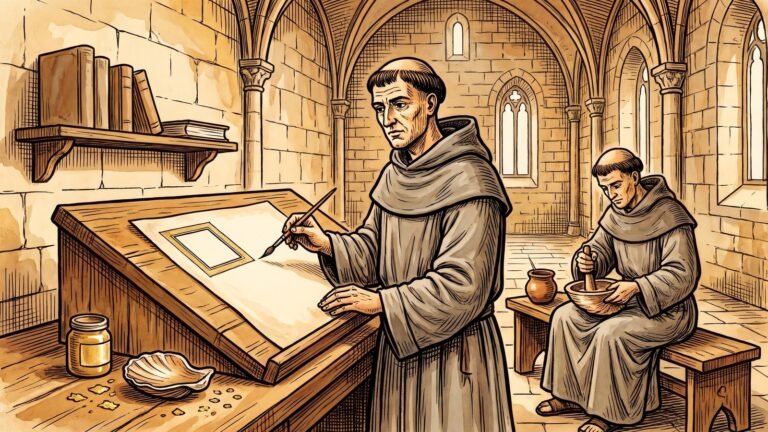
The Rabbula Gospels of 586
The Rabbula Gospels is a Syriac manuscript of the four Gospels completed in 586 at a monastery in northern Syria or Mesopotamia and now kept in the Biblioteca Medicea Laurenziana in Florence…
Reader settings
Colour theme
Colour themes are for light mode. Choosing one switches dark mode off.
Custom colourscolour wheel; text is kept readable
Preview: clear, readable long-form writing.
Saved in this browser only.
Essays migrated from masoretes.online
The Rabbula Gospels is a Syriac manuscript of the four Gospels completed in 586 at a monastery in northern Syria or Mesopotamia and now kept in the Biblioteca Medicea Laurenziana in Florence…
Codex Climaci Rescriptus is a palimpsest, a manuscript whose original writing was scraped away so that the parchment could be used again. Its upper and later text, written in Syriac around the…
Codex Marchalianus is a Greek manuscript of the Prophets written in Egypt in the sixth century and now kept in the Vatican Library under the shelfmark Vat. gr. 2125. It contains the…
About eighteen kilometres south of Qumran, a steep gorge known in Arabic as Wadi Murabbaʿat and in Hebrew as Nahal Darga cuts through the Judaean Desert towards the Dead Sea. In the…
The Samaritans, a small community living at Nablus and on Mount Gerizim in the central hills of the land of Israel, possess a number of ancient Torah scrolls written in their own…
Among the many thousands of fragments recovered from the caves near Khirbet Qumran on the north-western shore of the Dead Sea are some of the smallest written objects to survive from ancient…
In 1979, excavating a tomb in a cave on the western slope of the City of David, the archaeologist Gabriel Barkay uncovered two small objects that were, at first, easy to overlook:…
Almost every Christian who says the Lord's Prayer knows that the New Testament records it twice, once in Matthew and once in Luke, and most have heard that the two versions are…
In the winter of 1639 and 1640, in a wooden house not far from the Charles River at Cambridge in the Massachusetts Bay Colony, a printer named Stephen Daye pulled sheets off…
Two objects carry the name of Rashi into the modern world. The first is a person: Rabbi Shlomo Yitzhaki, born in Troyes in Champagne around February 1040 and buried there in July…
On 4 June 1535 the printer Pierre de Wingle finished, at Serrières on the shore of the lake of Neuchâtel, the printing of a large folio Bible in French. Its title announced…
On 4 September 1563 the printer Bernard Wojewódka completed, at Brest on the river Bug in the Grand Duchy of Lithuania, the printing of a complete Bible in Polish. The book was…
On 20 July 1590 a printer named Bálint Mantskovit finished printing, in the small village of Vizsoly in the hills of northern Hungary, the first complete Bible in the Hungarian language. The…
In 1753 and 1754 the Paris booksellers Antoine-Claude Briasson and Laurent Durand issued four large folio volumes containing the whole Hebrew Bible, a new Latin translation, and the Greek books that the…
Jacob of Edessa was a Syriac scholar, monk and bishop of the second half of the seventh century, and the most learned figure of the Syriac Orthodox Church in the generations that…
In the autumn of 1720 Richard Bentley, Master of Trinity College, Cambridge, and the most celebrated classical scholar in Europe, issued a short printed paper announcing a new edition of the Greek…
Karl Lachmann was a German philologist of the first half of the nineteenth century who worked with equal authority on Latin poetry, medieval German literature and the Greek New Testament. He is…
The Muratorian Fragment is a short Latin document, eighty-five lines long, that lists the books of the New Testament accepted by its author’s church and comments briefly on each. It survives in…
The Syro-Hexapla is a translation of the Greek Old Testament into Syriac, made in Egypt in the second decade of the seventh century by Paul, bishop of Tella, and a small group…
The Alba Bible is a manuscript of the Hebrew Bible translated into Castilian, made between 1422 and 1430 by Rabbi Moses Arragel of Guadalajara for Don Luis de Guzmán, Master of the…
The Bible historiale is a French version of the Bible composed at the end of the thirteenth century by Guyart des Moulins, a canon of the collegiate church of Saint-Pierre at Aire-sur-la-Lys…
The Bible moralisée, or moralised Bible, is a type of illustrated Bible created in Paris in the first half of the thirteenth century, in the circle of the Capetian kings of France.…
Robert Lowth was an English scholar and churchman of the eighteenth century whose lectures on the poetry of the Hebrew Bible, delivered at Oxford in the 1740s and published in Latin in…
The Ashburnham Pentateuch is a Latin manuscript of the first books of the Bible, written and painted in the late sixth or early seventh century and now preserved in the Bibliothèque nationale…