The Alba Bible and Moses Arragel’s Castilian Translation
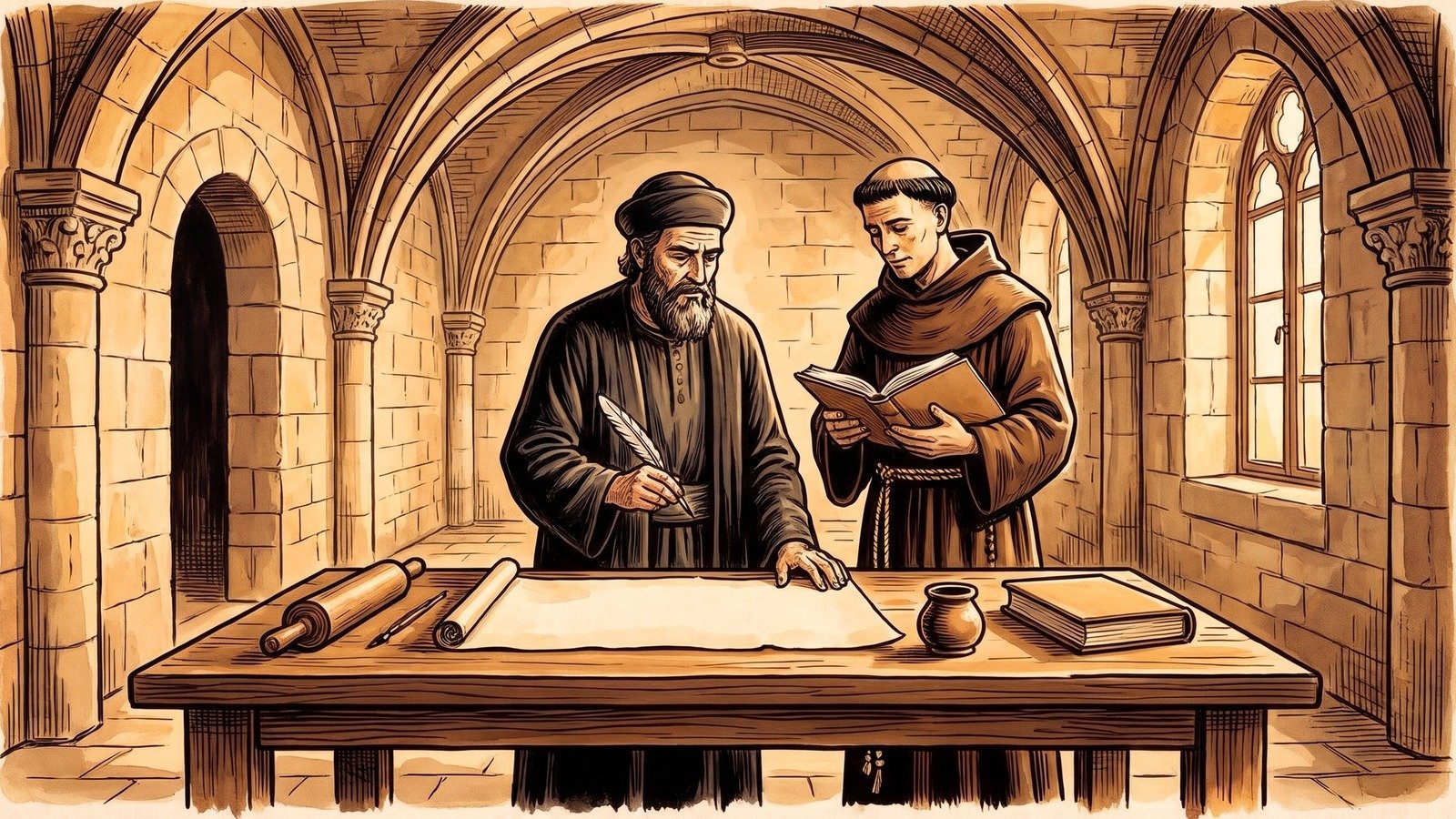
The Alba Bible is a manuscript of the Hebrew Bible translated into Castilian, made between 1422 and 1430 by Rabbi Moses Arragel of Guadalajara for Don Luis de Guzmán, Master of the military Order of Calatrava. It is one of the most ambitious books produced in fifteenth-century Spain. The translation follows the Hebrew text rather than the Latin Vulgate, and it is accompanied by a commentary of several thousand glosses in which Arragel set out the opinions of the rabbis alongside, and sometimes against, the teaching of the Church. The volume is illustrated with more than three hundred miniatures painted by Christian artists in Toledo, and it opens with an extraordinary dossier of letters and prologues in which the patron, the translator and their clerical supervisors negotiate the terms of the work. The manuscript is named after its owners since the seventeenth century, the Dukes of Alba, in whose library at the Liria Palace in Madrid it remains. It is at once a monument of Castilian prose, a witness to Jewish exegesis in the generation before the expulsion, a document of the pressures under which Jews and Christians worked together in the years after 1391, and a work of art of the first rank. This article describes the circumstances of the commission, the people who made the book, its contents and method, its pictures, its later history and its place in the long tradition of Spanish vernacular Bibles.123
At a glance
- Object: Illuminated manuscript of the Hebrew Bible translated into Castilian, with a commentary of several thousand glosses.
- Translator: Rabbi Moses Arragel of Guadalajara, living at Maqueda in the lordship of his patron.
- Patron: Don Luis de Guzmán, Master of the Order of Calatrava.
- Dates: Commissioned on 5 April 1422; the colophon gives 2 June 1430 as the date of completion of the text.
- Size: Some 513 folios, with 334 miniatures and a dossier of letters and prologues in the opening gatherings.
- Supervisors: Vasco de Guzmán, archdeacon of Toledo, and the Franciscan Arias de Encinas of the Toledo convent.
- Owner: The House of Alba, Liria Palace, Madrid, since the seventeenth century.
- Editions: Text by Antonio Paz y Meliá, 1920–1922; full colour facsimile, 1992.
Castile in the Early Fifteenth Century
After the Riots of 1391
The commission of 1422 cannot be understood without the catastrophe that had overtaken the Jews of Castile and Aragon a generation earlier. In the summer of 1391 a wave of violence that began in Seville, encouraged by the preaching of the archdeacon of Écija, Ferrant Martínez, spread to Córdoba, Toledo, Valencia, Barcelona and dozens of smaller towns. Many Jews were killed, and very many more accepted baptism under duress. Whole communities that had been among the largest in Europe ceased to exist or survived only in reduced form. The forced converts and their descendants, known as conversos or New Christians, became a new and uneasy class within Christian society, and the remaining Jews lived under a sharpened suspicion. In the following decades further measures were directed against them. The preaching campaigns of the Dominican Vincent Ferrer in the years around 1411 to 1413 brought new conversions, and the Valladolid ordinances of 1412, issued in the name of the young king John II, attempted to separate Jews from Christians in dress, residence and trade. In Aragon the great Disputation of Tortosa, held under the auspices of the antipope Benedict XIII between 1413 and 1414, set rabbis to defend the Talmud and their reading of the prophets before a convert, Jerónimo de Santa Fe, and ended in another wave of baptisms.4567
Yet this was not a world in which Jewish learning had ceased to matter to Christians. The very campaigns that sought converts depended on knowledge of Hebrew texts, and converts such as Pablo de Santa María, formerly Solomon ha-Levi, who became bishop of Burgos, carried rabbinic learning into the Church. Among the Castilian nobility there was a lively interest in vernacular books of every kind, including translations of Scripture. Christians knew that the Latin Bible of the Church was itself a translation, and the notion that the Hebrew original might illuminate obscure passages, or that Jewish commentators possessed knowledge of the language and customs of ancient Israel that Latin readers lacked, was familiar from the work of scholars such as Nicholas of Lyra, whose Postilla on the whole Bible had made the commentaries of Rashi available to Latin readers in the fourteenth century. The years of John II’s reign, from 1406 to 1454, were also a time of growing lay literacy and of noble libraries in which chronicles, romances, works of moral philosophy and translations of the classics stood side by side. A Castilian Bible made directly from the Hebrew, with Jewish commentary, was therefore an unusual but not an unthinkable project for a learned layman.8910
The Vernacular Bible in Spain before Arragel
Castile had a tradition of Bible translation that was older and stronger than that of most European kingdoms. From the thirteenth century Castilian versions of the Old Testament had been made directly from the Hebrew, sometimes evidently by Jews or converts working for Christian patrons. The manuscripts preserved in the library of the Escorial, known collectively as the biblias romanceadas, include several such versions, among them the Bible designated Escorial I.j.3 and the version of the books of the Prophets and Writings known as Escorial I.j.8. Alfonso X, in the second half of the thirteenth century, had incorporated large portions of a vernacular Bible into his General Estoria. The Church’s prohibitions of vernacular Scripture, which were severe in some parts of Europe, were applied unevenly in Castile until the end of the fifteenth century, and many of these versions circulated in noble households. Arragel’s work therefore belongs to an established practice, and it was to rival and improve on earlier versions that Guzmán asked for a new one. What makes the Alba Bible different from its predecessors is the scale of its commentary, its illustration, and the documentation of its making, which allows us to see how such a book was commissioned and what each party expected from it.111213
The Patron and the Translator
Don Luis de Guzmán
Luis González de Guzmán was elected Master of the Order of Calatrava in 1407 and held the office until his death in 1443. The order, founded in the twelfth century to defend the frontier of Castile against the Almohads, had become by the fifteenth century one of the great landholding powers of the kingdom, with commanderies and towns across New Castile and Andalusia. Its master was a political figure of the first importance, courted by kings and their favourites and involved in the factional struggles that dominated the reign of John II. Guzmán was also a reader. In the letter that opens the manuscript he explains that the Bibles available to him in Castilian were old and difficult, with obscure language and many errors, and that he wished to have a new translation, with glosses that would explain the meaning of hard passages. He asked specifically for a version made from the Hebrew, accompanied by an explanation of the Jewish understanding of the text, because, as he puts it, the souls of men require such knowledge in times when there were many doubts and debates about the Scriptures. He also asked that the volume be illustrated, so that it would be fine to look at as well as useful.141516
Guzmán’s motives have been discussed at length. Some scholars have seen in him an enlightened patron, eager to know the Hebrew truth for its own sake and willing to employ a Jew to supply it. Others have stressed that his letter is framed in the conventional language of Christian polemic and that the friars he appointed to supervise the work were charged with ensuring that the result served Christian purposes. A Bible that set out Jewish interpretations could be used to refute them as well as to learn from them. Both views can find support in the documents, and they are not necessarily incompatible. A powerful man in a turbulent age could wish to possess the best available text, to understand the arguments of the Jews who lived in his towns, and to own a magnificent book, all at once. What is clear is that he was insistent. He chose the translator, he set the terms, and he did not allow the translator’s objections to deflect him from the project.1718
Rabbi Moses Arragel
Moses Arragel was a Jew of Guadalajara, a town with an important Jewish community and a tradition of learning that included the circle in which the Zohar was composed at the end of the thirteenth century. At the time of the commission he was living at Maqueda, a town between Toledo and Madrid that belonged to the Order of Calatrava, and he was therefore one of Guzmán’s own vassals. His name, Arragel, is probably a form of an Arabic-derived family name; he is otherwise known almost entirely from the Alba Bible itself. He describes himself as a rabbi, and the commentary shows a wide acquaintance with rabbinic literature: the Talmud and the midrashim, the Targums, the great medieval commentators Rashi, Abraham ibn Ezra, David Kimhi and Nachmanides, and the philosophical tradition of Maimonides. He also knew the Christian Bible and the main lines of Christian interpretation well enough to report them fairly. His Castilian is fluent and, in the prologue and commentary, elegant, though in the translation itself it is bent closely to the shape of the Hebrew.1920212223
Arragel did not want the commission. In his reply to Guzmán he gave several reasons for declining. He pointed to the danger of the times, in which a Jew who wrote about the Christian faith or appeared to criticise it might suffer for it. He doubted his own capacity to carry out so large a work. And he raised the objection, which he would repeat throughout the process, that Jewish law forbade him to make or approve images of God, so that he could take no part in the illustration of a Bible in which the Christian painters would certainly wish to depict the Creator. Guzmán’s answer was courteous but firm. He told Arragel that the friars would answer for the Christian doctrine, that he need only set down what the Jews believed, and that the illustrations would be the responsibility of others. In the end Arragel accepted. The documents make it plain that he had little real choice, and the tone of his prologue, in which caution and pride in his learning are mingled, reflects the delicacy of his position.242526
The Supervisors
To oversee the work Guzmán appointed two churchmen of Toledo. The first was Vasco de Guzmán, archdeacon of Toledo and a kinsman of the master, whose role appears to have been chiefly that of an authority who could guarantee the orthodoxy of the finished book. The second was a Franciscan, Fray Arias de Encinas, guardian of the convent of San Francisco in Toledo, who was charged with supplying Arragel with Christian interpretations to be recorded in the glosses and with supervising the programme of illustration. Arragel was required to take instruction from the friar on points of Christian doctrine and to submit his work for review. The arrangement is depicted in the manuscript itself. In one of the opening miniatures the patron sits enthroned, surrounded by members of his order and by the clerics who supervised the work, while the kneeling translator presents the finished volume. The relative scale of the figures, with Arragel small and subordinate, expresses the hierarchy within which the collaboration took place.272829
The Making of the Book
The Letters and Prologues
The opening gatherings of the manuscript, some twenty-five folios in all, contain the documents of the commission. They include Guzmán’s letter of 5 April 1422 requesting the translation, Arragel’s reply setting out his objections, the master’s further instructions, a letter in which the archdeacon commends the project, and a long prologue by Arragel. The prologue is a treatise in its own right. In it the translator explains his method, describes the differences between Jewish and Christian readings of Scripture, sets out the main points of Jewish belief as the medieval philosophers had defined them, and gives an account of the order of the books of the Hebrew Bible and the traditions about their authorship. It also contains a remarkable passage in which Arragel explains why he has recorded Christian and Jewish interpretations without deciding between them. Each reader, he says, should hold to his own law and believe according to it; the commentator’s task is to set out what each side holds, not to compel agreement. This principle of reporting without adjudicating governs the glosses throughout.303132
The documents are rare evidence of the actual negotiation behind a medieval book. They show that the patron specified the scope and character of the work, that the translator was able to state objections and to secure some concessions, and that the clerical supervisors held a power of review. They also show the practical arrangements. Arragel worked at Maqueda, sending portions of his text to Toledo, where the friars examined them and the painters prepared the pictures. The dating clauses suggest that the translation of the Pentateuch was well advanced within a few years and that the whole was finished by the summer of 1430. The colophon records the date of 2 June 1430. The illumination may have continued for some time after the text was complete, and some scholars, including the first editor, allowed for work continuing until about 1433.3334
Scribes and Painters
The book was written by professional scribes in a formal Gothic hand, in two columns, with the translation in a larger script and the glosses in a smaller one arranged around and between the columns of text. The text was copied on parchment of high quality, and the volume, at some 513 folios, is one of the largest Castilian manuscripts of its century. The painters were Christians working in Toledo. They have not been identified by name, but their style belongs to the Castilian tradition of the early fifteenth century, which combined the elegant figure style of International Gothic painting with local habits of colour and ornament, and which had absorbed influences from Italian and French art as well as from the Mudéjar decorative tradition of the peninsula. The quality of the work varies, suggesting that more than one hand was engaged, but the best miniatures are of a very high standard.353637
The Translation
Following the Hebrew
Arragel translated from the Hebrew text as transmitted by the Jews, and he followed it with great fidelity. His Castilian reproduces the order of the Hebrew words wherever possible, preserves Hebraic idioms rather than replacing them with Castilian equivalents, and often renders a single Hebrew root consistently by a single Castilian word. The result is a version that can seem stiff to a modern reader but that conveys the texture of the original with unusual directness. In this it resembles the other Jewish and converso versions of medieval Castile and anticipates the style of the later Ladino translations, such as the Ferrara Bible of 1553, which carried literal rendering to an extreme. Arragel, however, was writing for a Christian lord and not for a synagogue, and he allowed himself more freedom than the Ladino tradition would, particularly where strict literalism would have produced nonsense. He also sometimes followed the Christian chapter divisions and the Christian order of books, as his patron’s readers would have expected.38394041
At points where Christian and Jewish readings of the text diverged, Arragel was obliged to take account of both. The most sensitive passages were those used in Christian apologetic: the plural of Genesis 1:26, “Let us make man in our image”; the prophecy of Isaiah 7:14, which the Church read as foretelling a virgin birth; the suffering servant of Isaiah 53; and the messianic psalms. In such cases Arragel’s practice was to render the Hebrew in the translation and to set out the interpretations in the glosses, noting that the Christians understood the passage in one way and the Jews in another. On Isaiah 7:14, for instance, he records that the Hebrew word means a young woman and that the Jewish commentators refer the prophecy to the time of Ahaz, while noting that the Christians read it of the mother of Jesus. He did not argue the point. His manner, which is carefully neutral, is a striking contrast with the polemical literature of the period, in which such passages were the occasion of fierce exchanges.4243
Language and Style
The Castilian of the Alba Bible is a valuable witness to the language of the early fifteenth century. It shows the vocabulary and syntax of educated Toledan usage at a time when the language was moving from its medieval to its early modern form, and it preserves many words and expressions that were becoming rare. It also shows the influence of the long tradition of translating Hebrew into Castilian. Certain conventions, such as the rendering of the divine name by Adonay, the use of particular words for ritual and priestly terms, and the reproduction of Hebrew constructions such as the infinitive absolute, are shared with other Jewish versions and suggest a common stock of translation habits that had been handed down in the schools. Modern scholars working on the history of Spanish have used the Alba Bible, together with the other biblias romanceadas, to trace this tradition, and the digital corpus of medieval Castilian Bibles now allows the versions to be compared verse by verse.444546
The Commentary
Sources and Method
The glosses of the Alba Bible, numbering more than six thousand, are the most remarkable part of the book. They occupy the margins and the spaces between the columns, and they range from single words of explanation to discussions of a page or more. Their main sources are Jewish. Arragel draws constantly on Rashi for the plain sense and for midrashic material, on Ibn Ezra for grammar and philosophy, on Kimhi for the Prophets and Psalms, and on Nachmanides for the Torah. He cites the Targum, the Talmud and the midrashic collections, and he frequently reports the opinions of “the doctors” or “the sages” without naming them. He also uses Maimonides, both for the principles of faith and for the reasons of the commandments. The Christian sources, supplied by the friars, include the early church writers, especially Augustine and Jerome, and the medieval commentators, notably Nicholas of Lyra, whose work was itself heavily indebted to Rashi. The result is a commentary in which Jewish and Christian learning are presented side by side, in Castilian, for a lay reader.474849505152
The glosses fulfil several functions. Many are philological, explaining the meaning of a Hebrew word or the reason for a particular rendering. Many are historical or geographical, identifying places, peoples and customs. Many record the legal interpretation of the commandments of the Torah, explaining how the rabbis understood a law and how it was practised. A large number set out midrashic narratives that fill gaps in the biblical story: the reasons for Cain’s crime, the youth of Abraham in Ur, the deeds of Moses in Egypt. Others are theological or philosophical, explaining the attributes of God, the nature of prophecy or the meaning of the sacrifices. And a significant number set the Jewish and Christian interpretations against each other in the neutral manner described above. Together they constitute a compendium of medieval Jewish learning in Castilian, made available to Christians, which has no real parallel in the literature of the period.5354
Points of Belief and the Order of the Books
In the prologue Arragel gave an account of what Jews believe, drawing on the philosophical tradition in which Maimonides had attempted to define the principles of the faith. The inclusion of this material in a book for a Christian patron is notable. It gave Guzmán a clear statement of Jewish doctrine in his own language and made plain the points on which Jews and Christians agreed, such as the unity and incorporeality of God and the authority of the Torah of Moses, as well as those on which they differed, notably the coming of the Messiah. Arragel also discussed the arrangement of the biblical books, explaining the threefold Jewish division into Torah, Prophets and Writings and the traditions recorded in the Talmud about the authorship of each book. The manuscript as executed follows in part the Jewish order and in part the Christian, a compromise that reflects the double audience of the work. The book of Esther, which was not provided with a full commentary, and certain other passages show signs that the work was completed under pressure of time.5556
The Miniatures
The Programme of Illustration
The Alba Bible contains 334 miniatures, ranging from full-page compositions to small scenes set within the columns of text. The programme was devised under the direction of the Franciscan supervisor, and it is overwhelmingly narrative, illustrating the stories of Genesis and Exodus, the conquest of Canaan, the deeds of the judges and kings, and the visions of the prophets. The first pages contain the presentation scenes, in which Guzmán receives the book and the order of Calatrava is depicted in its glory. There follow scenes of the creation, the fall, the flood and the patriarchs, rendered in a style of considerable refinement, with elegant figures, rich colours and abundant gold. Throughout the volume the painters drew on the standard repertory of Christian biblical illustration, but they also introduced unusual subjects that can only be explained by reference to the glosses, and therefore to Jewish exegesis.575859
The Swedish art historian Carl-Otto Nordström, in a study published in 1967, demonstrated that many of the miniatures depict scenes known only from the midrash. Examples include the representation of Abraham being cast into the furnace by Nimrod, a story derived from midrashic expansion of the phrase “Ur of the Chaldees”; and the illustrations of the punishment of the generation of the flood and of the builders of Babel, which follow rabbinic elaborations. In several instances the miniature corresponds closely to a gloss on the same page, so that the painter must have worked from Arragel’s commentary or from instructions derived from it. Nordström argued that some of these subjects might also derive from older Jewish picture cycles, now lost, which had passed into the repertory of Spanish painters, a hypothesis that remains debated. Either way, the Alba Bible is a key document for the question of the relationship between Jewish exegesis and Christian art in medieval Spain.6061
The Problem of Images
Arragel’s objection to images of God is recorded in the documents and reflected in the miniatures. He stated plainly that Jewish law forbade him to depict God or to approve such depictions, and he asked that he not be held responsible for them. The friars took responsibility for the pictures, and the painters depicted God in the usual Christian manner, as a bearded figure or as Christ, in scenes such as the creation and the giving of the Law. In some places, however, Arragel’s glosses comment on the pictures, explaining that a particular image was made at the request of the Christians and does not reflect Jewish belief. One famous instance concerns the zeal of Phinehas in Numbers 25, where the gloss refers explicitly to the accompanying image. Such passages are rare evidence of a translator commenting on the illustrations of his own text, and they show how the boundaries of the collaboration were negotiated on the page itself.626364
The presentation miniature at the beginning of the book deserves particular notice. It shows the Master of Calatrava seated on a throne beneath a canopy, flanked by knights of his order, with the friars and the archdeacon standing near him. In the foreground Arragel kneels and offers the book. Around the scene are depicted works of mercy and the virtues of a just ruler, presenting Guzmán as a model of Christian lordship. The image is a statement of the patron’s authority over the project and of the subordinate role of the Jewish scholar who had carried it out. It is also a portrait of the translator, the only representation of a medieval Spanish rabbi at work on a Bible for a Christian patron, and it has been reproduced many times as an emblem of the complex relations between Jews and Christians in late medieval Spain.6566
Later History of the Manuscript
From Calatrava to the Inquisition
Little is known of the manuscript’s whereabouts in the decades after Guzmán’s death in 1443. It presumably remained in the possession of the order or of the Guzmán family. The circumstances changed sharply at the end of the century. The Inquisition, established in Castile from 1478, was primarily concerned with the conversos, and in 1492 the Jews who refused baptism were expelled from the Spanish kingdoms by the edict of Ferdinand and Isabella. In the following decades vernacular Bibles came under suspicion as books that might sustain Judaizing among New Christians or spread heretical opinions, and the indexes of prohibited books issued by the Spanish Inquisition, notably that of Fernando de Valdés in 1551 and 1559, forbade translations of Scripture into the vernacular. Many manuscripts of the biblias romanceadas were surrendered or destroyed. The Alba Bible came into the hands of the Inquisition, and it was evidently preserved there rather than destroyed, presumably because of its value and its origin in a commission from the Master of Calatrava.676869
Olivares and the House of Alba
In the early 1620s the manuscript was given by the Inquisitor General to Gaspar de Guzmán, Count-Duke of Olivares, the favourite and chief minister of Philip IV, who was a collector of books on a grand scale and who claimed descent from the same Guzmán lineage as the original patron. Olivares’s library was one of the largest in Spain, and the Bible was among its most precious items. After his fall and death in 1645, his books passed through his heirs, and by a series of inheritances the manuscript came into the possession of the Dukes of Alba, whose palace of Liria in Madrid became its home. There it has remained, apart from periods of exhibition and the dangers of the Spanish Civil War, when the palace was damaged by bombing in 1936 and many of its treasures were evacuated. The manuscript survived and is now one of the principal treasures of the Alba collection.707172
Editions and Facsimile
The text of the Alba Bible was published by Antonio Paz y Meliá, librarian to the Duke of Alba, in two large volumes in 1920 and 1922. The edition, sponsored by the Duke and presented to the members of the Roxburghe Club, made the translation and the documents available in print for the first time, with reproductions of a selection of miniatures. In 1992, to mark the quincentenary of the expulsion of the Jews from Spain, a full colour facsimile was published by Facsimile Editions of London in association with the Fundación Amigos de Sefarad, accompanied by a companion volume of studies edited by Jeremy Schonfield. The facsimile made the miniatures accessible as never before and stimulated a new wave of scholarship. Sonia Fellous’s monograph of 2001 provided the fullest study of the making of the book, the relations between patron, translator and supervisors, and the commentary. The text has also been transcribed for the digital corpus of medieval Castilian Bibles directed by Andrés Enrique-Arias, which allows comparison with the other medieval versions.73747576
Interpretation and Significance
A Document of Collaboration and Constraint
The Alba Bible has often been presented as a symbol of the convivencia of Jews, Christians and Muslims in medieval Spain, a moment of collaboration on the eve of the expulsion. The documents justify a more nuanced reading. The project was a collaboration, and its result is a book of great learning and beauty in which Jewish and Christian interpretations stand side by side. But it was also a collaboration between unequals, in which a Jewish vassal was required to undertake a work he did not want, under the supervision of Christian clerics, in a period of persecution. Arragel’s neutrality was a strategy of survival as much as a principle of tolerance, and his objections to the images were overruled. The book records the intellectual openness of a Christian patron and the vulnerability of the Jewish scholar he employed. It is valuable precisely because it records both.777879
This double character can be seen in the later history of Arragel’s community. Within seventy years of the completion of the Bible, the Jews of Castile were given the choice of baptism or exile. Many of those who remained became conversos, and their descendants lived under the suspicion of the Inquisition. Those who left carried the tradition of Hebrew-to-Romance translation with them, and in the following century the Sephardic exiles produced the Ladino versions printed at Constantinople, Salonica and Ferrara. The Alba Bible belongs to the last generation of this tradition on Spanish soil, and its commentary preserves a body of learning that was soon to be dispersed. For students of Sephardic culture it is therefore a precious record of what was lost.808182
Its Place in the History of the Spanish Bible
In the history of the Bible in Spanish, the Alba Bible marks the high point of the medieval tradition of translation from the Hebrew. It shows how far that tradition had developed by the early fifteenth century and how well it could serve a Christian reader who wanted the Hebrew sense. After 1492 and the prohibitions of the sixteenth century, the tradition was broken in Spain itself. The next great Spanish Bibles were made abroad, by the Jews of Ferrara in 1553 and by the Protestant exile Casiodoro de Reina, whose Bible was printed at Basel in 1569. Both drew, in different ways, on the earlier Castilian tradition, and Reina is known to have consulted the Ferrara Bible. Inside Spain no complete vernacular Bible was printed until the end of the eighteenth century, when the translation of Felipe Scío de San Miguel appeared, made from the Vulgate. The Alba Bible thus stands at the threshold of a long silence, a reminder that Spain had once possessed one of the richest traditions of vernacular Scripture in Europe.83848586
For historians of art, the Alba Bible is one of the most important Castilian illuminated manuscripts of the fifteenth century and a crucial witness to the relationship between Jewish exegesis and Christian imagery. Its miniatures sit at the meeting point of several traditions: the Gothic painting of Toledo, the Hebrew illumination of the Sephardic Bibles of Catalonia and Castile, and the Mudéjar ornament of the peninsula. The Hebrew Bibles of the period, such as the Cervera Bible of 1300 and the Farhi Bible of Elisha Cresques, show what Jewish patrons commissioned for themselves, and the comparison with the Alba Bible shows the different conventions that governed books made for Christian readers. For historians of religion, it is a uniquely documented case of Jewish and Christian scholars working together on the text of Scripture, under conditions that reveal both the attraction and the danger of such cooperation.87888990
Reading the Alba Bible Today
The Translator’s Voice
What remains most vivid in the Alba Bible is the voice of its translator. In the prologue and glosses Arragel speaks with a scholar’s pride and a subject’s caution. He reminds his patron of the respect due to learning, describes the difficulty of his task, and protests his fidelity to the text. He insists that he has reported the opinions of the Christians as the friars gave them to him, and that the views of the Jews are those of the sages, not his own inventions. He asks to be forgiven if he has erred. At the same time he does not hide his conviction that the Hebrew text and its Jewish interpretation possess an authority that no translation can replace. He tells his patron that a translation can only approximate the original, that every language has its own idioms, and that the full meaning of Scripture is not exhausted by any single rendering. In such passages the Alba Bible becomes not only a source for the history of Bible translation but a reflection on the act of translation itself.919293
The relationship between Arragel and his supervisors, as it emerges from the documents and glosses, has also been read as an early instance of the problems that every interconfessional translation must face. The friars wanted a book that would serve Christian ends; the translator wanted to preserve the integrity of the Hebrew text and its Jewish understanding; the patron wanted a work of learning and beauty. These aims were partly compatible and partly in tension, and the book bears the marks of their negotiation on almost every page. Modern interconfessional Bible translations, made by committees of Jews and Christians or by Catholic and Protestant scholars together, have faced the same questions of authority, terminology and annotation. The Alba Bible is a medieval case of a problem that has never ceased to arise.9495
Questions That Remain
Several questions about the Alba Bible remain open. The identity of the painters and the precise organisation of their workshop are unknown. The extent to which the unusual subjects of the miniatures derive from lost Jewish picture cycles, rather than from the glosses alone, is still debated. The relationship between Arragel’s translation and the earlier Castilian versions from the Hebrew, especially those preserved at the Escorial, has been studied but not fully resolved, and it is possible that Arragel drew on existing renderings for parts of his text. The later fortunes of the manuscript between the death of the patron and its surrender to the Inquisition are obscure. And the question of the patron’s intentions, whether scholarly, polemical or devotional, may never be settled. These questions keep the Alba Bible at the centre of research on the cultural history of fifteenth-century Spain.969798
The manuscript also continues to raise questions about Arragel himself. He is known to us only through this one work, yet he was evidently one of the most learned Jews of his time in Castile. Whether he lived to see the hardening of attitudes in the second half of the century, whether his family remained Jewish or converted, and whether he wrote other works now lost, are all unknown. The very fact that he is remembered at all is due to the survival of a book made for a Christian patron. In this respect his fate resembles that of many Jewish scholars of medieval Spain, whose learning survives chiefly where Christians found it useful to preserve.99100
Assessment
The Alba Bible is one of the great books of the Spanish Middle Ages. It offers a complete translation of the Hebrew Bible into Castilian, made from the original by a learned rabbi, with a commentary that brings together the main currents of medieval Jewish exegesis and sets them beside the Christian tradition. It is illustrated with a programme of miniatures that is both a work of art of high quality and a document of the interaction between Jewish learning and Christian imagery. And it preserves, in its opening gatherings, the record of the negotiations through which it was made, showing the patron’s ambitions, the translator’s reluctance and the supervisors’ control. Few medieval books allow us to see so clearly how they came into being.101102103
Its significance extends beyond its own pages. It stands near the end of a long tradition of vernacular Scripture in Castile, a tradition that was broken by the Inquisition and the expulsion and that revived only in exile and, much later, in Spain itself. It records a moment in which a Christian lord could ask a Jew to explain the Bible to him in his own language, and a Jew could answer with learning and dignity, even under constraint. And it reminds us that the history of the Bible in Europe was shaped not only by the great Latin and Protestant traditions but also by the encounters between Jews and Christians over the meaning of the text they shared. For readers interested in the Hebrew text and its interpretation, the Alba Bible remains a uniquely rich witness to how that text was read, translated and argued over in the generation before 1492.104105106107
Notes
- Antonio Paz y Meliá, ed., Biblia (Antiguo Testamento) traducida del hebreo al castellano por Rabí Mosé Arragel de Guadalfajara (1422–1433?) y publicada por el Duque de Berwick y de Alba, 2 vols. (Madrid: Imprenta Artística, 1920–1922). *
- Sonia Fellous, Histoire de la Bible de Moïse Arragel: Quand un rabbin interprète la Bible pour les chrétiens (Paris: Somogy, 2001). *
- ““Alba Bible””. *
- Yitzhak Baer, A History of the Jews in Christian Spain, 2 vols. (Philadelphia: Jewish Publication Society, 1961–1966). *
- ““Massacre of 1391””. *
- ““Disputation of Tortosa””. *
- ““Vincent Ferrer””. *
- Yitzhak Baer, A History of the Jews in Christian Spain, 2 vols. (Philadelphia: Jewish Publication Society, 1961–1966). *
- Benzion Netanyahu, The Origins of the Inquisition in Fifteenth Century Spain (New York: Random House, 1995). *
- ““John II of Castile””. *
- Margherita Morreale, “Vernacular Scriptures in Spain,” in G. W. H. Lampe, ed., The Cambridge History of the Bible, vol. 2 (Cambridge: Cambridge University Press, 1969), 465–491. *
- Gemma Avenoza, Biblias castellanas medievales (San Millán de la Cogolla: Cilengua, 2011). *
- Moshe Lazar, ed., Biblia Ladinada: Escorial I.j.3 (Madison: Hispanic Seminary of Medieval Studies, 1995). *
- Antonio Paz y Meliá, ed., Biblia (Antiguo Testamento) traducida del hebreo al castellano por Rabí Mosé Arragel de Guadalfajara (1422–1433?) y publicada por el Duque de Berwick y de Alba, 2 vols. (Madrid: Imprenta Artística, 1920–1922). *
- Sonia Fellous, Histoire de la Bible de Moïse Arragel: Quand un rabbin interprète la Bible pour les chrétiens (Paris: Somogy, 2001). *
- ““Order of Calatrava””. *
- Sonia Fellous, Histoire de la Bible de Moïse Arragel: Quand un rabbin interprète la Bible pour les chrétiens (Paris: Somogy, 2001). *
- Jeremy Schonfield, ed., The Alba Bible: Companion Volume to the Facsimile Edition (London: Facsimile Editions; Madrid: Fundación Amigos de Sefarad, 1992). *
- Sonia Fellous, Histoire de la Bible de Moïse Arragel: Quand un rabbin interprète la Bible pour les chrétiens (Paris: Somogy, 2001). *
- ““Rashi””. *
- ““David Kimhi””. *
- ““Abraham ibn Ezra””. *
- ““Nachmanides””. *
- Antonio Paz y Meliá, ed., Biblia (Antiguo Testamento) traducida del hebreo al castellano por Rabí Mosé Arragel de Guadalfajara (1422–1433?) y publicada por el Duque de Berwick y de Alba, 2 vols. (Madrid: Imprenta Artística, 1920–1922). *
- Sonia Fellous, Histoire de la Bible de Moïse Arragel: Quand un rabbin interprète la Bible pour les chrétiens (Paris: Somogy, 2001). *
- Jeremy Schonfield, ed., The Alba Bible: Companion Volume to the Facsimile Edition (London: Facsimile Editions; Madrid: Fundación Amigos de Sefarad, 1992). *
- Carl-Otto Nordström, The Duke of Alba’s Castilian Bible: A Study of the Rabbinical Features of the Miniatures, Figura n.s. 5 (Uppsala: Almqvist & Wiksell, 1967). *
- Sonia Fellous, Histoire de la Bible de Moïse Arragel: Quand un rabbin interprète la Bible pour les chrétiens (Paris: Somogy, 2001). *
- ““Franciscans””. *
- Antonio Paz y Meliá, ed., Biblia (Antiguo Testamento) traducida del hebreo al castellano por Rabí Mosé Arragel de Guadalfajara (1422–1433?) y publicada por el Duque de Berwick y de Alba, 2 vols. (Madrid: Imprenta Artística, 1920–1922). *
- Sonia Fellous, Histoire de la Bible de Moïse Arragel: Quand un rabbin interprète la Bible pour les chrétiens (Paris: Somogy, 2001). *
- Jeremy Schonfield, ed., The Alba Bible: Companion Volume to the Facsimile Edition (London: Facsimile Editions; Madrid: Fundación Amigos de Sefarad, 1992). *
- Antonio Paz y Meliá, ed., Biblia (Antiguo Testamento) traducida del hebreo al castellano por Rabí Mosé Arragel de Guadalfajara (1422–1433?) y publicada por el Duque de Berwick y de Alba, 2 vols. (Madrid: Imprenta Artística, 1920–1922). *
- Sonia Fellous, Histoire de la Bible de Moïse Arragel: Quand un rabbin interprète la Bible pour les chrétiens (Paris: Somogy, 2001). *
- Carl-Otto Nordström, The Duke of Alba’s Castilian Bible: A Study of the Rabbinical Features of the Miniatures, Figura n.s. 5 (Uppsala: Almqvist & Wiksell, 1967). *
- Jeremy Schonfield, ed., The Alba Bible: Companion Volume to the Facsimile Edition (London: Facsimile Editions; Madrid: Fundación Amigos de Sefarad, 1992). *
- ““Illuminated manuscript””. *
- Gemma Avenoza, Biblias castellanas medievales (San Millán de la Cogolla: Cilengua, 2011). *
- Ángel Sáenz-Badillos, A History of the Hebrew Language, trans. John Elwolde (Cambridge: Cambridge University Press, 1993). *
- ““Old Spanish””. *
- See also “The Ferrara Bible of 1553” on this site. *
- Sonia Fellous, Histoire de la Bible de Moïse Arragel: Quand un rabbin interprète la Bible pour les chrétiens (Paris: Somogy, 2001). *
- Ángel Sáenz-Badillos, A History of the Hebrew Language, trans. John Elwolde (Cambridge: Cambridge University Press, 1993). *
- Gemma Avenoza, Biblias castellanas medievales (San Millán de la Cogolla: Cilengua, 2011). *
- Andrés Enrique-Arias, ed., Biblia Medieval, online corpus of the medieval Castilian Bibles, with the Alba text transcribed. *
- ““Old Spanish””. *
- Carl-Otto Nordström, The Duke of Alba’s Castilian Bible: A Study of the Rabbinical Features of the Miniatures, Figura n.s. 5 (Uppsala: Almqvist & Wiksell, 1967). *
- Sonia Fellous, Histoire de la Bible de Moïse Arragel: Quand un rabbin interprète la Bible pour les chrétiens (Paris: Somogy, 2001). *
- ““Rashi””. *
- ““David Kimhi””. *
- ““Abraham ibn Ezra””. *
- ““Nachmanides””. *
- Sonia Fellous, Histoire de la Bible de Moïse Arragel: Quand un rabbin interprète la Bible pour les chrétiens (Paris: Somogy, 2001). *
- Jeremy Schonfield, ed., The Alba Bible: Companion Volume to the Facsimile Edition (London: Facsimile Editions; Madrid: Fundación Amigos de Sefarad, 1992). *
- Sonia Fellous, Histoire de la Bible de Moïse Arragel: Quand un rabbin interprète la Bible pour les chrétiens (Paris: Somogy, 2001). *
- ““Hebrew Bible””. *
- Carl-Otto Nordström, The Duke of Alba’s Castilian Bible: A Study of the Rabbinical Features of the Miniatures, Figura n.s. 5 (Uppsala: Almqvist & Wiksell, 1967). *
- Jeremy Schonfield, ed., The Alba Bible: Companion Volume to the Facsimile Edition (London: Facsimile Editions; Madrid: Fundación Amigos de Sefarad, 1992). *
- ““Illuminated manuscript””. *
- Carl-Otto Nordström, The Duke of Alba’s Castilian Bible: A Study of the Rabbinical Features of the Miniatures, Figura n.s. 5 (Uppsala: Almqvist & Wiksell, 1967). *
- Katrin Kogman-Appel, Jewish Book Art between Islam and Christianity: The Decoration of Hebrew Bibles in Medieval Spain (Leiden: Brill, 2004). *
- Carl-Otto Nordström, The Duke of Alba’s Castilian Bible: A Study of the Rabbinical Features of the Miniatures, Figura n.s. 5 (Uppsala: Almqvist & Wiksell, 1967). *
- Sonia Fellous, Histoire de la Bible de Moïse Arragel: Quand un rabbin interprète la Bible pour les chrétiens (Paris: Somogy, 2001). *
- ““Alba Bible””. *
- Carl-Otto Nordström, The Duke of Alba’s Castilian Bible: A Study of the Rabbinical Features of the Miniatures, Figura n.s. 5 (Uppsala: Almqvist & Wiksell, 1967). *
- Jeremy Schonfield, ed., The Alba Bible: Companion Volume to the Facsimile Edition (London: Facsimile Editions; Madrid: Fundación Amigos de Sefarad, 1992). *
- Benzion Netanyahu, The Origins of the Inquisition in Fifteenth Century Spain (New York: Random House, 1995). *
- ““Spanish Inquisition””. *
- ““Alhambra Decree””. *
- Antonio Paz y Meliá, ed., Biblia (Antiguo Testamento) traducida del hebreo al castellano por Rabí Mosé Arragel de Guadalfajara (1422–1433?) y publicada por el Duque de Berwick y de Alba, 2 vols. (Madrid: Imprenta Artística, 1920–1922). *
- ““Gaspar de Guzmán, Count-Duke of Olivares””. *
- ““House of Alba””. *
- Antonio Paz y Meliá, ed., Biblia (Antiguo Testamento) traducida del hebreo al castellano por Rabí Mosé Arragel de Guadalfajara (1422–1433?) y publicada por el Duque de Berwick y de Alba, 2 vols. (Madrid: Imprenta Artística, 1920–1922). *
- Sonia Fellous, Histoire de la Bible de Moïse Arragel: Quand un rabbin interprète la Bible pour les chrétiens (Paris: Somogy, 2001). *
- Jeremy Schonfield, ed., The Alba Bible: Companion Volume to the Facsimile Edition (London: Facsimile Editions; Madrid: Fundación Amigos de Sefarad, 1992). *
- Andrés Enrique-Arias, ed., Biblia Medieval, online corpus of the medieval Castilian Bibles, with the Alba text transcribed. *
- Sonia Fellous, Histoire de la Bible de Moïse Arragel: Quand un rabbin interprète la Bible pour les chrétiens (Paris: Somogy, 2001). *
- Yitzhak Baer, A History of the Jews in Christian Spain, 2 vols. (Philadelphia: Jewish Publication Society, 1961–1966). *
- Gregory B. Kaplan, The Evolution of Converso Literature: The Writings of the Converted Jews of Medieval Spain (Gainesville: University Press of Florida, 2002). *
- ““Alhambra Decree””. *
- ““Sephardic Jews””. *
- See also “The Ferrara Bible of 1553” on this site. *
- Margherita Morreale, “Vernacular Scriptures in Spain,” in G. W. H. Lampe, ed., The Cambridge History of the Bible, vol. 2 (Cambridge: Cambridge University Press, 1969), 465–491. *
- Gemma Avenoza, Biblias castellanas medievales (San Millán de la Cogolla: Cilengua, 2011). *
- See also “The Ferrara Bible of 1553” on this site. *
- See also “The Reina-Valera Bible and the Bear Bible of 1569” on this site. *
- Katrin Kogman-Appel, Jewish Book Art between Islam and Christianity: The Decoration of Hebrew Bibles in Medieval Spain (Leiden: Brill, 2004). *
- See also “The Cervera Bible of 1300” on this site. *
- See also “The Farhi Bible and Elisha Cresques of Majorca” on this site. *
- See also “The Lisbon Bible and the Portuguese School of Hebrew Illumination” on this site. *
- Antonio Paz y Meliá, ed., Biblia (Antiguo Testamento) traducida del hebreo al castellano por Rabí Mosé Arragel de Guadalfajara (1422–1433?) y publicada por el Duque de Berwick y de Alba, 2 vols. (Madrid: Imprenta Artística, 1920–1922). *
- Sonia Fellous, Histoire de la Bible de Moïse Arragel: Quand un rabbin interprète la Bible pour les chrétiens (Paris: Somogy, 2001). *
- Ángel Sáenz-Badillos, A History of the Hebrew Language, trans. John Elwolde (Cambridge: Cambridge University Press, 1993). *
- Sonia Fellous, Histoire de la Bible de Moïse Arragel: Quand un rabbin interprète la Bible pour les chrétiens (Paris: Somogy, 2001). *
- Jeremy Schonfield, ed., The Alba Bible: Companion Volume to the Facsimile Edition (London: Facsimile Editions; Madrid: Fundación Amigos de Sefarad, 1992). *
- Carl-Otto Nordström, The Duke of Alba’s Castilian Bible: A Study of the Rabbinical Features of the Miniatures, Figura n.s. 5 (Uppsala: Almqvist & Wiksell, 1967). *
- Gemma Avenoza, Biblias castellanas medievales (San Millán de la Cogolla: Cilengua, 2011). *
- Katrin Kogman-Appel, Jewish Book Art between Islam and Christianity: The Decoration of Hebrew Bibles in Medieval Spain (Leiden: Brill, 2004). *
- Sonia Fellous, Histoire de la Bible de Moïse Arragel: Quand un rabbin interprète la Bible pour les chrétiens (Paris: Somogy, 2001). *
- Yitzhak Baer, A History of the Jews in Christian Spain, 2 vols. (Philadelphia: Jewish Publication Society, 1961–1966). *
- Carl-Otto Nordström, The Duke of Alba’s Castilian Bible: A Study of the Rabbinical Features of the Miniatures, Figura n.s. 5 (Uppsala: Almqvist & Wiksell, 1967). *
- Sonia Fellous, Histoire de la Bible de Moïse Arragel: Quand un rabbin interprète la Bible pour les chrétiens (Paris: Somogy, 2001). *
- Jeremy Schonfield, ed., The Alba Bible: Companion Volume to the Facsimile Edition (London: Facsimile Editions; Madrid: Fundación Amigos de Sefarad, 1992). *
- Margherita Morreale, “Vernacular Scriptures in Spain,” in G. W. H. Lampe, ed., The Cambridge History of the Bible, vol. 2 (Cambridge: Cambridge University Press, 1969), 465–491. *
- Yitzhak Baer, A History of the Jews in Christian Spain, 2 vols. (Philadelphia: Jewish Publication Society, 1961–1966). *
- ““Alba Bible””. *
- ““Hebrew Bible””. *


