The Dealer as Enemy: Alfred Flechtheim and the Plunder of Modern Art
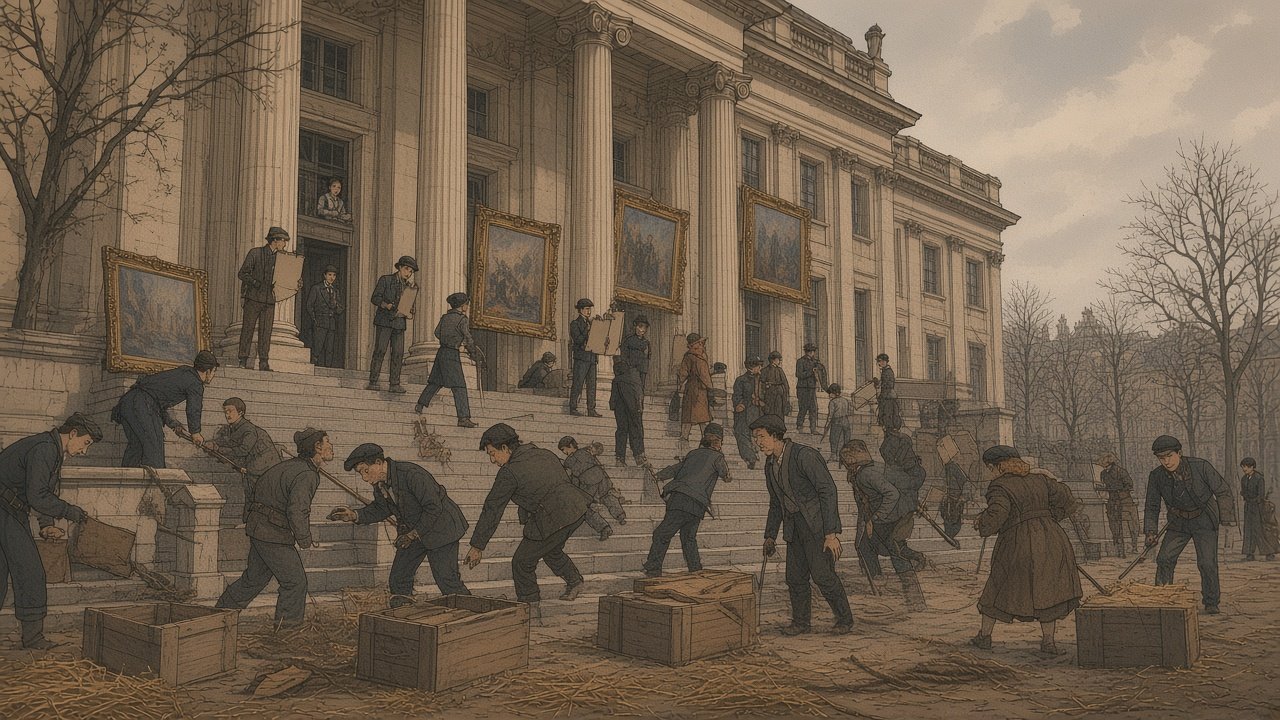
Alfred Flechtheim sold Picasso to Germany and was drawn by the Nazis as the face of the Jewish art trade. This long read follows him and the Jewish dealers of Berlin, Vienna and Paris from the making of the modern art market through persecution and plunder to the restitution claims still open today.
In 1926 Otto Dix painted the art dealer Alfred Flechtheim standing before a cubist still life, his long fingers splayed across a canvas he is holding, his great curved nose and heavy-lidded eyes pushed to the edge of caricature. It is a brilliant picture and an ugly one. Dix had his grievances: Flechtheim had declined to show his work, and the painter thought him greedy and dishonest. But the portrait reaches past personal spite into a vocabulary that every German viewer of the time could read. Here was the Jew as middleman, the cosmopolitan who sold French pictures to Germans, the dealer whose hands were on art and money at once.[1] Within a few years the same vocabulary would be printed in the Nazi press and on the posters of the regime’s campaign against modern art, with Flechtheim’s face as its emblem.
This essay is about the people behind that face: the German-Jewish dealers who built the market for modern art in central Europe, the French-Jewish dealers who were their partners and rivals in Paris, and what happened to them, their galleries and their pictures when National Socialism came first to Germany, then to Austria and finally to France. It draws throughout on Charles Dellheim’s Belonging and Betrayal: How Jews Made the Art World Modern (2021), a group portrait of the Jewish dealers who, between the 1870s and the 1940s, turned a cottage trade into an international market and then watched it torn apart.[2] Dellheim’s question is deliberately turned on its head. The story of Nazi looting usually begins with the theft. He begins further back and asks how Jewish families came to own, sell and champion so much art in the first place, and why that success made them so visible and so vulnerable.
Some of these dealers already have their own pages on this site. The old-master trade of the Duveens, from Hull to Fifth Avenue, is told in the Duveen family history on Merchants, and the fate of the Rothschild collections in 1938 and 1940 is covered in Vienna and Paris under the Nazis. They appear here only where their paths cross Flechtheim’s. The centre of gravity is elsewhere: in Düsseldorf and Berlin, in the back rooms of the rue La Boétie, in a London hospital ward in 1937, in a railway siding at Aubervilliers in 1944, and in the restitution hearings that are still running today.
1. The middlemen
Dellheim’s story begins not with modernism but with horses, textiles and art supplies. In 1875 a client approached Nathan Wildenstein, a twenty-four-year-old Jewish textile merchant in the small Champagne town of Vitry-le-François, with some pictures she wanted to sell. He knew nothing whatever about art.[3] Wildenstein had been born in 1851 in Fegersheim, an Alsatian village near Strasbourg, had left school at fourteen and had become a horse dealer like his father and grandfather. During the Franco-Prussian War he left Alsace, which was about to pass to Germany, did his military service in a French infantry regiment and settled in Vitry-le-François, some 175 kilometres from Paris.[3] He took the client’s pictures, taught himself by looking in the Louvre, and within a generation had founded one of the most powerful old-master houses in the world, first in partnership with Ernest Gimpel, a dealer from Mulhouse, and then on his own.[3]
The pattern repeats across the book. Alexandre Bernheim, born in Besançon in 1839 into an Alsatian-Jewish family, went to work for his father, who sold frames, paints and brushes and had begun carrying the work of local painters; his sons would turn the business into the Galerie Bernheim-Jeune, which bought impressionists on the secondary market when Durand-Ruel had the primary one sewn up and went on to deal in Bonnard, Vuillard and van Gogh.[4] Alexandre Rosenberg, an immigrant from Bratislava, founded the firm that his sons Léonce and Paul would make central to Picasso’s career. Paul Rosenberg remembered being taken by his father, at about ten, to look at a van Gogh of a bedroom in a shop window in the rue Le Peletier; the picture made him shriek with horror.[5] In Britain, the Duveen brothers began by importing Dutch porcelain to Hull, and Joseph Duveen ended as the dealer who sold the old masters of Europe to the plutocrats of America. That history has its own pages here, beginning with Joseph learns the trade and the longer essay A Dealer in Old Masters, and it need not be retold.
What linked these families was not taste. Several of the founders had none to begin with. It was the structure of the trade. Dealing in art, Dellheim argues, suited people who had long been confined to middleman occupations, who had experience of moving goods between markets and of extending credit on trust, and who could draw on networks of relatives in other cities.[2] Capital requirements were modest at the start; a dealer could begin with a shop and a few pictures. The firms were family businesses in which sons were trained from boyhood and marriages joined allied houses, as René Gimpel’s did with the Duveens. And the clients, increasingly, were themselves new money, including many Jewish bankers and industrialists, who wanted guidance and were willing to pay for it.
This is the background to what Dellheim calls the old masters’ new masters and the modernists’ champions.[2] By 1900 Jewish dealers had a disproportionate share of the market in both. They sold Rembrandts and Fragonards to the Morgans and Fricks, and they gambled on Cézanne, van Gogh and Picasso when almost nobody else would. The second role was riskier, more visible and more controversial. Old masters carried the prestige of history; their dealers could present themselves as custodians of tradition. Modern art was a wager on the future, and to its enemies it looked like a speculation dressed up as a revolution. It was in that second role, and in Germany, that Alfred Flechtheim made his name.
2. The grain merchant’s son
Alfred Flechtheim was born in Münster, in Westphalia, on 1 April 1878, into a family of grain merchants who had prospered in the trade for generations. The family motto, as Dellheim records it, was to be just and to shun no one, and the young Alfred was expected to carry it into the firm. Much later, in 1927, he would say that he had wanted to be his father’s dignified successor.[6] The family sent him to a commercial school in Geneva and then on the circuit of apprenticeships that a merchant house used to make a man of its heir: exchanges and offices in Liverpool, London, Bucharest and Moscow. It was a thoroughly cosmopolitan education, and it left him with good French, a working knowledge of how goods move between markets, and no particular wish to spend his life in grain.
What changed his life was Paris. He was there by 1906, a regular at the Café du Dôme in Montparnasse, where the German painters and critics of the city gathered: the young men around Matisse, the writers who sent dispatches home to Berlin and Munich, the dealers and would-be dealers looking for the next thing. The Dôme was a German island in the Left Bank, and it was there that Flechtheim learnt to look. In 1907 he met Daniel-Henry Kahnweiler, a fellow German Jew six years his junior, who had abandoned a career in banking to open a tiny gallery in the rue Vignon and who was about to become the dealer of Picasso and Braque.[6] The two men became friends for life, and for long stretches partners in all but name.
When Flechtheim married Betti Goldschmidt, who came from a well-to-do family, he spent a good part of her dowry on pictures during their honeymoon. The story is told with relish by everyone who knew him, and it is the first of many in which money, love and art become difficult to separate. He bought from Kahnweiler and directly from the painters. Picasso sold him works including the early Blue Boy, and by the eve of the First World War Flechtheim owned what was probably the finest group of Picassos in Germany.[6] He was not yet a dealer. He was a collector who could not stop, and he said so in words that sum up the man: art made him crazy, he wrote, and he was nothing compared to art.[6]
Two exhibitions of 1912 and 1913 show him moving from collecting to promoting. The first was the Sonderbund exhibition in Cologne in 1912, the vast international survey of modern painting that set van Gogh, Cézanne, Gauguin and Munch beside the young French and German avant-garde and that became the model for the Armory Show in New York the following year. Flechtheim was among its organisers and lenders. One of the Picassos that hung there, The Actor of 1904 to 1905, would return to haunt the story more than a century later in a New York courtroom.[7] The second was the Picasso retrospective at Heinrich Thannhauser’s Moderne Galerie in Munich in 1913, the first large showing of the painter in Germany. By Dellheim’s count, roughly a third of the Picassos on the walls came from Kahnweiler and Flechtheim.[6]
Thannhauser deserves a word, because he is a reminder of how thoroughly Jewish the German market for French modernism was. Like Nathan Wildenstein in Paris, he had begun as a tailor; he had opened a small gallery in Munich with a partner, F. J. Brakl, and gone out on his own in 1909. He sent his son Justin to study art history in Berlin, Florence and Paris, where the young man heard Heinrich Wölfflin and Henri Bergson and made friends with Kahnweiler and the German collector Wilhelm Uhde.[6] The Thannhausers, father and son, were commercial, profit-minded and serious about the new painting, and they were part of a web of family firms, cousins and co-religionists that ran from Paris to Munich, Berlin, Vienna and Amsterdam. Dellheim’s argument is that this web was not incidental. Art dealing had low barriers to entry, it rewarded trust between people who could not always check each other’s goods, and it suited families who had long experience as middlemen in other trades.[2]
Flechtheim’s own entry into the trade came in a crisis. By 1913 his buying had outrun his means, and he faced bankruptcy. He suffered a nervous breakdown and, by his own account, worked out a plan to kill himself so that his life insurance would cover his debts; better to be dead than dishonourable, he wrote.[6] He was rescued by two banks, by friends, and by the sale of a van Gogh to the Düsseldorf museum for forty thousand marks. Paul Cassirer in Berlin and the playwright Carl Sternheim helped. Later that year he opened a gallery of his own in Düsseldorf, announcing with evident relief that at last he was in a position to do what he had wanted. Kahnweiler, who knew him as well as anyone, called him a man of excessive activity.[6] It was meant kindly, and it was exactly right.
Something else marked Flechtheim from the start, and his contemporaries never let it pass. He looked, by the crude standards of the day, unmistakably Jewish, and he made no effort to hide it. He was honorary president of the Maccabee sports clubs, the Jewish athletic movement whose very name was a riposte to the caricature of the weak, bookish Jew.[6] In 1920 the writer Thea Sternheim, who watched him being jostled in the street, noted in her diary that his pronounced Jewish type was provocative. She also recorded the pleasure of meeting a Jew who was proud of his heritage rather than hiding it, and his own retort to the snobbery of German nobility: was not King David, he asked, more feudal than some fly-by-night Hohenzollern?[8] He was ambitious, extravagant, theatrical, often in debt and always in motion. He was also, in the language of later German criticism, a man who could not be assimilated into anybody’s idea of a modest guest.
3. A German market for French art
To understand why Flechtheim mattered, and why he was hated, it helps to see the market he joined. In 1900 the most adventurous buyers of French modern painting in the world were not in Paris. They were in Germany and Russia, and in Germany the commerce in the new art ran largely through Jewish hands.
The decisive firm was Paul Cassirer’s in Berlin. Paul, born in 1871, and his cousin Bruno, born a year later, came from a prosperous Jewish family of the Breslau region whose wider circle included scientists, doctors and Paul’s cousin, the philosopher Ernst Cassirer. In 1898 the cousins opened a gallery and a publishing house together in the Viktoriastrasse, with a corner of Max Liebermann’s studio, the Atelierwinkel, among the first pictures on the walls.[9] Paul and Bruno soon split the business, Bruno keeping the publishing and Paul the gallery, and Paul became the business manager and impresario of the Berlin Secession, the artists’ society led by Liebermann that broke with the official art establishment of imperial Berlin.
Cassirer did more than anyone outside the Netherlands to make van Gogh’s reputation. He worked with the painter’s sister-in-law, Johanna van Gogh-Bonger, who managed the estate, and he mounted show after show in Berlin, Hamburg and elsewhere. He sold Manet, Monet, Degas, Cézanne and van Gogh to German private collectors and to a new generation of museum directors who wanted to bring the national galleries up to date. The most famous of those directors, Hugo von Tschudi at the National Gallery in Berlin, bought French impressionists with money raised from wealthy donors, many of them Jewish, and was forced out in 1909 after the Kaiser objected to the direction of the collection.[9]
The backlash came in print. In 1911 the painter Carl Vinnen published a pamphlet, the Protest of German Artists, after the Kunsthalle in Bremen bought a van Gogh, a field of poppies, for what Vinnen considered an outrageous price. The pamphlet attacked the flood of foreign pictures, the speculators who promoted them, and the critics and dealers who allegedly manipulated German taste for profit. It did not need to name Cassirer; everyone knew whom it meant.[9] The language of the Vinnen protest, with its mixture of economic nationalism, aesthetic conservatism and barely veiled antisemitism, would be heard again, louder, in the 1920s and 1930s.
Flechtheim entered this world in Cassirer’s shadow and with his help. Cassirer had backed him in the 1913 crisis, and the two men handled the sale of Flechtheim’s stock together in 1917. Flechtheim’s particular cause, however, was different. Where Cassirer had made the impressionists and van Gogh acceptable in Germany, Flechtheim set out to do the same for the generation of Picasso, Braque, Derain, Léger and Gris, the painters of Kahnweiler’s stable, and to set them alongside the Germans he admired. That made him not only a dealer but a partisan in a cultural war over whether modern German art should look to Paris at all.
Liebermann is the other figure who looms over this period, and his fate is a short history of German-Jewish hope. Son of a Berlin textile manufacturer, the leading German impressionist, president of the Prussian Academy of Arts from 1920, he was the embodiment of the Jew as a pillar of national culture. When he was asked what painting had to do with Judaism, his answer was, in effect, nothing at all.[1] In 1933 he resigned from the Academy rather than serve under the new regime. He died in 1935. His widow, Martha, took her own life in 1943 rather than face deportation, and the family’s property, including the summer villa at Wannsee, passed out of their hands under the Nazi regime. The families who had made the Berlin Secession possible, as the Ephrussi history on this site shows for Paris and Vienna, were among those who had most to lose; see Charles and the Impressionists and Art Nouveau and the Secession Movements from Mucha to Klimt.
4. The lieutenant and the sequestered stock
The First World War split the international art trade along national lines, and it fell with special force on German dealers who had lived in France. Flechtheim, at thirty-six, volunteered for the army in 1914 and was commissioned as a lieutenant in a Westphalian Uhlan regiment. He spent most of the war on military administration in occupied Belgium.[8] His associate in the new Düsseldorf gallery, Hans Fehr, was killed. Kahnweiler, a German citizen living in Paris, was away from Paris on holiday when war was declared; unable to go home to a country whose cause he rejected and forbidden to return to France, he sat out the war in Switzerland. The French state sequestered his gallery and its entire stock as enemy property.[10]
For Flechtheim the war meant ruin of a different kind. With no trade and mounting debts, he had to sell his personal collection and the gallery’s stock. About 250 works went under the hammer in Berlin on 5 June 1917, with Cassirer and the Munich auctioneer Hugo Helbing in charge. Dellheim notes the double irony of the sale: it was the first auction of contemporary painting in Germany, and in the middle of a war with France it was the only public display of French modernism the country saw.[8] Flechtheim, who would later be denounced as an agent of French taste, had been fighting for the Kaiser while his Picassos were being knocked down in Berlin.
The fate of Kahnweiler’s sequestered stock is worth following in some detail, because it is a rehearsal, in a milder key, of much that came later. After the war the French government, short of the reparations Germany owed under the Treaty of Versailles, seized German-owned property in France and began to sell it off. It made no distinction between the assets of companies and those of private persons, nor between medieval sculpture, Chinese art and cubist painting. The collections of Kahnweiler and of his friend Wilhelm Uhde were scheduled for liquidation along with everything else.[10] The cubist pictures that French nationalists had called German goods during the war would now be sold to fill the French treasury.
Kahnweiler tried everything to stop the sales. He argued that dumping hundreds of works at once would depress prices and damage the artists, many of whom he had not yet paid for the pictures that had been seized. Picasso tried and failed to recover his own sequestered work. Braque, Derain, Léger and Vlaminck, all French citizens, expected better treatment and did not get it.[10] The authorities needed an expert to value the stock and run the sales, and the man they chose was a French Jewish dealer, Léonce Rosenberg, proprietor of the Galerie de l’Effort Moderne, veteran of the Somme and a passionate advocate of cubism. He accepted in March 1921, waived the usual fee of five per cent and settled for two.[10] He seems to have believed that he could manage the sales in the artists’ interest. It was a disastrous misjudgement. At the public viewing before the first sale, Braque, sent with Derain and Vlaminck to protest on Kahnweiler’s behalf, seized Rosenberg by the collar, shook him and kicked him; the purist painter Amédée Ozenfant tried to separate them. Soon afterwards, Dellheim notes, Rosenberg began taking boxing lessons.[10]
The four sales of the Kahnweiler stock ran from June 1921 to May 1923 at the Hôtel Drouot. On the evenings of 13 and 14 June 1921 alone, 127 works were sold for the benefit of the French state; by the end about seven hundred had passed through the saleroom, carload after carload of Picasso, Braque, Gris, Léger, Derain and Vlaminck from the heroic years of cubism.[10] Prices were low. Léonce Rosenberg consoled himself that everyone who bought at the sales was now a partisan of cubism, but there was little sign that the bargain-hunters meant to keep what they had bought.[10] Kahnweiler stayed away from the saleroom and bought what little he could afford through an alliance of friends bidding on his behalf. The collector Roger Dutilleul, out of loyalty, bought only one lot, Kahnweiler’s archives, and gave them back to him. Among the pictures that went to others was Derain’s portrait of Kahnweiler’s wife Lucie; to Kahnweiler’s fury its buyer was Paul Rosenberg, Léonce’s brother.[10] Flechtheim was a member of Kahnweiler’s buying syndicate, with a stake of six thousand francs; one of the pictures it bought, for 470 francs, was a 1913 still life by Juan Gris, Violon et encrier (Violin and Inkwell), which would later pass to Flechtheim and, ninety-five years after the sale, come before a German restitution panel.[11] The episode established a pattern that would recur: the forced sale of a dealer’s stock by the state, the scramble of rival dealers, low prices and works scattered across collections in a way that made later questions of ownership impossibly tangled.
It also tells us something about the solidarity and rivalry of the Jewish dealers themselves. Kahnweiler and Léonce Rosenberg were both Jews, both champions of cubism, and both, in their way, patriots of the countries they had chosen. The sequestration made them enemies for years. Dellheim’s book is full of such pairings, and they are a corrective to any picture of Jewish dealers as a single interest. They competed for artists, for clients and for prestige; they denounced each other’s prices; they married into each other’s families and fought over each other’s stock. What bound them together, in the end, was something imposed from outside.
5. The Weimar showman
Flechtheim came out of the war with almost nothing and rebuilt with astonishing speed. In 1919 he reopened in Düsseldorf on the Königsallee, the city’s grand shopping boulevard. For two years he also showed in a pair of rooms at Cassirer’s gallery in Berlin, before taking premises of his own in the capital in 1921. The same year he opened a branch in Frankfurt, run by Kahnweiler’s brother Gustav under the name Galerie Flechtheim und Kahnweiler; Cologne followed in 1922. In 1923 he went into partnership with the Galerie Würthle in Vienna, directed by the dealer Lea Bondi-Jaray, a name that will return later in this story. At the end of that year he and Betti moved to Berlin.[8] For a few years he had, in effect, a chain of modern-art galleries across the German-speaking world.
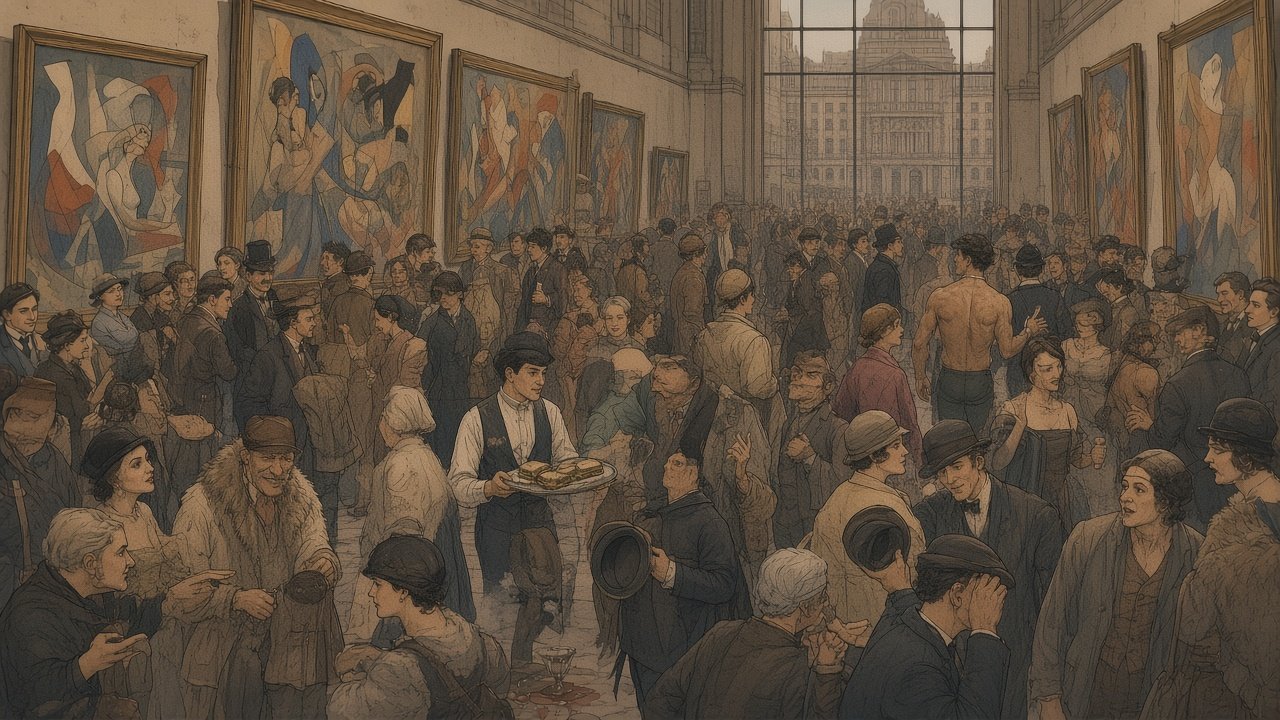
The list of artists is the list of German modernism, with Paris added. He showed and sold George Grosz, Max Beckmann, Wassily Kandinsky, Edvard Munch, Oskar Kokoschka and Max Ernst; he mounted three Paul Klee exhibitions between 1929 and 1931; he kept faith with the sculptors Renée Sintenis and Georg Kolbe and the painter Karl Hofer; and he never stopped showing the French. Dellheim counts about 150 exhibitions in some fifteen years.[8] He put some of his artists on contracts that guaranteed them a minimum income in return for their work, a practice associated above all with Kahnweiler, who had reopened in Paris in 1920 under the name of his partner André Simon and with whom Flechtheim remained closely allied.[8]
What made him famous beyond the trade was his flair for publicity. In the early 1920s he began issuing a gallery magazine, Der Querschnitt (The Cross-Section), which grew into one of the liveliest magazines of Weimar Germany and in the mid-1920s passed to the Ullstein publishing house. It mixed art, literature, fashion, gossip and sport, and it printed writers such as Hemingway, Proust and Joyce in German, often for the first time.[8][12] Sport was not an affectation. Flechtheim adored boxing, cultivated the heavyweight Max Schmeling, and liked to set prize-fighters beside painters as examples of modern grace. When he turned fifty in 1928, the magazine’s birthday issue gathered tributes from André Gide, Jean Cocteau, Schmeling and Hemingway.[8]
His parties were part of the business. In his flat off the Kurfürstendamm the guests mixed bankers and boxers, actresses and art historians, aristocrats and Communist painters. Lotte von Mendelssohn-Bartholdy made the sandwiches, and his clients from the distilling trade supplied the drink.[8] Flechtheim was, by most accounts, bisexual, and the openness of his private life was part of the air of liberty that made Weimar Berlin intoxicating to its friends and unbearable to its enemies.[12] Jules Pascin, who painted him dressed as a toreador, belonged to the same circle; his story is told on this site in Pascin of Montparnasse.
None of this made Flechtheim rich for long. The hyperinflation of 1922 and 1923 wrecked the finances of the middle-class collectors on whom he depended, and the Depression after 1929 finished what inflation had begun. He was forced to close Frankfurt and Cologne.[8] He sold well and lived beyond his means, and he was often near the edge. But by the late 1920s he had become, after Cassirer, the best-known art dealer in Germany, and after Cassirer’s death in 1926 he was the most visible.
It is worth pausing on what that visibility consisted of. Dellheim describes the 1920s and early 1930s as arguably the high-water mark of Jewish prominence in the European art world.[1] Jewish dealers ran many of the leading galleries in Berlin, Munich, Frankfurt, Vienna, Amsterdam and Paris. Jewish collectors and patrons were disproportionately represented among the buyers of modern art, and by one estimate about thirty per cent of the art historians working in Germany and Austria in the 1930s were of Jewish origin.[1] Stefan Zweig observed of Vienna that the Jewish bourgeoisie were the real audience for its culture.[2] None of this was a conspiracy, and very little of it was religious. But it could be made to look like a conspiracy by anyone who wanted to see one, and in Germany after 1918 there were many who did. Visibility, as Dellheim puts it, exacerbated vulnerability.[1]
6. Portrait of the dealer as a type
Return, then, to Dix’s portrait. It was painted on wood in about 1926, and it shows Flechtheim three-quarter length, in a dark suit, beside a cubist still life that is probably by Juan Gris, his hands resting on a canvas that appears to be a Braque.[1] The composition is a statement about taste: here is the man who brought French cubism into German drawing rooms. But Dix gave his sitter the elongated nose, the fleshy lips and the grasping fingers of the antisemitic cartoon. The contrast with his portrait of the Düsseldorf dealer Johanna Ey, painted two years earlier, a friend of the artists who was not Jewish, could hardly be sharper.[1] Dellheim reads the Flechtheim portrait as a summary of a grievance widely shared among German painters: that Jewish dealers were promoting French art at the expense of German artists and German taste.
The French had their own version of the grievance. René Gimpel, the Paris dealer whose diary is one of the great sources for the period, visited the German-born museum director Wilhelm Valentiner in March 1925 and saw his collection of expressionist paintings by Emil Nolde and Franz Marc. The pictures frightened him. The Germans of tomorrow, he wrote, would revel in cutting into real flesh.[1] In France, the right-wing press denounced the foreign, often Jewish, painters of Montparnasse as a barbarian horde: the critic Louis Vauxcelles used the phrase in 1931, and Camille Mauclair attacked the so-called School of Paris in Le Figaro in 1928 and 1929 and again, in book form, under the Occupation.[1] The arguments about Jewishness and modern art in Paris are explored on this site in The School of Paris.
In Germany the attacks moved from criticism to politics. Already in 1920 Adolf Hitler, then an obscure agitator in Munich, singled out the millionaire Paul Cassirer in a speech.[1] Cassirer himself died in January 1926, shooting himself in the middle of divorce proceedings with the actress Tilla Durieux; Liebermann and the diarist Harry Graf Kessler spoke at the memorial in his gallery in the Viktoriastrasse.[1] With Cassirer gone, Flechtheim became the chief target. He was, in Dellheim’s phrase, triply damned: as a Jew, as a Francophile and as a modernist.[8]
The attacks were personal and visual. On 7 January 1933, three weeks before Hitler became chancellor, the Nazi press printed a caricature of Flechtheim under the heading “One way or the other!”, turning his face into a shorthand for the Jewish art trade[8][12] That winter Flechtheim mounted an exhibition of living German art, which Dellheim calls the last show of its kind on German soil.[8] Within weeks the regime that had drawn him as a monster was in power.
It is easy, after the fact, to read every one of these attacks as a step on the road to genocide, and Dellheim is careful not to. Many of the people who disliked Flechtheim’s French taste were not Nazis; some were Jews. Dix himself was later declared degenerate and dismissed from his teaching post in Dresden. But the shape of the hostility is clear. The Jewish dealer was a figure onto whom resentment of the market, of modernism and of France could all be projected at once. When the state took up that resentment as policy, the dealers were among the first to feel it.
7. March 1933
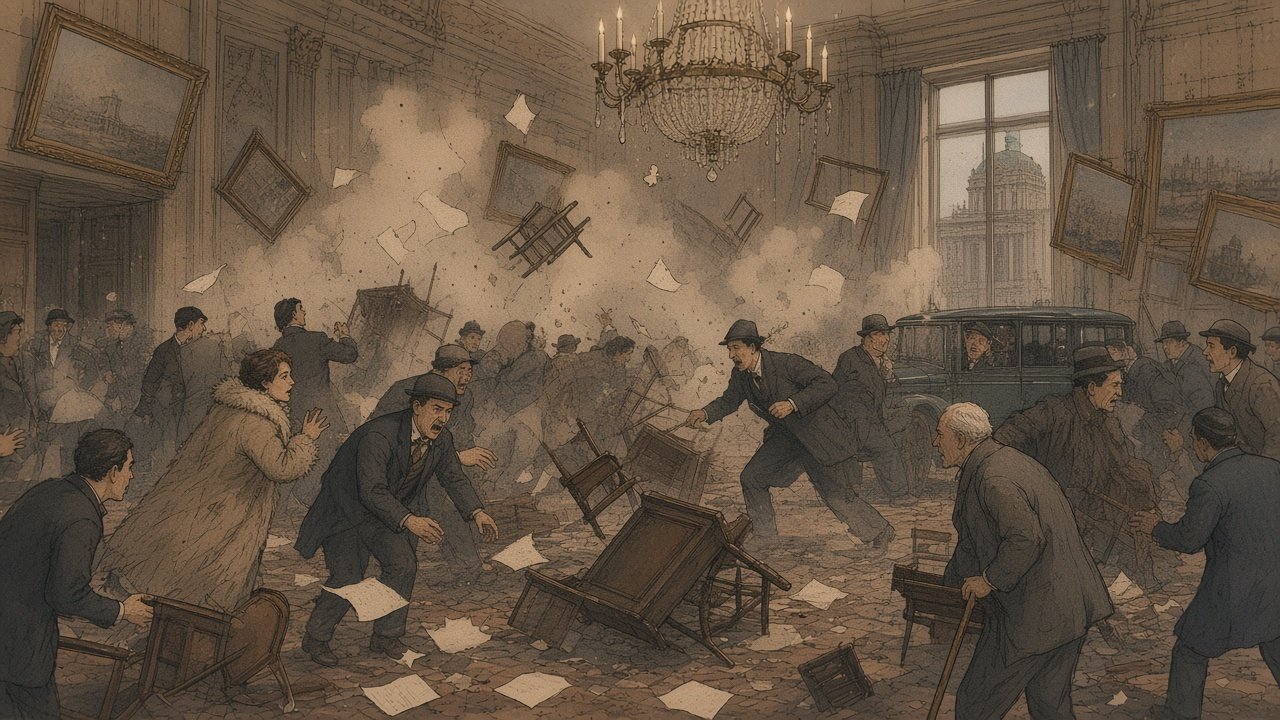
On 11 March 1933, less than a week after the Reichstag election that consolidated Nazi power, a bomb went off at an art auction in Düsseldorf. The sale had been organised by Flechtheim together with two colleagues, Hugo Helbing of Munich, himself Jewish, and the Düsseldorf dealer Georg Paffrath. Nobody was killed. Dellheim calls it an assault on Jews and modernism at once, and a signal of the theft and murder to come.[8] It was the worst of a series of attacks; others were less violent and more effective.
The regime moved quickly against modern art in public collections. Museum directors who had bought expressionist and French pictures were dismissed. In Mannheim, where the Kunsthalle had been one of the boldest buyers of modern art in Germany, a new director opened an exhibition on 4 April 1933 under the title “Images of Cultural Bolshevism”. The pictures were hung with the prices the museum had paid for them, as evidence of waste and corruption, and the labels named the dealers who had sold them, among them Cassirer and Flechtheim.[1] The message was explicit: modern art was a swindle perpetrated on the German people by Jewish middlemen.
The personal attacks came just as fast. On Flechtheim’s fifty-fifth birthday, 1 April 1933, the day of the national boycott of Jewish shops, a Düsseldorf newspaper ran a piece against him.[8] His employee Alex Vömel took over the Düsseldorf gallery that same spring and ran it under his own name. Vömel was not a party member until 1937, and Dellheim finds little evidence that he behaved ruthlessly; he kept in touch with Flechtheim until the end.[8] The gallery nevertheless passed out of Jewish hands within weeks of the seizure of power, and the speed of the transfer is part of what later made its legal status so contentious. In Berlin, Walter Feilchenfeldt, who with Grete Ring had carried on the Cassirer firm, left at once for Amsterdam.[8]
Flechtheim hesitated. Dellheim borrows Albert Hirschman’s categories of exit, voice and loyalty to describe the choices open to German Jews in 1933, and Flechtheim’s case shows how hard it was to tell which one was being exercised at any moment.[8] He spent part of 1933 with his friend the Basel collector Christoph Bernoulli, a publisher and dealer who offered him space to sell, went to Paris in the summer, went back and forth, and tried to keep the Berlin business alive. His wife did not go with him. Betti Flechtheim stayed in Berlin, in part because the Reich flight tax would have consumed the assets she had inherited.[8]
The letters of that summer have the tone of a man watching his life recede. In September 1933 he wrote to his niece Thea Löwenstein that only God knew what would become of him. In October he wrote that he had left Berlin the day before for ever, because there was no place for him there. Accounts of his emigration differ on when exactly he left Germany, and he seems to have travelled in and out during 1933, but that letter marks the end.[13] He was sharp about the reasons. If he had not dealt in Hofer, Kolbe, Sintenis and Klee, and in the French, he wrote, they would not care about him.[8] It was an acute diagnosis. He was being persecuted not only as a Jew but as the face of a kind of art, and the two charges reinforced each other.
The legal and financial machinery that followed is the part of the story most often misunderstood, because it was so undramatic. There was no single act of confiscation. A liquidator, Alfred E. Schulte, was appointed in November 1933 to wind up the Berlin firm, which had obligations of about twenty thousand Reichsmarks. Flechtheim asked his artists, Klee among them, to waive their claims. His assistant Rosi Hulisch returned works held on commission to the artists who had lent them.[8] Flechtheim himself, writing from abroad, called Schulte his liquidator and credited him with saving him from bankruptcy.[8] Every step could be described in the language of ordinary commerce: debts, creditors, consignment stock, a firm wound up. Only the context made it persecution, and it was precisely that context which later courts and committees would argue about for decades.
8. Exile in London
Flechtheim settled in London. He lived at first for a few months in Swiss Cottage and then in a succession of hotels: in Burlington Gardens, at the Regent Palace near Piccadilly Circus, at the Cumberland at Marble Arch.[8] It was the life of a man who did not expect to stay, or could not afford to.
He had managed to move part of his stock. Paintings had been lent to exhibitions in Zurich and Basel, where they were safe but out of reach. Betti, with the help of his trusted gallery staff, Curt Valentin and Rosi Hulisch, arranged for other works to reach Kahnweiler in Paris, who looked after them. By December 1933 Flechtheim had enough pictures in London to begin trading.[8] Valentin, who worked for the Berlin dealer Karl Buchholz after Flechtheim’s Berlin gallery closed, went on to New York in 1937, where he ran a gallery under Buchholz’s name and became one of the principal dealers of German modernism in America.[14]
In April 1934 Flechtheim wrote to George Grosz, already in America, that he had fed all his pictures to the crowd.[8] He meant that he had been forced to sell, quickly and cheaply, to stay afloat. Early that year he had joined the Mayor Gallery, founded in 1925 by Fred Hoyland Mayor as the first gallery on Cork Street, whose directors included J. F. Duthie and the young collector Douglas Cooper.[8] Flechtheim became, in effect, Kahnweiler’s man in London, placing the work of Picasso, Braque, Gris and Léger with British buyers. Kahnweiler later wrote that his friend had an unerring instinct comparable only to Paul Cassirer’s.[8] He also worked with Agnew’s, the old-master house in Bond Street, and in October 1936 he was involved in an exhibition of nineteenth-century French art at the New Burlington Galleries.[8]
London in the 1930s was not an easy market for modern art. The British collecting public was conservative, the museums were cautious, and the émigré dealers who arrived from Germany and Austria after 1933 found themselves competing for a small number of buyers. Flechtheim’s English circle was nevertheless distinguished, and it included Lord Ivor Churchill, a collector of French painting and one of his firmest friends. Cooper, then one of the Mayor Gallery’s directors, would later serve with the Allied art investigators and write the report on Georges Wildenstein’s wartime business.[14]
For a while Flechtheim retained an odd special status in the eyes of the German authorities. Until 1936 he was allowed to make journeys back to Germany, and Dellheim records that his name was nonetheless on a list of Jews to be watched.[8] In 1936 he persuaded Betti to divorce him, on paper, in the hope that it would protect her. His German passport was due to expire in November 1937, and he applied for French citizenship, hoping to speed the application with a gift of art to the French state.[8][13] His business records would later be destroyed, in 1941, when a German air raid hit London, a loss that has hampered every attempt since to reconstruct what he owned and sold.[8]
He did not live to need a new passport. Flechtheim had suffered from diabetes for some time, and in the winter of 1936 to 1937 his health collapsed. Accounts differ on the immediate cause. In one version he slipped on ice and aggravated an old injury from his army service; in another, while convalescing in a boarding house in Piccadilly, he fell on a rusty nail and the wound became badly infected.[8] By February 1937 he was critically ill in St Pancras Hospital, and Betti came from Berlin to be with him. Complications of diabetes forced the amputation of a leg. He survived the operation but not its aftermath, and died on 9 March 1937, three weeks before his fifty-ninth birthday.[8]
The Times obituary described him, with the casual prejudice of the period, as of typically Jewish appearance, and also as one of the most intelligent and discerning dealers of his time.[8] He was cremated at Golders Green, and on 11 March his ashes were placed in a niche in the Jewish cemetery opposite the crematorium.[15] Lord Ivor Churchill gave the eulogy. Flechtheim, he said, had been inspired by a higher vision than personal gain, and his ardour for modern art had been undiminished by the fact that the victory of prejudice had already been won.[8] It is a fine epitaph, and its last clause is exact. By the spring of 1937 the battle Flechtheim had fought in Germany was lost, and the regime was preparing to put its victory on public display.
9. Degenerate
In the summer of 1937, four months after Flechtheim’s death, the regime opened two exhibitions in Munich. The first, the Great German Art Exhibition, inaugurated the new House of German Art with an approved display of heroic nudes, peasant families and Alpine landscapes. The second, across the park in the cramped galleries of the Institute of Archaeology, was called Entartete Kunst (Degenerate Art). It opened on 19 July 1937, the day after Hitler inaugurated the House of German Art.[16]
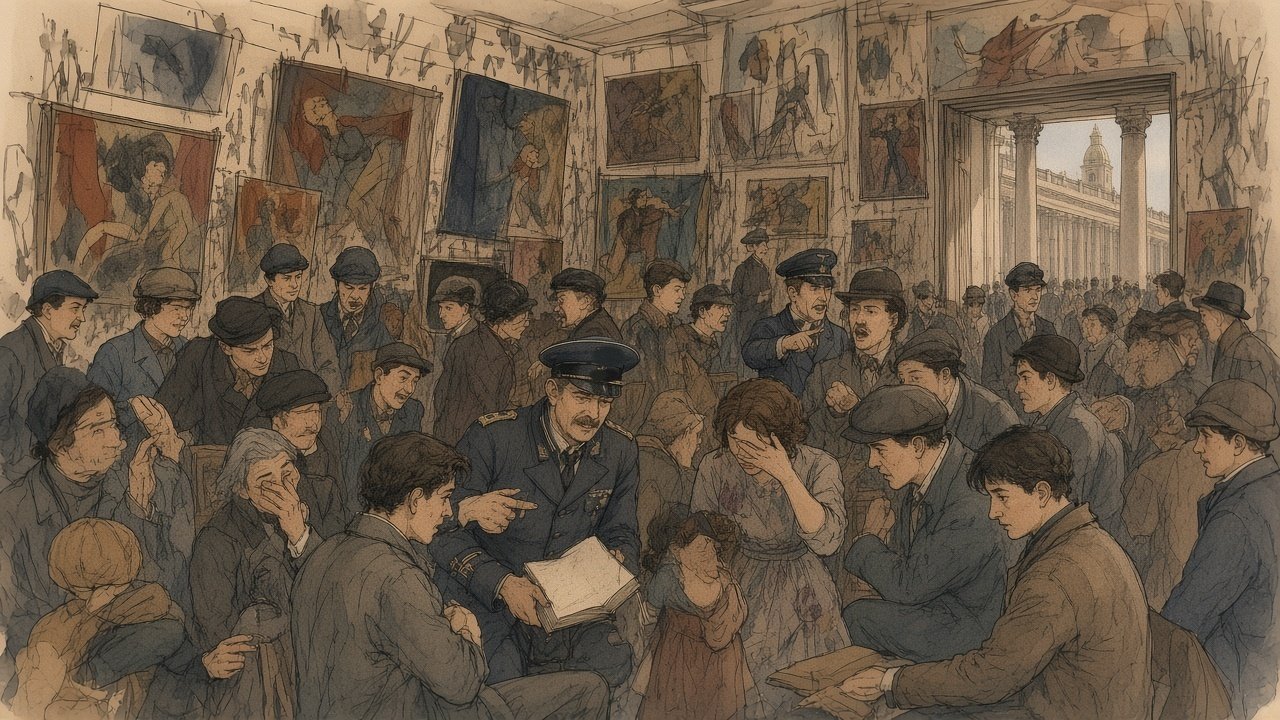
The material came from a purge of the German museums organised by a committee under the painter Adolf Ziegler. Dellheim cites a total of some sixteen thousand modernist works removed from public collections; about 650 of them, taken from thirty-two museums, were crowded onto the walls in Munich with mocking slogans painted beside them.[1] The display was designed as a chamber of horrors. Expressionist paintings were hung askew, sculpture was jammed together, and the walls were lettered with jeers about the insults the pictures offered to German womanhood, German religion and the German soldier. Many labels gave the sums the museums had paid, often inflation-era figures in the millions, so that visitors could see how their taxes had been squandered on rubbish sold by Jewish dealers. One young visitor, Peter Guenther, then seventeen, remembered people reading the prices aloud.[1]
The irony that Dellheim underlines is that the degenerate artists themselves were overwhelmingly not Jewish. Of the 112 artists shown, only six were Jews.[1] What the exhibition attacked as Jewish was not the art but its sponsorship: the dealers, critics, collectors and museum men who had promoted it. And that is where Flechtheim came back into the story. His face, in caricature, appeared on the posters and publicity for the show and its touring versions, as the type of the Jewish art dealer who had foisted modernism on the nation.[8] About two million people saw the exhibition in Munich in four months, and it then toured other cities in Germany and Austria.[1][16]
The purge had a commercial sequel. The regime had no wish simply to destroy pictures that could earn foreign currency. A small group of dealers was licensed to sell confiscated modern art abroad: Hildebrand Gurlitt, Karl Buchholz, Ferdinand Möller and Bernhard Böhmer.[17] The most notorious single sale took place at the Galerie Fischer in Lucerne on 30 June 1939, when Theodor Fischer auctioned 126 works from German museums. Van Gogh’s self-portrait of 1888, dedicated to Gauguin, went for 175,000 Swiss francs to Alfred Frankfurter, bidding for Maurice Wertheim, and is now in the Harvard art museums. Twenty-eight lots went unsold.[1] Many collectors and museum directors abroad stayed away, reasoning that the proceeds would fund rearmament; others bought, arguing that the pictures would otherwise be destroyed. Some were. The Nazi inventory of confiscated works, now in the Victoria and Albert Museum in London, records the disposal of thousands of objects, including those listed as destroyed [18].
Hildebrand Gurlitt is the figure in this group who has cast the longest shadow. Dismissed as a museum director because he was considered one quarter Jewish, he was nonetheless authorised to deal in degenerate art and, as Susan Ronald and others have documented, later bought on a large scale in occupied France, including for the planned Führermuseum in Linz.[2][19] On 28 February 2012, in the course of a tax investigation, Bavarian customs officers and prosecutors seized some 1,400 works from the Munich flat of his son Cornelius, then in his late seventies. The seizure was kept quiet until the magazine Focus revealed it in November 2013, with an estimated value of about a billion euros, the figure Dellheim repeats as about 1.4 billion dollars; later research suggested the hoard was worth far less, and that only a minority of the works were looted.[2][20] Cornelius Gurlitt died in 2014 and left the collection to the Kunstmuseum Bern, which accepted it on condition that works identified as looted would be returned. The Gurlitt case did more than any event since the Washington Conference of 1998 to show how much remained unresolved, and how much had been hidden in plain sight.
Flechtheim’s connection to all of this is not abstract. Pictures that had passed through his hands hung in the German museums that were purged; some reappeared in the degenerate art sales; some went through the hands of the licensed dealers; and some, decades later, turned up in collections whose curators had never asked how they got there. When historians and lawyers began, in the late 1990s, to reconstruct the market of the Nazi years, Flechtheim’s gallery labels and stock numbers became familiar clues on the backs of modern German and French paintings, and the loss of his own records in 1941 meant that each one had to be pieced together from other people’s files.[21]
10. What was left behind
Flechtheim’s death did not end the dispersal of his property; it accelerated it. In February 1938 the Amsterdam auctioneer Carel van Ler sold a group of works under the title of the estate of Alfred Flechtheim. Among them were sixty-two paintings by George Grosz, sold at prices Dellheim calls suspiciously low. Some went to the Museum of Modern Art in New York, some to Vienna and some to the Kunsthalle in Bremen. None of the proceeds reached Flechtheim’s widow.[8] Dellheim suggests that a nephew living in London may have recovered a few works, but the trail is faint.[8]
Betti Flechtheim was still in Berlin. In 1938, after the November pogrom, the regime imposed a collective fine on German Jews, collected as a levy on their declared assets; her share was seventy thousand Reichsmarks.[8] She lived on in a city that was stripping its Jewish citizens of their homes, their professions and their possessions one decree at a time. In November 1941, when she received notice of her deportation, she took her own life. The following year Alfred’s relatives Klara and Rosi Hulisch, Rosi being the assistant who had loyally wound up the Berlin gallery, died together in a suicide pact. The state then confiscated what remained of Betti’s property.[8] The Flechtheims had no children; the heirs who would one day bring claims were the descendants of their nephew Heinz-Alfred Hulisch, who emigrated to England and took the name Hulton.[12]
This was the pattern across the Reich. The November pogrom of 9 and 10 November 1938 was followed by decrees that centralised the expropriation of Jewish wealth, with Göring as its chief organiser.[8] Dellheim insists, rightly, that Nazi art plunder was different in kind from the looting of earlier conquerors. Lord Elgin took marbles and Napoleon took altarpieces as trophies of power; the Nazis took pictures from Jews because they were Jews, as part of a programme to remove them from German life altogether. Belongings, as he puts it, were necessary for belonging.[8] To strip a family of its paintings, its library, its silver and its furniture was to erase the evidence that it had ever been at home.
The American art historian Lane Faison, who interrogated Nazi art officials after the war for the Art Looting Investigation Unit of the Office of Strategic Services, described the looting as officially planned and expertly carried out, its purpose being to enhance the cultural prestige of the master race.[8] Two broad categories emerged. Modern art, which the regime officially despised, was sold or bartered abroad for currency or for the old masters it coveted. Old masters, especially Dutch, Flemish and German pictures that fitted Nazi ideas of Germanic culture, were reserved for Hitler’s museum at Linz, for Göring’s collection at Carinhall and for the museums of the Reich.[8] The dealers who had built the market were both its victims and, in a handful of cases, its instruments.
11. Vienna, 1938
When German troops entered Austria on 12 March 1938, the expropriation that had taken five years in Germany was compressed into a few months. Vienna had the largest Jewish community in German-speaking Europe and some of the richest private art collections in the world. Its dealers, collectors and patrons were overwhelmingly Jewish or of Jewish descent, and they were stripped with a speed that astonished even the Germans.
The art trade was taken over from inside. The Galerie Würthle, Flechtheim’s Viennese partner in the 1920s, belonged to Lea Bondi-Jaray, who was Jewish. In April 1938, under the new Aryanisation rules, it passed to Friedrich Welz, a Salzburg dealer who joined the Nazi party that summer.[8] According to the account later set out by the United States Attorney in New York, in 1939, on the eve of her escape to England, Welz came to her flat, saw a painting from her private collection hanging on the wall, Egon Schiele’s 1912 portrait of his lover Wally Neuzil, and demanded it. She gave way when her husband reminded her that Welz could stop them leaving. After the war American forces seized it among Welz’s holdings and it was handed to the Austrian authorities, who placed it in the Austrian Gallery. In the early 1950s Bondi-Jaray asked the Schiele collector Rudolf Leopold to help her recover it; according to the United States Attorney’s later account, he instead acquired it from the gallery for himself by exchange. The Leopold Museum maintained throughout the later litigation that the painting had not been stolen and that Leopold had not known it to be stolen property. When the Leopold Museum lent it to the Museum of Modern Art in New York in 1997, it was held there, first under a subpoena from the Manhattan District Attorney and then, from 1999, under a federal seizure warrant. The litigation that followed lasted twelve years and ended in July 2010 with a settlement under which the museum paid Bondi-Jaray’s estate nineteen million dollars to keep the painting.[22] Few objects connect the history of Flechtheim’s circle so directly to the restitution battles of our own time.
Dellheim tells the story of another Viennese collector whose fate is less well known. Heinrich Rieger, born in 1868, was a dentist who accepted works of art in payment for treatment from painters who could not afford his fees. He built up one of the great collections of Austrian modernism: an inventory of 1921 lists 658 objects, and he owned between 120 and 150 drawings by Schiele alone.[8] On 28 May 1939 Rieger offered his collection, about three hundred works including some seventy by Schiele, to the Tel Aviv Museum in return for help in obtaining an immigration certificate for Palestine. The offer was refused.[8] Over the next two years, Dellheim records, his villa was confiscated, Welz took a share of his pictures, and the artist and dealer Luigi Kasimir bought much of the rest for seventeen thousand Reichsmarks. Rieger described what he still had in March 1941 as the last remnant of the collection. He and his wife Bertha were deported to Theresienstadt in September 1942. He died there within a month; she was murdered at Auschwitz in 1944.[8] After the war Welz and Kasimir were acquitted of wrongdoing; Kasimir returned 187 works, and the Allies, by mistake, handed four Schieles back to Welz.[8]
Nor did the pressure come only from outsiders. The painter Carl Moll, a founder of the Vienna Secession, stepfather of Alma Mahler and an energetic promoter of Austrian modernism, became, in Dellheim’s account, an ardent Nazi. In 1937 he had helped to organise a Kokoschka retrospective; a year later, Dellheim writes, he was helping to Aryanise the Viennese art world. Dellheim quotes his shrug at the suffering around him: what did it matter if some people were trampled?[8] Moll’s career is a reminder that the movement whose patrons had been so largely Jewish was perfectly capable of turning on them.
The most extraordinary piece of Viennese theatre came in February 1943, when the regime mounted a great Klimt retrospective at the Secession building, which had been renamed. Some 24,000 people came. About a third of the works on show had been confiscated from Jewish owners, a dozen of them from the Lederer family, whose Klimt collection had been the greatest in private hands, and their provenance had been erased from the catalogue.[8] Klimt’s most famous portrait of a Jewish patron was already hanging in the Austrian Gallery under a new title, chosen so that nobody need be reminded who the sitter was.
12. The lady in gold
The portrait in question was Klimt’s Portrait of Adele Bloch-Bauer I, finished in 1907, a square canvas of oil with gold and silver leaf in which the sitter’s face and hands float in a field of eyes, spirals and rectangles derived from Egyptian and Byzantine ornament. Its history, which until recently had its own essay on this site, is the best-documented case of how a looted painting could be absorbed into a national collection and kept there for more than half a century, and it belongs here because it shows the post-war mechanisms that Flechtheim’s heirs and so many others would have to confront.[23]
Adele Bauer, born in 1881 into a Viennese banking family, married the sugar industrialist Ferdinand Bloch in 1899; in 1917 the couple, and Ferdinand’s brother Gustav, who had married Adele’s sister Therese, took the joint name Bloch-Bauer. Ferdinand commissioned the first portrait in about 1903, and Klimt made more than a hundred preparatory drawings. A second, very different portrait followed in 1912, and Ferdinand also acquired four Klimt landscapes. Adele died of meningitis in January 1925. Two years earlier she had written a will asking her husband, in a polite and conditional form of words, to leave her two portraits and four landscapes by Klimt to the Austrian Gallery after his death. The pictures, it would later be established, were his property and not hers.[23] In 1936 Ferdinand gave one landscape to the gallery; the rest stayed in the flat on the Elisabethstrasse.
Ferdinand was at his country house in Czechoslovakia at the Anschluss and never returned to Vienna. His sugar business was Aryanised, his apartment taken over, and his property attached on the pretext of unpaid taxes, a device used repeatedly to give expropriation a legal colour. The disposal of his collection was entrusted to a Nazi lawyer, Erich Führer. In 1941 Führer handed the golden portrait and a landscape to the Austrian Gallery, presenting the transaction as the fulfilment of Adele’s will, and took in exchange the landscape that Ferdinand had donated in 1936, which he sold on. The gallery hung the portrait under a title that concealed the sitter’s identity; the second portrait was sold to the gallery in 1943; other pictures went to the city museum and to Führer himself.[23] Ferdinand’s niece Maria and her husband Fritz Altmann, newly married, had their jewellery taken by the Gestapo; Fritz was held in Dachau as leverage against his brother, the textile manufacturer Bernhard Altmann. In October 1938 the couple slipped away from their guards, flew to Cologne and crossed into the Netherlands by night, reaching Britain and, in 1940, the United States.[24] Ferdinand died in Zurich in November 1945, having left his estate to his nephew and two nieces, with no mention of any gift to the gallery.
What happened next is the part of the story that matters most for the history of restitution. Austria re-emerged in 1945 as the self-described first victim of Nazi aggression, a position anchored in the Allies’ Moscow Declaration of 1943, and it was slow to accept obligations to the persecuted. A Nullity Act of 1946 voided transactions made under persecution, but the restitution laws that followed were narrow, and they operated alongside an export ban on works of national importance. In 1948 the family’s lawyer agreed, in return for permits to export other property, that the heirs would respect Adele’s supposed bequest of the Klimts. For fifty years that concession was presented as a gift.[23] The same trade, restitution in exchange for a donation, was used again and again against exiled Austrian Jews, and it is one reason the case became a model for later claimants.
The files were opened only in 1998, in the wake of the seizure of the Schiele Wally in New York. The Austrian journalist Hubertus Czernin went into the archives of the Austrian Gallery and the monuments office and showed that officials had known the paintings belonged to Ferdinand, that two had entered the collection by Führer’s exchange in 1941, and that the agreement of 1948 had been extracted.[25] That December the Austrian parliament passed an Art Restitution Act allowing federal museums to return such works, and in the same month forty-four governments endorsed the Washington Conference Principles on Nazi-Confiscated Art, which called on states to identify looted works and seek just and fair solutions with the heirs.[26]
Maria Altmann, by then living in Los Angeles, applied for the return of the paintings, represented by the young lawyer E. Randol Schoenberg, a grandson of the composer. In 1999 Austria’s advisory board recommended returning drawings and porcelain but not the Klimts, and the government refused arbitration. An Austrian lawsuit would have required a court fee linked to the value of the claim that Altmann could not pay. Schoenberg sued instead in California in 2000. Austria argued that the Foreign Sovereign Immunities Act of 1976 could not apply to events of the 1930s and 1940s. On 7 June 2004, in Republic of Austria v. Altmann, the Supreme Court of the United States held by six votes to three that it could.[27] The decision was about jurisdiction, not ownership, but it exposed Austria to a trial in Los Angeles. The state agreed to binding arbitration in Vienna instead. On 15 January 2006 three Austrian arbitrators found that Austria had acquired the five paintings through the 1948 settlement made in the context of export proceedings, exactly the kind of transaction the 1998 Act had been passed to undo, and that it must return them; a sixth claim, for a portrait of Amalie Zuckerkandl, failed.[23]
The paintings left the Belvedere in March 2006. Ronald Lauder bought the golden portrait for the Neue Galerie in New York for a reported 135 million dollars, and the other four were sold at Christie’s that November.[24] The sales were criticised, as such sales always are, on the grounds that heirs were putting money before memory; the answer, then and since, has been that nobody asks the descendants of non-Jewish collectors to keep their pictures on public view, and that Austria had been offered the chance to buy them and declined. Maria Altmann died in Los Angeles in 2011. Czernin, whose archival work made the claim possible, had died in 2006 at fifty. The story has since been told in a biography, a documentary and the 2015 film Woman in Gold.[24]
The legal legacy has been mixed. Altmann opened American courts to claims against foreign states over wartime takings, but in 2021, in Federal Republic of Germany v. Philipp, a case about the medieval Guelph Treasure bought from Jewish dealers in 1935, the Supreme Court held that a state’s taking of property from its own nationals does not fall within the expropriation exception.[28] That ruling matters directly to the heirs of German-Jewish dealers. When Flechtheim’s heirs sued the Free State of Bavaria in New York, the case was dismissed in 2018 on grounds of sovereign immunity, without any finding on the facts.[29] Austria, for its part, amended its restitution law in 2009 and has returned many works through its advisory board; the Belvedere now publishes its own provenance research. The idea that the arrangements of the late 1940s had settled all accounts has not survived.
13. Paris under the Occupation
If Berlin had been the market where Flechtheim made modernism saleable, Paris was the source of the pictures, and the rue La Boétie in the eighth arrondissement was its high street. Paul Rosenberg’s gallery stood at number 21; Georges Wildenstein’s firm, the most powerful in the old-master trade after Duveen, was in the same street; the Bernheim-Jeune, Seligmann, Kann and Gimpel families were nearby. They were French Jews, many of them of Alsatian or central European origin, and most of them regarded themselves as French above all.
Paul Rosenberg, younger brother of Léonce, was the son of an immigrant dealer from Bratislava and had built the leading modern-art gallery in Paris. He represented Picasso, Braque, Matisse and Léger; he had been made a member of the Legion of Honour in 1929; and in the late 1930s, as president of the French art dealers’ association, he urged colleagues to boycott the German sales of degenerate art.[30] When war came in September 1939 he had already sent pictures to New York and London. With his son Alexandre, then eighteen, and his assistant Louis Le Gall, he catalogued what remained and moved it south-west to a rented villa, Le Castel, at Floirac near Bordeaux. He deposited 162 paintings in a bank vault at Libourne: van Gogh, Corot, Cézanne, Matisse and others. About a hundred more stayed at the villa, including Picasso’s portrait of his wife and daughter. Braque, who was also his artist, put his own works in the Libourne vault.[30]
Rosenberg left France on 16 June 1940, by way of Hendaye, Spain and Portugal. In Sintra, waiting for a ship, he found himself sitting on a stone wall with a boiled egg and a crust of bread and could not help laughing.[30] Alfred Barr of the Museum of Modern Art and Paul Sachs of Harvard helped him obtain American visas, and he reached New York on 20 September 1940. He wrote that he felt miserable at leaving forty years’ work behind.[30] Alexandre stayed in Europe and joined the Free French.
The Germans entered Paris on 14 June 1940. Within days Hitler ordered that works of art in France, especially those owned by Jews, be safeguarded, a euphemism for seizure. The German army’s art-protection officer, Count Franz Wolff-Metternich, objected that private property was protected under Article 46 of the Hague Convention; he was overruled. The German embassy under Otto Abetz drew up a list of the fifteen largest Jewish collections, and French police vans helped carry them away.[31] From the autumn of 1940 the work was taken over by the Einsatzstab Reichsleiter Rosenberg (ERR), the task force of the Nazi ideologue Alfred Rosenberg, which used the small Jeu de Paume museum in the Tuileries as its depot. By its own reckoning the ERR had seized 203 collections and 21,903 objects by the summer of 1944, marked with codes such as R for Rothschild and KA for Alphonse Kann.[31][32] Hermann Göring visited the Jeu de Paume some twenty times to pick pictures for himself.[7]
The Rothschild collections were the richest prize; their fate is told on this site in Vienna and Paris under the Nazis. The Paris branch of Duveen Brothers, run after Joseph Duveen’s death in 1939 by his nephew Armand Lowengard, was sequestered as Jewish property and its hidden stock in Biarritz seized in February 1941; that episode belongs to The house after Lord Duveen.[33] Here it is enough to note that the plunder was not confined to collectors. Dealers’ stock was as much a target as private property, and in some ways an easier one, because galleries kept inventories.
Rosenberg’s turn came quickly. On 15 September 1940, acting, Dellheim writes, on information from informers who were paid in pictures, the Germans raided the villa at Floirac. In April 1941 they opened the Libourne vault, and by September it had been emptied; the ERR valued its contents at more than seven million francs, and took fourteen Braques besides. The bank later sent Braque a bill for the lock.[34] Ribbentrop’s agents took Monet’s Waterlily Pond of 1904. Göring’s dealer Walter Andreas Hofer drew up a wish list from the Rosenberg pictures.[34] In May 1941 the gallery at 21 rue La Boétie was turned into the Institute for the Study of Jewish Questions, an antisemitic propaganda office; Louis-Ferdinand Céline attended its functions.[34] Rosenberg’s French citizenship was revoked.[34]
Georges Wildenstein is the most difficult case, and the evidence needs careful handling. He sent hundreds of works abroad and to state depots before the defeat; a shipment of 302 items to America was intercepted and forced back to Bordeaux.[33] He left for New York in January 1941. In his absence his Paris firm was placed in the name of his manager Roger Dequoy, and, according to the Allied investigators whose findings Dellheim summarises, it did a great deal of business with Hitler’s dealer Karl Haberstock, who had begun his career at the Cassirer gallery and who set up shop in the rue La Boétie in October 1940.[33] After the war the Allied report by Douglas Cooper concluded that Wildenstein had collaborated, a view the family has always rejected, and Dellheim, weighing the evidence, leaves open whether pressure on the firm amounted to a pact with the devil.[33] His own words of 1943 are worth recording: the danger, he wrote, was that Germany, while losing the war, would win the peace.[33] The Paris market, as Cooper observed, was buoyant throughout the Occupation, with some seventy galleries trading alongside the Hôtel Drouot, and, in Cooper’s words, it was hard to resist the temptation to fleece the Teuton.[33]
14. The dealers who stayed
Not every Jewish dealer in France could leave, and not all wanted to. Their fates ranged from survival in hiding to murder, and they show how little the outcome depended on wealth or reputation.
René Gimpel, the diarist, was the son of Ernest Gimpel, who had been Nathan Wildenstein’s partner in the old-master trade, and his family was linked by marriage to the Duveens.[34] He had watched the coming of the war with clear eyes; at an exhibition of Prado pictures in Geneva in August 1939 he wrote that death hung over their heads.[30] After the defeat he lost almost everything. His apartment was emptied of some ninety crates; a cache of Chardins and Degas in a bank in Nice was seized; tapestries hidden at the department store La Samaritaine were found in October 1943.[34] He joined the Resistance with his sons, was arrested and interned in 1942, released, and arrested again by the Gestapo in the spring of 1944 after being denounced, Dellheim reports, by a colleague. From Fort Montluc in Lyon he was deported to Neuengamme, near Hamburg, and he died there around the turn of the year 1945. A fellow prisoner, the writer Louis Martin-Chauffier, remembered that morally he had not changed.[34] His diary, published after the war and in English in 1966 as Diary of an Art Dealer, remains one of the best sources for the art world between the wars.
Léonce Rosenberg, who had sold Kahnweiler’s stock at the Drouot two decades earlier, stayed in Paris throughout the Occupation and survived, reading Plato. He died on 31 July 1947. Dellheim records that major works from his collection were never returned.[34] Kahnweiler himself, who had been through sequestration once already, took 154 paintings to Saint-Léonard-de-Noblat in the Limousin in the autumn of 1939 and left Paris in June 1940.[30] His gallery, the Galerie Simon, was saved by a legal manoeuvre: his sister-in-law Louise Leiris, who was not Jewish, bought it and ran it as the Galerie Louise Leiris from 1941. Kahnweiler later spent the last part of the war in hiding under false papers in the south-west after the Gestapo raided his house.[34] He would write afterwards that paradise had existed in the shadow of the crematory oven, a terrible sentence about the beauty of the countryside where he had hidden while others died.[34]
The Bernheim-Jeune family, the oldest of the great modern dealers in Paris and once the dealers of the impressionists and Bonnard, were among the ERR’s targets. Their firm was put under an administrator, Édouard Gras, who was also responsible for Wildenstein, Seligmann and other Jewish galleries. Josse Bernheim-Jeune’s house was seized in April 1941, and he died in Lyon later that year. About thirty paintings the family had hidden in the château of Rastignac in the Dordogne, among them seven Cézannes and five Renoirs, were destroyed when German troops burned the house on 30 March 1944; they have never been seen again. Claude Bernheim was deported to Auschwitz in December 1943 and died before the liberation.[34] Japanese friends, Dellheim notes, helped smuggle the family’s funds.[34]
The wider context is the destruction of the Jews of France. From June 1942 Jews in the occupied zone were forced to wear the yellow star; on 16 and 17 July 1942 French police rounded up some thirteen thousand Jews in Paris in the Vel d’Hiv raid. About eighty thousand Jews living in France were killed.[34] The plunder of their homes did not stop at paintings. In the furniture operation known as the Möbel-Aktion, German agencies emptied some sixty-nine thousand Jewish apartments in France, carting off furniture, linen, pianos, books and kitchenware.[31] It is described on this site in The School of Paris. Against that background the distinction between a dealer’s stock and a family’s possessions mattered less than it seemed. Both were taken for the same reason.
15. Exiles on Fifty-Seventh Street
The dealers who escaped carried the European market with them, and by the early 1940s its centre had moved to a few blocks of Manhattan. René Gimpel’s colleague Edward Fowles of Duveen Brothers had predicted in January 1940 that the United States would be the only power left standing.[30] He was right, and the émigrés knew it.
Paul Rosenberg reopened at 16 East 57th Street. He had saved enough of his stock, shipped before the war, to trade, and he set out to make his gallery an outpost of a France that Vichy had betrayed. In November and December 1942 he mounted a loan exhibition of Cézanne for the benefit of the Fighting French. Several of the pictures came from another refugee, the Berlin banker Jakob Goldschmidt, an openly Jewish financier whom the Nazis had loathed, who had paid for causes ranging from the Encyclopaedia Judaica to the purchase of a van Gogh for the National Gallery in Berlin.[34] The catalogue essay was by Lionello Venturi, the Italian art historian who had compiled the first catalogue raisonné of Cézanne and who had refused to serve fascism; Alfred Frankfurter of Art News devoted a special issue to the show. Wallace Stevens, in all likelihood, went to see it.[34] The pictures on the walls, Dellheim suggests, stood for a vision of French life that was the opposite of both Nazi rule and Vichy collaboration.[34]
Rosenberg did not forget those who had not escaped. In 1944 he chaired the art group of the annual United Jewish Appeal drive. On 22 June 1944 he wrote to Pierre Matisse, the painter’s son and himself a New York dealer, asking for help. The cause of the doomed Jews of Europe, he wrote, was close to their hearts; news dispatches that week reported more than a million in danger of immediate extermination.[34] It is one of the few moments in Dellheim’s book when a dealer speaks explicitly as a Jew about the Holocaust as it was happening, and it is all the more striking for appearing in a fund-raising letter between two businessmen.
Others built new careers. Curt Valentin, Flechtheim’s former assistant, ran the Buchholz Gallery in New York from 1937 and became the leading American dealer for German sculpture and for Klee and Beckmann; Buchholz, in whose name the gallery traded, was one of the four dealers licensed in Berlin to sell confiscated degenerate art abroad.[17][14] Justin Thannhauser, who had moved from Munich to Berlin and then to Paris, reached New York at the start of the war years, having lost much of what he left behind in Paris; the core of his collection, which he later gave to the Solomon R. Guggenheim Museum, is still on view there. The story of Peggy Guggenheim’s own New York gallery, which opened in 1942 and gave a stage to European exiles among others, is told in Peggy and Art of This Century. Armand Lowengard, who had run Duveen’s Paris house, reached New York too, but died there in 1943 after a series of strokes.[34]
Not everyone who reached safety was spotless, and not everyone who stayed behind was compromised. The wartime market had a neutral wing in Switzerland. Dellheim, drawing on the Allied investigators’ findings, places there the Lucerne dealer Theodor Fischer, who had run the degenerate art auction of 1939, and the Paris-based German dealer Hans Wendland; by his account, in July 1941 Fischer received from Göring twenty-two impressionist and modern paintings taken from Jewish collections in exchange for six northern Renaissance works.[33] Already in May 1940, Dellheim notes, Wendland had approached Duveen’s with very important things to offer from a family who would not sell under ordinary circumstances.[30] The phrase is a small masterpiece of the dealer’s euphemism, and it describes the whole wartime trade. Many of the looted French pictures that reached the Americas after 1945 had passed through Swiss hands, and the Allied investigators of the Art Looting Investigation Unit spent the post-war years tracing them; in 1946 Theodore Rousseau of the unit interrogated Haberstock himself.[33] In September 1944, meanwhile, the New York Times had presented Wildenstein’s Paris manager Roger Dequoy as something of a hero of the Occupation, a view that, as Dellheim shows, sat uneasily with what the Allied investigators later reported.[34][33]
16. Train 40044
The ERR’s records survived because a French curator copied them. Rose Valland, an assistant at the Jeu de Paume, stayed at her post throughout the Occupation, ignored by the Germans as a harmless functionary, and noted in secret what arrived, who came to choose and where the crates were sent. Dellheim reckons that the material that passed through the building amounted to about a third of the art in French private hands.[7] In August 1944, as the Allies approached Paris, she learnt that a train, number 40044, was being loaded at Aubervilliers with 148 cases of paintings bound for Germany. The train never left the Paris region; Valland’s information, passed to the Resistance, is credited with helping to stop it.[7][35]
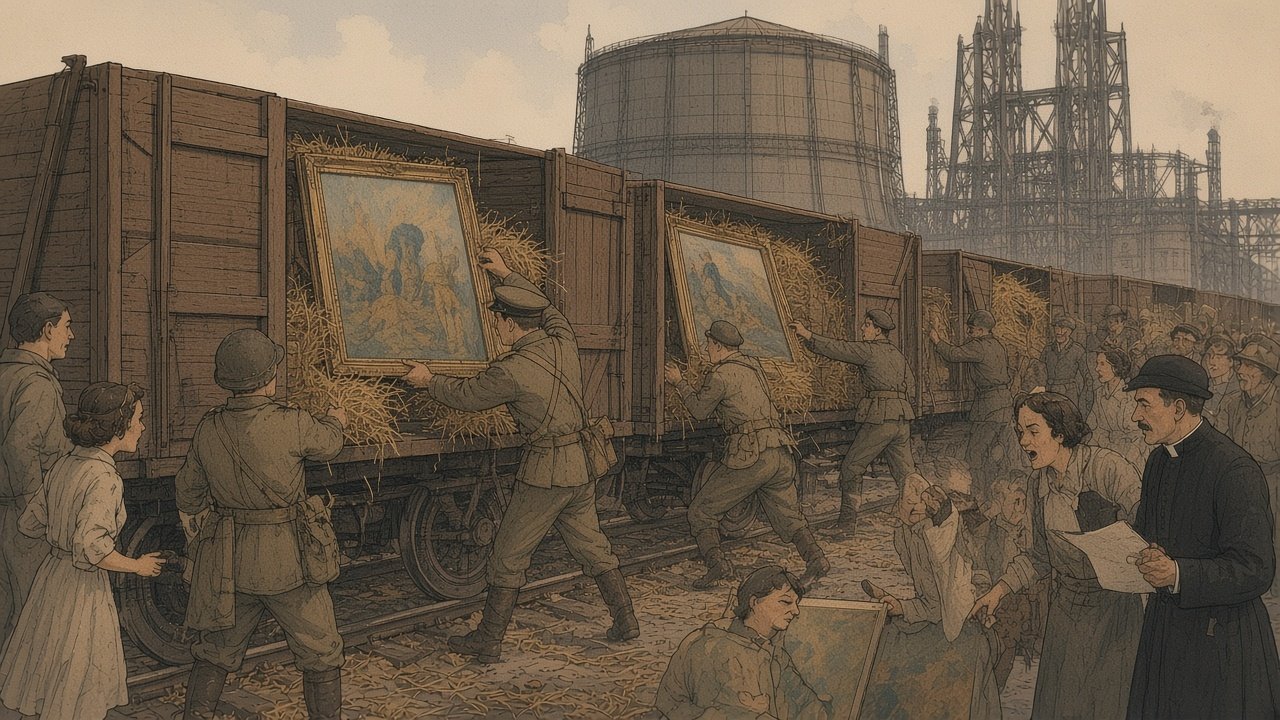
The men who stopped it, by one of those coincidences that sound invented, included Lieutenant Alexandre Rosenberg of the Free French forces. When his unit opened the wagons, he found among the cases paintings that had hung in his father’s house.[7][36] The scene was later reworked, without the Rosenberg family, into the 1964 film The Train. Valland herself went on to serve with the French recovery services and in occupied Germany, and in 1961 published her memoir, Le front de l’art.[35]
Across the Rhine the recovery was run by the Monuments, Fine Arts and Archives section of the Allied armies. Dellheim opens his book with one of its officers, Lieutenant James Rorimer, a curator from the Cloisters in New York whose family had changed its name from Rohrheimer in 1917 and whom army intelligence had described as a Jewish gentleman. On 3 May 1945 Rorimer and Corporal John Skilton reached the monastery of Buxheim in Bavaria, which the ERR had used as a store and restoration workshop. They found seventy-two cases marked Fragile, labelled D-W for the banker David David-Weill and stamped ERR; Rothschild textiles in the chapel; and a Rembrandt on a workbench. Rorimer’s phrase for what the Nazis had amassed was a roomful, a carload, a castle-full.[2] From Buxheim he went on to Neuschwanstein, where much of the French loot had been stored. The parallel story of the libraries and books hidden in German mines is told on this site in Bibles in the Salt Mines, 1943 to 1945.
Recovered works were gathered at collecting points, the largest in the former Nazi party buildings in Munich, the Führerbau and the Verwaltungsbau, where they were photographed, catalogued and sent back to the countries from which they had been taken.[7] That last principle mattered. The Allies returned art to governments, not to individuals, on the assumption that national authorities would find the owners. In France the Commission de récupération artistique received claims for about 100,000 objects and published a Répertoire des biens spoliés.[7] Paul Rosenberg recovered much of his collection from November 1944 onwards, and gave thirty-three works to French museums.[7] Monet’s Waterlily Pond took longer. It was returned to the family only in 1999, at a ceremony at the Jeu de Paume.[7] Rosenberg himself died in 1957.
When the French commission was wound up at the end of 1949, about fifteen thousand unclaimed works were sold off through the state property service, and about two thousand of the best were entrusted to the national museums as a separate inventory, the Musées nationaux récupération (MNR), to be held for owners who might still appear.[7] Many of those owners were dead; others had never been told; and some of the works had been bought on the Paris market under the Occupation by French collectors and museums who preferred not to ask. The MNR pictures are still being returned, one or two at a time.
In Germany the post-war arrangements were different again. The American zone passed restitution laws in 1947 and created a Jewish Restitution Successor Organization to claim heirless property, while Jewish Cultural Reconstruction, led by Salo Baron and Hannah Arendt among others, distributed ownerless books and ritual objects to libraries and communities abroad.[7] But the restitution of art from German museums to the families of Jewish dealers and collectors was largely ignored for half a century. A memorandum of April 1944, quoted by Dellheim, had warned American officials that what was needed was legal, not artistic, advice.[7] The warning proved prophetic. The questions that remained after 1945 were not about what a painting was, but about what had happened in the transactions that moved it: who sold, under what pressure, at what price, and whether a sale in 1933 or 1938 could be called voluntary at all.
17. The long return
The silence broke in the 1990s, for reasons that had little to do with art. The end of the Cold War opened archives in the East and loosened inhibitions in the West; the Swiss banks scandal put the economic dimension of the Holocaust on front pages; and a new generation of historians, journalists and lawyers began to read the files. Lynn Nicholas’s The Rape of Europa (1994) and Hector Feliciano’s The Lost Museum (1997) showed a general readership the scale of the plunder and how much of it was still in museums.[37][38] In France the turning point was political: on 16 July 1995, at the commemoration of the Vel d’Hiv round-up, President Jacques Chirac acknowledged the responsibility of the French state for the persecution of the Jews In 1997 the World Jewish Congress and Ronald Lauder set up the Commission for Art Recovery.[7] The Washington Conference of December 1998 gave the new mood an international form, in eleven non-binding principles that asked states to identify looted art, open their archives and seek just and fair solutions.[26]
What the principles could not do was resolve the hard cases, and the hardest of all have concerned Jewish dealers. A collector’s painting stolen from his wall by the ERR is a relatively simple matter. A dealer’s stock sold between 1933 and 1938 is not. Dealers sold pictures for a living. Did a sale by Flechtheim’s liquidator in 1934 represent ordinary trade or persecution? Was a picture sold by a refugee in London to pay his rent sold under duress? The answers have divided courts, commissions and historians, and they have divided them most sharply where the sellers were German Jews who were not robbed outright but squeezed out of business.
The law has tried to answer these questions with presumptions. The restitution legislation of the Allied occupation zones from 1947 treated transfers of property by people persecuted by the regime after 30 January 1933 as presumptively made under duress. The presumption could be rebutted, broadly, by showing that the seller had received a fair price and been free to dispose of it, and the conditions were stricter for sales made after the Nuremberg Laws of September 1935.[39] The German guidance issued to museums after 1998 took over the same structure, and the arbitration framework of 2025 is built on it too.
These rules were designed for the sale of a house, a factory or a private collection. They fit uneasily with a dealer, whose business was selling. A gallery that disposes of its stock in 1933 may be liquidating under persecution, or it may be trading through a slump, and in Flechtheim’s case it was doing both at once: the Depression had brought him to the edge of ruin before Hitler took office, and the regime then made recovery impossible. A refugee dealer selling in London or Amsterdam was beyond the reach of the Gestapo, but not beyond the reach of the persecution that had driven him there and left him without capital. A fair price is hard to define in a market that the regime itself was flooding with confiscated art. The categories that served well enough for a stolen Vermeer become, in the case of a dealer’s stock, an argument about the meaning of the word voluntary.
Historians have added a further complication: the records. Dealers’ stockbooks, invoices and correspondence are the raw material of provenance research, and the persecution destroyed many of them. Flechtheim’s were lost in a German air raid on London in 1941; others were seized, dispersed or deliberately burnt. Museums, meanwhile, often hold their own acquisition files, which tend to record what the buyer knew rather than what the seller suffered. The asymmetry is not malicious, but it is real, and it has shaped the outcome of more than one claim.
Two cases mark the boundaries. The first concerns Picasso’s The Actor, the picture that had hung at the Sonderbund exhibition Flechtheim helped to organise in 1912. In 1938 its owner, Paul Leffmann, a German-Jewish businessman who had fled to Italy, sold it in Paris to the dealers Hugo Perls and Paul Rosenberg for twelve thousand dollars; it was bought in 1941 by Walter P. Chrysler Jr and given to the Metropolitan Museum in 1952. Leffmann’s heir sued the museum. In June 2019 the federal Court of Appeals for the Second Circuit dismissed the claim, holding that the heir had waited too long to bring it, and declined to decide whether a sale under such pressure was void.[40][7]
The second concerns Flechtheim himself, and it shows how hard his London years are to judge. In 2016 Germany’s Advisory Commission considered the heirs’ claim to the Gris Violon et encrier, the still life bought by Kahnweiler’s syndicate at the Drouot in 1921. Flechtheim had shown it in Düsseldorf in 1925 and in Berlin in 1930, lent it to an exhibition in Zurich in 1933, retrieved it through the Galerie Simon in Paris that November and taken it to London, where it hung in his Mayor Gallery exhibition 20th Century Classics in 1934 and was sold to a London collector for an unknown price. In 1964 the Kunstsammlung Nordrhein-Westfalen in Düsseldorf bought it for 450,000 marks.[11] The commission accepted that Flechtheim had been on the brink of ruin even before 1933, because the Depression had all but destroyed the market for the pictures he dealt in, and it concluded that the London sale was not a loss caused by Nazi persecution. It recommended that the painting stay in Düsseldorf.[11] To the heirs it seemed perverse to treat the sale of a refugee’s stock in exile as ordinary business; to the museum it was a sale on the open market in a free country. Both readings are defensible, and that is the difficulty.
Other claims have ended differently. Flechtheim’s great-nephew Michael Hulton, the sole surviving heir, and his lawyer Markus Stötzel began searching for the scattered collection in 2008. Many institutions have since returned works or reached settlements; Hulton has said that numerous museums and private collectors recognised what had been done to his family.[12] Others refused. The most protracted dispute has been with the Bavarian State Painting Collections in Munich, over a bronze head of Fernande Olivier by Picasso and two paintings by Paul Klee. An attempt to sue Bavaria in New York was dismissed in 2018 on grounds of sovereign immunity, without any finding on the merits.[29] In 2023 the collections themselves recommended returning the Picasso, but, as The Guardian reported, the Bavarian government did not act on the recommendation, arguing that Flechtheim’s ownership in January 1933 could not be established beyond doubt.[12] In July 2026, after a change of national guidelines, the Bavarian culture minister announced that the Picasso would after all be returned, and Bavaria said it would move provenance research on its state collections out of the museums into an independent centre attached to the Institute for Contemporary History in Munich. Stötzel welcomed the decision as long overdue justice and pointed out that the Klee claims, some dating back to 2008, were still open.[41][29]
The national guidelines in question belong to a new institution. On 1 December 2025 Germany’s Advisory Commission on Nazi-looted art, which had issued only a couple of dozen recommendations in more than two decades and could act only if both sides agreed, was replaced by a Court of Arbitration for Nazi-Looted Cultural Property, which can be called upon by claimants alone where the holding institution has made a standing offer, and whose awards are binding.[39][12] Critics have warned that its assessment framework does not presume persecution in the case of Jewish dealers who sold in exile, which is precisely the situation of Flechtheim’s London years and of the Gris case;[42] others see it as the first serious attempt to give German restitution teeth. A federal restitution law that would also reach works in private hands, where claims have long been time-barred, was promised in the coalition agreement. In February 2026 the culture minister, Wolfram Weimer, said he was preparing it and hoped to see it passed within the current parliament, that is by early 2029; by the spring his office and the finance and justice ministries were still in talks, and what the law will contain has not been made public.[43][42]
Underneath the law lies a question of evidence. Restitution depends on provenance, the chain of owners that links a picture to its past. In the Jewish tradition there is a word for a chain of that kind applied to people: יחוס (yikhes, lineage or pedigree), the record of whom one descends from and the honour that comes with it. A painting’s provenance is its yikhes, and the Nazi years were, among other things, an attack on the pedigrees of objects as well as people: labels were scraped off, names removed from catalogues, sitters renamed, dealers’ records burnt. Every restitution is in part an act of reconstruction, and for Flechtheim’s pictures, whose own records burnt in London in 1941, the reconstruction has had to be done from other people’s files: auction catalogues, exhibition lists, photographs, the inventories of the museums that bought from him.[21] In 2013 a group of German museums joined in a research project on Flechtheim, published online at alfredflechtheim.com, to document his life and the provenance of works from his gallery in their collections.[13]
18. A crack in everything
Dellheim ends his book with a line from Leonard Cohen’s song “Anthem”, about the crack in everything that lets the light in.[7] It is an oddly hopeful note on which to close a history that ends in theft, suicide and deportation, but it fits his argument. The dealers he writes about were not saints. They were ambitious, combative, often reckless businessmen who fought each other as hard as they fought anyone, and whose love of art was never quite separable from their love of the deal. Flechtheim, who spent his wife’s dowry on Picassos and planned to kill himself rather than default on his debts, was the purest example of the type.
But they built something. Between them the Cassirers, Thannhausers, Flechtheims, Kahnweilers, Rosenbergs, Bernheims and Wildensteins made modern art into a market and gave it an audience, and in doing so they helped to make it part of European culture. That was exactly what their enemies could not forgive. The Nazi regime did not merely steal pictures from Jews; it set out to prove that the art Jews had championed was itself a kind of theft from the nation, and it used the figure of the Jewish dealer as its evidence. Dellheim calls the result a cultural atrocity, a crime against the humanity of Jews.[7]
The fates of the dealers in this essay run the whole range of the catastrophe. Cassirer died by his own hand before it began. Flechtheim died in exile, ruined, in 1937. Paul Rosenberg and Georges Wildenstein reached New York and rebuilt; Léonce Rosenberg and Kahnweiler survived in France, one in Paris and one in hiding; Josse Bernheim-Jeune died in Lyon in 1941; René Gimpel died in Neuengamme and Claude Bernheim at Auschwitz. Betti Flechtheim, Klara and Rosi Hulisch, Heinrich and Bertha Rieger were murdered or driven to suicide by the same machinery that emptied their walls. It is worth listing them, because the history of looted art can easily become a history of objects, of famous paintings and the prices they fetch at auction, in which the people appear only as names in a provenance line. Dellheim’s achievement is to put the people back.
Flechtheim died in London in March 1937, too early to see the worst and too late to save anything. His widow died by her own hand in Berlin four years later. His pictures are scattered across the museums of three continents, and some of them are still the subject of claims. The work of returning them, which began in a railway siding at Aubervilliers in 1944, is not finished; it has simply moved from the battlefield to the archive and the tribunal. The question it asks has not changed since Lord Ivor Churchill’s eulogy: whether the victory of prejudice can be undone after the fact, one painting at a time.
References
- Dellheim, Belonging and Betrayal, chapter 18, “Artful Jews”, pp. 415 - 434 *
- Charles Dellheim, Belonging and Betrayal: How Jews Made the Art World Modern (Waltham, MA: Brandeis University Press, 2021), Prologue, “The Frame”, pp. 1 - 15 *
- Dellheim, Belonging and Betrayal, chapter 1, “Horse Dealer to Art Dealer”, pp. 17 - 42 *
- Dellheim, Belonging and Betrayal, chapter 8, “First Impressionists”, pp. 163 - 182 *
- Dellheim, Belonging and Betrayal, chapter 6, “Madman and Sons”, pp. 147 - 154 *
- Dellheim, Belonging and Betrayal, chapter 11, “The Right Banker”, pp. 233 - 264 *
- Dellheim, Belonging and Betrayal, Epilogue, “A Crack in Everything”, pp. 563 - 582 *
- Dellheim, Belonging and Betrayal, chapter 19, “Artless Jews”, pp. 435 - 472 *
- Dellheim, Belonging and Betrayal, chapter 9, “Berlin Calling”, pp. 183 - 204 *
- Dellheim, Belonging and Betrayal, chapter 14, “Custody Battles”, pp. 315 - 334 *
- Advisory Commission on the return of cultural property seized as a result of Nazi persecution, “Recommendation in the matter of the Heirs of Alfred Flechtheim v. Stiftung Kunstsammlung Nordrhein-Westfalen, Düsseldorf”, 21 March 2016 *
- Deborah Cole, “‘I am hitting a wall’: heir of Jewish art collector calls for restitution from Germany”, The Guardian, 18 December 2024 *
- alfredflechtheim.com, “Alfred Flechtheim: Emigration” and “London” (joint research project of German museums, 2013) *
- Christel Hollevoet-Force, “Alfred Flechtheim”, The Modern Art Index Project, Leonard A. Lauder Research Center for Modern Art, The Metropolitan Museum of Art (March 2018) *
- Burcu Dogramaci, “Golders Green Crematorium”, METROMOD Archive (2021) *
- United States Holocaust Memorial Museum, “‘Degenerate’ Art”, Holocaust Encyclopedia *
- Jonathan Petropoulos, Art as Politics in the Third Reich (Chapel Hill: University of North Carolina Press, 1996) *
- Victoria and Albert Museum, “‘Entartete Kunst’: The Nazis’ inventory of ‘degenerate art’” *
- Susan Ronald, Hitler’s Art Thief: Hildebrand Gurlitt, the Nazis, and the Looting of Europe’s Treasures (New York: St. Martin’s Press, 2015) *
- BBC News, “Nazi trove in Munich contains unknown works by masters”, 5 November 2013 *
- Ottfried Dascher, “Es ist was Wahnsinniges mit der Kunst”: Alfred Flechtheim. Sammler, Kunsthändler, Verleger (Wädenswil: Nimbus, 2011) *
- United States Attorney’s Office, Southern District of New York, “United States announces $19 million settlement in case of painting stolen by Nazi”, press release, 20 July 2010 *
- Art-Law Centre, University of Geneva, ArThemis case note, “Six Klimt Paintings: Maria Altmann and Austria” *
- Anne-Marie O’Connor, The Lady in Gold: The Extraordinary Tale of Gustav Klimt’s Masterpiece, Portrait of Adele Bloch-Bauer (New York: Knopf, 2012) *
- Hubertus Czernin, Die Fälschung: Der Fall Bloch-Bauer, 2 vols (Vienna: Czernin Verlag, 1999) *
- Washington Conference Principles on Nazi-Confiscated Art, released in connection with the Washington Conference on Holocaust-Era Assets, 3 December 1998 *
- Republic of Austria v. Altmann, 541 U.S. 677 (2004), Legal Information Institute, Cornell Law School *
- Federal Republic of Germany v. Philipp, Supreme Court of the United States, decided 3 February 2021 *
- Bayerische Staatsgemäldesammlungen (Bavarian State Painting Collections), “Provenance research” *
- Dellheim, Belonging and Betrayal, chapter 20, “Next Year in Paris?”, pp. 473 - 491 *
- Dellheim, Belonging and Betrayal, chapter 21, “After the Fall”, pp. 492 - 502 *
- Claims Conference and United States Holocaust Memorial Museum, Database of Art Objects at the Jeu de Paume *
- Dellheim, Belonging and Betrayal, chapter 22, “The Dispossessed”, pp. 503 - 521 *
- Dellheim, Belonging and Betrayal, chapter 23, “The Exiles and the Kingdom”, pp. 522 - 562 *
- Rose Valland, Le front de l’art: défense des collections françaises, 1939 - 1945 (Paris: Plon, 1961) *
- Anne Sinclair, 21 rue La Boétie (Paris: Grasset, 2012); English translation, My Grandfather’s Gallery (New York: Farrar, Straus and Giroux, 2014) *
- Lynn H. Nicholas, The Rape of Europa: The Fate of Europe’s Treasures in the Third Reich and the Second World War (New York: Knopf, 1994) *
- Hector Feliciano, The Lost Museum: The Nazi Conspiracy to Steal the World’s Greatest Works of Art (New York: Basic Books, 1997) *
- German Lost Art Foundation, “Court of Arbitration for Nazi-looted Cultural Property launched”, 1 December 2025 *
- Zuckerman v. Metropolitan Museum of Art, 928 F.3d 186 (2d Cir. 2019) *
- Catherine Hickley, “Bavaria approves creation of Nazi loot panel and independent entity for provenance research”, The Art Newspaper, 15 July 2026 *
- taz, “Plan für Restitutionsgesetz: Steht alles still, wird es schwer mit der Gerechtigkeit”, 28 May 2026 *
- Die Zeit, “Weimer bereitet Gesetz zur Rückgabe von Raubgut vor”, February 2026 *


