The Anschluss
By the 1930s the Vienna house, S M von Rothschild, had been led for more than two decades by Louis Nathaniel von Rothschild, born in 1882, the third of the seven children of Albert and Bettina. After schooling at the Theresianum in Vienna and training as a bank clerk in Hamburg and New York, he joined the bank’s board in 1907 and in 1911, on his father’s death, became its sole manager. He sat on the boards of the Creditanstalt and, from 1922, on the General Council of the Austrian National Bank, and he was chairman of the great ironworks at Witkowitz, now Vítkovice, in Moravia.[1] Contemporaries remarked on his unshakeable calm. He played polo, hunted, qualified as a balloon pilot and held a pilot’s licence, and for many years he was one of the most eligible and most confirmed bachelors in Viennese society.[1]
The world in which Louis had grown up was already badly damaged. The Creditanstalt, which the Vienna Rothschilds had founded in 1855, collapsed in May 1931 in the most serious bank failure in Central Europe between the wars, and Louis, as its largest shareholder, was drawn into the costly rescue. Under the plan announced on 12 May 1931 the federal government put up 100 million schillings, and the National Bank and the Austrian house of Rothschild 30 million each, while the bank’s foreign creditors organised themselves in London in a committee led by the London Rothschilds and the Bank of England.[2][3] Antisemitism had become a staple of Austrian politics, and across the border in Germany the Nazis had been in power since 1933.
On 12 March 1938 German troops entered Austria. That day Louis organised the escape of his nieces Bettina and Gwendoline, but he could not escape himself. He was arrested at Aspern airfield by two SA men and taken back to his residence. The next day the Gestapo imprisoned him, first at the police prison on the Rossauer Lände and then on the fifth floor of its headquarters in the former Hotel Metropol on Morzinplatz, where he was held for fourteen months.[1]
Hostage and ransom
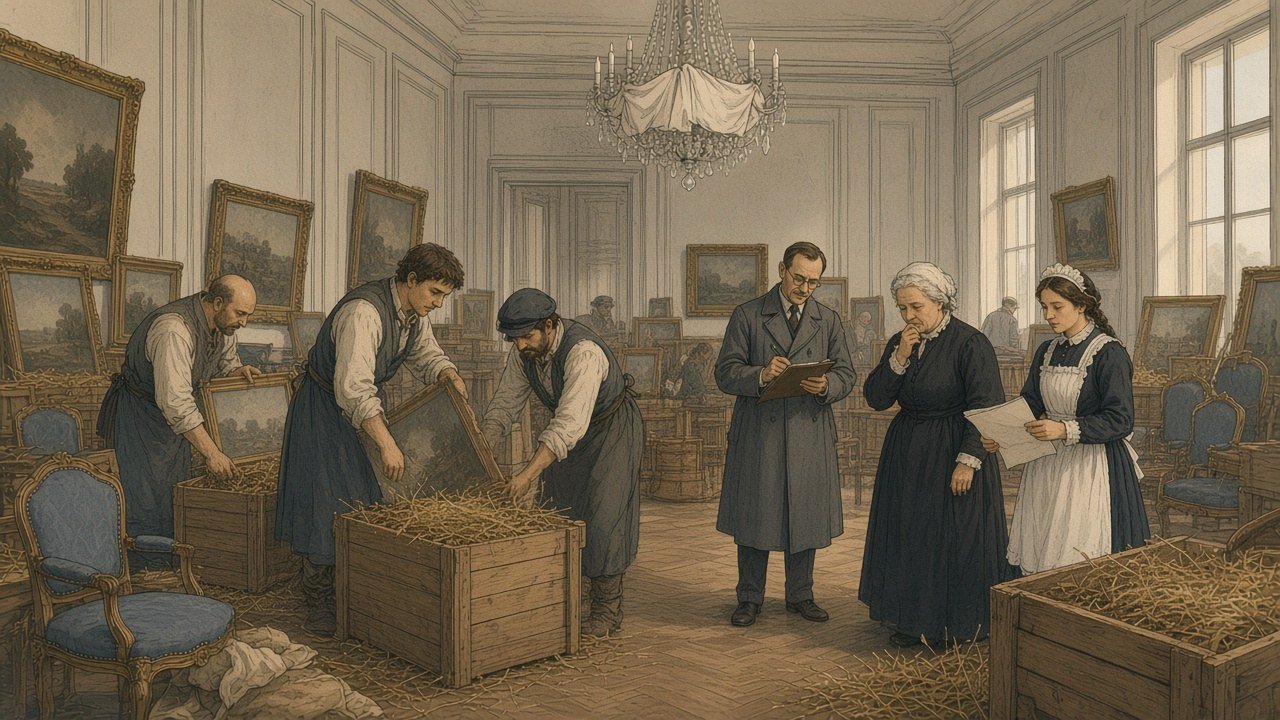
The persecution of Louis was robbery dressed as law. On 14 March the Gestapo sealed both family palaces, leaving the art collections in place for the moment. The bank was placed under a provisional director on 26 March, and on 8 July 1938 it was put in the charge of the Munich private bank Merck, Finck & Co; it was later expropriated and finally taken over by another Viennese bank. In August 1938 the Central Office for Jewish Emigration, the office through which Adolf Eichmann organised the forced emigration and plunder of Austria’s Jews, moved into Louis’s palace in the Prinz-Eugen-Strasse.[1]
Louis’s collection, described by a Viennese newspaper in 1930 as “the largest private collection of eighteenth-century art” in the city, included paintings by Fragonard, Boucher, Gainsborough and Romney, and more than a thousand objects in all.[1] In May 1938 the provisional director of the Kunsthistorisches Museum, Fritz Dworschak, was put in charge of the Rothschild art, and in October museum staff moved Louis’s collection into the Neue Burg on the Heldenplatz. Many of the best pieces were reserved for the museum that Hitler planned to build in Linz; the furnishings went to state buildings, and other museums submitted long wish lists for the rest.[1]
Louis was released only when the family agreed to give up title to all its remaining assets in Austria. He was freed on 11 May 1939 and went to Switzerland.[1][4] The Nazis also wanted the Witkowitz ironworks, one of the most important industrial concerns in Central Europe, but a contract of sale signed in July 1939 was never carried out, because the family had transferred most of the shares to a British company in London before the Anschluss.[1] The price of Louis’s freedom has been put at very large sums, but the exact figure is uncertain and the published estimates vary widely.
Exile
After leaving Europe, Louis applied in Buenos Aires in October 1940 for a stateless passport, and he reached New York only in February 1941. He became a citizen of the United States in 1946, married Hilda Auersperg, who had also emigrated from Vienna, and lived on a large farm at East Barnard in Vermont. After the war Czechoslovakia nationalised the ironworks at Vítkovice, and in 1953 it paid him a million pounds in compensation. He gave his Austrian property to the state in return for an undertaking that it would pay the pensions of all the former employees of the bank.[1] The Vienna house of the Rothschilds was never revived. Louis died on holiday in Jamaica in January 1955.[1]
The restitution of his collection was slow and incomplete. Between 1946 and 1952 the Austrian authorities returned many objects, but in return for permission to export them to the United States, Louis and his sister-in-law Clarice had to “donate” paintings, medals, weapons, drawings and clocks to Austrian museums.[1] Only after Austria passed its Art Restitution Act in 1998 did the state return these objects to the family’s heirs. In 1999 the heirs sent most of them to auction at Christie’s in London. The sale, on 8 July 1999, had been expected to raise around $40 million. In the event its 218 lots made £57.7 million, about $90 million, more than twice the estimate.[5][6][1] Provenance research in Austrian museums continues to identify objects from the collection today.[1]
France falls
In Paris the family had watched the rise of Nazism with growing alarm, and its members were active in helping Jewish refugees from Germany and Austria. When the German army broke through in May 1940, the French Rothschilds knew that they would be among its first targets. The Germans made strenuous efforts to capture members of the family, but all of them escaped and spent the war in Britain or the United States.[7] Others in the extended family were not so fortunate. Élisabeth, the wife of Philippe de Rothschild of Mouton, who had stayed in France, was arrested and deported and died in Ravensbrück on 23 March 1945.[8]
The Vichy government and the German occupiers treated the family’s property as a prize. The bank in the rue Laffitte was placed under administration and “aryanised”, the family’s houses were requisitioned, and the art collections, among the greatest in France, were seized by the Nazi looting organisation, the Einsatzstab Reichsleiter Rosenberg, which sent many of the best pieces to Germany for Hitler and Göring; the ERR’s own records of what passed through the Jeu de Paume list several Rothschild collections.[9] The vineyards at Lafite and Mouton were requisitioned.[10] Vichy stripped leading members of the family of their French nationality, five Rothschilds among fifteen people punished in this way for having left France in June 1940, and ordered their belongings confiscated.[11]
Guy de Rothschild, the son of Édouard and the future head of the French house, had fought in the battle of France in 1940 and was decorated. He made his way to London, joined the Free French forces of General de Gaulle, and at the end of the war served as an adjutant to de Gaulle’s military governor of Paris.[7] In Britain, the English Rothschilds had their own war. Victor, the third Lord Rothschild, a Cambridge zoologist, was recruited to MI5, where he specialised in counter-sabotage and explosives and defused bombs himself; the award of the George Medal for “dangerous work under hazardous circumstances” was announced in April 1944.[12][13][14]
Return
When Paris was liberated in August 1944, the Rothschilds came back to find their bank looted, their houses stripped and their collections scattered across Germany and Austria. Much of the art was recovered by the Allied armies, some of it from the salt mines and castles where the Nazis had hidden it, and was returned, although some pieces were never found.[10] The bank reopened under Édouard and Guy, and in the decades that followed Guy rebuilt de Rothschild Frères into one of the leading investment banks in France.
The family’s experience of the war was not that of most European Jews. Its members had the money, the connections and the foreign houses that allowed almost all of them to escape. Louis’s fourteen months in the Hotel Metropol were the worst that any Rothschild endured in Austria, while millions of Jews without such resources were murdered. The family has always been conscious of the difference, and after the war its foundations and members gave heavily to survivors, to the rebuilding of Jewish communities in France and to the new State of Israel.
References
OpenClose
- “Rothschild, Louis Nathaniel,” Lexikon der österreichischen Provenienzforschung (Commission for Provenance Research, Vienna) *
- Dieter Stiefel, “Die Krise der Credit-Anstalt in den 1930er Jahren und ihre Folgen für das österreichische Bankensystem,” Österreichische Zeitschrift für Geschichtswissenschaften *
- The Rothschild Archive, “The Vienna house, S M von Rothschild” *
- Jewish Telegraphic Agency, “Baron Rothschild Switzerland After Release from Vienna Prison,” 14 May 1939 *
- Carol Vogel, “At $90 Million, Rothschild Sale Exceeds Goals,” The New York Times, 9 July 1999 *
- The Independent, “Records hammered in £57m sale of looted Nazi art,” July 1999 *
- Henry Wasserman, Simon R. Schwarzfuchs and Vivian David Lipman, “Rothschild,” Encyclopaedia Judaica, 2nd ed., reprinted at Encyclopedia.com *
- Service historique de la Défense, “Dossier individuel de personnel de Rothschild de / Pelletier de Chambure, Elisabeth” *
- Cultural Plunder by the Einsatzstab Reichsleiter Rosenberg. Database of Art Objects at the Jeu de Paume *
- Niall Ferguson, The House of Rothschild. Volume 2, The World’s Banker 1849–1999 (London: Penguin, 2000; first published 1999) *
- Jewish Telegraphic Agency, “Ten prominent Jews denationalized by Vichy government,” 1940 *
- “Rothschild, Nathaniel Mayer Victor, Lord,” Encyclopaedia Judaica, 2nd ed., reprinted at Encyclopedia.com *
- Department of Zoology, University of Cambridge, “Victor Rothschild (1910–1990)” *
- Jewish Telegraphic Agency, “Lord Rothschild given British award for ‘dangerous work under hazardous circumstances’,” 6 April 1944 *
The family tree, timeline, places, glossary and select bibliography for the whole history are on the Rothschild index page.