Exile in the Maghreb
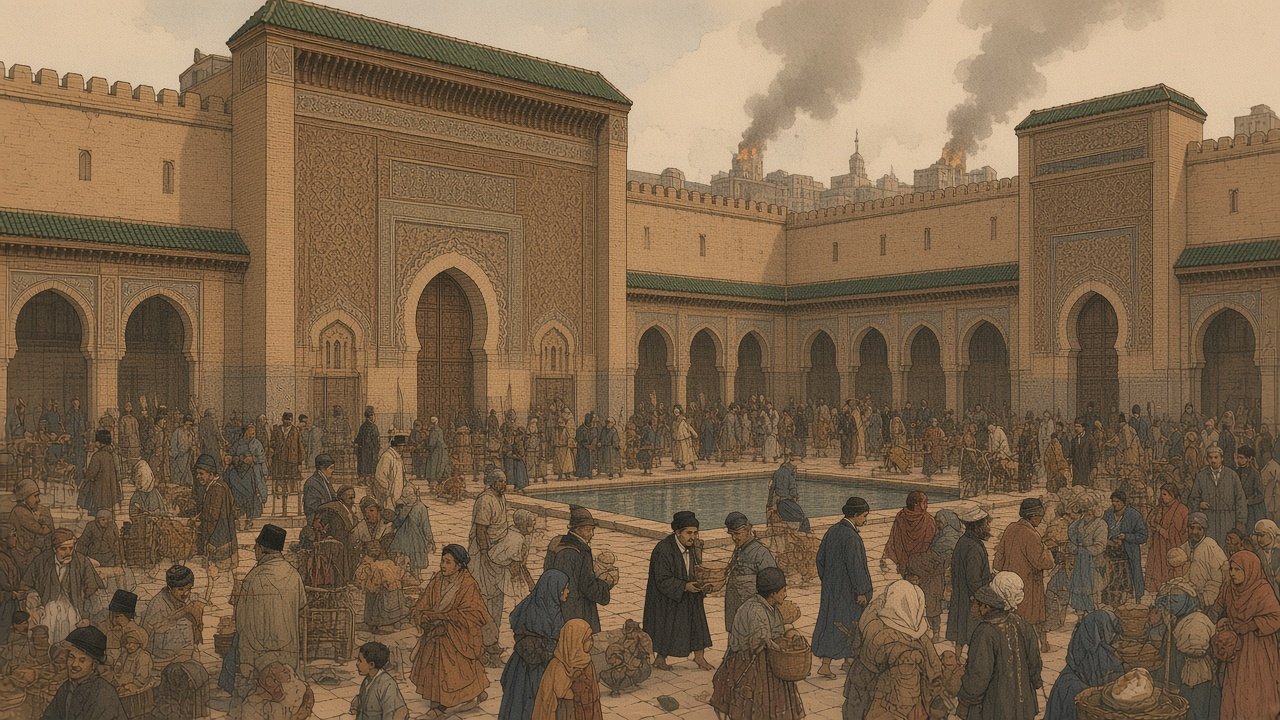
In the spring of 1912, in the days after the treaty that made Morocco a French protectorate, the Jewish quarter of Fez was sacked by mutinous soldiers and the crowds who followed them. Families hid in back rooms and among the dead, and on the third day thousands of them were let into the only refuge left, the courtyard of the sultan’s menagerie, among his lions and panthers. A boy who lived through it remembered that the animals, as he came out of the nightmare, all seemed to smile at him. The same city had stood at the very beginning of the written record: around 997 the head of the Babylonian academy at Sura sent a letter of consolation to the Jews of Fez, whom he called the seat of Torah.
Between those two moments lie nine centuries of Jewish life under Muslim rule in the far west of the Islamic world, the lands that Arabic geographers called المغرب (al-Maghrib, the place of sunset). They are the subject of Exile in the Maghreb: Jews under Islam, Sources and Documents, 997–1912, the anthology compiled by Paul B. Fenton and the late David G. Littman and published in English in 2016. It gathers several hundred texts: Hebrew elegies and letters, Arabic chronicles and legal opinions, the reports of European captives, consuls, missionaries and travellers, and the correspondence of Jewish teachers and diplomats. [1]
This long read draws on those documents to tell the story in order, from the Almohad persecutions of the twelfth century to the pogrom of 1912. It quotes the sources briefly, and every quotation is referenced to the pages of the book on which it appears. It also tries to do something the anthology was not designed to do, which is to weigh its evidence. Fenton and Littman wrote with a thesis, and they chose their documents to illustrate the humiliations and dangers of Jewish life under the ذمة (dhimma, the covenant of protection). Many of the texts bear that thesis out. Others complicate it, and the editors include them too: the Muslim scholar who refused to approve the destruction of a synagogue, the sultans who opened their gates, the neighbours who hid Jewish families. Where other historians have read the same evidence differently, the essay says so.
A word on scope. This is a history of the Jews of Morocco and Algeria. That is what the book documents: despite its title it covers only those two countries, because Tunisia and Libya were to be the subject of a second volume that was never completed. Tunisia and Libya therefore appear here only in passing.
1. A book of witnesses
How the anthology was made
Exile in the Maghreb began as the life’s work of David Littman, whose interest in the subject dated from a humanitarian mission to Morocco in 1961, and who died in May 2012 before the English edition was finished. His collaborator Paul Fenton completed it, signing the preface to the English edition in Paris in 2015. A French version, L’exil au Maghreb: la condition juive sous l’islam, 1148–1912, had appeared from the Presses de l’Université Paris-Sorbonne in 2010. Littman’s preface tells how the project grew out of a collaboration in the 1970s with the Israeli historian H. Z. Hirschberg, whose two-volume history of the Jews of North Africa remains the standard narrative, and how it was meant to be the first of nine volumes on the Jews of Islamic lands, from the Maghreb to Iran and Turkey. [1] [2]
The editors call the book a diachronic anthology. Part A, the larger, is arranged by period and gathers chronicles, poems, legal opinions and the accounts of travellers. Part B is drawn from three archives: those of the Alliance Israélite Universelle in Paris, the Anglo-Jewish Association in London and the Foreign Office papers in the Public Record Office. As the editors point out, Fez stands at both ends of the collection. The title comes from the Hebrew גלות (galut, exile), the word by which Jews named their condition wherever they lived outside the land of Israel, and which carries the sense of captivity as well as dispersal. [1]
A thesis and its critics
The anthology is not neutral, and it does not pretend to be. Littman’s preface quotes, in order to refute, the French orientalist Claude Cahen, who wrote in his article on the dhimma that there was nothing in medieval Islam that could specifically be called antisemitism. Littman acknowledges the influence of the writer Bat Ye’or, who coined the term dhimmitude in 1983 to describe what she saw as a permanent condition of subjection imposed on non-Muslims, and the editors use her word in several chapter titles. Their notes are sharply critical of the Moroccan historian Mohammed Kenbib, whose archival study of Jews and Muslims in Morocco from 1859 to 1948 they accuse of minimising Jewish suffering. The copyright page records that the English edition was made possible by a grant from the Middle East Forum, a political think tank, together with a grant from the Ahmanson Charitable Community Trust. [1] [3]
Readers should hold all of this in mind. Bernard Lewis’s survey The Jews of Islam set the comparative frame for much of what followed, weighing the inferior but protected status of Jews under Muslim rule against the far harsher record of medieval Christendom. [4] Since the 1990s historians of the Jews under Islam have argued over two opposite pictures. One, inherited from nineteenth-century European Jewish scholars, imagined a golden age of interfaith harmony. The other, which Mark R. Cohen of Princeton has called the neo-lachrymose conception of Jewish–Arab history, describes Jewish life under Islam as an almost unbroken story of persecution. Cohen argued that both are myths, and that the real history combines legal inferiority and periodic violence with long periods of relative security, a balance that was on the whole better than in medieval Latin Christendom. [5] Norman Stillman’s source book of 1979, which covers some of the same ground as Fenton and Littman, took a similar middle course. [6] Exile in the Maghreb stands firmly on the darker side of this debate. It has been reviewed in the Journal of the American Oriental Society by Susan Gilson Miller, a historian of modern Morocco. [7]
What the documents can and cannot show
None of this makes the documents less valuable. Most were hard to find, many are translated into English for the first time, and their sheer number makes certain patterns impossible to dismiss. But an anthology of grievances is shaped by its sources. Consuls and Alliance teachers wrote when something went wrong; travellers wrote about what struck them as strange; Hebrew elegies were composed for catastrophes, not for quiet years. Several of the European witnesses were themselves openly contemptuous of Jews. The archive of protest is not the same as the whole of life, and the account that follows tries to read the documents for what they say and also for what they imply about the long stretches between the crises.
2. Before Islam and the covenant of protection
Ancient roots
Jews lived in North Africa long before the Arabs came. Local legend carried their arrival back to the destruction of Solomon’s temple, and historians have thought it plausible that Judean seafarers settled alongside the Phoenicians in their African colonies during the first millennium BCE. Numbers certainly grew after the Roman wars in Judea; some Jews may have reached Africa as prisoners sold into slavery on Roman estates. The Jewish presence in the Roman provinces is also attested by funerary inscriptions, synagogue remains, rabbinic references to African communities, and Christian polemic; Carthage and other coastal cities hosted Greek- and Latin-speaking Jews who also used Hebrew liturgy. [2] Under Byzantine rule in the sixth century, after the Vandal interlude, Justinian’s campaign brought orders to convert synagogues into churches, and many Jews withdrew from the cities into the interior and the mountains, among independent Berber tribes. [8]
The Arab conquest of the late seventh and early eighth centuries, which reached the Atlantic under Mūsā ibn Nusayr in 708, is poorly documented for the Jews. The famous story of the Kāhina, the Berber queen who was said to have converted to Judaism and led resistance to the invaders, the editors treat as a later legend. What is clear is that by the ninth century the Jews of the new Muslim cities were mostly descendants of the older population, joined by immigrants from the East. [8]
The terms of the dhimma
From then on the Jews of the Maghreb lived as أهل الذمة (ahl al-dhimma, the people of the covenant), protected non-Muslims under Islamic law. The arrangement, which tradition attributed to the caliph ʿUmar, was in principle a bargain. In return for submission and payment of a poll tax, the جزية (jizya), Jews and Christians kept their lives, property and freedom of worship, and governed their own communities under their own law. In practice it was also a hierarchy. The rules that accumulated around the pact over the centuries forbade new places of worship, required distinctive dress, banned the riding of horses and the bearing of arms, and in many places disqualified a non-Muslim’s testimony against a Muslim. How strictly these rules were applied varied enormously with time, place and ruler. [5] [6]
The documents show the system’s earliest traces in the Maghreb. Lead seals from the ninth century, of the kind that tradition required a dhimmī to wear at his neck as proof of payment, have been found in North Africa, and the Cairo Genizah shows Jewish travellers carrying them. Legal manuals prescribed the manner of payment: “The jizya is to be given in a humiliating manner”, one of them says, and goes on to describe the official seizing the payer by the beard and striking him. Whether this ceremony was actually performed in the early centuries, the editors admit, has to be inferred; but as we shall see, travellers described versions of it in Morocco and Algeria as late as the nineteenth century. [8]
The Māliki school
North Africa followed the Māliki school of Islamic law, which the jurist Sahnūn consolidated at Qayrawān in the ninth century. The editors regard it as the severest of the law schools in its application of the dhimma. Their illustration is an anecdote about the Māliki scholar Abū ʿImrān al-Fāsī, a native of Fez who served as judge at Qayrawān. When the physician of the Zirid ruler, who was also the נגיד (nagid, head) of the Jews of Ifriqiya, brought him a message without wearing the Jewish badge, the judge took him for a Muslim, and on discovering his mistake had the man’s turban stained on the spot. The ruler, appealed to, told his physician that he had learned a good lesson. [8]
The story is typical of much that follows. A Jew could rise to the highest office at court, as physician, financier or diplomat, and yet remain subject to public humiliation by any scholar or crowd who chose to enforce the rules. Proximity to power was both the community’s protection and its danger.
3. Qayrawān, Fez and the age of the academies
A Mediterranean hinge
Between the ninth and eleventh centuries the Maghreb lay at the centre of the Jewish world, not at its edge. It linked Iraq and Egypt with Muslim Spain, and the great academies of Babylonia and Palestine competed for its loyalty and its donations. Communities in Qayrawān and Gabès in present-day Tunisia, Tāhert in Algeria, and Sijilmāsa and Fez in Morocco addressed legal questions to the geonim and supported their schools. Judah Hayyūj of Fez, one of the founders of Hebrew grammar, and the Talmudist Isaac al-Fāsī, who was born at Constantine in 1013 and later settled in Spain, carried Maghrebi learning to al-Andalus. Solomon ben Judah, a native of Fez who died in 1051, became head of the Palestinian academy. [8]
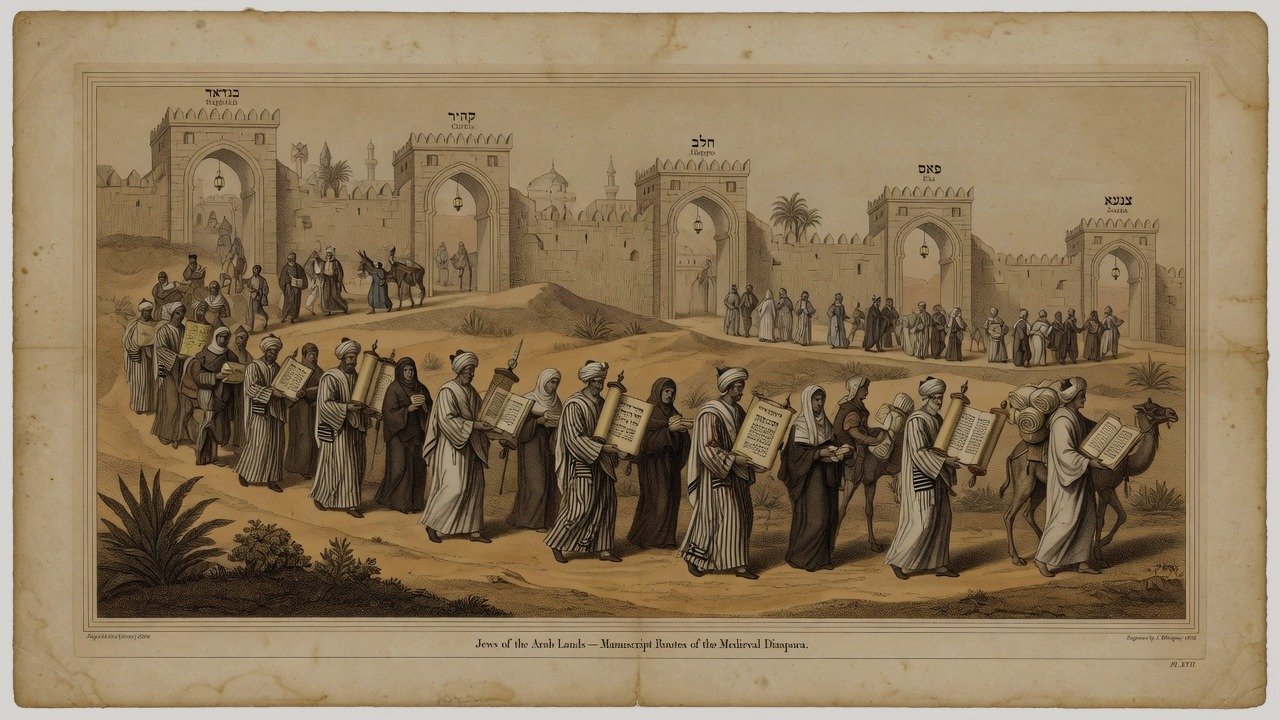
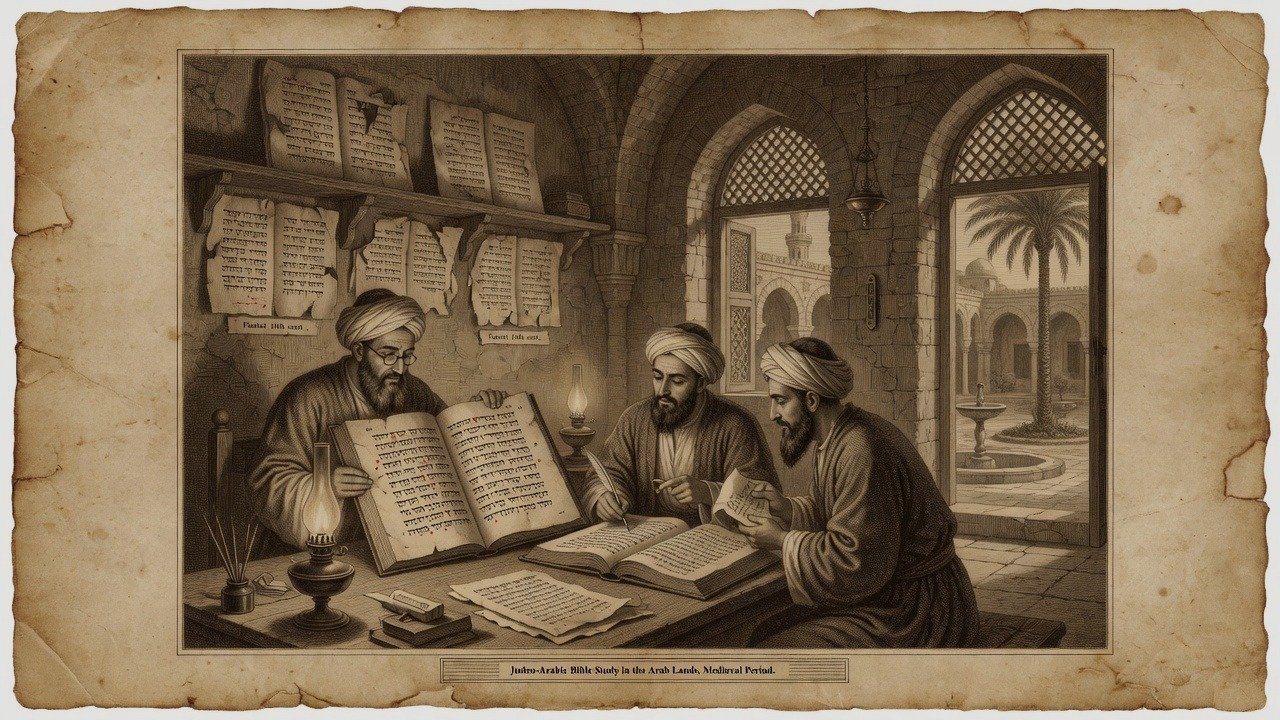
Qayrawān, until its destruction by the Banū Hilāl Arabs in 1057, was the foremost Jewish centre of the region, with a Talmudic academy of its own. Its scholars corresponded with the geonim of Sura and Pumbedita on questions of law, scroll-writing and the reading of Scripture, and Maghrebi merchants carried books as well as goods along the caravan routes from Sijilmāsa and across the sea to Fustat. S. D. Goitein’s reconstruction of the Genizah world, A Mediterranean Society, shows these traders writing home from Egypt and India in a Judeo-Arabic dense with biblical phrases, and settling their disputes before rabbinical courts that recognised one another across the whole Mediterranean. [9] The essay on the Jews of Fatimid Egypt follows those Maghrebi traders between Qayrawān and Fustat.
The first catastrophes in Fez
Fez, founded at the end of the eighth century, already had a celebrated Jewish community when the documents begin. The first text in the anthology is a letter of consolation from Samuel ben Hofni, head of the academy at Sura in Iraq, written around 997 to the Jews of Fez after a massacre during the wars between the Zenāta Berbers and the Umayyads of Córdoba. Its salutation piles up praise for a congregation living in “the seat of Torah, the threshing-floor of wisdom”, and its body is a string of biblical verses promising that the ruins will be rebuilt. [10]
The letter shows something that recurs throughout the book. Violence against Jews in the Maghreb was often a by-product of wars between Muslim powers, in which a defenceless and conspicuous minority was easy prey. In 1032, when Fez fell to the chief of another Berber tribe, he is reported to have killed 6,000 of its Jews. The figure is reported rather than counted, and like most round numbers in medieval sources it should be treated with caution; but there is no reason to doubt that the community suffered grievously. [8]
Yet the communities recovered each time. The century that followed was the age in which Isaac al-Fāsī wrote his great legal digest and in which the merchants of the Genizah letters moved freely between the Maghreb, Egypt and India. It was the twelfth century that brought something new: not a massacre in the course of a war, but a deliberate attempt by a Muslim state to end Jewish existence altogether.
4. The Almohad storm
Islam or death
The Almoravids, the Saharan Berber dynasty that ruled Morocco and al-Andalus from the later eleventh century, were already harsher towards Jews than their predecessors: ʿAlī ibn Yūsuf ibn Tāshfīn forbade them, under pain of death, to live in his capital of Marrakesh. But the Almohads (الموحدون, al-muwahhidūn, those who affirm the unity of God), who overthrew them from the 1140s, went much further. Their movement, founded by the preacher Ibn Tūmart and built into an empire by his successor ʿAbd al-Muʾmin, had begun as a puritan reform aimed at Muslims they regarded as lax, and it turned with the same rigour on unbelievers. The dhimma itself was suspended. Jews and Christians were offered conversion, exile or death. [8]


A Damascene historian of the thirteenth century, al-Dhahabī, preserved a conversation in which an Almohad secretary explained why no Jews, Christians, synagogues or churches remained in the Maghreb. The caliph ʿAbd al-Muʾmin is made to tell the Jews that their messiah has failed to appear within the five hundred years they had allowed him, and so “it’s either Islam or death!” He gave them time to sell what they could not carry. Most Jews, the account says, chose outward conversion and kept their property; most Christians emigrated to Spain. [11]
The letter from Sijilmāsa
The most immediate witness is a Judaeo-Arabic letter found in the Cairo Genizah, written in January 1148 by Solomon ben Judah al-Sijilmāsī. He reports what refugees have told him. After taking Oran and Tlemcen, ʿAbd al-Muʾmin entered Sijilmāsa and called on its Jews to convert. They debated with him for seven months, fasting and praying; then a commander demanded that they abjure their faith, and when they refused, a hundred and fifty were killed. The rest gave way, the first of them being the community’s own rabbinical judge. Solomon’s summary is bleak: from Bijāya to Gibraltar “there remains not one Jewish soul”, for all had either apostatised or been killed. His figures for the dead at Fez and Marrakesh, a hundred thousand in each, are the rumours of a frightened man, but his account of Sijilmāsa he insists came from eyewitnesses. [10]
Abraham ibn Ezra, the Spanish poet and commentator who spent the second half of his life wandering in Christian Europe, wrote an elegy for the destroyed communities of Spain and the Maghreb. It opens by pairing the two: misfortune has befallen Andalusia, “And a great mourning overtaken the Maghreb.” It then names the cities one by one, Lucena, Seville and Córdoba in Spain, and in the Maghreb Darʿa, Sijilmāsa, Marrakesh, Tlemcen, Ceuta, Meknes, Sūs, Aghmāt and finally Fez, which the poet honours as a home of Scripture and of rabbinic learning. [10] The site’s essay on Ibn Ezra, A Spaniard in the Corner of the Earth, follows his own exile. Judah Halevi is sometimes listed with these fugitives, but he had left Spain around 1140, before the Almohads took the Andalusian cities, and he died on the journey towards the Land of Israel; he was not an Almohad exile.
Life as a forced convert
What did it mean to survive as a convert? The fullest answer comes from Joseph ibn ʿAqnīn, a philosopher born in Barcelona whose family fled the Almohads in Spain only to live as crypto-Jews in Fez. He describes Jewish children taken away and handed to Muslim tutors, a ban on marriage with Muslims of long standing, restrictions on trade, and a humiliating dress code. The converts had become a byword: a Muslim who wished to describe his own disgrace would say, “My shame was like that of the Jews”. Ibn ʿAqnīn noticed a cruel paradox: in earlier persecutions compliance had brought relief, but now “the more we obey their instructions and comply with their doctrines and forsake our own, the more they burden our yoke and increase our travail.” Even those whose fathers or grandfathers had converted generations before were not trusted. [11]
The Almohad chronicler al-Marrākushī confirms the suspicion from the other side. Around 1198 the caliph Abū Yūsuf Yaʿqūb al-Mansūr ordered Muslims of Jewish descent to wear a dark blue robe with absurdly wide sleeves and a cap so misshapen that it looked like a pack-saddle; his son changed the colour to yellow. Al-Mansūr, the chronicler says, could not decide whether the converts were sincere. They prayed in the mosques and taught their children the Qur’an, but “God alone knows what is concealed in their hearts”. As for the original population of non-Muslims, by his day there was “neither synagogue nor church” in the Muslim Maghreb. [11]
What the Almohads left behind
In al-Andalus the blow fell on the most brilliant Jewish culture of the age, the world of the Umayyad court at Córdoba, of Hasdai ibn Shaprut and of the grammarians who had made the Tiberian pointed Bible the basis of a rational Hebrew philology. When the Almohads took Córdoba in the late 1140s — the date is often given as 1147, though some sources have 1148 — its Jewish families faced the same choice as those of the Maghreb. The grammarian Joseph Kimhi left southern Spain and settled in Narbonne, where he and his sons planted Andalusian Hebrew grammar and Bible commentary in Christian Provence. [12] Jonah ibn Janāḥ’s lexicon and grammar, the Kitāb al-Uṣūl (Sefer ha-Shorashim) and the Kitāb al-Lumaʿ (Sefer ha-Riqmah), travelled with other books into the same Provençal schools. Material losses were severe: synagogue libraries were burned or abandoned, and codices left behind were confiscated or destroyed. What could be carried or remembered survived. Almohad power in Spain was broken only by the Christian victory at Las Navas de Tolosa in 1212, after which Jewish life revived, never again at Córdoba’s tenth-century height, under Christian kings in Toledo, Barcelona and later Granada rather than under Muslim ones. [13]
This is the period that drove the family of Moses Maimonides, born in Córdoba in 1138, out of the city, through Fez and on to Fustat, where they settled around 1168. How far the family lived outwardly as Muslims while keeping their Judaism in private, as Ibn ʿAqnīn describes, is still debated. His life is told in the site’s essay Moses Maimonides, from Córdoba to Fustat. From that exile he wrote the Mishneh Torah, which set a legal standard for Torah scrolls in the tradition of Aaron Ben Asher, and Egypt became a new centre of Sephardi learning because the exiles brought Andalusian methods with them. The persecution also scattered the learning of al-Andalus: Andalusian Jewish families fled with their books to Christian Toledo, Provence and Egypt, carrying with them the Hebrew grammar, poetry and Bible commentary of the Muslim west. Historians sometimes treat the Almohad years as a prelude to the riots of 1391 and the expulsion of 1492. The pressures were not the same — Almohad policy was Islamic and theological; the later crises were Christian, and in time concerned descent as well as belief — but each redistributed scholars, books and methods across the Mediterranean. In the Maghreb itself the consequences were long. When the Almohad state collapsed in the thirteenth century, Jews gradually returned to open practice. The Christians, however, did not return. The ancient churches of North Africa, which had survived the Arab conquest, vanished under the Almohads, and the editors draw the conclusion that from then on, and for five centuries, the Jews were the only non-Muslims left to bear the weight of the dhimma in the Maghreb. [14]
5. The Marīnids and the first mellah
Return and riot
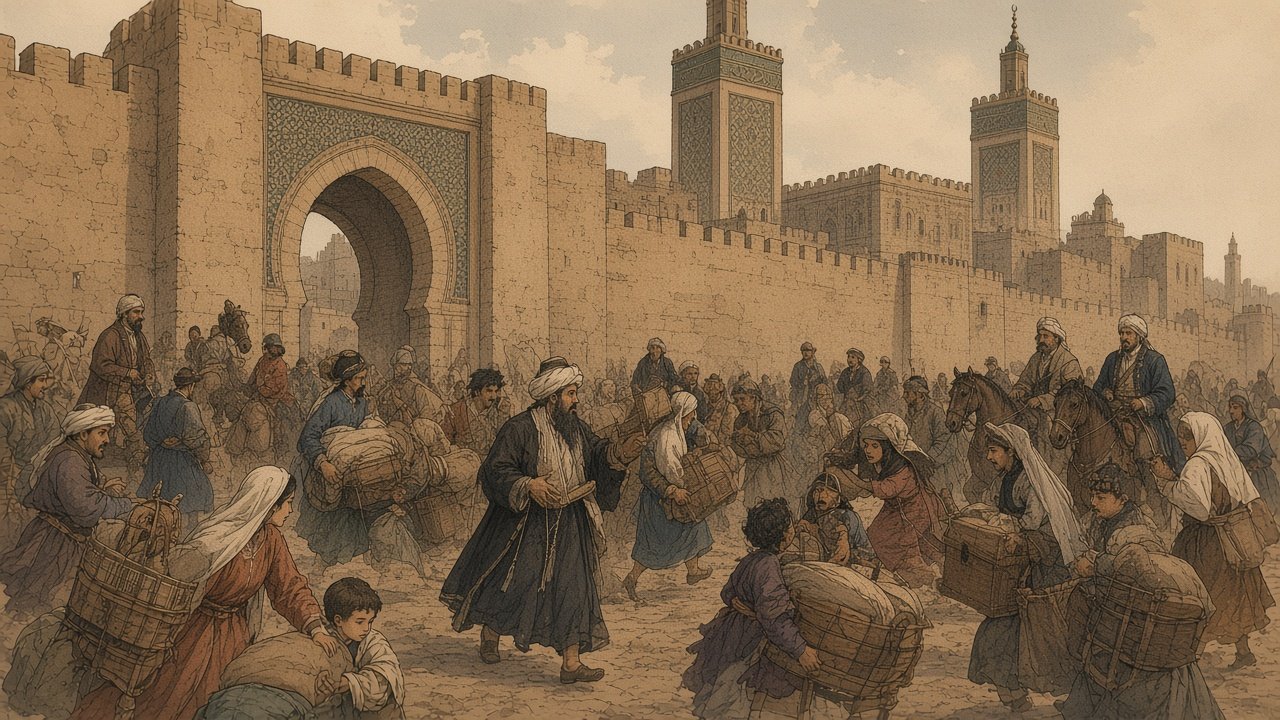
The Marīnids, Zenāta Berbers who took Fez in the middle of the thirteenth century and ruled Morocco until 1465, had their own reasons to favour Jews. Outsiders to the Arab urban elite of Fez and hostile to Almohad doctrine, they allowed former converts to return to Judaism and employed Jews in their service. Protection by the dynasty did not mean safety in the streets. A Muslim historian recorded an anti-Jewish riot in Fez in 1276, under Sultan Yaʿqūb ibn ʿAbd al-Haqq, in which many Jews were killed. The descendants of the Prophet, the شرفاء (shurafāʾ), had become a powerful social group in the city, and the Sufi writer Ibn Sakkāk later said that he admired Fez “because its inhabitants respect the shurafā’ and scorn the Jews”. [14]
A quarter beside the palace
After a further attack in 1438, the Marīnid rulers moved the Jews of Fez into a walled precinct next to the دار المخزن (dār al-makhzan, the seat of government) in the new royal city of Fās al-Jadīd. This was the first ملاح (mallāh, in its usual spelling mellah), and the editors see in it the model for every later Jewish quarter in Morocco. [14] The word’s origin is disputed. One explanation, given in the book, is that it comes from the Arabic for salt, and that it recalls the duty imposed on Jews of salting the heads of executed rebels before they were displayed on the city gates; Emily Gottreich, in her study of the mellah of Marrakesh, prefers the more prosaic derivation from the salty marshy ground on which the Fez quarter was built. [15]
Was the mellah a ghetto? In one sense plainly yes: Jews were moved into it by order, its gates were locked at night, and in many towns they could not live elsewhere. But its location also tells another story. It was built against the palace walls because it was meant to be protected, and in moments of danger Jews fled not out of the mellah but into the sultan’s compound next door, as they would in 1912. Gottreich argues that the mellah should be seen as a Moroccan urban institution in its own right, a space that Muslims as well as Jews used and shaped, rather than as a copy of the European ghetto. [16] The two readings are not exclusive. The mellah expressed both the ruler’s protection and the population’s separation, and which aspect mattered more depended on the year.
The jurists of Tlemcen
Two legal texts from Tlemcen, then the capital of the Zayyānid kingdom in what is now western Algeria, show how scholars thought about the rules. In about 1430 the jurist al-ʿUqbānī was asked whether Jews who had built a house overlooking a madrasa could be made to wall it off or pull it down. Yes, he replied; but he admitted that he could not recall any ruling forbidding Jewish houses to be higher than Muslim ones in general, and he listed the humiliations he did know: lead seals, distinctive belts, cropped forelocks and riding side-saddle. Some time later he wrote again to say that he had found the answer. [17]
In a longer treatise of around 1450, the same judge set out the distinctive signs Jews should wear. In the Maghreb, he observed, native Jews wore a piece of yellow cloth, the شكلة (shikla), on their outer garment, and Jewish women went without the veil. He wanted the rules tightened, and he ended with a prayer: “May Allah extinguish their pomp and confirm the word of Islam through their debasement and humiliation!” [17] The texts are revealing in two ways. They show that the rules of the dhimma were real law, discussed and enforced by judges. They also show, by the very need to discuss them, that Jews in fifteenth-century Tlemcen were not always observing them, and that some of them lived in houses grand enough to overlook a college.
6. The Jewish vizier of 1465
Hārūn ibn Bātāsh
The last Marīnid sultan, ʿAbd al-Haqq, tried to free himself from the Wattāsid family of viziers who had ruled in his name. To do so he turned to a Jew. The Egyptian traveller ʿAbd al-Bāsit ibn Khalīl, who was in North Africa at the time, tells how the sultan raised Hārūn ibn Bātāsh, a Jewish moneychanger of Fez who had handled the viziers’ finances, until he was vizier in all but name, riding fine horses, wearing a sword and escorting his master to the mosque on Fridays. The chronicler, who detested him, says that the Jews of Fez grew powerful in his time. While Hārūn was away from the city with the sultan, his relative and deputy Saul ibn Bātāsh was said to have insulted, and perhaps assaulted, a woman descended from the Prophet. [18]
The preacher of the Qarawiyyīn mosque, who had long denounced the Jews’ position in his sermons, ran through the streets of Fez crying “Holy war, holy war!”, and the crowd rose. The chief of the shurafāʾ at first declined to lead them without the scholars’ approval, and the mufti al-Qawrī, pressed for a legal opinion, refused, “claiming that he feared the authorities”, until the rebels drew their swords and threatened to kill him. With his written ruling in hand, the crowd attacked the Jewish quarter. Hārūn advised the sultan not to return to Fez; ʿAbd al-Haqq blamed him for everything, and a Marīnid prince speared the Jew at the sultan’s feet. When the sultan entered the city with a tiny escort, he was dragged from his horse and slaughtered on 19 May 1465. When news reached Tlemcen, ʿAbd al-Bāsit wrote that the people of Fez had massacred the Jews of the city: “Only five men and six women, or perhaps less, escaped death”. [18]
Reading the chronicle
It is an appalling story, but the chronicle needs to be read with care. ʿAbd al-Bāsit was not in Fez; he reported what reached Tlemcen. Elsewhere, in his obituary of Hārūn, he calls the Jewish vizier “a skilful, intelligent, and honest person” who was very capable in public affairs, even as he adds a curse to his name. And the annihilation he describes was not literally complete: the editors themselves note that Jews forcibly converted in 1465 were later allowed to return to Judaism, and Fez had a Jewish community again within a generation. A later Muslim chronicle, by al-Jannābī, retold the story as a just punishment, putting into the vizier’s mouth a blasphemous taunt against the Prophet’s descendant; the dialogue is a literary device, but it shows how the event was remembered as the defence of Islam against a Jew who had forgotten his place. [18]
What the episode reveals is the structural trap that would close on Moroccan Jews again and again. A ruler who wanted servants without a power base of their own found them among the Jews, who could not aspire to the throne and depended entirely on his favour. But the same dependence made them the natural target of anyone who opposed the ruler, and an attack on the sultan’s Jew could be dressed up as the defence of Islam. The fall of the Marīnids ended with the destruction of the community that had served them.
7. Refugees from Iberia
The waves of 1391, 1492 and 1497
The communities of the Maghreb were refilled from across the strait. After the riots that swept Castile and Aragon in 1391, and again after the expulsions from Spain in 1492 and from Portugal in 1497, thousands of Iberian Jews crossed to North Africa. The earlier refugees settled mostly in the coastal towns of what is now Algeria, among them Hūnayn, Oran, Mostaganem, Algiers and Bugia, and inland at Tlemcen, Miliana and Constantine. Some of the later ones saw the Maghreb only as a stage on the road to the Land of Israel. Muslim rulers generally let them in, though the Jewish sources note that money was part of the welcome. The refugees in Tlemcen tried at first, on the ground of their foreign origin, to avoid paying the jizya, but in the end they shared the burden of the local Jews. [19]
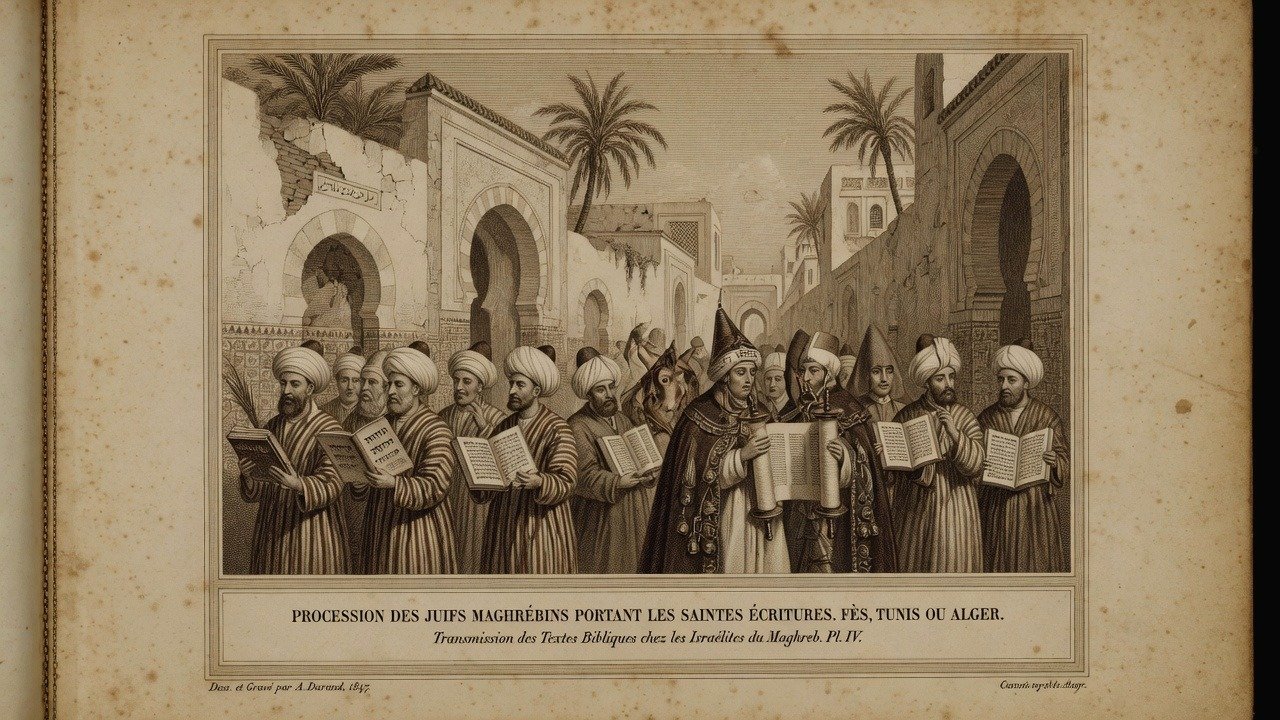

The newcomers brought scholarship with them. Rabbi Isaac bar Sheshet Perfet (the Ribash) and Rabbi Simon ben Zemah Duran (the Rashbaz) made Algiers a rabbinical centre whose leadership remained in Duran’s family for generations, and Rabbi Ephraim al-Naqāwa made Tlemcen a place of pilgrimage that North African Jews still revere. [19]
A sultan among the righteous
In Morocco, the Wattāsid sultan Muhammad al-Shaykh admitted the exiles of 1492 to his kingdom. A refugee chronicler, Abraham ben Solomon of Torrutiel, who reached Fez as a boy of about eleven, called him “one of the righteous gentiles for he admitted the Jews into his entire kingdom and treated them benevolently.” The same chronicler describes what followed: a fire in the Jewish quarter of Fez some eight months after their arrival, then famine and an epidemic that, by his count, killed more than 20,000 Jews in the city and as many in the neighbouring towns. Some despairing exiles set out to return to Spain; others took refuge with Arab and nomad camps. Those who landed at Salé suffered at the hands of Christian raiders. [18]
Two peoples in one community
The exiles never simply merged with the older population. Across Morocco and western Algeria, and in different forms in Tunisia, Jewish society came to be divided between the תושבים (toshavim, residents), the long-settled Arabic- and Berber-speaking Jews, and the מגורשים (megorashim, the expelled), the descendants of the Iberian exiles, who kept Castilian speech, their own synagogue rites and their own rabbinical courts. In Fez the two groups disputed precedence and custom for generations before their practices were gradually harmonised; in the northern towns of Tetuan and Tangier Spanish-speaking Jews remained dominant into the twentieth century. In Algiers, and above all in Tunis, a further divide later opened between the native Twansa and the Grana, Sephardi merchants who came from Livorno in Tuscany from the seventeenth century. In Tunis the Twansa and the Grana kept separate synagogues, courts and eventually separate communal councils within the same Jewish quarter, the حارة (hāra). Livorno also supplied printed Hebrew books, so that the Bibles and prayer books in Maghrebi schools increasingly came from Italian presses, even as Torah scrolls continued to be written by local scribes. And on the island of Djerba, the two old Jewish villages of the Hara Kbira and Hara Sghira sustained a dense culture of study that supplied rabbis to the whole of Tunisia, and that has outlasted almost every other Jewish settlement in the Maghreb. East of Tunisia, and only in passing here, the Jews of Tripoli and Benghazi in Libya stood at the edge of this same world, on the route between the Maghreb and Italy, until almost all of them left in the middle of the twentieth century. [2] [69] [2] [20] [21]
The exiles also brought political skills that North African rulers prized: languages, commercial connections across the Mediterranean, and knowledge of Christian courts. Within a generation families such as the Rute were serving the Wattāsids as commercial and diplomatic advisers. That success, as in 1465, had a cost. [19]
Languages of the mellah
Whatever their origin, Maghrebi Jews lived in several languages at once. Hebrew was the language of Scripture, prayer and learned writing, and Aramaic of the Talmud. Daily speech was Judaeo-Arabic, and in the Atlas Jews lived among Berber tribes, where European writers believed the oldest communities were to be found. William Lemprière noticed in 1790 that the Jews of Tetuan and Tangier spoke a tolerable Spanish, while those of Marrakesh and the inland towns knew only Arabic and a little Hebrew. [22] A Swedish diplomat writing around 1820 added that Moroccan Jews wrote the language of the country in Hebrew letters, which he put down to a ban on their reading Arabic. [23] French, Spanish and Italian came later, with the consulates, the ports and the schools of the Alliance described in section 20.
Scrolls, schools and the pointed page
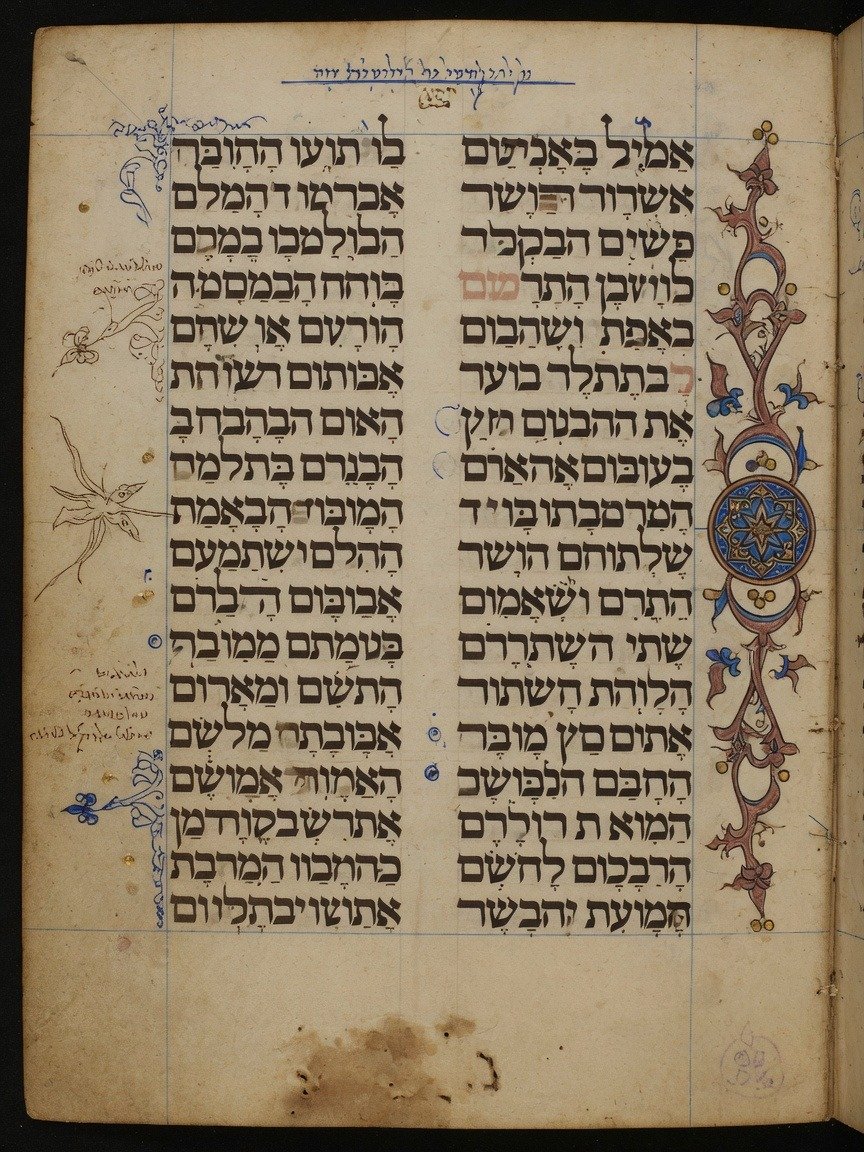
Alongside speech, Maghrebi communities kept a continuous culture of the pointed Hebrew page. Soferim wrote Torah scrolls, megillot, tefillin and mezuzot as a craft often handed down in families. Children learned the alphabet, the vowel points and the weekly portion in the heder or kuttāb, and those who went further read the humash with Rashi as the usual companion, then the other classic commentators of the Sephardi curriculum — Ibn Ezra, Nahmanides and the rest — in printed Mikraot Gedolot and separate humashim that reached the Maghreb first from Livorno and other Italian presses, then from Vienna and from cheaper nineteenth-century editions. Piyyut, especially rich in the Moroccan and Tunisian repertoires, carried biblical narrative into the sound of the synagogue beyond the formal Torah reading. The text on the page was the Tiberian Masoretic text; the oral realisation of its vowels, and the Torah and haftarah melodies, formed a distinct Maghrebi branch of Sephardi tradition, with Tunisian, Moroccan and Algerian substyles, different from Ashkenazi and Yemenite systems but not a departure from the same inventory of signs. Genizah fragments and, where they survive, synagogue genizot show Maghrebi hands copying biblical books, Targum and liturgical poetry — a reception of the Masora that any history of the pointed text is incomplete without. [2] [6]
8. Al-Maghīlī and the end of Tamantīt
A preacher in the Sahara
At the end of the fifteenth century the most dangerous enemy of the Jews of the Maghreb was not a ruler but a scholar. Muhammad ibn ʿAbd al-Karīm al-Maghīlī, a jurist and Sufi from Tlemcen who died around 1504, travelled south to spread Islam in the oases of the Sahara. In the region of Tuʾāt, in what is now southern Algeria, he found Jewish communities that had probably settled there in the time of the Almohad persecutions, and Jews in the service of local chiefs. To him this was a breach of the conditions of the dhimma, and a Jew who broke them forfeited its protection. [19]
His treatise against the Jews, written around 1491, opens with a poem whose refrain is “Rise up and kill the Jews!” The prose that follows argues that friendship with Jews is a betrayal of the Prophet, piling up Qur’anic verses against taking unbelievers as allies and anecdotes meant to show that Jewish servants are filthy and treacherous. One short line of verse sums up the argument: love of the Prophet implies hatred of the Jews. Anyone who protects them, he wrote, is lacking in common sense and dignity. [24]
The synagogue question
The practical issue was a synagogue in Tamantīt, the chief town of Tuʾāt. Had the Jews, who came after the Muslims had founded the town, any right to build a place of worship there? The question was put to jurists across the Maghreb, and the answers preserved in al-Wansharīsī’s great collection of legal opinions, the Miʿyār, show that it was contested. One reply in the anthology gathers prophetic traditions and the rulings of the judicial council of Córdoba to conclude that no new synagogue could be built in the lands of Islam and that the Tamantīt building must come down. [24] John Hunwick, who translated the dossier in full, traces how a prosperous Jewish community on the caravan route between Tlemcen and Timbuktu became the target of al-Maghīlī’s campaign, and how its members were scattered once the synagogue fell. Around 1492 the synagogue was destroyed and the Jews of the oasis were killed or driven out. [25]
Memory of Tuʾāt
The destruction of the Jews of Tuʾāt was remembered for centuries. An anonymous Hebrew lament calls al-Maghīlī “the notorious tyrant” and the assassin of the households of Gurāra and Tuʾāt, who then went on to Darʿa and demolished its house of prayer. Leo Africanus, writing a few decades later, noted that there had once been many rich Jews in the region, until “a certain Mahumetan preacher” had them expelled and many of them killed, in the very year of the expulsion from Spain. The Jews of Ghardāya and Laghouat, said to descend from the survivors, are reported to have ended their Passover meal with the wish “Next year in Tamanatit!” [19] [26]
A Maghrebi severity
The editors see al-Maghīlī’s treatise as the moment when a specifically Maghrebi interpretation of the dhimma took shape, one that read the Qur’anic command to humble the People of the Book in its most literal sense. They place it in a wider movement. In the East, the fourteenth-century Hanbali scholars Ibn Taymiyya and his disciple Ibn al-Qayyim had codified the laws on non-Muslims; in the West, al-Wansharīsī’s Miʿyār collected the Maghrebi rulings. The editors also note two occasions when Maghrebis carried their strictness eastwards: in 1301 a Moroccan vizier passing through Cairo on pilgrimage was shocked by the freedom of Egyptian non-Muslims and helped to provoke a fierce persecution there, and in 1358 Ibn al-Naqqāsh, a scholar of Maghrebi origin, wrote a ruling that led to the closure of Egypt’s synagogues for ten years. [27]
The editors go further and argue that, unlike in the Mamluk East where the rules were periodically renewed and then allowed to lapse, the Maghrebi chronicles never record their suspension. This is a large claim, made from silence. The documents in the rest of the book show the rules enforced with great variety, from barefoot walking in Fez to the ownership of fine houses in Tlemcen and the near-absence of any mellah in Larache in 1902. But there is no doubt that in Morocco the outward signs of subordination, black clothing and bare feet above all, lasted into the twentieth century.
9. Fez in the sixteenth century
Leo Africanus and Clénard
Two Christian witnesses describe the mellah of Fez in its first century. Leo Africanus, the Granada-born Muslim scholar who was captured by Christian corsairs and wrote his description of Africa in Rome, says that the Jews had been moved out of the old city after they were robbed there on a king’s death, and now lived in a walled quarter with one gate to the city and another to their cemetery. Most were goldsmiths, since Muslims in old Fez were not allowed to practise the trade, and the richest managed the revenues of governors and princes. They paid the sultan four hundred ducats a month. Jews were held in great contempt, he adds, and were not allowed to wear shoes outside their quarter, so they made themselves “socks of sea-rushes”. [28]
Nicolas Clénard, a Flemish scholar who went to Fez to learn Arabic, lived in the mellah in 1541 because he did not dare to keep a household in either Muslim city. He counted about four thousand Jews there and pitied them for the taxes they paid: the more money the sultan needed, the more the Jews had to find. With the condescension typical of his age he excused their supposed dishonesty as the only means of meeting the tribute. [28]
Shoes and money
An anonymous description of Morocco written in 1596 tells a revealing story about the Saʿdian sultan Mawlāy ʿAbdallāh. The Jews of Fez, it says, offered him money to forbid the Christian captives to wear shoes and fine clothes, as Jews were forbidden. The sultan agreed, but on his brother’s advice first asked Moroccans who had been captives in Portugal how they had been treated; the reports were good, so he let the Christians dress as they pleased and made the Jews go barefoot instead, after which the Jews had to pay again for the right to wear shoes inside their own quarter. [28] The story may be a Christian joke at Jewish expense. It is also a picture of how the rules of status worked in practice, as a market in which exemptions were bought and sold and in which each subordinate group measured itself against the others.
Two factions of scholars
Two legal opinions from the seventeenth century show Muslim scholars disagreeing about Jews. In about 1640, at Illīgh in the Sūs, the seat of an independent religious principality, Jews had settled with the founder’s permission and built a synagogue in a courtyard. An assembly of scholars split. One faction wanted it demolished, because Illīgh was a new Muslim town; the other argued that the Jews were protected precisely in the practice of their religion, that nothing forbade two religions to coexist outside Arabia, and that synagogues stood without objection in many new towns full of scholars. Unable to agree, they referred the question to the jurist ʿĪsā al-Suktānī, who ruled for demolition. [28]
A generation later the Sufi scholar ʿAbd al-Qādir al-Fāsī was asked about a Muslim who had praised a dead Jew in the market: the dead man had been a good and honest man, God rest him. The jurist forbade the prayer for mercy, as Qur’anic verses forbade prayer for unbelievers. But he allowed the praise, if it meant that the man had been just and had wronged no one, “for though unlikely, it is not impossible that such a thing should exist in a Jew.” [28] The ruling is grudging. Its occasion, an ordinary Muslim in a mixed crowd mourning a Jewish neighbour, is not.
10. Algiers under the deys
Captives, corsairs and Spanish Oran
From the early sixteenth century the history of the Jews of Algeria and Morocco diverged. Spain seized Oran in 1509 and held it, with a break, until the eighteenth century; Ottoman corsairs answered by making Algiers, Tunis and Tripoli into regencies of the sultan in Istanbul. By the middle of the seventeenth century the regency of Algiers was in practice self-governing under a داي (dāy, the dey), elected by the corsair captains and the officers of the Janissary garrison. The Spanish governors of Oran employed Jewish exiles, some openly practising and some still outwardly Christian, as interpreters and agents, and Jews served the deys in the same way. [20]

Corsairing made Algiers and the Moroccan port of Salé into markets for Christian captives, and the captives’ memoirs are among the richest sources the book contains. One of the most humane passages comes from a Portuguese nobleman, Jerónimo de Mendonça, captured at the battle of Alcácer Quibir in 1578 and redeemed by Jews. He wrote that the Portuguese captives in Fez found shelter in Jewish homes, where they met “much gentleness, affability and courtesy”, spoke Castilian with their hosts and climbed to the terraces to gaze towards Spain. [20]
The hāra of Algiers
The Jews of Algiers were governed through a شيخ اليهود (shaykh al-yahūd, chief of the Jews), appointed by the authorities to collect the poll tax, and represented at court by a wealthy notable whom Europeans called the king of the Jews. They lived in a special quarter, the حارة (hāra), in the lowest part of the town. The richest families handled most of the regency’s foreign trade, and from the seventeenth century they were joined by the Grāna, Jews of Iberian descent from Livorno who enjoyed the protection of the European capitulations, could live outside the hāra and were exempt from the distinctive dress. [20]
The first full description of the community comes from the Topography and General History of Algiers long attributed to the Spanish monk Diego de Haëdo, but now believed to be the work of Antonio de Sosa, a Portuguese captive in Algiers between 1577 and 1581 and a friend of Cervantes. He describes a busy community of traders and craftsmen, and notes that the Jews struck the regency’s coinage. He also describes their abjection: if a Muslim child met a Jew, however respectable, he could take off the man’s cap and sandals and slap his face with them “a thousand times”, and the Jew could only run. A Portuguese captive of the 1620s, João Mascarenhas, reported that Jews were not allowed into the city’s public baths, and that soldiers burst into Jewish homes and abused the women with impunity. [29] [20]
The small change of humiliation
The editors gather the rules from many travellers. Jews in Algiers wore dark clothes and black caps. They took off their shoes when they passed a mosque, a shrine or the dey’s palace. When the dey ordered everyone to carry a lantern at night, Jews were allowed only a candle, and the police beat those whose candle went out. They waited at the fountains until Muslims had finished and paid for their water, a grievance that inspired an Arabic quatrain secretly pinned to a fountain, which ends: “But more fortunate than the Jew / You can still murmur.” [30]
Some of the dangers were greater. A rebel leader in the eighteenth century promised the Janissaries “eight parts of your salary, white bread and three days free looting of the Jews”. In 1706, as the chief rabbi Saʿadya Azubib recorded, a new dey ordered all the synagogues of the city to be demolished, and a crowd began the work on the Great Synagogue. Here again there is a second side: some high officials protested on the Jews’ behalf, and troops were sent to stop the destruction, though the community was fined for its trouble. In 1720 a Jew falsely accused of murder was burned alive, and in 1794 Rabbi Mordechai Narboni, accused of insulting Islam after a religious argument with a neighbour, was sentenced to be burned for refusing to convert. [30] [29]
11. Busnach, Bacri and the riot of 1805
Merchants to the dey
At the end of the eighteenth century two Jewish merchant families with close ties to Livorno, the Bacris and the Busnachs, dominated the trade of Algiers. They shipped Algerian grain to Europe, including to revolutionary France, lent money to the dey and carried his diplomacy. Naftali Busnach, the head of the firm, became the most powerful man in the regency after the ruler himself. A French account of 1805 describes him dealing directly with foreign envoys, appointing and dismissing provincial governors, holding the keys of the treasury and directing the corsair fleet. The account is hostile to him, as most European writers were to Jewish favourites, and it blames him for a famine by claiming that he had shipped the grain abroad. [31] [20]
The shot on 9 June
On the morning of 9 June 1805 a Janissary named Yahya shot Busnach near the dey’s residence. When the palace guards moved to arrest him, he held them off with a loaded pistol and a sword, crying that he had killed the Jew who had tyrannised them: “If you dare to lay hands on me you are just as much Jews as he is.” The guards withdrew. That evening the dey pardoned the murderer and sent him his prayer beads as a sign of reconciliation. The next morning the soldiers left their barracks and killed every Jew they met; they were joined by townspeople and by Biskri and Kabyle labourers, and the Jewish quarter was looted while women cheered from the rooftops. [31]
A Hebrew account quoted by the editors remembers the young and old killed in the synagogues, the plundered goods carried away, and families left sitting naked on the ground with not even the nails left in their houses. Six years later Busnach’s successor as head of the community, David Bacri, met the same fate. [30]
What the favourites show
The careers of the Bacris and the Busnachs are sometimes cited as proof of Jewish power in Ottoman Algiers, and sometimes as proof of Jewish helplessness. They were both. Their commercial weight was real and reached far beyond Algiers: the unpaid Bacri–Busnach grain debts were one of the threads that led to the quarrel between the dey and the French consul in 1827, and so to the French invasion of 1830, though historians regard that quarrel as the pretext rather than the cause. [32] But their wealth gave them no rights. Their position depended entirely on the ruler’s goodwill, and when the soldiers turned on them, the dey sided with the soldiers. As the editors point out, riches bought the court Jews no exemption from the insecurity that every humble Jew in Algiers lived with. [20]
12. Saʿdians, marabouts and court Jews
Two Moroccos
Morocco alone in the Maghreb escaped Ottoman rule, and its history under the Saʿdian dynasty (1509–1659) and its ʿAlawī successors, who still reign, was shaped by a basic division. The sultans governed the بلاد المخزن (bilād al-makhzan, the lands of the treasury), the central plains and cities that paid taxes. Much of the interior, the Sūs, the Darʿa valley and the mountains, was بلاد السيبة (bilād al-sība, the lands of dissidence), where tribes and religious leaders went their own way. Many of these leaders were marabouts, holy men of the Sufi brotherhoods who built states around their lodges, the زوايا (zawāyā). [33]
The editors are severe on the marabouts, whom they count among the harshest persecutors of the Jews, even though they invited Jewish craftsmen and traders to their centres, because their own followers were farmers and herdsmen. The Illīgh synagogue case already described is one example of the pattern, in which a community was welcome for its economic usefulness and then held to the full letter of the law. Inside the cities, too, the situation was hard. The Spanish captive Luis del Mármol, who was held in North Africa in the 1530s, described Jews in the kingdom of Fez being beaten and spat upon in the street. [33]
The Pallache family and the sultan’s Jews
At the same time a handful of Jews rose high at court. The Pallache family, who acted for the Saʿdian sultans in the Netherlands, are the best known: Samuel Pallache negotiated Morocco’s treaty of friendship with the Dutch Republic in 1610. [34] Such men held grand titles, but the editors stress that in their Arabic credentials they were still called dhimmīs, and that they were instruments in their masters’ hands. Their prominence fed the resentment of rival claimants. In 1614 a marabout of the High Atlas, Yahyā ibn ʿAbdallāh, justified his rebellion against Mawlāy Zaydān by the sultan’s dealings with two Jews, Abraham Ben Waʿish and Samuel Pallache. [33]
The seventeenth century brought a string of disasters, recorded in Jewish chronicles. In 1610 Mawlāy Zaydān imposed a vast levy on the Jews, claiming that he had saved them from plunder by his own subjects; the fast of the Day of Atonement was broken so that it could be gathered. The same year tribesmen burned the synagogue of Tadla and its library. In 1622 a marabout destroyed the community of Tafilalt; a chronicle says that most died of hunger or by the sword in flight, women were sold, and the community’s leader was nailed alive to a tree. In 1646 the synagogues of Fez were closed and destroyed on the eve of the Day of Atonement at the order of another marabout, although the Jews had paid ransom to save them. [33]
The ʿAlawī founders
The ʿAlawī dynasty, which unified Morocco from the 1660s, did not change this pattern of patronage and danger. Its founder, Mawlāy Rashīd, was said in legend to have made his fortune by murdering a rich Jew named Ibn Mishʿal. A French account of 1670 tells the story as a parable of ingratitude: an old Jew who ruled a small mountain district with Muslim councillors, known to his neighbours as the “Jew’s Mountain”, gave the fugitive prince shelter and hospitality, and Rashīd turned his host’s Muslim subjects against him on the pretext of religion and seized his treasure. His brother Mawlāy Ismāʿīl, the builder of Meknes, had his Jewish adviser Joseph Maymrān assassinated in 1683. In 1701, to raise an army against the Ottomans, Ismāʿīl imposed a tax of a hundred quintals of silver on the Jews of the empire. Rabbi Jacob Aben Zur of Fez recorded that the community’s share was twenty-two quintals, besides bribes and the exactions of the crown prince, and that some Jews had to mortgage their property to pay. [33] [35]
The documents of these decades show a community that functioned and governed itself, with courts, schools and ordinances, in the תקנות (takkanot, communal ordinances) issued by the rabbis of Fez. They also show that the community’s chief political problem was not religious hostility as such but the arbitrary fiscal power of rulers who treated it as a reserve of money. The two were related, because the Jews’ status as dhimmīs made them an easy and legitimate target, but they are worth distinguishing.
13. Morocco through European eyes
Addison, Mouette and Windus
From the later seventeenth century Morocco drew a stream of European envoys, captives and travellers. Christians were not allowed to settle in the interior, and those who visited Fez, Meknes or Marrakesh were lodged in the mellah, so the Jews were the Moroccans they knew best. They also needed Jews as interpreters and agents. Their accounts therefore say a great deal about the Jews, and far more than Moroccan Muslim sources, which hardly mention them. [33]
The first European book devoted to the Jews of Morocco was written by Lancelot Addison, chaplain to the English garrison at Tangier in the 1660s. His Present State of the Jews, published in 1675, admired Moroccan Jews for their learning and piety, and described their condition under the Moors as “no other than a better sort of Slavery”: they were tolerated where they lived, paid tribute, and were at risk of expulsion at the smallest offence. [35] Germain Mouette, a Frenchman captured by the corsairs of Salé in 1670 who spent eleven years in Morocco, wrote that Jews seldom ventured into the country alone for fear of having their throats cut, that they rarely got justice, and that boys threw stones at Jewish funerals. [36]
John Windus, who accompanied an English embassy to Meknes in 1721, used words that many later visitors echoed. The Jews of the city, he wrote, “live in great subjection, it being death for them to curse, or lift up a hand against the meanest Moor, so that the boys kick them about at their pleasure”. Even Moses ibn ʿAttār, the sultan’s financial adviser, who negotiated the treaty with the English, had to ride a mule, not a horse. [36]
Hayyim ibn ʿAttār leaves
The worsening of conditions in the eighteenth century can also be read in Jewish sources. In 1737 a marabout who had seized Agadir burned its synagogue. Two years later one of the greatest Moroccan rabbis, Hayyim ibn ʿAttār (1696–1743), left for the Land of Israel, where he died in Jerusalem in 1743. [37] In his commentary on the Torah, Or ha-Hayyim, he wrote: “Happy is he who has not suffered exile under the Muslims.” The passage goes on to complain that they make the Jews’ lives bitter, take their labour without payment and then demand what they no longer have. [36]
How to read the travellers
These are vivid witnesses, but the editors themselves warn that the travellers repeated one another, generalised from short visits and saw only what was shown to them. Several also brought their own prejudice with them. Addison wrote about Jews as a Christian polemicist who regarded their sufferings as a consequence of the crucifixion. Many visitors describe Jewish dirt, cunning and greed in terms that would not be out of place in a European antisemitic pamphlet. When such men record Jewish humiliation, they may be accurate, since their sympathy was not engaged, but their indifference also means that they rarely asked what Jewish life looked like from the inside. [20] The Hebrew and Judaeo-Arabic sources, the rabbinic ordinances, the responsa and the chronicles of Fez, are the essential counterweight, and on the whole they confirm the outline of the travellers’ picture while filling it with the ordinary business of a community that married, studied, traded and buried its dead.
14. Taxes, children and converts
The Golden Hen
Georg Höst, the Danish consul at Mogador in the 1760s, left one of the most systematic accounts of eighteenth-century Moroccan Jewry. He listed what each community paid the sultan for his protection, from 500 ducats a year in Marrakesh, New Fez and Tetuan down to 60 in Asilah, while the poorest communities, in Safi and Agadir, paid nothing. On top of this each male over thirteen paid a ducat a head, collected by the shaykh and presented to the sultan at the end of Ramadan under the name of the “Golden Hen and its chicks”. [38]
Höst describes the indignities familiar from other sources: a Moorish boy could pull an old Jew’s beard and spit in his face, and if the Jew complained he was told, “Enta el-yahūdī”, you are a Jew. Jews had to address the humblest Muslim as sīdī, my lord. In Fez, Meknes and Marrakesh they lived in walled quarters under a Muslim governor whose gatekeeper had to be paid to open at night; elsewhere they lived as close together as they could among Muslims. Jewish women, he says, had to uncover half their faces in the street so that they could be told apart from Muslim women. [38]
Children taken
Where Jews lived among Muslims, Höst adds, there was a danger that their young children would be taken and secretly brought up as Muslims, until they were so changed that their parents either no longer recognised them or no longer dared to claim them. Abduction and conversion of children recur through the whole book, from the Almohads to the Alliance reports of the 1870s, and were among the fears that most marked Jewish family life. [38] [36]
Converts and their descendants
Conversion to Islam was always possible, and the pressure of the dhimma was meant to make it attractive. In times of famine whole groups of Jews converted to gain access to the food stores reserved for Muslims. The descendants of converts formed a distinct group in Fez, known as the مهاجرون (muhājirūn, emigrants) or in popular speech بلدي (bildī, native). Many became devout and learned Muslims, among them the scholars Muhammad Mayyāra and Ahmad Bannānī, who tried to defend the honour of their origins. Yet they remained marked: old Muslim families would not marry them, they were barred from some trades and offices, and their shops in the markets were said to carry a special sign. [36]
A Muslim holy man of Fez composed a poem around 1800 whose refrain warns that to trust Jewish companions is like clasping a desert scorpion to his breast. Its target was the bildī, the convert of Jewish descent, whom it accuses of fooling the Muslims and betraying his benefactors. [39] The French consul Louis de Chénier compared such converts to “an intermediate class of men . . . somewhat like amphibious animals”, held in low regard by Muslims and in lower regard still by Jews, who dared not show it. [38] The convert’s fate is a useful corrective to a common assumption. Hostility in these texts is not simply religious, to be dissolved by baptism or by the shahāda: for centuries it clung to descent.
A community in decline
Chénier also believed that the Jewish population of Morocco in his day was only a tenth of what it had been in the previous century, and that many communities were too poor to pay their capitation, let alone the extra taxes. The figure is surely exaggerated, but epidemics, drought, misgovernment and emigration did reduce the communities sharply. A decree of Sīdī Muhammad III addressed to the head of the Nāsiriyya Sufi lodge at Tamgrūt shows that Jews were forbidden to own land, and yet the same sultan employed a group of Jewish courtiers, interpreters and counsellors, among them Masʿūd de Lamar, Shalom and Eli Levy, Jacob ʿAttāl and Mordechai Ashriki. [36]
15. The terror of Mawlāy Yazīd
Romanelli’s warning
The Italian Jewish poet Samuel Romanelli, who spent four years in Morocco at the end of Sīdī Muhammad’s reign, wrote the most penetrating description of the sultan’s Jewish courtiers, the أصحاب السلطان (ashāb al-sultān, the sultan’s companions). “Most of them never die a natural death”, he wrote; they end in execution, torture, expropriation or prison. If you hear that someone has been raised high by the sultan, he advised, pity him and pray for him. [36]
He was soon proved right. Sīdī Muhammad’s son Yazīd had rebelled against his father and borne a grudge against the Jewish financiers who had refused to fund him. When the old sultan died in 1790 and Yazīd took the north, he turned on the Jews. At Tetuan, Romanelli wrote, the European vice-consuls who came out to greet him were stripped and tied to the tails of horses, and the next day he ordered the Jews to be struck. [22]
The cleric of Tetuan
Even in this terrible episode there was an intercession. A Muslim cleric, a طالب (tālib), challenged the sultan with an echo of Abraham’s plea for Sodom: would a judge who followed the law of Muhammad slay the righteous with the wicked? Punish those who had offended him, he urged, “but these sheep what have they done?” Let him take their property instead, for a pauper was as good as dead. Yazīd agreed, and the killing became a plunder, in which soldiers climbed through windows and dug up wells in search of hidden treasure. [22]
William Lemprière, an English army surgeon sent from Gibraltar to treat one of the princes, described the same sack: houses ransacked, men killed and beaten, women raped and families driven naked into the streets, until the sultan proclaimed a pardon. Lemprière’s picture of Moroccan Jews in general is bleak, and his title, “The Moors display more humanity to their beasts than to the Jews”, has been taken up by the editors as a chapter heading. Yet the same writer noted that at Tangier Jews and Muslims lived intermixed and kept up “a more friendly intercourse than elsewhere”, and that Jews there went barefoot only past a mosque or shrine. He also observed that the country could hardly function without Jewish craftsmen and men of business. [22]
The chronicle of Fez
A Jewish chronicler of Fez, who called the sultan Mēzid, the Sinner, recorded how the news of the old sultan’s death in 1790 sent the community into terror: families dug hiding places for their money through the night, and some entrusted their savings to Muslim neighbours in the old city. His account runs from catastrophe to catastrophe. The Jews of Meknes were stripped by the Wadāya soldiers and spent three weeks sleeping in the street before the Muslims took pity on them and let them back into the mellah. In Taza the Jews were driven out to live in caves and their synagogue was turned into a mosque, until a local chief interceded and Yazīd pardoned them. In Fez itself the black troops of the ʿabīd entered the mellah and shared out its streets for plunder; it was, the chronicler says, the sultan’s mother who forbade the pillage. Then came a levy the community could not meet, and finally an order to leave the mellah altogether and move to the kasbah outside the city, a march the chronicler remembered for the scorching sun and the bare feet. [40]
The reign lasted barely two years. Yazīd died of wounds received in battle in 1792, and his brother Sulaymān rescinded the anti-Jewish measures. But the episode fixed in Jewish memory the danger of every change of ruler, when the protection of the old sultan lapsed and the new one had not yet been bought. [36]
16. Mogador, Sulaymān and the receipt of blows
Merchants of the sultan
Sīdī Muhammad III founded Mogador, today Essaouira, in the 1760s as a royal port and invited Jewish merchant families to settle there and handle the trade with Europe. These تجار السلطان (tujjār al-sultān, the sultan’s merchants) lived in the kasbah alongside the consuls and enjoyed favours no ordinary Jew could hope for. Daniel Schroeter’s biography of one of them, Meir Macnin, shows a man who moved between Marrakesh, Mogador and London, served the sultan as an agent abroad and was nonetheless always a dhimmī at home, dependent on royal goodwill that could be withdrawn at any moment. [41]
Under Mawlāy Sulaymān (r. 1792–1822), a pious ruler influenced by reformist ulama, the Jews of several coastal and inland towns were moved into newly built mellahs, and the old sumptuary rules were tightened. Schroeter reads this as part of the sultan’s effort to reassert a strict Islamic order after the chaos of Yazīd’s reign. [41] A Swedish vice-consul’s list of the restrictions in force around 1820 gives their flavour: Jews were to remove their shoes when passing a mosque, a shrine or the house of a notable, to dress in black, not to approach a fountain while a Muslim drank, and to hang the condemned and bury their bodies; in many towns they paid for the right to wear shoes at all. [23]
The jizya at Mogador, 1815
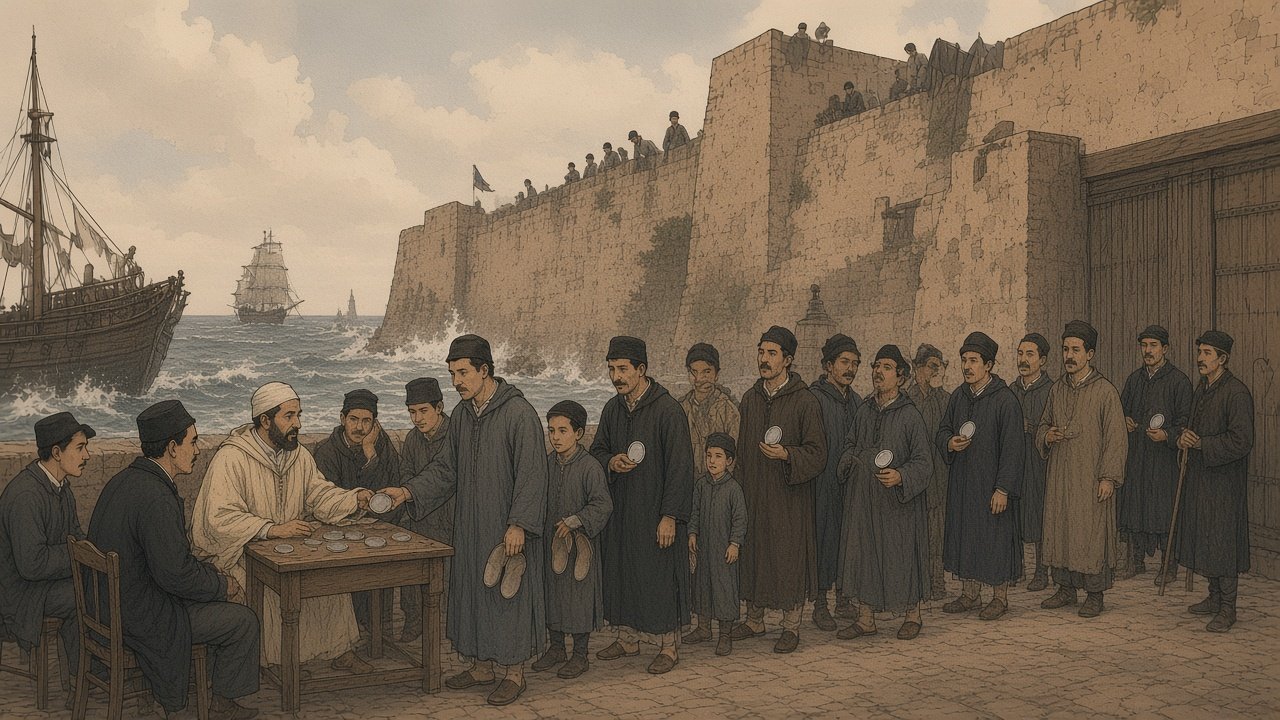
The most vivid picture of the jizya in practice comes from an unexpected witness. James Riley, the master of an American brig wrecked off the Saharan coast in 1815, was enslaved by nomads before being ransomed at Mogador by the British consul. Back home, his narrative ran to more than twenty editions. [42] Riley watched the collection of the capitation tax in the mellah of Mogador. The gates of the Jewish town were closed until the money was found, and the community, perhaps six thousand people, was divided into four classes, from the four great merchants down to the poorest labourers, with the rabbis exempt. Gatekeepers with heavy canes knocked down people trying to slip out for water or food. [23]
When the money was ready, each payer took off his slippers, held the coins in both hands at chest height and walked up to the Muslim official appointed to receive it, who struck him on the forehead with his fist “by way of a receipt”. The Jew answered “Nahma Sidi”, thank you, my lord, and made way for the next. [23] It is the humiliating ritual prescribed by the jurists, performed almost to the letter some eleven centuries after the Qur’anic verse that underlay it, and it shows, as the editors note, that the jizya had not fallen into abeyance. [42]
The Wadāya and the Bombshell Purim
In June 1820, a false rumour of the sultan’s death gave the Wadāya, a military tribe settled in New Fez, the occasion to invade the neighbouring mellah. The Muslim historian al-Nāsirī describes the plunder of the goods that Fez merchants had left with Jewish craftsmen, the killing and rape, the digging under houses for buried money and the torture of notables to reveal their hoards, all in the middle of Ramadan. [23] When Sulaymān did die two years later the Wadāya returned, and the government shelled the Jewish quarter to drive them out, causing many Jewish casualties. The survivors instituted a local festival, the Bombshell Purim (Purim d’al-kur), to mark their deliverance. [42]
But they also mourned. In September 1822 thirty rabbis and notables of Fez decreed a three-year period of mourning “for the profanation of our faith”, for Torah scrolls torn, burned and lost. For three years women were forbidden to wear gold embroidery, white garments or jewellery by day, on pain of prison, fines and the cancellation of their marriage contracts; only a bride in her seven days of celebration was exempt. [23] The decree is a rare look at how a community used its own law to give form to grief, and it is all the more striking for being so practical.
17. Algeria under the French, 1830–1871
“The Jews are free!”
The French invaded Algeria in 1830, using as pretext a quarrel in which the dey had intervened between France and the Bacri and Busnach firm. Jews struggled to conceal their sympathy for the newcomers, and anti-Jewish songs circulated in the streets, one lamenting that while desolation had taken hold of the city, the Jew rejoiced. [43] In 1832 a German visitor saw Jews riding mules through Algiers in bright fabrics and red caps, things they had been forbidden for centuries, while a crowd followed them shouting in mocking delight “Yahudi m’serra’h”, the Jews are free. [44]
The poet Thomas Campbell, who visited a few years later, expected to find the Jews embittered against the Turks and devoted to France, and was surprised. A wealthy Jew told him: “we were not so entirely wretched as you seem to imagine”. The community had its own head, Jews had run commerce and money-changing before the French came, and every rich Jew had a Turkish patron who protected him and his poorer clients. [44] It is one of the most valuable voices in the book, because it is a Jew of the old order speaking for himself, and it reminds us that a system of humiliation could also be a system that its subjects had learned to work.
The war of the Emir
The conquest itself was brutal for the Jews caught between the two sides. At Oran in 1830 the community sheltered in the synagogue while their houses were sacked, and was saved by the arrival of French troops on 29 July, a date long celebrated as the Purim of Oran. At Mascara, the stronghold of the Emir ʿAbd al-Qādir, the Jews left behind when the French attacked in December 1835 were massacred by the retreating troops; survivors who followed the French towards Oran died on the march or were captured and set to work for the Emir’s army. At Constantine in 1837, the Muslim commander made Jews repair the breaches in the ramparts under French fire. [43]
The dhimma survived in regions the French did not control. In the Mzab, annexed only in 1882, Jews continued to be humiliated by their neighbours, and at Ghardaïa a new synagogue was demolished in 1893. [43] A traveller at Tuggurt around 1860, asking to see the Jewish quarter, was met with evasion, until a passer-by confessed: “Our fathers have all been Jews”. A former governor had offered them Islam or the sword. Asked what he truly believed now, the man smiled, bowed and left. [44]
The Crémieux decree
In October 1870 the Crémieux decree made the Jews of the northern departments of Algeria French citizens. The editors describe a renewed hostility among Muslims who saw the age-old underdog suddenly made equal to the conqueror. [43] A report of March 1871 from Algiers describes the trouble that followed when a separate Jewish battalion was formed in colourful uniforms: Arabs who interfered with its drill were fined, and some 500 armed Biskris and Mozabites then attacked the Jewish quarter and demanded leave to exterminate the Jews, before troops dispersed them. [44] The editors’ introduction describes the Biskris as a Muslim battalion in the French army, whereas the document itself presents them as an armed crowd; I have followed the document.
Joshua Schreier’s study of Algerian Jews before Crémieux complicates the story of liberation from the other side. French officials, he shows, saw the Jews they had freed as a population to be civilised, reformed and policed, and citizenship was the end of a long campaign of regeneration rather than a simple gift. [45] The editors, whose book stops at the threshold of colonial rule, leave the colonial side of the story largely aside; they note only that the hostility of Muslims and settlers alike kept many Algerian Jews moving to the Holy Land. [43]
18. Solika, the bathhouse and the sultan’s letter
The girl from Tangier
In 1834 a young Jewish woman of Tangier, Solika Hatchuel, whom the editors call Zulayka Hajwal, was accused by two Muslim neighbours of having pronounced the Muslim profession of faith. She denied it. Under the law of the time the testimony of two Muslims was enough to make her a Muslim, and refusing to live as one counted as apostasy. The case was referred to the sultan in Fez, and she was executed. [42]
The fullest account in the book is by an Englishman who had lived for five years in Mogador and wrote some years later to rouse his fellow countrymen. He described a system in which a Jew’s evidence counted for nothing against a Muslim’s, so that the charge of having pronounced the formula could be used for blackmail, lust or zeal. He admitted that he could never find out whether her accusers acted from malice or whether the girl had repeated the words in jest, and he made a remark more telling than his rhetoric: there was, he wrote, “much friendly intercourse existing between the Jews and the better disposed Moors”, in which gossip and banter sometimes strayed past the bounds of safety. He believed the sultan wanted her for his harem. Her family and community offered large sums for her life, she refused every promise, and she was beheaded and her body burned. [46] Her story inspired a novel, a painting by Alfred Dehodencq, who was in Fez at the time, and a long literary afterlife among Jews and non-Jews alike. [42]
No bathhouse in the mellah
Two years later, in 1836, the Jews of Fez asked to build a bathhouse, a حمّام (hammām), in the mellah. A jurist of the city refused. He knew of no text directly on the point, he wrote, but the absence of Jewish bathhouses anywhere in the country agreed with “the compulsory state of abasement in which the sultan’s Jewish subjects must be continuously maintained”. To allow it would invite pride; and he went on to list the other rules that served the same end: no horses or mules, no saddle even on a donkey, and riding only side-saddle; distinctive garments; and no new synagogues on land conquered by the sword. [46] Read beside Riley’s jizya ceremony, the fatwa shows that the old doctrine was not a dead letter in learned circles in the 1830s.
“Reconciled” and “protected” people
The clearest statement of the doctrine in the whole book comes from a sultan. In 1842 Mawlāy ʿAbd al-Rahmān answered a French consul who had taken up the case of a Jew under French protection. As long as Jews respected the conditions of protection, he wrote, the law forbade the spilling of their blood and required respect for their property; but if they broke a single condition, the law permitted both. Merely to raise one’s voice against a Muslim was enough to break the pact. If in France Jews were equal to everyone else, that was well and good in France, but not in Morocco. Europeans had a different standing: “You are ‘reconciled’ people, whereas they are ‘protected’ people.” And if a foreign Jew came to trade, he must wear the same signs as Moroccan Jews, or stay at home. [47]
The letter is a precise piece of Islamic political thought, distinguishing the ذمّي (dhimmī), the protected subject, from the foreigner who had a treaty. It also shows why European intervention would become so contentious. To the sultan, foreign pressure on behalf of Jews was an attack on the law itself.
Mogador in 1844
Two years later France bombarded Tangier and Mogador to punish Morocco for supporting ʿAbd al-Qādir. Tribesmen from the surrounding country then poured into Mogador and pillaged it, and the mellah suffered most; many Jews were killed or wounded, among them the aged Kabbalist Rabbi Hayyim Pinto, who was stabbed and died soon after. [48] Here, as so often, a European war was paid for by the Jews of the town.
19. Tetuan, Gibraltar and Montefiore’s dahir
The war of 1860
The war between Spain and Morocco in 1859–60 brought the next disaster. Remembering 1844, thousands of Jews fled Tetuan for Gibraltar and Algeciras. Spain occupied the city on 5 February 1860, but in the confusion of the Moroccan retreat tribesmen fell on the Jewish quarter and began a slaughter, a scene captured in an engraving by Gustave Doré. Many Tetuan Jews afterwards left for Oran or the Holy Land. The refugees camped on the Gibraltar shore through the summer, and illustrated papers in London and Paris printed pictures of them. [48]

The crisis pushed the Jews of Europe, newly emancipated and confident after their intervention in the Damascus affair of 1840, to act in Morocco for the first time. A committee in London, probably led by Sir Moses Montefiore and the Board of Deputies, raised a relief fund and sent Moses Picciotto to report. His report of 1861 found two sources of evil: “Government oppression, and popular fanaticism”. The first meant special taxes, bars on emigration and the extortion of governors; the second, a web of local rules and customs that made daily life humiliating. [49]
The audience in Marrakesh
In 1863 the Spanish customs collector at Safi died after a few days’ illness, and four Jews were accused of poisoning him. Under torture, two of them confessed; at the request of the Spanish government one, Jacob Beniyuda, a valet of fourteen, was executed, protesting his innocence. [50] Montefiore, nearly eighty, travelled to Morocco with British government support, secured the release of the prisoners and went on to Marrakesh. He wrote to London that the Jews there could walk the streets only barefoot. On 1 February 1864 he was received by Sīdī Muhammad IV and asked that Jews and Christians be fully protected and enjoy the same advantages as other subjects. [51]
Four days later the sultan issued a ظهير (zahīr, royal decree; dahir in French usage) ordering his officials to treat the Jews according to what God required, with “a scale of justice and equality between them and others in the administration of the law”, and adding that “all men are equal in our sight”. No Jewish craftsman was to be made to work unpaid or unwilling. [49] A second decree, for the Jews of Demnat in the Atlas, released them from the status of “bondsmen of our grandfather”, the late sultan, ended forced labour on the Sabbath and on festivals, and freed them from being imprisoned at the whim of their lords or made to provide bedding for guests. [49]
The second letter
The court historian al-Nāsirī recorded what happened next, with evident approval. Copies of the decree were circulated among the Jews, who grew “arrogant and reckless”, especially in the ports, seeking special status under it. When the sultan noticed, he sent a second letter explaining that the decree was meant for respectable Jews and the poor who minded their own affairs, while the troublemakers would get the punishment they deserved. [49] The editors note that the dahir made no change in the sharīʿa; what made it look like a privilege was the setting in which it was granted. Within weeks, a favourite at the court of Marrakesh admitted that he had walked barefoot on the very day Montefiore left. [51]
The episode shows the pattern of the next half century. Every appeal from Europe set off a struggle between the sultan, who needed foreign goodwill, his officials and ulama, who saw a threat to Islamic order, and local governors, who often ignored both. Montefiore’s decree did not change the status of the Jews; what it did was to bring their condition onto the diplomatic stage. [51]
20. Schools, protégés and the Madrid conference
Halevy in Marrakesh
A dozen years after Montefiore, the Alliance Israélite Universelle sent the orientalist Joseph Halevy to Marrakesh. He found that the condition of the Jews had only worsened since the baronet’s visit, and that the decree he had won was “far too vaguely formulated to be of any practical use”. When a Jew facing the bastinado reminded the judge that the sultan had granted equality before the law, the judge would reply that he did not treat Muslims any differently either: he could flog them too. The difference, Halevy observed, was that a Muslim was flogged for a crime, whereas a Jew needed to commit none. He also described the gulf inside the community between the mass of poor craftsmen and pedlars and the handful of wealthy families, the גבירים (gevirim, magnates), who ran its affairs on behalf of the government, an oligarchy that the Muslim authorities had created and that existed in almost every Moroccan town. [52] [53]
The Alliance, founded in Paris in 1860 to defend Jews from persecution and lift them out of ignorance and poverty, opened its first Moroccan school at Tetuan in 1864. By 1912 it ran schools in fifteen towns, the largest at Casablanca, Mogador and Tetuan, and by the First World War some 5,500 boys and girls were taught in about twenty of them. Those schools, together with other colonial and communal classrooms, gave girls, and women at home, a new access to the pointed prayer book and the humash, without always displacing the older sofer, the piyyut and the Judaeo-Arabic explanation. [54] The schools also supplied the archive on which the second half of Fenton and Littman’s book rests: a stream of letters from teachers and directors to Paris, reporting every attack, levy and humiliation. A report from Marrakesh in 1911 proudly noted that former pupils now walked through the Muslim quarter with their heads high, and that Muslim acquaintances greeted them as “tājir”, merchant or sir, despite the traditional dress that should have marked them out. [55]
The protection system
The treaties Britain signed with Morocco in 1856, Spain in 1861 and France in 1863 allowed foreign powers to take local agents and brokers under their protection, removing them and their families from Moroccan jurisdiction and taxation. Jews with trading connections abroad sought this status eagerly, and Europeans were happy to extend their influence. Sultan Mawlāy al-Hasan (r. 1873–1894) regarded the system as an assault on his sovereignty and asked for a conference to reform it. It met in Madrid from 19 May to 3 July 1880 and, to his dismay, extended the privilege to every power present, while limiting the ways in which Moroccan Jews could acquire foreign nationality. The sultan in turn promised equality and religious freedom for his non-Muslim subjects. [53]
The same year showed how little such promises meant on the ground. In January 1880 a crowd in Fez beat to death a seventy-year-old Jew, Abraham Elalouf, after a quarrel over a Muslim who had attacked some Jewish children, then trampled his body and burned it with petroleum. An influential Jew who went to the palace for justice was told only that he personally had nothing to fear. [56] The Italian writer Edmondo De Amicis, visiting Fez with a diplomatic mission, watched Jewish women hide their jewellery in their dresses and walk home barefoot with their slippers under their arms: “Nos espantamos de los Moros”, they told him in Spanish, we are afraid of the Moors. [56]
Someone’s Jew
Beyond the reach of the sultan the picture was different again. Charles de Foucauld, the French officer who explored Morocco in 1883–84 disguised as a rabbi, described the Jews of the sība lands [57] as the property of their Muslim lords. Every Jew had his master, his sīd; a newcomer had to be designated “someone’s Jew”, and he and his descendants belonged to that master for ever. A prudent master protected his Jew as he would his own property and took only the interest on his capital; a careless one ruined him. [56] Foucauld’s contempt for the Jews he described is as plain as his sympathy, and the editors include it as a reminder that the protection of the sultan, however humiliating, was still protection.
21. Kindness, blows and the powers
The sultan’s two faces
The reign of al-Hasan illustrates the contradictions of the late dhimma better than any other. On one side stand the scenes reported in the Jewish press. In 1886 a deputation of Jewish women was received at the palace in Marrakesh to congratulate the harem on a festival and sent away with gifts. A year later the sultan kissed an Arabic translation of the synagogue prayer for the king, released three Jews imprisoned for debt, forgave the community a famine loan and exempted it from the capitation tax for seven years. [58]
On the other side stand the Fez notaries ordered in 1884 to issue Jews with no deeds except those confirming the Pact of ʿUmar, the expropriation of the old Jewish cemetery of Fez for a palace extension in 1888, and the ulama’s refusal, citing al-Maghīlī, of a modest request by the Jews of Fez to run their own civil affairs. [59] When the sultan had first demanded the cemetery in 1877, the chief rabbi signed away the community’s rights with the words, “We are compelled by law to obey the orders of H. M. the Sultan, but to unearth the dead is for us a great sin”. [53]
In Marrakesh in 1894 a harsh governor and a judge revived the old ceremony of the jizya. The Alliance correspondent Ruben Elmaleh explained that payment had once been accompanied by blows on the head or back, which the payer had to receive bowing, and that the custom had died out as persecution waned; al-Hasan, whom he called the kindest of the sultans, had not even insisted on collecting the tax. Now both returned at once. [60] In 1903 an Alliance teacher in Tetuan corrected a writer who claimed the jizya had been abolished: it was still in force, and tending to rise. [61]
The death of al-Hasan in 1894 opened a period of disorder. In 1895 rioters broke into the mellah of Fez, and the Jews fled to a Sufi lodge for refuge; the next year looters used a fire in the mellah as cover, and it took two hundred horsemen of the imperial guard to drive them off. Around Marrakesh, insurgent tribes plundered Jewish villages for months and sold women and children in the markets. In 1897 the judge of Taza forbade the Jews, on pain of death, to sound the shofar at the New Year, and the agitation that followed ended in the destruction of the mellah. In 1902 the pretender Bū Himāra raised a revolt in the same region and plundered the Jews of Taza again. The pattern was the old one: when the centre weakened, the mellah paid first. [59]
Rescuers
The documents of these decades also record people who stood between Jews and the crowd. At Tetuan in 1893, at the end of Ramadan, a Jewish child was crushed by a Muslim’s horse; when the grieving family laid his bier in the governor’s path, the governor took offence and a stoning mob chased the Jews to the gates of their quarter. The Spanish consul José de Navarro held the gate with a revolver for an hour, struck by stones, until soldiers came. The community asked the Alliance to thank Madrid on its behalf. [62] And in Larache in 1902 an Alliance report found no mellah at all: “Christians, Muslims and Jews live side by side in true harmony”. [61]
Algeciras
In 1904 France and Britain settled their rivalry, Britain conceding Morocco to France in exchange for Egypt, and Germany’s protest led to the Algeciras conference of 1906. The American secretary of state Elihu Root, prompted by Jacob Schiff, instructed his delegate Henry White to press for guarantees of “religious and racial tolerance”, and on 2 April a provision was added by which the signatories guaranteed the security and equal privileges of Moroccan Jews in the ports and the interior. [63] [59] It was the first time the United States had joined the European powers in a conference on Morocco. On the ground it changed little. Worse, as the editors observe of the years that followed, every advance of European power made the Jews look like the lackeys of the invaders, and they became the first scapegoats of Moroccan resistance. [64] Schroeter’s life of Meir Macnin shows the same tension from an earlier vantage point: an elite Jew who moved between royal patronage at home and European networks abroad, while the ordinary Jews of Morocco remained bound by the legal disabilities of the dhimma. [41]
22. Casablanca, Settat, Meknes and Fez
Casablanca, 1907
Casablanca had grown in the late nineteenth century from a small port into a busy commercial town, drawing Jews from the interior; by 1907 its community numbered some 6,000 and its Alliance school was the largest in the country. [64] [54] On 30 July 1907, tribesmen roused by the preaching of Mā al-ʿAynayn attacked the French workers building the new harbour and railway. France shelled the city in reply, and for three days tribesmen and townspeople plundered the medina and the mellah. About thirty Jews were killed, hundreds wounded, women raped, and the mellah destroyed except for a few houses near the French consulate. Fugitives who failed to reach Settat or Mazagan were captured and sold, and Alliance letters describe search parties tracking captives across the interior. [64]

Settat, 1908
At Settat, in January 1908, the Jews alone stayed behind to greet a French column with white flags. When the French withdrew, the townspeople stormed the mellah to punish them. Isaac Pisa of the Alliance in Casablanca reported: “Some 40 Jews were killed”, and the killing stopped only because the local chief, Shaykh Ben ʿUmar, went in person to defend the mellah and killed a looter with his own hand. When the French returned, a war correspondent found thirty or forty starving widows and children who begged to be taken to Casablanca. [65] [64]
Meknes, 1911
In April 1911 more than 1,500 Berber tribesmen converged on Meknes. The editors write that the Jews escaped a massacre by defending themselves with arms, encouraged by the director of the Alliance school; a Judeo-Arabic dirge on the sack of the mellah nonetheless names rabbi after rabbi shot down, laments the women abused and stripped, and declares: “Such a calamity had not befallen us since [the destruction] of Jerusalem.” [64] [66] The two accounts are not irreconcilable, but they show how a community’s memory and an institution’s report could differ.
The tritel of Fez
The Treaty of Fez, establishing the French protectorate, was signed on 30 March 1912. On 17 April the sultan’s Moroccan troops mutinied against their French instructors, killed them and turned on Europeans in the city. The mellah, whose arms had been collected by the French on the eve of the uprising, closed its gates and held out until mid-afternoon, then was overrun by soldiers, tribesmen and townspeople. For three days it was plundered and burned. [66]
A Jewish chronicle counted forty-five dead and twenty-seven wounded, and described how fragments of torn Torah scrolls were gathered for burial. [66] Abraham Elmaleh, writing to the Alliance on 22 April, called the Jews “the innocent scapegoats” of an anti-French riot, and drew a bleak conclusion: “whenever public anger explodes in Morocco, vengeance is wreaked on the Mellahs until hatred has been satiated.” [67] The local word for the episode, tritel, a term of Arabic and Berber speech meaning a sack or pillage, became a byword in Moroccan Jewish memory, and Fenton later devoted a separate volume to it. [68]
Yet the same accounts record the people who helped. After a day spent hunted through the streets and knocking in vain at the palace gates, the Jews were at last let in that evening by the sultan, Mawlāy ʿAbd al-Hafīz, who, Elmaleh wrote, was moved with compassion. The next morning he he came to speak to them “with simplicity and much kindness” and ordered bread distributed. [67] A son of Rabbi Maymūn Danon, a child at the time, remembered being led to the palace menagerie, where the mosaics, the pool and the wild animals “all smiled at me” after the nightmare, and how his father was sheltered by Pasha Saʿīd al-Baghdādī and then by a Muslim friend, Bel ʿArabī, who gave the family the whole ground floor of his house. [66]
23. Reading the record
On the threshold
The protectorate formally ended the dhimma in Morocco. The Jews remained the sultan’s subjects but were freed in principle from its disabilities and placed under French and Spanish administration. [64] Some of the old marks lingered to the end. In 1911 Rabbi Vidal Sarfaty of Fez asked the Alliance to have abolished the custom by which Jews had to enter the palace barefoot and wait for hours on the cold or scorching ground of the courtyard; the Alliance official in Fez replied that the sultan would never grant it, and that Jews under foreign protection should simply walk in with their shoes on. [55]

Abraham Pimienta, writing from Tangier to the Alliance in Paris on 17 April 1912, the very day the mutiny broke out in Fez, saw a new danger. The Jews of the coast and the great cities, he warned, had more to fear from the settlers than from the Muslims: “they have more to dread from the tendency that the new arrivals have of eliminating them and of disposing of their commercial competition than from the Muslim indigenous population.” [55] The Algerian experience, in which citizenship had not prevented settler antisemitism, suggests he was right. Within half a century, after the founding of Israel and the independence of Morocco, Tunisia and Algeria, the great majority of Maghrebi Jews had left for Israel, France, and in smaller numbers Canada and elsewhere. More than half went to Israel, while some nine in ten Algerian Jews, French citizens since 1870, settled in France; only small communities remained, among them the Jews of Djerba. They took scrolls, prayer books and Torah melodies with them. In Israel, Maghrebi and broader Mizrahi revivals have given new public life to North African piyyut and cantillation; in France, large Maghrebi Jewish populations still hear the weekly portion sung in a Maghrebi manner. [69] [70] [21]
What the documents show
What, then, does this long file of witnesses establish? First, that the dhimma in the Maghreb was not a dead letter. Its rules were cited by jurists from Qayrawān in the eleventh century to Fez in the 1830s, enforced in the jizya ceremony that Riley saw at Mogador and Elmaleh at Marrakesh, and restated by a sultan in 1842 in words that leave no room for doubt. Second, that violence against Jews followed a recognisable pattern: it came most often at moments of political crisis, when a ruler died, a dynasty fell or a foreign army appeared, and it fell hardest on the defenceless mellah.
But the documents also show what the editors’ framing plays down. In almost every crisis someone intervened: the cleric before Yazīd, the sultan’s mother in 1790, the governor’s soldiers in Algiers in 1706, a Spanish consul in Tetuan, a shaykh at Settat, a pasha and a neighbour in Fez. Rulers who humiliated Jews also protected them, because they needed their skills and their taxes, and because protection was itself part of the law. Jews spoke Arabic, traded and lived among Muslims, and a rich Jew of Algiers could tell a visitor that his people had not been so wretched as he imagined. Historians such as Cohen, Stillman, Gottreich and Schroeter have insisted on these textures without denying the inequality. Scholarship more generally has moved from colonial ethnography and golden-age apology toward archival work in responsa, Alliance reports, notarial records and oral history, and treats Maghrebi Jewry as a Mediterranean civilisation in its own right, not merely a periphery of Spanish or French history. [5] [16] [41]
Fenton and Littman wanted to show the dark side, and they have done so with a documentary thoroughness that no future historian of the subject can ignore. Read with care, their witnesses tell a more complicated and more human story than either a golden age or an unbroken persecution: a minority that survived for a thousand years under a law designed to keep it low, by learning, trade, negotiation and faith, and that remembered its catastrophes in elegies, fasts and special Purims so that later generations would know both what had been endured and who had helped.
24. Timeline
Samuel ben Hofni of Sura consoles the Jews of Fez after a massacre during Berber–Umayyad wars.
A Berber chief takes Fez; the sources report 6,000 Jews killed.
The Banū Hilāl destroy the leading Jewish centre of Ifriqiya.
Jews and Christians of the Maghreb face conversion, exile or death; the churches of North Africa disappear.
The Jews of Fez are moved to a separate quarter beside the royal city.
The Marīnid sultan and his Jewish vizier Hārūn are killed and the Jews of Fez massacred.
Refugees from Spain and Portugal settle in the Maghreb and form the megorashim.
Al-Maghīlī’s campaign destroys the synagogue and community of the Tuwāt oasis.
Sack of the Jewish quarters of Tetuan, Meknes, Taza and Fez.
An American captive watches the jizya collected with blows.
The Wadāya sack the mellah; the community declares three years of mourning.
France takes Algiers; Jews welcome the change and suffer in the fighting that follows.
A young Jewish woman of Tangier is executed in Fez for refusing Islam.
Mawlāy ʿAbd al-Rahmān defines the Jews as protected people, not equals.
War with Spain; Jewish refugees in Gibraltar; the Alliance Israélite Universelle is founded in Paris.
Sīdī Muhammad IV promises justice to the Jews; the Alliance opens its first Moroccan school.
Most Algerian Jews become French citizens.
The protection system is confirmed; Abraham Elalouf is killed in Fez.
The powers guarantee the security of Moroccan Jews on paper.
Riots and massacres follow the French landing.
The protectorate is signed on 30 March; the mellah is sacked on 17–19 April.
25. Glossary
- أهل الذمة (ahl al-dhimma)
- The people of the covenant: Jews and Christians protected under Islamic law in return for submission and the poll tax.
- جزية (jizya)
- The annual poll tax paid by non-Muslim men, often collected with a ritual of humiliation.
- ملاح (mellah)
- The walled Jewish quarter of Moroccan towns, first created at Fez in 1438.
- حارة (hāra)
- The Jewish quarter in Algerian and Tunisian towns.
- مخزن (makhzan)
- The Moroccan government and the lands under its direct control.
- بلاد السيبة (bilād al-sība)
- Lands outside the sultan’s effective authority, ruled by tribes and local lords.
- ظهير (zahīr, dahir)
- A royal decree of the Moroccan sultan.
- شريف (sharīf)
- A descendant of the Prophet; the Moroccan dynasties claimed this descent.
- תושבים (toshavim)
- Residents: the long-settled Jews of the Maghreb.
- מגורשים (megorashim)
- The expelled: descendants of the Iberian exiles.
- נגיד (nagid)
- Head of a Jewish community, often a courtier.
- תקנות (takkanot)
- Communal ordinances issued by rabbis and lay leaders.
- tritel
- A local word for the sack of a Jewish quarter, used above all of Fez in 1912.
- Alliance Israélite Universelle
- The Paris-based Jewish organisation, founded in 1860, whose schools and archives document Moroccan Jewry from 1862.
References
- Paul B. Fenton and David G. Littman, Exile in the Maghreb: Jews under Islam, Sources and Documents, 997 - 1912 (Madison, NJ: Fairleigh Dickinson University Press, 2016), copyright page and Preface, pp. xxvii - xxxiii *
- H. Z. (J. W.) Hirschberg, A History of the Jews in North Africa, 2 vols (Leiden: Brill, 1974 - 1981) *
- Mohammed Kenbib, Juifs et musulmans au Maroc, 1859 - 1948 (Rabat: Faculté des lettres et des sciences humaines, 1994) *
- Bernard Lewis, The Jews of Islam (Princeton: Princeton University Press, 1984) *
- Mark R. Cohen, Under Crescent and Cross: The Jews in the Middle Ages (Princeton: Princeton University Press, 1994; revised edition 2008) *
- Norman A. Stillman, The Jews of Arab Lands: A History and Source Book (Philadelphia: Jewish Publication Society of America, 1979) *
- Susan Gilson Miller, review of Fenton and Littman, Exile in the Maghreb, Journal of the American Oriental Society (2019) *
- Fenton and Littman, Exile in the Maghreb, Introduction, pp. 1 - 3 *
- S. D. Goitein, A Mediterranean Society: The Jewish Communities of the Arab World as Portrayed in the Documents of the Cairo Geniza, 6 vols (Berkeley: University of California Press, 1967 - 1993) *
- Fenton and Littman, Exile in the Maghreb, documents A1 - A3, pp. 47 - 51 *
- Fenton and Littman, Exile in the Maghreb, documents A4 - A6, pp. 51 - 56 *
- “Kimḥi, Joseph”, in Encyclopaedia Judaica, 2nd edn (Detroit: Macmillan Reference USA, 2007) *
- Jonathan Ray, “The Reconquista and the Jews: 1212 from the Perspective of Jewish History”, Journal of Medieval History 40:2 (2014), 159 - 175 *
- Fenton and Littman, Exile in the Maghreb, Introduction, pp. 3 - 4 *
- Emily Gottreich, “On the Origins of the Mellah of Marrakesh”, International Journal of Middle East Studies 35, no. 2 (2003), pp. 287 - 305 *
- Emily Benichou Gottreich, The Mellah of Marrakesh: Jewish and Muslim Space in Morocco’s Red City (Bloomington: Indiana University Press, 2007) *
- Fenton and Littman, Exile in the Maghreb, documents A7 - A8, pp. 57 - 59 *
- Fenton and Littman, Exile in the Maghreb, documents A9 - A11 and notes, pp. 59 - 65 *
- Fenton and Littman, Exile in the Maghreb, Introduction, pp. 4 - 5 *
- Fenton and Littman, Exile in the Maghreb, Introduction, pp. 6 - 9 *
- David Corcos and Rachel Simon, “Djerba”, in Encyclopaedia Judaica, 2nd edn (Detroit: Macmillan Reference USA, 2007) *
- Fenton and Littman, Exile in the Maghreb, documents A67 - A68, pp. 174 - 178 *
- Fenton and Littman, Exile in the Maghreb, documents A81 - A84, pp. 206 - 210 *
- Fenton and Littman, Exile in the Maghreb, documents A12 - A13, pp. 69 - 89 *
- John Hunwick, Jews of a Saharan Oasis: Elimination of the Tamantit Community (Princeton: Markus Wiener, 2006) *
- Fenton and Littman, Exile in the Maghreb, Introduction, note 10, p. 38 *
- Fenton and Littman, Exile in the Maghreb, Introduction, pp. 5 - 6 *
- Fenton and Littman, Exile in the Maghreb, documents A46 - A50, pp. 145 - 150 *
- Fenton and Littman, Exile in the Maghreb, documents A14 - A17, pp. 90 - 94 *
- Fenton and Littman, Exile in the Maghreb, Introduction, pp. 10 - 12 *
- Fenton and Littman, Exile in the Maghreb, document A24, pp. 103 - 105 *
- “Fly Whisk Incident (1827)”, in Encyclopedia of the Modern Middle East and North Africa, 2nd edn (Farmington Hills: Macmillan Reference USA, 2004) *
- Fenton and Littman, Exile in the Maghreb, Introduction, pp. 15 - 19 *
- Mercedes García-Arenal and Gerard Wiegers, A Man of Three Worlds: Samuel Pallache, a Moroccan Jew in Catholic and Protestant Europe, trans. Martin Beagles (Baltimore: Johns Hopkins University Press, 2007) *
- Fenton and Littman, Exile in the Maghreb, documents A52 - A54, pp. 153 - 159 *
- Fenton and Littman, Exile in the Maghreb, Introduction, pp. 19 - 21 *
- “Attar, Ḥayyim ben Moses (ibn)”, in Encyclopaedia Judaica, 2nd edn (Detroit: Macmillan Reference USA, 2007) *
- Fenton and Littman, Exile in the Maghreb, documents A61 - A62, pp. 161 - 163 *
- Fenton and Littman, Exile in the Maghreb, document A76, p. 201 *
- Fenton and Littman, Exile in the Maghreb, document A71, pp. 183 - 185 *
- Daniel J. Schroeter, The Sultan’s Jew: Morocco and the Sephardi World (Stanford: Stanford University Press, 2002) *
- Fenton and Littman, Exile in the Maghreb, Introduction, pp. 21 - 22 *
- Fenton and Littman, Exile in the Maghreb, Introduction, pp. 12 - 14 *
- Fenton and Littman, Exile in the Maghreb, documents A35 - A45, pp. 129 - 139 *
- Joshua Schreier, Arabs of the Jewish Faith: The Civilizing Mission in Colonial Algeria (New Brunswick: Rutgers University Press, 2010) *
- Fenton and Littman, Exile in the Maghreb, documents A89 - A90, pp. 218 - 223 *
- Fenton and Littman, Exile in the Maghreb, document A93, pp. 226 - 227 *
- Fenton and Littman, Exile in the Maghreb, Introduction, pp. 22 - 26 *
- Fenton and Littman, Exile in the Maghreb, documents A103 - A105, pp. 247 - 254 *
- Fenton and Littman, Exile in the Maghreb, document B1, pp. 345 - 346 *
- Fenton and Littman, Exile in the Maghreb, Introduction, pp. 26 - 28 *
- Fenton and Littman, Exile in the Maghreb, document B28, pp. 383 - 385 *
- Fenton and Littman, Exile in the Maghreb, Introduction, pp. 28 - 31 *
- Fenton and Littman, Exile in the Maghreb, General Introduction to the Archives of the AIU, pp. 339 - 340 *
- Fenton and Littman, Exile in the Maghreb, documents B173, B176 and B180, pp. 563 - 571 *
- Fenton and Littman, Exile in the Maghreb, documents A116 - A118, pp. 268 - 272 *
- Rosemary A. Peters-Hill, Charles de Foucauld’s Reconnaissance au Maroc, 1883 - 1884: A Critical Edition in English (London: Anthem Press, 2020) *
- Fenton and Littman, Exile in the Maghreb, documents A126 - A128, pp. 291 - 293 *
- Fenton and Littman, Exile in the Maghreb, Introduction, pp. 31 - 33 *
- Fenton and Littman, Exile in the Maghreb, document A135, pp. 302 - 304 *
- Fenton and Littman, Exile in the Maghreb, documents B111 - B112, pp. 492 - 493 *
- Fenton and Littman, Exile in the Maghreb, document B91, pp. 464 - 465 *
- Fenton and Littman, Exile in the Maghreb, document A140, pp. 311 - 312 *
- Fenton and Littman, Exile in the Maghreb, Introduction, pp. 34 - 37 *
- Fenton and Littman, Exile in the Maghreb, document B149, p. 536 *
- Fenton and Littman, Exile in the Maghreb, documents A143 - A146, pp. 322 - 333 *
- Fenton and Littman, Exile in the Maghreb, document B182, pp. 575 - 577 *
- Paul B. Fenton, Le Pogrom de Fès ou le tritel, 17 - 19 avril 1912: étude et documents (Jerusalem: Ben-Zvi Institute, 2012) *
- Michael M. Laskier, North African Jewry in the Twentieth Century: The Jews of Morocco, Tunisia, and Algeria (New York: New York University Press, 1994) *
- Aviad Moreno, “Amid Two Homecomings: Algerian Jewish Migration to Israel and France and the Remaking of North African Zionism across the Mediterranean”, Jewish Quarterly Review 116:4 (2026), 651 - 686 *


