The Tongues and Letters of the Middle East Today
From Casablanca to Kabul and from the Caucasus to Aden, the Middle East speaks in five language families and writes in more than a dozen scripts. This long read maps the region’s languages as they are spoken and written now: how they are related, how they came to resemble one another across family lines, how they sound and how they look on stone, paper and screen, and what states, schools and migration are doing to them.
1. Many tongues, one region
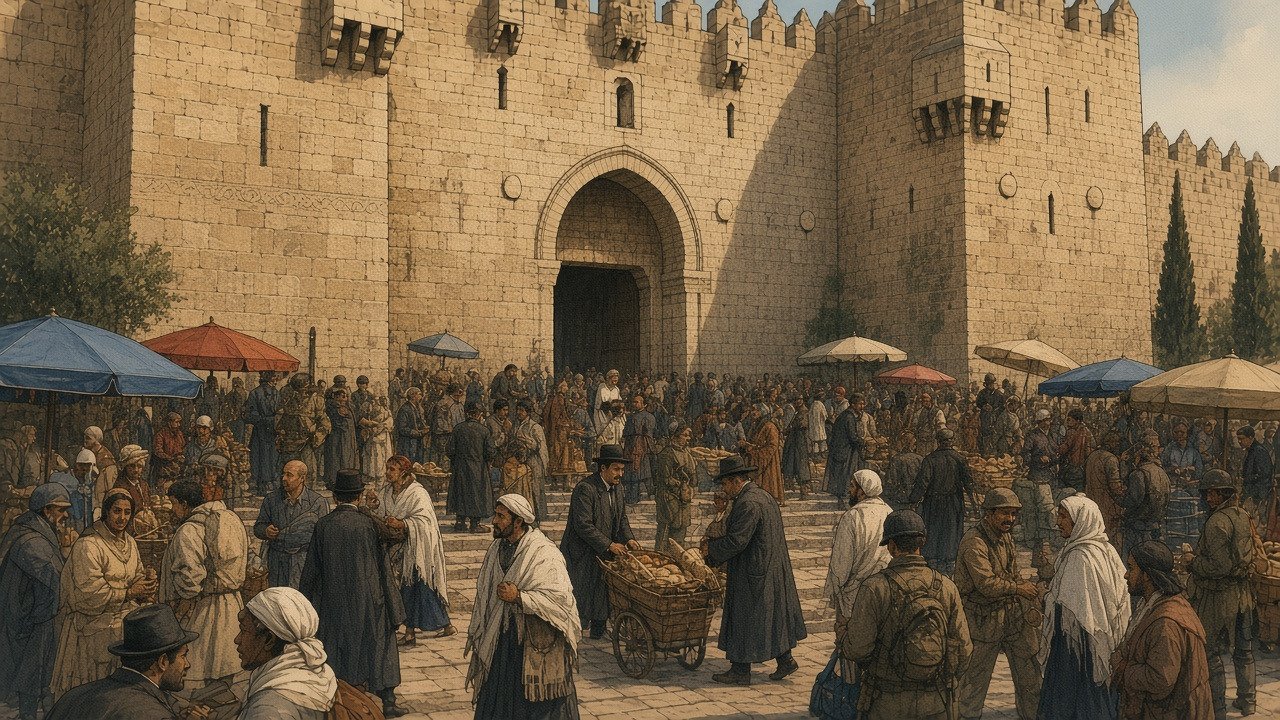
Stand for an hour at the bus station below the Damascus Gate in Jerusalem, or in the ferry queue at Eminönü in Istanbul, or outside a phone shop in the Deira quarter of Dubai, and the Middle East will tell you what it sounds like. In Jerusalem a driver calls out destinations in Palestinian Arabic, a soldier answers a telephone in Hebrew, two Armenian seminarians argue in Western Armenian, and an Ethiopian Orthodox family murmurs in Amharic on the way to the Church of the Holy Sepulchre. In Istanbul the ferry hawkers shout in Turkish, but the grandmother beside you may be speaking Kurmanji Kurdish to her grandson, who answers her in Turkish, and the tourists behind you are Iranians speaking Persian, Gulf Arabs speaking a Kuwaiti or Emirati dialect, and Azerbaijanis whose Turkic speech the hawkers half understand. In Dubai, where most residents are foreigners, the shop assistant who sells you a charger may be a Keralan speaking Malayalam to his colleague, Hindi-Urdu to the customer before you, and a serviceable Gulf Arabic pidgin to the Emirati after you.
This essay is about that sound, and about the writing that goes with it. It asks what the languages of the Middle East are today, how they are related to one another, why languages that belong to quite different families nonetheless share so much, and how they are spoken and written in the third decade of the twenty-first century. It is not a history of the ancient languages of the region, which have their own literature on this site and elsewhere: Akkadian, Sumerian, Hittite, Phoenician, Old Persian and Ugaritic appear here only where they help to explain something that is still alive. Nor is it a grammar of any single language. It is a map, drawn at a scale that shows the main roads and the larger towns, with some attention to the villages that are emptying.
The first problem with any such map is where to draw its edges. “The Middle East” is a twentieth-century British and American coinage, and like all regional labels it is a convenience rather than a fact. In this essay it means, broadly, the Arabic-speaking countries from Morocco to Iraq and the Arabian Peninsula, together with Israel, Turkey, Iran, and the southern Caucasus where Armenian, Georgian and Azerbaijani are spoken. Afghanistan sits at the eastern edge, because Dari is a form of Persian and Pashto is an Iranian language whose speakers have long been part of the region’s history. Malta, which is in Europe and a member of the European Union, appears because its language is a descendant of Arabic. Ethiopia and Eritrea appear because Amharic and Tigrinya are Semitic languages, and because without them the comparative tables later in the essay would be incomplete. The Maghreb, which many writers place in “North Africa” rather than the Middle East, is included because its Arabic and its Amazigh (Berber) languages are inseparable from the Arabic story.
The second problem is how to count. Linguists do not agree on how many languages the region contains, and the disagreement is not merely a matter of missing data. The catalogue published by SIL International as Ethnologue counts languages by a combination of structural difference, mutual intelligibility and the self-identification of speakers, and it divides Arabic into some thirty separately coded varieties, from Moroccan and Egyptian to Najdi and Chadian. [1] Glottolog, the bibliographical catalogue maintained at the Max Planck Institute for Evolutionary Anthropology, uses a different and more explicitly genealogical classification and draws its boundaries in slightly different places. [2] Both projects are indispensable, and both are honest about the arbitrariness that enters at the edges. Whether Moroccan Darija and Iraqi Arabic are “dialects of Arabic” or “languages” in their own right is a question that cannot be settled by linguistic facts alone, because a speaker from Casablanca and a speaker from Basra may struggle to understand each other in their everyday speech while sharing a written standard, a religion, a literature and a strong sense that they speak the same language.
The old joke, usually attributed to the Yiddish scholar Max Weinreich, that a language is a dialect with an army and a navy, is as true here as anywhere. Kurdish has no navy, and its speakers are divided between four states; Azerbaijani has one in Baku but its larger population of speakers lives in Iran, where it is a minority language. Persian, Dari and Tajik are, by most linguistic measures, a single language with three national standards, but the governments of Iran, Afghanistan and Tajikistan have at various times had reasons to stress the differences. Hebrew, which had no native speakers in 1880, now has an army, a navy and an academy.
Numbers, then, are offered in this essay with caution and in round figures, and the sources for them are named. Where a figure is disputed, the dispute is mentioned. The broad shape is not in doubt. Arabic, counted as a single language, has several hundred million speakers and is the official language of more than twenty states. Turkish and Persian each have native-speaker populations in the tens of millions, with many more who use them as second languages. Kurdish, in all its varieties, is the first language of perhaps twenty to thirty million people, though no census in the region counts them reliably. [3] Hebrew has around nine to ten million speakers, and about half of Israel’s adults name it as their mother tongue. [4] After these come Azerbaijani, Armenian, Georgian, Pashto, Balochi, Turkmen, the Amazigh languages of the Maghreb, and a long tail of languages with a few million, a few hundred thousand, or a few hundred speakers: the Neo-Aramaic dialects, the Modern South Arabian languages of Yemen and Oman, Domari, Circassian, Mandaic, Ladino and the Judaeo-Arabic dialects whose speakers have mostly left the countries in which they were spoken.
The plan of the essay follows the brief questions with which it began. It starts with the families: Semitic, Iranian, Turkic, and the others, taken one at a time, with a portrait of each major language and its principal varieties (sections 2 to 12). It then looks at what the languages share, whether by descent or by contact: the root-and-pattern morphology of Semitic, the cognate vocabulary of the Semitic family, the great river of loanwords that has flowed between Arabic, Persian and Turkish for more than a thousand years, the formulae of politeness and piety, and the structural features that make the region something like a linguistic area (sections 13 to 17). It turns next to speech: diglossia, the sound systems with their emphatic and pharyngeal consonants, code-switching, the media and migration, and the languages that are being revived or lost (sections 18 to 21). Then it turns to writing: the Arabic script and its adaptations, the Hebrew, Syriac, Armenian and Georgian alphabets, the move to Latin letters, the digital world of vowel points, Unicode and chat alphabets, and the calligraphic traditions (sections 22 to 26). It closes with language policy, nationalism, education and the future (sections 27 and 28), followed by some notes for learners, a timeline, a glossary and suggestions for further reading (sections 29 to 32).
A note on conventions. Words from the languages discussed are given first in their own script, then in a transliteration, then in translation: العربية (al-ʿarabiyya, Arabic), עברית (ʿivrit, Hebrew), فارسی (fārsi, Persian), ܣܘܪܝܝܐ (suryāyā, Syriac), Հայերեն (hayeren, Armenian), ქართული (kartuli, Georgian). Languages that are now written in the Latin alphabet, such as Türkçe (Turkish), Kurmancî (Kurmanji Kurdish) and Malti (Maltese), are given in their own spelling with a translation. Transliterations follow the conventions most common in English-language scholarship, with ʿ for the Semitic consonant ʿayn and ʾ for the glottal stop, and with long vowels marked by a macron. Where a dialect form is given, its pronunciation is approximated rather than rendered in the full International Phonetic Alphabet, which would make the essay unreadable to most of its readers. This site has several companion pieces on particular topics, and they are linked where they are relevant; the long post on Names and the essay Every Town Has Three Names are good places to start for anyone interested in how places and people in the region acquire more than one name in more than one language.
2. Five families and a few loners
A language family is a group of languages descended from a common ancestor, in the way that French, Spanish, Italian and Romanian descend from Latin. The ancestor is often unrecorded and must be reconstructed by the comparative method, which works by finding regular correspondences of sound between words of similar meaning in the daughter languages. The method was developed in the nineteenth century for Indo-European, and it has been applied with great success to Semitic, whose members have been written since the third millennium BCE and whose relationships were recognised by Jewish grammarians in Muslim Spain long before European philology existed.
The Middle East is home to five language families in the strict sense, together with a few languages whose families lie mainly elsewhere and one or two that belong to small families of their own.
The first and largest is Afroasiatic, formerly called Hamito-Semitic, a family of perhaps three hundred and fifty to four hundred languages spread across North Africa, the Horn of Africa, the Sahel and western Asia. [5] It has six generally recognised branches: Semitic, Egyptian (whose last stage is Coptic), Berber (Amazigh), Chadic (of which Hausa is the best-known member), Cushitic (Somali, Oromo, Beja and others) and Omotic, whose membership of the family is sometimes questioned. Only Semitic, Berber and the liturgical remnant of Egyptian are central to this essay, though Cushitic Beja is spoken in eastern Sudan and Somali in the Gulf diaspora. Afroasiatic is old, older probably than Indo-European, and the resemblances between its branches are correspondingly faint. Shared features include a series of pronouns with a recognisable family likeness (a first-person singular in something like -i or ʾan-, a second person in t- or k-), a feminine marker in -t, and a tendency for words to be built on consonantal skeletons. The homeland of the family is disputed; most specialists favour north-eastern Africa, but a minority argues for the Levant.
The Semitic branch is better understood than the family as a whole, because its members have been written for so long. Akkadian, the language of Babylon and Assyria, is attested from the middle of the third millennium BCE in cuneiform; Eblaite, from the archives of Ebla in northern Syria, from about the same time; Ugaritic, Phoenician, Hebrew and Aramaic from the second and first millennia; and Arabic and the Ethiopian languages from the first millennium BCE and later. Proto-Semitic, the reconstructed ancestor, is usually dated to the fourth millennium BCE or earlier, and most specialists place its speakers somewhere in the Levant or northern Mesopotamia, though the evidence is indirect. A computational study published in 2009 by Andrew Kitchen and colleagues, using statistical methods borrowed from biology, suggested a date of around 3750 BCE and a Levantine origin, with the Ethiopian Semitic languages deriving from a later movement out of Arabia; its results are broadly consistent with older views, though such methods remain debated. [6]
Within Afroasiatic, the Semitic branch is the one that dominates the region. Its members are conventionally divided into East Semitic, which comprises the extinct Akkadian and Eblaite, and West Semitic, which includes everything still spoken. West Semitic is further divided into Central Semitic, which comprises Arabic and the Northwest Semitic languages (Hebrew, Aramaic, Phoenician, Ugaritic and others), and South Semitic, which comprises the Modern South Arabian languages of Yemen and Oman and the Ethiopian Semitic languages, among them Geʿez, Amharic and Tigrinya. The details of this classification have been revised several times, most importantly in the 1970s and 1980s by Robert Hetzron and later by John Huehnergard, who moved Arabic from the southern to the central group on the basis of shared innovations in its verbal system. [7] The practical upshot is that Arabic and Hebrew are closer to each other than either is to Amharic, and that the speakers of Arabic, Hebrew and Aramaic, who have lived beside one another for some three thousand years, speak languages more closely related than English and German.
The very name “Semitic” is a scholarly invention. It was coined in 1781 by the German historian August Ludwig von Schlözer, who took it from Shem, the son of Noah, to whom the book of Genesis traces the ancestry of the Hebrews, Aramaeans, Assyrians and Arabs. Like many such terms it mixes genealogy of peoples with genealogy of languages, and linguists now use it strictly for the languages, with no implication about the descent or character of their speakers. The same caution applies to “Indo-European”, “Turkic” and the other family names used in this essay: they classify languages, not peoples, and a speaker’s language says nothing about his genes. A Turkish speaker in Istanbul may have Greek, Armenian, Kurdish, Circassian and Balkan ancestors; an Arabic speaker in Cairo is far more likely to descend from Copts than from Arabian tribesmen.
The second family is Indo-European, the family of English, Russian, Greek and Hindi. It is represented in the Middle East chiefly by its Iranian branch, which includes Persian, Kurdish, Balochi, Pashto, Luri, Gilaki, Mazandarani, Talysh and Zazaki, and by Armenian, which forms a branch of its own. Indo-Aryan, the sister of Iranian, is represented by Domari, the language of the Dom communities of the Levant, and by the many South Asian languages of migrant workers in the Gulf. Greek was spoken widely in the region until the population exchange of 1923 and survives in small communities in Istanbul, in the Greek Orthodox liturgy of the Patriarchates of Antioch, Jerusalem and Alexandria, and among a few elderly Greek-speaking Muslims of Pontic origin in north-eastern Turkey. Indo-European grammar is typically fusional: endings combine several meanings at once, as Latin amo combines “first person”, “singular”, “present” and “indicative” in a single -o. Persian has lost most of this complexity and is, in its morphology, one of the simplest languages of the family. [8]
The third family is Turkic, whose speakers spread westward from Inner Asia between the sixth and the fourteenth centuries and whose languages are now spoken from the Balkans to Siberia and north-western China. The Middle Eastern members belong almost entirely to its south-western or Oghuz branch: Turkish, Azerbaijani, Turkmen, and the Turkic varieties of Iran such as Qashqai and Khorasani Turkic. [9] Turkic languages are agglutinative, building words by adding a chain of suffixes each of which has a single meaning, and they observe vowel harmony, so that the vowels of a suffix change to match those of the stem. Whether Turkic is part of a larger “Altaic” family with Mongolic and Tungusic, and perhaps Korean and Japanese, has been debated for more than a century; most specialists now regard the resemblances as the product of long contact rather than common descent.
The fourth and fifth families are those of the Caucasus. Kartvelian, or South Caucasian, comprises Georgian, Mingrelian, Laz and Svan. Laz is spoken along the Black Sea coast of north-eastern Turkey, and Georgian has a long-established community in Turkey and a smaller one in Iran, at Fereydunshahr in the province of Isfahan, descended from Georgians deported by Shah ʿAbbās I in the early seventeenth century. Northwest Caucasian comprises Abkhaz, Abaza, the Circassian languages Adyghe and Kabardian, and the now extinct Ubykh, whose last fluent speaker, Tevfik Esenç, died in Turkey in 1992. Circassian communities descended from refugees expelled from the Russian Empire in the 1860s live in Turkey, Jordan, Syria and Israel, and are discussed in section 12. Northeast Caucasian, the family of Chechen, Avar and Lezgian, is represented by Chechen communities in Jordan and Turkey, also descended from nineteenth-century refugees. The Caucasus as a whole has been called a “mountain of tongues”, and the extraordinary complexity of its consonant systems and verbal morphology is part of the reason.
Beyond these families there are a few loners. Coptic, the last stage of Egyptian, is a liturgical rather than a spoken language but belongs to Afroasiatic. Hebrew script once wrote a dozen Jewish languages, some of them Semitic (Judaeo-Arabic, Judaeo-Aramaic), some Iranian (Judaeo-Persian, Juhuri), and some Romance (Ladino) or Germanic (Yiddish), and these are discussed together in section 12 because their history is a single story. The languages of the region’s guest workers, from Tagalog and Sinhala to Bengali and Swahili, are not discussed in detail, though their presence in the Gulf, where in some states they outnumber citizens several times over, is one of the largest linguistic facts of the region today.
A family tree, however, tells only half the story. The other half is contact. Persian and Hebrew are not related at all within any time-depth that comparative linguistics can reach, yet a Persian speaker reading a Hebrew newspaper would recognise words such as kitāb or maktub through their shared Arabic connections, and a Turkish speaker might be surprised to learn how many words of his own language came from Arabic by way of Persian. Turkish and Armenian belong to different families but share a great deal of vocabulary and some grammatical patterns, the product of centuries of life in the same Anatolian towns. Neo-Aramaic dialects in northern Iraq have adopted features of the Kurdish spoken around them so deeply that their verb system now looks more Iranian than Semitic. Linguists sometimes speak of the region as a Sprachbund, a linguistic area, in which unrelated languages come to resemble one another through long coexistence. Whether the term is justified for the whole Middle East, or only for parts of it such as eastern Anatolia and the Iranian plateau, is discussed in section 17. For the moment it is enough to say that a language in the Middle East is rarely understood by looking at its ancestry alone.
| Family and branch | Representative languages in the region | Approximate speakers in the region |
|---|---|---|
| Afroasiatic, Semitic | Arabic and its varieties, Hebrew, Neo-Aramaic, Maltese, Mehri, Soqotri; Amharic and Tigrinya in the Horn | Several hundred million (Arabic); about 9 to 10 million (Hebrew); hundreds of thousands at most (Neo-Aramaic) |
| Afroasiatic, Berber | Tashelhit, Central Atlas Tamazight, Tarifit, Kabyle, Tuareg varieties | Tens of millions in Morocco and Algeria combined |
| Afroasiatic, Egyptian | Coptic (liturgical) | No native speakers |
| Indo-European, Iranian | Persian (Farsi, Dari, Tajik), Kurdish, Balochi, Pashto, Luri, Gilaki, Mazandarani, Talysh, Zazaki | Persian, Kurdish and Pashto each in the tens of millions |
| Indo-European, Armenian | Eastern and Western Armenian | Several million, many in the diaspora |
| Indo-European, Indo-Aryan | Domari; migrant languages of the Gulf | Domari a few thousand speakers at most |
| Turkic, Oghuz | Turkish, Azerbaijani, Turkmen, Qashqai | Turkish and Azerbaijani each in the tens of millions |
| Kartvelian | Georgian, Mingrelian, Laz, Svan | About four million |
| Northwest Caucasian | Adyghe, Kabardian, Abaza (in the diaspora) | Diaspora speaker numbers uncertain |
3. Arabic, one name for many tongues
The word العربية (al-ʿarabiyya, Arabic) covers more ground than any other language name in the region. It names the language of the Qurʾan, of the poetry of the pre-Islamic odes and the prose of the medieval scholars; the language of today’s newspapers, ministerial decrees, news bulletins and university lectures; and the everyday speech of a farmer in the Nile Delta, a fisherman in Bahrain, a market trader in Fez and a student in Beirut, varieties that differ from one another at least as much as Portuguese differs from Italian. Understanding modern Arabic means understanding how these things can share a name.
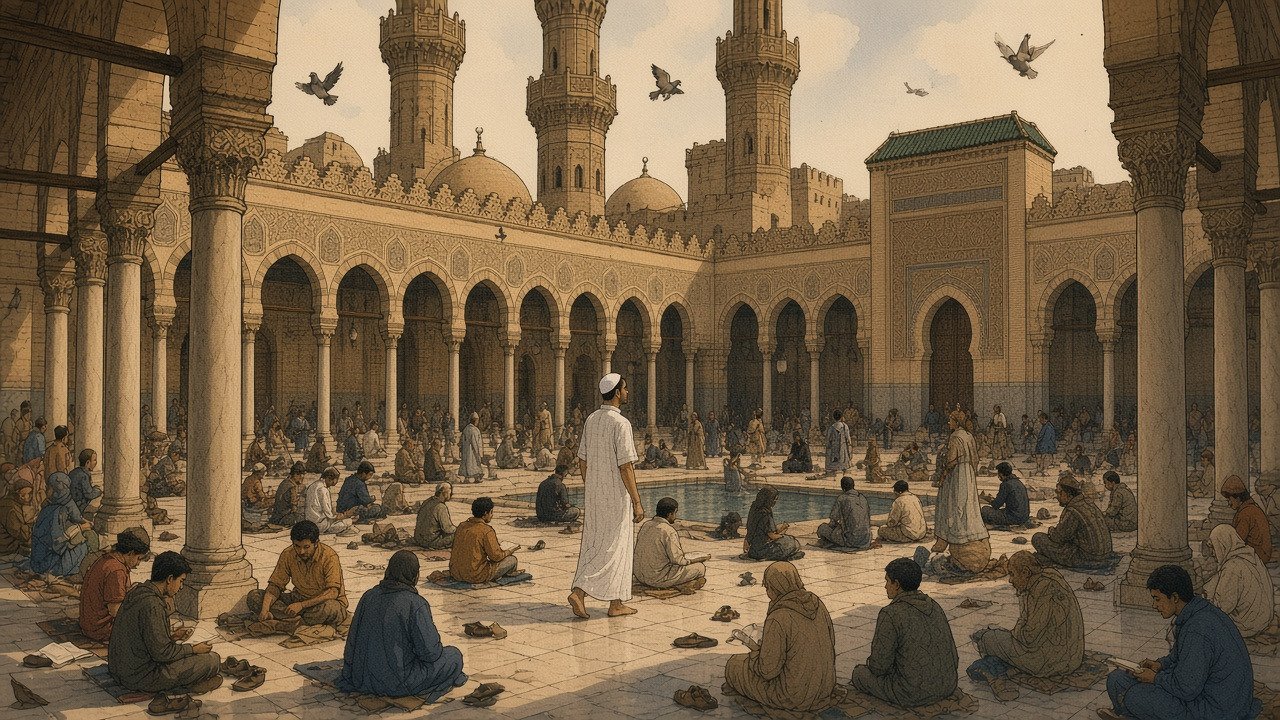
Arabic first appears in writing in inscriptions of the first millennium BCE in the Arabian Peninsula and on its northern fringes, written in South Arabian and then in Nabataean Aramaic script. The oldest text generally accepted as written in the Arabic language and in a form of the Arabic script is the inscription of Namāra in southern Syria, dated 328 CE, which commemorates a king called Imruʾ al-Qays; but it is written in Nabataean letters and its linguistic interpretation is debated. A handful of inscriptions from the sixth century, such as the trilingual of Zabad near Aleppo and the inscription of Umm al-Jimāl, show the script taking on its recognisable Arabic shape. [10] By then there was already a rich tradition of oral poetry composed in a supra-tribal poetic language, and it was in a form of this language, according to Muslim tradition, that the Qurʾan was revealed to Muḥammad in the early seventh century.
The Arab conquests of the seventh and eighth centuries carried Arabic from the Peninsula to Spain in the west and Central Asia in the east. Within two centuries it had become the language of administration, scholarship and, increasingly, everyday life in an area that had previously spoken Aramaic, Coptic, Greek, Berber, Persian and South Arabian. It replaced Aramaic and Coptic as spoken languages almost everywhere, though both lingered in villages and liturgies for centuries; it never replaced Persian, which re-emerged in a new form written in Arabic letters from the ninth century, nor Berber in the mountains of the Maghreb, nor Kurdish in the Zagros. The grammarians of Basra and Kufa in the eighth century, of whom the most famous is Sībawayh, a Persian by birth, codified the language in the form now called Classical Arabic, basing their rules on the Qurʾan and on the speech of the Bedouin, whom they regarded as the guardians of pure Arabic. [10] Their grammar has been, with remarkably little change, the grammar of written Arabic ever since.
What is now called Modern Standard Arabic, a term coined by Western scholars and rendered in Arabic as الفصحى (al-fuṣḥā, the most eloquent, or the pure language), is essentially Classical Arabic adapted to modern needs. Its grammar is the grammar of Sībawayh; its vocabulary has been expanded since the nineteenth century to cover everything from parliaments to particle physics; and its style has been loosened and simplified, under the influence of journalism and translation from European languages. The decisive period was the النهضة (al-nahḍa, the awakening or renaissance) of the nineteenth and early twentieth centuries, when writers in Cairo, Beirut and Damascus such as Rifāʿa al-Ṭahṭāwī, Buṭrus al-Bustānī and Ibrāhīm al-Yāzijī produced dictionaries, encyclopaedias, newspapers and translations, and coined or revived thousands of words. The language academies founded in Damascus in 1919 and in Cairo in 1932 carried on the work of coinage, though their recommendations have often been ignored in favour of borrowings or coinages that emerged on their own in the press. [11] Some Arabic words for modern things were deliberately formed on classical patterns, such as قطار (qiṭār, train, originally a line of camels) or سيارة (sayyāra, car, from a root meaning “to travel”), while others were borrowed and naturalised, such as تلفزيون (tilifizyūn, television), alongside the purist تلفاز (tilfāz).
It is worth noting how large a part Arab Christians played in this renewal. Buṭrus al-Bustānī, who compiled the dictionary Muḥīṭ al-Muḥīṭ and began the first modern Arabic encyclopaedia, and Ibrāhīm al-Yāzijī, who worked on the Arabic Bible translation published in Beirut in 1865 by the American missionaries Eli Smith and Cornelius Van Dyck, were Lebanese Christians, and Christian journalists from Syria and Lebanon founded many of the great newspapers of Cairo, among them al-Ahrām in 1875. For them, as for many Muslim reformers, the classical language was a shared national heritage rather than an exclusively religious one, and their insistence on that point helped make Arabic the foundation of a secular as well as a religious identity.
Modern Standard Arabic is everyone’s second language and nobody’s first. No child acquires it at home from its parents as a mother tongue; every child acquires a spoken variety, usually called العامية (al-ʿāmmiyya, the common language) in the Mashriq and الدارجة (al-dārija, the current language) in the Maghreb, and then learns the standard at school. The relationship between the two, which the American linguist Charles Ferguson called diglossia in a famous article of 1959, is the subject of section 18. [12] Here it is enough to note three things about it.
First, the spoken varieties are not degenerate forms of the standard, as many Arabic speakers themselves have been taught to believe. They descend from the spoken Arabic of the conquest era, which was itself already diverse, and they have developed in the way that all spoken languages develop. In some respects they are more conservative than the standard, since some preserve pronunciations or words lost elsewhere; in others they have innovated, as English has innovated since Old English. Grammatically, the most striking difference is the loss of the case endings that mark nouns as subject, object or possessor in the classical language. In Modern Standard Arabic “the book” as a subject is al-kitābu and as an object al-kitāba; in all spoken varieties it is simply il-ktāb or el-kitāb regardless of its role in the sentence. Even in the standard, most speakers omit the case endings when reading aloud except in formal or religious settings, a practice the grammarians call الوقف (al-waqf, pausing).
Second, the spoken varieties differ more from one another than the standard does from itself. The written Arabic of a newspaper in Rabat and one in Muscat is nearly identical in grammar, with small differences of vocabulary and style; the spoken Arabic of the two cities differs in pronunciation, grammar and vocabulary so much that speakers often switch to a more standard or more Egyptian or Levantine register to understand each other.
Third, the relationship between standard and spoken Arabic is not a matter of two separate languages used in two separate boxes. Most educated speakers move along a continuum, mixing standard and dialect features according to the subject, the audience and the setting. A university lecturer in Amman may begin a lecture in careful Modern Standard Arabic, slip into Jordanian Arabic to tell a joke, return to the standard for a definition, and answer a question in a mixture of both. The Egyptian linguist El-Said Badawi described five levels of contemporary Arabic in Egypt, from the “heritage classical” of the religious scholar to the “illiterate colloquial” of people with no schooling, and the terminology has been widely used, criticised and adapted. [13]
Is Arabic, then, one language or many? Linguists who look at structure and mutual intelligibility tend to see a group of related languages, comparable to the Romance family, with a classical ancestor-language that has been artificially preserved as the medium of writing. Speakers, and the states in which they live, tend to see one language with many dialects, and the sense of a single Arabic language has been one of the foundations of Arab nationalism since the nineteenth century. [14] Both views are defensible, and the tension between them is part of what makes Arabic so interesting to study. The comparison with the Romance languages is useful but imperfect. If the French, Spanish and Italians still wrote only Latin, read Latin newspapers, prayed and studied law in Latin, and regarded their spoken languages as corruptions of Latin unsuitable for writing, their situation would resemble that of the Arabic-speaking world. Some Arab intellectuals in the twentieth century, such as the Egyptian Salāma Mūsā and the Lebanese poet Saʿīd ʿAql, argued that the colloquials should become written national languages, as Italian and French had replaced Latin. Their proposals were rejected, often fiercely, because they seemed to threaten both the unity of the Arabs and the link with the language of the Qurʾan.
The coexistence of the two kinds of Arabic is not new. From the earliest centuries of Islam, writers who were not trained grammarians, or who wrote for practical purposes, produced texts that mixed classical and colloquial features in what scholars now call Middle Arabic. Letters, contracts and business documents from medieval Egypt, many of them preserved in the Cairo Genizah, the popular epics and the tales of the Thousand and One Nights, and much Christian and Jewish Arabic literature were written in this mixed style. [15] The Arabic Bible translations of Middle Eastern Christians, from the ninth century onward, often show the same mixture. Diglossia, in other words, has always produced intermediate forms, and the modern situation, in which educated speakers mix standard and dialect in speech, continues an ancient pattern.
Yet the colloquials have quietly gained ground in writing, particularly in the last thirty years. Egyptian Arabic has a long tradition of written poetry, theatre and comic journalism, and since the 2000s novels and blogs have appeared in it. The arrival of mobile telephones and social media gave every Arabic speaker a reason to write their own speech, and they did so in their millions, often in the Latin alphabet (see section 25). Lebanese and Moroccan advertising and song are now routinely written in dialect. There are dictionaries and grammars of the major dialects, written by Arab as well as Western linguists, and a growing body of Arabic-language scholarship on them. The old hierarchy, with the standard as the only language of writing and the dialects as mere speech, has not been overturned, but it has been loosened.
One more point needs to be made at the outset. Arabic is not only the language of Arabs. It is the liturgical language of Muslims everywhere, studied in Qurʾan schools from Senegal to Indonesia, and the language of religious scholarship for Muslims whose own languages are Persian, Turkish, Urdu or Malay. It was for centuries the language in which Jews of the Islamic world wrote philosophy, science and much of their religious literature, often in Hebrew characters (see section 12), and in which Christians of the Middle East have written theology and liturgy since the eighth century. Today, perhaps a fifth of the world’s Muslims speak Arabic as their first language; the rest learn it, to various degrees, as the language of prayer. This gives Arabic a prestige and a reach far beyond its native speakers, and it explains why so many Arabic words have entered the languages of the wider Muslim world, a subject discussed in section 15. On this site the essay Arabic and Hebrew, Sister Languages and Sister Scripts discusses the relationship of the two languages in the Middle Ages, and the essay on Arabic Influence on Jewish Bible Literature traces the debt of medieval Jewish grammar to the Arab grammarians.
That reach has been formally recognised. Arabic became one of the official languages of the United Nations by a resolution of the General Assembly in December 1973, and since 2012 UNESCO has marked 18 December, the anniversary of that decision, as World Arabic Language Day. It is an official or national language in more than twenty member states of the Arab League, and a recognised minority or religious language in many more, from Chad and Eritrea to Iran and Israel.
4. Spoken Arabic from the Atlantic to the Gulf
Every classification of the spoken Arabic dialects is a simplification, because they form a continuum across some seven thousand kilometres, in which each town understands its neighbours and the distant ends do not easily understand each other. Dialectologists nonetheless agree on a handful of large groups, defined partly by geography and partly by history, and on one cross-cutting distinction that matters almost everywhere: the difference between sedentary and Bedouin dialects. [11] [10]
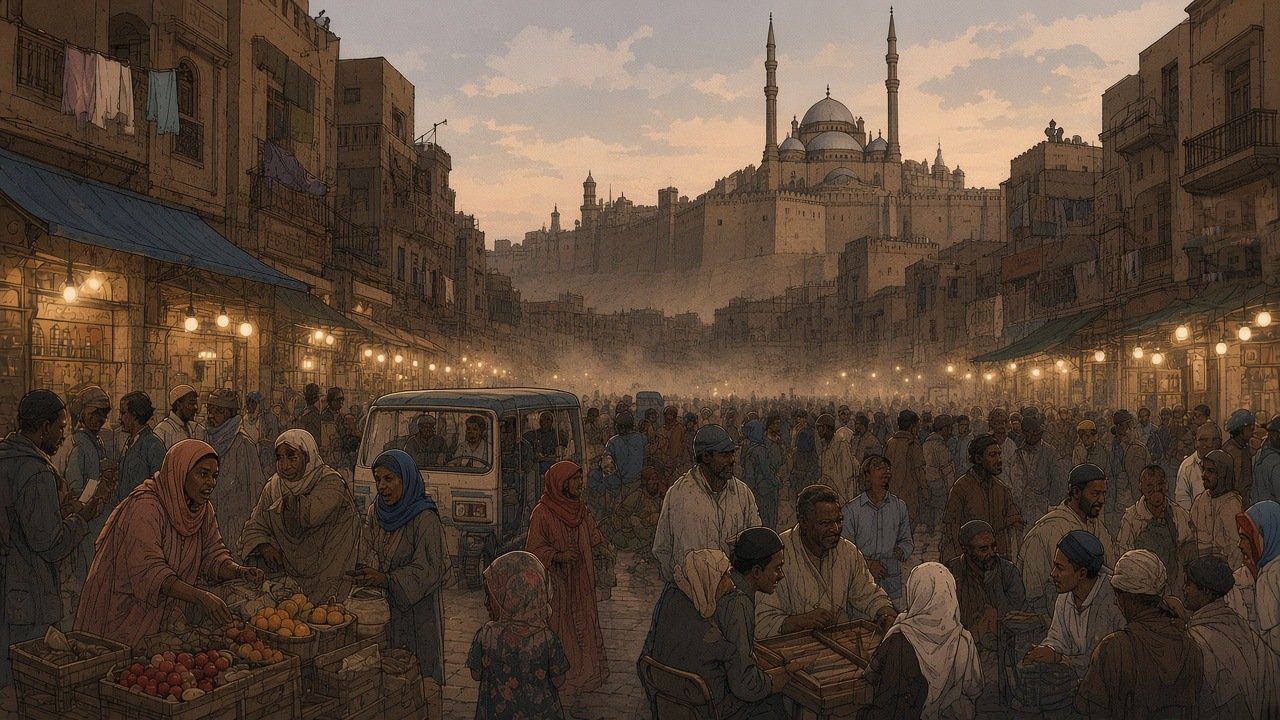
The distinction between sedentary and Bedouin goes back to the conquests. The Arabic brought to the towns and garrison cities of the conquered lands, where speakers of many languages learned it as adults, developed differently from the Arabic of the nomadic tribes who continued to move through the steppe and desert. Later migrations of Bedouin tribes, above all the movement of the Banū Hilāl and Banū Sulaym into the Maghreb from the eleventh century, laid new Bedouin-type dialects over older sedentary ones. The result is a patchwork in which the dialect of a city may differ sharply from that of the countryside around it. The most frequently cited marker is the pronunciation of the letter ق (qāf): many sedentary urban dialects pronounce it as a glottal stop, as in Cairo, Damascus and Beirut, or as a voiceless [q], as in Fez, Tunis and the speech of the Druze; Bedouin-type dialects pronounce it as a voiced [g], as in much of Arabia, Upper Egypt, Sudan, Jordan’s countryside and the Bedouin varieties of the Maghreb. The word for “he said”, qāl in the standard, is therefore ʾāl in Cairo, qāl in Fez and gāl in Riyadh. Section 19 returns to this consonant and its several lives.
Egyptian Arabic, more precisely the dialect of Cairo, is the most widely understood Arabic variety in the world. It owes this to the twentieth-century dominance of Egyptian cinema, radio, music and television, which made the voices of Umm Kulthūm, ʿAbd al-Ḥalīm Ḥāfiẓ and the comic actor ʿĀdil Imām familiar from Morocco to Iraq. It has about a hundred million native speakers if the dialects of the Nile Delta and Upper Egypt (Ṣaʿīdī) are included, though Ṣaʿīdī Arabic, with its [g] for qāf and its distinct vocabulary, is often the target of Cairene jokes. Cairene pronounces ج (jīm) as a hard [g], so that “camel”, standard jamal, is gamal; it pronounces qāf as a glottal stop; and it has lost the classical interdental consonants, so that ث (thāʾ) becomes [t] or [s] and ذ (dhāl) becomes [d] or [z]. Its grammar places question words at the end of the sentence, as in inta rāyiḥ fēn? (“you going where?”) and its negation wraps around the verb, as in ma-ktabtiš (“I did not write”), a pattern shared with Levantine and Maghrebi Arabic and probably influenced by the Coptic substrate.
Levantine Arabic, spoken in Syria, Lebanon, Jordan, Palestine and Israel, and in large diaspora communities, is the second most widely understood dialect group, its reach extended in recent decades by Syrian television drama, Lebanese music and the Turkish soap operas that have been dubbed into Syrian Arabic since the late 2000s. It is not a single dialect: the urban speech of Damascus, Beirut, Aleppo and Jerusalem differs in detail, and the rural and Bedouin dialects differ more. Most urban Levantine varieties share a glottal-stop qāf, a jīm pronounced [ʒ] (like the s in English “pleasure”), a present tense marked with a prefix b- (baktub, “I write”), and a future with raḥ or laḥ, from a verb meaning “to go”. Levantine Arabic shows a substrate of Aramaic, the language most of the region spoke before Arabic, in vocabulary and some features of pronunciation; it is discussed further in section 15.
Mesopotamian Arabic divides into two great types, which the Israeli linguist Haim Blanc, in a classic study of 1964, called gilit and qeltu after their words for “I said”. [16] The gilit dialects, of Bedouin origin, are spoken by most Muslims of Baghdad and southern Iraq; the qeltu dialects, which continue the older sedentary Arabic of medieval Iraq, are spoken in Mosul and the north, in parts of eastern Anatolia, and, until the mid twentieth century, by the Jews and Christians of Baghdad. Blanc showed that in Baghdad before 1950 Muslims, Christians and Jews spoke three distinct dialects of Arabic, with the Jewish and Christian ones belonging to the qeltu type. Most of the Jewish speakers left for Israel in 1950 and 1951, and their dialect is now spoken mainly by their elderly descendants. The memoir literature of the Baghdadi Jews, which this site has touched on in By the Waters of Baghdad and in the family histories of the Sassoons and Kadoories, is full of the vocabulary of that lost dialect. Iraqi Arabic as a whole is notable for its Persian and Turkish loans, for the preservation of the interdental consonants, and for a kāf that often becomes [tʃ], as in čalb for kalb, “dog”.
Gulf Arabic, spoken in Kuwait, Bahrain, Qatar, the United Arab Emirates, eastern Saudi Arabia and parts of Oman, is closely related to the dialects of Najd in central Arabia and to those of southern Iraq. It is of the Bedouin type, with [g] for qāf and interdentals preserved, and in many areas it shows the change of kāf to [tʃ] and of jīm to [j] (as in English “yes”), so that rajjāl, “man”, becomes rayyāl. Bahraini Arabic is divided, as Clive Holes has shown in a series of studies, between the dialect of the Shiʿi Baḥārna, which preserves older sedentary features, and that of the Sunni ʿArab families who arrived from Najd in the eighteenth century. [17] The Gulf states are also the scene of one of the most remarkable linguistic phenomena of the region, a pidgin Arabic used between Arabs and the South Asian and South-East Asian workers who now form the majority of their populations. Gulf Pidgin Arabic has a simplified grammar with invariant verb forms and many English and Hindi-Urdu words, and it varies from speaker to speaker; it is the everyday language of shops, construction sites and households across the region.
Arabic is also spoken outside the Arab states. In the Iranian province of Khuzestan, at the head of the Gulf, an Arab population of perhaps a few million speaks a Mesopotamian Arabic close to that of southern Iraq; it is not a language of education in Iran, and its speakers are bilingual in Persian. In Turkey, Arabic dialects of the qeltu type are spoken in the provinces of Mardin, Siirt and Şanlıurfa and around Antakya (Hatay), the last being close to the dialects of northern Syria. Small Arabic-speaking communities persist in Afghanistan, Uzbekistan and Tajikistan, descendants of medieval Arab settlers, whose dialects have been influenced by Persian and Uzbek. And Arabic has become, since 2011, one of the most widely spoken languages of Turkey, Germany and Sweden because of the Syrian refugee movement.
Yemeni Arabic is the most diverse of all the dialect groups, reflecting the mountainous geography of Yemen and the long survival there of South Arabian languages. Some Yemeni dialects use a k-suffix in the perfect tense of the verb, saying katabk rather than katabt for “I wrote”, a feature shared with the ancient South Arabian languages and with Ethiopian Semitic. Others use the definite article am- rather than al-, an archaic feature attested in a saying attributed to the Prophet. Yemen has also been a refuge for the Modern South Arabian languages, discussed in section 7.
Sudanese Arabic, spoken by most of the population of Sudan as a first or second language, is of the Bedouin type, with [g] for qāf and a jīm pronounced as a palatal stop. It has many loans from Nubian, Beja and other local languages, and it serves as a lingua franca for speakers of more than a hundred languages; its pidginised offshoot, Juba Arabic, is the main lingua franca of South Sudan. Chadian Arabic, spoken further west, is part of the same Sudanic dialect area and extends into northern Nigeria and Cameroon.
Maghrebi Arabic, spoken from Libya to Mauritania, is the most distinct of the major dialect groups, and speakers from the Mashriq often find it hard to understand. It is usually called الدارجة (al-dārija) in Morocco and Algeria, and its varieties differ according to their pre-Hilālian (sedentary) or Hilālian (Bedouin) origin. Its most distinctive features include the loss of short vowels in many positions, which produces long consonant clusters; a first-person singular imperfect with n- (nktəb, “I write”) and a plural with n- and -u (nktbu, “we write”); a lexicon rich in Berber loans and, since the nineteenth century, French and Spanish ones; and pronunciations that Mashriqi listeners find unfamiliar. Moroccan Darija is spoken as a first or second language by most Moroccans and has become, since the 2000s, a language of advertising, journalism and fiction. In Mauritania and the Western Sahara the Bedouin dialect called الحسانية (al-ḥassāniyya, Hassaniya) is spoken; it descends from the Arabic of the Banū Ḥassān tribes who arrived in the fourteenth and fifteenth centuries, and it has a large Berber substrate. Maltese, which is a Maghrebi-type dialect that developed in isolation and became a separate language, is discussed in section 7.
The dialects are not only languages of conversation but of poetry. Across Arabia and the Gulf, a vernacular poetic tradition called النبطي (al-nabaṭī, Nabati poetry) has flourished for centuries alongside classical verse, composed in the Bedouin and Najdi dialects and recited at weddings, councils and gatherings of tribesmen. Clive Holes, with Saʿīd Salmān Abū Athira, has translated and studied the Bedouin poetry of the region, [18] and the genre has acquired a new public through television: the Abu Dhabi programme Shāʿir al-Milyūn (“the poet of millions”), first broadcast in 2006, drew enormous audiences to a competition in vernacular poetry. Egyptian colloquial poetry, from Bayram al-Tūnisī to Aḥmad Fuʾād Nigm and ʿAbd al-Raḥmān al-Abnūdī, and the zajal of Lebanon, improvised in duels between poets, are other living traditions. Vernacular Arabic, in other words, has always had an art of its own, even when it was denied the status of a written language.
The degree of mutual intelligibility between these groups is often debated, and depends heavily on exposure. A Jordanian and a Syrian understand each other with ease; a Jordanian and an Egyptian do so with little trouble, because both have grown up with Egyptian films and Syrian dramas; a Jordanian and a Moroccan usually understand each other only if the Moroccan adapts his speech towards the Mashriqi norm, which most educated Moroccans can do and many enjoy doing. The asymmetry is telling. Moroccans and Algerians hear a great deal of Egyptian and Levantine Arabic in the media; Egyptians and Lebanese hear little Moroccan. The relationship is therefore one of exposure as much as of linguistic distance, and it has begun to shift as Moroccan music and online video reach a wider Arab audience.
A few simple words show both the unity and the diversity. The table below gives some everyday expressions in the standard and in four dialect areas. The forms are approximate and simplified; every city has its own variants.
| Meaning | Modern Standard | Cairo | Damascus | Baghdad (Muslim) | Casablanca |
|---|---|---|---|---|---|
| what? | ماذا (mādhā) | ʾēh | shū | shinu | āsh, shnu |
| now | الآن (al-ʾān) | dilwaʾti | hallaʾ | hassa | daba |
| I want | أريد (ʾurīd) | ʿāyiz | baddi | arīd, ard | bghit |
| good, fine | جيد (jayyid) | kwayyis | mnīḥ | zēn | mzyān |
| a lot, very | كثيرا (kathīran) | ʾawi | ktīr | kulliš | bzzāf |
| how? | كيف (kayfa) | izzāy | kīf | shlōn | kīfāsh |
Even these few words reveal the history of the dialects. Damascene baddi, “I want”, comes from bi-wuddī, “in my wish”; Baghdadi shlōn, “how”, from ʾayy shayʾ lawn, “what thing [is its] colour”; Moroccan bzzāf, “a lot”, from bi-l-jizāf, “by guesswork, in bulk”. Cairene dilwaʾti, “now”, is a contraction of dī l-waqt, “this time”; Damascene hallaʾ and Baghdadi hassa derive from phrases meaning “this hour” or “this moment”. The words are new, but the materials are old.
Two further forces are reshaping the dialect map in the present day. The first is urbanisation. Most Arabic speakers now live in cities, and the cities have drawn migrants from every corner of their countries, whose children grow up speaking a new urban variety that levels the differences between their parents’ dialects. Sociolinguists have documented this process in detail in Amman, a city that grew from a small town of a few thousand people in the 1920s to a metropolis of several million, built by successive waves of Jordanians from the countryside, Palestinians from both urban and rural backgrounds, and later Iraqis and Syrians. Enam Al-Wer and her colleagues have shown how a distinctive Ammani dialect has emerged from this mixture over three generations, combining features of its several sources and assigning them new social meanings. [19] Similar new urban koines have been described for Baghdad, Casablanca and the cities of the Gulf, and in each the speech of the capital is becoming a national model, displacing older rural and regional forms.
The second force is the spread of what might be called national dialects, varieties associated not with a city or a tribe but with a state. Before the twentieth century, there was no such thing as “Jordanian Arabic” or “Saudi Arabic”; there were the dialects of particular towns, regions and tribes. State schools, national broadcasting, military service and the bureaucracy have created spoken norms that many speakers now identify with their country, and that are increasingly used in national television drama and advertising. In Saudi Arabia, the dialect of the Hijaz, the western region around Mecca, Medina and Jeddah, long a cosmopolitan sedentary variety shaped by centuries of pilgrims and traders from across the Muslim world, now competes with the Najdi speech of Riyadh, which the political centre of the kingdom has made increasingly prestigious. Communal differences of the kind Blanc described for Baghdad persist in places: Christians in some Levantine towns, the Druze in their mountain villages, and the Shiʿa of Bahrain and southern Lebanon all have recognisable features of their own.
Since the 1990s there has been a revolution in the study of these varieties. The Encyclopedia of Arabic Language and Linguistics, published by Brill in five volumes between 2006 and 2009 and since continued online, contains descriptions of dozens of dialects by specialists. [20] Peter Behnstedt and Manfred Woidich’s Wortatlas der arabischen Dialekte maps the vocabulary of the dialects across the whole Arabic-speaking world. [21] Large spoken corpora have been compiled, and computational linguists have built tools to identify dialects from text, often with surprising accuracy. Yet many dialects remain poorly described, especially in Yemen, Sudan and the Sahara, and the wars of the last two decades have scattered the communities that speak them.
5. Hebrew reborn and remade
The story of עברית (ʿivrit, Hebrew) is so often told as a miracle that its ordinary linguistic features are sometimes forgotten. It is the only clear case in history of a language that had ceased to be anyone’s mother tongue for something like seventeen centuries and was then restored to everyday use by a whole society, becoming the native language of millions within a few generations. It is also a living Semitic language spoken by a society of immigrants from almost every country in the world, whose grammar and sound system have been shaped by Yiddish, Russian, Arabic, Ladino, German, Polish, English and the other languages its speakers brought with them. Both facts matter for understanding what kind of language Modern Hebrew is.
Hebrew ceased to be widely spoken at some point in the first centuries of the Common Era, giving way to Aramaic in Judaea and Galilee and to Greek in the diaspora; the language of the Mishnah, compiled around 200 CE, was probably still spoken in parts of Judaea, but within a few generations it had become a language of study and liturgy. [22] It was never “dead” in the sense of being unknown. Jews prayed, studied and wrote in it continuously; medieval Hebrew poetry in Spain is among the great literatures of the Middle Ages; and Hebrew served as a written lingua franca between Jews of different countries, used for letters, contracts, responsa and business records. What it lacked was native speakers, children who learned it from their parents and used it to talk about everyday things. The essay The Survival of Hebrew on this site follows this long period in more detail, and the post Lewis Glinert and The Story of Hebrew discusses one of the best recent accounts of it.
The revival began in the late nineteenth century, in the context of the Hebrew Enlightenment (the Haskalah) in Europe, which had already produced a modern Hebrew literature of novels, essays and journalism, and of the Zionist movement, which sought a national home for the Jews in Ottoman Palestine. Its best-known figure is Eliezer Ben-Yehuda, born Eliezer Perlman in Lithuania in 1858, who arrived in Jerusalem in 1881 and resolved to speak only Hebrew at home. His son Ben-Zion, later known as Itamar Ben-Avi, was raised, according to family tradition, as the first native speaker of Modern Hebrew. Ben-Yehuda founded newspapers, coined words and began a vast dictionary of ancient and modern Hebrew that was completed only in 1959, decades after his death. The essay Eliezer Ben-Yehuda and the Epic Resurrection of Spoken Hebrew tells his story at length.
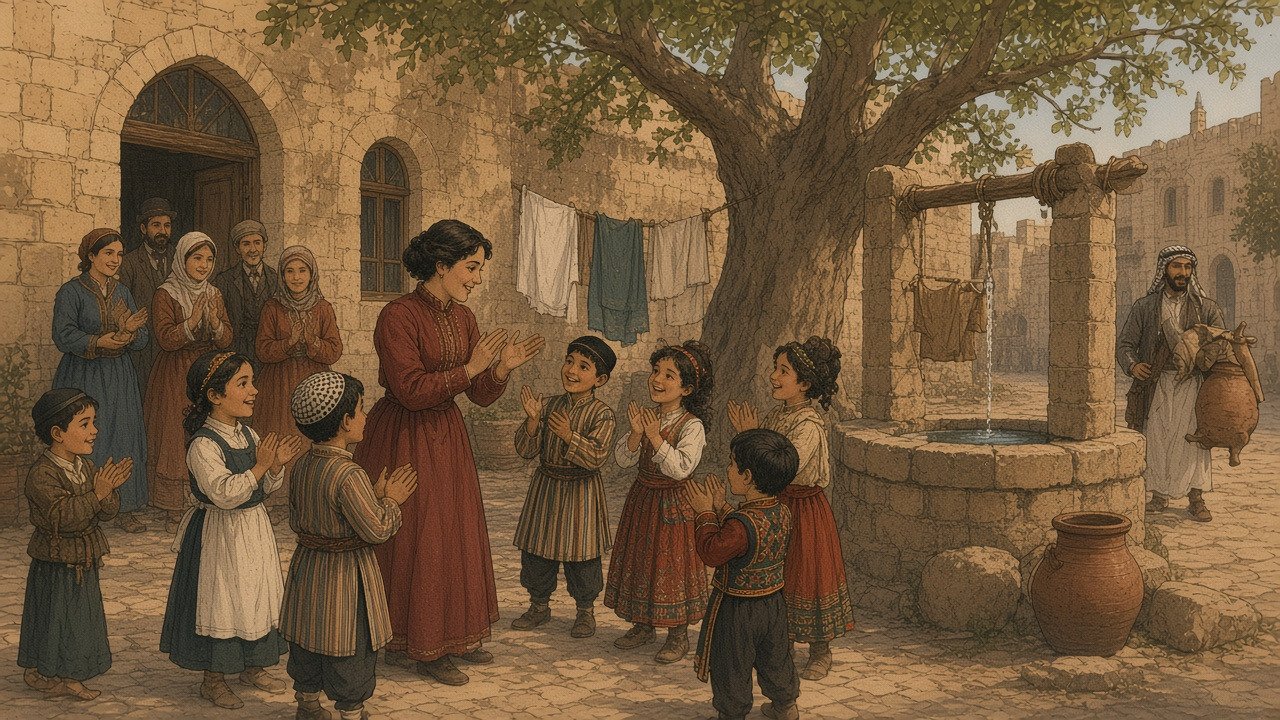
Historians of the revival now stress that Ben-Yehuda’s role, though important, was less decisive than the legend suggests. [22] [23] The crucial step was taken in the schools of the new agricultural settlements of the First Aliyah in the 1880s and 1890s, where teachers began to teach all subjects in Hebrew by the “Hebrew in Hebrew” method, and where children who had learned Hebrew at school began to speak it among themselves and later to their own children. The kindergartens, in which Hebrew-speaking teachers taught children from Yiddish-, Russian-, Arabic- and Ladino-speaking homes, were especially important. By the time of the First World War there were perhaps a few tens of thousands of Hebrew speakers in Palestine. The so-called “language war” of 1913 and 1914, when teachers and students protested against the plan of the German-Jewish Hilfsverein to make German the language of instruction at the new Technion in Haifa, marked the moment when Hebrew became the accepted language of Jewish education in the country. Under the British Mandate, Hebrew was one of three official languages of Palestine, alongside English and Arabic, and the Jewish community built a complete school system and a press in Hebrew. By the founding of the State of Israel in 1948, Hebrew was the dominant language of Jewish public life, and the mass immigration of the following years, which doubled and then tripled the population, was absorbed through intensive Hebrew courses called אולפן (ulpan, studio or school).
Modern Hebrew, which some linguists, most prominently Ghil’ad Zuckermann, prefer to call “Israeli” to stress its novelty, is a Semitic language in its morphology and much of its basic vocabulary. [24] Its verbs are formed on consonantal roots and patterns, the seven בניינים (binyanim, buildings, the verb patterns), in a way that any speaker of Arabic would recognise. Its nouns take gender and number in Semitic fashion, and it uses the construct state, the Semitic genitive construction in which the possessed noun comes first in a shortened form, as in bet sefer, “house of book”, meaning “school”. Its everyday vocabulary is largely Biblical and Rabbinic in origin. But its syntax, phonology and idiom owe a great deal to the European languages of its first speakers. Its word order is mainly subject, verb, object, like English or Yiddish, rather than the verb-first order of Biblical prose. Its sound system has lost most of the distinctively Semitic consonants: in the speech of most Israelis the pharyngeal ח (ḥet) has merged with the velar fricative of כ (khaf), and the pharyngeal ע (ʿayin) has merged with the glottal stop of א (alef) or disappeared altogether. Its ר (resh) is a uvular sound like the French or German r. Many idioms are calques of Yiddish, Russian or English expressions.
Arabic, interestingly, served the revivers as a resource. Ben-Yehuda and some of his colleagues regarded Arabic as a living sister of Hebrew that could supply roots and words missing from the ancient texts, on the grounds that a root attested in Arabic might well have existed in Hebrew too, and a number of Modern Hebrew words are often cited as having been formed on Arabic models in this way. The practice was controversial even at the time, and it declined as the relations between Jews and Arabs in Palestine deteriorated; in any case the main sources of new Hebrew words remained the Hebrew and Aramaic of the classical texts. But it is a reminder that the revival of Hebrew took place among Arabic speakers, and that the first generations of Hebrew speakers in Jerusalem, Safed and Jaffa heard Arabic around them every day.
The question of how to describe this mixed heritage has been controversial. Zuckermann’s thesis that Israeli is a “Semito-European” hybrid, as much a descendant of Yiddish as of Hebrew, has been vigorously contested by other linguists, who stress that every language acquires features from its speakers’ other languages and that the basic grammar and lexicon of Modern Hebrew are recognisably continuous with older Hebrew. [22] A more neutral formulation is that Modern Hebrew is a Semitic language that was reconstituted in a European-dominated speech community and has been shaped by that community’s habits. The essay The Emergence of Modern Hebrew on this site discusses the debate and the history in more detail, and The Origins of Chutzpah follows one of the many words that travelled from Hebrew into Yiddish and back again.
Not all Israelis speak alike. The pronunciation of Jews from Arab countries and from Iran, Kurdistan and Yemen, called “Mizrahi” (from מזרח, mizraḥ, east), traditionally preserved the pharyngeals ḥet and ʿayin and a trilled or tapped r, and for much of the twentieth century it was associated with radio announcers and was in principle regarded as the correct pronunciation by the Academy of the Hebrew Language. [25] In practice the Ashkenazi-influenced pronunciation became the prestige norm, and younger Mizrahi Israelis have largely abandoned the pharyngeals, though they persist among older speakers and in some singing styles and are sometimes used deliberately as a marker of identity. Yemenite Jews preserve an even more conservative reading tradition, which distinguishes sounds lost to other Jewish communities. Arab citizens of Israel, who make up about a fifth of the population, speak Palestinian Arabic as their mother tongue and generally learn Hebrew as a second language at school, which they often speak with great fluency; their Arabic contains many Hebrew loans, and their Hebrew is often marked by the retention of Arabic pharyngeals. Immigrants from the former Soviet Union, who arrived in large numbers in the 1990s, created a vigorous Russian-language press and culture in Israel, and the Ethiopian Jewish community brought Amharic and Tigrinya. Hebrew’s success as a national language has been accompanied by a slow loss of the languages of the immigrant generation, including Yiddish, Ladino and the Judaeo-Arabic dialects, a loss that has led since the 1990s to efforts at preservation and revival among their descendants (see section 12).
Modern Hebrew is regulated, in principle, by the האקדמיה ללשון העברית (ha-akademya la-lashon ha-ʿivrit, the Academy of the Hebrew Language), founded by law in 1953 as the successor to the Hebrew Language Committee that Ben-Yehuda and his colleagues had established in 1890. [25] The Academy coins words for new concepts, publishes rules of spelling, grammar and transliteration, and conducts research into the history of the language. Like its counterparts elsewhere, it has had mixed success. Some of its coinages have been widely adopted, such as מחשב (maḥshev, computer, from the root ḥ-sh-v, “to think, to calculate”) or the long-established מכונית (mekhonit, car), but many others have been ignored in favour of international words such as televizya or internet. The spoken language has moved quickly in its own direction, under the particularly strong influence of American English since the 1980s; Israeli slang borrows freely from English and from Arabic, and words such as סבבה (sababa, cool, great) and יאללה (yalla, come on, let’s go), both from Arabic, are among the most frequent words in informal speech.
Hebrew slang offers a vivid record of the contacts of Israeli society. Besides sababa and yalla, Arabic has given it ahlan (hi), mabsut (pleased), kef (fun, from Arabic kayf), ḥafla (a party), fashla (a fiasco, from Arabic fashal, failure) and walla (really?), many of them transmitted through the speech of Mizrahi Jews and the army. Yiddish has given shvitzer (show-off), nudnik (pest) and the word ḥutspa itself, which Yiddish had borrowed from Rabbinic Hebrew. Russian has given balagan (chaos) and the diminutive suffix -chik. English gives new words every year. In the Haredi (ultra-Orthodox) communities of Jerusalem and Bnei Brak, Yiddish remains a home language for many families, Hebrew is used for everyday dealings outside the community, and the Hebrew of the sacred texts is studied in yeshivas with an Ashkenazi pronunciation that differs markedly from the Israeli norm: a single neighbourhood can thus contain three different ways of sounding the same letters. The language that Ben-Yehuda’s generation hoped would unify the Jewish people has become, like every living language, a field of variation and social distinction.
Hebrew is now spoken as a first language by the majority of Israeli Jews and as a second language by most Arab citizens and immigrants. Its total number of speakers is usually given as around nine to ten million, of whom perhaps five or six million are native speakers, though estimates vary with the definition of fluency; in the Central Bureau of Statistics’ social survey of 2011, 49 per cent of Israelis aged twenty and over named Hebrew as their mother tongue. [4] [1] It has a large literature, a flourishing popular culture, and a growing diaspora of Israeli emigrants in North America and Europe whose children often grow up as heritage speakers. It is studied outside Israel as the language of the Bible and of Jewish prayer, by Jews and non-Jews alike. Its revival has inspired other language movements across the world, from Welsh and Māori to Hawaiian and Cornish, though no other has achieved anything comparable, perhaps because no other has combined the same circumstances: an immigrant community without a common vernacular, an ideology that made the language a central symbol of national rebirth, a written tradition of extraordinary depth that never ceased to be studied, and a state that made the language the condition of full participation in public life.
The legal status of Hebrew changed in 2018. Since the British Mandate, Hebrew and Arabic had both been official languages, though Arabic’s status was in practice limited. The Basic Law adopted by the Knesset in July 2018, known in English as the Nation-State Law, declared Hebrew the language of the state and gave Arabic a “special status”, while stating that the law did not harm the status Arabic enjoyed before it came into force. [26] The change was largely symbolic in its immediate effects, but it was widely seen, both by its supporters and by its Arab and Jewish critics, as a statement about the relationship between language and national identity in Israel. Section 27 returns to it.
6. Aramaic in its last villages and suburbs
For about a thousand years, from the middle of the first millennium BCE to the Arab conquests, Aramaic was the common language of the Fertile Crescent. It was the language of administration in the Neo-Assyrian, Neo-Babylonian and Achaemenid Persian empires, the everyday speech of Jews in Judaea and Babylonia, the language in which parts of the books of Daniel and Ezra were written, the language of the Babylonian and Jerusalem Talmuds, and, in its Edessan form called Syriac, the language of one of the great literatures of early Christianity. The essays The Aramaic Tongue and The Survival of Aramaic tell that story on this site, and Targum Onkelos and the Birth of Aramaic Scripture follows the Aramaic translation of the Torah that Jews still read beside the Hebrew. This section is concerned with what survives today.

After the Arab conquests, Aramaic gave way to Arabic as the spoken language of the towns and most of the countryside, a process that took several centuries and was complete in most of Syria, Iraq and Palestine by about the thirteenth century. Aramaic survived in a few mountain villages and remote districts, among communities that were Christian, Jewish or Mandaean and had reasons of religion and geography to remain apart. These survivals are collectively called Neo-Aramaic. They are not descended from Syriac, the classical literary language, but from spoken dialects that ran parallel to it, and they differ from one another as much as the Romance languages do. [27] Scholars usually recognise four main groups.
Western Neo-Aramaic is the last survivor of the Aramaic dialects of the western Levant, the group to which the Aramaic of Jesus and of the Palestinian Talmud belonged. It is spoken today in the village of معلولا (Maʿlūlā) and, in recent generations, in the neighbouring villages of Jubbʿadin and Bakhʿa in the Qalamūn mountains north of Damascus. Maʿlūlā is mostly Christian, with Melkite (Greek Catholic) and Orthodox churches and monasteries; Jubbʿadin and Bakhʿa are Muslim. The German Semitist Werner Arnold has described the language in a series of grammars, texts and dictionaries since the 1980s, and he and others have shown how deeply Western Neo-Aramaic has been influenced by Arabic, from which perhaps half of its vocabulary is borrowed. [28] [29] The speaker population was never large, perhaps fifteen to twenty thousand at most including emigrants to Damascus, and the Syrian civil war, during which Maʿlūlā was occupied by jihadist groups in 2013 and 2014 and many inhabitants fled, has placed the language in serious danger. Efforts to teach it in a script of its own, an adaptation of the square Hebrew script, caused controversy in the 2000s because of the script’s association with Hebrew; the community has more recently used Syriac letters and the Latin alphabet.
Turoyo, from ܛܘܪܐ (ṭūrā, mountain), is the language of the Syriac Orthodox Christians of Ṭūr ʿAbdīn, the “mountain of the servants of God”, a limestone plateau in south-eastern Turkey around the town of Midyat, with its many ancient monasteries such as Mor Gabriel. It belongs to the central Neo-Aramaic group along with the almost extinct Mlaḥsô, formerly spoken in two villages near Diyarbakır. The Aramaic-speaking Christian population of Ṭūr ʿAbdīn fell drastically during the massacres of 1915, known in Syriac as ܣܝܦܐ (sayfo, the sword), and again during the conflicts between the Turkish state and the Kurdish PKK from the 1980s, when most of the remaining villagers emigrated. Today the large majority of Turoyo speakers, put by Ethnologue at about a hundred thousand in all, with some fifteen thousand left in Turkey, [30] live in Europe, especially in Sweden, Germany, the Netherlands and Switzerland, where the language is spoken in the home but is losing ground among the young. The German linguist Otto Jastrow’s grammars and the work of Swedish and Dutch scholars have documented it extensively. [31] Turoyo is often written in Latin script in the diaspora and in Syriac script for church purposes, and there have been school textbooks in Sweden since the 1970s.
North-Eastern Neo-Aramaic (often abbreviated NENA) is the largest and most diverse group. Its dialects were spoken, until the twentieth century, by Christians and Jews in hundreds of villages and small towns across northern Iraq, south-eastern Turkey, north-western Iran and the Caucasus, and the Cambridge-based linguist Geoffrey Khan has led a long project to document as many of them as possible before they disappear. [27] The Christian dialects are spoken by communities who call themselves, in English, Assyrians or Chaldeans or simply Suraye (from ܣܘܪܝܝܐ, suryāyā, Syrian, Christian), and who belong mainly to the Assyrian Church of the East, the Ancient Church of the East and the Chaldean Catholic Church. The name of their speech, ܣܘܪܝܬ (sūret), is also used in English. The Jewish dialects, called by their speakers lishana deni (“our language”), lishanid nash didan (“the language of our people”) or simply Targum, were spoken by the Kurdish Jews, almost all of whom emigrated to Israel in the early 1950s. Today the Jewish NENA dialects survive among elderly speakers in Israel, and they have been recorded in detail by Khan, Yona Sabar and others; Sabar’s own family came from Zakho in Iraqi Kurdistan, and his dictionary of Jewish Neo-Aramaic is one of the major works on the language. [32]
In Israel, the Kurdish Jewish community has kept something of its Aramaic heritage alive in public form. Its spring festival, the Saharane, revived in the 1970s, brings tens of thousands of people to picnic grounds and parks for music, dancing and food, and older people still sing and tell stories in the Jewish Neo-Aramaic of Zakho, Amedi or Urmia. Recordings made by Khan, Sabar and others in the homes of elderly speakers in Jerusalem and the moshavim of the Galilee preserve dialects whose villages in Kurdistan no longer have any Jewish inhabitants. The paradox is striking: the language in which Jesus taught and the Talmud was argued survives, in one of its forms, as the grandmother’s tongue of Israelis whose grandchildren speak Hebrew.
The Christian NENA dialects have had a more complex modern history. In the nineteenth century American Presbyterian missionaries at Urmia in north-western Iran created a written standard based on the local dialect, printed in the East Syriac script, and this became the basis of a literary “Assyrian” language used in newspapers, books and school textbooks. The massacres and deportations of the First World War, and the later conflicts in Iraq, drove most of the speakers from their villages to Baghdad, Kirkuk, Mosul, Tehran and then to the diaspora: Chicago, Detroit, San Diego, Sydney, Melbourne, Sweden and Germany. Since 2003 the Iraqi Christian population has fallen sharply, from about one and a half million before the invasion to perhaps a quarter of a million twenty years later, on the estimates most often quoted, and the occupation of Mosul and the Nineveh Plain by the so-called Islamic State in 2014 emptied the region’s Christian towns for several years. [33] Some of the population has since returned to towns such as Qaraqosh and Alqosh, and Syriac language schooling has been offered in parts of the Kurdistan Region of Iraq, where the 2005 Iraqi constitution recognises Syriac as an official language in areas where its speakers are concentrated. [34] Yet most speakers now live outside the Middle East, and their children are increasingly English, Swedish or German speakers.
The fourth group is Neo-Mandaic, the spoken descendant of the Aramaic dialect of the Mandaeans, a Gnostic religious community of southern Iraq and south-western Iran whose prophet is John the Baptist. Classical Mandaic is the language of their scriptures, such as the Ginza Rabba (“great treasure”), written in a distinctive script of its own. The spoken language survives among a very small number of families, most of them originally from the Iranian cities of Ahvaz and Khorramshahr, and the Mandaean community itself, which numbered perhaps a few tens of thousands at the beginning of the twenty-first century, has been scattered by persecution and war to Sweden, Australia and the United States. [35] Neo-Mandaic is among the most endangered languages in the region.
Above these spoken varieties stands Classical Syriac, ܠܫܢܐ ܣܘܪܝܝܐ (leššānā suryāyā, the Syriac language), which remains the liturgical language of the Syriac Orthodox, Syriac Catholic, Maronite, Chaldean and Assyrian churches. It is chanted in services from Kerala in southern India to Södertälje in Sweden, studied in seminaries, and written in three scripts: the ancient Estrangela, the western Serto and the eastern or “Nestorian” script (see section 23). For many Christians of the region, Syriac plays a role similar to that of Classical Arabic for Muslims or Biblical Hebrew for Jews before the revival: a sacred and learned language that few speak but many revere. Some community activists have argued for a modern standard based on Classical Syriac, on the model of Hebrew; others favour the spoken dialects. The essay on The Syriac New Testament on this site describes the textual heritage of the classical language.
The decline of Aramaic is, in short, the mirror image of the rise of Hebrew. Where Hebrew acquired native speakers through migration, a national movement and a state, Aramaic has lost them through migration, persecution and the absence of any state that might support it. The question of names has added a further difficulty. Speakers of NENA in the diaspora are divided over whether they should call themselves Assyrian, Chaldean, Syriac or Aramean, and the dispute, which has deep roots in church history and modern politics, affects how the language is described in censuses, taught in schools and represented in the media. To the linguist they speak varieties of one language group; to their communities they may speak several different languages.
The media of the diaspora have given Aramaic a new kind of public life. Assyrian satellite channels broadcast from the United States, Sweden and northern Iraq; there are Assyrian and Suryoyo radio stations, YouTube channels, music videos and online dictionaries; and popular singers record in the dialects of Urmia, Nineveh and Ṭūr ʿAbdīn for audiences scattered across four continents. Classical Syriac is taught online to learners who have never seen a Syriac village. None of this replaces the loss of the village communities in which the dialects were spoken by everyone from infancy, but it creates a space in which the languages can still be heard, sung and written by the children of the diaspora.
7. Semitic outliers in Malta, Arabia and the Horn
Three groups of Semitic languages lie at the margins of the Middle East as defined here, and each throws light on the others. They are Maltese, the only Semitic language with official status in Europe; the Modern South Arabian languages of Yemen and Oman, which are not dialects of Arabic but a separate branch of Semitic; and the Ethiopian Semitic languages, of which Amharic and Tigrinya are the largest.
Il-Malti (Maltese) is spoken by about half a million people in Malta and by emigrant communities in Australia, Canada, the United Kingdom and the United States. [30] It descends from the Arabic brought to the islands by settlers from Sicily or North Africa after the Arab conquest of Malta in 870, and from Siculo-Arabic, the Arabic of medieval Sicily. When the Normans conquered Malta in the late eleventh century, and particularly after the expulsion or conversion of the Muslim population in the thirteenth century, the islands became part of Latin Christendom, and Maltese developed in isolation from the rest of the Arabic-speaking world, without contact with Classical Arabic or the Qurʾan. It absorbed a vast quantity of Sicilian and Italian vocabulary, and later English, so that perhaps half of its dictionary is of Romance origin, though the core vocabulary of everyday life and most of the grammar remain Semitic. [36] Maltese is written in the Latin alphabet with some additional letters, ċ, ġ, għ, ħ, ż and ie, according to a standard orthography fixed in the 1920s by the Għaqda tal-Kittieba tal-Malti (Association of Maltese Writers) and given official status in 1934. Since 2004 Maltese has been an official language of the European Union.
For a speaker of Arabic, Maltese is at once familiar and strange. Its numbers are Arabic: wieħed, tnejn, tlieta, erbgħa (one, two, three, four), corresponding to Arabic wāḥid, ithnān, thalātha, arbaʿa. Its verbs follow Semitic patterns, as in kiteb, “he wrote”, nikteb, “I write”, ktieb, “book”. Its word for God is Alla, though Malta is a Catholic country and the word carries no Islamic associations there. But a Maltese sentence about government, law, science or the arts will be full of Italian and English words, so that a newspaper headline such as Il-Gvern iħabbar miżuri ġodda (“the government announces new measures”) combines Italian governo, Arabic-derived iħabbar (compare Arabic akhbara, “to inform”) and ġodda (compare Arabic jadīd, “new”), with an Italian-derived miżuri (from misure). Maltese shows, as no other language does, what happens to Arabic when it is cut off from its classical standard and from Islam: it becomes a fully independent national language, written in the Latin alphabet, with a literature, an academy and a European identity of its own. It is also a useful reminder of what the spoken Arabic of the Maghreb might look like if it had been allowed to develop as a written language.
Maltese has a literature to match. Its national poet, Dun Karm Psaila (1871 to 1961), a priest who began by writing in Italian and turned to Maltese, wrote the words of the national anthem; the novelists and poets of the twentieth century, among them Ġużè Aquilina, who also compiled the great Maltese-English dictionary, and Oliver Friggieri, built a modern prose and verse. Maltese linguists have studied the language’s Semitic structure in close comparison with Arabic, and Maltese scholars have been among the most interesting commentators on what it means to be a Semitic-speaking European nation.
The Modern South Arabian languages are spoken in the far east of Yemen, in the western Omani province of Dhofar, on the island of Socotra and in a few places in Saudi Arabia. There are six of them: Mehri, the largest, with perhaps a hundred thousand or more speakers; [30] Soqotri, spoken on Socotra; Shehri or Jibbali, spoken in the mountains of Dhofar; Harsusi; Hobyot; and Bathari, which has only a few hundred speakers. They are not descended from the Old South Arabian languages of the inscriptions of Sabaʾ and Ḥimyar, as was once thought, but form an independent branch of Semitic, with features that have been lost elsewhere: a set of lateral consonants (sounds made with the air passing along the side of the tongue), which probably reflects Proto-Semitic pronunciation, and a dual number in pronouns and verbs. Janet Watson, who has worked on Mehri for many years, has emphasised both their importance for the reconstruction of Semitic and their vulnerability. [37] The languages are unwritten, though their speakers have developed transcription systems in Arabic and Latin script, and the spread of Arabic schooling, radio and television, and in Socotra the disruptions of war and development, have endangered all of them. The poetry of Mehri and Soqotri, an oral tradition of great richness, is now being recorded and published with the participation of the communities.
In the Horn of Africa, the Ethiopian Semitic languages descend from the Semitic speech brought across the Red Sea from South Arabia in the first millennium BCE, though the details of this migration are debated. Their classical ancestor, ግዕዝ (Gəʿəz, Geʿez), was the language of the kingdom of Aksum and later the liturgical language of the Ethiopian and Eritrean Orthodox churches, the Ethiopian Catholic church and the Beta Israel, the Jews of Ethiopia. The largest modern member is አማርኛ (Amarəñña, Amharic), the working language of the Ethiopian federal government, spoken as a first language by 21.6 million people at the census of 2007, the last to be held, and probably by well over thirty million today, as well as by many millions more as a second language. [30] The second is ትግርኛ (Təgrəñña, Tigrinya), spoken in the Tigray region of Ethiopia and in Eritrea by some seven million people at the last counts, and probably more today. [30] Smaller members include Tigre in Eritrea and the Gurage languages and Harari in Ethiopia. All are written in the Geʿez script, an abugida in which each character represents a consonant plus a vowel.
Amharic and Tigrinya have been shaped by long contact with the Cushitic languages, and their grammar differs from that of Arabic and Hebrew in some striking ways: their word order is subject, object, verb, as in Turkish or Japanese, and they place relative clauses and adjectives before the noun. Yet their verbs still follow Semitic patterns, and much of their basic vocabulary has clear Semitic cognates, as the comparative table in section 14 shows. They also matter to this essay for another reason: Israel has an Ethiopian Jewish community of more than a hundred and fifty thousand people, many of whom speak Amharic or Tigrinya, and the Gulf states, Lebanon and Israel have significant numbers of Ethiopian and Eritrean migrant workers and refugees. The Semitic family, in other words, is reunited in the streets of Tel Aviv and Beirut.
One more Afroasiatic group belongs in this section, though it is not Semitic. The Amazigh or Berber languages, ⵜⴰⵎⴰⵣⵉⵖⵜ (tamaziɣt) in the revived Tifinagh script, are spoken by perhaps a third or more of Moroccans and a quarter or more of Algerians, with smaller communities in Libya, Tunisia, the Egyptian oasis of Siwa, and among the Tuareg of the Sahara. The major Moroccan varieties are Tashelhit in the south, Central Atlas Tamazight in the Middle Atlas and Tarifit in the north; in Algeria the largest is Kabyle (Taqbaylit). These languages were the languages of North Africa before Arabic arrived, and they have influenced Maghrebi Arabic profoundly, while themselves absorbing a great deal of Arabic vocabulary. [38] Their recognition as national and then official languages in Morocco (2011) and Algeria (2016) is one of the most important developments in language policy in the region (see section 27).
8. Persian and the Iranian world
The language that its speakers call فارسی (fārsi) in Iran, دری (dari) in Afghanistan and тоҷикӣ (tojikī, Tajik) in Tajikistan is, by every structural measure, a single language with three national standards. It has perhaps seventy to eighty million native speakers, around half of them in Iran, with tens of millions more who use it as a second language in Iran and Afghanistan, and it has a literary tradition of more than a thousand years that is the common property of all three countries and of a large part of South and Central Asia. [39] For most of that time it was the prestige language of a vast area from Anatolia to Bengal, the language of the Mughal court in Delhi, the Ottoman court in Istanbul (alongside Turkish and Arabic) and the Uzbek khanates of Central Asia. Its poets, Firdawsī, Rūmī, Saʿdī, Ḥāfiẓ, are still memorised and quoted by millions.

Persian is the modern descendant of Old Persian, the language of the Achaemenid inscriptions of Darius and Xerxes in the sixth and fifth centuries BCE, by way of Middle Persian, the language of the Sasanian empire and of Zoroastrian scripture and commentary, written in a script derived from Aramaic. After the Arab conquest in the seventh century, Arabic replaced Middle Persian as the language of administration and scholarship, but Persian continued to be spoken, and from the ninth century a new form of it, written in the Arabic script and enriched with Arabic vocabulary, emerged in the courts of the eastern Iranian dynasties of the Saffarids and the Samanids. This New Persian is the language of Firdawsī’s Shāhnāma, completed around 1010, and of all later Persian literature. It has changed remarkably little since: an educated Iranian can read Firdawsī with less difficulty than an English speaker reads Chaucer. Its name, dari, was originally that of the court language of the Sasanians (from dar, “gate, court”), and it was revived in Afghanistan in the twentieth century for the Afghan standard.
Persian is, in some respects, a grammatically simple language. It has no grammatical gender, so that the pronoun او (u) means both “he” and “she”, a fact that Persian poets have exploited for centuries, leaving the beloved of a love poem tantalisingly undefined. It has no case endings, a single plural suffix for most nouns (-hā, with -ān for animate nouns in more formal style) and a regular verbal system built on two stems, present and past. Its word order is subject, object, verb, with the verb at the end of the clause. Its most characteristic construction is the اضافه (eżāfe, addition), an unstressed vowel -e that links a noun to a following adjective or possessor: ketāb-e bozorg, “big book”; ketāb-e man, “my book”; ketāb-e bozorg-e pedar-e man, “my father’s big book”. The ezafe is not usually written, which makes reading Persian a matter of knowing where it belongs.
The other distinctive feature of Persian grammar is its reliance on compound verbs. Persian has only a few hundred simple verbs, many of them archaic or literary, and most verbal meanings are expressed by combining a noun, adjective or preposition with a small set of “light” verbs such as کردن (kardan, to do, make), شدن (shodan, to become), زدن (zadan, to hit), دادن (dādan, to give) and داشتن (dāshtan, to have). Thus “to think” is فکر کردن (fekr kardan, literally “to make thought”, with an Arabic noun), “to telephone” is تلفن زدن (telefon zadan, “to hit telephone”), “to help” is کمک کردن (komak kardan), and “to start” is شروع کردن (shoruʿ kardan, with another Arabic noun). New verbs are created by this method almost without limit, and it allows Persian to absorb foreign nouns, Arabic, French or English, without having to adapt them to its verbal morphology. The same strategy, as section 17 shows, has spread to Turkish, Kurdish, Armenian, Urdu and Neo-Aramaic.
Persian vocabulary is a palimpsest. Its core is Iranian and Indo-European: pedar (father), mādar (mother), barādar (brother), dokhtar (daughter), nām (name) and the numbers are cognate with their English equivalents and recognisable to anyone who has studied Latin or Greek. Overlaid on this is a vast stratum of Arabic, which by some counts accounts for something like forty per cent of the vocabulary of a modern newspaper and a higher proportion of learned and religious prose. [40] Then come smaller strata of Turkic and Mongol words from the centuries of Turkic and Mongol rule, French words from the nineteenth and early twentieth centuries (mersi, thank you; ādres, address; otobus, bus) and, more recently, English. The efforts of the Iranian academy, the Farhangestan, to replace foreign words with Persian coinages are discussed in section 27.
Persian poetry lives in everyday speech to a degree that surprises visitors. Iranians quote Saʿdī’s Golestān and Ḥāfiẓ’s Divān in conversation as English speakers once quoted the Bible and Shakespeare, and many households keep a copy of Ḥāfiẓ to consult for an augury, the فال حافظ (fāl-e ḥāfeẓ), opening the book at random and reading the poem as an answer to a question; street vendors in Tehran and Shiraz offer the same service with trained birds that pick a folded poem from a box. On the winter solstice, the night called Yaldā, families gather to eat pomegranates and watermelon and to read Ḥāfiẓ aloud. Persian proverbs, many of them lines of verse, are a standard part of educated conversation, and politicians, religious leaders and dissidents alike quote the classical poets to make their points. The tomb of Ḥāfiẓ in Shiraz is a place of pilgrimage for Iranians of every political and religious persuasion. In few other places in the world is a medieval literary language so present in the mouths of ordinary people.
Modern Persian literature has added new voices to this tradition. The short stories and the novel The Blind Owl (1937) of Ṣādeq Hedāyat, the poetry of Nimā Yushij, who broke with classical metre, and of Forugh Farrokhzād, whose frank and lyrical verse of the 1950s and 1960s made her one of the most widely read poets in the language, and the novels of writers such as Simin Dāneshvar and Maḥmud Dowlatābādi, created a modern prose and verse that draw on the colloquial as well as the classical language. Persian cinema, from Abbas Kiarostami to Asghar Farhadi, has brought the sound of contemporary colloquial Persian to audiences around the world.
The three national standards differ mainly in pronunciation, vocabulary and the treatment of loanwords. Iranian Persian, based on the speech of Tehran, has shifted the old long vowels ē and ō to i and u and the short a before n and m towards u in colloquial speech (nān, bread, becomes nun in Tehran); Dari preserves the older distinctions, so that shir (“milk”) and sher (“lion”) remain distinct in Kabul but have merged as shir in Tehran. Iranian Persian has more French loans, Dari more English and Pashto ones, and Tajik, which has been written in the Cyrillic alphabet since 1940, has many Russian and Uzbek loans. The colloquial Persian of Tehran differs from the written language more than many learners expect, in pronunciation, in the shortened forms of verbs and pronouns, and in vocabulary: written mi-ravam, “I go”, is spoken mi-ram; written ān, “that”, is spoken un. The gap is not as large as the gap between Modern Standard Arabic and the dialects, but it is significant enough that some linguists speak of a diglossic situation in Persian too (see section 18).
Persian is not the only Iranian language of Iran. The country’s linguistic diversity is often underestimated, because Persian has been the sole official language since the early twentieth century and because the census does not ask about mother tongue. Along the Caspian coast, Gilaki and Mazandarani (Tabari), closely related north-western Iranian languages, are spoken by several million people. In the west, the Luri and Bakhtiari dialects, close to Persian, are spoken in the Zagros, and Laki and the southern Kurdish dialects around Kermanshah. Talysh is spoken on both sides of the border with Azerbaijan, and Tati and the Iranian dialects of Semnan, Kashan and other central towns preserve features lost in Persian. The Zoroastrians of Yazd and Kerman speak a distinctive Iranian dialect called Dari (not to be confused with Afghan Persian) or Behdinani, and the Jews of Iran spoke and wrote Judaeo-Persian and a group of Jewish dialects related to those of the central plateau (see section 12). Most of these languages are under pressure from Persian, which is the language of education, the media and the capital, and several are considered endangered by UNESCO. [41] To them must be added Iran’s large non-Iranian minorities: speakers of Azerbaijani Turkic, who are perhaps a fifth or more of the population; [30] Kurds; Arabs in Khuzestan; Baluch in the south-east; Turkmen in the north-east; and smaller Armenian, Assyrian and Georgian communities.
In Afghanistan, Dari is the language of government, business and the cities, and the lingua franca between speakers of Pashto, Uzbek, Turkmen, Hazaragi (a Persian dialect with Mongolic and Turkic elements spoken by the Hazaras) and the many smaller languages of the country. The 2004 constitution made Dari and Pashto co-official, and the Taliban governments, both in the 1990s and since 2021, have promoted Pashto, though Dari has remained the practical language of administration. [39] In Tajikistan, Tajik was established as a separate standard in the Soviet period and written first in Latin and then in Cyrillic script; since independence in 1991 there have been calls to adopt the Perso-Arabic script, but they have not been acted upon. Persian thus offers a striking case of a single language divided by three scripts and three national identities. A poem by Ḥāfiẓ is the same poem in Shiraz, Herat and Dushanbe, but the reader in Dushanbe will usually read it in Cyrillic letters.
9. Kurdish, Balochi and Pashto
Kurdish is often described as the language of the largest nation without a state, and the description, though rhetorical, contains a linguistic truth: a language spoken by tens of millions of people across four states, without a single standard or script, and for much of the twentieth century banned or restricted in several of them, has developed in ways that reflect its political fragmentation. No census in Turkey, Iran, Iraq or Syria counts Kurdish speakers reliably, and estimates of the total range widely, most often between about twenty and thirty million. [42] [3]
“Kurdish” is better understood as a cluster of closely related north-western Iranian languages than as a single language. The two largest are کوردی (kurdî) in its northern form, Kurmanji, and its central form, Sorani. Kurmanji (Kurmancî) is spoken by the large majority of Kurds in Turkey and Syria, by the Kurds of north-western Iran and of the Duhok province of Iraqi Kurdistan (where its local form is called Badînî), by Kurdish communities in the Caucasus and Khorasan, and by most of the Kurdish diaspora in Europe. It is written in a Latin alphabet in Turkey, Syria and the diaspora, in the Arabic script in Iraq and Iran, and formerly in Cyrillic in the Soviet Union. Sorani (سۆرانی, soranî) is spoken in most of Iraqi Kurdistan, including the cities of Erbil and Sulaymaniyah, and in the Iranian provinces of Kurdistan and West Azerbaijan around Sanandaj and Mahabad. It is written in a modified Arabic script that, unusually, writes all vowels (see section 22). Sorani has been a language of government, education and broadcasting in Iraqi Kurdistan since the 1920s, intermittently, and continuously since 1991, and it is the main language of the Kurdistan Regional Government.
The two forms differ considerably. Kurmanji preserves a two-gender system and a case distinction between direct and oblique forms of nouns, both of which Sorani has lost; Sorani has developed suffixed pronouns and a definite article in -eke that Kurmanji lacks. Both have a split-ergative system in the past tense of transitive verbs, in which the agent of a past transitive verb is marked differently from the subject of an intransitive one, a feature inherited from Middle Iranian and found also in Pashto, Balochi and some other Iranian languages, though Sorani realises it through pronominal clitics rather than case. Their vocabularies overlap but differ in many common words, so that speakers of the two often have difficulty understanding each other at first meeting; with exposure, mutual comprehension grows. Some linguists therefore regard them as distinct languages, while most Kurdish writers and activists insist on the unity of a single Kurdish language with several dialects.
Beyond Kurmanji and Sorani lie Southern Kurdish, spoken around Kermanshah and Ilam in Iran and in Khanaqin in Iraq, which shades into Laki and Luri; and two languages that are spoken by people who usually identify as Kurds but which belong to a different branch of north-western Iranian: Zazaki, spoken in eastern Anatolia around Dersim (Tunceli), Bingöl and Siverek by perhaps one to two million people, [30] and Gorani or Hawrami, spoken in the mountains on the Iran-Iraq border. Gorani was the literary language of the Kurdish principality of Ardalan and of the Yarsani (Ahl-e Haqq) religion, and a significant body of poetry was written in it from the sixteenth to the nineteenth centuries. The Yazidis, a religious community of northern Iraq and the Caucasus whose population suffered genocide at the hands of the so-called Islamic State in 2014, speak Kurmanji, and their sacred hymns are in that language.
Kurdish has a long oral literature, a written literature going back at least to the poet Melayê Cizîrî in the sixteenth or seventeenth century and to Ehmedê Xanî, whose romance Mem û Zîn (1692) is considered the Kurdish national epic, and a modern literature that has flourished especially in Iraq, in the diaspora, and since the 2000s in Turkey. Its modern history is dominated by state policy. In Turkey, Kurdish was banned in public use, in publication and in broadcasting for much of the twentieth century, culminating in a 1983 law that prohibited publication in Kurdish; the ban was lifted in 1991, the reforms of 2002 and 2003 permitted Kurdish broadcasting and private Kurdish courses, and a state television channel in Kurdish began on the first day of 2009. [42] [43] In Syria, Kurds were subjected to restrictions and many were denied citizenship until 2011; since the civil war, Kurdish-led authorities in the north-east have made Kurmanji a language of education. In Iran, Kurdish publication has been permitted under Article 15 of the constitution, which allows “regional and tribal languages” in the press and in the teaching of literature, but it is not a language of general education. In Iraq, Kurdish has been an official language alongside Arabic since the 2005 constitution. [34] The result is that a Kurdish child in Erbil may be educated entirely in Sorani, a Kurdish child in Diyarbakır has until recently been educated entirely in Turkish, and the two may share no written language at all.
The Kurdish diaspora has played a disproportionate role in the language’s modern development. The Kurdish Institute of Paris, founded in 1983, the Kurdish publishing houses of Sweden, which produced much of the Kurmanji literature of the 1980s and 1990s when it could not be published in Turkey, and the Kurdish satellite channels of Europe gave the language institutions it lacked at home. Writers such as Mehmed Uzun, who wrote his novels in Kurmanji in Swedish exile, helped create a modern Kurmanji prose style, and the dictionaries and grammars produced in the diaspora have shaped the standard language now taught in Syria, Turkey and Iraqi Duhok.
Balochi is a north-western Iranian language spoken in the dry lands of south-eastern Iran, south-western Pakistan and southern Afghanistan, and by large communities in Oman and the Gulf states, where Baluch soldiers and workers have been settled for centuries. Its speakers number perhaps eight to ten million, most of them in Pakistan. [1] It is written in the Arabic script in a style close to that of Urdu, though several competing orthographies exist, and its literature is mainly oral and poetic. In Iran, where Baluch are mostly Sunni Muslims in a predominantly Shiʿi state, the language has very limited official recognition. [39]
Pashto, پښتو (pax̌to), stands at the eastern edge of the region. It is an eastern Iranian language spoken by about forty to fifty million people in Afghanistan and Pakistan, and it is one of the two official languages of Afghanistan. [1] It is grammatically more complex than Persian, with two genders, several noun classes, a split-ergative system in the past tense, and retroflex consonants acquired through contact with the Indo-Aryan languages of South Asia. It is written in an extended Arabic script with additional letters for its retroflex and other sounds. Pashto is included in this essay partly because of its importance in Afghanistan and partly because it is an Iranian language whose history has been bound up with that of Persian for more than a millennium; its literary tradition, beginning in earnest with the warrior poet Khushḥāl Khān Khaṭak in the seventeenth century, draws on Persian models while celebrating the Pashtun code of honour, پښتونولي (paxtunwali).
One more Iranian language deserves mention for its unusual location. On the Musandam peninsula of Oman, at the tip of Arabia overlooking the Strait of Hormuz, a few thousand people in the village of Kumzar and its offshoots speak Kumzari, a south-western Iranian language heavily influenced by Arabic, which the linguist Christina van der Wal Anonby described in a grammar completed at Leiden in 2015. [44] Its existence is a reminder that the shores of the Gulf have been bilingual, Arabic and Iranian, for as long as there have been sailors and traders crossing it, and that the linguistic border between Arabia and Iran runs through the water rather than along it.
10. Turkish and its Oghuz kin
Türkçe (Turkish) is the largest Turkic language and the national language of the Republic of Turkey, where it is spoken as a first language by perhaps seventy to eighty per cent of a population of more than eighty-five million, and as a second language by nearly everyone else. It is also spoken in northern Cyprus, in the Balkans (Bulgaria, Greece, North Macedonia and Kosovo), and by large diaspora communities in Germany, the Netherlands, Austria, France and the United Kingdom, where it is one of the most widely spoken minority languages. [9] Together with Azerbaijani, Turkmen and the Turkic varieties of Iran it forms the Oghuz branch of the Turkic family, whose members are close enough that a Turkish speaker can follow much of an Azerbaijani news broadcast and a good deal of Turkmen.
Standard Turkish is based on the educated speech of Istanbul, and broadcasting and schooling have spread it across the country, but the regional dialects of Anatolia remain vigorous in the countryside and among older speakers. Turkish dialectologists divide them into western and eastern groups, with the eastern dialects around Erzurum, Kars and the Black Sea showing features that link them to Azerbaijani; the Black Sea dialects, around Trabzon and Rize, are famous for their distinctive intonation and vocabulary, influenced by centuries of contact with Pontic Greek and Laz. Cypriot Turkish, spoken in the north of the island, has a recognisable accent and vocabulary of its own, with many Greek loans, and the Balkan or Rumelian dialects of Bulgaria, Greece and North Macedonia preserve features of the Ottoman colloquial of the European provinces. In Germany, the speech of the descendants of Turkish workers, largely from central and eastern Anatolia, has developed its own features, including German loanwords and calques.
The Oghuz Turks entered the Middle East from Central Asia in the eleventh century, when the Seljuk dynasty conquered Iran and Iraq and, after the battle of Manzikert in 1071, opened Anatolia to Turkish settlement. Over the following centuries the Turkish language spread across Anatolia, gradually replacing Greek, Armenian, Syriac and Kurdish in many areas, though the process was slow and incomplete: Greek was still spoken in much of Anatolia until 1923, and Armenian until 1915. The literary language of the Ottoman Empire, عثمانلیجه (ʿosmānlıca, Ottoman Turkish), was written in the Arabic script and incorporated so much Arabic and Persian vocabulary and grammar that a passage of high Ottoman prose could be mostly Arabic and Persian words held together by Turkish suffixes. The everyday speech of ordinary Turks, called kaba Türkçe (“rough Turkish”) by Ottoman literati, was much less mixed. The gap between the two was one of the motives for the language reform of the Republic, which is discussed in sections 24 and 27. [45]
Turkish grammar is a textbook example of agglutination. A word is formed by adding to a root a sequence of suffixes, each with a single clear meaning, in a fixed order. The famous example evlerimizden, “from our houses”, is ev (house) + -ler (plural) + -imiz (our) + -den (from). Longer chains are common: Avrupalılaştıramadıklarımızdanmışsınız, “you are said to be one of those whom we could not make European”, is a long but grammatical word that is often quoted to illustrate the point. Verbs work the same way: gel-e-me-yecek-miş-sin, “you will apparently not be able to come”, strings together a verb root, a modal, a negative, a future, an evidential and a person ending. There are no grammatical genders and no articles, apart from bir, “one”, used as an indefinite article.
The second celebrated feature is vowel harmony. Turkish vowels are divided into front (e, i, ö, ü) and back (a, ı, o, u), and into rounded and unrounded, and the vowels of suffixes change to agree with the last vowel of the stem. So the plural is -ler after front vowels and -lar after back ones: evler, “houses”, but kitaplar, “books”. The question particle is mi, mı, mu or mü, depending on the preceding vowel. Vowel harmony gives Turkish its characteristic sound, and it extends, partially, to loanwords, though many Arabic and Persian loans resist it, as do Western loans: kitap (book, from Arabic) has mixed vowels and takes back-vowel suffixes, but saat (hour, clock, from Arabic sāʿa) takes front-vowel suffixes, saatler, because the Arabic ʿayn colours the vowel in Turkish pronunciation.
Turkish word order is subject, object, verb, with the verb at the end. Modifiers precede what they modify, so that adjectives come before nouns, possessors before the possessed, and relative clauses, formed with participles rather than relative pronouns, before their head nouns: dün gördüğüm adam, “the man I saw yesterday”, is literally “yesterday my-seen man”. Postpositions take the place of prepositions. All of this makes Turkish typologically very different from Arabic or Persian, and it explains why Ottoman Turkish, which borrowed Persian and Arabic constructions such as the ezafe and the relative conjunction ki wholesale, sounded so foreign to ordinary speakers.
Turkish also marks the source of information in its grammar. The suffix -miş (with its harmonic variants) indicates that the speaker did not witness an event but has inferred it or heard about it: gelmiş, “he has apparently come, I gather he came”, contrasts with geldi, “he came, I saw it or know it directly”. This kind of grammatical marking, called evidentiality, is found in many languages of the region, including Persian, Armenian, Georgian and Kurdish, and its spread is one of the features discussed under the heading of the linguistic area in section 17. [9]
Azerbaijani, called Azərbaycan dili in the Republic of Azerbaijan and ترکی (torki, Turkish) by many of its speakers in Iran, is the second-largest Oghuz language. Its speakers are divided between the Republic of Azerbaijan, where it is the first language of most of a population of about ten million, and north-western Iran, where the number is much larger, though estimates vary widely: Ethnologue has given 15.5 million first-language speakers and an ethnic population of 18.7 million, and other estimates exceed twenty million. [30] [1] The division goes back to the Russo-Persian treaties of Gulistan (1813) and Turkmenchay (1828), which drew the border along the Aras river. North Azerbaijani, the standard of the Republic, has been written successively in the Arabic script, the Latin script (1929), Cyrillic (1939) and the Latin script again (from 1991); South Azerbaijani in Iran is written in the Arabic script and has no official standard, since it is not a language of education. Azerbaijani differs from Turkish in phonology (it has a vowel ə and a velar fricative x), in some grammar and in much vocabulary, especially in the Iranian variety, which has many Persian loans. Azerbaijani speakers are also prominent in the Iranian establishment, including in the religious leadership; the relationship between language and identity in Iranian Azerbaijan is complex, and many Azerbaijanis there regard themselves as fully Iranian while cherishing their language.
Azerbaijani has a literary history of its own. The sixteenth-century poet Fuzûlî of Baghdad, who wrote in Azerbaijani Turkish as well as Persian and Arabic, is claimed as a classic by Azerbaijanis and Turks alike, and Shah Ismāʿīl I, the founder of the Safavid dynasty, wrote poetry in Azerbaijani under the pen name Khaṭāʾī. In the twentieth century the poet Moḥammad-Ḥoseyn Shahriyār of Tabriz, who wrote mainly in Persian, composed in Azerbaijani the long poem Heydər Babaya Salam (“Greetings to Heydar Baba”), an evocation of his village childhood that became one of the most beloved works in the language on both sides of the border.
Turkmen (Türkmen dili) is the national language of Turkmenistan and is spoken by Turkmen minorities in north-eastern Iran, north-western Afghanistan and Iraq, where the Turkmen community of Kirkuk and its surroundings speaks a dialect closer to Azerbaijani and Turkish. It was written in Arabic, then Latin, then Cyrillic script, and since 1993 in a new Latin alphabet. Turkmen preserves the Proto-Turkic distinction between long and short vowels, lost in Turkish, and pronounces s and z as interdental sounds, like English “th”.
Several other Turkic varieties are spoken in Iran. The Qashqai, a confederation of pastoral tribes in the province of Fars, speak a language close to Azerbaijani; the Khalaj, a small group in central Iran, speak a language that preserves archaic features and is often classified as a separate branch of Turkic; and the Khorasani Turks of north-eastern Iran speak varieties intermediate between Azerbaijani and Turkmen. Iran, in other words, contains a significant part of the Turkic-speaking world, and the history of Turkic in Iran, where Turkic dynasties ruled from the Seljuks to the Qajars (1789 to 1925), is one of continuous contact with Persian.
The Turkish of today is the product of two great waves of influence and one great purge. The first wave, from the eleventh to the nineteenth century, brought Arabic and Persian vocabulary, much of it still in everyday use: kitap (book), kalem (pen), dünya (world), insan (human being), hayat (life) and aşk (love) are Arabic; dost (friend), hafta (week), şehir (city), pazar (market) and tahta (board) are Persian. The second wave, from the nineteenth century, brought French, Italian and Greek words, and later English: tren, otobüs, banka, istasyon, televizyon. The purge was the language reform of the 1930s, which replaced thousands of Arabic and Persian words with words of Turkic origin or new coinages from Turkic roots, and which created, within a generation, a new written language that young Turks speak and their grandparents could barely read. Geoffrey Lewis called it “a catastrophic success”. [45] Its story belongs with the script change of 1928 in section 24.
11. Armenian, Georgian and the Caucasus
The southern Caucasus and eastern Anatolia have been the home of the Armenians and the Georgians for nearly three thousand years. Their languages are unrelated to each other, Armenian being an Indo-European language and Georgian a member of the small Kartvelian family, but their speakers have shared a geography, a religion (both adopted Christianity in the fourth century) and much of their history, and their two alphabets, created at about the same time in the early fifth century, are among the most distinctive scripts in the world (see section 23).
Հայերեն (hayeren, Armenian) forms an independent branch of the Indo-European family, related to Greek more closely than to other branches according to many specialists, though the question is still debated. It has been written since the early fifth century, when the monk Mesrop Mashtots created its alphabet, and Classical Armenian, called գրաբար (grabar, written language), was the language of a rich literature of theology, history and poetry. Modern Armenian exists in two standard forms. Eastern Armenian is the official language of the Republic of Armenia and is spoken by the Armenians of Iran and the former Soviet Union. Western Armenian developed among the Armenians of the Ottoman Empire, especially in Constantinople, and is the language of most of the diaspora descended from the survivors of the genocide of 1915: in Lebanon, Syria, Istanbul, Jerusalem, France and the Americas. [46] The two standards are mutually intelligible with some effort, but they differ in pronunciation (Western Armenian has shifted the voiced and voiceless stops, so that the name of the letter b in Eastern sounds like p in Western and vice versa), in grammar and in spelling, since the Soviet authorities reformed Eastern Armenian orthography in the 1920s while the diaspora retained the classical spelling.
Western Armenian is today one of the most vulnerable major languages of the region. UNESCO lists it as “definitely endangered”. [41] Its communities in the Middle East have been shrinking for decades: the Armenians of Lebanon, once more than two hundred thousand [47] and the cultural capital of the Western Armenian diaspora, with their own schools, newspapers, theatre and the Catholicosate of Cilicia in Antelias, have been reduced by emigration during the civil war of 1975 to 1990 and the economic collapse since 2019; those of Syria, centred on Aleppo, were scattered by the civil war; those of Istanbul, perhaps fifty or sixty thousand, maintain schools and the bilingual weekly Agos, founded by the journalist Hrant Dink, who was assassinated in 2007. The Armenian Quarter of the Old City of Jerusalem, with its monastery of St James, its seminary and its printing press, has an Armenian community of a few thousand. The essay on The Armenian Bible describes the classical translation from which much of Armenian literature descends.
The Armenians of Iran, perhaps several tens of thousands today, are concentrated in Tehran and in New Julfa, the Armenian quarter of Isfahan founded by Shah ʿAbbās I in the early seventeenth century for merchants deported from Julfa on the Aras; its cathedral of the Holy Saviour, Vank, with its library and museum, is one of the monuments of Safavid Isfahan. Iranian Armenians have their own schools and speak an Eastern Armenian with Persian loanwords. In north-eastern Turkey, the Muslim Hemshinli of the eastern Black Sea, descendants of Armenians who converted to Islam in the Ottoman period, preserve a dialect of Armenian called Homshetsma, a reminder that the boundaries between language, religion and identity in Anatolia were never as tidy as twentieth-century nationalism supposed.
Armenian grammar has seven cases, no grammatical gender, and an article suffixed to the noun. Its sound system includes a three-way contrast between voiced, voiceless and aspirated stops, and ejective consonants in some dialects, a feature it shares with Georgian and the other languages of the Caucasus. Its vocabulary includes many loans from Iranian languages, from the centuries of Parthian and Sasanian rule, so many that nineteenth-century scholars at first classified Armenian as Iranian; later layers include Syriac, Greek, Arabic and, in Western Armenian, Turkish. The Armenian of the Ottoman Empire was also, for a time, a vehicle for Turkish: Armeno-Turkish, Turkish written in Armenian letters, was widely used by Turkish-speaking Armenians in Anatolia in the eighteenth and nineteenth centuries and produced newspapers, novels and translations, among them what has been called the first novel written in Turkish, Hovsep Vartanian’s Akabi Hikâyesi (1851).
ქართული (kartuli, Georgian) is the national language of Georgia, spoken by about four million people, [30] and the largest member of the Kartvelian family, whose other members are Mingrelian and Laz in the west and Svan in the high Caucasus. It has been written since at least the fifth century in its own alphabet. Georgian is famous among linguists for the complexity of its verb, which can mark subject, direct object and indirect object, and which changes its pattern of agreement and case marking according to tense: in some tenses the subject of a transitive verb is in the nominative case, in others in the ergative, in still others in the dative, a pattern called split ergativity that has been studied in detail by Alice Harris and others. [48] Georgian is also known for its consonant clusters, which can be long and, to outsiders, unpronounceable, as in gvprtskvni (“you peel us”), often quoted as an example; and for its ejective consonants, produced with a closed glottis and a sharp release.
Within Georgia itself, Georgian coexists with its Kartvelian sisters. Mingrelian, spoken in the western lowlands by perhaps a few hundred thousand people, and Svan, spoken in the high valleys of the Caucasus by perhaps fifteen thousand, [30] are not mutually intelligible with Georgian and have no official status; their speakers use Georgian as the language of writing, school and the Church, and both languages are considered endangered. Georgia also has large Armenian and Azerbaijani minorities in its southern provinces, many of whose members speak little Georgian, a fact that has made language policy and minority education sensitive issues in the republic since independence.
Georgian is relevant to the Middle East not only because the southern Caucasus has long been part of the region’s political world, but because Georgian communities live in Turkey and Iran, and because Georgia’s relationship with Persian, Arabic, Greek and Turkish has left deep traces in its vocabulary and literature. The national epic, Shota Rustaveli’s The Knight in the Panther’s Skin (late twelfth or early thirteenth century), is set in Arabia and India and owes much to Persian romance. The Georgian monasteries of Jerusalem and Sinai, such as the Monastery of the Cross, preserved many of the oldest Georgian manuscripts, and the essay on The Georgian Bible on this site describes that heritage. The Laz language, spoken along the Turkish Black Sea coast by perhaps a few tens of thousands of fluent speakers, most of them elderly, is endangered; it has been written in a Latin alphabet based on Turkish since the 1980s, and since the elective course “Living Languages and Dialects” (Yaşayan Diller ve Lehçeler) was introduced in Turkish middle schools in 2012 it has been offered, where at least ten pupils request it, [49] alongside Kurmanji, Zazaki, Abkhaz, Adyghe and Georgian.
12. Small, scattered and sacred tongues
Every account of the languages of the Middle East is tempted to stop at the big languages and their national standards. Yet much of the region’s linguistic interest, and much of its linguistic loss, lies among the small ones: languages of religious minorities, refugees, travelling communities and diasporas, some of them spoken by a few hundred people, some by none at all except in prayer. This section gathers a selection. It is not exhaustive, and several of these languages deserve essays of their own.
Coptic, ϯⲙⲉⲧⲣⲉⲙⲛ̀ⲭⲏⲙⲓ (ti-metremnkhēmi, the Egyptian language), is the last stage of the Egyptian language, which was written for more than four thousand years, first in hieroglyphs and their cursive derivatives and from the third century CE in an alphabet based on Greek with seven additional letters taken from Demotic. It was the language of Christian Egypt in late antiquity, and the essays on The Coptic Bible and the Nag Hammadi Codices and Coptic Translation and Early Biblical Judaism and Christianity in Egypt on this site describe its literature. After the Arab conquest of 641, Coptic gradually gave way to Arabic as the spoken language even of the Christian population; by the thirteenth century Coptic scholars were writing grammars and vocabularies of the language in Arabic for their co-religionists, and by the seventeenth century it had probably ceased to be anyone’s first language, though reports of speakers in remote villages of Upper Egypt persisted somewhat longer. Coptic, in its Bohairic dialect, remains the liturgical language of the Coptic Orthodox Church, used alongside Arabic in services, and since the late nineteenth century a few enthusiasts have attempted to revive it as a spoken language, so far with very limited results. Its influence survives in Egyptian Arabic, in place names such as Aswan and Damanhur, in words such as timsāḥ (“crocodile”) and wāḥa (“oasis”), and perhaps in some features of Egyptian Arabic syntax. [50]
Domari is the Indo-Aryan language of the Dom, a travelling community related to the Romani of Europe and the Lom of Armenia, whose ancestors left India in the first millennium CE and who are scattered across the Middle East from Turkey and Syria to Egypt and Sudan, often called by the outsider names nawar or ghajar. The best-documented variety is that of the small Dom community of Jerusalem, described by Yaron Matras in a grammar published in 2012. [51] Matras found that the language was spoken fluently only by elderly members of the community, who numbered at most a few dozen out of a community of perhaps a thousand; the younger generation speaks Palestinian Arabic. Jerusalem Domari has absorbed Arabic grammar to an extraordinary degree: its numbers above five or so, its comparatives, many of its conjunctions and modal expressions, and a large part of its vocabulary are Arabic, while its basic verb and noun morphology remains Indo-Aryan. It is one of the most vivid cases of language contact anywhere, and one of the most endangered languages of the region. Varieties of Domari are spoken by much larger communities in Syria, Lebanon, Jordan and Turkey, but they are very poorly documented.
Circassian is the common name for Adyghe and Kabardian, two closely related Northwest Caucasian languages with enormous consonant inventories (some dialects have more than fifty consonants and only two or three vowels) and highly complex verbs. In the 1860s, after the Russian conquest of the north-western Caucasus, several hundred thousand Circassians were expelled or fled to the Ottoman Empire, where they were resettled in Anatolia, the Balkans and the Levant. Their descendants form substantial communities in Turkey, where they may number in the hundreds of thousands or more though few now speak the language, and smaller ones in Jordan, where Circassians founded or refounded Amman in the 1870s and have long held a special place in the royal guard, in Syria, and in Israel, in the villages of Kfar Kama and Rehaniya in Galilee. In Kfar Kama, Circassian is taught in the local school alongside Hebrew, Arabic and English, a rare example of a Northwest Caucasian language in formal education outside the Caucasus. [52] Chechen communities of similar origin live in Jordan and Turkey, and Abkhaz and Abaza communities in Turkey.
The Jewish languages of the Middle East are, as a group, the most dramatic case of linguistic displacement in the region. Before the mid twentieth century, Jews in every Muslim country spoke the local language in a Jewish form, often written in Hebrew characters, and often with a large Hebrew and Aramaic component. The mass emigration of these communities, mostly to Israel and to a lesser extent France and the Americas, between 1948 and the 1970s, removed the languages from their homelands and brought them into a society whose goal was to make Hebrew the language of all its citizens. Within two generations most of them had ceased to be transmitted to children.
Judaeo-Arabic is the general name for the Arabic of the Jews, written and spoken. In the Middle Ages it was the language in which Saadia Gaon, Judah Halevi and Maimonides wrote most of their philosophical and legal works, in Arabic but in Hebrew script, and the Cairo Genizah, discussed in several essays on this site, preserves hundreds of thousands of documents in it. [15] In the modern period the Jews of Morocco, Algeria, Tunisia, Libya, Egypt, Yemen, Iraq and Syria spoke distinctive Jewish dialects of Arabic, and translated the Bible and the prayers into them in a genre called sharḥ (“explanation”). The Jewish dialects of Baghdad and North Africa have been studied in detail and survive among older speakers in Israel and France; the Moroccan Jewish tradition in particular has a lively afterlife in song, comedy and family speech. The essay Mizrahi Jews and the long read Exile in the Maghreb on this site provide historical context.
Judaeo-Persian is Persian written in Hebrew characters, attested from the eighth century and used for Bible translations, poetry and documents; the essay Judeo-Persian Biblical Manuscripts on this site describes its manuscript tradition. The Jews of Iran also spoke a group of distinctive Iranian dialects in Isfahan, Kashan, Hamadan, Yazd and other towns, related to the regional dialects of the central plateau rather than to standard Persian, and the Jews of Bukhara spoke a variety of Tajik. Most of these dialects are now spoken only by older emigrants in Israel and the United States. Juhuri, or Judaeo-Tat, is the Iranian language of the Mountain Jews of Azerbaijan and Daghestan, many of whom now live in Israel; the essay on Mountain Jews introduces the community. The Jews of Kurdistan spoke the Jewish Neo-Aramaic dialects described in section 6, and the Jews of Georgia a Jewish form of Georgian.
Ladino, also called Judaeo-Spanish or Judezmo, is the Romance language of the Sephardi Jews expelled from Spain in 1492, who settled in large numbers in the Ottoman Empire, above all in Salonica, Istanbul, Izmir, Edirne, Sarajevo and the towns of the Balkans and Anatolia. It descends from fifteenth-century Castilian, with elements of other Iberian languages, Hebrew and Aramaic, and, after centuries in the Ottoman world, Turkish, Greek, Arabic and later French and Italian. It was written in Hebrew script, usually in the cursive soletreo and the semi-cursive “Rashi” type, until the twentieth century, when Latin-script spellings based on Turkish or Spanish became dominant. The Holocaust destroyed the great Ladino communities of Salonica and the Balkans, and emigration to Israel, the Americas and France, together with the pressure of Turkish, Hebrew and French, has reduced the language to perhaps a hundred thousand speakers on the most generous count, most of them elderly. [30] [53] In Israel the Autoridad Nasionala del Ladino, established by law in the 1990s, supports the language, and in Istanbul the Jewish weekly Şalom publishes a Ladino supplement, El Amaneser. This site has several pieces on the language and its world: Ladino, Ladino (Judezmo), Judeo-Spanish and the Sephardi Bible, Sephardim in the Ottoman Empire and From Sefarad to Salonica. Yiddish, the Germanic Jewish language of Ashkenazi Jews, is outside the scope of this essay as a language of Europe, but it was, and among the Haredi communities of Jerusalem and Bnei Brak still is, a living language of Israel; see Yiddish and Yiddish Language, Literature, and the Ashkenazi Bible.
Several religious communities have liturgical languages that preserve otherwise vanished forms of speech. The Samaritans, a community of under a thousand people living on Mount Gerizim near Nablus and in Holon near Tel Aviv, read the Torah in their own tradition of Hebrew pronunciation, which differs markedly from that of the Jews, and use Samaritan Aramaic in their liturgy, writing both in a script that descends from the Palaeo-Hebrew alphabet; in daily life they speak Arabic and Hebrew. The essays on the Samaritan Pentateuch on this site, such as A Witness Apart, discuss their text. The Mandaeans use Classical Mandaic, the Yazidis Kurmanji, the Zoroastrians the Avestan and Middle Persian of their scriptures. In each case the sacred language is a marker of identity even where the spoken language has changed.
Finally, the region has sign languages, which are languages in every linguistic sense, with their own grammar and lexicon. Most countries have a national sign language, such as Israeli Sign Language, Jordanian Sign Language, Turkish Sign Language and Persian Sign Language, all poorly known outside their communities. One of them has become famous among linguists: Al-Sayyid Bedouin Sign Language, which arose in the twentieth century in a Bedouin village in the Negev with an unusually high incidence of hereditary deafness, and which has been studied as a case of a language emerging and developing grammatical structure within a few generations, without influence from any other sign language. [54]
13. How roots and patterns build words
The single most distinctive feature of the Semitic languages, and the one that has fascinated grammarians for more than a thousand years, is the way they build words. In English, words are typically formed by adding prefixes and suffixes to a stable stem: write, writer, rewrite, writing. In Arabic, Hebrew, Aramaic and the other Semitic languages, much of the vocabulary is formed instead by combining two abstract elements: a root, usually of three consonants, which carries a core of meaning; and a pattern, a template of vowels and sometimes additional consonants, which carries a grammatical or derivational meaning. Neither the root nor the pattern can be pronounced on its own. Only their combination produces a word.
The classic example is the root k-t-b, which has to do with writing. In Arabic, combining it with the pattern CaCaCa (where C stands for a root consonant) gives kataba, “he wrote”; with CāCiC, kātib, “writer, clerk”; with CiCāC, kitāb, “book”; with maCCaC, maktab, “office, desk”, literally “place of writing”; with maCCaCa, maktaba, “library, bookshop”; with maCCūC, maktūb, “written, letter, fate”; with CuCCāC, kuttāb, “Qurʾan school”; and with the derived verb pattern ʾiCtaCaba, iktataba, “he subscribed, enlisted”. Hebrew uses the same root in much the same way: katav, “he wrote”; kotev, “writing, writer”; ktav, “script, handwriting”; mikhtav, “letter”; katava, “newspaper article” (a modern coinage); ktovet, “address”; hikhtiv, “he dictated”. The essay Roots in the Semitic Languages on this site explores the idea in depth, and Judah Hayyuj and the Three-Letter Root tells how the medieval Hebrew grammarian, following the Arab grammarians, established that Hebrew roots, like Arabic ones, are fundamentally triliteral.
| Pattern meaning | Arabic | Hebrew | Maltese | Persian (from Arabic) | Turkish (from Arabic) |
|---|---|---|---|---|---|
| he wrote | كَتَبَ (kataba) | כָּתַב (katav) | kiteb | (native verb نوشتن, neveshtan) | (native verb yazmak) |
| book, writing | كِتَاب (kitāb) | כְּתָב (ktav, script) | ktieb | کتاب (ketāb) | kitap |
| writer, clerk | كَاتِب (kātib) | כּוֹתֵב (kotev) | kittieb (writer) | کاتب (kāteb) | kâtip |
| place of writing, office, school | مَكْتَب (maktab) | (no equivalent pattern) | uffiċċju (Romance) | مکتب (maktab, traditional school) | mektep (school) |
| something written, letter | مَكْتُوب (maktūb) | מִכְתָּב (mikhtav) | miktub (written) | مکتوب (maktub, written) | mektup (letter) |
| library, bookshop | مَكْتَبَة (maktaba) | סִפְרִיָּה (sifriya, different root) | librerija (Romance) | (کتابخانه, ketābkhāne, hybrid) | (kütüphane, hybrid) |
The table shows something more than the shared root. Persian and Turkish, which are not Semitic languages and do not form words in this way, have borrowed dozens of Arabic words from the same root, each as an unanalysable whole: a Persian speaker does not need to know that ketāb, kāteb and maktub share a root, any more than an English speaker needs to know that scribe, script and scripture share one in Latin. Yet educated speakers of Persian and Turkish, especially in the Ottoman and Qajar periods, were aware of the patterns and could manipulate them, coining new Arabic-looking words that did not exist in Arabic. Turkish kütüphane, “library”, combines the Arabic plural kutub, “books”, with the Persian suffix -khāne, “house”, a characteristically Ottoman hybrid. The Persian equivalent, ketābkhāne, combines Arabic ketāb with the same suffix.
Semitic verbs are organised into a small number of derivational patterns, which Western grammars of Arabic number with Roman numerals from I to X (with a few rarer ones beyond), and which Hebrew grammar calls the binyanim. Each pattern adds a characteristic nuance to the root meaning. In Arabic, Form II, with a doubled middle consonant, often has a causative or intensive meaning: from ʿalima, “he knew”, comes ʿallama, “he taught” (caused to know). Form IV, with a prefix ʾa-, is also causative: ʾaʿlama, “he informed”. Form V, taʿallama, is the reflexive of Form II: “he taught himself, he learned”. Form X, istaʿlama, means “he enquired, he sought information”. From the same root come the nouns ʿilm (knowledge, science), ʿālim (scholar, plural ʿulamāʾ, the religious scholars), muʿallim (teacher), taʿlīm (education), maʿlūm (known) and istiʿlām (enquiry). Hebrew works in the same way. The piʿel, with a doubled middle consonant in its classical form, corresponds in function to the Arabic Form II, and the hifʿil, with a prefix hi-, to Form IV: from lamad, “he learned”, come limed, “he taught”, and the modern talmid, “pupil”, and melamed, “teacher”. [7]
The system extends to the plural of nouns. Both Arabic and the ancient South Semitic languages form many plurals not by adding a suffix but by changing the internal vowel pattern of the word, the so-called broken or internal plural. Arabic kitāb, “book”, has the plural kutub; walad, “boy”, has awlād; qalb, “heart”, has qulūb; madrasa, “school”, has madāris; bayt, “house”, has buyūt. There are several dozen broken plural patterns, and although some regularities exist, learners must largely memorise the plural of each noun. Hebrew has lost the broken plural almost entirely, using instead the suffixes -im and -ot, though traces of internal change survive in the so-called segolate nouns, such as melekh, “king”, plural melakhim. Amharic and Tigrinya retain some broken plurals, especially in Tigrinya. The broken plural, borrowed with its words, also entered Persian, Ottoman Turkish and Urdu: Persian ʿolamā (scholars), akhbār (news), ashkhās (persons) and Ottoman evrak (documents, from Arabic awrāq, plural of waraqa, “leaf, paper”) are all Arabic broken plurals. Modern Turkish has mostly replaced them with its own plural suffix, but evrak is still used, often as if it were singular.
Is the root a psychological reality for speakers, or merely a convenient abstraction for grammarians? The question has been studied experimentally, especially for Hebrew and Arabic. Psycholinguistic experiments using masked priming, in which a word is flashed too briefly to be consciously read before a target word appears, have found that Hebrew readers recognise a word more quickly if it is preceded by another word sharing its root, even when the two are unrelated in meaning; similar effects have been found for Arabic. [55] This suggests that the root is a real unit in the mental lexicon of speakers, at least of literate ones. Speakers’ own intuitions confirm it: Arabic and Hebrew speakers readily coin new words on old patterns, from Hebrew mahshev (computer) and misron (text message, from the root of meser, “message”) to Arabic ḥāsūb (computer) and maḥmūl (mobile phone, literally “carried”). The pattern CaCCāC, for professions, produces words like khabbāz (baker), najjār (carpenter) and ṭayyār (pilot), and new professional words are formed on it as needed.
Linguists have long debated how best to analyse this system. The Arab grammarians described words by mapping them onto the “measure” (wazn) of the root f-ʿ-l, “to do”, so that maktab is said to be on the measure mafʿal and kātib on fāʿil, a method still taught in schools across the Arab world and adopted by medieval Hebrew grammarians with the root p-ʿ-l. Modern theoretical linguistics, especially since John McCarthy’s work on “non-concatenative morphology” in the late 1970s and early 1980s, has used Arabic and Hebrew as test cases for theories of word structure, and some linguists have argued that words are better analysed as built on stems or on other words than on abstract roots. [56] For the purposes of this essay, the important point is that root-and-pattern morphology gives the Semitic languages a family resemblance that is immediately apparent to anyone who knows one of them, and that it has spread, through borrowing, far beyond the Semitic family itself. A Persian or Turkish speaker who knows the Arabic patterns of maktab and maktub has a key to a large part of the learned vocabulary of his own language.
The root-and-pattern system also shapes the writing of Semitic languages. Because the root consonants carry the core meaning, and because the vowels can often be predicted from the pattern and the context, the Semitic scripts have traditionally written only consonants and long vowels, leaving short vowels to the reader. A reader of Arabic or Hebrew who sees the consonants k-t-b recognises the root at once, and the context tells him whether to read kataba, kutiba, kutub or katab. This is why the Arabic and Hebrew scripts are called abjads rather than alphabets, and why vowel points were developed for sacred texts and for learners (see section 25). The structure of the language and the structure of the script fit each other.
Root and pattern also give the language academies a tool for coining words that European languages lack. Faced with a new concept, an Arabic or Hebrew academy can choose an appropriate root and place it in a pattern whose meaning suits the concept: a pattern for instruments (Arabic miCCāC, as in miftāḥ, key, from f-t-ḥ, “to open”), for places (maCCaC), for abstract nouns of process (taCCīC, as in taʿlīm, education) or for professions. Modern Arabic words such as thallāja (refrigerator, from th-l-j, “snow”, on the pattern faʿʿāla used for machines), hātif (telephone, from a root meaning “to call out”) and ḥāsūb (computer, from ḥ-s-b, “to count”) were formed in this way. Hebrew coinages followed the same logic: maḥshev (computer), mazgan (air conditioner, from mizug, mixing, conditioning), shiput (judgement) and thousands of others. Not every coinage succeeds, but the system ensures that a new word, even when unfamiliar, sounds like a native word to native ears. Maltese, interestingly, has largely stopped using the system for new words, borrowing them from Italian and English instead, which shows that root-and-pattern morphology, though deeply embedded in the grammar, depends for its productivity on speakers’ continuing sense of it.
14. Cognates across the Semitic family
Anyone who learns a second Semitic language after the first soon notices that the basic words are often the same, or nearly so. The Arabic greeting سلام (salām, peace) and the Hebrew שלום (shalom) are the best-known pair, but they are only the beginning. The words for house, name, eye, heart, dog, death, day and water, among hundreds of others, are recognisably related across Arabic, Hebrew, Aramaic and, more distantly, the Ethiopian languages. These are cognates, words descended from the same ancestral word in Proto-Semitic, and their resemblances are not random but follow regular correspondences of sound that allow linguists to reconstruct the ancestral forms. [7]
The table below gives a selection of core vocabulary in five Semitic languages: Arabic, Hebrew, Classical Syriac (as the best-attested form of Aramaic), Amharic and Maltese. Where a language uses a word from a different root, the native word is given in parentheses so that the gap in the pattern is visible. The forms are given in their own scripts where they have one, with a simplified transliteration; Syriac forms are given in the “emphatic” form with the suffix -ā, which in Aramaic originally marked definiteness and later became the normal form of the noun.
| Meaning | Arabic | Hebrew | Syriac (Aramaic) | Amharic | Maltese |
|---|---|---|---|---|---|
| house | بيت (bayt) | בית (bayit) | ܒܝܬܐ (baytā) | ቤት (bet) | bejt (roof); (dar, house) |
| peace | سلام (salām) | שלום (shalom) | ܫܠܡܐ (šlāmā) | ሰላም (sälam) | sliem |
| name | اسم (ism) | שם (shem) | ܫܡܐ (šmā) | ስም (səm) | isem |
| eye | عين (ʿayn) | עין (ʿayin) | ܥܝܢܐ (ʿaynā) | ዓይን (ayn) | għajn |
| heart | لب (lubb, core, mind); (قلب, qalb, heart) | לב (lev) | ܠܒܐ (lebbā) | ልብ (ləbb) | (qalb) |
| dog | كلب (kalb) | כלב (kelev) | ܟܠܒܐ (kalbā) | (ውሻ, wəšša) | kelb |
| three | ثلاثة (thalātha) | שלוש (shalosh) | ܬܠܬܐ (tlātā) | ሦስት (sost) | tlieta |
| earth, land | أرض (arḍ) | ארץ (ereṣ) | ܐܪܥܐ (arʿā) | (መሬት, märet) | art |
| gold | ذهب (dhahab) | זהב (zahav) | ܕܗܒܐ (dahbā) | (ወርቅ, wärq) | deheb |
| death | موت (mawt) | מוות (mavet) | ܡܘܬܐ (mawtā) | ሞት (mot) | mewt |
| tongue, language | لسان (lisān) | לשון (lashon) | ܠܫܢܐ (leššānā) | ልሳን (ləsan, learned word) | ilsien |
| water | ماء (māʾ) | מים (mayim) | ܡܝܐ (mayyā) | (ውሃ, wəha) | ilma |
| day | يوم (yawm) | יום (yom) | ܝܘܡܐ (yawmā) | (ቀን, qän) | jum |
| king | ملك (malik) | מלך (melekh) | ܡܠܟܐ (malkā) | (ንጉሥ, nəgus) | (re, from Italian) |
A few patterns stand out. The first is the regularity of the correspondences. Where Arabic has ث (th, as in English “thin”), Hebrew has ש (sh) and Aramaic has ת (t): Arabic thalātha, Hebrew shalosh, Syriac tlātā, “three”; Arabic thawr, Hebrew shor, Syriac tawrā, “ox”. Where Arabic has ذ (dh, as in English “this”), Hebrew has ז (z) and Aramaic ד (d): dhahab, zahav, dahbā, “gold”. Where Arabic has ض (ḍ), an emphatic consonant, Hebrew has צ (ṣ) and Aramaic ע (ʿ): arḍ, ereṣ, arʿā, “earth”. These correspondences reflect the fact that Proto-Semitic had a set of interdental and lateral consonants that Arabic preserved (or transformed in its own way) and that Hebrew and Aramaic merged with other consonants in different directions. Aramaic and Hebrew had in fact preserved them in their earliest stages, and the Old Aramaic inscriptions, written in an alphabet borrowed from the Phoenicians that had no letters for these sounds, spell “earth” with the letter qoph, a clue to an unusual sound that later became ʿayin.
The second pattern is that Arabic has often kept an old word in a narrower or more learned sense while using another for everyday purposes. The ordinary Arabic for “heart” is qalb, but the Semitic word lubb survives with the sense of “core, kernel, innermost mind”, and the Qurʾan speaks of ulū l-albāb, “those possessed of minds”. The Semitic word for “son”, Hebrew ben, Syriac brā (with a different form), survives in Arabic as ibn and in compounds and names, while everyday speech prefers walad. Amharic, which has been shaped by long contact with Cushitic languages and has replaced many Semitic words with non-Semitic ones, keeps bet, səm, ləbb and mot, but uses words of other origin for “dog”, “water”, “day”, “earth” and “king”. Its word for “language” in the learned register, ləsan, is a borrowing from Geʿez; the everyday Amharic word for “tongue”, məlas, is usually derived from the same Semitic root with its consonants rearranged.
The third pattern is the conservatism of Maltese in this core vocabulary, despite its Romance overlay. A Maltese child who counts wieħed, tnejn, tlieta, who says għajn for “eye” and qalb for “heart”, speaks a core vocabulary that is entirely Arabic, while the words for king, government, school and church are Italian. Maltese spelling also preserves traces of sounds that the spoken language has lost: the digraph għ represents the old Arabic ʿayn and ghayn, now silent or heard only as a lengthening of the adjacent vowel in most speech, and q represents a glottal stop, as it does in Cairo and Damascus.
The fourth is that resemblance has its limits. Cognates are not always obvious: Arabic ism and Hebrew shem, “name”, look quite different, and Arabic māʾ and Hebrew mayim, “water”, are related only through reconstructed forms. And some apparent resemblances are coincidences or later borrowings. Hebrew sukar, “sugar”, resembles Arabic sukkar not because both inherited it but because Hebrew borrowed it from Arabic, which borrowed it from Persian shakar, which in turn took it from an Indian source. Distinguishing inheritance from borrowing is the essential work of comparative linguistics, and in a region where Semitic languages have been borrowing from one another for three millennia it is not always easy.
The oldest Semitic language of all confirms the picture from a distance of four thousand years. Akkadian, the language of Babylon and Assyria, written in cuneiform from the middle of the third millennium BCE, has bītum for “house”, šumum for “name”, īnum for “eye”, libbum for “heart”, kalbum for “dog”, šalāš for “three”, mūtum for “death”, lišānum for “tongue”, mû for “water” and ūmum for “day”, with the nominative ending -um that Classical Arabic still has as -un. The word for “king”, however, is šarrum, from a different root, though the root of malik also exists in Akkadian, in malku, “prince”, and malākum, “to advise”. A Babylonian scribe, a medieval rabbi, a Syriac monk, an Ethiopian priest and a Maltese schoolchild, separated by thousands of years and miles, would recognise one another’s words for house, name, eye, heart and death.
For speakers today, the cognates have practical as well as scholarly significance. Arab and Jewish Israelis who learn each other’s languages, Maltese students of Arabic, Ethiopian immigrants learning Hebrew, and Christian Iraqis who speak Neo-Aramaic at home and Arabic at work all benefit from the shared vocabulary, and teachers have built courses around it. The resemblance is not enough to make the languages mutually intelligible, any more than English and German are, but it gives the learner a head start, and it gives the region a sense, sometimes made much of in political rhetoric, that its peoples are linguistic cousins.
15. Words that crossed the frontiers
If cognates show what the languages of the region inherited, loanwords show what they exchanged. The history of the Middle East has been, among many other things, a history of empires that brought their languages with them: Aramaic under the Assyrians and Persians, Greek after Alexander, Arabic after the conquests, Persian as the language of courts and culture across the eastern Islamic world, Turkish under the Seljuks and Ottomans, and then French, Italian, English and Russian in the nineteenth and twentieth centuries. Each left words behind. The result is that the vocabularies of Persian, Turkish, Kurdish, Urdu and Azerbaijani overlap with Arabic, and with each other, to a degree that often surprises their speakers.
The largest current runs from Arabic into the other Islamic languages. Arabic was the language of the Qurʾan, of religious law and theology, of philosophy, medicine and the sciences, and for several centuries of administration across the caliphate. When Persian re-emerged as a literary language in the ninth and tenth centuries, it absorbed Arabic vocabulary freely, and Persian in turn transmitted Arabic words, along with its own, into Ottoman Turkish, Chagatai, Urdu and the other languages of the Persianate world. [40] Arabic loans in Persian and Turkish cover every domain: religion (namaz is Persian, but dua, iman, din, Allah are Arabic), law (hukuk, kanun, mahkeme), learning (ilim, kitap, edebiyat), abstract ideas (fikir, akıl, hayal), time (vakit, saat, dakika) and everyday life (hal, insan, dünya, hava, lazım). Many are so naturalised that speakers do not feel them as foreign. A Turkish speaker who says merhaba (hello, from Arabic marḥaban), tamam (OK, from Arabic tamām, completeness), hayır (no, from Arabic khayr, good) or maalesef (unfortunately, from Arabic maʿa l-asaf, with regret) is using Arabic words in some of the most frequent expressions of his language.
These words often changed their form and meaning on the way. Persian and Turkish speakers could not pronounce the Arabic emphatic and pharyngeal consonants as Arabs did, and they merged them with ordinary consonants: in Persian, the four Arabic letters ز ذ ض ظ are all pronounced z, the three letters س ص ث are all s, and ت and ط are both t. Persian also kept the Arabic feminine ending -at in many words where Arabic itself dropped the -t in pause, so that Arabic ḥukūma (government) appears in Persian as hokumat and in Turkish as hükûmet, and Arabic madīna appears in Ottoman and Urdu forms such as medine. John Perry’s study of the Arabic feminine ending in Persian traced the complex rules by which some words took the -at form and others the -a form. [40] Meanings shifted too: Arabic ṣabāḥ (morning) became Turkish sabah; Arabic ḥāl (state) became the Turkish and Persian word for a person’s condition or mood; Arabic dukkān (shop) and sāʿa (hour) are common to Turkish, Persian, Kurdish and Urdu.
A second current runs from Persian into Arabic and Turkish. In Arabic, Persian loans are older than Islam: words for things that came from or through the Sasanian empire entered Arabic before and during the conquests, among them sirāj (lamp), bustān (garden, Persian bustān, “place of scent”), jawhar (jewel, essence, from Middle Persian gōhr), dīwān (register, office, council), fanjān or finjān (cup), banafsaj (violet), sukkar (sugar) and khandaq (trench). The Iraqi and Gulf dialects have many more, including chāy (tea), pāchā (a dish of sheep’s head and trotters) and bas (enough, only), which has spread to much of the Arabic-speaking world. In Turkish, Persian loans are especially numerous in the vocabulary of literature, feeling and everyday life: dost (friend), düşman (enemy), hafta (week), şehir (city), pazar (market, and Sunday), can (soul, dear), rüzgâr (wind), hoş (pleasant), zor (difficult), çünkü (because, from Persian chun ki) and ama (but, from Arabic ammā by way of Persian). Persian suffixes became productive in Ottoman Turkish: -hane (house, place) appears in hastane (hospital), postane (post office) and kütüphane (library); -dar (holder) in bayraktar (standard-bearer); -baz (player) in cambaz (acrobat). Armenian, Georgian, Kurdish and the Turkic languages of Central Asia absorbed Persian words in the same way, often the same words.
A third current runs from Turkish into Arabic, Persian and the Balkan languages. Ottoman rule over the Arab provinces from the sixteenth century to 1918 left many Turkish words in Egyptian, Levantine and Iraqi Arabic, especially in the domains of administration, the army, the household and food. Titles such as bāshā (pasha), bēh or bek (bey), afandi (effendi, sir, from Turkish efendi, itself from Greek authentēs) and hānim (lady) were used in Egypt and the Levant well into the twentieth century and survive as terms of address. The Turkish occupational suffix -ci (as in kahveci, coffee-seller) became productive in Arabic as -ji or -gi: Egyptian ʾahwagi (café owner), gazmagi (shoemaker, from Turkish çizme, boot), makwagi (ironer, from Arabic makwā, iron), and Iraqi pāyṣkiljī (bicycle mechanic) and many others. Household words such as ʾōḍa (room, Turkish oda), tūrshi (pickles, Turkish turşu, itself from Persian torshi), basṭirma (cured meat) and kubri (bridge, Turkish köprü) are common in Egyptian and Levantine Arabic. In Persian, Turkic loans from the Seljuk, Mongol, Timurid, Safavid and Qajar periods are numerous in the vocabulary of the army, administration and the household: otāq (room), qāshoq (spoon), qeshlāq (winter quarters), ordu (camp, army) and the titles āqā (master, sir, Mr) and khānom (lady, Mrs), which are now the ordinary Persian terms of address.
Beneath these currents lie older layers, the substrates of the languages that Arabic replaced. Levantine and Iraqi Arabic contain an Aramaic substrate, in vocabulary connected with agriculture, the house and local life, and possibly in some features of pronunciation and grammar. Widely cited examples include nāṭūr (watchman, guard of an orchard, from Aramaic nāṭōrā) and words for agricultural tools and plants; the dialect of the Qalamūn villages near Maʿlūlā, where Arabic and Aramaic have coexisted for centuries, shows the influence most clearly, as Werner Arnold and Peter Behnstedt documented in a study of Arabic-Aramaic language relations in the region. [57] Egyptian Arabic has a Coptic substrate, smaller than once claimed but real, in words such as timsāḥ (crocodile) and in the vocabulary of the agricultural calendar, which still uses the Coptic month names. Maghrebi Arabic has a Berber substrate in vocabulary, place names and probably some features of pronunciation. A volume on contact-induced change in Arabic edited by Christopher Lucas and Stefano Manfredi in 2020 surveys the evidence for all these substrates with appropriate caution, distinguishing claims that can be demonstrated from those that are merely plausible. [50]
The modern layer of loans comes from European languages. French, which was the language of diplomacy and education across the Ottoman world in the nineteenth century and the colonial language of the Maghreb, Syria and Lebanon in the twentieth, left a heavy mark on Maghrebi Arabic, Lebanese Arabic, Persian and Turkish: merci is the everyday word for “thank you” in Tehran and Beirut, and otobüs, asansör, kuaför and şoför are all Turkish adaptations of French words. Italian left its mark on Libya, on the maritime vocabulary of the Mediterranean, and on Maltese. English, the language of the British in Egypt, Iraq, Palestine and the Gulf, and of American commerce and technology since the Second World War, is now the dominant source of new loans everywhere, from Israeli Hebrew to Gulf Arabic. Russian has influenced Azerbaijani, Armenian, Georgian and Tajik, as well as the Hebrew of the Soviet-born generation.
The integration of these modern loans follows the habits of each language. Arabic speakers often give English loans Arabic plurals and verbal forms, so that a Levantine speaker may say sayyav, “he saved (a file)”, or fawwal, “he filled up (the tank)”, from English “full”, and Egyptian tilifūnāt takes an Arabic feminine plural. Hebrew does the same with its verb patterns: le-ṭalfen, “to telephone”, le-fargen, “to rejoice in another’s success”, from Yiddish, and le-hitkasher, “to get in touch”, built on the native root q-sh-r. Persian combines English nouns with its light verbs, as in chat kardan and dānlod kardan; Turkish does the same with etmek, as in download etmek, though the Turkish Language Association prefers indirmek. In each case the foreign word is absorbed into native grammar, and within a generation it may cease to feel foreign at all.
| Meaning | Source | Arabic | Persian | Turkish | Kurmanji Kurdish | Hebrew |
|---|---|---|---|---|---|---|
| book | Arabic | كتاب (kitāb) | کتاب (ketāb) | kitap | kitêb | (cognate כתב, ktav, script) |
| time | Arabic | وقت (waqt) | وقت (vaqt) | vakit | wext | — |
| world | Arabic | دنيا (dunyā) | دنیا (donyā) | dünya | dinya | — |
| pen | Greek kalamos, via Aramaic and Arabic | قلم (qalam) | قلم (qalam) | kalem | qelem | קולמוס (kulmus, quill, Rabbinic) |
| market | Persian | بازار (bāzār, also سوق, sūq) | بازار (bāzār) | pazar | bazar | בזאר (bazar, bazaar) |
| sugar | Persian (from an Indian source) | سكر (sukkar) | شکر (shekar) | şeker | şekir | סוכר (sukar, via Arabic) |
| council, register | Persian | ديوان (dīwān) | دیوان (divān) | divan | dîwan | — |
| room | Turkish | أوضة (ʾōḍa, dialect) | اتاق (otāq) | oda | ode | — |
| thank you | French | ميرسي (mersi, Levant and Maghreb) | مرسی (mersi) | mersi (dated) | mersî | — |
| telephone | Greek-based international word | تلفون (tilifūn), هاتف (hātif) | تلفن (telefon) | telefon | telefon | טלפון (telefon) |
Two further points deserve mention. The first is the role of calques, translations of foreign expressions word by word. Modern Standard Arabic is full of calques from French and English, coined by journalists and translators: laʿiba dawran, “to play a role”; ʿalā ḍawʾ, “in the light of”; ḥarb bārida, “cold war”; al-sharq al-awsaṭ, “the Middle East” itself. Modern Hebrew has calques from Yiddish, German, Russian and English in great numbers: gan yeladim, “kindergarten”, is a calque of German Kindergarten, and ha-mikre ha-ze, “this case”, follows the European model. Turkish has calqued French and English expressions too, sometimes in its purified vocabulary, as in gökdelen, “skyscraper”, literally “sky-piercer”.
The second is that loans travel in both directions between the Middle East and the West. English owes to Arabic, often through Spanish, Italian or Latin, such words as algebra, algorithm (from the name of al-Khwārizmī), alcohol, zenith, admiral, arsenal, coffee, cotton, magazine, sofa, sugar and tariff; to Persian, bazaar, caravan, chess, paradise, pyjamas and shawl; to Turkish, kiosk, yoghurt and coffee (by way of Turkish kahve from Arabic qahwa); to Hebrew, amen, hallelujah, jubilee, sabbath and cherub; and, from Yiddish’s Hebrew component, chutzpah. The essay Why Science Speaks English on this site describes the opposite current, by which English became the language of science, a current that now carries English words into every language of the region.
Arabic vocabulary has travelled far beyond the Middle East and Europe, carried by Islam and trade. Swahili, the great lingua franca of East Africa, owes perhaps a third of its vocabulary to Arabic, including kitabu (book), saa (hour), dunia (world) and habari (news, from khabar); Malay and Indonesian have kitab, waktu (time), dunia and hal; Hausa has hundreds of Arabic loans; Urdu, Bengali and Hindi share much of the Arabic and Persian vocabulary of Ottoman Turkish. A Turkish visitor in Zanzibar or Kuala Lumpur will find, in the market and the mosque, many words he knows. The great current of Arabic loanwords is thus not a regional but a global phenomenon, with the Middle East at its source.
16. Courtesy, greetings and the will of God
The sharing of vocabulary across the region is most visible, and most audible, in the formulae of everyday courtesy. Many of them are Arabic expressions of Islamic origin that have spread with Islam into Persian, Turkish, Kurdish, Urdu and beyond, and into the speech of Christians and Jews who lived among Muslims. Others are not religious at all, but express a shared culture of hospitality and mutual obligation through parallel formulae in unrelated languages, as if the languages had agreed on what needed to be said and differed only in the words. Anthropologists and linguists have described these “politeness formulae” as one of the most characteristic features of Middle Eastern speech, and they repay attention. [11]
The most famous is إن شاء الله (in shāʾa llāh, if God wills), said of any intention or hope concerning the future. It appears as inşallah in Turkish, enshāʾallāh in Persian, inşallah or îşallah in Kurdish, inshallah in Urdu, and in calqued form as jekk Alla jrid in Maltese. Spanish ojalá and Portuguese oxalá, “I hope so, would that”, derive from the Arabic law shāʾa llāh of al-Andalus. Jews in Arabic-speaking countries used the Arabic phrase and its Hebrew equivalent, אם ירצה השם (im yirtse ha-shem, if God wills), and Israelis of all backgrounds now often say be-ʿezrat ha-shem (with God’s help) or, informally and often ironically, inshallah itself. The phrase can express a sincere hope, a polite refusal, a vague promise, or resigned scepticism, and outsiders who interpret it as a commitment are frequently disappointed. Its companions are ما شاء الله (mā shāʾa llāh, what God has willed), said in admiration, especially of children, to avert the evil eye, and found as Turkish maşallah and Persian māshāʾallāh; بسم الله (bismi llāh, in the name of God), said before eating, beginning a journey or starting any task; الحمد لله (al-ḥamdu li-llāh, praise be to God), said in answer to “how are you?” and after sneezing or eating; and استغفر الله (astaghfiru llāh, I seek God’s forgiveness), said in reproach or embarrassment. Each has its Turkish, Persian and Urdu form, and each is used by Christians as well as Muslims in Arabic-speaking countries.
The ordinary greeting السلام عليكم (al-salāmu ʿalaykum, peace be upon you), answered with وعليكم السلام (wa-ʿalaykum al-salām, and upon you peace), is used across the Muslim world, as Turkish selamünaleyküm or selam, Persian salām, Kurdish silav or selam, and Urdu assalāmu ʿalaikum. It has a close Hebrew parallel in שלום עליכם (shalom ʿaleikhem), the traditional greeting of Ashkenazi Jews, answered with ʿaleikhem shalom, and the Syriac ܫܠܡܐ ܥܠܘܟ (šlāmā ʿlāk) of Aramaic-speaking Christians. Here the resemblance is not borrowing but inheritance, a shared Semitic formula on the shared root š-l-m, which Arabic, Hebrew and Aramaic all use for peace, wholeness and well-being.
The festivals of the calendar bring their own greetings, shared and parallel. Muslims everywhere wish each other عيد مبارك (ʿīd mubārak, a blessed feast) at the two great feasts, and Turks say bayramınız kutlu olsun (“may your feast be blessed”); Iranians, Afghans, Kurds and Azerbaijanis greet the spring new year with Nowruz mobārak or Newroz pîroz be; Jews say חג שמח (ḥag sameaḥ, joyful festival), and before the New Year שנה טובה (shana tova, a good year); Arab Christians at Christmas and Easter say kull ʿām wa-antum bi-khayr (“may you be well every year”), a formula that Muslims use too for their own feasts. In mixed neighbourhoods people learn each other’s greetings, and the exchange of festival wishes across religious lines is one of the oldest courtesies of the region.
The non-religious formulae are perhaps more interesting, because they show parallel cultural expectations expressed in different words. In much of the region one says something to a person at work, to a cook after a meal, to someone who has bought something new, to someone who has just bathed or had a haircut, to someone who is ill, and to the bereaved. The table below gives some of these.
| Situation | Arabic | Persian | Turkish | Hebrew |
|---|---|---|---|---|
| to a cook after a meal | تسلم إيدك (tislam īdak, may your hand be safe) | دستتون درد نکنه (dastetun dard nakone, may your hand not hurt) | elinize sağlık (health to your hands) | (no fixed formula; haya taʿim, it was tasty) |
| to someone at work | يعطيك العافية (yaʿṭīk il-ʿāfye, may God give you health) | خسته نباشید (khaste nabāshid, may you not be tired) | kolay gelsin (may it come easy) | יישר כוח (yishar koaḥ, may your strength be firm) |
| on something new | مبروك (mabrūk, blessed) | مبارک باشه (mobārak bāshe, may it be blessed) | güle güle kullan (use it laughing) | תתחדש (titḥadesh, may you be renewed) |
| after a bath or haircut | نعيماً (naʿīman, blissfully) | عافیت باشه (ʿāfiyat bāshe, may it be health) | sıhhatler olsun (may it be health) | — |
| to someone ill | سلامتك (salāmtak, your safety) | بلا دور باشه (balā dur bāshe, may misfortune be far) | geçmiş olsun (may it be past) | רפואה שלמה (refuʾa shlema, complete healing) |
| to the bereaved | البقاء لله (il-baʾāʾ li-llāh, permanence belongs to God) | تسلیت میگم (tasliyat migam, I offer condolence) | başınız sağ olsun (may your head be healthy) | המקום ינחם (ha-makom yenaḥem, may the Omnipresent comfort) |
The parallels are striking. The Arabic tislam īdak, the Persian dastetun dard nakone and the Turkish elinize sağlık all bless the hand of the person who prepared the meal; the Arabic salāmtak, the Persian balā dur bāshe and the Turkish geçmiş olsun all wish that illness should pass. These are not loan translations in any simple sense. They are better understood as the shared repertoire of a long-shared social world, in which neighbours of different languages attended the same markets, bathhouses and funerals, and learned what one says on each occasion. A Kurdish, Armenian or Assyrian speaker in eastern Anatolia will have similar formulae in his own language, and Greek and Balkan languages share some of them too, a legacy of Ottoman life.
Courtesy also shapes the grammar of address. Persian, Turkish, Kurdish and Armenian distinguish between an intimate “you” and a polite plural “you” (Persian to and shomā, Turkish sen and siz), as French does with tu and vous. Arabic and Hebrew do not have such a pronoun distinction, but Arabic expresses deference with honorific forms of address: ḥaḍritak (“your presence”) in Egypt, siyādtak (“your lordship”) in formal speech, ṭawīl al-ʿumr (“long of life”) addressed to princes and elders in the Gulf, and the Turkish titles bēh, bāsha and afandi mentioned above. Persian has the most elaborate system, in which verbs of giving, coming, eating and saying have humble forms for the speaker and exalted forms for the addressee: one does not say “come in” with the ordinary verb āmadan but with befarmāyid (“please command”), and one refers to oneself, in very polite speech, as bande (“your slave”) or in-jāneb (“this side”).
This system is part of the Persian code of etiquette called تعارف (taʿārof), a word borrowed from Arabic, where it means “mutual acquaintance”, and transformed in Persian into the name of an entire social art. Taʿārof involves elaborate offers and refusals, compliments and self-deprecation, and an understanding that the first offer is not always meant to be accepted. A taxi driver in Tehran may say qābel nadāre (“it is not worthy of you”) when asked the fare, and the passenger must insist on paying; a host will press food on a guest who must refuse several times before accepting. Turkish and Arabic etiquette have similar rituals, though less codified. The practice has been the subject of much anthropological study and of much exasperation from foreigners, and in recent years of a great deal of Iranian self-satire on social media. It shows that politeness is not a matter of words alone but of a whole grammar of social interaction that the languages of the region share to varying degrees.
Finally, there are the oaths, blessings and curses that colour everyday speech. Arabic wallāh or wallāhi (“by God”) is used constantly to assert sincerity, as is Turkish vallahi and Persian vallāh; it has entered Israeli Hebrew slang as walla, meaning “really?” or “wow”. The Turkish Allah Allah expresses surprise; the Arabic yā rabb (“O Lord”) and Hebrew ribono shel ʿolam (“Master of the universe”) express exasperation. The ubiquity of the name of God in the everyday speech of the region, among believers and unbelievers alike, is itself a linguistic fact, and one that translators into English, where such usage has largely disappeared, struggle to render.
Names, too, follow shared conventions across the region. Arabic speakers address and refer to adults by the kunya, a name of the form Abū (“father of”) or Umm (“mother of”) followed by the name of the eldest son, so that a man called Aḥmad whose son is Khālid becomes, among friends and neighbours, Abū Khālid; the usage is a mark of respect and intimacy at once, and it is so strong that a man without a son may be given a kunya anyway, often from the name of his father. Persian and Turkish speakers attach titles to first names: Persian Āqā-ye Rezāʾi (Mr Rezaei) and Khānom (Mrs or Miss), Turkish Ahmet Bey and Ayşe Hanım, with the title after the name. Religious titles, such as Ḥājj or Turkish Hacı for one who has made the pilgrimage to Mecca, Persian Mashhadi for one who has visited the shrine of the Imam Reżā at Mashhad, or Armenian mahtesi (from Arabic maqdisī, “Jerusalemite”) for a Christian who has made the pilgrimage to Jerusalem, mark piety and status across religious lines. The essay Names on this site follows the history of personal and family names among the Jews of the region, many of whose surnames, such as Sassoon, Safra, Kadoorie, Mizrahi and Elmaleh, carry the memory of Arabic, Persian or Aramaic words.
17. A linguistic area in the making
The term Sprachbund, literally “union of languages”, was coined in the 1920s by the Russian linguist Nikolai Trubetzkoy to describe a group of languages that have come to share structural features through long contact rather than common descent. The classic example is the Balkans, where Greek, Albanian, Romanian, Bulgarian and Macedonian, belonging to four different branches of Indo-European, share a postposed definite article, the loss of the infinitive and other features that none of them inherited. The question for this essay is whether the Middle East, or parts of it, form a similar area, and if so which features define it.
The answer depends on scale. Across the whole region, from Morocco to Iran, the most obvious shared features are lexical rather than structural: the vast common stock of Arabic and Persian vocabulary described in section 15, and the formulae of section 16. A Moroccan Arabic speaker and a Turkish speaker share hundreds of words but very little grammar. At a smaller scale, however, in the zone where Turkic, Iranian, Armenian, Kartvelian and Neo-Aramaic have coexisted for many centuries, in eastern Anatolia, northern Mesopotamia, the Iranian plateau and the southern Caucasus, there is good evidence for structural convergence of the kind that defines a linguistic area. The American linguist Donald Stilo has described an “Araxes-Iran” zone centred on the river Aras, and the German linguist Geoffrey Haig has studied the diffusion of grammatical features among the languages of eastern Anatolia, from Kurdish and Zazaki to Turkish, Armenian and Neo-Aramaic. [58]
The first and most widespread of these features is the light-verb construction, described for Persian in section 8. Persian forms most of its verbs by combining a noun or adjective with a small set of general verbs such as kardan (to do) and shodan (to become). Turkish does the same with etmek and olmak: kabul etmek (to accept), teşekkür etmek (to thank), memnun olmak (to be pleased), yardım etmek (to help). Kurdish uses kirin (to do) in the same way, Armenian uses anel (to do) and linel (to become), Urdu uses karnā and honā, and Neo-Aramaic uses its own verbs for “do” and “become”. In many cases the noun is an Arabic loan and the verb is native, so that the same Arabic noun is combined with equivalent native verbs across four or five languages: Arabic fikr (thought) gives Persian fekr kardan, Turkish fikir etmek (less common than native düşünmek), Kurdish fikir kirin and Urdu fikr karnā. The construction may well have spread from Persian, the prestige language of the eastern Islamic world, and it allowed every language that adopted it to absorb foreign vocabulary without changing its verbal morphology.
The second feature is evidentiality, the grammatical marking of how the speaker knows what he says. Turkish distinguishes the witnessed past in -di from the reported or inferred past in -miş (section 10). Persian uses its perfect tense with a similar inferential force in narrative: rafte ast, “he has gone”, can mean “apparently he went”. Armenian uses its perfect participle, Georgian its so-called perfect series of tenses, and several Iranian languages and Neo-Aramaic dialects their perfects in the same way. Whether this areal feature originated in Turkic, in Iranian or in some substrate is debated, but its distribution, across four families in a contiguous zone, is hard to explain except by contact. [9]
The third feature is the borrowing of the Persian subordinating conjunction ke or ki (“that, which”), together with the kind of finite subordinate clause that follows it. Turkish, whose native strategy for subordination uses participles and verbal nouns placed before the main clause, borrowed ki from Persian and used it, in Ottoman and still in modern colloquial speech, to introduce clauses after the main verb in the Persian manner: Biliyorum ki gelecek, “I know that he will come”. Kurdish has ku and ko, Azerbaijani ki, and the construction appears in Armenian and Neo-Aramaic dialects too. Similarly, Persian agar (“if”) and ammā (“but”, originally Arabic) have spread widely. The effect is that Turkish has two competing grammars of subordination, an inherited Turkic one and a borrowed Persian one, which co-exist in the modern language.
The fourth is the ezafe, the Persian linking particle, which Ottoman Turkish borrowed for Persian phrases (dâr-ı fenâ, “the transient abode”, that is, this world; Bâb-ı Âli, the Sublime Porte), and which has parallels in Kurdish (where the linker inflects for gender and number), Zazaki, Gorani and Balochi. In modern Turkish the ezafe survives only in fossilised phrases, but in Kurdish it is the main way of linking nouns and modifiers.
The fifth, and perhaps the most striking, is the way Neo-Aramaic has converged with Kurdish. Many North-Eastern Neo-Aramaic dialects have developed an ergative pattern in the past tense of transitive verbs, very similar to that of Kurdish, by reinterpreting an old Aramaic passive participle construction; they have moved the verb towards the end of the clause, as in Kurdish and Turkish; they have borrowed Kurdish particles, conjunctions and much vocabulary; and in some dialects they have lost the pharyngeal consonants that are so characteristic of Semitic. [27] Geoffrey Khan and his colleagues have shown that these changes did not happen in a single step but through generations of bilingualism, and that their degree varies from dialect to dialect according to the closeness of contact. A Christian villager in the mountains of Hakkari a century ago lived in a world where Kurdish was the language of the market and the agha, and his Aramaic absorbed Kurdish grammar as well as Kurdish words.
The converse process, the influence of Arabic grammar on its neighbours, is visible in Domari (section 12), in Western Neo-Aramaic, and in Maltese’s retention of Arabic structures beneath its Romance vocabulary. And the influence of Turkish structures on Arabic is visible in the Arabic dialects of Anatolia, such as those of Mardin and Siirt, which have adopted Turkish word order and evidential particles.
Caution is required. Some apparently shared features may be inherited or independently developed; others are restricted to particular contact zones; and the Middle East as a whole is too large and too diverse to be called a single Sprachbund in the Balkan sense. Linguists prefer to speak of overlapping zones of convergence, of which the eastern Anatolian and Iranian zone is the most intense. But the general point holds. The languages of the region cannot be understood only through their family trees. Arabic, Persian and Turkish, which belong to three different families, have spent a thousand years shaping each other, and the smaller languages around them have been shaped in turn.
18. Two registers in one mouth
In 1959 Charles Ferguson published in the journal Word an article of fifteen pages called simply “Diglossia”. [12] He used four examples: Arabic, Modern Greek, Swiss German and Haitian Creole. In each, he argued, two varieties of the same language were used side by side in a community, a “high” variety (H) reserved for formal purposes, writing, sermons, lectures and news broadcasts, and a “low” variety (L) used in conversation, folk literature, and instructions to servants and workmen. H was learned at school; L was learned at home. H had a written literary heritage and was regarded by the community as superior, more beautiful and more logical; L was often thought not to exist as a real language at all, so that speakers might deny that they used it. The two differed in grammar, vocabulary and pronunciation, and the situation was stable, persisting for centuries.
Ferguson’s article became one of the most cited papers in sociolinguistics, and Arabic became the paradigm case of diglossia. Its account of the division of functions remains broadly valid. An Egyptian or Moroccan child learns the dialect at home, meets the standard in the Qurʾan school, the primary classroom and the television news, and grows up to use the standard for reading and writing and the dialect for almost everything spoken. The Qurʾan and the prayers are in Classical Arabic; sermons are delivered in the standard, though preachers often slip into the dialect for emphasis or explanation; football commentary and soap operas are in the dialect; news broadcasts and political speeches mainly in the standard. [59]
But Ferguson’s model was a simplification, and the decades since 1959 have complicated it. The first complication is that most speech falls between the poles. As section 3 noted, El-Said Badawi proposed in 1973 that contemporary Egyptian Arabic should be seen as a continuum of five levels: fuṣḥā al-turāth (the classical language of heritage, used by religious scholars), fuṣḥā al-ʿaṣr (contemporary standard, used in the media and modern writing), ʿāmmiyyat al-muthaqqafīn (the colloquial of the cultured, used by educated people discussing serious matters), ʿāmmiyyat al-mutanawwirīn (the colloquial of the basically educated) and ʿāmmiyyat al-ummiyyīn (the colloquial of the illiterate). [13] Speakers move along this continuum, and the middle levels, often called “Educated Spoken Arabic”, combine standard vocabulary with dialect grammar and pronunciation. A television interview with an Egyptian economist will be conducted mostly at the third level, with standard technical terms embedded in Cairene syntax.
A single sentence shows the distance between the poles. The table below renders “I want to go to the market tomorrow” in Modern Standard Arabic and in four spoken varieties. Every word except the noun “market” differs in at least one variety, and even that noun is pronounced in three different ways.
| Variety | Sentence |
|---|---|
| Modern Standard Arabic | أريد أن أذهب إلى السوق غداً (urīdu an adhhaba ilā l-sūqi ghadan) |
| Cairo | ʿāyiz arūḥ is-sūʾ bukra |
| Damascus | baddi rūḥ ʿa-s-sūʾ bukra |
| Baghdad | arīd arūḥ lis-sūg bāchir |
| Casablanca | bghīt nmshi l-sūq ghedda |
The standard uses a verb of wanting, a subordinating particle an and a subjunctive verb with its case ending; all the dialects drop the particle and the endings, and three of them replace the standard’s verb dhahaba with rāḥ, while Moroccan uses msha, from a verb that in the standard means “to walk”. The word for “tomorrow” alone shows three different etymologies: standard ghadan, which survives in Moroccan ghedda; bukra, from the classical bukra, “early morning”, in Cairo and Damascus; and Iraqi bāchir, from bākir, “early”. A child in each city must learn the first line at school as something close to a foreign sentence.
The second complication is that the distribution of functions has shifted. Ferguson thought that L was hardly ever written; today it is written constantly, on social media, in advertising, in song lyrics, in some novels and newspaper columns, and in text messages. The standard, in turn, is heard in more contexts than before, thanks to pan-Arab satellite channels such as Al Jazeera, founded in 1996, and to dubbed cartoons for children, which have exposed a generation to spoken standard Arabic in entertainment. Anthropologists such as Niloofar Haeri, who studied the use of Classical Arabic in Egypt in the 1990s, have shown how complex the attitudes of speakers are: Egyptians revere the classical language, associate it with the sacred and with eloquence, and yet often feel alienated from it and find it hard to use; they regard their own dialect with both affection and condescension. [60]
The third complication is educational. Because the standard is not anyone’s mother tongue, Arab children learning to read must learn a new variety of their language at the same time as they learn the script. Research by Elinor Saiegh-Haddad and others has shown that the linguistic distance between the dialect and the standard has measurable effects on early reading: children find it harder to identify sounds and words that exist only in the standard, such as the interdental consonants for Palestinian children whose dialect lacks them. [61] Educators across the Arab world have debated whether children should be taught to read first in the dialect, or should be exposed to the standard earlier and more intensively, for instance through stories read aloud in kindergarten. The debate touches deep questions of identity and religion, and section 28 returns to it.
Is diglossia peculiar to Arabic in the Middle East? Ferguson’s other example, Greek, is instructive. The learned katharevousa (“purifying”) variety of Greek, created in the nineteenth century as a compromise between Ancient and modern spoken Greek, was the official language of the Greek state and its schools until it was abolished in 1976 in favour of the spoken demotic. Armenian went through a similar transition in the nineteenth century, when the classical grabar was replaced as the literary language by the modern vernacular ashkharhabar (“language of the world”) in both its Eastern and Western forms. Ottoman Turkish, with its heavily Persianised and Arabised literary register, stood in a diglossic relation to the spoken Turkish of Anatolia until the language reform of the 1930s collapsed the distance between them (section 24). Persian has a gap between formal written style and the colloquial of Tehran that some linguists describe as diglossic, though it is much narrower than the Arabic gap: the two share their grammar and most of their vocabulary, and differ mainly in pronunciation and in the forms of common verbs and pronouns. Modern Hebrew, in contrast, has almost no diglossia: its formal and informal registers differ in vocabulary and style, as in English, but not in grammar. Ironically, the language that most perfectly embodied the separation of a sacred classical language from everyday speech for nearly two thousand years now has one of the smallest gaps between speech and writing in the region.
A Persian example makes the scale clear. “I am going home” is written be khāne mi-ravam (به خانه میروم) and spoken in Tehran as mi-ram khune: the preposition is dropped, the verb is shortened, the long ā before a nasal becomes u, and the word order changes, with the destination after the verb. Every word is recognisably the same, which is not true of the Arabic sentence in the table above. Persian children learning to read meet a more formal version of their own speech; Arab children meet something closer to a related language.
For Arabic, the future of diglossia is one of the most debated questions in Arab intellectual life. Some see the growing written use of dialects as a threat to Arab unity and to the link with the Qurʾan; others welcome it as a democratisation of writing; others still argue that a “middle” Arabic, closer to the educated spoken varieties, is emerging as a practical norm in the media and online. What is clear is that the situation is not as stable as Ferguson thought, and that the relationship between the two registers in one mouth is being renegotiated in every Arab country, with different results in each.
19. Emphatics, pharyngeals and the many lives of qāf
To an outsider, the most characteristic sounds of the Middle East are those produced deep in the throat. Arabic, along with the older stages of Hebrew and Aramaic and many of their modern descendants, has consonants that most European languages lack: pharyngeal consonants, made by constricting the pharynx, the space behind the tongue root; uvular consonants, made with the back of the tongue against the uvula; and the so-called emphatic consonants, which are pronounced with a secondary constriction in the pharynx or upper throat and colour the vowels around them. Janet Watson’s The Phonology and Morphology of Arabic remains a standard account of how these sounds work in modern varieties. [56]
The two Arabic pharyngeals are ح (ḥāʾ), a voiceless fricative that sounds to English ears like a strong, breathy h, and ع (ʿayn), its voiced counterpart, a sound that has no equivalent in European languages and that learners find notoriously difficult. The name of the prophet Muḥammad contains the first; the word ʿarabī, “Arab”, begins with the second. The uvulars include ق (qāf), a k pronounced further back; خ (khāʾ), like the ch of Scottish “loch”; and غ (ghayn), its voiced counterpart, similar to a Parisian r. The emphatics are ص (ṣād), ض (ḍād), ط (ṭāʾ) and ظ (ẓāʾ), which contrast with the plain س, د, ت and ذ or ز. The difference is meaningful: sayf, “sword”, and ṣayf, “summer”, are distinct words, as are tīn, “figs”, and ṭīn, “mud”. Emphasis typically spreads to neighbouring vowels and sometimes across the whole word, making the vowels darker and lower, so that the difference between sayf and ṣayf is heard as much in the vowel as in the consonant.
The vowel systems of the non-Semitic languages differ in their turn. Persian has six vowels, three traditionally long (ā, i, u) and three short (a, e, o), though in modern Tehran speech the distinction is one of quality more than length; Turkish has eight, arranged symmetrically by frontness, rounding and height, which makes its vowel harmony possible; Kurdish has eight or nine, Armenian six, Georgian five. Hebrew has five, a, e, i, o, u, without distinctions of length, a system much simpler than that recorded by the Tiberian vowel points, which distinguished seven vowel qualities. When these languages borrow from one another, vowels are adjusted to fit: Arabic kitāb becomes Persian ketāb and Turkish kitap, Arabic dukkān becomes Turkish dükkân with front vowels, and Persian dust (friend) becomes Turkish dost.
The letter ض (ḍād) has a special place in Arab self-understanding. The Arab grammarians believed it to be unique to Arabic, and Arabic is often called لغة الضاد (lughat al-ḍād, the language of the ḍād). In its original pronunciation, described by Sībawayh, it was probably a lateral emphatic sound, something like an emphatic l with friction, related to the lateral consonants still found in the Modern South Arabian languages. In modern Arabic it is pronounced as an emphatic d in the sedentary dialects and in most standard speech, and as an emphatic interdental, merged with ظ, in the Bedouin dialects. The “language of the ḍād”, in other words, no longer has the sound for which it was named, at least not in the form Sībawayh heard.
There is one place where the classical sounds are preserved with scrupulous care: the recitation of the Qurʾan. The art of recitation, تجويد (tajwīd, making beautiful), prescribes the pronunciation of every letter, the length of every vowel, the nasalisation and assimilation of consonants, and the places where the reciter may pause, and it is taught in Qurʾan schools from Morocco to Indonesia to children who may not speak Arabic at all. A Turkish, Iranian or Malaysian reciter trained in tajwīd will pronounce the pharyngeals, the emphatics and the interdentals of Classical Arabic with a precision that many native Arabic speakers do not achieve in their everyday speech. Famous reciters, such as the Egyptians Muḥammad Rifʿat and ʿAbd al-Bāsiṭ ʿAbd al-Ṣamad, whose recordings have been broadcast across the Muslim world since the mid twentieth century, set the standard. Recitation thus maintains, alongside the spoken dialects, a living oral tradition of the classical sound system, and it influences the way educated Arabs pronounce the standard language in formal settings.
The fate of qāf is the best-known variable in Arabic dialectology, and it has social as well as geographical meaning. Its main reflexes are four. The uvular [q] is preserved in Modern Standard Arabic as taught, in much of the Maghreb (Tunis, Fez, Tlemcen in part), in the speech of the Druze of Lebanon, Syria and Israel, and in some Iraqi qeltu dialects and Anatolian varieties. The glottal stop [ʔ] is characteristic of the big cities of the eastern Mediterranean: Cairo, Alexandria, Damascus, Beirut, Jerusalem, and also some Maghrebi towns. The voiced [g] is typical of Bedouin and Bedouin-derived dialects: most of the Arabian Peninsula, Iraq (in the gilit dialects), Jordan outside the cities, Upper Egypt, Sudan, Libya and much of rural Algeria and Morocco. And a voiceless [k] is found in the rural Palestinian dialects of the central highlands and Galilee, where speakers say kalb for “heart” (standard qalb), and where the original k has in turn often become [tʃ], so that “dog”, standard kalb, becomes čalb. In some places, such as Amman, the choice among these is a matter of identity and gender: young men of Palestinian urban origin may adopt the Bedouin-Jordanian [g] as a mark of masculinity and local belonging, while women retain the urban glottal stop. [59] Sociolinguists have documented similar patterns across the region, in which the same consonant carries different social meanings in different cities.
The letter ج (jīm) has a similar spread of pronunciations: [dʒ] (as in English “judge”) in most of the Gulf, Iraq and Standard Arabic as often taught; [ʒ] (as in “pleasure”) in the Levant and much of the Maghreb; [g] in Cairo and Lower Egypt; [j] (as in “yes”) in parts of the Gulf; and a palatal stop in Sudan and parts of Upper Egypt and Yemen. When Egyptians read Modern Standard Arabic aloud, they often keep their [g], and the pronunciation gamīl for “beautiful” is heard on Egyptian television even in formal contexts. The Arabic interdentals ث and ذ are preserved in Bedouin dialects and in Iraq and the Gulf, and lost in the sedentary dialects of Egypt and the Levant, where they become [t] and [d] in everyday words and [s] and [z] in learned ones: Cairene talāta, “three”, but sawra, “revolution”, from standard thawra.
The vowel systems of the dialects also differ. Classical Arabic had three short vowels, a, i and u, and three long ones; the sedentary dialects of the east have added long ē and ō from the old diphthongs ay and aw (Cairene bēt, “house”, yōm, “day”), and the Maghrebi dialects have reduced short vowels so drastically that Moroccan words can contain long clusters of consonants without any full vowel, as in ktbt, “I wrote”.
Other languages of the region have treated these sounds in their own ways. Modern Hebrew, as section 5 described, has lost the pharyngeals and the emphatics in mainstream speech: ח and כ are both [χ], ע and א both a glottal stop or nothing, ט and ת both [t], צ is an affricate [ts], and ק is [k]. The traditional Mizrahi and Yemenite pronunciations preserved some of these distinctions, and Arabic-speaking Israelis often preserve them in their Hebrew. Neo-Aramaic dialects vary: many North-Eastern dialects have lost the pharyngeals, under the influence of Kurdish, while Turoyo and Western Neo-Aramaic preserve them. Persian and Turkish never had pharyngeals or emphatics, and their speakers merged the Arabic sounds with native ones when they borrowed Arabic words, as section 15 showed; but Arabic ʿayn often leaves a trace in Turkish as a lengthened vowel or a glottal catch, and in Persian as a glottal stop, as in maʿni (“meaning”, from Arabic maʿnā), pronounced with a catch as maʾni. Kurdish, interestingly, has acquired pharyngeal consonants, not only in Arabic loanwords but in some native words as well, a much-discussed case of the borrowing of sounds as well as words. Armenian and Georgian have instead the ejective consonants typical of the Caucasus, pronounced with a closed glottis and a popping release, which give their speech a quite different texture. The Circassian languages, as noted in section 12, have some of the largest consonant inventories in the world.
Prosody varies as much as consonants. Turkish has stress, mostly on the final syllable of a word, but its intonation is often described as flat by speakers of other languages; Persian stresses most nouns on the last syllable and has a characteristic rising intonation in questions; Egyptian Arabic has a rhythmic, syllable-timed quality that distinguishes it from the more stress-timed Levantine and Iraqi varieties. These differences are among the first things a native speaker notices in a foreigner’s speech, and among the last things a learner masters.
For listeners in the region, sounds are badges. A single qāf pronounced as [g] or [ʔ] can mark a speaker as Bedouin or urban, Jordanian or Palestinian, Muslim or Christian or Jewish (as in old Baghdad), rural or educated. A Hebrew speaker’s pronunciation of ח can mark him as Ashkenazi or Mizrahi, older or younger. An Iranian’s rendering of the Arabic letters in a prayer can mark him as a seminarian or a layman. The sound systems of the Middle East are not only objects of phonetic description; they are maps of the region’s social history, which every speaker reads instinctively.
20. Switching codes on screens and in the diaspora
A famous Lebanese greeting runs Hi, kīfak, ça va?, three languages in three words, and it is often quoted, half in pride and half in mockery, as a symbol of Beirut’s cosmopolitan bilingualism. It is also an example of one of the most common linguistic behaviours in the Middle East: code-switching, the alternation between two or more languages within a single conversation or sentence. Code-switching is not a sign of imperfect knowledge of either language, as purists sometimes claim; it is a skill, governed by grammatical constraints and social meanings, and practised most fluently by those who know both languages best. [59]
Its patterns vary across the region. In Morocco, Algeria and Tunisia, educated speakers switch constantly between Darija and French, the language of the colonial period that remains the language of business, higher education, medicine and much administration; the switches often follow topic (French for technical matters, Darija for feeling) and social setting (French with strangers of a certain class, Darija at home), but they also occur within sentences in ways that obey regular grammatical patterns. In Lebanon, the triangle of Arabic, French and English is associated with class, religious community and generation: francophone Christian families, anglophone younger professionals, and Arabic-dominant speakers in the south and the Beqaa. In the Gulf, English is the lingua franca of the expatriate economy and of higher education, and young Emiratis, Qataris and Kuwaitis often switch between Gulf Arabic and English in a way their grandparents would not have done. In Israel, Hebrew-English switching is common among the middle classes, and Arabic-Hebrew switching is pervasive among Arab citizens, whose Arabic contains hundreds of Hebrew words for the institutions of the state, the workplace and modern life: maḥsom (checkpoint), ramzor (traffic light), beseder (OK). In Iran, French and English loans are common, and the diaspora in Los Angeles, nicknamed “Tehrangeles”, has developed a Persian-English mixed style of its own.
The media have shaped how the languages of the region are heard, and by whom. In the twentieth century the dominant force was Egyptian: Cairo’s film studios, its radio stations, above all the Ṣawt al-ʿArab (“Voice of the Arabs”) station founded in 1953, and its singers made Egyptian Arabic the most widely understood dialect in the Arab world. From the 1990s satellite television transformed the landscape. The Saudi-owned MBC began broadcasting from London in 1991; Al Jazeera, founded in Qatar in 1996, created a new pan-Arab public sphere in Modern Standard Arabic and lively, often combative, talk shows where guests from different countries spoke a mixture of standard and dialect; and dozens of entertainment channels followed. The Syrian television dramas of the 2000s, and the Turkish soap operas dubbed into Syrian Arabic from 2008 onward, beginning with the enormous success of Nūr (the Turkish Gümüş), made Levantine Arabic the dialect of romance for a generation of viewers from Morocco to Iraq. Gulf Arabic has gained exposure through the region’s money, media and sport, and Moroccan Arabic through music and online video.
Satellite and then internet broadcasting has had a particularly strong effect on languages without states. For Kurds, the London-based MED TV, which broadcast in Kurmanji, Sorani and Zazaki from 1995 until its licence was revoked in 1999, was the first television channel in their language for millions of viewers, and its successors, together with the channels of the Kurdistan Region of Iraq such as Kurdistan24 and Rudaw, have created a Kurdish media space that crosses state borders. [43] The Persian-language channels broadcast from abroad, such as BBC Persian (from 2009) and the private Iran International and Manoto, have audiences of millions inside Iran despite official restrictions on satellite dishes. Assyrian, Armenian and Amazigh channels serve their own communities in the diaspora and at home.
Migration is the other great force. The Middle East is a region of emigration and immigration on an enormous scale, and its languages now have large populations outside it. Turkish is spoken by perhaps three million people in Germany and hundreds of thousands in the Netherlands, Austria, France and the United Kingdom; the German-Turkish mixed speech of young people in German cities, dubbed Kanak Sprak by the writer Feridun Zaimoğlu in a 1995 book that reclaimed an insult, has been extensively studied as a new urban vernacular. Maghrebi Arabic and Amazigh are among the most widely spoken languages of France, Belgium, the Netherlands and Spain. The refugee movements from Iraq after 2003 and from Syria after 2011 brought hundreds of thousands of Arabic, Kurdish and Neo-Aramaic speakers to Sweden and Germany; Arabic is now one of the most widely spoken minority languages in Sweden. Persian is spoken by large communities in the United States, Canada, Germany and the United Kingdom, and by millions of Afghan refugees in Iran and Pakistan, whose Dari has been influenced by Iranian Persian. Armenian, Assyrian and Lebanese diasporas in the Americas and Australia are a century or more old.
Within the region, labour migration has made the Gulf states some of the most linguistically diverse places on earth, where the citizens may be a small minority and where the everyday languages of the streets are Hindi-Urdu, Malayalam, Bengali, Tagalog and English as much as Arabic. Israel’s immigration of the 1990s created a large Russian-speaking population; Lebanon and Jordan received hundreds of thousands of Syrian and Iraqi refugees; Turkey hosts several million Syrians, whose Arabic has become a common sound in the streets of Gaziantep and Istanbul and whose children are growing up bilingual in Arabic and Turkish.
A short tour of five cities on a single afternoon shows how these forces combine. In Erbil, the capital of the Kurdistan Region of Iraq, a shopkeeper in the bazaar below the citadel speaks Sorani to his customers, switches to Arabic for a family from Baghdad who have come north for the cooler air, and to a halting English for a Western aid worker; his teenage son, educated entirely in Sorani, can barely follow the Arabic, and his Syrian Kurdish assistant speaks Kurmanji and reads Latin-script Kurdish that the shopkeeper cannot read. A Christian couple from the suburb of ʿAnkawa pass by speaking Sureth. In Haifa, a mixed city of Jews and Arabs on the slope of Mount Carmel, an Arab pharmacist speaks Hebrew to her Jewish customers, Palestinian Arabic to her Arab ones, Russian to an elderly immigrant who has never mastered Hebrew, and English with the occasional tourist; her children speak Arabic at home sprinkled with Hebrew words for school and the street. In Tehran, a taxi driver from Tabriz speaks Azerbaijani Turkish on his telephone to his mother and Persian to his passenger, a student from Mashhad, who tells him about her Afghan classmate whose Dari she finds charmingly old-fashioned. In Casablanca, a bank clerk speaks Darija to her colleagues, French to her manager, Tashelhit to her grandmother on the telephone, and reads the Modern Standard Arabic of the official forms with a professional fluency she would never use in conversation. In Dubai, in a café in a shopping centre, an Emirati student orders in English from a Filipina waitress, then turns to her friend and continues in Gulf Arabic mixed with English, while at the next table two Lebanese executives discuss a contract in a blend of Arabic, French and English, and the Keralan cleaner speaks Malayalam into his earphones.
None of these scenes is unusual. Multilingualism, not monolingualism, is the normal condition of the region’s cities, as it has been for most of its history. What has changed is the hierarchy of languages within it, with English rising at the top almost everywhere, national standards in the middle, and dialects, minority languages and the languages of migrants below; and the speed at which people, broadcasts and messages move between languages and places.
The children of migrants are typically “heritage speakers”, who speak the language of their parents at home but are educated in another, and who often understand more than they speak and speak more than they can read or write. Their language differs from that of their parents in predictable ways: simplified morphology, a reduced vocabulary, borrowing and switching from the dominant language, and, for Arabic speakers, little or no command of the standard. Communities respond with weekend schools, religious classes, summer camps and, increasingly, online lessons. For the larger languages, Arabic, Turkish and Persian, the heritage communities are a cultural bridge and an economic asset; for the smaller ones, such as Turoyo, Neo-Mandaic or Western Armenian, the diaspora may already be where most of the speakers live, and the fate of the language depends on whether the third generation can be persuaded to speak it.
Social media have added a new chapter to this story. Short videos in every dialect of Arabic, in Kurdish, Persian, Turkish and Hebrew, and in smaller languages such as Turoyo, Amazigh and Western Armenian, circulate among millions of viewers, and comedians, cooks and teachers have made careers out of performing their dialects for audiences across the region and the diaspora. For the first time, a teenager in Rabat can hear the everyday speech of a teenager in Kuwait, and both can mock, imitate and learn from each other’s words. Whether this will lead to greater mutual intelligibility among the dialects or to a sharper sense of their differences is one of the open questions of contemporary Arabic sociolinguistics.
21. Revival, decline and endangerment
Two stories frame the question of endangerment in the Middle East, and they run in opposite directions. The first is the revival of Hebrew, the only example in history of a language without native speakers becoming the everyday language of a nation. The second is the slow and now accelerating retreat of Aramaic, the language of the Fertile Crescent for a thousand years, to a handful of villages and to the suburbs of Stockholm, Chicago and Sydney. Between them lie dozens of other languages in various states of health.
UNESCO’s Atlas of the World’s Languages in Danger, edited by Christopher Moseley and published in its third edition in 2010, classifies languages on a scale from “vulnerable” (most children speak the language, but it may be restricted to certain domains) through “definitely endangered” (children no longer learn it as a mother tongue at home), “severely endangered” (spoken by grandparents and older generations; the parents may understand it but do not speak it to their children) and “critically endangered” (the youngest speakers are grandparents and older, and they speak it partially and infrequently), to “extinct”. [41] Applied to the Middle East, the scale produces a sobering list.
Among the languages discussed in this essay, the following are generally regarded as endangered to some degree: all the Neo-Aramaic varieties, with Western Neo-Aramaic, Neo-Mandaic and the Jewish dialects of Kurdistan among the most seriously threatened, and Mlaḥsô, whose last fluent speaker died in the late 1990s, already extinct; Domari in Jerusalem and probably elsewhere; Ladino, Juhuri and most of the Jewish dialects of Arabic and Iranian; Western Armenian; Laz; the Modern South Arabian languages, especially Bathari and Hobyot; Gorani and Zazaki; many of the smaller Iranian languages of Iran, such as Tati, the central dialects and the Zoroastrian dialect of Yazd and Kerman; Khalaj; and the Circassian, Abkhaz and Chechen varieties of the diaspora. Ubykh, the Northwest Caucasian language whose last speakers lived in Turkey, became extinct in 1992. Some of the Amazigh languages of the Maghreb, such as those of Siwa and the smaller oases, are in danger too.
Even Arabic has endangered varieties. In the Maronite village of Kormakitis in northern Cyprus, and among its former inhabitants now living in the south of the island, somewhere between about nine hundred and two thousand people speak Cypriot Maronite Arabic, on the estimates reported by the Cypriot government, or Sanna, a dialect brought by Maronite settlers from the Levant in the Middle Ages and isolated from the rest of the Arabic-speaking world for centuries, much as Maltese was. It has absorbed a great deal of Greek, it is written, when it is written, in Greek or Latin letters, and since 2008 Cyprus has recognised it as a minority language under the European Charter for Regional or Minority Languages. [62] The Arabic dialects of Central Asia, of Khorasan, and of some of the remote oases of Egypt and Libya are similarly fragile.
The causes are familiar from other parts of the world. Children learn the language of school, the media and the economy, and parents who associate their own language with poverty, backwardness or danger choose not to pass it on. Urbanisation removes speakers from the villages where the language was the everyday medium. In the Middle East, two further causes have been unusually powerful. The first is persecution and war, which have uprooted entire speech communities: the Armenians and Assyrians in 1915; the Jews of the Arab countries, Iran and Kurdistan between 1948 and the 1970s; the Christians of Iraq after 2003; the Yazidis, Christians and Mandaeans driven out by the so-called Islamic State in 2014; the villagers of Maʿlūlā during the Syrian war. The second is the nationalism of the twentieth-century states, which made Arabic, Turkish, Persian or Hebrew the language of national unity and treated other languages as threats, relics or private matters (section 27).
Against these losses stand the efforts of documentation and revitalisation. Linguists have documented many of the endangered languages of the region in grammars, dictionaries, text collections and recorded archives. Geoffrey Khan’s project on North-Eastern Neo-Aramaic has recorded more than a hundred dialects, many of them from the last speakers of village varieties, and made the recordings and transcriptions available online. [27] Werner Arnold’s work on Western Neo-Aramaic, Yaron Matras’s on Domari, Janet Watson’s and her colleagues’ on Mehri and the other Modern South Arabian languages, and the archives built with funding from programmes such as the Endangered Languages Documentation Programme are among the major achievements. Communities have their own initiatives: Assyrian and Syriac schools in the diaspora and, since 1991, in the Kurdistan Region of Iraq; Turoyo lessons in Swedish schools; the Ladino authority in Israel; Armenian schools in Istanbul and Beirut; Circassian teaching in Kfar Kama.
The relationship between documentation and the communities has changed in recent decades. Where the linguists of the nineteenth and early twentieth centuries often worked from a distance, collecting texts for scholarly archives, today’s documentary linguists are expected to work with and for the communities whose languages they record, to return materials to them in usable forms, to train community members as researchers, and to respect the communities’ wishes about what may be published. In the case of the Modern South Arabian languages, for instance, recent projects have involved native speakers as co-authors and have produced materials, such as recorded poetry and children’s books, for the communities as well as for linguists. The archives created by such work may outlive the spoken languages themselves, and they may also provide the basis for future revival, as the documentary records of other languages have done elsewhere.
Can the Hebrew example be repeated? Revitalisation movements around the world have studied it, and the lesson most often drawn is that it cannot easily be repeated, because the conditions that made it possible were exceptional. [22] Hebrew had a written corpus of immense depth and prestige, studied continuously for two thousand years by every literate man in the community, so that the language was never truly lost; its revival took place in a community of immigrants who had no other shared language and needed one; it was the central symbol of a powerful national movement; and it was supported, from 1948, by a state that made it the language of schooling, the army, the bureaucracy and the economy. None of the endangered languages of the region has all of these advantages, and most have none. Yet the Hebrew story shows something important: that a language’s fate is not determined by its numbers alone, and that the decisions of parents, teachers and states can change it. The essay Hebrew and Aramaic, Languages That Refused to Die on this site considers the two languages’ parallel and divergent histories.
There is also a quieter kind of revival. Many younger Mizrahi Israelis have begun to learn the Arabic or Persian of their grandparents; descendants of Ottoman Sephardim study Ladino in university courses and online; young Assyrians in Sweden produce music and videos in Sureth; Armenian Americans attend Western Armenian summer schools. These are not revivals in the Hebrew sense, and they rarely produce new native speakers, but they keep the languages alive as languages of heritage, song and identity, and they preserve knowledge that would otherwise be lost. In a region where so many communities have been displaced, the persistence of a language among the scattered is itself a form of survival.
22. The Arabic script and its adaptations
The Arabic script is, after the Latin alphabet, the most widely used writing system in the world. It writes Arabic, Persian, Urdu, Pashto, Sorani Kurdish, Balochi, Uyghur, Sindhi, Kashmiri, South Azerbaijani and many other languages, and in the past it wrote Ottoman Turkish, Malay, Swahili, Hausa, Berber, Spanish (in the aljamiado literature of the Moriscos) and Bosnian. It is also the script of the Qurʾan, read by Muslims everywhere, and this gives it a religious significance that no other script except Hebrew has for its users. Its history and its many adaptations are the subject of a large scholarly literature, of which Peter Daniels and William Bright’s The World’s Writing Systems provides a convenient overview. [63]
The script descends from the Nabataean form of the Aramaic alphabet, used by the Arab kingdom of Petra in the centuries around the turn of the era. By the sixth century CE, as section 3 noted, the Nabataean letters had developed into a recognisably Arabic cursive, in which most letters were joined to the next. The early script had a serious ambiguity: because several Nabataean letters had merged in shape, the same basic form could represent two, three or even five different consonants. The solution, adopted progressively from the seventh century and standardised by the tenth, was to add dots, called إعجام (iʿjām), above or below the basic shapes: one dot below for ب (b), two above for ت (t), three above for ث (th), two below for ي (y), one above for ن (n), all on the same basic “tooth”. The undotted skeleton is called the رسم (rasm), and early Qurʾan manuscripts are often written with few or no dots, which has implications for the textual history of the Qurʾan that scholars continue to study.
The order of the letters carries the same history. The traditional Arabic order, called أبجد (abjad) after its first four letters, alif, bāʾ, jīm, dāl, follows the order of the Aramaic, Hebrew and Phoenician alphabets, alef, bet, gimel, dalet, from which the Greek alpha, beta, gamma, delta and the Latin A, B, C, D also descend; the six letters for sounds that Arabic had and Aramaic lacked were added at the end. The modern Arabic order, which groups letters by shape (ب ت ث together, ج ح خ together), was introduced by the grammarians for teaching purposes, but the old abjad order survives in the use of letters as numerals, in the numbering of clauses in legal texts, and in the word that linguists now use for every consonantal script. A Hebrew child reciting alef-bet and an Arab child reciting abjad hawwaz are reciting, in different words, the same ancient sequence.
The modern Arabic alphabet has twenty-eight letters, all of them consonants (with alif, wāw and yāʾ also serving to write long vowels), written from right to left. Most letters connect to the following letter and have different forms according to their position in the word: isolated, initial, medial and final. The letter hāʾ, for example, appears as ه alone, هـ at the beginning of a word, ـهـ in the middle and ـه at the end. Six letters, ا د ذ ر ز و, connect only to the preceding letter, never to the following one, and so break the word into separate groups. There are no capital letters. Short vowels are not normally written, though they can be indicated by optional diacritics (section 25). The script is thus an abjad, a consonantal alphabet, well suited to the root-and-pattern structure of Arabic but less well suited to languages with many vowels and no such structure, a fact that has shaped the history of its adaptations.
A few further signs complete the system. The hamza (ء), a small sign representing the glottal stop, sits on a “seat” of alif, wāw or yāʾ, or on the line, according to rules that even educated Arabs find intricate. The tāʾ marbūṭa (ة), “tied t“, a hāʾ with the two dots of tāʾ, marks the feminine ending and is pronounced -a in pause but -at before a following genitive. The alif maqṣūra (ى), “shortened alif”, is a dotless yāʾ pronounced as a long ā at the end of certain words. The definite article al- is always written with its lām, even when the l is assimilated in pronunciation to a following consonant, so that al-shams, “the sun”, is pronounced ash-shams; the grammarians classified the letters into “sun letters”, which assimilate the l, and “moon letters”, which do not, after the words shams and qamar. The ligature of lām and alif (لا) is obligatory and has its own shape. None of these details is difficult once learned, but together they explain why the Arabic script, which looks to outsiders like a single flowing line, is in fact a precise and rule-governed system.
The first great adaptation was for Persian. When New Persian began to be written in the Arabic script in the ninth century, it needed letters for four sounds that Arabic lacked: p, ch, zh and g. These were created by adding dots to existing letters or a stroke to kāf: پ (p, from ب with three dots), چ (ch, from ج with three dots), ژ (zh, from ز with three dots) and گ (g, from ک with an extra stroke). The Persian alphabet thus has thirty-two letters. It also retained all the Arabic letters, including those for sounds that Persian does not distinguish, so that the sound z can be written with four different letters and s with three, according to the etymology of the word. Persian spelling of Arabic loanwords is therefore historical and must be learned word by word, much as English spells Greek loanwords with ph and y. Persian also uses slightly different forms of some letters, such as the final yāʾ without dots (ی) and kāf without the small inner mark (ک), and different digit shapes for 4, 5 and 6.
Ottoman Turkish adopted the Persian alphabet with a few additions, notably the letter nef or sağır kef (ڭ) for the velar nasal. Its great difficulty was the representation of vowels. Turkish has eight vowels, and its suffixes change their vowels according to vowel harmony; the Arabic script had only three letters to indicate long vowels and no systematic way of marking short ones. Ottoman spelling used wāw for o, ö, u and ü alike, and yāʾ for ı, i and e in some positions, so that a single written form might be read in several ways. The Arabic and Persian vocabulary was spelled as in its source languages, while Turkish words were spelled by convention. Reading Ottoman required a knowledge of three languages and their spelling habits, and the reformers of the 1920s made this one of their main arguments for the change to the Latin alphabet (section 24). [45]
For the languages of South Asia, the script was adapted again, with letters for retroflex consonants marked by a small ط above (ٹ, ڈ, ڑ in Urdu), a nasal sign (ں) and a special form of hāʾ (ھ) to mark aspiration. Urdu is normally written in the Nastaliq style (section 26), whose elegant diagonal flow is hard to set in type and was traditionally produced by calligraphers even for newspapers until digital fonts made it possible to typeset in the 1980s. Pashto has its own additional letters, such as ټ, ډ, ړ for retroflex sounds and ښ, ږ, ځ, څ for others, giving it an alphabet of some forty-five letters. Balochi, Sindhi and Kashmiri have further adaptations of their own.
Beyond South Asia, the script was adapted for African and Southeast Asian languages, in traditions known as ʿajamī (from the Arabic word for non-Arabs): Hausa, Fulfulde, Wolof and Swahili were written in Arabic letters long before the colonial introduction of the Latin alphabet, and in Malaysia and Brunei the Arabic-based Jawi script is still used for religious and ceremonial purposes. In Spain, the Moriscos, Muslims forced to convert to Christianity in the sixteenth century, wrote their Spanish in Arabic letters in the literature called aljamiado. Each of these adaptations made its own choices about how to represent sounds that Arabic lacked, and the study of them shows how flexible the script has proved over thirteen centuries.
The most radical adaptation within the region is that of Sorani Kurdish. Kurdish has many vowels and lacks the Semitic root structure that makes an abjad workable, and Kurdish writers of the twentieth century, building on proposals of the 1920s, gradually created an orthography in which all vowels are written except the short central vowel i. The letter ە writes e, ێ writes ê, ۆ writes o, و and وو write u and û, and ی writes î or y; ڕ writes a trilled r, ڵ a velarised l, and ڤ the sound v. Arabic letters for sounds that Kurdish lacks, such as the emphatics, are generally not used, so that Arabic loanwords are spelled phonetically. The result is in effect an alphabet built from Arabic letters, and it makes Sorani one of the few languages written in the Arabic script that a reader can pronounce correctly without knowing the words in advance. Uyghur, in north-western China, underwent a similar reform in the twentieth century and is now written in a fully vocalised Arabic script.
Regional variants exist even for Arabic itself. The Maghrebi script, used in North Africa and formerly in al-Andalus and West Africa, places the dot of ف (fāʾ) below the letter rather than above it, and writes ق (qāf) with one dot above rather than two, so that a Maghrebi qāf looks like a Mashriqi fāʾ. The traditional Maghrebi hands have a rounded, flowing character distinct from the eastern Naskh. Both are discussed further in section 26, and the essay Naskh and the Proportioned Pen on this site describes the system of proportions on which the eastern book hand was built.
The arrival of printing transformed the script, and the script made printing difficult. Arabic-script printing began in Europe: the first book printed with Arabic movable type, a book of hours for Arabic-speaking Christians, appeared at Fano in Italy in 1514. In the Ottoman Empire, Muslim printing in Arabic script began only in 1727, when İbrahim Müteferrika received permission to print secular books in Istanbul, and his first book appeared in 1729; earlier printing in the empire had been carried out by Jewish, Armenian and Greek printers in their own scripts. In Egypt, the Bulaq press founded by Muḥammad ʿAlī began printing in the early 1820s. The cursive, joined character of the script, with its contextual forms, ligatures and vertical stacking, required founts of hundreds of separate pieces of type, and the history of Arabic typography since then has been a history of compromise between the calligraphic ideal and the technical constraints of metal, then hot-metal machines such as the Linotype, then photocomposition and finally digital fonts. Titus Nemeth’s history of Arabic type-making in the machine age traces this process in detail. [64]
The script also carries political and religious meaning. For many Muslims it is inseparable from the Qurʾan, and proposals to replace it, made at various times in Egypt, Lebanon and elsewhere, have been seen as attacks on religion as well as on tradition. Its abandonment by Turkey in 1928, by the Soviet republics of Central Asia and the Caucasus in the 1920s and 1930s, and by Malaysia and Indonesia for most purposes in the twentieth century, removed it from the daily life of many millions of Muslims, and its retention or restoration in Iran, Afghanistan, Pakistan and among the Kurds of Iraq is in part a statement of identity. The script, like the language, is a flag.
23. Square letters, Syriac hands and Caucasian alphabets
The Arabic script is the most widespread in the region, but it is not alone, and it is not the oldest. Several of the other scripts in daily use descend, like Arabic, from the Aramaic alphabet of the Persian empire; two, the Armenian and the Georgian, were created in the fifth century for Christian peoples of the Caucasus; and one, the Geʿez script of Ethiopia, was adapted from the South Arabian alphabet into a syllabary of its own. Together they make the Middle East one of the most script-dense regions on earth, where a single street in Jerusalem or Beirut can display five alphabets on its shop fronts.
The Hebrew square script, כתב אשורי (ktav ashuri, Assyrian script), so called because it was believed to have been brought from Assyria or Babylonia, descends from the Imperial Aramaic alphabet that the Persian administration used across its empire. Jews in Judaea adopted it during the Second Temple period in place of the older Palaeo-Hebrew script, which was closely related to Phoenician and which survives today, in a developed form, only among the Samaritans. The square script has twenty-two letters, all consonants, written from right to left, with five letters taking a special form at the end of a word (ך ם ן ף ץ). Unlike Arabic, its letters are not joined. It has been used with remarkable stability for more than two thousand years: a modern Israeli can read the letters of the Dead Sea Scrolls, though not without effort. The essay Ktav Ashuri, the Upright Script on this site tells its history in detail, and Qeiyafa, Gezer and the Earliest Hebrew Writing goes back to the oldest Hebrew inscriptions in the older alphabet.
Modern Hebrew is written in two forms of the script: the square letters of print, and a cursive script, developed from Ashkenazi handwriting, which is used for all handwriting in Israel and differs so much in shape from the print forms that learners must learn the alphabet twice. A third form, the semi-cursive “Rashi script”, named after the eleventh-century commentator though he did not use it, is used to print traditional commentaries. The same script has written many Jewish languages besides Hebrew: Aramaic, Judaeo-Arabic, Judaeo-Persian, Ladino, Yiddish and others (section 12), each with its own spelling conventions; Yiddish, for instance, uses the letters alef and ayin to write vowels. Modern Hebrew spelling without vowel points uses the letters ו and י more liberally than Biblical spelling to indicate vowels, according to rules for “full spelling” (כתיב מלא, ktiv male) set by the Academy of the Hebrew Language. [25]
The Syriac script, also derived from Aramaic and closely related to the Nabataean ancestor of Arabic, is a joined script written from right to left with twenty-two letters. It exists in three main forms. The oldest, ܐܣܛܪܢܓܠܐ (esṭrangelā), is a monumental book hand used in the earliest manuscripts and still used for titles and decorative purposes. After the Christological controversies of the fifth century divided the Syriac-speaking churches, two further forms developed: the western ܣܪܛܐ (serṭā, Serto), used by the Syriac Orthodox and Maronite churches, and the eastern script, sometimes called “Nestorian” or “Chaldean”, used by the Church of the East and the Chaldean Catholic Church. The two traditions also developed different vowel systems: the West Syriac uses small Greek vowel letters placed above or below the line, the East Syriac a system of dots. Syriac script was also used to write Arabic, a practice called گرشوني (garshūnī, Garshuni), which allowed Arabic-speaking Christians to write their spoken language in the script of their liturgy, much as Jews wrote Arabic in Hebrew letters, and Garshuni manuscripts are numerous in the libraries of Lebanon, Syria and Iraq. [63] Today the East Syriac script is used for the Assyrian Neo-Aramaic literary language, and Serto for Turoyo where it is written in Syriac rather than Latin letters.
The Mandaeans have their own script, derived from a form of the Aramaic alphabet used in southern Mesopotamia, in which, unusually for a Semitic script, vowels are written with full letters. The Samaritans use their own descendant of the Palaeo-Hebrew alphabet. The Copts write their liturgy in an alphabet of the Greek letters with six or seven additional letters from Demotic, the late cursive form of Egyptian. Each of these is a minority script with a strongly religious identity, maintained by a community for whom writing is an act of continuity with the past.
The Armenian alphabet, Հայոց գրեր (hayotsʿ grer, Armenian letters), was created around 405 CE by the monk and scholar Mesrop Mashtots, with the support of the Armenian king and the head of the Armenian church, in order to translate the Bible and the liturgy into Armenian. Its original thirty-six letters, to which two more were later added, were designed to represent the sounds of Armenian precisely, and their order follows that of the Greek alphabet, with additional letters for Armenian sounds inserted. The script is written from left to right, with separate upper- and lower-case forms. Its distinctive rounded letters have changed little in fifteen centuries, and it is a powerful symbol of Armenian identity: in Yerevan there is a monument to the alphabet with giant carved letters, and Mashtots is a saint of the Armenian church. [46] The Soviet orthographic reform of the 1920s and 1940s changed the spelling of Eastern Armenian in the Republic of Armenia, while the diaspora, and the Armenians of Iran, kept the classical spelling; the result is that Armenian today has two orthographies as well as two standard forms.
The Georgian alphabet exists in three forms, which developed in succession and are all still in use. The oldest, ასომთავრული (asomtavruli, capital letters), is attested in inscriptions of the fifth century, including some found in Palestine; the second, ნუსხური (nuskhuri, minuscule), developed as an ecclesiastical book hand from the ninth century; the third, მხედრული (mkhedruli, the script of the horsemen or warriors), developed as a secular hand and became the standard script of modern Georgian. Mkhedruli has thirty-three letters in modern use, with no distinction between upper and lower case, though a set of capital-like letters (mtavruli) is used for titles and headings. Tradition attributes the alphabet to King Parnavaz in the third century BCE, but scholars generally date it to the fourth or fifth century CE and associate it, like the Armenian alphabet, with the Christianisation of the country; some medieval Armenian sources credit Mashtots himself with its creation, a claim that Georgian scholars reject. [48] In 2016 UNESCO inscribed the “living culture of three writing systems of the Georgian alphabet” on its list of the intangible cultural heritage of humanity. [65]
The Geʿez script of Ethiopia and Eritrea, ፊደል (fidäl), began as a consonantal alphabet derived from the Old South Arabian script and developed in the fourth century CE into an abugida, in which each character represents a consonant followed by a vowel, the vowel being shown by a modification of the basic consonant shape. Thus ለ is lä, ሉ lu, ሊ li, ላ la, ሌ le, ል lə or l, and ሎ lo. The script, written from left to right, has more than two hundred characters in its full form and is used for Geʿez, Amharic, Tigrinya and other languages of the Horn. It is the one script in the comparative tables of this essay that writes all its vowels by design.
The Tifinagh script of the Amazigh languages is one of the oldest in the region, descended from the ancient Libyco-Berber script of the first millennium BCE and preserved by the Tuareg of the Sahara. In the twentieth century Amazigh activists in Algeria and Morocco revived and modernised it as Neo-Tifinagh, and in 2003 Morocco’s Royal Institute of Amazigh Culture (IRCAM) adopted a standardised form as the official script for Amazigh in schools, a decision that was controversial because some activists preferred the Latin alphabet, used widely for Kabyle in Algeria, and some Islamists preferred the Arabic script. Today Tifinagh appears on Moroccan public buildings and road signs beside Arabic and French, though it is still not widely read.
The coexistence of scripts is most visible in public space. Road signs in Israel are trilingual, in Hebrew, Arabic and English, though the Arabic is sometimes a transliteration of the Hebrew name rather than the traditional Arabic name of a place; signs in Iraqi Kurdistan are in Sorani, Arabic and English; in Morocco, in Arabic, Tifinagh and French; in the Old City of Jerusalem, street names are given in three scripts on ceramic plaques. The choice of scripts, their order and their size on a sign are decided by laws and regulations, and they are often contested, because public writing is a statement about who belongs in a place. Sociolinguists call this the study of the “linguistic landscape”, and the Middle East, with its many scripts and contested territories, has been one of the field’s most productive areas of research.
24. From Ottoman letters to Latin type
On 9 August 1928, at a gala evening in the Sarayburnu park in Istanbul, Mustafa Kemal, the president of the Turkish Republic, announced that the Turks would henceforth write their language in a new alphabet based on Latin letters. In the following weeks he toured the country with a blackboard, teaching the new letters to crowds in public squares, and on 1 November 1928 the Grand National Assembly passed the law that made the alphabet compulsory in stages over the following months. Newspapers, books, signs and official documents were to be in the new letters within months; the use of the Arabic script in public life was abolished. It was one of the most radical changes of script ever undertaken by a modern state, and its consequences are still felt. [45] [66]
The new alphabet had twenty-nine letters, designed to fit Turkish phonology closely. It used the Latin letters familiar from Western European languages, omitting q, w and x, and added ç (as in “church”), ş (as in “ship”), ğ (the so-called “soft g”, which lengthens the preceding vowel or forms a glide), ı (a dotless i for the back unrounded vowel), ö and ü, together with a dotted capital İ to distinguish it from the dotless I. It wrote all eight Turkish vowels and so made vowel harmony visible on the page. Its spelling was phonemic: each letter represented one sound and each sound one letter, a stark contrast with the Ottoman system, which, as section 22 explained, wrote Arabic and Persian words by their etymology and Turkish words by convention, and left most vowels unwritten.
The arguments for the change were several. Its advocates claimed that the Arabic script was ill suited to Turkish and that it made literacy difficult; at the time, literacy in Turkey was very low, perhaps around ten per cent by the usual estimates. They wanted to cut Turkey’s cultural ties with the Arab and Persian East and orient it towards Europe. And they wished to break the authority of the religious establishment, for whom the Arabic script was the script of the Qurʾan. The opponents of reform had argued, during debates that went back to the 1860s, that the script was part of the Islamic heritage, that it united the Turks with other Muslims, and that a change of script would cut the new generation off from centuries of Ottoman literature. Both were right. The new alphabet was quickly learned, and a national literacy campaign in the “Nation Schools” (Millet Mektepleri) that began in 1929 taught it to adults across the country. Literacy rose steadily over the following decades, though how much of the rise was due to the alphabet and how much to the expansion of schooling remains debated. And within a generation most Turks could no longer read the books, letters, gravestones and inscriptions of their grandparents.
The script reform was followed by the language reform. In 1932 Mustafa Kemal founded the society that became the Türk Dil Kurumu (Turkish Language Association), with the task of purifying Turkish of Arabic and Persian words and replacing them with words of Turkic origin, drawn from Anatolian dialects, from other Turkic languages or from old texts, or coined from Turkic roots. Thousands of new words were introduced, some of them successfully: okul (school) replaced Arabic mektep, sözcük (word) competes with Arabic kelime, bilim (science) replaced Arabic ilim, uçak (aeroplane) replaced Persian-Arabic tayyare. For a time in the mid 1930s the movement took a bizarre turn with the “Sun Language Theory”, which claimed that Turkish was the mother of all languages and that foreign words need not be purged because they were originally Turkish. The reform continued after Atatürk’s death, and the vocabulary of written Turkish changed more in fifty years than in the previous five hundred. Geoffrey Lewis’s verdict, that the reform was “a catastrophic success”, captures both its achievement, a written language close to everyday speech and accessible to all, and its cost, a break in cultural memory and the loss of a rich vocabulary of nuance. [45] The reform also became political: from the 1950s to the 1980s the choice between old and new words marked a speaker’s political position, with the left favouring the new Turkic coinages and the right the old Arabic and Persian words.
The reforms touched names as well as words. The Surname Law of 1934 required every Turkish citizen to adopt a family name, which was to be Turkish in form, and lists of approved names were circulated; Mustafa Kemal himself received the surname Atatürk (“father of the Turks”) from the Assembly. Many Armenian, Greek, Jewish, Kurdish and Arab families took Turkish surnames, and place names were progressively Turkified over the following decades, a process that this site’s essays Names and Every Town Has Three Names discuss in a wider context. A village in eastern Anatolia may today have a Turkish official name, a Kurdish name used by its inhabitants, and an older Armenian or Syriac name remembered by the descendants of those who once lived there.
The break with the Ottoman script remains a live question in Turkey. Most Turks today cannot read the Arabic-script Turkish of their great-grandparents, and the archives of the Ottoman state, among the richest in the world, are accessible only to specialists. Courses in Ottoman Turkish have become popular since the 1990s, among students, genealogists and the religiously minded, and in December 2014 a recommendation by the National Education Council to make Ottoman Turkish a compulsory subject in high schools, later softened to an elective except in the religious imam-hatip schools, provoked fierce public debate, between those who saw it as the recovery of a lost heritage and those who saw it as a rejection of the secular Republic. [67] The debate showed that, nearly a century after 1928, a choice of script is still a choice of history.
Turkey was not the first state in the region to adopt the Latin alphabet for a Turkic language. In the Soviet Union, the Azerbaijanis had begun to use a Latin alphabet in the early 1920s, and in 1926 the first Turcological Congress in Baku recommended a unified Latin alphabet for all the Turkic peoples of the USSR, which was adopted in the following years. In the late 1930s Stalin’s government reversed course and imposed Cyrillic alphabets on all the Turkic languages of the Soviet Union, each slightly different, in a policy that was partly intended to separate them from one another and from Turkey. After independence in 1991, Azerbaijan returned to a Latin alphabet, close to Turkish but with the additional letters ə, x and q; the transition was gradual, and Latin became compulsory in official use only in 2001. [68] Turkmenistan adopted a new Latin alphabet in 1993, initially with some unusual letters, including symbols such as ¥ and $ that were later replaced. Uzbekistan and Kazakhstan, outside the scope of this essay, have also moved towards Latin script. The Iranian Azerbaijanis, meanwhile, continue to write in the Arabic script, so that the Azerbaijani language is now written in two scripts on either side of the Aras river.
For Kurmanji Kurdish, the Latin alphabet was created in the 1930s in exile. In 1932 Celadet Alî Bedirxan, a member of a distinguished Kurdish family exiled from Turkey, began publishing in Damascus the journal Hawar (“call, cry for help”), in which he and his collaborators used and promoted a Latin alphabet based on the new Turkish one but adapted to Kurdish phonology, with letters such as ê, î, û, x, q and w. [42] The Hawar alphabet, as it is called, became the standard for Kurmanji in Syria, Turkey and the diaspora. In Turkey, where the use of Kurdish was long restricted, the letters q, w and x, which are not part of the Turkish alphabet, became a political symbol, and their use in official contexts, for instance in personal names, was contested in the courts for decades, until the democratisation package announced in September 2013 undertook to lift the ban. [69] The Soviet Kurds used Latin and then Cyrillic alphabets; the Kurds of Iraq and Iran continue to use the Arabic-based Sorani script for both Sorani and Kurmanji. A Kurd in Diyarbakır and one in Sulaymaniyah may thus be unable to read each other’s writing even where they can understand each other’s speech.
Proposals to write Arabic itself in Latin letters have a long history and little success. In 1943 the Egyptian jurist ʿAbd al-ʿAzīz Fahmī proposed to the Cairo language academy that Arabic be written in Latin script; the proposal was rejected. The Lebanese poet Saʿīd ʿAql devised a Latin alphabet for Lebanese Arabic and published a collection of poetry in it in 1961. Neither had any lasting effect on formal writing. Yet the Latin alphabet has become a common medium for informal Arabic since the 1990s, without any reformer’s encouragement, through the chat alphabet discussed in section 25. Maltese, the one Arabic-derived language written in Latin letters as a matter of course, shows what such a change might look like when it is part of a national history rather than an imposed reform.
25. Vowel points, keyboards and chat alphabets
Arabic, Hebrew and Syriac, as abjads, write consonants and some long vowels but leave short vowels to the reader. Each has a system of optional signs to supply them, developed in the early medieval period for the sacred texts, where exact pronunciation mattered. In Hebrew the system is called ניקוד (niqqud, pointing); in Arabic the vowel signs are called حركات (ḥarakāt, movements) and the whole system of diacritics تشكيل (tashkīl). The history of the Hebrew systems, the Tiberian, the Babylonian and the Palestinian, is told in several essays on this site, including Power of the Niqqud, The Babylonian Vocalisation System and The Palestinian Vocalisation System. The Tiberian system, perfected by the Masoretes of Tiberias in the ninth and tenth centuries, became the standard for all Jewish communities.
The Arabic system, according to tradition, began with the grammarian Abū l-Aswad al-Duʾalī in the late seventh century, who marked vowels with coloured dots, and was given its modern form by al-Khalīl ibn Aḥmad in the eighth century, who replaced the dots with small letter-shaped signs. The modern signs are the fatḥa (a short stroke above the letter, for a), the kasra (a stroke below, for i), the ḍamma (a small wāw above, for u), the sukūn (a small circle, for no vowel), the shadda (a small sīn-like sign for doubled consonants) and the tanwīn (doubled vowel signs for the indefinite endings -an, -in, -un). [10]
Today, in both Arabic and Hebrew, the vowel signs are used in sacred texts, poetry, children’s books and textbooks for learners, and occasionally to disambiguate a word that might otherwise be misread; ordinary books, newspapers, signs and screens are written without them. A literate adult reads unpointed text fluently, because the root, the pattern and the context make the pronunciation predictable, though even native speakers sometimes disagree on the vowelling of rare words or names. The Qurʾan is always printed with full vowelling, and the Hebrew Bible and prayer book with full pointing and cantillation marks. Modern Hebrew compensates for the absence of points with its “full spelling”, using ו and י as vowel letters, while Arabic relies on the reader. Research has shown that pointed text helps beginning readers but can slow skilled ones, who have learned to read by the shapes of whole words. [55]
The digital age posed a set of problems for these scripts that took decades to solve. A right-to-left joined script with contextual letter forms, optional diacritics stacked above and below, and embedded left-to-right numbers and foreign words cannot be handled by a system designed for English. Early computers in the Arab world used a variety of incompatible encodings and often displayed Arabic as disconnected isolated letters; Hebrew computers before the 1990s often stored text in “visual” order, reversed so that it would appear correctly on screen, which made searching and editing difficult. The solution came with the Unicode Standard, first published in 1991, which assigned each letter of each script a single code point independent of its form or position, leaving it to the rendering software to choose the correct contextual form and to arrange text in the correct direction. [70]
Unicode now includes blocks for Arabic (beginning at U+0600, with several supplementary blocks for additional letters and presentation forms), Hebrew (U+0590), Syriac (U+0700), Armenian (U+0530), Georgian (U+10A0, with further blocks for Mtavruli capitals), Ethiopic (U+1200), Coptic, Samaritan, Mandaic, Tifinagh and many other scripts of the region, including historical ones such as Old South Arabian and Imperial Aramaic. The Unicode Bidirectional Algorithm specifies how to display text that mixes right-to-left and left-to-right scripts, a problem that arises in every Arabic or Hebrew document that contains a number, an English word or a URL. Font technologies such as OpenType allow the complex shaping of Arabic, including ligatures and the vertical stacking of Nastaliq, to be handled by the computer. The result is that Arabic, Persian, Hebrew and the other scripts can now be used on any device, though problems of rendering, especially for less common languages and diacritics, persist. The arrival of internationalised domain names in 2010, among them Egypt’s مصر. (.miṣr), allowed web addresses to be written in the Arabic script for the first time.
Yet before these solutions were widely available, Arabic speakers had devised their own. In the 1990s and early 2000s, when mobile telephones and computer keyboards often lacked Arabic support, young people in the Gulf, Egypt and the Levant began to write their dialects in Latin letters, using numerals to represent sounds that had no Latin equivalent. The system came to be known as عربيزي (ʿarabīzī, Arabizi, a blend of ʿarabī, Arabic, and inglīzī, English), or as the Arabic chat alphabet. Its conventions draw on the visual resemblance between numerals and Arabic letters: 2 for the glottal stop (resembling ء), 3 for ʿayn (resembling a reversed ع), 7 for ḥāʾ (resembling ح), 5 for khāʾ in the Levant and Egypt (because khamsa, five, begins with that sound), 6 for ṭāʾ, and 9 for ṣād (resembling a reversed ص), with local variations from country to country. A Levantine message might read kifak? shu 3am ta3mel? (“how are you? what are you doing?”), and the Arabic word for “love”, ḥubb, becomes 7ob. David Palfreyman and Muhamed Al Khalil, in an early study of instant messaging among Emirati university students, described the system in detail and noted its creativity. [71] [72]
Arabizi has been criticised by purists as a threat to the Arabic script and the standard language, and it has declined somewhat since smartphones made Arabic keyboards universal. But it has not disappeared, and its existence says something important about the relationship between the dialects and writing. For the first time, millions of Arabic speakers were writing their own spoken language every day, without the mediation of the standard, and they chose a script that freed them from the association of the Arabic letters with formal, correct language. Similar practices exist for Persian, where Latin-script Persian is called Finglish or Pinglish; for Greek, as “Greeklish”; and for Hebrew, though less commonly. In each case the chat alphabet is a reminder that writing systems are not only technical solutions but social choices.
Keyboards themselves carry history. The standard Arabic keyboard layout, the Persian layout (which places the additional Persian letters in different positions), the Hebrew layout (inherited from the typewriter, with its letters in an order that Israelis learn as children) and the Turkish F keyboard (designed in the 1950s for typing Turkish efficiently, and still preferred by many professional typists over the more common Q layout) are each small monuments to the adaptation of machines to languages. Voice recognition, machine translation and the large language models of the 2020s have brought new challenges: systems trained mainly on Modern Standard Arabic struggle with the dialects, and those trained mainly on English handle the morphology of Arabic, Hebrew and Turkish with varying success. A great deal of current research in computational linguistics in the region, in universities from Abu Dhabi to Haifa, is devoted to these problems.
Numbers and dates add a further layer of complexity, and a further set of choices. The digits that Europeans call “Arabic numerals” came to Europe from the Arab world, which had adopted them from India, but in the Middle East itself two different forms are used. The Maghreb uses the forms familiar in Europe (0 1 2 3), called in Arabic “Western Arabic” or “Ghubār” numerals; the Mashriq and the Gulf traditionally use the “Eastern Arabic” or “Indian” numerals (٠ ١ ٢ ٣ ٤ ٥ ٦ ٧ ٨ ٩), called in Arabic al-arqām al-hindiyya, Indian numerals; and Iran, Afghanistan and Pakistan use a Persian variant of the eastern forms, with different shapes for four, five and six (۴ ۵ ۶). Numbers are written from left to right even within right-to-left text, so that a reader of Arabic or Hebrew switches direction for every date and price. Western digits have become common across the Gulf and in much of the Levant in advertising, on car number plates alongside the eastern forms, and on digital devices, and the choice between the two has occasionally become a matter of public debate about identity and modernity. Hebrew uses the Western digits in ordinary life but retains the traditional use of Hebrew letters as numerals for dates in the Jewish calendar, for chapters and verses of the Bible, and for the numbering of lists, so that the year 5787 of the Jewish era appears on Israeli newspapers as תשפ״ז. Armenian and Georgian also used their letters as numerals, and Armenian still does so for some formal purposes.
The calendars are as varied as the numerals. The Islamic lunar calendar, dated from the Hijra of 622, governs religious life across the Muslim world and is the official calendar of Saudi Arabia; most other Arab states use the Gregorian calendar for civil purposes, with Hijri dates alongside. Iran and Afghanistan use the Solar Hijri calendar, with Persian month names such as Farvardin and Mehr, beginning at the spring equinox with the festival of Nowruz, and dated, like the lunar calendar, from the Hijra but counting solar years. Israel uses the Hebrew lunisolar calendar for religious and many official purposes alongside the Gregorian. The Levant and Iraq use, for the Gregorian months, a set of names inherited from the Syriac calendar, such as tishrīn, kānūn, shubāṭ, ādhār, nīsān and tammūz, several of which, such as nīsān, tammūz, ādhār and shubāṭ, are also the names of months in the Hebrew calendar, both sets being derived from Babylonian; Egypt and the Maghreb use the French-derived names yanāyir, fibrāyir, māris; Egyptian peasants and the Coptic church still use the Coptic calendar, with its Egyptian month names, for the agricultural year. A single date can thus be written in a dozen ways across the region, each carrying the history of an empire, a faith or a revolution.
26. Calligraphy and the art of the line
In the Islamic world, calligraphy has long been regarded as the highest of the visual arts. The reasons are partly religious, since the Arabic script is the vehicle of the Qurʾan and the act of writing God’s word beautifully is an act of devotion, and partly the result of the script’s own nature: a joined, flowing line of letters that can be stretched, compressed, stacked and interlaced without losing legibility, and that invites endless variation. Calligraphers were honoured at court, their works collected and copied, their lineages of teachers and pupils recorded, and their tools, the reed pen (qalam), the ink, the burnished paper and the penknife, the object of elaborate connoisseurship. Sheila Blair’s Islamic Calligraphy is the standard survey of the tradition. [73]

The earliest Qurʾan manuscripts were written in angular scripts now grouped under the name Kufic, after the Iraqi city of Kufa, though the name is a later convention. From the tenth century, the Abbasid vizier Ibn Muqla (d. 940) is credited with systematising the rounded book hands on the basis of geometric proportion: the height of the letter alif was measured in rhombic dots made by the pen, and the other letters were sized in relation to it and to a circle whose diameter was the alif. His successors, above all Ibn al-Bawwāb (d. 1022) in Baghdad and Yāqūt al-Mustaʿṣimī (d. 1298), refined the system into the “six pens” (al-aqlām al-sitta): Thuluth, Naskh, Muḥaqqaq, Rayḥān, Tawqīʿ and Riqāʿ. Naskh became the standard hand for copying books and is the ancestor of most modern Arabic type; Thuluth, larger and more elaborate, was used for headings and monumental inscriptions. The essay Naskh and the Proportioned Pen on this site describes the system of proportion in detail, and Proportioned Calligraphy and Monumental Epigraphy places it in the context of the Arabic sciences. Yasser Tabbaa has argued that the adoption of the proportioned scripts in the eleventh century was tied to religious and political developments in the Abbasid world, a “transformation of Arabic writing” that made the Qurʾan legible in a standardised form. [74]
In Iran and the Persianate world, calligraphers developed new styles. The most important is نستعلیق (nastaʿlīq), traditionally credited to Mīr ʿAlī Tabrīzī in the late fourteenth or early fifteenth century, whose name combines naskh and taʿlīq (“hanging”), an earlier chancery hand. Nastaliq is written with a sloping baseline, so that each word descends from right to left, and with dramatic contrasts between thick and thin strokes and long horizontal sweeps; it is the script of Persian poetry, and its masters, such as Mīr ʿImād al-Ḥasanī (d. 1615), are revered in Iran as great artists. In its broken form, shikasta (“broken”), it became a rapid script for correspondence and documents. Nastaliq is also the standard script for Urdu. In the Ottoman Empire, calligraphers such as Şeyh Hamdullah (d. 1520) and Hâfız Osman (d. 1698) developed their own versions of the six pens, especially Thuluth and Naskh, and the chancery script Dīwānī, with its interlaced curves, and the monumental celî styles used on mosque walls. The Ottoman tradition of hat (calligraphy, from Arabic khaṭṭ, line) continued after the script reform of 1928, as an art practised by a small number of masters and their students, and has revived since the 1980s; Istanbul is now one of the world’s centres of Arabic calligraphy, with its own system of licences (icazet) passed from master to pupil.
Calligraphy also served the state. The Ottoman tuğra, the elaborate monogram of each sultan drawn at the head of his decrees, was an emblem of sovereignty designed by court calligraphers, and the Mamluk, Safavid and Mughal chanceries had their own ceremonial hands. Coins, seals, banners and the inscriptions on mosques, madrasas, fountains and city gates made calligraphy a public art, seen daily by people who could not read it. In this sense the Arabic script has always been read in two ways: as text by the literate, and as image, ornament and sign of authority by everyone.
The Maghrebi tradition has its own hands, round and flowing, used for Qurʾans, documents and architecture in North Africa and al-Andalus, and the Sudani scripts of West Africa developed from it. Chinese Muslims developed the Sini style, influenced by the Chinese brush. And modern artists have taken Arabic calligraphy in new directions: the “letter art” (ḥurūfiyya) movement of the mid twentieth century, associated with artists in Iraq, Iran, Lebanon and Morocco, used letters as abstract forms; contemporary “calligraffiti” artists, such as the French-Tunisian eL Seed, paint monumental Arabic letters on walls in Cairo, Tunis and Paris. In 2021, UNESCO inscribed Arabic calligraphy on its list of the intangible cultural heritage of humanity, on the nomination of sixteen Arab states. [75]
Other scripts have calligraphic traditions of their own. Hebrew scribes, the soferim discussed in several essays on this site such as Soferim, the Scribes of the Hebrew Bible, write Torah scrolls, tefillin and mezuzot according to strict rules about the shape of every letter, using a quill and specially prepared parchment, and the Hebrew tradition has its own art of micrography, the use of minute script to form decorative patterns and images, especially in the margins of medieval Bibles. Armenian manuscripts are famous for their decorated initials, formed from birds and other animals, and Armenian calligraphy has a tradition of ornamental letters that continues in modern design. Georgian calligraphy was revived in the twentieth century, and the three scripts of the Georgian alphabet are used decoratively in churches and public buildings. Syriac Estrangela, with its strong vertical rhythm, is used for church inscriptions, and the Ethiopian scribal tradition of illuminated manuscripts on parchment continues in monasteries.
The modern design of type has become a creative field in its own right across the region. Hebrew printing types such as Frank-Rühl, designed in Leipzig at the beginning of the twentieth century and still the standard face of Israeli newspapers and books, and the sans-serif faces created by Israeli designers from the mid twentieth century onward, shaped the visual identity of Modern Hebrew. Arabic type designers, from the Egyptian and Lebanese foundries of the twentieth century to the digital designers of today in Beirut, Cairo, Dubai and Amsterdam, have sought to reconcile the calligraphic tradition with the needs of the screen, creating Naskh, Kufic and geometric faces for newspapers, signs and interfaces; the problem of producing a Nastaliq that can be set by machine occupied designers for decades. Armenian and Georgian designers have produced new families of faces for their alphabets, and the development of multi-script typeface families that harmonise Arabic, Hebrew, Armenian, Georgian and Latin letters in a single design is one of the most active areas of contemporary type design. [64]
Calligraphy matters to the theme of this essay because it shows that writing in the Middle East has never been merely functional. A script is a means of recording a language, but it is also an object of beauty and reverence, a marker of identity and a field of artistic invention. The persistence of calligraphic traditions in the age of the keyboard and the screen, and the efforts of type designers to bring calligraphic quality to digital fonts, show how deeply this sense of writing is rooted.
27. Language policy and the making of nations
The modern states of the Middle East were born, for the most part, in the twentieth century, from the ruins of the Ottoman and Qajar empires and the end of European rule, and almost all of them built their national identity in part on language. The idea that a nation is defined by its language, which came to the region from European romantic nationalism in the nineteenth century, found fertile ground among Arab, Turkish, Iranian, Jewish, Armenian and Kurdish intellectuals alike, and it has shaped language policy ever since. [14]
Arab nationalism made the Arabic language its central principle. The Syrian-born educator Sāṭiʿ al-Ḥuṣrī (1880 to 1968), the most influential theorist of the movement, argued that language and history, not religion or territory, made a nation, and that all who spoke Arabic were Arabs. The Baʿth party’s constitution of 1947 defined the Arab nation in similar terms. Every Arab state has made Arabic its official language, and most have established academies or councils to protect and develop it: after Damascus (1919) and Cairo (1932) came Baghdad (1947), Amman (1976) and others, and in 2007 Israel established by law an Academy of the Arabic Language for its Arab citizens. The project of taʿrīb (Arabisation) took different forms in different places. In Syria it meant that university teaching, including medicine, was conducted in Arabic, a policy unusual in the region; in Algeria, after independence in 1962, it meant a long struggle to replace French in administration and education, culminating in a 1991 law generalising the use of Arabic, and it also meant the marginalisation of the Amazigh languages; in Sudan it was imposed on the non-Arab south, contributing to the civil wars that ended in the independence of South Sudan in 2011. In the Gulf states, where English dominates higher education and business, governments have sought in recent decades to strengthen Arabic: Qatar University returned to Arabic as the language of instruction in several faculties in 2012, and the United Arab Emirates issued an Arabic Language Charter in the same year.
Some states have legislated directly to protect Arabic in public life. Jordan passed a law for the protection of the Arabic language in 2015, requiring its use in official documents, contracts, public signs and the names of institutions, with an exception for registered trademarks; [76] similar measures have been adopted or proposed elsewhere in the Gulf and the Maghreb. Their enforcement is uneven, and shop signs in Amman, Riyadh and Dubai continue to mix Arabic and English freely, but the laws express a widespread anxiety about the place of Arabic in a globalised economy.
The recognition of Amazigh is the great reversal of Arabisation in the Maghreb. After decades of activism, sometimes met with repression, as in the “Berber Spring” of Kabylia in 1980 and the “Black Spring” of 2001, Algeria recognised Tamazight as a national language in 2002 and an official one in 2016. Morocco created the Royal Institute of Amazigh Culture in 2001 and, in the new constitution of 2011, adopted in the wake of the protests of that year, declared Amazigh an official language alongside Arabic, “as a common heritage of all Moroccans”. Implementation has been slow, but Amazigh is now taught in many schools, broadcast on public television and written on public buildings in Tifinagh. In Libya, where Qadhafi’s regime suppressed Amazigh identity, the language has been used openly since 2011.
Turkey‘s language policy was, from the founding of the Republic in 1923, one of the most thoroughgoing in the region. The script reform and the language reform (section 24) aimed to create a modern national language; the campaign “Citizen, speak Turkish!” (Vatandaş, Türkçe konuş!), launched by students in 1928, pressed minorities, including Jews, Greeks, Armenians and Kurds, to abandon their languages in public. The Treaty of Lausanne of 1923 guaranteed the rights of the non-Muslim minorities to their own schools, which allowed Armenian, Greek and Jewish schools to survive in Istanbul, but did not apply to Muslim minorities such as Kurds, Laz or Circassians. Kurdish was suppressed most severely: after the Kurdish rebellions of the 1920s and 1930s, and again after the military coup of 1980, its public use was banned, and the 1982 constitution still provides that no language other than Turkish may be taught as a mother tongue in educational institutions. [42] Since the 1990s the restrictions have been progressively eased, as earlier sections described, with Kurdish publications, broadcasting, private courses, elective school classes and university departments of Kurdish now permitted; but the state’s commitment to Turkish as the sole official language, and its sensitivity to Kurdish demands for mother-tongue education, remain.
Iran under the Pahlavi dynasty (1925 to 1979) also pursued a policy of linguistic unification, making Persian the sole language of administration and education and founding in 1935 an academy, the فرهنگستان (farhangestān), to purge Persian of Arabic and European words. Between 1935 and 1940 the first Farhangestan proposed more than 1,600 Persian terms to replace words of Arabic or European origin, many of which are now standard, though many others were rejected; [77] words of the same purist kind, such as دانشگاه (dāneshgāh, university), adopted for the new University of Tehran in 1934, belong to the same movement. After the revolution of 1979, the Islamic Republic’s constitution confirmed Persian as the official language and script of Iran, while permitting, in Article 15, “the use of regional and tribal languages in the press and mass media, as well as for teaching of their literature in schools, in addition to Persian”. [78] The present Academy of Persian Language and Literature, whose council first met in 1990, continues the work of coinage, proposing Persian equivalents for foreign terms, such as rāyāne for computer, with mixed success. [79] The extent to which Article 15 should allow education in Azerbaijani, Kurdish, Arabic, Balochi and other languages has been debated repeatedly, and some limited teaching has been introduced, but Persian remains overwhelmingly dominant in schools.
Israel‘s language policy was shaped by the Zionist commitment to Hebrew, which in the pre-state period was enforced by social pressure and sometimes by militancy: in the 1920s and 1930s a group of students calling themselves the “Battalion of Defenders of the Language” campaigned against the use of Yiddish and other languages in public. After 1948 Hebrew became the language of the state, the army and immigrant absorption, and the languages of immigrants, especially Yiddish and the Judaeo-Arabic dialects, were long regarded as obstacles to integration, a policy that is now widely seen, by the descendants of those immigrants and by historians, as having involved cultural loss. Arabic remained an official language, used in Arab schools, which teach in Arabic, and in some official contexts, until the Basic Law of 2018 redefined it as a language with “special status” (section 5). [26] [80] The teaching of Arabic to Jewish pupils has been compulsory in some grades for decades, but few Jewish Israelis achieve fluency, and the language is often taught as a security skill rather than as the language of neighbours, a fact that Israeli educators have long lamented.
A small number of Israeli schools have tried another way. The network of bilingual Hebrew-Arabic schools run by the organisation Hand in Hand, founded in 1997, whose first two preschools opened in Jerusalem and Galilee in 1998 and which now has campuses in Wadi Ara, Haifa and elsewhere, teaches Jewish and Arab children together in both languages, with a Jewish and an Arab teacher in each classroom. [81] Their numbers are modest, some two thousand pupils, but they have attracted wide attention as an experiment in what language education might do in a divided society.
Iraq is a rare case of a state in the region with two official languages. The 2005 constitution, adopted after the fall of Saddam Hussein, declares Arabic and Kurdish the official languages of Iraq, guarantees the right to education in the mother tongue in government educational institutions, and makes Turkmen and Syriac official in the administrative units where their speakers are concentrated. [34] In the Kurdistan Region, Sorani and Badînî Kurmanji are the languages of government and schooling, and a generation has grown up there with little knowledge of Arabic, a striking reversal of the situation under the Baʿth, when Arabic was imposed and Kurdish restricted, and when the Anfal campaign of 1988 destroyed thousands of Kurdish villages. Syria, under the Baʿth, made Arabic the sole official language and denied many Kurds citizenship; since 2012, the Kurdish-led administration of the north-east has introduced Kurdish, and also Syriac, in schools, though the future of these arrangements is uncertain. Lebanon‘s constitution makes Arabic the official language and provides that the use of French shall be determined by law, a reflection of the country’s French mandate and its francophone institutions.
Malta offers a different and instructive case. Under the Knights of St John and then under British rule from 1800, the language of culture, law and the Church in Malta was Italian, while the people spoke Maltese. In the late nineteenth and early twentieth centuries the “Language Question” divided Maltese politics, with a pro-Italian party defending Italian as the language of civilisation and the Catholic tradition and a pro-British party promoting English; Maltese itself, regarded by many of the educated as a mere dialect, was championed by a group of writers and scholars who standardised its spelling in the 1920s. The dispute was resolved in 1934, when the colonial government, concerned about Fascist Italy’s influence, replaced Italian with Maltese and English as the official languages. [36] Maltese thus became a national language partly because it was neither Italian nor English, and its Semitic grammar became, ironically, a badge of a European Catholic identity distinct from that of its neighbours.
In the southern Caucasus, language was at the heart of the national movements of the late Soviet period. On 14 April 1978, when the Soviet authorities proposed to remove the clause in the Georgian constitution that made Georgian the state language of the republic, thousands of demonstrators gathered in Tbilisi, and the authorities withdrew the proposal; the day is now celebrated in Georgia as the Day of the Georgian Language. Armenian, Georgian and Azerbaijani became the sole state languages of their independent republics after 1991, and Russian, formerly dominant in education and administration, has retreated, though it remains widely known. The script changes in Azerbaijan and Turkmenistan were part of the same process of national self-assertion.
Afghanistan, finally, has seen the most turbulent politics of language. The 1964 constitution made Pashto the “national language” and both Pashto and Dari official; the 2004 constitution confirmed both as official and gave other languages, such as Uzbek, Turkmen, Balochi and Pashayi, official status in the regions where they are spoken. The rivalry between Pashto and Dari, which tracks the political rivalry between Pashtuns and other groups, has been fought over such matters as the language of signs on public buildings and the names of universities, and Taliban rule has tilted official usage towards Pashto.
Across all these cases, a few patterns stand out. States have used language to define their nations and to integrate their citizens, often at the expense of minority languages. Language academies have tried, with limited success, to control the vocabulary of their languages and to resist foreign borrowing. Minority language movements have used the same nationalist logic against the states, demanding recognition for their own languages as markers of their own nations. And in the past three decades, under the pressure of democratisation, decentralisation, international norms and the media, many states have moved from suppression to a measure of recognition, from Morocco’s Amazigh to Iraq’s Kurdish and Turkey’s partial acceptance of Kurdish. The process is uneven and reversible, but its direction, at least in some countries, is clear.
28. Classrooms, literacy and the future
A century ago, most people in the Middle East could not read. Literacy was a skill of religious scholars, scribes, merchants and officials, and the great majority of the population, especially women and rural people, had no schooling at all. Today, most young people in the region can read and write, and in the Gulf states, Israel, Turkey, Iran, Jordan, Lebanon and the Caucasus nearly all can. The transformation, achieved through the expansion of state schooling and literacy campaigns from the 1920s onward, is one of the great social changes of the twentieth century, and it has changed the place of language in people’s lives. Where once the written language was the property of an elite, it is now, in principle, the property of all.
Yet the picture is uneven. Adult literacy remains lower in Yemen, Sudan, Morocco, Iraq, Egypt and Afghanistan than elsewhere, and the gap between men and women, though narrowing, persists in some countries. Wars have destroyed school systems in Syria, Yemen, Iraq, Libya, Sudan and Gaza, and millions of refugee children have had their education interrupted. And even where children attend school, many do not learn to read well. In 2019 the World Bank and the UNESCO Institute for Statistics introduced the measure of “learning poverty”, the proportion of children unable to read and understand a simple text by the age of ten, and their estimates for the Middle East and North Africa, though based on incomplete data, put the figure at well over half. [82]
Governments and foundations have responded with campaigns to encourage reading. The Arab Reading Challenge, launched in the United Arab Emirates in 2015, invites schoolchildren across the Arab world and the diaspora to read fifty books in Arabic in a school year and reported more than forty million participating students from sixty countries in its tenth edition, in 2026; [83] national book fairs in Cairo, Riyadh, Sharjah, Tehran and Istanbul draw enormous crowds; and publishers of children’s books in Arabic, long a neglected field, have multiplied, with more books written for children in contemporary language rather than translated or adapted from classical sources. The success of these efforts is hard to measure, but they show that the problem is widely recognised.
The reasons are many, and include the quality of teacher training, the size of classes and the reliance on memorisation. But for Arabic-speaking children, specialists have pointed to a specific difficulty: as section 18 described, they must learn to read in a variety of Arabic that is not the one they speak. Reading instruction that assumes the child already knows the language of the text, as reading instruction in English or Spanish can, does not fit the Arabic situation. Educators and researchers have proposed several remedies: earlier and richer exposure to Modern Standard Arabic through stories read aloud in pre-school, so that children come to school with a feeling for the standard; textbooks that build systematically on the vocabulary shared by the dialect and the standard; and more attention to the explicit teaching of the differences. A few have proposed teaching initial reading in the dialect, as is done for speakers of other non-standard varieties elsewhere, but this remains controversial for the reasons of religion and identity already discussed. [61]
Multilingual education presents a second set of questions. Across the region, millions of children speak at home a language that is not the language of school: Kurdish in Turkey and Iran, Azerbaijani in Iran, Amazigh in Morocco and Algeria, Arabic in Israel’s Hebrew-medium schools and in Khuzestan, Balochi in Iran, the languages of migrant workers in the Gulf. International research suggests that children learn best when they begin their education in a language they understand and then add others, and UNESCO and other bodies have promoted mother-tongue-based multilingual education on this basis. But in the Middle East, as elsewhere, mother-tongue education is a political question as much as a pedagogical one, because it touches the relationship between minority communities and the nation-state. Iraq’s Kurdistan Region, Morocco’s Amazigh classes and Israel’s Arabic-medium schools are partial models; Turkey’s elective Kurdish classes and Iran’s limited provision are cautious steps; elsewhere, little has changed.
The third set of questions concerns foreign languages. English has become the language of higher education, science, business and the internet across the region, and in many countries the children of the elite are educated in English-medium or French-medium private schools from an early age. In the Gulf, English is often the main language of university teaching, and young Gulf citizens sometimes report that they are more comfortable writing in English than in Arabic, a situation that has provoked anxious public debate. In Lebanon and the Maghreb, French plays a similar role, though English is gaining. In Israel, English is the main foreign language, and in Turkey and Iran it is the most widely studied. The result is a hierarchy of languages in which the global language sits above the national standard, which sits above the dialect or minority language, and in which access to the top of the hierarchy is a marker and a source of social advantage.
What, then, is the future of the languages of the Middle East? A few forecasts can be made with reasonable confidence. Arabic will remain one of the world’s major languages, with a growing population of speakers, though its diglossic structure will continue to evolve, with the dialects gaining further ground in writing and the standard perhaps converging, in practice, towards an educated spoken norm. The dialects themselves will be levelled towards regional and national urban standards, as rural and Bedouin features give way to the speech of the capitals, a process already documented in Amman, Baghdad and Cairo. Hebrew is secure as the language of a state of ten million people, with a vigorous literature and culture; its main challenge is the pressure of English on its vocabulary and on the academic and professional elite. Persian and Turkish, each the national language of a large state with a strong literary tradition, are secure, though both face the same English pressure and both are the subject of policies that seek to protect their purity. Kurdish has gained ground in Iraq and, more tentatively, in Syria and Turkey, and its future depends heavily on politics. Armenian and Georgian are secure as national languages in their republics, while Western Armenian in the diaspora faces a hard struggle.
For the smaller languages, the outlook is bleaker. Without intervention, several of the Neo-Aramaic dialects, the Modern South Arabian languages, Domari, Ladino, Judaeo-Arabic, Juhuri, Laz and the smaller Iranian languages of Iran are likely to cease to be spoken as first languages within a generation or two. Their documentation is urgent, and some of it is being done; their revitalisation will depend on the decisions of their communities and on whether states choose to support them.
Language can also be a means of reconciliation. In a region where so much conflict has been framed in national and religious terms, and where languages have so often been instruments of exclusion, the knowledge of a neighbour’s language remains one of the simplest and most powerful forms of understanding. Jews who learn Arabic, Arabs who learn Hebrew, Turks who learn Kurdish and Armenian, Iranians who learn Arabic not only as the language of the Qurʾan but as the language of their neighbours: each such learner reverses, in a small way, the logic by which languages have been made into walls. The shared vocabulary and the shared formulae of courtesy described in this essay are a reminder that the walls were never as solid as they seemed.
Technology will shape all of this in ways that are hard to predict. Machine translation, speech recognition and artificial intelligence systems trained on large quantities of text are already changing how people read and write, and the languages with the most digital data, English above all, have the greatest advantage. For Arabic, the challenge is to build systems that handle the dialects as well as the standard; for the smaller languages, to gather enough data to be included at all. But technology also offers new opportunities: online dictionaries, recorded archives, language-learning applications, and social media spaces in which scattered communities can use their languages daily. A Turoyo speaker in Sweden can now talk every day to relatives in Germany and Australia in his own language, something that was hardly possible a generation ago.
Literature, finally, gives grounds for optimism. Arabic fiction has flourished since the Egyptian novelist Naguib Mahfouz received the Nobel Prize in Literature in 1988, and the International Prize for Arabic Fiction, founded in 2007 and first awarded in 2008, has drawn international attention to novelists from every Arab country; translation into and out of Arabic has grown. Modern Hebrew literature, from S. Y. Agnon, Nobel laureate in 1966, to Amos Oz, David Grossman and a younger generation of writers, is translated into dozens of languages. Turkish literature gained a Nobel laureate in Orhan Pamuk in 2006, and Persian literature retains its poetic prestige while producing novelists and film-makers of international reputation. Kurdish, Armenian, Georgian and Azerbaijani literatures each have their own presses, prizes and audiences. Literature does not decide the fate of languages, but it gives them a reason to be read, and a reason to be learned.
The Middle East has been, for five thousand years, one of the great laboratories of human language. It saw the invention of writing in Mesopotamia and Egypt, the invention of the alphabet in the Levant, the spread of Aramaic, Greek, Arabic, Persian and Turkish as languages of empire and civilisation, and the revival of Hebrew. Its languages have borrowed from each other so freely, over so long a time, that a speaker of any one of them carries in his everyday vocabulary the traces of the others. Its scripts have spread across half the world. And its peoples, in spite of everything that has divided them, continue to share greetings, blessings and the courtesies of the table in parallel words. Whatever the future holds, it is unlikely that the region will soon speak, or write, with a single voice.
29. Learning the languages of the region
Readers of an essay like this one often ask a practical question at the end: how hard are these languages to learn, and where should a learner begin? There is no single answer, because difficulty depends on the learner’s own languages, purposes and circumstances. But some observations can be made, drawing on the experience of teachers and on the classifications used by government language schools, which rank Arabic among the most demanding languages for native speakers of English, Persian and Turkish among the moderately demanding, and Hebrew somewhere between.
Arabic presents the learner with three challenges at once: a new script, a new sound system with pharyngeal and emphatic consonants, and diglossia. The last is the most important and the least often explained at the outset. A learner who studies only Modern Standard Arabic will be able to read newspapers and follow the news, but will find that people in the street do not speak like the textbook, and may be gently mocked for sounding like a news presenter or a religious scholar. A learner who studies only a dialect will be able to converse in one country but will be illiterate in the language of print. Most university programmes now teach the standard and one dialect together, often Egyptian or Levantine because of their wide comprehension, and many teachers advocate an “integrated” approach in which learners meet both from the beginning, as native speakers do. The root-and-pattern system, once grasped, is a great help: it allows the learner to guess the meanings of new words from familiar roots, and to see the structure of the vocabulary.
Hebrew shares the root-and-pattern system and the consonantal script, but it lacks the diglossia of Arabic and, in its modern Israeli pronunciation, the pharyngeals and emphatics. Its grammar is simpler than that of Arabic in several respects, with fewer verb forms in practice and no broken plurals. For learners who already know some Arabic, the cognate vocabulary and parallel structures make it easier still, and vice versa. Israel’s ulpan system, designed for immigrants, has developed effective intensive methods, and many of them are available to non-immigrants. The main difficulty for the advanced learner is the depth of the language’s history: a reader of modern literature meets Biblical, Rabbinic and medieval allusions on every page, as an English reader meets Shakespeare and the King James Bible.
Persian is often described as one of the more approachable languages of the region for speakers of English. Its grammar is regular, without gender or case; its vocabulary contains many Indo-European cognates; and its script, though it must be learned, is the same as that of Arabic with a few additions. The main difficulties are the gap between written and spoken Persian, which learners should know about from the beginning, the large Arabic vocabulary, which must be learned word by word unless the learner also knows Arabic, and the elaborate system of politeness and taʿārof described in section 16, which is as much a cultural as a linguistic skill. The rewards include access to one of the great poetic traditions of the world, which Iranians, Afghans and Tajiks still read and recite with passion.
Turkish presents a different kind of challenge. Its Latin script and phonemic spelling make reading easy from the first week, and its grammar is extraordinarily regular, with very few exceptions. But its agglutinative structure and its word order, with verbs at the end and relative clauses before their nouns, require the learner to rethink the order of every sentence, and its vocabulary is mostly unrelated to that of European languages, apart from French and English loans. Many learners describe Turkish as easy to begin and hard to master. Knowledge of Turkish opens the door to Azerbaijani and, with more effort, to Turkmen and the other Turkic languages of Central Asia.
For the other languages, resources are more limited but improving. Kurdish courses exist in both Kurmanji and Sorani, and learners must choose which to study, since the two are not interchangeable at the beginning. Armenian learners must choose between Eastern and Western Armenian, and Georgian learners face the formidable verb with the help of an increasing number of grammars and online courses. For the endangered languages, from Turoyo to Domari, the learner’s main resource is often the scholarly literature and, where they exist, the communities themselves, which may welcome serious learners as allies in the work of preservation.
Whatever the language, the region rewards the learner who pays attention to what the languages share. A student of Arabic who goes on to Persian or Turkish finds hundreds of familiar words; a student of Hebrew who learns Arabic finds familiar roots; a student of Persian who learns Turkish finds familiar constructions and idioms. The formulae of courtesy, learned once, can be recognised in several languages. And the scripts, once mastered, open up not one language but many: the Arabic script alone, learned for Arabic, gives the reader the ability to sound out Persian, Urdu, Pashto and Sorani, even without understanding them. Few regions offer so much reward for the second and third language learned.
30. Timeline
- 328 CE The Namāra inscription in southern Syria, an early text in the Arabic language written in Nabataean letters.
- c. 405 Mesrop Mashtots creates the Armenian alphabet; the Georgian alphabet appears in inscriptions of the same century.
- Early 7th century The Qurʾan is revealed, according to Muslim tradition, and soon written down; Arabic begins its expansion with the conquests.
- 641 The Arab conquest of Egypt begins the long retreat of Coptic as a spoken language.
- Late 8th century Sībawayh composes his grammar of Arabic in Basra.
- 9th to 10th centuries New Persian emerges as a literary language in the Arabic script; the Masoretes of Tiberias perfect the Hebrew vowel points.
- 870 The Arab conquest of Malta, from which Maltese ultimately descends.
- c. 1010 Firdawsī completes the Shāhnāma.
- 11th century The Banū Hilāl migrations bring Bedouin Arabic dialects into the Maghreb; the Seljuk Turks enter Iran and, after 1071, Anatolia.
- 1492 The expulsion of the Jews from Spain; Ladino-speaking Sephardim settle across the Ottoman Empire.
- 1514 The first book printed with Arabic movable type appears at Fano in Italy.
- 1692 Ehmedê Xanî completes Mem û Zîn, the Kurdish national epic.
- 1727 to 1729 İbrahim Müteferrika receives permission to print and publishes the first Ottoman Turkish book from his press in Istanbul.
- 1813 and 1828 The treaties of Gulistan and Turkmenchay divide the Azerbaijani-speaking lands between Russia and Iran.
- 1820s The Bulaq press begins printing in Cairo.
- 19th century The Arabic Nahḍa in Cairo, Beirut and Damascus; American missionaries at Urmia create a written standard for Christian Neo-Aramaic.
- 1881 Eliezer Ben-Yehuda arrives in Jerusalem.
- 1890 The Hebrew Language Committee is founded.
- 1913 to 1914 The “language war” over the Technion establishes Hebrew as the language of Jewish education in Palestine.
- 1915 The Armenian genocide and the sayfo massacres of Syriac Christians devastate the speech communities of eastern Anatolia.
- 1919 The Arab Academy of Damascus is founded.
- 1922 The British Mandate for Palestine makes English, Arabic and Hebrew official languages.
- 1923 The Treaty of Lausanne and the Greek-Turkish population exchange.
- 1926 The Turcological Congress in Baku recommends Latin alphabets for the Turkic languages of the USSR.
- 1928 Turkey adopts the Latin alphabet (law of 1 November).
- 1932 The Arabic Language Academy in Cairo is founded; the Turkish Language Association is founded; Celadet Bedirxan begins publishing Hawar in Damascus.
- 1934 Maltese becomes an official language of Malta.
- 1935 The first Iranian Farhangestan is founded.
- Late 1930s Cyrillic alphabets are imposed on the Turkic languages of the Soviet Union.
- 1948 to 1970s The emigration of most Jews from Arab countries, Iran and Kurdistan; their Arabic, Aramaic and Iranian dialects move to Israel and the West.
- 1953 The Academy of the Hebrew Language is established.
- 1959 Charles Ferguson publishes “Diglossia”.
- 1978 Mass protests in Tbilisi defend the status of Georgian.
- 1983 and 1991 Turkey bans publication in Kurdish and then lifts the ban.
- 1991 The Unicode Standard is first published; Azerbaijan returns to a Latin alphabet after independence.
- 1993 Turkmenistan adopts a new Latin alphabet.
- 1996 Al Jazeera begins broadcasting.
- 2001 Morocco founds the Royal Institute of Amazigh Culture.
- 2004 Maltese becomes an official language of the European Union.
- 2005 Iraq’s constitution makes Arabic and Kurdish official languages.
- 2011 Morocco’s new constitution makes Amazigh an official language.
- 2014 The so-called Islamic State drives Christians, Yazidis and others from Mosul, the Nineveh Plain and Sinjar.
- 2016 Algeria makes Tamazight an official language; UNESCO recognises the three Georgian scripts.
- 2018 Israel’s Nation-State Law makes Hebrew the state language and gives Arabic a “special status”.
- 2021 UNESCO inscribes Arabic calligraphy on its list of intangible cultural heritage.
31. Glossary
- abjad
- A writing system that writes consonants and leaves most vowels unwritten, such as Arabic, Hebrew and Syriac.
- abugida
- A writing system in which each character stands for a consonant plus a vowel, the vowel being shown by modifying the consonant, such as the Geʿez script.
- agglutination
- The formation of words by stringing together suffixes or prefixes that each carry a single meaning, as in Turkish.
- Arabizi
- The informal writing of Arabic, especially the dialects, in Latin letters with numerals for sounds such as ʿayn (3) and ḥāʾ (7).
- العامية (al-ʿāmmiyya)
- “The common language”: the spoken Arabic of everyday life in the Mashriq, as opposed to the standard.
- binyan
- One of the verb patterns of Hebrew (plural binyanim), corresponding to the Arabic verb forms.
- broken plural
- A plural formed by changing the internal vowel pattern of a noun, as in Arabic kitāb, kutub (book, books).
- calque
- A loan translation: a word or phrase translated element by element from another language.
- code-switching
- The alternation between two or more languages within a conversation or a sentence.
- الدارجة (al-dārija)
- “The current language”: the spoken Arabic of Morocco, Algeria and Tunisia.
- diglossia
- The coexistence in one community of a “high” variety used for formal purposes and writing and a “low” variety used in everyday speech.
- emphatic consonant
- In Semitic languages, a consonant pronounced with a secondary constriction in the pharynx or upper throat, such as Arabic ṣ, ḍ, ṭ, ẓ.
- ergativity
- A grammatical pattern in which the subject of a transitive verb is marked differently from the subject of an intransitive one; found in the past tenses of Kurdish, Pashto, Neo-Aramaic and Georgian.
- evidentiality
- The grammatical marking of how the speaker knows what he reports, as in the Turkish suffix -miş.
- ezafe
- The Persian linking particle -e that joins a noun to a following adjective or possessor.
- الفصحى (al-fuṣḥā)
- “The most eloquent”: Classical and Modern Standard Arabic.
- Garshuni
- Arabic written in Syriac script.
- حركات (ḥarakāt)
- The Arabic short-vowel signs.
- heritage speaker
- A person who grew up speaking a family language at home but was educated in another.
- light verb
- A verb of general meaning, such as Persian kardan or Turkish etmek, combined with a noun to form a compound verb.
- Nastaliq
- The sloping, hanging calligraphic style of Persian and Urdu.
- Neo-Aramaic
- The modern spoken descendants of Aramaic.
- ניקוד (niqqud)
- The Hebrew vowel points.
- pharyngeal consonant
- A consonant made by constricting the pharynx, such as Arabic ḥ and ʿ.
- qāf
- The Arabic letter ق, whose varying pronunciation ([q], [ʔ], [g], [k]) is a key marker of dialect.
- رسم (rasm)
- The undotted skeleton of Arabic letters.
- root
- In Semitic languages, a set of usually three consonants carrying a core meaning, combined with patterns to form words.
- Sprachbund
- A linguistic area in which unrelated languages have come to share features through contact.
- substrate
- Features left in a language by an earlier language that its speakers abandoned, such as Aramaic in Levantine Arabic.
- تعارف (taʿārof)
- The Persian code of ritual politeness.
- Tifinagh
- The script of the Amazigh languages, revived and standardised in the twentieth and twenty-first centuries.
- vowel harmony
- The adjustment of the vowels of suffixes to match those of the stem, as in Turkish evler and kitaplar.
32. Further reading
The literature on the languages of the Middle East is vast, and much of it is technical. The following works, most of them cited in the references, are good places to begin for readers who wish to go further, arranged by subject.
The region as a whole. Bernard Comrie’s edited volume The World’s Major Languages contains authoritative chapters on Arabic, Hebrew, Persian, Turkish and several other languages of the region, written for non-specialists with some knowledge of linguistics. Peter Daniels and William Bright’s The World’s Writing Systems covers every script discussed in this essay. Ethnologue and Glottolog, both available online, provide the basic data on the number, classification and distribution of languages, and are best used together, since each corrects the blind spots of the other.
Arabic. Kees Versteegh’s The Arabic Language is the best single-volume history, from pre-Islamic inscriptions to the modern dialects and the place of Arabic in the world. Clive Holes’s Modern Arabic is the best introduction to the contemporary language, combining a description of Modern Standard Arabic with an account of the dialects and of the sociolinguistic situation. Reem Bassiouney’s Arabic Sociolinguistics covers diglossia, code-switching, gender and identity, with many examples from Egypt and elsewhere. Janet Watson’s The Phonology and Morphology of Arabic is more technical but rewards readers interested in how the sounds and words of the language are organised. The Encyclopedia of Arabic Language and Linguistics is the indispensable reference work for every aspect of the language and its varieties. For the relationship between language and politics, Yasir Suleiman’s The Arabic Language and National Identity and Niloofar Haeri’s Sacred Language, Ordinary People are both illuminating.
Hebrew and the Jewish languages. Lewis Glinert’s The Story of Hebrew is an elegant history of the language from the Bible to modern Israel, discussed on this site in a separate essay. Ron Kuzar’s Hebrew and Zionism examines the ideology of the revival critically, and Ghil’ad Zuckermann’s work presents the controversial “hybrid” view of Israeli Hebrew. Joshua Blau’s studies of Judaeo-Arabic and Tracy Harris’s history of Judeo-Spanish introduce two of the major Jewish languages of the region. The essays on this site listed in the notes to each section, from The Emergence of Modern Hebrew to Ladino, offer further reading on particular topics.
Aramaic and the other Semitic languages. John Huehnergard and Na’ama Pat-El’s The Semitic Languages is the standard handbook of the family, with chapters on every branch, including Neo-Aramaic, Modern South Arabian and Ethiopian Semitic. Geoffrey Khan’s grammars of North-Eastern Neo-Aramaic dialects, and the online database of his Cambridge project, are the starting point for the modern Aramaic varieties; Werner Arnold’s and Otto Jastrow’s works cover Western Neo-Aramaic and Turoyo. Albert Borg and Marie Azzopardi-Alexander’s grammar of Maltese, and Janet Watson’s work on Mehri, cover two of the outliers.
Iranian and Turkic languages. Gernot Windfuhr’s edited volume The Iranian Languages covers Persian, Kurdish, Balochi, Pashto and the smaller Iranian languages in detail. Amir Hassanpour’s Nationalism and Language in Kurdistan remains the classic study of Kurdish language politics, and Jaffer Sheyholislami’s work brings it into the age of satellite television and the internet. Lars Johanson and Éva Csató’s The Turkic Languages is the standard handbook for Turkic, and Geoffrey Lewis’s The Turkish Language Reform is both a scholarly history and a pleasure to read, full of wit and examples.
The Caucasus and the small languages. George Hewitt’s grammar of Georgian and Jasmine Dum-Tragut’s grammar of Eastern Armenian are detailed reference works. Yaron Matras’s A Grammar of Domari is a model of the documentation of an endangered contact language, and the UNESCO Atlas of the World’s Languages in Danger provides an overview of endangerment across the region.
Scripts and calligraphy. Sheila Blair’s Islamic Calligraphy is the standard survey of the Arabic calligraphic tradition, and Titus Nemeth’s Arabic Type-Making in the Machine Age is the best account of the encounter between the Arabic script and modern technology. On this site, Naskh and the Proportioned Pen, Ktav Ashuri, the Upright Script and Power of the Niqqud explore particular scripts and systems in depth.
Finally, there is no substitute for the languages themselves. A few weeks spent learning the Arabic, Hebrew, Armenian or Georgian alphabet, or a few phrases of Persian or Turkish, will teach more about the texture of the region’s languages than any number of descriptions, and the effort is almost always met, by speakers in the region, with warmth and encouragement.
References
- David M. Eberhard, Gary F. Simons and Charles D. Fennig (eds), Ethnologue: Languages of the World (Dallas: SIL International, online edition) *
- Harald Hammarström, Robert Forkel, Martin Haspelmath and Sebastian Bank, Glottolog (Leipzig: Max Planck Institute for Evolutionary Anthropology, online edition) *
- Geoffrey Haig and Ergin Öpengin, “Kurmanji Kurdish in Turkey: Structure, Varieties and Status”, in Christiane Bulut (ed.), Linguistic Minorities in Turkey and Turkic-Speaking Minorities of the Periphery (Wiesbaden: Harrassowitz, 2018), 157 - 229, which puts Kurdish speakers at between 20 and 30 million *
- “CBS: 27% of Israelis struggle with Hebrew”, Ynetnews, 21 January 2013, reporting the Israel Central Bureau of Statistics Social Survey 2011 *
- John Huehnergard, “Afro-Asiatic”, in Roger D. Woodard (ed.), The Cambridge Encyclopedia of the World’s Ancient Languages (Cambridge: Cambridge University Press, 2004) *
- Andrew Kitchen, Christopher Ehret, Shiferaw Assefa and Connie J. Mulligan, “Bayesian Phylogenetic Analysis of Semitic Languages Identifies an Early Bronze Age Origin of Semitic in the Near East”, Proceedings of the Royal Society B 276 (2009), 2703 - 2710 *
- John Huehnergard and Na’ama Pat-El (eds), The Semitic Languages, 2nd edn (London: Routledge, 2019) *
- Bernard Comrie (ed.), The World’s Major Languages, 3rd edn (London: Routledge, 2018) *
- Lars Johanson and Éva Á. Csató (eds), The Turkic Languages, 2nd edn (London: Routledge, 2021) *
- Kees Versteegh, The Arabic Language, 2nd edn (Edinburgh: Edinburgh University Press, 2014) *
- Clive Holes, Modern Arabic: Structures, Functions, and Varieties, rev. edn (Washington, DC: Georgetown University Press, 2004) *
- Charles A. Ferguson, “Diglossia”, Word 15:2 (1959), 325 - 340 *
- El-Said Badawi, Mustawayāt al-ʿarabiyya al-muʿāṣira fī Miṣr (Cairo: Dār al-Maʿārif, 1973) *
- Yasir Suleiman, The Arabic Language and National Identity: A Study in Ideology (Edinburgh: Edinburgh University Press, 2003) *
- Joshua Blau, The Emergence and Linguistic Background of Judaeo-Arabic (Oxford: Oxford University Press, 1965) *
- Haim Blanc, Communal Dialects in Baghdad (Cambridge, MA: Harvard University Press, 1964) *
- Clive Holes, Dialect, Culture, and Society in Eastern Arabia, 3 vols (Leiden: Brill, 2001 - 2016) *
- Clive Holes and Said Salman Abu Athera, Poetry and Politics in Contemporary Bedouin Society (Reading: Ithaca Press, 2009) *
- Enam Al-Wer, “The Formation of the Dialect of Amman: From Chaos to Order”, in Catherine Miller, Enam Al-Wer, Dominique Caubet and Janet C. E. Watson (eds), Arabic in the City: Issues in Dialect Contact and Language Variation (London: Routledge, 2007) *
- Kees Versteegh et al. (eds), Encyclopedia of Arabic Language and Linguistics, 5 vols (Leiden: Brill, 2006 - 2009) *
- Peter Behnstedt and Manfred Woidich, Wortatlas der arabischen Dialekte (Leiden: Brill, 2011 onwards) *
- Lewis Glinert, The Story of Hebrew (Princeton: Princeton University Press, 2017) *
- Ron Kuzar, Hebrew and Zionism: A Discourse Analytic Cultural Study (Berlin: Mouton de Gruyter, 2001) *
- Ghil’ad Zuckermann, Language Contact and Lexical Enrichment in Israeli Hebrew (Basingstoke: Palgrave Macmillan, 2003) *
- The Academy of the Hebrew Language, official website (rules of spelling, transliteration and new terms) *
- Knesset, Basic Law, Israel as the Nation State of the Jewish People (2018), section 4, unofficial English translation *
- Geoffrey Khan, The Neo-Aramaic Dialect of Barwar, 3 vols (Leiden: Brill, 2008); see also the North-Eastern Neo-Aramaic Database Project (University of Cambridge) *
- Werner Arnold, Das Neuwestaramäische, 5 vols (Wiesbaden: Harrassowitz, 1989 - 1991) *
- “Western Neo-Aramaic” *
- M. Paul Lewis, Gary F. Simons and Charles D. Fennig (eds), Ethnologue: Languages of the World, 18th edn (Dallas: SIL International, 2015), online language entries for Amharic, Tigrigna, Turoyo, Maltese, Mehri, South and North Azerbaijani, Zaza, Georgian, Svan and Ladino, with population figures as stated there *
- Otto Jastrow, Lehrbuch der Ṭuroyo-Sprache (Wiesbaden: Harrassowitz, 1992) *
- Yona Sabar, A Jewish Neo-Aramaic Dictionary (Wiesbaden: Harrassowitz, 2002) *
- Dale Gavlak, “Iraq’s Christians Call for Secure Future”, Voice of America, 4 April 2023 *
- Constitution of the Republic of Iraq (2005), Article 4, English translation via Constitute Project *
- Charles G. Häberl, The Neo-Mandaic Dialect of Khorramshahr (Wiesbaden: Harrassowitz, 2009) *
- Albert Borg and Marie Azzopardi-Alexander, Maltese (London: Routledge, 1997) *
- Janet C. E. Watson, The Structure of Mehri (Wiesbaden: Harrassowitz, 2012) *
- Maarten Kossmann, The Arabic Influence on Northern Berber (Leiden: Brill, 2013) *
- Gernot Windfuhr (ed.), The Iranian Languages (London: Routledge, 2009) *
- John R. Perry, Form and Meaning in Persian Vocabulary: The Arabic Feminine Ending (Costa Mesa: Mazda, 1991) *
- Christopher Moseley (ed.), Atlas of the World’s Languages in Danger, 3rd edn (Paris: UNESCO Publishing, 2010) *
- Amir Hassanpour, Nationalism and Language in Kurdistan, 1918 - 1985 (San Francisco: Mellen Research University Press, 1992) *
- Jaffer Sheyholislami, Kurdish Identity, Discourse, and New Media (New York: Palgrave Macmillan, 2011) *
- Christina van der Wal Anonby, A Grammar of Kumzari: A Mixed Perso-Arabian Language of Oman (PhD thesis, Leiden University, 2015) *
- Geoffrey Lewis, The Turkish Language Reform: A Catastrophic Success (Oxford: Oxford University Press, 1999) *
- Jasmine Dum-Tragut, Armenian: Modern Eastern Armenian (Amsterdam: John Benjamins, 2009) *
- Antranig Dakessian, “Lebanon”, Armenian Diaspora Survey *
- B. George Hewitt, Georgian: A Structural Reference Grammar (Amsterdam: John Benjamins, 1995) *
- “Developing a Language Teaching Policy for the Endangered Languages in Turkey”, ELT Research Journal (2017); see also Minority Rights Group, “Türkiye: Access to Education in Mother Languages Is a Human Right” *
- Christopher Lucas and Stefano Manfredi (eds), Arabic and Contact-Induced Change (Berlin: Language Science Press, 2020) *
- Yaron Matras, A Grammar of Domari (Berlin: De Gruyter Mouton, 2012) *
- John Colarusso, A Grammar of the Kabardian Language (Calgary: University of Calgary Press, 1992) *
- Tracy K. Harris, Death of a Language: The History of Judeo-Spanish (Newark: University of Delaware Press, 1994) *
- Wendy Sandler, Irit Meir, Carol Padden and Mark Aronoff, “The Emergence of Grammar: Systematic Structure in a New Language”, Proceedings of the National Academy of Sciences 102:7 (2005), 2661 - 2665 *
- Ram Frost, Kenneth I. Forster and Avital Deutsch, “What Can We Learn from the Morphology of Hebrew? A Masked-Priming Investigation of Morphological Representation”, Journal of Experimental Psychology: Learning, Memory, and Cognition 23:4 (1997), 829 - 856 *
- Janet C. E. Watson, The Phonology and Morphology of Arabic (Oxford: Oxford University Press, 2002) *
- Werner Arnold and Peter Behnstedt, Arabisch-aramäische Sprachbeziehungen im Qalamūn (Syrien) (Wiesbaden: Harrassowitz, 1993) *
- Geoffrey Haig, “Linguistic Diffusion in Present-Day East Anatolia: From Top to Bottom”, in Alexandra Y. Aikhenvald and R. M. W. Dixon (eds), Areal Diffusion and Genetic Inheritance (Oxford: Oxford University Press, 2001) *
- Reem Bassiouney, Arabic Sociolinguistics: Topics in Diglossia, Gender, Identity, and Politics, 2nd edn (Washington, DC: Georgetown University Press, 2020) *
- Niloofar Haeri, Sacred Language, Ordinary People: Dilemmas of Culture and Politics in Egypt (New York: Palgrave Macmillan, 2003) *
- Elinor Saiegh-Haddad, “Linguistic Distance and Initial Reading Acquisition: The Case of Arabic Diglossia”, Applied Psycholinguistics 24:3 (2003), 431 - 451 *
- Council of Europe, European Charter for Regional or Minority Languages, Seventh Evaluation Report on Cyprus (adopted 19 November 2024), including the Cypriot declaration of 5 November 2008; speaker estimates from the Fifth Periodical Report of Cyprus (2017) *
- Peter T. Daniels and William Bright (eds), The World’s Writing Systems (New York: Oxford University Press, 1996) *
- Titus Nemeth, Arabic Type-Making in the Machine Age: The Influence of Technology on the Form of Arabic Type, 1908 - 1993 (Leiden: Brill, 2017) *
- UNESCO Intangible Cultural Heritage, “Living culture of three writing systems of the Georgian alphabet” (inscribed 2016) *
- “Turkish alphabet” *
- Pinar Tremblay, “Erdogan’s ‘New Turkey’ Aspires Teaching ‘Old Turkish’”, Al-Monitor, December 2014 *
- “Azerbaijani alphabet” *
- “Ban on Kurdish Letters to Be Lifted with Democracy Package”, Hürriyet Daily News, 27 September 2013 *
- The Unicode Consortium, The Unicode Standard, Version 16.0 (2024), chapters on the scripts of the Middle East and Unicode Standard Annex 9, the Bidirectional Algorithm *
- David Palfreyman and Muhamed al Khalil, “‘A Funky Language for Teenzz to Use’: Representing Gulf Arabic in Instant Messaging”, Journal of Computer-Mediated Communication 9:1 (2003) *
- “Arabic chat alphabet” *
- Sheila S. Blair, Islamic Calligraphy (Edinburgh: Edinburgh University Press, 2006) *
- Yasser Tabbaa, “The Transformation of Arabic Writing: Part I, Qurʾānic Calligraphy”, Ars Orientalis 21 (1991), 119 - 148 *
- UNESCO Intangible Cultural Heritage, “Arabic calligraphy: knowledge, skills and practices” (inscribed 2021) *
- Hashemite Kingdom of Jordan, قانون حماية اللغة العربية (qānūn ḥimāyat al-lugha al-ʿarabiyya, Law for the Protection of the Arabic Language), Law No. 35 of 2015, Official Gazette no. 5347, 1 July 2015 *
- Ludwig Paul, “Iranian Language Reform in the Twentieth Century: Did the First Farhangestān (1935 - 40) Succeed?”, Journal of Persianate Studies 3 (2010), 78 - 103 *
- Constitution of the Islamic Republic of Iran (1979, revised 1989), Article 15, English translation via Constitute Project *
- Mohammad Ali Jazayeri, “Farhangestān”, Encyclopaedia Iranica (1999, updated 2013) *
- Muhammad Amara, Arabic in Israel: Language, Identity and Conflict (London: Routledge, 2018) *
- Hand in Hand, “Hand in Hand Marks 25 Years of Shared Jewish-Arab Education”, 2023 *
- World Bank, “Learning Poverty” (brief and data, with regional estimates for the Middle East and North Africa); see also World Bank et al., The State of Global Learning Poverty: 2022 Update (2022) *
- Mohammed Bin Rashid Al Maktoum Global Initiatives, “Arab Reading Challenge”; and “Egyptian Student Wins Dh500,000 in 10th Arab Reading Challenge”, Education Post, 29 October 2026 *


