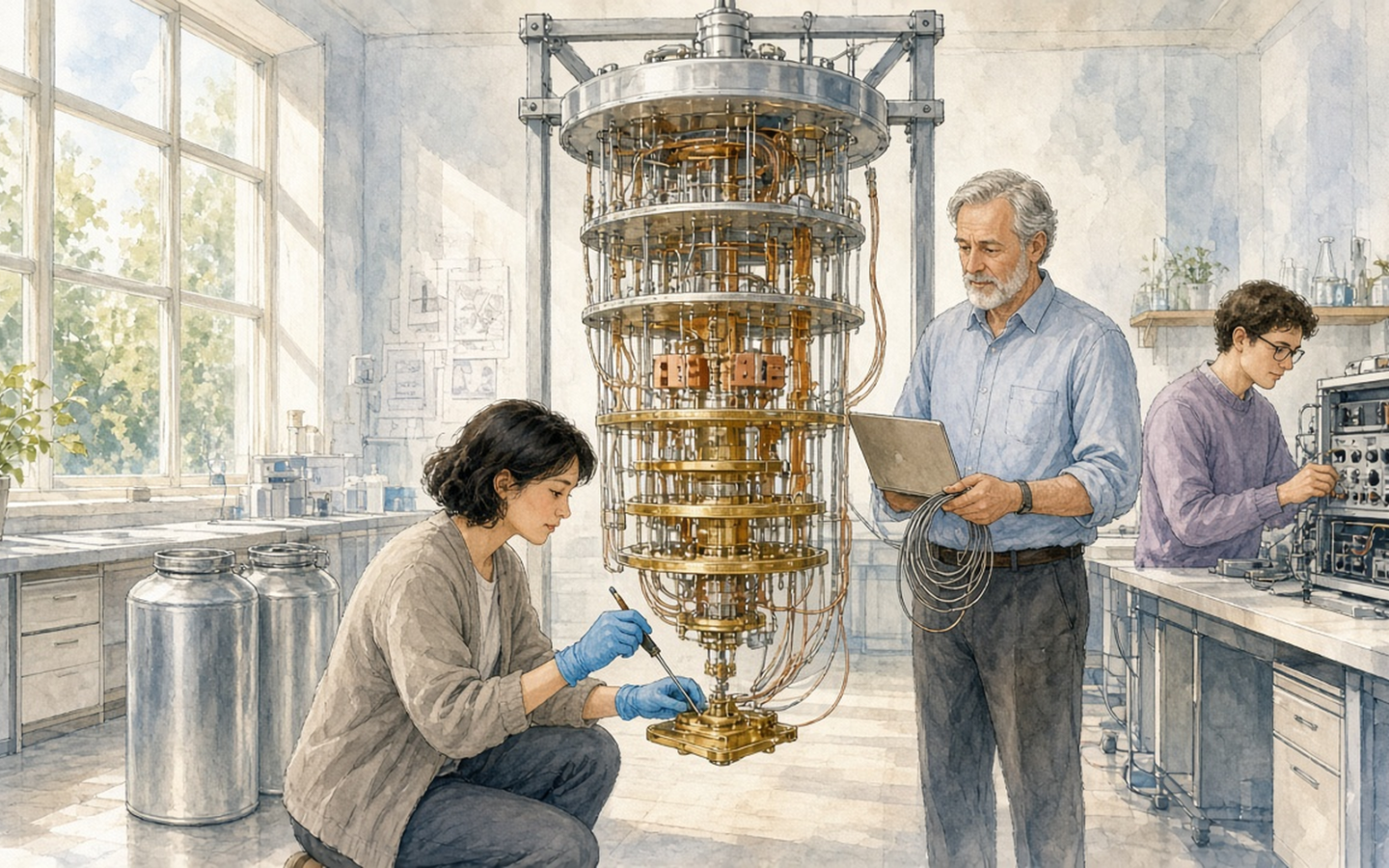
A quantum computer is only as good as its qubits, and nobody yet agrees on the best way to make one. In laboratories from Santa Barbara to Oxford, Pasadena, Hefei and Sydney, teams are building qubits from superconducting circuits, single charged atoms, neutral atoms held in beams of laser light, particles of light, electrons trapped in silicon and an exotic state of matter whose existence is still being argued over. Each approach buys one virtue at the cost of another. This is where the main contenders stand in October 2026, how the field got here, what the machines are expected to be good for, and how machine learning has become part of the toolkit.
Key findings
- No qubit technology leads on every measure. Superconducting circuits are the fastest, trapped ions the most accurate and neutral atoms the most numerous.
- Google’s Willow chip showed in 2024 that enlarging an error-correcting code can make it more reliable rather than less[1]. In July 2026 IBM and the University of Chicago reported a computation on 70 error-corrected logical qubits[2].
- The best reported two-qubit gate fidelity now exceeds 99.99%, measured by IonQ on trapped-ion research prototypes (company-reported)[3].
- Neutral-atom arrays have passed 6,000 qubits in a single array[4].
- Breaking 2,048-bit RSA encryption is now estimated to need fewer than a million noisy qubits running for under a week, down from 20 million in 2019, though that is still far beyond any machine yet built[5].
- Machine learning now decodes errors, designs control pulses and recalibrates processors while they run[6, 7].
Why a good qubit is hard to make
An ordinary bit is either 0 or 1. A qubit is a physical system with two distinguishable states, labelled 0 and 1, that can also be placed in a superposition: a combination of both, with a definite balance and phase relationship between them. Measuring it gives 0 or 1 at random, with probabilities set by that balance. Several qubits can also be entangled, so that their joint state cannot be described one qubit at a time. The possibilities multiply quickly: the 53 working qubits of Google’s 2019 Sycamore chip spanned a space of about 10¹⁶ possible states[8]. A quantum algorithm choreographs interference among those possibilities so that paths leading to wrong answers cancel and paths leading to right ones reinforce.
The difficulty is that this information lives in delicate physical properties: a current in a circuit, an energy level in an atom, the state of a photon. Any uncontrolled interaction with the surroundings, whether heat, vibration, a stray photon or a fluctuating field, leaks information about the qubit into its environment. This is decoherence: the superposition degrades into an ordinary, random 0 or 1, and the computation is lost. As the Nobel committee put it in 2012, single quantum particles “lose their mysterious quantum properties as soon as they interact with the outside world”[9]. A qubit must therefore be isolated well enough to survive, yet coupled strongly enough to be controlled and read, and every design is a compromise between those demands.
Engineers judge a qubit on a handful of measures: how long it keeps its state (coherence time), how accurately it can be operated (gate fidelity), how many other qubits it can interact with directly (connectivity), how quickly operations run, how far the design can be scaled, and how cold it must be kept.
How error correction works
Because every qubit makes mistakes, the long-term plan everywhere is quantum error correction. Quantum information cannot simply be copied, so instead one reliable “logical” qubit is spread across many physical ones. In the most widely studied scheme, the surface code, “data” qubits sit on a chessboard-like grid interleaved with “measure” qubits. Each measure qubit repeatedly checks a collective property of its neighbours without reading the data itself. When an error occurs, the pattern of checks that change reveals roughly where, and a classical computer called a decoder works out the most likely correction[10].
The catch is the threshold. Extra qubits also bring extra chances of error, so error correction only pays off if each physical operation is good enough. For the surface code the tolerable error rate is around 1% per operation. In 2012 Austin Fowler and colleagues estimated that, with gate fidelities above about 99.9%, each logical qubit would need roughly 1,000 to 10,000 physical qubits to reach the extremely low error rates that long calculations require[10]. Below threshold, each enlargement of the code, measured by its “distance”, suppresses errors further; above it, adding qubits makes things worse. Google’s Willow experiment, described below, ran a distance-7 code built from 49 data qubits, 48 measure qubits and four extra qubits that remove a type of error called leakage[1].
From a thought experiment to a race
The idea is older than the hardware. In 1981, at a conference organised by MIT and IBM at MIT’s Endicott House, Richard Feynman argued that simulating nature faithfully would need a computer built on quantum principles[11]. “Nature isn’t classical, dammit, and if you want to make a simulation of nature, you’d better make it quantum mechanical,” he said in the published version of his talk[12]. In 1994 Peter Shor showed that a quantum computer could factor large numbers and compute discrete logarithms efficiently, the mathematical problems on which much of today’s public-key encryption rests[13].
Hardware proposals followed. In 1995 Ignacio Cirac and Peter Zoller described how a string of trapped ions could work as a quantum computer, with the ions’ shared motion linking the qubits[14]. In 1999 Yasunobu Nakamura, Yuri Pashkin and Jaw-Shen Tsai, working at NEC’s laboratories in Tsukuba, Japan, showed coherent control of a tiny superconducting island, a working qubit in a solid-state electronic device[15]. In 2003 Rainer Blatt’s group at the University of Innsbruck built the two-ion logic gate Cirac and Zoller had proposed[16]. David Wineland of NIST in Boulder, who traps single ions and controls and measures them with light, shared the 2012 Nobel Prize in Physics with Serge Haroche[9].
The first claim that a quantum processor had outpaced a supercomputer came in October 2019, when Google’s Sycamore sampled the output of a random circuit a million times in about 200 seconds, a task the team estimated would take a state-of-the-art supercomputer about 10,000 years[8]. IBM researchers soon argued that the Summit supercomputer could simulate such circuits in a matter of days[17], and in 2022 Feng Pan, Keyang Chen and Pan Zhang produced comparable samples in about 15 hours on 512 graphics processors[18]. The episode set a pattern: claims of quantum advantage on specially designed benchmarks are tested against improved classical algorithms, and the bar moves.
Superconducting circuits: fast, and first past the threshold
The oldest of today’s leading approaches won its pioneers a Nobel Prize. In 1984 and 1985, at the University of California, Berkeley, John Clarke, Michel Devoret and John Martinis showed that an electrical circuit built from superconductors separated by a thin insulating barrier (a Josephson junction) could tunnel between states and absorb energy only in fixed amounts, behaving as a single quantum object “big enough to be held in the hand”. They shared the 2025 Nobel Prize in Physics; Devoret is now also at Google Quantum AI and Martinis at the start-up Qolab[19].
Modern superconducting qubits are descendants of that circuit, patterned onto chips and controlled with microwave pulses. They must sit in a dilution refrigerator, the gold-plated, chandelier-like stack of cooling stages familiar from photographs, which uses a mixture of helium isotopes to reach a few hundredths of a degree above absolute zero; IBM’s large experimental fridge reaches about 25 millikelvin[20].
The approach’s biggest recent result came from Google’s 105-qubit Willow processor. Running its 101-qubit error-correcting code, the team recorded a logical error rate of 0.143% per round of correction, and each step up in code distance cut the error rate by a factor of 2.14. The encoded qubit outlived the best physical qubit on the chip by a factor of 2.4, and a full correction cycle took just 1.1 microseconds[1]. The weakness is lifetime: the mean energy-relaxation time of Willow’s error-correction chip was 68 microseconds, and each qubit connects to about four neighbours rather than to every other qubit[21].
In October 2025 Google reported a different kind of benchmark, “Quantum Echoes”, which measures how quantum information scrambles through a processor. Run on 65 of Willow’s qubits, it took about 2.1 hours per circuit against an estimated 3.2 years on the Frontier supercomputer. Because the result is an expectation value that another quantum computer of similar quality should reproduce, Google describes it as verifiable[22, 23].
IBM unveiled its 120-qubit Nighthawk processor and an experimental fault-tolerance chip called Loon in November 2025, and said it could decode errors in real time in under 480 nanoseconds. Its stated target is a machine called Starling, with 200 logical qubits, to be built in Poughkeepsie, New York, by 2029[24, 25]. In July 2026, IBM and the University of Chicago reported running 70 logical qubits through 2,415 logical two-qubit operations in about 15 minutes, on a problem they say classical simulation could not match in practical time. IBM describes this as quantum advantage; as with earlier advantage claims, the classical comparison is for other researchers to test[2].
China’s leading superconducting effort is at the University of Science and Technology of China (USTC) in Hefei, in Pan Jianwei’s group. Its 105-qubit Zuchongzhi 3.0, published in March 2025, reported two-qubit gate fidelity of 99.62% and ran an 83-qubit random-circuit task that the team estimated would take Frontier about 6.4 billion years, an estimate that, like Sycamore’s, is open to challenge from better classical methods[26].
A variant of the approach aims to shrink the cost of error correction. “Cat qubits” store information in a microwave oscillator in a way that strongly suppresses one of the two basic kinds of quantum error, the bit flip. In February 2025 the AWS Center for Quantum Computing at Caltech reported Ocelot, a chip whose five cat qubits had their remaining phase-flip errors corrected by a simple repetition code. Bit-flip times approached one second, against phase-flip times of about 20 microseconds[27, 28]. AWS says scaling the design could cut error-correction overhead by up to 90%[28]. “We believe that if we’re going to make practical quantum computers, quantum error correction needs to come first,” said Oskar Painter of AWS[29]. The Paris start-up Alice & Bob is also building cat qubits[30].
Trapped ions: the accuracy leaders
Trapped-ion machines hold individual charged atoms in electric fields inside an ultra-high vacuum and drive them with lasers or microwaves. Because every ion of a given isotope is identical, there is no manufacturing variation between qubits. Quantinuum’s Helios, launched in November 2025 and described in Nature in June 2026, holds 98 barium ions that are shuttled around a ring and through a junction so that any pair can be brought together, giving all-to-all connectivity. Averaged across the machine, its two-qubit gates reach 99.92% fidelity[31]. The company switched from ytterbium to barium partly because barium can be controlled with visible-light lasers, which are cheaper and more reliable than ultraviolet ones[32].
The trade-off is speed. A single two-qubit gate on Helios takes about 70 microseconds, and once cooling and shuffling are included a layer of a random program averages 55 milliseconds[33], against Willow’s 1.1-microsecond correction cycle. In exchange, ions keep their quantum state for remarkably long: a team at Tsinghua University estimated a coherence time of more than an hour for a single ion[34]. The vacuum apparatus can run at room temperature, although some groups cool it to about 4 kelvin to reduce collisions with stray gas[35].
The record for two-qubit accuracy now belongs to this field. In October 2025 IonQ, which had acquired the Oxford spin-out Oxford Ionics, reported gates with an error of about 8 in 100,000, a fidelity above 99.99%, using electronics integrated into the trap chip in place of lasers. The work was done on research prototypes and published as a preprint alongside a company announcement[3, 36]. “In exceeding the 99.99% threshold on chips built in standard semiconductor fabs, we are now on a clear path to millions of qubits,” said Chris Ballance, an Oxford Ionics co-founder[3]. That path is still a claim to be tested.
Neutral atoms: scale held in light
Neutral-atom machines trap uncharged atoms, typically rubidium or caesium, in tightly focused laser beams called optical tweezers, and entangle them by briefly exciting them into large “Rydberg” states. Because the atoms can be moved mid-calculation, connections can be rearranged in software. In September 2025 Manuel Endres’s group at Caltech, in a study led by graduate students Hannah Manetsch, Gyohei Nomura and Elie Bataille, split one laser into about 12,000 tweezers and filled them with more than 6,100 caesium atoms, the largest such array reported[4]. The atoms held their superposition for about 13 seconds and single-qubit operations were 99.98% accurate. “On the screen, we can actually see each qubit as a pinpoint of light,” Manetsch said[37].
At Harvard and MIT, the groups of Mikhail Lukin, Markus Greiner and Vladan Vuletić tackled the other weakness of atoms: they get lost. Using conveyor belts of light to feed in 300,000 fresh atoms a second, they kept an array of more than 3,000 qubits running for over two hours[38]. In November 2025 a Harvard-led team with MIT and the company QuEra combined error correction below threshold with the other ingredients of a fault-tolerant machine on up to 448 atoms[39]. Two-qubit gate fidelity, at around 99.5% in 2023[40], still trails the best ions. In September 2026 the company Infleqtion said it had entangled 30 logical qubits made from 80 physical atoms, a figure it reported itself[41].
Photons: room-temperature light, very cold detectors
Photonic qubits are particles of light sent through waveguides on chips and along optical fibre, so most components work at room temperature and machines can be networked with telecom cable. PsiQuantum makes its chips in a commercial GlobalFoundries plant on 300-millimetre wafers. In Nature in February 2025 its team reported 99.98% accuracy in preparing and measuring single qubits and 99.22% for a two-photon “fusion” operation, figures that count only photons that were actually detected[42]. Its superconducting detectors run at about 2 kelvin. The company broke ground on a site in Chicago in September 2025 for what it intends to be a million-qubit-scale machine[43].
Xanadu in Toronto took a different route with Aurora, a machine of 35 chips in four server racks, networked by fibre, that generated an entangled state across 86.4 billion light modes. Everything ran at room temperature except its photon detectors, which sat in refrigerators at 12 millikelvin[44]. The team was candid about the central problem: light gets lost. Fault tolerance in its design needs loss of around 1% along key paths; Aurora’s heralding paths lost about 56%[44].
USTC has used photons for advantage claims too. Its Jiuzhang experiments send squeezed light through large optical networks to perform “Gaussian boson sampling”, registering up to 76 detected photons in 2020 and up to 255 photon detection events with Jiuzhang 3.0 in 2023[45, 46]. Like random-circuit sampling, boson sampling is a benchmark rather than a general-purpose computation.
Silicon, diamond and topological qubits: the outside bets
Spin qubits store information in the spin of single electrons confined in tiny silicon structures much like transistors, which makes them attractive to the chip industry. In September 2025 the Sydney company Diraq, led by Andrew Dzurak of the University of New South Wales, and the Belgian research centre imec reported four two-qubit devices made in a standard 300-millimetre foundry, all with operations above 99% accuracy[47]. Silicon spins can also work at around 1 kelvin, far warmer than superconducting chips, as groups at UNSW and QuTech showed in 2020[48, 49]. The open question is whether devices with a handful of qubits can be scaled up while staying that good.
Defects in diamond offer another solid-state qubit, aimed mainly at networking. In a nitrogen-vacancy (NV) centre, an electron spin is initialised and read out with laser light and manipulated with microwaves, and a nearby nuclear spin can serve as memory. In 2021 Ronald Hanson’s group at QuTech in Delft linked three such diamond nodes by optical fibre into a small entangled quantum network[50].
Microsoft has pursued topological qubits, which would store information in pairs of “Majorana zero modes” in nanowires and should be naturally shielded from local noise. Its February 2025 Nature paper stated that the data “do not, by themselves, determine whether the low-energy states detected by interferometry are topological”[51]. Nature published a formal critique of the paper, with a reply from the authors, in June 2026[51]. That same month Microsoft announced Majorana 2, which swaps aluminium for lead and, the company says, extends qubit parity lifetimes from 1–12 milliseconds to a mean of 20 seconds; it now targets a scalable machine by 2029[52]. These results are company-reported, and the physics remains contested.
| Qubit type | How it works | Leading groups | Strengths | Weaknesses | Typical operating temperature |
|---|---|---|---|---|---|
| Superconducting circuits | Microwave-driven circuits containing Josephson junctions, patterned on chips | Google Quantum AI; IBM; USTC (Zuchongzhi); AWS and Alice & Bob (cat-qubit variant) | Fast (1.1 µs error-correction cycle); first below-threshold error correction; chip fabrication | Short coherence (mean T1 68 µs on Willow); mostly nearest-neighbour links; heavy cooling and wiring | About 10–25 mK, in a dilution refrigerator |
| Trapped ions | Charged atoms held by electric fields in vacuum; gates driven by lasers or on-chip microwaves | Quantinuum; IonQ (including Oxford Ionics) | Highest fidelities (99.92% across 98 qubits; above 99.99% on prototypes); all-to-all connectivity; very long coherence | Slow (about 70 µs per two-qubit gate); complex optics; ion transport adds time | Ions laser-cooled; vacuum apparatus at room temperature or about 4 K |
| Neutral atoms | Uncharged atoms in optical tweezers, entangled via Rydberg states and moved as needed | Harvard and MIT with QuEra; Caltech; Infleqtion | Largest arrays (6,100+ atoms); about 13 s coherence; reconfigurable connectivity | Two-qubit fidelity around 99.5%; atom loss; slower cycles | Laser-cooled atoms in a room-temperature vacuum chamber |
| Photonics | Qubits carried by photons or squeezed light in chip waveguides and optical fibre | PsiQuantum; Xanadu; USTC (Jiuzhang) | Foundry-made chips; natural fibre networking; most parts at room temperature | Photon loss (about 56% on Aurora’s heralding paths against a roughly 1% target); probabilistic sources | Chips largely at room temperature; detectors at about 2 K or 12 mK |
| Silicon spins | Spins of single electrons in silicon quantum dots, set by gate voltages and microwaves | Diraq and UNSW with imec; QuTech | Transistor-scale, foundry-compatible; above 99% fidelity in 300 mm devices; can run near 1 K | Few qubits so far; noise from silicon-29 nuclei and charges; calibration still manual | 10 mK to about 1.5 K |
| Topological (Majorana) | Information stored in the shared parity of Majorana zero modes in superconductor–semiconductor nanowires | Microsoft | In principle protected from local noise; digital, measurement-based control | Topological nature still disputed; results so far largely company-reported | Dilution refrigerator (“much colder than outer space”) |
The engineering bottlenecks
Behind every qubit count is a plumbing problem. Superconducting processors are controlled from room-temperature electronics through cables that must pass down through each stage of the dilution refrigerator, and every cable carries heat towards the coldest stage. Sycamore needed 277 digital-to-analogue converters to control 53 qubits[8]. A team in Andreas Wallraff’s group at ETH Zurich measured the heat carried by each type of line and designed a wiring scheme for systems of around 100 qubits, noting that managing this heat budget is central to building larger machines[54].
One answer is to move the control electronics into the cold. In 2021 researchers at QuTech, in work funded by Intel, used a cryogenic CMOS chip called Horse Ridge, operating at 3 kelvin, to drive silicon spin qubits at 20 millikelvin, and found that it matched the fidelity of commercial room-temperature instruments[55]. Error correction adds another demand: decoders must keep pace with the qubits[24].
Ion and atom machines swap the wiring problem for an optics problem. Each species needs lasers at specific wavelengths for cooling, control and readout, all aligned and kept stable. That is part of why Quantinuum moved to barium, which can be driven with visible-light lasers[32], and why groups are building light delivery into the trap itself: in 2020 Jonathan Home’s group at ETH Zurich used optical waveguides integrated into a trap chip to perform multi-ion quantum logic[56].
Then there is manufacturing. Sycamore was designed with 54 qubits, but one did not work, and gate performance varied with each qubit’s frequency because of microscopic material defects and other imperfections, so each qubit’s operating point had to be tuned individually[8]. Making qubits uniform is a manufacturing problem as much as a physics one, and IBM, PsiQuantum and Diraq have all moved production onto 300-millimetre wafer lines[24, 42, 47].
What would a quantum computer be for?
The applications with the firmest theoretical footing are the two that Feynman and Shor pointed to: simulating quantum systems and breaking certain codes. Chemistry is the most cited example. In 2017 Markus Reiher, Matthias Troyer and colleagues at ETH Zurich and Microsoft took biological nitrogen fixation by the enzyme nitrogenase as a test case, and concluded that, even allowing for error correction, the calculations could run in reasonable time on small quantum computers[57]. A 2021 analysis by Joonho Lee, Ryan Babbush and colleagues estimated that simulating the enzyme’s key iron-molybdenum cluster, FeMoco, would need about four million physical qubits running for under four days, assuming gate errors of 0.1% and a one-microsecond cycle[58].
Cryptography is the application that concerns governments. Shor’s algorithm would break RSA and elliptic-curve cryptography, which protect much of today’s online traffic[59]. In 2019 Craig Gidney of Google and Martin Ekerå estimated that factoring a 2,048-bit RSA number would take eight hours on a machine with 20 million noisy qubits. In May 2025 Gidney cut that to fewer than a million qubits running for under a week, under the same assumptions of 0.1% gate errors and a one-microsecond surface-code cycle[5]. No existing machine is close, but the estimate fell roughly twentyfold in six years.
That is why the move to post-quantum cryptography, new algorithms designed to resist quantum attack, is already under way. In August 2024 the US National Institute of Standards and Technology (NIST) published its first three post-quantum standards, FIPS 203, 204 and 205, based on the ML-KEM, ML-DSA and SLH-DSA algorithms[60]. A NIST draft transition plan proposes deprecating RSA-2048 and similar algorithms after 2030 and disallowing quantum-vulnerable public-key schemes after 2035[59]. In March 2025 the UK’s National Cyber Security Centre asked organisations to finish planning by 2028, complete their highest-priority migrations by 2031 and migrate fully by 2035[61].
How AI has joined the lab
Machine learning now touches almost every stage of the work. The most mature use is decoding: working out from error-check signals which qubits have gone wrong. Google DeepMind and Google Quantum AI trained a neural network, AlphaQubit, first on simulated data and then on real data from Google’s earlier Sycamore chip, and it outperformed the best conventional decoders[6]. Willow’s headline 0.143% error rate was achieved with a neural-network decoder; a leading conventional decoder managed 0.171% on the same data[1].
The second use is calibration. Qubits drift, and today recalibrating usually means stopping the computation. In July 2026, Volodymyr Sivak and colleagues at Google reported a reinforcement-learning agent that reads the error-correction signals as feedback and continuously adjusts more than a thousand control settings while the processor runs. On Willow it made the encoded memory 3.5 times more stable under deliberately injected drift and cut errors by a further 20% after expert human calibration[7]. The authors liken it to tuning the instruments “while the music plays”[62].
Similar methods design the control pulses themselves: in 2021 researchers at the quantum-control company Q-CTRL used deep reinforcement learning on IBM hardware to find single-qubit gates up to three times faster than the defaults[63]. A team led by Pan Jianwei at USTC used an AI model to compute the laser holograms that arrange atoms, assembling defect-free arrays of up to 2,024 atoms in 60 milliseconds[64]. Microsoft says AI helped design Majorana 2’s materials, and Infleqtion says an AI model found the shorter logical operation behind its 30-qubit result; both claims are the companies’ own[41, 52]. None of this has removed the people. The Diraq team noted that calibrating its qubits “remains an intensive manual process”[47].
So who is winning?
Nobody yet, and the scoreboard depends on which column you read. Superconducting circuits are quick and have the strongest error-correction results, but are short-lived and wired only to their neighbours. Ions are the most accurate and fully connected, but slow. Neutral atoms offer the largest arrays but lose atoms and lag on two-qubit accuracy. Photonic chips come out of commercial foundries but leak light. Silicon spins promise transistor-scale density but remain small, and topological qubits are still proving that they exist.
The companies have published dates. IBM plans Starling, with 200 logical qubits running 100 million operations, by 2029[25]. Quantinuum says its fault-tolerant Apollo will arrive in 2029[65]. IonQ’s roadmap promises 2 million physical and 80,000 logical qubits by 2030[66]. Alice & Bob targets 100 logical qubits in 2030[30], Infleqtion 100 logical qubits in 2028[41], and Microsoft a scalable machine by 2029[52]. These are the companies’ own targets, not results.
The most systematic outside check is the Quantum Benchmarking Initiative run by the US Defense Advanced Research Projects Agency (DARPA), which aims to establish whether any approach can reach “utility scale”, meaning computational value that exceeds its cost, by 2033. In November 2025 DARPA moved 11 companies to its second stage: Atom Computing, Diraq, IBM, IonQ, Nord Quantique, Photonic Inc., Quantinuum, Quantum Motion, QuEra, Silicon Quantum Computing and Xanadu, spanning neutral atoms, ions, superconducting circuits, silicon spins and photonics. Microsoft and PsiQuantum are in the final phase of a predecessor programme with the same goals, and Google joined the first stage in September 2025[67]. In 2026 DARPA invited further entrants into the first stage[68].
What all the routes share is the work itself: engineers in gloves threading cables through refrigerator stages, students aligning lasers on optical tables, and teams watching rows of atoms appear as dots of light on a screen. The race to build the qubit is still being run at the bench.
References
- Google Quantum AI and collaborators (2025). Quantum error correction below the surface code threshold. Nature 638, 920–926. doi:10.1038/s41586-024-08449-y https://www.nature.com/articles/s41586-024-08449-y
- IBM (2026, 30 July). IBM and the University of Chicago demonstrate quantum advantage, establishing trusted quantum computation on logical circuits. Company press release. https://newsroom.ibm.com/2026-07-30-ibm-and-the-university-of-chicago-demonstrate-quantum-advantage,-establishing-trusted-quantum-computation-on-logical-circuits
- IonQ (2025, 21 October). IonQ achieves landmark result, setting new world record in quantum computing performance. Company press release. https://www.ionq.com/news/ionq-achieves-landmark-result-setting-new-world-record-in-quantum-computing
- Manetsch, H., Nomura, G., Bataille, E. et al. (2025). A tweezer array with 6,100 highly coherent atomic qubits. Nature. doi:10.1038/s41586-025-09641-4 https://www.nature.com/articles/s41586-025-09641-4
- Gidney, C. (2025). How to factor 2048 bit RSA integers with less than a million noisy qubits. arXiv:2505.15917. https://arxiv.org/abs/2505.15917
- Bausch, J. et al. (2024). Learning high-accuracy error decoding for quantum processors. Nature. doi:10.1038/s41586-024-08148-8 https://www.nature.com/articles/s41586-024-08148-8
- Sivak, V. et al. (2026). Reinforcement learning control of quantum error correction. Nature 655, 879–884. doi:10.1038/s41586-026-10759-2 https://www.nature.com/articles/s41586-026-10759-2
- Arute, F. et al. (2019). Quantum supremacy using a programmable superconducting processor. Nature 574, 505–510. doi:10.1038/s41586-019-1666-5 https://www.nature.com/articles/s41586-019-1666-5
- The Royal Swedish Academy of Sciences (2012, 9 October). The Nobel Prize in Physics 2012. Press release. https://www.nobelprize.org/prizes/physics/2012/press-release/
- Fowler, A. G., Mariantoni, M., Martinis, J. M. & Cleland, A. N. (2012). Surface codes: towards practical large-scale quantum computation. Physical Review A 86, 032324. https://arxiv.org/abs/1208.0928
- IBM Research (2021). Celebrating the 40-year anniversary of the Physics of Computation Conference. IBM Research blog. https://research.ibm.com/blog/qc40-physics-computation
- Feynman, R. P. (1982). Simulating physics with computers. International Journal of Theoretical Physics 21, 467–488. doi:10.1007/BF02650179 https://link.springer.com/article/10.1007/BF02650179
- Shor, P. W. (1994). Algorithms for quantum computation: discrete logarithms and factoring. Proceedings of the 35th Annual Symposium on Foundations of Computer Science, 124–134. doi:10.1109/SFCS.1994.365700 https://doi.org/10.1109/SFCS.1994.365700
- Cirac, J. I. & Zoller, P. (1995). Quantum computations with cold trapped ions. Physical Review Letters 74, 4091–4094. doi:10.1103/PhysRevLett.74.4091 https://doi.org/10.1103/PhysRevLett.74.4091
- Nakamura, Y., Pashkin, Yu. A. & Tsai, J. S. (1999). Coherent control of macroscopic quantum states in a single-Cooper-pair box. Nature 398, 786–788. https://www.nature.com/articles/19718
- Schmidt-Kaler, F. et al. (2003). Realization of the Cirac–Zoller controlled-NOT quantum gate. Nature 422, 408–411. https://www.nature.com/articles/nature01494
- Pednault, E. et al. (2019). Leveraging secondary storage to simulate deep 54-qubit Sycamore circuits. arXiv:1910.09534. https://arxiv.org/abs/1910.09534
- Pan, F., Chen, K. & Zhang, P. (2022). Solving the sampling problem of the Sycamore quantum circuits. Physical Review Letters 129, 090502. https://arxiv.org/abs/2111.03011
- The Royal Swedish Academy of Sciences (2025). The Nobel Prize in Physics 2025 (press release, with laureate affiliations). https://www.kva.se/en/news/the-nobel-prize-in-physics-2025/
- Gumann, P. & Chow, J. (2022). IBM scientists cool down the world’s largest quantum-ready cryogenic concept system. IBM Quantum blog. https://www.ibm.com/quantum/blog/goldeneye-cryogenic-concept-system
- Google Quantum AI (2024). Willow spec sheet (9 December 2024). https://quantumai.google/static/site-assets/downloads/willow-spec-sheet.pdf
- Google Quantum AI and collaborators (2025). Observation of constructive interference at the edge of quantum ergodicity. Nature. doi:10.1038/s41586-025-09526-6 https://www.nature.com/articles/s41586-025-09526-6
- Google Research (2025, 22 October). A verifiable quantum advantage. Google Research blog. https://research.google/blog/a-verifiable-quantum-advantage/
- IBM (2025, 12 November). IBM delivers new quantum processors, software, and algorithm breakthroughs on path to advantage and fault tolerance. Company press release. https://newsroom.ibm.com/2025-11-12-ibm-delivers-new-quantum-processors,-software,-and-algorithm-breakthroughs-on-path-to-advantage-and-fault-tolerance
- IBM (2025, 10 June). IBM sets the course to build world’s first large-scale, fault-tolerant quantum computer at new IBM Quantum Data Center. Company press release. https://newsroom.ibm.com/2025-06-10-IBM-Sets-the-Course-to-Build-Worlds-First-Large-Scale,-Fault-Tolerant-Quantum-Computer-at-New-IBM-Quantum-Data-Center
- Gao, D. et al. (2025). Establishing a new benchmark in quantum computational advantage with 105-qubit Zuchongzhi 3.0 processor. Physical Review Letters 134, 090601. https://arxiv.org/abs/2412.11924
- Putterman, H. et al. (2025). Hardware-efficient quantum error correction via concatenated bosonic qubits. Nature 638, 927–934. doi:10.1038/s41586-025-08642-7 https://www.nature.com/articles/s41586-025-08642-7
- Brandão, F. & Painter, O. (2025, 27 February). Amazon announces Ocelot quantum chip. Amazon Science blog. https://www.amazon.science/blog/amazon-announces-ocelot-quantum-chip
- Amazon (2025, 27 February). Amazon’s new Ocelot chip brings us closer to building a practical quantum computer. Company news release. https://www.aboutamazon.com/news/aws/quantum-computing-aws-ocelot-chip
- Alice & Bob (2024, 4 December). Alice & Bob publishes quantum computing roadmap to 100 logical qubits in 2030. Company press release. https://alice-bob.com/newsroom/alice-bob-quantum-computing-roadmap/
- Ransford, A. et al. (2026). A 98-qubit trapped-ion quantum computer with all-to-all connectivity. Nature 655, 81–86. doi:10.1038/s41586-026-10676-4 https://www.nature.com/articles/s41586-026-10676-4
- Quantinuum (2025, 5 November). Introducing Helios: the most accurate quantum computer in the world. Company blog. https://www.quantinuum.com/blog/introducing-helios-the-most-accurate-quantum-computer-in-the-world
- Quantinuum team (2025). Helios: a 98-qubit trapped-ion quantum computer. arXiv:2511.05465. https://arxiv.org/abs/2511.05465
- Wang, P. et al. (2021). Single ion qubit with estimated coherence time exceeding one hour. Nature Communications 12, 233. https://www.nature.com/articles/s41467-020-20330-w
- Hahn, L., Kotibhaskar, N. et al. (2025). A room-temperature extreme high vacuum system for trapped-ion quantum information processing. arXiv:2512.11794. https://arxiv.org/abs/2512.11794
- IonQ / Oxford Ionics team (2025). Trapped-ion two-qubit gates with >99.99% fidelity without ground-state cooling. arXiv:2510.17286. https://arxiv.org/abs/2510.17286
- Caltech (2025, 24 September). Caltech team sets record with 6,100-qubit array. Caltech News. https://www.caltech.edu/about/news/caltech-team-sets-record-with-6100-qubit-array
- Chiu, N.-C. et al. (2025). Continuous operation of a coherent 3,000-qubit system. Nature 646, 1075–1080. doi:10.1038/s41586-025-09596-6 https://www.nature.com/articles/s41586-025-09596-6
- Bluvstein, D. et al. (2025). A fault-tolerant neutral-atom architecture for universal quantum computation. Nature. doi:10.1038/s41586-025-09848-5 https://www.nature.com/articles/s41586-025-09848-5
- Evered, S. J. et al. (2023). High-fidelity parallel entangling gates on a neutral-atom quantum computer. Nature 622, 268–272. https://www.nature.com/articles/s41586-023-06481-y
- Infleqtion (2026, 24 September). Infleqtion achieves 30 entangled logical qubits on its Sqale quantum computer. Company press release. https://ir.infleqtion.com/news-events/press-releases/detail/212/infleqtion-achieves-30-entangled-logical-qubits-on-its-sqale-quantum-computer
- PsiQuantum team (2025). A manufacturable platform for photonic quantum computing. Nature. doi:10.1038/s41586-025-08820-7 https://www.nature.com/articles/s41586-025-08820-7
- PsiQuantum (2025, 30 September). PsiQuantum breaks ground on America’s largest quantum computing project in Chicago. Company press release. https://www.psiquantum.com/news-import/psiquantum-breaks-ground-chicago
- Aghaee Rad, H. et al. (2025). Scaling and networking a modular photonic quantum computer. Nature. doi:10.1038/s41586-024-08406-9 https://www.nature.com/articles/s41586-024-08406-9
- Zhong, H.-S. et al. (2020). Quantum computational advantage using photons. Science 370, 1460–1463. https://arxiv.org/abs/2012.01625
- Deng, Y.-H. et al. (2023). Gaussian boson sampling with pseudo-photon-number-resolving detectors and quantum computational advantage. Physical Review Letters 131, 150601. https://arxiv.org/abs/2304.12240
- Steinacker, P., Dumoulin Stuyck, N. et al. (2025). Industry-compatible silicon spin-qubit unit cells exceeding 99% fidelity. Nature. doi:10.1038/s41586-025-09531-9 https://www.nature.com/articles/s41586-025-09531-9
- Yang, C. H. et al. (2020). Operation of a silicon quantum processor unit cell above one kelvin. Nature 580, 350–354. https://www.nature.com/articles/s41586-020-2171-6
- Petit, L. et al. (2020). Universal quantum logic in hot silicon qubits. Nature 580. https://www.nature.com/articles/s41586-020-2170-7
- Pompili, M. et al. (2021). Realization of a multinode quantum network of remote solid-state qubits. Science 372, 259–264. https://arxiv.org/abs/2102.04471
- Microsoft Azure Quantum (2025). Interferometric single-shot parity measurement in InAs–Al hybrid devices. Nature 638, 651–655 (Matters Arising and reply published 24 June 2026). https://www.nature.com/articles/s41586-024-08445-2
- Nayak, C. (2026). Majorana 2: Microsoft’s scalable quantum processor with reliable, long-lasting qubits. Microsoft Quantum blog (announced 2 June 2026). https://quantum.microsoft.com/en-us/insights/blogs/majorana-2-scalable-quantum-processor
- Bolgar, C. (2025, 19 February). Microsoft’s Majorana 1 chip carves new path for quantum computing. Microsoft Source. https://news.microsoft.com/source/features/innovation/microsofts-majorana-1-chip-carves-new-path-for-quantum-computing/
- Krinner, S. et al. (2019). Engineering cryogenic setups for 100-qubit scale superconducting circuit systems. EPJ Quantum Technology 6, 2. https://epjquantumtechnology.springeropen.com/articles/10.1140/epjqt/s40507-019-0072-0
- Xue, X. et al. (2021). CMOS-based cryogenic control of silicon quantum circuits. Nature 593, 205–210. https://www.nature.com/articles/s41586-021-03469-4
- Mehta, K. K. et al. (2020). Integrated optical multi-ion quantum logic. Nature 586, 533–537. https://www.nature.com/articles/s41586-020-2823-6
- Reiher, M., Wiebe, N., Svore, K. M., Wecker, D. & Troyer, M. (2017). Elucidating reaction mechanisms on quantum computers. PNAS 114, 7555–7560. https://www.pnas.org/doi/10.1073/pnas.1619152114
- Lee, J. et al. (2021). Even more efficient quantum computations of chemistry through tensor hypercontraction. PRX Quantum 2, 030305. https://arxiv.org/abs/2011.03494
- NIST (2024, 12 November). NIST IR 8547 (initial public draft): Transition to post-quantum cryptography standards. https://csrc.nist.gov/pubs/ir/8547/ipd
- NIST (2024, 13 August). NIST releases first 3 finalized post-quantum encryption standards. News release. https://www.nist.gov/news-events/news/2024/08/nist-releases-first-3-finalized-post-quantum-encryption-standards
- National Cyber Security Centre (2025, 20 March). Timelines for migration to post-quantum cryptography. Guidance. https://www.ncsc.gov.uk/guidance/pqc-migration-timelines
- Sivak, V. & Klimov, P. (2026, 22 July). Towards a quantum computer that learns from its errors. Google Research blog. https://research.google/blog/towards-a-quantum-computer-that-learns-from-its-errors/
- Baum, Y. et al. (2021). Experimental deep reinforcement learning for error-robust gate-set design on a superconducting quantum computer. PRX Quantum 2, 040324. https://journals.aps.org/prxquantum/abstract/10.1103/PRXQuantum.2.040324
- Lin, R., Zhong, H.-S. et al. (2025). AI-enabled parallel assembly of thousands of defect-free neutral atom arrays. Physical Review Letters 135, 060602. https://arxiv.org/abs/2412.14647
- Quantinuum (2025, 26 June). Quantinuum overcomes last major hurdle to deliver scalable universal fault-tolerant quantum computers by 2029. Company blog. https://www.quantinuum.com/blog/quantinuum-overcomes-last-major-hurdle-to-deliver-scalable-universal-fault-tolerant-quantum-computers-by-2029
- IonQ (accessed 8 October 2026). Roadmap. Company website. https://www.ionq.com/roadmap
- DARPA (2025, 6 November). Quantum Benchmarking Initiative: Stage B selection. https://www.darpa.mil/research/programs/quantum-benchmarking-initiative/stage-b-selection
- DARPA (2026). Quantum Benchmarking Initiative expands quest to separate hype from reality. News release. https://www.darpa.mil/news/2026/qbi-stage-a-qbit