Engineering
The Subsea Immersed Tube Tunnel of the Hong Kong–Zhuhai–Macau Bridge
Contents ▾
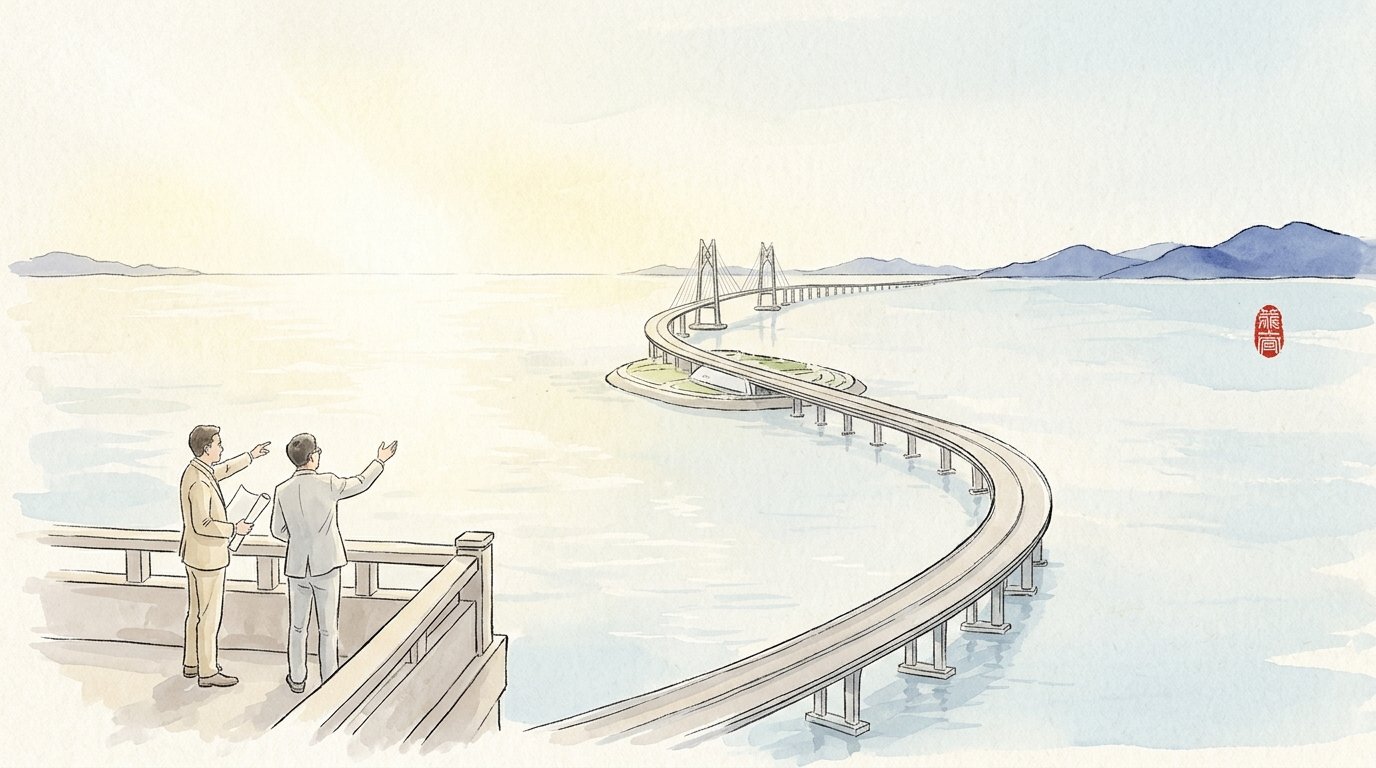
Traversing the turbulent, silty waters of the Pearl River Estuary, the Hong Kong–Zhuhai–Macau Bridge incorporates the world’s longest and deepest subsea immersed tube tunnel. Engineered to withstand typhoon-induced wave surges, soft marine clay settlement, and severe aviation height ceilings, the 6.7-kilometre submerged link required the casting, maritime transport, and sub-centimetre underwater mating of thirty-three monolithic 80,000-tonne reinforced concrete elements under intense hydrodynamic cross-currents.
1. The estuarine challenge, aviation caps and Lingdingyang navigation
The Hong Kong–Zhuhai–Macau Bridge (HZMB, 港珠澳大桥) spans 55 kilometres across the Lingdingyang channel of the Pearl River Estuary, linking the Hong Kong Special Administrative Region, Zhuhai City in Guangdong Province, and the Macau Special Administrative Region. Completed in October 2018, this monumental transportation corridor transformed travel times between the eastern and western shores of the Greater Bay Area from over four hours to less than forty-five minutes.
While the majority of the 29.6-kilometre offshore bridge-tunnel section is composed of elevated viaducts and three cable-stayed navigation spans (the Jiuzhou, Jianghai, and Qingzhou Bridges), the central channel—the Lingding West Channel—presented a seemingly insurmountable geometric conflict. The channel accommodates over 4,000 commercial cargo vessels, container ships, and oil tankers daily, demanding an unencumbered navigation clearance width of several hundred metres and a vertical ship clearance of at least 73 metres above mean high water springs. However, the channel lies directly beneath the immediate approach flight corridors of Hong Kong International Airport (Chek Lap Kok), where strict aviation height restrictions strictly prohibited bridge towers or cables exceeding a maximum elevation of 88 metres above sea level.
With an elevated suspension or cable-stayed bridge physically impossible due to the clash between shipping heights from below and aviation limits from above, the engineering consortium led by Chief Engineer Lin Ming (林鸣) of China Communications Construction Company (CCCC) chose the only feasible structural alternative: plunging the multi-lane expressway into an ultra-deep subsea immersed tube tunnel across the open waters of the estuary.
2. Structural anatomy, thirty-three monolithic 80,000-Tonne segments
The HZMB immersed tunnel measures 6,750 metres in total length, comprising a 5,664-metre submerged tube section joined by transition ramps to two massive artificial islands. The submerged tunnel consists of thirty-three precast reinforced concrete element segments (designated E1 through E33) and a single wedge-shaped final closure joint. Each standard element is 180 metres long, 37.95 metres wide, and 11.4 metres high, with a displaced water volume and structural weight of approximately 80,000 tonnes—equivalent in displacement to a modern Nimitz-class aircraft carrier.
Internally, each element houses two separate three-lane vehicular traffic bores, separated by a central utility and emergency evacuation corridor. The elements were designed to achieve a service life of 120 years under highly aggressive marine exposure, resting on the seabed at depths up to 48 metres beneath the water surface—the deepest immersed tube tunnel in civil engineering history.
At these depths, the tunnel shell must resist enormous hydrostatic water and earth pressures exceeding 0.5 to 0.6 MPa on its roof and sidewalls. Because traditional immersed tunnels deployed in sheltered rivers or shallow harbours typically utilize either rigid monolithic designs or fully flexible segmented joints, neither standard approach was directly applicable in the open, seismically active marine clays of Lingdingyang. The HZMB team developed a revolutionary “semi-rigid” structural joint system: each 180-metre element was precast from eight 22.5-metre segments joined by internal prestressed steel tendons. Under normal dead and live loads, the tendons maintain compression across the joint faces, behaving as a rigid beam to resist localized foundation differential settlements; under intense seismic shaking, the tendons allow controlled micro-articulation, dissipating energy without shear cracking.
3. Industrial Precasting on Guishan Island and deep-water towing
Fabricating thirty-three 80,000-tonne elements with microscopic dimensional tolerances required erecting a dedicated, world-record automated casting factory on Guishan Island (桂山岛), an uninhabited island 7 nautical miles from the tunnel alignment. The facility utilized a hydraulic skidding production line: high-performance self-compacting concrete with mineral admixtures (fly ash and silica fume) was placed using massive mobile formwork systems under strictly controlled indoor temperature and humidity to prevent thermal shrinkage cracks.
Once cast, each element was fitted with watertight temporary bulkheads at both ends to provide positive buoyancy. The dry dock was flooded, and the buoyant element—floating with a freeboard of just a few tens of centimetres—was towed through open estuarine waters by a fleet of high-powered ocean-going tugboats. Navigating an 80,000-tonne submerged mass through narrow navigation channels subject to complex tidal currents, varying salinity gradients, and sudden monsoonal winds demanded continuous acoustic positioning and real-time hydrodynamic ballast adjustments.
4. Underwater trench screeding and sub-centimetre hydrostatic docking
On the seabed, a massive foundation trench had been excavated through soft estuarine marine silts down to competent alluvial sand and gravel strata, in places requiring dredging depths exceeding 40 metres. To prevent post-construction differential settlement, the base was prepared using a continuous gravel screeding layer: a specialized, self-elevating dynamically positioned aggregate vessel (the Jin An 1) lowered a 50-metre screed pipe to distribute crushed stone aggregate, leveling the seabed foundation to a vertical tolerance of less than ±25 millimetres across a 40-metre width.
Lowering and docking the 80,000-tonne elements onto this screeded bed was performed using two custom-built twin-hull immersion barges. Suspended from hydraulic heave-compensation winches, the element was ballasted with water into a state of negative buoyancy and lowered into the oceanic trench at millimeter-per-minute speeds. Guidance was provided by high-frequency acoustic transponders, sonar scanners, and GPS masts protruding above the waves.
The definitive underwater mating relied on the GINA gasket and hydrostatic differential pressure method. As the advancing element approached the previously installed segment, hydraulic jacks pulled the new element into contact, compressing an outer GINA rubber gasket against the steel mating ring. Once an initial water seal was established, the water trapped within the chamber between the two bulkheads was pumped out. The immense hydrostatic pressure of the surrounding sea—exerting thousands of tonnes of force against the far end of the element—drove the new segment tightly home, compressing the GINA gasket by several centimetres to form a completely watertight hermetic seal, followed by the installation of an interior secondary OMEGA seal.
5. The Final Joint, the Zhen Hua 30 and deep-water closure
The definitive milestone occurred on 2 May 2017 during the installation of the Final Joint (最终接头) between elements E29 and E30. Traditional immersed tunnels employ complicated in-situ underwater concrete casting inside cofferdams to close the final gap—a method fraught with severe leakage risks in open oceanic conditions. Lin Ming’s team engineered an unprecedented prefabricated steel wedge-shaped joint weighing approximately 6,000 tonnes.
Using the world’s largest revolving crane vessel, the 12,000-tonne-capacity Zhen Hua 30 (振华30), the massive wedge was hoisted into the air, lowered into the 30-metre-deep underwater gap between the two pre-positioned tunnel elements, and positioned within an alignment tolerance of just 2.6 millimetres. Hydraulic actuators then expanded internal jacks to drive the wedge into intimate contact with the adjacent bulkhead gaskets, achieving a complete structural closure that was dry, watertight, and fully structurally unified.
6. Artificial islands and environmental stewardship
To transition the expressway between elevated viaducts and the submerged tube, two 100,000-square-metre artificial islands (East Island and West Island) were constructed in open water. Traditional island reclamation requires dredging tens of millions of cubic metres of marine clay, causing severe sediment plumes that would devastate the surrounding habitat of the endangered Indo-Pacific humpback dolphin (Chinese white dolphin, Sousa chinensis). Instead, engineers deployed rapid cylinder-driving technology: 120 giant thin-walled steel cylinders—each measuring 22 metres in diameter, 50 metres in height, and weighing over 500 tonnes—were driven into the seabed using an array of eight synchronized hydraulic vibratory hammers, forming a circular cofferdam perimeter within months and cutting environmental turbidity by over 90 percent.
Since opening to traffic on 24 October 2018, the HZMB immersed tunnel has operated without a single leak or structural failure, withstanding super-typhoons Mangkhut and Hato without interruption. The engineering methodologies pioneered in the Lingdingyang estuary have redefined maritime tunneling, providing the blueprint for subsequent deep-water mega-tunnels, including the Shenzhen–Zhongshan Link and the Bohai Strait corridor.
Share this article
References
- Lin, M., & Lin, W. (2018). Key technologies for the immersed tunnel of Hong Kong–Zhuhai–Macao Bridge. Engineering, 4(1), 25–34. doi:10.1016/j.eng.2017.07.001
- Liu, X., Lin, M., & Yin, H. (2019). Development of semi-rigid element technology for deep immersed tunnel under offshore conditions. Tunnelling and Underground Space Technology, 85, 126–137. doi:10.1016/j.tust.2018.12.012
- Wang, S., & Ding, H. (2018). Rapid artificial island construction using large-diameter steel cylinders in the Pearl River Estuary. Ocean Engineering, 164, 452–463. doi:10.1016/j.oceaneng.2018.06.058
- Hu, Z., Lin, M., & Chen, Y. (2017). Precision installation and settlement control of the final closure joint in the HZMB immersed tunnel. China Civil Engineering Journal, 50(11), 88–98.
- China Communications Construction Company (CCCC). (2018). Hong Kong–Zhuhai–Macao Bridge Island and Tunnel Project: Complete Technical Documentation. Beijing: China Communications Press.
Related reading
The Hyperscalers
A small number of firms now build computing at a scale once reserved for states — data centres measured in gigawatts, processors designed in house and made by others, and supply chains spanning three continents. This long read traces how the hyperscalers arose, how they build, who else is building, and what may limit them.
Ian Buck and the Making of GPU Computing
The graphics processing unit was designed to do one thing very quickly: turn descriptions of three-dimensional scenes into coloured pixels on a screen. For most of its history that was all anyone…
The Twenty-Tesla Magnet: High-Field Fusion
The Twenty-Tesla Magnet - High-Field Fusion On September 5, 2021, inside a fortified testing bunker at the Massachusetts Institute of Technology's Plasma Science and Fusion Center in Cambridge, an engineering team held…