Engineering
The Medium-Voltage DC Electromagnetic Catapult on the Type 003 Aircraft Carrier
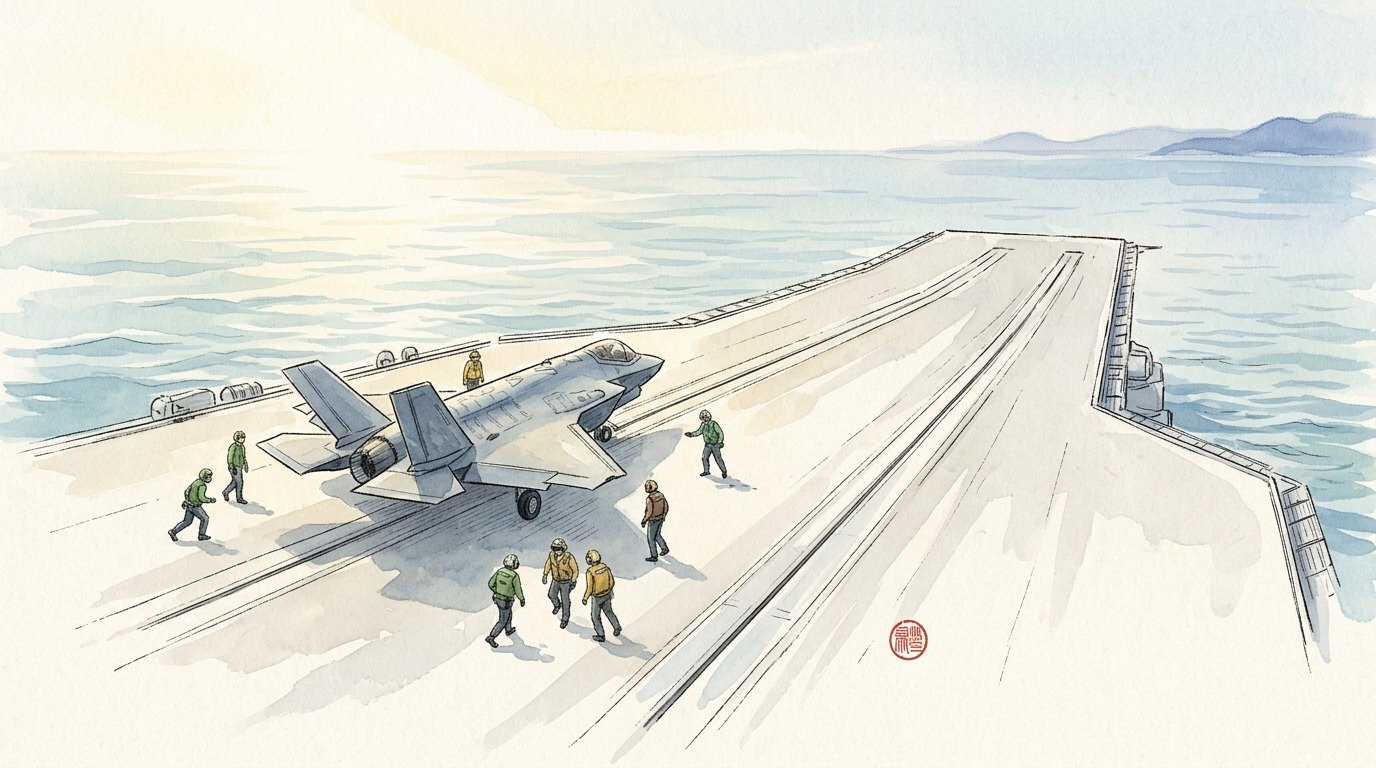
Contents ▾
With the launch of the Type 003 aircraft carrier Fujian, the People’s Liberation Army Navy made a historic leap directly from ski-jump short take-off ramps to an advanced Electromagnetic Aircraft Launch System (EMALS). Driven by a medium-voltage direct-current (MVDC) microgrid and high-density flywheel kinetic energy storage, this catapult technology bypasses conventional steam generation entirely, enabling programmable launch acceleration across an unprecedented spectrum of carrier-borne aircraft.
1. The naval aviation Bottleneck, ski-jumps versus catapults
For more than a decade, Chinese naval aviation operated under the operational constraints of the STOBAR (Short Take-Off But Arrested Recovery) configuration aboard the Liaoning (Type 001) and Shandong (Type 002). While ski-jump ramps provide an mechanically simple method to launch high-thrust fighter jets (such as the Shenyang J-15) under their own engine power, the physics of ski-jump launches impose severe aerodynamic and payload limitations.
Because aircraft must accelerate purely through onboard engine thrust along an upward-curved flight deck over a distance of barely 100 to 195 metres, carrier aircraft cannot launch at their maximum design takeoff weights. In high-temperature or zero-wind conditions, weapons ordnance and internal fuel capacity must be drastically curtailed, curtailing combat radius and strike capacity. More critically, heavy, low-thrust support aircraft—specifically twin-turboprop airborne early warning and control (AEW&C) platforms like the Xi’an KJ-600, anti-submarine aircraft, and heavy long-range unmanned aerial vehicles (UAVs)—cannot achieve the power-to-weight ratio required to clear a ski-jump ramp at safe stall margins.
Achieving a true CATOBAR (Catapult Assisted Take-Off But Arrested Recovery) carrier was thus the non-negotiable prerequisite for modern maritime command. Historically, the United States Navy relied on C-13 steam catapults. However, steam catapults require voluminous piping, high-pressure boilers, massive fresh-water evaporators (consuming up to 1,000 kg of distilled water per launch), and complex mechanical braking systems. Furthermore, steam delivers an abrupt, non-linear hydraulic shock impulse that subjects aircraft airframes to intense fatigue stress, and cannot be dialed down to safely launch lightweight composite drones without tearing their landing gear apart.
2. The Ma Weiming paradigm, medium-Voltage Direct Current (MVDC)
When China initiated its catapult development under the leadership of Rear Admiral Ma Weiming (马伟明) at the Naval University of Engineering in Wuhan, the naval establishment initially debated whether to develop steam catapults first as a risk-mitigation step. Ma Weiming made the audacious recommendation to bypass steam entirely and jump directly to electromagnetic launching, arguing that steam was an obsolescent mid-20th-century technology with inherent maintenance and scalability bottlenecks.
Crucially, while the United States Navy’s EMALS aboard the USS Gerald R. Ford (CVN-78) utilized a medium-voltage alternating-current (MVAC) power distribution architecture, Ma Weiming’s team pioneered a Medium-Voltage Direct Current (MVDC) integrated electrical system. In an MVAC architecture, synchronizing multiple high-speed turbine generators, transformers, and frequency cycloconverters across fluctuating shipboard AC grids introduces harmonic distortion, phase misalignment, and complex reactive power instability.
In China’s MVDC architecture, alternating current generated by the carrier’s propulsion turbines is immediately rectified into a high-capacity direct-current bus. Direct current completely eliminates the need for phase angle synchronization and frequency matching, drastically reducing the physical footprint and weight of shipboard transformers, power conditioning modules, and harmonic filters. The MVDC bus acts as an ultra-stable electrical reservoir that decouples the carrier’s primary propulsion generators from the instantaneous gigawatt electrical loads demanded during flight deck flight ops.
3. Energy storage, high-density Flywheels and Inverter Modulators
Catapulting a 35-tonne strike aircraft from a dead stop to a flyaway velocity of 260 km/h (72 m/s) along a 100-metre track in under 2.5 seconds requires a colossal burst of mechanical energy: approximately 100 to 120 megajoules (MJ) of kinetic energy per launch. In electrical terms, this represents an instantaneous peak power pulse exceeding 50 to 100 megawatts per catapult. No shipboard generator could absorb such a transient spike without suffering immediate voltage collapse and engine stall.
The solution lies in modular kinetic flywheel energy storage systems (FESS). The Fujian incorporates multiple flywheel generator units housed in armored bays beneath the flight deck. Each flywheel rotor is forged from high-strength carbon-fiber composite and high-nickel alloy steel, suspended in a sealed vacuum enclosure on active magnetic bearings (AMBs) that eliminate mechanical friction. Driven by an integrated motor-generator, the flywheel spins up to speeds exceeding 12,000 to 15,000 rpm over a 45-second charging window, drawing steady, low-amperage baseline power from the ship’s MVDC grid.
When the launch sequence is triggered, the motor-generator shifts instantaneously into regenerative braking mode, extracting hundreds of megajoules of rotational kinetic energy within 2.5 seconds. The resulting DC pulse is fed into advanced solid-state power conditioning units utilizing arrays of megawatt-class Silicon-Controlled Rectifiers (SCR) and Insulated Gate Bipolar Transistors (IGBT). These solid-state switches synthesize precise multi-phase AC currents with millisecond response times, routing pulsed power to the launch motor.
4. The Linear Synchronous Motor, mechanics and programmable acceleration
The catapult track itself is a long-stator Linear Synchronous Motor (LSM) embedded flush along the carrier’s flight deck. The track consists of hundreds of discrete, independently energized stator segment coils lacing both sides of a narrow central slot. The launch shuttle—which mechanically latches onto the nose-gear launch bar of the carrier aircraft—is propelled by an array of high-grade neodymium-iron-boron (NdFeB) permanent magnets mounted within the moving carrier trolley.
As the aircraft accelerates, high-speed optical and magnetic Hall-effect sensors track the shuttle’s real-time position with sub-millimetre precision. Solid-state inverters sequentially energize only the specific 3-to-6-metre stator coil sections immediately surrounding the shuttle, generating a traveling electromagnetic wave of magnetic flux that pulls the trolley down the track. By energizing only the local track segments, electrical resistance and thermal losses are minimized, keeping the remaining 95 percent of the catapult track de-energized.
The decisive operational advantage of the LSM over steam is programmatic precision. Because the electromagnetic field is modulated via digital software controls, the acceleration profile can be tailored precisely to the exact aerodynamic envelope of each aircraft. For a heavy, 33-tonne J-15T fighter loaded with anti-ship cruise missiles, the system delivers maximum sustained linear acceleration smoothly ramping up to 3.5 g without violent jerk forces. Conversely, when launching a fragile 3-tonne stealth reconnaissance UAV or a turboprop KJ-600 radar aircraft, the system scales the current down to deliver a gentle, calibrated 1.8 g stroke. This reduces peak airframe fatigue loads by over 30 percent, dramatically extending the structural service life of carrier aircraft.
5. Electromagnetic arresting gear and flight trials
Complementing EMALS on the landing deck is the Electromagnetic Aircraft Arresting Device (EAAD). Conventional arresting gear uses hydraulic cylinders and mechanical fluid cross-head dampers to absorb the kinetic energy of an incoming aircraft catching the arresting wire. These hydraulic systems require constant mechanical adjustment, frequent fluid replacement, and can impart abrupt decelerations.
China’s electromagnetic arresting gear replaces hydraulic pistons with electric generator-absorbers connected to the purchase cables. When the tailhook of a landing aircraft grabs the wire, the spinning drum drives an electric generator, transforming the aircraft’s landing kinetic energy into an electrical pulse that is dissipated through internal resistor banks or recaptured into the flywheel storage units. Software closed-loop controls dynamically modulate the resistive braking torque in real time based on the aircraft’s approach speed and landing weight, ensuring a smooth, uniform deceleration envelope.
Launched at Jiangnan Shipyard in Shanghai on 17 June 2022, the Fujian (hull number 18) displacement exceeds 80,000 tonnes. In late 2023, high-speed “dead-load” catapult launches were conducted using wheeled test vehicles fired into the harbor basin to validate the linear motor’s electromagnetic synchronization. In May 2024, the carrier completed its maiden eight-day sea trials in the Yellow Sea, successfully validating its power distribution systems and confirming China’s emergence alongside the United States as the only two nations possessing operational electromagnetic aircraft catapult technology.
Share this article
References
- Zhang, F., Ma, W., & Wang, D. (2020). Modeling and high-precision thrust control of long-stator linear synchronous motors for electromagnetic launch. IEEE Transactions on Plasma Science, 48(4), 1045–1054. doi:10.1109/TPS.2020.2978124
- Liu, G., & Chen, X. (2021). Dynamics and control of high-speed flywheel energy storage systems in naval pulsed-power applications. Energy Reports, 7, 432–441. doi:10.1016/j.egyr.2021.08.089
- Ma, W., & Lu, J. (2018). Key technologies of integrated electrical power systems for naval vessels. Journal of Naval University of Engineering, 30(1), 1–12.
- Naval Analysis Group. (2024). Type 003 Aircraft Carrier: Technical Architecture, EMALS Integration, and Sea Trial Assessments. Beijing: Maritime Defense Studies Institute.
- O’Rourke, R. (2023). China Naval Modernization: Implications for U.S. Navy Capabilities—Background and Issues for Congress. Congressional Research Service Report RL33153.
Related reading

The Hyperscalers
A small number of firms now build computing at a scale once reserved for states — data centres measured in gigawatts, processors designed in house and made by others, and supply chains spanning three continents. This long read traces how the hyperscalers arose, how they build, who else is building, and what may limit them.

Ian Buck and the Making of GPU Computing
The graphics processing unit was designed to do one thing very quickly: turn descriptions of three-dimensional scenes into coloured pixels on a screen. For most of its history that was all anyone…
The Twenty-Tesla Magnet: High-Field Fusion
The Twenty-Tesla Magnet - High-Field Fusion On September 5, 2021, inside a fortified testing bunker at the Massachusetts Institute of Technology's Plasma Science and Fusion Center in Cambridge, an engineering team held…