Economics
The Hyperscalers
A small number of firms now build computing at a scale once reserved for states — data centres measured in gigawatts, processors designed in house and made by others, and supply chains spanning three continents. This long read traces how the hyperscalers arose, how they build, who else is building, and what may limit them.
Contents ▾
For most of the history of computing, a computer was a place. It occupied a room, it had an operator, and if you wanted to use it you went to it, booked time on it, or submitted work to the people who ran it. The hyperscalers have inverted that relationship. Computing now comes from a place the user rarely sees and never visits, delivered over a network, billed by the second or by the unit of work, and available in quantities that would once have required a national programme to assemble. The buildings that make this possible are data centres, but that plain term understates what has changed. A modern hyperscale campus may contain several large buildings, its own electrical substations, reservoirs or pipework for cooling, fibre connections in multiple directions, and tens or hundreds of thousands of servers working as a single system. It is less a computer room than a factory whose product is computation itself.
The word “hyperscaler” is recent, and it is imprecise, but it points to something real. It describes a small group of companies that operate computing infrastructure at a scale, and with a degree of standardisation, that separates them from ordinary owners of data centres. They design or specify much of their own hardware, write the software that allocates machines to customers and to their own services, build or lease facilities in many countries, and spend on construction and equipment at a rate that is now visible in national investment figures. Amazon, Microsoft and Alphabet are usually placed at the centre of the group because they rent this infrastructure to others as cloud computing, but Meta, which built comparable facilities largely for its own social networks and artificial intelligence work, belongs in the same account, as do Oracle and a newer set of specialist firms supplying capacity for training large AI models. Later parts of this article will follow the supply chains, the in-house chips and the international operators, including the large Chinese platforms. This first part explains where the model came from, and who the American operators are.
Understanding the hyperscalers matters for reasons beyond the technology industry. Their decisions about where to build determine where electricity demand grows, which towns receive construction work and tax revenue, which undersea cables and fibre routes are financed, and which chip factories receive the largest orders. Their platforms also set practical conditions for thousands of other firms. A start-up today does not begin by buying servers; it opens an account. A government department, a bank or a university that once ran its own machine room may now rent capacity instead, and in doing so it accepts another company’s architecture, prices and timetable for change. None of this was inevitable. It is the outcome of a sequence of shifts, from the mainframe to the personal computer, from owning equipment to colocating it, and from colocating it to renting virtual machines by the hour, each of which left part of its logic in the system that followed.
1. From mainframes to cloud
The mainframe room
The mainframe era established the first pattern, which in some respects is the one the industry has now returned to, at far greater scale. In the 1950s and 1960s electronic computers were too expensive for most organisations to own more than one, and many owned none at all. A large machine was installed in a dedicated room, with raised floors, air conditioning and a staff of operators, programmers and engineers. Users did not interact with it directly in the modern sense. Work arrived as punched cards or tape, was queued, run in batches, and returned as printed output. The economics followed from the scarcity. Because the machine was costly and idle time was waste, the aim was to keep it busy, to schedule work carefully, and to share its capacity among many departments or customers.
IBM’s System/360, announced on 7 April 1964, gave that pattern a durable technical form. It was not a single machine but a family of compatible machines, covering a range of sizes, so that software written for one model could run on another and a customer could move to a larger system without starting again.[1] The Computer History Museum describes the announcement as embodying five new models and notes that the family was meant to address all sizes and types of customer with one unified, software-compatible architecture.[1] IEEE Spectrum, in its account of the programme, puts IBM’s spending on System/360 at about $5 billion, a figure that conveys how large a commitment a compatible computer family represented for a single firm at the time.[2] Compatibility, standard peripherals and a common operating environment are familiar ideas now. In 1964 they were a commercial proposition as much as a technical one, and they helped make centralised computing a service that could be planned, priced and expanded.
Time-sharing altered the experience of that central machine without changing its location. From the 1960s onwards, systems were developed that allowed several users at terminals to interact with a computer at the same time, each receiving a slice of its attention so rapid that it felt like exclusive use. Universities, research laboratories and commercial time-sharing bureaux sold access in this way. A customer could dial in, run a programme, store files and pay for the time and resources used. The details differed from modern cloud computing in almost every technical respect, but the commercial outline, shared infrastructure, remote access and measured use, was already present.
Minicomputers, personal computers and client-server
The next two decades moved computing in the opposite direction, away from the centre. Minicomputers from firms such as Digital Equipment Corporation brought smaller and cheaper systems within reach of a department or laboratory. The personal computer, from the early 1980s, placed a machine on an individual desk. Local area networks then reconnected those machines, and the client-server model divided work between desktop clients and departmental or central servers holding files, databases and applications. For many organisations this was a liberation from the mainframe’s queues and controls. Computing capacity could be bought incrementally, by a department, without a central plan, and software could be chosen locally.
The commercial internet added a further pressure. A website or online service could not predict its audience in the way an internal departmental system could. Success itself became an infrastructure problem, because a sudden rise in visitors could overwhelm a small installation, while provisioning for the highest imaginable peak meant buying equipment that might never be fully used. Online firms learned to build for growth by adding standard servers, distributing copies of data, and designing software so that the failure of one machine did not stop the service. Those techniques, developed inside large internet companies for their own products, are an important part of the background to hyperscale design. Search, e-commerce and social networking required fleets, not individual servers, and the fleet had to be managed by software because no operations team could configure machines one by one at that pace.
Colocation and the carrier-neutral building
Between owning a building and renting a cloud lies colocation. In a colocation facility, the operator provides the building, power, cooling, physical security and connectivity, and customers install their own servers in rented space, from a single rack to a large caged area or suite. The model grew with the internet in the late 1990s, particularly where many networks needed to interconnect. A carrier-neutral facility, not owned by a single telecommunications company, allowed competing networks, internet service providers and later content and cloud firms to place equipment close together and exchange traffic.
Equinix, founded in Silicon Valley in 1998, is a representative example of that stage. An account of the company at twenty-five years describes its founding purpose as creating network-neutral infrastructure, notes that it chose to be a multi-tenant colocation company rather than a network operator, and records a platform that by then covered hundreds of data centres across dozens of countries.[3] Colocation professionalised the building. Power distribution, backup generators, cooling and access control became a specialist business with service levels, rather than a facilities task attached to an office. It also created a geography that still matters. Certain buildings and campuses, in places such as Ashburn in Virginia, London, Frankfurt, Amsterdam and Singapore, became dense meeting points for networks, and later cloud providers wanted to be in or near the same places.
Colocation did not, however, remove the customer’s responsibility for servers, storage and software. That remained the dividing line. A colocation customer still forecast demand, bought hardware, shipped it, installed it and replaced it when it failed. The cloud providers removed those steps by owning the hardware themselves and renting abstracted capacity instead. In economic terms the shift was from renting space and power to renting computation, storage and network functions. In operational terms it was from managing physical machines to calling an application programming interface.
Virtualisation makes the machine divisible
The technical condition for that step was mature virtualisation. A hypervisor is software that allows several virtual machines to run on one physical server, each with its own operating system, apparently separate from the others. The idea has roots in mainframe systems, where partitioning a large machine was a natural way to share it, but its widespread use on standard x86 servers came in the late 1990s and 2000s. Virtualisation allowed a provider to divide a server safely among customers, to move workloads, to create a new machine from a template in minutes, and to charge for a defined quantity of processor, memory and storage rather than for a whole physical box.
It also changed the unit of planning. A physical server is indivisible and awkward; a virtual machine can be offered in many sizes, started and stopped quickly, and copied. Providers could therefore pool large numbers of physical machines and allocate fractions of them as demand arrived, raising utilisation and smoothing peaks across customers in different industries and time zones. The later addition of containers, which package an application and its dependencies without a full separate operating system for each instance, and of managed services that hide the virtual machine altogether, extended the same principle. The customer increasingly specified an outcome, store this object, run this function, answer this database query, rather than a machine.
Amazon Web Services and the 2006 launch
Amazon was not a computer manufacturer, a telecommunications firm or an enterprise software company when it entered this market. It was a retailer that had built, for itself, a large and demanding online operation, with seasonal peaks, a product catalogue, payment systems and logistics software. To support that business it had standardised internal services for storage, computation and messaging, so that its own development teams did not each rebuild the same foundations. The step taken in 2006 was to offer some of those foundations to outside developers, for payment, over the internet.
Amazon’s own retrospective account describes 2006 as the year AWS went public, with Amazon Simple Storage Service, known as S3, and Amazon Elastic Compute Cloud, known as EC2, among its first services, and explains the proposition as renting computing and storage resources rather than buying and maintaining physical servers.[4] S3 offered object storage, a way to store and retrieve files and data objects through a web interface, without managing disks. EC2 offered virtual servers that could be started in minutes and paid for by the hour. A third early service, Simple Queue Service, provided messaging between software components. Together they covered three basic needs, compute, storage and coordination, in a form a small firm could use with a credit card and no procurement process.
Contemporary and later accounts of EC2 stress the word “elastic”. TechCrunch’s history of EC2, published on its fifteenth anniversary, notes that EC2 was turned on in beta on 25 August 2006, that S3 had preceded it by about six months, and that the name was chosen to convey capacity that could be taken up and released as a job required.[5] Elasticity was the point of difference from both colocation and conventional hosting. A hosting company might rent a dedicated server for a month or a year. EC2 made the rental period short and the process programmatic. A developer could create one virtual machine to test an idea, a hundred to handle a launch, and none at all the following week.
Google and Microsoft enter by different routes
Google arrived with a different inheritance. It already operated, for search and its other services, one of the world’s largest fleets of servers, and it had developed internal systems for distributing work and data across that fleet. Its first public cloud product, App Engine, announced in preview in April 2008, was not a rental of virtual machines. It was a platform on which developers could run web applications on Google’s infrastructure, within Google’s constraints, while Google handled scaling.[6] That platform-as-a-service approach reflected Google’s strengths and its assumptions about how software should be built. It was followed by storage, database and data analysis services, and by Google Compute Engine, which offered virtual machines more directly comparable to EC2. The collection became Google Cloud Platform, later presented as part of Google Cloud.
Microsoft’s route was shaped by its enterprise customer base and its Windows and server software. It announced Windows Azure in October 2008 and made it commercially available in February 2010, initially with a strong platform emphasis for building and hosting applications, and later with a fuller set of infrastructure services including virtual machines running Linux as well as Windows. The service was renamed Microsoft Azure in 2014, reflecting that it was no longer only a Windows environment. Microsoft could offer something its rivals could not match in the same form, close integration with software that many organisations already licensed, identity systems they already used, and hybrid arrangements that connected a customer’s own data centre to Azure. Under Satya Nadella, who became chief executive in 2014, cloud services moved to the centre of the company’s strategy.
By the early 2010s the three firms had established the template that others would follow or react against. IBM, Hewlett-Packard, Oracle and telecommunications companies all offered cloud services of various kinds, and many have since withdrawn, narrowed or rebuilt their offers. The market did not become a simple monopoly, but it did concentrate. Building a general public cloud required not only data centres but a catalogue of managed databases, networking tools, identity and security systems, developer tools and compliance certifications, together with a sales organisation able to support large customers. Each addition made the platform more useful, and each gap made it harder for a smaller rival to be considered as a primary provider.
The United States National Institute of Standards and Technology gave the emerging model a formal definition in 2011. NIST Special Publication 800-145 defines cloud computing as “a model for enabling ubiquitous, convenient, on-demand network access to a shared pool of configurable computing resources” that can be rapidly provisioned and released with minimal management effort, and it identifies five essential characteristics, on-demand self-service, broad network access, resource pooling, rapid elasticity and measured service.[7] The definition is dry, but it captures why cloud was more than a new name for hosting. The customer provisions resources itself, through software, the provider pools them, capacity expands and contracts quickly, and use is measured. Hyperscale is what happens when that model is implemented by firms whose pooled resources are counted in hundreds of thousands of machines and whose customers include a substantial part of the online economy.
What hyperscale means
There is no official threshold at which a data centre or a company becomes hyperscale, and the term is used in at least two senses. In one sense it describes a facility, a very large data centre, designed around repeated standard units, with power measured in tens or hundreds of megawatts and space for many thousands of servers. In the other sense it describes an operator, a company whose computing platform is large enough that it designs its buildings, servers, networks and software together and can add capacity in large increments without a change of method. The second sense is usually the more useful one, because a single large building leased to many small tenants is a different business from a fleet operated as one system.
Analyst definitions reflect that ambiguity. A widely cited formulation attributed to IDC describes a hyperscale data centre as having at least 5,000 servers and at least 10,000 square feet of space, while noting that such facilities are generally much larger; Synergy Research Group instead classifies operators by the scale of their cloud and internet businesses and measures their capacity in megawatts of critical IT load.[8] Neither test is a standard in the engineering sense. Both are attempts to draw a line around a group whose members are recognisable in practice, firms that build campuses rather than single halls, buy equipment in volumes that affect suppliers’ roadmaps, and operate in many regions at once.
Synergy’s counting gives a sense of the expansion. It counted 1,136 large data centres operated by hyperscale providers at the end of 2024, roughly double the number five years earlier, with 137 new facilities coming online during 2024 alone, and it reported that the United States accounted for more than half of worldwide hyperscale capacity measured by critical IT load.[9] Those figures depend on Synergy’s own classification of which firms and facilities count, and they should be read as an analyst’s estimate rather than a census, but the direction is not in dispute. Capacity has grown, the average new facility has become larger, and a small number of operators account for a large share of the total.
Several design principles recur across these operators, even where their implementations differ. The first is standardisation. Servers are deployed in large numbers of identical or near-identical units, so that installation, repair and software deployment can be automated and spare parts simplified. The second is scale-out design. Rather than relying on one very powerful machine, applications are spread across many machines, with data copied to more than one place, so that growth means adding units and failure means removing one unit from service. The third is the separation of a site into fault domains. Cloud providers group facilities into regions, each region consisting of several availability zones, physically distinct locations with independent power and networking, connected by low-latency links. A customer that deploys across zones should survive the loss of one. The fourth is software control of almost everything, provisioning, networking, monitoring and recovery, because manual processes do not extend to fleets of this size.
Artificial intelligence training, from the late 2010s and especially after 2022, placed a new kind of demand on this system. Training a large model requires many thousands of accelerators, graphics processing units or custom chips, working together for weeks, connected by very fast networks, and drawing power at a density that older data centre designs were not built to supply. That demand is the subject of later parts of this article. Its effect on the first part of the story is simpler. It turned scale from an advantage into a requirement, raised the capital cost of remaining in the leading group, and brought firms that had previously built mainly for their own services, and specialists that built only for AI, into the same competitive frame as the established clouds.
2. The American hyperscalers
The American firms dominate the hyperscale market for historical as much as technical reasons. The modern internet industry grew up in the United States, its largest early cloud customers were there, and the firms concerned had access to deep capital markets and to cash flows from advertising, e-commerce, software licensing and social networking with which to fund construction. Their home geography also gave them a large first region to build in. Northern Virginia, within reach of Washington, DC, of major fibre routes and of a concentration of internet exchange points dating from the 1990s, became the largest single data centre market in the world, and it remains a reference point for the industry. From that base the American providers expanded into Europe and Asia-Pacific, following customers that needed lower latency, local data storage for regulatory reasons, or both.
What they share is a rate of capital expenditure that has risen sharply. Capital expenditure, in company reports, includes more than data centres, and the firms define and present it differently, so comparisons need care. Even with that caution, the reported figures for 2024 show the order of magnitude. Amazon reported purchases of property and equipment of about $83.0 billion in 2024, and cash capital expenditures of $77.7 billion after proceeds and incentives as described in its annual report, saying the spending primarily reflected investment in technology infrastructure, the majority of it to support AWS growth, together with capacity for its fulfilment network.[10] Microsoft reported additions to property and equipment of $44.5 billion in its fiscal year ended 30 June 2024, a figure that rose further in the following year.[11] Alphabet reported purchases of property and equipment of $52.5 billion in calendar 2024.[12] Meta reported capital expenditures, including principal payments on finance leases, of $39.23 billion for the full year 2024.[13] These are company-reported figures, drawn from their filings and results, and they are not a like-for-like measure of data centre construction alone. Together they indicate why hyperscale building is now discussed alongside railways, electricity networks and semiconductor fabrication as a capital programme, rather than as ordinary information technology spending.
Microsoft
Microsoft is, by revenue, the oldest firm in this group, and its cloud rests on relationships built over decades of selling operating systems, office software and server products to organisations. Azure’s commercial launch in 2010 came later than Amazon’s, and for several years it was presented primarily to developers already working with Microsoft tools. Its subsequent growth drew on a different asset, the ability to sell cloud services through existing enterprise agreements, to connect them to Microsoft 365 and Dynamics, and to present a single identity and security system across a customer’s own premises and the cloud. For many large organisations that continuity mattered more than any individual technical feature.
Microsoft describes Azure as available in more than sixty data centre regions, more than it attributes to any other cloud provider, and in more than 140 countries.[14] Its published list of regions pairs most regions with another region for disaster recovery, and many regions are divided into availability zones.[15][16] Region counts are not directly comparable between providers, because each defines a region differently and some announced regions are not yet in service, but the list conveys the administrative as well as the physical scale of the undertaking. Each region is a commitment to local power, staffing, compliance and network connection, maintained for years.
Amazon
AWS organises its infrastructure into regions and availability zones on the same general pattern described earlier. Its documentation lists thirty-four regions for a standard account at the time of writing, each with at least three availability zones in most cases, and explains that each region is a separate geographic area designed to be isolated from the others.[17] Separate GovCloud regions in the United States and regions in China operated through local partners are not included in that standard count, which is a reminder that the physical network is overlaid by legal and political boundaries. Amazon also operates edge locations and local zones that place some services closer to users in large cities, a tier below a full region.
Amazon’s reported spending requires the most careful reading of the group, because AWS shares a parent with a retail and logistics business that also builds large facilities. The company’s 2024 annual report states that cash capital expenditures were $77.7 billion in 2024, up from $48.1 billion in 2023, and that they primarily reflected investments in technology infrastructure, the majority of which was to support AWS business growth, and in additional capacity for its fulfilment network.[10] It does not follow that the whole sum was spent on data centres, and Amazon does not present it that way. It does follow that the infrastructure programme supporting AWS is financed from the cash flow of a much larger group, and that its warehouses and its cloud are, in accounting terms, part of the same capital story even though they are different operations.
Alphabet and Google Cloud
Google Cloud’s own locations page lists forty-three regions and 130 zones, and notes that a region generally consists of three or more zones housed in three or more physical data centres; as with the other providers, the count is Google’s own and changes as new regions open.[18]
Alphabet’s capital expenditure has risen in step with its AI programme. It reported purchases of property and equipment of $52.5 billion in 2024, compared with $32.3 billion in 2023, figures compiled from its filings.[12] A large part of that spending supports technical infrastructure, servers, networking equipment and data centres, for both Google’s own services and Google Cloud customers. Google is also distinctive among the American hyperscalers for the depth of its in-house chip programme, the Tensor Processing Units it designs for its own machine learning work and offers to cloud customers. That subject belongs to the later discussion of chips and supply chains, but it affects the present picture because it gives Google an alternative to buying all of its accelerators from outside suppliers, and a reason to design its data centres around its own hardware generations.
Meta
Meta, the parent of Facebook, Instagram and WhatsApp, is not primarily a seller of cloud infrastructure, and including it among the hyperscalers requires that distinction to be kept in mind. It builds data centres to run its own services, to store and serve photographs, video and messages for billions of user accounts, to operate its recommendation systems, and increasingly to train and run AI models. Its facilities are therefore designed for a smaller number of very large internal workloads rather than for thousands of external tenants, although the engineering problems, power, cooling, networking and fleet management, are closely comparable.
The clearest illustration of the scale now involved is Hyperion, the AI training cluster Meta is building at its Richland Parish Data Center in Louisiana. Meta describes that site as its largest data centre to date, describes Hyperion itself as its “largest multi-gigawatt AI training cluster”, and puts the campus at four million square feet.[19] Meta has said that Hyperion will be able to scale up to 5 GW over several years; that is the company’s stated planned capacity, not capacity already in service.[20] In October 2025 Meta announced a joint venture with funds managed by Blue Owl Capital to develop and own the Hyperion campus, with the parties committing to fund approximately $27 billion in total development costs for the buildings and the long-lived power, cooling and connectivity infrastructure at the campus, according to Meta.[21] A single cluster planned in gigawatts, on a campus measured in millions of square feet, is a different order of undertaking from the data centres described earlier in this chapter. The power supply, financing and construction that a campus of this size requires are treated in full in chapters 3 and 4, and are only flagged here as the point at which Meta’s building programme most clearly sets it alongside the largest cloud operators.
Its spending illustrates how AI has changed the position of a firm that does not sell cloud services. Meta reported capital expenditures, including principal payments on finance leases, of $39.23 billion for 2024, and its guidance and subsequent reports pointed to substantially higher spending in the following year, directed in large part to servers and data centres for AI.[13] Because Meta has no cloud revenue against which to set that expenditure, the investment is justified internally by expected improvements to its advertising systems, its content recommendations and its own AI products and assistants. Whether that justification is accepted by investors has varied, and Meta’s announcements on infrastructure spending have at times moved its share price sharply. The underlying point for this article is structural. A social media company now operates one of the larger computing fleets in the world, and its requirements influence the same markets for accelerators, power and construction as those of the cloud providers.
Oracle
Oracle entered the cloud infrastructure market from enterprise software, and late. Its first cloud offers in the early 2010s were widely regarded, including within the company, as an imitation of its rivals that did not match them. Oracle cancelled that first-generation infrastructure project and rebuilt it. Reporting of remarks by its founder and chief technology officer, Larry Ellison, at a company event in 2022 describes him saying that he had cancelled the original project because the company was copying what others were doing, and that he wanted to start again with a second-generation cloud.[22] The rebuilt service, Oracle Cloud Infrastructure, generally available from 2016, placed the cloud control software on separate machines from customer workloads, offered bare-metal servers as a standard option, and priced network data transfer more cheaply than the larger clouds.
For several years Oracle’s share of the general cloud market remained small, and its strongest position was with existing customers for its databases and business applications, which it encouraged to move to its own cloud. What changed its position was the AI building period. Oracle had available capacity, a willingness to build large clusters for a small number of customers, and contracts to supply infrastructure to firms including OpenAI, Meta and xAI. It also expanded its region count quickly from a low base. Writing in December 2020, Oracle reported that after a surge of openings it had twenty-nine cloud regions worldwide and aimed to have thirty-eight by the middle of 2021, attributing the expansion to demand from its large installed base of customers moving from their own premises to cloud services.[23] Its list has grown since, and it also offers dedicated regions installed inside a customer’s or partner’s facility, a model that suits governments and regulated industries.
New entrants built for AI
CoreWeave is the most prominent example. It began in 2017 as Atlantic Crypto, a company mining the cryptocurrency Ethereum with large numbers of graphics processing units, and pivoted to renting GPU capacity as demand for AI computing rose.[24] An account of the company notes that it grew from three data centres with more than 17,000 GPUs at the start of 2023 to dozens of data centres holding hundreds of thousands of GPUs by the end of 2024, that its customers have included Microsoft, OpenAI, Meta and NVIDIA itself, and that its shares began trading on Nasdaq in March 2025.[24] Such firms are sometimes called neoclouds. The term is informal, but it marks a real difference of scope. CoreWeave does not offer the hundreds of services of an AWS or an Azure. It offers accelerated computing, the networking to connect it, and the software to schedule it, and it has been able to bring new generations of NVIDIA hardware to market quickly because that is its whole business.
xAI represents a second pattern, the AI laboratory as its own infrastructure builder. Founded in 2023, it required very large training capacity for its Grok models and chose to build it directly rather than rely entirely on a cloud provider. NVIDIA announced in October 2024 that xAI’s Colossus cluster in Memphis, Tennessee, comprised 100,000 NVIDIA Hopper GPUs, that it was being used to train the Grok family of models, and that xAI was in the process of doubling it to a combined total of 200,000 GPUs; NVIDIA also reported that the facility and the system had been built in 122 days.[25] Those are figures reported by NVIDIA and xAI, and the 122-day claim refers to the build of that system rather than to the whole history of the site, but the speed was widely noted because it compressed work that would normally be planned over a much longer period, including the use of temporary generation to supplement grid power while permanent supply was arranged.
Reading the American picture
Capital expenditure has become the clearest public signal of intent, and the least precise. The reported 2024 figures cited above, about $83.0 billion of purchases of property and equipment at Amazon, $52.5 billion at Alphabet, $44.5 billion of additions at Microsoft and $39.23 billion at Meta including finance lease principal, are large by any historical comparison for these firms, and each company’s own reporting indicated that spending would rise again in 2025.[10][12][11][13] But the figures cover different fiscal years, different definitions and different mixtures of land, buildings, servers, networking equipment and, in Amazon’s case, logistics. They tell the reader that the leading firms have committed themselves to building at a pace that requires the supply chains examined later in this article. They do not, on their own, tell the reader how much usable computing capacity any one firm has added, where it is, or what return it will earn. Those questions, of chips, power, buildings and the firms outside the United States that are building in parallel, are where the story continues.
3. Superclusters and AI factories
A supercluster is not simply a large number of computers in a large building. It is a collection of accelerators, the specialised chips that do most of the arithmetic in modern artificial intelligence, bound together by networking fast enough, and software disciplined enough, that the collection can work on a single problem as if it were one machine. That qualification matters. Ten thousand graphics processing units, or GPUs, sitting in the same hall but unable to exchange information quickly are ten thousand separate computers. The same ten thousand, connected by a fabric designed for the purpose and scheduled as a unit, can train one model. Almost everything distinctive about the hyperscalers’ recent building programme follows from the effort to hold that distinction together at ever larger scale, and from the cost of failing to do so. An accelerator that is waiting for data from its neighbours is still drawing power and still depreciating, but it is producing nothing. At the prices these chips command, idle time is the central economic problem of the whole enterprise, and the design of the cluster is largely an attempt to minimise it.
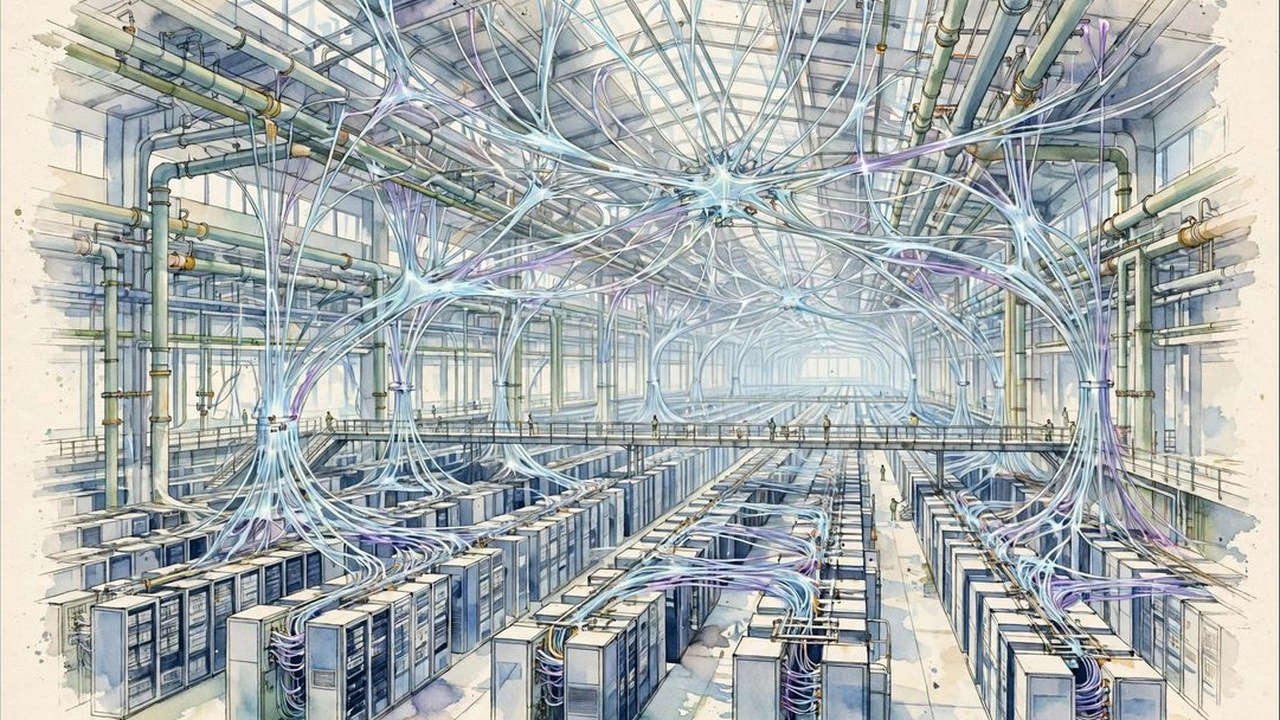
The vocabulary has shifted accordingly. Nvidia, whose GPUs dominate this market, now routinely describes the buildings that house its largest systems as “AI factories”, a phrase it also applied to xAI’s Colossus system in Memphis.[26] Microsoft uses similar language for its Fairwater sites, calling the first of them in Wisconsin “the largest and most sophisticated AI factory we’ve built yet”.[27] The metaphor is imperfect, since a factory usually transforms materials into a different product, whereas a training cluster transforms electricity and data into model weights, a set of numbers that can then be copied at negligible cost. But it captures something real about how the operators think. These are production facilities, planned around throughput, yield and utilisation, staffed by small numbers of people relative to their capital value, and judged by output per unit of input rather than by the elegance of any individual machine inside them.
Training and inference are different jobs
Two kinds of work dominate, and they pull cluster design in different directions. Training is the process by which a model learns from examples. In a large training run, the same calculation is repeated over an enormous body of text, images or other data, the model’s internal parameters are adjusted in small steps, and the intermediate state, which may run to many terabytes, must be kept consistent across every chip taking part. Training runs are typically long, planned in advance, and run on a dedicated cluster at high utilisation for days, weeks or months. They are also unforgiving. Because the chips proceed in lockstep through much of the computation, the whole run moves at the speed of its slowest participant, and a failure in one server can interrupt work being done by thousands of others unless the software has saved its state recently enough to restart from a checkpoint.
Inference is the use of a trained model to answer a request. It is smaller in scale per request, far larger in aggregate volume, and governed by latency, the delay a user experiences, as much as by total throughput. An inference system can often be divided into many independent copies of a model, each serving its own stream of users, so it does not need the same degree of tight coupling as a training system of comparable size. It does, however, need to be close enough to users, cheap enough per answer, and elastic enough to follow demand that rises and falls through the day. Google drew this distinction explicitly when it introduced Ironwood, its seventh generation Tensor Processing Unit, or TPU, in April 2025, describing it as the first of its TPUs designed specifically for inference, and as built to support what it called “thinking” models that generate intermediate reasoning before answering.[28] The same company’s earlier TPU generations were presented primarily as training machines. That a hyperscaler now designs silicon around the serving end of the workload says a good deal about where the volume, and increasingly the cost, of AI computing now sits.
In practice the boundary is porous. The same cluster may train a model, evaluate it, fine-tune it on narrower data, and then serve it. Reinforcement learning, in which a model generates many candidate answers and is scored on them, mixes generation and training in a single loop. Operators therefore tend to build general accelerator capacity and allocate it between the two kinds of work as priorities change, rather than constructing wholly separate estates. Even so, the distinction explains observable choices. Training capacity is concentrated in a small number of very large, tightly coupled sites where power is available, because splitting a single run across distant buildings imposes networking delays that are difficult to overcome. Inference capacity is more widely distributed, placed nearer to population centres and to the ordinary cloud regions that hyperscalers already operate, because the penalty for distance is paid by every user on every request.
Why the interconnect decides the size of the machine
The arithmetic in a modern accelerator is rarely the binding constraint. A current GPU can perform a vast number of low precision operations per second, but it can only do so if it is fed with data at a matching rate, and in distributed training much of that data consists of values produced by other chips. Training is therefore divided among chips in several complementary ways at once. The data are split into batches processed in parallel. The model itself may be split, with different layers, or different parts of each layer, held by different devices. In mixture of experts models, only a subset of specialised sub-networks is activated for each piece of input, and tokens must be routed to whichever devices hold the relevant experts. Each of these strategies generates communication, and some of it lies on the critical path, meaning that computation cannot resume until the exchange completes. The ratio between time spent calculating and time spent communicating determines how much benefit each additional chip actually adds.
This is why engineers distinguish between scaling up and scaling out. Scaling up means making a tightly connected domain larger, so that more accelerators can communicate over the fastest, shortest links. Scaling out means connecting many such domains with a more conventional network, accepting lower bandwidth or higher latency between groups. Within a rack, and increasingly within a row, the links are proprietary and extremely fast. Between racks, clusters use either InfiniBand, a networking technology long established in scientific supercomputing, or Ethernet adapted for the purpose with remote direct memory access, which allows one machine to read and write another’s memory without involving its main processor in each transfer. Nvidia sells both approaches, InfiniBand under its Quantum product line and Ethernet under Spectrum-X. xAI’s Colossus used the latter, and Nvidia reported that the system maintained 95 per cent data throughput, which it attributed to Spectrum-X congestion control, and experienced no application latency degradation or packet loss from flow collisions across the three tiers of its network fabric.[26] Those are the vendor’s figures for its own platform in a customer’s system, and they are best read as an indication of what the design is intended to achieve rather than as an independent measurement.
Congestion deserves a word of explanation, because it is where large clusters most often disappoint. When thousands of chips finish a calculation step at roughly the same moment and attempt to exchange results simultaneously, the network experiences a synchronised burst unlike ordinary internet traffic, which is comparatively random. If switches queue or drop packets, some chips are delayed, and because the next step cannot begin until all have finished, a brief local slowdown becomes a slowdown for the entire run. Much of the engineering in AI networking, from adaptive routing to congestion control to the careful arrangement of which racks connect to which switches, exists to keep these bursts moving. The same concern shapes physical layout. Cable length is latency, so the densest systems are arranged to keep the most talkative neighbours close, and Microsoft has described designing its Fairwater buildings specifically to maximise the density of compute in order to minimise latency within and across racks.[29]
The rack becomes the unit of computing
The clearest expression of scale-up design is Nvidia’s GB200 NVL72, the rack-scale system that has become the reference building block for new AI data centres. Nvidia specifies it as 36 of its Grace central processing units and 72 Blackwell GPUs in a single liquid-cooled rack, joined by its fifth generation NVLink interconnect into a 72-GPU domain that, in the company’s words, acts as a single large GPU.[30] The aggregate figures for the rack are striking even allowing for the fact that they are manufacturer specifications. Nvidia lists 130 terabytes per second of NVLink bandwidth across the domain, 13.4 terabytes of high bandwidth memory, and per-GPU NVLink bandwidth of 1.8 terabytes per second.[30] Each GPU is connected to every other in the domain through NVLink switches inside the rack, which removes the need to leave the rack for the most frequent exchanges when a model is partitioned within it.
Two consequences follow. The first is that the rack, rather than the server, is now the unit that a data centre must be designed around. A single NVL72 rack draws power on a scale that would until recently have described an entire row of conventional equipment, and it cannot be cooled by air alone, a point taken up in the next chapter. The second is that procurement, installation and maintenance have been reorganised around complete racks delivered as integrated systems, with networking, power distribution and cooling connections already engineered to fit together. This reduces the integration work left to the operator, but it also deepens dependence on the supplier’s roadmap, since the rack embodies choices about interconnect, memory and cooling that the buyer cannot easily substitute. Hyperscalers accept that trade-off in part because the alternative, assembling comparable systems from components, takes longer, and time to a working cluster has become a competitive variable in its own right.
Google’s approach illustrates a different route to a similar destination. Its TPUs are connected by an inter-chip interconnect into pods, and its Ironwood generation is offered in two configurations, one of 256 chips and one of 9,216 chips, the larger spanning nearly 10 megawatts and using liquid cooling.[28] Google states that a 9,216-chip Ironwood pod delivers 42.5 exaflops of compute, a figure it compares with 1.7 exaflops for El Capitan, a leading scientific supercomputer, while noting that each Ironwood chip provides peak compute of 4,614 teraflops and 192 gigabytes of high bandwidth memory.[28] Such comparisons need care. The numbers are calculated at the low numerical precisions used in AI work, whereas scientific supercomputers are conventionally ranked on higher precision arithmetic, so the two are not measuring quite the same thing. Google later added that the chips in a superpod are linked by interconnect networking operating at 9.6 terabits per second and can address 1.77 petabytes of shared high bandwidth memory.[31] The underlying point, common to both vendors, is that the pod or rack domain is treated as one computer with one memory space for programming purposes, whatever its physical extent.
Beyond the single domain, Google connects pods using optical circuit switching, which reconfigures light paths between groups of chips rather than routing every packet electronically. This allows the topology of the network to be matched to the workload and, the company argues, allows capacity to be assembled from available components when some parts are unavailable. Amazon, Microsoft and Meta each have their own equivalents, differing in detail but not in purpose. Amazon groups its in-house accelerators into large servers and then into what it calls UltraClusters. Meta has published designs for training clusters built around tens of thousands of GPUs with a combination of InfiniBand and Ethernet fabrics for different generations. The variety of names should not obscure the convergence. Everyone is building the same logical object, a pool of accelerators with a fast internal fabric and a somewhat slower fabric between groups, and the differences lie in where each operator chooses the boundary between the two and in how much of the stack it designs itself.
Microsoft, OpenAI and the move from one cluster to several
Microsoft’s AI building programme began as an extension of its partnership with OpenAI, for which Azure was for several years the exclusive cloud provider and the builder of the supercomputers on which OpenAI’s models were trained. The pattern set early, of very large GPU clusters in a small number of Azure regions, has since broadened in two directions. Microsoft now builds for its own models and services as well as for OpenAI, and OpenAI now obtains capacity from other providers as well as from Microsoft. The most public expression of the second change was the Stargate project, announced by OpenAI in January 2025 as a new company intending to invest 500 billion dollars over four years in AI infrastructure in the United States, with 100 billion dollars to be deployed immediately, and with SoftBank, OpenAI, Oracle and MGX as initial equity funders.[32] Those are the figures as announced by the participants at the outset of the programme. They describe an intention covering several years and many sites, and they should not be read as money already spent or capacity already operating. The first Stargate site, at Abilene in Texas, is built and operated with Oracle as the cloud provider, a role that would have belonged to Microsoft under the earlier arrangement.
Microsoft’s own flagship design is Fairwater. In September 2025 the company presented its Wisconsin site, at Mount Pleasant, as covering 315 acres with three buildings totalling 1.2 million square feet, housing hundreds of thousands of Nvidia GPUs, and as the first of several identical Fairwater data centres under construction in the United States.[27] Two months later it announced a second Fairwater site in Atlanta, Georgia, and described the two, connected by a dedicated wide area network it calls the AI WAN, as forming a “planet-scale AI superfactory” in which capacity can be allocated dynamically between sites.[29] That description needs a technical qualification. Work that requires the tightest coupling still has to sit within one site, and usually within one fabric, because no wide area link matches the bandwidth or latency of NVLink inside a rack. What a network between sites can usefully do is move less tightly coupled work, such as separate training runs, evaluation, fine-tuning and inference, to wherever capacity is free, and to allow two large sites to be managed as one pool for scheduling purposes. Microsoft’s own account emphasises exactly that, elastic allocation and GPU utilisation across the combined system, rather than a single training run stretched across two states.[29] It also gives a sense of the densities involved, stating that Fairwater supports roughly 140 kilowatts per rack and 1,360 kilowatts per row using liquid cooling.[29]
The wider significance of Fairwater and Stargate together is that the unit of competition has moved up a level. A decade ago a cloud provider competed on the quality of its individual regions. In AI it now competes on whether it can assemble, power and keep busy a small number of extremely large clusters, and on how quickly it can bring the next one into service. That favours operators with large balance sheets, established relationships with chip suppliers and utilities, and land already secured near transmission capacity. It also creates a new kind of concentration risk. If a frontier training run depends on one site, then a power fault, a cooling failure or a networking defect at that site is not a local incident but an interruption to a programme that may be central to a company’s strategy.
Meta’s clusters and the gigawatt threshold
Meta came to large-scale AI infrastructure from a different starting point, as a company that had long operated its own data centres for social networking and had already built substantial GPU capacity for recommendation systems and advertising before large language models became its priority. It has been unusually willing to describe its clusters in public, partly because it releases some of its models openly and publishes research describing the systems used to train them. In July 2025 its chief executive, Mark Zuckerberg, announced two named projects that illustrate where the scale has reached. The first, Prometheus, in Ohio, was described as a cluster of more than one gigawatt coming online in 2026. The second, Hyperion, was described as a cluster that would be able to scale up to five gigawatts over several years.[33] Both figures are the company’s own statements about its plans, the second explicitly a target to be reached over several years rather than a description of anything yet built. They are nevertheless useful markers. A gigawatt is roughly the output of one large nuclear reactor, and a single site drawing that much power continuously is, by historical standards, an industrial load of the first order that happens to consist of computers.
Hyperion in Richland Parish
Hyperion deserves to be taken as the leading example of the new scale, because it is the largest single campus any hyperscaler has described in public, and because Meta has put unusually concrete dimensions to it. The cluster is housed in Meta’s Richland Parish data centre, on a former agricultural site near Holly Ridge in north-east Louisiana. When Meta announced the campus in December 2024, it was already presented as the company’s largest data centre to date, an investment of more than 10 billion dollars with more than four million square feet of buildings, on a site reported at the time as 2,250 acres.[34] Reporting based on Meta’s announcement put the initial design at more than two gigawatts of compute capacity, intended for training the company’s future models.[35] Four million square feet is a difficult figure to hold in the mind, so it is worth converting. It is roughly 370,000 square metres of building, or the floor area of several dozen large warehouses, and the site around it, at 2,250 acres, is about nine square kilometres of land taken up by one customer’s computing operation.
Zuckerberg chose a more vivid comparison. Announcing the project in July 2025, he wrote that Meta was building several multi-gigawatt clusters, that Prometheus was the first, that Hyperion would be able to scale up to five gigawatts over several years, and that “just one of these covers a significant part of the footprint of Manhattan”.[36] Meta illustrated the point with an image superimposing the outline of one of these clusters over a map of Manhattan.[36] The comparison is Meta’s own, offered by its chief executive to convey the scale of the company’s plans, and it should be read in that spirit rather than as an independent measurement of the Louisiana site. A Meta spokesperson, clarifying the timetable at the time, said the company planned to bring two gigawatts of capacity online at Hyperion by 2030, scaling to five gigawatts in the years after.[37] Even on that phased timetable, the end state is a single campus whose power capacity would be about five times the one-gigawatt threshold that, until very recently, no individual data centre had crossed. As one engineering journal put it, the largest AI campuses being built today are designed to handle up to about a gigawatt each, which makes a stated five-gigawatt design the largest among its peers.[38]
The project has since grown again on paper. In July 2026 Meta said the Richland Parish campus would expand to five gigawatts of compute capacity, with investment in the project rising to more than 50 billion dollars.[35] Louisiana’s economic development agency, reporting Meta’s announcement, described the expanded campus as nearly ten million square feet with five gigawatts of IT capacity, home to Hyperion, which it called the company’s largest AI training cluster, and as the largest facility in Meta’s global fleet.[34] These are announced intentions for a campus still under construction, not a description of capacity in service, and the history of the project itself, which has been enlarged substantially twice since it was announced, is a reason to treat any single figure as a snapshot of a plan rather than a settled fact. What is not in doubt is the direction. In the space of about eighteen months, one site went from a very large data centre by the standards of 2024 to a project whose stated end state has no close precedent.
Setting Hyperion against the other systems in this chapter shows how far out on its own it sits. xAI’s Colossus, discussed below, was a remarkable achievement of speed and assembly, but it was installed inside an existing factory building and counted in hundreds of thousands of GPUs rather than in gigawatts of planned campus capacity. Microsoft’s Fairwater site in Wisconsin, which that company presents as its most powerful AI data centre, covers 315 acres with 1.2 million square feet of buildings.[27] Hyperion’s buildings alone were announced at more than three times that floor area, before the later expansion roughly doubled the figure again, and its land holding is about seven times the Wisconsin site’s acreage. Google’s largest Ironwood configuration, at 9,216 chips and nearly ten megawatts, is a pod, a building block to be repeated many times over inside a campus, rather than a campus in itself.[28] Perhaps the most telling comparison is with Stargate. OpenAI and its partners announced an intention to invest 500 billion dollars across an entire national programme of sites.[32] Hyperion is one campus, for one company, in one parish in Louisiana, and its stated capacity target is of an order that programme planners would once have associated with a portfolio.
Scale on this level changes the nature of the undertaking. A five-gigawatt load cannot be served by connecting to whatever spare capacity a local network happens to have. It requires generation and transmission to be built for the purpose, in Richland Parish’s case by the regional utility, Entergy Louisiana, working alongside Meta, and it makes the data centre, in effect, the anchor customer around which a regional power system is planned. It also changes the politics. A parish of modest population acquires a construction workforce numbered in the thousands and a single industrial neighbour whose electricity requirements rival those of a large city, and questions about who pays for the supporting infrastructure, how much water the site will use and what happens if the technology changes before the buildings are finished become questions of public policy rather than of corporate procurement. Those questions are taken up in the next chapter, because they belong to the data centre as a physical object. The point for the present chapter is narrower. Hyperion is what the logic of the supercluster produces when it is followed without the usual constraint of available power at an existing site. Meta did not find five gigawatts. It chose a place where five gigawatts might be created, and then set about creating it.
Meta’s announcements also show how the language of clusters and the language of data centres have merged. Prometheus and Hyperion are described as clusters, but each is in reality a campus of buildings with its own power arrangements, and the cluster is the logical system formed across them. This is more than a naming habit. Once a single training system occupies several buildings, the design problems of the building, the power supply and the computer become inseparable, and the operator is in effect designing one artefact at three scales at once. It also means that published GPU counts, which were once a reasonable shorthand for the size of a system, have become less informative than power. Two clusters with the same number of accelerators may differ greatly in capability depending on the generation of chip, the interconnect and the proportion of time they spend usefully working. Power, by contrast, is measurable, is what the local grid must supply, and is what ultimately limits how much computing a site can contain. That is why the companies themselves have begun to announce projects in gigawatts.
xAI and Colossus
xAI, the AI company founded by Elon Musk, built the system that did most to establish the present style of cluster announcement. Colossus, in Memphis, Tennessee, was described by Nvidia in October 2024 as a cluster of 100,000 of its Hopper generation GPUs, used to train xAI’s Grok family of models, with work under way to double it to 200,000 GPUs.[26] Nvidia also reported that the facility and supercomputer were built by xAI and Nvidia in 122 days.[26] Both the size and the timetable are figures originating with the companies involved, and the 122-day claim in particular depends on where one chooses to start the clock, on a site that was an existing industrial building rather than an empty field. Reporting on the project has noted that the Memphis site is a converted former factory, which helps to explain how servers could be installed quickly while longer term power arrangements were still being completed.[39] Treated with those qualifications, Colossus remains a substantial system by any measure, and its importance lies less in whether it was at a given moment the largest in the world, a title several companies claim in turn, than in what it demonstrated about method. It showed that a well financed entrant could assemble a frontier-scale training cluster in months by buying complete systems, using an existing building, and treating speed as the overriding objective.
That method has costs that appear later and elsewhere, in power supply, in permitting and in the relationship with the host city, and those are considered in the next chapter. Within the narrower story of computing, Colossus also confirmed the centrality of the network. xAI chose Ethernet rather than InfiniBand for its fabric, using Nvidia’s Spectrum-X platform with switches supporting port speeds of up to 800 gigabits per second and BlueField-3 network adapters in the servers.[26] A few years earlier, many practitioners assumed that only InfiniBand could sustain training at this scale. That an Ethernet system was used for a cluster of this size, and reported by its supplier to perform adequately, has shifted procurement across the industry, since Ethernet brings a wider supplier base and familiarity for the network teams who must operate it.
Scaling laws, and what they do and do not justify
Behind the decision to build clusters of this size sits a body of empirical research usually referred to as scaling laws. Work published by researchers at OpenAI in 2020 reported that the performance of language models, measured by a quantity called loss, improves in a smooth and predictable way as model size, dataset size and the amount of compute used in training are increased, following power law relationships over many orders of magnitude. The practical implication drawn at the time was that larger models, trained with more compute, could be expected to perform better in a way that could be estimated in advance, which turned an uncertain research gamble into something closer to a plannable investment. If a company believed the relationship would continue to hold, then committing very large sums to a training run had a rationale that a purely experimental programme would not have had.
A second paper complicated the prescription without overturning it. In 2022, researchers at DeepMind published a study of more than 400 language models, ranging from 70 million to more than 16 billion parameters and trained on between 5 billion and 500 billion tokens, and concluded that for a given compute budget the model size and the number of training tokens should be scaled roughly equally, so that many existing large models were, in their term, significantly undertrained.[40] Their test model, Chinchilla, used the same compute budget as an earlier and much larger DeepMind model, Gopher, but had 70 billion parameters rather than 280 billion and was trained on four times as much data, and it outperformed Gopher and several other larger models across a range of evaluations.[40] The finding mattered for infrastructure because it changed the optimal shape of a training run, favouring more data and longer training for a given model size, and because it implied that a smaller model trained well would be cheaper to serve afterwards, since inference cost follows model size.
Neither result should be read as a law of nature, and the operators building these clusters do not appear to treat them as one. The relationships were established on particular kinds of model, data and measurement, and they describe average performance on a statistical measure rather than the acquisition of specific capabilities, which tend to appear unevenly. They also say nothing directly about whether the resulting systems earn back their cost, or about the supply of suitable training data, which becomes harder to expand at the same rate as compute. More recent practice has moved beyond the simple pre-training picture in any case, with a growing share of compute devoted to post-training, to reinforcement learning and to inference-time reasoning, where a model uses more computation to answer a harder question. The durable contribution of the scaling literature to the infrastructure story is narrower and more solid. It gave the industry a shared, quantitative reason to believe that more compute, properly organised, would produce better models, and it gave finance departments a curve to point to when approving expenditure. The clusters described in this chapter are what that belief looks like when it is expressed in buildings, and the next question is what those buildings require in order to exist at all.
4. The data centre itself
From the outside, a hyperscale data centre is an unremarkable building, a long, low, windowless shed, usually in grey or white cladding, surrounded by fencing, substations, standby generators and cooling equipment. The plainness is deliberate and a little misleading. Inside, the building is best understood as a machine for delivering electricity to chips and removing the resulting heat, with computing equipment installed inside that machine rather than the other way round. Almost all of the electricity consumed by a server reappears as heat. A facility containing tens of thousands of accelerators is therefore, in thermodynamic terms, a heater of tens or hundreds of megawatts that happens to perform calculations on the way through. Every major design decision, from where the site is placed to how its floors are arranged, follows from the need to supply power reliably and to dispose of heat continuously, at a cost low enough not to erase the value of the computing.
It helps to separate three quantities that are often conflated in public discussion. The first is the power capacity of a site, usually expressed in megawatts or gigawatts, which is the maximum rate at which it can draw electricity. The second is the energy it actually consumes over a period, expressed in megawatt hours or terawatt hours. The third is the share of that power reaching the computing equipment, as opposed to being used by cooling, lost in conversion between voltages, or consumed by lighting and other building services. The industry measures the third with a ratio called power usage effectiveness, or PUE, defined as total facility energy divided by the energy used by the IT equipment, so that a PUE of 1.0 would mean no overhead at all. The Uptime Institute’s 2024 global survey found that average PUE levels had remained mostly flat for a fifth consecutive year across the industry as a whole, while also reporting that average server rack densities were increasing but remained below eight kilowatts, and that most facilities had no racks above 30 kilowatts.[41] Both halves of that finding are informative. The averages describe a large installed base of older, smaller facilities. The new AI buildings are built to a different specification altogether, with rack densities an order of magnitude higher and PUE figures that their operators aim to keep far closer to one, because at hundreds of megawatts even a small overhead represents a large absolute amount of electricity bought and then thrown away as heat.
How much electricity, in aggregate
The aggregate numbers have moved from a specialist concern to a question of national energy planning in a short period. The International Energy Agency estimated that data centres consumed around 415 terawatt hours in 2024, about 1.5 per cent of global electricity consumption, and in its base case projected that this would more than double to around 945 terawatt hours by 2030, with electricity demand from AI-optimised data centres projected to more than quadruple over the same period.[42] The Agency’s later update reported that global data centre electricity demand grew by 17 per cent in 2025, while consumption from AI-focused data centres grew by 50 per cent.[43] Those later figures are consistent with the earlier projection rather than a departure from it, but they underline how much of the growth is now attributable to one category of facility. For the United States, Lawrence Berkeley National Laboratory estimated that data centres used 176 terawatt hours in 2023, or 4.4 per cent of the country’s electricity, and presented scenarios in which consumption might reach between 325 and 580 terawatt hours by 2028.[44] The width of that range is itself part of the story. Utilities are being asked to plan generation and transmission for loads whose eventual size depends on commercial and technical developments that nobody can forecast with confidence, and the cost of building for the high end and being wrong falls, in most regulatory systems, partly on other customers.
Local concentration matters more than global share. One and a half per cent of world electricity is a modest figure in the abstract, but data centres are not spread evenly across the world’s grids. They cluster where power, land, fibre and permission coincide, which means a single metropolitan area or a single state can find that data centres account for a fifth or more of its electricity and for most of its expected demand growth. The planning problem is therefore not whether the world has enough electricity in total, but whether a specific substation, transmission corridor and generation portfolio can serve a specific new load of several hundred megawatts at the time the operator wants it, which is usually sooner than the grid would normally be reinforced.
Getting power to the site
Power reaches a hyperscale site through several routes, often in combination. The simplest is a conventional grid connection, applied for from the regional utility or transmission operator and delivered after whatever reinforcement the network requires. This remains the foundation for most facilities, but connection queues have lengthened considerably in the most popular markets, and the wait for a large new connection is now frequently the longest single item in a project’s timetable, longer than construction of the building or delivery of the servers. Operators respond by choosing sites where capacity already exists, by taking over industrial land with an established connection, by phasing a campus so that early buildings use available capacity while later phases wait for reinforcement, and by offering flexibility, agreeing to reduce load at times of system stress in return for an earlier connection.
The second route is the power purchase agreement, or PPA, under which the operator contracts to buy the output of a particular wind, solar, nuclear or other generating project, usually for ten to twenty years. A PPA does not normally mean that the electrons from that plant flow physically to that data centre, since electricity is pooled on the grid. What it does is provide the generator with the revenue certainty needed to finance construction, and provide the buyer with a claim on a defined quantity of generation with defined characteristics. Hyperscalers became some of the largest corporate buyers of renewable electricity through such agreements long before the current AI expansion, and the volumes have grown with it. A persistent complication is timing. Solar and wind generation vary through the day and the year, while a training cluster ideally runs at a steady, high level around the clock. Matching annual consumption with annual renewable generation is a weaker claim than matching consumption hour by hour, and the more ambitious operators now describe their goal in hourly terms, which pushes them towards a portfolio combining renewables with storage and with firm, low carbon generation that is available on demand.
That search for firm supply explains the third and most closely watched route, direct arrangements with nuclear generators, and the fourth, generation built on or beside the site itself. On-site and near-site generation in current projects is most often natural gas, used either as an interim supply while a grid connection is completed or as a permanent part of the design, sometimes in combination with batteries to smooth the sharp fluctuations in demand that large training workloads can produce. Gas offers speed and controllability, and it transfers the problem from the electricity network to the gas network and to air quality permitting. Batteries alone cannot carry a facility of this size for long, but they are valuable for bridging the seconds or minutes between a grid disturbance and the start of standby generation, and for absorbing sudden changes in load that would otherwise be exported to the grid.
Behind all of this sits an unglamorous layer of equipment that has become a bottleneck in its own right. A large site needs transformers, switchgear, uninterruptible power supplies, busways and standby generators in quantities that draw on a small number of manufacturers, and lead times for the largest transformers in particular have lengthened across the industry. Operators have responded by ordering earlier, standardising designs so that equipment can be moved between projects, and in some cases investing in or contracting directly with manufacturers. The data centre’s critical path now runs as much through electrical equipment factories as through chip fabrication plants.
Nuclear agreements and small modular reactors
The best known nuclear arrangement is the agreement announced in September 2024 between Constellation Energy and Microsoft, a 20-year power purchase agreement intended to support the restart of Unit 1 at Three Mile Island in Pennsylvania, which had been shut down for economic reasons in 2019, and to rename it the Crane Clean Energy Center.[45] Constellation said the agreement would add approximately 835 megawatts of carbon-free energy to the grid, and that Microsoft would purchase energy from the renewed plant as part of its goal of helping to match the power its data centres in the PJM interconnection region use with carbon-free energy.[45] At the time of the announcement the centre was expected to be online in 2028.[45] Two features of the deal are worth separating from its symbolism. The first is that the reactor in question is Unit 1, a separate unit from Unit 2, which was damaged in the 1979 accident and is being decommissioned. The second is that this is a restart of a large, previously operating reactor of an established design, not a new technology. Its attraction to a buyer is precisely that the engineering is understood and the output is large, continuous and located on a grid where the buyer has substantial demand. Its difficulties are those of any nuclear restart, licensing, refurbishment, staffing and the reconnection of a plant that was being prepared for decommissioning.
Amazon reached a different arrangement with Talen Energy for capacity associated with the existing Susquehanna nuclear plant in Pennsylvania, acquiring a data centre campus adjacent to the plant. Arrangements of this kind, in which a large load is placed next to a large generator and takes power under a dedicated contractual structure, are usually described as behind the meter or co-located. They have attracted regulatory attention because they change how the costs of the shared transmission network are allocated between the co-located customer and other users of the grid, a question that regulators in the United States have had to address case by case. The underlying attraction is straightforward. The generator gains a large, creditworthy customer willing to sign a long contract, and the data centre operator gains access to substantial firm power without waiting for new transmission to be built.
Small modular reactors, or SMRs, are the longer term element. These are reactors designed to be substantially smaller than conventional plants, with components manufactured in factories and assembled on site, in the expectation that repetition will reduce cost and construction time. No such design has yet been deployed commercially at scale in the United States or Europe, so the agreements signed by hyperscalers are best understood as options on a future supply rather than as power that can be scheduled. In October 2024 Google announced what it described as the world’s first corporate agreement to purchase nuclear energy from multiple small modular reactors, to be developed by Kairos Power, with the initial phase intended to bring a first reactor online by 2030, further deployments following through 2035, and up to 500 megawatts of new power in total.[46] Kairos uses a molten salt cooling system combined with a ceramic, pebble-type fuel, and had broken ground on a non-powered demonstration reactor in Tennessee that was the first United States advanced reactor project to receive a construction permit from the Nuclear Regulatory Commission.[46] In the same month, Amazon anchored a financing round of approximately 500 million dollars in X-energy, a developer of a high temperature gas-cooled design, and the two companies said they aimed to bring more than five gigawatts of new power projects online in the United States by 2039, beginning with a four-unit, 320-megawatt project with the utility Energy Northwest in Washington state, with an option to expand it to 12 units and 960 megawatts.[47] Amazon’s own account of the same programme describes the investment as including manufacturing capacity to support more than five gigawatts of projects using X-energy’s technology.[48] Meta and Microsoft have separately sought nuclear supply through requests for proposals and agreements with developers of both conventional and advanced reactors.
Read together, these deals describe a portfolio rather than a single bet. Existing large reactors and restarts can deliver hundreds of megawatts in the second half of this decade if licensing and refurbishment proceed as planned. SMRs, if they succeed, would deliver power in the 2030s in smaller increments that can be added near demand. Neither displaces the grid connection, the PPA or gas generation in the near term, and all of them share a characteristic that suits hyperscalers and few other buyers. They require a customer able to sign a contract of fifteen to twenty years, at a scale large enough to justify construction, with a credit rating strong enough for lenders to rely on. There are not many such customers, and the technology companies have become, almost incidentally, some of the most important financiers of new electricity generation in the markets where they operate.
Cooling, from moving air to moving liquid
For most of the data centre industry’s history, cooling meant moving air. Cold air was delivered to the front of the racks, drawn through the servers by their own fans, collected as warm air behind them and returned to cooling units, with the room arranged in alternating cold and hot aisles to keep the two streams apart. That approach works well at the densities the Uptime Institute still finds typical across the industry, below eight kilowatts per rack on average.[41] It fails at AI densities for a simple physical reason. The heat produced by a rack is proportional to the power it draws, and the power drawn by the leading accelerators has risen steeply in a few generations, from about 300 watts for Nvidia’s V100 of 2017 to 400 watts for the A100, up to 700 watts for the H100 and as much as 1,200 watts for Blackwell generation chips, so that a rack of AI equipment may draw around 100 kilowatts where a conventional rack drew about eight.[49] Air has a low capacity to carry heat per unit of volume, and beyond a certain point no practical quantity of it can be pushed through a rack fast enough. The fans themselves begin to consume a significant share of the power, and the temperature differences involved leave too little margin for the hottest components.
Liquid carries heat far more effectively, and the industry’s response has been to bring liquid progressively closer to the chip. The least invasive step is the rear-door heat exchanger, a liquid-cooled coil fitted to the back of a rack that absorbs heat from the exhaust air before it enters the room, an approach suited to retrofits because no liquid enters the servers themselves.[50] The approach now standard in new AI facilities is direct-to-chip, or cold plate, cooling, in which metal plates with internal channels are mounted on the processors and memory that produce most of the heat, and coolant is distributed to each server by a manifold and managed by a coolant distribution unit that controls temperature, flow and pressure and passes the heat to the building’s water loop.[50] Depending on the design, such a system can remove roughly 70 to 90 per cent of a rack’s heat at source, leaving fans to deal with the remaining lower-heat components.[50] Nvidia’s GB200 NVL72 is specified as a liquid-cooled rack design, so for the systems now being installed at the largest scale this is not an optional refinement but part of the product.[30] The third option, immersion, submerges whole servers in a non-conductive fluid, in single-phase form pumped to a heat exchanger, or in two-phase form allowed to boil at the hot surfaces and condense again.[50] Immersion removes heat very evenly and can eliminate server fans, but it requires specialised hardware, different maintenance practice and fluids that complicate servicing, and it remains a minority choice for large AI installations compared with cold plates.
Microsoft’s description of Fairwater gives a sense of what direct liquid cooling looks like when it is designed into a building from the start rather than added to one. The company says that more than 90 per cent of the facility’s capacity uses a closed-loop system in which liquid is filled once and then continually recirculated with no evaporation, supported by what it describes as the second largest water-cooled chiller plant in the world, with the warmed liquid piped to cooling fins on the sides of the building where 172 fans, each 20 feet across, cool it for recirculation.[27] The remaining capacity uses outside air, resorting to water only in the hottest conditions. Two wider consequences follow from the general move to liquid. The first is that cooling and computing can no longer be procured separately, since the rack, the manifold, the coolant distribution unit and the building loop must be engineered as one system. The second is that a new class of failure appears. A leak, a pump failure or a loss of flow in a liquid loop can force a rack out of service in minutes rather than the longer interval allowed by air, so leak detection, redundant pumps and rapid isolation have become part of the basic design rather than refinements.
Water, used directly and indirectly
Water enters the account in two ways that are often confused. Direct use is the water consumed on site, mostly evaporated in cooling towers or in evaporative cooling systems, where evaporation is doing the work of heat rejection. Indirect use is the water consumed by the power stations generating the electricity the site buys, which for thermal generation can be considerably larger than the direct figure. Lawrence Berkeley National Laboratory estimated that United States data centres directly consumed about 66 billion litres of water in 2023.[44] That is a national total across thousands of facilities, and it is most useful as a reminder that the significance of water is local rather than national. A facility that evaporates a large volume in a dry basin, or draws on a municipal supply shared with a growing town, presents a different problem from the same volume drawn from a large river in a wet climate, even though the two are identical in a national statistic.
Operators have three broad ways to reduce direct water use, and each involves a trade against electricity. Dry cooling, using air-cooled heat exchangers, can reduce water consumption almost to nothing but generally raises the energy needed for cooling, and works least well exactly when the weather is hottest. Closed-loop liquid systems of the kind Microsoft describes at Fairwater recirculate their coolant without evaporation, though the heat still has to be rejected somewhere, usually to air.[27] Seawater, river water and treated wastewater are used at some coastal and riverside sites, and several operators in northern Europe route waste heat into district heating networks, which converts a disposal problem into a saleable product where a network exists nearby to take it. The industry summarises water performance with a ratio analogous to PUE, water usage effectiveness, but reporting remains inconsistent between companies and between sites, and the figures that are published are not always calculated on the same basis. A careful reader should therefore treat any single site’s water figure as an indication of its cooling design and climate as much as of its operator’s diligence.
Choosing a site, and building faster
Site selection is where all of the constraints in this chapter meet. The requirements are, in rough order of difficulty, a large and obtainable supply of power, land large enough for a campus and its substations, fibre connectivity to the operator’s existing network, water or a cooling design that does not need much of it, a planning regime willing to permit the project, a construction workforce within reach, and a climate and hazard profile that does not add unnecessary cost. Political and tax considerations, and proximity to customers for latency-sensitive services, sit alongside these. In the industry’s earlier growth, the binding items were land, fibre and planning, and the great clusters formed accordingly, in northern Virginia above all, and in a small number of European hubs around Frankfurt, London, Amsterdam, Paris and Dublin. In the AI period the binding item is power, and the map is being redrawn around it, towards places with available generation, available transmission or room to build both, including parts of Texas, the American Midwest and the Nordic countries, where cooler climates also reduce the cost of rejecting heat.
The European experience shows what happens when the constraints bind in a mature market. In the Netherlands, official statistics put data centres at about five per cent of national electricity consumption in 2025, and within the European Union only Ireland recorded a larger share, at more than 21 per cent.[51] Both countries have at various points restricted new hyperscale development, the Netherlands through a national measure against new very large facilities outside designated areas and Ireland through grid connection policy that in practice paused new projects around Dublin for a period. The effect has not been to stop European growth but to redirect it, towards Spain, Italy, the Nordics and secondary cities where power and land are less contested. Similar pressures are visible in parts of the United States and in Asia, where Singapore’s earlier pause on new data centres and subsequent controlled allocations are frequently cited as an example of a government treating capacity as a scarce resource to be rationed rather than a market to be left alone. The general lesson is that permission, in the broad sense that includes a grid connection offer, has become a resource as real as land, and operators now compete for it as directly as they compete for chips.
Speed of construction has become a competitive variable, and the industry has reorganised to obtain it. The standard methods are repetition and prefabrication. An operator settles on a small number of reference designs for buildings, power trains and cooling systems, and then reproduces them across sites with local adaptation, which shortens design work, allows equipment to be ordered in bulk ahead of specific projects and lets construction teams move from one site to the next without relearning the building. Electrical and mechanical equipment is increasingly delivered as factory-built modules, substations, generator enclosures, cooling skids and complete power rooms, which are manufactured in parallel with site works and craned into place. Inside the building, capacity is fitted out in phases, hall by hall, so that the first accelerators can be installed and commissioned while later halls are still being built. xAI’s Memphis project, discussed in the previous chapter, was an extreme version of the same instinct, using an existing industrial building to remove construction of the shell from the critical path altogether. The risk in building this way is that designs are frozen early and repeated widely, so a defect or an inefficiency in the reference design is also repeated widely, and a campus planned around one generation of equipment may be awkward to adapt to the next, whose power and cooling requirements are likely to be higher again.
Planning and community questions follow from the physical facts rather than from any particular company’s behaviour. A campus of several hundred megawatts is among the largest single developments in most places that receive one. It occupies land that might otherwise be used for housing, industry or agriculture. It requires transmission lines, substations and sometimes new generating plant, each of which needs its own permission and may be more visible to neighbours than the data centre itself. It employs relatively few people permanently in relation to its size and capital value, though construction employment is substantial and temporary. It may raise local electricity prices if the costs of network reinforcement are spread across all customers, or it may lower them if the operator pays for its own infrastructure and adds demand that supports new generation, and which of those outcomes occurs depends largely on the regulatory settlement in each place. These are genuinely open questions, and they are being answered differently in Louisiana, in Ireland, in Virginia and in Singapore. What can be said generally is that the period in which a hyperscale data centre could be treated as an ordinary commercial building, assessed mainly on its appearance and its traffic, is over. At the scale of Hyperion, a data centre is a piece of national infrastructure that happens to be privately owned, and it is increasingly planned, permitted and argued about as one.
The two chapters of this part have described a single object from two directions. Seen from inside, it is a computer, a fabric of accelerators whose usefulness depends on how rarely they wait for one another. Seen from outside, it is a load, a very large and unusually steady demand for electricity and for heat disposal, attached to a building that must be permitted, financed and supplied. The hyperscalers’ achievement, and their difficulty, is that they must solve both problems at once, at a scale that has moved in a few years from tens of megawatts to, in the case of Hyperion, a stated five gigawatts on a single campus. Whether the demand for computing continues to justify campuses of that size is a question the following parts take up. That campuses of that size are now being planned, financed and built is not in question.
5. Stargate
Of all the building programmes described in this article, one has come to stand for the whole movement. The campuses of chapters 3 and 4 — the superclusters, with their gigawatt power supplies, their cooling plant and their small armies of construction workers — find their largest single expression in Stargate, the infrastructure venture announced by OpenAI with SoftBank, Oracle and the Abu Dhabi investment firm MGX in January 2025. Stargate is not a hyperscaler in the sense used elsewhere in this article. It owns no search engine, no social network and no established cloud business. It is a vehicle created to build data centres for one customer, OpenAI, whose models had outgrown the capacity that any single partner, including Microsoft, was prepared to supply on the timetable OpenAI wanted.
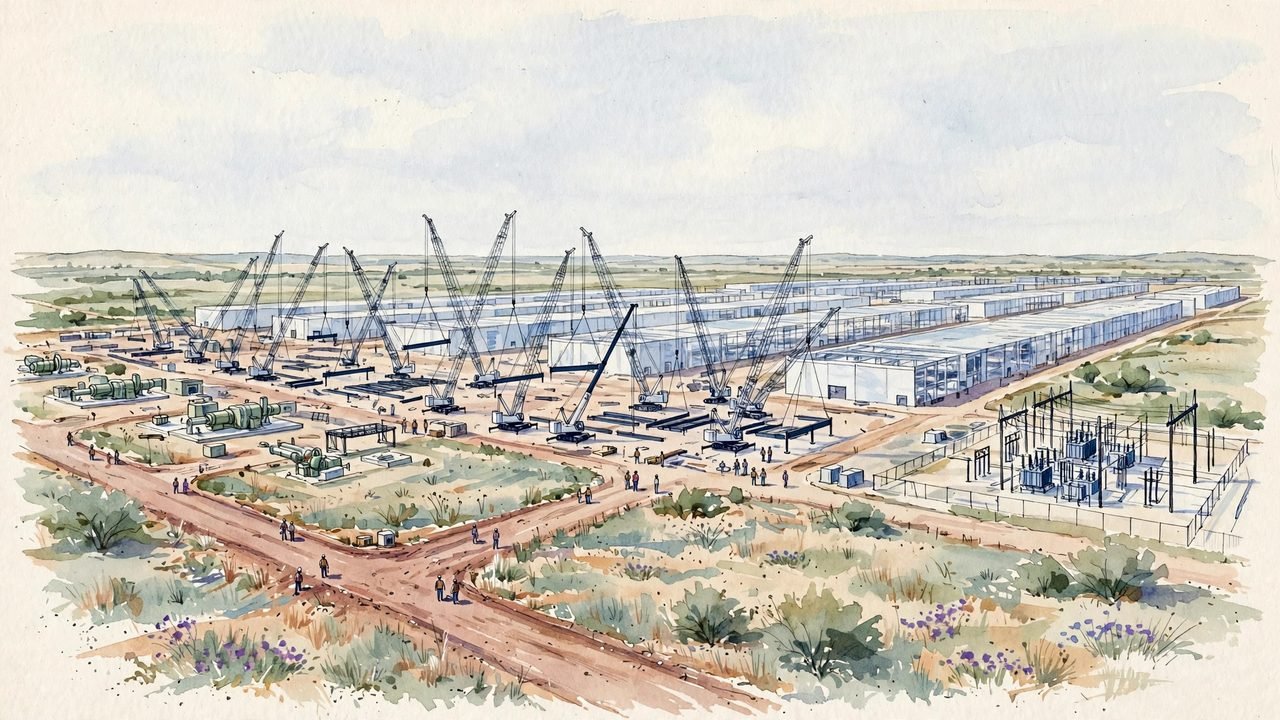
Stargate also requires more care from the reader than most of the programmes in this article, because its history is told in two kinds of number. The first kind is the announced number: the sum a company says it intends to invest, the capacity it plans to build, the date by which it expects to build it. The second kind is the verifiable number: money contractually committed, buildings under construction, racks delivered, halls energised. The gap between the two kinds of number is not a detail of the Stargate story. In large part, it is the Stargate story, and this chapter keeps the two apart throughout. Where a figure comes from an announcement, it is described as announced. Where reporting has tested an announcement against events, both versions are given.
A plan before it had a company
The name Stargate was in use before the venture existed. During 2024, reporting described a very large supercomputer that Microsoft and OpenAI were said to be planning together, costed in reporting at around $100 billion and intended, in some versions, to draw several gigawatts of power. That project, as reported, did not proceed in its original form. OpenAI had initially hoped to persuade Microsoft, then its exclusive cloud provider and largest backer, to support a mega data centre of roughly that character, according to later reporting based on conversations with OpenAI staff.[52] What emerged instead, in January 2025, was a multi-investor vehicle in which Microsoft was a technology partner rather than the funder — and in which OpenAI’s freedom to build with others had been written into its agreements with Microsoft on the same day, as a later section of this chapter explains.
The change of structure mattered. A single-customer infrastructure programme funded from Microsoft’s balance sheet would have been an extension of the arrangement described in chapter 2. A programme funded by a Japanese investment group, a database company turned cloud provider, an Abu Dhabi state-backed investor and OpenAI itself is something else: an attempt to raise infrastructure money the way power stations and toll roads raise it, through a dedicated company, project debt and outside investors, rather than from the operating cash flow of an existing technology giant. Whether that model can carry the sums involved is the question that has hung over Stargate since its first week.
A White House announcement
Stargate was announced on 21 January 2025, the first full day of Donald Trump’s second term as President of the United States. Trump presented the venture at the White House, flanked by Sam Altman of OpenAI, Masayoshi Son of SoftBank and Larry Ellison of Oracle. Reuters, reporting the event the following day, described a joint venture that would build data centres and create, in Trump’s words, more than 100,000 American jobs, with $100 billion committed for immediate deployment and the remaining investment expected over the following four years.[53] Ellison told the audience that data centres were already under construction in Texas. Altman described the project in similarly large terms, and Son, who had committed SoftBank to $100 billion of investment in the United States the previous month, allowed the figure to grow on stage into the Stargate total.
OpenAI’s own announcement, published the same day, is the primary document, and it is worth reading for what it does and does not say. It describes “a new company which intends to invest $500 billion over the next four years building new AI infrastructure for OpenAI in the United States”, adding, “We will begin deploying $100 billion immediately”.[54] The verbs are verbs of intention. The announcement does not say that $500 billion had been raised, deposited or contractually committed; it says the company intended to invest that sum, and that deployment of the first $100 billion would begin at once. It named the initial equity funders as SoftBank, OpenAI, Oracle and MGX, with SoftBank and OpenAI as lead partners, SoftBank holding financial responsibility, OpenAI holding operational responsibility, and Son as chairman. Arm, Microsoft, Nvidia, Oracle and OpenAI were named as the key initial technology partners, and the buildout was described as already under way, starting in Texas.[54] SoftBank’s press release of the following day repeated the same structure and figures in the same terms.[55]
The political framing was explicit. OpenAI’s announcement said the infrastructure would “secure American leadership in AI”, support “the re-industrialization of the United States” and provide “a strategic capability to protect the national security of America and its allies”.[54] Trump, for his part, presented the venture as evidence of business confidence in his administration and promised federal help with the energy and permitting such projects require. Readers of chapter 4 will recognise the underlying reality beneath the ceremony: by January 2025 the binding constraint on AI data centres in the United States was no longer enthusiasm or even money, but powered land — sites with a credible route to hundreds of megawatts — and Stargate’s first act after the announcement was to go looking for it. On 31 January 2025 OpenAI published a request for proposals focused on land and power, and a request for qualifications for design firms, inviting the industry to bring it sites.[54]
What the headline figures mean
Three figures from the announcement need to be held separately. The first is $500 billion over four years. That is an intention, stated by a company formed that week, and it covers everything the programme might spend: land, buildings, power infrastructure, cooling, and the computing equipment inside the halls, which is by far the most expensive part of any AI campus. The second figure is $100 billion, described as beginning deployment “immediately”. Even this was not a sum held in a Stargate bank account. Reporting by The Information, summarised in later coverage, put the initial equity commitments at about $19 billion each from SoftBank and OpenAI, who would each hold about 40 per cent of the venture, with Oracle and MGX contributing about $7 billion each; the balance of the programme’s cost was always expected to come from limited partners and from debt.[52] On those reported figures, the partners’ own equity amounted to roughly a tenth of the headline total. The rest had to be raised, project by project, against leases and purchase commitments.
The third figure is 10 gigawatts. OpenAI’s later announcements describe a commitment, made in January, to secure 10 gigawatts of capacity — roughly the output of ten large nuclear reactors, and, as chapter 3 noted, more power than many mid-sized countries devote to data centres in total. When OpenAI, Oracle and SoftBank announced five further American sites in September 2025, they said the programme had reached nearly 7 gigawatts of planned capacity and more than $400 billion of investment over the following three years, putting it, in their words, on a clear path to securing the full $500 billion, 10-gigawatt commitment ahead of schedule.[56] The careful reader will note the adjectives: planned capacity, and investment spread over years to come. A gigawatt planned is a site identified and a partner named. A gigawatt delivered is a substation energised and racks running. Stargate’s progress is best measured by watching the first kind of gigawatt turn into the second, site by site.
None of this makes the announcement empty. Infrastructure programmes of every kind begin as intentions, and some of the intentions described below have since become buildings. But the distinction explains much of the argument that has followed Stargate around. Its supporters point to the planned totals and to the speed of construction at its flagship site. Its critics point to the equity actually committed, to the debt still to be raised, and to the distance between a press release and a power purchase agreement. Both are describing the same programme at different points in its financial life.
Who does what
The governance announced in January 2025 divided the labour in a way that reflected each partner’s position. SoftBank, the Japanese investment group led by Masayoshi Son, took financial responsibility, and Son became Stargate’s chairman. SoftBank’s role was to assemble money: its own capital, co-investors and borrowing. OpenAI took operational responsibility: the venture existed to serve its requirements, and OpenAI would decide what was built and where. Oracle, the smallest of the established American cloud providers but the one most willing to build quickly for a single tenant, was both an equity funder and the programme’s principal builder-operator in its first phase. MGX, an Abu Dhabi investment firm focused on artificial intelligence and chaired by senior figures in the Emirates’ technology establishment, was the fourth equity funder, bringing Gulf capital into an American programme — a flow of money that later ran in the other direction as well, when Stargate itself went to Abu Dhabi.[54]
In practice, the centre of gravity shifted within months. The flagship site in Texas was not developed by Stargate as a company at all, but by Crusoe, a specialist builder, on land held by Lancium, financed by a joint venture of Crusoe, Blue Owl Capital and Primary Digital Infrastructure, and leased to Oracle, which operates it for OpenAI. Later sites followed the same pattern: a developer builds, an investor group finances, Oracle or SoftBank stands behind the lease or the power, and OpenAI is the customer whose demand justifies the whole structure. OpenAI itself has increasingly described Stargate not as a single company but as its “overarching AI infrastructure platform” — an umbrella under which bilateral deals with Oracle, with SoftBank, and with others are gathered.[56] That evolution, from joint venture to brand, is one of the keys to understanding the programme’s later history, including the disputes described below about which projects properly bear the name.
The financing model deserves a paragraph of its own, because it differs from the hyperscaler model of chapters 2 and 12. Microsoft, Alphabet and Amazon fund data centres largely from operating cash flow and corporate borrowing secured on the whole business. Stargate’s sites are financed more like independent power projects: a special-purpose venture raises construction debt against a long lease from a creditworthy tenant, equity investors take the residual risk, and the computing equipment is financed or leased separately. At Abilene, the two phases were financed through a joint venture that raised about $15 billion in debt and equity in total, including a construction loan arranged by JPMorgan for the second phase.[52] The model can move quickly, and it did. Its weakness is that every project must persuade lenders afresh, and lenders ask the question that runs through this chapter: how certain is the tenant’s demand, and how certain is the tenant?
Abilene, the flagship
The first Stargate campus stands outside Abilene, a city in Taylor County, west Texas, on a site developed by Lancium as its Clean Campus — a location chosen, as chapter 4 would lead one to expect, for its combination of land, wind generation and a grid connection that could grow. Construction of the data centre buildings began in June 2024, months before the Stargate name was attached to them, when Crusoe started work on a first phase intended for Oracle. That chronology is worth holding on to: the White House announcement did not conjure the Abilene campus into existence. It adopted a building project already under way and made it the flagship of a much larger claim.[57]
The campus as planned comprises eight buildings and about four million square feet, with a total capacity of about 1.2 gigawatts. The first phase — two buildings, with more than 200 megawatts of capacity — was built between June 2024 and the summer of 2025. Oracle began delivering the first Nvidia GB200 racks in June 2025, and early training and inference workloads followed. On 30 September 2025 Crusoe announced that the first phase was “now up and running on Oracle Cloud Infrastructure”, in the company’s words, a little over a year after construction began.[57] The second phase, six further buildings, began construction in March 2025 and was expected, when announced, to be energised in mid-2026. Oracle leases the campus, on a term reported at fifteen years, and operates it as part of Oracle Cloud Infrastructure, with OpenAI as the user of the capacity.[52] At completion, according to remarks by Oracle’s Larry Ellison reported in October 2025, the campus is expected to hold more than 450,000 GB200 processors — a figure stated by Oracle’s chairman as a plan, and best read as one.[58]
Abilene matters to the Stargate argument out of proportion to its share of the programme, because it is the part that can be photographed. Supporters, Altman among them, repeatedly invited sceptics to look at it: here were buildings, substations and racks, delivered at a speed the industry had not previously managed for a campus of this size. Critics replied, correctly, that one campus of 1.2 gigawatts, however impressive, is a fraction of a 10-gigawatt programme, and that the campus’s financing — a developer, an asset manager and a fifteen-year Oracle lease — owed little to the joint venture announced at the White House. Both observations are true, and the tension between them recurs at every Stargate site.
Power at Abilene and across the programme
A campus of 1.2 gigawatts needs the electricity supply of a city, and Abilene’s arrangements show how such supply is now assembled. Oracle’s own fact sheet for the site, as summarised in project documentation, says the campus connects directly to the ERCOT grid, the Texas system described in chapter 4, through a large purpose-built substation; Lancium’s filings describe a grid interconnection of the full 1.2 gigawatts. Behind the grid connection stands on-site generation: a gas-fired plant of about 360 megawatts, built with turbines from GE Vernova and Solar Turbines under Texas air permits, which Oracle’s fact sheet says will ultimately be used for backup power.[59] The sequence is typical of the current American buildout: grid power as the foundation, on-site gas as insurance and as a bridge, and the permits for the turbines taken out early, because generation that is not permitted cannot be built at all.
Elsewhere in the programme, power arrangements follow local conditions, in the pattern of chapter 4. In Milam County, Texas, the power is the product: SB Energy, SoftBank’s energy company, is providing what OpenAI calls “powered infrastructure” for a fast-build site — land with generation and connection already arranged, which is the scarcest commodity in the industry.[56] In Norway, as described below, the attraction was hydropower that local demand could not absorb. In Michigan, the state’s announcement emphasised that the campus would be served by the utility DTE Energy using existing excess capacity, with no new generation required and upgrade costs borne by the project rather than by other customers — a formulation that reflects how politically sensitive the power question has become.[60] In Abu Dhabi, the cluster sits inside a far larger government-backed campus whose power plans are a matter of national policy. Stargate’s site selection, in other words, is a power strategy before it is a real-estate strategy, and its published criteria in January 2025 put land and power first.[54]
Oracle’s widening role
If Stargate has a corporate winner whose position changed most during 2025, it is Oracle. The company entered the venture as the junior partner of the American cloud industry, with a cloud business far smaller than those of Microsoft, Amazon or Google. It leaves the programme’s first two years as OpenAI’s principal infrastructure supplier. The mechanism was a series of agreements that went well beyond the original joint venture. In July 2025, OpenAI and Oracle announced an agreement to develop up to 4.5 gigawatts of additional Stargate capacity in the United States, on top of Abilene — capacity that OpenAI said would run more than two million chips, with the Abilene site by then partly operational and its first GB200 racks delivered the previous month.[61] Bloomberg had reported the arrangement at the start of July as a rental agreement worth about $30 billion a year, a figure neither company confirmed in those terms.[62]
In September 2025, reporting based on people familiar with the contract put a total value on the relationship: about $300 billion over five years, described in coverage of Oracle’s results as one of the largest cloud contracts ever signed. Oracle did not confirm the figure directly, but its reported remaining performance obligations — contracted revenue not yet recognised — rose sharply in the same quarter, and the three Oracle-developed sites in the September site announcement, in Shackelford County in Texas, Doña Ana County in New Mexico and a Midwestern site later identified as Wisconsin, sit inside this Oracle partnership rather than inside the original four-party venture.[63] The distinction matters for the sceptical analysis below: the largest single piece of “Stargate” by value is a bilateral customer contract between OpenAI and Oracle, financed substantially by Oracle’s own rapidly growing capital expenditure and borrowing, and its delivery depends on Oracle’s ability to keep building and OpenAI’s ability to keep paying.
Microsoft, from exclusive provider to one partner among several
Stargate cannot be understood without the agreement it quietly renegotiated. From 2019, Microsoft was OpenAI’s exclusive cloud provider: its investment bought it the sole right to supply the computing behind OpenAI’s research and products, and chapter 2 describes how that arrangement underpinned Azure’s position in AI. By 2024 the exclusivity had become a constraint on both parties — on OpenAI, which wanted more capacity than Microsoft would commit to build, and arguably on Microsoft, which was being asked to fund, among other things, the $100 billion supercomputer project mentioned above. The announcement of Stargate was accompanied, on the same day, by a Microsoft statement recasting the relationship. The key elements of the partnership, Microsoft said, remained in place through 2030, including its rights to OpenAI’s intellectual property and its exclusivity over OpenAI’s application programming interfaces. But exclusivity over new capacity was replaced by a right of first refusal: Microsoft would be offered new OpenAI capacity first, and, to support OpenAI, Microsoft had “approved OpenAI’s ability to build additional capacity, primarily for research and training of models”.[64] Stargate was the additional capacity, and Microsoft’s statement pointedly welcomed it, describing the announcement as complementary to the companies’ work together.
The renegotiation did not stop there. On 28 October 2025, as OpenAI completed its recapitalisation into a public benefit corporation, the two companies signed a new definitive agreement. Microsoft’s investment in the restructured OpenAI was valued at about $135 billion, representing roughly 27 per cent of the company on the basis Microsoft described; its intellectual property rights were extended through 2032. OpenAI, in return, contracted to purchase an additional $250 billion of Azure services — and Microsoft gave up the right of first refusal it had acquired only ten months earlier, so that it “will no longer have a right of first refusal to be OpenAI’s compute provider”.[65] The sequence is instructive. In January, exclusivity became a right of first refusal, and Stargate became possible. In October, the right of first refusal itself was exchanged for a very large purchase commitment and a formal equity stake. Microsoft remained OpenAI’s largest single supplier and a central partner, but OpenAI’s infrastructure was, from that point, formally a multi-provider market in which Oracle, SoftBank, CoreWeave and others could compete — the market in which the rest of this chapter takes place.
More American sites
On 23 September 2025, at Abilene, OpenAI, Oracle and SoftBank announced five new American sites. Three were Oracle developments: in Shackelford County, Texas, the county adjoining the flagship; in Doña Ana County, New Mexico; and at a Midwestern site that the companies declined at first to locate, and which OpenAI confirmed on 22 October 2025 would be in Wisconsin, developed by Oracle with Vantage Data Centers. Together with a possible 600-megawatt expansion near Abilene, these were to deliver more than 5.5 gigawatts. The other two were the first sites developed through the SoftBank partnership itself: at Lordstown, Ohio, where SoftBank had broken ground on what OpenAI called an advanced data centre design, on track in the companies’ account to be operational the following year; and in Milam County, Texas, with SB Energy providing the powered site. The two SoftBank sites were described as able to scale to 1.5 gigawatts over the following eighteen months.[56] SoftBank’s own announcement of the same day used the same figures and described the five sites, with Abilene and projects with CoreWeave, as bringing Stargate to nearly 7 gigawatts of planned capacity and more than $400 billion of investment over three years.[66] The sites had been chosen, the companies said, from more than 300 proposals submitted from over 30 states after the January request for proposals.[56]
A sixth site followed on 30 October 2025: a campus of more than one gigawatt in Saline Township, Michigan, developed by Related Digital for Oracle and OpenAI, and known locally as The Barn. The Michigan governor’s office, announcing the selection the same day, described it as the largest one-time investment in the state’s history, with more than 2,500 union construction jobs, about 450 permanent jobs on site, power supplied by DTE Energy from existing capacity, and a closed-loop cooling system designed to use about as much water as an office building.[60] Related Digital’s announcement put the start of construction in early 2026, subject to approval by the Michigan Public Service Commission.[67] Construction was formally launched at a ceremony on 1 June 2026, by which time the project’s financing — a package reported at $16 billion, assembled from Related’s equity, funds associated with Blackstone and a large bond sale — had been put in place.[68] The Michigan campus is a fair specimen of the mature Stargate pattern: an experienced developer, a financing consortium, a utility with spare transmission capacity, a state government competing for the investment, and OpenAI’s demand, delivered through Oracle, at the centre of it.
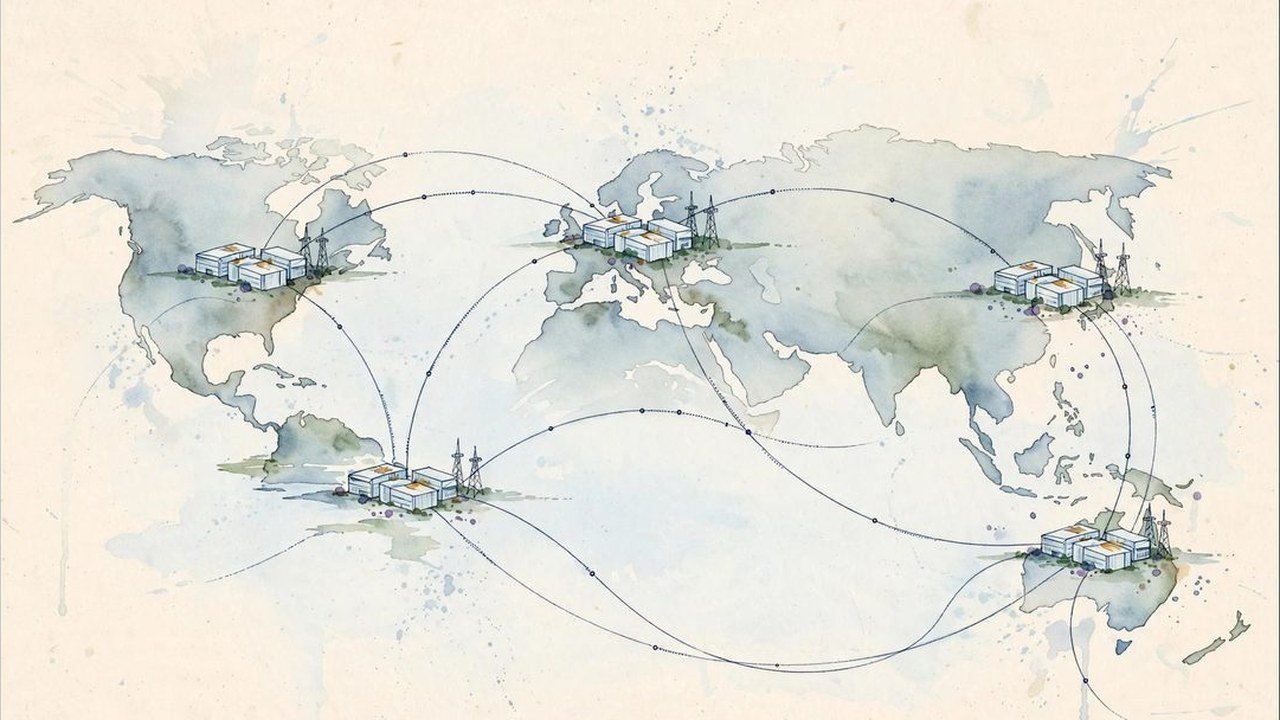
Stargate abroad
From May 2025, Stargate also became an export. OpenAI folded its international projects into a programme called OpenAI for Countries, offering governments a package of local data centre capacity, national access to its models and a share in the wider Stargate network, developed, as OpenAI put it, in coordination with the United States government. The first and largest of these ventures is Stargate UAE, announced on 22 May 2025: a one-gigawatt cluster in Abu Dhabi, built by the Emirati technology group G42, operated by OpenAI and Oracle, with Nvidia supplying Grace Blackwell GB300 systems, Cisco providing networking and security, and SoftBank among the partners. The first 200 megawatts were expected to go live in 2026. The cluster sits inside a wider UAE–United States AI campus planned at five gigawatts, and the arrangement included Emirati investment in American Stargate infrastructure in return — capital and compute flowing in both directions between Abu Dhabi and the United States.[69] G42 reported in October 2025 that construction of the first phase had begun; no commissioning of capacity had been announced in the companies’ updates since.[70]
Europe followed on 31 July 2025 with Stargate Norway, OpenAI’s first data centre initiative on the continent. The site, at Kvandal outside Narvik in northern Norway, was chosen for its hydropower, its cool climate and its limited local demand for electricity. It is owned by a joint venture between the British builder Nscale and the Norwegian industrial group Aker, each of which committed about $1 billion to an initial phase of 20 megawatts. The plan was to deliver 230 megawatts, with an ambition to add a further 290 megawatts, and to install 100,000 Nvidia processors by the end of 2026; OpenAI’s role was that of an off-taker, a committed buyer of capacity rather than an owner.[71] In September 2025 came Stargate UK, announced with Nvidia and Nscale during the American state visit, under which OpenAI would explore taking capacity beginning with up to 8,000 processors in early 2026, potentially rising to about 31,000, at sites including Cobalt Park in the North East AI Growth Zone.[72] Both European ventures were, from the start, smaller and less firmly specified than the American campuses: options and first phases, rather than gigawatt commitments.
The pattern reached Latin America on 10 October 2025, when OpenAI and the Argentine energy company Sur Energy signed a letter of intent for Stargate Argentina, a data centre in Patagonia of up to 500 megawatts, presented by the Argentine government as an investment of up to $25 billion within its incentive regime for large investments, with OpenAI again positioned as the prospective buyer of the capacity rather than its builder.[73] A letter of intent is the weakest instrument mentioned in this chapter: it records an intention to explore a project, not a contract to build one. Reporting into 2026 noted that no definitive contract had been signed and that the project had not been formally presented to the Argentine government under its investment regime.[74] The Argentine case is a useful corrective to any map of Stargate that colours in every announced country alike. Between a campus running workloads in Texas and a letter of intent in Patagonia lies most of the distance this chapter has been concerned with.
The sceptical case
The scepticism began within hours. On the night of the announcement, Elon Musk — a co-founder of OpenAI who had left its board years before, was suing it, and was building a competing company, xAI, whose Colossus cluster appears in chapter 3 — replied to OpenAI’s announcement on his social network with the words “They don’t actually have the money”, and added, in a further post, “SoftBank has well under $10B secured. I have that on good authority.” Altman replied the following day: “Wrong, as you surely know”, and invited Musk to visit the first site, which was already under construction. A source familiar with the matter told CNN, in response, that SoftBank held $24.3 billion of cash on its balance sheet and was comfortable taking on further debt for the project.[75] Musk’s claim was not substantiated in public then or later, and it came from an interested party; but it named the programme’s genuine vulnerability, which is that the announced total was an intention resting on a comparatively small base of committed equity, and it has been repeated, in more measured language, by analysts and reporters ever since. Microsoft’s Satya Nadella, asked about the exchange, confined himself to his own company’s plans: “All I know is, I’m good for my $80 billion.”[76]
The most substantial sceptical account came six months in. In July 2025 The Wall Street Journal reported, citing people familiar with the matter, that the Stargate company had yet to complete a single deal for a data centre, that SoftBank and OpenAI had disagreed over key terms including where to build and how far to build on sites tied to SB Energy, and that the partners had scaled back their near-term ambitions to a goal of completing one small data centre, probably in Ohio, by the end of the year. The Journal also reported that OpenAI had been applying the Stargate name to projects, including Abilene and a site at Denton, Texas, that SoftBank was not financing, although the Stargate trademark was held by SoftBank. The two companies responded in a joint statement that they were moving quickly to deliver AI infrastructure and making progress across several states.[77] Oracle’s chief executive, Safra Catz, had told investors the previous month, in a remark much quoted afterwards, that Stargate was “not yet formed”.[78] Set against the announcements, the Journal’s account described a joint venture that existed largely on paper while its partners pursued the actual building bilaterally — OpenAI with Oracle, OpenAI with CoreWeave, SoftBank on its own sites. The September site announcements, which were structured in exactly that bilateral way, did as much to confirm the description as to refute it.
A second line of scepticism concerns not the venture’s organisation but its arithmetic. OpenAI’s commitments across Stargate, its Oracle contract, its Azure purchases and its other cloud agreements grew during 2025 to a scale that Altman himself, in remarks reported in November 2025, put at some $1.4 trillion over the coming years — a sum far beyond OpenAI’s revenue, which is measured in the tens of billions, and one that depends on that revenue continuing to grow at something like its recent rate for most of a decade.[52] The partners’ announcements assume the demand; the contracts, in many cases, commit OpenAI to pay for capacity whether or not the demand arrives on schedule. None of this is concealed, and the same structure — commitments running ahead of revenue, justified by expected growth — appears in the economics of the established hyperscalers in chapter 12, at larger scale but against far larger existing revenues. The question the sceptics ask is not whether the buildings are real. By the end of 2025 some of them plainly were. It is whether a company of OpenAI’s present size can service commitments of this size if growth slows, and what would then happen to the developers, lenders and utilities who built against its signature.
Where the programme stands
At the time of writing, in November 2026, Stargate is best described as a programme at three different stages of reality at once. At Abilene, it is an operating campus approaching completion: Oracle told investors in September 2026 that six of the eight buildings, representing 618 megawatts, had been delivered, with the remaining buildings following.[58] In the United States more widely, it is a construction programme: Michigan under way since June 2026, the Oracle sites in Texas, New Mexico and Wisconsin at earlier stages, and the SoftBank sites in Ohio and Milam County announced as scaling towards 1.5 gigawatts between them.[68][56] In the Emirates, the first phase of the Abu Dhabi cluster is under construction towards its planned 2026 start, with the full gigawatt a plan rather than a schedule.[70]
At its edges, the programme has also contracted. In April 2026, according to Nscale’s later listing documents as reported in coverage of its flotation filing, OpenAI withdrew from the Stargate Norway and Stargate UK partnerships, and Microsoft expanded its own agreement with Nscale to take the capacity at Narvik instead — a turn of events that returns this chapter, neatly, to its Microsoft section: the partner whose exclusivity Stargate dissolved became, in Europe, the customer who replaced OpenAI in two of its ventures.[79] Stargate Argentina remains at the letter-of-intent stage described above.[74] And the original four-party joint venture, as a single company building a single programme, has receded behind the platform of bilateral deals that OpenAI now gathers under the Stargate name — deals which, whatever their legal form, have produced real buildings, real substations and real processors at a pace that the industry’s older occupants have had to answer. The chapters that follow turn to the component on which all of this depends, and over which the hyperscalers have fought their quietest and most consequential battle: the chip.
6. Chips designed in house
For most of the history of computing, the companies that ran large computer systems bought their processors from someone else. A bank, an airline or a university ordered machines from a manufacturer, and that manufacturer in turn bought or built the chips inside them according to a division of labour that seemed natural. Intel and AMD designed and, in Intel’s case, manufactured x86 processors. IBM and Sun made their own. The customer’s skill lay in software, operations and procurement, not in the layout of transistors. The hyperscalers broke that arrangement, slowly at first and then comprehensively. They did so not because designing chips is easy or cheap — it is neither — but because at their scale the processor stopped being a component they purchased and became a large part of the product they sold.
The logic begins with volume. A chip design that would be ruinously expensive for a company buying a few thousand servers can be rational for a company buying hundreds of thousands, year after year, to a specification it controls. The fixed costs of design, verification, masks and software are spread across a fleet. Small gains in performance per watt, repeated across that fleet, translate into fewer buildings, fewer substations and fewer cooling plants for the same amount of work, or more work from the same buildings. A second motive is fit. A merchant processor must serve many customers tolerably well. A hyperscaler’s processor can serve a narrower set of workloads very well, and can omit, shrink or rearrange anything those workloads do not use. A third motive is control over timing. A company that designs its own silicon can plan servers, racks, networks and data centres around a chip it knows is coming, rather than adapting to a supplier’s roadmap, allocation decisions and pricing.
None of this makes a hyperscaler self-sufficient. As the next chapter shows, almost none of these chips is manufactured by the company that designed it, and most depend on licensed intellectual property, bought-in memory, outside packaging and a long chain of specialist suppliers. Designing in house moves the boundary of the firm. It does not abolish the supply chain. What it changes is who decides what the chip should optimise for, who captures the margin that once went to a merchant supplier, and who bears the risk when a design is late, disappointing or overtaken by a change in workloads.
Google and the Tensor Processing Unit
Google was the earliest of the large internet companies to make this argument in public, and its Tensor Processing Unit, usually shortened to TPU, remains the clearest example of a hyperscaler accelerator designed from a specific internal problem outward. Google has described how, a little over a decade ago, its teams realised that the computational demands of machine learning, then spreading through speech recognition and other products, would outpace the infrastructure it had. In the company’s retrospective account, running neural networks for speech at Google’s scale on conventional processors threatened to require a very large expansion of its data centres, and the available alternatives did not meet the demand even for those early workloads. The response was a new kind of chip designed for the mathematics of neural networks rather than for general computing.[80]
The first TPU was deployed internally in 2015, according to Google, before it was announced publicly the following year. It was an inference chip, meaning that it ran models that had already been trained, answering queries in production services, rather than performing the training itself. That distinction matters. Inference in a live product has strict latency requirements. A speech query, a translation or a search result cannot wait while a processor works through a queue at its leisure, and the cost of the operation is incurred every time a user makes a request. An accelerator that performs the relevant matrix operations quickly and predictably, within a tight power budget, is worth a great deal even if it can do little else.
Google’s detailed account of the first TPU described a device built around a large matrix multiply unit, with tens of thousands of eight-bit multiply-and-add units arranged so that data could flow through them in a regular pattern, reusing values rather than fetching them repeatedly from memory. The company reported that, in its measurements, the TPU delivered substantially higher performance and performance per watt than the contemporary central processing units and graphics processing units it compared it with. Those comparisons belong to their period and to Google’s chosen workloads, and they should not be read as a ranking of present-day hardware. Their historical importance is different. They showed a large operator that a purpose-built chip, designed quickly for a narrow job, could outperform far more flexible devices bought from established suppliers.[81]
Subsequent generations widened the scope. The second and third generations, announced in 2017 and 2018, addressed training as well as inference, and Google began to organise TPUs not as isolated accelerators but as pods, large groups of chips connected by a dedicated interconnect and presented to software as a single machine for training a model. That shift, from chip to system, recurs throughout this chapter and the next. For large models, the limiting factor is rarely the arithmetic a single chip can perform in isolation. It is how fast many chips can exchange intermediate results, how much high-bandwidth memory each chip can reach, and how reliably the whole assembly can run for days or weeks without the failure of one part wasting the work of the rest.
The seventh generation, named Ironwood and introduced at Google Cloud Next in April 2025, illustrates where the emphasis has moved. Google described Ironwood as its first TPU designed specifically for inference, reflecting a phase in which the cost of running trained models for very large numbers of users matters at least as much as the cost of training them. The company said Ironwood could be configured in pods of 256 chips or 9,216 chips, that each chip offered 192 gigabytes of high-bandwidth memory, and that its performance per watt was twice that of Trillium, the sixth generation it had announced the year before. Those are Google’s own reported figures, given for its own configurations, and they describe peak or comparative performance under the company’s stated conditions rather than a universal measure. The direction they indicate is nevertheless plain. Memory capacity per chip, memory bandwidth and the interconnect between chips have become as important as raw arithmetic, because inference at scale is often a problem of moving model weights and intermediate data fast enough to keep the arithmetic units occupied.[82]
Google Axion and the general-purpose processor
For years Google’s most conspicuous gap, by comparison with Amazon, was a general-purpose server processor of its own. Its data centres ran on bought-in x86 processors for the ordinary work of computing — serving web pages, running databases, coordinating storage and hosting the accelerators themselves. In April 2024 Google closed that gap by announcing Axion, which it described as its first custom Arm-based central processing units designed for the data centre. Axion is built on Arm’s Neoverse V2 platform, a point to which this chapter returns when it considers licensing, and Google paired it with Titanium, its system of offload hardware that moves networking, security and storage tasks away from the main processor cores.[83]
Google’s claims for Axion were framed, as such claims usually are, against the alternatives a cloud customer might otherwise choose. The company said Axion-based instances would offer better performance than the fastest general-purpose Arm-based instances then available in the cloud, and better performance and energy efficiency than comparable current-generation x86-based instances, citing its own internal data. The precise percentages matter less than the strategic fact. With Axion, Google could offer its cloud customers a processor whose design it controlled, in the largest and most routine part of the market, rather than only in the specialised accelerator niche where the TPU sits. General-purpose computing is where most servers still spend most of their time, and it is where energy efficiency compounds most reliably across a fleet.
Arm summarised the same announcement in similar terms, presenting Axion as a continuation of Google Cloud’s custom silicon efforts and noting that Google services were already running on Arm-based servers with plans to scale deployments on Axion. The involvement of Arm in the telling is itself significant. Google designed Axion, but it did not design the instruction set architecture or the core from nothing. It licensed a proven foundation and built around it, which is how almost every hyperscaler processor in this chapter was made.[84]
Amazon, Annapurna and a portfolio built in layers
Amazon’s route into silicon began earlier and lower in the stack than most observers noticed. In 2015 it acquired Annapurna Labs, an Israeli chip company founded in 2011, and put it to work on the unglamorous infrastructure of Amazon Web Services. The first fruits were not accelerators for artificial intelligence but the Nitro system, a combination of hardware and software that offloads the work of virtualisation, networking and storage from a server’s main processors. In a cloud, that overhead is not trivial. Every cycle a host processor spends emulating hardware for tenants, encrypting traffic or managing storage is a cycle that cannot be sold to a tenant. By moving those functions onto dedicated hardware, Amazon could present customers with something closer to the full performance of the machine they were renting, while also strengthening the isolation between tenants on shared hardware.
Amazon describes the Nitro system as the foundation of its modern compute infrastructure, and says that offloading software functions to dedicated hardware gives it the flexibility to deliver new instance types more rapidly. It also places Nitro at the centre of its security story, with hardware-level monitoring and isolated environments for sensitive processing. Nitro rarely features in popular accounts of the chip race, because it neither trains models nor tops performance charts. Yet it may be the most instructive of Amazon’s designs, because it shows a hyperscaler identifying a cost that only it fully bore, at a scale only it fully understood, and designing silicon to remove it.[85]
On that foundation Amazon built Graviton, its family of Arm-based general-purpose processors. The first Graviton appeared in 2018, offering a lower-cost option for workloads that could run on Arm. Graviton2, Graviton3 and their variants widened its use across Amazon’s own services and its customers’ applications. The commercial proposition was consistent. Amazon said Graviton-based instances delivered better price performance than comparable x86-based instances, a claim it has repeated in updated form across generations, and it encouraged customers to move suitable workloads across. For many server applications, which are written in languages and frameworks that can be recompiled or run without change on Arm, the barrier proved manageable. For others, tied to x86-specific software, it did not, and Amazon continued to offer Intel and AMD processors alongside its own.
By the fourth generation the cadence was established. Announcing Graviton4 alongside Trainium2 in November 2023, Amazon said Graviton4 offered up to thirty per cent better compute performance than Graviton3, with fifty per cent more cores and seventy-five per cent more memory bandwidth, figures the company presented for its own comparison between its own generations. It described Graviton4 at the time as the most powerful and energy efficient chip it had built for a broad range of workloads, and noted that it was the fourth generation delivered in five years. A regular cadence is itself a claim about organisational capability. Designing one chip is a project. Designing four in succession, each manufactured, deployed and supported across a global fleet, is an institution.[86]
Amazon’s artificial intelligence accelerators follow the training and inference division seen at Google. Inferentia, first announced in 2018, was designed for inference, serving trained models at low cost per prediction. Trainium, announced in 2020, was designed for training. Both are exposed to customers through Amazon’s own instances and both are programmed through Amazon’s Neuron software development kit, which must persuade developers accustomed to other toolchains that their models will run correctly and efficiently on unfamiliar hardware. Amazon has consistently sold these chips on price performance rather than on peak performance alone, saying that Trainium offers the best price performance for training deep learning models in the cloud and that Inferentia delivers the lowest cost inference. Those are the company’s own characterisations of its products in its own cloud, and the relevant comparison for a customer is always the total cost of a finished training run or a served prediction, including engineering time, rather than a specification sheet.
Trainium2, announced with Graviton4, was presented as delivering up to four times faster training than the first Trainium generation and as deployable in what Amazon called EC2 UltraClusters of up to 100,000 chips, with up to twice the energy efficiency of its predecessor. In the following year Amazon linked Trainium2 publicly to its work with Anthropic, the artificial intelligence company in which it had invested, describing a very large cluster built from Trainium2 servers for training and serving Anthropic’s models. The arrangement shows another function of in-house silicon. It can anchor a partnership. A cloud provider that can offer not only capital and data centres but a proprietary accelerator roadmap has something distinctive to put in front of a model company choosing where to train.
Microsoft arrives later with Maia and Cobalt
Microsoft was the last of the three largest cloud providers to announce data centre processors of its own, and it did so in November 2023, at its Ignite conference, with two chips at once. The Azure Maia 100 is an artificial intelligence accelerator designed for training and inference in Microsoft’s data centres. The Azure Cobalt 100 is a general-purpose processor based on Arm architecture. Microsoft said both would begin rolling out to its data centres the following year, initially supporting its own services, including Copilot and the Azure OpenAI Service, before wider availability through Azure.
Maia 100 was described by Microsoft as a five-nanometre chip containing 105 billion transistors, among the largest chips built on that process at the time of its announcement. The company said it had been designed for the Azure hardware stack and developed with feedback from OpenAI, whose models were then the most prominent workloads on Azure, so that its design reflected how large language models actually ran on Microsoft’s infrastructure. As with Google’s TPU and Amazon’s Trainium, the accelerator was not offered for sale as a component. Its value would be realised inside Microsoft’s own services and cloud.
Cobalt 100 is a 128-core, 64-bit processor built on Arm’s Neoverse compute subsystem technology. Microsoft said it delivered a performance improvement of up to forty per cent over the previous generations of Arm-based servers in Azure, and that it was already powering services including Microsoft Teams and Azure SQL. The pairing of the two chips follows the pattern set by its rivals. An accelerator without an efficient host processor leaves part of the problem unsolved, because accelerators must be fed by general-purpose machines that prepare data, coordinate work and serve results. A host processor without an accelerator leaves the fastest-growing and most expensive workload to bought-in hardware. Microsoft’s announcement was therefore less a single product launch than an admission that the full stack had become the unit of competition.[87]
The company also had to build the physical system around Maia, including custom server boards and racks and a liquid cooling arrangement in which a unit beside the rack circulates coolant to plates attached to the chips. That detail, reported at the time of the announcement, belongs in any account of in-house silicon because it corrects a common simplification. A chip is not deployed by placing it in an existing server. At these power densities the server, the rack, the cooling and often the building are redesigned around it, which is one reason hyperscalers can contemplate accelerators that a smaller operator could not use even if it could buy them.
Meta and the accelerator for recommendation
Meta is not a cloud provider in the same sense as Amazon, Microsoft or Google. It does not rent its data centres to the public as its main business. Its silicon programme therefore answers a different question, namely what a very large consumer service should build for itself when its most expensive computations are its own. The answer, in Meta’s case, began with recommendation. The systems that rank posts, reels and advertisements for billions of users run continuously, at enormous volume, and their cost is a direct cost of the product rather than a service that can be billed to an outside customer.
Meta unveiled the first Meta Training and Inference Accelerator, shortened to MTIA, in 2023, describing it as its first-generation artificial intelligence inference accelerator designed in house for its deep learning recommendation models. In April 2024 it shared the next generation, saying that it more than doubled the compute and memory bandwidth of the previous solution, that it was designed to serve ranking and recommendation models, and that it had been deployed in its data centres and was serving models in production. Meta said the newer design used a rack system holding up to seventy-two accelerators, ran at a higher clock speed and a higher power level than the first generation, and formed part of a broader programme for custom, domain-specific silicon that would work alongside, rather than simply replace, bought-in graphics processors.[88]
Apple silicon as a contrast
Apple is not a hyperscaler, and its processors are not data centre chips, yet no account of in-house design is complete without it, because Apple demonstrated earlier than most what control of silicon could do for a company that also controlled the software and the finished product. Its A-series processors for the iPhone, built on licensed Arm architecture and manufactured by outside foundries, established a large internal design organisation long before the hyperscalers announced their server chips. In November 2020 Apple introduced M1, which it described as the first chip designed specifically for the Mac and the first personal computer chip built using five-nanometre process technology, with sixteen billion transistors and a unified memory architecture that brought memory into a single pool for the components of the system on a chip. Apple said the transition of the Mac line to its own silicon would take about two years.[89]
The contrast cuts in two directions. On one side, Apple showed that a company without a history as a merchant processor vendor could design leading processors, provided it hired and retained the expertise, licensed the right foundations and secured manufacturing capacity. On the other, Apple’s chips succeed inside a closed product whose hardware and operating system are released together. A hyperscaler faces a harder software problem. Its processors must run other people’s workloads, in many languages and frameworks, often written with no thought for its silicon at all. That is why the hyperscalers’ general-purpose processors have usually been conservative in architecture, however ambitious their accelerators have been, and why the choice of instruction set, considered next, has mattered so much.
Why hyperscalers design silicon
Drawing the threads together, five reasons recur. The first is cost at scale, including the supplier margin a hyperscaler can retain for itself and the energy it can save across a fleet. The second is performance per watt, which in a power-constrained building is effectively additional capacity without additional land or grid connection. The third is fit, the ability to build for recommendation, inference, virtualisation or a particular model architecture rather than for the average of a market. The fourth is supply and negotiating position, since a credible in-house alternative changes every conversation with a merchant vendor, even where the in-house chip handles only part of the fleet. The fifth is pace, the ability to co-design chips with servers, racks, networks and software on one timetable.
Arm in depth — the licensed foundation
Arm Holdings is the most consequential company in this chapter that sells no data centre chip of its own. It designs processor architectures and cores and licenses them to others, who turn them into chips. Graviton, Cobalt and Axion are all Arm-based. So are Apple’s processors, Nvidia’s Grace, Ampere’s server processors and the processors in almost every smartphone. To understand why three competing hyperscalers, starting from different positions, converged on the same foundation, it is necessary to understand what Arm is, where it came from and what it actually sells.
Arm’s own official history traces its pre-history to Acorn Computers, established in Cambridge in 1978, which built the BBC Micro and where Professor Steve Furber and Sophie Wilson designed the first Arm processor. The architecture’s first commercial setting was Acorn’s Archimedes computer. Arm itself was officially founded in November 1990 as Advanced RISC Machines Ltd, a joint venture between Acorn Computers, Apple Computer and VLSI Technology, founded by twelve Arm architecture designers and based in Cambridgeshire. The founding structure already contained the future business model. Acorn contributed the design team and the architecture, Apple contributed investment and a prospective use in its Newton project, and VLSI contributed tools and manufacturing access. None of the three needed Arm to become a chip manufacturer. They needed it to develop and license a processor design that each could use.[90]
Ownership has changed more than the model. SoftBank Group announced in September 2016 that its acquisition of Arm had taken effect and that the entire issued share capital was owned by SoftBank and its wholly owned subsidiaries, for a total acquisition price of approximately £24.0 billion, which SoftBank gave as approximately US$31.0 billion. Arm was delisted from the London Stock Exchange. SoftBank subsequently agreed to sell Arm to Nvidia, a transaction announced in 2020 that was abandoned in 2022 after sustained regulatory scrutiny in several jurisdictions, a sequence worth recording because it showed how central Arm’s neutrality had become. A licensor owned by one of its largest licensees would have faced questions from every other licensee about equal treatment, and those questions were a substantial part of the case against the deal.[91]
Arm returned to public markets instead. Its newsroom announced the closing of its initial public offering on 18 September 2023, with American depositary shares priced at $51.00 each and trading on the Nasdaq Global Select Market under the symbol “ARM”, including the underwriters’ full exercise of their option to buy additional shares. SoftBank remained the majority owner after the listing, so the flotation restored a public price and a degree of public scrutiny without changing control. For the hyperscalers, the practical point is that their processor roadmaps rest partly on a company whose controlling shareholder is a Japanese investment group, whose headquarters and much of its engineering remain in Cambridge, and whose customers include almost all of their competitors.[92]
The licensing and royalty model is the heart of it. In its filings Arm describes a flexible model in which customers license its products for a fee, giving them access to the products and enabling them to develop Arm-based processors, and in which Arm then receives a per-unit royalty on substantially all Arm-based chips shipped once a processor has been designed and manufactured with its products. Within that model, an architecture licence agreement allows the licensee to develop its own highly customised processor designs compliant with the Arm instruction set architecture, for a fixed architecture licence fee. Other licensees take Arm’s processor designs themselves, in varying degrees of completeness, rather than designing a core from the architecture alone.[93]
Three tiers therefore need to be distinguished, because the single phrase “Arm-based” conceals them. At the first tier, a licensee such as Apple takes an architecture licence and designs its own cores, using Arm mainly for the instruction set, the architecture’s rules and the right to claim compatibility. At the second, a licensee takes Arm-designed cores, such as the Neoverse cores described below, and integrates them with its own memory controllers, interconnect, accelerators and input and output into a complete system on a chip. At the third, increasingly important in data centres, a licensee takes a whole compute subsystem from Arm, a pre-integrated and verified collection of cores, mesh interconnect, memory and input and output, and concentrates its own effort on what surrounds it. Each step down that list trades differentiation for speed and lower design risk. Each also changes what Arm earns and how much of the resulting chip is meaningfully the licensee’s own work, a distinction that marketing language tends to blur and that readers should keep in mind whenever a company announces that it has “designed” an Arm processor.
Neoverse is Arm’s name for the family built for infrastructure, as distinct from the Cortex lines associated with mobile and embedded devices. Arm describes Neoverse as a family of infrastructure-class processor cores built on the Arm architecture and optimised for cloud computing, high-performance computing, artificial intelligence and machine learning workloads and edge deployments. Within it, the V series is aimed at maximum performance for cloud and high-performance work, while the N series is aimed at efficient scale and performance per watt for cloud-native and related workloads. Arm’s own guide lists the processors already encountered in this chapter among the platform’s users, including AWS Graviton built on Neoverse V2, Microsoft Azure Cobalt 100 based on Neoverse CSS N2 and Cobalt 200 on a later subsystem, and Nvidia’s Grace built on Neoverse V2.[94]
The compute subsystem, shortened to CSS, is where Arm’s offer has moved furthest from licensing a core. Arm’s developer documentation describes Neoverse CSS N2 as an Arm-configured, verified and performance-validated subsystem of up to sixty-four N2 cores targeting an advanced five-nanometre process, including the selection and configuration of third-party intellectual property for memory and for PCIe and CXL input and output, together with platform software. In plain terms, Arm will now supply much of what used to be the licensee’s own integration work, checked in advance on a stated manufacturing process. For a hyperscaler, that shortens the path from decision to silicon and reduces the chance of an integration failure. For Arm, it increases the value captured per design and makes its technology harder to replace. For the industry, it raises a quiet question about where design ends and assembly begins, which will matter more as subsystems grow to include more of the chip.[95]
Why, then, did Graviton, Cobalt and Axion all choose Arm rather than building on x86 or designing a wholly new architecture? The first reason is licensing itself. The x86 instruction set is controlled by Intel and AMD and is not available on terms that would let a hyperscaler design its own compatible server processor at will. Arm, by contrast, exists to license. The second reason is energy. Arm cores designed for scale-out work offer many comparatively simple, single-threaded cores in a power budget that suits cloud workloads, where a provider sells capacity by the virtual machine and profits from packing more of them into each rack. The third reason is customisation. An Arm licensee can choose core counts, cache sizes, memory channels and accelerators to suit its own fleet, and can integrate offload hardware such as Nitro or Titanium on the same die or package. The fourth reason is that the software barrier had fallen by the time the hyperscalers moved. Linux, the major programming languages, containers and most cloud-native software already ran well on Arm because of its dominance in mobile and its use in development machines, so the cost of moving suitable workloads was far lower than it would have been a decade earlier. None of these reasons required Arm to beat x86 core for core on every benchmark. They required it to be good enough, licensable and efficient, in that order.
RISC-V presents the longer-term alternative. RISC-V International describes RISC-V as an open standard instruction set architecture, explains that it produces specifications rather than hardware implementations, and notes that implementers create their own hardware compatible with those specifications, which may be open source or commercial. No architecture licence fee or per-chip royalty is owed for using the standard itself, and anyone may design a core to it. That openness is attractive to governments and companies concerned about dependence on a single licensor, and RISC-V has become well established in microcontrollers, embedded devices and some accelerators, including inside hyperscaler hardware in supporting roles. In Meta’s MTIA, for example, RISC-V cores handle control functions alongside the main processing elements.[96]
Two other Arm licensees complete the picture, because they show that hyperscalers were not the only route by which Arm reached the data centre. Ampere Computing, founded in the United States and led by former Intel president Renée James, set out to sell Arm server processors as a merchant vendor to cloud providers and enterprises that wanted Arm efficiency without designing a chip. Its earlier Altra family used Arm-designed Neoverse cores. Its AmpereOne family moved to cores Ampere designed itself under an architecture licence. Ampere’s product brief describes AmpereOne processors with from ninety-six to 192 custom cores, built on a five-nanometre process, with eight channels of DDR5 memory and 128 lanes of PCIe Gen5, aimed at high server rack density and scalable throughput. Ampere processors were adopted by several cloud providers, including Oracle and, for a period, as an Arm option alongside hyperscalers’ own chips in their clouds.[97]
Nvidia’s Grace shows the third route. Grace is not a hyperscaler’s chip or a merchant server processor sold on its own merits. It is the Arm-based host processor Nvidia designed to sit beside its own graphics processors, so that the company which sold the accelerator could also supply the processor feeding it, connected tightly enough that the pair behaves as one system. Nvidia describes the Grace CPU Superchip as two Grace processors connected by its NVLink chip-to-chip interconnect at 900 gigabytes per second, packing 144 Arm Neoverse V2 cores into a single module with server-class LPDDR5X memory delivering up to one terabyte per second of memory bandwidth, and it pairs the same processor with its Hopper and later graphics processors in the Grace Hopper and Grace Blackwell superchips.[98]
Grace matters to this story for two reasons. It demonstrates that the Arm licensing model serves the accelerator leader as readily as it serves the hyperscalers trying to reduce their dependence on that leader, so Arm gains whichever side prevails. And it shows where the contest has moved. The valuable unit is no longer a processor or an accelerator in isolation but a tightly coupled pair, with memory and interconnect arranged so that neither starves the other. Arm supplies the processor foundation inside that unit, Nvidia supplies the accelerator and the interconnect, and a foundry, considered next, manufactures both.
7. Fabless firms and foundries
Designing a chip and making a chip are different industries that happen to share a vocabulary. The hyperscalers of the previous chapter are, in manufacturing terms, fabless. They employ architects, verification engineers and software teams, they specify transistors and arrange them into designs, and then they hand those designs to another company to manufacture. That company, a foundry, owns the fabrication plants, or fabs, in which silicon wafers are processed through hundreds of steps into finished chips. The separation of design from manufacture is the single most important structural fact in modern semiconductors, and it is the reason a search company, a retailer and a social network could all become chip designers within a decade. None of them had to build a fab.
A fabless company needs no clean room, no lithography machines and no process engineers, though it needs a great deal of money and expertise of other kinds. A foundry needs capital on a scale few other industries contemplate, because a leading-edge fab costs many billions of dollars before it produces a saleable chip, and it must be kept at the frontier by continuous further investment or it falls behind within a generation. Between the two sit other specialists. Some firms sell only designs, as Arm does. Some, such as Broadcom and Marvell, help customers turn an architecture into a manufacturable chip. Others supply the equipment, the chemicals, the design software and the high-bandwidth memory without which neither designer nor foundry can work. The hyperscalers entered this structure at its least capital-intensive point and became dependent on its most capital-intensive point, which is why the geography of fabs now occupies finance ministries as much as it occupies engineers.
Nvidia, AMD and the merchant fabless model
Nvidia is the defining fabless company of the artificial intelligence period. It designs graphics processing units and the systems around them, writes the CUDA software platform on which much machine learning development has been built, and has its chips manufactured for it, principally by TSMC. Its position does not rest on the GPU alone. It rests on the combination of capable silicon, an interconnect that lets many GPUs work as one machine, networking acquired with Mellanox, and a software ecosystem that developers had adopted long before the present wave of demand. A customer buying Nvidia is buying that whole stack and, just as importantly, buying confidence that its code will run.
The Blackwell generation, announced in March 2024, shows the scale the merchant model reached. Reporting of the launch described Blackwell graphics processors with 208 billion transistors, manufactured using a custom TSMC 4NP process, with two dies connected by a ten terabit per second chip-to-chip link so that they function as a single graphics processor. Those figures are Nvidia’s, reported at announcement, and the architecture has since been extended, but the structural point stands. The most valuable chip designer in the industry owns no leading-edge fab, and its flagship product is a pair of dies made by a Taiwanese foundry and joined by advanced packaging.[99]
AMD is the other large merchant alternative, and it arrived at the fabless model by the opposite route. AMD once manufactured its own chips. It spun off its factories in 2009 into what became GlobalFoundries, and thereafter designed processors and graphics chips for manufacture elsewhere, principally TSMC for its leading products. Its revival in server processors with the EPYC line, and its position as the second supplier of x86 processors, both rest on that separation. In artificial intelligence AMD offers the Instinct family of accelerators and the open ROCm software stack. Announcing the MI300 series in December 2023, AMD said the MI300X accelerator offered 192 gigabytes of HBM3 memory and 5.3 terabits per second of peak memory bandwidth, and it named Microsoft, Meta and Oracle among the customers deploying or planning to deploy it. Those are AMD’s reported specifications and customer statements at launch.[100]
AMD’s appeal to hyperscalers is partly technical, in particular memory capacity, and partly structural. A second merchant source disciplines the first, and an open software stack promises an escape from dependence on a single vendor’s toolchain. Its difficulty is the mirror image of Nvidia’s strength. Software ecosystems accumulate over years, and a challenger must persuade developers not merely that its hardware is competitive but that the cost of moving, debugging and maintaining code on a different stack is worth paying. Hyperscalers, with large internal engineering teams and a strong interest in a second source, are the customers best placed to pay it, which is why their adoption decisions carry weight beyond the volumes involved.
Broadcom and Marvell as design partners
Between the merchant vendors and the hyperscalers sits a third kind of fabless firm, the design partner. Broadcom is the largest example. Alongside its networking chips, which connect many of the clusters discussed in this article, Broadcom works with hyperscalers to turn their accelerator architectures into finished silicon, supplying design expertise, high-speed interface intellectual property and experience of taking very large chips through a foundry’s process. Reporting on that business has noted that Broadcom’s custom accelerator work began with Google’s first Tensor Processing Unit in 2014, that it co-designs accelerators with customers before sending them to TSMC for manufacture, and that it helps assemble complete systems with memory and networking through its own switch families. Customers identified in that reporting included Google, Meta and ByteDance.[101]
TSMC and the pure-play foundry
Taiwan Semiconductor Manufacturing Company, known as TSMC, is the foundry on which most of the designs in this article depend. It was founded in 1987 in Taiwan under Morris Chang to pioneer the pure-play foundry model, manufacturing chips designed by other companies rather than competing with them by selling chips of its own design. That promise of neutrality was the innovation. A designer could hand its most valuable intellectual property to TSMC with reasonable confidence that TSMC would not use it to build a rival product, because TSMC had no rival product. Backed at its founding by Taiwan’s government through its industrial research institute and by Philips, the company grew with the fabless industry it had made possible, listing in Taiwan in 1994 and in New York in 1997.[102]
The relationship is now one of mutual dependence at unusual scale. TSMC’s largest customers are also the world’s largest technology companies, and its leading-edge capacity is allocated among them years ahead. Apple takes a large share for its telephone and computer processors. Nvidia, AMD, Broadcom and Qualcomm take capacity for accelerators, processors and communications chips. The hyperscalers’ own TPUs, Graviton processors, Maia accelerators and MTIA chips are manufactured there. When several of those customers expand at once, as they have during the artificial intelligence build-out, capacity, and in particular advanced packaging capacity for attaching high-bandwidth memory to large accelerators, becomes a constraint on the whole industry. A foundry’s decision about where to build its next plant, and a customer’s willingness to commit to volume in advance, are therefore strategic acts, not procurement details.
Advanced packaging deserves its own sentence in any account of foundries, because it has moved from an afterthought to a bottleneck. Large accelerators are now assembled from multiple dies and stacks of high-bandwidth memory joined on an interposer, using TSMC’s CoWoS packaging among other approaches, and the supply of that packaging has at times limited shipments of finished accelerators more than the supply of wafers. The industry’s centre of difficulty has shifted accordingly, from drawing a smaller transistor to assembling several very large pieces of silicon so that they behave as one.
Samsung Foundry and Intel Foundry
TSMC has two would-be rivals at the leading edge, each with a different handicap. Samsung Foundry is part of Samsung Electronics, the South Korean group that is also a leading maker of memory chips and a designer of its own processors and telephones. It offers an integrated proposition, logic manufacture alongside the high-bandwidth memory that accelerators require, from a single corporate group. Its difficulty is that it competes with some of its own potential customers in finished products, and that it has repeatedly had to work to convince large external designers that its leading-edge processes match TSMC’s in yield and reliability. Samsung was early with gate-all-around transistors, beginning production on its three-nanometre process using that architecture in June 2022, a genuine technical milestone that did not by itself translate into a comparable share of external leading-edge orders.[103]
Intel Foundry is the American attempt to rebuild a third option. Intel, historically an integrated device manufacturer that designed and made its own processors, opened its factories to external customers and organised them as a foundry business, seeking orders from the same designers that TSMC serves. Its pitch combines leading-edge processes in the United States and Europe with advanced packaging, and it has the explicit backing of American industrial policy. Its difficulty is the reverse of TSMC’s founding promise. Intel still designs and sells processors that compete with the products some prospective foundry customers want to build, and its foundry must establish a record of delivering for outsiders on schedule. Both Samsung and Intel illustrate the same lesson. Having a process is not the same as having a foundry business, because a foundry business is a reputation accumulated across many customers and many years.
Behind these three, other foundries including GlobalFoundries in the United States and Europe, UMC in Taiwan and SMIC in China manufacture the less advanced but indispensable chips that data centres also need, for power management, networking, controllers and countless supporting functions. A hyperscale data centre is not made only of leading-edge silicon, and disruptions in mature capacity, as the shortages of the early 2020s showed, can halt production of equipment whose most advanced component is readily available.
ASML and the machines that make the machines
Every leading-edge foundry depends in turn on one supplier. ASML, based in Veldhoven in the Netherlands, is the only supplier of extreme ultraviolet lithography systems, the machines that print the finest patterns on a wafer using light of a very short wavelength, generated by firing a laser at droplets of molten tin to create a plasma. Because extreme ultraviolet light is absorbed by air and by glass, these systems work in a vacuum and use mirrors rather than lenses, with optics supplied by Zeiss in Germany. ASML also supplies the deep ultraviolet systems used for less demanding layers. Without its machines, no foundry can manufacture at the leading edge, which makes a Dutch equipment company, with its own long supply chain, a foundation of the entire structure described in this article.[104]
Fab geography and industrial policy
The map of leading-edge manufacture is strikingly concentrated. Most of TSMC’s advanced capacity is in Taiwan, in and around Hsinchu and in the south of the island. Samsung’s is in South Korea. Intel’s is divided between the United States, Ireland and Israel, with expansion planned in Germany. Equipment comes disproportionately from the Netherlands, Germany, the United States and Japan. Design is concentrated in the United States, with Arm in Britain as the great exception. High-bandwidth memory comes mainly from South Korea and the United States. Almost every stage has a small number of locations, and several have effectively one.
Governments have responded with subsidies on a scale not seen in this industry for decades. The United States’ CHIPS and Science Act of 2022 provided $52.7 billion for American semiconductor research, development, manufacturing and workforce development, including $39 billion in manufacturing incentives and a twenty-five per cent investment tax credit for capital expenses for manufacturing semiconductors and related equipment, according to the White House fact sheet issued when the Act was signed. Awards went to TSMC, Samsung, Intel and others to support plants in the United States.[105]
TSMC’s expansion in Arizona is the most closely watched test of whether leading-edge manufacture can be transplanted. The company committed to a series of fabs there, and in 2025 announced additional investment that took its planned total in the United States to a figure it and the United States government presented as $165 billion, including further fabs, packaging facilities and a research centre. Japan has supported a TSMC joint venture in Kumamoto and a research effort of its own. The European Union adopted its own Chips Act to increase its share of world production. India has approved incentives for assembly, testing and some fabrication. China, largely excluded from the most advanced equipment, has supported its domestic industry through state funds over many years.
For the hyperscalers, all of this arrives as a set of practical constraints. Their chips are designed in California, Washington, Texas and Israel, on architecture licensed from Cambridge, with design help in some cases from Broadcom or Marvell, manufactured mostly in Taiwan on Dutch machines with German optics, packaged with Korean or American memory, and installed in data centres whose location is increasingly chosen with an eye to power and politics as much as to customers. Designing in house gave them control over what their silicon does. It did not give them control over where it can be made, and the next part of this article turns to the buildings, power supplies and networks in which that silicon has to live.
8. The model builders as hyperscalers
The first seven chapters of this article have treated the hyperscalers as the firms that own the buildings, the power contracts and the chip programmes, and the model companies — the firms that train and sell access to large language models — as their customers. That division was accurate for most of the cloud era. It is no longer accurate. Two model companies, OpenAI and Anthropic, now commit money, sign power-scale contracts and shape silicon roadmaps on a scale that the established hyperscalers themselves recognise as comparable to their own. OpenAI has contracted to purchase an incremental $250 billion of Azure services from Microsoft alone, under the agreement the two companies announced in October 2025.[106] Anthropic, in its filing for a public listing, disclosed commitments to spend at least $110 billion with Amazon, approximately $114.5 billion with Google and $44.9 billion with Microsoft on cloud computing over the next seven to ten years, according to summaries of that filing in financial reporting.[107] Neither company is a cloud provider in the older sense. Neither sells general-purpose computing capacity to the public as its main business. Yet between them they have become the largest single source of new demand in the industry this article describes, and the infrastructure programmes of Microsoft, Amazon, Google, Oracle and CoreWeave cannot be understood without them.
This chapter examines that position from three directions. The first is the pattern of their buying: how OpenAI moved from a single exclusive cloud to a web of arrangements spanning at least six providers, and how Anthropic built a different structure around one primary partner and two large secondary ones. The second is silicon: OpenAI now designs its own accelerator, with working samples shown in June 2026, while Anthropic — as the sources set out below make plain — has announced no processor of its own, and instead works inside other firms’ chip programmes, though it confirmed in August 2026 that it is building an in-house chip design team. The third is the rest of the field: the in-house silicon of the Chinese and Korean hyperscalers, which chapter 6 could only summarise, and the contrasting position of Oracle and xAI, two large builders that have chosen to buy processors rather than design them.
Two customers on a hyperscale of their own
The word duopoly needs care, and it is used in this chapter in a narrow sense. OpenAI and Anthropic are not the only firms training frontier models. Google trains Gemini inside its own infrastructure, Meta trains the Llama family inside its own, xAI trains Grok inside its own, and capable model firms operate in China and Europe. What distinguishes OpenAI and Anthropic is that they are the two largest model companies that do not own a pre-existing hyperscale cloud. Google’s demand for computing is internal to a hyperscaler; OpenAI’s and Anthropic’s demand arrives at the hyperscalers from outside, as contracts. When a cloud provider reports a backlog figure or announces a new campus, a substantial share of the demand behind it now traces back to one of these two customers. In late 2025 OpenAI’s chief executive put the company’s total compute commitments at about $1.4 trillion over roughly eight years, a figure reported at the time and repeated in later analyses of the company’s obligations; it should be read as the company’s own characterisation of its commitments, not as audited spending.[108]
The consequences run in both directions. For the hyperscalers, the two model companies are anchor tenants of a kind the industry has not previously had: customers whose individual training runs can justify a campus, and whose inference traffic — the continuous work of answering users — fills capacity between training runs. For the model companies, the dependence is equally real. A frontier training run requires a cluster that only a handful of organisations on earth can assemble, power and keep running for months. OpenAI and Anthropic therefore negotiate simultaneously as customers, as investees and, increasingly, as co-designers of the infrastructure they rent. Microsoft holds a large equity stake in OpenAI; Amazon and Google both hold stakes in Anthropic; Nvidia has agreed to invest in both. The result is not a simple market in which two buyers shop among competing sellers. It is a set of interlocking commitments in which the same firms appear as supplier, investor and, in Google’s and Microsoft’s cases, direct competitor in models.
There is also a shared structural problem. Both companies’ revenues, though growing quickly by their own accounts, are far smaller than the infrastructure commitments they have signed, and both rely on continued access to very large amounts of external capital. The hyperscalers that build against these commitments carry part of that risk on their own balance sheets, a question taken up in chapter 12. What matters for this chapter is the direction of travel: two firms that began as research laboratories now sit at the centre of the largest construction programme in the history of computing, and the established hyperscalers plan around them.
OpenAI and the end of the single cloud
OpenAI’s original arrangement was exclusive. From 2019, Microsoft was its cloud provider, its principal investor and the channel through which its models reached enterprise customers, and new capacity was Microsoft’s to build. The loosening came in stages. In January 2025 the two companies replaced exclusivity over new capacity with a right of first refusal for Microsoft. The definitive change arrived with the restructuring of October 2025, under which OpenAI became a public benefit corporation, Microsoft took a stake of roughly 27 per cent in the new for-profit entity, OpenAI contracted to purchase an incremental $250 billion of Azure services, and Microsoft’s right of first refusal over OpenAI’s compute ended.[106] Azure remained, by commitment, OpenAI’s largest single supplier. It was no longer its only possible one, and OpenAI moved quickly.
The largest of the new arrangements, by reported value, is with Oracle. Reporting through 2025 described a contract of about $300 billion over roughly five years for Oracle Cloud Infrastructure capacity, much of it associated with the Stargate programme described in chapter 5; Oracle does not break its backlog down by customer, so the figure rests on reporting rather than on a company disclosure naming OpenAI.[109] Alongside it sits the chip supply agreements. In September 2025 OpenAI and Nvidia announced a letter of intent to deploy at least 10 gigawatts of Nvidia systems, with Nvidia intending to invest up to $100 billion in OpenAI progressively as each gigawatt is deployed, and the first gigawatt targeted for the second half of 2026 on Nvidia’s Vera Rubin platform; a letter of intent is not a purchase contract, and Nvidia’s subsequent filings noted that a definitive agreement was still being finalised, a distinction the companies’ own documents preserve.[110] A fortnight later, OpenAI and AMD announced a definitive agreement to deploy 6 gigawatts of AMD Instinct GPUs across multiple generations, beginning with 1 gigawatt of MI450 systems in the second half of 2026, with AMD issuing OpenAI a warrant for up to 160 million shares vesting against deployment milestones.[111]
In November 2025 OpenAI added the third of the established American hyperscalers. Its agreement with Amazon Web Services is worth $38 billion over seven years, gives it immediate access to EC2 UltraServers carrying hundreds of thousands of Nvidia GB200 and GB300 processors, with the ability to expand to tens of millions of CPUs for agentic workloads, and targets deployment of all the contracted capacity before the end of 2026.[112] Google Cloud, a direct competitor through its Gemini models, also became a supplier during 2025, in an arrangement under which, according to Reuters reporting carried by Data Center Dynamics, some of the capacity Google supplies to OpenAI is itself provided by CoreWeave, the specialist GPU cloud — a leasing structure in which capacity passes through two intermediaries before reaching the model it trains.[113] CoreWeave’s direct contracts with OpenAI are separately substantial: an initial agreement of $11.9 billion in March 2025, expanded during that year to a reported total of about $22.4 billion.[113] Stargate, the joint programme with SoftBank, Oracle and MGX covered in chapter 5, sits across all of this as the vehicle through which OpenAI intends to own, rather than rent, a growing share of its capacity.
Read together, these arrangements describe a deliberate hedging strategy executed at unusual speed. Within a single year OpenAI held large commitments with Microsoft, Oracle, Amazon, Google, CoreWeave, Nvidia, AMD and Broadcom, spanning three processor architectures — Nvidia GPUs, AMD GPUs and its own design — and at least six operating organisations. The hedging has costs: engineering effort must be spread across incompatible software stacks, and capacity contracted in several places cannot be pooled as freely as capacity in one cloud. OpenAI’s position, as its executives have described it in the announcements themselves, is that demand has repeatedly outrun every forecast, and that the greater risk is having too little computing rather than too fragmented a supply of it.
Anthropic and the primary partner that is not the only partner
Anthropic’s structure looks different, and the difference is one of emphasis rather than of kind. Where OpenAI began with exclusivity and diversified late and fast, Anthropic named a primary partner early — Amazon, which invested $4 billion in 2023 and a further $4 billion in November 2024, taking its announced total to $8 billion while remaining a minority investor — and described AWS from the start as its primary cloud and training partner rather than its exclusive one. Anthropic also took investment from Google, and its models were offered through both Amazon Bedrock and Google Cloud’s Vertex AI. The primary partnership was nevertheless real, and its centrepiece is the cluster called Project Rainier, built by AWS with Anthropic as its purpose: an EC2 UltraCluster of Trainium2 UltraServers, each holding 64 Trainium2 chips, interconnected across multiple American data centres, with its anchor campus at New Carlisle in Indiana. AWS announced in October 2025 that Rainier was fully operational with nearly 500,000 Trainium2 chips, and that Anthropic would scale to more than one million Trainium2 chips by the end of that year; AWS described the cluster as providing about five times the compute Anthropic had used to train its previous generation of models.[114] Rainier matters beyond its size. It is the largest training system yet built entirely around a cloud provider’s own processor rather than Nvidia’s, and its anchor customer is not the provider itself but a model company — the clearest physical expression of the arrangement this chapter describes.
The relationship was then extended well beyond Rainier. In April 2026 Anthropic and Amazon announced a further agreement under which Anthropic committed to spend more than $100 billion on AWS technologies over ten years, securing up to 5 gigawatts of capacity spanning Trainium2, Trainium3 and Trainium4 and including tens of millions of Graviton CPU cores, while Amazon invested a further $5 billion, with up to $20 billion more tied to commercial milestones. Anthropic said in the same announcement that it was already using over one million Trainium2 chips to train and serve Claude, and that nearly a gigawatt of Trainium2 and Trainium3 capacity would be online by the end of 2026.[115] A commitment of that duration — a decade, across four generations of a partner’s silicon — is closer in character to the internal planning of a single company than to a normal cloud contract, and Anthropic’s own listing filing put its minimum Amazon commitment higher still, at $110 billion between May 2026 and April 2036 regardless of actual usage, as summarised in reporting on the filing.[107]
Against that primary axis, Anthropic built two large secondary ones in the autumn of 2025. In October it announced a major expansion of its use of Google Cloud, covering up to one million TPUs, in a deal it valued in the tens of billions of dollars and expected to bring well over a gigawatt of capacity online in 2026. Anthropic’s own statement set out the logic plainly: its compute strategy, it said, uses three chip platforms — Google’s TPUs, Amazon’s Trainium and Nvidia’s GPUs — matched to the workloads each handles best.[116] In November it added Microsoft. Under the partnership announced by Microsoft, Nvidia and Anthropic together, Anthropic committed to purchase $30 billion of Azure compute capacity and to contract additional capacity up to one gigawatt, initially on Nvidia Grace Blackwell and Vera Rubin systems, while Nvidia committed to invest up to $10 billion in Anthropic and Microsoft up to $5 billion, and the two model-side partners began a design and engineering collaboration to optimise Claude for future Nvidia architectures.[117] Anthropic also began, for the first time, to build capacity of its own rather than only contracting for other firms’: in November 2025 it announced a $50 billion investment in American computing infrastructure, building data centres with the specialist firm Fluidstack in Texas and New York, with further sites to follow and the first facilities coming online through 2026.[118]
What the duopoly is and is not
Set side by side, the two structures are variations on one theme. Both companies hedge across providers and across processor architectures. Both accept enormous fixed commitments — Anthropic’s filing-disclosed minima with its three main providers sum to roughly $270 billion over the coming decade, and OpenAI’s Azure commitment alone is $250 billion — in exchange for assured access to the scarcest input in their industry.[107][106] Both are bound to their suppliers by equity as well as by contract. The differences are of degree and of starting point. OpenAI’s portfolio is wider and more fragmented, assembled in a hurry after exclusivity ended, and includes owning capacity directly through Stargate. Anthropic’s is narrower and deeper, organised around one primary partner whose silicon roadmap it has effectively underwritten for a decade, with Google and Microsoft as large but secondary axes, and with its own building programme a year behind OpenAI’s in conception. Neither company publishes a breakdown of how its training is divided among providers, and claims in reporting about which firm uses more computing should be treated accordingly: the verifiable facts are the commitments, and the commitments of the two are of the same order.
It is equally important to state what the duopoly is not. It is not a duopoly in models sold to the public, where Google, Meta and others compete directly and Chinese firms compete in their home market and beyond, as chapter 10 describes. It is not a duopoly in infrastructure ownership: the buildings, power and most of the silicon still belong to the hyperscalers of the earlier chapters. It is a duopoly in one specific and consequential thing — external demand for frontier-scale computing. When the industry builds a gigawatt campus for a named outside customer, that customer is, in the great majority of announced cases, one of these two firms. That concentration shapes everything from Oracle’s backlog to the design of Amazon’s next Trainium, and it is why two companies with no legacy cloud business now belong in an article about hyperscalers.
Commitments, capital and circularity
Commitments of this size raise an obvious question, which a descriptive chapter should state rather than avoid: with what are they to be paid? Neither company is profitable on its own published accounts, and both have funded themselves through successive private rounds at rising valuations, in which their infrastructure suppliers feature prominently. Nvidia’s intended investment of up to $100 billion in OpenAI is explicitly progressive, made as each gigawatt of Nvidia systems is deployed — that is, the chip supplier finances the customer in step with the customer’s purchases of its chips.[110] Nvidia and Microsoft’s investments in Anthropic, of up to $10 billion and up to $5 billion, were announced in the same document as Anthropic’s $30 billion Azure purchase commitment.[117] Amazon’s further $5 billion investment in Anthropic, with up to $20 billion more, accompanied Anthropic’s commitment to spend more than $100 billion on Amazon’s technologies.[115] AMD’s contribution to OpenAI takes the form of equity in the other direction, a warrant over its own shares vesting as OpenAI deploys its processors. In each case money, or rights to money, flows from supplier to customer alongside a contract flowing from customer to supplier. This circularity is a fact of the structures as announced; what it means — prudent alignment of incentives, or fragility if demand disappoints — is contested, and chapter 12 sets out the arguments on both sides.
Against the commitments, both companies point to revenue growth. Anthropic said in April 2026 that its run-rate revenue had surpassed $30 billion, up from approximately $9 billion at the end of 2025, and that the growth had strained its reliability — a company statement, offered here as such.[115] OpenAI does not publish accounts, and figures for its revenue in reporting vary; the verifiable anchor on its side is the scale of the obligations themselves, including the $250 billion Azure commitment and the roughly $1.4 trillion total its chief executive has described.[106][108] Anthropic’s listing filing, which converts some of this into contractual minima, is the more documentable of the two positions: at least $110 billion to Amazon regardless of usage, and large stated totals for Google and Microsoft besides.[107]
The concentration cuts the other way as well, into the suppliers’ own accounts. Analyses of the partners’ disclosures note that Oracle’s contracted backlog reached a reported $664 billion by the end of August 2026, with analyst estimates attributing roughly half of it to OpenAI — an estimate, since Oracle does not name the customers behind its backlog — and that CoreWeave’s backlog of about $104 billion rests on a small number of customers, its three largest accounting for 72 per cent of its second-quarter revenue.[108] The duopoly of demand described in this chapter is therefore also a concentration of risk, held jointly by two model companies and the half-dozen firms building to serve them. That interdependence, more than any single contract, is the structural fact about the model builders as hyperscalers.
OpenAI designs a processor
Chapter 6 described how the hyperscalers came to design their own chips. In October 2025 OpenAI joined them. On 13 October, OpenAI and Broadcom announced a strategic collaboration to deploy 10 gigawatts of OpenAI-designed AI accelerators: OpenAI would design the accelerators and the systems around them, embedding, as the announcement put it, what it had learned from building frontier models directly into the hardware, while Broadcom would co-develop the systems and supply the Ethernet networking with which the racks are scaled, for deployment across OpenAI’s own facilities and partner data centres beginning in the second half of 2026 and completing by the end of 2029.[119] The companies did not disclose the financial terms; the Financial Times estimated the programme’s cost to OpenAI in a range of $350 billion to $500 billion, an estimate that should be attributed to that reporting rather than to either company.[119] The agreement made OpenAI Broadcom’s fourth large custom-silicon customer of this kind, after Google, Meta and Amazon’s Annapurna organisation in the pattern described in chapter 7, and it gave the model company something none of its cloud contracts could: a processor architecture of its own, whose roadmap it controls.
The programme produced silicon quickly by industry standards. On 24 June 2026 the two companies unveiled Jalapeño, described by OpenAI as its first Intelligence Processor: a custom accelerator designed from a blank sheet specifically for large language model inference — the work of running trained models to answer users — rather than adapted from a general-purpose design. OpenAI designed the chip, with Broadcom contributing silicon implementation and networking, including its Tomahawk Ethernet silicon, and Celestica supporting board, rack and system integration; the companies said the design went from initial work to manufacturing tape-out in nine months, that engineering samples were running in OpenAI’s laboratory at target frequency and power, and that initial deployment was planned by the end of 2026, as the first step of a multi-generation platform.[120] Reporting of the unveiling added that the samples were being tested on production-style workloads and that OpenAI claimed significantly better performance per watt than current alternatives; the companies published no full benchmark results, and those claims are OpenAI’s own.[121] The division of labour follows the fabless pattern of chapter 7: OpenAI holds the architecture, Broadcom industrialises it, and fabrication sits with the foundry industry — Reuters reported in September 2026 that OpenAI was also deepening its cooperation with Samsung Electronics as it develops its own chips, widening the programme’s manufacturing and memory relationships beyond its original partners.[122]
Behind the announcement is a team, and its composition explains the speed. OpenAI built its hardware organisation around engineers recruited from existing accelerator programmes; its head of hardware, Richard Ho, had previously led silicon work at Google, including on the TPU programme described in chapter 6, and reporting since 2024 has described a growing team working with Broadcom on architecture, networking and systems. Two features of the OpenAI programme distinguish it from the hyperscaler programmes of chapter 6. The first is its starting point in inference rather than training: the economics of serving hundreds of millions of users reward efficiency on a single, well-understood workload, which is precisely the case in which a custom ASIC is easiest to justify. The second is that OpenAI has been open about using its own models inside the design process, claiming that model-assisted engineering contributed to the nine-month tape-out; that claim, like the performance claims, is the company’s, and independent verification will only come with deployed systems. What is not in doubt is the direction: the largest buyer of other firms’ accelerators is becoming a designer of its own, while continuing to buy — the Nvidia, AMD and cloud agreements above were all signed in the same period as the Broadcom programme, not replaced by it.
The choice of networking in the Broadcom programme deserves a sentence of its own, because it marks a second point of independence. The racks are to be scaled entirely with Broadcom’s Ethernet and connectivity technology rather than with Nvidia’s InfiniBand-centred approach, following the same Ethernet direction taken by the largest hyperscaler clusters described in chapter 3.[119] For OpenAI this means that its own platform, when it arrives, will not merely substitute one accelerator for another inside someone else’s system design: the accelerator, the rack and the fabric are specified together, by the model company, around the behaviour of its own models. That is the fullest form of the hyperscaler pattern in this article, practised by a firm that, a decade ago, was a research laboratory with no hardware staff at all.
Anthropic and the processor it has not announced
Anthropic’s position must be stated precisely, because it is often misstated. As of the time of writing, Anthropic has announced no processor of its own design. No Anthropic chip has been named, taped out or unveiled, and none of its many infrastructure announcements describes one. What Anthropic has done instead, over several years, is co-design at one remove: its engineers work inside its suppliers’ programmes. The closest of those relationships is with Amazon’s Annapurna Labs, the organisation behind Trainium. Amazon’s April 2026 announcement described the two companies’ engineers working together on the Trainium roadmap, and Anthropic’s decade-long commitment across Trainium2, Trainium3 and Trainium4 — generations that, at the time of the agreement, partly did not yet exist — gives it the position of a design partner in all but name: its workload requirements are a stated input to silicon it will then rent.[115] Its October 2025 Google announcement reflects the same posture from the other side, describing years of experience training and serving on TPUs and a choice based on measured price-performance, not on any silicon of its own.[116] The November 2025 Nvidia partnership added a third such relationship, a design and engineering collaboration to optimise Claude for future Nvidia architectures and those architectures for Claude.[117]
That position changed in one respect in 2026, and the change should be recorded without being overstated. In April 2026 Reuters reported that Anthropic was considering designing its own AI chips. On 5 August 2026 Anthropic confirmed to Reuters that it is building an in-house team to design custom chips for Claude, hiring engineers across the hardware and software stack to co-design chips and models so that Claude runs faster and more efficiently at the scale its customers require; the company described custom silicon as the latest step in its multi-chip strategy, said it would continue to rely on a diversified hardware stack including technology from AWS, Google, Nvidia and AMD, and gave no timeline for any product.[123] Its own recruitment advertising tells the same story in more detail: a silicon engineer role describes a newly formed custom silicon team, seeks candidates whose personal work has taped out and shipped, and frames the job as deciding what Anthropic should build, buy or license, and where it should take design authority rather than rely on partners.[124] Reporting has since put the team’s early size at around fifteen people and identified individual senior hires from other firms’ programmes; those details rest on reporting rather than company disclosure. The accurate summary is therefore this: Anthropic has a chip programme in the organisational sense and none in the product sense. Whether it follows OpenAI from co-design to a named processor of its own is one of the open questions of the next hardware cycle.
One further detail from the August 2026 confirmation is worth noting. Anthropic’s list of the suppliers in its continuing diversified stack named AMD alongside AWS, Google and Nvidia, which means its production workloads now touch four processor families designed by others — Trainium, TPU, Nvidia GPUs and AMD GPUs — while its own team is assembled.[123] That breadth is the practical expression of its strategy: portability across other firms’ silicon is, for Anthropic, a substitute for owning silicon, purchased at the price of the engineering needed to keep Claude efficient on every platform it rents. If its in-house programme matures, that calculation changes; until a product exists, the substitute is the strategy.
Accelerators at the other hyperscalers
Chapter 6 concentrated on the American programmes. The same logic — rent is recurring, design is leverage, and supply from Nvidia cannot be assumed — has produced a second set of programmes in Asia, of which the most complete is Alibaba’s. Alibaba’s semiconductor subsidiary, T-Head, began with the Hanguang 800, an inference processor unveiled in September 2019 and used inside Alibaba’s own services rather than sold; Alibaba said at the time that a single chip reached 78,563 images per second at peak in the ResNet-50 test, figures from the company’s own announcement.[125] The line’s current form is the Zhenwu series. In May 2026 T-Head introduced the Zhenwu M890, a training and inference processor with 144 gigabytes of memory and 800 gigabytes per second of inter-chip bandwidth, natively supporting data formats from FP32 down to FP4, which Alibaba says delivers three times the performance of its predecessor, the Zhenwu 810E; the chip sits in Alibaba Cloud’s Panjiu AL128 Supernode Server, which packs 128 accelerators into a single rack, and Alibaba says T-Head has produced more than 560,000 Zhenwu chips to date.[126] Alibaba has been unusually candid about the programme’s limits, acknowledging in the same period that its chips are made in small quantities relative to the leading GPU suppliers — a reminder that a working design and a supply chain of Nvidia’s scale are different achievements, a distinction chapter 9 develops.[127]
Baidu’s programme is the oldest of the Chinese cloud firms’, and chapter 10 places it in its national context. Its Kunlun line began in 2018, was spun into a separate company, Kunlunxin, in 2021, and reached its third generation with the P800, around which Baidu said in April 2025 it had activated a cluster of 30,000 chips capable of training models with hundreds of billions of parameters; independent analysis in IEEE Spectrum put the P800 in roughly the performance class of Huawei’s 910B and Nvidia’s A100, and Baidu has since published a roadmap promising a new product each year, with the inference-focused M100 in 2026 and the M300 in 2027.[128] Tencent’s programme is smaller in public view and broader in kind: in 2021 it unveiled three self-developed chips — Zixiao for AI inference, Canghai for video transcoding and Xuanling for high-performance networking — while also investing in the independent accelerator firm Enflame, an arrangement that gives it influence over a domestic supplier without owning the whole programme.[129] ByteDance, the largest Chinese buyer of accelerators, has made no equivalent announcement: its in-house work exists in reporting rather than in company statements, with Reuters reporting in 2024 that it was working with Broadcom on an advanced processor for manufacture by TSMC, and reporting again in May 2026 that it was developing its own CPUs for its AI services; ByteDance has not confirmed a chip of its own, and its position in this chapter is that of a very large buyer with reported, unconfirmed design ambitions.[130] Huawei’s Ascend line, the most consequential of the Chinese programmes and the one around which much of China’s domestic capacity is organised, is treated in chapter 10 and is only noted here to complete the set.
In South Korea the pattern repeats with a local variation: the chip designer and the hyperscaler are different companies, joined by partnership. Samsung Electronics and Naver — operator of Naver Cloud and of the HyperCLOVA family of models — agreed in December 2022 to develop AI semiconductor solutions together, combining Samsung’s memory technologies, including processing-in-memory and Compute Express Link, with Naver’s models. Their first demonstrated solution, in December 2023, was a field-programmable gate array built for inference, which Naver said was eight times more power efficient than Nvidia’s GPUs in its tests, a company claim reported at the time.[131] The production direction is Samsung’s Mach-1, an inference ASIC that uses low-power DRAM rather than the high-bandwidth memory of a training GPU, with Naver as its reported lead customer under a supply arrangement Korean reporting valued at about $752 million for 150,000 to 200,000 units; those figures come from Korean press reporting rather than from a Samsung disclosure, and a second-generation Mach-2 has been reported as in joint development.[132] SK Group’s position is different again: SK hynix is a principal supplier of the high-bandwidth memory on which other firms’ accelerators depend, as chapter 9 describes, rather than a designer of cloud processors in its own right. The Korean case is a useful corrective to any simple picture of in-house silicon: what is in house depends on where a group’s existing strength lies.
Processors, networking chips and the rest of the stack
Accelerators attract the attention, but the in-house programmes extend across the whole server. On CPUs, the pattern of chapter 6 — Arm-based designs at Amazon, Microsoft and Google — has its Chinese counterpart at Alibaba, whose Yitian 710, a 5-nanometre Arm-based server processor announced in 2021, runs in its cloud’s own instances, and whose Xuantie family applies the open RISC-V instruction set to a range of smaller processors.[133] The CPU commitments inside the model companies’ contracts are easy to overlook and large: OpenAI’s AWS agreement includes expansion to tens of millions of CPUs, and Anthropic’s Amazon agreement includes tens of millions of Graviton cores, because agentic workloads — models that act through software tools — spend much of their time waiting on ordinary processors rather than on accelerators.[112][115] Neither OpenAI nor Anthropic designs a CPU, and no such programme has been reported for either; the CPU layer of their stacks remains their suppliers’.
Beyond the two main processor kinds sits a layer of specialised ASICs that the larger programmes treat as equally strategic. Alibaba paired the Zhenwu M890 with a networking chip of its own design, the ICN Switch 1.0, which it says provides 25.6 terabits per second of aggregate bandwidth and full-bandwidth interconnection across 64 accelerators, and T-Head’s range also includes an enterprise solid-state drive controller, the Zhenyue 510.[126][133] Tencent’s three-chip announcement of 2021 was structured the same way: an accelerator, a video processor and a network chip, reflecting the fact that at hyperscale the cost of moving data can rival the cost of computing on it.[129] The American programmes show the same shape — Amazon’s Nitro system and Elastic Fabric Adapter, Google’s networking and storage silicon, and the Ethernet switching at the centre of OpenAI’s Broadcom racks — and the general rule is that the larger the operator, the more of these unglamorous components it designs itself, because at sufficient volume a few per cent of efficiency on a component bought by the hundred thousand outweighs the cost of the team that designs it.
The buyers who do not design
Against all of this stand two large builders that have chosen, so far, not to design processors at all. Oracle, which in five years moved from the edge of the cloud market to the centre of its construction boom, builds its AI capacity on Nvidia systems bought at scale, and its OpenAI commitments described above are commitments to buy and operate other firms’ silicon inside Oracle’s buildings and power contracts. xAI took the same course at higher speed: its Colossus cluster in Memphis began with about 100,000 Nvidia H100 processors in a converted factory, on Nvidia’s Spectrum-X Ethernet networking, and its expansions have remained Nvidia-based.[134] The choice is defensible on its own terms. Designing a competitive accelerator takes years and a team that only a few organisations can assemble; buying Nvidia’s is faster, and for a firm whose advantage lies in construction speed or in contracted demand, speed may be worth more than the margin surrendered to the chip supplier. It also concentrates risk in a single supplier’s allocation decisions, which is the exposure the design programmes exist to reduce.
Between the hyperscalers and the pure buyers sits a third form that the model builders called into being: the specialist GPU cloud, of which CoreWeave is the largest example. CoreWeave owns no models and designs no chips; it buys Nvidia systems, builds or leases data centres around them, and rents the result, overwhelmingly to the customers of this chapter and to Microsoft. Its contracts with OpenAI, expanded during 2025 to a reported total of about $22.4 billion, and its position inside the Google–OpenAI capacity arrangement, make it in effect an extension of the model builders’ own infrastructure programmes, financed on its own balance sheet.[113] Anthropic’s Fluidstack arrangement has the same shape at an earlier stage: a specialist builder constructing to a model company’s specification, under a $50 billion programme announced in the model company’s name.[118] These firms complicate any tidy count of hyperscalers, but their existence follows from the duopoly’s demand: when two customers need capacity faster than the established clouds can build it, intermediaries appear whose whole business is building it for them, and whose fortunes are correspondingly tied to those two customers’ ability to pay, as the backlog concentration noted above suggests.[108]
The picture that emerges from this chapter is therefore not a simple one in which everyone designs and only laggards buy. It is a spectrum. At one end, Google designs its accelerator, its CPU and much of its networking and has done so for a decade. In the middle, most hyperscalers design some layers and buy others, and the model companies have entered at different points on the same spectrum — OpenAI with a named inference processor in production sampling, Anthropic with deep co-design inside three suppliers’ programmes and, since August 2026, a small team of its own. At the other end, Oracle and xAI buy the best available silicon and compete on buildings, power and pace. The next two chapters follow the consequences outward: chapter 9 to the supply chains that must somehow manufacture all of these designs at once, and chapter 10 to China, where the same spectrum exists under the additional pressure of export controls.
9. Supply chains under strain
A hyperscaler data centre is often described as if it were a building full of computers. That description understates what has to arrive, in the right order and in the right week, before a single training run can begin. An accelerator is not a finished product when its logic die leaves a fab. It must be joined to stacks of high bandwidth memory, mounted on a substrate large enough to carry thousands of connections, tested, placed on a board, connected to other accelerators by copper and by light, cooled, and fed with power that has itself passed through transformers, switchgear and backup systems built far from the data centre. If any one of those layers is short, the whole system waits. The history of the hyperscaler build-out since 2023 is, in large part, the history of that waiting moving from one layer to another.
At first the scarce item was the accelerator itself. Then, as orders rose, the constraint shifted to the memory beside it and to the packaging that joins memory and logic together. By 2024 and 2025, operators were also talking, with increasing plainness, about networking, about optical components, about substrates, about electrical equipment and about people. None of these constraints abolished the others. They accumulated. A useful way to read this chapter is therefore not as a list of separate shortages, but as a chain in which the slowest link at any moment sets the pace for everyone else, and in which relieving one link tends to reveal the next.
Memory that has to sit beside the processor
High bandwidth memory, usually shortened to HBM, exists because ordinary memory placed at a distance cannot feed a modern accelerator fast enough. Training and running large models involves moving very large amounts of data repeatedly between memory and compute. If the processor spends its time waiting for that data, expensive silicon sits idle. HBM answers the problem by stacking DRAM dies vertically, connecting them with through-silicon vias, and placing the resulting stack very close to the processor on the same package. The trade is complexity. A stack is not one chip but many, bonded and tested together, and a failure in one layer can spoil the whole assembly.
Only three companies supply HBM at scale. They are SK hynix and Samsung Electronics in South Korea, and Micron Technology in the United States. Their relative positions in conventional DRAM do not carry over neatly to HBM. Reporting based on TrendForce estimates put SK hynix at about 53 per cent of HBM bit shipments in the fourth quarter of 2024, Samsung at about 38 per cent and Micron at about 9 per cent, a reversal of the usual memory ranking in which Samsung is the larger firm.[135] Those figures are analyst estimates rather than audited company disclosures, and later estimates from other firms have differed in detail, but the broad picture they describe has been consistent across sources. SK hynix moved earlier, qualified earlier with the largest accelerator customer, and held the lead through the HBM3E generation.
The product milestones show the tempo. In September 2024 SK hynix announced that it had begun mass production of what it described as the world’s first 12-layer HBM3E product, with 36 gigabytes of capacity in a single stack. The company said it had increased capacity by 50 per cent over its eight-layer version by making each DRAM chip 40 per cent thinner and stacking twelve of them at the same overall thickness, using through-silicon via technology, and that it planned to supply the product to customers within the year. It also put the operating speed at 9.6 gigabits per second.[136] A single number of that kind can look modest on the page. In a package carrying several stacks, it determines how much model and how much intermediate data can sit within reach of each accelerator, and therefore how the whole cluster has to be organised.
Samsung’s position during the same period was more difficult, and it is important to describe it carefully. Samsung remained a very large memory maker and a substantial HBM supplier by share. What it struggled with, according to reporting at the time, was timely qualification of its most advanced HBM3E parts with Nvidia, the largest buyer. Qualification is not a formality. A memory supplier’s part must pass the accelerator maker’s tests in the accelerator maker’s system, under thermal and electrical conditions that leave little margin. A supplier can have a working product and still not have a qualified product for a particular customer and a particular generation. That distinction explains how Samsung could be both present in the market and, in the view of many customers, behind in it.
Micron, the smallest of the three in HBM at the start of this period, used a narrower focus to gain ground. It qualified HBM3E for Nvidia’s H200 generation and then, in successive earnings calls, told investors that its HBM output was sold out well in advance. Reporting on its March 2025 call noted that the company said it was already sold out of its HBM output for calendar 2025 and was in discussions with customers about 2026 demand. The same reporting recorded a point made by Micron’s management that matters for the wider memory market. HBM consumes roughly three times as much wafer capacity, for the same number of bits, as conventional DDR5 memory.[137] That ratio is the hinge between the AI build-out and everything else that uses memory. Every wafer directed to HBM is a wafer not directed to the memory in ordinary servers, personal computers and phones. When HBM demand rises, the effect is felt well beyond the data centre, in the price and availability of memory for products that have nothing to do with artificial intelligence.
There is also a generational treadmill. HBM3 gave way to HBM3E, which is giving way to HBM4, in which the interface widens and a logic base die becomes part of the stack. Each step requires new qualification, new packaging work and, in the case of HBM4, closer co-operation between the memory maker and the foundry that makes the base die. A lead established in one generation is therefore not a permanent possession. It has to be re-earned, and a supplier that missed one qualification cycle can return in the next. For hyperscalers, the practical response has been to qualify more than one supplier wherever possible, to sign longer agreements than the memory industry was used to, and to accept that the memory content of a system is now a strategic decision taken years ahead, not a component bought on a spot market.
Packaging as the narrow gate
If HBM is the first surprise in the chain, advanced packaging is the second and, for a time, the tighter one. The dominant process for large AI accelerators is TSMC’s CoWoS, short for Chip-on-Wafer-on-Substrate. In simplified terms, the logic die and the HBM stacks are placed on a silicon interposer, which carries the dense wiring between them, and that assembly is then placed on an organic substrate that connects it to the board. The interposer is what makes the short, wide connection between processor and memory possible. It is also what makes the package large, expensive and slow to produce.
TSMC does not publish a simple CoWoS capacity figure, and the numbers in circulation are analyst and press estimates rather than company disclosures. What the company itself said, on the record, is clearer than any estimate. On its earnings calls through 2024 its chief executive, C. C. Wei, described CoWoS capacity as very tight, said the company had more than doubled it and planned to more than double it again, and said he hoped supply and demand might reach balance in 2025 or 2026.[138] The transcript of the first-quarter 2024 call shows the same exchange in detail, with analysts pressing the company on how it would allocate capacity among large and small customers and the company acknowledging that demand was very strong and capacity very tight.[139] When the world’s largest contract chipmaker says, repeatedly and in those terms, that a step is limiting its customers, that is the most reliable evidence available that the step is in fact the constraint.
Three features make packaging hard to expand quickly. The first is that it needs its own specialised facilities, tools and engineers, distinct from the wafer fabs that receive most attention. The second is that package sizes keep growing. As accelerators add more HBM stacks, the interposer grows with them, so a given amount of packaging capacity, measured in wafers, yields fewer finished accelerators than it did for the previous generation. Capacity can rise and output per customer can still feel flat. The third is concentration. For the largest and most complex packages, customers have had few realistic alternatives to TSMC, whatever their preference for a second source. Other firms, including ASE, Amkor and Samsung, offer advanced packaging, and Intel offers its own approaches, but qualifying a different packaging flow for a flagship accelerator is a project measured in quarters or years, not a purchase order that can be moved next month.
The consequences run through the whole industry. Accelerator vendors plan launches around packaging allocations. Hyperscalers designing their own chips must secure packaging capacity as early as they secure wafer capacity, and a design that is ready on paper can wait for a packaging slot. Smaller customers, including start-ups and research groups, find themselves at the back of a queue ordered by volume. None of this implies misconduct by anyone in the chain. It is the ordinary result of a scarce, specialised resource being allocated among buyers whose demand rose at the same time.
Substrates and the materials underneath
Beneath the interposer sits the substrate, a layered board-like structure that fans out the package’s dense connections to the wider system. For high-end processors these are usually ABF substrates, named for Ajinomoto Build-up Film, the insulating film used in their build-up layers. The substrate was, for decades, an unglamorous component that few outside the industry discussed. AI packages changed that by becoming much larger and by needing many more layers. A substrate that once served a desktop processor now has to serve a package several times its area, with far more connections and far tighter tolerances for warping as it heats and cools.
Analysis of the substrate chain points to a double concentration. The film itself is supplied overwhelmingly by one Japanese company, Ajinomoto, whose share of ABF film has been put at more than 95 per cent in industry reporting, and the finished substrates are made by a small group of firms, among them Ibiden and Shinko in Japan, Unimicron in Taiwan and Samsung Electro-Mechanics in South Korea.[140] Those share and gap figures come from analyst and trade sources rather than from Ajinomoto itself, and forecasts of how short supply may become differ considerably between banks and research firms. The direction they agree on is the important part. Larger packages consume several times as much film per unit as conventional ones, substrate plants take years to build and qualify, and the glass fibre materials used in some advanced substrates have themselves been reported short. A component that costs a small fraction of the finished accelerator can therefore delay the accelerator just as completely as a shortage of the accelerator’s own silicon.
There are longer-term answers under development, including glass substrates, which promise flatter and larger panels, and new film capacity. Neither arrives quickly, and glass, on most accounts, changes the core of the substrate rather than removing the need for build-up film on top of it. For the period covered by this article, the substrate is best understood as another example of the same pattern. Demand moved in a step. Supply moves in a slope, set by construction and qualification. The gap between a step and a slope is where lead times live.
Networking inside the cluster
A training cluster is not a collection of independent machines. It is, for the duration of a training run, a single machine whose parts happen to sit in different racks. At intervals measured in fractions of a second, thousands of accelerators must exchange data and synchronise. If the network is slow, or uneven, the whole run proceeds at the pace of its slowest connection. This is why networking, which in an ordinary data centre is plumbing, becomes in an AI data centre a first-order determinant of performance, and why the choice of fabric has become one of the most contested commercial questions in the industry.
Two families of fabric dominate. The first is InfiniBand, a purpose-built high-performance interconnect that Nvidia acquired with Mellanox in 2020 and develops as its Quantum range. InfiniBand offers low latency, lossless delivery and features such as in-network computation that were designed for exactly this kind of synchronised work. Its strength is also its limitation in some buyers’ eyes. It is, in practice, a single-vendor fabric, and a hyperscaler that builds on it builds on Nvidia for both accelerators and network.
The second family is Ethernet, the near-universal networking standard, adapted for AI. Ordinary Ethernet was not designed for thousands of accelerators exchanging data in lockstep, and it drops packets under congestion in ways that are tolerable for web traffic and damaging for training. Nvidia’s answer is Spectrum-X, which combines its Spectrum switches with its BlueField and ConnectX adapters and adds adaptive routing, congestion control and telemetry drawn from its InfiniBand experience. Nvidia describes Spectrum-X as an Ethernet platform purpose-built for AI and puts its performance at 1.6 times that of traditional Ethernet for these workloads, a figure that is the company’s own claim for its own platform.[141] Its wider networking materials set out the full stack it is selling, from NVLink within a system, through Quantum InfiniBand and Spectrum-X Ethernet between systems, to BlueField processors that offload infrastructure work from the host.[142]
The alternative answer is to make Ethernet itself better, collectively. The Ultra Ethernet Consortium, founded in 2023 by a group that included AMD, Arista, Broadcom, Cisco, Hewlett Packard Enterprise, Intel, Meta and Microsoft, set out to define an open, multi-vendor Ethernet stack for AI and high-performance computing. In June 2025 it published its Specification 1.0, covering network interface cards, switches, optics and cables, with a new transport designed to provide modern remote direct memory access, low latency and interoperability between vendors.[143] The consortium’s existence is itself evidence about the market. Some of the largest buyers of AI networking are also members of a project whose stated purpose includes avoiding dependence on a single vendor. Whether Ultra Ethernet products displace established fabrics at scale is a question the specification alone cannot answer. Silicon, software and operational experience have to follow, and they follow slowly in facilities where a network fault can waste a training run worth a great deal of money.
Alongside the merchant market, the hyperscalers build their own fabrics where they can. Google’s data centre networks, built around its own Jupiter design and its own optical switching, long predate the current AI wave. Amazon, Microsoft and Meta each operate networks at a scale that justifies custom elements, whether in switch software, in network interface hardware or in the topology that connects accelerator pods. Broadcom and Marvell supply much of the merchant switch and custom silicon on which these designs rest, and Arista and Cisco sell the systems many operators still prefer to buy rather than build. The pattern is the same one seen in accelerators. At sufficient scale, a hyperscaler treats even the network as something to design, not merely to purchase, because a small percentage improvement in network efficiency is worth a large sum when it is multiplied across a fleet.
Light, and the cost of moving data
Inside a rack, accelerators are increasingly joined by copper, which is fast and efficient over very short distances. Between racks and across a building, data moves as light through fibre, converted at each end by optical transceivers. A large cluster uses transceivers not in the hundreds but in the tens of thousands, and each one consumes power and generates heat before it moves a single useful bit. As link speeds rise from 400 to 800 gigabits per second and towards 1.6 terabits, the optics become a significant line in both the capital budget and the power budget.
Supply for optics is concentrated in its own way, among firms such as Coherent and Lumentum in the United States, Innolight and Eoptolink in China, and a wider group making lasers, lenses and assemblies. Lead times for high-speed transceivers lengthened during the build-out, and hyperscalers responded as they did elsewhere, with advance orders, multi-year agreements and, in some cases, direct involvement in their suppliers’ capacity plans.
The industry’s longer-term answer is to move the optics closer to the switch or the processor, a family of approaches called co-packaged optics. In March 2025 Nvidia announced Spectrum-X and Quantum-X silicon photonics switches using co-packaged optics, saying they would let AI facilities connect very large numbers of processors while reducing energy use, and listing an ecosystem that included TSMC, Coherent, Corning, Foxconn, Lumentum and others. The company said its Quantum-X Photonics switches would be available later in 2025 and its Spectrum-X Photonics switches in 2026.[144] Those are the company’s own stated figures and dates for its own products, and they should be read as such. The underlying logic, though, is not controversial. Every conversion between electrical and optical form costs power, and at the scale of a modern cluster those costs are large enough to justify redesigning the switch itself. The countervailing difficulty is serviceability. A pluggable transceiver that fails can be pulled out and replaced in minutes. Optics packaged with a switch are harder to repair, and operators who prize uptime have been cautious about trading a known maintenance model for a more efficient but less familiar one.
Power equipment, and the long wait for a connection
Every constraint discussed so far sits inside a building that must be powered. The International Energy Agency estimated that data centres consumed about 415 terawatt-hours of electricity in 2024, about 1.5 per cent of global consumption, and projected in its base case that this would more than double to around 945 terawatt-hours by 2030.[145] Those are global totals for all data centres, not for AI alone, and the agency presents the 2030 figure as a projection under stated assumptions rather than a forecast of what must happen. Even so, the local arithmetic is stark. A single large campus can require as much power as a town, and it requires that power continuously, at very high reliability, in a specific place.
Between a power station and a rack stands equipment that is heavy, specialised and slow to make. Large power transformers step voltage down in stages. Switchgear, uninterruptible power supplies, backup generators, busways and cooling plant complete the chain. Much of this equipment was, until recently, made to order in modest volumes for utilities and industrial customers whose demand grew slowly. The data centre wave arrived as a step change in orders for exactly the same factories. Industry analyses drawing on the IEA’s work put the delivery time for a large power transformer at up to four years in the tightest cases, and cable procurement at two to three years, against a data centre building that can be constructed considerably faster.[146] Individual figures vary by market and by specification, and not every project faces the longest waits, but the mismatch in timescales is consistent across sources. The shell can be ready long before the equipment that makes it usable.
Grid connection adds a further queue on top of the equipment queue. In many markets a large new load must be studied, approved and connected in sequence with other projects, some of which will never be built. Utilities, understandably, are reluctant to build network capacity for speculative requests, and developers, equally understandably, file requests in several places to keep options open. The result is a queue that overstates real demand and still manages to delay real projects. Hyperscalers have responded by choosing sites for available power rather than for proximity to users, by signing long-term power purchase agreements, by funding generation and network upgrades directly, and in some cases by placing generation behind the meter, on the same site as the load. Each of those responses moves the constraint rather than abolishing it, from the grid to gas turbines, to fuel supply, to permitting, or to the same transformer factories everyone else is queuing for.
People as a supply chain
The least discussed input is labour, and in some regions it has become the most binding. Building a hyperscale facility needs large numbers of electricians, mechanical fitters, welders and commissioning engineers, often in places chosen for cheap land and available power rather than for a deep local workforce. Running it needs a smaller but highly specialised group of technicians and engineers who can work safely around high-voltage equipment and complex cooling systems, around the clock.
Survey evidence from the Uptime Institute, reported in 2024, found that more than half of data centre operators were having difficulty finding qualified candidates for open roles, with the sharpest gaps in electrical, mechanical and operations positions, and that experienced staff were being hired away by competitors.[147] Survey figures of this kind depend on who responds and how they describe their difficulties, and they should not be read as a precise count of unfilled posts. They do, however, point in the same direction as the wage evidence and the project evidence. Contractors in the busiest data centre regions report paying premiums for electrical labour, projects compete with semiconductor fabs and battery plants for the same trades, and commissioning, the stage at which a building is tested into life, has become a bottleneck in its own right because it depends on a small number of people with a rare combination of experience.
Lead times, taken together, explain the shape of the industry better than any single announcement. A hyperscaler that wants capacity in 2028 must, in 2025 or 2026, commit to chips it has not finished designing, memory that has not been made, packaging slots in plants still being fitted out, transformers that have not been wound and staff who have not been trained. It must do so on the basis of a demand forecast it knows will be wrong in detail. The large capital figures discussed elsewhere in this article are, in part, the financial expression of that timing problem. Money is committed early because the physical chain allows no other choice, and it is committed in large blocks because the chain’s components are sold in large blocks. Strain, in this industry, is not an accident or a failure of planning. It is what happens when many well-planned projects reach for the same narrow inputs at the same time.
10. China and its hyperscalers
China is the only market that contains, at full scale, both halves of the hyperscaler story. It has cloud providers serving hundreds of millions of users, a domestic semiconductor industry of real depth, the world’s largest manufacturing base for many of the components discussed in the previous chapter, and a state that treats computing capacity as strategic infrastructure. It also operates under the most extensive technology export controls imposed by the United States in the modern semiconductor era. Any account of the hyperscalers that treated China as a footnote would miss the place where the questions of scale, substitution and control are being tested most directly.
It is equally important not to treat China as a single actor. Its cloud market is a competition among companies with different origins and different strengths, its chip designers compete with each other as well as with foreign suppliers, and its data centre build-out is shaped by provincial governments, state-owned carriers and private firms as well as by national plans. What follows describes that competition first, then the chip effort beneath it, then the controls that frame both, giving the stated positions of the United States and of China where they differ, and finally the episode that brought these questions to a wider audience, the emergence of DeepSeek.
The shape of the Chinese cloud market
By the measure most often cited, cloud infrastructure services in mainland China were worth 10.2 billion dollars in the third quarter of 2024, up 11 per cent on the year before, according to Canalys. The same analysis put Alibaba Cloud first with a 36 per cent share, Huawei Cloud second with 19 per cent and Tencent Cloud third with 15 per cent, the three together holding about 70 per cent of the market.[148] Market share figures of this kind depend on what the analyst counts as cloud infrastructure and on how the revenues of diversified companies are separated, and other firms’ estimates for the same quarter differ. The ordering, however, is not in serious dispute, and neither is the concentration. Three providers hold most of the market, and a second tier, including Baidu, China Telecom’s cloud arm and ByteDance’s Volcano Engine, competes for the rest and for particular segments.
Alibaba Cloud is the oldest of the group, founded in 2009 as the computing arm of the e-commerce company Alibaba, and it remains the most international. Its strengths are breadth, a large enterprise and government customer base, and an unusually complete stack of its own, from its Feitian cloud operating system to its Qwen family of models and its T-Head chip design unit. In February 2025 Alibaba Group announced that it would invest at least 380 billion yuan, about 53 billion dollars, over the following three years in cloud computing and AI infrastructure, a sum it presented as larger than its spending on those areas over the previous decade.[149] Announcements of that kind are commitments of intent rather than completed spending, and the eventual total will depend on demand and on the availability of hardware. As a signal of how a Chinese hyperscaler’s capital plans now compare with those of its American counterparts, it is nonetheless the clearest available.
Huawei Cloud occupies a distinct position because its parent company is also China’s leading maker of AI accelerators, telecommunications equipment and much else. Its cloud business grew out of serving large enterprises and governments, markets where Huawei’s existing relationships and its willingness to build private and hybrid deployments carry weight. Its Pangu models are aimed at industrial, governmental and scientific uses rather than primarily at consumers. Huawei’s dual role, as both a cloud operator and the supplier of the chips its competitors may also need, has no close equivalent in the United States, where the largest chip vendor sells to all of the large clouds but operates no general cloud of its own.
Tencent Cloud is the cloud arm of Tencent, the company behind WeChat and the world’s largest games business by revenue. Its natural strengths follow from that origin. It is strong in video, games, live streaming and the mini-program ecosystem inside WeChat, and it carries enormous internal workloads of its own. Its Hunyuan models serve both its consumer products and its cloud customers. Tencent has also been unusually candid, in its financial reporting and commentary, about the effect of chip availability on its plans, noting periods in which capital spending and AI deployment were shaped by how many accelerators it could obtain rather than by how many it wished to buy. That candour is useful evidence, because it comes from a buyer with every incentive and every resource to solve the problem.
Baidu, the search company, was the earliest of the group to organise itself around artificial intelligence, and its cloud business, Baidu AI Cloud, is built around its Ernie models, its Apollo autonomous driving platform and its Kunlunxin chip subsidiary. Its share of the overall cloud market is smaller than the top three, but its position in AI services and in autonomous driving gives it a profile larger than that share suggests. China’s state-owned telecommunications carriers, China Telecom, China Mobile and China Unicom, form a further tier that is easy to overlook from outside. They own much of the country’s network and a growing amount of its data centre capacity, they are central to national computing plans, and their cloud arms have grown quickly in government and state-enterprise markets.
ByteDance and the demand from consumer platforms
The most consequential change in the Chinese market in this period came from a company that was, until recently, not counted as a cloud provider at all. ByteDance, the parent of Douyin in China and TikTok elsewhere, built very large computing infrastructure to run recommendation systems and video services for its own products. Its cloud arm, Volcano Engine, launched in 2021, sells the technology developed for those internal systems to outside customers. Reporting in 2025, citing IDC figures, described Volcano Engine as the second-largest AI cloud provider in China behind Alibaba, with about 13 per cent of that segment, while its share of the cloud market as a whole remained much smaller, at about 3 per cent.[150] Segment shares of that kind rest on the analyst’s definition of an AI cloud market, which is newer and less settled than the definition of cloud infrastructure generally. The underlying development is well attested from several directions. ByteDance became one of the largest buyers of AI hardware in China, its Doubao models reached a very large consumer audience, and its internal demand alone was enough to make it a hyperscaler in the operational sense, whatever label the market gave it.
ByteDance also illustrates a route available to Chinese firms that is not available in the same form to a purely domestic operator. Because it runs large services outside China, it can build and rent computing capacity in other jurisdictions, subject to the rules of those jurisdictions and, increasingly, to rules written in Washington about who may use American chips and where. The geography of a Chinese hyperscaler’s fleet is therefore not simply a map of China. It is a map drawn by demand, by energy, by regulation in several countries at once, and it has become one of the most sensitive parts of the whole subject.
Chips designed in China
China’s AI chip effort is led, by a wide margin, by Huawei’s HiSilicon unit and its Ascend family of neural processing units. The Ascend 910B, made by the Chinese foundry SMIC on a 7-nanometre-class process, became the workhorse domestic accelerator for training and inference after American controls cut off Huawei’s access to overseas fabrication. Its successor in volume terms, the Ascend 910C, takes a pragmatic approach to the limits of that process. Rather than a single larger die, it packages two 910B-class dies together. Independent analysis of the part, based on teardowns and field reporting rather than on a full public datasheet from Huawei, which the company does not publish for this product, puts it at roughly 128 gigabytes of HBM and about 3.2 terabytes per second of memory bandwidth, with performance in the region of 800 teraflops in 16-bit floating point terms.[151] Those figures should be read as analyst-reported estimates. Huawei’s silence on detailed specifications is itself a feature of this market, and it makes independent verification harder than it is for American accelerators, whose makers publish extensive datasheets.
Huawei’s strategic answer to a chip that is, die for die, behind the leading American parts has been to compete at the level of the system. Its CloudMatrix 384, shown publicly at the World Artificial Intelligence Conference in Shanghai in July 2025, links 384 Ascend 910C accelerators into a single tightly coupled system. Huawei’s reported figures for the system put its dense computing performance at about 300 petaflops, above the figure for Nvidia’s GB200 NVL72 system, which uses 72 accelerators. The same reporting noted the cost of achieving that result in this way. The CloudMatrix system occupies many more racks and consumes roughly four times as much power, at about 559 kilowatts for the configuration described.[152] Both halves of that comparison matter. On one reading, a system built from more, individually weaker chips can match or exceed a system built from fewer, stronger ones on headline throughput, which is a real engineering achievement and a viable route for a customer whose alternative is no system at all. On another reading, it does so by spending floor space, interconnect hardware and electricity, which are precisely the resources this article has shown to be scarce and expensive. Detailed independent analysis reached a similar balance, finding the CloudMatrix design ahead on some aggregate measures and well behind on efficiency per accelerator and per watt.[151] Neither reading cancels the other, and the choice between them depends on whether the buyer’s binding constraint is access to chips or the cost of power and space.
Beneath Huawei sits a wider field of designers. Cambricon, founded in 2016 as a spin-out from the Chinese Academy of Sciences and listed in Shanghai, is the best known of the independent AI chip firms. Its early years were spent largely in losses while it built its MLU accelerator family and its NeuWare software stack. Its reported revenue for 2024 was about 1.17 billion yuan, with its first quarterly profit arriving in the final quarter of that year.[153] Its subsequent growth, as reported in its filings and covered widely in 2025, was rapid, and it was driven overwhelmingly by cloud accelerator cards bought by domestic customers seeking supply they could rely on. Cambricon’s experience shows both the opportunity and the limit for a Chinese designer. Demand is not its problem. Like Huawei, it is fabless, it does not control the advanced fabrication or the HBM supply its products need, and it was placed on the United States Entity List in December 2022, which restricts its own access to American technology.
Other designers fill out the picture. Baidu’s Kunlunxin, Alibaba’s T-Head, which is best known for processors and for the Hanguang inference chip, and a group of younger firms including Biren, Moore Threads, MetaX and Enflame have each produced accelerators aimed at part of the market. Several of them have been placed on the Entity List. Their collective significance is greater than any individual market share. They give Chinese cloud operators more than one domestic design team to work with, they keep engineering talent employed and learning, and they create the conditions in which a software ecosystem for non-Nvidia hardware can develop. That ecosystem, centred on Huawei’s CANN toolkit and MindSpore framework and on adaptations of widely used open tools, remains the least visible and arguably the most important part of the effort. Years of accumulated libraries, tuned kernels and developer habit favour Nvidia’s CUDA. Reproducing enough of that surface for real workloads is slow work, and progress in it does not announce itself in product launches.
SMIC and the limits of fabrication under controls
Every domestic design described above meets the same physical boundary at the point of manufacture. China’s leading foundry, Semiconductor Manufacturing International Corporation, or SMIC, can produce chips at a 7-nanometre-class node, as it demonstrated in volume with a Huawei phone processor in 2023. It does so without access to the extreme ultraviolet lithography machines made by the Dutch company ASML, which are subject to export restrictions and have never been licensed for shipment to China. SMIC instead uses older deep ultraviolet machines with multiple patterning, printing the same layer in several passes to achieve finer features. The technique works. It is also slower, more expensive per wafer and lower yielding than the extreme ultraviolet route, because each additional pass adds cost and a further chance of defects.
Those three penalties, cost, throughput and yield, are the practical meaning of the fabrication constraint. They do not prevent China from making advanced accelerators. They limit how many it can make, at what price, and how quickly the volume can grow, and they bear hardest on large dies, where the chance that a defect falls somewhere on the die is highest. Huawei’s two-die approach in the 910C is in part a response to exactly that arithmetic, since two smaller dies are more likely to yield than one die of twice the area. Advanced packaging capacity, HBM supply and the availability of manufacturing equipment and spare parts add further limits on top of the lithography limit. Analysts who follow the sector therefore tend to describe China’s constraint as a production constraint rather than a design constraint. The designs exist. The question is volume.
Export controls and the two stated positions
The controls that created this situation were introduced in stages. On 7 October 2022 the United States Bureau of Industry and Security, part of the Department of Commerce, published rules restricting the export to China of advanced computing chips above defined performance thresholds, of the equipment needed to make them, and of certain supercomputer end uses, and restricting the activities of United States persons in support of advanced Chinese fabrication. In October 2023 the Bureau published an updated package that revised the thresholds, added a performance density measure intended to prevent circumvention by design, extended licensing requirements to additional countries and added further Chinese entities to the Entity List. In its announcement the Bureau said the rules were designed to restrict China’s ability to purchase and manufacture certain high-end chips critical for military advantage, and referred to China’s efforts to obtain equipment for producing advanced circuits needed for advanced weapon systems and semiconductors needed for artificial intelligence used in military applications.[154] Further measures followed in December 2024, covering additional manufacturing equipment and high bandwidth memory, and in 2025 the treatment of Nvidia’s and AMD’s reduced-performance parts designed for the China market changed more than once, with licences first required, then, in some cases, granted. The detail is intricate and continues to move. The direction, across administrations, has been towards wider coverage and tighter thresholds.
The Chinese government’s stated position has been consistent in the opposite direction. Responding to the October 2023 package, a spokesperson for the Ministry of Commerce said that China strongly deplored and firmly opposed the move, that the United States had been overstretching the concept of national security and abusing export control measures, and that the controls severely damaged market rules and the international economic and trade order and threatened the stability of global industry and supply chains.[155] Responding to the December 2024 measures, the Ministry used similar language, describing the move as a typical case of economic coercion and non-market practice and saying that the abuse of regulatory measures severely hindered normal economic and trade exchanges among countries and posed a serious threat to the stability of global industrial and supply chains.[156] China also applied controls of its own. From 2023 it required licences for exports of gallium and germanium, materials used in semiconductors and optics in which it is the dominant producer, and in December 2024 it prohibited exports of several such materials to the United States for military end uses and tightened its approach to others. Those measures were later suspended for a period as part of a broader trade arrangement, and then that suspension was extended. Both governments, in other words, have used access to materials and technology as an instrument, and both have described their own measures as defensive and the other’s as abusive.
Readers should be given both framings plainly, because the facts that are not in dispute do not by themselves settle the argument. It is not in dispute that the controls exist, that they cover the items described, that they have prevented Chinese firms from buying the most advanced American accelerators and the most advanced lithography equipment, or that Chinese firms have responded by investing heavily in domestic substitutes. What is disputed is the characterisation. The United States government presents the controls as a narrow, security-based measure aimed at military end uses, calibrated by technical thresholds. The Chinese government presents them as a broad containment measure aimed at China’s technological development as such, applied unilaterally and outside agreed trade rules. Commercial parties add a third set of observations that do not map neatly onto either. American chip firms have argued, in public and in their filings, that controls cost them revenue and risk accelerating the development of the very domestic industry they are meant to slow, since a guaranteed market is a powerful incentive for a substitute. Chinese firms, for their part, have had to manage real shortages while publicly emphasising self-reliance. This article does not resolve those claims. It records that the controls have had two effects at once, which are sometimes treated as if only one could be true. They have slowed China’s access to the frontier of computing hardware, measurably and immediately. They have also increased the resources, the urgency and the guaranteed demand behind China’s domestic alternative, measurably and immediately.
Enforcement and leakage belong in the same balanced account. American officials have said that diversion through third countries and through overseas computing arrangements is a real risk, and have extended licensing requirements in response. Chinese officials have said that such extensions interfere in normal trade between Chinese companies and companies in other countries. Reporting by news agencies has documented cases of controlled chips reaching Chinese buyers through intermediaries, and also cases of large orders being cancelled or blocked. Neither the existence of leakage nor the existence of enforcement establishes, on its own, how effective the regime is in aggregate, and aggregate estimates published by different research groups vary widely and rest on assumptions that are hard to test. What can be said with confidence is narrower. The price and difficulty of obtaining frontier accelerators in China rose, a grey market developed, and the largest Chinese buyers organised their plans around domestic supply and around compliant parts rather than around unrestricted access.
Building data centres at national scale
China’s physical build-out has a structure that the American one does not, because it is partly planned as a national system. In February 2022 the National Development and Reform Commission and three other departments approved the construction of eight national computing hubs and ten national data centre clusters, in a programme known in Chinese as East Data, West Computing. The hubs were placed in the Beijing-Tianjin-Hebei region, the Yangtze River Delta, the Guangdong-Hong Kong-Macao Greater Bay Area and the Chengdu-Chongqing circle, where demand is concentrated, and in Inner Mongolia, Guizhou, Gansu and Ningxia, where land, energy and cooler conditions are more readily available. The stated purpose was to channel computing resources from the developed east to the resource-rich west and to build a national integrated computing network.[157]
The logic is familiar from the previous chapter. Latency-sensitive work stays near its users in the east. Training, batch processing and storage, which tolerate distance, move inland to cheaper power and land. State media reported in 2024 that direct investment in the eight hubs had passed 43.5 billion yuan by the middle of that year and had drawn in a considerably larger total of associated investment. Figures of that kind come from official reporting and describe a programme in progress rather than a completed asset, and outside analysts have noted that a substantial share of China’s actual computing capacity remains in and around its large eastern cities, close to customers, whatever the plan intends. Both observations can be true at once. A national programme can be real, funded and building, and still describe an aspiration that the commercial market only partly follows.
Alongside the national programme, the commercial build-out by Alibaba, Tencent, ByteDance, Huawei and the carriers has proceeded on its own logic, in Zhangjiakou near Beijing, in Ulanqab and Horinger in Inner Mongolia, in Zhongwei in Ningxia, in Gui’an in Guizhou and in the clusters around Shanghai and Shenzhen. China also applies rules that shape this market in ways foreign operators must navigate, including data localisation requirements, licensing for cloud services that in practice leads foreign providers to operate through Chinese partners, and energy efficiency requirements for new facilities expressed through power usage effectiveness thresholds. Those rules are part of why the Chinese cloud market is served almost entirely by Chinese companies, in contrast to most other large markets, where American hyperscalers hold substantial shares. The result is a parallel ecosystem. It uses many of the same components, some of the same open-source software and, increasingly, a different set of accelerators, operated by companies that compete fiercely with each other while sharing an interest in a supply chain they can control.
DeepSeek and the efficiency question
In January 2025 a Chinese laboratory that few outside the field had heard of released a model that changed the public terms of this debate. DeepSeek, a Hangzhou company backed by the quantitative trading firm High-Flyer, published DeepSeek-R1, a reasoning model whose reported performance on mathematics and coding benchmarks was comparable to that of leading American models, and released its weights openly. Attention fixed, however, not on the model but on a number. DeepSeek’s earlier V3 paper had reported that the final training run of that model used 2.79 million GPU hours on Nvidia H800 accelerators, the reduced-bandwidth part Nvidia made for the China market under an earlier version of the controls, at an estimated cost of about 5.58 million dollars calculated at an assumed rental rate of two dollars per GPU hour.[158]
That figure needs the qualifications its own source gives it, and the episode is a good example of why this article attributes numbers rather than repeating them. The 5.58 million dollar figure covered one final pre-training run. It did not cover the research that led to it, the failed runs, the data work, the staff, the hardware itself or the subsequent reinforcement learning. When the R1 work was later published in peer-reviewed form, DeepSeek disclosed that the reinforcement learning stage for R1 cost about 294,000 dollars on the same accounting basis, a figure that some coverage then presented as the cost of training the model as a whole. Reporting that examined the disclosure pointed out that R1 rests on the V3 base model, so the two figures have to be added, and that both rest on an assumed hourly rate rather than on the purchase cost of the machines, which would be far higher.[158] None of those qualifications makes the underlying work unimportant. DeepSeek’s papers described genuine efficiency techniques, including a mixture-of-experts design that activates only part of the model for each token, multi-head latent attention to reduce memory use, training in lower precision, and a reinforcement learning method that dispensed with a separate critic model. A lab working with export-controlled hardware had strong reasons to pursue exactly those efficiencies, and it did so successfully enough to be published, after peer review, in a leading scientific journal.
The market reaction in late January 2025, in which the shares of American chip and power companies fell sharply in a single session, reflected a fear that efficiency of this kind might reduce the total amount of computing the world would need, and therefore the value of the build-out described in this article. That fear and its opposite were both argued at the time and both are still argued. One view holds that cheaper inference expands use so much that total demand rises, a pattern seen repeatedly in computing. Another holds that if frontier capability can be reached with a fraction of the expected hardware, the largest capital plans rest on an overestimate. The evidence since does not settle the question in either direction on its own. Chinese and American hyperscalers both increased their stated capital plans after the episode rather than cutting them, and DeepSeek’s own models became heavy users of inference capacity as their audience grew. What the episode did settle, for a general audience, was something simpler. Capability is not a simple function of how many of the most restricted chips a laboratory owns. Software, architecture and the pressure of constraint itself are variables in the same equation, and any policy or investment case that treats chip counts as the whole story will be surprised again.
China’s hyperscalers therefore end this part of the story in a position that resists a single summary. They operate at a scale matched only by the American firms, they are building data centres under a national programme as well as a commercial one, and they are doing so with a domestic chip supply that is real, growing and constrained in volume and efficiency by the fabrication and memory limits described above. Whether that supply closes the gap, holds it at a workable distance, or falls further behind as the frontier moves is the central open question in the industry, and it will be decided less by announcements than by yields, by packaging lines, by memory supply and by the unglamorous software work of making large clusters of domestic accelerators behave as one machine.
11. Players beyond America and China
The story so far has been dominated by two countries. The largest cloud platforms, the largest model builders and the largest clusters of new data centres are American, and the most complete alternative — state-backed, vertically integrated and increasingly capable in its own chips — is Chinese. It would be a mistake, however, to read the rest of the world as a passive market in which those two powers simply sell services. Almost every other large economy has looked at the same facts — concentrated supply, rising prices for scarce accelerators, data that governments do not want held under foreign law, and electricity systems being asked to absorb a new kind of load — and reached a similar conclusion, if not always with similar means. Compute has become a matter of industrial policy.
None of these efforts, taken singly, matches the scale described in earlier chapters. The four largest American firms spent, on one careful tally that includes finance leases, more than $416 billion on capital expenditure in 2025 alone.[159] A single European champion, by contrast, reports annual revenue of about €1 billion. That gap is real and should not be wished away. But scale is not the only measure that matters. A provider that is smaller, subject to local law, willing to run a workload on dedicated hardware, or able to offer capacity in a place where the larger firms have none, may still be the provider a government department, a hospital, a bank or a defence contractor is allowed — or required — to use. Much of what follows is therefore not a contest for the whole market. It is a contest for particular workloads, particular customers and particular kinds of trust.
Europe and the language of sovereignty
Europe is the clearest case. It has no hyperscaler in the American sense, and it has known this for some time. Its response has not been to create one by decree, though that idea surfaces periodically, but to build a layered alternative — commercial providers that are European in ownership and jurisdiction, certification schemes that define what counts as sovereign, and public programmes that buy or subsidise capacity for research, start-ups and the public sector.
The largest of the commercial providers is OVHcloud, founded in Roubaix in northern France in 1999 and listed in Paris in 2021. In its results for the year to 31 August 2025, the company reported revenue of €1,084.6 million, up 9.2 per cent on the year before, with private cloud accounting for about 62 per cent of the total, public cloud about 20 per cent and web cloud the remainder.[160] It reported almost 1,200 customers each generating more than €100,000 in annual recurring revenue, and described itself as the leader in the French SecNumCloud market, the demanding security qualification administered in France, with that qualified business growing quickly from a small base.[160] OVHcloud operates dozens of data centres, manufactures much of its own server hardware, and has long made a virtue of water cooling and of owning, rather than leasing, much of its estate.
Those details matter because they show both the strength and the limit of the European model. OVHcloud is a real, profitable-scale infrastructure business with its own facilities, its own supply chain for servers and a customer base measured in millions across its cheaper hosting products. It is also, by revenue, roughly two orders of magnitude smaller than the cloud divisions it competes with. Its growth rate in 2025 — high single figures overall, faster in public cloud — is respectable rather than explosive, and its guidance for the following year was for slower revenue growth again.[160] It competes, in other words, not by outspending but by being differently constituted — a French company, answerable to European law, without a parent in the United States that might be compelled to hand over data under American legislation. For some customers that difference is worth more than a longer catalogue of managed services.
Alongside OVHcloud sits Scaleway, the cloud arm of the Iliad group, based in Paris with facilities also in Amsterdam and Warsaw. Scaleway has positioned itself more narrowly — towards developers, start-ups and, increasingly, artificial intelligence workloads — offering bare metal servers, Kubernetes, managed databases and, notably, clusters of graphics processing units for training and inference. Iliad does not break out Scaleway revenue in the way a listed pure-play provider would, so outside estimates of its size should be treated with caution. Its strategic direction, however, is clear enough from its own announcements — a deliberate bet that European AI companies will want access to accelerators without sending training data to infrastructure controlled from outside Europe, and that a smaller provider can move faster in packaging that capacity than a general-purpose giant.
Germany offers a different pattern again. Deutsche Telekom, through T-Systems and its Open Telekom Cloud, and the hosting group IONOS, based in Montabaur, both sell cloud services at considerable scale within the German-speaking market, drawing on the trust that domestic incumbency still carries with the Mittelstand and with public bodies. France has its own constellation of qualified providers beyond the two best known, including firms built specifically around the SecNumCloud standard, sometimes in partnership with — and sometimes in explicit opposition to — the American platforms. That tension runs through the whole European debate. The largest American firms have responded to sovereignty demands not by leaving but by building European variants of their own clouds, with data held in Europe, operations staffed by Europeans and, in the most developed versions, a separate corporate structure intended to insulate the service from American legal reach. Whether such arrangements amount to sovereignty or merely to residency is a question on which regulators, customers and the European providers themselves do not agree, and on which the answer probably depends on the threat a particular customer has in mind.
Above the commercial layer sits public policy, and here the vocabulary has changed markedly since 2024. The European Commission’s InvestAI initiative, announced in February 2025, was presented as a plan to mobilise €200 billion for investment in artificial intelligence, including a €20 billion facility for what the Commission calls AI gigafactories — very large facilities, each envisaged as holding on the order of 100,000 advanced processors, for training and deploying large models.[161] The gigafactories build on an existing network of AI factories anchored in the EuroHPC supercomputing programme, which pools European and national money to buy and operate high-performance machines and then opens them to researchers and smaller firms.[162] In April 2025 the Commission folded these strands into an AI Continent Action Plan covering compute, data, skills and adoption.[161]
It is important to be precise about what such figures mean. A plan to “mobilise” €200 billion is not €200 billion of public spending, still less €200 billion already spent. It is a target that combines European money, national money and, in the largest part, private investment that the public share is intended to attract. The gigafactory element is smaller and more concrete, and even there the process has been one of calls for expressions of interest, consortia forming and tenders being prepared, rather than of buildings opening. Europe has been here before. Earlier federated-cloud initiatives, most prominently Gaia-X, produced standards, catalogues and governance structures but no infrastructure that a customer could buy in place of the American platforms, and critics cite that history whenever a new programme is announced. The fair reading is probably in between. The AI factories attached to existing supercomputers are real and usable. The gigafactories, if built on the scale described, would be a material addition to European training capacity. Neither amounts, on any present trajectory, to a European hyperscaler, and the Commission, to its credit, no longer quite claims otherwise. The aim has quietly shifted from replacement to insurance — enough domestic capacity, under domestic control, that Europe is not wholly dependent on decisions taken elsewhere.
Japan — incumbents, subsidies and a deliberate rebuild
Japan’s position is in some ways the inverse of Europe’s. It has world-class electronics and industrial firms, a large domestic market that prefers to buy in Japanese from Japanese suppliers, and a government willing to subsidise strategically, but its domestic share of its own cloud market is low. The Ministry of Economy, Trade and Industry has put that figure at roughly 30 per cent for basic cloud services, and has treated it as a problem to be corrected.[163]
The instrument has been subsidy under economic security legislation. In the best documented round, METI approved support totalling up to ¥72.5 billion for domestic GPU cloud capacity, divided among five recipients, with the largest share — about ¥50.1 billion — going to Sakura Internet, and smaller awards to KDDI, Highreso, Rutilea and GMO Internet Group.[163] Sakura, an Osaka-based hosting and cloud company whose main data centre campus is at Ishikari in Hokkaido, where land and cooler air are more plentiful than in Tokyo, has used the support to expand from a few thousand accelerators towards a planned fleet that its own disclosures put at around 10,800 GPUs.[164] Those are modest numbers beside an American supercluster. In the Japanese market, where demand for domestic GPU capacity has repeatedly exceeded supply, they are commercially significant, and Sakura’s management has spoken publicly of a backlog far larger than its present fleet.
Japan is also trying to rebuild advanced logic manufacturing through Rapidus, a consortium founded in 2022 by firms including Toyota, Sony, NTT and SoftBank, working with IBM technology towards 2-nanometre-class production in Hokkaido later in the decade, with government support running into trillions of yen.[165] It is a long shot, but it clarifies the strategy — subsidise domestic capacity where dependence looks uncomfortable, while remaining inside the American-led alliance.
The larger Japanese bets sit with the conglomerates. SoftBank — investor, telecoms operator and, through its stake in Arm, an interested party in the chip layer as well — has built some of the country’s most powerful AI systems, including an Nvidia DGX SuperPOD installation, and has pursued two very large data centre projects — one at Tomakomai in Hokkaido and one created by converting a former Sharp display plant at Sakai in Osaka, with initial power capacity reported at around 150 megawatts and scope to expand.[164] SoftBank has also tied its infrastructure to model and application ventures with American partners, presenting the data centre not as an end in itself but as the base for services sold to Japanese enterprise customers who want AI in Japanese, under Japanese contracts.
NTT, the former state telecommunications monopoly, approaches the same opportunity from the network and data centre side. Its global data centre arm is already one of the world’s larger colocation operators, and the group has committed to a multi-year programme, measured in trillions of yen, to rebuild itself around data, AI and the infrastructure that supports them, including its long-standing research into photonics-based networking intended to cut the energy cost of moving data.[164] KDDI, the other large carrier, combines telecoms, data centres and a GPU cloud offer of its own. Add the systems integrators and electronics firms — Fujitsu, NEC, Hitachi — each with its own models, chips or integration practices, and Japan has something Europe largely lacks — a set of domestic companies that already operate at scale in adjacent markets and need only to be pointed, and partly paid, towards cloud and AI infrastructure.
South Korea — memory as leverage
If Japan’s leverage is breadth, South Korea’s is depth in a single indispensable component. Modern AI accelerators are limited as much by high-bandwidth memory as by logic, and the two firms that dominate that memory — Samsung Electronics and SK hynix — are both Korean. SK hynix in particular became, in the HBM3 and HBM3E generations, the supplier on which the leading accelerator programmes most heavily depended, while Samsung remains the world’s largest memory maker overall and a foundry operator in its own right. That position has given Seoul something few governments possess — a seat at the table that the platform companies themselves need.
The clearest illustration came in October 2025, when Nvidia announced a broad programme with the Korean government and the country’s largest industrial groups, involving more than 260,000 of its GPUs. Within that programme, Samsung was to build an “AI factory” of up to 50,000 GPUs for semiconductor design and manufacturing, SK Group an AI factory and cloud, Hyundai Motor Group a further 50,000-GPU facility for manufacturing and autonomous driving, and Naver Cloud additional capacity for industry-specific models, while the Ministry of Science and ICT planned to deploy up to 50,000 GPUs through domestic cloud firms including Naver Cloud, NHN Cloud and Kakao.[166] In the same month, OpenAI announced that Samsung and SK had joined its Stargate programme as memory partners, with plans to scale advanced memory production towards 900,000 DRAM wafer starts a month, alongside work with the Korean government on data centre sites outside the Seoul metropolitan area.[166] These are announcements of intent and partnership rather than delivered capacity, and should be read as such. They nevertheless show the direction of travel — Korea trading memory supply and manufacturing skill for guaranteed access to compute and a place in the largest infrastructure programme in the industry.
Domestically, the Korean cloud market is led by firms that grew out of the country’s internet and telecoms sectors. Naver, the dominant Korean search and portal company, operates through Naver Cloud one of the country’s most substantial hyperscale-style facilities, its Gak Sejong data centre, built to house its own services and its HyperCLOVA X family of Korean-language models, with capacity designed to expand in phases. KT Cloud, spun out of the carrier KT, and Kakao’s cloud and data centre operations serve government-certified and enterprise markets respectively, while Samsung SDS and SK’s various technology arms run large facilities for their own groups and for outside customers. Government policy has pushed in two directions at once — encouraging the use of domestic cloud and domestic neural processing units through the K-Cloud programme, and, through planning and energy rules, pushing new data centres out of the congested capital region towards Sejong, Gangwon and other provinces where power and land are easier to find.
Korea also illustrates a limit that recurs throughout this chapter. A country can hold a commanding position in one layer of the stack and still depend on others for the rest. Korean firms design some of the world’s best memory and are developing their own AI accelerators — Samsung with its Mach series, and start-ups such as Rebellions and FuriosaAI with inference chips that have attracted domestic backing — but the training clusters being built in Korea run overwhelmingly on American-designed GPUs, and the most advanced logic in Korean products is in part fabricated in Taiwan. Sovereignty, in practice, is a matter of degree and of which dependency a country finds most tolerable.
India — scale, conglomerates and a market too large to ignore
India’s case rests first on arithmetic. A population of more than 1.4 billion, hundreds of millions of smartphone users, a large and growing digital public infrastructure for identity and payments, and data localisation pressures in sectors such as finance together guarantee demand for domestic data centres on a scale few countries can match. For most of the past decade that demand was met by colocation operators — NTT in India, STT GDC India, Sify, CtrlS, Nxtra by Airtel and others — building halls in Mumbai, Chennai, Hyderabad, Bengaluru and Delhi and leasing them to the American platforms, which operate extensive Indian regions of their own. Estimates of total operational capacity differ by source and by definition, but the broad picture given by industry surveys in 2025 and 2026 is of a market that passed one gigawatt of operational IT capacity and is adding several hundred megawatts a year, concentrated heavily in Mumbai.[167]
What has changed is the entry of India’s largest conglomerates, each treating AI infrastructure as a national project as much as a commercial one. Reliance Industries, through Jio, has announced a gigawatt-scale AI data centre programme at Jamnagar in Gujarat, on the same coastal complex as its refineries, working with Nvidia on Blackwell-based infrastructure and presenting the project as part of a wider build-out spanning energy, connectivity and AI services for Indian consumers and businesses.[167] Reliance’s advantage, if it can execute, is integration — it controls a national mobile network with hundreds of millions of subscribers, large retail and media businesses that generate demand, and the ability to build generation alongside load. Its risk is the familiar one for conglomerate announcements — the distance between a headline capacity figure, stated as an ambition for a site, and halls that are built, powered and occupied.
The Adani Group has approached the same market from the energy side. AdaniConneX, its fifty-fifty joint venture with the American operator EdgeConneX, has been building hyperscale facilities in Chennai, Hyderabad, Pune, Noida and elsewhere, with an original target of one gigawatt by 2030, and has since become the partner associated with much larger announced programmes, including Google’s planned AI hub at Visakhapatnam in Andhra Pradesh, announced in October 2025 as a $15 billion investment, in which AdaniConneX and Airtel’s Nxtra are partners.[167] Still larger figures have been attached to the group’s longer-term intentions. Such numbers, spanning a decade, are best treated as statements of ambition whose real test will be annual delivery, power procurement and the credit on which so much Indian infrastructure depends.
The Tata group completes the Indian trio from services. Tata Consultancy Services announced a move into owning infrastructure with its HyperVault AI data centre business, planned in the range of several billion dollars with private equity partners, while Tata Communications brings networks and its stake in STT GDC India.[167] The binding constraints remain power reliability, grid connection times, water and operating skills.
The Gulf — buying a place in the stack
The most striking new entrants of the past two years have not been technology companies at all, in the traditional sense, but states. The United Arab Emirates and Saudi Arabia have each decided that artificial intelligence infrastructure is a use for hydrocarbon wealth that might outlast the wealth itself, and have committed sovereign capital, land and energy on a scale that has forced the American platforms to treat the Gulf not as a sales territory but as a building site.
In the Emirates, the vehicle is G42, an Abu Dhabi technology group backed by Mubadala and chaired by senior figures in the national security establishment, whose data centre arm, Khazna, is the country’s largest operator. Microsoft took a $1.5 billion equity stake in G42 in 2024, in a deal widely reported to involve G42 distancing itself from Chinese technology suppliers, and in November 2025 Microsoft said its total investment in the UAE would reach $15.2 billion between 2023 and 2029, spanning its G42 stake, data centre capital expenditure and operating costs, with a further large expansion of capacity to be built by Khazna.[168] In May 2025 the two governments announced a UAE–US AI Campus in Abu Dhabi of five gigawatts — described at the time as the largest such campus outside the United States — to be built by G42 in partnership with American companies, within which the first Stargate project outside America, a one-gigawatt cluster developed with OpenAI, Oracle, Nvidia, Cisco and SoftBank, was to take its first 200 megawatts into service in 2026.[168] Five gigawatts is an extraordinary figure, and it should be read as a ceiling for a site to be filled over years, not as capacity under construction today. Gulf projects also depend on American export licences for advanced accelerators, granted in late 2025 to G42 and HUMAIN under stated security conditions — a partnership, therefore, rather than an independence.[168]
Saudi Arabia’s equivalent vehicle is HUMAIN, launched by the Public Investment Fund in May 2025 as a national AI company operating across data centres, cloud, models and applications, under a chief executive recruited from the kingdom’s telecoms sector.[169] HUMAIN announced, in quick succession, a partnership with Nvidia to build AI factories with capacity of up to 500 megawatts over five years, a collaboration with AMD valued by the companies at up to $10 billion for a further 500 megawatts, and a joint investment with Amazon Web Services of more than $5 billion in an “AI Zone” in the kingdom.[169] Alongside it, DataVolt, a Saudi-founded developer, signed a $5 billion agreement with NEOM to build a net-zero AI factory of 1.5 gigawatts at Oxagon on the Red Sea coast, with a first phase intended to be operational in 2028.[169] Qatar, characteristically, has entered through its sovereign fund and its carrier Ooredoo, with AI infrastructure ventures and data centre expansion of its own, though at a smaller announced scale than its two larger neighbours.
Southeast Asia, Australia and the geography of overflow
Southeast Asia shows what happens when demand meets a constraint in one place. Singapore established itself early as the region’s hub — well connected by subsea cables, legally predictable, and home to the regional operations of every major platform — and then, from 2019, effectively paused new data centre construction on grounds of land and energy, before resuming approvals in small, conditional allocations with demanding efficiency and renewable-energy requirements. Demand did not pause with it. It moved, principally across the causeway to Johor in Malaysia and across the strait to Batam in Indonesia.
Johor’s rise has been the fastest in the region. State and federal policy in Malaysia courted the investment, power and land were available at prices Singapore could not match, and a pipeline that industry reports now measure in gigawatts of planned and under-construction capacity accumulated around Johor Bahru, alongside a second cluster near Kuala Lumpur.[170] Microsoft and Google each committed more than $2 billion to Malaysian cloud and AI infrastructure in 2024, and local and regional operators — among them firms backed by YTL, Singtel’s Nxera, STT GDC, Princeton Digital Group and DayOne, the international arm spun out of China’s GDS — have built or announced large campuses.[170] Malaysia has since tightened its criteria, favouring AI-related projects and rejecting proposals that failed environmental tests on water and power, a reminder that the politics of hosting other countries’ compute turn quickly when local grids and rivers are involved.[170] Indonesia, with the region’s largest population and a fast-growing digital economy centred on Jakarta, has its own substantial pipeline, including AI-ready campuses announced at several hundred megawatts in aggregate, while Thailand and Vietnam have used board-of-investment incentives and new digital policies to attract their first hyperscale-scale projects, often from the American and Chinese platforms at once.
Australia, Canada and Latin America
Australia is a mature market centred on Sydney and Melbourne, served by domestic operators of genuine scale — AirTrunk, now owned by Blackstone, which builds hyperscale campuses across the region, the listed colocation company NEXTDC, and CDC Data Centres, whose government and defence work gives it a sovereignty franchise of its own.[171] Canada clusters in Toronto for connectivity and in Quebec for hydroelectric power, and has lately backed sovereign AI compute in policy, though it competes for capital with a much larger neighbour and a smaller domestic market.[171]
Latin America, finally, is a market of one large centre and several fast-growing ones. São Paulo in Brazil is the region’s established hub, with the largest concentration of facilities and the presence of all the major platforms, supported by a power system with a high share of renewables. Ascenty, controlled by Digital Realty and Brookfield, ODATA, now owned by Aligned Data Centers, and Scala Data Centers, backed by DigitalBridge, are among the operators building at hyperscale across Brazil, Chile, Colombia and Mexico.[171] The fastest growth in the CBRE-monitored Latin American markets has recently been in Querétaro in Mexico, whose operating capacity grew several-fold in a single recent year from a low base and which accounted for the great majority of regional net absorption in that period, as American demand looked for capacity within reach of the United States but outside its grid queues.[171] Chile, with renewable energy in its north and stability that investors prize, has attracted large projects around Santiago, though not without local disputes over water and planning that have delayed or reshaped some of them. Regional surveys put Latin American colocation inventory growth at around a fifth in 2025, with a high share of the construction pipeline pre-committed — growth that is rapid in percentage terms while remaining, in absolute megawatts, a fraction of what North America adds in the same year.[171]
Taken together, these players describe a world that is neither bipolar nor truly multipolar. It is layered. At the top, a handful of American and Chinese platforms set the technical standards and control the largest fleets. Beneath them, in almost every significant economy, sits a stratum of national champions, carriers, conglomerates and sovereign funds building capacity that is partly competitive, partly complementary and often, in practice, leased to or operated with the very platforms it was meant to balance. The interesting question for the next decade is not whether that stratum will replace the hyperscalers. It is how much bargaining power, resilience and local value it can accumulate — and whether the money being spent on it earns a return. That is an economic question, and it is to economics, energy and limits that the argument now turns.
12. Economics energy and limits
Every previous chapter has described spending. This one asks what the spending buys, what it costs to run, and what might stop it. The questions are not rhetorical and they do not have agreed answers. The same set of accounts can be read, by reasonable people with access to the same filings, as evidence of a durable new industry being built at speed, or as evidence of a capital cycle that has run ahead of the revenue it must eventually produce. A long-form account should give both readings fairly, identify where they actually disagree, and be clear about which facts would settle the argument.
The scale of the cycle
Start with the money, because its size disciplines everything else. On a tally that includes finance leases as well as cash purchases of property and equipment, Amazon, Alphabet, Microsoft and Meta together spent more than $416 billion on capital expenditure in 2025, up 66 per cent from about $251 billion in 2024, with Amazon at about $134.7 billion, Microsoft at about $118 billion on a calendar basis, Alphabet at $91.5 billion and Meta at $72.2 billion.[159] On a narrower cash basis drawn directly from the companies’ 10-K filings, the same four spent about $376 billion in 2025 — a reminder that even the headline total depends on how leases are counted, and that comparisons between companies, and between years, need the basis stated.[159] Guidance issued during 2025 pointed to further large increases in 2026, with each of the four raising its plans at least once during the year.[172] Add Oracle, the Chinese platforms, the specialist “neoclouds” such as CoreWeave, sovereign programmes of the kind described in the previous chapter, and the private credit and project finance now flowing into data centres built for a single tenant, and total industry investment is larger again — though estimates of that wider total vary so widely, depending on what is counted, that a single figure would mislead more than it informed.
Depreciation — where accounting meets the argument
That is why a technical accounting choice has become the most contested number in the industry. When a company buys a server, it does not charge the whole cost against that year’s profits. It spreads the cost over the asset’s estimated useful life — depreciation — and the longer the life it assumes, the smaller the annual charge and the higher the profit it reports in the meantime, with no change at all to its cash position.
In their recent filings, the large operators assume server and AI equipment lives of roughly five to six years — six years at Microsoft, Alphabet, Oracle and CoreWeave, five and a half at Meta, and five to six at Amazon, which in January 2025 actually shortened the assumed life of a subset of its servers from six years to five, citing the pace of development in artificial intelligence and machine learning.[173] The disclosed effects are large. Microsoft has said that extending server and network equipment lives from four to six years added $3.7 billion to operating income in its 2023 financial year. Meta has said that its 2025 extension to five and a half years reduced that year’s depreciation by $2.92 billion and increased net income by $2.59 billion. Amazon’s partial shortening moved the other way, adding roughly $1.4 billion of depreciation in 2025.[173]
The sceptical case was put most sharply in November 2025 by the investor Michael Burry, who argued that hyperscalers were “understating depreciation by extending useful life of assets [to] artificially boost earnings”, and estimated understated depreciation across the industry at about $176 billion between 2026 and 2028, with a correspondingly large overstatement of earnings at the most exposed companies.[174] In this reading, chips that are superseded on a two-to-three-year product cycle cannot honestly be depreciated over six, reported profits are therefore flattered at exactly the moment capital spending peaks, and investors valuing the companies on those profits are being misled. Burry’s is an investor’s argument, made by an investor with positions consistent with it, and it is not an audit finding — no regulator or auditor has endorsed the word “fraud” in this context. But the underlying question he raises is a factual one that does not depend on his motives. How long does a GPU actually remain economically useful?
The bullish answer rests on evidence from the rental market and from the operators’ own fleets. Older accelerators do not become worthless when a new generation appears. They are moved from training frontier models to inference, to fine-tuning, to less demanding internal work, and they continue to be rented. Analysts who have worked through the arithmetic note that at recent market rental prices for an H100 — the workhorse chip shipped in volume from 2023 — a unit can cover its purchase cost even on a comparatively short assumed life, and that once a chip is paid for, the price at which it remains worth keeping switched on is low, because the marginal cost of running it is mainly electricity and rack space.[175] CoreWeave has told investors that large numbers of its chips coming off their initial contracts in 2027 and 2028 could be re-rented for substantial revenue with no new capital spending, and other operators have reported firm or rising prices for older-generation capacity rather than a collapse.[175] On this reading, a five-to-six-year life is not a fiction. It reflects a cascade of uses, each less glamorous than the last, over which the hardware genuinely earns.
Both sides, it should be noted, can be partly right. A chip can remain rentable for six years while its value falls much faster than a straight line — earning a large share of its lifetime revenue in the first two or three years, when it is the best available tool, and a long, thin tail thereafter. Straight-line depreciation would then be defensible in total and misleading in shape, overstating profits early and understating them later. The honest conclusion at the time of writing is that the question is unresolved because it cannot yet be resolved. The generations of hardware at issue have not been in service for six years. The evidence that would settle it — realised rental prices and utilisation for four- and five-year-old accelerators, at scale, through a downturn in demand — does not yet exist.
The returns debate in full
Depreciation is one front in a wider argument about returns. The bullish version runs as follows. Demand for compute is real and measurable in the platforms’ own results — cloud revenue growth re-accelerated at the largest providers as AI capacity came online, waiting lists for accelerators persisted through much of the period, and the largest customers signed multi-year commitments measured in tens of billions of dollars. The firms doing the spending earn returns on capital, in their existing businesses, that few industries have ever sustained, and they are spending from strength rather than borrowing against hope. Infrastructure built now also has option value that a simple payback calculation misses — the company that owns scarce capacity when a new application arrives captures a market that the company which waited cannot enter. On this view, the greater risk for a Microsoft or an Alphabet is not building too much but building too little and ceding the next platform shift, as incumbents in earlier shifts ceded ground to them.
The sceptical version accepts much of that and disputes the conclusion. Revenue from AI services, while growing fast, remains small beside the capital being committed to produce it, and a large share of the most visible demand comes from a small circle of companies investing in, supplying and buying from one another — a chipmaker investing in a model company, which commits to buy cloud capacity from a provider, which commits to buy chips. Such circular arrangements are not improper and are common in young industries, but they mean that reported demand is not all independent, end-user demand, and they can unwind together. The sceptics add that returns on incremental capital are what matter, not returns on the legacy business — a superb advertising franchise can subsidise a mediocre infrastructure investment for years before the accounts make the distinction obvious — and that free cash flow, the figure that cannot be flattered by depreciation policy, has come under visible pressure at several of the largest spenders as capital expenditure has approached, and in some quarters exceeded, operating cash flow growth. They point, finally, to history. Railways, fibre-optic networks and shale all attracted capital on the correct belief that the underlying technology would transform the economy, and in each case the transformation happened while many of the investors who financed the first build-out lost money, because capacity arrived faster than paying demand and prices fell towards marginal cost.
Energy — the physical limit arrives first
If finance is the argument, energy is the fact. The International Energy Agency’s Energy and AI report, published in April 2025, estimated that data centres consumed about 415 terawatt-hours of electricity in 2024 — roughly 1.5 per cent of global consumption — and projected in its Base Case that consumption would more than double to around 945 terawatt-hours by 2030, just under 3 per cent of global electricity, with demand from AI-optimised data centres more than quadrupling over the same period.[176] The Agency was careful, as forecasters should be, to present that as one case among several. Its sensitivity cases for 2035 ranged from about 700 terawatt-hours in a headwinds case to more than 1,700 in a lift-off case, a spread that is itself the finding — the range of plausible outcomes is wider than the central estimate is precise.[176] The Agency also noted that in the United States, data centres were on course to account for almost half of the growth in electricity demand between 2024 and 2030, and in advanced economies generally for more than a fifth of demand growth — figures that explain why a sector consuming a small share of the world’s electricity can dominate the politics of electricity in the places where it builds.[176]
Competition, antitrust and the shape of the market
A build-out of this size, led by this few firms, was always going to attract competition authorities. Their concerns have taken three forms. The first is the familiar one of cloud market power — whether the largest providers use egress fees, committed-spend discounts, licensing terms for their own software on rival clouds, and the sheer breadth of their catalogues to make switching harder than the technology requires. The United Kingdom’s Competition and Markets Authority conducted a market investigation into cloud services that examined exactly these practices at the two largest providers, and regulators in the European Union have applied digital markets obligations and data legislation with cloud switching in mind.[177] The second concern is partnerships. The large investments by platform companies in model companies — structured as cloud credits, convertible instruments and commercial agreements rather than outright acquisitions — have been reviewed in several jurisdictions, generally without prohibition, but with a lasting argument about whether control can be exercised without ownership. The third is the supply chain itself — the dependence of the entire industry on one dominant accelerator designer, one dominant advanced foundry and a small number of memory makers, a concentration that competition and industrial policy, unusually, worry about for the same reasons.
What may limit growth
Draw the threads together and the limits fall into a rough order, from the most immediate to the most fundamental. First, power and connection — not energy in the abstract, but a firm connection, at a specific substation, by a specific date, which is already the binding constraint in the most popular locations. Second, supply — accelerators, high-bandwidth memory, transformers, switchgear, generators and the skilled electricians and engineers to install them, each of which has been, at some point in the past three years, the item that set the timetable. Third, capital — not for the largest firms, whose constraint is more often opportunity cost and shareholder patience, but for everyone else, for whom the cost of debt against a depreciating asset rented to a small number of counterparties can change the arithmetic quickly if interest rates or rental prices move. Fourth, consent — planning systems, local politics and national debates about who benefits from a facility that employs few people permanently while consuming the resources of a town. And fifth, demand itself — the possibility that the usefulness of ever-larger models grows more slowly than the cost of training them, or that the applications which justify inference at planetary scale arrive more slowly than the capacity built to serve them.
None of these limits, on present evidence, amounts to a wall. Each is better understood as a slope — a factor that raises the cost, lengthens the timetable or lowers the return on the next increment of capacity, and so determines where the build-out levels off rather than whether it continues. Industries rarely stop because a single forecast was wrong. They slow as several small frictions compound, and the compounding is usually visible in the least glamorous indicators first — connection queues, utilisation rates, the rental price of last year’s chip, the spread on a data centre loan.
There is a temptation, at the end of a long account of large numbers, to declare a verdict — that this was the foundation of a new age, or a bubble that wasted a fortune. The record assembled here does not support either verdict yet, and an honest account should resist both. What can be said is plainer, and perhaps more durable. In the space of two decades, computing at scale moved from a support function inside other businesses to an industry of its own, with its own geography, its own supply chains, its own diplomacy and its own claim on the world’s electricity. A small number of firms learned to build machines the size of factories and to operate them as a single system, and then, one after another, most of the world’s governments decided that this capability was too important to leave entirely to those firms or to foreign states. The buildings will be standing, and most of them will be in use, long after the arguments about their depreciation schedules are forgotten. What they will be used for, who will own them, and what the capacity will be worth are questions that the next decade, rather than this article, will answer.
13. Quantum chips and the next race
Every chip discussed in the previous chapters does its work in the same basic way. A transistor is on or off, a bit is one or zero, and a very large number of such decisions, taken very quickly and checked very carefully, becomes a computation. A quantum processor is not a faster version of that machine. It is a different kind of machine, built on different physical principles, suited — in theory — to a different and much narrower set of problems. That the hyperscalers are spending money on it at all, while simultaneously spending far larger sums on classical data centres, tells the reader something about how they see their business. They are not only operators of the present infrastructure of computing. They intend, if they can, to own whatever comes after it.

A different kind of bit
The unit of a classical computer is the bit, which at any moment is either zero or one. The unit of a quantum computer is the qubit, short for quantum bit. A qubit can be prepared in a state that is a combination — physicists call it a superposition — of zero and one, described by two numbers that give the probability of each outcome when the qubit is measured. Measurement is destructive in a specific sense. Once a qubit is measured, the superposition is gone and only a single classical answer, zero or one, remains. The art of quantum algorithm design is to arrange matters so that, before anyone measures anything, the possible answers interfere with one another in a useful way, the wrong ones cancelling and the right ones reinforcing, much as waves in water can cancel or build.
A second property, entanglement, links qubits so that the state of one cannot be described independently of another. It is a correlation with no classical equivalent, and one of the resources that allows certain quantum algorithms to need far fewer steps than a classical machine. The best-known examples are old, by computing standards. Peter Shor’s algorithm would factor large numbers far more efficiently than known classical methods, which matters because much modern encryption rests on the difficulty of factoring. A third family of uses, simulating molecules and materials whose behaviour is itself quantum mechanical, is the one most researchers now regard as the plausible first home of a genuinely useful machine.
None of this comes free. A qubit is not a robust physical object but a carefully isolated physical system — a superconducting circuit, a single charged atom held in an electromagnetic trap, a particle of light — and isolation is never complete. Heat, stray electromagnetic fields, vibration and imperfections in control signals all disturb the state, a process called decoherence. Operations on qubits, called gates, also introduce errors of their own. Error rates on leading devices are commonly in the region of a tenth of a per cent to one per cent for the more difficult two-qubit operations, whereas a classical processor performs operations so reliably that errors can largely be forgotten. John Preskill of the California Institute of Technology gave the present era its standard name in 2018, calling the machines NISQ devices, for noisy intermediate-scale quantum — large enough to be interesting, too noisy to correct their own errors, and so limited to comparatively short computations before noise overwhelms the result.[178]
The proposed escape from that limit is quantum error correction. Instead of trusting one physical qubit, a machine spreads one unit of information — a logical qubit — across many physical qubits, repeatedly checks them for signs of error without directly measuring the protected information itself, and repairs what it finds. This only works if the underlying hardware is good enough to begin with. Below a certain error rate, called the threshold, making the code bigger makes the logical qubit better. Above it, making the code bigger makes things worse, because the checking machinery introduces more errors than it removes. The overhead is sobering. Depending on the approach and the target reliability, a single logical qubit may require hundreds or thousands of physical qubits, which is why roadmaps speak of machines with a million physical qubits as the scale at which broadly useful, fault-tolerant computing might begin.
Why hyperscalers care
Three motives recur in the companies’ own explanations. The first is defensive. If a fault-tolerant quantum computer arrives, it will almost certainly be delivered, at first, as a cloud service, because the machines are expensive, delicate and operated by specialists. A hyperscaler with no quantum programme would risk watching a new class of computing be rented from its rivals in the way it now rents out classical computing itself. Offering access early, even to imperfect machines, builds the software tools, customer relationships and habits that would matter later.
The second motive is that quantum processors, if they work at scale, will not replace classical superclusters but sit beside them. Classical machines prepare the problem, control the quantum hardware in real time, decode the constant stream of error-correction measurements — itself a substantial task that must keep up with the hardware — and process the results. Researchers call this pattern quantum-centric supercomputing, and it maps naturally onto a data centre that already contains accelerators, high-performance networking and schedulers. The quantum processor becomes one more, highly specialised, kind of accelerator in the building.
None of this guarantees a return. A review by Jens Eisert and John Preskill, summarised in late 2025, concluded that while quantum computing is advancing rapidly, reaching fault-tolerant, application-scale systems will take longer and require solving larger engineering and conceptual gaps than a stream of announcements might suggest, and that no single hardware platform yet shows a clear path to dominance.[178] That assessment, from two researchers who have spent their careers in the field and want it to succeed, is a useful baseline for everything that follows.
Google and the error correction milestone
Google’s quantum programme, Google Quantum AI, works with superconducting qubits, tiny circuits cooled until they lose electrical resistance and behave as artificial atoms. Its earlier processor, Sycamore, was the subject of a widely reported 2019 claim about a sampling task performed faster than a classical supercomputer could manage. That claim did not stand still. Classical researchers using tensor network methods progressively reduced the classical time, and a team reporting in National Science Review later described a classical simulation of the Sycamore task using 1,432 graphics processors that generated samples faster than the original experiment and with a higher quality score, presenting it as evidence refuting the original advantage claim for that benchmark.[179] The episode established a pattern. A quantum result is announced against the best known classical method; classical methods then improve, sometimes dramatically; and the honest conclusion is usually that a benchmark was passed at a moment in time, not that a permanent boundary was drawn.
Google’s more recent chip, Willow, announced in December 2024, matters less for its sampling benchmark than for its error correction result. Willow carries 105 physical qubits and was fabricated at Google’s facility in Santa Barbara.[180] In work published in Nature, the team reported running a method called the surface code at three sizes, on grids described as 3 by 3, 5 by 5 and 7 by 7 encoded qubits, and found that each increase in size cut the logical error rate roughly in half — the behaviour expected when a system operates below threshold.[180] Reporting of the Nature paper noted that the system was operated for up to a million error correction cycles over several hours, decoding errors in real time, and that increasing the code distance from 3 to 5 to 7 halved the logical error rate each time.[181]
Two qualifications belong beside that result, and Google itself stated one of them. The demonstration protected a logical qubit’s memory. It did not run a useful algorithm on many logical qubits, and it did not show a computation of practical value. The second concerns the accompanying benchmark. Google said Willow performed a standard benchmark computation, random circuit sampling, in under five minutes that would take one of the fastest classical supercomputers 10 septillion years, an estimate the company based on stated assumptions about the classical machine.[180] Random circuit sampling has no use outside benchmarking, and the history of the 2019 claim is reason enough to treat any such estimate as provisional. What remains is a genuine experimental first, described in a peer-reviewed paper — the central scaling behaviour required by error correction theory, observed on real hardware.
Microsoft and the topological claim
No claim in quantum computing is presently as contested as Microsoft’s. The company has pursued, for many years, a kind of qubit that no other major firm has chosen as its main path, the topological qubit. The idea, in outline, is to store information not in a single local object but in the shared state of two quasiparticles called Majorana zero modes, expected to appear at the ends of a specially prepared superconducting wire. Because the information is stored non-locally, a local disturbance — a stray field, a vibration — should not, in principle, be able to read or corrupt it. Protection would be built into the physics rather than added afterwards by error correction, and Microsoft argues that this could make each qubit smaller, faster and easier to control than rival designs.
In February 2025 Microsoft announced Majorana 1, which it described as the world’s first quantum processing unit powered by a topological core, designed, the company said, to scale to a million qubits on a single chip. The announcement said the company had placed eight topological qubits on that chip, that the devices were built from indium arsenide and aluminium cooled to near absolute zero and tuned with magnetic fields, and that the material involved was a new class the company calls a topoconductor.[182] Microsoft also said it expected, as part of a programme run by the United States Defense Advanced Research Projects Agency, to build a fault-tolerant prototype based on topological qubits in years rather than decades.[182]
The accompanying peer-reviewed paper was narrower than the announcement, and the journal said so in print. The paper reported an interferometric measurement of fermion parity in hybrid semiconductor and superconductor devices. In the peer review file published with it, the editorial team at Nature stated that the results in the manuscript did not represent evidence for the presence of Majorana zero modes in the reported devices, and that the work was published for introducing a device architecture that might enable future experiments using such modes.[183] In other words, the paper’s own refereeing record separates two things that the public announcement placed close together — a measurement technique and a device architecture, on one side, and the demonstrated existence of the topological qubit itself, on the other.
Criticism has continued since, in the formal scientific literature rather than only in commentary. In June 2026 a critique by Henry Legg of the University of St Andrews, published in Nature as a Matters Arising article, argued that Microsoft’s claimed breakthrough rested on flawed foundations, pointing to coding errors and to what he described as a flawed protocol used to identify suitable devices, and to data not presented in the original work.[184] Reporting of that exchange noted that Microsoft published a reply disputing the critique and standing by its measurements.[185] Context also matters here, and it cuts in one direction only. Earlier Majorana research linked to Microsoft’s programme had already suffered a serious setback when a prominent 2018 paper reporting evidence of Majorana particles was retracted in 2021, an episode the critics cite and the company does not dispute as a matter of record.[184]
The fair summary, on the published evidence, is this. Microsoft has demonstrated devices and measurements that it interprets as steps towards a topological qubit. Independent confirmation that such a qubit exists in those devices has not been published, the journal that published the central paper attached an explicit caution to it, and a formal critique and reply were still being exchanged in Nature in 2026. The million-qubit figure should therefore be read as a statement about a chip’s intended design capacity, not a demonstrated capability. If the approach is eventually vindicated, its advantage could be considerable, because error protection at the physical level would reduce the overhead described earlier. If it is not, the company will have spent the longest time of any hyperscaler on the one approach that did not work.
Amazon and the cat qubit
Amazon came to quantum hardware later than Google or IBM and chose an unusual entry point. Rather than first building a large noisy processor and then worrying about correction, the team at the AWS Center for Quantum Computing, based at the California Institute of Technology, designed a small prototype around error correction from the start. The chip, Ocelot, announced in February 2025, is built on two integrated silicon microchips bonded together, each roughly a square centimetre.[186]
Ocelot’s data qubits are cat qubits, named after the famous thought experiment involving a cat that is, in the quantum description, in a superposition of two states at once. A cat qubit stores information in two opposite-phase oscillation states of a superconducting circuit. The design’s attraction is asymmetry. Cat qubits intrinsically suppress one class of error, bit flips, in which a zero becomes a one or the reverse, leaving the other class, phase flips, to be handled by a comparatively simple outer layer of error correction using additional conventional qubits.[186] The prototype combined five cat qubits, which hold the data, with four further qubits used to detect errors.[187] In the Nature work behind the announcement, the team reported that errors were suppressed as the arrangement grew, from 1.75 per cent per cycle for a three-cat-qubit array to 1.65 per cent per cycle for five, a modest numerical improvement that the researchers presented as evidence that the architecture behaves as intended rather than as a finished result.[187]
Amazon’s headline claim was about cost rather than performance. The company said chips built on the Ocelot architecture could reduce the cost of implementing quantum error correction by up to 90 per cent compared with current approaches, because fewer physical qubits would be needed per logical qubit, and that such chips might in future cost as little as a fifth as much to operate for an equivalent task.[186] Those figures are projections about a scaled-up version of a prototype, and should be read as such. Amazon itself described Ocelot plainly as a prototype and an early building block, and its director of quantum hardware was reported as saying that error rates must still improve enormously before practical machines are possible.[187] Another company, Alice and Bob in France, is pursuing cat qubits independently, which gives the idea a second, separate test.[188]
IBM, the incumbent
IBM is the oldest participant in this race and occupies a position closer to a classical computer manufacturer than to a hyperscaler pure and simple. It sells and rents its own machines, publishes a dated public roadmap, operates its own cloud access, and supplies processors installed beside classical supercomputers at research centres — both a competitor to the hyperscalers’ quantum services and a supplier to the same scientific market. IBM put a quantum computer on its cloud in 2016, before any of the firms above offered public access.
Its recent hardware illustrates the industry’s shift from counting qubits to improving them. In December 2023 IBM introduced Condor, a processor with 1,121 superconducting qubits, the first of its chips to pass a thousand, and in the same announcement introduced Heron, a far smaller processor of 133 qubits that IBM described as its most performant, with a three to five times improvement in device performance over its previous flagship and cross-talk, an unwanted interaction between neighbouring qubits, virtually eliminated.[189] Later versions of Heron raised the count to 156 qubits while keeping the same emphasis on gate quality. IBM’s System Two, the modular cabinet system designed to hold several processors together with their cryogenics and control electronics, began operating at its laboratory in Yorktown Heights, New York, with three Heron processors inside.[189] Reporting at the time noted the deliberate change of direction — away from doubling qubit numbers each year and towards error resistance, including work on a family of error-correcting codes intended to need fewer physical qubits than the surface code used by Google.[190]
Other ways to build a qubit
Superconducting circuits are the approach of Google, IBM, Amazon and Rigetti, but they are not the only one, and a chapter that presented them as such would mislead. At least four other families of hardware are in serious contention, each with a different balance of strengths. Rigetti, the best-known independent superconducting firm, offers its 84-qubit Ankaa-3 through its own cloud and through Amazon Braket, and links smaller chips together rather than building one ever-larger chip.[191]
Photonic processors use particles of light as qubits. Light interacts weakly with its surroundings, which protects it from some kinds of noise, and photonic chips can be made in semiconductor factories, which is the centre of PsiQuantum’s argument. The company, based in Palo Alto, says a useful fault-tolerant machine requires on the order of a million physical qubits and that only high-volume silicon photonics offers a plausible route to building that many; its photonic chipset, called Omega, is manufactured on full-size 300 millimetre wafers at a commercial foundry in New York state.[192] Unusually, PsiQuantum has declined to rent out small noisy machines along the way, and is building directly towards large systems in Brisbane, in Australia, and in Chicago, with substantial public money behind the Australian project.[192] The consequence is that there is at present no PsiQuantum machine whose performance an outsider can test. Its claims rest on published component results and on the credibility of its manufacturing argument.
Trapped-ion processors hold individual charged atoms in electromagnetic traps and manipulate them with lasers. Ions of the same element are naturally identical, unlike fabricated circuits, which vary slightly from one to the next, and trapped-ion systems have recorded some of the lowest gate error rates and allow any qubit to interact directly with any other, a property called all-to-all connectivity that simplifies some algorithms. Their operations are, however, much slower than those of superconducting circuits, and scaling a trap to very large numbers of ions is unsolved. IonQ is the best-known specialist firm; its Forte systems, with 36 qubits, are available through the major cloud platforms, including Amazon Braket and Azure Quantum.[191] Quantinuum, formed from the quantum division of Honeywell and the British firm Cambridge Quantum, pursues the same approach and competes on gate quality rather than qubit count.
Two further approaches deserve a sentence each. Neutral-atom processors, built by the American firm QuEra and the French firm Pasqal among others, trap uncharged atoms in arrays of focused laser beams and have demonstrated arrays of hundreds of atoms, though turning array size into reliable computation is a separate step. Spin qubits, pursued on the argument that they could eventually be manufactured in the same factories as classical transistors, store information in the spin of an electron in silicon. Neither has yet produced the error correction results reported for superconducting hardware, and neither can be ruled out.
China, from laboratory records to a commercial machine
The Hefei group, led by Pan Jianwei, Zhu Xiaobo and Peng Chengzhi, has produced a sequence of superconducting processors named Zuchongzhi, after the fifth-century mathematician Zu Chongzhi. Its Zuchongzhi 3.0, reported in Physical Review Letters in March 2025, carries 105 qubits and 182 couplers, with single-qubit gate fidelity of 99.90 per cent, two-qubit gate fidelity of 99.62 per cent and readout fidelity of 99.13 per cent, as reported by the authors.[193] The Chinese Academy of Sciences reported that the group used the machine for a random circuit sampling task which it estimated to run a quadrillion times faster than the most powerful classical supercomputer and a million times faster than Google’s latest published results.[194] Those comparisons should be read in the light of the earlier discussion. They are the authors’ estimates for a benchmark with no practical use, of exactly the kind whose classical cost has repeatedly fallen as classical algorithms improved, and they establish that the Chinese laboratory is operating at the same experimental frontier as Google’s, not that either machine can do useful work.
The commercial counterpart is Origin Quantum, a company founded in Hefei in 2017 and rooted in the same Academy laboratory tradition. Its third-generation machine, Origin Wukong, went into operation in January 2024 with a domestically produced 72-qubit superconducting chip — 198 elements in total, counting 126 couplers — and was opened to remote users around the world through the company’s cloud.[195] The Academy’s report quoted the research team’s leader acknowledging, at the launch, that a gap remained between China’s position and the world’s leading players.[195] China has a laboratory at the research frontier and a company delivering complete, usable machines of modest size, but no firm with the combined cloud business, chip programme and capital expenditure of an American hyperscaler devoted to quantum hardware.
The platform companies went the other way. Alibaba ran a quantum laboratory within its DAMO Academy research arm and offered a small superconducting processor through its cloud, and Baidu established a quantum computing institute in 2018 and in 2022 unveiled Qian Shi, a superconducting machine with a 10-qubit processor in service and a 36-qubit chip developed alongside it.[196] Both then left. Alibaba closed its quantum laboratory in November 2023 and donated its equipment to Zhejiang University, and Baidu followed in January 2024, donating its laboratory and equipment to the Beijing Academy of Quantum Information Sciences, as both firms redirected effort and money towards artificial intelligence.[197] Readers who have followed the preceding chapters will recognise the logic. Faced with a choice between classical accelerators, which customers were queuing to rent, and quantum hardware with no foreseeable revenue, two rational operators chose the accelerators. In China the state, through its academies and institutes, absorbed the work the companies set down. In the United States the equivalent long-horizon work is being carried, for now, on the balance sheets of the hyperscalers themselves.
Europe and the rest of the world
Europe has no hyperscaler of American scale, and its quantum sector reflects that, consisting of specialist firms, university spin-outs and publicly funded programmes that install machines beside classical supercomputers. IQM, a spin-out from Aalto University and the VTT Technical Research Centre of Finland, builds complete superconducting systems and sells them to research centres and data centre operators to install on their own premises, a model closer to selling a supercomputer than to renting a cloud.[188] In France, Pasqal builds neutral-atom processors and was co-founded by the physicist Alain Aspect, while Alice and Bob pursues the cat qubit approach described above.[188] European cloud access is also being assembled in the hyperscaler manner, at smaller scale. OVHcloud, the French cloud provider, offers access through a single interface to quantum processors hosted in Europe from several of these firms, spanning neutral atoms, photons, superconducting circuits and trapped ions.[198]
Elsewhere, the pattern is partnership between a national laboratory and a supplier. In Japan, the research institute RIKEN has worked with Fujitsu on domestically built superconducting machines and hosts foreign systems beside its classical supercomputers. In Australia, public investment has taken the more direct form of funding PsiQuantum’s Brisbane facility, effectively importing a programme in return for hosting its first large machine. Several specialist firms are technically ahead of hyperscaler programmes in their chosen niche. What none yet possesses is the combination that defines the subject of this article — a global cloud business able to fund an open-ended hardware programme from its own cash flow.
The limits that apply to everyone
The first is error. Physical gate error rates around a tenth of a per cent are an achievement of experimental physics and are still, by the standards of computing, enormous. Error correction can in principle bridge the gap, and Google’s Willow result showed the required scaling behaviour for a memory, but the price is the overhead described earlier — hundreds or thousands of physical qubits for each logical qubit, plus a classical decoding system that must process error information continuously and faster than the quantum hardware generates it. Eisert and Preskill’s assessment was that the field must move, step by step, from error mitigation to active correction, from limited correction to scalable fault tolerance, and from heuristic algorithms to mature and verifiable ones, and that none of those transitions is yet complete.[178]
The second is cold. Superconducting qubits operate at around ten to twenty thousandths of a degree above absolute zero, colder than deep space, inside a dilution refrigerator circulating a mixture of helium-3 and helium-4.[199] Every qubit must be wired to room-temperature electronics, and every wire carries heat into the coldest part of the machine, whose cooling power at those temperatures is measured in millionths of a watt. Wiring, rather than chip area, is therefore one of the binding constraints on how many superconducting qubits can sit in a single refrigerator, which is why modular designs linking several smaller systems, of the kind IBM and Rigetti pursue, attract so much attention. Trapped-ion, neutral-atom and photonic systems avoid the dilution refrigerator, a real operational advantage, but each substitutes its own scaling problem, in laser control, in atom-by-atom assembly or in photons lost in optical components.
The third is that there is, at the time of writing, no demonstrated general practical advantage. Quantum machines have performed artificial benchmark tasks faster than classical machines were then able to, and some of those benchmark claims were subsequently matched or overtaken by improved classical methods.[179] They have not yet produced a result of commercial or scientific value that a classical supercluster could not have produced. That is not a prediction that they never will. It is a statement about the present, and it is the reason the honest writers in this field, including its leading practitioners, describe the goal in terms of fault tolerance first and applications second.
Set against the rest of this article, the sums involved are also instructive. A hyperscaler’s annual capital expenditure on classical data centres now runs to tens of billions of dollars, spent on buildings whose revenue is already contracted. Its quantum programme costs a small fraction of that and occupies, in most cases, a laboratory rather than a campus. Quantum computing is best understood, in the hyperscalers’ own portfolios, as an option bought cheaply relative to their scale — cheaply enough to hold for decades, and valuable enough, if the physics and the engineering eventually cooperate, that none of them is willing to be the firm that let it lapse. The next race, if it is run at all, will be run inside the same buildings, on the same networks and through the same cloud accounts as the present one. That, more than any single chip, is the advantage the hyperscalers have already secured.
Timeline
-
Amazon offers storage and compute by the hour to outside customers, establishing the rental model on which the hyperscale industry is built.
-
Google opens its internal platform to outside developers, an early step towards Google Cloud.
-
Microsoft enters public cloud commercially, bringing its enterprise customer base with it.
-
Facebook shares its data centre and server designs openly, spreading hyperscale practice across the industry.
-
Large platforms begin acquiring AI research groups at scale, linking cloud infrastructure to model development.
-
Alibaba begins a sustained international expansion of its cloud business beyond China.
-
Google reveals it has been running its own AI accelerator in its data centres, opening the era of in-house hyperscaler silicon.
-
Amazon announces its own Arm-based server processor, extending custom silicon from accelerators to general compute.
-
Singapore effectively halts new approvals on land and energy grounds, pushing regional demand towards Johor and Batam.
-
Remote work and digital services surge, accelerating cloud migration and data centre leasing worldwide.
-
A conversational model built on hyperscale infrastructure reaches a mass audience, converting AI from a research field into a consumer product.
-
The United States imposes controls on advanced accelerators and semiconductor equipment destined for China, reshaping supply chains.
-
Microsoft makes a further multibillion-dollar investment in OpenAI and becomes its exclusive cloud provider, tying model leadership to Azure capacity.
-
Microsoft takes a $1.5 billion stake in Abu Dhabi’s G42, marking the Gulf’s entry into the top tier of AI infrastructure partnerships.
-
OpenAI, SoftBank, Oracle and partners announce the Stargate programme of very large American AI data centres.
-
The European Commission announces InvestAI, intended to mobilise €200 billion including a fund for AI gigafactories.
-
Saudi Arabia launches HUMAIN and the UAE and United States announce a five-gigawatt AI campus in Abu Dhabi.
-
The IEA projects global data centre electricity demand more than doubling to around 945 terawatt-hours by 2030 in its Base Case.
-
The largest American platforms guide to further large increases in capital expenditure, extending the build-out into another year.
Share this article
References
- Computer History Museum, “April 7 – IBM Announces System 360 Computer Family”, This Day in History. Computer History Museum *
- “Building the System/360 Mainframe Nearly Destroyed IBM”, IEEE Spectrum. IEEE Spectrum *
- “Equinix at 25 – Creating a Home for All Things Digital”, Nareit, REIT magazine. Nareit *
- “How AWS Started – From a Simple Idea to the Cloud We Use Today”, AWS Builder Center. Amazon Web Services *
- “How Amazon EC2 grew from a notion into a foundational element of cloud computing”, TechCrunch, 28 August 2021. TechCrunch *
- “What is Google Cloud Platform (GCP)?”, Pluralsight, including the history of Google App Engine from its April 2008 preview. Pluralsight *
- Mell, P. and Grance, T., The NIST Definition of Cloud Computing, NIST Special Publication 800-145, National Institute of Standards and Technology, September 2011. National Institute of Standards and Technology *
- “A primer on hyperscale data centers”, TechTarget, summarising the IDC server and floor-area formulation and Synergy Research Group’s operator-based classification. TechTarget *
- “AI powers real data center investments”, SDxCentral, reporting Synergy Research Group’s count of 1,136 hyperscale data centres at the end of 2024. SDxCentral *
- Amazon.com, Inc., Form 10-K for the fiscal year ended December 31, 2024, filed with the US Securities and Exchange Commission, February 2025, consolidated statements of cash flows and management’s discussion of cash capital expenditures. Amazon.com, Inc. *
- Microsoft Corporation, Form 10-K for the fiscal year ended June 30, 2024, filed with the US Securities and Exchange Commission, 30 July 2024, additions to property and equipment. US Securities and Exchange Commission *
- Alphabet Inc., capital expenditures compiled from its SEC filings, purchases of property and equipment of $52.5 billion in 2024 and $32.3 billion in 2023. Alphabet Inc. via SEC filings *
- Meta Platforms, Inc., Reports Fourth Quarter and Full Year 2024 Results, 29 January 2025, capital expenditures including principal payments on finance leases of $39.23 billion for the full year 2024. Meta Platforms, Inc. *
- Microsoft Azure, “Azure AI Infrastructure” and Azure global infrastructure pages, describing more than 60 datacenter regions. Microsoft Azure *
- Microsoft Learn, “List of Azure Regions”, including paired regions, physical locations and availability zone support. Microsoft Learn *
- Microsoft Learn, “List of Azure Regions”, including paired regions, physical locations and availability zone support. Microsoft Learn *
- Amazon Web Services, “AWS Regions”, AWS Global Infrastructure documentation, listing 34 Regions and their Availability Zones. Amazon Web Services *
- Google Cloud, “Global Locations – Regions and Zones”, listing 43 regions and 130 zones, last updated October 2026 on the page as retrieved. Google Cloud *
- Meta, “One Year In – Meta’s Richland Parish Data Center Supports Louisiana Economy With $875M In Contracts”, Meta Newsroom, December 2025, describing the site as Meta’s largest data center to date, housing Hyperion, its largest multi-gigawatt AI training cluster, across a four million square-foot campus. Meta Newsroom *
- “Meta Hyperion data center and Prometheus explained”, The Model Press, quoting Meta chief executive Mark Zuckerberg on the company’s second-quarter 2025 earnings call, 30 July 2025, that Hyperion “will be able to scale up to 5GW over several years”. The Model Press *
- Meta, “Meta Announces Joint Venture With Funds Managed by Blue Owl Capital to Develop Hyperion Data Center”, Meta Newsroom, 21 October 2025, on the Hyperion data center campus in Richland Parish, Louisiana, and approximately $27 billion in total development costs. Meta Newsroom *
- “Larry Ellison killed Oracle’s first-generation cloud”, The Register, 24 October 2022. The Register *
- Oracle, “Larry Ellison on Oracle global cloud expansion”, Oracle News, 11 December 2020, reporting 29 cloud regions and a target of 38 by mid-2021. Oracle *
- “CoreWeave, Inc.”, Britannica Money, Encyclopaedia Britannica, on the company’s 2017 origins as Atlantic Crypto, its GPU fleet growth and its March 2025 Nasdaq listing. Encyclopaedia Britannica *
- NVIDIA, “NVIDIA Ethernet Networking Accelerates World’s Largest AI Supercomputer, Built by xAI”, press release, 28 October 2024, on the 100,000-GPU Colossus cluster in Memphis, Tennessee. NVIDIA *
- Nvidia, press release on xAI’s Colossus supercomputer, 100,000 Hopper GPUs, Spectrum-X Ethernet networking and the reported 122-day build, 28 October 2024. Nvidia *
- Microsoft, “Inside the world’s most powerful AI datacenter”, on the Fairwater site in Wisconsin, its 315 acres and 1.2 million square feet, and its closed-loop liquid cooling, September 2025. Microsoft *
- Google, “Ironwood, the first Google TPU for the age of inference”, on the seventh generation TPU, its 256-chip and 9,216-chip configurations and pod performance, April 2025. Google *
- Microsoft, “Infinite scale, the architecture behind the Azure AI superfactory”, on the Fairwater site in Atlanta, the AI WAN, rack and row power densities and dynamic allocation between sites, November 2025. Microsoft *
- Nvidia, GB200 NVL72 product specifications, including the 36 Grace CPU and 72 Blackwell GPU configuration, NVLink bandwidth and liquid-cooled rack design. Nvidia *
- Google, “3 things to know about Ironwood, Google’s latest TPU”, on the 9,216-chip superpod, interconnect speed of 9.6 terabits per second and 1.77 petabytes of shared high bandwidth memory, November 2025. Google *
- OpenAI, “Announcing The Stargate Project”, on the intended investment of 500 billion dollars over four years and the initial equity funders, January 2025. OpenAI *
- Zuckerberg, M., post announcing Meta’s multi-gigawatt clusters, Prometheus at more than one gigawatt and Hyperion scaling to five gigawatts, July 2025. Facebook *
- Louisiana Economic Development, “Meta Digital Factory in Louisiana”, reporting Meta’s announcements of a data centre of more than 10 billion dollars and four million square feet in December 2024 and of a 50 billion dollar expansion to nearly ten million square feet and five gigawatts of IT capacity. Louisiana Economic Development *
- Reuters, “Meta expands Louisiana data center to 5 gigawatts, investment crosses $50 billion”, on the expansion of the Richland Parish campus known as Hyperion and its earlier projection of more than two gigawatts, July 2026. Reuters *
- The Register, “Meta reveals plan for several multi-GW datacenter clusters”, reporting Zuckerberg’s July 2025 post on Prometheus and Hyperion, including his statement that just one of these clusters covers a significant part of the footprint of Manhattan, July 2025. The Register *
- TechCrunch, “Mark Zuckerberg says Meta is building a 5GW AI data center”, on Hyperion in Louisiana, a Meta spokesperson’s statement that two gigawatts were planned online by 2030 with scaling to five gigawatts thereafter, and Prometheus in Ohio, July 2025. TechCrunch *
- IEEE Spectrum, “5GW Data Center Buildout Requires Novel Engineering”, on Hyperion’s stated five-gigawatt scale as the largest among its peers and on Zuckerberg’s comparison of its footprint with Manhattan. IEEE Spectrum *
- Data Centre Dynamics, “Nvidia wins, Intel loses, and xAI builds a Colossus, a year in compute”, on the Colossus system in Memphis, its 100,000 GPUs and its converted factory site, January 2025. Data Centre Dynamics *
- Hoffmann, J. and others, “Training Compute-Optimal Large Language Models”, DeepMind, 2022, on the Chinchilla study of more than 400 models and compute-optimal scaling of model size and training tokens. arXiv *
- Uptime Institute, announcement of the results of its 14th Annual Global Data Center Survey, on average PUE levels remaining mostly flat and average rack densities remaining below eight kilowatts, July 2024. Uptime Institute *
- NS Energy, summary of the International Energy Agency’s “Energy and AI” report, on data centre consumption of around 415 terawatt hours in 2024 and a projected rise to around 945 terawatt hours by 2030. NS Energy *
- International Energy Agency, “Key Questions on Energy and AI”, executive summary, on growth in data centre electricity demand in 2025, including 50 per cent growth for AI-focused data centres. International Energy Agency *
- Lawrence Berkeley National Laboratory, “2024 United States Data Center Energy Usage Report”, prepared for the United States Department of Energy, on United States data centre electricity and water consumption and scenarios to 2028. OSTI *
- Constellation Energy, announcement of the 20-year power purchase agreement with Microsoft, the restart of Three Mile Island Unit 1 as the Crane Clean Energy Center and approximately 835 megawatts of capacity, September 2024, as published by Nasdaq. Nasdaq *
- Google, announcement of its agreement with Kairos Power to purchase nuclear energy from multiple small modular reactors, up to 500 megawatts by 2035, October 2024. Google *
- X-energy, announcement of Amazon’s investment and of the collaboration to bring more than five gigawatts of new power projects online in the United States by 2039, beginning with the Energy Northwest project, October 2024. X-energy *
- Amazon, “Amazon enlists nuclear small modular reactors in push for net carbon-zero”, on its investment in X-energy and manufacturing capacity for more than five gigawatts of projects, October 2024. Amazon *
- IEEE Spectrum, “Data Center Liquid Cooling, the AI Heat Solution”, on the rise in chip power from the V100 to Blackwell generation GPUs and the move from air to liquid cooling. IEEE Spectrum *
- Data Center Knowledge, “Liquid Cooling Options, RDHx, Direct-to-Chip, Immersion”, on rear-door heat exchangers, cold plate cooling and immersion cooling. Data Center Knowledge *
- Statistics Netherlands figures on data centre electricity consumption, as reported in English, putting Dutch data centres at about five per cent of national electricity consumption in 2025 and Ireland’s share at more than 21 per cent. Block 9 *
- DataCenterDynamics, “Building Stargate — talking to OpenAI about its trillion-dollar data centre vision”, 14 November 2025. DataCenterDynamics *
- Reuters, “Trump announces private-sector $500 billion investment in AI infrastructure”, 22 January 2025, via BusinessWorld. BusinessWorld *
- OpenAI, “Announcing The Stargate Project”, 21 January 2025, with update of 31 January 2025. OpenAI *
- SoftBank Group, “Announcing The Stargate Project”, press release, 22 January 2025. SoftBank Group *
- OpenAI, “OpenAI, Oracle, and SoftBank expand Stargate with five new AI data centre sites”, 23 September 2025, with update of 22 October 2025. OpenAI *
- Crusoe, “Crusoe announces flagship Abilene data centre is live”, 30 September 2025. Crusoe *
- “OpenAI Stargate Abilene — how a 1.2 GW campus started at 200 MW live”, November 2026, reporting Oracle’s September 2026 earnings call and Crusoe’s announcements. VLSI Research *
- “Stargate Abilene”, Data Center Footprint, summarising Oracle’s site fact sheet, Lancium’s filings and Texas Commission on Environmental Quality permits, accessed November 2026. Data Center Footprint *
- Office of Governor Gretchen Whitmer, “Gov. Whitmer on Stargate announcement from OpenAI, Oracle and Related Digital”, 30 October 2025. Michigan.gov *
- The Register, “OpenAI talks Oracle into another 2M GPUs worth of datacenter”, 23 July 2025. The Register *
- Data Centre Magazine, “OpenAI and Oracle’s US$30bn deal”, July 2025, reporting Bloomberg’s account of the agreement. Data Centre Magazine *
- DataCenterDynamics, “OpenAI announces five more US Stargate data centres with Oracle and SoftBank”, 24 September 2025. DataCenterDynamics *
- Microsoft, “Microsoft and OpenAI evolve partnership to drive the next phase of AI”, 21 January 2025. Microsoft *
- Microsoft, “The next chapter of the Microsoft–OpenAI partnership”, 28 October 2025. Microsoft *
- SoftBank Group, “OpenAI, Oracle, and SoftBank expand Stargate with five new AI data centre sites”, 24 September 2025. SoftBank Group *
- Related Digital, “OpenAI, Oracle, and Related Digital announce Stargate data centre site in Michigan”, 30 October 2025. Related Digital *
- DataCenterDynamics, “Oracle and OpenAI start construction on Stargate data centre campus in Saline Township, Michigan”, June 2026. DataCenterDynamics *
- “Stargate UAE — OpenAI and Nvidia back AI campus in Abu Dhabi”, 22 May 2025, reporting the companies’ announcement. TalkMarkets *
- “Stargate UAE — inside the 1 GW AI cluster and the 5 GW Abu Dhabi campus”, November 2026, checked against the OpenAI and G42 announcements and G42’s October 2025 update. VLSI Research *
- Nscale, “Nscale, Aker and OpenAI to establish Stargate Norway”, 31 July 2025. Nscale *
- “AI data centre market”, Intel Market Research, summarising OpenAI’s Stargate UK announcement of September 2025, accessed November 2026. Intel Market Research *
- DataCenterDynamics, “OpenAI plans 500MW data centre in Argentina”, October 2025. DataCenterDynamics *
- TechRepublic, “Tech firms plan billion-dollar AI data centres in Patagonia”, 2026, reporting the status of the OpenAI and Sur Energy letter of intent. TechRepublic *
- TMTPost, “Altman refutes Musk’s doubts on the $500 billion AI investment backed by OpenAI”, January 2025, reporting the exchange and CNN’s sourcing on SoftBank’s cash position. TMTPost *
- GeekWire, “Microsoft and OpenAI tweak the terms of their cloud deal, enabling $500B Stargate AI project”, 22 January 2025. GeekWire *
- PYMNTS, “Stargate dials back near-term goal amid disagreement”, 21 July 2025, reporting The Wall Street Journal’s account. PYMNTS *
- The Decoder, “OpenAI pushes ahead with Stargate as SoftBank remains absent from data centre development”, 22 July 2025. The Decoder *
- PPC Land, “Nscale loses $1.02bn in six months on the road to a NYSE listing”, November 2026, reporting Nscale’s registration statement, including its account of OpenAI’s withdrawal from Stargate Norway and Stargate UK. PPC Land *
- Google Cloud, “TPU transformation — A look back at 10 years of our AI-specialised chips”. cloud.google.com *
- Google Cloud, “An in-depth look at Google’s first Tensor Processing Unit”. cloud.google.com *
- Google, “Ironwood — The first Google TPU for the age of inference”, April 2025. blog.google *
- Google Cloud, “Introducing Google’s new Arm-based CPU”, April 2024. cloud.google.com *
- Arm Newsroom, “Google Cloud delivers customised silicon powered by Arm Neoverse for general-purpose compute and AI inference workloads”, April 2024. newsroom.arm.com *
- Amazon Web Services, “AWS Silicon Innovation”. aws.amazon.com *
- Amazon announcement of Graviton4 and Trainium2, November 2023, as reported with Amazon’s reported figures. guru3d.com *
- TechCrunch, “Microsoft looks to free itself from GPU shackles by designing custom AI chips”, November 2023. techcrunch.com *
- Meta, “Introducing our next generation infrastructure for AI”, April 2024. about.fb.com *
- Apple Newsroom, “Apple unleashes M1”, November 2020. apple.com *
- Arm Newsroom, “The official history of Arm”. newsroom.arm.com *
- SoftBank Group, “Completion of acquisition of ARM by SoftBank”, September 2016. group.softbank *
- Arm Newsroom, “Arm announces closing of initial public offering”, September 2023. newsroom.arm.com *
- Arm Holdings, annual report material describing its licensing and royalty business model, via a summary of Arm’s Form 20-F filings. history.itlibra.com *
- Arm Newsroom, “A comprehensive guide to understanding Arm Neoverse”. newsroom.arm.com *
- Arm Developer, “Neoverse CSS N2”. developer.arm.com *
- RISC-V International, “RISC-V — An open standard instruction set architecture”, May 2023. riscv.org *
- Ampere Computing, “AmpereOne product brief”. amperecomputing.com *
- Nvidia Developer, “Nvidia Grace CPU Superchip architecture in depth”. developer.nvidia.com *
- SDxCentral, “Nvidia’s Blackwell GPUs sold out for 12 months”, reporting Nvidia’s announced Blackwell specifications. sdxcentral.com *
- AMD, “AMD delivers leadership portfolio of data centre AI solutions with AMD Instinct MI300 series”, December 2023. amd.com *
- HPCwire, “Broadcom steps up to challenge Nvidia in AI chip arms race”, September 2025. hpcwire.com *
- TheStreet, “History of TSMC and its stock — Company timeline and facts”. thestreet.com *
- Chip Supply Chain, “How TSMC and other foundries make chips”, including Samsung’s June 2022 three-nanometre gate-all-around production milestone sourced to Samsung Global Newsroom. chipsupplychain.org *
- The Semiconductor Hub, “ASML — Meaning in semiconductors”. thesemiconhub.com *
- The American Presidency Project, “Fact sheet — CHIPS and Science Act will lower costs, create jobs, strengthen supply chains, and counter China”, August 2022. presidency.ucsb.edu *
- Microsoft, “The next chapter of the Microsoft–OpenAI partnership”, Microsoft Blog, 28 October 2025 — OpenAI contracts to purchase an incremental $250 billion of Azure services; Microsoft no longer has a right of first refusal to be OpenAI’s compute provider. Microsoft *
- Reporting on Anthropic’s public listing filing (Form S-1), summarised by Invezz and carried by TradingView, 2026 — commitments to spend at least $110 billion with Amazon (May 2026 to April 2036), approximately $114.5 billion with Google and $44.9 billion with Microsoft over the next seven to ten years. TradingView *
- Analysis of OpenAI and Anthropic compute commitments, Gemral, 2026 — tabulation of both companies’ commitments by partner, including the reported figure of about $1.4 trillion in OpenAI compute commitments over roughly eight years as stated by its chief executive in late 2025. Gemral *
- Built In, “OpenAI’s $1T infrastructure plan” — summary of OpenAI’s cloud and chip partnerships, including the reported Oracle agreement of about $300 billion over five years; figures as reported, Oracle does not disclose backlog by customer. Built In *
- OpenAI and NVIDIA, “OpenAI and NVIDIA announce strategic partnership to deploy 10 gigawatts of NVIDIA systems”, OpenAI, 22 September 2025 — letter of intent; NVIDIA intends to invest up to $100 billion progressively as each gigawatt is deployed; first gigawatt targeted for the second half of 2026 on the Vera Rubin platform. OpenAI *
- AMD and OpenAI, “AMD and OpenAI announce strategic partnership to deploy 6 gigawatts of AMD GPUs”, OpenAI, 6 October 2025 — first 1 gigawatt deployment of Instinct MI450 GPUs from the second half of 2026; warrant for up to 160 million AMD shares. OpenAI *
- Amazon Web Services and OpenAI, “AWS and OpenAI announce multi-year strategic partnership”, press release carried by HPCwire, 3 November 2025 — $38 billion over seven years; hundreds of thousands of NVIDIA GPUs; expansion to tens of millions of CPUs; all capacity targeted for deployment before the end of 2026. HPCwire *
- Data Center Dynamics, “CoreWeave to provide compute capacity for Google’s OpenAI deal — report”, 2025 — Reuters reporting on the Google Cloud–OpenAI capacity agreement, CoreWeave’s role within it, and OpenAI’s CoreWeave contracts of $11.9 billion (March 2025) plus a further $4 billion (May 2025), later expanded further. Data Center Dynamics *
- Data Center Dynamics, “AWS activates Project Rainier cluster of nearly 500,000 Trainium2 chips”, October 2025 — Rainier fully operational; more than one million Trainium2 chips planned for Anthropic by the end of 2025; anchor campus in St. Joseph County, Indiana. Data Center Dynamics *
- Anthropic, “Anthropic and Amazon expand compute collaboration”, Anthropic, 20 April 2026 — commitment of more than $100 billion over ten years to AWS technologies; up to 5 gigawatts spanning Trainium2 to Trainium4 and tens of millions of Graviton cores; over one million Trainium2 chips already in use; Amazon invests $5 billion with up to $20 billion more. Anthropic *
- Anthropic, “Expanding our use of Google Cloud TPUs and services”, Anthropic, 23 October 2025 — up to one million TPUs; deal worth tens of billions of dollars; well over a gigawatt of capacity online in 2026; Anthropic’s three-platform compute strategy. Anthropic *
- Anthropic, “Microsoft, NVIDIA, and Anthropic announce strategic partnerships”, Anthropic, 18 November 2025 — Anthropic commits to purchase $30 billion of Azure compute capacity and up to one further gigawatt; NVIDIA and Microsoft commit to invest up to $10 billion and up to $5 billion respectively. Anthropic *
- Anthropic, “Anthropic invests $50 billion in American AI infrastructure”, Anthropic, 12 November 2025 — data centres with Fluidstack in Texas and New York, more sites to come; about 800 permanent and 2,400 construction jobs; sites coming online through 2026. Anthropic *
- OpenAI and Broadcom, “OpenAI and Broadcom announce strategic collaboration to deploy 10 gigawatts of OpenAI-designed AI accelerators”, OpenAI, 13 October 2025 — OpenAI designs the accelerators and systems; racks scaled with Broadcom Ethernet; deployment from the second half of 2026 to the end of 2029. Financial terms undisclosed; cost estimate of $350 billion to $500 billion as reported by the Financial Times and carried in coverage of the announcement. OpenAI *
- OpenAI and Broadcom, “OpenAI and Broadcom unveil Jalapeño, a custom LLM inference chip”, joint release carried by HPCwire (AIwire), 24 June 2026 — first Intelligence Processor; nine months from design to tape-out; engineering samples at target frequency and power; initial deployment by the end of 2026; Broadcom Tomahawk networking; Celestica board and rack integration. HPCwire *
- TechCrunch, “OpenAI unveils its first custom chip, built by Broadcom”, 24 June 2026 — Jalapeño designed specifically for inference; early results described by OpenAI as showing better performance per watt than current alternatives; no full benchmarks published. TechCrunch *
- Reuters, “OpenAI says working with Samsung on next-generation chips, deepening cooperation”, 9 September 2026 — Jalapeño designed by OpenAI’s engineers with Broadcom for AI inference; TSMC to manufacture; cooperation with Samsung Electronics deepening. Reuters *
- Reuters, “Anthropic to build in-house chip design team for Claude, hire engineers”, 5 August 2026 — Anthropic confirms it is building an in-house team to co-design custom chips and models; no timeline given; diversified hardware stack from AWS, Google, NVIDIA and AMD to continue; April 2026 Reuters reporting that the company was considering designing its own chips. Reuters *
- Anthropic, “Silicon Engineer” job listing, Anthropic careers (Greenhouse) — the company is building a custom silicon team; candidates must have contributed personally to silicon that taped out and shipped; the role includes deciding build versus buy versus license and where Anthropic takes design authority. Anthropic Careers *
- Alibaba Group, “Alibaba unveils AI chip to enhance cloud computing power”, Alibaba Group, 25 September 2019 — Hanguang 800 neural processing unit developed by T-Head under the DAMO Academy; 78,563 images per second at peak and 500 images per second per watt in the ResNet-50 inference test, as announced by the company. Alibaba Group *
- Alibaba Cloud, “Alibaba announces comprehensive full-stack AI upgrade”, Alibaba Cloud press room, 20 May 2026 — T-Head Zhenwu M890 with 144 GB of memory, 800 GB/s inter-chip bandwidth and FP32 to FP4 support, three times the performance of the Zhenwu 810E; Panjiu AL128 Supernode Server with 128 accelerators per rack; ICN Switch 1.0 networking chip at 25.6 Tbps. Alibaba Cloud *
- The Register, “Alibaba just admitted it’s struggling to keep up with rival chipmakers and AI shops”, 22 May 2026 — Zhenwu M890 and Panjiu AL128 reporting, including Alibaba’s figure of 560,000 Zhenwu chips made to date and the limited production quantities relative to leading GPU suppliers. The Register *
- IEEE Spectrum, “China’s AI chip race” — Baidu’s Kunlun line from 2018, the Kunlunxin spin-out, the 30,000-chip P800 cluster unveiled in 2025, the P800’s reported performance class, and Baidu’s annual product roadmap including the M100 and M300. IEEE Spectrum *
- Pandaily, “Tencent unveils three self-developed chips for AI computing, video processing and high-performance networks”, 3 November 2021 — Zixiao (AI inference), Canghai (video processing) and Xuanling (high-performance networking); Tencent’s investment in Enflame and its Penglai Lab. Pandaily *
- Techmeme summary of Reuters reporting, 28 May 2026 — ByteDance is developing its own central processing units for its AI services, according to Reuters; ByteDance declined to comment in the reporting. Earlier Reuters reporting (September 2024) described ByteDance working with Broadcom on an advanced AI processor for manufacture by TSMC. Techmeme *
- Tom’s Hardware, “Samsung claims its new AI chip is 8x more power efficient than NVIDIA’s H100”, December 2023 — Samsung and Naver’s jointly developed FPGA inference solution for HyperCLOVA X, the December 2022 partnership, and the claimed eightfold power efficiency, as stated by the companies and reported by BusinessKorea. Tom’s Hardware *
- AirTrain, “Samsung’s Mach-1 AI accelerator strategy” — summary of Korean reporting on the Mach-1 inference ASIC, its low-power DRAM design, and Naver’s reported order of 150,000 to 200,000 units valued at about $752 million; figures as reported in the Korean press, not a Samsung disclosure. AirTrain *
- Nextomoro, “T-Head Semiconductor” company profile — T-Head’s product range including the Yitian 710 Arm-based server processor, the Xuantie RISC-V family, the Hanguang accelerators and the Zhenyue 510 enterprise SSD controller. Nextomoro *
- Data Center Dynamics, “NVIDIA wins, Intel loses, and xAI builds a Colossus — a year in compute”, January 2025 — Colossus in Memphis with 100,000 liquid-cooled NVIDIA H100 GPUs on the Spectrum-X Ethernet platform, assembled in 122 days according to xAI, with expansion plans announced thereafter. Data Center Dynamics *
- TrendForce HBM market and vendor share estimates for 2024 to 2025, summarised in “Korea memory in 2026 — Samsung versus SK Hynix, NVIDIA qualification, and the HBM share war”. https://deluair.com/consultancy/insights/korea-samsung-hbm-2026 * *
- SK hynix, “SK hynix Begins Volume Production of the World’s First 12-Layer HBM3E”, press release reproduced in Semiconductor Digest, 26 September 2024. https://www.semiconductor-digest.com/?p=28272 * *
- Trefis, “The Question Micron Stock Answered Before Its Historic Surge”, on Micron’s March 2025 earnings call statements on HBM availability and wafer trade ratio, 2026. https://www.trefis.com/stock/mu/articles/606410/the-question-micron-stock-answered-before-its-historic-surge/2026-07-09 * *
- The Register, “TSMC boss predicts AI chip shortage through 2025, says Trump comments don’t change his strategy”, reporting TSMC’s second-quarter 2024 earnings call, 18 July 2024. https://www.theregister.com/on-prem/2024/07/18/tsmc-ceo-predicts-ai-chip-shortage-through-2025-2026/1351224?td=keepreading * *
- Taiwan Semiconductor Manufacturing Company, first-quarter 2024 earnings conference call transcript, 18 April 2024. https://investor.tsmc.com/english/encrypt/files/encrypt_file/reports/2024-04/34ff75e23e53246302ce3a8d90d0423c57c6b120/TSMC%201Q24%20Transcript.pdf * *
- “ABF Substrates Dissected — The Physics and the Double Monopoly”, industry analysis of Ajinomoto Build-up Film supply and substrate makers, 2026. https://www.vlsi.kr/en/abf-substrate-deep-anatomy-en/ * *
- SDxCentral, “Inside Spectrum-X — Nvidia’s Ethernet networking platform”, analysis of Spectrum-X architecture and performance claims. https://www.sdxcentral.com/analysis/inside-spectrum-x-nvidias-ethernet-networking-platform/ * *
- Nvidia, “Networking Solutions for the Era of AI”, company product overview. https://www.nvidia.com/en-us/networking/?validated-design-guides * *
- Ultra Ethernet Consortium, “Ultra Ethernet Consortium Releases Specification 1.0 to Support Scalable AI and HPC Networking”, announcement reproduced by HPCwire, 11 June 2025. https://www.hpcwire.com/off-the-wire/ultra-ethernet-consortium-releases-specification-1-0-to-support-scalable-ai-and-hpc-networking/ * *
- Nvidia, “NVIDIA Announces Spectrum-X Photonics, Co-Packaged Optics Networking Switches to Scale AI Factories to Millions of GPUs”, press release, 18 March 2025. https://investor.nvidia.com/news/press-release-details/2025/NVIDIA-Announces-Spectrum-X-Photonics-Co-Packaged-Optics-Networking-Switches-to-Scale-AI-Factories-to-Millions-of-GPUs/ * *
- International Energy Agency, Energy and AI, April 2025, key findings summarised in “Energy and AI — Key Findings from the IEA”, NS Energy. https://www.nsenergybusiness.com/analysis/energy-and-ai-key-findings-from-the-iea/ * *
- “Power Is the New Moat — The AI Data Center Electricity Bottleneck”, analysis drawing on the International Energy Agency’s Energy and AI report, including transformer and cable lead times, 2026. https://www.vlsi.kr/en/ai-datacenter-power-bottleneck-en/ * *
- Bisnow, “America’s Data Centers Are Running Out Of People Who Know How To Run Them”, reporting Uptime Institute survey findings. https://www.bisnow.com/news/national/data-center-personnel/booming-data-center-sector-faces-shortage-of-experienced-professionals * *
- Canalys, mainland China cloud infrastructure services, third quarter 2024, reported in “How Alibaba, Huawei and Tencent gained from 11% rise in China Cloud spending”, InfotechLead. https://infotechlead.com/cloud/how-alibaba-huawei-and-tencent-gained-from-11-rise-in-china-cloud-spending-88170 * *
- Alibaba Group Holding Limited, “Alibaba to Invest RMB380 billion in AI and Cloud Infrastructure Over Next Three Years”, announcement filed with the United States Securities and Exchange Commission, 24 February 2025. https://www.sec.gov/Archives/edgar/data/1577552/000110465925016348/tm257405d1_ex99-1.htm * *
- Data Centre Dynamics, “ByteDance ramps up cloud computing offering in China”, reporting IDC AI cloud figures and company statements. https://www.datacenterdynamics.com/en/news/bytedance-ramps-up-cloud-computing-offering-in-china/ * *
- The Register, “Huawei’s rack-scale iron vs Nvidia H20, Blackwell — analysis”, on the Ascend 910C and CloudMatrix 384, 29 July 2025. https://www.theregister.com/on-prem/2025/07/29/huaweis-rack-scale-iron-vs-nvidia-h20-blackwell-analysis/631735 * *
- SiliconANGLE, “Huawei launches CloudMatrix 384 server as an alternative to Nvidia’s AI infrastructure stack”, 27 July 2025. https://siliconangle.com/2025/07/27/huawei-launches-cloudmatrix-384-server-alternative-nvidias-ai-infrastructure-stack/ * *
- Cambricon Technologies company profile, summarising reported 2024 revenue and product lines. https://registry.deploy.report/companies/cambricon * *
- United States Department of Commerce, Bureau of Industry and Security, “Commerce Strengthens Restrictions on Advanced Computing Semiconductors, Semiconductor Manufacturing Equipment, and Supercomputing Items to Countries of Concern”, press release, October 2023. https://www.bis.gov/press-release/commerce-strengthens-restrictions-advanced-computing-semiconductors-semiconductor-manufacturing-equipment * *
- State Council Information Office, “MOC — China opposes US tightening export controls on semiconductors to China”, reporting a Ministry of Commerce spokesperson’s statement, 19 October 2023. http://english.scio.gov.cn/pressroom/2023-10/19/content_116759136.htm * *
- State Council Information Office, “China firmly opposes US semiconductor export control measures”, reporting a Ministry of Commerce statement, 3 December 2024. http://english.scio.gov.cn/m/pressroom/2024-12/03/content_117582979.html * *
- China Economic Net, “China approves mega project for greater computing power, digital future”, on the approval of eight national computing hubs and ten data centre clusters, February 2022. http://en.ce.cn/main/latest/202202/18/t20220218_37339754.shtml * *
- The Register, “DeepSeek didn’t really train its flagship model for $294,000”, on the DeepSeek-V3 and DeepSeek-R1 cost disclosures, 19 September 2025. https://www.theregister.com/software/2025/09/19/deepseek-didnt-really-train-its-flagship-model-for-294000/1025726 * *
- Platformonomics, “Follow the CAPEX — 2025 Retrospective”, February 2026 — four-company total above $416 billion including finance leases, and company figures as cited; cash-basis totals from the companies’ Form 10-K filings. platformonomics.com *
- OVHcloud, “FY25 Results — Revenue breaks through the billion euro mark”, press release, 21 October 2025 — revenue €1,084.6 million, segment and SecNumCloud figures as reported. live.euronext.com *
- European Commission, InvestAI announcement, February 2025, and AI Continent Action Plan, April 2025 — €200 billion mobilisation target and €20 billion gigafactory facility, as summarised in European Commission and OECD reporting. oecd.org *
- European High-Performance Computing Joint Undertaking, AI Factories and EuroHPC programme documentation, 2024–2025, as summarised by the OECD. oecd.org *
- Ministry of Economy, Trade and Industry, Japan, GPU cloud subsidy approvals under the Economic Security Promotion Act — up to ¥72.5 billion across five recipients, Sakura Internet about ¥50.1 billion, and the estimate that domestic firms hold about 30 per cent of Japan’s basic cloud market, as reported from METI materials. spheron.network *
- Sakura Internet and SoftBank disclosures on GPU fleet expansion, the Ishikari, Tomakomai and Sakai projects and NTT group investment plans, as reported in company and trade coverage, 2024–2025. introl.com *
- Rapidus Corporation and Ministry of Economy, Trade and Industry, Japan, materials on the Chitose 2-nanometre programme and its founding shareholders, 2022–2025. techsoda.substack.com *
- Nvidia, announcements on AI infrastructure partnerships with the Government of South Korea, Samsung, SK Group, Hyundai Motor Group and Naver Cloud, October 2025, and OpenAI, announcement on Samsung and SK joining Stargate, October 2025, as reported. internationalbusinessadvisors.com *
- Company announcements by Reliance Industries and Nvidia on Jamnagar, by Google, AdaniConneX and Airtel on Visakhapatnam, and by Tata Consultancy Services on HyperVault, 2024–2026, with Indian market capacity context from industry surveys as reported. kurums.com *
- Microsoft, “Microsoft in the UAE” investment announcement, November 2025 — $15.2 billion from 2023 to 2029 including the $1.5 billion G42 stake; United States and UAE governments and G42, UAE–US AI Campus and Stargate UAE announcements, May 2025; and reporting of United States chip approvals for G42 and HUMAIN, November 2025. media-publications.bcg.com *
- Public Investment Fund, HUMAIN launch announcement, May 2025; HUMAIN and Nvidia, HUMAIN and AMD, and Amazon Web Services and HUMAIN partnership announcements, May 2025; DataVolt and NEOM, Oxagon AI factory agreement, 2025, as compiled by Boston Consulting Group. media-publications.bcg.com *
- BMI and CBRE regional data centre reporting on Asia-Pacific, Malaysia and Johor, 2025–2026, including the pipeline, Microsoft and Google Malaysia commitments and approval criteria, as reported. businesstoday.com.my *
- Cloudscene facility counts as cited in the Stanford AI Index 2026, and CBRE and JLL market reporting on Australia, Canada and Latin America, 2025–2026, as reported — facility counts and growth rates vary by snapshot and definition. kurums.com *
- UBS, “Wired for growth — Why energy is so critical for AI’s next chapter”, 17 November 2025 — summary of hyperscaler 2025 capex plans and guidance as announced that quarter. ubs.com *
- Company Form 10-K disclosures on server useful lives and the financial effects of changes at Microsoft, Meta and Amazon, compiled with Securities and Exchange Commission citations in industry analyses, 2025–2026. exent.ai *
- Michael Burry, post on X, 10 November 2025, as reported by CNBC — the $176 billion estimate for 2026–2028 is that investor’s estimate, not an audit or regulatory finding. llms.blog *
- Analyses of H100 rental prices, break-even arithmetic and CoreWeave re-rental disclosures, November 2025–2026 — rental prices are market observations at a date, not guarantees of future prices. medium.com *
- International Energy Agency, Energy and AI (IEA, Paris, April 2025) — 415 TWh in 2024, Base Case about 945 TWh in 2030, AI-optimised demand more than quadrupling, and 2035 sensitivity cases, as summarised by the Energy Institute. knowledge.energyinst.org *
- Competition and Markets Authority, cloud services market investigation, United Kingdom, 2024–2025 — scope covering egress fees, discounts, licensing and switching at the largest providers. *
- “NISQ to FASQ — quantum computing still faces a climb from promise to practicality”, summarising Jens Eisert and John Preskill on the gaps to fault-tolerant application-scale systems, The Quantum Insider, 1 November 2025. The Quantum Insider *
- Zhao, X.-H. and others, “Leapfrogging Sycamore — harnessing 1,432 GPUs for 7× faster quantum random circuit sampling”, National Science Review 12(3), 2025. Oxford Academic *
- Google, “Meet Willow, our state-of-the-art quantum chip”, Google Blog, 9 December 2024. Google *
- “Google’s new quantum chip hits error correction target”, reporting the Nature paper “Quantum error correction below the surface code threshold”, Phys.org, 9 December 2024. Phys.org *
- Microsoft, “Microsoft unveils Majorana 1, the world’s first quantum processor powered by topological qubits”, Microsoft Azure Blog, 19 February 2025. Microsoft Azure *
- Peer review file for “Interferometric single-shot parity measurement in InAs-Al hybrid devices”, including the Nature editorial team’s note on the manuscript, Nature, 2025. Nature *
- “Critique challenges Microsoft’s quantum computing claims”, reporting Henry Legg’s Matters Arising critique in Nature, Tech Xplore, 24 June 2026. Tech Xplore *
- “Nature critique questions Microsoft’s evidence for Majorana topological qubits”, including Microsoft’s published reply, Particle News, 25 June 2026. Particle News *
- Amazon, “Amazon’s new Ocelot chip brings us closer to building a practical quantum computer”, About Amazon, 27 February 2025. About Amazon *
- “Cat qubits open a faster track to fault-tolerant quantum computing”, on the AWS and California Institute of Technology Nature paper behind Ocelot, Physics World, 2025. Physics World *
- “Meet the companies racing to build quantum chips”, on IQM, Pasqal, Alice and Bob and other European firms, TechCrunch, 5 May 2025. TechCrunch *
- IBM, “IBM Quantum System Two — the era of quantum utility is here”, IBM Quantum Blog, 4 December 2023. IBM *
- “IBM Quantum Summit — two new QPUs, upgraded Qiskit, 10-year roadmap and more”, HPCwire, 4 December 2023. HPCwire *
- Kumaresan, P. and others, “Eliminating vendor lock-in in quantum machine learning via framework-agnostic neural networks”, including the Amazon Braket device line-up for IonQ Forte and Rigetti Ankaa-3, Frontiers in Quantum Science and Technology, 2026. Frontiers *
- “PsiQuantum raises $1B, collaborates with NVIDIA”, on the Omega silicon photonic chipset manufactured at GlobalFoundries and the Brisbane and Chicago sites, Photonics Spectra, September 2025. Photonics Media *
- Gao, D. and others, “Establishing a new benchmark in quantum computational advantage with 105-qubit Zuchongzhi 3.0 processor”, Physical Review Letters 134, 090601, 3 March 2025. American Physical Society *
- Chinese Academy of Sciences, “China hits new landmark in global quantum computing race”, on Zuchongzhi 3.0, Chinese Academy of Sciences, 4 March 2025. Chinese Academy of Sciences *
- Chinese Academy of Sciences, “China launches third-generation superconducting quantum computer”, on Origin Wukong, Chinese Academy of Sciences, January 2024. Chinese Academy of Sciences *
- “Baidu releases Qian Shi — a superconducting quantum computer, cloud access platform”, The Quantum Insider, 25 August 2022. The Quantum Insider *
- “China’s quantum sector sees investment surge as larger funding rounds return”, on Alibaba’s and Baidu’s withdrawal from quantum hardware, The Quantum Insider, 6 April 2026. The Quantum Insider *
- OVHcloud, “QPU as a service”, on European quantum processors available through a single cloud interface. OVHcloud *
- “How quantum computers are cooled — dilution fridges and helium-3”, on millikelvin operation and cryogenic wiring limits, Safeguard, 2026. Safeguard *
Select bibliography
- International Energy Agency, Energy and AI (IEA, Paris, 2025).
- OVHcloud, Annual Results for the Financial Year Ended 31 August 2025 (OVHcloud, Roubaix, 2025).
- European Commission, InvestAI and the AI Continent Action Plan (European Commission, Brussels, 2025).
- Amazon.com Inc, Form 10-K for the Fiscal Year Ended 31 December 2025 (United States Securities and Exchange Commission, 2026).
- Alphabet Inc, Form 10-K for the Fiscal Year Ended 31 December 2025 (United States Securities and Exchange Commission, 2026).
- Microsoft Corporation, Annual Report 2025 (Microsoft, Redmond, 2025).
- Meta Platforms Inc, Form 10-K for the Fiscal Year Ended 31 December 2025 (United States Securities and Exchange Commission, 2026).
- Competition and Markets Authority, Cloud Services Market Investigation — Final Report (CMA, London, 2025).
- Lawrence Berkeley National Laboratory, United States Data Center Energy Usage Report (United States Department of Energy, 2024).
- Chris Miller, Chip War — The Fight for the World’s Most Critical Technology (Scribner, New York, 2022).
Related reading

The Xiaogang Village Contract and the Household Responsibility System, 1978
On a winter night in late November 1978, in a small village in the hills of Fengyang County in the province of Anhui, the heads of eighteen households gathered in a mud-walled…

China’s Accession to the World Trade Organization in 2001
On 10 November 2001, at a ministerial conference held in Doha, the capital of Qatar, the members of the World Trade Organization approved by consensus the terms on which the People's Republic…
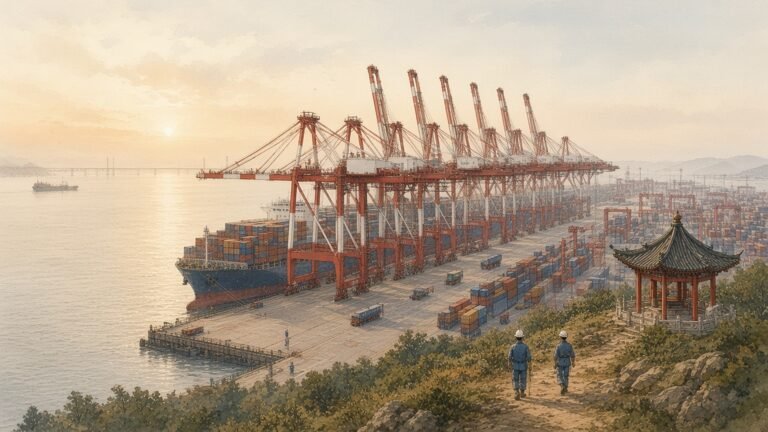
China’s Industrial Surplus and the World Economy
China now produces more than a quarter of the world’s manufacturing value added, runs the largest goods trade surplus ever recorded, and holds a commanding share of global output in industries as…