Grammarians of the Fez Mellah

Fez lies in a bowl of hills in northern Morocco, where the little river that the Arabs called وادي فاس (Wādī Fās, the river of Fez) drops through a maze of tanneries, mills and mosques towards the Sebou. Jews were living there within a generation of its foundation at the end of the eighth century, and for most of the following millennium the city was, with Kairouan and later Marrakesh, one of the capitals of Jewish learning in the Maghreb. Its Hebrew name was simply פאס (Fas, Fez). Scholars born or schooled there carried the city with them as a surname, الفاسي (al-Fāsī, the man from Fez), and two of the most influential names in medieval Jewish scholarship, the Karaite lexicographer David ben Abraham al-Fasi and the Talmudist Isaac Alfasi, are nothing more than that.[1][2]
This essay is written for a site about the Hebrew Bible and its transmission, and it reads the history of the Jews of Fez with that emphasis. It asks what the community did with Scripture: how its scholars argued about the Aramaic Targum, the Hebrew root and the vowel points, how it produced and printed books, how it translated the Bible into the spoken Arabic of the mellah, and how its courts and schools kept the pointed text alive through massacre, expulsion and emigration. The political history is told more briefly, because the documents of persecution have been gathered at length in this site’s long read on Exile in the Maghreb, to which the reader is referred at several points. A timeline at the end gathers the principal dates.
1. A city on two banks
Fez began as two towns facing each other across the river. In 789 Idrīs I, a descendant of the Prophet who had fled the Abbasids and been received by the Berber tribes of the region, founded a settlement called مدينة فاس (Madīnat Fās, the city of Fez) on the south-eastern bank. A legend explains the name by the Arabic فأس (faʾs, pickaxe), the tool with which Idrīs is said to have marked out the walls. After his death in 791 his son Idrīs II built a second town, al-ʿĀliya, on the opposite bank in about 809, made Fez his capital and drew settlers from Córdoba and Kairouan; the two halves later became the quarters known as the ʿAdwat al-Andalus and the ʿAdwat al-Qarawiyyīn, the bank of the Andalusians and the bank of the Kairouanese.[2][3][4]
Jews were among the first inhabitants. The Encyclopaedia Judaica records that the earliest population of Fez included pagan Berbers, Christians and Jews, and that Idrīs II admitted a large number of Jews who paid him an annual tax of 30,000 dinars and were assigned a quarter of their own, فندق اليهود (al-Funduq al-Yahūdī, the hostelry of the Jews). A story preserved by the historian Ibn Khaldūn shows how quickly they became part of the city. When the ruler Yaḥyā, the last of the senior line of the Idrisids, forced his way into a bathhouse to seize a Jewish girl in about 860, the people of Fez rose against him and drove him to take refuge in the Andalusian quarter. The historian André Chouraqui read the episode as evidence that the townspeople regarded the welfare of their Jews as their own concern.[1][5]
The city that grew around them became one of the intellectual centres of the western Islamic world. In 859 Fāṭima al-Fihrī, a woman from Kairouan, endowed the mosque that became جامع القرويين (Jāmiʿ al-Qarawiyyīn, the mosque of the Kairouanese), whose school is often described as the oldest continuously operating place of learning in the world. Fez was also a commercial hub of the first importance, and the Encyclopaedia Judaica attributes part of that prosperity to the Jews of the city, who travelled widely from it. Merchants, scholars and letters moved along the same roads: south across the Atlas to Sijilmāsa and the gold trade, east to Tlemcen, Kairouan and Fustat, and north across the strait to Córdoba.[6][1]
The language of those letters was Arabic written in Hebrew characters, ערבית יהודית (ʿaravit yehudit, Judaeo-Arabic). From the tenth century it became the ordinary medium of Jewish thought in the Islamic world, including Bible commentary, grammar and law, while Hebrew remained the language of Scripture, prayer and poetry. The decisive model for reading the Bible in Arabic was the تفسير (tafsīr, interpretative translation) of Saadia Gaon in Baghdad, which made Scripture accessible to Arabic-speaking Jews and was studied from Iraq to the Atlantic. Every one of the Fez scholars described below worked within that bilingual culture, and most of them wrote their books on the Hebrew Bible in Arabic.[7][8]

2. The seat of Torah
By the tenth century the Jews of Fez had a reputation that reached the academies of Iraq. Their rabbis, according to the Encyclopaedia Judaica, maintained a regular correspondence with the heads of the academies of Sura and Pumbedita, sending questions on law and the reading of Scripture and receiving answers and requests for support. The oldest dated document in Paul Fenton and David Littman’s anthology of Maghrebi sources is a letter of consolation written around 997 by Samuel ben Ḥofni, head of the academy at Sura, to the Jews of Fez after a massacre in the wars between the Zenāta Berbers and the Umayyads of Córdoba. Its salutation addresses a congregation living in “the seat of Torah, the threshing-floor of wisdom”, and its body is a chain of biblical verses promising that the ruins will be rebuilt.[1][9]
The phrase was not empty flattery. Fez sent scholars outwards as well as letters. One of them, Solomon ben Judah, the son of a family of scholars from Fez, rose through the ranks of the Palestinian academy from cantor to head, and led it in Jerusalem and Ramla from 1025 until his death in 1051. More of his letters have been preserved than those of any other Palestinian gaon. They are written in a figurative Hebrew and sometimes in Arabic, most of them to Egypt, and they show a leader whose judgments inclined to leniency and who tried, against the wishes of others in his academy, to abolish the annual ban pronounced against the Karaites on the Mount of Olives.[10][1]
The same source lists, as men who went from Fez to the Land of Israel and to Spain, the Karaite lexicographer David ben Abraham al-Fasi and the grammarians Dunash ben Labrat and Judah Hayyuj. Even before them, the Fez yeshivot had drawn the attention of Judah ibn Quraysh in the ninth century. These four men occupy a remarkable place in the history of the study of the Hebrew Bible, for between them they posed most of the questions with which medieval Hebrew philology was concerned: how Hebrew relates to Aramaic and Arabic, what a Hebrew root is, how the vowel points and accents are to be understood, and how far grammar can settle the meaning of a verse. In 1988 the Hebrew philologist Aharon Maman published an article whose title called Fez the land in which the study of the Hebrew language in the Maghreb grew up.[1]
The wider setting, the routes that tied Fez to Qayrawān, Fustat and Baghdad and the Genizah merchants who travelled them, is described in this site’s notes on Maghrebi Sages and Scriptural Study in Kairouan and Fez and in the essays on The Jews of Fatimid Egypt and By the Waters of Baghdad. The sections that follow concentrate on what the Fez scholars wrote about the Bible.
3. An epistle in defence of the Targum
The earliest of them never lived in Fez as far as is known, but his most famous work was addressed to it. Judah ibn Quraysh, in Hebrew יהודה בן קוריש (Yehudah ben Qurayish, Judah son of Quraysh), was a physician in Tāhert, in what is now western Algeria. His dates are uncertain: he is usually placed in the second half of the ninth century, though some scholars put him a little earlier and others in the early tenth. One article of the Encyclopaedia Judaica calls him the physician of the emir of Fez.[11][7]
The occasion of his book was a decision by the community of Fez to abolish the ancient custom of reciting the Aramaic תרגום (Targum, translation) in the synagogue after the Hebrew reading of the Torah. Ibn Quraysh wrote them a رسالة (risāla, epistle) urging them to reverse the decision. In his preface he argued that the recitation was an old tradition, that it helped the congregation to understand the Bible, and that Aramaic in general, together with Arabic, was important for the understanding of Scripture and of the Hebrew language. The Targum in question was the Aramaic version of the Torah associated with Onkelos, whose origins and use are traced in this site’s essay on Targum Onkelos and the Birth of Aramaic Scripture.[11]
What followed the preface was something new. The body of the epistle falls into three parts. In the first, biblical Hebrew words are compared in alphabetical order with Aramaic; in the second, with the Hebrew of the Mishnah; and in the third, with Arabic. A section of the third part treats the similarity of structure between Arabic and Hebrew and the regular correspondence of their consonants, and Ibn Quraysh also discusses words of non-Semitic origin in the Bible. With Saadia Gaon he is regarded as one of the founders of comparative Semitic linguistics, because he recognised that Hebrew, Aramaic and Arabic resemble one another not only in vocabulary but in grammatical structure.[11][7]
The work apparently had no title of its own. Because of its preface it is usually called the Risāla, but later writers knew it by other names. Abraham ibn Ezra called it ספר היחס (Sefer ha-Yaḥas, the book of relationship) and אב ואם (Av va-Em, father and mother), after the first words of the third part; Menahem ben Saruq called it ספר פתרונות (Sefer Pitronot, the book of interpretations). It was edited by J. J. L. Bargès and D. B. Goldberg in 1857, translated into Hebrew by M. Katz in 1950, and published in a critical edition with a modern Hebrew translation by Dan Becker in 1984. The old claim that Ibn Quraysh was a Karaite has long since been refuted.[11]
The Risāla is a document of Bible scholarship born out of synagogue practice. A community’s decision about what should be read aloud on the Sabbath provoked a scholar to show, word by word, that the three languages of Jewish life illuminated one another, and that the translation which the congregation wished to drop was a key to the original. The same argument, that Scripture is best understood when it is heard alongside its translation, would return in Fez many centuries later in the Arabic sharḥ discussed in section 14.
4. Dunash ben Labrat, a man of Fez by education
The second figure belongs to Fez by schooling rather than by birth. Moses ibn Ezra described Dunash ben Labrat, in Hebrew דונש בן לברט, as “a Baghdadi by origin and a man of Fez by education”. He was probably born around 925, either in Baghdad or in Fez, and studied with Saadia Gaon in Baghdad, one of the last of his pupils. After Saadia’s death in 942 he settled first in Fez and then in Córdoba, where he was teaching around 960. Some years later, after a falling-out with the courtier Ḥasdai ibn Shaprut, he left al-Andalus; a poem he wrote in 985 for a prominent Andalusian Jew is the last concrete trace of him.[12]
Dunash is best known as the poet who brought Arabic metres and genres into Hebrew, laying the foundation of the Hebrew poetry of al-Andalus. Among his religious poems are the Sabbath table song דרור יקרא (Deror yiqra, he will proclaim liberty) and Devai haser, which became part of the grace after the wedding meal. Solomon ibn Gabirol called him the greatest poet of his generation.[12][13]
His contribution to Bible scholarship was polemical. In Córdoba, Ḥasdai’s secretary Menahem ben Saruq was completing the מחברת (Maḥberet, the composition), a dictionary of biblical Hebrew and Aramaic written in Hebrew. Shortly after 958 Dunash presented Ḥasdai with a set of responses attacking it. He claimed to have disputed two hundred items; one hundred and eighty survive, sixty-eight of them set in a poem and explained in prose. Many of his objections concerned explanations of words which, in his view, could lead readers into error in law or belief, and some attacked interpretations that seemed close to Karaism. Three of Menahem’s students, among them Judah Hayyuj, replied in the same form, and Dunash’s pupil Yehudi ben Sheshet answered them in turn. The quarrel echoed for two centuries: Rashi quotes Dunash about twenty times, Rabbenu Tam wrote “decisions” on the points at issue, and Joseph Kimḥi answered Rabbenu Tam in Dunash’s favour.[12][13]
The Encyclopaedia Judaica judges that Dunash was right on many points but that his grammatical method was no more advanced than Menahem’s. Both men looked for the firm consonants that formed the base of a Hebrew word, a notion quite different from the later concept of the root, and both accepted that some bases had only one or two letters. Where they differed was in method: Menahem rejected the comparison of Hebrew with other languages, while Dunash accepted it, especially comparison with Arabic. Dunash wrote no continuous commentary on any biblical book, but his grammatical analysis was in effect literal exegesis, respectful of the Targum and the Masorah, and he insisted that philology was an instrument for understanding Scripture rather than an end in itself.[12]
The Córdoba quarrel belongs as much to Spain as to Morocco, and its Andalusian side is told in this site’s long read on The Golden Age of Sefarad and in the notes on Medieval Hebrew Lexicography and Grammarians, Exegetes and Illuminators of Sefarad. What matters here is that the comparative method Dunash defended against Menahem was the method of Ibn Quraysh’s letter to Fez, and that he had learned his trade in Saadia’s Baghdad and in the Fez of the academies.
5. A Karaite dictionary from Fez
The Karaites, in Hebrew קראים (Qaraʾim, readers of Scripture), rejected the authority of the rabbinic oral law and held that the written Bible alone was binding. That conviction made them some of the most careful students of the biblical text in the tenth century, and one of their most important philologists came from Fez. David ben Abraham al-Fasi, known in Arabic as Abū Sulaymān Dāwūd ibn Ibrāhīm al-Fāsī, left Morocco for the Land of Israel and spent a number of years there, and there composed a Hebrew–Arabic dictionary of the Bible, كتاب جامع الألفاظ (Kitāb Jāmiʿ al-Alfāẓ, the book that gathers the words).[14][15]
The dictionary survives in a long and a short version, and their exact relationship has not been settled. Solomon Skoss published a critical edition in two volumes in 1936 and 1945. It is divided into twenty-two chapters, one for each letter of the Hebrew alphabet, and its entries are arranged on the principle of two-letter roots. Al-Fasi cites the Aramaic Targums of Onkelos and Jonathan ben Uzziel, by name or as al-Targum, al-Suryānī or al-Mutarjim, and he quotes the Mishnah, the Talmud, the Masorah and even the Rabbanite prayer book. He follows the Tiberian tradition and the Palestinian grammarians on the text, the vowels and the accents. As Karaite authors often did, he calls the Bible القرآن (al-Qurʾān, the recitation) or الكتاب (al-Kitāb, the book), and he mentions Saadia Gaon twice, as al-Fayyūmī, while drawing on and criticising his commentaries elsewhere without naming him.[14]
The book’s most striking feature is comparative. Al-Fasi quotes numerous parallels between biblical Hebrew and Aramaic, literary and spoken Arabic and the Hebrew of the Mishnah. Many of them agree with those in the Risāla of Ibn Quraysh, the epistle written to his own home town, although he does not mention it, and many have been accepted by modern philologists. He also explains a number of roots by metathesis, the transposition of letters. The Encyclopaedia Judaica calls the dictionary one of the earliest and most important sources for the history of Hebrew philology, and notes that it preserves a wealth of information about early Karaite exegesis and about material conditions in the Land of Israel in its author’s time. Later Karaite scholars, Levi ben Japheth, Eli ben Israel and ʿAlī ben Sulaymān, made successive abridgements of the short version. His commentaries on the Psalms and the Song of Songs have not survived.[14]
Al-Fasi wrote for a sectarian community, but his dictionary was part of a shared conversation. Rabbanites and Karaites in the tenth century read the same pointed text, argued over the same words and sometimes copied from the same codices, a relationship explored in this site’s essay A Contract for Two Calendars. The fact that a Rabbanite community in Fez had heard the arguments of Ibn Quraysh, and that a Karaite from Fez repeated many of the same comparisons in Jerusalem, shows how closely the Maghreb was tied into the scholarship of the East.
6. Judah Hayyuj and the three-letter root
The most consequential of the Fez philologists was Judah ben David Hayyuj, in Hebrew יהודה בן דוד חיוג׳, whom the Encyclopaedia Judaica calls the most important Hebrew grammarian of the years around 1000. He was born in Fez around 945 and reached Córdoba in 960, when the quarrel between Menahem and Dunash was at its height. Whether he was the Judah ben David who joined two other pupils of Menahem in answering Dunash is uncertain. Little else is known of his life; he died around 1000.[16]
His reputation rests on two books on the Hebrew verb, written in Arabic: كتاب الأفعال ذوات حروف اللين (Kitāb al-Afʿāl Dhawāt Ḥurūf al-Līn, the book of verbs with weak letters) and كتاب الأفعال ذوات المثلين (Kitāb al-Afʿāl Dhawāt al-Mithlayn, the book of verbs with doubled letters). In them he argued that every Hebrew root consists of three letters, even when one of them seems to disappear in inflection. A weak letter, he showed, may change into another, drop out or be absorbed into a neighbouring letter marked with a דגש (dagesh, the dot that doubles a consonant). This was a departure from the view of Menahem and Dunash, which allowed roots of two letters and even of one. The linguist Gideon Goldenberg argued that Hayyuj’s real discovery lay less in the three-letter verb itself than in his concept of the quiescent soft letter, the sākin layyin.[16]
Hayyuj also wrote a كتاب التنقيط (Kitāb al-Tanqīṭ, book of vocalisation), which deals with grammatical and masoretic matters, chiefly nouns, and was translated into Hebrew by Abraham ibn Ezra; and a كتاب النتف (Kitāb al-Nutaf, book of plucked feathers), which explained difficult verses in the Prophets by linguistic method. Parts of it survive on Joshua, Judges, Kings, Isaiah, Jeremiah and Ezekiel, including a discussion of the importance of the מתג (meteg, the bridle, a secondary stress mark) and of other accents for understanding the Hebrew language. Ibn Ezra called it ספר הקרחה (Sefer ha-Qorḥah, the book of baldness), a name later corrupted to Sefer ha-Roqḥah. The two works on the verb were published with their Hebrew translations by J. L. Dukes in 1844, G. W. Nutt in 1870 and Morris Jastrow in 1897, and the remains of the Nutaf were gathered by N. Basal in 2001.[16]
The theory spread quickly through the Jewish East and even into Germany. Jonah ibn Janāḥ filled its gaps in his Kitāb al-Mustalḥaq and built his comprehensive grammar and lexicon of biblical Hebrew upon it; a synopsis attributed to Moses ibn Gikatilla circulated widely enough for copies to reach the Cairo Genizah; and Hebrew handbooks such as Sefer ha-Shoham and Sefat Yeter followed in its footsteps. The details of Hayyuj’s works and their afterlife are set out in this site’s note on Judah Hayyuj and the Three-Letter Root. The table below sets him beside the other Fez scholars who shaped the study of the biblical word.[16][14][12][11]
| Scholar | Link with Fez | Principal work on Scripture | Language | Contribution |
|---|---|---|---|---|
| Judah ibn Quraysh | Wrote his epistle to the Fez community | The Risāla on the Targum | Judaeo-Arabic | Systematic comparison of biblical Hebrew with Aramaic, mishnaic Hebrew and Arabic |
| Dunash ben Labrat | Educated in Fez | Responses to Menahem ben Saruq | Hebrew | Defended comparison with Arabic; worked with one- and two-letter bases |
| David ben Abraham al-Fasi | Native of Fez | Kitāb Jāmiʿ al-Alfāẓ | Judaeo-Arabic | Karaite dictionary of the Bible arranged on two-letter roots, rich in comparisons |
| Judah Hayyuj | Born in Fez | Books on weak and doubled verbs | Judaeo-Arabic | Showed that Hebrew roots have three letters |
7. Massacre, sack and recovery
The golden age of the Fez academies was punctuated by disaster. The Encyclopaedia Judaica lists three grave events: the deportation of part of the community to Ashīr in present-day Algeria in about 987; a massacre of six thousand Jews by a conqueror of the city in the 1030s; and the sack of the town by the Almoravids in 1068. The massacre is dated differently in different sources, to 1032, 1033 or May 1035. It took place when Abu’l-Kamāl Tamīm of the Banū Ifran, a Zenāta Berber tribe, seized Fez from the rival Maghrāwa, and the medieval chronicles agree on the figure of six thousand dead, which modern historians treat as a reported rather than a counted number.[1][17][9]
Fenton and Littman observe that such violence was often a by-product of wars between Muslim powers, in which a conspicuous and defenceless minority was easy prey, and that the community recovered each time. In about 1127 a would-be messiah named Moses Dari brought further troubles on the Jews of Fez. Yet it was in the decades after 1033 that Isaac Alfasi made the city one of the centres of Talmudic learning in the Jewish world. The documents of these events are quoted and weighed in the third chapter of Exile in the Maghreb.[9][1][5]
8. Isaac Alfasi, the Rif
Isaac ben Jacob Alfasi, in Hebrew יצחק בן יעקב אלפסי (Yiṣḥaq ben Yaʿaqov Alfasi, Isaac son of Jacob of Fez) and known by the acronym הרי״ף (ha-Rif, Rabbi Isaac Fasi), was not born in Fez. He was a native of Qalʿat Ḥammād near Constantine in present-day Algeria, born in 1013, and according to Abraham ibn Daud he studied at Kairouan under Nissim ben Jacob and Ḥananel ben Ḥushiel, although Alfasi himself never names them as his teachers. He then settled in Fez, and the city gave him his name. He remained there until 1088, when, in his seventy-fifth year, he was denounced to the government by enemies and fled to Spain. After a few months in Córdoba he moved to Lucena, where he became head of the yeshiva in 1089 and taught until his death in 1103. Joseph ibn Migash, whom he named as his successor, and the poet Judah Halevi were among his pupils.[18][19]
His most extended period of teaching was therefore in Fez, and it was there, according to the Encyclopaedia Judaica, that he wrote his great summary of the Talmud and answered legal queries sent to him from all over the Jewish world. Hundreds of his responsa survive, many of them written in Fez and most of them in Arabic; in style and character they are still close to those of the Babylonian geonim. Some early authorities called Alfasi himself “gaon”, and in a sense he closed the geonic age: Hai Gaon, the last of the great Babylonian heads, died when Alfasi was twenty-five.[1][18]
Alfasi’s ספר ההלכות (Sefer ha-Halakhot, the book of laws), also called Halakhot Rabbati, had two aims: to extract the binding law from the Talmud in a compendium for ready reference, and to provide an essential summary of the Talmud itself for study. It covers the orders of Moʿed, Nashim and Neziqin, together with the tractates Berakhot and Ḥullin, twenty-four tractates in all, and leaves aside laws that were no longer practised, such as the Passover sacrifice and the Temple service. It was the most important code before the Mishneh Torah of Maimonides.[18]
For the history of the biblical text one part of the work deserves special mention. Alfasi gathered the laws scattered through the orders of Qodashim and Ṭohorot that remained in force, among them the laws of the ספר תורה (sefer Torah, Torah scroll), the mezuzah and the tefillin, under the separate title of הלכות קטנות (Halakhot Qeṭannot, the minor laws). In other words, one of the standard medieval statements of the scribal law that governs how a Torah scroll is written was composed by a scholar whose working life was spent in Fez. When the first Hebrew press in Africa opened in the same city more than four centuries later, one of its books was the Hilkhot Rav Alfas.[18][5]
9. Maimonides in Fez
In the 1140s the Almohads, a reforming movement from the Atlas, conquered Morocco and al-Andalus. Under ʿAbd al-Muʾmin they abolished the protected status of Jews and Christians and decreed that they must convert, emigrate or die. Córdoba fell to them in 1148, when Moses ben Maimon was thirteen, and his family spent the next eight or nine years wandering through Spain. In 1159 or early 1160 his father, Maimon, a דיין (dayyan, rabbinic judge), brought the family to Fez. The Encyclopaedia Judaica suggests that ʿAbd al-Muʾmin had become somewhat more moderate in his treatment of the Jews in the central, Moroccan, part of his empire, and that this made the move worthwhile.[20][21]
Fez was then home to Judah ha-Kohen ibn Susan, a scholar whose fame for learning and piety had reached Spain, and the young Maimonides studied with him. Many Jews in the city had outwardly accepted Islam, and their consciences troubled them. Maimon wrote them an אגרת הנחמה (Iggeret ha-Neḥamah, letter of consolation), assuring them that whoever prays, even in the shortest form, and does good deeds remains a Jew. His son was meanwhile working on his commentary on the Mishnah, begun in 1158. The אגרת השמד (Iggeret ha-Shemad, epistle on forced conversion), usually attributed to Maimonides and dated to these years, answered a rabbi who had ruled that Jews who recited the Muslim profession of faith under duress had abandoned Judaism; its authorship has been questioned by some scholars but is accepted by most.[21][22]
Whether the family had itself outwardly professed Islam is disputed. Several Muslim writers say so, and Jewish sources are silent or deny it. The Encyclopaedia Judaica notes that the chronicler Saadiah ibn Danan, who bore the surname of the rabbinic family after which a restored synagogue of the Fez mellah is named, remarked that Muslims claimed the same of many Jewish scholars. The same Saadiah ibn Danan is the source for the tradition that the family’s departure in 1165 followed the martyrdom of Judah ibn Susan, who chose death rather than apostasy. The family escaped from Fez and landed at Acre a month later, The day of departure and the day on which their ship was saved from a storm became fasts for his descendants, and the day of arrival in the Land of Israel a festival.[21][1]
Another scholar of the next generation, Joseph ben Judah ibn ʿAqnīn, a friend of Maimonides who left Spain and settled in Fez, wrote that he lived there as a crypto-Jew, although his literary output suggests that his private studies were not disturbed. Local tradition in Fez still points out a house near the Dār al-Magana, the medieval water-clock building, as Maimonides’ residence, and a small restaurant in the medina trades on his name. His life as a whole is the subject of Moses Maimonides, from Córdoba to Fustat, and his rulings on the Torah scroll are discussed in the note on Maimonides and the Masoretic Tradition; the Almohad decrees are documented in The Almohad Persecution.[7][22][23]
10. The Marinids and the first mellah
The Almohad empire collapsed in the thirteenth century, and in 1244, according to the Encyclopaedia Judaica, the Marinids, a Zenāta Berber dynasty, established themselves in Fez, which became once more the capital of the kingdom. They allowed former converts to return to Judaism and employed Jews in their service. Protection by the dynasty did not mean safety in the streets: in 1275 or 1276 there was an anti-Jewish riot in which many were killed, and it was the sultan himself who intervened to save the community. In the following century the Jews of Fez lived in relative freedom and prosperity, with a flourishing trade with Aragon.[1][9]
The Marinids built a new royal city beside the old one, فاس الجديد (Fās al-Jadīd, New Fez), around the palace and the دار المخزن (dār al-makhzan, seat of government). In 1438, after a further outbreak of violence, the Jews of Fez were compelled to move into a walled precinct beside the palace. It was the first ملاح (mallāḥ, salt place), in Hebrew מלאח (mellaḥ, salt place), the model for every later Jewish quarter in Morocco. One explanation, repeated in Fenton and Littman’s anthology, connects it with a duty imposed on Jews of salting the heads of executed rebels; Emily Gottreich, the historian of the mellah of Marrakesh, prefers the more prosaic derivation from the salty, marshy ground on which the Fez quarter was built.[1][9][24]
Whether the mellah was a ghetto has been debated. Its gates were locked at night and Jews could not live elsewhere; but it was built against the palace walls because it was meant to be protected, and in moments of danger the Jews fled not out of the mellah but into the sultan’s compound next door. Its main street, the Grande Rue, ran from the gate called Bāb al-Samārīn into a dense grid of alleys, lined with shops and tall houses whose distinctive overhanging wooden balconies became the quarter’s signature.[9][24]
The first mellah did not save its inhabitants in 1465. The last Marinid sultan, ʿAbd al-Ḥaqq, had turned to the Jews of Fez to set his finances in order and made one of them, Hārūn, his chief minister. The city rose in revolt, the sultan and his minister were killed, and most of the Jews of Fez were massacred. The community, the Encyclopaedia Judaica says, did not recover until the arrival of the refugees from Spain after 1492. The episode and its chroniclers are examined in the sixth chapter of Exile in the Maghreb.[1]
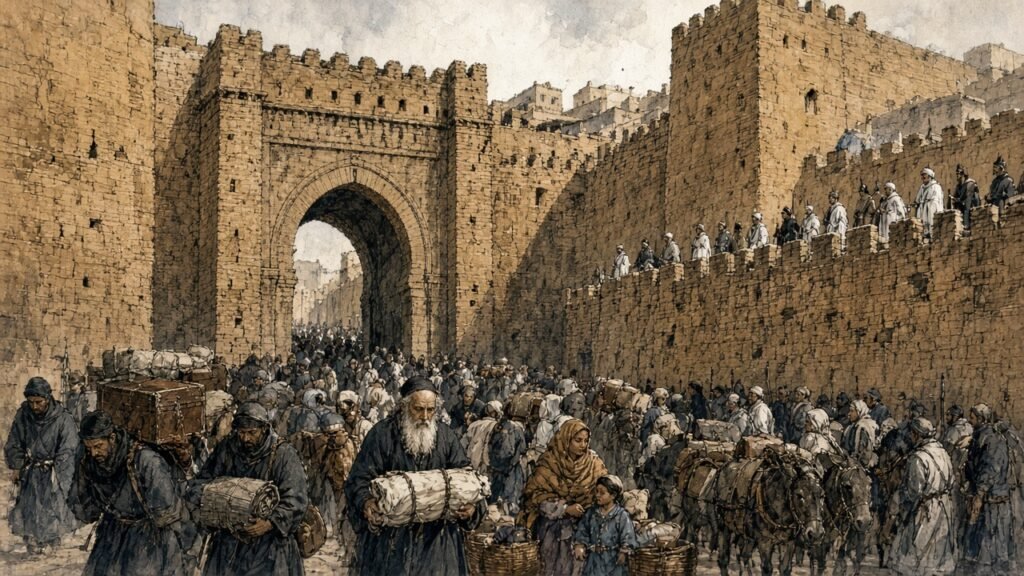
11. Exiles and residents
The expulsions from Spain in 1492 and from Portugal in 1497 transformed the Jews of Fez. Refugees poured into Morocco, and the community of Fez grew to some ten thousand people. Among the newcomers were scholars of the first rank. Jacob Berab, born around 1474, was appointed rabbi of Fez at the age of eighteen; he later left for the Land of Israel, where in Safed he was involved in the attempt to renew rabbinic ordination. The Torah commentator Abraham Saba, who died around 1508, is also counted among the sages of Fez in this period.[5][1]
The newcomers called themselves מגורשים (megorashim, the expelled) and the Arabic-speaking Jews who had been in Morocco before them תושבים (toshavim, the residents). The two groups prayed in different synagogues, kept different customs and for a time fought one another. The megorashim issued their own ordinances based on the customs of Castile and, in the words of the Encyclopaedia Judaica, became entirely detached from the toshavim; serious friction followed, but the megorashim finally gained the upper hand. The Arabic-speaking natives kept their own house of prayer, صلاة الفاسيين (Ṣlāt al-Fāsiyyīn, the synagogue of the people of Fez), which has since been restored by the Judeo-Moroccan Heritage Foundation.[1][25]
The megorashim brought Spanish with them. In the northern ports it survived as Haketia, the Judaeo-Spanish of Tetuan and Tangier, but in Fez the exiles gradually adopted Arabic. The change can be followed in their ordinances, written at first in Judaeo-Spanish and, from the end of the seventeenth century, in Judaeo-Arabic. In 1668 the founder of the ʿAlawī dynasty, Mawlāy al-Rashīd, transferred the rich Jewish community of the zāwiya of Dila, some 1,300 families, to Fez, and the mellah, the Encyclopaedia Judaica says, lost its Spanish character.[26][27][1]
The descendants of the exiles held the office of נגיד (nagid, leader of the community), established in Fez at the beginning of the sixteenth century, and they kept a local festival, the Purim de los Cristianos, to commemorate the defeat of the Portuguese at the battle of al-Qaṣr al-Kabīr in 1578. The history of the Iberian exiles in the Maghreb is told in the seventh chapter of Exile in the Maghreb and in this site’s notes on The Expulsion of 1492, Sephardi Jews and Maghrebi Jews; the eastern Mediterranean destinations of the same exiles are followed in From Sefarad to Salonica.[1]
12. The first press in Africa
Among the refugees who reached Fez from Portugal were a printer and his son. Samuel ben Isaac Nedivot, in Hebrew שמואל בן יצחק נדיבות, and his son Isaac had learned their craft in the Lisbon printing house of Eliezer Toledano, and when the Jews of Portugal were offered the choice between baptism and exile in 1497 they chose exile. They brought typographical equipment with them, and around 1515, when the Jewish population of Fez had grown to about ten thousand, they judged that the moment had come to print again. The Hebrew presses of the Iberian peninsula had closed with the expulsions, and the Italian Hebrew presses had not yet reached their later eminence; the demand for books was great.[28][5]
Their first dated book was an almost exact reprint of the ספר אבודרהם (Sefer Abudarham, the Book of Abudarham), the commentary on the prayers and their laws written in Seville around 1340 by David ben Joseph Abudarham, which Samuel Nedivot had helped to produce in Lisbon in 1489. The Fez edition reproduces Toledano’s, page for page and line for line, so faithfully that only the long colophon reveals its origin: in it the Nedivots substituted their own names, the name of Fez and the date, the month of Kislev in the year 5277, that is late 1516. The bibliographer Lazarus Goldschmidt, writing in 1948, gave the year as 1517, and both dates appear in the literature. The book is regarded as the first book printed in any language on the African continent; the Library of Congress holds a copy.[5][28][29]
Sefer Abudarham was a liturgical work, but it was also a guide to the reading of Scripture in the synagogue. Besides its commentary on the prayers and the Passover Haggadah and its treatment of the calendar, it sets out the order of the weekly Torah readings and of the haftarot, the prophetic lessons, for the whole year. Abudarham wrote, he said, because the customs of prayer varied from country to country and most people did not understand the words they recited or the reasons for the ritual.[5][29]
The Nedivots complained in their introduction that they had great difficulty obtaining paper, because the Spanish authorities forbade its sale to them. They persevered for a decade. How many books they printed is uncertain: the Encyclopaedia Judaica and Abraham Karp of the Library of Congress give fifteen between 1516 and 1524, while the bibliographer Marvin Heller counts seven to nine securely attributed titles. Besides the Abudarham these include the Azharot, the liturgical poem on the 613 commandments by Isaac ben Reuben al-Bargeloni; two parts of Jacob ben Asher’s code, the Ṭur Yoreh Deʿah and Ḥoshen Mishpaṭ, the latter in 1520; the Hilkhot Rav Alfas, Alfasi’s Talmudic code; and several tractates of the Talmud. The Fez Ṭur Yoreh Deʿah survives in only two incomplete copies, in the Schocken Library in Jerusalem and at the University of Alberta.[1][28][5]
The tractates are the most telling for the history of the Hebrew page. The Fez Rosh ha-Shanah was printed entirely in the semi-cursive Sephardi type now called “Rashi script” rather than in square letters, and without the Tosafot, reflecting the Sephardi habit of studying the Talmud with Rashi and Naḥmanides rather than with the French glosses. The scholar Haim Dimitrovsky, comparing type, watermarks and abbreviations, attributed Rosh ha-Shanah and Eruvin to the Fez press, and a fragment of Ḥullin as well. Most Fez imprints are now of the greatest rarity, and the press was unknown to European bibliographers until a bookseller found a complete copy of the Abudarham, naming place and year, around the end of the nineteenth century.[5]
The press closed, Heller writes, chiefly because of the Spanish embargo on paper. Almost four hundred years passed before another Hebrew press opened in Morocco, when Solomon ben Ḥayyun began printing the weekly Kol Yisrael in Tangier in 1891. The broader story of the Iberian printers and their emigration is told in this site’s Five Centuries of Jewish Printing and Publishing and in the notes on the Jews of Lisbon and the Jews of Faro, whose presses the Nedivots’ type descended from.[5]

13. Ordinances and rabbinic dynasties
From their first years in Fez, the rabbis and leaders of the Castilian exiles set about giving their community religious and civil institutions that matched the rules they had lived by in Spain, which differed considerably from those of the toshavim. Each new rule, a תקנה (taqqanah, ordinance; plural תקנות, taqqanot), was submitted to the מעמד (maʿamad, the communal council) and to the approval of the people assembled in the synagogues, signed by the rabbis and notables and countersigned by the clerks of the court, and then copied into the ספר התקנות (Sefer ha-Taqqanot, the register of ordinances), where it had the force of law.[30]
The earliest ordinances, of 1494 and 1496, regulate the arrangement of marriages and the inheritance of spouses’ property according to the customs of Castile. Over the next two and a half centuries the register grew to cover the office of the nagid and the council, sumptuary rules, recourse to non-Jewish courts, the sale of alcoholic drinks to Muslims, contributions for the Land of Israel and the ransom of captives. One group of rules dealt with parents who took their sons out of school too young to put them to work, a reminder that the communal law of Fez was concerned with the teaching of the Bible as well as with property. The earliest ordinances followed the rulings of Asher ben Jehiel, the later ones those of Alfasi, Maimonides and Joseph Karo, and most Moroccan communities came to adopt them.[31][27]
The register circulated for centuries in manuscript. Jacob Abensur made the first compilation in 1698, and Makhluf ibn Zikri revised it in 1778, adding many decisions of the eighteenth-century rabbis of Fez. It was printed only in 1871, at Livorno, in the second volume of Abraham Ankawa’s כרם חמר (Kerem Ḥemer, a vineyard of wine), and a facsimile edited by Shalom Bar-Asher appeared in Jerusalem in 1977. Copies were kept by the rabbinic courts of Fez and Meknes until modern times.[27][30][32]
The men who signed the ordinances belonged to a handful of learned families whose members filled the rabbinical court of Fez for generations. The Encyclopaedia Judaica names the heads of the sixteenth-century yeshivot of the megorashim: Naḥman ben Sunbal, Samuel Ḥagiz, Judah Uzziel and Saul Serero. The Serero family, Spanish scholars who settled in Fez after the expulsion, brought a considerable library with them. Saul ben David Serero (1575–1655), the most prominent sage of Fez in his day, signed the ordinances of 1602, kept a chronicle of the events of his time, of which fragments survive, and wrote sermons, legal decisions and a commentary on the book of Proverbs; his sermons show him well read in contemporary philosophy.[1][33]
His descendants served as judges in Fez for three centuries. Joshua Serero (1670–c. 1740) was a scribe, preacher and poet who left a journal of reminiscences about the scribes of the rabbinical court. Mattathias ben Menahem (1718–c. 1788) sat on the five-member court of Fez and had seven learned sons, most of them judges. Judah Benjamin Serero (1834–1926) was a copyist and grammarian, an expert in the linguistic style of Abraham ibn Ezra. In 1912 the synagogue of Joseph ben Raphael Joshua Zion Serero (1843–1902) and its famous library were burned, together with his writings, and in 1929 his brother Mattathias became head of the rabbinical court of Fez.[33]
Other families held similar authority. The Ibn Danans, the Encyclopaedia Judaica records, were the leading judges of Fez for several generations, and their rulings were recognised by the Jews of the whole country; Isaac ibn Danan, who died in 1900, and Abner Sarfaty, who died in 1884, are credited with reviving study in the nineteenth-century mellah. Samuel Sarfaty, Judah ibn ʿAṭṭar and Ḥayyim ibn ʿAṭṭar kept up the standard of learning into the eighteenth century, and Fez sent rabbis abroad, among them Isaac ben Abraham Uzziel, Aaron ibn Ḥayyim and Jacob Ḥagiz. The pre-eminence of Fez ended, in the same source’s judgment, only with the death of Jacob ibn Zur in 1753. When disaster struck, the rabbis of Fez took refuge in the small town of Sefrou nearby.[1]
Ḥayyim ibn ʿAṭṭar is the best known of these names outside Morocco. Born in Salé in 1696, he worked as a judge and teacher in Meknes and Fez before leaving Morocco for Livorno and Jerusalem, where he died in 1743. His commentary on the Torah, אור החיים (Or ha-Ḥayyim, the light of life), printed in Venice in 1742, became a widely studied commentary and was especially influential among the Hasidim. Judah ibn ʿAṭṭar is still honoured each year in Fez with a הילולא (hilula, a celebration at a sage’s anniversary) that draws Jewish visitors from abroad.[34][35]
14. The sharḥ, Scripture in the mother tongue
The Jews of Fez spoke Arabic, but the Bible they heard in the synagogue was Hebrew. For most of their history the bridge between the two was the شرح (sharḥ; in Hebrew letters שרח, explanation), a word-for-word Judaeo-Arabic translation of the biblical text. Šurūḥ, to use the plural, were current in North Africa from at least the fourteenth century to the twentieth, and several of them evidently circulated in the Maghreb before the expulsion from Spain. When Mordecai Ḥai Diyyan of Tunis published his translation of Genesis in 1937, he explained in the introduction that the language customarily used for translating the Bible had changed so much that most people no longer understood it.[36]
The sharḥ was a teaching text. The Moroccan linguist Mohamed Elmedlaoui describes it as a didactic genre in which the verses of the most important biblical books are set out one by one, each in biblical Hebrew followed by its translation into Moroccan Judaeo-Arabic, to be memorised by beginners. Simon Levy, writing about the Jewish dialects of Morocco, notes that Hebrew was not a spoken language for Moroccan Jews but the language of high culture, of study in the ṣla, the synagogue school, and of the yeshiva; even in teaching, discussion was conducted in Arabic, by means of translations and calques, the sharḥ. Among the Spanish exiles, he adds, the same practice gave rise to Ladino.[37][25]
Much of the tradition was oral. Moshé Bar-Asher has published a sharḥ of the haftarah read on the afternoon of the Day of Atonement, the book of Jonah, in the tradition of Tafilalt and Todgha in south-eastern Morocco, which was handed down by word of mouth for generations and written down in Jerusalem only in the 1960s. In another study he traced echoes of Saadia Gaon’s Tafsīr in the Moroccan sharḥ, showing that the medieval Arabic Bible of Baghdad had left its mark on the village translations of the Maghreb, even though the Tafsīr itself was a sophisticated work in a high register of Judaeo-Arabic. His four-volume edition and study of the Maghrebi Judaeo-Arabic translation of the Bible, the fruit of forty years’ work, appeared in Jerusalem in 2022.[38][39][37]
The Arabic of the Fez sharḥ was the Arabic of the mellah, and it was distinctive. Joseph Chetrit groups the Judaeo-Arabic of Fez with that of Meknes and Sefrou in one of three dialect groups of Moroccan Jewish speech; among its features is the pronunciation of the old qāf as a glottal stop. Louis Brunot and Élie Malka recorded it in their Textes judéo-arabes de Fez of 1939 and Glossaire judéo-arabe de Fez of 1940, and Levy notes that the Jews of Fez used an Aramaic expression, bine-bine, for “meanwhile”, a trace of the Talmudic study that shaped their everyday speech.[40][41][25][1]
There is a symmetry here with the beginning of this story. In the ninth or tenth century the Jews of Fez were rebuked by Ibn Quraysh for wanting to abandon the Aramaic Targum, the translation that had for centuries helped congregations to understand the Hebrew. A thousand years later the same community was reading its Bible with an Arabic translation that played exactly that role. The languages of the Middle East and the scripts in which Jews wrote them are surveyed in this site’s long read The Tongues and Letters of the Middle East Today, and the Judaeo-Spanish of the exiles in the page on Ladino.

15. Scrolls, schools and the pointed page
The practice of Bible teaching in Fez followed the pattern described in this site’s notes on Casablanca and Tunis. Public reading required a kosher, unpointed Torah scroll written by a סופר (sofer, scribe); teaching required books with the vowel points and accents, from which boys learned to read before they chanted the weekly portion in public. The rabbinical court of Fez had scribes of its own, who wrote its deeds and judgments, and Joshua Serero’s journal of reminiscences about them, mentioned above, is a rare glimpse of that world of professional penmen. The rules for writing a scroll that the scribes of Fez followed went back, through Alfasi’s Halakhot Qeṭannot and the code of Maimonides, to the medieval scholars who had worked in their city.[33][18]
Schooling was the first concern of every revival of the mellah. In the late nineteenth century, the Encyclopaedia Judaica records, the community possessed many schools, five yeshivot and an important charitable society. In 1884 the Alliance Israélite Universelle, founded in Paris in 1860 to defend Jewish communities and educate their children, opened a French school in Fez with financial support from the community’s notables. Its curriculum emphasised French and secular subjects alongside basic Jewish studies, and it began the shift by which, as Levy puts it, French largely replaced Hebrew as the language of culture among Moroccan Jews while Hebrew remained almost exclusively the language of prayer.[1][42][25]
The craft of the scribes and the history of the pointed Hebrew text are traced in the notes on Soferim, the Scribes of the Hebrew Bible, and in the essay Ktav Ashuri, the Upright Script.
16. From Mawlāy Yazīd to the tritl
After the Saʿdian conquest of 1550 Fez lost much of its political and economic importance, and its Jewish community, deserted by many of its wealthiest families, slowly grew poorer. The ʿAlawī founder Mawlāy al-Rashīd, enthroned in Fez in 1665, entered the city by way of the mellah, where the Jews allowed him to spend the night. In the troubled decades after 1720 a few Jews obtained monopolies over tobacco or the minting of coin, but most lived by the crafts that the mellah was known for: goldsmithing, the making of gold thread, lace, embroidery and tailoring.[1]
The worst blow of the eighteenth century came in 1790, when the sultan Mawlāy Yazīd destroyed the synagogues of Fez, had the mellah plundered and expelled its inhabitants. The judge Saul Serero fled to Sefrou with Elijah ha-Sarfati, the head of the court on which he sat. Mawlāy Sulaymān allowed the Jews to return in 1792, but the mellah was reduced to a quarter of its former size. The soldiers of the Wadāya regiment quartered in New Fez continued to harass them until 1832, when the sultan bombarded the rebellious Wadāya and dispersed them; the community commemorated its deliverance in a local Purim, the Purim del Kor, the Purim of the cannonballs, kept each year on 22 Kislev.[1][33]
In 1834 Fez was the scene of the execution of Sol Hachuel, known as Solika, a young Jewish woman from Tangier who was accused of having embraced Islam and beheaded when she refused to accept that she had done so. Her grave in the Jewish cemetery of Fez became a place of pilgrimage, and Jewish tradition remembers her as Sol ha-Tsaddiqah, Sol the righteous; the details of her story come from later testimonies and have gathered legend. Her case and the documents of the nineteenth century are discussed in the eighteenth chapter of Exile in the Maghreb.[43][35]
On 30 March 1912 the sultan Mawlāy ʿAbd al-Ḥafīẓ signed the Treaty of Fez, which made Morocco a French protectorate. On 17 April his Moroccan troops mutinied against their French instructors and the city rose. The mellah, then home to about twelve thousand people, had been disarmed by the French authorities on the pretext of preventing smuggling, and when the mutineers, tribesmen and townspeople broke in it was plundered and burned for three days. About forty-five Jews were killed and twenty-seven wounded. A Jewish chronicle described how fragments of torn Torah scrolls were gathered for burial; among the buildings destroyed was the synagogue of the Serero family with its famous library. The sultan received the refugees within the precincts of his palace, where many sheltered in the royal menagerie among the lions and panthers, and ordered food and clothing distributed.[44][1][9][33]
The Jews of Morocco called such an event a tritl, in Hebrew התריתל (ha-tritl, the sack). The historian Paul Fenton, who devoted a volume to the Fez riots, explains that the word is of Arabic and Berber origin and meant to dig up and plunder buried goods, especially the grain stores raided by tribes, before it was extended to the periodic sacking of Jewish quarters. He asks why Jewish historical memory, which knows the Russian word pogrom, should not also know the Arabic word tritl. The full account of the days of April 1912, with the testimony of survivors and of the Muslim neighbours who sheltered them, is given in the twenty-second chapter of Exile in the Maghreb.[45][9]

17. The new town and the great departure
Under the protectorate Fez was given a European new town, the ville nouvelle, and from 1925 many Jews moved there, alongside the Europeans; only the poor and some of the most traditional families stayed in the mellah. In 1942 the Vichy authorities tried to force those who had left back into the old quarter. In 1947 there were 22,484 Jews in Fez and its surroundings, among them physicians, lawyers, industrialists and landowners. The old crafts were disappearing with modernisation, and most commerce had passed into Muslim hands, though Jews kept a leading role in the trade in precious metals and grain.[1]
The national picture changed after 1948. The Jewish population of Morocco, estimated at between 225,000 and 265,000 in the middle of the twentieth century, began to leave in large numbers after the foundation of the State of Israel, driven by riots, economic pressure and the nationalism of the years around independence in 1956, and drawn by Zionism. Morocco at first restricted departures and later tacitly allowed them, notably through the organised emigration known as Operation Yachin in the 1960s. By 1970 more than nine-tenths of Moroccan Jews had left, most of them for Israel, many for France and smaller numbers for Canada, the United States and Latin America.[46]
Fez emptied with the rest. Its synagogues fell silent one by one; by the time the Ibn Danan synagogue was restored in 1999 it had not been used for about twenty-five years. Its rabbis, scribes and teachers went with their congregations to Israel, France and Canada. Something of their liturgy had travelled before them: hymns by members of the Serero family had been printed in Sephardi festival prayer books and in collections such as Shir Yedidut (1927) and Yismaḥ Yisrael (1931).[47][33]
18. The restored Ibn Danan and Fez today
The Ibn Danan synagogue, in Hebrew בית הכנסת אבן דנאן (Bet ha-Keneset Ibn Danan, the Ibn Danan synagogue), is one of the oldest surviving synagogues in North Africa. It was built in the seventeenth century by a merchant named Mimoun ben Sidan and later took the name of the scholarly Ibn Danan family; the World Monuments Fund lists it as the Rabbi Shlomo Ibn Danan Synagogue. Inside are horseshoe arches, carved plaster, a dark wooden ark set in a wall of multicoloured tiles, chandeliers, a steep staircase to the women’s gallery and a sunken space for ritual immersion.[24][48][47]
By the 1990s the building was badly decayed. Its restoration, carried out under a UNESCO programme for the old city, cost about $300,000, most of it given by an association headed by members of the Danan family, most of whom now live outside Morocco, with further funds from the World Monuments Fund; a foundation established by the Moroccan Jewish community undertook its upkeep. At the end of February 1999 some two hundred Jews, Moroccans and visitors, carried Torah scrolls through the streets of the medina in a driving rain to rededicate it. The Jewish Telegraphic Agency reported that it was the first recent rehabilitation of a building in the old city, which had been declared a protected historic area, and that the synagogue would serve not for regular prayer but as a tribute to the history of Moroccan Jewry. Henry Danan, a descendant of the rabbi for whom it is named, said that it would “show to future generations how beautiful Jewish life was in Morocco.” The medina of Fez had been inscribed as a UNESCO World Heritage Site in 1981.[47][2]
The restoration was followed by others. The synagogue of the toshavim, Ṣlāt al-Fāsiyyīn, was restored and reopened in 2013 as a place of Jewish memory, and the Jewish cemetery beside the mellah, with the graves of rabbis and of Solika, is tended and visited.[49][24] The community itself is tiny. In 2020 fewer than fifty Jews lived in Fez, and the Roben Bensadoun synagogue in the new town survived on the tourists who filled its pews on Sabbaths and holidays; in 2026 a visiting group from London found a few dozen Jewish residents and two historic synagogues no longer in regular use. The community centre houses a small synagogue, a ritual bath and a kosher shop, and each year the hilula of Rabbi Judah ibn ʿAṭṭar brings Jews from France and elsewhere back to the city for a few days.[25][35][23][50]

What remains of Jewish Fez is, above all, what its scholars wrote. In the judgment of the Encyclopaedia Judaica, all later work on the Hebrew language and on biblical exegesis has been built on the ideas of Judah Hayyuj, and much of his terminology is still in use. Alfasi’s code was the most important before Maimonides; David al-Fasi’s dictionary is one of the earliest and most important witnesses to the history of Hebrew philology; and Ibn Quraysh’s plea for the Targum is read as one of the founding documents of comparative Semitic linguistics. The Abudarham of 1516 is the oldest printed book of a continent. The ordinances of the exiles, the chronicles of the mellah and the sharḥ of the schoolroom record how ordinary Jews in Fez lived with their Bible for five more centuries. Few cities on the western edge of the Jewish world did as much for the study of the Hebrew text.[16][18][14][11][28]
19. Timeline
Idrīs I founds Madīnat Fās on the bank of the Wādī Fās; Jews are among the early inhabitants.
Idrīs II builds al-ʿĀliya on the opposite bank, makes Fez his capital and assigns the Jews a quarter of their own.
Fāṭima al-Fihrī founds the mosque of the Kairouanese, later the city’s great school.
Judah ibn Quraysh writes to the Jews of Fez urging them to keep reciting the Aramaic Targum.
Dunash ben Labrat, educated in Fez, attacks Menahem’s dictionary; Judah Hayyuj, born in Fez, reaches Córdoba.
David ben Abraham al-Fasi compiles the Kitāb Jāmiʿ al-Alfāẓ in the Land of Israel.
Samuel ben Ḥofni of Sura writes to console the Jews of Fez after a massacre.
Solomon ben Judah, of a Fez family, heads the Palestinian academy.
About six thousand Jews are reported killed when Tamīm of the Banū Ifran takes Fez; sources give 1032, 1033 or 1035.
Isaac Alfasi teaches in Fez and writes his Sefer ha-Halakhot until denounced and forced to flee to Spain.
The family of Maimon lives in Fez under Almohad rule, then leaves for Acre after the martyrdom of Judah ibn Susan.
The Jews of Fez are moved into a walled quarter beside the palace in New Fez.
The revolt against the last Marinid sultan and his Jewish minister ends in a massacre of the Jews of Fez.
Refugees from Spain and Portugal swell the community to about ten thousand; megorashim and toshavim divide.
The Castilian exiles enact their first ordinances on marriage and inheritance.
Samuel and Isaac Nedivot print Sefer Abudarham, the first book printed on the continent.
Mawlāy al-Rashīd transfers some 1,300 Jewish families from Dila to Fez.
The death of Jacob ibn Zur closes the period of Fez’s rabbinic pre-eminence.
Mawlāy Yazīd destroys the synagogues and expels the Jews; Mawlāy Sulaymān lets them return to a smaller mellah.
Sol Hachuel of Tangier is executed in Fez; her grave becomes a place of pilgrimage.
The ordinances of Fez are printed for the first time, at Livorno.
The Alliance Israélite Universelle opens a French school in Fez.
After the Treaty of Fez the mellah is sacked for three days; about forty-five Jews are killed.
22,484 Jews live in Fez and its surroundings.
The restored synagogue is rededicated with a Torah procession through the medina.
References
- Jewish Virtual Library, “Fez”, from the Encyclopaedia Judaica (2nd edn, 2007) *
- “Fez, Morocco” *
- “Idris II of Morocco” *
- “Fes el Bali” *
- Marvin J. Heller, “A Fleeting Moment, A Short-lived Press: Hebrew Printing in Sixteenth Century Fez”, Sephardic Horizons 11, no. 1 *
- “University of al-Qarawiyyin” *
- Encyclopaedia Judaica, “Judeo-Arabic Literature”, at Encyclopedia.com *
- “Saadia Gaon” *
- Paul B. Fenton and David G. Littman, Exile in the Maghreb: Jews under Islam, Sources and Documents, 997 - 1912 (2016) *
- Encyclopaedia Judaica, “Solomon ben Judah”, at Encyclopedia.com *
- Encyclopaedia Judaica, “Ibn Quraysh, Judah” (Joshua Blau), at Encyclopedia.com *
- Encyclopaedia Judaica, “Dunash ben Labrat” (Chaim M. Rabin and Angel Sáenz-Badillos), at Encyclopedia.com *
- Jewish Virtual Library, “Dunash ben Labrat” *
- Encyclopaedia Judaica, “Alfasi, David ben Abraham” (Solomon Leon Skoss), at Encyclopedia.com *
- “Karaite Judaism” *
- Encyclopaedia Judaica, “Ḥayyuj, Judah ben David”, at Encyclopedia.com *
- “1033 Fez massacre” *
- Encyclopaedia Judaica, “Alfasi, Isaac ben Jacob”, at Encyclopedia.com *
- “Isaac Alfasi” *
- “Almohad Caliphate” *
- Encyclopaedia Judaica, “Maimonides, Moses”, at Encyclopedia.com *
- “Maimonides” *
- Lisa Hostein, “Morocco, Where Jewish Memory Lives On”, Hadassah Magazine, July 2020 *
- “Mellah of Fez” *
- Simon Levy, “The Arabic Dialects of Jews in Morocco”, Langage et société 143 (2013), 41 - 51 *
- “Haketia” *
- Gérard Nahon, review of The Taqanot of the Jews of Morocco, Kerem Ḥemer II, ed. Shalom Bar-Asher, Revue des études juives 137 (1978), 256 - 257 *
- Jewish Virtual Library, “First Book in Africa”, from Abraham J. Karp, From the Ends of the Earth: Judaic Treasures of the Library of Congress (1991) *
- Encyclopaedia Judaica, “Abudarham, David ben Joseph”, at Encyclopedia.com *
- Haïm Zafrani, “L’école espagnole, référence privilégiée des décisionnaires nord-africains”, Revue des études juives 152 (1993), 313 - 370 *
- Marina Girona Berenguer, “Las tacanot de los megorašim (1494 y 1496)”, Cadernos de Estudos Sefarditas 24 (2022 - 2023), 11 - 29 *
- Encyclopaedia Judaica, “Takkanot”, at Encyclopedia.com *
- Encyclopaedia Judaica, “Serero” (Haim Bentov), at Encyclopedia.com *
- “Chaim ibn Attar” *
- Ayelet Mamo Shay, “In Fez, Morocco’s Jewish community clings to hope amid uncertainty”, Ynetnews *
- D. Doron, “Lexical and Exegetical Similarities and Differences in North African Judaeo-Arabic Šurūḥ on Genesis”, Journal of Semitic Studies (2007) *
- Mohamed Elmedlaoui, synopsis of Moshé Bar-Asher, Targum ha-Miqra le-ʿAravit Yehudit Magrebit (4 vols, 2022), OrBinah (7 June 2024) *
- Moshé Bar-Asher, “A Maghrebian Sharḥ to the Hafṭara for the Minḥa Service on the Day of Atonement”, Journal of Jewish Languages (2013) *
- Moshé Bar-Asher, “Traces du Tafsir de Saadia Gaon dans le Sharḥ marocain”, Études Renaniennes 112 (2010), 57 - 65 *
- Aharon Geva-Kleinberger, review of Joseph Chetrit, Notre judéo-arabe. Les dialectes judéo-arabes du Maroc (2023), Al-Qanṭara (2024) *
- “Judeo-Moroccan Arabic” *
- “Alliance Israélite Universelle” *
- “Sol Hachuel” *
- “Treaty of Fes” *
- Paul B. Fenton, “Le Pogrom de Fès ou le Tritel, 17 - 19 avril 1912”, excerpt at Moreshet Morocco *
- “Moroccan Jews” *
- Bill Lewis, “In medieval Moroccan city, a synagogue is rededicated”, Jewish Telegraphic Agency, 2 March 1999 *
- World Monuments Fund, “Rabbi Shlomo Ibn Danan Synagogue” *
- Le Matin, “Patrimoine judéo-marocain, la renaissance de la synagogue Slat Al Fassiyine” (2013) *
- Alma Green, “Ner Yisrael congregants breathe life back into two historic Morocco synagogues”, The Jewish Chronicle, 18 March 2026 *


