Engineering
Baihetan Dam and the Engineering of 1,000-Megawatt Francis Turbines
Contents ▾
Harnessing the immense hydraulic potential of the lower Jinsha River, the Baihetan Hydropower Station houses sixteen monolithic 1,000-megawatt Francis hydro-generator units—the largest single-unit capacity machines ever manufactured. Operating under hydraulic heads exceeding two hundred metres, these record-breaking power units required unprecedented breakthroughs in hydraulic runner metallurgy, electromagnetic air-cooling, and low-heat Portland cement chemistry that fundamentally redefined modern mega-dam engineering.
1. The Jinsha cascade, Hydrological context and topographic confinement
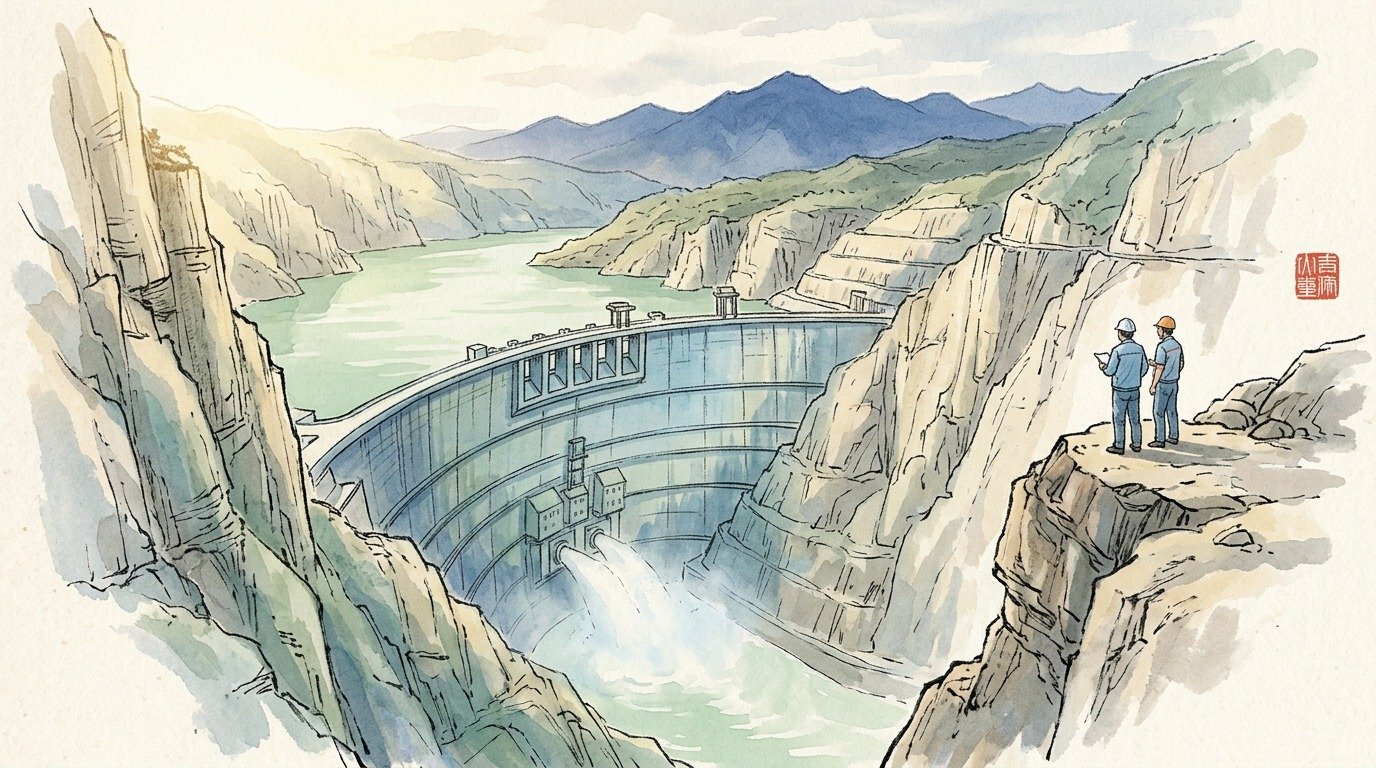
Straddling the rugged canyon divide between Ningnan County in Sichuan Province and Qiaojia County in Yunnan Province, the Baihetan Hydropower Station (白鹤滩水电站) is the second-largest hydroelectric facility on Earth by installed capacity, surpassed only by the Three Gorges Dam. Engineered and operated by the China Three Gorges Corporation (CTG), Baihetan serves as the critical keystone of the four-station downstream Jinsha River hydropower cascade, which comprises Wudongde (10,200 MW), Baihetan (16,000 MW), Xiluodu (12,600 MW), and Xiangjiaba (6,400 MW). Together, this contiguous riverine energy staircase delivers clean base-load electricity over thousands of kilometres via ultra-high-voltage direct-current (UHVDC) transmission lines to the coastal manufacturing epicentres of eastern and southern China.
The topography of the Baihetan gorge is intensely constricted: a classic asymmetrical V-shaped canyon carved through deeply weathered columnar basalt formations. The river canyon is characterized by steep limestone and basalt slopes ascending at angles between 60 and 70 degrees, with high natural seismic activity and complicated tectonic jointing. Within this narrow bedrock corridor, engineers constructed a double-curvature concrete arch dam rising to a maximum structural height of 289 metres, with a crest length of 709 metres and a total dam concrete volume of 8.03 million cubic metres. The reservoir impounds 20.6 billion cubic metres of water, creating an operating gross hydraulic head ranging between 200 and 243 metres.
2. The 1-Gigawatt Francis turbine runner, Fluid Dynamics and cavitation control
The technological heart of Baihetan resides in its sixteen 1,000-megawatt (1 GW) Francis hydro-turbine generator units—eight units installed in the Left Bank underground cavern manufactured by Dongfang Electric Machinery (东方电气), and eight units in the Right Bank cavern manufactured by Harbin Electric Machinery (哈电集团). Prior to Baihetan, the maximum unit capacity achieved in global hydroelectric engineering stood at 700 to 800 MW (as deployed at Three Gorges and Xiangjiaba). Scaling unit capacity to 1,000 MW was widely considered by international turbine manufacturers to represent a physical threshold where hydrodynamic flow instability, vortex core breakdown, and cavitation erosion would overwhelm mechanical durability.
A single 1,000 MW Francis turbine runner at Baihetan weighs approximately 338 to 345 tonnes, measures 8.62 to 8.87 metres in outer diameter, and stands nearly 4 metres high. To operate continuously across fluctuating grid loads, the runner must maintain hydraulic efficiency exceeding 96.7 percent across its entire operating envelope while processing up to 500 cubic metres of water per second—equivalent to draining an Olympic-sized swimming pool in five seconds. At full discharge velocity, the relative water flow velocity across the runner blade tips exceeds 50 metres per second.
Under these high-velocity, high-head conditions, the pressure field on the suction side of the blades drops precipitously near the trailing edges. If the local fluid pressure falls below the vapor pressure of water (∼2.3 kPa at 20°C), microscopic water vapor cavities form and subsequently collapse violently against the steel surface, producing micro-jets that exert localized shock pressures of several gigapascals. This cavitation erosion can pit and destroy conventional stainless-steel blades in hundreds of operational hours.
To eliminate cavitation and draft-tube pressure pulsations, turbine aerodynamicists employed high-fidelity Computational Fluid Dynamics (CFD) simulating three-dimensional unsteady turbulent multi-phase flows with full Reynolds stress turbulence models. The blade profiles were sculpted with complex non-linear three-dimensional spatial curvatures: long-tail thin-edged blades with progressive lean angles that maintain smooth, attached boundary-layer flow and suppress inter-blade vortex shedding. The runners were fabricated as monolithic welded structures from ultra-low carbon martensitic stainless steel (04Cr13Ni5Mo), providing exceptional fatigue endurance, high yield strength (≥550 MPa), and outstanding resistance to sediment abrasion.
3. Air-cooled electromagnetic generators and massive thrust bearings
Transferring 1,000 MW of mechanical shaft power into the electrical grid demanded equally unprecedented breakthroughs in generator design. Each Baihetan generator has an outer diameter of over 16 metres, a total rotating weight (rotor and shaft) of nearly 2,100 tonnes, and operates at a synchronous rotational speed of 111.1 revolutions per minute (rpm) to generate 50 Hz three-phase alternating current at a rated terminal voltage of 24 kilovolts (kV).
In conventional high-power generators exceeding 800 MW, direct water cooling of the stator winding copper bars is standard to evacuate the immense joule heat generated by stator currents exceeding 25,000 amperes. However, internal water cooling introduces hundreds of hydraulic connections, hoses, and seals within the high-voltage stator core, carrying chronic risks of insulation breakdown from water leaks. For Baihetan, Chinese electrical engineers set a world-first goal: achieving full 1,000 MW generation using 100% air cooling for both rotor and stator windings.
Achieving this required radical improvements in magnetic core laminations and aerodynamic ventilation circuits. Low-loss, high-permeability cold-rolled silicon steel sheets (0.5 mm thick) were used for the stator core, coupled with class-F epoxy mica vacuum pressure impregnation (VPI) insulation capable of withstanding intense thermal cycling. A multi-circuit symmetrical radial-axial air circulation system was integrated directly into the rotor rim, where the rotational motion of the rotor poles acts as an integral centrifugal fan, forcing thousands of cubic metres of cooled air per minute through microscopic stator radial ducts, limiting total stator winding temperature rise to under 85 Kelvin.
Supporting the enormous mechanical burden—the 2,100-tonne rotating assembly plus over 1,500 tonnes of downward hydraulic water thrust—is a single giant thrust bearing situated beneath the generator rotor. This bearing must continuously support a total combined axial load exceeding 3,600 to 4,000 tonnes with zero metallic contact. The bearing utilizes double-layer elastic metal plastic pads (polytetrafluoroethylene, PTFE, composite lining) submerged in a high-viscosity synthetic oil bath. Hydrodynamic lubrication wedges generate an oil film thickness of merely 0.05 to 0.08 millimetres, maintaining a friction coefficient under 0.001 under thousands of tonnes of dynamic rotating thrust.
4. The “crack-free” dam, low-heat cement and intelligent thermal control
Mass concrete structures, particularly mega-scale arch dams, are notoriously prone to thermal cracking. When millions of cubic metres of concrete hydrate, the exothermic chemical reaction of standard Portland cement produces intense hydration heat, elevating internal core temperatures to over 50°C to 65°C. As the outer concrete boundaries cool against ambient air and river water while the deep core remains hot, severe thermal stress gradients (ΔT > 20°C) inevitably induce macroscopic tensile cracking that compromises structural impermeability and seismic resistance.
Baihetan achieved global acclaim by becoming the world’s first “crack-free” mass concrete arch dam. This breakthrough rested on two pillars: material formulation and digital thermodynamic cooling. First, the dam was constructed entirely using low-heat Portland cement (comprising high concentrations of dicalcium silicate, C2S, and low tricalcium aluminate, C3A), which releases hydration heat slowly over months rather than in rapid early spikes, reducing early-age adiabatic temperature rise by 6°C to 8°C.
Second, CTG engineers implemented a comprehensive cyber-physical thermal management system. More than 10,000 high-precision digital temperature sensors and hundreds of kilometres of distributed optical fiber thermometers were embedded within every concrete pour block across the 289-metre dam. Thousands of kilometres of serpentined stainless-steel cooling pipes were laced through the blocks. An automated algorithm continuously monitored internal core temperatures in real time, dynamically modulating the water flow rate, direction, and chiller temperature (ranging from 8°C to 14°C) through each individual pipe loop. This precision cooling ensured that internal concrete tensile stresses never exceeded the material’s dynamic tensile strength throughout the five-year placement cycle.
5. Subterranean cavern complexes and operational commissioning
Because the narrow river gorge offered no surface land area for surface powerhouses, the entire power generation and transformer complex was excavated deep inside the basalt mountain abutments. The left- and right-bank underground powerhouse caverns each measure 438 metres in length, 34 metres in span width, and 88.7 metres in excavation height—the largest underground industrial caverns ever carved in rock. Accompanied by thousands of metres of diversion tunnels, tailrace surge chambers, and busbar shafts, the total underground excavation volume exceeded 25 million cubic metres.
On 28 June 2021, the first two 1,000 MW units at Baihetan officially entered commercial operation. Over the subsequent eighteen months, each unit was successively synchronized to the State Grid without a single forced shutdown or vibration exceedance. On 20 December 2022, the sixteenth and final 1,000 MW unit completed its 72-hour trial operation, marking the full operational commissioning of the 16,000 MW facility. At full capacity, Baihetan generates approximately 62.4 billion kilowatt-hours (kWh) of clean electricity annually, offsetting approximately 51 million tonnes of carbon dioxide emissions each year and cementing China’s pre-eminence in high-head hydraulic engineering.
Share this article
References
- Yang, J., Li, H., & Zhou, W. (2022). Temperature control and cracking prevention of low-heat cement mass concrete in Baihetan ultra-high arch dam. Engineering Structures, 262, 114328. doi:10.1016/j.engstruct.2022.114328
- Dong, X., Tan, L., & Liu, B. (2021). Cavitation characteristics and pressure fluctuation analysis in the 1000 MW Francis turbine runner. Renewable Energy, 178, 1289–1301. doi:10.1016/j.renene.2021.06.128
- Fan, Q., Chen, S., & Wang, Y. (2020). Key technologies of super-high arch dam construction at Baihetan Hydropower Station. Journal of Hydraulic Engineering, 51(9), 1013–1024.
- Zhang, C., & Liu, X. (2021). Research and development of 1000 MW hydro-turbine generator units for Baihetan Hydropower Station. Hydropower and New Energy, 35(6), 1–8.
- China Three Gorges Corporation (CTG). (2022). Baihetan Hydropower Project: Engineering Innovations and Operation Summary. Beijing: China Water & Power Press.
Related reading

The Hyperscalers
A small number of firms now build computing at a scale once reserved for states — data centres measured in gigawatts, processors designed in house and made by others, and supply chains spanning three continents. This long read traces how the hyperscalers arose, how they build, who else is building, and what may limit them.

Ian Buck and the Making of GPU Computing
The graphics processing unit was designed to do one thing very quickly: turn descriptions of three-dimensional scenes into coloured pixels on a screen. For most of its history that was all anyone…
The Twenty-Tesla Magnet: High-Field Fusion
The Twenty-Tesla Magnet - High-Field Fusion On September 5, 2021, inside a fortified testing bunker at the Massachusetts Institute of Technology's Plasma Science and Fusion Center in Cambridge, an engineering team held…