Science
CJPL and the Deep-Underground Search for Dark Matter in Sichuan
Contents ▾
1. Introduction, the quest for cosmic silence 2,400 metres beneath Jinping Mountain
On the surface of the Earth, every square metre of ground is relentlessly bombarded by an invisible shower of energetic subatomic particles. Produced when high-energy cosmic rays strike atmospheric nuclei in the stratosphere, these secondary particles—predominantly cosmic-ray muons, accompanied by fast neutrons, gamma rays, and atmospheric neutrinos—create a continuous background cacophony. For standard terrestrial existence and ordinary engineering, this ambient radiation is utterly harmless. For experimental particle physicists attempting to detect the rarest and most elusive phenomena in the universe, however, it represents a deafening curtain of cosmic noise that completely drowns out the faint signals of new physics.
Among the most sought-after of these hidden phenomena is the direct interaction of dark matter. Astronomical observations of galactic rotational velocity curves, gravitational lensing around massive galaxy clusters, and the precision power spectrum of the Cosmic Microwave Background (CMB) all point toward an unavoidable astronomical conclusion: approximately 85 percent of all matter in the universe, and roughly 27 percent of its total energy-matter budget, consists of non-baryonic dark matter. It does not emit, absorb, or reflect electromagnetic radiation. It holds galaxies together like gravitational scaffolding. Yet despite nearly a century of astronomical certainty, no laboratory on Earth has unambiguously observed a dark matter particle colliding with ordinary atomic matter.
Under the prevailing theoretical paradigm of modern physics, the leading candidates for dark matter have long been Weakly Interacting Massive Particles (WIMPs)—hypothetical neutral particles with masses typically ranging from a few gigaelectronvolts (GeV) to several teraelectronvolts (TeV), interacting with normal matter solely through gravity and an elusive force no stronger than the electroweak interaction. If WIMPs permeate the Milky Way’s halo, hundreds of thousands of them must pass through every human hand every second. Occasionally—perhaps once every few months or years in a multi-tonne target detector—a WIMP should scatter elastically off an atomic nucleus, imparting a minute kinetic recoil energy of a few kiloelectronvolts. To detect this microscopic tremble, experimentalists require target detectors of absolute purity, shielded from every conceivable source of environmental interference.
In December 2010, China inaugurated a facility that redefined the global landscape of astroparticle physics: the China Jinping Underground Laboratory (CJPL, 中国锦屏地下实验室). Buried beneath the sheer limestone and marble massif of Jinping Mountain in the Liangshan Yi Autonomous Prefecture of southwestern Sichuan Province, CJPL sits beneath an unprecedented vertical rock overburden of 2,400 metres (equivalent to approximately 6,720 metres of water equivalent, or m.w.e.). At this immense subterranean depth, the dense alpine rock absorbs and attenuates the cosmic-ray muon flux by a factor of nearly one hundred million. CJPL is the deepest and cleanest underground radiation-shielded research laboratory operating on Earth, providing physicists with the quietest subterranean sanctuary ever constructed to listen for the elusive whispers of the cosmos.
2. The serendipity of hydroelectric infrastructure, turning traffic tunnels into science
The creation of CJPL was an act of extraordinary engineering serendipity, born from one of the most audacious civil hydroelectric undertakings in modern Chinese history: the Jinping Hydroelectric Project on the Yalong River. The Yalong River, a major torrential tributary of the upper Yangtze, executes a dramatic 150-kilometre horseshoe bend around the colossal Jinping mountain range. To exploit the 310-metre natural hydraulic head created by this geographic loop, the Yalong River Hydropower Development Company undertook the construction of two massive hydro stations: Jinping-I, featuring the world’s tallest double-curvature arch dam at 305 metres, and Jinping-II, which bypassed the entire 150-kilometre river loop by boring four enormous 17-kilometre-long hydraulic diversion tunnels and two parallel vehicular access tunnels straight through the core of Jinping Mountain.
Excavated through massive formations of metamorphic marble, limestone, and dolomite using giant tunnel-boring machines (TBMs) and precision drilling, the auxiliary transport tunnels were completed in 2008. These dual tunnels provided vehicular roadway access from one side of the mountain range to the other, cutting directly beneath the Jinping peak. At the deepest point along the 17.5-kilometre traverse, the mountain summit towered exactly 2,400 metres vertically overhead.
In late 2008, physicists from Tsinghua University, led by Professor Kang Kejun and Associate Professor Yue Qian, were actively searching for a suitable underground site within China to establish a national deep-subterranean laboratory. Until that point, Chinese researchers interested in dark matter or neutrino physics were forced to join foreign collaborations at the Laboratori Nazionali del Gran Sasso (LNGS) in Italy, the Sanford Underground Research Facility (SURF) in the United States, Kamioka Observatory in Japan, or SNOLAB in Canada. All existing Chinese mine shafts were either too shallow, geographically unstable, or plagued by high environmental radon concentrations. While reviewing national infrastructure developments, the Tsinghua team noticed a televised news report celebrating the breakthrough of the Jinping vehicular tunnel. Recognising immediately that a 2,400-metre vertical overburden combined with horizontal drive-in vehicular access represented an unprecedented global opportunity, the physicists contacted the engineering leadership of the Yalong River Hydropower Development Company.
Unlike deep laboratories in South Dakota or Ontario that require personnel and sensitive cryogenic equipment to be lowered down vertical mine elevator shafts in narrow cages—severely constraining the physical dimensions of detector cryostats—Jinping offered direct, drive-in horizontal roadway access. Heavy flatbed lorries carrying 40-tonne cryogenic vessels, liquid nitrogen tankers, and delicate scientific hardware could drive directly from the surface highway into the subterranean research cavern. Recognising the national scientific significance of the initiative, the state-owned hydropower company entered into a formal strategic partnership with Tsinghua University in 2009, agreeing to excavate a dedicated 4,000-cubic-metre experimental chamber branching off the central transport tunnel. Work commenced immediately, and in December 2010, Phase I of the laboratory (CJPL-I) was officially brought into operational service.
3. Two competing Paradigms, The CDEX and PandaX experiments
Upon the commissioning of CJPL-I in 2010, the laboratory was partitioned between two flagship Chinese dark matter research collaborations, each adopting a distinct and complementary detector technology to probe the dark matter frontier: CDEX and PandaX.
The CDEX (China Dark Matter Experiment) collaboration, led by Tsinghua University in partnership with the China Institute of Atomic Energy, Nankai University, and Sichuan University, selected high-purity germanium (HPGe) semiconductor technology. Specifically, CDEX pioneered the deployment of Point-Contact Germanium (PPC-HPGe) detectors. Germanium detectors offer an extraordinarily low energy threshold (down to sub-keV levels) and superb energy resolution, making them uniquely sensitive to low-mass WIMPs (masses between 1 GeV and 10 GeV), as well as to hypothetical sub-GeV dark matter particles and dark photons.
Beginning with a single 1-kilogram crystal (CDEX-1) in 2011, the collaboration systematically developed modular detector arrays encased in a multi-layer passive shielding castle comprising high-purity electrolytic copper, boron-loaded polyethylene, lead, and boil-off liquid nitrogen. Over the subsequent decade, the collaboration scaled its technology to CDEX-10 (a 10-kilogram array submerged directly in a liquid nitrogen cryostat) and CDEX-50, achieving sub-keV energy detection thresholds with the lowest background noise ever recorded in semiconductor detectors. The CDEX measurements established world-leading exclusion limits on spin-independent and spin-dependent low-mass WIMP-nucleon scattering cross-sections, directly testing and refuting controversial claims of low-mass dark matter signals made by the DAMA/LIBRA experiment in Italy and CoGeNT in the United States.
Concurrently, the PandaX (Particle and Astrophysical Xenon Experiments) collaboration, initiated by Shanghai Jiao Tong University under the leadership of Chair Professor Ji Xiangdong and subsequently directed by Professor Liu Jianglai, pursued the dual-phase xenon time projection chamber (TPC) paradigm. Liquid xenon is an exceptionally dense target (roughly 3 grams per cubic centimetre) with a high atomic mass (A ≈ 131), providing coherent cross-sectional enhancement for spin-independent WIMP-nucleus elastic scattering. Furthermore, xenon possesses no long-lived radioactive isotopes except for double-beta decaying xenon-136, and it can be continuously circulated, purified, and distilled on-site to remove electronegative impurities and trace traces of radioactive krypton-85.
A dual-phase xenon TPC operates by measuring two distinct signals produced during a particle interaction: a prompt scintillation light burst (S1) in the liquid phase, detected by top and bottom arrays of ultra-sensitive photomultiplier tubes (PMTs), and a delayed electroluminescence ionisation signal (S2) produced when drift electrons are pulled by an electric field into the gaseous xenon layer above. The ratio of the ionisation signal to the scintillation signal (S2/S1) provides exquisite discrimination power, allowing physicists to distinguish between electron recoils (induced by mundane gamma and beta background radiation) and nuclear recoils (the expected signature of a WIMP or neutron collision) with a rejection efficiency exceeding 99.99 percent.
PandaX executed an aggressive, rapid scaling roadmap. The first-generation detector, PandaX-I, was deployed in 2012 with a 120-kilogram target mass, publishing its first dark matter search results in 2014. It was rapidly followed by PandaX-II, which utilised a 580-kilogram target liquid xenon volume operating inside a 100-tonne ultrapure water shielding tank between 2016 and 2019. Over hundreds of days of stable low-background exposure, PandaX-II established the most stringent limits in the world on WIMP-nucleon cross-sections for dark matter particles with masses above 10 GeV, entering into a direct, high-stakes scientific neck-and-neck race with the American LUX/LZ experiments at SURF and the European XENON collaboration at Gran Sasso.
4. Two competing Paradigms, The CDEX and PandaX experiments
Upon the commissioning of CJPL-I in 2010, the laboratory was partitioned between two flagship Chinese dark matter research collaborations, each adopting a distinct and complementary detector technology to probe the dark matter frontier: CDEX and PandaX.
The CDEX (China Dark Matter Experiment) collaboration, led by Tsinghua University in partnership with the China Institute of Atomic Energy, Nankai University, and Sichuan University, selected high-purity germanium (HPGe) semiconductor technology. Specifically, CDEX pioneered the deployment of Point-Contact Germanium (PPC-HPGe) detectors. Germanium detectors offer an extraordinarily low energy threshold (down to sub-keV levels) and superb energy resolution, making them uniquely sensitive to low-mass WIMPs (masses between 1 GeV and 10 GeV), as well as to hypothetical sub-GeV dark matter particles and dark photons.
Beginning with a single 1-kilogram crystal (CDEX-1) in 2011, the collaboration systematically developed modular detector arrays encased in a multi-layer passive shielding castle comprising high-purity electrolytic copper, boron-loaded polyethylene, lead, and boil-off liquid nitrogen. Over the subsequent decade, the collaboration scaled its technology to CDEX-10 (a 10-kilogram array submerged directly in a liquid nitrogen cryostat) and CDEX-50, achieving sub-keV energy detection thresholds with the lowest background noise ever recorded in semiconductor detectors. The CDEX measurements established world-leading exclusion limits on spin-independent and spin-dependent low-mass WIMP-nucleon scattering cross-sections, directly testing and refuting controversial claims of low-mass dark matter signals made by the DAMA/LIBRA experiment in Italy and CoGeNT in the United States.
Concurrently, the PandaX (Particle and Astrophysical Xenon Experiments) collaboration, initiated by Shanghai Jiao Tong University under the leadership of Chair Professor Ji Xiangdong and subsequently directed by Professor Liu Jianglai, pursued the dual-phase xenon time projection chamber (TPC) paradigm. Liquid xenon is an exceptionally dense target (roughly 3 grams per cubic centimetre) with a high atomic mass (A ≈ 131), providing coherent cross-sectional enhancement for spin-independent WIMP-nucleus elastic scattering. Furthermore, xenon possesses no long-lived radioactive isotopes except for double-beta decaying xenon-136, and it can be continuously circulated, purified, and distilled on-site to remove electronegative impurities and trace traces of radioactive krypton-85.
A dual-phase xenon TPC operates by measuring two distinct signals produced during a particle interaction: a prompt scintillation light burst (S1) in the liquid phase, detected by top and bottom arrays of ultra-sensitive photomultiplier tubes (PMTs), and a delayed electroluminescence ionisation signal (S2) produced when drift electrons are pulled by an electric field into the gaseous xenon layer above. The ratio of the ionisation signal to the scintillation signal (S2/S1) provides exquisite discrimination power, allowing physicists to distinguish between electron recoils (induced by mundane gamma and beta background radiation) and nuclear recoils (the expected signature of a WIMP or neutron collision) with a rejection efficiency exceeding 99.99 percent.
PandaX executed an aggressive, rapid scaling roadmap. The first-generation detector, PandaX-I, was deployed in 2012 with a 120-kilogram target mass, publishing its first dark matter search results in 2014. It was rapidly followed by PandaX-II, which utilised a 580-kilogram target liquid xenon volume operating inside a 100-tonne ultrapure water shielding tank between 2016 and 2019. Over hundreds of days of stable low-background exposure, PandaX-II established the most stringent limits in the world on WIMP-nucleon cross-sections for dark matter particles with masses above 10 GeV, entering into a direct, high-stakes scientific neck-and-neck race with the American LUX/LZ experiments at SURF and the European XENON collaboration at Gran Sasso.
A critical chemical challenge that required custom cryogenic chemical engineering was the isotopic separation of krypton. Commercial research-grade xenon typically contains trace atmospheric concentrations of krypton at parts-per-billion levels (10^-9 mol/mol). Natural krypton contains the beta-emitting radioisotope krypton-85, generated primarily by atmospheric nuclear weapons tests and nuclear fuel reprocessing facilities. Because the endpoint energy of krypton-85 beta decay (Q = 687 keV) overlaps squarely across the low-energy dark matter search window, krypton contamination must be eliminated to sub-part-per-trillion levels. Shanghai Jiao Tong University designed and installed a dedicated high-throughput cryogenic distillation tower inside the CJPL support facility. Standing twelve metres tall and operating at minus 100 degrees Celsius under thermodynamic equilibrium, the column exploits the minute difference in boiling points between krypton (119.9 Kelvin) and xenon (165.0 Kelvin). Passing the entire four-tonne inventory through this distillation apparatus repeatedly, the team reduced the krypton-to-xenon mole ratio to below 5 x 10^-13—an isotopic purity so extreme that fewer than five atoms of krypton-85 remained within the entire multi-tonne active volume.
The light-detection sensors themselves underwent radical materials redesign. In standard commercial photomultiplier tubes, the borosilicate glass envelope contains elevated trace concentrations of potassium-40, whose decay emits energetic gammas. For PandaX-4T, the collaboration partnered with Hamamatsu Photonics to procure custom three-inch R11410-21 PMTs specifically manufactured with ultra-clean synthetic silica quartz windows, low-cobalt Kovar alloy housings, and lead-free ceramic stem feedthroughs. Each tube was individually tested inside custom liquid xenon test stands at Shanghai Jiao Tong University to verify single-photoelectron resolution and dark count rates below 50 Hertz at cryogenic temperatures. Arranged in two compact hexagonal arrays—169 PMTs in the top array viewing the gas gap and 199 PMTs in the bottom array submerged directly in liquid xenon—these optical eyes achieve an overall photon detection efficiency exceeding 28 percent, enabling the reconstruction of event interaction vertices within three-dimensional space to an accuracy better than five millimetres.
5. The battle against terrestrial radioactivity, radon, krypton, and radiopurity
While the 2,400 metres of marble overburden solved the cosmic muon problem, it introduced a different, equally formidable challenge: terrestrial environmental radioactivity. Every deep underground cavern is continuously permeated by radon gas (principally radon-222, an alpha-emitting noble gas daughter of the uranium-238 decay chain), which emanates from trace radium deposits within rock fissures and groundwater. Radon atoms disperse freely through the air, decaying into radioactive lead, bismuth, and polonium isotopes that adhere to detector surfaces and emit background betas and gammas.
Inside the unventilated Jinping tunnels, radon concentrations in raw rock air can reach several thousand Becquerels per cubic metre. To counter this, CJPL engineers designed a massive, airtight closed-cycle ventilation system. A dedicated stainless-steel air conduit stretching ten kilometres out to the surface portal continuously delivers fresh, filtered surface air into the caverns, maintaining the laboratory halls at a positive air pressure relative to the surrounding rock tunnels. This positive pressure prevents rock-wall radon from seeping into the experimental halls, driving ambient radon activity down below 20 Becquerels per cubic metre.
Around the detectors themselves, Chinese engineers constructed multi-tier protective shielding structures. For PandaX-II, the cryostat was submerged inside a 10-metre-tall, 100-cubic-metre tank filled with ultra-pure deionised water, which thermalised and absorbed ambient fast neutrons and shielded against external gamma rays emitted by cavern concrete. For CDEX, detectors were housed inside a modular “passive shield” weighing dozens of tonnes: an outer 20-centimetre shell of boron-doped polyethylene to thermalise neutrons, followed by a 20-centimetre layer of high-density lead to attenuate environmental gammas, and an inner 15-centimetre liner of ultra-pure oxygen-free electronic electrolytic (OFHC) copper.
Even the structural materials used to construct the detectors—titanium screws, resistors, ceramic insulators, stainless steel bolts, solder, and PMT glass windows—harbour trace concentrations of uranium, thorium, and potassium-40. If a single structural bolt emits one gamma ray per day, it can ruin the sensitivity of a multi-million-dollar dark matter search. To establish material cleanliness, CJPL constructed dedicated low-background gamma-ray assay counting stations utilising ultra-low-background high-purity germanium detectors protected inside custom nitrogen-flushed lead castles. Every gram of titanium, Teflon, copper, and cable insulation used inside PandaX and CDEX was subjected to rigorous radiopurity screening, with acceptable contamination levels pushed down below parts per trillion ($10^{-12}$ g/g) of uranium and thorium.
6. From cavern to subterranean city, CJPL-II and the DURF megaproject
By 2014, the spectacular scientific output of PandaX and CDEX demonstrated that CJPL had outgrown its original pilot footprint. The single 4,000-cubic-metre cavern of CJPL-I was fully saturated; detectors were crowded against electronics racks, liquid nitrogen storage vessels, and gas purification skids. There was no space to house next-generation multi-tonne detectors, cryogenic water tanks, or new experimental collaborations seeking to investigate solar neutrinos, geoneutrinos, nuclear astrophysics, and double-beta decay.
In 2014, Tsinghua University and the Yalong River Hydropower Development Company signed an agreement to undertake a massive civil expansion: Phase II of the China Jinping Underground Laboratory (CJPL-II). The National Development and Reform Commission (NDRC) formally approved the project as a major national scientific infrastructure megaproject under China’s 13th Five-Year Plan, designated the Deep Underground and Ultra-low Radiation Background Facility for Frontier Physics Experiments (DURF, 极深地下极低辐射本底前沿物理实验设施).
Between 2014 and 2016, mining engineers excavated four separate subterranean experimental halls (designated Halls A, B, C, and D), interconnected by transport tunnels, bypasses, and service galleries. Each main hall measured 14 metres wide, 14 metres high, and 130 metres long—spacious enough to comfortably swallow an entire multi-storey apartment complex. The total excavated rock volume of CJPL-II reached an immense 330,000 cubic metres—expanding the laboratory’s spatial volume by more than eighty-fold and making it the largest deep underground research facility by volume in the world, eclipsing the cavern spaces of Gran Sasso.
Constructing a scientific megacavity 2,400 metres beneath an alpine mountain presented monumental civil engineering perils. At this extreme depth, the virgin rock geostatic stress exceeds 70 megapascals. The intense overburden pressure induces violent rockburst phenomena—spontaneous, explosive fracturing and ejection of rock slabs from the tunnel walls as stress is relieved during excavation. Engineers deployed high-strength steel-mesh reinforcement, multi-point rock bolts anchored deep into the marble strata, and thick coatings of specialised high-strength shotcrete formulated with low-radioactivity limestone aggregates to stabilise the cavern perimeter.
To eliminate radon emissions from the expansive 330,000-cubic-metre cavern walls, the DURF engineering team developed a world-first subterranean containment technology: a ten-layer composite wall-sealing system. Rather than leaving the cavern walls as bare sprayed concrete, the entire interior of the experimental halls was encapsulated in airtight waterproofing and gas-blocking membranes, high-density polyethylene liners, and multi-layer non-permeable elastomeric coatings. This barrier hermetically sealed the rock face, cutting rock-radon exhalation into the cavern atmosphere by more than 99 percent.
The civil excavation of the eight 130-metre experimental caverns in CJPL-II provided geomechanical engineers with a unique, real-world laboratory to study rock mechanics under super-high geostatic stress. Under vertical stresses reaching 70 MPa and horizontal tectonic stresses exceeding 45 MPa, the hard, brittle crystalline marble exhibited severe spalling, core discing, and violent strain-bursting during drill-and-blast cycles. Engineers from the Institute of Rock and Soil Mechanics (Chinese Academy of Sciences) installed an array of 32-channel high-frequency microseismic monitoring sensors, multi-point extensometers, and stress cells throughout the rock mass. By analyzing the acoustic emission waveforms generated by micro-crack propagation in real time, the engineering team predicted imminent rockburst hazards days in advance. Excavation was accompanied by immediate installation of high-strength yielding anchor cables and energy-absorbing steel mesh liners designed to deform plastically under sudden seismic dynamic loads without catastrophic rupture, establishing a new global benchmark for deep-cavern civil stabilization.
7. The multi-tonne frontier, PandaX-4T and the hunt for the Neutrino Floor
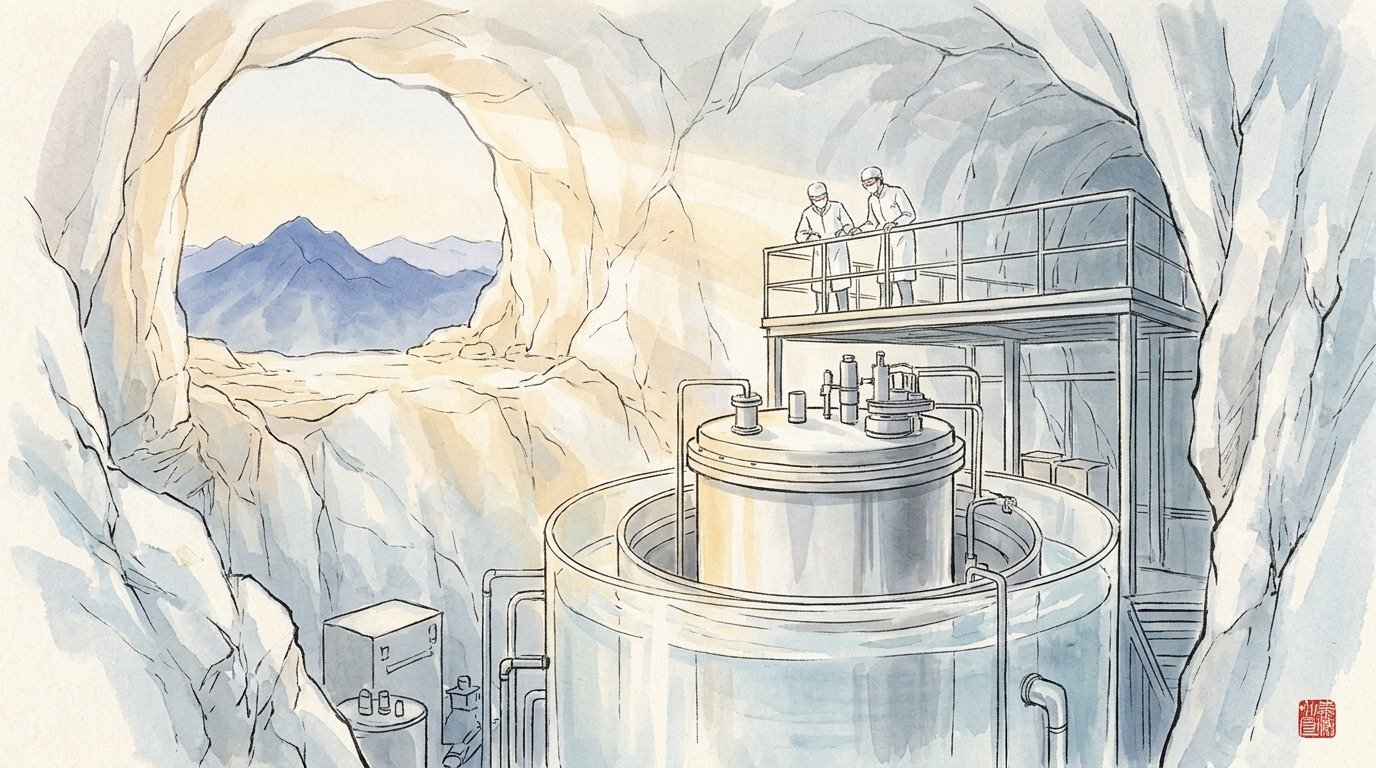
The crown jewel of CJPL-II’s Hall B is the PandaX-4T experiment. Operating inside an enormous 10-metre-tall, 900-tonne ultra-pure water shield, PandaX-4T contains a total liquid xenon inventory of nearly six tonnes, with four tonnes serving as the active fiducial target volume inside the dual-phase TPC. Commissioned in 2021, PandaX-4T pushed China directly into the vanguard of the global multi-tonne dark matter race, operating in parallel with the LZ (LUX-ZEPLIN) 7-tonne detector at SURF and XENONnT at Gran Sasso.
Operating a four-tonne liquid xenon detector requires monumental precision in cryogenic engineering and chemical purity. To prevent electronegative impurities (such as oxygen and water molecules) from capturing ionization electrons drifting upward along the 1.2-metre TPC drift length, the entire xenon volume is continuously circulated through high-temperature zirconium metal-getter purifiers at speeds of hundreds of litres per minute. The electron lifetime—a measure of purity representing how long free electrons can survive before being absorbed—was maintained at greater than 10 milliseconds, allowing ionization electrons to travel the entire vertical height of the chamber with near-zero loss.
In November 2021 and updated through 2024, the PandaX-4T collaboration published its initial physics results in Physical Review Letters. With an initial exposure of nearly one tonne-year, PandaX-4T observed no excess of nuclear recoil events over expected backgrounds. This null result allowed the team to set the world’s most stringent upper limits on the spin-independent WIMP-nucleon scattering cross-section, depressing the exclusion boundary to an astonishingly tiny cross-section of: $$sigma_{text{SI}} < 3.8 times 10^{-47} text{ cm}^2 quad (text{at a WIMP mass of } 40 text{ GeV}/c^2)$$ To put this number into perspective, a cross-section of $10^{-47}text{ cm}^2$ is ten billion times smaller than the cross-section of a typical weak-interaction neutrino collision. PandaX-4T established that if WIMPs exist in this mass range, their interaction probability with atomic nuclei is so exceedingly rare that a typical particle could easily pass through light-years of solid lead without touching a single atom.
More critically, as detector sensitivity continues to improve by another factor of ten, experimentalists are rapidly approaching what physicists term the “Neutrino Floor” (or neutrino fog). At cross-sections below $10^{-48}text{ cm}^2$, coherent elastic neutrino-nucleus scattering (CEvNS) from solar boron-8 neutrinos, diffuse supernova neutrinos, and atmospheric neutrinos begins to produce nuclear recoil events at rates comparable to hypothetical WIMP interactions. Because neutrinos cannot be shielded by 2,400 metres of rock or water tanks, they represent an irreducible ultimate background. PandaX-4T and its future planned upgrade, PandaX-xT (a 30-to-50-tonne liquid xenon facility), are designed to be among the very first instruments on Earth to measure this coherent neutrino fog, transforming dark matter detectors into ultra-sensitive astrophysical neutrino observatories.
8. Beyond Dark Matter, Neutrinoless Double Beta Decay and Nuclear Astrophysics
The vast subterranean expanses of CJPL-II have transformed the facility from a dedicated dark matter outpost into a comprehensive multi-disciplinary underground science centre. Today, CJPL-II hosts flagship research programs across three distinct scientific frontiers:
1. Neutrinoless Double Beta Decay ($0nubetabeta$): Beyond hunting for WIMPs, both the CDEX and PandaX collaborations are utilizing their target isotopes to investigate one of the fundamental open questions in theoretical particle physics: Is the neutrino its own antiparticle (a Majorana fermion)? Certain rare atomic nuclei, such as germanium-76 and xenon-136, can undergo standard two-neutrino double beta decay ($2nubetabeta$), emitting two electrons and two antineutrinos. If neutrinos are Majorana particles, they can theoretically undergo neutrinoless double beta decay, where the two antineutrinos annihilate internally, emitting solely two electrons that carry away the total decay energy ($Q_{betabeta}$). Detecting this process would prove that lepton number conservation is violated in nature, explain the origin of tiny neutrino masses via the seesaw mechanism, and provide the crucial theoretical mechanism (leptogenesis) needed to explain why the universe contains matter rather than an equal balance of matter and antimatter. CDEX-300v (using enriched germanium-76) and PandaX (monitoring xenon-136 decays in its multi-tonne volume) are actively searching for this spike, achieving half-life sensitivity limits exceeding $10^{26}$ years.
2. JUNA (Jinping Underground Nuclear Astrophysics): Installed in CJPL-II Hall A, JUNA is a dedicated low-energy high-intensity accelerator facility operated by the China Institute of Atomic Energy (CIAE). Understanding how chemical elements were forged inside stars requires measuring the nuclear fusion cross-sections of reactions such as $^{12}text{C}(alpha,gamma)^{16}text{O}$ and $^{25}text{Mg}(p,gamma)^{26}text{Al}$ at the actual, extremely low kinetic energies found in stellar cores (the Gamow window). On the Earth’s surface, cosmic-ray background noise makes it impossible to detect these reaction rates, which may yield only one fusion event per day. Inside the quietude of CJPL, JUNA fired intense ion beams into enriched gas targets, successfully measuring several pivotal stellar fusion cross-sections at hydrostatic burning energies for the first time in history, resolving long-standing astronomical discrepancies regarding the production of fluorine and aluminum-26 in asymptotic giant branch (AGB) stars.
3. Deep-Earth Biosphere and Rock Mechanics: The extreme environment of CJPL has attracted geophysicists, seismologists, and microbiologists. Sichuan University and Wuhan Institute of Rock and Soil Mechanics (CAS) operate high-precision strain meters and acoustic sensors to monitor long-term crustal deformation along the Longmenshan fault system. Concurrently, astrobiologists are studying extremophilic microbial life thriving inside deep, isolated marble fractures at high temperatures and pressures, cut off from sunlight and surface organic input for millions of years.
9. Global standing, the Geopolitics of fundamental physics
The rapid rise of CJPL from an improvised tunnel excavation in 2009 to the world’s premier deep-underground research complex by December 2023 represents a fundamental shift in the global balance of basic research. Historically, the United States, Western Europe, and Japan dominated large-scale astroparticle infrastructure. Laboratories like Gran Sasso, Kamioka, and Soudan set the agenda, while developing nations supplied visiting graduate students and manufactured detector components.
Through CJPL, China demonstrated an ability to marry world-scale civil engineering prowess with cutting-edge detector physics. By leveraging the state-owned enterprise construction capabilities of the Yalong River Hydropower Development Corporation alongside the academic talent of Tsinghua, Shanghai Jiao Tong, and Peking universities, Beijing erected a facility with 2,400 metres of rock shielding, 330,000 cubic metres of volume, and horizontal highway access in less than fifteen years. In comparison, proposals to construct equivalent-depth facilities in North America or Europe have faced decades of environmental reviews, funding shortfalls, and logistical bottlenecks.
Today, CJPL functions as an open international research hub, attracting collaborative institutional partnerships from France, the United States, Russia, and Japan. International review panels regularly acknowledge that the combination of ultra-low cosmic-ray muon backgrounds, vast physical space, and high radiopurity infrastructure at Jinping gives China a commanding structural advantage in the ongoing global race to discover dark matter. Whether dark matter is ultimately revealed as a 100-GeV WIMP colliding with a liquid xenon nucleus in PandaX, a light dark photon scattering in a CDEX germanium crystal, or an even more exotic particle, the silence deep beneath Jinping Mountain has provided humanity with its clearest window yet into the dark architecture of our universe.
The strategic comparison between CJPL and the Laboratori Nazionali del Gran Sasso (LNGS) in Abruzzo, Italy, underscores the transformative advantage of depth. Gran Sasso has served as the historic capital of European underground physics since the 1980s, hosting landmark experiments including Borexino, ICARUS, and XENON1T. However, because Gran Sasso sits beneath 1,400 metres of rock (3,800 m.w.e.), it records a residual muon flux of approximately 1.1 muons per square metre per hour. At CJPL, with its 2,400-metre marble cap (6,720 m.w.e.), the muon flux is reduced to approximately 0.007 muons per square metre per hour—more than 150 times quieter than Gran Sasso. For rare-event searches requiring multi-tonne-year exposures where muon-induced spallation neutrons constitute the ultimate background barrier, this two-orders-of-magnitude reduction gives Chinese physicists an unassailable signal-to-noise ratio advantage that no amount of surface shielding or software vetoing can replicate.
Sources
10. Timeline
Excavated through massive formations of metamorphic marble, limestone, and dolomite using giant tunnel-boring machines (TBMs) and precision drilling, the auxiliary transport tunnels were completed in 2008.
The rapid rise of CJPL from an improvised tunnel excavation in 2009 to the world’s premier deep-underground research complex by December 2023 represents a fundamental shift in the global balance of basic research.
Upon the commissioning of CJPL-I in 2010, the laboratory was partitioned between two flagship Chinese dark matter research collaborations, each adopting a distinct and complementary detector technology to probe the dark matter frontier: CDEX and PandaX.
Beginning with a single 1-kilogram crystal (CDEX-1) in 2011, the collaboration systematically developed modular detector arrays encased in a multi-layer passive shielding castle comprising high-purity electrolytic copper, boron-loaded polyethylene, lead, and boil-off liquid nitrogen.
The first-generation detector, PandaX-I, was deployed in 2012 with a 120-kilogram target mass, publishing its first dark matter search results in 2014.
[4] Journal of Semiconductors — Introduction to the China Jinping Underground Laboratory (2013).
By 2014, the spectacular scientific output of PandaX and CDEX demonstrated that CJPL had outgrown its original pilot footprint.
[5] Annual Review of Nuclear and Particle Science — Direct Detection of Dark Matter: APPEC Committee Report (2020).
Commissioned in 2021, PandaX-4T pushed China directly into the vanguard of the global multi-tonne dark matter race, operating in parallel with the LZ (LUX-ZEPLIN) 7-tonne detector at SURF and XENONnT at Gran Sasso.
[8] Nuclear Instruments and Methods in Physics Research A — Background Characterization of the PandaX Dual-Phase Xenon TPC (2022).
Share this article
References
- Nature News — China completes world’s deepest and largest underground laboratory (December 2023). Reporting on the formal operational completion and commissioning of the 330,000-cubic-metre DURF facility at CJPL-II.
- Physical Review Letters — Dark Matter Search Results from the PandaX-4T Commissioning Run (December 2021). Detailing the 0.63 tonne-year exposure results and world-leading limits on WIMP-nucleon cross-sections.
- Physical Review Letters — Limits on Light Weakly Interacting Massive Particles from CDEX-10 (June 2018). Point-contact germanium detector measurements setting sub-GeV dark matter exclusion limits.
- Journal of Semiconductors — Introduction to the China Jinping Underground Laboratory (2013). Technical architectural overview of overburden geology, cosmic muon flux attenuation ($2.0 times 10^{-10} text{ cm}^{-2}text{s}^{-1}$), and Phase I infrastructure.
- Annual Review of Nuclear and Particle Science — Direct Detection of Dark Matter: APPEC Committee Report (2020). Global comparative review benchmark of underground facilities: Gran Sasso, SURF, SNOLAB, and CJPL.
- Chinese Physics C — Jinping Underground Nuclear Astrophysics Experiment (JUNA): Progress and Prospects (2021). Overview of the high-intensity accelerator measuring hydrostatic stellar burning cross-sections in Hall A.
- Science Bulletin — Low radioactivity background measurement and radon suppression in CJPL-II (2021). Engineering analysis of the positive-pressure ventilation system and ten-layer composite wall barrier.
- Nuclear Instruments and Methods in Physics Research A — Background Characterization of the PandaX Dual-Phase Xenon TPC (2022). Comprehensive breakdown of material radiopurity assays, krypton-85 distillation, and water shield neutron moderation.
Related reading

Terafab and the Orbital Foundry
In March 2026 Tesla and SpaceX unveiled Terafab, an ambition to build logic, memory, and advanced packaging in Texas at a scale of one terawatt of compute hardware a year. Behind the Kardashev-scale rhetoric lies a far more revealing story of Intel 14A physics, stacked Texas tax filings, radiator thermodynamics in vacuum, and the hard arithmetic of moving artificial intelligence off the grid.

Against the Grain
The lives and work of thirteen Jewish women scientists, from Gerty Cori and Lise Meitner to Ada Yonath and Shafi Goldwasser. Each of them did foundational work in physics, chemistry, biology, medicine, mathematics, astronomy or computing while facing barriers of sex and antisemitism.

The House of Wisdom in Baghdad and the Sages of the Middle East
In the summer of 762 the second Abbasid ruler, Abu Jafar al-Mansur, chose a site on the west bank of the Tigris, close to the point where that river runs nearest to…