The flier
Ellice Victor Sassoon, always known as Victor, was born on 30 December 1881 in Naples, where his parents had stopped on their way to India.[1][2] He was the son of Edward Elias Sassoon, Jacob’s younger brother, and his wife Leontine, and so a great-grandson of the founder through the “new” house of E. D. Sassoon.[3][4] He was educated at Harrow and Trinity College, Cambridge.[1] Unlike his cousins in England, he would spend his working life in Asia, at the head of a trading firm.
He was a keen aviator. In the First World War he served as a flier in the Royal Naval Air Service, and a crash left him with permanent injuries.[3][5] He had joined the service in November 1914. In February 1915 he crashed an Avro 504 at Dover, and for the rest of his life he was in pain and walked with sticks. The date often given, February 1916, may be that of his wound pension.[1] In 1924 his father died, and Victor inherited both the baronetcy of Bombay and control of E. D. Sassoon & Co.[5][1] Sotheby’s records that after Jacob’s death Edward and his brother Meyer had already begun to move the firm into luxury property in Shanghai.[4]
Leaving India
Victor began in India. He was, the Encyclopaedia Judaica notes, a leader of British Indian Jewry, and he sat in the Indian Legislative Assembly in 1922–23 and again from 1926 to 1929.[3] Scroll.in, drawing on Madhavi Thampi’s history of Indians in China, adds that he served on the Royal Commission on Labour in India.[5] The family’s Bombay mills were still a great enterprise, and Victor upgraded and expanded them.[6]
But he lost faith in India’s future under British rule, at least for a foreign firm. In a Reuters interview in July 1931, quoted by Scroll.in, he said that “the outlook for the foreigner in India did not seem to be bright.” His firm could not compete with Indian mills that had lower overheads. “It looks as if India, under the Swaraj, will have a great deal of trouble,” he said. “On the other hand, China is getting over her civil wars and other troubles. There is a general feeling in India against the foreigner developing the country, which they call ‘exploiting,’ but in China they are only too glad to welcome the foreigner.”[5] When he decided to go, according to Scroll.in, the share capital of E. D. Sassoon & Co. stood at one crore of rupees, and the E. D. Sassoon Banking Company in Hong Kong had a capital of £1 million.[5] In October 1931 he left Bombay for Shanghai, though not without a parting hope for the country he was leaving. “I only trust that everybody in this country will exert every influence to avoid political disturbances,” he told the Straits Times, “and to effect compromises between the communities to this end.” He said he meant to visit India regularly.[5] The Encyclopaedia Judaica records that in 1931 he moved the headquarters of the E. D. Sassoon Banking Company to Shanghai.[3]
Patel, writing nine decades later, sees this as the fatal decision. If the Sassoons had made their peace with Indian society, he suggests, “perhaps they could have followed the path of the Tatas and made their peace with Nehruvian socialism.”[6] Instead, he writes, the family sold its Bombay land “in a huff in the 1930s and 1940s, thereafter retreating to the Bahamas.” That land is now the site of the towers and malls of Mumbai’s business district.[6]
Sassoon House and the Cathay
Thampi, quoted by Scroll.in, calls the family’s move into Shanghai property its “shrewdest move”. In the nineteenth century, she writes, the firm’s profits from real estate were “just about one-nineteenth of their profits from opium.” From the early 1920s, “with the opium business at an end, real estate developed into the most profitable segment of their business empire.”[5] The Sassoons bought prime sites, especially along the waterfront, through companies with names such as the Hua Mao Real Estate Company.[5]
Victor bought the most prominent site on the Bund, a full city block at the corner of Nanjing Road and the waterfront.[7] On it he built Sassoon House. It was an Art Deco tower with a green pyramid roof, finished in 1929.[5][8] In the summary of Kaufman’s book by the novelist Qiu Xiaolong, it stood fifty feet taller than the tallest building in the city at the time. Its hotel took the name that Marco Polo had used for China: Cathay.[7] Its upper floors held the Cathay Hotel, which the Forward, adapting Jonathan Kaufman’s book, calls “the grandest hotel east of Suez.”[9] In March 1930, according to Sotheby’s, Victor moved the headquarters of E. D. Sassoon & Co. into the building.[4] He lived in a suite on the ninth floor.[10] Jonathan Kaufman’s book, as summarised by the Boston Globe, describes deep baths filled with spring water from silver taps, corridors lit by Lalique lamps, and vegetables guaranteed not to have been fertilised with human waste.[10] The New York Times review of Joseph Sassoon’s book recalls that Victor put his initials on the roof, “lest air travelers overhead question who ruled the city’s skyline.”[11]
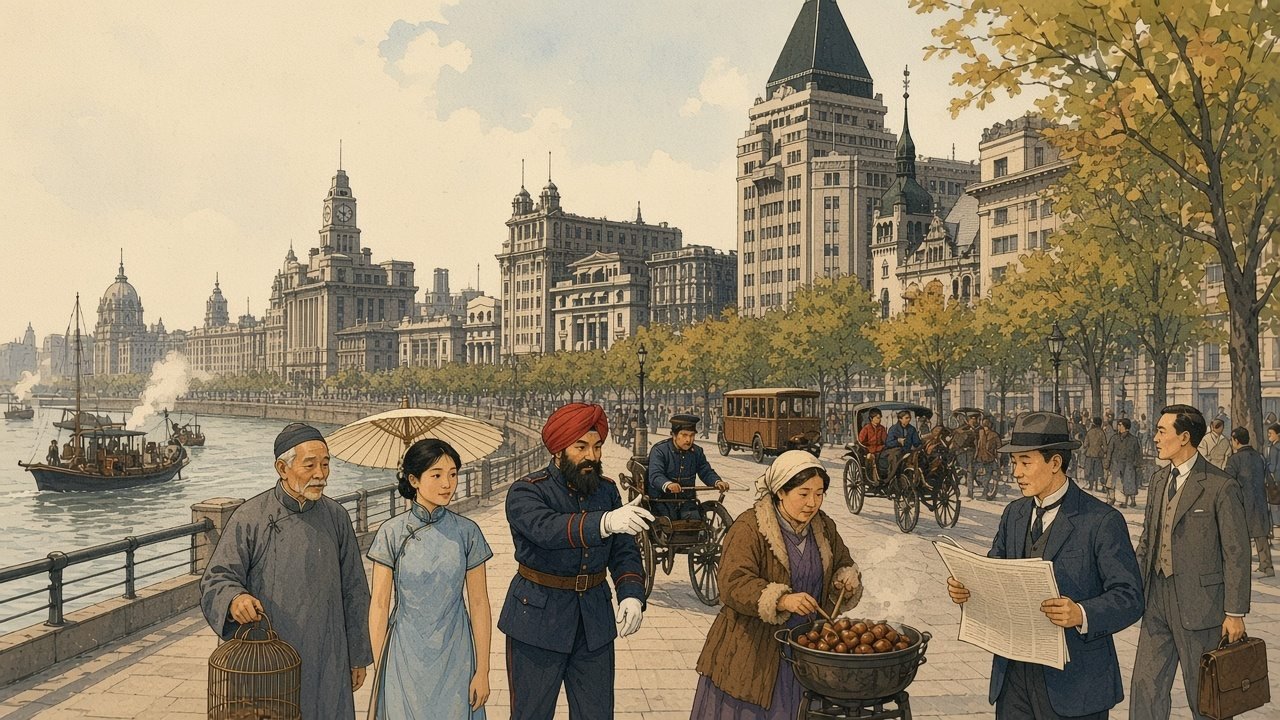
The Cathay was a social machine. Victor entertained Noël Coward and Charlie Chaplin,[9] and in the 1930s Chaplin and Paulette Goddard danced on the sprung floor of the Tower Night Club at the top of the building.[8] Victor gave some of the most famous parties of interwar Shanghai.[9] The American writer Emily Hahn, who wrote for the New Yorker, was his close friend and confidante as well as his lover. Kaufman credits her with seeing in the city’s stark inequality the seeds of the communist victory.[7] Through another lover, the Shanghai writer Shao Xunmei, she came to know left-wing Chinese intellectuals and politicians, among them Zhou Enlai. Victor dismissed her fears. Qiu Xiaolong, summarising Kaufman, suggests that jealousy of her affair with Shao clouded his judgement, and he asks whether Victor might have saved his empire if he had listened.[7]
A city of towers
Sassoon House was only the start. Within a decade, the New York Times writes, Victor had transformed the skyline, working with architects and developers on the first true skyscrapers in the Eastern Hemisphere.[8] One of them, his Embankment Building, would later be used as a reception centre for Jewish refugees.[12] The rivalry with the Kadoories, the clerk-turned-competitor family described in Chapter 8, was part of the spectacle. The Kadoories built the Majestic Hotel and a palatial family house known as Marble Hall. The Cathay, the Hadassah Magazine review of Kaufman’s book notes, was built to eclipse the Majestic. The two families’ parties and their rivalry raised Shanghai’s standing and drew celebrities such as Charles Lindbergh. Elly Kadoorie’s son Lawrence wrote in his diary that “there never was and never will be another city like Shanghai … a place where one could dance all night, go riding at 6 o’clock in the morning, work all day and yet not feel tired.”[13]
Thampi, quoted by Scroll.in, records that in the 1920s and 1930s wealthy Chinese fled to Shanghai from the insecurity of the interior, and that the Sassoons “took advantage of the situation to make even greater profits through the issue of shares and bonds.”[5] Kaufman’s summary goes further: Victor “bankrolled the Nationalist government, defied the Japanese, and saved thousands of Jewish refugees fleeing the Nazi regime.”[7] It is not hard to see why later Chinese accounts treated the Peace Hotel as a symbol of foreign domination. One recent Chinese television series, the Los Angeles Review of Books notes, portrayed Victor as an evil “imperialist” whose fortune came from opium.[7] Scroll.in calls the building “a stark reminder” of what China calls the Century of Humiliation.[5] Both readings are true to part of the story. The Cathay was a monument to the colonial treaty port and to opium money. It was also, by the end of the 1930s, the headquarters of one of the few men in Asia with the means and the will to help Jewish refugees from Europe.
References
OpenClose
- “Setting history straight: discovering the truth about a WW1 aviator, businessman and playboy,” TheGenealogist, 2023 *
- Imperial War Museums, Lives of the First World War, “Ellice Victor Sassoon” *
- “Sassoon,” Encyclopaedia Judaica, 2nd ed. (Detroit: Macmillan Reference, 2007), reprinted at Encyclopedia.com *
- Sotheby’s, “The Sassoons in the Far East” *
- Ajay Kamalakaran, “How the Sassoon family built a business empire in Shanghai from Bombay,” Scroll.in *
- Dinyar Patel, “The Rise and Fall of the Sassoons,” The India Forum, 6 October 2022 *
- Qiu Xiaolong, “History Has Many Cunning Passages: On Jonathan Kaufman’s The Last Kings of Shanghai,” Los Angeles Review of Books *
- Taras Grescoe, “The Man Who Changed the Face of Shanghai,” The New York Times, 2 October 2014 *
- Jonathan Kaufman, “In Shanghai, a refuge for Jews fleeing Nazi Europe,” The Forward, 2020, adapted from The Last Kings of Shanghai *
- “The Last Kings of Shanghai examines the little-known history of two extraordinary dynasties,” The Boston Globe, 2 June 2020 *
- Adam Rathe, “The Rise and Fall of a Great Dynasty,” review of Joseph Sassoon, The Sassoons, The New York Times, 20 October 2022 *
- “The rise and fall of the opium-fueled Sassoon dynasty, the ‘Rothschilds of the East’,” The Times of Israel *
- Stewart Kampel, “The Last Kings of Shanghai: Two Rival Families,” Hadassah Magazine, 17 November 2020 *
The family tree, timeline, places, glossary and select bibliography for the whole history are on the Sassoon index page.